EP0849246B1 - Derivatives of 4-vinyl-4'-alpha-hydroxyethyl-biphenyl - Google Patents
Derivatives of 4-vinyl-4'-alpha-hydroxyethyl-biphenyl Download PDFInfo
- Publication number
- EP0849246B1 EP0849246B1 EP97810972A EP97810972A EP0849246B1 EP 0849246 B1 EP0849246 B1 EP 0849246B1 EP 97810972 A EP97810972 A EP 97810972A EP 97810972 A EP97810972 A EP 97810972A EP 0849246 B1 EP0849246 B1 EP 0849246B1
- Authority
- EP
- European Patent Office
- Prior art keywords
- compound
- process according
- formula
- alkyl
- hydrogen
- Prior art date
- Legal status (The legal status is an assumption and is not a legal conclusion. Google has not performed a legal analysis and makes no representation as to the accuracy of the status listed.)
- Expired - Lifetime
Links
- GOQAMYGZKIQBSV-UHFFFAOYSA-N 1-[4-(4-ethenylphenyl)phenyl]ethanol Chemical group C1=CC(C(O)C)=CC=C1C1=CC=C(C=C)C=C1 GOQAMYGZKIQBSV-UHFFFAOYSA-N 0.000 title claims description 13
- 238000000034 method Methods 0.000 claims description 60
- 150000001875 compounds Chemical class 0.000 claims description 47
- 238000006243 chemical reaction Methods 0.000 claims description 30
- 239000001257 hydrogen Substances 0.000 claims description 25
- 229910052739 hydrogen Inorganic materials 0.000 claims description 25
- 239000011541 reaction mixture Substances 0.000 claims description 19
- 125000004178 (C1-C4) alkyl group Chemical group 0.000 claims description 17
- KDLHZDBZIXYQEI-UHFFFAOYSA-N Palladium Chemical compound [Pd] KDLHZDBZIXYQEI-UHFFFAOYSA-N 0.000 claims description 16
- YFNKIDBQEZZDLK-UHFFFAOYSA-N triglyme Chemical compound COCCOCCOCCOC YFNKIDBQEZZDLK-UHFFFAOYSA-N 0.000 claims description 16
- IYSVFZBXZVPIFA-UHFFFAOYSA-N 1-ethenyl-4-(4-ethenylphenyl)benzene Chemical group C1=CC(C=C)=CC=C1C1=CC=C(C=C)C=C1 IYSVFZBXZVPIFA-UHFFFAOYSA-N 0.000 claims description 15
- 238000004519 manufacturing process Methods 0.000 claims description 15
- 150000002941 palladium compounds Chemical class 0.000 claims description 14
- 150000002431 hydrogen Chemical group 0.000 claims description 13
- QGZKDVFQNNGYKY-UHFFFAOYSA-O Ammonium Chemical compound [NH4+] QGZKDVFQNNGYKY-UHFFFAOYSA-O 0.000 claims description 12
- LCGLNKUTAGEVQW-UHFFFAOYSA-N Dimethyl ether Chemical compound COC LCGLNKUTAGEVQW-UHFFFAOYSA-N 0.000 claims description 12
- 150000001989 diazonium salts Chemical class 0.000 claims description 12
- MTHSVFCYNBDYFN-UHFFFAOYSA-N diethylene glycol Chemical compound OCCOCCO MTHSVFCYNBDYFN-UHFFFAOYSA-N 0.000 claims description 12
- 125000004435 hydrogen atom Chemical group [H]* 0.000 claims description 12
- 239000003112 inhibitor Substances 0.000 claims description 12
- 239000000203 mixture Substances 0.000 claims description 12
- 239000002904 solvent Substances 0.000 claims description 12
- PPBRXRYQALVLMV-UHFFFAOYSA-N Styrene Chemical compound C=CC1=CC=CC=C1 PPBRXRYQALVLMV-UHFFFAOYSA-N 0.000 claims description 10
- -1 alkyl nitrile Chemical class 0.000 claims description 10
- 238000009835 boiling Methods 0.000 claims description 9
- 239000003054 catalyst Substances 0.000 claims description 9
- JOXIMZWYDAKGHI-UHFFFAOYSA-N toluene-4-sulfonic acid Chemical compound CC1=CC=C(S(O)(=O)=O)C=C1 JOXIMZWYDAKGHI-UHFFFAOYSA-N 0.000 claims description 9
- 230000018044 dehydration Effects 0.000 claims description 8
- 238000006297 dehydration reaction Methods 0.000 claims description 8
- 229910052763 palladium Inorganic materials 0.000 claims description 8
- 150000007513 acids Chemical class 0.000 claims description 7
- 125000000229 (C1-C4)alkoxy group Chemical group 0.000 claims description 6
- 125000002853 C1-C4 hydroxyalkyl group Chemical group 0.000 claims description 6
- 239000002202 Polyethylene glycol Substances 0.000 claims description 6
- 229910052794 bromium Inorganic materials 0.000 claims description 6
- 229910052791 calcium Inorganic materials 0.000 claims description 6
- 229910052801 chlorine Inorganic materials 0.000 claims description 6
- WMKGGPCROCCUDY-PHEQNACWSA-N dibenzylideneacetone Chemical compound C=1C=CC=CC=1\C=C\C(=O)\C=C\C1=CC=CC=C1 WMKGGPCROCCUDY-PHEQNACWSA-N 0.000 claims description 6
- 229910052731 fluorine Inorganic materials 0.000 claims description 6
- 229910052736 halogen Inorganic materials 0.000 claims description 6
- 150000002367 halogens Chemical group 0.000 claims description 6
- 239000012442 inert solvent Substances 0.000 claims description 6
- 229910052740 iodine Inorganic materials 0.000 claims description 6
- 229910052749 magnesium Inorganic materials 0.000 claims description 6
- 229920001515 polyalkylene glycol Polymers 0.000 claims description 6
- 229920001223 polyethylene glycol Polymers 0.000 claims description 6
- 229910052700 potassium Inorganic materials 0.000 claims description 6
- 229910052708 sodium Inorganic materials 0.000 claims description 6
- 239000007858 starting material Substances 0.000 claims description 6
- 125000002023 trifluoromethyl group Chemical group FC(F)(F)* 0.000 claims description 6
- 239000002253 acid Substances 0.000 claims description 5
- 150000001412 amines Chemical class 0.000 claims description 5
- 239000000178 monomer Substances 0.000 claims description 5
- 239000003960 organic solvent Substances 0.000 claims description 4
- 239000000376 reactant Substances 0.000 claims description 4
- 150000002940 palladium Chemical class 0.000 claims description 3
- 125000001997 phenyl group Chemical group [H]C1=C([H])C([H])=C(*)C([H])=C1[H] 0.000 claims description 3
- QTBSBXVTEAMEQO-UHFFFAOYSA-M Acetate Chemical compound CC([O-])=O QTBSBXVTEAMEQO-UHFFFAOYSA-M 0.000 claims description 2
- CPELXLSAUQHCOX-UHFFFAOYSA-M Bromide Chemical compound [Br-] CPELXLSAUQHCOX-UHFFFAOYSA-M 0.000 claims description 2
- VEXZGXHMUGYJMC-UHFFFAOYSA-M Chloride anion Chemical compound [Cl-] VEXZGXHMUGYJMC-UHFFFAOYSA-M 0.000 claims description 2
- 229910002651 NO3 Inorganic materials 0.000 claims description 2
- NHNBFGGVMKEFGY-UHFFFAOYSA-N Nitrate Chemical compound [O-][N+]([O-])=O NHNBFGGVMKEFGY-UHFFFAOYSA-N 0.000 claims description 2
- XBDQKXXYIPTUBI-UHFFFAOYSA-M Propionate Chemical compound CCC([O-])=O XBDQKXXYIPTUBI-UHFFFAOYSA-M 0.000 claims description 2
- QAOWNCQODCNURD-UHFFFAOYSA-L Sulfate Chemical compound [O-]S([O-])(=O)=O QAOWNCQODCNURD-UHFFFAOYSA-L 0.000 claims description 2
- 150000001450 anions Chemical class 0.000 claims description 2
- XMBWDFGMSWQBCA-UHFFFAOYSA-N hydrogen iodide Chemical compound I XMBWDFGMSWQBCA-UHFFFAOYSA-N 0.000 claims description 2
- 229910000064 phosphane Inorganic materials 0.000 claims description 2
- ISWSIDIOOBJBQZ-UHFFFAOYSA-N Phenol Chemical compound OC1=CC=CC=C1 ISWSIDIOOBJBQZ-UHFFFAOYSA-N 0.000 claims 2
- AZQWKYJCGOJGHM-UHFFFAOYSA-N para-benzoquinone Natural products O=C1C=CC(=O)C=C1 AZQWKYJCGOJGHM-UHFFFAOYSA-N 0.000 claims 2
- 125000004151 quinonyl group Chemical group 0.000 claims 2
- 239000005922 Phosphane Substances 0.000 claims 1
- XYFCBTPGUUZFHI-UHFFFAOYSA-N Phosphine Chemical compound P XYFCBTPGUUZFHI-UHFFFAOYSA-N 0.000 claims 1
- OJMIONKXNSYLSR-UHFFFAOYSA-N phosphorous acid Chemical compound OP(O)O OJMIONKXNSYLSR-UHFFFAOYSA-N 0.000 claims 1
- QTBSBXVTEAMEQO-UHFFFAOYSA-N Acetic acid Chemical compound CC(O)=O QTBSBXVTEAMEQO-UHFFFAOYSA-N 0.000 description 12
- 239000000243 solution Substances 0.000 description 11
- WFDIJRYMOXRFFG-UHFFFAOYSA-N Acetic anhydride Chemical compound CC(=O)OC(C)=O WFDIJRYMOXRFFG-UHFFFAOYSA-N 0.000 description 9
- 239000000047 product Substances 0.000 description 8
- XLYOFNOQVPJJNP-UHFFFAOYSA-N water Substances O XLYOFNOQVPJJNP-UHFFFAOYSA-N 0.000 description 8
- RANXIKJMWBYSGV-UHFFFAOYSA-N 1-[4-[4-(1-hydroxyethyl)phenyl]phenyl]ethanol Chemical group C1=CC(C(O)C)=CC=C1C1=CC=C(C(C)O)C=C1 RANXIKJMWBYSGV-UHFFFAOYSA-N 0.000 description 7
- 239000006081 fluorescent whitening agent Substances 0.000 description 6
- 238000007341 Heck reaction Methods 0.000 description 5
- 238000001816 cooling Methods 0.000 description 5
- 235000011054 acetic acid Nutrition 0.000 description 4
- 239000007795 chemical reaction product Substances 0.000 description 4
- 238000003756 stirring Methods 0.000 description 4
- 0 CC*(C(C)(CC1)CC1=CC*C)=*C Chemical compound CC*(C(C)(CC1)CC1=CC*C)=*C 0.000 description 3
- LFQSCWFLJHTTHZ-UHFFFAOYSA-N Ethanol Chemical compound CCO LFQSCWFLJHTTHZ-UHFFFAOYSA-N 0.000 description 3
- OKKJLVBELUTLKV-UHFFFAOYSA-N Methanol Chemical compound OC OKKJLVBELUTLKV-UHFFFAOYSA-N 0.000 description 3
- AMQJEAYHLZJPGS-UHFFFAOYSA-N N-Pentanol Chemical compound CCCCCO AMQJEAYHLZJPGS-UHFFFAOYSA-N 0.000 description 3
- 239000002585 base Substances 0.000 description 3
- JFDZBHWFFUWGJE-UHFFFAOYSA-N benzonitrile Chemical compound N#CC1=CC=CC=C1 JFDZBHWFFUWGJE-UHFFFAOYSA-N 0.000 description 3
- 239000006227 byproduct Substances 0.000 description 3
- 238000010992 reflux Methods 0.000 description 3
- ZMCHBSMFKQYNKA-UHFFFAOYSA-N 2-aminobenzenesulfonic acid Chemical compound NC1=CC=CC=C1S(O)(=O)=O ZMCHBSMFKQYNKA-UHFFFAOYSA-N 0.000 description 2
- ZAJAQTYSTDTMCU-UHFFFAOYSA-N 3-aminobenzenesulfonic acid Chemical compound NC1=CC=CC(S(O)(=O)=O)=C1 ZAJAQTYSTDTMCU-UHFFFAOYSA-N 0.000 description 2
- JIGUICYYOYEXFS-UHFFFAOYSA-N 3-tert-butylbenzene-1,2-diol Chemical compound CC(C)(C)C1=CC=CC(O)=C1O JIGUICYYOYEXFS-UHFFFAOYSA-N 0.000 description 2
- XKRFYHLGVUSROY-UHFFFAOYSA-N Argon Chemical compound [Ar] XKRFYHLGVUSROY-UHFFFAOYSA-N 0.000 description 2
- IJGRMHOSHXDMSA-UHFFFAOYSA-N Atomic nitrogen Chemical compound N#N IJGRMHOSHXDMSA-UHFFFAOYSA-N 0.000 description 2
- FERIUCNNQQJTOY-UHFFFAOYSA-N Butyric acid Chemical compound CCCC(O)=O FERIUCNNQQJTOY-UHFFFAOYSA-N 0.000 description 2
- KFZMGEQAYNKOFK-UHFFFAOYSA-N Isopropanol Chemical compound CC(C)O KFZMGEQAYNKOFK-UHFFFAOYSA-N 0.000 description 2
- IOVCWXUNBOPUCH-UHFFFAOYSA-M Nitrite anion Chemical compound [O-]N=O IOVCWXUNBOPUCH-UHFFFAOYSA-M 0.000 description 2
- VYPSYNLAJGMNEJ-UHFFFAOYSA-N Silicium dioxide Chemical compound O=[Si]=O VYPSYNLAJGMNEJ-UHFFFAOYSA-N 0.000 description 2
- VMHLLURERBWHNL-UHFFFAOYSA-M Sodium acetate Chemical compound [Na+].CC([O-])=O VMHLLURERBWHNL-UHFFFAOYSA-M 0.000 description 2
- DKGAVHZHDRPRBM-UHFFFAOYSA-N Tert-Butanol Chemical compound CC(C)(C)O DKGAVHZHDRPRBM-UHFFFAOYSA-N 0.000 description 2
- 229940040526 anhydrous sodium acetate Drugs 0.000 description 2
- 230000015572 biosynthetic process Effects 0.000 description 2
- KBPLFHHGFOOTCA-UHFFFAOYSA-N caprylic alcohol Natural products CCCCCCCCO KBPLFHHGFOOTCA-UHFFFAOYSA-N 0.000 description 2
- 125000003178 carboxy group Chemical group [H]OC(*)=O 0.000 description 2
- 238000002425 crystallisation Methods 0.000 description 2
- MWKFXSUHUHTGQN-UHFFFAOYSA-N decan-1-ol Chemical compound CCCCCCCCCCO MWKFXSUHUHTGQN-UHFFFAOYSA-N 0.000 description 2
- 239000008367 deionised water Substances 0.000 description 2
- 125000000664 diazo group Chemical group [N-]=[N+]=[*] 0.000 description 2
- XBDQKXXYIPTUBI-UHFFFAOYSA-N dimethylselenoniopropionate Natural products CCC(O)=O XBDQKXXYIPTUBI-UHFFFAOYSA-N 0.000 description 2
- ZUOUZKKEUPVFJK-UHFFFAOYSA-N diphenyl Chemical compound C1=CC=CC=C1C1=CC=CC=C1 ZUOUZKKEUPVFJK-UHFFFAOYSA-N 0.000 description 2
- 238000004821 distillation Methods 0.000 description 2
- LQZZUXJYWNFBMV-UHFFFAOYSA-N dodecan-1-ol Chemical compound CCCCCCCCCCCCO LQZZUXJYWNFBMV-UHFFFAOYSA-N 0.000 description 2
- 238000001914 filtration Methods 0.000 description 2
- ZSIAUFGUXNUGDI-UHFFFAOYSA-N hexan-1-ol Chemical compound CCCCCCO ZSIAUFGUXNUGDI-UHFFFAOYSA-N 0.000 description 2
- 239000000155 melt Substances 0.000 description 2
- BDAGIHXWWSANSR-UHFFFAOYSA-N methanoic acid Natural products OC=O BDAGIHXWWSANSR-UHFFFAOYSA-N 0.000 description 2
- KJIFKLIQANRMOU-UHFFFAOYSA-N oxidanium;4-methylbenzenesulfonate Chemical compound O.CC1=CC=C(S(O)(=O)=O)C=C1 KJIFKLIQANRMOU-UHFFFAOYSA-N 0.000 description 2
- 150000002989 phenols Chemical class 0.000 description 2
- BDERNNFJNOPAEC-UHFFFAOYSA-N propan-1-ol Chemical compound CCCO BDERNNFJNOPAEC-UHFFFAOYSA-N 0.000 description 2
- 150000004053 quinones Chemical class 0.000 description 2
- LPXPTNMVRIOKMN-UHFFFAOYSA-M sodium nitrite Chemical compound [Na+].[O-]N=O LPXPTNMVRIOKMN-UHFFFAOYSA-M 0.000 description 2
- 239000000126 substance Substances 0.000 description 2
- 125000000020 sulfo group Chemical group O=S(=O)([*])O[H] 0.000 description 2
- 239000000725 suspension Substances 0.000 description 2
- 238000003786 synthesis reaction Methods 0.000 description 2
- HVLLSGMXQDNUAL-UHFFFAOYSA-N triphenyl phosphite Chemical compound C=1C=CC=CC=1OP(OC=1C=CC=CC=1)OC1=CC=CC=C1 HVLLSGMXQDNUAL-UHFFFAOYSA-N 0.000 description 2
- RIOQSEWOXXDEQQ-UHFFFAOYSA-N triphenylphosphine Chemical compound C1=CC=CC=C1P(C=1C=CC=CC=1)C1=CC=CC=C1 RIOQSEWOXXDEQQ-UHFFFAOYSA-N 0.000 description 2
- DNIAPMSPPWPWGF-GSVOUGTGSA-N (R)-(-)-Propylene glycol Chemical compound C[C@@H](O)CO DNIAPMSPPWPWGF-GSVOUGTGSA-N 0.000 description 1
- XIRPMPKSZHNMST-UHFFFAOYSA-N 1-ethenyl-2-phenylbenzene Chemical group C=CC1=CC=CC=C1C1=CC=CC=C1 XIRPMPKSZHNMST-UHFFFAOYSA-N 0.000 description 1
- UMSGIWAAMHRVQI-UHFFFAOYSA-N 1-ethyl-4-(4-ethylphenyl)benzene Chemical group C1=CC(CC)=CC=C1C1=CC=C(CC)C=C1 UMSGIWAAMHRVQI-UHFFFAOYSA-N 0.000 description 1
- OSWFIVFLDKOXQC-UHFFFAOYSA-N 4-(3-methoxyphenyl)aniline Chemical compound COC1=CC=CC(C=2C=CC(N)=CC=2)=C1 OSWFIVFLDKOXQC-UHFFFAOYSA-N 0.000 description 1
- UXVMQQNJUSDDNG-UHFFFAOYSA-L Calcium chloride Chemical compound [Cl-].[Cl-].[Ca+2] UXVMQQNJUSDDNG-UHFFFAOYSA-L 0.000 description 1
- PMZURENOXWZQFD-UHFFFAOYSA-L Sodium Sulfate Chemical compound [Na+].[Na+].[O-]S([O-])(=O)=O PMZURENOXWZQFD-UHFFFAOYSA-L 0.000 description 1
- 125000001931 aliphatic group Chemical group 0.000 description 1
- 229910052783 alkali metal Inorganic materials 0.000 description 1
- 229960003116 amyl nitrite Drugs 0.000 description 1
- 239000007864 aqueous solution Substances 0.000 description 1
- 229910052786 argon Inorganic materials 0.000 description 1
- 239000004305 biphenyl Substances 0.000 description 1
- 235000010290 biphenyl Nutrition 0.000 description 1
- 239000001273 butane Substances 0.000 description 1
- 239000011575 calcium Substances 0.000 description 1
- 239000001110 calcium chloride Substances 0.000 description 1
- 229910001628 calcium chloride Inorganic materials 0.000 description 1
- 238000005352 clarification Methods 0.000 description 1
- 239000002826 coolant Substances 0.000 description 1
- 229920001577 copolymer Polymers 0.000 description 1
- 239000012024 dehydrating agents Substances 0.000 description 1
- 238000006356 dehydrogenation reaction Methods 0.000 description 1
- 150000008049 diazo compounds Chemical class 0.000 description 1
- 239000006185 dispersion Substances 0.000 description 1
- 239000012065 filter cake Substances 0.000 description 1
- 235000019253 formic acid Nutrition 0.000 description 1
- 239000011261 inert gas Substances 0.000 description 1
- 239000000543 intermediate Substances 0.000 description 1
- 229960004592 isopropanol Drugs 0.000 description 1
- 239000000463 material Substances 0.000 description 1
- 239000002808 molecular sieve Substances 0.000 description 1
- TVMXDCGIABBOFY-UHFFFAOYSA-N n-Octanol Natural products CCCCCCCC TVMXDCGIABBOFY-UHFFFAOYSA-N 0.000 description 1
- CSDTZUBPSYWZDX-UHFFFAOYSA-N n-pentyl nitrite Chemical compound CCCCCON=O CSDTZUBPSYWZDX-UHFFFAOYSA-N 0.000 description 1
- 229910052757 nitrogen Inorganic materials 0.000 description 1
- 150000003002 phosphanes Chemical class 0.000 description 1
- AQSJGOWTSHOLKH-UHFFFAOYSA-N phosphite(3-) Chemical class [O-]P([O-])[O-] AQSJGOWTSHOLKH-UHFFFAOYSA-N 0.000 description 1
- 239000002244 precipitate Substances 0.000 description 1
- 239000001294 propane Substances 0.000 description 1
- 235000019260 propionic acid Nutrition 0.000 description 1
- IUVKMZGDUIUOCP-BTNSXGMBSA-N quinbolone Chemical compound O([C@H]1CC[C@H]2[C@H]3[C@@H]([C@]4(C=CC(=O)C=C4CC3)C)CC[C@@]21C)C1=CCCC1 IUVKMZGDUIUOCP-BTNSXGMBSA-N 0.000 description 1
- 239000000377 silicon dioxide Substances 0.000 description 1
- 239000011734 sodium Chemical group 0.000 description 1
- URGAHOPLAPQHLN-UHFFFAOYSA-N sodium aluminosilicate Chemical compound [Na+].[Al+3].[O-][Si]([O-])=O.[O-][Si]([O-])=O URGAHOPLAPQHLN-UHFFFAOYSA-N 0.000 description 1
- 235000010288 sodium nitrite Nutrition 0.000 description 1
- 229910052938 sodium sulfate Inorganic materials 0.000 description 1
- 235000011152 sodium sulphate Nutrition 0.000 description 1
- 239000007787 solid Substances 0.000 description 1
- QAOWNCQODCNURD-UHFFFAOYSA-N sulfuric acid Substances OS(O)(=O)=O QAOWNCQODCNURD-UHFFFAOYSA-N 0.000 description 1
- HRXKRNGNAMMEHJ-UHFFFAOYSA-K trisodium citrate Chemical compound [Na+].[Na+].[Na+].[O-]C(=O)CC(O)(CC([O-])=O)C([O-])=O HRXKRNGNAMMEHJ-UHFFFAOYSA-K 0.000 description 1
- 229920002554 vinyl polymer Polymers 0.000 description 1
Classifications
-
- C—CHEMISTRY; METALLURGY
- C07—ORGANIC CHEMISTRY
- C07C—ACYCLIC OR CARBOCYCLIC COMPOUNDS
- C07C309/00—Sulfonic acids; Halides, esters, or anhydrides thereof
- C07C309/01—Sulfonic acids
- C07C309/28—Sulfonic acids having sulfo groups bound to carbon atoms of six-membered aromatic rings of a carbon skeleton
- C07C309/29—Sulfonic acids having sulfo groups bound to carbon atoms of six-membered aromatic rings of a carbon skeleton of non-condensed six-membered aromatic rings
- C07C309/32—Sulfonic acids having sulfo groups bound to carbon atoms of six-membered aromatic rings of a carbon skeleton of non-condensed six-membered aromatic rings containing at least two non-condensed six-membered aromatic rings in the carbon skeleton
-
- C—CHEMISTRY; METALLURGY
- C07—ORGANIC CHEMISTRY
- C07C—ACYCLIC OR CARBOCYCLIC COMPOUNDS
- C07C1/00—Preparation of hydrocarbons from one or more compounds, none of them being a hydrocarbon
- C07C1/20—Preparation of hydrocarbons from one or more compounds, none of them being a hydrocarbon starting from organic compounds containing only oxygen atoms as heteroatoms
- C07C1/24—Preparation of hydrocarbons from one or more compounds, none of them being a hydrocarbon starting from organic compounds containing only oxygen atoms as heteroatoms by elimination of water
-
- C—CHEMISTRY; METALLURGY
- C07—ORGANIC CHEMISTRY
- C07C—ACYCLIC OR CARBOCYCLIC COMPOUNDS
- C07C15/00—Cyclic hydrocarbons containing only six-membered aromatic rings as cyclic parts
- C07C15/40—Cyclic hydrocarbons containing only six-membered aromatic rings as cyclic parts substituted by unsaturated carbon radicals
- C07C15/50—Cyclic hydrocarbons containing only six-membered aromatic rings as cyclic parts substituted by unsaturated carbon radicals polycyclic non-condensed
-
- C—CHEMISTRY; METALLURGY
- C07—ORGANIC CHEMISTRY
- C07C—ACYCLIC OR CARBOCYCLIC COMPOUNDS
- C07C29/00—Preparation of compounds having hydroxy or O-metal groups bound to a carbon atom not belonging to a six-membered aromatic ring
- C07C29/60—Preparation of compounds having hydroxy or O-metal groups bound to a carbon atom not belonging to a six-membered aromatic ring by elimination of -OH groups, e.g. by dehydration
-
- C—CHEMISTRY; METALLURGY
- C07—ORGANIC CHEMISTRY
- C07C—ACYCLIC OR CARBOCYCLIC COMPOUNDS
- C07C303/00—Preparation of esters or amides of sulfuric acids; Preparation of sulfonic acids or of their esters, halides, anhydrides or amides
- C07C303/02—Preparation of esters or amides of sulfuric acids; Preparation of sulfonic acids or of their esters, halides, anhydrides or amides of sulfonic acids or halides thereof
- C07C303/22—Preparation of esters or amides of sulfuric acids; Preparation of sulfonic acids or of their esters, halides, anhydrides or amides of sulfonic acids or halides thereof from sulfonic acids, by reactions not involving the formation of sulfo or halosulfonyl groups; from sulfonic halides by reactions not involving the formation of halosulfonyl groups
-
- C—CHEMISTRY; METALLURGY
- C07—ORGANIC CHEMISTRY
- C07C—ACYCLIC OR CARBOCYCLIC COMPOUNDS
- C07C33/00—Unsaturated compounds having hydroxy or O-metal groups bound to acyclic carbon atoms
- C07C33/28—Alcohols containing only six-membered aromatic rings as cyclic part with unsaturation outside the aromatic rings
-
- C—CHEMISTRY; METALLURGY
- C07—ORGANIC CHEMISTRY
- C07C—ACYCLIC OR CARBOCYCLIC COMPOUNDS
- C07C2531/00—Catalysts comprising hydrides, coordination complexes or organic compounds
- C07C2531/02—Catalysts comprising hydrides, coordination complexes or organic compounds containing organic compounds or metal hydrides
- C07C2531/025—Sulfonic acids
Definitions
- the present invention relates to new compounds which are useful as intermediates for the production of fluorescent whitening agents and to a process for their production.
- a further known process for the production of 4,4'-divinyl-biphenyl is that described in JP 08003079.
- 4,4'-diethyl-biphenyl is contacted with a dehydrogenation catalyst in the presence of steam; a cooling medium is rapidly added to the gaseous reaction product containing 4,4'-divinyl-biphenyl; and a solution or dispersion containing the 4,4'-divinyl-biphenyl is formed.
- the compound 4,4'-divinyl-biphenyl is known for use as a starting material for the production of copolymers with other monomers such as styrene. It is also possible to use 4,4'-divinyl-biphenyl as a starting material for certain fluorescent whitening agents.
- 4,4'-divinyl-biphenyl may be reacted, in the presence of a palladium compound, according to the Heck reaction, with diazo compounds to form distyryl-diaryl fluorescent whitening agents. If so used in the Heck reaction, however, there would be obtained only the corresponding symmetrical distyryl-diaryl fluorescent whitening agents.
- the present invention provides, as a first aspect, a new class of vinyl-biphenyl compounds which are useful for the production of asymmetrical or symmetrical distyryl-diaryl fluorescent whitening agents.
- the present invention provides compounds having the formula: in which R is hydrogen or C 1 -C 4 alkyl, preferably hydrogen, and Y is hydrogen, C 1 -C 4 alkyl, C 1 -C 4 alkoxy, CF 3 , halogen (F, Cl, Br or I) or SO 3 M in which M is hydrogen, Na, K, Ca, Mg, ammonium, mono-, di-, tri- or tetra-C 1 -C 4 alkylammonium, mono-, di- or tri-hydroxyalkylammonium or ammonium that is di- or tri-substituted with a mixture of C 1 -C 4 alkyl and C 1 -C 4 hydroxyalkyl groups.
- Y is hydrogen.
- the preferred compound of formula (1) is 4-vinyl-4'- ⁇ -hydroxyethyl-biphenyl.
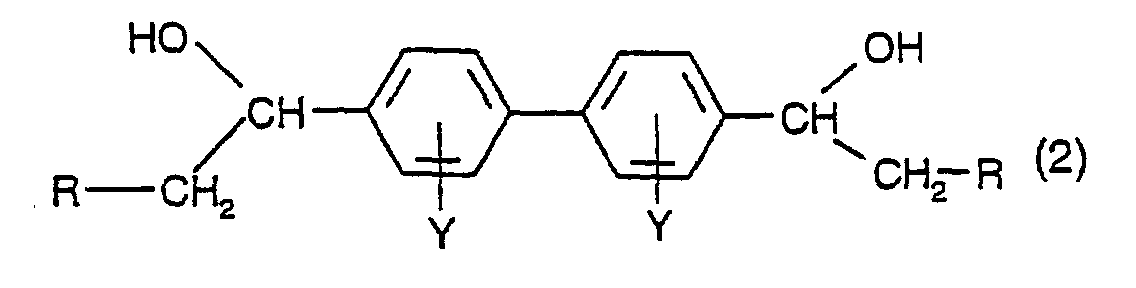
- the present invention also provides a process for the production of a compound of formula (1), comprising partially dehydrating a compound having the formula (2):
- R and Y have their previous significance, at a temperature in the range of from 140 to 260°C., preferably in the range of from 180 to 220°C., in a high-boiling inert solvent.
- the solvent used is preferably a polyalkylene glycol or a di-alkyl ether thereof, preferably a polyethylene glycol or a dimethyl ether thereof, especially diethylene glycol or triethylene glycol-dimethyl ether. If an acid-free solvent such as triethylene glycol-dimethyl ether is used, then a minor amount of an acidic compound such as p-toluene sulfonic acid is preferably present during the partial dehydation process according to the invention.
- the partial dehydation process according to the second aspect of the invention is preferably conducted at normal pressure and in the presence of a effective amount of a compound which is an inhibitor of the polymerisation of styrene monomers.
- a compound which is an inhibitor of the polymerisation of styrene monomers include quinones, hindered phenols and amines.
- the preferred polymerisation inhibitor is tert.-butylpyrocatechol.
- the reaction temperature used in the partial dehydation process according to the invention is preferably held in the range of from 180 to 220°C. and the content of the reaction mixture is monitored, and the reaction is stopped as soon as the optimal amount of the product of formula (2) is detected in the reaction mixture.
- a process for the production of a compound having the formula: in which R and Y have their previous significance comprising dehydrating a compound having the formula (1), at a temperature in the range of from 140 to 260°C., preferably in the range of from 180 to 220°C., in a high-boiling inert solvent.
- the solvent used is preferably a polyalkylene glycol or an di-alkyl ether thereof, preferably a polyethylene glycol or a dimethyl ether thereof, especially diethylene glycol or triethylene glycol-dimethyl ether. If an acid-free solvent such as triethylene glycol-dimethyl ether is used, then a minor amount of an acidic compound such as p-toluene sulfonic acid is preferably present during the partial dehydation process according to the invention.
- the dehydation process according to the third aspect of the present invention is preferably conducted at normal pressure and in the presence of a effective amount of a compound which is an inhibitor of the polymerisation of styrene monomers.
- a compound which is an inhibitor of the polymerisation of styrene monomers include quinones, hindered phenols and amines.
- the preferred polymerisation inhibitor is tert.-butylpyrocatechol.
- the preferred starting material of formula (2) is 4-vinyl-4'- ⁇ -hydroxyethyl-biphenyl which is dehydrated according to the process of the third aspect of the present invention to produce 4,4'-divinyl-biphenyl.
- a fourth aspect of the present invention comprises a process for the production of asymmetric or symmetric compounds having the formula: in which Y has its previous significance and R 1 and R 2 are the same or different and each is a phenyl group, optionally substituted with one or more groups of formula SO 3 M in which M has its previous significance, which process comprises:
- Step b) of the process the dehydration of the compound of formula (5) to the compound of formula (6), is conveniently conducted according to the dehydration procedure described in relation to the process for the production of a compound of formula (3), comprising dehydrating a compound having the formula(1).
- reaction of a compound having the formula (1) with a diazonium compound having the formula R 1 -N 2 X ⁇ and the reaction of a compound having the formula (6) with a diazonium compound having the formula R 2 -N 2 X ⁇ , viz. steps a) and c) of the process, are each conducted under the conditions of the Heck reaction, namely in the presence of a palladium compound, as catalyst.
- the reaction is conducted in an organic solvent such as water, an aliphatic alcohol or an aliphatic acid.
- palladium compound catalysts include inorganic palladium salts such as the chloride, bromide, iodide, nitrate, sulfate, acetate or propionate, and mixtures thereof.
- the palladium compound may also be used in the form of a complex.
- Suitable complex formers include alkyl nitriles, such as C 1 -C 4 alkylnitriles, aryl nitrites such as benzonitrile, phosphites such as triphenyl phosphite, triaryl phosphanes such as triphenyl phosphane or the mono-, di- or tri-sodium salt thereof, bis(diarylphosphane)-alkanes such as bis(diarylphosphane)-methane, -ethane, -propane or -butane, trihetarylphosphanes such as trifurylphosphane and bis(dibenzalacetone).
- the organic complex formers may be substituted with one or more water-solubilising groups such as sulfo groups or carboxyl groups.
- the preferred palladium compound catalyst is palladium[bis(dibenzalacetone)] 2 .
- the palladium compound catalyst used contains one or more water-solubilising groups such as sulfo groups or carboxyl groups.
- the reaction steps a) and c) are conducted in an organic solvent, especially in a C 1 -C 12 alcohol or in a C 1 -C 4 alkanoic acid.
- C 1 -C 12 alcohols include methanol, ethanol, n-propanol, iso-propanol, t-butyl alcohol, n-pentanol, n-hexanol, n-octanol, n-decanol and n-dodecanol.
- C 1 -C 4 alkanoic acids which may be used include formic acid, acetic acid, propionic acid and n-butyric acid.
- the palladium compound catalyst is preferably used in an amount of 0.001 to 5 mole percent, more preferably 0.005 to 0.5 mole percent, based on the reactant of formula (1) or (6), respectively.
- the reaction temperature in steps a) and c) preferably ranges from 0 to 100°C., especially from 10 to 80°C.
- the palladium catalyst is preferably recovered for re-use, by methods which are well-known.
- the diazonium compounds having the formula R 1 -N 2 X ⁇ or R 2 -N 2 X ⁇ in which R 1 , R 2 and X ⁇ have their previous significance, used as respective reactants in steps a) and c), are known compounds and may be produced by methods known per se.
- the said diazonium compounds may be produced by reacting the corresponding amines of formula R 1 -NH 2 or R 2 -NH 2 with an alkali metal nitrite or with an alkyl nitrite in the presence an acid in aqueous or in organic solution. If the diazotisation is conducted in organic solution, it is preferred that the water, produced as a by-product of the diazotisation reaction, is removed as it is formed. The removal of such water may be conveniently conducted by effecting the diazotisation in the presence of water-binding materials such as acetic anhydride, sodium sulfate, calcium chloride or molecular sieves.
- water-binding materials such as acetic anhydride, sodium sulfate, calcium chloride or molecular sieves.
- the compounds of formula (5) are new compounds per se and, as such, form a further aspect of the present invention.
- the cooled reaction solution is poured slowly, with stirring, into 2 litres of deionised water containing 100 mg. of tert.-butylpyrocatechol.
- the reaction products are precipitated and are filtered off.
- the separated precipitate is washed with 2 litres of deionised water containing 100 mg. of tert.-butylpyrocatechol and re-filtered.
- the moist filter-cake is then dried at 20°C. under vacuum for 3 days.
- the two main products, 4,4'-divinyl-biphenyl and 4-vinyl-4'- ⁇ -hydroxyethyl-biphenyl are separated from one another on a silica column using a weakly basic solvent.
- acetic anhydride 200 g are added, dropwise, over 3 hours, to the diazo suspension obtained in step A), whereupon a weakly exothermic reaction takes place.
- the reaction mixture is stirred for 1 hour, 32.8 g of anhydrous sodium acetate are added, the whole is stirred well, treated with 1 g of palladium[bis(dibenzalacetone)] 2 and, after 5 minutes, 45 g of 4-vinyl-4'- ⁇ -hydroxyethyl-biphenyl and 0.05 g of tert-butyl-pyrocatechol are added.
- the reaction mixture is stirred at 18-20°C. for 10 hours, heated to 40°C. and held at this temperature for a further 5 hours.
- the dried product from step B) is stirred into 750 g of triethylene glycol dimethylether and 1 g of tert-butyl-pyrocatechol and 0.2 g of toluene-4-sulfonic acid are added.
- the reaction mixture is then heated, with stirring.
- the dehydration begins when the reaction mixture reaches a temperature above 180°C. and continues until the reaction mixture attains the boiling point (224-227°C.) of the triethylene glycol dimethylether.
- the reaction mixture is held at the reflux temperature for 2 hours, then it is cooled and neutralised by adding a base to give the product of formula:
- step D 20 g of acetic anhydride are added, dropwise, over 2 hours, to the diazo suspension obtained in step D), whereupon a weakly exothermic reaction takes place.
- the reaction mixture is stirred for 1 hour, 32.8 g of anhydrous sodium acetate are added, the whole is stirred well, treated with 1 g of palladium[bis(dibenzalacetone)] 2 and, after 5 minutes, the reaction mixture is combined with that from step C).
- the reaction mixture is stirred at 18-20°C. for 10 hours, heated to 40°C. and held at this temperature for a further 5 hours.
- the volatile components namely amyl alcohol, acetic acid and triethylene glycol dimethylether are removed by distillation under vacuum.
- the melt so obtained is made up to 300 mls volume by adding water and heated to 90°C.
- the insoluble components are separated by clarification. Crystallisation of the reaction product from the solution is induced by cooling the solution to 15°C. using a ramp. Finally, the product which crystallises out is separated by filtration, washed and dried under vacuum. In this way, 75 g of the compound of formula: are obtained, representing a total yield of 66%, based on the weight of vinyl compound used.
Landscapes
- Chemical & Material Sciences (AREA)
- Organic Chemistry (AREA)
- Chemical Kinetics & Catalysis (AREA)
- Organic Low-Molecular-Weight Compounds And Preparation Thereof (AREA)
- Low-Molecular Organic Synthesis Reactions Using Catalysts (AREA)
Description
- The present invention relates to new compounds which are useful as intermediates for the production of fluorescent whitening agents and to a process for their production.
- In US Patent 2 465 486, a process is described for the production of 4,4'-divinyl-biphenyl. This process comprises dehydrating 4,4'-di-(α-hydroxyethyl)-biphenyl in the presence of a dehydrating agent. The reaction is preferably conducted in an atmosphere of inert gas, at reduced pressure and at elevated temperature. The gaseous 4,4'-divinyl-biphenyl so obtained is chilled to convert it to the solid state.
- A further known process for the production of 4,4'-divinyl-biphenyl is that described in JP 08003079. In this process, 4,4'-diethyl-biphenyl is contacted with a dehydrogenation catalyst in the presence of steam; a cooling medium is rapidly added to the gaseous reaction product containing 4,4'-divinyl-biphenyl; and a solution or dispersion containing the 4,4'-divinyl-biphenyl is formed.
- The compound 4,4'-divinyl-biphenyl is known for use as a starting material for the production of copolymers with other monomers such as styrene. It is also possible to use 4,4'-divinyl-biphenyl as a starting material for certain fluorescent whitening agents. Thus, 4,4'-divinyl-biphenyl may be reacted, in the presence of a palladium compound, according to the Heck reaction, with diazo compounds to form distyryl-diaryl fluorescent whitening agents. If so used in the Heck reaction, however, there would be obtained only the corresponding symmetrical distyryl-diaryl fluorescent whitening agents.
- Chemical Abstracts 87 22792h (1977) and Chemical Substance Index, compound [63137-35-9] disclose compounds of the following formula (4) wherein R1 and R2 are sulfophenyl.
- The present invention provides, as a first aspect, a new class of vinyl-biphenyl compounds which are useful for the production of asymmetrical or symmetrical distyryl-diaryl fluorescent whitening agents.
- Accordingly, the present invention provides compounds having the formula:in which R is hydrogen or C1-C4alkyl, preferably hydrogen, and Y is hydrogen, C1-C4alkyl, C1-C4alkoxy, CF3, halogen (F, Cl, Br or I) or SO3M in which M is hydrogen, Na, K, Ca, Mg, ammonium, mono-, di-, tri- or tetra-C1-C4alkylammonium, mono-, di- or tri-hydroxyalkylammonium or ammonium that is di- or tri-substituted with a mixture of C1-C4alkyl and C1-C4hydroxyalkyl groups. Preferably Y is hydrogen.

- The preferred compound of formula (1) is 4-vinyl-4'-α-hydroxyethyl-biphenyl.
- The present invention also provides a process for the production of a compound of formula (1), comprising partially dehydrating a compound having the formula (2):
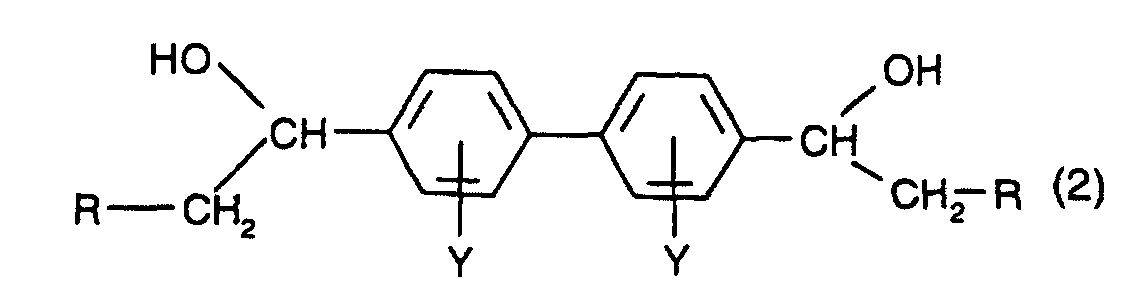
- In which R and Y have their previous significance, at a temperature in the range of from 140 to 260°C., preferably in the range of from 180 to 220°C., in a high-boiling inert solvent.
- The solvent used is preferably a polyalkylene glycol or a di-alkyl ether thereof, preferably a polyethylene glycol or a dimethyl ether thereof, especially diethylene glycol or triethylene glycol-dimethyl ether. If an acid-free solvent such as triethylene glycol-dimethyl ether is used, then a minor amount of an acidic compound such as p-toluene sulfonic acid is preferably present during the partial dehydation process according to the invention.
- The partial dehydation process according to the second aspect of the invention is preferably conducted at normal pressure and in the presence of a effective amount of a compound which is an inhibitor of the polymerisation of styrene monomers. Examples of such polymerisation inhibitors include quinones, hindered phenols and amines. The preferred polymerisation inhibitor is tert.-butylpyrocatechol.
- At dehydration temperatures above 200°C., the product of formula (1) begins to dehydrate to form 4,4'-divinyl-biphenyl. Accordingly, the reaction temperature used in the partial dehydation process according to the invention is preferably held in the range of from 180 to 220°C. and the content of the reaction mixture is monitored, and the reaction is stopped as soon as the optimal amount of the product of formula (2) is detected in the reaction mixture.
- In addition to the partial dehydration process according to the present invention for the production of a compound of formula (1), other possible routes are available for obtaining a compound of formula (1). The various routes are summarised in the following scheme:

- As a third aspect of the present invention, there is provided a process for the production of a compound having the formula:in which R and Y have their previous significance, comprising dehydrating a compound having the formula (1), at a temperature in the range of from 140 to 260°C., preferably in the range of from 180 to 220°C., in a high-boiling inert solvent.
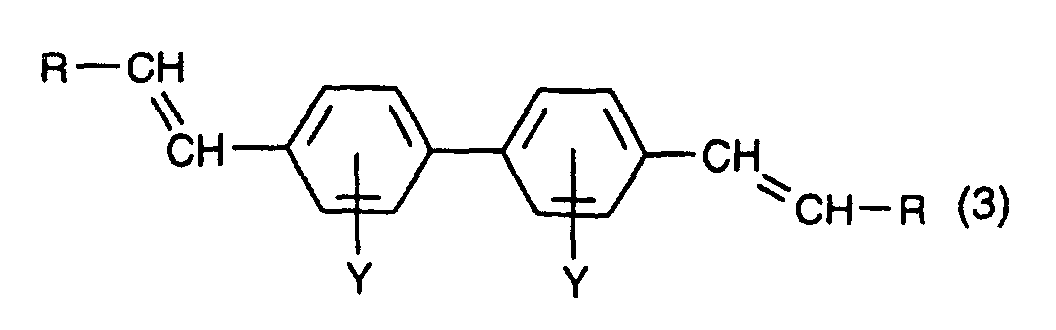
- The solvent used is preferably a polyalkylene glycol or an di-alkyl ether thereof, preferably a polyethylene glycol or a dimethyl ether thereof, especially diethylene glycol or triethylene glycol-dimethyl ether. If an acid-free solvent such as triethylene glycol-dimethyl ether is used, then a minor amount of an acidic compound such as p-toluene sulfonic acid is preferably present during the partial dehydation process according to the invention.
- The dehydation process according to the third aspect of the present invention is preferably conducted at normal pressure and in the presence of a effective amount of a compound which is an inhibitor of the polymerisation of styrene monomers. Examples of such polymerisation inhibitors include quinones, hindered phenols and amines. The preferred polymerisation inhibitor is tert.-butylpyrocatechol.
- The preferred starting material of formula (2) is 4-vinyl-4'-α-hydroxyethyl-biphenyl which is dehydrated according to the process of the third aspect of the present invention to produce 4,4'-divinyl-biphenyl.
- A fourth aspect of the present invention comprises a process for the production of asymmetric or symmetric compounds having the formula:in which Y has its previous significance and R1 and R2 are the same or different and each is a phenyl group, optionally substituted with one or more groups of formula SO3M in which M has its previous significance, which process comprises:

- a) reacting a compound having the formula (1), wherein R is hydrogen and Y has its
previous significance, in the presence of a palladium compound, with a diazonium compound
having the formula R1-N2X in which X is an anion, to produce a compound having the
formula;
in which Y and R1 have their previous significance and R is hydrogen;
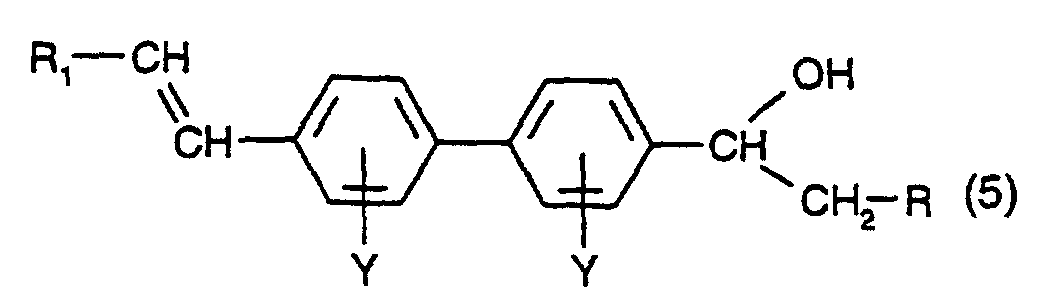
- b) dehydrating the compound having the formula (5), at a temperature in the range of from
140 to 260°C., preferably in the range of from 180 to 220°C., in a high-boiling inert solvent to
produce a compound having the formula;
in which Y and R1 have their previous significance and R is hydrogen; and
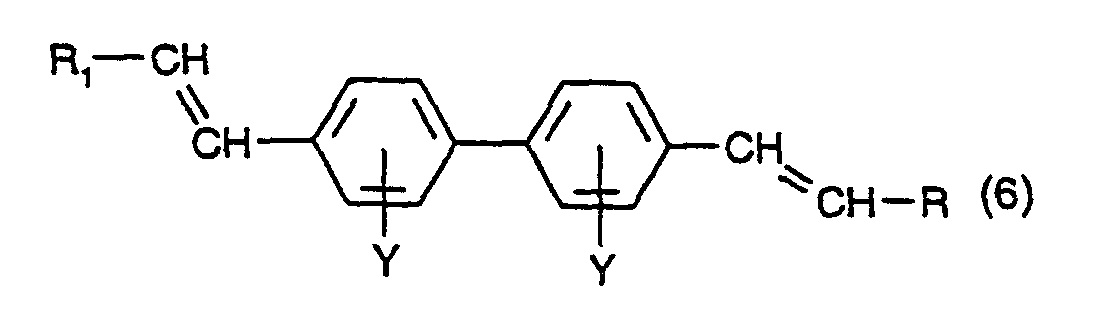
- c) reacting a compound having the formula (6), under the conditions of the Heck reaction, with a diazonium compound having the formula R2-N2X in which R2 and X have their previous significance, to produce a compound having the formula (4).
-
- Step b) of the process, the dehydration of the compound of formula (5) to the compound of formula (6), is conveniently conducted according to the dehydration procedure described in relation to the process for the production of a compound of formula (3), comprising dehydrating a compound having the formula(1).
- The reaction of a compound having the formula (1) with a diazonium compound having the formula R1-N2X, and the reaction of a compound having the formula (6) with a diazonium compound having the formula R2-N2X, viz. steps a) and c) of the process, are each conducted under the conditions of the Heck reaction, namely in the presence of a palladium compound, as catalyst. The reaction is conducted in an organic solvent such as water, an aliphatic alcohol or an aliphatic acid.
- Examples of palladium compound catalysts include inorganic palladium salts such as the chloride, bromide, iodide, nitrate, sulfate, acetate or propionate, and mixtures thereof. The palladium compound may also be used in the form of a complex. Examples of suitable complex formers include alkyl nitriles, such as C1-C4alkylnitriles, aryl nitrites such as benzonitrile, phosphites such as triphenyl phosphite, triaryl phosphanes such as triphenyl phosphane or the mono-, di- or tri-sodium salt thereof, bis(diarylphosphane)-alkanes such as bis(diarylphosphane)-methane, -ethane, -propane or -butane, trihetarylphosphanes such as trifurylphosphane and bis(dibenzalacetone). The organic complex formers may be substituted with one or more water-solubilising groups such as sulfo groups or carboxyl groups. The preferred palladium compound catalyst is palladium[bis(dibenzalacetone)]2.
- If the Heck reactions are effected in water, as solvent, preferably the palladium compound catalyst used contains one or more water-solubilising groups such as sulfo groups or carboxyl groups.
- Preferably, however, the reaction steps a) and c) are conducted in an organic solvent, especially in a C1-C12alcohol or in a C1-C4alkanoic acid. Examples of such C1-C12alcohols include methanol, ethanol, n-propanol, iso-propanol, t-butyl alcohol, n-pentanol, n-hexanol, n-octanol, n-decanol and n-dodecanol. C1-C4alkanoic acids which may be used include formic acid, acetic acid, propionic acid and n-butyric acid.
- The palladium compound catalyst is preferably used in an amount of 0.001 to 5 mole percent, more preferably 0.005 to 0.5 mole percent, based on the reactant of formula (1) or (6), respectively. The reaction temperature in steps a) and c) preferably ranges from 0 to 100°C., especially from 10 to 80°C.
- After completion of step a) or c), the palladium catalyst is preferably recovered for re-use, by methods which are well-known.
- The diazonium compounds having the formula R1-N2X or R2-N2X in which R1, R2 and X have their previous significance, used as respective reactants in steps a) and c), are known compounds and may be produced by methods known per se.
- For example, the said diazonium compounds may be produced by reacting the corresponding amines of formula R1-NH2 or R2-NH2 with an alkali metal nitrite or with an alkyl nitrite in the presence an acid in aqueous or in organic solution. If the diazotisation is conducted in organic solution, it is preferred that the water, produced as a by-product of the diazotisation reaction, is removed as it is formed. The removal of such water may be conveniently conducted by effecting the diazotisation in the presence of water-binding materials such as acetic anhydride, sodium sulfate, calcium chloride or molecular sieves.
- The compounds of formula (5) are new compounds per se and, as such, form a further aspect of the present invention.
- The following Examples further illustrate the present invention. Parts and percentages shown therein are by weight unless otherwise stated.
-
- 15 g. 4,4'-di-(α-hydroxyethyl)-biphenyl
- 135 g. triethyleneglycol-dimethylether
- 0.3 g. tert.-butylpyrocatechol and
- 27 mg. toluene-4-sulfonic acid monohydrate are placed in a 500 ml. 3-necked flask. The contents of the flask are heated, with stirring under an atmosphere of argon. When the reaction temperature reaches 90°C., the 4,4'-di-(α-hydroxyethyl)-biphenyl starting material is dissolved and the reaction solution is clear. The conversion of 4-vinyl-4'-α-hydroxyethyl-biphenyl to 4,4'-divinyl-biphenyl commences as the reaction temperature reaches 180°C. and the conversion continues until the boiling point (224-227°C.) of the triethyleneglycol-dimethylether is reached. The reaction mixture is held at the reflux temperature until a white turbidity forms in the reaction mixture (after about 50 minutes). At this point, the reaction is stopped by adding a base and by applying rapid cooling. The reaction mixture has the following composition:
- 50-55% 4,4'-divinyl-biphenyl
- 40-45% 4-vinyl-4'-α-hydroxyethyl-biphenyl
- 2-5% 4,4'-di-(α-hydroxyethyl)-biphenyl and
- 0-5% by-products.
-
- The cooled reaction solution is poured slowly, with stirring, into 2 litres of deionised water containing 100 mg. of tert.-butylpyrocatechol. The reaction products are precipitated and are filtered off. The separated precipitate is washed with 2 litres of deionised water containing 100 mg. of tert.-butylpyrocatechol and re-filtered. The moist filter-cake is then dried at 20°C. under vacuum for 3 days. The two main products, 4,4'-divinyl-biphenyl and 4-vinyl-4'-α-hydroxyethyl-biphenyl, are separated from one another on a silica column using a weakly basic solvent.
-
- 15 g. 4,4'-di-(α-hydroxyethyl)-biphenyl
- 135 g. triethyleneglycol-dimethylether
- 0.3 g. tert.-butylpyrocatechol and
- 27 mg. toluene-4-sulfonic acid monohydrate are placed in a 500 ml. 3-necked flask. The contents of the flask are heated, with stirring under an atmosphere of nitrogen. When the reaction temperature reaches 90°C., the 4,4'-di-(α-hydroxyethyl)-biphenyl starting material is dissolved and the reaction solution is clear. The conversion of 4-vinyl-4'-α-hydroxyethyl-biphenyl to 4,4'-divinyl-biphenyl commences as the reaction temperature reaches 180°C. and the conversion continues until the boiling point (224-227°C.) of the triethyleneglycol-dimethylether is reached. The reaction mixture is held at the reflux temperature and after about 30 minutes the reaction is stopped by adding a base and by applying rapid cooling. The reaction mixture has the following composition:
- 10-17% 4,4'-divinyl-biphenyl
- 35-40% 4-vinyl-4'-α-hydroxyethyl-biphenyl
- 18-20% 4,4'-di-(α-hydroxyethyl)-biphenyl and
- 0-5% by-products.
-
- The cooled reaction solution is then worked up in the manner described in Example 1.
- Into 150 g of anhydrous acetic acid there are stirred 38 g of 3-amino-benzene sulfonic acid (100%) and 13.8 g of concentrated sulfuric acid (96%) and the mixture is cooled externally to 5-10°C. At the same temperature, over 1 hour, 31.7 of of a 50% aqueous solution of sodium nitrite are added, dropwise, and the whole is stirred for a further hour, the temperature being held below 10°C. by means of cooling. Finally, the nitrite excess is determined and the necessary amount of 3-aminobenzene sulfonic acid is added to remove the excess.
- 200 g of acetic anhydride are added, dropwise, over 3 hours, to the diazo suspension obtained in step A), whereupon a weakly exothermic reaction takes place. The reaction mixture is stirred for 1 hour, 32.8 g of anhydrous sodium acetate are added, the whole is stirred well, treated with 1 g of palladium[bis(dibenzalacetone)]2 and, after 5 minutes, 45 g of 4-vinyl-4'-α-hydroxyethyl-biphenyl and 0.05 g of tert-butyl-pyrocatechol are added. The reaction mixture is stirred at 18-20°C. for 10 hours, heated to 40°C. and held at this temperature for a further 5 hours.
- The acetic acid is removed by distillation under vacuum, the melt so obtained is made up to 400 mls volume by adding water and heated to 90°C. Crystallisation of the reaction product from the solution is induced by cooling the solution to 15°C. using a ramp. Finally, the product which crystallises out is separated by filtration, washed and dried under vacuum. In this way, 83 g of the compound of formula:are obtained which represents a yield of 83%, based on the amount of 4-vinyl-4'-α-hydroxyethyl-biphenyl used.

- The dried product from step B) is stirred into 750 g of triethylene glycol dimethylether and 1 g of tert-butyl-pyrocatechol and 0.2 g of toluene-4-sulfonic acid are added. The reaction mixture is then heated, with stirring. The dehydration begins when the reaction mixture reaches a temperature above 180°C. and continues until the reaction mixture attains the boiling point (224-227°C.) of the triethylene glycol dimethylether. The reaction mixture is held at the reflux temperature for 2 hours, then it is cooled and neutralised by adding a base to give the product of formula:

- Into 150 g of triethylene glycol dimethylether there are stirred 29.4 g of 2-aminobenzenesulfonic acid (100%; 32.6 g of technical grade product) and 7 g of water, and the mixture is cooled externally to 5-10°C. At the same temperature, over 1 hour, 21.0 g of amyl nitrite are added, dropwise, and the reaction mixture is stirred for a further 2 hours. Finally, the nitrite excess is determined and the necessary amount of 2-aminobenzene sulfonic acid is added to remove the excess.
- 20 g of acetic anhydride are added, dropwise, over 2 hours, to the diazo suspension obtained in step D), whereupon a weakly exothermic reaction takes place. The reaction mixture is stirred for 1 hour, 32.8 g of anhydrous sodium acetate are added, the whole is stirred well, treated with 1 g of palladium[bis(dibenzalacetone)]2 and, after 5 minutes, the reaction mixture is combined with that from step C). The reaction mixture is stirred at 18-20°C. for 10 hours, heated to 40°C. and held at this temperature for a further 5 hours.
- The volatile components, namely amyl alcohol, acetic acid and triethylene glycol dimethylether are removed by distillation under vacuum. The melt so obtained is made up to 300 mls volume by adding water and heated to 90°C. The insoluble components are separated by clarification. Crystallisation of the reaction product from the solution is induced by cooling the solution to 15°C. using a ramp. Finally, the product which crystallises out is separated by filtration, washed and dried under vacuum. In this way, 75 g of the compound of formula:are obtained, representing a total yield of 66%, based on the weight of vinyl compound used.

Claims (36)
- A compound having the formula:in which R is hydrogen or C1-C4alkyl and Y is hydrogen, C1-C4alkyl, C1-C4alkoxy, CF3, halogen (F, Cl, Br or I) or SO3M in which M is hydrogen, Na, K, Ca, Mg, ammonium, mono-, di-, tri- or tetra-C1-C4alkylammonium, mono-, di- or tri-hydroxyalkylammonium or ammonium that is di- or tri-substituted with a mixture of C1-C4alkyl and C1-C4hydroxyalkyl groups.
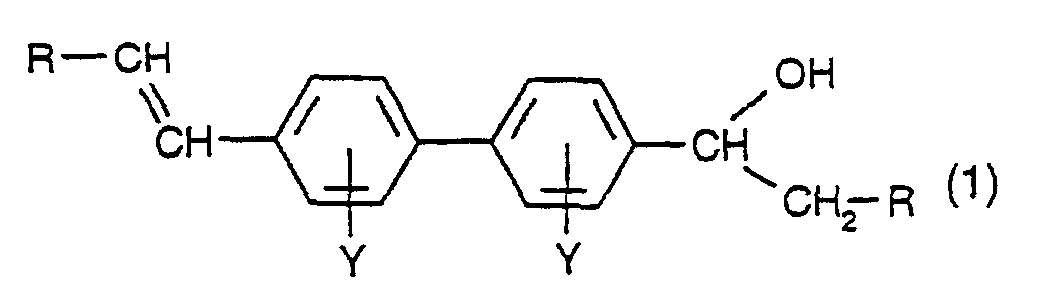
- A compound according to claim 1 which is 4-vinyl-4'-α-hydroxyethyl-biphenyl.
- A process for the production of a compound of formula (1), as defined in claim 1, comprising partially dehydrating a compound having the formula (2):In which R is hydrogen or C1-C4alkyl and Y is hydrogen, C1-C4alkyl, C1-C4alkoxy, CF3, halogen (F, Cl, Br or I) or SO3M in which M is hydrogen, Na, K, Ca, Mg, ammonium, mono-, di-, tri- or tetra-C1-C4alkylammonium, mono-, di- or tri-hydroxyalkylammonium or ammonium that is di- or tri-substituted with a mixture of C1-C4alkyl and C1-C4hydroxyalkyl, at a temperature in the range of from 140 to 260°C. in a high-boiling inert solvent.
- A process according to claim 3 in which the partial dehydration is conducted at temperature in the range of from 180 to 220°C.
- A process according to claim 3 or 4 in which the solvent is a polyalkylene glycol or a di-alkyl ether thereof.
- A process according to claim 5 in which the polyalkylene glycol or a di-alkyl ether thereof is a polyethylene glycol or a dimethyl ether thereof.
- A process according to claim 6 in which the polyethylene glycol or a dimethyl ether thereof is diethylene glycol or triethylene glycol-dimethyl ether.
- A process according to any of claims 3 to 7 in which an acid-free solvent is used and a minor amount of an acidic compound is present during the partial dehydation process.
- A process according to claim 8 in which the acid-free solvent is triethylene glycol-dimethyl ether and the acidic compound is p-toluene sulfonic acid.
- A process according to any of claims 3 to 9 in which the partial dehydation process is conducted at normal pressure and in the presence of a effective amount of a compound which is an inhibitor of the polymerisation of styrene monomers.
- A process according to claim 10 in which the polymerisation inhibitor is a quinone, a hindered phenol or an amine.
- A process according to claim 11 in which the polymerisation inhibitor is tert.-butylpyrocatechol.
- A process according to any of claims 3 to 12 in which the temperature is in the range of from 180 to 220°C. and the content of the reaction mixture is monitored, and the reaction is stopped as soon as the optimal amount of the product of formula (2) is detected in the reaction mixture.
- A process for the production of a compound having the formula:in which R is hydrogen or C1-C4alkyl and Y is hydrogen, C1-C4alkyl, C1-C4alkoxy, CF3, halogen (F, Cl, Br or I) or SO3M in which M is hydrogen, Na, K, Ca, Mg, ammonium, mono-, di-, tri- or tetra-C1-C4alkylammonium, mono-, di- or tri-hydroxyalkylammonium or ammonium that is di- or tri-substituted with a mixture of C1-C4alkyl and C1-C4hydroxyalkyl groups, comprising dehydrating a compound having the formula:
 in which R and Y have their previous significance, at a temperature in the range of from 140 to 260°C. in a high-boiling inert solvent.
- A process according to claim 14 in which the dehydration is conducted at a temperature in the range of from 180 to 220°C.
- A process according to claim 14 or 15 in which the solvent is a polyalkylene glycol or a di-alkyl ether thereof.
- A process according to claim 16 in which the polyalkylene glycol or a di-alkyl ether thereof is a polyethylene glycol or a dimethyl ether thereof.
- A process according to claim 17 in which the polyethylene glycol or a dimethyl ether thereof is diethylene glycol or triethylene glycol-dimethyl ether.
- A process according to any of claims 14 to 18 in which an acid-free solvent is used and a minor amount of an acidic compound is present during the partial dehydation process.
- A process according to claim 19 in which the acid-free solvent is triethylene glycol-dimethyl ether and the acidic compound is p-toluene sulfonic acid.
- A process according to any of claims 14 to 20 in which the partial dehydation process is conducted at normal pressure and in the presence of a effective amount of a compound which is an inhibitor of the polymerisation of styrene monomers.
- A process according to claim 21 in which the polymerisation inhibitor is a quinone, a hindered phenol or an amine.
- A process according to claim 22 in which the polymerisation inhibitor is tert.-butylpyrocatechol.
- A process according to any of claims 14 to 23 in which starting material of formula (2) is 4-vinyl-4'-α-hydroxyethyl-biphenyl which is dehydrated to produce 4,4'-divinyl-biphenyl.
- A process for the production of asymmetric or symmetric compounds having the formula:in which Y is hydrogen, C1-C4alkyl, C1-C4alkoxy, CF3, halogen (F, Cl, Br or I) or SO3M in which M is hydrogen, Na, K, Ca, Mg, ammonium, mono-, di-, tri- or tetra-C1-C4alkylammonium, mono-, di- or tri-hydroxyalkylammonium or ammonium that is di- or tri-substituted with a mixture of C1-C4alkyl and C1-C4hydroxyalkyl groups, R1 and R2 are the same or different and each is a phenyl group, optionally substituted with one or more groups of formula SO3M in which M has its previous significance, which process comprises:
 a) reacting a compound having the formula (1) as defined in claim 1 wherein R is hydrogen and Y has its previous significance, in the presence of a palladium compound, with a diazonium compound having the formula R1-N2X in which X is an anion, to produce a compound having the formula; in which R is hydrogen and Y and R1 have their previous significance;b) dehydrating the compound having the formula (5), at a temperature in the range of from 140 to 260°C., in a high-boiling inert solvent, to produce a compound having the formula;in which Y and R1 have their previous significance and R is hydrogen; and
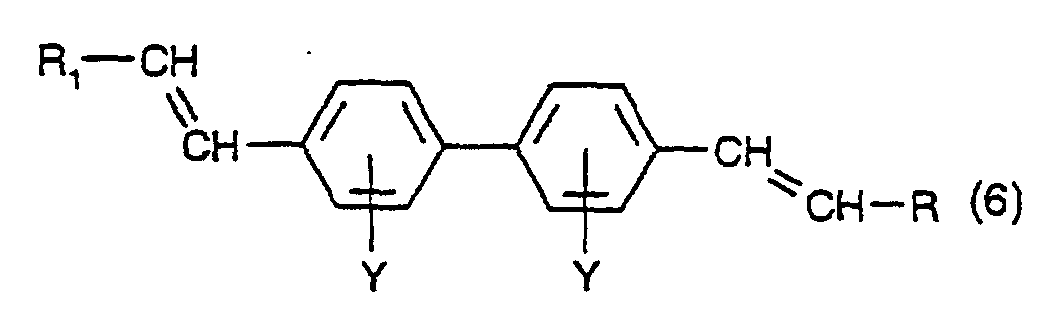 c) reacting a compound having the formula (6), in the presence of a palladium compound, with a diazonium compound having the formula R2-N2X in which R2 and X have their previous significance, to produce a compound having the formula (4).
 - A process according to claim 25 in which the palladium compound is an inorganic palladium salt or a palladium complex.
- A process according to claim 26 in which the inorganic palladium salt is the chloride, bromide, iodide, nitrate, sulfate, acetate or propionate or a mixture thereof.
- A process according to claim 26 in which the palladium complex is formed from a complex former selected from an alkyl nitrile, an aryl nitrile, a phosphite, a triaryl phosphane, a bis(diarylphosphane)-alkane, a trihetarylphosphane and bis(dibenzalacetone).
- A process according to claim 28 in which the palladium compound catalyst is palladium[bis(dibenzalacetone)]2.
- A process according to any of claims 25 to 29 in which the reaction steps a) and c) are conducted in an organic solvent.
- A process according to claim 30 in which the organic solvent is a C1-C12alcohol or a C1-C4alkanoic acid.
- A process according to any of claims 25 to 31 in which the palladium compound is used in an amount of 0.001 to 5 mole percent, based on the reactant of formula (1) or (6), respectively.
- A process according to claim 32 in which the palladium compound is used in an amount of 0.005 to 0.5 mole percent, based on the reactant of formula (1) or (6), respectively.
- A process according to any of claims 25 to 33 in which the reaction temperature in steps a) and c) ranges from 0 to 100°C.
- A process according to any of claims 25 to 34 in which, after completion of step a) or c), the palladium catalyst is recovered for re-use.
- A compound having the formula:in which R is hydrogen or C1-C4alkyl, Y is hydrogen, C1-C4alkyl, C1-C4alkoxy, CF3, halogen (F, Cl, Br or I) or SO3M in which M is hydrogen, Na, K, Ca, Mg, ammonium, mono-, di-, tri- or tetra-C1-C4alkylammonium, mono-, di- or tri-hydroxyalkylammonium or ammonium that is di- or tri-substituted with a mixture of C1-C4alkyl and C1-C4hydroxyalkyl groups and R1 is a phenyl group, optionally substituted with one or more groups of formula SO3M in which M has its previous significance.

Applications Claiming Priority (2)
| Application Number | Priority Date | Filing Date | Title |
|---|---|---|---|
| GB9626514 | 1996-12-20 | ||
| GBGB9626514.5A GB9626514D0 (en) | 1996-12-20 | 1996-12-20 | New intermediates |
Publications (3)
| Publication Number | Publication Date |
|---|---|
| EP0849246A2 EP0849246A2 (en) | 1998-06-24 |
| EP0849246A3 EP0849246A3 (en) | 1998-09-23 |
| EP0849246B1 true EP0849246B1 (en) | 2002-02-06 |
Family
ID=10804766
Family Applications (1)
| Application Number | Title | Priority Date | Filing Date |
|---|---|---|---|
| EP97810972A Expired - Lifetime EP0849246B1 (en) | 1996-12-20 | 1997-12-11 | Derivatives of 4-vinyl-4'-alpha-hydroxyethyl-biphenyl |
Country Status (7)
| Country | Link |
|---|---|
| US (2) | US5902909A (en) |
| EP (1) | EP0849246B1 (en) |
| JP (1) | JPH10226656A (en) |
| KR (1) | KR19980064331A (en) |
| DE (1) | DE69710305T2 (en) |
| ES (1) | ES2170933T3 (en) |
| GB (2) | GB9626514D0 (en) |
Families Citing this family (6)
| Publication number | Priority date | Publication date | Assignee | Title |
|---|---|---|---|---|
| GB9718353D0 (en) * | 1997-08-30 | 1997-11-05 | Ciba Geigy Ag | Sulphonated distyryl - Biphenyl compounds |
| US6258909B1 (en) | 1998-10-07 | 2001-07-10 | Boris A. Zaitsev | Polyester resins |
| EP1129116A1 (en) * | 1998-10-07 | 2001-09-05 | Boris A. Zaitsev | Novel polymerizable materials and novel polyester resins |
| US6143922A (en) * | 1998-10-07 | 2000-11-07 | Zaitsev; Boris A. | Diols and unsaturated monomers |
| US20050159379A1 (en) * | 2001-05-18 | 2005-07-21 | Sirna Therapeutics, Inc | RNA interference mediated inhibition of gastric inhibitory polypeptide (GIP) and gastric inhibitory polypeptide receptor (GIPR) gene expression using short interfering nucleic acid (siNA) |
| JP5503877B2 (en) * | 2009-01-30 | 2014-05-28 | 住友化学株式会社 | Method for producing dibenzooxepin compound |
Family Cites Families (2)
| Publication number | Priority date | Publication date | Assignee | Title |
|---|---|---|---|---|
| US2465486A (en) * | 1945-11-24 | 1949-03-29 | Rca Corp | Preparation of 4, 4'-divinyl-biphenyl |
| US4377532A (en) * | 1981-02-26 | 1983-03-22 | Ciba-Geigy Corporation | 3-Phenoxybenzyl compounds |
-
1996
- 1996-12-20 GB GBGB9626514.5A patent/GB9626514D0/en active Pending
-
1997
- 1997-12-10 GB GB9726001A patent/GB2320495A/en not_active Withdrawn
- 1997-12-11 DE DE69710305T patent/DE69710305T2/en not_active Expired - Fee Related
- 1997-12-11 EP EP97810972A patent/EP0849246B1/en not_active Expired - Lifetime
- 1997-12-11 ES ES97810972T patent/ES2170933T3/en not_active Expired - Lifetime
- 1997-12-19 US US08/994,220 patent/US5902909A/en not_active Expired - Fee Related
- 1997-12-19 KR KR1019970070395A patent/KR19980064331A/en not_active Ceased
- 1997-12-19 JP JP9349886A patent/JPH10226656A/en active Pending
-
1998
- 1998-09-22 US US09/158,372 patent/US6194606B1/en not_active Expired - Fee Related
Also Published As
| Publication number | Publication date |
|---|---|
| GB9626514D0 (en) | 1997-02-05 |
| EP0849246A3 (en) | 1998-09-23 |
| KR19980064331A (en) | 1998-10-07 |
| JPH10226656A (en) | 1998-08-25 |
| EP0849246A2 (en) | 1998-06-24 |
| GB9726001D0 (en) | 1998-02-04 |
| US6194606B1 (en) | 2001-02-27 |
| GB2320495A (en) | 1998-06-24 |
| DE69710305T2 (en) | 2002-10-24 |
| ES2170933T3 (en) | 2002-08-16 |
| DE69710305D1 (en) | 2002-03-21 |
| US5902909A (en) | 1999-05-11 |
Similar Documents
| Publication | Publication Date | Title |
|---|---|---|
| KR100646739B1 (en) | Method for preparing onium salt derivative and novel onium salt derivative | |
| US5902909A (en) | Intermediates | |
| US4501919A (en) | Process for the production of serine derivatives | |
| KR100215228B1 (en) | Process for preparing N-methyrol acrylamide | |
| US5132444A (en) | Gas-phase preparation of vinyl phosphonic acid derivatives | |
| KR940007526B1 (en) | Method for preparing 3-amino-4-hydroxybenzoic acid | |
| EP0600714B1 (en) | Process for producing O,O'-diacyltartaric anhydride and process for producing O,O'-diacyltartaric acid | |
| JPH06805B2 (en) | Method for producing high degree of polymerization polyvinyl alcohol | |
| EP0553668A2 (en) | Process for making arylacrylic acids and their esters | |
| US3213132A (en) | Process for preparation of 4-nitrostilbenes | |
| EP0148145A1 (en) | Process for making nitrodiarylamines | |
| US5502231A (en) | Process for the preparation of cyclic vinylphosphonic esters | |
| US4235819A (en) | Process for isolating 1-(alkoxyphenyl)-5-(phenyl)biguanide compounds from a crude, acid reaction mixture thereof | |
| US4806643A (en) | Preparation of riboflavin | |
| CA1254583A (en) | Process for producing sulphonic acids | |
| JP3569428B2 (en) | Method for producing homoallylamines | |
| JPS6049170B2 (en) | Method for producing β-alkoxyethoxymethyl halide | |
| US4224245A (en) | Method of making 1-(alkoxyphenyl)-5-(phenyl)biguanide compounds which are useful as agricultural fungicides | |
| JPH078816B2 (en) | Method for producing dibenzoylmethane | |
| US4612392A (en) | N-substituted acrylamide and methacrylamide derivatives and their preparation | |
| JPH07138243A (en) | Method for producing phenothiazines | |
| KR880001850B1 (en) | Method for preparing 5-fluoro pyridone derivative | |
| JPH0627128B2 (en) | Optically active polymerization catalyst with axial chirality | |
| SU166021A1 (en) | METHOD OF OBTAINING Arylo8b! X esters of p-aryloxyethanesulfonic acid | |
| JP3085612B2 (en) | Method for producing bismaleimides |
Legal Events
| Date | Code | Title | Description |
|---|---|---|---|
| PUAI | Public reference made under article 153(3) epc to a published international application that has entered the european phase |
Free format text: ORIGINAL CODE: 0009012 |
|
| AK | Designated contracting states |
Kind code of ref document: A2 Designated state(s): BE CH DE ES FR GB IT LI NL |
|
| AX | Request for extension of the european patent |
Free format text: AL;LT;LV;MK;RO;SI |
|
| PUAL | Search report despatched |
Free format text: ORIGINAL CODE: 0009013 |
|
| AK | Designated contracting states |
Kind code of ref document: A3 Designated state(s): AT BE CH DE DK ES FI FR GB GR IE IT LI LU MC NL PT SE |
|
| AX | Request for extension of the european patent |
Free format text: AL;LT;LV;MK;RO;SI |
|
| 17P | Request for examination filed |
Effective date: 19981123 |
|
| AKX | Designation fees paid |
Free format text: BE CH DE ES FR GB IT LI NL |
|
| RBV | Designated contracting states (corrected) |
Designated state(s): BE CH DE ES FR GB IT LI NL |
|
| 17Q | First examination report despatched |
Effective date: 20000419 |
|
| GRAG | Despatch of communication of intention to grant |
Free format text: ORIGINAL CODE: EPIDOS AGRA |
|
| GRAG | Despatch of communication of intention to grant |
Free format text: ORIGINAL CODE: EPIDOS AGRA |
|
| GRAH | Despatch of communication of intention to grant a patent |
Free format text: ORIGINAL CODE: EPIDOS IGRA |
|
| GRAH | Despatch of communication of intention to grant a patent |
Free format text: ORIGINAL CODE: EPIDOS IGRA |
|
| GRAA | (expected) grant |
Free format text: ORIGINAL CODE: 0009210 |
|
| REG | Reference to a national code |
Ref country code: GB Ref legal event code: IF02 |
|
| AK | Designated contracting states |
Kind code of ref document: B1 Designated state(s): BE CH DE ES FR GB IT LI NL |
|
| REG | Reference to a national code |
Ref country code: CH Ref legal event code: EP |
|
| REF | Corresponds to: |
Ref document number: 69710305 Country of ref document: DE Date of ref document: 20020321 |
|
| ET | Fr: translation filed | ||
| REG | Reference to a national code |
Ref country code: ES Ref legal event code: FG2A Ref document number: 2170933 Country of ref document: ES Kind code of ref document: T3 |
|
| PGFP | Annual fee paid to national office [announced via postgrant information from national office to epo] |
Ref country code: FR Payment date: 20021106 Year of fee payment: 6 Ref country code: CH Payment date: 20021106 Year of fee payment: 6 |
|
| PGFP | Annual fee paid to national office [announced via postgrant information from national office to epo] |
Ref country code: NL Payment date: 20021108 Year of fee payment: 6 |
|
| PGFP | Annual fee paid to national office [announced via postgrant information from national office to epo] |
Ref country code: DE Payment date: 20021118 Year of fee payment: 6 |
|
| PGFP | Annual fee paid to national office [announced via postgrant information from national office to epo] |
Ref country code: GB Payment date: 20021126 Year of fee payment: 6 |
|
| PGFP | Annual fee paid to national office [announced via postgrant information from national office to epo] |
Ref country code: ES Payment date: 20021203 Year of fee payment: 6 |
|
| PLBE | No opposition filed within time limit |
Free format text: ORIGINAL CODE: 0009261 |
|
| STAA | Information on the status of an ep patent application or granted ep patent |
Free format text: STATUS: NO OPPOSITION FILED WITHIN TIME LIMIT |
|
| PGFP | Annual fee paid to national office [announced via postgrant information from national office to epo] |
Ref country code: BE Payment date: 20030115 Year of fee payment: 6 |
|
| 26N | No opposition filed |
Effective date: 20021107 |
|
| PG25 | Lapsed in a contracting state [announced via postgrant information from national office to epo] |
Ref country code: GB Free format text: LAPSE BECAUSE OF NON-PAYMENT OF DUE FEES Effective date: 20031211 |
|
| PG25 | Lapsed in a contracting state [announced via postgrant information from national office to epo] |
Ref country code: ES Free format text: LAPSE BECAUSE OF NON-PAYMENT OF DUE FEES Effective date: 20031212 |
|
| PG25 | Lapsed in a contracting state [announced via postgrant information from national office to epo] |
Ref country code: LI Free format text: LAPSE BECAUSE OF NON-PAYMENT OF DUE FEES Effective date: 20031231 Ref country code: CH Free format text: LAPSE BECAUSE OF NON-PAYMENT OF DUE FEES Effective date: 20031231 Ref country code: BE Free format text: LAPSE BECAUSE OF NON-PAYMENT OF DUE FEES Effective date: 20031231 |
|
| BERE | Be: lapsed |
Owner name: *CIBA SPECIALTY CHEMICALS HOLDING INC. Effective date: 20031231 |
|
| PG25 | Lapsed in a contracting state [announced via postgrant information from national office to epo] |
Ref country code: NL Free format text: LAPSE BECAUSE OF NON-PAYMENT OF DUE FEES Effective date: 20040701 Ref country code: DE Free format text: LAPSE BECAUSE OF NON-PAYMENT OF DUE FEES Effective date: 20040701 |
|
| GBPC | Gb: european patent ceased through non-payment of renewal fee |
Effective date: 20031211 |
|
| REG | Reference to a national code |
Ref country code: CH Ref legal event code: PL |
|
| PG25 | Lapsed in a contracting state [announced via postgrant information from national office to epo] |
Ref country code: FR Free format text: LAPSE BECAUSE OF NON-PAYMENT OF DUE FEES Effective date: 20040831 |
|
| NLV4 | Nl: lapsed or anulled due to non-payment of the annual fee |
Effective date: 20040701 |
|
| REG | Reference to a national code |
Ref country code: FR Ref legal event code: ST |
|
| REG | Reference to a national code |
Ref country code: ES Ref legal event code: FD2A Effective date: 20031212 |
|
| PG25 | Lapsed in a contracting state [announced via postgrant information from national office to epo] |
Ref country code: IT Free format text: LAPSE BECAUSE OF NON-PAYMENT OF DUE FEES;WARNING: LAPSES OF ITALIAN PATENTS WITH EFFECTIVE DATE BEFORE 2007 MAY HAVE OCCURRED AT ANY TIME BEFORE 2007. THE CORRECT EFFECTIVE DATE MAY BE DIFFERENT FROM THE ONE RECORDED. Effective date: 20051211 |