EP0846685A1 - 3-Hydroxypyridine-2-carboxylic acid amide esters, their preparation and their use as medicaments - Google Patents
3-Hydroxypyridine-2-carboxylic acid amide esters, their preparation and their use as medicaments Download PDFInfo
- Publication number
- EP0846685A1 EP0846685A1 EP97120537A EP97120537A EP0846685A1 EP 0846685 A1 EP0846685 A1 EP 0846685A1 EP 97120537 A EP97120537 A EP 97120537A EP 97120537 A EP97120537 A EP 97120537A EP 0846685 A1 EP0846685 A1 EP 0846685A1
- Authority
- EP
- European Patent Office
- Prior art keywords
- formula
- compounds
- hydroxypyridine
- carboxylic acid
- amide
- Prior art date
- Legal status (The legal status is an assumption and is not a legal conclusion. Google has not performed a legal analysis and makes no representation as to the accuracy of the status listed.)
- Granted
Links
- 239000003814 drug Substances 0.000 title claims description 6
- VIHUZJYFQOEUMI-UHFFFAOYSA-N 3-Hydroxypicolinamide Chemical class NC(=O)C1=NC=CC=C1O VIHUZJYFQOEUMI-UHFFFAOYSA-N 0.000 title description 3
- BRARRAHGNDUELT-UHFFFAOYSA-N 3-hydroxypicolinic acid Chemical compound OC(=O)C1=NC=CC=C1O BRARRAHGNDUELT-UHFFFAOYSA-N 0.000 claims abstract description 79
- -1 glycyl ethyl Chemical group 0.000 claims abstract description 42
- 150000003839 salts Chemical class 0.000 claims abstract description 27
- 239000000651 prodrug Substances 0.000 claims abstract description 7
- 229940002612 prodrug Drugs 0.000 claims abstract description 7
- 150000001875 compounds Chemical class 0.000 claims description 67
- 150000001408 amides Chemical class 0.000 claims description 38
- 229910052739 hydrogen Inorganic materials 0.000 claims description 24
- 239000001257 hydrogen Substances 0.000 claims description 24
- 125000002496 methyl group Chemical group [H]C([H])([H])* 0.000 claims description 23
- UFHFLCQGNIYNRP-UHFFFAOYSA-N Hydrogen Chemical compound [H][H] UFHFLCQGNIYNRP-UHFFFAOYSA-N 0.000 claims description 21
- 150000002431 hydrogen Chemical class 0.000 claims description 15
- 210000004185 liver Anatomy 0.000 claims description 14
- 102000008186 Collagen Human genes 0.000 claims description 13
- 108010035532 Collagen Proteins 0.000 claims description 13
- 206010016654 Fibrosis Diseases 0.000 claims description 13
- 229920001436 collagen Polymers 0.000 claims description 13
- 230000036570 collagen biosynthesis Effects 0.000 claims description 13
- 102000004079 Prolyl Hydroxylases Human genes 0.000 claims description 12
- 108010043005 Prolyl Hydroxylases Proteins 0.000 claims description 12
- 230000004761 fibrosis Effects 0.000 claims description 12
- LFQSCWFLJHTTHZ-UHFFFAOYSA-N Ethanol Chemical compound CCO LFQSCWFLJHTTHZ-UHFFFAOYSA-N 0.000 claims description 10
- 230000005764 inhibitory process Effects 0.000 claims description 10
- 210000004072 lung Anatomy 0.000 claims description 10
- 201000010099 disease Diseases 0.000 claims description 8
- 208000037265 diseases, disorders, signs and symptoms Diseases 0.000 claims description 8
- 210000002808 connective tissue Anatomy 0.000 claims description 7
- 125000001231 benzoyloxy group Chemical group C(C1=CC=CC=C1)(=O)O* 0.000 claims description 6
- 230000015572 biosynthetic process Effects 0.000 claims description 6
- 125000003178 carboxy group Chemical group [H]OC(*)=O 0.000 claims description 6
- 230000003176 fibrotic effect Effects 0.000 claims description 6
- 125000002887 hydroxy group Chemical group [H]O* 0.000 claims description 6
- 238000001727 in vivo Methods 0.000 claims description 6
- 238000000034 method Methods 0.000 claims description 6
- 125000000217 alkyl group Chemical group 0.000 claims description 5
- 230000002980 postoperative effect Effects 0.000 claims description 5
- 230000005855 radiation Effects 0.000 claims description 5
- 125000006702 (C1-C18) alkyl group Chemical group 0.000 claims description 4
- 125000000094 2-phenylethyl group Chemical group [H]C1=C([H])C([H])=C(C([H])=C1[H])C([H])([H])C([H])([H])* 0.000 claims description 4
- 201000001320 Atherosclerosis Diseases 0.000 claims description 4
- 208000010412 Glaucoma Diseases 0.000 claims description 4
- 125000003342 alkenyl group Chemical group 0.000 claims description 4
- 125000005196 alkyl carbonyloxy group Chemical group 0.000 claims description 4
- 125000001797 benzyl group Chemical group [H]C1=C([H])C([H])=C(C([H])=C1[H])C([H])([H])* 0.000 claims description 4
- 125000005201 cycloalkylcarbonyloxy group Chemical group 0.000 claims description 4
- 125000004435 hydrogen atom Chemical group [H]* 0.000 claims description 4
- 125000004344 phenylpropyl group Chemical group 0.000 claims description 4
- SIOXPEMLGUPBBT-UHFFFAOYSA-N picolinic acid Chemical class OC(=O)C1=CC=CC=N1 SIOXPEMLGUPBBT-UHFFFAOYSA-N 0.000 claims description 4
- 230000037390 scarring Effects 0.000 claims description 4
- 125000001424 substituent group Chemical group 0.000 claims description 4
- 125000004642 (C1-C12) alkoxy group Chemical group 0.000 claims description 3
- 125000004400 (C1-C12) alkyl group Chemical group 0.000 claims description 3
- 125000000229 (C1-C4)alkoxy group Chemical group 0.000 claims description 3
- 125000006552 (C3-C8) cycloalkyl group Chemical group 0.000 claims description 3
- 125000000081 (C5-C8) cycloalkenyl group Chemical group 0.000 claims description 3
- 238000002512 chemotherapy Methods 0.000 claims description 3
- 125000004093 cyano group Chemical group *C#N 0.000 claims description 3
- 125000002350 geranyl group Chemical group [H]C([*])([H])/C([H])=C(C([H])([H])[H])/C([H])([H])C([H])([H])C([H])=C(C([H])([H])[H])C([H])([H])[H] 0.000 claims description 3
- 229910052736 halogen Inorganic materials 0.000 claims description 3
- 150000002367 halogens Chemical class 0.000 claims description 3
- 210000002216 heart Anatomy 0.000 claims description 3
- 210000003734 kidney Anatomy 0.000 claims description 3
- 125000002023 trifluoromethyl group Chemical group FC(F)(F)* 0.000 claims description 3
- 125000003545 alkoxy group Chemical group 0.000 claims description 2
- 125000000304 alkynyl group Chemical group 0.000 claims description 2
- 238000007098 aminolysis reaction Methods 0.000 claims description 2
- 125000004030 farnesyl group Chemical group [H]C([*])([H])C([H])=C(C([H])([H])[H])C([H])([H])C([H])([H])C([H])=C(C([H])([H])[H])C([H])([H])C([H])([H])C([H])=C(C([H])([H])[H])C([H])([H])[H] 0.000 claims description 2
- 125000002768 hydroxyalkyl group Chemical group 0.000 claims description 2
- 210000000056 organ Anatomy 0.000 claims description 2
- 125000002924 primary amino group Chemical group [H]N([H])* 0.000 claims description 2
- 125000000946 retinyl group Chemical group [H]C([*])([H])/C([H])=C(C([H])([H])[H])/C([H])=C([H])/C([H])=C(C([H])([H])[H])/C([H])=C([H])/C1=C(C([H])([H])[H])C([H])([H])C([H])([H])C([H])([H])C1(C([H])([H])[H])C([H])([H])[H] 0.000 claims description 2
- 239000002253 acid Substances 0.000 claims 1
- 125000001997 phenyl group Chemical group [H]C1=C([H])C([H])=C(*)C([H])=C1[H] 0.000 claims 1
- 238000011477 surgical intervention Methods 0.000 claims 1
- 125000004181 carboxyalkyl group Chemical group 0.000 abstract 1
- RTZKZFJDLAIYFH-UHFFFAOYSA-N Diethyl ether Chemical compound CCOCC RTZKZFJDLAIYFH-UHFFFAOYSA-N 0.000 description 13
- WEVYAHXRMPXWCK-UHFFFAOYSA-N Acetonitrile Chemical compound CC#N WEVYAHXRMPXWCK-UHFFFAOYSA-N 0.000 description 12
- XEKOWRVHYACXOJ-UHFFFAOYSA-N Ethyl acetate Chemical compound CCOC(C)=O XEKOWRVHYACXOJ-UHFFFAOYSA-N 0.000 description 12
- YXFVVABEGXRONW-UHFFFAOYSA-N Toluene Chemical compound CC1=CC=CC=C1 YXFVVABEGXRONW-UHFFFAOYSA-N 0.000 description 9
- 239000003112 inhibitor Substances 0.000 description 9
- 239000000047 product Substances 0.000 description 9
- QTBSBXVTEAMEQO-UHFFFAOYSA-N Acetic acid Chemical compound CC(O)=O QTBSBXVTEAMEQO-UHFFFAOYSA-N 0.000 description 8
- 210000004027 cell Anatomy 0.000 description 8
- XLYOFNOQVPJJNP-UHFFFAOYSA-N water Substances O XLYOFNOQVPJJNP-UHFFFAOYSA-N 0.000 description 8
- VEXZGXHMUGYJMC-UHFFFAOYSA-N Hydrochloric acid Chemical compound Cl VEXZGXHMUGYJMC-UHFFFAOYSA-N 0.000 description 7
- YMWUJEATGCHHMB-UHFFFAOYSA-N Dichloromethane Chemical compound ClCCl YMWUJEATGCHHMB-UHFFFAOYSA-N 0.000 description 6
- OKKJLVBELUTLKV-UHFFFAOYSA-N Methanol Chemical compound OC OKKJLVBELUTLKV-UHFFFAOYSA-N 0.000 description 6
- ZMANZCXQSJIPKH-UHFFFAOYSA-N Triethylamine Chemical compound CCN(CC)CC ZMANZCXQSJIPKH-UHFFFAOYSA-N 0.000 description 6
- 210000002919 epithelial cell Anatomy 0.000 description 6
- 238000000338 in vitro Methods 0.000 description 6
- IAZDPXIOMUYVGZ-UHFFFAOYSA-N Dimethylsulphoxide Chemical compound CS(C)=O IAZDPXIOMUYVGZ-UHFFFAOYSA-N 0.000 description 5
- DHMQDGOQFOQNFH-UHFFFAOYSA-N Glycine Natural products NCC(O)=O DHMQDGOQFOQNFH-UHFFFAOYSA-N 0.000 description 5
- 125000002915 carbonyl group Chemical group [*:2]C([*:1])=O 0.000 description 5
- 239000000243 solution Substances 0.000 description 5
- 239000000126 substance Substances 0.000 description 5
- ONIBWKKTOPOVIA-BYPYZUCNSA-N L-Proline Chemical compound OC(=O)[C@@H]1CCCN1 ONIBWKKTOPOVIA-BYPYZUCNSA-N 0.000 description 4
- ONIBWKKTOPOVIA-UHFFFAOYSA-N Proline Natural products OC(=O)C1CCCN1 ONIBWKKTOPOVIA-UHFFFAOYSA-N 0.000 description 4
- 230000003510 anti-fibrotic effect Effects 0.000 description 4
- 210000001508 eye Anatomy 0.000 description 4
- 238000001356 surgical procedure Methods 0.000 description 4
- JOXIMZWYDAKGHI-UHFFFAOYSA-N toluene-4-sulfonic acid Chemical compound CC1=CC=C(S(O)(=O)=O)C=C1 JOXIMZWYDAKGHI-UHFFFAOYSA-N 0.000 description 4
- ASOKPJOREAFHNY-UHFFFAOYSA-N 1-Hydroxybenzotriazole Chemical compound C1=CC=C2N(O)N=NC2=C1 ASOKPJOREAFHNY-UHFFFAOYSA-N 0.000 description 3
- HVCNXQOWACZAFN-UHFFFAOYSA-N 4-ethylmorpholine Chemical compound CCN1CCOCC1 HVCNXQOWACZAFN-UHFFFAOYSA-N 0.000 description 3
- 239000004471 Glycine Substances 0.000 description 3
- ZMXDDKWLCZADIW-UHFFFAOYSA-N N,N-Dimethylformamide Chemical compound CN(C)C=O ZMXDDKWLCZADIW-UHFFFAOYSA-N 0.000 description 3
- LRHPLDYGYMQRHN-UHFFFAOYSA-N N-Butanol Chemical compound CCCCO LRHPLDYGYMQRHN-UHFFFAOYSA-N 0.000 description 3
- IMNFDUFMRHMDMM-UHFFFAOYSA-N N-Heptane Chemical compound CCCCCCC IMNFDUFMRHMDMM-UHFFFAOYSA-N 0.000 description 3
- 229960000583 acetic acid Drugs 0.000 description 3
- 238000004458 analytical method Methods 0.000 description 3
- 238000004113 cell culture Methods 0.000 description 3
- 230000000694 effects Effects 0.000 description 3
- IXCSERBJSXMMFS-UHFFFAOYSA-N hydrogen chloride Substances Cl.Cl IXCSERBJSXMMFS-UHFFFAOYSA-N 0.000 description 3
- 238000005805 hydroxylation reaction Methods 0.000 description 3
- 230000002401 inhibitory effect Effects 0.000 description 3
- 238000004519 manufacturing process Methods 0.000 description 3
- GBCAVSYHPPARHX-UHFFFAOYSA-M n'-cyclohexyl-n-[2-(4-methylmorpholin-4-ium-4-yl)ethyl]methanediimine;4-methylbenzenesulfonate Chemical compound CC1=CC=C(S([O-])(=O)=O)C=C1.C1CCCCC1N=C=NCC[N+]1(C)CCOCC1 GBCAVSYHPPARHX-UHFFFAOYSA-M 0.000 description 3
- JUJWROOIHBZHMG-UHFFFAOYSA-N pyridine Substances C1=CC=NC=C1 JUJWROOIHBZHMG-UHFFFAOYSA-N 0.000 description 3
- 210000001626 skin fibroblast Anatomy 0.000 description 3
- 230000009885 systemic effect Effects 0.000 description 3
- 102000008490 2-Oxoglutarate 5-Dioxygenase Procollagen-Lysine Human genes 0.000 description 2
- 108010020504 2-Oxoglutarate 5-Dioxygenase Procollagen-Lysine Proteins 0.000 description 2
- 229920000742 Cotton Polymers 0.000 description 2
- QOSSAOTZNIDXMA-UHFFFAOYSA-N Dicylcohexylcarbodiimide Chemical compound C1CCCCC1N=C=NC1CCCCC1 QOSSAOTZNIDXMA-UHFFFAOYSA-N 0.000 description 2
- 241000287828 Gallus gallus Species 0.000 description 2
- GUBGYTABKSRVRQ-QKKXKWKRSA-N Lactose Chemical compound OC[C@H]1O[C@@H](O[C@H]2[C@H](O)[C@@H](O)C(O)O[C@@H]2CO)[C@H](O)[C@@H](O)[C@H]1O GUBGYTABKSRVRQ-QKKXKWKRSA-N 0.000 description 2
- AFVFQIVMOAPDHO-UHFFFAOYSA-N Methanesulfonic acid Chemical compound CS(O)(=O)=O AFVFQIVMOAPDHO-UHFFFAOYSA-N 0.000 description 2
- VYPSYNLAJGMNEJ-UHFFFAOYSA-N Silicium dioxide Chemical compound O=[Si]=O VYPSYNLAJGMNEJ-UHFFFAOYSA-N 0.000 description 2
- WYURNTSHIVDZCO-UHFFFAOYSA-N Tetrahydrofuran Chemical compound C1CCOC1 WYURNTSHIVDZCO-UHFFFAOYSA-N 0.000 description 2
- XSQUKJJJFZCRTK-UHFFFAOYSA-N Urea Chemical compound NC(N)=O XSQUKJJJFZCRTK-UHFFFAOYSA-N 0.000 description 2
- 230000004913 activation Effects 0.000 description 2
- NFCPBBXWCPNVDP-UHFFFAOYSA-N butyl 2-aminoacetate;4-methylbenzenesulfonic acid Chemical compound CCCCOC(=O)CN.CC1=CC=C(S(O)(=O)=O)C=C1 NFCPBBXWCPNVDP-UHFFFAOYSA-N 0.000 description 2
- 239000003153 chemical reaction reagent Substances 0.000 description 2
- 239000003795 chemical substances by application Substances 0.000 description 2
- 238000004587 chromatography analysis Methods 0.000 description 2
- LQZZUXJYWNFBMV-UHFFFAOYSA-N dodecan-1-ol Chemical compound CCCCCCCCCCCCO LQZZUXJYWNFBMV-UHFFFAOYSA-N 0.000 description 2
- PLGHUJRCHYBFRR-UHFFFAOYSA-N dodecyl 2-aminoacetate;4-methylbenzenesulfonic acid Chemical compound CC1=CC=C(S(O)(=O)=O)C=C1.CCCCCCCCCCCCOC(=O)CN PLGHUJRCHYBFRR-UHFFFAOYSA-N 0.000 description 2
- 229940079593 drug Drugs 0.000 description 2
- 238000004128 high performance liquid chromatography Methods 0.000 description 2
- 230000033444 hydroxylation Effects 0.000 description 2
- 210000005229 liver cell Anatomy 0.000 description 2
- HQKMJHAJHXVSDF-UHFFFAOYSA-L magnesium stearate Chemical compound [Mg+2].CCCCCCCCCCCCCCCCCC([O-])=O.CCCCCCCCCCCCCCCCCC([O-])=O HQKMJHAJHXVSDF-UHFFFAOYSA-L 0.000 description 2
- 239000012452 mother liquor Substances 0.000 description 2
- CTSLXHKWHWQRSH-UHFFFAOYSA-N oxalyl chloride Chemical compound ClC(=O)C(Cl)=O CTSLXHKWHWQRSH-UHFFFAOYSA-N 0.000 description 2
- 239000008188 pellet Substances 0.000 description 2
- 239000003208 petroleum Substances 0.000 description 2
- 239000000825 pharmaceutical preparation Substances 0.000 description 2
- QKFJKGMPGYROCL-UHFFFAOYSA-N phenyl isothiocyanate Chemical compound S=C=NC1=CC=CC=C1 QKFJKGMPGYROCL-UHFFFAOYSA-N 0.000 description 2
- YBYRMVIVWMBXKQ-UHFFFAOYSA-N phenylmethanesulfonyl fluoride Chemical compound FS(=O)(=O)CC1=CC=CC=C1 YBYRMVIVWMBXKQ-UHFFFAOYSA-N 0.000 description 2
- UMJSCPRVCHMLSP-UHFFFAOYSA-N pyridine Natural products COC1=CC=CN=C1 UMJSCPRVCHMLSP-UHFFFAOYSA-N 0.000 description 2
- 239000000741 silica gel Substances 0.000 description 2
- 229910002027 silica gel Inorganic materials 0.000 description 2
- 210000003491 skin Anatomy 0.000 description 2
- 238000002415 sodium dodecyl sulfate polyacrylamide gel electrophoresis Methods 0.000 description 2
- 210000000352 storage cell Anatomy 0.000 description 2
- 238000012360 testing method Methods 0.000 description 2
- VZGDMQKNWNREIO-UHFFFAOYSA-N tetrachloromethane Chemical compound ClC(Cl)(Cl)Cl VZGDMQKNWNREIO-UHFFFAOYSA-N 0.000 description 2
- FYSNRJHAOHDILO-UHFFFAOYSA-N thionyl chloride Chemical compound ClS(Cl)=O FYSNRJHAOHDILO-UHFFFAOYSA-N 0.000 description 2
- 230000000699 topical effect Effects 0.000 description 2
- ONIBWKKTOPOVIA-FXLFCPKBSA-N (2S)-(214C)azolidine-2-carboxylic acid Chemical compound N1[14C@@H](CCC1)C(=O)O ONIBWKKTOPOVIA-FXLFCPKBSA-N 0.000 description 1
- RYHBNJHYFVUHQT-UHFFFAOYSA-N 1,4-Dioxane Chemical compound C1COCCO1 RYHBNJHYFVUHQT-UHFFFAOYSA-N 0.000 description 1
- JVSFQJZRHXAUGT-UHFFFAOYSA-N 2,2-dimethylpropanoyl chloride Chemical compound CC(C)(C)C(Cl)=O JVSFQJZRHXAUGT-UHFFFAOYSA-N 0.000 description 1
- LBLYYCQCTBFVLH-UHFFFAOYSA-N 2-Methylbenzenesulfonic acid Chemical compound CC1=CC=CC=C1S(O)(=O)=O LBLYYCQCTBFVLH-UHFFFAOYSA-N 0.000 description 1
- JEHGATQUCUYHJL-UHFFFAOYSA-N 3-hydroxypyridine-4-carboxylic acid Chemical compound OC(=O)C1=CC=NC=C1O JEHGATQUCUYHJL-UHFFFAOYSA-N 0.000 description 1
- QTBSBXVTEAMEQO-UHFFFAOYSA-M Acetate Chemical compound CC([O-])=O QTBSBXVTEAMEQO-UHFFFAOYSA-M 0.000 description 1
- BVKZGUZCCUSVTD-UHFFFAOYSA-M Bicarbonate Chemical compound OC([O-])=O BVKZGUZCCUSVTD-UHFFFAOYSA-M 0.000 description 1
- ROFVEXUMMXZLPA-UHFFFAOYSA-N Bipyridyl Chemical group N1=CC=CC=C1C1=CC=CC=N1 ROFVEXUMMXZLPA-UHFFFAOYSA-N 0.000 description 1
- DKPFZGUDAPQIHT-UHFFFAOYSA-N Butyl acetate Natural products CCCCOC(C)=O DKPFZGUDAPQIHT-UHFFFAOYSA-N 0.000 description 1
- 102000029816 Collagenase Human genes 0.000 description 1
- 108060005980 Collagenase Proteins 0.000 description 1
- XTHFKEDIFFGKHM-UHFFFAOYSA-N Dimethoxyethane Chemical compound COCCOC XTHFKEDIFFGKHM-UHFFFAOYSA-N 0.000 description 1
- KCXVZYZYPLLWCC-UHFFFAOYSA-N EDTA Chemical compound OC(=O)CN(CC(O)=O)CCN(CC(O)=O)CC(O)=O KCXVZYZYPLLWCC-UHFFFAOYSA-N 0.000 description 1
- 108010010803 Gelatin Proteins 0.000 description 1
- 229920000084 Gum arabic Polymers 0.000 description 1
- 239000012981 Hank's balanced salt solution Substances 0.000 description 1
- PMMYEEVYMWASQN-DMTCNVIQSA-N Hydroxyproline Chemical compound O[C@H]1CN[C@H](C(O)=O)C1 PMMYEEVYMWASQN-DMTCNVIQSA-N 0.000 description 1
- KDXKERNSBIXSRK-UHFFFAOYSA-N Lysine Natural products NCCCCC(N)C(O)=O KDXKERNSBIXSRK-UHFFFAOYSA-N 0.000 description 1
- 239000004472 Lysine Substances 0.000 description 1
- FXHOOIRPVKKKFG-UHFFFAOYSA-N N,N-Dimethylacetamide Chemical compound CN(C)C(C)=O FXHOOIRPVKKKFG-UHFFFAOYSA-N 0.000 description 1
- BIMZLRFONYSTPT-UHFFFAOYSA-N N-oxalylglycine Chemical compound OC(=O)CNC(=O)C(O)=O BIMZLRFONYSTPT-UHFFFAOYSA-N 0.000 description 1
- 206010039710 Scleroderma Diseases 0.000 description 1
- 241000978776 Senegalia senegal Species 0.000 description 1
- 229920002472 Starch Polymers 0.000 description 1
- 239000007983 Tris buffer Substances 0.000 description 1
- 239000000205 acacia gum Substances 0.000 description 1
- 235000010489 acacia gum Nutrition 0.000 description 1
- 239000012445 acidic reagent Substances 0.000 description 1
- 230000002378 acidificating effect Effects 0.000 description 1
- 239000013543 active substance Substances 0.000 description 1
- 125000004453 alkoxycarbonyl group Chemical group 0.000 description 1
- 238000010640 amide synthesis reaction Methods 0.000 description 1
- 150000001413 amino acids Chemical class 0.000 description 1
- 238000010171 animal model Methods 0.000 description 1
- 239000000872 buffer Substances 0.000 description 1
- DAZIIYQDIQJGQL-UHFFFAOYSA-N butyl 2-[(3-hydroxypyridine-2-carbonyl)amino]acetate Chemical compound CCCCOC(=O)CNC(=O)C1=NC=CC=C1O DAZIIYQDIQJGQL-UHFFFAOYSA-N 0.000 description 1
- 239000002775 capsule Substances 0.000 description 1
- 239000004202 carbamide Substances 0.000 description 1
- PFKFTWBEEFSNDU-UHFFFAOYSA-N carbonyldiimidazole Chemical compound C1=CN=CN1C(=O)N1C=CN=C1 PFKFTWBEEFSNDU-UHFFFAOYSA-N 0.000 description 1
- 150000001732 carboxylic acid derivatives Chemical class 0.000 description 1
- 150000001735 carboxylic acids Chemical class 0.000 description 1
- 239000000969 carrier Substances 0.000 description 1
- 238000006243 chemical reaction Methods 0.000 description 1
- 229960002424 collagenase Drugs 0.000 description 1
- 230000000052 comparative effect Effects 0.000 description 1
- 238000006482 condensation reaction Methods 0.000 description 1
- 238000001816 cooling Methods 0.000 description 1
- 239000012043 crude product Substances 0.000 description 1
- 230000006378 damage Effects 0.000 description 1
- ZWUGAAWNNKHWAK-UHFFFAOYSA-N decyl 2-[(3-hydroxypyridine-2-carbonyl)amino]acetate Chemical compound CCCCCCCCCCOC(=O)CNC(=O)C1=NC=CC=C1O ZWUGAAWNNKHWAK-UHFFFAOYSA-N 0.000 description 1
- 230000008021 deposition Effects 0.000 description 1
- PMMYEEVYMWASQN-UHFFFAOYSA-N dl-hydroxyproline Natural products OC1C[NH2+]C(C([O-])=O)C1 PMMYEEVYMWASQN-UHFFFAOYSA-N 0.000 description 1
- KNVNTYZIYOHMFK-UHFFFAOYSA-N dodecyl 2-[(3-hydroxypyridine-2-carbonyl)amino]acetate Chemical compound CCCCCCCCCCCCOC(=O)CNC(=O)C1=NC=CC=C1O KNVNTYZIYOHMFK-UHFFFAOYSA-N 0.000 description 1
- 239000003937 drug carrier Substances 0.000 description 1
- 238000001035 drying Methods 0.000 description 1
- 238000001962 electrophoresis Methods 0.000 description 1
- 210000002257 embryonic structure Anatomy 0.000 description 1
- 150000002148 esters Chemical class 0.000 description 1
- DNJIEGIFACGWOD-UHFFFAOYSA-N ethyl mercaptane Natural products CCS DNJIEGIFACGWOD-UHFFFAOYSA-N 0.000 description 1
- 238000002474 experimental method Methods 0.000 description 1
- 210000001723 extracellular space Anatomy 0.000 description 1
- 238000000605 extraction Methods 0.000 description 1
- 208000030533 eye disease Diseases 0.000 description 1
- 239000000499 gel Substances 0.000 description 1
- 239000008273 gelatin Substances 0.000 description 1
- 229920000159 gelatin Polymers 0.000 description 1
- 235000019322 gelatine Nutrition 0.000 description 1
- 235000011852 gelatine desserts Nutrition 0.000 description 1
- 239000012362 glacial acetic acid Substances 0.000 description 1
- 239000011521 glass Substances 0.000 description 1
- ZDXPYRJPNDTMRX-UHFFFAOYSA-N glutamine Natural products OC(=O)C(N)CCC(N)=O ZDXPYRJPNDTMRX-UHFFFAOYSA-N 0.000 description 1
- 102000005396 glutamine synthetase Human genes 0.000 description 1
- 108020002326 glutamine synthetase Proteins 0.000 description 1
- 239000011544 gradient gel Substances 0.000 description 1
- 210000000208 hepatic perisinusoidal cell Anatomy 0.000 description 1
- 210000003494 hepatocyte Anatomy 0.000 description 1
- WENLITUTTYFQNG-UHFFFAOYSA-N heptyl 2-[(3-hydroxypyridine-2-carbonyl)amino]acetate Chemical compound CCCCCCCOC(=O)CNC(=O)C1=NC=CC=C1O WENLITUTTYFQNG-UHFFFAOYSA-N 0.000 description 1
- PCHFYYNLCDXLAU-UHFFFAOYSA-N hexadecyl 2-[(3-hydroxypyridine-2-carbonyl)amino]acetate Chemical compound CCCCCCCCCCCCCCCCOC(=O)CNC(=O)C1=NC=CC=C1O PCHFYYNLCDXLAU-UHFFFAOYSA-N 0.000 description 1
- FUZZWVXGSFPDMH-UHFFFAOYSA-N hexanoic acid Chemical compound CCCCCC(O)=O FUZZWVXGSFPDMH-UHFFFAOYSA-N 0.000 description 1
- YPHXQVMVBUTDKA-UHFFFAOYSA-N hexyl 2-[(3-hydroxypyridine-2-carbonyl)amino]acetate Chemical compound CCCCCCOC(=O)CNC(=O)C1=NC=CC=C1O YPHXQVMVBUTDKA-UHFFFAOYSA-N 0.000 description 1
- 150000003840 hydrochlorides Chemical class 0.000 description 1
- 229960002591 hydroxyproline Drugs 0.000 description 1
- 238000011065 in-situ storage Methods 0.000 description 1
- 238000011534 incubation Methods 0.000 description 1
- 230000006698 induction Effects 0.000 description 1
- 238000002955 isolation Methods 0.000 description 1
- 235000019359 magnesium stearate Nutrition 0.000 description 1
- 210000001161 mammalian embryo Anatomy 0.000 description 1
- 239000011159 matrix material Substances 0.000 description 1
- 239000002609 medium Substances 0.000 description 1
- 238000001466 metabolic labeling Methods 0.000 description 1
- 229940098779 methanesulfonic acid Drugs 0.000 description 1
- MGJXBDMLVWIYOQ-UHFFFAOYSA-N methylazanide Chemical compound [NH-]C MGJXBDMLVWIYOQ-UHFFFAOYSA-N 0.000 description 1
- 239000007758 minimum essential medium Substances 0.000 description 1
- HZAXFHJVJLSVMW-UHFFFAOYSA-N monoethanolamine hydrochloride Natural products NCCO HZAXFHJVJLSVMW-UHFFFAOYSA-N 0.000 description 1
- QBHWDBWWYMQZHZ-UHFFFAOYSA-N n-(2-aminoacetyl)-3-hydroxypyridine-2-carboxamide Chemical class NCC(=O)NC(=O)C1=NC=CC=C1O QBHWDBWWYMQZHZ-UHFFFAOYSA-N 0.000 description 1
- LYGJENNIWJXYER-UHFFFAOYSA-N nitromethane Chemical compound C[N+]([O-])=O LYGJENNIWJXYER-UHFFFAOYSA-N 0.000 description 1
- MLRIMONDTQRFAS-UHFFFAOYSA-N nonyl 2-[(3-hydroxypyridine-2-carbonyl)amino]acetate Chemical compound CCCCCCCCCOC(=O)CNC(=O)C1=NC=CC=C1O MLRIMONDTQRFAS-UHFFFAOYSA-N 0.000 description 1
- BNAOBJGYLBTVPT-UHFFFAOYSA-N octadecyl 2-[(3-hydroxypyridine-2-carbonyl)amino]acetate Chemical compound CCCCCCCCCCCCCCCCCCOC(=O)CNC(=O)C1=NC=CC=C1O BNAOBJGYLBTVPT-UHFFFAOYSA-N 0.000 description 1
- JDKMWIVOVQIPFB-UHFFFAOYSA-N octyl 2-[(3-hydroxypyridine-2-carbonyl)amino]acetate Chemical compound CCCCCCCCOC(=O)CNC(=O)C1=NC=CC=C1O JDKMWIVOVQIPFB-UHFFFAOYSA-N 0.000 description 1
- 239000003921 oil Substances 0.000 description 1
- 235000019198 oils Nutrition 0.000 description 1
- 239000012074 organic phase Substances 0.000 description 1
- 230000003204 osmotic effect Effects 0.000 description 1
- YBPXSIYOHDRRQW-UHFFFAOYSA-N pentan-3-yl 2-[(3-hydroxypyridine-2-carbonyl)amino]acetate Chemical compound CCC(CC)OC(=O)CNC(=O)C1=NC=CC=C1O YBPXSIYOHDRRQW-UHFFFAOYSA-N 0.000 description 1
- ODWYKZIFHUFDBQ-UHFFFAOYSA-N pentyl 2-[(3-hydroxypyridine-2-carbonyl)amino]acetate Chemical compound CCCCCOC(=O)CNC(=O)C1=NC=CC=C1O ODWYKZIFHUFDBQ-UHFFFAOYSA-N 0.000 description 1
- 235000019271 petrolatum Nutrition 0.000 description 1
- 230000000144 pharmacologic effect Effects 0.000 description 1
- 239000012071 phase Substances 0.000 description 1
- 229940117953 phenylisothiocyanate Drugs 0.000 description 1
- 239000008363 phosphate buffer Substances 0.000 description 1
- 229920001515 polyalkylene glycol Polymers 0.000 description 1
- 230000003389 potentiating effect Effects 0.000 description 1
- 108090000765 processed proteins & peptides Proteins 0.000 description 1
- IOXDNRCYPYSTSG-UHFFFAOYSA-N propan-2-yl 2-[(3-hydroxypyridine-2-carbonyl)amino]acetate Chemical compound CC(C)OC(=O)CNC(=O)C1=NC=CC=C1O IOXDNRCYPYSTSG-UHFFFAOYSA-N 0.000 description 1
- ZRDNQLNDWUPZJL-UHFFFAOYSA-N propyl 2-[(3-hydroxypyridine-2-carbonyl)amino]acetate Chemical compound CCCOC(=O)CNC(=O)C1=NC=CC=C1O ZRDNQLNDWUPZJL-UHFFFAOYSA-N 0.000 description 1
- 102000004169 proteins and genes Human genes 0.000 description 1
- 108090000623 proteins and genes Proteins 0.000 description 1
- 239000013558 reference substance Substances 0.000 description 1
- 229920006395 saturated elastomer Polymers 0.000 description 1
- 238000005245 sintering Methods 0.000 description 1
- 239000002904 solvent Substances 0.000 description 1
- 239000008107 starch Substances 0.000 description 1
- 235000019698 starch Nutrition 0.000 description 1
- 210000004500 stellate cell Anatomy 0.000 description 1
- 239000000454 talc Substances 0.000 description 1
- 229910052623 talc Inorganic materials 0.000 description 1
- 235000012222 talc Nutrition 0.000 description 1
- CQQXNFIHGCZQRI-UHFFFAOYSA-N tetradecyl 2-[(3-hydroxypyridine-2-carbonyl)amino]acetate Chemical compound CCCCCCCCCCCCCCOC(=O)CNC(=O)C1=NC=CC=C1O CQQXNFIHGCZQRI-UHFFFAOYSA-N 0.000 description 1
- YLQBMQCUIZJEEH-UHFFFAOYSA-N tetrahydrofuran Natural products C=1C=COC=1 YLQBMQCUIZJEEH-UHFFFAOYSA-N 0.000 description 1
- 238000002560 therapeutic procedure Methods 0.000 description 1
- FGMPLJWBKKVCDB-UHFFFAOYSA-N trans-L-hydroxy-proline Natural products ON1CCCC1C(O)=O FGMPLJWBKKVCDB-UHFFFAOYSA-N 0.000 description 1
- IPPLXUBEHRJLDD-UHFFFAOYSA-N tridecyl 2-[(3-hydroxypyridine-2-carbonyl)amino]acetate Chemical compound CCCCCCCCCCCCCOC(=O)CNC(=O)C1=NC=CC=C1O IPPLXUBEHRJLDD-UHFFFAOYSA-N 0.000 description 1
- LENZDBCJOHFCAS-UHFFFAOYSA-N tris Chemical compound OCC(N)(CO)CO LENZDBCJOHFCAS-UHFFFAOYSA-N 0.000 description 1
- 238000001665 trituration Methods 0.000 description 1
- 235000015112 vegetable and seed oil Nutrition 0.000 description 1
- 239000008158 vegetable oil Substances 0.000 description 1
- 229920002554 vinyl polymer Polymers 0.000 description 1
- 238000005303 weighing Methods 0.000 description 1
- DGVVWUTYPXICAM-UHFFFAOYSA-N β‐Mercaptoethanol Chemical compound OCCS DGVVWUTYPXICAM-UHFFFAOYSA-N 0.000 description 1
Classifications
-
- C—CHEMISTRY; METALLURGY
- C07—ORGANIC CHEMISTRY
- C07D—HETEROCYCLIC COMPOUNDS
- C07D213/00—Heterocyclic compounds containing six-membered rings, not condensed with other rings, with one nitrogen atom as the only ring hetero atom and three or more double bonds between ring members or between ring members and non-ring members
- C07D213/02—Heterocyclic compounds containing six-membered rings, not condensed with other rings, with one nitrogen atom as the only ring hetero atom and three or more double bonds between ring members or between ring members and non-ring members having three double bonds between ring members or between ring members and non-ring members
- C07D213/04—Heterocyclic compounds containing six-membered rings, not condensed with other rings, with one nitrogen atom as the only ring hetero atom and three or more double bonds between ring members or between ring members and non-ring members having three double bonds between ring members or between ring members and non-ring members having no bond between the ring nitrogen atom and a non-ring member or having only hydrogen or carbon atoms directly attached to the ring nitrogen atom
- C07D213/60—Heterocyclic compounds containing six-membered rings, not condensed with other rings, with one nitrogen atom as the only ring hetero atom and three or more double bonds between ring members or between ring members and non-ring members having three double bonds between ring members or between ring members and non-ring members having no bond between the ring nitrogen atom and a non-ring member or having only hydrogen or carbon atoms directly attached to the ring nitrogen atom with hetero atoms or with carbon atoms having three bonds to hetero atoms with at the most one bond to halogen, e.g. ester or nitrile radicals, directly attached to ring carbon atoms
- C07D213/78—Carbon atoms having three bonds to hetero atoms, with at the most one bond to halogen, e.g. ester or nitrile radicals
- C07D213/81—Amides; Imides
-
- A—HUMAN NECESSITIES
- A61—MEDICAL OR VETERINARY SCIENCE; HYGIENE
- A61K—PREPARATIONS FOR MEDICAL, DENTAL OR TOILETRY PURPOSES
- A61K31/00—Medicinal preparations containing organic active ingredients
- A61K31/33—Heterocyclic compounds
- A61K31/395—Heterocyclic compounds having nitrogen as a ring hetero atom, e.g. guanethidine or rifamycins
- A61K31/435—Heterocyclic compounds having nitrogen as a ring hetero atom, e.g. guanethidine or rifamycins having six-membered rings with one nitrogen as the only ring hetero atom
- A61K31/44—Non condensed pyridines; Hydrogenated derivatives thereof
-
- A—HUMAN NECESSITIES
- A61—MEDICAL OR VETERINARY SCIENCE; HYGIENE
- A61P—SPECIFIC THERAPEUTIC ACTIVITY OF CHEMICAL COMPOUNDS OR MEDICINAL PREPARATIONS
- A61P11/00—Drugs for disorders of the respiratory system
-
- A—HUMAN NECESSITIES
- A61—MEDICAL OR VETERINARY SCIENCE; HYGIENE
- A61P—SPECIFIC THERAPEUTIC ACTIVITY OF CHEMICAL COMPOUNDS OR MEDICINAL PREPARATIONS
- A61P43/00—Drugs for specific purposes, not provided for in groups A61P1/00-A61P41/00
-
- A—HUMAN NECESSITIES
- A61—MEDICAL OR VETERINARY SCIENCE; HYGIENE
- A61P—SPECIFIC THERAPEUTIC ACTIVITY OF CHEMICAL COMPOUNDS OR MEDICINAL PREPARATIONS
- A61P9/00—Drugs for disorders of the cardiovascular system
- A61P9/10—Drugs for disorders of the cardiovascular system for treating ischaemic or atherosclerotic diseases, e.g. antianginal drugs, coronary vasodilators, drugs for myocardial infarction, retinopathy, cerebrovascula insufficiency, renal arteriosclerosis
-
- C—CHEMISTRY; METALLURGY
- C07—ORGANIC CHEMISTRY
- C07D—HETEROCYCLIC COMPOUNDS
- C07D213/00—Heterocyclic compounds containing six-membered rings, not condensed with other rings, with one nitrogen atom as the only ring hetero atom and three or more double bonds between ring members or between ring members and non-ring members
- C07D213/02—Heterocyclic compounds containing six-membered rings, not condensed with other rings, with one nitrogen atom as the only ring hetero atom and three or more double bonds between ring members or between ring members and non-ring members having three double bonds between ring members or between ring members and non-ring members
- C07D213/04—Heterocyclic compounds containing six-membered rings, not condensed with other rings, with one nitrogen atom as the only ring hetero atom and three or more double bonds between ring members or between ring members and non-ring members having three double bonds between ring members or between ring members and non-ring members having no bond between the ring nitrogen atom and a non-ring member or having only hydrogen or carbon atoms directly attached to the ring nitrogen atom
- C07D213/60—Heterocyclic compounds containing six-membered rings, not condensed with other rings, with one nitrogen atom as the only ring hetero atom and three or more double bonds between ring members or between ring members and non-ring members having three double bonds between ring members or between ring members and non-ring members having no bond between the ring nitrogen atom and a non-ring member or having only hydrogen or carbon atoms directly attached to the ring nitrogen atom with hetero atoms or with carbon atoms having three bonds to hetero atoms with at the most one bond to halogen, e.g. ester or nitrile radicals, directly attached to ring carbon atoms
- C07D213/62—Oxygen or sulfur atoms
- C07D213/63—One oxygen atom
Definitions
- the invention relates to 3-hydroxypyridine-2-carboxamide, their Production and their use for inhibiting collagen biosynthesis and their use as medicines for the treatment of fibrotic Diseases.
- Inhibitors of prolyl hydroxylase are therefore suitable substances in the Therapy of diseases in which the deposition of collagens contributes significantly to the clinical picture. These include a. Fibrosis of the Lungs, liver and skin (scleroderma and scarring after burns, Injuries and surgery) and atherosclerosis.
- N-Oxalylglycine as inhibitors of prolyl-4-hydroxylase are from J.Med.Chem. 1992, 35, 2652-2658 (Cunliffe et al.) And EP-A-0 457 163.
- 3-hydroxypyridine-2-carboxamide of the formula I particularly potent inhibitors of Are collagen biosynthesis. They are characterized by a particularly high in vivo and In vitro activity, especially in their systemic and / or local Use against fibrotic diseases. These include, for example Fibrosis of the lungs, liver, kidney, heart, eye and the Skin and in atherosclerosis.
- the compounds of formula I lead to a strong inhibition of Collagen biosynthesis in a wide variety of cells (e.g. normal human Skin fibroblasts, primary fat storage cells from rat liver, Rat liver epithelial cells and in organ cultures from Calvary).
- cells e.g. normal human Skin fibroblasts, primary fat storage cells from rat liver, Rat liver epithelial cells and in organ cultures from Calvary.
- connection of the Formula I e.g. suitable for local application to avoid / reduce Scarring after surgery on the human body and for local application in the postoperative treatment of eye diseases, e.g. postoperative treatment of glaucoma and radiation-induced or chemotherapy-induced fibrosis, in particular on the lungs.
- the compounds according to the invention are ester prodrugs of the corresponding Carboxylic acids of formula I in which B represents a carboxyl group.
- the compounds of formula I are in the living organism (in vivo) and in Cell cultures (in vitro) to compounds of the formula I in which B is a Carboxyl group or its salts means cleaved.
- the invention further encompasses salts of the compounds of the general Formula I.
- Salt formation with acidic reagents can take place on the pyridine N atom.
- Reagents used are, for example, toluenesulfonic acid, methanesulfonic acid, HCl, H 2 SO 4 , H 3 PO 4 and medicaments which contain an acidic group.
- the invention relates to the compounds of general formula I and the physiologically acceptable salts for use in inhibiting the Collagen biosynthesis.
- the invention relates to the compounds of general formula I and the physiologically acceptable salts for use in inhibiting prolyl 4-hydroxylase in vivo and in vitro.
- the invention further relates to the compounds of general formula I. as well as the physiologically acceptable salts for use in fibrotic Diseases of the lungs, liver, kidney, heart, eye and Skin.
- the compounds can also be used in atherosclerosis. Systemic and / or local applications are used here.
- the invention relates to compounds of general formula I. as well as the physiologically acceptable salts for local use, especially as inhibitors of collagen biosynthesis, as antifibrotic Active substances and in the case of diseases that are characterized by an increased formation of Connective tissue (collagen) are caused.
- the invention relates to the compounds of general formula I for Use as a medicine.
- the invention relates to compounds of formula I for local Use in fibrosis of the skin, lungs and eyes, especially for postoperative treatment of glaucoma.
- the invention further relates to a method for producing compounds of the general formula I.
- Suitable methods for amide formation are the methods of Carbonyl activation and those known from peptide chemistry Condensation reactions.
- the person skilled in the art can use reagents for carboxylic acid activation known substances, such as thionyl chloride, oxalyl chloride, pivaloyl chloride, Chloroformic acid ester derivatives or N, N'-carbonyldimidazole use Find.
- carboxylic acid activation known substances such as thionyl chloride, oxalyl chloride, pivaloyl chloride, Chloroformic acid ester derivatives or N, N'-carbonyldimidazole use Find.
- the activated derivatives of the compounds of formula II are after Production implemented in situ with the amide derivatives of the formula III.
- a suitable condensing agent is, for example, the combination of N, N'-dicyclohexylcarbodiimide / N-hydroxy-1H-benzotriazole and N-ethylmorpholine.
- Suitable solvents are dichloromethane, carbon tetrachloride, butyl acetate, Ethyl acetate, toluene, tetrahydrofuran, dimethoxyethane, 1,4-dioxane, acetonitrile, N, N-dimethylformamide, N, N-dimethylacetamide, dimethyl sulfoxide, nitromethane and / or pyridine.
- the compounds of formula I according to the invention have valuable pharmacological properties and in particular show antifibrotic Effectiveness.
- Calvaries are prepared from 15 day old chicken embryos and washed for 3 min at 37 ° C in Hanks' balanced salt solution minimum essential medium Eagle (HMEM, BioWhittaker, Walkersville, MD, USA). 4 calvariae are incubated in glass vessels with 1.5 ml HMEM with the addition of 2 mM glutamine and 1 ⁇ Ci [U-14C] proline and various inhibitor concentrations at 37 ° C for 2.5 h. The incubation is ended by placing the sample vessels in ice. The medium is removed and the calvaries are briefly washed with 1 ml bidest H 2 O.
- HMEM Hanks' balanced salt solution minimum essential medium Eagle
- the calvaries are mixed with 3 ml of 0.5 M acetic acid and 18 ⁇ g of phenylmethane sulfonyl fluoride and extracted for 16 h.
- the extraction solution is dialyzed against 0.5 M acetic acid at 4 ° C. until the free [U-14C] proline is removed and then freeze-dried in aliquots.
- the amino acids are then derivatized for 20 min at room temperature in a solution of ethanol / triethylamine / phenyl isothiocyanate / H 2 O 7: 1: 1: 1 (v: v: v: v) and dried again.
- the samples are dissolved in 150 ⁇ l of a phosphate buffer (5 mM Na 2 HPO 4 , pH 7.4 / acetonitrile 95: 5 (v: v)) and centrifuged for 5 min at 10,000 g. 50 ⁇ l are used for analysis.
- HPLC chromatography is carried out on a C18 reverse phase column Ultrasphere ODS 3 ⁇ m, 4.6 nim x 7.5 cm (Beckman) at 50 ° C with the following gradient system: time Buffer A Buffer B 0 min 100% 0-9 min 100-90% 0-10% 9-11 min 90-0% 10-100% 11-12 min 0% 100% 12-14 min 0-100% 100-0% 14-19 min 100% Solution A: 70 mM Na acetate pH 6.14 / 0.1% acetonitrile Solution B: acetonitrile / methanol / water 45:15:40 (v: v: v)
- the compounds of formula I can be in the form of drugs pharmaceutical preparations are used, which they may be used with compatible pharmaceutical carriers.
- the connections can as a remedy, e.g. find use in the form of pharmaceutical preparations, which these compounds are mixed with one for enteral, percutaneous, parenteral and inhalative application of suitable pharmaceutical, organic or inorganic carriers, such as. B. water, gum arabic, Gelatin, milk sugar, starch, magnesium stearate, talc, vegetable oils, Contain polyalkylene glycols, petroleum jelly, etc.
- the dosage can also be severe increase. In many cases, however, lower doses are sufficient.
- This Figures refer to an adult weighing approximately 75 kg.
Landscapes
- Chemical & Material Sciences (AREA)
- Organic Chemistry (AREA)
- Health & Medical Sciences (AREA)
- Veterinary Medicine (AREA)
- Animal Behavior & Ethology (AREA)
- Engineering & Computer Science (AREA)
- Public Health (AREA)
- General Health & Medical Sciences (AREA)
- Medicinal Chemistry (AREA)
- Bioinformatics & Cheminformatics (AREA)
- Pharmacology & Pharmacy (AREA)
- Life Sciences & Earth Sciences (AREA)
- Nuclear Medicine, Radiotherapy & Molecular Imaging (AREA)
- General Chemical & Material Sciences (AREA)
- Chemical Kinetics & Catalysis (AREA)
- Pulmonology (AREA)
- Urology & Nephrology (AREA)
- Vascular Medicine (AREA)
- Cardiology (AREA)
- Heart & Thoracic Surgery (AREA)
- Epidemiology (AREA)
- Pharmaceuticals Containing Other Organic And Inorganic Compounds (AREA)
- Pyridine Compounds (AREA)
Abstract
Description
Die Erfindung betrifft 3-Hydroxypyridin-2-carbonsäureamidester, ihre Herstellung und ihre Verwendung zur Hemmung der Kollagenbiosynthese und ihre Verwendung als Arzneimittel zur Behandlung von fibrotischen Erkrankungen.The invention relates to 3-hydroxypyridine-2-carboxamide, their Production and their use for inhibiting collagen biosynthesis and their use as medicines for the treatment of fibrotic Diseases.
Verbindungen, die die Enzyme Prolyl- und Lysylhydroxylase inhibieren, bewirken eine sehr selektive Hemmung der Kollagenbiosynthese durch Beeinflussung der kollagenspezifischen Hydroxylierungsreaktionen. In deren Verlauf wird proteingebundenes Prolin oder Lysin durch die Enzyme Prolyl- bzw. Lysylhydroxylase hydroxyliert. Wird diese Reaktion durch Inhibitoren unterbunden, so entsteht ein nicht funktionsfähiges, unterhydroxyliertes Kollagenmolekül, das von den Zellen nur in geringer Menge in den extrazellulären Raum abgegeben werden kann. Das unterhydroxylierte Kollagen kann außerdem nicht in die Kollagenmatrix eingebaut werden und wird sehr leicht proteolytisch abgebaut. Als Folge dieser Effekte verringert sich insgesamt die Menge des extrazellulär abgelagerten Kollagens.Compounds that inhibit the enzymes prolyl and lysyl hydroxylase a very selective inhibition of collagen biosynthesis by influencing the collagen-specific hydroxylation reactions. In the course of which protein-bound proline or lysine through the enzymes prolyl or Lysyl hydroxylase hydroxylated. This reaction is caused by inhibitors prevented, so a non-functional, under hydroxylated Collagen molecule that is only released in small quantities by the cells extracellular space can be released. The under-hydroxylated collagen can also not be built into the collagen matrix and becomes very slightly proteolytically degraded. As a result, these effects decrease overall the amount of extracellularly deposited collagen.
Inhibitoren der Prolylhydroxylase sind deshalb geeignete Substanzen in der Therapie von Erkrankungen, in denen die Ablagerung von Kollagenen maßgeblich zum Krankheitsbild beiträgt. Hierzu gehören u. a. Fibrosen der Lunge, Leber und Haut (Skleroderma und Vernarbungen nach Verbrennungen, Verletzungen und chirurgischen Eingriffen) sowie die Artherosklerose.Inhibitors of prolyl hydroxylase are therefore suitable substances in the Therapy of diseases in which the deposition of collagens contributes significantly to the clinical picture. These include a. Fibrosis of the Lungs, liver and skin (scleroderma and scarring after burns, Injuries and surgery) and atherosclerosis.
Es ist bekannt, daß das Enzym Prolylhydroxylase durch Pyridin-2,4- und -2,5-dicarbonsäure
effektiv gehemmt wird (K. Majamaa et al., Eur. J. Biochem. 138
(1984) 239-245). Diese Verbindungen sind in der Zellkultur allerdings nur in
sehr hohen Konzentrationen als Hemmstoffe wirksam (Tschank, G. et al.,
Biochem. J. 238 (1987) 625-633).
Auch Prodrugs der Pyridin-2,4(5)-dicarboxylate sind bekannt. Diese sind in den
Patentanmeldungen EP-A-0 590 520 und DE-A-42 38 506 und EP-A-0 562 512
beschrieben.It is known that the enzyme prolyl hydroxylase is effectively inhibited by pyridine-2,4- and -2,5-dicarboxylic acids (K. Majamaa et al., Eur. J. Biochem. 138 (1984) 239-245). However, these compounds are only effective as inhibitors in cell culture in very high concentrations (Tschank, G. et al., Biochem. J. 238 (1987) 625-633).
Prodrugs of the pyridine-2,4 (5) dicarboxylates are also known. These are described in patent applications EP-A-0 590 520 and DE-A-42 38 506 and EP-A-0 562 512.
N-Oxalylglycine als Inhibitoren der Prolyl-4-hydroxylase sind aus J.Med.Chem. 1992, 35, 2652-2658 (Cunliffe et al.) und EP-A-0 457 163 bekannt.N-Oxalylglycine as inhibitors of prolyl-4-hydroxylase are from J.Med.Chem. 1992, 35, 2652-2658 (Cunliffe et al.) And EP-A-0 457 163.
3-Hydroxypyridin-2-carbonsäure(glycyl)amide und deren Prodrugs sowie deren Verwendung sind aus der EP-A-0 661 269 bekannt.3-hydroxypyridine-2-carboxylic acid (glycyl) amides and their prodrugs and their Use are known from EP-A-0 661 269.
Weiterhin ist 3-Hydroxypyridin-2-carbonsäure(glycylethylester)amid in J. Org. Chem. 31, 636-638 (1966) beschrieben.Furthermore, 3-hydroxypyridine-2-carboxylic acid (glycyl ethyl ester) amide in J. Org. Chem. 31, 636-638 (1966).
Es bestand daher die Aufgabe, Verbindungen bereitzustellen, die sich durch eine besonders hohe In-vivo und/oder In-vitro-Aktivität auszeichnen, insbesondere bei ihrer systemischen und/oder lokalen Anwendung.There was therefore the task of providing connections that stand out distinguish a particularly high in vivo and / or in vitro activity, especially in their systemic and / or local application.
Überraschenderweise wurde nun gefunden, daß 3-Hydroxypyridin-2-carbonsäureamidester der Formel I besonders stark wirksame Inhibitoren der Kollagenbiosynthese sind. Sie zeichnen sich durch eine besonders hohe In-vivo-und In-vitro-Aktivität aus, insbesondere bei ihrer systemischen und/oder lokalen Verwendung gegen fibrotische Erkrankungen. Hierzu gehören beispielsweise Fibrosen der Lunge, der Leber, der Niere, des Herzens, des Auges sowie der Haut und bei Artherosklerose.Surprisingly, it has now been found that 3-hydroxypyridine-2-carboxamide of the formula I particularly potent inhibitors of Are collagen biosynthesis. They are characterized by a particularly high in vivo and In vitro activity, especially in their systemic and / or local Use against fibrotic diseases. These include, for example Fibrosis of the lungs, liver, kidney, heart, eye and the Skin and in atherosclerosis.
Die Verbindungen der Formel I führen zu einer starken Hemmung der Kollagenbiosynthese in den verschiedenartigsten Zellen (z.B. normale humane Hautfibroblasten, primäre Fettspeicherzellen aus der Rattenleber, Rattenleberepithelzellen und in Organkulturen von Calvarien).The compounds of formula I lead to a strong inhibition of Collagen biosynthesis in a wide variety of cells (e.g. normal human Skin fibroblasts, primary fat storage cells from rat liver, Rat liver epithelial cells and in organ cultures from Calvary).
Sie sind besonders geeignet zur lokalen Anwendung als Inhibitoren der Kollagenbiosynthese, zur lokalen Anwendung als antifibrotische Wirkstoffe und zur lokalen Anwendung bei Krankheitsformen, die von einer erhöhten Bildung von Bindegewebe (Kollagen) verursacht werden. So sind die Verbindungen der Formel I z.B. geeignet zur lokalen Anwendung zur Vermeidung/Verringerung von Vernarbungen nach chirurgischen Eingriffen am menschlichen Körper und zur lokalen Anwendung bei der postoperativen Behandlung von Augenerkrankungen, z.B. der nachoperativen Behandlung des Glaukoms und bei strahleninduzierter oder durch Chemotherapie induzierter Fibrose, insbesondere an der Lunge.They are particularly suitable for local use as inhibitors of Collagen biosynthesis, for topical use as antifibrotic agents and for topical application in the case of illnesses that result from an increased education caused by connective tissue (collagen). So are the connections of the Formula I e.g. suitable for local application to avoid / reduce Scarring after surgery on the human body and for local application in the postoperative treatment of eye diseases, e.g. postoperative treatment of glaucoma and radiation-induced or chemotherapy-induced fibrosis, in particular on the lungs.
Die erfindungsgemäßen Verbindungen sind Ester-Prodrugs der entsprechenden Carbonsäuren der Formel I, in denen B eine Carboxylgruppe bedeutet.The compounds according to the invention are ester prodrugs of the corresponding Carboxylic acids of formula I in which B represents a carboxyl group.
Die Verbindungen der Formel I werden im lebenden Organismus (in vivo) und in Zellkulturen (in vitro) zu Verbindungen der Formel I, in denen B eine Carboxylgruppe oder deren Salze bedeutet, gespalten.The compounds of formula I are in the living organism (in vivo) and in Cell cultures (in vitro) to compounds of the formula I in which B is a Carboxyl group or its salts means cleaved.
Nach der Applikation der Verbindungen der Formel I bewirken sie die in vivo und in vitro zu beobachtende Hemmung der Kollagenbiosynthese, wobei sich die Verbindungen der Formel I, in denen B eine Carboxylgruppe oder deren Salze bedeutet, bilden. Diese Verbindungen inhibieren die Prolyl-4-hydroxylase und führen deshalb zu einer Hemmung der Kollagenbiosynthese.After application of the compounds of the formula I, they bring about in vivo and inhibition of collagen biosynthesis observed in vitro, whereby the compounds of formula I in which B is a carboxyl group or its Salts means to form. These compounds inhibit prolyl 4-hydroxylase and therefore lead to an inhibition of collagen biosynthesis.
Die erfindungsgemäßen Verbindungen entsprechen der allgemeinen Formel I
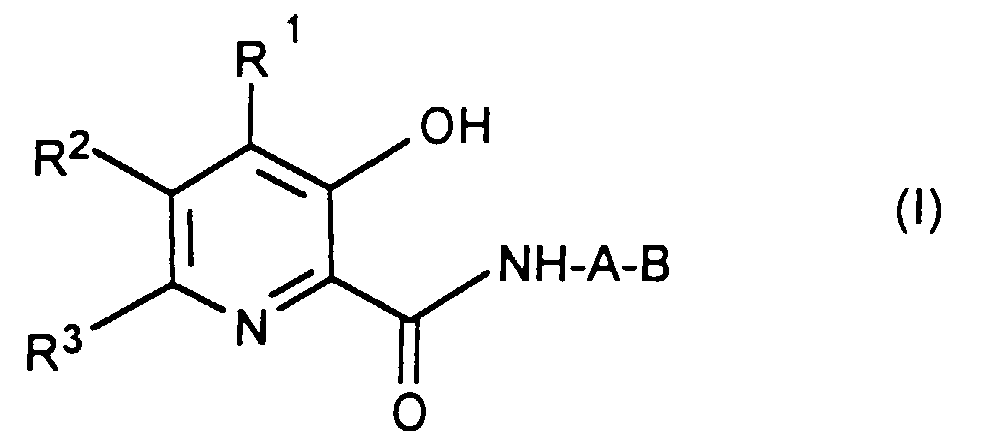
- R1, R2 und R3
- Wasserstoff,
- A
- eine -CH2-Gruppe bedeutet, in der ein Wasserstoff durch eine Methylgruppe ersetzt sein kann, und
- B
- -CO2G bedeutet, wobei
- G
- einen organischen Rest bedeutet, der die Verbindungen der Formel I zu Prodrugs macht, einschließlich der physiologisch wirksamen Salze, ausgenommen 3-Hydroxypyridin-2-carbonsäure-(glycylethylester)amid.
- R 1 , R 2 and R 3
- Hydrogen,
- A
- means a -CH 2 group in which a hydrogen can be replaced by a methyl group, and
- B
- -CO 2 G means, wherein
- G
- means an organic radical which makes the compounds of the formula I prodrugs, including the physiologically active salts, with the exception of 3-hydroxypyridine-2-carboxylic acid (glycylethyl ester) amide.
Bevorzugt sind Verbindungen der Formel I, in welcher
- R1, R2 und R3
- Wasserstoff,
- A
- eine -CH2-Gruppe bedeutet, in der ein Wasserstoff durch eine Methylgruppe ersetzt sein kann, und
- B
- -CO2G bedeutet, wobei
- G
- den Rest eines Alkohols GOH bedeutet, einschließlich der physiologisch wirksamen Salze, ausgenommen 3-Hydroxypyridin-2-carbonsäure-(glycylethylester)amid.
- R 1 , R 2 and R 3
- Hydrogen,
- A
- means a -CH 2 group in which a hydrogen can be replaced by a methyl group, and
- B
- -CO 2 G means, wherein
- G
- the balance of an alcohol means GOH, including the physiologically active salts, with the exception of 3-hydroxypyridine-2-carboxylic acid (glycylethyl ester) amide.
Bevorzugt sind Verbindungen der Formel I, in denen
- R1, R2 und R3
- Wasserstoff,
- A
- eine -CH2-Gruppe bedeutet, in der ein Wasserstoff durch eine Methylgruppe ersetzt sein kann, und
- B
- -CO2G bedeutet, wobei
- G
- einen verzweigten oder unverzweigten (C1-C20)-Alkyl-Rest, einen verzweigten oder unverzweigten (C2-C20)-Alkenyl-Rest, einen entsorechenden (C2-C20)-Alkinyl-Rest, einen entsprechenden (C4-C20)-Alkeninyl-Rest oder einen (C3-C12)-Cycloalkylrest, oder einen Retinyl-Rest bedeutet, wobei die Reste jeweils eine oder mehrere Mehrfachbindungen enthalten können, oder einen Phenylalkyl-Rest bedeutet, wobei die vorstehenden Reste insbesondere einen oder mehrere Substituenten aus der Reihe Hydroxy, Halogen, Cyano, Trifluormethyl, Carboxy, (C1-C12)-Alkyl, (C3-C8)-Cycloalkyl, (C5-C8)-Cycloalkenyl, (C1-C12)-Alkoxy, (C1-12)-Alkoxy-(C1-C12)-alkyl, (C1-C12)-Alkoxy-(C1-C12)-alkoxy, Phenyl-(C1-C4)-alkyloxy, (C1-C8)-Hydroxyalkyl, (C1-C12)-Alkylcarbonyloxy, (C3-C8)-Cycloalkylcarbonyloxy, Benzoyloxy, Phenyl-(C1-C4)-alkylcarbonyloxy enthalten, einschließlich der physiologisch wirksamen Salze, ausgenommen 3-Hydroxypyridin-2-carbonsäure-(glycylethylester)amid.
- R 1 , R 2 and R 3
- Hydrogen,
- A
- means a -CH 2 group in which a hydrogen can be replaced by a methyl group, and
- B
- -CO 2 G means, wherein
- G
- a branched or unbranched (C 1 -C 20 ) alkyl radical, a branched or unbranched (C 2 -C 20 ) alkenyl radical, a corresponding (C 2 -C 20 ) alkynyl radical, a corresponding (C 4 -C 20 ) alkeninyl radical or a (C 3 -C 12 ) cycloalkyl radical, or a retinyl radical, where the radicals can each contain one or more multiple bonds, or a phenylalkyl radical, where the above radicals especially one or more substituents from the series hydroxy, halogen, cyano, trifluoromethyl, carboxy, (C 1 -C 12 ) alkyl, (C 3 -C 8 ) cycloalkyl, (C 5 -C 8 ) cycloalkenyl, (C 1 -C 12 ) alkoxy, (C 1 - 12 ) alkoxy- (C 1 -C 12 ) alkyl, (C 1 -C 12 ) alkoxy- (C 1 -C 12 ) alkoxy, phenyl- ( C 1 -C 4 ) alkyloxy, (C 1 -C 8 ) hydroxyalkyl, (C 1 -C 12 ) alkylcarbonyloxy, (C 3 -C 8 ) cycloalkylcarbonyloxy, benzoyloxy, phenyl- (C 1 -C 4 ) -alkylcarbonyloxy contain, including the physiologically active salts, except 3-hydroxypyridine-2-carboxylic acid- ( glycylethyl ester) amide.
Weiterhin bevorzugt sind Verbindungen der Formel I, in denen
- R1, R2 und R3
- Wasserstoff,
- A
- eine -CH2-Gruppe bedeutet, in der ein Wasserstoffatom durch eine Methylgruppe ersetzt sein kann, und
- B
- -CO2G bedeutet, wobei
- G
- einen verzweigten oder unverzweigten aliphatischen (C1-C18)-Alkyl-Rest,
einen (C3-C8)-Cycloalkylrest, einen (C3-C8)-Cycloalkyl-(C1-C8)-alkylrest,
einen verzweigten oder unverzweigten (C2-C18)-Alkenylrest, wie z.B.
einen Geranyl-, Farnesyl- oder einen Retinyl-Rest, oder einen
entsprechenden (C2-C18)-Alkinylrest, einen Benzyl-, Phenethyl-,
Phenylpropyl- oder Phenylbutylrest bedeutet,
wobei die vorstehenden Reste einen Substituenten aus der Reihe Hydroxy, (C1-C4)-Alkoxy, (C1-C6)-Alkylcarbonyloxy, (C3-C8)-Cycloalkylcarbonyloxy, Benzoyloxy oder Phenyl-(C1-C4)-alkylcarbonyloxy, enthalten, einschließlich der physiologisch wirksamen Salze, ausgenommen 3-Hydroxypyridin-2-carbonsäure-(glycylethylester)amid.
- R 1 , R 2 and R 3
- Hydrogen,
- A
- represents a -CH 2 group in which a hydrogen atom can be replaced by a methyl group, and
- B
- -CO 2 G means, wherein
- G
- a branched or unbranched aliphatic (C 1 -C 18 ) alkyl radical, a (C 3 -C 8 ) cycloalkyl radical, a (C 3 -C 8 ) cycloalkyl (C 1 -C 8 ) alkyl radical, one branched or unbranched (C 2 -C 18 ) alkenyl, such as a geranyl, farnesyl or a retinyl residue, or a corresponding (C 2 -C 18 ) alkynyl residue, a benzyl, phenethyl, phenylpropyl or Phenylbutyl radical means
wherein the above radicals a substituent from the series hydroxy, (C 1 -C 4 ) alkoxy, (C 1 -C 6 ) alkylcarbonyloxy, (C 3 -C 8 ) cycloalkylcarbonyloxy, benzoyloxy or phenyl- (C 1 -C 4 ) -alkylcarbonyloxy, including the physiologically active salts, with the exception of 3-hydroxypyridine-2-carboxylic acid (glycylethyl ester) amide.
Besonders bevorzugt sind Verbindungen der Formel I, in denen
- R1, R2 und R3
- Wasserstoff,
- A
- eine -CH2-Gruppe bedeutet, in der ein Wasserstoffatom durch eine Methylgruppe ersetzt sein kann, und
- B
- -CO2G bedeutet, wobei
- G
- einen verzweigten oder unverzweigten aliphatischen (C1-C18)-Alkyl-Rest, einen (C5-C6)-Cycloalkylrest, einen (C3-C8)-Cycloalkyl-(C1-C4)-alkylrest, einen verzweigten oder unverzweigten (C2-C18)-Alkenylrest, einen Benzyl-, Phenethyl-, Phenylpropyl- oder Phenylbutylrest, bedeutet, einschließlich der physiologisch wirksamen Salze, ausgenommen 3-Hydroxypyridin-2-carbonsäure-(glycylethylester)amid.
- R 1 , R 2 and R 3
- Hydrogen,
- A
- represents a -CH 2 group in which a hydrogen atom can be replaced by a methyl group, and
- B
- -CO 2 G means, wherein
- G
- a branched or unbranched aliphatic (C 1 -C 18 ) alkyl radical, a (C 5 -C 6 ) cycloalkyl radical, a (C 3 -C 8 ) cycloalkyl (C 1 -C 4 ) alkyl radical, one means branched or unbranched (C 2 -C 18 ) alkenyl, a benzyl, phenethyl, phenylpropyl or phenylbutyl radical, including the physiologically active salts, with the exception of 3-hydroxypyridine-2-carboxylic acid (glycylethyl ester) amide.
Besonders bevorzugt sind weiterhin Verbindungen der Formel I, in denen
- R1, R2 und R3
- Wasserstoff,
- A
- eine -CH2-Gruppe bedeutet, in der ein Wasserstoff durch eine Methylgruppe ersetzt sein kann, und
- B
- -CO2G bedeutet, wobei
- G
- einen verzweigten oder unverzweigten (C1-C18)-Alkyl-oder (C2-C18)-Alkenyl-Rest, bedeutet, einschließlich der physiologischen wirksamen Salze, ausgenommen 3-Hydroxypyridin-2-carbonsäure-(glycylethylester)amid.
- R 1 , R 2 and R 3
- Hydrogen,
- A
- means a -CH 2 group in which a hydrogen can be replaced by a methyl group, and
- B
- -CO 2 G means, wherein
- G
- is a branched or unbranched (C 1 -C 18 ) alkyl or (C 2 -C 18 ) alkenyl radical, including the physiologically active salts, with the exception of 3-hydroxypyridine-2-carboxylic acid (glycylethyl ester) amide.
Besonders bevorzugt sind weiterhin Verbindungen der Formel I, in denen
- R1, R2 und R3
- Wasserstoff,
- A
- eine -CH2-Gruppe, und
- B
- -CO2G bedeutet, wobei
- G
- einen verzweigten oder unverzweigten (C1-C18)-Alkyl- oder (C2-C18)-Alkenyl-Rest
bedeutet,
einschließlich der physiologisch wirksamen Salze, ausgenommen 3-Hydroxypyridin-2-carbonsäure-(glycylethylester)amid.
- R 1 , R 2 and R 3
- Hydrogen,
- A
- a -CH 2 group, and
- B
- -CO 2 G means, wherein
- G
- is a branched or unbranched (C 1 -C 18 ) alkyl or (C 2 -C 18 ) alkenyl radical,
including the physiologically active salts, with the exception of 3-hydroxypyridine-2-carboxylic acid (glycylethyl ester) amide.
Insbesondere bevorzugt sind Verbindungen der Formel I, in denen
- R1, R2 und R3
- Wasserstoff,
- A
- eine -CH2-Gruppe,
- B
- -CO2G bedeutet, wobei
- G
- einen linearen (C1-C18)-Alkyl-Rest bedeutet, einschließlich der physiologisch wirksamen Salze, ausgenommen 3-Hydroxypyridin-2-carbonsäure-(glycylethylester)amid.
- R 1 , R 2 and R 3
- Hydrogen,
- A
- a -CH 2 group,
- B
- -CO 2 G means, wherein
- G
- represents a linear (C 1 -C 18 ) alkyl radical, including the physiologically active salts, with the exception of 3-hydroxypyridine-2-carboxylic acid (glycylethyl ester) amide.
Besonders bevorzugt sind solche Verbindungen der Formel I, in denen
- G
- einen linearen (C1-C16)-Alkyl-Rest bedeutet, einschließlich der physiologisch wirksamen Salze, ausgenommen 3-Hydroxypyridin-2-carbonsäure-(glycylethylester)amid.
- G
- represents a linear (C 1 -C 16 ) alkyl radical, including the physiologically active salts, with the exception of 3-hydroxypyridine-2-carboxylic acid (glycylethyl ester) amide.
Die Erfindung umfaßt weiterhin Salze der Verbindungen der allgemeinen Formel I.The invention further encompasses salts of the compounds of the general Formula I.
Die Salzbildung mit sauren Reagenzien kann am Pyridin-N-Atom erfolgen.Salt formation with acidic reagents can take place on the pyridine N atom.
Zur Anwendung kommende Reagenzien sind beispielsweise Toluolsulfonsäure, Methansulfonsäure, HCl, H2SO4, H3PO4 und Arzneimittel, die eine saure Gruppe enthalten. Reagents used are, for example, toluenesulfonic acid, methanesulfonic acid, HCl, H 2 SO 4 , H 3 PO 4 and medicaments which contain an acidic group.
Die Erfindung betrifft die Verbindungen der allgemeinen Formel I sowie die physiologisch verträglichen Salze zur Anwendung bei der Hemmung der Kollagenbiosynthese.The invention relates to the compounds of general formula I and the physiologically acceptable salts for use in inhibiting the Collagen biosynthesis.
Die Erfindung betrifft die Verbindungen der allgemeinen Formel I sowie die physiologisch verträglichen Salze zur Anwendung bei der Hemmung der Prolyl-4-hydroxylase in vivo und in vitro.The invention relates to the compounds of general formula I and the physiologically acceptable salts for use in inhibiting prolyl 4-hydroxylase in vivo and in vitro.
Weiterhin betrifft die Erfindung die Verbindungen der allgemeinen Formel I sowie die physiologisch verträglichen Salze zur Anwendung bei fibrotischen Erkrankungen der Lunge, der Leber, der Niere, des Herzens, des Auges und der Haut. Die Verbindungen können auch Anwendung finden bei Artherosklerose. Hierbei werden systemische und/oder lokale Applikationen angewandt.The invention further relates to the compounds of general formula I. as well as the physiologically acceptable salts for use in fibrotic Diseases of the lungs, liver, kidney, heart, eye and Skin. The compounds can also be used in atherosclerosis. Systemic and / or local applications are used here.
Insbesondere betrifft die Erfindung Verbindungen der allgemeinen Formel I sowie der physiologisch verträglichen Salze zur lokalen Anwendung, insbesondere als Inhibitoren der Kollagenbiosynthese, als antifibrotische Wirkstoffe und bei Krankheitsformen, die von einer erhöhten Bildung von Bindegewebe (Kollagen) verursacht werden. Hierunter zählen die Anwendungen zur Vermeidung/Verringerung von Vernarbungen nach chirurgischen Eingriffen am menschlichen Körper und bei der postoperativen Behandlung von Augenoperationen, z.B. bei Glaukomoperationen und bei strahleninduzierter oder durch Chemotherapie induzierter Fibrose, insbesondere an der Lunge.In particular, the invention relates to compounds of general formula I. as well as the physiologically acceptable salts for local use, especially as inhibitors of collagen biosynthesis, as antifibrotic Active substances and in the case of diseases that are characterized by an increased formation of Connective tissue (collagen) are caused. This includes the applications to avoid / reduce scarring after surgery on the human body and in the postoperative treatment of Eye surgery, e.g. for glaucoma operations and radiation-induced ones or fibrosis induced by chemotherapy, especially on the lungs.
Schließlich betrifft die Erfindung die Verbindungen der allgemeinen Formel I zur Verwendung als Arzneimittel.Finally, the invention relates to the compounds of general formula I for Use as a medicine.
Insbesondere betrifft die Erfindung Verbindungen der Formel I zur lokalen Anwendung bei Fibrosen der Haut, der Lunge und des Auges, insbesondere zur nachoperativen Behandlung des Glaukoms. In particular, the invention relates to compounds of formula I for local Use in fibrosis of the skin, lungs and eyes, especially for postoperative treatment of glaucoma.
Weiterhin betrifft die Erfindung ein Verfahren zur Herstellung von Verbindungen der allgemeinen Formel I.The invention further relates to a method for producing compounds of the general formula I.
Die Herstellung der Verbindungen der Formel I, in denen A eine -CH2-Gruppe, in
der ein Wasserstoff durch eine Methylgruppe ersetzt sein kann und B CO2G
bedeuten, erfolgt, indem

Geeignete Verfahren zur Amidbildung (Umsetzung i1) sind die Methoden der Carbonylaktivierung und die aus der Peptidchemie bekannten Kondensationsreaktionen.Suitable methods for amide formation (implementation i1) are the methods of Carbonyl activation and those known from peptide chemistry Condensation reactions.
An Reagenzien zur Carbonsäureaktivierung können die dem Fachmann bekannten Substanzen, wie Thionylchlorid, Oxalylchlorid, Pivaloylchlorid, Chlorameisensäureester-Derivate oder N,N'-Carbonyldimidazol Verwendung finden. Die aktivierten Derivate der Verbindungen der Formel II werden nach Herstellung in situ mit den Amidderivaten der Formel III umgesetzt.The person skilled in the art can use reagents for carboxylic acid activation known substances, such as thionyl chloride, oxalyl chloride, pivaloyl chloride, Chloroformic acid ester derivatives or N, N'-carbonyldimidazole use Find. The activated derivatives of the compounds of formula II are after Production implemented in situ with the amide derivatives of the formula III.
Ein geeignetes Kondensationsmittel ist beispielsweise die Kombination von N,N'-Dicyclohexylcarbodiimid/N-Hydroxy-1H-benzotriazol und N-Ethylmorpholin.A suitable condensing agent is, for example, the combination of N, N'-dicyclohexylcarbodiimide / N-hydroxy-1H-benzotriazole and N-ethylmorpholine.
Geeignete Lösungsmittel sind Dichlormethan, Tetrachlormethan, Butylacetat, Ethylacetat, Toluol, Tetrahydrofuran, Dimethoxyethan, 1,4-Dioxan, Acetonitril, N,N-Dimethylformamid, N,N-Dimethylacetamid, Dimethylsulfoxid, Nitromethan und/oder Pyridin.Suitable solvents are dichloromethane, carbon tetrachloride, butyl acetate, Ethyl acetate, toluene, tetrahydrofuran, dimethoxyethane, 1,4-dioxane, acetonitrile, N, N-dimethylformamide, N, N-dimethylacetamide, dimethyl sulfoxide, nitromethane and / or pyridine.
Die erfindungsgemäßen Verbindungen der Formel I besitzen wertvolle pharmakologische Eigenschaften und zeigen insbesondere antifibrotische Wirksamkeit.The compounds of formula I according to the invention have valuable pharmacological properties and in particular show antifibrotic Effectiveness.
Die antifibrotische Wirkung kann in folgenden Tiermodellen bestimmt werden:
Hemmung der Prolyl-4-hydroxylase in Zellkulturen:
Normale humane Hautfibroblasten (Normal human fibroblasts, NHDF),
Rattenleber-Epithelzellen (rat liver epithelial cells, Ref. 1) und Fettspeicherzellen
aus der Leber (fat storing cells, Ref. 2) werden als Zellmodelle zur
Substanztestung verwendet. Dazu werden die Zellen in Gegenwart von
Hemmstoffen kultiviert. Gleichzeitig wird das in dieser Zeit neu synthetisierte
Kollagen durch 4-3H-L-Prolin und 14C-Prolin metabolisch markiert. Der Einfluß
der Testsubstanzen auf den Hydroxylierungsgrad des Kollagens wird
anschließend entsprechend der Methode von Chojkier et al (Ref. 3) bestimmt.
Als Referenzsubstanz wird 2,2'-Dipyridyl eingesetzt. (1.: Schrode, W., Mecke,
D., Gebhard, R. 1990. Induction of glutamine synthetase in periportal
hepatocytes by co-cultivation with a liver epithelial cell line. Eur. J. Cell. Biol.
53: 35-41, 2.: Blomhoff, R., Berg T. 1990. Isolation and cultivation of rat liver
stellate cells. Methods Enzymol. 190: 59-71 und 3.: Chojkier, M. Peterkofsky,
B. Bateman,, J. 1980. A new method for determining the extent of proline
hydroxylation by measuring changes in the ration of [4-3H]:[14C] proline in
collagenase digests. Anal. Biochem. 108: 385-393).Inhibition of prolyl-4-hydroxylase in cell cultures:
Normal human skin fibroblasts (NHDF), rat liver epithelial cells (rat liver epithelial cells, ref. 1) and fat storage cells from the liver (fat storing cells, ref. 2) are used as cell models for substance testing. For this purpose, the cells are cultivated in the presence of inhibitors. At the same time, the collagen newly synthesized during this time is metabolically marked by 4- 3 HL-proline and 14 C-proline. The influence of the test substances on the degree of hydroxylation of the collagen is then determined according to the method of Chojkier et al (Ref. 3). 2,2'-Dipyridyl is used as the reference substance. (1 .: Schrode, W., Mecke, D., Gebhard, R. 1990. Induction of glutamine synthetase in periportal hepatocytes by co-cultivation with a liver epithelial cell line. Eur. J. Cell. Biol. 53: 35- 41, 2 .: Blomhoff, R., Berg T. 1990. Isolation and cultivation of rat liver stellate cells. Methods Enzymol. 190: 59-71 and 3 .: Chojkier, M. Peterkofsky, B. Bateman, J. 1980 A new method for determining the extent of proline hydroxylation by measuring changes in the ration of [4- 3 H]: [ 14 C] proline in collagenase digests. Anal. Biochem. 108: 385-393).
Hemmung der Prolyl-4-hydroxylase in vitro (in Hühnchenembryo - Calvarien) gemäß Biochem. J. (1994) 300, 525-300:Inhibition of prolyl-4-hydroxylase in vitro (in chicken embryo - calvary) according to Biochem. J. (1994) 300, 525-300:
Calvarien werden aus 15 Tage alten Hühnchenembryonen präpariert und 3 min bei 37°C in Hanks' balanced salt solution minimum essential medium Eagle (HMEM, BioWhittaker, Walkersville, MD, USA) gewaschen. Je 4 Calvarien werden in Glasgefäßen mit 1.5 ml HMEM unter Zusatz von 2 mM Glutamin und 1 µCi [U-14C]Prolin sowie verschiedenen Inhibitorkonzentrationen 2.5 h bei 37°C inkubiert. Die Inkubation wird durch Einbringen der Probengefäße in Eis beendet. Das Medium wird entfernt und die Calvarien werden kurz mit 1 ml bidest H2O gewaschen. Danach werden die Calvarien mit 3 ml 0.5 M Essigsäure und 18 µg Phenylmethan-Sulfonylfluorid versetzt und 16 h extrahiert. Die Extraktionslösung wird bis zum Entfernen des freien [U-14C]Prolin bei 4°C gegen 0.5 M Essigsäure dialysiert und anschließend in Aliquots gefriergetrocknet.Calvaries are prepared from 15 day old chicken embryos and washed for 3 min at 37 ° C in Hanks' balanced salt solution minimum essential medium Eagle (HMEM, BioWhittaker, Walkersville, MD, USA). 4 calvariae are incubated in glass vessels with 1.5 ml HMEM with the addition of 2 mM glutamine and 1 µCi [U-14C] proline and various inhibitor concentrations at 37 ° C for 2.5 h. The incubation is ended by placing the sample vessels in ice. The medium is removed and the calvaries are briefly washed with 1 ml bidest H 2 O. Then the calvaries are mixed with 3 ml of 0.5 M acetic acid and 18 μg of phenylmethane sulfonyl fluoride and extracted for 16 h. The extraction solution is dialyzed against 0.5 M acetic acid at 4 ° C. until the free [U-14C] proline is removed and then freeze-dried in aliquots.
Ein Aliquot der gefriergetrockneten Probe wird in 2 ml 6 N HCl aufgelöst und 24
h bei 105°C hydrolysiert. Danach wird die Salzsäure abgedampft. Der
Rückstand wird in 300 µl bidest H2O resuspendiert, in Eppendorf-Gefäße
überführt und erneut getrocknet. Die verbleibenden Hydrochloride werden durch
Lösen in 60 µl einer Ethanol/H2O/Triethylamin 2:2:1 (v:v:v) und erneutem
Trocknen neutralisiert. Anschließend werden die Aminosäuren 20 min bei
Raumtemperatur in einer Lösung von Ethanol/Triethylamin/Phenylisothiocyanat/H2O
7:1:1:1 (v:v:v:v) derivatisiert und erneut getrocknet. Zur Analyse mit HPLC
werden die Proben in 150 µl eines Phosphatpuffers (5 mM Na2HPO4, pH 7.4/Acetonitril
95:5 (v:v)) gelöst und 5 min bei 10000 g zentrifugiert. 50 µl werden
zur Analyse verwendet. Die HPLC-Chromatographie erfolgt auf einer C18
reverse phase Säule Ultrasphere ODS 3 µm, 4.6 nim x 7.5 cm (Beckman) bei
50°C mit folgendem Gradientensystem:
Lsg. B: Acetonitril/Methanol/Wasser 45:15:40 (v:v:v)
Solution B: acetonitrile / methanol / water 45:15:40 (v: v: v)
Ein Aliquot der gefriergetrockneten Proben aus 1. wird für die SDS-Polyacrylamid - Gelelektrophorese mit 10 mM Tris/HCl, pH 8 / 1 mM EDTA / 1 % SDS und 5 % Mercaptoethanol gelöst und 5 min bei 95°C denaturiert. Die Elektrophorese erfolgt auf einem linearen Gradientengel (5-15 %). Nach Fixierung in Methanol/Eisessig/Wasser 3:1:6 (v:v:v) werden die Gele getrocknet und zur Belichtung von Kodak X-Omat Film bei -70°C verwendet.An aliquot of the freeze-dried samples from 1. is used for the SDS-polyacrylamide - Gel electrophoresis with 10 mM Tris / HCl, pH 8/1 mM EDTA / 1 % SDS and 5% mercaptoethanol dissolved and denatured for 5 min at 95 ° C. The Electrophoresis is carried out on a linear gradient gel (5-15%). After Fixing in methanol / glacial acetic acid / water 3: 1: 6 (v: v: v) the gels are dried and used to expose Kodak X-Omat film at -70 ° C.
Im folgenden werden die überraschenden Vorteile der erfindungsgemäßen
Verbindungen gegenüber Verbindungen aus EP-A-0 661 269 anhand von
Vergleichsversuchen über die Hemmung der Prolyl-4-hydroxylase
(Kollagenbiosynthese) in Rattenleberzellen verdeutlicht:
Die Verbindungen der Formel I können als Medikamente in Form pharmazeutischer Präparate Verwendung finden, welche sie gegebenenfalls mit verträglichen pharmazeutischen Trägern enthalten. Die Verbindungen können als Heilmittel, z.B. in Form pharmazeutischer Präparate Verwendung finden, welche diese Verbindungen in Mischung mit einem für die enterale, perkutane, parenterale und inhalative Applikation geeigneten pharmazeutischen, organischen oder anorganischen Träger, wie z. B. Wasser, Gummi arabicum, Gelatine, Milchzucker, Stärke, Magnesiumstearat, Talk, pflanzliche Öle, Polyalkylenglykole, Vaseline usw. enthalten.The compounds of formula I can be in the form of drugs pharmaceutical preparations are used, which they may be used with compatible pharmaceutical carriers. The connections can as a remedy, e.g. find use in the form of pharmaceutical preparations, which these compounds are mixed with one for enteral, percutaneous, parenteral and inhalative application of suitable pharmaceutical, organic or inorganic carriers, such as. B. water, gum arabic, Gelatin, milk sugar, starch, magnesium stearate, talc, vegetable oils, Contain polyalkylene glycols, petroleum jelly, etc.
Sie können zu diesem Zweck oral in Dosen von 0,1 bis 25 mg/kg/Tag, vorzugsweise 1 bis 5 mg/kg/Tag oder parenteral in Dosen von 0,01 bis 5 mg/kg/Tag, vorzugsweise 0,01 bis 2,5 mg/kg/Tag, insbesondere 0,5 bis 1,0 mg/kg/Tag, appliziert werden. Die Dosierung kann in schweren Fällen auch erhöht werden. In vielen Fällen genügen jedoch auch geringere Dosen. Diese Angaben beziehen sich auf einen Erwachsenen von etwa 75 kg Gewicht.For this purpose you can take orally in doses of 0.1 to 25 mg / kg / day, preferably 1 to 5 mg / kg / day or parenterally in doses of 0.01 to 5 mg / kg / day, preferably 0.01 to 2.5 mg / kg / day, in particular 0.5 to 1.0 mg / kg / day. The dosage can also be severe increase. In many cases, however, lower doses are sufficient. This Figures refer to an adult weighing approximately 75 kg.
Unter den im folgenden beschriebenen Beispielen werden die erfindungsgemäßen Verbindungen der Formel I als substituierte 3-Hydroxypyridin-2-carbonsäure(glycylester)amide bezeichnet. Unter dieser Bezeichnungsweise werden substituierte 3-Hydroxypyridin-2-carbonsäure-N-((alkoxycarbonyl)methyl)amide verstanden. Die Klassifizierung als substituierte N-(3-Hydroxypyridyl-2-carbonyl)glycinester ist eine weitere Möglichkeit. Among the examples described below, the Compounds of formula I according to the invention as substituted 3-hydroxypyridine-2-carboxylic acid (glycylester) amides designated. Substituted 3-hydroxypyridine-2-carboxylic acid N - ((alkoxycarbonyl) methyl) amides are used under this designation Understood. The classification as a substituted N- (3-hydroxypyridyl-2-carbonyl) glycine ester is another way.
38 g (0,5 Mol) Glycin, 93,2 g (0,5 Mol) 1-Dodekanol und 115 g (0,6 Mol) p-Toluolsulfonsäure wurden mit 400 ml Toluol am Wasserabscheider erhitzt bis kein Wasser mehr überging. 4 h nach dem Abkühlen wurde durch Anreiben zur Kristallisation gebracht, mit Diethylether verdünnt, das ausgefallene Produkt abgesaugt, mit Diethylether gewaschen und getrocknet. Man erhielt 140 g Produkt, Fp. 106°C (sintern bei 80°C).a) Glycine-1-dodecyl ester tosylate
38 g (0.5 mol) of glycine, 93.2 g (0.5 mol) of 1-dodecanol and 115 g (0.6 mol) of p-toluenesulfonic acid were heated with 400 ml of toluene on a water separator until no more water passed over. 4 h after cooling, the product was crystallized by trituration, diluted with diethyl ether, the precipitated product was filtered off with suction, washed with diethyl ether and dried. 140 g of product were obtained, mp 106 ° C. (sintering at 80 ° C.).
Dann wurde der ausgefallene Harnstoff abgesaugt, die Mutterlauge nacheinander mit 2N wäßriger Salzsäure, mit gesättigter, wäßriger Na-bicarbonat-Lösung und mit Wasser geschüttelt, die organische Phase getrocknet, i.Vak. eingeengt und der Rückstand mit Ethylacetat an Kieselgel chromatographiert. Aus entsprechenden Fraktionen wurden 12 g hellbraunes Öl erhalten, das beim Stehen kristallisierte. Man behandelte mit kaltem Petrolether, saugte das Produkt ab, wusch mit kaltem Petrolether und erhielt 8,5 g farblos kristallines Produkt, Fp. 53-56°C. Then the precipitated urea was sucked off, the mother liquor successively with 2N aqueous hydrochloric acid, with saturated aqueous Na bicarbonate solution and shaken with water, the organic phase dried, vacuum concentrated and the residue with ethyl acetate on silica gel chromatographed. Corresponding fractions became 12 g of light brown oil obtained, which crystallized on standing. It was treated with cold petroleum ether, the product was suctioned off, washed with cold petroleum ether and obtained 8.5 g colorless crystalline product, mp 53-56 ° C.
38 g (0,5 Mol) Glycin wurden in 400 ml Toluol mit 37 g (0,5 Mol) 1-Butanol und 115 g (0,6 Mol) p-Toluolsulfonsäure versetzt und am Wasserabscheider erhitzt bis kein Wasser mehr überging. Nach Stehen über Nacht wurde das ausgefallene Produkt abgesaugt und mit Diethylether gewaschen; 20 g Produkt, Fp.: 80-82°C. Aus der Mutterlauge wurden weitere 130 g Produkt gewonnen.a) Glycine-1-butyl ester tosylate
38 g (0.5 mol) of glycine in 400 ml of toluene were mixed with 37 g (0.5 mol) of 1-butanol and 115 g (0.6 mol) of p-toluenesulfonic acid and heated on a water separator until no more water passed over. After standing overnight, the precipitated product was filtered off and washed with diethyl ether; 20 g product, m.p .: 80-82 ° C. A further 130 g of product were obtained from the mother liquor.
Claims (22)
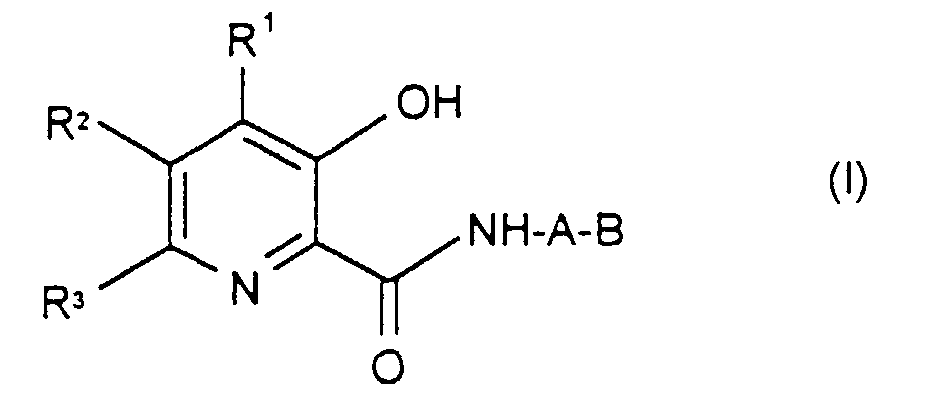
- R1, R2 und R3
- Wasserstoff,
- A
- eine -CH2-Gruppe bedeutet, in der ein Wasserstoff durch eine Methylgruppe ersetzt sein kann, und
- B
- -CO2G bedeutet, wobei
- G
- einen organischen Rest bedeutet, der die Verbindungen der Formel I in Prodrugs überführt, einschließlich der physiologisch wirksamen Salze, ausgenommen 3-Hydroxypyridin-2-carbonsäure-(glycylethylester)-amid.
- R 1 , R 2 and R 3
- Hydrogen,
- A
- means a -CH 2 group in which a hydrogen can be replaced by a methyl group, and
- B
- -CO 2 G means, wherein
- G
- means an organic radical which converts the compounds of the formula I into prodrugs, including the physiologically active salts, with the exception of 3-hydroxypyridine-2-carboxylic acid (glycylethyl ester) amide.
- R1, R2 und R3
- Wasserstoff,
- A
- eine -CH2-Gruppe bedeutet, in der ein Wasserstoff durch eine Methylgruppe ersetzt sein kann, und
- B
- -CO2G bedeutet, wobei
- G
- einen verzweigten oder unverzweigten (C1-C20)-Alkyl-Rest, oder einen verzweigten oder unverzweigten (C2-C20)-Alkenyl-Rest, einen entsprechenden (C2-C20)-Alkinyl-Rest, einen entsprechenden (C4-C20)-Alkeninyl-Rest oder einen (C3-C12)-Cycloalkylrest, oder einen Retinyl-Rest bedeutet, wobei die Reste jeweils eine oder mehrere Mehrfachbindungen enthalten können, oder einen Phenylalkyl-Rest bedeutet, wobei die vorstehenden Reste insbesondere einen oder mehrere Substituenten aus der Reihe Hydroxy, Halogen, Cyano, Trifluormethyl, Carboxy, (C1-C12)-Alkyl,(C3-C8)-Cycloalkyl, (C5-C8)-Cycloalkenyl, (C1-C12)-Alkoxy, (C1-C12)-Alkoxy-(C1-C12)-alkyl, (C1-C12)-Alkoxy-(C1-C12)-alkoxy, Phenyl-(C1-C4)-alkyloxy, (C1-C8)-Hydroxyalkyl, (C1-C12)-Alkylcarbonyloxy, (C3-C8)-Cycloalkylcarbonyloxy, Benzoyloxy, Phenyl-(C1-C4)-alkylcarbonyloxy enthalten, einschließlich der physiologisch wirksamen Salze, ausgenommen 3-Hydroxypyridin-2-carbonsäure-(glycylethylester)-amid.
- R 1 , R 2 and R 3
- Hydrogen,
- A
- means a -CH 2 group in which a hydrogen can be replaced by a methyl group, and
- B
- -CO 2 G means, wherein
- G
- a branched or unbranched (C 1 -C 20 ) alkyl radical, or a branched or unbranched (C 2 -C 20 ) alkenyl radical, a corresponding (C 2 -C 20 ) alkynyl radical, a corresponding ( C 4 -C 20 ) alkeninyl radical or a (C 3 -C 12 ) cycloalkyl radical, or a retinyl radical, where the radicals may each contain one or more multiple bonds, or a phenylalkyl radical, the above Radicals in particular one or more substituents from the series hydroxyl, halogen, cyano, trifluoromethyl, carboxy, (C 1 -C 12 ) alkyl, (C 3 -C 8 ) cycloalkyl, (C 5 -C 8 ) cycloalkenyl, ( C 1 -C 12 ) alkoxy, (C 1 -C 12 ) alkoxy- (C 1 -C 12 ) alkyl, (C 1 -C 12 ) alkoxy- (C 1 -C 12 ) alkoxy, phenyl - (C 1 -C 4 ) alkyloxy, (C 1 -C 8 ) hydroxyalkyl, (C 1 -C 12 ) alkylcarbonyloxy, (C 3 -C 8 ) cycloalkylcarbonyloxy, benzoyloxy, phenyl- (C 1 -C 4 ) -alkylcarbonyloxy contain, including the physiologically active salts, except 3-hydroxypyridine-2-carboxylic acid acid (glycylethyl ester) amide.
- R1, R2 und R3
- Wasserstoff,
- A
- eine -CH2-Gruppe bedeutet, in der ein Wasserstoffatom durch eine Methylgruppe ersetzt sein kann, und
- B
- -CO2G bedeutet, wobei
- G
- einen verzweigten oder unverzweigten aliphatischen (C1-C18)-Alkyl-Rest,
einen (C3-C8)-Cycloalkylrest, einen (C3-C8)-Cycloalkyl-(C1-C8)-alkylrest,
einen verzweigten oder unverzweigten (C2-C18)-Alkenylrest,
wie z.B. einen Geranyl-, Farnesyl- oder einen Retinyl-Rest,
oder einen entsprechenden (C2-C18)-Alkinylrest, einen
Benzyl-, Phenethyl-, Phenylpropyl- oder Phenylbutylrest bedeutet,
wobei die vorstehenden Reste einen Substituenten aus der Reihe Hydroxy, (C1-C4)-Alkoxy, (C1-C6)-Alkylcarbonyloxy, (C3-C8)-Cycloalkylcarbonyloxy, Benzoyloxy oder Phenyl-(C1-C4)-alkylcarbonyloxy, enthalten, einschließlich der physiologisch wirksamen Salze, ausgenommen 3-Hydroxypyridin-2-carbonsäure-(glycylethylester)-amid.
- R 1 , R 2 and R 3
- Hydrogen,
- A
- represents a -CH 2 group in which a hydrogen atom can be replaced by a methyl group, and
- B
- -CO 2 G means, wherein
- G
- a branched or unbranched aliphatic (C 1 -C 18 ) alkyl radical, a (C 3 -C 8 ) cycloalkyl radical, a (C 3 -C 8 ) cycloalkyl (C 1 -C 8 ) alkyl radical, one branched or unbranched (C 2 -C 18 ) alkenyl, such as a geranyl, farnesyl or a retinyl residue, or a corresponding (C 2 -C 18 ) alkynyl residue, a benzyl, phenethyl, phenylpropyl or Phenylbutyl radical means
wherein the above radicals a substituent from the series hydroxy, (C 1 -C 4 ) alkoxy, (C 1 -C 6 ) alkylcarbonyloxy, (C 3 -C 8 ) cycloalkylcarbonyloxy, benzoyloxy or phenyl- (C 1 -C 4 ) -alkylcarbonyloxy, including the physiologically active salts, with the exception of 3-hydroxypyridine-2-carboxylic acid (glycylethyl ester) amide.
- R1, R2 und R3
- Wasserstoff,
- A
- eine -CH2-Gruppe bedeutet, in der ein Wasserstoffatom durch eine Methylgruppe ersetzt sein kann, und
- B
- -CO2G bedeutet, wobei
- G
- einen verzweigten oder unverzweigten aliphatischen (C1-C18)-Alkyl-Rest, einen (C5-C6)-Cycloalkylrest, einen (C3-C8)-Cycloalkyl-(C1-C4)-alkylrest, einen verzweigten oder unverzweigten (C2-C18)-Alkenylrest, einen Benzyl-, Phenethyl-, Phenylpropyl- oder Phenylbutylrest, bedeutet, einschließlich der physiologisch wirksamen Salze, ausgenommen 3-Hydroxypyridin-2-carbonsäure-(glycylethylester)-amid.
- R 1 , R 2 and R 3
- Hydrogen,
- A
- represents a -CH 2 group in which a hydrogen atom can be replaced by a methyl group, and
- B
- -CO 2 G means, wherein
- G
- a branched or unbranched aliphatic (C 1 -C 18 ) alkyl radical, a (C 5 -C 6 ) cycloalkyl radical, a (C 3 -C 8 ) cycloalkyl (C 1 -C 4 ) alkyl radical, one means branched or unbranched (C 2 -C 18 ) alkenyl, a benzyl, phenethyl, phenylpropyl or phenylbutyl radical, including the physiologically active salts, with the exception of 3-hydroxypyridine-2-carboxylic acid (glycylethyl ester) amide.
- R1, R2 und R3
- Wasserstoff,
- A
- eine -CH2-Gruppe bedeutet, in der ein Wasserstoff durch eine Methylgruppe ersetzt sein kann, und
- B
- -CO2G bedeutet, wobei
- G
- einen verzweigten oder unverzweigten (C1-C18)-Alkyl-oder (C2-C18)-Alkenyl-Rest, bedeutet, einschließlich der physiologischen wirksamen Salze, ausgenommen 3-Hydroxypyridin-2-carbonsäure-(glycylethylester)-amid.
- R 1 , R 2 and R 3
- Hydrogen,
- A
- means a -CH 2 group in which a hydrogen can be replaced by a methyl group, and
- B
- -CO 2 G means, wherein
- G
- is a branched or unbranched (C 1 -C 18 ) alkyl or (C 2 -C 18 ) alkenyl radical, including the physiologically active salts, with the exception of 3-hydroxypyridine-2-carboxylic acid (glycylethyl ester) amide.
- R1, R2 und R3
- Wasserstoff,
- A
- eine -CH2-Gruppe, und
- B
- -CO2G bedeutet, wobei
- G
- einen verzweigten oder unverzweigten (C1-C18)-Alkyl- oder
(C2-C18)-Alkenyl-Rest bedeutet,
einschließlich der physiologisch wirksamen Salze, ausgenommen 3-Hydroxypyridin-2-carbonsäure-(glycylethylester)-amid.
- R 1 , R 2 and R 3
- Hydrogen,
- A
- a -CH 2 group, and
- B
- -CO 2 G means, wherein
- G
- is a branched or unbranched (C 1 -C 18 ) alkyl or (C 2 -C 18 ) alkenyl radical,
including the physiologically active salts, with the exception of 3-hydroxypyridine-2-carboxylic acid (glycylethyl ester) amide.
- R1, R2 und R3
- Wasserstoff,
- A
- eine -CH2-Gruppe,
- B
- -CO2G bedeutet, wobei
- G
- einen linearen (C1-C18)-Alkyl-Rest bedeutet, einschließlich der physiologisch wirksamen Salze, ausgenommen 3-Hydroxypyridin-2-carbonsäure-(glycylethylester)-amid.
- R 1 , R 2 and R 3
- Hydrogen,
- A
- a -CH 2 group,
- B
- -CO 2 G means, wherein
- G
- means a linear (C 1 -C 18 ) alkyl radical, including the physiologically active salts, with the exception of 3-hydroxypyridine-2-carboxylic acid (glycylethyl ester) amide.
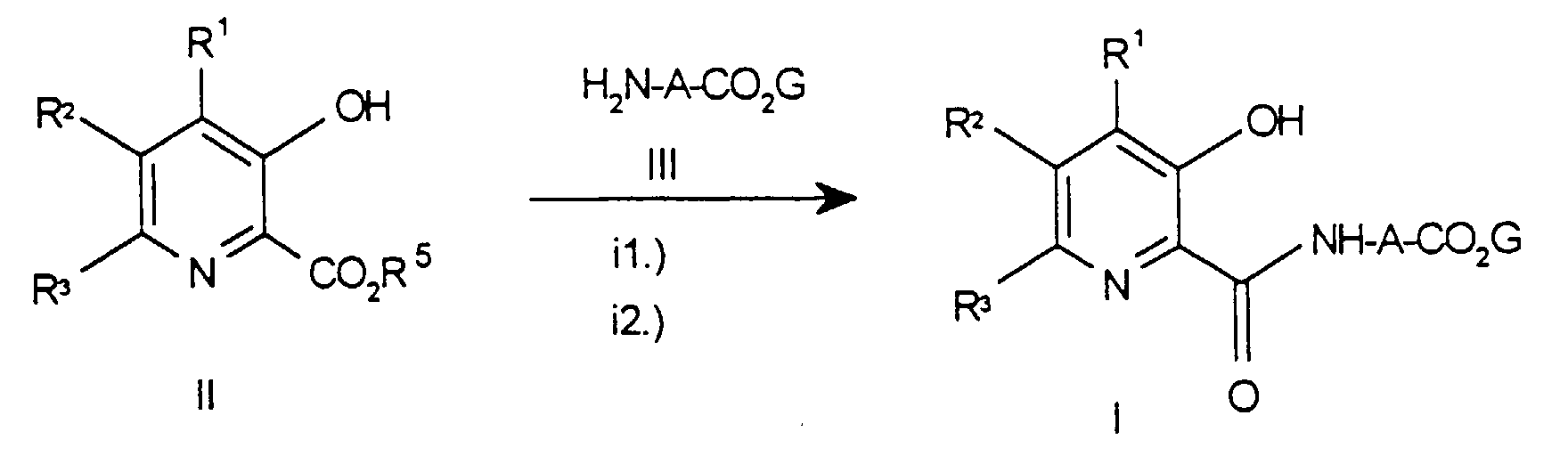
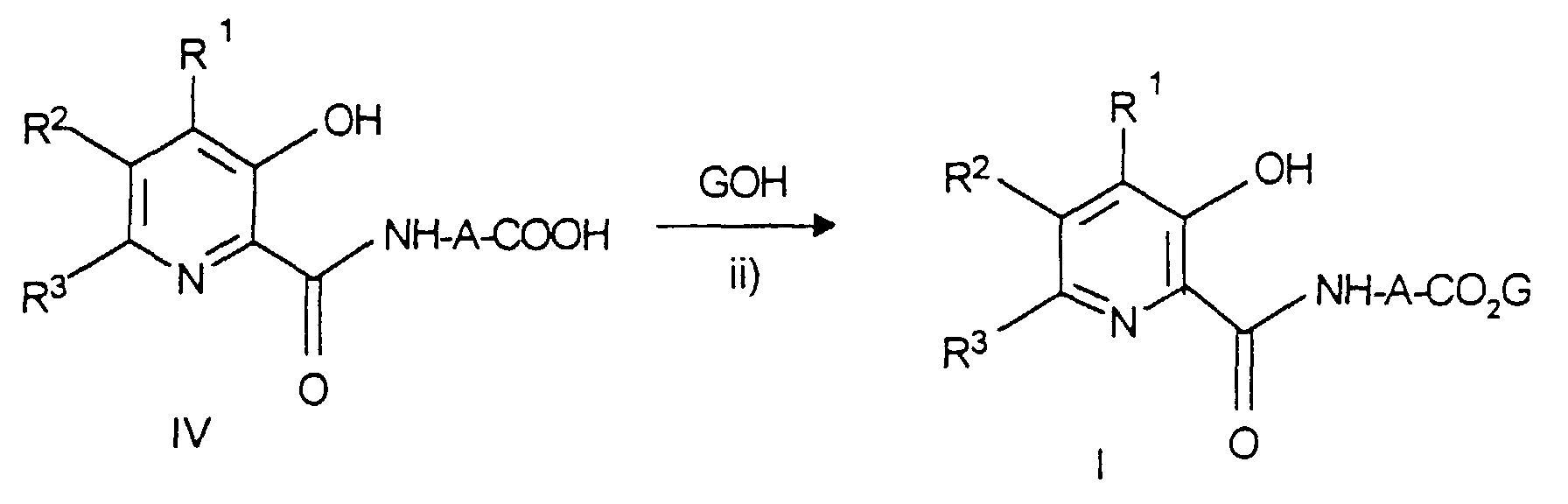
Applications Claiming Priority (2)
| Application Number | Priority Date | Filing Date | Title |
|---|---|---|---|
| DE19650215A DE19650215A1 (en) | 1996-12-04 | 1996-12-04 | 3-hydroxypyridine-2-carboxylic acid amide esters, their preparation and their use as medicaments |
| DE19650215 | 1996-12-04 |
Publications (2)
| Publication Number | Publication Date |
|---|---|
| EP0846685A1 true EP0846685A1 (en) | 1998-06-10 |
| EP0846685B1 EP0846685B1 (en) | 2002-03-13 |
Family
ID=7813570
Family Applications (1)
| Application Number | Title | Priority Date | Filing Date |
|---|---|---|---|
| EP97120537A Expired - Lifetime EP0846685B1 (en) | 1996-12-04 | 1997-11-24 | 3-Hydroxypyridine-2-carboxylic acid amide esters, their preparation and their use as medicaments |
Country Status (18)
| Country | Link |
|---|---|
| US (1) | US6020350A (en) |
| EP (1) | EP0846685B1 (en) |
| JP (1) | JPH10168062A (en) |
| KR (1) | KR19980063725A (en) |
| CN (1) | CN1184104A (en) |
| AR (1) | AR010328A1 (en) |
| AT (1) | ATE214371T1 (en) |
| AU (1) | AU743750B2 (en) |
| BR (1) | BR9706129A (en) |
| CA (1) | CA2223366A1 (en) |
| CZ (1) | CZ383297A3 (en) |
| DE (2) | DE19650215A1 (en) |
| HU (1) | HUP9702345A2 (en) |
| NO (1) | NO309717B1 (en) |
| NZ (1) | NZ329299A (en) |
| PL (1) | PL323517A1 (en) |
| SG (1) | SG65705A1 (en) |
| TR (1) | TR199701490A2 (en) |
Cited By (6)
| Publication number | Priority date | Publication date | Assignee | Title |
|---|---|---|---|---|
| US6306839B1 (en) | 1998-09-16 | 2001-10-23 | Dow Agrosciences Llc | 2-methoxyimino-2-(pyridinyloxymethyl) phenyl acetamides with (derivatised) hydroxyalkyl derivatives on the pyridine ring |
| WO2001005769A3 (en) * | 1999-07-20 | 2001-11-22 | Dow Agrosciences Llc | Fungicidal heterocyclic aromatic amides and their compositions, methods of use and preparation |
| WO2007101204A1 (en) * | 2006-02-27 | 2007-09-07 | Alcon Research, Ltd. | Method of treating glaucoma |
| EP3096617A4 (en) * | 2014-01-23 | 2017-09-13 | Akebia Therapeutics Inc. | Compositions and methods for treating ocular diseases |
| EP3275864A4 (en) * | 2015-03-27 | 2018-08-22 | Shenyang Sunshine Pharmaceutical Co., Ltd. | Compound of 3-hydroxyl pyridine, preparation method thereof and pharmaceutical use thereof |
| IT201900021960A1 (en) * | 2019-11-22 | 2021-05-22 | Isagro Spa | Compounds with fungicidal activity, their agronomic compositions and related preparation method |
Families Citing this family (26)
| Publication number | Priority date | Publication date | Assignee | Title |
|---|---|---|---|---|
| FR2803592A1 (en) * | 2000-01-06 | 2001-07-13 | Aventis Cropscience Sa | NOVEL DERIVATIVES OF 3-HYDROXYPICOLINIC ACID, PROCESS FOR THEIR PREPARATION AND FUNGICIDAL COMPOSITIONS CONTAINING SAME |
| US8318703B2 (en) | 2001-12-06 | 2012-11-27 | Fibrogen, Inc. | Methods for improving kidney function |
| HU229475B1 (en) | 2001-12-06 | 2014-01-28 | Fibrogen | Methods of increasing endogenous erythropoietin (epo) |
| EP2295060B1 (en) | 2001-12-06 | 2018-10-31 | Fibrogen, Inc. | Treatment or prevention of ischemic or hypoxic conditions |
| US8124582B2 (en) | 2002-12-06 | 2012-02-28 | Fibrogen, Inc. | Treatment of diabetes |
| US7618940B2 (en) | 2002-12-06 | 2009-11-17 | Fibrogen, Inc. | Fat regulation |
| US8614204B2 (en) | 2003-06-06 | 2013-12-24 | Fibrogen, Inc. | Enhanced erythropoiesis and iron metabolism |
| AU2006259352A1 (en) | 2005-06-15 | 2006-12-28 | Fibrogen, Inc. | Use of HIF 1alfa modulators for treatment of cancer |
| US7745461B1 (en) | 2006-02-27 | 2010-06-29 | Alcon Research, Ltd. | Method of treating dry eye disorders |
| US7588924B2 (en) | 2006-03-07 | 2009-09-15 | Procter & Gamble Company | Crystal of hypoxia inducible factor 1 alpha prolyl hydroxylase |
| KR100934671B1 (en) * | 2006-03-30 | 2009-12-31 | 엘지전자 주식회사 | Method and apparatus for decoding / encoding video signal |
| NZ623002A (en) | 2006-06-26 | 2015-08-28 | Akebia Therapeutics Inc | Prolyl hydroxylase inhibitors and methods of use |
| US8962530B2 (en) * | 2007-06-27 | 2015-02-24 | Regents Of The University Of Colorado | Inflammatory bowel disease therapies |
| CA2774039A1 (en) | 2009-11-06 | 2011-05-12 | Aerpio Therapeutics Inc. | Methods for increasing the stabilization of hypoxia inducible factor-1 alpha |
| NO2686520T3 (en) | 2011-06-06 | 2018-03-17 | ||
| CN103717214A (en) | 2011-06-06 | 2014-04-09 | 阿克比治疗有限公司 | Compounds and compositions for stabilizing hypoxia inducible factor-2 alpha as a method for treating cancer |
| HUE066123T2 (en) | 2013-06-13 | 2024-07-28 | Akebia Therapeutics Inc | Compositions and methods for treating anemia |
| TWI665190B (en) | 2013-11-15 | 2019-07-11 | 阿克比治療有限公司 | Solid form of {[5-(3-chlorophenyl)-3-hydroxypyridine-2-carbonyl]amino}acetic acid, composition and use thereof |
| CA2974691A1 (en) | 2015-01-23 | 2016-07-28 | Akebia Therapeutics, Inc. | Solid forms of 2-(5-(3-fluorophenyl)-3-hydroxypicolinamido)acetic acid, compositions, and uses thereof |
| NZ735973A (en) | 2015-04-01 | 2023-06-30 | Akebia Therapeutics Inc | Compositions and methods for treating anemia |
| EP4667059A3 (en) * | 2015-05-28 | 2026-04-08 | Japan Tobacco Inc. | Method for treating or preventing diabetic nephropathy |
| US11713298B2 (en) | 2018-05-09 | 2023-08-01 | Akebia Therapeutics, Inc. | Process for preparing 2-[[5-(3-chlorophenyl)-3-hydroxypyridine-2-carbonyl]amino]acetic acid |
| US11524939B2 (en) | 2019-11-13 | 2022-12-13 | Akebia Therapeutics, Inc. | Solid forms of {[5-(3-chlorophenyl)-3-hydroxypyridine-2-carbonyl]amino} acetic acid |
| US12612367B2 (en) | 2019-12-10 | 2026-04-28 | Akebia Therapeutics, Inc. | Method for producing nitrogen-containing heteroarylcarboxamide acetic acid derivative |
| CN112979541B (en) * | 2019-12-17 | 2022-11-11 | 浙江大学 | N- (3-hydroxypyridine-2-carbonyl) glycine-based antitumor drug sensitizer and application thereof |
| WO2021216530A1 (en) | 2020-04-20 | 2021-10-28 | Akebia Therapeutics, Inc. | Treatment of viral infections, of organ injury, and of related conditions using a hif prolyl hydroxylase inhibitor or a hif-alpha stabilizer |
Citations (2)
| Publication number | Priority date | Publication date | Assignee | Title |
|---|---|---|---|---|
| EP0661269A1 (en) * | 1993-12-30 | 1995-07-05 | Hoechst Aktiengesellschaft | Substituted heterocyclic carboxylic acid amides, their preparation and their use as medicaments |
| EP0765871A1 (en) * | 1995-09-28 | 1997-04-02 | Hoechst Aktiengesellschaft | Substituted Quinoline-2-carboxamides, their preparation and their use as prolyle-4-hydroxylase Inhibitors |
Family Cites Families (1)
| Publication number | Priority date | Publication date | Assignee | Title |
|---|---|---|---|---|
| DE4015255A1 (en) * | 1990-05-12 | 1991-11-14 | Hoechst Ag | OXALYL-AMINOSA-E-LEED DERIVATIVES, METHOD FOR THE PRODUCTION THEREOF AND THEIR USE AS A MEDICAMENT FOR INHIBITING THE PROLYL HYDROXYLASE |
-
1996
- 1996-12-04 DE DE19650215A patent/DE19650215A1/en not_active Withdrawn
-
1997
- 1997-11-24 AT AT97120537T patent/ATE214371T1/en not_active IP Right Cessation
- 1997-11-24 EP EP97120537A patent/EP0846685B1/en not_active Expired - Lifetime
- 1997-11-24 DE DE59706602T patent/DE59706602D1/en not_active Expired - Lifetime
- 1997-12-01 NO NO975513A patent/NO309717B1/en not_active IP Right Cessation
- 1997-12-02 TR TR97/01490A patent/TR199701490A2/en unknown
- 1997-12-02 NZ NZ329299A patent/NZ329299A/en unknown
- 1997-12-02 AU AU46792/97A patent/AU743750B2/en not_active Ceased
- 1997-12-02 CZ CZ973832A patent/CZ383297A3/en unknown
- 1997-12-02 AR ARP970105663A patent/AR010328A1/en unknown
- 1997-12-03 CA CA002223366A patent/CA2223366A1/en not_active Abandoned
- 1997-12-03 KR KR1019970065494A patent/KR19980063725A/en not_active Withdrawn
- 1997-12-03 SG SG1997004280A patent/SG65705A1/en unknown
- 1997-12-03 CN CN97125404A patent/CN1184104A/en active Pending
- 1997-12-03 BR BR9706129A patent/BR9706129A/en unknown
- 1997-12-03 HU HU9702345A patent/HUP9702345A2/en unknown
- 1997-12-04 US US08/985,266 patent/US6020350A/en not_active Expired - Fee Related
- 1997-12-04 PL PL97323517A patent/PL323517A1/en unknown
- 1997-12-04 JP JP9334148A patent/JPH10168062A/en active Pending
Patent Citations (2)
| Publication number | Priority date | Publication date | Assignee | Title |
|---|---|---|---|---|
| EP0661269A1 (en) * | 1993-12-30 | 1995-07-05 | Hoechst Aktiengesellschaft | Substituted heterocyclic carboxylic acid amides, their preparation and their use as medicaments |
| EP0765871A1 (en) * | 1995-09-28 | 1997-04-02 | Hoechst Aktiengesellschaft | Substituted Quinoline-2-carboxamides, their preparation and their use as prolyle-4-hydroxylase Inhibitors |
Non-Patent Citations (2)
| Title |
|---|
| FRANKLIN T J ET AL: "Approaches to the design of anti-fibrotic drugs", BIOCHEM. SOC. TRANS. (BCSTB5,03005127);91; VOL.19 (4); PP.812-15, ICI PHARM.;MACCLESFIELD/CHESHIRE; SK10 4TG; UK (GB), XP002059028 * |
| J.T.SHEEHAN: "3-Hydroxypicolinic acid and some of its derivatives", J ORG CHEM, vol. 31, 1966, pages 636 - 638, XP002059029 * |
Cited By (11)
| Publication number | Priority date | Publication date | Assignee | Title |
|---|---|---|---|---|
| US6306839B1 (en) | 1998-09-16 | 2001-10-23 | Dow Agrosciences Llc | 2-methoxyimino-2-(pyridinyloxymethyl) phenyl acetamides with (derivatised) hydroxyalkyl derivatives on the pyridine ring |
| US6432951B1 (en) | 1998-09-16 | 2002-08-13 | Dow Agrosciences Llc | 2-methoxyimino-2-(pyridinyloxymethyl)phenyl acetamides with (derivatized) hydroxyalkyl derivatives on the pyridine ring |
| WO2001005769A3 (en) * | 1999-07-20 | 2001-11-22 | Dow Agrosciences Llc | Fungicidal heterocyclic aromatic amides and their compositions, methods of use and preparation |
| US6521622B1 (en) | 1999-07-20 | 2003-02-18 | Dow Agrosciences Llc | Fungicidal heterocyclic aromatic amides and their compositions, methods of use and preparation |
| US6927225B2 (en) | 1999-07-20 | 2005-08-09 | Dow Agrosciences Llc | Fungicidal 2-pyridyl alkyl amides and their compositions, methods of use and preparation |
| US7034035B2 (en) | 1999-07-20 | 2006-04-25 | Dow Agrosciences Llc | Fungicidal mono-, bi-, and tri-cycloheteroalkyl amides and their compositions, methods of use and preparation |
| WO2007101204A1 (en) * | 2006-02-27 | 2007-09-07 | Alcon Research, Ltd. | Method of treating glaucoma |
| US7625927B2 (en) | 2006-02-27 | 2009-12-01 | Alcon Research, Ltd. | Method of treating glaucoma |
| EP3096617A4 (en) * | 2014-01-23 | 2017-09-13 | Akebia Therapeutics Inc. | Compositions and methods for treating ocular diseases |
| EP3275864A4 (en) * | 2015-03-27 | 2018-08-22 | Shenyang Sunshine Pharmaceutical Co., Ltd. | Compound of 3-hydroxyl pyridine, preparation method thereof and pharmaceutical use thereof |
| IT201900021960A1 (en) * | 2019-11-22 | 2021-05-22 | Isagro Spa | Compounds with fungicidal activity, their agronomic compositions and related preparation method |
Also Published As
| Publication number | Publication date |
|---|---|
| NO975513D0 (en) | 1997-12-01 |
| DE59706602D1 (en) | 2002-04-18 |
| KR19980063725A (en) | 1998-10-07 |
| DE19650215A1 (en) | 1998-06-10 |
| ATE214371T1 (en) | 2002-03-15 |
| AU743750B2 (en) | 2002-02-07 |
| EP0846685B1 (en) | 2002-03-13 |
| NO309717B1 (en) | 2001-03-19 |
| CA2223366A1 (en) | 1998-06-04 |
| HU9702345D0 (en) | 1998-03-02 |
| TR199701490A2 (en) | 1998-06-22 |
| CN1184104A (en) | 1998-06-10 |
| AR010328A1 (en) | 2000-06-07 |
| BR9706129A (en) | 1999-05-18 |
| JPH10168062A (en) | 1998-06-23 |
| US6020350A (en) | 2000-02-01 |
| PL323517A1 (en) | 1998-06-08 |
| NO975513L (en) | 1998-06-05 |
| MX9709438A (en) | 1998-06-30 |
| HUP9702345A2 (en) | 2002-11-28 |
| AU4679297A (en) | 1998-06-11 |
| CZ383297A3 (en) | 1998-06-17 |
| SG65705A1 (en) | 1999-06-22 |
| NZ329299A (en) | 1998-11-25 |
Similar Documents
| Publication | Publication Date | Title |
|---|---|---|
| EP0846685B1 (en) | 3-Hydroxypyridine-2-carboxylic acid amide esters, their preparation and their use as medicaments | |
| EP0900202A1 (en) | 3-alkoxypyridine-2-carboxylic acid amide esters, their preparation and their use as drugs | |
| EP1538160B1 (en) | Substituted Isoquinolin-3-carboxyamides, their preparation and medical use | |
| EP0661269B1 (en) | Substituted heterocyclic carboxylic acid amides, their preparation and their use as medicaments | |
| EP0650960B1 (en) | Substituted heterocyclic carboxylic acid amide esters, their preparation and their us as medicaments | |
| EP0562512B1 (en) | Sulfonamidocarbonylpyridine-2-carboxamides and their use as medicines | |
| EP0185390B1 (en) | Tripeptidyl-argininaldehyde, process for its preparation and medicaments thereof, as well as n-(monoalkyl) and n,n-di-(alkyl)-xxx-l-proline dipeptide | |
| DE69122867T2 (en) | METHOD FOR PRODUCING S-ACYL DERIVATIVES OF GLUTATHION, AND COMPOUNDS THEREFORE | |
| DE69314478T2 (en) | INNOVATIVE ANTICOAGULATING PEPTIDE DERIVATIVES AND MEDICINAL PRODUCTS CONTAINING SUCH AS THE CORRESPONDING PRODUCTION PROCESS | |
| DE19937721A1 (en) | New diketopiperazines | |
| EP0463592A1 (en) | 2,4- and 2,5-substituted pyridine-N-oxides, processes for their preparation and for their utilization | |
| EP0548024A2 (en) | Aminosulphonic acid derivatives and process for their preparation | |
| DE4111394A1 (en) | AMIDINOPHENYLALANINE DERIVATIVES, METHOD FOR THE PRODUCTION THEREOF, THE USE THEREOF AND MEANS THEREOF | |
| DE69625230T2 (en) | thrombin inhibitors | |
| EP0278454B1 (en) | 2,4- and 2,5-pyridine-dicarboxylic-acid derivatives, process for their preparation, their use and medicines based on these compounds | |
| EP1664089B1 (en) | Base-substituted benzylamine analogs for use as coagulation factor xa inhibitors, the production and use thereof | |
| WO2003076457A1 (en) | INHIBITORS OF THE BLOOD-CLOTTING FACTOR Xa, PRODUCTION THEREOF AND USE OF THE SAME | |
| DE2725732C2 (en) | Bestatin analogs, processes for their preparation and pharmaceutical preparations containing these compounds | |
| EP0356796A2 (en) | Aminomethyl peptides, production process and their use as medicaments | |
| DE69626846T2 (en) | PHOSPHONIC ACID DERIVATIVES WITH METAL OPEPTIDASE INHIBITING ACTIVITY | |
| MXPA97009438A (en) | Ester-amidas de acido 3-hidroxi-piridina-2-carboxilico, its preparation and its use as a medicamen | |
| HUP9903414A2 (en) | 3-alkoxypyridine-2-carboxylic acid amide esters,their preparation and their use as drugs | |
| HK1008851A (en) | 3-hydroxypyridine-2-carboxamidoesters, their preparation and their use as pharmaceuticals |
Legal Events
| Date | Code | Title | Description |
|---|---|---|---|
| PUAI | Public reference made under article 153(3) epc to a published international application that has entered the european phase |
Free format text: ORIGINAL CODE: 0009012 |
|
| AK | Designated contracting states |
Kind code of ref document: A1 Designated state(s): AT BE CH DE DK ES FI FR GB GR IE IT LI LU NL PT SE |
|
| AX | Request for extension of the european patent |
Free format text: AL;LT;LV;MK;RO;SI |
|
| 17P | Request for examination filed |
Effective date: 19981210 |
|
| AKX | Designation fees paid |
Free format text: AT BE CH DE DK ES FI FR GB GR IE IT LI LU NL PT SE |
|
| RBV | Designated contracting states (corrected) |
Designated state(s): AT BE CH DE DK ES FI FR GB GR IE IT LI LU NL PT SE |
|
| 17Q | First examination report despatched |
Effective date: 20000323 |
|
| GRAG | Despatch of communication of intention to grant |
Free format text: ORIGINAL CODE: EPIDOS AGRA |
|
| GRAG | Despatch of communication of intention to grant |
Free format text: ORIGINAL CODE: EPIDOS AGRA |
|
| GRAH | Despatch of communication of intention to grant a patent |
Free format text: ORIGINAL CODE: EPIDOS IGRA |
|
| REG | Reference to a national code |
Ref country code: GB Ref legal event code: IF02 |
|
| GRAH | Despatch of communication of intention to grant a patent |
Free format text: ORIGINAL CODE: EPIDOS IGRA |
|
| GRAA | (expected) grant |
Free format text: ORIGINAL CODE: 0009210 |
|
| AK | Designated contracting states |
Kind code of ref document: B1 Designated state(s): AT BE CH DE DK ES FI FR GB GR IE IT LI LU NL PT SE |
|
| REF | Corresponds to: |
Ref document number: 214371 Country of ref document: AT Date of ref document: 20020315 Kind code of ref document: T |
|
| PUAC | Information related to the publication of a b1 document modified or deleted |
Free format text: ORIGINAL CODE: 0009299EPPU |
|
| REG | Reference to a national code |
Ref country code: CH Ref legal event code: EP |
|
| REF | Corresponds to: |
Ref document number: 59706602 Country of ref document: DE Date of ref document: 20020418 |
|
| REG | Reference to a national code |
Ref country code: CH Ref legal event code: PK Free format text: DIE ERTEILUNG WURDE VOM EPA WIDERRUFEN. |
|
| DB1 | Publication of patent cancelled | ||
| STAA | Information on the status of an ep patent application or granted ep patent |
Free format text: STATUS: THE APPLICATION HAS BEEN WITHDRAWN |
|
| 18W | Application withdrawn |
Withdrawal date: 20020320 |
|
| REG | Reference to a national code |
Ref country code: GB Ref legal event code: FG4W Free format text: 20020320 |
|
| R18W | Application withdrawn (corrected) |
Effective date: 20020222 |
|
| NLXE | Nl: other communications concerning ep-patents (part 3 heading xe) |
Free format text: PAT. BUL. 05/2002: PATENTNUMBER 0846685 SHOULD BE DELETED (SEE EUROPEAN PATENT BULLETIN 02.05.2002/18). |
|
| REG | Reference to a national code |
Ref country code: IE Ref legal event code: FD4D |
|
| EN | Fr: translation not filed |