EP0846267B1 - Method of identifying persons susceptible to group a beta-hemolytic streptococci-mediated neuropsychiatric disorders - Google Patents
Method of identifying persons susceptible to group a beta-hemolytic streptococci-mediated neuropsychiatric disorders Download PDFInfo
- Publication number
- EP0846267B1 EP0846267B1 EP96918399A EP96918399A EP0846267B1 EP 0846267 B1 EP0846267 B1 EP 0846267B1 EP 96918399 A EP96918399 A EP 96918399A EP 96918399 A EP96918399 A EP 96918399A EP 0846267 B1 EP0846267 B1 EP 0846267B1
- Authority
- EP
- European Patent Office
- Prior art keywords
- disorder
- ocd
- subject
- neuropsychiatric
- symptoms
- Prior art date
- Legal status (The legal status is an assumption and is not a legal conclusion. Google has not performed a legal analysis and makes no representation as to the accuracy of the status listed.)
- Expired - Lifetime
Links
Classifications
-
- G—PHYSICS
- G01—MEASURING; TESTING
- G01N—INVESTIGATING OR ANALYSING MATERIALS BY DETERMINING THEIR CHEMICAL OR PHYSICAL PROPERTIES
- G01N33/00—Investigating or analysing materials by specific methods not covered by groups G01N1/00 - G01N31/00
- G01N33/48—Biological material, e.g. blood, urine; Haemocytometers
- G01N33/50—Chemical analysis of biological material, e.g. blood, urine; Testing involving biospecific ligand binding methods; Immunological testing
- G01N33/53—Immunoassay; Biospecific binding assay; Materials therefor
- G01N33/569—Immunoassay; Biospecific binding assay; Materials therefor for microorganisms, e.g. protozoa, bacteria, viruses
- G01N33/56911—Bacteria
- G01N33/56944—Streptococcus
-
- G—PHYSICS
- G01—MEASURING; TESTING
- G01N—INVESTIGATING OR ANALYSING MATERIALS BY DETERMINING THEIR CHEMICAL OR PHYSICAL PROPERTIES
- G01N33/00—Investigating or analysing materials by specific methods not covered by groups G01N1/00 - G01N31/00
- G01N33/48—Biological material, e.g. blood, urine; Haemocytometers
- G01N33/50—Chemical analysis of biological material, e.g. blood, urine; Testing involving biospecific ligand binding methods; Immunological testing
- G01N33/53—Immunoassay; Biospecific binding assay; Materials therefor
- G01N33/569—Immunoassay; Biospecific binding assay; Materials therefor for microorganisms, e.g. protozoa, bacteria, viruses
- G01N33/56966—Animal cells
- G01N33/56972—White blood cells
-
- G—PHYSICS
- G01—MEASURING; TESTING
- G01N—INVESTIGATING OR ANALYSING MATERIALS BY DETERMINING THEIR CHEMICAL OR PHYSICAL PROPERTIES
- G01N33/00—Investigating or analysing materials by specific methods not covered by groups G01N1/00 - G01N31/00
- G01N33/48—Biological material, e.g. blood, urine; Haemocytometers
- G01N33/50—Chemical analysis of biological material, e.g. blood, urine; Testing involving biospecific ligand binding methods; Immunological testing
- G01N33/68—Chemical analysis of biological material, e.g. blood, urine; Testing involving biospecific ligand binding methods; Immunological testing involving proteins, peptides or amino acids
- G01N33/6893—Chemical analysis of biological material, e.g. blood, urine; Testing involving biospecific ligand binding methods; Immunological testing involving proteins, peptides or amino acids related to diseases not provided for elsewhere
- G01N33/6896—Neurological disorders, e.g. Alzheimer's disease
-
- G—PHYSICS
- G01—MEASURING; TESTING
- G01N—INVESTIGATING OR ANALYSING MATERIALS BY DETERMINING THEIR CHEMICAL OR PHYSICAL PROPERTIES
- G01N2474/00—Immunochemical assays or immunoassays characterised by detection mode or means of detection
- G01N2474/20—Immunohistochemistry assay
-
- G—PHYSICS
- G01—MEASURING; TESTING
- G01N—INVESTIGATING OR ANALYSING MATERIALS BY DETERMINING THEIR CHEMICAL OR PHYSICAL PROPERTIES
- G01N2800/00—Detection or diagnosis of diseases
- G01N2800/30—Psychoses; Psychiatry
- G01N2800/301—Anxiety or phobic disorders
-
- Y—GENERAL TAGGING OF NEW TECHNOLOGICAL DEVELOPMENTS; GENERAL TAGGING OF CROSS-SECTIONAL TECHNOLOGIES SPANNING OVER SEVERAL SECTIONS OF THE IPC; TECHNICAL SUBJECTS COVERED BY FORMER USPC CROSS-REFERENCE ART COLLECTIONS [XRACs] AND DIGESTS
- Y10—TECHNICAL SUBJECTS COVERED BY FORMER USPC
- Y10S—TECHNICAL SUBJECTS COVERED BY FORMER USPC CROSS-REFERENCE ART COLLECTIONS [XRACs] AND DIGESTS
- Y10S436/00—Chemistry: analytical and immunological testing
- Y10S436/811—Test for named disease, body condition or organ function
Definitions
- the present invention relates to a method of identifying persons with, or at risk of developing, autoimmune neuropsychiatric disorders. More specifically, the invention relates to the new use of an antibody-based test for detecting the D8/17 antigen on B lymphocytes of affected and at risk individuals.
- Obsessive Compulsive Disorder is characterized by recurrent thoughts (obsessions) and/or repetitive rituals (compulsions) that are distressful and/or interfere in one's life (American Psychiatric Association, Diagnostic and Statistical Manual of Mental Disorders , 4th ed. (DSM-IV), Washington, D.C.: American Psychiatric Association (1994)).
- the obsessive thoughts may include worries about the safety of oneself or family members, past actions, or fears of contamination.
- the rituals are often performed in response to an obsession and include repetitive washing, checking, counting, repeating, arranging, or hoarding.
- Tourette's Syndrome ITS or Tourette's Disorder is a childhood onset disorder characterized by involuntary motor and vocal tics of more than one year's duration which typically change anatomic location, number, frequency, complexity, and severity over time (DSM IV).
- Chronic motor tic, chronic vocal tic, and transient tic disorders are characterized by the same involuntary motor or vocal tics, but are not of sufficient duration to meet diagnostic criteria for TS (DSM-IV).
- Tic disorders and TS have been reviewed by Singer, et aL, in Brain and Development 16 :353 (1994).
- OCD OCD-comorbid tic disorder
- TS comorbid compulsive symptoms
- individuals with TS have an increased rate of familial OCD and tic disorders (Pauls et al., 1986).
- Sydenham's Chorea (SC), first described in the late 1600s as “St. Vitus dance,” is a type of rheumatic fever (RF) and is characterized by muscular weakness and chorea (reviewed by Swedo et al., in Pediatrics 91 :706 (1993)).
- the muscle weakness and adventitious movements may lead to a clumsy gait, slurred speech, and the inability to hold a grip.
- this neurological disorder has been described to have accompanying psychological symptoms in some patients, including emotional lability, irritability, and obsessive compulsive symptoms.
- SC Attention Deficit Hyperactivity Disorder
- emotional lability emotional lability
- irritability irritability
- Sydenham's chorea is a variant of RF that is thought to result from an autoimmune process mediated by antineuronal antibodies.
- the self-reactive antibodies appear to arise in response to group A ⁇ -hemolytic streptococci (GABHS) infections and then cross-react with antigens on neuronal cells within the basal ganglia and other brain regions (Husby at al., J. Exp. Med . 144 :1084 (1976)).
- GABHS group A ⁇ -hemolytic streptococci
- the choreic symptoms could be caused either directly by antineuronal antibodies, or indirectly by altering immune responsivity or permeability of the blood brain barrier.
- each of these mechanisms is reported to be under genetic control ( Int. Rev. Cytol . 127 :57 (1991)).
- One aspect of the invention provides a method of determining whether a human subject has susceptibility to an infection triggered autoimmune neuropsychiatric disorder.
- the invented method is carried out employing a sample containing B lymphocytes obtained from the subject, and comprises the step of testing the B lymphocytes for the presence of alloantigen D8/17.
- the presence of the D8/17 antigen on the B lymphocytes indicates that the subject has a susceptibility to autoimmune neuropsychiatric disorders.
- the sample containing B lymphocytes is a blood sample that is collected from a finger prick or by venous puncture.
- an immunonistochemistry assay is employed to test the B lymphocytes for the presence of alloantigen D8/17.
- This immunohistochemistry assay can employ an antibody reagent that may be a monoclonal antibody.
- the monoclonal antibody can be the monoclonal antibody that is produced by the HB8783 hybridoma cell line. A visible color change may be used to indicate the presence of this antibody reagent in the immunohistochemistry assay.
- the assay can be performed such that either microscopy or flow cytometry is employed as a detection system.
- an ELISA assay is used to test the subject's B lymphocytes for the presence of the D8/17 alloantigen.
- the invented method is used for determining if the subject has susceptibility to an infection triggered autoimmune childhood obsessive compulsive disorder. In another preferred embodiment, the invented method is used for determining if the subject has susceptibility to an infection triggered autoimmune childhood onset tic disorder. In another preferred embodiment, the invented method is used for determining if the subject has susceptibility to infection triggered autoimmune childhood onset Tourette's syndrome. In another preferred embodiment, the invented method is used for determining if the subject has susceptibility to infection triggered autoimmune Attention Deficit Hyperactivity Disorder. In yet another preferred embodiment, the invented method is used when the subject has no prior history of a neuropsychiatric disorder.
- an antibody-based test for detecting the presence of the D8/17 B lymphocyte alloantigen can be used to identify pediatric patients with a clinical picture of abrupt onset or exacerbetion of neuropsychiatric symptoms following an infectious illness, specifically GABHS, and others who are at-risk of developing such disorders. Identification of this at-risk population is important because the autoimmune response that exacarbates these patients' neuropsychiatric disorders is controllable. For example, early treatment of streptococcal infections with antibiotics can limit the body's need to mount a vigorous immune response. For those having the genetic vulnerability to develop antineuronal antibodies, such intervention might block development of the symptoms or exacerbation.
- immunomodulatory treatments can improve symptoms for OCD and tic disorder/TS patients having severe illness that is exacerbated by an autoimmune response.
- the essential features of these cases are summarized by the phrase: pediatric, infection-triggered, autoimmune neuropsychiatric disorders (PITANDs). As disclosed below, some of these cases may be triggered by viruses rather than GABHS. A set of subjective criteria for identifying PITAND cases is also disclosed.
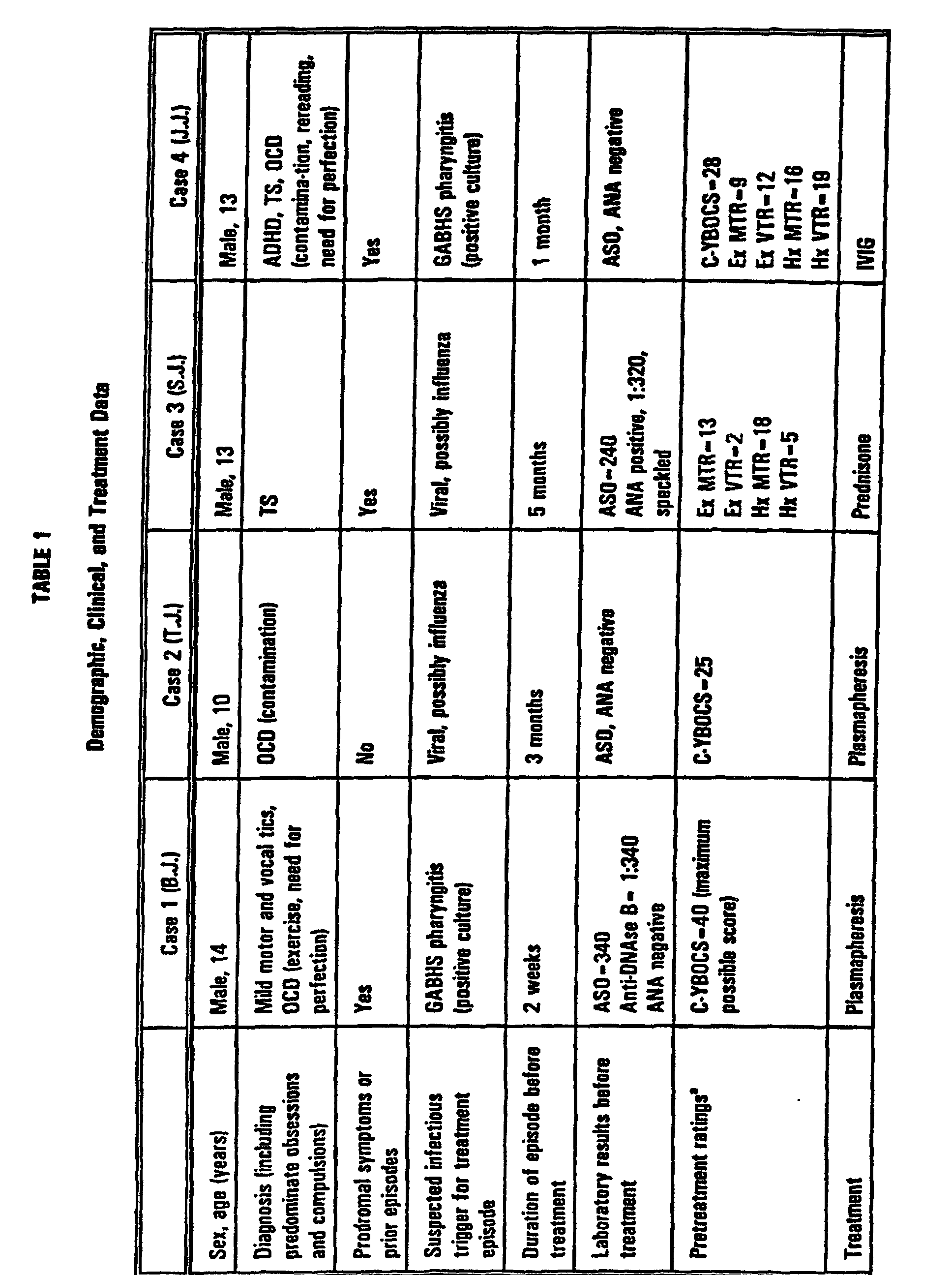
- Example 1 presents four pediatric cases who were treated in an open National Institute of Mental Health (NIMH) trial. Significantly, these cases represented a subclass of children having OCD and/or tic disorders whose neuropsychiatric symptoms were exacerbated following infection.
- NIMH National Institute of Mental Health
- B.J. was a 14-year-old with a 1.5-year history of OCD and mild tics which had been stable for several months while he was taking a combination of clomipramine and fluoxetine. Then, during a summer soccer camp, his OCD symptoms suddenly worsened dramatically. On his return home a throat culture was done. The culture was positive and GABHS pharyngitis was diagnosed, although BJ.'s last sore throat had resolved a month earlier. Two weeks later he came to the NIMH for evaluation. His obsessions included a fear for his own and his father's safety, a need for symmetry and perfectionistic concerns.
- His predominate compulsions were checking behaviors and exercises (e.g., fingertip pushups) that had to be performed perfectly or repeated until he was unable to continue. At that time, more than 90% of his waking hours were occupied by obsessions and compulsions. Neurological examination revealed motoric hyperactivity and mild choreiform movements.
- T.J. was a 10-year-old who had no history of psychiatric or neurological problems. The weekend after several family members had the "flu,” he experienced a sudden onset of severe obsessions about viruses and chemicals. He additionally began compulsive hand-washing. After a month of continuous illness, psychiatric treatment was sought and he started sertraline therapy, with only partial symptom relief of his OCD after two months. He was then evaluated at the NIMH (three months after the onset of his illness). At that time his forearms and hands were chapped and red, and contamination fears prevented him from fully opening his mouth so that he was unable to eat in the hospital or have a throat culture.
- J.J. was a 13-year-old with a long history of asthma, hyperactivity, TS and OCD. He had previously been enrolled in several protocols at the National Institutes of Health (NIH) for these illnesses. His neuropsychiatric symptoms were believed to be episodic but had been relatively well controlled for about six months while he was taking a combination of methylphenidate and clomipramine. After a documented case of GABHS pharyngitis, he experienced rapid, severe worsening of both his TS and OCD. This occurred during a family trip to Thailand and Arizona, during which the family had to alter their travel plans because of J.J.'s obsessive fears that the plane would crash. J.J. also had severe vocal tics (spitting and nearly continuous screaming) during the trans-Pacific flights, and he was unable to finish any reading material because he felt the need to reread every sentence many times.
- NASH National Institutes of Health
- Table 1 summarizes the relevant findings, treatments and results from the four case studies presented above.
- the monoclonal antibody, D8/17 appears to identify a cell-surface marker which shows increased expression on B cells of rheumatic fever patients (Khanna et al., J. Clin . Invest. 83 :1710 (1989)).
- This B cell alloantigen marker is present ("positive") in 90-100% of patients with RF (Gibofsky et al., J. Rheumatol (supp. 130) 18 :1-5 (1991)).
- the D8/17 antigen is unique to individuals who have had (or had risk for) RF illness and is considered to be a genetic marker for individuals who are genetically vulnerable to develop RF.
- Example 2 describes the method used to detect the D8/17 positive B cell antigen in blood samples from children whose neuropsychiatric symptoms were exacerbated following infectious illness.
- a 300 ⁇ l sample of citrated blood was transferred to a polystyrene tube, such as a FALCON 2058.
- a 100 ⁇ l volume of the D8/17 antibody produced by hybridoma HB8783 was added to the blood sample and then incubated for 1 hour at 4°C.
- the mixture was washed once using 2 mis of PBS-BSA buffer and centrifuged at 1500 rpm for 5 minutes to gently pellet the cells.
- a 1 liter preparation of the PBS-BSA buffer contained 8 g of NaCl, 400 mg of KCl, 1.15 g of Na 2 HPO 4 , 10 g of bovine serum albumin, 1 g sodium azide, and was adjusted to a pH of 7.4.
- Lysis buffer was prepared by combining 0.9 g NH 4 Cl, 0.19 g KHCO 3 , 0.05 ml 10% EDTA and diluting to a final volume of 100 ml using distilled water. The lysate was washed twice as before, and then counted for stained cells by standard laboratory procedures as would be familiar to one having ordinary skill in the art.
- results of this immunohistochamical analysis from subjects at the NIMH are shown below in Table 2.
- 89% were positive for the B cell D8/17 marker.
- This result was expected based on the fact that U.S. patent 4,743,538 indicates the D8/17 antigen is a marker for the risk of developing RF, and that SC is a variant of RF.
- only 10% of the normal controls were positive for the D8/17 antigen. This is consistent with previous estimates that only 5-10% of the population may express this marker.
- 93% of the children with GABHS mediated (nonRF, nonSC) neuropsychiatric symptoms were D8/17 positive.
- D8/17 marker has predictive value in identifying individuals who, while unaffected at the time of testing, may go on to develop autoimmune neuropsychiatric disorders in the future. More specifically, some of the unaffected siblings of the D8/17 positive pediatric patients were tested for the presence of the D8/17 marker. Two siblings of separate patients were found to be D8/17 positive and subsequently developed DCD and/or tics. In addition, one proband with OCD had two male siblings, one with TS (already diagnosed) who was D8/17 positive and one who was D8/17 negative and evidenced no neuropsychiatric symptoms.
- D8/17 antigen can identify individuals who have OCD, tic disorders/TS, and/or other autoimmune neuropsychiatric disorders. Further, a positive test for the D8/17 antigen has been shown to identify individuals at genetic risk for these disorders. Thus, the D8/17 test has diagnostic and prognostic implications and may be useful in the prevention of these neuropsychiatric disorders, as well as identifying patients for whom novel therapies may be useful. With estimates that 1% of all children and adolescents have OCD, and that 5.10% have a tic disorder, this technique will have application in a large number of individuals.
Landscapes
- Health & Medical Sciences (AREA)
- Life Sciences & Earth Sciences (AREA)
- Engineering & Computer Science (AREA)
- Immunology (AREA)
- Hematology (AREA)
- Biomedical Technology (AREA)
- Molecular Biology (AREA)
- Chemical & Material Sciences (AREA)
- Urology & Nephrology (AREA)
- Cell Biology (AREA)
- Medicinal Chemistry (AREA)
- Pathology (AREA)
- Biotechnology (AREA)
- Food Science & Technology (AREA)
- Microbiology (AREA)
- Physics & Mathematics (AREA)
- Analytical Chemistry (AREA)
- Biochemistry (AREA)
- General Health & Medical Sciences (AREA)
- General Physics & Mathematics (AREA)
- Virology (AREA)
- Tropical Medicine & Parasitology (AREA)
- Zoology (AREA)
- Neurology (AREA)
- Neurosurgery (AREA)
- Proteomics, Peptides & Aminoacids (AREA)
- Measuring Or Testing Involving Enzymes Or Micro-Organisms (AREA)
- Medicines That Contain Protein Lipid Enzymes And Other Medicines (AREA)
- Acyclic And Carbocyclic Compounds In Medicinal Compositions (AREA)
- Investigating Or Analysing Biological Materials (AREA)
- Image Processing (AREA)
- Image Analysis (AREA)
- Financial Or Insurance-Related Operations Such As Payment And Settlement (AREA)
Abstract
Description

| Frequency of Individuals Positive for Expression of B cell D8/17 Marker in Various Patient Populations | |
| Patient Population | % of Population D8/17 Positive |
| Normal Control | 10 |
| Sydenham's Chorea | 89 |
| GABHS-mediated (non-RF; non-SC) Neuropsychiatric Symptoms | 93 |
Claims (16)
- A method of determining whether a human subject with no prior history of a rheumatic disorder has susceptibility to a group A β-hemolytic streptococci (GABHS)-mediated neuropsychiatric disorder, said method being carried out employing a sample containing B lymphocytes obtained from the subject, and comprising the step of testing the B lymphocytes for the presence of alloantigen D8/17, wherein the presence of said alloantigen indicates the subject has a susceptibility to said neuropsychiatric disorder.
- The method of Claim 1, wherein said sample containing B lymphocytes is a blood sample.
- The method of Claim 2, wherein said blood sample is collected from a finger prick or venous puncture.
- The method of Claim 1, wherein the testing step comprises an immunohistochemistry assay.
- The method of Claim 4, wherein the immunohistochemistry assay employs an antibody reagent.
- The method of Claim 5, wherein the antibody reagent is a monoclonal antibody.
- The method of Claim 6, wherein the monoclonal antibody is produced by the HB8783 hybridoma cell line.
- The method of Claim 5, where a visible color change indicates the presence of the antibody reagent is detected optically.
- The method of Claim 4, wherein the immunohistochemistry assay comprises microscopy.
- The method of Claim 4, wherein the immunohistochemistry assay comprises flow cytometry.
- The method of Claim 4, wherein the immunohistochemistry assay is an ELISA assay.
- The method of Claim 1, wherein said disorder is childhood obsessive compulsive disorder.
- The method of Claim 1, wherein said disorder is a childhood onset tic disorder.
- The method of Claim 1, wherein said disorder is childhood onset Tourette's syndrome.
- The method of Claim 1, wherein said disorder is Attention Deficit Hyperactivity Disorder associated with a GABHS-mediated neuropsychiatric disorder.
- The method of Claim 1, wherein the subject has no prior history of a neuropsychiatric disorder.
Applications Claiming Priority (3)
| Application Number | Priority Date | Filing Date | Title |
|---|---|---|---|
| US47303395A | 1995-06-06 | 1995-06-06 | |
| US473033 | 1995-06-06 | ||
| PCT/US1996/009743 WO1996039631A1 (en) | 1995-06-06 | 1996-06-06 | METHOD OF IDENTIFYING PERSONS SUSCEPTIBLE TO GROUP A β-HEMOLYTIC STREPTOCOCCI-MEDIATED NEUROPSYCHIATRIC DISORDERS |
Publications (2)
| Publication Number | Publication Date |
|---|---|
| EP0846267A1 EP0846267A1 (en) | 1998-06-10 |
| EP0846267B1 true EP0846267B1 (en) | 2003-04-09 |
Family
ID=23877917
Family Applications (1)
| Application Number | Title | Priority Date | Filing Date |
|---|---|---|---|
| EP96918399A Expired - Lifetime EP0846267B1 (en) | 1995-06-06 | 1996-06-06 | Method of identifying persons susceptible to group a beta-hemolytic streptococci-mediated neuropsychiatric disorders |
Country Status (10)
| Country | Link |
|---|---|
| US (1) | US5866347A (en) |
| EP (1) | EP0846267B1 (en) |
| JP (1) | JP2001507440A (en) |
| AT (1) | ATE237139T1 (en) |
| AU (1) | AU697755B2 (en) |
| CA (1) | CA2222737A1 (en) |
| DE (1) | DE69627352D1 (en) |
| IL (1) | IL122426A (en) |
| NZ (1) | NZ310301A (en) |
| WO (1) | WO1996039631A1 (en) |
Families Citing this family (3)
| Publication number | Priority date | Publication date | Assignee | Title |
|---|---|---|---|---|
| US7144708B2 (en) * | 2001-06-25 | 2006-12-05 | The Cleveland Clinic Foundation | Markers of blood barrier disruption and methods of using same |
| US6884591B2 (en) * | 2001-06-25 | 2005-04-26 | The Cleveland Clinic Foundation | Peripheral marker of blood brain barrier permeability |
| US7508965B2 (en) * | 2004-06-01 | 2009-03-24 | Lumidigm, Inc. | System and method for robust fingerprint acquisition |
Family Cites Families (1)
| Publication number | Priority date | Publication date | Assignee | Title |
|---|---|---|---|---|
| US4743538A (en) * | 1985-04-17 | 1988-05-10 | The Rockefeller University | Test for rheumatic fever and monoclonal antibodies useful therefor |
-
1996
- 1996-06-06 NZ NZ310301A patent/NZ310301A/en unknown
- 1996-06-06 WO PCT/US1996/009743 patent/WO1996039631A1/en not_active Ceased
- 1996-06-06 AT AT96918399T patent/ATE237139T1/en not_active IP Right Cessation
- 1996-06-06 AU AU61073/96A patent/AU697755B2/en not_active Ceased
- 1996-06-06 IL IL12242696A patent/IL122426A/en not_active IP Right Cessation
- 1996-06-06 JP JP50197497A patent/JP2001507440A/en not_active Ceased
- 1996-06-06 EP EP96918399A patent/EP0846267B1/en not_active Expired - Lifetime
- 1996-06-06 CA CA002222737A patent/CA2222737A1/en not_active Abandoned
- 1996-06-06 DE DE69627352T patent/DE69627352D1/en not_active Expired - Lifetime
-
1997
- 1997-04-08 US US08/833,653 patent/US5866347A/en not_active Expired - Fee Related
Also Published As
| Publication number | Publication date |
|---|---|
| JP2001507440A (en) | 2001-06-05 |
| US5866347A (en) | 1999-02-02 |
| WO1996039631A1 (en) | 1996-12-12 |
| ATE237139T1 (en) | 2003-04-15 |
| CA2222737A1 (en) | 1996-12-12 |
| NZ310301A (en) | 1998-12-23 |
| DE69627352D1 (en) | 2003-05-15 |
| IL122426A (en) | 2001-01-11 |
| AU6107396A (en) | 1996-12-24 |
| IL122426A0 (en) | 1998-06-15 |
| MX9709776A (en) | 1998-10-31 |
| EP0846267A1 (en) | 1998-06-10 |
| AU697755B2 (en) | 1998-10-15 |
Similar Documents
| Publication | Publication Date | Title |
|---|---|---|
| Yuki et al. | Acute ophthalmoparesis (without ataxia) associated with anti-GQ1b IgG antibody: clinical features | |
| Meyer Sauteur et al. | Mycoplasma pneumoniae triggering the Guillain‐Barré syndrome: a case‐control study | |
| Araujo et al. | Antigenemia in recently acquired acute toxoplasmosis | |
| Kolski et al. | Etiology of acute childhood encephalitis at The Hospital for Sick Children, Toronto, 1994–1995 | |
| Leonard et al. | Paediatric autoimmune neuropsychiatric disorders associated with streptococcal infection (PANDAS) | |
| Greenberger et al. | Application of enzyme-linked immunosorbent assay (ELISA) in diagnosis of allergic bronchopulmonary aspergillosis | |
| Zoschke et al. | Lymphoproliferative responses to Borrelia burgdorferi in Lyme disease | |
| YOUNG et al. | Abnormalities of serum gamma 1A globulin and ataxia telangiectasia | |
| Rapaport et al. | Serum‐soluble interleukin‐2 receptors in neuroleptic‐naive schizophrenic subjects and in medicated schizophrenic subjects with and without tardive dyskinesia | |
| How et al. | Antineuronal antibodies in neuropsychiatric systemic lupus erythematosus | |
| Jones et al. | The impact of HIV on Streptococcus pneumoniae bacteraemia in a South African population | |
| Rose et al. | IgA antibodies to Streptococcus mutans in caries-resistant and-susceptible children | |
| Lai et al. | Evaluation of cerebrospinal anticardiolipin antibodies in lupus patients with neuropsychiatric manifestations | |
| Burks et al. | Antibody response to milk proteins in patients with milk-protein intolerance documented by challenge | |
| Walker et al. | Rheumatoid factor tests in the diagnosis and prediction of rheumatoid arthritis. | |
| Young et al. | Studies in serum proteins: Agammaglobulinemia in the adult | |
| AU697755B2 (en) | Method of identifying persons susceptible to group a beta-hemolytic strep tococci-mediated neuropsychiatric disorders | |
| Moss et al. | Evaluation of the immunologic cross-reactivity of aztreonam in patients with cystic fibrosis who are allergic to penicillin and/or cephalosporin antibiotics | |
| CA2169273A1 (en) | Methods of detecting and combating disorders of the central nervous system | |
| Jaye et al. | Comparison of two rapid latex agglutination tests for detection of cryptococcal capsular polysaccharide | |
| Baldree et al. | Immunoglobulin A-fibronectin aggregate levels in children and adults with immunoglobulin A nephropathy | |
| CHRISTENSSON et al. | ANTIBODY RESPONSE TO ALPHA‐AND BETAHEMOLYSIN FROM STAPHYLOCOCCUS AUREUS IN PATIENTS WITH STAPHYLOCOCCAL INFECTIONS AND IN NORMALS | |
| Rubin et al. | Pneumococcal and Haemophilus influenzae type b antigen detection in children at risk for occult bacteremia | |
| Thomson et al. | CSF myelin basic protein in multiple sclerosis | |
| Ericsson et al. | Clinical presentation as a guide to therapy for travelers’ diarrhea |
Legal Events
| Date | Code | Title | Description |
|---|---|---|---|
| PUAI | Public reference made under article 153(3) epc to a published international application that has entered the european phase |
Free format text: ORIGINAL CODE: 0009012 |
|
| 17P | Request for examination filed |
Effective date: 19971216 |
|
| AK | Designated contracting states |
Kind code of ref document: A1 Designated state(s): AT BE CH DE DK ES FI FR GB GR IE IT LI LU MC NL PT SE |
|
| RTI1 | Title (correction) |
Free format text: METHOD OF IDENTIFYING PERSONS SUSCEPTIBLE TO GROUP A BETA-HEMOLYTIC STREPTOCOCCI-MEDIATED NEUROPSYCHIATRIC DISORDERS |
|
| RAP1 | Party data changed (applicant data changed or rights of an application transferred) |
Owner name: ROCKEFELLER UNIVERSITY Owner name: THE GOVERNMENT OF THE UNITED STATES OF AMERICA AS |
|
| 17Q | First examination report despatched |
Effective date: 20011121 |
|
| GRAG | Despatch of communication of intention to grant |
Free format text: ORIGINAL CODE: EPIDOS AGRA |
|
| GRAG | Despatch of communication of intention to grant |
Free format text: ORIGINAL CODE: EPIDOS AGRA |
|
| GRAH | Despatch of communication of intention to grant a patent |
Free format text: ORIGINAL CODE: EPIDOS IGRA |
|
| GRAH | Despatch of communication of intention to grant a patent |
Free format text: ORIGINAL CODE: EPIDOS IGRA |
|
| GRAA | (expected) grant |
Free format text: ORIGINAL CODE: 0009210 |
|
| AK | Designated contracting states |
Designated state(s): AT BE CH DE DK ES FI FR GB GR IE IT LI LU MC NL PT SE |
|
| PG25 | Lapsed in a contracting state [announced via postgrant information from national office to epo] |
Ref country code: NL Free format text: LAPSE BECAUSE OF FAILURE TO SUBMIT A TRANSLATION OF THE DESCRIPTION OR TO PAY THE FEE WITHIN THE PRESCRIBED TIME-LIMIT Effective date: 20030409 Ref country code: LI Free format text: LAPSE BECAUSE OF FAILURE TO SUBMIT A TRANSLATION OF THE DESCRIPTION OR TO PAY THE FEE WITHIN THE PRESCRIBED TIME-LIMIT Effective date: 20030409 Ref country code: IT Free format text: LAPSE BECAUSE OF FAILURE TO SUBMIT A TRANSLATION OF THE DESCRIPTION OR TO PAY THE FEE WITHIN THE PRESCRIBED TIME-LIMIT;WARNING: LAPSES OF ITALIAN PATENTS WITH EFFECTIVE DATE BEFORE 2007 MAY HAVE OCCURRED AT ANY TIME BEFORE 2007. THE CORRECT EFFECTIVE DATE MAY BE DIFFERENT FROM THE ONE RECORDED. Effective date: 20030409 Ref country code: FR Free format text: LAPSE BECAUSE OF FAILURE TO SUBMIT A TRANSLATION OF THE DESCRIPTION OR TO PAY THE FEE WITHIN THE PRESCRIBED TIME-LIMIT Effective date: 20030409 Ref country code: FI Free format text: LAPSE BECAUSE OF FAILURE TO SUBMIT A TRANSLATION OF THE DESCRIPTION OR TO PAY THE FEE WITHIN THE PRESCRIBED TIME-LIMIT Effective date: 20030409 Ref country code: CH Free format text: LAPSE BECAUSE OF FAILURE TO SUBMIT A TRANSLATION OF THE DESCRIPTION OR TO PAY THE FEE WITHIN THE PRESCRIBED TIME-LIMIT Effective date: 20030409 Ref country code: BE Free format text: LAPSE BECAUSE OF FAILURE TO SUBMIT A TRANSLATION OF THE DESCRIPTION OR TO PAY THE FEE WITHIN THE PRESCRIBED TIME-LIMIT Effective date: 20030409 Ref country code: AT Free format text: LAPSE BECAUSE OF FAILURE TO SUBMIT A TRANSLATION OF THE DESCRIPTION OR TO PAY THE FEE WITHIN THE PRESCRIBED TIME-LIMIT Effective date: 20030409 |
|
| REG | Reference to a national code |
Ref country code: GB Ref legal event code: FG4D |
|
| REG | Reference to a national code |
Ref country code: CH Ref legal event code: EP |
|
| REG | Reference to a national code |
Ref country code: IE Ref legal event code: FG4D |
|
| PG25 | Lapsed in a contracting state [announced via postgrant information from national office to epo] |
Ref country code: LU Free format text: LAPSE BECAUSE OF NON-PAYMENT OF DUE FEES Effective date: 20030606 Ref country code: IE Free format text: LAPSE BECAUSE OF NON-PAYMENT OF DUE FEES Effective date: 20030606 |
|
| PG25 | Lapsed in a contracting state [announced via postgrant information from national office to epo] |
Ref country code: MC Free format text: LAPSE BECAUSE OF NON-PAYMENT OF DUE FEES Effective date: 20030630 |
|
| PG25 | Lapsed in a contracting state [announced via postgrant information from national office to epo] |
Ref country code: SE Free format text: LAPSE BECAUSE OF FAILURE TO SUBMIT A TRANSLATION OF THE DESCRIPTION OR TO PAY THE FEE WITHIN THE PRESCRIBED TIME-LIMIT Effective date: 20030709 Ref country code: PT Free format text: LAPSE BECAUSE OF FAILURE TO SUBMIT A TRANSLATION OF THE DESCRIPTION OR TO PAY THE FEE WITHIN THE PRESCRIBED TIME-LIMIT Effective date: 20030709 Ref country code: GR Free format text: LAPSE BECAUSE OF FAILURE TO SUBMIT A TRANSLATION OF THE DESCRIPTION OR TO PAY THE FEE WITHIN THE PRESCRIBED TIME-LIMIT Effective date: 20030709 Ref country code: DK Free format text: LAPSE BECAUSE OF FAILURE TO SUBMIT A TRANSLATION OF THE DESCRIPTION OR TO PAY THE FEE WITHIN THE PRESCRIBED TIME-LIMIT Effective date: 20030709 |
|
| PG25 | Lapsed in a contracting state [announced via postgrant information from national office to epo] |
Ref country code: DE Free format text: LAPSE BECAUSE OF FAILURE TO SUBMIT A TRANSLATION OF THE DESCRIPTION OR TO PAY THE FEE WITHIN THE PRESCRIBED TIME-LIMIT Effective date: 20030710 |
|
| PGFP | Annual fee paid to national office [announced via postgrant information from national office to epo] |
Ref country code: GB Payment date: 20030813 Year of fee payment: 8 |
|
| NLV1 | Nl: lapsed or annulled due to failure to fulfill the requirements of art. 29p and 29m of the patents act | ||
| REG | Reference to a national code |
Ref country code: CH Ref legal event code: PL |
|
| PG25 | Lapsed in a contracting state [announced via postgrant information from national office to epo] |
Ref country code: ES Free format text: LAPSE BECAUSE OF FAILURE TO SUBMIT A TRANSLATION OF THE DESCRIPTION OR TO PAY THE FEE WITHIN THE PRESCRIBED TIME-LIMIT Effective date: 20031030 |
|
| PLBE | No opposition filed within time limit |
Free format text: ORIGINAL CODE: 0009261 |
|
| STAA | Information on the status of an ep patent application or granted ep patent |
Free format text: STATUS: NO OPPOSITION FILED WITHIN TIME LIMIT |
|
| EN | Fr: translation not filed | ||
| 26N | No opposition filed |
Effective date: 20040112 |
|
| REG | Reference to a national code |
Ref country code: IE Ref legal event code: MM4A |
|
| PG25 | Lapsed in a contracting state [announced via postgrant information from national office to epo] |
Ref country code: GB Free format text: LAPSE BECAUSE OF NON-PAYMENT OF DUE FEES Effective date: 20040606 |
|
| GBPC | Gb: european patent ceased through non-payment of renewal fee |
Effective date: 20040606 |