EP0845698B1 - Third-order nonlinear optical material and method for production thereof - Google Patents
Third-order nonlinear optical material and method for production thereof Download PDFInfo
- Publication number
- EP0845698B1 EP0845698B1 EP97309579A EP97309579A EP0845698B1 EP 0845698 B1 EP0845698 B1 EP 0845698B1 EP 97309579 A EP97309579 A EP 97309579A EP 97309579 A EP97309579 A EP 97309579A EP 0845698 B1 EP0845698 B1 EP 0845698B1
- Authority
- EP
- European Patent Office
- Prior art keywords
- order nonlinear
- absorption
- nonlinear optical
- polymer
- thin film
- Prior art date
- Legal status (The legal status is an assumption and is not a legal conclusion. Google has not performed a legal analysis and makes no representation as to the accuracy of the status listed.)
- Expired - Lifetime
Links
Images
Classifications
-
- G—PHYSICS
- G02—OPTICS
- G02F—OPTICAL DEVICES OR ARRANGEMENTS FOR THE CONTROL OF LIGHT BY MODIFICATION OF THE OPTICAL PROPERTIES OF THE MEDIA OF THE ELEMENTS INVOLVED THEREIN; NON-LINEAR OPTICS; FREQUENCY-CHANGING OF LIGHT; OPTICAL LOGIC ELEMENTS; OPTICAL ANALOGUE/DIGITAL CONVERTERS
- G02F1/00—Devices or arrangements for the control of the intensity, colour, phase, polarisation or direction of light arriving from an independent light source, e.g. switching, gating or modulating; Non-linear optics
- G02F1/35—Non-linear optics
- G02F1/355—Non-linear optics characterised by the materials used
- G02F1/361—Organic materials
- G02F1/3615—Organic materials containing polymers
Definitions
- This invention relates to a third-order nonlinear optical material excelling in third-order nonlinear optical properties characterized in terms of conversion of wavelength, phenomenon of optical bistability, and generation of phase-conjugated wavefront, and to a method for the production thereof.
- third-order nonlinear optical material for such optical devices as extremely high-speed optical switches, optical bistable elements, phase-correcting elements, and wavelength-converting elements is being studied.
- third-order nonlinear optical materials using fine metal particles such as of gold and silver, semiconducting nonoxide fine particles such as of CdS, and organic compounds exhibiting a third-order nonlinear optical effect
- development of materials which satisfy such high qualities as, for example, (1) high third-order nonlinear susceptibility, (2) high transparency (small absorption) in the operating wavelength range, and (3) high response speed has been under way.
- response speed used herein refers to a time required for one operation in the repeated operations with the above optical device.
- the limitation of the solubility implies the limitation of the third-order nonlinear optical properties of the material.
- the glass having fine gold particles dispersed therein is observed to contain a slow relaxation component in third-order nonlinear optical effects. According to M. J. Bloemer et al., J. Opt. Soc. Am.
- this phenomenon is interpreted as arising from the slow relaxation of lattice vibration of fine gold particles. Further, this technique does not deserve to be called a perfect process because it requires heat-treatment for enabling a metal ion dispersed in glass to be precipitated as the fine metal particle and consequently complicates the process.
- the fine semiconducting particles such as of CdS are subjected to degradation of the third-order nonlinear optical effect and induction of the phenomenon of blackening and have dubious stability as evinced by precipitation of sulfur due to oxidative decomposition.
- the filter glass warrants no perfect safety because it contains cadmium, a substance harmful to a human body, and the process used for the production thereof hardly deserves to be called satisfactory in terms of processability because it requires the raw materials to be fused at an elevated temperature.
- the conducting particles of gold or the semiconducting particles of CdS which are dispersed in an insulating medium can be expected to manifest prominent third-order nonlinear optical properties, ultra-radiation of excitons, and specificity of crystal interface reaction by the fact that electrons and positive holes, or excitons are confined three-dimensionally.
- the fine particles dispersed are required to possess a size small enough to manifest the quantum size effect, i.e., a size of not more than 500 nm, preferably not more than 100 nm, exhibit a narrow particle diameter distribution, and assume the best possible state of dispersion.
- a thin film formed of an oxide of a transition metal selected from the group consisting of V, Cr, Mn, Fe, Co, Ni, and Cu and containing an additive component selected from the group consisting of Al 2 O 3 , ZnO, and ZrO 2 has been proposed.
- the manufacture of this thin film can hardly be called easy because it necessitates a heat treatment at an elevated temperature in spite of the addition of Al 2 O 3 , ZnO, or ZrO 2 .
- the additive component is only effective in improving the thin film in structural stability and mechanical strength and is not particularly effective in enhancing the third-order nonlinear optical property of the thin film.
- Polymer, Vol. 34, No. 6 (1993), pp.1174-1178 discloses such data as the structures and the characteristics (such as third-order nonlinear susceptibility coefficient) of a poly(p-phenylenevinylene) (PPV) /silica composite and a PPV/V 2 O 5 composite.
- the section "INTRODUCTION" of the literature has a mention to the effect that when the PPV, a substance which inherently manifests a third-order nonlinear optical effect, incorporates silica or V 2 O 5 therein, it enjoys an improvement in the third-order nonlinear optical effect thereof. It, however, has absolutely no mention of the fact that silica or V 2 O 5 itself manifests a third-order nonlinear optical effect.
- PPV itself is deficient in manufacture of a film because it is insoluble and infusible. PPV, therefore, must be obtained by previously forming a film using a water-soluble sulfonate thereof as the precursor and thermally decomposing the film.
- EP 0 598 472 discloses third order nonlinear optical materials made using a metal oxide and a transparent polymer.
- This invention aims to solve the problems of processability attendant on the conventional techniques and also improve the speed of relaxation. To be specific, it aims to provide a material which excels in processability and has a higher relaxation speed as compared with the conventional material by introducing an oxide of a transition metal into a transparent polymer.
- An object of this invention is to provide a novel third-order nonlinear optical material and a method for the production thereof, the material satisfying the requirements, i.e. (1) large third-order nonlinear susceptibility; (2) high transparency (small absorption) in the operating wavelength range; and (3) high relaxation speed, and being excellent in weatherability to withstand the deterioration with the elapse of time such as due to the decomposition through oxidation, heat resistance to withstand the thermal deterioration such as the alteration of composition, chemical and thermal stability (lightfastness) to withstand the laser beam, safety to a human body, and processability manifested during the course of manufacture.
- the requirements i.e. (1) large third-order nonlinear susceptibility; (2) high transparency (small absorption) in the operating wavelength range; and (3) high relaxation speed, and being excellent in weatherability to withstand the deterioration with the elapse of time such as due to the decomposition through oxidation, heat resistance to withstand the thermal deterioration such as the alteration of composition, chemical
- Another object of this invention is to provide a third-order nonlinear optical material which is capable of fully manifesting a quantum size effect.
- Still another object of this invention is to provide a third-order nonlinear optical material Which abounds in species of substances usable (or fit for arbitrary selection) for raw material components, prevents restrictions on manufacture from affecting the properties of raw materials, and enjoys high relaxation speed.
- Yet another object of this invention is to provide a method of producing a third-order nonlinear optical material which satisfies the objects mentioned above and requires no complicate treatment or process, avoids necessity of such a heat treatment as by heating at an elevated temperature or fusion, and excels in processability.
- a third-order nonlinear optical material having a metal oxide contained in a transparent polymer having substantially no absorption at a wavelength within the range of the operating wavelength to a wavelength shorter by 200mn characterised in that the metal oxide is a polyacid.
- the third-order nonlinear optical material of this invention is characterised, as described above, by having a metal oxide contained in a transparent polymer.
- the third-order nonlinear optical material according to this invention satisfies the requirements, i.e. (1) high third-order nonlinear susceptibility; (2) high transparency (low absorption) in the operating wavelength range; and (3) extremely rapid relaxation speed, and excels in weatherability to withstand the deterioration with the elapse of time such as due to the decomposition through oxidation, heat resistance to withstand the thermal deterioration such as the alteration of composition, chemical and thermal stability (lightfastness) to withstand the laser beam, safety to a human body, and processability manifested during the course of manufacture.
- the third-order nonlinear optical material therefore, can be extensively utilized for such optical devices as extremely high-speed optical switches, optical bistable elements, phase-correcting elements, and wavelength-converting elements.
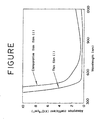
- Fig. 1 shows an ultraviolet-visible absorption spectrum of a thin film (1) as a third-order nonlinear optical material in Example 1 of this invention and a comparative thin film (1) in Referential Example 2.
- the third-order nonlinear optical material according to this invention is produced by introducing a metal oxide in a transparent polymer.
- the metal oxide to be used in this invention is only required to have an absorption at a wavelength of not less than 248 nm, preferably not less than 350 nm, and more preferably not less than 500 nm and manifest a third-order nonlinear optical effect on exposure to a laser beam. It is inferred that the metal oxide which has the absorption at the wavelength mentioned above and manifests the third-order nonlinear optical effect on exposure to a laser beam manifests the third-order nonlinear optical effect owing to the so-called band-filling phenomenon which consists in prominently increasing the carrier density in the excited state in consequence of the irradiation of a laser beam near the band gap and consequently inducing saturated absorption and a change in refractive index.
- this invention enjoys a very rich variety of species of metal oxides to be usable.
- a given metal oxide has an absorption only at a wavelength of less than 248 nm, it is inappropriate for this invention because the operating wavelength of the laser beam for enabling this metal oxide to manifest the third-order nonlinear optical effect is less than 248 nm and the laser beam is absorbed by the polymer.
- the polyacid to be effectively used in this invention is subject to no particular restriction except for the requirement that it be capable of manifesting a third-order nonlinear optical effect on the exposure to a laser beam. It is nevertheless preferred to be a polyacid containing a metal element. More preferably, a polyacid having an absorption at a wavelength of not less than 248 nm and a polyacid having the nature as a semiconductor may be used.
- This invention does not particularly discriminate the polyacid on account of the species thereof.
- polyacids which contain metal elements of the Group III through Group VI in the Periodic Table of the Elements, preferably such metal elements as Si, V, Nb, Ta, Cr, Mo, and W, may be cited.
- the polyacid maybe any of the isopoly acids composed of oxygen and one kind of metal element, namely (polynuclear) oxo acids formed by subjecting inorganic oxo acids which is not very strong as acid to the dehydration condensation in an acidic aqueous solution, and the heteropoly acids composed of oxygen and two or more kinds of metal elements, namely ternary polyoxo acids formed by subjecting vanadic acid, niobic acid, molybdic acid, and tungstic acid among the inorganic oxo acids to the dehydration condensation with a transition metal or the ions of a typical element (hetero atom) in an acidic aqueous solution.
- the poly acids mentioned above those which include in the components of the composition thereof at least one kind of metal element selected from the group consisting of V, Mo, and W prove to be particularly appropriate.
- the polyacid mentioned above may be used in various forms.
- isopoly acids or the salts thereof
- polyvanadates for example, namely the isopoly acids represented by the general formula: mM 2 O ⁇ nV 2 O 5 ⁇ xH 2 O (wherein M represents a monovalent metal element)
- M represents a monovalent metal element
- the forms of orthovanadates, pyrovanadates, andmetavanadates as well as the forms of various complicated polyacids, depending on the V concentration and the pH value. They may also assume the forms of heteropoly acids.
- the polymolybdates i.e.
- the polychromates i.e. the isopoly acids represented by the general formula: M 2 Cr n O 3n+1 (wherein M represents a monovalent metal element), may assume various forms of polyacids having different degrees of condensation, depending on the pH value.
- heteropoly acids may assume such forms as, for example, H 3 [HSiW 12 O 40 ], H 3 [PMo 12 O 40 ], (NH 4 ) 3 [PMo 12 O 40 ], H 7 [Co II Co III W 12 O 42 ], and H 3 [PV 2 Mo 10 O 39 ].
- the polyacid to be used effectively in this invention may assume any of the forms mentioned above.
- the polyacids mentioned above those which have a wide absorption in the ultraviolet, visible, and infrared regions and exhibit the nature as a semiconductor may be preferably used.
- the polyacids which prove to be appropriate herein have an absorption at a wavelength of not less than 248 nm, preferably not less than 350 nm, and more preferably not less than 500 nm, and manifest a third-order nonlinear optical effect on the exposure to a laser beam.
- the polyacid which has an absorption at a wavelength in the range as mentioned above possesses the nature as a semiconductor, and manifests a third-order nonlinear optical effect on the exposure to a laser beam is enabled to manifest the third-order nonlinear optical effect by the so-called band-filling phenomenon which consists in prominently augmenting the carrier density in the excited state in consequence of the irradiation of a laser beam near the band gap and consequently inducing saturated absorption and a change in refractive index. Since it suffices to select the wavelength of the laser in compliance with the size of the band gap, it may well be concluded that this invention enjoys a very rich variety of species of polyacids to be usable. Further, the polyacid to be used is stable to resist the laser beam because it is a chemically stable type.
- polyacid having an absorption at a wavelength of not less than 350 nm and operate the laser beam at a wavelength of not less than 350 nm.
- heteropoly acids such as metavanadates, pyrovanadic acid (salts), orthovanadic acid (salts), and H 3 [PV 2 Mo 10 O 39 ], and M 2 Mo 6 O 19 ⁇ xH 2 O and M 2 W 10 O 31 ⁇ xH 2 O (wherein M represents a monovalent metal element) may be cited.
- the third-order nonlinear optical material of this invention is preferred to contain the polyacid mentioned above at a concentration of not less than 1% by weight, particularly at a concentration in the range of 70 to 95% by weight. It may be composed of the polyacid and at least one other component. For example, a matrix for containing the polyacid in a uniformly dispersed state may be used as the one other component. The material, when necessary, may be composed solely of the polyacid. No matter what composition the third-order nonlinear optical material may possess, the absorption of the polyacid at the operating wavelength is preferred to be not less than 90% of the absorption of the whole material.
- the absorption of the polyacid is less than 90% of the absorption of the whole material, the produced material will possibly be deficient in the performance as an optical material.
- the component other than the polyacid mentioned above is subject to no particular restriction except for the requirement that it possess transparency and excel in compatibility with the polyacid.
- such known materials for matrix as glass, amorphous SiO 2 , Al 2 O 3 , ZrO 2 , TiO 2 , and MgO may be cited.
- the refractive index of the matrix had better be high.
- the matrix is preferred to be a polymer which excels in lightfastness, weatherability, heat-resistance, safety, and processability.
- the polyacid mentioned above is enabled to manifest a quantum size effect and gain in oscillator strength and third-order nonlinear susceptibility owing to the fact that it is uniformly dispersed in the form of fine particles in a polymer. Then, the manifestation of the quantum size effect results in sharpening the leading edge of absorption and causing the absorption spectrum to produce a blue shift. It is further inferred that the use of a laser approximating closely to the absorption edge enables the third-order nonlinear optical effect to manifest with the least possible absorption of light and the relaxation speed to heighten.
- the polyacid which is retained in the polymer is morphologically preferred to be in the form of fine particles having a diameter of not more than 1 ⁇ m, preferably not more than 500 nm, and more preferably not more than 100 nm.
- any of the well-known methods such as, for example, the analysis by the X-ray diffraction, the observation of a sliced thin film of the material with the aid of a transmission electron microscope, and the observation of the surface of the thin film with the aid of a scanning probe microscope may be adopted.
- the third-order nonlinear optical material according to this invention is such that the visible-ultraviolet absorption spectrum thereof can afford the following information concerning the fine particle distribution.
- the decrease in particle diameter generally results in the appearance of a quantum size effect of electrons and positive holes, or excitons. It is known that the wavelength at which given particles start absorbing light consequently shifts to the shorter wavelength side in accordance as the diameter of the particles decreases.
- the energy in the lowest state is heightened as indicated by the following formula (1) : ⁇ E z ⁇ h 2 ⁇ 2 2m e a 2 n 2 (wherein ⁇ E z stands for an energy which is increased by the quantum size effect, h for a quotient of the division of the Planck's constant by 2 ⁇ , m e for an effective mass of electrons in crystal, a for a length of one side, and n for a quantum number) and the wavelength for starting absorption is enabled to produce a blue shift accordingly. Based on the shift of the wavelength for starting the absorption in the spectrum, therefore, the particle diameter can be estimated by using the formula (1) mentioned above.
- transparent polymer which is used in this invention refers to a polymer which has substantially no absorption at a wavelength within the range of the operating wavelength to a wavelength shorter than the operating wavelength by at least 100 nm, preferably 200 nm.
- substantially no absorption means that the absorption of the polymer is not more than 10%, preferably 3%, of the absorption of the metal oxide, as determined by the comparison of the absorbance per unit thickness thereof.
- the advantages such as that the absorption around at the operating wavelength can be decreased, the quantum size effect can be efficiently manifested, the figure of merit, ⁇ (3) / ⁇ (which will be described in detail below), can be increased, and the relaxation speed can be heightened will ensue.
- the polymer When the polymer has some absorption at the operating wavelength, such disadvantages may be generated as that light for the manifestation of third-order nonlinear optical effect be absorbed into the polymer and subjected to attenuation. Further, when the polymer has some absorption in the vicinity of the operating wavelength (within the range of the operating wavelength to a wavelength shorter than the operating wavelength by 200 nm), the quantum size effect must be disadvantageously degraded.
- the transparent polymer used in this invention is required to have substantially no absorption at a wavelength within the range of the operating wavelength to a wavelength shorter than the operating wavelength by at least 100 nm, preferably 200 nm.
- the operating wavelength is preferred to be approximately a wavelength at which the absorption by the metal oxide starts.
- the polymer to be used in this invention if it has a high electric conductivity, it more often than not follows that the coloration due to the excitation of the conjugate electrons of the material will gain in intensity and the optical transparency will degrade. If the polymer has a strong absorption at the operating wavelength, the energy gap of the polymer will be unduly small, the quantum size effect of electrons and positive holes, or excitons brought about by the absorption of light by the polyacid will not readily manifest, and the exaltation of the third-order nonlinear optical effect due to the quantum size effect will not be expected. Further, the relaxation of the third-order nonlinear optical effect will be retarded by the same reason.
- the high absorption is not advantageous because the electrons and the positive holes generated by the absorption of light will possibly migrate to the polymer and consequently decompose or oxidize the polymer.
- the polymer to be used in this invention therefore, has preferably an electric conductivity of not more than 10 -10 S/cm, preferably not more than 10 -12 S/cm.
- the measurement of the electric conductivity can be performed by testing for a compressed pellet sample or a film sample with a direct current four-terminal method.
- This polymer is preferred to have transparency at the operating wavelength and exhibit a satisfactory ability to disperse the polyacid.
- the absorption of the polymer at the operating wavelength is more preferred to be not more than 10% of the whole absorption at the operating wavelength. If the polyacid has an unduly low dispersing ability, it will aggregate in the polymer possibly to the extent of aggravating the scattering of light and degrading the quality as an optical material.
- the polymer had better have a high glass transition point for the purpose of enabling the polyacid contained therein to remain in a stably dispersed state over a long period.
- polystyrene polyethylene, acrylonitrile/styrene copolymer, polypropylene, polyesters, polyamides, polycarbonates, polymethyl methacrylate, polyacrylates, polyvinyl methyl ether, polyethylene terephthalate, and polyvinyl chloride
- polyamides, polycarbonates, and polystyrene as exhibit a relatively high glass transition point and excel in heat-resistance prove to be particularly advantageous.
- These polymers may be used as mixed at a ratio arbitrarily selected.
- the polymer When the polymer is mixed with the polyacid in a solvent, it is preferred to be soluble in the solvent and further to be capable of being insolubilized by cross-linkage.
- the third-order nonlinear optical material of this invention which incorporates the polymer therein may, in the process of manufacture thereof for the sake of improving the dispersibility of the polyacid in the polymer, incorporate additionally therein a varying anionic, cationic, or nonionic surfactant.
- the third-order nonlinear optical material of this invention incorporating the polymer therein is used for manufacturing such a device as, for example, an optical waveguide path
- a photosensitive resin such intermolecular crosslinking photo-insolubilizing (negative) photosensitive polymers as are obtained by introducing such photosensitive groups as, for example, (1) a cinnamic acid residue, (2) a chalcone residue, (3) an acrylic acid residue, (4) a diazonium salt residue, and (5) phenyl azide residue severally into PVA, novolakresin, acrylic acid type resin, and epoxy resin; and such photo-solubilizing (positive) photosensitive polymers soluble in an aqueous alkali solution as are obtained by introducing such photosensitive groups as, for example, (6) an o-quinone azide residue into the same resins as mentioned above may be cited.
- the (1) and (2) residues are introduced by the photo-dimerization, the (3) residue by photo-polymerization, the (4) and (5) residues by photo-decomposition, and the (6) residue by photo-decomposition, respectively.
- thermosetting resin phenol resins, furan resins, xylene-formaldehyde resins, ketone-formaldehyde resins, urea resins, melamine resins, aniline resins, alkyd resins, unsaturated polyester resins, and epoxy resins, as well as diethylene glycol bisallyl carbonate may be cited.
- a method which comprises mixing the polyacid with the polymer in a solvent or a method which comprises causing the polymer to contain the polyacid therein at a temperature at which the polymer is fused may be adopted.
- the polyacid is preferably a hydrate of the metal oxide having a semiconductivity.
- the ratios of the polyacid and the polymer are not particularly limited.
- the ratio of the polyacid is preferred to be as high as possible because the polymer is a matrix for confining the polyacid preferably in a uniformly dispersed state and makes no contribution to the manifestation of the third-order nonlinear optical effect.
- the remarks hold good for the component of the composition which is other than the polyacid and also other than the polymer mentioned above.
- the ratio of the polyacid is in the approximate range of 50 to 99% by weight, preferably 70 to 95% by weight, based on the weight of the whole material.
- the ratio of the polymer is preferred to be in the range of 1 to 50% by weight, particularly 5 to 30% by weight, based on the weight of the whole material.
- the third-order nonlinear optical material according to this invention can be fabricated in any shape suitable for the use for which this material is intended.
- the polymer having fine particles of the metal oxide contained therein in a dispersed state can be used, for example, in the form of lens or fibers obtained by mechanically cutting the substance or rolling, stretching, melting, or injection molding the substance, in the form of a thin film obtained by spin coating or dip coating the substance on a glass substrate, or in the form of elements obtained by the techniques of reactive etching or photolithography. These forms are not exclusive.
- the form in which the third-order nonlinear optical material is advantageously used for the manufacture of an optical device is a thin film formed on a transparent substrate.
- the thickness of the thin film is in the range of 10 nm to 20 ⁇ m, preferably 100 nm to 10 ⁇ m.
- the transparent substrate mentioned above has an absorption at an operating wavelength of not more than 5%, preferably not more than 3%, based on the total absorption.
- silica glass type substrates such as a fused quartz substrate, a synthetic quartz glass, and an aluminosilicate glass substrate and single crystal substrates such as of MgO, ⁇ -Al 2 O 3 , and SrTiO 3 may be cited.
- the transparent substrate can be used irrespectively of the largeness of area specifically. It can be used in a thickness in the range of 10 ⁇ m to 1 mm.
- the manufacture of the third-order nonlinear optical material according to this invention is not particularly discriminated on account of a method to be adopted.
- a method for manufacturing the third-order nonlinear optical material having the polyacid contained in the polymer for example, the polyacid and the polymer may be mixed in a solvent. Otherwise, a method which consists in dispersing the polyacid in the polymer at the melting point thereof may be adopted. Nevertheless, a method which comprises preparing a liquid having the polyacid and the polymer dissolved or dispersed therein and distilling this liquid thereby expelling the solvent or the dispersion medium is preferred.
- this method enables the polymer matrix to contain the polyacid therein in a uniformly dispersed state, it requires no complicated treatment or procedure, and obviates the necessity of undergoing the heat-treatment effected as by elevating the temperature beyond 1000 °C or fusing as practiced in the conventional technique, it is at an advantage in excelling in processability, allowing the produced material to keep in order the interface between the polyacid and the polymer, and not easily inflicting damage to the produced material.
- the solvent or dispersion medium to be used effectively in the method of manufacture mentioned above is only required to be capable of dissolving or dispersing the polyacid and the polymer being used at prescribed ratios.
- the solvent or dispersion medium which answers the description is preferred to be a solvent which exhibits relatively high polarity evinced by a solvent polarity parameter not less than 40 and enjoys compatibility with water.
- alcohols such as methanol, ethanol, 1-propanol, and 2-propanol
- ketones such as acetone and methylethyl ketone
- nitriles such as acetonitrile and propyl nitrile
- ethers such as dioxane, and dimethyl formamide and dimethyl sulfoxide
- solvents may be used either singly or in the form of a mixture of two or more members at proportions of arbitrary choice.
- the boiling point of the selected solvent under normal pressure is preferred to be not higher than 250 °C, particularly not higher than 200 °C.
- the solvent or dispersion medium For the expulsion of the solvent or dispersion medium by distillation, the solvent or dispersion medium is required to be heated to a temperature of not less than the boiling point thereof under the pressure prevalent therein.
- the manufacture of the third-order nonlinear optical material, when necessary, may be attained at a relatively low temperature by heating under a reduced pressure.
- the temperature of the solvent or dispersion medium to be expelled is preferably not more than 200 °C, and the pressure is preferably in the range of 760 mmHg to 10 mmHg.
- the relaxation speed of response was determined by measuring intensity of the phase-conjugated light by delaying the incident time of the backward pump light in the degenerate four wave mixing method as disclosed in Materials Research Society Symposium Proceeding, Vol.283, pp.903-908 (1993).
- the particle diameter of fine particles (dispersing medium) in a thin film was determined by the observation of the surface of the thin film through a scanning probe microscope (SPM) (produced by Digital Instruments Corp. and marketed under trademark designation of "Nanoscope”).
- SPM scanning probe microscope
- the absorbance was determined by the use of the following instrument under the following conditions.
- a column packed with an ion-exchange resin (Dowex 50W-8) was washed with an aqueous 4M hydrochloric acid solution to obtain a column of an H + -substituted ion-exchange resin.
- a solution of 17.5 g (0.15 mol) of ammonium vanadate in 1000 g of distilled water was passed through the column filled with the H + -substituted ion-exchange resin, to obtain an effluent.
- the column effluent was left standing at a room temperature for not less than 24 hours, to obtain a solution (1) containing polyvanadic acid.
- a thin film (1) for comparison was obtained by spin coating the solution (1) on a glass substrate.
- the thin film was found to comprise fine particles of about 400 nm in particle diameter.
- a solution (2) was obtained by following the procedure of Referential Example 1 while using ammonium tungstate pentahydrate in place of ammonium vanadate.
- a thin film (2) for comparison was obtained by spin coating the solution (2) on a glass substrate. When the surface of the thin film (2) for comparison was observed by means of SPM, the thin film was found to comprise fine particles of about 30 nm in particle diameter.
- a solution of 1.0 g of zinc 2-ethyl hexanoate (zinc content of 8% by weight) in 7.0 g of n-butanol was spin coated on a glass substrate to obtain a coating.
- the resultant coating was left standing at a room temperature for one hour and then calcined at 380 °C for two hours to obtain a thin film (3) for comparison.
- this film was found to comprise fine zinc oxide particles of 8 nm in particle diameter.
- a methanol solution of poly(vinyl methyl ether) (solids content of 50% by weight; produced by Tokyo Kasei Kogyo Co., Ltd. and marketed under product code of "P1007") was diluted with methanol until a solids content of 5% by weight.
- the diluted solution was spin coated on a glass substrate and dried at 80 °C for 30 minutes to obtain a thin film (4) for comparison.
- a compressed pellet sample of poly(vinyl methyl ether) was prepared and tested for an electric conductivity by a direct current four-terminal method, to find 4x10 -12 S/cm.
- This polymer mixed solution (1) was spin coated on a glass substrate and dried at 80 °C for 30 minutes to obtain a thin film (1) of a third-order nonlinear optical material having vanadium oxide (V 2 O 5 ⁇ nH 2 O), as a metal oxide, contained in polyvinyl methyl ether, as a polymer.
- This thin film (1) was formed very easily without requiring any heating treatment at an elevated temperature.
- the thin film (1) When the surface of the thin film (1) was observed by means of SPM, the thin film (1) was found to have fine particles of about 400 nm in particle diameter contained in a dispersed state in polyvinyl methyl ether.
- the absorption spectra of the thin film (1) and the thin film (1) for comparison obtained in Referential Example 2 are shown in Fig. 1.
- the spectrum of the thin film (1) is found to have a sharp leading edge of absorption and produce a blue shift of the wavelength for starting absorption, as compared with that of the thin film (1) for comparison.
- the absorption of polymer was substantially nil, i.e. not more than 10% of the absorption of the whole thin film (1).
- the thin film (1) was found to have the absorption at a wavelength of 350 nm, as shown in Fig. 1.
- the thin film (1) and the thin film (1) for comparison were tested for third-order nonlinear susceptibility to find a figure of merit [ ⁇ (3) / ⁇ (wherein ⁇ represents an absorption coefficient)] by calculation.
- the results are shown in Table 1. It is clearly noted from Table 1 that the thin film (1) showed a figure of merit, ⁇ (3) / ⁇ , of 4.4 x 10 -13 esu ⁇ cm, a magnitude nearly equal to that of the thin film (1) for comparison. This fact indicates that the thin film (1) has only small absorption and manifests a high third-order nonlinear optical effect.
- the thin film (1) and the thin film (1) for comparison were tested for phase-conjugated optical intensity by retarding the laser pulse reaching the sample, to determine a relaxation speed.
- the results are shown in Table 1. From Table 1, the thin film (1) is noted to show a markedly high relaxation as compared with the thin film (1) for comparison.
- Sample Figure of merit ( ⁇ (3) / ⁇ ) (esu ⁇ cm) Relaxation speed of response Delay time of laser pulse, 60 psec Delay time of laser pulse, 130 psec Thin film (1) 4.4 ⁇ 10 -13 0.06 1 0.02 1 Thin film (1) for comparison 3.1 ⁇ 10 -13 0.28 1 0.19 1
- This thin film (2) could be formed very easily without requiring any heating treatment at an elevated temperature.
- the thin film (2) When the surface of the thin film (2) was observed by means of SPM, the thin film (2) was found to have fine particles of about 200 nm in particle diameter contained in a dispersed state in the polyvinyl methyl ether.
- the absorption spectrum of the thin film (2) showed a sharp leading edge of absorption and a greater blue shift of the absorption edge than the thin film (1).
- the absorption of polymer was substantially nil, i.e. not more than 10% of the absorption of the whole thin film (2).
- the thin film (2) was found to have absorption at a wavelength of 350 nm.
- the thin film (3) could be formed very easily without requiring any heating treatment at an elevated temperature.
- the thin film (3) When the surface of the thin film (3) was observed by means of SPM, the thin film (3) was found to have fine particles of about 30 nm in particle diameter contained in a dispersed state in the polyvinyl methyl ether.
- the absorption spectrum of the thin film (3) showed the occurrence of a greater blue shift of the absorption edge as compared with that of the thin film (2) prepared in Referential Example 3.
- the absorption of polymer was substantially nil, i.e. not more than 10% of the absorption of the whole thin film (3).
- the thin film (3) was found to have absorption at a wavelength of 350 nm.
- a mixed solvent composed of 80 g of acetic acid and 80 g of deionized water and 15 g of zinc oxide powder added thereto were together stirred and heated up to 100 °C to obtain a zinc-containing solution.
- this thin film (4) When the surface of the thin film (4) was observed by means of SPM, this thin film (4) was found to contain fine particles of zinc oxide of 5 nm in particle diameter in a dispersed state in the acrylic polymer.
- the absorption spectrum of the thin film (4) showed a sharper leading edge of absorption as compared with the absorption spectrum of the thin film (3) for comparison obtained in Referential Example 4 and also revealed the occurrence of a blue shift of the wavelength for starting absorption.
- the absorption of polymer was substantially nil, i.e. not more than 10% of the absorption of the whole thin film (4).
- the thin film (4) was found to have absorption at a wavelength of 350 nm.
Landscapes
- Physics & Mathematics (AREA)
- Nonlinear Science (AREA)
- General Physics & Mathematics (AREA)
- Optics & Photonics (AREA)
- Compositions Of Macromolecular Compounds (AREA)
- Optical Modulation, Optical Deflection, Nonlinear Optics, Optical Demodulation, Optical Logic Elements (AREA)
- Polymers With Sulfur, Phosphorus Or Metals In The Main Chain (AREA)
- Glass Compositions (AREA)
- Optical Integrated Circuits (AREA)
Abstract
Description
- This invention relates to a third-order nonlinear optical material excelling in third-order nonlinear optical properties characterized in terms of conversion of wavelength, phenomenon of optical bistability, and generation of phase-conjugated wavefront, and to a method for the production thereof.
- In recent years, the feasibility of utilizing a second-order nonlinear optical material for such optical devices as, for example, wavelength-converting elements has been under study. Such inorganic crystals as potassium dihydrogen phosphate and lithium niobate have been heretofore used as a second-order nonlinear optical material. Since these substances are used more often than not in the form of single crystals, they are deficient in processability and consequently are not easily fabricated into elements.
- The feasibility of using a third-order nonlinear optical material for such optical devices as extremely high-speed optical switches, optical bistable elements, phase-correcting elements, and wavelength-converting elements is being studied. As concerns third-order nonlinear optical materials using fine metal particles such as of gold and silver, semiconducting nonoxide fine particles such as of CdS, and organic compounds exhibiting a third-order nonlinear optical effect, development of materials which satisfy such high qualities as, for example, (1) high third-order nonlinear susceptibility, (2) high transparency (small absorption) in the operating wavelength range, and (3) high response speed has been under way. The term "response speed" used herein refers to a time required for one operation in the repeated operations with the above optical device. Therefore, the smaller the response speed is, the larger the number of operations per one second can be performed. Since the time until the generated effect is vanished completely (or to such a extent as that the influence by the accumulation of effects can be neglected) is generally longer than that until the effect is manifested, the development for the latter material having a short relaxation time must be important.
- As conventional technical achievements in this field, a glass having fine gold particles dispersed therein by the technique of fusion disclosed in Applied Physics A, Vol. 47, p.347 (1988) and a glass having fine gold particles dispersed therein by the technique of ion implantation disclosed in Material Research Society Symposium Proceedings, Vol. 283, p.903 (1993) may be cited. When the technique of fusion is adopted, it is at a disadvantage in limiting the species of metals usable therein by reason of fusibility and also limiting the solubility of a selected metal in glass. Since the third-order nonlinear optical properties of the relevant material are in direct proportion to the concentration of a metal contained in glass, the limitation of the solubility implies the limitation of the third-order nonlinear optical properties of the material. Even when the technique of ion implantation which allows an addition to the concentration of metal is adopted, it is still difficult to enable the glass to contain a metal at a ratio of not less than approximately 6.3 atomic percentage. As stated in Material Research Society Symposium Proceedings, Vol. 283, p.903 (1993), the glass having fine gold particles dispersed therein is observed to contain a slow relaxation component in third-order nonlinear optical effects. According to M. J. Bloemer et al., J. Opt. Soc. Am. B, 7, p.790 (1990), this phenomenon is interpreted as arising from the slow relaxation of lattice vibration of fine gold particles. Further, this technique does not deserve to be called a perfect process because it requires heat-treatment for enabling a metal ion dispersed in glass to be precipitated as the fine metal particle and consequently complicates the process.
- As mentioned above, in the case of glass having fine gold particles dispersed therein as a conductive material, it is difficult to increase the concentration of the metal and consequently the heat-treatment at an elevated temperature is needed. As stated in Applied Physics Letter, Vol. 64, No. 25, p.20 (1994), there is a problem in disorder of interface because of difference in coefficient of thermal expansion between glass matrix and fine gold particle.
- In J. Opt. Soc. Am., 73, p.647 (1983), it has been proposed to use a cutoff filter having fine particles of CdSxSe1-x dispersed in borosilicate glass as a third-order nonlinear optical thin film. This cutoff filter glass is manufactured by placing the raw materials for borosilicate glass and CdSxSe1-x in a platinum crucible and fusing them at a temperature of about 1000°C. This manufacture, however, entails the problem that apart of semiconductor components is vaporized with variation of composition during the course of the fusion. Further, as stated in Journal of Materials Science: Materials in Electronics, 4 (1993), pp.59-61, the fine semiconducting particles such as of CdS are subjected to degradation of the third-order nonlinear optical effect and induction of the phenomenon of blackening and have dubious stability as evinced by precipitation of sulfur due to oxidative decomposition. Further, the filter glass warrants no perfect safety because it contains cadmium, a substance harmful to a human body, and the process used for the production thereof hardly deserves to be called satisfactory in terms of processability because it requires the raw materials to be fused at an elevated temperature.
- On the other hand, techniques which comprise dispersing fine CdS particles in a polymer in order to avoid harmful effects generated by the heat-treatment at an elevated temperature have been disclosed in JP-A-04-189801 and JP-A-05-184913. In these publications, techniques which comprise forming CdS by the light irradiation to obtain CdS particles having its surface coated with a polymer , and forming the particles into a film have been disclosed.
- These publications, however, have defects in that the stability of these fine particles is degraded with the elapse of time because of easy oxidative decomposition of CdS itself.
- In the dispersions of these fine particles, the conducting particles of gold or the semiconducting particles of CdS which are dispersed in an insulating medium can be expected to manifest prominent third-order nonlinear optical properties, ultra-radiation of excitons, and specificity of crystal interface reaction by the fact that electrons and positive holes, or excitons are confined three-dimensionally. In order to ensure thorough derivation of this quantum size effect, the fine particles dispersed are required to possess a size small enough to manifest the quantum size effect, i.e., a size of not more than 500 nm, preferably not more than 100 nm, exhibit a narrow particle diameter distribution, and assume the best possible state of dispersion.
- Further, Nature, Vol. 374, No. 6523, pp.625-627 discloses that an oxide thin film which is formed by the thermal decomposition of alkyl carboxylate of V, Cr, Mn, Fe, Co, Cu, and Ni can manifest large third-order nonlinear optical effects.
- As stated in JP-A-07-284516, a thin film formed of an oxide of a transition metal selected from the group consisting of V, Cr, Mn, Fe, Co, Ni, and Cu and containing an additive component selected from the group consisting of Al2O3, ZnO, and ZrO2 has been proposed. The manufacture of this thin film can hardly be called easy because it necessitates a heat treatment at an elevated temperature in spite of the addition of Al2O3, ZnO, or ZrO2. Further, the additive component is only effective in improving the thin film in structural stability and mechanical strength and is not particularly effective in enhancing the third-order nonlinear optical property of the thin film.
- Polymer, Vol. 34, No. 6 (1993), pp.1174-1178 discloses such data as the structures and the characteristics (such as third-order nonlinear susceptibility coefficient) of a poly(p-phenylenevinylene) (PPV) /silica composite and a PPV/V2O5 composite. The section "INTRODUCTION" of the literature has a mention to the effect that when the PPV, a substance which inherently manifests a third-order nonlinear optical effect, incorporates silica or V2O5 therein, it enjoys an improvement in the third-order nonlinear optical effect thereof. It, however, has absolutely no mention of the fact that silica or V2O5 itself manifests a third-order nonlinear optical effect. Further, the PPV itself is deficient in manufacture of a film because it is insoluble and infusible. PPV, therefore, must be obtained by previously forming a film using a water-soluble sulfonate thereof as the precursor and thermally decomposing the film.
- EP 0 598 472 discloses third order nonlinear optical materials made using a metal oxide and a transparent polymer.
- This invention aims to solve the problems of processability attendant on the conventional techniques and also improve the speed of relaxation. To be specific, it aims to provide a material which excels in processability and has a higher relaxation speed as compared with the conventional material by introducing an oxide of a transition metal into a transparent polymer.
- An object of this invention, therefore, is to provide a novel third-order nonlinear optical material and a method for the production thereof, the material satisfying the requirements, i.e. (1) large third-order nonlinear susceptibility; (2) high transparency (small absorption) in the operating wavelength range; and (3) high relaxation speed, and being excellent in weatherability to withstand the deterioration with the elapse of time such as due to the decomposition through oxidation, heat resistance to withstand the thermal deterioration such as the alteration of composition, chemical and thermal stability (lightfastness) to withstand the laser beam, safety to a human body, and processability manifested during the course of manufacture.
- Another object of this invention is to provide a third-order nonlinear optical material which is capable of fully manifesting a quantum size effect.
- Still another object of this invention is to provide a third-order nonlinear optical material Which abounds in species of substances usable (or fit for arbitrary selection) for raw material components, prevents restrictions on manufacture from affecting the properties of raw materials, and enjoys high relaxation speed.
- Yet another object of this invention is to provide a method of producing a third-order nonlinear optical material which satisfies the objects mentioned above and requires no complicate treatment or process, avoids necessity of such a heat treatment as by heating at an elevated temperature or fusion, and excels in processability.
- The objects mentioned above are accomplished by a third-order nonlinear optical material having a metal oxide contained in a transparent polymer having substantially no absorption at a wavelength within the range of the operating wavelength to a wavelength shorter by 200mn characterised in that the metal oxide is a polyacid.
- The third-order nonlinear optical material of this invention is characterised, as described above, by having a metal oxide contained in a transparent polymer. The third-order nonlinear optical material according to this invention satisfies the requirements, i.e. (1) high third-order nonlinear susceptibility; (2) high transparency (low absorption) in the operating wavelength range; and (3) extremely rapid relaxation speed, and excels in weatherability to withstand the deterioration with the elapse of time such as due to the decomposition through oxidation, heat resistance to withstand the thermal deterioration such as the alteration of composition, chemical and thermal stability (lightfastness) to withstand the laser beam, safety to a human body, and processability manifested during the course of manufacture. The third-order nonlinear optical material, therefore, can be extensively utilized for such optical devices as extremely high-speed optical switches, optical bistable elements, phase-correcting elements, and wavelength-converting elements.
- Fig. 1 shows an ultraviolet-visible absorption spectrum of a thin film (1) as a third-order nonlinear optical material in Example 1 of this invention and a comparative thin film (1) in Referential Example 2.
- The third-order nonlinear optical material according to this invention is produced by introducing a metal oxide in a transparent polymer.
- The metal oxide to be used in this invention is only required to have an absorption at a wavelength of not less than 248 nm, preferably not less than 350 nm, and more preferably not less than 500 nm and manifest a third-order nonlinear optical effect on exposure to a laser beam. It is inferred that the metal oxide which has the absorption at the wavelength mentioned above and manifests the third-order nonlinear optical effect on exposure to a laser beam manifests the third-order nonlinear optical effect owing to the so-called band-filling phenomenon which consists in prominently increasing the carrier density in the excited state in consequence of the irradiation of a laser beam near the band gap and consequently inducing saturated absorption and a change in refractive index. Since it suffices to select the wavelength of the laser in compliance with the size of the band gap, it may well be concluded that this invention enjoys a very rich variety of species of metal oxides to be usable. When a given metal oxide has an absorption only at a wavelength of less than 248 nm, it is inappropriate for this invention because the operating wavelength of the laser beam for enabling this metal oxide to manifest the third-order nonlinear optical effect is less than 248 nm and the laser beam is absorbed by the polymer. For the purpose of decreasing the absorption of the laser beam by the polymer and preventing the laser beam from impairing the polymer, it is advantageous to adopt a metal oxide having an absorption at a wavelength of not less than 350 nm and operate the laser beam at a wavelength of not less than 350 nm.
- The polyacid to be effectively used in this invention is subject to no particular restriction except for the requirement that it be capable of manifesting a third-order nonlinear optical effect on the exposure to a laser beam. It is nevertheless preferred to be a polyacid containing a metal element. More preferably, a polyacid having an absorption at a wavelength of not less than 248 nm and a polyacid having the nature as a semiconductor may be used.
- This invention does not particularly discriminate the polyacid on account of the species thereof. As typical examples thereof', polyacids which contain metal elements of the Group III through Group VI in the Periodic Table of the Elements, preferably such metal elements as Si, V, Nb, Ta, Cr, Mo, and W, may be cited. To be specific, the polyacid maybe any of the isopoly acids composed of oxygen and one kind of metal element, namely (polynuclear) oxo acids formed by subjecting inorganic oxo acids which is not very strong as acid to the dehydration condensation in an acidic aqueous solution, and the heteropoly acids composed of oxygen and two or more kinds of metal elements, namely ternary polyoxo acids formed by subjecting vanadic acid, niobic acid, molybdic acid, and tungstic acid among the inorganic oxo acids to the dehydration condensation with a transition metal or the ions of a typical element (hetero atom) in an acidic aqueous solution. Among the poly acids mentioned above, those which include in the components of the composition thereof at least one kind of metal element selected from the group consisting of V, Mo, and W prove to be particularly appropriate.
- The polyacid mentioned above may be used in various forms. Firstly, as respects isopoly acids (or the salts thereof), it has been well-known that polyvanadates (vanadates), for example, namely the isopoly acids represented by the general formula: mM2O· nV2O5· xH2O (wherein M represents a monovalent metal element), assume the forms of orthovanadates, pyrovanadates, andmetavanadates, as well as the forms of various complicated polyacids, depending on the V concentration and the pH value. They may also assume the forms of heteropoly acids. Similarly, the polymolybdates, i.e. the isopoly acids represented by the general formula: mM2O· nMoO3· xH2O (wherein M represents a monovalent metal element), may assume such forms as satisfy (m, n) = (1, 2), (1, 3), (1, 4), (1, 6), (1, 8), (1, 10), (1, 16), and (2, 8) [metamolybdates] and (3, 7) [paramolybdates], depending on the pH value. Then, the polytungstates, i.e. the isopoly acids represented by the general formula, mM2O· nWO3· xH2O (wherein M represents a monovalent metal element), may assume such forms of varying degrees of condensation as paratungstates satisfying (m, n) = (5, 12) and metatungstates satisfying (m, n) = (6, 12), depending on the pH value. Further, the polychromates, i.e. the isopoly acids represented by the general formula: M2CrnO3n+1 (wherein M represents a monovalent metal element), may assume various forms of polyacids having different degrees of condensation, depending on the pH value. Next, the heteropoly acids (or the salts thereof) may assume such forms as, for example, H3[HSiW12O40], H3[PMo12O40], (NH4)3[PMo12O40], H7[CoIICoIIIW12O42], and H3 [PV2Mo10O39]. The polyacid to be used effectively in this invention may assume any of the forms mentioned above.
- As the polyacids mentioned above, those which have a wide absorption in the ultraviolet, visible, and infrared regions and exhibit the nature as a semiconductor may be preferably used. To be specific, the polyacids which prove to be appropriate herein have an absorption at a wavelength of not less than 248 nm, preferably not less than 350 nm, and more preferably not less than 500 nm, and manifest a third-order nonlinear optical effect on the exposure to a laser beam. It is inferred that the polyacid which has an absorption at a wavelength in the range as mentioned above, possesses the nature as a semiconductor, and manifests a third-order nonlinear optical effect on the exposure to a laser beam is enabled to manifest the third-order nonlinear optical effect by the so-called band-filling phenomenon which consists in prominently augmenting the carrier density in the excited state in consequence of the irradiation of a laser beam near the band gap and consequently inducing saturated absorption and a change in refractive index. Since it suffices to select the wavelength of the laser in compliance with the size of the band gap, it may well be concluded that this invention enjoys a very rich variety of species of polyacids to be usable. Further, the polyacid to be used is stable to resist the laser beam because it is a chemically stable type.
- For the purpose of decreasing the absorption of the laser beam by components other than the polyacid and preventing the laser beam from impairing the component, it is advantageous to adopt polyacid having an absorption at a wavelength of not less than 350 nm and operate the laser beam at a wavelength of not less than 350 nm. As examples of the polyacid which satisfies these requirements, heteropoly acids such as metavanadates, pyrovanadic acid (salts), orthovanadic acid (salts), and H3[PV2Mo10O39], and M2Mo6O19· xH2O and M2W10O31· xH2O (wherein M represents a monovalent metal element) may be cited.
- The third-order nonlinear optical material of this invention is preferred to contain the polyacid mentioned above at a concentration of not less than 1% by weight, particularly at a concentration in the range of 70 to 95% by weight. It may be composed of the polyacid and at least one other component. For example, a matrix for containing the polyacid in a uniformly dispersed state may be used as the one other component. The material, when necessary, may be composed solely of the polyacid. No matter what composition the third-order nonlinear optical material may possess, the absorption of the polyacid at the operating wavelength is preferred to be not less than 90% of the absorption of the whole material. If the absorption of the polyacid is less than 90% of the absorption of the whole material, the produced material will possibly be deficient in the performance as an optical material. The component other than the polyacid mentioned above is subject to no particular restriction except for the requirement that it possess transparency and excel in compatibility with the polyacid. As typical examples thereof, such known materials for matrix as glass, amorphous SiO2, Al2O3, ZrO2, TiO2, and MgO may be cited. The refractive index of the matrix had better be high. The matrix is preferred to be a polymer which excels in lightfastness, weatherability, heat-resistance, safety, and processability.
- In the third-order nonlinear optical material of the present invention, the polyacid mentioned above is enabled to manifest a quantum size effect and gain in oscillator strength and third-order nonlinear susceptibility owing to the fact that it is uniformly dispersed in the form of fine particles in a polymer. Then, the manifestation of the quantum size effect results in sharpening the leading edge of absorption and causing the absorption spectrum to produce a blue shift. It is further inferred that the use of a laser approximating closely to the absorption edge enables the third-order nonlinear optical effect to manifest with the least possible absorption of light and the relaxation speed to heighten. Since it is judged advantageous for the reasons adduced above that the polyacid to be contained in a uniformly dispersed state in a polymer has as small a particle diameter as permissible, the polyacid which is retained in the polymer is morphologically preferred to be in the form of fine particles having a diameter of not more than 1 µm, preferably not more than 500 nm, and more preferably not more than 100 nm.
- For the observation and the identification of metal oxide particles (including semiconducting metal oxide particles and polyacid) in the third-order nonlinear optical material, any of the well-known methods such as, for example, the analysis by the X-ray diffraction, the observation of a sliced thin film of the material with the aid of a transmission electron microscope, and the observation of the surface of the thin film with the aid of a scanning probe microscope may be adopted. The third-order nonlinear optical material according to this invention is such that the visible-ultraviolet absorption spectrum thereof can afford the following information concerning the fine particle distribution. The decrease in particle diameter generally results in the appearance of a quantum size effect of electrons and positive holes, or excitons. It is known that the wavelength at which given particles start absorbing light consequently shifts to the shorter wavelength side in accordance as the diameter of the particles decreases.
- As disclosed in New Glass, Vol.4, No.2, p.18 (1989), for example, when the quantum size effect is manifested, the energy in the lowest state is heightened as indicated by the following formula (1) :
- For the manufacture of the polyacid to be used in this invention, following methods may be cited, for example.
- 1) A method which attains the manufacture by adding an acid to an alkali solution of such a metal salt as ammonium vanadate or potassium tungstate and subjecting the resultant mixture to the dehydration condensation;
- 2) A method which attains the manufacture by subjecting a metal salt such as a chloride and a metal alkali to double decomposition in an aqueous solution or in a molten state; and
- 3) A method which attains the manufacture by subjecting an aqueous solution of a metal salt to the dehydration condensation by means of ion-exchange (proton-exchange). Among the methods mentioned above, the method of 3) proves to be particularly advantageous because it is simple and can produce a polyacid having high purity.
-
- The term "transparent polymer" which is used in this invention refers to a polymer which has substantially no absorption at a wavelength within the range of the operating wavelength to a wavelength shorter than the operating wavelength by at least 100 nm, preferably 200 nm. In this case, the phrase " substantially no absorption" means that the absorption of the polymer is not more than 10%, preferably 3%, of the absorption of the metal oxide, as determined by the comparison of the absorbance per unit thickness thereof. By incorporating the metal oxide into the transparent polymer according to this invention, the advantages such as that the absorption around at the operating wavelength can be decreased, the quantum size effect can be efficiently manifested, the figure of merit, χ(3)/α (which will be described in detail below), can be increased, and the relaxation speed can be heightened will ensue.
- When the polymer has some absorption at the operating wavelength, such disadvantages may be generated as that light for the manifestation of third-order nonlinear optical effect be absorbed into the polymer and subjected to attenuation. Further, when the polymer has some absorption in the vicinity of the operating wavelength (within the range of the operating wavelength to a wavelength shorter than the operating wavelength by 200 nm), the quantum size effect must be disadvantageously degraded.
- By these reasons, the transparent polymer used in this invention is required to have substantially no absorption at a wavelength within the range of the operating wavelength to a wavelength shorter than the operating wavelength by at least 100 nm, preferably 200 nm.
- The operating wavelength is preferred to be approximately a wavelength at which the absorption by the metal oxide starts. By setting the operating wavelength as mentioned above, the figure of merit can be expected to be improved.
- Concerning the polymer to be used in this invention, if it has a high electric conductivity, it more often than not follows that the coloration due to the excitation of the conjugate electrons of the material will gain in intensity and the optical transparency will degrade. If the polymer has a strong absorption at the operating wavelength, the energy gap of the polymer will be unduly small, the quantum size effect of electrons and positive holes, or excitons brought about by the absorption of light by the polyacid will not readily manifest, and the exaltation of the third-order nonlinear optical effect due to the quantum size effect will not be expected. Further, the relaxation of the third-order nonlinear optical effect will be retarded by the same reason. The high absorption is not advantageous because the electrons and the positive holes generated by the absorption of light will possibly migrate to the polymer and consequently decompose or oxidize the polymer.
- The polymer to be used in this invention, therefore, has preferably an electric conductivity of not more than 10-10 S/cm, preferably not more than 10-12 S/cm. The measurement of the electric conductivity can be performed by testing for a compressed pellet sample or a film sample with a direct current four-terminal method. This polymer is preferred to have transparency at the operating wavelength and exhibit a satisfactory ability to disperse the polyacid. The absorption of the polymer at the operating wavelength is more preferred to be not more than 10% of the whole absorption at the operating wavelength. If the polyacid has an unduly low dispersing ability, it will aggregate in the polymer possibly to the extent of aggravating the scattering of light and degrading the quality as an optical material. The polymer had better have a high glass transition point for the purpose of enabling the polyacid contained therein to remain in a stably dispersed state over a long period.
- As typical examples of the polymer to be effectively used in this invention, those which excel in transparency such as polystyrene, polyethylene, acrylonitrile/styrene copolymer, polypropylene, polyesters, polyamides, polycarbonates, polymethyl methacrylate, polyacrylates, polyvinyl methyl ether, polyethylene terephthalate, and polyvinyl chloride may be cited. Among the polymers cited above, such polyamides, polycarbonates, and polystyrene as exhibit a relatively high glass transition point and excel in heat-resistance prove to be particularly advantageous. These polymers may be used as mixed at a ratio arbitrarily selected.
- When the polymer is mixed with the polyacid in a solvent, it is preferred to be soluble in the solvent and further to be capable of being insolubilized by cross-linkage.
- The third-order nonlinear optical material of this invention which incorporates the polymer therein may, in the process of manufacture thereof for the sake of improving the dispersibility of the polyacid in the polymer, incorporate additionally therein a varying anionic, cationic, or nonionic surfactant.
- Where the third-order nonlinear optical material of this invention incorporating the polymer therein is used for manufacturing such a device as, for example, an optical waveguide path, it is particularly appropriate to use as the polymer either a photosensitive resin or a thermosetting resin. As typical examples of the photosensitive resin, such intermolecular crosslinking photo-insolubilizing (negative) photosensitive polymers as are obtained by introducing such photosensitive groups as, for example, (1) a cinnamic acid residue, (2) a chalcone residue, (3) an acrylic acid residue, (4) a diazonium salt residue, and (5) phenyl azide residue severally into PVA, novolakresin, acrylic acid type resin, and epoxy resin; and such photo-solubilizing (positive) photosensitive polymers soluble in an aqueous alkali solution as are obtained by introducing such photosensitive groups as, for example, (6) an o-quinone azide residue into the same resins as mentioned above may be cited. In the manufacturing process as mentioned above, the (1) and (2) residues are introduced by the photo-dimerization, the (3) residue by photo-polymerization, the (4) and (5) residues by photo-decomposition, and the (6) residue by photo-decomposition, respectively. As typical examples of the thermosetting resin, phenol resins, furan resins, xylene-formaldehyde resins, ketone-formaldehyde resins, urea resins, melamine resins, aniline resins, alkyd resins, unsaturated polyester resins, and epoxy resins, as well as diethylene glycol bisallyl carbonate may be cited.
- For the purpose of causing the polymer mentioned above to contain therein the polyacid, preferably in a uniformly dispersed state, a method which comprises mixing the polyacid with the polymer in a solvent or a method which comprises causing the polymer to contain the polyacid therein at a temperature at which the polymer is fused may be adopted. When the mixture of the polyacid is performed in a solvent, the polyacid is preferably a hydrate of the metal oxide having a semiconductivity. Even when the polyacid are contained in a dispersed state at the melting point of the polymer, the possibility that the polyacid will be impaired and the interface between the polyacid and the polymer will be disturbed is nil because the polymer does not need to undergo the thermal fusion at an elevated temperature which is indispensable to glass.
- In the third-order nonlinear optical material obtained by having the polyacid to be contained in the polymer and used for this invention, the ratios of the polyacid and the polymer are not particularly limited. The ratio of the polyacid, however, is preferred to be as high as possible because the polymer is a matrix for confining the polyacid preferably in a uniformly dispersed state and makes no contribution to the manifestation of the third-order nonlinear optical effect. The remarks hold good for the component of the composition which is other than the polyacid and also other than the polymer mentioned above. Since the polymer (and/or the component of the composition other than the polymer) has its own irreducible minimum for the purpose of improving the dispersed state of the polyacid, however, the ratio of the polyacid is in the approximate range of 50 to 99% by weight, preferably 70 to 95% by weight, based on the weight of the whole material. The ratio of the polymer is preferred to be in the range of 1 to 50% by weight, particularly 5 to 30% by weight, based on the weight of the whole material.
- The third-order nonlinear optical material according to this invention can be fabricated in any shape suitable for the use for which this material is intended. The polymer having fine particles of the metal oxide contained therein in a dispersed state can be used, for example, in the form of lens or fibers obtained by mechanically cutting the substance or rolling, stretching, melting, or injection molding the substance, in the form of a thin film obtained by spin coating or dip coating the substance on a glass substrate, or in the form of elements obtained by the techniques of reactive etching or photolithography. These forms are not exclusive.
- The form in which the third-order nonlinear optical material is advantageously used for the manufacture of an optical device is a thin film formed on a transparent substrate. In this case, the thickness of the thin film is in the range of 10 nm to 20 µm, preferably 100 nm to 10 µm.
- The transparent substrate mentioned above has an absorption at an operating wavelength of not more than 5%, preferably not more than 3%, based on the total absorption. As typical examples of the transparent substrate which is used effectively herein, silica glass type substrates such as a fused quartz substrate, a synthetic quartz glass, and an aluminosilicate glass substrate and single crystal substrates such as of MgO, α-Al2O3, and SrTiO3 may be cited. The transparent substrate can be used irrespectively of the largeness of area specifically. It can be used in a thickness in the range of 10 µm to 1 mm.
- The manufacture of the third-order nonlinear optical material according to this invention is not particularly discriminated on account of a method to be adopted. In a method for manufacturing the third-order nonlinear optical material having the polyacid contained in the polymer, for example, the polyacid and the polymer may be mixed in a solvent. Otherwise, a method which consists in dispersing the polyacid in the polymer at the melting point thereof may be adopted. Nevertheless, a method which comprises preparing a liquid having the polyacid and the polymer dissolved or dispersed therein and distilling this liquid thereby expelling the solvent or the dispersion medium is preferred. Since this method enables the polymer matrix to contain the polyacid therein in a uniformly dispersed state, it requires no complicated treatment or procedure, and obviates the necessity of undergoing the heat-treatment effected as by elevating the temperature beyond 1000 °C or fusing as practiced in the conventional technique, it is at an advantage in excelling in processability, allowing the produced material to keep in order the interface between the polyacid and the polymer, and not easily inflicting damage to the produced material.
- The solvent or dispersion medium to be used effectively in the method of manufacture mentioned above is only required to be capable of dissolving or dispersing the polyacid and the polymer being used at prescribed ratios. The solvent or dispersion medium which answers the description is preferred to be a solvent which exhibits relatively high polarity evinced by a solvent polarity parameter not less than 40 and enjoys compatibility with water. As typical examples thereof, alcohols such as methanol, ethanol, 1-propanol, and 2-propanol, ketones such as acetone and methylethyl ketone, nitriles such as acetonitrile and propyl nitrile, ethers such as dioxane, and dimethyl formamide and dimethyl sulfoxide may be cited. These solvents may be used either singly or in the form of a mixture of two or more members at proportions of arbitrary choice. The boiling point of the selected solvent under normal pressure is preferred to be not higher than 250 °C, particularly not higher than 200 °C.
- For the manufacture of the third-order nonlinear optical material, it suffices to prepare a liquid having the polyacid and the polymer dissolved or dispersed therein and then distill the liquid thereby expelling the solvent or dispersion medium therefrom. Any of the well-known methods for (reduced-pressure) distillation may be adopted for this purpose.
- For the expulsion of the solvent or dispersion medium by distillation, the solvent or dispersion medium is required to be heated to a temperature of not less than the boiling point thereof under the pressure prevalent therein. The manufacture of the third-order nonlinear optical material, when necessary, may be attained at a relatively low temperature by heating under a reduced pressure. In this case, the temperature of the solvent or dispersion medium to be expelled is preferably not more than 200 °C, and the pressure is preferably in the range of 760 mmHg to 10 mmHg.
- Now, this invention will be described more specifically below with reference to working examples. The determination methods which are used herein are as follows.
- This property was determined by the phase-conjugated type degenerate four wave mixing method. The second harmonic of the Nd:YAG laser (532 nm in wavelength and 40 psec in pulse duration) was used for the determination. The third order nonlinear susceptibility, χ(3), was calculated based on the following formula (2) using the ratio of the reflectivity, R, to the standard substance (CS2) in the same optical system:
- The relaxation speed of response was determined by measuring intensity of the phase-conjugated light by delaying the incident time of the backward pump light in the degenerate four wave mixing method as disclosed in Materials Research Society Symposium Proceeding, Vol.283, pp.903-908 (1993).
- The particle diameter of fine particles (dispersing medium) in a thin film was determined by the observation of the surface of the thin film through a scanning probe microscope (SPM) (produced by Digital Instruments Corp. and marketed under trademark designation of "Nanoscope").
- The absorbance was determined by the use of the following instrument under the following conditions.
- · Instrument: Spectrophotometer (produced by Shimadzu Seisakusho Ltd. and marketed under product code of "UV-3100")
- · Conditions: The absorbance was determined at a room temperature, at a scan rate of wavelength of 200 nm/min, and with a slit width of 5.0 nm.
-
- This calculation was carried out by the following procedure.
- 1) The polymer was tested preparatorily for absorption per unit thickness at the operating wavelength (532 nm) (A1).
- 2) Then, the whole material was similarly tested for absorption and reduced to the value per unit thickness (A2).
-
- When the value of A1 was not more than 10% of the value of A2, the absorption of the polymer was judged to be not more than 10% of the absorption of the whole material.
- A column packed with an ion-exchange resin (Dowex 50W-8) was washed with an aqueous 4M hydrochloric acid solution to obtain a column of an H+-substituted ion-exchange resin. A solution of 17.5 g (0.15 mol) of ammonium vanadate in 1000 g of distilled water was passed through the column filled with the H+-substituted ion-exchange resin, to obtain an effluent. The column effluent was left standing at a room temperature for not less than 24 hours, to obtain a solution (1) containing polyvanadic acid.
- A thin film (1) for comparison was obtained by spin coating the solution (1) on a glass substrate. When the surface of the thin film (1) for comparison was observed by means of SPM, the thin film was found to comprise fine particles of about 400 nm in particle diameter.
- A solution (2) was obtained by following the procedure of Referential Example 1 while using ammonium tungstate pentahydrate in place of ammonium vanadate. A thin film (2) for comparison was obtained by spin coating the solution (2) on a glass substrate. When the surface of the thin film (2) for comparison was observed by means of SPM, the thin film was found to comprise fine particles of about 30 nm in particle diameter.
- A solution of 1.0 g of zinc 2-ethyl hexanoate (zinc content of 8% by weight) in 7.0 g of n-butanol was spin coated on a glass substrate to obtain a coating. The resultant coating was left standing at a room temperature for one hour and then calcined at 380 °C for two hours to obtain a thin film (3) for comparison. When the thin film (3) for comparison was subjected to observation of surface by means of SPM and to an X-ray diffraction analysis, this film was found to comprise fine zinc oxide particles of 8 nm in particle diameter.
- A methanol solution of poly(vinyl methyl ether) (solids content of 50% by weight; produced by Tokyo Kasei Kogyo Co., Ltd. and marketed under product code of "P1007") was diluted with methanol until a solids content of 5% by weight. The diluted solution was spin coated on a glass substrate and dried at 80 °C for 30 minutes to obtain a thin film (4) for comparison. When the thin film (4) for comparison was analyzed for an ultraviolet-visible absorption spectrum, no discernible absorption was observed at a wavelength of not less than 330 nm, indicating that the absorption has not been recognized at the wavelength within the range of from the operating wavelength to be used in Example 1, namely, 532 nm, to the wavelength shorter than the operating wavelength by 200 nm.
- A compressed pellet sample of poly(vinyl methyl ether) was prepared and tested for an electric conductivity by a direct current four-terminal method, to find 4x10-12 S/cm.
- 20 g of a solution which is obtained by concentrating the solution (1) prepared in Referential Example 1 to a solids content of 5% by weight and 20 g of a diluted solution to be obtained by diluting a methanol solution of poly(vinyl methyl ether) (solids content of 50% by weight; produced by Tokyo Kasei Kogyo Co., Ltd. and marketed under product code of "P1007") further with methanol until a solids content of 5% by weight were stirred together at a room temperature for one hour to obtain a polymer mixed solution (1). This polymer mixed solution (1) was spin coated on a glass substrate and dried at 80 °C for 30 minutes to obtain a thin film (1) of a third-order nonlinear optical material having vanadium oxide (V2O5· nH2O), as a metal oxide, contained in polyvinyl methyl ether, as a polymer. This thin film (1) was formed very easily without requiring any heating treatment at an elevated temperature.
- When the surface of the thin film (1) was observed by means of SPM, the thin film (1) was found to have fine particles of about 400 nm in particle diameter contained in a dispersed state in polyvinyl methyl ether.
- The absorption spectra of the thin film (1) and the thin film (1) for comparison obtained in Referential Example 2 are shown in Fig. 1. The spectrum of the thin film (1) is found to have a sharp leading edge of absorption and produce a blue shift of the wavelength for starting absorption, as compared with that of the thin film (1) for comparison.
- At the operating wavelength (532 nm) of the thin film (1), the absorption of polymer was substantially nil, i.e. not more than 10% of the absorption of the whole thin film (1). The thin film (1) was found to have the absorption at a wavelength of 350 nm, as shown in Fig. 1.
- Then, the thin film (1) and the thin film (1) for comparison were tested for third-order nonlinear susceptibility to find a figure of merit [χ(3)/α (wherein α represents an absorption coefficient)] by calculation. The results are shown in Table 1. It is clearly noted from Table 1 that the thin film (1) showed a figure of merit, χ(3)/α, of 4.4 x 10⁻¹³ esu·cm, a magnitude nearly equal to that of the thin film (1) for comparison. This fact indicates that the thin film (1) has only small absorption and manifests a high third-order nonlinear optical effect.
- The thin film (1) and the thin film (1) for comparison were tested for phase-conjugated optical intensity by retarding the laser pulse reaching the sample, to determine a relaxation speed. The results are shown in Table 1. From Table 1, the thin film (1) is noted to show a markedly high relaxation as compared with the thin film (1) for comparison.
Sample Figure of merit (=χ(3)/α) (esu·cm) Relaxation speed of response Delay time of laser pulse, 60 psec Delay time of laser pulse, 130 psec Thin film (1) 4.4×10⁻¹³ 0.061 0.021 Thin film (1) for comparison 3.1×10⁻¹³ 0.281 0.191 - The results given above indicate that the incorporation of vanadium oxide in a dispersed state in the polymer sharpened the leading edge of absorption and produced a blue shift of the absorption edge. The determination of the third-order nonlinear susceptibility revealed that the thin film (1) showed a large third-order nonlinear optical effect and notably decreased the time of relaxation preceding the distinction of this effect.
- A thin film (2) of a third-order nonlinear optical material having vanadium oxide, as a metal oxide, contained in a polyvinyl methyl ether, as a polymer, was obtained by following the procedure of Example 1 while using a solution obtained after 5 hours' passage of the ion-exchange column instead. This thin film (2) could be formed very easily without requiring any heating treatment at an elevated temperature.
- When the surface of the thin film (2) was observed by means of SPM, the thin film (2) was found to have fine particles of about 200 nm in particle diameter contained in a dispersed state in the polyvinyl methyl ether.
- The absorption spectrum of the thin film (2) showed a sharp leading edge of absorption and a greater blue shift of the absorption edge than the thin film (1).
- At the operating wavelength (532 nm) of the thin film (2), the absorption of polymer was substantially nil, i.e. not more than 10% of the absorption of the whole thin film (2). The thin film (2) was found to have absorption at a wavelength of 350 nm.
- A thin film (3) of a third-order nonlinear optical material having tungsten oxide (WO3·nH2O), as a metal oxide, contained in polyvinyl methyl ether, as a polymer, was obtained by following the procedure of Example 1 while using ammonium tungstate pentahydrate instead. The thin film (3) could be formed very easily without requiring any heating treatment at an elevated temperature.
- When the surface of the thin film (3) was observed by means of SPM, the thin film (3) was found to have fine particles of about 30 nm in particle diameter contained in a dispersed state in the polyvinyl methyl ether.
- The absorption spectrum of the thin film (3) showed the occurrence of a greater blue shift of the absorption edge as compared with that of the thin film (2) prepared in Referential Example 3.
- At the operating wavelength (532 nm) of the thin film (3), the absorption of polymer was substantially nil, i.e. not more than 10% of the absorption of the whole thin film (3). The thin film (3) was found to have absorption at a wavelength of 350 nm.
- In a glass reaction vessel, 500 ml in inner volume, provided with a stirrer, a dropping inlet, a thermometer, and a reflux condenser, a mixed solvent composed of 80 g of acetic acid and 80 g of deionized water and 15 g of zinc oxide powder added thereto were together stirred and heated up to 100 °C to obtain a zinc-containing solution.
- Then, in a glass reaction vessel, 1 liter in inner volume, provided with a stirrer, a dropping inlet, a thermometer, and a distillate gas outlet, 700 g of 2-butoxy ethanol was placed and the inner temperature thereof was heated to and kept at 153 °C. To the hot 2-butoxy ethanol, the aforementioned zinc-containing solution kept at 100 °C was drip-fed by the use of a metering pump over a period of 30 minutes. After the completion of this drip-feeding, the contents of the reaction vessel was heated to and kept at 168 °C for 5 hours to obtain a white dispersion. This dispersion was concentrated by an evaporator to an involatile content of 10% by weight, to obtain a dispersing element. 5 g of this dispersing element and 1 g of an acrylic resin solution (solids content of 45% by weight; produced by Nippon Shokubai Co., Ltd. and marketed under trademark designation of "AROSETTO 5210") added thereto were together stirred at a room temperature for one hour to obtain a polymer mixed solution. A thin film (4) of a third-order nonlinear optical material having fine particles of zinc oxide, as a metal oxide, contained in the acrylic polymer, as a polymer, was obtained by following the procedure of Example 1 while using this polymer mixed solution instead. This thin film (4) could be formed very easily without requiring any heating treatment at an elevated temperature.
- When the surface of the thin film (4) was observed by means of SPM, this thin film (4) was found to contain fine particles of zinc oxide of 5 nm in particle diameter in a dispersed state in the acrylic polymer.
- The absorption spectrum of the thin film (4) showed a sharper leading edge of absorption as compared with the absorption spectrum of the thin film (3) for comparison obtained in Referential Example 4 and also revealed the occurrence of a blue shift of the wavelength for starting absorption.
- At the operating wavelength (532 nm) of the thin film (4), the absorption of polymer was substantially nil, i.e. not more than 10% of the absorption of the whole thin film (4). The thin film (4) was found to have absorption at a wavelength of 350 nm.
Claims (7)
- A third-order nonlinear optical material having at least one metal oxide contained in a transparent polymer having substantially no absorption at a wavelength within the range of the operating wavelength to a wavelength shorter by 200nm characterised in that the metal oxide is a polyacid.
- A third-order nonlinear optical material according to claim 1, wherein said metal oxide is selected from the group of vanadium, molybdenum, tungsten and zinc oxide.
- A third-order nonlinear optical material according to claim 1 or claim 2, wherein the absorption of said polymer at an operating wavelength is not more than 10% of the absorption of the whole material.
- A third-order nonlinear optical material according to any one of claims 1 to 3, wherein said transparent polymer is an insulating polymer having an electric conductivity of not more than 10-10 S/cm.
- A third-order nonlinear optical material having a thin film of the third-order nonlinear optical material set forth in any of claims 1 to 4 formed on a transparent substrate.
- A method of producing a third-order nonlinear optical material, comprising the steps of preparing a liquid having at least one polyacid as a metal oxide and a transparent polymer having substantially no absorption at a wavelength within the range of the operating wavelength to a wavelength shorter by 200nm dissolved or dispersed therein and distilling said liquid at a temperature of not more than 200°C thereby expelling a solvent or a dispersion medium therefrom.
- A method according to claim 6, wherein said metal oxide is selected from the group consisting of vanadium, molybdenum, tungsten and zinc oxide.
Applications Claiming Priority (9)
| Application Number | Priority Date | Filing Date | Title |
|---|---|---|---|
| JP316706/96 | 1996-11-27 | ||
| JP31670796 | 1996-11-27 | ||
| JP316708/96 | 1996-11-27 | ||
| JP31670896 | 1996-11-27 | ||
| JP31670696 | 1996-11-27 | ||
| JP316707/96 | 1996-11-27 | ||
| JP31670696 | 1996-11-27 | ||
| JP31670796 | 1996-11-27 | ||
| JP31670896 | 1996-11-27 |
Publications (2)
| Publication Number | Publication Date |
|---|---|
| EP0845698A1 EP0845698A1 (en) | 1998-06-03 |
| EP0845698B1 true EP0845698B1 (en) | 2003-07-09 |
Family
ID=27339553
Family Applications (1)
| Application Number | Title | Priority Date | Filing Date |
|---|---|---|---|
| EP97309579A Expired - Lifetime EP0845698B1 (en) | 1996-11-27 | 1997-11-27 | Third-order nonlinear optical material and method for production thereof |
Country Status (4)
| Country | Link |
|---|---|
| US (1) | US5993701A (en) |
| EP (1) | EP0845698B1 (en) |
| AT (1) | ATE244902T1 (en) |
| DE (1) | DE69723403T2 (en) |
Families Citing this family (6)
| Publication number | Priority date | Publication date | Assignee | Title |
|---|---|---|---|---|
| EP1184898A1 (en) * | 1999-11-30 | 2002-03-06 | Ebara Corporation | Method and apparatus for forming thin film of metal |
| GB9928473D0 (en) * | 1999-12-03 | 2000-02-02 | Secr Defence Brit | Non-linear optical bodies and devices |
| US6761985B2 (en) * | 2000-10-05 | 2004-07-13 | Battelle Memorial Institute | Magnetic transparent conducting oxide film and method of making |
| US6782154B2 (en) | 2001-02-12 | 2004-08-24 | Rensselaer Polytechnic Institute | Ultrafast all-optical switch using carbon nanotube polymer composites |
| CN101546087B (en) * | 2008-03-27 | 2013-05-22 | 中国科学院物理研究所 | A kind of solid non-linear body material and preparation method thereof |
| US11426818B2 (en) | 2018-08-10 | 2022-08-30 | The Research Foundation for the State University | Additive manufacturing processes and additively manufactured products |
Citations (1)
| Publication number | Priority date | Publication date | Assignee | Title |
|---|---|---|---|---|
| EP0598472A1 (en) * | 1992-08-20 | 1994-05-25 | Mitsuboshi Belting Ltd. | Ultra-fine-particles-dispersed glassy material and method |
Family Cites Families (19)
| Publication number | Priority date | Publication date | Assignee | Title |
|---|---|---|---|---|
| US4806579A (en) * | 1986-01-30 | 1989-02-21 | The British Petroleum Co. P.L.C. | Polymer composites |
| JPH0244031A (en) * | 1988-08-05 | 1990-02-14 | Nippon Telegr & Teleph Corp <Ntt> | Production of nonlinear optical glass |
| US5132051A (en) * | 1989-02-24 | 1992-07-21 | E. I. Du Pont De Nemours And Company | Iii-v semiconductors in rigid matrices |
| JP2650501B2 (en) * | 1990-06-12 | 1997-09-03 | 宇部興産株式会社 | Nonlinear optical material |
| JP3110449B2 (en) * | 1990-11-22 | 2000-11-20 | 三井化学株式会社 | Method for producing semiconductor ultrafine particles |
| JPH05184913A (en) * | 1991-07-10 | 1993-07-27 | Mitsui Toatsu Chem Inc | Method for producing semiconductor ultrafine particles and nonlinear optical material |
| JPH05127206A (en) * | 1991-11-05 | 1993-05-25 | Matsushita Electric Ind Co Ltd | Nonlinear optical material and production thereof |
| JPH05224262A (en) * | 1992-02-17 | 1993-09-03 | Ricoh Co Ltd | Nonlinear optical material |
| US5401569A (en) * | 1992-05-19 | 1995-03-28 | Tdk Corporation | Nonlinear optical thin film |
| US5432635A (en) * | 1992-09-29 | 1995-07-11 | Matsushita Electric Industrial Co., Ltd. | Nonlinear optical material and method of manufacturing the same |
| JP2795590B2 (en) * | 1992-12-01 | 1998-09-10 | 松下電器産業株式会社 | Nonlinear optical material and manufacturing method thereof |
| US5824240A (en) * | 1993-02-12 | 1998-10-20 | Fuji Xerox Co. Ltd. | Nonlinear optical element and process for the preparation of same |
| US5482656A (en) * | 1993-03-04 | 1996-01-09 | Kabushiki Kaisha Toshiba | Non-linear optical devices employing a polysilane composition and a polysilane composition therefor |
| US5348687A (en) * | 1993-11-26 | 1994-09-20 | Mobil Oil Corp. | M41S materials having nonlinear optical properties |
| DE19501802A1 (en) * | 1994-02-01 | 1995-08-03 | Basf Ag | Compsns. useful as non-linear optical materials |
| US5800925A (en) * | 1995-03-07 | 1998-09-01 | Agency Of Industrial Science & Technology | Nonlinear optical materials and process for producing the same |
| JP2772411B2 (en) * | 1994-03-11 | 1998-07-02 | 工業技術院長 | Nonlinear optical material and manufacturing method thereof |
| JPH07270837A (en) * | 1994-03-31 | 1995-10-20 | Ricoh Co Ltd | Ultrafine particle dispersed thin film and its manufacturing method |
| DE19503098A1 (en) * | 1995-02-01 | 1996-08-08 | Basf Ag | Easily prepd. compsns. with reliable high nonlinear optical susceptibility |
-
1997
- 1997-11-26 US US08/979,280 patent/US5993701A/en not_active Expired - Fee Related
- 1997-11-27 DE DE69723403T patent/DE69723403T2/en not_active Expired - Fee Related
- 1997-11-27 EP EP97309579A patent/EP0845698B1/en not_active Expired - Lifetime
- 1997-11-27 AT AT97309579T patent/ATE244902T1/en not_active IP Right Cessation
Patent Citations (1)
| Publication number | Priority date | Publication date | Assignee | Title |
|---|---|---|---|---|
| EP0598472A1 (en) * | 1992-08-20 | 1994-05-25 | Mitsuboshi Belting Ltd. | Ultra-fine-particles-dispersed glassy material and method |
Also Published As
| Publication number | Publication date |
|---|---|
| DE69723403D1 (en) | 2003-08-14 |
| US5993701A (en) | 1999-11-30 |
| EP0845698A1 (en) | 1998-06-03 |
| DE69723403T2 (en) | 2004-05-27 |
| ATE244902T1 (en) | 2003-07-15 |
Similar Documents
| Publication | Publication Date | Title |
|---|---|---|
| Sheikh et al. | Narrow band gap and optical anisotropy in double perovskite oxide Sm2NiMnO6: a new promising solar cell absorber | |
| Pan et al. | Synthesis and thermochromic property studies on W doped VO2 films fabricated by sol-gel method | |
| Yang et al. | Microstructures of electrochromic MoO3 thin films colored by injection of different cations | |
| US6738203B2 (en) | Optical power limiting material | |
| Partovi et al. | Photorefractivity at 1.5 μm in CdTe: V | |
| Shirk et al. | Off‐resonant third‐order optical nonlinearities of metal‐substituted phthalocyanines | |
| Lasalle et al. | Investigation of growth, optical, thermal, mechanical, electrical, laser damage threshold properties of 1, 2, 3-Benzotriazolium Dihydrogen Phosphate (BTDHP) single crystal for nonlinear optical (NLO) applications | |
| EP0598472A1 (en) | Ultra-fine-particles-dispersed glassy material and method | |
| Zhou et al. | Langmuir-Blodgett Film and Second Harmonic Generation of a Europium Hemicyanine Complex, Me2NC6H4CH: CHC5H4NC16H33+ Eu (NTA) 4 | |
| Ashok Hegde et al. | χ (3) measurement and optical limiting behaviour of novel semi-organic cadmium mercury thiocyanate crystal by Z-scan technique | |
| US5993701A (en) | Third-order nonlinear optical material and method for production thereof | |
| Zhao et al. | Metal-insulator transition tuned by valence variation of Nb dopants in Nb-doped VO2 films | |
| Shubar et al. | Nonlinear optical switching and all-figures of merit in Bi_2S_3-xSe_x/PMMA nanocomposite films investigated by Z scan under visible CW laser | |
| Bairy et al. | Significant effect of film thickness on morphology and third-order optical nonlinearities of Cd1− x Zn x O semiconductor nanostructures for optoelectronics | |
| Thilaga Rajeswari et al. | First-time investigation on crystal growth, optical, thermal, electrical and third-order non-linear optical activities of novel thiosemicarbazide single crystals for non-linear optical applications | |
| Arslan et al. | Optical properties of the poly (N-benzylaniline) thin film | |
| Nagaradona et al. | Spectral, nonlinear optical and optical limiting properties of L-phenylalanine L-phenylalaninium formate single crystal | |
| Saini et al. | Optical and thermal properties of rhodamine B dye-doped sulphamic acid single crystals | |
| JP4116121B2 (en) | Nonlinear optical material and manufacturing method thereof | |
| Anwar et al. | ESR studies of thin amorphous films of MoO3-effects of substrate temperature, film thickness and annealing procedures | |
| Zhang et al. | Thermochromic organoaminomodified silica composite films containing phosphomolybdic acid | |
| Gayitri et al. | Investigation on optical, structural and electrochemical properties of hybrid PVA/ZnWMoO7 nanocomposite film for optoelectronics and super capacitor applications | |
| Lee et al. | Electron paramagnetic resonance investigation of the photochromic effect in near-stoichiometric LiNbO 3 with applications to holographic storage | |
| Lee et al. | Photoinduced charge transfer in near-stoichiometric LiNbO 3 | |
| Sternberg et al. | Radiation-induced effects in transparent ferroelectric ceramics |
Legal Events
| Date | Code | Title | Description |
|---|---|---|---|
| PUAI | Public reference made under article 153(3) epc to a published international application that has entered the european phase |
Free format text: ORIGINAL CODE: 0009012 |
|
| AK | Designated contracting states |
Kind code of ref document: A1 Designated state(s): AT BE CH DE DK ES FI FR GB GR IE IT LI LU MC NL PT SE |
|
| AX | Request for extension of the european patent |
Free format text: AL;LT;LV;MK;RO;SI |
|
| 17P | Request for examination filed |
Effective date: 19981111 |
|
| AKX | Designation fees paid |
Free format text: AT BE CH DE DK ES FI FR GB GR IE IT LI LU MC NL PT SE |
|
| RBV | Designated contracting states (corrected) |
Designated state(s): AT BE CH DE DK ES FI FR GB GR IE IT LI LU MC NL PT SE |
|
| 17Q | First examination report despatched |
Effective date: 20020115 |
|
| GRAH | Despatch of communication of intention to grant a patent |
Free format text: ORIGINAL CODE: EPIDOS IGRA |
|
| GRAH | Despatch of communication of intention to grant a patent |
Free format text: ORIGINAL CODE: EPIDOS IGRA |
|
| GRAA | (expected) grant |
Free format text: ORIGINAL CODE: 0009210 |
|
| RAP1 | Party data changed (applicant data changed or rights of an application transferred) |
Owner name: NATIONAL INSTITUTE OF ADVANCED INDUSTRIAL SCIENCE Owner name: NIPPON SHOKUBAI CO., LTD. |
|
| AK | Designated contracting states |
Designated state(s): AT BE CH DE DK ES FI FR GB GR IE IT LI LU MC NL PT SE |
|
| PG25 | Lapsed in a contracting state [announced via postgrant information from national office to epo] |
Ref country code: NL Free format text: LAPSE BECAUSE OF FAILURE TO SUBMIT A TRANSLATION OF THE DESCRIPTION OR TO PAY THE FEE WITHIN THE PRESCRIBED TIME-LIMIT Effective date: 20030709 Ref country code: LI Free format text: LAPSE BECAUSE OF FAILURE TO SUBMIT A TRANSLATION OF THE DESCRIPTION OR TO PAY THE FEE WITHIN THE PRESCRIBED TIME-LIMIT Effective date: 20030709 Ref country code: IT Free format text: LAPSE BECAUSE OF FAILURE TO SUBMIT A TRANSLATION OF THE DESCRIPTION OR TO PAY THE FEE WITHIN THE PRESCRIBED TIME-LIMIT;WARNING: LAPSES OF ITALIAN PATENTS WITH EFFECTIVE DATE BEFORE 2007 MAY HAVE OCCURRED AT ANY TIME BEFORE 2007. THE CORRECT EFFECTIVE DATE MAY BE DIFFERENT FROM THE ONE RECORDED. Effective date: 20030709 Ref country code: FI Free format text: LAPSE BECAUSE OF FAILURE TO SUBMIT A TRANSLATION OF THE DESCRIPTION OR TO PAY THE FEE WITHIN THE PRESCRIBED TIME-LIMIT Effective date: 20030709 Ref country code: CH Free format text: LAPSE BECAUSE OF FAILURE TO SUBMIT A TRANSLATION OF THE DESCRIPTION OR TO PAY THE FEE WITHIN THE PRESCRIBED TIME-LIMIT Effective date: 20030709 Ref country code: BE Free format text: LAPSE BECAUSE OF FAILURE TO SUBMIT A TRANSLATION OF THE DESCRIPTION OR TO PAY THE FEE WITHIN THE PRESCRIBED TIME-LIMIT Effective date: 20030709 Ref country code: AT Free format text: LAPSE BECAUSE OF FAILURE TO SUBMIT A TRANSLATION OF THE DESCRIPTION OR TO PAY THE FEE WITHIN THE PRESCRIBED TIME-LIMIT Effective date: 20030709 |
|
| REG | Reference to a national code |
Ref country code: GB Ref legal event code: FG4D |
|
| REG | Reference to a national code |
Ref country code: CH Ref legal event code: EP |
|
| REF | Corresponds to: |
Ref document number: 69723403 Country of ref document: DE Date of ref document: 20030814 Kind code of ref document: P |
|
| REG | Reference to a national code |
Ref country code: IE Ref legal event code: FG4D |
|
| PG25 | Lapsed in a contracting state [announced via postgrant information from national office to epo] |
Ref country code: SE Free format text: LAPSE BECAUSE OF FAILURE TO SUBMIT A TRANSLATION OF THE DESCRIPTION OR TO PAY THE FEE WITHIN THE PRESCRIBED TIME-LIMIT Effective date: 20031009 Ref country code: GR Free format text: LAPSE BECAUSE OF FAILURE TO SUBMIT A TRANSLATION OF THE DESCRIPTION OR TO PAY THE FEE WITHIN THE PRESCRIBED TIME-LIMIT Effective date: 20031009 Ref country code: DK Free format text: LAPSE BECAUSE OF FAILURE TO SUBMIT A TRANSLATION OF THE DESCRIPTION OR TO PAY THE FEE WITHIN THE PRESCRIBED TIME-LIMIT Effective date: 20031009 |
|
| PG25 | Lapsed in a contracting state [announced via postgrant information from national office to epo] |
Ref country code: ES Free format text: LAPSE BECAUSE OF FAILURE TO SUBMIT A TRANSLATION OF THE DESCRIPTION OR TO PAY THE FEE WITHIN THE PRESCRIBED TIME-LIMIT Effective date: 20031020 |
|
| PG25 | Lapsed in a contracting state [announced via postgrant information from national office to epo] |
Ref country code: LU Free format text: LAPSE BECAUSE OF NON-PAYMENT OF DUE FEES Effective date: 20031127 Ref country code: IE Free format text: LAPSE BECAUSE OF NON-PAYMENT OF DUE FEES Effective date: 20031127 |
|
| PG25 | Lapsed in a contracting state [announced via postgrant information from national office to epo] |
Ref country code: MC Free format text: LAPSE BECAUSE OF NON-PAYMENT OF DUE FEES Effective date: 20031130 |
|
| NLV1 | Nl: lapsed or annulled due to failure to fulfill the requirements of art. 29p and 29m of the patents act | ||
| PG25 | Lapsed in a contracting state [announced via postgrant information from national office to epo] |
Ref country code: PT Free format text: LAPSE BECAUSE OF FAILURE TO SUBMIT A TRANSLATION OF THE DESCRIPTION OR TO PAY THE FEE WITHIN THE PRESCRIBED TIME-LIMIT Effective date: 20031209 |
|
| REG | Reference to a national code |
Ref country code: CH Ref legal event code: PL |
|
| ET | Fr: translation filed | ||
| PLBE | No opposition filed within time limit |
Free format text: ORIGINAL CODE: 0009261 |
|
| STAA | Information on the status of an ep patent application or granted ep patent |
Free format text: STATUS: NO OPPOSITION FILED WITHIN TIME LIMIT |
|
| 26N | No opposition filed |
Effective date: 20040414 |
|
| REG | Reference to a national code |
Ref country code: IE Ref legal event code: MM4A |
|
| PGFP | Annual fee paid to national office [announced via postgrant information from national office to epo] |
Ref country code: GB Payment date: 20071121 Year of fee payment: 11 Ref country code: FR Payment date: 20071127 Year of fee payment: 11 |
|
| PGFP | Annual fee paid to national office [announced via postgrant information from national office to epo] |
Ref country code: DE Payment date: 20080126 Year of fee payment: 11 |
|
| GBPC | Gb: european patent ceased through non-payment of renewal fee |
Effective date: 20081127 |
|
| REG | Reference to a national code |
Ref country code: FR Ref legal event code: ST Effective date: 20090731 |
|
| PG25 | Lapsed in a contracting state [announced via postgrant information from national office to epo] |
Ref country code: DE Free format text: LAPSE BECAUSE OF NON-PAYMENT OF DUE FEES Effective date: 20090603 |
|
| PG25 | Lapsed in a contracting state [announced via postgrant information from national office to epo] |
Ref country code: GB Free format text: LAPSE BECAUSE OF NON-PAYMENT OF DUE FEES Effective date: 20081127 |
|
| PG25 | Lapsed in a contracting state [announced via postgrant information from national office to epo] |
Ref country code: FR Free format text: LAPSE BECAUSE OF NON-PAYMENT OF DUE FEES Effective date: 20081130 |