EP0842923B1 - Pyrrole derivatives and medicinal composition - Google Patents
Pyrrole derivatives and medicinal composition Download PDFInfo
- Publication number
- EP0842923B1 EP0842923B1 EP96916319A EP96916319A EP0842923B1 EP 0842923 B1 EP0842923 B1 EP 0842923B1 EP 96916319 A EP96916319 A EP 96916319A EP 96916319 A EP96916319 A EP 96916319A EP 0842923 B1 EP0842923 B1 EP 0842923B1
- Authority
- EP
- European Patent Office
- Prior art keywords
- hydrogen
- carbon atoms
- methyl
- cyano
- substituted
- Prior art date
- Legal status (The legal status is an assumption and is not a legal conclusion. Google has not performed a legal analysis and makes no representation as to the accuracy of the status listed.)
- Expired - Lifetime
Links
- 150000003233 pyrroles Chemical class 0.000 title claims abstract description 13
- 239000000203 mixture Substances 0.000 title description 44
- 239000001257 hydrogen Substances 0.000 claims abstract description 126
- 229910052739 hydrogen Inorganic materials 0.000 claims abstract description 126
- 125000002496 methyl group Chemical group [H]C([H])([H])* 0.000 claims abstract description 86
- 125000004093 cyano group Chemical group *C#N 0.000 claims abstract description 80
- 125000000217 alkyl group Chemical group 0.000 claims abstract description 73
- -1 monoalkylamino Chemical group 0.000 claims abstract description 33
- 125000002924 primary amino group Chemical group [H]N([H])* 0.000 claims abstract description 31
- 125000003118 aryl group Chemical group 0.000 claims abstract description 29
- 150000003839 salts Chemical class 0.000 claims abstract description 15
- 206010036018 Pollakiuria Diseases 0.000 claims abstract description 14
- 206010046543 Urinary incontinence Diseases 0.000 claims abstract description 13
- 239000012453 solvate Substances 0.000 claims abstract description 11
- UFHFLCQGNIYNRP-UHFFFAOYSA-N Hydrogen Chemical compound [H][H] UFHFLCQGNIYNRP-UHFFFAOYSA-N 0.000 claims abstract description 10
- 125000003917 carbamoyl group Chemical group [H]N([H])C(*)=O 0.000 claims abstract description 10
- 239000008194 pharmaceutical composition Substances 0.000 claims abstract description 9
- 125000004466 alkoxycarbonylamino group Chemical group 0.000 claims abstract description 7
- 125000002947 alkylene group Chemical group 0.000 claims abstract description 5
- 239000004480 active ingredient Substances 0.000 claims abstract description 3
- 125000004435 hydrogen atom Chemical group [H]* 0.000 claims description 120
- 125000004432 carbon atom Chemical group C* 0.000 claims description 109
- 150000002367 halogens Chemical class 0.000 claims description 34
- 229910052736 halogen Inorganic materials 0.000 claims description 33
- 125000001997 phenyl group Chemical group [H]C1=C([H])C([H])=C(*)C([H])=C1[H] 0.000 claims description 33
- 125000003545 alkoxy group Chemical group 0.000 claims description 32
- 125000002887 hydroxy group Chemical group [H]O* 0.000 claims description 13
- 125000001424 substituent group Chemical group 0.000 claims description 12
- 125000004453 alkoxycarbonyl group Chemical group 0.000 claims description 11
- 125000000449 nitro group Chemical group [O-][N+](*)=O 0.000 claims description 11
- 125000004070 6 membered heterocyclic group Chemical group 0.000 claims description 10
- 125000000389 2-pyrrolyl group Chemical group [H]N1C([*])=C([H])C([H])=C1[H] 0.000 claims description 9
- 239000003814 drug Substances 0.000 claims description 9
- 125000002252 acyl group Chemical group 0.000 claims description 8
- 125000002941 2-furyl group Chemical group O1C([*])=C([H])C([H])=C1[H] 0.000 claims description 7
- 125000000175 2-thienyl group Chemical group S1C([*])=C([H])C([H])=C1[H] 0.000 claims description 7
- 125000001397 3-pyrrolyl group Chemical group [H]N1C([H])=C([*])C([H])=C1[H] 0.000 claims description 7
- 125000004800 4-bromophenyl group Chemical group [H]C1=C([H])C(*)=C([H])C([H])=C1Br 0.000 claims description 6
- 125000000587 piperidin-1-yl group Chemical group [H]C1([H])N(*)C([H])([H])C([H])([H])C([H])([H])C1([H])[H] 0.000 claims description 5
- 125000004203 4-hydroxyphenyl group Chemical group [H]OC1=C([H])C([H])=C(*)C([H])=C1[H] 0.000 claims description 4
- 125000002915 carbonyl group Chemical group [*:2]C([*:1])=O 0.000 claims description 4
- 125000004433 nitrogen atom Chemical group N* 0.000 claims description 4
- 125000000636 p-nitrophenyl group Chemical group [H]C1=C([H])C(=C([H])C([H])=C1*)[N+]([O-])=O 0.000 claims description 4
- 125000004214 1-pyrrolidinyl group Chemical group [H]C1([H])N(*)C([H])([H])C([H])([H])C1([H])[H] 0.000 claims description 3
- 125000003349 3-pyridyl group Chemical group N1=C([H])C([*])=C([H])C([H])=C1[H] 0.000 claims description 3
- 125000001495 ethyl group Chemical group [H]C([H])([H])C([H])([H])* 0.000 claims description 3
- 125000000959 isobutyl group Chemical group [H]C([H])([H])C([H])(C([H])([H])[H])C([H])([H])* 0.000 claims description 3
- 125000004123 n-propyl group Chemical group [H]C([H])([H])C([H])([H])C([H])([H])* 0.000 claims description 3
- 238000002360 preparation method Methods 0.000 claims description 3
- 125000004198 2-fluorophenyl group Chemical group [H]C1=C([H])C(F)=C(*)C([H])=C1[H] 0.000 claims description 2
- 125000001255 4-fluorophenyl group Chemical group [H]C1=C([H])C(*)=C([H])C([H])=C1F 0.000 claims description 2
- 125000004172 4-methoxyphenyl group Chemical group [H]C1=C([H])C(OC([H])([H])[H])=C([H])C([H])=C1* 0.000 claims description 2
- 125000001664 diethylamino group Chemical group [H]C([H])([H])C([H])([H])N(*)C([H])([H])C([H])([H])[H] 0.000 claims description 2
- 125000000250 methylamino group Chemical group [H]N(*)C([H])([H])[H] 0.000 claims description 2
- 125000004573 morpholin-4-yl group Chemical group N1(CCOCC1)* 0.000 claims description 2
- 125000002004 n-butylamino group Chemical group [H]N(*)C([H])([H])C([H])([H])C([H])([H])C([H])([H])[H] 0.000 claims description 2
- 125000003854 p-chlorophenyl group Chemical group [H]C1=C([H])C(*)=C([H])C([H])=C1Cl 0.000 claims description 2
- 125000000168 pyrrolyl group Chemical group 0.000 claims description 2
- 125000005843 halogen group Chemical group 0.000 claims 6
- 125000004663 dialkyl amino group Chemical group 0.000 abstract description 2
- 150000001875 compounds Chemical class 0.000 description 227
- LFQSCWFLJHTTHZ-UHFFFAOYSA-N Ethanol Chemical compound CCO LFQSCWFLJHTTHZ-UHFFFAOYSA-N 0.000 description 71
- UHOVQNZJYSORNB-UHFFFAOYSA-N Benzene Chemical compound C1=CC=CC=C1 UHOVQNZJYSORNB-UHFFFAOYSA-N 0.000 description 60
- RTZKZFJDLAIYFH-UHFFFAOYSA-N Diethyl ether Chemical compound CCOCC RTZKZFJDLAIYFH-UHFFFAOYSA-N 0.000 description 53
- XEKOWRVHYACXOJ-UHFFFAOYSA-N Ethyl acetate Chemical compound CCOC(C)=O XEKOWRVHYACXOJ-UHFFFAOYSA-N 0.000 description 51
- 238000006243 chemical reaction Methods 0.000 description 45
- OKKJLVBELUTLKV-UHFFFAOYSA-N Methanol Chemical compound OC OKKJLVBELUTLKV-UHFFFAOYSA-N 0.000 description 42
- ZMXDDKWLCZADIW-UHFFFAOYSA-N N,N-Dimethylformamide Chemical compound CN(C)C=O ZMXDDKWLCZADIW-UHFFFAOYSA-N 0.000 description 42
- VLKZOEOYAKHREP-UHFFFAOYSA-N n-Hexane Chemical compound CCCCCC VLKZOEOYAKHREP-UHFFFAOYSA-N 0.000 description 38
- IAZDPXIOMUYVGZ-UHFFFAOYSA-N Dimethylsulphoxide Chemical compound CS(C)=O IAZDPXIOMUYVGZ-UHFFFAOYSA-N 0.000 description 34
- WYURNTSHIVDZCO-UHFFFAOYSA-N Tetrahydrofuran Chemical compound C1CCOC1 WYURNTSHIVDZCO-UHFFFAOYSA-N 0.000 description 34
- YMWUJEATGCHHMB-UHFFFAOYSA-N Dichloromethane Chemical compound ClCCl YMWUJEATGCHHMB-UHFFFAOYSA-N 0.000 description 33
- 238000000034 method Methods 0.000 description 30
- 239000013078 crystal Substances 0.000 description 29
- HEDRZPFGACZZDS-UHFFFAOYSA-N Chloroform Chemical compound ClC(Cl)Cl HEDRZPFGACZZDS-UHFFFAOYSA-N 0.000 description 28
- WEVYAHXRMPXWCK-UHFFFAOYSA-N Acetonitrile Chemical compound CC#N WEVYAHXRMPXWCK-UHFFFAOYSA-N 0.000 description 27
- 239000002904 solvent Substances 0.000 description 27
- YXFVVABEGXRONW-UHFFFAOYSA-N Toluene Chemical compound CC1=CC=CC=C1 YXFVVABEGXRONW-UHFFFAOYSA-N 0.000 description 24
- 210000003932 urinary bladder Anatomy 0.000 description 24
- CSNNHWWHGAXBCP-UHFFFAOYSA-L Magnesium sulfate Chemical compound [Mg+2].[O-][S+2]([O-])([O-])[O-] CSNNHWWHGAXBCP-UHFFFAOYSA-L 0.000 description 23
- 239000000243 solution Substances 0.000 description 23
- 238000001816 cooling Methods 0.000 description 19
- XLYOFNOQVPJJNP-UHFFFAOYSA-N water Substances O XLYOFNOQVPJJNP-UHFFFAOYSA-N 0.000 description 18
- 241000894007 species Species 0.000 description 17
- YLQBMQCUIZJEEH-UHFFFAOYSA-N tetrahydrofuran Natural products C=1C=COC=1 YLQBMQCUIZJEEH-UHFFFAOYSA-N 0.000 description 17
- QTBSBXVTEAMEQO-UHFFFAOYSA-N Acetic acid Chemical compound CC(O)=O QTBSBXVTEAMEQO-UHFFFAOYSA-N 0.000 description 15
- 239000011541 reaction mixture Substances 0.000 description 15
- 238000000921 elemental analysis Methods 0.000 description 13
- 238000001914 filtration Methods 0.000 description 13
- UIIMBOGNXHQVGW-UHFFFAOYSA-M Sodium bicarbonate Chemical compound [Na+].OC([O-])=O UIIMBOGNXHQVGW-UHFFFAOYSA-M 0.000 description 12
- ZMANZCXQSJIPKH-UHFFFAOYSA-N Triethylamine Chemical compound CCN(CC)CC ZMANZCXQSJIPKH-UHFFFAOYSA-N 0.000 description 12
- 239000003480 eluent Substances 0.000 description 12
- 229910052943 magnesium sulfate Inorganic materials 0.000 description 12
- 238000012360 testing method Methods 0.000 description 12
- 238000004519 manufacturing process Methods 0.000 description 11
- 238000010898 silica gel chromatography Methods 0.000 description 11
- KFZMGEQAYNKOFK-UHFFFAOYSA-N Isopropanol Chemical compound CC(C)O KFZMGEQAYNKOFK-UHFFFAOYSA-N 0.000 description 10
- 150000001299 aldehydes Chemical class 0.000 description 10
- 230000035484 reaction time Effects 0.000 description 10
- WFDIJRYMOXRFFG-UHFFFAOYSA-N Acetic anhydride Chemical compound CC(=O)OC(C)=O WFDIJRYMOXRFFG-UHFFFAOYSA-N 0.000 description 9
- 230000001419 dependent effect Effects 0.000 description 9
- VEXZGXHMUGYJMC-UHFFFAOYSA-N Hydrochloric acid Chemical compound Cl VEXZGXHMUGYJMC-UHFFFAOYSA-N 0.000 description 8
- LRHPLDYGYMQRHN-UHFFFAOYSA-N N-Butanol Chemical compound CCCCO LRHPLDYGYMQRHN-UHFFFAOYSA-N 0.000 description 8
- DKGAVHZHDRPRBM-UHFFFAOYSA-N Tert-Butanol Chemical compound CC(C)(C)O DKGAVHZHDRPRBM-UHFFFAOYSA-N 0.000 description 8
- 239000002585 base Substances 0.000 description 8
- 150000002170 ethers Chemical class 0.000 description 8
- 150000008282 halocarbons Chemical class 0.000 description 8
- 229930195733 hydrocarbon Natural products 0.000 description 8
- 150000002430 hydrocarbons Chemical class 0.000 description 8
- 239000002798 polar solvent Substances 0.000 description 8
- BDERNNFJNOPAEC-UHFFFAOYSA-N propan-1-ol Chemical compound CCCO BDERNNFJNOPAEC-UHFFFAOYSA-N 0.000 description 8
- 230000001965 increasing effect Effects 0.000 description 7
- 239000010410 layer Substances 0.000 description 7
- KWYUFKZDYYNOTN-UHFFFAOYSA-M Potassium hydroxide Chemical compound [OH-].[K+] KWYUFKZDYYNOTN-UHFFFAOYSA-M 0.000 description 6
- JUJWROOIHBZHMG-UHFFFAOYSA-N Pyridine Chemical compound C1=CC=NC=C1 JUJWROOIHBZHMG-UHFFFAOYSA-N 0.000 description 6
- 239000007864 aqueous solution Substances 0.000 description 6
- 239000000706 filtrate Substances 0.000 description 6
- HQKMJHAJHXVSDF-UHFFFAOYSA-L magnesium stearate Chemical compound [Mg+2].CCCCCCCCCCCCCCCCCC([O-])=O.CCCCCCCCCCCCCCCCCC([O-])=O HQKMJHAJHXVSDF-UHFFFAOYSA-L 0.000 description 6
- 235000017557 sodium bicarbonate Nutrition 0.000 description 6
- 229910000030 sodium bicarbonate Inorganic materials 0.000 description 6
- 238000003756 stirring Methods 0.000 description 6
- 239000000126 substance Substances 0.000 description 6
- 239000003826 tablet Substances 0.000 description 6
- MEKOFIRRDATTAG-UHFFFAOYSA-N 2,2,5,8-tetramethyl-3,4-dihydrochromen-6-ol Chemical compound C1CC(C)(C)OC2=C1C(C)=C(O)C=C2C MEKOFIRRDATTAG-UHFFFAOYSA-N 0.000 description 5
- QGZKDVFQNNGYKY-UHFFFAOYSA-N Ammonia Chemical compound N QGZKDVFQNNGYKY-UHFFFAOYSA-N 0.000 description 5
- 239000002253 acid Substances 0.000 description 5
- 150000001298 alcohols Chemical class 0.000 description 5
- 238000009472 formulation Methods 0.000 description 5
- 230000027939 micturition Effects 0.000 description 5
- 239000000843 powder Substances 0.000 description 5
- 229940126585 therapeutic drug Drugs 0.000 description 5
- VHYFNPMBLIVWCW-UHFFFAOYSA-N 4-Dimethylaminopyridine Chemical compound CN(C)C1=CC=NC=C1 VHYFNPMBLIVWCW-UHFFFAOYSA-N 0.000 description 4
- WKBOTKDWSSQWDR-UHFFFAOYSA-N Bromine atom Chemical compound [Br] WKBOTKDWSSQWDR-UHFFFAOYSA-N 0.000 description 4
- 0 C*C1=C(*C)C(C)=C(*CNN)*1OC Chemical compound C*C1=C(*C)C(C)=C(*CNN)*1OC 0.000 description 4
- YNAVUWVOSKDBBP-UHFFFAOYSA-N Morpholine Chemical compound C1COCCN1 YNAVUWVOSKDBBP-UHFFFAOYSA-N 0.000 description 4
- VYPSYNLAJGMNEJ-UHFFFAOYSA-N Silicium dioxide Chemical compound O=[Si]=O VYPSYNLAJGMNEJ-UHFFFAOYSA-N 0.000 description 4
- CDBYLPFSWZWCQE-UHFFFAOYSA-L Sodium Carbonate Chemical compound [Na+].[Na+].[O-]C([O-])=O CDBYLPFSWZWCQE-UHFFFAOYSA-L 0.000 description 4
- WQDUMFSSJAZKTM-UHFFFAOYSA-N Sodium methoxide Chemical compound [Na+].[O-]C WQDUMFSSJAZKTM-UHFFFAOYSA-N 0.000 description 4
- GDTBXPJZTBHREO-UHFFFAOYSA-N bromine Substances BrBr GDTBXPJZTBHREO-UHFFFAOYSA-N 0.000 description 4
- 229910052794 bromium Inorganic materials 0.000 description 4
- UMXADXYSYVKRJV-UHFFFAOYSA-N ethyl 2-cyanoethanimidate;hydrochloride Chemical compound Cl.CCOC(=N)CC#N UMXADXYSYVKRJV-UHFFFAOYSA-N 0.000 description 4
- BWHMMNNQKKPAPP-UHFFFAOYSA-L potassium carbonate Chemical compound [K+].[K+].[O-]C([O-])=O BWHMMNNQKKPAPP-UHFFFAOYSA-L 0.000 description 4
- 239000000047 product Substances 0.000 description 4
- 238000001953 recrystallisation Methods 0.000 description 4
- JOXIMZWYDAKGHI-UHFFFAOYSA-N toluene-4-sulfonic acid Chemical compound CC1=CC=C(S(O)(=O)=O)C=C1 JOXIMZWYDAKGHI-UHFFFAOYSA-N 0.000 description 4
- MFYSUUPKMDJYPF-UHFFFAOYSA-N 2-[(4-methyl-2-nitrophenyl)diazenyl]-3-oxo-n-phenylbutanamide Chemical compound C=1C=CC=CC=1NC(=O)C(C(=O)C)N=NC1=CC=C(C)C=C1[N+]([O-])=O MFYSUUPKMDJYPF-UHFFFAOYSA-N 0.000 description 3
- KVDWOQGDMAEJLM-UHFFFAOYSA-N 2-amino-5-(2-fluorophenyl)-4-methyl-1h-pyrrole-3-carbonitrile Chemical compound N1C(N)=C(C#N)C(C)=C1C1=CC=CC=C1F KVDWOQGDMAEJLM-UHFFFAOYSA-N 0.000 description 3
- RVYATSSPBCRXII-UHFFFAOYSA-N 2-bromo-1-(2,5-difluorophenyl)propan-1-one Chemical compound CC(Br)C(=O)C1=CC(F)=CC=C1F RVYATSSPBCRXII-UHFFFAOYSA-N 0.000 description 3
- SRWOGHXEYXHDFI-UHFFFAOYSA-N 2-bromo-1-(2-fluorophenyl)propan-1-one Chemical compound CC(Br)C(=O)C1=CC=CC=C1F SRWOGHXEYXHDFI-UHFFFAOYSA-N 0.000 description 3
- NUPLLTDVHPEUQM-UHFFFAOYSA-N 2-cyanoethanimidamide Chemical compound NC(=N)CC#N NUPLLTDVHPEUQM-UHFFFAOYSA-N 0.000 description 3
- ZCYVEMRRCGMTRW-UHFFFAOYSA-N 7553-56-2 Chemical compound [I] ZCYVEMRRCGMTRW-UHFFFAOYSA-N 0.000 description 3
- CSCPPACGZOOCGX-UHFFFAOYSA-N Acetone Chemical compound CC(C)=O CSCPPACGZOOCGX-UHFFFAOYSA-N 0.000 description 3
- ZAMOUSCENKQFHK-UHFFFAOYSA-N Chlorine atom Chemical compound [Cl] ZAMOUSCENKQFHK-UHFFFAOYSA-N 0.000 description 3
- 229920002261 Corn starch Polymers 0.000 description 3
- WSFSSNUMVMOOMR-UHFFFAOYSA-N Formaldehyde Chemical compound O=C WSFSSNUMVMOOMR-UHFFFAOYSA-N 0.000 description 3
- 241000700159 Rattus Species 0.000 description 3
- FAPWRFPIFSIZLT-UHFFFAOYSA-M Sodium chloride Chemical compound [Na+].[Cl-] FAPWRFPIFSIZLT-UHFFFAOYSA-M 0.000 description 3
- HEMHJVSKTPXQMS-UHFFFAOYSA-M Sodium hydroxide Chemical compound [OH-].[Na+] HEMHJVSKTPXQMS-UHFFFAOYSA-M 0.000 description 3
- 150000008065 acid anhydrides Chemical class 0.000 description 3
- 239000003377 acid catalyst Substances 0.000 description 3
- 229940084030 carboxymethylcellulose calcium Drugs 0.000 description 3
- 239000001913 cellulose Substances 0.000 description 3
- 229920002678 cellulose Polymers 0.000 description 3
- 239000007795 chemical reaction product Substances 0.000 description 3
- 239000003638 chemical reducing agent Substances 0.000 description 3
- 239000000460 chlorine Substances 0.000 description 3
- 229910052801 chlorine Inorganic materials 0.000 description 3
- KRKNYBCHXYNGOX-UHFFFAOYSA-N citric acid Chemical compound OC(=O)CC(O)(C(O)=O)CC(O)=O KRKNYBCHXYNGOX-UHFFFAOYSA-N 0.000 description 3
- 239000008120 corn starch Substances 0.000 description 3
- 238000011967 cystometrography Methods 0.000 description 3
- 229940079593 drug Drugs 0.000 description 3
- 230000036724 intravesical pressure Effects 0.000 description 3
- 239000011630 iodine Substances 0.000 description 3
- 229910052740 iodine Inorganic materials 0.000 description 3
- 125000001449 isopropyl group Chemical group [H]C([H])([H])C([H])(*)C([H])([H])[H] 0.000 description 3
- 235000019359 magnesium stearate Nutrition 0.000 description 3
- 235000019341 magnesium sulphate Nutrition 0.000 description 3
- 239000006186 oral dosage form Substances 0.000 description 3
- 239000007935 oral tablet Substances 0.000 description 3
- 230000003389 potentiating effect Effects 0.000 description 3
- UMJSCPRVCHMLSP-UHFFFAOYSA-N pyridine Natural products COC1=CC=CN=C1 UMJSCPRVCHMLSP-UHFFFAOYSA-N 0.000 description 3
- 229920006395 saturated elastomer Polymers 0.000 description 3
- 239000012279 sodium borohydride Substances 0.000 description 3
- 229910000033 sodium borohydride Inorganic materials 0.000 description 3
- 239000011780 sodium chloride Substances 0.000 description 3
- QDRKDTQENPPHOJ-UHFFFAOYSA-N sodium ethoxide Chemical compound [Na+].CC[O-] QDRKDTQENPPHOJ-UHFFFAOYSA-N 0.000 description 3
- KPUCUAVXSJXJMM-UHFFFAOYSA-N 2-acetyl-4-(2-fluorophenyl)-3-methyl-4-oxobutanenitrile Chemical compound N#CC(C(C)=O)C(C)C(=O)C1=CC=CC=C1F KPUCUAVXSJXJMM-UHFFFAOYSA-N 0.000 description 2
- BKPMMOWMLAPMOS-UHFFFAOYSA-N 2-amino-4-methyl-5-phenyl-1h-pyrrole-3-carbonitrile Chemical compound N#CC1=C(N)NC(C=2C=CC=CC=2)=C1C BKPMMOWMLAPMOS-UHFFFAOYSA-N 0.000 description 2
- QKHHCXOSPQAQQI-UHFFFAOYSA-N 2-bromo-1-(4-fluorophenyl)propan-1-one Chemical compound CC(Br)C(=O)C1=CC=C(F)C=C1 QKHHCXOSPQAQQI-UHFFFAOYSA-N 0.000 description 2
- WPDWOCRJBPXJFM-UHFFFAOYSA-N 2-bromo-1-phenylpropan-1-one Chemical compound CC(Br)C(=O)C1=CC=CC=C1 WPDWOCRJBPXJFM-UHFFFAOYSA-N 0.000 description 2
- RGXJMLZFKIUGNH-UHFFFAOYSA-N 3-amino-3-iminopropanamide Chemical compound NC(=N)CC(N)=O RGXJMLZFKIUGNH-UHFFFAOYSA-N 0.000 description 2
- NIJBZJPXHOOJAX-UHFFFAOYSA-N 3-amino-3-morpholin-4-ylprop-2-enenitrile Chemical compound N#CC=C(N)N1CCOCC1 NIJBZJPXHOOJAX-UHFFFAOYSA-N 0.000 description 2
- FTRRZJIVFMSIJJ-UHFFFAOYSA-N 3-bromo-2,3-dihydrochromen-4-one Chemical compound C1=CC=C2C(=O)C(Br)COC2=C1 FTRRZJIVFMSIJJ-UHFFFAOYSA-N 0.000 description 2
- AWDAGITZFQFGGR-UHFFFAOYSA-N 3-oxobutanenitrile;sodium Chemical compound [Na].CC(=O)CC#N AWDAGITZFQFGGR-UHFFFAOYSA-N 0.000 description 2
- USFZMSVCRYTOJT-UHFFFAOYSA-N Ammonium acetate Chemical compound N.CC(O)=O USFZMSVCRYTOJT-UHFFFAOYSA-N 0.000 description 2
- 239000005695 Ammonium acetate Substances 0.000 description 2
- IJGRMHOSHXDMSA-UHFFFAOYSA-N Atomic nitrogen Chemical compound N#N IJGRMHOSHXDMSA-UHFFFAOYSA-N 0.000 description 2
- VZCYOOQTPOCHFL-OWOJBTEDSA-N Fumaric acid Chemical compound OC(=O)\C=C\C(O)=O VZCYOOQTPOCHFL-OWOJBTEDSA-N 0.000 description 2
- 241001465754 Metazoa Species 0.000 description 2
- AFVFQIVMOAPDHO-UHFFFAOYSA-N Methanesulfonic acid Chemical compound CS(O)(=O)=O AFVFQIVMOAPDHO-UHFFFAOYSA-N 0.000 description 2
- 241000699670 Mus sp. Species 0.000 description 2
- PCLIMKBDDGJMGD-UHFFFAOYSA-N N-bromosuccinimide Chemical compound BrN1C(=O)CCC1=O PCLIMKBDDGJMGD-UHFFFAOYSA-N 0.000 description 2
- NBIIXXVUZAFLBC-UHFFFAOYSA-N Phosphoric acid Chemical compound OP(O)(O)=O NBIIXXVUZAFLBC-UHFFFAOYSA-N 0.000 description 2
- NQRYJNQNLNOLGT-UHFFFAOYSA-N Piperidine Chemical compound C1CCNCC1 NQRYJNQNLNOLGT-UHFFFAOYSA-N 0.000 description 2
- QPCVHQBVMYCJOM-UHFFFAOYSA-N Propiverine Chemical compound C=1C=CC=CC=1C(C=1C=CC=CC=1)(OCCC)C(=O)OC1CCN(C)CC1 QPCVHQBVMYCJOM-UHFFFAOYSA-N 0.000 description 2
- KEAYESYHFKHZAL-UHFFFAOYSA-N Sodium Chemical compound [Na] KEAYESYHFKHZAL-UHFFFAOYSA-N 0.000 description 2
- QAOWNCQODCNURD-UHFFFAOYSA-N Sulfuric acid Chemical compound OS(O)(=O)=O QAOWNCQODCNURD-UHFFFAOYSA-N 0.000 description 2
- 231100000215 acute (single dose) toxicity testing Toxicity 0.000 description 2
- 238000011047 acute toxicity test Methods 0.000 description 2
- 150000001266 acyl halides Chemical group 0.000 description 2
- 150000001350 alkyl halides Chemical group 0.000 description 2
- 229910021529 ammonia Inorganic materials 0.000 description 2
- 229940043376 ammonium acetate Drugs 0.000 description 2
- 235000019257 ammonium acetate Nutrition 0.000 description 2
- HUMNYLRZRPPJDN-UHFFFAOYSA-N benzaldehyde Chemical compound O=CC1=CC=CC=C1 HUMNYLRZRPPJDN-UHFFFAOYSA-N 0.000 description 2
- SLUNEGLMXGHOLY-UHFFFAOYSA-N benzene;hexane Chemical compound CCCCCC.C1=CC=CC=C1 SLUNEGLMXGHOLY-UHFFFAOYSA-N 0.000 description 2
- WTEOIRVLGSZEPR-UHFFFAOYSA-N boron trifluoride Chemical compound FB(F)F WTEOIRVLGSZEPR-UHFFFAOYSA-N 0.000 description 2
- VQFAIAKCILWQPZ-UHFFFAOYSA-N bromoacetone Chemical compound CC(=O)CBr VQFAIAKCILWQPZ-UHFFFAOYSA-N 0.000 description 2
- 239000006227 byproduct Substances 0.000 description 2
- OSGAYBCDTDRGGQ-UHFFFAOYSA-L calcium sulfate Chemical compound [Ca+2].[O-]S([O-])(=O)=O OSGAYBCDTDRGGQ-UHFFFAOYSA-L 0.000 description 2
- 230000008602 contraction Effects 0.000 description 2
- 239000012043 crude product Substances 0.000 description 2
- 239000012024 dehydrating agents Substances 0.000 description 2
- 201000010099 disease Diseases 0.000 description 2
- 208000037265 diseases, disorders, signs and symptoms Diseases 0.000 description 2
- 239000002552 dosage form Substances 0.000 description 2
- CJTDBBPQNDKTLR-UHFFFAOYSA-N ethyl 2-cyanoethanimidate Chemical compound CCOC(=N)CC#N CJTDBBPQNDKTLR-UHFFFAOYSA-N 0.000 description 2
- 238000002474 experimental method Methods 0.000 description 2
- WBJINCZRORDGAQ-UHFFFAOYSA-N formic acid ethyl ester Natural products CCOC=O WBJINCZRORDGAQ-UHFFFAOYSA-N 0.000 description 2
- 238000001802 infusion Methods 0.000 description 2
- CUONGYYJJVDODC-UHFFFAOYSA-N malononitrile Chemical compound N#CCC#N CUONGYYJJVDODC-UHFFFAOYSA-N 0.000 description 2
- AWFWQFVIIBYOKY-UHFFFAOYSA-N n-[1-(2-fluorophenyl)-2-oxopropyl]acetamide Chemical compound CC(=O)NC(C(C)=O)C1=CC=CC=C1F AWFWQFVIIBYOKY-UHFFFAOYSA-N 0.000 description 2
- ODUCDPQEXGNKDN-UHFFFAOYSA-N nitroxyl Chemical compound O=N ODUCDPQEXGNKDN-UHFFFAOYSA-N 0.000 description 2
- 239000011736 potassium bicarbonate Substances 0.000 description 2
- 235000015497 potassium bicarbonate Nutrition 0.000 description 2
- 229910000028 potassium bicarbonate Inorganic materials 0.000 description 2
- 229910000027 potassium carbonate Inorganic materials 0.000 description 2
- 235000011181 potassium carbonates Nutrition 0.000 description 2
- TYJJADVDDVDEDZ-UHFFFAOYSA-M potassium hydrogencarbonate Chemical compound [K+].OC([O-])=O TYJJADVDDVDEDZ-UHFFFAOYSA-M 0.000 description 2
- 229940086066 potassium hydrogencarbonate Drugs 0.000 description 2
- LPNYRYFBWFDTMA-UHFFFAOYSA-N potassium tert-butoxide Chemical compound [K+].CC(C)(C)[O-] LPNYRYFBWFDTMA-UHFFFAOYSA-N 0.000 description 2
- 229960003510 propiverine Drugs 0.000 description 2
- 229910000029 sodium carbonate Inorganic materials 0.000 description 2
- 235000017550 sodium carbonate Nutrition 0.000 description 2
- 239000000725 suspension Substances 0.000 description 2
- VZCYOOQTPOCHFL-UHFFFAOYSA-N trans-butenedioic acid Natural products OC(=O)C=CC(O)=O VZCYOOQTPOCHFL-UHFFFAOYSA-N 0.000 description 2
- GKASDNZWUGIAMG-UHFFFAOYSA-N triethyl orthoformate Chemical compound CCOC(OCC)OCC GKASDNZWUGIAMG-UHFFFAOYSA-N 0.000 description 2
- PYOKUURKVVELLB-UHFFFAOYSA-N trimethyl orthoformate Chemical compound COC(OC)OC PYOKUURKVVELLB-UHFFFAOYSA-N 0.000 description 2
- 210000002700 urine Anatomy 0.000 description 2
- JIAARYAFYJHUJI-UHFFFAOYSA-L zinc dichloride Chemical compound [Cl-].[Cl-].[Zn+2] JIAARYAFYJHUJI-UHFFFAOYSA-L 0.000 description 2
- VYCDVTGBGFGGJV-LURJTMIESA-N (2s)-2-[(3-chlorobenzoyl)amino]propanoic acid Chemical compound OC(=O)[C@H](C)NC(=O)C1=CC=CC(Cl)=C1 VYCDVTGBGFGGJV-LURJTMIESA-N 0.000 description 1
- NJFDMENHTAYHMA-UHFFFAOYSA-N (4-chlorophenyl)-phenyldiazene Chemical compound C1=CC(Cl)=CC=C1N=NC1=CC=CC=C1 NJFDMENHTAYHMA-UHFFFAOYSA-N 0.000 description 1
- QBXCVQVFPVXAGS-UHFFFAOYSA-N 1-(1,3-benzodioxol-5-yl)-2-bromoethanone Chemical compound BrCC(=O)C1=CC=C2OCOC2=C1 QBXCVQVFPVXAGS-UHFFFAOYSA-N 0.000 description 1
- NTPQGLLTGPTOAA-UHFFFAOYSA-N 1-(1,3-benzodioxol-5-yl)-2-bromopropan-1-one Chemical compound CC(Br)C(=O)C1=CC=C2OCOC2=C1 NTPQGLLTGPTOAA-UHFFFAOYSA-N 0.000 description 1
- NVRNCBWTEDOAQA-UHFFFAOYSA-N 1-(1-benzofuran-2-yl)-2-bromoethanone Chemical compound C1=CC=C2OC(C(=O)CBr)=CC2=C1 NVRNCBWTEDOAQA-UHFFFAOYSA-N 0.000 description 1
- BXLHXHGCQFJTLA-UHFFFAOYSA-N 1-(2,5-difluorophenyl)propan-1-one Chemical compound CCC(=O)C1=CC(F)=CC=C1F BXLHXHGCQFJTLA-UHFFFAOYSA-N 0.000 description 1
- SOVNNTVCMDQPII-UHFFFAOYSA-N 1-[3,5-bis(trifluoromethyl)phenyl]-2-bromopropan-1-one Chemical compound CC(Br)C(=O)C1=CC(C(F)(F)F)=CC(C(F)(F)F)=C1 SOVNNTVCMDQPII-UHFFFAOYSA-N 0.000 description 1
- 125000001637 1-naphthyl group Chemical group [H]C1=C([H])C([H])=C2C(*)=C([H])C([H])=C([H])C2=C1[H] 0.000 description 1
- YQTCQNIPQMJNTI-UHFFFAOYSA-N 2,2-dimethylpropan-1-one Chemical group CC(C)(C)[C]=O YQTCQNIPQMJNTI-UHFFFAOYSA-N 0.000 description 1
- AHRIITVCPAZZTJ-UHFFFAOYSA-N 2-(2-bromo-1-phenylpropylidene)propanedinitrile Chemical group N#CC(C#N)=C(C(Br)C)C1=CC=CC=C1 AHRIITVCPAZZTJ-UHFFFAOYSA-N 0.000 description 1
- IRPXWLZBUWKMQB-UHFFFAOYSA-N 2-(3-chlorophenyl)-5-methyl-1h-pyrrole-3-carbonitrile Chemical compound N1C(C)=CC(C#N)=C1C1=CC=CC(Cl)=C1 IRPXWLZBUWKMQB-UHFFFAOYSA-N 0.000 description 1
- UDQWVNPOVANADS-UHFFFAOYSA-N 2-(benzylamino)-5-(2-fluorophenyl)-4-methyl-1h-pyrrole-3-carbonitrile Chemical compound N1C(C=2C(=CC=CC=2)F)=C(C)C(C#N)=C1NCC1=CC=CC=C1 UDQWVNPOVANADS-UHFFFAOYSA-N 0.000 description 1
- JZBJYDKIMKWVDY-UHFFFAOYSA-N 2-acetyl-3-methyl-4-oxo-4-phenylbutanenitrile 2-acetyl-4-oxo-4-(3-propan-2-yloxyphenyl)butanenitrile Chemical compound C(C)(=O)C(C#N)CC(C1=CC(=CC=C1)OC(C)C)=O.C(C)(=O)C(C#N)C(C)C(C1=CC=CC=C1)=O JZBJYDKIMKWVDY-UHFFFAOYSA-N 0.000 description 1
- ZMLVJYZUUQEJFB-UHFFFAOYSA-N 2-acetyl-4-(1,3-benzodioxol-5-yl)-4-oxobutanenitrile Chemical compound CC(=O)C(C#N)CC(=O)C1=CC=C2OCOC2=C1 ZMLVJYZUUQEJFB-UHFFFAOYSA-N 0.000 description 1
- JPEJPOQCBRMINW-UHFFFAOYSA-N 2-acetyl-4-(1-benzofuran-2-yl)-4-oxobutanenitrile Chemical compound C1=CC=C2OC(C(=O)CC(C(=O)C)C#N)=CC2=C1 JPEJPOQCBRMINW-UHFFFAOYSA-N 0.000 description 1
- WWPOZSFSIFRDQG-UHFFFAOYSA-N 2-acetyl-4-(2,5-difluorophenyl)-4-oxobutanenitrile Chemical compound CC(=O)C(C#N)CC(=O)C1=CC(F)=CC=C1F WWPOZSFSIFRDQG-UHFFFAOYSA-N 0.000 description 1
- HRGAAWFOHUZOPL-UHFFFAOYSA-N 2-acetyl-4-(2-fluorophenyl)-4-oxobutanenitrile Chemical compound CC(=O)C(C#N)CC(=O)C1=CC=CC=C1F HRGAAWFOHUZOPL-UHFFFAOYSA-N 0.000 description 1
- RAUKVEMHYPSKCW-UHFFFAOYSA-N 2-acetyl-4-(3-bromophenyl)-4-oxobutanenitrile Chemical compound CC(=O)C(C#N)CC(=O)C1=CC=CC(Br)=C1 RAUKVEMHYPSKCW-UHFFFAOYSA-N 0.000 description 1
- SHZBVGGEOJYYQV-UHFFFAOYSA-N 2-acetyl-4-(3-chloro-4-methylphenyl)-3-methyl-4-oxobutanenitrile Chemical compound N#CC(C(C)=O)C(C)C(=O)C1=CC=C(C)C(Cl)=C1 SHZBVGGEOJYYQV-UHFFFAOYSA-N 0.000 description 1
- MCKRHWCBZPGKKS-UHFFFAOYSA-N 2-acetyl-4-(3-chlorophenyl)-3-methyl-4-oxobutanenitrile Chemical compound N#CC(C(C)=O)C(C)C(=O)C1=CC=CC(Cl)=C1 MCKRHWCBZPGKKS-UHFFFAOYSA-N 0.000 description 1
- LZNZVAAMYVVWCJ-UHFFFAOYSA-N 2-acetyl-4-(3-methoxyphenyl)-4-oxobutanenitrile Chemical compound COC1=CC=CC(C(=O)CC(C#N)C(C)=O)=C1 LZNZVAAMYVVWCJ-UHFFFAOYSA-N 0.000 description 1
- QYMIQCJCCVAWCF-UHFFFAOYSA-N 2-acetyl-4-(4-chloro-3-methylphenyl)-4-oxobutanenitrile Chemical compound CC(=O)C(C#N)CC(=O)C1=CC=C(Cl)C(C)=C1 QYMIQCJCCVAWCF-UHFFFAOYSA-N 0.000 description 1
- RADZORBRXPSKBM-UHFFFAOYSA-N 2-acetyl-4-(4-fluorophenyl)-4-oxobutanenitrile Chemical compound CC(=O)C(C#N)CC(=O)C1=CC=C(F)C=C1 RADZORBRXPSKBM-UHFFFAOYSA-N 0.000 description 1
- DJMPKYQBVJLMGF-UHFFFAOYSA-N 2-acetyl-4-(furan-2-yl)-3-methyl-4-oxobutanenitrile Chemical compound N#CC(C(C)=O)C(C)C(=O)C1=CC=CO1 DJMPKYQBVJLMGF-UHFFFAOYSA-N 0.000 description 1
- LGXJFSAJOVVKRG-UHFFFAOYSA-N 2-acetyl-4-[4-(2-methoxyethoxy)phenyl]-4-oxobutanenitrile Chemical compound COCCOC1=CC=C(C(=O)CC(C#N)C(C)=O)C=C1 LGXJFSAJOVVKRG-UHFFFAOYSA-N 0.000 description 1
- AKWPTKRCUSFIHP-UHFFFAOYSA-N 2-acetyl-4-naphthalen-2-yl-4-oxobutanenitrile Chemical compound C1=CC=CC2=CC(C(=O)CC(C(=O)C)C#N)=CC=C21 AKWPTKRCUSFIHP-UHFFFAOYSA-N 0.000 description 1
- MCNBDKVYZQFSEI-UHFFFAOYSA-N 2-acetyl-4-oxo-4-[3-(trifluoromethoxy)phenyl]butanenitrile Chemical compound CC(=O)C(C#N)CC(=O)C1=CC=CC(OC(F)(F)F)=C1 MCNBDKVYZQFSEI-UHFFFAOYSA-N 0.000 description 1
- RLSPPKSVVYHGNE-UHFFFAOYSA-N 2-acetyl-4-oxo-4-[3-(trifluoromethyl)phenyl]butanenitrile Chemical compound CC(=O)C(C#N)CC(=O)C1=CC=CC(C(F)(F)F)=C1 RLSPPKSVVYHGNE-UHFFFAOYSA-N 0.000 description 1
- FCQZQMZQYKQRGY-UHFFFAOYSA-N 2-acetyl-4-oxo-4-[4-(trifluoromethoxy)phenyl]butanenitrile Chemical compound CC(=O)C(C#N)CC(=O)C1=CC=C(OC(F)(F)F)C=C1 FCQZQMZQYKQRGY-UHFFFAOYSA-N 0.000 description 1
- MVEMRPYPIBVJFE-UHFFFAOYSA-N 2-amino-1,4-dihydrochromeno[4,3-b]pyrrole-3-carbonitrile Chemical compound C1=CC=C2C(NC(=C3C#N)N)=C3COC2=C1 MVEMRPYPIBVJFE-UHFFFAOYSA-N 0.000 description 1
- OKCBUMJKMMSDBU-UHFFFAOYSA-N 2-amino-4-methyl-5-phenyl-1h-pyrrole-3-carboxamide Chemical compound NC(=O)C1=C(N)NC(C=2C=CC=CC=2)=C1C OKCBUMJKMMSDBU-UHFFFAOYSA-N 0.000 description 1
- GANCPBMQNGCZGP-UHFFFAOYSA-N 2-amino-4-methyl-5-pyridin-3-yl-1h-pyrrole-3-carbonitrile Chemical compound N1C(N)=C(C#N)C(C)=C1C1=CC=CN=C1 GANCPBMQNGCZGP-UHFFFAOYSA-N 0.000 description 1
- VPZYXGVUQMJVDM-UHFFFAOYSA-N 2-amino-4-methyl-5-pyridin-3-yl-1h-pyrrole-3-carbonitrile;hydrochloride Chemical compound Cl.N#CC1=C(N)NC(C=2C=NC=CC=2)=C1C VPZYXGVUQMJVDM-UHFFFAOYSA-N 0.000 description 1
- HHFALDMLTBZLLQ-UHFFFAOYSA-N 2-amino-5-(2,5-difluorophenyl)-4-methyl-1h-pyrrole-3-carbonitrile Chemical compound N1C(N)=C(C#N)C(C)=C1C1=CC(F)=CC=C1F HHFALDMLTBZLLQ-UHFFFAOYSA-N 0.000 description 1
- CGNMJIBUVDGMIY-UHFFFAOYSA-N 2-azaniumyl-2-(2-fluorophenyl)acetate Chemical compound OC(=O)C(N)C1=CC=CC=C1F CGNMJIBUVDGMIY-UHFFFAOYSA-N 0.000 description 1
- KQHLBMVGQBPSMT-UHFFFAOYSA-N 2-bromo-1-(2,4-dichlorophenyl)propan-1-one Chemical compound CC(Br)C(=O)C1=CC=C(Cl)C=C1Cl KQHLBMVGQBPSMT-UHFFFAOYSA-N 0.000 description 1
- CSGDTHXBRAAOHV-UHFFFAOYSA-N 2-bromo-1-(2,4-difluorophenyl)ethanone Chemical compound FC1=CC=C(C(=O)CBr)C(F)=C1 CSGDTHXBRAAOHV-UHFFFAOYSA-N 0.000 description 1
- VLNACFMTJGOEPP-UHFFFAOYSA-N 2-bromo-1-(2,5-dichlorophenyl)propan-1-one Chemical compound CC(Br)C(=O)C1=CC(Cl)=CC=C1Cl VLNACFMTJGOEPP-UHFFFAOYSA-N 0.000 description 1
- SFUWMFXQRHHPJP-UHFFFAOYSA-N 2-bromo-1-(2,5-difluorophenyl)ethanone Chemical compound FC1=CC=C(F)C(C(=O)CBr)=C1 SFUWMFXQRHHPJP-UHFFFAOYSA-N 0.000 description 1
- ABONBTQFMVFJQQ-UHFFFAOYSA-N 2-bromo-1-(2,5-dimethoxyphenyl)propan-1-one Chemical compound COC1=CC=C(OC)C(C(=O)C(C)Br)=C1 ABONBTQFMVFJQQ-UHFFFAOYSA-N 0.000 description 1
- QOGKPUDETMYSPA-UHFFFAOYSA-N 2-bromo-1-(2,6-difluorophenyl)propan-1-one Chemical compound CC(Br)C(=O)C1=C(F)C=CC=C1F QOGKPUDETMYSPA-UHFFFAOYSA-N 0.000 description 1
- QXBPNBFQCNGDTQ-UHFFFAOYSA-N 2-bromo-1-(2-chlorophenyl)propan-1-one Chemical compound CC(Br)C(=O)C1=CC=CC=C1Cl QXBPNBFQCNGDTQ-UHFFFAOYSA-N 0.000 description 1
- LHYAAHBMTMUBRV-UHFFFAOYSA-N 2-bromo-1-(2-ethoxyphenyl)propan-1-one Chemical compound CCOC1=CC=CC=C1C(=O)C(C)Br LHYAAHBMTMUBRV-UHFFFAOYSA-N 0.000 description 1
- QDNWNJSLWKHNTM-UHFFFAOYSA-N 2-bromo-1-(2-fluorophenyl)ethanone Chemical compound FC1=CC=CC=C1C(=O)CBr QDNWNJSLWKHNTM-UHFFFAOYSA-N 0.000 description 1
- GKNCPTLOPRDYMH-UHFFFAOYSA-N 2-bromo-1-(2-methoxyphenyl)ethanone Chemical compound COC1=CC=CC=C1C(=O)CBr GKNCPTLOPRDYMH-UHFFFAOYSA-N 0.000 description 1
- FPLIHNQJYDCWBM-UHFFFAOYSA-N 2-bromo-1-(2-methoxyphenyl)propan-1-one Chemical compound COC1=CC=CC=C1C(=O)C(C)Br FPLIHNQJYDCWBM-UHFFFAOYSA-N 0.000 description 1
- DAHLZPWQZMVBHH-UHFFFAOYSA-N 2-bromo-1-(2-methylphenyl)propan-1-one Chemical compound CC(Br)C(=O)C1=CC=CC=C1C DAHLZPWQZMVBHH-UHFFFAOYSA-N 0.000 description 1
- PAKFHEFMTRCFAU-UHFFFAOYSA-N 2-bromo-1-(3,4-dichlorophenyl)ethanone Chemical compound ClC1=CC=C(C(=O)CBr)C=C1Cl PAKFHEFMTRCFAU-UHFFFAOYSA-N 0.000 description 1
- YPKHWACIODYBCI-UHFFFAOYSA-N 2-bromo-1-(3,4-dichlorophenyl)propan-1-one Chemical compound CC(Br)C(=O)C1=CC=C(Cl)C(Cl)=C1 YPKHWACIODYBCI-UHFFFAOYSA-N 0.000 description 1
- BLSYJFIEQBRDBJ-UHFFFAOYSA-N 2-bromo-1-(3-bromophenyl)propan-1-one Chemical compound CC(Br)C(=O)C1=CC=CC(Br)=C1 BLSYJFIEQBRDBJ-UHFFFAOYSA-N 0.000 description 1
- KJVRURZDIOVSSQ-UHFFFAOYSA-N 2-bromo-1-(3-chlorophenyl)ethanone Chemical compound ClC1=CC=CC(C(=O)CBr)=C1 KJVRURZDIOVSSQ-UHFFFAOYSA-N 0.000 description 1
- OFNMQTRHMBQQEA-UHFFFAOYSA-N 2-bromo-1-(3-chlorophenyl)propan-1-one Chemical compound CC(Br)C(=O)C1=CC=CC(Cl)=C1 OFNMQTRHMBQQEA-UHFFFAOYSA-N 0.000 description 1
- QHBNLYDJVIIJEI-UHFFFAOYSA-N 2-bromo-1-(3-ethoxyphenyl)ethanone Chemical compound CCOC1=CC=CC(C(=O)CBr)=C1 QHBNLYDJVIIJEI-UHFFFAOYSA-N 0.000 description 1
- GUEJEXCTWVCAGC-UHFFFAOYSA-N 2-bromo-1-(3-fluoro-4-methoxyphenyl)ethanone Chemical compound COC1=CC=C(C(=O)CBr)C=C1F GUEJEXCTWVCAGC-UHFFFAOYSA-N 0.000 description 1
- ITAQNNGDCNFGID-UHFFFAOYSA-N 2-bromo-1-(3-fluorophenyl)ethanone Chemical compound FC1=CC=CC(C(=O)CBr)=C1 ITAQNNGDCNFGID-UHFFFAOYSA-N 0.000 description 1
- IOOHBIFQNQQUFI-UHFFFAOYSA-N 2-bromo-1-(3-methoxyphenyl)ethanone Chemical compound COC1=CC=CC(C(=O)CBr)=C1 IOOHBIFQNQQUFI-UHFFFAOYSA-N 0.000 description 1
- GLYOZMXLYWQMLE-UHFFFAOYSA-N 2-bromo-1-(3-nitrophenyl)propan-1-one Chemical compound CC(Br)C(=O)C1=CC=CC([N+]([O-])=O)=C1 GLYOZMXLYWQMLE-UHFFFAOYSA-N 0.000 description 1
- FKJSFKCZZIXQIP-UHFFFAOYSA-N 2-bromo-1-(4-bromophenyl)ethanone Chemical compound BrCC(=O)C1=CC=C(Br)C=C1 FKJSFKCZZIXQIP-UHFFFAOYSA-N 0.000 description 1
- GKALOSTUZMFUQB-UHFFFAOYSA-N 2-bromo-1-(4-bromophenyl)propan-1-one Chemical compound CC(Br)C(=O)C1=CC=C(Br)C=C1 GKALOSTUZMFUQB-UHFFFAOYSA-N 0.000 description 1
- LUCPZLPBUCDKQE-UHFFFAOYSA-N 2-bromo-1-(4-chloro-3-methylphenyl)ethanone Chemical compound CC1=CC(C(=O)CBr)=CC=C1Cl LUCPZLPBUCDKQE-UHFFFAOYSA-N 0.000 description 1
- FLAYZKKEOIAALB-UHFFFAOYSA-N 2-bromo-1-(4-chlorophenyl)ethanone Chemical compound ClC1=CC=C(C(=O)CBr)C=C1 FLAYZKKEOIAALB-UHFFFAOYSA-N 0.000 description 1
- SAKMPXRILWVZEG-UHFFFAOYSA-N 2-bromo-1-(4-chlorophenyl)propan-1-one Chemical compound CC(Br)C(=O)C1=CC=C(Cl)C=C1 SAKMPXRILWVZEG-UHFFFAOYSA-N 0.000 description 1
- VJMIEHFULCHDLD-UHFFFAOYSA-N 2-bromo-1-(4-ethoxyphenyl)ethanone Chemical compound CCOC1=CC=C(C(=O)CBr)C=C1 VJMIEHFULCHDLD-UHFFFAOYSA-N 0.000 description 1
- PBZZQPIFIPQKJN-UHFFFAOYSA-N 2-bromo-1-(4-ethoxyphenyl)propan-1-one Chemical compound CCOC1=CC=C(C(=O)C(C)Br)C=C1 PBZZQPIFIPQKJN-UHFFFAOYSA-N 0.000 description 1
- ZJFWCELATJMDNO-UHFFFAOYSA-N 2-bromo-1-(4-fluorophenyl)ethanone Chemical compound FC1=CC=C(C(=O)CBr)C=C1 ZJFWCELATJMDNO-UHFFFAOYSA-N 0.000 description 1
- QQFSREJMXIMHQJ-UHFFFAOYSA-N 2-bromo-1-(4-hydroxyphenyl)propan-1-one Chemical compound CC(Br)C(=O)C1=CC=C(O)C=C1 QQFSREJMXIMHQJ-UHFFFAOYSA-N 0.000 description 1
- XQJAHBHCLXUGEP-UHFFFAOYSA-N 2-bromo-1-(4-methoxyphenyl)ethanone Chemical compound COC1=CC=C(C(=O)CBr)C=C1 XQJAHBHCLXUGEP-UHFFFAOYSA-N 0.000 description 1
- QNCDPGOJVGDTAN-UHFFFAOYSA-N 2-bromo-1-(4-methoxyphenyl)propan-1-one Chemical compound COC1=CC=C(C(=O)C(C)Br)C=C1 QNCDPGOJVGDTAN-UHFFFAOYSA-N 0.000 description 1
- KRVGXFREOJHJAX-UHFFFAOYSA-N 2-bromo-1-(4-methylphenyl)ethanone Chemical compound CC1=CC=C(C(=O)CBr)C=C1 KRVGXFREOJHJAX-UHFFFAOYSA-N 0.000 description 1
- OZLUPIIIHOOPNQ-UHFFFAOYSA-N 2-bromo-1-(4-methylphenyl)propan-1-one Chemical compound CC(Br)C(=O)C1=CC=C(C)C=C1 OZLUPIIIHOOPNQ-UHFFFAOYSA-N 0.000 description 1
- MBUPVGIGAMCMBT-UHFFFAOYSA-N 2-bromo-1-(4-nitrophenyl)ethanone Chemical compound [O-][N+](=O)C1=CC=C(C(=O)CBr)C=C1 MBUPVGIGAMCMBT-UHFFFAOYSA-N 0.000 description 1
- IAPCKPXQFYWNDN-UHFFFAOYSA-N 2-bromo-1-(4-phenylmethoxyphenyl)ethanone Chemical compound C1=CC(C(=O)CBr)=CC=C1OCC1=CC=CC=C1 IAPCKPXQFYWNDN-UHFFFAOYSA-N 0.000 description 1
- LSQLSCUJBXFBRB-UHFFFAOYSA-N 2-bromo-1-(4-phenylmethoxyphenyl)propan-1-one Chemical compound C1=CC(C(=O)C(Br)C)=CC=C1OCC1=CC=CC=C1 LSQLSCUJBXFBRB-UHFFFAOYSA-N 0.000 description 1
- KGHGZRVXCKCJGX-UHFFFAOYSA-N 2-bromo-1-(4-phenylphenyl)ethanone Chemical compound C1=CC(C(=O)CBr)=CC=C1C1=CC=CC=C1 KGHGZRVXCKCJGX-UHFFFAOYSA-N 0.000 description 1
- UOEGCVFXAKQTNI-UHFFFAOYSA-N 2-bromo-1-(4-propan-2-yloxyphenyl)ethanone Chemical compound CC(C)OC1=CC=C(C(=O)CBr)C=C1 UOEGCVFXAKQTNI-UHFFFAOYSA-N 0.000 description 1
- DMPURYNRSCYBFO-UHFFFAOYSA-N 2-bromo-1-(4-propan-2-yloxyphenyl)propan-1-one Chemical compound CC(C)OC1=CC=C(C(=O)C(C)Br)C=C1 DMPURYNRSCYBFO-UHFFFAOYSA-N 0.000 description 1
- CCOJXLZTTRVBFI-UHFFFAOYSA-N 2-bromo-1-(4-propoxyphenyl)ethanone Chemical compound CCCOC1=CC=C(C(=O)CBr)C=C1 CCOJXLZTTRVBFI-UHFFFAOYSA-N 0.000 description 1
- DACXEYGFIPWWBX-UHFFFAOYSA-N 2-bromo-1-(5-bromo-2,4-diethoxyphenyl)propan-1-one Chemical compound CCOC1=CC(OCC)=C(C(=O)C(C)Br)C=C1Br DACXEYGFIPWWBX-UHFFFAOYSA-N 0.000 description 1
- FMTFWGURSZHMEZ-UHFFFAOYSA-N 2-bromo-1-(5-fluoro-2-methoxyphenyl)propan-1-one Chemical compound COC1=CC=C(F)C=C1C(=O)C(C)Br FMTFWGURSZHMEZ-UHFFFAOYSA-N 0.000 description 1
- UIALGUXSAGHRLD-UHFFFAOYSA-N 2-bromo-1-(furan-2-yl)ethanone Chemical compound BrCC(=O)C1=CC=CO1 UIALGUXSAGHRLD-UHFFFAOYSA-N 0.000 description 1
- ZLZJJJKGSBIXNZ-UHFFFAOYSA-N 2-bromo-1-(furan-2-yl)propan-1-one Chemical compound CC(Br)C(=O)C1=CC=CO1 ZLZJJJKGSBIXNZ-UHFFFAOYSA-N 0.000 description 1
- KWZCBMKXNYOQAK-UHFFFAOYSA-N 2-bromo-1-[2-(trifluoromethyl)phenyl]ethanone Chemical compound FC(F)(F)C1=CC=CC=C1C(=O)CBr KWZCBMKXNYOQAK-UHFFFAOYSA-N 0.000 description 1
- BOIAGJISPDBIAD-UHFFFAOYSA-N 2-bromo-1-[3-(2-fluoroethoxy)phenyl]ethanone Chemical compound FCCOC1=CC=CC(C(=O)CBr)=C1 BOIAGJISPDBIAD-UHFFFAOYSA-N 0.000 description 1
- AUAWKPMOVFXGDP-UHFFFAOYSA-N 2-bromo-1-[3-(2-methoxyethoxy)phenyl]ethanone Chemical compound COCCOC1=CC=CC(C(=O)CBr)=C1 AUAWKPMOVFXGDP-UHFFFAOYSA-N 0.000 description 1
- SEQCPLOHECELDR-UHFFFAOYSA-N 2-bromo-1-[3-(trifluoromethyl)phenyl]propan-1-one Chemical compound CC(Br)C(=O)C1=CC=CC(C(F)(F)F)=C1 SEQCPLOHECELDR-UHFFFAOYSA-N 0.000 description 1
- VKNBYVGQRCZVMT-UHFFFAOYSA-N 2-bromo-1-[4-(2-ethoxyethoxy)phenyl]ethanone Chemical compound CCOCCOC1=CC=C(C(=O)CBr)C=C1 VKNBYVGQRCZVMT-UHFFFAOYSA-N 0.000 description 1
- CXMCZBAYHCOSJX-UHFFFAOYSA-N 2-bromo-1-[4-(2-fluoroethoxy)phenyl]ethanone Chemical compound FCCOC1=CC=C(C(=O)CBr)C=C1 CXMCZBAYHCOSJX-UHFFFAOYSA-N 0.000 description 1
- XJGAMGIHDJFISU-UHFFFAOYSA-N 2-bromo-1-[4-(2-methoxyethoxy)phenyl]ethanone Chemical compound COCCOC1=CC=C(C(=O)CBr)C=C1 XJGAMGIHDJFISU-UHFFFAOYSA-N 0.000 description 1
- HEMROKPXTCOASZ-UHFFFAOYSA-N 2-bromo-1-[4-(trifluoromethyl)phenyl]ethanone Chemical compound FC(F)(F)C1=CC=C(C(=O)CBr)C=C1 HEMROKPXTCOASZ-UHFFFAOYSA-N 0.000 description 1
- NFXCMWCJLDRJIM-UHFFFAOYSA-N 2-bromo-1-[4-(trifluoromethyl)phenyl]propan-1-one Chemical compound CC(Br)C(=O)C1=CC=C(C(F)(F)F)C=C1 NFXCMWCJLDRJIM-UHFFFAOYSA-N 0.000 description 1
- YHXHHGDUANVQHE-UHFFFAOYSA-N 2-bromo-1-naphthalen-2-ylethanone Chemical compound C1=CC=CC2=CC(C(=O)CBr)=CC=C21 YHXHHGDUANVQHE-UHFFFAOYSA-N 0.000 description 1
- UIJVLGGVVHJTOX-UHFFFAOYSA-N 2-bromo-1-naphthalen-2-ylpropan-1-one Chemical compound C1=CC=CC2=CC(C(=O)C(Br)C)=CC=C21 UIJVLGGVVHJTOX-UHFFFAOYSA-N 0.000 description 1
- DNPMOGQMEOPVNT-UHFFFAOYSA-N 2-bromo-1-pyridin-2-ylethanone Chemical compound BrCC(=O)C1=CC=CC=N1 DNPMOGQMEOPVNT-UHFFFAOYSA-N 0.000 description 1
- IQMGXSROJBYCLS-UHFFFAOYSA-N 2-bromo-1-pyridin-3-ylethanone Chemical compound BrCC(=O)C1=CC=CN=C1 IQMGXSROJBYCLS-UHFFFAOYSA-N 0.000 description 1
- ZRLVFZLAKFFDIX-UHFFFAOYSA-N 2-bromo-1-pyridin-3-ylpropan-1-one Chemical compound CC(Br)C(=O)C1=CC=CN=C1 ZRLVFZLAKFFDIX-UHFFFAOYSA-N 0.000 description 1
- UWDCEYSNRXCWRO-UHFFFAOYSA-N 2-bromo-1-pyridin-4-ylpropan-1-one Chemical compound CC(Br)C(=O)C1=CC=NC=C1 UWDCEYSNRXCWRO-UHFFFAOYSA-N 0.000 description 1
- UHWNENCHFSDZQP-UHFFFAOYSA-N 2-bromo-1-thiophen-2-ylethanone Chemical compound BrCC(=O)C1=CC=CS1 UHWNENCHFSDZQP-UHFFFAOYSA-N 0.000 description 1
- ISEXQXDJGISUKO-UHFFFAOYSA-N 2-bromo-1-thiophen-2-ylpropan-1-one Chemical compound CC(Br)C(=O)C1=CC=CS1 ISEXQXDJGISUKO-UHFFFAOYSA-N 0.000 description 1
- TXEJYUFJFSPCHH-UHFFFAOYSA-N 2-bromo-1-thiophen-3-ylethanone Chemical compound BrCC(=O)C=1C=CSC=1 TXEJYUFJFSPCHH-UHFFFAOYSA-N 0.000 description 1
- OYUNTGBISCIYPW-UHFFFAOYSA-N 2-chloroprop-2-enenitrile Chemical compound ClC(=C)C#N OYUNTGBISCIYPW-UHFFFAOYSA-N 0.000 description 1
- FOHYGTXGUDLKOY-UHFFFAOYSA-N 2-methyl-n-(3-methyl-2-oxo-1-phenylbutyl)propanamide Chemical compound CC(C)C(=O)NC(C(=O)C(C)C)C1=CC=CC=C1 FOHYGTXGUDLKOY-UHFFFAOYSA-N 0.000 description 1
- 125000001622 2-naphthyl group Chemical group [H]C1=C([H])C([H])=C2C([H])=C(*)C([H])=C([H])C2=C1[H] 0.000 description 1
- 125000004105 2-pyridyl group Chemical group N1=C([*])C([H])=C([H])C([H])=C1[H] 0.000 description 1
- BMYNFMYTOJXKLE-UHFFFAOYSA-N 3-azaniumyl-2-hydroxypropanoate Chemical compound NCC(O)C(O)=O BMYNFMYTOJXKLE-UHFFFAOYSA-N 0.000 description 1
- BNBOUFHCTIFWHN-UHFFFAOYSA-N 3-bromobutan-2-one Chemical compound CC(Br)C(C)=O BNBOUFHCTIFWHN-UHFFFAOYSA-N 0.000 description 1
- 125000003682 3-furyl group Chemical group O1C([H])=C([*])C([H])=C1[H] 0.000 description 1
- 125000001541 3-thienyl group Chemical group S1C([H])=C([*])C([H])=C1[H] 0.000 description 1
- CDIIZULDSLKBKV-UHFFFAOYSA-N 4-chlorobutanoyl chloride Chemical compound ClCCCC(Cl)=O CDIIZULDSLKBKV-UHFFFAOYSA-N 0.000 description 1
- PGAUTYJGTYNXGH-UHFFFAOYSA-N 4-methyl-2-(2-oxopyrrolidin-1-yl)-5-phenyl-1h-pyrrole-3-carbonitrile Chemical compound CC=1C(C#N)=C(N2C(CCC2)=O)NC=1C1=CC=CC=C1 PGAUTYJGTYNXGH-UHFFFAOYSA-N 0.000 description 1
- WMDXOZQGXYORII-UHFFFAOYSA-N 4-methyl-2-(methylamino)-5-phenyl-1h-pyrrole-3-carbonitrile Chemical compound N#CC1=C(NC)NC(C=2C=CC=CC=2)=C1C WMDXOZQGXYORII-UHFFFAOYSA-N 0.000 description 1
- 125000000339 4-pyridyl group Chemical group N1=C([H])C([H])=C([*])C([H])=C1[H] 0.000 description 1
- SOLLGGDSVMSSLY-UHFFFAOYSA-N 5-(2-fluorophenyl)-2,4-dimethyl-1h-pyrrole-3-carbonitrile Chemical compound N#CC1=C(C)NC(C=2C(=CC=CC=2)F)=C1C SOLLGGDSVMSSLY-UHFFFAOYSA-N 0.000 description 1
- VPSUHGSRNBMQIJ-UHFFFAOYSA-N 5-(3-chlorophenyl)-2-methyl-1h-pyrrole-3-carbonitrile Chemical compound N#CC1=C(C)NC(C=2C=C(Cl)C=CC=2)=C1 VPSUHGSRNBMQIJ-UHFFFAOYSA-N 0.000 description 1
- ROLNTHGKCIIJBN-UHFFFAOYSA-N 5-(4-fluorophenyl)-4-methyl-2-morpholin-4-yl-1h-pyrrole-3-carbonitrile Chemical compound N#CC=1C(C)=C(C=2C=CC(F)=CC=2)NC=1N1CCOCC1 ROLNTHGKCIIJBN-UHFFFAOYSA-N 0.000 description 1
- AGQOIYCTCOEHGR-UHFFFAOYSA-N 5-methyl-1,2-oxazole Chemical compound CC1=CC=NO1 AGQOIYCTCOEHGR-UHFFFAOYSA-N 0.000 description 1
- 206010002091 Anaesthesia Diseases 0.000 description 1
- 229910015900 BF3 Inorganic materials 0.000 description 1
- 239000004342 Benzoyl peroxide Substances 0.000 description 1
- OMPJBNCRMGITSC-UHFFFAOYSA-N Benzoylperoxide Chemical compound C=1C=CC=CC=1C(=O)OOC(=O)C1=CC=CC=C1 OMPJBNCRMGITSC-UHFFFAOYSA-N 0.000 description 1
- GSNUFIFRDBKVIE-UHFFFAOYSA-N DMF Natural products CC1=CC=C(C)O1 GSNUFIFRDBKVIE-UHFFFAOYSA-N 0.000 description 1
- 206010012289 Dementia Diseases 0.000 description 1
- FEWJPZIEWOKRBE-JCYAYHJZSA-N Dextrotartaric acid Chemical compound OC(=O)[C@H](O)[C@@H](O)C(O)=O FEWJPZIEWOKRBE-JCYAYHJZSA-N 0.000 description 1
- XIQVNETUBQGFHX-UHFFFAOYSA-N Ditropan Chemical compound C=1C=CC=CC=1C(O)(C(=O)OCC#CCN(CC)CC)C1CCCCC1 XIQVNETUBQGFHX-UHFFFAOYSA-N 0.000 description 1
- VGGSQFUCUMXWEO-UHFFFAOYSA-N Ethene Chemical compound C=C VGGSQFUCUMXWEO-UHFFFAOYSA-N 0.000 description 1
- JOYRKODLDBILNP-UHFFFAOYSA-N Ethyl urethane Chemical compound CCOC(N)=O JOYRKODLDBILNP-UHFFFAOYSA-N 0.000 description 1
- 239000005977 Ethylene Substances 0.000 description 1
- PXGOKWXKJXAPGV-UHFFFAOYSA-N Fluorine Chemical compound FF PXGOKWXKJXAPGV-UHFFFAOYSA-N 0.000 description 1
- WRNFDRGXTADSPI-UHFFFAOYSA-N N-[1-(3-chlorophenyl)-2-oxopropyl]acetamide N-(2-oxo-1-phenylpentyl)butanamide Chemical compound C1(=CC=CC=C1)C(C(CCC)=O)NC(CCC)=O.ClC=1C=C(C=CC1)C(C(C)=O)NC(C)=O WRNFDRGXTADSPI-UHFFFAOYSA-N 0.000 description 1
- 239000004698 Polyethylene Substances 0.000 description 1
- OFOBLEOULBTSOW-UHFFFAOYSA-N Propanedioic acid Natural products OC(=O)CC(O)=O OFOBLEOULBTSOW-UHFFFAOYSA-N 0.000 description 1
- PMZURENOXWZQFD-UHFFFAOYSA-L Sodium Sulfate Chemical compound [Na+].[Na+].[O-]S([O-])(=O)=O PMZURENOXWZQFD-UHFFFAOYSA-L 0.000 description 1
- KDYFGRWQOYBRFD-UHFFFAOYSA-N Succinic acid Natural products OC(=O)CCC(O)=O KDYFGRWQOYBRFD-UHFFFAOYSA-N 0.000 description 1
- NINIDFKCEFEMDL-UHFFFAOYSA-N Sulfur Chemical compound [S] NINIDFKCEFEMDL-UHFFFAOYSA-N 0.000 description 1
- FEWJPZIEWOKRBE-UHFFFAOYSA-N Tartaric acid Natural products [H+].[H+].[O-]C(=O)C(O)C(O)C([O-])=O FEWJPZIEWOKRBE-UHFFFAOYSA-N 0.000 description 1
- YSVZGWAJIHWNQK-UHFFFAOYSA-N [3-(hydroxymethyl)-2-bicyclo[2.2.1]heptanyl]methanol Chemical compound C1CC2C(CO)C(CO)C1C2 YSVZGWAJIHWNQK-UHFFFAOYSA-N 0.000 description 1
- 230000003187 abdominal effect Effects 0.000 description 1
- 230000002159 abnormal effect Effects 0.000 description 1
- 125000002777 acetyl group Chemical group [H]C([H])([H])C(*)=O 0.000 description 1
- DGOBMKYRQHEFGQ-UHFFFAOYSA-L acid green 5 Chemical compound [Na+].[Na+].C=1C=C(C(=C2C=CC(C=C2)=[N+](CC)CC=2C=C(C=CC=2)S([O-])(=O)=O)C=2C=CC(=CC=2)S([O-])(=O)=O)C=CC=1N(CC)CC1=CC=CC(S([O-])(=O)=O)=C1 DGOBMKYRQHEFGQ-UHFFFAOYSA-L 0.000 description 1
- 150000007513 acids Chemical class 0.000 description 1
- 230000001476 alcoholic effect Effects 0.000 description 1
- 229910000147 aluminium phosphate Inorganic materials 0.000 description 1
- 230000037005 anaesthesia Effects 0.000 description 1
- 150000008064 anhydrides Chemical class 0.000 description 1
- QVGXLLKOCUKJST-UHFFFAOYSA-N atomic oxygen Chemical compound [O] QVGXLLKOCUKJST-UHFFFAOYSA-N 0.000 description 1
- SRSXLGNVWSONIS-UHFFFAOYSA-N benzenesulfonic acid Chemical compound OS(=O)(=O)C1=CC=CC=C1 SRSXLGNVWSONIS-UHFFFAOYSA-N 0.000 description 1
- 229940092714 benzenesulfonic acid Drugs 0.000 description 1
- 125000003236 benzoyl group Chemical group [H]C1=C([H])C([H])=C(C([H])=C1[H])C(*)=O 0.000 description 1
- 235000019400 benzoyl peroxide Nutrition 0.000 description 1
- 230000015572 biosynthetic process Effects 0.000 description 1
- 125000006268 biphenyl-3-yl group Chemical group [H]C1=C([H])C([H])=C(C([H])=C1[H])C1=C([H])C(*)=C([H])C([H])=C1[H] 0.000 description 1
- 125000000319 biphenyl-4-yl group Chemical group [H]C1=C([H])C([H])=C([H])C([H])=C1C1=C([H])C([H])=C([*])C([H])=C1[H] 0.000 description 1
- 230000037396 body weight Effects 0.000 description 1
- KDYFGRWQOYBRFD-NUQCWPJISA-N butanedioic acid Chemical compound O[14C](=O)CC[14C](O)=O KDYFGRWQOYBRFD-NUQCWPJISA-N 0.000 description 1
- 125000004063 butyryl group Chemical group O=C([*])C([H])([H])C([H])([H])C([H])([H])[H] 0.000 description 1
- UEBDZDZLEVYUEC-UHFFFAOYSA-N caerulomycinonitrile Chemical compound COC1=CC(C#N)=NC(C=2N=CC=CC=2)=C1 UEBDZDZLEVYUEC-UHFFFAOYSA-N 0.000 description 1
- 125000003178 carboxy group Chemical group [H]OC(*)=O 0.000 description 1
- 239000003054 catalyst Substances 0.000 description 1
- 230000003197 catalytic effect Effects 0.000 description 1
- 238000004440 column chromatography Methods 0.000 description 1
- DGJMPUGMZIKDRO-UHFFFAOYSA-N cyanoacetamide Chemical compound NC(=O)CC#N DGJMPUGMZIKDRO-UHFFFAOYSA-N 0.000 description 1
- 238000011161 development Methods 0.000 description 1
- 239000003085 diluting agent Substances 0.000 description 1
- 210000001198 duodenum Anatomy 0.000 description 1
- 230000000694 effects Effects 0.000 description 1
- 230000008030 elimination Effects 0.000 description 1
- 238000003379 elimination reaction Methods 0.000 description 1
- 150000002148 esters Chemical class 0.000 description 1
- 238000000605 extraction Methods 0.000 description 1
- 239000000945 filler Substances 0.000 description 1
- 238000011049 filling Methods 0.000 description 1
- 238000003818 flash chromatography Methods 0.000 description 1
- 229960000855 flavoxate Drugs 0.000 description 1
- SPIUTQOUKAMGCX-UHFFFAOYSA-N flavoxate Chemical compound C1=CC=C2C(=O)C(C)=C(C=3C=CC=CC=3)OC2=C1C(=O)OCCN1CCCCC1 SPIUTQOUKAMGCX-UHFFFAOYSA-N 0.000 description 1
- 229910052731 fluorine Inorganic materials 0.000 description 1
- 239000011737 fluorine Substances 0.000 description 1
- 125000002485 formyl group Chemical group [H]C(*)=O 0.000 description 1
- 239000012458 free base Substances 0.000 description 1
- 239000001530 fumaric acid Substances 0.000 description 1
- 230000002496 gastric effect Effects 0.000 description 1
- 238000010438 heat treatment Methods 0.000 description 1
- 125000005842 heteroatom Chemical group 0.000 description 1
- 125000000623 heterocyclic group Chemical group 0.000 description 1
- 125000003104 hexanoyl group Chemical group O=C([*])C([H])([H])C([H])([H])C([H])([H])C([H])([H])C([H])([H])[H] 0.000 description 1
- FUKUFMFMCZIRNT-UHFFFAOYSA-N hydron;methanol;chloride Chemical compound Cl.OC FUKUFMFMCZIRNT-UHFFFAOYSA-N 0.000 description 1
- 229910052500 inorganic mineral Inorganic materials 0.000 description 1
- 238000004255 ion exchange chromatography Methods 0.000 description 1
- 239000007788 liquid Substances 0.000 description 1
- VZCYOOQTPOCHFL-UPHRSURJSA-N maleic acid Chemical compound OC(=O)\C=C/C(O)=O VZCYOOQTPOCHFL-UPHRSURJSA-N 0.000 description 1
- 239000011976 maleic acid Substances 0.000 description 1
- 229940098779 methanesulfonic acid Drugs 0.000 description 1
- GBMDVOWEEQVZKZ-UHFFFAOYSA-N methanol;hydrate Chemical compound O.OC GBMDVOWEEQVZKZ-UHFFFAOYSA-N 0.000 description 1
- LVRJAFUTXDBMCM-UHFFFAOYSA-N methyl 3-(2-bromopropanoyl)benzoate Chemical compound COC(=O)C1=CC=CC(C(=O)C(C)Br)=C1 LVRJAFUTXDBMCM-UHFFFAOYSA-N 0.000 description 1
- YBVZVPLAZZOOEM-UHFFFAOYSA-N methyl n-(2-amino-3-cyano-4-methyl-5-phenylpyrrol-1-yl)carbamate Chemical compound COC(=O)NN1C(N)=C(C#N)C(C)=C1C1=CC=CC=C1 YBVZVPLAZZOOEM-UHFFFAOYSA-N 0.000 description 1
- WFJRIDQGVSJLLH-UHFFFAOYSA-N methyl n-aminocarbamate Chemical compound COC(=O)NN WFJRIDQGVSJLLH-UHFFFAOYSA-N 0.000 description 1
- 235000010755 mineral Nutrition 0.000 description 1
- 239000011707 mineral Substances 0.000 description 1
- 239000002808 molecular sieve Substances 0.000 description 1
- 210000003205 muscle Anatomy 0.000 description 1
- WURAKFWOBJQTLO-UHFFFAOYSA-N n-(1-naphthalen-2-yl-2-oxopropyl)acetamide Chemical compound C1=CC=CC2=CC(C(C(C)=O)NC(=O)C)=CC=C21 WURAKFWOBJQTLO-UHFFFAOYSA-N 0.000 description 1
- BZKHRDCHWPAATC-UHFFFAOYSA-N n-(2-oxo-1-phenylbutyl)propanamide Chemical compound CCC(=O)NC(C(=O)CC)C1=CC=CC=C1 BZKHRDCHWPAATC-UHFFFAOYSA-N 0.000 description 1
- JJWYZVRWPKYPBT-UHFFFAOYSA-N n-(2-oxo-1-phenylpropyl)acetamide Chemical compound CC(=O)NC(C(C)=O)C1=CC=CC=C1 JJWYZVRWPKYPBT-UHFFFAOYSA-N 0.000 description 1
- XZZHQGLKIGUAQH-UHFFFAOYSA-N n-(2-oxo-1-pyridin-2-ylpropyl)acetamide Chemical compound CC(=O)NC(C(C)=O)C1=CC=CC=N1 XZZHQGLKIGUAQH-UHFFFAOYSA-N 0.000 description 1
- FQHLPHXTKYBJIK-UHFFFAOYSA-N n-(2-oxo-1-pyridin-3-ylpropyl)acetamide Chemical compound CC(=O)NC(C(C)=O)C1=CC=CN=C1 FQHLPHXTKYBJIK-UHFFFAOYSA-N 0.000 description 1
- LGNLYBTZMQHESY-UHFFFAOYSA-N n-(2-oxopentan-3-yl)acetamide Chemical compound CCC(C(C)=O)NC(C)=O LGNLYBTZMQHESY-UHFFFAOYSA-N 0.000 description 1
- SJAVOHKJNGHDEC-UHFFFAOYSA-N n-(3-oxo-1-phenylbutan-2-yl)acetamide Chemical compound CC(=O)NC(C(C)=O)CC1=CC=CC=C1 SJAVOHKJNGHDEC-UHFFFAOYSA-N 0.000 description 1
- IRVPUNRJDRXQBL-UHFFFAOYSA-N n-(3-oxobutan-2-yl)acetamide Chemical compound CC(=O)C(C)NC(C)=O IRVPUNRJDRXQBL-UHFFFAOYSA-N 0.000 description 1
- RRJLVECBOAUCQL-UHFFFAOYSA-N n-(3-oxopentan-2-yl)propanamide Chemical compound CCC(=O)NC(C)C(=O)CC RRJLVECBOAUCQL-UHFFFAOYSA-N 0.000 description 1
- GNJZUBXXMQSPRM-UHFFFAOYSA-N n-[1-(1h-indol-3-yl)-3-oxobutan-2-yl]acetamide Chemical compound C1=CC=C2C(CC(NC(=O)C)C(C)=O)=CNC2=C1 GNJZUBXXMQSPRM-UHFFFAOYSA-N 0.000 description 1
- HRAMDBSYFPQXHH-UHFFFAOYSA-N n-[1-(2,5-dichlorophenyl)-2-oxopropyl]acetamide Chemical compound CC(=O)NC(C(C)=O)C1=CC(Cl)=CC=C1Cl HRAMDBSYFPQXHH-UHFFFAOYSA-N 0.000 description 1
- IVLDDMNKXUOFCI-UHFFFAOYSA-N n-[1-(3-nitrophenyl)-2-oxopropyl]acetamide Chemical compound CC(=O)NC(C(C)=O)C1=CC=CC([N+]([O-])=O)=C1 IVLDDMNKXUOFCI-UHFFFAOYSA-N 0.000 description 1
- ALOUVIUVQHDWQR-UHFFFAOYSA-N n-[1-(4-chlorophenyl)-3-oxobutan-2-yl]acetamide Chemical compound CC(=O)NC(C(C)=O)CC1=CC=C(Cl)C=C1 ALOUVIUVQHDWQR-UHFFFAOYSA-N 0.000 description 1
- DJUOPGCBFXBBDR-UHFFFAOYSA-N n-[1-(4-fluorophenyl)-2-oxopropyl]acetamide Chemical compound CC(=O)NC(C(C)=O)C1=CC=C(F)C=C1 DJUOPGCBFXBBDR-UHFFFAOYSA-N 0.000 description 1
- PBSKSMJDPOCNQD-UHFFFAOYSA-N n-[1-(4-hydroxyphenyl)-3-oxobutan-2-yl]acetamide Chemical compound CC(=O)NC(C(C)=O)CC1=CC=C(O)C=C1 PBSKSMJDPOCNQD-UHFFFAOYSA-N 0.000 description 1
- PMPQSAUESFPTJC-UHFFFAOYSA-N n-[1-(4-methoxyphenyl)-2-oxopropyl]acetamide Chemical compound COC1=CC=C(C(NC(C)=O)C(C)=O)C=C1 PMPQSAUESFPTJC-UHFFFAOYSA-N 0.000 description 1
- IOXQOFCRSXSIQZ-UHFFFAOYSA-N n-[4-(2-bromoacetyl)phenyl]methanesulfonamide Chemical compound CS(=O)(=O)NC1=CC=C(C(=O)CBr)C=C1 IOXQOFCRSXSIQZ-UHFFFAOYSA-N 0.000 description 1
- AWHSSDRUELBNDP-UHFFFAOYSA-N n-[4-(3-cyano-4-oxopentanoyl)phenyl]methanesulfonamide Chemical compound CC(=O)C(C#N)CC(=O)C1=CC=C(NS(C)(=O)=O)C=C1 AWHSSDRUELBNDP-UHFFFAOYSA-N 0.000 description 1
- 125000004108 n-butyl group Chemical group [H]C([H])([H])C([H])([H])C([H])([H])C([H])([H])* 0.000 description 1
- 238000006386 neutralization reaction Methods 0.000 description 1
- 229910052757 nitrogen Inorganic materials 0.000 description 1
- 231100000252 nontoxic Toxicity 0.000 description 1
- 230000003000 nontoxic effect Effects 0.000 description 1
- 230000000474 nursing effect Effects 0.000 description 1
- 238000003305 oral gavage Methods 0.000 description 1
- 150000007524 organic acids Chemical class 0.000 description 1
- 235000005985 organic acids Nutrition 0.000 description 1
- 239000012044 organic layer Substances 0.000 description 1
- 229960005434 oxybutynin Drugs 0.000 description 1
- 229910052760 oxygen Inorganic materials 0.000 description 1
- 239000001301 oxygen Substances 0.000 description 1
- QNGNSVIICDLXHT-UHFFFAOYSA-N para-ethylbenzaldehyde Natural products CCC1=CC=C(C=O)C=C1 QNGNSVIICDLXHT-UHFFFAOYSA-N 0.000 description 1
- 239000003208 petroleum Substances 0.000 description 1
- 230000000144 pharmacologic effect Effects 0.000 description 1
- LIGACIXOYTUXAW-UHFFFAOYSA-N phenacyl bromide Chemical compound BrCC(=O)C1=CC=CC=C1 LIGACIXOYTUXAW-UHFFFAOYSA-N 0.000 description 1
- 229920000573 polyethylene Polymers 0.000 description 1
- 238000003825 pressing Methods 0.000 description 1
- WYVAMUWZEOHJOQ-UHFFFAOYSA-N propionic anhydride Chemical compound CCC(=O)OC(=O)CC WYVAMUWZEOHJOQ-UHFFFAOYSA-N 0.000 description 1
- 125000001501 propionyl group Chemical group O=C([*])C([H])([H])C([H])([H])[H] 0.000 description 1
- KRIOVPPHQSLHCZ-UHFFFAOYSA-N propiophenone Chemical compound CCC(=O)C1=CC=CC=C1 KRIOVPPHQSLHCZ-UHFFFAOYSA-N 0.000 description 1
- 238000000746 purification Methods 0.000 description 1
- 125000000246 pyrimidin-2-yl group Chemical group [H]C1=NC(*)=NC([H])=C1[H] 0.000 description 1
- 125000004527 pyrimidin-4-yl group Chemical group N1=CN=C(C=C1)* 0.000 description 1
- 238000006722 reduction reaction Methods 0.000 description 1
- 238000011160 research Methods 0.000 description 1
- 125000002914 sec-butyl group Chemical group [H]C([H])([H])C([H])([H])C([H])(*)C([H])([H])[H] 0.000 description 1
- 239000011734 sodium Substances 0.000 description 1
- 229910052708 sodium Inorganic materials 0.000 description 1
- URGAHOPLAPQHLN-UHFFFAOYSA-N sodium aluminosilicate Chemical compound [Na+].[Al+3].[O-][Si]([O-])=O.[O-][Si]([O-])=O URGAHOPLAPQHLN-UHFFFAOYSA-N 0.000 description 1
- BEOOHQFXGBMRKU-UHFFFAOYSA-N sodium cyanoborohydride Chemical compound [Na+].[B-]C#N BEOOHQFXGBMRKU-UHFFFAOYSA-N 0.000 description 1
- 239000012312 sodium hydride Substances 0.000 description 1
- 229910000104 sodium hydride Inorganic materials 0.000 description 1
- 159000000000 sodium salts Chemical class 0.000 description 1
- 229910052938 sodium sulfate Inorganic materials 0.000 description 1
- 235000011152 sodium sulphate Nutrition 0.000 description 1
- 239000007787 solid Substances 0.000 description 1
- 239000011877 solvent mixture Substances 0.000 description 1
- 239000007858 starting material Substances 0.000 description 1
- 125000003107 substituted aryl group Chemical group 0.000 description 1
- 229910052717 sulfur Inorganic materials 0.000 description 1
- 239000011593 sulfur Substances 0.000 description 1
- 238000003786 synthesis reaction Methods 0.000 description 1
- 239000011975 tartaric acid Substances 0.000 description 1
- 235000002906 tartaric acid Nutrition 0.000 description 1
- 125000000999 tert-butyl group Chemical group [H]C([H])([H])C(*)(C([H])([H])[H])C([H])([H])[H] 0.000 description 1
- 238000004809 thin layer chromatography Methods 0.000 description 1
- 210000001519 tissue Anatomy 0.000 description 1
- 231100000721 toxic potential Toxicity 0.000 description 1
- 230000002485 urinary effect Effects 0.000 description 1
- 238000005292 vacuum distillation Methods 0.000 description 1
- 125000003774 valeryl group Chemical group O=C([*])C([H])([H])C([H])([H])C([H])([H])C([H])([H])[H] 0.000 description 1
- 238000005406 washing Methods 0.000 description 1
- 239000011592 zinc chloride Substances 0.000 description 1
- 235000005074 zinc chloride Nutrition 0.000 description 1
Classifications
-
- C—CHEMISTRY; METALLURGY
- C07—ORGANIC CHEMISTRY
- C07D—HETEROCYCLIC COMPOUNDS
- C07D207/00—Heterocyclic compounds containing five-membered rings not condensed with other rings, with one nitrogen atom as the only ring hetero atom
- C07D207/02—Heterocyclic compounds containing five-membered rings not condensed with other rings, with one nitrogen atom as the only ring hetero atom with only hydrogen or carbon atoms directly attached to the ring nitrogen atom
- C07D207/30—Heterocyclic compounds containing five-membered rings not condensed with other rings, with one nitrogen atom as the only ring hetero atom with only hydrogen or carbon atoms directly attached to the ring nitrogen atom having two double bonds between ring members or between ring members and non-ring members
- C07D207/32—Heterocyclic compounds containing five-membered rings not condensed with other rings, with one nitrogen atom as the only ring hetero atom with only hydrogen or carbon atoms directly attached to the ring nitrogen atom having two double bonds between ring members or between ring members and non-ring members with only hydrogen atoms, hydrocarbon or substituted hydrocarbon radicals, directly attached to ring carbon atoms
- C07D207/33—Heterocyclic compounds containing five-membered rings not condensed with other rings, with one nitrogen atom as the only ring hetero atom with only hydrogen or carbon atoms directly attached to the ring nitrogen atom having two double bonds between ring members or between ring members and non-ring members with only hydrogen atoms, hydrocarbon or substituted hydrocarbon radicals, directly attached to ring carbon atoms with substituted hydrocarbon radicals, directly attached to ring carbon atoms
- C07D207/335—Radicals substituted by nitrogen atoms not forming part of a nitro radical
-
- C—CHEMISTRY; METALLURGY
- C07—ORGANIC CHEMISTRY
- C07D—HETEROCYCLIC COMPOUNDS
- C07D401/00—Heterocyclic compounds containing two or more hetero rings, having nitrogen atoms as the only ring hetero atoms, at least one ring being a six-membered ring with only one nitrogen atom
- C07D401/02—Heterocyclic compounds containing two or more hetero rings, having nitrogen atoms as the only ring hetero atoms, at least one ring being a six-membered ring with only one nitrogen atom containing two hetero rings
- C07D401/04—Heterocyclic compounds containing two or more hetero rings, having nitrogen atoms as the only ring hetero atoms, at least one ring being a six-membered ring with only one nitrogen atom containing two hetero rings directly linked by a ring-member-to-ring-member bond
-
- A—HUMAN NECESSITIES
- A61—MEDICAL OR VETERINARY SCIENCE; HYGIENE
- A61P—SPECIFIC THERAPEUTIC ACTIVITY OF CHEMICAL COMPOUNDS OR MEDICINAL PREPARATIONS
- A61P13/00—Drugs for disorders of the urinary system
-
- A—HUMAN NECESSITIES
- A61—MEDICAL OR VETERINARY SCIENCE; HYGIENE
- A61P—SPECIFIC THERAPEUTIC ACTIVITY OF CHEMICAL COMPOUNDS OR MEDICINAL PREPARATIONS
- A61P13/00—Drugs for disorders of the urinary system
- A61P13/02—Drugs for disorders of the urinary system of urine or of the urinary tract, e.g. urine acidifiers
-
- A—HUMAN NECESSITIES
- A61—MEDICAL OR VETERINARY SCIENCE; HYGIENE
- A61P—SPECIFIC THERAPEUTIC ACTIVITY OF CHEMICAL COMPOUNDS OR MEDICINAL PREPARATIONS
- A61P13/00—Drugs for disorders of the urinary system
- A61P13/10—Drugs for disorders of the urinary system of the bladder
-
- C—CHEMISTRY; METALLURGY
- C07—ORGANIC CHEMISTRY
- C07D—HETEROCYCLIC COMPOUNDS
- C07D207/00—Heterocyclic compounds containing five-membered rings not condensed with other rings, with one nitrogen atom as the only ring hetero atom
- C07D207/02—Heterocyclic compounds containing five-membered rings not condensed with other rings, with one nitrogen atom as the only ring hetero atom with only hydrogen or carbon atoms directly attached to the ring nitrogen atom
- C07D207/30—Heterocyclic compounds containing five-membered rings not condensed with other rings, with one nitrogen atom as the only ring hetero atom with only hydrogen or carbon atoms directly attached to the ring nitrogen atom having two double bonds between ring members or between ring members and non-ring members
- C07D207/34—Heterocyclic compounds containing five-membered rings not condensed with other rings, with one nitrogen atom as the only ring hetero atom with only hydrogen or carbon atoms directly attached to the ring nitrogen atom having two double bonds between ring members or between ring members and non-ring members with hetero atoms or with carbon atoms having three bonds to hetero atoms with at the most one bond to halogen, e.g. ester or nitrile radicals, directly attached to ring carbon atoms
-
- C—CHEMISTRY; METALLURGY
- C07—ORGANIC CHEMISTRY
- C07D—HETEROCYCLIC COMPOUNDS
- C07D207/00—Heterocyclic compounds containing five-membered rings not condensed with other rings, with one nitrogen atom as the only ring hetero atom
- C07D207/46—Heterocyclic compounds containing five-membered rings not condensed with other rings, with one nitrogen atom as the only ring hetero atom with hetero atoms directly attached to the ring nitrogen atom
- C07D207/50—Nitrogen atoms
-
- C—CHEMISTRY; METALLURGY
- C07—ORGANIC CHEMISTRY
- C07D—HETEROCYCLIC COMPOUNDS
- C07D401/00—Heterocyclic compounds containing two or more hetero rings, having nitrogen atoms as the only ring hetero atoms, at least one ring being a six-membered ring with only one nitrogen atom
- C07D401/02—Heterocyclic compounds containing two or more hetero rings, having nitrogen atoms as the only ring hetero atoms, at least one ring being a six-membered ring with only one nitrogen atom containing two hetero rings
- C07D401/12—Heterocyclic compounds containing two or more hetero rings, having nitrogen atoms as the only ring hetero atoms, at least one ring being a six-membered ring with only one nitrogen atom containing two hetero rings linked by a chain containing hetero atoms as chain links
-
- C—CHEMISTRY; METALLURGY
- C07—ORGANIC CHEMISTRY
- C07D—HETEROCYCLIC COMPOUNDS
- C07D405/00—Heterocyclic compounds containing both one or more hetero rings having oxygen atoms as the only ring hetero atoms, and one or more rings having nitrogen as the only ring hetero atom
- C07D405/02—Heterocyclic compounds containing both one or more hetero rings having oxygen atoms as the only ring hetero atoms, and one or more rings having nitrogen as the only ring hetero atom containing two hetero rings
- C07D405/04—Heterocyclic compounds containing both one or more hetero rings having oxygen atoms as the only ring hetero atoms, and one or more rings having nitrogen as the only ring hetero atom containing two hetero rings directly linked by a ring-member-to-ring-member bond
-
- C—CHEMISTRY; METALLURGY
- C07—ORGANIC CHEMISTRY
- C07D—HETEROCYCLIC COMPOUNDS
- C07D405/00—Heterocyclic compounds containing both one or more hetero rings having oxygen atoms as the only ring hetero atoms, and one or more rings having nitrogen as the only ring hetero atom
- C07D405/02—Heterocyclic compounds containing both one or more hetero rings having oxygen atoms as the only ring hetero atoms, and one or more rings having nitrogen as the only ring hetero atom containing two hetero rings
- C07D405/12—Heterocyclic compounds containing both one or more hetero rings having oxygen atoms as the only ring hetero atoms, and one or more rings having nitrogen as the only ring hetero atom containing two hetero rings linked by a chain containing hetero atoms as chain links
-
- C—CHEMISTRY; METALLURGY
- C07—ORGANIC CHEMISTRY
- C07D—HETEROCYCLIC COMPOUNDS
- C07D409/00—Heterocyclic compounds containing two or more hetero rings, at least one ring having sulfur atoms as the only ring hetero atoms
- C07D409/02—Heterocyclic compounds containing two or more hetero rings, at least one ring having sulfur atoms as the only ring hetero atoms containing two hetero rings
- C07D409/04—Heterocyclic compounds containing two or more hetero rings, at least one ring having sulfur atoms as the only ring hetero atoms containing two hetero rings directly linked by a ring-member-to-ring-member bond
-
- C—CHEMISTRY; METALLURGY
- C07—ORGANIC CHEMISTRY
- C07D—HETEROCYCLIC COMPOUNDS
- C07D491/00—Heterocyclic compounds containing in the condensed ring system both one or more rings having oxygen atoms as the only ring hetero atoms and one or more rings having nitrogen atoms as the only ring hetero atoms, not provided for by groups C07D451/00 - C07D459/00, C07D463/00, C07D477/00 or C07D489/00
- C07D491/02—Heterocyclic compounds containing in the condensed ring system both one or more rings having oxygen atoms as the only ring hetero atoms and one or more rings having nitrogen atoms as the only ring hetero atoms, not provided for by groups C07D451/00 - C07D459/00, C07D463/00, C07D477/00 or C07D489/00 in which the condensed system contains two hetero rings
- C07D491/04—Ortho-condensed systems
Definitions
- the present invention relates to a pyrrole derivative, a pharmaceutically acceptable salt thereof, and a solvate of either of them and to the use of the pyride derivative for the preparation of a medicament.
- the compound of the invention has urinary bladder capacity increasing activity and is useful for the treatment of pollakiuria and urinary incontinence.
- the frequency of urination of healthy humans is generally 4-6 times a day and usually no urine is voided during sleep at night.
- the condition of an abnormally increased frequency of urination is called pollakiuria and the condition of involuntary emptying of the urinary bladder is known as urinary incontinence. Both morbidities are bothersome to the affected person because sleep is disturbed and going out is restricted.
- the frequency of occuring pollakiuria or urinary incontinence is particularly high in the bedridden aged persons and patients with dementia and there is a pressing need for development of useful therapeutic drug in this field, not only for patients and clinical doctors but also for the people taking charge of nursing care.
- the inventors of the present invention did much research for developing a drug which is structurally different from the hitherto-known therapeutic drugs for pollakiuria or urinary incontinence and is more useful than those drugs.
- the inventors found that the pyrrole derivative of the following formula [1] or a pharmaceutically acceptable salt thereof, or a solvate of either of them, has excellent bladder capacity increasing activity and is useful as a therapeutic drug for pollakiuria or urinary incontinence.
- the present invention has been completed on the basis of the above finding.
- R 1 represents hydrogen or alkoxycarbonylamino, the alkyl moiety of which being an alkyl group of 1-4 carbon atoms
- R 2 represents alkyl groups of 1-4 carbon atoms, aryl groups of 6-12 carbon atoms which may be substituted by 1 member or 2-3 same or different members selected from the group consisting of (1) halogen, (2) alkyl groups of 1-4 carbon atoms which may be substituted by halogen, (3) cyano, (4) nitro, (5) alkoxycarbonyl, the alkyl moiety of which being an alkyl group of 1-4 carbon atoms, (6) hydroxy, (7) alkoxy of 1-4 carbon atoms which may be substituted by (i) halogen, (ii) aryl groups of 6-12 carbon atoms which may be substituted by alkoxy of 1-4 carbon atoms, or (iii) alkoxy of 1-4 carbon atoms, (8) ⁇ NHSO 2 R 82 , and (9) ⁇ NR 83 R 84
- X represents -O-, -S-, or >NR 90 where R 90 represents alkyl groups of 1-4 carbon atoms;
- R 95 , R 96 and R 97 may be the same or different and each is selected from the group consisting of (1) hydrogen, (2) halogen, (3) alkyl groups of 1-4 carbon atoms which may be substituted by halogen, (4) cyano, (5) nitro, (6) alkoxycarbonyl, the alkyl moiety of which being an alkyl group of 1-4 carbon atoms, (7) hydroxy, (8) alkoxy of 1-4 carbon atoms which may be substituted by halogen or alkoxy of 1-4 carbon atoms, (9) -NHSO 2 R 92 , wherein R 92 is as defined above, and (10) ⁇ NR 93 R 94 , wherein R 93 and R 94 are as defined above; any two adjacent substituent groups among R 95 , R 96 and R 97 may jointly represent -O-(CH 2 ) u -
- the present invention relates to the compound of formula [1] according to claim 1 and to a pharmaceutical composition comprising the compound of formula [1] as an active ingredient.
- the present invention further relates to the use of the compound of formula [1] for the preparation of a medicament for the treatment of pollakiuria or urinary incontinence according to claim 7.
- the compound of formula [1] includes known compounds. However, it was discovered for the first time by the inventors of the present invention that those known compounds have bladder capacity increasing activity.
- the alkyl in formula [1] includes straight-chain or branched alkyl group of 1-4 carbon atoms, such as methyl, ethyl, n-propyl, isopropyl, n-butyl, isobutyl, sec-butyl, or tert-butyl.
- the aryl includes aryl group of 6- 12 carbon atoms, such as phenyl, 1-naphthyl, 2-naphthyl, 3-biphenyl, or 4-biphenyl.
- the aromatic heterocyclyl includes aromatic 5- or 6-membered heterocyclic group containing 1-4 hetero-atoms selected from among nitrogen, oxygen and sulfur, and the corresponding benzologue (benzene-fused) systems (provided that 2-pyrrolyl and 3-pyrrolyl are excluded), such as 2-pyridyl, 3-pyridyl, 4-pyridyl, 2-pyrimidinyl, 4-pyrimidinyl, 1-indolyl, 2-indolyl, 3-indolyl, 1-tetrazolyl, 2-furyl, 3-furyl, 2-benzofuranyl, 3-benzofuranyl, 2-thienyl, and 3-thienyl.
- the alkylene includes straight-chain or branched alkylene group of 1-4 carbon atoms, such as the following.
- alkyl moiety of said alkoxy, alkoxycarbonyl, or alkoxycarbonylamino includes the alkyl group mentioned above by way of example.
- the halogen includes fluorine, chlorine, bromine, and iodine.
- the acyl includes acyl group of 1-7 carbon atoms, such as formyl, acetyl, propionyl, butyryl, isobutyryl, valeryl, isovaleryl, pivaloyl, hexanoyl, isohexanoyl, or benzoyl.
- the 5- through 7-membered cyclic amino represented by NR 83 R 84 or NR 93 R 94 includes 1-pyrrolidinyl, 1-piperidinyl, and 1-hexamethyleneimino, among others.
- Preferred species of the compound [1] of the invention include those in which R 2 is
- Still more preferred species of compound [1] according to the present invention are those in which R 1 is hydrogen, R 2 is NH 2 , R 3 is cyano, R 4 is hydrogen or alkyl, q is equal to 0, and A is aryl which may be substituted or aromatic heterocyclyl which may be substituted.
- Particularly preferred species of compound [1] according to the present invention are the following compounds (1)-(5).
- the compound [1] according to the present invention can be produced, for example, by the following processes.
- Synthetic Process A production of compound [1a] corresponding to formula [1] wherein R 1 is hydrogen and R 2 is [In the above reaction schema, A, E, q, R 3 , and R 4 are as defined hereinbefore; R 21 represents R 6 , R 7 , Z 1 , Z 2 , Y, m, n, and p are as defined hereinbefore; L represents halogen such as chlorine, bromine, or iodine]
- Compound [1a] can be synthesized by reacting compound [3] with compound [4].
- This reaction can be generally carried out in a solvent that does not interfere with the reaction (e.g. alcohols such as methanol, ethanol, n-propanol, isopropanol, n-butanol and tert-butanol, ethers such as tetrahydrofuran (THF) and diethyl ether, halogenated hydrocarbons such as chloroform and methylene chloride, hydrocarbons such as benzene, toluene and n-hexane, polar solvents such as acetonitrile, N,N-dimethyl formamide (DMF), dimethyl sulfoxide (DMSO) and ethyl acetate and mixture of such solvents), either in the presence of a base (e.g.
- a solvent that does not interfere with the reaction e.g. alcohols such as methanol, ethanol, n-propanol, isopropanol, n-butanol and tert
- reaction time is dependent on the species of compound [3] and compound [4] used and the reaction temperature but may generally range from 1 minute to 24 hours.
- the molar ratio of compound [4] to compound [3] is generally 1-2:1.
- Compound [4] may be used in excess so that it may function as the base as well.
- Synthesis Process B production of compound [1b] corresponding to formula [1] wherein R 1 is hydrogen and R 2 is NH 2 )
- A, E, q, R 3 , and R 4 are as defined above; R 10 represents alkyl such as that mentioned hereinbefore]
- Compound [1b] can be synthesized by reacting compound [5] with compound [6].
- This reaction is generally carried out in a solvent that does not interfere with the reaction (e.g. alcohols such as methanol, ethanol, n-propanol, isopropanol, n-butanol and tert-butanol, ethers such as tetrahydrofuran (THF) and diethyl ether, halogenated hydrocarbons such as chloroform and methylene chloride, hydrocarbons such as benzene, toluene and n-hexane and, polar solvents such as acetonitrile, N,N-dimethylformamide (DMF) and dimethyl sulfoxide (DMSO), and mixture of such solvents), within the pH range of 9.5-10.5 as adjusted by addition of a base (e.g.
- a solvent that does not interfere with the reaction e.g. alcohols such as methanol, ethanol, n-propanol, isopropanol, n-butanol and ter
- a sodium alkoxide such as sodium methoxide or sodium ethoxide, piperidine, triethylamine, 30-60% aqueous solution of sodium hydroxide, 30-60% aqueous solution of potassium hydroxide) at -10 to 100°C.
- the reaction time is dependent on the species of compound [5] and compound [6] and the reaction temperature but may generally range from 5 minutes to 24 hours.
- the molar ratio of compound [6] to compound [5] is generally 1-2:1.
- Synthetic Process C production of compound [1c] corresponding to formula [1] wherein R 1 is alkoxycarbonyl amino and R 2 is [In the above reaction schema, A, E, q, R 21 , R 3 , and R 4 are as defined hereinbefore; R 5 represents a straight-chain or branched alkyl group of 1-4 carbon atoms]
- Compound [1c] can be synthesized by reacting compound [7] with compound [8] in the known manner (J. Heterocyclic Chem., 17, 1793, 1980) and subjecting the reaction product further to reaction with compound [4].
- the reaction of compound [7] with compound [8] can be generally carried out in a solvent which does not interfere with the reaction (e.g. ethers such as tetrahydrofuran (THF) and diethyl ether, halogenated hydrocarbons such as chloroform and methylene chloride, hydrocarbons such as benzene, toluene and n-hexane, polar solvents such as acetonitrile, N,N-dimethylformamide (DMF) and dimethyl sulfoxide (DMSO), and mixture of such solvents), either in the presence of a catalytic amount of an acid (e.g. concentrated hydrochloric acid, zinc chloride, boron trifluoride) or in the absence of the acid, at 0-150°C, while the byproduct water is continuously distilled off.
- a solvent which does not interfere with the reaction e.g. ethers such as tetrahydrofuran (THF) and diethyl ether, hal
- Synthetic Process D production of compound [1d] corresponding to formula [1] wherein R 1 is alkoxycarbonylamino and R 2 is NH 2 ) [In the above reaction schema, A, E, q, R 3 , R 4 , R 5 , and L are as defined hereinbefore]
- Compound [1d] can be synthesized by reacting compound [9] with compound [8] in the known manner (J. Prakt. Chem., 318, 663, 1976).
- This reaction can be generally carried out in a solvent which does not interfere with the reaction (e.g. alcohols such as methanol, ethanol, n-propanol, isopropanol, n-butanol and tert-butanol, ethers such as tetrahydrofuran (THF) and diethyl ether, halogenated hydrocarbons such as chloroform and methylene chloride, hydrocarbons such as benzene, toluene and n-hexane, polar solvents such as acetonitrile, N,N-dimethylformamide (DMF) and dimethyl sulfoxide (DMSO), and mixture of such solvents) at 20-100°C.
- a solvent which does not interfere with the reaction e.g. alcohols such as methanol, ethanol, n-propanol, isopropanol, n-butanol and tert-butanol, ethers such as te
- reaction time is dependent on the species of compound [9] and compound [8] and the reaction temperature but may generally range from 30 minutes to 24 hours.
- the molar ratio of compound [8] to compound [9] is generally 1-1.2:1.
- Synthetic Process F production of compound [1d] corresponding to formula [1] wherein R 1 is alkoxycarbonylamino and R 2 is NH 2 ) [In the above reaction schema, A, E, q, R 3 , R 4 , and R 5 are as defined hereinbefore]
- Compound [1d] can be synthesized by reacting compound [7] with compound [8] and subjecting the reaction product further to reaction with compound [6].
- R 61 and R 71 may be the same or different and each represents alkyl such as that mentioned hereinbefore (which alkyl may be substituted by (1) hydroxy, (2) aryl which may be substituted by alkoxy, or (3) aromatic heterocyclyl).
- R 610 and R 710 represent residues available upon elimination of the bonding-end -CH 2 - from R 61 and R 71 , respectively]
- Compound [1g] can be synthesized by reacting compound [1f] with aldehyde [9a] and then reducing the reaction product.
- Compound [1h] can be synthesized from compound [1g] and aldehyde [9b] in the similar manner.
- the reaction of compound [1f] with aldehyde [9a] can be generally carried out in the absence of a solvent or in a solvent which does not interfere with the reaction (e.g. ethers such as tetrahydrofuran (THF) and diethyl ether, halogenated hydrocarbons such as chloroform and methylene chloride, hydrocarbons such as benzene, toluene and n-hexane, polar solvents such as acetonitrile, N,N-dimethylformamide (DMF) and dimethyl sulfoxide (DMSO), and mixture of such solvents), either in the presence of a dehydrating agent (e.g.
- a solvent which does not interfere with the reaction e.g. ethers such as tetrahydrofuran (THF) and diethyl ether, halogenated hydrocarbons such as chloroform and methylene chloride, hydrocarbons such as benzene, toluene and
- reaction time is dependent on the species of compound [1f] and aldehyde [9a] and the reaction temperature but may generally range from 30 minutes to 120 hours.
- the molar ratio of aldehyde [9a] to compound [1f] is generally 1-1.2:1.
- the reduction reaction can be carried out using a reducing agent such as sodium borohydride or sodium cyanoborohydride in a solvent which does not interfere with the reaction (e.g. methanol, ethanol, isopropanol, DMF, DMSO, acetonitrile, or ethyl acetate, or a mixture thereof) at -10 to 40°C.
- a reducing agent such as sodium borohydride or sodium cyanoborohydride in a solvent which does not interfere with the reaction (e.g. methanol, ethanol, isopropanol, DMF, DMSO, acetonitrile, or ethyl acetate, or a mixture thereof) at -10 to 40°C.
- the reaction time is dependent on the species of compound [1f], aldehyde [9a], and reducing agent used and the reaction temperature but may generally range from 30 minutes to 24 hours.
- the proportion of the reducing agent is generally 1-10 moles per mole of compound [1f
- an orthoformic ester e.g. methyl orthoformate, ethyl orthoformate
- Synthetic Process G production of compound [1i] corresponding to formula [1] wherein R 2 is 2-oxocyclic amino (Y is -CH 2 -)
- A, E, q, R 1 , R 3 , and R 4 are as defined hereinbefore; L 1 and L 2 may be the same or different and each represents halogen such as chlorine, bromine, or iodine; v represents an integer of 3-5.
- Compound [1i] can be produced by reacting compound [1f] with compound [10].
- the reaction of the acyl halide moiety can be generally carried out in a solvent which does not interfere with the reaction (e.g. ethers such as tetrahydrofuran (THF) and diethyl ether, halogenated hydrocarbons such as chloroform and methylene chloride, hydrocarbons such as benzene, toluene and n-hexane, polar solvents such as acetonitrile, N,N-dimethylformamide (DMF), dimethyl sulfoxide (DMSO), and mixture of such solvents) in the presence of a base (e.g.
- a solvent which does not interfere with the reaction e.g. ethers such as tetrahydrofuran (THF) and diethyl ether, halogenated hydrocarbons such as chloroform and methylene chloride, hydrocarbons such as benzene, toluene and n-hexane, polar solvents such as acetonitrile
- reaction time is dependent on the species of compound [1f] and compound [10] and the reaction temperature but may generally range from 30 minutes to 24 hours.
- the molar ratio of compound [10] to compound [1f] is 1-1.2:1.
- the proportion of the base is generally 1-10 moles per mole of compound [1f].
- the reaction of the alkyl halide moiety is carried out using the compound obtained in the previous step and a strong base (e.g. potassium tert-butoxide, sodium methoxide, sodium ethoxide, sodium hydride) in a solvent which does not interfere with the reaction (e.g. potassium tert-butoxide, sodium methoxide, sodium ethoxide, sodium hydride) in a solvent which does not interfere with the reaction (e.g.
- reaction time is dependent on the species of compound [1f] and compound [10] and the reaction temperature but may generally range from 30 minutes to 24 hours.
- the proportion of the strong base is generally 1-1.2 molar equivalents based on compound [1f].
- Synthetic Process H production of compound [1j] corresponding to formula [1] wherein R 1 is hydrogen, R 2 is (1) alkyl, (2) aryl which may be substituted, or (3) aromatic heterocyclyl which may be substituted, and R 4 is hydrogen
- R 1 is hydrogen
- R 2 is (1) alkyl, (2) aryl which may be substituted, or (3) aromatic heterocyclyl which may be substituted
- R 4 is hydrogen
- A, E, q, R 3 , and L are as defined hereinbefore
- R 22 represents (1) alkyl such as that defined hereinbefore, (2) optionally substituted aryl such as that defined hereinbefore, or (3) optionally substituted aromatic heterocyclyl such as that defined hereinbefore]
- Compound [1j] can be synthesized by reacting compound [11] with compound [12] in the presence of an acid anhydride (e.g. acetic anhydride, propionic anhydride, an anhydride of A-(E)q-CO 2 H).
- an acid anhydride e.g. acetic anhydride, propionic anhydride, an anhydride of A-(E)q-CO 2 H.
- This reaction is generally carried out using the above-mentioned acid anhydride as a solvent at 0-160°C.
- the reaction time is dependent on the species of compound [11] and compound [12] and the reaction temperature but may generally range from 5 minutes to 24 hours.
- the molar ratio of compound [12] to compound [11] is generally 10-20:1.
- the proportion of said acid anhydride is generally 10-100 moles per mole of compound [11].
- Compound [1k] can be synthesized by reacting compound [13] with either compound [14] or its acid addition salt.
- This reaction can be generally carried out in a solvent which does not interfere with the reaction (e.g. alcohols such as methanol, ethanol, n-propanol, isopropanol, n-butanol, and tert-butanol, ethers solvent such as tetrahydrofuran (THF) and diethyl ether, halogenated hydrocarbons such as chloroform and methylene chloride, hydrocarbons such as benzene, toluene and n-hexane, polar solvents such as acetonitrile, N,N-dimethylformamide (DMF), dimethyl sulfoxide (DMSO), and mixture of such solvents), either in the presence of an acid catalyst (e.g.
- a solvent which does not interfere with the reaction e.g. alcohols such as methanol, ethanol, n-propanol, isopropanol, n-butanol, and tert-butanol,
- acetic acid, p-toluenesulfonic acid or in the absence of the acid, at 20-160°C.
- the reaction time is dependent on the species of compound [13] and compound [14] and the reaction temperature but may generally range from 5 minutes to 18 hours.
- the molar ratio of compound [14] to compound [13] is generally 1-5:1.
- the proportion of the acid catalyst is generally 0.1-2 moles per mole of compound [13].
- the acid catalyst (such as acetic acid) may be used in excess so that it may function as the solvent as well.
- Compound [1] can be isolated and purified from the reaction mixture by conventional separation-purification techniques such as extraction, concentration, neutralization, filtration, recrystallization, column chromatography, thin-layer chromatography, and ion exchange chromatography as used selectively in a suitable combination.
- separation-purification techniques such as extraction, concentration, neutralization, filtration, recrystallization, column chromatography, thin-layer chromatography, and ion exchange chromatography as used selectively in a suitable combination.
- any species of compound [1] of the invention that is basic can be used in the form of a free base as a medicine but may be converted to a pharmaceutically acceptable salt by the per se known method and used as such.
- the salt includes salts with mineral acids such as hydrochloric acid, hydrobromic acid, sulfuric acid and phosphoric acid and salts with organic acids such as acetic acid, citric acid, tartaric acid, maleic acid, succinic acid, fumaric acid, p-toluenesulfonic acid, benzenesulfonic acid and methanesulfonic acid.
- the hydrochloride for instance, can be obtained by dissolving compound [1] in alcoholic hydrochloric acid.
- Compound [1] of the invention may show polymorphism and in such cases the respective polymorphs also fall within the scope of the invention.
- the compound [3] through compound [14], which are used as starting compounds in the production of compound [1] of the invention are either known compounds or compounds which can be prepared by the similar process to per se known processes as described in Reference Examples which appear hereinafter.
- the compound of the invention is useful as a medicine. As can be understood from the Test Examples presented hereinafter, the compound of the invention has potent bladder capacity increasing activity and is useful particularly as a therapeutic drug for pollakiuria or urinary incontinence.
- the compound of the invention in the administration of the compound of the invention as a medicine, can be administered either as it is or in the form of a pharmaceutical composition containing 0.1-99.5%, preferably 0.5-90%, of the compound in a pharmaceutically acceptable, nontoxic and inert carrier, to animals including humans.
- the carrier includes solid, semisolid or liquid diluents, fillers and other formulation auxiliaries and they may be used either solely or jointly.
- the pharmaceutical composition is preferably administered in unit dosage forms.
- the pharmaceutical composition of the invention can be administered intravenously, orally, into the tissue, topically (e.g. transdermally), or rectally.
- the dosage form suited to each route of administration should be selected. Oral administration is particularly advantageous.
- the dosage of the pharmaceutical composition of the invention for the treatment of pollakiuria or urinary incontience is preferably established in consideration of patient factors, e.g. age and body weight, route of administration, nature and severity of disease, etc.
- the daily dose as an effective amount of the compound of the invention for adult patients is 0.1-1000 mg/patient, preferably 1-500 mg/patient.
- Lower doses may be sufficient in some cases and higher doses may be needed in other cases.
- the above dosage may be administered in 2-3 divided doses a day.
- the obtained compound (3.6 g) was dissolved in anhydrous benzene (30 ml), followed by addition of N-bromosuccinimide (3.6 g) and benzoyl peroxide (a catalyst amount), and the mixture was refluxed for 14 hours. After cooling to room temperature, the reaction mixture was filtered to remove insoluble matter and the filtrate was distilled under reduced pressure to remove the solvent. The residual tan oily substance was recrystallized from ethanol to provide the title compound as light-yellow crystals (2.99 g).
- the resulting residual oily substance was purified by silica gel column chromatography [Wakogel C-200, 110 g; eluent: ethyl acetate/n-hexane (4:1)] to provide the title compound as yellow oily substance (1.43 g).
- N-(3-chlorobenzoyl)alanine (3.5 g) and 2-chloroacrylonitrile (13.3 g) were dissolved in acetic anhydride (100 ml) and the solution was stirred at 80°C for 5 hours.
- This reaction mixture was concentrated under reduced pressure and the residue was subjected to silica gel column chromatography (Wakogel C-200, 600 g; eluent: methylene chloride) to fractionate the objective compounds.
- the compounds were respectively recrystallized from benzene/n-hexane.
- Cystometrography is a method for ascertaining the relation between intravesical pressure and bladder capacity and provides information on the time course of condition of the urinary bladder from urine filling to micturition, the possible involuntary contraction of the urinary bladder, and the contractility of the detrusor muscle during micturition.
- the experiment was performed using 9 to 13-weeks old female SD rats in groups of 3-5. After a median incision was made in the abdominal region under urethane anesthesia, a polyethylene indwelling cannula was inserted into the urinary bladder dome through the apex of the urinary bladder and fixed. The other end of the cannula was connected to a T-tube for infusion of saline via one branch and changes in intravesical pressure were recorded via the other branch. When warmed saline was continuously infused into the urinary bladder at a constant rate, the urinary bladder was distended and, when the pressure reached a threshold, the urinary bladder underwent rapid contractions and at the same time a micturition was induced.
- the compounds of the invention produced equivalent or more potant effect in the increase of bladder capacity at markedly lower dose levels as compared with the reference prior art drug.
- mice Male ddY mice, 6 to 7-weeks old, were used in groups of 4-5. The animals fasted from the previous day (16-18 hours before the experiment) were given the test compound by oral gavage using a gastric tube and monitored for death for 2 weeks. As shown in Table 4, no death was encountered at all, nor was observed any abnormal finding.
- Table 4 Acute toxicity test in mice Compound No. Dosage (mg/kg) Dead/Total R1 1000 0/4 1 1000 0/4 8 1000 0/4 41 1000 0/5 63 1000 0/5
- a powdery mixture of the above composition was compressed to provide oral tablets.
- a powdery mixture of the above composition was compressed to provide oral tablets.
- a powdery mixture of the above composition was compressed to provide oral tablets.
- the compound of the present invention has potent bladder capacity increasing activity with a low toxic potential and is, therefore, useful for the treatment of pollakiuria or urinary incontinence.
Landscapes
- Chemical & Material Sciences (AREA)
- Organic Chemistry (AREA)
- Health & Medical Sciences (AREA)
- Pharmacology & Pharmacy (AREA)
- Animal Behavior & Ethology (AREA)
- Urology & Nephrology (AREA)
- Chemical Kinetics & Catalysis (AREA)
- General Chemical & Material Sciences (AREA)
- Medicinal Chemistry (AREA)
- Nuclear Medicine, Radiotherapy & Molecular Imaging (AREA)
- Engineering & Computer Science (AREA)
- Life Sciences & Earth Sciences (AREA)
- Bioinformatics & Cheminformatics (AREA)
- General Health & Medical Sciences (AREA)
- Public Health (AREA)
- Veterinary Medicine (AREA)
- Pharmaceuticals Containing Other Organic And Inorganic Compounds (AREA)
- Pyrrole Compounds (AREA)
- Materials For Medical Uses (AREA)
- Nitrogen Condensed Heterocyclic Rings (AREA)
- Plural Heterocyclic Compounds (AREA)
- Medicines Containing Material From Animals Or Micro-Organisms (AREA)
Abstract
Description
- The present invention relates to a pyrrole derivative, a pharmaceutically acceptable salt thereof, and a solvate of either of them and to the use of the pyride derivative for the preparation of a medicament.
- The compound of the invention has urinary bladder capacity increasing activity and is useful for the treatment of pollakiuria and urinary incontinence.
- The frequency of urination of healthy humans is generally 4-6 times a day and usually no urine is voided during sleep at night. The condition of an abnormally increased frequency of urination is called pollakiuria and the condition of involuntary emptying of the urinary bladder is known as urinary incontinence. Both morbidities are bothersome to the affected person because sleep is disturbed and going out is restricted. The frequency of occuring pollakiuria or urinary incontinence is particularly high in the bedridden aged persons and patients with dementia and there is a pressing need for development of useful therapeutic drug in this field, not only for patients and clinical doctors but also for the people taking charge of nursing care.
- As therapeutic drugs designed to ameliorate pollakiuria and urinary incontinence through increase in bladder capacity, flavoxate, oxybutynin, propiverine and so on are used today.
- Meanwhile, as pyrrole derivatives apparently resembling the compound of the present invention, the compounds listed below in Table 1 are known. However, none of them are known to have the first medicinal use, namely, to be useful for the treatment of disease such as pollakiuria or urinary incontinence.


- The inventors of the present invention did much research for developing a drug which is structurally different from the hitherto-known therapeutic drugs for pollakiuria or urinary incontinence and is more useful than those drugs.
- As a result, the inventors found that the pyrrole derivative of the following formula [1] or a pharmaceutically acceptable salt thereof, or a solvate of either of them, has excellent bladder capacity increasing activity and is useful as a therapeutic drug for pollakiuria or urinary incontinence. The present invention has been completed on the basis of the above finding.

wherein
R1 represents hydrogen or alkoxycarbonylamino, the alkyl moiety of which being an alkyl group of 1-4 carbon atoms;
R2 represents alkyl groups of 1-4 carbon atoms, aryl groups of 6-12 carbon atoms which may be substituted by 1 member or 2-3 same or different members selected from the group consisting of (1) halogen, (2) alkyl groups of 1-4 carbon atoms which may be substituted by halogen, (3) cyano, (4) nitro, (5) alkoxycarbonyl, the alkyl moiety of which being an alkyl group of 1-4 carbon atoms, (6) hydroxy, (7) alkoxy of 1-4 carbon atoms which may be substituted by (i) halogen, (ii) aryl groups of 6-12 carbon atoms which may be substituted by alkoxy of 1-4 carbon atoms, or (iii) alkoxy of 1-4 carbon atoms, (8) ―NHSO2R82, and (9) ―NR83R84; or two adjacent substituent groups may jointly represent -O-(CH2)r-O-; aromatic 5- or 6-membered heterocyclic groups including the corresponding benzofused systems, provided that 2-pyrrolyl and 3-pyrrolyl are excluded, which may be substituted by 1 member or 2-3 same or different members selected from the group consisting of (1) halogen; (2) alkyl groups of 1-4 carbon atoms which may be substituted by halogen, (3) cyano, (4) nitro, (5) alkoxycarbonyl, the alkyl moiety of which being an alkyl group of 1-4 carbon atoms, (6) hydroxy, (7) alkoxy of 1-4 carbon atoms which may be substituted by (i) halogen, (ii) aryl groups of 6-12 carbon atoms which may be substituted by alkoxy of 1-4 carbon atoms, or (iii) alkoxy of 1-4 carbon atoms, (8) ―NHSO2R82, and (9) ―NR83R84; or two adjacent substituent groups may jointly represent ―O―(CH2)r―O―;
R6 and R7 may be the same or different and each represents hydrogen or alkyl groups of 1-4 carbon atoms which alkyl groups may be substituted by hydroxy, aryl groups of 6-12 carbon atoms which may be substituted by alkoxy groups of 1-4 carbon atoms, or aromatic 5- or 6-membered heterocyclic groups including the corresponding benzofused systems, provided that 2-pyrrolyl and 3-pyrrolyl are excluded;
Z1 and Z2 may be the same or different and each represents ―CH2― or >C=O;
provided that Z1 and Z2 do not concurrently represent >C=O;
Y represents -CH2-, -O-, -S- or >NR9;
R9 represents hydrogen, alkyl groups of 1-4 carbon atoms, acyl groups of 1-7 carbon atoms, aryl groups of 6-12 carbon atoms, or aromatic 5- or 6-membered heterocyclic groups including the corresponding benzofused systems, provided that 2-pyrrolyl and 3-pyrroly are excluded;
m represents an integer of 1-3;
n represents an integer of 0-2;
p represents 0 or 1;
R82 represents alkyl groups of 1-4 carbon atoms or aryl groups of 6-12 carbon atoms which may be substituted by alkyl groups of 1-4 carbon atoms; t represents 1 or 2;
R83 and R84 may be the same or diffferent and each represents hydrogen, alkyl groups of 1-4 carbon atoms, or acyl groups of 1-7 carbon atoms; or
R83 and R84 jointly and taken together with the adjacent N atom represent 5- through 7-membered cyclic amino;
R3 represents cyano or carbamoyl;
R4 represents hydrogen or alkyl groups of 1-4 carbon atoms;
E represents alkylene groups of 1-4 carbon atoms;
q represents 0 or 1;
A represents methyl, aryl groups of 6-12 carbon atoms which may be substituted by 1 member or 2-3 same or different members selected from the group consisting of (1) halogen, (2) alkyl groups of 1-4 carbon atoms which may be substituted by halogen, (3) cyano, (4) nitro, (5) alkoxycarbonyl, the alkyl moiety of which being an alkyl group of 1-4 carbon atoms, (6) hydroxy, (7) alkoxy of 1-4 carbon atoms which may be substituted by (i) halogen, (ii) aryl groups of 6-12 carbon atoms which may be substituted by alkoxy of 1-4 carbon atoms, or (iii) alkoxy of 1-4 carbon atoms, (8) ―NHSO2R92, and (9) ―NR93R94; or two adjacent substituent groups may jointly represent ―O―(CH2)u―O―; or aromatic 5- or 6-membered heterocyclic groups including the corresponding benzofused systems, provided that 2-pyrrolyl and 3-pyrrolyl are excluded, which may be substituted by 1 member or 2-3 same or different members selected from the group consisting of (1) halogen, (2) alkyl groups of 1-4 carbon atoms which may be substituted by halogen, (3) cyano, (4) nitro, (5) alkoxycarbonyl, the alkyl moiety of which being an alkyl group of 1-4 carbon atoms, (6) hydroxy, (7) alkoxy of 1-4 carbon atoms which may be substituted by (i) halogen, (ii) aryl groups of 6-12 carbon atoms which may be substituted by alkoxy of 1-4 carbon atoms, or (iii) alkoxy of 1-4 carbon atoms, (8) -NHSO2R92, and (9) -NR93R94; or two adjacent substituent groups may jointly represent -O-(CH2)u-O-;
R92 represents alkyl groups of 1-4 carbon atoms or aryl groups of 6-12 carbon atoms which may be substituted by alkyl groups of 1-4 carbon atoms;
u represents 1 or 2;
R93 and R94 may be the same or different and each represents hydrogen, alkyl groups of 1-4 carbon atoms, or acyl groups of 1-7 carbon atoms;
or R93 and R94 jointly and taken together with the adjacent N atom represent 5- through 7-membered cyclic amino;
A-(E)q, R4, and the double bond of the pyrrole ring may jointly, i.e.
X represents -O-, -S-, or >NR90 where R90 represents alkyl groups of 1-4 carbon atoms;
R95, R96 and R97 may be the same or different and each is selected from the group consisting of (1) hydrogen, (2) halogen, (3) alkyl groups of 1-4 carbon atoms which may be substituted by halogen, (4) cyano, (5) nitro, (6) alkoxycarbonyl, the alkyl moiety of
which being an alkyl group of 1-4 carbon atoms, (7) hydroxy, (8) alkoxy of 1-4 carbon atoms which may be substituted by halogen or alkoxy of 1-4 carbon atoms, (9) -NHSO2R92, wherein R92 is as defined above, and (10)―NR93R94, wherein R93 and R94 are as defined above;
any two adjacent substituent groups among R95, R96 and R97 may jointly represent -O-(CH2)u-O-, wherein u is as defined above. - The present invention relates to the compound of formula [1] according to claim 1 and to a pharmaceutical composition comprising the compound of formula [1] as an active ingredient. The present invention further relates to the use of the compound of formula [1] for the preparation of a medicament for the treatment of pollakiuria or urinary incontinence according to claim 7.
- Depending on the combination of specific substituent groups, the compound of formula [1] includes known compounds. However, it was discovered for the first time by the inventors of the present invention that those known compounds have bladder capacity increasing activity.
- Thus, among pyrrole derivatives of formula [1], the following compounds (1)-(30) are known compounds, while the other compounds are novel compounds hot described in any literature.
- (1) the compound in which R1 is hydrogen, R2 is NH2, R3 is cyano, R4 is methyl, q is equal to 0, and A is methyl, phenyl, or 4-hydroxyphenyl,
- (2) the compound in which R1 is hydrogen, R2 is NH2, R3 is cyano, R4 is methyl, -(E)q- is ―CH2―, and A is methyl, phenyl, 4-hydroxyphenyl, 4-chlorophenyl, or 3-indolyl,
- (3) the compound in which R1 is hydrogen, R2 is morpholino, R3 is cyano, R4 is hydrogen, q is equal to 0, and A is methyl or phenyl,
- (4) the compound in which R-1 is hydrogen, R2 is 1-pyrrolidinyl, R3 is cyano, R4 is hydrogen, q is equal to 0, and A is phenyl, 4-bromophenyl, 4-nitrophenyl, or 2,4-dimethylphenyl,
- (5) the compound in which R1 is hydrogen, R2 is 1-piperidinyl, R3 is cyano, R4 is hydrogen, q is equal to 0, and A is phenyl or 4-bromophenyl,
- (6) the compound in which R1 is hydrogen, R2 is diethylamino, R3 is cyano, R4 is hydrogen, q is equal to 0, and A is methyl, phenyl, 4-bromophenyl, or 3-nitrophenyl,
- (7) the compound in which R1 is hydrogen, R2 is NH2, R3 is cyano, R4 is methyl, -(E)q- is -CH2CH2-, and A is methyl,
- (8) the compound in which R1 is hydrogen, R2 is NH2, R3 is cyano, R4 is n-propyl, -(E)q- is -CH2-, and A is methyl,
- (9) the compound in which R1 is hydrogen, R2 is NH2, R3 is cyano, R4 is methyl, -(E)q- is -CH(CH3)CH2-, and A is methyl,
- (10) the compound in which R1 is hydrogen, R2 is NH2' R3 is cyano, R4 is ethyl, q is equal to 0, and A is methyl,
- (11) the compound in which R1 is hydrogen, R2 is methylamino, R3 is cyano, R4 is methyl, q is equal to 0, and A is methyl,
- (12) the compound in which R1 is hydrogen, R2 is 2-oxopyrrolidin-1-yl, R3 is cyano, R4 is methyl, q is equal to 0, and A is methyl,
- (13) the compound in which R1 is hydrogen, R2 is 1-piperidinyl, R3 is cyano, R4 is methyl, q is equal to 0, and A is phenyl,
- (14) the compound in which R1 is hydrogen, R2 is n-butylamino, R3 is cyano, R4 is hydrogen, q is equal to 0, and A is phenyl,
- (15) the compound in which R1 is hydrogen, R2 is methyl, R3 is cyano, R4 is methyl, q is equal to 0, and A is methyl or phenyl,
- (16) the compound in which R1 is hydrogen, R2 is methyl, R3 is carbamoyl, R4 is methyl, q is equal to 0, and A is methyl,
- (17) the compound in which R1 is hydrogen, R2 is methyl, R3 is carbamoyl, R4 is hydrogen, q is equal to 0, and A is methyl or phenyl,
- (18) the compound in which R1 is hydrogen, R2 is methyl, R3 is cyano, R4 is hydrogen, q is equal to 0, and A is methyl or phenyl,
- (19) the compound in which R1 is hydrogen, R2 is methyl, R3 is cyano, R4 is hydrogen, -(E)q- is -CH(CH3)CH2-, and A is methyl,
- (20) the compound in which R1 is hydrogen, R2 is phenyl, R3 is cyano, R4 is hydrogen, q is equal to 0, and A is methyl or phenyl,
- (21) the compound in which R1 is hydrogen, R2 is isobutyl, R3 is cyano, R4 is hydrogen, q is equal to 0, and A is methyl,
- (22) the compound in which R1 is hydrogen, R2 is 4-methoxycarbonylphenyl, R3 is cyano, R4 is hydrogen, q is equal to 0, and A is methyl,
- (23) the compound in which R1 is hydrogen, R2 is 4-methoxycarbonylphenyl, R3 is cyano, R4 is hydrogen, -(E)q- is -CH2-, and A is methyl,
- (24) the compound in which R1 is hydrogen, R2 is 2-thienyl, R3 is cyano, R4 is hydrogen, q is equal to 0, and A is 2-thienyl or 2-furyl,
- (25) the compound in which R1 is hydrogen, R2 is 4-nitrophenyl, R3 is cyano, R4 is hydrogen, q is equal to 0, and A is phenyl,
- (26) the compound in which R1 is hydrogen, R2 is 1-isoquinolyl, R3 is cyano or carbamoyl, R4 is hydrogen, q is equal to 0, and A is phenyl,
- (27) the compound in which R1 is hydrogen, R2 is 2-furyl, R3 is cyano, R4 is hydrogen, q is equal to 0, and A is 2-thienyl or 2-furyl.
- (28) the compound in which R1 is hydrogen, R2 is methyl, R3 is cyano, R4 is methyl, -(E)q- is -CH2-, and A is methyl,
- (29) the compound in which R1 is hydrogen, R2 is 5-nitrobenzimidazol-1-yl, R3 is cyano, R4 is methyl, q is equal to 0, and A is methyl,
- (30) the compound in which R1 is hydrogen, R2 is NH2, R3 is cyano, R4 is methyl, -(E)q- is -CH2-, and A is 4-methoxyphenyl or 1-methyl-3-indolyl.
- The alkyl in formula [1] includes straight-chain or branched alkyl group of 1-4 carbon atoms, such as methyl, ethyl, n-propyl, isopropyl, n-butyl, isobutyl, sec-butyl, or tert-butyl.
- The aryl includes aryl group of 6- 12 carbon atoms, such as phenyl, 1-naphthyl, 2-naphthyl, 3-biphenyl, or 4-biphenyl.
- The aromatic heterocyclyl includes aromatic 5- or 6-membered heterocyclic group containing 1-4 hetero-atoms selected from among nitrogen, oxygen and sulfur, and the corresponding benzologue (benzene-fused) systems (provided that 2-pyrrolyl and 3-pyrrolyl are excluded), such as 2-pyridyl, 3-pyridyl, 4-pyridyl, 2-pyrimidinyl, 4-pyrimidinyl, 1-indolyl, 2-indolyl, 3-indolyl, 1-tetrazolyl, 2-furyl, 3-furyl, 2-benzofuranyl, 3-benzofuranyl, 2-thienyl, and 3-thienyl.
- The alkylene includes straight-chain or branched alkylene group of 1-4 carbon atoms, such as the following.


- The alkyl moiety of said alkoxy, alkoxycarbonyl, or alkoxycarbonylamino includes the alkyl group mentioned above by way of example.
- The halogen includes fluorine, chlorine, bromine, and iodine.
- The acyl includes acyl group of 1-7 carbon atoms, such as formyl, acetyl, propionyl, butyryl, isobutyryl, valeryl, isovaleryl, pivaloyl, hexanoyl, isohexanoyl, or benzoyl.
- The 5- through 7-membered cyclic amino represented by NR83R84 or NR93R94 includes 1-pyrrolidinyl, 1-piperidinyl, and 1-hexamethyleneimino, among others.
- Preferred species of the compound [1] of the invention include those in which R2 is

- Still more preferred species of compound [1] according to the present invention are those in which R1 is hydrogen, R2 is NH2, R3 is cyano, R4 is hydrogen or alkyl, q is equal to 0, and A is aryl which may be substituted or aromatic heterocyclyl which may be substituted.
- Particularly preferred species of compound [1] according to the present invention are the following compounds (1)-(5).
- (1) the compound in which R1 is hydrogen, R2 is NH2, R3 is cyano, R4 is methyl, q is equal to 0, and A is 2-fluorophenyl,
- (2) the compound in which R1 is hydrogen, R2 is NH2, R3 is cyano, R4 is methyl, q is equal to 0, and A is 2,5-difluorophenyl,
- (3) the compound in which R1 is hydrogen; R2 is NH2, R3 is cyano, R4 is methyl, q is equal to 0, and A is 3-pyridyl,
- (4) the compound in which R1 is hydrogen, R2 is NH2, R3 is cyano, R4 is hydrogen, q is equal to 0, and A is phenyl,
- (5) the compound in which R1 is hydrogen, R2 is NH2, R3 is cyano, R4 is hydrogen, q is equal to 0, and A is 4-fluorophenyl,
- The compound [1] according to the present invention can be produced, for example, by the following processes.
Synthetic Process A (production of compound [1a] corresponding to formula [1] wherein R1 is hydrogen and R2 is


- Compound [1a] can be synthesized by reacting compound [3] with compound [4].
- This reaction can be generally carried out in a solvent that does not interfere with the reaction (e.g. alcohols such as methanol, ethanol, n-propanol, isopropanol, n-butanol and tert-butanol, ethers such as tetrahydrofuran (THF) and diethyl ether, halogenated hydrocarbons such as chloroform and methylene chloride, hydrocarbons such as benzene, toluene and n-hexane, polar solvents such as acetonitrile, N,N-dimethyl formamide (DMF), dimethyl sulfoxide (DMSO) and ethyl acetate and mixture of such solvents), either in the presence of a base (e.g. ammonia, sodium hydrogen carbonate, potassium hydrogen carbonate, potassium carbonate, sodium carbonate, pyridine, 4-dimethylaminopyridine, triethylamine) or in the absence of the base, at -20 to 100°C. The reaction time is dependent on the species of compound [3] and compound [4] used and the reaction temperature but may generally range from 1 minute to 24 hours. The molar ratio of compound [4] to compound [3] is generally 1-2:1. Compound [4] may be used in excess so that it may function as the base as well.
Synthesis Process B (production of compound [1b] corresponding to formula [1] wherein R1 is hydrogen and R2 is NH2)
- Compound [1b] can be synthesized by reacting compound [5] with compound [6].
- This reaction is generally carried out in a solvent that does not interfere with the reaction (e.g. alcohols such as methanol, ethanol, n-propanol, isopropanol, n-butanol and tert-butanol, ethers such as tetrahydrofuran (THF) and diethyl ether, halogenated hydrocarbons such as chloroform and methylene chloride, hydrocarbons such as benzene, toluene and n-hexane and, polar solvents such as acetonitrile, N,N-dimethylformamide (DMF) and dimethyl sulfoxide (DMSO), and mixture of such solvents), within the pH range of 9.5-10.5 as adjusted by addition of a base (e.g. a sodium alkoxide such as sodium methoxide or sodium ethoxide, piperidine, triethylamine, 30-60% aqueous solution of sodium hydroxide, 30-60% aqueous solution of potassium hydroxide) at -10 to 100°C. The reaction time is dependent on the species of compound [5] and compound [6] and the reaction temperature but may generally range from 5 minutes to 24 hours. The molar ratio of compound [6] to compound [5] is generally 1-2:1.
Synthetic Process C (production of compound [1c] corresponding to formula [1] wherein R1 is alkoxycarbonyl amino and R2 is

- Compound [1c] can be synthesized by reacting compound [7] with compound [8] in the known manner (J. Heterocyclic Chem., 17, 1793, 1980) and subjecting the reaction product further to reaction with compound [4].
- The reaction of compound [7] with compound [8] can be generally carried out in a solvent which does not interfere with the reaction (e.g. ethers such as tetrahydrofuran (THF) and diethyl ether, halogenated hydrocarbons such as chloroform and methylene chloride, hydrocarbons such as benzene, toluene and n-hexane, polar solvents such as acetonitrile, N,N-dimethylformamide (DMF) and dimethyl sulfoxide (DMSO), and mixture of such solvents), either in the presence of a catalytic amount of an acid (e.g. concentrated hydrochloric acid, zinc chloride, boron trifluoride) or in the absence of the acid, at 0-150°C, while the byproduct water is continuously distilled off.
- To this reaction mixture is added compound [4] at 10-30°C and the whole mixture is heated at 40-100°C. The reaction time depends on the species of compound [7], compound [8], and compound [4] used and the reaction temperature but may generally range from 30 minutes to 24 hours. The proportions of compound [8] and compound [4] are generally 1-1.2 molar equivalents based on compound [7].
Synthetic Process D (production of compound [1d] corresponding to formula [1] wherein R1 is alkoxycarbonylamino and R2 is NH2)
- Compound [1d] can be synthesized by reacting compound [9] with compound [8] in the known manner (J. Prakt. Chem., 318, 663, 1976).
- This reaction can be generally carried out in a solvent which does not interfere with the reaction (e.g. alcohols such as methanol, ethanol, n-propanol, isopropanol, n-butanol and tert-butanol, ethers such as tetrahydrofuran (THF) and diethyl ether, halogenated hydrocarbons such as chloroform and methylene chloride, hydrocarbons such as benzene, toluene and n-hexane, polar solvents such as acetonitrile, N,N-dimethylformamide (DMF) and dimethyl sulfoxide (DMSO), and mixture of such solvents) at 20-100°C. The reaction time is dependent on the species of compound [9] and compound [8] and the reaction temperature but may generally range from 30 minutes to 24 hours. The molar ratio of compound [8] to compound [9] is generally 1-1.2:1.
Synthetic Process F (production of compound [1d] corresponding to formula [1] wherein R1 is alkoxycarbonylamino and R2 is NH2)
- Compound [1d] can be synthesized by reacting compound [7] with compound [8] and subjecting the reaction product further to reaction with compound [6].
- Except that compound [6] is used in lieu of compound [4], the reaction can be carried out in the similar manner as in Synthetic Process C.
- Starting with the compound [1f] corresponding to compound [1] of the invention wherein R2 is NH2, which is synthesized by the above Synthetic Processes A-E, the compound in which R2 is alkyl-substituted amino can be synthesized by the following Synthetic Process F or Synthetic Process G.
Synthetic Prortass F (production of compound [1g] corresponding to formula [1] wherein R2 is monoalkylamino and compound [1h] corresponding to formula [1] wherein R2 is dialkylamino)
- Compound [1g] can be synthesized by reacting compound [1f] with aldehyde [9a] and then reducing the reaction product. Compound [1h] can be synthesized from compound [1g] and aldehyde [9b] in the similar manner.
- The reaction of compound [1f] with aldehyde [9a] can be generally carried out in the absence of a solvent or in a solvent which does not interfere with the reaction (e.g. ethers such as tetrahydrofuran (THF) and diethyl ether, halogenated hydrocarbons such as chloroform and methylene chloride, hydrocarbons such as benzene, toluene and n-hexane, polar solvents such as acetonitrile, N,N-dimethylformamide (DMF) and dimethyl sulfoxide (DMSO), and mixture of such solvents), either in the presence of a dehydrating agent (e.g. magnesium sulfate, sodium sulfate, active calcium sulfate, molecular sieves) or in the absence of the dehydrating agent, at 0-150°C. The reaction time is dependent on the species of compound [1f] and aldehyde [9a] and the reaction temperature but may generally range from 30 minutes to 120 hours. The molar ratio of aldehyde [9a] to compound [1f] is generally 1-1.2:1.
- The reduction reaction can be carried out using a reducing agent such as sodium borohydride or sodium cyanoborohydride in a solvent which does not interfere with the reaction (e.g. methanol, ethanol, isopropanol, DMF, DMSO, acetonitrile, or ethyl acetate, or a mixture thereof) at -10 to 40°C. The reaction time is dependent on the species of compound [1f], aldehyde [9a], and reducing agent used and the reaction temperature but may generally range from 30 minutes to 24 hours. The proportion of the reducing agent is generally 1-10 moles per mole of compound [1f].
- In carrying out this synthetic process, an orthoformic ester (e.g. methyl orthoformate, ethyl orthoformate) can be used in lieu of formaldehyde (compound [9a] (R610=H), compound [9b] (R710=H)).
Synthetic Process G (production of compound [1i] corresponding to formula [1] wherein R2 is 2-oxocyclic amino (Y is -CH2-))
- Compound [1i] can be produced by reacting compound [1f] with compound [10].
- In this reaction, the acyl halide moiety of compound [10] undergoes reaction in the first place and the alkyl halide moiety then undergoes reaction.
- The reaction of the acyl halide moiety can be generally carried out in a solvent which does not interfere with the reaction (e.g. ethers such as tetrahydrofuran (THF) and diethyl ether, halogenated hydrocarbons such as chloroform and methylene chloride, hydrocarbons such as benzene, toluene and n-hexane, polar solvents such as acetonitrile, N,N-dimethylformamide (DMF), dimethyl sulfoxide (DMSO), and mixture of such solvents) in the presence of a base (e.g. sodium hydrogen carbonate, potassium hydrogen carbonate, potassium carbonate, sodium carbonate, pyridine, 4-dimethylaminopyridine, triethylamine) at -78 to 100°C. The reaction time is dependent on the species of compound [1f] and compound [10] and the reaction temperature but may generally range from 30 minutes to 24 hours. The molar ratio of compound [10] to compound [1f] is 1-1.2:1. The proportion of the base is generally 1-10 moles per mole of compound [1f].
- The reaction of the alkyl halide moiety is carried out using the compound obtained in the previous step and a strong base (e.g. potassium tert-butoxide, sodium methoxide, sodium ethoxide, sodium hydride) in a solvent which does not interfere with the reaction (e.g. alcohols such as methanol and ethanol, ethers such as tetrahydrofuran (THF) and diethyl ether, halogenated hydrocarbons such as chloroform and methylene chloride, hydrocarbons such as benzene, toluene and n-hexane, polar solvents such as acetonitrile, N,N-dimethylformamide (DMF), dimethyl sulfoxide (DMSO), and mixture of such solvents) at 0-100°C. The reaction time is dependent on the species of compound [1f] and compound [10] and the reaction temperature but may generally range from 30 minutes to 24 hours. The proportion of the strong base is generally 1-1.2 molar equivalents based on compound [1f].
Synthetic Process H (production of compound [1j] corresponding to formula [1] wherein R1 is hydrogen, R2 is (1) alkyl, (2) aryl which may be substituted, or (3) aromatic heterocyclyl which may be substituted, and R4 is hydrogen)
- Compound [1j] can be synthesized by reacting compound [11] with compound [12] in the presence of an acid anhydride (e.g. acetic anhydride, propionic anhydride, an anhydride of A-(E)q-CO2H).
- This reaction is generally carried out using the above-mentioned acid anhydride as a solvent at 0-160°C. The reaction time is dependent on the species of compound [11] and compound [12] and the reaction temperature but may generally range from 5 minutes to 24 hours. The molar ratio of compound [12] to compound [11] is generally 10-20:1. The proportion of said acid anhydride is generally 10-100 moles per mole of compound [11]. Synthetic Process I (production of compound [1k] corresponding to formula [1] wherein R2 is (1) alkyl, (2) aryl which may be substituted, or (3) aromatic heterocyclyl which may be substituted, and R3 is cyano)

- Compound [1k] can be synthesized by reacting compound [13] with either compound [14] or its acid addition salt.
- This reaction can be generally carried out in a solvent which does not interfere with the reaction (e.g. alcohols such as methanol, ethanol, n-propanol, isopropanol, n-butanol, and tert-butanol, ethers solvent such as tetrahydrofuran (THF) and diethyl ether, halogenated hydrocarbons such as chloroform and methylene chloride, hydrocarbons such as benzene, toluene and n-hexane, polar solvents such as acetonitrile, N,N-dimethylformamide (DMF), dimethyl sulfoxide (DMSO), and mixture of such solvents), either in the presence of an acid catalyst (e.g. acetic acid, p-toluenesulfonic acid) or in the absence of the acid, at 20-160°C. The reaction time is dependent on the species of compound [13] and compound [14] and the reaction temperature but may generally range from 5 minutes to 18 hours. The molar ratio of compound [14] to compound [13] is generally 1-5:1. The proportion of the acid catalyst is generally 0.1-2 moles per mole of compound [13]. The acid catalyst (such as acetic acid) may be used in excess so that it may function as the solvent as well.
- Referring to species of compound [1] wherein R3 is cyano, this R3 can be converted to carbamoyl by the known procedure.
- With regard to species of compound [1] wherein R2 and A respectively represent nitro-substituted aryl or nitro-substituted aromatic heterocyclyl, the nitro can be converted to amino by the known procedure.
- Compound [1] can be isolated and purified from the reaction mixture by conventional separation-purification techniques such as extraction, concentration, neutralization, filtration, recrystallization, column chromatography, thin-layer chromatography, and ion exchange chromatography as used selectively in a suitable combination.
- Any species of compound [1] of the invention that is basic can be used in the form of a free base as a medicine but may be converted to a pharmaceutically acceptable salt by the per se known method and used as such. The salt includes salts with mineral acids such as hydrochloric acid, hydrobromic acid, sulfuric acid and phosphoric acid and salts with organic acids such as acetic acid, citric acid, tartaric acid, maleic acid, succinic acid, fumaric acid, p-toluenesulfonic acid, benzenesulfonic acid and methanesulfonic acid.
- The hydrochloride, for instance, can be obtained by dissolving compound [1] in alcoholic hydrochloric acid.
- There are cases in which a solvate (inclusive of hydrate) of the compound [1] or salt of the invention is available upon recrystallization of the solvated compound from the corresponding solvent or an appropriate solvent mixture containing the corresponding solvent. Such solvates also fall within the scope of the invention.
- For instance, there is the case that the hydrate of compound [1] according to the invention is obtained upon recrystallization of compound [1] from an aqueous alcohol.
- Compound [1] of the invention may show polymorphism and in such cases the respective polymorphs also fall within the scope of the invention.
- The compound [3] through compound [14], which are used as starting compounds in the production of compound [1] of the invention are either known compounds or compounds which can be prepared by the similar process to per se known processes as described in Reference Examples which appear hereinafter.
- The compound of the invention is useful as a medicine. As can be understood from the Test Examples presented hereinafter, the compound of the invention has potent bladder capacity increasing activity and is useful particularly as a therapeutic drug for pollakiuria or urinary incontinence.
- In the administration of the compound of the invention as a medicine, the compound can be administered either as it is or in the form of a pharmaceutical composition containing 0.1-99.5%, preferably 0.5-90%, of the compound in a pharmaceutically acceptable, nontoxic and inert carrier, to animals including humans.
- The carrier includes solid, semisolid or liquid diluents, fillers and other formulation auxiliaries and they may be used either solely or jointly. The pharmaceutical composition is preferably administered in unit dosage forms. The pharmaceutical composition of the invention can be administered intravenously, orally, into the tissue, topically (e.g. transdermally), or rectally. Of course, the dosage form suited to each route of administration should be selected. Oral administration is particularly advantageous.
- The dosage of the pharmaceutical composition of the invention for the treatment of pollakiuria or urinary incontience is preferably established in consideration of patient factors, e.g. age and body weight, route of administration, nature and severity of disease, etc. Usually, however, the daily dose as an effective amount of the compound of the invention for adult patients is 0.1-1000 mg/patient, preferably 1-500 mg/patient.
- Lower doses may be sufficient in some cases and higher doses may be needed in other cases. The above dosage may be administered in 2-3 divided doses a day.
- The following Examples, Test Examples and Formulation Examples for the pharmaceutical composition of the invention are further illustrative of the present invention.
- To a solution of 2',5'-difluoropropiophenone (2.12 g) in diethyl ether (20 ml) under ice-cooling was added bromine dropwise, and the mixture was stirred at room temperature overnight. To this reaction mixture was added ice and the diethyl ether layer was separated, followed by washing with water and saturated aqueous solution of sodium hydrogen carbonate in that order and dried over anhydrous magnesium sulfate (MgSO4). The ether layer was concentrated under reduced pressure to provide the title compound.
- The following compounds were synthesized by substantially the same procedure as Reference Example 1.
2-Bromo-4'-ethoxyacetophenone,
Bromomethyl 3-thienyl ketone,
2-Bromo-3',4'-methylenedioxyacetophenone,
2-Bromo-2',4'-difluoroacetophenone,
2-Bromo-2',5'-difluoroacetophenone,
2-(Bromoacetyl)benzofuran,
2-Bromo-4'-methanesulfonamidoacetophenone,
2-Bromoacetophenone,
2-Bromo-4'-methoxyacetophenone,
2-Bromo-4'-chloroacetophenone,
2-Bromo-4'-bromoacetophenone,
2-Bromo-4'-nitroacetophenone,
2-Bromo-4'-methylacetophenone,
2-Bromo-3'-methoxyacetophenone,
2-Bromo-2'-methoxyacetophenone,
Bromomethyl 2-thienyl ketone,
2-Bromo-3'-ethoxyacetophenone,
2-Bromo-4'-phenylacetophenone,
2-Bromo-3',4'-dichloroacetophenone,
2-Bromo-4'-fluoroacetophenone,
3-(Bromoacetyl)pyridine,
2-Bromo-4'-isopropoxyacetophenone,
2-(Bromoacetyl)naphthalene,
2-Bromo-3'-chloroacetophenone,
2-Bromo-3'-methyl-4'-chloroacetophenone,
2-(Bromoacetyl)pyridine,
Bromoacetone,
(1-Bromoethyl) methyl ketone,
2-Bromo-4'-n-propoxyacetophenone,
2-Bromo-4'-(2-methoxyethoxy)acetophenone,
2-Bromo-4'-(2-ethoxyethoxy)acetophenone,
2-Bromo-4'-benzyloxyacetophenone,
2-Bromo-2'-fluoroacetophenone,
2-Bromo-3'-fluoroacetophenone,
2-Bromo-4'-trifluoromethylacetophenone,
2-Bromo-2'-trifluoromethylacetophenone,
2-Bromo-3'-(2-methoxyethoxy)acetophenone,
2-(Bromoacetyl)furan,
2-Bromo-3'-fluoro-4'-methoxyacetophenone,
2-Bromo-2'-fluoro-4'-metoxyacetophenone,
2-Bromo-4'-(2-fluoroethoxy)acetophenone,
2-Bromo-3'-(2-fluoroethoxy)acetophenone,
2-Bromo-5'-bromo-2',4'-diethoxypropiophenone,
2-Bromo-2'-ethoxypropiophenone,
2-Bromo-4'-isopropoxypropiophenone,
2-Bromo-3',5'-ditrifluoromethylpropiophenone,
2-Bromo-2'-fluoropropiophenone,
2-Bromopropiophenone,
2-Bromo-4'-fluoropropiophenone,
2-Bromo-3'-nitropropiophenone,
2-Bromo-3'-chloropropiophenone,
2-Bromo-4'-methylpropiophenone,
2-Bromo-2', 5'-dichloropropiophenone,
2-Bromo-3'-nitroacetophenone
2-Bromo-1-(2-pyridyl)-1-propanone,
2-Bromo-1-(2-naphthyl)-1-propanone,
2-Bromo-4'-methoxypropiophenone,
2-Bromo-1-(3-pyridyl)-1-propanone,
2-Bromo-1-(2-thienyl)-1-propanone,
2-Bromo-3',4'-dichloropropiophenone,
2-Bromo-4'-chloropropiophenone,
2-Bromo-4'-bromopropiophenone,
2-Bromo-4'-benzyloxypropiophenone,
2-Bromo-4'-ethoxypropiophenone,
2-Bromo-4'-hydroxypropiophenone,
2-Bromo-2',5'-dimethoxypropiophenone,
2-Bromo-3'-bromopropiophenone,
2-Bromo-2'-methoxypropiophenone,
2-Bromo-3',4'-methylenedioxypropiophenone,
2-Bromo-2',4'-dichloropropiophenone,
2-Bromo-1-(2-furyl)-1-propanone,
2-Bromo-1-(4-pyridyl)-1-propanone,
3-Bromo-4-chromanone,
2-Bromo-2'-chloropropiophenone,
2-Bromo-2',5'-difluoropropiophenone,
2-Bromo-2'-methylpropiophenone,
2-Bromo-2',6'-difluoropropiophenone, 2-Bromo-4'-trifluoromethylpropiophenone, 2-Bromo-3'-trifluoromethylpropiophenone, 2-Bromo-3'-methoxycarbonylpropiophenone, 2-Bromo-5'-fluoro-2'-methoxypropiophenone. - To saturated ammonia/ethanol (20 ml) was added ethyl 2-cyanoacetimidate hydrochloride (3.7 g) under ice-cooling, and the mixture was stirred at the same temperature for 0.5 hour and then at room temperature for 2 hours. The precipitated was filtered off and the filtrate was concentrated under reduced pressure on a water bath to remove the excess ammonia. The residue was used as it was in the next reaction.
- In anhydrous ethanol (10 ml) was dissolved ethyl 2-cyanoacetimidate (1.0 g), followed by addition of morpholine (0.78 g). The mixture was stirred at room temperature for 4 hours, and the separated crystals were collected by filtration. This crystal crop was used as it was in the next reaction. Reference Example 4
- The title compound was synthesized by the known process (J. Amer. Chem. Soc., 73, 2760, 1951).
- A mixture of 2-fluorophenylglycine (5.0 g), pyridine (15.6 g), and acetic anhydride (25.7 g) was heated at 140-150°C for 4 hours. This reaction mixture was concentrated under reduced pressure and the residue was diluted with diethyl ether. The ether layer was washed with water and a saturated aqueous solution of sodium hydrogen carbonate. The ether layer was dried over MgSO4 and concentrated under reduced pressure. The residue was purified by silica gel column chromatography (eluent: n-hexane/ethyl acetate) to provide the title compound as yellow oily substance (4.7 g).
- The following compounds were synthesized in the similar manner as described in Reference Example 5.
1-Phenyl-1-acetamido-2-propanone,
1-(4-Fluorophenyl)-1-acetamido-2-propanone,
3-Acetamido-2-butanone,
1-(3-Nitrophenyl)-1-acetamido-2-propanone,
4-Phenyl-3-acetamido-2-butanone,
1-Phenyl-1-propanamido-2-butanone,
4-(4-Hydroxyphenyl)-3-acetamido-2-butanone,
1-Phenyl-1-isobutanamido-3-methyl-2-butanone,
2-Propanamido-3-pentanone,
4-(Indol-3-yl)-3-acetamido-2-butanone,
1-(3-Chlorophenyl)-1-acetamido-2-propanone
1-Phenyl-1-butanamido-2-pentanone,
3-Acetamido-2-pentanone,
4-(4-Chlorophenyl)-3-acetamido-2-butanone,
1-(3-Pyridyl)-1-acetamido-2-propanone,
1-(2,5-Dichlorophenyl)-1-acetamido-2-propanone,
1-(2-Pyridyl)-1-acetamido-2-propanone,
1-(2-Naphthyl)-1-acetamido-2-propanone,
1-(4-Methoxyphenyl)-1-acetamido-2-propanone. - Propiophenone (30 g) and malononitrile (15 g) were added to benzene (100 ml), followed by addition of acetic acid (5.45 g) and ammonium acetate (1.8 g), the mixture was refluxed for 8 hours, while the byproduct water was continuously distilled off. After cooling to room temperature, the reaction mixture was washed with water, dried over MgSO4, and concentrated under reduced pressure. The residual black oily substance was subjected to vacuum distillation to provide a pale yellow oily substance (32.5 g) (b.p. 120-125°C/2-3 mmHg).
- The obtained compound (3.6 g) was dissolved in anhydrous benzene (30 ml), followed by addition of N-bromosuccinimide (3.6 g) and benzoyl peroxide (a catalyst amount), and the mixture was refluxed for 14 hours. After cooling to room temperature, the reaction mixture was filtered to remove insoluble matter and the filtrate was distilled under reduced pressure to remove the solvent. The residual tan oily substance was recrystallized from ethanol to provide the title compound as light-yellow crystals (2.99 g).
- A solution of 5-methylisoxazole (16.6 g) in ethanol was added dropwise to a solution of sodium ethoxide in ethanol (prepared from 4.6 g of sodium metal and 150 ml of ethanol) under ice-cooling. After completion of dropwise addition, the mixture was stirred at room temperature for 2 hours. Then, ether (150 ml) was added thereto and the mixture was further stirred for several minutes under ice-cooling. The sodium salt was then collected by filtration, washed with ether, and dried in vacuo to provide the title compound as white powder (18.1 g).
- To a solution of 2-bromo-2'-fluoropropiophenone (3.45 g) in ethanol (40 ml) was added a solution of sodium cyanoacetone enolate (1.57 g), as obtained in Reference Example 7. in ethanol (15 ml) dropwise under ice-cooling and the mixture was stirred for 18 hours. The solvent was then distilled off under reduced pressure and the resulting residue was dissolved in ethyl acetate. This solution was washed with water and dried over MgSO4, and the solvent was distilled off under reduced pressure. The resulting residual oily substance was purified by silica gel column chromatography [Wakogel C-200, 110 g; eluent: ethyl acetate/n-hexane (4:1)] to provide the title compound as yellow oily substance (1.43 g).
- The following compounds were synthesized in the similar manner as described in Reference Example 8.
2-Acetyl-3-benzoylbutyronitrile
2-Acetyl-3-(3-isopropoxybenzoyl)propionitrile,
2-Acetyl-3-(4-trifluoromethoxybenzoyl)propionitrile,
2-Acetyl-3-(3-trifluoromethylbenzoyl)propionitrile,
2-Acetyl-3-(3-trifluoromethoxybenzoyl)propionitrile,
2-Acetyl-3-[4-(2-methoxy)ethoxybenzoyl]propionitrile,
2-Acetyl-3-(2-fluorobenzoyl)propionitrile,
2-Acetyl-3-(benzofuran-2-carbonyl)propionitrile,
2-Acetyl-3-(3,4-methylenedioxybenzoyl)propionitrile,
2-Acetyl-3-(2,5-difluorobenzoyl)propionitrile,
2-Acetyl-3-(4-chloro-3-methylbenzoyl)propionitrile,
2-Acetyl-3-(2-naphthoyl)propionitrile,
2-Acetyl-3-(3-bromobenzoyl)propionitrile,
2-Acetyl-3-(3-chloro-4-methylbenzoyl)butyronitrile,
2-Acetyl-3-(4-fluorobenzoyl)propionitrile,
2-Acetyl-3-(4-methanesulfonylaminobenzoyl)propionitrile,
2-Acetyl-3-(2-furoyl)butyronitrile,
2-Acetyl-3-(3-chlorobenzoyl)butyronitrile,
2-Acetyl-3-(3-methoxybenzoyl)propionitrile. - To an ethanolic solution of 2-cyanoacetamidine obtained from ethyl 2-cyanoacetimidate hydrochloride (3.7 g) as in Reference Example 2, was added a solution of 2-bromo-2',5'-difluoropropiophenone (3.7 g) in ethanol dropwise under ice-cooling with stirring, and the mixture was further stirred at room temperature overnight. This reaction mixture was poured into iced water and the separated crystal crop was collected by filtration. This crude product was dissolved in ethyl acetate. The ethyl acetate layer was washed with water, dried over MgSO4 and concentrated under reduced pressure. The residue was purified by silica gel column chromatography (Wakogel C-200, 200 g; eluent: chloroform) and recrystallized from benzene-n-hexane to provide the title compound as yellow powder (0.58 g). m.p. 146-147°C.
Elemental analysis (C12H9F2N3)Calcd. (%): C, 61.80; H, 3.89; N, 18.02 Found (%): C, 61.71; H, 3.91; N, 17.69 - In anhydrous ethanol (10 ml) was dissolved 3-amino-3-morpholinoacrylonitrile, as prepared from ethyl 2-cyano-acetimidate (1.0 g) and morpholine (0.78 g) as in Reference Example 3, followed by addition of sodium hydrogen carbonate (0.95 g). Then, a solution of 2-bromo-4'-fluoropropiophenone (2.06 g) in ethanol was added dropwise thereto at room temperature with stirring. The mixture was refluxed for 10 minutes and, then, stirred at room temperature overnight. The separated crystal crop was collected by filtration and recrystallized from ethanol to provide the title compound as colorless crystals (0.12 g). m.p. 245-247°C.
Elemental analysis (C16H16FN3O)Calcd. (%): C, 67.35; H, 5.65; N, 14.73 Found (%): C, 67.14; H, 5.86; N, 14.69 - To an ethanolic solution of 2-cyanoacetamidine prepared from ethyl 2-cyanoacetimidate hydrochloride (4.0 g) as in Reference Example 2 was added a solution of 3-bromo-4-chromanone (3.0 g) in ethanol dropwise under ice-cooling with stirring. The mixture was stirred at room temperature overnight and, then, concentrated under reduced pressure. The resulting crude product was dissolved in ethyl acetate. The ethyl acetate layer was washed with water, dried over MgS04 and concentrated under reduced pressure. The residue was purified by silica gel column chromatography (Wakogel C-200, 200 g; eluent: 2% methanol/chloroform) and recrystallized from acetone/isopropyl ether to provide the title compound as light-brown crystals (0.31 g). m.p. 216-217°C.
Elemental analysis (C12H9N3O)Calcd. (%): C, 68.24; H, 4.29; N, 19.89 Found (%): C, 68.29; H, 4.52; N, 19.81 - To a solution (20 ml) of carbamoylacetamidine (5.1 g) in ethanol was added a solution of 2-bromopropiophenone (4.0 g) in ethanol dropwise thereto under ice-cooling with stirring and the mixture was then stirred at room temperature overnight. The insoluble matter was filtered off and the filtrate was concentrated under reduced pressure. The obtained product was washed with benzene, purified by silica gel column chromatography (Wakogel C-200, 200 g; eluent: 50% ethyl acetate/n-hexane), and recrystallized from ethyl acetate/diethyl ether to provide the title compound as colorless crystals (0.2 g). m.p. 195-197°C.
Elemental analysis (C12H13N3O)Calcd. (%): C, 66.96; C, 66.96; N, 19.52 Found (%): C, 66.95; H, 6.23; N, 19.38 - 1-(2-Fluorophenyl)-1-acetamido-2-propanone (3.13 g) and malononitrile (1.49 g) were dissolved in methanol (15 ml) and the solution was stirred under ice-cooling. Then, 55% aqueous solution of potassium hydroxide was added to the above solution to adjust to pH 10. The reaction mixture was then warmed and stirred at 55-60°C for 0.5 hour. After cooling, the reaction mixture was poured into iced water and the resulting crystals were collected by filtration. This crude crystalline product was recrystallized from methanol-water and, further, from benzene to provide the title compound as colorless crystals (0.72 g). m.p. 117-118°C
Elemental analysis (C12H10FN3)Calcd. (%): C, 66.97; H, 4.68; N, 19.52 Found (%): C, 67.09; H, 4.74; N, 19.40 - To an ethanolic solution of 2-cyanoacetamidine prepared from 10 g of ethyl 2-cyanoacetimidate hydrochloride as in Reference Example 2 was added a solution of 2-bromo-2'-fluoropropiophenone (7.6 g) in ethanol dropwise under ice-cooling with stirring, and the mixture was then stirred at room temperature overnight. This reaction mixture was poured into iced water (500 g) and the resulting crystals were collected by filtration. The crude crystal crop was washed well with n-hexane, air-dried, and purified by flash chromatography (Kieselgel 60H, 90 g; eluent: 30% ethyl acetate/n-hexane). Recrystallization from benzene-n-hexane (1:1) yielded the title compound as colorless crystals (4.67 g). The physical constants of this product were in agreement with those of the product obtained in Example 5-(1).
- In anhydrous ethanol (30 ml) was suspended 1,1-dicyano-2-phenyl-2-(1-bromoethyl)ethylene (1.3 g) and while the suspension was stirred at 65°C, 10 ml of a suspension of methyl hydrazinecarboxylate (1.3 g) in anhydrous ethanol was added dropwise over about 5 minutes. The mixture was stirred at the same temperature for 4.5 hours and poured in iced water (200 g), and the resulting crystals were collected by filtration. The resulting crystals (1.0 g) were purified by silica gel column chromatography (Wakogel C-200, 200 g; eluent: 30% ethyl acetate/n-hexane) and recrystallized from ethyl acetate/isopropyl ether to provide the title compound as colorless needles (0.48 g). m.p. 178-179°C.
Elemental analysis (C14H14N4O2)Calcd. (%): C, 62.21; H, 5.22; N, 20.73 Found (%): C, 62.25; H, 4.92; N, 20.72 - 2-Amino-3-cyano-4-methyl-5-phenylpyrrole (compound No. R1) (3.0 g), prepared in the process described in the literature (J. Prakt. Chem., 318, 663, 1976), and ethyl orthoformate (12 ml) were refluxed for 4.5 hours. After cooling the reaction mixture to room temperature, the crystals which had separated out were collected by filtration. This crystal crop was washed with benzene and then petroleum ether, air-dried, and purified by silica gel column chromatography (Wakogel C-200, 200 g; eluent: chloroform) to obtain the iminoether as light-green crystals (1.9 g). This iminoether (1.85 g) was dissolved in anhydrous methanol (37 ml) and while the solution was stirred under ice-cooling, sodium borohydride (0.33 g) was added thereto in small portions. The mixture was stirred under cooling with water for 12 hours, after which the insoluble matter was removed by filtration and washed with benzene. The filtrate and washes were combined and concentrated under reduced pressure and the resulting residue was purified by silica gel column chromatography (Wakogel C-200, 200 g; eluent: chloroform) and recrystallized from benzene/n-hexane to provide the title compound as pale yellow crystals (0.37 g). m.p. 138-139°C.
Elemental analysis (C13H13N3)Calcd. (%): C, 73.91; H, 6.20; N, 19.89 Found (%): C, 73.85; H, 6.52; N, 19.66 - To a solution of 2-amino-3-cyano-4-methyl-5-(2-fluorophenyl)pyrrole (Compound No. 1) obtained in Example 5 (0.21 g) in methylene chloride (5 ml) was added a small amount of magnesium sulfate and the mixture was stirred under ice-cooling. Then, a solution of benzaldehyde (0.11 g) in methylene chloride (5 ml) was added dropwise at the same temperature and the mixture was stirred at room temperature for 5 days. The magnesium sulfate was then filtered off and the filtrate was concentrated under reduced pressure. After the residue was dissolved in methanol (15 ml), sodium borohydride (76 mg) was added thereto under ice-cooling. This mixture was stirred at room temperature for 1 hour and the reaction mixture was concentrated under reduced pressure. To the residue was added ethyl acetate, and the ethyl acetate layer was washed with water, dried over MgSO4, and concentrated under reduced pressure. The residue was purified by silica gel column chromatography (Wakogel C-200, 50 g; eluent: chloroform/methanol = 50/1) and the resulting crystals were recrystallized from benzene/n-hexane to provide the title compound as light-yellow powder (0.17 g). m.p. 151-152°C.
Elemental analysis (C19H16FN3)Calcd. (%): C, 74.74; H, 5.28; N, 13.76 Found (%): C, 74.78; H, 5.38; N, 13.50 - To a solution of 3-cyano-4-methyl-2-amino-5-phenylpyrrole (4.9 g) in THF (80 ml) was added triethylamine (2.5 g) and while the mixture was stirred at -50°C, 4-chlorobutyryl chloride (3.5 g) was added. This reaction mixture was then stirred at room temperature for 1.5 hours, after which the insoluble matter was filtered off. The filtrate was diluted with ethyl acetate and the organic layer was washed with water and saturated aqueous solution of sodium hydrogen carbonate, dried over MgSO4, and concentrated under reduced pressure. The residue was recrystallized from benzene/n-hexane. The crystals were suspended in ethanol (40 ml), and potassium tert-butoxide (1.32 g) was added thereto. The mixture was stirred at room temperature overnight and the resulting crystals were collected by filtration, washed with water, and air-dried. The crude crystals thus obtained were recrystallized from ethanol to provide the title compound as light-yellow needles (1.5 g). m.p. 140-141°C.
Elemental analysis (C16H15N3O)Calcd. (%): C, 72.43; H, 5.70; N, 15.84 Found (%): C, 72.42; H, 5.64; N, 15.79 - 2-Amino-3-cyano-4-methyl-5-(3-pyridyl)pyrrole (compound No. 8) obtained in the same manner as Example 1 (5.0 g) was dissolved in methanol (220 ml) under heating, followed by addition of 40% HCl-methanol (4 ml) under ice-cooling with stirring. The separated crystals were collected by filtration, washed with methanol (50 ml) twice and diethyl ether (50 ml) 3 times, and air-dried. The crude crystals thus obtained were recrystallized from methanol to provide the title compound as reddish brown crystals (3.4 g). m.p. 279-281°C.
Elemental analysis (C11H10N4 · HCl)Calcd. (%): C, 56.30; H, 4.72; N, 23.89 Found (%): C, 56.08; H, 4.80; N, 23.90 - N-(3-chlorobenzoyl)alanine (3.5 g) and 2-chloroacrylonitrile (13.3 g) were dissolved in acetic anhydride (100 ml) and the solution was stirred at 80°C for 5 hours. This reaction mixture was concentrated under reduced pressure and the residue was subjected to silica gel column chromatography (Wakogel C-200, 600 g; eluent: methylene chloride) to fractionate the objective compounds. The compounds were respectively recrystallized from benzene/n-hexane.
- Compound No. 84 was obtained as light-brown powder (291 mg). m.p. 208-209°C.
Elemental analysis (C12H9CIN2)Calcd. (%): C, 66.52; H, 4.19; N, 12.93 Found (%): C, 66.47; H, 4.21; N, 12.87 - Compound No. 83 was obtained as colorless scales (426 mg). m.p. 189-190°C.
Elemental analysis (C12H9ClN2)Calcd. (%): C, 66.52; H, 4.19; N, 12.93 Found (%): C, 66.51; H, 4.24; N, 12.86 - To a solution of 2-acetyl-3-(2-fluorobenzoyl)butyronitrile (1.4g) obtained in Reference Example 8 in acetic acid (15 ml) was added ammonium acetate (6.0 g) and the mixture was stirred at 90°C for 15 minutes. This reaction mixture was poured in iced water and the resulting crystals were collected by filtration. This crystal crop was dissolved in benzene and dried over MgSO4 and the solvent was distilled off under reduced pressure. The residual orange-colored crystals were purified by silica gel column chromatography (Wakogel C-200, 120 g; eluent: chloroform) and the resulting orange-colored powder was recrystallized from benzene/n-hexane to provide the title compound as colorless needles (0.36 g) m.p. 125-127°C.
Elemental analysis (C13H11 FN 2)Calcd. (%): C, 72.88; H, 5.18; N, 13.08 Found (%): C, 73.11; H, 5.39; N, 13.08 - The structural formulas and physicochemical properties of the compounds synthesized in Examples 1-12 and the compounds synthesized in the similar procedures as the Examples (compound Nos. 2-12, 15-51, 53-62, 64-71, 77-82, 85-193, 195-266) are listed in Table 2. However, the present invention is by no means limited to those compounds.
- In the column "Synthetic process" of the table, synthetic processes used for the production of the respective compounds are indicated as "A"-"I". "A and B", for instance, in the column means that the same compound was synthesized by both synthetic process A and synthetic process B.


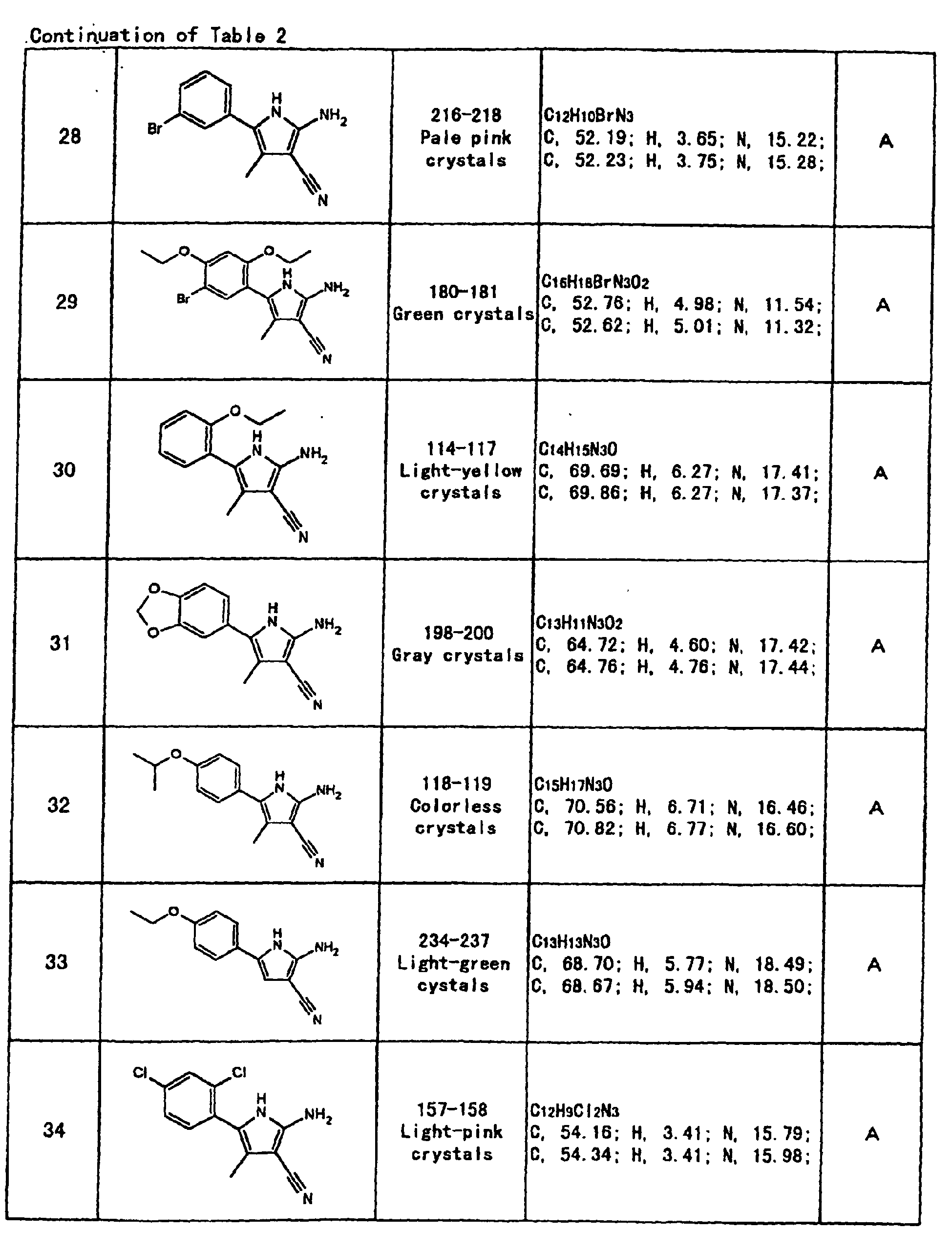

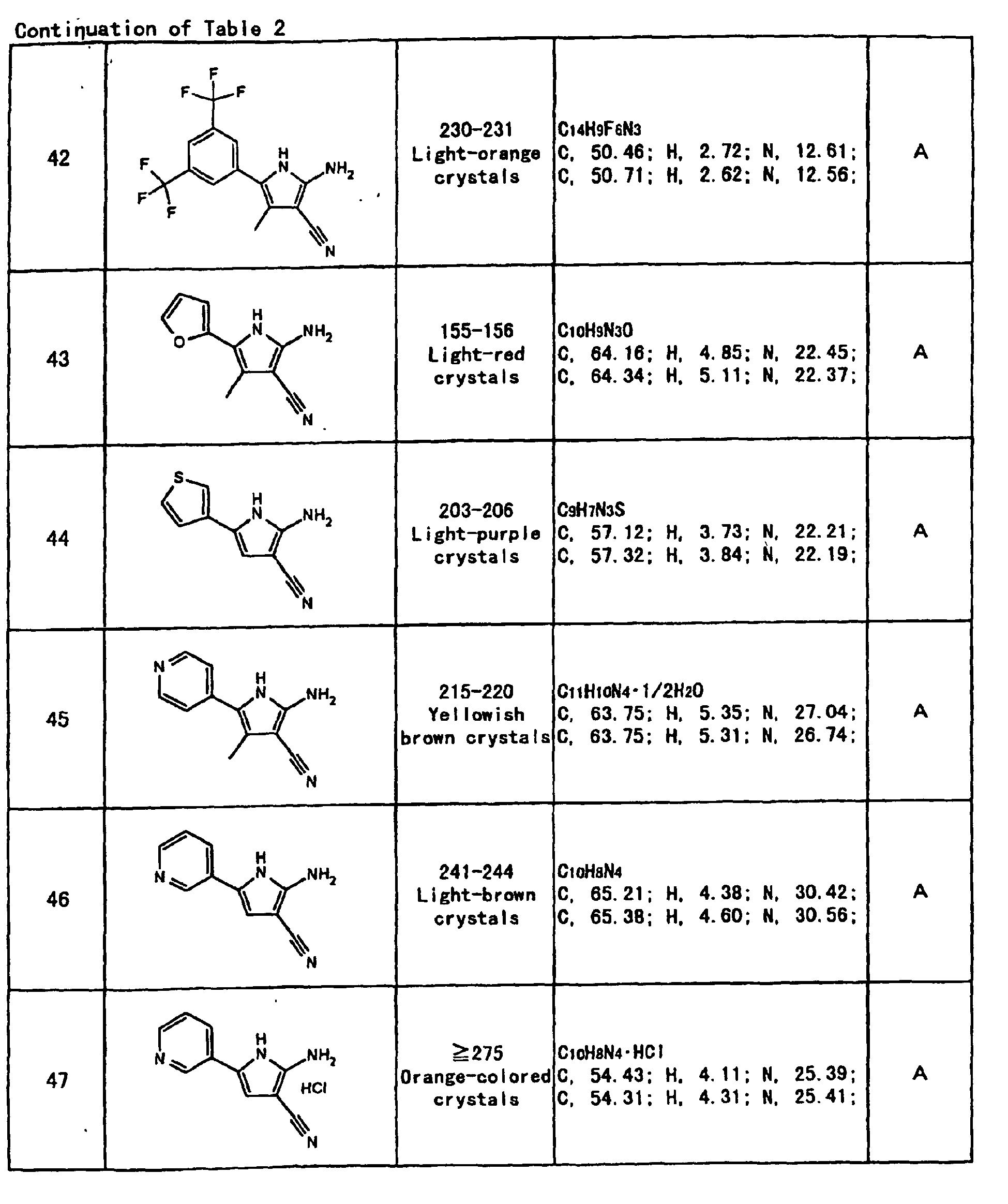


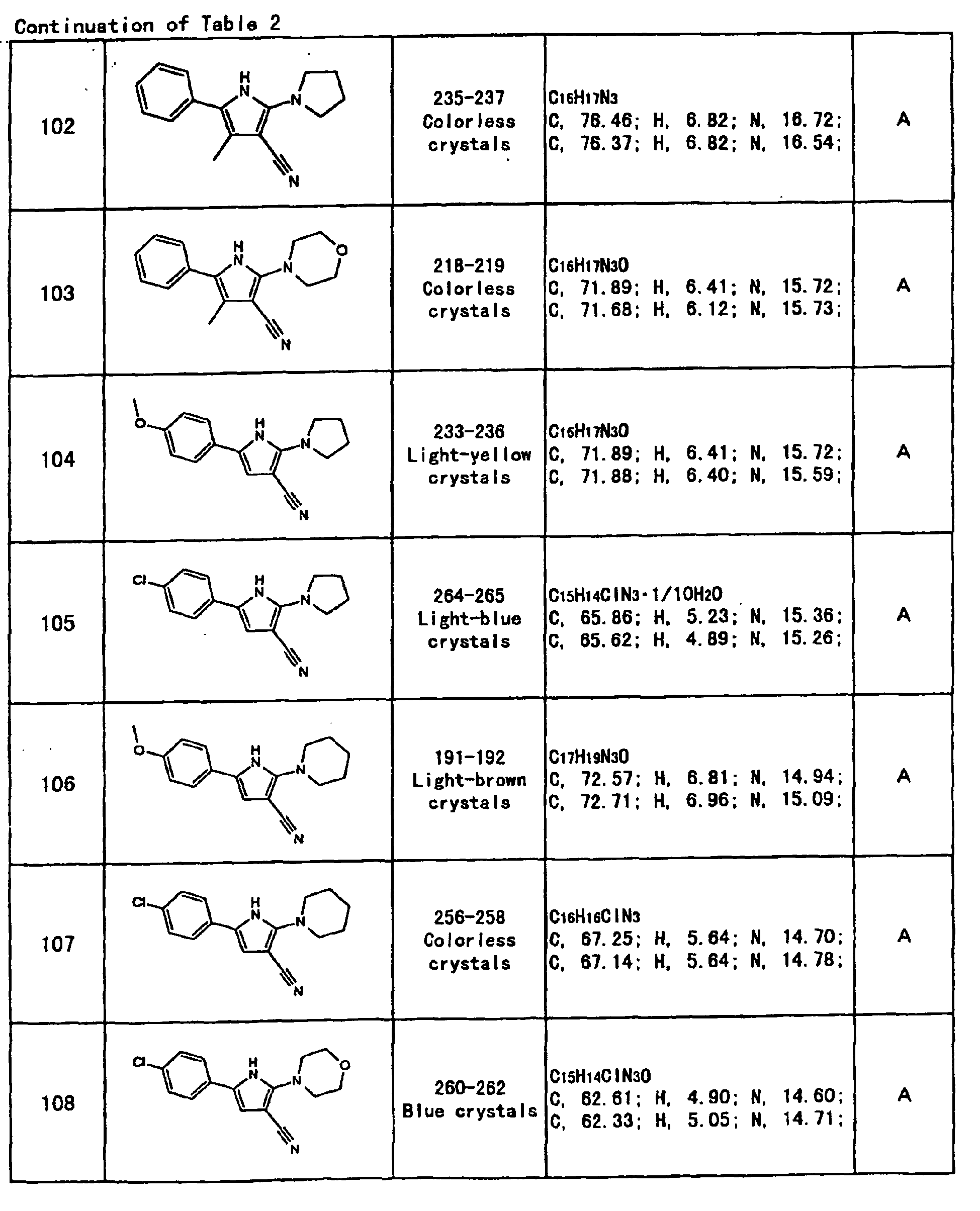


- The following are the results of pharmacological tests of some representative species, which demonstrate the usefulness of the compound of the invention.
- Cystometrography is a method for ascertaining the relation between intravesical pressure and bladder capacity and provides information on the time course of condition of the urinary bladder from urine filling to micturition, the possible involuntary contraction of the urinary bladder, and the contractility of the detrusor muscle during micturition.
- The experiment was performed using 9 to 13-weeks old female SD rats in groups of 3-5. After a median incision was made in the abdominal region under urethane anesthesia, a polyethylene indwelling cannula was inserted into the urinary bladder dome through the apex of the urinary bladder and fixed. The other end of the cannula was connected to a T-tube for infusion of saline via one branch and changes in intravesical pressure were recorded via the other branch. When warmed saline was continuously infused into the urinary bladder at a constant rate, the urinary bladder was distended and, when the pressure reached a threshold, the urinary bladder underwent rapid contractions and at the same time a micturition was induced. This procedure was repeated until the volume of saline from the start of infusion to the threshold intravesical pressure (bladder capacity) became steady giving approximately constant values in at least two consecutive determinations. Then, the test compound was administered into the duodenum. The bladder capacity was measured immediately before administration of the test compound and 0.5, 1, 2, and 3 hours after administration. The maximum increase rate (%) in bladder capacity was calculated by means of the following equation.

where B represents the bladder capacity value immediately before administration of the test compound and A represents the maximum bladder capacity at 0.5, 1, 2, and 3 hours after administration of the test compound. Results of the test are shown in Table 3. The data shown are mean values.Table 3 Cystometrography (rats) Compound No. Dosage (mg/kg) Maximum increase rate (%) in bladder capacity R1 3 63. 6 1 3 60. 8 8 30 55. 4 15 10 53. 8 41 10 38. 8 63 3 49. 9 Propiverine 100 42. 0 - The compounds of the invention produced equivalent or more potant effect in the increase of bladder capacity at markedly lower dose levels as compared with the reference prior art drug.
- It is clear from the above results that the compounds of the invention have potent bladder capacity increasing activity.
- Male ddY mice, 6 to 7-weeks old, were used in groups of 4-5. The animals fasted from the previous day (16-18 hours before the experiment) were given the test compound by oral gavage using a gastric tube and monitored for death for 2 weeks. As shown in Table 4, no death was encountered at all, nor was observed any abnormal finding.
Table 4 Acute toxicity test in mice Compound No. Dosage (mg/kg) Dead/Total R1 1000 0/4 1 1000 0/4 8 1000 0/4 41 1000 0/5 63 1000 0/5 - In 200 mg per tablet:
Compound No. R1 20 mg Corn starch 88 mg Crystalline cellulose 80 mg Carboxymethylcellulose calcium , 10 mg Light silicic anhydride 1 mg Magnesium stearate 1 mg - A powdery mixture of the above composition was compressed to provide oral tablets.
- In 200 mg per tablet
Compound No. 1 20 mg Corn starch 88 mg Crystalline cellulose 80 mg Carboxymethylcellulose calcium 10 mg Light silicic anhydride 1 mg Magnesium stearate 1 mg - A powdery mixture of the above composition was compressed to provide oral tablets.
- In 200 mg per tablet:
Compound No. 63 20 mg Corn starch 88 mg Crystalline cellulose 80 mg Carboxymethylcellulose calcium 10 mg Light silicic anhydride 1 mg Magnesium stearate 1 mg - A powdery mixture of the above composition was compressed to provide oral tablets.
- As described above, the compound of the present invention has potent bladder capacity increasing activity with a low toxic potential and is, therefore, useful for the treatment of pollakiuria or urinary incontinence.
Claims (7)
- A pyrrole derivative of the following formula [1], a pharmaceutically acceptable salt thereof, or a solvate of either of them,

wherein
R1 represents hydrogen or alkoxycarbonylamino, the alkyl moiety of which being an alkyl group of 1-4 carbon atoms;
R2 represents alkyl groups of 1-4 carbon atoms, aryl groups of 6-12 carbon atoms which may be substituted by 1 member or 2-3 same or different members selected from the group consisting of (1) halogen, (2) alkyl groups of 1-4 carbon atoms which may be substituted by halogen, (3) cyano, (4) nitro, (5) alkoxycarbonyl, the alkyl moiety of which being an alkyl group of 1-4 carbon atoms, (6) hydroxy, (7) alkoxy of 1-4 carbon atoms which may be substituted by (i) halogen, (ii) aryl groups of 6-12 carbon atoms which may be substituted by alkoxy of 1-4 carbon atoms, or (iii) alkoxy of 1-4 carbon atoms, (8) ―NHSO2R82, and (9) -NR83R84; or two adjacent substituent groups may jointly represent -0-(CH2)r-O-; aromatic 5- or 6-membered heterocyclic groups including the corresponding benzofused systems, provided that 2-pyrrolyl and 3-pyrrolyl are excluded, which may be substituted by 1 member or 2-3 same or different members selected from the group consisting of (1) halogen, (2) alkyl groups of 1-4 carbon atoms which may be substituted by halogen, (3) cyano, (4) nitro, (5) alkoxycarbonyl, the alkyl moiety of which being an alkyl group of 1-4 carbon atoms, (6) hydroxy, (7) alkoxy of 1-4 carbon atoms which may be substituted by (i) halogen, (ii) aryl groups of 6-12 carbon atoms which may be substituted by alkoxy of 1-4 carbon atoms, or (iii) alkoxy of 1-4 carbon atoms, (8) ―NHSO2R82, and (9) ―NR83R84; or two adjacent substituent groups may jointly represent ―O―(CH2)t―O―;
R6 and R7 may be the same or different and each represents hydrogen or alkyl groups of 1-4 carbon atoms which alkyl groups may be substituted by hydroxy, aryl groups of 6-12 carbon atoms which may be substituted by alkoxy groups of 1-4 carbon atoms, or aromatic 5- or 6-membered heterocyclic groups including the corresponding benzofused systems, provided that 2-pyrrolyl and 3-pyrrolyl are excluded;
Z1 and Z2 may be the same or different and each represents ―CH2― or >C=O; provided that Z1 and Z2 do not concurrently represent >C=O;
Y represents ―CH2―, ―O―, -S- or >NR9;
R9 represents hydrogen, alkyl groups of 1-4 carbon atoms, acyl groups of 1-7 carbon atoms, aryl groups of 6-12 carbon atoms, or aromatic 5- or 6-membered heterocyclic groups including the corresponding benzofused systems, provided that 2-pyrrolyl and
3-pyrroly are excluded;
m represents an integer of 1-3;
n represents an integer of 0-2;
p represents 0 or 1;
R82 represents alkyl groups of 1-4 carbon atoms or aryl groups of 6-12 carbon atoms which may be substituted by alkyl groups of 1-4 carbon atoms;
t represents 1 or 2;
R83 and R84 may be the same or diffferent and each represents hydrogen, alkyl groups of 1-4 carbon atoms, or acyl groups of 1-7 carbon atoms; or
R83 and R84 jointly and taken together with the adjacent N atom represent 5- through 7-membered cyclic amino;
R3 represents cyano or carbamoyl;
R4 represents hydrogen or alkyl groups of 1-4 carbon atoms;
E represents alkylene groups of 1-4 carbon atoms;
q represents 0 or 1;
A represents methyl, aryl groups of 6-12 carbon atoms which may be substituted by 1 member or 2-3 same or different members selected from the group consisting of (1) halogen, (2) alkyl groups of 1-4 carbon atoms which may be substituted by halogen, (3) cyano, (4) nitro, (5) alkoxycarbonyl, the alkyl moiety of which being an alkyl group of 1-4 carbon atoms, (6) hydroxy, (7) alkoxy of 1-4 carbon atoms which may be substituted by (i) halogen, (ii) aryl groups of 6-12 carbon atoms which may be substituted by alkoxy of 1-4 carbon atoms, or (iii) alkoxy of 1-4 carbon atoms, (8) ―NHSO2R92, and (9) ―NR93R94; or two adjacent substituent groups may jointly represent ―O―(CH2)u―O―; or aromatic 5- or 6-membered heterocyclic groups including the corresponding benzofused systems, provided that 2-pyrrolyl and 3-pyrrolyl are excluded, which may be substituted by 1 member or 2-3 same or different members selected from the group consisting of (1) halogen, (2) alkyl groups of 1-4 carbon atoms which may be substituted by halogen, (3) cyano, (4) nitro, (5) alkoxycarbonyl, the alkyl moiety of which being an alkyl group of 1-4 carbon atoms, (6) hydroxy, (7) alkoxy of 1-4 carbon atoms which may be substituted by (i) halogen, (ii) aryl groups of 6-12 carbon atoms which may be substituted by alkoxy of 1-4 carbon atoms, or (iii) alkoxy of 1-4 carbon atoms, (8) ―NHSO2R92 , and (9) ―NR93R94; or two adjacent substituent groups may jointly represent ―O―(CH2)u―O―;
R92 represents alkyl groups of 1-4 carbon atoms or aryl groups of 6-12 carbon atoms which may be substituted by alkyl groups of 1-4 carbon atoms;
u represents 1 or 2;
R93 and R94 may be the same or different and each represents hydrogen, alkyl groups of 1-4 carbon atoms, or acyl groups of 1-7 carbon atoms;
or R93 and R94 jointly and taken together with the adjacent N atom represent 5- through 7-membered cyclic amino;
A-(E)q, R4, and the double bond of the pyrrole ring may jointly, i.e.
X represents -O-, -S-, or >NR90 where R90 represents alkyl groups of 1-4 carbon atoms;
R95, R96 and R97 may be the same or different and each is selected from the group consisting of (1) hydrogen, (2) halogen, (3) alkyl groups of 1-4 carbon atoms which may be substituted by halogen, (4) cyano, (5) nitro, (6) alkoxycarbonyl, the alkyl moiety of which being an alkyl group of 1-4 carbon atoms, (7) hydroxy, (8) alkoxy of 1-4 carbon atoms which may be substituted by halogen or alkoxy of 1-4 carbon atoms, (9) - NHSO2R92, wherein R92 is as defined above, and (10) -NR93R94, wherein R93 and R94 are as defined above;
any two adjacent substituent groups among R95, R96 and R97 may jointly represent -0-(CH2)u-O-, wherein u is as defined above;
but exclusive of the following cases;(1) R1 is hydrogen, R2 is NH2, R3 is cyano, R4 is methyl, q is equal to 0, and A is methyl, phenyl, or 4-hydroxyphenyl,(2) R1 is hydrogen, R2 is NH2, R3 is cyano, R4 is methyl, -(E)q- is -CH2-, and A is methyl, phenyl, 4-hydroxyphenyl, 4-chlorophenyl, or 3-indolyl,(3) R1 is hydrogen, R2 is morpholino, R3 is cyano, R4 is hydrogen, q is equal to 0, and A is methyl or phenyl,(4) R1 is hydrogen, R2 is 1-pyrrolidinyl, R3 is cyano, R4 is hydrogen, q is equal to 0, and A is phenyl, 4-bromophenyl, 4-nitrophenyl, or 2,4-dimethylphenyl,(5) R1 is hydrogen, R2 is 1-piperidinyl, R3 is cyano, R4 is hydrogen, q is equal to 0, and A is phenyl or 4-bromophenyl,(6) R1 is hydrogen, R2 is diethylamino, R3 is cyano, R4 is hydrogen, q is equal to 0, and A is methyl, phenyl, 4-bromophenyl, or 3-nitrophenyl,(7) R1 is hydrogen, R2 is NH2, R3 is cyano, R4 is methyl, -(E)q- is ―CH2CH2―, and A is methyl,(8) R1 is hydrogen, R2 is NH2, R3 is cyano, R4 is n-propyl, -(E)q- is -CH2-, and A is methyl,(9) R1 is hydrogen, R2 is NH2, R3 is cyano, R4 is methyl, -(E)q- is -CH(CH3)CH2-, and A is methyl,(10) R1 is hydrogen, R2 is NH2, R3 is cyano, R4 is ethyl, q is equal to 0, and A is methyl,(11) R1 is hydrogen, R2 is methylamino, R3 is cyano, R4 is methyl, q is equal to 0, and A is methyl,(12) R1 is hydrogen, R2 is 2-oxopyrrolidin-1-yl, R3 is cyano, R4 is methyl, q is equal to 0, and A is methyl,(13) R1 is hydrogen, R2 is 1-piperidinyl, R3 is cyano, R4 is methyl, q is equal to 0, and A is phenyl,(14) R1 is hydrogen, R2 is n-butylamino, R3 is cyano, R4 is hydrogen, q is equal to 0, and A is phenyl,(15) R1 is hydrogen, R2 is methyl, R3 is cyano, R4 is methyl, q is equal to 0, and A is methyl or phenyl,(16) R1 is hydrogen, R2 is methyl, R3 is carbamoyl, R4 is methyl, q is equal to 0, and A is methyl,(17) R1 is hydrogen, R2 is methyl, R3 is carbamoyl, R4 is hydrogen, q is equal to 0, and A is methyl or phenyl,(18) R1 is hydrogen, R2 is methyl, R3 is cyano, R4 is hydrogen, q is equal to 0, and A is methyl or phenyl,(19) R1 is hydrogen, R2 is methyl, R3 is cyano, R4 is hydrogen, -(E)q- is ―CH(CH3)CH2―, and A is methyl,(20) R1 is hydrogen, R2 is phenyl, R3 is cyano, R4 is hydrogen, q is equal to 0, and A is methyl or phenyl,(21) R' is hydrogen, R2 is isobutyl, R3 is cyano, R4 is hydrogen, q is equal to 0, and A is methyl,(22) R1 is hydrogen, R2 is 4-methoxycarbonylphenyl, R3 is cyano, R4 is hydrogen, q is equal to 0, and A is methyl,(23) R1 is hydrogen, R2 is 4-methoxycarbonylphenyl, R3 is cyano, R4 is hydrogen, -(E)q- is -CH2-, and A is methyl,(24) R1 is hydrogen, R2 is 2-thienyl, R3 is cyano, R4 is hydrogen, q is equal to 0, and A is 2-thienyl or 2-furyl,(25) R1 is hydrogen, R2 is 4-nitrophenyl, R3 is cyano, R4 is hydrogen, q is equal to 0, and A is phenyl,(26) R1 is hydrogen, R2 is 1-isoquinolyl, R3 is cyano or carbamoyl, R4 is hydrogen, q is equal to 0, and A is phenyl,(27) R1 is hydrogen, R2 is 2-furyl, R3 is cyano, R4 is hydrogen, q is equal to 0, and A is 2-thienyl or 2-furyl,(28) R1 is hydrogen, R2 is methyl, R3 is cyano, R4 is methyl, -(E)q- is ―CH2―, and A is methyl,(29) R1 is hydrogen, R2 is 5-nitrobenzimidazol-1-yl, R3 is cyano, R4 is methyl, q is equal to 0, and A is methyl,(30) R1 is hydrogen, R2 is NH2, R3 is cyano, R4 is methyl, -(E)q- is ―CH2―, and A is 4-methoxyphenyl or 1-methyl-3-indolyl. - The pyrrole derivative according to claim 1, a pharmaceutically acceptable salt, or a solvate of either of them,
wherein
R2 is
- The pyrrole derivative according to claim 1, a pharmaceutically acceptable salt, or a solvate of either of them, wherein R1 is hydrogen, R2 is NH2, R3 is cyano, R4 is hydrogen or an alkyl group of 1-4 carbon atoms; q is equal to 0, and A is an aryl group of 6-12 carbon atoms which may be substituted, or an aromatic 5- or 6-membered heterocyclic group including the corresponding benzofused systems, which may be substituted, whereby the substituents are defined as above.
- The pyrrole derivative according to claim 1, a pharmaceutically acceptable salt, or a solvate of either of them, wherein R1 is hydrogen, R2 is NH2, R3 is cyano, R4 is methyl, q is equal to 0, and A is 2-fluorophenyl, 2,5-difluorophenyl, or 3-pyridyl.
- The pyrrole derivative according to claim 1, a pharmaceutically acceptable salt, or a solvate of either of them, wherein R1 is hydrogen, R2 is NH2, R3 is cyano, R4 is hydrogen, q is equal to 0, and A is phenyl, or 4-fluorophenyl.
- A pharmaceutical composition for the treatment of pollakiuria or urinary incontinence which comprises a pyrrole derivative according to one of claims 1 to 5, a pharmaceutically acceptable salt, or a solvate of either of them, as an active ingredient.
- Use of a pyrrole derivative according to anyone of claims 1 to 5 including the excluded cases (1) to (30) for the preparation of a medicament for the treatment of pollakiuria or urinary incontinence.
Applications Claiming Priority (3)
| Application Number | Priority Date | Filing Date | Title |
|---|---|---|---|
| JP140698/95 | 1995-06-07 | ||
| JP14069895 | 1995-06-07 | ||
| PCT/JP1996/001526 WO1996040634A1 (en) | 1995-06-07 | 1996-06-06 | Pyrrole derivatives and medicinal composition |
Publications (3)
| Publication Number | Publication Date |
|---|---|
| EP0842923A1 EP0842923A1 (en) | 1998-05-20 |
| EP0842923A4 EP0842923A4 (en) | 1999-12-29 |
| EP0842923B1 true EP0842923B1 (en) | 2006-03-01 |
Family
ID=15274666
Family Applications (1)
| Application Number | Title | Priority Date | Filing Date |
|---|---|---|---|
| EP96916319A Expired - Lifetime EP0842923B1 (en) | 1995-06-07 | 1996-06-06 | Pyrrole derivatives and medicinal composition |
Country Status (20)
| Country | Link |
|---|---|
| US (2) | US5998459A (en) |
| EP (1) | EP0842923B1 (en) |
| JP (1) | JP3160910B2 (en) |
| KR (1) | KR100275222B1 (en) |
| CN (2) | CN1090617C (en) |
| AT (1) | ATE318799T1 (en) |
| AU (1) | AU710683B2 (en) |
| BR (1) | BR9608502A (en) |
| CA (1) | CA2223918C (en) |
| DE (1) | DE69635857T2 (en) |
| DK (1) | DK0842923T3 (en) |
| ES (1) | ES2259795T3 (en) |
| HU (1) | HUP9802290A3 (en) |
| MX (1) | MX9709475A (en) |
| NO (1) | NO321606B1 (en) |
| NZ (1) | NZ309151A (en) |
| PT (1) | PT842923E (en) |
| RU (1) | RU2166941C2 (en) |
| TW (1) | TW504503B (en) |
| WO (1) | WO1996040634A1 (en) |
Families Citing this family (22)
| Publication number | Priority date | Publication date | Assignee | Title |
|---|---|---|---|---|
| EP0842923B1 (en) * | 1995-06-07 | 2006-03-01 | Nippon Shinyaku Company, Limited | Pyrrole derivatives and medicinal composition |
| US6121309A (en) * | 1996-03-18 | 2000-09-19 | Eisai Co., Ltd. | Fused-ring carboxylic acid derivatives |
| EP1057485B1 (en) * | 1998-01-14 | 2005-05-11 | Nippon Shinyaku Co., Ltd. | Potassium channel activators |
| AU3953899A (en) * | 1998-05-27 | 1999-12-13 | Nippon Shinyaku Co. Ltd. | Cyclooxygenase-2 inhibitors |
| CN1193754C (en) * | 2000-03-21 | 2005-03-23 | 日本新药株式会社 | Controlled Release Oral Formulations |
| CA2415815A1 (en) * | 2000-07-06 | 2002-01-17 | Nigel H. Greig | Tetrahydrobenzothiazole analogues as neuroprotective agents |
| TWI239952B (en) * | 2001-03-14 | 2005-09-21 | Nippon Shinyaku Co Ltd | Stable crystals of pyrrole compound |
| CN100540538C (en) * | 2001-04-16 | 2009-09-16 | 田边三菱制药株式会社 | High Conductivity Calcium-Activated K Channel Opener |
| TWI271402B (en) * | 2002-10-15 | 2007-01-21 | Tanabe Seiyaku Co | Large conductance calcium-activated K channel opener |
| US7456190B2 (en) * | 2003-03-13 | 2008-11-25 | Vertex Pharmaceuticals Incorporated | Compositions useful as protein kinase inhibitors |
| US20050075359A1 (en) * | 2003-03-14 | 2005-04-07 | Rikako Kono | Large conductance calcium-activated K channel opener |
| GB0321509D0 (en) * | 2003-09-13 | 2003-10-15 | Astrazeneca Ab | Chemical compounds |
| EP1675585A2 (en) * | 2003-10-17 | 2006-07-05 | Tanabe Seiyaku Co., Ltd. | Large conductance calcium-activated k channel opener |
| US7118801B2 (en) * | 2003-11-10 | 2006-10-10 | Gore Enterprise Holdings, Inc. | Aerogel/PTFE composite insulating material |
| ITTO20040125A1 (en) * | 2004-03-01 | 2004-06-01 | Rotta Research Lab | NEW HETEROCYCLIC AMIDINS INHIBITIVE THE PRODUCTION OF NITROGEN OXIDE (NO) FOR ANTI-INFLAMMATORY AND ANALGESIC ACTIVITY |
| JP2005325103A (en) * | 2004-04-13 | 2005-11-24 | Tanabe Seiyaku Co Ltd | Pharmaceutical composition |
| WO2006130493A2 (en) * | 2005-05-31 | 2006-12-07 | Vertex Pharmaceuticals Incorporated | Heterocycles useful as modulators of ion channels |
| PE20070341A1 (en) * | 2005-07-29 | 2007-04-13 | Wyeth Corp | PIRROL DERIVATIVES AS PROGESTERONE RECEPTOR MODULATORS |
| PE20070404A1 (en) * | 2005-07-29 | 2007-05-10 | Wyeth Corp | COMPOUNDS DERIVED FROM CYANOPYRROL-SULFONAMIDE AS MODULATORS OF THE PROGESTERONE RECEPTOR |
| EP2280948A1 (en) | 2008-04-09 | 2011-02-09 | Mitsubishi Tanabe Pharma Corporation | Pyrimidine, pyridine and triazine derivatives as maxi-k channel openers. |
| BR112017012588B8 (en) | 2014-12-17 | 2024-02-15 | King S College London | Bicyclic heteroaryl-heteroaryl compounds of benzoic acid, their uses, pharmaceutical compositions, methods of preparation thereof and methods for causing or promoting neurite outgrowth, neurite outgrowth and/or neurite regeneration and for activating the retinoic acid beta receptor |
| GB201610867D0 (en) | 2016-06-22 | 2016-08-03 | King S College London | Crystalline forms of a therapeutic compound and processes for their preparation |
Family Cites Families (18)
| Publication number | Priority date | Publication date | Assignee | Title |
|---|---|---|---|---|
| DD143426A1 (en) * | 1979-05-07 | 1980-08-20 | Karl Gewald | PROCESS FOR PREPARING 5,6-CONDENSED 4-AMINO-3-CYAN-PYRIDONES (2) |
| US4431823A (en) * | 1981-07-23 | 1984-02-14 | Hoffmann-La Roche Inc. | 1H-Pyrrole-3-carbonitrile-4(2-benzoyl)phenyl derivatives as intermediates for pyrrolo[3,4-D][2]benzazepines |
| FR2569189B1 (en) * | 1984-08-14 | 1986-12-19 | Roussel Uclaf | NOVEL PYRROLE DERIVATIVES, THEIR PREPARATION PROCESS AND THEIR APPLICATION AS PESTICIDES |
| SE8500273D0 (en) * | 1985-01-22 | 1985-01-22 | Leo Ab | NEW TRICYCLIC ASSOCIATIONS, COMPOSITIONS CONTAINING SUCH ASSOCIATIONS, MANUFACTURING PROCEDURES AND METHODS OF TREATMENT |
| JPH0637389B2 (en) * | 1986-12-26 | 1994-05-18 | 北陸製薬株式会社 | Treatment for frequent urination |
| IL87222A (en) * | 1987-07-29 | 1993-04-04 | American Cyanamid Co | Arylpyrroles, methods for thepreparation thereof andinsecticidal, acaricidal andnematicidal compositionscontaining them |
| US4929634A (en) * | 1987-10-23 | 1990-05-29 | American Cyanamid Company | Method of and bait compositions for controlling mollusks |
| US4886625A (en) * | 1987-10-29 | 1989-12-12 | Miles Inc. | Functionalized conducting polymers and their use in diagnostic devices |
| DE3820190A1 (en) * | 1988-06-14 | 1989-12-21 | Cassella Ag | PYRROL DERIVATIVES, THEIR PREPARATION AND THEIR USE AS PHARMACEUTICAL ACTIVE SUBSTANCES |
| EP0358047A3 (en) * | 1988-09-08 | 1991-05-29 | American Cyanamid Company | Method of controlling phytopathogenic fungi |
| US5021586A (en) * | 1989-03-31 | 1991-06-04 | Miles, Inc. | Dithiophenylpyrrole derivative monomers for preparing semi-conducting polymers |
| IT1233715B (en) * | 1989-07-14 | 1992-04-14 | Menarini Farma Ind | USE IN THERAPY OF 10-AMINO-5,6 DIIDRO-11H = DIBENZO (B, E) AZEPINA-6,11-DIONE AND DERIVATIVES, WHICH USEFUL DRUGS FOR THE TREATMENT OF URINARY INCONTINENCE |
| US5210092A (en) * | 1990-09-25 | 1993-05-11 | Fujisawa Pharmaceutical Co., Ltd. | Angiotensin ii antagonizing heterocyclic derivatives |
| WO1993019067A1 (en) * | 1991-09-12 | 1993-09-30 | Fujisawa Pharmaceutical Co., Ltd. | Imidazopyridine derivatives as angiotensin ii antagonists |
| FR2706899A1 (en) * | 1993-06-22 | 1994-12-30 | Synthelabo | Pyrrole derivatives, their preparation and their therapeutic application |
| FR2698364B1 (en) * | 1992-11-24 | 1995-01-27 | Synthelabo | Pyrrole derivatives, their preparation and their therapeutic application. |
| US5359090A (en) * | 1993-12-29 | 1994-10-25 | American Cyanamid Company | Alkoxymethylation of pyrroles |
| EP0842923B1 (en) * | 1995-06-07 | 2006-03-01 | Nippon Shinyaku Company, Limited | Pyrrole derivatives and medicinal composition |
-
1996
- 1996-06-06 EP EP96916319A patent/EP0842923B1/en not_active Expired - Lifetime
- 1996-06-06 KR KR1019970708809A patent/KR100275222B1/en not_active Expired - Fee Related
- 1996-06-06 CN CN96194448A patent/CN1090617C/en not_active Expired - Fee Related
- 1996-06-06 NZ NZ309151A patent/NZ309151A/en not_active IP Right Cessation
- 1996-06-06 HU HU9802290A patent/HUP9802290A3/en unknown
- 1996-06-06 DK DK96916319T patent/DK0842923T3/en active
- 1996-06-06 AU AU59109/96A patent/AU710683B2/en not_active Ceased
- 1996-06-06 BR BR9608502A patent/BR9608502A/en not_active Application Discontinuation
- 1996-06-06 CA CA002223918A patent/CA2223918C/en not_active Expired - Fee Related
- 1996-06-06 AT AT96916319T patent/ATE318799T1/en not_active IP Right Cessation
- 1996-06-06 WO PCT/JP1996/001526 patent/WO1996040634A1/en not_active Ceased
- 1996-06-06 ES ES96916319T patent/ES2259795T3/en not_active Expired - Lifetime
- 1996-06-06 US US08/973,369 patent/US5998459A/en not_active Expired - Fee Related
- 1996-06-06 RU RU98100090/14A patent/RU2166941C2/en not_active IP Right Cessation
- 1996-06-06 JP JP50031097A patent/JP3160910B2/en not_active Expired - Fee Related
- 1996-06-06 MX MX9709475A patent/MX9709475A/en not_active IP Right Cessation
- 1996-06-06 DE DE69635857T patent/DE69635857T2/en not_active Expired - Lifetime
- 1996-06-06 PT PT96916319T patent/PT842923E/en unknown
- 1996-06-18 TW TW085107349A patent/TW504503B/en not_active IP Right Cessation
-
1997
- 1997-12-05 NO NO19975666A patent/NO321606B1/en unknown
-
1999
- 1999-07-30 US US09/365,096 patent/US6172102B1/en not_active Expired - Fee Related
-
2001
- 2001-10-15 CN CN01135586A patent/CN1349796A/en active Pending
Also Published As
| Publication number | Publication date |
|---|---|
| MX9709475A (en) | 1998-02-28 |
| TW504503B (en) | 2002-10-01 |
| AU710683B2 (en) | 1999-09-30 |
| JP3160910B2 (en) | 2001-04-25 |
| EP0842923A1 (en) | 1998-05-20 |
| ATE318799T1 (en) | 2006-03-15 |
| ES2259795T3 (en) | 2006-10-16 |
| US6172102B1 (en) | 2001-01-09 |
| EP0842923A4 (en) | 1999-12-29 |
| DE69635857T2 (en) | 2006-10-19 |
| NO321606B1 (en) | 2006-06-12 |
| AU5910996A (en) | 1996-12-30 |
| NZ309151A (en) | 2000-01-28 |
| RU2166941C2 (en) | 2001-05-20 |
| BR9608502A (en) | 1999-07-06 |
| WO1996040634A1 (en) | 1996-12-19 |
| HUP9802290A2 (en) | 1999-10-28 |
| US5998459A (en) | 1999-12-07 |
| NO975666D0 (en) | 1997-12-05 |
| DE69635857D1 (en) | 2006-04-27 |
| CN1090617C (en) | 2002-09-11 |
| DK0842923T3 (en) | 2006-06-19 |
| HUP9802290A3 (en) | 2002-02-28 |
| CN1349796A (en) | 2002-05-22 |
| PT842923E (en) | 2006-07-31 |
| CN1186485A (en) | 1998-07-01 |
| KR19990022329A (en) | 1999-03-25 |
| KR100275222B1 (en) | 2001-02-01 |
| CA2223918A1 (en) | 1996-12-19 |
| CA2223918C (en) | 2006-01-10 |
| NO975666L (en) | 1998-02-09 |
Similar Documents
| Publication | Publication Date | Title |
|---|---|---|
| EP0842923A1 (en) | Pyrrole derivatives and medicinal composition | |
| JPWO1996040634A1 (en) | Pyrrole derivatives and pharmaceutical compositions | |
| US4342776A (en) | 4-Substituted-3-hydroxy-3-pyrroline-2,5-dione inhibitors of glycolic acid oxidase | |
| US4666902A (en) | Tetrahydropyridazinone derivatives, processes for their preparation and their use | |
| JPH0574587B2 (en) | ||
| IE54896B1 (en) | Pyrrolacetic amides having antiinflammatory activity | |
| US4652582A (en) | Antiinflammatory-2-halo-4,5-diarylpyrroles | |
| KR102954979B1 (en) | Acrylic-containing nuclear export regulators and their uses | |
| AU2007249952B2 (en) | Modified chalcone compounds as antimitotic agents | |
| EP1556376B1 (en) | Large conductance calcium-activated k channel opener | |
| EP2044957A1 (en) | Treatment agent for inflammatory bowel disease | |
| DE69221634T2 (en) | 5-piperazinylalkyl) -1,5-benzothiazepinone usable as calcium antagonists | |
| EP0397031B1 (en) | Novel esters of phenylalkanoic acid | |
| CA1283914C (en) | Derivative of benzoquinonylphenyl alkanoic acid amide | |
| CH633541A5 (en) | Pharmacologically active substituted 1,2,4-triazines and medicaments containing these triazines | |
| JPH03258770A (en) | Benzazole derivative, preparation thereof and synthetic intermediate theroef | |
| IL100274A (en) | Pharmaceutical compositions containing functionalized vinyl azole derivatives novel functionalized vinyl azole derivatives and processes for the preparation of same | |
| CA2204007A1 (en) | Remedy for diseases caused by infection with helicobacter | |
| US5135928A (en) | Triazolo derivatives and process for their preparation | |
| CA1298294C (en) | Pyrrole derivatives, their preparation and their pharmaceutical compositions therein | |
| CA2313302C (en) | New metalloprotease inhibitors, the process for preparing them and the pharmaceutical compounds containing them | |
| US4021554A (en) | 1,4-Oxathiino[2,3-c]pyrrole derivatives | |
| JPH0680041B2 (en) | 2-Pyridylacetic acid derivative, method for producing the same, and medicament containing the same | |
| JP4463900B2 (en) | Phenylazole compounds, production methods and antihyperlipidemic drugs | |
| EP0341213B1 (en) | 5-Aryl-substituted-2,3-dihydro-imidazo [1,2-a]furo[3,2-c]- or thieno[2,3-c]pyridines |
Legal Events
| Date | Code | Title | Description |
|---|---|---|---|
| PUAI | Public reference made under article 153(3) epc to a published international application that has entered the european phase |
Free format text: ORIGINAL CODE: 0009012 |
|
| 17P | Request for examination filed |
Effective date: 19971127 |
|
| AK | Designated contracting states |
Kind code of ref document: A1 Designated state(s): AT BE CH DE DK ES FI FR GB GR IE IT LI LU NL PT SE |
|
| A4 | Supplementary search report drawn up and despatched |
Effective date: 19991115 |
|
| AK | Designated contracting states |
Kind code of ref document: A4 Designated state(s): AT BE CH DE DK ES FI FR GB GR IE IT LI LU NL PT SE |
|
| RIC1 | Information provided on ipc code assigned before grant |
Free format text: 6C 07D 207/335 A, 6C 07D 207/34 B, 6C 07D 401/04 B, 6C 07D 401/14 B, 6C 07D 403/04 B, 6C 07D 405/04 B, 6C 07D 405/14 B, 6C 07D 409/04 B, 6C 07D 413/04 B, 6C 07D 417/04 B, 6A 61K 31/40 B |
|
| EUG | Se: european patent has lapsed | ||
| 17Q | First examination report despatched |
Effective date: 20021202 |
|
| GRAP | Despatch of communication of intention to grant a patent |
Free format text: ORIGINAL CODE: EPIDOSNIGR1 |
|
| GRAS | Grant fee paid |
Free format text: ORIGINAL CODE: EPIDOSNIGR3 |
|
| GRAA | (expected) grant |
Free format text: ORIGINAL CODE: 0009210 |
|
| AK | Designated contracting states |
Kind code of ref document: B1 Designated state(s): AT BE CH DE DK ES FI FR GB GR IE IT LI LU NL PT SE |
|
| REG | Reference to a national code |
Ref country code: GB Ref legal event code: FG4D |
|
| REG | Reference to a national code |
Ref country code: CH Ref legal event code: EP |
|
| REG | Reference to a national code |
Ref country code: IE Ref legal event code: FG4D |
|
| PGFP | Annual fee paid to national office [announced via postgrant information from national office to epo] |
Ref country code: IE Payment date: 20060427 Year of fee payment: 11 |
|
| REF | Corresponds to: |
Ref document number: 69635857 Country of ref document: DE Date of ref document: 20060427 Kind code of ref document: P |
|
| PGFP | Annual fee paid to national office [announced via postgrant information from national office to epo] |
Ref country code: GR Payment date: 20060505 Year of fee payment: 11 |
|
| PGFP | Annual fee paid to national office [announced via postgrant information from national office to epo] |
Ref country code: PT Payment date: 20060512 Year of fee payment: 11 |
|
| PGFP | Annual fee paid to national office [announced via postgrant information from national office to epo] |
Ref country code: FI Payment date: 20060519 Year of fee payment: 11 |
|
| PGFP | Annual fee paid to national office [announced via postgrant information from national office to epo] |
Ref country code: LU Payment date: 20060531 Year of fee payment: 11 |
|
| PGFP | Annual fee paid to national office [announced via postgrant information from national office to epo] |
Ref country code: DK Payment date: 20060606 Year of fee payment: 11 |
|
| PGFP | Annual fee paid to national office [announced via postgrant information from national office to epo] |
Ref country code: SE Payment date: 20060607 Year of fee payment: 11 |
|
| PGFP | Annual fee paid to national office [announced via postgrant information from national office to epo] |
Ref country code: AT Payment date: 20060613 Year of fee payment: 11 |
|
| REG | Reference to a national code |
Ref country code: DK Ref legal event code: T3 |
|
| REG | Reference to a national code |
Ref country code: SE Ref legal event code: TRGR |
|
| REG | Reference to a national code |
Ref country code: CH Ref legal event code: NV Representative=s name: SCHMAUDER & PARTNER AG PATENTANWALTSBUERO Ref country code: GR Ref legal event code: EP Ref document number: 20060401853 Country of ref document: GR |
|
| REG | Reference to a national code |
Ref country code: PT Ref legal event code: SC4A Effective date: 20060512 |
|
| REG | Reference to a national code |
Ref country code: ES Ref legal event code: FG2A Ref document number: 2259795 Country of ref document: ES Kind code of ref document: T3 |
|
| ET | Fr: translation filed | ||
| PLBE | No opposition filed within time limit |
Free format text: ORIGINAL CODE: 0009261 |
|
| STAA | Information on the status of an ep patent application or granted ep patent |
Free format text: STATUS: NO OPPOSITION FILED WITHIN TIME LIMIT |
|
| 26N | No opposition filed |
Effective date: 20061204 |
|
| REG | Reference to a national code |
Ref country code: PT Ref legal event code: MM4A Free format text: LAPSE DUE TO NON-PAYMENT OF FEES Effective date: 20071206 |
|
| PG25 | Lapsed in a contracting state [announced via postgrant information from national office to epo] |
Ref country code: PT Free format text: LAPSE BECAUSE OF NON-PAYMENT OF DUE FEES Effective date: 20071206 Ref country code: FI Free format text: LAPSE BECAUSE OF NON-PAYMENT OF DUE FEES Effective date: 20070606 |
|
| REG | Reference to a national code |
Ref country code: DK Ref legal event code: EBP |
|
| EUG | Se: european patent has lapsed | ||
| PG25 | Lapsed in a contracting state [announced via postgrant information from national office to epo] |
Ref country code: AT Free format text: LAPSE BECAUSE OF NON-PAYMENT OF DUE FEES Effective date: 20070606 |
|
| PG25 | Lapsed in a contracting state [announced via postgrant information from national office to epo] |
Ref country code: GR Free format text: LAPSE BECAUSE OF NON-PAYMENT OF DUE FEES Effective date: 20060602 |
|
| PG25 | Lapsed in a contracting state [announced via postgrant information from national office to epo] |
Ref country code: IE Free format text: LAPSE BECAUSE OF NON-PAYMENT OF DUE FEES Effective date: 20070606 |
|
| PG25 | Lapsed in a contracting state [announced via postgrant information from national office to epo] |
Ref country code: SE Free format text: LAPSE BECAUSE OF NON-PAYMENT OF DUE FEES Effective date: 20070607 |
|
| PG25 | Lapsed in a contracting state [announced via postgrant information from national office to epo] |
Ref country code: DK Free format text: LAPSE BECAUSE OF NON-PAYMENT OF DUE FEES Effective date: 20070702 |
|
| REG | Reference to a national code |
Ref country code: CH Ref legal event code: PCAR Free format text: SCHMAUDER & PARTNER AG PATENT- UND MARKENANWAELTE VSP;ZWAENGIWEG 7;8038 ZUERICH (CH) |
|
| PG25 | Lapsed in a contracting state [announced via postgrant information from national office to epo] |
Ref country code: LU Free format text: LAPSE BECAUSE OF NON-PAYMENT OF DUE FEES Effective date: 20070606 |
|
| PGFP | Annual fee paid to national office [announced via postgrant information from national office to epo] |
Ref country code: FR Payment date: 20100709 Year of fee payment: 15 |
|
| PGFP | Annual fee paid to national office [announced via postgrant information from national office to epo] |
Ref country code: IT Payment date: 20100615 Year of fee payment: 15 |
|
| PGFP | Annual fee paid to national office [announced via postgrant information from national office to epo] |
Ref country code: NL Payment date: 20100616 Year of fee payment: 15 Ref country code: ES Payment date: 20100630 Year of fee payment: 15 Ref country code: CH Payment date: 20100614 Year of fee payment: 15 Ref country code: BE Payment date: 20100518 Year of fee payment: 15 |
|
| PGFP | Annual fee paid to national office [announced via postgrant information from national office to epo] |
Ref country code: GB Payment date: 20100602 Year of fee payment: 15 Ref country code: DE Payment date: 20100602 Year of fee payment: 15 |
|
| BERE | Be: lapsed |
Owner name: *NIPPON SHINYAKU CY LTD Effective date: 20110630 |
|
| REG | Reference to a national code |
Ref country code: NL Ref legal event code: V1 Effective date: 20120101 |
|
| REG | Reference to a national code |
Ref country code: CH Ref legal event code: PL |
|
| GBPC | Gb: european patent ceased through non-payment of renewal fee |
Effective date: 20110606 |
|
| PG25 | Lapsed in a contracting state [announced via postgrant information from national office to epo] |
Ref country code: IT Free format text: LAPSE BECAUSE OF NON-PAYMENT OF DUE FEES Effective date: 20110606 |
|
| REG | Reference to a national code |
Ref country code: FR Ref legal event code: ST Effective date: 20120229 |
|
| PG25 | Lapsed in a contracting state [announced via postgrant information from national office to epo] |
Ref country code: BE Free format text: LAPSE BECAUSE OF NON-PAYMENT OF DUE FEES Effective date: 20110630 |
|
| REG | Reference to a national code |
Ref country code: DE Ref legal event code: R119 Ref document number: 69635857 Country of ref document: DE Effective date: 20120103 |
|
| PG25 | Lapsed in a contracting state [announced via postgrant information from national office to epo] |
Ref country code: LI Free format text: LAPSE BECAUSE OF NON-PAYMENT OF DUE FEES Effective date: 20110630 Ref country code: CH Free format text: LAPSE BECAUSE OF NON-PAYMENT OF DUE FEES Effective date: 20110630 Ref country code: DE Free format text: LAPSE BECAUSE OF NON-PAYMENT OF DUE FEES Effective date: 20120103 Ref country code: FR Free format text: LAPSE BECAUSE OF NON-PAYMENT OF DUE FEES Effective date: 20110630 |
|
| PG25 | Lapsed in a contracting state [announced via postgrant information from national office to epo] |
Ref country code: NL Free format text: LAPSE BECAUSE OF NON-PAYMENT OF DUE FEES Effective date: 20120101 |
|
| PG25 | Lapsed in a contracting state [announced via postgrant information from national office to epo] |
Ref country code: GB Free format text: LAPSE BECAUSE OF NON-PAYMENT OF DUE FEES Effective date: 20110606 |
|
| REG | Reference to a national code |
Ref country code: ES Ref legal event code: FD2A Effective date: 20130605 |
|
| PG25 | Lapsed in a contracting state [announced via postgrant information from national office to epo] |
Ref country code: ES Free format text: LAPSE BECAUSE OF NON-PAYMENT OF DUE FEES Effective date: 20110607 |