EP0841327B1 - Triazole antifungal agent - Google Patents
Triazole antifungal agent Download PDFInfo
- Publication number
- EP0841327B1 EP0841327B1 EP96908350A EP96908350A EP0841327B1 EP 0841327 B1 EP0841327 B1 EP 0841327B1 EP 96908350 A EP96908350 A EP 96908350A EP 96908350 A EP96908350 A EP 96908350A EP 0841327 B1 EP0841327 B1 EP 0841327B1
- Authority
- EP
- European Patent Office
- Prior art keywords
- group
- butyl
- phenyl
- methyl
- ethyl
- Prior art date
- Legal status (The legal status is an assumption and is not a legal conclusion. Google has not performed a legal analysis and makes no representation as to the accuracy of the status listed.)
- Expired - Lifetime
Links
- 0 CSC1COC(C=Cc2ccc(*)cc2)OC1 Chemical compound CSC1COC(C=Cc2ccc(*)cc2)OC1 0.000 description 4
- PDZIWMMQUNMUIB-ZHACJKMWSA-N CCOC(/C=C(\C)/C#Cc1ccc(C(F)(F)F)cc1)=O Chemical compound CCOC(/C=C(\C)/C#Cc1ccc(C(F)(F)F)cc1)=O PDZIWMMQUNMUIB-ZHACJKMWSA-N 0.000 description 1
Classifications
-
- C—CHEMISTRY; METALLURGY
- C07—ORGANIC CHEMISTRY
- C07D—HETEROCYCLIC COMPOUNDS
- C07D231/00—Heterocyclic compounds containing 1,2-diazole or hydrogenated 1,2-diazole rings
- C07D231/02—Heterocyclic compounds containing 1,2-diazole or hydrogenated 1,2-diazole rings not condensed with other rings
- C07D231/10—Heterocyclic compounds containing 1,2-diazole or hydrogenated 1,2-diazole rings not condensed with other rings having two or three double bonds between ring members or between ring members and non-ring members
- C07D231/12—Heterocyclic compounds containing 1,2-diazole or hydrogenated 1,2-diazole rings not condensed with other rings having two or three double bonds between ring members or between ring members and non-ring members with only hydrogen atoms, hydrocarbon or substituted hydrocarbon radicals, directly attached to ring carbon atoms
-
- A—HUMAN NECESSITIES
- A01—AGRICULTURE; FORESTRY; ANIMAL HUSBANDRY; HUNTING; TRAPPING; FISHING
- A01N—PRESERVATION OF BODIES OF HUMANS OR ANIMALS OR PLANTS OR PARTS THEREOF; BIOCIDES, e.g. AS DISINFECTANTS, AS PESTICIDES OR AS HERBICIDES; PEST REPELLANTS OR ATTRACTANTS; PLANT GROWTH REGULATORS
- A01N43/00—Biocides, pest repellants or attractants, or plant growth regulators containing heterocyclic compounds
- A01N43/64—Biocides, pest repellants or attractants, or plant growth regulators containing heterocyclic compounds having rings with three nitrogen atoms as the only ring hetero atoms
- A01N43/647—Triazoles; Hydrogenated triazoles
- A01N43/653—1,2,4-Triazoles; Hydrogenated 1,2,4-triazoles
-
- A—HUMAN NECESSITIES
- A61—MEDICAL OR VETERINARY SCIENCE; HYGIENE
- A61K—PREPARATIONS FOR MEDICAL, DENTAL OR TOILETRY PURPOSES
- A61K31/00—Medicinal preparations containing organic active ingredients
- A61K31/33—Heterocyclic compounds
- A61K31/395—Heterocyclic compounds having nitrogen as a ring hetero atom, e.g. guanethidine or rifamycins
- A61K31/41—Heterocyclic compounds having nitrogen as a ring hetero atom, e.g. guanethidine or rifamycins having five-membered rings with two or more ring hetero atoms, at least one of which being nitrogen, e.g. tetrazole
-
- A—HUMAN NECESSITIES
- A61—MEDICAL OR VETERINARY SCIENCE; HYGIENE
- A61P—SPECIFIC THERAPEUTIC ACTIVITY OF CHEMICAL COMPOUNDS OR MEDICINAL PREPARATIONS
- A61P31/00—Antiinfectives, i.e. antibiotics, antiseptics, chemotherapeutics
- A61P31/10—Antimycotics
-
- C—CHEMISTRY; METALLURGY
- C07—ORGANIC CHEMISTRY
- C07D—HETEROCYCLIC COMPOUNDS
- C07D233/00—Heterocyclic compounds containing 1,3-diazole or hydrogenated 1,3-diazole rings, not condensed with other rings
- C07D233/54—Heterocyclic compounds containing 1,3-diazole or hydrogenated 1,3-diazole rings, not condensed with other rings having two double bonds between ring members or between ring members and non-ring members
- C07D233/56—Heterocyclic compounds containing 1,3-diazole or hydrogenated 1,3-diazole rings, not condensed with other rings having two double bonds between ring members or between ring members and non-ring members with only hydrogen atoms or radicals containing only hydrogen and carbon atoms, attached to ring carbon atoms
-
- C—CHEMISTRY; METALLURGY
- C07—ORGANIC CHEMISTRY
- C07D—HETEROCYCLIC COMPOUNDS
- C07D249/00—Heterocyclic compounds containing five-membered rings having three nitrogen atoms as the only ring hetero atoms
- C07D249/02—Heterocyclic compounds containing five-membered rings having three nitrogen atoms as the only ring hetero atoms not condensed with other rings
- C07D249/08—1,2,4-Triazoles; Hydrogenated 1,2,4-triazoles
-
- C—CHEMISTRY; METALLURGY
- C07—ORGANIC CHEMISTRY
- C07D—HETEROCYCLIC COMPOUNDS
- C07D401/00—Heterocyclic compounds containing two or more hetero rings, having nitrogen atoms as the only ring hetero atoms, at least one ring being a six-membered ring with only one nitrogen atom
-
- C—CHEMISTRY; METALLURGY
- C07—ORGANIC CHEMISTRY
- C07D—HETEROCYCLIC COMPOUNDS
- C07D403/00—Heterocyclic compounds containing two or more hetero rings, having nitrogen atoms as the only ring hetero atoms, not provided for by group C07D401/00
Definitions
- the present invention relates to a 1,2,4-triazole compound represented by the formula (I) which is particularly effective for mycotic disease of a human being and an animal.
- EP-A-510700 discloses azole compounds, which are said to have antifungal activity, having the following general formula: wherein: X may represent a nitrogen atom; R 7 may represent a hydroxy group; Ar represents an optionally substituted phenyl group; R 1 and R 2 are the same or different and each represents a hydrogen atom or an alkyl group; and B may represent a group of the following formula: wherein n is an integer of from 0 to 2 and R 3 and R 4 , together with the nitrogen atom to which they are attached may represent an optionally substituted heterocyclic group.
- the present inventors made intensive studies in order to find a more excellent antifungal agent and found that the compound of the present invention is an excellent antifungal agent to accomplish the present invention.
- the present invention relates to a compound having the formula (I): wherein Ar 1 represents a phenyl group or a phenyl group having 1 to 3 substituent(s) (said substituent(s) represent(s) a halogen atom or a trifluoromethyl group);
- halogen atom is, for example, a fluorine, chlorine or bromine atom, preferably a fluorine or chlorine atom.
- the lower alkyl group is a methyl, ethyl, propyl, isopropyl, butyl, isobutyl, sec-butyl or tert-butyl group, preferably a methyl, ethyl, propyl or isopropyl group.
- the lower alkoxy group is a methoxy, ethoxy, propoxy, isopropoxy, butoxy, isobutoxy, sec-butoxy or tert-butoxy group, preferably a methoxy, ethoxy, propoxy or isopropoxy group.
- the 5- or 6-membered aromatic heterocyclic group of Ar 2 is, for example, a furyl, thienyl, pyrrolyl, pyrazolyl, imidazolyl, oxazolyl, thiazolyl, pyridyl, pyrimidyl or pyrazyl group, preferably a furyl, thienyl, pyrrolyl or pyridyl group.
- Preferred compounds having the formula (I) are compounds in which:
- Preferred compounds in Table 1 include those having the substituents of 4, 6, 7, 13, 16, 18, 22, 25, 32, 36, 40, 43, 44, 47, 52, 53, 61, 63, 71, 76, 96, 107, 123, 127, 142, 174, 176, 177, 178, 181, 182, 183 and 186, and particularly preferred compounds may include 2-(2,4-difluorophenyl)-3-[[2-[2-[4-(trifluoromethyl)phenyl]vinyl]-1,3-dioxan-5-yl]thio]-1-(1H-1,2,4-triazol-1-yl)-2-butanol (the compound corresponding to Example 2), 2-(2,4-difluorophenyl)-1-(1H-1,2,4-triazol-1-yl)-3-[[2-[2-[4-(trifluoromethoxy)phenyl]vinyl]-1,3-dioxan-5-yl]
- the triazole compound (I) of the present invention has at least two asymmetric carbon atoms, and optical isomers and diastereomers exist.
- optical isomer both antipodes can be obtained by general optical resolution or asymmetric synthesis.
- diastereomers can be separated by conventional separation methods such as fractional recrystallization and chromatography.
- the compound (I) of the present invention includes one of these isomers or mixtures thereof.
- the triazole compound (I) of the present invention can be used as an antifungal agent as such or in the form of a pharmacologically acceptable salt.
- the pharmacologically acceptable salt of the compound (I) includes, for example, a salt of inorganic acids such as hydrochloric acid, hydrobromic acid, sulfuric acid and nitric acid, a salt of carboxylic acids such as acetic acid, fumaric acid, maleic acid, oxalic acid, malonic acid, succinic acid, citric acid and malic acid, a salt of sulfonic acids such as methanesulfonic acid, ethanesulfonic acid, benzenesulfonic acid and toluenesulfonic acid and a salt of amino acids such as glutamic acid and aspartic acid, preferably a salt of carboxylic acids.
- a hydrate of the compound (I) and a hydrate of the salt of the compound (I) are also included in the compound of the present invention.
- the compound (I) and a pharmacologically acceptable salt thereof of the present invention exhibit excellent antifungal activities and in the case where the compound (I) and a pharmacologically acceptable salt thereof are used as an antifungal agent, they can be administered as such or as a mixture, for example, with a suitable pharmacologically acceptable excipient or diluent orally in the form of a tablet, a capsule, a granule, a powder or a syrup or parenterally in the form of injection preparations.
- excipients for example, sugar derivatives such as lactose, sucrose, glucose, mannitol and sorbitol; starch derivatives such as corn starch, mashed potato starch, ⁇ -starch, dextrine and carboxymethyl starch; cellulose derivatives such as crystalline cellulose, low hydroxypropyl-substituted cellulose, hydroxypropylmethyl cellulose, carboxymethyl cellulose, carboxymethyl cellulose calcium and internally bridged carboxymethyl cellulose sodium; gum arabic; dextran; Pullulan; silicate derivatives such as light silicic acid anhydride, synthetic aluminum silicate and magnesium meta-silicic acid aluminate; phosphate derivatives such as calcium phosphate; carbonate derivatives such as calcium carbonate; and sulfate derivatives such as calcium sulfate), binders (for example, the above excipients; gelatin; polyvinylpyrrolidone; and Macrogol);
- excipients for example, sugar derivatives such as
- the dose varies depending on the condition and age of the patient to be treated, it is desirably administered 1 to 6 times daily depending on the condition: in the case of oral administration, the lower limit of 1 mg each time (preferably 5 mg) and the upper limit of 2000 mg (preferably 1000 mg) for an adult; and in the case of intravenous administration, the lower limit of 0.1 mg each time (preferably 0.5 mg) and the upper limit of 600 mg (preferably 500 mg) for an adult.
- the solvent employable in the reaction includes preferably alcohols such as methanol, ethanol and propanol, aprotic solvents such as dimethylformamide, dimethylacetamide, dimethyl sulfoxide, acetonitrile and tetrahydrofuran.
- alcohols such as methanol, ethanol and propanol
- aprotic solvents such as dimethylformamide, dimethylacetamide, dimethyl sulfoxide, acetonitrile and tetrahydrofuran.
- the base employable in the reaction includes sodium hydride, sodium methoxide, sodium ethoxide, lithium methoxide, potassium tert-butoxide, lithium hydroxide, sodium hydroxide and potassium hydroxide.
- the amount to be used is 0.1 to 2 molar equivalents based on the compound (2).
- Mercaptan (3) or the acetic acid derivative thereof (4) is used in 1 to 3 molar equivalents.
- the reaction temperature is room temperature to 100°C and the reaction time is 2 to 10 hours.
- the compound (Ia) can be obtained by treating the reaction mixture by conventional procedures (an oil obtained by extraction with an organic solvent and then evaporation of the solvent is purified by column chromatography or recrystallization).
- the acid chloride (10) used in the above reaction can be obtained by treating a carboxylic acid, obtained by alkali-decomposing the unsaturated ester (7a) or (7b) described above, with thionyl chloride.
- the solvent employable in the reaction includes methanol, ethanol, propanol, butanol, dimethylformamide, dimethylacetamide, dimethyl sulfoxide, acetonitrile, tetrahydrofuran, dioxane, diethyl ether, acetone, benzene, toluene, xylene, etc.
- the base employable in the reaction includes triethylamine, diisopropylethylamine, sodium hydride, sodium methoxide, sodium ethoxide, lithium methoxide, potassium tert-butoxide, sodium hydroxide, potassium hydroxide, etc., and the amount used is 1 to 3 molar equivalents based on the compound (11).
- the alkylating reagent(12) is used in 1 to 3 molar equivalents.
- the reaction temperature is -50 to 100°C and the reaction time is 2 to 10 hours.
- the compound (Ia) can be obtained by treating the reaction mixture by conventional procedures (an oil obtained by extraction with an organic solvent and then evaporation of the solvent is purified by column chromatography or recrystallization).
- the alkylating reagent R 8 -X (12) used in the above reaction can be obtained according to the process shown below.
- the process is to prepare the desired compound (Ib) by reacting the above epoxide compound (2) with a thioacetic acid derivative (15) obtained by the reaction of the above known compound (5) with sodium thioacetate under the same conditions as in the reaction of (2) and (4) to obtain the compound (16), deprotecting the compound (16) according to conventional procedures such as the treatment with an acid to obtain the compound (17) and reacting the compound (17) with the above aldehyde compound (6).
- the reaction of the compounds (17) and (6) is usually carried out under acidic conditions.
- the acid employable here includes, for example, hydrogen chloride, sulfuric acid, nitric acid, boron trifluoride, methanesulfonic acid, benzenesulfonic acid and p-toluenesulfonic acid and the amount of the acid used is 1 to 2 molar equivalents based on (17).
- the aldehyde (6) is used in 1 to 2 molar equivalents.
- aprotic solvents such as methylene chloride, chloroform, 1,2-dichloroethane, benzene, toluene, xylene, diethyl ether and tetrahydrofuran are used.
- the reaction is carried out in the range of 0°C to a boiling point of the solvent and the reaction time is 2 to 10 hours. While water produced by the reaction can be removed by azeotropic distillation, molecular sieves may be used as a dehydrating agent.
- the compound (Ib) can be obtained by neutralizing the reaction mixture with an aqueous sodium hydrogencarbonate solution and then treating it by conventional procedures (an oil obtained by extraction with an organic solvent and then evaporation of the solvent is purified by column chromatography or recrystallization).
- the process is to prepare the desired compound (Ic) by reacting the above epoxide compound (2) with the mercaptan compound (18), obtained by treating the above thioacetic acid derivative (9) with an alkali, under the same conditions as in the reaction of (2) and (3) to obtain the compound (19), deprotecting (19) by treating it with an acid according to conventional procedures to obtain the compound (20) and reacting the compound (20) with the above acid chloride (10).
- the reaction of compounds (20) and (10) is carried out in an inert solvent such as benzene, toluene, methylene chloride, chloroform or tetrahydrofuran in the presence of an appropriate base by conventional procedures (Reference example Nos. 13, 14, 18 and 19).
- Hei 7-2802 (January 6, 1995), with the above mercaptan (3) or an acetic acid derivative thereof (4) under alkaline conditions to obtain a thioether derivative (22) and reacting (22) with trimethylsulfoxonium iodide and 1,2,4-triazole in the presence of a base.
- the solvent used in the reaction of (21) and (3) or (4) includes preferably alcohols such as methanol, ethanol and propanol, and the alkali employable here includes sodium hydroxide, potassium hydroxide, sodium methoxide and sodium ethoxide.
- the solvent used in the reaction for converting the thioether derivative (22) to (Id) includes preferably alcohols such as methanol, ethanol, propanol, butanol and t-butanol and aprotic solvents such as dimethylformamide, dimethylacetamide, dimethyl sulfoxide, acetonitrile and tetrahydrofuran.
- the base used in the reaction includes sodium hydride, sodium methoxide, sodium ethoxide, lithium methoxide, potassium tert-butoxide, lithium hydroxide, sodium hydroxide and potassium hydroxide, and the amount used is 2 to 5 molar equivalents based on the compound (22).
- Trimethylsulfoxonium iodide and 1,2,4-triazole are used in 1 to 2 molar equivalents based on the compound (22), respectively.
- the reaction temperature is room temperature to 100°C and the reaction time is 2 to 10 hours.
- the reaction conditions in the above respective steps are the same as those described in the reaction of (16) ⁇ (17) ⁇ (Ib).
- the aldehyde compounds used in Examples are synthesized according to the procedures described in the literature and/or the citation of the literature in the cases where the literature is indicated in parenthesis.
- the aldehyde compounds for which the literature is not indicated are commercially available or can be obtained by the procedures for synthesizing an aldehyde which are described in the literature in the parenthesis of Examples or are described in the citation of the literature or a process according to the procedures for synthesizing an aldehyde described in Reference example of the present specification.
- This compound was mixed with 1 equivalent of oxalic acid in a mixed solvent of ethyl acetate-hexane to obtain an oxalic acid salt crystal having a melting point of 132 to 135°C.
- This compound was mixed with 1 equivalent of oxalic acid in a mixed solvent of ethyl acetate-hexane to obtain an oxalic acid salt crystal having a melting point of 103 to 105°C.
- This compound was mixed with 1 equivalent of oxalic acid in a mixed solvent of ethyl acetate-hexane to obtain an oxalic acid salt crystal having a melting point of 164 to 165°C.
- This compound was mixed with 1 equivalent of oxalic acid in a mixed solvent of ethyl acetate-hexane to obtain an oxalic acid salt crystal having a melting point of 53 to 57°C.
- the reaction mixture was poured into 20 ml of a 3% aqueous sodium hydrogencarbonate solution under ice-cooling and the mixture was stirred for 5 minutes. Then, the molecular sieves was removed by filtration and the organic layer was collected by fractions, followed by drying and evaporation of the solvent under reduced pressure. 908 mg of the thus obtained oil were subjected to column chromatography using 19 g of silica gel and eluted with a mixed solvent of hexane-ethyl acetate (1:1) to obtain 448 mg (yield: 63%) of the desired title compound as an oil.
- the insolubles were removed by filtration using Celite and the filtrate was extracted with ethyl acetate and dried, followed by evaporation of the solvent to obtain an oil.
- the oil was subjected to column chromatography using 5 g of silica gel and eluted with a mixed solvent of 30 to 40% ethyl acetate-hexane to obtain 90 mg of the title compound as an oil.
- reaction mixture was subjected to silica gel column chromatography and eluted with a mixed solvent of hexane-ethyl acetate (2:1 to 1:1) to obtain 2.32 g (yield: 95%) of the desired compound as a slightly yellow solid.
- (2E,4E,6E) -7-[4-(Trifluoromethyl)phenyl]-2,4,6-heptatrien-1-ol was treated with active manganese dioxide in the same manner as in Reference example 22 to obtain the title compound in a yield of 88%.
- Ethyl (2E,4E)-5-[4-(2,2,3,3-tetrafluoropropoxy)phenyl]-2,4-pentadien-1-ol was treated with active manganese dioxide in the same manner as in Reference example 22 to obtain the title compound having a melting point of 53 to 55°C in a yield of 96%.
- Ethyl 6-(2,2,3,3-tetrafluoropropoxy)nicotinate was reduced with diisobutyl aluminum hydride in the same manner as in Reference example 21 to obtain the title compound as an oil in a yield of 100%.
- This product was stirred in 15 ml of a 0.07N sodium methoxide-methanol solution at room temperature for 2 to 3 hours. To the mixture was added 0.2 ml of acetic acid, and the resulting mixture was diluted with ethyl acetate and washed with an aqueous NaCl solution. After the mixture was dried, the solvent was distilled off to obtain 865 mg of a 4:1 mixture of the title trans form and a cis form as a solid. The solid was recrystallized from a mixed solvent of etherhexane to obtain 220 mg of the trans form title compound having a melting point of 44 to 46°C.
- the mixture was diluted with toluene and washed with water and an aqueous NaCl solution. After the mixture was dried, the crude product obtained by evaporation of the solvent was subjected to column chromatography using 5 g of silica gel and eluted with a mixed solvent of methylene chloride-hexane (1:2). The eluted portion was recrystallized from hexane to obtain 86 mg (yield: 31%) of the title compound having a melting point of 142 to 144°C.
- the crude product obtained by evaporation of the solvent was subjected to column chromatography using 5 g of silica gel and eluted with a mixed solvent of methylene chloride-hexane (1:1), followed by purification over Rover column [GrosseB, a mixed solvent of ethyl acetate-hexane (1:19)] to obtain 98 mg (yield: 70%) of the title compound having a melting point of 113 to 115°C.
- mice one group consisting of 10 mice, which were innoculated with 4 to 9 x 10 6 Candida albicans, were administered orally 20 mg/kg of preparations after 1, 4 and 24 hours, and thereafter the survival rate until 21 days after infection was examined.
- the results of comparison of the compound (I) of the present invention with commercially available Fluconazol are shown in Table 2. From the results, it is apparent that the compound (I) exhibits an excellent antifungal activity.
- Compound Survival rate % 14 days 21 days Example 2 100 100 11 100 100 15 100 100 16 100 100 18 100 100 21 100 60 30 100 100 100 32 100 100 100 35 100 100 37 100 100 Fluconazol 70 60
- the thus formulated powder was mixed and passed through a sieve of 60 mesh, and then the powder was encapsulated in No. 3 gelatin capsule of 250 mg to prepare a capsule.
- the thus formulated powder was mixed and wet-granulated using a corn starch sizing agent and dried, and then a 200 mg-tablet was made by means of a tablet making machine. If necessary, sugar coating can be applied to the tablet.
- the compound having the general formula (I) or a pharmacologically acceptable salt thereof of the present invention has an excellent antifungal activity and is useful as an antifungal agent.
Landscapes
- Chemical & Material Sciences (AREA)
- Organic Chemistry (AREA)
- Health & Medical Sciences (AREA)
- Life Sciences & Earth Sciences (AREA)
- General Health & Medical Sciences (AREA)
- Environmental Sciences (AREA)
- Public Health (AREA)
- Engineering & Computer Science (AREA)
- Dentistry (AREA)
- Pest Control & Pesticides (AREA)
- Wood Science & Technology (AREA)
- Zoology (AREA)
- Agronomy & Crop Science (AREA)
- Veterinary Medicine (AREA)
- Plant Pathology (AREA)
- Animal Behavior & Ethology (AREA)
- Pharmacology & Pharmacy (AREA)
- Medicinal Chemistry (AREA)
- Nuclear Medicine, Radiotherapy & Molecular Imaging (AREA)
- General Chemical & Material Sciences (AREA)
- Chemical Kinetics & Catalysis (AREA)
- Oncology (AREA)
- Communicable Diseases (AREA)
- Epidemiology (AREA)
- Pharmaceuticals Containing Other Organic And Inorganic Compounds (AREA)
- Plural Heterocyclic Compounds (AREA)
- Agricultural Chemicals And Associated Chemicals (AREA)
Abstract
Description
- The present invention relates to a 1,2,4-triazole compound represented by the formula (I) which is particularly effective for mycotic disease of a human being and an animal.
- In Japanese Unexamined Patent Publication (KOKAI) No. Sho 61-85369, it is described that an analogous compound of the compound of the present invention, in which a moiety corresponding to the moiety of formula:
- EP-A-510700 discloses azole compounds, which are said to have antifungal activity, having the following general formula:wherein: X may represent a nitrogen atom; R7 may represent a hydroxy group; Ar represents an optionally substituted phenyl group; R1 and R2 are the same or different and each represents a hydrogen atom or an alkyl group; and B may represent a group of the following formula:
 wherein n is an integer of from 0 to 2 and R3 and R4, together with the nitrogen atom to which they are attached may represent an optionally substituted heterocyclic group.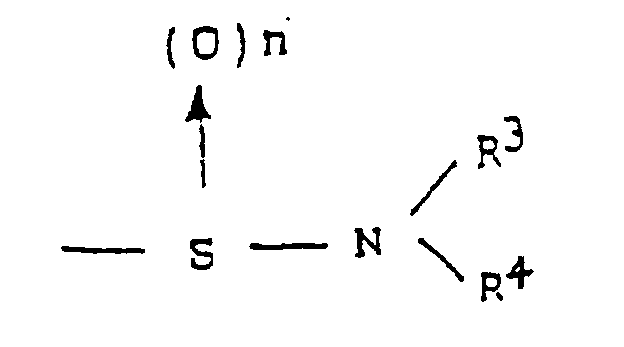
- However, the present inventors made intensive studies in order to find a more excellent antifungal agent and found that the compound of the present invention is an excellent antifungal agent to accomplish the present invention.
- The present invention relates to a compound having the formula (I):wherein Ar1 represents a phenyl group or a phenyl group having 1 to 3 substituent(s) (said substituent(s) represent(s) a halogen atom or a trifluoromethyl group);

- Ar2 represents a phenyl group, a 5- or 6-membered aromatic heterocyclic group (said aromatic heterocyclic group has at least one nitrogen, oxygen or sulfur atom) or a phenyl group or a 5- or 6- membered aromatic heterocyclic group having 1 to 3 substituents [said substituent(s) represent(s) a lower alkyl group, a lower alkoxy group, a halogen atom, a lower alkyl group substituted with a halogen atom or halogen atoms, a lower alkoxy group substituted with a halogen atom or halogen atoms, a nitro group, a cyano group, a -S(O)mR6 group (R6 represents a lower alkyl group which may be substituted with a halogen atom or halogen atoms and m represents 0, 1 or 2) or a -NHCOR7 group (R7 represents a lower alkyl group) and said aromatic heterocyclic group has at least one nitrogen, oxygen or sulfur atom];
- R0 represents a hydrogen atom or a lower alkyl group;
- R1 represents a lower alkyl group;
- R2, R3, R4 and R5 may be the same or different and represent a hydrogen atom, a lower alkyl group or a lower alkyl group substituted with a halogen atom or halogen atoms and, where q and/or s represent 2, each of R2, R3, R4 and R5 represents independently a group which is the same or different from the other R2, R3, R4 and R5 respectively;
- n represents 0;
- p represents 0 or 1;
- q, r and s represent 0, 1 or 2; and
- A represents a 4- to 7-membered aliphatic carbocyclic group comprising 4 to 7 carbon atoms or a 4- to 7-membered aliphatic heterocyclic group having at least one nitrogen, oxygen or sulfur atom, or a pharmacologically acceptable salt thereof;
-
- The above-mentioned halogen atom is, for example, a fluorine, chlorine or bromine atom, preferably a fluorine or chlorine atom.
- The lower alkyl group is a methyl, ethyl, propyl, isopropyl, butyl, isobutyl, sec-butyl or tert-butyl group, preferably a methyl, ethyl, propyl or isopropyl group.
- The lower alkoxy group is a methoxy, ethoxy, propoxy, isopropoxy, butoxy, isobutoxy, sec-butoxy or tert-butoxy group, preferably a methoxy, ethoxy, propoxy or isopropoxy group.
- The 5- or 6-membered aromatic heterocyclic group of Ar2 is, for example, a furyl, thienyl, pyrrolyl, pyrazolyl, imidazolyl, oxazolyl, thiazolyl, pyridyl, pyrimidyl or pyrazyl group, preferably a furyl, thienyl, pyrrolyl or pyridyl group.
- Preferred compounds having the formula (I) are compounds in which:
- Ar1 is a dichlorophenyl, difluorophenyl, chlorophenyl, fluorophenyl, (trifluoromethyl)phenyl or fluoro(trifluoromethyl)phenyl group, preferably a 2,4-dichlorophenyl, 2,4-difluorophenyl, 4-chlorophenyl, 4-fluorophenyl, 4-(trifluoromethyl)phenyl or 2-fluoro-4-(trifluoromethyl)phenyl group, particularly preferably a 2,4-dichlorophenyl, 2,4-difluorophenyl or 4-(trifluoromethyl)phenyl group;
- Ar2 is a fluorophenyl, chlorophenyl, difluorophenyl, dichlorophenyl, (trifluoromethyl)phenyl, (trichloromethyl)phenyl, fluoro-(trifluoromethyl)phenyl, (difluoromethoxy)phenyl,)phenyl, (trifluoromethoxy)phenyl, (2,2,2-trifluoroethoxy)phenyl, (1,1,2,2-tetrafluoroethoxy)phenyl, (2,2,3,3-tetrafluoropropoxy)phenyl, fluoro-(2,2,3,3-tetrafluoropropoxy)phenyl, nitrophenyl, fluoro-nitrophenyl, cyanophenyl, chloro-cyanophenyl, (methylthio)phenyl, (methylsulfinyl)phenyl, (methylsulfonyl)phenyl, (trifluoromethylthio)phenyl, )phenyl, (trifluoromethylsulfinyl)phenyl, (trifluoromethylsulfonyl)phenyl, chloropyridyl, (trifluoromethyl)pyridyl, (2,2,3,3-tetrafluoropropoxy)pyridyl, (trifluoromethyl)furyl, chlorothienyl or (trifluoromethyl)thienyl group, preferably a 4-fluorophenyl, 4-chlorophenyl, 2,4-difluorophenyl, 2,4-dichlorophenyl, 4-(trifluoromethyl)phenyl, 4-(trichloromethyl)phenyl, 2-fluoro-4-(trifluoromethyl)phenyl, 4-(difluoromethoxy)phenyl, 3-(trifluoromethoxy)phenyl, 4-(trifluoromethoxy)phenyl, 4-(2,2,2-trifluoroethoxy)phenyl, 4-(1,1,2,2-tetrafluoroethoxy)phenyl, 4-(2,2,3,3-tetrafluoropropoxy)phenyl, 2-fluoro-4-(2,2,3,3-tetrafluoropropoxy)phenyl, 4-nitrophenyl, 2-fluoro-4-nitrophenyl, 4-cyanophenyl, 2-chloro-4-cyanophenyl, 4-(methylthio)phenyl, 4-(methylsulfinyl)phenyl, 4-(methylsulfonyl)phenyl, 4-(trifluoromethylthio)phenyl, 4-(trifluoromethylsulfinyl)phenyl, 4-(trifluoromethylsulfonyl)phenyl, 6-chloro-3-pyridyl, 6-(trifluoromethyl)-3-pyridyl, 5-chloro-2-pyridyl, 6-(2,2,3,3-tetrafluoropropoxy)-3-pyridyl, 5-(trifluoromethyl)-2-furyl, 5-chloro-2-thienyl or 5-(trifluoromethyl)-2-thienyl group, particularly preferably a 4-chlorophenyl, 4-(trifluoromethylthio)phenyl, 4-(trifluoromethylsulfonyl)phenyl, 4-(trifluoromethyl)phenyl, 4-(trifluoromethoxy)phenyl or 4-(2,2,3,3-tetrafluoropropoxy)phenyl group;
- R0 is a hydrogen atom, a methyl, ethyl or propyl group, preferably a hydrogen atom, a methyl or ethyl group, particularly preferably a hydrogen atom or a methyl group;
- R1 is a methyl, ethyl or propyl group, preferably a methyl or ethyl group, particularly preferably a methyl group;
- R2, R3, R4 and R5 may be the same or different and are a hydrogen atom, a methyl, ethyl, propyl or trifluoromethyl group, preferably a hydrogen atom, a methyl or trifluoromethyl group, particularly preferably a hydrogen atom or a trifluoromethyl group;
- n is 0;
- p is 0 or 1, particularly preferably 0;
- q is 0, 1 or 2, particularly preferably 1;
- r is 0, 1 or 2, particularly preferably 0 or 1;
- s is 0, 1 or 2, particularly preferably 1;
- A is an azetidine, pyrrolidine, piperidine or 1,3-dioxane ring, preferably an azetidine, piperidine or 1,3-dioxane ring, particularly preferably a piperidine or 1,3-dioxane ring.
-
- The preferred compounds of formula (I) can be exemplified by the compounds in which Ar1 is a 4-chlorophenyl, 2,4-difluorophenyl, 2,4-dichlorophenyl or 4-(trifluoromethyl)phenyl group; R0 is a hydrogen atom or a methyl group; R1 is a methyl group; and the moiety represented by the formula:
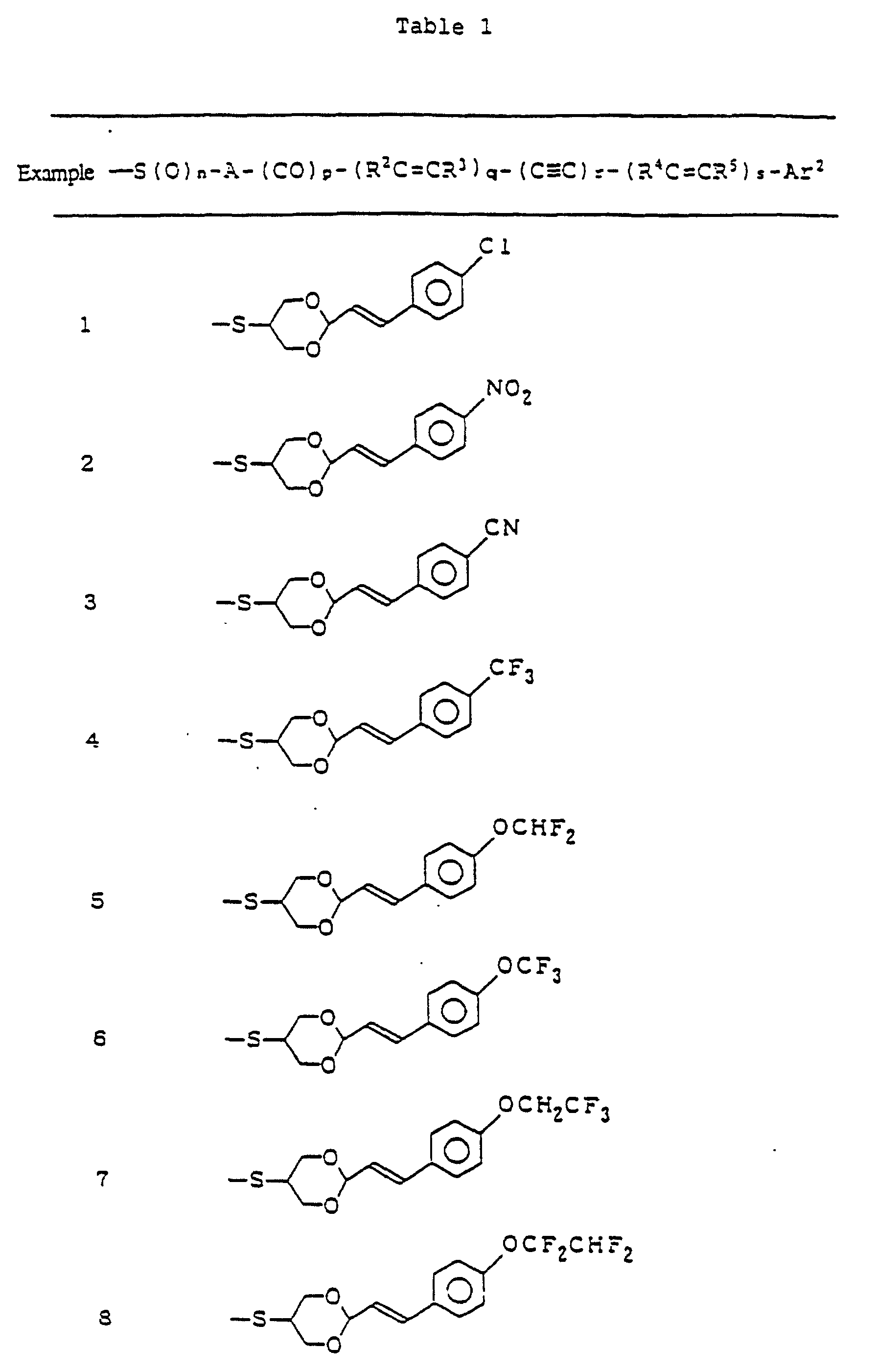
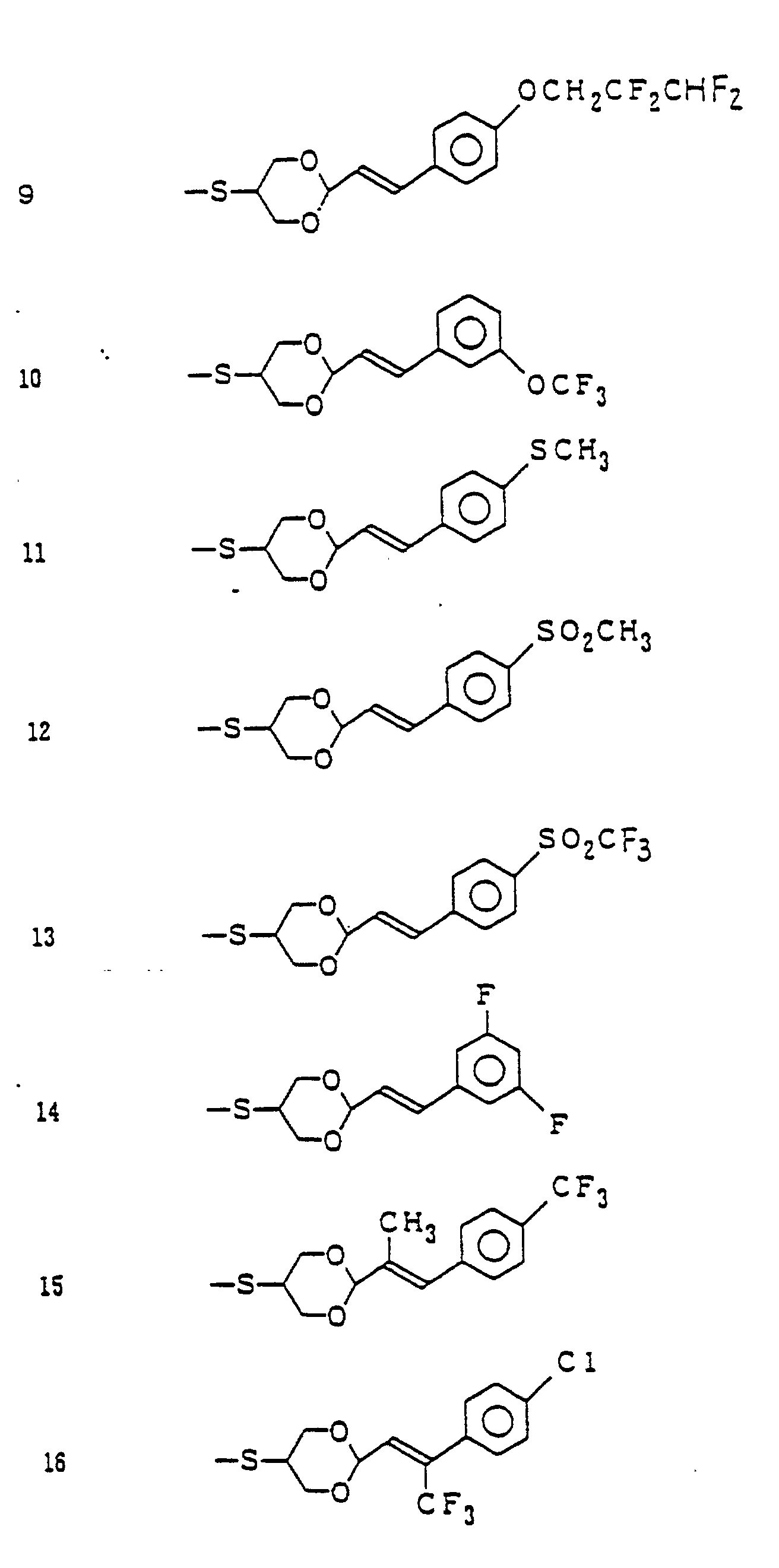
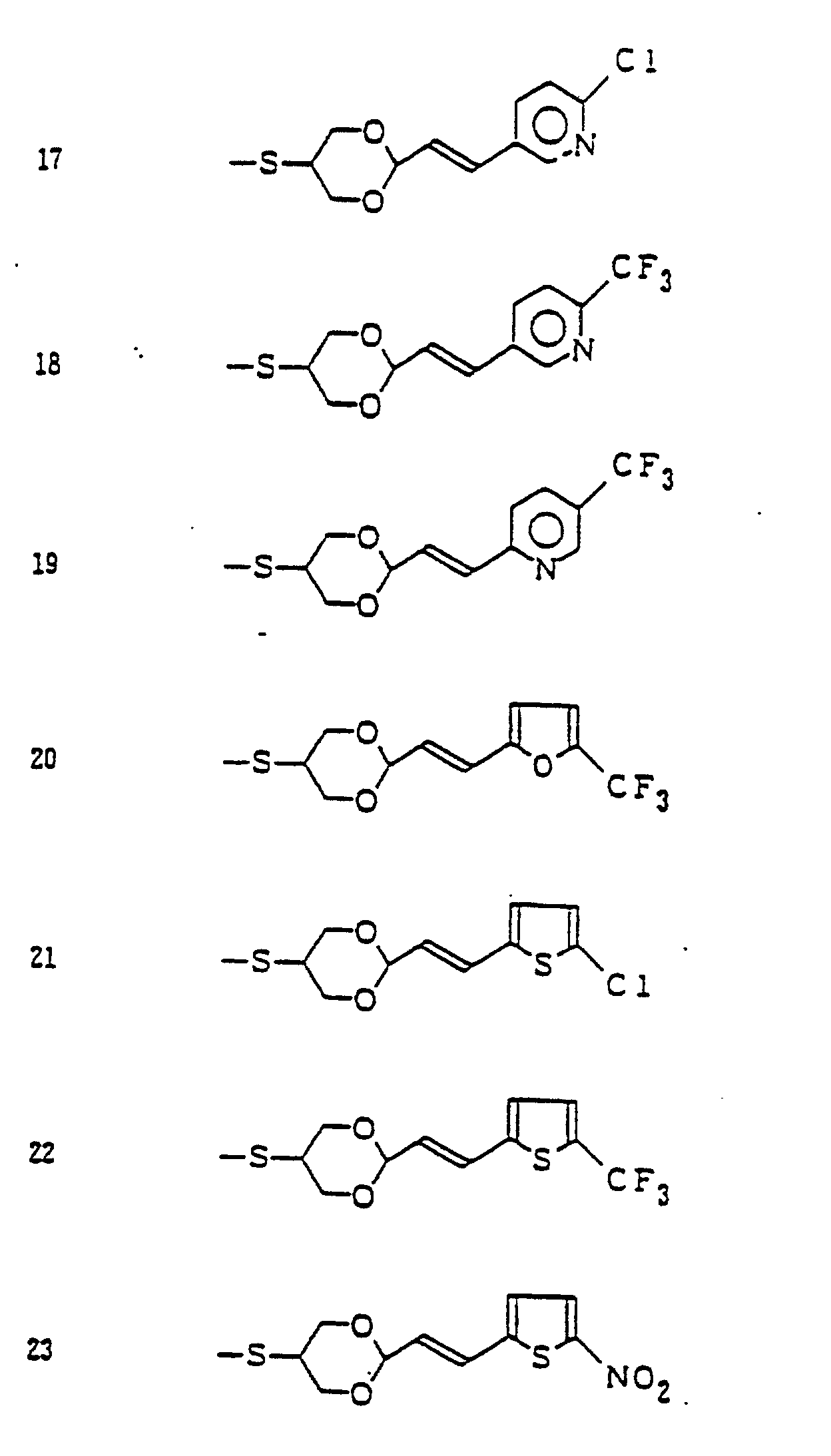
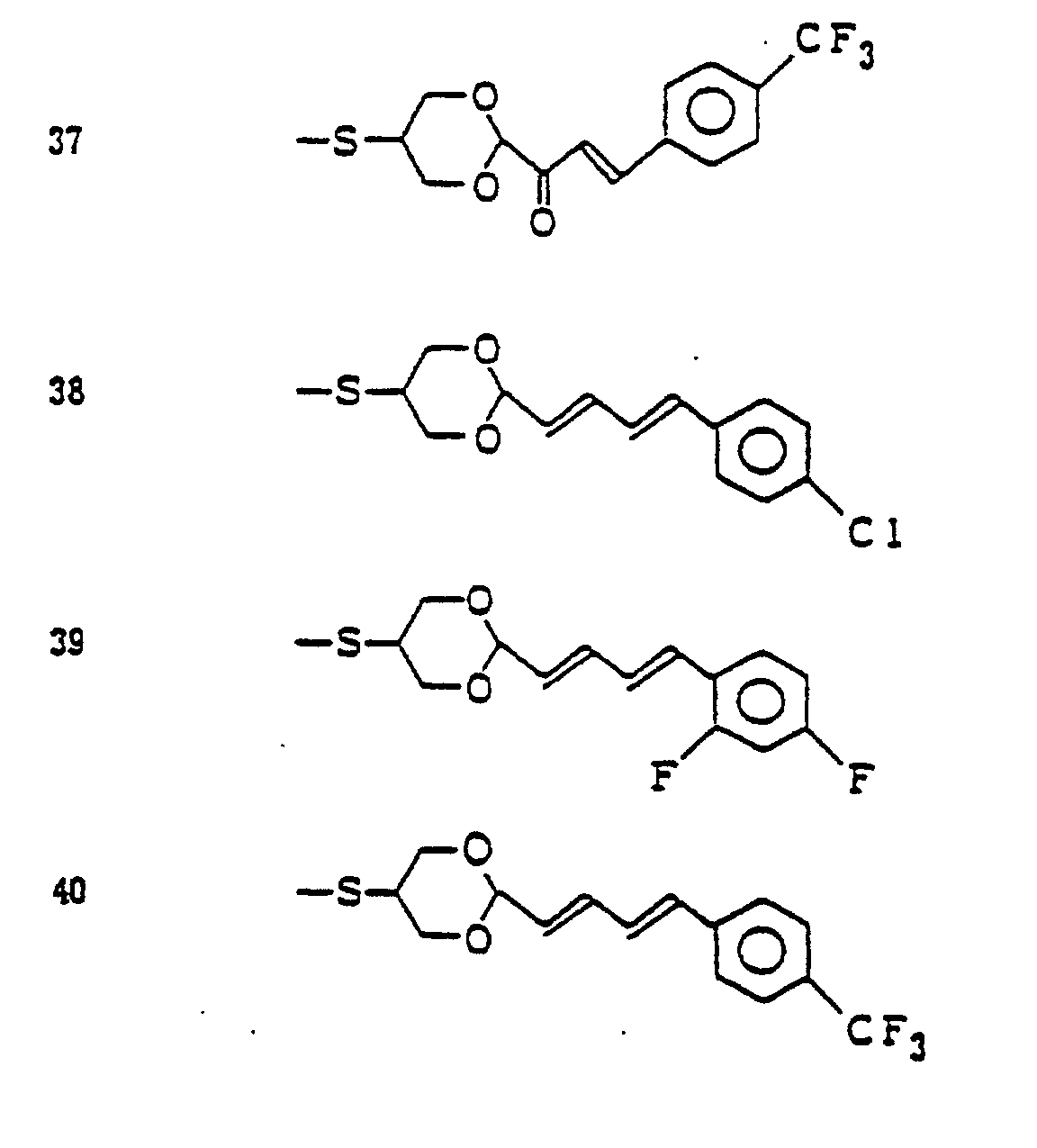


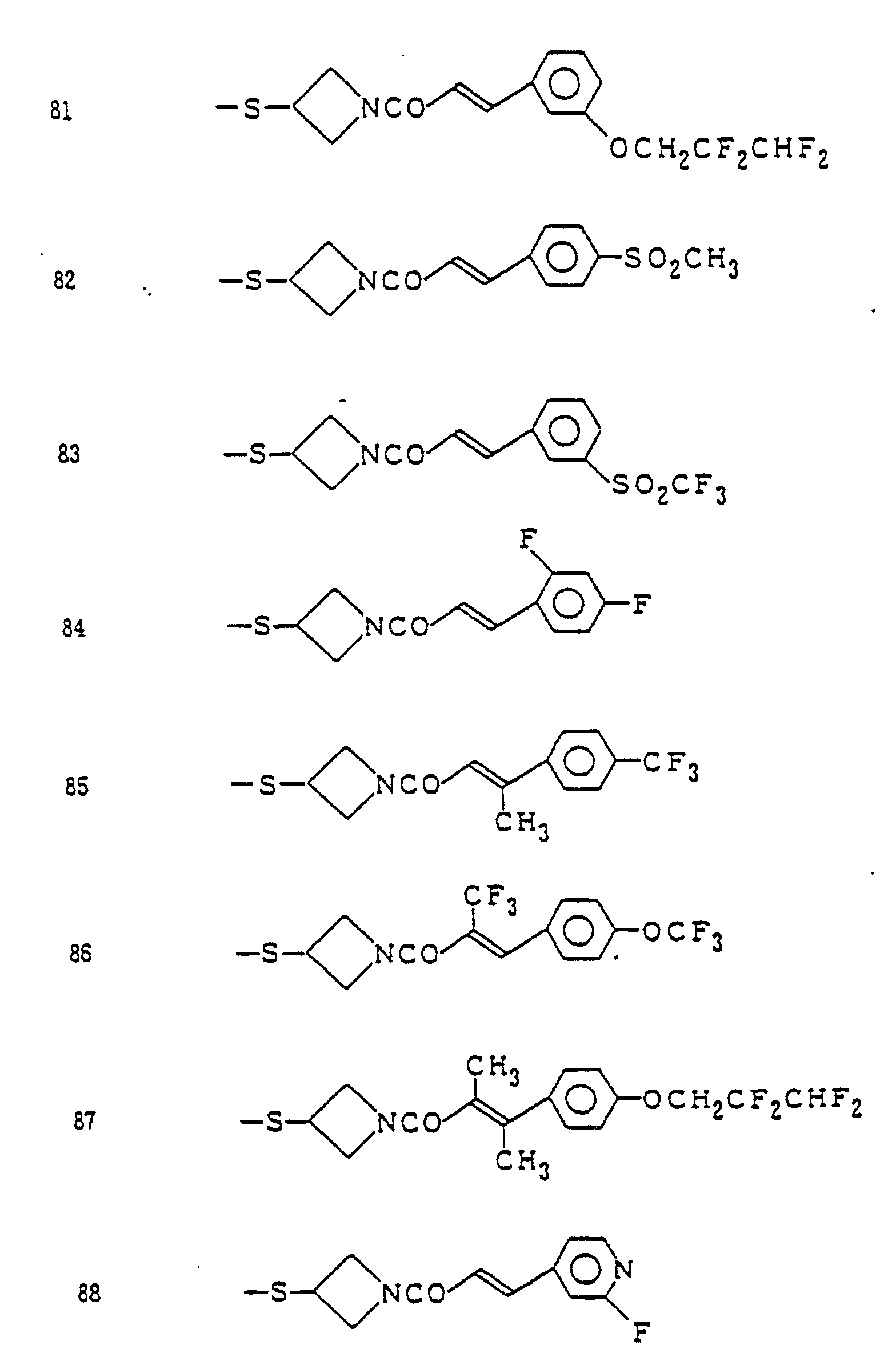


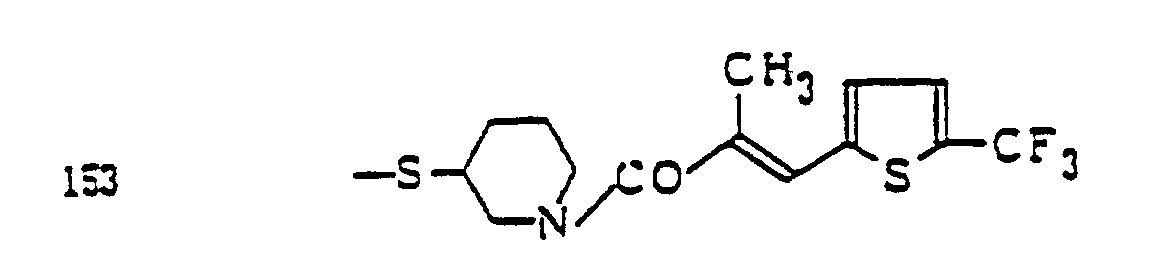

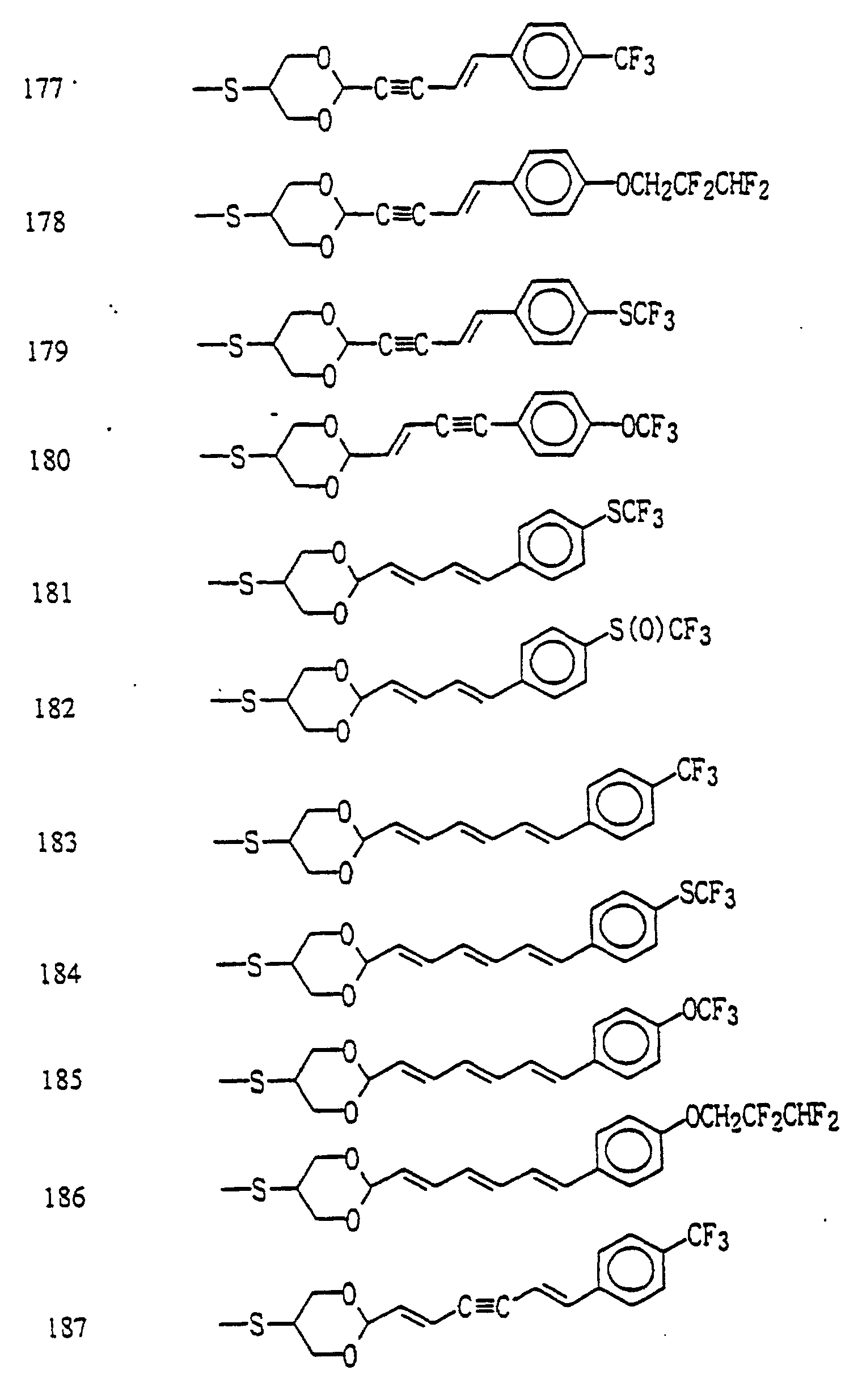
- Preferred compounds in Table 1 include those having the substituents of 4, 6, 7, 13, 16, 18, 22, 25, 32, 36, 40, 43, 44, 47, 52, 53, 61, 63, 71, 76, 96, 107, 123, 127, 142, 174, 176, 177, 178, 181, 182, 183 and 186, and particularly preferred compounds may include 2-(2,4-difluorophenyl)-3-[[2-[2-[4-(trifluoromethyl)phenyl]vinyl]-1,3-dioxan-5-yl]thio]-1-(1H-1,2,4-triazol-1-yl)-2-butanol (the compound corresponding to Example 2), 2-(2,4-difluorophenyl)-1-(1H-1,2,4-triazol-1-yl)-3-[[2-[2-[4-(trifluoromethoxy)phenyl]vinyl]-1,3-dioxan-5-yl]thio]-2-butanol (the compound corresponding to Example 11), 2-(2,4-difluorophenyl)-1-(1H-1,2,4-triazol-1-yl)-3-[[2-[4-[4-(trifluoromethyl)phenyl]-1,3-butadien-1-yl]-1,3-dioxan-5-yl]thio]-2-butanol (the compound corresponding to Example 15), 2-(2,4-difluorophenyl)-3-[[2-[4-[4-(2,2,3,3-tetrafluoropropoxy)phenyl]-1,3-butadien-1-yl]-1,3-dioxan-5-yl]thio]-1-(1H-1,2,4-triazol-1-yl)-2-butanol (the compound corresponding to Example 16),
2-(2,4-difluorophenyl)-3-[[2-[4-(4-chlorophenyl)-5,5,5-trifluoro-1,3-pentadien-1-yl]-1,3-dioxan-5-yl]thio]-1-(1H-1,2,4-triazol-1-yl)-2-butanol (the compound corresponding to Example 18),
2-(2,4-difluorophenyl)-3-[[1-[4-trifluoromethoxy)cinnamoyl]-piperidin-4-yl]thio]-1-(1H- 1,2,4-triazol-1-yl)-2-butanol
the compound corresponding to Example 21),
2-(2,4-difiuorophenyl)-3-[[1-[4-nitrocinnamoyl]piperidin-4-yl]thio]-1-(1H-1,2,4-triazol-1-yl)-2-butanol (the compound corresponding to Example 23),
2-(2,4-difluorophenyl)-1-(1H-1,2,4-triazol-1-yl)-3-([1-[5-[4-(trifluoromethoxy)phenyl]-2,4-pentadienoyl]piperidin-4-yl]thio]-2-butanol (the compound corresponding to Example 24), 3-methyl-1-(1H-1,2,4-triazol-1-yl)-2-[4-(trifluoromethyl)phenyl]-3-[[2-[4-(trifluoromethyl)phenyl]-1,3-butadien-1-yl]-1,3-dioxan-5-yl]thio]-2-butanol (the compound corresponding to Example 31),
2-(2,4-difluorophenyl)-1-(1H-1,2,4-triazol-1-yl)-3-[[2-[4-(trifluoromethylthio)phenyl]-1,3-butadien-1-yl]-1,3-dioxan-5-yl]thio]-2-butanol (the compound corresponding to Example 32), 3-[[2-[4-[4-(2,2,3,3-tetrafluoropropoxy)phenyl]-1,3-butadien-1-yl]-1,3-dioxan-5-yl]thio]-1-(1H-1,2,4-triazol-1-yl)-2-[4-(trifluoromethyl)phenyl]-2-butanol (the compound corresponding to Example 33),
1-(1H-1,2,4-triazol-1-yl)-2-[4-(trifluoromethyl)phenyl]-3-[[2-[4-[4-(trifluoromethyl)phenyl]-1,3-butadien-1-yl]-1,3-dioxan-5-yl]thio]-2-butanol (the compound corresponding to Example 34),
2-(2,4-difluorophenyl)-1-(1H-1,2,4-triazol-1-yl)-3-[[2-[4-[4-(trifluoromethylsulfinyl)phenyl]-1,3-butadien-1-yl]-1,3-dioxan-5-yl]thio]-2-butanol (the compound corresponding to Example 35),
2-(2,4-difluorophenyl)-1-(1H-1,2,4-triazol-1-yl)-3-[[2-[6-[4-(trifluoromethyl)phenyl]-1,3,5-hexatrien-1-yl]-1,3-dioxan-5-yl]thio]-2-butanol (the compound corresponding to Example 37), 2-(2,4-difluorophenyl)-3-methyl-1-(1H-1,2,4-triazol-1-yl)-3-[[2-[4-[4-(trifluoromethyl)phenyl]-1,3-butadien-1-yl]-1,3-dioxan-5-yl]thio]-2-butanol (the compound corresponding to Example 38) and
2-(2,4-difluorophenyl)-1-(1H-1,2,4-triazol-1-yl)-3-[[2-[4-[4-(trifluoromethyl)phenyl]-1-buten-3-yn-1-yl]-1,3-dioxan-5-yl]thio]-2-butanol (the compound corresponding to Example 39). - The triazole compound (I) of the present invention has at least two asymmetric carbon atoms, and optical isomers and diastereomers exist. In the optical isomer, both antipodes can be obtained by general optical resolution or asymmetric synthesis. Further, the diastereomers can be separated by conventional separation methods such as fractional recrystallization and chromatography. The compound (I) of the present invention includes one of these isomers or mixtures thereof.
- The triazole compound (I) of the present invention can be used as an antifungal agent as such or in the form of a pharmacologically acceptable salt. The pharmacologically acceptable salt of the compound (I) includes, for example, a salt of inorganic acids such as hydrochloric acid, hydrobromic acid, sulfuric acid and nitric acid, a salt of carboxylic acids such as acetic acid, fumaric acid, maleic acid, oxalic acid, malonic acid, succinic acid, citric acid and malic acid, a salt of sulfonic acids such as methanesulfonic acid, ethanesulfonic acid, benzenesulfonic acid and toluenesulfonic acid and a salt of amino acids such as glutamic acid and aspartic acid, preferably a salt of carboxylic acids.
- Incidentally, a hydrate of the compound (I) and a hydrate of the salt of the compound (I) are also included in the compound of the present invention.
- The compound (I) and a pharmacologically acceptable salt thereof of the present invention exhibit excellent antifungal activities and in the case where the compound (I) and a pharmacologically acceptable salt thereof are used as an antifungal agent, they can be administered as such or as a mixture, for example, with a suitable pharmacologically acceptable excipient or diluent orally in the form of a tablet, a capsule, a granule, a powder or a syrup or parenterally in the form of injection preparations.
- These preparations are prepared by the known method using additives such as excipients (for example, sugar derivatives such as lactose, sucrose, glucose, mannitol and sorbitol; starch derivatives such as corn starch, mashed potato starch, α-starch, dextrine and carboxymethyl starch; cellulose derivatives such as crystalline cellulose, low hydroxypropyl-substituted cellulose, hydroxypropylmethyl cellulose, carboxymethyl cellulose, carboxymethyl cellulose calcium and internally bridged carboxymethyl cellulose sodium; gum arabic; dextran; Pullulan; silicate derivatives such as light silicic acid anhydride, synthetic aluminum silicate and magnesium meta-silicic acid aluminate; phosphate derivatives such as calcium phosphate; carbonate derivatives such as calcium carbonate; and sulfate derivatives such as calcium sulfate), binders (for example, the above excipients; gelatin; polyvinylpyrrolidone; and Macrogol); disintegrating agents (for example, the above excipients; chemically modified starch-cellulose derivatives such as Crosscarmelose sodium, sodium carboxymethyl starch and bridged polyvinylpyrrolidone), lubricants (for example, talc; stearic acid; and metal stearates such as calcium stearate and magnesium stearate; colloidal silica; waxes such as beeswax and spermaceti; boric acid; glycol; carboxylic acid such as fumaric acid and adipic acid; sodium carboxylate such as sodium benzoate; sulfates such as sodium sulfate; leucine; lauryl sulfates such as sodium laurylsulfate and magnesium laurylsulfate; silicic acids such as silicic acid anhydride and silicic acid hydrate; and starch derivatives in the above excipients), stabilizers (for example, p-hydroxybenzoates such as methylparaben and propylparaben; alcohols such as chlorobutanol, benzyl alcohol and phenylethyl alcohol; benzalkonium chloride; phenols such as phenol and cresol; thimerosal; acetic anhydride; and sorbic acid); corrigents (for example, sweeteners, sour agents and perfumes conventionally used), suspending agents (for example, polysorbate 80 and carboxymethyl cellulose sodium), diluents and solvents for preparations (for example, water, ethanol and glycerin). While the dose varies depending on the condition and age of the patient to be treated, it is desirably administered 1 to 6 times daily depending on the condition: in the case of oral administration, the lower limit of 1 mg each time (preferably 5 mg) and the upper limit of 2000 mg (preferably 1000 mg) for an adult; and in the case of intravenous administration, the lower limit of 0.1 mg each time (preferably 0.5 mg) and the upper limit of 600 mg (preferably 500 mg) for an adult.
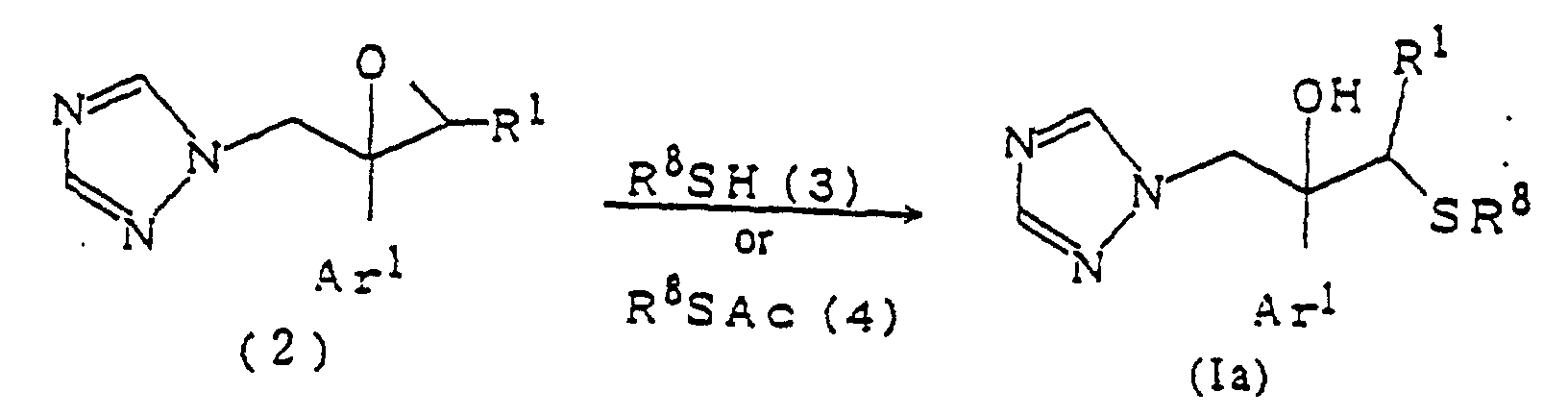
- Among the compounds having the formula (I) of the present invention, the compound (Ia) in which R0 is a hydrogen atom and n=0 can be prepared according to the process shown below:(wherein Ar1 and R1 have the same meanings as defined above and R8 represents the formula:
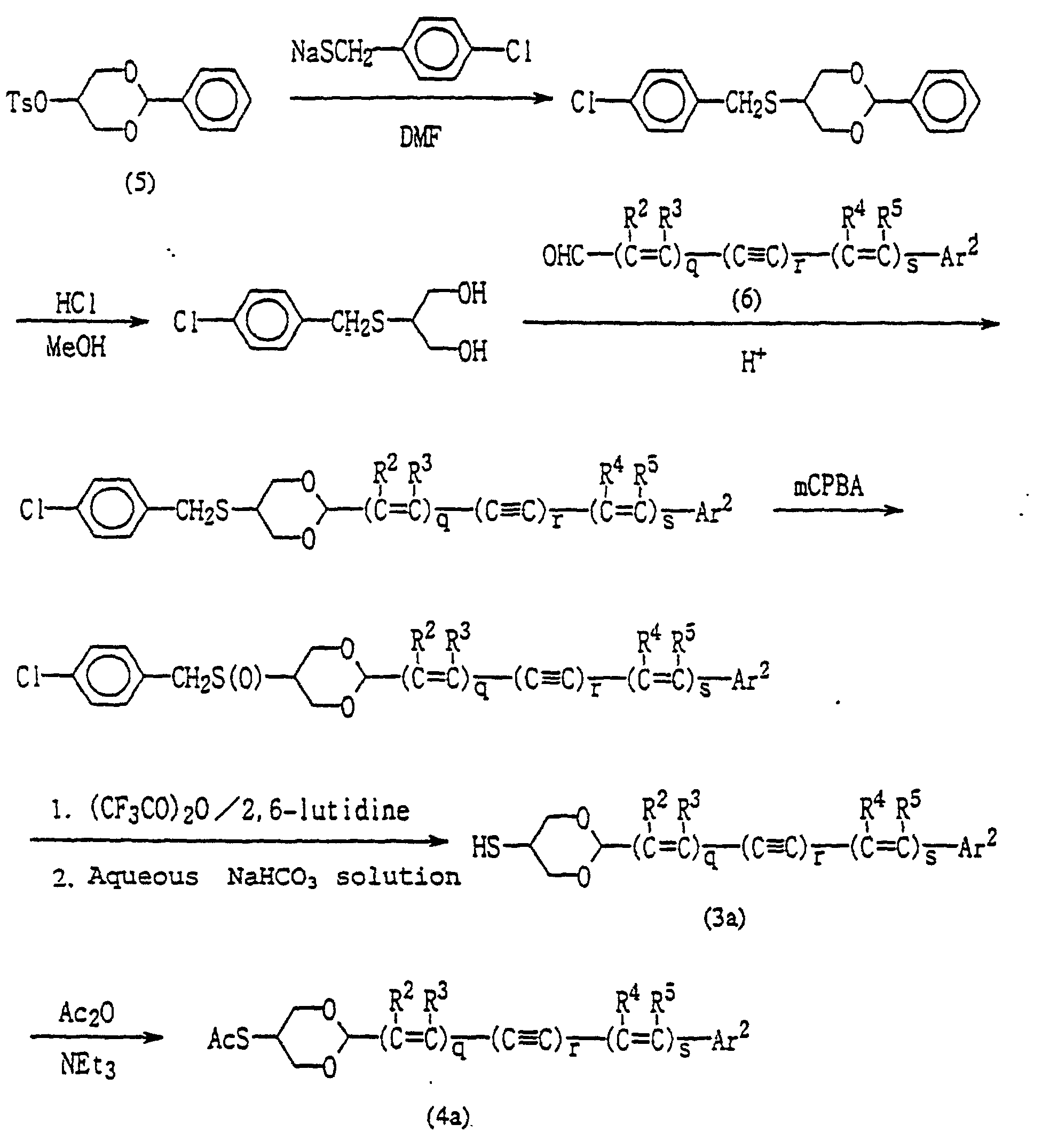
- Incidentally, R8SH (3) or R8SAc (4) used in the above reaction can be obtained according to the process shown below. More specifically, the compound (3) or (4) in which A in R8 is a 1,3-dioxane ring and p=0 can be prepared using the known compound (5) [reference: O.E. van Lohuizen, P.E. Verkade, Rec. trav. chim., 78, 460 (1959)] as a starting material according to the scheme shown below (with respect to the reaction conditions and the isolation method in each step, see Reference examples 3, 4, 5, 6 and 7) :(wherein R2, R3, R4, R5, Ar2, q, r and s have the same meanings as defined above). Among the unsaturated aldehydes (6) used in the above reaction, the compound (6a) in which r=0 can be generally obtained through an unsaturated ester (7a) according to the process shown below (with respect to the reaction conditions and the isolation method in each step, see Reference examples 8, 9, 10, 20, 21, 22, 23, 33 and 49) :
 (wherein R2, R3, R4, R5, Ar2, q and s have the same meanings as defined above and DIBAL-H represents diisobutyl aluminum hydride).
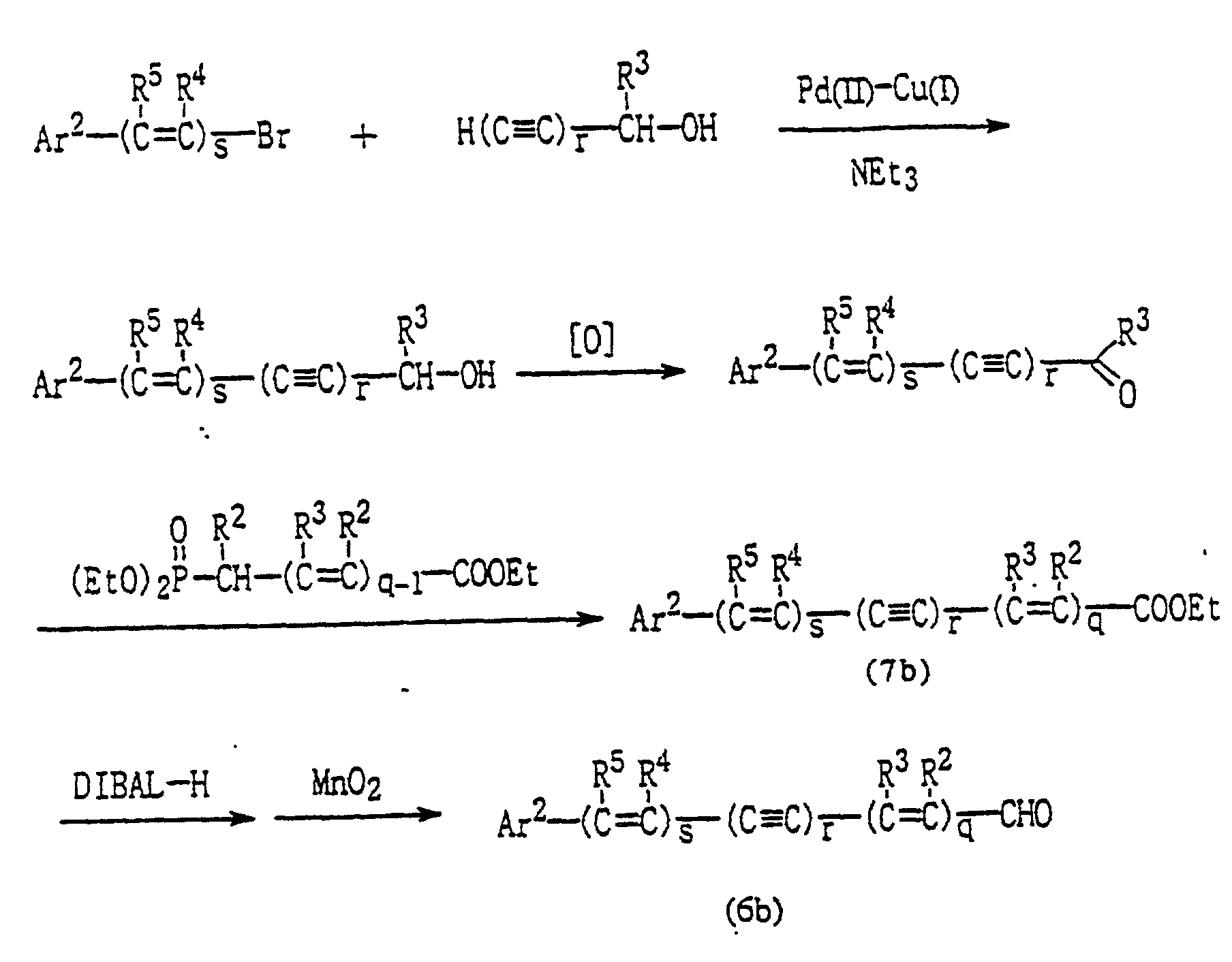
- Among the unsaturated aldehydes (6), the compound (6b) in which r=1 or 2 can be generally obtained through an unsaturated ester (7b) according to the process shown below (with respect to the reaction conditions and the isolation method in each step, see Reference examples 44, 45, 46, 47 and 48):(wherein R2, R3, R4, R5, q, r and s have the same meanings as defined above and DIBAL-H represents diisobutyl aluminum hydride).
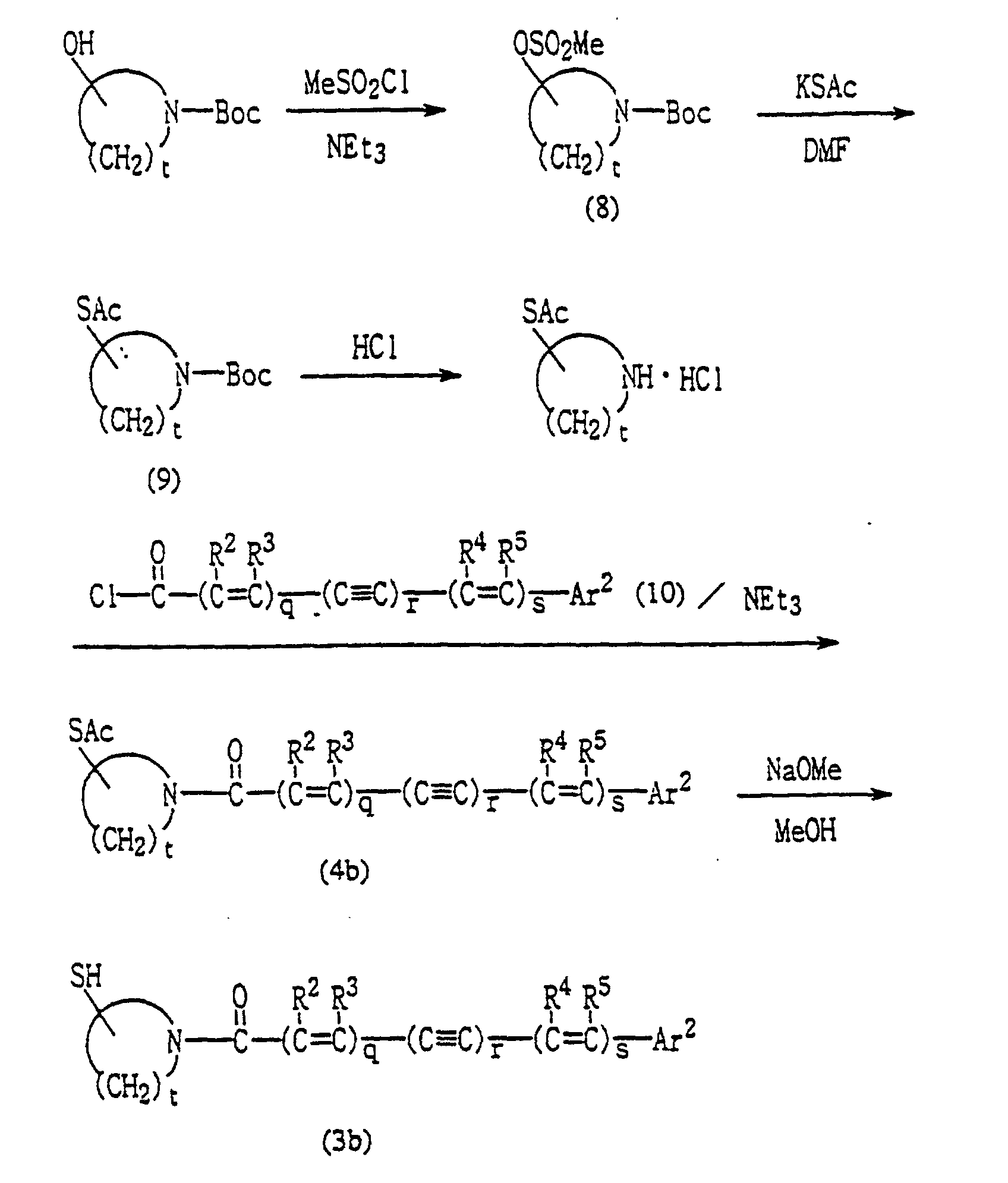
- Further, the compound (3b) or (4b) in which A in R8 of R8SH (3) or R8SAc (4) is a 4- to 7-membered nitrogen-containing heterocyclic group (azetidine, pyrrolidine, piperidine, homopiperidine) and p=1 can be obtained according to the process shown below (with respect to the reaction conditions and the isolation method in each step, see Reference examples 16 and 17) :(wherein R2, R3, R4, R5, q, r and s have the same meanings as defined above, t represents 3, 4, 5 or 6 and Boc represents tert-butoxycarbonyl).
- The acid chloride (10) used in the above reaction can be obtained by treating a carboxylic acid, obtained by alkali-decomposing the unsaturated ester (7a) or (7b) described above, with thionyl chloride.
- Among the compounds having the formula (I) of the present invention, the compound (Ia) in which R0 is a hydrogen atom and n=0 can be also obtained according to the process shown below(wherein Ar1, R1 and R8 have the same meanings as defined above and X represents a chlorine, bromine or iodine atom, methanesulfonyloxy, benzenesulfonyloxy or toluenesulfonyloxy). More specifically, the process is to prepare the desired compound (Ia) by reacting a triazolylmercapto alcohol derivative (11) described in Japanese Unexamined Patent Publication (KOKAI) No. Hei 3-240778 (October 28, 1991) with an alkylating agent (12) under basic conditions. The solvent employable in the reaction includes methanol, ethanol, propanol, butanol, dimethylformamide, dimethylacetamide, dimethyl sulfoxide, acetonitrile, tetrahydrofuran, dioxane, diethyl ether, acetone, benzene, toluene, xylene, etc. The base employable in the reaction includes triethylamine, diisopropylethylamine, sodium hydride, sodium methoxide, sodium ethoxide, lithium methoxide, potassium tert-butoxide, sodium hydroxide, potassium hydroxide, etc., and the amount used is 1 to 3 molar equivalents based on the compound (11). The alkylating reagent(12)is used in 1 to 3 molar equivalents. The reaction temperature is -50 to 100°C and the reaction time is 2 to 10 hours. The compound (Ia) can be obtained by treating the reaction mixture by conventional procedures (an oil obtained by extraction with an organic solvent and then evaporation of the solvent is purified by column chromatography or recrystallization).

- The alkylating reagent R8-X (12) used in the above reaction can be obtained according to the process shown below. The compound (12a) in which A in R8 is a 1,3-dioxane ring and p=0 can be obtained, for example, by reacting a diol compound (13), obtained by treating the above compound (5) with an acid in methanol, with the above unsaturated aldehyde (6) under acidic conditions (Reference example Nos. 56 and 57):(wherein R2, R3, R4, R5, Ar2, q, r and s have the same meanings as defined above). Further, the compound (12b) in which A in R8 is a 4-to 7-membered nitrogen-containing heterocyclic group (azetidine, pyrrolidine, piperidine, homopiperidine) and p=1 can be obtained, for example, by reacting a compound (14) obtained by treating the above cyclic amine derivative (8) with HCl, with the above acid chloride (10) in the presence of a base such as triethylamine:
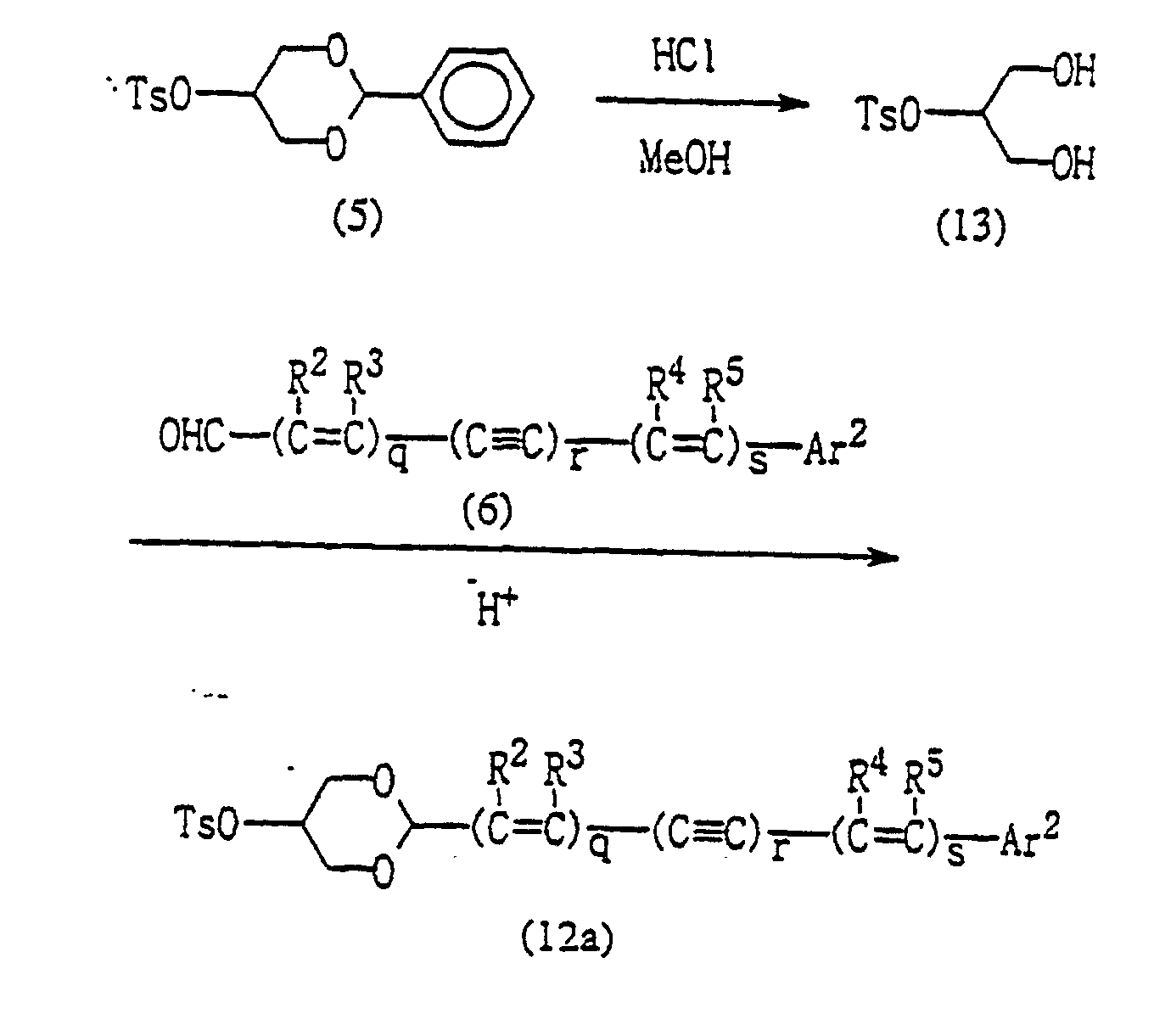 (wherein R2, R3, R4, R5, Ar2, q, r, s and t have the same meanings as defined above).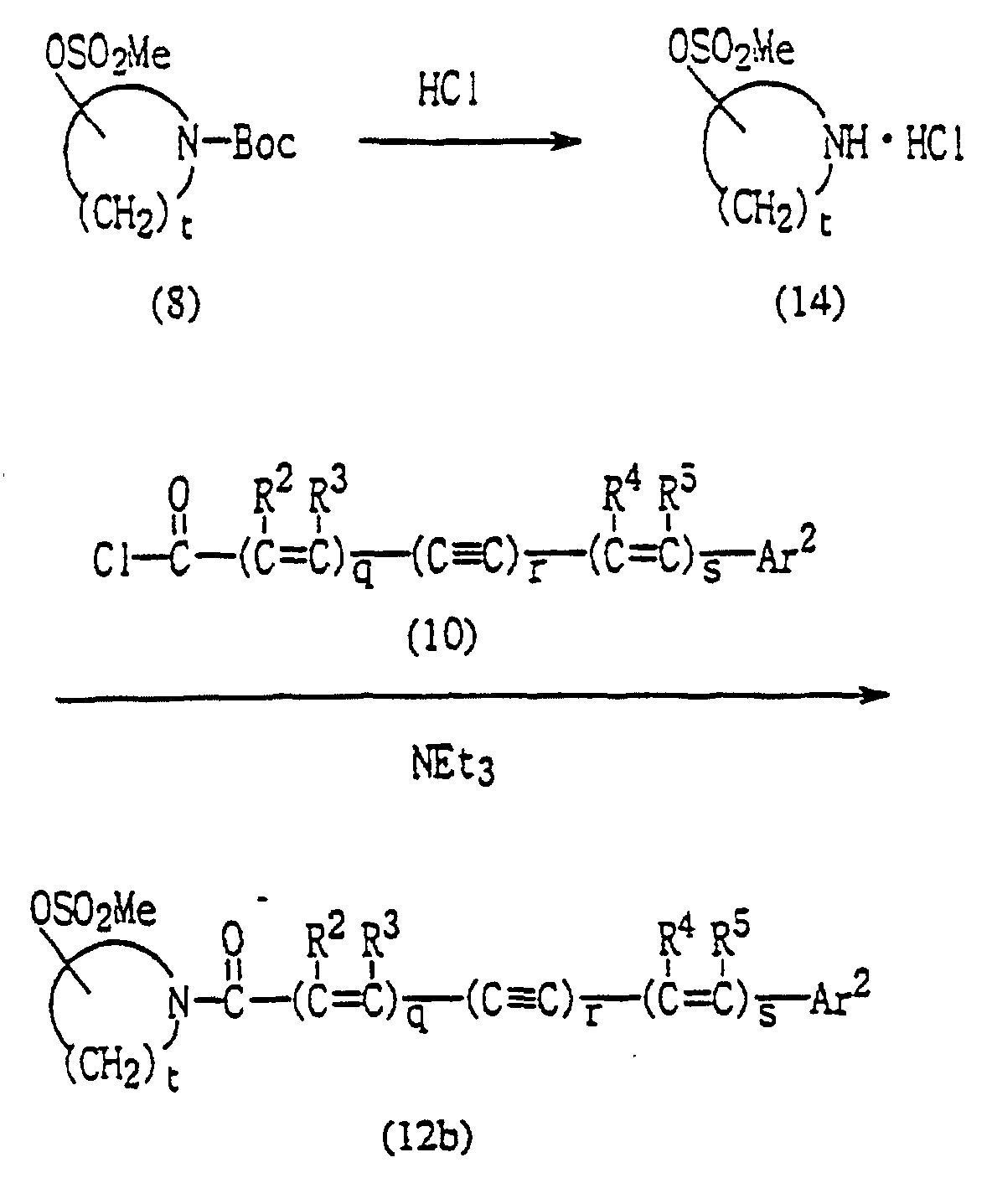
- Among the compounds having the formula (I) of the present invention, the compound (Ib) in which R0 is a hydrogen atom, n=0, p=0 and A is a 1,3-dioxane ring can be also prepared according to the process shown below:(wherein Ar1, Ar2, R1, R2, R3, R4, R5, p, q and r have the same meanings as defined above). More specifically, the process is to prepare the desired compound (Ib) by reacting the above epoxide compound (2) with a thioacetic acid derivative (15) obtained by the reaction of the above known compound (5) with sodium thioacetate under the same conditions as in the reaction of (2) and (4) to obtain the compound (16), deprotecting the compound (16) according to conventional procedures such as the treatment with an acid to obtain the compound (17) and reacting the compound (17) with the above aldehyde compound (6). The reaction of the compounds (17) and (6) is usually carried out under acidic conditions. The acid employable here includes, for example, hydrogen chloride, sulfuric acid, nitric acid, boron trifluoride, methanesulfonic acid, benzenesulfonic acid and p-toluenesulfonic acid and the amount of the acid used is 1 to 2 molar equivalents based on (17). The aldehyde (6) is used in 1 to 2 molar equivalents. As the solvent, aprotic solvents such as methylene chloride, chloroform, 1,2-dichloroethane, benzene, toluene, xylene, diethyl ether and tetrahydrofuran are used. The reaction is carried out in the range of 0°C to a boiling point of the solvent and the reaction time is 2 to 10 hours. While water produced by the reaction can be removed by azeotropic distillation, molecular sieves may be used as a dehydrating agent. The compound (Ib) can be obtained by neutralizing the reaction mixture with an aqueous sodium hydrogencarbonate solution and then treating it by conventional procedures (an oil obtained by extraction with an organic solvent and then evaporation of the solvent is purified by column chromatography or recrystallization).

- Among the compounds of the present invention, the compound (Ic) in which R0 is a hydrogen atom, n=0, p=1 and A is a 4- to 7-membered nitrogen-containing heterocyclic group (azetidine, pyrrolidine, piperidine, homopiperidine) can be obtained according to the process shown below:
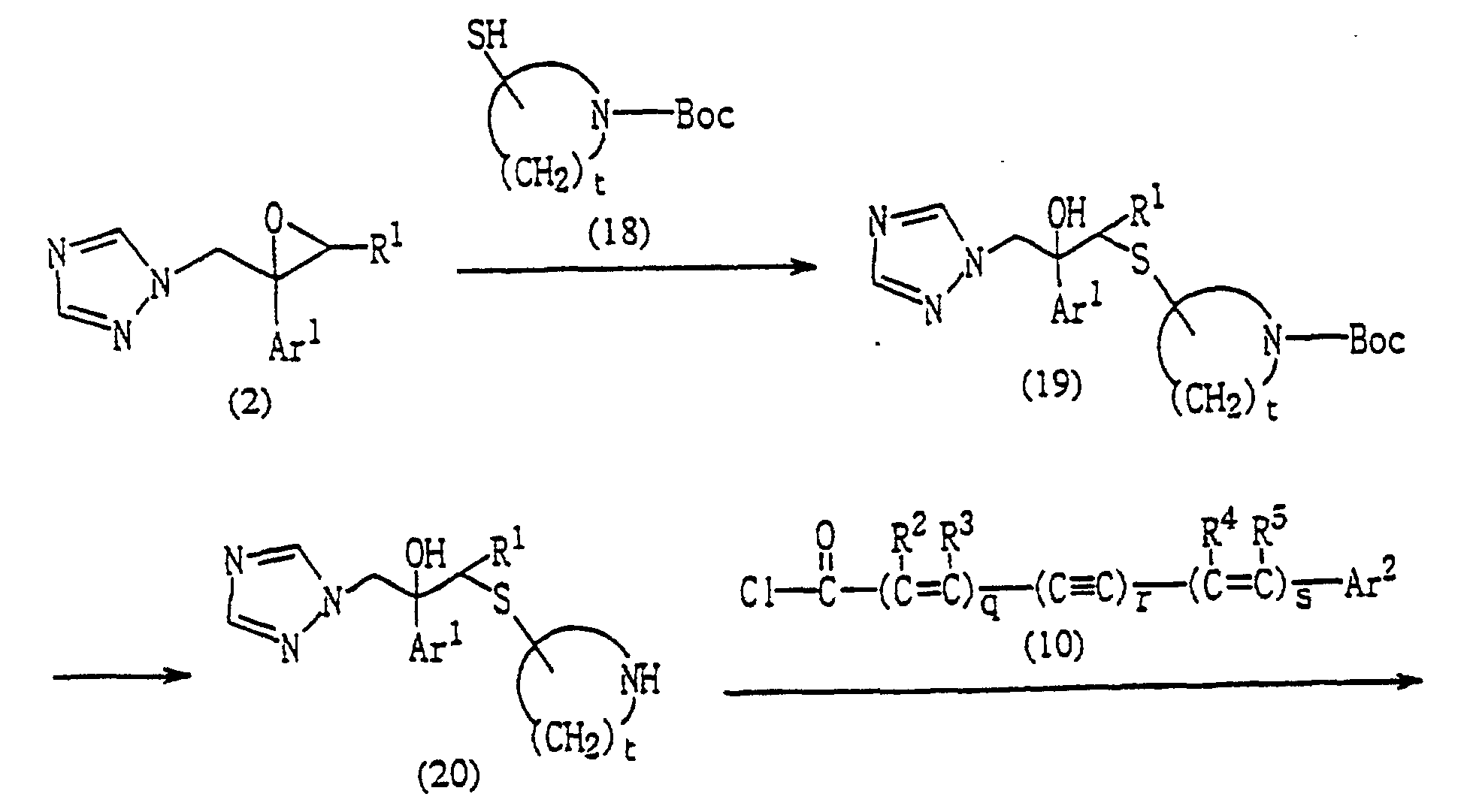 (wherein Ar1, Ar2, R1, R2, R3, R4, R5, q, r, s and t have the same meanings as defined above and Boc represents tert-butoxy carbonyl). More specifically, the process is to prepare the desired compound (Ic) by reacting the above epoxide compound (2) with the mercaptan compound (18), obtained by treating the above thioacetic acid derivative (9) with an alkali, under the same conditions as in the reaction of (2) and (3) to obtain the compound (19), deprotecting (19) by treating it with an acid according to conventional procedures to obtain the compound (20) and reacting the compound (20) with the above acid chloride (10). The reaction of compounds (20) and (10) is carried out in an inert solvent such as benzene, toluene, methylene chloride, chloroform or tetrahydrofuran in the presence of an appropriate base by conventional procedures (Reference example Nos. 13, 14, 18 and 19).
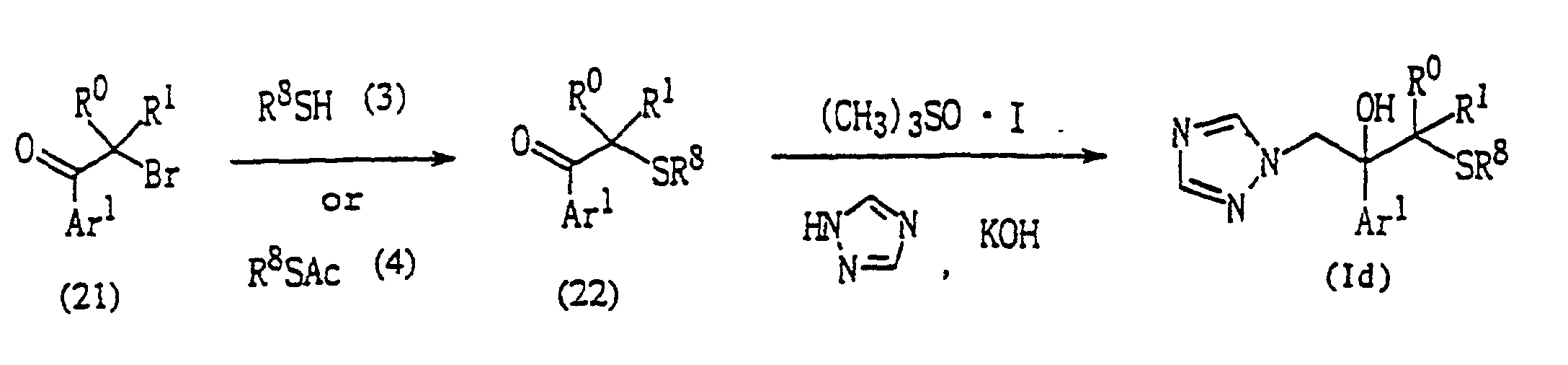
- Among the compounds having the formula (I) of the present invention, the compound (Id) in which R0 is lower alkyl and n=0 can be prepared according to the process shown below:(wherein Ar1, R0, R1 and R8 have the same meanings as defined above). More specifically, the desired compound (Id) is prepared by reacting bromoketone (21), obtained according to the procedures described in Japanese Unexamined Patent Publication (KOKAI) No. Hei 7-2802 (January 6, 1995), with the above mercaptan (3) or an acetic acid derivative thereof (4) under alkaline conditions to obtain a thioether derivative (22) and reacting (22) with trimethylsulfoxonium iodide and 1,2,4-triazole in the presence of a base. The solvent used in the reaction of (21) and (3) or (4) includes preferably alcohols such as methanol, ethanol and propanol, and the alkali employable here includes sodium hydroxide, potassium hydroxide, sodium methoxide and sodium ethoxide. The solvent used in the reaction for converting the thioether derivative (22) to (Id) includes preferably alcohols such as methanol, ethanol, propanol, butanol and t-butanol and aprotic solvents such as dimethylformamide, dimethylacetamide, dimethyl sulfoxide, acetonitrile and tetrahydrofuran. The base used in the reaction includes sodium hydride, sodium methoxide, sodium ethoxide, lithium methoxide, potassium tert-butoxide, lithium hydroxide, sodium hydroxide and potassium hydroxide, and the amount used is 2 to 5 molar equivalents based on the compound (22). Trimethylsulfoxonium iodide and 1,2,4-triazole are used in 1 to 2 molar equivalents based on the compound (22), respectively. The reaction temperature is room temperature to 100°C and the reaction time is 2 to 10 hours. The compound (Id) (n=0) can be obtained by treating the reaction mixture by conventional procedures (a crude product obtained by extraction with an organic solvent and then evaporation of the solvent is purified by column chromatography or recrystallization). Among the compounds (I), the compound (Ie) in which n=0, p=0 and A is a 1,3-dioxane ring can be obtained from the compound (23) in which R8 is a group represented by the formula:
 in the compound (Id) obtained by the above process through a triol (24) according to the process shown below:
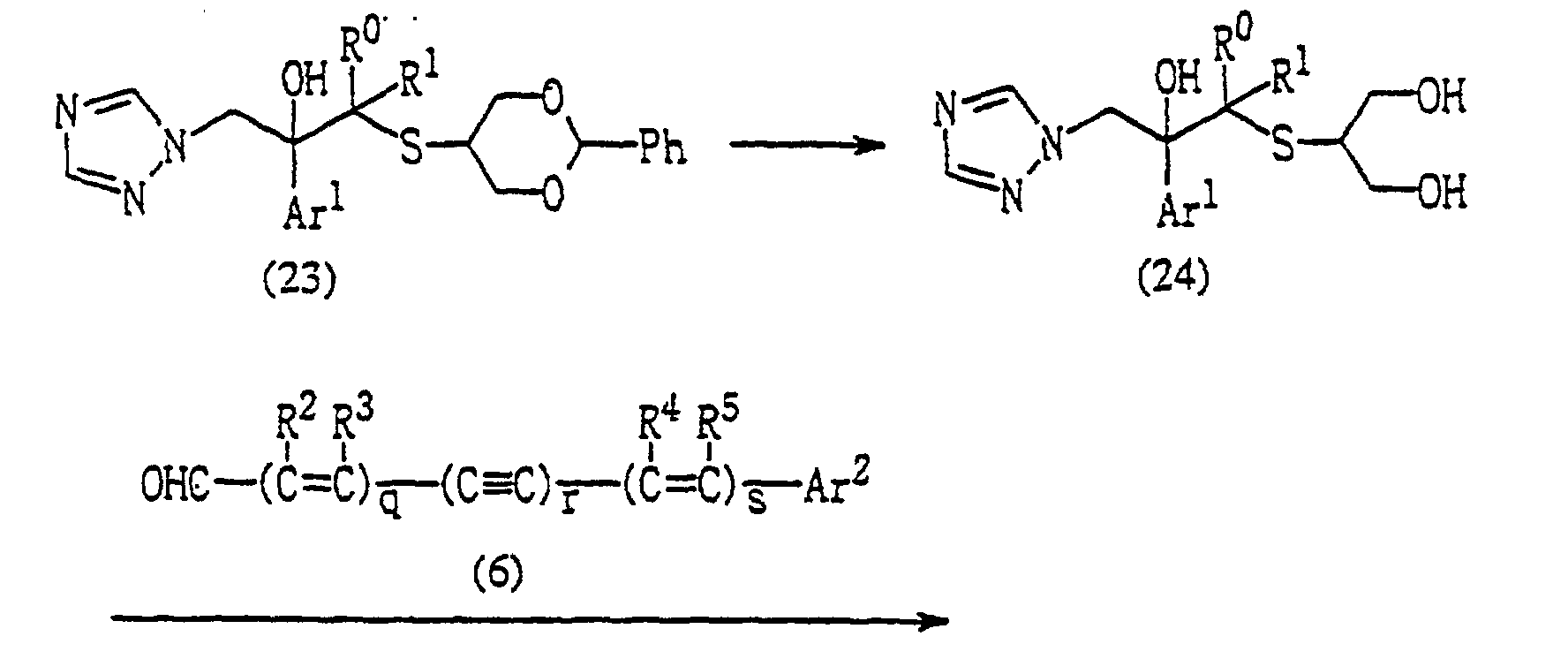 (wherein R0 represents lower alkyl and Ar1, Ar2, R1, R2, R3, R4, R5, q, r and s have the same meanings as defined above). The reaction conditions in the above respective steps are the same as those described in the reaction of (16)→(17)→(Ib).
- The present invention will be explained below in more detail by referring to Examples, Reference examples, Test examples and Preparation examples but the scope of the present invention is not limited thereto.
- Incidentally, the aldehyde compounds used in Examples are synthesized according to the procedures described in the literature and/or the citation of the literature in the cases where the literature is indicated in parenthesis. The aldehyde compounds for which the literature is not indicated are commercially available or can be obtained by the procedures for synthesizing an aldehyde which are described in the literature in the parenthesis of Examples or are described in the citation of the literature or a process according to the procedures for synthesizing an aldehyde described in Reference example of the present specification.
-
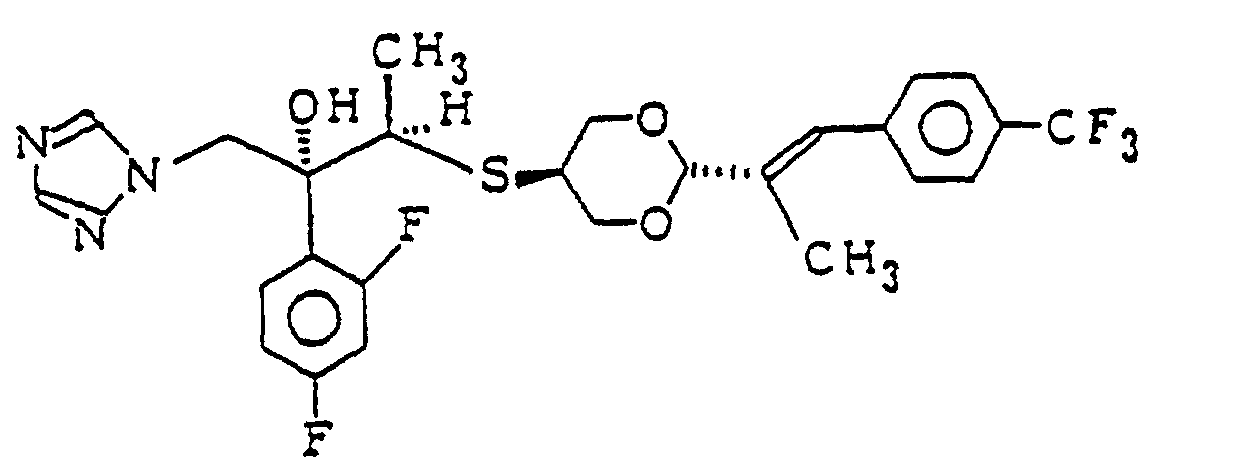
- In 2 ml of dimethylformamide were dissolved 166 mg (0.48 mmol) of trans-4- (acetylthio) -2- [(E)-1-methyl-2- [4-(trifluoromethyl)phenyl]vinyl]-1,3-dioxane as described in Reference example 7 and 110 mg (0.44 mmol) of (2R,3S)-2-(2,4-difluorophenyl)-3-methyl-2-[(1H-1,2,4-triazol-1-yl)methyl]oxirane, and 0.15 ml (0.24 mmol) of a 1.6M sodium methoxide-methanol solution were added thereto under nitrogen atmosphere, followed by stirring of the resulting mixture at 55°C for 6 hours. After cooling, ethyl acetate was added to the reaction mixture to dilute it and the resulting mixture was washed with a saturated aqueous NaCl solution. An oil obtained by distilling off the solvent was subjected to column chromatography using 15 g of silica gel and was eluted by a mixed solvent of hexane-ethyl acetate (2:1) to obtain 180 mg (yield: 74%) of the desired compound as an oil.
NMR spectrum (60MHz, CDCl3) δ ppm: 1.19 (3H, d, J=7Hz), 1.90 (3H, d, J=1.5Hz), 3.34 (1H, q, J=7Hz), 3.0-3.9 (3H, m), 4.1-4.6 (2H, m), 4.80 (1H, d, J=14Hz), 4.94 (1H, s), 5.02 (1H, d, J=1Hz), 5.05 (1H, d, J=14Hz), 6.4-7.0 (3H, m), 7.1-7.6 (1H, m), 7.40 (2H, d, J=9Hz), 7.62 (2H, d, J=9Hz), 7.80 (2H, s). -

- Reaction and treatment were carried out in the same manner as in Example 1 using (2R,3S)-2-(2,4-difluorophenyl)-3-methyl-2-[(1H-1,2,4-triazol-1-yl)methyl]oxirane and trans-5-(acetylthio)-2-[(E)-2-[4-(trifluoromethyl)phenyl]vinyl]-1,3-dioxane to obtain the desired compound having a melting point of 73 to 75°C in a yield of 70%.
- Specific rotation [α]D 25 -73.8° (c=1.00, CHCl3)
- NMR spectrum (270MHz, CDCl3) δ ppm: 1.19 (3H, d, J=7.3Hz), 3.34 (1H, q, J=7.3Hz), 3.43 (H, tt, J=11.2, 4.6Hz), 3.65 (1H, t, J=11.2Hz), 3.67 (1H, t, J=11.2Hz), 4.33 (1H, ddd, J=11.2, 4.6, 2.0Hz), 4.46 (1H, ddd, J=11.2, 4.6, 2.0Hz), 4.82 (1H, d, J=13.8Hz), 5.03 (1H, d, J=13.8Hz), 5.04 (1H, br s), 5.14 (1H, d, J=4.6Hz), 6.25 (1H, dd, J=15.8, 4.6Hz), 6.7-7.8 (2H, m), 6.83 (1H, d, J=15.8Hz), 7.3-7.45 (1H, m), 7.49 (2H, d, J=8.6Hz), 7.58 (2H, d, J=8.6Hz), 7.79 (2H, s).
-
-
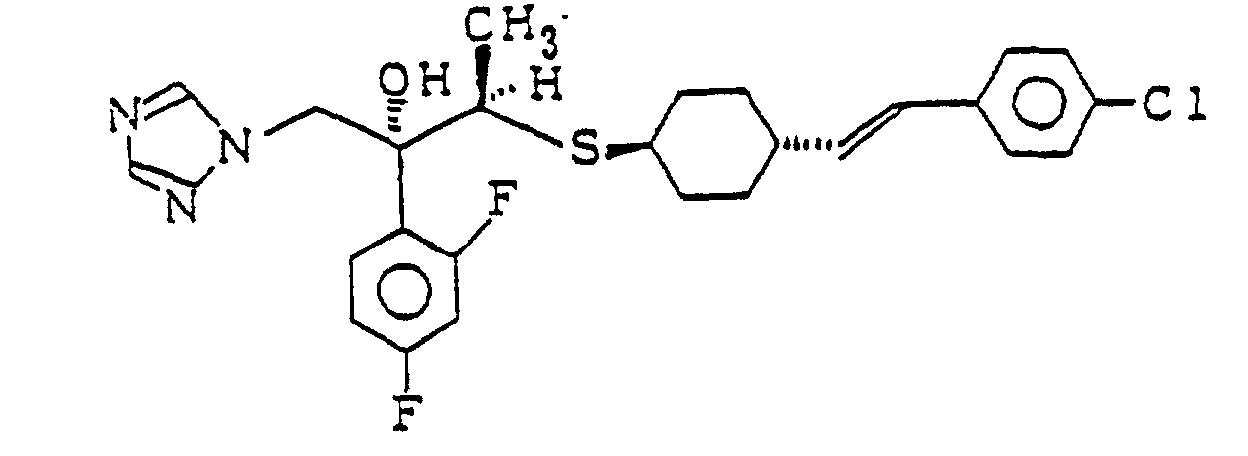
- Reaction and treatment were carried out in the same manner as in Example 1 using (2R,3S)-2-(2,4-difluorophenyl)-3-methyl-2-[(1H-1, 2,4-triazol-1-yl)methyl]oxirane and trans-1-(acetylthio)-4-[(E)-2-(4-chlorophenyl)vinyl]cyclohexane to obtain the desired compound having a melting point of 64 to 66°C in a yield of 31%.
- Specific rotation [α]D 25 -84.1° (c=2.69, CHCl3)
- NMR spectrum (270MHz, CDCl3) δ ppm: 1.16 (3H, d, J=7.3Hz), 1.2-1.6 (4H, m), 1.9-2.0 (2H, m), 2.1-2.25 (3H, m), 2.70 (1H, tt, J=11.2, 4.0Hz), 3.36 (1H, q, J=7.3Hz), 4.60 (1H, s), 4.83 (1H, d, J=13.9Hz), 5.10 (1H, d, J=13.9Hz), 6.11 (1H, dd, J=15.8, 7.3Hz), 6.32 (1H, d, J=15.8Hz), 6.74 (2H, t-like, J=9Hz), 7.26 (4H, s), 7.37 (1H, td, J=8.6, 6.5Hz), 7.76 (1H, s), 7.83 (1H, s).
-
-

- In 14 ml of methylene chloride were dissolved 294 mg (0.82 mmol) of (2R,3R)-2-(2,4-difluorophenyl)-3-[(1,3-dihydroxy-2-propyl)thio]-1-(1H-1,2,4-triazol-1-yl)-2-butanol as described in Reference example 2 and 191 mg (1.15 mmol) of trans-4-chlorocinnamaldehyde [Bull. Chem. Soc. Japan 52 555 (1979)], and 233 mg (1.23 mmol) of p-toluenesulfonic acid monohydrate and 1.5 g of molecular sieves 4A were added thereto, followed by stirring of the resulting mixture for 1 hour and 15 minutes. An aqueous sodium hydrogencarbonate solution was added to the reaction mixture and the mixture was stirred for 10 minutes, followed by removal of the molecular sieves by filtration. The organic layers were collected and dried to distil off the solvent under reduced pressure. The thus obtained oil was subjected to column chromatography using 15 g of silica gel and eluted with a mixed solvent hexane-ethyl acetate (3:2) to obtain 280 mg (yield: 67%) of the desired title compound, trans isomer (A) as an oil. Further, the oil was eluted with a mixed solvent of hexane-ethyl acetate (1:1) to obtain 35 mg (yield: 8%) of the cis isomer (B) as an oil.
- Specific rotation (A) [α]D 25 -68° (c=1.22, CHCl3)
- Specific rotation (B) [α]D 25 -80° (c=1.30, CHCl3)
- NMR spectrum (270MHz, CDCl3) δ ppm: (A), 1.19 (3H, d, J=7.3Hz), 3.34 (1H, q, J=7.3Hz), 3.41 (1H, tt, J=11.2, 4.6Hz), 3.64 (1H, t, J=11.2Hz), 3.66 (1H, t, J=11.2Hz), 4.32 (1H, ddd, J=11.2, 4.6, 2.6Hz), 4.44 (1H, ddd, J=11.2, 4.6, 2.6Hz), 4.82 (1H, d, J=13.9Hz), 5.01 (1H, s), 5.04 (1H, d, J=13.9Hz), 5.11 (1H, d, J=4.6Hz), 6.15 (1H, dd, J=15.8, 4.6Hz), 6.7-6.8 (2H, m), 6.76 (1H, d, J=15.8Hz), 7.25-7.45 (5H, m), 7.78 (2H, s); (B), 1.21 (3H, d, J=7.3 Hz), 3.11 (1H, s-like), 3.50 (1H, q, J=7.3Hz), 4.2-4.4 (4H, m), 4.88 (1H, J=14.5Hz), 4.93 (1H, s), 5.16 (1H, d, J=14.5Hz), 5.23 (1H, d, J=4.6Hz), 6.21 (1H, dd, J=16.5, 4.6 Hz), 6.65-6.8 (2H, m), 6.76 (1H, d, J=16.5Hz), 7.25-7.45 (5H, m), 7.77 (1H, s), 7.80 (1H, s).
-
- In ethyl acetate was dissolved 54 mg of (A), and 19 mg of oxalic acid was added to the solution, followed by addition of hexane to the resulting mixture. The precipitated cystal was collected by filtration to obtain 65 mg of the oxalic acid salt having a melting point of 89 to 92°C. The oxalate of (B) having a melting point of 94 to 98°C was obtained analogously.
-
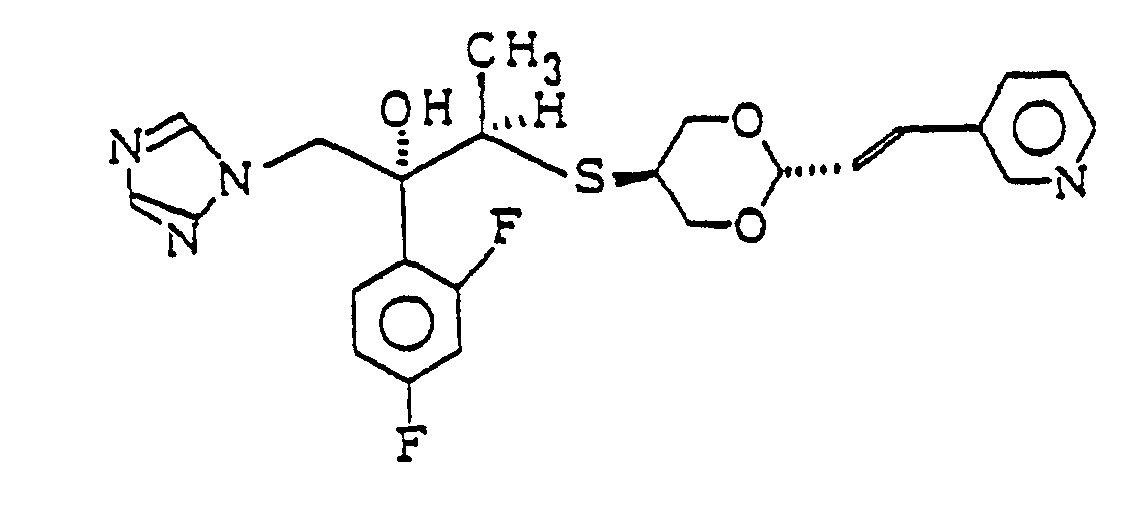
- In 5 ml of methylene chloride were dissolved 120 mg (0.33 mmol) Qf (2R,3R)-2-(2,4-difluorophenyl)-3-[(1,3-dihydroxy-2-propyl)thio]-1-(1H-1,2,4-triazol-1-yl)-2-butanol and 60 mg (0.45 mmol) of trans-β-(3-pyridyl)acrolein [J. Med. Chem. 18 839 (1975)], 190 mg (1.00 mmol) of p-toluenesulfonic acid monohydrate and 1.2 g of molecular sieves 4A were added to the solution, followed by stirring of the resulting mixture for 1 hour and 15 minutes. An aqueous sodium hydrogencarbonate solution was added to the reaction mixture and the mixture was stirred for 10 minutes, followed by removal of the molecular sieves by filtration and extraction with chloroform. An oil obtained by evaporation of the solvent after drying was subjected to column chromatography using 15 g of silica gel and eluted with a mixed solvent of hexane-ethyl acetate (1:4 to 1:5) to obtain 82 mg (yield: 52%) of the title compound, trans isomer (A) as an oil. Further, the oil was eluted with ethyl acetate-5% methanol-ethyl acetate to obtain 28 mg (yield: 15%) of the cis isomer (B) having a melting point of 118 to 125°C as a solid.
NMR spectrum (270MHz, CDCl3) δ ppm: (A), 1.20 (3H, d, J=7.3Hz), 3.34 (1H, q, J=7.3Hz), 3.43 (1H, tt, J=11.2, 4.6Hz), 3.65 (1H, t, J=11.2Hz), 3.68 (1H, t, J=11.2Hz), 4.33 (1H, m), 4.46 (1H, m), 4.83 (1H, d, J=13.9Hz), 5.04 (1H, s), 5.04 (1H, d, J=13.9Hz), 5.14 (1H, d, J=4.0Hz), 6.25 (1H, dd, J=16.5, 4.0Hz), 6.7-6.8 (2H, m), 6.81 (1H, d, J=16.5Hz), 7.29 (1H, dd, J=7.9, 4.6Hz), 7.3-7.45 (1H, m), 7.73 (1H, dt, J=7.9, 1Hz), 8.51 (1H, dd, J=4.6, 1Hz), 8.62 (1H, d, J=1Hz); (B), 1.22 (3H, d, J=7.3 Hz), 3.13 (1H, br s), 3.50 (1H, q, J=7.3Hz), 4.2-4.4 (4H, m), 4.88 (1H, d, J=13.9Hz), 4.94 (1H, s), 5.17 (1H, d, J=13.9Hz), 5.26 (1H, d, J=4.6Hz), 6.31 (1H, dd, J=16.5, 4.6Hz), 6.65-6.8 (2H, m), 6.81 (1H, d, J=16.5Hz), 7.26 (1H, dd, J=7.9, 4.6Hz), 7.74 (1H, td, J=7.2, 6.6Hz), 7.74 (1H, br d, J=7.9Hz), 7.77 (1H, s), 7.80 (1H, s), 8.50 (1H, br d, J=4.6Hz), 8.63 (1H, br s). -
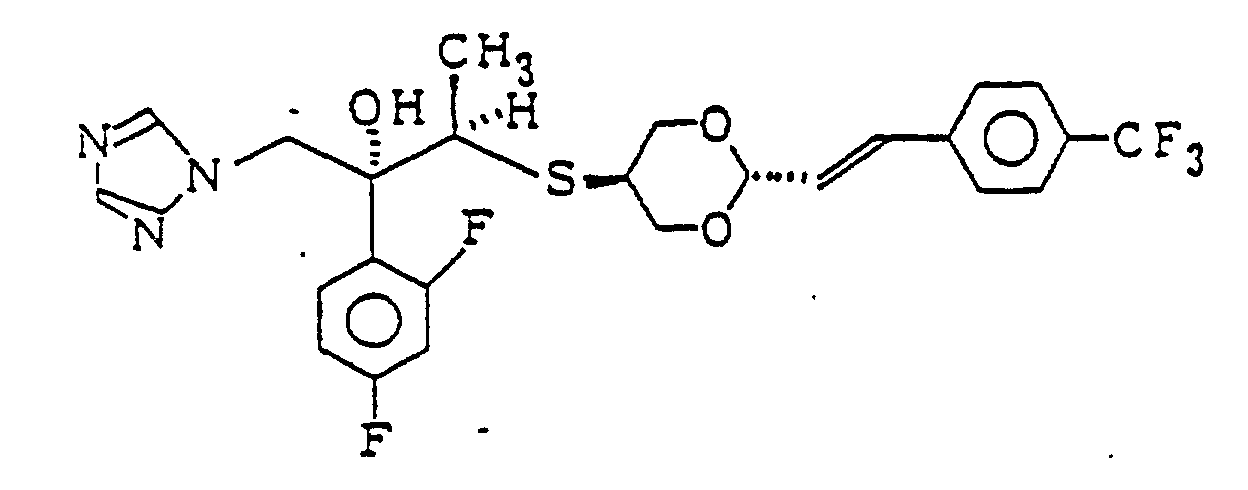
- Reaction and treatment were carried out in the same manner as in Example 4 using (2R,3R)-2-(2,4-difluorophenyl)-3-[(1,3-dihydroxy-2-propyl)thio]-1-(1H-1,2,4-triazol-1-yl)-2-butanol and trans-4-(trifluoromethyl)cinnamaldehyde as described in Reference example 22 to obtain the desired compound as a major product (yield: 62%). Physical data and spectral data coincided with those of the compound described in Example 2.
-

- Reaction and treatment were carried out in the same manner as in Example 4 using (2R,3R)-2-(2,4-difluorophenyl)-3-[(1,3-dihydroxy-2-propyl)thio]-1-(1H-1,2,4-triazol-1-yl)-2-butanol and trans-4-fluorocinnamaldehyde [Arch. Pharm. 316 574 (1983)] to obtain the title compound, a major product as an oil in a yield of 66%.
NMR spectrum (60MHz, CDCl3) δ ppm: 1.20 (3H, d, J=7Hz), 3.1-3.9 (4H, m), 4.1-4.6 (2H, m), 4.78 (1H, d, J=14Hz), 4.99 (1H, d, J=1.5Hz), 5.06 (1H, d, J=14Hz), 5.09 (1H, d, J=4Hz), 6.07 (1H, dd, J=16.4Hz), 6.79 (1H, d, J=16Hz), 6.5-7.6 (7H, m), 7.78 (2H, s). - This compound was mixed with 1 equivalent of oxalic acid in a mixed solvent of ethyl acetate-hexane to obtain an oxalic acid salt crystal having a melting point of 132 to 135°C.
-
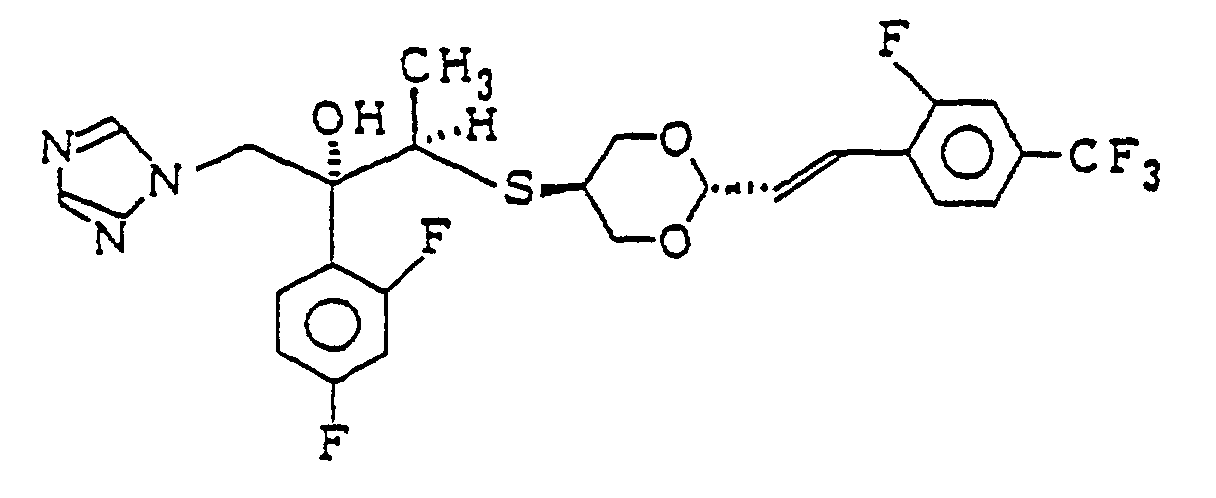
- Reaction and treatment were carried out in the same manner as in Example 4 using (2R,3R)-2-(2,4-difluorophenyl)-3-[(1,3-dihydroxy-2-propyl)thio]-1-(1H-1,2,4-triazol-5-yl)-2-butanol and trans-2-fluoro-4-(trifluoromethyl)cinnamaldehyde to obtain the title compound, a major product as an oil in a yield of 66%.
- Specific rotation [α]D 25 -72° (c=0.63, CHCl3)
- NMR spectrum (270MHz, CDCl3) δ ppm: 1.20 (3H, d, J=7.0Hz), 3.34 (1H, q, J=7.0Hz), 3.43 (1H, tt, J=11.3, 4.6Hz), 3.65 (1H, t, J=11.3Hz), 3.68 (1H, t, J=11.3Hz), 4.34 (1H, m), 4.46 (1H, m), 4.83 (1H, d, J=14.0Hz), 5.04 (d, J=14.0Hz), 5.04 (1H, d, J=1.1Hz), 5.15 (1H, d, J=4.2Hz), 6.36 (1H, dd, J=16.3, 4.2Hz), 6.7-6.8 (2H, m), 6.97 (1H, d, J=16.0Hz), 7.3-7.45 (3H, m), 7.58 (1H, t, J=7.6Hz), 7.79 (2H, s).
-
-
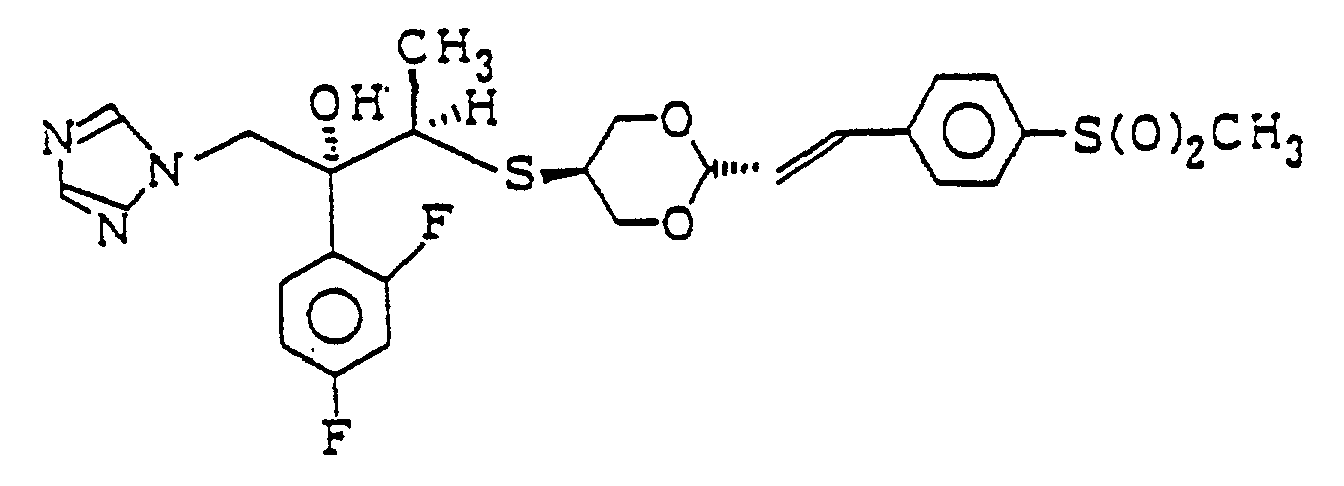
- Reaction and treatment were carried out in the same manner as in Example 4 using (2R,3R)-2-(2,4-difluorophenyl)-3-[(1,3-dihydroxy-2-propyi)thio]-1-(1H-1,2,4-triazol-1-yl)-2-butanol and trans-4-(methylsulfonyl)cinnamaldehyde to obtain the title compound, a major product as an oil in a yield of 58%.
NMR spectrum (60MHz, CDCl3 + D2O) δ ppm: 1.20 (3H, d, J=7Hz), 3.00 (3H, s), 3.33 (1H, q, J=7Hz), 3.5-4.0 (3H, m), 4.2-4.8 (2H, m), 4.80 (1H, d, J=14Hz), 5.08 (1H, d, J=14Hz), 5.15 (1H, d, J=4Hz), 6.30 (1H, dd, J=17, 4Hz), 6.90 (1H, d, J=17Hz), 6.55-7.0 (2H, m), 7.2-7.6 (1H, m), 7.58 (2H, d, J=8Hz), 7.80 (2H, s), 7.94 (2H, d, J=8Hz). -

- Reaction and treatment were carried out in the same manner as in Example 4 using (2R,3R)-2-(2,4-difluorophenyl)-3-[(1,3-dihydroxy-2-propyl)thio]-1-(1H-1,2,4-triazol-5-yl)-2-butanol and trans-4-nitrocinnamaldehyde to obtain the title compound, a major product as an oil in a yield of 40%.
- Specific rotation [α]D 25 -64.1° (c=2.43, CHCl3)
- NMR spectrum (270MHz, CDCl3) δ ppm: 1.19 (3H, d, J=7.3Hz), 3.35 (1H, q, J=7.3Hz), 3.44 (1H, tt, J=11.2, 4.6Hz), 3.66 (1H, t, J=11.2Hz), 3.68 (1H, t, J=11.2Hz), 4.34 (1H, m), 4.46 (1H, m), 4.83 (1H, d, J=13.9Hz), 5.04 (1H, d, J=13.9Hz), 5.04 (1H, s), 5.16 (1H, d, J=4.0Hz), 6.32 (1H, dd, J=16.5, 4.0Hz), 6.7-6.8 (2H, m), 6.87 (1H, d, J=16.5Hz), 7.36 (1H, m), 7.53 (2H, d, J=8.6Hz), 7.79 (1H, s), 7.80 (1H, s), 8.19 (2H, d, J=8.6Hz).
-
- This compound was mixed with 1 equivalent of oxalic acid in a mixed solvent of ethyl acetate-hexane to obtain an oxalic acid salt crystal having a melting point of 103 to 105°C.
-
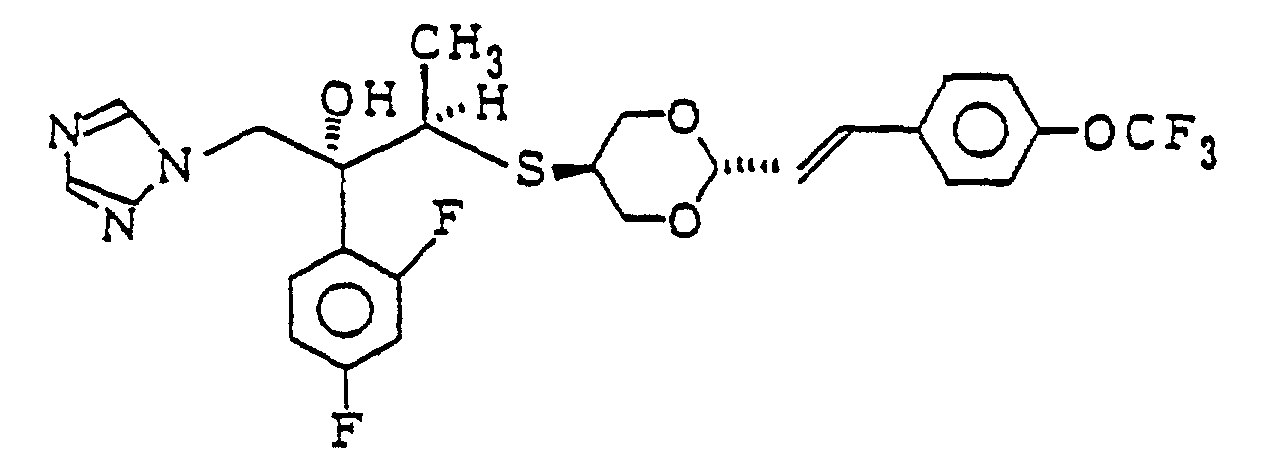
- Reaction and treatment were carried out in the same manner as in Example 4 using (2R,3R) -2-(2,4-difluorophenyl)-3-[(1,3-dihydroxy-2-propyl)thio]-1-(1H-1,2,4-triazol-5-yl)-2-butanol and trans-4-(trifluoromethoxy)cinnamaldehyde as described in Reference example 33 to obtain the title compound, a major product as an oil in a yield of 43%.
- Specific rotation [α]D 25 -77° (c=0.52, CHCl3)
- NMR spectrum (270MHz, CDCl3) δ ppm: 1.20 (3H, d, J=7.3Hz), 3.34 (1H, q, J=2.3Hz), 3.42 (1H, tt, J=11.2, 4.6Hz), 3.65 (1H, t, J=11.2Hz), 3.67 (1H, t, J=11.2Hz), 4.32 (1H, ddd, J=11.2, 4.6, 2.0Hz), 4.45 (1H, ddd, J=11.2, 4.6, 2.0Hz), 4.83 (1H, d, J=14.5Hz), 5.01 (1H, s), 5.03 (1H, d, J=14.5Hz), 5.12 (1H, d, J=4.0Hz), 6.15 (1H, dd, J=16.5, 4.0Hz), 6.7-6.8 (2H, m), 6.79 (1H, d, J=16.5Hz), 7.17 (2H, d, J=8.6Hz), 7.3-7.45 (1H, m), 7.42 (2H, d, J=8.6Hz), 7.79 (2H, s).
-
-

- Reaction and treatment were carried out in the same manner as in Example 4 using (2R,3R)-2-(2,4-difluorophenyl)-3-[(1,3-dihydroxy-2-propyl)thio]-1-(1H-1,2,4-triazol-5-yl)-2-butanol and trans-4-cyanocinnamaldehyde [Mol. Cryst. Liq. Cryst. 123 257 (1985)] to obtain the title compound, a major product as an oil in a yield of 66%.
- Specific rotation [α]D 25 -78° (c=0.52, CHCl3)
- NMR spectrum (270MHz, CDCl3) δ ppm: 1.20 (3H, d, J=7.0Hz), 3.34 (1H, br q, J=7.0Hz), 3.43 (1H, tt, J=11.3, 4.8Hz), 3.65 (1H, t, J=11.3Hz), 3.67 (1H, t, J=11.3Hz), 4.33 (1H, m), 4.46 (1H, m), 4.83 (1H, d, J=14.2Hz), 5.03 (1H, d, J=1.2Hz), 5.04 (1H, d, J=14.2Hz), 5.14 (1H, d, J=4.1Hz), 6.28 (1H, dd, J=16.1, 4.1Hz), 6.7-6.8 (2H, m), 6.82 (1H, d, J=16.1Hz), 7.36 (1H, m), 7.49 (2H, d, J=8.3Hz), 7.62 (2H, d, J=8.3Hz), 7.79 (2H, s).
-
- This compound was mixed with 1 equivalent of oxalic acid in a mixed solvent of ethyl acetate-hexane to obtain an oxalic acid salt crystal having a melting point of 164 to 165°C.
-

- Reaction and treatment were carried out in the same manner as in Example 4 using (2R,3R)-2-(2,4-difluorophenyl)-3-[(1,3-dihydroxy-2-propyl)thio]-1-(1H-1,2,4-triazol-1-yl)-2-butanol and trans-β-methyl-4-(trifluoromethyl)cinnamaldehyde to obtain the desired title compound, a major product as an oil in a yield of 73%.
NMR spectrum (270MHz, CDCl3) δ ppm: 1.20 (3H, d, J=7.1Hz), 2.16 (3H, s), 3.36 (1H, q, J=7.1Hz), 3.41 (1H, tt, J=11.3, 4.6Hz), 3.66 (1H, t, J=11.3Hz), 3.68 (1H, t, J=11.3Hz), 4.32 (1H, m), 4.44 (1H, m), 4.83 (1H, d, J=13.9Hz), 5.03 (1H, s), 5.04 (1H, d, J=13.9Hz), 5.33 (1H, d, J=6.0Hz), 5.83 (1H, br d, J=6.0Hz), 6.7-6.8 (2H, m), 7.3-7.45 (1H, m), 7.51 (2H, d, J=8.3Hz), 7.59 (2H, d, J=8.3Hz), 7.79 (2H, s). -

- Reaction and treatment were carried out in the same manner as in Example 4 using (2R,3R)-2-(2,4-difluorophenyl)-3-[(1,3-dihydroxy-2-propyl)thio]-1-(1H-1,2,4-triazol-5-yl)-2-butanol and trans-β-(5-chloro-2-thienyl)acrolein [Chem. Abst. 51 1284h (1941)] to obtain the title compound as an oil in a yield of 50%.
- Specific rotation [α]D 25 -75.7° (c=0.56, CHCl3)
- NMR spectrum (270MHz, CDCl3) δ ppm: 1.19 (3H, d, J=7.3Hz), 3.33 (1H, q, J=7.3Hz), 3.40 (1H, tt, J=11.2, 4.6Hz), 3.62 (1H, t, J=11.2Hz), 3.64 (1H, t, J=11.2Hz), 4.36 (1H, m), 4.42 (1H, m), 4.82 (1H, d, J=13.8Hz), 5.02 (1H, br s), 5.03 (1H, d, J=13.8Hz), 5.06 (1H, d, J=4.6Hz), 5.88 (1H, dd, J=15.8, 4.6Hz), 6.7-6.85 (3H, m), 6.78 (2H, s), 7.36 (1H, m), 7.87 (2H, s).
-
- This compound was mixed with 1 equivalent of oxalic acid in a mixed solvent of ethyl acetate-hexane to obtain an oxalic acid salt crystal having a melting point of 53 to 57°C.
-

- Reaction and treatment were carried out in the same manner as in Example 4 using (2R,3R)-2-(2,4-difluorophenyl)-3-[(1,3-dihydroxy-2-propyl)thio]-1-(1H-1,2,4-triazol-5-yl)-2-butanol and (2E,4E)-5-[4-(trifluoromethyl)phenyl]-2,4-pentadienal as described in Reference example 25 to obtain the title compound, a major product as an oil in a yield of 67%.
- Specific rotation [α]D 25 -69.8° (c=1.00, CHCl3)
- NMR spectrum (270MHz, CDCl3) δ ppm: 1.19 (3H, d, J=7.3Hz), 3.33 (1H, q, J=7.3Hz), 3.40 (1H, tt, J=11.2, 4.6Hz), 3.62 (1H, t, J=11.2Hz), 3.64 (1H, t, J=11.2Hz), 4.30 (1H, m), 4.42 (1H, m), 4.82 (1H, d, J=13.9Hz), 5.01 (1H, s), 5.03 (1H, d, J=13.9Hz), 5.06 (1H, d, J=4.6Hz), 5.84 (1H, dd, J=15.2, 4.6Hz), 6.60 (1H, dd, J=15.2, 10.6Hz), 6.73 (1H, d, J=15.8Hz), 6.7-6.8 (2H, m), 6.85 (1H, dd, J=15.8, 10.6Hz), 7.3-7.45 (1H, m), 7.49 (2H, d, J=8.6Hz), 7.56 (2H, d, J=8.6Hz), 7.78 (2H, s).
-
-

- Reaction and treatment were carried out in the same manner as in Example 4 using (2R,3R)-2-(2,4-difluorophenyl)-3-[(1,3-dihydroxy-2-propyl)thio]-1-(1H-1,2,4-triazol-5-yl)-2-butanol and (2E,4E)-5-[4-(2,2,3,3-tetrafluoropropoxy)phenyl]-2,4-pentadienal as described in Reference example 32 to obtain the title compound having a melting point of 75 to 85°C (crystallization from a mixed solvent of hexane-ether), a major product as a powder in a yield of 60%.
- Specific rotation [α]D 25 -69° (c=0.56, CHCl3)
- NMR spectrum (270MHz, CDCl3) δ ppm: 1.18 (3H, d, J=7.0Hz), 3.33 (1H, q, J=7.0Hz), 3.39 (1H, tt, J=11.3, 4.8Hz), 3.62 (1H, t, J=11.3Hz), 3.64 (1H, t, J=11.3Hz), 4.30 (1H, m), 4.35 (2H, br t, J=11.8Hz), 4.41 (1H, m), 4.82 (1H, d, J=14.1Hz), 4.99 (1H, d, J=1.6Hz), 5.03 (1H, d, J=14.1Hz), 5.04 (1H, d, J=4.6Hz), 5.75 (1H, dd, J=15.7, 4.6Hz), 6.06 (1H, tt, J=53.0, 5.1Hz), 6.56 (1H, dd, J=15.7, 10.2Hz), 6.57 (1H, d, J=15.0Hz), 6.68 (1H, dd, J=15.0, 10.2Hz), 6.7-6.8 (2H, m), 6.88 (2H, d, J=8.7Hz), 7.3-7.4 (1H, m), 7.37 (2H, d, J=8.7Hz), 7.79 (2H, s).
-
-

- Reaction and treatment were carried out in the same manner as in Example 4 using (2R,3R)-2-(2,4-difluorophenyl)-3-[(1,3-dihydroxy-2-propyl)thio]-1-(1H-1,2,4-triazol-5-yl)-2-butanol and (2E,4E)-5-(6-chloro-3-pyridyl)-2,4-pentadienal as described in Reference example 38 to obtain the title compound having a melting point of 88 to 90°C, a major product as a crystalline solid in a yield of 69%.
- Specific rotation [α]D 25 -74° (c=0.59, CHCl3)
- NMR spectrum (270MHz, CDCl3) δ ppm: 1.19 (3H, d, J=7.1Hz), 3.33 (1H, q, J=7.1Hz), 3.40 (1H, tt, J=11.3, 4.7Hz), 3.62 (1H, t, J=11.3Hz), 3.64 (1H, t, J=11.3Hz), 4.30 (1H, m), 4.42 (1H, m), 4.82 (1H, d, J=14.3Hz), 5.00 (1H, s), 5.03 (1H, d, J=14.3Hz), 5.05 (1H, d, J=4.2Hz), 5.84 (1H, dd, J=15.1, 4.2Hz), 6.56 (1H, d, J=15.5Hz), 6.58 (1H, dd, J=15.1, 10.5Hz), 6.7-6.8 (2H, m), 6.80 (1H, dd, J=15.5, 10.5Hz), 7.28 (1H, d, J=8.3Hz), 7.3-7.4 (1H, m), 7.70 (1H, dd, J=8.3, 2.5Hz), 7.79 (2H, s), 8.37 (1H, d, J=2.5Hz).
-
-

- Reaction and treatment were carried out in the same manner as in Example 4 using (2R,3R)-2-(2,4-difluorophenyl)-3-[(1,3-dihydroxy-2-propyl)thio]-1-(1H-1,2,4-triazol-5-yl)-2-butanol and (2E,4Z)-5-(4-chlorophenyl)-6,6,6-trifluoro-2,4-hexadienal as described in Reference example 52 to obtain the title compound, a major product as an oil in a yield of 31%.
- Specific rotation [α]D 25 -59.4° (c=0.90, CHCl3)
- NMR spectrum (270MHz, CDCl3) δ ppm: 1.19 (3H, d, J=7.3Hz), 3.33 (1H, br q, J=7.3Hz), 3.40 (1H, tt, J=11.2, 4.6Hz), 3.61 (1H, t, J=11.2Hz), 3.64 (1H, t, J=11.2Hz), 4.31 (1H, m), 4.43 (1H, m), 4.82 (1H, d, J=13.9Hz), 5.02 (1H, s), 5.03 (1H, d, J=13.9Hz), 5.09 (1H, d, J=4.6Hz), 5.96 (1H, dd, J=15.2, 4.6Hz), 6.50 (1H, d, J=11.9Hz), 6.7-6.8 (2H, m), 6.9-7.1 (1H, m), 7.25-7.4 (5H, m), 7.79 (2H, s).
-
-
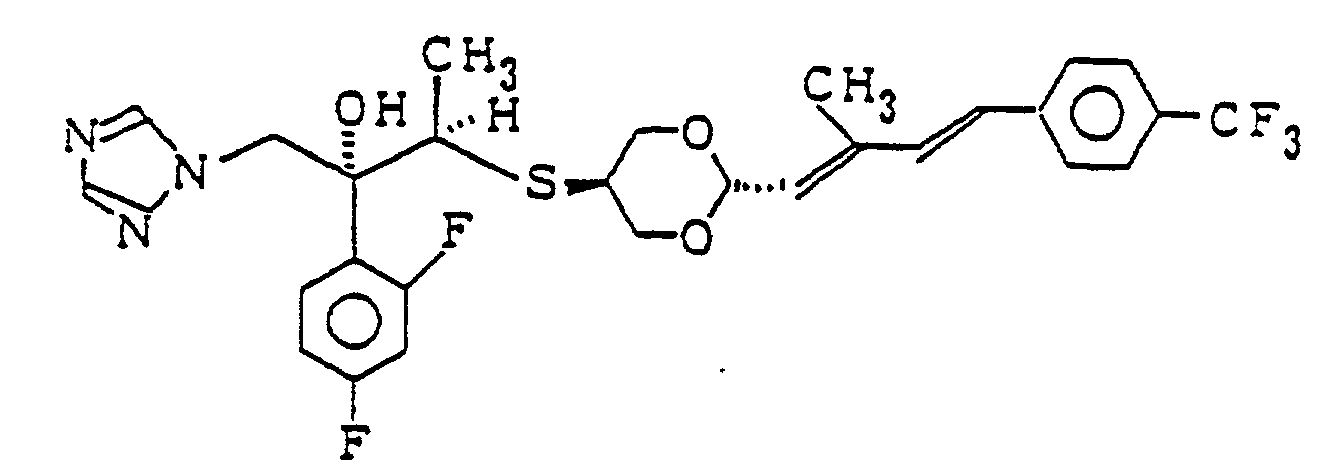
- Reaction and treatment were carried out in the same manner as in Example 4 using (2R,3R)-2-(2,4-difluorophenyl)-3-[(1,3-dihydroxy-2-propyl)thio]-1-(1H-1,2,4-triazol-5-yl)-2-butanol and (2E,4E)-3-methyl-5-[4-(trifluoromethyl)phenyl]-2,4-pentadienal as described in Reference example 10 to obtain the title compound, a major product as an oil in a yield of 70%.
- Specific rotation [α]D 25 -68° (c=0.50, CHCl3)
- NMR spectrum (270MHz, CDCl3) δ ppm: 1.27 (3H, d, J=7.1Hz), 1.99 (3H, s), 3.34 (1H, q, J=7.1Hz), 3.39 (1H, tt, J=11.3, 4.8 Hz), 3.64 (1H, t, J=11.3Hz), 3.66 (1H, t, J=11.3Hz), 4.30 (1H, m), 4.41 (1H, m), 4.83 (1H, d, J=14.1Hz), 5.01 (1H, s), 5.04 (1H, d, J=14.1Hz), 5.32 (1H, d, J=6.2Hz), 5.66 (1H, d, J=6.2Hz), 6.66 (1H, d, J=16.1Hz), 6.7-6.8 (2H, m), 6.86 (1H, d, J=16.1Hz), 7.3-7.4 (1H, m), 7.51 (2H, d, J=8.4Hz), 7.57 (2H, d, J=8.4Hz), 7.78 (2H, s).
-
-

- Reaction and treatment were carried out in the same manner as in Example 4 using (2R,3R)-2-(2,4-difluorophenyl)-3-[(1,3-dihydroxy-2-propyl)thio]-1-(1H-1,2,4-triazol-5-yl)-2-butanol and (2E,4E)-4-methyl-5-[4-(trifluoromethyl)phenyl]-2,4-pentadienal to obtain the title compound, a major product as an oil in a yield of 69%.
- Specific rotation [α]D 25 -63.4° (c=1.07, CHCl3)
- NMR spectrum (270MHz, CDCl3) δ ppm: 1.19 (3H, d, J=7.0Hz), 2.00 (3H, s), 3.33 (1H, q, J=7.0Hz), 3.41 (1H, tt, J=11.2, 4.6Hz), 3.64 (1H, t, J=11.2Hz), 3.66 (1H, t, J=11.2Hz), 4.31 (1H, m), 4.43 (1H, m), 4.83 (1H, d, J=14.2Hz), 5.01 (1H, s), 5.04 (1H, d, J=14.2Hz), 5.09 (1H, d, J=4.6Hz), 5.81 (1H, dd, J=16.0, 4.6Hz), 6.60 (1H, s), 6.63 (1H, d, J=16.0Hz), 6.7-6.8 (2H, m), 7.3-7.4 (1H, m), 7.38 (2H, d, J=8.2Hz), 7.59 (2H, d, J=8.2Hz), 7.79 (2H, s).
-
-

- To a mixture of 150 mg (0.340 mmol) of (2R,3R)-(2,4-difluorophenyl)-3-(1H-1,2,4-triazol-1-yl)-3-[(piperidin-4-yl)thio]-2-butanol dihydrochloride as described in Reference example 14 and 3 ml of dichloromethane were added 142 µl (1.02 mmol) of triethylamine at 0°C under nitrogen atmosphere and, after 5 minutes, 128 mg (0.510 mmol) of (E)-4-(trifluoromethoxy)cinnamoyl chloride. The mixture was stirred at the same temperature for 30 minutes and the solvent was distilled off, and then ethyl acetate was added to the thus obtained residue, followed by washing of the mixture with an aqueous NaCl solution. The solvent was distilled off and the residue was subjected to silica gel column chromatography, followed by elution with ethyl acetate to obtain 160 mg (yield: 81%) of the title compound as a colorless foam.
- NMR spectrum (270MHz, CDCl3) δ ppm: 1.19 (3H, d, J=7.0Hz), 1.6-1.8 (2H, m), 2.0-2.1 (2H, m), 3.0-3.2 (2H, m), 3.35 (1H, q, J=7.0Hz), 3.2-3.4 (1H, m), 4.0-4.1 (1H, m), 4.2-4.3 (1H, m), 4.83 (1H, s), 4.83 (1H, d, J=14.0Hz), 5.09 (1H, d, J=14.0Hz), 6.7-6.8 (2H, m), 6.87 (1H, d, J=15.5Hz), 7.22 (2H, d, J=8.5Hz), 7.3-7.4 (1H, m), 7.55 (2H, d, J=8.5Hz), 7.65 (1H, d, J=15.5Hz), 7.78 (1H, s), 7.82 (1H, s).
- IR spectrum υmax KBrcm-1: 3421, 1695, 1686, 1617, 1591.
- Mass spectrum m/e: 582, 563, 522, 500, 427, 359, 299, 258, 215, 187, 144, 101, 82.
-
- In 4 ml of dimethylformamide were dissolved 327 mg (0.875 mmol) of 4-(acetylthio)-1- [(E)-4-(trifluoromethoxy)cinnamoyl)piperidine as described in Reference example 16 and 200 mg (0.796 mmol) of (2R,3S)-2-(2,4-difluorophenyl)-3-methyl-2-[(1H-1,2,4-triazol-1-yl)methyl]oxirane, and 129 µl (0.613 mmol) of a 28% sodium methoxide-methanol solution were added to the mixture under nitrogen atmosphere, followed by stirring of the resulting mixture at 50°C for 3 hours. After cooling, ethyl acetate was added to the reaction mixture to dilute it and washed with water and then a saturated aqueous NaCl solution.
The oil obtained by evaporation of the solvent was subjected to silica gel column chromatography and eluted with ethyl acetate to obtain 275 mg (yield: 59%) as a colorless foam. The present compound was identified as the compound obtained according to the [Process A] by means of each spectrum of NMR, IR and MS. -
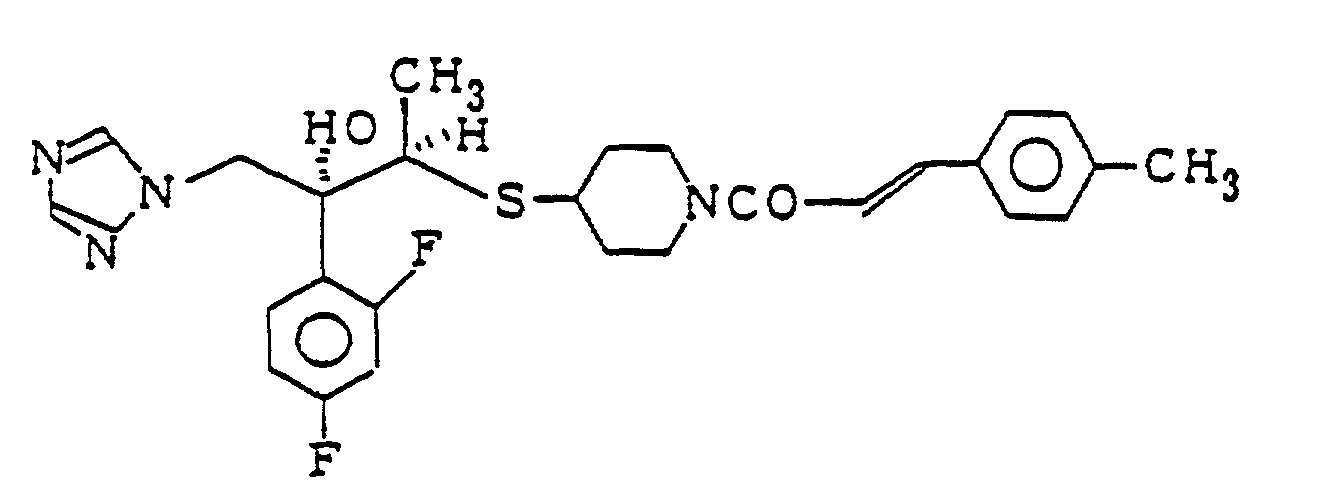
- A colorless foam obtained from (E)-4-methylcinnamoyl chloride (Can. J. Chem. 45 1001 (1967)] according to [Process A] of Example 21.
- NMR spectrum (270MHz, CDCl3) δ ppm: 1.19 (3H, d, J=7.0Hz), 1.6-1.8 (2H, m), 2.0-2.2 (2H, m), 2.37 (3H, s), 3.0-3.2 (2H, m), 3.2-3.4 (1H, m), 3.35 (1H, q, J=7.0Hz), 4.0-4.2 (1H, m), 4.4-4.6 (1H, m), 4.83 (1H, d, J=13.9Hz), 4.84 (1H, s), 5.09 (1H, d, J=13.9Hz), 6.7-6.8 (2H, m), 6.85 (1H, d, J=15.5Hz), 7.18 (2H, d, J=8.3Hz), 7.3-7.4 (1H, m), 7.43 (2H, d, J=8.3Hz), 7.65 (1H, d, J=15.5Hz), 7.77 (1H, s), 7.82 (1H, s) .
- IR spectrum υmax KBrcm-1: 3333, 1645, 1599.
- Mass spectrum m/e: 512, 510, 452, 430, 425, 367, 357, 289, 229, 224, 188, 145, 117, 82.
-
-

- A slightly yellow foam obtained from (E)-4-nitrocinnamoyl chloride according to [Process A] of Example 21.
- NMR spectrum (270MHz, CDCl3) δ ppm: 1.26 (3H, d, J=6.6Hz), 1.6-1.9 (2H, m), 2.1-2.3 (2H, m), 3.1-3.3 (2H, m), 3.3-3.5 (1H, m), 3.42 (1H, q, J=6.6Hz), 4.0-4.2 (1H, m), 4.4-4.6 (1H, m), 4.89 (1H, d, J=13.9Hz), 4.92 (1H, s), 5.15 (1H, d, J=13.9Hz), 6.7-6.9 (2H, m), 7.10 (1H, d, J=15.5Hz), 7.4-7.5 (1H, m), 7.73 (2H, d, J=8.9Hz), 7.75 (1H, d, J=15.5Hz), 7.86 (2H, d, J=8.9Hz), 8.29 (1H, s), 8.32 (1H, s).
- IR spectrum υmax KBr cm-1:3361, 1649, 1612, 1518, 1345.
Mass spectrum m/e: 544, 525, 513, 483, 461, 388, 365, 284, 260, 224, 219, 176, 144, 130, 82. -
-

- A colorless foam obtained from (2E,4E)-5-[4-(trifluoromethoxy)phenyl]-2,4-pentadienoyl chloride according to [Process A] of Example 21.
- NMR spectrum (270MHz, CDCl3) δ ppm: 1.19 (3H, d, J=6.6Hz), 1.5-1.8 (2H, m), 2.0-2.2 (2H, m), 3.0-3.3 (3H, m), 3.34 (1H, q, J=6.6Hz), 3.9-4.1 (1H, m), 4.3-4.5 (1H, m), 4.83 (1H, d, J=13.9Hz), 4.82 (1H, s), 5.08 (1H, d, J=13.9Hz), 6.50 (1H, d, J=14.5Hz), 6.7-6.8 (2H, m), 6.8-6.9 (2H, m), 7.20 (2H, d, J=8.9Hz), 7.3-7.5 (2H, m), 7.47 (2H, d, J=8.9Hz), 7.78 (1H, s), 7.82 (1H, s).
- IR spectrum υmax KBrcm-1: 3395, 1639, 1616, 1596.
- Mass spectrum m/e: 608, 589, 548, 526, 453, 433, 385, 325, 241, 224, 213, 144, 127, 82.
-
-
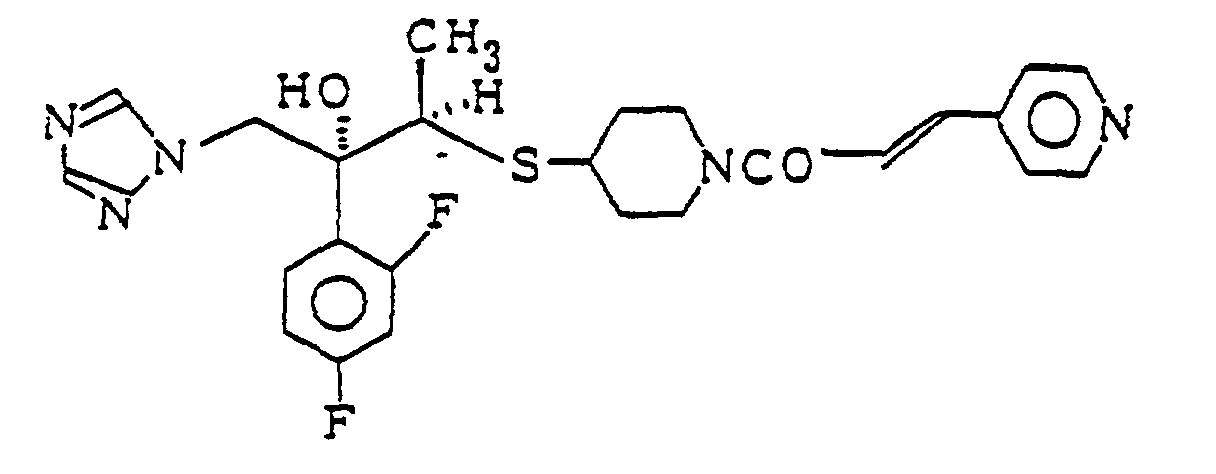
- A colorless foam obtained from 4-acetylthio-1-[(E)-3-(pyridin-4-yl)-acryloyl]piperidine according to [Process B] of Example 21.
- NMR spectrum (270MHz, CDCl3) δ ppm: 1.20 (3H, d, J=6.6Hz), 1.6-1.8 (2H, m), 2.0-2.2 (2H, m), 3.0-3.2 (2H, m), 3.35 (1H, q, J=6.6Hz), 3.2-3.4 (1H, m), 3.9-4.1 (1H, m), 4.3-4.5 (1H, m), 4.83 (1H, d, J=14.5Hz), 4.86 (1H, s), 5.09 (1H, d, J=14.5Hz), 6.7-6.8 (2H, m), 7.06 (1H, d, J=15.2Hz), 7.3-7.4 (1H, m), 7.37 (2H, d, J=5.9Hz), 7.57 (1H, d, J=15.2Hz), 7.78 (1H, s), 7.81 (1H, s), 8.64 (2H, d, J=5.9Hz).
- IR spectrum υmax KBrcm-1: 3420, 1651, 1615, 1598.
- Mass spectrum m/e: 499, 439, 417, 410, 365, 344, 307, 275, 247, 216, 144, 132, 104, 82.
-
-

- A slightly yellow foam obtained from (2R,3R)-2-(2,4-difluorophenyl)-1-(1H-1,2,4-triazol-1-yl)-3-[(azetidin-3-yl]thio]-2-butanol dihydrochloride according to [Process A] of Example 21.
- NMR spectrum (270MHz, CDCl3) δ ppm: 1.17 (3H, d, J=7.1Hz), 3.32 (1H, q, J=7.1Hz), 4.0-4.3 (3H, m), 4.5-4.6 (1H, m), 4.6-4.7 (1H, m), 4.86 (1H, d, J=14.2Hz), 5.05 (1H, d, J=14.2Hz), 5.09 (1H, s), 6.43 (1H, d, J=15.7Hz), 6.7-6.8 (2H, m), 7.22 (2H, d, J=8.2Hz), 7.3-7.4 (1H, m), 7.56 (2H, d, J=8.2Hz), 7.65 (1H, d, J=15.7Hz), 7.79 (1H, s), 7.81 (1H, s).
- IR spectrum υmax KBrcm-1: 3376, 1656.
- Mass spectrum m/e: 554, 535, 472, 384, 331, 271, 224, 215, 187, 127, 87.
-
-

- Reaction was carried out in the same manner as in Example 4 using (2R,3R)-2-(2,4-difluorophenyl)-3-[(1,3-dihydroxy-2-propyl)thio]-1-(1H-1,2,4-triazol-5-yl)-2-butanol and (2E,4E)-5-(2,4-difluorophenyl)-2,4-pentadienal to obtain the title compound, a major product as an oil in a yield of 61%.
- Specific rotation [α]D 25 -79.1° (c=1.04, CHCl3)
- NMR spectrum (270MHz, CDCl3) δ ppm: 1.18 (3H, d, J=7.0Hz), 3.33 (1H, q, J=7.0Hz), 3.39 (1H, tt, J=11.3, 4.6Hz), 3.62 (1H, t, J=11.3Hz), 3.64 (1H, t, J=11.3Hz), 4.30 (1H, m), 4.41 (1H, m), 4.82 (1H, d, J=14.0Hz), 5.00 (1H, s), 5.03 (1H, d, J=14.0Hz), 5.05 (1H, d, J=4.6Hz), 5.79 (1H, dd, J=15.2, 4.6Hz), 6.58 (1H, dd, J=15.2, 9.5Hz), 6.65-6.9 (6H, m), 7.3-7.5 (2H, m), 7.79 (2H, s).
-
-

- In 11 ml of methylene chloride were dissolved 404 mg (1.12 mmol) of (2R,3R)-2-(2,4-difluorophenyl)-3-[(1,3-dihydroxy-2-propyl)thio]-1-(1H-1,2,4-triazol-1-yl)-2-butanol and 501 mg (1.73 mmol) of (2E,4E)-5-[6-(2,2,3,3-tetrafluoropropoxy)-3-pyridyl]-2,4-pentadienal as described in Reference example 37, and 320 mg (1.68 mmol) of p-toluenesulfonic acid monohydrate and 4 g of molecular sieves 4A were added to the solution, followed by stirring of the resulting mixture at room temperature for 1 hour. The reaction mixture was poured into 20 ml of a 3% aqueous sodium hydrogencarbonate solution under ice-cooling and the mixture was stirred for 5 minutes. Then, the molecular sieves was removed by filtration and the organic layer was collected by fractions, followed by drying and evaporation of the solvent under reduced pressure. 908 mg of the thus obtained oil were subjected to column chromatography using 19 g of silica gel and eluted with a mixed solvent of hexane-ethyl acetate (1:1) to obtain 448 mg (yield: 63%) of the desired title compound as an oil.
- Specific rotation [α]D 25 -58.6° (c=0.52, CHCl3)
- NMR spectrum (270MHz, CDCl3) δ ppm: 1.19 (3H, J=7.0Hz), 3.33 (1H, q, J=7.0Hz), 3.39 (1H, tt, J=11.2, 4.8Hz), 3.62 (1H, t, J=11.2Hz), 3.64 (1H, t, J=11.2Hz), 4.30 (1H, ddd, J=11.2, 4.7, 2.1Hz), 4.42 (1H, ddd, J=11.2, 4.7, 2.1Hz), 4.74 (2H, brt, J=12.8Hz), 4.82 (1H, d, J=13.9Hz), 5.01 (1H, s), 5.03 (1H, d, J=13.9Hz), 5.05 (1H, d, J=4.5Hz), 5.78 (1H, d, J=15.5, 4.5Hz), 6.01 (1H, tt, J=53.1, 4.6Hz), 6.51-6.62 (2H, m), 6.65-6.78 (3H, m), 6.81 (1H, d, J=8.6Hz), 7.35 (1H, m), 7.74 (1H, dd, J=8.6, 2.3Hz), 7.79 (2H, s), 8.11 (1H, d, J=2.3Hz).
-
-
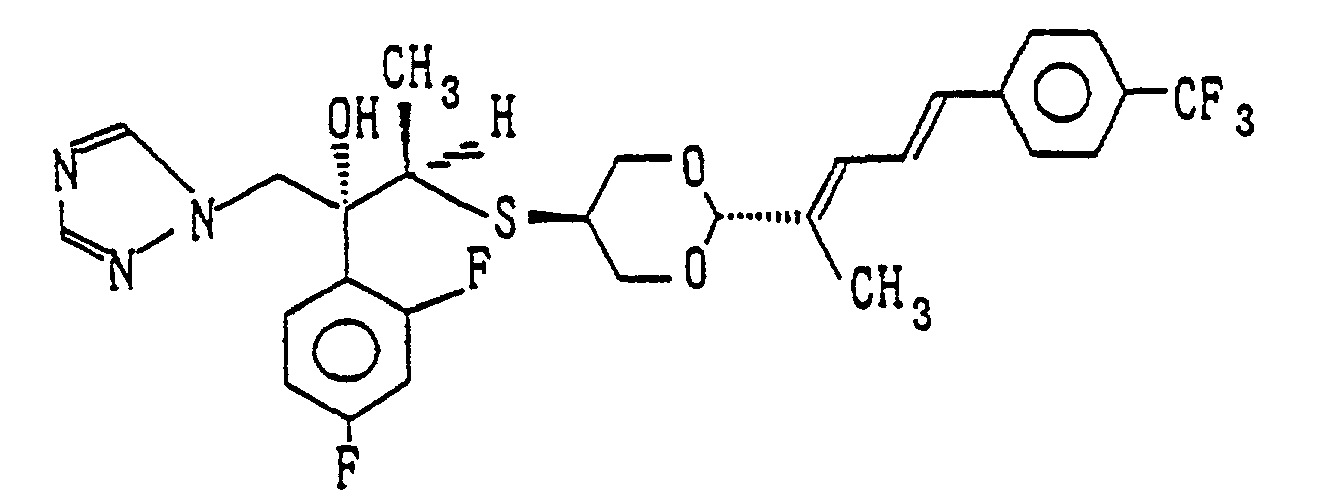
- Reaction was carried out in the same manner as in Example 4 using (2R,3R)-2-(2,4-diphenyl)-3-[(1,3-dihydroxy-2-propyl)thio]-1-(1H-1,2,4-triazol-5-yl)-2-butanol and (2E,4E)-2-methyl-5-[4-(trifluoromethyl)phenyl]-2,4-pentadienal to obtain the title compound, a major product as an oil in a yield of 31%.
NMR spectrum (270MHz, CDCl3) δ ppm: 1.19 (3H, d, J=7.3Hz), 1.94 (3H, s), 3.34 (1H, q, J=7.3Hz), 3.39 (1H, tt, J=11.2, 4.6Hz), 3.36 (1H, t, J=11.2Hz), 3.65 (1H, t, J=11.2Hz), 4.33 (1H, m), 4.44 (1H, m), 4.83 (1H, d, J=13.9Hz), 4.89 (1H, s), 5.02 (1H, s), 5.04 (1H, d, J=13.9Hz), 6.41 (1H, d, J=11.2Hz), 6.62 (1H, d, J=15.8Hz), 6.7-6.8 (2H, m), 7.09 (1H, dd, J=15.8, 11.2Hz), 7.36 (1H, m), 7.50 (2H, d, J=8.6Hz), 7.56 (2H, d, J=8.6Hz), 7.79 (1H, s), 7.80 (1H, s). -

- Reaction was carried out in the same manner as in Example 4 using (RS)-3-[(1,3-dihydroxy-2-propyl)thio]-3-methyl-2-[4-(trifluoromethyl)phenyl)-1-(1H-1,2,4-triazol-1-yl)-2-butanol as described in Reference example 55 and trans-4-(trifluoromethyl)cinnamaldehyde as described in Reference example 22 to obtain the title compound as a colorless foam.
- NMR spectrum (270MHz, CDCl3) δ ppm: 1.36 (3H, s), 1.37 (3H, s), 3.5-3.7 (3H, m), 4.2-4.3 (1H, m), 4.4-4.5 (1H, m), 5.02 (2H, s), 5.11 (1H, d, J=4.1Hz), 5.44 (1H, s), 6.25 (1H, dd, J=16.2, 4.1Hz), 6.84 (1H, d, J=16.2Hz), 7.4-7.6 (8H, m), 7.70 (1H, s), 7.93 (1H, s).
- IR spectrum υmax (KBr) cm-1: 3404, 1618, 1508, 1328.
- Mass spectrum m/e: 587, 568, 331, 298, 256, 201, 159, 131.
-
-

- Reaction was carried out in the same manner as in Example 4 using (RS) -3-[(1,3-dihydroxy-2-propyl)thio]-3-methyl-2-[4-(trifluoromethyl)phenyl]-1-(1H-1,2,4-triazol-1-yl)-2-butanol as described in Reference example 55 and (2E,4E)-5-[4-(trifluoromethyl)phenyl]-2,4-pentadienal as described in Reference example 25 to obtain the title compound, a major product as a colorless foam.
- NMR spectrum (270MHz, CDCl3) δ ppm: 1.36 (3H, s), 1.37 (3H, s), 3.4-3.7 (3H, m), 4.2-4.3 (1H, m), 4.4-4.5 (1H, m), 5.01 (2H, s), 5.02 (1H, d, J=4.3Hz), 5.39 (1H, s), 5.83 (1H, dd, J=15.2, 4.3Hz), 6.59 (1H, dd, J=15.2, 10.7Hz), 6.63 (1H, d, J=15.8Hz), 6.85 (1H, dd, J=15.8, 10.7Hz), 7.4-7.6 (8H, m), 7.73 (1H, s), 7.93 (1H, s).
- IR spectrum υmax (KBr) cm-1: 3398, 1679, 1619, 1328, 1126.
- Mass spectrum m/e: 614, 541, 494, 478, 406, 348, 256, 211.
-
-

- Reaction was carried out in the same manner as in Example 4 using (2R,3R)-2-(2,4-difluorophenyl)-3-[(1,3-dihydroxy-2-propyl)thio]-1-(1H-1,2,4-triazol-5-yl)-2-butanol and (2E,4E)-5-[4-(trifluoromethylthio)phenyl]-2,4-pentadienal to obtain the title compound, a major product as a colorless foam.
- NMR spectrum (270MHz, CDCl3) δ ppm: 1.19 (3H, d, J=7.1Hz), 3.3-3.5 (2H, m), 3.62 (1H, t, J=11.4Hz), 3.64 (1H, t, J=11.4Hz), 4.31 (1H, ddd, J=11.4, 4.7, 2.1Hz), 4.42 (1H, ddd, J=11.4, 4.7, 2.1Hz), 4.83 (1H, d, J=14.1Hz), 5.01 (1H, s), 5.03 (1H, d, J=14.1Hz), 5.06 (1H, d, J=4.5Hz), 5.83 (1H, dd, J=15.7, 4.5Hz), 6.60 (1H, dd, J=15.7, 10.3Hz), 6.62 (1H, d, J=15.7Hz), 6.7-6.8 (2H, m), 6.84 (1H, dd, J=15.7, 10.3Hz), 7.3-7.4 (1H, m), 7.44 (2H, d, J=8.3Hz), 7.60 (2H, d, J=8.3Hz), 7.79 (2H, s).
- IR spectrum υmax (KBr) cm-1: 3389, 1621, 1680, 1621, 1501, 1117.
- Mass spectrum m/e: 599, 580, 557, 530, 500, 438, 388, 376, 346, 284, 258, 224, 183.
-
-

- Reaction was carried out in the same manner as in Example 1 using (2R*,3R*)-3-[(1,3-dihydroxy-2-propyl)thio]-1-(1H-1,2,4-triazol-5-yl)-2-[4-(trifluoromethyl)phenyl]-2-butanol and (2E,4E)-5-[4-(2,2,3,3-tetrafluoropropoxy)phenyl]-2,4-pentadienal as described in Reference example 32 to obtain the title compound, a major product as an oil.
NMR spectrum (270MHz, CDCl3) δ ppm: 1.22 (3H, d, J=6.6Hz), 3.16 (1H, q, J=6.6Hz), 3.34 (1H, tt, J=11.2, 4.6Hz), 3.58 (1H, t, J=11.2Hz), 3.61 (1H, t, J=11.2Hz), 4.27 (1H, m), 4.35 (2H, br t, J=11.9Hz), 4.39 (1H, m), 4.57 (1H, d, J=13.9Hz), 4.77 (1H, s), 5.02 (1H, d, J=4.6Hz), 5.03 (1H, d, J=13.9Hz), 5.72 (1H, dd, J=15.8, 4.6Hz), 6.05 (1H, tt, J=52.8, 5.3Hz), 6.5-6.75 (3H, m), 6.88 (2H, d, J=8.6Hz), 7.36 (2H, d, J=8.6Hz), 7.39 (2H, d, J=8.6Hz), 7.54 (2H, d, J=8.6Hz), 7.71 (1H, s), 7.83 (1H, s). -

- Reaction was carried out in the same manner as in Example 1 using (2R*,3R*)-3-methyl-2-[(1H-1,2,4-triazol-1-yl)methyl]oxirane and trans-5-(acetylthio)-2-[(1E,3E)-4-[4-(trifluoromethyl)phenyl]-1,3-butadien-1-yl]-1,3-dioxane to obtain the title compound as an oil in a yield of 71%.
NMR spectrum (270MHz, CDCl3) δ ppm: 1.22 (3H, d, J=7.0Hz), 3.17 (1H, q, J=7.0Hz), 3.36 (1H, tt, J=11.3, 4.7Hz), 3.59 (1H, t, J=11.3Hz), 3.62 (1H, t, J=11.3Hz), 4.27 (1H, ddd, J=11.3, 4.7, 2.2Hz), 4.39 (1H, ddd, J=11.3, 4.7, 2.2Hz), 4.57 (1H, d, J=14.0Hz), 4.80 (1H, s), 5.03 (1H, d, J=14.0Hz), 5.05 (1H, d, J=4.5Hz), 5.83 (1H, dd, J=15.3, 4.5Hz), 6.59 (1H, dd, J=15.3, 10.7Hz), 6.64 (1H, d, J=15.3Hz), 6.85 (1H, dd, J=15.3, 10.7Hz), 7.39 (2H, d, J=8.4Hz), 7.49 (2H, d, J=8.3Hz), 7.54 (2H, d, J=8.3Hz), 7.57 (2H, d, J=8.4Hz), 7.71 (1H, s), 7.83 (1H, s). -

- Reaction was carried out in the same manner as in Example 4 using (2R,3R)-2-(2,4-difluorophenyl)-3-[(1,3-dihydroxy-2-propyl)thio]-1-(1H-1,2,4-triazol-5-yl)-2-butanol and (2E,4E)-5-[4-(trifluoromethylsulfinyl)phenyl]-2,4-pentadienal to obtain the title compound, a major product as a colorless foam.
- NMR spectrum (270MHz, CDCl3) δ ppm: 1.19 (3H, d, J=7.0Hz), 3.3-3.5 (2H, m), 3.62 (1H, t, J=11.3Hz), 3.64 (1H, t, J=11.3Hz), 4.30 (1H, ddd, J=11.3, 4.8, 2.3Hz), 4.42 (1H, ddd, J=11.3, 4.8, 2.3Hz), 4.83 (1H, d, J=14.1Hz), 5.01 (1H, s), 5.03 (1H, d, J=14.1Hz), 5.06 (1H, d, J=4.5Hz), 5.83 (1H, dd, J=15.9, 4.5Hz), 6.60 (1H, dd, J=15.9, 10.6Hz), 6.62 (1H, d, J=15.9Hz), 6.7-6.8 (2H, m), 6.84 (1H, dd, J=15.9, 10.6Hz), 7.3-7.4 (1H, m), 7.44 (2H, d, J=8.3Hz), 7.60 (2H, d, J=8.3Hz), 7.79 (2H, s).
- Mass spectrum m/e: 616, 600, 547, 400, 370, 342, 284, 252, 224, 183.
-
-

- Reaction was carried out in the same manner as in Example 4 using (2R,3R)-2-(2,4-difluorophenyl)-3-[(1,3-dihydroxy-2-propyl)thio]-1-(1H-1,2,4-triazol-1-yl)-2-butanol and (2E,4E,6E)-7-[4-(trifluoromethyl)phenyl]-2,4,6-heptatrienal as described in Reference example 28 to obtain the title compound, a major product as an oil in a yield of 65%.
NMR spectrum (270MHz, CDCl3) δ ppm: 1.18 (3H, d, J=6.6Hz), 3.33 (1H, q, J=6.6Hz), 3.38 (1H, tt, J=11.2, 4.6Hz), 3.61 (1H, t, J=11.2Hz), 3.63 (1H, t, J=11.2Hz), 4.29 (1H, m), 4.40 (1H, m), 4.83 (1H, d, J=14.5Hz), 5.00 (1H, s), 5.02 (1H, d, J=14.5Hz), 5.03 (1H, d, J=4.6Hz), 5.74 (1H, dd, J=15.2, 4.6Hz), 6.35-6.55 (3H, m), 6.59 (1H, d, J=15.2Hz), 6.7-6.8 (2H, m), 6.89 (1H, dd, J=15.2, 9.9Hz), 7.35 (1H, m), 7.48 (2H, d, J=8.6Hz), 7.56 (2H, d, J=8.6Hz), 7.78 (1H, s), 7.79 (1H, s). -

- Reaction was carried out in the same manner as in Example 4 using (RS)-2-(2,4-difluorophenyl)-3-[(1,3-dihydroxy-2-propyl)thio]-3-methyl-1-(1H-1,2,4-triazol-1-yl)-2-butanol and (2E,4E)-5-[4-(trifluoromethyl)phenyl]-2,4-pentadienal as described in Reference example 25 to obtain the title compound, a major product as a colorless foam.
NMR spectrum (270MHz, CDCl3) δ ppm: 1.36 (6H, s), 3.5-3.6 (2H, m), 3.6-3.8 (2H, m), 4.2-4.4 (1H, m), 4.4-4.6 (1H, m), 4.93 (1H, d, J=14.1Hz), 5.03 (1H, d, J=4.3Hz), 5.23 (1H, d, J=14.1Hz), 5.56 (1H, s), 5.84 (1H, dd, J=15.4, 4.3Hz), 6.5-6.7 (3H, m), 6.7-6.9 (2H, m), 7.50 (2H, d, J=8.4Hz), 7.57 (2H, d, J=8.4Hz), 7.6-7.7 (1H, m), 7.74 (1H, s), 8.05 (1H, s). -
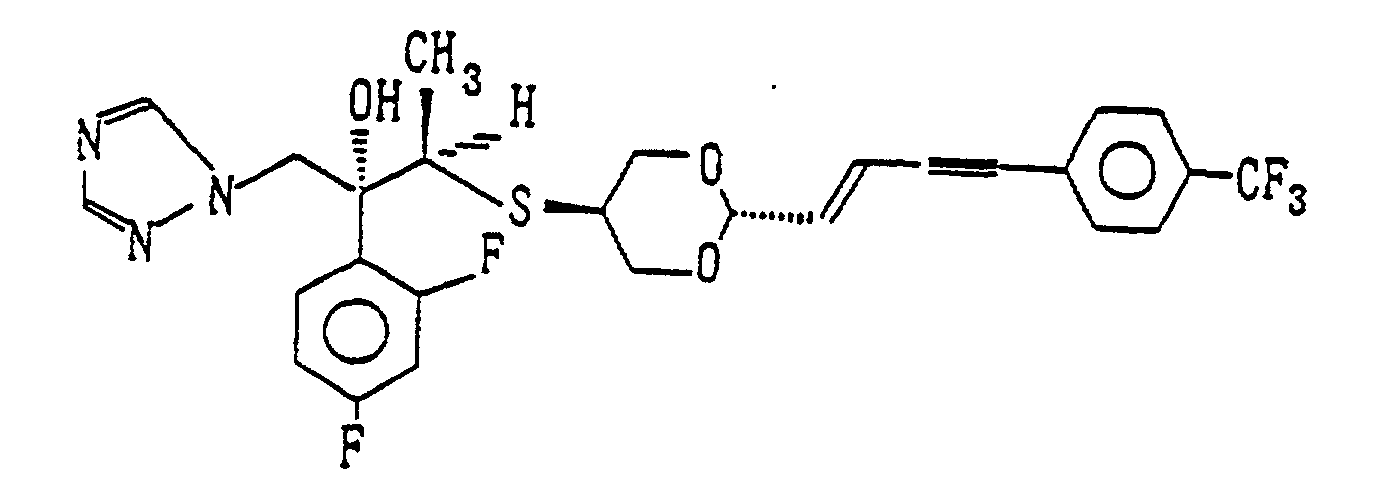
- Reaction was carried out in the same manner as in Example 4 using (2R,3R)-2-(2,4-difluorophenyl)-3-[(1,3-dihydroxy-2-propyl)thio]-1-(1H-1,2,4-triazol-1-yl)-2-butanol and (E)-5-[4-(trifluoromethyl)phenyl]-2-penten-4-ynal as described in Reference example 48 to obtain the title compound, a major product as an oil in a yield of 70%.
- Specific rotation [α]D 25 -65.1° (c=0.97, CHCl3)
- NMR spectrum (270MHz, CDCl3) δ ppm: 1.19 (3H, d, J=7.0Hz), 3.33 (1H, q, J=7.0Hz), 3.39 (1H, tt, J=11.4, 4.9Hz), 3.60 (1H, t, J=11.4Hz), 3.62 (1H, t, J=11.4Hz), 4.30 (1H, m), 4.42 (1H, m), 5.0-5.1 (2H, m), 5.04 (1H, d, J=3.2Hz), 6.12 (1H, d, J=16.0Hz), 6.18 (1H, dd, J=16.0, 3.2Hz), 6.7-6.8 (2H, m), 7.36 (1H, m), 7.54 (2H, d, J=8.5Hz), 7.58 (2H, d, J=8.5Hz), 7.79 (2H, s).
-
-
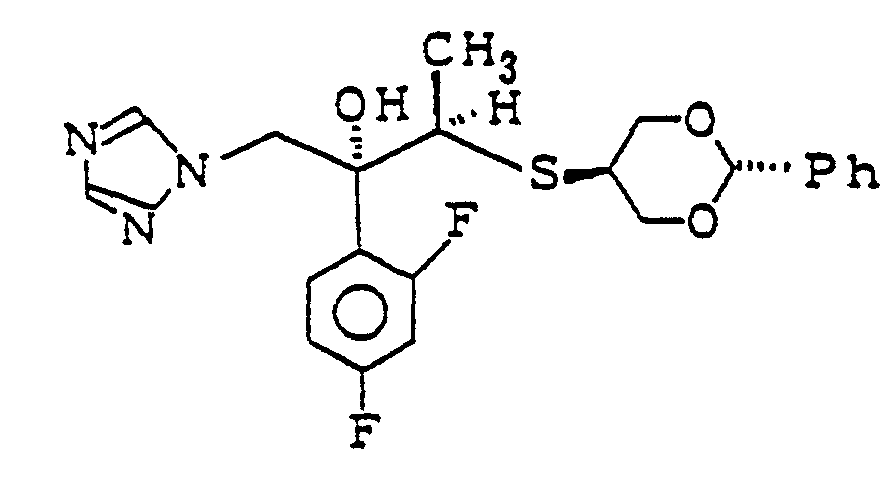
- In 20 ml of dimethylformamide were dissolved 1.65 g (6.57 mmol) of (2R,3S)-2-(2,4-difluorophenyl)-3-methyl-2-(1H-1,2,4-triazol-1-yl)methyl]oxirane and 2.00 g (8.40 mmol) of trans-4-(acetylthio)-2-phenyl-1,3-dioxane as described in Reference example 1, and 2.5 ml (4.00 mmol) of a 1.6M sodium methoxide-methanol solution were added to the solution under a nitrogen atmosphere, followed by heating of the resulting mixture with stirring at 65°C for 2 hours. After cooling, ethyl acetate was added to the reaction mixture and the resulting mixture was washed with a saturated aqueous NaCl solution and dried, followed by evaporation of the solvent under reduced pressure. The thus obtained crude product was subjected to column chromatography using 60 g of silica gel and eluted with a mixed solvent of benzene-ethyl acetate (5:1) to obtain 2.53 g (yield: 91%) of the title compound as a solid. The solid was recrystallized from ethyl acetate-hexane to obtain a pure product having a melting point of 58 to 60°C.
- Specific rotation [α]D 25 -88° (c=1.07, CHCl3)
- IR spectrum υmax(CHCl3)cm-1: 3400, 1615, 1500, 1139.
- NMR spectrum (270MHz, CDCl3) δ ppm: 1.21 (3H, d, J=7.3Hz), 3.36 (1H, q, J=7.3 Hz), 3.48 (1H, tt, J=11.2, 4.6Hz), 3.75 (1H, t, J=11.2Hz), 3.77 (1H, t, J=11.2Hz), 4.40 (1H, ddd, J=11.2, 4.6, 2.6Hz), 4.51 (1H, ddd, J=11.2, 4.6, 2.6Hz), 4.84 (1H, d, J=13.9Hz), 5.02 (1H, s), 5.05 (1H, d, J=13.9Hz), 5.49 (1H, s), 7.7-7.8 (2H, m), 7.3-7.45 (4H, m), 7.45-7.53 (2H, m), 7.79 (2H, s).
-
-

- In 200 ml of dimethylformamide were dissolved 29.0 g (86.8 mmol) of cis-2-phenyl-4-(p-toluenesulfonyloxy)-1,3-dioxane and 17.0 g (149 mmol) of sodium thioacetate, and the solution was heated at 115 to 120°C under a nitrogen atmosphere for 1 hour. After cooling, benzene was added to the reaction mixture and the mixture was washed with water, followed by evaporation of the solvent. The thus obtained brown residue was subjected to column chromatography using silica gel and the fractions eluted with a mixed solvent of benzene-hexane (2:1) were collected, followed by recrystallization from a mixed solvent of benzene-hexane to obtain 8.99 g (yield: 43%) of the title compound having a melting point of 95 to 96°C.
- NMR spectrum (270MHz, CDCl3) δ ppm: 2.37 (3H, s), 3.79 (2H, t, J=11.2Hz), 4.03 (1H, tt, J=11.2, 4.6Hz), 4.31 (2H, dd, J=11.2, 4.6Hz), 5.47 (1H, s), 7.35-7.5 (5H, m).
- IR spectrum υmax (CHCl3) cm-1: 1690, 1383, 1146, 1084.
- Mass spectrum m/e: 238 (M+), 237, 195, 162(100%), 149, 116, 107, 73.
-
-

- In 3.5 ml of methanol were dissolved 253 mg of (2R,3R)-2-(2,4-difluorophenyl)-3-[[trans-2-phenyl-1,3-dioxan-5-yl]thio]-1-(1H-1,2,4-triazol-1-yl)-2-butanol as described in Example 40, and 0.35 ml of a 4N HCl-dioxane solution were added to the solution, followed by stirring of the resulting mixture at room temperature for 30 minutes. To the reaction mixture were added 250 mg of a NaHCO3 powder, and the mixture was stirred for 10 minutes, followed by filtration of the reaction mixture and concentration of the filtrate under reduced pressure. The thus obtained oil was subjected to column chromatography using 5 g of silica gel and eluted with 10% methanol-ethyl acetate to obtain 179 mg (yield: 88%) of the title compound as a viscous oil.
- Specific rotation [α]D 25 -61° (c=1.05, CHCl3)
- IR spectrum υmax(CHCl3)cm-1: 3400, 1618, 1500.
- NMR spectrum (60MHz, CDCl3+D2O) δ ppm: 1.20 (3H, d, J=6.5Hz), 3.0-4.0 (6H, m), 4.80 (1H, d, J=14Hz), 5.16 (1H, d, J=14Hz), 6.6-7.0 (2H, m), 7.43 (1H, td, J=9, 8Hz), 7.74 (1H, s), 7.86 (1H, s).
-
-
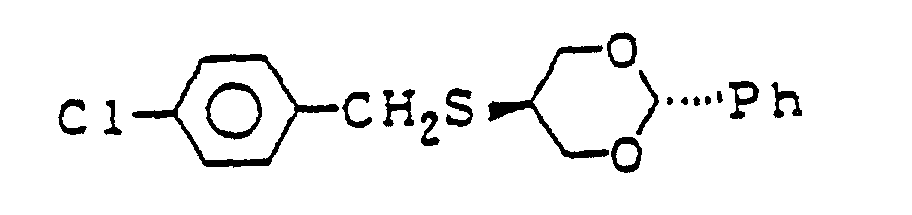
- After 240 mg (5.50 mmol) of 55% sodium hydride were washed with hexane, it was suspended in 15 ml of dimethylformamide and 903 mg (5.70 mmol) of 4-chlorobenzylmercaptane were added to the resulting suspension with stirring under nitrogen atmosphere. After 15 minutes, 1.66 g (4.96 mmol) of cis-5-(p-toluenesulfonyloxy)-2-phenyl-1,3-dioxane were added to the mixture and the resulting mixture was stirred at 75°C for 1 hour. After cooling, benzene was added to the reaction mixture and the mixture was washed with water and then an aqueous NaCl solution. After the solvent was distilled off, the thus obtained crystalline residue was recrystallized from a mixed solvent of benzene-hexane to obtain 670 mg (yield: 42%) of the title compound having a melting point of 95 to 99°C as a flaky crystalline solid.
NMR spectrum (60MHz, CDCl3) δ ppm: 3.02 (1H, tt, J=11, 5Hz), 3.67 (2H, t, J=11Hz), 3.72 (2H, s), 4.21 (2H, dd, J=11, 5Hz), 5.39 (1H, s), 7.30 (5H, s), 7.38 (4H, s). -
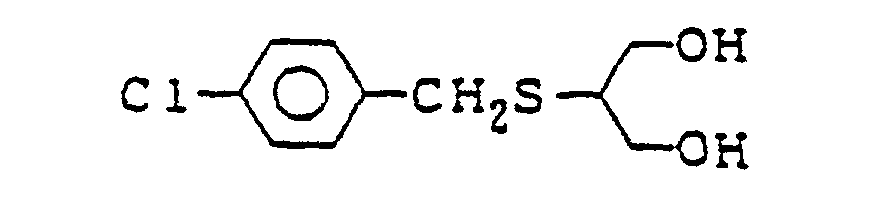
- In 10 ml of methanol were dissolved 750 mg of trans-5-[(4-chlorobenzyl)thio]-2-phenyl-1,3-dioxane, and 1 ml of a 4N hydrogen chloride-dioxane solution was added to the solution, followed by stirring of the resulting mixture at room temperature for 1 hour. After 750 mg of sodium hydrogencarbonate (powder) were added to the reaction mixture and the resulting mixture was stirred for 15 minutes, the solid was removed by filtration and the solvent was distilled off. Ethyl acetate was added to the residue and the insolubles were removed by filtration. The crystal obtained by evaporation of the solvent was recrystallized from a mixed solvent of benzene-hexane to obtain 468 mg (yield: 86%) of the title compound having a melting point of 70 to 75°C.
-

- In 12 ml of benzene were dissolved 341 mg (1.46 mmol) of 2-[(4-chlorobenzyl)thio]-1,3-propanediol and 375 mg (1.75 mmol) of (E)-4-(trifluoromethyl)-a-methylcinnamaldehyde, and 3 mg of p-toluenesulfonic acid were added to the solution, followed by heating of the resulting mixture with reflux under nitrogen atmosphere for 2 hours. After cooling, the reaction mixture was washed with an aqueous sodium hydrogencarbonate solution. The residue obtained by evaporation of the solvent was subjected to column chromatography using 15 g of silica gel. The fractions eluted with a mixed solvent of hexane-ethyl acetate (9:1) were collected and the thus obtained solid was washed with hexane to obtain 370 mg (yield: 59%) of the title compound having a melting point of 93 to 95°C.
NMR spectrum (270MHz, CDCl3) δ ppm: 1.87 (3H, s), 2.99 (1H, tt, J=11.2, 4.6Hz), 3.58 (2H, dd, J=11.9, 11.2Hz), 3.73 (2H, s), 4.15 (2H, dd, J=11.9, 4.6Hz), 4.87 (1H, s), 6.68 (1H, br s), 7.25-7.3 (4H, m), 7.36 (2H, d, J=7.9Hz), 7.57 (2H, d, J=7.9Hz). -
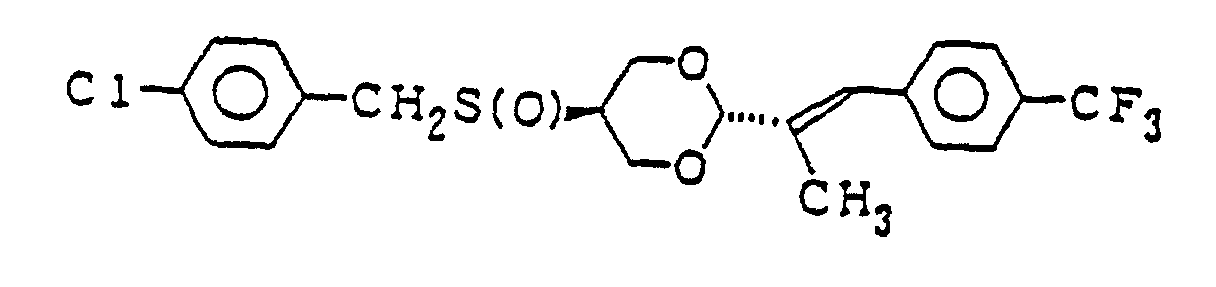
- In 10 ml of methylene chloride were dissolved 382 mg (0.89 mmol) of trans-5-[(4-chlorobenzyl)thio]-2-[(E)-1-methyl-2-[4-(trifluoromethyl)phenyl]vinyl]-1,3-dioxane, and 188 mg (0.92 mmol) of m-chloroperbenzoic acid (purity: 85%) were added to the solution, followed by stirring of the resulting mixture for 15 minutes. The reaction mixture was washed with an aqueous sodium hydrogencarbonate solution and the solid obtained by evaporation of the solvent was washed with a mixed solvent of ethyl acetate-hexane to obtain 328 mg (yield: 83%) having a melting point of 192 to 194°C.
NMR spectrum (60MHz, CDCl3) δ ppm: 1.88 (3H, d, J=1.5Hz), 2.8-3.3 (1H, m), 3.8-4.5 (4H, m), 4.01 (2H, s), 4.95 (1H, s), 6.73 (1H, br s), 7.15-7.75 (8H, m). -
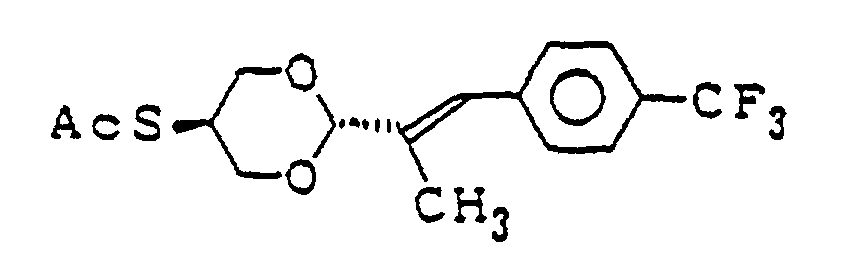
- In 8 ml of a mixed solvent of tetrahydrofuran-acetonitrile (1:1) were dissolved 309 mg (0.696 mmol) of trans-5-[(4-chlorobenzyl)sulfinyl]-2-[(E)-1-methyl-2-[4-(trifluoromethyl)phenyl]vinyl]-1,3-dioxane, and 500 mg (4.67 mmol) of 2,6-lutidine were added to the solution. To the resulting mixture were added dropwise 500 mg (2.4 mmol) of trifluoroacetic anhydride with stirring at 0°C for about 5 minutes. After 10 minutes, about 5 ml of an aqueous sodium hydrogencarbonate solution were added to the reaction mixture and the mixture was stirred at 5 minutes, followed by extraction with ethyl acetate. An oily residue (about 350 mg) obtained by evaporation of the solvent was dissolved in 5 ml of methylene chloride and 210 mg of triethylamine were added to the solution at 0°C, followed by addition of 109 mg of acetyl chloride to the resulting mixture. After 5 minutes, the reaction mixture was washed with water and the solvent was distilled off. The residue was subjected to column chromatography using 10 g of silica gel and eluted with a mixed solvent of hexane-benzene (1:1 to 1:2) to obtain 186 mg (yield: 77%) of the title compound as a crystalline solid. The crystalline solid was recrystallized from a mixed solvent of benzene-hexane to obtain a plate-like crystalline solid having a melting point of 128 to 129°C.
NMR spectrum (270MHz, CDCl3) δ ppm: 1.92 (3H, s), 2.36 (3H, s), 3.70 (2H, t, J=11.2Hz), 3.96 (1H, tt, J=11.2, 4.6Hz), 4.25 (2H, dd, J=11.2, 4.6Hz), 4.94 (1H, s), 6.70(1H, br s), 7.39 (2H, d, J=8.2Hz), 7.59 (2H, d, J=8.2Hz). -

- After 45 mg (1.03 mmol) of 55% sodium hydride were washed with hexane, it was suspended in 3 ml of 1,2-dimethoxyethane and 273 mg (1.03 mmol) of triethyl 3-methyl-4-phosphonocrotonate were added to the resulting mixture with stirring at 0°C under nitrogen atmosphere. After 15 minutes, 100 mg (0.57 mmol) of 4-(trifluoromethyl)benzaldehyde were added to the mixture and the resulting mixture was stirred for 10 minutes. After ice-water was added to the reaction mixture, the mixture was extracted with ethyl acetate. The crude product obtained by evaporation of the solvent was subjected to column chromatography using 5 g of silica gel and eluted with a mixed solvent of ethyl acetate-hexane (4:96) to obtain 159 mg (yield: 97%) of a 5:1 mixture of the title compound, a (2E,4E) isomer and a (2Z,4E) isomer as an oil.
NMR spectrum (270MHz, CDCl3) δ ppm: (2E, 4E)-isomer, 1.31 (3H, t, J=6.6Hz), 2.41 (3H, s), 4.20 (2H, q, J=6.6Hz), 5.95 (1H, s), 6.86 (1H, d, J=16.5Hz), 6.95 (1H, d, J=16.5Hz), 7.5-7.65 (4H, m): (2E, 4E)-isomer (main signal), 2.14 (3H, s), 5.82 (1H, s), 6.92 (1H, d, J=16.5Hz), 8.49 (1H, d, J=16.5Hz). -

- After a solution in which 150 mg (0.53 mmol) of ethyl (4E)-3-methyl-5-[4-(trifluoromethyl)phenyl]-2,4-pentadienoate ((2E)/(2Z) = 5/1) as described in Reference example 8 were dissolved in 2 ml of toluene was stirred at 0°C, 0.7 ml (1.06 mmol) of a 1.5M diisobutyl aluminum hydride-toluene solution were added to the solution. After 20 minutes, ice-water was added to the reaction mixture and the mixture was stirred for 10 minutes. The insolubles were removed by filtration using Celite and the filtrate was extracted with ethyl acetate and dried, followed by evaporation of the solvent to obtain an oil. The oil was subjected to column chromatography using 5 g of silica gel and eluted with a mixed solvent of 30 to 40% ethyl acetate-hexane to obtain 90 mg of the title compound as an oil.
NMR spectrum (270MHz, CDCl3) δ ppm: 1.34 (1H, br s), 1.93 (3H, s), 4.37 (2H, d, J=6.5Hz), 5.87 (1H, t, J=6.5Hz), 6.58 (1H, d, J=16.1Hz), 6.88 (1H, d, J=16.1Hz), 7.50 (2H, d, J=8.5Hz), 7.57 (2H, d, J=8.5Hz). -

- In 10 ml of methylene chloride were dissolved 460 mg (1.90 mmol) of (2E,4E)-3-methyl-5-[4-(trifluoromethyl)phenyl]-2,4-pentadien-1-ol, and 5 g of active manganese dioxide were added to the mixture, followed by stirring of the resulting mixture at room temperature for 30 minutes. The solid was removed by filtration, and after the filtrate was concentrated, it was purified over silica gel chromatography (eluting solvent: 4% ethyl acetate-hexane) to obtain 460 mg of the title compound as an oil.
NMR spectrum (270MHz, CDCl3) δ ppm: 2.41 (3H, s), 6.13 (1H, d, J=8.0Hz), 6.96 (1H, d, J=16.1Hz), 7.09 (1H, d, J=16.1Hz), 7.55-7.7 (4H, m), 10.19 (1H, d, J=8.0Hz). -
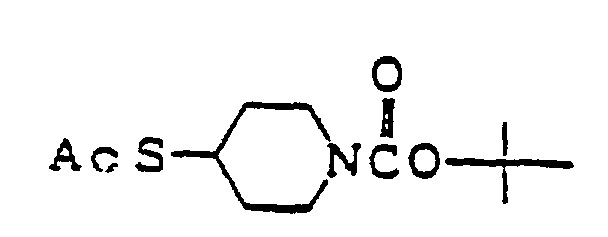
- In 40 ml of dimethylformamide were dissolved 4.12 g (14.7 mmol) of 1-(tert-butoxycarbonyl)-4-(methanesulfonyloxy)piperidine, and 2.53 g (2.21 mmol) of potassium thioacetate were added to the solution, followed by stirring of the resulting mixture at 105°C for 4 hours under nitrogen atmosphere. After cooling, the reaction mixture was diluted with ethyl acetate and washed with water and then a saturated aqueous NaCl solution, followed by evaporation of the solvent. The thus obtained residue was subjected to silica gel column chromatography and the fractions eluted with a mixed solvent of hexane-ethyl acetate (5:1) were collected to obtain 5.19 g (yield: 81%) of the title compound as an oil.
- NMR spectrum (270MHz, CDCl3) δ ppm: 1.46 (9H, s), 1.5-1.6 (2H, m), 1.9-2.0 (2H, m), 2.33 (3H, s), 3.0-3.1 (2H, m), 3.5-3.7 (1H, m), 3.8-3.9 (2H, m).
- Mass spectrum m/e: 259, 244, 216, 202, 186, 183, 160, 144, 127, 116, 97, 84, 57.
-
-
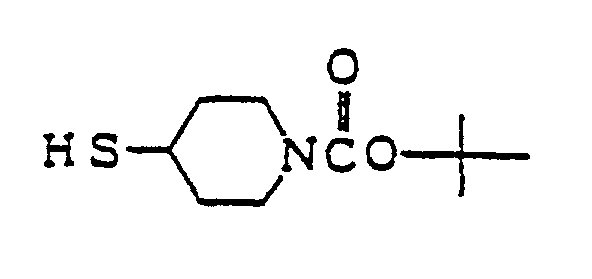
- In dry methanol were dissolved 520 mg (2 mmol) of 4-(acetylthio)-1-(tert-butoxycarbonyl)piperidine, and 420 µl (2 mmol) of a 28% sodium methoxide-methanol solution were added to the mixture under ice-cooling and under a nitrogen atmosphere, followed by stirring of the resulting mixture for 40 minutes. Then, 173 µl of acetic acid were added to the mixture and the solvent was distilled off at room temperature, followed by diluting of the residue with ethyl acetate. The mixture was washed successively with an aqueous sodium hydrogencarbonate solution and an aqueous NaCl solution in the order and the solvent was distilled off to obtain 430 mg of reddish orange oil. This product was used for a subsequent reaction without purification.
- NMR spectrum (270MHz, CDCl3) δ ppm: 1.46 (9H, s), 1.5-1.6 (2H, m), 1.9-2.0 (2H, m), 2.8-3.0 (3H, m), 3.9-4.1 (2H, m).
- Mass spectrum m/e: 217, 202, 184, 161, 144, 127, 117, 84, 82.
-
-

- In 6 ml of dimethylformamide was dissolved 1-(tert-butoxycarbonyl)-4-mercaptopiperidine (corresponding to 2 mmol) as described in Reference example 12, and 86 mg (1.97 mmol) of 55% sodium hydride were added to the solution at 0°C under a nitrogen atmosphere, followed by stirring of the resulting mixture at the same temperature for 20 minutes. Then, 503 mg (2.00 mmol) of(2R,3S)-2-(2,4-difluorophenyl)-3-methyl-2-[(1H-1,2,4-triazol-1-yl)methyl]oxirane were added to the reaction mixture and the mixture was stirred at 60°C for 3 hours. After cooling, ethyl acetate was added to the reaction mixture to dilute it and washed successively with water and a saturated aqueous NaCl solution. An oil obtained by evaporation of the solvent was subjected to silica gel column chromatography and eluted with ethyl acetate to obtain 557 mg (yield: 53%) of the desired compound as an oil.
- NMR spectrum (270MHz, CDCl3) δ ppm: 1.17 (3H, d, J=6.6Hz), 1.47 (9H, s), 1.4-1.6 (2H, m), 1.9-2.1 (2H, m), 2.9-3.1 (3H, m), 3.34 (1H,
- q, J=6.6Hz), 3.9-4.1 (2H, m), 4.77 (1H, s), 4.82 (1H, d, J=14.2Hz), 5.09 (1H, d, J=14.2Hz), 6.7-6.8 (2H, m), 7.3-7.4 (1H, m), 7.77 (1H, s), 7.82 (1H, s).
- IR spectrum υmax KBrcm-1: 3401, 1691.
- Mass spectrum m/e: 468, 408, 395, 365, 321, 284, 253, 224, 188, 166, 144, 127.
-
-
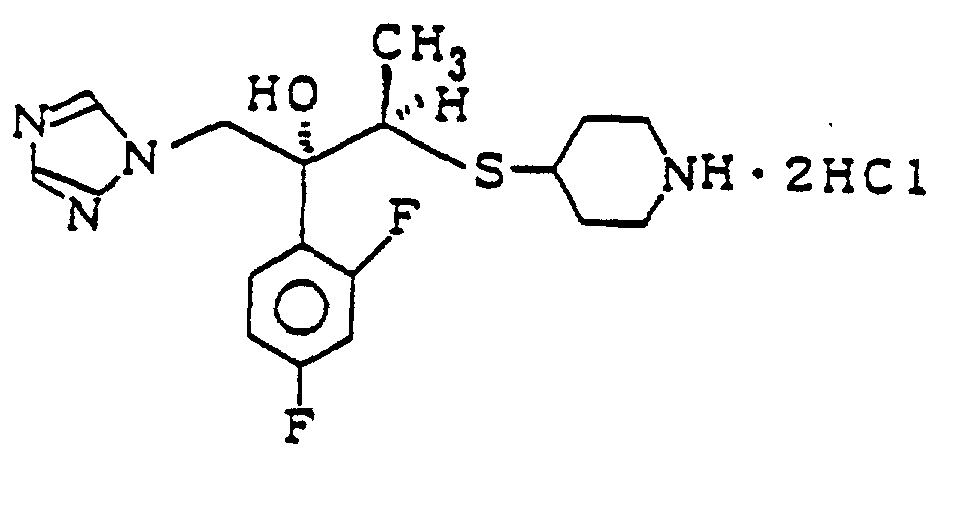
- In 20 ml of ethyl acetate were dissolved 557 mg (1.05 mmol) of (2R,3R)-2-(2,4-difluorophenyl)-1-(1H-1,2,4-triazol-1-yl)-3-[[1-(tert-butoxycarbonyl)piperidin-4-yl]thio]-2-butanol, and 2.63 ml (10.5 mmol) of a 4N hydrogen chloride-ethyl acetate solution were added to the solution, followed by stirring of the resulting mixture at 40°C for 8 hours. After cooling, the precipitated solid was collected by filtration and washed with hexane to obtain 460 mg (yield: 100%) of the desired compound as a colorless powder.
- NMR spectrum (270MHz, DMSO-d6+CDCl3) δ ppm: 1.23 (3H, d, J=6.6Hz), 1.8-2.0 (2H, m), 2.3-2.5 (2H, m), 3.1-3.4 (3H, m), 3.74 (1H, q, J=6.6Hz), 4.79 (1H, d, J=14.2Hz), 5.05 (1H, d, J=14.2Hz), 5.3-5.6 (1H, br s), 6.8-6.9 (1H, m), 7.0-7.1 (1H, m), 7.2-7.3 (1H, m), 7.79 (1H, s), 8.28 (1H, s).
- IR spectrum υmax KBrcm-1: 3366, 3094, 2725, 2483.
- Mass spectrum m/e: 368, 308, 286, 284, 253, 224, 213, 183, 165, 144, 116, 113, 84.
-
-

- In 45 ml of ethyl acetate were dissolved 1.25 g (4.82 mmol) of 4-(acetylthio)-1-(tert-butoxycarbonyl)piperidine as described in Reference example 11, and 12.0 ml (48.2 mmol) of a 4N hydrogen chloride-ethyl acetate solution were added to the solution, followed by stirring of the resulting mixture at 50°C for 4 hours. After cooling, the precipitated solid was collected by filtration and washed with hexane to obtain 885 mg (yield: 94%) of the desired compound as a slightly yellow powder.
NMR spectrum (270MHz, CD3OD) δ ppm: 1.8-2.0 (2H, m), 2.1-2.3 (2H, m), 2.35 (3H, s), 3.1-3.3 (2H, m), 3.3-3.5 (2H, m), 3.6-3.8 (1H, m) . -

- In 17 ml of dichloromethane were suspended 1.28 g (6.53 mmol) of 4-(acetylthio)piperidine hydrochloride, and 2.27 ml (16.3 mmol) of triethylamine were added dropwise to the suspension with stirring under ice-cooling. Then, a solution in which 1.80 g (7.18 mmol) of (E)-4-(trifluoromethoxy)cinnamoyl chloride were dissolved in 6 ml of dichloromethane was added dropwise to the reaction mixture, followed by stirring of the mixture at the same temperature for 1 hour. The reaction mixture was subjected to silica gel column chromatography and eluted with a mixed solvent of hexane-ethyl acetate (2:1 to 1:1) to obtain 2.32 g (yield: 95%) of the desired compound as a slightly yellow solid.
- NMR spectrum (270MHz, CDCl3) 6 ppm: 1.5-1.7 (2H, m), 1.9-2.1 (2H, m), 2.34 (3H, s), 3.1-3.3 (1H, m), 3.3-3.5 (1H, m), 3.7-3.8 (1H, m), 3.9-4.0 (1H, m), 4.2-4.4 (1H, m), 6.85 (1H, d, J=15.5Hz), 7.21 (2H, d, J=8.6Hz), 7.54 (2H, d, J=8.6Hz), 7.63 (1H, d, J=15.5Hz).
- Mass spectrum m/e: 373, 330, 298, 256, 228, 215, 187, 158, 136, 116, 101.
-
-

- An orange oil obtained from 1-(tert-butoxycarbonyl)-3-(methanesulfonyloxy)azetidine according to the procedure of Reference example 11.
NMR spectrum (270MHz, CDCl3) δ ppm: 1.44 (9H, s), 2.33 (3H, s), 3.81 (2H, dd, J=9.0, 5.5Hz), 4.1-4.2 (1H, m), 4.37 (2H, t, J=9.0Hz). -
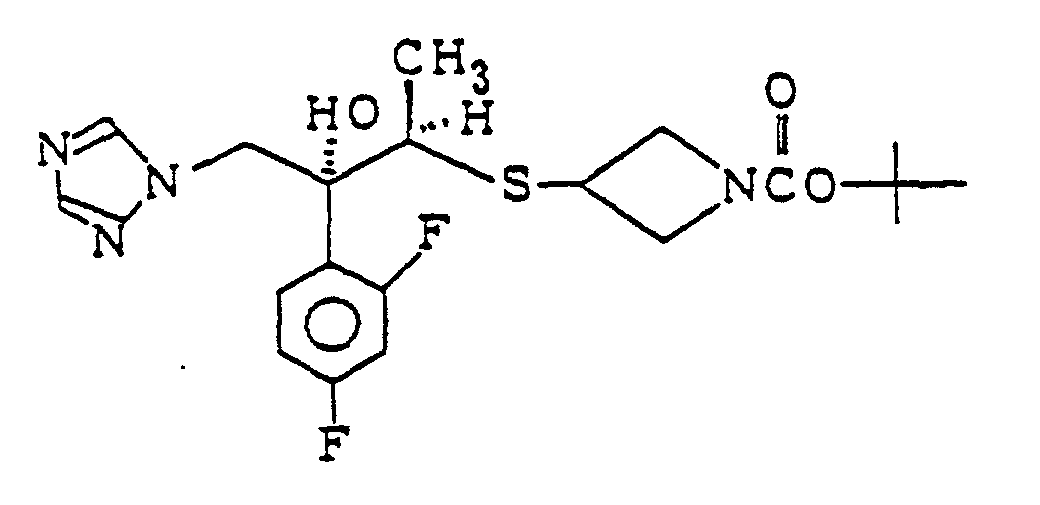
- A pale yellow foam obtained from 3-(acetylthio)-1-(tert-butoxycarbonyl)azetidine according to the procedure of Reference examples 12 and 13.
- NMR spectrum (270MHz, CDCl3) δ ppm: 1.13 (3H, d, J=7.1Hz), 1.45 (9H, s), 3.27 (1H, q, J=7.1Hz), 3.7-3.9 (2H, m), 3.9-4.0 (1H, m), 4.2-4.4 (2H, m), 4.84 (1H, d, J=14.1Hz), 4.98 (1H, s), 5.04 (1H, d, J=14.1Hz), 6.7-6.9 (2H, m), 7.3-7.4 (1H, m), 7.78 (1H, s), 7.80 (1H, s).
- IR spectrum υmax KBrcm-1: 3405, 1701.
- Mass spectrum m/e: 441, 425, 385, 367, 341, 311, 284, 252, 224, 199, 183, 165, 141, 127, 88.
-
-
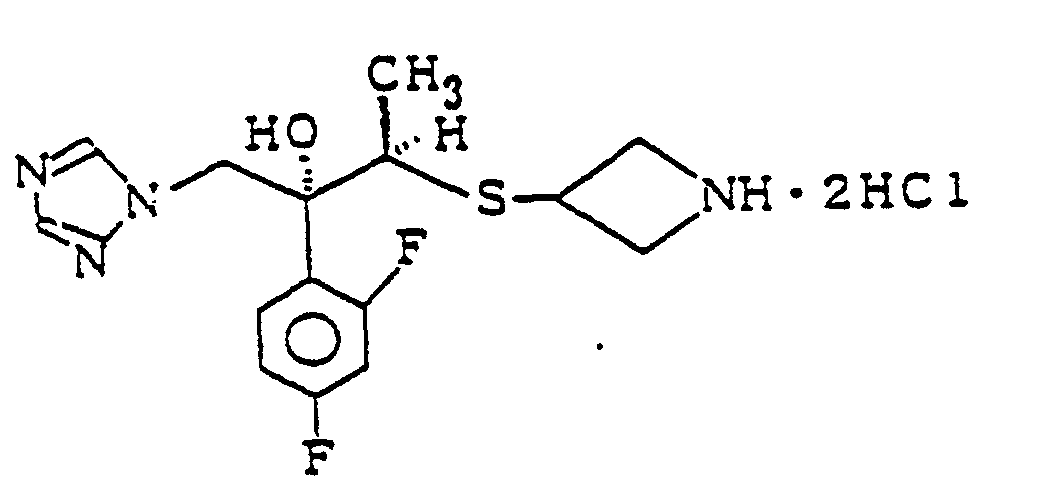
- A slightly yellow powder obtained from (2R,3R)-2-(2,4-difluorophenyl)-1-(1H-1,2,4-triazol-1-yl)-3-[[1-(tert-butoxycarbonyl)azetidin-3-yl]thio]-2-butanol according to the procedure of Reference example 14.
NMR spectrum (270MHz, CDCl3) δ ppm: 1.16 (3H, d, J=6.6Hz), 3.52 (1H, q, J=6.6Hz), 3.9-4.3 (3H, m), 4.3-4.6 (2H, m), 4.98 (1H, d, J=14.2Hz), 5.43 (1H, d, J=14.2Hz), 6.6-6.9 (2H, m), 7.2-7.4 (1H, m), 8.40 (1H, s), 8.95 (1H, s), 9.0-9.6 (1H, br). -
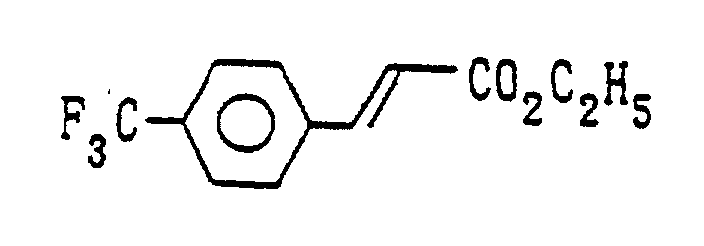
- After 903 mg (20.7 mmol) of 55% sodium hydride were washed with hexane, it was suspended in 60 ml of 1,2-dimethoxyethane, and 4.63 g (20.7 mmol) of triethyl phosphonoacetate were added dropwise thereto while the suspension was stirred at 0°C under nitrogen atmosphere. After 15 minutes, 2.00 g (11.5 mmol) of 4-(trifluoromethyl)benzaldehyde were added to the resulting mixture at the same temperature, followed by stirring of the mixture for 15 minutes. Ethyl acetate was added to the reaction mixture and the resulting mixture was washed with water. After drying, an oily residue obtained by evaporation of the solvent was subjected to column chromatography using silica gel and eluted with 4% ethyl acetate-hexane to obtain the title compound having a melting point of 31 to 32.5°C in a yield of 98%.
NMR spectrum (270MHz, CDCl3) δ ppm: 1.35 (3H, t, J=7.3Hz), 4.48 (2H, q, J=7.3Hz), 6.51 (1H, d, J=16.2Hz), 7.66 (4H, s), 7.69 (1H, d, J=16.2Hz). -

- In 15 ml of toluene were dissolved 3.00 g (12.3 mmol) of ethyl trans-4-(trifluoromethyl)cinnamate, and 16.4 ml (24.6 mmol) of a 1.5M diisobutyl aluminum hydride-toluene solution were added to the solution with stirring at 0°C. After 20 minutes, ice-water was added to the reaction mixture and the mixture was stirred for 10 minutes, followed by removal of the insolubles by filtration using Celite. The filtrate was extracted with ethyl acetate and, after drying, the solvent was distilled off to obtain a crystalline residue. The residue was recrystallized from a mixed solvent of benzene-hexane to obtain 2.36 g (yield: 96%) of the title compound having a melting point of 53 to 55°C.
NMR spectrum (270MHz, CDCl3) δ ppm: 1.55 (1H, t, J=5.9Hz), 4.37 (2H, br t), 6.46 (1H, dt, J=16.2, 5.3Hz), 6.67 (1H, d, J=16.2Hz), 7.46 (2H, d, J=8.3Hz), 7.57 (2H, d, J=8.3Hz). -

- In 30 ml of methylene chloride were dissolved 2.15 g of trans-4-(trifluoromethyl)cinnamyl alcohol, and 14 g of active manganese dioxide were added to the solution at 0°C, followed by stirring of the resulting mixture for 15 minutes and then stirring at room temperature for 2 hours. The solid was removed by filtration and the filtrate was concentrated to obtain a crystalline residue. The residue was recrystallized from a mixed solvent of benzene-hexane to obtain the title compound having a melting point of 60 to 61°C in a yield of 90%.
- NMR spectrum (270MHz, CDCl3) δ ppm: 6.78 (1H, dd, J=16.2, 7.3Hz), 7.53 (1H, d, J=16.2Hz), 7.69 (4H, s), 9.76 (1H, d, J=7.3Hz).
- IR spectrum υmax (KBr) cm-1: 1680, 1630, 1321, 1173, 1123, 1066.
- Mass spectrum m/e: 200 (M+), 199, 171, 151, 145, 131 (100%), 103, 102.
-
-

- After 4.51 g (103 mmol) of 55% sodium hydride were washed with hexane, it was suspended in 70 ml of 1,2-dimethoxyethane, and 25.9 g (103 mmol) of triethyl phosphonocrotonate were added dropwise thereto while the suspension was stirred at 0°C under nitrogen atmosphere. After 15 minutes, 10.0 g (57.4 mmol) of 4-(trifluoromethyl)benzaldehyde was added to the resulting mixture at the same temperature and the mixture was stirred for 10 minutes. The reaction mixture was poured in ice-water, followed by extraction with ethyl acetate. The oily residue obtained by evaporation of the solvent was subjected to column chromatography using silica gel and eluted with 6% ethyl acetate-hexane to obtain 11.2 g (yield: 72%) of the title compound as an oil.
NMR spectrum (270MHz, CDCl3) δ ppm: 1.32 (3H, t, J=7.3Hz), 4.24 (2H, q, J=7.3Hz), 6.05 (1H, d, J=15.2Hz), 6.85-7.0 (2H, m), 7.44 (1H, ddd, J=15.2, 7.9, 2.6Hz), 7.55 (2H, d, J=8.6Hz), 7.61 (2H, d, J=8.6Hz). -

- Ethyl (2E,4E)-5-[4-(trifluoromethyl)phenyl]-2,4-pentadienoate was treated with diisobutyl aluminum hydride in the same manner as in Reference example 21 to obtain the title compound in quantitative yield.
NMR spectrum (270MHz, CDCl3) δ ppm: 1.47 (1H, t, J=5.9Hz), 4.28 (2H, t, J=5.9Hz), 6.04 (1H, dt, J=15.2, 5.9Hz), 6.45 (1H, dd, J=15.2, 10.6Hz), 6.57 (1H, d, J=15.8Hz), 6.87 (1H, dd, J=15.8, 10.6Hz), 7.47 (2H, d, J=8.6Hz), 7.56 (2H, d, J =8.6Hz). -

- (2E,4E)-5-[4-(Trifluoromethyl)phenyl]-2,4-pentadien-1-ol was treated with active manganese dioxide in the same manner as in Reference example 22 to obtain the title compound in a yield of 92%.
NMR spectrum (270MHz, CDCl3) δ ppm: 6.33 (1H, dd, J=15.2, 7.3Hz), 7.0-7.35 (3H, m), 7.60 (2H, d, J=8.6Hz), 7.64 (2H, d, J=8.6Hz), 9.65 (1H, d, J=7.3Hz). -

- (2E,4E)-5-[4-(Trifluoromethyl)phenyl]-2,4-pentadienal was reacted with triethyl phosphonoacetate in the same manner as in Reference example 20 to obtain the title compound in a yield of 95%.
NMR spectrum (270MHz, CDCl3) δ ppm: 1.31 (3H, t, J=7.3Hz), 4.23 (2H, q, J=7.3Hz), 5.96 (1H, d, J=15.2Hz), 6.49 (1H, dd, J=15.2, 11.2Hz), 6.72 (1H, dd, J=15.2, 10.6Hz), 6.73 (1H, d, J=15.8Hz), 6.94 (1H, dd, J=15.8, 10.6Hz), 7.37 (1H, dd, J=15.2, 11.2Hz), 7.51 (2H, d, J=8.6Hz), 7.58 (2H, d, J=8.6Hz). -

- Ethyl (2E,4E,6E)-7-[4-(trifluoromethyl)phenyl]-2,4,6-heptatrienoate was treated with diisobutyl aluminum hydride in the same manner as in Reference example 21 to obtain the title compound in a yield of 90%.
NMR spectrum (270MHz, CDCl3) δ ppm: 1.41 (1H, t, J=5.3Hz), 4.25 (2H, t, J=5.3Hz), 5.95 (1H, dt, J=15.0, 5.3Hz), 6.3-6.5 (3H, m), 6.57 (1H, d, J=15.2Hz), 6.90 (1H, m), 7.47 (2H, d, J=8.6Hz), 7.55 (2H, d, J=8.6Hz). -

- (2E,4E,6E) -7-[4-(Trifluoromethyl)phenyl]-2,4,6-heptatrien-1-ol was treated with active manganese dioxide in the same manner as in Reference example 22 to obtain the title compound in a yield of 88%.
NMR spectrum (270MHz, CDCl3) δ ppm: 6.23 (1H, dd, J=15.2, 7.9Hz), 6.62 (1H, dd, J=14.5, 11.2Hz), 6.82 (1H, d, J=15.8Hz), 6.84 (1H, dd, J=14.5, 9.9Hz), 6.98 (1H, dd, J=15.8, 9.9Hz), 7.19 (1H, dd, J=15.2, 11.2Hz), 7.54 (2H, d, J=8.6Hz), 7.61 (2H, d, J=8.6Hz), 9.62 (1H, d, J=7.9Hz). -
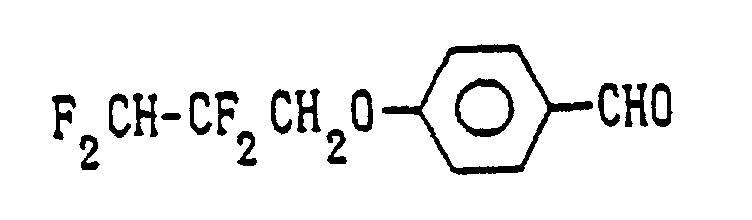
- After 1.90 g (43.5 mmol) of 55% sodium hydride were washed with hexane, it was suspended in 25 ml of N,N-dimethylacetamide and 5.3 g (43 mmol) of 4-hydroxybenzaldehyde were gradually added to the suspension at 0°C under nitrogen atmosphere. When generation of hydrogen gas stopped, 11.14 g (39 mmol) of 2,2,3,3-tetrafluoropropyl p-toluenesulfonate were added to the reaction mixture, followed by heating of the resulting mixture at 120°C with stirring for 2 hours and 15 minutes. After the reaction mixture was cooled, a mixed solvent of benzene-hexane (1:1) was added thereto and the resulting mixture was washed with water. After drying, the solvent was distilled off to obtain 8.85 g (yield: 96%) of the title compound as an oil.
NMR spectrum (270MHz, CDCl3) δ ppm: 4.45 (2H, br t, J=11.9Hz), 6.06 (1H, tt, J=53.3, 4.6Hz), 7.06 (2H, d, J=8.7Hz), 7.88 (2H, d, J=8.7Hz), 9.93 (1H, s). -

- 4-(2,2,3,3-Tetrafluoropropoxy)benzaldehyde and triethyl phosphonocrotonate were reacted in the same manner as in Reference example 23 to obtain the title compound having a melting point of 65 to 66°C in a yield of 74%.
NMR spectrum (270MHz, CDCl3) δ ppm: 1.31 (3H, t, J=7.3Hz), 4.23 (2H, q, J=7.3Hz), 4.37 (2H, br t, J=11.9Hz), 5.95 (1H, d, J=15.2Hz), 6.06 (1H, tt, J=53.5, 4.6Hz), 6.77 (1H, dd, J=15.2, 9.9Hz), 6.86 (1H, d, J=15.2Hz), 6.91 (2H, d, J=8.6Hz), 7.42 (1H, dd, J=15.2, 9.9Hz), 7.44 (2H, d, J=8.6Hz). -
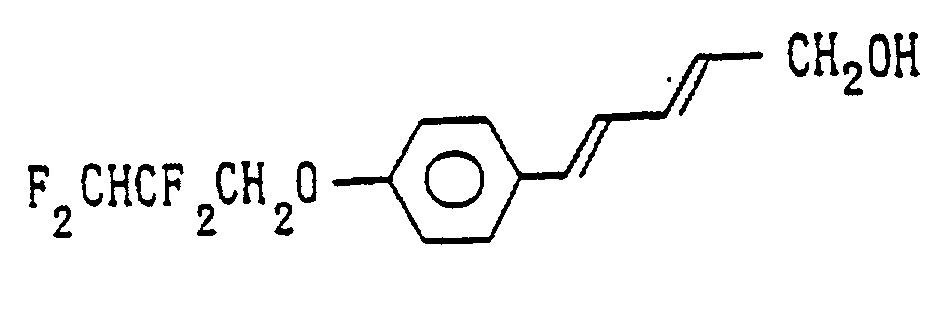
- Ethyl (2E,4E)-5-[4-(2,2,3,3-tetrafluoropropoxy)phenyl]-2,4-pentadienoate was treated with diisobutyl aluminum hydride in the same manner as in Reference example 21 to obtain the title compound having a melting point of 95 to 97°C in a yield of 95%.
NMR spectrum (270MHz, CDCl3) δ ppm: 1.39 (1H, t, J=~5Hz), 4.25 (2H, t, J=5.9Hz), 4.34 (2H, br t, J=11.9Hz), 5.94 (1H, dt, J=15.1, 5.9Hz), 6.06 (1H, tt, J=53.2, 4.8Hz), 6.40 (1H, dd, J=15.1, 10.3Hz), 6.50 (1H, d, J=15.5Hz), 6.69 (1H, dd, J=15.5, 10.3Hz), 6.88 (2H, d, J=8.7Hz), 7.36 (2H, d, J=8.7Hz). - Ethyl (2E,4E)-5-[4-(2,2,3,3-tetrafluoropropoxy)phenyl]-2,4-pentadien-1-ol was treated with active manganese dioxide in the same manner as in Reference example 22 to obtain the title compound having a melting point of 53 to 55°C in a yield of 96%.
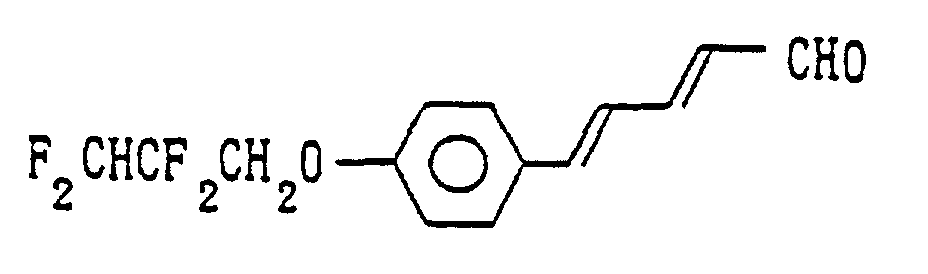
NMR spectrum (270MHz, CDCl3) δ ppm: 4.38 (2H, br t, J=11.9Hz), 6.06 (1H, tt, J=52.8, 4.6Hz), 6.25 (1H, dd, J=15.2, 7.9Hz), 6.90 (1H, dd, J=15.8, 9.2Hz), 6.94 (2H, d, J=8.6Hz), 6.97 (1H, d, J=15.8Hz), 7.25 (1H, dd, J=15.2, 9.2Hz), 7.48 (2H, d, J=8.6Hz), 9.61 (1H, d, J=7.9Hz). -

- 570 mg (3.0 mmol) of 4-(trifluoromethoxy)benzaldehyde and 913 mg (3.0 mmol) of (triphenylphosphoranylidene)acetaldehyde were heated under reflux in 7.5 ml of toluene under nitrogen atmosphere for 1 hour and 45 minutes. The toluene was distilled off under reduced pressure and the thus obtained residue was purified over column chromatography using 20 g of silica gel. The fractions eluted with a mixed solvent of acetic acid-hexane (1:10) were collected to obtain 387 mg (yield: 60%) of the title compound as an oil.
- NMR spectrum (270MHz, CDCl3) δ ppm: 6.70 (1H, dd, J=15.8, 7.3Hz), 7.29 (2H, d, J=8.6Hz), 7.47 (1H, d, J=15.8Hz), 7.61 (2H, d, J=8.6Hz), 9.72 (1H, d, J=7.3Hz).
- IR spectrum υmax (CHCl3) cm-1: 1680, 1508, 1259.
- Mass spectrum m/e: 216 (M+), 215, 187, 175, 162, 131(100%), 119, 101.
-
-

- After 840 mg (19.3 mmol) of 55% sodium hydride were washed with hexane, it was suspended in 40 ml of dimethylformamide, and 3.00 g (22.7 mmol) of 2,2,3,3-tetrafluoropropanol were gradually added to the suspension at 0°C under a nitrogen atmosphere. When generation of hydrogen gas stopped, a solution in which 3.40 g (18.3 mmol) of ethyl 6-chloronicotinate was dissolved in 15 ml of dimethylformamide was added dropwise to the resulting mixture at the same temperature for about 30 minutes. After the dropwise addition, the mixture was stirred for 30 minutes and the reaction mixture was poured into ice-water, followed by extraction with benzene. After the extract was dried, the solvent was distilled off and the thus obtained oil was purified over column chromatography [eluted with a mixed solvent of benzene-hexane (1:1)] using silica gel to obtain 4.42 g (yield: 86%) of the title compound as an oil.
- NMR spectrum (270MHz, CDCl3) δ ppm: 1.40 (3H, t, J=7.2Hz), 4.39 (2H, q, J=7.2Hz), 4.81 (2H, br t, J=12.6Hz), 6.00 (1H, tt, J=53.0, 4.6Hz), 6.87 (1H, d, J=8.6Hz), 8.24 (1H, dd, J=8.6, 2.5Hz), 8.83 (1H, d, J=2.5Hz).
- IR spectrum υmax (CHCl3) cm-1: 1717, 1604, 1280, 1119.
- Mass spectrum m/e: 281 (M+), 236(100%), 180, 152, 151, 123, 122, 93.
-
-
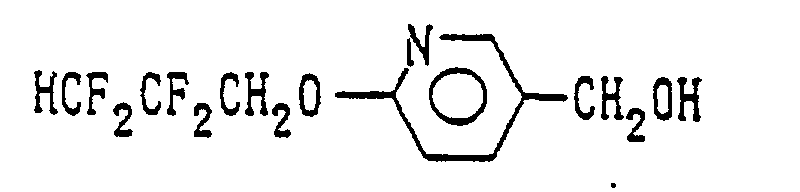
- Ethyl 6-(2,2,3,3-tetrafluoropropoxy)nicotinate was reduced with diisobutyl aluminum hydride in the same manner as in Reference example 21 to obtain the title compound as an oil in a yield of 100%.
- NMR spectrum (270MHz, CDCl3) δ ppm: 1.69 (1H, t, J=5.8Hz), 4.66 (2H, d, J=5.8Hz), 4.74 (2H, br t, J=12.8Hz), 6.01 (1H, tt, J=53.1, 4.6Hz), 6.84 (1H, d, J=8.5Hz), 7.69 (1H, dd, J=8.5, 2.5Hz), 8.12 (1H, d, J=2.5Hz).
- Mass spectrum m/e: 239 (M+), 210, 188, 168, 138(100%), 109, 108, 78.
-
-
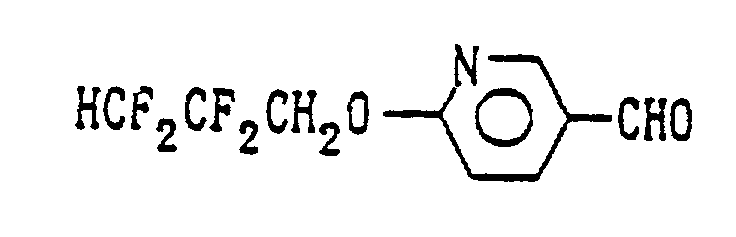
- 2-(2,2,3,3-Tetrafluoropropoxy)-5-(hydroxymethyl)pyridine was treated with active manganese dioxide in the same manner as in Reference example 22 to obtain the title compound as an oil in a yield of 96%.
- NMR spectrum (270MHz, CDCl3) δ ppm: 4.86 (2H, br t, J=12.8Hz), 6.01 (1H, tt, J=53.3, 4.4Hz), 6.97 (1H, d, J=8.6Hz), 8.15 (1H, dd, J=8.6, 2.3Hz), 8.65 (1H, d, J=2.3Hz).
- Mass spectrum m/e: 237 (M+), 186, 166, 136(100%), 107, 106, 78.
-
-
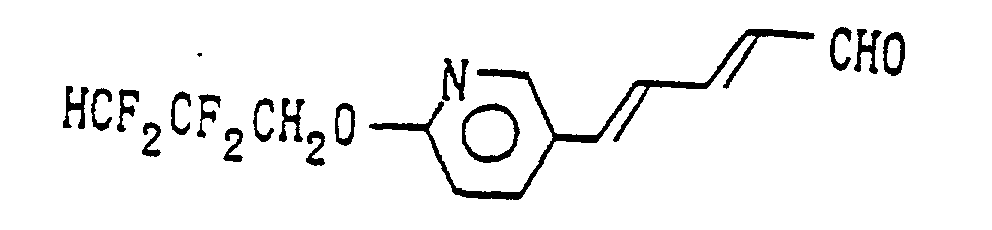
- Following Reference examples 23, 24 and 25, the title compound having a melting point of 88 to 89°C was obtained from 6-(2,2,3,3-tetrafluoropropoxy)nicotinaldehyde in 3 steps.
- NMR spectrum (270MHz, CDCl3) δ ppm: 4.78 (2H, br t, J=12.6Hz), 6.01 (1H, tt, J=53.3, 4.5Hz), 6.28 (1H, dd, J=15.2, 7.9Hz), 6.87 (1H, d, J=8.7Hz), 6.85-7.0 (2H, m), 7.25 (1H, ddd, J=15.2, 7.8, 2.5Hz), 7.85 (1H, dd, J=8.7, 2.5Hz), 8.23 (1H, d, J=2.5Hz), 9.63 (1H, d, J=7.9Hz).
- IR spectrum υmax (CHCl3) cm-1: 1677, 1626, 1591, 1488, 1290, 1120.
- Mass spectrum m/e: 289 (M+), 260, 188, 178, 160, 145, 128, 117, 81, 69(100%).
-
-

- Following Reference examples 23, 24 and 25, the title compound was obtained as an oil from 6-chloronicotinaldehyde in 3 steps.
NMR spectrum (270MHz, CDCl3) δ ppm: 6.32 (1H, dd, J=15.2, 7.8Hz), 6.96 (1H, d, J=15.4Hz), 7.05 (1H, dd, J=15.4, 9.8Hz), 7.26 (1H, dd, J=15.2, 9.8Hz), 7.36 (1H, d, J=8.3Hz), 7.80 (1H, dd, J=8.3, 2.5Hz), 8.48 (1H, d, J=2.5Hz), 9.66 (1H, d, J=7.8Hz). -
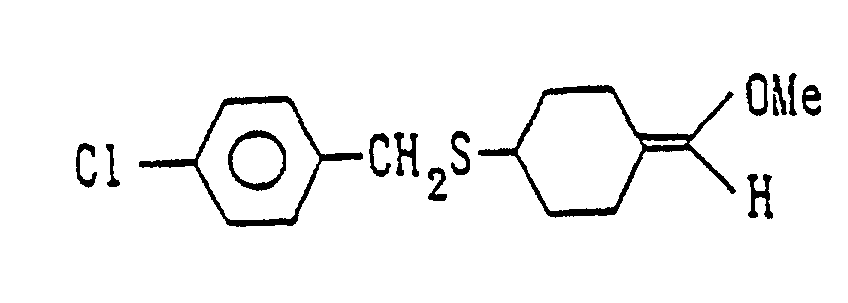
- After 146 mg (3.34 mmol) of 55% sodium hydride were washed with hexane, it was suspended in 18 ml of dimethyl sulfoxide, followed by stirring of the resulting suspension at 55°C for 2 hours. The mixture was cooled to room temperature and 1.26 g (3.34 mmol) of methoxymethyltriphenylphosphonium chloride were added to the mixture. Further, a solution in which 426 mg (1.67 mmol) of 4-[(4-chlorobenzyl)thio]cyclohexanone were dissolved in 5 ml of dimethyl sulfoxide was added to the resulting mixture. Water was added to the mixture and the resulting mixture was extracted with toluene. After the extract was dried, the crude product obtained by evaporation of the solvent was subjected to column chromatography using 20 g of silica gel and eluted with a mixed solvent of methylene chloride-hexane (1:4) to obtain 370 mg (yield: 78%) of the title compound as an oil.
- NMR spectrum (270MHz, CDCl3) δ ppm: 1.2-1.5 (2H, m), 1.7-2.0 (3H, m), 2.0-2.2 (1H, m), 2.5-2.8 (2H, m), 3.53 (3H, s), 3.71 (2H, s), 5.77 (1H, s), 7.27 (4H, s).
- IR spectrum υmax (CHCl3) cm-1: 2935, 1689, 1491, 1443, 1123.
- Mass spectrum m/e: 282, 157, 124, 109.
-
-
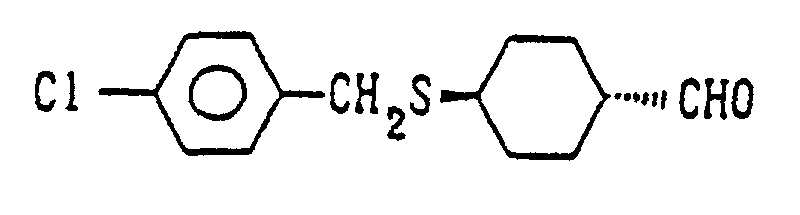
- In 20 ml of acetone were dissolved 955 mg (3.4 mmol) of [4-[(4-chlorobenzyl)thio]cyclohexylidene]methyl methyl ether, and 5 ml of water were added to the solution, followed by addition of 1 ml of 5N hydrochloric acid. The mixture was stirred at 55°C for 20 minutes. The mixture was concentrated under reduced pressure and the residue was extracted with ethyl acetate. After the extract was dried, the crude product obtained by evaporation of the solvent was subjected to column chromatography using 15 g of silica gel and eluted with a mixed solvent of methylene chloride-hexane (1:3) to obtain 865 mg (yield: 95%) of a 1:1 mixture of a trans isomer, the title compound, and a cis isomer as an oil.
- This product was stirred in 15 ml of a 0.07N sodium methoxide-methanol solution at room temperature for 2 to 3 hours. To the mixture was added 0.2 ml of acetic acid, and the resulting mixture was diluted with ethyl acetate and washed with an aqueous NaCl solution. After the mixture was dried, the solvent was distilled off to obtain 865 mg of a 4:1 mixture of the title trans form and a cis form as a solid. The solid was recrystallized from a mixed solvent of etherhexane to obtain 220 mg of the trans form title compound having a melting point of 44 to 46°C.
- NMR spectrum (270MHz, CDCl3) δ ppm: 1.2-1.5 (4H, m), 1.9-2.15 (2H, m), 2.15-2.35 (1H, m), 2.35-2.55 (1H, m), 3.73 (2H, s), 7.27 (5H, s), 9.61 (1H, s).
- Cis isomer exhibited a signal at δ 3.67 (2H, s) and δ 9.64 (1H, s).
- IR spectrum υmax (CHCl3) cm-1: 2927, 1732, 1493, 1448, 1092.
- Mass spectrum m/e: 268, 240, 127, 125, 110.
-
-

- After 50 mg (1.14 mmol) of 55% sodium hydride were washed with hexane, it was suspended in 7 ml of dimethyl sulfoxide, followed by stirring of the suspension at 55°C for 2.5 hours. The mixture was cooled to room temperature and 607 mg (1.26 mmol) of [(E)-4-(trifluoromethyl)cinnamyl]triphenylphosphonium chloride were added thereto. Further, 170 mg (0.63 mmol) of trans-4-[(4-chlorobenzyl)thio]cyclohexanecarboxaldehyde were added to the resulting mixture, followed by stirring of the mixture at room temperature for 15 minutes. The mixture was diluted with toluene and washed with water and an aqueous NaCl solution. After the mixture was dried, the crude product obtained by evaporation of the solvent was subjected to column chromatography using 5 g of silica gel and eluted with a mixed solvent of methylene chloride-hexane (1:2). The eluted portion was recrystallized from hexane to obtain 86 mg (yield: 31%) of the title compound having a melting point of 142 to 144°C.
- NMR spectrum (270MHz, CDCl3) δ ppm: 1.1-1.3 (2H, m), 1.3-1.5 (2H, m), 1.7-2.0 (2H, m), 2.0-2.2 (2H, m), 2.64 (1H, tt, J=12.4Hz), 3.74 (2H, s), 5.81 (1H, dd, J=15, 7Hz), 6.20 (1H, dd, J=15, 10Hz), 6.47 (1H, d, J=16Hz), 6.81 (1H, dd, J=16, 10Hz), 7.29 (4H, s), 7.46 (2H, d, J=8Hz), 7.55 (2H, d, J=8Hz).
- IR spectrum υmax (KBr) cm-1: 1641, 1612, 1490, 1326, 1167, 1127, 1069.
- Mass spectrum m/e: 436, 417, 403, 311, 277, 235, 159, 125.
-
-
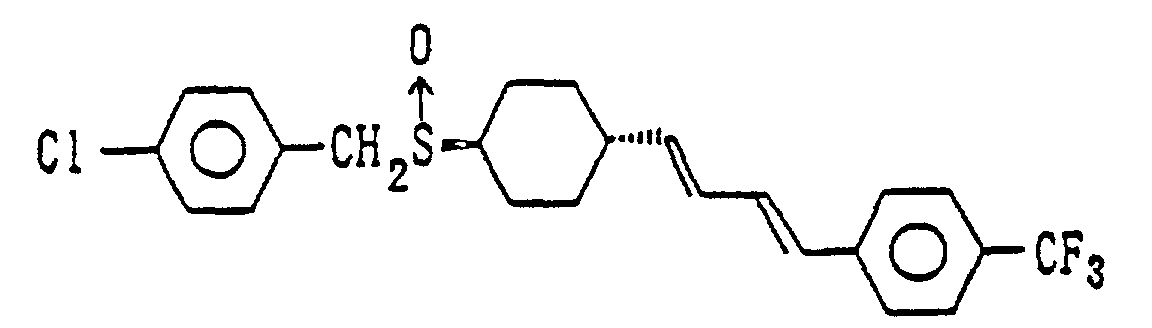
- In 20 ml of methylene chloride were dissolved 211 mg (0.48 mmol) of 4-chlorobenzyl trans-4-[(1E,3E)-4-[4-(trifluoromethyl)phenyl]-1,3-butadienyl]cyclohexyl sulfide, and 104 mg (0.48 mmol) of m-chloroperbenzoic acid (purity: 80%) were added to the solution at 0°C, followed by stirring of the resulting mixture for 5 minutes. An aqueous sodium sulfite solution and ethyl acetate were added to the reaction mixture and the organic layer was washed with an aqueous sodium hydrogencarbonate solution and an aqueous NaCl solution. After the mixture was dried, the crude product obtained by evaporation of the solvent was recrystallized from a mixed solvent of ethyl acetate-hexane to obtain 168 mg (yield: 77%) of the title compound having a melting point of 212 to 214°C.
- NMR spectrum (270MHz, CDCl3) δ ppm: 1.1-1.3 (2H, m), 1.5-1.8 (2H, m), 1.9-2.3 (5H, m), 2.42 (1H, tt, J=12, 4Hz), 3.87 (1H, d, J=13Hz), 3.97 (1H, d, J=13Hz), 5.80 (1H, dd, J=15, 7Hz), 6.22 (1H, dd, J=15, 10Hz), 6.48 (1H, d, J=16Hz), 6.80 (1H, dd, J=16, 10Hz), 7.25 (2H, d, J=8Hz), 7.36 (2H, d, J=8Hz), 7.45 (2H, d, J=8Hz), 7.55 (2H, d, J=8Hz).
- IR spectrum υmax (KBr) cm-1: 1612, 1492, 1325, 1168, 1128, 1069.
- Mass spectrum m/e: 452, 436, 327, 278, 277, 159, 125.
-
-
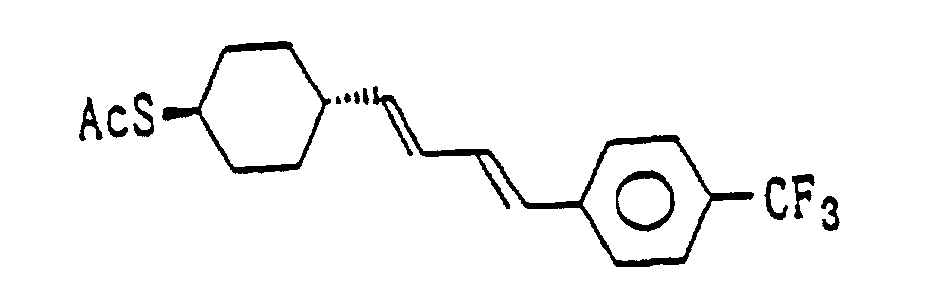
- In 11 ml of a mixed solvent of tetrahydrofuran-acetonitrile (8:3) were dissolved 178 mg (0.39 mmol) of 4-chlorobenzyl trans-4-[(1E,3E)-4-[4-(trifluoromethyl)phenyl]-1,3-butadienyl]cyclohexyl sulfoxide, and 168 mg (1.57 mmol) of 2,6-lutidine were added to the solution. To the mixture were added 165 mg (0.79 mmol) of trifluoroacetic anhydride with stirring at 0°C. After 3 minutes, an aqueous sodium hydrogencarbonate solution was added to the mixture, followed by extraction with ethyl acetate. The oily residue obtained by evaporation of the solvent was dissolved in 10 ml of methylene chloride, and 119 mg (1.17 mmol) of triethylamine were added to the mixture at 0°C, followed by addition of 62 mg (0.79 mmol) of acetyl chloride to the resulting mixture. After 1 hour, the reaction mixture was diluted with ethyl acetate and washed with an aqueous sodium hydrogencarbonate solution and an aqueous NaCl solution. After the mixture was dried, the crude product obtained by evaporation of the solvent was subjected to column chromatography using 5 g of silica gel and eluted with a mixed solvent of methylene chloride-hexane (1:1), followed by purification over Rover column [GrosseB, a mixed solvent of ethyl acetate-hexane (1:19)] to obtain 98 mg (yield: 70%) of the title compound having a melting point of 113 to 115°C.
- NMR spectrum (270MHz, CDCl3) δ ppm: 1.2-1.5 (4H, m), 1.7-1.9 (2H, m), 2.0-2.2 (3H, m), 2.31 (3H, s), 3.37 (1H, tt, J=12, 4Hz), 5.82 (1H, dd, J=15, 7Hz), 6.20 (1H, dd, J=15, 10Hz), 6.47 (1H, d, J=16Hz), 6.81 (1H, dd, J=16, 10Hz), 7.45 (2H, d, J=8Hz), 7.54 (2H, d, J=8Hz).
- IR spectrum υmax (KBr) cm-1: 1688, 1613, 1326, 1157, 1117, 1068.
- Mass spectrum m/e: 354, 335, 311, 277, 235, 159.
-
-

- In 50 ml of diethylamine were dissolved 5.0 g (22 mmol) of 4-bromo-α,α,α-trifluorotoluene and 1.25 g (22 mmol) of propargyl alcohol, and 80 mg (0.11 mmol) of bis(triphenylphosphine)palladium (II) chloride and 40 mg (0.22 mmol) of copper (I) iodide were added to the solution, followed by stirring of the resulting mixture at 50°C for 35 minutes. To the mixture were added 40 mg (0.06 mmol) of bis(triphenylphosphine)palladium (II) chloride, and the resulting mixture was stirred for a further 35 minutes. After the mixture was cooled to room temperature, it was diluted with benzene and filtered, and then the filtrate was washed with water. After the mixture was dried, the crude product obtained by evaporation of the solvent was subjected to column chromatography using 50 g of silica gel and eluted with a mixed solvent of ethyl acetate-hexane (3:17) to obtain 2.21 g (yield: 50%) of the title compound as an oil.
- NMR spectrum (270MHz, CDCl3) δ ppm: 1.8 (1H, br, OH), 4.52 (2H, s), 7.54 (2H, d, J=9Hz), 7.57 (2H, d, J=9Hz).
- IR spectrum υmax (CHCl3) cm-1: 3610, 1618, 1324, 1172, 1133, 1069, 1019, 844.
- Mass spectrum m/e: 200, 183, 171, 151, 131.
-
-
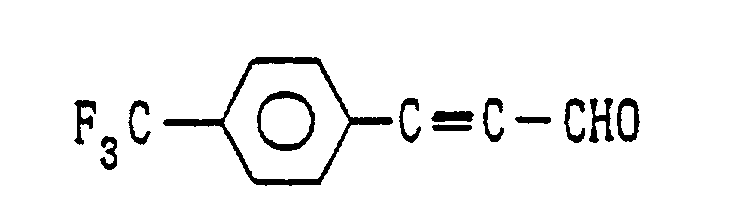
- In 20 ml of methylene chloride were dissolved 2.21 g (11.0 mmol) of 3-[4-(trifluoromethyl)phenyl]-2-propyn-1-ol, and 7.43 g (17.5 mmol) of Dess-Martin reagent were added to the solution under ice-cooling for 1.7 hours. Benzene was added to the resulting mixture and the insolubles were removed by filtration, followed by concentration of the filtrate to obtain 1.83 g (yield: 84%) of the title compound as an oil.
- NMR spectrum (270MHz, CDCl3) δ ppm: 7.68 (2H, d, J=9Hz), 7.71 (2H, d, J=9Hz), 9.45 (1H, s).
- IR spectrum υmax (CHCl3) cm-1: 2197, 1664, 1324, 1175, 1138.
- Mass spectrum m/e: 198, 197, 170, 151, 120.
-
-

- After 181 mg (4.54 mmol) of 55% sodium hydride were washed with hexane, it was suspended in 10 ml of 1,2-dimethoxyethane, and 1.02 g (4.54 mmol) of triethyl 4-phosphonoacetate were added to the suspension with stirring at 0°C under nitrogen atmosphere. After 20 minutes, 500 mg (2.52 mmol) of 3-[4-(trifluoromethyl)phenyl]-2-propynal were added to the mixture, followed by stirring of the resulting mixture for 20 minutes. The reaction mixture was diluted with ethyl acetate, ice was added to the mixture and then the organic layer was washed with water. The crude product obtained by distilling off the solvent was subjected to column chromatography using 15 g of silica gel and eluted with benzene to obtain 488 mg (yield: 72%) of the title compound as an oil.
- NMR spectrum (270MHz, CDCl3) δ ppm: 1.32 (3H, t, J=7Hz), 4.25 (2H, q, J=7Hz), 6.35 (1H, d, J=16Hz), 6.97 (1H, d, J=16Hz), 7.5-7.7 (4H, m).
- IR spectrum υmax (CHCl3) cm-1: 1712, 1622, 1316, 1174, 1134.
- Mass spectrum m/e: 268, 240, 223, 195, 183, 175.
-
-

- In 4 ml of toluene were dissolved 480 mg (1.79 mmol) of ethyl (E)-5-[4-(trifluoromethyl)phenyl]-2-penten-4-ynoate, and 2.38 ml (3.58 mmol) of a 1.5M diisobutyl aluminum hydride-toluene solution were added to the solution with stirring at 0°C. After 10 minutes, ice was added to the mixture and the insolubles were removed by filtration using Celite. After the organic layer was dried, the crude product obtained by evaporation of the solvent was subjected to column chromatography using 15 g of silica gel and eluted with a mixed solvent of ethyl acetate-hexane (3:17) to obtain 353 mg (yield: 87%) of the title compound as an oil.
NMR spectrum (270MHz, CDCl3) δ ppm: 1.60 (1H, br, OH), 4.31 (2H, br), 5.99 (1H, d, J=16Hz), 6.40 (1H, dt, J=16, 5Hz), 7.54 (2H, d, J=9Hz), 7.57 (2H, d, J=9Hz). -

- In 4 ml of methylene chloride were dissolved 350 mg (1.56 mmol) of (E)-5-[4-(trifluoromethyl)phenyl]-2-penten-4-yn-1-ol, and 3.5 g of active manganese dioxide were added to the solution, followed by stirring of the resulting mixture at room temperature for 30 minutes. The solid was removed by filtration and the filtrate was concentrated. Then, the filtrate was subjected to column chromatography using 10 g of silica gel and eluted with a mixed solvent of ethyl acetate-hexane (1:24) to obtain 245 mg (yield: 70%) of the title compound as an oil.
- NMR spectrum (270MHz, CDCl3) δ ppm: 6.58 (1H, dd, J=16, 8Hz), 6.82 (1H, d, J=16Hz), 7.63 (4H, s), 9.65 (1H, d, J=8Hz).
- IR spectrum υmax (CHCl3) cm-1: 1670, 1325, 1132, 1119, 1107, 1072, 845.
- Mass spectrum m/e: 224, 196, 195, 175, 170, 146.
-
-

- In 10 ml of tetrahydrofuran were dissolved 150 mg (0.47 mmol) of bis(2,2,2-trifluoroethyl) (methoxycarbonylmethyl)phosphonate, and 0.94 ml (0.47 mmol) of a 0.5M potassium hexamethyldisilazide-toluene solution were added dropwise to the mixture with stirring at -78°C under nitrogen atmosphere. Then, 622 mg (2.36 mmol) of 18-crown-6 were added to the mixture and the resulting mixture was stirred for 20 minutes, followed by addition of a solution in which 98 mg (0.47 mmol) of 4'-chloro-2,2,2-trifluoroacetophenone were dissolved in 1 ml of tetrahydrofuran. The temperature of the reaction mixture was slowly elevated to room temperature and a saturated aqueous ammonium chloride solution was added to the mixture, followed by extraction with ethyl acetate. The crude product obtained by evaporation of the solvent was purified over column chromatography (eluted with 4% ethyl acetate-hexane) using silica gel to obtain 89 mg (yield: 70%, containing about 1/10 of (E)-isomer) of the title compound as an oil.
NMR spectrum (270MHz, CDCl3) δ ppm: 3.85 (3H, s), 6.34 (1H, s), 7.34 (2H, d, J=8.6Hz), 7.39 (2H, d, J=8.6Hz). -
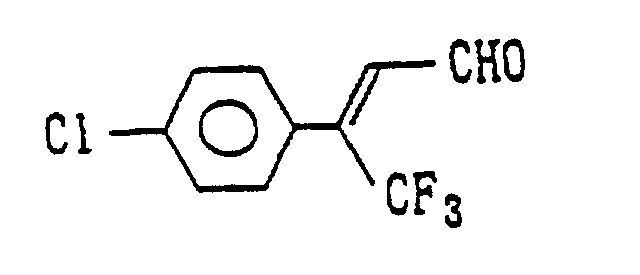
- Following Reference examples 21 and 22, the title compound was obtained as an oil in a yield of 81% from methyl (Z)-4-chloro-β-(trifluoromethyl)cinnamate in 2 steps.
NMR spectrum (270MHz, CDCl3) δ ppm: 6.36 (1H, d, J=7.3Hz), 7.38 (2H, d, J=8.6Hz), 7.44 (2H, d, J=8.6Hz), 10.21 (1H, dq, J=7.3, 2.0Hz). -

- (Z)-4-Chloro-β-(trifluoromethyl)cinnamaldehyde and trimethyl phosphonocrotonate were reacted in the same manner as in Reference example 23 to obtain the title compound as an oil in a yield of about 90% (separation and purification by column chromatography).
NMR spectrum (270MHz, CDCl3) δ ppm: 3.81 (3H, s), 6.15 (1H, d, J=15.2Hz), 6.59 (1H, d, J=11.9Hz), 7.31 (2H, d, J=8.6Hz), 7.38 (1H, d, J=8.6Hz), 7.78 (1H, ddq, J=15.2, 11.9, 2.0Hz). -
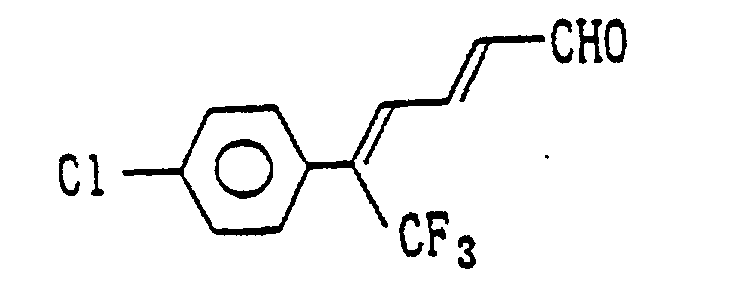
- Following Reference examples 21 and 22, the title compound was obtained as an oil in a yield of 71% from methyl (2E,4Z)-5-(4-chlorophenyl)-6,6,6-trifluoro-2,4-hexadienoate in 2 steps.
NMR spectrum (270MHz, CDCl3) δ ppm: 6.37 (1H, dd, J=15.2, 7.3Hz), 6.72 (1H, d, J=11.9Hz), 7.33 (2H, d, J=8.6Hz), 7.40 (2H, d, J=8.6Hz), 7.64 (1H, ddq, J=15.2, 11.9, 2Hz), 9.74 (1H, d, J=7.3Hz). -

- In 3.8 ml of dimethylformamide were dissolved 619 mg (2.10 mmol) of 2-bromo-2-methyl-4'-(trifluoromethyl)propiophenone, and 0.44 ml (2.10 mmol) of a 28% sodium methoxide-methanol solution were added to the solution with stirring at room temperature under nitrogen atmosphere. After 30 minutes, water was added to the reaction mixture and the resulting mixture was extracted with ethyl acetate. The solvent was evaporated to obtain 860 mg (yield: ~100%) of the title compound as a solid.
NMR spectrum (270MHz, CDCl3) δ ppm: 1.61 (6H, s), 4.42 (1H, tt, J=11.6, 5.0Hz), 3.64 (2H, t, J=11.6Hz), 4.12 (2H, dd, J=11.6, 5.0Hz), 5.38 (1H, s), 7.3-7.5 (5H, m), 7.68 (2H, d, J=8.2Hz), 8.19 (2H, d, J=8.2Hz). -

- 680 mg (1.66 mmol) of 2-methyl-2-[(trans-2-phenyl-1,3-dioxan-5-yl) thio]-4'-(trifluoromethyl)propiophenone, 547 mg (2.49 mmol) of trimethylsulfoxonium iodide, 381 mg (6.79 mmol) of potassium hydroxide and 264 mg (3.82 mmol) of 1,2,4-triazole were heated with stirring in 5.7 ml of t-butanol at 80°C for 6 hours. After cooling, the reaction mixture was distributed between chloroform and water and the chloroform layer was separated and dried, followed by evaporation of the solvent. The thus obtained oil was subjected to column chromatography using silica gel and eluted with a mixed solvent of ethyl acetate-hexane (1:1) to obtain 605 mg (yield: 74%) of the title compound as a foam.
NMR spectrum (270MHz, CDCl3) δ ppm: 1.38 (3H, s), 1.39 (3H, s), 3.55-3.8 (3H, m), 4.33 (1H, m), 4.54 (1H, m), 5.02 (2H, s), 5.37 (1H, s), 5.44 (1H, s), 7.3-7.6 (5H, m), 7.73 (1H, s), 7.94 (1H, s). -

- (RS)-3-Methyl-3-[(trans-2-phenyl-1,3-dioxan-5-yl)thio]-1-(1H-1,2,4-triazol-1-yl)-2-butanol was treated with HCl in methanol in the same manner as in Reference example 2 to obtain the title compound as a foam.
NMR spectrum (270MHz, CDCl3) δ ppm: 1.30 (3H, s), 1.42 (3H, s), 3.35 (1H, m), 3.55-3.8 (3H, m), 3.96 (1H, dd, J=10.9, 5.4Hz), 4.83 (3H, s), 5.26 (1H, d, J=14.6Hz), 5.34 (1H, d, J=14.6Hz), 7.53 (2H, d, J=8.3Hz), 7.70 (1H, s), 7.75 (2H, d, J=8.3Hz), 8.26 (1H, s). -
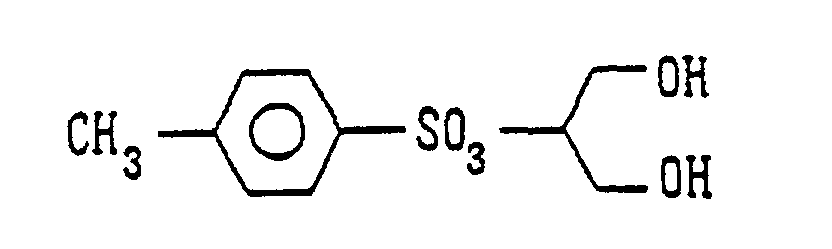
- In 50 ml of methanol were dissolved 5.00 g of cis-2-phenyl-4-(p-toluenesulfonyloxy)-1,3-dioxane, and 5 ml of a 4N HCl-dioxane solution were added to the solution, followed by stirring of the resulting mixture at room temperature for 2 hours. To the reaction mixture were added 3.5 g of NaHCO3 powder, and the mixture was stirred for 10 minutes. Then, the reaction mixture was filtered and the filtrate was concentrated under reduced pressure. The thus obtained oil was subjected to column chromatography using silica gel and eluted with ethyl acetate to obtain 3.70 g (yield: 100%) of the title compound as an oil.
NMR spectrum (60MHz, CDCl3) δ ppm: 2.40 (3H, s), 3.30 (2H, s), 3.73 (4H, d, J=4.5Hz), 4.55 (1H, quintet, J=4.5Hz), 7.33 (2H, d, J=8Hz), 7.84 (2H, d, J=8Hz). -

- In 4.5 ml of methylene chloride were dissolved 200 mg (0.81 mmol) of 2-(p-toluenesulfonyloxy)-1,3-propanediol and 206 mg (0.91 mmol) of (2E,4E)-5-[4-(trifluoromethyl)phenyl]-2,4-pentadienal, and 15 mg of p-toluenesulfonic acid and 0.8 g of molecular sieves 4A were added to the solution, followed by stirring of the resulting mixture at 0°C for 1 hour. An aqueous sodium hydrogencarbonate solution was added to the reaction mixture and the mixture was stirred for 10 minutes. Then, the molecular sieves were removed by filtration and the filtrate was extracted with methylene chloride. The oil obtained by evaporation of the solvent was separated by preparative thin layer chromatography of silica gel (developing solvent: 20% ethyl acetate-hexane) to obtain 107 mg (yield: 29%) of a trans isomer having less polarity and 153 mg (yield: 42%) of a cis isomer having higher polarity as an oil, respectively.
NMR spectrum (270MHz, CDCl3) of cis isomer δ ppm: 2.45 (3H, s), 3.99 (2H, br d, J=13.2Hz), 4.19 (2H, br d, J=13.2Hz), 4.45 (1H, br s), 5.09 (1H, d, J=4.6Hz), 5.82 (1H, dd, J=15.2, 4.6Hz), 6.57 (1H, dd, J=15.2, 10.5Hz), 6.63 (1H, d, J=15.2Hz), 6.82 (1H, dd, J=15.2, 10.5Hz), 7.36 (2H, d, J=8.6Hz), 7.48 (2H, d, J=8.6Hz), 7.56 (2H, d, J=8.6Hz), 7.85 (2H, d, J=8.6Hz). - To mice (one group consisting of 10 mice), which were innoculated with 4 to 9 x 10⁶ Candida albicans, were administered orally 20 mg/kg of preparations after 1, 4 and 24 hours, and thereafter the survival rate until 21 days after infection was examined. The results of comparison of the compound (I) of the present invention with commercially available Fluconazol are shown in Table 2. From the results, it is apparent that the compound (I) exhibits an excellent antifungal activity.
Compound Survival rate % 14 days 21 days Example 2 100 100 11 100 100 15 100 100 16 100 100 18 100 100 21 100 60 30 100 100 32 100 100 35 100 100 37 100 100 Fluconazol 70 60 -
Capsule Compound of Examples 1 to 39 or 40 50 mg Lactose 128 mg Corn starch 70 mg Magnesium stearate 2 mg 250 mg - The thus formulated powder was mixed and passed through a sieve of 60 mesh, and then the powder was encapsulated in No. 3 gelatin capsule of 250 mg to prepare a capsule.
-
Tablet Compound of Examples 1 to 39 or 40 50 mg Lactose 126 mg Corn starch 23 mg Magnesium stearate 1 mg 200 mg - The thus formulated powder was mixed and wet-granulated using a corn starch sizing agent and dried, and then a 200 mg-tablet was made by means of a tablet making machine. If necessary, sugar coating can be applied to the tablet.
- The compound having the general formula (I) or a pharmacologically acceptable salt thereof of the present invention has an excellent antifungal activity and is useful as an antifungal agent.
PROVIDED THAT, when q, r and s each represent 0 and A represents a 4- to 7-membered aliphatic heterocyclic group having a nitrogen atom, said nitrogen atom is not directly bonded to the -S(O)n- moiety.
Claims (23)
- A compound having the formula:wherein Ar1 represents a phenyl group or a phenyl group having 1 to 3 substituent(s) (said substituent(s) represent(s) a halogen atom or a trifluoromethyl group);
 PROVIDED THAT, when q, r and s each represent 0 and A represents a 4- to 7-membered aliphatic heterocyclic group having a nitrogen atom, said nitrogen atom is not directly bonded to the -S(O)n- moiety.Ar2 represents a phenyl group, a 5- or 6-membered aromatic heterocyclic group (said aromatic heterocyclic group has at least one nitrogen, oxygen or sulfur atom) or a phenyl group or a 5- or 6-membered aromatic heterocyclic group having 1 to 3 substituent(s) [said substituent(s) represent(s) an alkyl group selected from methyl, ethyl, propyl, isopropyl, butyl, isobutyl, sec-butyl and tert-butyl groups, an alkoxy group selected from methoxy, ethoxy, propoxy, isopropoxy, butoxy, isobutoxy, sec-butoxy and tert-butoxy groups, a halogen atom, an alkyl group, selected from methyl, ethyl, propyl, isopropyl, butyl, isobutyl, sec-butyl and tent-butyl groups, substituted with a halogen atom or halogen atoms, an alkoxy group, selected from methoxy, ethoxy, propoxy, isopropoxy, butoxy, isobutoxy, sec-butoxy and tert-butoxy groups, substituted with a halogen atom or halogen atoms, a nitro group, a cyano group, a -S(O)mR6 group (R6 represents an alkyl group, selected from methyl, ethyl, propyl, isopropyl, butyl, isobutyl, sec-butyl and tert-butyl groups, which may be substituted with a halogen atom or halogen atoms and m represents 0, 1 or 2), or a NHCOR7 group (R7 represents an alkyl group selected from methyl, ethyl, propyl, isopropyl, butyl, isobutyl, sec-butyl and tert-butyl groups)] and said aromatic heterocyclic group has at least one nitrogen, oxygen or sulfur atom;R0 represents a hydrogen atom or an alkyl group selected from methyl, ethyl, propyl, isopropyl, butyl, isobutyl, sec-butyl and tert-butyl groups;R1 represents an alkyl group selected from methyl, ethyl, propyl, isopropyl, butyl, isobutyl, sec-butyl and tert-butyl groups;R2, R3, R4 and R5 may be the same or different and represent a hydrogen atom, an alkyl group selected from methyl, ethyl, propyl, isopropyl, butyl, isobutyl, sec-butyl and tert-butyl groups or an alkyl group, selected from methyl, ethyl, propyl, isopropyl, butyl, isobutyl, sec-butyl and tert-butyl groups, substituted with a halogen atom or halogen atoms and, where q and/or s represent 2, each of R2, R3, R4 and R5 represents independently a group which is the same or different from the other R2, R3, R4 and R5 respectively;n represents 0;p represents 0 or 1;q, r and s represent 0, 1 or 2; andA represents a 1,3-dioxane, azetidine, pyrrolidine, piperidine or homopiperidine ring; or a pharmacologically acceptable salt thereof;
 - A triazole compound or a pharmacologically acceptable salt thereof according to claim 1, wherein Ar1 is a phenyl group having 1 to 3 substituent(s) (said substitent(s) represent(s) a halogen atom or a trifluorormethyl group).
- A triazole compound or a pharmacologically acceptable salt thereof according to claim 1, wherein Ar1 is a phenyl group having 1 or 2 substituent(s) (said substituent(s) represent(s) a fluorine atom, a chlorine atom or a trifluoromethyl group).
- A triazole compound or a pharmacologically acceptable salt thereof according to claims 1 to 3, wherein Ar2 represents a phenyl group, a 5- or 6-membered aromatic heterocyclic group (said aromatic heterocyclic group has at least one nitrogen, oxygen or sulfur atom), or a phenyl group or a 5- or 6-membered aromatic heterocyclic group optionally having 1 to 3 substituent(s) [said substituent(s) represent(s) an alkyl group selected from methyl, ethyl, propyl, isopropyl, butyl, isobutyl, sec-butyl and tert-butyl groups, a halogen atom, an alkyl group, selected from methyl, ethyl, propyl, isopropyl, butyl, isobutyl, sec-butyl and tert-butyl groups, substituted with a halogen atom or halogen atoms, an alkoxy group, selected from methoxy, ethoxy, propoxy, isopropoxy, butoxy, isobutoxy, sec-butoxy and tert-butoxy groups, substituted with a halogen atom or halogen atoms, a nitro group, a cyano group or a -S(O)mR6 group, wherein R6 represents an alkyl group, selected from methyl, ethyl, propyl, isopropyl, butyl, isobutyl, sec-butyl and tert-butyl groups, which may be substituted with a halogen atom or halogen atoms and m represents 0, 1 or 2)] and said aromatic heterocyclic group has at least one nitrogen, oxygen or sulfur atom.
- A triazole compound or a pharmacologically acceptable salt thereof according to claims 1 to 3, wherein Ar2 represents a phenyl group, a 5- or 6-membered aromatic heterocyclic group (said aromatic heterocyclic group has one nitrogen, oxygen or sulfur atom) or a phenyl group or a 5- to 6-membered aromatic heterocyclic group having 1 to 3 substituent(s) [said substituent(s) represent(s) an alkyl group selected from methyl, ethyl, propyl, isopropyl, butyl, isobutyl, sec-butyl and tert-butyl groups, a halogen atom, an alkyl group, selected from methyl, ethyl, propyl, isopropyl, butyl, isobutyl, sec-butyl and tert-butyl groups, substituted with a halogen atom or halogen atoms, an alkoxy group, selected from methoxy, ethoxy, propoxy, isopropoxy, butoxy, isobutoxy, sec-butoxy and tert-butoxy groups, substituted with a halogen atom or halogen atoms, a nitro group, a cyano group or a -S(O)mR6 group (R6 represents an alkyl group, selected from methyl, ethyl, propyl, isopropyl, butyl, isobutyl, sec-butyl and tert-butyl groups, which may be substituted with a halogen atom or halogen atoms and m represents 0, 1 or 2)] and said aromatic heterocyclic group has one nitrogen, oxygen or sulfur atom.
- A triazole compound or a pharmacologically acceptable salt thereof according to claims 1 to 3, wherein Ar2 represents a phenyl group, a 5- or 6-membered aromatic heterocyclic group (said aromatic heterocyclic group has one nitrogen or sulfur atom) or a phenyl group or a 5- or 6-membered aromatic heterocyclic group having 1 or 2 substituent(s) [said substituent(s) represent(s) an alkyl group selected from methyl, ethyl, propyl, isopropyl, butyl, isobutyl, sec-butyl and tert-butyl groups, a halogen atom, an alkyl group, selected from methyl, ethyl, propyl, isopropyl, butyl, isobutyl, sec-butyl and tert-butyl groups, substituted with a halogen atom or halogen atoms, an alkoxy group, selected from methoxy, ethoxy, propoxy, isopropoxy, butoxy, isobutoxy, sec-butoxy and tert-butoxy groups, substituted with a halogen atom or halogen atoms, a nitro group, a cyano group or a -S(O)mR6 group (R6 represents an alkyl group, selected from methyl, ethyl, propyl, isopropyl, butyl, isobutyl, sec-butyl and tert-butyl groups, which may be substituted with a halogen atom or halogen atoms and m represents 0, 1 or 2)] and said aromatic heterocyclic group has one nitrogen or sulfur atom.
- A triazole compound or a pharmacologically acceptable salt thereof according to claims 1 to 3, wherein Ar2 represents a phenyl group or a pyridyl group or a phenyl group, a pyridyl group or a thienyl group having 1 or 2 substituent(s) [said substituent(s) represent(s) an alkyl group selected from methyl, ethyl, propyl, isopropyl, butyl, isobutyl, sec-butyl and tert-butyl group, a halogen atom, an alkyl group, selected from methyl, ethyl, propyl, isopropyl, butyl, isobutyl, sec-butyl and tert-butyl groups, substituted with a halogen atom or halogen atoms, an alkoxy group, selected from methoxy, ethoxy, propoxy, isopropoxy, butoxy, isobutoxy, sec-butoxy and tert-butoxy groups, substituted with a halogen atom or halogen atoms, a nitro group, a cyano group or a -S(O)mR6 group (R6 represents an alkyl group, selected from methyl, ethyl, propyl, isopropyl, butyl, isobutyl, sec-butyl and tert-butyl groups, which may be substituted with a halogen atom or halogen atoms and m represents 0, 1 or 2)].
- A triazole compound or a pharmacologically acceptable salt thereof according to claims 1 to 7, wherein R0 is a hydrogen atom, a methyl group, an ethyl group or a propyl group.
- A triazole compound or a pharmacologically acceptable salt thereof according to claims 1 to 7, wherein R0 is a hydrogen atom, a methyl group or an ethyl group.
- A triazole compound or a pharmacologically acceptable salt thereof according to claims 1 to 4, wherein R0 is a hydrogen atom or a methyl group.
- A triazole compound or a pharmacologically acceptable salt thereof according to claims 1 to 10, wherein R1 is a methyl group, an ethyl group or a propyl group.
- A triazole compound or a pharmacologically acceptable salt thereof according to claims 1 to 10, wherein R1 is a methyl group or an ethyl group.
- A triazole compound or a pharmacologically acceptable salt thereof according to claims 1 to 10, wherein R1 is a methyl group.
- A triazole compound or a pharmacologically acceptable salt thereof according to claims 1 to 13, wherein R2, R3, R4 and R5 may be the same or different and are a hydrogen atom, an alkyl group selected from methyl, ethyl, propyl, isopropyl, butyl, isobutyl, sec-butyl and tert-butyl groups or an alkyl group, selected from methyl, ethyl, propyl, isopropyl, butyl, isobutyl, sec-butyl and tert-butyl groups, substituted with a fluorine or chlorine atom or atoms.
- A triazole compound or a pharmacologically acceptable salt thereof according to claims 1 to 13, wherein R2, R3, R4 and R5 may be the same or different and are a hydrogen atom, a methyl group, an ethyl group or a propyl group or a methyl group, an ethyl group or a propyl group substituted with a fluorine or chlorine atom or atoms.
- A triazole compound or a pharmacologically acceptable salt thereof according to claims 1 to 13, wherein R2, R3, R4 and R5 may be the same or different and are a hydrogen atom, a methyl group or an ethyl group or a methyl group or an ethyl group substituted with a fluorine or chlorine atom or atoms.
- A triazole compound or a pharmacologically acceptable salt thereof according to claims 1 to 13, wherein R2, R3, R4 and R5 may be the same or different and are a hydrogen atom or a methyl group or a methyl group substituted with a fluorine or chlorine atom or atoms.
- A triazole compound or a pharmacologically acceptable salt thereof according to claims 2 to 17 wherein p is 0 or 1.
- A triazole compound or a pharmacologically acceptable salt thereof according to claims 2 to 18 wherein q, r and s are 0, 1 or 2.
- A triazole compound or a pharmacologically acceptable salt thereof according to claims 1 to 19, wherein A is a piperidine or 1,3-dioxane ring.
- A triazole compound or a pharmacologically acceptable salt thereof according to claims 1 to 19, wherein A is a 1,3-dioxane ring.
- 2-(2,4-Difluorophenyl)-3-[[2-[2-[4-(trifluoromethyl)-phenyl]vinyl]-1,3-dioxan-5-yl]thio]-1-(1H-1,2,4-triazol-1-yl)-2-butanol,2-(2,4-difluorophenyl)-1-(1H-1,2,4-triazol- 1 -yl)-3-[[2-[2-[4-(trifiuorornethoxy)phenyl]vinyl]-1,3-dioxan-5-yl]thio]-2-butanol,2-(2,4-difluorophenyl)-1-(1H-1,2,4-triazol-1-yl)-3-[[2-[4-[4-(trifiuoromethyl)phenyl]-1,3-butadien-1-yl]-1,3-dioxan-5-yl]thio]-2-butanol,2-(2,4-difluorophenyl)-3-[[2-[4-[4-(2,2,3,3-tetrafluoropropoxy)phenyl]-1,3-butadien-1 -yl]-1,3-dioxan-5-yl]thio]-1-(1H-1,2,4-triazol-1-yl)-2-butanol,2-(2,4-difiuorophenyl)-3-[[2-[4-(4-chlorophenyl)-5,5,5-trifluoro-1,3-pentadien-1-yl]-1,3-dioxan-5-yl]thio]-1-(1H-1,2,4-triazol-1-yl)-2-butanol,2-(2,4-difluorophenyl)-3-[[1-[4-(trifluoromethoxy)cinnamoyl]piperidin-4-yl]thio]-1-(1H-1,2,4-triazol-1-yl)-2-butanol,2-(2,4-difluorophenyl)-3-[[1-[4-nitrocinnamoyl]piperidin-4-yl]thio]-1-(1H-1,2,4-triazol-1-yl)-2-butanol,2-(2,4-difluorophenyl)-1-(1H-1,2,4-triazol-1-yl)-3-[[1-[5-[4-(trifluoromethoxy)phenyl]-2,4-pentadienoyl]piperidin-4-yl]thio]-2-butanol,3-methyl-1-(1H-1,2,4-triazol-1-yl)-2-[4-(trifluoromethyl)phenyl]-3-[[2-[4-(trifiuoromethyl)phenyl]-1,3-butadien-1-yl]-1,3-dioxan-5-yl]thio]-2-butanol,2-(2,4-difluorophenyl)-1-(1H-1,2,4-triazol-1-yl)-3-[[2-[4-(trifluoromethylthio)phenyl]-1,3-butadien-1-yl]-1,3-dioxan-5-yl]thio]-2-butanol,3-[[2-[4-[4-(2,2,3,3-tetrafluoropropoxy)phenyl]-1,3-butadien-1-yl]-1,3-dioxan-5-yl]thio]-1-(1H-1,2,4-triazol-1-yl)-2-[4-(tifluoromethyl)phenyl]-2-butanol,1-(1H-1,2,4-triazol-1-yl)-2-[4-(trifiuoromethyl)phenyl]-3-[[2-[4-[4-(trifluoromethyl)phenyl]-1,3-butadien-1-yl]-1,3-dioxan-5-yl]thio]-2-butanol,2-(2,4-difluorophenyl)-1-(1H-1,2,4-triazol-1-yl)-3-[[2-[4-[4-(tifluoromethylsulfinyl)phenyl]-1,3-butadien-1-yl]-1,3-dioxan-5-yl]thio]-2-butanol,2-(2,4-difluorophenyl)-1-(1H-1,2,4-triazol-1-yl)-3-[[2-[6-[4-(trifiuoromethyl)phenyl]-1,3,5-hexatrien-1-yl]-1,3-dioxan-5-yl]thio]-2-butanol,2-(2,4-difluorophenyl)-3-methyl-1-(1H-1,2,4-triazol-1-yl)-3-[[2-[4-[4-(trifluoromethyl)phenyl]-1,3-butadien-1-yl]-1,3-dioxan-5-yl]thio]-2-butanol or2-(2,4-difiuorophenyl)-1-(1H-1,2,4-triazol-1-yl)-3-[[2-[4-[4-(trifluoromethyl)phenyl]-1-buten-3-yn-1-yl]-1,3-dioxan-5-yl]thio]-2-butanol, or a pharmacologically acceptable salt thereof.
- An antifungal agent containing a triazole compound or a pharmacologically acceptable salt thereof according to claims 1 to 22 as an active ingredient.
Applications Claiming Priority (4)
| Application Number | Priority Date | Filing Date | Title |
|---|---|---|---|
| JP81052/95 | 1995-04-06 | ||
| JP8105295 | 1995-04-06 | ||
| JP8105295 | 1995-04-06 | ||
| PCT/JP1996/000932 WO1996031491A1 (en) | 1995-04-06 | 1996-04-05 | Triazole antifungal agent |
Publications (3)
| Publication Number | Publication Date |
|---|---|
| EP0841327A1 EP0841327A1 (en) | 1998-05-13 |
| EP0841327A4 EP0841327A4 (en) | 1998-09-30 |
| EP0841327B1 true EP0841327B1 (en) | 2001-10-04 |
Family
ID=13735652
Family Applications (1)
| Application Number | Title | Priority Date | Filing Date |
|---|---|---|---|
| EP96908350A Expired - Lifetime EP0841327B1 (en) | 1995-04-06 | 1996-04-05 | Triazole antifungal agent |
Country Status (17)
| Country | Link |
|---|---|
| US (5) | US5977152A (en) |
| EP (1) | EP0841327B1 (en) |
| KR (1) | KR100367327B1 (en) |
| CN (1) | CN1151138C (en) |
| AT (1) | ATE206410T1 (en) |
| CA (1) | CA2217516C (en) |
| CZ (1) | CZ292377B6 (en) |
| DE (1) | DE69615694T2 (en) |
| DK (1) | DK0841327T3 (en) |
| ES (1) | ES2164238T3 (en) |
| HU (1) | HU227320B1 (en) |
| MX (1) | MX9707697A (en) |
| NO (1) | NO319218B1 (en) |
| NZ (1) | NZ304438A (en) |
| PT (1) | PT841327E (en) |
| RU (1) | RU2146250C1 (en) |
| WO (1) | WO1996031491A1 (en) |
Families Citing this family (12)
| Publication number | Priority date | Publication date | Assignee | Title |
|---|---|---|---|---|
| AU5779598A (en) * | 1997-02-04 | 1998-08-25 | Sankyo Company Limited | Triazole derivatives |
| US6275026B1 (en) * | 1999-08-10 | 2001-08-14 | Trw Inc. | Position sensing device |
| US6391903B1 (en) | 1999-09-09 | 2002-05-21 | Sankyo Company, Limited | Triazole derivatives having antifungal activity |
| CZ297383B6 (en) * | 1999-09-09 | 2006-11-15 | Sankyo Company Limited | Triazole derivatives exhibiting antifungal activity |
| JP3240129B1 (en) | 1999-09-09 | 2001-12-17 | 三共株式会社 | Triazole antifungal agent |
| TW591024B (en) * | 2000-03-27 | 2004-06-11 | Sankyo Lifetech Company Ltd | An amide type triazole compound having antifungal activity |
| WO2002040472A1 (en) * | 2000-11-16 | 2002-05-23 | Sankyo Company, Limited | Carbamoyl-bearing triazole fungicides |
| US7687434B2 (en) | 2000-12-22 | 2010-03-30 | Monsanto Technology, Llc | Method of improving yield and vigor of plants |
| HUP0303249A3 (en) | 2001-02-22 | 2007-03-28 | Sankyo Co | Water-soluble triazole fungicide compounds and pharmaceutical compositions containing them |
| BRPI0213586B1 (en) * | 2001-09-27 | 2017-06-20 | Monsanto Technology Llc | COMPOSITIONS, METHOD OF PROTECTING A PLANT OR ITS PROPAGATION MATERIALS AGAINST FUNGUS DISEASE OR DAMAGE, AS A CONTROLLED RELEASE FORMULATION |
| TW200503697A (en) * | 2003-06-06 | 2005-02-01 | Sankyo Co | Medicinal compositions containing triazole compounds |
| CN112137972A (en) * | 2020-09-16 | 2020-12-29 | 石家庄四药有限公司 | Fluconazole tablet composition, tablet and preparation method |
Family Cites Families (22)
| Publication number | Priority date | Publication date | Assignee | Title |
|---|---|---|---|---|
| DK161382C (en) * | 1982-04-01 | 1991-12-09 | Pfizer | PROCEDURE FOR PREPARING 1,2,4-TRIAZOL COMPOUNDS OR PHARMACEUTICAL ACCEPTABLE ACID ADDITION SALTS |
| US4507484A (en) * | 1982-07-24 | 1985-03-26 | Pfizer Inc. | Triazole antifungal agents |
| PH19347A (en) * | 1982-09-30 | 1986-04-02 | Pfizer | Triazole derivatives,pharmaceutical composition containing same and method of use thereof |
| GB8302888D0 (en) * | 1983-02-02 | 1983-03-09 | Pfizer Ltd | Antifungal agents |
| US4505919A (en) * | 1982-10-09 | 1985-03-19 | Pfizer Inc. | Antifungal S-arylmethyl- and S-heterocyclylmethyl ethers of 2-aryl-3-mercapto-1-(1H-1,2,4-triazol-1-yl) propan-2-ols |
| JPS6069071A (en) * | 1983-09-26 | 1985-04-19 | Sumitomo Chem Co Ltd | N-substituted-1,2,4-triazole |
| AU572889B2 (en) * | 1983-09-26 | 1988-05-19 | Sumitomo Chemical Company, Limited | 1,2,4 - triazolyl propanols |
| JPS60136570A (en) * | 1984-08-27 | 1985-07-20 | Sumitomo Chem Co Ltd | 1,2,4-triazolylpropanol |
| DE3402166A1 (en) * | 1984-01-23 | 1985-07-25 | Hoechst Ag, 6230 Frankfurt | AZOLYL-ARYL-ALKANOL DERIVATIVES, METHOD FOR THE PRODUCTION THEREOF AND THEIR USE |
| KR930004193B1 (en) * | 1984-10-02 | 1993-05-21 | 스미또모 세이야꾸 가부시끼가이샤 | Process for preparing n-substituted triazole derivatives |
| JPS6185369A (en) | 1984-10-02 | 1986-04-30 | Sumitomo Seiyaku Kk | 1,2,4-triazole derivative |
| CN1008735B (en) * | 1984-11-02 | 1990-07-11 | 拜尔公司 | Pyrrole ylmethyl-cyclopropyl-carbinol derivatives with replacement is a composition of active components |
| NO171272C (en) * | 1988-03-04 | 1993-02-17 | Sankyo Co | ANALOGY PROCEDURE FOR THE PREPARATION OF THERAPEUTIC ACTIVE 1,2,4-TRIAZOLO COMPOUNDS |
| JPH02191262A (en) * | 1988-03-04 | 1990-07-27 | Sankyo Co Ltd | Triazole derivative |
| IE903395A1 (en) * | 1989-09-26 | 1991-04-10 | Takeda Chemical Industries Ltd | Triazole compounds, their production and use |
| TW206224B (en) * | 1989-12-14 | 1993-05-21 | Takeda Pharm Industry Co Ltd | |
| JPH04211070A (en) * | 1990-03-15 | 1992-08-03 | Takeda Chem Ind Ltd | Triazole compound and its use |
| US5387599A (en) * | 1990-03-15 | 1995-02-07 | Takeda Chemical Industries, Ltd. | Triazoles, their production and use |
| IE912990A1 (en) * | 1990-08-26 | 1992-03-11 | Sankyo Co | Anti-fungal triazole derivatives, their preparation and¹uses |
| KR920019763A (en) * | 1991-04-26 | 1992-11-19 | 모리다 가즈라 | Azole compounds, preparation methods and uses thereof |
| JPH06247944A (en) * | 1992-12-28 | 1994-09-06 | Sumitomo Pharmaceut Co Ltd | Novel 1,2,4-triazole derivative |
| US5393269A (en) * | 1994-01-12 | 1995-02-28 | Atkinson, Jr.; William A. | Bowling pin setting mechanism and scissor arms |
-
1996
- 1996-04-05 DK DK96908350T patent/DK0841327T3/en active
- 1996-04-05 MX MX9707697A patent/MX9707697A/en not_active IP Right Cessation
- 1996-04-05 HU HU9801133A patent/HU227320B1/en not_active IP Right Cessation
- 1996-04-05 AT AT96908350T patent/ATE206410T1/en not_active IP Right Cessation
- 1996-04-05 CZ CZ19973105A patent/CZ292377B6/en not_active IP Right Cessation
- 1996-04-05 CN CNB961945702A patent/CN1151138C/en not_active Expired - Fee Related
- 1996-04-05 ES ES96908350T patent/ES2164238T3/en not_active Expired - Lifetime
- 1996-04-05 CA CA002217516A patent/CA2217516C/en not_active Expired - Fee Related
- 1996-04-05 KR KR1019970707043A patent/KR100367327B1/en not_active Expired - Fee Related
- 1996-04-05 EP EP96908350A patent/EP0841327B1/en not_active Expired - Lifetime
- 1996-04-05 NZ NZ304438A patent/NZ304438A/en not_active IP Right Cessation
- 1996-04-05 PT PT96908350T patent/PT841327E/en unknown
- 1996-04-05 DE DE69615694T patent/DE69615694T2/en not_active Expired - Lifetime
- 1996-04-05 WO PCT/JP1996/000932 patent/WO1996031491A1/en not_active Ceased
- 1996-04-05 RU RU97116580/04A patent/RU2146250C1/en not_active IP Right Cessation
-
1997
- 1997-10-03 NO NO19974588A patent/NO319218B1/en not_active IP Right Cessation
- 1997-10-06 US US08/944,304 patent/US5977152A/en not_active Expired - Fee Related
-
1999
- 1999-02-01 US US09/241,370 patent/US6306880B1/en not_active Expired - Fee Related
- 1999-02-01 US US09/241,369 patent/US6300357B1/en not_active Expired - Fee Related
-
2001
- 2001-02-27 US US09/794,180 patent/US20010031778A1/en not_active Abandoned
- 2001-02-27 US US09/794,177 patent/US20010031768A1/en not_active Abandoned
Also Published As
| Publication number | Publication date |
|---|---|
| ATE206410T1 (en) | 2001-10-15 |
| HU227320B1 (en) | 2011-03-28 |
| MX9707697A (en) | 1997-12-31 |
| CZ292377B6 (en) | 2003-09-17 |
| CZ310597A3 (en) | 1998-02-18 |
| US6300357B1 (en) | 2001-10-09 |
| NO974588D0 (en) | 1997-10-03 |
| PT841327E (en) | 2002-02-28 |
| DE69615694D1 (en) | 2001-11-08 |
| ES2164238T3 (en) | 2002-02-16 |
| US20010031778A1 (en) | 2001-10-18 |
| US6306880B1 (en) | 2001-10-23 |
| NZ304438A (en) | 1999-04-29 |
| CA2217516C (en) | 2003-01-14 |
| RU2146250C1 (en) | 2000-03-10 |
| EP0841327A4 (en) | 1998-09-30 |
| CN1187191A (en) | 1998-07-08 |
| DE69615694T2 (en) | 2002-07-11 |
| EP0841327A1 (en) | 1998-05-13 |
| WO1996031491A1 (en) | 1996-10-10 |
| US5977152A (en) | 1999-11-02 |
| CN1151138C (en) | 2004-05-26 |
| KR100367327B1 (en) | 2003-03-03 |
| US20010031768A1 (en) | 2001-10-18 |
| KR19980703644A (en) | 1998-12-05 |
| HUP9801133A3 (en) | 2000-03-28 |
| AU5162496A (en) | 1996-10-23 |
| NO319218B1 (en) | 2005-07-04 |
| HUP9801133A2 (en) | 1998-08-28 |
| AU694638B2 (en) | 1998-07-23 |
| DK0841327T3 (en) | 2002-01-21 |
| CA2217516A1 (en) | 1996-10-10 |
| HK1009803A1 (en) | 1999-10-08 |
| NO974588L (en) | 1997-12-08 |
Similar Documents
| Publication | Publication Date | Title |
|---|---|---|
| US5405861A (en) | Triazole compounds and antifungal compositions thereof | |
| US5039676A (en) | Tri- and tetra-substituted-oxetanes and tetrahydrofurans and intermediates thereof | |
| HU205348B (en) | Process for producing triazole derivatives and pharmaceutical compositions comprising such compounds as active ingredient | |
| JPH0419992B2 (en) | ||
| WO1993018029A1 (en) | Imidazole, triazole and tetrazole derivatives | |
| US6306880B1 (en) | Triazole antifungal agent | |
| JPH07502022A (en) | triazole antifungal agent | |
| JP2007502268A (en) | Antifungal azole derivative having fluorovinyl group and process for producing the same | |
| JP3415865B2 (en) | Optically active azole compound and use thereof | |
| US5922718A (en) | Triazolones as apolipoprotein-B synthesis inhibitors | |
| JP3622882B2 (en) | Medicine containing triazole derivative | |
| US5478826A (en) | Orally active azole derivatives | |
| JP2902345B2 (en) | Triazole antifungal agent | |
| US5047548A (en) | 3-aryl-3-hydroxy-4-(1H-1,2,4-triazol-1-yl)butyramide and derivatives as antifungal agents | |
| WO1999002524A1 (en) | Antifungal triazole compounds | |
| JP2002535328A (en) | Antifungal azole derivative having fluorinated vinyl group and method for producing the same | |
| HK1009803B (en) | Triazole antifungal agent | |
| JPH1180135A (en) | Antifungal triazol compound | |
| TW391965B (en) | Triazole derivatives and antifungic pharmacentical compositions | |
| JPH10279567A (en) | Triazole derivative | |
| MXPA98000046A (en) | Antiphungic agents of triazol, use of them, compositions that contain them and procediminto to prepare mys |
Legal Events
| Date | Code | Title | Description |
|---|---|---|---|
| PUAI | Public reference made under article 153(3) epc to a published international application that has entered the european phase |
Free format text: ORIGINAL CODE: 0009012 |
|
| 17P | Request for examination filed |
Effective date: 19971023 |
|
| AK | Designated contracting states |
Kind code of ref document: A1 Designated state(s): AT BE CH DE DK ES FI FR GB GR IE IT LI LU MC NL PT SE |
|
| A4 | Supplementary search report drawn up and despatched | ||
| AK | Designated contracting states |
Kind code of ref document: A4 Designated state(s): AT BE CH DE DK ES FI FR GB GR IE IT LI LU MC NL PT SE |
|
| 17Q | First examination report despatched |
Effective date: 19991119 |
|
| GRAG | Despatch of communication of intention to grant |
Free format text: ORIGINAL CODE: EPIDOS AGRA |
|
| GRAG | Despatch of communication of intention to grant |
Free format text: ORIGINAL CODE: EPIDOS AGRA |
|
| GRAH | Despatch of communication of intention to grant a patent |
Free format text: ORIGINAL CODE: EPIDOS IGRA |
|
| GRAH | Despatch of communication of intention to grant a patent |
Free format text: ORIGINAL CODE: EPIDOS IGRA |
|
| GRAA | (expected) grant |
Free format text: ORIGINAL CODE: 0009210 |
|
| AK | Designated contracting states |
Kind code of ref document: B1 Designated state(s): AT BE CH DE DK ES FI FR GB GR IE IT LI LU MC NL PT SE |
|
| REF | Corresponds to: |
Ref document number: 206410 Country of ref document: AT Date of ref document: 20011015 Kind code of ref document: T |
|
| REG | Reference to a national code |
Ref country code: CH Ref legal event code: EP |
|
| REG | Reference to a national code |
Ref country code: CH Ref legal event code: NV Representative=s name: A. BRAUN, BRAUN, HERITIER, ESCHMANN AG PATENTANWAE |
|
| REF | Corresponds to: |
Ref document number: 69615694 Country of ref document: DE Date of ref document: 20011108 |
|
| REG | Reference to a national code |
Ref country code: IE Ref legal event code: FG4D |
|
| REG | Reference to a national code |
Ref country code: GB Ref legal event code: IF02 |
|
| REG | Reference to a national code |
Ref country code: DK Ref legal event code: T3 |
|
| REG | Reference to a national code |
Ref country code: ES Ref legal event code: FG2A Ref document number: 2164238 Country of ref document: ES Kind code of ref document: T3 |
|
| REG | Reference to a national code |
Ref country code: PT Ref legal event code: SC4A Free format text: AVAILABILITY OF NATIONAL TRANSLATION Effective date: 20011122 |
|
| REG | Reference to a national code |
Ref country code: GR Ref legal event code: EP Ref document number: 20010402184 Country of ref document: GR |
|
| EN | Fr: translation not filed | ||
| ET | Fr: translation filed | ||
| PLBE | No opposition filed within time limit |
Free format text: ORIGINAL CODE: 0009261 |
|
| STAA | Information on the status of an ep patent application or granted ep patent |
Free format text: STATUS: NO OPPOSITION FILED WITHIN TIME LIMIT |
|
| 26N | No opposition filed | ||
| REG | Reference to a national code |
Ref country code: FR Ref legal event code: RN Ref country code: FR Ref legal event code: FC |
|
| REG | Reference to a national code |
Ref country code: GB Ref legal event code: 732E |
|
| REG | Reference to a national code |
Ref country code: CH Ref legal event code: PUEA Owner name: SANKYO COMPANY LIMITED Free format text: SANKYO COMPANY LIMITED#5-1 NIHONBASHI HONCHO 3-CHOME#CHUO-KU, TOKYO 103-0023 (JP) -TRANSFER TO- SANKYO COMPANY LIMITED#5-1 NIHONBASHI HONCHO 3-CHOME#CHUO-KU, TOKYO 103-0023 (JP) $ SANKYO LIFETECH COMPANY LIMITED#4-23-14, HONGO, BUNKYO-KU#TOKYO 113-0033 (JP) |
|
| NLS | Nl: assignments of ep-patents |
Owner name: SANKYO LIFETECH COMPANY LIMITED Owner name: SANKYO COMPANY LIMITED |
|
| REG | Reference to a national code |
Ref country code: FR Ref legal event code: TQ |
|
| REG | Reference to a national code |
Ref country code: PT Ref legal event code: PC4A Free format text: SANKYO LIFETECH COMPANY, LIMITED JP Effective date: 20040601 |
|
| BECA | Be: change of holder's address |
Owner name: 12-24, NISHI-AZABU 4-CHOME, MINATO-KU, TOKYO 106-0 Effective date: 20080218 Owner name: NOVARTIS ANIMAL HEALTH K.K.3-5-1 NIHONBASHI HONCHO Effective date: 20080218 Owner name: DAIICHI SANKYO CY LTD Effective date: 20080218 |
|
| BECH | Be: change of holder |
Owner name: NOVARTIS ANIMAL HEALTH K.K. Effective date: 20080218 Owner name: DAIICHI SANKYO CY LTD Effective date: 20080218 |
|
| REG | Reference to a national code |
Ref country code: GB Ref legal event code: 732E |
|
| REG | Reference to a national code |
Ref country code: CH Ref legal event code: PUEA Owner name: DAIICHI SANKYO COMPANY LIMITED Free format text: SANKYO LIFETECH COMPANY LIMITED#4-23-14, HONGO, BUNKYO-KU#TOKYO 113-0033 (JP) $ DAIICHI SANKYO COMPANY LIMITED#3-5-1 NIHONBASHI HONCHO#CHUO-KU, TOKYO (JP) -TRANSFER TO- DAIICHI SANKYO COMPANY LIMITED#3-5-1 NIHONBASHI HONCHO#CHUO-KU, TOKYO (JP) $ NOVARTIS ANIMAL HEALTH K.K.#12-24 NISHI-AZABU 4-CHOME MINATO-KU#TOKYO 106-0031 (JP) Ref country code: CH Ref legal event code: PUE Owner name: SANKYO LIFETECH COMPANY LIMITED Free format text: SANKYO COMPANY LIMITED#5-1 NIHONBASHI HONCHO 3-CHOME#CHUO-KU, TOKYO 103-0023 (JP) $ SANKYO LIFETECH COMPANY LIMITED#4-23-14, HONGO, BUNKYO-KU#TOKYO 113-0033 (JP) -TRANSFER TO- SANKYO LIFETECH COMPANY LIMITED#4-23-14, HONGO, BUNKYO-KU#TOKYO 113-0033 (JP) $ DAIICHI SANKYO COMPANY LIMITED#3-5-1 NIHONBASHI HONCHO#CHUO-KU, TOKYO (JP) Ref country code: CH Ref legal event code: NV Representative=s name: RITSCHER & PARTNER AG |
|
| REG | Reference to a national code |
Ref country code: PT Ref legal event code: PC4A Owner name: NOVARTIS ANIMAL HEALTH K.K., JP Effective date: 20080327 Ref country code: PT Ref legal event code: PC4A Owner name: DAIICHI SANKYO COMPANY, LIMITED, JP Effective date: 20080327 |
|
| NLS | Nl: assignments of ep-patents |
Owner name: NOVARTIS ANIMAL HEALTH K.K. Effective date: 20080219 Owner name: SANKYO LIFETECH COMPANY LIMITED Effective date: 20080219 Owner name: DAIICHI SANKYO COMPANY, LIMITED Effective date: 20080219 |
|
| REG | Reference to a national code |
Ref country code: ES Ref legal event code: PC2A |
|
| REG | Reference to a national code |
Ref country code: ES Ref legal event code: PC2A |
|
| REG | Reference to a national code |
Ref country code: FR Ref legal event code: TQ |
|
| PGFP | Annual fee paid to national office [announced via postgrant information from national office to epo] |
Ref country code: PT Payment date: 20100323 Year of fee payment: 15 |
|
| PGFP | Annual fee paid to national office [announced via postgrant information from national office to epo] |
Ref country code: GB Payment date: 20100325 Year of fee payment: 15 |
|
| PGFP | Annual fee paid to national office [announced via postgrant information from national office to epo] |
Ref country code: MC Payment date: 20100420 Year of fee payment: 15 Ref country code: LU Payment date: 20100506 Year of fee payment: 15 Ref country code: IE Payment date: 20100423 Year of fee payment: 15 Ref country code: FR Payment date: 20100521 Year of fee payment: 15 Ref country code: FI Payment date: 20100414 Year of fee payment: 15 Ref country code: ES Payment date: 20100423 Year of fee payment: 15 Ref country code: DK Payment date: 20100412 Year of fee payment: 15 |
|
| PGFP | Annual fee paid to national office [announced via postgrant information from national office to epo] |
Ref country code: NL Payment date: 20100416 Year of fee payment: 15 Ref country code: IT Payment date: 20100417 Year of fee payment: 15 Ref country code: DE Payment date: 20100430 Year of fee payment: 15 Ref country code: BE Payment date: 20100322 Year of fee payment: 15 Ref country code: AT Payment date: 20100413 Year of fee payment: 15 |
|
| PGFP | Annual fee paid to national office [announced via postgrant information from national office to epo] |
Ref country code: CH Payment date: 20100414 Year of fee payment: 15 |
|
| PGFP | Annual fee paid to national office [announced via postgrant information from national office to epo] |
Ref country code: SE Payment date: 20100409 Year of fee payment: 15 |
|
| PGFP | Annual fee paid to national office [announced via postgrant information from national office to epo] |
Ref country code: GR Payment date: 20100322 Year of fee payment: 15 |
|
| REG | Reference to a national code |
Ref country code: PT Ref legal event code: MM4A Free format text: LAPSE DUE TO NON-PAYMENT OF FEES Effective date: 20111006 |
|
| BERE | Be: lapsed |
Owner name: NOVARTIS ANIMAL HEALTH K.K. Effective date: 20110430 Owner name: DAIICHI SANKYO CY LTD Effective date: 20110430 |
|
| REG | Reference to a national code |
Ref country code: DE Ref legal event code: R119 Ref document number: 69615694 Country of ref document: DE |
|
| REG | Reference to a national code |
Ref country code: DE Ref legal event code: R119 Ref document number: 69615694 Country of ref document: DE |
|
| REG | Reference to a national code |
Ref country code: NL Ref legal event code: V1 Effective date: 20111101 |
|
| REG | Reference to a national code |
Ref country code: SE Ref legal event code: EUG |
|
| PG25 | Lapsed in a contracting state [announced via postgrant information from national office to epo] |
Ref country code: MC Free format text: LAPSE BECAUSE OF NON-PAYMENT OF DUE FEES Effective date: 20110430 |
|
| REG | Reference to a national code |
Ref country code: CH Ref legal event code: PL |
|
| GBPC | Gb: european patent ceased through non-payment of renewal fee |
Effective date: 20110405 |
|
| REG | Reference to a national code |
Ref country code: AT Ref legal event code: MM01 Ref document number: 206410 Country of ref document: AT Kind code of ref document: T Effective date: 20110405 |
|
| REG | Reference to a national code |
Ref country code: GR Ref legal event code: ML Ref document number: 20010402184 Country of ref document: GR Effective date: 20111102 |
|
| REG | Reference to a national code |
Ref country code: FR Ref legal event code: ST Effective date: 20111230 |
|
| PG25 | Lapsed in a contracting state [announced via postgrant information from national office to epo] |
Ref country code: PT Free format text: LAPSE BECAUSE OF NON-PAYMENT OF DUE FEES Effective date: 20111006 Ref country code: FI Free format text: LAPSE BECAUSE OF NON-PAYMENT OF DUE FEES Effective date: 20110405 Ref country code: NL Free format text: LAPSE BECAUSE OF NON-PAYMENT OF DUE FEES Effective date: 20111101 Ref country code: FR Free format text: LAPSE BECAUSE OF NON-PAYMENT OF DUE FEES Effective date: 20110502 Ref country code: CH Free format text: LAPSE BECAUSE OF NON-PAYMENT OF DUE FEES Effective date: 20110430 Ref country code: LI Free format text: LAPSE BECAUSE OF NON-PAYMENT OF DUE FEES Effective date: 20110430 Ref country code: BE Free format text: LAPSE BECAUSE OF NON-PAYMENT OF DUE FEES Effective date: 20110430 |
|
| REG | Reference to a national code |
Ref country code: IE Ref legal event code: MM4A |
|
| REG | Reference to a national code |
Ref country code: DK Ref legal event code: EBP |
|
| PG25 | Lapsed in a contracting state [announced via postgrant information from national office to epo] |
Ref country code: AT Free format text: LAPSE BECAUSE OF NON-PAYMENT OF DUE FEES Effective date: 20110405 Ref country code: IT Free format text: LAPSE BECAUSE OF NON-PAYMENT OF DUE FEES Effective date: 20110405 Ref country code: GR Free format text: LAPSE BECAUSE OF NON-PAYMENT OF DUE FEES Effective date: 20111102 Ref country code: GB Free format text: LAPSE BECAUSE OF NON-PAYMENT OF DUE FEES Effective date: 20110405 |
|
| PG25 | Lapsed in a contracting state [announced via postgrant information from national office to epo] |
Ref country code: IE Free format text: LAPSE BECAUSE OF NON-PAYMENT OF DUE FEES Effective date: 20110405 |
|
| REG | Reference to a national code |
Ref country code: ES Ref legal event code: FD2A Effective date: 20120604 |
|
| PG25 | Lapsed in a contracting state [announced via postgrant information from national office to epo] |
Ref country code: DK Free format text: LAPSE BECAUSE OF NON-PAYMENT OF DUE FEES Effective date: 20110430 |
|
| PG25 | Lapsed in a contracting state [announced via postgrant information from national office to epo] |
Ref country code: ES Free format text: LAPSE BECAUSE OF NON-PAYMENT OF DUE FEES Effective date: 20110406 |
|
| PG25 | Lapsed in a contracting state [announced via postgrant information from national office to epo] |
Ref country code: SE Free format text: LAPSE BECAUSE OF NON-PAYMENT OF DUE FEES Effective date: 20110406 |
|
| PG25 | Lapsed in a contracting state [announced via postgrant information from national office to epo] |
Ref country code: LU Free format text: LAPSE BECAUSE OF NON-PAYMENT OF DUE FEES Effective date: 20110405 |
|
| PG25 | Lapsed in a contracting state [announced via postgrant information from national office to epo] |
Ref country code: DE Free format text: LAPSE BECAUSE OF NON-PAYMENT OF DUE FEES Effective date: 20111031 |