EP0839056B1 - Process for producing ioversol - Google Patents
Process for producing ioversol Download PDFInfo
- Publication number
- EP0839056B1 EP0839056B1 EP96922444A EP96922444A EP0839056B1 EP 0839056 B1 EP0839056 B1 EP 0839056B1 EP 96922444 A EP96922444 A EP 96922444A EP 96922444 A EP96922444 A EP 96922444A EP 0839056 B1 EP0839056 B1 EP 0839056B1
- Authority
- EP
- European Patent Office
- Prior art keywords
- bis
- product
- dihydroxypropyl
- reacting
- produce
- Prior art date
- Legal status (The legal status is an assumption and is not a legal conclusion. Google has not performed a legal analysis and makes no representation as to the accuracy of the status listed.)
- Expired - Lifetime
Links
Classifications
-
- C—CHEMISTRY; METALLURGY
- C07—ORGANIC CHEMISTRY
- C07C—ACYCLIC OR CARBOCYCLIC COMPOUNDS
- C07C231/00—Preparation of carboxylic acid amides
- C07C231/12—Preparation of carboxylic acid amides by reactions not involving the formation of carboxamide groups
-
- C—CHEMISTRY; METALLURGY
- C07—ORGANIC CHEMISTRY
- C07C—ACYCLIC OR CARBOCYCLIC COMPOUNDS
- C07C237/00—Carboxylic acid amides, the carbon skeleton of the acid part being further substituted by amino groups
- C07C237/28—Carboxylic acid amides, the carbon skeleton of the acid part being further substituted by amino groups having the carbon atom of at least one of the carboxamide groups bound to a carbon atom of a non-condensed six-membered aromatic ring of the carbon skeleton
- C07C237/46—Carboxylic acid amides, the carbon skeleton of the acid part being further substituted by amino groups having the carbon atom of at least one of the carboxamide groups bound to a carbon atom of a non-condensed six-membered aromatic ring of the carbon skeleton having carbon atoms of carboxamide groups, amino groups and at least three atoms of bromine or iodine, bound to carbon atoms of the same non-condensed six-membered aromatic ring
Definitions
- This invention is in the field of imaging.
- the invention relates to X-ray imaging.
- the invention relates to a new process for obtaining ioversol.
- This invention relates to N,N'-bis(2,3-dihydroxypropyl)-5-N-(2-hydroxyethyl)glycolamido-2,4,6-triiodoisopthalamide (ioversol).
- Ioversol is commonly used as an X-ray contrast agent.
- the agent may be used in various radiographic procedures including those involving cardiography, coronary arteriography, aortography, cerebral and peripheral angiography, arthrography, intravenous pyelography and urography as well as myelography.
- the present commercial manufacture of ioversol proceeds in four steps from bis(2,3-dihydroxypropyl)-2,4,6-triiodo-5-aminoisophthalamide to crude ioversol product, which product is subsequently purified.
- This conversion utilizes two expensive raw materials, acetoxyacetyl chloride (AAC) and bromoethylacetate (BEA), which together contribute to greater than 25% of the final product material cost.
- AAC acetoxyacetyl chloride
- BEA bromoethylacetate
- the present commercial manufacturing process requires the use of several expensive, environmentally undesirable and/or reactive solvents such as 1,1,2-trichloroethane (TCE), dimethylsulfoxide (DMSO) and amylacetate.
- TCE 1,1,2-trichloroethane
- DMSO dimethylsulfoxide
- amylacetate amylacetate
- Patents 4,396,598 and 5, 177,261 describe syntheses of ioversol.
- the syntheses described is these Patents are characterized by a final acid hydrolysis step and the use of non-aqueous solvents
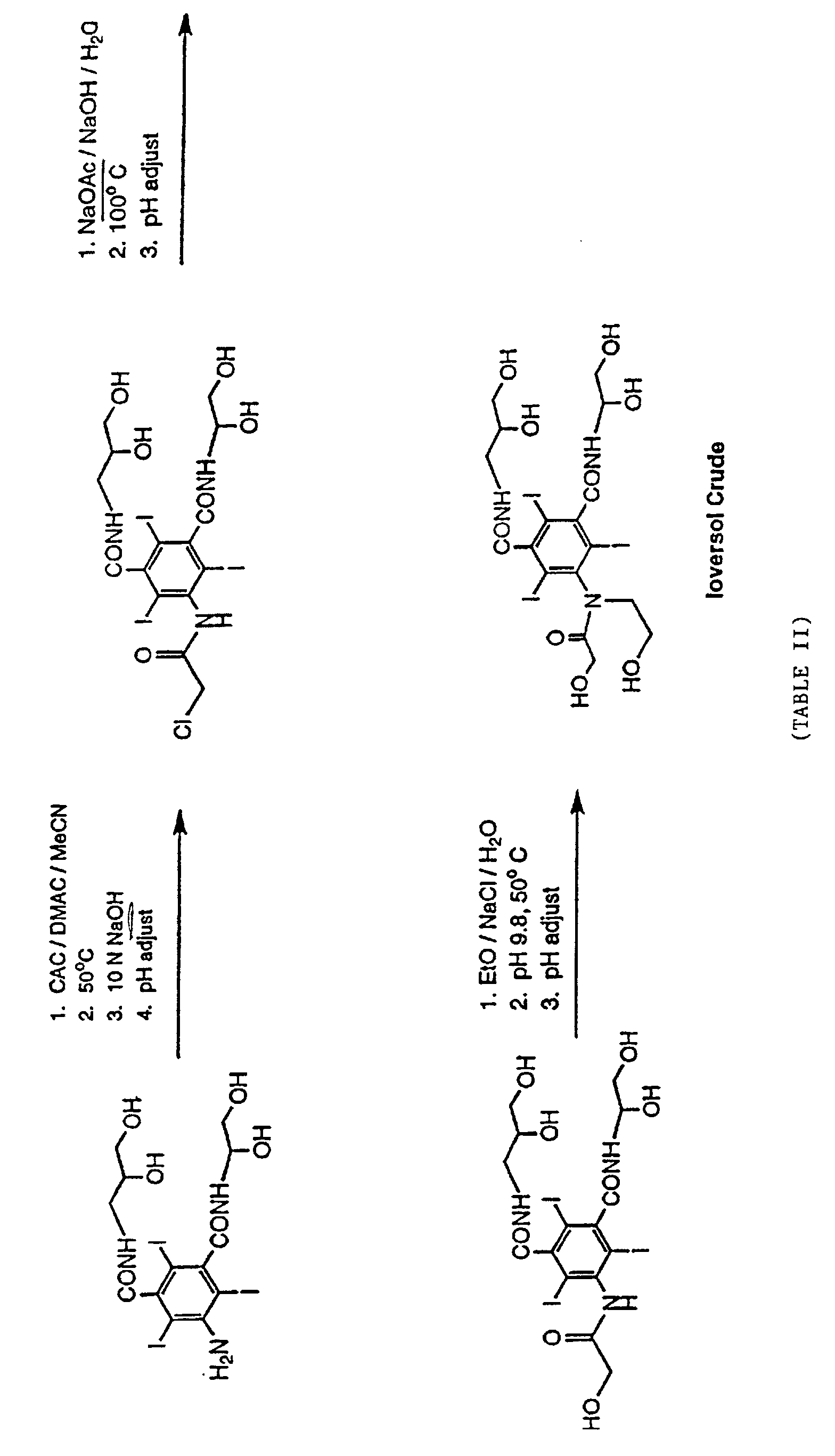
- the present invention provides a new process for producing ioversol (marketed as OPTIRAY®) comprising:
- the new synthetic route replaces the high cost AAC and BEA components with chloroacetylchloride (CAC) and an alkylating agent which is capable of producing a hydroxyethylated product, respectively, thus reducing the introduction of these components to a more elementary and far less expensive archetype.
- CAC chloroacetylchloride
- DMAC polar aprotic solvent dimethylacetamide
- 5-Amino-N,N'-bis(2,3-dihydroxpropyl)-2,4,6-triiodoisophthalamide is dissolved in N,N-diomethylacetamide and acetylated with acetic anhydride, using 4-dimethylaminopyridine as a catalyst, to produce 5-amino-N,N'-bis(2,3-diacetoxypropyl)-2,4,6-triiodoisophthalamide.
- the mixture is diluted with 1,1,2-trichloroethane and washed with aqueous sodium carbonate and aqueous sodium chloride solutions to remove acetic acid, which is the by-product of the reaction.
- the resulting 1,1,2-trichloroethane solution of the product is used in STEP #2.
- 1,1,2-trichloroethane is added to dilute the reaction mixture and the solution is washed with aqueous sodium bicarbonate and aqueous sodium chloride solutions to remove acetoxyacetic acid and other by-products.
- the resulting organic layer which contains the reaction product is used in the next step.
- Solvent (1,1,2-trichloroethane) is distilled from the solution of 5-acetoxyacetamido-N,N'-bis(2,3-diacetoxypropyl)-2,4,6-triiodoisophthalamide prepared in STEP #2.
- Dimethyl sulfoxide is added as the reaction solvent.
- Potassium carbonate and 2-bromoethyl acetate are added and the mixture is stirred for ca . 10 hours at ca . 40° C to complete the reaction to form 5-[N-(2-acetoxyethyl)acetoxyacetamido]-N,N'-bis(2,3-diacetoxypropyl) -2,4,6-triiodoisophthalamide.
- 1,1,2-trichloroethane is added to dilute the mixture.
- the mixture is washed once with deionized water, and twice with aqueous sodium chloride solution.
- the organic layer, which contains the product, is then distilled to remove the solvent and the residue is dissolved in amyl acetate while the mixture is still hot.
- the mixture is then cooled and stirred continuously to complete the crystallization.
- the reaction product is collected and dried. After testing, it is used in STEP #4 to prepare crude ioversol aqueous solution.
- the solution which contains ioversol, (crude ioversol aqueous solution) is cooled and utilized in subsequent purification steps.
- the general procedure for the process of the invention involves reacting 5-amino-N,N'-bis(2,3-dihydroxypropyl)-2,4,6-triiodoisophthalamide with chloroacetyl chloride in a polar aprotic solvent.
- the resulting product is hydrolyzed with sodium hydroxide.
- a homogeneous solution is obtained by adding water. Precipitation is affected to yield N,N'-bis(2,3-dihydroxypropyl) -5-(2-chloroacetamido)-2,4,6-triiodoisophthalamide.
- This product is mixed with water and sodium acetate and the pH adjusted. A base is added as the reaction proceeds in order to maintain pH at a constant level and produce N,N'-bis(2,3-dihydroxypropyl)-5-glycolamido-2,4,6-triiodoisopthalamide.
- This product from the previous step is subsequently treated in aqueous solution with a base and reacted with an alkylating agent capable of producing an hydroxyethylated product.
- the reaction product is crude ioversol.
- the reaction pH is maintained by addition of mineral acid. Finally, salt and low molecular weight impurities are removed.
- Polar aprotic solvents for use with the invention include dimethylacetamide, acetonitrile, dimethylsulfoxide, dimethylformamide, tetrahydrofuran, dimethoxyethane, acetonitrile, or combinations thereof.
- Suitable bases for use with the water include sodium hydroxide, lithium hydroxide, ammonium hydroxide, and potassium hydroxide.
- Alkylating agents capable of producing a hydroxyethylated product suitable for use with the invention include 2-chloroethanol, ethylene oxide, ethylene carbonate, 2-bromoethanol, 2-iodoethanol, and 2-tosylethanol.
- N,N'-bis[2,3-di(2-chloroacetoxy)propyl]-5-(2-chloroacetamido)-2 , 4,6-triiodoisophthalamide in N,N-dimethylacetamide, from Example 1, was hydrolyzed by adding 156 mL of 10N sodium hydroxide solution (1.56 moles). Water (100 mL) was then added to the mixture to give a homogeneous solution. 1N Hydrochloric acid (59 mL, 0.59 moles) was added to precipitate the N,N'-bis (2,3-dihydroxypropyl)-5-(2-chloroacetamido) -2,4,6-triiodoisophthalamide. The precipitate was collected and washed with water. The wet product was dried at 60°C in a vacuum oven to give 81.69 g of product, 88.4 % yield. The material was 100 % pure by HPLC analysis.
- N,N'-bis[2,3-di(2-chloroacetoxy)propyl]-5-(2-chloroacetamido)-2 , 4,6-triiodoisophthalamide in N,N-dimethylacetamide and acetonitrile, from Example 3, was hydrolyzed by adding 130 mL of 10N sodium hydroxide solution (1.3 moles). Water (36 mL) was then added to the mixture to give a homogeneous solution. 1N Hydrochloric acid (100 mL, 0.1 moles) was added to precipitate the N,N'-bis(2,3-dihydroxypropyl)-5-(2-chloroacetamido) -2,4,6-triiodoisophthalamide. The precipitate was collected and washed with water. The wet product was dried at 60°C in a vacuum oven to give 71.6 g of product, 92.2 % yield. The material was 100 % pure by HPLC analysis.
- N,N'-bis(2,3-dihydroxypropyl)-5-(2-chloroacetamido)-2,4,6-triio doisophthalamide 39.08 g, 0.05 moles was suspended in 150 mL of water.
- Sodium acetate (32.8 g, 0.4 moles) was added and the pH of the mixture was adjusted to 6.4 with 1 mL of 12N hydrochloric acid.
- the mixture was heated to reflux.
- the pH of the reaction mixture was maintained at 6.3 to 6.5 by adding 5N sodium hydroxide solution.
- the mixture contained 96.4% N,N'-bis(2,3-dihydroxypropyl)-5-glycolamido-2,4,6-triiodoisopht halamide.
- the reaction mixture was cooled to room temperature and the product precipitated from the reaction mixture.
- the precipitate was isolated and washed with water.
- the solid was dried at 60°C in a vacuum oven to give 33 g of product, 94% yield.
- the material was 97.75% pure by HPLC analysis.
- N,N'-bis(2,3-dihydroxypropyl)-5-glycolamido-2,4,6-triiodoisopht halamide (30.0g, 0.039 moles), aqueous sodium hydroxide (50% w/w solution; 7.28 g, 0.091 moles), and deionized water (85 mL) were combined in a 500 mL, 3-necked round bottomed flask equipped with thermometer, overhead stirrer, and a reflux condenser connected to a 10% aqueous sodium hydroxide trap. The mixture was heated to 50°C, and the 2-chloroethanol was added all at once by syringe. Heating was continued for 7 hours.
- reaction mixture was cooled to 10-15°C, and the reaction was quenched with 5 mL of concentrated hydrochloric acid.
- HPLC the reaction mixture contained 93% N,N'-bis(2,3-dihydroxypropyl)-5-N-(2-hydroxyethyl)glycolamido-2,4,6-triiodoisophthalamide.
- the reaction mixture was carried forward without further processing.
- N,N'-bis(2,3-dihydroxypropyl -5-glycolamido-2,4,6-triiodoisopht halamide (17.65 g, 0.023 moles), NaCl (1.3 g, 0.023 moles), NaOAc (15.1 g, 0.184 moles), and deionized water (165 mL) were combined in a 500 mL 4-necked round bottomed flask equipped with thermometer, overhead stirrer, air-cooled reflux condenser, and a glass tube attached to an ethylene oxide gas cylinder. The mixture was cooled to 2°C with an ice bath, and ethylene oxide (18.11 g, 0.411 moles) was bubbled subsurface at a rate of ca.
- Example 8 Removal of salts and other lower molecular weigh impurities from crude ioversol:
- a column (2.5 cm diameter, 29 cm height) was packed, using the procedure recommended by the manufacturer, with Amberlite XAD-16 resin. Crude ioversol (4.5 g) containing ioversol (45.3%), sodium acetate (40.9%), NaCl (3.2%), ethylene glycol (10.2%) and other organic impurities was dissolved in water (12 mL) and loaded into the XAD-16 column. The column was eluted with water at a flow rate of 3.0 mL per minute. The elution profile was monitored with a conductivity meter for ionic substances and an UV detector at 254 nm for ioversol. When the conductivity started to increase, fractions were collected (30 mL each).
- the salts and other lower molecular weight impurities were eluted from the column.
- the column was then eluted with a mixture of methanol and water (50/50) which cleanly effected deadsorption of ioversol from the column in 95-99% yield.
- the XAD-16 column may be re-equilibrated with water for reuse.
- the isolated ioversol fraction contained less than 5 ppm of ethylene glycol (by HPLC) and were devoid of ionic impurities (by conductivity analyses).
Landscapes
- Chemical & Material Sciences (AREA)
- Organic Chemistry (AREA)
- Chemical Kinetics & Catalysis (AREA)
- Saccharide Compounds (AREA)
- Organic Low-Molecular-Weight Compounds And Preparation Thereof (AREA)
- Coloring Foods And Improving Nutritive Qualities (AREA)
- Preparation Of Compounds By Using Micro-Organisms (AREA)
Abstract
Description
Ioversol is commonly used as an X-ray contrast agent. The agent may be used in various radiographic procedures including those involving cardiography, coronary arteriography, aortography, cerebral and peripheral angiography, arthrography, intravenous pyelography and urography as well as myelography.

Claims (10)
- A process for producing ioversol comprising:(a) reacting 5-amino-N,N'-bis(2,3-dihydroxypropyl)-2,4,6-triiodoisopthalamide with chloroacetyl chloride in a polar aprotic solvent, or combinations thereof, to produce N,N'-bis[2,3-di(2-chloroacetoxy)propyl]-5-(2-chloroacetamido-2,4,6-triiodoisophthalamide;(b) reacting the product of (a) with sodium hydroxide to produce N,N'-bis(2,3-dihydroxypropyl)-5-(2-chloroacetamido)-2,4,6-triiodoisopthalamide;(c) reacting the product of (b) in water and sodium acetate to produce N,N'-bis(2,3-dihydroxypropyl)-5-glycolamido-2,4,6-triiodoisopthalamide; and(d) reacting the product of (c) with an alkylating agent capable of producing a hydroxyethylated product in the presence of a base and water to produce ioversol.
- The process of claim 1 wherein the polar aprotic solvent is selected from dimethylacetamide, acetonitrile, dimethylsulfoxide, dimethylformamide, tetrahydrofuran, dimethoxyethane, acetonitrile, or mixtures thereof.
- The process of claim 2 wherein the polar aprotic solvent is N,N-dimethylacetamide.
- The process of claim 2 wherein the polar aprotic solvent is N,N-dimethylacetamide and acetonitrile.
- The process of claim 1 wherein the alkylating agent in (d) is selected from the group consisting of 2-chloroethanol, ethylene oxide, ethylene carbonate, 2-bromoethanol, 2-iodoethanol and 2-tosylethanol.
- The process of claim 5 wherein the alkylating agent is ethylene oxide.
- The process of claim 1 wherein the base in (d) is selected from sodium hydroxide, lithium hydroxide, ammonium hydroxide and potassium hydroxide.
- The process of claim 7 wherein the base is sodium hydroxide.
- A process for producing ioversol comprising:(a) reacting 5-amino-N,N'-bis(2,3-dihydroxypropyl)-2,4,6-triiodoisopthalamide with chloroacetyl chloride in N,N-dimethylacetamide to produce N,N'-bis[2,3-di(2-chloroacetoxy)propyl]-5-(2-chloroacetamido)-2,4,6-triiodoisophthalamide;(b) reacting the product of (a) with sodium hydroxide to produce N,N'-bis(2,3-dihydroxypropyl)-5-(2-chloroacetamido)-2,4,6-triiodoisopthalamide;(c) reacting the product of (b) in water and sodium acetate to produce N,N'-bis(2,3-dihydroxypropyl)-5-glycolamido-2,4,6-triiodoisopthalamide; and(d) reacting the product of (c) with sodium hydroxide, water, and ethylene oxide, to produce ioversol.
- A process for producing ioversol comprising:(a) reacting 5-amino-N,N'-bis(2,3-dihydroxypropyl)-2,4,6-triiodoisopthalamide with chloroacetyl chloride in N,N-dimethylacetamide and acetonitrile, to produce N,N'-bis[2,3-di(2-chloroacetoxy)propyl]-5-(2-chloroacetamido)-2,4,6-triiodoisophthalamide;(b) reacting the product of (a) with sodium hydroxide to produce N,N'-bis(2,3-dihydroxypropyl)-5-(2-chloroacetamido)-2,4,6-triiodoisopthalamide;(c) reacting the product of (b) in water and sodium acetate to produce N,N'-bis(2,3-dihydroxypropyl)-5-glycolamido-2,4,6-triiodoisopthalamide; and(d) reacting the product of (c) with sodium hydroxide, water, and ethylene oxide, to produce ioversol.
Applications Claiming Priority (3)
| Application Number | Priority Date | Filing Date | Title |
|---|---|---|---|
| US482380 | 1995-06-07 | ||
| US08/482,380 US5648536A (en) | 1995-06-07 | 1995-06-07 | Process for producing ioversol |
| PCT/US1996/010097 WO1996040286A1 (en) | 1995-06-07 | 1996-06-06 | Process for producing ioversol |
Publications (3)
| Publication Number | Publication Date |
|---|---|
| EP0839056A1 EP0839056A1 (en) | 1998-05-06 |
| EP0839056A4 EP0839056A4 (en) | 2000-09-13 |
| EP0839056B1 true EP0839056B1 (en) | 2003-05-07 |
Family
ID=23915832
Family Applications (1)
| Application Number | Title | Priority Date | Filing Date |
|---|---|---|---|
| EP96922444A Expired - Lifetime EP0839056B1 (en) | 1995-06-07 | 1996-06-06 | Process for producing ioversol |
Country Status (9)
| Country | Link |
|---|---|
| US (1) | US5648536A (en) |
| EP (1) | EP0839056B1 (en) |
| AT (1) | ATE239510T1 (en) |
| DE (1) | DE69628015T2 (en) |
| DK (1) | DK0839056T3 (en) |
| ES (1) | ES2198492T3 (en) |
| NO (1) | NO323216B1 (en) |
| PT (1) | PT839056E (en) |
| WO (1) | WO1996040286A1 (en) |
Families Citing this family (22)
| Publication number | Priority date | Publication date | Assignee | Title |
|---|---|---|---|---|
| US6596904B1 (en) * | 1996-01-29 | 2003-07-22 | Mallinc Krodt Inc | Process for producing ioversol |
| GB9725010D0 (en) * | 1997-11-26 | 1998-01-28 | Nycomed Imaging As | Process |
| US8518373B2 (en) * | 2001-08-03 | 2013-08-27 | Bracco Imaging Spa | Ionic and non-ionic radiographic contrast agents for use in combined X-ray and nuclear magnetic resonance diagnostics |
| ITMI20011706A1 (en) * | 2001-08-03 | 2003-02-03 | Bracco Imaging Spa | IONIC AND NON-IONIC RADIOGRAPHIC CONTRAST AGENTS, USABLE FOR THE COMBINED DIAGNOSTIC INVESTIGATION THROUGH X-RAYS AND MAGNETIC RESONANCE |
| CN100344606C (en) * | 2005-12-28 | 2007-10-24 | 江苏省原子医学研究所 | Iodine Ioxilan preparation method |
| WO2008104853A1 (en) * | 2007-02-26 | 2008-09-04 | Wockhardt Research Centre | Processes for the preparation of pure ioversol |
| EP2483235A1 (en) | 2009-09-30 | 2012-08-08 | Mallinckrodt LLC | Alkylation of triiodo-substituted arylamides in an aqueous mixed solvent system |
| EP2483236A1 (en) | 2009-09-30 | 2012-08-08 | Mallinckrodt LLC | Reduction of fused bicyclic impurities in triiodinated x-ray contrast media |
| CN105669488A (en) * | 2016-01-11 | 2016-06-15 | 浙江海洲制药有限公司 | X-CT contrast agent iodine-containing intermediate mother solution pretreatment and intermediate recovery method |
| CN106336362B (en) * | 2016-08-24 | 2018-01-26 | 江苏恒瑞医药股份有限公司 | A kind of preparation method of Ioversol |
| CN106496058B (en) * | 2016-10-12 | 2018-11-16 | 浙江海洲制药有限公司 | The preparation method of non-ionic contrast agent Ioversol intermediate |
| CN106749323B (en) * | 2016-10-19 | 2018-10-09 | 江苏恒瑞医药股份有限公司 | A kind of preparation method of Ioversol impurity |
| CN107698456A (en) * | 2017-05-22 | 2018-02-16 | 成都丽璟科技有限公司 | A kind of Ioversol and its synthetic method |
| KR102079983B1 (en) * | 2018-04-12 | 2020-02-21 | (주)유케이케미팜 | Method for preparing triiodoisophthalamide x-ray contrast media ioversol |
| CN110028418A (en) * | 2019-03-26 | 2019-07-19 | 大道隆达(北京)医药科技发展有限公司 | A kind of preparation method of Ioversol |
| CN110156623B (en) * | 2019-05-17 | 2022-05-27 | 浙江海洲制药有限公司 | Method for preparing ioversol |
| CN114213273A (en) * | 2021-12-15 | 2022-03-22 | 兄弟科技股份有限公司 | A kind of synthetic method of iomeprol |
| CN115093342B (en) * | 2022-07-07 | 2025-03-07 | 安徽普利药业有限公司 | A method for industrial production of ioversol |
| CN116283644A (en) * | 2023-03-03 | 2023-06-23 | 安庆朗坤药业有限公司 | Preparation method of ioversol |
| CN116947677A (en) * | 2023-07-27 | 2023-10-27 | 安庆朗坤药业有限公司 | A kind of preparation method of hydroxyacetyl iodide |
| CN117756660B (en) * | 2024-01-19 | 2026-03-17 | 重庆圣华曦药业股份有限公司 | A method for removing iodophoric acid impurities |
| CN118993930A (en) * | 2024-10-24 | 2024-11-22 | 南昌大学 | Continuous flow synthesis process of ioversol hydrolysate |
Family Cites Families (4)
| Publication number | Priority date | Publication date | Assignee | Title |
|---|---|---|---|---|
| US4396598A (en) * | 1982-01-11 | 1983-08-02 | Mallinckrodt, Inc. | Triiodoisophthalamide X-ray contrast agent |
| US5256393A (en) * | 1991-04-16 | 1993-10-26 | Mallinckrodt Medical, Inc. | Use of azeotropic distillation in process to dry 5-amino-N,N'bis (2,3-dihydroxypropyl)-2,4,6-triiodoisphthalamide |
| US5177261A (en) * | 1991-07-22 | 1993-01-05 | Mallinckrodt Medical, Inc. | Synthesis of ioversol using chloroacetyl chloride |
| US5371278A (en) * | 1994-03-25 | 1994-12-06 | Mallinckrodt Medical Pmc | Synthesis of ioversol using a minimal excess of acetoxyacetylchloride |
-
1995
- 1995-06-07 US US08/482,380 patent/US5648536A/en not_active Expired - Lifetime
-
1996
- 1996-06-06 ES ES96922444T patent/ES2198492T3/en not_active Expired - Lifetime
- 1996-06-06 WO PCT/US1996/010097 patent/WO1996040286A1/en not_active Ceased
- 1996-06-06 PT PT96922444T patent/PT839056E/en unknown
- 1996-06-06 AT AT96922444T patent/ATE239510T1/en not_active IP Right Cessation
- 1996-06-06 DK DK96922444T patent/DK0839056T3/en active
- 1996-06-06 EP EP96922444A patent/EP0839056B1/en not_active Expired - Lifetime
- 1996-06-06 DE DE69628015T patent/DE69628015T2/en not_active Expired - Lifetime
-
1997
- 1997-12-05 NO NO19975743A patent/NO323216B1/en not_active IP Right Cessation
Also Published As
| Publication number | Publication date |
|---|---|
| ES2198492T3 (en) | 2004-02-01 |
| WO1996040286A1 (en) | 1996-12-19 |
| NO975743D0 (en) | 1997-12-05 |
| DE69628015T2 (en) | 2003-12-04 |
| DK0839056T3 (en) | 2003-09-01 |
| EP0839056A4 (en) | 2000-09-13 |
| NO323216B1 (en) | 2007-01-29 |
| US5648536A (en) | 1997-07-15 |
| NO975743L (en) | 1998-02-06 |
| EP0839056A1 (en) | 1998-05-06 |
| DE69628015D1 (en) | 2003-06-12 |
| ATE239510T1 (en) | 2003-05-15 |
| PT839056E (en) | 2003-09-30 |
Similar Documents
| Publication | Publication Date | Title |
|---|---|---|
| US5648536A (en) | Process for producing ioversol | |
| EP0886634B1 (en) | Process for producing ioversol | |
| EP1150943B1 (en) | Preparation of iodixanol | |
| KR102172700B1 (en) | Preparation of intermediates of x-ray contrast agents | |
| WO2008104853A1 (en) | Processes for the preparation of pure ioversol | |
| JP4219409B2 (en) | Method for producing 5-amino-2,4,6-triiodo-1,3-benzenedicarboxylic acid derivative | |
| KR20110009039A (en) | Continuous Deacetylation and Purification Methods in the Synthesis of Non-Ion X-Ray Contrast Agents | |
| CN113816868A (en) | Synthesis method of iohexol | |
| RU2060246C1 (en) | Triiodine-5-aminoisophthalic diamides, method for their production and radiological composition | |
| KR100539647B1 (en) | Process for the Preparation of Contrast Agents | |
| CN102325748B (en) | Process for the preparation of triiodinated carboxylic aromatic derivatives | |
| AU658099B2 (en) | Synthesis of ioversol using chloroacetyl chloride | |
| HUT71893A (en) | Polyiodine compounds, process for producing them, and diagnostical compositions containing them | |
| RU2566823C2 (en) | Method of obtaining contrast agents | |
| CN106366015A (en) | Preparation method and intermediates of iopromide | |
| KR100567449B1 (en) | Method for preparing iodisanol derivatives | |
| JP4476365B2 (en) | Production of triiodobenzene compounds | |
| CN116854610A (en) | Preparation method of impurity K and impurity H of iopamidol and its intermediates | |
| CN118239857A (en) | Preparation method of iodixanol impurity I | |
| KR20040095799A (en) | Improved process for preparing Iodixanol |
Legal Events
| Date | Code | Title | Description |
|---|---|---|---|
| PUAI | Public reference made under article 153(3) epc to a published international application that has entered the european phase |
Free format text: ORIGINAL CODE: 0009012 |
|
| 17P | Request for examination filed |
Effective date: 19971216 |
|
| AK | Designated contracting states |
Kind code of ref document: A1 Designated state(s): AT BE CH DE DK ES FI FR GB GR IE IT LI NL PT SE |
|
| A4 | Supplementary search report drawn up and despatched |
Effective date: 20000727 |
|
| AK | Designated contracting states |
Kind code of ref document: A4 Designated state(s): AT BE CH DE DK ES FI FR GB GR IE IT LI NL PT SE |
|
| RAP1 | Party data changed (applicant data changed or rights of an application transferred) |
Owner name: MALLINCKRODT INC. |
|
| 17Q | First examination report despatched |
Effective date: 20010911 |
|
| GRAH | Despatch of communication of intention to grant a patent |
Free format text: ORIGINAL CODE: EPIDOS IGRA |
|
| GRAH | Despatch of communication of intention to grant a patent |
Free format text: ORIGINAL CODE: EPIDOS IGRA |
|
| GRAA | (expected) grant |
Free format text: ORIGINAL CODE: 0009210 |
|
| AK | Designated contracting states |
Designated state(s): AT BE CH DE DK ES FI FR GB GR IE IT LI NL PT SE |
|
| REG | Reference to a national code |
Ref country code: GB Ref legal event code: FG4D |
|
| REG | Reference to a national code |
Ref country code: CH Ref legal event code: EP |
|
| REG | Reference to a national code |
Ref country code: IE Ref legal event code: FG4D |
|
| REF | Corresponds to: |
Ref document number: 69628015 Country of ref document: DE Date of ref document: 20030612 Kind code of ref document: P |
|
| REG | Reference to a national code |
Ref country code: SE Ref legal event code: TRGR |
|
| REG | Reference to a national code |
Ref country code: CH Ref legal event code: NV Representative=s name: DR. LUSUARDI AG |
|
| REG | Reference to a national code |
Ref country code: DK Ref legal event code: T3 |
|
| REG | Reference to a national code |
Ref country code: GR Ref legal event code: EP Ref document number: 20030402926 Country of ref document: GR |
|
| REG | Reference to a national code |
Ref country code: PT Ref legal event code: SC4A Free format text: AVAILABILITY OF NATIONAL TRANSLATION Effective date: 20030711 |
|
| ET | Fr: translation filed | ||
| REG | Reference to a national code |
Ref country code: ES Ref legal event code: FG2A Ref document number: 2198492 Country of ref document: ES Kind code of ref document: T3 |
|
| PLBE | No opposition filed within time limit |
Free format text: ORIGINAL CODE: 0009261 |
|
| STAA | Information on the status of an ep patent application or granted ep patent |
Free format text: STATUS: NO OPPOSITION FILED WITHIN TIME LIMIT |
|
| 26N | No opposition filed |
Effective date: 20040210 |
|
| REG | Reference to a national code |
Ref country code: CH Ref legal event code: PFA Owner name: MALLINCKRODT INC. Free format text: MALLINCKRODT INC.#675 MCDONNELL BOULEVARD, P.O.BOX 5840#ST. LOUIS, MISSOURI 63134 (US) -TRANSFER TO- MALLINCKRODT INC.#675 MCDONNELL BOULEVARD, P.O.BOX 5840#ST. LOUIS, MISSOURI 63134 (US) |
|
| PGFP | Annual fee paid to national office [announced via postgrant information from national office to epo] |
Ref country code: AT Payment date: 20080521 Year of fee payment: 13 |
|
| PGFP | Annual fee paid to national office [announced via postgrant information from national office to epo] |
Ref country code: FI Payment date: 20080630 Year of fee payment: 13 |
|
| PGFP | Annual fee paid to national office [announced via postgrant information from national office to epo] |
Ref country code: DK Payment date: 20080626 Year of fee payment: 13 |
|
| PGFP | Annual fee paid to national office [announced via postgrant information from national office to epo] |
Ref country code: BE Payment date: 20080730 Year of fee payment: 13 |
|
| PGFP | Annual fee paid to national office [announced via postgrant information from national office to epo] |
Ref country code: GR Payment date: 20080627 Year of fee payment: 13 |
|
| BERE | Be: lapsed |
Owner name: *MALLINCKRODT INC. Effective date: 20090630 |
|
| PG25 | Lapsed in a contracting state [announced via postgrant information from national office to epo] |
Ref country code: FI Free format text: LAPSE BECAUSE OF NON-PAYMENT OF DUE FEES Effective date: 20090606 |
|
| REG | Reference to a national code |
Ref country code: DK Ref legal event code: EBP |
|
| PG25 | Lapsed in a contracting state [announced via postgrant information from national office to epo] |
Ref country code: BE Free format text: LAPSE BECAUSE OF NON-PAYMENT OF DUE FEES Effective date: 20090630 Ref country code: AT Free format text: LAPSE BECAUSE OF NON-PAYMENT OF DUE FEES Effective date: 20090606 |
|
| PG25 | Lapsed in a contracting state [announced via postgrant information from national office to epo] |
Ref country code: DK Free format text: LAPSE BECAUSE OF NON-PAYMENT OF DUE FEES Effective date: 20090630 |
|
| PG25 | Lapsed in a contracting state [announced via postgrant information from national office to epo] |
Ref country code: GR Free format text: LAPSE BECAUSE OF NON-PAYMENT OF DUE FEES Effective date: 20100107 |
|
| PGFP | Annual fee paid to national office [announced via postgrant information from national office to epo] |
Ref country code: SE Payment date: 20100629 Year of fee payment: 15 |
|
| REG | Reference to a national code |
Ref country code: NL Ref legal event code: SD Effective date: 20111019 |
|
| REG | Reference to a national code |
Ref country code: FR Ref legal event code: CJ Effective date: 20111116 Ref country code: FR Ref legal event code: CA Effective date: 20111116 |
|
| REG | Reference to a national code |
Ref country code: CH Ref legal event code: PFA Owner name: MALLINCKRODT LLC Free format text: MALLINCKRODT INC.#675 MCDONNELL BOULEVARD, P.O.BOX 5840#ST. LOUIS, MISSOURI 63134 (US) -TRANSFER TO- MALLINCKRODT LLC#675 MCDONNELL BLVD, P.O. BOX 5840#ST. LOUIS, MO 63134 (US) |
|
| REG | Reference to a national code |
Ref country code: DE Ref legal event code: R082 Ref document number: 69628015 Country of ref document: DE Representative=s name: FROHWITTER PATENT- UND RECHTSANWAELTE, DE |
|
| REG | Reference to a national code |
Ref country code: SE Ref legal event code: EUG |
|
| REG | Reference to a national code |
Ref country code: ES Ref legal event code: PC2A Owner name: MALLINCKRODT LLC Effective date: 20120207 |
|
| REG | Reference to a national code |
Ref country code: DE Ref legal event code: R082 Ref document number: 69628015 Country of ref document: DE Representative=s name: FROHWITTER, BERNHARD, DIPL.-ING., DE Effective date: 20120120 Ref country code: DE Ref legal event code: R082 Ref document number: 69628015 Country of ref document: DE Representative=s name: FROHWITTER PATENT- UND RECHTSANWAELTE, DE Effective date: 20120120 Ref country code: DE Ref legal event code: R081 Ref document number: 69628015 Country of ref document: DE Owner name: LIEBEL-FLARSHEIM COMPANY LLC, HAZELWOOD, US Free format text: FORMER OWNER: MALLINCKRODT, INC., ST. LOUIS, MO., US Effective date: 20120120 Ref country code: DE Ref legal event code: R081 Ref document number: 69628015 Country of ref document: DE Owner name: MALLINCKRODT LLC, ST. LOUIS, US Free format text: FORMER OWNER: MALLINCKRODT, INC., ST. LOUIS, MO., US Effective date: 20120120 |
|
| PG25 | Lapsed in a contracting state [announced via postgrant information from national office to epo] |
Ref country code: SE Free format text: LAPSE BECAUSE OF NON-PAYMENT OF DUE FEES Effective date: 20110607 |
|
| REG | Reference to a national code |
Ref country code: CH Ref legal event code: PUE Owner name: LIEBEL-FLARSHEIM COMPANY LLC, US Free format text: FORMER OWNER: MALLINCKRODT LLC, US Ref country code: CH Ref legal event code: NV Representative=s name: SCHNEIDER FELDMANN AG PATENT- UND MARKENANWAEL, CH |
|
| REG | Reference to a national code |
Ref country code: PT Ref legal event code: PC4A Owner name: LIEBEL-FLARSHEIM COMPANY LLC, US Effective date: 20150130 |
|
| REG | Reference to a national code |
Ref country code: ES Ref legal event code: PC2A Owner name: LIEBEL-FLARSHEIM COMAPANY LLC Effective date: 20150303 |
|
| REG | Reference to a national code |
Ref country code: FR Ref legal event code: TP Owner name: LIEBEL-FLARSHEIM COMPANY LLC, US Effective date: 20150211 |
|
| REG | Reference to a national code |
Ref country code: GB Ref legal event code: 732E Free format text: REGISTERED BETWEEN 20150226 AND 20150304 |
|
| REG | Reference to a national code |
Ref country code: NL Ref legal event code: SD Effective date: 20150417 |
|
| REG | Reference to a national code |
Ref country code: FR Ref legal event code: PLFP Year of fee payment: 20 |
|
| PGFP | Annual fee paid to national office [announced via postgrant information from national office to epo] |
Ref country code: ES Payment date: 20150626 Year of fee payment: 20 Ref country code: CH Payment date: 20150629 Year of fee payment: 20 Ref country code: DE Payment date: 20150629 Year of fee payment: 20 Ref country code: GB Payment date: 20150629 Year of fee payment: 20 Ref country code: PT Payment date: 20150519 Year of fee payment: 20 |
|
| REG | Reference to a national code |
Ref country code: DE Ref legal event code: R082 Ref document number: 69628015 Country of ref document: DE Representative=s name: FROHWITTER, BERNHARD, DIPL.-ING., DE Ref country code: DE Ref legal event code: R081 Ref document number: 69628015 Country of ref document: DE Owner name: LIEBEL-FLARSHEIM COMPANY LLC, HAZELWOOD, US Free format text: FORMER OWNER: MALLINCKRODT LLC, ST. LOUIS, MO., US |
|
| PGFP | Annual fee paid to national office [announced via postgrant information from national office to epo] |
Ref country code: FR Payment date: 20150617 Year of fee payment: 20 Ref country code: IE Payment date: 20150630 Year of fee payment: 20 Ref country code: NL Payment date: 20150626 Year of fee payment: 20 |
|
| PGFP | Annual fee paid to national office [announced via postgrant information from national office to epo] |
Ref country code: IT Payment date: 20150625 Year of fee payment: 20 |
|
| REG | Reference to a national code |
Ref country code: DE Ref legal event code: R071 Ref document number: 69628015 Country of ref document: DE |
|
| REG | Reference to a national code |
Ref country code: NL Ref legal event code: MK Effective date: 20160605 |
|
| REG | Reference to a national code |
Ref country code: PT Ref legal event code: MM4A Free format text: MAXIMUM VALIDITY LIMIT REACHED Effective date: 20160606 |
|
| REG | Reference to a national code |
Ref country code: CH Ref legal event code: PL |
|
| REG | Reference to a national code |
Ref country code: GB Ref legal event code: PE20 Expiry date: 20160605 |
|
| REG | Reference to a national code |
Ref country code: IE Ref legal event code: MK9A |
|
| PG25 | Lapsed in a contracting state [announced via postgrant information from national office to epo] |
Ref country code: GB Free format text: LAPSE BECAUSE OF EXPIRATION OF PROTECTION Effective date: 20160605 |
|
| PG25 | Lapsed in a contracting state [announced via postgrant information from national office to epo] |
Ref country code: PT Free format text: LAPSE BECAUSE OF EXPIRATION OF PROTECTION Effective date: 20160614 |
|
| REG | Reference to a national code |
Ref country code: ES Ref legal event code: FD2A Effective date: 20160926 |
|
| PG25 | Lapsed in a contracting state [announced via postgrant information from national office to epo] |
Ref country code: IE Free format text: LAPSE BECAUSE OF EXPIRATION OF PROTECTION Effective date: 20160606 |
|
| PG25 | Lapsed in a contracting state [announced via postgrant information from national office to epo] |
Ref country code: ES Free format text: LAPSE BECAUSE OF EXPIRATION OF PROTECTION Effective date: 20160607 |