EP0838447A1 - Processes employing reusable aluminum catalysts - Google Patents
Processes employing reusable aluminum catalysts Download PDFInfo
- Publication number
- EP0838447A1 EP0838447A1 EP97250301A EP97250301A EP0838447A1 EP 0838447 A1 EP0838447 A1 EP 0838447A1 EP 97250301 A EP97250301 A EP 97250301A EP 97250301 A EP97250301 A EP 97250301A EP 0838447 A1 EP0838447 A1 EP 0838447A1
- Authority
- EP
- European Patent Office
- Prior art keywords
- aluminum
- accordance
- salt
- aromatic
- mixture
- Prior art date
- Legal status (The legal status is an assumption and is not a legal conclusion. Google has not performed a legal analysis and makes no representation as to the accuracy of the status listed.)
- Withdrawn
Links
- 238000000034 method Methods 0.000 title claims abstract description 99
- 229910052782 aluminium Inorganic materials 0.000 title claims abstract description 98
- XAGFODPZIPBFFR-UHFFFAOYSA-N aluminium Chemical compound [Al] XAGFODPZIPBFFR-UHFFFAOYSA-N 0.000 title claims abstract description 62
- 239000003054 catalyst Substances 0.000 title claims abstract description 50
- -1 aluminum compound Chemical class 0.000 claims abstract description 64
- 125000003118 aryl group Chemical group 0.000 claims abstract description 57
- 239000000203 mixture Substances 0.000 claims abstract description 57
- 239000007788 liquid Substances 0.000 claims abstract description 55
- 150000001491 aromatic compounds Chemical class 0.000 claims abstract description 53
- 239000000376 reactant Substances 0.000 claims abstract description 52
- 238000005727 Friedel-Crafts reaction Methods 0.000 claims abstract description 43
- 150000003839 salts Chemical class 0.000 claims abstract description 36
- 239000007795 chemical reaction product Substances 0.000 claims abstract description 30
- 239000000470 constituent Substances 0.000 claims abstract description 26
- 230000003197 catalytic effect Effects 0.000 claims abstract description 25
- 150000003242 quaternary ammonium salts Chemical class 0.000 claims abstract description 25
- RWSOTUBLDIXVET-UHFFFAOYSA-N Dihydrogen sulfide Chemical class S RWSOTUBLDIXVET-UHFFFAOYSA-N 0.000 claims abstract description 15
- 229910052783 alkali metal Inorganic materials 0.000 claims abstract description 15
- 229910001508 alkali metal halide Inorganic materials 0.000 claims abstract description 15
- 150000008045 alkali metal halides Chemical class 0.000 claims abstract description 15
- 150000001340 alkali metals Chemical class 0.000 claims abstract description 15
- 229910001615 alkaline earth metal halide Inorganic materials 0.000 claims abstract description 15
- 150000004714 phosphonium salts Chemical group 0.000 claims abstract description 15
- 229910052784 alkaline earth metal Inorganic materials 0.000 claims abstract description 14
- 238000006243 chemical reaction Methods 0.000 claims description 58
- 150000004945 aromatic hydrocarbons Chemical class 0.000 claims description 25
- CTQNGGLPUBDAKN-UHFFFAOYSA-N O-Xylene Chemical group CC1=CC=CC=C1C CTQNGGLPUBDAKN-UHFFFAOYSA-N 0.000 claims description 23
- VSCWAEJMTAWNJL-UHFFFAOYSA-K aluminium trichloride Chemical group Cl[Al](Cl)Cl VSCWAEJMTAWNJL-UHFFFAOYSA-K 0.000 claims description 22
- MOPBWASVAUDDTC-UHFFFAOYSA-N 4-[2-(3,4-dimethylphenyl)ethyl]-1,2-dimethylbenzene Chemical compound C1=C(C)C(C)=CC=C1CCC1=CC=C(C)C(C)=C1 MOPBWASVAUDDTC-UHFFFAOYSA-N 0.000 claims description 18
- UHOVQNZJYSORNB-UHFFFAOYSA-N Benzene Chemical compound C1=CC=CC=C1 UHOVQNZJYSORNB-UHFFFAOYSA-N 0.000 claims description 18
- 239000000047 product Substances 0.000 claims description 17
- 230000015572 biosynthetic process Effects 0.000 claims description 14
- 239000011541 reaction mixture Substances 0.000 claims description 13
- 150000001350 alkyl halides Chemical class 0.000 claims description 11
- WSLDOOZREJYCGB-UHFFFAOYSA-N 1,2-Dichloroethane Chemical group ClCCCl WSLDOOZREJYCGB-UHFFFAOYSA-N 0.000 claims description 10
- 125000000217 alkyl group Chemical group 0.000 claims description 10
- 125000004432 carbon atom Chemical group C* 0.000 claims description 9
- 229940078552 o-xylene Drugs 0.000 claims description 9
- 238000005804 alkylation reaction Methods 0.000 claims description 8
- 230000029936 alkylation Effects 0.000 claims description 7
- 125000005843 halogen group Chemical group 0.000 claims description 7
- 125000004435 hydrogen atom Chemical group [H]* 0.000 claims description 7
- JRMUNVKIHCOMHV-UHFFFAOYSA-M tetrabutylammonium bromide Chemical group [Br-].CCCC[N+](CCCC)(CCCC)CCCC JRMUNVKIHCOMHV-UHFFFAOYSA-M 0.000 claims description 5
- 230000002152 alkylating effect Effects 0.000 claims description 4
- 125000001424 substituent group Chemical group 0.000 claims description 4
- DQAZLNHCFTUZEN-UHFFFAOYSA-N 1-[1-(2,3-dimethylphenyl)ethyl]-2,3-dimethylbenzene Chemical class C=1C=CC(C)=C(C)C=1C(C)C1=CC=CC(C)=C1C DQAZLNHCFTUZEN-UHFFFAOYSA-N 0.000 claims description 3
- 125000002947 alkylene group Chemical group 0.000 claims description 2
- 125000005207 tetraalkylammonium group Chemical group 0.000 claims 4
- NLXLAEXVIDQMFP-UHFFFAOYSA-N Ammonium chloride Substances [NH4+].[Cl-] NLXLAEXVIDQMFP-UHFFFAOYSA-N 0.000 claims 2
- 235000019270 ammonium chloride Nutrition 0.000 claims 2
- BSZXAFXFTLXUFV-UHFFFAOYSA-N 1-phenylethylbenzene Chemical compound C=1C=CC=CC=1C(C)C1=CC=CC=C1 BSZXAFXFTLXUFV-UHFFFAOYSA-N 0.000 claims 1
- 125000000816 ethylene group Chemical group [H]C([H])([*:1])C([H])([H])[*:2] 0.000 claims 1
- 125000005023 xylyl group Chemical group 0.000 claims 1
- 150000001875 compounds Chemical class 0.000 description 14
- 239000003153 chemical reaction reagent Substances 0.000 description 10
- 239000010410 layer Substances 0.000 description 10
- QWUWMCYKGHVNAV-UHFFFAOYSA-N 1,2-dihydrostilbene Chemical compound C=1C=CC=CC=1CCC1=CC=CC=C1 QWUWMCYKGHVNAV-UHFFFAOYSA-N 0.000 description 9
- YXFVVABEGXRONW-UHFFFAOYSA-N Toluene Chemical compound CC1=CC=CC=C1 YXFVVABEGXRONW-UHFFFAOYSA-N 0.000 description 9
- XLYOFNOQVPJJNP-UHFFFAOYSA-N water Substances O XLYOFNOQVPJJNP-UHFFFAOYSA-N 0.000 description 9
- 238000006467 substitution reaction Methods 0.000 description 7
- HEMHJVSKTPXQMS-UHFFFAOYSA-M Sodium hydroxide Chemical compound [OH-].[Na+] HEMHJVSKTPXQMS-UHFFFAOYSA-M 0.000 description 6
- RWGFKTVRMDUZSP-UHFFFAOYSA-N cumene Chemical compound CC(C)C1=CC=CC=C1 RWGFKTVRMDUZSP-UHFFFAOYSA-N 0.000 description 6
- 238000000926 separation method Methods 0.000 description 6
- 238000003756 stirring Methods 0.000 description 6
- 239000008096 xylene Substances 0.000 description 6
- 241001120493 Arene Species 0.000 description 5
- 239000012044 organic layer Substances 0.000 description 5
- 239000000126 substance Substances 0.000 description 5
- YNQLUTRBYVCPMQ-UHFFFAOYSA-N Ethylbenzene Chemical compound CCC1=CC=CC=C1 YNQLUTRBYVCPMQ-UHFFFAOYSA-N 0.000 description 4
- 239000006227 byproduct Substances 0.000 description 4
- 230000000694 effects Effects 0.000 description 4
- 239000012074 organic phase Substances 0.000 description 4
- 238000011084 recovery Methods 0.000 description 4
- 241000894007 species Species 0.000 description 4
- BAVMXDNHWGQCSR-UHFFFAOYSA-N 1-[2-(2,3-dimethylphenyl)ethyl]-2,3-dimethylbenzene Chemical compound CC1=CC=CC(CCC=2C(=C(C)C=CC=2)C)=C1C BAVMXDNHWGQCSR-UHFFFAOYSA-N 0.000 description 3
- VEXZGXHMUGYJMC-UHFFFAOYSA-M Chloride anion Chemical compound [Cl-] VEXZGXHMUGYJMC-UHFFFAOYSA-M 0.000 description 3
- AZDRQVAHHNSJOQ-UHFFFAOYSA-N alumane Chemical class [AlH3] AZDRQVAHHNSJOQ-UHFFFAOYSA-N 0.000 description 3
- 229930007927 cymene Natural products 0.000 description 3
- 230000009849 deactivation Effects 0.000 description 3
- AUHZEENZYGFFBQ-UHFFFAOYSA-N mesitylene Substances CC1=CC(C)=CC(C)=C1 AUHZEENZYGFFBQ-UHFFFAOYSA-N 0.000 description 3
- 125000001827 mesitylenyl group Chemical group [H]C1=C(C(*)=C(C([H])=C1C([H])([H])[H])C([H])([H])[H])C([H])([H])[H] 0.000 description 3
- 239000003960 organic solvent Substances 0.000 description 3
- HFPZCAJZSCWRBC-UHFFFAOYSA-N p-cymene Chemical compound CC(C)C1=CC=C(C)C=C1 HFPZCAJZSCWRBC-UHFFFAOYSA-N 0.000 description 3
- NLKNQRATVPKPDG-UHFFFAOYSA-M potassium iodide Chemical compound [K+].[I-] NLKNQRATVPKPDG-UHFFFAOYSA-M 0.000 description 3
- OHBQPCCCRFSCAX-UHFFFAOYSA-N 1,4-Dimethoxybenzene Chemical compound COC1=CC=C(OC)C=C1 OHBQPCCCRFSCAX-UHFFFAOYSA-N 0.000 description 2
- YBYIRNPNPLQARY-UHFFFAOYSA-N 1H-indene Chemical compound C1=CC=C2CC=CC2=C1 YBYIRNPNPLQARY-UHFFFAOYSA-N 0.000 description 2
- XKRFYHLGVUSROY-UHFFFAOYSA-N Argon Chemical compound [Ar] XKRFYHLGVUSROY-UHFFFAOYSA-N 0.000 description 2
- IJGRMHOSHXDMSA-UHFFFAOYSA-N Atomic nitrogen Chemical compound N#N IJGRMHOSHXDMSA-UHFFFAOYSA-N 0.000 description 2
- CPELXLSAUQHCOX-UHFFFAOYSA-M Bromide Chemical compound [Br-] CPELXLSAUQHCOX-UHFFFAOYSA-M 0.000 description 2
- VEXZGXHMUGYJMC-UHFFFAOYSA-N Hydrochloric acid Chemical compound Cl VEXZGXHMUGYJMC-UHFFFAOYSA-N 0.000 description 2
- TWRXJAOTZQYOKJ-UHFFFAOYSA-L Magnesium chloride Chemical compound [Mg+2].[Cl-].[Cl-] TWRXJAOTZQYOKJ-UHFFFAOYSA-L 0.000 description 2
- JLTDJTHDQAWBAV-UHFFFAOYSA-N N,N-dimethylaniline Chemical compound CN(C)C1=CC=CC=C1 JLTDJTHDQAWBAV-UHFFFAOYSA-N 0.000 description 2
- UFWIBTONFRDIAS-UHFFFAOYSA-N Naphthalene Chemical compound C1=CC=CC2=CC=CC=C21 UFWIBTONFRDIAS-UHFFFAOYSA-N 0.000 description 2
- FAPWRFPIFSIZLT-UHFFFAOYSA-M Sodium chloride Chemical compound [Na+].[Cl-] FAPWRFPIFSIZLT-UHFFFAOYSA-M 0.000 description 2
- PPBRXRYQALVLMV-UHFFFAOYSA-N Styrene Chemical compound C=CC1=CC=CC=C1 PPBRXRYQALVLMV-UHFFFAOYSA-N 0.000 description 2
- PQLAYKMGZDUDLQ-UHFFFAOYSA-K aluminium bromide Chemical compound Br[Al](Br)Br PQLAYKMGZDUDLQ-UHFFFAOYSA-K 0.000 description 2
- RDOXTESZEPMUJZ-UHFFFAOYSA-N anisole Chemical compound COC1=CC=CC=C1 RDOXTESZEPMUJZ-UHFFFAOYSA-N 0.000 description 2
- QARVLSVVCXYDNA-UHFFFAOYSA-N bromobenzene Chemical compound BrC1=CC=CC=C1 QARVLSVVCXYDNA-UHFFFAOYSA-N 0.000 description 2
- GZUXJHMPEANEGY-UHFFFAOYSA-N bromomethane Chemical compound BrC GZUXJHMPEANEGY-UHFFFAOYSA-N 0.000 description 2
- NLSCHDZTHVNDCP-UHFFFAOYSA-N caesium nitrate Chemical compound [Cs+].[O-][N+]([O-])=O NLSCHDZTHVNDCP-UHFFFAOYSA-N 0.000 description 2
- MVPPADPHJFYWMZ-UHFFFAOYSA-N chlorobenzene Chemical compound ClC1=CC=CC=C1 MVPPADPHJFYWMZ-UHFFFAOYSA-N 0.000 description 2
- 230000001066 destructive effect Effects 0.000 description 2
- GGSUCNLOZRCGPQ-UHFFFAOYSA-N diethylaniline Chemical compound CCN(CC)C1=CC=CC=C1 GGSUCNLOZRCGPQ-UHFFFAOYSA-N 0.000 description 2
- ZUOUZKKEUPVFJK-UHFFFAOYSA-N diphenyl Chemical compound C1=CC=CC=C1C1=CC=CC=C1 ZUOUZKKEUPVFJK-UHFFFAOYSA-N 0.000 description 2
- 239000000463 material Substances 0.000 description 2
- 239000012299 nitrogen atmosphere Substances 0.000 description 2
- 239000012071 phase Substances 0.000 description 2
- IOLCXVTUBQKXJR-UHFFFAOYSA-M potassium bromide Chemical compound [K+].[Br-] IOLCXVTUBQKXJR-UHFFFAOYSA-M 0.000 description 2
- FGIUAXJPYTZDNR-UHFFFAOYSA-N potassium nitrate Chemical compound [K+].[O-][N+]([O-])=O FGIUAXJPYTZDNR-UHFFFAOYSA-N 0.000 description 2
- 125000002577 pseudohalo group Chemical group 0.000 description 2
- 239000000243 solution Substances 0.000 description 2
- 239000002904 solvent Substances 0.000 description 2
- 238000002061 vacuum sublimation Methods 0.000 description 2
- 150000003738 xylenes Chemical class 0.000 description 2
- PNKZBZPLRKCVLI-UHFFFAOYSA-N (2-methylpropan-2-yl)oxybenzene Chemical compound CC(C)(C)OC1=CC=CC=C1 PNKZBZPLRKCVLI-UHFFFAOYSA-N 0.000 description 1
- FJEQTUWHWBFLAK-UHFFFAOYSA-M 1,1-dimethylpyrrolidin-1-ium;chloride Chemical compound [Cl-].C[N+]1(C)CCCC1 FJEQTUWHWBFLAK-UHFFFAOYSA-M 0.000 description 1
- BBHBAUPIOUITGJ-UHFFFAOYSA-N 1,2-bis[2-(2,3-dimethylphenyl)ethyl]-3,4-dimethylbenzene Chemical class CC1=CC=CC(CCC=2C(=C(C)C(C)=CC=2)CCC=2C(=C(C)C=CC=2)C)=C1C BBHBAUPIOUITGJ-UHFFFAOYSA-N 0.000 description 1
- PAAZPARNPHGIKF-UHFFFAOYSA-N 1,2-dibromoethane Chemical compound BrCCBr PAAZPARNPHGIKF-UHFFFAOYSA-N 0.000 description 1
- GWLKCPXYBLCEKC-UHFFFAOYSA-N 1,2-dichloro-3-methylbenzene Chemical compound CC1=CC=CC(Cl)=C1Cl GWLKCPXYBLCEKC-UHFFFAOYSA-N 0.000 description 1
- KNKRKFALVUDBJE-UHFFFAOYSA-N 1,2-dichloropropane Chemical compound CC(Cl)CCl KNKRKFALVUDBJE-UHFFFAOYSA-N 0.000 description 1
- QBGVARBIQGHVKR-UHFFFAOYSA-N 1,3-dichlorobutane Chemical compound CC(Cl)CCCl QBGVARBIQGHVKR-UHFFFAOYSA-N 0.000 description 1
- YHRUOJUYPBUZOS-UHFFFAOYSA-N 1,3-dichloropropane Chemical compound ClCCCCl YHRUOJUYPBUZOS-UHFFFAOYSA-N 0.000 description 1
- ULTHEAFYOOPTTB-UHFFFAOYSA-N 1,4-dibromobutane Chemical compound BrCCCCBr ULTHEAFYOOPTTB-UHFFFAOYSA-N 0.000 description 1
- OCJBOOLMMGQPQU-UHFFFAOYSA-N 1,4-dichlorobenzene Chemical compound ClC1=CC=C(Cl)C=C1 OCJBOOLMMGQPQU-UHFFFAOYSA-N 0.000 description 1
- MZMYAXREHSQDRT-UHFFFAOYSA-N 1,4-dichlorooctane Chemical compound CCCCC(Cl)CCCCl MZMYAXREHSQDRT-UHFFFAOYSA-N 0.000 description 1
- ROUYUBHVBIKMQO-UHFFFAOYSA-N 1,4-diiodobutane Chemical compound ICCCCI ROUYUBHVBIKMQO-UHFFFAOYSA-N 0.000 description 1
- OVISMSJCKCDOPU-UHFFFAOYSA-N 1,6-dichlorohexane Chemical compound ClCCCCCCCl OVISMSJCKCDOPU-UHFFFAOYSA-N 0.000 description 1
- LVWSZGCVEZRFBT-UHFFFAOYSA-N 1,7-dibromoheptane Chemical compound BrCCCCCCCBr LVWSZGCVEZRFBT-UHFFFAOYSA-N 0.000 description 1
- DKEGCUDAFWNSSO-UHFFFAOYSA-N 1,8-dibromooctane Chemical compound BrCCCCCCCCBr DKEGCUDAFWNSSO-UHFFFAOYSA-N 0.000 description 1
- UIYAVMHVUDMIDV-UHFFFAOYSA-N 1-[2-(2,4-dimethylphenyl)ethyl]-2,4-dimethylbenzene Chemical compound CC1=CC(C)=CC=C1CCC1=CC=C(C)C=C1C UIYAVMHVUDMIDV-UHFFFAOYSA-N 0.000 description 1
- ZMVBLTWJWNMPSJ-UHFFFAOYSA-N 1-[2-(3,4-dimethylphenyl)ethyl]-3,5-dimethylbenzene Chemical compound CC1=CC(C)=CC(CCC=2C=C(C)C(C)=CC=2)=C1 ZMVBLTWJWNMPSJ-UHFFFAOYSA-N 0.000 description 1
- ZKHPOZWEBHHMQY-UHFFFAOYSA-N 1-[2-(3,5-dimethylphenyl)ethyl]-3,5-dimethylbenzene Chemical compound CC1=CC(C)=CC(CCC=2C=C(C)C=C(C)C=2)=C1 ZKHPOZWEBHHMQY-UHFFFAOYSA-N 0.000 description 1
- MYMSJFSOOQERIO-UHFFFAOYSA-N 1-bromodecane Chemical compound CCCCCCCCCCBr MYMSJFSOOQERIO-UHFFFAOYSA-N 0.000 description 1
- YRGAYAGBVIXNAQ-UHFFFAOYSA-N 1-chloro-4-methoxybenzene Chemical compound COC1=CC=C(Cl)C=C1 YRGAYAGBVIXNAQ-UHFFFAOYSA-N 0.000 description 1
- VFWCMGCRMGJXDK-UHFFFAOYSA-N 1-chlorobutane Chemical compound CCCCCl VFWCMGCRMGJXDK-UHFFFAOYSA-N 0.000 description 1
- CNDHHGUSRIZDSL-UHFFFAOYSA-N 1-chlorooctane Chemical compound CCCCCCCCCl CNDHHGUSRIZDSL-UHFFFAOYSA-N 0.000 description 1
- CGYGETOMCSJHJU-UHFFFAOYSA-N 2-chloronaphthalene Chemical compound C1=CC=CC2=CC(Cl)=CC=C21 CGYGETOMCSJHJU-UHFFFAOYSA-N 0.000 description 1
- QJPJQTDYNZXKQF-UHFFFAOYSA-N 4-bromoanisole Chemical compound COC1=CC=C(Br)C=C1 QJPJQTDYNZXKQF-UHFFFAOYSA-N 0.000 description 1
- IONGEXNDPXANJD-UHFFFAOYSA-N 4-chloro-n,n-dimethylaniline Chemical compound CN(C)C1=CC=C(Cl)C=C1 IONGEXNDPXANJD-UHFFFAOYSA-N 0.000 description 1
- KLZUFWVZNOTSEM-UHFFFAOYSA-K Aluminium flouride Chemical compound F[Al](F)F KLZUFWVZNOTSEM-UHFFFAOYSA-K 0.000 description 1
- VGMCKMZJMGXOFL-UHFFFAOYSA-N C1=C(C)C(C)=CC=C1CCC(C(=C1C)C)=CC=C1CCC1=CC=C(C)C(C)=C1 Chemical group C1=C(C)C(C)=CC=C1CCC(C(=C1C)C)=CC=C1CCC1=CC=C(C)C(C)=C1 VGMCKMZJMGXOFL-UHFFFAOYSA-N 0.000 description 1
- VQGBWRWLODILOG-UHFFFAOYSA-N C1=C(C)C(C)=CC=C1CCC1=CC(C)=C(C)C(CCC=2C=C(C)C(C)=CC=2)=C1 Chemical group C1=C(C)C(C)=CC=C1CCC1=CC(C)=C(C)C(CCC=2C=C(C)C(C)=CC=2)=C1 VQGBWRWLODILOG-UHFFFAOYSA-N 0.000 description 1
- ZEGQDUNKTRWIAV-UHFFFAOYSA-N CC1=CC=CC(CCC=2C(=C(C)C(CCC=3C(=C(C)C=CC=3)C)=CC=2)C)=C1C Chemical group CC1=CC=CC(CCC=2C(=C(C)C(CCC=3C(=C(C)C=CC=3)C)=CC=2)C)=C1C ZEGQDUNKTRWIAV-UHFFFAOYSA-N 0.000 description 1
- UXVMQQNJUSDDNG-UHFFFAOYSA-L Calcium chloride Chemical compound [Cl-].[Cl-].[Ca+2] UXVMQQNJUSDDNG-UHFFFAOYSA-L 0.000 description 1
- LFQSCWFLJHTTHZ-UHFFFAOYSA-N Ethanol Chemical compound CCO LFQSCWFLJHTTHZ-UHFFFAOYSA-N 0.000 description 1
- KRHYYFGTRYWZRS-UHFFFAOYSA-M Fluoride anion Chemical compound [F-] KRHYYFGTRYWZRS-UHFFFAOYSA-M 0.000 description 1
- OKIZCWYLBDKLSU-UHFFFAOYSA-M N,N,N-Trimethylmethanaminium chloride Chemical compound [Cl-].C[N+](C)(C)C OKIZCWYLBDKLSU-UHFFFAOYSA-M 0.000 description 1
- CWRYPZZKDGJXCA-UHFFFAOYSA-N acenaphthene Chemical compound C1=CC(CC2)=C3C2=CC=CC3=C1 CWRYPZZKDGJXCA-UHFFFAOYSA-N 0.000 description 1
- 230000010933 acylation Effects 0.000 description 1
- 238000005917 acylation reaction Methods 0.000 description 1
- 238000013019 agitation Methods 0.000 description 1
- 150000001335 aliphatic alkanes Chemical class 0.000 description 1
- 150000001338 aliphatic hydrocarbons Chemical class 0.000 description 1
- CECABOMBVQNBEC-UHFFFAOYSA-K aluminium iodide Chemical compound I[Al](I)I CECABOMBVQNBEC-UHFFFAOYSA-K 0.000 description 1
- 239000008346 aqueous phase Substances 0.000 description 1
- 229910052786 argon Inorganic materials 0.000 description 1
- 150000008378 aryl ethers Chemical class 0.000 description 1
- 150000001502 aryl halides Chemical class 0.000 description 1
- 238000006254 arylation reaction Methods 0.000 description 1
- 239000012298 atmosphere Substances 0.000 description 1
- NKQIMNKPSDEDMO-UHFFFAOYSA-L barium bromide Chemical compound [Br-].[Br-].[Ba+2] NKQIMNKPSDEDMO-UHFFFAOYSA-L 0.000 description 1
- 229910001620 barium bromide Inorganic materials 0.000 description 1
- 230000009286 beneficial effect Effects 0.000 description 1
- 150000001555 benzenes Chemical class 0.000 description 1
- JZKFIPKXQBZXMW-UHFFFAOYSA-L beryllium difluoride Chemical compound F[Be]F JZKFIPKXQBZXMW-UHFFFAOYSA-L 0.000 description 1
- 229910001633 beryllium fluoride Inorganic materials 0.000 description 1
- 235000010290 biphenyl Nutrition 0.000 description 1
- 239000004305 biphenyl Substances 0.000 description 1
- 238000009835 boiling Methods 0.000 description 1
- RDHPKYGYEGBMSE-UHFFFAOYSA-N bromoethane Chemical compound CCBr RDHPKYGYEGBMSE-UHFFFAOYSA-N 0.000 description 1
- 229940038926 butyl chloride Drugs 0.000 description 1
- 229910052792 caesium Inorganic materials 0.000 description 1
- 239000001110 calcium chloride Substances 0.000 description 1
- 229910001628 calcium chloride Inorganic materials 0.000 description 1
- 229910052799 carbon Inorganic materials 0.000 description 1
- HRYZWHHZPQKTII-UHFFFAOYSA-N chloroethane Chemical compound CCCl HRYZWHHZPQKTII-UHFFFAOYSA-N 0.000 description 1
- 238000004581 coalescence Methods 0.000 description 1
- 238000009833 condensation Methods 0.000 description 1
- 230000005494 condensation Effects 0.000 description 1
- 238000011109 contamination Methods 0.000 description 1
- DICVNOJSEPSZIC-UHFFFAOYSA-N cyclopropyloxybenzene Chemical compound C1CC1OC1=CC=CC=C1 DICVNOJSEPSZIC-UHFFFAOYSA-N 0.000 description 1
- 230000006378 damage Effects 0.000 description 1
- 230000001419 dependent effect Effects 0.000 description 1
- RFUDQCRVCDXBGK-UHFFFAOYSA-L dichloro(propyl)alumane Chemical compound [Cl-].[Cl-].CCC[Al+2] RFUDQCRVCDXBGK-UHFFFAOYSA-L 0.000 description 1
- JJSGABFIILQOEY-UHFFFAOYSA-M diethylalumanylium;bromide Chemical compound CC[Al](Br)CC JJSGABFIILQOEY-UHFFFAOYSA-M 0.000 description 1
- YNLAOSYQHBDIKW-UHFFFAOYSA-M diethylaluminium chloride Chemical compound CC[Al](Cl)CC YNLAOSYQHBDIKW-UHFFFAOYSA-M 0.000 description 1
- ZGMHEOLLTWPGQX-UHFFFAOYSA-M dimethylalumanylium;bromide Chemical compound C[Al](C)Br ZGMHEOLLTWPGQX-UHFFFAOYSA-M 0.000 description 1
- JGHYBJVUQGTEEB-UHFFFAOYSA-M dimethylalumanylium;chloride Chemical compound C[Al](C)Cl JGHYBJVUQGTEEB-UHFFFAOYSA-M 0.000 description 1
- CGGWHUZJDXLSTD-UHFFFAOYSA-M dimethylalumanylium;iodide Chemical compound C[Al](C)I CGGWHUZJDXLSTD-UHFFFAOYSA-M 0.000 description 1
- 230000003292 diminished effect Effects 0.000 description 1
- ZMXPNWBFRPIZFV-UHFFFAOYSA-M dipropylalumanylium;chloride Chemical compound [Cl-].CCC[Al+]CCC ZMXPNWBFRPIZFV-UHFFFAOYSA-M 0.000 description 1
- 238000007323 disproportionation reaction Methods 0.000 description 1
- 238000004821 distillation Methods 0.000 description 1
- 239000012039 electrophile Substances 0.000 description 1
- 238000005516 engineering process Methods 0.000 description 1
- 229960003750 ethyl chloride Drugs 0.000 description 1
- UXYBXUYUKHUNOM-UHFFFAOYSA-M ethyl(trimethyl)azanium;chloride Chemical compound [Cl-].CC[N+](C)(C)C UXYBXUYUKHUNOM-UHFFFAOYSA-M 0.000 description 1
- JFICPAADTOQAMU-UHFFFAOYSA-L ethylaluminum(2+);dibromide Chemical compound CC[Al](Br)Br JFICPAADTOQAMU-UHFFFAOYSA-L 0.000 description 1
- UAIZDWNSWGTKFZ-UHFFFAOYSA-L ethylaluminum(2+);dichloride Chemical compound CC[Al](Cl)Cl UAIZDWNSWGTKFZ-UHFFFAOYSA-L 0.000 description 1
- 238000001704 evaporation Methods 0.000 description 1
- RMBPEFMHABBEKP-UHFFFAOYSA-N fluorene Chemical compound C1=CC=C2C3=C[CH]C=CC3=CC2=C1 RMBPEFMHABBEKP-UHFFFAOYSA-N 0.000 description 1
- GNTRBBGWVVMYJH-UHFFFAOYSA-M fluoro(dimethyl)alumane Chemical compound [F-].C[Al+]C GNTRBBGWVVMYJH-UHFFFAOYSA-M 0.000 description 1
- 150000004820 halides Chemical class 0.000 description 1
- 125000001188 haloalkyl group Chemical group 0.000 description 1
- 238000007871 hydride transfer reaction Methods 0.000 description 1
- 239000012433 hydrogen halide Substances 0.000 description 1
- 229910000039 hydrogen halide Inorganic materials 0.000 description 1
- XMBWDFGMSWQBCA-UHFFFAOYSA-N hydrogen iodide Chemical compound I XMBWDFGMSWQBCA-UHFFFAOYSA-N 0.000 description 1
- 238000006460 hydrolysis reaction Methods 0.000 description 1
- 238000011065 in-situ storage Methods 0.000 description 1
- HVTICUPFWKNHNG-UHFFFAOYSA-N iodoethane Chemical compound CCI HVTICUPFWKNHNG-UHFFFAOYSA-N 0.000 description 1
- 238000006317 isomerization reaction Methods 0.000 description 1
- 239000011968 lewis acid catalyst Substances 0.000 description 1
- 229910001629 magnesium chloride Inorganic materials 0.000 description 1
- 229910052751 metal Inorganic materials 0.000 description 1
- 239000002184 metal Substances 0.000 description 1
- UZKWTJUDCOPSNM-UHFFFAOYSA-N methoxybenzene Substances CCCCOC=C UZKWTJUDCOPSNM-UHFFFAOYSA-N 0.000 description 1
- 229940102396 methyl bromide Drugs 0.000 description 1
- XBKBZMOLSULOEA-UHFFFAOYSA-L methylaluminum(2+);dibromide Chemical compound C[Al](Br)Br XBKBZMOLSULOEA-UHFFFAOYSA-L 0.000 description 1
- YSTQWZZQKCCBAY-UHFFFAOYSA-L methylaluminum(2+);dichloride Chemical compound C[Al](Cl)Cl YSTQWZZQKCCBAY-UHFFFAOYSA-L 0.000 description 1
- UEBCFKSPKUURKQ-UHFFFAOYSA-L methylaluminum(2+);difluoride Chemical compound [F-].[F-].[Al+2]C UEBCFKSPKUURKQ-UHFFFAOYSA-L 0.000 description 1
- OFDZMBIASJPNKS-UHFFFAOYSA-L methylaluminum(2+);diiodide Chemical compound C[Al](I)I OFDZMBIASJPNKS-UHFFFAOYSA-L 0.000 description 1
- 238000012544 monitoring process Methods 0.000 description 1
- 150000004947 monocyclic arenes Chemical class 0.000 description 1
- 125000002950 monocyclic group Chemical group 0.000 description 1
- 239000012452 mother liquor Substances 0.000 description 1
- ZEOQPNRYUCROGZ-UHFFFAOYSA-N n,n-dibutylbutan-1-amine;hydrobromide Chemical compound [Br-].CCCC[NH+](CCCC)CCCC ZEOQPNRYUCROGZ-UHFFFAOYSA-N 0.000 description 1
- PPHQUIPUBYPZLD-UHFFFAOYSA-N n-ethyl-n-methylaniline Chemical compound CCN(C)C1=CC=CC=C1 PPHQUIPUBYPZLD-UHFFFAOYSA-N 0.000 description 1
- SNMVRZFUUCLYTO-UHFFFAOYSA-N n-propyl chloride Chemical compound CCCCl SNMVRZFUUCLYTO-UHFFFAOYSA-N 0.000 description 1
- 229910052757 nitrogen Inorganic materials 0.000 description 1
- NIHNNTQXNPWCJQ-UHFFFAOYSA-N o-biphenylenemethane Natural products C1=CC=C2CC3=CC=CC=C3C2=C1 NIHNNTQXNPWCJQ-UHFFFAOYSA-N 0.000 description 1
- 238000006053 organic reaction Methods 0.000 description 1
- DLRJIFUOBPOJNS-UHFFFAOYSA-N phenetole Chemical compound CCOC1=CC=CC=C1 DLRJIFUOBPOJNS-UHFFFAOYSA-N 0.000 description 1
- 230000026731 phosphorylation Effects 0.000 description 1
- 238000006366 phosphorylation reaction Methods 0.000 description 1
- 238000006116 polymerization reaction Methods 0.000 description 1
- 229910052700 potassium Inorganic materials 0.000 description 1
- 239000011591 potassium Substances 0.000 description 1
- 235000010333 potassium nitrate Nutrition 0.000 description 1
- 239000004323 potassium nitrate Substances 0.000 description 1
- 238000001556 precipitation Methods 0.000 description 1
- 125000001453 quaternary ammonium group Chemical group 0.000 description 1
- 238000001953 recrystallisation Methods 0.000 description 1
- 238000004064 recycling Methods 0.000 description 1
- 239000011780 sodium chloride Substances 0.000 description 1
- 239000007858 starting material Substances 0.000 description 1
- KRIJWFBRWPCESA-UHFFFAOYSA-L strontium iodide Chemical compound [Sr+2].[I-].[I-] KRIJWFBRWPCESA-UHFFFAOYSA-L 0.000 description 1
- 229910001643 strontium iodide Inorganic materials 0.000 description 1
- 230000001502 supplementing effect Effects 0.000 description 1
- NBRKLOOSMBRFMH-UHFFFAOYSA-N tert-butyl chloride Chemical compound CC(C)(C)Cl NBRKLOOSMBRFMH-UHFFFAOYSA-N 0.000 description 1
- DDFYFBUWEBINLX-UHFFFAOYSA-M tetramethylammonium bromide Chemical compound [Br-].C[N+](C)(C)C DDFYFBUWEBINLX-UHFFFAOYSA-M 0.000 description 1
- ZTXFOCMYRCGSMU-UHFFFAOYSA-M tetramethylphosphanium;bromide Chemical compound [Br-].C[P+](C)(C)C ZTXFOCMYRCGSMU-UHFFFAOYSA-M 0.000 description 1
- JVIKNVRZMNQFFL-UHFFFAOYSA-N tri(tetradecyl)alumane Chemical compound CCCCCCCCCCCCCC[Al](CCCCCCCCCCCCCC)CCCCCCCCCCCCCC JVIKNVRZMNQFFL-UHFFFAOYSA-N 0.000 description 1
- SQBBHCOIQXKPHL-UHFFFAOYSA-N tributylalumane Chemical compound CCCC[Al](CCCC)CCCC SQBBHCOIQXKPHL-UHFFFAOYSA-N 0.000 description 1
- YGRHYJIWZFEDBT-UHFFFAOYSA-N tridecylaluminum Chemical compound CCCCCCCCCCCCC[Al] YGRHYJIWZFEDBT-UHFFFAOYSA-N 0.000 description 1
- XBEXIHMRFRFRAM-UHFFFAOYSA-N tridodecylalumane Chemical compound CCCCCCCCCCCC[Al](CCCCCCCCCCCC)CCCCCCCCCCCC XBEXIHMRFRFRAM-UHFFFAOYSA-N 0.000 description 1
- GRVPDGGTLNKOBZ-UHFFFAOYSA-M triethyl(methyl)azanium;bromide Chemical compound [Br-].CC[N+](C)(CC)CC GRVPDGGTLNKOBZ-UHFFFAOYSA-M 0.000 description 1
- NIUZJTWSUGSWJI-UHFFFAOYSA-M triethyl(methyl)azanium;chloride Chemical compound [Cl-].CC[N+](C)(CC)CC NIUZJTWSUGSWJI-UHFFFAOYSA-M 0.000 description 1
- SCHLFXXEFZSLSD-UHFFFAOYSA-M triethyl(methyl)phosphanium;bromide Chemical compound [Br-].CC[P+](C)(CC)CC SCHLFXXEFZSLSD-UHFFFAOYSA-M 0.000 description 1
- VOITXYVAKOUIBA-UHFFFAOYSA-N triethylaluminium Chemical compound CC[Al](CC)CC VOITXYVAKOUIBA-UHFFFAOYSA-N 0.000 description 1
- FQMMZTDQJFUYSA-UHFFFAOYSA-N triheptylalumane Chemical compound CCCCCCC[Al](CCCCCCC)CCCCCCC FQMMZTDQJFUYSA-UHFFFAOYSA-N 0.000 description 1
- ORYGRKHDLWYTKX-UHFFFAOYSA-N trihexylalumane Chemical compound CCCCCC[Al](CCCCCC)CCCCCC ORYGRKHDLWYTKX-UHFFFAOYSA-N 0.000 description 1
- WRTMQOHKMFDUKX-UHFFFAOYSA-N triiodide Chemical compound I[I-]I WRTMQOHKMFDUKX-UHFFFAOYSA-N 0.000 description 1
- MCULRUJILOGHCJ-UHFFFAOYSA-N triisobutylaluminium Chemical compound CC(C)C[Al](CC(C)C)CC(C)C MCULRUJILOGHCJ-UHFFFAOYSA-N 0.000 description 1
- JLTRXTDYQLMHGR-UHFFFAOYSA-N trimethylaluminium Chemical compound C[Al](C)C JLTRXTDYQLMHGR-UHFFFAOYSA-N 0.000 description 1
- OWUGVJBQKGQQKJ-UHFFFAOYSA-M trimethylsulfanium;chloride Chemical compound [Cl-].C[S+](C)C OWUGVJBQKGQQKJ-UHFFFAOYSA-M 0.000 description 1
- LFXVBWRMVZPLFK-UHFFFAOYSA-N trioctylalumane Chemical compound CCCCCCCC[Al](CCCCCCCC)CCCCCCCC LFXVBWRMVZPLFK-UHFFFAOYSA-N 0.000 description 1
- JOJQVUCWSDRWJE-UHFFFAOYSA-N tripentylalumane Chemical compound CCCCC[Al](CCCCC)CCCCC JOJQVUCWSDRWJE-UHFFFAOYSA-N 0.000 description 1
- CNWZYDSEVLFSMS-UHFFFAOYSA-N tripropylalumane Chemical compound CCC[Al](CCC)CCC CNWZYDSEVLFSMS-UHFFFAOYSA-N 0.000 description 1
- CVSAJRZGXGSNSA-UHFFFAOYSA-N tris(2,4-diethylhexyl)alumane Chemical compound CCC(CC)CC(CC)C[Al](CC(CC)CC(CC)CC)CC(CC)CC(CC)CC CVSAJRZGXGSNSA-UHFFFAOYSA-N 0.000 description 1
- WCWWRDANFBTPCH-UHFFFAOYSA-N tris(2-methylpentyl)alumane Chemical compound CCCC(C)C[Al](CC(C)CCC)CC(C)CCC WCWWRDANFBTPCH-UHFFFAOYSA-N 0.000 description 1
- KIQNXYQBPMEZJO-UHFFFAOYSA-N tris(3-ethylhexyl)alumane Chemical compound CCCC(CC)CC[Al](CCC(CC)CCC)CCC(CC)CCC KIQNXYQBPMEZJO-UHFFFAOYSA-N 0.000 description 1
- KBDPCSBGWWKZNI-UHFFFAOYSA-N tris(3-methylpentyl)alumane Chemical compound CCC(C)CC[Al](CCC(C)CC)CCC(C)CC KBDPCSBGWWKZNI-UHFFFAOYSA-N 0.000 description 1
- QOQAUAUSFYMGMC-UHFFFAOYSA-N tris(4-ethylhexyl)alumane Chemical compound CCC(CC)CCC[Al](CCCC(CC)CC)CCCC(CC)CC QOQAUAUSFYMGMC-UHFFFAOYSA-N 0.000 description 1
- MLDSMTVYPPIXMZ-UHFFFAOYSA-N tris(4-methylpentyl)alumane Chemical compound CC(C)CCC[Al](CCCC(C)C)CCCC(C)C MLDSMTVYPPIXMZ-UHFFFAOYSA-N 0.000 description 1
- 238000005292 vacuum distillation Methods 0.000 description 1
- 239000002699 waste material Substances 0.000 description 1
Classifications
-
- C—CHEMISTRY; METALLURGY
- C07—ORGANIC CHEMISTRY
- C07C—ACYCLIC OR CARBOCYCLIC COMPOUNDS
- C07C15/00—Cyclic hydrocarbons containing only six-membered aromatic rings as cyclic parts
- C07C15/12—Polycyclic non-condensed hydrocarbons
- C07C15/18—Polycyclic non-condensed hydrocarbons containing at least one group with formula
-
- B—PERFORMING OPERATIONS; TRANSPORTING
- B01—PHYSICAL OR CHEMICAL PROCESSES OR APPARATUS IN GENERAL
- B01J—CHEMICAL OR PHYSICAL PROCESSES, e.g. CATALYSIS OR COLLOID CHEMISTRY; THEIR RELEVANT APPARATUS
- B01J27/00—Catalysts comprising the elements or compounds of halogens, sulfur, selenium, tellurium, phosphorus or nitrogen; Catalysts comprising carbon compounds
- B01J27/06—Halogens; Compounds thereof
- B01J27/125—Halogens; Compounds thereof with scandium, yttrium, aluminium, gallium, indium or thallium
-
- B—PERFORMING OPERATIONS; TRANSPORTING
- B01—PHYSICAL OR CHEMICAL PROCESSES OR APPARATUS IN GENERAL
- B01J—CHEMICAL OR PHYSICAL PROCESSES, e.g. CATALYSIS OR COLLOID CHEMISTRY; THEIR RELEVANT APPARATUS
- B01J31/00—Catalysts comprising hydrides, coordination complexes or organic compounds
- B01J31/02—Catalysts comprising hydrides, coordination complexes or organic compounds containing organic compounds or metal hydrides
- B01J31/0234—Nitrogen-, phosphorus-, arsenic- or antimony-containing compounds
- B01J31/0235—Nitrogen containing compounds
- B01J31/0239—Quaternary ammonium compounds
-
- B—PERFORMING OPERATIONS; TRANSPORTING
- B01—PHYSICAL OR CHEMICAL PROCESSES OR APPARATUS IN GENERAL
- B01J—CHEMICAL OR PHYSICAL PROCESSES, e.g. CATALYSIS OR COLLOID CHEMISTRY; THEIR RELEVANT APPARATUS
- B01J31/00—Catalysts comprising hydrides, coordination complexes or organic compounds
- B01J31/02—Catalysts comprising hydrides, coordination complexes or organic compounds containing organic compounds or metal hydrides
- B01J31/0234—Nitrogen-, phosphorus-, arsenic- or antimony-containing compounds
- B01J31/0255—Phosphorus containing compounds
- B01J31/0267—Phosphines or phosphonium compounds, i.e. phosphorus bonded to at least one carbon atom, including e.g. sp2-hybridised phosphorus compounds such as phosphabenzene, the other atoms bonded to phosphorus being either carbon or hydrogen
- B01J31/0268—Phosphonium compounds, i.e. phosphine with an additional hydrogen or carbon atom bonded to phosphorous so as to result in a formal positive charge on phosphorous
-
- B—PERFORMING OPERATIONS; TRANSPORTING
- B01—PHYSICAL OR CHEMICAL PROCESSES OR APPARATUS IN GENERAL
- B01J—CHEMICAL OR PHYSICAL PROCESSES, e.g. CATALYSIS OR COLLOID CHEMISTRY; THEIR RELEVANT APPARATUS
- B01J31/00—Catalysts comprising hydrides, coordination complexes or organic compounds
- B01J31/02—Catalysts comprising hydrides, coordination complexes or organic compounds containing organic compounds or metal hydrides
- B01J31/12—Catalysts comprising hydrides, coordination complexes or organic compounds containing organic compounds or metal hydrides containing organo-metallic compounds or metal hydrides
- B01J31/14—Catalysts comprising hydrides, coordination complexes or organic compounds containing organic compounds or metal hydrides containing organo-metallic compounds or metal hydrides of aluminium or boron
- B01J31/143—Catalysts comprising hydrides, coordination complexes or organic compounds containing organic compounds or metal hydrides containing organo-metallic compounds or metal hydrides of aluminium or boron of aluminium
-
- B—PERFORMING OPERATIONS; TRANSPORTING
- B01—PHYSICAL OR CHEMICAL PROCESSES OR APPARATUS IN GENERAL
- B01J—CHEMICAL OR PHYSICAL PROCESSES, e.g. CATALYSIS OR COLLOID CHEMISTRY; THEIR RELEVANT APPARATUS
- B01J31/00—Catalysts comprising hydrides, coordination complexes or organic compounds
- B01J31/26—Catalysts comprising hydrides, coordination complexes or organic compounds containing in addition, inorganic metal compounds not provided for in groups B01J31/02 - B01J31/24
-
- B—PERFORMING OPERATIONS; TRANSPORTING
- B01—PHYSICAL OR CHEMICAL PROCESSES OR APPARATUS IN GENERAL
- B01J—CHEMICAL OR PHYSICAL PROCESSES, e.g. CATALYSIS OR COLLOID CHEMISTRY; THEIR RELEVANT APPARATUS
- B01J31/00—Catalysts comprising hydrides, coordination complexes or organic compounds
- B01J31/40—Regeneration or reactivation
- B01J31/4015—Regeneration or reactivation of catalysts containing metals
- B01J31/4053—Regeneration or reactivation of catalysts containing metals with recovery of phosphorous catalyst system constituents
-
- C—CHEMISTRY; METALLURGY
- C07—ORGANIC CHEMISTRY
- C07B—GENERAL METHODS OF ORGANIC CHEMISTRY; APPARATUS THEREFOR
- C07B37/00—Reactions without formation or introduction of functional groups containing hetero atoms, involving either the formation of a carbon-to-carbon bond between two carbon atoms not directly linked already or the disconnection of two directly linked carbon atoms
- C07B37/04—Substitution
-
- C—CHEMISTRY; METALLURGY
- C07—ORGANIC CHEMISTRY
- C07C—ACYCLIC OR CARBOCYCLIC COMPOUNDS
- C07C2/00—Preparation of hydrocarbons from hydrocarbons containing a smaller number of carbon atoms
- C07C2/86—Preparation of hydrocarbons from hydrocarbons containing a smaller number of carbon atoms by condensation between a hydrocarbon and a non-hydrocarbon
- C07C2/861—Preparation of hydrocarbons from hydrocarbons containing a smaller number of carbon atoms by condensation between a hydrocarbon and a non-hydrocarbon the non-hydrocarbon contains only halogen as hetero-atoms
-
- C—CHEMISTRY; METALLURGY
- C07—ORGANIC CHEMISTRY
- C07C—ACYCLIC OR CARBOCYCLIC COMPOUNDS
- C07C7/00—Purification; Separation; Use of additives
- C07C7/148—Purification; Separation; Use of additives by treatment giving rise to a chemical modification of at least one compound
- C07C7/152—Purification; Separation; Use of additives by treatment giving rise to a chemical modification of at least one compound by forming adducts or complexes
-
- B—PERFORMING OPERATIONS; TRANSPORTING
- B01—PHYSICAL OR CHEMICAL PROCESSES OR APPARATUS IN GENERAL
- B01J—CHEMICAL OR PHYSICAL PROCESSES, e.g. CATALYSIS OR COLLOID CHEMISTRY; THEIR RELEVANT APPARATUS
- B01J2231/00—Catalytic reactions performed with catalysts classified in B01J31/00
- B01J2231/40—Substitution reactions at carbon centres, e.g. C-C or C-X, i.e. carbon-hetero atom, cross-coupling, C-H activation or ring-opening reactions
- B01J2231/42—Catalytic cross-coupling, i.e. connection of previously not connected C-atoms or C- and X-atoms without rearrangement
- B01J2231/4205—C-C cross-coupling, e.g. metal catalyzed or Friedel-Crafts type
-
- C—CHEMISTRY; METALLURGY
- C07—ORGANIC CHEMISTRY
- C07C—ACYCLIC OR CARBOCYCLIC COMPOUNDS
- C07C2527/00—Catalysts comprising the elements or compounds of halogens, sulfur, selenium, tellurium, phosphorus or nitrogen; Catalysts comprising carbon compounds
- C07C2527/06—Halogens; Compounds thereof
- C07C2527/125—Compounds comprising a halogen and scandium, yttrium, aluminium, gallium, indium or thallium
- C07C2527/126—Aluminium chloride
-
- Y—GENERAL TAGGING OF NEW TECHNOLOGICAL DEVELOPMENTS; GENERAL TAGGING OF CROSS-SECTIONAL TECHNOLOGIES SPANNING OVER SEVERAL SECTIONS OF THE IPC; TECHNICAL SUBJECTS COVERED BY FORMER USPC CROSS-REFERENCE ART COLLECTIONS [XRACs] AND DIGESTS
- Y02—TECHNOLOGIES OR APPLICATIONS FOR MITIGATION OR ADAPTATION AGAINST CLIMATE CHANGE
- Y02P—CLIMATE CHANGE MITIGATION TECHNOLOGIES IN THE PRODUCTION OR PROCESSING OF GOODS
- Y02P20/00—Technologies relating to chemical industry
- Y02P20/50—Improvements relating to the production of bulk chemicals
- Y02P20/584—Recycling of catalysts
Definitions
- This invention pertains to processes employing reusable aluminum catalysts in Friedel-Crafts reactions.
- Aluminum-containing catalysts are among the most common Lewis acid catalysts employed in Friedel-Craft reactions. Friedel-Craft reactions are reactions which fall within the broader category of electrophylic substitution reactions. There are numerous Friedel-Craft reactions which have been studied and described in the literature. For example, a survey of these reactions is set forth in Encyclopedia of Chemical Technology , Volume 11, pp. 269-300 (John Wiley & Sons, 1983). Friedel-Crafts reactions include, but are not limited to, alkylations, cycloalkylations, thioalkylations, acylations, phosphorylations, isomerizations, disproportionations, ortho substitution reactions, condensations, arylations, polymerizations, and intermolecular hydride transfer reactions.
- reaction product is immiscible or is part of a solution which is immiscible with water or a water solution
- the separation can be easily facilitated by treating the reaction mass with water.
- the water serves two purposes, first, it reacts with the aluminum-containing catalyst, usually a hydrolysis reaction, to form a water soluble species and secondly, it provides a solvent in which this species can be dissolved.
- the result is a reaction mass having two phases, an organic phase comprised of the reaction product and an aqueous phase containing the water soluble aluminum species.
- the two phases are then easily separated. While this scheme is widely used, it is not without serious drawbacks.
- the main two drawbacks are (1) the destruction of the catalyst by the water reaction so that it is deactivated and of no further catalytic use, and (2) the formation of a process waste which is costly to dispose of.
- the present invention is deemed to fulfill this need by providing processes which utilize a catalyst system enabling efficient and substantial recovery of the aluminum catalyst from the reaction mass, without its deactivation, and, optionally, the recovery and efficient use of the recovered aluminum catalyst in one or more subsequent reactions.
- this invention provides a process for producing a Friedel-Crafts reaction product, the process comprising:
- the reactor contents will be highly stirred or agitated during the Friedel-Crafts reaction period.
- the two immiscible liquids i.e., the reaction product and the liquid clathrate
- the reaction mixture will each be allowed to form their own unitary separate layers. This is accomplished by causing the reaction mixture to become quiescent, under substantially anhydrous conditions, for a period of time sufficient to allow coalescence of the liquid clathrate and consequent formation of the separate, immiscible layers.
- the liquid clathrate possesses viable Friedel-Crafts catalytic activity, it is preferably recycled for subsequent catalytic duty. If recycling the liquid clathrate is not desired, it is then preferred that the liquid clathrate be treated to separate the aromatic compound therefrom so that the aluminum compound can be recovered in a non-clathrate form.
- the treatment may include heat or chemical treatment such as, for example, vacuum distillation followed by vacuum sublimation, or precipitation of the salt complexes using excess aliphatic hydrocarbons followed by vacuum sublimation.
- this invention also provides a liquid clathrate composition formed from constituents comprising:
- a process for alkylating an aromatic reactant comprises providing a reaction mass formed from the aromatic reactant and a catalyst system, at least a portion of the system being present as a liquid clathrate formed from constituents which comprise, (i) an aluminum compound selected from at least one aluminum trihalide, alkyl aluminum halide, or aluminum trialkyl, or a mixture of any two or more of the foregoing, (ii) a salt selected from alkali metal halide, alkaline earth metal halide, alkali metal or alkaline earth metal pseudohalide, quaternary ammonium salt, quaternary phosphonium salt, or ternary sulfonium salt, or a mixture of any two or more of the foregoing, and (iii) an aromatic compound which may be the same as or different from the aromatic reactant; and, preferably, after the alkylation is at least substantially complete, recovering at least a portion of the liquid clathrate from the reaction mass and re
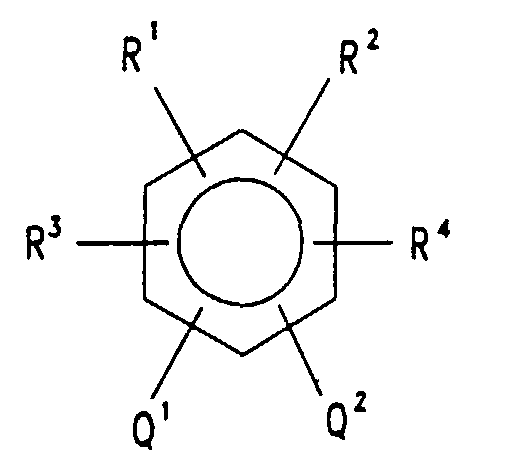
- a process for alkylating (A) an alkylatable mononuclear aromatic reactant of the formula: where Q 1 and Q 2 are the same or different and each is a hydrogen atom, an alkyl group, or an aprotic substituent (e.g., a halogen atom, a hydrocarbyloxy group, a hydrocarbylthio group, and a dihydrocarbylamino group), and R 1 , R 2 , R 3 and R 4 may be the same or different and each is either a hydrogen atom or an alkyl group, at least one of R 1 , R 2 , R 3 and R 4 being a hydrogen atom with (B) a haloalkane having from 1 to 2 halogen atoms, with the proviso that when 2 halogen atoms are present, the respective halogen atoms are bonded to different carbon atoms, the process comprising:
- This invention further provides a process for enriching the 1,2-bis(3,4-dimethylphenyl)ethane content of a mixture of bis(dimethylphenyl)ethanes and/or over-alkylated co-products.
- the process comprises agitating the mixture in the presence of an aluminum-containing Friedel-Crafts catalyst, at least a portion of the Friedel-Crafts catalyst being present as part of a liquid clathrate formed with an arene and a salt selected from alkali metal halide, alkaline earth metal halide, alkali metal or alkane earth metal pseudohalide, quaternary ammonium salt, quaternary phosphonium salt, ternary sulfonium salt, or a mixture of any two or more of the foregoing.
- a salt selected from alkali metal halide, alkaline earth metal halide, alkali metal or alkane earth metal pseudohalide, quaternary ammonium salt, quaternary
- the catalytic system used in the processes of this invention is, as before noted, formed at least partially from an aluminum compound (broadly defined as a Friedel-Crafts catalyst), a salt (broadly defined as any salt capable of forming a complex with the aluminum compound) and an aromatic compound (broadly defined as any aromatic compound capable of forming a liquid clathrate with the aluminum compound and salt).
- the catalytic system can be formed separately from the aromatic reactant or reaction mixture, or, more preferably, it can be formed in situ with the aromatic reactant or reaction mixture. To accomplish the former, the catalytic system constituents are mixed together and then added to the aromatic reactant. In the case of the latter, the constituents are each added, in any sequence; to the aromatic reactant or reaction reactor.
- the catalytic efficacy of the catalytic system during the Friedel-Crafts reaction can be the result of an individual constituent s catalytic activity, e.g., the aluminum compound, and/or the result of the catalytic activity of a combination of any two or more of the constituents, e.g., the liquid clathrate. It is theorized, though the processes of this invention are not to be so limited, that the catalytic activity during the reaction period is provided by the aluminum compound and the liquid clathrate. When speaking of the catalytic activity of the liquid clathrate, it is meant to include, such as they exist, both the activity of the liquid clathrate itself and any activity of a constituent of the liquid clathrate.
- the aluminum compounds used in the practice of this invention are any of those aluminum-containing compounds which are considered by the art to be in and of themselves Friedel-Crafts catalysts. Also the aluminum compounds have to be capable of forming the clathrates of this invention. As before noted, such compounds can be selected from aluminum trihalide, alkyl aluminum halide, aluminum trialkyl, or mixtures thereof. Suitable aluminum trihalides include aluminum trichloride, aluminum tribromide, aluminum trifluoride, and aluminum triiodide, as well as mixtures of such compounds.
- the aluminum trihalides are preferred for use in processes of this invention, especially those processes involving the alkylation of arenes, e.g., the alkylation of an arene with a dihaloalkane.
- Especially preferred are aluminum trichloride, aluminum tribromide and mixtures thereof.
- Aluminum trifloride and triiodide are suitable, but are not generally preferred.
- Suitable alkyl aluminum halides may have 1 or 2 branched or straight-chain alkyl groups which may be the same or different, each having from 1 to 10 carbon atoms.
- alkyl aluminum halides include dimethylaluminum chloride, methylaluminum dichloride, dimethylaluminum bromide, methylaluminum dibromide, dimethylaluminum iodide, methylaluminum diiodide, dimethylaluminum fluoride, methylaluminum difluoride, diethylaluminum chloride, ethylaluminum dichloride, diethylaluminum bromide, ethylaluminum dibromide, di-n-propylaluminum chloride, and n-propylaluminum dichloride, including higher homologs and mixtures of such compounds.
- Suitable aluminum trialkyl compounds for use in the practice of this invention have alkyl groups which may be the same or different, and may have branched or straight-chain alkyl groups each having from 1 to 10 carbon atoms.
- Suitable aluminum trialkyl compounds with straight-chain alkyl groups may include, for example, trimethylaluminum, triethylaluminum, tripropylaluminum, tributylaluminum, tripentylaluminum, trihexylaluminum, triheptylaluminum, trioctylaluminum, trinonylaluminum, tridecylaluminum, tris(dodecyl)aluminum, and tris(tetradecyl)aluminum, including higher homologs and mixtures of such compounds.
- Suitable aluminum trialkyl compounds with branched alkyl groups include, for example, triisopropylaluminum, triisobutylaluminum, tri(2-methylpentyl)aluminum, tri(3-methylpentyl)aluminum, tri(4-methylpentyl)aluminum, tri(2-diethylhexyl)aluminum, tri(3-ethylhexyl)aluminum, tri(4-ethylhexyl)aluminum, and tri(2,4-diethylhexyl)aluminum, including higher homologs and mixtures of such compounds.
- the aluminum compound is preferably an aluminum trihalide, most preferably aluminum trichloride.
- the salt which is used in the practice of this invention is any salt which is capable of forming a complex with the aluminum compound, which complex will form a liquid clathrate with the aromatic compound.
- Suitable are salts selected from alkali metal halide, alkaline earth metal halide, alkali metal or alkaline earth metal pseudohalide, quaternary ammonium salt, quaternary phosphonium salt, ternary sulfonium salt, or any mixture thereof.
- suitable salts include, sodium chloride, magnesium chloride, potassium iodide, potassium bromide, calcium chloride, beryllium fluoride, strontium iodide, barium bromide, potassium nitride, cesium nitride, potassium nitrate, cesium nitrate, tetramethylammonium chloride, triethylmethylammonium bromide, triethylmethylammonium chloride, tetramethylammonium bromide, dimethylpyrrolidinium chloride, trimethylethylammonium chloride, tetramethylphosphonium bromide, triethylmethylphosphonium bromide, triethylmethylphosphoninum chloride, trimethylsulfonium chloride, and tetra-n-butylammonium bromide, including higher homologs and mixtures of such compounds.
- the halide component in each of these compounds may be either chloride, bromide, fluoride, or iodide, with bromide or chloride being preferred.
- the salt is preferably a quaternary ammonium salt, most preferably a quaternary ammonium bromide.
- the aromatic compound used in forming the catalyst system is any of which is capable of forming the desired liquid clathrate in combination with the aluminum compound and the salt. It is preferred that the aromatic compound of the catalyst system be the same as the aromatic reactant. In this way, contamination of the reaction product is diminished and the process is simplified. If the aromatic compound and aromatic reactant are to be different, then the aromatic compound of the catalyst system should be chosen so that it is benign to the process. For examples of suitable aromatic compounds, reference is made to the recitation below of suitable aromatic reactants. In preferred embodiments of the invention, the aromatic compound used in forming the catalyst system is an arene.
- Liquid clathrates will be best formed from mononuclear arenes such as benzene, toluene, xylene, mesitylene, ethylbenzene, cumene, and cymene, with o-xylene being particularly preferred.
- the amount of catalytic system used should be that amount which will provide enough Friedel-Crafts catalytic activity to insure a useful and efficient process.
- the mole ratio of aluminum compound to aromatic (compound and reactant) is within the range of from 0.001:1 to 0.5:1 More preferred is the ratio of from 0.1:1 to 0.2:1. It is preferred to use a molar ratio of aluminum compound to reagent which is within the range of from 0.01:1 to 3:1, and most preferably within the range of from 0.1:1 to 1:1.
- the mole ratio of aluminum compound to salt is preferably within the range of from 0.01 to 2, and more preferably within the range of from 0.1 to 2.
- the aromatic reactant of this invention may include monocyclic and polycyclic aromatic compounds, and may include, for example, aromatic hydrocarbons and aromatic compounds having aprotic substituents.
- aromatic hydrocarbons and aromatic compounds having aprotic substituents may include, for example, aprotically substituted aromatic compounds such as aromatic ethers, aryl sulfides, aromatic nitriles, and arylhalides.
- aromatic hydrocarbons include benzene, cumene; cymene; mesitylene; styrene, toluene, xylene, indene, naphthalene, biphenyl, acenaphthene, fluorene; and 1,2-bis(phenyl)ethane.
- suitable aromatic compounds having aprotic substituents include anisole, ethyl phenyl ether, tert-butyl phenyl ether, cyclopropyl phenyl ether, p-dimethoxybenzene, p-bromoanisole, p-chloroanisole, N,N-dimethylaniline, N,N-dimethyl-p-toluidene, N,N-diethylaniline, N-ethyl-N-methylaniline, p-chloro-N,N-dimethylaniline, bromobenzene, chlorobenzene, 1-cchloronaphthalene, 2-chloronaphthalene, 1,4-dichlorobenzene, and 2,3-dichlorotoluene.
- the aromatic reactant and the aromatic compound forming part of the liquid clathrate are selected from the preferred arenes listed above for liquid clathrate formation, with alkylatable monocyclic arenes from the benzene series, such as xylene for example, being particularly preferred.
- alkylatable is meant that the aromatic ring contains at least one carbon atom having a hydrogen substituent available for and susceptible to alkylation.
- the aromatic compounds will contain up to 40 carbon atoms per molecule.
- the aromatic reactant of this invention may also include an alkylated aromatic compound, an isomeric mixture of alkylated aromatic compounds, an over-alkylated aromatic compound, a mixture of over-alkylated aromatic compounds or a mixture of any two or more of the foregoing.
- over-alkylated aromatic compounds it is meant that the compound contains at least one more aromatic and/or haloalkyl group constituent than is desired, the excess aromatic constituent(s), when present, being each bonded to the rest of the molecule by at least one alkyl substituting group.
- the practitioner may use the processes of this invention to obtain a reaction product which is more pure in a particular alkylated aromatic compound or obtain a less-alkylated aromatic compound, preferably a single isomeric product of the formula Ar-R-Ar, where Ar is an arene or an arene substituted by one or more aprotic groups and R is an alkylene group having at least 2 carbon atoms.
- a process of this invention can be used to enhance the 1,2-bis(3,4-dimethylphenyl)ethane content of a mix containing a lesser amount of same and, as an aromatic reactant, any one or more of 1,2-bis(2,3-dimethylphenyl)ethane, 1,2-bis(2,4-dimethylphenyl)ethane, 1,2-bis(3,5-dimethylphenyl)ethane, and 1-(3,4-dimethylphenyl)-2-(3,5-dimethylphenyl)ethane.
- the aromatic reactant includes at least one over-alkylated aromatic compound, such as bis(xylylethyl)xylenes.
- Such xylenes are exemplified by 1,4-bis[2-(2,3-xylyl)ethyl]-2,3-xylene, 1,4-bis[2-(3,4-xylyl)ethyl]-2,3-xylene, and 1,5-bis[2-(3,4-xylyl)ethyl]-2,3-xylene.
- These xylenes are readily converted to 1,2-bis(3,4-dimethylphenyl)ethane by the processes of this invention. Though an initial concentration of 1,2-bis(3,4-dimethylphenyl)ethane can be present in any of these reaction masses, it is not necessary for the purposes of this invention.
- the aromatic compound used to form the clathrate will need to be one which is different from the alkylated aromatic reactant.
- benzene, toluene, xylene, mesitylene, ethylbenzene, cumene, and cymene are preferred. It is especially useful to choose the aromatic compound for clathrate formation so that it also can be alkylated to produce the desired product.
- the desired product is 1,2-bis(3,4-dimethylphenyl)ethane
- o-xylene would be a most preferred liquid clathrate-forming aromatic compound for use in the process.
- the other reagent used in the Friedel-Crafts reaction of this invention provides the substituting group and is capable of forming a carbocation or carbocation-like complex with an aluminum containing Friedel-Crafts catalyst, e.g., AlCl 3 .
- the carbocation acts as an electrophile which can attack an aromatic ring site to effect the substitution.
- Selection of this reagent is based upon the desired Friedel-Crafts reaction product. For example, if the Friedel-Crafts reaction is to be an alkylation, then haloalkanes are suitable and preferred.
- reagents suitable for producing alkylated monoarene products are ethylchloride, propylchloride, butylchloride, methylbromide, ethylbromide, ethyliodide, octylchloride, n-decylbromide, tert-butylchloride, and analogous monohaloalkanes.
- the Friedel-Crafts reaction product sought is a diarene product, e.g., diphenylethane and 1,2-bis(3,4-dimethylphenyl)ethane
- the following reagents may be used, ethylene dichloride, ethylene dibromide, 1,2-dichloropropane, 1,3-dichloropropane, 1,3-dichlorobutane, 1,4-dibromobutane, 1,6-dichlorohexane; 1,7-dibromoheptane, 1,8-dibromooctane, 1,4-diiodobutane, 1,4-dichlorooctane and analogous dihaloalkanes.
- a preferred dihaloalkane is ethylene dichloride. Generally speaking, the haloalkanes will contain up to 18 carbon atoms per molecule.
- reaction mass It is suitable to provide from 2 to 20 and, preferably from 2 to 10 times the stoichiometric amount of aromatic reactant to the reaction mass. Such an excess is beneficial to provide organic solvent to the reaction mass and to reduce by-product formation. Further, if the aromatic compound used in forming the catalyst system is to be the same as the aromatic reactant, then some of the excess aromatic reactant can be used for that purpose. If the reaction product is a monocylic aromatic compound having a single Friedel-Crafts substitution, then the stoichiometric molar relationship between the aromatic reactant and reagent is 1:1. If, however, the reaction product is a dicyclic aromatic compound, such as diphenylethane, then the molar stoichiometric relationship will be 2:1.
- reaction temperature employed in the processes of this invention may range from 0 to 200° C.
- the desired product is a diarene
- the preferred reaction temperature is within the range of from 0 to 150° C. Most preferably, the temperature range is from 25 to 100° C.
- the desired reaction product is 1,2-bis(3,4-dimethylphenyl)ethane
- the preferred temperature is within the range of from 50 to 100° C.
- a reaction temperature of from 0 to 120° C is preferred.
- the processes of this invention are not particularly pressure dependent.
- the pressure used in the processes of this invention may range from atmospheric up to 17.6 kg/cm 2 (250 psia) and preferably up to 14.1 kg/cm 2 (200 psia). The more preferred pressures are atmospheric or near-atmospheric (0.98 - 1.41 kg/cm 2 [14 - 20 psia]) pressures.
- the processes of this invention may be conducted as either continuous, semi-continuous or batch reactions.
- the processes should also be carried out under substantially anhydrous conditions as water is destructive of the aluminum compound constituent of the catalyst system and may be destructive of the formed liquid clathrate.
- reaction periods may vary widely depending upon the results desired, but will typically be carried out for a time of from 1 to 24 hours. The reaction periods should only be that approximate amount of time needed to maximize product yield without incurring undue process inefficiency.
- the process time can be determined by monitoring the process for the cessation of formation of substitution by-products.
- the substitution by-product will be a hydrogen halide, e.g., ethylene dichloride will yield HCl as the substitution by-product.
- Reaction periods for producing diphenylethane and 1,2-bis(3,4-dimethylphenyl)ethane are preferably 10 hours or less.
- the aromatic reactant, the reagent and the catalyst system can be provided to the reactor in any order. However, it is preferred to provide the aromatic reactant first if a portion thereof is going to provide the aromatic compound constituent of the catalyst system. Thus, in this case the aromatic reactant is added first, the catalyst system second and the reagent third or contemporaneously with the second addition.
- reaction mass needs to be kept in a well stirred or agitated condition. After the reaction period has lapsed, the reaction mass is no longer stirred or agitated and the separate organic layers are allowed to form.
- the top organic layer was decanted off via a double-ended needle and washed with 5% aqueous sodium hydroxide to remove any remaining HCl and aluminum trichloride.
- the products, bis-(dimethylphenyl)ethanes, were isolated by evaporating solvent of the organic layer. Upon recrystallization of the products in alcohol, 1,2-bis(3,4-dimethylphenyl)ethane was obtained in good selectivity (61-68%) and yields (41-58%).
- the bottom layer was subsequently used as the catalyst system for four more cycles of the same reaction.
- the top organic layer containing 1-2% of total aluminum trichloride added was decanted off via a double-ended needle and washed with 5% aqueous sodium hydroxide.
- the product, diphenylethane was isolated by distillation in good yield (75%) and selectivity (85%) toward formation of diphenylethane versus over-alkylated co-products.
- the bottom liquid clathrate layer was a dark, viscous liquid immiscible in organic solvent and was used as the catalyst for another cycle of the same reaction. In a recycled run, a 55% yield of diphenylethane was obtained without supplementing aluminum chloride catalyst after 9 hours reaction at 70° C.
- Example 2 A total of 23.4 grams of a residue isolated from the mother liquor of the reaction set forth above as Example 1 containing mainly 1,2-bis-(dimethylphenyl)ethanes, over-alkylated co-products, and only 0.13 GC area% of 1,2-bis(3,4-dimethylphenyl)ethane was treated with 13.3 grams of aluminum trichloride, 16.2 grams of tetra-n-butylammonium bromide and 150 mL of o-xylene for 9 hours at 50° C with efficient stirring. When the stirring was stopped thereafter and while the mixture became quiescent, immediate separation of two organic phases occurred, indicating formation of a liquid clathrate.
- the isomerized product isolated from the top layer contained 69 GC area% of 1,2-bis(3,4-dimethylphenyl)ethane with a demonstrated conversion of the 1,2-bis-(dimethylphenyl)ethanes mixture and over-alkylated co-products to the desired 1,2-bis(3,4-dimethylphenyl)ethane.
- liquid clathrate formed and/or used in the practice of this invention is typically immiscible in organic solvent; the liquid clathrate exhibits efficient catalytic activity when used as the catalyst system in subsequent reactions.
- the liquid clathrate will often have a darker coloration which distinguishes it from the top organic layer.
- the liquid clathrate contains substantially all of the aluminum catalyst, thereby providing a platform from efficient recovery of the catalyst from the reaction mass, and efficient recycle of substantially all of the aluminum catalyst used in the initial reaction.
Landscapes
- Chemical & Material Sciences (AREA)
- Organic Chemistry (AREA)
- Chemical Kinetics & Catalysis (AREA)
- Engineering & Computer Science (AREA)
- Materials Engineering (AREA)
- Inorganic Chemistry (AREA)
- General Chemical & Material Sciences (AREA)
- Analytical Chemistry (AREA)
- Oil, Petroleum & Natural Gas (AREA)
- Water Supply & Treatment (AREA)
- Organic Low-Molecular-Weight Compounds And Preparation Thereof (AREA)
- Low-Molecular Organic Synthesis Reactions Using Catalysts (AREA)
Abstract
Description

Claims (49)
- A process for producing a Friedel-Crafts reaction product, the process comprising: providing, to a reactor, aromatic reactant and a catalyst system, which system is formed from constituents which comprise,causing the aluminum compound (i), the salt (ii), and the aromatic compound (iii) to form a readily recoverable liquid clathrate which is immiscible in the Friedel-Crafts reaction product and which exhibits Friedel-Crafts catalytic activity.(i) an aluminum compound selected from at least one aluminum trihalide, alkyl aluminum halide, or aluminum trialkyl, or a mixture of any two or more of the foregoing,(ii) a salt selected from alkali metal halide, alkaline earth metal halide, alkali metal or alkaline earth metal pseudohalide, quaternary ammonium salt, quaternary phosphonium salt, or ternary sulfonium salt, or a mixture of any two or more of the foregoing, and(iii) an aromatic compound which may be the same as or different from the aromatic reactant, and
- A process in accordance with Claim 1 wherein the aromatic compound and the aromatic reactant each are an arene.
- A process in accordance with Claim 2 wherein the aromatic compound and the aromatic reactant each are the same arene.
- A process in accordance with Claim 1 wherein the Friedel-Crafts reaction is an alkylation reaction.
- A process in accordance with Claim 1 wherein the aluminum compound is at least one aluminum trihalide.
- A process in accordance with Claim 5 wherein the aluminum trihalide is aluminum trichloride.
- A process in accordance with Claim 1 wherein the salt is at least one quaternary ammonium salt.
- A process in accordance with Claim 7 wherein the quaternary ammonium salt is tetra-n-butylammonium bromide.
- A process in accordance with Claim 1 wherein the liquid clathrate is recovered and reused to catalyze the same or a different Friedel-Crafts reaction.
- A process for alkylating an aromatic reactant, which process comprises: providing a reaction mass formed from the aromatic reactant and a catalyst system, at least a portion the system being present as a liquid clathrate formed from constituents which comprise, (i) an aluminum compound selected from at least one aluminum trihalide, alkyl aluminum halide, or aluminum trialkyl, or a mixture of any two or more of the foregoing, (ii) a salt selected from alkali metal halide, alkaline earth metal halide, alkali metal or alkaline earth metal pseudohalide, quaternary ammonium salt, quaternary phosphonium salt, or ternary sulfonium salt, or a mixture of any two or more of the foregoing, and (iii) an aromatic compound which may be the same as or different from the aromatic reactant.
- A process in accordance with Claim 10 further comprising, after the alkylation is at least substantially complete, recovering at least a portion of the clathrate from the reaction mass and reusing the recovered clathrate to catalyze the same or a different reaction.
- A process in accordance with Claim 10 wherein the aluminum compound is at least one aluminum trihalide.
- A process in accordance with Claim 12 wherein the aluminum trihalide is aluminum trichloride.
- A process in accordance with Claim 10 wherein the salt is at least one quaternary ammonium salt.
- A process in accordance with Claim 14 wherein the quaternary ammonium salt is tetra-n-butylammonium bromide.
- A process for alkylating (A) an alkylatable mononuclear aromatic reactant of the formula:where Q1 and Q2 are the same or different and each is a hydrogen atom, an alkyl group, or an aprotic substituent; and R1, R2, R3 and R4 may be the same or different and each is either a hydrogen atom or an alkyl group, at least one of R1, R2, R3 and R4 being a hydrogen atom; with (B) a haloalkane having from 1 to 2 halogen atoms, with the proviso that when 2 halogen atoms are present, the respective halogen atoms are bonded to different carbon atoms the process comprising:
 (a) agitating a reaction mixture of the aromatic reactant and the haloalkane in the presence of a catalyst system which is formed from constituents which comprise,(i) an aluminum compound comprising at least one aluminum trihalide, alkyl aluminum halide, aluminum trialkyl, or a mixture of any two or more of the foregoing,(ii) a salt selected from alkali metal halide, alkaline earth metal halide, alkali metal or alkaline earth metal pseudohalide, quaternary ammonium salt, quaternary phosphonium salt, ternary sulfonium salt, or a mixture of any two or more of the foregoing, and(iii) an aromatic compound which may be the same as or different from the aromatic reactant;(b) subsequent to (a), causing the formation of a first layer comprised of a liquid clathrate which is formed from constituents comprising (i), (ii) and (iii), which is immiscible in the Friedel-Crafts reaction product, and which exhibits Friedel-Crafts catalytic activity, and a second layer comprised of the alkylated aromatic reactant; and(c) optionally, recovering at least a portion of the liquid clathrate layer for use in a subsequent Friedel-Crafts reaction mixture to provide at least a part of the catalyst needs for such subsequent reaction mixture.
- A process in accordance with Claim 16 wherein the aromatic reactant and the aromatic compound are each an arene.
- A process in accordance with Claim 17 wherein the aromatic reactant and the aromatic compound are each the same arene.
- A process in accordance with Claim 16 wherein the aluminum compound is an aluminum trihalide.
- A process in accordance with Claim 19 wherein the aluminum trihalide is aluminum trichloride.
- A process in accordance with Claim 16 wherein the salt is a quaternary ammonium salt.
- A process in accordance with Claim 21 wherein the quaternary ammonium salt is tetraalkyl ammonium bromide or tetraalkyl ammonium chloride.
- A process in accordance with Claim 22 wherein the aluminum compound is aluminum trichloride.
- A process in accordance with Claim 16 wherein the haloalkane is a dihaloalkane.
- A process in accordance with Claim 24 wherein the dihaloalkane is ethylene dichloride.
- A process in accordance with Claim 16 wherein the aromatic compound is an aromatic hydrocarbon.
- A process in accordance with Claim 26 wherein the aromatic hydrocarbon is o-xylene.
- A process in accordance with Claim 27 wherein the haloalkane is a dihaloalkane.
- A process in accordance with Claim 28 wherein the dihaloalkane is ethylene dichloride.
- A process in accordance with Claim 29 wherein the aluminum compound is an aluminum trihalide, the salt a tetra-n-butylammonium halide, the reaction mixture in step (a) is maintained at a temperature in the range of 0 to 150° C and a pressure in the range of 0.98 - 14.1 kg/cm2 (14 to 200 psia), and the alkylated reaction product is at least one 1,2-bis(3,4-dimethylphenyl)ethane.
- A process in accordance with Claim 26 wherein the aromatic hydrocarbon is benzene.
- A process in accordance with Claim 31 wherein the haloalkane is a dihaloalkane.
- A process in accordance with Claim 32 wherein the dihaloalkane is ethylene dichloride.
- A process in accordance with Claim 33 wherein the aluminum compound is an aluminum trihalide, the salt is a tetra-n-butylammonium halide, the reaction mixture in step (a) is maintained at a temperature in the range of 0 to 120° C and a pressure in the range of 0.98 - 14.1 kg/cm2 (14 to 200 psia), and the alkylated reaction product is at least one diphenylethane.
- A liquid clathrate composition formed from constituents comprising:the composition being formed under substantially anhydrous conditions by agitating at least (i), (ii), and (iii) together and causing the mixture to become quiescent at least until a readily recoverable liquid clathrate having Friedel-Crafts catalytic activity is formed.(i) at least one aluminum trihalide,(ii) at least one salt selected from alkali metal halide, alkaline earth metal halide, alkali metal or alkaline earth metal pseudohalide, quaternary ammonium salt, quaternary phosphonium salt, or ternary sulfonium salt, or a mixture of any two or more of the foregoing, and(iii) at least one aromatic compound,
- A composition in accordance with Claim 35 wherein the aluminum trihalide is aluminum trichloride, the salt is a quaternary ammonium halide, and the aromatic compound is an arene.
- A process for converting one or more aromatic reactants selected from at least two or more isomeric forms of an alkylated aromatic compound, at least one over-alkylated aromatic compound, or a mixture of any two or more of the foregoing, into a single isomeric product of the formula Ar-R-Ar, where Ar is an arene or an arene substituted by one or more aprotic groups and R is an alkylene group having at least 2 carbon atoms, the process comprising agitating the reaction mass in the presence of a catalyst system, at least a portion of the system being present as a liquid clathrate formed from constituents which comprise,(i) an aluminum compound selected from at least one aluminum trihalide, alkyl aluminum halide, or aluminum trialkyl, or a mixture of any two or more of the foregoing,(ii) a salt selected from alkali metal halide, alkaline earth metal halide, alkali metal or alkaline earth metal pseudohalide, quaternary ammonium salt, quaternary phosphonium salt, or ternary sulfonium salt, or a mixture of any two or more of the foregoing, and(iii) an aromatic compound which may be the same as or different from any one of the aromatic reactants.
- A process in accordance with Claim 37 further comprising, after the reaction is at least substantially complete, recovering at least a portion of the clathrate from the reaction mass and reusing the recovered clathrate to catalyze the same or a different reaction.
- A process in accordance with Claim 37 wherein Ar is a xylyl group and R is an ethylene group.
- A process in accordance with Claim 39 wherein the isomeric product is 1,2-bis(3,4-dimethylphenyl)ethane.
- A process for enriching the 1,2-bis(3,4-dimethylphenyl)ethane content of a mixture of bis(dimethylphenyl)ethanes, the process comprising: agitating the mixture in the presence of a catalyst system, at least a portion of the system being present as a liquid clathrate formed from constituents which comprise.(i) an aluminum compound selected from at least one aluminum trihalide, alkyl aluminum halide, or aluminum trialkyl, or a mixture of any two or more of the foregoing,(ii) a salt selected from alkali metal halide, alkaline earth metal halide, alkali metal or alkaline earth metal pseudohalide, quaternary ammonium salt, quaternary phosphonium salt, or ternary sulfonium salt, or a mixture of any two or more of the foregoing, and(iii) an aromatic compound which may be the same as or different from any one of the aromatic reactants.
- A process in accordance with Claim 41 further comprising, after the reaction is at least substantially complete, recovering at least a portion of the clathrate from the mixture and reusing the recovered clathrate to catalyze the same or a different reaction.
- A process in accordance with Claim 41 wherein the aluminum-containing catalyst is an aluminum trihalide.
- A process in accordance with Claim 43 wherein the aluminum trihalide is aluminum trichloride.
- A process in accordance with Claim 41 wherein the salt is a quaternary ammonium salt.
- A process in accordance with Claim 45 wherein the quaternary ammonium salt is tetraalkyl ammonium bromide or tetraalkyl ammonium chloride.
- A process in accordance with Claim 46 wherein the aluminum-containing catalyst is aluminum trichloride.
- A process for the production of 1,2-bis(3,4-dimethylphenyl)ethane, the process comprising:(a) agitating a reaction mixture comprised of o-xylene and a dihaloethane in the presence of a first catalyst system which is formed from constituents which comprise,to form a reaction product;(i) an aluminum compound selected from at least one aluminum trihalide, alkyl aluminum halide, aluminum trialkyl, or a mixture of any two or more of the foregoing,(ii) a salt selected from alkali metal halide, alkaline earth metal halide, alkali metal or alkaline earth metal pseudohalide, quaternary ammonium salt, quaternary phosphonium salt, ternary sulfonium salt, or a mixture of any two or more of the foregoing, and(iii) o-xylene;(b) causing the formation of the reaction product of a first layer comprised of a liquid clathrate which is formed from constituents comprising (i), (ii) and (iii), which is immiscible in the reaction product, and which exhibits Friedel-Crafts catalytic activity, and a second layer comprised of alkylated o-xylene:(c) separating the first layer and the second layer from each other;(d) recovering 1,2-bis(3,4-dimethylphenyl)ethane from the second layer;(e) thereafter agitating at least a portion of the second layer with at least a portion of the liquid clathrate and optionally a second catalyst system which is formed from constituents which comprise,and repeating steps (b), (c) and (d).(i) at least an aluminum compound comprising at least one aluminum trihalide, alkyl aluminum halide, aluminum trialkyl, or a mixture of any two or more of the foregoing, and optionally,(ii) a salt selected from alkali metal halide, alkaline earth metal halide, alkali metal or alkaline earth metal pseudohalide, quaternary ammonium salt, quaternary phosphonium salt, ternary sulfonium salt, or a mixture of any two or more of the foregoing, and(iii) o-xylene;
- The process of Claim 48 wherein the aluminum compound in (a)(i) and (e)(i) is aluminum trichloride, and wherein the salt in (a)(ii) and (e)(ii) is a quaternary ammonium salt.
Applications Claiming Priority (2)
| Application Number | Priority Date | Filing Date | Title |
|---|---|---|---|
| US739225 | 1985-05-30 | ||
| US08/739,225 US5859302A (en) | 1996-10-28 | 1996-10-28 | Processes employing reusable aluminum catalysts |
Publications (1)
| Publication Number | Publication Date |
|---|---|
| EP0838447A1 true EP0838447A1 (en) | 1998-04-29 |
Family
ID=24971357
Family Applications (1)
| Application Number | Title | Priority Date | Filing Date |
|---|---|---|---|
| EP97250301A Withdrawn EP0838447A1 (en) | 1996-10-28 | 1997-10-13 | Processes employing reusable aluminum catalysts |
Country Status (2)
| Country | Link |
|---|---|
| US (1) | US5859302A (en) |
| EP (1) | EP0838447A1 (en) |
Cited By (7)
| Publication number | Priority date | Publication date | Assignee | Title |
|---|---|---|---|---|
| WO1999054038A1 (en) * | 1998-04-22 | 1999-10-28 | Albemarle Corporation | Liquid clathrate compositions |
| US6573405B1 (en) | 1999-03-24 | 2003-06-03 | Scionix Limited | Ionic liquids |
| WO2007070263A3 (en) * | 2005-12-14 | 2007-08-02 | Chemtura Corp | Ring alkylation of aniline or an aniline derivative using ionic liquid catalysts |
| US7351339B2 (en) | 2002-01-24 | 2008-04-01 | Basf Aktiengesellschaft | Method for the separation of acids from chemical reaction mixtures by means of ionic fluids |
| JP2009519928A (en) * | 2005-12-14 | 2009-05-21 | ケムチュア コーポレイション | Alkylation of diphenylamine compounds in ionic liquids |
| WO2011064556A2 (en) | 2009-11-25 | 2011-06-03 | University Of Leicester | New ionic liquids |
| CN103801402A (en) * | 2012-11-09 | 2014-05-21 | 中化化工科学技术研究总院 | Quaternary phosphonium salt ionic liquid composite catalyst, preparation method and application thereof |
Families Citing this family (3)
| Publication number | Priority date | Publication date | Assignee | Title |
|---|---|---|---|---|
| DE19926463B4 (en) * | 1998-06-23 | 2006-04-20 | Siemens Ag | Method for monitoring optical signals on a plurality of optical fibers |
| CN103804118B (en) * | 2012-11-09 | 2016-03-09 | 中化化工科学技术研究总院 | A kind of Friedel-Crafts reaction method |
| CN114890623B (en) * | 2022-05-16 | 2023-07-04 | 煤炭科学技术研究院有限公司 | Acylation wastewater treatment process and system capable of recycling resources |
Citations (5)
| Publication number | Priority date | Publication date | Assignee | Title |
|---|---|---|---|---|
| US3760021A (en) * | 1971-08-13 | 1973-09-18 | Exxon Research Engineering Co | Alkylation catalyst |
| JPS541286B1 (en) * | 1970-07-20 | 1979-01-23 | ||
| JPS5745114A (en) * | 1980-09-01 | 1982-03-13 | Kureha Chem Ind Co Ltd | Preparation of 1,2-diphenylethane |
| JPH06263656A (en) * | 1992-10-26 | 1994-09-20 | Nippon Steel Corp | Alkylation of aromatic compound |
| WO1995021872A1 (en) * | 1994-02-10 | 1995-08-17 | Bp Chemicals Limited | Ionic liquids |
Family Cites Families (10)
| Publication number | Priority date | Publication date | Assignee | Title |
|---|---|---|---|---|
| US2092295A (en) * | 1935-01-30 | 1937-09-07 | Shell Dev | Production of synthetic resins and resinous materials |
| US2520439A (en) * | 1945-10-08 | 1950-08-29 | Phillips Petroleum Co | Wet grinding process |
| US2882289A (en) * | 1954-11-24 | 1959-04-14 | Universal Oil Prod Co | Alkylation process and catalyst therefor |
| US3275703A (en) * | 1964-01-24 | 1966-09-27 | Standard Oil Co | Process for alkylation of aromatic hydrocarbons |
| US4367360A (en) * | 1981-09-18 | 1983-01-04 | Koppers Company, Inc. | Method for product isolation and catalyst recovery in aluminum chloride catalyzed isomerization of sym-octahydrophenanthrene to sym-octahydroanthracene |
| US4868271A (en) * | 1985-10-22 | 1989-09-19 | Raychem Corporation | Novel aromatic polymers |
| US5068447A (en) * | 1984-10-11 | 1991-11-26 | Raychem Corporation | Friedel-crafts preparation of aromatic ketones with an inoganic salt controlling agent |
| JP2699183B2 (en) * | 1988-10-31 | 1998-01-19 | 旭電化工業株式会社 | Thermal recording material |
| SU1696416A1 (en) * | 1989-11-01 | 1991-12-07 | Пермский политехнический институт | Method of ethylbenzene preparation |
| JP2792609B2 (en) * | 1990-09-17 | 1998-09-03 | 旭電化工業株式会社 | Method for producing 1,2-bis (3,4-dimethylphenyl) ethane |
-
1996
- 1996-10-28 US US08/739,225 patent/US5859302A/en not_active Expired - Fee Related
-
1997
- 1997-10-13 EP EP97250301A patent/EP0838447A1/en not_active Withdrawn
Patent Citations (5)
| Publication number | Priority date | Publication date | Assignee | Title |
|---|---|---|---|---|
| JPS541286B1 (en) * | 1970-07-20 | 1979-01-23 | ||
| US3760021A (en) * | 1971-08-13 | 1973-09-18 | Exxon Research Engineering Co | Alkylation catalyst |
| JPS5745114A (en) * | 1980-09-01 | 1982-03-13 | Kureha Chem Ind Co Ltd | Preparation of 1,2-diphenylethane |
| JPH06263656A (en) * | 1992-10-26 | 1994-09-20 | Nippon Steel Corp | Alkylation of aromatic compound |
| WO1995021872A1 (en) * | 1994-02-10 | 1995-08-17 | Bp Chemicals Limited | Ionic liquids |
Non-Patent Citations (3)
| Title |
|---|
| CHEMICAL ABSTRACTS, vol. 90, no. 21, 21 May 1979, Columbus, Ohio, US; abstract no. 168240k, "Ethylbenzene" page 570; column 1; XP002055165 * |
| PATENT ABSTRACTS OF JAPAN vol. 18, no. 668 (C - 1289) 16 December 1994 (1994-12-16) * |
| PATENT ABSTRACTS OF JAPAN vol. 6, no. 118 (C - 111) 2 July 1982 (1982-07-02) * |
Cited By (14)
| Publication number | Priority date | Publication date | Assignee | Title |
|---|---|---|---|---|
| WO1999054038A1 (en) * | 1998-04-22 | 1999-10-28 | Albemarle Corporation | Liquid clathrate compositions |
| US6573405B1 (en) | 1999-03-24 | 2003-06-03 | Scionix Limited | Ionic liquids |
| US7767852B2 (en) | 2002-01-24 | 2010-08-03 | Basf Aktiengesellschaft | Method for the separation of acids from chemical reaction mixtures by means of ionic fluids |
| US7351339B2 (en) | 2002-01-24 | 2008-04-01 | Basf Aktiengesellschaft | Method for the separation of acids from chemical reaction mixtures by means of ionic fluids |
| JP2009519928A (en) * | 2005-12-14 | 2009-05-21 | ケムチュア コーポレイション | Alkylation of diphenylamine compounds in ionic liquids |
| JP2009519927A (en) * | 2005-12-14 | 2009-05-21 | ケムチュア コーポレイション | Ring alkylation of aniline or aniline derivatives using ionic liquid catalysts |
| US7378554B2 (en) | 2005-12-14 | 2008-05-27 | Chemtura Corporation | Ring alkylation of aniline or an aniline derivative using ionic liquid catalysts |
| WO2007070263A3 (en) * | 2005-12-14 | 2007-08-02 | Chemtura Corp | Ring alkylation of aniline or an aniline derivative using ionic liquid catalysts |
| RU2427567C2 (en) * | 2005-12-14 | 2011-08-27 | Кемтура Корпорейшн | Alkylation on aniline ring using ionic liquid catalysts |
| JP4875106B2 (en) * | 2005-12-14 | 2012-02-15 | ケムチュア コーポレイション | Alkylation of diphenylamine compounds in ionic liquids |
| JP4938790B2 (en) * | 2005-12-14 | 2012-05-23 | ケムチュア コーポレイション | Ring alkylation of aniline or aniline derivatives using ionic liquid catalysts |
| WO2011064556A2 (en) | 2009-11-25 | 2011-06-03 | University Of Leicester | New ionic liquids |
| CN103801402A (en) * | 2012-11-09 | 2014-05-21 | 中化化工科学技术研究总院 | Quaternary phosphonium salt ionic liquid composite catalyst, preparation method and application thereof |
| CN103801402B (en) * | 2012-11-09 | 2016-03-09 | 中化化工科学技术研究总院 | A kind of quaternary phosphonium salt ionic liquid composite catalyst and its preparation method and application |
Also Published As
| Publication number | Publication date |
|---|---|
| US5859302A (en) | 1999-01-12 |
Similar Documents
| Publication | Publication Date | Title |
|---|---|---|
| US6096680A (en) | Liquid clathrate compositions | |
| Collman et al. | Selective syntheses of aliphatic ketones using sodium tetracarbonylferrate (-II) | |
| CN1123023A (en) | Alkylation process | |
| US5859302A (en) | Processes employing reusable aluminum catalysts | |
| WO2000041809A1 (en) | Ionic liquid catalyst for alkylation | |
| EP1097118B1 (en) | Alkylation process | |
| WO2013061336A2 (en) | A process for producing alkylated aromatic hydrocarbons | |
| JPS5833206B2 (en) | Improved alkylation method | |
| US3666825A (en) | Process for alkylating aromatic hydrocarbons | |
| US3095460A (en) | Preparation of stabilized magnesium alkyls | |
| JP4383449B2 (en) | Method for producing substituted arylcarboxylic acid chloride | |
| JPS6123798B2 (en) | ||
| JP2922289B2 (en) | Method for producing biaryl compound | |
| JP3537483B2 (en) | Method for alkylating aromatic compounds | |
| US4585750A (en) | Composite catalyst for hydrocarbon conversion reactions | |
| US2311232A (en) | Manufacture of catalysts | |
| JP4658432B2 (en) | Method for producing o-chloromethylbenzoyl chloride | |
| US3832417A (en) | Disproportionation process | |
| US2849505A (en) | Alkylation catalyst comprising a tin halide and metallic aluminum | |
| US3657148A (en) | Alkylation catalyst complex its preparation and use | |
| CZ281498B6 (en) | Process for preparing 2,2-bis(3,4-dimethylphenyl)propane | |
| US6307113B1 (en) | Selective bromination of aromatic compounds | |
| US2246007A (en) | Treatment of friedel-crafts reaction liquors | |
| US3679760A (en) | Preparation of diarylalkanes | |
| US3217020A (en) | Process for transalkylation and preparation of higher fatty acids from magnesium lower alkyl compounds |
Legal Events
| Date | Code | Title | Description |
|---|---|---|---|
| PUAI | Public reference made under article 153(3) epc to a published international application that has entered the european phase |
Free format text: ORIGINAL CODE: 0009012 |
|
| AK | Designated contracting states |
Kind code of ref document: A1 Designated state(s): DE FR GB |
|
| AX | Request for extension of the european patent |
Free format text: AL;LT;LV;RO;SI |
|
| 17P | Request for examination filed |
Effective date: 19980612 |
|
| AKX | Designation fees paid |
Free format text: DE FR GB |
|
| RBV | Designated contracting states (corrected) |
Designated state(s): DE FR GB |
|
| 17Q | First examination report despatched |
Effective date: 20000218 |
|
| GRAG | Despatch of communication of intention to grant |
Free format text: ORIGINAL CODE: EPIDOS AGRA |
|
| GRAG | Despatch of communication of intention to grant |
Free format text: ORIGINAL CODE: EPIDOS AGRA |
|
| GRAH | Despatch of communication of intention to grant a patent |
Free format text: ORIGINAL CODE: EPIDOS IGRA |
|
| STAA | Information on the status of an ep patent application or granted ep patent |
Free format text: STATUS: THE APPLICATION IS DEEMED TO BE WITHDRAWN |
|
| 18D | Application deemed to be withdrawn |
Effective date: 20020921 |