EP0838123B1 - Detecting mobile telephone misuse - Google Patents
Detecting mobile telephone misuse Download PDFInfo
- Publication number
- EP0838123B1 EP0838123B1 EP96924059A EP96924059A EP0838123B1 EP 0838123 B1 EP0838123 B1 EP 0838123B1 EP 96924059 A EP96924059 A EP 96924059A EP 96924059 A EP96924059 A EP 96924059A EP 0838123 B1 EP0838123 B1 EP 0838123B1
- Authority
- EP
- European Patent Office
- Prior art keywords
- profile
- subscriber
- pattern
- profiles
- fraud
- Prior art date
- Legal status (The legal status is an assumption and is not a legal conclusion. Google has not performed a legal analysis and makes no representation as to the accuracy of the status listed.)
- Expired - Lifetime
Links
Images



Classifications
-
- H—ELECTRICITY
- H04—ELECTRIC COMMUNICATION TECHNIQUE
- H04W—WIRELESS COMMUNICATION NETWORKS
- H04W12/00—Security arrangements; Authentication; Protecting privacy or anonymity
- H04W12/12—Detection or prevention of fraud
- H04W12/126—Anti-theft arrangements, e.g. protection against subscriber identity module [SIM] cloning
-
- H—ELECTRICITY
- H04—ELECTRIC COMMUNICATION TECHNIQUE
- H04M—TELEPHONIC COMMUNICATION
- H04M15/00—Arrangements for metering, time-control or time indication ; Metering, charging or billing arrangements for voice wireline or wireless communications, e.g. VoIP
- H04M15/47—Fraud detection or prevention means
-
- H—ELECTRICITY
- H04—ELECTRIC COMMUNICATION TECHNIQUE
- H04M—TELEPHONIC COMMUNICATION
- H04M2215/00—Metering arrangements; Time controlling arrangements; Time indicating arrangements
- H04M2215/01—Details of billing arrangements
- H04M2215/0148—Fraud detection or prevention means
-
- H—ELECTRICITY
- H04—ELECTRIC COMMUNICATION TECHNIQUE
- H04W—WIRELESS COMMUNICATION NETWORKS
- H04W12/00—Security arrangements; Authentication; Protecting privacy or anonymity
- H04W12/60—Context-dependent security
- H04W12/65—Environment-dependent, e.g. using captured environmental data
Definitions
- This invention relates to an apparatus and method for the detection of fraudulent use of mobile telephones.
- Mobile telephone fraud is the unauthorised use of a telecommunications network accomplished by deception via the wireless medium.
- This deception may take a number of forms which are generally classified under the broad headings of subscription fraud, theft and cloning.
- Subscription fraud arises from the use of a false name and address when purchasing a mobile telephone and results in a direct loss to the service provider when a bill for usage of the telephone is unpaid.
- Theft of a mobile telephone can lead to antenna misuse in the period between loss of the telephone and the reporting of that loss to the service provider.
- a mobile telephone may simply be borrowed by a fraudster who then steals air time. This particular type of theft may remain undetected for some time as it will become apparent only when the customer subsequently receives a bill.
- the most serious fraud in a mobile system is that of mobile telephone cloning where the fraudster gains access to the network by emulating or copying the identification code of a genuine mobile telephone. This results in multiple occurrence of the telephone unit.
- the users of these clones may or may not be aware of this misuse. This fraud generally remains undetected until a customer becomes aware of unexpected items on a bill, by which time the total financial loss can be substantial.
- An object of the invention is to minimise or to overcome this disadvantage.
- an apparatus for the detection of fraudulent use of a telephone subscriber's instrument in a mobile telephone system including means for determining a long term calling profile for a said subscriber, means for determining a short term calling profile for the subscriber, means for determining the difference between the long term and short term profiles, said difference comprising a subscriber profile pattern, and a trained neural net arrangement for determining from the subscriber profile pattern a probability value for the existence of fraud in that pattern, wherein the neural net arrangement comprises a self organising map adapted to effect pattern recognition of said subscriber profile patterns, and a multilayer perceptron adapted to determine said probability value for each recognised pattern.
- apparatus for the detection of fraudulent use of a telephone subscriber's instrument in a mobile telephone system, the apparatus including an input preprocesor, a neural network engine coupled to the preprocessor, and an output postprocessor coupled to the neural network engine, wherein the preprocessor is adapted to determine for each subscriber, from that subscriber's telephone call data, a first long term calling profile, a second short term calling profile, and a subscriber profile pattern comprising the difference between the first and second profiles, each said calling profile and subscriber profile pattern comprising a set of values for a respective set of call attributes, wherein the neural network engine comprises a self organising map trained to effect pattern recognition of said subscriber profile patterns and a multilayer perceptron adapted to determine for each recognised pattern a value indicative of the probability of a fraud being associated with that pattern, and wherein said postprocessor is arranged to order said recognised pattern according to said fraud probabilities.
- a method for the detection of fraudulent use of a telephone subscriber's instrument in a mobile telephone system including determining a long term calling profile for a said subscriber, determining a short term calling profile for the subscriber, determining the difference between the long term and short term profiles, said difference comprising a subscriber profile pattern, and processing the pattern via a trained neural net arrangement comprising a self organising map adapted to effect pattern recognition of said subscriber profile patterns and a multilayer perceptron adapted to determine said probability value for each recognised pattern whereby to determine from the subscriber profile pattern a probability value for the existence of fraud in that pattern.
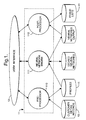
- the arrangement includes a processor generally indicated as 11 accessed via a user interface 12.
- the processor receives customers detail records 13 of calls made by customers and outputs a list of potential frauds 14 by processing and analysis of those records.
- the processor 11 includes a preprocessor 110 which generates customer profiles 15 from the input customer data, a neural network engine 111 which performs the customer profile analysis and a post processor 112 which performs an output function.
- the neural network engine 111 may incorporate a self organising map (SOM), which organises customer calling patterns into groups, and a multi-layered perceptron (MLP) which is trained to recognise potential frauds in the customer calling patterns from known cases of fraud.
- SOM self organising map
- MLP multi-layered perceptron
- this shows the construction of the preprocessor of the arrangement of figure 1.
- the function of the preprocessor is to transform the new data relating to customer calls into a format suitable for processing by the neural network engine.
- the preprocessor is also used to process information from a training file 21 into a form suitable for training the MLP.
- the output of the preprocessor comprises SOM profiles 22 for the self organising map, MLP detection profiles 23 for the multi-layer perceptron (MLP) and training profiles 24 for the MLP.
- a customer detail record is a log of a completed telephone call. This comprises a number of attributes, for example the following:-
- the preprocessor collects the individual CDR's for each customer and generates a customer profile record.
- a profile record captures a customer's calling pattern over time and is created for each customer account holder from their respective CDR's.
- a customer's profile record comprises the following attributes or fields:
- the historic profile captures the customer's calling behaviour over a long period of time, typically six months. It is assumed that fraudulent activity is not taking place for each historical profile during that period. Calling habits can change over time and the historical profile will thus need to be updated periodically to reflect the new calling behaviour.
- FIG. 3a shows a typical customer profile.
- the profile attributes have been normalised to values between 0 - 1.
- a profile pattern is then obtained by plotting the points of the profile for each attribute, as illustrated in figure 3b which shows the pattern obtained from the profile of figure 3a.
- the output file does not have to include all the fields described above and for some applications may consist of a subset of the fields identified in the profile record. All the fields are numeric and may be subjected to mathematical transformations. Transformations alter the characteristics of a field and are used to improve the pattern recognition capabilities of the neural network by accentuating salient features. There are many functions which are suitable for this task.
- Transformations can be applied globally to change all the fields or locally to make one attribute more or less predominant.
- Figures 4a and 4b illustrate the effects of applying local and global transformations to attributes or fields of the pattern of figure 3b.
- the processor uses the historic and new profiles to generate SOM profiles and MLP profiles.
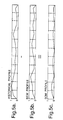
- a SOM profile is a measure of the change in behaviour of a user's calling habits. This is the difference between the historical profile and the new profile. Scaling may take place between the historical and new profile to produce a more pronounced output pattern. This may be used to improve the pattern recognition capabilities of the neural network, and is illustrated in figures 5a to 5c which illustrate the derivation of a SOM profile from corresponding historical and new profiles for a customer.
- An MLP profile for detection is a set or pair of historical and new profiles for a particular customer .
- An MLP profile for training is simply an MLP profile for detection with the inclusion of an extra binary field for each profile which indicates whether or not a fraud is being committed in that particular profile.
- a binary '1' denotes fraudulent activity otherwise the value will be '0'.
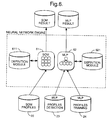
- the neural network engine incorporates a self-organising map (SOM) 61 and a multi-layer perceptron (MLP) 62 each having a respective definition module 611, 621.
- SOM profiles 22 from the preprocessor are fed to the SOM 61.
- MLP detection profiles 23 and MLP training profiles 24 are fed to the MLP 62.
- the neural network engine is a tool which recognises patterns of fraud from a set of account or customer profiles.
- the pattern recognition capabilities are determined by the architecture and input data.
- the SOM 61 is a neural network architecture which discovers patterns in data by clustering similar types together.
- the data is grouped by the SOM without any prior knowledge or assistance which makes the types of patterns found highly dependent upon the input data presented.
- the SOM is used to classify the SOM profiles into groups representing types of legitimate and fraudulent patterns. Grouping is achieved by mapping the profiles on to points on a two dimensional plane, each point representing a group.
- a SOM is topology preserving which means neighbouring groups will share similar features.
- the SOM operates in two phases, firstly the neural network learns the characteristics of the data upon which the model forms the groups. This is achieved by repeatedly presenting the set of profiles to the network until the classification of profiles to groups remains static. The number of potential groups is predetermined and reflects the diversity in the data. This is the training phase of the SOM. Once the group types have been established, unseen profiles can be presented to the network and will be classified accordingly. Each profile will be allocated to the group which it most closely resembles.
- the same type of input is used and comprises a set of SOM profiles from the preprocessor.
- the groups are represented by points in two-dimensional space. Each group will also have a set of characteristics associated with them that describe the group. The characteristics comprise the profile associated with that group.
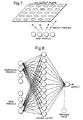
- the output consists of the allocation of profiles to groups where each profile belongs to precisely one group. This is illustrated in Table 2 below and in figure 7 which shows the SOM neural network architecture in highly schematic form.
- the two dimensional plane represents the output space of the network where the groups are depicted by nodes.
- the SOM profile input is fed into the network and allotted to the output node it most resembles.
- the black node in figure 7 denotes the group type of the SOM profile.
- the groups characteristics are stored on the connections from the SOM profile to the Output Plane as indicated by the black dots.
- the multi-layer perceptron is used to give an indication of the likelihood of fraud occurring for each accounts holder or customer.
- the multi-layered perceptron is trained to recognise patterns from historical data containing known cases of fraud. Training is defined as showing the neural network a set of MLP profiles for training which includes the desired response of either legitimate or fraudulent. Once trained the neural network can then interpolate over unseen data.
- the MLP has three modes of operation training, validation and detection each of which are discussed below.
- Figure 8 shows the neural network architecture of the MLP.
- the network takes either the MLP profile for training or an MLP profile for detection depending on the mode of operations.
- the output is a continuous value between 0-1 which is an indication of legitimate use or of fraud.
- the input data for the MLP is a set of MLP profiles supplied by the preprocessor.
- each record contains an additional field with the desired result.
- This extra field is a binary value where '1' denotes a fraudulent profile otherwise the value is '0'.
- This additional requirement is reflected in the MLP profile for training.
- Typical MLP training and detection profiles are illustrated in Tables 3 and 4 respectively.
- MLP Profile for Training Historical Profile New Profile Fraud Indication 0.5 0.4... 0.4 0.3... 0 0.1 0.1 ... 0.9 0.8 ... 1 0.2 0.5... 0.3 0.45... 0 0.1 0.5 ... 0.2 0.4 ... 0
- the MLP output from the MLP network is a string of continuous valued numbers between '0' and '1'. Each number represents the likelihood of network abuse or fraud for the corresponding account holder. The closer the value is to '1' the stronger the indication of fraud. In training and validation mode the additional binary field containing the actual value will also be output to enable the performance to be evaluated.
- the MLP training output is illustrated in Table 5 and the detection output in Table 6.
- the postprocessor shown in figure 9 provides the intermediary stage between neural network and the user interface. Its purpose is to translate the neural networks output into a meaningful and useful format.
- the postprocessing tasks include merging data from profiles, reversing mathematical functions applied by the preprocessor, sorting, filtering and saving the results to file.
- the SOM network clusters profiles of user accounts into groups in two dimensional space. This concept is illustrated in figure 10 in which the black circles represent group types and the grey dots denote the customer account profiles. A customer account profile will belong to the nearest group in the 2-Dimensional space, group boundaries are shown by the dotted lines.
- the output comprises the SOM profile and their associated group type as well as the characteristics of that group. From the group characteristics we can measure how closely the SOM profile matches that group. This measure serves as a certainty factor for groups which are found to be fraudulent. The output is merged with the user's billing account number to retain user details.
- the task is now to label groups in terms of legitimate accounts and types of fraud.
- One technique for identifying group types is to add profiles of known legitimate and fraudulent types to the input space. The resulting group can then be labelled accordingly. Unknown groups may represent new types of fraud.
- the output can be used for fraud detection. Here, only fraudulent cases need to be listed. This list can then be saved to file.
- Multi-Layered Perceptron MLP
- the MLP network operates in training, validation or detection mode.
- training or validation mode the neural network output is a set of actual and desired values.
- the actual values are calculated by the neural network and represent the degree of certainty of fraud occurring for that account holder. These are continuous values between '0' and '1'.
- the desired value is a binary value where '1' denotes fraud otherwise it is '0'.
- the output is used as a performance measure to judge how well the neural network has learned to recognise fraud.
- the performance measure is calculated from the average difference between actual and desired values. An acceptable error threshold needs to be set and if the measure falls outside this value then the neural network has not been trained successfully.
- the neural network should be validated on a set of data which is independent from the training set to test the generalisation capabilities.
- the output now contains the set of actual values. These actual values need to be merged with their corresponding user billing account number prior to processing to ensure the reference to the original users details is retained.
- the account profile can then be ordered in a list by the strength of the indication of fraud. A threshold can be optionally used to filter out less prevalent cases. Items at the top of the list should have highest priority for further investigation. This list can then be saved to file. An example of the list is given in Table 9. Postprocessed MLP Detection Output Bill Account No Certainty Factor 001 0.98 002 0.9 003 0.78 004 0.72 0.72 00 005 0.69
- the arrangement described above may be incorporated in a network manager for a mobile telephone network. Alternatively it may be provided as a stand-alone arrangement which services a number of mobile networks.
Landscapes
- Engineering & Computer Science (AREA)
- Computer Networks & Wireless Communication (AREA)
- Signal Processing (AREA)
- Computer Security & Cryptography (AREA)
- Telephonic Communication Services (AREA)
- Mobile Radio Communication Systems (AREA)
- Arrangements For Transmission Of Measured Signals (AREA)
Abstract
Description
- Billing account number.
- Telephone number associated with account.
- Called telephone number.
- Date and time of completion of call
- Duration of call.
- Originating send area.
- Receiving area.
- Home location of the caller.
- Medium of call destination i.e. land, mobile or call forward.
- Units of call.
- Call made to a frequently used telephone number
- Distance class of call
| | ||||||||||
| # | ||||||||||
| 1 | #2 | #3 | #4 | #5 | #6 | #7 | #8 | #9 | #10 | #11 |
| 0.4 | 0.67 | 0.6 | 6 | 2.5 | 0.9 | 0.56 | 5 | 2 | 0.7 | 11 |
| 0.5 | 0.9 | 0.56 | 3 | 4 | 0.8 | 0.2 | 1 | 3 | 0.1 | 10 |
| 0.1 | 0.7 | 0.1 | 1 | 9 | 0.34 | 0.76 | 18 | 3 | 0.56 | 14 |
| 0.3 | 0.2 | 0.3 | 7 | 1 | 0.2 | 0.3 | 4 | 2 | 0.2 | 12 |
| SOM Output | ||
| SOM Profile | Group | Group Profile |
| 0.56 0.34 ... | 00010000 | 0.54 0.3 ... |
| 0.4 0.2 ... | 10000000 | 0.34 0.2 ... |
| 0.7 0.4 ... | 00000001 | 0.9 0.5 ... |
| 0.3 0.4 | 01000000 | 0.23 0.44 ... |
- Training is the process of teaching the neural network to recognise patterns. During this phase each profile is shown in turn to the neural network along with the desired response. For training we need data that we know about. We also need a large representative set of data to ensure that the neural network learns all the possible patterns. The process is repeated until the neural network has been successfully taught, this being measured by the amount of error between the neural network output and the desired response.
- Validation is the process of checking that the neural network has learned successfully. Validation is much like training, but here the network is tested on previously unseen data where the desired response is already known to see how well the network has generalised. If validation fails the neural network must be retrained.
- Once the MLP has been successfully trained it can then be used in a detection mode on unseen data to judge whether fraud is occurring for an account.
| MLP Profile for Training | ||
| Historical Profile | New Profile | Fraud Indication |
| 0.5 0.4... | 0.4 0.3... | 0 |
| 0.1 0.1 ... | 0.9 0.8 ... | 1 |
| 0.2 0.5... | 0.3 0.45... | 0 |
| 0.1 0.5 ... | 0.2 0.4 ... | 0 |
| MLP Profile for Detection | |
| Historical Profile | New Profile |
| 0.5 0.4... | 0.4 0.3... |
| 0.1 0.1 ... | 0.9 0.8... |
| 0.2 0.5... | 0.3 0.45... |
| 0.1 0.5... | 0.2 0.4... |
| MLP Output for Training | |
| ACTUAL RESPONSE | DESIRED RESPONSE |
| 0.8 | 1 |
| 0.1 | 0 |
| 0.4 | 0 |
| 0.7 | 1 |

| Postprocessed SOM Output | |
| GROUP A | |
| Billing Account No | Certainty Factor |
| 001 | 0.98 |
| 002 | 0.9 |
| 003 | 0.78 |
| 004 | 0.72 |
| 005 | 0.69 |
| GROUP B | |
| Billing Account No | Certainty Factor |
| 006 | 0.94 |
| Performance Metric | ||
| Actual Value | Desired Values | Difference |
| x1 | y1 | y1 - x1 |
| x2 | y2 | y2 - x2 |
| • | • | • |
| • | • | • |
| xn | yn | yn - xn |
| Σi=1(yn - xn)2 / n |
| Postprocessed MLP Detection Output | |
| Bill Account No | Certainty Factor |
| 001 | 0.98 |
| 002 | 0.9 |
| 003 | 0.78 |
| 004 | 0.72 |
| 0.72 | 00 |
| 005 | 0.69 |
Claims (11)
- Apparatus for the detection of fraudulent use of a telephone subscriber's instrument in a mobile telephone system, the apparatus including means for determining a long term calling profile for a said subscriber, means for determining a short term calling profile for the subscriber, means for determining the difference between the long term and short term profiles, said difference comprising a subscriber profile pattern, and a trained neural net arrangement for determining from the subscriber profile pattern a probability value for the existence of fraud in that pattern, wherein the neural net arrangement comprises a self organising map adapted to effect pattern recognition of said subscriber profile patterns, and a multilayer perceptron adapted to determine said probability value for each recognised pattern.
- Apparatus as claimed in claim 1, and including training means for providing said multilayer perceptron with subscriber profile patterns relating to predetermined frauds.
- Apparatus as claimed in claim 1 or 2, wherein said long term and short term profiles comprise each a set of values determined for a respective set of call attributes.
- Apparatus as claimed in claim 3, and including means for selectively scaling the difference between the long term and short term profiles whereby to accentuate the difference between the profiles for a subset of said attributes.
- Apparatus as claimed in claim 1 wherein said self organising map is arranged to group said subscriber profile patterns into a plurality of groups such that similar patterns are placed in the same group.
- Apparatus as claimed in claim 5, and including means for classfying said groups into types of legitimate use and fraudulent use.
- Apparatus for the detection of fraudulent use of a telephone subscriber's instrument in a mobile telephone system, the apparatus (11) including an input preprocesor (110), a neural network engine (111) coupled to the preprocessor, and an output postprocessor (112) coupled to the neural network engine, wherein the preprocessor (110) is adapted to determine for each subscriber, from that subscriber's telephone call data, a first long term calling profile, a second short term calling profile, and a subscriber profile pattern comprising the difference between the first and second profiles, each said calling profile and subscriber profile pattern comprising a set of values for a respective set of call attributes, wherein the neural network engine (111) comprises a self organising map (SOM) trained to effect pattern recognition of said subscriber profile patterns and a multilayer perceptron (MLP) adapted to determine for each recognised pattern a value indicative of the probability of a fraud being associated with that pattern, and wherein said postprocessor (112) is arranged to order said recognised pattern according to said fraud probabilities.
- A mobile telephone system provided with fraud detection apparatus as claimed in any one of claims 1 to 7.
- A method for the detection of fraudulent use of a telephone subscriber's instrument in a mobile telephone system, the method including determining a long term calling profile for a said subscriber, determining a short term calling profile for the subscriber determining the difference between the long term and short term calling profiles, said difference comprising a subscriber profile pattern, and processing the subscriber profile pattern via a trained neural net arrangement comprising a self organising map adapted to effect pattern recognition of said subscriber profile patterns and a multilayer perceptron adapted to determine said probability value for each recognised pattern whereby to determine from the subscriber profile pattern a probability value for the existence of fraud in that pattern.
- A method as claimed in claim 9, wherein said long term and short term profiles comprise each a set of values determined for a respective set of call attributes.
- A method as claimed in claim 11, wherein the differences between the values of the long and short term profiles are selectively scaled whereby to accentuate the difference between the profiles for a subset of said attributes.
Applications Claiming Priority (3)
| Application Number | Priority Date | Filing Date | Title |
|---|---|---|---|
| GB9514381 | 1995-07-13 | ||
| GB9514381A GB2303275B (en) | 1995-07-13 | 1995-07-13 | Detecting mobile telephone misuse |
| PCT/GB1996/001663 WO1997003533A1 (en) | 1995-07-13 | 1996-07-12 | Detecting mobile telephone misuse |
Publications (2)
| Publication Number | Publication Date |
|---|---|
| EP0838123A1 EP0838123A1 (en) | 1998-04-29 |
| EP0838123B1 true EP0838123B1 (en) | 2000-05-03 |
Family
ID=10777627
Family Applications (1)
| Application Number | Title | Priority Date | Filing Date |
|---|---|---|---|
| EP96924059A Expired - Lifetime EP0838123B1 (en) | 1995-07-13 | 1996-07-12 | Detecting mobile telephone misuse |
Country Status (6)
| Country | Link |
|---|---|
| US (1) | US5966650A (en) |
| EP (1) | EP0838123B1 (en) |
| CA (1) | CA2223521C (en) |
| DE (1) | DE69608108T2 (en) |
| GB (1) | GB2303275B (en) |
| WO (1) | WO1997003533A1 (en) |
Cited By (1)
| Publication number | Priority date | Publication date | Assignee | Title |
|---|---|---|---|---|
| US11538063B2 (en) | 2018-09-12 | 2022-12-27 | Samsung Electronics Co., Ltd. | Online fraud prevention and detection based on distributed system |
Families Citing this family (53)
| Publication number | Priority date | Publication date | Assignee | Title |
|---|---|---|---|---|
| US7747243B2 (en) * | 1992-03-24 | 2010-06-29 | Boatwright John T | Call security system |
| GB2321362A (en) * | 1997-01-21 | 1998-07-22 | Northern Telecom Ltd | Generic processing capability |
| GB2321363A (en) * | 1997-01-21 | 1998-07-22 | Northern Telecom Ltd | Telecommunications |
| GB2321364A (en) * | 1997-01-21 | 1998-07-22 | Northern Telecom Ltd | Retraining neural network |
| DE19729631A1 (en) * | 1997-07-10 | 1999-01-14 | Siemens Ag | Detection of a fraudulent call using a neural network |
| DE19729630A1 (en) * | 1997-07-10 | 1999-01-14 | Siemens Ag | Detection of a fraudulent call using a neural network |
| US6163604A (en) * | 1998-04-03 | 2000-12-19 | Lucent Technologies | Automated fraud management in transaction-based networks |
| US6157707A (en) * | 1998-04-03 | 2000-12-05 | Lucent Technologies Inc. | Automated and selective intervention in transaction-based networks |
| WO1999056495A1 (en) * | 1998-04-27 | 1999-11-04 | Aurora Wireless Technologies, Ltd. | System and method for detecting high credit risk customers |
| US6321338B1 (en) * | 1998-11-09 | 2001-11-20 | Sri International | Network surveillance |
| WO2000030398A1 (en) * | 1998-11-18 | 2000-05-25 | Lightbridge, Inc. | Event manager for use in fraud detection |
| DE19857336C1 (en) * | 1998-12-11 | 2000-03-09 | Siemens Ag | Control and marketing process for use of internet/Intranet |
| FI107983B (en) * | 1998-12-23 | 2001-10-31 | Nokia Networks Oy | Detection and prevention of fraudulent use in a telecommunications network |
| DE19905884B4 (en) * | 1999-02-11 | 2005-01-13 | T-Mobile Deutschland Gmbh | A method for detecting customer-related abuses of network operator services by means of online analysis of customer-related data records |
| GB9910111D0 (en) * | 1999-04-30 | 1999-06-30 | Nortel Networks Corp | Account fraud scoring |
| GB9910268D0 (en) * | 1999-05-04 | 1999-06-30 | Northern Telecom Ltd | Behavourial pattern recognition for event streams |
| US6904409B1 (en) * | 1999-06-01 | 2005-06-07 | Lucent Technologies Inc. | Method for constructing an updateable database of subject behavior patterns |
| US7107347B1 (en) | 1999-11-15 | 2006-09-12 | Fred Cohen | Method and apparatus for network deception/emulation |
| GB2366699B (en) * | 2000-09-01 | 2004-07-14 | Vodafone Ltd | Apparatus and methods for behaviour profiling |
| FI114749B (en) * | 2000-09-11 | 2004-12-15 | Nokia Corp | Mechanism for detecting anomalies and the procedure for teaching it |
| US6904408B1 (en) * | 2000-10-19 | 2005-06-07 | Mccarthy John | Bionet method, system and personalized web content manager responsive to browser viewers' psychological preferences, behavioral responses and physiological stress indicators |
| GB0207392D0 (en) * | 2002-03-28 | 2002-05-08 | Neural Technologies Ltd | A configurable data profiling system |
| US20050154688A1 (en) * | 2002-05-13 | 2005-07-14 | George Bolt | Automated performance monitoring and adaptation system |
| GB0210938D0 (en) * | 2002-05-13 | 2002-06-19 | Neural Technologies Ltd | An automatic performance monitoring and adaptation system |
| FR2840480B1 (en) * | 2002-05-31 | 2004-11-26 | Cit Alcatel | METHOD FOR SELF-ADAPTIVE MANAGEMENT OF RELEVANCE OF MULTIMEDIA CONTENT FOR RECEPTOR OF SUCH CONTENT AND ASSOCIATED RECEPTOR |
| US20040063424A1 (en) * | 2002-09-27 | 2004-04-01 | Silberstein Eli J. | System and method for preventing real-time and near real-time fraud in voice and data communications |
| US8914309B2 (en) * | 2004-08-20 | 2014-12-16 | Ebay Inc. | Method and system for tracking fraudulent activity |
| US7454192B1 (en) * | 2005-02-04 | 2008-11-18 | Sprint Communications Company, L.P. | Postal address validation using mobile telephone location information |
| GB2431255A (en) * | 2005-10-13 | 2007-04-18 | Memex Technology Ltd | Anomalous behaviour detection system |
| US12406111B2 (en) | 2007-08-23 | 2025-09-02 | Management Analytics, Inc. | Cognology and cognometrics system and method |
| US12346638B2 (en) | 2023-05-05 | 2025-07-01 | Management Analytics, Inc. | Cognology and cognometrics system and method |
| US20100033485A1 (en) * | 2008-08-06 | 2010-02-11 | International Business Machines Corporation | Method for visualizing monitoring data |
| CN105477650A (en) | 2009-03-19 | 2016-04-13 | Emd密理博公司 | Removal of microorganisms from fluid samples using nanofiber filtration media |
| US20180053114A1 (en) | 2014-10-23 | 2018-02-22 | Brighterion, Inc. | Artificial intelligence for context classifier |
| US10896421B2 (en) | 2014-04-02 | 2021-01-19 | Brighterion, Inc. | Smart retail analytics and commercial messaging |
| US20150066771A1 (en) | 2014-08-08 | 2015-03-05 | Brighterion, Inc. | Fast access vectors in real-time behavioral profiling |
| US20160055427A1 (en) | 2014-10-15 | 2016-02-25 | Brighterion, Inc. | Method for providing data science, artificial intelligence and machine learning as-a-service |
| US20150339673A1 (en) | 2014-10-28 | 2015-11-26 | Brighterion, Inc. | Method for detecting merchant data breaches with a computer network server |
| US20150032589A1 (en) | 2014-08-08 | 2015-01-29 | Brighterion, Inc. | Artificial intelligence fraud management solution |
| US20160071017A1 (en) | 2014-10-15 | 2016-03-10 | Brighterion, Inc. | Method of operating artificial intelligence machines to improve predictive model training and performance |
| US10546099B2 (en) | 2014-10-15 | 2020-01-28 | Brighterion, Inc. | Method of personalizing, individualizing, and automating the management of healthcare fraud-waste-abuse to unique individual healthcare providers |
| US11080709B2 (en) | 2014-10-15 | 2021-08-03 | Brighterion, Inc. | Method of reducing financial losses in multiple payment channels upon a recognition of fraud first appearing in any one payment channel |
| US20160078367A1 (en) | 2014-10-15 | 2016-03-17 | Brighterion, Inc. | Data clean-up method for improving predictive model training |
| US20160063502A1 (en) | 2014-10-15 | 2016-03-03 | Brighterion, Inc. | Method for improving operating profits with better automated decision making with artificial intelligence |
| US10290001B2 (en) | 2014-10-28 | 2019-05-14 | Brighterion, Inc. | Data breach detection |
| US11997123B1 (en) | 2015-07-15 | 2024-05-28 | Management Analytics, Inc. | Scaleable cyber security assessment system and method |
| US10671915B2 (en) | 2015-07-31 | 2020-06-02 | Brighterion, Inc. | Method for calling for preemptive maintenance and for equipment failure prevention |
| US20190342297A1 (en) | 2018-05-01 | 2019-11-07 | Brighterion, Inc. | Securing internet-of-things with smart-agent technology |
| CN110072016A (en) * | 2019-01-29 | 2019-07-30 | 浙江鹏信信息科技股份有限公司 | A method of bad Classification of Speech is realized using call behavior time-domain filtering |
| US11301563B2 (en) | 2019-03-13 | 2022-04-12 | International Business Machines Corporation | Recurrent neural network based anomaly detection |
| US11171904B1 (en) | 2020-05-06 | 2021-11-09 | International Business Machines Corporation | Message authentication using generative adversarial networks |
| US11463475B1 (en) * | 2021-03-24 | 2022-10-04 | Amazon Technologies, Inc. | Click-to-call fraud detection |
| US12452308B2 (en) | 2023-04-27 | 2025-10-21 | Bank Of America Corporation | Systems, methods, and apparatuses for detecting and preventing misappropriation attempts based on initiator device data and dynamic rules in a distributed network |
Family Cites Families (4)
| Publication number | Priority date | Publication date | Assignee | Title |
|---|---|---|---|---|
| DE68927675T2 (en) * | 1989-08-23 | 1997-07-10 | Hitachi Ltd | Method for correcting network weighting factors in a multilayer perceptron device and such a device with means for carrying out this method |
| US5819226A (en) * | 1992-09-08 | 1998-10-06 | Hnc Software Inc. | Fraud detection using predictive modeling |
| US5345595A (en) * | 1992-11-12 | 1994-09-06 | Coral Systems, Inc. | Apparatus and method for detecting fraudulent telecommunication activity |
| US5420910B1 (en) * | 1993-06-29 | 1998-02-17 | Airtouch Communications Inc | Method and apparatus for fraud control in cellular telephone systems utilizing rf signature comparison |
-
1995
- 1995-07-13 GB GB9514381A patent/GB2303275B/en not_active Expired - Fee Related
-
1996
- 1996-07-12 WO PCT/GB1996/001663 patent/WO1997003533A1/en not_active Ceased
- 1996-07-12 US US08/894,198 patent/US5966650A/en not_active Expired - Lifetime
- 1996-07-12 EP EP96924059A patent/EP0838123B1/en not_active Expired - Lifetime
- 1996-07-12 DE DE69608108T patent/DE69608108T2/en not_active Expired - Fee Related
- 1996-07-12 CA CA002223521A patent/CA2223521C/en not_active Expired - Fee Related
Cited By (1)
| Publication number | Priority date | Publication date | Assignee | Title |
|---|---|---|---|---|
| US11538063B2 (en) | 2018-09-12 | 2022-12-27 | Samsung Electronics Co., Ltd. | Online fraud prevention and detection based on distributed system |
Also Published As
| Publication number | Publication date |
|---|---|
| US5966650A (en) | 1999-10-12 |
| GB9514381D0 (en) | 1995-09-13 |
| GB2303275B (en) | 1997-06-25 |
| WO1997003533A1 (en) | 1997-01-30 |
| GB2303275A (en) | 1997-02-12 |
| EP0838123A1 (en) | 1998-04-29 |
| DE69608108T2 (en) | 2000-09-21 |
| CA2223521A1 (en) | 1997-01-30 |
| DE69608108D1 (en) | 2000-06-08 |
| CA2223521C (en) | 2001-09-18 |
Similar Documents
| Publication | Publication Date | Title |
|---|---|---|
| US5966650A (en) | Detecting mobile telephone misuse | |
| CN111614690B (en) | Abnormal behavior detection method and device | |
| CN109615116B (en) | A kind of telecommunication fraud incident detection method and detection system | |
| US5790645A (en) | Automatic design of fraud detection systems | |
| US8700551B2 (en) | Systems and methods for identifying provider noncustomers as likely acquisition targets | |
| CN106384273B (en) | Malicious bill-swiping detection system and method | |
| US6920440B1 (en) | Forming a signature of parameters extracted from information | |
| US20030097294A1 (en) | System and method for analyzing data | |
| GB2321362A (en) | Generic processing capability | |
| CN106875078A (en) | transaction risk detection method, device and equipment | |
| GB2321364A (en) | Retraining neural network | |
| CN114549006B (en) | A method, apparatus, equipment, and readable storage medium for gang excavation | |
| CN109214178A (en) | APP application malicious act detection method and device | |
| CN105930430B (en) | A real-time fraud detection method and device based on non-cumulative attributes | |
| CN109410035A (en) | A kind of method and tool for assisting anti-fraud analysis cluster structure | |
| CN111913864B (en) | A method and device for discovering abnormal operating behaviors based on business operation combinations | |
| CN111833171B (en) | Abnormal operation detection and model training method, device and readable storage medium | |
| Daka et al. | Smart Mobile Telecommunication Network Fraud Detection System Using Call Traffic Pattern Analysis and Artificial Neural Network | |
| CN113159606A (en) | Operation risk identification method and device | |
| CN112417007A (en) | A data analysis method, device, electronic device and storage medium | |
| JP2000165512A (en) | Unauthorized use detection method and apparatus, and computer-readable storage medium recording unjust use detection program | |
| Karunathilaka | Fraud detection on international direct dial calls | |
| US20070025534A1 (en) | Fraud telecommunications pre-checking systems and methods | |
| Grossman | Alert management systems: A quick introduction | |
| CN118804287B (en) | Different-network user positioning method and device and electronic equipment |
Legal Events
| Date | Code | Title | Description |
|---|---|---|---|
| PUAI | Public reference made under article 153(3) epc to a published international application that has entered the european phase |
Free format text: ORIGINAL CODE: 0009012 |
|
| 17P | Request for examination filed |
Effective date: 19980213 |
|
| AK | Designated contracting states |
Kind code of ref document: A1 Designated state(s): DE FR NL SE |
|
| RAP3 | Party data changed (applicant data changed or rights of an application transferred) |
Owner name: NORTEL NETWORKS CORPORATION |
|
| GRAG | Despatch of communication of intention to grant |
Free format text: ORIGINAL CODE: EPIDOS AGRA |
|
| GRAG | Despatch of communication of intention to grant |
Free format text: ORIGINAL CODE: EPIDOS AGRA |
|
| GRAH | Despatch of communication of intention to grant a patent |
Free format text: ORIGINAL CODE: EPIDOS IGRA |
|
| 17Q | First examination report despatched |
Effective date: 19990930 |
|
| GRAH | Despatch of communication of intention to grant a patent |
Free format text: ORIGINAL CODE: EPIDOS IGRA |
|
| GRAA | (expected) grant |
Free format text: ORIGINAL CODE: 0009210 |
|
| AK | Designated contracting states |
Kind code of ref document: B1 Designated state(s): DE FR NL SE |
|
| ET | Fr: translation filed | ||
| REF | Corresponds to: |
Ref document number: 69608108 Country of ref document: DE Date of ref document: 20000608 |
|
| PG25 | Lapsed in a contracting state [announced via postgrant information from national office to epo] |
Ref country code: SE Free format text: LAPSE BECAUSE OF NON-PAYMENT OF DUE FEES Effective date: 20000713 |
|
| RAP2 | Party data changed (patent owner data changed or rights of a patent transferred) |
Owner name: NORTEL NETWORKS LIMITED |
|
| NLT2 | Nl: modifications (of names), taken from the european patent patent bulletin |
Owner name: NORTEL NETWORKS LIMITED |
|
| PLBE | No opposition filed within time limit |
Free format text: ORIGINAL CODE: 0009261 |
|
| STAA | Information on the status of an ep patent application or granted ep patent |
Free format text: STATUS: NO OPPOSITION FILED WITHIN TIME LIMIT |
|
| EUG | Se: european patent has lapsed |
Ref document number: 96924059.7 |
|
| 26N | No opposition filed | ||
| NLS | Nl: assignments of ep-patents |
Owner name: NORTEL NETWORKS LIMITED |
|
| REG | Reference to a national code |
Ref country code: FR Ref legal event code: CD Ref country code: FR Ref legal event code: CA |
|
| REG | Reference to a national code |
Ref country code: FR Ref legal event code: CD |
|
| NLS | Nl: assignments of ep-patents |
Owner name: NORTEL NETWORKS UK LIMITED Owner name: CERBRUS SOLUTIONS LIMITED |
|
| REG | Reference to a national code |
Ref country code: FR Ref legal event code: TP |
|
| PGFP | Annual fee paid to national office [announced via postgrant information from national office to epo] |
Ref country code: DE Payment date: 20080717 Year of fee payment: 13 |
|
| PGFP | Annual fee paid to national office [announced via postgrant information from national office to epo] |
Ref country code: NL Payment date: 20080703 Year of fee payment: 13 Ref country code: FR Payment date: 20080718 Year of fee payment: 13 |
|
| NLV4 | Nl: lapsed or anulled due to non-payment of the annual fee |
Effective date: 20100201 |
|
| REG | Reference to a national code |
Ref country code: FR Ref legal event code: ST Effective date: 20100331 |
|
| PG25 | Lapsed in a contracting state [announced via postgrant information from national office to epo] |
Ref country code: FR Free format text: LAPSE BECAUSE OF NON-PAYMENT OF DUE FEES Effective date: 20090731 |
|
| PG25 | Lapsed in a contracting state [announced via postgrant information from national office to epo] |
Ref country code: DE Free format text: LAPSE BECAUSE OF NON-PAYMENT OF DUE FEES Effective date: 20100202 |
|
| PG25 | Lapsed in a contracting state [announced via postgrant information from national office to epo] |
Ref country code: NL Free format text: LAPSE BECAUSE OF NON-PAYMENT OF DUE FEES Effective date: 20100201 |