EP0835930A1 - European vaccine strains of the porcine reproductive and respiratory syndrome virus (PRRSV) - Google Patents
European vaccine strains of the porcine reproductive and respiratory syndrome virus (PRRSV) Download PDFInfo
- Publication number
- EP0835930A1 EP0835930A1 EP19970203111 EP97203111A EP0835930A1 EP 0835930 A1 EP0835930 A1 EP 0835930A1 EP 19970203111 EP19970203111 EP 19970203111 EP 97203111 A EP97203111 A EP 97203111A EP 0835930 A1 EP0835930 A1 EP 0835930A1
- Authority
- EP
- European Patent Office
- Prior art keywords
- prrsv
- cells
- virus
- live attenuated
- strains
- Prior art date
- Legal status (The legal status is an assumption and is not a legal conclusion. Google has not performed a legal analysis and makes no representation as to the accuracy of the status listed.)
- Granted
Links
Classifications
-
- C—CHEMISTRY; METALLURGY
- C12—BIOCHEMISTRY; BEER; SPIRITS; WINE; VINEGAR; MICROBIOLOGY; ENZYMOLOGY; MUTATION OR GENETIC ENGINEERING
- C12N—MICROORGANISMS OR ENZYMES; COMPOSITIONS THEREOF; PROPAGATING, PRESERVING, OR MAINTAINING MICROORGANISMS; MUTATION OR GENETIC ENGINEERING; CULTURE MEDIA
- C12N1/00—Microorganisms; Compositions thereof; Processes of propagating, maintaining or preserving microorganisms or compositions thereof; Processes of preparing or isolating a composition containing a microorganism; Culture media therefor
- C12N1/20—Bacteria; Culture media therefor
-
- C—CHEMISTRY; METALLURGY
- C12—BIOCHEMISTRY; BEER; SPIRITS; WINE; VINEGAR; MICROBIOLOGY; ENZYMOLOGY; MUTATION OR GENETIC ENGINEERING
- C12N—MICROORGANISMS OR ENZYMES; COMPOSITIONS THEREOF; PROPAGATING, PRESERVING, OR MAINTAINING MICROORGANISMS; MUTATION OR GENETIC ENGINEERING; CULTURE MEDIA
- C12N7/00—Viruses; Bacteriophages; Compositions thereof; Preparation or purification thereof
-
- A—HUMAN NECESSITIES
- A61—MEDICAL OR VETERINARY SCIENCE; HYGIENE
- A61K—PREPARATIONS FOR MEDICAL, DENTAL OR TOILETRY PURPOSES
- A61K39/00—Medicinal preparations containing antigens or antibodies
- A61K39/12—Viral antigens
-
- A—HUMAN NECESSITIES
- A61—MEDICAL OR VETERINARY SCIENCE; HYGIENE
- A61P—SPECIFIC THERAPEUTIC ACTIVITY OF CHEMICAL COMPOUNDS OR MEDICINAL PREPARATIONS
- A61P31/00—Antiinfectives, i.e. antibiotics, antiseptics, chemotherapeutics
- A61P31/12—Antivirals
- A61P31/14—Antivirals for RNA viruses
-
- A—HUMAN NECESSITIES
- A61—MEDICAL OR VETERINARY SCIENCE; HYGIENE
- A61K—PREPARATIONS FOR MEDICAL, DENTAL OR TOILETRY PURPOSES
- A61K39/00—Medicinal preparations containing antigens or antibodies
- A61K2039/51—Medicinal preparations containing antigens or antibodies comprising whole cells, viruses or DNA/RNA
- A61K2039/525—Virus
- A61K2039/5254—Virus avirulent or attenuated
-
- A—HUMAN NECESSITIES
- A61—MEDICAL OR VETERINARY SCIENCE; HYGIENE
- A61K—PREPARATIONS FOR MEDICAL, DENTAL OR TOILETRY PURPOSES
- A61K39/00—Medicinal preparations containing antigens or antibodies
- A61K2039/55—Medicinal preparations containing antigens or antibodies characterised by the host/recipient, e.g. newborn with maternal antibodies
- A61K2039/552—Veterinary vaccine
-
- A—HUMAN NECESSITIES
- A61—MEDICAL OR VETERINARY SCIENCE; HYGIENE
- A61K—PREPARATIONS FOR MEDICAL, DENTAL OR TOILETRY PURPOSES
- A61K35/00—Medicinal preparations containing materials or reaction products thereof with undetermined constitution
- A61K35/66—Microorganisms or materials therefrom
- A61K35/76—Viruses; Subviral particles; Bacteriophages
-
- C—CHEMISTRY; METALLURGY
- C12—BIOCHEMISTRY; BEER; SPIRITS; WINE; VINEGAR; MICROBIOLOGY; ENZYMOLOGY; MUTATION OR GENETIC ENGINEERING
- C12N—MICROORGANISMS OR ENZYMES; COMPOSITIONS THEREOF; PROPAGATING, PRESERVING, OR MAINTAINING MICROORGANISMS; MUTATION OR GENETIC ENGINEERING; CULTURE MEDIA
- C12N2770/00—MICROORGANISMS OR ENZYMES; COMPOSITIONS THEREOF; PROPAGATING, PRESERVING, OR MAINTAINING MICROORGANISMS; MUTATION OR GENETIC ENGINEERING; CULTURE MEDIA ssRNA viruses positive-sense
- C12N2770/00011—Details
- C12N2770/10011—Arteriviridae
- C12N2770/10034—Use of virus or viral component as vaccine, e.g. live-attenuated or inactivated virus, VLP, viral protein
-
- Y—GENERAL TAGGING OF NEW TECHNOLOGICAL DEVELOPMENTS; GENERAL TAGGING OF CROSS-SECTIONAL TECHNOLOGIES SPANNING OVER SEVERAL SECTIONS OF THE IPC; TECHNICAL SUBJECTS COVERED BY FORMER USPC CROSS-REFERENCE ART COLLECTIONS [XRACs] AND DIGESTS
- Y10—TECHNICAL SUBJECTS COVERED BY FORMER USPC
- Y10S—TECHNICAL SUBJECTS COVERED BY FORMER USPC CROSS-REFERENCE ART COLLECTIONS [XRACs] AND DIGESTS
- Y10S424/00—Drug, bio-affecting and body treating compositions
- Y10S424/815—Viral vaccine for porcine species, e.g. swine
Definitions
- the present invention is concerned with a live attenuated strain of a European serotype of the Porcine Reproductive and Respiratory Syndrome Virus (PRRSV), methods for the production of such strains, vaccines based thereon and methods for the production of such vaccines.
- PRRSV Porcine Reproductive and Respiratory Syndrome Virus
- PRRS Porcine Reproductive Respiratory Syndrome
- PEARS Porcine Epidemic Abortion and Respiratory Syndrome
- the pathology is not restricted to abortion and respiratory disease.
- Other symptoms associated with the disease are: off feed, anorexia, bluish discolorations of the extremities, especially the ears.
- the causative agent of the disease is now known to be a small enveloped RNA virus belonging to the group of Arteriviridae.
- the European type of this virus has been described by Wensvoort et al. (The Vet. Quarterly; 13:121-130 (1991)).
- a strain of this European type called the "Lelystad Virus” (LV) has been deposited with the Institut Pasteur, Paris, France under no. l-1102, in connection with PCT WO 92/21375 by the Central Veterinary Institute, Lelystad, The Netherlands.
- Another European strain has been described in EPA no. 91.202.646.5, and was deposited with the Collection Nationale de Cultures de Micro-organismes (CNCM) of the Institut Pasteur at Paris France under no. l-1140.
- This European strain has recently been described by Conzelmann et al. (Virology 193: 329-339 (1993)).
- EP 0.676.467 live attenuated strains of the European serotype are disclosed for the first time.
- attenuated strains of the European serotype are the virus strains PRRS C and PRRS D, as deposited with the Collection Nationale de Cultures de Micro-organismes (CNCM) of the Institut Pasteur at Paris, France, under the Accession number l-1387 (Strain D) and number l-1388 (Strain C).
- the present invention provides live attenuated PRRS viruses of a European serotype that have the unique feature that they am not infectious to macrophages. It is shown in the Examples that such strains show a more attenuated character in pigs, than the parent strains that still are infectious to macrophages.
- TCID 50 Tissue Culture Infectious Doses 50 according to the present invention does not give a visible CPE on a macrophage culture even at 7 days after infection.
- a typical macrophage-infectious PRRSV field strain would give a full CPE with infectious particle doses from 1 TCID 50 .on.
- Viruses of the European serotype are characterized in that they give a higher serum titre in an Immunoperoxidase Monolayer Assay with a panel of antisera against the European PRRS virus LV (CDI-NL-2.91; as deposited with the Institut Pasteur under l-1102) compared to a reaction with a panel of antisera against the American PRRS virus SIRSV (ATCC VR-2332).
- All European PRRSV strains are obtained from macrophages of infected animals, and then if possible kept on MA104 cells or clones thereof for propagation.
- the methods according to the present invention relate to the adaptation of MA104-grown PRRS virus to non-MA104 cells.
- These non-MA104 cells may e.g. be cells with a limited life span, or established immortalized cell lines.
- the non-MA104 cells will be mammalian cells.
- Mammalian non-MA104 cells are e.g. general purpose cell lines such as BHK cell lines, CRFK cell lines and Madin Darby Bovine Kidney cell lines or e.g.
- porcine cells such as Swine testicle cells or Swine kidney cells, or they may be non-MA104 primate cells such as VERO cells.
- Adapting PRRSV to cells other than the natural host cell comprises standard methods that can be performed as follows: a specific PRRS virus isolate is grown on a culture containing porcine cells or other susceptible cells of non-porcine origin, at which the virus can be multiplied, such as MA104 cells. After growth, the PRRSV is harvested by collecting the cell culture fluids and/or cells followed by passage of the cell culture fluids and/or cells onto another cell type for adaptation. Strains that have first been adapted to one non-MA104 cell line can additionally be adapted to another non-MA104 cell line for further attenuation.
- this adaptation process can be repeated on still other non-MA104 cells. Adaptation to growth at different temperatures may also be part of the attenuation process.
- the non-macrophage-infectious character can be obtained after a small number of passages. A number of 5 passages, usually the number of passages necessary to obtain a master seed virus, often suffices to obtain non-macrophage-infectious viruses according to the invention.
- the method uses non-MA104 primate cells as the cells for the adaptation. It is clear, that after adaptation to non-MA104 primate cells any further adaptation can be done on any other suitable cells.
- the method uses Vero cells as the non-MA104 primate cells for the adaptation.
- the attenuated character of PRRSV strains according to the present invention can be illustrated departing from two strains: l-1140, a pathogenic PRRSV strain isolated in 1991 in the Netherlands, and l-1387, a low pathogenic PRRSV field strain (both strains deposited with the Collection Nationale de Cultures de Micro-organismes (CNCM) of the Institut Pasteur at Paris France under their respective number). These parent strains are infectious for macrophages. Of these parent strains, attenuated non-macrophage-infectious strains according to the invention were made as described in Example I. The macrophage-infectious character was determined as described in Example 2.
- PRRS viruses that are already attenuated in another (i.e. not relating to macrophage infectivity) aspect.
- PRRS viruses have been described in European Patent Application No. EP 0.676.467, mentioned above.
- These virus strains belong to a European serotype and they are reactive with monoclonal antibody A27 as produced by hybridoma A27 deposited with the Collection Nationale de Cultures de Micro-organismes (CNCM) of the Institut Pasteur at Paris France under nr. l 1401, but not with monoclonal antibody A35 as produced by hybridoma A35 deposited with the Institut Pasteur at Paris France under No. l 1402.
- CNCM Collection Nationale de Cultures de Micro-organismes
- the live attenuated PRRSV according to the invention has the additional characteristics of being reactive with monoclonal antibody A27 as produced by hybridoma A27 deposited with the Collection Nationale de Cultures de Micro-organismes (CNCM) of the Institut Pasteur at Paris France under nr. l 1401, but not with monoclonal antibody A35 as produced by hybridoma A35 deposited with the Institut Pasteur at Paris France under No. l 1402.
- CNCM Collection Nationale de Cultures de Micro-organismes
- the live attenuated PRRSV is of the strain that is deposited by AKZO Nobel NV at the Collection Nationale de Cultures de Microorganismes of the Institut Pasteur, 25 Rue du Dondel Roux, 75724 Paris Cedex 15 under Accession Number l-1758. This strain was given the Identification Reference "PRRSV strain DV" and thus will also be referred to as strain DV in this Specification.
- the live attenuated viruses according to the present invention are, as a result of their inability to infect macrophages, a very suitable basis for vaccines for the following reason: These strains are not infectious to the macrophage.
- the macrophage is the primary target cell of wild type PRRSV and one of the key cells of the immune system. Nevertheless, they still have retained their ability to trigger the immune system. Therefore, contrary to vaccines based on known live attenuated strains of the European serotype as described in European Patent Application No. EP 0.676.467, vaccines comprising the live attenuated viruses according to the present invention trigger the immune system without at the same time impairing it.
- vaccines based on the strains of the present invention provide safety of a different kind than vaccines based on the known attenuated strains.
- the present invention provides vaccines for the protection of pigs against PRRSV-infection, that are based on the live non-macrophage-infectious attenuated PRRS strains described above.
- vaccines based on these viruses may typically contain 10 3 -10 10 live virus particles.
- Vaccines according to the present invention may comprise a pharmaceutically acceptable carrier.
- a pharmaceutically acceptable carrier is a physiological salt-solution.
- Another pharmaceutically acceptable carrier is for instance the tissue culture fluid used for sustaining the cell growth, in which the viruses are released from the infected cells.
- An adjuvant and if desired one or more emulsifiers such as Tween (R) and Span (R) may also be incorporated in the live attenuated vaccine according to the invention.
- Suitable adjuvants are for example vitamin-E acetate solubilisate, aluminium hydroxide, - phosphate or -oxide, (mineral) oil emulsions such as Bayol (R) and Marcol52 (R) , and saponins. Incorporation of the antigens in Iscoms is also a possible way of adjuvation.
- the vaccine according to the invention is produced preferably in a freeze-dried form. It is advantageous to add a stabilizer to live attenuated viruses, particularly if a dry composition of live viruses is prepared by lyophilisation.
- Suitable stabilizers are, for example, SPGA (Bovarnik et al., J. Bacteriology 59, 509, 1950), carbohydrates (such as sorbitol, mannitol, trehalose, starch, sucrose, dextran or glucose), proteins (such as albumin or casein), or degradation products thereof, and buffers (such as alkali metal phosphates). If desired, one or more compounds with adjuvant activity as described above can also be added.
- a vaccine according to the invention may be administered by intramuscular or subcutaneous injection or via intranasal, intratracheal, oral, cutane, percutane/intradermal or intracutane administration.
- a very convenient way of administration is intradermal or intramuscular administration. Therefore, in a preferred embodiment, the vaccine according to the invention comprises a carrier that is suitable for intradermal or intramuscular application.
- a physiological salt solution is e.g. a simple and suitable carrier for intradermal or intramuscular application.
- the vaccine according to the invention can be administered to pigs depending on the vaccination history of the sows at 1, 3, 6 or 10 weeks of age, to sows before mating and/or up to 6 weeks before farrowing (booster vaccination), or to boars each half a year (boosters).
- the vaccine of the present invention comprises, next to live attenuated PRRS virus, another unrelated (i.e. non-PRRSV-) attenuated or inactivated pathogen or antigenic material from another pathogen.
- a pathogen may e.g. be a bacterium or a parasite, but may also be of viral origin.
- the unrelated pathogen or antigenic material thereof will be a porcine pathogen.
- a vaccine according to the invention that also comprises such an additional attenuated or inactivated pathogen or antigenic material from another pathogen has the advantage that it induces protection against several infections at the same time.
- Antigenic material is understood to be material that is capable of inducing an immunogenic response. Examples of antigenic material are proteins, polysaccharides and lipopolysaccharides
- the pathogen is selected from the group of Pseudorabies virus, Porcine influenza virus, Porcine parvo virus, Transmissible gastro-enteritis virus, Rotavirus, Escherichia coli, Erysipelo rhusiopathiae, Bordetella bronchiseptica, Salmonella cholerasuis, Haemophilus parasuis, Pasteurella multocida, Streptococcus suis, Mycoplasma hyopneumoniae and Actinobacillus pleuropneumoniae.
- Pseudorabies virus Porcine influenza virus, Porcine parvo virus, Transmissible gastro-enteritis virus, Rotavirus, Escherichia coli, Erysipelo rhusiopathiae, Bordetella bronchiseptica, Salmonella cholerasuis, Haemophilus parasuis, Pasteurella multocida, Streptococcus suis, Mycoplasm
- a vaccine according to the invention may be derived from any live attenuated PRRS virus isolate of a European serotype according to the present invention.
- the deposited PRRSV strain DV developed by using methods according to the present invention has all the characteristics that make it a very suitable vaccine strain.
- the vaccine is derived from PRRSV strain DV, deposited at the Institut Pasteur under Accession Number l-1758.
- the present invention provides methods for the preparation of a live attenuated vaccine for combating PRRS.
- a convenient way of obtaining a vaccine based on live attenuated PRRSV according to the invention comprises admixing a suitable amount of virus according to the invention with a pharmaceutically acceptable carrier.
- PRRSV isolate l-1140 a pathogenic PRRSV strain isolated in 1991 in the Netherlands (mentioned above and deposited with the Collection Nationale de Cultures de Micro-organismes (CNCM) of the Institut Pasteur at Paris France under this number), was first cultured on porcine lung macrophages, and then grown on MA104 cells as follows: Semi-confluent monolayers of MA104 cells (70 cm 2 ) were inoculated with the PRRSV strain at 80% confluence with an MOI of 1. Inoculation was done by first removing the tissue culture medium, then 1 ml of PRRSV virus was added and left on the monolayer for at least 2 hours at 37 °C.
- CNCM Collection Nationale de Cultures de Micro-organismes
- CV1 Green African monkey kidney
- the cells were freeze thawed 3x, the supernatants harvested by centrifugation and filtered through a 0.2 ⁇ m filter. The filtered material was then used to incubate a new monolayer of CV1 cells as described above. This process was done for 3 rounds, after the third round the harvested and filtered supernatants were checked for the presence of PRRSV by incubating the supernatants on MA104 cells. The presence of PRRSV was shown by the presence of a PRRSV specific fluorescence using the PRRSV specific monoclonal antibody l-1401. (Monoclonal antibody l-1401 has been deposited with the Collection Nationale de Cultures de Micro-organismes (CNCM) of the Institut Pasteur at Paris France under this number).
- CNCM Collection Nationale de Cultures de Micro-organismes
- a PRRSV titre of 6.6 TCID 50 /ml was found in the supernatants of the CV1 cells. Passage 13 of l-1140 on CV1 cells was brought on Vero cells by the method described above. This time after 3 rounds of blind passages PRRSV was detected in the supernatants of Vero cells. The virus was further adapted to Vero cells by performing 61 passages on Vero cells. For comparison, the 88 th passage of the parent strain l-1140 on MA104 cells, and thus not adapted to non-MA104 cells was used as a control in table 1, where the macrophage-infectivity of the various strains was compared.
- Example 2 macrophage-infectivity test system.
- Swine alveolar macrophages were obtained as follows: SPF-pigs were sacrificed, their lungs were removed and washed with 3000 ml PBS. The cells were collected by centrifugation and resuspended in MEM-medium (GIBCO) + 10% FCS to a concentration of 0.3 x 10 6 cells/ml. Finally, cells were seeded on 96-well microculture plates with 225 ⁇ l cell suspension/well and the plates were stored four days in a CO 2 -incubator. Just before titration, the microtiter plates were emptied and refilled with fresh medium.
- Example 3 attenuation tests.
- Strains according to the invention are perfectly safe for the target animal: the young piglet.
- the pregnant sow is regarded as the most sensitive animal for safety studies, because infection with PRRS virus at approximately 90 days of gestation leads to a high percentage of abortions and mummifications (30-100%) and to a high percentage of death in the first week after birth of piglets born alive.
- each sow was inoculated at 94 days of gestation both intramuscularly and intradermally with a massive dose of 10 8.3 TCID 50 per injection site.
- the antibody level measured in an Immune Fluorescence Assay was >8 (log 2 ) in all sows indicating that the virus had taken. After vaccination no systemic reactions were observed during a period of 5 days of temperature monitoring and 14 days of clinical observations. Only in one sow on day 7 post-i.m.-vaccination a minor local reaction was observed. During one week after intradermal application local skin-reactions were seen: redness, heat, palpable spots and some lesions. These local skin reactions rapidly disappeared and were no longer visible in the 2 nd week.
- the major criterion to judge the protective properties of the vaccine was the amount of re-isolated challenge strain virus from serum obtained at various times after challenge. Re-isolation was determined with two different parameters: the period during which the challenge virus could be re-isolated and the titre of the virus at the moment of re-isolation were determined.
- a clear antibody response is already detectable at two weeks after vaccination, and it mounts to high titres.
- the serological response after intramuscular and intradermal application is comparable. Even with a dose of 10 3.5 TCID 50 significant titres are obtained.
- No re-isolation or a significantly reduced re-isolation rate and duration of re-isolation was found in all groups in comparison with the unvaccinated controls.
Landscapes
- Health & Medical Sciences (AREA)
- Life Sciences & Earth Sciences (AREA)
- Chemical & Material Sciences (AREA)
- Organic Chemistry (AREA)
- Virology (AREA)
- Engineering & Computer Science (AREA)
- Medicinal Chemistry (AREA)
- Bioinformatics & Cheminformatics (AREA)
- General Health & Medical Sciences (AREA)
- Zoology (AREA)
- Genetics & Genomics (AREA)
- Wood Science & Technology (AREA)
- Microbiology (AREA)
- Immunology (AREA)
- Biotechnology (AREA)
- Biomedical Technology (AREA)
- General Engineering & Computer Science (AREA)
- Biochemistry (AREA)
- Pharmacology & Pharmacy (AREA)
- Animal Behavior & Ethology (AREA)
- Public Health (AREA)
- Veterinary Medicine (AREA)
- Mycology (AREA)
- Epidemiology (AREA)
- Molecular Biology (AREA)
- Communicable Diseases (AREA)
- Oncology (AREA)
- Chemical Kinetics & Catalysis (AREA)
- General Chemical & Material Sciences (AREA)
- Nuclear Medicine, Radiotherapy & Molecular Imaging (AREA)
- Tropical Medicine & Parasitology (AREA)
- Medicines Containing Antibodies Or Antigens For Use As Internal Diagnostic Agents (AREA)
- Micro-Organisms Or Cultivation Processes Thereof (AREA)
Abstract
Description
Currently the disease is world-wide referred to as PRRS.
A strain of this European type, called the "Lelystad Virus" (LV) has been deposited with the Institut Pasteur, Paris, France under no. l-1102, in connection with PCT WO 92/21375 by the Central Veterinary Institute, Lelystad, The Netherlands.
Another European strain has been described in EPA no. 91.202.646.5, and was deposited with the Collection Nationale de Cultures de Micro-organismes (CNCM) of the Institut Pasteur at Paris France under no. l-1140.
This European strain has recently been described by Conzelmann et al. (Virology 193: 329-339 (1993)).
An attenuated strain of the American serotype has been described in European Patent Application 0.529.584. This strain is directly derived from the deposited American VR-2332 strain.
Therefore, animals vaccinated with this strain will not obtain an efficient protection against infection with European strains.
This made it necessary to develop a live attenuated strain of the European serotype to be used as a basis for vaccines against European serotypes.
It is another object of the present invention to provide methods for the preparation of such live attenuated PRRS-virus strains.

Adapting PRRSV to cells other than the natural host cell comprises standard methods that can be performed as follows: a specific PRRS virus isolate is grown on a culture containing porcine cells or other susceptible cells of non-porcine origin, at which the virus can be multiplied, such as MA104 cells. After growth, the PRRSV is harvested by collecting the cell culture fluids and/or cells followed by passage of the cell culture fluids and/or cells onto another cell type for adaptation.
Strains that have first been adapted to one non-MA104 cell line can additionally be adapted to another non-MA104 cell line for further attenuation. If desired, this adaptation process can be repeated on still other non-MA104 cells. Adaptation to growth at different temperatures may also be part of the attenuation process.
After passage to non-MA104 cells, the non-macrophage-infectious character can be obtained after a small number of passages. A number of 5 passages, usually the number of passages necessary to obtain a master seed virus, often suffices to obtain non-macrophage-infectious viruses according to the invention.
Standard techniques for both the preparation of macrophage cultures and propagation of macrophage-infectious virus are known in the art, and have e.g. been described in WO 93/07898. A simple test-system based on macrophages isolated and grown under standard conditions will do as a test system to discriminate live attenuated PRRS strains according to the invention from other live attenuated PRRS viruses that still retain their macrophage-infectious character. One possible test system is described in Example 2.

Therefore, in a more preferred embodiment of the present invention, the live attenuated PRRSV according to the invention has the additional characteristics of being reactive with monoclonal antibody A27 as produced by hybridoma A27 deposited with the Collection Nationale de Cultures de Micro-organismes (CNCM) of the Institut Pasteur at Paris France under nr. l 1401, but not with monoclonal antibody A35 as produced by hybridoma A35 deposited with the Institut Pasteur at Paris France under No. l 1402.
This strain was given the Identification Reference "PRRSV strain DV" and thus will also be referred to as strain DV in this Specification.
Therefore, contrary to vaccines based on known live attenuated strains of the European serotype as described in European Patent Application No. EP 0.676.467, vaccines comprising the live attenuated viruses according to the present invention trigger the immune system without at the same time impairing it.
A vaccine according to the invention that also comprises such an additional attenuated or inactivated pathogen or antigenic material from another pathogen has the advantage that it induces protection against several infections at the same time.
Antigenic material is understood to be material that is capable of inducing an immunogenic response. Examples of antigenic material are proteins, polysaccharides and lipopolysaccharides
The deposited PRRSV strain DV, developed by using methods according to the present invention has all the characteristics that make it a very suitable vaccine strain.
Thus in a preferred form, the vaccine is derived from PRRSV strain DV, deposited at the Institut Pasteur under Accession Number l-1758.
A convenient way of obtaining a vaccine based on live attenuated PRRSV according to the invention comprises admixing a suitable amount of virus according to the invention with a pharmaceutically acceptable carrier.
l-1140, a pathogenic PRRSV strain isolated in 1991 in the Netherlands (mentioned above and deposited with the Collection Nationale de Cultures de Micro-organismes (CNCM) of the Institut Pasteur at Paris France under this number), was first cultured on porcine lung macrophages, and then grown on MA104 cells as follows:
Semi-confluent monolayers of MA104 cells (70 cm2) were inoculated with the PRRSV strain at 80% confluence with an MOI of 1. Inoculation was done by first removing the tissue culture medium, then 1 ml of PRRSV virus was added and left on the monolayer for at least 2 hours at 37 °C. After this period new tissue culture medium was added and the cells were incubated further at 37°C in humidified CO2 (5% CO2). When CPE was observed the supernatant was collected and the cells were freeze thawed 3x, centrifuged for 10 minutes at 2000 rpm and the supernatant collected. Both supernatants were then pooled and used to inoculated a fresh monolayer of the same cells. This process was then repeated until the virus was fully adapted to the cell line and titres comparable to macrophage cultures could be obtained on this cell line. During this process the identity of the virus was determined by Immune Fluorescence Assay (IFA) with both PRRSV specific polyclonal serum and PRRSV specific monoclonal antibodies.
CV1 cells were grown under standard cell growth conditions.
At 70 to 80% confluence the medium was removed from the CV1 monolayer. Supernatant obtained at maximum CPE from an infected monolayer of MA104 cells was first filtered through a 0.2 µm filter and then placed on the CV1 monolayer. After one day of incubation at 37 °C and 5% CO2 the medium was replaced by new tissue culture medium. Cells were incubated further at 37 °C and 5% CO2 for 7 days. During this period cells were daily examined microscopically. After 7 days the cells were freeze thawed 3x, the supernatants harvested by centrifugation and filtered through a 0.2 µm filter. The filtered material was then used to incubate a new monolayer of CV1 cells as described above. This process was done for 3 rounds, after the third round the harvested and filtered supernatants were checked for the presence of PRRSV by incubating the supernatants on MA104 cells. The presence of PRRSV was shown by the presence of a PRRSV specific fluorescence using the PRRSV specific monoclonal antibody l-1401. (Monoclonal antibody l-1401 has been deposited with the Collection Nationale de Cultures de Micro-organismes (CNCM) of the Institut Pasteur at Paris France under this number).
A PRRSV titre of 6.6 TCID50/ml was found in the supernatants of the CV1 cells.
Passage 13 of l-1140 on CV1 cells was brought on Vero cells by the method described above. This time after 3 rounds of blind passages PRRSV was detected in the supernatants of Vero cells. The virus was further adapted to Vero cells by performing 61 passages on Vero cells.
For comparison, the 88th passage of the parent strain l-1140 on MA104 cells, and thus not adapted to non-MA104 cells was used as a control in table 1, where the macrophage-infectivity of the various strains was compared.
Isolate l-1387 was first cultured on porcine lung macrophages. The 5th passages of l-1387 was then placed on MA104 cells by the method described above.
Passage 38 of l-1387 on MA104 cells was used to infect Vero cells according the method given above.
PRRSV was detected in the supernatants of the Vero cells. This isolate was further adapted to Vero cells by performing 49 passages on these cells.
This strain was used in the safety experiments and vaccination challenge experiments described in Examples 2 and 3.
For comparison, the 20th passage of the parent strain l-1387 on MA104 cells, and thus not adapted to non-MA104 cells was used as a control in table 1, where the macrophage-infectivity of the various strains was compared.
Swine alveolar macrophages were obtained as follows: SPF-pigs were sacrificed, their lungs were removed and washed with 3000 ml PBS. The cells were collected by centrifugation and resuspended in MEM-medium (GIBCO) + 10% FCS to a concentration of 0.3 x 10⁶ cells/ml. Finally, cells were seeded on 96-well microculture plates with 225 µl cell suspension/well and the plates were stored four days in a CO2-incubator.
Just before titration, the microtiter plates were emptied and refilled with fresh medium. 25 µl samples comprising 104 MA104-infectious virus particles of the virus to be tested were brought onto the wells and 10-fold serial dilution's were made. Finally the plates were incubated in a CO2-incubator for 7 days.
No growth on macrophages as measured by CPE could be detected for the strains that were adapted to non-MA104-cells, whereas the non-adapted control strains were infectious for macrophages as expected. Results are shown in table 1 (vide supra).
Sows, negative for PRRS virus and PRRSV specific antibodies, were infected with one of the PRRSV strains given above at approximately 90 days of gestation. To measure the virulence of a given strain the number of aborted piglets and piglet that died within a week were determined. The following results were obtained:
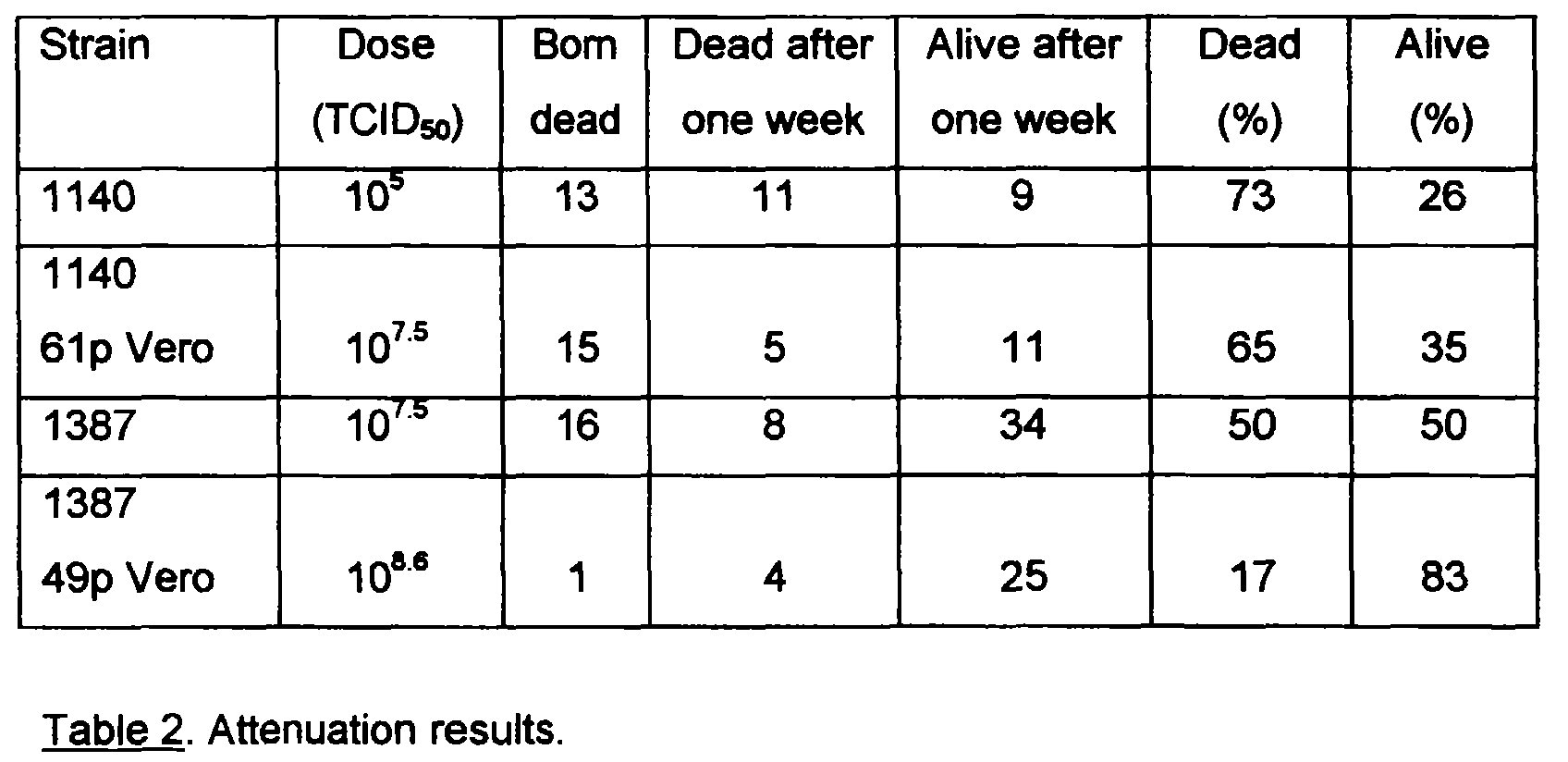
A similar effect is observed in the experiment where l-1387 is given to sows. A dose of 107.5 TCID50 still induced a significant number of dead piglets. However, with the non-macrophage-infective strain a remarkable reduction in virulence was observed; although given at an extreme high dose (a 10 fold increase with respect to the dose of 107.5 TCID50), a significantly lower number of piglets was found dead.
For the safety-test, the animals were screened for possible clinical signs, attributable to the vaccination.
| Exp. No. | Dose | Application method | Age (weeks) | Number | Observation period days | |
| TCID 50 | ml | |||||
| 131 | 106.9 | 2 | i.m. | 5 | 10 | 28 |
| 135 | 105.5 | 2 | i.m. | 5 | 10 | 28 |
| 105.5 | 0.2 | i.d. | 5 | 10 | 28 | |
| 104.8 | 2 | i.m. | 5 | 10 | 28 | |
| 104.5 | 0.2 | i.d. | 5 | 10 | 28 | |
| 103.5 | 2 | i.m. | 5 | 10 | 28 | |
| 103.8 | 0.2 | i.d. | 5 | 10 | 28 | |
| 192 | 106.6 | 2 | i.m. | 6 | 8 | 3-15 |
| 106.4 | 0.2 | i.d. | 6 | 8 | 3-15 |
In this safety test, each sow was inoculated at 94 days of gestation both intramuscularly and intradermally with a massive dose of 108.3 TCID50 per injection site.
- Local and systemic reactions in the sows
- Antibody level in the sows at parturition to show the take

- Reproductive performance of the sows
- Virus re-isolations from serum samples of piglets taken on the day of birth
| Sow No. | Number of piglets that died | |
| Before or at birth | During one week after birth | |
| 4611 | 0 out of 12 | 1 out of 12 |
| 4608 | 0 out of 15 | 2 out of 15 |
| 465 | 1 out of 11 | 1 out of 11 |
In both experiments groups of ten PRRS antibody free piglets were vaccinated at an age of 5 to 6 weeks with vaccine strain DV PRRS virus with titres varying from 103.5 to 106.9 TCID50 (see also table 2; groups 131 and 135). In these experiments also safety and spreading aspects were investigated.
Four weeks after vaccination these piglets were challenged intranasally with 105 TCID50 of a heterologous wild-type PRRS virus. After vaccination and challenge the serological response was monitored in the vaccinated animal as well as in sentinel animals placed in direct contact with the vaccinates and controls placed in the same building but physically separated (different pen).
| Vaccinates | ||||||||||||
| Exp. No. | Application method | Dose | N | Average antibody titre days following | ||||||||
| Vaccination | Challenge | |||||||||||
| 0 | 14 | 21 | 28 | 0 | 3 | 7 | 10 | 13/14 | ||||
| 131 | i.m. | 106.9 | 9 | 0 | 6.9 | 10.0 | 11.6 | 11.6 | 12.0 | |||
| 135 | i.m. | 105.5 | 10 | 0 | 9.7 | 9.7 | 10.9 | 10.3 | 11.6 | 10.7 | ||
| i.d. | 105.5 | 10 | 0 | 9.5 | 9.5 | 10.9 | 10.9 | 10.9 | 11.1 | |||
| i.m. | 104.8 | 10 | 0 | 10.0 | 10.0 | 11.4 | 10.8 | 11.4 | 11.3 | |||
| i.d. | 104.5 | 10 | 0 | 9.1 | 9.1 | 10.6 | 10.7 | 11.5 | 10.4 | |||
| i.m. | 103.5 | 10 | 0 | 9.3 | 9.3 | 10.2 | 9.8 | 12.1 | 11.4 | |||
| i.d. | 103.8 | 10 | 0 | 9.2 | 9.2 | 10.2 | 10.0 | 10.8 | 10.6 | |||
| Sentinels | ||||||||||||
| Exp. No. | Placed in group | N | ||||||||||
| 131 | i.m. | 106.9 | 4 | 0 | 0 | 2.5 | 4.5 | 4.5 | 11.5 | |||
| 135 | i.m. | 105.5 | 2 | 0 | 0 | 0 | 0 | 0 | 9.3 | 9.8 | ||
| i.d. | 105.5 | 2 | 0 | 0 | 0 | 0 | 0 | 11.3 | 10.3 | |||
| i.m. | 104.8 | 2 | 0 | 4.7 | 4.7 | 7.8 | 7.8 | 10.8 | 10.3 | |||
| i.d. | 104.5 | 2 | 0 | 0 | 0 | 0 | 0 | 9.8 | 8.3 | |||
| i.m. | 103.5 | 2 | 0 | 0 | 0 | 0 | 3.7 | 7.3 | 9.3 | |||
| i.d. | 103.8 | 2 | 0 | 0 | 0 | 0 | 0 | 7.3 | 9.3 | |||
| Controls | ||||||||||||
| 131 | 5 | 0 | 0 | 0 | 0 | 0 | 1.6 | |||||
| 135 | 12 | 0 | 0.7 | 0.7 | 0 | 0 | 7.4 | 8.7 |
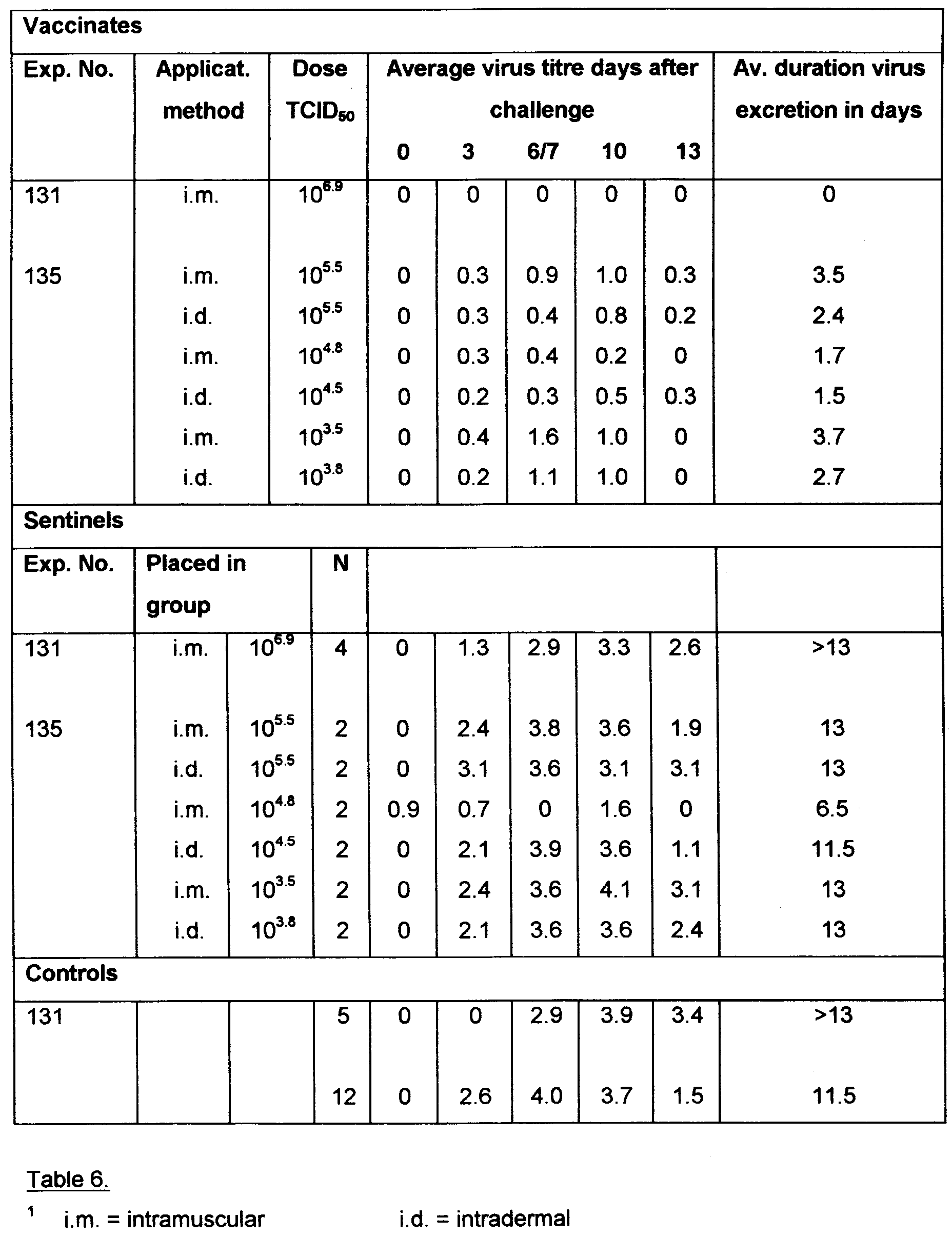
The serological response after intramuscular and intradermal application is comparable. Even with a dose of 103.5 TCID50 significant titres are obtained.
No re-isolation or a significantly reduced re-isolation rate and duration of re-isolation was found in all groups in comparison with the unvaccinated controls. The virus spreads to direct controls only at a very low rate. With this rate of spreading the vaccine virus will become extinct within a few rounds of replication further demonstrating the attenuated character of strains according to the invention.
Claims (13)
- live attenuated Porcine Reproductive and Respiratory Syndrome Virus (PRRSV) of a European serotype, characterized in that it is not infectious to macrophages.
- live attenuated PRRSV according to claim 1, characterized in that it is reactive with monoclonal antibody A27 as produced by hybridoma A27 deposited with the Collection Nationale de Cultures de Micro-organismes (CNCM) of the Institut Pasteur at Paris France under nr. l 1401, but not with monoclonal antibody A35 as produced by hybridoma A35 deposited with the Institut Pasteur at Paris France under No. l 1402.
- live attenuated PRRSV according to claim 2, characterized in that it is of the strain as deposited at the Institut Pasteur under Accession Number l-1758.
- Method for the preparation of live attenuated PRRSV according to claims 1-3, characterized in that the method comprises the adaptation of a MA104-grown PRRSV of a European serotype to non-MA104 mammalian cells.
- Method according to claim 4, characterized in that non-MA104 primate cells are used as the non-MA104 mammalian cells.
- Method according to claim 5, characterized in that Vero cells are used as the non-MA104 primate cells.
- Vaccine for the protection of pigs against PRRSV-infection, characterized in that it comprises live attenuated PRRSV according to claim 1-3 and a pharmaceutically acceptable carrier.
- Vaccine according to claim 7, characterized in that it in addition comprises one or more non-PRRSV attenuated or inactivated pathogens or antigenic material thereof.
- Vaccine according to claim 8, characterized in that said non-PRRSV pathogens are selected from Pseudorabies virus, Porcine influenza virus, Porcine parvo virus, Transmissible gastro-enteritis virus, Rotavirus, Escherichia coli, Erysipelo rhusiopathiae, Bordetella bronchiseptica, Salmonella cholerasuis, Haemophilus parasuis, Pasteurella multocida, Streptococcus suis, Mycoplasma hyopneumoniae and Actinobacillus pleuropneumoniae.
- Vaccine according to claims 7-9, characterized in that it comprises a carrier that is suitable for intradermal or intramuscular application.
- Vaccine according to claims 7-10, characterized in that it is in a freeze-dried form.
- Method for the preparation of a live attenuated vaccine for combating PRRS, chap terized in that it comprises admixing a live attenuated PRRSV according to claims 1-3 with a pharmaceutically acceptable carrier.
- Method according to claim 12, characterized in that the live attenuated PRRSV deposited at the Institut Pasteur under Accession Number l-1758 is used for admixing.
Priority Applications (2)
| Application Number | Priority Date | Filing Date | Title |
|---|---|---|---|
| EP19970203111 EP0835930B1 (en) | 1996-10-09 | 1997-10-07 | European vaccine strains of the porcine reproductive and respiratory syndrome virus (PRRSV) |
| GR20010400562T GR3035712T3 (en) | 1996-10-09 | 2001-04-06 | European vaccine strains of the porcine reproductive and respiratory syndrome virus (PRRSV) |
Applications Claiming Priority (3)
| Application Number | Priority Date | Filing Date | Title |
|---|---|---|---|
| EP96202804 | 1996-10-09 | ||
| EP96202804 | 1996-10-09 | ||
| EP19970203111 EP0835930B1 (en) | 1996-10-09 | 1997-10-07 | European vaccine strains of the porcine reproductive and respiratory syndrome virus (PRRSV) |
Publications (2)
| Publication Number | Publication Date |
|---|---|
| EP0835930A1 true EP0835930A1 (en) | 1998-04-15 |
| EP0835930B1 EP0835930B1 (en) | 2001-01-31 |
Family
ID=8224476
Family Applications (1)
| Application Number | Title | Priority Date | Filing Date |
|---|---|---|---|
| EP19970203111 Expired - Lifetime EP0835930B1 (en) | 1996-10-09 | 1997-10-07 | European vaccine strains of the porcine reproductive and respiratory syndrome virus (PRRSV) |
Country Status (12)
| Country | Link |
|---|---|
| US (1) | US5925359A (en) |
| EP (1) | EP0835930B1 (en) |
| JP (2) | JP4152462B2 (en) |
| KR (1) | KR100484041B1 (en) |
| AT (1) | ATE199022T1 (en) |
| BR (1) | BR9705009A (en) |
| CA (1) | CA2217882C (en) |
| DE (1) | DE69704011T2 (en) |
| DK (1) | DK0835930T3 (en) |
| ES (1) | ES2157522T3 (en) |
| GR (1) | GR3035712T3 (en) |
| PT (1) | PT835930E (en) |
Cited By (24)
| Publication number | Priority date | Publication date | Assignee | Title |
|---|---|---|---|---|
| WO2000053787A1 (en) * | 1999-03-08 | 2000-09-14 | Id-Lelystad, Instituut Voor Dierhouderij En Dierg Ezondheid B.V. | Prrsv vaccines |
| SG83740A1 (en) * | 1999-08-10 | 2001-10-16 | Inst Of Molecular Agrobiology | An attenuated porcine reproductive and respiratory syndrome virus strain and methods of use |
| WO2006074986A2 (en) | 2005-01-13 | 2006-07-20 | Boehringer Ingelheim Vetmedica Gmbh | Prrs vaccines |
| WO2006055331A3 (en) * | 2004-11-19 | 2006-08-10 | Intervet Int Bv | Porcine reproductive and respiratory syndrome virus strains and compositions |
| WO2012110489A2 (en) | 2011-02-17 | 2012-08-23 | Boehringer Ingelheim Vetmedica Gmbh | Novel european prrsv strain |
| WO2012110490A1 (en) | 2011-02-17 | 2012-08-23 | Boehringer Ingelheim Vetmedica Gmbh | Commercial scale process for production of prrsv |
| CN102727882A (en) * | 2011-10-27 | 2012-10-17 | 华威特(北京)生物科技有限公司 | Combined live vaccine against porcine reproductive and respiratory syndrome, swine fever and pseudorabies, and preparation method thereof |
| CN102727884A (en) * | 2011-10-27 | 2012-10-17 | 华威特(北京)生物科技有限公司 | Combined live vaccine against porcine reproductive and respiratory syndrome and pseudorabies, and preparation method thereof |
| US8383131B2 (en) | 2004-09-21 | 2013-02-26 | Boehringer Ingelheim Vetmedica, Inc. | Porcine reproductive and respiratory syndrome isolates and methods of use |
| CN102973932A (en) * | 2011-09-07 | 2013-03-20 | 普莱柯生物工程股份有限公司 | Trivalent inactivated vaccine of porcine reproductive and respiratory syndrome virus, porcine circovirus type 2, and porcine pseudorabies virus and preparation method thereof |
| US8546124B2 (en) | 1996-10-30 | 2013-10-01 | Boehringer Ingelheim Vetmedica Gmbh | Infectious clones of RNA viruses and vaccines and diagnostic assays derived thereof |
| US8741309B2 (en) | 1999-04-22 | 2014-06-03 | The United States Of America As Represented By The Secretary Of Agriculture | Porcine reproductive and respiratory syndrome vaccine based on isolate JA-142 |
| US9187731B2 (en) | 2011-07-29 | 2015-11-17 | Boehringer Ingelheim Vetmedica Gmbh | PRRS virus inducing type I interferon in susceptible cells |
| US9315781B2 (en) | 2011-07-29 | 2016-04-19 | Boehringer Ingelheim Vetmedica Gmbh | Infectious CDNA clone of european PRRS virus and uses thereof |
| US9561270B2 (en) | 2009-09-02 | 2017-02-07 | Boehringer Ingelheim Vetmedica, Inc. | Methods of reducing virucidal activity in PCV-2 compositions and PCV-2 compositions with an improved immunogenicity |
| US9579373B2 (en) | 2013-03-15 | 2017-02-28 | Boehringer Ingelheim Vetmedica, Inc. | Porcine reproductive and respiratory syndrome virus, compositions, vaccine and methods of use |
| WO2017040672A1 (en) | 2015-08-31 | 2017-03-09 | Boehringer Ingelheim Vetmedica Gmbh | Pestivirus vaccines for congenital tremors |
| US9592286B2 (en) | 2011-05-27 | 2017-03-14 | Sinovet (Beijing) Biotechnology Co., Ltd. | Combined vaccines for prevention of porcine virus infections |
| WO2017106079A1 (en) | 2015-12-14 | 2017-06-22 | Boehringer Ingelheim Vetmedica, Inc. | Hybrid core feline vaccines |
| US10010601B2 (en) | 2013-12-20 | 2018-07-03 | Boehringer Ingelheim Vetmedica Gmbh | PRRS virus variant, European PRRS virus cDNA clone, and uses thereof |
| WO2020206452A1 (en) | 2019-04-04 | 2020-10-08 | Boehringer Ingelheim Animal Health USA Inc. | Porcine circovirus type 3 (pcv3) vaccines, and production and uses thereof |
| CN113801854A (en) * | 2021-08-27 | 2021-12-17 | 中国农业科学院哈尔滨兽医研究所(中国动物卫生与流行病学中心哈尔滨分中心) | Hybridoma cell line secreting European porcine reproductive and respiratory syndrome virus specific monoclonal antibody and application thereof |
| WO2022020593A2 (en) | 2020-07-24 | 2022-01-27 | Boehringer Ingelheim Animal Health USA Inc. | Combination porcine vaccine |
| RU2779552C1 (en) * | 2021-09-14 | 2022-09-08 | Федеральное Казенное Предприятие "Щелковский Биокомбинат" | Strain “prrs-1sbc” of the swine reproductive and respiratory syndrome virus for the manufacture of diagnostic and vaccine preparations, a vaccine against swine reproductive and respiratory syndrome and a method for obtaining a vaccine against swine reproductive and respiratory syndrome (variants) |
Families Citing this family (45)
| Publication number | Priority date | Publication date | Assignee | Title |
|---|---|---|---|---|
| CA2290906C (en) * | 1991-06-06 | 2003-04-01 | Stichting Centraal Diergeneeskundig Instituut | Causative agent of the mystery swine disease, vaccine compositions and diagnostic kits |
| USRE39494E1 (en) * | 1992-02-27 | 2007-02-27 | Intervet Inc. | Inactivated mycoplasma hyopneumoniae and uses therefor |
| US6380376B1 (en) * | 1992-10-30 | 2002-04-30 | Iowa State University Research Foundation | Proteins encoded by polynucleic acids of porcine reproductive and respiratory syndrome virus (PRRSV) |
| US5695766A (en) * | 1992-10-30 | 1997-12-09 | Iowa State University Research Foundation | Highly virulent porcine reproductive and respiratory syndrome viruses which produce lesions in pigs and vaccines that protect pigs against said syndrome |
| US6592873B1 (en) | 1992-10-30 | 2003-07-15 | Iowa State University Research Foundation, Inc. | Polynucleic acids isolated from a porcine reproductive and respiratory syndrome virus (PRRSV) and proteins encoded by the polynucleic acids |
| US6773908B1 (en) * | 1992-10-30 | 2004-08-10 | Iowa State University Research Foundation, Inc. | Proteins encoded by polynucleic acids of porcine reproductive and respiratory syndrome virus (PRRSV) |
| US20040224327A1 (en) * | 1996-10-30 | 2004-11-11 | Meulenberg Johanna Jacoba Maria | Infectious clones of RNA viruses and vaccines and diagnostic assays derived thereof |
| FR2772047B1 (en) * | 1997-12-05 | 2004-04-09 | Ct Nat D Etudes Veterinaires E | GENOMIC SEQUENCE AND POLYPEPTIDES OF CIRCOVIRUS ASSOCIATED WITH PIGLET LOSS DISEASE (MAP), APPLICATIONS TO DIAGNOSIS AND TO PREVENTION AND / OR TREATMENT OF INFECTION |
| AU769539B2 (en) | 1999-01-29 | 2004-01-29 | Zoetis Services Llc | Adjuvants for use in vaccines |
| US20030103962A1 (en) * | 2001-10-09 | 2003-06-05 | Campbell Joy M. | Methods and compositions for modulating the immune system of animals |
| US20030099633A1 (en) * | 2001-10-09 | 2003-05-29 | Campbell Joy M. | Methods and compositions for treatment of immune dysfunction disorders |
| US20050271674A1 (en) * | 2001-01-30 | 2005-12-08 | Campbell Joy M | Methods and compositions for modulating the immune system of animals |
| PL211753B1 (en) * | 2001-01-30 | 2012-06-29 | Lauridsen Group | Methods and compositions for treatment of immune dysfunction disorders |
| US20030190314A1 (en) * | 2001-01-30 | 2003-10-09 | The Lauridsen Group | Methods and compositions of treatment for modulating the immune system of animals |
| SE0300795D0 (en) | 2003-03-24 | 2003-03-24 | Isconova Ab | Composition comprising iscom particles and live micro-organisms |
| KR20050040172A (en) * | 2003-10-27 | 2005-05-03 | 주식회사 중앙백신연구소 | Method of porcine reproductive and respiratory syndrome inactivated oil vaccine |
| CA2552328A1 (en) * | 2004-01-15 | 2005-08-04 | Intervet International B.V. | Non-animal origin stabilizers and processes for producing the same |
| TW200604526A (en) | 2004-06-18 | 2006-02-01 | Unviersity Of Minnesota | Identifying virally infected and vaccinated organisms |
| US7700285B1 (en) | 2005-12-29 | 2010-04-20 | Boehringer Ingelheim Vetmedica, Inc. | PCV2 immunogenic compositions and methods of producing such compositions |
| US7833707B2 (en) * | 2004-12-30 | 2010-11-16 | Boehringer Ingelheim Vetmedica, Inc. | Methods of overexpression and recovery of porcine circovirus type 2 ORF2 |
| UA95602C2 (en) | 2004-12-30 | 2011-08-25 | Берингер Ингельхейм Ветмедика, Инк. | Pcv2 immunogenic compositions and methods of producing such compositions |
| US7572620B2 (en) | 2005-01-11 | 2009-08-11 | Wisconsin Alumni Research Foundation | H3 equine influenza A virus |
| DK1838341T3 (en) | 2005-01-20 | 2013-11-04 | Isconova Ab | VACCINE COMPOSITION comprising a FIBRONECTIN BINDING PROTEIN OR A FIBRONECTIN BINDING PEPTIDE |
| US8834891B2 (en) | 2005-03-14 | 2014-09-16 | Boehringer Ingelheim Vetmedica, Inc. | Immunogenic compositions comprising Lawsonia intracellularis |
| PT2369001T (en) | 2005-06-24 | 2016-10-25 | Univ Minnesota | Prrs viruses, infectious clones, mutants thereof, and methods of use |
| DK1926496T3 (en) * | 2005-09-09 | 2013-09-30 | Intervet Int Bv | PCV-2 vaccine |
| MX338626B (en) | 2005-12-29 | 2016-04-26 | Boehringer Ingelheim Vetmed | Use of a pcv2 immunogenic composition for lessening clinical symptoms in pigs. |
| EP2275132B1 (en) | 2005-12-29 | 2021-03-03 | Boehringer Ingelheim Animal Health USA Inc. | Multivalent PCV2 immunogenic compositions and methods of producing them |
| WO2007116032A1 (en) * | 2006-04-10 | 2007-10-18 | Intervet International B.V. | Vaccine against mycoplasma prrsv |
| EP2859900A1 (en) * | 2006-12-11 | 2015-04-15 | Boehringer Ingelheim Vetmedica, Inc. | Effective method of treatment of porcine circovirus and lawsonia intracellularis infections |
| BRPI0721083A2 (en) * | 2006-12-15 | 2014-02-25 | Boehringer Ingelheim Vetmed | PCV2 ANTIGEN PIG TREATMENT |
| EP1941903A1 (en) * | 2007-01-03 | 2008-07-09 | Boehringer Ingelheim Vetmedica Gmbh | Prophylaxis and treatment of PRDC |
| MX2009007457A (en) | 2007-01-12 | 2009-08-12 | Univ Illinois | Non-simian cells for growth of porcine reproductive and respiratory syndrome (prrs) virus. |
| EP1958644A1 (en) | 2007-02-13 | 2008-08-20 | Boehringer Ingelheim Vetmedica Gmbh | Prevention and treatment of sub-clinical pcvd |
| US7829274B2 (en) | 2007-09-04 | 2010-11-09 | Boehringer Ingelheim Vetmedica, Inc. | Reduction of concomitant infections in pigs by the use of PCV2 antigen |
| JP2011508595A (en) * | 2007-12-31 | 2011-03-17 | ベーリンガー インゲルハイム フェトメディカ インコーポレイテッド | PCV2ORF2 virus-like particles containing foreign amino acid insertions |
| JP5613061B2 (en) * | 2008-01-23 | 2014-10-22 | ベーリンガー インゲルハイム フェトメディカ インコーポレイテッド | PCV2 Mycoplasma hyopneumoniae immunogenic composition and method for producing said composition |
| KR101653177B1 (en) * | 2008-08-25 | 2016-09-01 | 베링거잉겔하임베트메디카인코퍼레이티드 | Vaccine against Highly Pathogenic Porcine Reproductive and Respiratory Syndrome (HP PRRS) |
| KR101125244B1 (en) * | 2008-09-19 | 2012-03-21 | 전남대학교산학협력단 | A composition for preventing or treating PRRSV infection comprising live attenuated Bordetella bronchiseptica strain expressing GP5 of PRRSV and method for producing thereof |
| JP5306943B2 (en) * | 2009-08-24 | 2013-10-02 | 全国農業協同組合連合会 | How to make an attenuated virus |
| WO2013163337A1 (en) * | 2012-04-24 | 2013-10-31 | The Ohio State University | Compositions and methods for treating and preventing porcine reproductive and respiratory syndrome |
| KR102319843B1 (en) | 2013-09-25 | 2021-10-29 | 조에티스 서비시즈 엘엘씨 | Pcv2b divergent vaccine composition and methods of use |
| US9505808B2 (en) | 2013-10-02 | 2016-11-29 | Boehringer Ingelheim Vetmedica, Inc. | PCV2 ORF2 protein variant and virus like particles composed thereof |
| AU2017353380B2 (en) | 2016-11-03 | 2024-08-22 | Boehringer Ingelheim Vetmedica Gmbh | Vaccine against porcine parvovirus and porcine reproductive and respiratory syndrome virus and methods of production thereof |
| CN119899783B (en) * | 2025-04-02 | 2025-07-29 | 华中农业大学 | Bacillus amyloliquefaciens H-6 and application thereof in preparation of medicines for treating or preventing porcine reproductive and respiratory syndrome virus infection |
Citations (3)
| Publication number | Priority date | Publication date | Assignee | Title |
|---|---|---|---|---|
| WO1993007898A1 (en) * | 1991-10-14 | 1993-04-29 | Akzo Nobel N.V. | Porcine reproductive respiratory syndrome vaccine and diagnostic |
| WO1994018311A1 (en) * | 1993-02-08 | 1994-08-18 | Bayer Corporation | Process for growing porcine reproductive and respiratory syndrome virus and its use in vaccines |
| EP0676467A2 (en) * | 1994-04-11 | 1995-10-11 | Akzo Nobel N.V. | European vaccine strains of the porcine reproductive respiratory syndrome virus (PRRSV) |
Family Cites Families (2)
| Publication number | Priority date | Publication date | Assignee | Title |
|---|---|---|---|---|
| JPS62192325A (en) * | 1986-02-15 | 1987-08-22 | ザ・ウイスタ−・インステイチユ−ト・オブ・アナトミ−・アンド・バイオロジ− | Vaccine, manufacture and use for vaccine inoculation againstrotavirus infection |
| US5695766A (en) * | 1992-10-30 | 1997-12-09 | Iowa State University Research Foundation | Highly virulent porcine reproductive and respiratory syndrome viruses which produce lesions in pigs and vaccines that protect pigs against said syndrome |
-
1997
- 1997-10-07 PT PT97203111T patent/PT835930E/en unknown
- 1997-10-07 ES ES97203111T patent/ES2157522T3/en not_active Expired - Lifetime
- 1997-10-07 AT AT97203111T patent/ATE199022T1/en active
- 1997-10-07 DK DK97203111T patent/DK0835930T3/en active
- 1997-10-07 EP EP19970203111 patent/EP0835930B1/en not_active Expired - Lifetime
- 1997-10-07 DE DE69704011T patent/DE69704011T2/en not_active Expired - Lifetime
- 1997-10-08 CA CA 2217882 patent/CA2217882C/en not_active Expired - Lifetime
- 1997-10-09 KR KR1019970051704A patent/KR100484041B1/en not_active Expired - Lifetime
- 1997-10-09 BR BR9705009A patent/BR9705009A/en not_active IP Right Cessation
- 1997-10-09 JP JP27739797A patent/JP4152462B2/en not_active Expired - Lifetime
- 1997-10-09 US US08/947,696 patent/US5925359A/en not_active Expired - Lifetime
-
2001
- 2001-04-06 GR GR20010400562T patent/GR3035712T3/en unknown
-
2007
- 2007-07-20 JP JP2007190153A patent/JP2007320963A/en active Pending
Patent Citations (3)
| Publication number | Priority date | Publication date | Assignee | Title |
|---|---|---|---|---|
| WO1993007898A1 (en) * | 1991-10-14 | 1993-04-29 | Akzo Nobel N.V. | Porcine reproductive respiratory syndrome vaccine and diagnostic |
| WO1994018311A1 (en) * | 1993-02-08 | 1994-08-18 | Bayer Corporation | Process for growing porcine reproductive and respiratory syndrome virus and its use in vaccines |
| EP0676467A2 (en) * | 1994-04-11 | 1995-10-11 | Akzo Nobel N.V. | European vaccine strains of the porcine reproductive respiratory syndrome virus (PRRSV) |
Cited By (40)
| Publication number | Priority date | Publication date | Assignee | Title |
|---|---|---|---|---|
| US8790656B2 (en) | 1996-10-30 | 2014-07-29 | Boehringer Ingelheim Vetmedica Gmbh | PRRSV vaccines |
| US8546124B2 (en) | 1996-10-30 | 2013-10-01 | Boehringer Ingelheim Vetmedica Gmbh | Infectious clones of RNA viruses and vaccines and diagnostic assays derived thereof |
| WO2000053787A1 (en) * | 1999-03-08 | 2000-09-14 | Id-Lelystad, Instituut Voor Dierhouderij En Dierg Ezondheid B.V. | Prrsv vaccines |
| US8741309B2 (en) | 1999-04-22 | 2014-06-03 | The United States Of America As Represented By The Secretary Of Agriculture | Porcine reproductive and respiratory syndrome vaccine based on isolate JA-142 |
| US8747859B2 (en) | 1999-04-22 | 2014-06-10 | The United States Of America, As Represented By The Secretary Of Agriculture | Porcine reproductive and respiratory syndrome vaccine based on isolate JA-142 |
| SG83740A1 (en) * | 1999-08-10 | 2001-10-16 | Inst Of Molecular Agrobiology | An attenuated porcine reproductive and respiratory syndrome virus strain and methods of use |
| US8383131B2 (en) | 2004-09-21 | 2013-02-26 | Boehringer Ingelheim Vetmedica, Inc. | Porcine reproductive and respiratory syndrome isolates and methods of use |
| WO2006055331A3 (en) * | 2004-11-19 | 2006-08-10 | Intervet Int Bv | Porcine reproductive and respiratory syndrome virus strains and compositions |
| US8178103B2 (en) | 2004-11-19 | 2012-05-15 | Intervet International B.V. | Porcine reproductive and respiratory syndrome virus strains and compositions |
| AU2005306781B2 (en) * | 2004-11-19 | 2011-12-22 | Intervet International B.V. | Porcine reproductive and respiratory syndrome virus strains and compositions |
| US7368117B2 (en) | 2005-01-13 | 2008-05-06 | Boehringer Ingelheim Vetmedica Gmbh | PRRS vaccines |
| WO2006074986A2 (en) | 2005-01-13 | 2006-07-20 | Boehringer Ingelheim Vetmedica Gmbh | Prrs vaccines |
| US9561270B2 (en) | 2009-09-02 | 2017-02-07 | Boehringer Ingelheim Vetmedica, Inc. | Methods of reducing virucidal activity in PCV-2 compositions and PCV-2 compositions with an improved immunogenicity |
| US8765142B2 (en) | 2011-02-17 | 2014-07-01 | Boehringer Ingelheim Vetmedica Gmbh | European PRRSV strain |
| US10039821B2 (en) | 2011-02-17 | 2018-08-07 | Boehringer Ingelheim Vetmedica Gmbh | European PRRSV strain |
| US9944902B2 (en) | 2011-02-17 | 2018-04-17 | Boehringer Ingelheim Vetmedica Gmbh | Commercial scale process for production of PRRSV |
| US10668144B2 (en) | 2011-02-17 | 2020-06-02 | Boehringer Ingelheim Vetmedica Gmbh | European PRRSV strain |
| WO2012110490A1 (en) | 2011-02-17 | 2012-08-23 | Boehringer Ingelheim Vetmedica Gmbh | Commercial scale process for production of prrsv |
| EP2959916A1 (en) | 2011-02-17 | 2015-12-30 | Boehringer Ingelheim Vetmedica GmbH | Novel european prrsv strain |
| US9534207B2 (en) | 2011-02-17 | 2017-01-03 | Boehringer Ingelheim Vetmedica Gmbh | European PRRSV strain |
| WO2012110489A2 (en) | 2011-02-17 | 2012-08-23 | Boehringer Ingelheim Vetmedica Gmbh | Novel european prrsv strain |
| US9592286B2 (en) | 2011-05-27 | 2017-03-14 | Sinovet (Beijing) Biotechnology Co., Ltd. | Combined vaccines for prevention of porcine virus infections |
| US9187731B2 (en) | 2011-07-29 | 2015-11-17 | Boehringer Ingelheim Vetmedica Gmbh | PRRS virus inducing type I interferon in susceptible cells |
| US9315781B2 (en) | 2011-07-29 | 2016-04-19 | Boehringer Ingelheim Vetmedica Gmbh | Infectious CDNA clone of european PRRS virus and uses thereof |
| CN102973932A (en) * | 2011-09-07 | 2013-03-20 | 普莱柯生物工程股份有限公司 | Trivalent inactivated vaccine of porcine reproductive and respiratory syndrome virus, porcine circovirus type 2, and porcine pseudorabies virus and preparation method thereof |
| CN102727884A (en) * | 2011-10-27 | 2012-10-17 | 华威特(北京)生物科技有限公司 | Combined live vaccine against porcine reproductive and respiratory syndrome and pseudorabies, and preparation method thereof |
| CN102727882A (en) * | 2011-10-27 | 2012-10-17 | 华威特(北京)生物科技有限公司 | Combined live vaccine against porcine reproductive and respiratory syndrome, swine fever and pseudorabies, and preparation method thereof |
| CN102727882B (en) * | 2011-10-27 | 2014-05-14 | 华威特(北京)生物科技有限公司 | Combined live vaccine against porcine reproductive and respiratory syndrome, swine fever and pseudorabies, and preparation method thereof |
| CN102727884B (en) * | 2011-10-27 | 2014-05-14 | 华威特(北京)生物科技有限公司 | Combined live vaccine against porcine reproductive and respiratory syndrome and pseudorabies, and preparation method thereof |
| US9579373B2 (en) | 2013-03-15 | 2017-02-28 | Boehringer Ingelheim Vetmedica, Inc. | Porcine reproductive and respiratory syndrome virus, compositions, vaccine and methods of use |
| US10639364B2 (en) | 2013-12-20 | 2020-05-05 | Boehringer Ingelheim Vetmedica Gmbh | PRRS virus variant, european PRRS virus cDNA clone, and uses thereof |
| US10010601B2 (en) | 2013-12-20 | 2018-07-03 | Boehringer Ingelheim Vetmedica Gmbh | PRRS virus variant, European PRRS virus cDNA clone, and uses thereof |
| WO2017040672A1 (en) | 2015-08-31 | 2017-03-09 | Boehringer Ingelheim Vetmedica Gmbh | Pestivirus vaccines for congenital tremors |
| US10188725B2 (en) | 2015-12-14 | 2019-01-29 | Elanco Us Inc. | Hybrid core feline vaccines |
| WO2017106079A1 (en) | 2015-12-14 | 2017-06-22 | Boehringer Ingelheim Vetmedica, Inc. | Hybrid core feline vaccines |
| WO2020206452A1 (en) | 2019-04-04 | 2020-10-08 | Boehringer Ingelheim Animal Health USA Inc. | Porcine circovirus type 3 (pcv3) vaccines, and production and uses thereof |
| WO2022020593A2 (en) | 2020-07-24 | 2022-01-27 | Boehringer Ingelheim Animal Health USA Inc. | Combination porcine vaccine |
| CN113801854A (en) * | 2021-08-27 | 2021-12-17 | 中国农业科学院哈尔滨兽医研究所(中国动物卫生与流行病学中心哈尔滨分中心) | Hybridoma cell line secreting European porcine reproductive and respiratory syndrome virus specific monoclonal antibody and application thereof |
| CN113801854B (en) * | 2021-08-27 | 2023-02-28 | 中国农业科学院哈尔滨兽医研究所(中国动物卫生与流行病学中心哈尔滨分中心) | Hybridoma cell line secreting European porcine reproductive and respiratory syndrome virus specific monoclonal antibody and application thereof |
| RU2779552C1 (en) * | 2021-09-14 | 2022-09-08 | Федеральное Казенное Предприятие "Щелковский Биокомбинат" | Strain “prrs-1sbc” of the swine reproductive and respiratory syndrome virus for the manufacture of diagnostic and vaccine preparations, a vaccine against swine reproductive and respiratory syndrome and a method for obtaining a vaccine against swine reproductive and respiratory syndrome (variants) |
Also Published As
| Publication number | Publication date |
|---|---|
| CA2217882C (en) | 2007-05-22 |
| JP2007320963A (en) | 2007-12-13 |
| PT835930E (en) | 2001-06-29 |
| MX9707780A (en) | 1998-08-30 |
| KR100484041B1 (en) | 2005-08-18 |
| CA2217882A1 (en) | 1998-04-09 |
| EP0835930B1 (en) | 2001-01-31 |
| ATE199022T1 (en) | 2001-02-15 |
| DK0835930T3 (en) | 2001-06-18 |
| ES2157522T3 (en) | 2001-08-16 |
| BR9705009A (en) | 1998-10-27 |
| US5925359A (en) | 1999-07-20 |
| GR3035712T3 (en) | 2001-07-31 |
| DE69704011T2 (en) | 2001-06-07 |
| DE69704011D1 (en) | 2001-03-08 |
| JP4152462B2 (en) | 2008-09-17 |
| JPH10117773A (en) | 1998-05-12 |
| KR19980032672A (en) | 1998-07-25 |
Similar Documents
| Publication | Publication Date | Title |
|---|---|---|
| EP0835930B1 (en) | European vaccine strains of the porcine reproductive and respiratory syndrome virus (PRRSV) | |
| EP0676467B1 (en) | European vaccine strains of the porcine reproductive respiratory syndrome virus (PRRSV) | |
| EP0830142B1 (en) | Prrs (porcine reproductive and respiratory syndrome) virus vaccine | |
| EP0683816B1 (en) | Process for growing porcine reproductive and respiratory syndrome virus and its use in vaccines | |
| AU2012217169B2 (en) | Novel european PRRSV strain | |
| US6001370A (en) | Attenuated strain of the virus causing the porcine reproductive respiratory syndrome (PRRS), and vaccines | |
| US5976537A (en) | Porcine reproductive and respiratory syndrome vaccine | |
| EP0595436A2 (en) | Porcine respiratory and reproductive disease virus, vaccines and viral DNA | |
| KR101152012B1 (en) | Porcine reproductive and respiratory syndrome virus strains and compositions | |
| US20080299141A1 (en) | Raccoon Poxvirus Expressing Genes of Porcine Virus | |
| MXPA97007780A (en) | European strains of vaccines of the porcine reproductive and respiratory syndrome virus (prrsv) | |
| CA2155533C (en) | Process for growing porcine reproductive and respiratory syndrome virus and its use in vaccines | |
| Gorcyca | United States Patent to | |
| MXPA97007302A (en) | New attenuated cepa of the virus causing the respiratory and reproductive swine syndrome (prrs), vaccines and diagnostic media obtained with the same and the procedures for your obtenc |
Legal Events
| Date | Code | Title | Description |
|---|---|---|---|
| PUAI | Public reference made under article 153(3) epc to a published international application that has entered the european phase |
Free format text: ORIGINAL CODE: 0009012 |
|
| AK | Designated contracting states |
Kind code of ref document: A1 Designated state(s): AT BE CH DE DK ES FI FR GB GR IE IT LI LU MC NL PT SE |
|
| 17P | Request for examination filed |
Effective date: 19981015 |
|
| AKX | Designation fees paid |
Free format text: AT BE CH DE DK ES FI FR GB GR IE IT LI LU MC NL PT SE |
|
| RBV | Designated contracting states (corrected) |
Designated state(s): AT BE CH DE DK ES FI FR GB GR IE IT LI LU MC NL PT SE |
|
| 17Q | First examination report despatched |
Effective date: 19990818 |
|
| GRAG | Despatch of communication of intention to grant |
Free format text: ORIGINAL CODE: EPIDOS AGRA |
|
| GRAG | Despatch of communication of intention to grant |
Free format text: ORIGINAL CODE: EPIDOS AGRA |
|
| GRAH | Despatch of communication of intention to grant a patent |
Free format text: ORIGINAL CODE: EPIDOS IGRA |
|
| GRAH | Despatch of communication of intention to grant a patent |
Free format text: ORIGINAL CODE: EPIDOS IGRA |
|
| GRAA | (expected) grant |
Free format text: ORIGINAL CODE: 0009210 |
|
| AK | Designated contracting states |
Kind code of ref document: B1 Designated state(s): AT BE CH DE DK ES FI FR GB GR IE IT LI LU MC NL PT SE |
|
| PG25 | Lapsed in a contracting state [announced via postgrant information from national office to epo] |
Ref country code: SE Free format text: LAPSE BECAUSE OF FAILURE TO SUBMIT A TRANSLATION OF THE DESCRIPTION OR TO PAY THE FEE WITHIN THE PRESCRIBED TIME-LIMIT Effective date: 20010131 Ref country code: FI Free format text: LAPSE BECAUSE OF FAILURE TO SUBMIT A TRANSLATION OF THE DESCRIPTION OR TO PAY THE FEE WITHIN THE PRESCRIBED TIME-LIMIT Effective date: 20010131 |
|
| REF | Corresponds to: |
Ref document number: 199022 Country of ref document: AT Date of ref document: 20010215 Kind code of ref document: T |
|
| REG | Reference to a national code |
Ref country code: CH Ref legal event code: NV Representative=s name: ISLER & PEDRAZZINI AG Ref country code: CH Ref legal event code: EP |
|
| REG | Reference to a national code |
Ref country code: IE Ref legal event code: FG4D |
|
| REF | Corresponds to: |
Ref document number: 69704011 Country of ref document: DE Date of ref document: 20010308 |
|
| ET | Fr: translation filed | ||
| ITF | It: translation for a ep patent filed | ||
| REG | Reference to a national code |
Ref country code: DK Ref legal event code: T3 |
|
| REG | Reference to a national code |
Ref country code: PT Ref legal event code: SC4A Free format text: AVAILABILITY OF NATIONAL TRANSLATION Effective date: 20010320 |
|
| REG | Reference to a national code |
Ref country code: ES Ref legal event code: FG2A Ref document number: 2157522 Country of ref document: ES Kind code of ref document: T3 |
|
| PG25 | Lapsed in a contracting state [announced via postgrant information from national office to epo] |
Ref country code: MC Free format text: LAPSE BECAUSE OF NON-PAYMENT OF DUE FEES Effective date: 20011007 |
|
| PLBE | No opposition filed within time limit |
Free format text: ORIGINAL CODE: 0009261 |
|
| STAA | Information on the status of an ep patent application or granted ep patent |
Free format text: STATUS: NO OPPOSITION FILED WITHIN TIME LIMIT |
|
| REG | Reference to a national code |
Ref country code: GB Ref legal event code: IF02 |
|
| 26N | No opposition filed | ||
| REG | Reference to a national code |
Ref country code: CH Ref legal event code: PUE Owner name: INTERVET INTERNATIONAL B. V. Free format text: AKZO NOBEL N.V.#VELPERWEG 76#6824 BM ARNHEM (NL) -TRANSFER TO- INTERVET INTERNATIONAL B. V.#WIM DE KOERVERSTRAAT 35#5831 AN BOXMEER (NL) |
|
| REG | Reference to a national code |
Ref country code: PT Ref legal event code: PC4A Owner name: INTERVET INTERNATIONAL B.V., NL Effective date: 20061114 |
|
| REG | Reference to a national code |
Ref country code: FR Ref legal event code: TP |
|
| NLS | Nl: assignments of ep-patents |
Owner name: INTERVET INTERNATIONAL B.V. Effective date: 20070208 |
|
| REG | Reference to a national code |
Ref country code: CH Ref legal event code: PCAR Free format text: ISLER & PEDRAZZINI AG;POSTFACH 1772;8027 ZUERICH (CH) |
|
| PGFP | Annual fee paid to national office [announced via postgrant information from national office to epo] |
Ref country code: PT Payment date: 20100924 Year of fee payment: 14 Ref country code: IE Payment date: 20101025 Year of fee payment: 14 Ref country code: AT Payment date: 20100921 Year of fee payment: 14 |
|
| PGFP | Annual fee paid to national office [announced via postgrant information from national office to epo] |
Ref country code: LU Payment date: 20101028 Year of fee payment: 14 Ref country code: CH Payment date: 20101025 Year of fee payment: 14 |
|
| PGFP | Annual fee paid to national office [announced via postgrant information from national office to epo] |
Ref country code: GR Payment date: 20101026 Year of fee payment: 14 |
|
| REG | Reference to a national code |
Ref country code: PT Ref legal event code: MM4A Free format text: LAPSE DUE TO NON-PAYMENT OF FEES Effective date: 20120409 |
|
| REG | Reference to a national code |
Ref country code: CH Ref legal event code: PL |
|
| REG | Reference to a national code |
Ref country code: GR Ref legal event code: ML Ref document number: 20010400562 Country of ref document: GR Effective date: 20120503 |
|
| PG25 | Lapsed in a contracting state [announced via postgrant information from national office to epo] |
Ref country code: CH Free format text: LAPSE BECAUSE OF NON-PAYMENT OF DUE FEES Effective date: 20111031 Ref country code: LI Free format text: LAPSE BECAUSE OF NON-PAYMENT OF DUE FEES Effective date: 20111031 |
|
| REG | Reference to a national code |
Ref country code: IE Ref legal event code: MM4A |
|
| PG25 | Lapsed in a contracting state [announced via postgrant information from national office to epo] |
Ref country code: PT Free format text: LAPSE BECAUSE OF NON-PAYMENT OF DUE FEES Effective date: 20120409 Ref country code: GR Free format text: LAPSE BECAUSE OF NON-PAYMENT OF DUE FEES Effective date: 20120503 |
|
| PG25 | Lapsed in a contracting state [announced via postgrant information from national office to epo] |
Ref country code: IE Free format text: LAPSE BECAUSE OF NON-PAYMENT OF DUE FEES Effective date: 20111007 |
|
| REG | Reference to a national code |
Ref country code: AT Ref legal event code: MM01 Ref document number: 199022 Country of ref document: AT Kind code of ref document: T Effective date: 20111007 |
|
| PG25 | Lapsed in a contracting state [announced via postgrant information from national office to epo] |
Ref country code: AT Free format text: LAPSE BECAUSE OF NON-PAYMENT OF DUE FEES Effective date: 20111007 |
|
| PG25 | Lapsed in a contracting state [announced via postgrant information from national office to epo] |
Ref country code: LU Free format text: LAPSE BECAUSE OF NON-PAYMENT OF DUE FEES Effective date: 20111007 |
|
| REG | Reference to a national code |
Ref country code: FR Ref legal event code: PLFP Year of fee payment: 20 |
|
| PGFP | Annual fee paid to national office [announced via postgrant information from national office to epo] |
Ref country code: GB Payment date: 20160926 Year of fee payment: 20 Ref country code: DK Payment date: 20160926 Year of fee payment: 20 |
|
| PGFP | Annual fee paid to national office [announced via postgrant information from national office to epo] |
Ref country code: FR Payment date: 20160926 Year of fee payment: 20 |
|
| PGFP | Annual fee paid to national office [announced via postgrant information from national office to epo] |
Ref country code: DE Payment date: 20161031 Year of fee payment: 20 Ref country code: NL Payment date: 20161007 Year of fee payment: 20 |
|
| PGFP | Annual fee paid to national office [announced via postgrant information from national office to epo] |
Ref country code: ES Payment date: 20161010 Year of fee payment: 20 Ref country code: BE Payment date: 20161013 Year of fee payment: 20 Ref country code: IT Payment date: 20161017 Year of fee payment: 20 |
|
| REG | Reference to a national code |
Ref country code: DE Ref legal event code: R071 Ref document number: 69704011 Country of ref document: DE |
|
| REG | Reference to a national code |
Ref country code: DK Ref legal event code: EUP Effective date: 20171007 |
|
| REG | Reference to a national code |
Ref country code: NL Ref legal event code: MK Effective date: 20171006 |
|
| REG | Reference to a national code |
Ref country code: GB Ref legal event code: PE20 Expiry date: 20171006 |
|
| REG | Reference to a national code |
Ref country code: BE Ref legal event code: MK Effective date: 20171007 |
|
| PG25 | Lapsed in a contracting state [announced via postgrant information from national office to epo] |
Ref country code: GB Free format text: LAPSE BECAUSE OF EXPIRATION OF PROTECTION Effective date: 20171006 |
|
| REG | Reference to a national code |
Ref country code: ES Ref legal event code: FD2A Effective date: 20180508 |
|
| PG25 | Lapsed in a contracting state [announced via postgrant information from national office to epo] |
Ref country code: ES Free format text: LAPSE BECAUSE OF EXPIRATION OF PROTECTION Effective date: 20171008 |