EP0835251B1 - Process for the production of lipoic acid - Google Patents
Process for the production of lipoic acid Download PDFInfo
- Publication number
- EP0835251B1 EP0835251B1 EP96919924A EP96919924A EP0835251B1 EP 0835251 B1 EP0835251 B1 EP 0835251B1 EP 96919924 A EP96919924 A EP 96919924A EP 96919924 A EP96919924 A EP 96919924A EP 0835251 B1 EP0835251 B1 EP 0835251B1
- Authority
- EP
- European Patent Office
- Prior art keywords
- lactone
- mmol
- ethyl acetate
- methyl
- lipoic acid
- Prior art date
- Legal status (The legal status is an assumption and is not a legal conclusion. Google has not performed a legal analysis and makes no representation as to the accuracy of the status listed.)
- Expired - Lifetime
Links
Classifications
-
- C—CHEMISTRY; METALLURGY
- C07—ORGANIC CHEMISTRY
- C07D—HETEROCYCLIC COMPOUNDS
- C07D339/00—Heterocyclic compounds containing rings having two sulfur atoms as the only ring hetero atoms
- C07D339/02—Five-membered rings
- C07D339/04—Five-membered rings having the hetero atoms in positions 1 and 2, e.g. lipoic acid
-
- A—HUMAN NECESSITIES
- A61—MEDICAL OR VETERINARY SCIENCE; HYGIENE
- A61P—SPECIFIC THERAPEUTIC ACTIVITY OF CHEMICAL COMPOUNDS OR MEDICINAL PREPARATIONS
- A61P1/00—Drugs for disorders of the alimentary tract or the digestive system
- A61P1/16—Drugs for disorders of the alimentary tract or the digestive system for liver or gallbladder disorders, e.g. hepatoprotective agents, cholagogues, litholytics
-
- A—HUMAN NECESSITIES
- A61—MEDICAL OR VETERINARY SCIENCE; HYGIENE
- A61P—SPECIFIC THERAPEUTIC ACTIVITY OF CHEMICAL COMPOUNDS OR MEDICINAL PREPARATIONS
- A61P3/00—Drugs for disorders of the metabolism
- A61P3/08—Drugs for disorders of the metabolism for glucose homeostasis
-
- A—HUMAN NECESSITIES
- A61—MEDICAL OR VETERINARY SCIENCE; HYGIENE
- A61P—SPECIFIC THERAPEUTIC ACTIVITY OF CHEMICAL COMPOUNDS OR MEDICINAL PREPARATIONS
- A61P3/00—Drugs for disorders of the metabolism
- A61P3/08—Drugs for disorders of the metabolism for glucose homeostasis
- A61P3/10—Drugs for disorders of the metabolism for glucose homeostasis for hyperglycaemia, e.g. antidiabetics
-
- A—HUMAN NECESSITIES
- A61—MEDICAL OR VETERINARY SCIENCE; HYGIENE
- A61P—SPECIFIC THERAPEUTIC ACTIVITY OF CHEMICAL COMPOUNDS OR MEDICINAL PREPARATIONS
- A61P39/00—General protective or antinoxious agents
- A61P39/02—Antidotes
Definitions
- the present invention relates to a novel process for obtaining lipoic acid (thioctic acid) either in racemic or single enantiomer form, and intermediates in that process.
- Lipoic acid (thioctic acid) has been reported to have utility for a wide range of therapeutic applications, including liver disease and poisoning (see DE-A-4338508), hypertension (see DE-A-4343647), pain and infection, especially retroviral infection such as HIV (see EP-A-0427247). It has been reported that (R)-lipoic acid is preferred for conditions associated with diabetes such as polyneuropathy and nephropathy (see DE-A-4343593), and for treating chronic degenerative diseases of the central nervous system (CNS) (see DE-A-4343592). Whereas in EP-A-0572922, it has been reported that a combination of the unnatural (S)-enantiomer and vitamin E provides effective analgesia.
- EP-A- 0 586 987 refers to various methods for the preparation of lipoic acid, all comprising the steps of preparing a suitably 2-substituted cyclohexanone derivative, converting said cyclohexanone derivative in an oxidation reaction to the lactone corresponding to 8-substituted-6-hydroxy-octanoic acid, and further converting said lactone to lipoic acid.
- a suitably 2-substituted cyclohexanone derivative converting said cyclohexanone derivative in an oxidation reaction to the lactone corresponding to 8-substituted-6-hydroxy-octanoic acid, and further converting said lactone to lipoic acid.
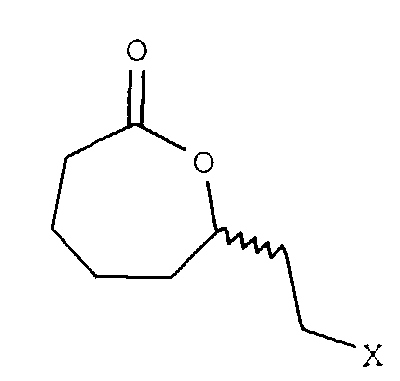
- a process for preparing lipoic acid (thioctic acid), or a derivative thereof is one in which a 2-substituted cyclohexanone is transformed in an oxidation reaction to a lactone having the formula (2), below, wherein X is a heteroatom substituent and the lactone is converted to lipoic acid.
- a novel lactone has the formula (2), below, wherein X is a heteroatom substituent, and is in substantially single enantiomer form.
- substantially single enantiomer we mean typically at least 50% ee, preferably at least 80% ee, more preferably at least 90% ee, or higher. Lactones of this type are particularly useful as intermediates in the preparation of single enantiomer lipoic acid.
- X is generally a heteroatom substituent, such as an oxygen-containing substituent, e.g. -OH, -Oacyl, -OCOR (in which R is generally C 1-20 alkyl, but can be other groups), or a halogen atom.
- an oxygen-containing substituent e.g. -OH, -Oacyl, -OCOR (in which R is generally C 1-20 alkyl, but can be other groups
- R is generally C 1-20 alkyl, but can be other groups
- Benefits of such a route are that (i) the starting material is inexpensive, as there are various ways to achieve substitution at the 2-position of cyclohexanone; and (ii) if the 2-substituted cyclohexanone is obtained in single enantiomer form through resolution, the incorrect enantiomer can be racemised (by virtue of the acidity of the proton at the stereogenic centre), and recycled into the resolution.
- the resolution can be conducted by a variety of methods, such as by esterase bio-resolution where X is chosen to provide an O-acyl derivative and kinetic resolution with an asymmetric Baeyer Villiger reaction, as is the case described below using a monooxygenase, or by fractional crystallisation if X is an ester (-O-COR) with a chiral acid which forms a crystalline ester.
- the Baeyer Villiger oxidation step to the lactone can be either biocatalytic or chemical with a per-acid.
- An alternative to resolution of the 2-substituted cyclohexanone is to prepare it from a prochiral substrate by asymmetric synthesis, such as by formation of the enamine of cyclohexanone with a chiral amine and alkylation of that enamine with ethylene oxide (see W.E. Harvey and D.S. Tarbell, J. Org. Chem., (1967) 32 : 1679-81; A.Z. Britten et al, Tetrahedron, (1969) 25 : 3157-60; S.B. Zeinalov, Dokl. Akad. Nauk Az. SSR, (1985) 41 : 45-7), or an equivalent thereof such as 2-iodoethyl acetate.
- a given enantiomer of the lactone (2) can be converted into either enantiomer of the final lipoic acid product, as illustrated in Scheme 2, below.
- Scheme 2 shows an alternative synthetic route, differing from Scheme 1 in that there is a hydroxyl inversion in this particular sequence. This circumvents the need for a Mitsunobu inversion, thereby reducing the overall process to lipoic acid by two steps as compared to Scheme 1.
- An NADPH-dependent monooxygenase derived from Pseudomonas putida NCIMB 10007, termed "MO-2" (described in R. Gagnon et al, J. Chem. Soc. Perkin Trans.
- triphenylphosphine 1.016 g, 3.87 mmol
- 4-nitrobenzoic acid 647 mg, 3.87 mmol
- DEAD 0.6 ml, 3.87 mmol
- anhydrous potassium carbonate 130 mg, 0.94 mmol was added to a solution of (6S)-(+)-methyl 6,8-bis(4-nitrobenzoxy)octanoate (461 mg, 0.94 mmol) in methanol (9.4 ml). The mixture was stirred at room temperature for 1 h and quenched with a saturated ammonium chloride solution (50 ml). The mixture was extracted with chloroform (3 x 50 ml) and the combined organic extracts were washed with brine (50 ml).
- NADPH 9 mg, 0.11 mmol
- ( ⁇ )-2-(2'-acetoxyethyl)cyclohexanone 20 mg, 0.11 mmol
- Trisma buffer 20 ml, 50 mM, pH 7.5
- the mixture was agitated in an orbital incubator (200 rpm, 30 °C) for 45 min and then extracted with ethyl acetate (3 X 20 ml).
- the combined organic extracts were washed with brine (20 ml) and dried over magnesium sulphate.
- the solvent was evaporated under reduced pressure to give the crude product. Purification using flash column chromatography with hexane-ethyl acetate (gradient 25 - 60% of ethyl acetate) afforded the following products:
Landscapes
- Health & Medical Sciences (AREA)
- Chemical & Material Sciences (AREA)
- Organic Chemistry (AREA)
- Diabetes (AREA)
- Public Health (AREA)
- Life Sciences & Earth Sciences (AREA)
- Veterinary Medicine (AREA)
- General Health & Medical Sciences (AREA)
- Animal Behavior & Ethology (AREA)
- Chemical Kinetics & Catalysis (AREA)
- General Chemical & Material Sciences (AREA)
- Medicinal Chemistry (AREA)
- Nuclear Medicine, Radiotherapy & Molecular Imaging (AREA)
- Pharmacology & Pharmacy (AREA)
- Bioinformatics & Cheminformatics (AREA)
- Engineering & Computer Science (AREA)
- Endocrinology (AREA)
- Obesity (AREA)
- Emergency Medicine (AREA)
- Hematology (AREA)
- Toxicology (AREA)
- Gastroenterology & Hepatology (AREA)
- Organic Low-Molecular-Weight Compounds And Preparation Thereof (AREA)
- Heterocyclic Compounds Containing Sulfur Atoms (AREA)
- Pharmaceuticals Containing Other Organic And Inorganic Compounds (AREA)
- Preparation Of Compounds By Using Micro-Organisms (AREA)
- Pyrane Compounds (AREA)
Abstract
Description
- The present invention relates to a novel process for obtaining lipoic acid (thioctic acid) either in racemic or single enantiomer form, and intermediates in that process. Background to the Invention
- Lipoic acid (thioctic acid) has been reported to have utility for a wide range of therapeutic applications, including liver disease and poisoning (see DE-A-4338508), hypertension (see DE-A-4343647), pain and infection, especially retroviral infection such as HIV (see EP-A-0427247). It has been reported that (R)-lipoic acid is preferred for conditions associated with diabetes such as polyneuropathy and nephropathy (see DE-A-4343593), and for treating chronic degenerative diseases of the central nervous system (CNS) (see DE-A-4343592). Whereas in EP-A-0572922, it has been reported that a combination of the unnatural (S)-enantiomer and vitamin E provides effective analgesia.
- EP-A- 0 586 987 refers to various methods for the preparation of lipoic acid, all comprising the steps of preparing a suitably 2-substituted cyclohexanone derivative, converting said cyclohexanone derivative in an oxidation reaction to the lactone corresponding to 8-substituted-6-hydroxy-octanoic acid, and further converting said lactone to lipoic acid. However, there is no disclosure or reference in this document suggesting to provide the aforementioned lactone or lipoic acid in single enantiomer form.
- Thus, synthetic routes to single enantiomer lipoic acid have been sought.
- There are already various synthetic approaches reported, such as in Y.S. Yadav et al, J. Sci. Ind. Rev., (1990) 49: 400-409; P.C. Bullman Page et al, J. Chem. Soc. Perkin Trans. 1, (1990), 1615-18; B.R. Menon et al, Tetrahedron Lett., (1987) 28: 2183-6; S.A. Gopalan and J.H. Jacobs, J. Chem. Soc. Perkin Trans. 1, (1990), 1897-1900; J.D. Elliot et al, Tetrahedron Lett., (1985) 26: 2535-8; M.H. Brookes et al, J. Chem. Soc. Chem. Commun., (1983), 1051-3; and L.G. Chebotareva, Zhim.-Farm. Zh., (1980) 14: 92-9, including classical resolution; asymmetric epoxidation of an intermediate; enantiomeric control by a chiral auxiliary; or derivation from an available chirality pool material. The existing routes are generally not ideal as they involve many steps, use expensive reagents or starting materials, or result in loss of half tne desired material following resolution of a racemate. As a result there is a continuing need for a more economical synthetic route.
- According to a first aspect of the present invention, a process for preparing lipoic acid (thioctic acid), or a derivative thereof, is one in which a 2-substituted cyclohexanone is transformed in an oxidation reaction to a lactone having the formula (2), below, wherein X is a heteroatom substituent and the lactone is converted to lipoic acid.
- According to a second aspect of the present invention, a novel lactone has the formula (2), below, wherein X is a heteroatom substituent, and is in substantially single enantiomer form. By substantially single enantiomer we mean typically at least 50% ee, preferably at least 80% ee, more preferably at least 90% ee, or higher. Lactones of this type are particularly useful as intermediates in the preparation of single enantiomer lipoic acid.
- One synthetic route to single enantiomer lipoic acid (or for that matter the racemate) embodied by the present invention starts with the very readily available starting material cyclohexanone and is outlined in Scheme 1 below. It is characterised by a Baeyer Villiger oxidation of a 2-substituted cyclohexanone.
- In Scheme 1, X is generally a heteroatom substituent, such as an oxygen-containing substituent, e.g. -OH, -Oacyl, -OCOR (in which R is generally C1-20 alkyl, but can be other groups), or a halogen atom.
- Benefits of such a route are that (i) the starting material is inexpensive, as there are various ways to achieve substitution at the 2-position of cyclohexanone; and (ii) if the 2-substituted cyclohexanone is obtained in single enantiomer form through resolution, the incorrect enantiomer can be racemised (by virtue of the acidity of the proton at the stereogenic centre), and recycled into the resolution.
- The resolution can be conducted by a variety of methods, such as by esterase bio-resolution where X is chosen to provide an O-acyl derivative and kinetic resolution with an asymmetric Baeyer Villiger reaction, as is the case described below using a monooxygenase, or by fractional crystallisation if X is an ester (-O-COR) with a chiral acid which forms a crystalline ester. The Baeyer Villiger oxidation step to the lactone can be either biocatalytic or chemical with a per-acid.
- An alternative to resolution of the 2-substituted cyclohexanone is to prepare it from a prochiral substrate by asymmetric synthesis, such as by formation of the enamine of cyclohexanone with a chiral amine and alkylation of that enamine with ethylene oxide (see W.E. Harvey and D.S. Tarbell, J. Org. Chem., (1967) 32: 1679-81; A.Z. Britten et al, Tetrahedron, (1969) 25: 3157-60; S.B. Zeinalov, Dokl. Akad. Nauk Az. SSR, (1985) 41: 45-7), or an equivalent thereof such as 2-iodoethyl acetate. Once obtained, a given enantiomer of the lactone (2) can be converted into either enantiomer of the final lipoic acid product, as illustrated in Scheme 2, below.
- Scheme 2 shows an alternative synthetic route, differing from Scheme 1 in that there is a hydroxyl inversion in this particular sequence. This circumvents the need for a Mitsunobu inversion, thereby reducing the overall process to lipoic acid by two steps as compared to Scheme 1. An NADPH-dependent monooxygenase derived from Pseudomonas putida NCIMB 10007, termed "MO-2" (described in R. Gagnon et al, J. Chem. Soc. Perkin Trans. 1, (1994), 2537), has been found to effect a kinetic resolution of the 2-substituted cyclohexanone (3a) through converting one of its enantiomers into the lactone (2a) and leaving the other enantiomer of the ketone unconverted. Initial biocatalytic conversion has given the lactone (2a) in 83% ee and 34% yield while the remaining starting material (3a) has been obtained in 75% ee and 13% yield. (A subsequent experiment gave the lactone in 78% ee and 43% yield). The lactone (2a) has been trasesterified to (R)-methyl 6, 8-dihydroxyhexanoate in 80% yield. Inversion by the Mitsunobu reaction and hydrolysis has given the corresponding (S)-ester, which has been converted by standard steps into (R)-(+)-lipoic acid having [α]D 104° (c = 1, benzene) compared with a literature value (see P.C.B. Page et al, J. Chem. Soc. Perkin. Trans. 1, (1990), 1615) of [α]D + 107°(c = 0.88, benzene).
- Alternatively, by omitting the hydroxyl inversion steps from the reaction sequence in Scheme 2, (S)-lipoic acid may be synthesised.
- The present invention is further illustrated by the following examples.
- Under an argon atmosphere, ethylene glycol (7.6 ml, 135.87 mmol) and para-toluenesulfonic acid (516 mg, 2.72 mmol) were added to a solution of (±)-2-(ethoxycarbonylmethyl)cyclohexanone (5.00 g, 27.17 mmol) in toluene (136 ml). The mixture was heated to reflux in a Dean Stark apparatus for 4 h and then allowed to cool to room temperature and quenched with sodium bicarbonate (5 g) and a saturated sodium bicarbonate solution (150 ml). The organic phase was separated from the aqueous phase which was extracted with ethyl acetate (3 x 100 ml). The combined organic phases were washed with a saturated sodium bicarbonate solution (100 ml) and brine (100 ml). The organic phase was dried over magnesium sulphate and the solvent was evaporated under reduced pressure to give the crude product which was purified using flash column chromatography with hexane-ethyl acetate (9 : 1) to give (±)-6-(ethoxycarbonylmethyl)-1,4-dioxaspiro[4.5]decane (4.59 g, 74% yield) as a colourless oil. Rf 0.18 (hexane-ethyl acetate, 9 : 1).
- Under an argon atmosphere, a solution of (±)-6-(ethoxycarbonylmethyl)-1,4-dioxaspiro[4.5]decane (1.00 g, 4.39 mmol) in diethyl ether (22 ml) was cooled to 0 °C. Lithium aluminium hydride (333 mg, 8.77 mmol) was added and the mixture was stirred at room temperature for 3 h. The mixture was cooled to 0 °C, quenched with ethyl acetate (10 ml) and 2 M sodium hydroxide solution (50 ml). The mixture was extracted with chloroform (3 x 50 ml) and the combined organic extracts were dried over magnesium sulphate. The solvent was evaporated under reduced pressure to give the crude product which was purified using flash column chromatography with hexane-ethyl acetate (3 : 7) to give (±)-6-(2'-hydroxyethyl)-1,4-dioxaspiro[4.5]decane (767 mg, 94% yield) as a colourless oil. Rf 0.30 (hexane-ethyl acetate, 3 : 7).
- Under an argon atmosphere, DMAP (259 mg, 2.12 mmol) and acetic anhydride (3 ml, 31.75 mmol) were added to a solution of (±)-6-(2'-hydroxyethyl)-1,4-dioxaspiro [4.5]decane (3.94 g, 21.17 mmol) in pyridine (106 ml). The mixture was stirred at room temperature for 1 h. The pyridine was evaporated under reduced pressure and the residue was diluted with methanol (100 ml). The mixture was cooled to 0 °C and 2 M hydrochloric acid (250 ml) was added. The mixture was stirred at room temperature for 1 h and then extracted with chloroform (3 x 200 ml). The combined organic extracts were washed with 2 M hydrochloric acid (200 ml) and brine (300 ml). The organic phase was dried over magnesium sulphate and the solvent was evaporated under reduced pressure to give the crude product which was purified using flash column chromatography with hexane-ethyl acetate (3 : 1) to give (±)-2-(2'acetoxyethyl)cyclohexanone (3.45 g, 88% yield) as a colourless oil. Rf 0.34 (hexane-ethyl acetate, 7 : 3).
- A solution of (±)-2-(2'-acetoxyethyl)cyclohexanone (660 mg, 3.59 mmol) in ethanol (3ml) was added to a solution of MO-2 (partially purified by dialysis) in TRIZMA buffer (330ml) containing NADPH tetrasodium salt (0.3mmol), glucose-6-phosphate monosodium salt (282 mg, 3mmol) and glucose-6-phosphate dehydrogenase (600IU, from Leuconostoc mesenteroides). After incubation for 3 h at 30°C, the mixture was extracted with ethyl acetate (3 x 200ml), and the combined organic extracts were washed with brine (200ml), dried over magnesium sulphate, and concentrated under reduced pressure. The residue was purified by flash column chromatography with hexane-ethyl acetate (gradient 25 - 60 - 100% of ethyl acetate), once the products were isolated in the following order:
- (2S)-(+)-2-(2'-Acetoxyethyl)cyclohexanone was isolated as a colourless oil [19% (GC), 88 mg, 13% yield]. Rf 0.34 (hexane-ethyl acetate, 7 : 3).
- (7R)-(-)-7-(2'-Acetoxyethyl)-2-oxepanone was isolated as a colourless oil [36% (GC), 241 mg, 34% yield]. Rf 0.40 (hexane-ethyl acetate, 7 : 3).
-
- Under an argon atmosphere, sodium methoxide (12 mg, 0,24 mmol) was added to a solution of (7R)-(-)-7-(2'-acetoxyethyl)-2-oxepanone (241 mg, 1.21 mmol) in methanol (12 ml) at room temperature. The mixture was stirred at room temperature for 3 h, quenched with a saturated ammonium chloride solution (40 ml) and extracted with chloroform (3 x 40 ml). The combined organic extracts were washed with brine (40 ml) and dried over magnesium sulphate. The solvent was evaporated under reduced pressure to give the crude product which was purified by flash column chromatography using ethyl acetate as eluent to give (6R)-(+)-methyl 6,8-dihydroxyoctanoate (184 mg, 80% yield) as a colourless oil. Rf 0.30 (ethyl acetate, 100%).
- Under an argon atmosphere, triphenylphosphine (1.016 g, 3.87 mmol) and 4-nitrobenzoic acid (647 mg, 3.87 mmol) were added to a solution of (6R)-(+)-methyl 6,8-dihydroxyoctanoate (184 mg, 0.97 mmol) in THF (9.7 ml). DEAD (0.6 ml, 3.87 mmol) was added dropwise over 15 min to the stirred mixture at room temperature. The mixture was stirred at room temperature for 30 min. The solvent was evaporated under reduced pressure and the residue was purified using flash column chromatography with hexane-ethyl acetate (3 : 1) to give (6S)-(+)-methyl 6,8-bis(4-nitrobenzoxy)octanoate (461 mg, 97% yield) as a clear yellow oil. Rf 0.24 (hexane-ethyl acetate, 7 : 3).
- Under an argon atmosphere, anhydrous potassium carbonate (130 mg, 0.94 mmol) was added to a solution of (6S)-(+)-methyl 6,8-bis(4-nitrobenzoxy)octanoate (461 mg, 0.94 mmol) in methanol (9.4 ml). The mixture was stirred at room temperature for 1 h and quenched with a saturated ammonium chloride solution (50 ml). The mixture was extracted with chloroform (3 x 50 ml) and the combined organic extracts were washed with brine (50 ml). The organic phase was dried over magnesium sulphate and the solvent was evaporated under reduced pressure to give the crude product which was purified using flash column chromatography with ethyl acetate to give (6S)-(-)-methyl 6,8-dihydroxyoctanoate (147 mg, 82% yield) as a colourless oil. Rf 0.30 (ethyl acetate, 100%).
- Under an argon atmosphere, triethylamine (324 ml, 2.32 mmol) and methanesulfonyl chloride (132 ml, 1.70 mmol) were added to a solution of (6S)-(-)-methyl 6,8-dihydroxyoctanoate (147 mg, 0.77 mmol) in dichloromethane (3.9 ml) at 0 °C. The mixture was stirred at 0 °C for 30 min, then quenched with ice water (10 ml) and extracted with dichloromethane (10 ml). The extract was washed with 2 M hydrochloric acid (10 ml), saturated sodium bicarbonate solution (10 ml) and brine (10 ml). The organic phase was dried over magnesium sulphate and the solvent was evaporated under reduced pressure to give the crude product which was purified using flash column chromatography with hexane-ethyl acetate (2 : 3) to give (6S)-(+)-methyl 6,8-bis(methylsulfonyloxy)octanoate (247 mg, 92% yield) as a clear yellow oil. Rf 0.30 (hexane-ethyl acetate, 3 : 2).
- Under an argon atmosphere, finely grounded sodium sulphide nonahydrate (189 mg, 0.79 mmol) and sulphur (25 mg, 0.79 mmol) were dissolved in DMF (14 ml). The mixture was heated to 80 °C in the dark for 1 h. A solution of (6S)-(+)-methyl 6,8-bis(methylsulfonyloxy)octanoate (247 mg, 0.71 mmol) in DMF (2 ml) was added dropwise to the mixture at 80 °C over 25 min. The mixture was stirred at 80 °C for 2 h in the dark, cooled to room temperature and diluted with water (70 ml). The mixture was extracted with hexane (2 x 100 ml) and ethyl acetate (2 x 100 ml). The combined organic extracts were washed with brine (150 ml) and dried over magnesium sulphate. The solvent was evaporated to give the crude product which was purified using flash column chromatography with hexane-ethyl acetate (4 : 1) to give (R)-(+)-methyl lipoate (130 mg, 83% yield) as a clear yellow oil. Rf 0.30 (hexane-ethyl acetate, 4 : 1).
- Potassium hydroxide (99 mg, 1.77 mmol) was dissolved in water (17.7 ml) and added to a solution of (R)-(+)-methyl lipoate (130 mg, 0.59 mmol) in methanol (17.7 ml). The mixture was stirred at room temperature for 3 h and then washed with chloroform (20 ml) to remove the organic impurities. The aqueous phase was acidified with 2 M hydrochloric acid (50 ml) and extracted with diethyl ether (3 x 50 ml). The combined organic extracts were washed with brine (50 ml) and dried over magnesium sulphate. The solvent was evaporated under reduced pressure to give the crude product which was recrystallized from hexane to give (R)-(+)-lipoic acid (85 mg, 70% yield) as yellow needles.
- Under an argon atmosphere, sodium bicarbonate (1.78 g, 21.20 mmol) and 80 - 90% w/w MCPBA (4.95 g, 28.26 mmol) were added to a solution of (±)-2-(2'-acetoxyethyl)cyclohexanone (2.60 g, 14.13 mmol) (0.50 mmol) in dichloromethane (70 ml) at room temperature. The mixture was stirred at room temperature for 3h, and diluted with dichloromethane (80 ml) and washed sequentially with a saturated sodium sulphite solution (3 x 100 ml), distilled water (100 ml) and brine (100 ml). The organic phase was dried over magnesium sulphate. After filtration, the solvent was evaporated under reduced pressure to give the crude product which was purified by flash column chromatography using hexane-ethyl acetate (2:3) as eluent to give (±)-7-(2'-acetoxyethyl)-2-oxepanone, as a colourless oil (2.76 g, 98% yield). Rf 0.40 (hexane-ethyl acetate, 7 : 3).
- Following the general procedure for transesterification (see Example 1), (±)-7-(2'-acetoxyethyl)-2-oxepanone (2.76 g, 13.80 mmol) was converted to (±)-methyl 6,8-dihydroxyoctanoate which was isolated after work-up and flash column chromatography with ethyl acetate as a colourless oil (2.57 g, 98% yield). Rf 0.30 (ethyl acetate, 100%).
- Under an argon atmosphere, triethylamine (0.7 ml, 5.05 mmol) and methanesulfonyl chloride (0.3 ml, 3.71 mmol) were added to a solution of (±)-methyl 6,8-dihydroxyoctanoate (320 mg, 1.68 mmol) in dichloromethane (8.4 ml) at 0 °C. The mixture was stirred at 0 °C for 30 min, then quenched with ice water (20 ml) and extracted with dichloromethane (20 ml). The organic extract was washed with 2 M hydrochloric acid (20 ml), saturated sodium bicarbonate solution (20 ml) and brine (20 ml). The organic phase was dried over magnesium sulphate and the solvent was evaporated under reduced pressure to give the crude product which was purified using flash column chromatography with hexane-ethyl acetate (2 : 3) to give (±)-methyl 6,8-bis(methylsulfonyloxy)octanoate (581 mg, 99% yield) as a clear yellow oil. Rf 0.30 (hexane-ethyl acetate, 3 : 2).
- Under an argon atmosphere, finely grounded sodium sulphide nonahydrate (17 mg, 0.54 mmol) and sulphur (10 mg, 0.54 mmol) were dissolved in DMF (8 ml). The mixture was heated to 80 °C in the dark for 1 h. A solution of (±)-methyl 6,8-bis(methylsulfonyloxy) octanoate (171 mg, 0.49 mmol) in DMF (2 ml) was added dropwise to the mixture at 80°C over 15 min. The mixture was stirred at 80 °C for 2 h in the dark. It was then allowed to cool to room temperature and quenched with water (150 ml). The mixture was extracted with hexane (3 x 150 ml) and the combined organic extracts were washed with brine (150 ml). The organic phase was dried over magnesium sulphate and the solvent was evaporated to give the crude product which was purified using flash column chromatography with hexane-ethyl acetate (4 : 1) to give (±)-methyl lipoate (59 mg, 54% yield) as a clear yellow oil. Rf 0.30 (hexane-ethyl acetate, 4 : 1).
- Potassium hydroxide (24 mg, 0.42 mmol) was dissolved in water (4.2 ml) and added to a solution of (±)-methyl lipoate (28 mg, 0.13 mmol) in methanol (10 ml). The mixture was stirred at room temperature for 3 h and then washed with chloroform (10 ml) to remove the organic impurities. The aqueous phase was acidified with 2 M hydrochloric acid (15 ml) and extracted with diethyl ether (3 X 20 ml). The combined organic extracts were washed with brine (20 ml) and dried over magnesium sulphate. The solvent was evaporated under reduced pressure to give the crude (±)-lipoic acid (26 mg, 98% yield) as yellow needles.
- NADPH (91 mg, 0.11 mmol) and (±)-2-(2'-acetoxyethyl)cyclohexanone (20 mg, 0.11 mmol) were added to a solution of cyclopentanone monooxygenase (3.12 IU) in Trisma buffer (20 ml, 50 mM, pH 7.5). The mixture was agitated in an orbital incubator (200 rpm, 30 °C) for 45 min and then extracted with ethyl acetate (3 X 20 ml). The combined organic extracts were washed with brine (20 ml) and dried over magnesium sulphate. The solvent was evaporated under reduced pressure to give the crude product. Purification using flash column chromatography with hexane-ethyl acetate (gradient 25 - 60% of ethyl acetate) afforded the following products:
- (2R)-(-)-2-(2'-Acetoxyethyl)cyclohexanone was the first product eluted and isolated as a colourless oil [38% (GC), 7 mg, 37% yield]. Rf 0.34 (hexane-ethyl acetate, 7 : 3). (7S)-(+)-7-(2'-Acetoxyethyl)-2-oxepanone was the second product eluted and isolated as a colourless oil [62% (GC), 13 mg, 59% yield]. Rf 0.40 (hexane-ethyl acetate, 7 : 3).
- Under an argon atmosphere, sodium methoxide (3 mg, 0.06 mmol) was added to a solution of (7S)-(+)-7-(2'-acetoxyethyl)-2-oxepanone (13mg, 0.06 mmol) in methanol (0.6 ml) at room temperature. The mixture was stirred at room temperature for 3 h, quenched with a saturated ammonium chloride solution (5 ml) and extracted with chloroform (3 x 5 ml). The combined extracts were washed with brine (5 ml) and dried over magnesium sulphate. The solvent was evaporated under reduced pressure to give the crude product which was purified by flash column chromatography using ethyl acetate as eluent to give (6S)-(-)-methyl 6,8-dihydroxyoctanoate (8 mg, 63% yield) as a colourless oil. Rf 0.30 (ethyl acetate, 100%).
-


Claims (13)
- A process for the preparation of substantially single enantiomer lipoic acid (thioctic acid) (R or S), or a derivative thereof, in which a 2-substituted cyclohexanone is transformed in an oxidation reaction to a substantially single enantiomer form (R or S) of a lactone having the formulawherein X is a heteroatom substituent, and the lactone is converted to lipoic acid.

- The process according to claim 1, wherein the lactone is provided by resolving the 2-substituted cyclohexanone by an esterase bioresolution, where X is chosen to provide an O-acyl derivative, or by an asymetric Baeyer-Villiger reaction using a monooxygenase.
- A lactone as defined in claim 1.
- A lactone according to claim 3, wherein X is an oxygen-containing substituent.
- A lactone according to claim 4, wherein X is -OH or -Oacyl.
- A lactone according to claim 3, wherein X is a halogen atom.
- A lactone according to any of claims 3 to 6 which is the (R) enatiomer
- A lactone according to any of claims 3 to 6 which is the (S) enatiomer
- Use of a lactone having the formula defined in claim 1, for the synthesis of lipoic acid, or a derivative thereof.
- Use according to claim 9, wherein the lactone is as defined in any of claims 4 to 8.
- A process for the production of (6S)-(-)-methyl-6,8-dihydroxyoctanoate, in which a lactone having the formulawherein X is a heteroatom substituent, is reacted with sodium methoxide.

- A process for the production of (6R)-(+)-methyl-6,8-dihydroxyoctanoate, in which a lactone having the formulawherein X is a heteroatom substituent, is reacted with sodium methoxide.

- A process for the production of (±)-methyl-6,8-dihydroxyoctanoate, in which a lactone having the formulawherein X is a heteroatom substituent is reacted with sodium methoxide.
Applications Claiming Priority (3)
| Application Number | Priority Date | Filing Date | Title |
|---|---|---|---|
| GBGB9510858.5A GB9510858D0 (en) | 1995-05-30 | 1995-05-30 | Process for preparing lipoic acid |
| GB9510858 | 1995-05-30 | ||
| PCT/GB1996/001278 WO1996038437A1 (en) | 1995-05-30 | 1996-05-30 | Process for the production of lipoic acid |
Publications (2)
| Publication Number | Publication Date |
|---|---|
| EP0835251A1 EP0835251A1 (en) | 1998-04-15 |
| EP0835251B1 true EP0835251B1 (en) | 2000-01-26 |
Family
ID=10775210
Family Applications (1)
| Application Number | Title | Priority Date | Filing Date |
|---|---|---|---|
| EP96919924A Expired - Lifetime EP0835251B1 (en) | 1995-05-30 | 1996-05-30 | Process for the production of lipoic acid |
Country Status (12)
| Country | Link |
|---|---|
| US (1) | US6140512A (en) |
| EP (1) | EP0835251B1 (en) |
| JP (1) | JP3856830B2 (en) |
| AT (1) | ATE189219T1 (en) |
| AU (1) | AU5828896A (en) |
| DE (1) | DE69606411T2 (en) |
| DK (1) | DK0835251T3 (en) |
| ES (1) | ES2143206T3 (en) |
| GB (1) | GB9510858D0 (en) |
| GR (1) | GR3033198T3 (en) |
| PT (1) | PT835251E (en) |
| WO (1) | WO1996038437A1 (en) |
Families Citing this family (10)
| Publication number | Priority date | Publication date | Assignee | Title |
|---|---|---|---|---|
| US6562869B1 (en) | 1999-09-23 | 2003-05-13 | Juvenon, Inc. | Nutritional supplement for increased energy and stamina |
| AU7828200A (en) | 1999-09-23 | 2001-04-24 | Juvenon Corporation | Nutritional supplement for increased energy and stamina |
| AU2001276210A1 (en) * | 2000-07-18 | 2002-01-30 | National Research Council Of Canada | Cloning, sequencing and expression of a comamonas cyclopentanone 1,2-monooxygenase-encoding gene in escherichia coli |
| DE10038147A1 (en) * | 2000-08-04 | 2002-02-14 | Sued Chemie Ag | Graft polymers or copolymers |
| IT1319194B1 (en) * | 2000-10-10 | 2003-09-26 | Laboratorio Chimico Int Spa | RACEMO TIOTIC ACID PRODUCTION PROCESS. |
| IT1319196B1 (en) * | 2000-10-10 | 2003-09-26 | Laboratorio Chimico Int Spa | SUMMARY OF R (+) ALPHA-LIPOIC ACID. |
| US20040137551A1 (en) * | 2003-01-13 | 2004-07-15 | Markovic Nenad S. | Cervical acid phosphatase - papanicolaou (CAP-PAP) test kit, method and accesories, processes for producing and using the same |
| US20090078581A1 (en) * | 2007-09-24 | 2009-03-26 | Applied Intellectual Capital | Configurations and Methods of Reduction of Lipoic Acid |
| CN115772155B (en) * | 2021-09-07 | 2023-10-24 | 山东新时代药业有限公司 | Preparation method of alpha-lipoic acid intermediate |
| CN116925035B (en) * | 2023-07-27 | 2026-03-06 | 风火轮(上海)生物科技有限公司 | A purification method for lipoic acid |
Family Cites Families (2)
| Publication number | Priority date | Publication date | Assignee | Title |
|---|---|---|---|---|
| ES2114984T3 (en) * | 1992-09-08 | 1998-06-16 | Basf Ag | IMPROVED PROCEDURE FOR OBTAINING R / S-GAMMA-LIPOIC ACID OR R / S-ALPHA-LIPOIC ACID. |
| DE4229914A1 (en) * | 1992-09-08 | 1994-03-10 | Basf Ag | Racemic alpha- and gamma-lipoic acid prepn. - from cyclohexanone and vinyl alkyl ether in good yield by economical multi-stage process |
-
1995
- 1995-05-30 GB GBGB9510858.5A patent/GB9510858D0/en active Pending
-
1996
- 1996-05-30 JP JP53628996A patent/JP3856830B2/en not_active Expired - Fee Related
- 1996-05-30 ES ES96919924T patent/ES2143206T3/en not_active Expired - Lifetime
- 1996-05-30 PT PT96919924T patent/PT835251E/en unknown
- 1996-05-30 DE DE69606411T patent/DE69606411T2/en not_active Expired - Fee Related
- 1996-05-30 EP EP96919924A patent/EP0835251B1/en not_active Expired - Lifetime
- 1996-05-30 AU AU58288/96A patent/AU5828896A/en not_active Abandoned
- 1996-05-30 US US08/952,698 patent/US6140512A/en not_active Expired - Fee Related
- 1996-05-30 DK DK96919924T patent/DK0835251T3/en active
- 1996-05-30 WO PCT/GB1996/001278 patent/WO1996038437A1/en not_active Ceased
- 1996-05-30 AT AT96919924T patent/ATE189219T1/en not_active IP Right Cessation
-
2000
- 2000-04-12 GR GR20000400892T patent/GR3033198T3/en not_active IP Right Cessation
Also Published As
| Publication number | Publication date |
|---|---|
| DE69606411T2 (en) | 2000-06-21 |
| GR3033198T3 (en) | 2000-08-31 |
| WO1996038437A1 (en) | 1996-12-05 |
| EP0835251A1 (en) | 1998-04-15 |
| DE69606411D1 (en) | 2000-03-02 |
| US6140512A (en) | 2000-10-31 |
| AU5828896A (en) | 1996-12-18 |
| PT835251E (en) | 2000-06-30 |
| ES2143206T3 (en) | 2000-05-01 |
| ATE189219T1 (en) | 2000-02-15 |
| DK0835251T3 (en) | 2000-06-26 |
| GB9510858D0 (en) | 1995-07-26 |
| JPH11506443A (en) | 1999-06-08 |
| JP3856830B2 (en) | 2006-12-13 |
Similar Documents
| Publication | Publication Date | Title |
|---|---|---|
| US5281722A (en) | Preparation and use of salts of the pure enantiomers of alpha-lipoic acid | |
| US20080312465A1 (en) | Intermediate compounds in the synthesis of dronabinol | |
| US4772727A (en) | Method of producing enantiomerically pure R-(+)-alpha-lipoic acid and S-(-)a | |
| JPS5912654B2 (en) | Optically active norpinene derivative and method for producing the same | |
| FR2545490A1 (en) | PROCESS FOR THE PRODUCTION OF DILTIAZEM HYDROCHLORIDE AS A CALCIUM ANTAGONIST PRODUCT | |
| US6140512A (en) | Process for the production of lipoic acid | |
| BG61261B1 (en) | Process for the preparation of13,14-dihydro-15(r)-17-phenyl-18,19,20-trinor-pgf2? esters | |
| CA2099444C (en) | Process for preparing tert-butyl (3r,5s)-6-hydroxy-3,5-o- isopropylidene-3,5-dihydroxyhexanoate | |
| der Deen et al. | Enantioselective synthesis of benzylbutyrolactones from 5-hydroxyfuran-2 (5 H)-one. New chiral synthons for dibenzylbutyrolactone lignans by a chemoenzymatic route | |
| EP0082049A2 (en) | Ethers with chiral atoms in the organic rest groups, their preparation, their use in the resolution of alcohols or of certain hemiacetals, and compounds so resolved | |
| BRPI0919257B1 (en) | NEBIVOLOL PREPARATION PROCESS | |
| Maloneyhuss | A useful preparation of L-(S)-glyceraldehyde acetonide | |
| JP3739432B2 (en) | Ozone cleavage reaction | |
| Kakeya et al. | Biochemical preparation of optically active 4-hydroxy-β-ionone and its transformation to (S)-6-hydroxy-α-ionone | |
| FR2655340A1 (en) | PROCESS FOR THE PREPARATION OF INTERMEDIATE PRODUCTS FOR THE PREPARATION OF DILTIAZEM. | |
| Wei et al. | Baker's yeast mediated mono-reduction of 1, 3-cyclohexanediones bearing two identical C (2) substituents | |
| US5079382A (en) | Process for the production of 3,4-epoxybutyrate and intermediate therefor | |
| US5072008A (en) | Manufacture of lactol derivatives | |
| MC2136A1 (en) | HETEROCYCLIC COMPOUND | |
| JP4509377B2 (en) | Process for producing optically active chromene derivatives | |
| US7078543B2 (en) | Methods for producing oxirane carboxylic acids and derivatives thereof | |
| EP0718407B1 (en) | Intermediates for the synthesis of eliprodil enantiomers and process for their preparation | |
| JP2893473B2 (en) | Process for producing (+)-equilenin and intermediate | |
| JPH0129793B2 (en) | ||
| HU213475B (en) | Process for producing substituted alkene-acid and its derivatives and pharmaceutical compositions containing the same |
Legal Events
| Date | Code | Title | Description |
|---|---|---|---|
| PUAI | Public reference made under article 153(3) epc to a published international application that has entered the european phase |
Free format text: ORIGINAL CODE: 0009012 |
|
| 17P | Request for examination filed |
Effective date: 19971216 |
|
| AK | Designated contracting states |
Kind code of ref document: A1 Designated state(s): AT BE CH DE DK ES FI FR GB GR IE IT LI LU MC NL PT SE |
|
| 17Q | First examination report despatched |
Effective date: 19981229 |
|
| GRAG | Despatch of communication of intention to grant |
Free format text: ORIGINAL CODE: EPIDOS AGRA |
|
| GRAG | Despatch of communication of intention to grant |
Free format text: ORIGINAL CODE: EPIDOS AGRA |
|
| GRAH | Despatch of communication of intention to grant a patent |
Free format text: ORIGINAL CODE: EPIDOS IGRA |
|
| GRAH | Despatch of communication of intention to grant a patent |
Free format text: ORIGINAL CODE: EPIDOS IGRA |
|
| GRAA | (expected) grant |
Free format text: ORIGINAL CODE: 0009210 |
|
| AK | Designated contracting states |
Kind code of ref document: B1 Designated state(s): AT BE CH DE DK ES FI FR GB GR IE IT LI LU MC NL PT SE |
|
| REF | Corresponds to: |
Ref document number: 189219 Country of ref document: AT Date of ref document: 20000215 Kind code of ref document: T |
|
| REG | Reference to a national code |
Ref country code: CH Ref legal event code: EP |
|
| REF | Corresponds to: |
Ref document number: 69606411 Country of ref document: DE Date of ref document: 20000302 |
|
| ITF | It: translation for a ep patent filed | ||
| REG | Reference to a national code |
Ref country code: IE Ref legal event code: FG4D |
|
| REG | Reference to a national code |
Ref country code: CH Ref legal event code: NV Representative=s name: BOVARD AG PATENTANWAELTE |
|
| ET | Fr: translation filed | ||
| REG | Reference to a national code |
Ref country code: ES Ref legal event code: FG2A Ref document number: 2143206 Country of ref document: ES Kind code of ref document: T3 |
|
| REG | Reference to a national code |
Ref country code: DK Ref legal event code: T3 |
|
| REG | Reference to a national code |
Ref country code: PT Ref legal event code: SC4A Free format text: AVAILABILITY OF NATIONAL TRANSLATION Effective date: 20000328 |
|
| PLBE | No opposition filed within time limit |
Free format text: ORIGINAL CODE: 0009261 |
|
| STAA | Information on the status of an ep patent application or granted ep patent |
Free format text: STATUS: NO OPPOSITION FILED WITHIN TIME LIMIT |
|
| 26N | No opposition filed | ||
| REG | Reference to a national code |
Ref country code: GB Ref legal event code: IF02 |
|
| REG | Reference to a national code |
Ref country code: CH Ref legal event code: PFA Free format text: ASTA MEDICA AKTIENGESELLSCHAFT TRANSFER- VIATRIS GMBH & CO. KG |
|
| REG | Reference to a national code |
Ref country code: PT Ref legal event code: PD4A Free format text: VIATRIS GMBH & CO. KG DE Effective date: 20020909 Ref country code: PT Ref legal event code: PD4A Free format text: ASTA MEDICA GMBH DE Effective date: 20020909 Ref country code: PT Ref legal event code: PC4A Free format text: ASTA MEDICA HEALTH PRODUCTS GMBH & CO. KG DE Effective date: 20020909 |
|
| NLS | Nl: assignments of ep-patents |
Owner name: VIATRIS GMBH & CO. KG |
|
| REG | Reference to a national code |
Ref country code: FR Ref legal event code: TP Ref country code: FR Ref legal event code: CD |
|
| REG | Reference to a national code |
Ref country code: GB Ref legal event code: 732E |
|
| REG | Reference to a national code |
Ref country code: CH Ref legal event code: PFA Owner name: VIATRIS GMBH & CO. KG Free format text: VIATRIS GMBH & CO. KG#WEISMUELLERSTRASSE 45#60314 FRANKFURT AM MAIN (DE) -TRANSFER TO- VIATRIS GMBH & CO. KG#BENZSTRASSE 1#61352 BAD HOMBURG (DE) |
|
| REG | Reference to a national code |
Ref country code: PT Ref legal event code: TE4A Free format text: VIATRIS GMBH & CO. KG DE Effective date: 20050506 |
|
| REG | Reference to a national code |
Ref country code: FR Ref legal event code: CA |
|
| PGFP | Annual fee paid to national office [announced via postgrant information from national office to epo] |
Ref country code: PT Payment date: 20070426 Year of fee payment: 12 |
|
| REG | Reference to a national code |
Ref country code: CH Ref legal event code: PFA Owner name: MEDA PHARMA GMBH & CO. KG Free format text: VIATRIS GMBH & CO. KG#BENZSTRASSE 1#61352 BAD HOMBURG (DE) -TRANSFER TO- MEDA PHARMA GMBH & CO. KG#BENZSTRASSE 1#61352 BAD HOMBURG (DE) |
|
| NLT1 | Nl: modifications of names registered in virtue of documents presented to the patent office pursuant to art. 16 a, paragraph 1 |
Owner name: MEDA PHARMA GMBH & CO. KG |
|
| PGFP | Annual fee paid to national office [announced via postgrant information from national office to epo] |
Ref country code: LU Payment date: 20070511 Year of fee payment: 12 |
|
| PGFP | Annual fee paid to national office [announced via postgrant information from national office to epo] |
Ref country code: NL Payment date: 20070514 Year of fee payment: 12 Ref country code: MC Payment date: 20070514 Year of fee payment: 12 Ref country code: FI Payment date: 20070514 Year of fee payment: 12 |
|
| PGFP | Annual fee paid to national office [announced via postgrant information from national office to epo] |
Ref country code: SE Payment date: 20070515 Year of fee payment: 12 Ref country code: DK Payment date: 20070515 Year of fee payment: 12 Ref country code: CH Payment date: 20070515 Year of fee payment: 12 Ref country code: AT Payment date: 20070515 Year of fee payment: 12 |
|
| PGFP | Annual fee paid to national office [announced via postgrant information from national office to epo] |
Ref country code: DE Payment date: 20070522 Year of fee payment: 12 |
|
| PGFP | Annual fee paid to national office [announced via postgrant information from national office to epo] |
Ref country code: IE Payment date: 20070524 Year of fee payment: 12 |
|
| PGFP | Annual fee paid to national office [announced via postgrant information from national office to epo] |
Ref country code: ES Payment date: 20070529 Year of fee payment: 12 |
|
| PGFP | Annual fee paid to national office [announced via postgrant information from national office to epo] |
Ref country code: BE Payment date: 20070531 Year of fee payment: 12 |
|
| REG | Reference to a national code |
Ref country code: PT Ref legal event code: PD4A Owner name: MEDA PHARMA GMBH & CO. KG, DE Effective date: 20070604 |
|
| REG | Reference to a national code |
Ref country code: FR Ref legal event code: CD |
|
| PGFP | Annual fee paid to national office [announced via postgrant information from national office to epo] |
Ref country code: GB Payment date: 20070522 Year of fee payment: 12 |
|
| PGFP | Annual fee paid to national office [announced via postgrant information from national office to epo] |
Ref country code: IT Payment date: 20070525 Year of fee payment: 12 |
|
| PGFP | Annual fee paid to national office [announced via postgrant information from national office to epo] |
Ref country code: FR Payment date: 20070516 Year of fee payment: 12 |
|
| PGFP | Annual fee paid to national office [announced via postgrant information from national office to epo] |
Ref country code: GR Payment date: 20070531 Year of fee payment: 12 |
|
| BERE | Be: lapsed |
Owner name: *MEDA PHARMA G.M.B.H. & CO. K.G. Effective date: 20080531 |
|
| REG | Reference to a national code |
Ref country code: PT Ref legal event code: MM4A Free format text: LAPSE DUE TO NON-PAYMENT OF FEES Effective date: 20081202 |
|
| PG25 | Lapsed in a contracting state [announced via postgrant information from national office to epo] |
Ref country code: MC Free format text: LAPSE BECAUSE OF NON-PAYMENT OF DUE FEES Effective date: 20080531 |
|
| REG | Reference to a national code |
Ref country code: CH Ref legal event code: PL |
|
| REG | Reference to a national code |
Ref country code: DK Ref legal event code: EBP |
|
| GBPC | Gb: european patent ceased through non-payment of renewal fee |
Effective date: 20080530 |
|
| PG25 | Lapsed in a contracting state [announced via postgrant information from national office to epo] |
Ref country code: PT Free format text: LAPSE BECAUSE OF NON-PAYMENT OF DUE FEES Effective date: 20081202 Ref country code: NL Free format text: LAPSE BECAUSE OF NON-PAYMENT OF DUE FEES Effective date: 20081201 Ref country code: LI Free format text: LAPSE BECAUSE OF NON-PAYMENT OF DUE FEES Effective date: 20080531 Ref country code: CH Free format text: LAPSE BECAUSE OF NON-PAYMENT OF DUE FEES Effective date: 20080531 |
|
| PG25 | Lapsed in a contracting state [announced via postgrant information from national office to epo] |
Ref country code: FI Free format text: LAPSE BECAUSE OF NON-PAYMENT OF DUE FEES Effective date: 20080530 Ref country code: AT Free format text: LAPSE BECAUSE OF NON-PAYMENT OF DUE FEES Effective date: 20080530 |
|
| REG | Reference to a national code |
Ref country code: FR Ref legal event code: ST Effective date: 20090119 |
|
| REG | Reference to a national code |
Ref country code: IE Ref legal event code: MM4A |
|
| PG25 | Lapsed in a contracting state [announced via postgrant information from national office to epo] |
Ref country code: BE Free format text: LAPSE BECAUSE OF NON-PAYMENT OF DUE FEES Effective date: 20080531 |
|
| PG25 | Lapsed in a contracting state [announced via postgrant information from national office to epo] |
Ref country code: IE Free format text: LAPSE BECAUSE OF NON-PAYMENT OF DUE FEES Effective date: 20080530 Ref country code: FR Free format text: LAPSE BECAUSE OF NON-PAYMENT OF DUE FEES Effective date: 20080602 Ref country code: DK Free format text: LAPSE BECAUSE OF NON-PAYMENT OF DUE FEES Effective date: 20080531 Ref country code: DE Free format text: LAPSE BECAUSE OF NON-PAYMENT OF DUE FEES Effective date: 20081202 |
|
| PG25 | Lapsed in a contracting state [announced via postgrant information from national office to epo] |
Ref country code: GR Free format text: LAPSE BECAUSE OF NON-PAYMENT OF DUE FEES Effective date: 20081204 Ref country code: GB Free format text: LAPSE BECAUSE OF NON-PAYMENT OF DUE FEES Effective date: 20080530 |
|
| REG | Reference to a national code |
Ref country code: ES Ref legal event code: FD2A Effective date: 20080531 |
|
| PG25 | Lapsed in a contracting state [announced via postgrant information from national office to epo] |
Ref country code: IT Free format text: LAPSE BECAUSE OF NON-PAYMENT OF DUE FEES Effective date: 20080530 |
|
| PG25 | Lapsed in a contracting state [announced via postgrant information from national office to epo] |
Ref country code: ES Free format text: LAPSE BECAUSE OF NON-PAYMENT OF DUE FEES Effective date: 20080531 |
|
| PG25 | Lapsed in a contracting state [announced via postgrant information from national office to epo] |
Ref country code: LU Free format text: LAPSE BECAUSE OF NON-PAYMENT OF DUE FEES Effective date: 20080530 |
|
| PG25 | Lapsed in a contracting state [announced via postgrant information from national office to epo] |
Ref country code: SE Free format text: LAPSE BECAUSE OF NON-PAYMENT OF DUE FEES Effective date: 20080531 |