EP0833931B1 - Bacillus strain and sporulation assay method - Google Patents
Bacillus strain and sporulation assay method Download PDFInfo
- Publication number
- EP0833931B1 EP0833931B1 EP96920919A EP96920919A EP0833931B1 EP 0833931 B1 EP0833931 B1 EP 0833931B1 EP 96920919 A EP96920919 A EP 96920919A EP 96920919 A EP96920919 A EP 96920919A EP 0833931 B1 EP0833931 B1 EP 0833931B1
- Authority
- EP
- European Patent Office
- Prior art keywords
- bacillus strain
- prespore
- spoiiie
- sporulation
- gene
- Prior art date
- Legal status (The legal status is an assumption and is not a legal conclusion. Google has not performed a legal analysis and makes no representation as to the accuracy of the status listed.)
- Expired - Lifetime
Links
- 241000193830 Bacillus <bacterium> Species 0.000 title claims abstract description 20
- 230000028070 sporulation Effects 0.000 title claims abstract description 19
- 238000003556 assay Methods 0.000 title description 7
- 108700008625 Reporter Genes Proteins 0.000 claims abstract description 28
- 210000000349 chromosome Anatomy 0.000 claims abstract description 16
- 235000014469 Bacillus subtilis Nutrition 0.000 claims abstract description 10
- 238000000034 method Methods 0.000 claims abstract description 9
- 230000009471 action Effects 0.000 claims abstract description 8
- 230000000694 effects Effects 0.000 claims description 12
- 108090000790 Enzymes Proteins 0.000 claims description 9
- 102000004190 Enzymes Human genes 0.000 claims description 9
- 230000014509 gene expression Effects 0.000 claims description 9
- 210000004027 cell Anatomy 0.000 claims description 8
- 230000001771 impaired effect Effects 0.000 claims description 6
- 101150066555 lacZ gene Proteins 0.000 claims description 6
- 101100361762 Bacillus subtilis (strain 168) sigG gene Proteins 0.000 claims description 5
- 239000003795 chemical substances by application Substances 0.000 claims description 5
- 239000007850 fluorescent dye Substances 0.000 claims description 3
- 230000001939 inductive effect Effects 0.000 claims description 3
- 101100437498 Escherichia coli (strain K12) uidA gene Proteins 0.000 claims description 2
- 108090000623 proteins and genes Proteins 0.000 abstract description 15
- 238000005192 partition Methods 0.000 abstract description 2
- 108050006002 RNA polymerase sigma factor FliA Proteins 0.000 abstract 1
- 230000035772 mutation Effects 0.000 description 8
- 229940088598 enzyme Drugs 0.000 description 7
- 230000004927 fusion Effects 0.000 description 7
- 101100366267 Bacillus subtilis (strain 168) spoIIIE gene Proteins 0.000 description 6
- 102000005936 beta-Galactosidase Human genes 0.000 description 6
- 108010005774 beta-Galactosidase Proteins 0.000 description 6
- 101150002100 ftsK gene Proteins 0.000 description 6
- 108020004414 DNA Proteins 0.000 description 5
- 239000004599 antimicrobial Substances 0.000 description 4
- 239000003112 inhibitor Substances 0.000 description 4
- 101150000942 spoIIIE gene Proteins 0.000 description 4
- 239000000758 substrate Substances 0.000 description 4
- 241000894006 Bacteria Species 0.000 description 3
- 108091023040 Transcription factor Proteins 0.000 description 3
- 102000040945 Transcription factor Human genes 0.000 description 3
- 102000004169 proteins and genes Human genes 0.000 description 3
- 210000000130 stem cell Anatomy 0.000 description 3
- 241000589875 Campylobacter jejuni Species 0.000 description 2
- ULGZDMOVFRHVEP-RWJQBGPGSA-N Erythromycin Chemical compound O([C@@H]1[C@@H](C)C(=O)O[C@@H]([C@@]([C@H](O)[C@@H](C)C(=O)[C@H](C)C[C@@](C)(O)[C@H](O[C@H]2[C@@H]([C@H](C[C@@H](C)O2)N(C)C)O)[C@H]1C)(C)O)CC)[C@H]1C[C@@](C)(OC)[C@@H](O)[C@H](C)O1 ULGZDMOVFRHVEP-RWJQBGPGSA-N 0.000 description 2
- NWIBSHFKIJFRCO-WUDYKRTCSA-N Mytomycin Chemical compound C1N2C(C(C(C)=C(N)C3=O)=O)=C3[C@@H](COC(N)=O)[C@@]2(OC)[C@@H]2[C@H]1N2 NWIBSHFKIJFRCO-WUDYKRTCSA-N 0.000 description 2
- 230000004913 activation Effects 0.000 description 2
- 150000001875 compounds Chemical class 0.000 description 2
- 230000007547 defect Effects 0.000 description 2
- 230000002068 genetic effect Effects 0.000 description 2
- 238000004519 manufacturing process Methods 0.000 description 2
- MHWLWQUZZRMNGJ-UHFFFAOYSA-N nalidixic acid Chemical compound C1=C(C)N=C2N(CC)C=C(C(O)=O)C(=O)C2=C1 MHWLWQUZZRMNGJ-UHFFFAOYSA-N 0.000 description 2
- 229960000210 nalidixic acid Drugs 0.000 description 2
- 230000035897 transcription Effects 0.000 description 2
- 238000013518 transcription Methods 0.000 description 2
- 101150101900 uidA gene Proteins 0.000 description 2
- 241000606678 Coxiella burnetii Species 0.000 description 1
- 230000004543 DNA replication Effects 0.000 description 1
- 241000194033 Enterococcus Species 0.000 description 1
- 241000588724 Escherichia coli Species 0.000 description 1
- 241000282326 Felis catus Species 0.000 description 1
- 102000016943 Muramidase Human genes 0.000 description 1
- 108010014251 Muramidase Proteins 0.000 description 1
- 108010062010 N-Acetylmuramoyl-L-alanine Amidase Proteins 0.000 description 1
- 230000000845 anti-microbial effect Effects 0.000 description 1
- 230000015572 biosynthetic process Effects 0.000 description 1
- 238000006243 chemical reaction Methods 0.000 description 1
- 229960005091 chloramphenicol Drugs 0.000 description 1
- WIIZWVCIJKGZOK-RKDXNWHRSA-N chloramphenicol Chemical compound ClC(Cl)C(=O)N[C@H](CO)[C@H](O)C1=CC=C([N+]([O-])=O)C=C1 WIIZWVCIJKGZOK-RKDXNWHRSA-N 0.000 description 1
- 230000024321 chromosome segregation Effects 0.000 description 1
- 230000021615 conjugation Effects 0.000 description 1
- 238000010276 construction Methods 0.000 description 1
- 230000002950 deficient Effects 0.000 description 1
- 230000003111 delayed effect Effects 0.000 description 1
- 230000001419 dependent effect Effects 0.000 description 1
- 239000003814 drug Substances 0.000 description 1
- 229940079593 drug Drugs 0.000 description 1
- 230000002255 enzymatic effect Effects 0.000 description 1
- 229960003276 erythromycin Drugs 0.000 description 1
- 230000007062 hydrolysis Effects 0.000 description 1
- 238000006460 hydrolysis reaction Methods 0.000 description 1
- 230000002401 inhibitory effect Effects 0.000 description 1
- 230000005764 inhibitory process Effects 0.000 description 1
- 238000003780 insertion Methods 0.000 description 1
- 230000037431 insertion Effects 0.000 description 1
- 229960000274 lysozyme Drugs 0.000 description 1
- 235000010335 lysozyme Nutrition 0.000 description 1
- 239000004325 lysozyme Substances 0.000 description 1
- 230000007246 mechanism Effects 0.000 description 1
- 229960004857 mitomycin Drugs 0.000 description 1
- 239000000203 mixture Substances 0.000 description 1
- 230000008569 process Effects 0.000 description 1
- 230000009467 reduction Effects 0.000 description 1
- 230000014493 regulation of gene expression Effects 0.000 description 1
- 230000010076 replication Effects 0.000 description 1
- 238000012216 screening Methods 0.000 description 1
- 238000000638 solvent extraction Methods 0.000 description 1
- 239000000126 substance Substances 0.000 description 1
- 238000003786 synthesis reaction Methods 0.000 description 1
- 238000011144 upstream manufacturing Methods 0.000 description 1
- 230000009105 vegetative growth Effects 0.000 description 1
Images

Classifications
-
- C—CHEMISTRY; METALLURGY
- C12—BIOCHEMISTRY; BEER; SPIRITS; WINE; VINEGAR; MICROBIOLOGY; ENZYMOLOGY; MUTATION OR GENETIC ENGINEERING
- C12Q—MEASURING OR TESTING PROCESSES INVOLVING ENZYMES, NUCLEIC ACIDS OR MICROORGANISMS; COMPOSITIONS OR TEST PAPERS THEREFOR; PROCESSES OF PREPARING SUCH COMPOSITIONS; CONDITION-RESPONSIVE CONTROL IN MICROBIOLOGICAL OR ENZYMOLOGICAL PROCESSES
- C12Q1/00—Measuring or testing processes involving enzymes, nucleic acids or microorganisms; Compositions therefor; Processes of preparing such compositions
- C12Q1/02—Measuring or testing processes involving enzymes, nucleic acids or microorganisms; Compositions therefor; Processes of preparing such compositions involving viable microorganisms
- C12Q1/18—Testing for antimicrobial activity of a material
-
- C—CHEMISTRY; METALLURGY
- C12—BIOCHEMISTRY; BEER; SPIRITS; WINE; VINEGAR; MICROBIOLOGY; ENZYMOLOGY; MUTATION OR GENETIC ENGINEERING
- C12N—MICROORGANISMS OR ENZYMES; COMPOSITIONS THEREOF; PROPAGATING, PRESERVING, OR MAINTAINING MICROORGANISMS; MUTATION OR GENETIC ENGINEERING; CULTURE MEDIA
- C12N15/00—Mutation or genetic engineering; DNA or RNA concerning genetic engineering, vectors, e.g. plasmids, or their isolation, preparation or purification; Use of hosts therefor
- C12N15/09—Recombinant DNA-technology
- C12N15/63—Introduction of foreign genetic material using vectors; Vectors; Use of hosts therefor; Regulation of expression
- C12N15/65—Introduction of foreign genetic material using vectors; Vectors; Use of hosts therefor; Regulation of expression using markers
-
- C—CHEMISTRY; METALLURGY
- C12—BIOCHEMISTRY; BEER; SPIRITS; WINE; VINEGAR; MICROBIOLOGY; ENZYMOLOGY; MUTATION OR GENETIC ENGINEERING
- C12N—MICROORGANISMS OR ENZYMES; COMPOSITIONS THEREOF; PROPAGATING, PRESERVING, OR MAINTAINING MICROORGANISMS; MUTATION OR GENETIC ENGINEERING; CULTURE MEDIA
- C12N15/00—Mutation or genetic engineering; DNA or RNA concerning genetic engineering, vectors, e.g. plasmids, or their isolation, preparation or purification; Use of hosts therefor
- C12N15/09—Recombinant DNA-technology
- C12N15/63—Introduction of foreign genetic material using vectors; Vectors; Use of hosts therefor; Regulation of expression
- C12N15/74—Vectors or expression systems specially adapted for prokaryotic hosts other than E. coli, e.g. Lactobacillus, Micromonospora
- C12N15/75—Vectors or expression systems specially adapted for prokaryotic hosts other than E. coli, e.g. Lactobacillus, Micromonospora for Bacillus
Definitions
- the septum can close around the incompletely replicated nucleoid.
- an inhibitor such as nalidixic acid
- the septum can close around the incompletely replicated nucleoid.
- spoIIIE mutant cells with nucleoids trapped by septa can not recover and the nucleoid seems to be permanently trapped (6).
- the spoIIIE defect is manifested in a reduction of about 2-fold in the resistance to drugs such as nalidixic acid and mitomycin C (6).
- sporulation phenotype arising when SpoIIIE is inactivated provides the potential for a very powerful and specific assay.
- the chromosome In the absence of functional SpoIIIE, the chromosome is trapped partially inside and partially outside the prespore compartment, but the prespore-specific transcription factor, ⁇ F , is activated normally. Reporter genes dependent on ⁇ F are expressed if they are located at certain places in the chromosome and blocked if they lie elsewhere.
- the invention provides a Bacillus strain having a chromosome with two reporter genes each linked to a promoter and responsive to the action of ⁇ F during sporulation, a first reporter gene being located in a segment of the DNA that is trapped in a prespore compartment when SpoIIIE function is impaired, and a second reporter gene being located outside the said segment.
- the invention provides a method of determining whether an agent inhibits SpoIIIE function in Bacillus species, which method comprises inducing the Bacillus strain as defined to sporulate in the presence of the agent, and observing expression of the first and the second reporter genes. It is thought that the property, of inhibiting SpoIIIE function in Bacillus species, is indicative of actual or potential anti-microbial properties in the agent. The method is thus expected to be useful for screening possible anti-microbial agents.
- Bacillus species may be used that is capable of sporulating under suitable conditions and for which genetic constructions can be made.
- B. subtilis is conveniently accessible and well characterised and is preferred.
- the Bacillus strain constructed has a chromosome with two reporter genes each linked to a promoter and responsive to the action of ⁇ F during sporulation.
- a reporter gene is one which on expression gives rise to an easily detected or observed phenotype.
- the expressed protein may be an enzyme which acts on a substrate to give a product that is easily observed e.g. because it is coloured or chemiluminescent of fluorescent.
- Reporter genes capable of being expressed in Bacillus species are well known and documented in the literature. Reporter genes are preferably chosen so that their products can be readily assayed simultaneously. lacZ has been used for more than 10 years with great success in B. subtilis .
- Each reporter gene is functionally linked to a promoter which is responsive to the action of the prespore-specific transcription factor ⁇ F during sporulation.
- the same promoter may conveniently be used for both reporter genes, although this is not necessary.
- Suitable promoters include those of the gpr and spoIIIG genes.
- the assay method of the invention involves inducing the Bacillus strain described to sporulate in the presence of a putative anti-microbial agent.
- samples of the Bacillus strain may be cultured in the wells of a microtitre plate in an exhaustion medium to stimulate sporulation. Thereafter, observation is made of expression of the first and second reporter genes.
- substrates for the two enzymes may be added to the wells of the microtitre plate, and observation made of e.g. chemiluminescent or fluorescent or coloured products of enzymatic activity.
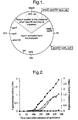
- a B. subtilis cell 10 contains two copies of a chromosome 12 having two reporter gene insertions: a lacZ gene shown as a black filled circle 14, and a uidA gene shown as a shaded circle 16, both fused to a ⁇ F promoter.
- Sporulation causes the cell to divide into two compartments, a mother cell compartment 18 and a prespore compartment 20, separated by a septum 22.
- the sporulation process follows one of two routes A and B.
- route A the functional spoIIIE gene causes the complete chromosome to enter the prespore compartment.
- route B the spoIIIE gene is defective or its product has been inhibited as a result of contact with an anti-microbial agent, and only a small proportion (about 30%) of the chromosome enters the prespore compartment.
- the prespore-specific transcription factor ⁇ F causes expression of genes in the prespore compartment 20 but not the mother cell compartment 18.
- this results in production of ⁇ -galactosidase (from the lacZ gene) and ⁇ -glucoronidase (from the uidA gene).
- route B only the ⁇ -galactosidase, and not the ⁇ -glucoronidase, is produced.
- the cells are lysed, e.g. with lysozyme so as not to inactivate the enzymes, and fluorogenic substrates for the two enzymes are added.
- the presence of either or both enzymes may be detected simultaneously by a fluorimeter set to receive two different appropriate wavelengths for the fluorescent products of enzymic activity.
- Subtilis strain 1206 has two reporter genes that are responsive to the action of ⁇ F during sporulation (Fig. 1).
- a spoIIIG'-'lacZ fusion marked with a selectable chloramphenicol resistance gene ( cat ) has been placed at the amyE locus. This locus lies within the segment of DNA that is trapped in the prespore when SpoIIIE function is impaired (Wu et al , 1994). This fusion should be available for transcription directed by the prespore-specific sigma factor ⁇ F , even when SpoIIIE function is impaired.
- the second reporter gene is a spoIIIG'-uidA fusion, tagged with an erythromycin resistance gene, erm . This fusion is placed in the spoIIIG locus, which lies outside the segment of DNA trapped in the prespore in spoIIIE mutants (Fig. 1). Its expression should thus be blocked when SpoIIIE function is impaired.
- strain 1206 provides a sensitive assay strain with which to identify compounds that specifically impair SpoIIIE function. Such compounds would result in production of ⁇ -glucoronidase.
- the ratio of these two enzymes could be measured conveniently in a single assay mixture as outlined above.
Landscapes
- Health & Medical Sciences (AREA)
- Genetics & Genomics (AREA)
- Life Sciences & Earth Sciences (AREA)
- Chemical & Material Sciences (AREA)
- Engineering & Computer Science (AREA)
- Organic Chemistry (AREA)
- Zoology (AREA)
- Wood Science & Technology (AREA)
- General Engineering & Computer Science (AREA)
- Bioinformatics & Cheminformatics (AREA)
- Biotechnology (AREA)
- Biomedical Technology (AREA)
- Biophysics (AREA)
- Molecular Biology (AREA)
- Microbiology (AREA)
- Biochemistry (AREA)
- General Health & Medical Sciences (AREA)
- Physics & Mathematics (AREA)
- Proteomics, Peptides & Aminoacids (AREA)
- Plant Pathology (AREA)
- Immunology (AREA)
- Analytical Chemistry (AREA)
- Toxicology (AREA)
- Measuring Or Testing Involving Enzymes Or Micro-Organisms (AREA)
- Micro-Organisms Or Cultivation Processes Thereof (AREA)
Abstract
Description
Claims (8)
- A Bacillus strain having a chromosome with two reporter genes each linked to a promoter and responsive to the action of σF during sporulation, a first reporter gene being located in a segment of the DNA that is trapped in a prespore compartment when SpoIIIE function is impaired, and a second reporter gene being located outside the said segment.
- A Bacillus strain as claimed in claim 1 wherein each reporter gene is linked to the same promoter.
- A Bacillus strain as claimed in claim 2, wherein the promoter is spoIIIG.
- A Bacillus strain as claimed in any one of claims 1 to 3, wherein the reporter genes are lacZ and uidA.
- A Bacillus strain as claimed in any one of claims 1 to 4, which is a B. subtilis strain.
- A method of determining whether an agent inhibits SpoIIIE function in Bacillus species, which method comprises inducing the Bacillus strain as claimed in any one of claims 1 to 5, to sporulate in the presence of the agent, and observing expression of the first and the second reporter genes.
- A method as claimed in claim 6, wherein the two reporter genes are expressed as enzymes, the activities of which are observed by fluorimetry.
- A method as claimed in claim 7, wherein samples of the Bacillus strain are cultured in the wells of a microtitre plate in an exhaustion medium to stimulate sporulation, and then the cells are lysed and fluorogenic substrates for the two enzymes are added to the wells.
Applications Claiming Priority (3)
| Application Number | Priority Date | Filing Date | Title |
|---|---|---|---|
| GBGB9512109.1A GB9512109D0 (en) | 1995-06-14 | 1995-06-14 | Bacillus strain and assay method |
| GB9512109 | 1995-06-14 | ||
| PCT/GB1996/001416 WO1997000325A1 (en) | 1995-06-14 | 1996-06-14 | Bacillus strain and sporulation assay method |
Publications (2)
| Publication Number | Publication Date |
|---|---|
| EP0833931A1 EP0833931A1 (en) | 1998-04-08 |
| EP0833931B1 true EP0833931B1 (en) | 2005-11-09 |
Family
ID=10776065
Family Applications (1)
| Application Number | Title | Priority Date | Filing Date |
|---|---|---|---|
| EP96920919A Expired - Lifetime EP0833931B1 (en) | 1995-06-14 | 1996-06-14 | Bacillus strain and sporulation assay method |
Country Status (7)
| Country | Link |
|---|---|
| US (1) | US6027909A (en) |
| EP (1) | EP0833931B1 (en) |
| JP (1) | JP4104655B2 (en) |
| AT (1) | ATE309379T1 (en) |
| DE (1) | DE69635416T2 (en) |
| GB (1) | GB9512109D0 (en) |
| WO (1) | WO1997000325A1 (en) |
Families Citing this family (6)
| Publication number | Priority date | Publication date | Assignee | Title |
|---|---|---|---|---|
| GB9600955D0 (en) * | 1996-01-17 | 1996-03-20 | Smithkline Beecham Plc | Novel compounds |
| GB9625825D0 (en) * | 1996-12-12 | 1997-01-29 | Isis Innovation | Bacillus strain and assay method |
| GB9625832D0 (en) * | 1996-12-12 | 1997-01-29 | Isis Innovation | Bacillus strain and assay method |
| US5888770A (en) * | 1997-08-26 | 1999-03-30 | Smithkline Beecham Corporation | Spoiiie |
| GB9824682D0 (en) * | 1998-11-10 | 1999-01-06 | Isis Innovation | Bacillus strain and assay method |
| KR102811755B1 (en) | 2017-02-03 | 2025-05-23 | 삼성디스플레이 주식회사 | Touch sensor and display device having the touch sensor |
Family Cites Families (1)
| Publication number | Priority date | Publication date | Assignee | Title |
|---|---|---|---|---|
| NL7806086A (en) * | 1978-06-05 | 1979-12-07 | Gist Brocades Nv | ANALYSIS UNIT. |
-
1995
- 1995-06-14 GB GBGB9512109.1A patent/GB9512109D0/en active Pending
-
1996
- 1996-06-14 AT AT96920919T patent/ATE309379T1/en not_active IP Right Cessation
- 1996-06-14 JP JP50280597A patent/JP4104655B2/en not_active Expired - Fee Related
- 1996-06-14 WO PCT/GB1996/001416 patent/WO1997000325A1/en not_active Ceased
- 1996-06-14 DE DE69635416T patent/DE69635416T2/en not_active Expired - Fee Related
- 1996-06-14 EP EP96920919A patent/EP0833931B1/en not_active Expired - Lifetime
- 1996-06-14 US US08/945,856 patent/US6027909A/en not_active Expired - Fee Related
Non-Patent Citations (1)
| Title |
|---|
| WU L.J.; ERRINGTON J.: "Bacillus subtilis SpoIIIE Protein Required for DNA Segregation During Assymetric Cell Division", SCIENCE, vol. 264, 22 April 1994 (1994-04-22), pages 572 - 575 * |
Also Published As
| Publication number | Publication date |
|---|---|
| US6027909A (en) | 2000-02-22 |
| GB9512109D0 (en) | 1995-08-09 |
| WO1997000325A1 (en) | 1997-01-03 |
| ATE309379T1 (en) | 2005-11-15 |
| JP4104655B2 (en) | 2008-06-18 |
| JPH11507549A (en) | 1999-07-06 |
| DE69635416D1 (en) | 2005-12-15 |
| EP0833931A1 (en) | 1998-04-08 |
| DE69635416T2 (en) | 2006-07-13 |
Similar Documents
| Publication | Publication Date | Title |
|---|---|---|
| Mason et al. | Regulation of expression of genes coding for small, acid-soluble proteins of Bacillus subtilis spores: studies using lacZ gene fusions | |
| Errington | Bacillus subtilis sporulation: regulation of gene expression and control of morphogenesis | |
| Ireton et al. | Integration of multiple developmental signals in Bacillus subtilis through the Spo0A transcription factor. | |
| Lee et al. | The chromosome partitioning proteins Soj (ParA) and Spo0J (ParB) contribute to accurate chromosome partitioning, separation of replicated sister origins, and regulation of replication initiation in Bacillus subtilis | |
| Chung et al. | Gene expression in single cells of Bacillus subtilis: evidence that a threshold mechanism controls the initiation of sporulation | |
| Pogliano et al. | Disappearance of the sigma E transcription factor from the forespore and the SpoIIE phosphatase from the mother cell contributes to establishment of cell-specific gene expression during sporulation in Bacillus subtilis | |
| Raivio et al. | The Cpx envelope stress response is controlled by amplification and feedback inhibition | |
| Youngman et al. | New ways to study developmental genes in spore-forming bacteria | |
| Mandic-Mulec et al. | The Bacillus subtilis SinR protein is a repressor of the key sporulation gene spo0A | |
| Arigoni et al. | The SpoIIE phosphatase, the sporulation septum and the establishment of forespore‐specific transcription in Bacillus subtilis: a reassessment | |
| Wu et al. | Prespore-specific gene expression in Bacillus subtilisis driven by sequestration of SpoIIE phosphatase to the prespore side of the asymmetric septum | |
| Errington et al. | Use of a lacZ gene fusion to determine the dependence pattern and the spore compartment expression of sporulation operon spoVA in spo mutants of Bacillus subtilis | |
| Lysenko et al. | Characterization of the ftsH gene of Bacillus subtilis | |
| US6027909A (en) | Bacillus strain and sporulation assay method | |
| Zupancic et al. | Chromosomal organization governs the timing of cell type‐specific gene expression required for spore formation in Bacillus subtilis | |
| Waldburger et al. | Characterization of a new sporulation factor in Bacillus subtilis | |
| Karmazyn‐Campelli et al. | How the early sporulation sigma factor σF delays the switch to late development in Bacillus subtilis | |
| Clarke et al. | Use of lacZ gene fusions to determine the dependence pattern of the sporulation gene spoIID in spo mutants of Bacillus subtilis | |
| Zhang et al. | ςK can negatively regulate sigE expression by two different mechanisms during sporulation of Bacillus subtilis | |
| US6255065B1 (en) | Bacillus strain and antibiotic screening method | |
| WINSTON et al. | DNA replication in Bacillus subtilis | |
| EP0944734B1 (en) | Bacillus strain and antibiotic screening method | |
| Sharrock et al. | Suppression of defective-sporulation phenotypes by the Bacillus subtilis mutation rev4 | |
| JP4494640B2 (en) | Bacillus strain and assay method | |
| Predich | The regulation and role of the Bacillus subtilis early sporulation gene spoOH |
Legal Events
| Date | Code | Title | Description |
|---|---|---|---|
| PUAI | Public reference made under article 153(3) epc to a published international application that has entered the european phase |
Free format text: ORIGINAL CODE: 0009012 |
|
| 17P | Request for examination filed |
Effective date: 19971022 |
|
| AK | Designated contracting states |
Kind code of ref document: A1 Designated state(s): AT BE CH DE ES FR GB IT LI NL SE |
|
| 17Q | First examination report despatched |
Effective date: 20030922 |
|
| GRAP | Despatch of communication of intention to grant a patent |
Free format text: ORIGINAL CODE: EPIDOSNIGR1 |
|
| RAP1 | Party data changed (applicant data changed or rights of an application transferred) |
Owner name: ISIS INNOVATION LIMITED |
|
| GRAS | Grant fee paid |
Free format text: ORIGINAL CODE: EPIDOSNIGR3 |
|
| GRAA | (expected) grant |
Free format text: ORIGINAL CODE: 0009210 |
|
| AK | Designated contracting states |
Kind code of ref document: B1 Designated state(s): AT BE CH DE ES FR GB IT LI NL SE |
|
| PG25 | Lapsed in a contracting state [announced via postgrant information from national office to epo] |
Ref country code: NL Free format text: LAPSE BECAUSE OF FAILURE TO SUBMIT A TRANSLATION OF THE DESCRIPTION OR TO PAY THE FEE WITHIN THE PRESCRIBED TIME-LIMIT Effective date: 20051109 Ref country code: IT Free format text: LAPSE BECAUSE OF FAILURE TO SUBMIT A TRANSLATION OF THE DESCRIPTION OR TO PAY THE FEE WITHIN THE PRESCRIBED TIME-LIMIT;WARNING: LAPSES OF ITALIAN PATENTS WITH EFFECTIVE DATE BEFORE 2007 MAY HAVE OCCURRED AT ANY TIME BEFORE 2007. THE CORRECT EFFECTIVE DATE MAY BE DIFFERENT FROM THE ONE RECORDED. Effective date: 20051109 Ref country code: BE Free format text: LAPSE BECAUSE OF FAILURE TO SUBMIT A TRANSLATION OF THE DESCRIPTION OR TO PAY THE FEE WITHIN THE PRESCRIBED TIME-LIMIT Effective date: 20051109 Ref country code: AT Free format text: LAPSE BECAUSE OF FAILURE TO SUBMIT A TRANSLATION OF THE DESCRIPTION OR TO PAY THE FEE WITHIN THE PRESCRIBED TIME-LIMIT Effective date: 20051109 |
|
| REG | Reference to a national code |
Ref country code: GB Ref legal event code: FG4D |
|
| REG | Reference to a national code |
Ref country code: CH Ref legal event code: EP |
|
| REF | Corresponds to: |
Ref document number: 69635416 Country of ref document: DE Date of ref document: 20051215 Kind code of ref document: P |
|
| PG25 | Lapsed in a contracting state [announced via postgrant information from national office to epo] |
Ref country code: SE Free format text: LAPSE BECAUSE OF FAILURE TO SUBMIT A TRANSLATION OF THE DESCRIPTION OR TO PAY THE FEE WITHIN THE PRESCRIBED TIME-LIMIT Effective date: 20060209 |
|
| REG | Reference to a national code |
Ref country code: CH Ref legal event code: NV Representative=s name: PATENTANWAELTE SCHAAD, BALASS, MENZL & PARTNER AG |
|
| PG25 | Lapsed in a contracting state [announced via postgrant information from national office to epo] |
Ref country code: ES Free format text: LAPSE BECAUSE OF FAILURE TO SUBMIT A TRANSLATION OF THE DESCRIPTION OR TO PAY THE FEE WITHIN THE PRESCRIBED TIME-LIMIT Effective date: 20060220 |
|
| NLV1 | Nl: lapsed or annulled due to failure to fulfill the requirements of art. 29p and 29m of the patents act | ||
| ET | Fr: translation filed | ||
| PLBE | No opposition filed within time limit |
Free format text: ORIGINAL CODE: 0009261 |
|
| STAA | Information on the status of an ep patent application or granted ep patent |
Free format text: STATUS: NO OPPOSITION FILED WITHIN TIME LIMIT |
|
| 26N | No opposition filed |
Effective date: 20060810 |
|
| PGFP | Annual fee paid to national office [announced via postgrant information from national office to epo] |
Ref country code: FR Payment date: 20090618 Year of fee payment: 14 Ref country code: CH Payment date: 20090624 Year of fee payment: 14 |
|
| PGFP | Annual fee paid to national office [announced via postgrant information from national office to epo] |
Ref country code: GB Payment date: 20090626 Year of fee payment: 14 Ref country code: DE Payment date: 20090825 Year of fee payment: 14 |
|
| REG | Reference to a national code |
Ref country code: CH Ref legal event code: PL |
|
| GBPC | Gb: european patent ceased through non-payment of renewal fee |
Effective date: 20100614 |
|
| REG | Reference to a national code |
Ref country code: FR Ref legal event code: ST Effective date: 20110228 |
|
| PG25 | Lapsed in a contracting state [announced via postgrant information from national office to epo] |
Ref country code: DE Free format text: LAPSE BECAUSE OF NON-PAYMENT OF DUE FEES Effective date: 20110101 Ref country code: CH Free format text: LAPSE BECAUSE OF NON-PAYMENT OF DUE FEES Effective date: 20100630 Ref country code: LI Free format text: LAPSE BECAUSE OF NON-PAYMENT OF DUE FEES Effective date: 20100630 |
|
| PG25 | Lapsed in a contracting state [announced via postgrant information from national office to epo] |
Ref country code: FR Free format text: LAPSE BECAUSE OF NON-PAYMENT OF DUE FEES Effective date: 20100630 |
|
| PG25 | Lapsed in a contracting state [announced via postgrant information from national office to epo] |
Ref country code: GB Free format text: LAPSE BECAUSE OF NON-PAYMENT OF DUE FEES Effective date: 20100614 |