EP0833881B1 - Agglomerates - Google Patents
Agglomerates Download PDFInfo
- Publication number
- EP0833881B1 EP0833881B1 EP96920939A EP96920939A EP0833881B1 EP 0833881 B1 EP0833881 B1 EP 0833881B1 EP 96920939 A EP96920939 A EP 96920939A EP 96920939 A EP96920939 A EP 96920939A EP 0833881 B1 EP0833881 B1 EP 0833881B1
- Authority
- EP
- European Patent Office
- Prior art keywords
- lignosulfonate
- particulate material
- agglomerates
- fuel
- pct
- Prior art date
- Legal status (The legal status is an assumption and is not a legal conclusion. Google has not performed a legal analysis and makes no representation as to the accuracy of the status listed.)
- Expired - Lifetime
Links
Classifications
-
- C—CHEMISTRY; METALLURGY
- C10—PETROLEUM, GAS OR COKE INDUSTRIES; TECHNICAL GASES CONTAINING CARBON MONOXIDE; FUELS; LUBRICANTS; PEAT
- C10L—FUELS NOT OTHERWISE PROVIDED FOR; NATURAL GAS; SYNTHETIC NATURAL GAS OBTAINED BY PROCESSES NOT COVERED BY SUBCLASSES C10G OR C10K; LIQUIFIED PETROLEUM GAS; USE OF ADDITIVES TO FUELS OR FIRES; FIRE-LIGHTERS
- C10L5/00—Solid fuels
- C10L5/02—Solid fuels such as briquettes consisting mainly of carbonaceous materials of mineral or non-mineral origin
- C10L5/06—Methods of shaping, e.g. pelletizing or briquetting
- C10L5/10—Methods of shaping, e.g. pelletizing or briquetting with the aid of binders, e.g. pretreated binders
- C10L5/14—Methods of shaping, e.g. pelletizing or briquetting with the aid of binders, e.g. pretreated binders with organic binders
- C10L5/20—Methods of shaping, e.g. pelletizing or briquetting with the aid of binders, e.g. pretreated binders with organic binders with sulfite lye
-
- C—CHEMISTRY; METALLURGY
- C10—PETROLEUM, GAS OR COKE INDUSTRIES; TECHNICAL GASES CONTAINING CARBON MONOXIDE; FUELS; LUBRICANTS; PEAT
- C10L—FUELS NOT OTHERWISE PROVIDED FOR; NATURAL GAS; SYNTHETIC NATURAL GAS OBTAINED BY PROCESSES NOT COVERED BY SUBCLASSES C10G OR C10K; LIQUIFIED PETROLEUM GAS; USE OF ADDITIVES TO FUELS OR FIRES; FIRE-LIGHTERS
- C10L5/00—Solid fuels
- C10L5/40—Solid fuels essentially based on materials of non-mineral origin
-
- Y—GENERAL TAGGING OF NEW TECHNOLOGICAL DEVELOPMENTS; GENERAL TAGGING OF CROSS-SECTIONAL TECHNOLOGIES SPANNING OVER SEVERAL SECTIONS OF THE IPC; TECHNICAL SUBJECTS COVERED BY FORMER USPC CROSS-REFERENCE ART COLLECTIONS [XRACs] AND DIGESTS
- Y02—TECHNOLOGIES OR APPLICATIONS FOR MITIGATION OR ADAPTATION AGAINST CLIMATE CHANGE
- Y02E—REDUCTION OF GREENHOUSE GAS [GHG] EMISSIONS, RELATED TO ENERGY GENERATION, TRANSMISSION OR DISTRIBUTION
- Y02E50/00—Technologies for the production of fuel of non-fossil origin
- Y02E50/10—Biofuels, e.g. bio-diesel
-
- Y—GENERAL TAGGING OF NEW TECHNOLOGICAL DEVELOPMENTS; GENERAL TAGGING OF CROSS-SECTIONAL TECHNOLOGIES SPANNING OVER SEVERAL SECTIONS OF THE IPC; TECHNICAL SUBJECTS COVERED BY FORMER USPC CROSS-REFERENCE ART COLLECTIONS [XRACs] AND DIGESTS
- Y02—TECHNOLOGIES OR APPLICATIONS FOR MITIGATION OR ADAPTATION AGAINST CLIMATE CHANGE
- Y02E—REDUCTION OF GREENHOUSE GAS [GHG] EMISSIONS, RELATED TO ENERGY GENERATION, TRANSMISSION OR DISTRIBUTION
- Y02E50/00—Technologies for the production of fuel of non-fossil origin
- Y02E50/30—Fuel from waste, e.g. synthetic alcohol or diesel
Definitions
- the present invention is concerned with agglomerates obtained from organic waste (such as sewage sludge solids or refuse derived fuel), which are suitable for use in a gasification process or as a combustible fuel for use in a boiler, for example.
- organic waste such as sewage sludge solids or refuse derived fuel
- Sewage sludge is the insoluble part of raw sewage, which may be present in the residue left after aerobic or anaerobic treatment of sewage; current methods of disposal of sewage sludge include landfill and dumping at sea, neither of which is satisfactory from an environmental point of view. Difficulties are encountered with incineration of sewage sludge, because of the high water content of sewage sludge, the presence of toxic heavy metals, and the fact that safe incineration would require flame temperatures in the region of plasma temperatures.
- binders disclosed for such briquettes are molasses, black liquor, lignin sulfonate derivatives, brewery wastes, starch wastes, bentonite, slaked lime, unslaked lime, bitumen and pitch. No indication of preference is given for any of these binders, and no conditions are given for use of these binders.
- Briquettes based on organic waste materials may be gasified to produce a fuel gas, which can be burnt in a gas turbine, followed by exhaust gas recovery to generate steam, which in turn can be used to drive a steam turbine, both turbines being connected to generators to generate electricity.
- the briquettes must meet the following criteria:
- thermoly shock-resistant agglomerates each comprising a chemically bonded macromolecular structure which method comprises:
- the resulting agglomerates have a polymerised or macromolecular (pseudo coal-like) structure with excellent carbonization properties and thermal shock resistance.
- phenol has reaction properties which affect the carbonization properties of coal.
- Lignin contains substituted phenol units and has similar beneficial properties on the carbonization properties of coal, for example.
- thermal shock resistance of the agglomerates is beneficially associated with the formation of sulfonyl and sulfur bridges between the macromolecular (lignin-based) backbones.
- Calcium sulfate formed from the calcium ions present is also believed to beneficially contribute to such thermal shock resistance.
- the sulfur present in the resulting agglomerates is stoichiometrically bonded in such a form that disadvantageous evolution of oxides of sulfur, or other noxious sulfur compounds, is substantially precluded.
- lignosulfonate is permitted to react with urea or a urea derivative, this may contribute to the plasticity of the resulting mix; it is particularly preferred to supply urea or such a urea derivative by using (according to a preferred embodiment of the invention), sewage sludge as the animal excrement.
- This reaction of lignin with urea or urea derivatives is a reaction which is known per se.
- sewage sludge When sewage sludge is used, it is preferably initially screened and dewatered, typically to a water content of less than about 70% by weight (or a solids content of greater than 30% by weight).
- Other possible types of animal excrement which may be used according to the invention include pig slurry, which is also preferably dewatered to a solids content such as that described above with reference to sewage sludge.
- lignosulfonate which is a material typically produced as a byproduct in a paper-making process, results in agglomerates of exceptional strength, as evidenced by their substantial resistance to impact, attrition and thermal shock.
- the lignosulfonate is preferably present in a minor amount, such as up to about 15% by weight, of the mix used to form agglomerates, the amount referred to relating to lignosulfonate in aqueous form.
- the chemical bonding between the particles extends through the structure of the particles, thereby establishing a metamorphic change throughout the agglomerate molecular structure.
- the nature of this bonding is important not only under test conditions, but also under service conditions.
- the bonding were to be of a purely adhesive nature, there would be a separate phase at the interfaces between particles; according to the invention, the bonding is chemical in nature and extends throughout the macromolecular structure of the agglomerate.
- the particles of the organic particulate materials become fused and chemically bonded to one another in such a manner that the particles and lignosulfonate binder no longer remain as distinct separate entities or separate phases, such that under gasification conditions, the whole agglomerate has high green strength and acts as a single homogeneous mass.
- the lignosulfonate may be used in aqueous form, such as an aqueous solution.
- aqueous solution contains 40 to 60% by weight (on a dry basis) of the lignosulfonate.
- the lignosulfonate may be in solid or pseudo-solid form.
- the lignosulfonate may include any suitable cation; examples of suitable cations include ammonium, sodium, calcium and magnesium.
- Calcium lignosulfonate is preferred because of the advantageous thermal shock-resistance of the resulting agglomerates, and the ability of calcium lignosulfonate to polymerise to provide agglomerates with excellent green strength. Furthermore, when calcium lignosulfonate is used, it may not be necessary to treat the conditioned mix with lime, as there may already be sufficient calcium ions present.
- the lignosulfonate should be substantially sugar-free (sugars, for example having been removed, typically by fermentation, for example).
- the calcium ions have several effects, as follows:
- the ratio of sewage sludge to carbonaceous fuel may be, for example, in the range 0.25 to 2.5:1.
- the amount of sewage sludge is greater than that of the carbonaceous fuel (a preferred ratio being in the range 1.5 to 2.5:1), which enables high quality agglomerates to be obtained, from low grade starting materials so as to be suitable for supply to, for example, a gasification process. Gas resulting from such a gasification process appears to be cleaner than gas from a conventional gasification process.
- sewage sludge When sewage sludge is used, it should, as indicated above, be dewatered, and preferably also dried, prior to mixing with the lignosulfonate, typically to a water content of 10% by weight or less.
- the sewage sludge and (where used) the carbonaceous fuel are in particulate form, typically in the form of short fibres, flock, flakes, powder, granules or the like with a mean particle size of not more than 10 mm, more preferably not more than 6 mm.
- the agglomerate mix used according to the invention is preferably, in at least some embodiments of the invention, substantially free of refuse-derived fuel or other materials derived from municipal refuse.
- Refuse-derived fuel can, in some cases, detract from the properties, such as the physical strength and thermal shock resistance, of the resulting agglomerates.
- the fuel may be any suitable particulate material, such as refuse-derived fuel, petroleum coke, anthracite, bituminous or sub-bituminous coal, coke (from coal), coking coal, peat or lignite.
- the fuel typically has a particle size in the range indicated above for the sewage sludge; a preferred particle size for the carbonaceous fuel is not more than 2 mm.
- lime when used in the method according to the invention, it is typically in the form of the oxide (which is preferred when the mix has a relatively high water content, such as about 5% by weight or more), or, in some cases, in the form of the hydroxide (slaked lime).
- the agglomerates can be shaped into, for example, briquettes (formed between shaped dies or the like), pellets, similar bodies formed by extrusion, pan agglomeration or the like.
- the mix may be shaped to agglomerates by any suitable means, such as for example, in a ring-roll press.
- the briquettes are preferably of the pillow-shaped type.
- Such agglomerates are substantially dry and can be used in a process involving gasification with oxygen, such as in a British Gas/Lurgi Slagging Gasifier, which is a high pressure, fixed bed, oxygen-blown, slagging gasifier, where fuel (lump coal or briquettes) is fed to the top of a gasification bed via a lock hopper system. As the fuel sinks through the bed, it is successively dried, devolatilised, pyrolysed, gasified and combusted.
- a British Gas/Lurgi Slagging Gasifier which is a high pressure, fixed bed, oxygen-blown, slagging gasifier, where fuel (lump coal or briquettes) is fed to the top of a gasification bed via a lock hopper system.
- fuel lump coal or briquettes
- Oxygen and steam in a suitable predetermined ratio, are injected into the gasification zone via nozzles (called tuyeres), which thereby ensures that the temperature is sufficiently high that ash and flux are melted so as to form a slag pool in the bottom of the gasification zone, which slag is drained intermittently and water quenched to form a benign frit.
- nozzles called tuyeres
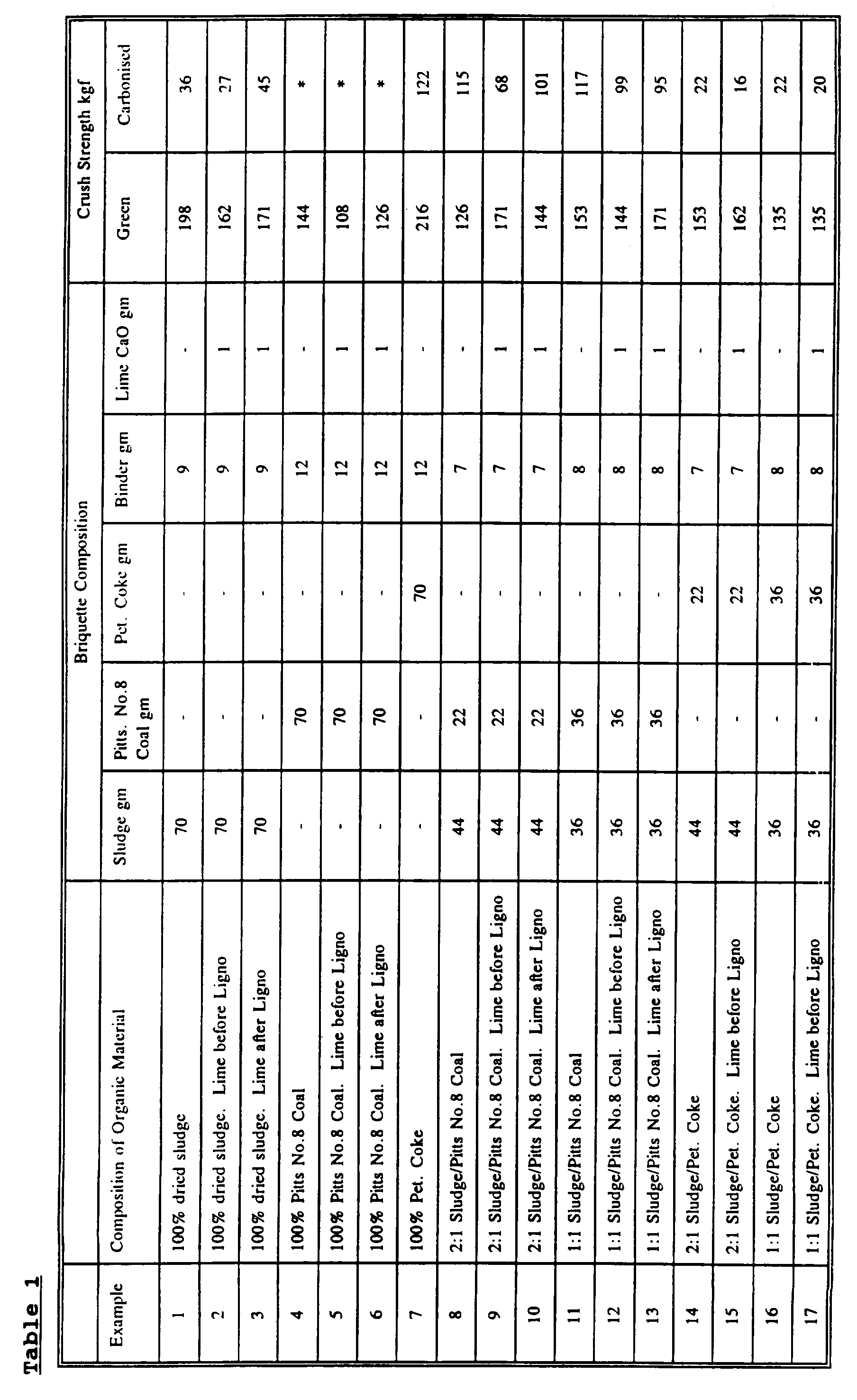
- Table 1 gives details of compositions of briquettes obtained according to the invention, together with the corresponding green and carbonised crush strengths of the briquettes (measured using a pneumatic briquette crushing test rig).
- Each briquette tested contained calcium lignosulfonate (Ligno) as binder; the percentages and ratios quoted in the column entitled “Composition of Organic Material” relate to the organic material (that is, all the organic ingredients other than the lignosulfonate).
- the sludge used was sewage sludge which had been dried at at least 105 degrees Celsius to a residual moisture content of 1 to 2.5% by weight.
- "Pitts. No 8 Coal” means Pittsburgh No. 8 Coal;
- Pet. Coke means petroleum coke.
- the sludge and/or other organic material was mixed with the aqueous calcium lignosulfonate, heated and oxidatively conditioned, and then shaped to pillow-shaped briquettes.
- "Lime before Ligno” means that calcium oxide was added before the lignosulfonate;
- “Lime after Ligno” means that calcium oxide was added after the lignosulfonate.
- Table 2 gives details of the weight changes attained for individual briquettes after they had undergone carbonisation in an oven in an inert atmosphere, where the temperature was increased from around ambient room temperature to about 800 degrees Celsius over a period of about one hour.
- the briquettes measured were the corresponding ones identified in Table 1.
Landscapes
- Chemical & Material Sciences (AREA)
- Oil, Petroleum & Natural Gas (AREA)
- Organic Chemistry (AREA)
- Life Sciences & Earth Sciences (AREA)
- Environmental & Geological Engineering (AREA)
- General Life Sciences & Earth Sciences (AREA)
- Geochemistry & Mineralogy (AREA)
- Geology (AREA)
- Solid Fuels And Fuel-Associated Substances (AREA)
- Separation Using Semi-Permeable Membranes (AREA)
- Treatment Of Sludge (AREA)
- Medicines Containing Plant Substances (AREA)
- Removal Of Floating Material (AREA)
- Separation Of Suspended Particles By Flocculating Agents (AREA)
- Transition And Organic Metals Composition Catalysts For Addition Polymerization (AREA)
- Carbon And Carbon Compounds (AREA)
Abstract
Description

Claims (10)
- A method of forming thermally shock-resistant chemically bonded agglomerates suitable for use as a combustible fuel or in a gasification process, which method comprises:(a) mixing particulate organic material comprising a carbonaceous fuel and/or animal excrement with a lignosulfonate, in the presence of water, with application of heat sufficient to maintain the lignosulfonate in fluid form, so as to deposit a film of lignosulfonate over the surface of the particulate material;(b) oxidatively conditioning the lignosulfonate coated particulate material in an atmosphere comprising oxygen under conditions permitting escape of water present in the mixed particulate material, said conditioning either being in the presence of calcium ions or being followed by mixing the conditioned particulate material with lime; and(c) shaping the resulting free-flowing plastic mixture under pressure, to form agglomerates.
- A method according to claim 1, wherein the oxygen is in the form of air.
- A method according to claim 1 or 2, wherein the lime is in the form of the hydroxide and the lignosulfonate has a water content of less than 5% by weight.
- A method according to any of claims 1 to 3, wherein the lignosulfonate is an ammonium, sodium, calcium or magnesium salt.
- A method according to any of claims 1 to 4, wherein the lignosulfonate is substantially sugar-free.
- A method according to any of claims 1 to 5, wherein the lignosulfonate is used in an aqueous form containing 40-60% dry weight of said lignosulfonate.
- A method according to any of claims 1 to 6, wherein the animal excrement comprises dewatered sewage sludge.
- A method according to any of claims 1 to 7, wherein the weight ratio of said animal excrement to said carbonaceous fuel is within the range 0.25 to 2.5:1.
- A method according to any of claims 1 to 8, wherein the carbonaceous fuel comprises refuse-derived fuel, petroleum coke, anthracite, bituminous or sub-bituminous coal, coke from coal, coking coal, peat or lignite, all with a maximum particle size of 10mm.
- A method according to any of claims 1 to 9, wherein the mix is substantially free of municipal solid waste.
Applications Claiming Priority (3)
| Application Number | Priority Date | Filing Date | Title |
|---|---|---|---|
| GBGB9512433.5A GB9512433D0 (en) | 1995-06-19 | 1995-06-19 | Agglomerates from carbonaceous fuel |
| GB9512433 | 1995-06-19 | ||
| PCT/GB1996/001446 WO1997000307A1 (en) | 1995-06-19 | 1996-06-18 | Agglomerates |
Publications (2)
| Publication Number | Publication Date |
|---|---|
| EP0833881A1 EP0833881A1 (en) | 1998-04-08 |
| EP0833881B1 true EP0833881B1 (en) | 2001-01-24 |
Family
ID=10776300
Family Applications (1)
| Application Number | Title | Priority Date | Filing Date |
|---|---|---|---|
| EP96920939A Expired - Lifetime EP0833881B1 (en) | 1995-06-19 | 1996-06-18 | Agglomerates |
Country Status (17)
| Country | Link |
|---|---|
| US (1) | US6001143A (en) |
| EP (1) | EP0833881B1 (en) |
| JP (1) | JPH11508926A (en) |
| KR (1) | KR19990022777A (en) |
| AT (1) | ATE198904T1 (en) |
| AU (1) | AU696354B2 (en) |
| BR (1) | BR9608577A (en) |
| CA (1) | CA2224814A1 (en) |
| DE (1) | DE69611676T2 (en) |
| DK (1) | DK0833881T3 (en) |
| ES (1) | ES2155610T3 (en) |
| GB (2) | GB9512433D0 (en) |
| GR (1) | GR3035748T3 (en) |
| NO (1) | NO975476L (en) |
| PT (1) | PT833881E (en) |
| WO (1) | WO1997000307A1 (en) |
| ZA (1) | ZA965193B (en) |
Families Citing this family (11)
| Publication number | Priority date | Publication date | Assignee | Title |
|---|---|---|---|---|
| EP1090095B1 (en) * | 1998-04-24 | 2003-03-19 | Vera Vasilievna Myasoedova | Composition for manufacture of fuel briquettes |
| CA2425426C (en) * | 2000-10-17 | 2010-01-26 | Earth Alive Resources Inc. | Wastewater treatment |
| US7674303B2 (en) * | 2003-12-17 | 2010-03-09 | Kela Energy, Llc | Methods for binding particulate solids |
| US20090235577A1 (en) * | 2003-12-17 | 2009-09-24 | Kela Energy, Llc | Methods For Binding Particulate Solids And Particulate Solid Compositions |
| WO2007000724A1 (en) * | 2005-06-27 | 2007-01-04 | Sasol-Lurgi Technology Company (Proprietary) Limited | Particulate material |
| CN104498098A (en) | 2008-06-26 | 2015-04-08 | 谐和能源有限责任公司 | Engineered Fuel Feed Stock Useful For Displacement Of Coal In Coal Firing Plants |
| WO2009158540A1 (en) | 2008-06-26 | 2009-12-30 | Casella Waste Systems, Inc. | Engineered fuel feed stock |
| US8444721B2 (en) | 2008-06-26 | 2013-05-21 | Re Community Energy, Llc | Engineered fuel feed stock |
| HRP20170938T1 (en) | 2009-12-22 | 2017-09-22 | Accordant Energy, Llc | MODIFIED REPLACEMENT FUELS CONTAINING SORBENS |
| JP2012255108A (en) * | 2011-06-09 | 2012-12-27 | Sumitomo Heavy Ind Ltd | Method of producing biomass fuel |
| ES2688361T3 (en) | 2012-01-26 | 2018-11-02 | Accordant Energy, Llc | Mitigation of harmful combustion emissions using combustible raw materials containing sorbent |
Family Cites Families (7)
| Publication number | Priority date | Publication date | Assignee | Title |
|---|---|---|---|---|
| US4284413A (en) * | 1979-12-26 | 1981-08-18 | Canadian Patents & Development Ltd. | In-line method for the beneficiation of coal and the formation of a coal-in-oil combustible fuel therefrom |
| FR2577235B1 (en) * | 1985-02-13 | 1987-02-20 | Omnium Traitement Valorisa | SOLID WASTE TREATMENT PLANT FOR PRODUCING FUEL |
| CA1307877C (en) * | 1986-09-18 | 1992-09-29 | Idemitsu Kosan Co., Ltd. | Process for producing coal fillers |
| GB2201423A (en) * | 1987-01-28 | 1988-09-01 | Petrofina | Process for producing smokeless, cured fuel briquettes |
| US5125931A (en) * | 1990-09-24 | 1992-06-30 | Dynecology Incorporated | Sewage sludge disposal process and apparatus |
| US5238629A (en) * | 1991-08-09 | 1993-08-24 | Adtech, Inc. Of Illinois | Process of coal agglomeration |
| DE69324266T2 (en) * | 1993-01-19 | 1999-07-08 | Dynecology Inc., Harrison, N.Y. | FUEL PELLETS OR BRIQUETTES MADE FROM SEWAGE SLUDGE AND COMBUSTIBLE SOLID WASTE |
-
1995
- 1995-06-19 GB GBGB9512433.5A patent/GB9512433D0/en active Pending
-
1996
- 1996-06-18 AT AT96920939T patent/ATE198904T1/en not_active IP Right Cessation
- 1996-06-18 EP EP96920939A patent/EP0833881B1/en not_active Expired - Lifetime
- 1996-06-18 PT PT96920939T patent/PT833881E/en unknown
- 1996-06-18 DE DE69611676T patent/DE69611676T2/en not_active Expired - Fee Related
- 1996-06-18 US US08/973,698 patent/US6001143A/en not_active Expired - Fee Related
- 1996-06-18 DK DK96920939T patent/DK0833881T3/en active
- 1996-06-18 KR KR1019970709244A patent/KR19990022777A/en not_active Withdrawn
- 1996-06-18 CA CA002224814A patent/CA2224814A1/en not_active Abandoned
- 1996-06-18 WO PCT/GB1996/001446 patent/WO1997000307A1/en not_active Ceased
- 1996-06-18 ES ES96920939T patent/ES2155610T3/en not_active Expired - Lifetime
- 1996-06-18 JP JP9502819A patent/JPH11508926A/en active Pending
- 1996-06-18 GB GB9701741A patent/GB2305187B/en not_active Expired - Fee Related
- 1996-06-18 AU AU62323/96A patent/AU696354B2/en not_active Ceased
- 1996-06-18 BR BR9608577A patent/BR9608577A/en not_active Application Discontinuation
- 1996-06-19 ZA ZA9605193A patent/ZA965193B/en unknown
-
1997
- 1997-11-28 NO NO975476A patent/NO975476L/en not_active Application Discontinuation
-
2001
- 2001-04-12 GR GR20010400599T patent/GR3035748T3/en unknown
Also Published As
| Publication number | Publication date |
|---|---|
| GB2305187A8 (en) | 1997-05-12 |
| KR19990022777A (en) | 1999-03-25 |
| US6001143A (en) | 1999-12-14 |
| PT833881E (en) | 2001-06-29 |
| ES2155610T3 (en) | 2001-05-16 |
| WO1997000307A1 (en) | 1997-01-03 |
| BR9608577A (en) | 1998-12-29 |
| MX9710284A (en) | 1998-03-31 |
| DK0833881T3 (en) | 2001-04-30 |
| NO975476D0 (en) | 1997-11-28 |
| GB9701741D0 (en) | 1997-03-19 |
| GB2305187B (en) | 1999-06-09 |
| DE69611676T2 (en) | 2001-08-16 |
| ZA965193B (en) | 1997-02-24 |
| GR3035748T3 (en) | 2001-07-31 |
| ATE198904T1 (en) | 2001-02-15 |
| EP0833881A1 (en) | 1998-04-08 |
| CA2224814A1 (en) | 1997-01-03 |
| AU6232396A (en) | 1997-01-15 |
| GB2305187A (en) | 1997-04-02 |
| DE69611676D1 (en) | 2001-03-01 |
| GB9512433D0 (en) | 1995-08-23 |
| AU696354B2 (en) | 1998-09-10 |
| NO975476L (en) | 1998-02-02 |
| JPH11508926A (en) | 1999-08-03 |
Similar Documents
| Publication | Publication Date | Title |
|---|---|---|
| US5125931A (en) | Sewage sludge disposal process and apparatus | |
| US5797972A (en) | Sewage sludge disposal process and product | |
| US5431702A (en) | Waste conversion process and products | |
| US4152119A (en) | Briquette comprising caking coal and municipal solid waste | |
| US4225457A (en) | Briquette comprising caking coal and municipal solid waste | |
| JP2024515973A (en) | Biocarbon compositions with optimized fixed carbon and processes for producing same | |
| US4448589A (en) | Pyrolytic conversion of carbonaceous solids to fuel gas in quartz sand fluidized beds | |
| US4515601A (en) | Carbonaceous briquette | |
| HK1251008A1 (en) | Production of a carbonaceous feedstock material from a waste carbon source | |
| AU696354B2 (en) | Agglomerates | |
| CN107234122A (en) | A kind of resource recycling of house refuse manufacture haydite utilizes production technology | |
| JP2000351979A (en) | Gasification of waste | |
| JP2024544930A (en) | Biocarbon composition having optimized compositional parameters and process for producing same | |
| JPH09235148A (en) | Method of utilizing residue and waste and low calorific value fuel in cement furnace | |
| Alsaqoor et al. | Using of adhesives and binders for agglomeration of particle waste resources | |
| US5711768A (en) | Sewage sludge disposal process and product | |
| EP0681603B1 (en) | Fuel pellets or briquettes made from sewage sludge solids and combustible solid waste | |
| US4309190A (en) | Process of producing coal briquettes for gasification or devolatilization | |
| GB2161174A (en) | Process for the preparation of an absorbing and adsorbing agent, and an absorbing and adsorbing agent thus produced | |
| CN101348741A (en) | Boiler molded coal and preparation thereof | |
| Ao et al. | Hydrochar pelletization towards solid biofuel from biowaste hydrothermal carbonization | |
| US20250109347A1 (en) | Water-resistant and durable biocarbon pellets, and methods for making and using the same | |
| Borowski et al. | Using agglomeration techniques for coal and ash waste management in the circular economy | |
| CN1020920C (en) | Process for making lignite as industrial fuel | |
| MXPA97010284A (en) | Aglomera |
Legal Events
| Date | Code | Title | Description |
|---|---|---|---|
| PUAI | Public reference made under article 153(3) epc to a published international application that has entered the european phase |
Free format text: ORIGINAL CODE: 0009012 |
|
| 17P | Request for examination filed |
Effective date: 19980114 |
|
| AK | Designated contracting states |
Kind code of ref document: A1 Designated state(s): AT BE CH DE DK ES FI FR GR IE IT LI NL PT SE |
|
| GRAG | Despatch of communication of intention to grant |
Free format text: ORIGINAL CODE: EPIDOS AGRA |
|
| 17Q | First examination report despatched |
Effective date: 20000529 |
|
| GRAG | Despatch of communication of intention to grant |
Free format text: ORIGINAL CODE: EPIDOS AGRA |
|
| GRAH | Despatch of communication of intention to grant a patent |
Free format text: ORIGINAL CODE: EPIDOS IGRA |
|
| GRAH | Despatch of communication of intention to grant a patent |
Free format text: ORIGINAL CODE: EPIDOS IGRA |
|
| GRAA | (expected) grant |
Free format text: ORIGINAL CODE: 0009210 |
|
| AK | Designated contracting states |
Kind code of ref document: B1 Designated state(s): AT BE CH DE DK ES FI FR GR IE IT LI NL PT SE |
|
| PG25 | Lapsed in a contracting state [announced via postgrant information from national office to epo] |
Ref country code: SE Free format text: LAPSE BECAUSE OF FAILURE TO SUBMIT A TRANSLATION OF THE DESCRIPTION OR TO PAY THE FEE WITHIN THE PRESCRIBED TIME-LIMIT Effective date: 20010124 Ref country code: ES Free format text: THE PATENT HAS BEEN ANNULLED BY A DECISION OF A NATIONAL AUTHORITY Effective date: 20010124 |
|
| REF | Corresponds to: |
Ref document number: 198904 Country of ref document: AT Date of ref document: 20010215 Kind code of ref document: T |
|
| REG | Reference to a national code |
Ref country code: CH Ref legal event code: EP |
|
| REF | Corresponds to: |
Ref document number: 69611676 Country of ref document: DE Date of ref document: 20010301 |
|
| REG | Reference to a national code |
Ref country code: IE Ref legal event code: FG4D |
|
| ITF | It: translation for a ep patent filed | ||
| REG | Reference to a national code |
Ref country code: DK Ref legal event code: T3 |
|
| REG | Reference to a national code |
Ref country code: CH Ref legal event code: NV Representative=s name: RIEDERER HASLER & PARTNER PATENTANWAELTE AG |
|
| REG | Reference to a national code |
Ref country code: ES Ref legal event code: FG2A Ref document number: 2155610 Country of ref document: ES Kind code of ref document: T3 |
|
| ET | Fr: translation filed | ||
| PG25 | Lapsed in a contracting state [announced via postgrant information from national office to epo] |
Ref country code: IE Free format text: LAPSE BECAUSE OF NON-PAYMENT OF DUE FEES Effective date: 20010618 Ref country code: FI Free format text: LAPSE BECAUSE OF NON-PAYMENT OF DUE FEES Effective date: 20010618 Ref country code: AT Free format text: LAPSE BECAUSE OF NON-PAYMENT OF DUE FEES Effective date: 20010618 |
|
| REG | Reference to a national code |
Ref country code: PT Ref legal event code: SC4A Free format text: AVAILABILITY OF NATIONAL TRANSLATION Effective date: 20010327 |
|
| PG25 | Lapsed in a contracting state [announced via postgrant information from national office to epo] |
Ref country code: LI Free format text: LAPSE BECAUSE OF NON-PAYMENT OF DUE FEES Effective date: 20010630 Ref country code: CH Free format text: LAPSE BECAUSE OF NON-PAYMENT OF DUE FEES Effective date: 20010630 Ref country code: BE Free format text: LAPSE BECAUSE OF NON-PAYMENT OF DUE FEES Effective date: 20010630 |
|
| PG25 | Lapsed in a contracting state [announced via postgrant information from national office to epo] |
Ref country code: DK Free format text: LAPSE BECAUSE OF NON-PAYMENT OF DUE FEES Effective date: 20010731 |
|
| PLBE | No opposition filed within time limit |
Free format text: ORIGINAL CODE: 0009261 |
|
| STAA | Information on the status of an ep patent application or granted ep patent |
Free format text: STATUS: NO OPPOSITION FILED WITHIN TIME LIMIT |
|
| BERE | Be: lapsed |
Owner name: STEWARD RONALD J. Effective date: 20010630 Owner name: LEITCH ALAN J. Effective date: 20010630 Owner name: REES GERAINT Effective date: 20010630 |
|
| PG25 | Lapsed in a contracting state [announced via postgrant information from national office to epo] |
Ref country code: GR Free format text: LAPSE BECAUSE OF NON-PAYMENT OF DUE FEES Effective date: 20011231 |
|
| PG25 | Lapsed in a contracting state [announced via postgrant information from national office to epo] |
Ref country code: NL Free format text: LAPSE BECAUSE OF NON-PAYMENT OF DUE FEES Effective date: 20020101 |
|
| 26N | No opposition filed |
Opponent name: STEWARD RONALD J. Effective date: 20010630 Opponent name: LEITCH ALAN J. Effective date: 20010630 |
|
| EUG | Se: european patent has lapsed |
Ref document number: 96920939.4 |
|
| REG | Reference to a national code |
Ref country code: CH Ref legal event code: PL |
|
| PG25 | Lapsed in a contracting state [announced via postgrant information from national office to epo] |
Ref country code: FR Free format text: LAPSE BECAUSE OF NON-PAYMENT OF DUE FEES Effective date: 20020228 |
|
| NLV4 | Nl: lapsed or anulled due to non-payment of the annual fee |
Effective date: 20020101 |
|
| PG25 | Lapsed in a contracting state [announced via postgrant information from national office to epo] |
Ref country code: DE Free format text: LAPSE BECAUSE OF NON-PAYMENT OF DUE FEES Effective date: 20020403 |
|
| PG25 | Lapsed in a contracting state [announced via postgrant information from national office to epo] |
Ref country code: PT Free format text: LAPSE BECAUSE OF NON-PAYMENT OF DUE FEES Effective date: 20021231 |
|
| REG | Reference to a national code |
Ref country code: DK Ref legal event code: EBP |
|
| REG | Reference to a national code |
Ref country code: PT Ref legal event code: MM4A Free format text: LAPSE DUE TO NON-PAYMENT OF FEES Effective date: 20021231 |
|
| PG25 | Lapsed in a contracting state [announced via postgrant information from national office to epo] |
Ref country code: IT Free format text: LAPSE BECAUSE OF NON-PAYMENT OF DUE FEES;WARNING: LAPSES OF ITALIAN PATENTS WITH EFFECTIVE DATE BEFORE 2007 MAY HAVE OCCURRED AT ANY TIME BEFORE 2007. THE CORRECT EFFECTIVE DATE MAY BE DIFFERENT FROM THE ONE RECORDED. Effective date: 20050618 |
|
| PG25 | Lapsed in a contracting state [announced via postgrant information from national office to epo] |
Ref country code: PT Free format text: LAPSE BECAUSE OF NON-PAYMENT OF DUE FEES Effective date: 20010618 |