EP0832961B1 - Refrigerant compressor and cooling apparatus comprising the same - Google Patents
Refrigerant compressor and cooling apparatus comprising the same Download PDFInfo
- Publication number
- EP0832961B1 EP0832961B1 EP97116911.5A EP97116911A EP0832961B1 EP 0832961 B1 EP0832961 B1 EP 0832961B1 EP 97116911 A EP97116911 A EP 97116911A EP 0832961 B1 EP0832961 B1 EP 0832961B1
- Authority
- EP
- European Patent Office
- Prior art keywords
- type
- refrigerant
- carbon atoms
- alkyl group
- refrigerant compressor
- Prior art date
- Legal status (The legal status is an assumption and is not a legal conclusion. Google has not performed a legal analysis and makes no representation as to the accuracy of the status listed.)
- Expired - Lifetime
Links
- 239000003507 refrigerant Substances 0.000 title claims description 75
- 238000001816 cooling Methods 0.000 title claims description 7
- 239000000463 material Substances 0.000 claims description 50
- XEEYBQQBJWHFJM-UHFFFAOYSA-N Iron Chemical compound [Fe] XEEYBQQBJWHFJM-UHFFFAOYSA-N 0.000 claims description 49
- 239000000203 mixture Substances 0.000 claims description 35
- 125000004432 carbon atom Chemical group C* 0.000 claims description 34
- 125000000217 alkyl group Chemical group 0.000 claims description 29
- 238000004381 surface treatment Methods 0.000 claims description 29
- 229920001289 polyvinyl ether Polymers 0.000 claims description 23
- 150000001875 compounds Chemical class 0.000 claims description 22
- 229910052742 iron Inorganic materials 0.000 claims description 19
- RWRIWBAIICGTTQ-UHFFFAOYSA-N difluoromethane Chemical compound FCF RWRIWBAIICGTTQ-UHFFFAOYSA-N 0.000 claims description 12
- 239000004593 Epoxy Substances 0.000 claims description 11
- 230000006835 compression Effects 0.000 claims description 10
- 238000007906 compression Methods 0.000 claims description 10
- 150000001718 carbodiimides Chemical class 0.000 claims description 9
- LVGUZGTVOIAKKC-UHFFFAOYSA-N 1,1,1,2-tetrafluoroethane Chemical compound FCC(F)(F)F LVGUZGTVOIAKKC-UHFFFAOYSA-N 0.000 claims description 8
- GTLACDSXYULKMZ-UHFFFAOYSA-N pentafluoroethane Chemical compound FC(F)C(F)(F)F GTLACDSXYULKMZ-UHFFFAOYSA-N 0.000 claims description 8
- 150000002148 esters Chemical class 0.000 claims description 7
- 239000002530 phenolic antioxidant Substances 0.000 claims description 7
- 150000002170 ethers Chemical class 0.000 claims description 6
- 125000001183 hydrocarbyl group Chemical group 0.000 claims description 6
- 125000004435 hydrogen atom Chemical group [H]* 0.000 claims description 6
- UJPMYEOUBPIPHQ-UHFFFAOYSA-N 1,1,1-trifluoroethane Chemical compound CC(F)(F)F UJPMYEOUBPIPHQ-UHFFFAOYSA-N 0.000 claims description 4
- 239000003921 oil Substances 0.000 description 58
- 230000000052 comparative effect Effects 0.000 description 31
- OKTJSMMVPCPJKN-UHFFFAOYSA-N Carbon Chemical compound [C] OKTJSMMVPCPJKN-UHFFFAOYSA-N 0.000 description 20
- 229910052799 carbon Inorganic materials 0.000 description 20
- 229910001315 Tool steel Inorganic materials 0.000 description 13
- 239000011651 chromium Substances 0.000 description 13
- 239000002131 composite material Substances 0.000 description 12
- YSMRWXYRXBRSND-UHFFFAOYSA-N TOTP Chemical compound CC1=CC=CC=C1OP(=O)(OC=1C(=CC=CC=1)C)OC1=CC=CC=C1C YSMRWXYRXBRSND-UHFFFAOYSA-N 0.000 description 11
- 229910052782 aluminium Inorganic materials 0.000 description 11
- XAGFODPZIPBFFR-UHFFFAOYSA-N aluminium Chemical compound [Al] XAGFODPZIPBFFR-UHFFFAOYSA-N 0.000 description 11
- 229920005862 polyol Polymers 0.000 description 8
- -1 polyol ester Chemical class 0.000 description 8
- 239000002253 acid Substances 0.000 description 7
- 238000004227 thermal cracking Methods 0.000 description 6
- 229910001018 Cast iron Inorganic materials 0.000 description 5
- 230000007062 hydrolysis Effects 0.000 description 5
- 150000002500 ions Chemical class 0.000 description 5
- BBBUAWSVILPJLL-UHFFFAOYSA-N 2-(2-ethylhexoxymethyl)oxirane Chemical compound CCCCC(CC)COCC1CO1 BBBUAWSVILPJLL-UHFFFAOYSA-N 0.000 description 4
- 238000010586 diagram Methods 0.000 description 4
- PXBRQCKWGAHEHS-UHFFFAOYSA-N dichlorodifluoromethane Chemical compound FC(F)(Cl)Cl PXBRQCKWGAHEHS-UHFFFAOYSA-N 0.000 description 4
- 238000006460 hydrolysis reaction Methods 0.000 description 4
- 239000010687 lubricating oil Substances 0.000 description 4
- 238000000926 separation method Methods 0.000 description 4
- 239000010802 sludge Substances 0.000 description 4
- VOPWNXZWBYDODV-UHFFFAOYSA-N Chlorodifluoromethane Chemical compound FC(F)Cl VOPWNXZWBYDODV-UHFFFAOYSA-N 0.000 description 3
- 150000001735 carboxylic acids Chemical class 0.000 description 3
- MCMNRKCIXSYSNV-UHFFFAOYSA-N Zirconium dioxide Chemical compound O=[Zr]=O MCMNRKCIXSYSNV-UHFFFAOYSA-N 0.000 description 2
- 238000005299 abrasion Methods 0.000 description 2
- QVGXLLKOCUKJST-UHFFFAOYSA-N atomic oxygen Chemical compound [O] QVGXLLKOCUKJST-UHFFFAOYSA-N 0.000 description 2
- 230000003197 catalytic effect Effects 0.000 description 2
- 239000000919 ceramic Substances 0.000 description 2
- 239000003795 chemical substances by application Substances 0.000 description 2
- 230000006866 deterioration Effects 0.000 description 2
- 235000014113 dietary fatty acids Nutrition 0.000 description 2
- GYZLOYUZLJXAJU-UHFFFAOYSA-N diglycidyl ether Chemical compound C1OC1COCC1CO1 GYZLOYUZLJXAJU-UHFFFAOYSA-N 0.000 description 2
- 239000000194 fatty acid Substances 0.000 description 2
- 229930195729 fatty acid Natural products 0.000 description 2
- 150000004665 fatty acids Chemical class 0.000 description 2
- 230000001050 lubricating effect Effects 0.000 description 2
- 238000004519 manufacturing process Methods 0.000 description 2
- 239000002480 mineral oil Substances 0.000 description 2
- 235000010446 mineral oil Nutrition 0.000 description 2
- 239000011368 organic material Substances 0.000 description 2
- 239000001301 oxygen Substances 0.000 description 2
- 229910052760 oxygen Inorganic materials 0.000 description 2
- 238000004886 process control Methods 0.000 description 2
- 230000001629 suppression Effects 0.000 description 2
- BFMNHBIWNXFWJI-UHFFFAOYSA-N 2-(16-methylheptadecoxymethyl)oxirane Chemical compound CC(C)CCCCCCCCCCCCCCCOCC1CO1 BFMNHBIWNXFWJI-UHFFFAOYSA-N 0.000 description 1
- JPEGUDKOYOIOOP-UHFFFAOYSA-N 2-(hexoxymethyl)oxirane Chemical compound CCCCCCOCC1CO1 JPEGUDKOYOIOOP-UHFFFAOYSA-N 0.000 description 1
- 229910000838 Al alloy Inorganic materials 0.000 description 1
- NLZUEZXRPGMBCV-UHFFFAOYSA-N Butylhydroxytoluene Chemical compound CC1=CC(C(C)(C)C)=C(O)C(C(C)(C)C)=C1 NLZUEZXRPGMBCV-UHFFFAOYSA-N 0.000 description 1
- ZAMOUSCENKQFHK-UHFFFAOYSA-N Chlorine atom Chemical compound [Cl] ZAMOUSCENKQFHK-UHFFFAOYSA-N 0.000 description 1
- 239000004338 Dichlorodifluoromethane Substances 0.000 description 1
- 239000005069 Extreme pressure additive Substances 0.000 description 1
- 101000823778 Homo sapiens Y-box-binding protein 2 Proteins 0.000 description 1
- CBENFWSGALASAD-UHFFFAOYSA-N Ozone Chemical compound [O-][O+]=O CBENFWSGALASAD-UHFFFAOYSA-N 0.000 description 1
- 238000010521 absorption reaction Methods 0.000 description 1
- 230000004913 activation Effects 0.000 description 1
- 239000000654 additive Substances 0.000 description 1
- 230000000996 additive effect Effects 0.000 description 1
- 150000004996 alkyl benzenes Chemical class 0.000 description 1
- 239000003963 antioxidant agent Substances 0.000 description 1
- 230000003078 antioxidant effect Effects 0.000 description 1
- 125000003118 aryl group Chemical group 0.000 description 1
- CXOWYMLTGOFURZ-UHFFFAOYSA-N azanylidynechromium Chemical compound [Cr]#N CXOWYMLTGOFURZ-UHFFFAOYSA-N 0.000 description 1
- 239000002199 base oil Substances 0.000 description 1
- 230000033228 biological regulation Effects 0.000 description 1
- 229910010293 ceramic material Inorganic materials 0.000 description 1
- 239000000460 chlorine Substances 0.000 description 1
- 229910052801 chlorine Inorganic materials 0.000 description 1
- 125000001309 chloro group Chemical group Cl* 0.000 description 1
- 235000019404 dichlorodifluoromethane Nutrition 0.000 description 1
- 238000007599 discharging Methods 0.000 description 1
- 230000000694 effects Effects 0.000 description 1
- 230000007613 environmental effect Effects 0.000 description 1
- 238000011156 evaluation Methods 0.000 description 1
- 239000000835 fiber Substances 0.000 description 1
- 229910052500 inorganic mineral Inorganic materials 0.000 description 1
- 229910052751 metal Inorganic materials 0.000 description 1
- 239000002184 metal Substances 0.000 description 1
- 238000000034 method Methods 0.000 description 1
- 239000011707 mineral Substances 0.000 description 1
- 230000002093 peripheral effect Effects 0.000 description 1
- 239000000843 powder Substances 0.000 description 1
- 238000004321 preservation Methods 0.000 description 1
- 239000000344 soap Substances 0.000 description 1
- 238000000638 solvent extraction Methods 0.000 description 1
- 150000005846 sugar alcohols Polymers 0.000 description 1
- 238000009283 thermal hydrolysis Methods 0.000 description 1
- XLYOFNOQVPJJNP-UHFFFAOYSA-N water Substances O XLYOFNOQVPJJNP-UHFFFAOYSA-N 0.000 description 1
- 229910001868 water Inorganic materials 0.000 description 1
Images

Classifications
-
- F—MECHANICAL ENGINEERING; LIGHTING; HEATING; WEAPONS; BLASTING
- F25—REFRIGERATION OR COOLING; COMBINED HEATING AND REFRIGERATION SYSTEMS; HEAT PUMP SYSTEMS; MANUFACTURE OR STORAGE OF ICE; LIQUEFACTION SOLIDIFICATION OF GASES
- F25B—REFRIGERATION MACHINES, PLANTS OR SYSTEMS; COMBINED HEATING AND REFRIGERATION SYSTEMS; HEAT PUMP SYSTEMS
- F25B9/00—Compression machines, plants or systems, in which the refrigerant is air or other gas of low boiling point
- F25B9/002—Compression machines, plants or systems, in which the refrigerant is air or other gas of low boiling point characterised by the refrigerant
- F25B9/006—Compression machines, plants or systems, in which the refrigerant is air or other gas of low boiling point characterised by the refrigerant the refrigerant containing more than one component
-
- F—MECHANICAL ENGINEERING; LIGHTING; HEATING; WEAPONS; BLASTING
- F25—REFRIGERATION OR COOLING; COMBINED HEATING AND REFRIGERATION SYSTEMS; HEAT PUMP SYSTEMS; MANUFACTURE OR STORAGE OF ICE; LIQUEFACTION SOLIDIFICATION OF GASES
- F25B—REFRIGERATION MACHINES, PLANTS OR SYSTEMS; COMBINED HEATING AND REFRIGERATION SYSTEMS; HEAT PUMP SYSTEMS
- F25B31/00—Compressor arrangements
- F25B31/002—Lubrication
-
- C—CHEMISTRY; METALLURGY
- C09—DYES; PAINTS; POLISHES; NATURAL RESINS; ADHESIVES; COMPOSITIONS NOT OTHERWISE PROVIDED FOR; APPLICATIONS OF MATERIALS NOT OTHERWISE PROVIDED FOR
- C09K—MATERIALS FOR MISCELLANEOUS APPLICATIONS, NOT PROVIDED FOR ELSEWHERE
- C09K5/00—Heat-transfer, heat-exchange or heat-storage materials, e.g. refrigerants; Materials for the production of heat or cold by chemical reactions other than by combustion
- C09K5/02—Materials undergoing a change of physical state when used
- C09K5/04—Materials undergoing a change of physical state when used the change of state being from liquid to vapour or vice versa
- C09K5/041—Materials undergoing a change of physical state when used the change of state being from liquid to vapour or vice versa for compression-type refrigeration systems
- C09K5/044—Materials undergoing a change of physical state when used the change of state being from liquid to vapour or vice versa for compression-type refrigeration systems comprising halogenated compounds
- C09K5/045—Materials undergoing a change of physical state when used the change of state being from liquid to vapour or vice versa for compression-type refrigeration systems comprising halogenated compounds containing only fluorine as halogen
-
- C—CHEMISTRY; METALLURGY
- C10—PETROLEUM, GAS OR COKE INDUSTRIES; TECHNICAL GASES CONTAINING CARBON MONOXIDE; FUELS; LUBRICANTS; PEAT
- C10M—LUBRICATING COMPOSITIONS; USE OF CHEMICAL SUBSTANCES EITHER ALONE OR AS LUBRICATING INGREDIENTS IN A LUBRICATING COMPOSITION
- C10M107/00—Lubricating compositions characterised by the base-material being a macromolecular compound
- C10M107/20—Lubricating compositions characterised by the base-material being a macromolecular compound containing oxygen
- C10M107/22—Macromolecular compounds obtained by reactions only involving carbon-to-carbon unsaturated bonds
- C10M107/24—Macromolecular compounds obtained by reactions only involving carbon-to-carbon unsaturated bonds containing monomers having an unsaturated radical bound to an alcohol, aldehyde, ketonic, ether, ketal or acetal radical
-
- C—CHEMISTRY; METALLURGY
- C10—PETROLEUM, GAS OR COKE INDUSTRIES; TECHNICAL GASES CONTAINING CARBON MONOXIDE; FUELS; LUBRICANTS; PEAT
- C10M—LUBRICATING COMPOSITIONS; USE OF CHEMICAL SUBSTANCES EITHER ALONE OR AS LUBRICATING INGREDIENTS IN A LUBRICATING COMPOSITION
- C10M129/00—Lubricating compositions characterised by the additive being an organic non-macromolecular compound containing oxygen
- C10M129/02—Lubricating compositions characterised by the additive being an organic non-macromolecular compound containing oxygen having a carbon chain of less than 30 atoms
- C10M129/04—Hydroxy compounds
- C10M129/10—Hydroxy compounds having hydroxy groups bound to a carbon atom of a six-membered aromatic ring
-
- C—CHEMISTRY; METALLURGY
- C10—PETROLEUM, GAS OR COKE INDUSTRIES; TECHNICAL GASES CONTAINING CARBON MONOXIDE; FUELS; LUBRICANTS; PEAT
- C10M—LUBRICATING COMPOSITIONS; USE OF CHEMICAL SUBSTANCES EITHER ALONE OR AS LUBRICATING INGREDIENTS IN A LUBRICATING COMPOSITION
- C10M129/00—Lubricating compositions characterised by the additive being an organic non-macromolecular compound containing oxygen
- C10M129/02—Lubricating compositions characterised by the additive being an organic non-macromolecular compound containing oxygen having a carbon chain of less than 30 atoms
- C10M129/16—Ethers
- C10M129/18—Epoxides
-
- C—CHEMISTRY; METALLURGY
- C10—PETROLEUM, GAS OR COKE INDUSTRIES; TECHNICAL GASES CONTAINING CARBON MONOXIDE; FUELS; LUBRICANTS; PEAT
- C10M—LUBRICATING COMPOSITIONS; USE OF CHEMICAL SUBSTANCES EITHER ALONE OR AS LUBRICATING INGREDIENTS IN A LUBRICATING COMPOSITION
- C10M133/00—Lubricating compositions characterised by the additive being an organic non-macromolecular compound containing nitrogen
- C10M133/02—Lubricating compositions characterised by the additive being an organic non-macromolecular compound containing nitrogen having a carbon chain of less than 30 atoms
- C10M133/22—Lubricating compositions characterised by the additive being an organic non-macromolecular compound containing nitrogen having a carbon chain of less than 30 atoms containing a carbon-to-nitrogen double bond, e.g. guanidines, hydrazones, semicarbazones
-
- C—CHEMISTRY; METALLURGY
- C10—PETROLEUM, GAS OR COKE INDUSTRIES; TECHNICAL GASES CONTAINING CARBON MONOXIDE; FUELS; LUBRICANTS; PEAT
- C10M—LUBRICATING COMPOSITIONS; USE OF CHEMICAL SUBSTANCES EITHER ALONE OR AS LUBRICATING INGREDIENTS IN A LUBRICATING COMPOSITION
- C10M137/00—Lubricating compositions characterised by the additive being an organic non-macromolecular compound containing phosphorus
- C10M137/02—Lubricating compositions characterised by the additive being an organic non-macromolecular compound containing phosphorus having no phosphorus-to-carbon bond
- C10M137/04—Phosphate esters
-
- C—CHEMISTRY; METALLURGY
- C10—PETROLEUM, GAS OR COKE INDUSTRIES; TECHNICAL GASES CONTAINING CARBON MONOXIDE; FUELS; LUBRICANTS; PEAT
- C10M—LUBRICATING COMPOSITIONS; USE OF CHEMICAL SUBSTANCES EITHER ALONE OR AS LUBRICATING INGREDIENTS IN A LUBRICATING COMPOSITION
- C10M169/00—Lubricating compositions characterised by containing as components a mixture of at least two types of ingredient selected from base-materials, thickeners or additives, covered by the preceding groups, each of these compounds being essential
- C10M169/04—Mixtures of base-materials and additives
-
- C—CHEMISTRY; METALLURGY
- C10—PETROLEUM, GAS OR COKE INDUSTRIES; TECHNICAL GASES CONTAINING CARBON MONOXIDE; FUELS; LUBRICANTS; PEAT
- C10M—LUBRICATING COMPOSITIONS; USE OF CHEMICAL SUBSTANCES EITHER ALONE OR AS LUBRICATING INGREDIENTS IN A LUBRICATING COMPOSITION
- C10M171/00—Lubricating compositions characterised by purely physical criteria, e.g. containing as base-material, thickener or additive, ingredients which are characterised exclusively by their numerically specified physical properties, i.e. containing ingredients which are physically well-defined but for which the chemical nature is either unspecified or only very vaguely indicated
- C10M171/008—Lubricant compositions compatible with refrigerants
-
- C—CHEMISTRY; METALLURGY
- C09—DYES; PAINTS; POLISHES; NATURAL RESINS; ADHESIVES; COMPOSITIONS NOT OTHERWISE PROVIDED FOR; APPLICATIONS OF MATERIALS NOT OTHERWISE PROVIDED FOR
- C09K—MATERIALS FOR MISCELLANEOUS APPLICATIONS, NOT PROVIDED FOR ELSEWHERE
- C09K2205/00—Aspects relating to compounds used in compression type refrigeration systems
- C09K2205/22—All components of a mixture being fluoro compounds
-
- C—CHEMISTRY; METALLURGY
- C09—DYES; PAINTS; POLISHES; NATURAL RESINS; ADHESIVES; COMPOSITIONS NOT OTHERWISE PROVIDED FOR; APPLICATIONS OF MATERIALS NOT OTHERWISE PROVIDED FOR
- C09K—MATERIALS FOR MISCELLANEOUS APPLICATIONS, NOT PROVIDED FOR ELSEWHERE
- C09K2205/00—Aspects relating to compounds used in compression type refrigeration systems
- C09K2205/24—Only one single fluoro component present
-
- C—CHEMISTRY; METALLURGY
- C10—PETROLEUM, GAS OR COKE INDUSTRIES; TECHNICAL GASES CONTAINING CARBON MONOXIDE; FUELS; LUBRICANTS; PEAT
- C10M—LUBRICATING COMPOSITIONS; USE OF CHEMICAL SUBSTANCES EITHER ALONE OR AS LUBRICATING INGREDIENTS IN A LUBRICATING COMPOSITION
- C10M2207/00—Organic non-macromolecular hydrocarbon compounds containing hydrogen, carbon and oxygen as ingredients in lubricant compositions
- C10M2207/02—Hydroxy compounds
- C10M2207/023—Hydroxy compounds having hydroxy groups bound to carbon atoms of six-membered aromatic rings
-
- C—CHEMISTRY; METALLURGY
- C10—PETROLEUM, GAS OR COKE INDUSTRIES; TECHNICAL GASES CONTAINING CARBON MONOXIDE; FUELS; LUBRICANTS; PEAT
- C10M—LUBRICATING COMPOSITIONS; USE OF CHEMICAL SUBSTANCES EITHER ALONE OR AS LUBRICATING INGREDIENTS IN A LUBRICATING COMPOSITION
- C10M2207/00—Organic non-macromolecular hydrocarbon compounds containing hydrogen, carbon and oxygen as ingredients in lubricant compositions
- C10M2207/02—Hydroxy compounds
- C10M2207/023—Hydroxy compounds having hydroxy groups bound to carbon atoms of six-membered aromatic rings
- C10M2207/026—Hydroxy compounds having hydroxy groups bound to carbon atoms of six-membered aromatic rings with tertiary alkyl groups
-
- C—CHEMISTRY; METALLURGY
- C10—PETROLEUM, GAS OR COKE INDUSTRIES; TECHNICAL GASES CONTAINING CARBON MONOXIDE; FUELS; LUBRICANTS; PEAT
- C10M—LUBRICATING COMPOSITIONS; USE OF CHEMICAL SUBSTANCES EITHER ALONE OR AS LUBRICATING INGREDIENTS IN A LUBRICATING COMPOSITION
- C10M2207/00—Organic non-macromolecular hydrocarbon compounds containing hydrogen, carbon and oxygen as ingredients in lubricant compositions
- C10M2207/02—Hydroxy compounds
- C10M2207/023—Hydroxy compounds having hydroxy groups bound to carbon atoms of six-membered aromatic rings
- C10M2207/027—Neutral salts thereof
-
- C—CHEMISTRY; METALLURGY
- C10—PETROLEUM, GAS OR COKE INDUSTRIES; TECHNICAL GASES CONTAINING CARBON MONOXIDE; FUELS; LUBRICANTS; PEAT
- C10M—LUBRICATING COMPOSITIONS; USE OF CHEMICAL SUBSTANCES EITHER ALONE OR AS LUBRICATING INGREDIENTS IN A LUBRICATING COMPOSITION
- C10M2207/00—Organic non-macromolecular hydrocarbon compounds containing hydrogen, carbon and oxygen as ingredients in lubricant compositions
- C10M2207/04—Ethers; Acetals; Ortho-esters; Ortho-carbonates
- C10M2207/042—Epoxides
-
- C—CHEMISTRY; METALLURGY
- C10—PETROLEUM, GAS OR COKE INDUSTRIES; TECHNICAL GASES CONTAINING CARBON MONOXIDE; FUELS; LUBRICANTS; PEAT
- C10M—LUBRICATING COMPOSITIONS; USE OF CHEMICAL SUBSTANCES EITHER ALONE OR AS LUBRICATING INGREDIENTS IN A LUBRICATING COMPOSITION
- C10M2209/00—Organic macromolecular compounds containing oxygen as ingredients in lubricant compositions
- C10M2209/02—Macromolecular compounds obtained by reactions only involving carbon-to-carbon unsaturated bonds
- C10M2209/04—Macromolecular compounds obtained by reactions only involving carbon-to-carbon unsaturated bonds containing monomers having an unsaturated radical bound to an alcohol or ester thereof; bound to an aldehyde, ketonic, ether, ketal or acetal radical
-
- C—CHEMISTRY; METALLURGY
- C10—PETROLEUM, GAS OR COKE INDUSTRIES; TECHNICAL GASES CONTAINING CARBON MONOXIDE; FUELS; LUBRICANTS; PEAT
- C10M—LUBRICATING COMPOSITIONS; USE OF CHEMICAL SUBSTANCES EITHER ALONE OR AS LUBRICATING INGREDIENTS IN A LUBRICATING COMPOSITION
- C10M2209/00—Organic macromolecular compounds containing oxygen as ingredients in lubricant compositions
- C10M2209/02—Macromolecular compounds obtained by reactions only involving carbon-to-carbon unsaturated bonds
- C10M2209/04—Macromolecular compounds obtained by reactions only involving carbon-to-carbon unsaturated bonds containing monomers having an unsaturated radical bound to an alcohol or ester thereof; bound to an aldehyde, ketonic, ether, ketal or acetal radical
- C10M2209/043—Macromolecular compounds obtained by reactions only involving carbon-to-carbon unsaturated bonds containing monomers having an unsaturated radical bound to an alcohol or ester thereof; bound to an aldehyde, ketonic, ether, ketal or acetal radical used as base material
-
- C—CHEMISTRY; METALLURGY
- C10—PETROLEUM, GAS OR COKE INDUSTRIES; TECHNICAL GASES CONTAINING CARBON MONOXIDE; FUELS; LUBRICANTS; PEAT
- C10M—LUBRICATING COMPOSITIONS; USE OF CHEMICAL SUBSTANCES EITHER ALONE OR AS LUBRICATING INGREDIENTS IN A LUBRICATING COMPOSITION
- C10M2209/00—Organic macromolecular compounds containing oxygen as ingredients in lubricant compositions
- C10M2209/02—Macromolecular compounds obtained by reactions only involving carbon-to-carbon unsaturated bonds
- C10M2209/06—Macromolecular compounds obtained by reactions only involving carbon-to-carbon unsaturated bonds containing monomers having an unsaturated radical bound to an acyloxy radical of saturated carboxylic or carbonic acid
-
- C—CHEMISTRY; METALLURGY
- C10—PETROLEUM, GAS OR COKE INDUSTRIES; TECHNICAL GASES CONTAINING CARBON MONOXIDE; FUELS; LUBRICANTS; PEAT
- C10M—LUBRICATING COMPOSITIONS; USE OF CHEMICAL SUBSTANCES EITHER ALONE OR AS LUBRICATING INGREDIENTS IN A LUBRICATING COMPOSITION
- C10M2209/00—Organic macromolecular compounds containing oxygen as ingredients in lubricant compositions
- C10M2209/02—Macromolecular compounds obtained by reactions only involving carbon-to-carbon unsaturated bonds
- C10M2209/06—Macromolecular compounds obtained by reactions only involving carbon-to-carbon unsaturated bonds containing monomers having an unsaturated radical bound to an acyloxy radical of saturated carboxylic or carbonic acid
- C10M2209/062—Vinyl esters of saturated carboxylic or carbonic acids, e.g. vinyl acetate
-
- C—CHEMISTRY; METALLURGY
- C10—PETROLEUM, GAS OR COKE INDUSTRIES; TECHNICAL GASES CONTAINING CARBON MONOXIDE; FUELS; LUBRICANTS; PEAT
- C10M—LUBRICATING COMPOSITIONS; USE OF CHEMICAL SUBSTANCES EITHER ALONE OR AS LUBRICATING INGREDIENTS IN A LUBRICATING COMPOSITION
- C10M2211/00—Organic non-macromolecular compounds containing halogen as ingredients in lubricant compositions
- C10M2211/02—Organic non-macromolecular compounds containing halogen as ingredients in lubricant compositions containing carbon, hydrogen and halogen only
- C10M2211/022—Organic non-macromolecular compounds containing halogen as ingredients in lubricant compositions containing carbon, hydrogen and halogen only aliphatic
-
- C—CHEMISTRY; METALLURGY
- C10—PETROLEUM, GAS OR COKE INDUSTRIES; TECHNICAL GASES CONTAINING CARBON MONOXIDE; FUELS; LUBRICANTS; PEAT
- C10M—LUBRICATING COMPOSITIONS; USE OF CHEMICAL SUBSTANCES EITHER ALONE OR AS LUBRICATING INGREDIENTS IN A LUBRICATING COMPOSITION
- C10M2211/00—Organic non-macromolecular compounds containing halogen as ingredients in lubricant compositions
- C10M2211/06—Perfluorinated compounds
-
- C—CHEMISTRY; METALLURGY
- C10—PETROLEUM, GAS OR COKE INDUSTRIES; TECHNICAL GASES CONTAINING CARBON MONOXIDE; FUELS; LUBRICANTS; PEAT
- C10M—LUBRICATING COMPOSITIONS; USE OF CHEMICAL SUBSTANCES EITHER ALONE OR AS LUBRICATING INGREDIENTS IN A LUBRICATING COMPOSITION
- C10M2215/00—Organic non-macromolecular compounds containing nitrogen as ingredients in lubricant Compositions
- C10M2215/14—Containing carbon-to-nitrogen double bounds, e.g. guanidines, hydrazones, semicarbazones
-
- C—CHEMISTRY; METALLURGY
- C10—PETROLEUM, GAS OR COKE INDUSTRIES; TECHNICAL GASES CONTAINING CARBON MONOXIDE; FUELS; LUBRICANTS; PEAT
- C10M—LUBRICATING COMPOSITIONS; USE OF CHEMICAL SUBSTANCES EITHER ALONE OR AS LUBRICATING INGREDIENTS IN A LUBRICATING COMPOSITION
- C10M2223/00—Organic non-macromolecular compounds containing phosphorus as ingredients in lubricant compositions
- C10M2223/02—Organic non-macromolecular compounds containing phosphorus as ingredients in lubricant compositions having no phosphorus-to-carbon bonds
- C10M2223/04—Phosphate esters
-
- C—CHEMISTRY; METALLURGY
- C10—PETROLEUM, GAS OR COKE INDUSTRIES; TECHNICAL GASES CONTAINING CARBON MONOXIDE; FUELS; LUBRICANTS; PEAT
- C10M—LUBRICATING COMPOSITIONS; USE OF CHEMICAL SUBSTANCES EITHER ALONE OR AS LUBRICATING INGREDIENTS IN A LUBRICATING COMPOSITION
- C10M2223/00—Organic non-macromolecular compounds containing phosphorus as ingredients in lubricant compositions
- C10M2223/02—Organic non-macromolecular compounds containing phosphorus as ingredients in lubricant compositions having no phosphorus-to-carbon bonds
- C10M2223/04—Phosphate esters
- C10M2223/041—Triaryl phosphates
-
- C—CHEMISTRY; METALLURGY
- C10—PETROLEUM, GAS OR COKE INDUSTRIES; TECHNICAL GASES CONTAINING CARBON MONOXIDE; FUELS; LUBRICANTS; PEAT
- C10M—LUBRICATING COMPOSITIONS; USE OF CHEMICAL SUBSTANCES EITHER ALONE OR AS LUBRICATING INGREDIENTS IN A LUBRICATING COMPOSITION
- C10M2223/00—Organic non-macromolecular compounds containing phosphorus as ingredients in lubricant compositions
- C10M2223/02—Organic non-macromolecular compounds containing phosphorus as ingredients in lubricant compositions having no phosphorus-to-carbon bonds
- C10M2223/04—Phosphate esters
- C10M2223/042—Metal salts thereof
-
- C—CHEMISTRY; METALLURGY
- C10—PETROLEUM, GAS OR COKE INDUSTRIES; TECHNICAL GASES CONTAINING CARBON MONOXIDE; FUELS; LUBRICANTS; PEAT
- C10N—INDEXING SCHEME ASSOCIATED WITH SUBCLASS C10M RELATING TO LUBRICATING COMPOSITIONS
- C10N2040/00—Specified use or application for which the lubricating composition is intended
-
- C—CHEMISTRY; METALLURGY
- C10—PETROLEUM, GAS OR COKE INDUSTRIES; TECHNICAL GASES CONTAINING CARBON MONOXIDE; FUELS; LUBRICANTS; PEAT
- C10N—INDEXING SCHEME ASSOCIATED WITH SUBCLASS C10M RELATING TO LUBRICATING COMPOSITIONS
- C10N2040/00—Specified use or application for which the lubricating composition is intended
- C10N2040/30—Refrigerators lubricants or compressors lubricants
-
- C—CHEMISTRY; METALLURGY
- C10—PETROLEUM, GAS OR COKE INDUSTRIES; TECHNICAL GASES CONTAINING CARBON MONOXIDE; FUELS; LUBRICANTS; PEAT
- C10N—INDEXING SCHEME ASSOCIATED WITH SUBCLASS C10M RELATING TO LUBRICATING COMPOSITIONS
- C10N2040/00—Specified use or application for which the lubricating composition is intended
- C10N2040/32—Wires, ropes or cables lubricants
-
- C—CHEMISTRY; METALLURGY
- C10—PETROLEUM, GAS OR COKE INDUSTRIES; TECHNICAL GASES CONTAINING CARBON MONOXIDE; FUELS; LUBRICANTS; PEAT
- C10N—INDEXING SCHEME ASSOCIATED WITH SUBCLASS C10M RELATING TO LUBRICATING COMPOSITIONS
- C10N2040/00—Specified use or application for which the lubricating composition is intended
- C10N2040/34—Lubricating-sealants
-
- C—CHEMISTRY; METALLURGY
- C10—PETROLEUM, GAS OR COKE INDUSTRIES; TECHNICAL GASES CONTAINING CARBON MONOXIDE; FUELS; LUBRICANTS; PEAT
- C10N—INDEXING SCHEME ASSOCIATED WITH SUBCLASS C10M RELATING TO LUBRICATING COMPOSITIONS
- C10N2040/00—Specified use or application for which the lubricating composition is intended
- C10N2040/36—Release agents or mold release agents
-
- C—CHEMISTRY; METALLURGY
- C10—PETROLEUM, GAS OR COKE INDUSTRIES; TECHNICAL GASES CONTAINING CARBON MONOXIDE; FUELS; LUBRICANTS; PEAT
- C10N—INDEXING SCHEME ASSOCIATED WITH SUBCLASS C10M RELATING TO LUBRICATING COMPOSITIONS
- C10N2040/00—Specified use or application for which the lubricating composition is intended
- C10N2040/38—Conveyors or chain belts
-
- C—CHEMISTRY; METALLURGY
- C10—PETROLEUM, GAS OR COKE INDUSTRIES; TECHNICAL GASES CONTAINING CARBON MONOXIDE; FUELS; LUBRICANTS; PEAT
- C10N—INDEXING SCHEME ASSOCIATED WITH SUBCLASS C10M RELATING TO LUBRICATING COMPOSITIONS
- C10N2040/00—Specified use or application for which the lubricating composition is intended
- C10N2040/40—Generators or electric motors in oil or gas winning field
-
- C—CHEMISTRY; METALLURGY
- C10—PETROLEUM, GAS OR COKE INDUSTRIES; TECHNICAL GASES CONTAINING CARBON MONOXIDE; FUELS; LUBRICANTS; PEAT
- C10N—INDEXING SCHEME ASSOCIATED WITH SUBCLASS C10M RELATING TO LUBRICATING COMPOSITIONS
- C10N2040/00—Specified use or application for which the lubricating composition is intended
- C10N2040/42—Flashing oils or marking oils
-
- C—CHEMISTRY; METALLURGY
- C10—PETROLEUM, GAS OR COKE INDUSTRIES; TECHNICAL GASES CONTAINING CARBON MONOXIDE; FUELS; LUBRICANTS; PEAT
- C10N—INDEXING SCHEME ASSOCIATED WITH SUBCLASS C10M RELATING TO LUBRICATING COMPOSITIONS
- C10N2040/00—Specified use or application for which the lubricating composition is intended
- C10N2040/44—Super vacuum or supercritical use
-
- C—CHEMISTRY; METALLURGY
- C10—PETROLEUM, GAS OR COKE INDUSTRIES; TECHNICAL GASES CONTAINING CARBON MONOXIDE; FUELS; LUBRICANTS; PEAT
- C10N—INDEXING SCHEME ASSOCIATED WITH SUBCLASS C10M RELATING TO LUBRICATING COMPOSITIONS
- C10N2040/00—Specified use or application for which the lubricating composition is intended
- C10N2040/50—Medical uses
-
- F—MECHANICAL ENGINEERING; LIGHTING; HEATING; WEAPONS; BLASTING
- F25—REFRIGERATION OR COOLING; COMBINED HEATING AND REFRIGERATION SYSTEMS; HEAT PUMP SYSTEMS; MANUFACTURE OR STORAGE OF ICE; LIQUEFACTION SOLIDIFICATION OF GASES
- F25B—REFRIGERATION MACHINES, PLANTS OR SYSTEMS; COMBINED HEATING AND REFRIGERATION SYSTEMS; HEAT PUMP SYSTEMS
- F25B2500/00—Problems to be solved
- F25B2500/06—Damage
Definitions
- This invention relates to a refrigerant compressor which uses 1,1,1,2-tetrafluoroethane (to be referred to as R134a hereinafter) which is an HFC type refrigerant or a mixture of HFC type refrigerants (such as a mixture of R134a, R32 and R125, a mixture of R134a, R143a and R125 or a mixture of R32 and R125) as a refrigerant and a refrigerator oil having compatibility with the refrigerant and to a cooling apparatus.
- R134a 1,1,1,2-tetrafluoroethane
- R12 dichlorodifluoromethane
- R134a is now being studied for use in refrigerators as a substitute for this R12 (refer to Laid-open Japanese Patent Application No. Hei 1-271491 , for example).
- HFC type refrigerants such as the above-described R134a have poor compatibility with a refrigerator oil such as mineral oil or alkylbenzene oil which is currently used and cause a failure in lubricating the compressor due to the bad returning of the oil to the compressor and the absorption of the separated refrigerant at the time of activation.
- the inventors of the present invention have studied a polyol ester type oil as a refrigerator oil which has compatibility with HFC type refrigerants such as R134a.
- a polyol ester type oil is used in a rotary type compressor, a fatty acid produced by the hydrolysis of the oil caused by heat corrodes sliding members and causes wear. Powders produced by this wear exert a bad influence on organic materials such as magnet wires of electric elements of the compressor and thus impair the durability of the compressor.
- the inventors have conducted studies to use a combination of an HFC type refrigerant as a refrigerant and a polyol ester type oil as a refrigerator oil in a rotary type compressor and have found that a carboxylic acid which is produced by the hydrolysis of the polyol ester type oil for lubricating sliding members caused by the frictional heat of the sliding members of the rotary type compressor corrodes iron type materials or reacts with iron type materials to become metal soap or sludge, thereby reducing refrigerating capacity.
- the inventors have found that the thermal cracking of the polyol ester type oil caused by frictional heat generated by the sliding members can be suppressed by a combination of a specific polyol ester type oil, a specific additive and a specific sliding material (refer to Laid-open Japanese Patent Application No. Hei 6-295357 ).
- the above technique it is necessary to strictly control the production process, that is, the concentrations of water, chlorine and oxygen, in order to suppress hydrolysis when the polyol ester type oil is used. Therefore, the above invention has a problem that control is troublesome.
- Patent document EP 0 732 391 A1 discloses a lubricating oil for compression refrigerators comprising a polyvinyl ether compound as the main component thereof, wherein the ratio by mol of carbon to oxygen in the polyvinyl ether compound is 4.2 to 7.0.
- Document EP 0 715 079 A2 discloses a refrigerating apparatus and a lubricating oil composition using an HFC type refrigerant.
- the lubricating oil composition comprises as base oil components a polyolester type oil formed by reacting specific polyhydric alcohol with a fatty acid, to which tricresylphosphate and epoxy compound comprising glycidyl ether or carbodiimide are added at respective specific rates.
- the refrigerating apparatus uses this lubricating oil composition as refrigerator oil and comprises a sealed electric driving compressor whose sliding members are made of a material selected from iron type materials, composite materials of aluminum and carbon, iron type materials surface-treated with chromium nitride and ceramic materials.
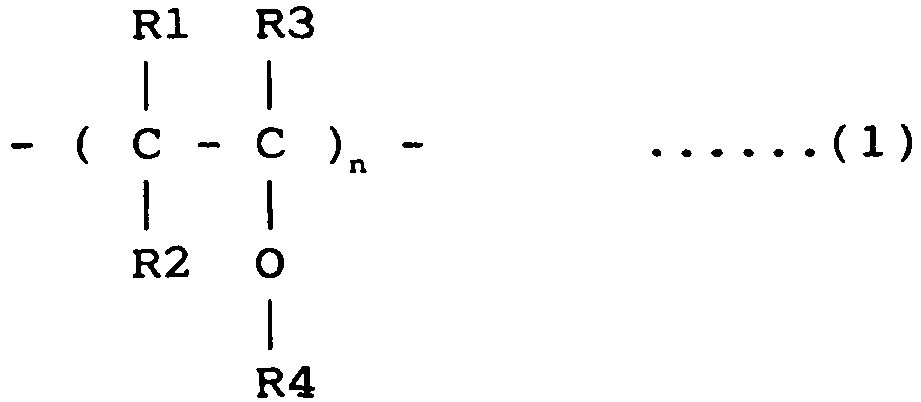
- a refrigerant compressor comprising a hermetically sealed container and a compressor unit, comprising a rotary compression element having a vane, installed in the hermetically sealed container, wherein an HFC type refrigerant mixture and a refrigerator oil having compatibility with the refrigerant are charged into the hermetically sealed container, and the refrigerator oil essentially comprises a polyvinyl ether type compound having structural units represented by the following general formula (1): , wherein n is an integral number in the range of 1 or more, R1 to R3 are each a hydrogen atom or a hydrocarbon group having 1 to 8 carbon atoms and may be the same or different, R4 is an alkyl group having 1 to 4 carbon atoms, and units in which R4 is an alkyl group having 1 to 2 carbon atoms are 40 to 100 % and units in which R4 is an alkyl group having 3 to 4 carbon atoms are 0 to 60 %, wherein the refrigerant mixture is selected
- a refrigerant compressor in which the refrigerator oil comprises 0.01 to 1.0 wt% of a phenolic antioxidant as an essential component and 0.01 to 2 wt% of an epoxy type or carbodiimide type compound.
- a refrigerant compressor in which the refrigerator oil comprises 0.1 to 2 wt% of a phosphoric ester type compound.
- a refrigerant compressor in which the units in which R4 is an alkyl group having 1 to 2 carbon atoms are 80 to 100 % and the units in which R4 is an alkyl group having 3 to 4 carbon atoms are 0 to 20 %.
- a refrigerant compressor in which the refrigerator oil comprises 0.01 to 1.0 wt% of a phenolic antioxidant as an essential component and 0.01 to 2 wt% of an epoxy type or carbodiimide type compound.
- a refrigerant compressor in which the refrigerator oil comprises 0.1 to 2 wt% of a phosphoric ester type compound.
- a refrigerant compressor in which the units in which R4 is an alkyl group having 1 to 2 carbon atoms are 60 to 100 % and the units in which R4 is an alkyl group having 3 to 4 carbon atoms are 0 to 40 %.
- a refrigerant compressor in which the refrigerator oil comprises 0.01 to 1.0 wt% of a phenolic antioxidant as an essential component and 0.01 to 2 wt% of an epoxy type or carbodiimide type compound.
- a refrigerant compressor in which the refrigerator oil comprises 0.1 to 2 wt% of a phosphoric ester type compound.
- a cooling apparatus comprising the refrigerant compressor of the first aspect , a condenser, an expansion device and an evaporator, which are connected by pipes.
- Fig. 1 is a longitudinal sectional view of a rotary type compressor.
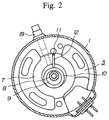
- Fig. 2 is a sectional view cut on line A-A of the rotary type compressor of Fig. 1 .
- reference numeral 1 denotes a hermetically sealed container in which an electric element 2 and a rotary compression element 3 driven by this electric element as a compressor unit are installed in the container in such a manner that the electric element 2 is positioned above the rotary compression element 3.
- the electric element 2 comprises a stator 5 having a coil 4 insulated by an organic material and a rotor 6 arranged inside the stator.
- the rotary compression element 3 comprises a cylinder 7, a roller 10 which is turned along the interior wall of the cylinder 7 by an eccentric portion 9 of a rotary shaft 8, a vane 12 pressed by a spring 11 for partitioning the inside of the cylinder 7 into a suction side and a discharge side when it is pressure contacted to the peripheral surface of the roller, and an upper bearing 13 and a lower bearing 14 for supporting the rotary shaft 8 and closing the openings of the cylinder 7.
- a discharge port 15 communicating with the discharge side of the cylinder 7 is formed in the upper bearing 13.
- a discharge valve 16 for opening and closing the discharge port 15 and an exhaust muffler 17 for covering the discharge valve are attached to the upper bearing 13.
- the roller 10 is formed from an iron type material such as cast iron as will be described hereinafter
- the vane 12 is formed from an iron type material, a composite material of aluminum and carbon, or an iron type material such as high speed tool steel or an SUS type material subjected to a single or composite surface treatment by ion nitridation, nitrosulphurization, CrN or the like.
- the refrigerant is an azeotropic mixed refrigerant (to be referred to as R410A hereinafter) consisting of 50 wt% of difluoromethane (R32) and 50 wt% of pentafluoroethane (R125), a pseudo-azeotropic mixed refrigerant (to be referred to as R404A hereinafter) consisting of 44 wt% of pentafluoroetane (R125), 52 wt% of trifluoroethane (R143a) and 4 wt% of 1,1,1,2-tetrafluoroethane (R134a), or a pseudo-azeotropic mixed refrigerant (to be referred to as R407C hereinafter) consisting of 23 wt% of difluoromethane (R32), 25 wt% of pentafluoroethane (
- Oil used as the refrigerator oil has compatibility with the above refrigerant.
- the refrigerator oil essentially comprises a polyvinyl ether type compound having structural units represented by the following general formula (1): , wherein n is an integral number in the range of 1 or more, R1 to R3 are each a hydrogen atom or a hydrocarbon group having 1 to 8 carbon atoms and may be the same or different, R4 is an alkyl group having 1 to 4 carbon atoms, and units in which R4 is an alkyl group having 1 to 2 carbon atoms are 40 to 100 % and units in which R4 is an alkyl group having 3 to 4 carbon atoms are 0 to 60 %.
- R1 to R3 are each a hydrogen atom or a hydrocarbon group having 1 to 8 carbon atoms and may be the same or different
- R4 is an alkyl group having 1 to 4 carbon atoms
- units in which R4 is an alkyl group having 1 to 2 carbon atoms are 40 to 100 %
- units in which R4 is an alkyl group having 3 to 4 carbon atoms are 0
- a phenolic antioxidant such as DBPC
- 0.01 to 2 wt% of an epoxy type or carbodiimide type compound is contained as an acid trapping agent in the refrigerator oil.
- a phosphoric ester type compound such as tricresyl phosphate (TCP) is contained in the refrigerator oil.
- Glycidyl ether which is one of epoxy type compounds is selected from the group consisting of hexylglycidyl ether, 2-ethylhexylglycidyl ether and isooctadecylglycidyl ether.
- the oil 18 lubricates a sliding surface between the roller 10 and the vane 12 which are the sliding members of the rotary compression element 3.
- the refrigerant which flows into the cylinder 7 of the rotary compression element 3 and is compressed by cooperation between the roller 10 and the vane 12 is R134a, R410A, R407C or R404A having compatibility with the polyvinyl ether type oil 18 as described above.
- Reference numeral 19 denotes a suction pipe, attached to the hermetically sealed container 1, for guiding the refrigerant to the suction side of the cylinder 7 and 20 a discharge pipe, attached to the upper wall of the hermetically sealed container 1, for discharging the refrigerant compressed by the rotary compression element 3 to the outside of the hermetically sealed container 1 through the electric element 2.
- the refrigerant flowing into the suction side of the cylinder 7 from the suction pipe 19 is compressed by cooperation between the roller 10 and the vane 12, passes through the discharge port 15 to open the discharge valve 16 and is discharged into the exhaust muffler 17.
- the refrigerant in this exhaust muffler is discharged from the discharge pipe 20 to the outside of the hermetically sealed container 1 through the electric element 2.
- the oil 18 is supplied to the sliding surface between the sliding members such as the roller 10 and the vane 12 of the rotary compression element 3 to lubricate the surface.
- the refrigerant compressed in the cylinder 7 is prevented from being leaked into a low-pressure side.
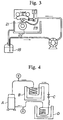
- Fig. 3 is a diagram for explaining a wear test which has been conducted using an Amsler wear tester.
- reference numeral 21 denotes a fixed piece equivalent to the vane and having a curved end with a radius of 4.7 mm, which receives a load L of 100 kg.
- Reference numeral 22 represents a rotating piece equivalent to the roller and having a diameter of 45 mm. This rotating piece is turned at a speed of 400 rpm for 20 hours while a pressure contact portion thereof with the fixed piece 21 is supplied with various polyvinyl ether type oils at a rate of 120 cc/min.
- Table 1 shows the results of abrasion tests made on the following combinations using the Amsler abrasion tester shown in Fig. 3 .
- Comparative Example 2 composite material comprising aluminum and carbon; stated specifically, carbon composite material infiltrated with aluminum (Carbon AL)
- Example 1 iron type material such as high speed tool steel which is subjected to a surface treatment by nitrosulphurization; stated specifically, a material equivalent to SKH55 containing the following components and subjected to a surface treatment by plasma nitrosulphurization
- Example 2 SUS type material subjected to a surface treatment by nitrosulphurization; stated specifically, SUS440 type material containing the following components and subjected to a surface treatment by plasma nitrosulphurization
- Comparative Example 3 iron type material such as high speed tool steel subjected to a surface treatment by ion nitridation and further a surface treatment by CrN
- [OIL] oil essentially comprising a polyvinyl ether type compound having structural units represented by the following general formula (1): , wherein n is an integral number in the range of 1 or more, R1 to R3 are each a hydrogen atom or a hydrocarbon group having 1 to 8 carbon atoms and may be the same or different, R4 is an alkyl group having 1 to 4 carbon atoms, and units in which R4 is an alkyl group having 1 to 2 carbon atoms are 50 % and units in which R4 is an alkyl group having 3 to 4 carbon atoms are 50 %, and further comprising 0.1 to 2.0 wt% of tricresyl phosphate (TCP) and 0.01 to 10 wt% of 2-ethylhexylglycidyl ether as the epoxy compound according to the present invention (EPOX) (to be referred to as "Type A" hereinafter).
- TCP tricresyl phosphate
- EPOX 2-ethylhex
- Table 2 shows the results of wear tests on the following combinations using an Amsler wear tester shown in Fig. 3 .
- Comparative Example 2 composite material comprising aluminum and carbon; stated specifically, carbon composite material infiltrated with aluminum (Carbon AL)
- Example 1 iron type material such as high speed tool steel subjected to a surface treatment by nitrosulphurization; stated specifically, HAP 63 material (equivalent to SKH54) containing the following components and subjected to a surface treatment by plasma nitrosulphurization
- Example 2 SUS type material subjected to a surface treatment by nitrosulphurization; stated specifically, SUS440 type material containing the following components and subjected to a surface treatment by plasma nitrosulphurization
- Comparative Example 3 iron type material such as high speed tool steel subjected to a surface treatment by ion nitridation and further to a surface treatment by CrN
- [OIL] oil essentially comprising a polyvinyl ether type compound having structural units represented by the following general formula (1): , wherein n is an integral number in the range of 1 or more, R1 to R3 are each a hydrogen atom or a hydrocarbon group having 1 to 8 carbon atoms and may be the same or different, R4 is an alkyl group having 1 to 4 carbon atoms, and units in which R4 is an alkyl group having 1 to 2 carbon atoms are 80 % and units in which R4 is an alkyl group having 3 to 4 carbon atoms are 20 %, and further comprising 0.1 to 2.0 wt% of tricresyl phosphate (TCP) and 0.01 to 10 wt% of 2-ethylhexylglycidyl ether as the epoxy compound according to the present invention (EPOX) (to be referred to as "Type C" hereinafter)
- TCP tricresyl phosphate
- EPOX 2-ethylhex
- Table 3 shows the results of wear tests on the following combinations using an Amsler wear tester shown in Fig. 3 .
- Comparative Example 2 composite material comprising aluminum and carbon; stated specifically, carbon composite material infiltrated with aluminum (Carbon AL)
- Example 1 iron type material such as high speed tool steel subjected to a surface treatment by nitrosulphurization; stated specifically, HAP63 material (equivalent to SKH54) containing the following components and subjected to a surface treatment by plasma nitrosulphurization
- Example 2 SUS type material subjected to a surface treatment by nitrosulphurization; stated specifically, SUS440 type material containing the following components and subjected to a surface treatment by plasma nitrosulphurization
- Comparative Example 3 iron type material such as high speed tool steel subjected to a surface treatment by ion nitridation and further to a surface treatment by CrN
- [OIL] oil essentially comprising a polyvinyl ether type compound having structural units represented by the following general formula (1): , wherein n is an integral number in the range of 1 or more, R1 to R3 are each a hydrogen atom or a hydrocarbon group having 1 to 8 carbon atoms and may be the same or different, R4 is an alkyl group having 1 to 4 carbon atoms, and units in which R4 is an alkyl group having 1 to 2 carbon atoms are 70 % and units in which R4 is an alkyl group having 3 to 4 carbon atoms are 30 %, and further comprising 0.1 to 2.0 wt% of tricresyl phosphate (TCP) and 0.01 to 10 wt% of 2-ethylhexylglycidyl ether as the epoxy compound according to the present invention (EPOX) (to be referred to as "Type B" hereinafter)
- TCP tricresyl phosphate
- EPOX 2-ethylhex
- Table 4 shows the results of a durability test on an actual refrigerant compressor comprising the following elements using a bench-stand tester shown in Fig. 4 based on the evaluations of Tables 1, 2 and 3.
- the bench-stand tester comprises a compressor A, condenser B, expansion valve C and evaporator D all of which are connected by pipes and test conditions are as follows:
- Comparative Example 2 composite material comprising aluminum and carbon; stated specifically, carbon composite material infiltrated with aluminum (Carbon AL)
- Example 1 iron type material such as high speed tool steel subjected to a surface treatment by nitrosulphurization; stated specifically, HAP63 material (equivalent to SKH54) containing the following components and subjected to a surface treatment by plasma nitrosulphurization
- Example 2 SUS type material subjected to a surface treatment by nitrosulphurization; stated specifically, SUS440 type material containing the following components and subjected to a surface treatment by plasma nitrosulphurization
- Comparative Example 3 iron type material such as high speed tool steel subjected to a surface treatment by ion nitridation and further to a surface treatment by CrN
- the vane materials of Examples 1 to 2 are all good because they exhibit good results and higher durability than a combination of a conventional refrigerant R-22 and mineral oil (Mineral).
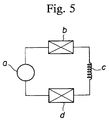
- a refrigerant compressor a by connecting a refrigerant compressor a, condenser b, expansion device c and evaporator d by pipes and charging the above-mentioned HFC type refrigerant or mixture thereof (R134a, R410A, R404A or R407C) and the above-mentioned refrigerator oil (Type A, B, or C) having compatibility with the refrigerant into the hermetically sealed container 1 of the compressor a, there can be provided a cooling apparatus (such as a refrigerator, air conditioner or show case) which can prevent the returning of the oil and has a high refrigerating capacity.
- a cooling apparatus such as a refrigerator, air conditioner or show case
- thermal cracking caused by frictional heat generated by sliding members and the generation of sludge can be suppressed by a combination of a specific HFC type refrigerant, a polyvinyl ether type oil having a specific structure and a specific sliding material, and there is no carboxylic acid generated by hydrolysis when a conventional polyol ester type oil is used.
- a high-performance rotary compressor and cooling apparatus can be provided without the need for complicated process control.
Landscapes
- Chemical & Material Sciences (AREA)
- Chemical Kinetics & Catalysis (AREA)
- Organic Chemistry (AREA)
- General Chemical & Material Sciences (AREA)
- Oil, Petroleum & Natural Gas (AREA)
- Engineering & Computer Science (AREA)
- Thermal Sciences (AREA)
- Physics & Mathematics (AREA)
- Mechanical Engineering (AREA)
- General Engineering & Computer Science (AREA)
- Combustion & Propulsion (AREA)
- Materials Engineering (AREA)
- Health & Medical Sciences (AREA)
- Emergency Medicine (AREA)
- Lubricants (AREA)
- Applications Or Details Of Rotary Compressors (AREA)
Description
- This invention relates to a refrigerant compressor which uses 1,1,1,2-tetrafluoroethane (to be referred to as R134a hereinafter) which is an HFC type refrigerant or a mixture of HFC type refrigerants (such as a mixture of R134a, R32 and R125, a mixture of R134a, R143a and R125 or a mixture of R32 and R125) as a refrigerant and a refrigerator oil having compatibility with the refrigerant and to a cooling apparatus.
- Most refrigerant compressors for refrigerators, automatic vending machines and show cases have conventionally used dichlorodifluoromethane (to be referred to as R12 hereinafter) as a refrigerant. This R12 falls under flon regulations because of the disruption of the ozone layer. R134a is now being studied for use in refrigerators as a substitute for this R12 (refer to
Laid-open Japanese Patent Application No. Hei 1-271491 - Although chlorodifluoromethane (R22) has been used in air conditioners and the like, much attention is paid to HFC type mixed refrigerants from a viewpoint of environmental preservation.
- However, HFC type refrigerants such as the above-described R134a have poor compatibility with a refrigerator oil such as mineral oil or alkylbenzene oil which is currently used and cause a failure in lubricating the compressor due to the bad returning of the oil to the compressor and the absorption of the separated refrigerant at the time of activation.
- Therefore, the inventors of the present invention have studied a polyol ester type oil as a refrigerator oil which has compatibility with HFC type refrigerants such as R134a. However, when this polyol ester type oil is used in a rotary type compressor, a fatty acid produced by the hydrolysis of the oil caused by heat corrodes sliding members and causes wear. Powders produced by this wear exert a bad influence on organic materials such as magnet wires of electric elements of the compressor and thus impair the durability of the compressor.
- The inventors have conducted studies to use a combination of an HFC type refrigerant as a refrigerant and a polyol ester type oil as a refrigerator oil in a rotary type compressor and have found that a carboxylic acid which is produced by the hydrolysis of the polyol ester type oil for lubricating sliding members caused by the frictional heat of the sliding members of the rotary type compressor corrodes iron type materials or reacts with iron type materials to become metal soap or sludge, thereby reducing refrigerating capacity.
- As a result, the inventors have found that the thermal cracking of the polyol ester type oil caused by frictional heat generated by the sliding members can be suppressed by a combination of a specific polyol ester type oil, a specific additive and a specific sliding material (refer to Laid-open
Japanese Patent Application No. Hei 6-295357 - However, according to the above technique, it is necessary to strictly control the production process, that is, the concentrations of water, chlorine and oxygen, in order to suppress hydrolysis when the polyol ester type oil is used. Therefore, the above invention has a problem that control is troublesome.
- Patent document
EP 0 732 391 A1 discloses a lubricating oil for compression refrigerators comprising a polyvinyl ether compound as the main component thereof, wherein the ratio by mol of carbon to oxygen in the polyvinyl ether compound is 4.2 to 7.0. - Document
EP 0 715 079 A2 discloses a refrigerating apparatus and a lubricating oil composition using an HFC type refrigerant. The lubricating oil composition comprises as base oil components a polyolester type oil formed by reacting specific polyhydric alcohol with a fatty acid, to which tricresylphosphate and epoxy compound comprising glycidyl ether or carbodiimide are added at respective specific rates. The refrigerating apparatus uses this lubricating oil composition as refrigerator oil and comprises a sealed electric driving compressor whose sliding members are made of a material selected from iron type materials, composite materials of aluminum and carbon, iron type materials surface-treated with chromium nitride and ceramic materials. - It is an object of the present invention which has been made to solve the above problem to provide a high-performance refrigerant compressor which uses a polyvinyl ether type oil having compatibility with an HFC type refrigerant such as R134a as a refrigerator oil to suppress the production of a carboxylic acid caused by thermal cracking or hydrolysis due to the frictional heat of sliding members and the generation of a sludge caused thereby without carrying out troublesome process control.
- According to a first aspect of the present invention, there is provided a refrigerant compressor comprising a hermetically sealed container and a compressor unit, comprising a rotary compression element having a vane, installed in the hermetically sealed container, wherein an HFC type refrigerant mixture and a refrigerator oil having compatibility with the refrigerant are charged into the hermetically sealed container, and the refrigerator oil essentially comprises a polyvinyl ether type compound having structural units represented by the following general formula (1):

wherein the vane is made from one selected from an iron type material subjected to a surface treatment by nitrosulphurization and a SUS type material subjected to a surface treatment by nitrosulphurization. - According to a second aspect of the present invention, there is provided a refrigerant compressor in which the refrigerator oil comprises 0.01 to 1.0 wt% of a phenolic antioxidant as an essential component and 0.01 to 2 wt% of an epoxy type or carbodiimide type compound.
- According to a third aspect of the present invention, there is provided a refrigerant compressor in which the refrigerator oil comprises 0.1 to 2 wt% of a phosphoric ester type compound.
- According to a fourth aspect of the present invention, there is provided a refrigerant compressor in which the units in which R4 is an alkyl group having 1 to 2 carbon atoms are 80 to 100 % and the units in which R4 is an alkyl group having 3 to 4 carbon atoms are 0 to 20 %.
- According to a fifth aspect of the present invention, there is provided a refrigerant compressor in which the refrigerator oil comprises 0.01 to 1.0 wt% of a phenolic antioxidant as an essential component and 0.01 to 2 wt% of an epoxy type or carbodiimide type compound.
- According to an sixth aspect of the present invention, there is provided a refrigerant compressor in which the refrigerator oil comprises 0.1 to 2 wt% of a phosphoric ester type compound.
- According to a seventh aspect of the present invention, there is provided a refrigerant compressor in which the units in which R4 is an alkyl group having 1 to 2 carbon atoms are 60 to 100 % and the units in which R4 is an alkyl group having 3 to 4 carbon atoms are 0 to 40 %.
- According to an eighth aspect of the present invention, there is provided a refrigerant compressor in which the refrigerator oil comprises 0.01 to 1.0 wt% of a phenolic antioxidant as an essential component and 0.01 to 2 wt% of an epoxy type or carbodiimide type compound.
- According to a nineth aspect of the present invention, there is provided a refrigerant compressor in which the refrigerator oil comprises 0.1 to 2 wt% of a phosphoric ester type compound.
- According to a tenth aspect of the present invention, there is provided a cooling apparatus comprising the refrigerant compressor of the first aspect , a condenser, an expansion device and an evaporator, which are connected by pipes.
- These objects and advantages of the present invention will become clear from the following description with reference to the accompanying drawings, wherein:
-
Fig. 1 is a longitudinal sectional view of a rotary type compressor according to an embodiment of the present invention; -
Fig. 2 is a transverse sectional view of a rotary type compressor of the present invention; -
Fig. 3 is a diagram for explaining an Amsler wear tester; -
Fig. 4 is a diagram for explaining a bench-stand tester; and -
Fig. 5 is a refrigerant circuit diagram of a cooling apparatus according to the present invention. - The present invention is described hereinafter with reference to embodiments shown in the accompanying drawings.
-
Fig. 1 is a longitudinal sectional view of a rotary type compressor.Fig. 2 is a sectional view cut on line A-A of the rotary type compressor ofFig. 1 . InFigs. 1 and2 , reference numeral 1 denotes a hermetically sealed container in which anelectric element 2 and arotary compression element 3 driven by this electric element as a compressor unit are installed in the container in such a manner that theelectric element 2 is positioned above therotary compression element 3. Theelectric element 2 comprises a stator 5 having acoil 4 insulated by an organic material and a rotor 6 arranged inside the stator. Therotary compression element 3 comprises acylinder 7, aroller 10 which is turned along the interior wall of thecylinder 7 by aneccentric portion 9 of arotary shaft 8, avane 12 pressed by a spring 11 for partitioning the inside of thecylinder 7 into a suction side and a discharge side when it is pressure contacted to the peripheral surface of the roller, and an upper bearing 13 and alower bearing 14 for supporting therotary shaft 8 and closing the openings of thecylinder 7. - A
discharge port 15 communicating with the discharge side of thecylinder 7 is formed in the upper bearing 13. A discharge valve 16 for opening and closing thedischarge port 15 and an exhaust muffler 17 for covering the discharge valve are attached to theupper bearing 13. - The
roller 10 is formed from an iron type material such as cast iron as will be described hereinafter, thevane 12 is formed from an iron type material, a composite material of aluminum and carbon, or an iron type material such as high speed tool steel or an SUS type material subjected to a single or composite surface treatment by ion nitridation, nitrosulphurization, CrN or the like. - An HFC type refrigerant or a mixture thereof is charged into a bottom portion of the hermetically sealed container 1. The refrigerant is an azeotropic mixed refrigerant (to be referred to as R410A hereinafter) consisting of 50 wt% of difluoromethane (R32) and 50 wt% of pentafluoroethane (R125), a pseudo-azeotropic mixed refrigerant (to be referred to as R404A hereinafter) consisting of 44 wt% of pentafluoroetane (R125), 52 wt% of trifluoroethane (R143a) and 4 wt% of 1,1,1,2-tetrafluoroethane (R134a), or a pseudo-azeotropic mixed refrigerant (to be referred to as R407C hereinafter) consisting of 23 wt% of difluoromethane (R32), 25 wt% of pentafluoroethane (R125) and 52 wt% of 1,1,1,2-tetrafluoroethane (R134a).
- Oil used as the refrigerator oil has compatibility with the above refrigerant.
- Stated more specifically, the refrigerator oil essentially comprises a polyvinyl ether type compound having structural units represented by the following general formula (1):

- As an antioxidant, 0.01 to 1.0 wt% of a phenolic antioxidant (such as DBPC) is contained as an essential component and 0.01 to 2 wt% of an epoxy type or carbodiimide type compound is contained as an acid trapping agent in the refrigerator oil.
- As an extreme-pressure additive or an anti-wear agent, 0.1 to 2 wt% of a phosphoric ester type compound such as tricresyl phosphate (TCP) is contained in the refrigerator oil.
- Glycidyl ether which is one of epoxy type compounds is selected from the group consisting of hexylglycidyl ether, 2-ethylhexylglycidyl ether and isooctadecylglycidyl ether.
- The above carbodiimide type compounds are represented by the general formula R5-N=C=N-R6 wherein R5 and R6 are each selected from an alkyl group and an alkyl-substituted aromatic group.
- The
oil 18 lubricates a sliding surface between theroller 10 and thevane 12 which are the sliding members of therotary compression element 3. - The refrigerant which flows into the
cylinder 7 of therotary compression element 3 and is compressed by cooperation between theroller 10 and thevane 12 is R134a, R410A, R407C or R404A having compatibility with the polyvinylether type oil 18 as described above. -
Reference numeral 19 denotes a suction pipe, attached to the hermetically sealed container 1, for guiding the refrigerant to the suction side of thecylinder 7 and 20 a discharge pipe, attached to the upper wall of the hermetically sealed container 1, for discharging the refrigerant compressed by therotary compression element 3 to the outside of the hermetically sealed container 1 through theelectric element 2. - In the above configured rotary compressor using the refrigerator oil composition, the refrigerant flowing into the suction side of the
cylinder 7 from thesuction pipe 19 is compressed by cooperation between theroller 10 and thevane 12, passes through thedischarge port 15 to open the discharge valve 16 and is discharged into the exhaust muffler 17. The refrigerant in this exhaust muffler is discharged from thedischarge pipe 20 to the outside of the hermetically sealed container 1 through theelectric element 2. Theoil 18 is supplied to the sliding surface between the sliding members such as theroller 10 and thevane 12 of therotary compression element 3 to lubricate the surface. The refrigerant compressed in thecylinder 7 is prevented from being leaked into a low-pressure side. - The following examples and comparative examples are given to further illustrate the present invention.
-
Fig. 3 is a diagram for explaining a wear test which has been conducted using an Amsler wear tester. - In this respect,
reference numeral 21 denotes a fixed piece equivalent to the vane and having a curved end with a radius of 4.7 mm, which receives a load L of 100 kg.Reference numeral 22 represents a rotating piece equivalent to the roller and having a diameter of 45 mm. This rotating piece is turned at a speed of 400 rpm for 20 hours while a pressure contact portion thereof with the fixedpiece 21 is supplied with various polyvinyl ether type oils at a rate of 120 cc/min. - Table 1 shows the results of abrasion tests made on the following combinations using the Amsler abrasion tester shown in
Fig. 3 .[Table 1] Vane Material Structure of Polyvinyl Ether (R4) Total Acid Number (TAN) Wear Quantity of Test Sample Vane 0.1x(mm) Roller (µm) Comparative Example 1 Type A 0.09 0.7 -3 Comparative Example 2 Type A 0.01 0.6 -1 Example 1 Type A not more than 0.01 0.1 0 Example 2 Type A not more than 0.01 0.1 0 Comparative Example 3 Type A not more than 0.01 0.1 0 - Comparative Example 1: high speed tool steel (SKH51)
- composition : C: 0.8 to 0.9, Si: not more than 0.4, Mn: not more than 0.4, P: not more than 0.03, S: not more than 0.03, Cr; 3.8 to 4.5, Mo: 4.5 to 5.5, W: 5.5 to 6.7, V: 1.6 to 2.2, Cu: not more than 0.25, Ni: not more than 0.25
- Comparative Example 2: composite material comprising aluminum and carbon; stated specifically, carbon composite material infiltrated with aluminum (Carbon AL)
- composition: C: 55, Al: 36, Si: 6, others (such as Mg): 3 (in wt%)
- Example 1: iron type material such as high speed tool steel which is subjected to a surface treatment by nitrosulphurization; stated specifically, a material equivalent to SKH55 containing the following components and subjected to a surface treatment by plasma nitrosulphurization
- composition: C: 2.14, Si: 0.32, Cr: 4.21, Mn: 0.32, W: 11.5, V: 7.0, Co: 8.0, Mo: 2.53, Fe: the balance (in wt%)
- Example 2: SUS type material subjected to a surface treatment by nitrosulphurization; stated specifically, SUS440 type material containing the following components and subjected to a surface treatment by plasma nitrosulphurization
- composition: C: 1.8 to 2.3, Si: not more than 1, Cr: 20 to 24, Mo: 0.5 to 2.6, Fe: the balance (in wt%)
- Comparative Example 3: iron type material such as high speed tool steel subjected to a surface treatment by ion nitridation and further a surface treatment by CrN
- [ROLLER] cast iron material (to be referred to as E-3 hereinafter)
- composition: T.C.(total carbon): 0.56 to 0.64, Si: 2.2 to 2.9, Mn: 0.6 to 1.0, P: 0.18 max, S: 0.08 max, Ni: 0.1 to 0.2, Cr: 0.20 max, Mo: 0.07 to 0.2, Ti: 0.25 max, Fe: the balance
- [OIL] oil essentially comprising a polyvinyl ether type compound having structural units represented by the following general formula (1):
- As a result, as shown in Table 1, it was confirmed that the vane materials of Examples 1 to 2 are all superior in total acid number (TAN) and wear quantity of TP.
- It is assumed that the reason for this is the thermal cracking of the polyvinyl ether type oil caused by sliding frictional heat generated on the sliding surface between the
rotating piece 22 and the fixedpiece 21 was suppressed. - Table 2 shows the results of wear tests on the following combinations using an Amsler wear tester shown in
Fig. 3 .[Table 2] Vane Material Structure of Polyvinyl Ether (R4) Total Acid Number (TAN) Wear Quantity of Test Sample Vane 0.1x(mm) Roller (µm) Comparative Example 1 Type C 0.08 0.6 -3 Comparative Example 2 Type C 0.01 0.5 -1 Example 1 Type C not more than 0.01 0.1 0 Example 2 Type C not more than 0.01 0.1 0 Comparative Example 3 Type C not more than 0.01 0.1 0 - Comparative Example 2: composite material comprising aluminum and carbon; stated specifically, carbon composite material infiltrated with aluminum (Carbon AL)
- composition: C: 55, Al: 36, Si: 6, others (such as Mg): 3 (in wt%)
- Example 1: iron type material such as high speed tool steel subjected to a surface treatment by nitrosulphurization; stated specifically, HAP 63 material (equivalent to SKH54) containing the following components and subjected to a surface treatment by plasma nitrosulphurization
- composition: C: 2.14, Si: 0.32, Cr: 4.21, Mn: 0.32, W: 11.5, V: 7.0, Co: 8.0, Mo: 2.53, Fe: the balance (in wt%)
- Example 2: SUS type material subjected to a surface treatment by nitrosulphurization; stated specifically, SUS440 type material containing the following components and subjected to a surface treatment by plasma nitrosulphurization
- composition: C: 1.8 to 2.3, Si: not more than 1, Cr: 20 to 24, Mo: 0.5 to 2.6, Fe: the balance (in wt%)
- Comparative Example 3: iron type material such as high speed tool steel subjected to a surface treatment by ion nitridation and further to a surface treatment by CrN
- [ROLLER] cast iron material (to be referred to as E-3 hereinafter)
- composition: T. C. (total carbon): 0.56 to 0.64, Si: 2.2 to 2.9, Mn: 0.6 to 1.0, P: 0.18 max, S: 0.08 max, Ni: 0.1 to 0.2, Cr: 0.20 max, Mo: 0.07 to 0.2, Ti: 0.25 max
- [OIL] oil essentially comprising a polyvinyl ether type compound having structural units represented by the following general formula (1):

- As a result, as shown in Table 2, it was confirmed that the vane materials of Examples 1 to 2 are all superior in total acid number (TAN) and wear quantity of TP.
- It is assumed that the reason for this is the thermal cracking of the polyvinyl ether type oil caused by sliding frictional heat generated on the sliding surface between the
rotating piece 22 and the fixedpiece 21 was suppressed. It is also considered that the deterioration of the oil is caused by the suppression of a catalytic function due to the ineffectiveness of iron by TCP. - Table 3 shows the results of wear tests on the following combinations using an Amsler wear tester shown in
Fig. 3 .[Table 3] Vane Material Structure of Polyvinyl Ether (R4) Total Acid Number (TAN) Wear Quantity of Test Sample Vane 0.1x(mm) Roller (µm) Comparative Example 1 Type B 0.07 0.5 -2 Comparative Example 2 Type B not more than 0.01 0.5 0 Example 1 Type B not more than 0.01 0.2 -1 Example 2 Type B not more than 0.01 0.2 -1 Comparative Example 3 Type B not more than 0.01 0.1 0 - Comparative Example 2: composite material comprising aluminum and carbon; stated specifically, carbon composite material infiltrated with aluminum (Carbon AL)
- composition: C: 55, Al: 36, Si: 6, others (such as Mg): 3 (in wt%)
- Example 1: iron type material such as high speed tool steel subjected to a surface treatment by nitrosulphurization; stated specifically, HAP63 material (equivalent to SKH54) containing the following components and subjected to a surface treatment by plasma nitrosulphurization
- composition: C: 2.14, Si: 0.32, Cr: 4.21, Mn: 0.32, W: 11.5, V: 7.0, Co: 8.0, Mo: 2.53, Fe: the balance (in wt%)
- Example 2: SUS type material subjected to a surface treatment by nitrosulphurization; stated specifically, SUS440 type material containing the following components and subjected to a surface treatment by plasma nitrosulphurization
- composition: C: 1.8 to 2.3, Si: not more than 1, Cr: 20 to 24, Mo: 0.5 to 2.6, Fe: the balance (in wt%)
- Comparative Example 3: iron type material such as high speed tool steel subjected to a surface treatment by ion nitridation and further to a surface treatment by CrN
- [ROLLER] cast iron material (to be referred to as E-3 hereinafter)
- composition: T. C. (total carbon): 0.56 to 0.64, Si: 2.2 to 2.9, Mn: 0.6 to 1.0, P: 0.18 max, S: 0.08 max, Ni: 0.1 to 0.2, Cr: 0.20 max, Mo: 0.07 to 0.2, Ti: 0.25 max, Fe: the balance
- [OIL] oil essentially comprising a polyvinyl ether type compound having structural units represented by the following general formula (1):

- As a result, as shown in Table 3, it was confirmed that the vane materials of Examples 1 to 2 are all superior in total acid number (TAN) and wear quantity of TP.
- It is assumed that the reason for this is the thermal cracking of the polyvinyl ether type oil caused by sliding frictional heat generated on the sliding surface between the
rotating piece 22 and the fixedpiece 21 was suppressed. It is also considered that the deterioration of the oil is caused by the suppression of a catalytic function due to the ineffectiveness of iron by TCP. - Table 4 shows the results of a durability test on an actual refrigerant compressor comprising the following elements using a bench-stand tester shown in
Fig. 4 based on the evaluations of Tables 1, 2 and 3. - The bench-stand tester comprises a compressor A, condenser B, expansion valve C and evaporator D all of which are connected by pipes and test conditions are as follows:
- Pressure at High Level: 27 to 28 kg/cm2 G,
- Pressure at Low Level: 46 kg/cm2 G,
- Operation Frequency: 100 Hz,
- Operation Time: 1,000 hr,
- Refrigerant: R134a, R410A, R404A, R407C
- Temperature of Upper Portion of Case: 95 to 100°C
- Each material is as follows:
- Comparative Example 2: composite material comprising aluminum and carbon; stated specifically, carbon composite material infiltrated with aluminum (Carbon AL)
- composition: C: 55, Al: 36, Si: 6, others (such as Mg): 3 (in wt%)
- Example 1: iron type material such as high speed tool steel subjected to a surface treatment by nitrosulphurization; stated specifically, HAP63 material (equivalent to SKH54) containing the following components and subjected to a surface treatment by plasma nitrosulphurization
- composition: C: 2.14, Si: 0.32, Cr: 4.21, Mn: 0.32, W: 11.5, V: 7.0, Co: 8.0, Mo: 2.53, Fe: the balance (in wt%)
- Example 2: SUS type material subjected to a surface treatment by nitrosulphurization; stated specifically, SUS440 type material containing the following components and subjected to a surface treatment by plasma nitrosulphurization
- composition: C: 1.8 to 2.3, Si: not more than 1, Cr: 20 to 24, Mo: 0.5 to 2.6, Fe: the balance (in wt%)
- Comparative Example 3: iron type material such as high speed tool steel subjected to a surface treatment by ion nitridation and further to a surface treatment by CrN
- [ROLLER] cast iron material (to be referred to as E-3 hereinafter)
- composition: T. C. (total carbon): 0.56 to 0.64, Si: 2.2 to 2.9, Mn: 0.6 to 1.0, P: 0.18 max, S: 0.08 max, Ni: 0.1 to 0.2, Cr: 0.20 max, Mo: 0.07 to 0.2, Ti: 0.25 max, Fe: the balance
- As a result, as shown in Table 4, the vane materials of Examples 1 to 2 are all good because they exhibit good results and higher durability than a combination of a conventional refrigerant R-22 and mineral oil (Mineral).
- As shown in
Fig. 5 , by connecting a refrigerant compressor a, condenser b, expansion device c and evaporator d by pipes and charging the above-mentioned HFC type refrigerant or mixture thereof (R134a, R410A, R404A or R407C) and the above-mentioned refrigerator oil (Type A, B, or C) having compatibility with the refrigerant into the hermetically sealed container 1 of the compressor a, there can be provided a cooling apparatus (such as a refrigerator, air conditioner or show case) which can prevent the returning of the oil and has a high refrigerating capacity.[Table 4] Vane Material Structure of Polyvinyl Ether (R4) Refrigerant Used Durability Test Wear Sludge TAN Comparative Example 1 Type A R134a G B B Comparative Example 2 Type A R134a G G G Example 1 Type A R134a E E G Example 2 Type A R134a E E G Comparative Example 3 Type A R134a E E G Comparative Example 1 Type C R410A, R404A G B B Comparative Example 2 Type C R410A, R404A G G G Example 1 Type C R410A, R404A E E G Example 2 Type C R410A, R404A E E G Comparative Example 3 Type C R410A, R404A E E G Comparative Example 1 Type B R407C G B B Comparative Example 2 Type B R407C G G G Example 1 Type B R407C E E G Example 2 Type B R407C E E G Comparative Example 3 Type B R407C E E G *Note: E: excellent, G: good, B: bad - The following points have been found from the above results:
- (1) Since the HFC type refrigerant does not contain chlorine atoms, it is inferior to CFC type and HCFC type refrigerants in the lubricity of a sliding portion.
- (2) When the ratio of an alkyl group having 1 to 2 carbon atoms to an alkyl group having 3 to 4 carbon atoms in the structure of the polyvinyl ether oil is made a predetermined ratio in accordance with the type of the above HFC type refrigerant and a predetermined vane material is selected in accordance with the ratio, the polyvinyl ether oil does not separate when the separation temperature ranges from a high temperature side to a low temperature side, that is, from 35 to 10°C. Thereby, the refrigerator can exhibit a predetermined refrigerating capacity.
- Stated specifically, the relationship between the structure of the polyvinyl ether oil and the separation temperature is shown in Table 5 below.
[Table 5] The Relationship Between The Structure Of The Polyvinyl Ether Oil And The Separation Temperature high-temperature side/low-temperature side (unit: °C) Structure of R4 (C1∼C2/C3∼C4) Type of Oil Refrigerant R134a R407C R410A R404A 80∼100/0∼20% Type D 50 or more / -50 or less 50 or more / -50 or less 50 or more / 44 / -50 or less 80∼100/0∼20% Type C 50 or more / -50 or less 50 or more / -44 50 or more / -23 37 / -50 or less 60∼100/0∼40% Type B 50 or more / -20 50 or more / -15 --- --- 40∼100/0∼60% Type A 50 or more / 10 50 or more / -19 --- --- REMARKS: The mark "---" means that the separation
occurs at entire temperature range. - The same function and effect are expected from the following vane materials as other examples.
- For example,
- (1) composite material comprising aluminum and carbon and having the following composition
- composition: C: 55, Al: 36, Si: 6, others (such as Mg): 3 (in wt%)
- (2) fiber reinforced aluminum alloy having the following composition
- composition: C: 55, Al: 36, Si: 6 (in wt%)
- (3) ceramic such as zirconia (ceramic)
- As described above, according to the present invention, thermal cracking caused by frictional heat generated by sliding members and the generation of sludge can be suppressed by a combination of a specific HFC type refrigerant, a polyvinyl ether type oil having a specific structure and a specific sliding material, and there is no carboxylic acid generated by hydrolysis when a conventional polyol ester type oil is used. As a result, a high-performance rotary compressor and cooling apparatus can be provided without the need for complicated process control.
Claims (10)
- A refrigerant compressor comprising a hermetically sealed container and a compressor unit, comprising a rotary compression element having a vane, installed in the hermetically sealed container, wherein a HFC type refrigerant mixture and a refrigerator oil having compatibility with the refrigerant are charged into the hermetically sealed container, and the refrigerator oil essentially comprises a polyvinyl ether type compound having structural units represented by the following general formula (1):

wherein the refrigerant mixture is selected from the group consisting of an azeotropic mixed refrigerant consisting of 50 wt% of difluoromethane (R32) and 50 wt % of pentafluoroethane (R125), and a pseudo-azeotropic mixed refrigerant consisting of 44 wt% of pentafluoroethane (R125), 52 wt% of trifluoroethane (143a) and 4 wt % of 1,1,1,2-tetrafluoroethane (R134a), and a pseudo-azeotropic mixed refrigerant consisting of 23 wt% of difluoromethane, 25 wt% of pentafluoroethane and 52 wt% of 1,1,1,2-tetrafluoroethane, and
wherein the vane is made from one selected from an iron type material subjected to a surface treatment by nitrosulphurization and a SUS type material subjected to a surface treatment by nitrosulphurization. - The refrigerant compressor of claim 1, wherein the refrigerator oil comprises 0.01 to 1.0 wt % of a phenolic antioxidant as an essential component and 0.01 to 2 wt % of an epoxy type or carbodiimide type compound.
- The refrigerant compressor of claim 1, wherein the refrigerator oil comprises 0.1 to 2 wt % of a phosphoric ester type compound.
- The refrigerant compressor of claim 1, wherein the units in which R4 is the alkyl group having 1 to 2 carbon atoms are 80 to 100% and the units in which R4 is the alkyl group having 3 to 4 carbon atoms are 0 to 20%.
- The refrigerant compressor of claim 4, wherein the refrigerator oil comprises 0.01 to 1.0 wt % of a phenolic antioxidant as an essential component and 0.01 to 2 wt % of an expoxy type or carbodiimide type compound.
- The refrigerant compressor of claim 4, wherein the refrigerator oil comprises 0.1 to 2 wt% of a phosphoric ester type compound.
- The refrigerant compressor of claim 1, wherein the units in which R4 is the alkyl group having 1 to 2 carbon atoms are 60 to 100% and the units in which R4 is the alkyl group having 3 to 4 carbon atoms are 0 to 40%.
- The refrigerant compressor of claim 7, wherein the refrigerator oil comprises 0.01 to 1.0 wt % of a phenolic antioxidant as an essential component and 0.01 to 2 wt % of an epoxy type or carbodiimide type compound.
- The refrigerant compressor of claim 7, wherein the refrigerator oil comprises 0.1 to 2 wt % of a phosphoric ester type compound.
- A cooling apparatus comprising the refrigerant compressor of claim 1, a condenser, an expansion device and an evaporator, which are connected by pipes.
Applications Claiming Priority (2)
| Application Number | Priority Date | Filing Date | Title |
|---|---|---|---|
| JP25964196A JP3557053B2 (en) | 1996-09-30 | 1996-09-30 | Refrigerant compressor |
| JP259641/96 | 1996-09-30 |
Publications (3)
| Publication Number | Publication Date |
|---|---|
| EP0832961A2 EP0832961A2 (en) | 1998-04-01 |
| EP0832961A3 EP0832961A3 (en) | 1998-04-22 |
| EP0832961B1 true EP0832961B1 (en) | 2016-05-11 |
Family
ID=17336890
Family Applications (1)
| Application Number | Title | Priority Date | Filing Date |
|---|---|---|---|
| EP97116911.5A Expired - Lifetime EP0832961B1 (en) | 1996-09-30 | 1997-09-29 | Refrigerant compressor and cooling apparatus comprising the same |
Country Status (7)
| Country | Link |
|---|---|
| US (2) | US5956959A (en) |
| EP (1) | EP0832961B1 (en) |
| JP (1) | JP3557053B2 (en) |
| KR (1) | KR100504929B1 (en) |
| CN (2) | CN1165723C (en) |
| SG (1) | SG72761A1 (en) |
| TW (1) | TW357236B (en) |
Families Citing this family (51)
| Publication number | Priority date | Publication date | Assignee | Title |
|---|---|---|---|---|
| JPH10159734A (en) | 1996-11-28 | 1998-06-16 | Sanyo Electric Co Ltd | Refrigerator |
| JP2000009071A (en) * | 1998-06-24 | 2000-01-11 | Daikin Ind Ltd | Rotary compressor |
| KR20010014817A (en) * | 1999-07-06 | 2001-02-26 | 다카노 야스아키 | refrigerant compressor and refrigeration cooling apparatus using the same |
| US6505475B1 (en) | 1999-08-20 | 2003-01-14 | Hudson Technologies Inc. | Method and apparatus for measuring and improving efficiency in refrigeration systems |
| JP4836305B2 (en) * | 2000-02-16 | 2011-12-14 | ダイキン工業株式会社 | Refrigeration equipment |
| US6302654B1 (en) * | 2000-02-29 | 2001-10-16 | Copeland Corporation | Compressor with control and protection system |
| US6668240B2 (en) * | 2001-05-03 | 2003-12-23 | Emerson Retail Services Inc. | Food quality and safety model for refrigerated food |
| US6892546B2 (en) | 2001-05-03 | 2005-05-17 | Emerson Retail Services, Inc. | System for remote refrigeration monitoring and diagnostics |
| US6889173B2 (en) | 2002-10-31 | 2005-05-03 | Emerson Retail Services Inc. | System for monitoring optimal equipment operating parameters |
| US8463441B2 (en) | 2002-12-09 | 2013-06-11 | Hudson Technologies, Inc. | Method and apparatus for optimizing refrigeration systems |
| KR100504910B1 (en) * | 2002-12-20 | 2005-07-29 | 엘지전자 주식회사 | Reciprocating compressor for refrigerator |
| KR100504911B1 (en) * | 2002-12-20 | 2005-07-29 | 엘지전자 주식회사 | Refrigerating system having reciprocating compressor |
| KR100511325B1 (en) * | 2002-12-20 | 2005-08-31 | 엘지전자 주식회사 | Refrigerating system having reciprocating compressor |
| KR100486597B1 (en) * | 2002-12-20 | 2005-05-03 | 엘지전자 주식회사 | Reciprocating compressor for compressing refrigerant |
| KR100505929B1 (en) * | 2003-03-31 | 2005-08-04 | 삼성광주전자 주식회사 | A compressor and A method for connecting pipeline of compressor |
| WO2005022049A2 (en) * | 2003-08-25 | 2005-03-10 | Computer Process Controls, Inc. | Refrigeration control system |
| US7412842B2 (en) | 2004-04-27 | 2008-08-19 | Emerson Climate Technologies, Inc. | Compressor diagnostic and protection system |
| US7275377B2 (en) | 2004-08-11 | 2007-10-02 | Lawrence Kates | Method and apparatus for monitoring refrigerant-cycle systems |
| ATE553422T1 (en) * | 2005-02-21 | 2012-04-15 | Computer Process Controls Inc | CONTROL AND MONITORING SYSTEM FOR COMPANIES |
| US20070089436A1 (en) * | 2005-10-21 | 2007-04-26 | Abtar Singh | Monitoring refrigerant in a refrigeration system |
| US7596959B2 (en) | 2005-10-21 | 2009-10-06 | Emerson Retail Services, Inc. | Monitoring compressor performance in a refrigeration system |
| US7665315B2 (en) * | 2005-10-21 | 2010-02-23 | Emerson Retail Services, Inc. | Proofing a refrigeration system operating state |
| US20070089435A1 (en) * | 2005-10-21 | 2007-04-26 | Abtar Singh | Predicting maintenance in a refrigeration system |
| US7594407B2 (en) | 2005-10-21 | 2009-09-29 | Emerson Climate Technologies, Inc. | Monitoring refrigerant in a refrigeration system |
| US7752853B2 (en) | 2005-10-21 | 2010-07-13 | Emerson Retail Services, Inc. | Monitoring refrigerant in a refrigeration system |
| US7752854B2 (en) * | 2005-10-21 | 2010-07-13 | Emerson Retail Services, Inc. | Monitoring a condenser in a refrigeration system |
| US20070093732A1 (en) * | 2005-10-26 | 2007-04-26 | David Venturi | Vibroacoustic sound therapeutic system and method |
| US8590325B2 (en) | 2006-07-19 | 2013-11-26 | Emerson Climate Technologies, Inc. | Protection and diagnostic module for a refrigeration system |
| FR2904975A1 (en) * | 2006-08-21 | 2008-02-22 | Arkema France | REFRIGERANT |
| US20080216494A1 (en) | 2006-09-07 | 2008-09-11 | Pham Hung M | Compressor data module |
| EP2067844A4 (en) | 2006-09-29 | 2011-05-04 | Idemitsu Kosan Co | REFRIGERANT REFRIGERATING MACHINE LUBRICANT AND REFRIGERATING APPARATUS USING THE SAME |
| US20090037142A1 (en) | 2007-07-30 | 2009-02-05 | Lawrence Kates | Portable method and apparatus for monitoring refrigerant-cycle systems |
| US8393169B2 (en) | 2007-09-19 | 2013-03-12 | Emerson Climate Technologies, Inc. | Refrigeration monitoring system and method |
| US8160827B2 (en) | 2007-11-02 | 2012-04-17 | Emerson Climate Technologies, Inc. | Compressor sensor module |
| US9140728B2 (en) * | 2007-11-02 | 2015-09-22 | Emerson Climate Technologies, Inc. | Compressor sensor module |
| JP2009222032A (en) * | 2008-03-18 | 2009-10-01 | Daikin Ind Ltd | Refrigerating apparatus |
| WO2010138831A2 (en) | 2009-05-29 | 2010-12-02 | Emerson Retail Services, Inc. | System and method for monitoring and evaluating equipment operating parameter modifications |
| US8889031B2 (en) * | 2010-11-30 | 2014-11-18 | Jx Nippon Oil & Energy Corporation | Working fluid composition for refrigerator machine and refrigerating machine oil |
| CA2828740C (en) | 2011-02-28 | 2016-07-05 | Emerson Electric Co. | Residential solutions hvac monitoring and diagnosis |
| US8964338B2 (en) | 2012-01-11 | 2015-02-24 | Emerson Climate Technologies, Inc. | System and method for compressor motor protection |
| US9480177B2 (en) | 2012-07-27 | 2016-10-25 | Emerson Climate Technologies, Inc. | Compressor protection module |
| JP2014047127A (en) * | 2012-09-04 | 2014-03-17 | Toyo Tanso Kk | Metal-carbon composite material, manufacturing method of metal-carbon composite material, and sliding member |
| US9310439B2 (en) | 2012-09-25 | 2016-04-12 | Emerson Climate Technologies, Inc. | Compressor having a control and diagnostic module |
| KR102124305B1 (en) * | 2012-09-28 | 2020-06-18 | 이데미쓰 고산 가부시키가이샤 | Lubricant for compression type refrigerating machines |
| US9551504B2 (en) | 2013-03-15 | 2017-01-24 | Emerson Electric Co. | HVAC system remote monitoring and diagnosis |
| CA2904734C (en) | 2013-03-15 | 2018-01-02 | Emerson Electric Co. | Hvac system remote monitoring and diagnosis |
| US9803902B2 (en) | 2013-03-15 | 2017-10-31 | Emerson Climate Technologies, Inc. | System for refrigerant charge verification using two condenser coil temperatures |
| AU2014248049B2 (en) | 2013-04-05 | 2018-06-07 | Emerson Climate Technologies, Inc. | Heat-pump system with refrigerant charge diagnostics |
| JP2015081726A (en) * | 2013-10-23 | 2015-04-27 | 日立アプライアンス株式会社 | Refrigeration cycle apparatus and air conditioner |
| US9945370B2 (en) | 2015-11-20 | 2018-04-17 | Industrial Technology Research Institute | Gas compression system and method of compressing gas using the gas compression system |
| JP7373474B2 (en) * | 2020-08-25 | 2023-11-02 | 出光興産株式会社 | lubricating oil composition |
Family Cites Families (9)
| Publication number | Priority date | Publication date | Assignee | Title |
|---|---|---|---|---|
| JPH0823030B2 (en) * | 1988-04-22 | 1996-03-06 | 日本石油株式会社 | Refrigerator oil composition for car air conditioners |
| GB9108527D0 (en) * | 1991-04-18 | 1991-06-05 | Ici Plc | Refrigerant compositions |
| EP1059279B1 (en) * | 1992-06-04 | 2005-08-17 | Idemitsu Kosan Co., Ltd. | Polyvinyl ether compound and method of preperation |
| JPH06184575A (en) * | 1992-12-18 | 1994-07-05 | Tonen Corp | Refrigerator oil |
| DE69420158T2 (en) * | 1993-02-19 | 2000-02-10 | Idemitsu Kosan Co. Ltd., Tokio/Tokyo | Oil composition for chillers |
| JPH06295357A (en) * | 1993-04-08 | 1994-10-21 | Sharp Corp | Information processor |
| MY111325A (en) * | 1993-12-03 | 1999-10-30 | Idemitsu Kosan Co | A lubricating oil for compression-type refrigerators. |
| SG75080A1 (en) * | 1994-11-29 | 2000-09-19 | Sanyo Electric Co | Refrigerating apparatus and lubricating oil composition |
| JP4112645B2 (en) * | 1996-02-05 | 2008-07-02 | 出光興産株式会社 | Lubricating oil for compression type refrigerators |
-
1996
- 1996-09-30 JP JP25964196A patent/JP3557053B2/en not_active Expired - Lifetime
-
1997
- 1997-06-28 TW TW086109131A patent/TW357236B/en not_active IP Right Cessation
- 1997-09-29 KR KR1019970049549A patent/KR100504929B1/en not_active Expired - Lifetime
- 1997-09-29 EP EP97116911.5A patent/EP0832961B1/en not_active Expired - Lifetime
- 1997-09-29 US US08/939,667 patent/US5956959A/en not_active Expired - Lifetime
- 1997-09-29 SG SG1997003611A patent/SG72761A1/en unknown
- 1997-09-30 CN CNB971198012A patent/CN1165723C/en not_active Expired - Lifetime
- 1997-09-30 CN CNB031275745A patent/CN1244670C/en not_active Expired - Lifetime
-
1999
- 1999-05-21 US US09/316,540 patent/US6035661A/en not_active Expired - Lifetime
Also Published As
| Publication number | Publication date |
|---|---|
| KR100504929B1 (en) | 2005-10-28 |
| EP0832961A3 (en) | 1998-04-22 |
| SG72761A1 (en) | 2000-05-23 |
| CN1244670C (en) | 2006-03-08 |
| JP3557053B2 (en) | 2004-08-25 |
| TW357236B (en) | 1999-05-01 |
| CN1165723C (en) | 2004-09-08 |
| US6035661A (en) | 2000-03-14 |
| EP0832961A2 (en) | 1998-04-01 |
| KR19980025104A (en) | 1998-07-06 |
| US5956959A (en) | 1999-09-28 |
| CN1185543A (en) | 1998-06-24 |
| JPH10103279A (en) | 1998-04-21 |
| CN1492032A (en) | 2004-04-28 |
Similar Documents
| Publication | Publication Date | Title |
|---|---|---|
| US5956959A (en) | Refrigerant compressor and cooling apparatus comprising the same | |
| EP0715079B1 (en) | Refrigerating apparatus and lubricating oil composition | |
| US5417872A (en) | Lubricant composition, refrigeration apparatus containing same and process for operating the apparatus | |
| RU2126518C1 (en) | Refrigerating installation | |
| US6189322B1 (en) | Refrigerant-circulating system, and refrigerant compressor and refrigeration cycle employing the refrigerant compressor | |
| KR0167847B1 (en) | Refrigerator oil composition and compressor using same | |
| JPH04183788A (en) | Refrigerator and refrigerant compressor | |
| KR100287584B1 (en) | Refrigerator oil composition | |
| US6176094B1 (en) | Refrigerating machine oil composition, and refrigeration and compressor using the refrigerating machine oil composition | |
| WO2016113993A1 (en) | Refrigeration device and sealed electric compressor | |
| EP4286699A1 (en) | Compressor with wear sleeve and method of retrofitting a compressor | |
| JP3012889B2 (en) | Refrigerant compressor | |
| JPH09189453A (en) | Refrigerating plant | |
| JPH09188891A (en) | Lubricating oil composition | |
| JPH11158478A (en) | Refrigerator oil composition and refrigeration apparatus using the composition | |
| JPH08231972A (en) | Refrigeration equipment | |
| JPS59113095A (en) | Refrigerator oil composition | |
| JPH10102079A (en) | Lubricating oil composition | |
| US12241474B2 (en) | Refrigerant compressor with wear sleeve and lubricant blends for handling debris-laden fluids | |
| JP2002156165A (en) | Refrigerator | |
| JP2962677B2 (en) | Refrigeration equipment | |
| JPH10140170A (en) | Composition for working fluid of refrigerator | |
| JP2001089777A (en) | Refrigerating apparatus | |
| JP2000154943A (en) | Refrigeration equipment | |
| JPH10103271A (en) | Hermetic compressor and refrigerator which uses it |
Legal Events
| Date | Code | Title | Description |
|---|---|---|---|
| PUAI | Public reference made under article 153(3) epc to a published international application that has entered the european phase |
Free format text: ORIGINAL CODE: 0009012 |
|
| PUAL | Search report despatched |
Free format text: ORIGINAL CODE: 0009013 |
|
| AK | Designated contracting states |
Kind code of ref document: A2 Designated state(s): ES FR GB IT |
|
| AX | Request for extension of the european patent |
Free format text: AL;LT;LV;RO;SI |
|
| AK | Designated contracting states |
Kind code of ref document: A3 Designated state(s): AT BE CH DE DK ES FI FR GB GR IE IT LI LU MC NL PT SE |
|
| AX | Request for extension of the european patent |
Free format text: AL;LT;LV;RO;SI |
|
| 17P | Request for examination filed |
Effective date: 19980602 |
|
| AKX | Designation fees paid |
Free format text: ES FR GB IT |
|
| RBV | Designated contracting states (corrected) |
Designated state(s): ES FR GB IT |
|
| REG | Reference to a national code |
Ref country code: DE Ref legal event code: 8566 |
|
| 17Q | First examination report despatched |
Effective date: 20000605 |
|
| GRAP | Despatch of communication of intention to grant a patent |
Free format text: ORIGINAL CODE: EPIDOSNIGR1 |
|
| RIC1 | Information provided on ipc code assigned before grant |
Ipc: C10M 171/00 20060101AFI20151030BHEP Ipc: F25B 31/00 20060101ALI20151030BHEP |
|
| INTG | Intention to grant announced |
Effective date: 20151125 |
|
| GRAS | Grant fee paid |
Free format text: ORIGINAL CODE: EPIDOSNIGR3 |
|
| GRAA | (expected) grant |
Free format text: ORIGINAL CODE: 0009210 |
|
| AK | Designated contracting states |
Kind code of ref document: B1 Designated state(s): ES FR GB IT |
|
| REG | Reference to a national code |
Ref country code: GB Ref legal event code: FG4D |
|
| REG | Reference to a national code |
Ref country code: FR Ref legal event code: PLFP Year of fee payment: 20 |
|
| PGFP | Annual fee paid to national office [announced via postgrant information from national office to epo] |
Ref country code: GB Payment date: 20160921 Year of fee payment: 20 |
|
| PG25 | Lapsed in a contracting state [announced via postgrant information from national office to epo] |
Ref country code: ES Free format text: LAPSE BECAUSE OF FAILURE TO SUBMIT A TRANSLATION OF THE DESCRIPTION OR TO PAY THE FEE WITHIN THE PRESCRIBED TIME-LIMIT Effective date: 20160511 |
|
| PGFP | Annual fee paid to national office [announced via postgrant information from national office to epo] |
Ref country code: FR Payment date: 20160922 Year of fee payment: 20 |
|
| PG25 | Lapsed in a contracting state [announced via postgrant information from national office to epo] |
Ref country code: IT Free format text: LAPSE BECAUSE OF FAILURE TO SUBMIT A TRANSLATION OF THE DESCRIPTION OR TO PAY THE FEE WITHIN THE PRESCRIBED TIME-LIMIT Effective date: 20160511 |
|
| PLBE | No opposition filed within time limit |
Free format text: ORIGINAL CODE: 0009261 |
|
| STAA | Information on the status of an ep patent application or granted ep patent |
Free format text: STATUS: NO OPPOSITION FILED WITHIN TIME LIMIT |
|
| 26N | No opposition filed |
Effective date: 20170214 |
|
| REG | Reference to a national code |
Ref country code: GB Ref legal event code: PE20 Expiry date: 20170928 |
|
| PG25 | Lapsed in a contracting state [announced via postgrant information from national office to epo] |
Ref country code: GB Free format text: LAPSE BECAUSE OF EXPIRATION OF PROTECTION Effective date: 20170928 |