EP0831713B1 - Edible fat product and interesterified fat for use therein - Google Patents
Edible fat product and interesterified fat for use therein Download PDFInfo
- Publication number
- EP0831713B1 EP0831713B1 EP96916024A EP96916024A EP0831713B1 EP 0831713 B1 EP0831713 B1 EP 0831713B1 EP 96916024 A EP96916024 A EP 96916024A EP 96916024 A EP96916024 A EP 96916024A EP 0831713 B1 EP0831713 B1 EP 0831713B1
- Authority
- EP
- European Patent Office
- Prior art keywords
- fat
- oil
- interesterified
- fish oil
- product
- Prior art date
- Legal status (The legal status is an assumption and is not a legal conclusion. Google has not performed a legal analysis and makes no representation as to the accuracy of the status listed.)
- Expired - Lifetime
Links
- 235000021323 fish oil Nutrition 0.000 claims abstract description 72
- 235000019198 oils Nutrition 0.000 claims abstract description 56
- 238000002844 melting Methods 0.000 claims abstract description 36
- 230000008018 melting Effects 0.000 claims abstract description 36
- 239000007788 liquid Substances 0.000 claims abstract description 33
- POULHZVOKOAJMA-UHFFFAOYSA-N dodecanoic acid ester group Chemical group C(CCCCCCCCCCC)(=O)O POULHZVOKOAJMA-UHFFFAOYSA-N 0.000 claims abstract description 19
- 125000005313 fatty acid group Chemical group 0.000 claims abstract 6
- 239000003921 oil Substances 0.000 claims description 54
- 239000000203 mixture Substances 0.000 claims description 41
- 239000012071 phase Substances 0.000 claims description 26
- 235000010692 trans-unsaturated fatty acids Nutrition 0.000 claims description 18
- 239000008346 aqueous phase Substances 0.000 claims description 17
- PHYFQTYBJUILEZ-IUPFWZBJSA-N triolein Chemical compound CCCCCCCC\C=C/CCCCCCCC(=O)OCC(OC(=O)CCCCCCC\C=C/CCCCCCCC)COC(=O)CCCCCCC\C=C/CCCCCCCC PHYFQTYBJUILEZ-IUPFWZBJSA-N 0.000 claims description 15
- 235000019482 Palm oil Nutrition 0.000 claims description 12
- 239000002540 palm oil Substances 0.000 claims description 11
- 235000016709 nutrition Nutrition 0.000 abstract description 8
- 239000003925 fat Substances 0.000 description 216
- 235000019197 fats Nutrition 0.000 description 216
- 239000000047 product Substances 0.000 description 93
- 235000019484 Rapeseed oil Nutrition 0.000 description 26
- 235000013310 margarine Nutrition 0.000 description 26
- 238000005194 fractionation Methods 0.000 description 23
- 150000004665 fatty acids Chemical class 0.000 description 21
- DCXXMTOCNZCJGO-UHFFFAOYSA-N tristearoylglycerol Chemical compound CCCCCCCCCCCCCCCCCC(=O)OCC(OC(=O)CCCCCCCCCCCCCCCCC)COC(=O)CCCCCCCCCCCCCCCCC DCXXMTOCNZCJGO-UHFFFAOYSA-N 0.000 description 20
- 239000003264 margarine Substances 0.000 description 19
- 235000014113 dietary fatty acids Nutrition 0.000 description 11
- 229930195729 fatty acid Natural products 0.000 description 11
- 239000000194 fatty acid Substances 0.000 description 11
- KRKNYBCHXYNGOX-UHFFFAOYSA-N citric acid Chemical compound OC(=O)CC(O)(C(O)=O)CC(O)=O KRKNYBCHXYNGOX-UHFFFAOYSA-N 0.000 description 9
- 235000019625 fat content Nutrition 0.000 description 9
- 238000004519 manufacturing process Methods 0.000 description 9
- 238000004904 shortening Methods 0.000 description 9
- 235000019486 Sunflower oil Nutrition 0.000 description 8
- 239000000796 flavoring agent Substances 0.000 description 8
- 238000005984 hydrogenation reaction Methods 0.000 description 8
- 239000007787 solid Substances 0.000 description 8
- 239000002600 sunflower oil Substances 0.000 description 8
- 244000068988 Glycine max Species 0.000 description 7
- 235000010469 Glycine max Nutrition 0.000 description 7
- 239000003054 catalyst Substances 0.000 description 7
- 238000009884 interesterification Methods 0.000 description 7
- 238000002156 mixing Methods 0.000 description 7
- 238000010411 cooking Methods 0.000 description 6
- 229940013317 fish oils Drugs 0.000 description 6
- 235000019634 flavors Nutrition 0.000 description 6
- 238000003892 spreading Methods 0.000 description 6
- 230000007480 spreading Effects 0.000 description 6
- 239000000126 substance Substances 0.000 description 6
- XLYOFNOQVPJJNP-UHFFFAOYSA-N water Substances O XLYOFNOQVPJJNP-UHFFFAOYSA-N 0.000 description 5
- CSCPPACGZOOCGX-UHFFFAOYSA-N Acetone Chemical compound CC(C)=O CSCPPACGZOOCGX-UHFFFAOYSA-N 0.000 description 4
- 239000006227 byproduct Substances 0.000 description 4
- 230000006872 improvement Effects 0.000 description 4
- 238000000034 method Methods 0.000 description 4
- IIZPXYDJLKNOIY-JXPKJXOSSA-N 1-palmitoyl-2-arachidonoyl-sn-glycero-3-phosphocholine Chemical compound CCCCCCCCCCCCCCCC(=O)OC[C@H](COP([O-])(=O)OCC[N+](C)(C)C)OC(=O)CCC\C=C/C\C=C/C\C=C/C\C=C/CCCCC IIZPXYDJLKNOIY-JXPKJXOSSA-N 0.000 description 3
- 241001133760 Acoelorraphe Species 0.000 description 3
- 239000005639 Lauric acid Substances 0.000 description 3
- 239000002253 acid Substances 0.000 description 3
- 238000006243 chemical reaction Methods 0.000 description 3
- 239000007795 chemical reaction product Substances 0.000 description 3
- 238000002425 crystallisation Methods 0.000 description 3
- 238000011161 development Methods 0.000 description 3
- 230000018109 developmental process Effects 0.000 description 3
- 239000000787 lecithin Substances 0.000 description 3
- 229940067606 lecithin Drugs 0.000 description 3
- 235000010445 lecithin Nutrition 0.000 description 3
- 238000002360 preparation method Methods 0.000 description 3
- 230000006641 stabilisation Effects 0.000 description 3
- 150000004670 unsaturated fatty acids Chemical class 0.000 description 3
- ZCYVEMRRCGMTRW-UHFFFAOYSA-N 7553-56-2 Chemical compound [I] ZCYVEMRRCGMTRW-UHFFFAOYSA-N 0.000 description 2
- DPUOLQHDNGRHBS-UHFFFAOYSA-N Brassidinsaeure Natural products CCCCCCCCC=CCCCCCCCCCCCC(O)=O DPUOLQHDNGRHBS-UHFFFAOYSA-N 0.000 description 2
- URXZXNYJPAJJOQ-UHFFFAOYSA-N Erucic acid Natural products CCCCCCC=CCCCCCCCCCCCC(O)=O URXZXNYJPAJJOQ-UHFFFAOYSA-N 0.000 description 2
- 244000061944 Helianthus giganteus Species 0.000 description 2
- UFHFLCQGNIYNRP-UHFFFAOYSA-N Hydrogen Chemical compound [H][H] UFHFLCQGNIYNRP-UHFFFAOYSA-N 0.000 description 2
- OYHQOLUKZRVURQ-HZJYTTRNSA-N Linoleic acid Chemical compound CCCCC\C=C/C\C=C/CCCCCCCC(O)=O OYHQOLUKZRVURQ-HZJYTTRNSA-N 0.000 description 2
- WQDUMFSSJAZKTM-UHFFFAOYSA-N Sodium methoxide Chemical compound [Na+].[O-]C WQDUMFSSJAZKTM-UHFFFAOYSA-N 0.000 description 2
- 150000007513 acids Chemical class 0.000 description 2
- 230000002411 adverse Effects 0.000 description 2
- OENHQHLEOONYIE-UKMVMLAPSA-N all-trans beta-carotene Natural products CC=1CCCC(C)(C)C=1/C=C/C(/C)=C/C=C/C(/C)=C/C=C/C=C(C)C=CC=C(C)C=CC1=C(C)CCCC1(C)C OENHQHLEOONYIE-UKMVMLAPSA-N 0.000 description 2
- TUPZEYHYWIEDIH-WAIFQNFQSA-N beta-carotene Natural products CC(=C/C=C/C=C(C)/C=C/C=C(C)/C=C/C1=C(C)CCCC1(C)C)C=CC=C(/C)C=CC2=CCCCC2(C)C TUPZEYHYWIEDIH-WAIFQNFQSA-N 0.000 description 2
- 235000013734 beta-carotene Nutrition 0.000 description 2
- 239000011648 beta-carotene Substances 0.000 description 2
- 229960002747 betacarotene Drugs 0.000 description 2
- 235000008429 bread Nutrition 0.000 description 2
- 229910052799 carbon Inorganic materials 0.000 description 2
- 238000009885 chemical interesterification Methods 0.000 description 2
- HVYWMOMLDIMFJA-DPAQBDIFSA-N cholesterol Chemical compound C1C=C2C[C@@H](O)CC[C@]2(C)[C@@H]2[C@@H]1[C@@H]1CC[C@H]([C@H](C)CCCC(C)C)[C@@]1(C)CC2 HVYWMOMLDIMFJA-DPAQBDIFSA-N 0.000 description 2
- 239000003240 coconut oil Substances 0.000 description 2
- 235000019864 coconut oil Nutrition 0.000 description 2
- 230000007547 defect Effects 0.000 description 2
- 238000009826 distribution Methods 0.000 description 2
- 230000000694 effects Effects 0.000 description 2
- 238000009886 enzymatic interesterification Methods 0.000 description 2
- DPUOLQHDNGRHBS-KTKRTIGZSA-N erucic acid Chemical compound CCCCCCCC\C=C/CCCCCCCCCCCC(O)=O DPUOLQHDNGRHBS-KTKRTIGZSA-N 0.000 description 2
- 238000011156 evaluation Methods 0.000 description 2
- 229910052739 hydrogen Inorganic materials 0.000 description 2
- 239000001257 hydrogen Substances 0.000 description 2
- 239000004615 ingredient Substances 0.000 description 2
- 229910052740 iodine Inorganic materials 0.000 description 2
- 239000011630 iodine Substances 0.000 description 2
- 235000020778 linoleic acid Nutrition 0.000 description 2
- OYHQOLUKZRVURQ-IXWMQOLASA-N linoleic acid Natural products CCCCC\C=C/C\C=C\CCCCCCCC(O)=O OYHQOLUKZRVURQ-IXWMQOLASA-N 0.000 description 2
- 235000013336 milk Nutrition 0.000 description 2
- 239000008267 milk Substances 0.000 description 2
- 210000004080 milk Anatomy 0.000 description 2
- 230000004048 modification Effects 0.000 description 2
- 238000012986 modification Methods 0.000 description 2
- CKQVRZJOMJRTOY-UHFFFAOYSA-N octadecanoic acid;propane-1,2,3-triol Chemical compound OCC(O)CO.CCCCCCCCCCCCCCCCCC(O)=O CKQVRZJOMJRTOY-UHFFFAOYSA-N 0.000 description 2
- 235000014593 oils and fats Nutrition 0.000 description 2
- 239000003346 palm kernel oil Substances 0.000 description 2
- 235000019865 palm kernel oil Nutrition 0.000 description 2
- 239000004033 plastic Substances 0.000 description 2
- 239000003755 preservative agent Substances 0.000 description 2
- 230000009467 reduction Effects 0.000 description 2
- 102220119837 rs201031378 Human genes 0.000 description 2
- 102220059317 rs780155240 Human genes 0.000 description 2
- 150000003839 salts Chemical class 0.000 description 2
- 239000000523 sample Substances 0.000 description 2
- 229920006395 saturated elastomer Polymers 0.000 description 2
- 238000000926 separation method Methods 0.000 description 2
- -1 shortenings Substances 0.000 description 2
- 239000002904 solvent Substances 0.000 description 2
- 150000003626 triacylglycerols Chemical class 0.000 description 2
- 235000021122 unsaturated fatty acids Nutrition 0.000 description 2
- OENHQHLEOONYIE-JLTXGRSLSA-N β-Carotene Chemical compound CC=1CCCC(C)(C)C=1\C=C\C(\C)=C\C=C\C(\C)=C\C=C\C=C(/C)\C=C\C=C(/C)\C=C\C1=C(C)CCCC1(C)C OENHQHLEOONYIE-JLTXGRSLSA-N 0.000 description 2
- LDVVTQMJQSCDMK-UHFFFAOYSA-N 1,3-dihydroxypropan-2-yl formate Chemical compound OCC(CO)OC=O LDVVTQMJQSCDMK-UHFFFAOYSA-N 0.000 description 1
- SBMYBOVJMOVVQW-UHFFFAOYSA-N 2-[3-[[4-(2,2-difluoroethyl)piperazin-1-yl]methyl]-4-[2-(2,3-dihydro-1H-inden-2-ylamino)pyrimidin-5-yl]pyrazol-1-yl]-1-(2,4,6,7-tetrahydrotriazolo[4,5-c]pyridin-5-yl)ethanone Chemical compound FC(CN1CCN(CC1)CC1=NN(C=C1C=1C=NC(=NC=1)NC1CC2=CC=CC=C2C1)CC(=O)N1CC2=C(CC1)NN=N2)F SBMYBOVJMOVVQW-UHFFFAOYSA-N 0.000 description 1
- 235000019737 Animal fat Nutrition 0.000 description 1
- 235000014698 Brassica juncea var multisecta Nutrition 0.000 description 1
- 240000002791 Brassica napus Species 0.000 description 1
- 235000006008 Brassica napus var napus Nutrition 0.000 description 1
- 235000006618 Brassica rapa subsp oleifera Nutrition 0.000 description 1
- 244000188595 Brassica sinapistrum Species 0.000 description 1
- 235000004977 Brassica sinapistrum Nutrition 0.000 description 1
- 241000273930 Brevoortia tyrannus Species 0.000 description 1
- 235000002568 Capsicum frutescens Nutrition 0.000 description 1
- OKTJSMMVPCPJKN-UHFFFAOYSA-N Carbon Chemical compound [C] OKTJSMMVPCPJKN-UHFFFAOYSA-N 0.000 description 1
- 244000020518 Carthamus tinctorius Species 0.000 description 1
- 235000003255 Carthamus tinctorius Nutrition 0.000 description 1
- 241000283153 Cetacea Species 0.000 description 1
- 241000252203 Clupea harengus Species 0.000 description 1
- 244000060011 Cocos nucifera Species 0.000 description 1
- 235000013162 Cocos nucifera Nutrition 0.000 description 1
- 241000208818 Helianthus Species 0.000 description 1
- 235000003222 Helianthus annuus Nutrition 0.000 description 1
- AFCARXCZXQIEQB-UHFFFAOYSA-N N-[3-oxo-3-(2,4,6,7-tetrahydrotriazolo[4,5-c]pyridin-5-yl)propyl]-2-[[3-(trifluoromethoxy)phenyl]methylamino]pyrimidine-5-carboxamide Chemical compound O=C(CCNC(=O)C=1C=NC(=NC=1)NCC1=CC(=CC=C1)OC(F)(F)F)N1CC2=C(CC1)NN=N2 AFCARXCZXQIEQB-UHFFFAOYSA-N 0.000 description 1
- PXHVJJICTQNCMI-UHFFFAOYSA-N Nickel Chemical compound [Ni] PXHVJJICTQNCMI-UHFFFAOYSA-N 0.000 description 1
- 241001125048 Sardina Species 0.000 description 1
- 235000021068 Western diet Nutrition 0.000 description 1
- 239000005862 Whey Substances 0.000 description 1
- 102000007544 Whey Proteins Human genes 0.000 description 1
- 108010046377 Whey Proteins Proteins 0.000 description 1
- 240000008042 Zea mays Species 0.000 description 1
- 235000020167 acidified milk Nutrition 0.000 description 1
- 239000000654 additive Substances 0.000 description 1
- ZOJBYZNEUISWFT-UHFFFAOYSA-N allyl isothiocyanate Chemical compound C=CCN=C=S ZOJBYZNEUISWFT-UHFFFAOYSA-N 0.000 description 1
- 230000008901 benefit Effects 0.000 description 1
- 230000015572 biosynthetic process Effects 0.000 description 1
- 239000008280 blood Substances 0.000 description 1
- 210000004369 blood Anatomy 0.000 description 1
- 230000036760 body temperature Effects 0.000 description 1
- 235000014121 butter Nutrition 0.000 description 1
- 235000019879 cocoa butter substitute Nutrition 0.000 description 1
- 235000009508 confectionery Nutrition 0.000 description 1
- 238000010924 continuous production Methods 0.000 description 1
- 235000005687 corn oil Nutrition 0.000 description 1
- 235000012343 cottonseed oil Nutrition 0.000 description 1
- 239000006071 cream Substances 0.000 description 1
- 239000008157 edible vegetable oil Substances 0.000 description 1
- 239000003995 emulsifying agent Substances 0.000 description 1
- 150000002148 esters Chemical group 0.000 description 1
- 235000019869 fractionated palm oil Nutrition 0.000 description 1
- 239000003349 gelling agent Substances 0.000 description 1
- PEDCQBHIVMGVHV-UHFFFAOYSA-N glycerol group Chemical group OCC(O)CO PEDCQBHIVMGVHV-UHFFFAOYSA-N 0.000 description 1
- 235000019589 hardness Nutrition 0.000 description 1
- 235000019514 herring Nutrition 0.000 description 1
- 239000008172 hydrogenated vegetable oil Substances 0.000 description 1
- 235000019860 lauric fat Nutrition 0.000 description 1
- 150000002632 lipids Chemical class 0.000 description 1
- 239000008164 mustard oil Substances 0.000 description 1
- 239000005022 packaging material Substances 0.000 description 1
- 235000014594 pastries Nutrition 0.000 description 1
- 239000000843 powder Substances 0.000 description 1
- 230000002335 preservative effect Effects 0.000 description 1
- 230000008569 process Effects 0.000 description 1
- 238000012545 processing Methods 0.000 description 1
- 239000002994 raw material Substances 0.000 description 1
- 230000003134 recirculating effect Effects 0.000 description 1
- 238000004064 recycling Methods 0.000 description 1
- 230000000284 resting effect Effects 0.000 description 1
- JBYXPOFIGCOSSB-UQGDGPGGSA-N rumenic acid Chemical compound CCCCCC\C=C/C=C/CCCCCCCC(O)=O JBYXPOFIGCOSSB-UQGDGPGGSA-N 0.000 description 1
- 150000004671 saturated fatty acids Chemical class 0.000 description 1
- 235000003441 saturated fatty acids Nutrition 0.000 description 1
- 239000003549 soybean oil Substances 0.000 description 1
- 235000012424 soybean oil Nutrition 0.000 description 1
- 239000007858 starting material Substances 0.000 description 1
- 238000003756 stirring Methods 0.000 description 1
- 238000003860 storage Methods 0.000 description 1
- 239000004094 surface-active agent Substances 0.000 description 1
- 238000012360 testing method Methods 0.000 description 1
- 235000019587 texture Nutrition 0.000 description 1
- 239000002562 thickening agent Substances 0.000 description 1
- UFTFJSFQGQCHQW-UHFFFAOYSA-N triformin Chemical compound O=COCC(OC=O)COC=O UFTFJSFQGQCHQW-UHFFFAOYSA-N 0.000 description 1
- 235000015112 vegetable and seed oil Nutrition 0.000 description 1
- 235000019871 vegetable fat Nutrition 0.000 description 1
- 239000008158 vegetable oil Substances 0.000 description 1
Classifications
-
- A—HUMAN NECESSITIES
- A23—FOODS OR FOODSTUFFS; TREATMENT THEREOF, NOT COVERED BY OTHER CLASSES
- A23D—EDIBLE OILS OR FATS, e.g. MARGARINES, SHORTENINGS OR COOKING OILS
- A23D7/00—Edible oil or fat compositions containing an aqueous phase, e.g. margarines
- A23D7/001—Spread compositions
-
- A—HUMAN NECESSITIES
- A23—FOODS OR FOODSTUFFS; TREATMENT THEREOF, NOT COVERED BY OTHER CLASSES
- A23D—EDIBLE OILS OR FATS, e.g. MARGARINES, SHORTENINGS OR COOKING OILS
- A23D9/00—Other edible oils or fats, e.g. shortenings or cooking oils
-
- C—CHEMISTRY; METALLURGY
- C11—ANIMAL OR VEGETABLE OILS, FATS, FATTY SUBSTANCES OR WAXES; FATTY ACIDS THEREFROM; DETERGENTS; CANDLES
- C11C—FATTY ACIDS FROM FATS, OILS OR WAXES; CANDLES; FATS, OILS OR FATTY ACIDS BY CHEMICAL MODIFICATION OF FATS, OILS, OR FATTY ACIDS OBTAINED THEREFROM
- C11C3/00—Fats, oils, or fatty acids by chemical modification of fats, oils, or fatty acids obtained therefrom
- C11C3/04—Fats, oils, or fatty acids by chemical modification of fats, oils, or fatty acids obtained therefrom by esterification of fats or fatty oils
- C11C3/10—Ester interchange
-
- C—CHEMISTRY; METALLURGY
- C11—ANIMAL OR VEGETABLE OILS, FATS, FATTY SUBSTANCES OR WAXES; FATTY ACIDS THEREFROM; DETERGENTS; CANDLES
- C11C—FATTY ACIDS FROM FATS, OILS OR WAXES; CANDLES; FATS, OILS OR FATTY ACIDS BY CHEMICAL MODIFICATION OF FATS, OILS, OR FATTY ACIDS OBTAINED THEREFROM
- C11C3/00—Fats, oils, or fatty acids by chemical modification of fats, oils, or fatty acids obtained therefrom
- C11C3/12—Fats, oils, or fatty acids by chemical modification of fats, oils, or fatty acids obtained therefrom by hydrogenation
- C11C3/123—Fats, oils, or fatty acids by chemical modification of fats, oils, or fatty acids obtained therefrom by hydrogenation using catalysts based principally on nickel or derivates
Definitions
- the present invention relates to edible fat products and to interesterified fat suitable for use in such products.
- Edible fat products such as shortenings, margarine and reduced fat products comprise a fat phase the fat of which usually consists of triglyceride fats.
- fat phase the fat of which usually consists of triglyceride fats.
- Much work has been done to improve the nutritional properties of such fat products by reducing the fat content and by the choice of fats to improve the fatty acid composition.
- typical western diet nutritionists recommend to reduce fat intake.
- C 12 , C 14 , C 16 and fatty acids containing trans unsaturated bonds are held to have an adverse effect on blood cholesterol levels, and their intake should be reduced.
- EP 89 082 discloses a fatblend that comprises 70-96 wt% of liquid oil, e.g. sunflower oil and 4-30 wt% of a hardstock fat in which 55-100 wt% of the triglycerides have a carbon number ranging from 44 to 48.
- the hardstock can for example be made by randomly interesterifying equal amounts of fully hardened palmkernel fat and fully hardened palm fat, and fractionating the interesterified fatblend twice in acetone.
- US 4,425,371 discloses a margarine fatblend that is made by randomly interesterifying a mixture containing 45-75 wt% of an oil having a linoleic acid content of at least 20%, with 55-25 wt% of a fat of which at least 80% of the fatty acids are saturated and have a chain length of at least 16, fractionating the mixture to obtain an olein having a specified N-value profile, and mixing 50-90% of the olein with 50-10% of an oil having a linoleic acid content of at least 40%.
- hydrogenated vegetable oil e.g. soyabean, sunflower, safflower, rapeseed oil is used.
- US 3,425,842 discloses spreads containing as fat 92 - 98% liquid oil and 2-8% hardstock.
- the hardstock is a combination of "beta-phase tending hardstock" and "non-beta-phase tending" hardstock.
- “beta-tending” hardstock for example certain fully hardened fats can be used, substantially fully hardened soyabean oil being preferred.
- non-beta tending hardstock for example substantially fully hydrogenated oils having substantial amounts of C 20 -C 24 fatty acids e.g. substantially completely hydrogenated fish oil or mustard oil can be used, substantially completely hydrogenated rapeseed oil being preferred.
- EP 470 658 discloses spreads the fat of which contains at least 90% liquid oil e.g. sunflower oil and 2-10% of hardstock.
- the hardstock comprises typically a single, substantially fully hydrogenated fat, e.g. fully hardened palm oil or fully hardened, optionally randomized fish oil.
- the present invention provides an edible fat product comprising a fat phase the fat (A) of which has a content of trans fatty acid residues of at most 10% and which comprises:
- the invention provides interesterified fat (B) suitable for use in the present fat product, which interesterified fat has a content of trans fatty acid residues of at most 15% preferably 0-10% more preferably 0-5% and which is derived from a fatblend (C) which comprises:
- Fish oil normally is the cheapest oil that can be used in edible fat products. It is extensively used in economy products. To prevent off-flavours, and to give structure to the product, it is usually hydrogenated e.g. to a slip melting point of 35-40°C. The resulting products have high contents of trans fatty acids.
- GB 1 481 694 discloses the use of co-randomised palm oil and marine oil in margarine. The purpose of the interesterification with fish oil is to overcome crystallisation problems related to the use of high amounts of palm oil in fatblends for making margarine.
- J 05 017797 discloses margarine comprising at least 60% of ester-exchanger oil prepared by random ester exchange of 80-50% of a hardened oil with 20-50% of a liquid oil.
- the hardened oil has a melting point of 30-42°C.
- hardened oil for example soyabean, cottonseed, palm, maize, rapeseed and fish oil can be used.
- the hardened oil must contain at least 40% of trans acids.
- the content of trans fatty acids and the combined content of C 12 , C 14 , C 16 and trans fatty acids of the fatproduct can be substantially reduced at only a modest cost increase, without adverse effect on the other properties of the product.
- the type or origin of the fish oil is not critical, for example fish oil from herring, pilchard, whale, menhaden etc. can be used. Large volumes of fish oil are for example available from Japan, chili, USA, Norway etc. Any such oil or blend of such oils can be used as starting material for the present invention.
- the optimum amount of hydrogenated fish oil and the optimum degree of hydrogenation to be employed depend on the properties required of the endproduct.
- the amount of hydrogenated fish oil is 30 - 75 %, more preferably 30 - 70%, particularly 35 - 60% of the fatblend (C).
- the fish oil has been hydrogenated to a slip melting point of 48-59°C, a slip melting point of 51-59°C being particularly preferred.
- the remainder of fatblend (C) preferably consists of liquid oil.
- liquid oil suitably liquid vegetable oils such as rapeseed oil, sunflower oil, soyabean oil and the like, and mixtures of such oils can be used.
- the liquid oil may also include some unhydrogenated fish oil. Usually the amount of such unhydrogenated fish oil should not be high, preferably less than 15% calculated on fatblend (C), more preferably less than 10% to reduce the risk of the development of off-flavours.
- fatblend (C) may also include some fat rich in lauric acid residues.
- Fats rich in lauric acid residues are any fats containing 25% or more, preferably 40-60%, of lauric acid (C 12 ). The use of such fats may be appropriate to achieve desired properties of the endproduct, for example a very steep N-line combining high solids contents at 20°C with low solids contents at 35 or 40°C.
- fat rich in lauric acid for example hydrogenated or unhydrogenated coconut oil or palmkernel oil can be used.
- Such fats may also be fractionated and/or interesterified fat.
- fats rich in lauric acid may be obtained as byproduct of the production of palmkernel stearine to be used as cocoa butter substitute or of the production of hardstock to be used in spreads with a very high content of liquid oil.
- Such byproducts often are relatively cheap and their use in the present products can help to achieve the desired functional properties at a low cost.
- Interesterified fat (B) is derived from fatblend (C) by interesterifying the blend and optionally fractionating it. For cost reasons, fractionation is preferably avoided. However, as is further elucidated below, in some cases it may be advantageous if the interesterified fat (B) has been fractionated. In such cases, the interesterified fat (B) preferably is an olein fraction.
- the interesterification can be carried out by means of chemical or enzymatic interesterification. The interesterification can be carried out in conventional manner, e.g. as described in G. Hoffmann, The Chemistry and Technology of Edible Oils and Fats and their High Fat Products, Academic Press London, 1989, Chapter 5.III.
- the hydrogenation of the fish oil can be carried out by conventional means. Depending on the reaction conditions the hydrogenation can be "high trans” or "low trans". "High trans” hydrogenation gives a relatively steep N-line, but the trans content for a given slip melting point will be relatively high. Such hardening may be appropriate for products requiring steep N-lines. Preferably however, low trans hardening is used. Conditions favouring the formation of relatively small amount of trans fatty acids for a given slip melting point are the use of small amounts of active, non-selective Ni-catalyst, low reaction temperature, fast stirring and high hydrogen pressure. In a preferred embodiment, however, the hydrogenation reaction is continued essentially to completion, i.e.
- the interesterified fat (B) can be a fraction.
- the composition is fractionated and at least one fraction is recovered.
- the fractionation is dry fractionation, but solvent fractionation using a solvent e.g. acetone, or Lanza fractionation, using water and surfactants can be used as well. Conventional fractionation techniques can be employed.
- the fraction used as fat (B) preferably is an olein fraction, i.e. the fraction resulting from the fractionation having the lower melting point compared with the other fraction on fractions resulting from the fractionation.
- the fractionation is a single stage fractionation that separates the interesterified fatblend (C) into a stearin fraction and an olein fraction, the olein fraction being used as the interesterified fat (B).
- the fatblend (C) preferably consists of 40-80% of the hydrogenated fish oil, 10-60% of the liquid oil and, optionally 0-30% of fat rich in lauric acid residues.
- the fatblend (C) consists of 50-75% of the hydrogenated fish oil, the balance consisting of liquid oil.
- Adapting the N values of fat (B) can be arranged by adjusting the composition of fatblend (C) and the fractionation conditions notably the temperature and time of the crystallisation of the interesterified fatblend (C) and of the separation temperature. Normally, the temperature at the end of the crystallisation is the same as the temperature at which the separation is carried out.
- This temperature is also referred to as the fractionation temperature.
- this temperature preferably is between 28-45°C, especially 32-40°C. Recycling of stearin can be applied to recover part of the lower melting triglycerides that remain trapped in the stearin during the fractionation, i.e. the stearin obtained in one fractionation can be mixed with the feed of a subsequent fractionation batch, or the feed can continuously be mixed with the fractionation feedstock in a continuous process.
- the stearin in the fatblend (C) that is to be interestified.
- the relative amount of hydrogenated fish oil in fatblend (C) can be somewhat reduced and the amount of liquid oil somewhat increased to obtain constant properties and yield of the resulting olein.
- the fractionation is carried out such that the olein yield is at least 40% of the interesterified blend that is fractionated, more preferably the olein yield is 50-85%.
- Combinations of one or more of such oleins and not-fractionated interesterified fat can of course also be used as interesterified fat (B).
- interesterified fat (B) preferably is derived from fatblend (C) by interesterifying it, optionally fractionating fatblend (C) or a combination of fatblend (C) with a stearin fraction by-product from an earlier production of interesterified fat (B), to recover an olein fraction and using as interesterified fat (B), the interesterified fatblend (C), the olein or a combination thereof wherein fatblend (C) consists of:
- the fat phase of the edible fat product may consist of the fat (A) as such, but mostly it will contain in addition some additives like colour, flavour, emulsifier and the like. Typically the fat (A) constitutes at least 95% of the fat phase, mostly more than 98 or 99% of the fat phase.
- the fat product may consist of the fat phase as such, e.g. if the fat product is a fat for frying or a shortening, e.g. for cooking, baking and shallow frying applications.
- the fat product may also comprise an aqueous phase.
- the fat product may be a margarine or a reduced fat product comprising a continuous fat phase and a dispersed aqueous phase.
- the fat product preferably comprises 30 - 100% of fat phase and optionally up to 70% of dispersed aqueous phase.
- the present invention is however particularly advantageous for products with relatively high fat contents, and products for kitchen application for which quite high fat contents are desired.
- the fat phase more preferably constitutes 40 - 100%, especially 60 - 100% of the product, the fat phase constituting the continuous phase of the product.
- Margarine and shortening, containing 80 - 85% and 100% fat phase, respectively are particularly preferred.
- the remainder of the product, if any, preferably consists of dispersed aqueous phase.
- the product may be a relatively soft product to be packed in a tub.
- the invention is however especially advantageous for harder products which can be packed in a wrapper.
- the N 20 of the fat (A) preferably is at least 8, more preferably 11 - 50, 15 - 40 being especially preferred.
- the products with the higher N 20 values are especially suitable for baking applications like pastries. For cake and cream making intermediate N 20 values are appropriate while the lower N 20 values give products especially suitable for spreading.
- the N 20 value is not very critical.
- the combined content of C 12 , C 14 , C 16 and trans fatty acids and especially of trans fatty acids as such, typically occurring in fat products depends to a degree on the N 20 value.
- the fat product is preferably formulated such that the combined content of C 12 , C 14 , C 16 and trans fatty acids is less than 50%, more preferably less than 40% of fat (A).
- the content of trans fatty acid residues alone in fat (A) is at most 10%, preferably however, it is less than 7%, 0-5% being particularly preferred.
- the fat (A) of the fat product may consist solely of interesterified fat (B) but optionally fat (A) may also comprise other fat (D).
- other fat (D) any fat normally used in fat products may be used.
- such fats can be hardened or unhardened vegetable or animal fat or oil, byproducts of fractionation processes, interesterified fats, etc., provided that the trans acid content of fat (A) does not exceed 10%.
- the amount of such other fat (D) in fat (A) may be as high as 80% or more, especially if relatively soft products are to be made, but preferably the amount of fat (D) is 0 - 60%, 0 - 40% being particularly preferred.
- Particularly suitable fats to be used as fat (D) are liquid oil, partially hydrogenated fish oil, fat rich in lauric acid residues and mixtures of two or more thereof. Palm oil and palm oil fractions can also be used in or as fat (D). As liquid oil and as fat rich in lauric acid residues the same oils and fats can be used as described above for use in fatblend (C). For example, the use of liquid oil as fat (D) is often appropriate for softer products.
- an interesterified fat (B) is designed to be suitable as such for use as fat in a fat product to be packed in a wrapper
- the same interesterified fat (B) can often suitably be used for making a tub product by using 60 - 90 % of the interesterified fat (B) mixed with 10 - 40% of liquid oil as fat (D).
- the use of partially hydrogenated fish oil in or as fat (D) can be attractive e.g. for cost reasons, while the use of fat rich in lauric acid residues may be appropriate to achieve a very steep N-line, if required, e.g. to reduce the N 35 value without substantially reducing N 10 .
- the combined use of partially hydrogenated fish oil and of fat rich in lauric acid residues in or as fat (D) is preferably kept low for nutritional reasons. Preferably their combined use is less than 30%, more preferably less than 20% calculated on the total amount of fat (A). To obtain minimal or zero levels of trans fatty acids, however, it is most preferred to avoid the use of partially hydrogenated fat altogether.
- the manufacturing of the fat products becomes relatively easy.
- problems can easily arise, for example the fat may crystallize slowly giving problems to pack the product in wrappers and leading to high rejects, or defects may develop in the product such as sandiness, lumpiness or graininess.
- interesterified fat (B) in fat (A) the window of operating conditions is relatively wide, and product defects are less likely to develop.
- the fatproduct comprises an aqueous phase it may comprise apart from water, other ingredients e.g. milk or ingredients derived from milk, preservative, flavour, gelling or thickening agents etc.
- N x indicates the solid fat content measured at X°C by means of NMR as described in Fete, Seifen, Anstrichstoff 80, 180-186 (1978) using 1 hour stabilisation at 60°C, 1 hour stabilisation at 0°C and 30 minutes stabilisation at the measuring temperature.
- Slip melting point is measured as described in The Lipid Handbook, F.D. Gunstone et al., Chapman and Hall, (1986), pp. 251-253.
- Fatty acid compositions including trans fatty acids can be measured by means of GLC. See e.g. JAOCS 54 , (1977), 208. Contents of fatty acid residues are expressed relative to the weight of the combined amount of fatty acid residues, i.e. excluding the weight contribution of the glycerol moieties of the fat.
- Fish oil was essentially fully hydrogenated. It had a slip melting point of 55°C and an I.V. of 6.5. It was randomly interesterified using a chemical catalyst with rapeseed oil in weight ratio's of 40:60, 50:50 and 60:40. The N-values of the interesterified fats are given in Table I. These interesterified fats were mixed with rapeseed oil at 60°C in ratios as shown in table II. The N-lines of these mixtures are also given. The trans fatty acid contents of all fats were between 1 and 3%.
- Example 1 2 3 Interesterified blend Hardened fish oil (%) 40 50 60 Rapeseed oil (%) 60 50 40 N 10 36.4 49.9 64.8 N 20 21.2 36.2 53.5 N 30 7.9 18.8 32.8 N 35 4.4 11.5 22.3 C 12 +C 14 +C 16 (%) 17.5 20.8 24.1
- Example 4 5 6 7 8 Interesterified fat from example 1. 1. 2. 2. 3. Amount of interesterified fat (%) 88 70 70 50 50 Rapeseed oil (%) 12 30 30 50 50 N 10 30.7 23.1 30.4 21.7 31.0 N 20 17.5 12.6 20.5 13.3 21.8 N 30 7.0 4.5 9.7 6.7 12.1 N 35 3.8 2.3 6.9 3.2 8.6 C 12 +C 14 +C 16 (%) 15.9 13.6 15.9 12.6 14.2
- Fat phases are prepared from each of the fats of examples 1 and 4-8 by mixing 100 parts of fat with 0.2 parts of monodiglyceride and 0.1 part of soyabean lecithin. A small amount of ⁇ -carotene colourant is included.
- Aqueous phase is prepared by mixing 70 parts water with 30 parts acidified milk. Citric acid solution is added to adjust the pH to 4.6 and small amounts of flavour and preservatives are included.
- Margarines are prepared in a conventional way using 82 parts of fat phase and 18 parts of aqueous phase.
- the products obtained with the fats of examples 5 and 7 are filled in tubs. They are primarily suitable for spreading.
- the products from fats 1, 4, 6 and 8 are packed in wrappers.
- Product 4 is a soft wrapper product especially suitable for spreading.
- the product from fat 1 is a multipurpose product.
- the products from fats 6 and 8 are primarily intended for kitchen application, e.g. cooking, baking and shallow frying.
- a fat By blending 70 parts of the interesterified fat of example 9 with 30 parts of rapeseed oil a fat is obtained with 9% trans fatty acids suitable for preparing for example a tub margarine.
- tub margarines of different hardnesses and having trans fatty acid contents of less than 10% can be prepared from fat 10 by mixing 50-65% of this fat with 50-35% of liquid oil such as sunflower oil, rapeseed oil, soyabean oil or a mixture thereof.
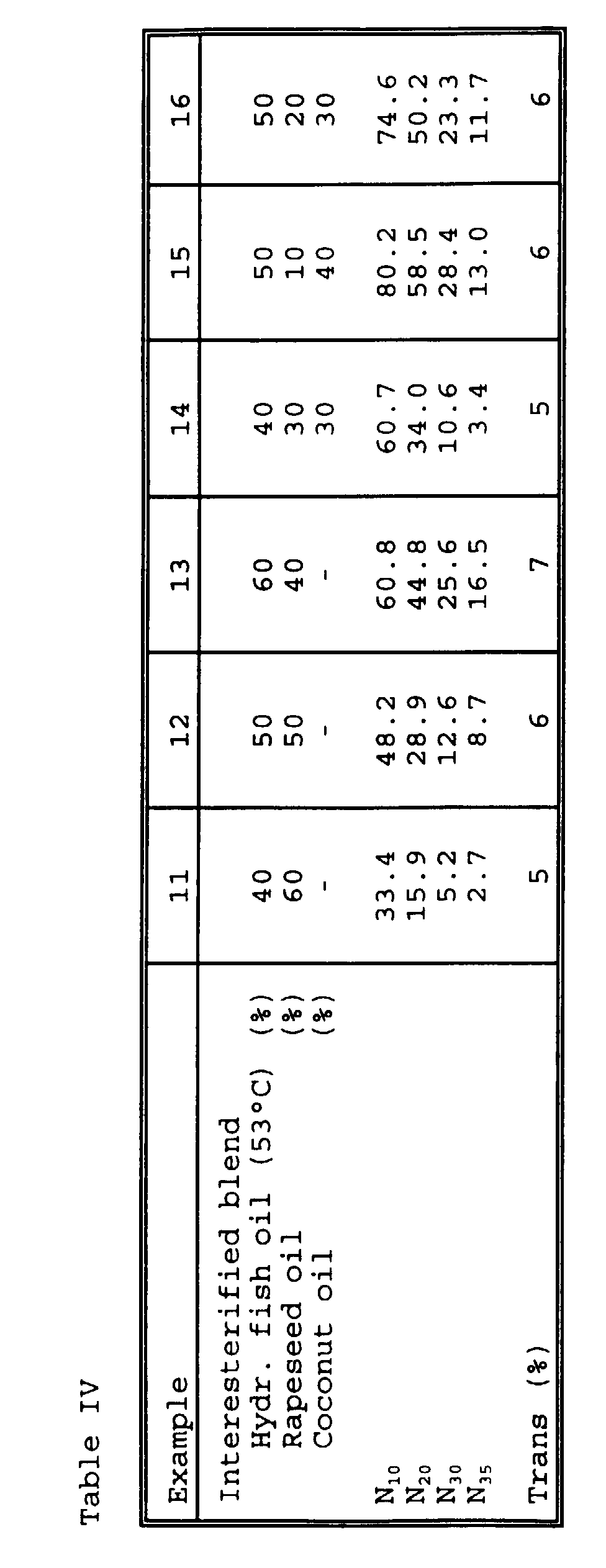
- Fish oil was hydrogenated to a slip melting point of 53°C. It had an I.V. of 16.8 and a trans fatty acid residue content of 11%. This fish oil was randomly interesterified with different amounts of rapeseed oil and in some cases coconut oil. The composition of the blends that were interesterified and the N-values and the trans contents of the resulting interesterified fats are given in table IV.
- the fat of example 11 is suitable as such as the fat in fairly firm tub margarines. It can also be used for preparing spreads with reduced fat content, e.g. 40% fat phase and 60% aqueous phase.
- the fat of example 14 is very suitable for making a firm wrapper product e.g. for kitchen applications, that needs to be distributed at ambient conditions in warm climates. It is also suitable for preparing shortening. Mixtures of 50% of the fats 12-16 were made with 25% rapeseed oil and 25% sunflower oil. The results are shown in table V.
- Example 17 18 19 20 21 Interesterified fat from example 12 13 14 15 16 N 10 18.3 24.7 23.1 33.7 28.2 N 20 9.2 14.8 9.6 20.1 16.8 N 30 4.7 8.6 2.7 8.1 6.6 N 35 1.6 4.7 0.5 2.1 1.9 Trans (%) 3 3 2 3 3 Suitable as fat for preparation of (margarine) soft tub tub soft tub wrapper firm tub
- the fat of example 19 will give a fat product with good mouthfeel and good flavour release. Similar types of product can also be prepared using for example in each case 70% of fat phase and 30% of aqueous phase.
- Fat 23 can be used as such as the fat for making e.g. kitchen margarine or shortening.
- Example 24 25 Int. est. fat from example 22 23 N 10 16.9 20.0 N 20 8.4 9.7 N 30 3.7 4.4 N 35 1.3 1.6 Trans (%) 3.8 4.6
- Both blends can be used for making soft tub spreads.
- Each of these fish oils was interesterified in a 1:1 weight ratio with rapeseed oil.
- the properties of the fish oils and of the interesterified fats are given in table VIII.
- results obtained with a fish oil hydrogenated to a slip melting point of less than 45°C is shown.
- results obtained when one of the hydrogenated fish oils is just blended with rapeseed oil, without interesterification are shown.
- Fats 26 and 28, as such, are suitable for use as fat in the preparation of for example wrapper margarines or shortenings.
- the fat of comparison A made with hydrogenated fish oil with a too low melting point, can be used for making a tub margarine, but the product will have a trans content of 17% calculated on the weight of the fat. If the fat is diluted with liquid oil to reduce the trans content too well below 10, the resulting fat blend is slightly too soft, and suitable fat products can no longer be prepared from it.
- Comparison B shows that the interesterification is essential. If the same fat mixture is used as in Example 27 but without interesterification, the fat has a very "flat" N-line: N 20 and N 10 are only a little higher than N 30 and N 35 . From such fat no acceptable plastic fat product can be prepared. The amount of solid fat at body temperature will be much too high.
- Fats are prepared using the interesterified fats of examples 27 and 29 and blending them with other fats as given in table IX. The resulting N-lines and trans fatty acid contents are given as well.
- Example 30 31 32 Fat of ex. 27 19 76 25 Fat of ex. 29 67 - 57 soyabean oil 4 11 - palmkernel oil 10 - - fish oil hydr. to 49°C - 13 - component X - - 18 N 10 44 48 47 N 20 25 34 29 N 30 8 16 10 N 35 3 8 4 saturated fatty acids (%) 49 48 52 trans (%) 4 5 4 cis-unsaturated 47 47 44 cis-polyunsaturated 5 19 5
- wrapper margarines are prepared in the same manner as described for example 1. In a similar way from the fat 31 a wrapper shortening is prepared, except that 100% fatphase is employed and no aqueous phase.
- Fish oil was hydrogenated to a slip melting point of 50°C.
- a blend of this hardened fish oil with rapeseed oil in a 1:1 weight ratio was randomly interesterified.
- a fatblend was prepared of 93 parts of this component and 7 parts rapeseed oil and the mixture was refined in a conventional manner.
- a fat phase was prepared by adding to 80 parts of fatblend, 0.1 parts lecithin, 0.1 parts of a monodiglyceride mixture and small amounts of ⁇ -carotene solution and flavour.
- An aqueous phase was prepared comprising water and small amounts of citric acid, flavour and salt.
- Margarine was prepared by continuously passing 82 parts fat phase and 18 parts aqueous phase by means of a proportioning pump through a margarine production line comprising a CAB sequence wherein C indicates a stirred crystallizer, A are scraped surface heat exchangers and B indicates an (unstirred) resting tube. Part of the stream exiting from the 3rd A-unit was recirculated and mixed with fresh feed before the entrance of the C-unit. The line was operated at a throughput of 3.7 tons/hour. The fresh feed had a temperature of 40°C and the product leaving the B-unit had a temperature of 9°C. The product was packed in wrappers and stored at 15°C.
- the solid fat contents were: N 10 47.9 N 20 26.6 N 30 10.8 N 35 5.1 N 40 0
- the firmness of the product at 5°C was assessed with a Stevens Texture Analyzer® in conventional manner using a 2 mm cylindrical rod.
- the resulting S5 value was 175 g.
- the refined fatblend had a content of trans fatty acid residues of 9.7%.
- the resulting product was a good multi purpose margarine suitable for cooking and baking as well as for spreading on bread.
- Example 33 was repeated except that the following fatblend was used
- a tub margarine was prepared in the same manner as described in example 33 except that:
- the product was a good tubmargarine suitable e.g. for cooking as well as for spreading on bread or toast.
- the fat of Ex. 36 can suitably be used for preparing baking shortening or margarine.
- the fats of ex. 37-39 are suitable for the preparation of wrapper margarines or similar products with lower fat contents, e.g. 60 or 70%, e.g. for use as table spread instead of butter.
- the fats of ex. 40-43 can be used for making e.g. tubmargarines or reduced fatspreads, e.g. containing 35 or 40% fat.
- An interesterified fat was prepared as described in example 36 except that the fatblend that was interesterified comprised 60 parts hydrogenated fish oil and 40 parts of rapeseed oil (canola) and that the fractionation temperature was 40°C or 32°C.
- the oleins obtained had the following N-values: Fractionation Temp 32°C 40°C N10 42.1 49.9 N20 20.2 30.7 N30 0.4 11.2
- Fat phase and aqueous phase compositions were prepared as follows: 81.32 parts fatblend 0.05 parts monoglyceride 0.05 parts lecithin 0.08 parts colourant 15.75 parts water 2.25 parts salt 0.5 parts sweet whey powder p.m. citric acid to pH 5.5
- the fatphase and aqueous phase compositions were mixed and kept at 60°C.
- conventional spread processing conditions were applied using an CAAAC sequence with recirculation from after the second A-unit into the first C-unit.
- an AAAC sequence was applied for the composition according to the invention.
- the throughput was 70 kg/h
- the temperature after the third A-unit was 8°C
- the volume of the C-unit was 3 liter.
- the A-units were operated at 600 rpm, the C-unit at 300 rpm.
- the products were filled in tubs and stored at 5°C. After 9 weeks storage the Stevens value of the products at 10°C using a 6.35 mm probe were 274 and 276 g for the reference and the trial product, respectively. Panel evaluation as well as oil exudation tests confirmed that the trial product was a fully satisfactory match of the reference product.
- the trial product contained only about 2% trans fatty acid residues.
- the trans content of the reference product was 32% calculated on the fatty acid residue content of the fat.
- trial fat contained only 28% fish oil while the reference fat contained 80%, the trial fat was only moderately more expensive because of the reduction in the amount of fish oil that needed to be hydrogenated. Hydrogenation of fish oil is relatively expensive.
- a conventional wrapper margarine based on partially hydrogenated fish oil and having a trans content in the fat of 48% could be matched by a product containing a fat with only about 2% trans having the following composition:
- the N-values of the fatblend were: N10 38.0 N20 23.7 N30 11.3 N35 6.0
- the Votator sequence applied was ACAB.
- the temperature after each of the units was 14, 17, 11 and 15°C, respectively.
- the Stevens values (4.4 mm probe) at 10 and 20°C were: Ex. 46 Reference St10 325 374 St20 161 146
Landscapes
- Chemical & Material Sciences (AREA)
- Oil, Petroleum & Natural Gas (AREA)
- Life Sciences & Earth Sciences (AREA)
- Engineering & Computer Science (AREA)
- Wood Science & Technology (AREA)
- Chemical Kinetics & Catalysis (AREA)
- General Chemical & Material Sciences (AREA)
- Organic Chemistry (AREA)
- Food Science & Technology (AREA)
- Polymers & Plastics (AREA)
- Edible Oils And Fats (AREA)
- Fats And Perfumes (AREA)
- Coloring Foods And Improving Nutritive Qualities (AREA)
- General Preparation And Processing Of Foods (AREA)
- Bakery Products And Manufacturing Methods Therefor (AREA)
Abstract
Description
- 20 - 80 % hydrogenated fish oil with a slip melting point of at least 45°C,
- 80 - 10 % liquid oil, and
- optionally up to 40%, preferably 0-30% of fat rich in lauric acid residues.
The hardened oil has a melting point of 30-42°C.
As hardened oil for example soyabean, cottonseed, palm, maize, rapeseed and fish oil can be used. The hardened oil must contain at least 40% of trans acids. These disclosures are not related to the subject of the present invention, i.e. providing fat products with a desirable fatty acid composition particularly a low content of trans fatty acids, at modest cost. We found that by interesterifying fish oil hydrogenated to a relatively high melting point with liquid oil, fat can be obtained with a very low content of trans fatty acids and with properties that make it suitable for use in the fat for fat products up to quite high levels. Particularly, also the solid contents profile of the interesterified fat as a function of temperature that can be obtained, makes this component attractive. Preferably, the solid fat content of the interesterified fat at 20 and 35°C is preferably N20 at least 15 and N35 at most 25.
More preferably N20 = 18-50, particularly 20-45, most preferably 20-40 and preferably N35 = 0-15, particularly 0-10, most preferably 2-10. Because of the attractive properties of the interesterified fat according to the present invention the content of trans fatty acids and the combined content of C12, C14, C16 and trans fatty acids of the fatproduct can be substantially reduced at only a modest cost increase, without adverse effect on the other properties of the product.
- 20-80% hydrogenated fish oil with a slip melting point of at least 45°C
- 80-10% liquid oil
- optionally up to 40%, preferably 0-30% of fat rich in lauric acid residues, and
- optionally up to 70% preferably 0-60% especially 0-50% of a stearin fraction from an earlier production of interesterified fat (B) .
The combined content of C12, C14, C16 and trans fatty acids and especially of trans fatty acids as such, typically occurring in fat products depends to a degree on the N20 value. Usually these contents are higher for products with intermediate N-values, somewhat lower values being obtainable for products with very low or very high N20 values. The present invention allows reduction of these contents for products across the whole N20 range but important improvements can especially be achieved for the intermediate N20 values, e.g. in the N20 range of 20 - 40. The fat product is preferably formulated such that the combined content of C12, C14, C16 and trans fatty acids is less than 50%, more preferably less than 40% of fat (A). The content of trans fatty acid residues alone in fat (A) is at most 10%, preferably however, it is less than 7%, 0-5% being particularly preferred.
The amount of such other fat (D) in fat (A) may be as high as 80% or more, especially if relatively soft products are to be made, but preferably the amount of fat (D) is 0 - 60%, 0 - 40% being particularly preferred.
Preferably their combined use is less than 30%, more preferably less than 20% calculated on the total amount of fat (A). To obtain minimal or zero levels of trans fatty acids, however, it is most preferred to avoid the use of partially hydrogenated fat altogether.
| Example | 1 | 2 | 3 |
| Interesterified blend | |||
| Hardened fish oil (%) | 40 | 50 | 60 |
| Rapeseed oil (%) | 60 | 50 | 40 |
| N10 | 36.4 | 49.9 | 64.8 |
| N20 | 21.2 | 36.2 | 53.5 |
| N30 | 7.9 | 18.8 | 32.8 |
| N35 | 4.4 | 11.5 | 22.3 |
| C12+C14+C16 (%) | 17.5 | 20.8 | 24.1 |
| Example | 4 | 5 | 6 | 7 | 8 |
| Interesterified | |||||
| fat from example | 1. | 1. | 2. | 2. | 3. |
| Amount of | |||||
| interesterified fat (%) | 88 | 70 | 70 | 50 | 50 |
| Rapeseed oil (%) | 12 | 30 | 30 | 50 | 50 |
| N10 | 30.7 | 23.1 | 30.4 | 21.7 | 31.0 |
| N20 | 17.5 | 12.6 | 20.5 | 13.3 | 21.8 |
| N30 | 7.0 | 4.5 | 9.7 | 6.7 | 12.1 |
| N35 | 3.8 | 2.3 | 6.9 | 3.2 | 8.6 |
| C12+C14+C16 (%) | 15.9 | 13.6 | 15.9 | 12.6 | 14.2 |
| Example | 9 | 10 |
| Interesterified blend hydr. fish oil (47°C) (%) | 50 | 60 |
| sunflower oil (%) | 50 | 40 |
| N10 | 44 | 54 |
| N20 | 24 | 34 |
| N30 | 9 | 16 |
| N35 | 4 | 8 |
| Trans (%) | 13 | 15 |
| Example | 17 | 18 | 19 | 20 | 21 |
| Interesterified fat from example | 12 | 13 | 14 | 15 | 16 |
| N10 | 18.3 | 24.7 | 23.1 | 33.7 | 28.2 |
| N20 | 9.2 | 14.8 | 9.6 | 20.1 | 16.8 |
| N30 | 4.7 | 8.6 | 2.7 | 8.1 | 6.6 |
| N35 | 1.6 | 4.7 | 0.5 | 2.1 | 1.9 |
| Trans (%) | 3 | 3 | 2 | 3 | 3 |
| Suitable as fat for preparation of (margarine) | soft tub | tub | soft tub | wrapper | firm tub |
The blends as given in Table VI were interesterified.
| Example | 22 | 23 |
| hydr. fish oil (53°C) | 45 | 40 |
| hydr. fish oil (37°C) | 5 | 10 |
| rapeseed oil | 50 | 50 |
| Interesterified fat: | ||
| N10 | 45.7 | 43.6 |
| N20 | 26.6 | 23.8 |
| N30 | 11.6 | 10.3 |
| N35 | 7.9 | 5.5 |
| Trans (%) | 7.5 | 9.4 |
| Example | 24 | 25 |
| Int. est. fat from example | 22 | 23 |
| N10 | 16.9 | 20.0 |
| N20 | 8.4 | 9.7 |
| N30 | 3.7 | 4.4 |
| N35 | 1.3 | 1.6 |
| Trans (%) | 3.8 | 4.6 |

| Example | 30 | 31 | 32 |
| Fat of ex. 27 | 19 | 76 | 25 |
| Fat of ex. 29 | 67 | - | 57 |
| soyabean oil | 4 | 11 | - |
| palmkernel oil | 10 | - | - |
| fish oil hydr. to 49°C | - | 13 | - |
| component X | - | - | 18 |
| N10 | 44 | 48 | 47 |
| N20 | 25 | 34 | 29 |
| N30 | 8 | 16 | 10 |
| N35 | 3 8 4 | ||
| saturated fatty acids (%) | 49 | 48 | 52 |
| trans (%) | 4 | 5 | 4 |
| cis-unsaturated | 47 | 47 | 44 |
| cis-polyunsaturated | 5 | 19 | 5 |
| N10 | 47.9 |
| N20 | 26.6 |
| N30 | 10.8 |
| N35 | 5.1 |
| N40 | 0 |
| N10 | 40.4 |
| N20 | 23.0 |
| N30 | 10.9 |
| N35 | 5.2 |
| N40 | 0 |
| Trans | 5% |
| S5 (2 mm ø): 202 |
- as fatblend was used a mixture of
- 62% of the interesterified component of example 33
- 12% fish oil hydrogenated to a slip melting point of 35°C
- 26% rapeseed oil
- the production line had only 3 A-units, recirculation was taken from after the 2nd A-unit and the line had a C-unit instead of a B-unit.
- the line was operated at a througput of 8 tons/hour.
- the temperature of the product leaving the last C-unit was 14°C.
- the product was filled into tubs.
| N10 | 32.2 |
| N20 | 15.6 |
| N30 | 5.7 |
| N35 | 1.4 |
| Trans | 10% |
| S5 (measured with 6.3 mm ø rod): 365 g. |
| C14:0 | 7% |
| C15:0 | 1% |
| C16:0 | 30% |
| C17:0 | 1% |
| C18:0 | 23% |
| C20:0 | 19% |
| C22:0 | 11% |
| C24:0 | 1% |
| Others | 7% |
| Example | 36 | 37 | 38 | 39 | 40 | 41 | 42 | 43 |
| Composition (%) | ||||||||
| Olein | 100 | 42.9 | 57.1 | 71.7 | 28.6 | 35.7 | 42.8 | 50.0 |
| Palmstearine | - | 6.5 | 7.1 | 1.3 | 3.6 | 2.3 | 1.1 | - |
| Palm oil | - | 27.5 | 8.9 | - | 22.0 | 13.8 | 5.8 | - |
| Soybean oil | - | 23.1 | 26.9 | 26.9 | 45.8 | 48.1 | 50.3 | 50.0 |
| N-values | ||||||||
| N10 | 60.4 | 37.3 | 37.2 | 44.3 | 23.4 | 20.7 | 19.6 | 20.9 |
| N20 | 40.5 | 19.3 | 19.2 | 19.5 | 11.0 | 9.0 | 9.0 | 9.2 |
| N30 | 10.9 | 7.1 | 6.6 | 4.8 | 3.4 | 1.8 | 1.3 | 1.1 |
| N35 | 1.2 | 1.8 | 1.0 | 0.0 | 0.2 | 0.0 | 0.0 | 0.1 |
| Fractionation Temp | 32°C | 40°C |
| N10 | 42.1 | 49.9 |
| N20 | 20.2 | 30.7 |
| N30 | 0.4 | 11.2 |
| Ex. 45 | Reference | |
| N10 | 33.0 | 35.0 |
| N20 | 13.8 | 16.9 |
| N30 | 4.8 | 3.2 |
| N35 | 2.9 | 0 |
| 81.32 | parts fatblend |
| 0.05 | parts monoglyceride |
| 0.05 | parts lecithin |
| 0.08 | parts colourant |
| 15.75 | parts water |
| 2.25 | parts salt |
| 0.5 | parts sweet whey powder |
| p.m. | citric acid to pH 5.5 |
| N10 | 38.0 |
| N20 | 23.7 |
| N30 | 11.3 |
| N35 | 6.0 |
| Ex. 46 | Reference | |
| St10 | 325 | 374 |
| St20 | 161 | 146 |
Claims (17)
- Edible fat product comprising a fat phase the fat (A) of which has a content of trans fatty acid residues of at most 10% and which comprisesinteresterified fat (B) derived from a fatblend (C) comprising hydrogenated fish oil with a slip melting point of at least 45°C and liquid oil, andoptionally other fat (D).
- Fat product according to claim 1 wherein the fat (A) comprises 20 - 100% of interesterified fat (B) and 0 - 80% of other fat (D).
- Fat product according to claim 2 wherein the fat (A) comprises 40 - 100% of interesterified fat (B) and 0 - 60% of other fat (D), preferably 60 - 100% of interesterified fat (B) and 0 - 40% of other fat (D).
- Fat product according to any one of claims 1 - 3 comprising 30 - 100% of fat phase and optionally up to 70% of dispersed aqueous phase.
- Fat product according to claim 4 comprising 40 - 100% of fat phase and 0 - 60% of aqueous phase, preferably 60 - 100% of fat phase and 0 - 40% of aqueous phase.
- Fat product according to any one of claims 1 - 5 wherein the other fat (D) consists of liquid oil, partially hydrogenated fish oil, fat rich in lauric acid residues, palm oil, a palm oil fraction or a mixture of two or more thereof.
- Fat product according to any one of claims 1 - 6 wherein the content of C12, C14, C16 and trans fatty acid residues is less than 50%, preferably less than 40% of the fat (A).
- Fat product according to any one of claims 1 - 7 wherein the content of trans fatty acids residues is less than 7% of the fat (A).
- Fat product according to any one of claims 1 - 8 wherein the fat (A) has an N20 of at least 8, preferably of 11 - 50, more preferably of 15 - 40.
- Interesterified fat (B) suitable for use in a fat product according to any one of claims 1 - 9, which has a content of trans fatty acid residues of at most 15% preferably 0-10%, more preferably 0-5% and which is derived from a fatblend (C) comprising 20 - 80% hydrogenated fish oil with a slip melting point of at least 45°C, 80 - 10% of liquid oil and optionally up to 40%, preferably 0-30% of fat rich in lauric acid residues.
- Interesterified fat (B) according to claim 10, wherein fatblend (C) consists of 30 - 75% hydrogenated fish oil and 70 - 25% of liquid oil, preferably 30 - 70% hydrogenated fish oil and 70 - 30% of liquid oil.
- Interesterified fat (B) according to claim 10 or 11 that is not fractionated.
- Interesterified fat (B) according to claim 10 or 11 that is or comprises an olein fraction.
- Interesterified fat (B) according to any one of claims 10 - 13 wherein the hydrogenated fish oil has a slip melting point of 48 - 59°C, more preferably of 51 - 59°C.
- Interesterified fat (B) according to any one of claims 10-14, wherein the hydrogenated fish oil is essentially fully hydrogenated fish oil.
- Interesterified fat (B) according to any one of claims 10-15 having a N20 of 18-50 and a N35 of 0-15.
- Fatproduct according to any one of claims 1-9 wherein the interesterified fat (B) is a fat (B) according to anyone of claims 10-16.
Priority Applications (2)
| Application Number | Priority Date | Filing Date | Title |
|---|---|---|---|
| EP96916024A EP0831713B1 (en) | 1995-06-07 | 1996-05-03 | Edible fat product and interesterified fat for use therein |
| ES96916024T ES2143200T3 (en) | 1995-06-07 | 1996-05-03 | EDIBLE FAT PRODUCT AND INTERSTERIFIED FAT FOR USE THEREIN. |
Applications Claiming Priority (4)
| Application Number | Priority Date | Filing Date | Title |
|---|---|---|---|
| EP95201494 | 1995-06-07 | ||
| EP95201494 | 1995-06-07 | ||
| EP96916024A EP0831713B1 (en) | 1995-06-07 | 1996-05-03 | Edible fat product and interesterified fat for use therein |
| PCT/EP1996/001911 WO1996039856A1 (en) | 1995-06-07 | 1996-05-03 | Edible fat product and interesterified fat for use therein |
Publications (2)
| Publication Number | Publication Date |
|---|---|
| EP0831713A1 EP0831713A1 (en) | 1998-04-01 |
| EP0831713B1 true EP0831713B1 (en) | 2000-02-09 |
Family
ID=8220361
Family Applications (1)
| Application Number | Title | Priority Date | Filing Date |
|---|---|---|---|
| EP96916024A Expired - Lifetime EP0831713B1 (en) | 1995-06-07 | 1996-05-03 | Edible fat product and interesterified fat for use therein |
Country Status (17)
| Country | Link |
|---|---|
| EP (1) | EP0831713B1 (en) |
| JP (1) | JP3005295B2 (en) |
| AT (1) | ATE189579T1 (en) |
| AU (1) | AU697294B2 (en) |
| BR (1) | BR9608545A (en) |
| CO (1) | CO4650126A1 (en) |
| CZ (1) | CZ289419B6 (en) |
| DE (1) | DE69606641T2 (en) |
| DK (1) | DK0831713T3 (en) |
| ES (1) | ES2143200T3 (en) |
| HU (1) | HU221462B (en) |
| MX (1) | MX9709520A (en) |
| PL (1) | PL182260B1 (en) |
| PT (1) | PT831713E (en) |
| SK (1) | SK282029B6 (en) |
| WO (1) | WO1996039856A1 (en) |
| ZA (1) | ZA963680B (en) |
Cited By (2)
| Publication number | Priority date | Publication date | Assignee | Title |
|---|---|---|---|---|
| US7498453B2 (en) | 2003-07-31 | 2009-03-03 | Cargill Incorporated | Low trans-fatty acid fats and fat compositions and methods of making same |
| US7585990B2 (en) | 2003-07-31 | 2009-09-08 | Cargill, Incorporated | Low trans-fatty acid fat compositions; low-temperature hydrogenation, e.g., of edible oils |
Families Citing this family (4)
| Publication number | Priority date | Publication date | Assignee | Title |
|---|---|---|---|---|
| JP5318660B2 (en) * | 2009-05-22 | 2013-10-16 | 株式会社Adeka | Oil coating composition for ice coating |
| JP5736409B2 (en) * | 2013-05-27 | 2015-06-17 | 太陽油脂株式会社 | Oil composition for cream |
| WO2014195498A1 (en) * | 2013-06-07 | 2014-12-11 | Loders Croklaan B.V. | Edible composition |
| PL449397A1 (en) * | 2024-07-30 | 2026-02-02 | Biodairy Labs Spółka Z Ograniczoną Odpowiedzialnością | Composition of structured edible fats and method for preparation thereof |
Family Cites Families (8)
| Publication number | Priority date | Publication date | Assignee | Title |
|---|---|---|---|---|
| GB903141A (en) * | 1958-04-30 | 1962-08-09 | Hedley Thomas & Co Ltd | Improvements in margarine manufacture |
| CA1201447A (en) * | 1981-10-06 | 1986-03-04 | Cornelis N.M. Keulemans | Interesterification process and apparatus |
| EP0084900B1 (en) * | 1982-01-20 | 1986-04-16 | Unilever N.V. | Margarine fat blend with a reduced tendency to sandiness and a process for reducing the development of sandiness in fat blends |
| AU564008B2 (en) * | 1984-07-11 | 1987-07-30 | Unilever Plc | Hydrogenation products |
| JPH02215346A (en) * | 1989-02-15 | 1990-08-28 | Nippon Oil & Fats Co Ltd | Oil and fat for electric oven cooking |
| ATE110935T1 (en) * | 1990-08-02 | 1994-09-15 | Unilever Nv | IMPROVEMENT OF EDIBLE FATS. |
| US5196215A (en) * | 1990-09-20 | 1993-03-23 | Myoshi Oil & Fat Co., Ltd. | Cavity forming agent for edible foods |
| JP2566855B2 (en) * | 1991-07-08 | 1996-12-25 | 月島食品工業株式会社 | Fat composition |
-
1996
- 1996-05-03 PT PT96916024T patent/PT831713E/en unknown
- 1996-05-03 MX MX9709520A patent/MX9709520A/en not_active IP Right Cessation
- 1996-05-03 DE DE69606641T patent/DE69606641T2/en not_active Expired - Fee Related
- 1996-05-03 AU AU58938/96A patent/AU697294B2/en not_active Ceased
- 1996-05-03 AT AT96916024T patent/ATE189579T1/en not_active IP Right Cessation
- 1996-05-03 SK SK1638-97A patent/SK282029B6/en unknown
- 1996-05-03 WO PCT/EP1996/001911 patent/WO1996039856A1/en not_active Ceased
- 1996-05-03 PL PL96323915A patent/PL182260B1/en not_active IP Right Cessation
- 1996-05-03 JP JP9500112A patent/JP3005295B2/en not_active Expired - Fee Related
- 1996-05-03 DK DK96916024T patent/DK0831713T3/en active
- 1996-05-03 ES ES96916024T patent/ES2143200T3/en not_active Expired - Lifetime
- 1996-05-03 CZ CZ19973895A patent/CZ289419B6/en not_active IP Right Cessation
- 1996-05-03 BR BR9608545A patent/BR9608545A/en not_active IP Right Cessation
- 1996-05-03 HU HU9801533A patent/HU221462B/en not_active IP Right Cessation
- 1996-05-03 EP EP96916024A patent/EP0831713B1/en not_active Expired - Lifetime
- 1996-05-09 ZA ZA9603680A patent/ZA963680B/en unknown
- 1996-05-13 CO CO96023887A patent/CO4650126A1/en unknown
Cited By (3)
| Publication number | Priority date | Publication date | Assignee | Title |
|---|---|---|---|---|
| US7498453B2 (en) | 2003-07-31 | 2009-03-03 | Cargill Incorporated | Low trans-fatty acid fats and fat compositions and methods of making same |
| US7585990B2 (en) | 2003-07-31 | 2009-09-08 | Cargill, Incorporated | Low trans-fatty acid fat compositions; low-temperature hydrogenation, e.g., of edible oils |
| US7820841B2 (en) | 2003-07-31 | 2010-10-26 | Cargill, Incorporated | Low trans-fatty acid fat compositions; low-temperature hydrogenation, e.g., of edible oils |
Also Published As
| Publication number | Publication date |
|---|---|
| AU697294B2 (en) | 1998-10-01 |
| DE69606641T2 (en) | 2000-07-20 |
| JPH11500317A (en) | 1999-01-12 |
| HUP9801533A2 (en) | 1998-11-30 |
| CZ289419B6 (en) | 2002-01-16 |
| HUP9801533A3 (en) | 2000-02-28 |
| BR9608545A (en) | 1999-07-06 |
| DE69606641D1 (en) | 2000-03-16 |
| HU221462B (en) | 2002-10-28 |
| AU5893896A (en) | 1996-12-30 |
| WO1996039856A1 (en) | 1996-12-19 |
| SK282029B6 (en) | 2001-10-08 |
| CO4650126A1 (en) | 1998-09-03 |
| PT831713E (en) | 2000-07-31 |
| MX9709520A (en) | 1998-03-31 |
| PL323915A1 (en) | 1998-04-27 |
| CZ389597A3 (en) | 1998-05-13 |
| JP3005295B2 (en) | 2000-01-31 |
| SK163897A3 (en) | 1998-04-08 |
| ES2143200T3 (en) | 2000-05-01 |
| ATE189579T1 (en) | 2000-02-15 |
| PL182260B1 (en) | 2001-11-30 |
| DK0831713T3 (en) | 2000-05-29 |
| ZA963680B (en) | 1997-11-10 |
| EP0831713A1 (en) | 1998-04-01 |
Similar Documents
| Publication | Publication Date | Title |
|---|---|---|
| AU689344B2 (en) | Fat blend for margarine and w/o spreads | |
| US6238723B1 (en) | Edible fat spread | |
| US6171636B1 (en) | Natural triglyceride fats | |
| AU713420B2 (en) | Margarine fat blend and plastic w/o emulsion spread comprising this fat blend | |
| US5879735A (en) | Fat blends, based on diglycerides | |
| US7223435B2 (en) | Triglyceride fat | |
| AU697294B2 (en) | Edible fat product and interesterified fat for use therein | |
| EP0719091B1 (en) | Natural triglyceride fats | |
| MXPA97004529A (en) | Margarine grease mixture and emulsion w / o plastic to join, that understand this gr mix |
Legal Events
| Date | Code | Title | Description |
|---|---|---|---|
| PUAI | Public reference made under article 153(3) epc to a published international application that has entered the european phase |
Free format text: ORIGINAL CODE: 0009012 |
|
| 17P | Request for examination filed |
Effective date: 19971029 |
|
| AK | Designated contracting states |
Kind code of ref document: A1 Designated state(s): AT BE DE DK ES FI FR GB IE NL PT SE |
|
| GRAG | Despatch of communication of intention to grant |
Free format text: ORIGINAL CODE: EPIDOS AGRA |
|
| 17Q | First examination report despatched |
Effective date: 19990505 |
|
| GRAG | Despatch of communication of intention to grant |
Free format text: ORIGINAL CODE: EPIDOS AGRA |
|
| GRAH | Despatch of communication of intention to grant a patent |
Free format text: ORIGINAL CODE: EPIDOS IGRA |
|
| GRAH | Despatch of communication of intention to grant a patent |
Free format text: ORIGINAL CODE: EPIDOS IGRA |
|
| GRAA | (expected) grant |
Free format text: ORIGINAL CODE: 0009210 |
|
| AK | Designated contracting states |
Kind code of ref document: B1 Designated state(s): AT BE DE DK ES FI FR GB IE NL PT SE |
|
| REF | Corresponds to: |
Ref document number: 189579 Country of ref document: AT Date of ref document: 20000215 Kind code of ref document: T |
|
| REF | Corresponds to: |
Ref document number: 69606641 Country of ref document: DE Date of ref document: 20000316 |
|
| ET | Fr: translation filed | ||
| REG | Reference to a national code |
Ref country code: ES Ref legal event code: FG2A Ref document number: 2143200 Country of ref document: ES Kind code of ref document: T3 |
|
| REG | Reference to a national code |
Ref country code: IE Ref legal event code: FG4D |
|
| REG | Reference to a national code |
Ref country code: DK Ref legal event code: T3 |
|
| REG | Reference to a national code |
Ref country code: PT Ref legal event code: SC4A Free format text: AVAILABILITY OF NATIONAL TRANSLATION Effective date: 20000508 |
|
| PLBE | No opposition filed within time limit |
Free format text: ORIGINAL CODE: 0009261 |
|
| STAA | Information on the status of an ep patent application or granted ep patent |
Free format text: STATUS: NO OPPOSITION FILED WITHIN TIME LIMIT |
|
| 26N | No opposition filed | ||
| REG | Reference to a national code |
Ref country code: GB Ref legal event code: IF02 |
|
| PGFP | Annual fee paid to national office [announced via postgrant information from national office to epo] |
Ref country code: AT Payment date: 20040421 Year of fee payment: 9 |
|
| PGFP | Annual fee paid to national office [announced via postgrant information from national office to epo] |
Ref country code: PT Payment date: 20040427 Year of fee payment: 9 |
|
| PGFP | Annual fee paid to national office [announced via postgrant information from national office to epo] |
Ref country code: FR Payment date: 20040519 Year of fee payment: 9 |
|
| PGFP | Annual fee paid to national office [announced via postgrant information from national office to epo] |
Ref country code: ES Payment date: 20040609 Year of fee payment: 9 |
|
| PGFP | Annual fee paid to national office [announced via postgrant information from national office to epo] |
Ref country code: BE Payment date: 20040622 Year of fee payment: 9 |
|
| PGFP | Annual fee paid to national office [announced via postgrant information from national office to epo] |
Ref country code: DE Payment date: 20040630 Year of fee payment: 9 |
|
| PG25 | Lapsed in a contracting state [announced via postgrant information from national office to epo] |
Ref country code: AT Free format text: LAPSE BECAUSE OF NON-PAYMENT OF DUE FEES Effective date: 20050503 |
|
| PG25 | Lapsed in a contracting state [announced via postgrant information from national office to epo] |
Ref country code: ES Free format text: LAPSE BECAUSE OF NON-PAYMENT OF DUE FEES Effective date: 20050504 |
|
| PG25 | Lapsed in a contracting state [announced via postgrant information from national office to epo] |
Ref country code: BE Free format text: LAPSE BECAUSE OF NON-PAYMENT OF DUE FEES Effective date: 20050531 |
|
| PG25 | Lapsed in a contracting state [announced via postgrant information from national office to epo] |
Ref country code: PT Free format text: LAPSE BECAUSE OF NON-PAYMENT OF DUE FEES Effective date: 20051103 |
|
| BERE | Be: lapsed |
Owner name: *UNILEVER N.V. Effective date: 20050531 |
|
| PG25 | Lapsed in a contracting state [announced via postgrant information from national office to epo] |
Ref country code: DE Free format text: LAPSE BECAUSE OF NON-PAYMENT OF DUE FEES Effective date: 20051201 |
|
| PG25 | Lapsed in a contracting state [announced via postgrant information from national office to epo] |
Ref country code: FR Free format text: LAPSE BECAUSE OF NON-PAYMENT OF DUE FEES Effective date: 20060131 |
|
| REG | Reference to a national code |
Ref country code: FR Ref legal event code: ST Effective date: 20060131 |
|
| REG | Reference to a national code |
Ref country code: ES Ref legal event code: FD2A Effective date: 20050504 |
|
| BERE | Be: lapsed |
Owner name: *UNILEVER N.V. Effective date: 20050531 |
|
| PGFP | Annual fee paid to national office [announced via postgrant information from national office to epo] |
Ref country code: NL Payment date: 20090524 Year of fee payment: 14 Ref country code: IE Payment date: 20090527 Year of fee payment: 14 Ref country code: DK Payment date: 20090528 Year of fee payment: 14 |
|
| PGFP | Annual fee paid to national office [announced via postgrant information from national office to epo] |
Ref country code: SE Payment date: 20090528 Year of fee payment: 14 Ref country code: FI Payment date: 20090529 Year of fee payment: 14 |
|
| PGFP | Annual fee paid to national office [announced via postgrant information from national office to epo] |
Ref country code: GB Payment date: 20090528 Year of fee payment: 14 |
|
| REG | Reference to a national code |
Ref country code: NL Ref legal event code: V1 Effective date: 20101201 |
|
| REG | Reference to a national code |
Ref country code: DK Ref legal event code: EBP |
|
| GBPC | Gb: european patent ceased through non-payment of renewal fee |
Effective date: 20100503 |
|
| PG25 | Lapsed in a contracting state [announced via postgrant information from national office to epo] |
Ref country code: FI Free format text: LAPSE BECAUSE OF NON-PAYMENT OF DUE FEES Effective date: 20100503 |
|
| EUG | Se: european patent has lapsed | ||
| REG | Reference to a national code |
Ref country code: IE Ref legal event code: MM4A |
|
| PG25 | Lapsed in a contracting state [announced via postgrant information from national office to epo] |
Ref country code: SE Free format text: LAPSE BECAUSE OF NON-PAYMENT OF DUE FEES Effective date: 20100504 Ref country code: NL Free format text: LAPSE BECAUSE OF NON-PAYMENT OF DUE FEES Effective date: 20101201 |
|
| PG25 | Lapsed in a contracting state [announced via postgrant information from national office to epo] |
Ref country code: IE Free format text: LAPSE BECAUSE OF NON-PAYMENT OF DUE FEES Effective date: 20100503 Ref country code: DK Free format text: LAPSE BECAUSE OF NON-PAYMENT OF DUE FEES Effective date: 20100531 |
|
| PG25 | Lapsed in a contracting state [announced via postgrant information from national office to epo] |
Ref country code: GB Free format text: LAPSE BECAUSE OF NON-PAYMENT OF DUE FEES Effective date: 20100503 |