EP0829290B1 - A toy building element and set - Google Patents
A toy building element and set Download PDFInfo
- Publication number
- EP0829290B1 EP0829290B1 EP97610038A EP97610038A EP0829290B1 EP 0829290 B1 EP0829290 B1 EP 0829290B1 EP 97610038 A EP97610038 A EP 97610038A EP 97610038 A EP97610038 A EP 97610038A EP 0829290 B1 EP0829290 B1 EP 0829290B1
- Authority
- EP
- European Patent Office
- Prior art keywords
- toy building
- building element
- coupling
- coupling means
- flexible
- Prior art date
- Legal status (The legal status is an assumption and is not a legal conclusion. Google has not performed a legal analysis and makes no representation as to the accuracy of the status listed.)
- Expired - Lifetime
Links
- 230000008878 coupling Effects 0.000 claims description 98
- 238000010168 coupling process Methods 0.000 claims description 98
- 238000005859 coupling reaction Methods 0.000 claims description 98
- 239000000470 constituent Substances 0.000 claims description 30
- 230000000295 complement effect Effects 0.000 claims description 10
- 239000000463 material Substances 0.000 claims description 4
- 238000010276 construction Methods 0.000 description 1
- 238000004519 manufacturing process Methods 0.000 description 1
- 238000000034 method Methods 0.000 description 1
- 229920003023 plastic Polymers 0.000 description 1
- 239000004033 plastic Substances 0.000 description 1
Images
Classifications
-
- A—HUMAN NECESSITIES
- A63—SPORTS; GAMES; AMUSEMENTS
- A63H—TOYS, e.g. TOPS, DOLLS, HOOPS OR BUILDING BLOCKS
- A63H33/00—Other toys
- A63H33/04—Building blocks, strips, or similar building parts
- A63H33/06—Building blocks, strips, or similar building parts to be assembled without the use of additional elements
- A63H33/08—Building blocks, strips, or similar building parts to be assembled without the use of additional elements provided with complementary holes, grooves, or protuberances, e.g. dovetails
- A63H33/086—Building blocks, strips, or similar building parts to be assembled without the use of additional elements provided with complementary holes, grooves, or protuberances, e.g. dovetails with primary projections fitting by friction in complementary spaces between secondary projections, e.g. sidewalls
Definitions
- the present invention relates to a toy building element for use in a toy building element system comprising a number of toy building elements with coupling means for coupling with other toy building elements with complementary coupling means, said coupling means being arranged in a regular pattern with a specific modular distance relative to each other.
- Toy building elements of this type may also be constituent parts of various toy building sets having different modular distances, where some of these toy building sets are more or less compatible.
- Toy building sets of the above-mentioned type are known where the constituent toy building elements couple tightly with each other thereby allowing the construction of large structures which do not easily fall apart.
- toy building sets are also known where the toy building elements couple only very loosely with each other - the so-called stacking sets - where simple stacking of the toy building elements constitutes the only method of building structures.
- This object is achieved by constructing the toy building element mentioned in the introductory part in such a manner that at least some of the coupling means of the toy building element in the free state thereof are shifted relative to said modular distance, the mutual position of the coupling means of the toy building elements being elastically changeable at least to a mutual position corresponding to said modular distance.
- a toy building element which may couple tightly with other toy building elements if coupling is effected over several coupling means which are shifted relative to each other and relative to the modular distance. If, on the other hand, coupling is effected over only one or over more coupling means which are not shifted relative to each other and relative to the modular distance, it is still possible to provide a loose coupling between the toy building elements.
- the toy building element comprises at least two contstituents, each of which is provided with coupling means and which are connected to each other in a flexible manner.
- the toy building element comprises at least two contstituents, each of which is provided with coupling means and which are connected to each other in a flexible manner.
- connection between the individual constituents may differ widely, as it may consist of a flexible rod extending through the constituents and preshaped to an arcuate configuration to ensure that the coupling means depart from the specific modular distance.
- connection between the individual constituents may consist of a bellows portion or it may be provided by manufacturing the constituents in one piece with reduced material thickness between the constituents.
- the coupling means consist of coupling studs arranged on the upper surface of the toy building element, and according to a preferred embodiment there is exactly one coupling stud on each constituent.
- coupling means are also provided on the underside of the toy building element in the form of sockets which are complementary to the coupling studs on the upper surface.
- the invention also relates to a toy building set comprising a number of rigid toy building elements with coupling means for coupling with other rigid toy building elements with corresponding coupling means, said coupling means being arranged in a regular pattern with a specific modular distance relative to each other.
- Such toy building sets are well known both in the form of building systems with a tight coupling between the toy building elements and as a stacking system with a loose coupling between the toy building elements.
- the toy building set in such a manner that, in addition to the rigid toy building elements, it also comprises at least one flexible toy building element with coupling means, wherein at least some of the coupling means in the free state of the flexible toy building element are shifted relative to said modular distance, the mutual position of the coupling means of the flexible toy building element being elastically changeable at least to a mutual position corresponding to said modular distance.
- a toy building set wherein it is possible to interconnect the toy building elements with a loose as well as a tight coupling, the tight coupling being obtained when a rigid toy building element is connected with a flexible toy building element whereby the shifted coupling means of the flexible toy building element are forced to assume the modular distance, and due to the elasticity of the element provides a coupling force between the two building elements.
- the toy building set is intended for a stacking set to provide the option of alternating between loose and tight couplings, but of course there is nothing to prevent the invention from being used in connection with a toy building set where the couplings between the toy building elements are already tight.
- the coupling means on the rigid toy building elements consist of coupling studs arranged on the upper surface of the toy building elements and complementary sockets on the underside of the toy building elements
- the coupling means on the flexible toy building element consist at least of coupling studs on the upper surface of the flexible toy building element
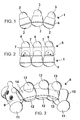
- FIG. 1 a first embodiment of a toy building element 1 according to the invention is illustrated.
- the toy building element 1 consists of three constituents 2 that are each provided with a coupling stud 3 which allows the toy building element 1 to be connected to other toy building elements with complementary coupling means as will appear from Figure 2 which will be described in further detail below.
- the coupling studs 3 have a circular cross section with a rounded top, and preferably the toy building element 1 forms part of a stacking system with a loose coupling between the toy building elements, i.e. without any coupling force between the interconnected toy building elements.
- the constituents 2 with coupling studs 3 are preferably made of a die-cast plastics material but, of course, it is possible to use other materials.
- the constituents 3 are connected to each other around their centre portion by a through-going elastic band 4 shown with dashed lines seen from its most narrow side.
- This through-going band 4 is fastened to the end-constituents 2 and is preshaped to an arcuate configuration whereby the toy building element 1 is caused to assume the shape shown in Figure 1 when it is in its free state, i.e. when it is not interconnected with other toy building elements.
- the coupling studs 3 have departed from the modular distance to be assumed by the toy building element in order for it to be able to couple with other toy building elements over more studs.
- the through-going band 4 is of an elastic nature, whereby the toy building element 1 may be straigthened to a straight configuration upon interconnecting with other toy building elements whereby the coupling studs 3 are caused to reassume the aforementioned modular distance.
- the upper surface of the rigid toy building element 5 is provided with three coupling studs 6 and, moreover, its underside is provided with complementary coupling means in the form of three downwardly extending tubular members 7, the internal diameter of which corresponding to or slightly exceeding the diameter of the coupling studs 3.
- Coupling of the toy building element 1 according to the invention with the rigid toy building element 5 produces a coupling force between the two toy building elements since the elasticity of the through-going band 4 makes the outermost coupling studs 3 of the toy building element 1 press against the inside of the tubular members 7 as indicated by the arrows F.
- the underside of the toy building element 1 may also be provided with coupling means in the form of tubular members, like the toy building element 5.
- Figure 3 illustrates an alternative toy building element 8 according to the invention, said toy building element constituting in itself a toy.
- the toy building element 8 is in the shape of a looper with a head 9 and a tail 10 and wheels 11.
- the central elements 12 which corresponds to the constituents 2 in Figure 1 have coupling studs 13 for interconnecting the toy building element 8 with other toy building elements 5.
- the three central elements 12 are connected to each other and to the head and tail of the toy building element 8 by means of a through-going elastic band 14 in the same manner as in the toy building element 1 shown in Figure 1.
- the design of this through-going band 14 will appear more clearly from Figure 3.
- interconnecting with other toy building elements 5 enables the toy building element 8 to assume a straight configuration (not shown) corresponding to the configuration of the toy building element 1 shown in Figure 2 while simultaneously producing a coupling force between the toy building element 8 and the toy building element 5.
- the toy building element 1,8 is illustrated as comprising constituents 1,12 which are connected to each other by a through-going elastic band 4,14.
- the constituents 2,12 may, however, be connected to each other in other ways, e.g. by means of integral hinges in those regions where the constituents 2,12 abut on each other.
- constituents 2,12 may be connected by an elastic bellows portion or some other kind of elastic connection between the individual constituents 2,12, said connection causing the constituents 2,12 to be aligned but still departing from the modular distance.
- an elastic bellows portion or some other kind of elastic connection between the individual constituents 2,12, said connection causing the constituents 2,12 to be aligned but still departing from the modular distance.
- the invention is particularly directed to toy building elements 1, 5 and 8 in a stacking system where, in normal conditions, no coupling force exists between the individual toy building elements 1, 5 and 8, and where it is possible with the toy building element 1,8 according to the invention to produce a coupling force between said toy building elements 1, 5 and 8.
Landscapes
- Toys (AREA)
Description
- The present invention relates to a toy building element for use in a toy building element system comprising a number of toy building elements with coupling means for coupling with other toy building elements with complementary coupling means, said coupling means being arranged in a regular pattern with a specific modular distance relative to each other.
- Many different types of such toy building elements are known which have many different coupling means, the most well known type being toy building elements with coupling studs.
- Within this group of toy building elements, different embodiments are also known with e.g. round or square coupling studs disposed on the upper surface of the toy building elements and with complementary sockets on the underside of the toy building elements.
- Toy building elements of this type may also be constituent parts of various toy building sets having different modular distances, where some of these toy building sets are more or less compatible.
- Toy building sets of the above-mentioned type are known where the constituent toy building elements couple tightly with each other thereby allowing the construction of large structures which do not easily fall apart. However, toy building sets are also known where the toy building elements couple only very loosely with each other - the so-called stacking sets - where simple stacking of the toy building elements constitutes the only method of building structures.
- In order to increase the number of building options available with toy building elements that couple loosely with each other, there is a need to develop a toy building element wherein the coupling force between this toy building element and the remaining toy building elements is increased while retaining the capacity of the toy building element for being used with the loose coupling, i.e. without the design of the coupling means proper being changed.
- This object is achieved by constructing the toy building element mentioned in the introductory part in such a manner that at least some of the coupling means of the toy building element in the free state thereof are shifted relative to said modular distance, the mutual position of the coupling means of the toy building elements being elastically changeable at least to a mutual position corresponding to said modular distance.
- Hereby a toy building element is provided which may couple tightly with other toy building elements if coupling is effected over several coupling means which are shifted relative to each other and relative to the modular distance. If, on the other hand, coupling is effected over only one or over more coupling means which are not shifted relative to each other and relative to the modular distance, it is still possible to provide a loose coupling between the toy building elements.
- According to a preferred embodiment of the invention, the toy building element comprises at least two contstituents, each of which is provided with coupling means and which are connected to each other in a flexible manner. In this way a comparatively simple toy building element is obtained which may consist of die-cast constituents that are connected to each other in a flexible manner.
- The nature of the connection between the individual constituents may differ widely, as it may consist of a flexible rod extending through the constituents and preshaped to an arcuate configuration to ensure that the coupling means depart from the specific modular distance.
- Alternatively the connection between the individual constituents may consist of a bellows portion or it may be provided by manufacturing the constituents in one piece with reduced material thickness between the constituents.
- Preferably, the coupling means consist of coupling studs arranged on the upper surface of the toy building element, and according to a preferred embodiment there is exactly one coupling stud on each constituent. Preferably, coupling means are also provided on the underside of the toy building element in the form of sockets which are complementary to the coupling studs on the upper surface.
- The invention also relates to a toy building set comprising a number of rigid toy building elements with coupling means for coupling with other rigid toy building elements with corresponding coupling means, said coupling means being arranged in a regular pattern with a specific modular distance relative to each other.
- Such toy building sets are well known both in the form of building systems with a tight coupling between the toy building elements and as a stacking system with a loose coupling between the toy building elements.
- In order to increase the number of building options available, in particular in connection with the stacking systems, there is a need for a novel toy building set wherein a tight as well as a loose coupling between the toy building elements may be effected.
- This is obtained by composing the toy building set in such a manner that, in addition to the rigid toy building elements, it also comprises at least one flexible toy building element with coupling means, wherein at least some of the coupling means in the free state of the flexible toy building element are shifted relative to said modular distance, the mutual position of the coupling means of the flexible toy building element being elastically changeable at least to a mutual position corresponding to said modular distance.
- Hereby a toy building set is provided wherein it is possible to interconnect the toy building elements with a loose as well as a tight coupling, the tight coupling being obtained when a rigid toy building element is connected with a flexible toy building element whereby the shifted coupling means of the flexible toy building element are forced to assume the modular distance, and due to the elasticity of the element provides a coupling force between the two building elements.
- In particular, the toy building set is intended for a stacking set to provide the option of alternating between loose and tight couplings, but of course there is nothing to prevent the invention from being used in connection with a toy building set where the couplings between the toy building elements are already tight.
- Preferably the coupling means on the rigid toy building elements consist of coupling studs arranged on the upper surface of the toy building elements and complementary sockets on the underside of the toy building elements, and the coupling means on the flexible toy building element consist at least of coupling studs on the upper surface of the flexible toy building element.
- The invention will now be explained in further detail with reference to the drawings, wherein
- Figure 1 illustrates a first embodiment of a toy building element according to the invention,
- Figure 2 also illustrates the toy building element shown in Figure 1, however with a rigid toy building element coupled thereto, and
- Figure 3 illustrates an alternative embodiment of a toy building element according to the invention.
-
- In Figure 1 a first embodiment of a
toy building element 1 according to the invention is illustrated. - The
toy building element 1 consists of threeconstituents 2 that are each provided with acoupling stud 3 which allows thetoy building element 1 to be connected to other toy building elements with complementary coupling means as will appear from Figure 2 which will be described in further detail below. - Preferably the
coupling studs 3 have a circular cross section with a rounded top, and preferably thetoy building element 1 forms part of a stacking system with a loose coupling between the toy building elements, i.e. without any coupling force between the interconnected toy building elements. - The
constituents 2 withcoupling studs 3 are preferably made of a die-cast plastics material but, of course, it is possible to use other materials. - The
constituents 3 are connected to each other around their centre portion by a through-goingelastic band 4 shown with dashed lines seen from its most narrow side. This through-goingband 4 is fastened to the end-constituents 2 and is preshaped to an arcuate configuration whereby thetoy building element 1 is caused to assume the shape shown in Figure 1 when it is in its free state, i.e. when it is not interconnected with other toy building elements. - Owing to the arcuate configuration of the through-going
band 4, thecoupling studs 3 have departed from the modular distance to be assumed by the toy building element in order for it to be able to couple with other toy building elements over more studs. - The through-going
band 4 is of an elastic nature, whereby thetoy building element 1 may be straigthened to a straight configuration upon interconnecting with other toy building elements whereby thecoupling studs 3 are caused to reassume the aforementioned modular distance. - This will appear from Figure 2, where the
toy building element 1 shown in Figure 1 is interconnected with a rigid toy building element 5. - Like the
toy building element 1, the upper surface of the rigid toy building element 5 is provided with threecoupling studs 6 and, moreover, its underside is provided with complementary coupling means in the form of three downwardly extendingtubular members 7, the internal diameter of which corresponding to or slightly exceeding the diameter of thecoupling studs 3. - Coupling of the
toy building element 1 according to the invention with the rigid toy building element 5 produces a coupling force between the two toy building elements since the elasticity of the through-goingband 4 makes theoutermost coupling studs 3 of thetoy building element 1 press against the inside of thetubular members 7 as indicated by the arrows F. - Hereby a coupling force is produced between two
toy building elements 1,5 in a stacking system, where there would not exist any coupling force between saidcoupling elements 1,5 in normal conditions. - The underside of the
toy building element 1 may also be provided with coupling means in the form of tubular members, like the toy building element 5. - Figure 3 illustrates an alternative
toy building element 8 according to the invention, said toy building element constituting in itself a toy. - The
toy building element 8 is in the shape of a looper with ahead 9 and atail 10 andwheels 11. Thecentral elements 12 which corresponds to theconstituents 2 in Figure 1 havecoupling studs 13 for interconnecting thetoy building element 8 with other toy building elements 5. - The three
central elements 12 are connected to each other and to the head and tail of thetoy building element 8 by means of a through-goingelastic band 14 in the same manner as in thetoy building element 1 shown in Figure 1. The design of this through-goingband 14 will appear more clearly from Figure 3. - Thus, interconnecting with other toy building elements 5 enables the
toy building element 8 to assume a straight configuration (not shown) corresponding to the configuration of thetoy building element 1 shown in Figure 2 while simultaneously producing a coupling force between thetoy building element 8 and the toy building element 5. - In the embodiments shown, the
toy building element constituents elastic band constituents constituents - It is not necessary for the
toy building element - Thus the
constituents individual constituents constituents toy building element - In addition to a flexing of the coupling means out of the plane (as illustrated in Figures 1 and 3) and a shifting of the coupling means in the plane to a position out of (or within) the modular distance as described above, longitudinal twisting of the
toy building element - As mentioned above, the invention is particularly directed to
toy building elements toy building elements toy building element toy building elements - However, nothing prevents the invention from being used with other toy building systems with coupling force between the individual toy building elements, since in that event such
toy building element
Claims (14)
- A toy building element (1,8) for use in a toy building element system comprising a number of toy building elements with coupling means for coupling with other toy building elements with complementary coupling means, said coupling means being arranged in a regular pattern with a specific modular distance relative to each other, CHARACTERIZED IN THAT at least some of the coupling means of the toy building element (1,8) in the free state thereof are shifted relative to said modular distance, the mutual position of the coupling means of the toy building element being elastically changeable at least to a mutual position corresponding to said modular distance.
- A toy building element according to claim 1, CHARACTERIZED IN THAT it comprises at least two constituents (2,12) with coupling means, said constituents (2,12) being connected to each other in a flexible manner.
- A toy building element according to claim 2, CHARACTERIZED IN THAT the constituents (2,12) are connected to each other by means of a through-going flexible rod (4,14) which is preshaped to an arcuate configuration.
- A toy building element according to claim 2, CHARACTERIZED IN THAT the constituents (2,12) are connected to each other by means of a bellows portion.
- A toy building element according to claim 2, CHARACTERIZED IN THAT the constituents (2,12) are made in one piece with a reduced material thickness between the constituents.
- A toy building element according to any one of claims 2-5, CHARACTERIZED IN THAT the coupling means consist of coupling studs (3,13) arranged on the upper surface of the toy building element (1,8).
- A toy building element according to claim 6, CHARACTERIZED IN THAT exactly one coupling stud (3,13) is provided on each constituent (2,12).
- A toy building element according to claim 6 or 7, CHARACTERIZED IN THAT sockets are also provided on the underside of the toy building element (1,8), said sockets being complementary to the coupling studs (3,13) on the upper surface.
- A toy building set comprising a number of rigid toy building elements (5) with coupling means for coupling with other rigid toy building elements (5) with corresponding coupling means, said coupling means being arranged in a regular pattern with a specific modular distance relative to each other, CHARACTERIZED IN THAT the toy building set also comprises at least one flexible toy building element (1,8) with coupling means, wherein at least some of the coupling means in the free state of the toy building element (1,8) are shifted relative to said modular distance, the mutual position of the coupling means of the flexible toy building element (1,8) being elastically changeable at least to a mutual position corresponding to said modular distance.
- A toy building set according to claim 9, CHARACTERIZED IN THAT the shifted coupling means on the flexible toy building element (1,8) are caused to occupy a position corresponding to said modular distance when the flexible toy building element (1,8) is interconnected with one of the rigid toy building elements (5).
- A toy building set according to claim 9 or 10, CHARACTERIZED IN THAT the coupling means on the rigid toy building elements (5) are constituted of coupling studs (6) arranged on the upper surface of the toy building elements (5) and complementary sockets (7) on the underside of the toy building elements (5), and that the coupling means on the flexible toy building element (1,8) consist at least of coupling studs (3,13) on the upper surface of the flexible toy building element.
- A toy building set according to claim 11, CHARACTERIZED IN THAT the flexible toy building element (1,8) comprises at least to constituents (2,12) with coupling studs (3,13), said constituents (2,12) being connected to each other in a flexible manner.
- A toy building set according to claim 12, CHARACTERIZED IN THAT exactly one coupling stud (3,13) is provided on each constituent (2,12), and that the toy building elements (1,5,8) couple loosely on exactly one coupling stud (3,13)
- A toy building set according to any one of claims 11-13, CHARACTERIZED IN THAT sockets are also provided on the underside of the flexible toy building element (1,8), said sockets being complementary to the coupling studs (3,13) provided on the upper surface.
Applications Claiming Priority (2)
| Application Number | Priority Date | Filing Date | Title |
|---|---|---|---|
| US08/714,857 US5846113A (en) | 1996-09-17 | 1996-09-17 | Toy Building element and a toy building set comprising toy building elements |
| US714857 | 1996-09-17 |
Publications (3)
| Publication Number | Publication Date |
|---|---|
| EP0829290A2 EP0829290A2 (en) | 1998-03-18 |
| EP0829290A3 EP0829290A3 (en) | 1998-08-05 |
| EP0829290B1 true EP0829290B1 (en) | 2003-03-19 |
Family
ID=24871733
Family Applications (1)
| Application Number | Title | Priority Date | Filing Date |
|---|---|---|---|
| EP97610038A Expired - Lifetime EP0829290B1 (en) | 1996-09-17 | 1997-09-16 | A toy building element and set |
Country Status (6)
| Country | Link |
|---|---|
| US (1) | US5846113A (en) |
| EP (1) | EP0829290B1 (en) |
| JP (1) | JPH10156057A (en) |
| CN (1) | CN1111437C (en) |
| CA (1) | CA2215589A1 (en) |
| DE (1) | DE69719885T2 (en) |
Families Citing this family (5)
| Publication number | Priority date | Publication date | Assignee | Title |
|---|---|---|---|---|
| US8382548B2 (en) | 2009-02-13 | 2013-02-26 | Mattel, Inc. | Toy building blocks |
| US9480931B1 (en) * | 2012-11-16 | 2016-11-01 | Mattel, Inc. | Building components |
| CN108601985A (en) * | 2016-01-08 | 2018-09-28 | 宝达积木有限公司 | Building Blocks and Building Block Components |
| USD834106S1 (en) * | 2016-07-12 | 2018-11-20 | Mega Brands Inc. | Construction set element |
| US10507401B1 (en) * | 2019-08-28 | 2019-12-17 | Kun Yuan Tong | Building piece comprising two containers and a flexible belt therebetween |
Family Cites Families (3)
| Publication number | Priority date | Publication date | Assignee | Title |
|---|---|---|---|---|
| GB1012305A (en) * | 1963-01-10 | 1965-12-08 | Christiansen Godtfred Kirk | Flexible connector for toy building sets |
| US5312283A (en) * | 1991-12-13 | 1994-05-17 | Lyman Ronald L | Flexible toy construction blocks |
| TW373517U (en) * | 1994-09-29 | 1999-11-01 | Interlego Ag | Stackable block system |
-
1996
- 1996-09-17 US US08/714,857 patent/US5846113A/en not_active Expired - Fee Related
-
1997
- 1997-09-16 DE DE69719885T patent/DE69719885T2/en not_active Expired - Fee Related
- 1997-09-16 EP EP97610038A patent/EP0829290B1/en not_active Expired - Lifetime
- 1997-09-16 CA CA002215589A patent/CA2215589A1/en not_active Abandoned
- 1997-09-17 JP JP9251527A patent/JPH10156057A/en not_active Withdrawn
- 1997-09-17 CN CN97118478A patent/CN1111437C/en not_active Expired - Fee Related
Also Published As
| Publication number | Publication date |
|---|---|
| DE69719885D1 (en) | 2003-04-24 |
| HK1009670A1 (en) | 1999-06-04 |
| DE69719885T2 (en) | 2003-11-27 |
| EP0829290A3 (en) | 1998-08-05 |
| CN1111437C (en) | 2003-06-18 |
| EP0829290A2 (en) | 1998-03-18 |
| US5846113A (en) | 1998-12-08 |
| CA2215589A1 (en) | 1998-03-17 |
| CN1177512A (en) | 1998-04-01 |
| JPH10156057A (en) | 1998-06-16 |
Similar Documents
| Publication | Publication Date | Title |
|---|---|---|
| US4692050A (en) | Joint and method of utilizing it | |
| US4823532A (en) | Building element and coupling-pin for interconnecting such elements | |
| EP2629864B1 (en) | A toy building set | |
| US4874341A (en) | Folding polygonal toy construction element | |
| EP1015084B1 (en) | A toy building set | |
| GB2263648A (en) | Interlocking toy blocks for forming flexible constructions | |
| BG62557B1 (en) | System of blocks for arrangement | |
| US6149487A (en) | Multi-purpose interlocking block | |
| US6554676B1 (en) | Toy building set | |
| WO1999016521A1 (en) | A toy building set comprising a tubular, elongated, flexible toy building element, and such toy building element | |
| US20020065017A1 (en) | Geometric construction system | |
| US20020098774A1 (en) | Geometric construction system | |
| US5846113A (en) | Toy Building element and a toy building set comprising toy building elements | |
| US20050075035A1 (en) | Toy building set | |
| WO2000021628A1 (en) | A toy building set | |
| US4637805A (en) | Apparatus and methods for engaging toothpicks to assemble a toy structure | |
| HK1009670B (en) | A toy building element and set | |
| JPS6027851B2 (en) | shaft coupling | |
| US6343937B1 (en) | Block | |
| US6394689B1 (en) | Partition screen connecting device | |
| US4569665A (en) | Play building element | |
| WO2004067128A2 (en) | A toy building set with plate-shaped toy building elements and coupling elements | |
| WO1996011042A1 (en) | Fastening system for triangularly shaped surfaces | |
| US2041069A (en) | Toy corner block construction | |
| WO2000021629A1 (en) | A toy building set |
Legal Events
| Date | Code | Title | Description |
|---|---|---|---|
| PUAI | Public reference made under article 153(3) epc to a published international application that has entered the european phase |
Free format text: ORIGINAL CODE: 0009012 |
|
| AK | Designated contracting states |
Kind code of ref document: A2 Designated state(s): DE FR GB |
|
| PUAL | Search report despatched |
Free format text: ORIGINAL CODE: 0009013 |
|
| AK | Designated contracting states |
Kind code of ref document: A3 Designated state(s): AT BE CH DE DK ES FI FR GB GR IE IT LI LU MC NL PT SE |
|
| 17P | Request for examination filed |
Effective date: 19990203 |
|
| AKX | Designation fees paid |
Free format text: DE FR GB |
|
| RBV | Designated contracting states (corrected) |
Designated state(s): DE FR GB |
|
| GRAH | Despatch of communication of intention to grant a patent |
Free format text: ORIGINAL CODE: EPIDOS IGRA |
|
| GRAH | Despatch of communication of intention to grant a patent |
Free format text: ORIGINAL CODE: EPIDOS IGRA |
|
| GRAA | (expected) grant |
Free format text: ORIGINAL CODE: 0009210 |
|
| AK | Designated contracting states |
Designated state(s): DE FR GB |
|
| REG | Reference to a national code |
Ref country code: GB Ref legal event code: FG4D |
|
| REF | Corresponds to: |
Ref document number: 69719885 Country of ref document: DE Date of ref document: 20030424 Kind code of ref document: P |
|
| ET | Fr: translation filed | ||
| PLBE | No opposition filed within time limit |
Free format text: ORIGINAL CODE: 0009261 |
|
| STAA | Information on the status of an ep patent application or granted ep patent |
Free format text: STATUS: NO OPPOSITION FILED WITHIN TIME LIMIT |
|
| 26N | No opposition filed |
Effective date: 20031222 |
|
| PGFP | Annual fee paid to national office [announced via postgrant information from national office to epo] |
Ref country code: FR Payment date: 20050823 Year of fee payment: 9 |
|
| PGFP | Annual fee paid to national office [announced via postgrant information from national office to epo] |
Ref country code: DE Payment date: 20050909 Year of fee payment: 9 |
|
| PGFP | Annual fee paid to national office [announced via postgrant information from national office to epo] |
Ref country code: GB Payment date: 20050914 Year of fee payment: 9 |
|
| PG25 | Lapsed in a contracting state [announced via postgrant information from national office to epo] |
Ref country code: DE Free format text: LAPSE BECAUSE OF NON-PAYMENT OF DUE FEES Effective date: 20070403 |
|
| GBPC | Gb: european patent ceased through non-payment of renewal fee |
Effective date: 20060916 |
|
| REG | Reference to a national code |
Ref country code: FR Ref legal event code: ST Effective date: 20070531 |
|
| PG25 | Lapsed in a contracting state [announced via postgrant information from national office to epo] |
Ref country code: GB Free format text: LAPSE BECAUSE OF NON-PAYMENT OF DUE FEES Effective date: 20060916 |
|
| PG25 | Lapsed in a contracting state [announced via postgrant information from national office to epo] |
Ref country code: FR Free format text: LAPSE BECAUSE OF NON-PAYMENT OF DUE FEES Effective date: 20061002 |