EP0828614B1 - Article intended for marking and a method of marking it - Google Patents
Article intended for marking and a method of marking it Download PDFInfo
- Publication number
- EP0828614B1 EP0828614B1 EP96914290A EP96914290A EP0828614B1 EP 0828614 B1 EP0828614 B1 EP 0828614B1 EP 96914290 A EP96914290 A EP 96914290A EP 96914290 A EP96914290 A EP 96914290A EP 0828614 B1 EP0828614 B1 EP 0828614B1
- Authority
- EP
- European Patent Office
- Prior art keywords
- chain
- groups
- compound
- article
- group
- Prior art date
- Legal status (The legal status is an assumption and is not a legal conclusion. Google has not performed a legal analysis and makes no representation as to the accuracy of the status listed.)
- Expired - Lifetime
Links
Classifications
-
- C—CHEMISTRY; METALLURGY
- C08—ORGANIC MACROMOLECULAR COMPOUNDS; THEIR PREPARATION OR CHEMICAL WORKING-UP; COMPOSITIONS BASED THEREON
- C08K—Use of inorganic or non-macromolecular organic substances as compounding ingredients
- C08K5/00—Use of organic ingredients
- C08K5/04—Oxygen-containing compounds
- C08K5/07—Aldehydes; Ketones
-
- B—PERFORMING OPERATIONS; TRANSPORTING
- B41—PRINTING; LINING MACHINES; TYPEWRITERS; STAMPS
- B41M—PRINTING, DUPLICATING, MARKING, OR COPYING PROCESSES; COLOUR PRINTING
- B41M5/00—Duplicating or marking methods; Sheet materials for use therein
- B41M5/26—Thermography ; Marking by high energetic means, e.g. laser otherwise than by burning, and characterised by the material used
- B41M5/267—Marking of plastic artifacts, e.g. with laser
Definitions
- This invention relates to articles that can be marked and to marking of articles, and especially, although not exclusively, to laser marking of articles.
- Laser marking methods have become widespread in recent years for applying visible marks such as alphanumeric indicia to various articles, for example to electrical wires and cable.
- Laser writing on plastics, polymers, thin films (such as cellophane), paints, and varnishes can be achieved by burning, melting or ablation of the surface. These types of laser writing can lead to surface damage and reduce the durability of the material (e.g. the insulating coating on fine wires).
- Other processes for example, foaming of the material or partial carbonisation of the material to provide a visible mark, can lead to damage if the energy of the laser pulse is too high or lead to a mark which lacks wear resistance if the energy of the laser pulse is too low.
- Alternative processes comprise the application of lacquer to the surface of the plastic so that as the lacquer is ablated by the laser energy, exposing the plastic to produce a contrasting mark (this process involves risk of surface damage and the additional coating process adds substantially to the cost) or irradiating a material that will change colour when subjected to a pulse of laser energy.
- an ultraviolet laser such as an excimer laser
- the article contains a material that will change colour when subjected to the laser radiation.
- titanium dioxide is employed in a concentration of 5-10% by weight but such systems, containing the titanium dioxide as a suspension, can suffer from the disadvantage that the concentration of titanium oxide can adversely affect the physical properties of the article.
- EP-A-0 572 178 describes resin compositions for laser marking which comprise a thermoplastic resin, one or more compounds selected from tetrazole compounds, sulfonylhydrazide compounds, nitroso compounds and azo compounds, carbon black and optionally a flame-retarding agent.
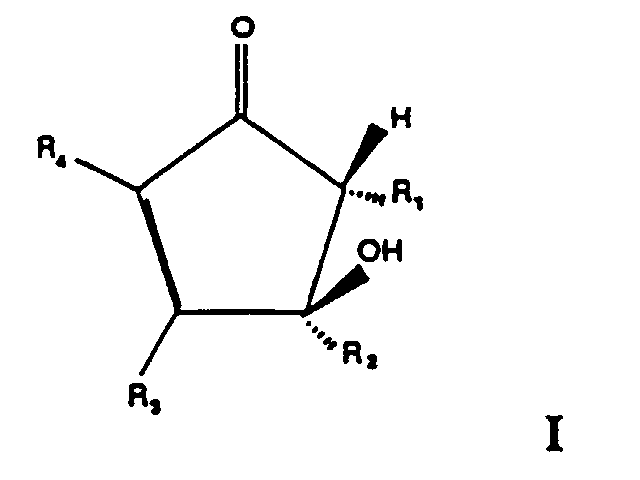
- the invention provides an article of manufacture which has a surface formed from a polymer composition, the polymer composition incorporating a quantity of a compound of the general formula I wherein:
- the invention provides a method of marking an article which has a surface formed from a polymer composition that incorporates a quantity of a compound of the general formula I wherein:
- the present invention is based partly on the appreciation that the colourless hydroxyketone has, in fact, a cis arrangement of the groups R 1 and R 2 , and therefore a cis arrangement of the 3-hydroxy group and the 2-hydrogen atom (as verified by X-Ray diffraction) rather than a trans arrangement.
- the compound is thermally stable at melt processing temperatures employed for plastics in the absence of an acid catalyst
- the colour change of the compound occurs by ⁇ -cleavage of the compound which allows rotation about the 2-carbon atom and recombination to produce a hydroxyketone in which the 2-hydrogen and the 3-hydroxy group are in the trans-configuration, followed by thermal dehydration under the action of the laser, to produce the coloured cyclopentadienone II, according to the following scheme:
- this reaction is allowed when the compound is dispersed in a polymer matrix since the polymer matrix will prevent fusion of the groups R 3 and R 4 , whereas when the compound is irradiated in a solvent the preferential cyclisation, and oxidation, and dehydration reactions occur:
- the group R 2 should not contain any eliminatable hydrogen atoms, that is to say it should not contain any hydrogen atoms that would be eliminated in preference to the hydrogen atom
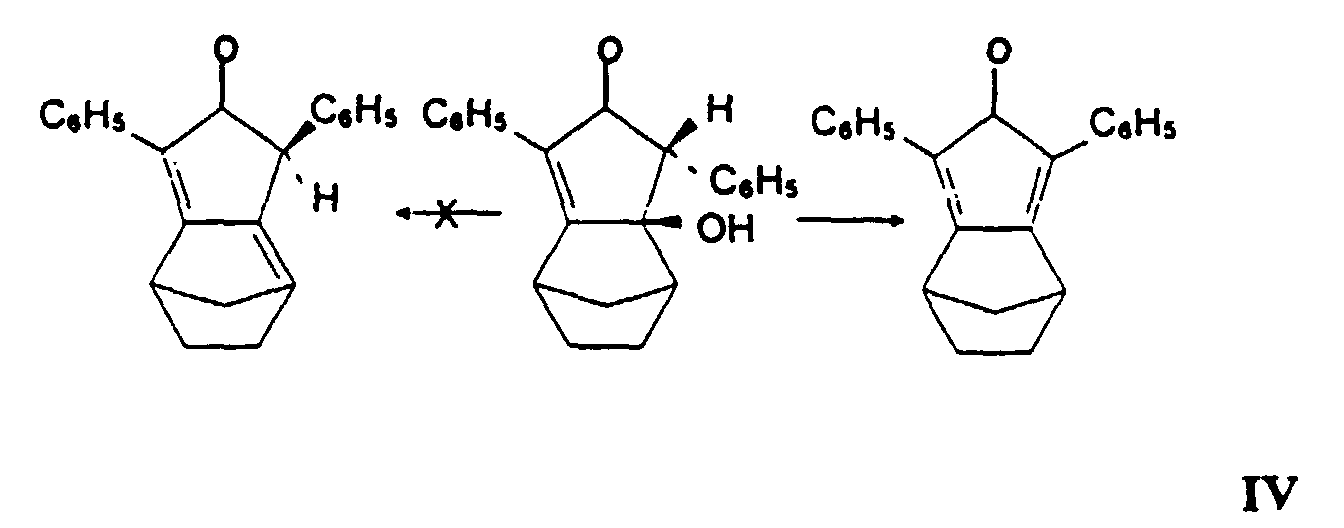
- the group R 2 may, however, contain hydrogen atoms in the 1-position if, for example, the product of dehydration is sufficiently strained to prevent exocyclic elimination as in the case of the compound of the formula IV
- R 1 and R 4 are together sufficiently large to prevent any dimerisation by a Diels Alder reaction of the cyclopentadienone resulting from the irradiation since this may, in some circumstances give a colourless product, for example if dimerisation interrupts conjugation in the chromophone.
- the indicia may be caused by the dimer.
- the groups R 1 and R 4 may be aryl groups, either homocyclic or heterocycic, (and preferably either phenyl or naphthyl, especially phenyl) which may be unsubstituted or substituted by either electron withdrawing or electron donating groups, preferably by alkyl, alkoxy or nitro groups or by halogen atoms, and especially by methoxy or nitro groups or by bromine atoms.
- the surface is preferably irradiated by means of a ultraviolet laser and especially an excimer laser at a typical fluence of from 0.1 to 4 J cm -2 .
- the compound may be incorporated into any article that it is desired to mark with a laser, for example the article may be an electrical wire or jacketted optical fibre or a cable comprising one or more electrical wires and/or optical fibres.
- the article may comprise moulded plastics housings for domestic or industrial equipment, credit and other cards for financial transactions.
- the compound of the formula I acts in a sense like a SMART dye (i.e. one which responds to environmental conditions and forms a colour accordingly).
- the compound is able to withstand the melt temperatures of the medium in which it is incorporated, but on application of the appropriate electromagnetic energy, can undergo a photochemical conversion to an isomeric form (also colourless) that is less thermally stable and which can undergo a thermal reaction at much lower temperatures to produce a black or highly coloured product that is completely photochemically and thermally stable.
- This property enables the compound of the formula I to be employed in articles that are used in a number of additional fields such as security coatings and anticounterfeit and tamper proof films and wrappings.
- the invention provides a method of forming an article which has a surface comprising a polymeric composition that incorporates a quantity of a compound of the general formula V wherein:
- the security article is applied thermally, for example in the form of a dimensionally heat-recoverable (shrink wrap) film
- the article may be subjected to intense ultraviolet light after it has been applied to a substrate, thereby allowing the compound to undergo ⁇ cleavage and rearrangement.
- the resulting compound can be chosen so that it will change colour at temperatures below those required for application of the article to the substrate so that any attempt to remove the article thermally will leave a mark.
- the film or wrapping may be removed without detectable damage but when an attempt is made to re-apply the film or wrapping, the necessary thermal treatment will cause the trans-hydroxyketone in the film or wrapping to dehydrate and the film or wrapping will become coloured, indicating that an attempt has been made to reuse the film or wrapping.
- Such articles may include coatings applied to credit cards, passports, as wrappings applied thermally for drugs and pharmaceuticals, and tamper proof wrappings applied thermally to all kinds of packages and containers such as whisky bottles, video cassettes etc.
- the article may contain other security features such as fluorescent marks, overprinting etc., and of course it is possible to write on the article by means of a laser as described above.
- Yet a further application of the article according to the present invention is in the provision of indication that products have (or have not) been subjected to elevated temperatures.
- Such products may include foodstuffs that are intended to be heat-treated e.g. sterilised or pasteurised, or medical equipment and the like.
- the article may be formed from any of a number of polymers, for example from low, medium or high density polyethylene, linear low density polyethylene, polypropylene, polystyrene, ethylene vinyl acetate copolymers, ethylene ethyl acrylate copolymers, polyvinyl chloride, polyamides, polyimides, fluoropolymers such as ETFE or reconstituted cellulose.
- the compound may be incorporated into the polymer composition by melt blending provided that the melting point of the polymer is not so high as to cause thermal dehydration of the compound. Alternatively it may be possible to imbibe the compound.
- the compound will normally be present in an amount of at least 0.05% by weight and especially at least 0.1% by weight but usually not more than 0.5% by weight, based on the weight of the polymer.
- the polymer composition may include other additives commonly employed, for example fillers, antioxidants, ultraviolet stabilisers, plasticisers, flame retardants, fungicides and the like.
- X-Ray analysis established the structure and stereochemistry.
- the compound (0.2g) was dissolved in molten polypropylene (40g) maintained at 190°C.
- the colourless melt was moulded into sheets (ca.2mm thickness) by pressing between platens and allowing to cool.
- the white sheets were used for the laser marking tests.
- the polypropylene sample was then marked with indicia using an excimer laser at a fluence of 1 Jcm -2 to produce dark grey marks with a high degree of contrast.
- the cis hydroxyketone is isomerised and dehydrated to form 2,3,4,5 - tetraphenylcyclopentadienone which has a broad absorption peak in the visible spectrum with a maximum at 514nm.
Landscapes
- Chemical & Material Sciences (AREA)
- Physics & Mathematics (AREA)
- Optics & Photonics (AREA)
- Health & Medical Sciences (AREA)
- Chemical Kinetics & Catalysis (AREA)
- Medicinal Chemistry (AREA)
- Polymers & Plastics (AREA)
- Organic Chemistry (AREA)
- Thermal Transfer Or Thermal Recording In General (AREA)
- Multi-Conductor Connections (AREA)
- Connections By Means Of Piercing Elements, Nuts, Or Screws (AREA)
Abstract
Description
- This invention relates to articles that can be marked and to marking of articles, and especially, although not exclusively, to laser marking of articles.
- Laser marking methods have become widespread in recent years for applying visible marks such as alphanumeric indicia to various articles, for example to electrical wires and cable. Laser writing on plastics, polymers, thin films (such as cellophane), paints, and varnishes can be achieved by burning, melting or ablation of the surface. These types of laser writing can lead to surface damage and reduce the durability of the material (e.g. the insulating coating on fine wires). Other processes, for example, foaming of the material or partial carbonisation of the material to provide a visible mark, can lead to damage if the energy of the laser pulse is too high or lead to a mark which lacks wear resistance if the energy of the laser pulse is too low.
- Alternative processes comprise the application of lacquer to the surface of the plastic so that as the lacquer is ablated by the laser energy, exposing the plastic to produce a contrasting mark (this process involves risk of surface damage and the additional coating process adds substantially to the cost) or irradiating a material that will change colour when subjected to a pulse of laser energy. In the latter process, an ultraviolet laser, such as an excimer laser, is normally employed and the article contains a material that will change colour when subjected to the laser radiation.
- Typically, titanium dioxide is employed in a concentration of 5-10% by weight but such systems, containing the titanium dioxide as a suspension, can suffer from the disadvantage that the concentration of titanium oxide can adversely affect the physical properties of the article.
- A recent patent describes yellow and red dyes incorporated into plastic to give an orange lacquer which is bleached by lasers to generate a yellow mark on a red background (Ciba Geigy EP 0327508). This process lacks the required contrast for laser writing in many instances. In addition, EP-A-0 572 178 describes resin compositions for laser marking which comprise a thermoplastic resin, one or more compounds selected from tetrazole compounds, sulfonylhydrazide compounds, nitroso compounds and azo compounds, carbon black and optionally a flame-retarding agent.
- It is an object of the present invention to provide a system in which the material that will change colour can be incorporated into a range of polymers, especially at relatively low concentration, and will provide a highly visible mark after irradiation. Since the material may have to be incorporated into the whole product it is preferably of relatively low cost, i.e. it is preferably capable of being prepared in high yield and purity from inexpensive reactants in a simple one-step process.
- According to one aspect, the invention provides an article of manufacture which has a surface formed from a polymer composition, the polymer composition incorporating a quantity of a compound of the general formula Iwherein:

- R1 and R4 which may be the same or different, each is a straight-chain, branched-chain or cyclic alkyl group or an aryl group, which groups may be unsubstituted or substituted and may include one or more hetero atoms;
- R2 is a straight-chain, branched-chain or cyclic alkyl group or an aryl group which may be unsubstituted or substituted and may include one or more hetero atoms, but which does not include any eliminatable α-hydrogen atoms; and
- R3, which may be fused with or separate from R2 or which may be fused
with or separate from R4, is straight-chain, branched-chain or cyclic alkyl
group or an aryl group which may be unsubstituted and may include one or
more hetero atoms;
provided that, whenever water is eliminated from the compound of the general formula I to form a cyclopentadienone, the groups R1 and R4 together have sufficient conjugated unsaturation to produce an absorption band in the visible spectrum. -
- According to another aspect, the invention provides a method of marking an article which has a surface formed from a polymer composition that incorporates a quantity of a compound of the general formula Iwherein:

- R1 and R4 which may be the same or different, each is a straight-chain, branched-chain or cyclic alkyl group or an aryl group, which groups may be unsubstituted or substituted and may include one or more hetero atoms;
- R2 is a straight-chain, branched-chain or cyclic alkyl group or an aryl group which may be unsubstituted or substituted and may include one or more hetero atoms, but which does not include any eliminatable α-hydrogen atoms; and
- R3, which may be fused with or separate from R2 or which may be fused
with or separate from R4, is a straight-chain, branched-chain or cyclic alkyl
group or an aryl group which may be unsubstituted or substituted and may
include one or more hetero atoms;
provided that, whenever water is eliminated from the compound of the general formula I to form a cyclopentadienone, the groups R1 to R4 together have sufficient conjugated unsaturation to produce an absorption band in the visible spectrum;
which comprises irradiating selected parts of the surface with a laser to form visible
marks thereon. -
- We have observed that it is possible to form highly visible permanent marks on the polymeric surface of the article by irradiation of the article with an excimer laser, whereas, if the compounds are dispersed in a solvent instead of a polymer, no such visible colour change occurs. Although the colourless hydroxyketone of the general formula I and the cyclopentadienone of the general formula II are known per se and may be formed by methods known in the art, it has generally been understood that the hydroxyketone has a trans configuration. We have discovered that these hydroxyketones do not have a trans configuration but instead have a cis configuration. The present invention is based partly on the appreciation that the colourless hydroxyketone has, in fact, a cis arrangement of the groups R1 and R2, and therefore a cis arrangement of the 3-hydroxy group and the 2-hydrogen atom (as verified by X-Ray diffraction) rather than a trans arrangement. In view of the cis arrangement, the compound is thermally stable at melt processing temperatures employed for plastics in the absence of an acid catalyst Without being bound to any particular theory, it is believed that the colour change of the compound occurs by α-cleavage of the compound which allows rotation about the 2-carbon atom and recombination to produce a hydroxyketone in which the 2-hydrogen and the 3-hydroxy group are in the trans-configuration, followed by thermal dehydration under the action of the laser, to produce the coloured cyclopentadienone II, according to the following scheme:Furthermore, it is believed that this reaction is allowed when the compound is dispersed in a polymer matrix since the polymer matrix will prevent fusion of the groups R3 and R4, whereas when the compound is irradiated in a solvent the preferential cyclisation, and oxidation, and dehydration reactions occur:
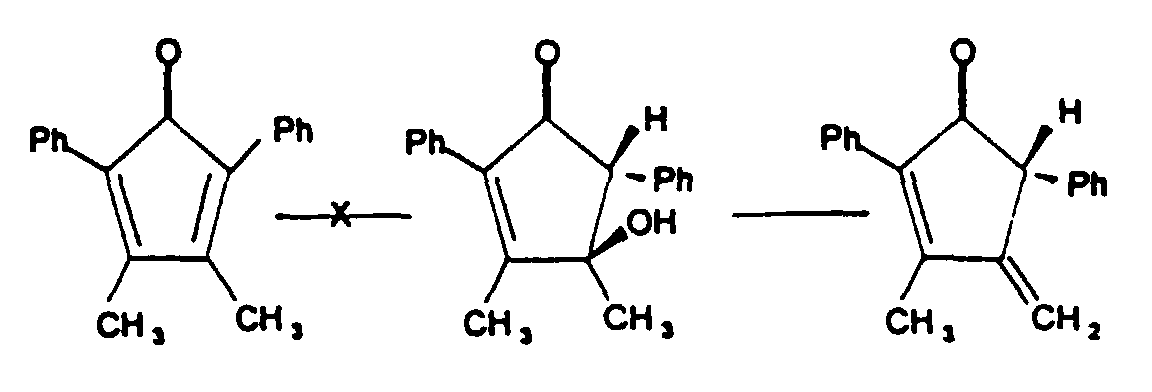
 As stated above, the group R2 should not contain any eliminatable hydrogen atoms, that is to say it should not contain any hydrogen atoms that would be eliminated in preference to the hydrogen atom in the 2-position when the compound is dehydrated. For example, where R2 and R3 are methyl groups, the resistance of the cis hydroxyketone to form an endocyclic double bond is illustrated by the following scheme in which dehydration occurs to form an exocyclic double bond.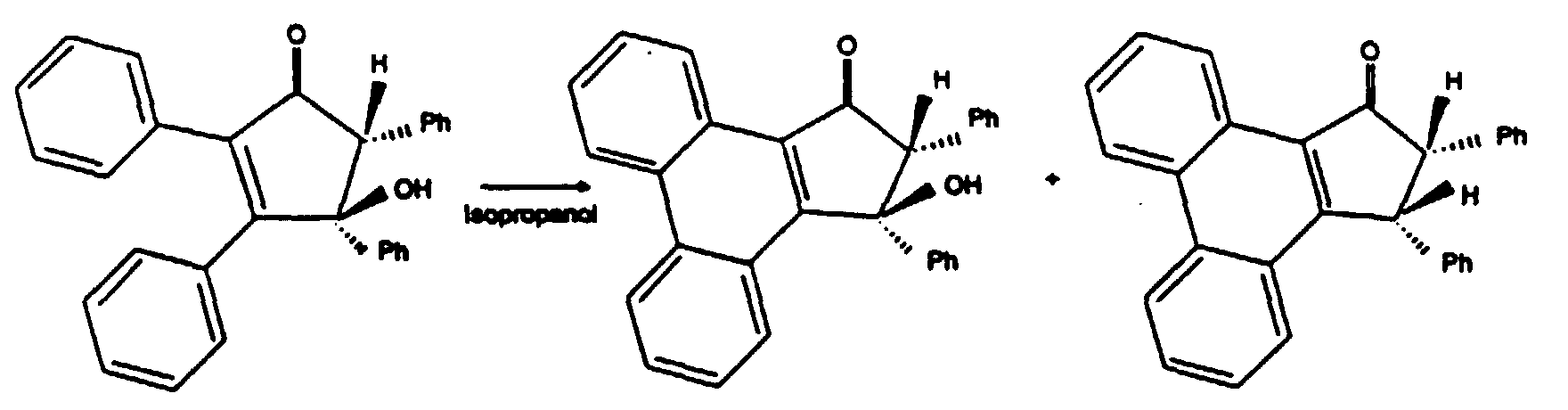
- The group R2 may, however, contain hydrogen atoms in the 1-position if, for example, the product of dehydration is sufficiently strained to prevent exocyclic elimination as in the case of the compound of the formula IVPreferably R1 and R4 are together sufficiently large to prevent any dimerisation by a Diels Alder reaction of the cyclopentadienone resulting from the irradiation since this may, in some circumstances give a colourless product, for example if dimerisation interrupts conjugation in the chromophone. However, in other circumstances, where the dimer absorbs in the visible spectrum, the indicia may be caused by the dimer.
- In the compound of the general formula I the groups R1 and R4 may be aryl groups, either homocyclic or heterocycic, (and preferably either phenyl or naphthyl, especially phenyl) which may be unsubstituted or substituted by either electron withdrawing or electron donating groups, preferably by alkyl, alkoxy or nitro groups or by halogen atoms, and especially by methoxy or nitro groups or by bromine atoms.
- The surface is preferably irradiated by means of a ultraviolet laser and especially an excimer laser at a typical fluence of from 0.1 to 4 J cm-2.
- The compound may be incorporated into any article that it is desired to mark with a laser, for example the article may be an electrical wire or jacketted optical fibre or a cable comprising one or more electrical wires and/or optical fibres. Alternatively, the article may comprise moulded plastics housings for domestic or industrial equipment, credit and other cards for financial transactions.
- The compound of the formula I acts in a sense like a SMART dye (i.e. one which responds to environmental conditions and forms a colour accordingly). The compound is able to withstand the melt temperatures of the medium in which it is incorporated, but on application of the appropriate electromagnetic energy, can undergo a photochemical conversion to an isomeric form (also colourless) that is less thermally stable and which can undergo a thermal reaction at much lower temperatures to produce a black or highly coloured product that is completely photochemically and thermally stable. This property enables the compound of the formula I to be employed in articles that are used in a number of additional fields such as security coatings and anticounterfeit and tamper proof films and wrappings.
- Thus, according to yet another aspect, the invention provides a method of forming an article which has a surface comprising a polymeric composition that incorporates a quantity of a compound of the general formula Vwherein:
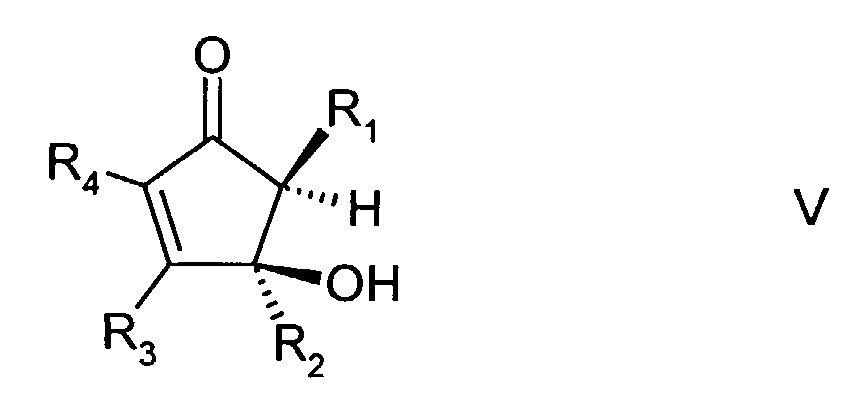
- R1 and R4, which may be the same or different, each is a straight-chain, branched-chain or cyclic alkyl group or an aryl group, which groups may be unsubstituted or substituted and may include one or more hetero atoms.
- R2 is a straight-chain, branched-chain or cyclic alkyl group or an aryl which may be unsubstituted or substituted and may include one or more hetero atoms, but which does not include any eliminatable α-hydrogen atoms; and
- R3, which may be fused with or separate from R2 or which may be fused
with or separate from R4, is a straight-chain, branched-chain or cyclic alkyl
group or an aryl group which may be unsubstituted or substituted and may
include one or more hetero atoms;
provided that, when water is eliminated from the compound of the general formula I to form a cyclopentadienone, the groups R1 to R4 together have sufficient conjugated unsaturation to produce an absorption band in the visible spectrum;
which method comprises incorporating in a polymeric composition a quantity of a
compound of the general formula I
-
- Where the security article is applied thermally, for example in the form of a dimensionally heat-recoverable (shrink wrap) film, the article may be subjected to intense ultraviolet light after it has been applied to a substrate, thereby allowing the compound to undergo α cleavage and rearrangement. The resulting compound can be chosen so that it will change colour at temperatures below those required for application of the article to the substrate so that any attempt to remove the article thermally will leave a mark. Alternatively, in other cases the film or wrapping may be removed without detectable damage but when an attempt is made to re-apply the film or wrapping, the necessary thermal treatment will cause the trans-hydroxyketone in the film or wrapping to dehydrate and the film or wrapping will become coloured, indicating that an attempt has been made to reuse the film or wrapping.
- Such articles may include coatings applied to credit cards, passports, as wrappings applied thermally for drugs and pharmaceuticals, and tamper proof wrappings applied thermally to all kinds of packages and containers such as whisky bottles, video cassettes etc. The article may contain other security features such as fluorescent marks, overprinting etc., and of course it is possible to write on the article by means of a laser as described above.
- Yet a further application of the article according to the present invention is in the provision of indication that products have (or have not) been subjected to elevated temperatures. Such products may include foodstuffs that are intended to be heat-treated e.g. sterilised or pasteurised, or medical equipment and the like.
- The article may be formed from any of a number of polymers, for example from low, medium or high density polyethylene, linear low density polyethylene, polypropylene, polystyrene, ethylene vinyl acetate copolymers, ethylene ethyl acrylate copolymers, polyvinyl chloride, polyamides, polyimides, fluoropolymers such as ETFE or reconstituted cellulose. The compound may be incorporated into the polymer composition by melt blending provided that the melting point of the polymer is not so high as to cause thermal dehydration of the compound. Alternatively it may be possible to imbibe the compound. The compound will normally be present in an amount of at least 0.05% by weight and especially at least 0.1% by weight but usually not more than 0.5% by weight, based on the weight of the polymer. The polymer composition may include other additives commonly employed, for example fillers, antioxidants, ultraviolet stabilisers, plasticisers, flame retardants, fungicides and the like.
- The following Examples illustrate the invention.
- Equimolar quantities of 1, 3-diphenylpropan-2-one and benzil were dissolved in ethanol and a one fifth molar proportion of potassium hydroxide in ethanol was added dropwise. After stirring the solution for one hour, the solution was cooled and the near colourless solid was filtered off and recrystallised from chloroform to give 3-hydroxy-cis-2,3,4,5-tetraphenylcyclopent-4-enone-1 (m.p.198°C) in an 83% yield. The compound had an absorption peak at 340nm.
- X-Ray analysis established the structure and stereochemistry.
The compound (0.2g) was dissolved in molten polypropylene (40g) maintained at 190°C. The colourless melt was moulded into sheets (ca.2mm thickness) by pressing between platens and allowing to cool. The white sheets were used for the laser marking tests. - The polypropylene sample was then marked with indicia using an excimer laser at a fluence of 1 Jcm-2 to produce dark grey marks with a high degree of contrast. During the marking step, the cis hydroxyketone is isomerised and dehydrated to form 2,3,4,5 - tetraphenylcyclopentadienone which has a broad absorption peak in the visible spectrum with a maximum at 514nm.
- Compounds 1 to 6 shown in Scheme 1 and defined in Table 1 were prepared from reactants A and B in Table 1 by methods analogous to that given in Example 1. In order to prepare the cis-hydroxyketone (7), a solution of cis-4-hydroxy-2,3,4,5-tetraphenyl-2-cyclopenten-1-one (1, R1 = R2 = H) (3g, 7.4mmol) in isopropanol (150cm3) was irradiated in a photochemical reactor with a 200 watt mercury lamp for 48 hours. The solvent was removed and the residual colourless solid column chromatographed giving the cis-hydroxyketone (7) (2.37g, 79%), m.p. 235-236°C (ether).

Example Reactant A Reactant B cis-Hydroxyketone 1 1,3-Diphenylpropan-2-one Benzil (1)R1 = R2 = H 2 1,3-Di(4-nitrophenyl) propan-2-one Ditto (1) R1 = NO2 R2 = H 3 1,3-Di(4-bromophenyl) propan-2-one Ditto (1) R1 = Br R2 = H 4 1,3-Di(4-methoxyphenyl) propan-2-one Ditto (1) R1 = OCH3 R2 = H 5 1,3-Diphenylpropan-2-one 4,4'-Dibromobenzil (1) R1 = H R2 = Br 6 Ditto Acenaphthenquinone (2) R1 = H 7 1,3-Di(4-bromophenyl) propan-2-one Ditto (2) R1 = Br 8 1,3-Diphenylpropan-2-one Phenanthrenquinone (3) 9 Ditto Norcamphorquinone (4) 10 Ditto Tricyclo [5,2,1,02,6] -decane-8,9-dione (5) 11 3-Pentanone Acenaphthenquinone (6) Example cis-Hydroxy ketone M.P. (°C) Solvent of recrystallisation Yield (%) Colour 1 (1) R1 =R2 = H 179-182 Chloroform 83 Black 2 (1) R1 = NO2 134-135 Dichloromethane 61 Dark red R2 = H 3 (1) R1 = Br, 160-162 Ether 26 Black R2 = H 4 (1) R1 = OCH3 178-179 Ethanol 58 Black R2 = H 5 (1) R1 = H 109-111 Ether 62 Dark red R2 = Br 6 (2) R1 = H 229-231 Ethanol 73 Black 7 (2) R1 = H 270-272 Dichloromethane 63 Black 8 (3) 239-242 Chloroform 80 Black 9 (4) Oil - 55 Red 10 (5) Oil - 51 Red 11 (6) 192-195 THF 59 Yellow 12 (7) 235-236 Ether 79 Dark red
Claims (15)
- An article of manufacture which has a surface formed from a polymer composition, the polymer composition incorporating a quantity of a compound of the general formula I;wherein:
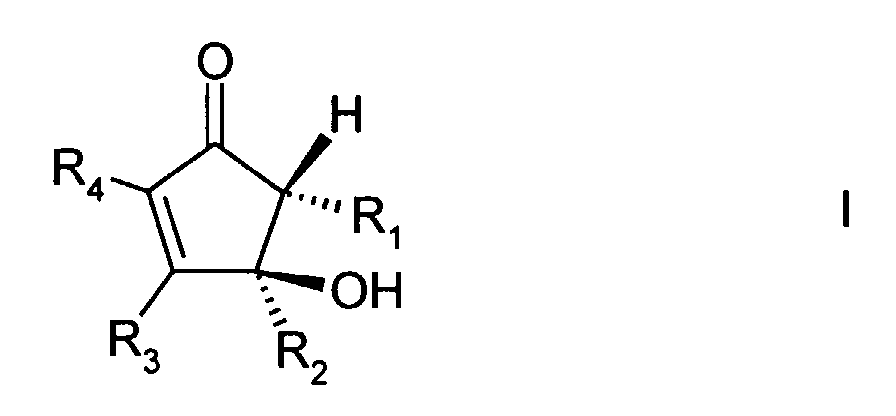 R1 and R4, which may be the same or different, each is a straight-chain, branched-chain or cyclic alkyl group or an aryl group, which groups may be unsubstituted or substituted and may include one or more hereto atoms.R2 is a straight-chain, branched-chain or cyclic alkyl group or an aryl group which may be unsubstituted or substituted and may include one or more hetero atoms, but which does not include any eliminatable α-hydrogen atoms; andR3, which may be fused with or separate from R2 or which may be fused or separate from R4, is a straight-chain, branched-chain or cyclic alkyl group or an aryl group which may be unsubstituted or substituted and may include one or more hetero atoms;
provided that, whenever water is eliminated from the compound of the general formula I to form a cyclopentadienone, the groups R1 to R4 together have sufficient conjugated unsaturation to produce an absorption band in the visible spectrum. - An article as claimed in claim 1, wherein each of the groups R1 and R4 do not contain any hetero atoms.
- An article as claimed in claim 1 or claim 2, wherein R2 and R3 are separate groups.
- An article as claimed in any one of claims 1 to 3 wherein each of groups R1 to R4 are aryl groups.
- An article as claimed in any one of claims 1 to 4 wherein each of the groups R1 to R4 is a phenyl group that is unsubstituted, or substituted by one or more substituents selected from alkyl groups, alkoxy groups, nitro groups or halogen atoms.
- An article as claimed in claim 1 wherein the compound has the formula IIIwherein
 Ph represents a phenyl group.
 - An article as claimed in claim 1, wherein R1 and R4 are each a phenyl group and R2 and R3 are each a p-bromophenyl group, a p-methoxyphenyl group or a 2 pyridyl group.
- An article as claimed in claim 1, wherein the groups R1 and R4 are each a p-nitrophenyl group, a p-methoxy phenyl group or a p-bromophenyl group and R2 and R3 are each a phenyl group.
- An article as claimed in any one of claims 1 to 8, which is an electrical wire, an optical fibre or an electrical and/or optical cable.
- A method of marking an article as claimed in claim 1, which comprises irradiating selected parts of the surface with a laser to form visible marks thereon.
- A method as claimed in claim 10 wherein the laser is an excimer laser.
- A method as claimed in claim 10 or claim 11, wherein the article is as defined in any one of claims 2 to 9.
- A method of forming an article which has a surface comprising a polymeric composition that incorporates a quantity of a compound of the general formula V;wherein:
 which method comprises incorporating in a polymeric composition a quantity of a compound of the general formula IR1 and R4 which may be the same or different, each is a straight-chain, branched-chain or cyclic alkyl group or an aryl group, which groups may be unsubstituted or substituted and may include one or more hetero atoms.R2 is a straight-chain, branched-chain or cyclic alkyl group or an aryl group which may be unsubstituted or substituted and may include one or more hetero atoms, but which does not include any eliminatable α-hydrogen atoms; andR3 which may be fused with or separate from R2 or which may be fused with or separate from R4, is a straight-chain, branched-chain or cyclic alkyl group or an aryl group which may be unsubstituted or substituted and may include one or more hetero atoms;
provided that, when water is eliminated from the compound of the general formula I to form a cyclopentadienone, the groups R1 to R4 together have sufficient conjugated unsaturation to produce an absorption band in the visible spectrum;wherein the groups R1 to R4 are as defined with respect to the compound of the general formula V, and exposing the polymeric material to ultraviolet radiation to cause at least some of the compound of the general formula I to undergo a photochemical rearrangement to the compound of the general formula V.
 - A method as claimed in claim 13, which includes the step of applying the polymeric composition to a substrate by a thermal means before the step of exposing it to ultraviolet radiation.
- A method as claimed in claim 14, wherein during the step of applying the polymeric composition to the substrate, it is heated to a temperature above the temperature at which the compound of the general formula V thermally dehydrates.
Applications Claiming Priority (5)
| Application Number | Priority Date | Filing Date | Title |
|---|---|---|---|
| GB9514343 | 1995-05-13 | ||
| GB9510655 | 1995-05-25 | ||
| GBGB9510655.5A GB9510655D0 (en) | 1995-05-25 | 1995-05-25 | Method of marking an article |
| GBGB9514343.4A GB9514343D0 (en) | 1995-07-13 | 1995-07-13 | Method of making an article |
| PCT/GB1996/001175 WO1996037369A1 (en) | 1995-05-25 | 1996-05-17 | Method of marking an article |
Publications (2)
| Publication Number | Publication Date |
|---|---|
| EP0828614A1 EP0828614A1 (en) | 1998-03-18 |
| EP0828614B1 true EP0828614B1 (en) | 2000-01-05 |
Family
ID=26307093
Family Applications (1)
| Application Number | Title | Priority Date | Filing Date |
|---|---|---|---|
| EP96914290A Expired - Lifetime EP0828614B1 (en) | 1995-05-25 | 1996-05-17 | Article intended for marking and a method of marking it |
Country Status (5)
| Country | Link |
|---|---|
| US (1) | US5916943A (en) |
| EP (1) | EP0828614B1 (en) |
| AU (1) | AU5769996A (en) |
| DE (1) | DE69606032T2 (en) |
| WO (1) | WO1996037369A1 (en) |
Families Citing this family (8)
| Publication number | Priority date | Publication date | Assignee | Title |
|---|---|---|---|---|
| DE19629675A1 (en) * | 1996-07-23 | 1998-01-29 | Merck Patent Gmbh | Laser-markable plastics |
| RU2183560C2 (en) * | 1999-06-01 | 2002-06-20 | Российский Федеральный Ядерный Центр - Всероссийский Научно-Исследовательский Институт Экспериментальной Физики | Method for labeling controlled entities |
| US6776340B2 (en) * | 1999-07-23 | 2004-08-17 | Tri Star Technologies, A General Partnership | Duplicate laser marking discrete consumable articles |
| US6429889B1 (en) * | 1999-07-23 | 2002-08-06 | Tri-Star Technologies | Laser marking discrete consumable articles |
| AU2001264658A1 (en) * | 2000-05-18 | 2001-11-26 | Spectra Systems Corporation | Visual indicator for verification of an object |
| NL1015686C2 (en) * | 2000-07-12 | 2002-01-15 | Dsm Nv | Method for irreversibly applying laser irradiation of a marking on a polymer molded part to the naked eye. |
| EP1452338A1 (en) * | 2003-02-28 | 2004-09-01 | Eidgenössische Technische Hochschule (ETH) | Patterned dichroic security features |
| US20100125002A1 (en) * | 2008-11-14 | 2010-05-20 | Taylor Made Golf Company, Inc. | Resin compositions incorporating modified polyisocyanate and method for their manufacture and use |
Family Cites Families (3)
| Publication number | Priority date | Publication date | Assignee | Title |
|---|---|---|---|---|
| US4371711A (en) * | 1979-05-30 | 1983-02-01 | Sumitomo Chemical Company, Limited | Process for producing 4-hydroxycyclopentenones |
| JP3102822B2 (en) * | 1992-05-29 | 2000-10-23 | 日本ジーイープラスチックス株式会社 | Resin composition for laser marking |
| JPH06161123A (en) * | 1992-11-17 | 1994-06-07 | Mita Ind Co Ltd | Photosensitive body for electrophotography |
-
1996
- 1996-05-17 US US08/952,729 patent/US5916943A/en not_active Expired - Fee Related
- 1996-05-17 DE DE69606032T patent/DE69606032T2/en not_active Expired - Lifetime
- 1996-05-17 WO PCT/GB1996/001175 patent/WO1996037369A1/en not_active Ceased
- 1996-05-17 AU AU57699/96A patent/AU5769996A/en not_active Abandoned
- 1996-05-17 EP EP96914290A patent/EP0828614B1/en not_active Expired - Lifetime
Also Published As
| Publication number | Publication date |
|---|---|
| EP0828614A1 (en) | 1998-03-18 |
| AU5769996A (en) | 1996-12-11 |
| DE69606032D1 (en) | 2000-02-10 |
| WO1996037369A1 (en) | 1996-11-28 |
| US5916943A (en) | 1999-06-29 |
| DE69606032T2 (en) | 2000-08-03 |
Similar Documents
| Publication | Publication Date | Title |
|---|---|---|
| JP2947878B2 (en) | Moldings, semi-finished products and finished parts consisting of polymeric substances which can be marked and / or described with a laser beam | |
| CA2506729C (en) | Polymeric material containing a latent acid | |
| JP2922306B2 (en) | Oxygen scavengers unrelated to transition metal catalysts | |
| TWI301496B (en) | Polyester and polyamide compositions of low residual aldehyde content | |
| US4085062A (en) | N,N'-bis-aromaticformamidines useful as sunscreening agents | |
| US5266447A (en) | Photochromic composition | |
| US5916943A (en) | Method of marking an article | |
| EP0822968B1 (en) | Triggered active packaging material | |
| EP0279600A1 (en) | Marking | |
| KR20080050503A (en) | Encapsulated Luminescent Pigment | |
| EP0771839A3 (en) | Pigments and process for their preparation | |
| US3920659A (en) | Certain alkyl alkanoate derivatives of substituted piperazino-diones | |
| WO2007057367A2 (en) | Tetrabenzodiazadiketoperylene pigments for laser marking | |
| WO1983004258A1 (en) | Acylated hindered hexahydropyrimidines and their use as light stabilizing agents | |
| US20040055492A1 (en) | Irreversible application of an invisible marking to polymer mouldings | |
| US3907803A (en) | Hindered piperidine carboxamide acids and metal salts thereof | |
| JPH0678310B2 (en) | Novel dihydropyridines with hindered amine groups | |
| GB1584202A (en) | Tetrabromophthalimide derivatives and their use as flameproofing agents | |
| AU2009336646A1 (en) | Time temperature indicator comprising indolenin based spiropyrans | |
| JPS61176640A (en) | 2-phenylbenzotriazole type ultraviolet light absorber | |
| EP1296837B1 (en) | Laser-markable polymer composition | |
| US3978033A (en) | Difurfurylidene cycloalkanones as photoactive prodegradants for polyolefins | |
| US3567647A (en) | Phosphorescent crystals | |
| US5134193A (en) | Low density polyethylene containing chemically bonded chromophores as UV prodegradants | |
| Allen et al. | Synthesis and thermal and photo-oxidative behaviour of novel aminated 2-hydroxybenzophenone stabilizers in polyolefin films |
Legal Events
| Date | Code | Title | Description |
|---|---|---|---|
| PUAI | Public reference made under article 153(3) epc to a published international application that has entered the european phase |
Free format text: ORIGINAL CODE: 0009012 |
|
| 17P | Request for examination filed |
Effective date: 19971209 |
|
| AK | Designated contracting states |
Kind code of ref document: A1 Designated state(s): DE FR GB |
|
| GRAG | Despatch of communication of intention to grant |
Free format text: ORIGINAL CODE: EPIDOS AGRA |
|
| 17Q | First examination report despatched |
Effective date: 19990301 |
|
| GRAG | Despatch of communication of intention to grant |
Free format text: ORIGINAL CODE: EPIDOS AGRA |
|
| GRAH | Despatch of communication of intention to grant a patent |
Free format text: ORIGINAL CODE: EPIDOS IGRA |
|
| GRAH | Despatch of communication of intention to grant a patent |
Free format text: ORIGINAL CODE: EPIDOS IGRA |
|
| RTI1 | Title (correction) |
Free format text: ARTICLE INTENDED FOR MARKING AND A METHOD OF MARKING IT |
|
| GRAA | (expected) grant |
Free format text: ORIGINAL CODE: 0009210 |
|
| AK | Designated contracting states |
Kind code of ref document: B1 Designated state(s): DE FR GB |
|
| ET | Fr: translation filed | ||
| REF | Corresponds to: |
Ref document number: 69606032 Country of ref document: DE Date of ref document: 20000210 |
|
| PLBE | No opposition filed within time limit |
Free format text: ORIGINAL CODE: 0009261 |
|
| STAA | Information on the status of an ep patent application or granted ep patent |
Free format text: STATUS: NO OPPOSITION FILED WITHIN TIME LIMIT |
|
| 26N | No opposition filed | ||
| REG | Reference to a national code |
Ref country code: GB Ref legal event code: IF02 |
|
| REG | Reference to a national code |
Ref country code: GB Ref legal event code: 732E |
|
| REG | Reference to a national code |
Ref country code: FR Ref legal event code: TQ |
|
| PGFP | Annual fee paid to national office [announced via postgrant information from national office to epo] |
Ref country code: FR Payment date: 20100520 Year of fee payment: 15 |
|
| PGFP | Annual fee paid to national office [announced via postgrant information from national office to epo] |
Ref country code: DE Payment date: 20100524 Year of fee payment: 15 |
|
| PGFP | Annual fee paid to national office [announced via postgrant information from national office to epo] |
Ref country code: GB Payment date: 20100518 Year of fee payment: 15 |
|
| REG | Reference to a national code |
Ref country code: DE Ref legal event code: R119 Ref document number: 69606032 Country of ref document: DE |
|
| REG | Reference to a national code |
Ref country code: DE Ref legal event code: R119 Ref document number: 69606032 Country of ref document: DE |
|
| GBPC | Gb: european patent ceased through non-payment of renewal fee |
Effective date: 20110517 |
|
| REG | Reference to a national code |
Ref country code: FR Ref legal event code: ST Effective date: 20120131 |
|
| PG25 | Lapsed in a contracting state [announced via postgrant information from national office to epo] |
Ref country code: FR Free format text: LAPSE BECAUSE OF NON-PAYMENT OF DUE FEES Effective date: 20110531 |
|
| PG25 | Lapsed in a contracting state [announced via postgrant information from national office to epo] |
Ref country code: GB Free format text: LAPSE BECAUSE OF NON-PAYMENT OF DUE FEES Effective date: 20110517 |
|
| PG25 | Lapsed in a contracting state [announced via postgrant information from national office to epo] |
Ref country code: DE Free format text: LAPSE BECAUSE OF NON-PAYMENT OF DUE FEES Effective date: 20111130 |