EP0827425B1 - Combination reagent holding and test device - Google Patents
Combination reagent holding and test device Download PDFInfo
- Publication number
- EP0827425B1 EP0827425B1 EP97909010A EP97909010A EP0827425B1 EP 0827425 B1 EP0827425 B1 EP 0827425B1 EP 97909010 A EP97909010 A EP 97909010A EP 97909010 A EP97909010 A EP 97909010A EP 0827425 B1 EP0827425 B1 EP 0827425B1
- Authority
- EP
- European Patent Office
- Prior art keywords
- test
- chamber
- blood
- sample
- transfer member
- Prior art date
- Legal status (The legal status is an assumption and is not a legal conclusion. Google has not performed a legal analysis and makes no representation as to the accuracy of the status listed.)
- Expired - Lifetime
Links
- 238000012360 testing method Methods 0.000 title claims abstract description 177
- 239000003153 chemical reaction reagent Substances 0.000 title claims abstract description 38
- 238000003556 assay Methods 0.000 claims abstract description 66
- 238000005192 partition Methods 0.000 claims abstract description 62
- 238000012546 transfer Methods 0.000 claims abstract description 60
- 239000007788 liquid Substances 0.000 claims abstract description 27
- 239000008280 blood Substances 0.000 claims description 70
- 210000004369 blood Anatomy 0.000 claims description 69
- 239000012528 membrane Substances 0.000 claims description 30
- 239000000463 material Substances 0.000 claims description 22
- XTWYTFMLZFPYCI-KQYNXXCUSA-N 5'-adenylphosphoric acid Chemical compound C1=NC=2C(N)=NC=NC=2N1[C@@H]1O[C@H](COP(O)(=O)OP(O)(O)=O)[C@@H](O)[C@H]1O XTWYTFMLZFPYCI-KQYNXXCUSA-N 0.000 claims description 21
- 239000003795 chemical substances by application Substances 0.000 claims description 14
- 102000008186 Collagen Human genes 0.000 claims description 13
- 108010035532 Collagen Proteins 0.000 claims description 13
- 229920001436 collagen Polymers 0.000 claims description 13
- 239000012190 activator Substances 0.000 claims description 10
- 230000017531 blood circulation Effects 0.000 claims description 10
- 230000015271 coagulation Effects 0.000 claims description 10
- 238000005345 coagulation Methods 0.000 claims description 10
- 238000000034 method Methods 0.000 claims description 9
- UCTWMZQNUQWSLP-VIFPVBQESA-N (R)-adrenaline Chemical compound CNC[C@H](O)C1=CC=C(O)C(O)=C1 UCTWMZQNUQWSLP-VIFPVBQESA-N 0.000 claims description 8
- 229930182837 (R)-adrenaline Natural products 0.000 claims description 8
- 238000006243 chemical reaction Methods 0.000 claims description 8
- 229960005139 epinephrine Drugs 0.000 claims description 8
- 239000000427 antigen Substances 0.000 claims description 6
- 102000036639 antigens Human genes 0.000 claims description 6
- 108091007433 antigens Proteins 0.000 claims description 6
- 230000015572 biosynthetic process Effects 0.000 claims description 6
- 230000000977 initiatory effect Effects 0.000 claims description 6
- -1 polypropylene Polymers 0.000 claims description 6
- 239000004743 Polypropylene Substances 0.000 claims description 5
- 230000023555 blood coagulation Effects 0.000 claims description 5
- 239000002274 desiccant Substances 0.000 claims description 5
- 239000003446 ligand Substances 0.000 claims description 5
- 229920001155 polypropylene Polymers 0.000 claims description 5
- 208000010110 spontaneous platelet aggregation Diseases 0.000 claims description 5
- PGOHTUIFYSHAQG-LJSDBVFPSA-N (2S)-6-amino-2-[[(2S)-5-amino-2-[[(2S)-2-[[(2S)-2-[[(2S)-2-[[(2S)-4-amino-2-[[(2S)-2-[[(2S)-2-[[(2S)-2-[[(2S)-2-[[(2S)-5-amino-2-[[(2S)-5-amino-2-[[(2S)-2-[[(2S)-2-[[(2S)-2-[[(2S,3R)-2-[[(2S)-5-amino-2-[[(2S)-2-[[(2S)-2-[[(2S,3R)-2-[[(2S)-2-[[(2S)-2-[[(2S)-2-[[(2S)-2-[[(2S)-5-amino-2-[[(2S)-1-[(2S,3R)-2-[[(2S)-2-[[(2S)-2-[[(2R)-2-[[(2S)-2-[[(2S)-2-[[2-[[(2S)-2-[[(2S)-2-[[(2S)-2-[[(2S)-1-[(2S)-2-[[(2S)-2-[[(2S)-2-[[(2S)-2-amino-4-methylsulfanylbutanoyl]amino]-3-(1H-indol-3-yl)propanoyl]amino]-5-carbamimidamidopentanoyl]amino]propanoyl]pyrrolidine-2-carbonyl]amino]-3-methylbutanoyl]amino]-4-methylpentanoyl]amino]-4-methylpentanoyl]amino]acetyl]amino]-3-hydroxypropanoyl]amino]-4-methylpentanoyl]amino]-3-sulfanylpropanoyl]amino]-4-methylsulfanylbutanoyl]amino]-5-carbamimidamidopentanoyl]amino]-3-hydroxybutanoyl]pyrrolidine-2-carbonyl]amino]-5-oxopentanoyl]amino]-3-hydroxypropanoyl]amino]-3-hydroxypropanoyl]amino]-3-(1H-imidazol-5-yl)propanoyl]amino]-4-methylpentanoyl]amino]-3-hydroxybutanoyl]amino]-3-(1H-indol-3-yl)propanoyl]amino]-5-carbamimidamidopentanoyl]amino]-5-oxopentanoyl]amino]-3-hydroxybutanoyl]amino]-3-hydroxypropanoyl]amino]-3-carboxypropanoyl]amino]-3-hydroxypropanoyl]amino]-5-oxopentanoyl]amino]-5-oxopentanoyl]amino]-3-phenylpropanoyl]amino]-5-carbamimidamidopentanoyl]amino]-3-methylbutanoyl]amino]-4-methylpentanoyl]amino]-4-oxobutanoyl]amino]-5-carbamimidamidopentanoyl]amino]-3-(1H-indol-3-yl)propanoyl]amino]-4-carboxybutanoyl]amino]-5-oxopentanoyl]amino]hexanoic acid Chemical compound CSCC[C@H](N)C(=O)N[C@@H](Cc1c[nH]c2ccccc12)C(=O)N[C@@H](CCCNC(N)=N)C(=O)N[C@@H](C)C(=O)N1CCC[C@H]1C(=O)N[C@@H](C(C)C)C(=O)N[C@@H](CC(C)C)C(=O)N[C@@H](CC(C)C)C(=O)NCC(=O)N[C@@H](CO)C(=O)N[C@@H](CC(C)C)C(=O)N[C@@H](CS)C(=O)N[C@@H](CCSC)C(=O)N[C@@H](CCCNC(N)=N)C(=O)N[C@@H]([C@@H](C)O)C(=O)N1CCC[C@H]1C(=O)N[C@@H](CCC(N)=O)C(=O)N[C@@H](CO)C(=O)N[C@@H](CO)C(=O)N[C@@H](Cc1cnc[nH]1)C(=O)N[C@@H](CC(C)C)C(=O)N[C@@H]([C@@H](C)O)C(=O)N[C@@H](Cc1c[nH]c2ccccc12)C(=O)N[C@@H](CCCNC(N)=N)C(=O)N[C@@H](CCC(N)=O)C(=O)N[C@@H]([C@@H](C)O)C(=O)N[C@@H](CO)C(=O)N[C@@H](CC(O)=O)C(=O)N[C@@H](CO)C(=O)N[C@@H](CCC(N)=O)C(=O)N[C@@H](CCC(N)=O)C(=O)N[C@@H](Cc1ccccc1)C(=O)N[C@@H](CCCNC(N)=N)C(=O)N[C@@H](C(C)C)C(=O)N[C@@H](CC(C)C)C(=O)N[C@@H](CC(N)=O)C(=O)N[C@@H](CCCNC(N)=N)C(=O)N[C@@H](Cc1c[nH]c2ccccc12)C(=O)N[C@@H](CCC(O)=O)C(=O)N[C@@H](CCC(N)=O)C(=O)N[C@@H](CCCCN)C(O)=O PGOHTUIFYSHAQG-LJSDBVFPSA-N 0.000 claims description 4
- 108010094028 Prothrombin Proteins 0.000 claims description 4
- 102100027378 Prothrombin Human genes 0.000 claims description 4
- 108010000499 Thromboplastin Proteins 0.000 claims description 4
- 102000002262 Thromboplastin Human genes 0.000 claims description 4
- YZXBAPSDXZZRGB-DOFZRALJSA-N arachidonic acid Chemical compound CCCCC\C=C/C\C=C/C\C=C/C\C=C/CCCC(O)=O YZXBAPSDXZZRGB-DOFZRALJSA-N 0.000 claims description 4
- 238000005520 cutting process Methods 0.000 claims description 4
- 230000006624 extrinsic pathway Effects 0.000 claims description 4
- 230000006623 intrinsic pathway Effects 0.000 claims description 4
- 230000008569 process Effects 0.000 claims description 4
- 229940039716 prothrombin Drugs 0.000 claims description 4
- OXHYRVSBKWIFES-WWSDOYNLSA-N trap-14 peptide Chemical compound C([C@@H](C(=O)N[C@@H](CC(C)C)C(=O)N[C@@H](CC(C)C)C(=O)N[C@@H](CCCNC(N)=N)C(=O)N[C@@H](CC(N)=O)C(=O)N1[C@@H](CCC1)C(=O)N[C@@H](CC(N)=O)C(=O)N[C@@H](CC(O)=O)C(=O)N[C@@H](CCCCN)C(=O)N[C@@H](CC=1C=CC(O)=CC=1)C(=O)N[C@@H](CCC(O)=O)C(=O)N1[C@@H](CCC1)C(=O)N[C@@H](CC=1C=CC=CC=1)C(O)=O)NC(=O)[C@@H](N)CO)C1=CC=CC=C1 OXHYRVSBKWIFES-WWSDOYNLSA-N 0.000 claims description 4
- 102000007469 Actins Human genes 0.000 claims description 3
- 108010085238 Actins Proteins 0.000 claims description 3
- 239000002033 PVDF binder Substances 0.000 claims description 3
- 230000002776 aggregation Effects 0.000 claims description 3
- 238000004220 aggregation Methods 0.000 claims description 3
- 229920002678 cellulose Polymers 0.000 claims description 3
- 229920002981 polyvinylidene fluoride Polymers 0.000 claims description 3
- QTBSBXVTEAMEQO-UHFFFAOYSA-M Acetate Chemical compound CC([O-])=O QTBSBXVTEAMEQO-UHFFFAOYSA-M 0.000 claims description 2
- 229910002651 NO3 Inorganic materials 0.000 claims description 2
- NHNBFGGVMKEFGY-UHFFFAOYSA-N Nitrate Chemical compound [O-][N+]([O-])=O NHNBFGGVMKEFGY-UHFFFAOYSA-N 0.000 claims description 2
- 239000004677 Nylon Substances 0.000 claims description 2
- 108010081391 Ristocetin Proteins 0.000 claims description 2
- 108090000190 Thrombin Proteins 0.000 claims description 2
- 229940114079 arachidonic acid Drugs 0.000 claims description 2
- 235000021342 arachidonic acid Nutrition 0.000 claims description 2
- 239000000919 ceramic Substances 0.000 claims description 2
- BGTFCAQCKWKTRL-YDEUACAXSA-N chembl1095986 Chemical compound C1[C@@H](N)[C@@H](O)[C@H](C)O[C@H]1O[C@@H]([C@H]1C(N[C@H](C2=CC(O)=CC(O[C@@H]3[C@H]([C@@H](O)[C@H](O)[C@@H](CO)O3)O)=C2C=2C(O)=CC=C(C=2)[C@@H](NC(=O)[C@@H]2NC(=O)[C@@H]3C=4C=C(C(=C(O)C=4)C)OC=4C(O)=CC=C(C=4)[C@@H](N)C(=O)N[C@@H](C(=O)N3)[C@H](O)C=3C=CC(O4)=CC=3)C(=O)N1)C(O)=O)=O)C(C=C1)=CC=C1OC1=C(O[C@@H]3[C@H]([C@H](O)[C@@H](O)[C@H](CO[C@@H]5[C@H]([C@@H](O)[C@H](O)[C@@H](C)O5)O)O3)O[C@@H]3[C@H]([C@@H](O)[C@H](O)[C@@H](CO)O3)O[C@@H]3[C@H]([C@H](O)[C@@H](CO)O3)O)C4=CC2=C1 BGTFCAQCKWKTRL-YDEUACAXSA-N 0.000 claims description 2
- 230000002708 enhancing effect Effects 0.000 claims description 2
- 239000011152 fibreglass Substances 0.000 claims description 2
- 229920001778 nylon Polymers 0.000 claims description 2
- 229950004257 ristocetin Drugs 0.000 claims description 2
- 238000010998 test method Methods 0.000 claims description 2
- 229960004072 thrombin Drugs 0.000 claims description 2
- 239000011148 porous material Substances 0.000 claims 2
- 230000037361 pathway Effects 0.000 claims 1
- 210000001772 blood platelet Anatomy 0.000 description 39
- 230000006870 function Effects 0.000 description 28
- 238000011534 incubation Methods 0.000 description 20
- 239000000243 solution Substances 0.000 description 8
- 208000032843 Hemorrhage Diseases 0.000 description 6
- 208000034158 bleeding Diseases 0.000 description 6
- 230000000740 bleeding effect Effects 0.000 description 6
- 238000010438 heat treatment Methods 0.000 description 5
- 230000003993 interaction Effects 0.000 description 5
- 210000002381 plasma Anatomy 0.000 description 5
- 238000003860 storage Methods 0.000 description 5
- 239000011248 coating agent Substances 0.000 description 4
- 238000000576 coating method Methods 0.000 description 4
- 238000010348 incorporation Methods 0.000 description 4
- 206010053567 Coagulopathies Diseases 0.000 description 3
- 230000004913 activation Effects 0.000 description 3
- 238000001994 activation Methods 0.000 description 3
- 230000035602 clotting Effects 0.000 description 3
- 230000002596 correlated effect Effects 0.000 description 3
- 238000010586 diagram Methods 0.000 description 3
- 230000023597 hemostasis Effects 0.000 description 3
- 230000013011 mating Effects 0.000 description 3
- 239000004033 plastic Substances 0.000 description 3
- 229920003023 plastic Polymers 0.000 description 3
- HVAUUPRFYPCOCA-AREMUKBSSA-N 2-O-acetyl-1-O-hexadecyl-sn-glycero-3-phosphocholine Chemical compound CCCCCCCCCCCCCCCCOC[C@@H](OC(C)=O)COP([O-])(=O)OCC[N+](C)(C)C HVAUUPRFYPCOCA-AREMUKBSSA-N 0.000 description 2
- 108090000790 Enzymes Proteins 0.000 description 2
- 102000004190 Enzymes Human genes 0.000 description 2
- 108010003541 Platelet Activating Factor Proteins 0.000 description 2
- FAPWRFPIFSIZLT-UHFFFAOYSA-M Sodium chloride Chemical compound [Na+].[Cl-] FAPWRFPIFSIZLT-UHFFFAOYSA-M 0.000 description 2
- 230000002159 abnormal effect Effects 0.000 description 2
- 239000007864 aqueous solution Substances 0.000 description 2
- 238000001816 cooling Methods 0.000 description 2
- 238000001035 drying Methods 0.000 description 2
- 210000002889 endothelial cell Anatomy 0.000 description 2
- 229940088598 enzyme Drugs 0.000 description 2
- 238000011156 evaluation Methods 0.000 description 2
- 239000011888 foil Substances 0.000 description 2
- 239000003292 glue Substances 0.000 description 2
- 238000003018 immunoassay Methods 0.000 description 2
- 238000001727 in vivo Methods 0.000 description 2
- 210000000265 leukocyte Anatomy 0.000 description 2
- 238000004519 manufacturing process Methods 0.000 description 2
- 238000005259 measurement Methods 0.000 description 2
- 230000007246 mechanism Effects 0.000 description 2
- 229920000139 polyethylene terephthalate Polymers 0.000 description 2
- 239000005020 polyethylene terephthalate Substances 0.000 description 2
- 102000004169 proteins and genes Human genes 0.000 description 2
- 108090000623 proteins and genes Proteins 0.000 description 2
- 230000035945 sensitivity Effects 0.000 description 2
- 239000011780 sodium chloride Substances 0.000 description 2
- 239000007787 solid Substances 0.000 description 2
- 239000000758 substrate Substances 0.000 description 2
- 239000000725 suspension Substances 0.000 description 2
- 238000003466 welding Methods 0.000 description 2
- YLXIPWWIOISBDD-NDAAPVSOSA-N (2r,3r)-2,3-dihydroxybutanedioic acid;4-[(1r)-1-hydroxy-2-(methylamino)ethyl]benzene-1,2-diol Chemical compound OC(=O)[C@H](O)[C@@H](O)C(O)=O.CNC[C@H](O)C1=CC=C(O)C(O)=C1 YLXIPWWIOISBDD-NDAAPVSOSA-N 0.000 description 1
- UXVMQQNJUSDDNG-UHFFFAOYSA-L Calcium chloride Chemical compound [Cl-].[Cl-].[Ca+2] UXVMQQNJUSDDNG-UHFFFAOYSA-L 0.000 description 1
- 102000012422 Collagen Type I Human genes 0.000 description 1
- 108010022452 Collagen Type I Proteins 0.000 description 1
- 102000009123 Fibrin Human genes 0.000 description 1
- 108010073385 Fibrin Proteins 0.000 description 1
- BWGVNKXGVNDBDI-UHFFFAOYSA-N Fibrin monomer Chemical compound CNC(=O)CNC(=O)CN BWGVNKXGVNDBDI-UHFFFAOYSA-N 0.000 description 1
- WQZGKKKJIJFFOK-GASJEMHNSA-N Glucose Natural products OC[C@H]1OC(O)[C@H](O)[C@@H](O)[C@@H]1O WQZGKKKJIJFFOK-GASJEMHNSA-N 0.000 description 1
- 206010073391 Platelet dysfunction Diseases 0.000 description 1
- 239000004698 Polyethylene Substances 0.000 description 1
- 238000010521 absorption reaction Methods 0.000 description 1
- 230000009471 action Effects 0.000 description 1
- 238000007605 air drying Methods 0.000 description 1
- XAGFODPZIPBFFR-UHFFFAOYSA-N aluminium Chemical compound [Al] XAGFODPZIPBFFR-UHFFFAOYSA-N 0.000 description 1
- 229910052782 aluminium Inorganic materials 0.000 description 1
- 239000012491 analyte Substances 0.000 description 1
- 238000004458 analytical method Methods 0.000 description 1
- 230000003190 augmentative effect Effects 0.000 description 1
- 230000008238 biochemical pathway Effects 0.000 description 1
- 229940088623 biologically active substance Drugs 0.000 description 1
- 238000009534 blood test Methods 0.000 description 1
- 230000036760 body temperature Effects 0.000 description 1
- 239000000872 buffer Substances 0.000 description 1
- 239000001110 calcium chloride Substances 0.000 description 1
- 229910001628 calcium chloride Inorganic materials 0.000 description 1
- 230000015556 catabolic process Effects 0.000 description 1
- 210000004027 cell Anatomy 0.000 description 1
- 239000006285 cell suspension Substances 0.000 description 1
- 230000008859 change Effects 0.000 description 1
- 238000007820 coagulation assay Methods 0.000 description 1
- 238000011109 contamination Methods 0.000 description 1
- 230000003247 decreasing effect Effects 0.000 description 1
- 230000007812 deficiency Effects 0.000 description 1
- 238000006731 degradation reaction Methods 0.000 description 1
- 238000013461 design Methods 0.000 description 1
- 230000000694 effects Effects 0.000 description 1
- 229960003157 epinephrine bitartrate Drugs 0.000 description 1
- 229950003499 fibrin Drugs 0.000 description 1
- 210000000245 forearm Anatomy 0.000 description 1
- 239000008103 glucose Substances 0.000 description 1
- 229920001903 high density polyethylene Polymers 0.000 description 1
- 239000004700 high-density polyethylene Substances 0.000 description 1
- 230000001771 impaired effect Effects 0.000 description 1
- 230000006872 improvement Effects 0.000 description 1
- 238000000338 in vitro Methods 0.000 description 1
- 238000001802 infusion Methods 0.000 description 1
- 230000008611 intercellular interaction Effects 0.000 description 1
- 239000011159 matrix material Substances 0.000 description 1
- 230000003287 optical effect Effects 0.000 description 1
- 230000035515 penetration Effects 0.000 description 1
- 239000012466 permeate Substances 0.000 description 1
- 230000010118 platelet activation Effects 0.000 description 1
- 210000004623 platelet-rich plasma Anatomy 0.000 description 1
- 229920000728 polyester Polymers 0.000 description 1
- 229920000573 polyethylene Polymers 0.000 description 1
- 229920000642 polymer Polymers 0.000 description 1
- 238000004080 punching Methods 0.000 description 1
- 238000003908 quality control method Methods 0.000 description 1
- 150000003839 salts Chemical class 0.000 description 1
- 238000005070 sampling Methods 0.000 description 1
- 238000012216 screening Methods 0.000 description 1
- 210000002966 serum Anatomy 0.000 description 1
- BHZOKUMUHVTPBX-UHFFFAOYSA-M sodium acetic acid acetate Chemical compound [Na+].CC(O)=O.CC([O-])=O BHZOKUMUHVTPBX-UHFFFAOYSA-M 0.000 description 1
- 229910001220 stainless steel Inorganic materials 0.000 description 1
- 239000010935 stainless steel Substances 0.000 description 1
- 230000000638 stimulation Effects 0.000 description 1
- 210000002435 tendon Anatomy 0.000 description 1
- 238000009736 wetting Methods 0.000 description 1
Images



Classifications
-
- B—PERFORMING OPERATIONS; TRANSPORTING
- B01—PHYSICAL OR CHEMICAL PROCESSES OR APPARATUS IN GENERAL
- B01L—CHEMICAL OR PHYSICAL LABORATORY APPARATUS FOR GENERAL USE
- B01L3/00—Containers or dishes for laboratory use, e.g. laboratory glassware; Droppers
- B01L3/50—Containers for the purpose of retaining a material to be analysed, e.g. test tubes
- B01L3/502—Containers for the purpose of retaining a material to be analysed, e.g. test tubes with fluid transport, e.g. in multi-compartment structures
-
- G—PHYSICS
- G01—MEASURING; TESTING
- G01N—INVESTIGATING OR ANALYSING MATERIALS BY DETERMINING THEIR CHEMICAL OR PHYSICAL PROPERTIES
- G01N33/00—Investigating or analysing materials by specific methods not covered by groups G01N1/00 - G01N31/00
- G01N33/48—Biological material, e.g. blood, urine; Haemocytometers
- G01N33/483—Physical analysis of biological material
- G01N33/487—Physical analysis of biological material of liquid biological material
- G01N33/49—Blood
- G01N33/4905—Determining clotting time of blood
-
- B—PERFORMING OPERATIONS; TRANSPORTING
- B01—PHYSICAL OR CHEMICAL PROCESSES OR APPARATUS IN GENERAL
- B01L—CHEMICAL OR PHYSICAL LABORATORY APPARATUS FOR GENERAL USE
- B01L2300/00—Additional constructional details
- B01L2300/06—Auxiliary integrated devices, integrated components
- B01L2300/0672—Integrated piercing tool
-
- B—PERFORMING OPERATIONS; TRANSPORTING
- B01—PHYSICAL OR CHEMICAL PROCESSES OR APPARATUS IN GENERAL
- B01L—CHEMICAL OR PHYSICAL LABORATORY APPARATUS FOR GENERAL USE
- B01L2400/00—Moving or stopping fluids
- B01L2400/04—Moving fluids with specific forces or mechanical means
- B01L2400/0475—Moving fluids with specific forces or mechanical means specific mechanical means and fluid pressure
- B01L2400/0487—Moving fluids with specific forces or mechanical means specific mechanical means and fluid pressure fluid pressure, pneumatics
- B01L2400/049—Moving fluids with specific forces or mechanical means specific mechanical means and fluid pressure fluid pressure, pneumatics vacuum
-
- B—PERFORMING OPERATIONS; TRANSPORTING
- B01—PHYSICAL OR CHEMICAL PROCESSES OR APPARATUS IN GENERAL
- B01L—CHEMICAL OR PHYSICAL LABORATORY APPARATUS FOR GENERAL USE
- B01L2400/00—Moving or stopping fluids
- B01L2400/06—Valves, specific forms thereof
- B01L2400/0677—Valves, specific forms thereof phase change valves; Meltable, freezing, dissolvable plugs; Destructible barriers
- B01L2400/0683—Valves, specific forms thereof phase change valves; Meltable, freezing, dissolvable plugs; Destructible barriers mechanically breaking a wall or membrane within a channel or chamber
Definitions
- reagents/components of the assay system are often added at different stages in the assay, i.e., they are not combined until the appropriate stage in the assay.
- the particular order in which reagents are combined is determined by the requirements of the particular assay. For example, in some systems it is necessary to incubate to bring the sample and/or reagents to a desired temperature before initiating the assay; in two step assays wherein one reaction must precede the other, if reagents for the second reaction interfere with the first reaction then these reagents must not be added until after the first reaction is complete; and so on.
- Hemostasis or stoppage of bleeding involves the interplay of two biochemical pathways which are controlled by various protein factors and formed elements, e.g., platelets.
- the processes by which blood coagulates as it is presently understood involve a multi-step cascade of activations of the protein factors that culminate in fibrin formation.
- Various tests have been developed to test the individual steps of this cascade in order to determine whether the blood of a patient can properly clot or whether there is clotting disorder in which there is a deficiency of one or more of the factors necessary for proper clotting. It is well known that the condition of the platelets or the platelet function of blood is one indication of the ability of blood to properly clot.
- the primary existing test in use for testing platelet function or Primary Hemostasis on whole human blood is known as the bleeding time test.
- the bleeding time test which has existed for several decades involves an incision on the forearm of the patient. Accordingly, a test which does not involve an incision and which is also more accurate was developed.
- U.S. Patent Nos. 4,604, 894; 4,780,418; and 5,051,239 disclose an assay system which can be used to perform an in vitro test on blood that can be accurately and reproducibly correlated to the in vivo bleeding time test described above, thereby eliminating involvement of the patient.
- the ThrombostatTM 4000 (Baxter Diagnostics), in current use, is one such system. Platelet function is evaluated in these systems by aspirating anticoagulated whole blood samples at a constant negative pressure through a small aperture positioned at the center of a separating wall which may be non-porous or porous. In systems wherein the separating wall is porous, it is wetted prior to the start of the assay with an activator that activates coagulation of blood platelets. A platelet plug forms at the aperture and the time required for the cessation of blood flow to occur is determined. This time is then correlated to platelet function, i.e., in vivo bleeding time.
- the ThrombostatTM 4000 system is not in widespread use, due largely to the present configuration which is costly and does not lend itself to automation for a number of reasons, including limitations of the device which holds the sample to be tested.
- the device currently used with the ThrombostatTM 4000 consists of three separate parts: a reagent/test chamber, a capillary, and a sample cup.
- a porous separating wall containing collagen is disposed in the reagent/test chamber.
- the reagent/test chamber then must be stored in a separate hermetic package apart from the capillary and sample cup to maintain stability of the collagen for the specified shelf life.
- the capillary and reagent/test chamber must be manually assembled by the operator at the start of each test being performed.
- the sample to be tested must be pipetted into the sample cup and incubated before the sample cup can be assembled to the capillary and reagent/test chamber.
- the incubation step is manually timed by the operator. The separate incubation step requires additional handling after the incubation period, when the operator manually places the assembled capillary and reagent/test chamber into the sample cup and initiates the testing sequence. At the end of the test, the capillary is removed and cleaned for reuse because of its high cost.
- ThrombostatTM 4000 system could be improved by use of a device which eliminates the need for user interaction during a test cycle, which does not require complicated sample handling mechanisms, which eliminates the need for a separate external hermetic package for the reagent/test chambers during shipping and storage and which is disposable.
- a device which accomplishes these objectives would be generally useful in assay systems wherein certain components/reagents are kept separated or not combined until the appropriate time. Accordingly, such devices are being sought.
- a test cartridge according to the introductory parts of claims 1 and 14 and a method of testing platelet function of blood according to the introductory part of claim 18 are disclosed in WO 96/00898.
- the transfer member is a capillary that is moved through the pierceable member separating the sample-holding chamber from the test chamber.
- This material may occlude the capillary.
- US-A-5,352,413 discloses a device for safe removal of blood from a supply vessel, wherein the supply vessel is closed by a cover part.
- the cover part has a cut in the form of a cross slit or a circle for obtaining blood from the supply vessel, a capillary is pushed through the cut.
- test cartridge of the present invention is defined by claims 1 and 14, respectively, and the method of the invention is defined by claim 18.
- the present invention provides test cartridges for use in the assay of a liquid sample, wherein the assay includes at least one step during which the sample to be assayed and one or more components of the assay system are kept separated.
- the test cartridges are disposable liquid sampling and containing devices particularly useful in automated analysis, wherein the liquid to be assayed flows through the device.
- the test cartridges of the present invention are especially suited for use in assays which involve the testing of a bodily liquid, such as blood, blood plasma or serum.
- test cartridge of the present invention is adapted for use in an assay system which involves an incubation step wherein the sample to be analyzed and other components of the assay are kept separated.
- This device is particularly suited for assay systems wherein the incubation and testing steps are automatically carried out by an instrument and the incubation step includes heating the sample to be assayed and other components of the assay system to a predetermined temperature at which the assay will be carried out.
- Such test cartridges are particularly suited for use in assay systems for testing a hemostasis or coagulation function of blood.
- test cartridge of the present invention is specifically adapted for use in an assay for testing a coagulation function of blood such as the measurement of platelet function, including but not limited to automated versions of those assays described in U.S. Patent Nos. 4.604,894, 4,780,418, and 5,051,239 discussed above.
- test cartridge of claim 14 blood is disposed by a user in the holding chamber and the test cartridge is placed in an instrument for incubation. After incubation, the transfer member is moved towards and pierces the pierceable member, by moving through the cut, to contact the blood and a negative pressure is created in the test chamber, blood moves through the transfer member into the receiving chamber and through the opening in the partition member.
- test cartridges of the present invention are intended for use with an instrument which automates some or all of the steps of the assay being conducted.
- the configuration of the instrument is not particularly important but the test cartridge and instrument must be compatible to accomplish the desired objectives, one of which is the creation of a negative pressure in the test cartridge or a portion thereof so that a liquid sample and/or other reagents can be aspirated through the transfer member as desired.
- the design and geometry of the housing and its components is selected based on the assay to be performed.
- the housing is configured so that the transfer member makes contact with the liquid sample and/or reagents so that a volume of liquid sufficient to carryout the assay can be transferred to the test chamber.
- a section of the holding chamber contacts heating or cooling elements in the instrument. This section preferably comprises a material which is capable of enhancing the heat transfer.
- the holding chamber is L-shaped, the bottom of the L forming the bottom of the holding chamber and being angled downwardly so that liquid sample placed in the holding chamber will flow easily to the bottom. This configuration also creates additional surface area for contact with heating or cooling elements.
- the test chamber is adapted to receive a sample cup, the sample cup having disposed therein the partition member, the receiving chamber and the transfer member.
- the assay takes place in the vicinity of the partition member, the liquid sample being aspirated from the holding chamber through the transfer member into the receiving chamber positioned just below the partition member, and through the opening in the partition member.
- the partition member may be porous and wetted with reagents or it may be in the form of a non-porous plate.
- the partition member preferably comprises a porous member which is provided with one or more agents capable of initiating the coagulation process in anticoagulated whole blood and blood plasma or initiating platelet aggregation in anticoagulated whole blood and platelet rich plasma.
- the blood entry side of the partition member comprises a collagen material as disclosed in U.S. Patent Nos. 4,604,894 and 5,051,239 which acts as an activator for platelet function.
- other activators such as ADP, can if desired also be provided to the porous member.
- the transfer member is a capillary tube.
- the flow rate of liquid sample through the device can be controlled by varying the length and diameter of the capillary and the dimensions of the capillary tube are selected in order to achieve a flow rate of liquid sample through the test cartridge optimized for the particular test being conducted.
- the rate of flow is such that an appropriate platelet plug can be formed at the opening in the partition member. If the flow rate is too high, a proper plug of clotted blood will not be formed and erroneous test results could be obtained, in addition to excessive sample volume being required.
- the test chamber is provided with a two position support for the sample cup to isolate the holding chamber containing the sample during incubation.
- the sample cup is in a first position which prevents contact of the transfer member with the sample.
- the sample cup is moved into the second position, thereby causing the transfer member disposed therein to move towards and pierce the pierceable membrane, by moving through the cut, and to contact the liquid sample in the holding chamber.
- the housing is provided with a test type identifier that can be read by the instrument which automatically conducts the assay to set up proper test parameters for conducting the desired assay and also to appropriately label the results of the assay as output by the instrument.
- the present invention also provides a holder which is capable of receiving one or more test cartridges of the present invention and maintaining the device in the appropriate position for introduction of the sample to the holding chamber and subsequent transfer to the instrument which automatically carries out the incubation and testing steps.
- Test cartridges of the present invention adapted for testing platelet function in those assays disclosed in U.S. Patent Nos. 4,604,894, 4.780,418, and 5,051,239 provide the improvements discussed above.
- the sample to be tested is incubated in the same device in which the assay takes place, the sample being isolated from the transfer member during this period to eliminate risk of platelet activation and subsequent blockage of the capillary.
- reduced handling by the user reduces the risk of user contamination by the blood.
- test cartridges of the present invention are generally useful in testing blood coagulation and specifically as blood coagulation is affected by various agents which may be present in a patient's blood or by factors which are lacking or impaired and so forth.
- the test cartridges adapted for use in the platelet function test are useful, for example, presurgically to predict risk of bleeding, in blood banks for donor screening for functional platelets and quality control tests for platelet function prior to administration, and in hospitals in post administration testing to determine how a patient is responding to platelet infusion, and so forth.
- test cartridges of the present invention have been illustrated with one such cartridge specifically adapted for use in an assay for testing platelet functions. However, it can be seen that test cartridges of the present invention can be adapted for other assays which require that components be kept separated until a specific time in the assay and the components can be combined via a sample transfer member under a negative pressure.
- the test cartridges can be adapted for use in assays to quantitate various cell-ligand interactions and binding.
- the ligand is bound to the partition member around the aperture.
- a cell suspension is then aspirated through the transfer member into the cup and allowed to flow through the aperture.
- the binding of cells to the ligand present around the aperture partially occludes the aperture and results in a measurable change in the flow rate through the aperture.
- Measurement of leukocyte interactions to ligands is a good example of one such potential application.
- the leukocytes are also known to interact with each other and form aggregates which could also be evaluated with the test cartridges of the present invention.
- the test cartridge could also be adapted for use in assays to investigate cell-cell interactions under shear conditions.
- One such application is in evaluation of platelet interaction to endothelial cells, where the endothelial cells line the area surrounding the aperture and the platelet suspension is allowed to flow through the aperture under specific shear conditions.
- the antigen (or the antibody) is bound to a solid support.
- an antigen-antibody complex is formed.
- the amount of this complex is then measured by addition of a substrate which results in formation of color.
- the individual components of the assay system must be kept separate until the reactions are ready to proceed.
- the test cartridge described herein could be adapted for the enzyme immunoassay application.
- the antigen (or the antibody) is bound to the partition member either by absorption or by crosslinkage chemistry.
- the antibody (or the antigen) is placed in the test chamber at the onset of the test.
- the antibody solution is aspirated through the transfer member and allowed to react to the antigen present on the membrane.
- the transfer member After incubation for a specific period of time, the transfer member is pushed down to the lower chamber piercing the pierceable member separating the two chambers, and the substrate is aspirated through the transfer member into the cup where it reacts to the antigen-antibody complex on the membrane.
- test cartridges of the present invention can be used for a variety of assays.
- test cartridges of the present invention will be illustrated with an embodiment specifically adapted for use in an instrument which is capable of carrying out an automated version of those assays for testing platelet function disclosed in .U.S. Patent Nos. 4,604,804, 4,780,418, and 5,051,239.
- These assays involve an incubation step in the instrument during which the liquid sample of blood to be analyzed and components of the assay are heated to a particular temperature and during this incubation step the sample and assay components are kept separated.
- the instrument After the incubation step, the instrument causes the transfer member to pierce the pierceable section between the holding and test chambers and to move into contact with the blood, and causes blood to be aspirated through the transfer member by creating a negative pressure in the housing as will be more fully discussed hereinafter.
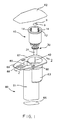
- Fig. 1 shows an isometric, exploded view of one preferred device in accordance with the present invention.
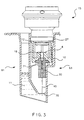
- a cross section of the device along line 2-2 of Fig. 1 in assembled form and containing sample 11 is shown in Figs. 2, 3 and 4.
- Figs. 2 to 4 also show a component of one instrument which can be used with the devices of the present invention.
- Figs. 2 to 4 also illustrate different stages in one preferred assay of the present invention.
- this device comprises a housing 60 which defines holding chamber 61 and test chamber 63.
- the holding chamber 61 and test chamber 63 are separated by a pierceable member which has a cut therein.
- Housing 60 is provided with flange 67 and tab 69.
- Housing 60 is provided with a removable top seal 62 which in the assembled device is hermetically sealed to flange 67 and closed at the bottom with bottom seal 66.
- top seal 62 is pealable and completely removable from flange 67 so as not to leave any piece of seal which could interfere with creating a negative pressure within housing 60 as described hereinafter.
- Top seal 62 is optionally provided with a desiccant not shown.
- Housing 60 serves as a storage package when top seal 62, desiccant and bottom seal 66 are in place.
- the desiccant material maintains chambers 61, 63 at a low humidity by absorbing any moisture that may permeate through housing 60 during storage.
- Top seal 62 comprises a material which resists moisture, such as LCFlex 7075 Polyester/Polyethylene Coated Aluminum, a trademark of Jefferson Smurfit Corporation, Schaumburg, Illinois.
- Bottom seal 66 comprises a material which efficiently transfers heat, such as a metallic foil, from the instrument to bring a blood sample to 37°C before starting the test (body temperature).
- housing 60 which defines holding chamber 61 and test chamber 63 is selected to minimize the possibility of an air bubble being trapped in the device and in preferred embodiments the bottom of holding chamber 61 is sloped to minimize air entrapment when blood is added through opening 65.
- the section of housing 60 defining holding chamber 61 is tapered at opening 65 for ease of-inserting, e.g., a pipette tip for delivering blood to holding chamber 61.
- the geometry of the housing is selected to maximize surface contact of the blood to the heated surface of the housing, while at the same time minimizing the area of blood exposed to the air to minimize risk of sample degradation.
- the L-shaped configuration of housing 60 accomplishes both of these objectives.
- housing 60 is provided with flange 67.
- the flange is designed to provide a large enough surface to affix removable top seal 62.
- Flange 67 is also provided with tab 69 in which is punched type sense code 68.
- the housing 60 is moved at a relatively steady speed beneath a reflective infrared sensor which is part of the instrument.
- the alternating punched holes and solid areas forming type sense code 68 in tab 69 of flange 67 are so situated that the infrared beam is alternatively reflected and not reflected towards a detecting sensor.
- the resulting alternating high and low output of the detector can be interpreted as a series of binary digits which serve to uniquely identify the type of assay to be conducted. This general scheme is similar to that used in familiar bar code readers.
- Sense code 68 also tells the instrument that a sample is inserted. In other words, it is both a presence detector and a type of test detector.
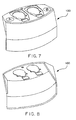
- Flange 67 is also provided with cassette snaps 80 so that the housing 60 can be snapped into a cassette shown in Figs. 7 and 8 which holds one or more of the present test cartridges in the right orientation to conveniently pipette sample in through opening 65 and minimize air entrapment.
- flange 67 has two parallel sides so that it is bowl feedable in an automated production line.
- Test chamber 63 is adapted to receive sample cup 10.
- Sample cup 10 supports a reagent treated partition member 6 having aperture 9 therein and a capillary hub 30 which provides a mechanism to operably attach capillary 40 to sample cup 10.
- the interior of sample cup 10 is provided with four vacuum chuck stop ribs 14 for positioning, two of which are shown in Fig. 1.
- Housing 60 is adapted to mate with an instrument which can create a negative pressure in test chamber 63 or in a part of test chamber 63. In the embodiment shown, this is accomplished by rim 12 of sample cup 10 which comprises a part of test chamber 63.
- the instrument has a mating component which is capable of sealably mating with rim 12 of sample cup 10.
- the matins component comprises vacuum chuck 15 shown. Vacuum chuck 15 is provided with O-ring 27 which during the assay sealably meets rim 12. The contact is sufficient to enable vacuum chuck 15 to create a negative pressure in sample cup 10.
- Vacuum chuck 15 is moved by the instrument to contact rim 12 and to exert a downward pressure on sample cup 10 to move transfer member 40 towards pierceable member 70 which has a cut therein, causing it to pierce the pierceable member by moving through the cut, and extend into sample 11 in the holding chamber.
- Vacuum chuck stop ribs 14 in sample cup 10 limit the downward movement of vacuum chuck 15.
- Fig. 2 shows a cross section view of the device shown in Fig. 1 along line 2-2 before vacuum chuck 15 has exerted downward pressure on sample cup 10.
- Fig. 3 shows a cross section view of the device shown in Fig. 2 after vacuum chuck 15 has moved to contact and move sample cup 10 downward so that the bottom of sample cup 10 is in contact with support member 71 and capillary 40 has pierced pierceable member 70 by moving through the cut and penetrated into sample 11. As shown in Fig. 3, support member 71 contacts the bottom of sample cup 10 under the downward pressure of the instrument.
- test chamber 63 e.g., by pulling a vacuum.
- This vacuum or negative pressure causes sample 11 to flow from holding chamber 61 through capillary transfer member 40 into receiving chamber 18 and through aperture 11 in partition member 6 as shown in Fig. 4.
- reagents on partition member 6 activate the formation of a platelet plug which eventually occludes aperture 9 and the flow of sample through transfer member 40 ceases.
- the time required for the blood flow to cease is then compared with the time required for blood flow to cease when the platelet function of the blood is normal. A normal range within which blood flow should stop is obtained by testing normal blood.
- Capillary hub 30 is shown in detail in Fig. 5.
- Fig. 6 shows a cross section of a device wherein capillary 40 is glued to capillary hub 30 by means of glue placed in glue gap 42.
- Capillary hub 30 is affixed to sample cup 10 at weld surface 34 by ultrasonic welding.
- capillary hub 30 is molded as a separate piece to facilitate coating and punching an aperture in partition members which are fragile.
- sample cup 10 could be molded as a single piece which includes capillary hub 30 and capillary 40.
- partition member 6 Before capillary hub 30 is assembled to sample cup 10, partition member 6 is welded to membrane seat 8 and one or more reagents are applied to the surface of partition member 6 which will face receiving chamber 18. Partition member 6 is then dried, and opening 9 shown in Fig. 1 is made in the dried membrane.
- Opening 9 in partition member 6 is dimensioned so that under the conditions of the particular assay a plug will be formed and the opening closed. If the aperture is too small non-assay related blockages will occur. If it is too big then a plug will not form properly.
- the aperture is preferably between about 100 microns to about 200 microns, more preferably about 140 microns to 160 microns, most preferably about 150 microns. The dimension of the aperture in partition member 6 does not have a great influence on the initial flow characteristics in the device.
- Receiving chamber 18 shown in Figs. 2 and 3 is positioned in test chamber 63 between partition member 6 and capillary hub 30. Receiving chamber 18 is dimensioned so that blood entering from capillary 40 does not enter too close to the membrane and disturb the forming plug.
- Partition member 6 is a porous or non-porous support matrix for the collagen and/or other agents which promote the clotting of blood.
- the preferred material has absorbency to liquids so that reagents can be applied yet has a stable structure so that a precise opening can be, for example, punched.
- adenosine 5' diphosphate (ADP) and collagen are preferred reagents for partition member 6.
- Preferred porous partition members for use in the test cartridge and methods of the present invention include cellulose esters, ceramic, nylon, polypropylene, polyvinylidene fluoride (PVDF), and fiberglass.
- a particularly preferred porous partition member is a mixed cellulose ester (acetate and nitrate) membrane from Millipore.
- a uniform layer of collagen around the aperture is highly desirable.
- the amount of collagen on the membrane is not particularly critical. A range of about 1-2 ⁇ g has been found to perform well in the platelet function assay.
- collagen is provided to partition member and then the porous member is dried for storage in the housing under a hermetic seal.
- ADP is known to be unstable in aqueous solutions, having a useful life of only about 4 hours. Accordingly, it is applied to the porous member just before use at a concentration of from about 1 mg/ml to about 90 mg/ml, more preferably about 45 mg/ml to about 55 mg/ml.
- ADP is incorporated in a porous partition member, the partition member is dried and welded to sample cup 10, and stored under hermetically sealed conditions until ready for use.
- the ADP is brought into solution before use by applying a wetting solution.
- platelet aggregation modulation agents such as ADP
- ADP platelet aggregation modulation agents
- the present invention also provides porous partition members having incorporated therein other standard modulating agents, such as ristocetin, arachidonic acid and salts thereof, thrombin, epinephrine, platelet activating factor (PAF), thrombin receptor agonist peptide (TRAP), and so forth which are useful in the evaluation of various aspects of platelet function.
- standard modulating agents such as ristocetin, arachidonic acid and salts thereof, thrombin, epinephrine, platelet activating factor (PAF), thrombin receptor agonist peptide (TRAP), and so forth which are useful in the evaluation of various aspects of platelet function.
- porous partition members for us in the test cartridges and methods of the present invention are also useful in whole blood and blood plasma coagulation assays to evaluate coagulation functions, similar to PT and PTT tests.
- clot formation is initiated by blood contact with appropriate activators of extrinsic or intrinsic pathways which have incorporated in the porous partition member which ultimately causes cessation of blood flow through the porous partition member.
- the time required for cessation of blood flow to occur can be correlated, e.g. , to the prothrombin time or the partial thromboplastin time for the patient.
- present whole blood coagulation instruments rely on changes in optical signals or electrical signals upon formation of a clot.
- Activators of the extrinsic pathway of prothrombin conversion suitable for incorporation in the porous partition members of the present invention include thromboplastin reagents, e.g., THROMBOPLASTIN-C® , Baxter-Dade.
- Activators of the intrinsic pathway suitable for incorporation in the porous partition members of the present invention include inosithin, and calcium chloride and/or activated cephaloplastin reagent (ACTIN® , Baxter-Dade).
- ACTIN® may be incorporated in the porous partition member or premixed with a whole blood sample to be tested. These tests can be carried out both on anticoagulated whole blood and on plasma samples.
- the concentration of agent or agents in the porous partition member are selected so as to result in an aperture closure time which shows a difference between normal and abnormal coagulation parameters.
- ADP adenosine 5' diphosphate
- ADP is unstable in aqueous solution having a useful life of only about 4 hours. It was unexpectedly found that by incorporating ADP in a porous partition member, drying it and storing it at about 4°C under hermetically sealed conditions, it is stable for about one and one-half years. By eliminating the need for a user to prepare ADP solutions for use in the assay, such porous partition members eliminate user error, permeation variability, and provide reproducible stimulation for platelet aggregation.
- the aperture closure time with a normal blood sample depends in part upon the concentration of the biologically active substance incorporated in the membrane.
- concentration of agents is selected so as to provide a convenient distinction between normal and abnormal coagulation parameter. This can be readily determined by one of ordinary skill in the art.
- concentration ranges of similar reagents reported for use in aggregometry provide one starting point in determining the appropriate concentration range. Reagent concentrations are optimized keeping in mind the desired sensitivity of the assay. For example, it is desirable that the concentration of ADP be sufficient to detect mild platelet dysfunction, but not so low as to introduce variable results.
- a threshold amount is needed for complete activation and aggregation and if mild platelet disfunction is being studied, then a smaller amount of reagent is used. It can be seen that a balance between the sensitivity of the test and obtaining reproducible results is desired.
- test chamber 63 is provided with a two position support for sample cup 10, the support comprising support member 71 and crush rib 72.
- Support member 71 has a central opening dimensioned to permit section 31 of capillary hub 30 to pass therethrough.
- crush rib 72 (others not shown) maintain sample cup 10 in a first position so that capillary 40 is above but not in contact with piercable membrane 70.
- Fig. 1 As shown in Figs. 2 and 3 test chamber 63 is provided with a two position support for sample cup 10, the support comprising support member 71 and crush rib 72.
- Support member 71 has a central opening dimensioned to permit section 31 of capillary hub 30 to pass therethrough.
- crush rib 72 (others not shown) maintain sample cup 10 in a first position so that capillary 40 is above but not in contact with piercable membrane 70.
- sample cup 10 has been moved into a second position whereby crush ribs 72 have been compressed, sample cup 10 is in contact with and held in position by support member 71, section 31 of capillary hub 30 has passed through support member 71, and capillary 40 has been moved towards and through piercable membrane 70 by moving through the cut, to project into holding chamber 61 and into sample 11 disposed therein.
- Sample is caused to flow from holding chamber 61 to test chamber 63 by the negative pressure created by the instrument.
- the initial rate of flow through the device is controlled by varying the length and the inner diameter of the capillary.
- the initial flow rate of blood through the device be from about 100 ⁇ l to about 200 ⁇ l per minute. It is believed that diameters much less than 100 micron will have an effect on platelets. Accordingly, the preferred inner diameter of capillary 40 is from about 100 to 220 microns. A particularly preferred inner diameter is about 150-210 ⁇ and a preferred length of the capillary is about 0.6 - 1.2 inches long. In an especially preferred embodiment the inner diameter of the capillary is about 200 ⁇ 10 microns and the length of the capillary is about 1.2 inches. With this configuration and flow, the aperture in the membrane will close in about 1 to 3 minutes if the blood is normal.
- the inner diameter of the capillary can be decreased to maintain the same flow rate through the system or the sample volume could be adjusted accordingly.
- the capillary can be made of any material that can hold a tight tolerance with respect to the inner diameter, has a relatively smooth inner surface and is compatible with blood, i.e., not an activator of blood.
- a convenient material for the capillary hub 30 is plastic.
- a convenient material for the capillary is stainless steel.
- the components of the present invention are manufactured from materials that are compatible with blood. In the platelet function test, the materials are selected so that they do not activate platelets.
- Polypropylene is a preferred material for the housing. However, other plastics such as polyethylene terephthalate (PET) are also acceptable. Polypropylene is a preferable plastic when welding will be used to assemble parts of the device.
- An operator prepares the disposable device shown in the figures for use by removing the top foil 62 and attached desiccant material, if present.
- the device is snapped into cassette 100 shown in Figs. 7 and 8.
- the operator then transfers the sample to be tested into holding chamber 61 through opening 65 by use of a pipette or similar device.
- Cassette 100 containing the disposable device with the loaded sample is placed into an automated instrument where the sample is heated to the required test temperature.
- the instrument is able to determine the heating time and other test parameters by reading type sense code 68 located on tab 69 of flange 67. Heating of sample 11 is augmented by the higher heat transfer characteristic of bottom seal 66, the outer surface of which is in close proximity to a heater block in the instrument and the inner surface is in contact with sample 11.
- the sample in holding chamber 61 is isolated from test chamber 63 during the incubation period by pierceable member 70 which is shown in Fig. 2.
- the automated instrument initiates the testing cycle by moving sample cup 10/capillary hub 30 assembly from position A shown in Fig. 2 to position B shown in Fig. 3, which causes transfer member 40 to pass through pierceable member 70 into holding chamber 61 and thus into contact with sample 11.
- the instrument exerts a downward pressure on sample cup 10 through vacuum chuck 15 which sealably mates with rim 12 of sample cup 10, thereby creating a seal between the mating portion of the instrument and rim 12.
- the instrument then creates a negative pressure within sample cup 10 which causes sample to be drawn up through capillary 40 to receiving chamber 18 and through the opening in partition member 6.
- the disposable device together with the sample, is removed from the instrument and discarded at the completion of the test.
- the cassette is reused.
- the pierceable member is an integral part of the housing and is manufactured from the same material as the housing, preferably any moldable polymer, such as polypropylene or PVC, but most preferably high density polyethylene.
- the thickness of the pierceable member will typically be less than the thickness of the housing so as to permit the capillary transfer member to pierce the pierceable member and contact the sample.
- the pierceable member can be of any dimension that is greater than the diameter of the capillary transfer member and consistent with the dimensions of the housing. In a preferred embodiment the pierceable member is about 4 mm in diameter.
- the membrane material when the capillary transfer member pierces the membrane, the membrane material clings to the end of the capillary, preventing the blood or liquid from moving through the transfer member.
- Capillary occlusion is avoided by providing the pierceable member with a cut therein.
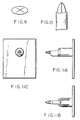
- One exemplary configuration of such a cut is depicted in Figure 9.
- the material for the pierceable member is selected to be sufficiently stiff so that the cut in the pierceable member, as shown in Figure 9, creates flaps in the pierceable member which remain in position during the incubation phase, preventing the liquid or blood sample from escaping through the cut, but the pierceable member is also sufficiently flexible to enable the capillary transfer member to pierce it by moving through the cut.
- the flaps easily move away from the path of the capillary and allow the capillary to be immersed into the blood sample.
- the pierceable member is cut during manufacture of the test cartridge and can be accomplished by methods known in the art.
- the cut depicted in Figure 9 was made by a pneumatic driven bit which contains four slitting blades as shown in Figure 10.
- the resulting cut is very sharp, made without removing any material, which ensures that no sample will pass through prior to penetration by the capillary.
- Figure 11(a) shows a side view and 11(b) shows a top view of an example of the pneumatic bit of Figure 10.
- Figure 11(c) shows a front view of the pneumatic bit of Figures 11(a) and (b).
- the size and shape of the cut in the pierceable member can be readily determined by one of skill in the art to maximize its effectiveness, based upon the material of the pierceable member and configuration of the capillary.
- the cut extends about 3 to 3.5 mm from end to end, or about 1.5 to 2 mm from the center of the member.
- the configuration and size of the cut can be manipulated by one of skill in the art to ensure that the capillary contacts the cut when the transfer member moves towards the pierceable member.
- the cut can be of any configuration which enables the capillary transfer member to pierce the pierceable member, for example like that depicted in Figure 9, or alternatively a three-sided cut.
- lyophilized ADP or epinephrine bitartrate was incorporated in a porous partition member comprising a membrane.
- These agents were dissolved in a sodium acetate-acetic acid buffer (pH 3.5) containing 5% glucose (osmolality 280 mOsm/kg).
- the concentration of ADP solution used for incorporation into the membrane was 50 mg/ml, and that of the epinephrine solution was 10 mg/ml.
- a strip of membrane was spot-coated with 1 ⁇ L of ADP or epinephrine solution. Therefore, each membrane placed in a test cartridge contained 50 ⁇ g of ADP or 10 ⁇ g of epinephrine. The membrane was then spot-coated with 1 ⁇ L of fibrillar Type I collagen suspension from horse tendon available from Nycomed AG.
- Spot-coating involved putting spots of liquid agent on a strip of membrane. After spot-coating, the membrane was placed in a forced air drying chamber for 25 minutes for drying of the ADP or epinephrine, and formation of a collagen film on the coated areas. Once dried, an aperture is. e.g., was punched in the center of the spot and a membrane disk was cut from the membrane strip. The membrane disk was inserted in a test cartridge.
Landscapes
- Health & Medical Sciences (AREA)
- Life Sciences & Earth Sciences (AREA)
- Engineering & Computer Science (AREA)
- Chemical & Material Sciences (AREA)
- Hematology (AREA)
- Biomedical Technology (AREA)
- Analytical Chemistry (AREA)
- General Health & Medical Sciences (AREA)
- Physics & Mathematics (AREA)
- Clinical Laboratory Science (AREA)
- Medicinal Chemistry (AREA)
- Chemical Kinetics & Catalysis (AREA)
- Biophysics (AREA)
- Molecular Biology (AREA)
- Urology & Nephrology (AREA)
- Food Science & Technology (AREA)
- Ecology (AREA)
- Biochemistry (AREA)
- General Physics & Mathematics (AREA)
- Immunology (AREA)
- Pathology (AREA)
- Investigating Or Analysing Biological Materials (AREA)
- Automatic Analysis And Handling Materials Therefor (AREA)
Abstract
Description
- Fig. 1
- is an exploded isometric view of components of one preferred device in accordance with the present invention.
- Fig. 2
- is a cross section taken along line 2-2 of Fig. 1 wherein the device shown in Fig. 1 is in an assembled form and further shows a portion of an instrument for use with the devices of the present invention.
- Fig. 3
- is similar to Fig. 2, but shows the portion of the instrument having contacted and moved a component of the device shown in Fig. 2 from a first into a second position.
- Fig. 4
- is similar to Fig. 3 but shows sample having moved through the device.
- Fig. 5
- is an enlarged isometric view of
capillary hub 30 shown in Fig. 1. - Fig. 6
- is an enlarged cross section view of
capillary hub 30 withcapillary 31 as shown in Fig. 2. - Fig. 7
- shows a front isometric view of one cassette of the present invention.
- Fig. 8
- shows a rear isometric view of the cassette shown in Fig. 7.
- Fig. 9
- shows a diagram of one embodiment of a pre-cut pierceable member.
- Fig. 10
- shows a diagram of a pneumatic driven bit which contains four cutting blades.
- Fig. 10
- shows a diagram of a pneumatic driven bit which contains four cutting blades.
- Fig. 11(a), (b) and (c)
- show three views of a pneumatic driven bit, similar to that shown in Fig. 10.
Claims (18)
- A test cartridge for use in assay system for the assay of a liquid sample (11), the test cartridge comprising a housing (60) through which the liquid sample flows during the assay, the housing defining:characterized in that,a) holding chamber (61) for holding the sample and a test chamber (63), wherein the holding chamber and test chamber are separated by a pierceable member (70);b) a partition member (6) disposed in the test chamber (63), the member having an opening (9) therethrough and comprising at least one reagent for the assay;c) a transfer member (40) movably mounted in the test chamber so that it can be moved towards and pierce the pierceable member (70) and contact the liquid sample in the holding chamber;d) a receiving chamber (18) between the transfer member (40) and the partition member (6) for receiving blood from the transfer member; ande) a sample cup (10) movably supported within the test chamber (63) which holds the transfer member (40), the receiving chamber (18) and the partition member (6); whereby the sample cup (10) is adapted to sealably mate with a component of an instrument which is capable of creating a negative pressure in the test chamber (63) and whereby when the transfer member (40) has been moved towards and pierces the pierceable member to contact the liquid sample (11) and a negative pressure is created in the test chamber (63), liquid sample moves through the transfer member into the test chamber and through the opening (9) of the partition member (6) ;
the pierceable member (70) has a cut therein through which the transfer member is moved when the sample cup (10) is moved forward within the test chamber (63). - A test cartridge in accordance with claim 1, wherein at least one reagent is collagen, an antigen, an antibody or a ligand for binding cells.
- A test cartridge in accordance with claim 1 or 2, wherein the partition member (6) comprises a porous material.
- A test cartridge in accordance with one of claims 1 - 3, wherein the partition member (6) comprises a porous material having an aperture (9) and having incorporated therein at least one agent capable of initiating the blood coagulation process or platelet aggregation in blood.
- A test cartridge according to claim 4, wherein the agent capable of initiating platelet aggregation in blood comprises ADP, ristocetin, arachidonic acid, thrombin, epinephrine, platelet activator factor (PAF), or thrombin receptor agonist peptide (TRAP).
- A test cartridge according to claim 5, further comprising collagen.
- A test cartridge according to one of claims 4 - 6, wherein the porous partition member comprises a membrane, ceramic, nylon, polypropylene, polyvinylidene fluoride or fiberglass.
- A test cartridge according to one of claims 4 - 7, wherein the membrane comprises a mixed cellulose ester (acetate and nitrate) membrane.
- A test cartridge according to one of claims 1 - 8, wherein the holding chamber (61) is L-shaped, the bottom of the L forming the bottom of the holding chamber and being angled downwardly.
- A test cartridge according to claim 9, wherein the bottom of the holding chamber comprises a material which is capable of enhancing heat transfer.
- A test cartridge according to one of claims 1 - 10, wherein the top of the housing (60) is provided with a removable cover (62) which seals both holding and test chambers.
- A test cartridge according to claim 11, wherein the side of the removable cover (62) disposed towards the inside of the housing is provided with a desiccant.
- A test cartridge according to one of claims 1 - 12, wherein the top of the housing is provided with a flange (67) having a type sense code (68) thereon.
- A test cartridge for use in an assay system for testing a coagulation function of blood, the test cartridge comprising a housing (60) through which the blood flows, wherein the housing defines:characterized in thata) a holding chamber (61) for holding a sample of the blood to be tested and a test chamber (63), wherein the holding chamber and test chamber are separated by a pierceable member (70);b) a partition member (6) disposed in the test chamber, the partition member having an opening (9) therethrough and containing at least one reagent which activates at least one pathway of the coagulation of blood;c) a transfer member (40) movably mounted in the test chamber (63) so that it can be moved towards and through the pierceable member;d) a receiving chamber (18) disposed in the test chamber between the partition member (6) and the transfer member for receiving blood from the sample transfer member (40); ande) a sample cup (10) movably supported within the test chamber (63) which holds the transfer member (40), the receiving chamber and the partition member; whereby the sample cup (10) is adapted to sealably mate with a component of an instrument which is capable of creating a negative pressure in the test chamber (63) and whereby when blood is disposed in the holding chamber (18) and the transfer member (40) has been moved towards and pierces the pierceable member (6) to contact the blood and a negative pressure is created in the test chamber, blood moves through the transfer member (40) into the receiving chamber (18) and through the opening of the partition member,
the pierceable member (70) has a cut therein through which the transfer member is moved when the sample cup (10) is moved forward within the test chamber (63). - A test cartridge according to claim 14, wherein the agent capable of initiating the blood coagulation process comprises at least one activator of the extrinsic or intrinsic pathways of prothrombin conversion.
- A test cartridge according to claim 15, wherein the activator of the extrinsic or intrinsic pathways of prothrombin conversion comprises a thromboplastin reagent or activated cephaloplastin reagent.
- A test cartridge according to claim 16, wherein the thromboplastin reagent comprises THROMBOPLASTIN-C® and the activated cephaloplastin reagent comprises ACTIN®.
- A method of testing platelet function which comprises passing blood through a test cartridge, the test cartridge comprising a housing (60) through which the blood flows during the assay, wherein the housing defines:wherein the method comprises the steps of:a) a holding chamber (61) for holding a sample of the blood to be tested and a test chamber (63), wherein the holding chamber and test chamber are separated by a pierceable member (6);b) a partition member (6) disposed in the test chamber (63), the partition member having an opening (9) therethrough and containing at least one reagent which activates the aggregation of platelets;c) a transfer member (40) movably mounted in the test chamber (63) so that it can be moved towards and pierce the pierceable member (70); andd) a receiving chamber (18) disposed in the test chamber (63) between the partition member (6) and the transfer member (40) for receiving blood from the sample transfer member;characterized in that(i) providing a sample of blood to the holding chamber (61);(ii) preincubating the sample under predetermined conditions;(iii) moving the transfer member (40) towards and through the pierceable member (70) and into contact with the blood in the holding chamber;(iv) causing the pressure in the test chamber (63) to become sufficiently negative to cause blood to flow through the transfer member (40) into the receiving chamber (18) and through the opening (9) of the partition member (6);(v) measuring the amount of time it takes for the formation of a platelet plug at the opening in the partition member thereby stopping the flow of blood; and(vi) correlating the time determined in step (v) with a predetermined normal range,
the transfer member (40) is moved through a cut of the pierceable member without cutting out material from the pierceable member.
Applications Claiming Priority (3)
| Application Number | Priority Date | Filing Date | Title |
|---|---|---|---|
| US62182196A | 1996-03-22 | 1996-03-22 | |
| US621821 | 1996-03-22 | ||
| PCT/US1997/003844 WO1997034698A1 (en) | 1996-03-22 | 1997-03-14 | Combination reagent holding and test device |
Publications (2)
| Publication Number | Publication Date |
|---|---|
| EP0827425A1 EP0827425A1 (en) | 1998-03-11 |
| EP0827425B1 true EP0827425B1 (en) | 2004-11-03 |
Family
ID=24491778
Family Applications (1)
| Application Number | Title | Priority Date | Filing Date |
|---|---|---|---|
| EP97909010A Expired - Lifetime EP0827425B1 (en) | 1996-03-22 | 1997-03-14 | Combination reagent holding and test device |
Country Status (9)
| Country | Link |
|---|---|
| EP (1) | EP0827425B1 (en) |
| JP (1) | JP3743918B2 (en) |
| AT (1) | ATE281238T1 (en) |
| AU (1) | AU717559B2 (en) |
| BR (1) | BR9702199A (en) |
| CA (1) | CA2220574A1 (en) |
| DE (1) | DE69731439T2 (en) |
| ES (1) | ES2231860T3 (en) |
| WO (1) | WO1997034698A1 (en) |
Families Citing this family (23)
| Publication number | Priority date | Publication date | Assignee | Title |
|---|---|---|---|---|
| US5708591A (en) | 1995-02-14 | 1998-01-13 | Akzo Nobel N.V. | Method and apparatus for predicting the presence of congenital and acquired imbalances and therapeutic conditions |
| US6429017B1 (en) | 1999-02-04 | 2002-08-06 | Biomerieux | Method for predicting the presence of haemostatic dysfunction in a patient sample |
| US6321164B1 (en) | 1995-06-07 | 2001-11-20 | Akzo Nobel N.V. | Method and apparatus for predicting the presence of an abnormal level of one or more proteins in the clotting cascade |
| US6898532B1 (en) | 1995-06-07 | 2005-05-24 | Biomerieux, Inc. | Method and apparatus for predicting the presence of haemostatic dysfunction in a patient sample |
| US6502040B2 (en) | 1997-12-31 | 2002-12-31 | Biomerieux, Inc. | Method for presenting thrombosis and hemostasis assay data |
| ATE282208T1 (en) | 1999-02-04 | 2004-11-15 | Bio Merieux Inc | METHOD AND APPARATUS FOR PREDICTING HEMOSTATIC FUNCTION IN PATIENT SAMPLES |
| US7179612B2 (en) | 2000-06-09 | 2007-02-20 | Biomerieux, Inc. | Method for detecting a lipoprotein-acute phase protein complex and predicting an increased risk of system failure or mortality |
| US6627156B1 (en) * | 2000-06-22 | 2003-09-30 | Beckman Coulter, Inc. | Cap piercing station for closed container sampling system |
| DE10360814A1 (en) * | 2003-12-23 | 2005-07-28 | Dade Behring Marburg Gmbh | Cartridge for functional control of a device for the examination of platelet function, method for functional control and use of a test liquid |
| CA2563840A1 (en) | 2004-04-21 | 2005-11-03 | Vdg-Von Der Goltz Gmbh | Device for analyzing the coagulation or aggregation behavior of blood |
| DE102006020386A1 (en) * | 2006-04-28 | 2007-10-31 | Dade Behring Marburg Gmbh | Method for determining platelet function under flow conditions |
| DE102006020385A1 (en) | 2006-04-28 | 2007-10-31 | Dade Behring Marburg Gmbh | Method and device for determining platelet function under flow conditions |
| AU2009280612B2 (en) * | 2008-08-11 | 2014-11-13 | Fujimori Kogyo Co., Ltd. | Blood-platelet test method and blood-platelet test device |
| DE102009019650A1 (en) * | 2009-04-30 | 2010-11-04 | Siemens Aktiengesellschaft | Cartridge and operating procedure for reagents of a biosensor system |
| US8796031B2 (en) | 2010-02-10 | 2014-08-05 | Fujimori Kogyo Co., Ltd. | Microchip for platelet examination and platelet examination device using same |
| GB2483077A (en) | 2010-08-25 | 2012-02-29 | Concateno Uk Ltd | Sample testing assay apparatus and method |
| EP2500095A1 (en) | 2011-03-15 | 2012-09-19 | Siemens Healthcare Diagnostics Products GmbH | Method and devices for determining the platelet function in a centrifugal analyser |
| JP5559096B2 (en) * | 2011-05-10 | 2014-07-23 | 株式会社堀場製作所 | Blood cell counting reagent and blood test method |
| EP2525228A1 (en) | 2011-05-18 | 2012-11-21 | Siemens Healthcare Diagnostics Products GmbH | Method for determining the risk of clopidogrel resistance |
| EP2543998B1 (en) | 2011-07-07 | 2014-10-29 | Siemens Healthcare Diagnostics Products GmbH | Method for standardising measurement results in a system for measuring thrombocyte function |
| EP2562542B1 (en) | 2011-08-22 | 2015-01-28 | Siemens Healthcare Diagnostics Products GmbH | Dynamically determining the thrombocyte function |
| EP2634583A1 (en) | 2012-02-28 | 2013-09-04 | Siemens Healthcare Diagnostics Products GmbH | Screening method for detecting samples with antiphospholipid antibodies |
| JP6012455B2 (en) * | 2012-12-21 | 2016-10-25 | シーメンス ヘルスケア ダイアグノスティクス プロダクツ ゲゼルシヤフト ミツト ベシユレンクテル ハフツング | Method for standardizing measurement results in a system for measuring platelet function |
Family Cites Families (6)
| Publication number | Priority date | Publication date | Assignee | Title |
|---|---|---|---|---|
| US4663127A (en) * | 1982-10-15 | 1987-05-05 | Hemotec, Inc. | Gas flow cartridge having resilient flexible membrane with slit separating reaction and reagent chambers |
| US5128104A (en) * | 1987-04-27 | 1992-07-07 | Murphy Harold R | Cuvette for automated testing machine |
| IT215743Z2 (en) * | 1989-03-03 | 1990-11-05 | Instrumentation Lab Spa | SAMPLE CUVET WITH WELDED CAP. |
| US5111946A (en) * | 1990-11-30 | 1992-05-12 | Elliot Glanz | Safety bottle |
| ATE121968T1 (en) * | 1991-05-28 | 1995-05-15 | Diagnostics Inc Baxter | DEVICE FOR SAFELY COLLECTING BLOOD FROM A STORAGE VESSEL. |
| US5602037A (en) * | 1994-06-30 | 1997-02-11 | Dade International, Inc. | Combination reagent holding and test device |
-
1997
- 1997-03-14 EP EP97909010A patent/EP0827425B1/en not_active Expired - Lifetime
- 1997-03-14 ES ES97909010T patent/ES2231860T3/en not_active Expired - Lifetime
- 1997-03-14 AU AU20766/97A patent/AU717559B2/en not_active Expired
- 1997-03-14 AT AT97909010T patent/ATE281238T1/en not_active IP Right Cessation
- 1997-03-14 WO PCT/US1997/003844 patent/WO1997034698A1/en not_active Ceased
- 1997-03-14 BR BR9702199A patent/BR9702199A/en unknown
- 1997-03-14 DE DE69731439T patent/DE69731439T2/en not_active Expired - Lifetime
- 1997-03-14 CA CA002220574A patent/CA2220574A1/en not_active Abandoned
- 1997-03-14 JP JP53353597A patent/JP3743918B2/en not_active Expired - Fee Related
Also Published As
| Publication number | Publication date |
|---|---|
| DE69731439D1 (en) | 2004-12-09 |
| ATE281238T1 (en) | 2004-11-15 |
| JPH11506215A (en) | 1999-06-02 |
| AU717559B2 (en) | 2000-03-30 |
| ES2231860T3 (en) | 2005-05-16 |
| BR9702199A (en) | 1999-07-20 |
| EP0827425A1 (en) | 1998-03-11 |
| JP3743918B2 (en) | 2006-02-08 |
| AU2076697A (en) | 1997-10-10 |
| DE69731439T2 (en) | 2005-11-24 |
| CA2220574A1 (en) | 1997-09-25 |
| WO1997034698A1 (en) | 1997-09-25 |
Similar Documents
| Publication | Publication Date | Title |
|---|---|---|
| US5888826A (en) | Combination reagent holding and test device | |
| US5602037A (en) | Combination reagent holding and test device | |
| AU717559B2 (en) | Combination reagent holding and test device | |
| AU690302B2 (en) | Bioactive porous partition members | |
| EP0716744B1 (en) | Bioactive porous partition members | |
| EP1906186B1 (en) | Assay system | |
| CN110967520A (en) | Reagent container rack and sample analysis device | |
| JPH06500463A (en) | A fibrinogen analysis method for accurately, quickly and easily performing fibrinogen analysis (i.e. determining the concentration of coagulable fibrinogen in a sample) using a dry chemical reagent containing magnetic particles. | |
| US7521247B2 (en) | Cartridge for monitoring the function of a device for testing blood platelet function, method for function monitoring, and use of a test fluid | |
| EP3629032B1 (en) | Specimen measurement apparatus and method performed in specimen measurement apparatus | |
| US5958716A (en) | Blood factor assay | |
| JP7171641B2 (en) | Reagent container rack and sample analyzer | |
| Van den Besselaar et al. | The use of evacuated tubes for blood collection in oral anticoagulant control | |
| MXPA98001050A (en) | Essay for the factor of the san |
Legal Events
| Date | Code | Title | Description |
|---|---|---|---|
| PUAI | Public reference made under article 153(3) epc to a published international application that has entered the european phase |
Free format text: ORIGINAL CODE: 0009012 |
|
| 17P | Request for examination filed |
Effective date: 19971031 |
|
| AK | Designated contracting states |
Kind code of ref document: A1 Designated state(s): AT BE CH DE ES FR GB GR IT LI NL SE |
|
| RAP3 | Party data changed (applicant data changed or rights of an application transferred) |
Owner name: DADE BEHRING INC. |
|
| 17Q | First examination report despatched |
Effective date: 20011011 |
|
| GRAP | Despatch of communication of intention to grant a patent |
Free format text: ORIGINAL CODE: EPIDOSNIGR1 |
|
| GRAS | Grant fee paid |
Free format text: ORIGINAL CODE: EPIDOSNIGR3 |
|
| GRAA | (expected) grant |
Free format text: ORIGINAL CODE: 0009210 |
|
| AK | Designated contracting states |
Kind code of ref document: B1 Designated state(s): AT BE CH DE ES FR GB GR IT LI NL SE |
|
| PG25 | Lapsed in a contracting state [announced via postgrant information from national office to epo] |
Ref country code: NL Free format text: LAPSE BECAUSE OF FAILURE TO SUBMIT A TRANSLATION OF THE DESCRIPTION OR TO PAY THE FEE WITHIN THE PRESCRIBED TIME-LIMIT Effective date: 20041103 Ref country code: LI Free format text: LAPSE BECAUSE OF FAILURE TO SUBMIT A TRANSLATION OF THE DESCRIPTION OR TO PAY THE FEE WITHIN THE PRESCRIBED TIME-LIMIT Effective date: 20041103 Ref country code: CH Free format text: LAPSE BECAUSE OF FAILURE TO SUBMIT A TRANSLATION OF THE DESCRIPTION OR TO PAY THE FEE WITHIN THE PRESCRIBED TIME-LIMIT Effective date: 20041103 Ref country code: BE Free format text: LAPSE BECAUSE OF FAILURE TO SUBMIT A TRANSLATION OF THE DESCRIPTION OR TO PAY THE FEE WITHIN THE PRESCRIBED TIME-LIMIT Effective date: 20041103 Ref country code: AT Free format text: LAPSE BECAUSE OF FAILURE TO SUBMIT A TRANSLATION OF THE DESCRIPTION OR TO PAY THE FEE WITHIN THE PRESCRIBED TIME-LIMIT Effective date: 20041103 |
|
| REG | Reference to a national code |
Ref country code: GB Ref legal event code: FG4D |
|
| REG | Reference to a national code |
Ref country code: CH Ref legal event code: EP |
|
| REF | Corresponds to: |
Ref document number: 69731439 Country of ref document: DE Date of ref document: 20041209 Kind code of ref document: P |
|
| PG25 | Lapsed in a contracting state [announced via postgrant information from national office to epo] |
Ref country code: SE Free format text: LAPSE BECAUSE OF FAILURE TO SUBMIT A TRANSLATION OF THE DESCRIPTION OR TO PAY THE FEE WITHIN THE PRESCRIBED TIME-LIMIT Effective date: 20050203 Ref country code: GR Free format text: LAPSE BECAUSE OF FAILURE TO SUBMIT A TRANSLATION OF THE DESCRIPTION OR TO PAY THE FEE WITHIN THE PRESCRIBED TIME-LIMIT Effective date: 20050203 |
|
| NLV1 | Nl: lapsed or annulled due to failure to fulfill the requirements of art. 29p and 29m of the patents act | ||
| REG | Reference to a national code |
Ref country code: CH Ref legal event code: PL |
|
| REG | Reference to a national code |
Ref country code: ES Ref legal event code: FG2A Ref document number: 2231860 Country of ref document: ES Kind code of ref document: T3 |
|
| ET | Fr: translation filed | ||
| PLBE | No opposition filed within time limit |
Free format text: ORIGINAL CODE: 0009261 |
|
| STAA | Information on the status of an ep patent application or granted ep patent |
Free format text: STATUS: NO OPPOSITION FILED WITHIN TIME LIMIT |
|
| 26N | No opposition filed |
Effective date: 20050804 |
|
| REG | Reference to a national code |
Ref country code: GB Ref legal event code: 732E Free format text: REGISTERED BETWEEN 20101021 AND 20101027 |
|
| REG | Reference to a national code |
Ref country code: ES Ref legal event code: PC2A Owner name: SIEMENS HEALTHCARE DIAGNOSTICS INC. Effective date: 20110408 |
|
| PG25 | Lapsed in a contracting state [announced via postgrant information from national office to epo] |
Ref country code: DE Free format text: LAPSE BECAUSE OF NON-PAYMENT OF DUE FEES Effective date: 20111001 |
|
| REG | Reference to a national code |
Ref country code: FR Ref legal event code: TP Owner name: SIEMENS HEALTHCARE DIAGNOSTICS INC., US Effective date: 20120127 Ref country code: FR Ref legal event code: CD Owner name: SIEMENS HEALTHCARE DIAGNOSTICS INC., US Effective date: 20120127 |
|
| REG | Reference to a national code |
Ref country code: FR Ref legal event code: PLFP Year of fee payment: 20 |
|
| PGFP | Annual fee paid to national office [announced via postgrant information from national office to epo] |
Ref country code: FR Payment date: 20160311 Year of fee payment: 20 Ref country code: GB Payment date: 20160310 Year of fee payment: 20 |
|
| PGFP | Annual fee paid to national office [announced via postgrant information from national office to epo] |
Ref country code: ES Payment date: 20160426 Year of fee payment: 20 Ref country code: DE Payment date: 20160520 Year of fee payment: 20 |
|
| PGFP | Annual fee paid to national office [announced via postgrant information from national office to epo] |
Ref country code: IT Payment date: 20160329 Year of fee payment: 20 |
|
| REG | Reference to a national code |
Ref country code: DE Ref legal event code: R071 Ref document number: 69731439 Country of ref document: DE |
|
| REG | Reference to a national code |
Ref country code: GB Ref legal event code: PE20 Expiry date: 20170313 |
|
| PG25 | Lapsed in a contracting state [announced via postgrant information from national office to epo] |
Ref country code: GB Free format text: LAPSE BECAUSE OF EXPIRATION OF PROTECTION Effective date: 20170313 |
|
| REG | Reference to a national code |
Ref country code: ES Ref legal event code: FD2A Effective date: 20180508 |
|
| PG25 | Lapsed in a contracting state [announced via postgrant information from national office to epo] |
Ref country code: ES Free format text: LAPSE BECAUSE OF EXPIRATION OF PROTECTION Effective date: 20170315 |