EP0826652B1 - Process for preparing asymmetric compound by using metal complex - Google Patents
Process for preparing asymmetric compound by using metal complex Download PDFInfo
- Publication number
- EP0826652B1 EP0826652B1 EP96906911A EP96906911A EP0826652B1 EP 0826652 B1 EP0826652 B1 EP 0826652B1 EP 96906911 A EP96906911 A EP 96906911A EP 96906911 A EP96906911 A EP 96906911A EP 0826652 B1 EP0826652 B1 EP 0826652B1
- Authority
- EP
- European Patent Office
- Prior art keywords
- reaction
- asymmetric
- compound
- group
- optically active
- Prior art date
- Legal status (The legal status is an assumption and is not a legal conclusion. Google has not performed a legal analysis and makes no representation as to the accuracy of the status listed.)
- Expired - Lifetime
Links
- 150000001875 compounds Chemical class 0.000 title claims abstract description 69
- 150000004696 coordination complex Chemical class 0.000 title claims abstract description 47
- 238000004519 manufacturing process Methods 0.000 title abstract description 4
- -1 lithium aluminum hydride Chemical compound 0.000 claims abstract description 36
- 238000006957 Michael reaction Methods 0.000 claims abstract description 29
- 229910052783 alkali metal Inorganic materials 0.000 claims abstract description 26
- DVWQNBIUTWDZMW-UHFFFAOYSA-N 1-naphthalen-1-ylnaphthalen-2-ol Chemical compound C1=CC=C2C(C3=C4C=CC=CC4=CC=C3O)=CC=CC2=C1 DVWQNBIUTWDZMW-UHFFFAOYSA-N 0.000 claims abstract description 25
- 239000002585 base Substances 0.000 claims abstract description 22
- 150000001340 alkali metals Chemical class 0.000 claims abstract description 10
- 150000004678 hydrides Chemical class 0.000 claims abstract description 10
- 229910052784 alkaline earth metal Inorganic materials 0.000 claims abstract description 9
- 150000001342 alkaline earth metals Chemical class 0.000 claims abstract description 9
- 238000006243 chemical reaction Methods 0.000 claims description 116
- WYURNTSHIVDZCO-UHFFFAOYSA-N Tetrahydrofuran Chemical compound C1CCOC1 WYURNTSHIVDZCO-UHFFFAOYSA-N 0.000 claims description 80
- 239000000126 substance Substances 0.000 claims description 68
- YXFVVABEGXRONW-UHFFFAOYSA-N Toluene Chemical compound CC1=CC=CC=C1 YXFVVABEGXRONW-UHFFFAOYSA-N 0.000 claims description 57
- 238000005927 hydrophosphonylation reaction Methods 0.000 claims description 43
- YLQBMQCUIZJEEH-UHFFFAOYSA-N tetrahydrofuran Natural products C=1C=COC=1 YLQBMQCUIZJEEH-UHFFFAOYSA-N 0.000 claims description 37
- 238000000034 method Methods 0.000 claims description 30
- 125000004432 carbon atom Chemical group C* 0.000 claims description 22
- 125000000217 alkyl group Chemical group 0.000 claims description 19
- RTZKZFJDLAIYFH-UHFFFAOYSA-N ether Substances CCOCC RTZKZFJDLAIYFH-UHFFFAOYSA-N 0.000 claims description 18
- UHOVQNZJYSORNB-UHFFFAOYSA-N Benzene Chemical compound C1=CC=CC=C1 UHOVQNZJYSORNB-UHFFFAOYSA-N 0.000 claims description 12
- 125000004435 hydrogen atom Chemical group [H]* 0.000 claims description 9
- 125000003710 aryl alkyl group Chemical group 0.000 claims description 8
- BZLVMXJERCGZMT-UHFFFAOYSA-N Methyl tert-butyl ether Chemical compound COC(C)(C)C BZLVMXJERCGZMT-UHFFFAOYSA-N 0.000 claims description 7
- 125000003545 alkoxy group Chemical group 0.000 claims description 7
- 125000004093 cyano group Chemical group *C#N 0.000 claims description 7
- FWFSEYBSWVRWGL-UHFFFAOYSA-N cyclohex-2-enone Chemical compound O=C1CCCC=C1 FWFSEYBSWVRWGL-UHFFFAOYSA-N 0.000 claims description 7
- 239000003960 organic solvent Substances 0.000 claims description 7
- BZKFMUIJRXWWQK-UHFFFAOYSA-N Cyclopentenone Chemical compound O=C1CCC=C1 BZKFMUIJRXWWQK-UHFFFAOYSA-N 0.000 claims description 6
- 150000001299 aldehydes Chemical class 0.000 claims description 6
- 229910052799 carbon Inorganic materials 0.000 claims description 6
- 125000001997 phenyl group Chemical group [H]C1=C([H])C([H])=C(*)C([H])=C1[H] 0.000 claims description 6
- 125000005353 silylalkyl group Chemical group 0.000 claims description 6
- 150000005690 diesters Chemical class 0.000 claims description 5
- 125000000449 nitro group Chemical group [O-][N+](*)=O 0.000 claims description 5
- RYHBNJHYFVUHQT-UHFFFAOYSA-N 1,4-Dioxane Chemical compound C1COCCO1 RYHBNJHYFVUHQT-UHFFFAOYSA-N 0.000 claims description 4
- 238000006845 Michael addition reaction Methods 0.000 claims description 4
- CTQNGGLPUBDAKN-UHFFFAOYSA-N O-Xylene Chemical compound CC1=CC=CC=C1C CTQNGGLPUBDAKN-UHFFFAOYSA-N 0.000 claims description 3
- 229910052736 halogen Inorganic materials 0.000 claims description 3
- 150000002367 halogens Chemical class 0.000 claims description 3
- 229910052739 hydrogen Inorganic materials 0.000 claims description 3
- 239000001257 hydrogen Substances 0.000 claims description 3
- 239000008096 xylene Substances 0.000 claims description 3
- 150000007824 aliphatic compounds Chemical class 0.000 claims description 2
- 125000001931 aliphatic group Chemical group 0.000 claims description 2
- 125000003282 alkyl amino group Chemical group 0.000 claims description 2
- 125000003277 amino group Chemical group 0.000 claims description 2
- 150000003934 aromatic aldehydes Chemical class 0.000 claims description 2
- 150000001491 aromatic compounds Chemical class 0.000 claims description 2
- 125000006165 cyclic alkyl group Chemical group 0.000 claims description 2
- 125000004663 dialkyl amino group Chemical group 0.000 claims description 2
- 125000005843 halogen group Chemical group 0.000 claims description 2
- 125000004122 cyclic group Chemical group 0.000 claims 1
- 230000003287 optical effect Effects 0.000 abstract description 50
- 238000002360 preparation method Methods 0.000 abstract description 14
- 239000003054 catalyst Substances 0.000 abstract description 12
- 229910052761 rare earth metal Inorganic materials 0.000 abstract description 6
- 150000002910 rare earth metals Chemical class 0.000 abstract description 6
- 239000012280 lithium aluminium hydride Substances 0.000 abstract description 4
- 229910052782 aluminium Inorganic materials 0.000 abstract description 2
- 229910052751 metal Inorganic materials 0.000 abstract description 2
- 239000002184 metal Substances 0.000 abstract description 2
- 239000013543 active substance Substances 0.000 abstract 1
- XAGFODPZIPBFFR-UHFFFAOYSA-N aluminium Chemical compound [Al] XAGFODPZIPBFFR-UHFFFAOYSA-N 0.000 abstract 1
- 238000005954 phosphonylation reaction Methods 0.000 abstract 1
- 108090000623 proteins and genes Proteins 0.000 abstract 1
- VLKZOEOYAKHREP-UHFFFAOYSA-N n-Hexane Chemical compound CCCCCC VLKZOEOYAKHREP-UHFFFAOYSA-N 0.000 description 177
- HEDRZPFGACZZDS-MICDWDOJSA-N Trichloro(2H)methane Chemical compound [2H]C(Cl)(Cl)Cl HEDRZPFGACZZDS-MICDWDOJSA-N 0.000 description 102
- XEKOWRVHYACXOJ-UHFFFAOYSA-N Ethyl acetate Chemical compound CCOC(C)=O XEKOWRVHYACXOJ-UHFFFAOYSA-N 0.000 description 84
- 238000004128 high performance liquid chromatography Methods 0.000 description 74
- KFZMGEQAYNKOFK-UHFFFAOYSA-N Isopropanol Chemical compound CC(C)O KFZMGEQAYNKOFK-UHFFFAOYSA-N 0.000 description 68
- 239000000243 solution Substances 0.000 description 66
- VYPSYNLAJGMNEJ-UHFFFAOYSA-N Silicium dioxide Chemical compound O=[Si]=O VYPSYNLAJGMNEJ-UHFFFAOYSA-N 0.000 description 45
- 239000007795 chemical reaction product Substances 0.000 description 43
- CSCPPACGZOOCGX-UHFFFAOYSA-N Acetone Chemical compound CC(C)=O CSCPPACGZOOCGX-UHFFFAOYSA-N 0.000 description 42
- VEXZGXHMUGYJMC-UHFFFAOYSA-N Hydrochloric acid Chemical compound Cl VEXZGXHMUGYJMC-UHFFFAOYSA-N 0.000 description 38
- 238000004458 analytical method Methods 0.000 description 36
- 238000005160 1H NMR spectroscopy Methods 0.000 description 34
- 238000001514 detection method Methods 0.000 description 34
- HEDRZPFGACZZDS-UHFFFAOYSA-N Chloroform Chemical compound ClC(Cl)Cl HEDRZPFGACZZDS-UHFFFAOYSA-N 0.000 description 32
- 239000000203 mixture Substances 0.000 description 30
- 238000003756 stirring Methods 0.000 description 26
- 239000002904 solvent Substances 0.000 description 25
- 239000012467 final product Substances 0.000 description 24
- 229910052681 coesite Inorganic materials 0.000 description 22
- 229910052906 cristobalite Inorganic materials 0.000 description 22
- 239000000284 extract Substances 0.000 description 22
- 238000003818 flash chromatography Methods 0.000 description 22
- 239000000377 silicon dioxide Substances 0.000 description 22
- 229910052682 stishovite Inorganic materials 0.000 description 22
- 229910052905 tridymite Inorganic materials 0.000 description 22
- 239000007832 Na2SO4 Substances 0.000 description 20
- PMZURENOXWZQFD-UHFFFAOYSA-L Sodium Sulfate Chemical compound [Na+].[Na+].[O-]S([O-])(=O)=O PMZURENOXWZQFD-UHFFFAOYSA-L 0.000 description 20
- 229910052938 sodium sulfate Inorganic materials 0.000 description 20
- 238000001644 13C nuclear magnetic resonance spectroscopy Methods 0.000 description 17
- 239000012300 argon atmosphere Substances 0.000 description 16
- 239000012267 brine Substances 0.000 description 16
- HPALAKNZSZLMCH-UHFFFAOYSA-M sodium;chloride;hydrate Chemical compound O.[Na+].[Cl-] HPALAKNZSZLMCH-UHFFFAOYSA-M 0.000 description 16
- CZHYKKAKFWLGJO-UHFFFAOYSA-N dimethyl phosphite Chemical compound COP([O-])OC CZHYKKAKFWLGJO-UHFFFAOYSA-N 0.000 description 15
- HUMNYLRZRPPJDN-UHFFFAOYSA-N benzaldehyde Chemical compound O=CC1=CC=CC=C1 HUMNYLRZRPPJDN-UHFFFAOYSA-N 0.000 description 12
- 229910001868 water Inorganic materials 0.000 description 10
- YMWUJEATGCHHMB-UHFFFAOYSA-N Dichloromethane Chemical compound ClCCl YMWUJEATGCHHMB-UHFFFAOYSA-N 0.000 description 9
- OKKJLVBELUTLKV-UHFFFAOYSA-N Methanol Chemical compound OC OKKJLVBELUTLKV-UHFFFAOYSA-N 0.000 description 9
- ZMXDDKWLCZADIW-UHFFFAOYSA-N N,N-Dimethylformamide Chemical compound CN(C)C=O ZMXDDKWLCZADIW-UHFFFAOYSA-N 0.000 description 9
- PPTXVXKCQZKFBN-UHFFFAOYSA-N (S)-(-)-1,1'-Bi-2-naphthol Chemical group C1=CC=C2C(C3=C4C=CC=CC4=CC=C3O)=C(O)C=CC2=C1 PPTXVXKCQZKFBN-UHFFFAOYSA-N 0.000 description 8
- AMIMRNSIRUDHCM-UHFFFAOYSA-N Isopropylaldehyde Chemical compound CC(C)C=O AMIMRNSIRUDHCM-UHFFFAOYSA-N 0.000 description 8
- MFRIHAYPQRLWNB-UHFFFAOYSA-N sodium tert-butoxide Chemical compound [Na+].CC(C)(C)[O-] MFRIHAYPQRLWNB-UHFFFAOYSA-N 0.000 description 7
- XLYOFNOQVPJJNP-UHFFFAOYSA-N water Substances O XLYOFNOQVPJJNP-UHFFFAOYSA-N 0.000 description 7
- RYFCSKVXWRJEOB-UHFFFAOYSA-N dibenzyl propanedioate Chemical compound C=1C=CC=CC=1COC(=O)CC(=O)OCC1=CC=CC=C1 RYFCSKVXWRJEOB-UHFFFAOYSA-N 0.000 description 6
- QNGNSVIICDLXHT-UHFFFAOYSA-N para-ethylbenzaldehyde Natural products CCC1=CC=C(C=O)C=C1 QNGNSVIICDLXHT-UHFFFAOYSA-N 0.000 description 6
- ZRSNZINYAWTAHE-UHFFFAOYSA-N p-methoxybenzaldehyde Chemical compound COC1=CC=C(C=O)C=C1 ZRSNZINYAWTAHE-UHFFFAOYSA-N 0.000 description 5
- SEPQTYODOKLVSB-UHFFFAOYSA-N 3-methylbut-2-enal Chemical compound CC(C)=CC=O SEPQTYODOKLVSB-UHFFFAOYSA-N 0.000 description 4
- MZRVEZGGRBJDDB-UHFFFAOYSA-N N-Butyllithium Chemical compound [Li]CCCC MZRVEZGGRBJDDB-UHFFFAOYSA-N 0.000 description 4
- IMNFDUFMRHMDMM-UHFFFAOYSA-N N-Heptane Chemical compound CCCCCCC IMNFDUFMRHMDMM-UHFFFAOYSA-N 0.000 description 4
- 0 O=*1C=CCC1 Chemical compound O=*1C=CCC1 0.000 description 4
- 239000007864 aqueous solution Substances 0.000 description 4
- SIPUZPBQZHNSDW-UHFFFAOYSA-N bis(2-methylpropyl)aluminum Chemical compound CC(C)C[Al]CC(C)C SIPUZPBQZHNSDW-UHFFFAOYSA-N 0.000 description 4
- LEHBURLTIWGHEM-UHFFFAOYSA-N pyridinium chlorochromate Chemical compound [O-][Cr](Cl)(=O)=O.C1=CC=[NH+]C=C1 LEHBURLTIWGHEM-UHFFFAOYSA-N 0.000 description 4
- VLUMOWNVWOXZAU-VQHVLOKHSA-N (e)-2-methyl-3-phenylprop-2-enal Chemical compound O=CC(/C)=C/C1=CC=CC=C1 VLUMOWNVWOXZAU-VQHVLOKHSA-N 0.000 description 3
- OECCEFXMNQKERN-VIFPVBQESA-N (s)-dimethoxyphosphoryl(phenyl)methanol Chemical compound COP(=O)(OC)[C@H](O)C1=CC=CC=C1 OECCEFXMNQKERN-VIFPVBQESA-N 0.000 description 3
- AAAPCSTUGHFPAA-UHFFFAOYSA-N 6-bromo-1-(6-bromonaphthalen-1-yl)naphthalen-2-ol Chemical compound BrC1=CC=C2C(C3=C4C=CC(Br)=CC4=CC=C3O)=CC=CC2=C1 AAAPCSTUGHFPAA-UHFFFAOYSA-N 0.000 description 3
- HEMHJVSKTPXQMS-UHFFFAOYSA-M Sodium hydroxide Chemical compound [OH-].[Na+] HEMHJVSKTPXQMS-UHFFFAOYSA-M 0.000 description 3
- LXCYSACZTOKNNS-UHFFFAOYSA-N diethoxy(oxo)phosphanium Chemical compound CCO[P+](=O)OCC LXCYSACZTOKNNS-UHFFFAOYSA-N 0.000 description 3
- UPQZOUHVTJNGFK-UHFFFAOYSA-N diethyl 2-methylpropanedioate Chemical compound CCOC(=O)C(C)C(=O)OCC UPQZOUHVTJNGFK-UHFFFAOYSA-N 0.000 description 3
- 239000003814 drug Substances 0.000 description 3
- 229940079593 drug Drugs 0.000 description 3
- 239000000047 product Substances 0.000 description 3
- 238000000746 purification Methods 0.000 description 3
- 230000002194 synthesizing effect Effects 0.000 description 3
- NQBBREZXGYAFLG-LURJTMIESA-N (1s)-1-dimethoxyphosphoryl-2-methylpropan-1-ol Chemical compound COP(=O)(OC)[C@H](O)C(C)C NQBBREZXGYAFLG-LURJTMIESA-N 0.000 description 2
- YYROPELSRYBVMQ-UHFFFAOYSA-N 4-toluenesulfonyl chloride Chemical compound CC1=CC=C(S(Cl)(=O)=O)C=C1 YYROPELSRYBVMQ-UHFFFAOYSA-N 0.000 description 2
- XJUZRXYOEPSWMB-UHFFFAOYSA-N Chloromethyl methyl ether Chemical compound COCCl XJUZRXYOEPSWMB-UHFFFAOYSA-N 0.000 description 2
- OKKJLVBELUTLKV-MZCSYVLQSA-N Deuterated methanol Chemical compound [2H]OC([2H])([2H])[2H] OKKJLVBELUTLKV-MZCSYVLQSA-N 0.000 description 2
- WTDHULULXKLSOZ-UHFFFAOYSA-N Hydroxylamine hydrochloride Chemical compound Cl.ON WTDHULULXKLSOZ-UHFFFAOYSA-N 0.000 description 2
- STNJBCKSHOAVAJ-UHFFFAOYSA-N Methacrolein Chemical compound CC(=C)C=O STNJBCKSHOAVAJ-UHFFFAOYSA-N 0.000 description 2
- CDBYLPFSWZWCQE-UHFFFAOYSA-L Sodium Carbonate Chemical compound [Na+].[Na+].[O-]C([O-])=O CDBYLPFSWZWCQE-UHFFFAOYSA-L 0.000 description 2
- UIIMBOGNXHQVGW-UHFFFAOYSA-M Sodium bicarbonate Chemical compound [Na+].OC([O-])=O UIIMBOGNXHQVGW-UHFFFAOYSA-M 0.000 description 2
- WQDUMFSSJAZKTM-UHFFFAOYSA-N Sodium methoxide Chemical compound [Na+].[O-]C WQDUMFSSJAZKTM-UHFFFAOYSA-N 0.000 description 2
- ACWQBUSCFPJUPN-UHFFFAOYSA-N Tiglaldehyde Natural products CC=C(C)C=O ACWQBUSCFPJUPN-UHFFFAOYSA-N 0.000 description 2
- 238000011914 asymmetric synthesis Methods 0.000 description 2
- SLPLCLDJTNLWPW-UHFFFAOYSA-N barium(2+);2-methylpropan-2-olate Chemical compound [Ba+2].CC(C)(C)[O-].CC(C)(C)[O-] SLPLCLDJTNLWPW-UHFFFAOYSA-N 0.000 description 2
- 230000015572 biosynthetic process Effects 0.000 description 2
- 239000007810 chemical reaction solvent Substances 0.000 description 2
- 125000000118 dimethyl group Chemical group [H]C([H])([H])* 0.000 description 2
- JARKCYVAAOWBJS-UHFFFAOYSA-N hexanal Chemical compound CCCCCC=O JARKCYVAAOWBJS-UHFFFAOYSA-N 0.000 description 2
- KWGKDLIKAYFUFQ-UHFFFAOYSA-M lithium chloride Chemical compound [Li+].[Cl-] KWGKDLIKAYFUFQ-UHFFFAOYSA-M 0.000 description 2
- 125000000956 methoxy group Chemical group [H]C([H])([H])O* 0.000 description 2
- 239000012046 mixed solvent Substances 0.000 description 2
- 239000002994 raw material Substances 0.000 description 2
- 239000011541 reaction mixture Substances 0.000 description 2
- AKHNMLFCWUSKQB-UHFFFAOYSA-L sodium thiosulfate Chemical compound [Na+].[Na+].[O-]S([O-])(=O)=S AKHNMLFCWUSKQB-UHFFFAOYSA-L 0.000 description 2
- 235000019345 sodium thiosulphate Nutrition 0.000 description 2
- 238000003786 synthesis reaction Methods 0.000 description 2
- JABYJIQOLGWMQW-UHFFFAOYSA-N undec-4-ene Chemical compound CCCCCCC=CCCC JABYJIQOLGWMQW-UHFFFAOYSA-N 0.000 description 2
- MUKCZGHKAYLNHX-SSDOTTSWSA-N (1R)-1-dimethoxyphosphoryl-3-methylbut-2-en-1-ol Chemical compound COP(=O)(OC)[C@@H](O)C=C(C)C MUKCZGHKAYLNHX-SSDOTTSWSA-N 0.000 description 1
- KUEKTLZKIIWVCV-QMMMGPOBSA-N (1S)-1-dimethoxyphosphorylhexan-1-ol Chemical compound CCCCC[C@@H](O)P(=O)(OC)OC KUEKTLZKIIWVCV-QMMMGPOBSA-N 0.000 description 1
- MUKCZGHKAYLNHX-ZETCQYMHSA-N (1s)-1-dimethoxyphosphoryl-3-methylbut-2-en-1-ol Chemical compound COP(=O)(OC)[C@H](O)C=C(C)C MUKCZGHKAYLNHX-ZETCQYMHSA-N 0.000 description 1
- FTUKQBLLYLQTDG-ZETCQYMHSA-N (1s)-1-dimethoxyphosphoryl-3-methylbutan-1-ol Chemical compound COP(=O)(OC)[C@H](O)CC(C)C FTUKQBLLYLQTDG-ZETCQYMHSA-N 0.000 description 1
- DSAJOXMMUNNHIK-DGDSNLKDSA-N (3ar,5r,6s,6ar)-5-(1,4-dioxaspiro[4.5]decan-3-yl)-6-(2-methylpropoxy)spiro[3a,5,6,6a-tetrahydrofuro[2,3-d][1,3]dioxole-2,1'-cyclohexane] Chemical compound O([C@H]1O[C@@H]([C@@H]([C@H]1O1)OCC(C)C)C2OC3(CCCCC3)OC2)C21CCCCC2 DSAJOXMMUNNHIK-DGDSNLKDSA-N 0.000 description 1
- KJPRLNWUNMBNBZ-QPJJXVBHSA-N (E)-cinnamaldehyde Chemical compound O=C\C=C\C1=CC=CC=C1 KJPRLNWUNMBNBZ-QPJJXVBHSA-N 0.000 description 1
- IEARORYJISZKGK-VQHVLOKHSA-N (e)-3-phenylbut-2-enal Chemical compound O=C\C=C(/C)C1=CC=CC=C1 IEARORYJISZKGK-VQHVLOKHSA-N 0.000 description 1
- CCQZGUUHNCQFMD-VMPCVLLUSA-N (e,1s)-1-dimethoxyphosphoryl-3-phenylbut-2-en-1-ol Chemical compound COP(=O)(OC)[C@H](O)\C=C(/C)C1=CC=CC=C1 CCQZGUUHNCQFMD-VMPCVLLUSA-N 0.000 description 1
- HWNZVTWKEWAILK-FBOQAHMBSA-N (e,1s)-1-dimethoxyphosphoryl-3-phenylprop-2-en-1-ol Chemical compound COP(=O)(OC)[C@H](O)\C=C\C1=CC=CC=C1 HWNZVTWKEWAILK-FBOQAHMBSA-N 0.000 description 1
- NVXUCDRHDVQPDI-CZEYKFRCSA-N (e,1s)-1-dimethoxyphosphorylhex-2-en-1-ol Chemical compound CCC\C=C\[C@@H](O)P(=O)(OC)OC NVXUCDRHDVQPDI-CZEYKFRCSA-N 0.000 description 1
- CZWPPMLDIAGXJH-SNVBAGLBSA-N (r)-dimethoxyphosphoryl-(4-methoxyphenyl)methanol Chemical compound COC1=CC=C([C@H](O)P(=O)(OC)OC)C=C1 CZWPPMLDIAGXJH-SNVBAGLBSA-N 0.000 description 1
- XWQYSORCBYSVKR-VIFPVBQESA-N (s)-(4-chlorophenyl)-dimethoxyphosphorylmethanol Chemical compound COP(=O)(OC)[C@H](O)C1=CC=C(Cl)C=C1 XWQYSORCBYSVKR-VIFPVBQESA-N 0.000 description 1
- CXXHOMAIPKBMEZ-NRFANRHFSA-N (s)-bis(phenylmethoxy)phosphoryl-phenylmethanol Chemical compound C1([C@@H](O)P(=O)(OCC=2C=CC=CC=2)OCC=2C=CC=CC=2)=CC=CC=C1 CXXHOMAIPKBMEZ-NRFANRHFSA-N 0.000 description 1
- WXXIFQYVXITZBX-HNNXBMFYSA-N (s)-dibutoxyphosphoryl(phenyl)methanol Chemical compound CCCCOP(=O)(OCCCC)[C@H](O)C1=CC=CC=C1 WXXIFQYVXITZBX-HNNXBMFYSA-N 0.000 description 1
- SLNMJVMGIXUXFI-NSHDSACASA-N (s)-diethoxyphosphoryl(phenyl)methanol Chemical compound CCOP(=O)(OCC)[C@H](O)C1=CC=CC=C1 SLNMJVMGIXUXFI-NSHDSACASA-N 0.000 description 1
- CZWPPMLDIAGXJH-JTQLQIEISA-N (s)-dimethoxyphosphoryl-(4-methoxyphenyl)methanol Chemical compound COC1=CC=C([C@@H](O)P(=O)(OC)OC)C=C1 CZWPPMLDIAGXJH-JTQLQIEISA-N 0.000 description 1
- CXWWOURIHBVTKT-JTQLQIEISA-N (s)-dimethoxyphosphoryl-(4-methylphenyl)methanol Chemical compound COP(=O)(OC)[C@H](O)C1=CC=C(C)C=C1 CXWWOURIHBVTKT-JTQLQIEISA-N 0.000 description 1
- WKULVHLZPACKQK-VIFPVBQESA-N (s)-dimethoxyphosphoryl-(4-nitrophenyl)methanol Chemical compound COP(=O)(OC)[C@H](O)C1=CC=C([N+]([O-])=O)C=C1 WKULVHLZPACKQK-VIFPVBQESA-N 0.000 description 1
- WEGAUDHKBIQSRA-NSHDSACASA-N (s)-dimethoxyphosphoryl-[4-(dimethylamino)phenyl]methanol Chemical compound COP(=O)(OC)[C@H](O)C1=CC=C(N(C)C)C=C1 WEGAUDHKBIQSRA-NSHDSACASA-N 0.000 description 1
- LTMRRSWNXVJMBA-UHFFFAOYSA-L 2,2-diethylpropanedioate Chemical compound CCC(CC)(C([O-])=O)C([O-])=O LTMRRSWNXVJMBA-UHFFFAOYSA-L 0.000 description 1
- OVSKIKFHRZPJSS-UHFFFAOYSA-N 2,4-D Chemical compound OC(=O)COC1=CC=C(Cl)C=C1Cl OVSKIKFHRZPJSS-UHFFFAOYSA-N 0.000 description 1
- YGCZTXZTJXYWCO-UHFFFAOYSA-N 3-phenylpropanal Chemical compound O=CCCC1=CC=CC=C1 YGCZTXZTJXYWCO-UHFFFAOYSA-N 0.000 description 1
- 108010020183 3-phosphoshikimate 1-carboxyvinyltransferase Proteins 0.000 description 1
- BGNGWHSBYQYVRX-UHFFFAOYSA-N 4-(dimethylamino)benzaldehyde Chemical compound CN(C)C1=CC=C(C=O)C=C1 BGNGWHSBYQYVRX-UHFFFAOYSA-N 0.000 description 1
- AVPYQKSLYISFPO-UHFFFAOYSA-N 4-chlorobenzaldehyde Chemical compound ClC1=CC=C(C=O)C=C1 AVPYQKSLYISFPO-UHFFFAOYSA-N 0.000 description 1
- BXRFQSNOROATLV-UHFFFAOYSA-N 4-nitrobenzaldehyde Chemical compound [O-][N+](=O)C1=CC=C(C=O)C=C1 BXRFQSNOROATLV-UHFFFAOYSA-N 0.000 description 1
- DEZPYHJTBUCEAO-UHFFFAOYSA-N 5-(6-cyanonaphthalen-1-yl)-6-hydroxynaphthalene-2-carbonitrile Chemical compound N#CC1=CC=C2C(C3=C4C=CC(=CC4=CC=C3O)C#N)=CC=CC2=C1 DEZPYHJTBUCEAO-UHFFFAOYSA-N 0.000 description 1
- WKBOTKDWSSQWDR-UHFFFAOYSA-N Bromine atom Chemical compound [Br] WKBOTKDWSSQWDR-UHFFFAOYSA-N 0.000 description 1
- RLBQZVKSAJCVED-UHFFFAOYSA-N CC(C1C=O)C1c1ccccc1 Chemical compound CC(C1C=O)C1c1ccccc1 RLBQZVKSAJCVED-UHFFFAOYSA-N 0.000 description 1
- LUACCWXQSBJBAO-VMPCVLLUSA-N C[C@](/C(\C)=C(\C)/C1=CC=CC=C1)(O)OP(O)=O Chemical compound C[C@](/C(\C)=C(\C)/C1=CC=CC=C1)(O)OP(O)=O LUACCWXQSBJBAO-VMPCVLLUSA-N 0.000 description 1
- VEXZGXHMUGYJMC-UHFFFAOYSA-M Chloride anion Chemical compound [Cl-] VEXZGXHMUGYJMC-UHFFFAOYSA-M 0.000 description 1
- 108090000790 Enzymes Proteins 0.000 description 1
- 102000004190 Enzymes Human genes 0.000 description 1
- LFQSCWFLJHTTHZ-UHFFFAOYSA-N Ethanol Chemical compound CCO LFQSCWFLJHTTHZ-UHFFFAOYSA-N 0.000 description 1
- 108010010369 HIV Protease Proteins 0.000 description 1
- UFHFLCQGNIYNRP-UHFFFAOYSA-N Hydrogen Chemical compound [H][H] UFHFLCQGNIYNRP-UHFFFAOYSA-N 0.000 description 1
- KDLHZDBZIXYQEI-UHFFFAOYSA-N Palladium on carbon Substances [Pd] KDLHZDBZIXYQEI-UHFFFAOYSA-N 0.000 description 1
- 108090000783 Renin Proteins 0.000 description 1
- 102100028255 Renin Human genes 0.000 description 1
- KEAYESYHFKHZAL-UHFFFAOYSA-N Sodium Chemical compound [Na] KEAYESYHFKHZAL-UHFFFAOYSA-N 0.000 description 1
- NTGSKDDHJLDXNY-YFKPBYRVSA-N [(1S)-1-hydroxy-3-methylbut-2-enyl]phosphonic acid Chemical compound CC(C)=C[C@@H](O)P(O)(O)=O NTGSKDDHJLDXNY-YFKPBYRVSA-N 0.000 description 1
- JEDZLBFUGJTJGQ-UHFFFAOYSA-N [Na].COCCO[AlH]OCCOC Chemical compound [Na].COCCO[AlH]OCCOC JEDZLBFUGJTJGQ-UHFFFAOYSA-N 0.000 description 1
- 239000003905 agrochemical Substances 0.000 description 1
- 150000001338 aliphatic hydrocarbons Chemical class 0.000 description 1
- 125000005037 alkyl phenyl group Chemical group 0.000 description 1
- 150000004945 aromatic hydrocarbons Chemical class 0.000 description 1
- 239000012298 atmosphere Substances 0.000 description 1
- AZWXAPCAJCYGIA-UHFFFAOYSA-N bis(2-methylpropyl)alumane Chemical compound CC(C)C[AlH]CC(C)C AZWXAPCAJCYGIA-UHFFFAOYSA-N 0.000 description 1
- GDTBXPJZTBHREO-UHFFFAOYSA-N bromine Substances BrBr GDTBXPJZTBHREO-UHFFFAOYSA-N 0.000 description 1
- 229910052794 bromium Inorganic materials 0.000 description 1
- 239000003153 chemical reaction reagent Substances 0.000 description 1
- 239000003638 chemical reducing agent Substances 0.000 description 1
- 229940117916 cinnamic aldehyde Drugs 0.000 description 1
- KJPRLNWUNMBNBZ-UHFFFAOYSA-N cinnamic aldehyde Natural products O=CC=CC1=CC=CC=C1 KJPRLNWUNMBNBZ-UHFFFAOYSA-N 0.000 description 1
- 238000004440 column chromatography Methods 0.000 description 1
- 238000001816 cooling Methods 0.000 description 1
- KVFDZFBHBWTVID-UHFFFAOYSA-N cyclohexanecarbaldehyde Chemical compound O=CC1CCCCC1 KVFDZFBHBWTVID-UHFFFAOYSA-N 0.000 description 1
- 230000018044 dehydration Effects 0.000 description 1
- 238000006297 dehydration reaction Methods 0.000 description 1
- CDHICTNQMQYRSM-UHFFFAOYSA-N di(propan-2-yl)alumane Chemical compound CC(C)[AlH]C(C)C CDHICTNQMQYRSM-UHFFFAOYSA-N 0.000 description 1
- BVXOPEOQUQWRHQ-UHFFFAOYSA-N dibutyl phosphite Chemical compound CCCCOP([O-])OCCCC BVXOPEOQUQWRHQ-UHFFFAOYSA-N 0.000 description 1
- HJXBDPDUCXORKZ-UHFFFAOYSA-N diethylalumane Chemical compound CC[AlH]CC HJXBDPDUCXORKZ-UHFFFAOYSA-N 0.000 description 1
- SMBQBQBNOXIFSF-UHFFFAOYSA-N dilithium Chemical compound [Li][Li] SMBQBQBNOXIFSF-UHFFFAOYSA-N 0.000 description 1
- BEPAFCGSDWSTEL-UHFFFAOYSA-N dimethyl malonate Chemical compound COC(=O)CC(=O)OC BEPAFCGSDWSTEL-UHFFFAOYSA-N 0.000 description 1
- 238000004090 dissolution Methods 0.000 description 1
- 229940125532 enzyme inhibitor Drugs 0.000 description 1
- 239000002532 enzyme inhibitor Substances 0.000 description 1
- 150000002170 ethers Chemical class 0.000 description 1
- 239000012065 filter cake Substances 0.000 description 1
- 125000002887 hydroxy group Chemical group [H]O* 0.000 description 1
- 238000002955 isolation Methods 0.000 description 1
- 229910052746 lanthanum Inorganic materials 0.000 description 1
- FZLIPJUXYLNCLC-UHFFFAOYSA-N lanthanum atom Chemical compound [La] FZLIPJUXYLNCLC-UHFFFAOYSA-N 0.000 description 1
- ICAKDTKJOYSXGC-UHFFFAOYSA-K lanthanum(iii) chloride Chemical compound Cl[La](Cl)Cl ICAKDTKJOYSXGC-UHFFFAOYSA-K 0.000 description 1
- 239000004973 liquid crystal related substance Substances 0.000 description 1
- SIAPCJWMELPYOE-UHFFFAOYSA-N lithium hydride Chemical compound [LiH] SIAPCJWMELPYOE-UHFFFAOYSA-N 0.000 description 1
- 229910000103 lithium hydride Inorganic materials 0.000 description 1
- LZWQNOHZMQIFBX-UHFFFAOYSA-N lithium;2-methylpropan-2-olate Chemical compound [Li+].CC(C)(C)[O-] LZWQNOHZMQIFBX-UHFFFAOYSA-N 0.000 description 1
- 238000002844 melting Methods 0.000 description 1
- 230000008018 melting Effects 0.000 description 1
- CAAULPUQFIIOTL-UHFFFAOYSA-N methyl dihydrogen phosphate Chemical compound COP(O)(O)=O CAAULPUQFIIOTL-UHFFFAOYSA-N 0.000 description 1
- 125000000325 methylidene group Chemical group [H]C([H])=* 0.000 description 1
- 238000002156 mixing Methods 0.000 description 1
- 230000004048 modification Effects 0.000 description 1
- 238000012986 modification Methods 0.000 description 1
- 239000012452 mother liquor Substances 0.000 description 1
- RQKYHDHLEMEVDR-UHFFFAOYSA-N oxo-bis(phenylmethoxy)phosphanium Chemical compound C=1C=CC=CC=1CO[P+](=O)OCC1=CC=CC=C1 RQKYHDHLEMEVDR-UHFFFAOYSA-N 0.000 description 1
- FXLOVSHXALFLKQ-UHFFFAOYSA-N p-tolualdehyde Chemical compound CC1=CC=C(C=O)C=C1 FXLOVSHXALFLKQ-UHFFFAOYSA-N 0.000 description 1
- 239000002304 perfume Substances 0.000 description 1
- NTTOTNSKUYCDAV-UHFFFAOYSA-N potassium hydride Chemical compound [KH] NTTOTNSKUYCDAV-UHFFFAOYSA-N 0.000 description 1
- 229910000105 potassium hydride Inorganic materials 0.000 description 1
- 230000003389 potentiating effect Effects 0.000 description 1
- 150000002909 rare earth metal compounds Chemical class 0.000 description 1
- 230000035484 reaction time Effects 0.000 description 1
- 238000001953 recrystallisation Methods 0.000 description 1
- 229910000030 sodium bicarbonate Inorganic materials 0.000 description 1
- 235000017557 sodium bicarbonate Nutrition 0.000 description 1
- 239000012279 sodium borohydride Substances 0.000 description 1
- 229910000033 sodium borohydride Inorganic materials 0.000 description 1
- 229910000029 sodium carbonate Inorganic materials 0.000 description 1
- QDRKDTQENPPHOJ-UHFFFAOYSA-N sodium ethoxide Chemical compound [Na+].CC[O-] QDRKDTQENPPHOJ-UHFFFAOYSA-N 0.000 description 1
- 229910000104 sodium hydride Inorganic materials 0.000 description 1
- 239000012312 sodium hydride Substances 0.000 description 1
- WBQTXTBONIWRGK-UHFFFAOYSA-N sodium;propan-2-olate Chemical compound [Na+].CC(C)[O-] WBQTXTBONIWRGK-UHFFFAOYSA-N 0.000 description 1
- 239000006228 supernatant Substances 0.000 description 1
- 239000000725 suspension Substances 0.000 description 1
- 238000004809 thin layer chromatography Methods 0.000 description 1
- 238000010626 work up procedure Methods 0.000 description 1
Classifications
-
- C—CHEMISTRY; METALLURGY
- C07—ORGANIC CHEMISTRY
- C07F—ACYCLIC, CARBOCYCLIC OR HETEROCYCLIC COMPOUNDS CONTAINING ELEMENTS OTHER THAN CARBON, HYDROGEN, HALOGEN, OXYGEN, NITROGEN, SULFUR, SELENIUM OR TELLURIUM
- C07F9/00—Compounds containing elements of Groups 5 or 15 of the Periodic Table
- C07F9/02—Phosphorus compounds
- C07F9/28—Phosphorus compounds with one or more P—C bonds
- C07F9/38—Phosphonic acids [RP(=O)(OH)2]; Thiophosphonic acids ; [RP(=X1)(X2H)2(X1, X2 are each independently O, S or Se)]
- C07F9/40—Esters thereof
- C07F9/4003—Esters thereof the acid moiety containing a substituent or a structure which is considered as characteristic
- C07F9/4056—Esters of arylalkanephosphonic acids
-
- B—PERFORMING OPERATIONS; TRANSPORTING
- B01—PHYSICAL OR CHEMICAL PROCESSES OR APPARATUS IN GENERAL
- B01J—CHEMICAL OR PHYSICAL PROCESSES, e.g. CATALYSIS OR COLLOID CHEMISTRY; THEIR RELEVANT APPARATUS
- B01J31/00—Catalysts comprising hydrides, coordination complexes or organic compounds
- B01J31/02—Catalysts comprising hydrides, coordination complexes or organic compounds containing organic compounds or metal hydrides
- B01J31/12—Catalysts comprising hydrides, coordination complexes or organic compounds containing organic compounds or metal hydrides containing organo-metallic compounds or metal hydrides
- B01J31/14—Catalysts comprising hydrides, coordination complexes or organic compounds containing organic compounds or metal hydrides containing organo-metallic compounds or metal hydrides of aluminium or boron
- B01J31/143—Catalysts comprising hydrides, coordination complexes or organic compounds containing organic compounds or metal hydrides containing organo-metallic compounds or metal hydrides of aluminium or boron of aluminium
-
- B—PERFORMING OPERATIONS; TRANSPORTING
- B01—PHYSICAL OR CHEMICAL PROCESSES OR APPARATUS IN GENERAL
- B01J—CHEMICAL OR PHYSICAL PROCESSES, e.g. CATALYSIS OR COLLOID CHEMISTRY; THEIR RELEVANT APPARATUS
- B01J31/00—Catalysts comprising hydrides, coordination complexes or organic compounds
- B01J31/16—Catalysts comprising hydrides, coordination complexes or organic compounds containing coordination complexes
- B01J31/18—Catalysts comprising hydrides, coordination complexes or organic compounds containing coordination complexes containing nitrogen, phosphorus, arsenic or antimony as complexing atoms, e.g. in pyridine ligands, or in resonance therewith, e.g. in isocyanide ligands C=N-R or as complexed central atoms
- B01J31/1805—Catalysts comprising hydrides, coordination complexes or organic compounds containing coordination complexes containing nitrogen, phosphorus, arsenic or antimony as complexing atoms, e.g. in pyridine ligands, or in resonance therewith, e.g. in isocyanide ligands C=N-R or as complexed central atoms the ligands containing nitrogen
-
- B—PERFORMING OPERATIONS; TRANSPORTING
- B01—PHYSICAL OR CHEMICAL PROCESSES OR APPARATUS IN GENERAL
- B01J—CHEMICAL OR PHYSICAL PROCESSES, e.g. CATALYSIS OR COLLOID CHEMISTRY; THEIR RELEVANT APPARATUS
- B01J31/00—Catalysts comprising hydrides, coordination complexes or organic compounds
- B01J31/16—Catalysts comprising hydrides, coordination complexes or organic compounds containing coordination complexes
- B01J31/22—Organic complexes
- B01J31/2204—Organic complexes the ligands containing oxygen or sulfur as complexing atoms
- B01J31/2208—Oxygen, e.g. acetylacetonates
- B01J31/2226—Anionic ligands, i.e. the overall ligand carries at least one formal negative charge
- B01J31/223—At least two oxygen atoms present in one at least bidentate or bridging ligand
-
- C—CHEMISTRY; METALLURGY
- C07—ORGANIC CHEMISTRY
- C07B—GENERAL METHODS OF ORGANIC CHEMISTRY; APPARATUS THEREFOR
- C07B53/00—Asymmetric syntheses
-
- C—CHEMISTRY; METALLURGY
- C07—ORGANIC CHEMISTRY
- C07C—ACYCLIC OR CARBOCYCLIC COMPOUNDS
- C07C67/00—Preparation of carboxylic acid esters
- C07C67/30—Preparation of carboxylic acid esters by modifying the acid moiety of the ester, such modification not being an introduction of an ester group
- C07C67/333—Preparation of carboxylic acid esters by modifying the acid moiety of the ester, such modification not being an introduction of an ester group by isomerisation; by change of size of the carbon skeleton
- C07C67/343—Preparation of carboxylic acid esters by modifying the acid moiety of the ester, such modification not being an introduction of an ester group by isomerisation; by change of size of the carbon skeleton by increase in the number of carbon atoms
- C07C67/347—Preparation of carboxylic acid esters by modifying the acid moiety of the ester, such modification not being an introduction of an ester group by isomerisation; by change of size of the carbon skeleton by increase in the number of carbon atoms by addition to unsaturated carbon-to-carbon bonds
-
- C—CHEMISTRY; METALLURGY
- C07—ORGANIC CHEMISTRY
- C07F—ACYCLIC, CARBOCYCLIC OR HETEROCYCLIC COMPOUNDS CONTAINING ELEMENTS OTHER THAN CARBON, HYDROGEN, HALOGEN, OXYGEN, NITROGEN, SULFUR, SELENIUM OR TELLURIUM
- C07F9/00—Compounds containing elements of Groups 5 or 15 of the Periodic Table
- C07F9/02—Phosphorus compounds
- C07F9/28—Phosphorus compounds with one or more P—C bonds
- C07F9/38—Phosphonic acids [RP(=O)(OH)2]; Thiophosphonic acids ; [RP(=X1)(X2H)2(X1, X2 are each independently O, S or Se)]
- C07F9/40—Esters thereof
- C07F9/4003—Esters thereof the acid moiety containing a substituent or a structure which is considered as characteristic
- C07F9/4006—Esters of acyclic acids which can have further substituents on alkyl
-
- C—CHEMISTRY; METALLURGY
- C07—ORGANIC CHEMISTRY
- C07F—ACYCLIC, CARBOCYCLIC OR HETEROCYCLIC COMPOUNDS CONTAINING ELEMENTS OTHER THAN CARBON, HYDROGEN, HALOGEN, OXYGEN, NITROGEN, SULFUR, SELENIUM OR TELLURIUM
- C07F9/00—Compounds containing elements of Groups 5 or 15 of the Periodic Table
- C07F9/02—Phosphorus compounds
- C07F9/28—Phosphorus compounds with one or more P—C bonds
- C07F9/38—Phosphonic acids [RP(=O)(OH)2]; Thiophosphonic acids ; [RP(=X1)(X2H)2(X1, X2 are each independently O, S or Se)]
- C07F9/40—Esters thereof
- C07F9/4003—Esters thereof the acid moiety containing a substituent or a structure which is considered as characteristic
- C07F9/4015—Esters of acyclic unsaturated acids
-
- C—CHEMISTRY; METALLURGY
- C07—ORGANIC CHEMISTRY
- C07F—ACYCLIC, CARBOCYCLIC OR HETEROCYCLIC COMPOUNDS CONTAINING ELEMENTS OTHER THAN CARBON, HYDROGEN, HALOGEN, OXYGEN, NITROGEN, SULFUR, SELENIUM OR TELLURIUM
- C07F9/00—Compounds containing elements of Groups 5 or 15 of the Periodic Table
- C07F9/02—Phosphorus compounds
- C07F9/28—Phosphorus compounds with one or more P—C bonds
- C07F9/38—Phosphonic acids [RP(=O)(OH)2]; Thiophosphonic acids ; [RP(=X1)(X2H)2(X1, X2 are each independently O, S or Se)]
- C07F9/40—Esters thereof
- C07F9/4003—Esters thereof the acid moiety containing a substituent or a structure which is considered as characteristic
- C07F9/4018—Esters of cycloaliphatic acids
-
- B—PERFORMING OPERATIONS; TRANSPORTING
- B01—PHYSICAL OR CHEMICAL PROCESSES OR APPARATUS IN GENERAL
- B01J—CHEMICAL OR PHYSICAL PROCESSES, e.g. CATALYSIS OR COLLOID CHEMISTRY; THEIR RELEVANT APPARATUS
- B01J2231/00—Catalytic reactions performed with catalysts classified in B01J31/00
- B01J2231/30—Addition reactions at carbon centres, i.e. to either C-C or C-X multiple bonds
- B01J2231/32—Addition reactions to C=C or C-C triple bonds
- B01J2231/323—Hydrometalation, e.g. bor-, alumin-, silyl-, zirconation or analoguous reactions like carbometalation, hydrocarbation
-
- B—PERFORMING OPERATIONS; TRANSPORTING
- B01—PHYSICAL OR CHEMICAL PROCESSES OR APPARATUS IN GENERAL
- B01J—CHEMICAL OR PHYSICAL PROCESSES, e.g. CATALYSIS OR COLLOID CHEMISTRY; THEIR RELEVANT APPARATUS
- B01J2231/00—Catalytic reactions performed with catalysts classified in B01J31/00
- B01J2231/30—Addition reactions at carbon centres, i.e. to either C-C or C-X multiple bonds
- B01J2231/34—Other additions, e.g. Monsanto-type carbonylations, addition to 1,2-C=X or 1,2-C-X triplebonds, additions to 1,4-C=C-C=X or 1,4-C=-C-X triple bonds with X, e.g. O, S, NH/N
- B01J2231/341—1,2-additions, e.g. aldol or Knoevenagel condensations
-
- B—PERFORMING OPERATIONS; TRANSPORTING
- B01—PHYSICAL OR CHEMICAL PROCESSES OR APPARATUS IN GENERAL
- B01J—CHEMICAL OR PHYSICAL PROCESSES, e.g. CATALYSIS OR COLLOID CHEMISTRY; THEIR RELEVANT APPARATUS
- B01J2231/00—Catalytic reactions performed with catalysts classified in B01J31/00
- B01J2231/30—Addition reactions at carbon centres, i.e. to either C-C or C-X multiple bonds
- B01J2231/34—Other additions, e.g. Monsanto-type carbonylations, addition to 1,2-C=X or 1,2-C-X triplebonds, additions to 1,4-C=C-C=X or 1,4-C=-C-X triple bonds with X, e.g. O, S, NH/N
- B01J2231/348—1,4-additions, e.g. conjugate additions
-
- B—PERFORMING OPERATIONS; TRANSPORTING
- B01—PHYSICAL OR CHEMICAL PROCESSES OR APPARATUS IN GENERAL
- B01J—CHEMICAL OR PHYSICAL PROCESSES, e.g. CATALYSIS OR COLLOID CHEMISTRY; THEIR RELEVANT APPARATUS
- B01J2531/00—Additional information regarding catalytic systems classified in B01J31/00
- B01J2531/02—Compositional aspects of complexes used, e.g. polynuclearity
- B01J2531/0261—Complexes comprising ligands with non-tetrahedral chirality
- B01J2531/0266—Axially chiral or atropisomeric ligands, e.g. bulky biaryls such as donor-substituted binaphthalenes, e.g. "BINAP" or "BINOL"
-
- B—PERFORMING OPERATIONS; TRANSPORTING
- B01—PHYSICAL OR CHEMICAL PROCESSES OR APPARATUS IN GENERAL
- B01J—CHEMICAL OR PHYSICAL PROCESSES, e.g. CATALYSIS OR COLLOID CHEMISTRY; THEIR RELEVANT APPARATUS
- B01J2531/00—Additional information regarding catalytic systems classified in B01J31/00
- B01J2531/10—Complexes comprising metals of Group I (IA or IB) as the central metal
- B01J2531/11—Lithium
-
- B—PERFORMING OPERATIONS; TRANSPORTING
- B01—PHYSICAL OR CHEMICAL PROCESSES OR APPARATUS IN GENERAL
- B01J—CHEMICAL OR PHYSICAL PROCESSES, e.g. CATALYSIS OR COLLOID CHEMISTRY; THEIR RELEVANT APPARATUS
- B01J2531/00—Additional information regarding catalytic systems classified in B01J31/00
- B01J2531/30—Complexes comprising metals of Group III (IIIA or IIIB) as the central metal
- B01J2531/31—Aluminium
Definitions
- the present invention relates to a metal complex which may be used in preparation of an asymmetric compound used in the fields of medicines, agricultural chemicals, perfumes, liquid crystals and the like, more particularly, it relates to a metal complex by which an optically active reaction product having high optical purity can be obtained at high yield when it is used as a catalyst for asymmetric Michael addition reaction, asymmetric hydrophosphonylation reaction or the like, as well as a process for producing an asymmetric compound using a solution of the metal complex.
- J. Am. Chem. Soc., Vol. 106, No. 22, 1984, p 6709-6716 discloses a chiral hydride reagent, devised by the modification of lithium aluminum hydride with equimolar amounts of (R)- or (S)-2,2'-dihydroxy-1,1'-binaphthyl and a simple alcohol.
- This reducing agent was found to exhibit high enantioface-differentiating ability in the reduction of prochiral alkyl phenyl ketones in tetrahydrofuran.
- the present inventors previously studied asymmetric synthesis reaction using a catalyst of a metal complex of a rare earth metal element and, as a result, found that a metal complex prepared by a method of mixing lanthanum chloride and optically active dilithium binaphthoxide in tetrahydrofuran and adding water and sodium hydroxide thereto, or by a method of adding successively optically active binaphthol, water and lithium chloride to a solution of La 3 (O-tC 4 H 9 ) 9 in tetrahydrofuran containing sodium tert-butoxide can catalyze an asymmetric nitoroaldol reaction to afford a nitroaldol product having high optical purity (J. Am. Chem. Soc., Vol. 114, 4418 (1992)).
- LPB La-K-Binol
- La-Li-Binol (LnLB)
- LnLB La-Li-Binol
- lanthanum which is a rare earth metal element contained in the aforementioned metal complexes, is difficult to be obtained and, thus, the development of metal complex catalysts without using a rare earth metal is desired.
- metal complex catalysts are not known yet.
- an asymmetric Michael reaction product and asymmetric ⁇ -hydrophosphonylated compound are both known as useful asymmetric compound reaction product.
- hydroxy phosphorylated compound has potent bioactivity and is expected to act effectively as an enzyme inhibitor for a synthesis enzyme such as renin, EPSP synthase, HIV protease and the like and, thus, the development of an optically-selective process for synthesizing these asymmetric phosphorylated compounds is desired.
- Ln-Li-Binol Ln-Li-Binol
- the present invention provides a metal complex or a solution of the metal complex which can be used as a catalyst for asymmetric Michael reaction and asymmetric hydrophosphonylation reaction, contain no rare earth metal element, and can afford an optically active compound having high optical purity at high yield.
- the present invention also provides a process for producing an asymmetric compound by asymmetric Michael reaction and asymmetric hydrophosphonylation reaction using such the metal complex.
- the present inventors further studied an asymmetric synthesis catalyst using optically active binaphthol and a derivative thereof and found that, although chemical structure is not clear, a metal complex prepared using an aluminum compound without using a rare earth metal compound extremely effectively acts as a catalyst in the asymmetric Michael reaction and asymmetric hydrophosphonylation reaction and produces, at high yield, a Michael adduct and an asymmetric hydrophosphonylated compound having high optical purity.
- a metal complex of the present invention is characterized by the fact that it is obtainable by reacting optically active binaphthol or a derivative thereof with alkali metal aluminum hydride or alkali metal aluminum hydride compound.
- a metal complex of the present invention is characterized by the fact that it is obtainable by reacting optically active binaphthol or a derivative thereof, with dialkylaluminum hydride, and a base containing an alkali metal or a base containing an alkaline earth metal.
- optically active binaphthol or a derivative thereof which can be used for preparing a metal complex of the present invention
- a compound represented by the following general formula 1 can be used: wherein R 1 , R 2 , R 3 and R 4 are independently a group selected from the group consisting of hydrogen atom, lower alkyl group, lower alkoxy group, halogen, cyano group and nitro group, and R 1 to R 4 may be the same or different from each other.
- lithium aluminum hydride is a typical one.
- a compound which can be easily obtained such as sodium-bis(methoxyethoxy) aluminum hydride can be used as the alkali metal aluminum hydride compound which can be used in preparation of a metal complex of the present invention.
- the molar ratio of the optically active binaphthol or a derivative thereof and the alkali metal aluminum hydride in a preparation of a metal complex is in a range of 2-4:1, and preferably 2 : 1.
- the equivalent ratio of the optically active binaphthol or a derivative thereof and the alkali metal aluminum hydride is preferably 1-4:1, more preferably 1.5-2.5:1 and most preferably 2 : 1.
- dialkylaluminum hydride which can be used in preparation of a metal complex of the present invention
- diethyl-aluminum hydride diisopropyl-aluminum hydride and diisobutyl-aluminum hydride. From among them, diisobutylaluminum hydride is preferably used.
- the base containing an alkali metal there are sodium methylate, sodium ethylate, sodium isopropoxide, sodium tert-butoxide, lithium hydride, potassium hydride, sodium borohydride, lithium tert-butoxide, and butyllithium. From among them, sodium tert-butoxide is preferably used.
- the base containing an alkaline earth metal barium tert-butoxide can be used.
- a preferable equivalent ratio of the optically active binaphthol or a derivative thereof, dialkylaluminum hydride and the base containing an alkali metal or the base containing an alkaline earth metal is 1-4 : 0.5-2 : 1.
- the use at an equivalent ratio of 1.5-2.5 : 0.5-1.5 : 1 is preferable and the use at an equivalent ratio of 2 : 1 : 1 is more preferable.
- organic solvents may be used in preparation of the above metal complex. Particularly, ethereal ones are preferable. From among them, tetrahydrofuran, diethyl ether, methyl tert-butyl ether, dioxane are particularly preferable although solvents such as toluene, hexane and heptane may be used.
- Organic solution, in which a metal complex is prepared may be used as such for synthesizing an asymmetric compound without isolation of the metal complex therefrom.
- the metal complex of the present invention or a solution thereof can be suitably used in asymmetric Michael reaction and is particularly useful for a reaction of cyclopentenone or cyclohexenone with malonic diester or alkylmalonic diester.
- an optically active compound having the following general formula 2 can be obtained by adding an aliphatic or an aromatic aldehyde thereto.
- R 1 is a residue of an aliphatic compound or an aromatic compound
- R 2 is hydrogen or alkyl group
- R 3 is alkyl group or aralkyl group.
- the metal complex of the present invention or a solution thereof may be suitably used in asymmetric hydrophosphonylation reaction.
- a reaction solvent for carrying out this asymmetric hydrophosphonylation reaction is not limited to specified ones and is preferably benzene, toluene or xylene.
- the process for producing an asymmetric hydrophosphonylated compound of the present invention may be suitably used to obtain an asymmetric hydrophosphonylated compound shown by the following general formula 5 by reacting an aldehyde shown by the following general formula 3 with a phosphonic diester compound shown by the following general formula 4.
- R 1 is a hydrogen atom, a halogen atom, an alkyl group having 1-4 carbon atoms, an alkoxy group having 1-4 carbon atoms, a nitro group, an amino group, an alkylamino group or a dialkylamino group
- R2 is an alkyl group having 1-8 carbon atoms, an arylalkyl group or a silylalkyl group. * represents an asymmetric carbon atom.
- an asymmetric hydrophosphonyl compound of the present invention may be suitably used to obtain an asymmetric hydrophosphonyl compound shown by the following general formula 8 by reacting an aldehyde shown by the following general formula 6 with phosphonic diester compound shown by the following general formula 7.
- R 3 , R 4 and R 5 are independently a hydrogen atom, a phenyl group, a lower alkyl-substituted phenyl group, a lower alkoxy-substituted phenyl group, or an alkyl group or an alkoxy group each having 1-8 carbon atoms, or R 3 and R 4 , or R 4 and R 5 may form a ring.
- R 6 is an alkyl group having 1-8 carbon atoms, an arylalkyl group or a silylalkyl group, and * represents an asymmetric carbon atom.
- an asymmetric hydrophosphonyl compound of the present invention may be suitably used to obtain an asymmetric hydrophosphonyl compound shown by the following general formula 11 by reacting an aldehyde shown by the following general formula 9 with a phosphonic diester compound shown by the following general formula 10.
- R 1 is a linear or branched alkyl group having 1-8 carbon atoms, or a cyclic alkyl group having 3-10 carbon atoms.
- R 2 is an alkyl group having 1-8 carbon atoms, an arylalkyl group or a silylalkyl group, and * represents an asymmetric carbon atom.
- the asymmetric hydrophosphonylation reaction may be carried out at the temperature of -70°C to 45°C.
- the reaction temperature is preferably -20°C to -60°C, more preferably -30°C to - 45°C, most preferably -40°C.
- various organic solvents may be used. From among them, aromatic hydrocarbons such as xylene, toluene and benzene and a mixture thereof are particularly preferable. However, aliphatic hydrocarbons such as hexane, and heptane and ether compounds such as tetrahydrofuran, diethyl ether, methyl tert-butyl ethers, and dioxane can be used.
- Lithium aluminum hydride (114 mg, 3.0 mmol) was dissolved in anhydrous tetrahydrofuran (15 ml) under argon atmosphere. To this solution was added dropwise a solution of (R)-binaphthol in anhydrous tetrahydrofuran (1.72 g, 6.0 mmol/THF 15 ml) at 0°C, which was stirred at room temperature for 12 hours. A supernatant was used as a solution of Al-Li-(R)-binaphthol complex in tetrahydrofuran (0.1 M).
- Example 2 The same manner as shown in Example 1 was adopted except that (R)-6,6'-dibromobinaphthol (obtained from Kankyokagaku Center Co., Ltd.) was used in place of (R)-binaphthol in Example 1 to afford Al-Li-(R)-6,6'-dibromobinaphthol.
- (R)-6,6'-dibromobinaphthol obtained from Kankyokagaku Center Co., Ltd.
- Example 13 the workup was carried out as in Example 13 to obtain the three component combination compound of a final product in a yield of 82%.
- the product was oxidized with pyridinium chlorochromate (hereinafter abbreviated as PCC) to obtain the diketone compound as shown in chemical formula 25.
- PCC pyridinium chlorochromate
- Table 11 the optical purity of the diketone compound was 89% e.e. Therefore, it is considered that the optical purity of the three-component combination type reaction product in this Example is also 89% e.e.
- ALB Al-Li-(R)-binaphthol complex
- Example 2 The solution of ALB in tetrahydrofuran (0.1 M, 0.40 ml) obtained in Example 1 was concentrated at room temperature for 1 hour under reduced pressure, and 0.4 ml of toluene was added thereto under argon atmosphere. To this solution was added dimethyl phosphite (37 ⁇ l, 0.40 mmol) at room temperature. After stirring for 30 minutes, the reaction vessel was cooled to -40°C, and it was maintained at this temperature for 15 minutes. Benzaldehyde (0.40 mmol) was then added thereto. After reaction for 51 hours, 1N hydrochloric acid was added thereto to stop the reaction. The mixture was extracted with ethyl acetate (10 ml X three times).
- Example 2 The solution of ALB in tetrahydrofuran (0.1 M, 0.40 ml) obtained in Example 1 was concentrated at room temperature for 1 hour under reduced pressure, and 0.4 ml of toluene was added thereto under argon atmosphere. To this solution was added dimethyl phosphite (37 ⁇ l, 0.40 mmol) at room temperature. After stirring for 30 minutes, the reaction vessel was cooled to -40°C, and it was maintained at this temperature for 15 minutes. Then p-chlorobenzaldehyde (0.40 mmol) was added thereto. After reaction for 38 hours, 1N hydrochloric acid was added thereto to stop the reaction.
- dimethyl phosphite 37 ⁇ l, 0.40 mmol
- Example 2 The solution of ALB in tetrahydrofuran (0.1 M, 0.40 ml) obtained in Example 1 was concentrated at room temperature for 1 hour under reduced pressure, and 0.4 ml of toluene was added thereto under argon atmosphere. To this solution was added dimethyl phosphite (37 ⁇ l, 0.40 mmol) at room temperature. After stirring at room temperature for 30 minutes, the reaction vessel was cooled to -40°C, and it was maintained at this temperature for 15 minutes. Then p-methylbenzaldehyde (0.40 mmol) was added thereto. After reaction for 92 hours, 1N hydrochloric acid was added thereto to stop the reaction.
- dimethyl phosphite 37 ⁇ l, 0.40 mmol
- Example 2 The solution of ALB in tetrahydrofuran (0.1 M, 0.40 ml) obtained in Example 1 was concentrated at room temperature for 1 hour under reduced pressure, and 0.4 ml of toluene was added thereto under argon atmosphere. To this solution was added dimethyl phosphite (37 ⁇ l, 0.40 mmol) at room temperature. After stirring for 30 minutes at room temperature, the reaction vessel was cooled to -40°C, and it was maintained at this temperature for 15 minutes. Then, p-methoxybenzaldehyde (0.40 mmol) was added thereto. After reaction for 115 hours, 1N hydrochloric acid was added thereto to stop the reaction.
- dimethyl phosphite 37 ⁇ l, 0.40 mmol
- Dimethyl phosphite (37 ⁇ l, 0.40 mmol) was added to the solution of ALB in tetrahydrofuran (0.1 M, 0.40 ml) obtained in Example 1 at room temperature. After stirring at room temperature for 30 minutes, the reaction vessel was cooled to -78°C, and it was maintained at this temperature for 15 minutes. Then p-nitrobenzaldehyde (0.40 mmol) was added thereto. After the temperature was raised to room temperature, the stirring was continued for 12 hours. 1N Hydrochloric acid was added thereto to stop the reaction, and the mixture was extracted with ethyl acetate (10 ml X three times). The combined extracts were washed with brine and dried over Na 2 SO 4 .
- Dimethyl phosphite (37 ⁇ l, 0.40 mmol) was added to the solution of ALB in tetrahydrofuran (0.1 M, 0.40 ml) obtained in Example 1 at room temperature. After stirring at room temperature for 30 minutes, the reaction vessel was cooled to -40 °C, and it was maintained at this temperature for 15 minutes. p-Dimethylaminobenzaldehyde (0.40 mmol) was added thereto. After the reaction for 48 hours, 1N hydrochloric acid was added thereto to stop the reaction. The mixture was extracted with ethyl acetate (10 ml X three times), and the combined mixture were washed with brine and dried over Na 2 SO 4 .
- Example 2 The solution of ALB in tetrahydrofuran (0.1 M, 0.40 ml) obtained in Example 1 was concentrated at room temperature for 1 hour under reduced pressure, and 0.4 ml of toluene was added thereto under argon atmosphere. To this solution was added diethyl phosphite (0.40 mmol) at room temperature. After stirring at room temperature for 30 minutes, the reaction vessel was cooled to -40 °C, and it was maintained at this temperature for 15 minutes. Then, benzaldehyde (0.40 mmol) was added thereto. After the reaction for 90 hours, 1N hydrochloric acid was added thereto to stop the reaction.
- Example 26 The same manner as shown in Example 26 was adopted except that dibutyl phosphite was used in place of diethyl phosphite used in Example 26 to afford dibutyl (S)-hydroxy-phenylmethylphosphonate of a final product in a yield of 42%.
- Example 26 The same manner as shown in Example 26 was adopted except that dibenzyl phosphite was used in place of diethyl phosphite used in Example 26 and that the reaction was performed at room temperature for 6.5 hours to afford dibenzyl (S)-hydroxy-phenylmethylphosphonate of a final product in a yield of 60%.
- the analysis results on this reaction product are shown in Table 22.
- Example 2 The solution of ALB in tetrahydrofuran (0.1 M, 0.40 ml) obtained in Example 1 was concentrated at room temperature for 1 hour under reduced pressure, and 0.4 ml of toluene was added thereto under argon atmosphere. To this solution was added dimethyl phosphite (37 ⁇ l, 0.40 mmol) at room temperature. After stirring at room temperature for 30 minutes, the reaction vessel was cooled to -40°C, and it was maintained at this temperature for 15 minutes. Then, cinnamaldehyde (0.40 mmol) was added thereto. After the reaction for 81 hours, 1N hydrochloric acid was added thereto to stop the reaction.
- dimethyl phosphite 37 ⁇ l, 0.40 mmol
- Example 2 The solution of ALB in tetrahydrofuran (0.1 M, 0.40 ml) obtained in Example 1 was concentrated at room temperature for 1 hour under reduced pressure, and 0.4 ml of toluene was added thereto under argon atmosphere. To this solution was added dimethyl phosphite (37 ⁇ l, 0.40 mmol) at room temperature. After stirring at room temperature for 30 minutes. Then, the reaction vessel was cooled to -40 °C, and it was maintained at this temperature for 15 minutes, then (E)- ⁇ - methylcinnamaldehyde (0.40 mmol) was added thereto. After the reaction for 81 hours, 1N hydrochloric acid was added thereto to stop the reaction.
- dimethyl phosphite 37 ⁇ l, 0.40 mmol
- Example 2 The solution of ALB in tetrahydrofuran (0.1 M, 0.40 ml) obtained in Example 1 was concentrated at room temperature for 1 hour under reduced pressure, and 0.4 ml of toluene was added thereto under argon atmosphere. To this solution was added dimethyl phosphite (37 ⁇ l, 0.40 mmol) at room temperature. After stirring at room temperature for 30 minutes, the reaction vessel was cooled to -40°C, and it was maintained at this temperature for 15 minutes. Then 3-methyl-2-butenal (0.40 mmol) was added thereto. After the reaction for 81 hours, 1N hydrochloric acid was added thereto to stop the reaction.
- dimethyl phosphite 37 ⁇ l, 0.40 mmol
- Example 2 The solution of ALB in tetrahydrofuran (0.1 M, 0.40 ml) obtained in Example 1 was concentrated at room temperature for 1 hour under reduced pressure, and 0.4 ml of toluene was added thereto under argon atmosphere. To this solution was added dimethyl phosphite (37 ⁇ l, 0.40 mmol) at room temperature. After stirring at room temperature for 30 minutes, the reaction vessel was cooled to -40°C, and it was maintained at this temperature for 15 minutes. Then 2-hexenylaldehyde (0.40 mmol) was added thereto. After the reaction for 39 hours, 1N hydrochloric acid was added thereto to stop the reaction.
- dimethyl phosphite 37 ⁇ l, 0.40 mmol
- Example 2 The solution of ALB in tetrahydrofuran (0.1 M, 0.40 ml) obtained in Example 1 was concentrated at room temperature for 1 hour under reduced pressure, and 0.4 ml of toluene was added thereto under argon atmosphere. To this solution was added dimethyl phosphite (37 ⁇ l, 0.40 mmol) at room temperature. After stirring at room temperature for 30 minutes, the reaction vessel was cooled to -40°C, and it was maintained at this temperature for 15 minutes. Then (E)- ⁇ -methylcinnamaldehyde (0.40 mmol) was added thereto. After the reaction for 61 hours, 1N hydrochloric acid was added thereto to stop the reaction.
- dimethyl phosphite 37 ⁇ l, 0.40 mmol
- Example 33 The same manner as shown in Example 33 was adopted except that 2-methylpropenal was used in place of (E)- ⁇ -methylcinnamaldehyde (0.40 mmol) used in Example 33 and that a reaction was carried out for 35 hours to afford dimethyl (S,E)-1-hydroxy-2-methyl-2-propenylphosphonate of a final product in a yield of 65%.
- the chemical reaction in this Example is shown in chemical formula 39.
- Example 33 The same manner as shown in Example 33 was adopted except that cyclohexylidene- ⁇ 1 ⁇ -acetaldehyde was used in place of (E)- ⁇ - methylcinnamaldehyde (0.40 mmol) used in Example 33 and that the reaction was carried out for 47 hours to afford dimethyl-(S)-cyclohexylidene- ⁇ 1 ⁇ 1-1-hydroxyethylphosphonate in a yield of 65%.
- the chemical reaction in this Example is shown in chemical formula 40.
- Example 2 The solution of ALB in tetrahydrofuran (0.1 M, 0.40 ml) obtained in Example 1 was concentrated at room temperature for 1 hour under reduced pressure, and 0.4 ml of toluene was added thereto under argon atmosphere. To this solution was added dimethyl phosphite (37 ⁇ l, 0.40 mmol) at room temperature. After stirring at room temperature for 30 minutes, the reaction vessel was cooled to -40 °C , and it was maintained at this temperature for 15 minutes. Then 2-methylpropionaldehyde (0.40 mmol) was added thereto. After the reaction for 38 hours, 1N hydrochloric acid was added thereto to stop the reaction.
- dimethyl phosphite 37 ⁇ l, 0.40 mmol
- Example 36 The same manner as shown in Example 36 was adopted except that hexanal was used in place of 2-methylpropionaldehyde used in Example 36 and that the reaction was carried out for 20 hours to afford dimethyl (S)-1-hydroxyhexylphosphonate of a final compound in a yield of 90%.
- the chemical reaction in this Example is shown in chemical formula 42
- Example 36 The same manner as shown in Example 36 was adopted except that cyclohexanal was used in place of 2-methylpropionaldehyde used in Example 36 and that the reaction was carried out for 43 hours to afford dimethyl (S)-1-hydroxyhexyl phosphonate in a yield of 91%.
- the chemical reaction in this Example is shown in chemical formula 43.
- Example 39 Asymmetric hydrophosphonylation reaction using Al-Li-(R)-6,6'-dibromobinaphthol (hereinafter abbreviated as ALB-Br))
- Example 4 The solution of ALB-Br in tetrahydrofuran (0.1M, 0.40 ml) obtained in Example 4 was concentrated at room temperature for 1 hour under reduced pressure, and 0.4 ml of toluene was added under argon atmosphere. To this solution was added dimethyl phosphite (37 1, 0.40 mmol). After stirring at room temperature for 30 minutes, the reaction vessel was cooled to -40°C, and it was maintained at this temperature for 15 minutes. Then benzaldehyde (0.40 mmol) was added thereto. After the reaction for 59 hours, 1N hydrochloric acid was added to stop the reaction.
- dimethyl phosphite 37 1, 0.40 mmol
- Example 39 The same manner as shown in Example 39 was adopted except that p-methoxybenzaldehyde was used in place of benzaldehyde used in Example 39 to afford dimethyl (S)-hydroxy(p-methoxyphenyl)methylphosphate of a final product in a yield of 72%.
- the chemical reaction in this Example is shown in chemical formula 45.
- Example 41 Asymmetric hydrophosphonylation reaction using Al-Li-(R)-6,6'-dicyanobinaphthol (hereinafter abbreviated as ALB-CN))
- Example 5 The solution of ALB-CN in tetrahydrofuran (0.1M, 0.40 ml) obtained in Example 5 was concentrated at room temperature for 1 hour under reduced pressure, and 0.4 ml of toluene was added thereto under argon atmosphere. To this solution was added dimethyl phosphite (37 ⁇ l, 0.40 mmol) at room temperature. After stirring at room temperature for 30 minutes, the reaction vessel was cooled to -40°C, and it was maintained at this temperature for 15 minutes. Then p-methoxybenzaldehyde (0.40 mmol) was added thereto. After the reaction for 59 hours, 1N hydrochloric acid was added to stop the reaction.
- dimethyl phosphite 37 ⁇ l, 0.40 mmol
- Example 41 The same manner as shown in Example 41 was adopted except that 2-methylpropionaldehyde was used in place of p-methoxybenzaldehyde used in Example 41 to afford dimethyl (S)-1-hydroxy-2-methylpropylphosphonate of a final product in a yield of 66%.
- the chemical reaction in this Example is shown in chemical formula 47.
- Example 41 The same manner as shown in Example 41 was adopted except that 3-methyl-2-butenal was used in place of p-methoxybenzaldehyde used in Example 41 to afford dimethyl (R)-1-hydroxy-3-methyl-2-butenylphosphonate of a final product in a yield of 34%.
- the chemical reaction in this Example is shown in chemical formula 48.
- the process for producing an asymmetric compound of the present invention is suitable for obtaining, in a high yield, an optically active compound having high optical purity, which is useful as an intermediate for medicines, by asymmetric Michael reaction and asymmetric hydrophosphonylation reaction although the process uses, as a catalyst, a metal complex containing no rare earth metal element.
Landscapes
- Chemical & Material Sciences (AREA)
- Organic Chemistry (AREA)
- Biochemistry (AREA)
- Health & Medical Sciences (AREA)
- General Health & Medical Sciences (AREA)
- Molecular Biology (AREA)
- Life Sciences & Earth Sciences (AREA)
- Engineering & Computer Science (AREA)
- Materials Engineering (AREA)
- Chemical Kinetics & Catalysis (AREA)
- Inorganic Chemistry (AREA)
- Organic Low-Molecular-Weight Compounds And Preparation Thereof (AREA)
- Catalysts (AREA)
- Low-Molecular Organic Synthesis Reactions Using Catalysts (AREA)
Abstract
Description
- The present invention relates to a metal complex which may be used in preparation of an asymmetric compound used in the fields of medicines, agricultural chemicals, perfumes, liquid crystals and the like, more particularly, it relates to a metal complex by which an optically active reaction product having high optical purity can be obtained at high yield when it is used as a catalyst for asymmetric Michael addition reaction, asymmetric hydrophosphonylation reaction or the like, as well as a process for producing an asymmetric compound using a solution of the metal complex.
- J. Am. Chem. Soc., Vol. 106, No. 22, 1984, p 6709-6716 discloses a chiral hydride reagent, devised by the modification of lithium aluminum hydride with equimolar amounts of (R)- or (S)-2,2'-dihydroxy-1,1'-binaphthyl and a simple alcohol. This reducing agent was found to exhibit high enantioface-differentiating ability in the reduction of prochiral alkyl phenyl ketones in tetrahydrofuran.
- The present inventors previously studied asymmetric synthesis reaction using a catalyst of a metal complex of a rare earth metal element and, as a result, found that a metal complex prepared by a method of mixing lanthanum chloride and optically active dilithium binaphthoxide in tetrahydrofuran and adding water and sodium hydroxide thereto, or by a method of adding successively optically active binaphthol, water and lithium chloride to a solution of La3(O-tC4H9)9 in tetrahydrofuran containing sodium tert-butoxide can catalyze an asymmetric nitoroaldol reaction to afford a nitroaldol product having high optical purity (J. Am. Chem. Soc., Vol. 114, 4418 (1992)).
- In addition, the present inventors revealed that a complex prepared by adding 1 mole equivalent of optically active binaphthol to La(O-iC3H7)3 can catalyze asymmetric Michael reaction to afford a Michael adduct having high optical purity (J. Synth. Org. Chem., Jpn., Vol. 51, 972 (1993), J. Am. Chem. Soc., Vol. 116, 1571 (1994)).
- Further, the present inventors found that a metal complex, La-K-Binol (LPB), can act as an effective catalyst in imine-hydrophosphonylating reaction to afford a hydrophosphonyl compound having high optical purity (J. Org. Chem., Vol. 60, 6656 (1995)).
- In addition, it was found that a metal complex, La-Li-Binol (LnLB), can act as an effective catalyst in aldehyde-hydrophosphonylating reaction to afford an asymmetric hydrophosphonylated compound (Tetrahedron: Asymmetry, Vol. 4, 1783 (1993), Tetrahedron Lett., Vol. 35, 227 (1994)).
- However, lanthanum, which is a rare earth metal element contained in the aforementioned metal complexes, is difficult to be obtained and, thus, the development of metal complex catalysts without using a rare earth metal is desired. However, such metal complex catalysts are not known yet.
- On the other hand, an asymmetric Michael reaction product and asymmetric α-hydrophosphonylated compound are both known as useful asymmetric compound reaction product. Particularly, hydroxy phosphorylated compound has potent bioactivity and is expected to act effectively as an enzyme inhibitor for a synthesis enzyme such as renin, EPSP synthase, HIV protease and the like and, thus, the development of an optically-selective process for synthesizing these asymmetric phosphorylated compounds is desired. However, even when the above metal complex, Ln-Li-Binol (LnLB), is applied to this, either optical purity or yield of the resulting phosphorylated compound can not be said to be satisfactory. In addition, a reaction at an extremely low temperature is inevitably required. Thus, the above application has suffered many unsolved problems as an industrial process for preparing the above compounds.
- The present invention provides a metal complex or a solution of the metal complex which can be used as a catalyst for asymmetric Michael reaction and asymmetric hydrophosphonylation reaction, contain no rare earth metal element, and can afford an optically active compound having high optical purity at high yield. The present invention also provides a process for producing an asymmetric compound by asymmetric Michael reaction and asymmetric hydrophosphonylation reaction using such the metal complex.
- The present inventors further studied an asymmetric synthesis catalyst using optically active binaphthol and a derivative thereof and found that, although chemical structure is not clear, a metal complex prepared using an aluminum compound without using a rare earth metal compound extremely effectively acts as a catalyst in the asymmetric Michael reaction and asymmetric hydrophosphonylation reaction and produces, at high yield, a Michael adduct and an asymmetric hydrophosphonylated compound having high optical purity.
- That is, a metal complex of the present invention is characterized by the fact that it is obtainable by reacting optically active binaphthol or a derivative thereof with alkali metal aluminum hydride or alkali metal aluminum hydride compound.
- In addition, a metal complex of the present invention is characterized by the fact that it is obtainable by reacting optically active binaphthol or a derivative thereof, with dialkylaluminum hydride, and a base containing an alkali metal or a base containing an alkaline earth metal.
- As the optically active binaphthol or a derivative thereof which can be used for preparing a metal complex of the present invention, a compound represented by the following general formula 1 can be used:

- As the alkali metal aluminum hydride which can be used in preparation of a metal complex of the present invention, lithium aluminum hydride is a typical one. In addition, as the alkali metal aluminum hydride compound which can be used in preparation of a metal complex of the present invention, a compound which can be easily obtained such as sodium-bis(methoxyethoxy) aluminum hydride can be used. The molar ratio of the optically active binaphthol or a derivative thereof and the alkali metal aluminum hydride in a preparation of a metal complex is in a range of 2-4:1, and preferably 2 : 1.
- When used in the processes for producing an asymmetric Michael addition compound or an asymmetric hydrophosphonylated compound according to the invention, the equivalent ratio of the optically active binaphthol or a derivative thereof and the alkali metal aluminum hydride is preferably 1-4:1, more preferably 1.5-2.5:1 and most preferably 2 : 1.
- As examples of the dialkylaluminum hydride which can be used in preparation of a metal complex of the present invention, there are diethyl-aluminum hydride, diisopropyl-aluminum hydride and diisobutyl-aluminum hydride. From among them, diisobutylaluminum hydride is preferably used. In addition, as examples of the base containing an alkali metal, there are sodium methylate, sodium ethylate, sodium isopropoxide, sodium tert-butoxide, lithium hydride, potassium hydride, sodium borohydride, lithium tert-butoxide, and butyllithium. From among them, sodium tert-butoxide is preferably used. As an example of the base containing an alkaline earth metal, barium tert-butoxide can be used. A preferable equivalent ratio of the optically active binaphthol or a derivative thereof, dialkylaluminum hydride and the base containing an alkali metal or the base containing an alkaline earth metal is 1-4 : 0.5-2 : 1. The use at an equivalent ratio of 1.5-2.5 : 0.5-1.5 : 1 is preferable and the use at an equivalent ratio of 2 : 1 : 1 is more preferable.
- In addition, various organic solvents may be used in preparation of the above metal complex. Particularly, ethereal ones are preferable. From among them, tetrahydrofuran, diethyl ether, methyl tert-butyl ether, dioxane are particularly preferable although solvents such as toluene, hexane and heptane may be used. Organic solution, in which a metal complex is prepared may be used as such for synthesizing an asymmetric compound without isolation of the metal complex therefrom.
- The metal complex of the present invention or a solution thereof can be suitably used in asymmetric Michael reaction and is particularly useful for a reaction of cyclopentenone or cyclohexenone with malonic diester or alkylmalonic diester.
- Further, in asymmetric Michael reaction using the metal complex of the present invention or a solution thereof, an optically active compound having the following general formula 2 can be obtained by adding an aliphatic or an aromatic aldehyde thereto.

- In the above formula, R1 is a residue of an aliphatic compound or an aromatic compound, R2 is hydrogen or alkyl group and R3 is alkyl group or aralkyl group.
- The metal complex of the present invention or a solution thereof may be suitably used in asymmetric hydrophosphonylation reaction. A reaction solvent for carrying out this asymmetric hydrophosphonylation reaction is not limited to specified ones and is preferably benzene, toluene or xylene.
- The process for producing an asymmetric hydrophosphonylated compound of the present invention may be suitably used to obtain an asymmetric hydrophosphonylated compound shown by the following general formula 5 by reacting an aldehyde shown by the following general formula 3 with a phosphonic diester compound shown by the following general formula 4.


- In the chemical formulas 3 to 5, R1 is a hydrogen atom, a halogen atom, an alkyl group having 1-4 carbon atoms, an alkoxy group having 1-4 carbon atoms, a nitro group, an amino group, an alkylamino group or a dialkylamino group, and R2 is an alkyl group having 1-8 carbon atoms, an arylalkyl group or a silylalkyl group. * represents an asymmetric carbon atom.
- In addition, the process for producing an asymmetric hydrophosphonyl compound of the present invention may be suitably used to obtain an asymmetric hydrophosphonyl compound shown by the following general formula 8 by reacting an aldehyde shown by the following general formula 6 with phosphonic diester compound shown by the following general formula 7.


- In the chemical formulas 6 to 8, R3, R4 and R5 are independently a hydrogen atom, a phenyl group, a lower alkyl-substituted phenyl group, a lower alkoxy-substituted phenyl group, or an alkyl group or an alkoxy group each having 1-8 carbon atoms, or R3 and R4, or R4 and R5 may form a ring. In addition, R6 is an alkyl group having 1-8 carbon atoms, an arylalkyl group or a silylalkyl group, and * represents an asymmetric carbon atom.
- Further, the process for producing an asymmetric hydrophosphonyl compound of the present invention may be suitably used to obtain an asymmetric hydrophosphonyl compound shown by the following general formula 11 by reacting an aldehyde shown by the following general formula 9 with a phosphonic diester compound shown by the following general formula 10.


- In the chemical formulas 9 to 11, R1 is a linear or branched alkyl group having 1-8 carbon atoms, or a cyclic alkyl group having 3-10 carbon atoms. In addition, R2 is an alkyl group having 1-8 carbon atoms, an arylalkyl group or a silylalkyl group, and * represents an asymmetric carbon atom.
- In the present invention, the asymmetric hydrophosphonylation reaction may be carried out at the temperature of -70°C to 45°C. However, from a viewpoint of optical purity, the reaction temperature is preferably -20°C to -60°C, more preferably -30°C to - 45°C, most preferably -40°C.
- In the asymmetric hydrophosphonylation reaction of the present invention, various organic solvents may be used. From among them, aromatic hydrocarbons such as xylene, toluene and benzene and a mixture thereof are particularly preferable. However, aliphatic hydrocarbons such as hexane, and heptane and ether compounds such as tetrahydrofuran, diethyl ether, methyl tert-butyl ethers, and dioxane can be used.
- The following Examples illustrate the process for preparing the metal complex of the present invention, and the process for producing an asymmetric compound by asymmetric Michael reaction and asymmetric hydrophosphonylation reaction using the metal complex as a catalyst, but the present invention is not limited by these disclosures.
- Lithium aluminum hydride (114 mg, 3.0 mmol) was dissolved in anhydrous tetrahydrofuran (15 ml) under argon atmosphere. To this solution was added dropwise a solution of (R)-binaphthol in anhydrous tetrahydrofuran (1.72 g, 6.0 mmol/THF 15 ml) at 0°C, which was stirred at room temperature for 12 hours. A supernatant was used as a solution of Al-Li-(R)-binaphthol complex in tetrahydrofuran (0.1 M).
- To a solution of (R)-binaphthol in anhydrous tetrahydrofuran (0.1 M, 2.0 ml) was added dropwise a solution of diisobutylaluminium hydride in tetrahydrofuran (1.0 M, 0.1 ml) at 0 °C, which was stirred for 15 minutes. Thereafter, a solution of sodium tertiary butoxide in tetrahydrofuran (0.8 M, 0.12 ml) was added thereto, which was stirred at room temperature for another 30 minutes to obtain a solution of Al-Na-(R)-binaphthol complex in tetrahydrofuran.
- To a solution of (R)-binaphthol in anhydrous tetrahydrofuran (0.1 M, 2.0 ml) was added a solution of diisobutylaluminum hydride in tetrahydrofuran (1.0 M, 0.1 ml) at 0 °C, which was stirred for 15 minutes. Thereafter, a solution of Ba dibenzyl malonate in tetrahydrofuran (1.0 M, 0.1 ml) which had been prepared by pre-acting 2 equivalents of dibenzyl malonate on barium tertiary butoxide (Ba(O-tC4H9)2) was added thereto, which was stirred at room temperature for another 30 minutes to obtain a solution of Al-Ba-(R)-binaphthol complex in tetrahydrofuran.
- The same manner as shown in Example 1 was adopted except that (R)-6,6'-dibromobinaphthol (obtained from Kankyokagaku Center Co., Ltd.) was used in place of (R)-binaphthol in Example 1 to afford Al-Li-(R)-6,6'-dibromobinaphthol. As Reference Example, a process for synthesizing (R)-6,6'-dibromobinaphthol is shown below.
- (R)-binaphthol (750 mg, 2.6 mmol) was dissolved in 20 ml of methylene chloride, which was cooled to - 78°C. To this solution was added dropwise bromine (0.32 ml, 6.3 mmol), which was stirred at -78 °C for 30 minutes and then at room temperature for 2 hours. After completion of the reaction, the reaction mixture was treated with sodium thiosulfate to obtain 6,6'-dibromobinaphthol (the following structural formula 12).

-
(1) The reaction was carried out according to the same manner as shown in Example 4 except that the purification step after treatment with sodium thiosulfate was omitted, to obtain crude 6,6'-dibromobinaphthol which was used in the next step without further purification.
(2) Crude 6,6'-dibromobinaphthol was dissolved in dimethylformamide (5 ml, abbreviated as DMF hereinafter). This solution was added to a suspension of sodium hydride (800 mg) in DMF (30 ml) under ice-cooling, which was stirred for 30 minutes. After methoxymethyl chloride (hereinafter abbreviated as MOMCl) (1.2 ml) was added thereto, the mixture was stirred at room temperature for 3 hours. The reaction solution was poured into water. The mixture was extracted with ethyl acetate, and the solvent was distilled off to obtain crude Br-MOM protected compound (the following structural formula 13).
(3)The crude Br-MOM protected compound obtained in the above step (2) was dissolved in benzene and azeotropic dehydration was carried out three times. Thereafter, the solution was dissolved in 30 ml of tetrahydrofuran (hereinafter abbreviated as THF), which was cooled to -78°C under argon atmosphere. After n-butyllithium (4.3 ml, 1.05 equivalents to the Br-MOM protected compound) was added thereto to stir for 1 hour. Thereafter, 500 µl of dry DMF was added thereto to stir at room temperature for 5 hours. The reaction was poured into water, and the mixture was extracted with ethyl acetate, and the solvent was distilled off to obtain crude OHC-MOM protected compound (the following structural formula 14).
The results of analysis of this compound are shown in Table 1.Table 1 1H NMR (CDCl3) (δ) 3.19(s, 6H), 5.13(d, J=7.0Hz, 2H), 5.23(d, J=7.0Hz, 2H), 7.27(d, J=8.9Hz, 2H), 7.77(d, J=8.9Hz, 4H), 8.20(d, J=9.2Hz, 2H), 8.46 (s, 2H), 10.20 (s, 2H)
(4) The crude OHC-MOM protected compound obtained in the above step (3) was dissolved in methyl alcohol (80 ml), and sodium bicarbonate (10 g) and hydroxylamine hydrochloride (4.1 g) were added thereto. After stirring at room temperature for 1 hour, a majority of methyl alcohol was distilled off, and the remainder was poured into water. The mixture was extracted with ethyl acetate, and the combined extracts was concentrated to obtain crude dioxime-MOM protected compound (the following structural formula 15). This compound was used in the next step without further purification.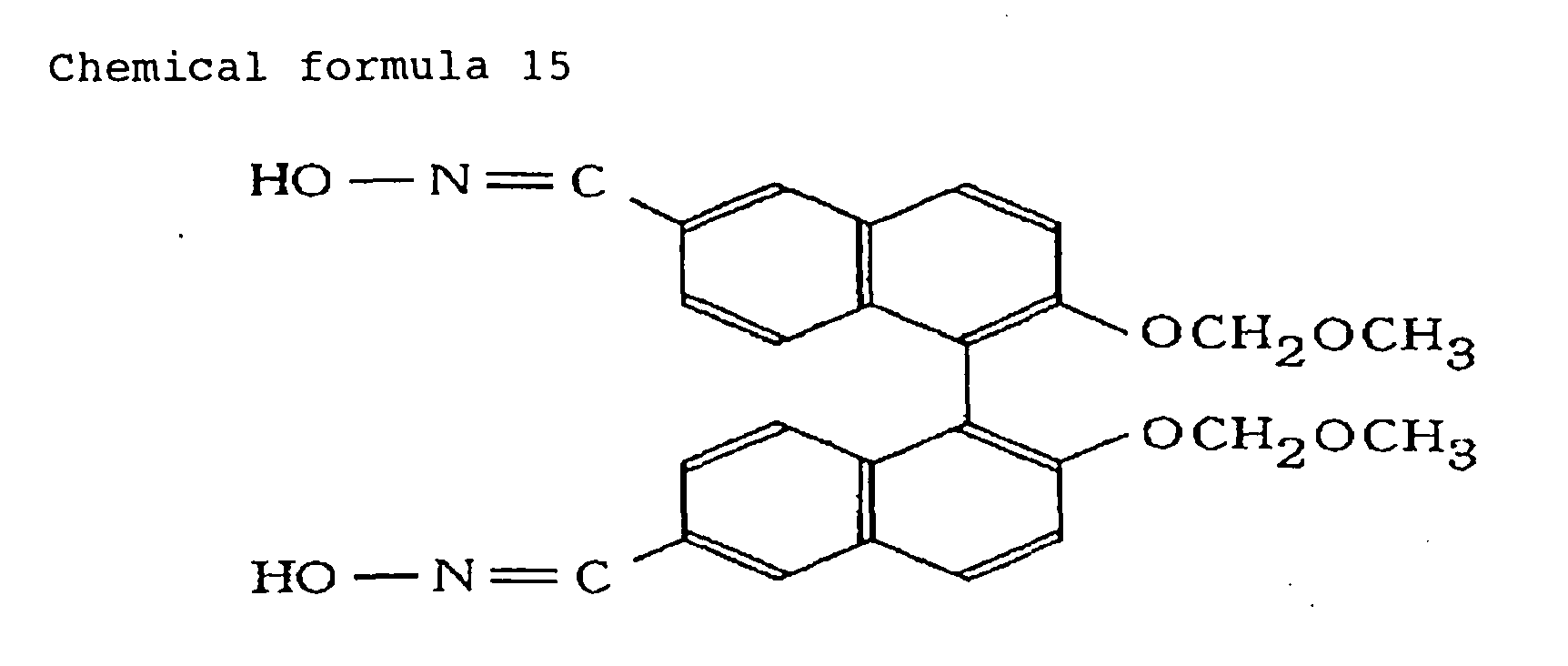
The results of analysis of this compound are shown in Table 2.Table 2 1H NMR (CDCl3) (δ) 3.17(s,6H), 5.00(d, J=7.2Hz, 2H), 5.10(d, J=6.9Hz, 2H), 7.12 (d, J=8.9Hz, 2H), 7.55 (dd, J=7.2, 1.6Hz, 2H), 7.60 (d, J=8.9Hz, 2H), 7.91 (d, J=1.4Hz, 2H), 7.97 (d, J=8.9Hz, 2H), 8.25 (s, 2H)
(5) The compound obtained in the above step (4) was suspended in 80 ml of methylene chloride, and 1,8-diazabicyclo[5.4.0.]undec-7-ene (DBU) (3.2 ml) was added thereto to complete dissolution. To this solution was added p-toluenesulfonyl chloride (2.0 g) at room temperature. After stirring at room temperature for 30 minutes, the mixture was poured into water. The mixture was extracted with ethyl acetate. The combined extracts were washed with aqueous sodium carbonate solution, and concentrated. The residue was purified by column chromatography (flash chromatography on SiO2) to obtain dicyano-MOM protected compound (1.1 g (wet weight)) (the following structural formula 16)
The results of analysis of this compound are shown in Table 3Table 3 1H NMR (CDCl3) (δ) 3.12 (s, 6H), 4.98 (d, J=6.9Hz, 2H), 5.03 (d, J=6.9Hz, 2H), 7.08 (d, J=8.9Hz, 2H), 7.20 (dd, J=1.7, 8.6Hz, 2H), 7.65 (d, J=8.9Hz, 2H), 7.97 (d, J=8.9Hz, 2H), 8.21 (d, J=1.7Hz, 2H)
(6) The dicyano-MOM protected compound obtained in the above step (5) was dissolved in a mixed solvent of THF (20 ml) and concentrated hydrochloric acid (15 ml). After stirring at room temperature for 2 hours. completion of the reaction was confirmed by thin layer chromatography. The reaction solution was poured into water, and the mixture extracted with ethyl acetate. The combined extracts were concentrated. The residue was recrystallized from a mixed solvent of ethyl acetate/hexane (ethyl acetate:hexane = 2:3 to 1:2) at room temperature to obtain (R)-6,6'- dicyanobinaphthol (500 mg).
The overall yield based on the raw material binaphthol used was 51%. Recrystallization was carried out again with the above mother liquor to obtain further 160 mg (yield 16%), with a total yield of 660 mg of (R)-6,6'-dicyanobinaphthol (the following structural formula 17). The overall yield from (R)-binaphthol was 67%.
The results of analysis of this compound are shown in Table 4.Table 4 1H NMR (CDCl3+CD3OD) (δ) 7.13 (d, J=8.0Hz, 2H), 7.46 (dd, J=1.7, 8.9Hz, 2H), 7.52 (d, J=8.9Hz, 2H), 8.07 (d, J=8.9Hz, 2H), 8.29 (d, J=1.7Hz, 2H) Optical purity (HPLC analysis) 99% e.e. (HPLC analysis conditions: CHIRALPAK AD manufactured by Daicel Chemical Industries Co., Ltd., isopropanol/hexane = 1/9, detection; 254 nm, flow rate; 1.0 ml/min.)
(7) Preparation of Al-Li-(R)-6,6'-dicyanobinaphthol
The same manner as shown in Example 1 was adopted except that the (R)- 6,6'-dicyanobinaphthol obtained in the above steps (1) to (6) was used in place of (R)-binaphthol in Example 1 to afforded Al-Li-(R)-6,6'-dicyanobinaphthol. - Cyclohexenone (96 mg, 1.0 mmol) and dibenzyl malonate (250 mg, 1.0 mmol) were added to a solution of Al-Li-(R)-binaphthol complex in tetrahydrofuran (0.1 M, 1.0 ml), which was stirred at room temperature for 48 hours to carry out asymmetric Michael reaction shown by the following chemical formula 18. The reaction was stopped by adding 1N HCl aqueous solution (3ml) to the reaction solution. The mixture was extracted with ethyl acetate (15 ml X three times) and the combined extracts were dried over Na2SO4. The solvent was distilled off, and the residue was purified by flash column chromatography (acetone/hexane = 1/10) using SiO2 to obtain the Michael reaction product of a final compound in a yield of 91%.

- The results of analysis of the reaction product in this Example are shown in Table 5.
Table 5 IR (KBr) 1740cm-1, 1261cm-1 Melting point 43°C 1H NMR (CDCl3) δ 1.46 (dddd, J=3.0, 11.5, 11.5, 11.5Hz, 1H), 1.62 (dddd, J=2.2, 2.4, 12.3, 12.3, 12.3Hz, 1H), 1.84-2.08 (m, 2H), 2.12-2.64 (m, 5H), 3.41 (d, J=7.6Hz, 1H), 5.14 (s, 2H), 5.16 (s, 2H), 7.25-7.36 (m, 10H) 13C NMR (CDCl3) (δ) 24.4, 28.6, 38.0, 40.9, 45.0, 56.6, 67.2, 128.2, 128.4, 128.5, 135.0, 167.4, 167.5, 209.3 MS m/z 289 (M+ -Bn), 91 (base peak) HRMS for C23H24O5 (M+ -Bn) cal'd [C,72.61;H,6.36], measured [C,72.40;H,6.13] [α]D 24 +1.24° (c 1.02, CHCl3) Optical purity (HPLC analysis) 98% e.e. (HPLC analysis conditions: CHIRALPAK AS manufactured by Daicel Chemical Industries Co., Ltd., isopropanol/hexane = 1/9, detection; 254 nm, flow rate; 1.0 ml/min.) - According to the same reaction conditions and operations as proposed in Example 6, cyclohexenone and diethyl malonate were subjected to the asymmetric Michael reaction to obtain the reaction product of the structural formula 19 in a yield of 87%.
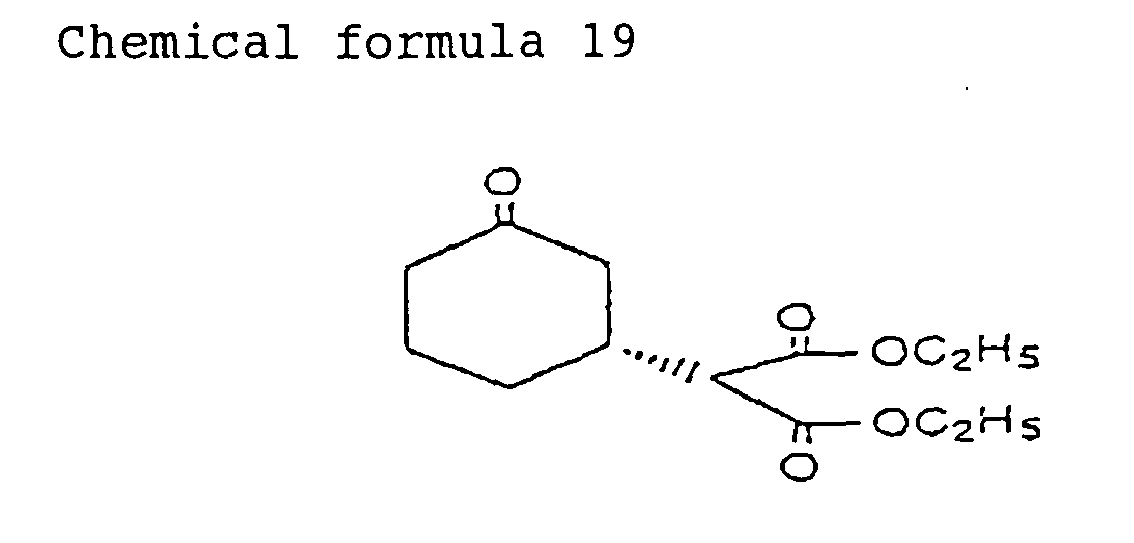
- The analysis was carried out on this reaction product in same manner as in Example 6, the results were shown in Table 6.
Table 6 IR (KBr) 1731cm-1, 1230cm-1 1H NMR (CDCl3) (δ) 1.20 (t, J=7.3Hz, 3H), 1.21 (t, J=7.3Hz, 3H), 1.44 (dddd, J=3.2, 12.1, 12.1, 12.1Hz, 1H), 1.62 (ddddd, J=3.2, 5.0, 12.1, 12.1, 12.1Hz, 1H), 1.83-1.95 (m, 1H), 1.95-2.07 (m, 1H), 2.11-2.28 (m, 2H), 2.28-2.54 (m, 3H), 3.23 (d, J=7.9Hz, 1H), 4.13 (q, J=7.3Hz, 2H), 4.14 (q, J=7.3Hz, 2H) 13C NMR (CDCl3) (δ) 14.0, 24.5, 28.7, 38.0, 40.9, 45.0, 56.8, 61.5, 167.7, 167.8, 209.6 MS m/z 256 (M+), 211 (M+ -OMe), 97 (base peak) HRMS for C13H20O5 cal'd [C,60.92;H,7.87], measured [C,60.64;H,7.62] [α]D 24 +3.33° (c 2.09, CHCl3) Optical purity (HPLC analysis) 95% e.e. (HPLC analysis conditions: CHIRALPAK AS manufactured by Daicel Chemical Industries Co., Ltd., isopropanol/hexane = 1/9,detection; differential refraction, 254 nm, flow rate; 1.0 ml/min.) - According to the same reaction conditions and operations as proposed in Example 6, cyclohexenone and dimethyl malonate were subjected to the asymmetric Michael reaction to obtain the reaction product of the structural formula 20 in a yield of 90%.

- The analysis was carried out on this reaction product in same manner as in Example 6, and the results were shown in Table 7.
Table 7 IR (neat) 1732cm-1, 1259cm-1 1H NMR (CDCl3) (δ) 1.46 (dddd, J=2.6, 12.2, 12.2, 12.2Hz, 1H), 1.62 (ddddd, J=2.6, 4.2, 12.2, 12.2, 12.2Hz, 1H), 1.86-1.97 (m, 1H), 1.98-2.11 (m, 1H), 2.15-2.31 (m, 2H), 2.31-2.59 (m, 3H), 3.32 (d, J=7.9Hz, 1H), 3.71 (s, 3H), 3.72 (s, 3H) 13C NMR (CDCl3) (δ) 24.4, 28.7, 37.9, 38.0, 40.9, 45.0, 52.5, 56.5, 168.1, 168.2, 209.4 MS m/z 228 (M+), 197 (M+ -OMe), 97 (base peak) HRMS for C17H16O5 cal'd [C,57.88;H,7.07], measured [C,57.70;H,7.01] [α]D 24 +3.73° (c 1.00, CHCl3) Optical purity 93% e.e. (HPLC analysis conditions: (HPLC analysis) CHIRALPAK AS manufactured by Daicel Chemical Industries Co., Ltd., isopropanol/hexane = 1/9, detection; differential refraction, flow rate; 1.0 ml/min. - According to the same reaction conditions and operations as proposed in Example 6, cyclopentenone and dibenzyl malonate were subjected to the asymmetric Michael reaction to obtain the reaction product of the structural formula 21 in a yield of 93%.

- The analysis was carried out on this reaction product in the same manner as in Example 6, and the results were obtained shown in Table 8.
Table 8 IR (neat) 1740cm-1, 1211cm-1 1H NMR (CDCl3) (δ) 1.51-1.72 (m, 1H), 1.99 (dd, J=11.2, 18.5Hz, 1H), 2.06-2.38 (m, 3H), 2.45 (dd, J=7.9, 18.5Hz, 1H), 2.78-2.97 (m, 1H), 3.45 (d, J=9.6Hz, 1H), 5.14 (s, 2H), 5.16 (s, 2H), 7.25-7.37 (m, 10H) 13C NMR (CDCl3) (δ) 27.4, 36.3, 38.1, 42.7, 56.4, 67.3, 67.3, 128.2, 128.5, 128.6, 135.0, 135.1, 167.7, 167.8, 216.9 MS m/z 275 (M+ -Bn), 91 (base peak) HRMS for C15H15O5 (M+ -Bn) cal'd [275.0919], measured [275.0931] [α]D 24 +35.0° (c 1.20, CHCl3) Optical purity 91% e.e. (HPLC analysis conditions: (HPLC analysis) CHIRALPAK AS manufactured by Daicel Chemical Industries Co., Ltd., isopropanol/hexane = 1/9, detection; 254 nm, flow rate; 1.0 ml/min. - According to the same reaction conditions and operations as proposed in Example 6, cyclopentenone and diethyl methylmalonate were subjected to the asymmetric Michael reaction to obtain the reaction product of the structural formula 22 in a yield of 84%.

- The analysis was carried out on this reaction product in the same manner as in Example 2, and the results were obtained shown in Table 9.
Table 9 IR (neat) 2984cm-1, 1730cm-1, 1262cm-1 1H NMR (CDCl3) (δ) 1.25 (t, J=7.0Hz, 3H), 1.26 (t, J=7.0Hz, 3H), 1.44 (s, 1H),1.60-1.84 (m, 1H), 2.07-2.49 (m, 5H), 2.78-2.94 (m, 1H), 4.19 (q, J=7Hz,2H), 4.21 (q, J=7Hz, 2H) 13C NMR (CDCl3) (δ) 14.0, 17.8, 24.6, 38.5, 40.8, 41.4, 55.4, 61.4, 171.2, 171.3, 217.7 MS m/z 257 (M+1), 288 (M+1 -Et), 174 (base peak) HRMS For C13H20O5 Cal'd [C,60.92;H,7.87], measured [C,60.66;H,7.76] [α]D 24 +54.9° (c 3.34, CHCl3) Optical purity (HPLC analysis) 91% e.e. (HPLC analysis conditions: CHIRALPAK AS manufactured by Daicel Chemical Industries Co., Ltd., isopropanol/hexane = 1/9, detection; differential refraction, flow rate; 1.0 ml/min. - Cyclohexenone (96 mg, 1.0 mmol) and dibenzyl malonate (250 mg, 1.0 mmol) were added to the solution obtained in Example 2. After stirring at room temperature for 48 hours, 1N HCl aqueous solution (3 ml) was added to the reaction solution to stop the reaction. The mixture was extracted with ethyl acetate (15 ml X three times) and the combined extracts were dried over Na2SO4. The solvent was distilled off from the reaction solution, and the residue was purified by flash column chromatography (acetone/hexane = 1/10, on SiO2) to obtain the Michael reaction product of a final compound in a yield of 44%. The optical purity by HPLC analysis was 97% e.e. (HPLC analysis conditions were the same as those in Example 6).
- Cyclohexenone (96 mg, 1.0 mmol) and dibenzyl malonate (250 mg, 1.0 mmol) were added to the solution obtained in Example 3. After stirring at room temperature for 6 hours. 1N HCl aqueous solution (3 ml) was added to the reaction solution to stop the reaction. The mixture was extracted with ethyl acetate (15 ml X three times) and the combined extracts were dried over Na2SO4. The solvent was distilled off from the reaction solution, and the residue was purified by flash column chromatography (acetone/hexane = 1/10, on SiO2) to obtain the Michael reaction product of a final compound in a yield of 100%. The optical purity of the product was 87% e.e as analized by HPLC. (HPLC analysis conditions were the same as those in Example 6).
- Cyclopentenone (84 mg, 1.0 mmol), diethyl methylmalonate (138 mg, 1.0 mmol) and hydrocinnamaldehyde (158 mg, 1.2 mmol) were added to a solution of Al-Li-(R)-binaphthol complex obtained in Example 1 (0.1 M, 1.0 ml). The stirring was continued at room temperature for 36 hours to carry out the reaction below.

- After 1N HCl aqueous solution (3 ml) was added to this reaction solution to stop the reaction, the mixture was extracted with ethyl acetate (15 ml X three times). The combined extracts were dried over Na2SO4. After the solvent was distilled off, the residue was purified by flash column chromatography (acetone/hexane = 1/10, on SiO2) to afford the three-component combination type reaction product of a final compound in a yield of 64%. The analysis was carried out on this reaction product in same manner as in Example 6 to obtain the results shown in Table 10.
Table 10 IR (neat) 3518cm-1, 3085cm-1, 1728cm-1, 1253cm-1 1H NMR (CDCl3) (δ) 1.19 (t, J=7.0Hz, 3H), 1.22 (t, J=7.0Hz, 3H), 1.40 (s, 3H), 1.68-1.87 (m, 2H), 2.01-2.19 (m, 2H), 2.24 (t, J=8.4Hz, 2H), 2.35 (dd, J=3.8, 6.3Hz, 1H), 2.57-2.70 (m, 2H), 2.76-2.899 (m, 1H), 2.97 (dt, J=6.3, 8.0Hz, 1H), 3.75 (dt, J=3.8, 9.6Hz, 1H), 4.06 (q, J=7.0Hz, 1H), 4.11 (q, J=7.0Hz, 1H), 4.13 (q, J=7.0Hz, 2H), 7.13-7.40 (m, 5H) 13C NMR (CDCl3) (δ) 13.9, 14.0, 18.6, 22.9, 32.5, 36.1, 38.5, 42.4, 43.3, 55.9, 56.9, 57.0, 61.6, 72.0, 125.9, 128.4, 128.5, 141.8, 171.6, 171.8, 218.9 MS m/z 391 (M+), 373 (M+ -H2O), 175 (base peak) HRMS For C22H36O6 Cal'd [C,67 . 67 ; H, 7 . 74], measured [C,67.41;H,7.70] [α]D 24 +18.34° (c 0.66, CHCl3) Optical purity 91% e.e. (HPLC analysis conditions: (HPLC analysis) CHIRALPAK AD manufactured by Daicel Chemical Industries Co., Ltd., isopropanol/hexane = 1/9, detection; 254 nm, flow rate; 0.5 ml/min. - Cyclopentenone (84 mg, 1.0 mmol), diethyl methylmalonate (138 mg, 1.0 mmol) and benzaldehyde (122 mg, 1.2 mmol) were added to the solution of Al-Li-(R)-binaphthol complex obtained in Example 1 (0.1 M, 1.0 ml). The stirring was continued at room temperature for 72 hours to carry out the reaction below.
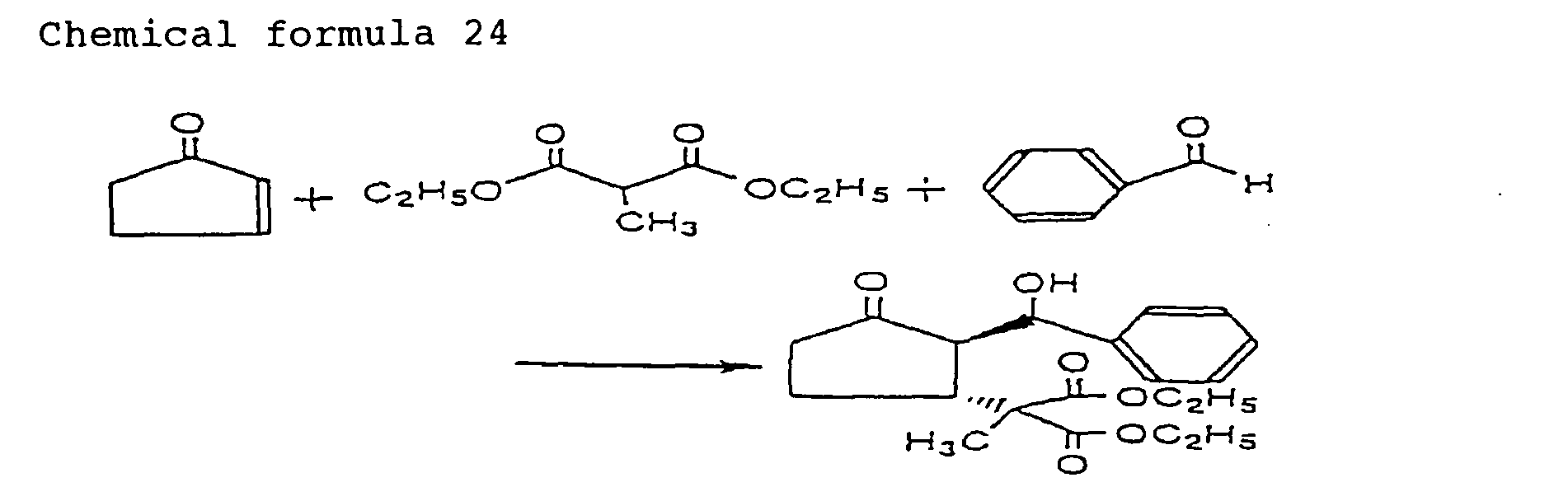
- Then, the workup was carried out as in Example 13 to obtain the three component combination compound of a final product in a yield of 82%. In order to analyze this reaction product in the same manner as in Example 6, the product was oxidized with pyridinium chlorochromate (hereinafter abbreviated as PCC) to obtain the diketone compound as shown in chemical formula 25. The results of analysis of this diketone compound are shown in Table 11. According to the HPLC analysis results shown in this Table, the optical purity of the diketone compound was 89% e.e. Therefore, it is considered that the optical purity of the three-component combination type reaction product in this Example is also 89% e.e.

Table 11 IR (neat) 3468cm-1, 1728cm-1, 1677cm-1, 1260cm-1 1H NMR (CDCl3) (δ) 1.04 (t, J=7.3Hz, 3H), 1.21 (t, J=7.3Hz, 3H), 1.49 (s, 3H), 1.03-2.03 (m, 1H), 2.26-2.48 (m, 3H), 3.55-3.68 (m, 1H), 3.87 (dq, J=7.3, 10.9Hz, 1H), 4.03 (dq, J=7.3, 10.9Hz, 1H), 4.13 (q, J=7.3Hz. 2H), 4.77 (d, J=8.6Hz, 1H), 7.45-7.52 (m, 2H), 7.55-7.62 (m, 1H), 8.00-8.05 (m, 1H) 13C NMR (CDCl3) (δ) 13.6, 13.9, 19.7, 22.7, 38.9, 44.4, 55.6, 59.4, 61.4, 128.5, 129.4, 133.3, 136.5, 171.1, 195.1, 211.0 MS m/z 361 (M+), 360 (M+), 105 (base peak) HRMS For C20H24O6 Cal'd [C,66.65;H,6.71], measured [C,66.38;H,66.65] [α]D 24 -22.00° (c 1.02, CHCl3) Optical purity (HPLC analysis) 89% e.e. (A diketone compound which had been oxidized with pyridinium chlorochromate in methylene chloride was subjected to HPLC analysis. HPLC analysis conditions: CHIRALCEL OJ manufactured by Daicel Chemical Industries Co., Ltd., isopropanol/hexane = 1/4, detection; 254 nm, flow rate; 0.5 ml/min. - The solution of Al-Li-(R)-binaphthol complex (hereinafter abbreviated as ALB) obtained in Example 1 in tetrahydrofuran (0.1 M, 0.36 ml) was concentrated at room temperature for 1 hour under reduced pressure, and 0.4 ml of toluene was added thereto under argon atmosphere. To this solution was added dimethyl phosphite (37 µl, 0.40 mmol) at room temperature. After stirring for 30 minutes, the reaction vessel was cooled to -40°C. After it was maintained at this temperature for 15 minutes, then benzaldehyde (0.48 mmol) was added thereto. After reaction for 90 hours, 1N hydrochloric acid was added thereto to stop the reaction. The mixture was extracted with ethyl acetate (10 ml X three times), and the combined extracts were washed with brine and dried over Na2SO4. The solvent was distilled off, and the residue was purified by flash column chromatography (acetone/hexane = 1/5, on SiO2) to obtain dimethyl (S)-hydroxyphenylmethylphosphonate of a final product in a yield of 95%. The chemical reaction in this Example is shown in chemical formula 26.

- The results of analysis of this reaction product are shown in Table 12.
Table 12 IR (KBr) 3261cm-1, 1235cm-1 1H NMR (CDCl3) (δ) 3.30 (dd, J=4.0, 5.3Hz, 1H), 3.61 (d, J=9.9Hz, 3H), 3.63 (d, J=9.9Hz, 3H), 4.98 (dd, J=5.0, 9.9Hz, 1H), 7.2-7.5 (m, 5H) 13C NMR (CDCl3) (δ) 53.6 (J=7.3Hz), 53.9 (J=7.3Hz), 70.6 (J=159.9Hz), 127.0 (J=159.9Hz), 128.2 (J=3.7Hz), 128.4 (J=2.5Hz), 136.3 MS m/z 216 (M+) HRMS For C9H13O4P1 Cal'd [C,50.00;H,6.06], measured [C,49.80;H,6.05] Optical purity (HPLC analysis) 90% e.e. (HPLC analysis conditions: CHIRALPAK AS manufactured by Daicel Chemical Industries Co., Ltd., isopropanol/hexane = 1/4, detection; 254 nm, flow rate; 0.9 ml/min. - The solution of ALB in tetrahydrofuran (0.1 M, 0.40 ml) obtained in Example 1 was concentrated at room temperature for 1 hour under reduced pressure, and 0.4 ml of toluene was added thereto under argon atmosphere. To this solution was added dimethyl phosphite (37 µl, 0.40 mmol) at room temperature. After stirring for 30 minutes, the reaction vessel was cooled to -40°C, and it was maintained at this temperature for 15 minutes. Benzaldehyde (0.40 mmol) was then added thereto. After reaction for 51 hours, 1N hydrochloric acid was added thereto to stop the reaction. The mixture was extracted with ethyl acetate (10 ml X three times). The combined extracts were washed with brine and dried over Na2SO4. The solvent was distilled off, and the residue was purified by flash column chromatography (acetone/hexane = 1/5, on SiO2) to obtain dimethyl (S)-hydroxy-phenylmethylphosphonate of final product in a yield of 90%. The chemical reaction in this Example is shown in chemical formula 27.

- The results of analysis of this reaction product are shown in Table 13.
Table 13 IR (KBr) 3261 cm-1, 1235 cm-1 1H NMR (CDCl3) (δ) 3.30 (dd, J=4.0, 5.3Hz, 1H), 3.61 (d, J=9.9Hz, 3H), 3.63 (d, J=9.9Hz, 3H), 4.98 (dd, J=5.0, 9.9Hz, 1H), 7.2-7.5 (m, 5H) 13C NMR (CDCl3) (δ) 53.6 (J=7.3Hz), 53.9 (J=7.3Hz), 70.6 (J=159.9Hz), 127.0(J=159.9Hz), 128.2 (J=3.7Hz), 128.4 (J=2.5Hz), 136.3 MS m/z 216 (M+) HRMS For C9H13O4P1 cal'd [C,50.00;H,6.06], measured [C,49.80;H,6.05] [α]D 24 -44.3° (c 1.0, CHCl3) Optical purity (HPLC analysis) 85% e.e. (HPLC analysis conditions: CHIRALPAK AS manufactured by Daicel Chemical Industries Co., Ltd., isopropanol/hexane = 1/4, detection; 254 nm, flow rate; 0.9 ml/min. - Further, the same reactions were carried out as in chemical formula 27 by changing the reaction solvents to obtain analysis results shown in Table 14.
Table 14 Exampl e No. Solvent Reaction time (hr) Yield (%) Optical purity (%) 17 Tetrahydrofuran 36.5 61 73 18 Toluene 36.5 88 83 19 Methylene 36.5 49 80 20 chloride 36.5 58 78 Ethyl ether - The solution of ALB in tetrahydrofuran (0.1 M, 0.40 ml) obtained in Example 1 was concentrated at room temperature for 1 hour under reduced pressure, and 0.4 ml of toluene was added thereto under argon atmosphere. To this solution was added dimethyl phosphite (37 µl, 0.40 mmol) at room temperature. After stirring for 30 minutes, the reaction vessel was cooled to -40°C, and it was maintained at this temperature for 15 minutes. Then p-chlorobenzaldehyde (0.40 mmol) was added thereto. After reaction for 38 hours, 1N hydrochloric acid was added thereto to stop the reaction. The mixture was extracted with ethyl acetate (10 ml X three times), and the combined extracts were washed with brine and dried over Na2SO4. The solvent was distilled off, and the residure was purified by flash column chromatography (acetone/hexane = 1/5, on SiO2) to obtain dimethyl (S)-hydroxy(p-chlorophenyl)methylphosphonate of a final product in a yield of 90%. The chemical reaction in this Example is shown in chemical formula 28.

- The results of analysis of this reaction product are shown in Table 15.
Table 15 IR (KBr) 3257 cm-1, 1233 cm-1 1H NMR (CDCl3) (δ) 2.95 (dd, J=4.6, 10.6Hz, 1H), 3.62 (d, J=10.6Hz, 3H), 3.64 (d, J=10.6Hz, 3H), 5.05 (dd, J=5.0, 10.9Hz, 1H), 7.35 (d, J=8.5Hz, 2H), 7.43 (dd, J=3.0, 8.5Hz, 2H) 13C NMR (CDCl3) (δ) 53.6 (J=7.4Hz), 54.1 (J=7.4Hz), 70.0 (J=159.9Hz), 128.4 (J=6.0Hz), 128.5 (J=2.4Hz), 133.9 (J=3.7Hz), 135.1 (J=2.4Hz) MS m/z 250 (M+) HRMS For C9H12Cl1O4P1 Cal'd [C,43.13 ; H,4.83], measured [C,42.88;H,4.80] [α]D 24 -49.1° (c 1.0, CHCl3) Optical purity (HPLC analysis) 83% e.e. (HPLC analysis conditions: CHIRALPAK AS manufactured by Daicel Chemical Industries Co., Ltd., isopropanol/hexane = 1/4, detection; 254 nm, flow rate; 0.5 ml/min. - The solution of ALB in tetrahydrofuran (0.1 M, 0.40 ml) obtained in Example 1 was concentrated at room temperature for 1 hour under reduced pressure, and 0.4 ml of toluene was added thereto under argon atmosphere. To this solution was added dimethyl phosphite (37 µl, 0.40 mmol) at room temperature. After stirring at room temperature for 30 minutes, the reaction vessel was cooled to -40°C, and it was maintained at this temperature for 15 minutes. Then p-methylbenzaldehyde (0.40 mmol) was added thereto. After reaction for 92 hours, 1N hydrochloric acid was added thereto to stop the reaction. The mixture was extracted with ethyl acetate (10 ml X three times), and the combined extracts were washed with brine and dried over Na2SO4. The solvent was distilled off, and the residue was purified by flash column chromatography (acetone/hexane = 1/5, on SiO2) to obtain dimethyl (S)-hydroxy(p-methylphenyl)methylphosphonate of a final product in a yield of 82%. The chemical reaction in this Example is shown in chemical formula 29.

- The results of analysis of this reaction product are shown in Table 16.
Table 16 IR (KBr) 3250 cm-1, 1256 cm-1 1H NMR (CDCl3) (δ) 2.28 (d, J=1.6, 3H), 2.80 (bs, 1H), 3.63 (d, J=10.8Hz, 3H), 3.65 (d, J=10.8Hz, 3H), 4.93 (d, J=10.6Hz, 1H), 7.12 (d, J=7.9Hz, 2H), 7.30 (dd, J=2.0, 7.9Hz, 2H) 13C NMR (CDCl3) (δ) 21.2, 53.6 (J=7.3Hz), 53.9 (J=7.3Hz), 70.5 (J=159.9Hz),126.9 (J=6.1Hz), 129.1 (J=2.4Hz), 133.3, 138.0 (J=2.4Hz) MS m/z 230 (M+) HRMS for C10H15O4P1 cal'd [C,52.18;H,6.57], measured [C,52.17;H,6.45] [α]D 24 -49.5° (c 1.0, CHCl3) Optical purity (HPLC analysis) 86% e.e. (HPLC analysis conditions: CHIRALPAK AS manufactured by Daicel Chemical Industries Co., Ltd., isopropanol/hexane = 1/4, detection; 254 nm, flow rate; 0.5 ml/min. - The solution of ALB in tetrahydrofuran (0.1 M, 0.40 ml) obtained in Example 1 was concentrated at room temperature for 1 hour under reduced pressure, and 0.4 ml of toluene was added thereto under argon atmosphere. To this solution was added dimethyl phosphite (37 µl, 0.40 mmol) at room temperature. After stirring for 30 minutes at room temperature, the reaction vessel was cooled to -40°C, and it was maintained at this temperature for 15 minutes. Then, p-methoxybenzaldehyde (0.40 mmol) was added thereto. After reaction for 115 hours, 1N hydrochloric acid was added thereto to stop the reaction. The mixture was extracted with ethyl acetate (10 ml X three times), and the combined extracts were washed with brine and dried over Na2SO4. The solvent was distilled off, and the residue was purified by flash column chromatography (acetone/hexane = 1/5, on SiO2) to obtain dimethyl (S)-hydroxy(p-methoxyphenyl)methylphosphonate of a final product in a yield of 88%. The chemical reaction in this Example is shown in chemical formula 30.

- The results of analysis of this reaction product are shown in Table 17.
Table 17 IR (KBr) 3338 cm-1, 1236 cm-1 1H NMR (CDCl3) (δ) 3.19 (bs, 1H), 3.63 (d, J=10.4Hz, 3H), 3.65 (d, J=10.4Hz, 3H), 3.74 (s, 3H), 4.91 (d, J=9.9Hz, 1H), 6.85 (d, J=8.3Hz, 2H), 7.34 (dd, J=2.0, 8.3Hz, 2H) 13C NMR (CDCl3) (δ) 53.5 (J=7.3Hz), 53.8 (J=7.3Hz), 55.2, 70.0 (J=162.4Hz), 113.8, 128.4, 159.5 (J=2.5Hz) MS m/z 246 (M+) HRMS for C10H15O5P1 cal'd [C,48.79;H,6.19], measured [C,48.81;H,6.07] [α]D 24 -38.7° (c 1.0, CHCl3) Optical purity (HPLC analysis) 78% e.e. (HPLC analysis conditions: CHIRALPAK AS manufactured by Daicel Chemical Industries Co., Ltd., isopropanol/hexane = 1/4, detection; 254 nm, flow rate; 1.0 ml/min. - Dimethyl phosphite (37 µl, 0.40 mmol) was added to the solution of ALB in tetrahydrofuran (0.1 M, 0.40 ml) obtained in Example 1 at room temperature. After stirring at room temperature for 30 minutes, the reaction vessel was cooled to -78°C, and it was maintained at this temperature for 15 minutes. Then p-nitrobenzaldehyde (0.40 mmol) was added thereto. After the temperature was raised to room temperature, the stirring was continued for 12 hours. 1N Hydrochloric acid was added thereto to stop the reaction, and the mixture was extracted with ethyl acetate (10 ml X three times). The combined extracts were washed with brine and dried over Na2SO4. The solvent was distilled off, and the residue was purified by flash column chromatography (acetone/hexane = 1/5, on SiO2) to obtain dimethyl (S)-hydroxy(p-nitrophenyl)methylphosphonate of a final product in a yield of 81%. The chemical reaction in this Example is shown in chemical formula 31.

- The results of analysis of this reaction product are shown in Table 18. Table 18
1H NMR (CDCl3) (δ) 3.85 (d, J=10.9Hz, 3H), 3.87 (d, J=10.9Hz, 3H), 5.30 (d, J=11.6Hz, 1H), 7.77 (dd, J=2.0, 8.0Hz, 2H), 8.34 (d, J=8.0Hz, 2H) Optical purity (HPLC analysis) 23% e.e. (HPLC analysis conditions: CHIRALPAK AS manufactured by Daicel Chemical Industries Co., Ltd., isopropanol/hexane = 1/9, detection; 254 nm, flow rate; 1.0 ml/min. - Dimethyl phosphite (37 µl, 0.40 mmol) was added to the solution of ALB in tetrahydrofuran (0.1 M, 0.40 ml) obtained in Example 1 at room temperature. After stirring at room temperature for 30 minutes, the reaction vessel was cooled to -40 °C, and it was maintained at this temperature for 15 minutes. p-Dimethylaminobenzaldehyde (0.40 mmol) was added thereto. After the reaction for 48 hours, 1N hydrochloric acid was added thereto to stop the reaction. The mixture was extracted with ethyl acetate (10 ml X three times), and the combined mixture were washed with brine and dried over Na2SO4. The solvent was distilled off, and the residue was purified by flash column chromatography (acetone/hexane = 1/5, on SiO2) to obtain dimethyl (S)-hydroxy(p-dimethylaminophenyl)methylphosphonate of a final product in a yield of 71%. The chemical reaction in this Example is shown in chemical formula 32.

Table 19 1H NMR (CDCl3) (δ) 2.96 (s, 6H), 3.64 (d, J=10.2Hz, 3H), 3.74 (d, J=10.6Hz, 3H), 4.92 (dd, J=5.0, 9.9Hz, 1H), 6.72 (d, J=8.9Hz, 2H), 7.35 (dd, J=2.0, 8.9Hz, 2H) Optical purity (HPLC analysis) 15% e.e. (HPLC analysis conditions: CHIRALPAK AS manufactured by Daicel Chemical Industries Co., Ltd., isopropanol/hexane = 1/2, detection; 254 nm, flow rate; 1.0 ml/min. - The solution of ALB in tetrahydrofuran (0.1 M, 0.40 ml) obtained in Example 1 was concentrated at room temperature for 1 hour under reduced pressure, and 0.4 ml of toluene was added thereto under argon atmosphere. To this solution was added diethyl phosphite (0.40 mmol) at room temperature. After stirring at room temperature for 30 minutes, the reaction vessel was cooled to -40 °C, and it was maintained at this temperature for 15 minutes. Then, benzaldehyde (0.40 mmol) was added thereto. After the reaction for 90 hours, 1N hydrochloric acid was added thereto to stop the reaction. The mixture was extracted with ethyl acetate (10 ml X three times), and the combined extracts were washed with brine and dried over Na2SO4. The solvent was distilled off, and the residue was purified by flash column chromatography (acetone/hexane = 1/5, on SiO2) to obtain diethyl (S)-hydroxy-phenylmethylphosphonate of a final product in a yield of 39%. The chemical reaction in this Example is shown in chemical formula 33.

Table 20 Optical purity (HPLC analysis) 73% e.e. (HPLC analysis conditions: CHIRALPAK AS manufactured by Daicel Industries Co., Ltd., isopropanol/hexane = 1/4, detection; 254 nm, flow rate; 0.8 ml/min. - The same manner as shown in Example 26 was adopted except that dibutyl phosphite was used in place of diethyl phosphite used in Example 26 to afford dibutyl (S)-hydroxy-phenylmethylphosphonate of a final product in a yield of 42%.
- The analysis results of this reaction product are shown in Table 21.
Table 21 Optical purity (HPLC analysis) 67% e.e. (HPLC analysis conditions: CHIRALPAK AS manufactured by Daicel Chemical Industries Co., Ltd., isopropanol/hexane = 1/9, detection; 254 nm, flow rate; 1.0 ml/min. - The same manner as shown in Example 26 was adopted except that dibenzyl phosphite was used in place of diethyl phosphite used in Example 26 and that the reaction was performed at room temperature for 6.5 hours to afford dibenzyl (S)-hydroxy-phenylmethylphosphonate of a final product in a yield of 60%. The analysis results on this reaction product are shown in Table 22.
Table 22 Optical purity (HPLC analysis) 8.4% e.e. (HPLC analysis conditions: CHIRALPAK AD manufactured by Daicel Chemical Industries Co., Ltd., isopropanol/hexane = 1/9, detection; 254 nm, flow rate; 1.0 ml/min. - The solution of ALB in tetrahydrofuran (0.1 M, 0.40 ml) obtained in Example 1 was concentrated at room temperature for 1 hour under reduced pressure, and 0.4 ml of toluene was added thereto under argon atmosphere. To this solution was added dimethyl phosphite (37 µl, 0.40 mmol) at room temperature. After stirring at room temperature for 30 minutes, the reaction vessel was cooled to -40°C, and it was maintained at this temperature for 15 minutes. Then, cinnamaldehyde (0.40 mmol) was added thereto. After the reaction for 81 hours, 1N hydrochloric acid was added thereto to stop the reaction. The mixture was extracted with ethyl acetate (10 ml X three times), and the combined extracts were washed with brine and dried over Na2SO4. The solvent was distilled off, and the residue was purified by flash column chromatography (acetone/hexane = 1/5, on SiO2) to obtain dimethyl (S,E)-1-hydroxy-3-phenyl-2-propenylphosphonate of a final product in a yield of 85%. The chemical reaction in this Example is shown in chemical formula 34.

- The results of analysis of this reaction product are shown in Table 23.
Table 23 IR (KBr) 3258 cm-1, 1243 cm-1 1H NMR (CDCl3) (δ) 3.77 (d, J=10.3Hz, 3H), 3.78 (d, J=10.3Hz, 3H), 4.64 (ddd, J=1.7, 6.3, 12.9Hz, 1H), 6.26 (dt, J=5.6, 15.8Hz, 1H), 6.73 (dd, J=5.0, 15.8Hz, 1H), 7.30 (m, 5H) 13C NMR (CDCl3) (δ) 53.7 (J=7.3Hz), 53.9 (J=7.3Hz), 69.3 (J=2.5Hz) MS m/z 242 (M+) HRMS for C11H15O4P1 cal'd [C,54.55;H,6.24], measured [C,54.28;H,5.96] [α]D 24 -21.4° (c 1.0 , CHCl3) Optical purity (HPLC analysis) 82% e.e. (HPLC analysis conditions: CHIRALPAK AS manufactured by Daicel Chemical Industries Co., Ltd., isopropanol/hexane = 1/4, detection; 254 nm, flow rate; 1.2 ml/min. - The solution of ALB in tetrahydrofuran (0.1 M, 0.40 ml) obtained in Example 1 was concentrated at room temperature for 1 hour under reduced pressure, and 0.4 ml of toluene was added thereto under argon atmosphere. To this solution was added dimethyl phosphite (37 µl, 0.40 mmol) at room temperature. After stirring at room temperature for 30 minutes. Then, the reaction vessel was cooled to -40 °C, and it was maintained at this temperature for 15 minutes, then (E)- β - methylcinnamaldehyde (0.40 mmol) was added thereto. After the reaction for 81 hours, 1N hydrochloric acid was added thereto to stop the reaction. The mixture was extracted with ethyl acetate (10 ml X three times), and the combined extracts were washed with brine and dried over Na2SO4. The solvent was distilled off, and the residue was purified by flash column chromatography (acetone/hexane = 1/5, on SiO2) to obtain dimethyl (S,E)-1-hydroxy-3-methyl-3-phenyl-2-propenylphosphonate of a final product in a yield of 93%. The chemical reaction in this Example is shown in chemical formula 35.
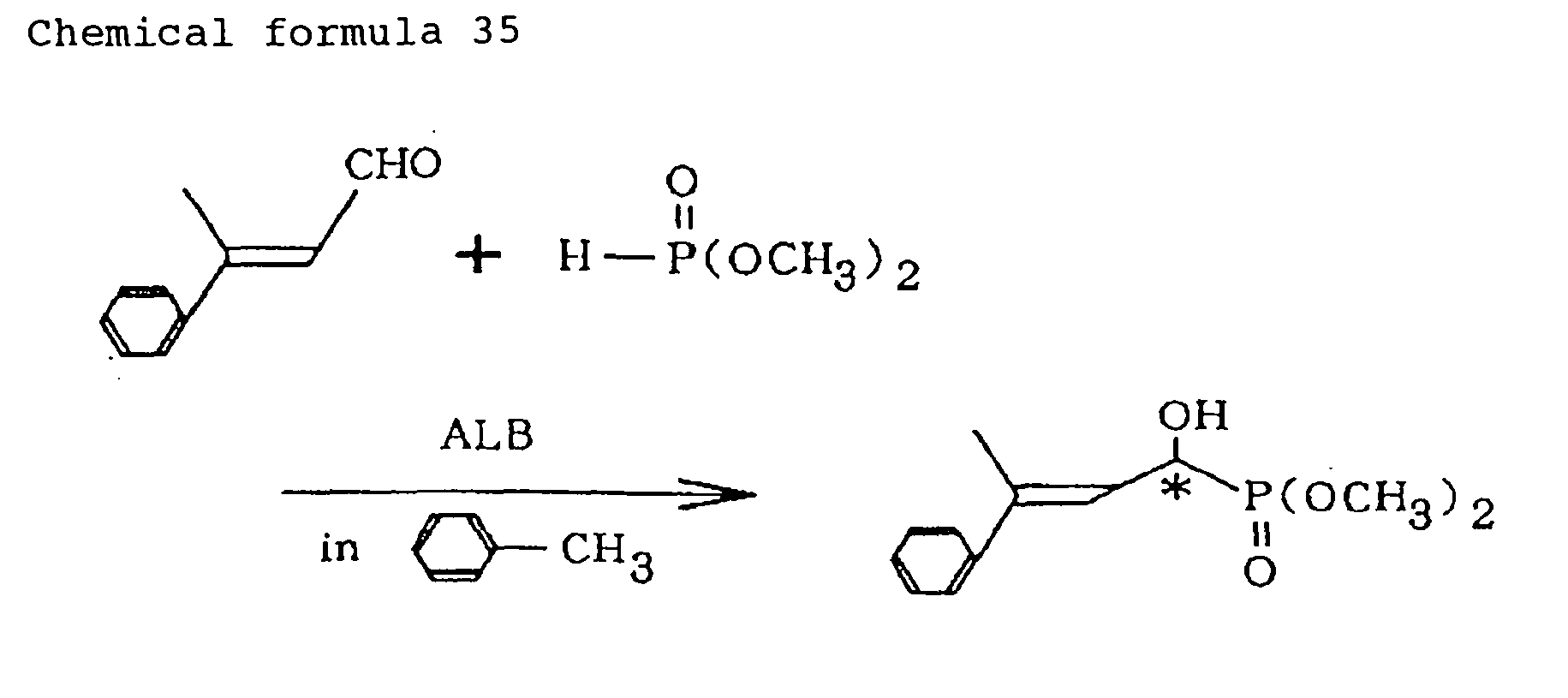
- The results of analysis of this reaction product are shown in Table 24.
Table 24 IR (KBr) 3245 cm-1, 1031 cm-1 1H NMR (CDCl3) (δ) 2.14 (dd, J=1.0, 3.3Hz, 3H), 3.10 (bs, 1H), 3.82 (d, J=10.6Hz, 3H), 3.84 (d, J=10.6Hz, 3H), 4.89 (t, J=9.2, 10.6Hz, 1H), 5.87 (dt, J=7.2, 15.5Hz, 1H), 7.36 (m, 5H) 13C NMR (CDCl3) (δ) 16.8, 53.6 (J=7.4Hz), 53.8 (J=7.3Hz), 66.3 (J=163.5Hz), 122.0 (J=3.7Hz), 126.0, 127.7, 128.3, 140.9 (J=13.5Hz), 142.4 MS m/z 256 (M+) HRMS for C12H17O4P1 cal'd [C,56.25;H,6.69], measured [C,54.02;H,6.91] [α]D 24 -12.8° (c 1.0, CHCl3) Optical purity (HPLC analysis) 89% e.e. (HPLC analysis conditions: CHIRALPAK AD manufactured by Daicel Chemical Industries Co., Ltd., isopropanol/hexane = 5/95, detection; 254 nm, flow rate; 1.0 ml/min. - The solution of ALB in tetrahydrofuran (0.1 M, 0.40 ml) obtained in Example 1 was concentrated at room temperature for 1 hour under reduced pressure, and 0.4 ml of toluene was added thereto under argon atmosphere. To this solution was added dimethyl phosphite (37 µl, 0.40 mmol) at room temperature. After stirring at room temperature for 30 minutes, the reaction vessel was cooled to -40°C, and it was maintained at this temperature for 15 minutes. Then 3-methyl-2-butenal (0.40 mmol) was added thereto. After the reaction for 81 hours, 1N hydrochloric acid was added thereto to stop the reaction. The mixture was extracted with ethyl acetate (10 ml X three times), and the combined extracts were washed with brine and dried over Na2SO4. The solvent was distilled off, and the residue was purified by flash column chromatography (acetone/hexane = 1/5, on SiO2) to obtain dimethyl (S)-1-hydroxy-3-methyl-2-butenylphosphonate of a final product in a yield of 72%. The chemical reaction in this Example is shown in chemical formula 36.

- The results of analysis of this reaction product are shown in Table 25.
Table 25 IR (KBr) 3274 cm-1, 1052 cm-1 1H NMR (CDCl3) δ 1.71 (dd, J=1.3, 3.0Hz, 3H), 1.81 (dd, J=1.0, 4.0Hz, 3H), 3.18 (bs, 1H), 3.80 (d, J=10.5Hz, 3H), 3.82 (d, J=10.5Hz, 3H), 4.66 (dt, 5.5, 9.1, 9.2, 1H), 5.33 (m, 1H) 13C NMR (CDCl3) δ 18.5, 25.9, 53.4 (J=6.1Hz), 53.5 (J=7.4Hz), 65.5 (J=163.6Hz), 119.4 (J=2.4Hz), 139.6 (J=14.6Hz) MS m/z 191 (M+) HRMS for C7H15O4P1 cal'd [C,43.30;H,7.79], measured [C,43.01;H,7.80] [α]D 25 -54.4° (c 0.65, CHCl3) Optical purity (HPLC analysis) 68% e.e. (HPLC analysis conditions: CHIRALPAK AS manufactured by Daicel Chemical Industries Co., Ltd., isopropanol/hexane = 1/4, flow rate; 1.0 ml/min., detection; differential refraction - The solution of ALB in tetrahydrofuran (0.1 M, 0.40 ml) obtained in Example 1 was concentrated at room temperature for 1 hour under reduced pressure, and 0.4 ml of toluene was added thereto under argon atmosphere. To this solution was added dimethyl phosphite (37 µl, 0.40 mmol) at room temperature. After stirring at room temperature for 30 minutes, the reaction vessel was cooled to -40°C, and it was maintained at this temperature for 15 minutes. Then 2-hexenylaldehyde (0.40 mmol) was added thereto. After the reaction for 39 hours, 1N hydrochloric acid was added thereto to stop the reaction. The mixture was extracted with ethyl acetate (10 ml X three times), and the combined extracts were washed with brine and dried over Na2SO4. The solvent was distilled off, and the residue was purified by flash column chromatography (acetone/hexane = 1/5, on SiO2) to obtain dimethyl (E,S)-1-hydroxy-2-hexenylphosphonate of a final product in a yield of 53%. The chemical reaction in this Example is shown in chemical formula 37.

- The results of analysis of this reaction product are shown in Table 26.
Table 26 IR (KBr) 3299 cm-1, 1237 cm-1 1H NMR (CDCl3) (δ) 0.91 (d, J=7.3Hz, 3H), 1.43 (dt, J=7.3, 7.6Hz, 2H), 2.07 (m, 2H), 3.79 (d, J=10.2Hz, 3H), 3.81 (d, J=10.2Hz, 3H), 4.46 (dd, J=7.3, 10.6Hz, 1H), 5.60 (m, 1H), 5.90 (m, 1H) 13C NMR (CDCl3) (δ) 13.6, 22.0, 34.4, 53.5 (J=7.3Hz), 53.7 (J=7.3Hz), 69.2 (J=162.3Hz), 124.2 (J=3.6Hz), 135.4 (J=12.2Hz) MS m/z 208 (M+) [α]D 25 -9.7° (c 0.95, CHCl3) Optical purity (HPLC analysis) 55% e.e. (HPLC analysis conditions: CHIRALPAK AS manufactured by Daicel Chemical Industries Co., Ltd., isopropanol/hexane = 1/4, flow rate; 1.0 ml/min., detection; differential refraction - The solution of ALB in tetrahydrofuran (0.1 M, 0.40 ml) obtained in Example 1 was concentrated at room temperature for 1 hour under reduced pressure, and 0.4 ml of toluene was added thereto under argon atmosphere. To this solution was added dimethyl phosphite (37 µl, 0.40 mmol) at room temperature. After stirring at room temperature for 30 minutes, the reaction vessel was cooled to -40°C, and it was maintained at this temperature for 15 minutes. Then (E)-α-methylcinnamaldehyde (0.40 mmol) was added thereto. After the reaction for 61 hours, 1N hydrochloric acid was added thereto to stop the reaction. The mixture was extracted with ethyl acetate (10 ml X three times), and the combined extracts were washed with brine and dried over Na2SO4. The solvent was distilled off, and the residue was purified by flash column chromatography (acetone/hexane = 1/5, on SiO2) to obtain dimethyl-(E)-(S)-1-hydroxy-2-methyl-3-phenyl-2-propenyl phosphonate of a final product in a yield of 47%. The chemical reaction in this Example is shown in chemical formula 38.

- The results of analysis of this reaction product are shown in Table 27.
Table 27 1H NMR (CDCl3) (δ) 1.96 (dd, J=1.3, 3.3Hz, 3H), 3.76 (d, J=10.8Hz, 3H), 3.78 (d, J=10.6Hz, 3H), 4.47 (dd, J=4.3, 12.5Hz, 1H), 6.63 (d, J=4.6Hz, 1H), 7.21 (m, 5H) Optical purity (HPLC analysis) 56% e.e. (HPLC analysis conditions: CHIRALPAK AS manufactured by Daicel Chemical Industries Co., Ltd., isopropanol/hexane = 1/4, detection; 254 nm, flow rate; 0.5 ml/min. - The same manner as shown in Example 33was adopted except that 2-methylpropenal was used in place of (E)-α -methylcinnamaldehyde (0.40 mmol) used in Example 33 and that a reaction was carried out for 35 hours to afford dimethyl (S,E)-1-hydroxy-2-methyl-2-propenylphosphonate of a final product in a yield of 65%. The chemical reaction in this Example is shown in chemical formula 39.

- The results of analysis of this reaction product are shown in Table 28.
Table 28 1H NMR (CDCl3) (δ) 1.83 (t, J=1.3, 1.0Hz, 3H), 3.12 (dd, J=5.6, 10.2Hz, 1H), 3.75 (d, J=10.5Hz, 3H), 3.76 (d, J=10.5Hz, 3H), 4.38 (dd, J=5.0, 12.5Hz, 1H), 5.02 (t, J=1.3Hz, 1H), 5.13 (d, J=4.6Hz, 1H) Optical purity (HPLC analysis) 56% e.e. (HPLC analysis conditions: CHIRALPAK AS manufactured by Daicel Chemical Industries Co., Ltd., isopropanol/hexane = 1/4, detection; differential refraction, flow rate; 0.5 ml/min. - The same manner as shown in Example 33 was adopted except that cyclohexylidene-Δ1α-acetaldehyde was used in place of (E)-α- methylcinnamaldehyde (0.40 mmol) used in Example 33 and that the reaction was carried out for 47 hours to afford dimethyl-(S)-cyclohexylidene-Δ1α1-1-hydroxyethylphosphonate in a yield of 65%. The chemical reaction in this Example is shown in chemical formula 40.

- The results of analysis of this reaction product are shown in Table 29.
Table 29 1H NMR (CDCl3) (δ) 1.45 (bs, 6H), 2.11 (bs, 2H), 3.05 (bs, 1H), 3.74 (d, J=10.6Hz, 3H), 3.75 (d, J=10.6Hz, 3h), 4.70 (m, 1H), 5.21 (m, 1H) Optical purity (HPLC analysis) 60% e.e. (HPLC analysis conditions: CHIRALPAK AS manufactured by Daicel Chemical Industries Co., Ltd., isopropanol/hexane = 1/4, detection; 254 nm, flow rate; 1.0 ml/min - The solution of ALB in tetrahydrofuran (0.1 M, 0.40 ml) obtained in Example 1 was concentrated at room temperature for 1 hour under reduced pressure, and 0.4 ml of toluene was added thereto under argon atmosphere. To this solution was added dimethyl phosphite (37 µl, 0.40 mmol) at room temperature. After stirring at room temperature for 30 minutes, the reaction vessel was cooled to -40 °C , and it was maintained at this temperature for 15 minutes. Then 2-methylpropionaldehyde (0.40 mmol) was added thereto. After the reaction for 38 hours, 1N hydrochloric acid was added thereto to stop the reaction. The mixture was extracted with ethyl acetate (10 ml X three times), and the combined extracts were washed with brine and dried over Na2SO4. The solvent was distilled off, and the residue was purified by flash column chromatography (acetone/hexane = 1/5, on SiO2) to obtain dimethyl (S)-1-hydroxy-2-methylpropylphosphonate of a final product in a yield of 95%. The chemical reaction in this Example is shown in chemical formula 41

- The results of analysis of this reaction product are shown in Table 30
Table 30 1H NMR (CDCl3) (δ) 1.96 (dd, J=1.3, 3.3Hz, 3H), 3.76 (d, J=10.8Hz, 3H), 3.78 (d, J=10.6Hz, 3H), 4.47 (dd, J=4.3, 12.5Hz, 1H), 6.63 (d, J=4.6Hz, 1H), 7.21 (m, 5H) Optical purity (HPLC analysis) 14% e.e. (HPLC analysis conditions: CHIRALPAK AS manufactured by Daicel Chemical Industries Co,, Ltd., isopropanol/hexane = 1/4, detection; differential refraction, flow rate; 0.5 ml/min - The same manner as shown in Example 36 was adopted except that hexanal was used in place of 2-methylpropionaldehyde used in Example 36 and that the reaction was carried out for 20 hours to afford dimethyl (S)-1-hydroxyhexylphosphonate of a final compound in a yield of 90%. The chemical reaction in this Example is shown in chemical formula 42

- The results of analysis of this reaction product are shown in Table 31
Table 31 1H NMR (CDCl3) (δ) 0.97 (t, J=6.3, 3H), 1.40 (m, 4H), 1.80 (m, 4H), 3.87 (d, J=10.2Hz, 3H), 3.88 (d, J=10.2Hz, 3H), 3.92 (m, 1H) Optical purity (HPLC analysis) 3% e.e. (HPLC analysis conditions: CHIRALPAK AS manufactured by Daicel Chemical Industries Co., Ltd., isopropanol/hexane = 1/4, detection; 254 nm, flow rate; 0.5 ml/min - The same manner as shown in Example 36 was adopted except that cyclohexanal was used in place of 2-methylpropionaldehyde used in Example 36 and that the reaction was carried out for 43 hours to afford dimethyl (S)-1-hydroxyhexyl phosphonate in a yield of 91%. The chemical reaction in this Example is shown in chemical formula 43.

- The results of analysis of this reaction product are shown in Table 32
Table 32 1H NMR (CDCl3) (δ) 1.20 (m, 6H), 1.78 (m, 4H), 1.98 (d, J=11.9Hz, 1H), 2.52 (t, J=6.9Hz, 1H), 3.71 (q, J=6.9, 12.5Hz, 2H), 3.80 (d, J=10.6Hz, 3H), 3.82 (d, J=10.6Hz, 3H) Optical purity (HPLC analysis) 24% e.e. (HPLC analysis conditions: CHIRALPAK AS manufactured by Daicel Chemical Industries Co., Ltd., isopropanol/hexane = 1/4, detection; differential refraction, flow rate; 0.5 ml/min - The solution of ALB-Br in tetrahydrofuran (0.1M, 0.40 ml) obtained in Example 4 was concentrated at room temperature for 1 hour under reduced pressure, and 0.4 ml of toluene was added under argon atmosphere. To this solution was added dimethyl phosphite (37 1, 0.40 mmol). After stirring at room temperature for 30 minutes, the reaction vessel was cooled to -40°C, and it was maintained at this temperature for 15 minutes. Then benzaldehyde (0.40 mmol) was added thereto. After the reaction for 59 hours, 1N hydrochloric acid was added to stop the reaction. The mixture was extracted with ethyl acetate (10 ml X three times), and the combined extracts were washed with brine and dried over Na2SO4. The solvent was distilled off, and the residue was purified by flash column chromatography (acetone/hexane = 1/5, on SiO2) to obtain dimethyl (S)-hydroxy-phenylmethyl phosphonate of a final product in a yield of 91%. The chemical reaction in this Example is shown in chemical formula 44.

- The results of analysis of this reaction product are shown in Table 33.
Table 33 1H NMR (CDCl3) (δ) 3.30 (dd, J=4.0, 5.3Hz, 1H), 3.61 (d, J=9.9Hz, 3H), 3.63 (d, J=9.9Hz, 3H), 4.98 (dd, J=5.0, 9.9Hz, 1H), 7.2-7.5 (m, 5H) Optical purity (HPLC analysis) 68% e.e. (HPLC analysis conditions: CHIRALPAK AS manufactured by Daicel Chemical Industries Co., Ltd., isopropanol/hexane = 1/4, detection; 254 nm, flow rate; 0.5 ml/min - The same manner as shown in Example 39 was adopted except that p-methoxybenzaldehyde was used in place of benzaldehyde used in Example 39 to afford dimethyl (S)-hydroxy(p-methoxyphenyl)methylphosphate of a final product in a yield of 72%. The chemical reaction in this Example is shown in chemical formula 45.

- The results of analysis of this reaction product are shown in Table 34.
Table 34 1H NMR (CDCl3) (δ) 3.19 (bs, 1H), 3.63 (d, J=10.4Hz, 3H), 3.65 (d, J=10.4Hz, 3H), 3.74 (s, 3H), 4.91 (d, J=9.9Hz, 1H), 6.85 (d, J=8.3Hz, 2H), 7.34 (dd, J=2.0, 8.3Hz, 2H) Optical purity (HPLC analysis) 35% e.e. (HPLC analysis conditions: CHIRALPAK AS manufactured by Daicel Chemical Industries Co., Ltd., isopropanol/hexane = 1/4, detection; 254 nm, flow rate; 1.1 ml/min - The solution of ALB-CN in tetrahydrofuran (0.1M, 0.40 ml) obtained in Example 5 was concentrated at room temperature for 1 hour under reduced pressure, and 0.4 ml of toluene was added thereto under argon atmosphere. To this solution was added dimethyl phosphite (37 µl, 0.40 mmol) at room temperature. After stirring at room temperature for 30 minutes, the reaction vessel was cooled to -40°C, and it was maintained at this temperature for 15 minutes. Then p-methoxybenzaldehyde (0.40 mmol) was added thereto. After the reaction for 59 hours, 1N hydrochloric acid was added to stop the reaction. The mixture was extracted with ethyl acetate (10 ml X three times), and the combined extracts were washed with brine and dried over Na2SO4. The solvent was distilled off, and the residue was purified by flash column chromatography (acetone/hexane = 1/5, on SiO2) to obtain dimethyl (R)-hydroxy(p-methoxyphenyl)methylphosphonate of a final product in a yield of 25%. The chemical reaction in this Example is shown in chemical formula 46.

- The results of analysis of this reaction product are shown in Table 35
Table 35 1H NMR (CDCl3) (δ) 3.19 (bs, 1H), 3.63 (d, J=10.4Hz, 3H), 3.65 (d, J=10.4Hz, 3H), 3.74 (s, 3H), 4.91 (d, J=9.9Hz, 1H), 6.85 (d, J=8.3Hz, 2H), 7.34 (dd, J=2.0, 8.3Hz, 2H) Optical purity (HPLC analysis) 35% e.e. (HPLC analysis conditions: CHIRALPAK AS manufactured by Daicel Chemical Industries Co., Ltd., isopropanol/hexane = 1/4, detection; 254 nm, flow rate; 1.1 ml/min - The same manner as shown in Example 41 was adopted except that 2-methylpropionaldehyde was used in place of p-methoxybenzaldehyde used in Example 41 to afford dimethyl (S)-1-hydroxy-2-methylpropylphosphonate of a final product in a yield of 66%. The chemical reaction in this Example is shown in chemical formula 47.

- The results of analysis of this reaction product are shown in Table 36.
Table 36 1H NMR (CDCl3) (δ) 1.15 (dd, J=2.0, 6.9Hz, 6H), 2.19 (m, 1H), 2.95 (t, J=6.6Hz, 1H), 3.79 (dd, J=9.3, 12.2Hz, 1H), 3.89 (d, J=10.6Hz, 3H), 3.90 (d, J=10.6Hz, 3H) Optical purity (HPLC analysis) 29% e.e. (HPLC analysis conditions: CHIRALPAK AS manufactured by Daicel Chemical Industries Co., Ltd., isopropanol/hexane = 1/4, detection; differential refraction, flow rate; 0.5 ml/min - The same manner as shown in Example 41 was adopted except that 3-methyl-2-butenal was used in place of p-methoxybenzaldehyde used in Example 41 to afford dimethyl (R)-1-hydroxy-3-methyl-2-butenylphosphonate of a final product in a yield of 34%. The chemical reaction in this Example is shown in chemical formula 48.
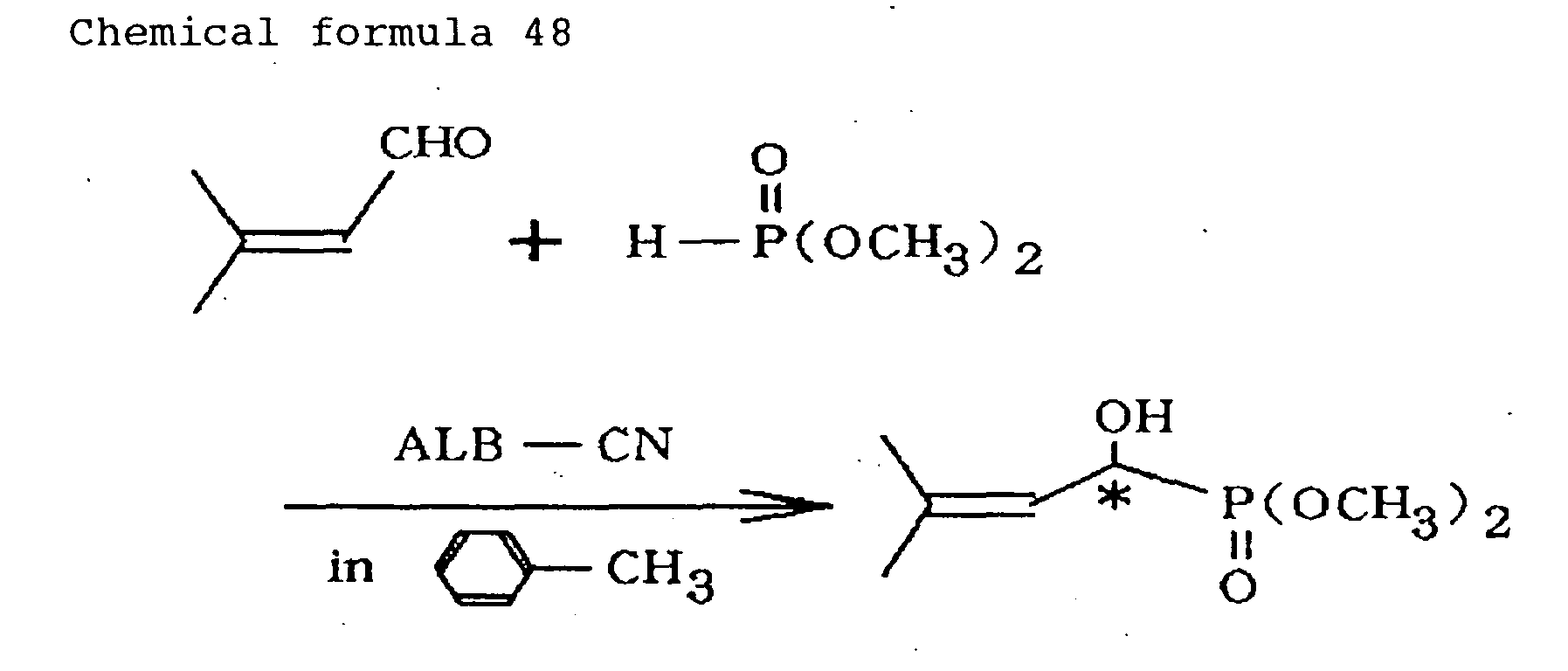
- The results of analysis of this reaction product are shown in Table 37.
Table 37 1H NMR (CDCl3) (δ) 1.71 (dd, J=1.3, 3.0Hz, 3H), 1.81 (dd, J=1.0, 4.0Hz, 3H), 3.18 (bs, 1H), 3.80 (d, J=10.5Hz, 3H), 3.82 (d, J=10.5Hz, 3H), 4.66 (dt, 5.5, 9.1, 9.2, 1H), 5.33 (m, 1H) Optical purity (HPLC analysis) 47% e.e. (HPLC analysis conditions: CHIRALPAK AS manufactured by Daicel Chemical Industries Co., Ltd., isopropanol/hexane = 5/95, detection; differential refraction, flow rate; 0.5 ml/min - Dimethy (S)-1-hydroxy-3-methyl-2-butenylphosphonate obtained in Example 31 (68% e.e., 54 mg) was dissolved in 10 ml of methanol, and 10% Pd/C (16 mg) was added thereto. The mixture was stirred at room temperature for 3 hours under hydrogen atmosphere, and the reaction mixture was filtered through Celite and the filter cake was washed with ethyl acetate. The solvent was distilled off under reduced pressure and the residue was purified by flash column chromatography (acetone/hexane = 1/4, on SiO2) to obtain dimethyl (S)-1-hydroxy-3-methylbutylphosphonate of a final product in a yield of 98%. This compound is known to be useful as a raw material for medicines and the like. The chemical reaction in this Reference Example is shown in chemical formula 49.

- The results of analysis of this reaction product are shown in Table 38.
Table 38 IR (neat) 3320 cm-1 1H NMR (CDCl3) (δ) 0.90 (d, J=6.6Hz, 3H), 0.95 (d, J=6.6Hz, 3H), 1.47 (m, 1H), 1.73 (m, 1H), 1.95 (m, 1H), 3.78 (d, J=10.2Hz, 3H), 3.79 (d, J=10.2Hz, 3H), 4.00 (m, 1H) 13C NMR (CDCl3) (δ) 21.0, 23.4, 24.0 (J=14.6Hz), 39.9, 53.2 (J=4.9Hz), 53.3 (J=6.1Hz), 65.5 (J=161.1Hz) MS m/z 196 (M+) [α]D 25 +16.4° (c 1.0, CHCl3) Optical purity (HPLC analysis) 68% e.e. (HPLC analysis conditions: CHIRALPAK AS manufactured by Daicel Chemical Industries Co., Ltd., isopropanol/hexane = 1/4, flow rate; 1.0 ml/min., detection; differential refraction - The process for producing an asymmetric compound of the present invention is suitable for obtaining, in a high yield, an optically active compound having high optical purity, which is useful as an intermediate for medicines, by asymmetric Michael reaction and asymmetric hydrophosphonylation reaction although the process uses, as a catalyst, a metal complex containing no rare earth metal element.
Claims (25)
- A process for producing an asymmetric Michael addition compound, which comprises performing asymmetric Michael reaction using a metal complex obtained by reacting optically active binaphthol or a derivative thereof with alkali metal aluminum hydride or alkali metal aluminum hydride compound.
- A process for producing an asymmetric hydrophosphonylated compound, which comprises performing asymmetric hydrophosphonylation reaction using a metal complex obtained by reacting optically active binaphthol or a derivative thereof with alkali metal aluminum hydride or alkali metal aluminum hydride compound.
- A process for producing an asymmetric Michael addition compound, which comprises performing asymmetric Michael reaction using a metal complex obtained by reacting optically active binaphthol or a derivative thereof, dialkylaluminum hydride, and a base containing an alkali metal or a base containing an alkaline earth metal.
- A process for producing an asymmetric hydrophosphonylated compound, which comprises performing asymmetric hydrophosphonylation reaction using a metal complex obtained by reacting optically active binaphthol or a derivative thereof, dialkylaluminum hydride, and a base containing an alkali metal or a base containing an alkaline earth metal.
- The process according to claim 1 or 2, wherein an equivalent ratio of the optically active binaphthol or a derivative thereof and the alkali metal aluminum hydride is 1-4 : 1.
- The process according to claim 3 or 4, wherein an equivalent ratio of the optically active binaphthol or a derivative thereof, the dialkylaluminum hydride, and the base containing an alkali metal or the base containing alkaline earth metal is 1-4 : 0.5-2 : 1.
- The process according to one of claims 1 to 6,
wherein the optically active binaphthol derivative is an optically active compound represented by the general formula 1:
- The process according to any one of claims 1 to 7, wherein the metal complex is used as such or the solution thereof obtained by said reaction using an organic solvent.
- The process according to claim 8, wherein the organic solvent is an ether compound.
- The process according to claim 9, wherein the ether compound is selected from the group consisting of tetrahydrofuran, diethyl ether, methyl tert-butyl ether and dioxane.
- A process for producing an asymmetric compound according to claim 1 or 3, wherein the asymmetric Michael reaction is a reaction of cyclopentenone or cyclohexenone with malonic diester or alkylmalonic diester.
- The process for producing an asymmetric compound according to claim 11, wherein the asymmetric Michael reaction is performed by adding further an aliphatic or an aromatic aldehyde to obtain a three-component combination type optically active compound represented by the general formula 2:
 wherein R1 is a residue of an aliphatic or aromaticcompound, R2 is hydrogen or an alkyl group, and R3 is an alkyl group or an aralkyl group.
 - The process for producing an asymmetric hydrophosphonylated compound according to claim 2 or 4, wherein the asymmetric hydrophosphonylation reaction is performed by using an organic solvent selected from the group consisting of benzene, toluene and xylene.
- The process for producing an asymmetric hydrophosphonylated compound according to claim 2, 4 or 13, wherein the asymmetric hydrophosphonylation reaction is a reaction by reacting an aldehyde represented by the following general formula 3:


- The process for producing of an asymmetric hydrophosphonylated compound according to claim 2, 4 or 13, wherein the asymmetric hydrophosphonylation reaction is a reaction by reacting an aldehyde represented by the following general formula 6:


- The process for producing an asymmetric hydrophosphonylated compound according to claim 2, 4 or 13, wherein the asymmetric hydrophosphonylation reaction is a reaction by reacting an aldehyde represented by the following general formula 9: Chemical formula 9
R1-CHO
(wherein R1 is a linear or branched alkyl group having 1-8 carbon atoms, or a cyclic alkyl group having 3-10 carbon atoms,) with a phosphonic diester represented by the following general formula 10:

- The process for producing an asymmetric hydrophosphonylated compound according to any one of claims 14 to 16, wherein the asymmetric hydrophosphonylation reaction is performed at a temperature ranging from -70°C to 45°C.
- A metal complex produced by a reaction of (a) an optically active binaphthol or a derivative thereof, and (b) alkali metal aluminum hydride or alkali metal aluminum hydride compound, and the molar ratio of said optically active binaphthol or a derivative thereof to said alkali metal aluminum hydride or alkali metal aluminum hydride compound is 2-4:1.
- A metal complex produced by a reaction of (a) an optically active binaphthol or a derivative thereof, (b) dialkylaluminum hydride, and (c) a base containing an alkali metal or an alkaline earth metal.
- A metal complex according to claim 18, wherein a ratio of equivalents of the optically active binaphthol or a derivative thereof to equivalents of the alkali metal aluminum hydride is 2:1.
- A metal complex according to claim 19, wherein a ratio of equivalents of the optically active binaphthol or a derivative thereof, the dialkylaluminum hydride, and the base containing an alkali metal or alkaline earth metal is 1-4 : 0.5-2 : 1.
- A metal complex according to claim 18 or claim 19, wherein the optically active binaphthol derivative is an optically active compound represented by the formula:

- A solution of a metal complex of claim 18 or claim 19 obtained by said reaction using an organic solvent.
- A solution of a metal complex of claim 23, wherein the organic solvent is an ether compound.
- A solution of a metal complex of claim 24, wherein the ether compound is selected from the group consisting of tetrahydrofuran, diethyl ether, methyl tert-butyl ether and dioxane.
Applications Claiming Priority (5)
| Application Number | Priority Date | Filing Date | Title |
|---|---|---|---|
| JP6309195 | 1995-03-22 | ||
| JP63091/95 | 1995-03-22 | ||
| JP46106/96 | 1996-03-04 | ||
| JP04610696A JP3782149B2 (en) | 1995-03-22 | 1996-03-04 | Metal complex for asymmetric synthesis, catalyst and method for producing asymmetric compound using the same |
| PCT/JP1996/000739 WO1996029295A1 (en) | 1995-03-22 | 1996-03-21 | Process for preparing asymmetric compound by using metal complex |
Publications (3)
| Publication Number | Publication Date |
|---|---|
| EP0826652A1 EP0826652A1 (en) | 1998-03-04 |
| EP0826652A4 EP0826652A4 (en) | 1999-05-26 |
| EP0826652B1 true EP0826652B1 (en) | 2006-09-06 |
Family
ID=26386228
Family Applications (1)
| Application Number | Title | Priority Date | Filing Date |
|---|---|---|---|
| EP96906911A Expired - Lifetime EP0826652B1 (en) | 1995-03-22 | 1996-03-21 | Process for preparing asymmetric compound by using metal complex |
Country Status (8)
| Country | Link |
|---|---|
| US (2) | US5847186A (en) |
| EP (1) | EP0826652B1 (en) |
| JP (1) | JP3782149B2 (en) |
| CN (1) | CN1182412A (en) |
| AT (1) | ATE338739T1 (en) |
| AU (1) | AU5014296A (en) |
| DE (1) | DE69636516D1 (en) |
| WO (1) | WO1996029295A1 (en) |
Families Citing this family (7)
| Publication number | Priority date | Publication date | Assignee | Title |
|---|---|---|---|---|
| JP3782149B2 (en) * | 1995-03-22 | 2006-06-07 | 長瀬産業株式会社 | Metal complex for asymmetric synthesis, catalyst and method for producing asymmetric compound using the same |
| JP4032190B2 (en) * | 1998-02-23 | 2008-01-16 | 日産化学工業株式会社 | Method for producing optically active compound |
| EP1238962B1 (en) * | 2001-03-07 | 2008-02-27 | Firmenich Sa | A process for the preparation of michael-adducts |
| JP4309686B2 (en) | 2003-01-17 | 2009-08-05 | 関東化学株式会社 | Method for producing optically active compound |
| TW200619222A (en) * | 2004-09-02 | 2006-06-16 | Rohm & Haas Elect Mat | Method for making organometallic compounds |
| JP4178151B2 (en) * | 2005-04-12 | 2008-11-12 | 独立行政法人科学技術振興機構 | Method for producing optically active α-hydroxyphosphonic acid and derivatives thereof, optically active aluminum (salalene) complex and method for producing the same, and method for producing salalen ligand |
| CN117003622B (en) * | 2023-08-11 | 2025-09-16 | 南开大学 | Series of chiral supermolecule macrocycles based on binaphthol element, preparation method and application |
Family Cites Families (3)
| Publication number | Priority date | Publication date | Assignee | Title |
|---|---|---|---|---|
| JPH0714898B2 (en) * | 1988-07-28 | 1995-02-22 | 高砂香料工業株式会社 | Process for producing optically active α-hydroxycarboxylic acid ester |
| JP3439255B2 (en) * | 1994-03-31 | 2003-08-25 | 長瀬産業株式会社 | Metal complexes catalyzing asymmetric Michael reaction |
| JP3782149B2 (en) * | 1995-03-22 | 2006-06-07 | 長瀬産業株式会社 | Metal complex for asymmetric synthesis, catalyst and method for producing asymmetric compound using the same |
-
1996
- 1996-03-04 JP JP04610696A patent/JP3782149B2/en not_active Expired - Lifetime
- 1996-03-21 DE DE69636516T patent/DE69636516D1/en not_active Expired - Lifetime
- 1996-03-21 EP EP96906911A patent/EP0826652B1/en not_active Expired - Lifetime
- 1996-03-21 WO PCT/JP1996/000739 patent/WO1996029295A1/en not_active Ceased
- 1996-03-21 US US08/913,784 patent/US5847186A/en not_active Expired - Fee Related
- 1996-03-21 CN CN96193449.2A patent/CN1182412A/en active Pending
- 1996-03-21 AU AU50142/96A patent/AU5014296A/en not_active Abandoned
- 1996-03-21 AT AT96906911T patent/ATE338739T1/en not_active IP Right Cessation
-
1998
- 1998-09-08 US US09/149,735 patent/US6090969A/en not_active Expired - Fee Related
Also Published As
| Publication number | Publication date |
|---|---|
| EP0826652A4 (en) | 1999-05-26 |
| JPH08319258A (en) | 1996-12-03 |
| WO1996029295A1 (en) | 1996-09-26 |
| CN1182412A (en) | 1998-05-20 |
| DE69636516D1 (en) | 2006-10-19 |
| US6090969A (en) | 2000-07-18 |
| EP0826652A1 (en) | 1998-03-04 |
| US5847186A (en) | 1998-12-08 |
| AU5014296A (en) | 1996-10-08 |
| ATE338739T1 (en) | 2006-09-15 |
| JP3782149B2 (en) | 2006-06-07 |
Similar Documents
| Publication | Publication Date | Title |
|---|---|---|
| US6005133A (en) | Enantioselective oxazaborolidine catalysts | |
| US6090969A (en) | Process for the preparation of an asymmetric compound using a metal complex | |
| AU693588B2 (en) | Novel process for the preparation of diisopinocampheylchloroborane | |
| TWI880924B (en) | Novel synthetic options towards the manufacture of (6r,10s)-10-{4-[5-chloro-2-(4-chloro-1h-1,2,3-triazol-1-yl)phenyl]-6-oxo-1(6h)-pyrimidinyl}- 1-(difluoromethyl)-6-methyl-1,4,7,8,9,10-hexahydro-11,15-(metheno)pyrazolo[4,3-b][1,7]diazacyclotetradecin-5(6h)-one | |
| US6025503A (en) | Process for producing optically active titanium alkoxide complexes | |
| US6476250B1 (en) | Optically active fluorinated binaphthol derivative | |
| EP1724251B1 (en) | Process for the production of optically active hydroxymethylated compounds | |
| US7232933B2 (en) | Preparation and use of diols | |
| US6187961B1 (en) | Process for the preparation of trans-(R,R)-actinol | |
| US6255501B1 (en) | Process for preparing antiosteoporotic agents | |
| US4964846A (en) | Process for the E/Z stereoselective synthesis of homochiral five and six ring intermediate products | |
| CN115650824B (en) | Chiral diol and preparation method thereof, prepared catalyst and preparation method and application thereof | |
| US6156935A (en) | Chiral phosphorus-based ligands | |
| JP4378826B2 (en) | Complex catalyst for asymmetric epoxidation reaction of enones and method for producing optically active epoxide using the same | |
| US6103914A (en) | Method of producing optically active material of tricyclic compound | |
| JP3680341B2 (en) | Process for producing optically active 1,1'-bis (1-hydroxyalkyl) metallocene | |
| JP4032190B2 (en) | Method for producing optically active compound | |
| EP1852412A1 (en) | Process for production of optically active hydroxymethylated compounds and catalyst therefor | |
| JPH04297471A (en) | Production of optically active phthalide |
Legal Events
| Date | Code | Title | Description |
|---|---|---|---|
| PUAI | Public reference made under article 153(3) epc to a published international application that has entered the european phase |
Free format text: ORIGINAL CODE: 0009012 |
|
| 17P | Request for examination filed |
Effective date: 19971015 |
|
| AK | Designated contracting states |
Kind code of ref document: A1 Designated state(s): AT BE CH DE DK ES FI FR GB GR IE IT LI LU MC NL PT SE |
|
| A4 | Supplementary search report drawn up and despatched |
Effective date: 19990413 |
|
| AK | Designated contracting states |
Kind code of ref document: A4 Designated state(s): AT BE CH DE DK ES FI FR GB GR IE IT LI LU MC NL PT SE |
|
| 17Q | First examination report despatched |
Effective date: 20020830 |
|
| GRAP | Despatch of communication of intention to grant a patent |
Free format text: ORIGINAL CODE: EPIDOSNIGR1 |
|
| RIC1 | Information provided on ipc code assigned before grant |
Ipc: B01J 31/22 20060101ALI20060331BHEP Ipc: C07F 5/06 20060101ALI20060331BHEP Ipc: C07F 9/40 20060101ALI20060331BHEP Ipc: C07C 69/716 20060101ALI20060331BHEP Ipc: C07C 67/347 20060101ALI20060331BHEP Ipc: C07B 53/00 20060101ALI20060331BHEP Ipc: C07B 37/02 20060101AFI20060331BHEP |
|
| GRAS | Grant fee paid |
Free format text: ORIGINAL CODE: EPIDOSNIGR3 |
|
| GRAA | (expected) grant |
Free format text: ORIGINAL CODE: 0009210 |
|
| AK | Designated contracting states |
Kind code of ref document: B1 Designated state(s): AT BE CH DE DK ES FI FR GB GR IE IT LI LU MC NL PT SE |
|
| PG25 | Lapsed in a contracting state [announced via postgrant information from national office to epo] |
Ref country code: NL Free format text: LAPSE BECAUSE OF FAILURE TO SUBMIT A TRANSLATION OF THE DESCRIPTION OR TO PAY THE FEE WITHIN THE PRESCRIBED TIME-LIMIT Effective date: 20060906 Ref country code: LI Free format text: LAPSE BECAUSE OF FAILURE TO SUBMIT A TRANSLATION OF THE DESCRIPTION OR TO PAY THE FEE WITHIN THE PRESCRIBED TIME-LIMIT Effective date: 20060906 Ref country code: IT Free format text: LAPSE BECAUSE OF FAILURE TO SUBMIT A TRANSLATION OF THE DESCRIPTION OR TO PAY THE FEE WITHIN THE PRESCRIBED TIME-LIMIT;WARNING: LAPSES OF ITALIAN PATENTS WITH EFFECTIVE DATE BEFORE 2007 MAY HAVE OCCURRED AT ANY TIME BEFORE 2007. THE CORRECT EFFECTIVE DATE MAY BE DIFFERENT FROM THE ONE RECORDED. Effective date: 20060906 Ref country code: FI Free format text: LAPSE BECAUSE OF FAILURE TO SUBMIT A TRANSLATION OF THE DESCRIPTION OR TO PAY THE FEE WITHIN THE PRESCRIBED TIME-LIMIT Effective date: 20060906 Ref country code: CH Free format text: LAPSE BECAUSE OF FAILURE TO SUBMIT A TRANSLATION OF THE DESCRIPTION OR TO PAY THE FEE WITHIN THE PRESCRIBED TIME-LIMIT Effective date: 20060906 Ref country code: BE Free format text: LAPSE BECAUSE OF FAILURE TO SUBMIT A TRANSLATION OF THE DESCRIPTION OR TO PAY THE FEE WITHIN THE PRESCRIBED TIME-LIMIT Effective date: 20060906 Ref country code: AT Free format text: LAPSE BECAUSE OF FAILURE TO SUBMIT A TRANSLATION OF THE DESCRIPTION OR TO PAY THE FEE WITHIN THE PRESCRIBED TIME-LIMIT Effective date: 20060906 |
|
| REG | Reference to a national code |
Ref country code: GB Ref legal event code: FG4D |
|
| REG | Reference to a national code |
Ref country code: CH Ref legal event code: EP |
|
| REG | Reference to a national code |
Ref country code: IE Ref legal event code: FG4D |
|
| REF | Corresponds to: |
Ref document number: 69636516 Country of ref document: DE Date of ref document: 20061019 Kind code of ref document: P |
|
| PG25 | Lapsed in a contracting state [announced via postgrant information from national office to epo] |
Ref country code: SE Free format text: LAPSE BECAUSE OF FAILURE TO SUBMIT A TRANSLATION OF THE DESCRIPTION OR TO PAY THE FEE WITHIN THE PRESCRIBED TIME-LIMIT Effective date: 20061206 Ref country code: DK Free format text: LAPSE BECAUSE OF FAILURE TO SUBMIT A TRANSLATION OF THE DESCRIPTION OR TO PAY THE FEE WITHIN THE PRESCRIBED TIME-LIMIT Effective date: 20061206 |
|
| PG25 | Lapsed in a contracting state [announced via postgrant information from national office to epo] |
Ref country code: DE Free format text: LAPSE BECAUSE OF FAILURE TO SUBMIT A TRANSLATION OF THE DESCRIPTION OR TO PAY THE FEE WITHIN THE PRESCRIBED TIME-LIMIT Effective date: 20061207 |
|
| PG25 | Lapsed in a contracting state [announced via postgrant information from national office to epo] |
Ref country code: ES Free format text: LAPSE BECAUSE OF FAILURE TO SUBMIT A TRANSLATION OF THE DESCRIPTION OR TO PAY THE FEE WITHIN THE PRESCRIBED TIME-LIMIT Effective date: 20061217 |
|
| PG25 | Lapsed in a contracting state [announced via postgrant information from national office to epo] |
Ref country code: PT Free format text: LAPSE BECAUSE OF FAILURE TO SUBMIT A TRANSLATION OF THE DESCRIPTION OR TO PAY THE FEE WITHIN THE PRESCRIBED TIME-LIMIT Effective date: 20070219 |
|
| NLV1 | Nl: lapsed or annulled due to failure to fulfill the requirements of art. 29p and 29m of the patents act | ||
| PGFP | Annual fee paid to national office [announced via postgrant information from national office to epo] |
Ref country code: GB Payment date: 20070308 Year of fee payment: 12 |
|
| PGFP | Annual fee paid to national office [announced via postgrant information from national office to epo] |
Ref country code: IE Payment date: 20070322 Year of fee payment: 12 |
|
| REG | Reference to a national code |
Ref country code: CH Ref legal event code: PL |
|
| EN | Fr: translation not filed | ||
| PLBE | No opposition filed within time limit |
Free format text: ORIGINAL CODE: 0009261 |
|
| STAA | Information on the status of an ep patent application or granted ep patent |
Free format text: STATUS: NO OPPOSITION FILED WITHIN TIME LIMIT |
|
| 26N | No opposition filed |
Effective date: 20070607 |
|
| PG25 | Lapsed in a contracting state [announced via postgrant information from national office to epo] |
Ref country code: MC Free format text: LAPSE BECAUSE OF NON-PAYMENT OF DUE FEES Effective date: 20070331 |
|
| PG25 | Lapsed in a contracting state [announced via postgrant information from national office to epo] |
Ref country code: GR Free format text: LAPSE BECAUSE OF FAILURE TO SUBMIT A TRANSLATION OF THE DESCRIPTION OR TO PAY THE FEE WITHIN THE PRESCRIBED TIME-LIMIT Effective date: 20061207 Ref country code: FR Free format text: LAPSE BECAUSE OF FAILURE TO SUBMIT A TRANSLATION OF THE DESCRIPTION OR TO PAY THE FEE WITHIN THE PRESCRIBED TIME-LIMIT Effective date: 20070511 |
|
| GBPC | Gb: european patent ceased through non-payment of renewal fee |
Effective date: 20080321 |
|
| PG25 | Lapsed in a contracting state [announced via postgrant information from national office to epo] |
Ref country code: FR Free format text: LAPSE BECAUSE OF FAILURE TO SUBMIT A TRANSLATION OF THE DESCRIPTION OR TO PAY THE FEE WITHIN THE PRESCRIBED TIME-LIMIT Effective date: 20060906 |
|
| PG25 | Lapsed in a contracting state [announced via postgrant information from national office to epo] |
Ref country code: IE Free format text: LAPSE BECAUSE OF NON-PAYMENT OF DUE FEES Effective date: 20080321 |
|
| PG25 | Lapsed in a contracting state [announced via postgrant information from national office to epo] |
Ref country code: GB Free format text: LAPSE BECAUSE OF NON-PAYMENT OF DUE FEES Effective date: 20080321 |
|
| PG25 | Lapsed in a contracting state [announced via postgrant information from national office to epo] |
Ref country code: LU Free format text: LAPSE BECAUSE OF NON-PAYMENT OF DUE FEES Effective date: 20070321 |