EP0825186B1 - 2-Aminobenzazepine derivatives and their use for the treatment of immunosuppression - Google Patents
2-Aminobenzazepine derivatives and their use for the treatment of immunosuppression Download PDFInfo
- Publication number
- EP0825186B1 EP0825186B1 EP97305934A EP97305934A EP0825186B1 EP 0825186 B1 EP0825186 B1 EP 0825186B1 EP 97305934 A EP97305934 A EP 97305934A EP 97305934 A EP97305934 A EP 97305934A EP 0825186 B1 EP0825186 B1 EP 0825186B1
- Authority
- EP
- European Patent Office
- Prior art keywords
- amino
- compound
- alkyl
- benzo
- hydroxy
- Prior art date
- Legal status (The legal status is an assumption and is not a legal conclusion. Google has not performed a legal analysis and makes no representation as to the accuracy of the status listed.)
- Expired - Lifetime
Links
- 0 C*=**=C(C(C(*)=C(C1(*)*)C(*)=O)=C)N=C1N Chemical compound C*=**=C(C(C(*)=C(C1(*)*)C(*)=O)=C)N=C1N 0.000 description 1
Classifications
-
- C—CHEMISTRY; METALLURGY
- C07—ORGANIC CHEMISTRY
- C07D—HETEROCYCLIC COMPOUNDS
- C07D223/00—Heterocyclic compounds containing seven-membered rings having one nitrogen atom as the only ring hetero atom
- C07D223/14—Heterocyclic compounds containing seven-membered rings having one nitrogen atom as the only ring hetero atom condensed with carbocyclic rings or ring systems
- C07D223/16—Benzazepines; Hydrogenated benzazepines
-
- A—HUMAN NECESSITIES
- A61—MEDICAL OR VETERINARY SCIENCE; HYGIENE
- A61P—SPECIFIC THERAPEUTIC ACTIVITY OF CHEMICAL COMPOUNDS OR MEDICINAL PREPARATIONS
- A61P31/00—Antiinfectives, i.e. antibiotics, antiseptics, chemotherapeutics
- A61P31/04—Antibacterial agents
-
- A—HUMAN NECESSITIES
- A61—MEDICAL OR VETERINARY SCIENCE; HYGIENE
- A61P—SPECIFIC THERAPEUTIC ACTIVITY OF CHEMICAL COMPOUNDS OR MEDICINAL PREPARATIONS
- A61P31/00—Antiinfectives, i.e. antibiotics, antiseptics, chemotherapeutics
- A61P31/12—Antivirals
-
- A—HUMAN NECESSITIES
- A61—MEDICAL OR VETERINARY SCIENCE; HYGIENE
- A61P—SPECIFIC THERAPEUTIC ACTIVITY OF CHEMICAL COMPOUNDS OR MEDICINAL PREPARATIONS
- A61P33/00—Antiparasitic agents
- A61P33/10—Anthelmintics
-
- A—HUMAN NECESSITIES
- A61—MEDICAL OR VETERINARY SCIENCE; HYGIENE
- A61P—SPECIFIC THERAPEUTIC ACTIVITY OF CHEMICAL COMPOUNDS OR MEDICINAL PREPARATIONS
- A61P35/00—Antineoplastic agents
-
- A—HUMAN NECESSITIES
- A61—MEDICAL OR VETERINARY SCIENCE; HYGIENE
- A61P—SPECIFIC THERAPEUTIC ACTIVITY OF CHEMICAL COMPOUNDS OR MEDICINAL PREPARATIONS
- A61P37/00—Drugs for immunological or allergic disorders
-
- A—HUMAN NECESSITIES
- A61—MEDICAL OR VETERINARY SCIENCE; HYGIENE
- A61P—SPECIFIC THERAPEUTIC ACTIVITY OF CHEMICAL COMPOUNDS OR MEDICINAL PREPARATIONS
- A61P37/00—Drugs for immunological or allergic disorders
- A61P37/02—Immunomodulators
- A61P37/04—Immunostimulants
-
- C—CHEMISTRY; METALLURGY
- C07—ORGANIC CHEMISTRY
- C07D—HETEROCYCLIC COMPOUNDS
- C07D487/00—Heterocyclic compounds containing nitrogen atoms as the only ring hetero atoms in the condensed system, not provided for by groups C07D451/00 - C07D477/00
- C07D487/02—Heterocyclic compounds containing nitrogen atoms as the only ring hetero atoms in the condensed system, not provided for by groups C07D451/00 - C07D477/00 in which the condensed system contains two hetero rings
- C07D487/04—Ortho-condensed systems
Definitions
- the present invention relates to 2-aminobenzazepine derivatives which are immune stimulants with a variety of immunomodulatory activities and as such are useful in the treatment of myelosuppression including suppression associated with cancer chemotherapy as well as activation of the immune system for the treatment of cancer, and in the prevention and treatment of viral, fungal, bacterial and parasitic infectious diseases, either alone or as a vaccine adjunct in conjunction with antimicrobial therapy.
- This invention also relates to a method of using such compounds in the prevention and treatment of the above diseases in mammals, especially humans, and to the pharmaceutical compositions useful therefor.
- the human blood-forming (hematopoietic) system replaces a variety of white blood cells (including neutrophils, macrophages and basophils/mast cells), red blood cells (erythrocytes), and clot-forming cells (megakaryocytes/platelets).
- white blood cells including neutrophils, macrophages and basophils/mast cells
- red blood cells erythrocytes
- clot-forming cells megakaryocytes/platelets.
- the hematopoietic system of the average human male has been estimated to produce on the order of 4.5.X 10 11 granulocytes and eythrocytes every year, which is equivalent to an annual replacement of total body weight. It is believed that small amounts of certain hematopoietic growth factors account for the differentiation of a small number of progeniter "stem cells" into the variety of blood cell lines for the tremendous proliferation of those lines, and for the ultimate differentiation of mature blood cells from those lines.
- Granulocyte and Granulocyte-Macrophage Colony Stimulation Factor are two of the four classes of hemopoietic growth factors known as colony stimulating factors (CSF's).
- CSF colony stimulating factors
- GM-CSF is a growth factor which regulates the proliferation and differentiation of multipotential cells.
- GM-CSF has also been shown to stimulate the formation of clones of neutrophilic granulocytes and mononuclear phagocytic cells from single bone marrow cells in vitro.
- Colony stimulating factors also activate white blood cells to combat infections of bacteria, fungi, and parasites and accelerate the maturation of leukemic cells, thereby stopping the regeneration of leukemic cells. It is well recognized that human.
- GM-CSF may be useful in the treatment of general hematopoietic disorders including those arising from chemotherapy or from radiation therapy. It may also be useful in bone marrow transplantation. Wound healing, burn treatment, and the treatment of bacterial inflammation may also benefit from the application of human GM-CFS.
- EP 339485 discloses 4-quinoline carboxylic acid derivatives which are indicated as immunosuppressive agents.
- US 5,310,913 discloses derivatives of quinoline-3-carboxanilide which are indicated as immunomodulating agents.
- US 5,268,376 discloses 1-substituted 1H-imidazo[4,5-c]quinolin-4-amines which are indicated as immunomodulating agents.
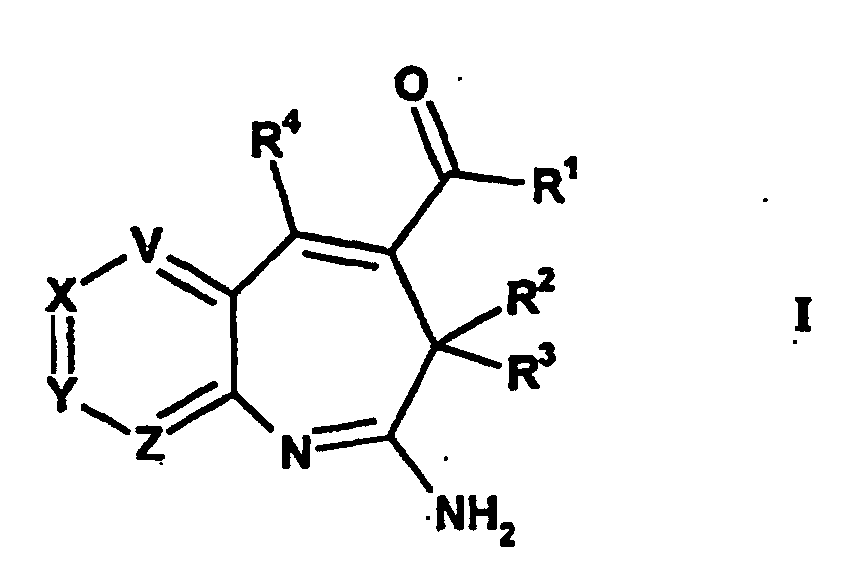
- the present invention relates to a compound of the formula or the pharmaceutically acceptable salts thereof; wherein V, X, Y and Z are each independently CR 5 , wherein each R 5 is independently selected from hydrogen, halo, cyano, hydroxy, ((C 1 -C 6 )alkyl) 2 amino, trifluoromethyl, or a group of the formula wherein s is 0, t is 0; and B is (C 1 -C 6 )alkoxy or NR 7 R 8 wherein R 7 and R 8 are each (C 1 -C 6 )alkyl; R 1 is hydrogen, hydroxy, (C 1 -C 6 )alkoxy optionally substituted by hydroxy; (C 1 -C 6 )alkyl, (C 6 -C 10 )aryl or NR 17 R 18 wherein R 17 and R 18 are each independently hydrogen, (C 1 -C 6 )alkyl, (C 1 -C 6 )alkoxy or (C 6 -C 10 )aryl
- alkyl as used herein, unless otherwise indicated, includes saturated monovalent hydrocarbon radicals having straight, branched or cyclic moieties or combinations thereof.
- alkoxy includes O-alkyl groups wherein “alkyl” is defined above.
- aryl includes an organic radical derived from an aromatic hydrocarbon by removal of one hydrogen, such as phenyl or naphthyl, optionally substituted by 1 to 3 substituents selected from the group consisting of fluoro, chloro, trifluoromethyl, (C 1 -C 6 )alkoxy, (C 8 -C 10 )aryloxy, trifluoromethoxy, difluoromethoxy and (C 1 -C 6 )alkyl.
- the compound of formula I may have chiral centers and therefore exist in different enantiomeric forms.
- This invention relates to all optical isomers and stereoisomers of the compounds of formula I and mixtures thereof.
- Preferred compounds of formula I include those wherein R 2 , R 3 and R 4 are each hydrogen.
- the present invention also provides a pharmaceutical composition
- a pharmaceutical composition comprising a compound of formula I, or a pharmaceutically acceptable salt thereof, and a pharmaceutically acceptable carrier.
- the invention further provides the use of a compound of formula I, or a pharmaceutically acceptable salt thereof, in the manufacture of a medicament for the treatment of myelosuppression including suppression associated with cancer chemotherapy as well as activation of the immune system for the treatment of cancer.
- the invention further provides the use of a compound of formula I, or a pharmaceutically acceptable salt thereof, in the manufacture of a medicament for the treatment or prevention of viral, fungal, bacterial or parasitic infectious diseases
- reaction 1 of Scheme 1 the compound of formula IX is convened to the corresponding 2-nitrotoluene compound of formula VIII by adding 1,4-dioxane to a suspension of IX in concentrated sulfuric acid.
- the solution so formed is cooled to a temperature between about -5°C to about 10°C, preferably about 0°C, and nitric acid is then added dropwise.
- the resulting reaction mixture is warm to room temperature and allowed to stir for a time period between about 10 hours to about 14 hours, preferably about 12 hours.
- reaction 2 of Scheme 1 the compound of formula VIII is converted to the corresponding compound of formula VII by reacting VIII with N,N-dimethylformamide dimethyl acetal in a polar aprotic solvent, such as dimethylformamide.
- the reaction mixture is heated, under an inert atmosphere, to a temperature between about 130°C to about 150°C, preferably about 140°C, for a time period between about 10 hours to about 14 hours, preferably about 12 hours.
- reaction 3 of Scheme 1 the compound of formula VII is converted to the corresponding 2-nitrobenzaldehyde compound of formula VI by oxidizing VII with sodium periodate in a 1:1 ratio solution of aqueous tetrahydrofuran.
- the reaction mixture is stirred, at room temperature, for a time period between about 15 minutes to about 1 hour, preferably about 30 minutes.
- reaction 4 of Scheme 1 the compound of formula VI is converted to the corresponding compound of formula V by reacting, under an inert atmosphere, VI with an ylide of the formula wherein R 33 is hydrogen, (C 1 -C 6 )alkyl or hydroxy(C 1 -C 6 )alkyl, in a polar aprotic solvent, such as toluene.
- the reaction mixture is heated to reflux and stirred for a time period between about 4 hours to about 6 hours, preferably about 5 hours.
- reaction 5 of Scheme 1 the compound of formula V is converted to the corresponding 2-aminobenzazapine compound of formula II by heating V in the presence of iron power and a polar protic solvent, such as AcOH, to a temperature between about 65°C to about 95°C, preferably about 80°C.
- a polar protic solvent such as AcOH
- the reaction mixture is stirred, under an inert atmosphere, for a time period between about 10 hours to about 14 hours, preferably about 12 hours.
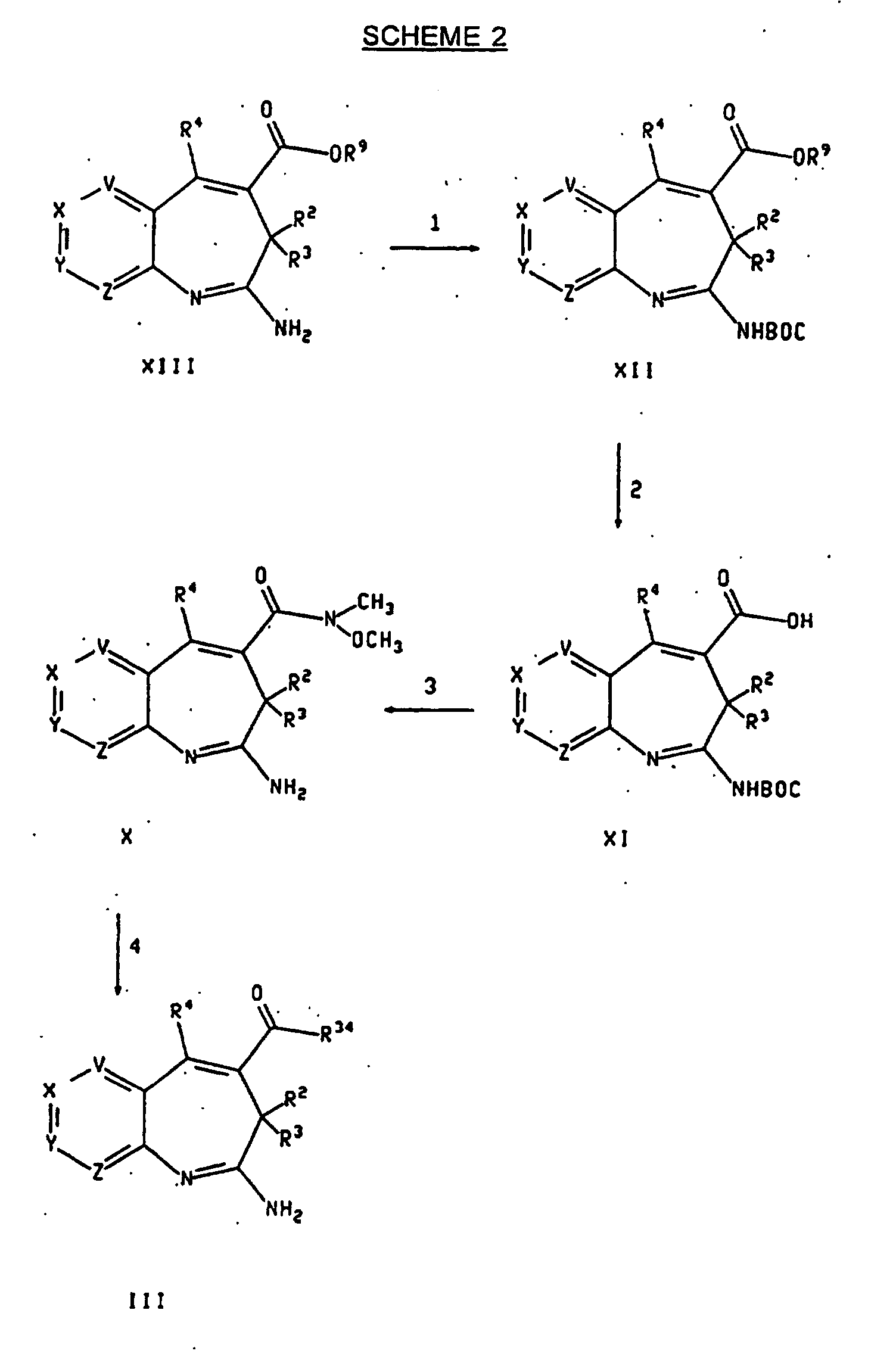
- reaction 1 of Scheme 2 the 2-aminobenzazepine compound of formula XIII , wherein R 9 is (C 1 -C 6 )alkyl, is converted to the corresponding compound of formula XII by reacting XIII with N-tert-butoxycarbonyl anhydride in a polar aprotic solvent, such as methylene chloride.
- a polar aprotic solvent such as methylene chloride.
- the reaction mixture is stirred, at room temperature, for a time period between about 10 hours to about 14 hours, preferably about 12 hours.
- reaction 2 of Scheme 2 the compound of formula XII is converted to the corresponding carboxylic acid compound of formula XI by reacting XII with lithium hydroxide in a polar solvent, such as aqueous tetrahydrofuran.
- a polar solvent such as aqueous tetrahydrofuran.
- the reaction mixture is stirred at a temperature between about 60°C to about 90°C, preferably about 75°C, for a time period between about 1 hour to about 3 hours, preferably about 2 hours.
- the compound of formula XI is converted to the corresponding amide compound of formula X by adding a solution of XI in a polar aprotic solvent, such as dimethyl formamide, to a solution of N,O-dimethylhydroxylamine hydrochloride and a base, such as triethylamine, in a polar protic solvent, such as dimethyl formamide. Diethyl pyrocarbonate is then added to the resulting solution. The reaction mixture so formed is stirred, at room temperature, for a time period between about 10 minutes to about 30 minutes, preferably about 20 minutes.
- a polar aprotic solvent such as dimethyl formamide
- the compound of formula X is converted to the corresponding 2-aminobenzazepine compound of formula III , wherein R 34 is (C 1 -C 6 )alkyl or hydroxy(C 1 -C 6 )alkyl, by reacting, under an inert atmosphere, a solution of X in a polar aprotic solvent, such as tetrahydrofuran, cooled to a temperature between about -90°C to about -70°C, preferably about -78°C, with an alkyl lithium. After approximately 10 minutes, the reaction mixture so formed is allowed to warm to room temperature, quenched with hydrochloric acid and stirred for a time period between about 30 minutes to about 1 hour, preferably about 45 minutes.
- a polar aprotic solvent such as tetrahydrofuran
- the carboxylic acid compound of formula XI is converted to the corresponding amide compound of formula XIV by reacting XI with R 17 R 18 amine, diethyl pyrocarbonate and triethylamine in a polar aprotic solvent, such as methylene chloride.
- a polar aprotic solvent such as methylene chloride.
- the compound of formula XIV is converted to the corresponding 2-aminobenzazapine compound of formula IV by treating XIV with hydrochloric acid in a aprotic solvent, such as dioxane, or with trifluoracetic acid neat at a temperature between about -30°C to about 70°C, preferably about -5°C to about 35°C.
- aprotic solvent such as dioxane
- Bovine sternum bone marrow marrow is placed into a sterile sieve which sits in the bottom of a Petrie dish.
- the contents are mashed with.a glass pestle.
- Alsevers solution is then poured over the contents to rinse and release cells.
- the liquid from the Petrie dish is collected (single cell suspension) and transfered to a bottle.
- the contents of the Petrie dish are mashed and rinsed again.
- the cell suspension is filtered through sterile nylon mesh into 50ml conical centrifuge tubes. Centrifuge at 1200 rpm (approximately 300g) for 10 minutes. Discard supernatant. Resuspend in Alsevers solution and wash two more times. Count nucleated blood cells on Coulter counter (model ZM) using zapoglobin for pre-gradient concentration.
- Count white blood cells for gradient yield typically 10-15%. Wash two more times in Alsevers solution, spinning at 1000 rpm (approximately 225g) 10 minutes. Check platelet-to-cell ratio using the Coulter counter. Cells should outnumber platelets in a ratio of at least 2 to 1. Then wash once in Serum-Free RPMI and obtain final concentration and culture at 50,000 cells per well in 96-well microtiter plates using a volume of 150ul.
- Compound preparation synthetic compounds are dissolved as a 1mg/ml working stock in Serum-Free RPMI + 10% dimethyl sulfoxide. Note: Add dimethyl sulfoxide first, solubilize compound, then add medium. Dilute appropriately to run compounds starting at 1.0 ug/ml with 3-fold dilutions. Typically compounds are diluted to 4 times stocks and 50ul are added to wells containing 150ul cell suspension. Plates are incubated at 39°C in 5% carbon dioxide for 4 days.
- Tritiated thymidine is added to each well at a final concentration of 2 uCi/ml.
- 3H-thymidine is purchased as a 1mCi/ml stock, dilute to 20uCi/ml with Serum-Free RPMI, then add to wells as a 10% volume, i.e., 22ul is added to the 200 ul volume now in wells. Incubate plates at 39°C in 5% carbon dioxide for approximately 18 hours more.
- the active compound will be administered orally or parenterally at dosages between about 0.1 and 25 mg/kg body weight of the subject to be treated per day, preferably from about 0.3 to 5 mg/kg. However, some variation in dosage will necessarily occur depending on the condition of the subject being treated. The person responsible for administration will, in any event, determine the appropriate dose for the individual subject.
- the compounds of the present invention can be administered in a wide variety of different dosage forms.
- the compounds of this invention are present in such dosage forms at concentration levels ranging from about 5.0% to about 70% by weight.
- tablets containing various excipients such as microcrystalline cellulose, sodium citrate, calcium carbonate, dicalcium phosphate and glycine may be employed along with various disintegrants such as starch (and preferably corn, potato or tapioca starch), alginic acid and certain complex silicates, together with granulation binders like polyvinylpyrrolidone, sucrose, gelation and acacia.
- disintegrants such as starch (and preferably corn, potato or tapioca starch), alginic acid and certain complex silicates, together with granulation binders like polyvinylpyrrolidone, sucrose, gelation and acacia.
- lubricating agents such as magnesium stearate, sodium lauryl sulfate and talc are often very useful for tabletting purposes.
- compositions of a similar type may also be employed as fillers in gelatin capsules; preferred materials in this connection also include lactose or milk sugar as well as high molecular weight polyethylene glycols.
- the active ingredient may be combined with various sweetening or flavoring agents, coloring matter or dyes, and, if so desired, emulsifying and/or suspending agents as well, together with such diluents as water, ethanol, propylene glycol, glycerin and various like combinations thereof.
- animals are advantageously contained in an animal feed or drinking water in a concentration of 5-5000 ppm, preferably 25 to 500 ppm.
- a sterile injectable solution of the active ingredient is usually prepared.
- Solutions of a therapeutic compound of the present invention in either sesame or peanut oil or in aqueous propylene glycol may be employed.
- the aqueous solutions should be suitably adjusted and buffered, preferably at a pH of greater than 8, if necessary and the liquid diluent first rendered isotonic.
- These aqueous solutions are suitable intravenous injection purposes.
- the oily solutions are suitable for intraarticular, intramuscular and subcutaneous injection purposes.
- the preparation of all these solutions under sterile conditions is readily accomplished by standard pharmaceutical techniques well known to those skilled in the art.
- compounds can be administered intramuscularly or subcutaneously at dosage levels of about 0.1 to 50 mg/kg/day, advantageously 0.2 to 10 mg/kg/day given in a single dose or up to 3 divided doses.
- 1,4 Dioxane was slowly added to a suspension of 4-fluorotoluene (6.6 grams, 34.7 mmol) in 30 ml concentrated sulfuric acid until the suspension began to become soluble (6 ml).
- the reaction was cooled to 0°C and nitric acid (5.6 grams, 85.3 mmol) was slowly added. The reaction gradually became yellow over time.
- the reaction was allowed to warm to room temperature overnight, and then worked up by pouring over ice and water. This solution was extracted repeatedly with ethyl acetate. Organics were washed with several portions of water, dried over magnesium sulfate and concentrated in vacuo to yield 6.8 grams of a yellow-orange oil (86%).
- Boc-anhydride (2.98 grams, 13.7 mmol) was added to a stirring solution of 2-amino-3H-benzo[b]azepine-4-carboxylic acid ethyl ester (3.003 grams 13.03 mmol) in 65 ml of methylene chloride. The reaction was stirred overnight at room temperature. The reaction mixture was partitioned between 1N phosphoric acid and methylene chloride. The organic layer was washed with saturated bicarbonate then brine. The organics were dried over sodium sulfate, filtered and concentrated to give 4.42 grams of a solid. This solid was suspended in 65 ml of ethanol and 14.3 mL of 1N sodium hydroxide was added.
- the reaction mixture was heated to 50°C and stirred for 6.5 hours.
- the pH was adjusted to 3.0 with 1N phosphoric acid and extracted with methylene chloride.
- the organic layer was dried over sodium sulfate, filtered and concentrated in vacuo to give 3.82 grams (97% yield) of a solid.
- Lithium hydroxide (1.26 grams, 30.12 mmol) was added to a stirring solution of the amidine (6.0 grams, 15.06 mmol) in tetrahydrofuran/water. The reaction was stirred at 75°C for 2 hours and worked up by washing with ether. The aqueous layer was acidified to a pH of 4.5 with phosphoric acid and extracted with methylene chloride. Upon acidification, salts formed and were filtered before extraction. Organics from aqueous extraction were dried over sodium sulfate, filtered and concentrated in vacuo to yield 3.60 grams of a yellow solid (64.6%).
- the aqueous layer was then basified to pH of 10 with 1N sodium hydroxide and subsequently extracted into methylene chloride. dried over sodium sulfate, filtered and concentrated in vacuo to give an orange solid. The solid was recrystallised from methanol to give 139 mg (22.3%) of a yellow solid.
- the solid obtained was dissolved in 10 ml of a 1:1 ratio methylene chloride:trifluoroacetic acid solution and stirred at room temperature for three hours. The solution was then diluted with 200 ml of a 1:1 solution of methylene chloride and water. The aqueous layer was basified to a pH greater than 9 with anhydrous K 2 CO 3 , the layers were separated and the organic layer was washed with saturated sodium bicarbonate and brine. The organic layer was dried over sodium sulfate and concentrated in vacuo. The residue was purified via silica gel flash chromatography eluting with 3% methanol in chloroform to give 100 mg (23%) of an orange solid.
Landscapes
- Health & Medical Sciences (AREA)
- Organic Chemistry (AREA)
- Chemical & Material Sciences (AREA)
- Veterinary Medicine (AREA)
- Life Sciences & Earth Sciences (AREA)
- Medicinal Chemistry (AREA)
- Nuclear Medicine, Radiotherapy & Molecular Imaging (AREA)
- General Chemical & Material Sciences (AREA)
- Pharmacology & Pharmacy (AREA)
- Animal Behavior & Ethology (AREA)
- General Health & Medical Sciences (AREA)
- Public Health (AREA)
- Chemical Kinetics & Catalysis (AREA)
- Immunology (AREA)
- Engineering & Computer Science (AREA)
- Bioinformatics & Cheminformatics (AREA)
- Communicable Diseases (AREA)
- Oncology (AREA)
- Tropical Medicine & Parasitology (AREA)
- Virology (AREA)
- Pharmaceuticals Containing Other Organic And Inorganic Compounds (AREA)
- Nitrogen And Oxygen Or Sulfur-Condensed Heterocyclic Ring Systems (AREA)
- Medicines Containing Material From Animals Or Micro-Organisms (AREA)
- Acyclic And Carbocyclic Compounds In Medicinal Compositions (AREA)
Abstract
Description
- The present invention relates to 2-aminobenzazepine derivatives which are immune stimulants with a variety of immunomodulatory activities and as such are useful in the treatment of myelosuppression including suppression associated with cancer chemotherapy as well as activation of the immune system for the treatment of cancer, and in the prevention and treatment of viral, fungal, bacterial and parasitic infectious diseases, either alone or as a vaccine adjunct in conjunction with antimicrobial therapy. This invention also relates to a method of using such compounds in the prevention and treatment of the above diseases in mammals, especially humans, and to the pharmaceutical compositions useful therefor.
- The human blood-forming (hematopoietic) system replaces a variety of white blood cells (including neutrophils, macrophages and basophils/mast cells), red blood cells (erythrocytes), and clot-forming cells (megakaryocytes/platelets). The hematopoietic system of the average human male has been estimated to produce on the order of 4.5.X 1011 granulocytes and eythrocytes every year, which is equivalent to an annual replacement of total body weight. It is believed that small amounts of certain hematopoietic growth factors account for the differentiation of a small number of progeniter "stem cells" into the variety of blood cell lines for the tremendous proliferation of those lines, and for the ultimate differentiation of mature blood cells from those lines. Granulocyte and Granulocyte-Macrophage Colony Stimulation Factor (G-, and GM-CSF) are two of the four classes of hemopoietic growth factors known as colony stimulating factors (CSF's). GM-CSF is a growth factor which regulates the proliferation and differentiation of multipotential cells. GM-CSF has also been shown to stimulate the formation of clones of neutrophilic granulocytes and mononuclear phagocytic cells from single bone marrow cells in vitro. Colony stimulating factors also activate white blood cells to combat infections of bacteria, fungi, and parasites and accelerate the maturation of leukemic cells, thereby stopping the regeneration of leukemic cells. It is well recognized that human. GM-CSF may be useful in the treatment of general hematopoietic disorders including those arising from chemotherapy or from radiation therapy. It may also be useful in bone marrow transplantation. Wound healing, burn treatment, and the treatment of bacterial inflammation may also benefit from the application of human GM-CFS.
- In diseases or disease states involving immunosuppression, it is considered invaluable to restore the immune status of an individual in as rapid a fashion as possible to limit the development of opportunistic infections, bacterial viral, fungal, etc. An agent which would stimulate the production of G or GM-CSF would augment this immunoregulation process.
- EP 339485 discloses 4-quinoline carboxylic acid derivatives which are indicated as immunosuppressive agents. US 5,310,913 discloses derivatives of quinoline-3-carboxanilide which are indicated as immunomodulating agents. US 5,268,376 discloses 1-substituted 1H-imidazo[4,5-c]quinolin-4-amines which are indicated as immunomodulating agents.
- The present invention relates to a compound of the formulaor the pharmaceutically acceptable salts thereof;
wherein
V, X, Y and Z are each independently CR5, wherein each R5 is independently selected from hydrogen, halo, cyano, hydroxy, ((C1-C6)alkyl)2amino, trifluoromethyl, or a group of the formulawherein s is 0, t is 0; and B is (C1-C6)alkoxy or NR7R8 wherein R7 and R8 are each (C1-C6)alkyl;
R1 is hydrogen, hydroxy, (C1-C6)alkoxy optionally substituted by hydroxy; (C1-C6)alkyl, (C6-C10)aryl or NR17R18 wherein R17 and R18 are each independently hydrogen, (C1-C6)alkyl, (C1-C6)alkoxy or (C6-C10)aryl; or R17 and R18 may be taken together with the nitrogen to which they are attached to form a pyrrolidinyl or piperidinyl ring; and
R2, R3 and R4 are each independently hydrogen, (C1-C6)alkyl, (C1-C6)alkoxy, hydroxy, hydroxy(C1-C6)alkyl, hydroxy(C1-C6)alkoxy or NR6R7 wherein R6 and R7 are each independently hydrogen, (C1-C6)alkyl or (C1-C6)alkoxy. - The term "alkyl", as used herein, unless otherwise indicated, includes saturated monovalent hydrocarbon radicals having straight, branched or cyclic moieties or combinations thereof.
- The term "alkoxy", as used herein, includes O-alkyl groups wherein "alkyl" is defined above.
- The term "aryl", as used herein, unless otherwise indicated, includes an organic radical derived from an aromatic hydrocarbon by removal of one hydrogen, such as phenyl or naphthyl, optionally substituted by 1 to 3 substituents selected from the group consisting of fluoro, chloro, trifluoromethyl, (C1-C6)alkoxy, (C8-C10)aryloxy, trifluoromethoxy, difluoromethoxy and (C1-C6)alkyl.
- The compound of formula I may have chiral centers and therefore exist in different enantiomeric forms. This invention relates to all optical isomers and stereoisomers of the compounds of formula I and mixtures thereof.
- Preferred compounds of formula I include those wherein R2, R3 and R4 are each hydrogen.
- Specific preferred compounds of formula I include the following:
- 2-[(2-Amino-3H-benzo[b]azepine-4-carbonyl)-amino]-propionic acid methyl ester;
- 2-[(2-Amino-3H-benzo[b]azepine-4-carbonyl)-amino]-propionic acid benzyl ester,
- 2-[(2-Amino-3H-benzo[b]azepine-4-carbonyl)-amino]-3-methylbutyric acid methyl ester; and
- 2-Amino-3H-benzo[b]azepine-4-carbaldehyde.
-
- The present invention also provides a pharmaceutical composition comprising a compound of formula I, or a pharmaceutically acceptable salt thereof, and a pharmaceutically acceptable carrier.
- The invention further provides the use of a compound of formula I, or a pharmaceutically acceptable salt thereof, in the manufacture of a medicament for the treatment of myelosuppression including suppression associated with cancer chemotherapy as well as activation of the immune system for the treatment of cancer.
- The invention further provides the use of a compound of formula I, or a pharmaceutically acceptable salt thereof, in the manufacture of a medicament for the treatment or prevention of viral, fungal, bacterial or parasitic infectious diseases
- The following reaction Schemes illustrate the preparation of compounds of the present invention. Unless otherwise indicated V, X, Y, Z, R2, R3, R4, R17 and R18 in the reaction Schemes and the discussion that follow are defined as above.
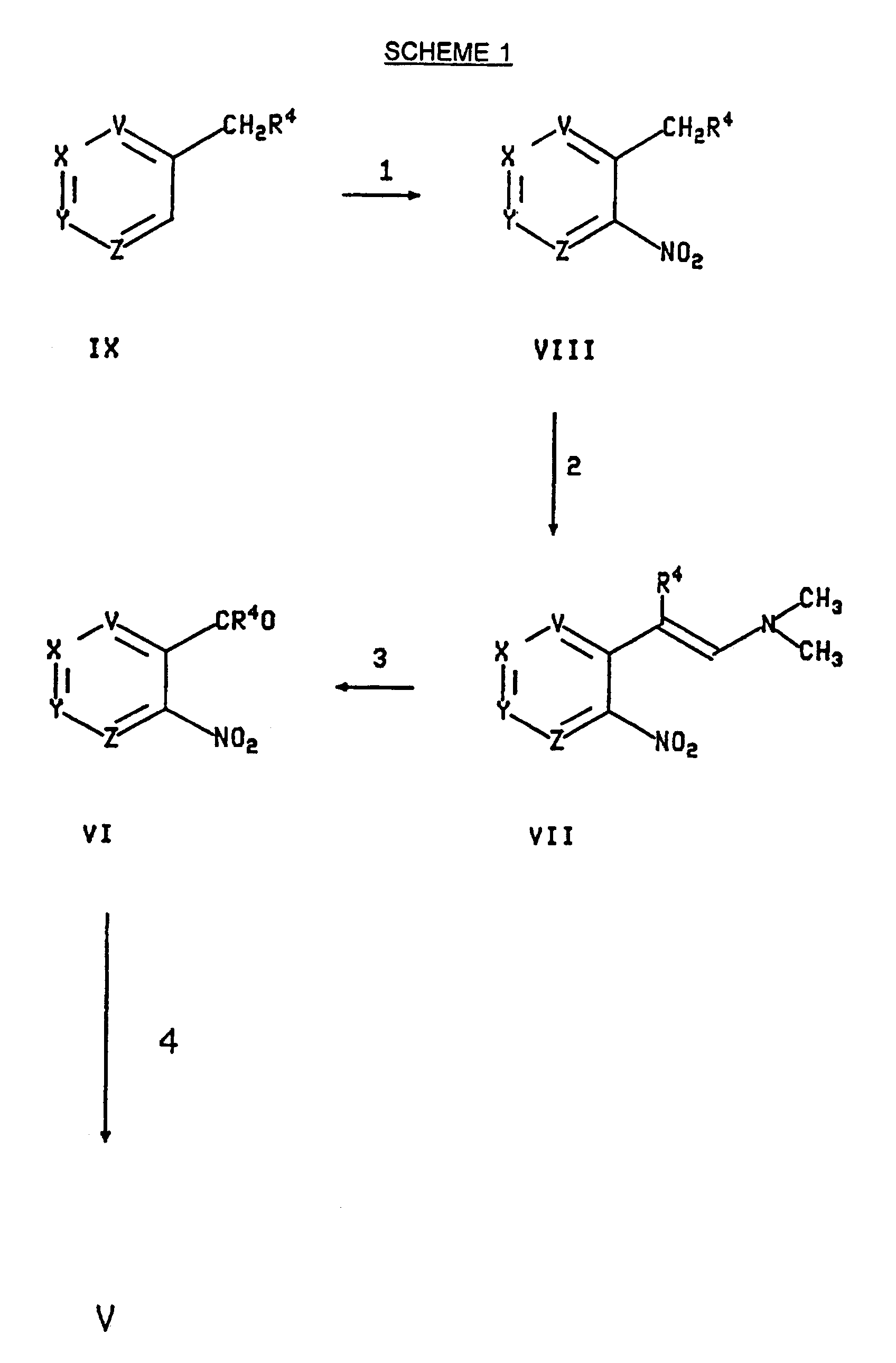


- In reaction 1 of Scheme 1, the compound of formula IX is convened to the corresponding 2-nitrotoluene compound of formula VIII by adding 1,4-dioxane to a suspension of IX in concentrated sulfuric acid. The solution so formed is cooled to a temperature between about -5°C to about 10°C, preferably about 0°C, and nitric acid is then added dropwise. The resulting reaction mixture is warm to room temperature and allowed to stir for a time period between about 10 hours to about 14 hours, preferably about 12 hours.
- In reaction 2 of Scheme 1, the compound of formula VIII is converted to the corresponding compound of formula VII by reacting VIII with N,N-dimethylformamide dimethyl acetal in a polar aprotic solvent, such as dimethylformamide. The reaction mixture is heated, under an inert atmosphere, to a temperature between about 130°C to about 150°C, preferably about 140°C, for a time period between about 10 hours to about 14 hours, preferably about 12 hours.
- In reaction 3 of Scheme 1, the compound of formula VII is converted to the corresponding 2-nitrobenzaldehyde compound of formula VI by oxidizing VII with sodium periodate in a 1:1 ratio solution of aqueous tetrahydrofuran. The reaction mixture is stirred, at room temperature, for a time period between about 15 minutes to about 1 hour, preferably about 30 minutes.
- In reaction 4 of Scheme 1, the compound of formula VI is converted to the corresponding compound of formula V by reacting, under an inert atmosphere, VI with an ylide of the formulawherein R33 is hydrogen, (C1-C6)alkyl or hydroxy(C1-C6)alkyl, in a polar aprotic solvent, such as toluene. The reaction mixture is heated to reflux and stirred for a time period between about 4 hours to about 6 hours, preferably about 5 hours.

- In reaction 5 of Scheme 1, the compound of formula V is converted to the corresponding 2-aminobenzazapine compound of formula II by heating V in the presence of iron power and a polar protic solvent, such as AcOH, to a temperature between about 65°C to about 95°C, preferably about 80°C. The reaction mixture is stirred, under an inert atmosphere, for a time period between about 10 hours to about 14 hours, preferably about 12 hours.
- In reaction 1 of Scheme 2, the 2-aminobenzazepine compound of formula XIII, wherein R9 is (C1-C6)alkyl, is converted to the corresponding compound of formula XII by reacting XIII with N-tert-butoxycarbonyl anhydride in a polar aprotic solvent, such as methylene chloride. The reaction mixture is stirred, at room temperature, for a time period between about 10 hours to about 14 hours, preferably about 12 hours.
- In reaction 2 of Scheme 2, the compound of formula XII is converted to the corresponding carboxylic acid compound of formula XI by reacting XII with lithium hydroxide in a polar solvent, such as aqueous tetrahydrofuran. The reaction mixture is stirred at a temperature between about 60°C to about 90°C, preferably about 75°C, for a time period between about 1 hour to about 3 hours, preferably about 2 hours.
- In reaction 3 of Scheme 2, the compound of formula XI is converted to the corresponding amide compound of formula X by adding a solution of XI in a polar aprotic solvent, such as dimethyl formamide, to a solution of N,O-dimethylhydroxylamine hydrochloride and a base, such as triethylamine, in a polar protic solvent, such as dimethyl formamide. Diethyl pyrocarbonate is then added to the resulting solution. The reaction mixture so formed is stirred, at room temperature, for a time period between about 10 minutes to about 30 minutes, preferably about 20 minutes.
- In reaction 4 of Scheme 2, the compound of formula X is converted to the corresponding 2-aminobenzazepine compound of formula III, wherein R34 is (C1-C6)alkyl or hydroxy(C1-C6)alkyl, by reacting, under an inert atmosphere, a solution of X in a polar aprotic solvent, such as tetrahydrofuran, cooled to a temperature between about -90°C to about -70°C, preferably about -78°C, with an alkyl lithium. After approximately 10 minutes, the reaction mixture so formed is allowed to warm to room temperature, quenched with hydrochloric acid and stirred for a time period between about 30 minutes to about 1 hour, preferably about 45 minutes.
- In reaction 1 of Scheme 3, the carboxylic acid compound of formula XI is converted to the corresponding amide compound of formula XIV by reacting XI with R17R18amine, diethyl pyrocarbonate and triethylamine in a polar aprotic solvent, such as methylene chloride. The reaction mixture was stirred, at room temperature, for a time period between about 6 hours to about 8 hours, preferably about 7 hours.
- In reaction 2 of Scheme 3, the compound of formula XIV is converted to the corresponding 2-aminobenzazapine compound of formula IV by treating XIV with hydrochloric acid in a aprotic solvent, such as dioxane, or with trifluoracetic acid neat at a temperature between about -30°C to about 70°C, preferably about -5°C to about 35°C.
- Bovine sternum bone marrow marrow is placed into a sterile sieve which sits in the bottom of a Petrie dish. The contents are mashed with.a glass pestle. Alsevers solution is then poured over the contents to rinse and release cells. The liquid from the Petrie dish is collected (single cell suspension) and transfered to a bottle. The contents of the Petrie dish are mashed and rinsed again.
- The cell suspension is filtered through sterile nylon mesh into 50ml conical centrifuge tubes. Centrifuge at 1200 rpm (approximately 300g) for 10 minutes. Discard supernatant. Resuspend in Alsevers solution and wash two more times. Count nucleated blood cells on Coulter counter (model ZM) using zapoglobin for pre-gradient concentration.
- Set up ficoll gradients using 20 ml of 1.077 histopaque at room temperature in 50 ml tubes. Layer 20-30 ml of bone marrow suspension at a concentration range of 1 to 3 x 10⁻⁹ white blood cells/gradient. Spin gradients at 1400 rpm (approximately. 450g) for 30 minutes at room temperature with centrifuge brake OFF.
- Remove and discard supernatant. Carefully collect white blood cells layer at interface from each tube and pool (including red blood cells is unavoidable-nucleated red blood cells do not dearly separate from white blood cell's. Bring up to 50 ml with Alsevers solution.
- Count white blood cells for gradient yield (typically 10-15%). Wash two more times in Alsevers solution, spinning at 1000 rpm (approximately 225g) 10 minutes. Check platelet-to-cell ratio using the Coulter counter. Cells should outnumber platelets in a ratio of at least 2 to 1. Then wash once in Serum-Free RPMI and obtain final concentration and culture at 50,000 cells per well in 96-well microtiter plates using a volume of 150ul.
- Compound preparation: synthetic compounds are dissolved as a 1mg/ml working stock in Serum-Free RPMI + 10% dimethyl sulfoxide. Note: Add dimethyl sulfoxide first, solubilize compound, then add medium. Dilute appropriately to run compounds starting at 1.0 ug/ml with 3-fold dilutions. Typically compounds are diluted to 4 times stocks and 50ul are added to wells containing 150ul cell suspension. Plates are incubated at 39°C in 5% carbon dioxide for 4 days.
- Tritiated thymidine is added to each well at a final concentration of 2 uCi/ml. 3H-thymidine is purchased as a 1mCi/ml stock, dilute to 20uCi/ml with Serum-Free RPMI, then add to wells as a 10% volume, i.e., 22ul is added to the 200 ul volume now in wells. Incubate plates at 39°C in 5% carbon dioxide for approximately 18 hours more.
- At the end of the labeling period freeze the plates. Thaw plates just before harvesting and harvest cells on glass fiber 96-well filtermats. Use a Betaplate scintillation counter for 1 minute counts.
- Calculate activity by dividing the counts per minute of the sample by the medium control for fold-over-background. Activity of 3 or more fold-over background is considered positive.
- For administration to mammals, including humans, a variety of conventional routes may be used including orally, parenterally and topically. In general, the active compound will be administered orally or parenterally at dosages between about 0.1 and 25 mg/kg body weight of the subject to be treated per day, preferably from about 0.3 to 5 mg/kg. However, some variation in dosage will necessarily occur depending on the condition of the subject being treated. The person responsible for administration will, in any event, determine the appropriate dose for the individual subject.
- The compounds of the present invention can be administered in a wide variety of different dosage forms. In general, the compounds of this invention are present in such dosage forms at concentration levels ranging from about 5.0% to about 70% by weight.
- For oral administration, tablets containing various excipients such as microcrystalline cellulose, sodium citrate, calcium carbonate, dicalcium phosphate and glycine may be employed along with various disintegrants such as starch (and preferably corn, potato or tapioca starch), alginic acid and certain complex silicates, together with granulation binders like polyvinylpyrrolidone, sucrose, gelation and acacia. Additionally, lubricating agents such as magnesium stearate, sodium lauryl sulfate and talc are often very useful for tabletting purposes. Solid compositions of a similar type may also be employed as fillers in gelatin capsules; preferred materials in this connection also include lactose or milk sugar as well as high molecular weight polyethylene glycols. When aqueous suspensions and/or elixirs are desired for oral administration, the active ingredient may be combined with various sweetening or flavoring agents, coloring matter or dyes, and, if so desired, emulsifying and/or suspending agents as well, together with such diluents as water, ethanol, propylene glycol, glycerin and various like combinations thereof. In the case of animals, they are advantageously contained in an animal feed or drinking water in a concentration of 5-5000 ppm, preferably 25 to 500 ppm.
- For parenteral administration (intramuscular, intraperitoneal, subcutaneous and intravenous use) a sterile injectable solution of the active ingredient is usually prepared. Solutions of a therapeutic compound of the present invention in either sesame or peanut oil or in aqueous propylene glycol may be employed. The aqueous solutions should be suitably adjusted and buffered, preferably at a pH of greater than 8, if necessary and the liquid diluent first rendered isotonic. These aqueous solutions are suitable intravenous injection purposes. The oily solutions are suitable for intraarticular, intramuscular and subcutaneous injection purposes. The preparation of all these solutions under sterile conditions is readily accomplished by standard pharmaceutical techniques well known to those skilled in the art. In the case of animals, compounds can be administered intramuscularly or subcutaneously at dosage levels of about 0.1 to 50 mg/kg/day, advantageously 0.2 to 10 mg/kg/day given in a single dose or up to 3 divided doses.
- The present invention is illustrated by the following examples, but it is not limited to the details thereof.
- 1,4 Dioxane was slowly added to a suspension of 4-fluorotoluene (6.6 grams, 34.7 mmol) in 30 ml concentrated sulfuric acid until the suspension began to become soluble (6 ml). The reaction was cooled to 0°C and nitric acid (5.6 grams, 85.3 mmol) was slowly added. The reaction gradually became yellow over time. The reaction was allowed to warm to room temperature overnight, and then worked up by pouring over ice and water. This solution was extracted repeatedly with ethyl acetate. Organics were washed with several portions of water, dried over magnesium sulfate and concentrated in vacuo to yield 6.8 grams of a yellow-orange oil (86%).
- To a flame dried 65 ml roundbottom was added 20 ml of and anhydrous N,N-dimethylformamide, 2.94 gm (24.7 mmol) of N,N-dimethylformamide-dimethyl acetal and 3.00 grams (19.3 mmol) of 4-fluoro-2-nitrotoluene. The reaction was heated overnight at 140°C under nitrogen. The solution was concentrated in vacuo to give a red oil Upon dilution with cold methanol, red crystals precipitated to give 2.65 grams (65% yield).
- 500 mg (2.37 mmol) of the above enamine was dissolved in 50 ml of a 1:1 solution of aqueous tetrahydrofuran and 1.53 grams (7.14 mmol) of sodium periodate was added. The reaction was stirred for 30 minutes and then filtered. The filtrate was extracted with ethyl acetate and washed with saturated bicarbonate solution then with brine. The organic layer was dried over magnesium sulfate filtered, and concentrated in vacuo to give 345 mg (86% yield) of an orange solid. An analytically pure sample was obtained by recystallization from methanol.
- 0.313 grams (1.33 mmol) of 4-fluoro-2-nitrobenzaldehyde and 0.482 grams (1.37 mmol) of α-cyanomethylcarboethoxyethylidene triphenylphosphorane were combined and dissolved in 10 ml of anhydrous toluene and stirred under nitrogen. The reaction mixture was heated to reflux with stirring for 10 hours. The reaction was allowed to cool to room temperature overnight. This material was worked up by extracting the resulting solid by the addition of 50 ml of ether twice. The mixture was filtered and the filtrate was concentrated in vacuo to give a tan solid.
- 440 mg (7.6 mmol) of iron powder was added to a stirring solution of ethyl 4'-fluoro-α-cyanomethylcinnamate (0.457 grams, 1.13 mmol) in 10 ml AcOH. The reaction was then heated to 80°C and stirred under nitrogen overnight. The reaction was cooled to room temperature, diluted with methylene chloride and filtered. The precipatate was washed with methylene chloride. The filtrate was slowly treated with solid Na2CO3 until the pH was equal to 9. The layers were separated, and the organic layer was washed with water, brine, and dried over sodium sulfate. The dried filrate was concentrated in vacuo to give 345 mg of a yellow solid. The solid was recrystalized from ethyl acetate/hexanes to give 257 mg (58%) of a white solid. 1H NMR (250MHz, CD3OD d 7.83 (s, 1 H), 7.56 (d, J = 8.2 Hz, 1 H), 7.39 (s, 1 H), 7.26 (d, J = 8.2 Hz, 1 H), 4.31 (q, J = 7.1 Hz, 2 H), 3.01 (s, 2 H), 1.36 (t, J = 8.2 Hz, 3 H); Analysis: calcd for C 56.38, H 4.39, N 9.39; found C 56.22, H 4.55, N 9,37.
- The title compounds of examples 2-5 were prepared analogously to the title compound described in Example 1 using the starting material indicated.
- Starting material: 3-cyanotoluene. 1H NMR (300 MHz, CD3OD) d 8.05 (s, 1H), 7.96 (s, 1H), 7.86 (d, J = 8.5 Hz,1H), 7.52 (d, J = 8.5 Hz, 1 H), 4.34 (q, J = 7.1 Hz, 2 H), 1.37 (t, J = 7.1 Hz, 3 H); 13C NMR (75.5 MHz, CD3OD) d 165.4, 140.2, 138.0, 137.6, 134.6, 129.9, 129.1, 125.5, 118.5, 111.2, 63.24, 30.13,14.51; HRMS calcd 255.10077; found 255.10465.
- Starting material: 3-N,N-dimethylaminotoluene. 1H NMR (250 MHz, CDCl3) d 7.77 (s, 1 H), 7.19 (d, J = 9.0 Hz, 1 H), 6.92 (dd. J =2.9, 9.0 Hz, 1 H), 6.67 (d, J = 2.9 Hz, 1 H), 4.31 (q, J = 7.1Hz, 2 H), 2.99 (s, 2 H),2.96 (s, 6 H), 1.38 (t, J =7.1Hz, 3 H); HRMS calcd 273.14772; found 273.14773.
- Starting material: 4-N,N,-dimethylaminotoluene. 1H NMR (250 MHz, CDCl3) d 7.74 (s, 1 H), 7.25 (d, J = 8.7 Hz, 1 H), 6.53 (dd, J = 2.4, 8.7 Hz, 1 H), 6.48 (d, J = 2.4 Hz, 1 H), 4.28 (q, J = 7.1 Hz, 2 H), 3.02 (s, 6 H), 2.96 (s, 2 H), 1.38 (t, J = 7.1 Hz, 3 H); HRMS calcd 273.1477; found 273. 1473.
- Starting material: 3-fluorotoluene. 1H NMR (250 MHz, CDCl3) d 7.72 (s, 1 H), 7.02-7.22 (m, 3 H), 4.31 (q, J = 7.2 Hz, 2 H), 2.93 (s, 2 H), 1.39 (t, J = 7.2 Hz, 3 H); HRMS calcd 248.09610; found 248.09402.
- Boc-anhydride (2.98 grams, 13.7 mmol) was added to a stirring solution of 2-amino-3H-benzo[b]azepine-4-carboxylic acid ethyl ester (3.003 grams 13.03 mmol) in 65 ml of methylene chloride. The reaction was stirred overnight at room temperature. The reaction mixture was partitioned between 1N phosphoric acid and methylene chloride. The organic layer was washed with saturated bicarbonate then brine. The organics were dried over sodium sulfate, filtered and concentrated to give 4.42 grams of a solid. This solid was suspended in 65 ml of ethanol and 14.3 mL of 1N sodium hydroxide was added. The reaction mixture was heated to 50°C and stirred for 6.5 hours. The pH was adjusted to 3.0 with 1N phosphoric acid and extracted with methylene chloride. The organic layer was dried over sodium sulfate, filtered and concentrated in vacuo to give 3.82 grams (97% yield) of a solid.
- Lithium hydroxide (1.26 grams, 30.12 mmol) was added to a stirring solution of the amidine (6.0 grams, 15.06 mmol) in tetrahydrofuran/water. The reaction was stirred at 75°C for 2 hours and worked up by washing with ether. The aqueous layer was acidified to a pH of 4.5 with phosphoric acid and extracted with methylene chloride. Upon acidification, salts formed and were filtered before extraction. Organics from aqueous extraction were dried over sodium sulfate, filtered and concentrated in vacuo to yield 3.60 grams of a yellow solid (64.6%).
- A solution of 2.00 grams (6.62 mmol) of this solid in 23 ml of N,N-dimethylformamide was added to a solution of 3.7 ml (26.6 mmol) of triethylamine and 647 mg (6.63mmol) of N,O-dimethylhydroxylamine hydrochloride in 33 ml of anhydrous N,N-dimethylformamide. To this solution was added 1.50 ml (9.93mmol) of diethyl pyrocarbonate. The reaction was stirred at room temperature for 20 minutes then diluted with methylene chloride and washed with saturated bicarbonate. The organic layer was concentrated in vacuo to give an oil which was purified via flash silica gel chromatography eluting with 9% acetone in hexanes to give 1.15 grams (50%) of a solid. This solid was subsequenttly treated with 50 ml of a 1:1 ratio solution of trifluoroacetic acid in methylene chloride for 1.5 hours. The material was concentrated in vacuo and partitioned between 0.1 N sodium hydroxide and methylene chloride. The organic layer was dried over sodium sulfate filtered and concentrated to give 750 mg (92%) of a solid.
- 630mg (2.57 mmol) of weinreb's amide compound was dissolved in 26 ml of anhydrous tetrahydrofuran under nitrogen. The solution was cooled to -78°C and (2.5 M, 7.75mmol, 3.1 ml ) butyl lithium was added to the reaction mixture. After 10 minutes, the reaction was allowed to warm to room temperature. After 45 minutes the reaction mixture was quenched with 10 ml of 2N hydrochloric acid and stirred for an additional 1/2 hour. The mixture was partitioned between saturated bicarbonate solution and methylene chloride. The product was extracted from organic into 0.1 N hydrochloric acid. The aqueous layer was then basified to pH of 10 with 1N sodium hydroxide and subsequently extracted into methylene chloride. dried over sodium sulfate, filtered and concentrated in vacuo to give an orange solid. The solid was recrystallised from methanol to give 139 mg (22.3%) of a yellow solid. 1H NMR (250 MHz, CDCl3) d 7.69 (s, 1 H),7.40 (m, 2 H), 7.25 (d, J =8.2 Hz, 1 H), 7.09 (m, 1 H), 5.02 (br s, 1H), 2.90 (s, 2 H), 2.87 (t, J = 7.7 Hz, 12 H), 1.69 (m, 2 H), 1.40 (m, 2 H), 0.964 (t, J = 7.3 Hz, 3 H); 13C NMR (75.5 MHz, CDCl3) d 154.1, 149.0, 138.0, 132.0, 131.4, 129.8, 127.2, 126.9, 121.5, 36.85, 29.21, 27.08, 22.51, 13.93; HRMS calcd 242.14190, found 242.14194.
- The title compounds of examples 7-9 were prepared analogously to the title compound described in Example 6 using the the appropriate reagent indicated.
- Propyl lithium. 1H NMR (250 MHz, CDCl3) d 7.69 (s, 1 H), 7.40 (m, 2 H), 7.25 (d, J = 7.9 Hz, 1 H), 7.10 (d, J = 7.4 Hz, 1 H), 5.05 (brs, 2 H), 2.91 (s, 2 H), 2.86 (t, J = 7.4 Hz, 2 H), 1.75 (m, 2 H), 1.00 (t, J = 7.4 Hz, 3 H); Mass spectrum FAB MH+ 229.
- Ethyl lithium. 1H NMR (250 MHz, CHCl3) d 7.73 (s,1 H), 7.35-7.51 (m, 3 H), 7.22 (m, 1 H), 3.12 (s, 2 H), 2.92 (q, J = 7.4Hz, 2 H), 1.21 (t, J = 7.4Hz, 3 H); HRMS calcd 214.11060; found 214.11063.
- Phenyl lithium. 1H NMR (300 MHz, CDCl3) d 7.75 (d. J = 8.5 Hz, 2 H), 7.22-7.61 (m, 7 H), 7.06 (t, J = 7.3 Hz, 1H), 5.21 (brs, 2 H), 3.07 (s, 2 H); HRMS Calcd 262.11060; found 262.10926.
- Diethyl pyrocarbonate (0.767 grams, 4.27 mmol) was added to a stirring solution of the acid (1.585 grams, 4,27 mmol), dipropyl amine (0.476 grams, 4.70 mmol), triethylamine (0.907 grams, 8.96 mmol) in methylene chloride. The reaction was stirred at room temperature for 7 hours, and worked up by partitioning between methylene chloride and saturated bicarbonate solution. Organics dried over sodium sulfate, filtered and concentrated to yield a brown oil. This oil was purified via silica gel column chromatography using a 4:1 ratio of hexanes:ethylacetate as eluent. 0.756 grams of a yellow foamy solid was obtained (39.1%).
- The solid obtained was dissolved in 10 ml of a 1:1 ratio methylene chloride:trifluoroacetic acid solution and stirred at room temperature for three hours. The solution was then diluted with 200 ml of a 1:1 solution of methylene chloride and water. The aqueous layer was basified to a pH greater than 9 with anhydrous K2CO3, the layers were separated and the organic layer was washed with saturated sodium bicarbonate and brine. The organic layer was dried over sodium sulfate and concentrated in vacuo. The residue was purified via silica gel flash chromatography eluting with 3% methanol in chloroform to give 100 mg (23%) of an orange solid. 1H NMR (300 MHz, CDCl3) d 7.85 (s 1H), d 7.50 (s 1H), d 7.35 (m 2 H), d 6.85 (s 1H), d 4.05 (m 2H), d 3.30-3.50 (m 6H), d 3.20 (s 2H), d 1.25 (m 12 H) mass spectrum MH+ 357.
- The title compounds of examples 11-19 were prepared analogously to the title compound described in Example 10 using the the appropriate reagent(s) indicated.
- Diethylamine. 1H NMR (250 MHz, CDCl3) d 7.19-7.33 (m, 3 H), 7.02 (dt, J= 1.4, 6.8 Hz, 1 H), 6.81 (s, 1 H), 5.42 (brs, 2H), 3.52 (q, J = 7.1 Hz, 4 H), 2.78 (s, 2 H), 1.22 (t, J = 7.1 Hz, 6 H); HRMS calcd 232.08478; found 232.08493
- Dipropylamine, 1H NMR (250 MHz, CDCl3) d 7.23-7.29 (m, 3 H), 7.03 (dt, J = 1.2, 6.8 Hz, 1 H), 6.78 (s, 1 H), 5.10 (brs, 2 H), 3.43 (m, 4 H), 2.75 (s, 2 H), 1.64 (m, 4 H), 0.90 (t, J = 7.3 Hz, 6 H); 13C NMR (75.5MHz, CDCl3) d 171.0, 154.1, 147.0, 130.6, 129.6, 128.4, 127.3, 126.8, 121.4, 34.08, 21.61, 11.32; HRMS calcd 285.18410; found 285.18431.
- Piperidine. 1H NMR (300 MHz, CDCl3) d 7.19-7.32 (m, 3 H), 7.02 (m, 1 H), 6.79 (s, 1 H), 5.09 (brs, 2 H), 3.64 (m, 4 H), 2.76 (s, 2 H), 1.58-1.75 (m, 6 H); 13C NMR (75.5 MHz, CDCl3) d 169.5, 154.3, 147.2, 130.7, 130.5, 128.5, 127.7, 127.2,126.8, 121.4, 33.90, 26.22, 24.67; HRMS calcd 269.15280; found 269.15291.
- Pyrrolidine. 1H NMR (300 MHZ, CDCl3) d 7.16-7.30 (m, 3H),6.96-7.01 (m, 2 H), 5.64 (brs, 2 H), 3.67 (m, 2 H), 3.53 (m, 2 H), 2.81 (s, 2 H), 1.90 (m, 4 H); 13C NMR (75.5 MHz, CDCl3) d 168.3, 154.7, 147.7, 131.7, 130.7, 128.9, 128.6, 127.3, 126.8, 121.2, 49.91, 46.46, 33.29, 26.55, 24.32; HRMS calcd 255.13715; found 255.13597.
- Dibutylamine. 1H NMR (250 MHZ, CDCl3) d 7.21-7.35 (m, 3 H), 7.04 (m, 1 H), 6.80 (s, 1 H), 5.17 (brs, 2 H), 3.48 (m, 4 H), 2.75 (s, 2 H), 1.61 (m, 4 H), 1.35 (m, 4 H), 0.94 (t, J = 7.2 Hz, 6 H); 13C NMR (75.5 MHz, CDCl3) d 170.8, 154.4, 147.4, 130.4, 129.5, 128.3, 128.2. 127.1, 126.6, 33.94. 29.52, 15.10,13.68; HRMS calcd 313.21540 found 313.21475.
- 8-trifluoromethyl-3H-benzo[b]azepine-4-carboxylic acid. 1H NMR (250 MHz, CDCl3) d 7.59 (s, 1 H), 7.38 (m, 2 H), 6.81 (s, 1 H), 3.40 (m, 4 H), 3.02 (s, 2 H), 1.63 (m, 4 H), 0.90 (m, 6 H); 13C NMR (75.5 MHz, CDCl3) d 177.9, 169.8, 160.6, 141.7, 139.7, 131.38, 131.2, 131.1, 130.8, 130.4, 129.0, 125.4, 122.4, 122.3, 121.8, 119.7, 60.06, 33.70, 22.54, 11.28; HRMS calcd 353.1715 found 353.17024.
- Diethylamine. 1H NMR (250 MHz, CDCl3) d 7.41 (d, J = 1.5 Hz, 1 H), 7.26 (d, J = 8.2 Hz, 1 H), 7.17 (dd, J =1.5, 8.2 Hz, 1 H), 6.72 (s, 1 H), 3.49 (q, J = 7.1 Hz, 4 H), 2.80 (s, 2 H), 1.22 (t, J = 7.1 Hz, 6 H); 13C NMR (75.5 MHz, CDCl3) d 170.2, 155.4, 147.3, 131.3, 130.8, 130.0, 128.3, 125.9, 123.9, 122.9, 117.0, 34.10; HRMS calcd 326.14802 found 326.14771.
- Dimethylamine. 1H NMR (250 MHZ, CDCl3) d 7.50 (s, 1 H), 7.39 (d, J = 8.1 Hz, 1 H), 7.22 (d, J = 8.1 Hz, 1 H), 6.80 (s, 1 H), 3.39 (brs, 6 H); 2.82 (s; 2 H); mass spectrum MH+ 298.
- N-pentylamine. 1H NMR (300 MHz, dimethyl sulfoxide) d 8.33 (m, 1 H), 7.21-7.49 (m, 5 H), 3.10 (m, 2 H), 1.41 (m, 2 H), 1.20 (m, 4 H), 0.79 (m, 3H); masspectrum MH+ 272.
Claims (6)
- A compound of the formulaor the pharmaceutically acceptable salts thereof;

wherein
V, X, Y and Z are each independently CR5, wherein each R5 is independently selected from hydrogen, halo, cyano, hydroxy, ((C1-C6)alkyl)2amino, trifluoromethyl, or a group of the formulawherein s is 0, t is 0; and B is (C1-C6)alkoxy or NR7R8 wherein R7 and R8 are each (C1-C6)alkyl;
R1 is hydrogen, hydroxy, (C1-C6)alkoxy optionally substituted by hydroxy; (C1-C6)alkyl, (C6-C10)aryl or NR17R18 wherein R17 and R18 are each independently hydrogen, (C1-C6)alkyl, (C1-C6)alkoxy or (C6-C10)aryl; or R17 and R18 may be taken together with the nitrogen to which they are attached to form a pyrrolidinyl or piperidinyl ring; and
R2, R3 and R4 are each independently hydrogen, (C1-C6)alkyl, (C1-C6)alkoxy, hydroxy, hydroxy(C1-C6)alkyl, hydroxy(C1-C6)alkoxy or NR6R7 wherein R6 and R7 are each independently hydrogen, (C1-C6)alkyl or (C1-C6)alkoxy. - A compound according to claim 1, wherein R2, R3 and R4 are each hydrogen.
- A compound according to claim 1, selected from the group consisting of:2-[(2-Amino-3H-benzo[b]azepine-4-carbonyl)-amino]-propionic acid methyl ester;2-[(2-Amino-3H-benzo[b]azepine-4-carbonyl)-amino]-propionic acid benzyl ester;2-[(2-Amio-3H-benzo[b]azepine-4-carbonyl)-amino]-3-methylbutyric acid methyl ester; and2-Amino-3H-benzo[b]azepine-4-carbaldehyde.
- A pharmaceutical composition comprising a compound of claim 1, or a pharmaceutically acceptable salt thereof, and a pharmaceutically acceptable carrier.
- Use of a compound of claim 1, or a pharmaceutically acceptable salt thereof, in the manufacture of a medicament for the treatment of myelosuppression including suppression associated with cancer chemotherapy as well as activation of the immune system for the treatment of cancer.
- Use of a compound of claim 1, or a pharmaceutically acceptable salt thereof, in the manufacture of a medicament for the treatment or prevention of viral, fungal, bacterial or parasitic infectious diseases.
Applications Claiming Priority (2)
| Application Number | Priority Date | Filing Date | Title |
|---|---|---|---|
| US2342396P | 1996-08-16 | 1996-08-16 | |
| US23423P | 1996-08-16 |
Publications (2)
| Publication Number | Publication Date |
|---|---|
| EP0825186A1 EP0825186A1 (en) | 1998-02-25 |
| EP0825186B1 true EP0825186B1 (en) | 2002-04-17 |
Family
ID=21815010
Family Applications (1)
| Application Number | Title | Priority Date | Filing Date |
|---|---|---|---|
| EP97305934A Expired - Lifetime EP0825186B1 (en) | 1996-08-16 | 1997-08-05 | 2-Aminobenzazepine derivatives and their use for the treatment of immunosuppression |
Country Status (10)
| Country | Link |
|---|---|
| US (1) | US6043238A (en) |
| EP (1) | EP0825186B1 (en) |
| JP (1) | JP2978850B2 (en) |
| AT (1) | ATE216366T1 (en) |
| CA (1) | CA2213108C (en) |
| DE (1) | DE69711996T2 (en) |
| DK (1) | DK0825186T3 (en) |
| ES (1) | ES2173391T3 (en) |
| MX (1) | MX9706231A (en) |
| PT (1) | PT825186E (en) |
Cited By (6)
| Publication number | Priority date | Publication date | Assignee | Title |
|---|---|---|---|---|
| US8242106B2 (en) | 2008-08-01 | 2012-08-14 | Ventirx Pharmaceuticals, Inc. | Toll-like receptor agonist formulations and their use |
| US8524702B2 (en) | 2009-08-18 | 2013-09-03 | Ventirx Pharmaceuticals, Inc. | Substituted benzoazepines as toll-like receptor modulators |
| US8691809B2 (en) | 2009-08-18 | 2014-04-08 | Ventirx Pharmaceuticals, Inc. | Substituted benzoazepines as toll-like receptor modulators |
| US10370338B2 (en) | 2016-05-23 | 2019-08-06 | Hoffmann-La Roche Inc. | Benzazepine dicarboxamide compounds with tertiary amide function |
| US10544102B2 (en) | 2016-05-23 | 2020-01-28 | Hoffmann-La Roche Inc. | Benzazepine dicarboxamide compounds with secondary amide function |
| US10590112B2 (en) | 2016-06-12 | 2020-03-17 | Hoffmann-La Roche Inc. | Dihydropyrimidinyl benzazepine carboxamide compounds |
Families Citing this family (21)
| Publication number | Priority date | Publication date | Assignee | Title |
|---|---|---|---|---|
| WO2000076993A1 (en) * | 1999-06-16 | 2000-12-21 | Takeda Chemical Industries, Ltd. | Benzazepine derivatives, process for the preparation of the same and uses thereof |
| SE0003795D0 (en) | 2000-10-20 | 2000-10-20 | Astrazeneca Ab | Pharmaceutically useful compounds |
| TWI404537B (en) * | 2005-08-19 | 2013-08-11 | Array Biopharma Inc | 8-substituted benzoazepines as toll-like receptor modulators |
| TWI382019B (en) * | 2005-08-19 | 2013-01-11 | Array Biopharma Inc | Aminodiazepines as toll-like receptor modulators |
| WO2010054215A1 (en) | 2008-11-06 | 2010-05-14 | Ventirx Pharmaceuticals, Inc. | Methods of synthesis of benzazepine derivatives |
| US10016440B2 (en) * | 2010-04-21 | 2018-07-10 | Ventirx Pharmaceuticals, Inc. | Methods of enhancing antibody-dependent cellular cytotoxicity |
| CA2824779C (en) * | 2011-01-12 | 2020-01-14 | Array Biopharma, Inc. | Substituted benzoazepines as toll-like receptor modulators |
| ES2620605T3 (en) * | 2011-01-12 | 2017-06-29 | Ventirx Pharmaceuticals, Inc. | Substituted benzoazepines as modulators of Toll-like receptors |
| SG10202110184XA (en) | 2017-03-15 | 2021-10-28 | Silverback Therapeutics Inc | Benzazepine compounds, conjugates, and uses thereof |
| KR20200100113A (en) | 2017-12-15 | 2020-08-25 | 실버백 테라퓨틱스, 인크. | Antibody construct-drug conjugate for the treatment of hepatitis |
| CN109956903B (en) * | 2017-12-22 | 2022-08-23 | 江苏恒瑞医药股份有限公司 | Benzazepine derivative, preparation method thereof, and use thereof in medicine |
| KR20220035908A (en) | 2019-06-19 | 2022-03-22 | 실버백 테라퓨틱스, 인크. | Anti-Mesothelin Antibodies and Immunoconjugates Thereof |
| WO2021168274A1 (en) | 2020-02-21 | 2021-08-26 | Silverback Therapeutics, Inc. | Nectin-4 antibody conjugates and uses thereof |
| AU2021300362A1 (en) | 2020-07-01 | 2023-02-23 | ARS Pharmaceuticals, Inc. | Anti-ASGR1 antibody conjugates and uses thereof |
| EP4319820A1 (en) | 2021-04-10 | 2024-02-14 | Profoundbio Us Co. | Folr1 binding agents, conjugates thereof and methods of using the same |
| JP7742892B2 (en) | 2021-04-23 | 2025-09-22 | ジェンマブ エー/エス | Anti-CD70 antibodies, conjugates thereof and methods of using same |
| TW202320857A (en) | 2021-07-06 | 2023-06-01 | 美商普方生物製藥美國公司 | Linkers, drug linkers and conjugates thereof and methods of using the same |
| CN118525007A (en) * | 2021-11-19 | 2024-08-20 | 成都安泰康赛生物科技有限公司 | 1H-Benzo[B]azepin-2(3H)-one compounds, compositions and methods for treating cancer |
| WO2025072406A1 (en) | 2023-09-26 | 2025-04-03 | Profoundbio Us Co. | Ptk7 binding agents, conjugates thereof and methods of using the same |
| TW202547866A (en) | 2024-01-10 | 2025-12-16 | 丹麥商珍美寶股份有限公司 | Slitrk6 binding agents, conjugates thereof and methods of using the same |
| US20250381289A1 (en) | 2024-02-29 | 2025-12-18 | Genmab A/S | Egfr and c-met bispecific binding agents, conjugates thereof and methods of using the same |
Family Cites Families (4)
| Publication number | Priority date | Publication date | Assignee | Title |
|---|---|---|---|---|
| US3509130A (en) * | 1966-12-09 | 1970-04-28 | Ciba Geigy Corp | 2-amino-1-benzazepines |
| US4968701A (en) * | 1988-04-26 | 1990-11-06 | E. I. Du Pont De Nemours And Company | 4-Quinoline carboxylic acid derivatives useful as immunosuppressive agents |
| US5310913A (en) * | 1989-06-09 | 1994-05-10 | Kabi Pharmacia Aktiebolag | Derivatives of quinoline-3-carboxanilide |
| US5268376A (en) * | 1991-09-04 | 1993-12-07 | Minnesota Mining And Manufacturing Company | 1-substituted 1H-imidazo[4,5-c]quinolin-4-amines |
-
1997
- 1997-08-05 DE DE69711996T patent/DE69711996T2/en not_active Expired - Fee Related
- 1997-08-05 DK DK97305934T patent/DK0825186T3/en active
- 1997-08-05 PT PT97305934T patent/PT825186E/en unknown
- 1997-08-05 AT AT97305934T patent/ATE216366T1/en not_active IP Right Cessation
- 1997-08-05 ES ES97305934T patent/ES2173391T3/en not_active Expired - Lifetime
- 1997-08-05 EP EP97305934A patent/EP0825186B1/en not_active Expired - Lifetime
- 1997-08-13 JP JP9218532A patent/JP2978850B2/en not_active Expired - Fee Related
- 1997-08-14 CA CA002213108A patent/CA2213108C/en not_active Expired - Fee Related
- 1997-08-15 US US08/912,091 patent/US6043238A/en not_active Expired - Fee Related
- 1997-08-15 MX MX9706231A patent/MX9706231A/en not_active IP Right Cessation
Cited By (10)
| Publication number | Priority date | Publication date | Assignee | Title |
|---|---|---|---|---|
| US8242106B2 (en) | 2008-08-01 | 2012-08-14 | Ventirx Pharmaceuticals, Inc. | Toll-like receptor agonist formulations and their use |
| US9216192B2 (en) | 2008-08-01 | 2015-12-22 | Ventirx Pharmaceuticals, Inc. | Toll-like receptor agonist formulations and their use |
| US8524702B2 (en) | 2009-08-18 | 2013-09-03 | Ventirx Pharmaceuticals, Inc. | Substituted benzoazepines as toll-like receptor modulators |
| US8691809B2 (en) | 2009-08-18 | 2014-04-08 | Ventirx Pharmaceuticals, Inc. | Substituted benzoazepines as toll-like receptor modulators |
| US9126940B2 (en) | 2009-08-18 | 2015-09-08 | Ventirx Pharmaceuticals, Inc. | Substituted benzoazepines as toll-like receptor modulators |
| US9242964B2 (en) | 2009-08-18 | 2016-01-26 | Ventirx Pharmaceuticals, Inc. | Substituted benzoazepines as toll-like receptor modulators |
| US10370338B2 (en) | 2016-05-23 | 2019-08-06 | Hoffmann-La Roche Inc. | Benzazepine dicarboxamide compounds with tertiary amide function |
| US10544102B2 (en) | 2016-05-23 | 2020-01-28 | Hoffmann-La Roche Inc. | Benzazepine dicarboxamide compounds with secondary amide function |
| US10590112B2 (en) | 2016-06-12 | 2020-03-17 | Hoffmann-La Roche Inc. | Dihydropyrimidinyl benzazepine carboxamide compounds |
| US11046671B2 (en) | 2016-06-12 | 2021-06-29 | Hoffmann-La Roche Inc. | Dihydropyrimidinyl benzazepine carboxamide compounds |
Also Published As
| Publication number | Publication date |
|---|---|
| MX9706231A (en) | 1998-02-28 |
| EP0825186A1 (en) | 1998-02-25 |
| CA2213108A1 (en) | 1998-02-16 |
| JP2978850B2 (en) | 1999-11-15 |
| DE69711996D1 (en) | 2002-05-23 |
| CA2213108C (en) | 2001-12-11 |
| DK0825186T3 (en) | 2002-07-22 |
| US6043238A (en) | 2000-03-28 |
| ATE216366T1 (en) | 2002-05-15 |
| DE69711996T2 (en) | 2002-08-22 |
| PT825186E (en) | 2002-08-30 |
| JPH1087631A (en) | 1998-04-07 |
| ES2173391T3 (en) | 2002-10-16 |
Similar Documents
| Publication | Publication Date | Title |
|---|---|---|
| US6043238A (en) | 2-Aminobenzazapine derivatives | |
| JP2648793B2 (en) | 8a, 9-dihydro-1H-diimidazo [1,5-a: 4 ', 5'-d] pyridine derivative | |
| US4816463A (en) | Substituted diimidazo [1,5-a: 4',5'-d]pyridines having antihypertensive activity | |
| US5428040A (en) | Carbocyclic fused-ring quinolinecarboxylic acids useful as immunosuppressive agents | |
| MXPA97006231A (en) | Derivatives of 2-aminobenzazap | |
| EP0323171B1 (en) | Novel K-252 derivatives having anti-tumor activity and pharmaceutical compositions containing them | |
| GB2140416A (en) | Polycyclic aromatic compounds | |
| CZ26396A3 (en) | Novel perhydroisoindole derivatives, process of their preparation and pharmaceutical compositions containing thereof | |
| JPH08503221A (en) | Water-soluble camptothecin derivative | |
| RU2114845C1 (en) | Imidazopyridine derivatives or their pharmaceutically acceptable salts, method of their synthesis and pharmaceutical composition showing antagonistic activity with respect to histamine h1 | |
| HU204052B (en) | Process for producing imidazopyridazines and pharmaceutical comprising such compounds | |
| EP0365863A2 (en) | Novel quinolyloxazole-2-ones useful as proteinkinase C inhibitors | |
| CA2050962A1 (en) | Aryl-fused and hetaryl-fused-2,4 diazepine and 2,4-diazocine antiarrhythmic agents | |
| US3845060A (en) | 1-(1-(2,3-dihydro-2-benzofuryl)-alkyl)-4-aminohexahydroisonicotinic acid amides or nitriles | |
| US4581172A (en) | Substituted pyrimido[6,1-a]isoquinolin-4-ones,pyrimido[6,1-a]benzozepin-4-ones and pyrimido[6,1-a]benzodiazepin-4-ones useful for prevention of thromboses and treating hypertension | |
| EP0064317B1 (en) | Pyrrolo(2,3-d)carbazole derivatives, preparation thereof and their therapeutical use | |
| US5021418A (en) | Antihypertensive benzopyran compounds | |
| EP0107619A1 (en) | Dihydropyrazolo(3,4-b)pyridine derivatives and production thereof | |
| CA2132849A1 (en) | Bridged bis-aryl carbinol derivatives, compositions and methods of use | |
| EP0440119A1 (en) | Imidazopyridazine compounds, their production and use | |
| US4883872A (en) | 3-oxo-1,2,4-triazolo(4,3-A) pyrimidine-6-carboxylic acid esters | |
| US4495187A (en) | Method of using [1,2,4]triazolo[4,3-a]quinoxaline-4-amine derivatives as antidepressant and antifatigue agents | |
| US3891652A (en) | Antianginal aryldecahydropyrrolo{8 3,4-f{9 quinolines | |
| PL202231B1 (en) | Novel analogues of camptothecin, method of obtaining them and pharmacological compositions containing such compounds | |
| US4734430A (en) | Dipyrazoles and their use as bronchodilators |
Legal Events
| Date | Code | Title | Description |
|---|---|---|---|
| PUAI | Public reference made under article 153(3) epc to a published international application that has entered the european phase |
Free format text: ORIGINAL CODE: 0009012 |
|
| 17P | Request for examination filed |
Effective date: 19970814 |
|
| AK | Designated contracting states |
Kind code of ref document: A1 Designated state(s): AT BE CH DE DK ES FI FR GB GR IE IT LI LU NL PT SE |
|
| AX | Request for extension of the european patent |
Free format text: AL;LT;LV;RO;SI |
|
| AKX | Designation fees paid |
Free format text: AT BE CH DE DK ES FI FR GB GR IE IT LI LU NL PT SE |
|
| RBV | Designated contracting states (corrected) |
Designated state(s): AT BE CH DE DK ES FI FR GB GR IE IT LI LU NL PT SE |
|
| 17Q | First examination report despatched |
Effective date: 19990126 |
|
| GRAG | Despatch of communication of intention to grant |
Free format text: ORIGINAL CODE: EPIDOS AGRA |
|
| GRAG | Despatch of communication of intention to grant |
Free format text: ORIGINAL CODE: EPIDOS AGRA |
|
| GRAG | Despatch of communication of intention to grant |
Free format text: ORIGINAL CODE: EPIDOS AGRA |
|
| GRAG | Despatch of communication of intention to grant |
Free format text: ORIGINAL CODE: EPIDOS AGRA |
|
| GRAG | Despatch of communication of intention to grant |
Free format text: ORIGINAL CODE: EPIDOS AGRA |
|
| GRAH | Despatch of communication of intention to grant a patent |
Free format text: ORIGINAL CODE: EPIDOS IGRA |
|
| REG | Reference to a national code |
Ref country code: GB Ref legal event code: IF02 |
|
| GRAH | Despatch of communication of intention to grant a patent |
Free format text: ORIGINAL CODE: EPIDOS IGRA |
|
| GRAA | (expected) grant |
Free format text: ORIGINAL CODE: 0009210 |
|
| AK | Designated contracting states |
Kind code of ref document: B1 Designated state(s): AT BE CH DE DK ES FI FR GB GR IE IT LI LU NL PT SE |
|
| REF | Corresponds to: |
Ref document number: 216366 Country of ref document: AT Date of ref document: 20020515 Kind code of ref document: T |
|
| REG | Reference to a national code |
Ref country code: CH Ref legal event code: NV Representative=s name: E. BLUM & CO. PATENTANWAELTE Ref country code: CH Ref legal event code: EP |
|
| REG | Reference to a national code |
Ref country code: IE Ref legal event code: FG4D |
|
| REF | Corresponds to: |
Ref document number: 69711996 Country of ref document: DE Date of ref document: 20020523 |
|
| REG | Reference to a national code |
Ref country code: DK Ref legal event code: T3 |
|
| ET | Fr: translation filed | ||
| REG | Reference to a national code |
Ref country code: PT Ref legal event code: SC4A Free format text: AVAILABILITY OF NATIONAL TRANSLATION Effective date: 20020531 |
|
| REG | Reference to a national code |
Ref country code: GR Ref legal event code: EP Ref document number: 20020401751 Country of ref document: GR |
|
| REG | Reference to a national code |
Ref country code: ES Ref legal event code: FG2A Ref document number: 2173391 Country of ref document: ES Kind code of ref document: T3 |
|
| PLBE | No opposition filed within time limit |
Free format text: ORIGINAL CODE: 0009261 |
|
| STAA | Information on the status of an ep patent application or granted ep patent |
Free format text: STATUS: NO OPPOSITION FILED WITHIN TIME LIMIT |
|
| 26N | No opposition filed |
Effective date: 20030120 |
|
| PGFP | Annual fee paid to national office [announced via postgrant information from national office to epo] |
Ref country code: PT Payment date: 20060627 Year of fee payment: 10 |
|
| PGFP | Annual fee paid to national office [announced via postgrant information from national office to epo] |
Ref country code: LU Payment date: 20060628 Year of fee payment: 10 |
|
| PGFP | Annual fee paid to national office [announced via postgrant information from national office to epo] |
Ref country code: GR Payment date: 20060704 Year of fee payment: 10 |
|
| PGFP | Annual fee paid to national office [announced via postgrant information from national office to epo] |
Ref country code: GB Payment date: 20060706 Year of fee payment: 10 |
|
| PGFP | Annual fee paid to national office [announced via postgrant information from national office to epo] |
Ref country code: CH Payment date: 20060707 Year of fee payment: 10 Ref country code: AT Payment date: 20060707 Year of fee payment: 10 |
|
| PGFP | Annual fee paid to national office [announced via postgrant information from national office to epo] |
Ref country code: NL Payment date: 20060710 Year of fee payment: 10 |
|
| PGFP | Annual fee paid to national office [announced via postgrant information from national office to epo] |
Ref country code: IE Payment date: 20060720 Year of fee payment: 10 |
|
| PGFP | Annual fee paid to national office [announced via postgrant information from national office to epo] |
Ref country code: FR Payment date: 20060803 Year of fee payment: 10 |
|
| PGFP | Annual fee paid to national office [announced via postgrant information from national office to epo] |
Ref country code: ES Payment date: 20060808 Year of fee payment: 10 |
|
| PGFP | Annual fee paid to national office [announced via postgrant information from national office to epo] |
Ref country code: FI Payment date: 20060811 Year of fee payment: 10 |
|
| PGFP | Annual fee paid to national office [announced via postgrant information from national office to epo] |
Ref country code: BE Payment date: 20060829 Year of fee payment: 10 |
|
| PGFP | Annual fee paid to national office [announced via postgrant information from national office to epo] |
Ref country code: IT Payment date: 20060831 Year of fee payment: 10 Ref country code: DE Payment date: 20060831 Year of fee payment: 10 |
|
| REG | Reference to a national code |
Ref country code: CH Ref legal event code: PFA Owner name: PFIZER INC. Free format text: PFIZER INC.#235 EAST 42ND STREET#NEW YORK, N.Y. 10017 (US) -TRANSFER TO- PFIZER INC.#235 EAST 42ND STREET#NEW YORK, N.Y. 10017 (US) |
|
| PGFP | Annual fee paid to national office [announced via postgrant information from national office to epo] |
Ref country code: SE Payment date: 20060804 Year of fee payment: 10 |
|
| REG | Reference to a national code |
Ref country code: PT Ref legal event code: MM4A Free format text: LAPSE DUE TO NON-PAYMENT OF FEES Effective date: 20080206 |
|
| BERE | Be: lapsed |
Owner name: *PFIZER INC. Effective date: 20070831 |
|
| EUG | Se: european patent has lapsed | ||
| REG | Reference to a national code |
Ref country code: CH Ref legal event code: PL |
|
| REG | Reference to a national code |
Ref country code: DK Ref legal event code: EBP |
|
| GBPC | Gb: european patent ceased through non-payment of renewal fee |
Effective date: 20070805 |
|
| PG25 | Lapsed in a contracting state [announced via postgrant information from national office to epo] |
Ref country code: SE Free format text: LAPSE BECAUSE OF NON-PAYMENT OF DUE FEES Effective date: 20070806 Ref country code: NL Free format text: LAPSE BECAUSE OF NON-PAYMENT OF DUE FEES Effective date: 20080301 Ref country code: LI Free format text: LAPSE BECAUSE OF NON-PAYMENT OF DUE FEES Effective date: 20070831 Ref country code: CH Free format text: LAPSE BECAUSE OF NON-PAYMENT OF DUE FEES Effective date: 20070831 |
|
| PGFP | Annual fee paid to national office [announced via postgrant information from national office to epo] |
Ref country code: DK Payment date: 20060710 Year of fee payment: 10 |
|
| NLV4 | Nl: lapsed or anulled due to non-payment of the annual fee |
Effective date: 20080301 |
|
| PG25 | Lapsed in a contracting state [announced via postgrant information from national office to epo] |
Ref country code: PT Free format text: LAPSE BECAUSE OF NON-PAYMENT OF DUE FEES Effective date: 20080206 Ref country code: FI Free format text: LAPSE BECAUSE OF NON-PAYMENT OF DUE FEES Effective date: 20070805 |
|
| REG | Reference to a national code |
Ref country code: IE Ref legal event code: MM4A |
|
| PG25 | Lapsed in a contracting state [announced via postgrant information from national office to epo] |
Ref country code: AT Free format text: LAPSE BECAUSE OF NON-PAYMENT OF DUE FEES Effective date: 20070805 |
|
| REG | Reference to a national code |
Ref country code: FR Ref legal event code: ST Effective date: 20080430 |
|
| PG25 | Lapsed in a contracting state [announced via postgrant information from national office to epo] |
Ref country code: DK Free format text: LAPSE BECAUSE OF NON-PAYMENT OF DUE FEES Effective date: 20070831 Ref country code: DE Free format text: LAPSE BECAUSE OF NON-PAYMENT OF DUE FEES Effective date: 20080301 |
|
| PG25 | Lapsed in a contracting state [announced via postgrant information from national office to epo] |
Ref country code: BE Free format text: LAPSE BECAUSE OF NON-PAYMENT OF DUE FEES Effective date: 20070831 |
|
| PG25 | Lapsed in a contracting state [announced via postgrant information from national office to epo] |
Ref country code: IE Free format text: LAPSE BECAUSE OF NON-PAYMENT OF DUE FEES Effective date: 20070806 Ref country code: FR Free format text: LAPSE BECAUSE OF NON-PAYMENT OF DUE FEES Effective date: 20070831 |
|
| REG | Reference to a national code |
Ref country code: ES Ref legal event code: FD2A Effective date: 20070806 |
|
| PG25 | Lapsed in a contracting state [announced via postgrant information from national office to epo] |
Ref country code: GB Free format text: LAPSE BECAUSE OF NON-PAYMENT OF DUE FEES Effective date: 20070805 |
|
| PG25 | Lapsed in a contracting state [announced via postgrant information from national office to epo] |
Ref country code: GR Free format text: LAPSE BECAUSE OF NON-PAYMENT OF DUE FEES Effective date: 20080304 Ref country code: ES Free format text: LAPSE BECAUSE OF NON-PAYMENT OF DUE FEES Effective date: 20070806 |
|
| PG25 | Lapsed in a contracting state [announced via postgrant information from national office to epo] |
Ref country code: LU Free format text: LAPSE BECAUSE OF NON-PAYMENT OF DUE FEES Effective date: 20070805 |
|
| PG25 | Lapsed in a contracting state [announced via postgrant information from national office to epo] |
Ref country code: IT Free format text: LAPSE BECAUSE OF NON-PAYMENT OF DUE FEES Effective date: 20070805 |