EP0824960A1 - Hollow-fiber membrane of polysulfone polymer and process for the production thereof - Google Patents
Hollow-fiber membrane of polysulfone polymer and process for the production thereof Download PDFInfo
- Publication number
- EP0824960A1 EP0824960A1 EP96913703A EP96913703A EP0824960A1 EP 0824960 A1 EP0824960 A1 EP 0824960A1 EP 96913703 A EP96913703 A EP 96913703A EP 96913703 A EP96913703 A EP 96913703A EP 0824960 A1 EP0824960 A1 EP 0824960A1
- Authority
- EP
- European Patent Office
- Prior art keywords
- polysulfone
- based polymer
- hollow fiber
- fiber membrane
- stock solution
- Prior art date
- Legal status (The legal status is an assumption and is not a legal conclusion. Google has not performed a legal analysis and makes no representation as to the accuracy of the status listed.)
- Withdrawn
Links
- 239000012510 hollow fiber Substances 0.000 title claims abstract description 60
- 229920000642 polymer Polymers 0.000 title claims abstract description 55
- 239000012528 membrane Substances 0.000 title claims abstract description 52
- 229920002492 poly(sulfone) Polymers 0.000 title claims abstract description 52
- 238000000034 method Methods 0.000 title claims abstract description 21
- 230000008569 process Effects 0.000 title claims abstract description 18
- 238000004519 manufacturing process Methods 0.000 title description 3
- 238000009987 spinning Methods 0.000 claims abstract description 38
- 239000011550 stock solution Substances 0.000 claims abstract description 36
- 239000000243 solution Substances 0.000 claims abstract description 21
- 230000001112 coagulating effect Effects 0.000 claims abstract description 18
- 229920002307 Dextran Polymers 0.000 claims abstract description 17
- XLYOFNOQVPJJNP-UHFFFAOYSA-N water Substances O XLYOFNOQVPJJNP-UHFFFAOYSA-N 0.000 claims abstract description 11
- 239000003495 polar organic solvent Substances 0.000 claims abstract description 8
- 239000001267 polyvinylpyrrolidone Substances 0.000 claims abstract description 7
- 235000013855 polyvinylpyrrolidone Nutrition 0.000 claims abstract description 7
- 229920000036 polyvinylpyrrolidone Polymers 0.000 claims abstract description 7
- 238000000108 ultra-filtration Methods 0.000 claims abstract description 6
- 125000001424 substituent group Chemical group 0.000 claims description 4
- 125000003118 aryl group Chemical group 0.000 claims description 3
- WKBOTKDWSSQWDR-UHFFFAOYSA-N Bromine atom Chemical compound [Br] WKBOTKDWSSQWDR-UHFFFAOYSA-N 0.000 claims description 2
- ZAMOUSCENKQFHK-UHFFFAOYSA-N Chlorine atom Chemical compound [Cl] ZAMOUSCENKQFHK-UHFFFAOYSA-N 0.000 claims description 2
- 229910006069 SO3H Inorganic materials 0.000 claims description 2
- 125000000217 alkyl group Chemical group 0.000 claims description 2
- GDTBXPJZTBHREO-UHFFFAOYSA-N bromine Substances BrBr GDTBXPJZTBHREO-UHFFFAOYSA-N 0.000 claims description 2
- 229910052794 bromium Inorganic materials 0.000 claims description 2
- 125000003178 carboxy group Chemical group [H]OC(*)=O 0.000 claims description 2
- 229910052801 chlorine Inorganic materials 0.000 claims description 2
- 239000000460 chlorine Substances 0.000 claims description 2
- -1 chlorine or bromine Chemical class 0.000 claims description 2
- 125000001495 ethyl group Chemical group [H]C([H])([H])C([H])([H])* 0.000 claims description 2
- 229910052736 halogen Inorganic materials 0.000 claims description 2
- 150000002367 halogens Chemical class 0.000 claims description 2
- 125000002496 methyl group Chemical group [H]C([H])([H])* 0.000 claims description 2
- 238000005259 measurement Methods 0.000 claims 1
- 239000007864 aqueous solution Substances 0.000 description 10
- ZMXDDKWLCZADIW-UHFFFAOYSA-N N,N-Dimethylformamide Chemical compound CN(C)C=O ZMXDDKWLCZADIW-UHFFFAOYSA-N 0.000 description 9
- 239000000126 substance Substances 0.000 description 9
- IAZDPXIOMUYVGZ-UHFFFAOYSA-N Dimethylsulphoxide Chemical compound CS(C)=O IAZDPXIOMUYVGZ-UHFFFAOYSA-N 0.000 description 8
- 239000010410 layer Substances 0.000 description 8
- FXHOOIRPVKKKFG-UHFFFAOYSA-N N,N-Dimethylacetamide Chemical compound CN(C)C(C)=O FXHOOIRPVKKKFG-UHFFFAOYSA-N 0.000 description 6
- 238000003917 TEM image Methods 0.000 description 6
- SECXISVLQFMRJM-UHFFFAOYSA-N N-Methylpyrrolidone Chemical compound CN1CCCC1=O SECXISVLQFMRJM-UHFFFAOYSA-N 0.000 description 5
- LFQSCWFLJHTTHZ-UHFFFAOYSA-N Ethanol Chemical compound CCO LFQSCWFLJHTTHZ-UHFFFAOYSA-N 0.000 description 4
- 239000008280 blood Substances 0.000 description 4
- 210000004369 blood Anatomy 0.000 description 4
- 230000035699 permeability Effects 0.000 description 4
- OKKJLVBELUTLKV-UHFFFAOYSA-N Methanol Chemical compound OC OKKJLVBELUTLKV-UHFFFAOYSA-N 0.000 description 3
- 230000015572 biosynthetic process Effects 0.000 description 3
- 210000003734 kidney Anatomy 0.000 description 3
- 239000002904 solvent Substances 0.000 description 3
- AVQQQNCBBIEMEU-UHFFFAOYSA-N 1,1,3,3-tetramethylurea Chemical compound CN(C)C(=O)N(C)C AVQQQNCBBIEMEU-UHFFFAOYSA-N 0.000 description 2
- RYHBNJHYFVUHQT-UHFFFAOYSA-N 1,4-Dioxane Chemical compound C1COCCO1 RYHBNJHYFVUHQT-UHFFFAOYSA-N 0.000 description 2
- LRHPLDYGYMQRHN-UHFFFAOYSA-N N-Butanol Chemical compound CCCCO LRHPLDYGYMQRHN-UHFFFAOYSA-N 0.000 description 2
- 238000005345 coagulation Methods 0.000 description 2
- 230000015271 coagulation Effects 0.000 description 2
- 238000000502 dialysis Methods 0.000 description 2
- 238000004090 dissolution Methods 0.000 description 2
- 238000001879 gelation Methods 0.000 description 2
- 239000000203 mixture Substances 0.000 description 2
- 102000004169 proteins and genes Human genes 0.000 description 2
- 108090000623 proteins and genes Proteins 0.000 description 2
- 238000000746 purification Methods 0.000 description 2
- 238000000926 separation method Methods 0.000 description 2
- 239000002344 surface layer Substances 0.000 description 2
- 125000001140 1,4-phenylene group Chemical group [H]C1=C([H])C([*:2])=C([H])C([H])=C1[*:1] 0.000 description 1
- MYKOKMFESWKQRX-UHFFFAOYSA-N 10h-anthracen-9-one;sulfuric acid Chemical compound OS(O)(=O)=O.C1=CC=C2C(=O)C3=CC=CC=C3CC2=C1 MYKOKMFESWKQRX-UHFFFAOYSA-N 0.000 description 1
- 102000009027 Albumins Human genes 0.000 description 1
- 108010088751 Albumins Proteins 0.000 description 1
- 206010064553 Dialysis amyloidosis Diseases 0.000 description 1
- 239000004695 Polyether sulfone Substances 0.000 description 1
- 239000000654 additive Substances 0.000 description 1
- 150000001298 alcohols Chemical class 0.000 description 1
- 230000008901 benefit Effects 0.000 description 1
- 230000005540 biological transmission Effects 0.000 description 1
- 230000000052 comparative effect Effects 0.000 description 1
- 239000000470 constituent Substances 0.000 description 1
- 238000007872 degassing Methods 0.000 description 1
- 238000010612 desalination reaction Methods 0.000 description 1
- 238000007599 discharging Methods 0.000 description 1
- 238000009826 distribution Methods 0.000 description 1
- 238000001035 drying Methods 0.000 description 1
- 238000004070 electrodeposition Methods 0.000 description 1
- 229920006351 engineering plastic Polymers 0.000 description 1
- 239000000835 fiber Substances 0.000 description 1
- 238000007380 fibre production Methods 0.000 description 1
- 238000001914 filtration Methods 0.000 description 1
- 239000012530 fluid Substances 0.000 description 1
- 239000008214 highly purified water Substances 0.000 description 1
- 230000002209 hydrophobic effect Effects 0.000 description 1
- 230000006872 improvement Effects 0.000 description 1
- 239000012535 impurity Substances 0.000 description 1
- 230000004941 influx Effects 0.000 description 1
- 230000007774 longterm Effects 0.000 description 1
- 230000000813 microbial effect Effects 0.000 description 1
- 238000002156 mixing Methods 0.000 description 1
- 239000003960 organic solvent Substances 0.000 description 1
- 239000003973 paint Substances 0.000 description 1
- 230000002093 peripheral effect Effects 0.000 description 1
- 229920006393 polyether sulfone Polymers 0.000 description 1
- 239000011148 porous material Substances 0.000 description 1
- 238000002360 preparation method Methods 0.000 description 1
- BDERNNFJNOPAEC-UHFFFAOYSA-N propan-1-ol Chemical compound CCCO BDERNNFJNOPAEC-UHFFFAOYSA-N 0.000 description 1
- 239000011347 resin Substances 0.000 description 1
- 229920005989 resin Polymers 0.000 description 1
- 239000013535 sea water Substances 0.000 description 1
- 238000007789 sealing Methods 0.000 description 1
- 239000007858 starting material Substances 0.000 description 1
- 229920002803 thermoplastic polyurethane Polymers 0.000 description 1
- 238000005406 washing Methods 0.000 description 1
Images


Classifications
-
- D—TEXTILES; PAPER
- D01—NATURAL OR MAN-MADE THREADS OR FIBRES; SPINNING
- D01D—MECHANICAL METHODS OR APPARATUS IN THE MANUFACTURE OF ARTIFICIAL FILAMENTS, THREADS, FIBRES, BRISTLES OR RIBBONS
- D01D5/00—Formation of filaments, threads, or the like
- D01D5/24—Formation of filaments, threads, or the like with a hollow structure; Spinnerette packs therefor
-
- B—PERFORMING OPERATIONS; TRANSPORTING
- B01—PHYSICAL OR CHEMICAL PROCESSES OR APPARATUS IN GENERAL
- B01D—SEPARATION
- B01D67/00—Processes specially adapted for manufacturing semi-permeable membranes for separation processes or apparatus
- B01D67/0002—Organic membrane manufacture
- B01D67/0009—Organic membrane manufacture by phase separation, sol-gel transition, evaporation or solvent quenching
- B01D67/0011—Casting solutions therefor
-
- B—PERFORMING OPERATIONS; TRANSPORTING
- B01—PHYSICAL OR CHEMICAL PROCESSES OR APPARATUS IN GENERAL
- B01D—SEPARATION
- B01D69/00—Semi-permeable membranes for separation processes or apparatus characterised by their form, structure or properties; Manufacturing processes specially adapted therefor
- B01D69/08—Hollow fibre membranes
-
- B—PERFORMING OPERATIONS; TRANSPORTING
- B01—PHYSICAL OR CHEMICAL PROCESSES OR APPARATUS IN GENERAL
- B01D—SEPARATION
- B01D71/00—Semi-permeable membranes for separation processes or apparatus characterised by the material; Manufacturing processes specially adapted therefor
- B01D71/06—Organic material
- B01D71/66—Polymers having sulfur in the main chain, with or without nitrogen, oxygen or carbon only
- B01D71/68—Polysulfones; Polyethersulfones
-
- B—PERFORMING OPERATIONS; TRANSPORTING
- B01—PHYSICAL OR CHEMICAL PROCESSES OR APPARATUS IN GENERAL
- B01D—SEPARATION
- B01D2323/00—Details relating to membrane preparation
- B01D2323/12—Specific ratios of components used
-
- B—PERFORMING OPERATIONS; TRANSPORTING
- B01—PHYSICAL OR CHEMICAL PROCESSES OR APPARATUS IN GENERAL
- B01D—SEPARATION
- B01D2325/00—Details relating to properties of membranes
- B01D2325/04—Characteristic thickness
-
- B—PERFORMING OPERATIONS; TRANSPORTING
- B01—PHYSICAL OR CHEMICAL PROCESSES OR APPARATUS IN GENERAL
- B01D—SEPARATION
- B01D2325/00—Details relating to properties of membranes
- B01D2325/20—Specific permeability or cut-off range
-
- B—PERFORMING OPERATIONS; TRANSPORTING
- B01—PHYSICAL OR CHEMICAL PROCESSES OR APPARATUS IN GENERAL
- B01D—SEPARATION
- B01D2325/00—Details relating to properties of membranes
- B01D2325/34—Molecular weight or degree of polymerisation
Definitions
- the concentration of the polysulfone-based polymer in the spinning stock solution according to the invention is preferably 5-30 wt%, and especially 10-20 wt%.
- a concentration of the polysulfone-based polymer exceeding 30 wt% is not preferred because it increases the solution viscosity resulting in poorer handleability, while the ultrafiltration rate of the resulting hollow fiber membrane is lowered regardless of the composition of the polar organic solvent used.
- a polysulfone-based polymer concentration of less than 5 wt% is also not preferred because it results in lower mechanical strength of the hollow fiber membrane product.
- the present invention provides a polysulfone-based polymer hollow fiber membrane with excellent handleability and productivity for hollow fiber spinning, giving hollow fiber membranes with satisfactory molecular weight fractionating properties which are highly useful as selectively permeable hollow fiber separating membranes.
Landscapes
- Chemical & Material Sciences (AREA)
- Engineering & Computer Science (AREA)
- Chemical Kinetics & Catalysis (AREA)
- Dispersion Chemistry (AREA)
- Manufacturing & Machinery (AREA)
- Mechanical Engineering (AREA)
- Textile Engineering (AREA)
- Separation Using Semi-Permeable Membranes (AREA)
- Artificial Filaments (AREA)
- Spinning Methods And Devices For Manufacturing Artificial Fibers (AREA)
Abstract
A process in which a spinning stock solution
containing a polysulfone-based polymer is discharged into
air from a tube-in-orifice nozzle and then passed through
a coagulating solution and desolvated to produce a hollow
fiber separating membrane, comprising spinning a
polysulfone-based polymer spinning stock solution
containing 5-30 wt% of the polysulfone-based polymer, 5-20
wt% of polyvinylpyrrolidone and 2-8 wt% of water in
terms of total weight, dissolved in a polar organic
solvent, at a nozzle temperature of 20-60°C. The process
gives a polysulfone-based polymer hollow fiber membrane
which has a spongy structure for the membrane as a whole,
a 0.05-0.3 µm thick dense layer on at least either one of
the inner surface or the outer surface thereof, and an
ultrafiltration rate of 500-800 ml/hr·mmHg·m2, a dextran
10,000 cutoff of 30% or lower and a dextran 70,000 cutoff
of 80% or higher.
Description
The present invention relates to a polysulfone-based
polymer hollow fiber separating membrane and to a process
for producing it. More specifically, the present
invention relates to a selectively permeable hollow fiber
separating membrane composed of a polysulfone-based
polymer, which has excellent fluid separating properties,
excellent strength and excellent handleability, as well
as to a process for producing the separating membrane in
a highly efficient manner.
Polysulfone-based polymers known as engineering
plastics have excellent mechanical properties, heat
resistance, chemical resistance and microbial resistance,
and for this reason they have been applied to a wide
range of practical uses in a variety of fields, from
electronic parts and household appliances to separating
membranes for separation and purification of colloidal
substances and proteins, for electrodeposition paint bath
control, production of highly purified water for the
electronics industry, in the atomic power industry and
for desalination of seawater, as well as for medical
instruments for blood purification, etc. with artificial
kidneys.
Because polysulfone-based polymers are well suited
for spinning into hollow fibers, they can be used in
hollow fiber membranes for artificial kidneys. Hollow
fiber membranes made of polysulfone-based polymers are
particularly suitable for efficient removal of the low
molecular protein β2-microglobulin, which is believed to
be one of the causative substances of dialysis
amyloidosis, one of the recently studied long-term
complications of dialysis.
As processes for producing hollow fiber membranes
made of polysulfone-based polymers there are known the
processes described in, for example, Japanese Unexamined
Patent Publications No. 54-145379 (U.S. Patent Nos.
4,286,015 and 4,351,860), No. 58-156018 (U.S. Patent No.
4,822,489), No. 59-189903 (U.S. Patent No. 4,612,119) and
No. 61-93801 (U.S. Patent No. 4,906,375). These
processes involve dissolving polysulfone resins in
organic solvents such as dimethylacetamide (DMAc),
dimethylformamide (DMF), N-methyl-2-pyrrolidone (NMP),
dioxane (DOX) and tetramethylurea (TMU) to prepare
spinning stock solutions, and discharging the stock
solutions together with pre-mixing coagulating solutions
from double-barrel nozzles into aqueous baths, to prepare
hollow fiber separating membranes with fine porous
structures.
However, the polysulfone-based polymer hollow fiber
membranes obtained by these production processes are
still in need of improvement for β2-microglobulin removal
performance when seeking to minimize loss of albumin
during dialysis. There also exists the problem of low
spinning productivity. Here, it is an object of the
present invention to provide a process for producing
hollow fibers with the properties required of high-performance
artificial kidneys, specifically excellent
permeability to β2-microglobulin without impairing the
fractionating molecular weight or mechanical properties,
as well as a polysulfone-based polymer hollow fiber
membrane which gives this excellent performance.
In light of the circumstances described above, the
present inventors have conducted much diligent study and
research aimed at overcoming the aforementioned problems,
and as a result we have completed the present invention
upon successfully obtaining a polysulfone-based polymer
hollow fiber membrane with sharp molecular weight
fractionating properties and β2-microglobulin
permeability, by a process in which a spinning stock
solution containing a polysulfone-based polymer is
discharged into air from a tube-in-orifice nozzle and
then passed through a coagulating solution and desolvated
to produce a hollow fiber separating membrane, which
comprises spinning a polysulfone-based polymer spinning
stock solution containing 5-30 wt% of the polysulfone-based
polymer, 5-20 wt% of polyvinylpyrrolidone and 2-8
wt% of water in terms of total weight, dissolved in a
polar organic solvent, at a nozzle temperature of 20-60°C.
Here, the fractionating molecular weight is the
molecular weight of a permeating substance with a given
molecular weight when 50% permeation of that substance
occurs through the separating membrane.
Fig. 1 is a cross-sectional transmission electron
micrograph of a polysulfone-based polymer hollow fiber
membrane obtained in an example.
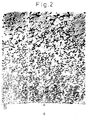
Fig. 2 is a cross-sectional transmission electron
micrograph of an embodiment of a conventional
polysulfone-based polymer hollow fiber membrane.
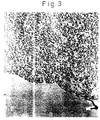
Fig. 3 is a cross-sectional transmission electron
micrograph of another embodiment of a conventional
polysulfone-based polymer hollow fiber membrane.
Fig. 4 is a cross-sectional transmission electron
micrograph of yet another embodiment of a conventional
polysulfone-based polymer hollow fiber membrane.
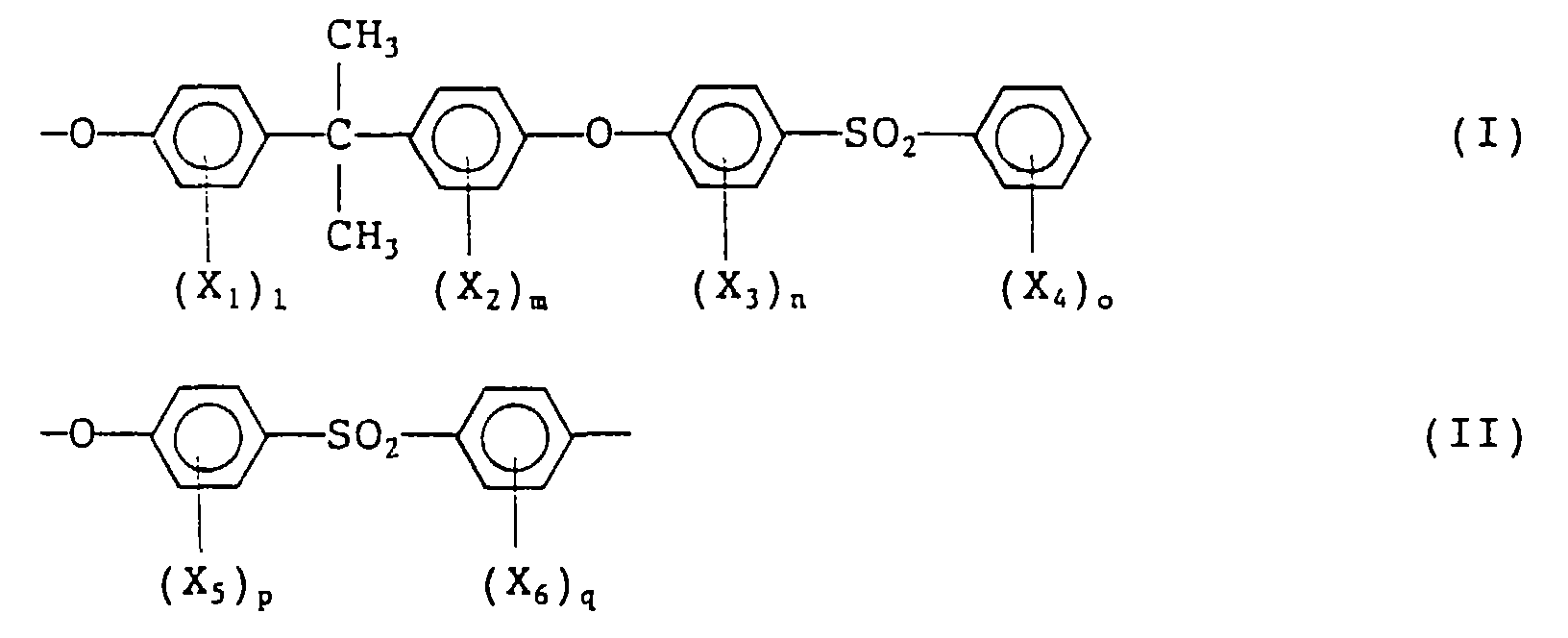
The polysulfone-based polymer used according to the
present invention is preferably an aromatic polysulfone-based
polymer containing -O- and -SO2- bonds, and as
representative examples there may be mentioned those with
repeating units represented by the following general
formulas (I) and (II).
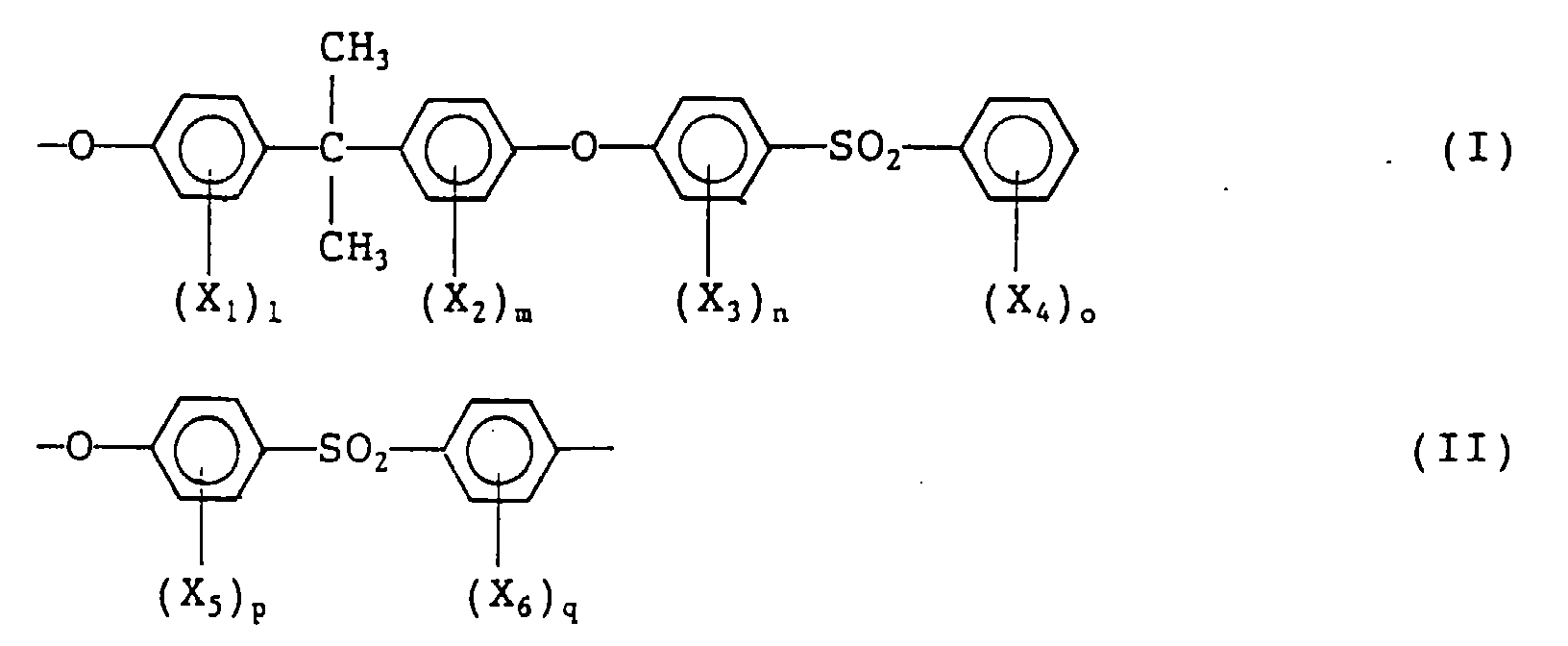 In formulas (I) and (II), X1-X6 represent non-dissociating
substituents exemplified by alkyl groups
such as methyl or ethyl and halogens such as chlorine or
bromine, or dissociating substituents such as -COOH or
-SO3H; and l, m, n, o, p and q represent integers of 0-4.
In formulas (I) and (II), X1-X6 represent non-dissociating
substituents exemplified by alkyl groups
such as methyl or ethyl and halogens such as chlorine or
bromine, or dissociating substituents such as -COOH or
-SO3H; and l, m, n, o, p and q represent integers of 0-4.
Polysulfone-based polymers with l, m, n, o, p and q
all equal to zero in the above formulas (I) and (II) are
generally easy to obtain and are also preferred for use
according to the invention. However, the polysulfone-based
polymer used for the invention is not limited to
these. Preferred among these are aromatic polysulfone-based
polymers represented by formula (II), especially
with p and q equal to zero.
The concentration of the polysulfone-based polymer
in the spinning stock solution according to the invention
is preferably 5-30 wt%, and especially 10-20 wt%. A
concentration of the polysulfone-based polymer exceeding
30 wt% is not preferred because it increases the solution
viscosity resulting in poorer handleability, while the
ultrafiltration rate of the resulting hollow fiber
membrane is lowered regardless of the composition of the
polar organic solvent used. On the other hand, a
polysulfone-based polymer concentration of less than 5
wt% is also not preferred because it results in lower
mechanical strength of the hollow fiber membrane product.
According to the invention, the water in the spinning
stock solution is an indispensable constituent of the
invention, and it is preferably present at 2-8 wt%, and
more preferably 4-6 wt%, in the spinning stock solution
containing the aforementioned polysulfone-based polymer.
If the amount of water in the spinning stock
solution is less than 2 wt%, not only the substance
permeability for β2-microglobulin, etc., but also the
mechanical strength of the hollow fibers will be lowered.
Also, if the amount of water exceeds 8 wt% the solubility
of the polysulfone-based polymer in the polar organic
solvent is lowered, tending to result in gelation of the
spinning stock solution and poor handleability.
As useful polar organic solvents for the invention
there may be mentioned N-methylpyrrolidone,
dimethylsulfoxide, dimethylacetamide and
dimethylformamide.
The polyvinylpyrrolidone contained in the spinning
stock solution is added to improve the compatibility of
the polysulfone-based polymer with blood when it contacts
blood, and it is said to improve the blood compatibility
due to a microphase separation structure formed within
the hollow fiber membrane structure by the hydrophobic
polysulfone-based polymer and hydrophilic
polyvinylpyrrolidone. The content thereof is generally
preferred to be 5-20 wt%, and especially 6-12 wt%, in the
spinning stock solution.
Conventional processes for preparing spinning stock
solutions have generally employed a system wherein the
polymer, solvent and additives are measured out, stirred
and dissolved in a tank, and then filtered to remove the
impurities prior to being degassed and supplied to
spinning. Because this system is a batch system using a
tank, it requires manpower and costly equipment.
Depending on the nature of the dope, there may be
concerns about changes in the properties thereof as time
passes after dissolution, and thus another disadvantage
is caused for provision of a uniform dope. According to
the present invention it is possible to employ a system
wherein preferably the polymer and solvent are each
supplied at constant prescribed rates to a twin-screw
extruder, dissolved and kneaded in the extruder, and then
the stock solution is filtered with a filter. In such a
system, the determination of quantities of starting
materials, the dissolution, the filtration and the
degassing may be carried out in a continuous manner, thus
providing the advantage of increased productivity and
workability, as well as excellent uniformity of the stock
solution.
According to the present invention, the nozzle
temperature during discharge of the polysulfone-based
polymer spinning stock solution from the tube-in-orifice
nozzle is preferably 20-60°C, and more preferably 30-50°C.
The nozzle temperature is preferably no lower than
20°C to prevent easy gelation of the spinning stock
solution and an increased percentage of fiber breakage
during spinning. On the other hand, if the temperature
is higher than 60°C the viscosity of the spinning stock
solution is lowered, thus resulting in disadvantages such
as more difficulty in achieving stable spinning and
larger thickness unevenness in the hollow fibers after
coagulation.
Conventional systems for supplying stock solutions
to spinning nozzles have achieved constant delivery by
using one pump per nozzle hole, and this system uses more
nozzles which increases the equipment volume and
equipment costs. According to the present invention it
is preferred in terms of equipment costs to employ a
system wherein the stock solution is supplied with one
pump for a plurality of nozzles, with a distributing jig
used for even distribution to each nozzle.
Also, discharged hollow fibers have conventionally
been coagulated into single filaments and then subjected
to such steps as water washing and drying and handled as
separate single filaments, but according to the present
invention it is very advantageous and preferred from the
standpoint of equipment cost and workability to use a
system wherein the discharged filaments are solidified in
the coagulating solution and then combined into multiple
hollow fiber filaments before passing through the
subsequent steps.
According to the process of the invention, the
spinning stock solution prepared in the manner described
above is discharged into the coagulating bath using a
tube-in-orifice nozzle, for coagulation. The coagulating
solution for the coagulating bath used here, i.e. the
external coagulating solution, is preferably water, an
alcohol such as methanol, ethanol, propanol, butanol,
etc., an aqueous solution of one of these alcohols, or an
aqueous solution of one of the polar organic solvents
mentioned above for preparation of the spinning stock
solution.
In addition, an internal coagulating solution used
for the hollow portions of the discharged hollow fibers
is also preferably water, alcohol or an aqueous solution
thereof, or an aqueous solution of a polar organic
solvent.
Formation of the skin layer which exhibits the
separating function of the membrane either on the inner
surface or the outer surface of the hollow fiber may be
accomplished by appropriate selection of the coagulating
solutions for the internal coagulating solution and the
external coagulating solution. Also, the temperature of
the coagulating solution is usually 30-70°C, and
preferably 30-50°C, when the coagulating solution is
water or an aqueous solution.
The polysulfone-based polymer hollow fiber membrane
of the invention which is obtained in this manner has a
spongy structure for the membrane as a whole, and at
least either one of the inner surface or the outer
surface thereof has a dense layer (skin layer) about
0.05-0.3 µm thick, i.e. a surface section with a markedly
different density and pore size than the Spongy structure
section, and the substance permeability performance of
the hollow fiber membrane has an ultrafiltration rate of
500-800 ml/hr·mmHg·m2, a dextran 10,000 cutoff of 30% or
lower and a dextran 70,000 cutoff of 80% or higher, with
preferably a dextran 10,000 cutoff of 25% or lower and a
dextran 70,000 cutoff of 85% or higher, and is
characterized by having a high ultrafiltration rate and a
sharp cutoff for medium high molecular weight substances.
The dense layer of the polysulfone-based polymer hollow
fiber membrane of the invention preferably has a
thickness of 0.07-0.2 µm, and especially about 0.1 µm.
The membrane thickness of the hollow fiber membrane
of the invention is preferred to be 20-50 µm, and
especially 30-40 µm.
According to the invention, the thickness of the
dense layer or skin layer was directly measured using a
15,000x magnification transmission electron micrograph of
a cross-section of the hollow fibers.
The cutoff was measured by the following method.
That is, after collecting 1,000 hollow fibers into a
bundle about 20 cm in length and sealing both ends with a
urethane resin, the bundle is cut to expose the center
section of the hollow fibers, and a module is formed. A
0.1 wt% aqueous solution of dextran 70,000 (molecular
weight 70,000) or dextran 10,000 (molecular weight
10,000) (stock solution) is passed over the hollow side
of the hollow fibers of the module at an inflow rate of
200 ml/min for each, and the influx pressure of the
aqueous dextran solution is controlled for a solution
permeation rate of 10 ml/hr·m2 through the hollow fiber
membrane. The temperature of the aqueous solution at
this time is 37°C ±1°C. When the aqueous solution
permeation rate becomes constant (usually after 30
minutes), the permeated solution and the aqueous solution
at the module inlet and outlet are sampled, the dextran
concentrations thereof are measured by the anthronesulfuric
acid method, and the cutoff (percentage by
weight of dextran blocked from permeation) is calculated.
The stock solution concentration for calculation of the
cutoff is (module inlet concentration + outlet
concentration of stock solution)/2.
The present invention will now be explained in more
detail by way of examples, with the understanding that
the invention is in no way limited thereby. Unless
otherwise specified, the symbol "%" will refer to percent
by weight.
A twin-screw extruder was used to dissolve and knead
dimethylsulfoxide (DMSO) and dimethylacetamide (DMAc) as
solvents, polyvinylpyrrolidone (PVP) and polyethersulfone
with repeating units represented by (-O--SO2--) (where
is 1,4-phenylene) as polymers and water in a proportion
of 41:30:9:15:5 %, and the resulting uniform solution was
filtered and degassed. This spinning stock solution was
then extruded through a tube-in-orifice nozzle (40°C) for
hollow fiber production, and using 60% aqueous solutions
of DMSO and DMAc (40°C) as internal and external
coagulating solutions, the spinning stock solution was
coagulated from the interior and exterior to spin a
hollow fiber porous membrane. The distance from the
nozzle to the external coagulating solution was 20 cm.
The dimensions of the nozzle used were a core diameter of
0.15 mm, a peripheral torus thickness of 0.25 mm, a
surrounding tube section (stock solution discharge
outlet) thickness of 0.35 mm and a draft of 3.
The properties of the resulting hollow fibers were
as follows.
Inner diameter: 200 µm, outer diameter: 280 µm,
membrane thickness: 40 µm, ultrafiltration rate: 650
ml/m2·hr·mmHg, dextran 10,000 and dextran 70,000 cutoff
[(stock solution concentration - permeating solution
concentration)/(stock solution concentration)]: 20% and
88%, respectively.
A cross-section of the resulting hollow fiber
membrane was photographed with a transmission electron
microscope at 15,000x magnification. The photograph is
shown in Fig. 1. Here, "A" is the inner surface layer.
However, Fig. 1 has been reduced to 70%, i.e. 10,500x
magnification, due to the paper size. Fig. 1 shows that
the hollow fiber membrane has a spongy structure as a
whole, with formation of a dense skin layer with an inner
surface thickness of about 0.1 µm.
For comparison, transmission electron micrographs
were taken at 15,000x magnification of the cross-section
of a polysulfone-based polymer hollow fiber membrane used
in a commercially available dialyzer by Kawasumi Chemical
Industries, KK. (model name: PS-1.6 UW), a polysulfone-based
polymer hollow fiber membrane used in a dialyzer by
Asahi Medical, KK. (model name: APS-16) and a
polysulfone-based polymer hollow fiber membrane used in a
dialyzer by Toray, KK. (model name: Toraysulfone HF-1.8).
These are shown in Figs. 2, 3 and 4 respectively, at 70%
size (10,500x magnification). Here, "A" is the inner
surface layer and "B" is the hollow section. These
photographs show that the conventional polysulfone-based
polymer hollow fiber membranes have no formation of a
dense skin layer as seen in the polysulfone-based polymer
hollow fiber membrane of the invention.
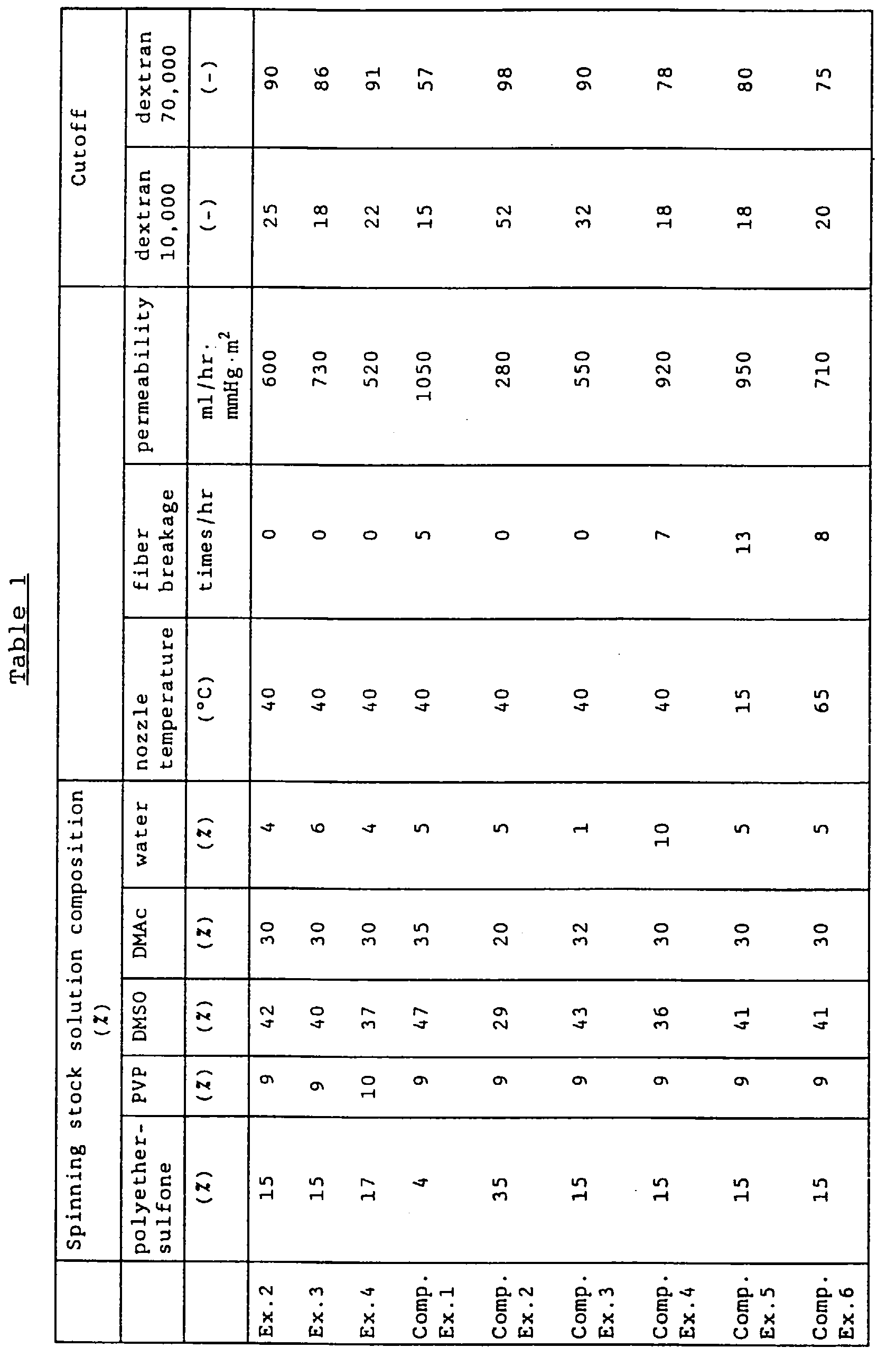
Hollow fiber spinning was carried out under the same
conditions as in Example 1, but with variation in the
spinning stock solution composition and the spinning
nozzle temperature. Table 1 lists the spinning
conditions and the properties of the resulting hollow
fibers.
As explained above, the present invention provides a
polysulfone-based polymer hollow fiber membrane with
excellent handleability and productivity for hollow fiber
spinning, giving hollow fiber membranes with satisfactory
molecular weight fractionating properties which are
highly useful as selectively permeable hollow fiber
separating membranes.
Claims (10)
- A process for producing a polysulfone-based polymer hollow fiber membrane in which a spinning stock solution containing a polysulfone-based polymer is discharged into air from a tube-in-orifice nozzle and then passed through a coagulating solution and desolvated to produce a hollow fiber separating membrane, which comprises spinning a polysulfone-based polymer spinning stock solution containing 5-30 wt% of the polysulfone-based polymer, 5-20 wt% of polyvinylpyrrolidone and 2-8 wt% of water in terms of total weight, dissolved in a polar organic solvent, at a nozzle temperature of 20-60°C.
- The process of claim 1, wherein the polysulfone-based polymer is an aromatic polysulfone-based polymer containing -O- and SO2- bonds.
- The process of claim 2, wherein the polysulfone-based polymer is a polymer represented by the following formula (I) or (II).In formulas (I) and (II), X1-X6 represent non-dissociating substituents exemplified by alkyl groups such as methyl or ethyl and halogens such as chlorine or bromine, or dissociating substituents such as -COOH or -SO3H; and l, m, n, o, p and q represent integers of 0-4.
- The process of claim 1, wherein the method of preparing the polysulfone-based polymer spinning stock solution is a system employing a twin-screw extruder.
- The process of claim 1, wherein the system accomplishes measurement of the spinning stock solution discharge rate for multiple nozzles.
- The process of claim 1, wherein the discharged filaments from the nozzle are treated as bundles of said hollow fibers after coagulating and hardening.
- A polysulfone-based polymer hollow fiber membrane which has a spongy structure for the membrane as a whole, which has a 0.05-0.3 µm thick dense layer on at least either one of the inner surface or the outer surface thereof, and which has an ultrafiltration rate of 500-800 ml/hr·mmHg·m2, a dextran 10,000 cutoff of 30% or lower and a dextran 70,000 cutoff of 80% or higher.
- A hollow fiber membrane according to claim 7, wherein the thickness of said dense layer is 0.07-0.2 µm.
- A hollow fiber membrane according to claim 7, which has a membrane thickness of 20-50 µm.
- A hollow fiber membrane according to claim 7, wherein the dextran 10,000 cutoff is 25% or lower and the dextran 70,000 cutoff is 85% or higher.
Applications Claiming Priority (3)
| Application Number | Priority Date | Filing Date | Title |
|---|---|---|---|
| JP110531/95 | 1995-05-09 | ||
| JP11053195 | 1995-05-09 | ||
| PCT/JP1996/001218 WO1996035504A1 (en) | 1995-05-09 | 1996-05-08 | Hollow-fiber membrane of polysulfone polymer and process for the production thereof |
Publications (2)
| Publication Number | Publication Date |
|---|---|
| EP0824960A1 true EP0824960A1 (en) | 1998-02-25 |
| EP0824960A4 EP0824960A4 (en) | 1998-11-11 |
Family
ID=14538175
Family Applications (1)
| Application Number | Title | Priority Date | Filing Date |
|---|---|---|---|
| EP96913703A Withdrawn EP0824960A4 (en) | 1995-05-09 | 1996-05-08 | Hollow-fiber membrane of polysulfone polymer and process for the production thereof |
Country Status (2)
| Country | Link |
|---|---|
| EP (1) | EP0824960A4 (en) |
| WO (1) | WO1996035504A1 (en) |
Cited By (4)
| Publication number | Priority date | Publication date | Assignee | Title |
|---|---|---|---|---|
| WO2005099878A1 (en) * | 2004-04-19 | 2005-10-27 | Lysitech Srl | Process for producing hollow capillary polymeric membranes for the treatment of blood and its derivatives |
| DE102004008221B4 (en) * | 2004-02-19 | 2006-01-26 | Membrana Gmbh | Dialysis membrane with improved agent molecule removal |
| WO2008046779A1 (en) | 2006-10-18 | 2008-04-24 | Gambro Lundia Ab | Hollow fiber membrane and method for manufacturing thereof |
| US8758625B2 (en) | 2008-09-26 | 2014-06-24 | Asahi Kasei Chemicals Corporation | Use of porous hollow-fiber membrane for producing clarified biomedical culture medium |
Families Citing this family (4)
| Publication number | Priority date | Publication date | Assignee | Title |
|---|---|---|---|---|
| KR100416135B1 (en) * | 1997-12-30 | 2004-05-07 | 주식회사 코오롱 | Polysulfone hollow fiber membrane for hemodialysis and its manufacturing method. |
| JP2009136763A (en) * | 2007-12-06 | 2009-06-25 | Toyobo Co Ltd | Method for manufacturing hollow-fiber-type separation membrane |
| KR101944923B1 (en) * | 2017-09-29 | 2019-02-01 | 연세대학교 산학협력단 | 3-dimensional matrices using superhydrophobic electrospun fiber and use thereof |
| CN114392655A (en) * | 2021-12-24 | 2022-04-26 | 苏州君康医疗科技有限公司 | Preparation method of hemodialysis filtration membrane |
Family Cites Families (8)
| Publication number | Priority date | Publication date | Assignee | Title |
|---|---|---|---|---|
| DE3149976A1 (en) * | 1981-12-17 | 1983-06-30 | Hoechst Ag, 6230 Frankfurt | MACROPOROUS ASYMMETRIC HYDROPHILE MEMBRANE MADE OF SYNTHETIC POLYMER |
| DE3426331A1 (en) * | 1984-07-17 | 1986-01-30 | 6380 Bad Homburg Fresenius AG | ASYMMETRIC MICROPOROUS HOLLOW FIBER FOR HAEMODIALYSIS AND METHOD FOR THE PRODUCTION THEREOF |
| JPH0675667B2 (en) * | 1985-04-17 | 1994-09-28 | 東レ株式会社 | Method for producing semi-permeable membrane of polysulfone resin |
| JPS62168506A (en) * | 1986-01-17 | 1987-07-24 | Nitto Electric Ind Co Ltd | Method and apparatus for preparing hollow yarn bundle |
| JP2528169B2 (en) * | 1987-11-19 | 1996-08-28 | 帝人株式会社 | Method for manufacturing porous molded article |
| ATE132766T1 (en) * | 1991-04-12 | 1996-01-15 | Minntech Corp | FIBER SPINNING PROCESS AND ITS PRODUCT |
| EP0647156A1 (en) * | 1992-06-23 | 1995-04-12 | Minntech Corporation | Hollow fiber membrane incorporating a surfactant and process for preparing same |
| US6093491A (en) * | 1992-11-30 | 2000-07-25 | Basf Corporation | Moisture transport fiber |
-
1996
- 1996-05-08 WO PCT/JP1996/001218 patent/WO1996035504A1/en not_active Ceased
- 1996-05-08 EP EP96913703A patent/EP0824960A4/en not_active Withdrawn
Cited By (10)
| Publication number | Priority date | Publication date | Assignee | Title |
|---|---|---|---|---|
| DE102004008221B4 (en) * | 2004-02-19 | 2006-01-26 | Membrana Gmbh | Dialysis membrane with improved agent molecule removal |
| US7811507B2 (en) | 2004-02-19 | 2010-10-12 | Membrana Gmbh | Dialysis membrane having improved ability for removal of middle molecules |
| US8651284B2 (en) | 2004-02-19 | 2014-02-18 | Membrana Gmbh | Dialysis membrane with improved removal of middle molecules |
| WO2005099878A1 (en) * | 2004-04-19 | 2005-10-27 | Lysitech Srl | Process for producing hollow capillary polymeric membranes for the treatment of blood and its derivatives |
| WO2008046779A1 (en) | 2006-10-18 | 2008-04-24 | Gambro Lundia Ab | Hollow fiber membrane and method for manufacturing thereof |
| EP2228126A1 (en) | 2006-10-18 | 2010-09-15 | Gambro Lundia AB | Hollow firbe membrane and use thereof |
| EP2383031A1 (en) | 2006-10-18 | 2011-11-02 | Gambro Lundia AB | Microdialysis device |
| US8596467B2 (en) | 2006-10-18 | 2013-12-03 | Gambro Lundia Ab | Hollow fiber membrane and method for manufacturing thereof |
| US9156005B2 (en) | 2006-10-18 | 2015-10-13 | Gambro Lundia Ab | Hollow fiber membrane and method for manufacturing thereof |
| US8758625B2 (en) | 2008-09-26 | 2014-06-24 | Asahi Kasei Chemicals Corporation | Use of porous hollow-fiber membrane for producing clarified biomedical culture medium |
Also Published As
| Publication number | Publication date |
|---|---|
| EP0824960A4 (en) | 1998-11-11 |
| WO1996035504A1 (en) | 1996-11-14 |
Similar Documents
| Publication | Publication Date | Title |
|---|---|---|
| CA2143863C (en) | Hollow fiber membrane incorporating a polyimide and process for preparing same | |
| AU658885B2 (en) | Fiber spinning process and product thereof | |
| US4351860A (en) | Polyaryl ether sulfone semipermeable membrane and process for producing same | |
| EP0294737B1 (en) | Polysulfone hollow fiber membrane and process for making the same | |
| US6165363A (en) | Hollow fiber type filtration membrane | |
| JP5433921B2 (en) | Polymer porous hollow fiber membrane | |
| CA2202969C (en) | Selectively permeable hollow fiber membrane and process for producing same | |
| CN111282455B (en) | External pressure type hollow fiber industrial nanofiltration membrane and preparation method thereof | |
| AU672856B2 (en) | High flux hollow fiber membrane | |
| US20010047959A1 (en) | Polyacrylonitrile-based filtration membrane in a hollow fiber state | |
| EP0923984B1 (en) | Polyacrylonitrile-based hollow-fiber filtration membrane | |
| JPH10216489A (en) | Cellulose hollow fiber membrane and its production | |
| WO1996035504A1 (en) | Hollow-fiber membrane of polysulfone polymer and process for the production thereof | |
| JP2688564B2 (en) | Cellulose acetate hollow fiber separation membrane | |
| JP3169404B2 (en) | Method for producing semipermeable membrane with high water permeability | |
| WO2016182015A1 (en) | Porous hollow fiber membrane and manufacturing method therefor | |
| CN113244790A (en) | Self-reinforced hollow fiber ultrafiltration membrane and preparation method and application thereof | |
| JP4164730B2 (en) | Selective separation membrane | |
| JPS60172312A (en) | Preparation of polysulfone hollow yarn film | |
| US5693694A (en) | Low and medium flux membranes | |
| JP2819713B2 (en) | Porous membrane and method for producing the same | |
| WO2019172077A1 (en) | Hollow-fiber membrane and method for producing hollow-fiber membrane | |
| JP3464000B1 (en) | Manufacturing method of high performance hollow fiber microfiltration membrane | |
| JP3473202B2 (en) | Manufacturing method of hollow fiber membrane | |
| JPWO1996035504A1 (en) | Polysulfone-based polymer hollow fiber membrane and its manufacturing method |
Legal Events
| Date | Code | Title | Description |
|---|---|---|---|
| PUAI | Public reference made under article 153(3) epc to a published international application that has entered the european phase |
Free format text: ORIGINAL CODE: 0009012 |
|
| 17P | Request for examination filed |
Effective date: 19971104 |
|
| AK | Designated contracting states |
Kind code of ref document: A1 Designated state(s): DE FR GB |
|
| A4 | Supplementary search report drawn up and despatched |
Effective date: 19980928 |
|
| AK | Designated contracting states |
Kind code of ref document: A4 Designated state(s): DE FR GB |
|
| 17Q | First examination report despatched |
Effective date: 19991221 |
|
| STAA | Information on the status of an ep patent application or granted ep patent |
Free format text: STATUS: THE APPLICATION IS DEEMED TO BE WITHDRAWN |
|
| 18D | Application deemed to be withdrawn |
Effective date: 20000503 |