EP0823889B1 - 1,3-propane diol derivatives as bioactive compounds - Google Patents
1,3-propane diol derivatives as bioactive compounds Download PDFInfo
- Publication number
- EP0823889B1 EP0823889B1 EP96912139A EP96912139A EP0823889B1 EP 0823889 B1 EP0823889 B1 EP 0823889B1 EP 96912139 A EP96912139 A EP 96912139A EP 96912139 A EP96912139 A EP 96912139A EP 0823889 B1 EP0823889 B1 EP 0823889B1
- Authority
- EP
- European Patent Office
- Prior art keywords
- acid
- gla
- propane diol
- epa
- drug
- Prior art date
- Legal status (The legal status is an assumption and is not a legal conclusion. Google has not performed a legal analysis and makes no representation as to the accuracy of the status listed.)
- Expired - Lifetime
Links
- DNIAPMSPPWPWGF-VKHMYHEASA-N (+)-propylene glycol Chemical class C[C@H](O)CO DNIAPMSPPWPWGF-VKHMYHEASA-N 0.000 title claims abstract description 55
- 150000001875 compounds Chemical class 0.000 title claims abstract description 48
- 230000000975 bioactive effect Effects 0.000 title claims abstract description 24
- 235000014113 dietary fatty acids Nutrition 0.000 claims abstract description 99
- 239000000194 fatty acid Substances 0.000 claims abstract description 99
- 229930195729 fatty acid Natural products 0.000 claims abstract description 99
- 150000004665 fatty acids Chemical class 0.000 claims abstract description 93
- 239000003814 drug Substances 0.000 claims abstract description 68
- 229940079593 drug Drugs 0.000 claims abstract description 60
- YPFDHNVEDLHUCE-UHFFFAOYSA-N 1,3-propanediol Substances OCCCO YPFDHNVEDLHUCE-UHFFFAOYSA-N 0.000 claims abstract description 53
- 229940035437 1,3-propanediol Drugs 0.000 claims abstract description 48
- 229920000166 polytrimethylene carbonate Polymers 0.000 claims abstract description 48
- 238000002560 therapeutic procedure Methods 0.000 claims abstract description 15
- 125000002252 acyl group Chemical group 0.000 claims abstract description 9
- 125000000373 fatty alcohol group Chemical group 0.000 claims abstract description 6
- 235000015097 nutrients Nutrition 0.000 claims abstract description 5
- 239000001257 hydrogen Substances 0.000 claims abstract description 3
- 229910052739 hydrogen Inorganic materials 0.000 claims abstract description 3
- 125000004435 hydrogen atom Chemical class [H]* 0.000 claims abstract description 3
- VZCCETWTMQHEPK-QNEBEIHSSA-N gamma-linolenic acid Chemical compound CCCCC\C=C/C\C=C/C\C=C/CCCCC(O)=O VZCCETWTMQHEPK-QNEBEIHSSA-N 0.000 claims description 71
- 235000020664 gamma-linolenic acid Nutrition 0.000 claims description 71
- VZCCETWTMQHEPK-UHFFFAOYSA-N gamma-Linolensaeure Natural products CCCCCC=CCC=CCC=CCCCCC(O)=O VZCCETWTMQHEPK-UHFFFAOYSA-N 0.000 claims description 69
- 229960002733 gamolenic acid Drugs 0.000 claims description 66
- YZXBAPSDXZZRGB-DOFZRALJSA-N arachidonic acid Chemical compound CCCCC\C=C/C\C=C/C\C=C/C\C=C/CCCC(O)=O YZXBAPSDXZZRGB-DOFZRALJSA-N 0.000 claims description 65
- MBMBGCFOFBJSGT-KUBAVDMBSA-N all-cis-docosa-4,7,10,13,16,19-hexaenoic acid Chemical compound CC\C=C/C\C=C/C\C=C/C\C=C/C\C=C/C\C=C/CCC(O)=O MBMBGCFOFBJSGT-KUBAVDMBSA-N 0.000 claims description 62
- 238000011282 treatment Methods 0.000 claims description 60
- 239000000203 mixture Substances 0.000 claims description 53
- JAZBEHYOTPTENJ-JLNKQSITSA-N all-cis-5,8,11,14,17-icosapentaenoic acid Chemical compound CC\C=C/C\C=C/C\C=C/C\C=C/C\C=C/CCCC(O)=O JAZBEHYOTPTENJ-JLNKQSITSA-N 0.000 claims description 51
- JAZBEHYOTPTENJ-UHFFFAOYSA-N eicosapentaenoic acid Natural products CCC=CCC=CCC=CCC=CCC=CCCCC(O)=O JAZBEHYOTPTENJ-UHFFFAOYSA-N 0.000 claims description 50
- 235000020673 eicosapentaenoic acid Nutrition 0.000 claims description 50
- 229960005135 eicosapentaenoic acid Drugs 0.000 claims description 50
- HOBAELRKJCKHQD-UHFFFAOYSA-N (8Z,11Z,14Z)-8,11,14-eicosatrienoic acid Natural products CCCCCC=CCC=CCC=CCCCCCCC(O)=O HOBAELRKJCKHQD-UHFFFAOYSA-N 0.000 claims description 44
- 235000021298 Dihomo-γ-linolenic acid Nutrition 0.000 claims description 44
- HOBAELRKJCKHQD-QNEBEIHSSA-N dihomo-γ-linolenic acid Chemical compound CCCCC\C=C/C\C=C/C\C=C/CCCCCCC(O)=O HOBAELRKJCKHQD-QNEBEIHSSA-N 0.000 claims description 44
- 235000020669 docosahexaenoic acid Nutrition 0.000 claims description 35
- 235000021342 arachidonic acid Nutrition 0.000 claims description 32
- 229940114079 arachidonic acid Drugs 0.000 claims description 32
- 229940090949 docosahexaenoic acid Drugs 0.000 claims description 30
- 239000002253 acid Substances 0.000 claims description 24
- 235000004626 essential fatty acids Nutrition 0.000 claims description 23
- OYHQOLUKZRVURQ-IXWMQOLASA-N linoleic acid Natural products CCCCC\C=C/C\C=C\CCCCCCCC(O)=O OYHQOLUKZRVURQ-IXWMQOLASA-N 0.000 claims description 21
- OPGOLNDOMSBSCW-CLNHMMGSSA-N Fursultiamine hydrochloride Chemical compound Cl.C1CCOC1CSSC(\CCO)=C(/C)N(C=O)CC1=CN=C(C)N=C1N OPGOLNDOMSBSCW-CLNHMMGSSA-N 0.000 claims description 20
- CGIGDMFJXJATDK-UHFFFAOYSA-N indomethacin Chemical compound CC1=C(CC(O)=O)C2=CC(OC)=CC=C2N1C(=O)C1=CC=C(Cl)C=C1 CGIGDMFJXJATDK-UHFFFAOYSA-N 0.000 claims description 20
- JIWBIWFOSCKQMA-UHFFFAOYSA-N stearidonic acid Natural products CCC=CCC=CCC=CCC=CCCCCC(O)=O JIWBIWFOSCKQMA-UHFFFAOYSA-N 0.000 claims description 20
- 230000009471 action Effects 0.000 claims description 19
- JBYXPOFIGCOSSB-GOJKSUSPSA-N 9-cis,11-trans-octadecadienoic acid Chemical compound CCCCCC\C=C\C=C/CCCCCCCC(O)=O JBYXPOFIGCOSSB-GOJKSUSPSA-N 0.000 claims description 17
- 229940108924 conjugated linoleic acid Drugs 0.000 claims description 17
- 150000002632 lipids Chemical class 0.000 claims description 17
- 238000000034 method Methods 0.000 claims description 17
- LFQSCWFLJHTTHZ-UHFFFAOYSA-N Ethanol Chemical compound CCO LFQSCWFLJHTTHZ-UHFFFAOYSA-N 0.000 claims description 13
- HXQHFNIKBKZGRP-JRVLCRGASA-N 5,9,12-octadecatrienoic acid Chemical compound CCCCC\C=C\C\C=C\CC\C=C\CCCC(O)=O HXQHFNIKBKZGRP-JRVLCRGASA-N 0.000 claims description 12
- 239000012528 membrane Substances 0.000 claims description 12
- 239000003963 antioxidant agent Substances 0.000 claims description 11
- 235000006708 antioxidants Nutrition 0.000 claims description 11
- 230000004888 barrier function Effects 0.000 claims description 11
- 239000003795 chemical substances by application Substances 0.000 claims description 11
- 229960000905 indomethacin Drugs 0.000 claims description 11
- DTOSIQBPPRVQHS-PDBXOOCHSA-N alpha-linolenic acid Chemical class CC\C=C/C\C=C/C\C=C/CCCCCCCC(O)=O DTOSIQBPPRVQHS-PDBXOOCHSA-N 0.000 claims description 10
- 150000001413 amino acids Chemical class 0.000 claims description 10
- 229940024606 amino acid Drugs 0.000 claims description 9
- 235000001014 amino acid Nutrition 0.000 claims description 9
- 239000000126 substance Substances 0.000 claims description 9
- 229940088594 vitamin Drugs 0.000 claims description 9
- 229930003231 vitamin Natural products 0.000 claims description 9
- 235000013343 vitamin Nutrition 0.000 claims description 9
- 239000011782 vitamin Substances 0.000 claims description 9
- 238000004519 manufacturing process Methods 0.000 claims description 8
- ZQPPMHVWECSIRJ-KTKRTIGZSA-N oleic acid Chemical compound CCCCCCCC\C=C/CCCCCCCC(O)=O ZQPPMHVWECSIRJ-KTKRTIGZSA-N 0.000 claims description 8
- 150000003431 steroids Chemical class 0.000 claims description 8
- 230000003078 antioxidant effect Effects 0.000 claims description 7
- 235000013305 food Nutrition 0.000 claims description 7
- 238000002360 preparation method Methods 0.000 claims description 7
- 150000003722 vitamin derivatives Chemical class 0.000 claims description 7
- 235000020661 alpha-linolenic acid Nutrition 0.000 claims description 6
- 235000015872 dietary supplement Nutrition 0.000 claims description 6
- NOESYZHRGYRDHS-UHFFFAOYSA-N insulin Chemical compound N1C(=O)C(NC(=O)C(CCC(N)=O)NC(=O)C(CCC(O)=O)NC(=O)C(C(C)C)NC(=O)C(NC(=O)CN)C(C)CC)CSSCC(C(NC(CO)C(=O)NC(CC(C)C)C(=O)NC(CC=2C=CC(O)=CC=2)C(=O)NC(CCC(N)=O)C(=O)NC(CC(C)C)C(=O)NC(CCC(O)=O)C(=O)NC(CC(N)=O)C(=O)NC(CC=2C=CC(O)=CC=2)C(=O)NC(CSSCC(NC(=O)C(C(C)C)NC(=O)C(CC(C)C)NC(=O)C(CC=2C=CC(O)=CC=2)NC(=O)C(CC(C)C)NC(=O)C(C)NC(=O)C(CCC(O)=O)NC(=O)C(C(C)C)NC(=O)C(CC(C)C)NC(=O)C(CC=2NC=NC=2)NC(=O)C(CO)NC(=O)CNC2=O)C(=O)NCC(=O)NC(CCC(O)=O)C(=O)NC(CCCNC(N)=N)C(=O)NCC(=O)NC(CC=3C=CC=CC=3)C(=O)NC(CC=3C=CC=CC=3)C(=O)NC(CC=3C=CC(O)=CC=3)C(=O)NC(C(C)O)C(=O)N3C(CCC3)C(=O)NC(CCCCN)C(=O)NC(C)C(O)=O)C(=O)NC(CC(N)=O)C(O)=O)=O)NC(=O)C(C(C)CC)NC(=O)C(CO)NC(=O)C(C(C)O)NC(=O)C1CSSCC2NC(=O)C(CC(C)C)NC(=O)C(NC(=O)C(CCC(N)=O)NC(=O)C(CC(N)=O)NC(=O)C(NC(=O)C(N)CC=1C=CC=CC=1)C(C)C)CC1=CN=CN1 NOESYZHRGYRDHS-UHFFFAOYSA-N 0.000 claims description 6
- 235000020778 linoleic acid Nutrition 0.000 claims description 6
- YGSDEFSMJLZEOE-UHFFFAOYSA-N salicylic acid Chemical compound OC(=O)C1=CC=CC=C1O YGSDEFSMJLZEOE-UHFFFAOYSA-N 0.000 claims description 6
- DVSZKTAMJJTWFG-SKCDLICFSA-N (2e,4e,6e,8e,10e,12e)-docosa-2,4,6,8,10,12-hexaenoic acid Chemical compound CCCCCCCCC\C=C\C=C\C=C\C=C\C=C\C=C\C(O)=O DVSZKTAMJJTWFG-SKCDLICFSA-N 0.000 claims description 5
- GZJLLYHBALOKEX-UHFFFAOYSA-N 6-Ketone, O18-Me-Ussuriedine Natural products CC=CCC=CCC=CCC=CCC=CCC=CCCCC(O)=O GZJLLYHBALOKEX-UHFFFAOYSA-N 0.000 claims description 5
- KAUVQQXNCKESLC-UHFFFAOYSA-N docosahexaenoic acid (DHA) Natural products COC(=O)C(C)NOCC1=CC=CC=C1 KAUVQQXNCKESLC-UHFFFAOYSA-N 0.000 claims description 5
- 229960000901 mepacrine Drugs 0.000 claims description 5
- 235000021313 oleic acid Nutrition 0.000 claims description 5
- 108090000765 processed proteins & peptides Proteins 0.000 claims description 5
- 102000004169 proteins and genes Human genes 0.000 claims description 5
- 108090000623 proteins and genes Proteins 0.000 claims description 5
- GPKJTRJOBQGKQK-UHFFFAOYSA-N quinacrine Chemical compound C1=C(OC)C=C2C(NC(C)CCCN(CC)CC)=C(C=CC(Cl)=C3)C3=NC2=C1 GPKJTRJOBQGKQK-UHFFFAOYSA-N 0.000 claims description 5
- TWSWSIQAPQLDBP-CGRWFSSPSA-N (7e,10e,13e,16e)-docosa-7,10,13,16-tetraenoic acid Chemical compound CCCCC\C=C\C\C=C\C\C=C\C\C=C\CCCCCC(O)=O TWSWSIQAPQLDBP-CGRWFSSPSA-N 0.000 claims description 4
- WRIDQFICGBMAFQ-UHFFFAOYSA-N (E)-8-Octadecenoic acid Natural products CCCCCCCCCC=CCCCCCCC(O)=O WRIDQFICGBMAFQ-UHFFFAOYSA-N 0.000 claims description 4
- LQJBNNIYVWPHFW-UHFFFAOYSA-N 20:1omega9c fatty acid Natural products CCCCCCCCCCC=CCCCCCCCC(O)=O LQJBNNIYVWPHFW-UHFFFAOYSA-N 0.000 claims description 4
- QSBYPNXLFMSGKH-UHFFFAOYSA-N 9-Heptadecensaeure Natural products CCCCCCCC=CCCCCCCCC(O)=O QSBYPNXLFMSGKH-UHFFFAOYSA-N 0.000 claims description 4
- 239000004475 Arginine Substances 0.000 claims description 4
- 235000021292 Docosatetraenoic acid Nutrition 0.000 claims description 4
- ULGZDMOVFRHVEP-RWJQBGPGSA-N Erythromycin Chemical compound O([C@@H]1[C@@H](C)C(=O)O[C@@H]([C@@]([C@H](O)[C@@H](C)C(=O)[C@H](C)C[C@@](C)(O)[C@H](O[C@H]2[C@@H]([C@H](C[C@@H](C)O2)N(C)C)O)[C@H]1C)(C)O)CC)[C@H]1C[C@@](C)(OC)[C@@H](O)[C@H](C)O1 ULGZDMOVFRHVEP-RWJQBGPGSA-N 0.000 claims description 4
- COLNVLDHVKWLRT-QMMMGPOBSA-N L-phenylalanine Chemical compound OC(=O)[C@@H](N)CC1=CC=CC=C1 COLNVLDHVKWLRT-QMMMGPOBSA-N 0.000 claims description 4
- QIVBCDIJIAJPQS-VIFPVBQESA-N L-tryptophane Chemical compound C1=CC=C2C(C[C@H](N)C(O)=O)=CNC2=C1 QIVBCDIJIAJPQS-VIFPVBQESA-N 0.000 claims description 4
- 239000005642 Oleic acid Substances 0.000 claims description 4
- ZQPPMHVWECSIRJ-UHFFFAOYSA-N Oleic acid Natural products CCCCCCCCC=CCCCCCCCC(O)=O ZQPPMHVWECSIRJ-UHFFFAOYSA-N 0.000 claims description 4
- QIVBCDIJIAJPQS-UHFFFAOYSA-N Tryptophan Natural products C1=CC=C2C(CC(N)C(O)=O)=CNC2=C1 QIVBCDIJIAJPQS-UHFFFAOYSA-N 0.000 claims description 4
- TWSWSIQAPQLDBP-UHFFFAOYSA-N adrenic acid Natural products CCCCCC=CCC=CCC=CCC=CCCCCCC(O)=O TWSWSIQAPQLDBP-UHFFFAOYSA-N 0.000 claims description 4
- 239000002246 antineoplastic agent Substances 0.000 claims description 4
- 239000000262 estrogen Substances 0.000 claims description 4
- 235000013373 food additive Nutrition 0.000 claims description 4
- 239000002778 food additive Substances 0.000 claims description 4
- JYGXADMDTFJGBT-VWUMJDOOSA-N hydrocortisone Chemical compound O=C1CC[C@]2(C)[C@H]3[C@@H](O)C[C@](C)([C@@](CC4)(O)C(=O)CO)[C@@H]4[C@@H]3CCC2=C1 JYGXADMDTFJGBT-VWUMJDOOSA-N 0.000 claims description 4
- QXJSBBXBKPUZAA-UHFFFAOYSA-N isooleic acid Natural products CCCCCCCC=CCCCCCCCCC(O)=O QXJSBBXBKPUZAA-UHFFFAOYSA-N 0.000 claims description 4
- 229940021182 non-steroidal anti-inflammatory drug Drugs 0.000 claims description 4
- IJTNSXPMYKJZPR-UHFFFAOYSA-N parinaric acid Chemical compound CCC=CC=CC=CC=CCCCCCCCC(O)=O IJTNSXPMYKJZPR-UHFFFAOYSA-N 0.000 claims description 4
- COLNVLDHVKWLRT-UHFFFAOYSA-N phenylalanine Natural products OC(=O)C(N)CC1=CC=CC=C1 COLNVLDHVKWLRT-UHFFFAOYSA-N 0.000 claims description 4
- 229960002847 prasterone Drugs 0.000 claims description 4
- 125000002924 primary amino group Chemical group [H]N([H])* 0.000 claims description 4
- 239000000583 progesterone congener Substances 0.000 claims description 4
- 208000017520 skin disease Diseases 0.000 claims description 4
- 229960001727 tretinoin Drugs 0.000 claims description 4
- YUFFSWGQGVEMMI-JLNKQSITSA-N (7Z,10Z,13Z,16Z,19Z)-docosapentaenoic acid Chemical compound CC\C=C/C\C=C/C\C=C/C\C=C/C\C=C/CCCCCC(O)=O YUFFSWGQGVEMMI-JLNKQSITSA-N 0.000 claims description 3
- WHTVZRBIWZFKQO-AWEZNQCLSA-N (S)-chloroquine Chemical compound ClC1=CC=C2C(N[C@@H](C)CCCN(CC)CC)=CC=NC2=C1 WHTVZRBIWZFKQO-AWEZNQCLSA-N 0.000 claims description 3
- BSYNRYMUTXBXSQ-UHFFFAOYSA-N Aspirin Chemical compound CC(=O)OC1=CC=CC=C1C(O)=O BSYNRYMUTXBXSQ-UHFFFAOYSA-N 0.000 claims description 3
- 229940122361 Bisphosphonate Drugs 0.000 claims description 3
- VOVIALXJUBGFJZ-KWVAZRHASA-N Budesonide Chemical compound C1CC2=CC(=O)C=C[C@]2(C)[C@@H]2[C@@H]1[C@@H]1C[C@H]3OC(CCC)O[C@@]3(C(=O)CO)[C@@]1(C)C[C@@H]2O VOVIALXJUBGFJZ-KWVAZRHASA-N 0.000 claims description 3
- FMGSKLZLMKYGDP-UHFFFAOYSA-N Dehydroepiandrosterone Natural products C1C(O)CCC2(C)C3CCC(C)(C(CC4)=O)C4C3CC=C21 FMGSKLZLMKYGDP-UHFFFAOYSA-N 0.000 claims description 3
- HEFNNWSXXWATRW-UHFFFAOYSA-N Ibuprofen Chemical compound CC(C)CC1=CC=C(C(C)C(O)=O)C=C1 HEFNNWSXXWATRW-UHFFFAOYSA-N 0.000 claims description 3
- 102000004877 Insulin Human genes 0.000 claims description 3
- 108090001061 Insulin Proteins 0.000 claims description 3
- 229960001138 acetylsalicylic acid Drugs 0.000 claims description 3
- 230000000996 additive effect Effects 0.000 claims description 3
- OFBHPPMPBOJXRT-VWJPMABRSA-N adenylosuccinic acid Chemical compound O[C@@H]1[C@H](O)[C@@H](COP(O)(O)=O)O[C@H]1N1C2=NC=NC(N[C@@H](CC(O)=O)C(O)=O)=C2N=C1 OFBHPPMPBOJXRT-VWJPMABRSA-N 0.000 claims description 3
- 239000003470 adrenal cortex hormone Substances 0.000 claims description 3
- SHGAZHPCJJPHSC-YCNIQYBTSA-N all-trans-retinoic acid Chemical compound OC(=O)\C=C(/C)\C=C\C=C(/C)\C=C\C1=C(C)CCCC1(C)C SHGAZHPCJJPHSC-YCNIQYBTSA-N 0.000 claims description 3
- 229960002749 aminolevulinic acid Drugs 0.000 claims description 3
- 239000002260 anti-inflammatory agent Substances 0.000 claims description 3
- 239000001961 anticonvulsive agent Substances 0.000 claims description 3
- 239000000935 antidepressant agent Substances 0.000 claims description 3
- 239000000164 antipsychotic agent Substances 0.000 claims description 3
- ODKSFYDXXFIFQN-UHFFFAOYSA-N arginine Natural products OC(=O)C(N)CCCNC(N)=N ODKSFYDXXFIFQN-UHFFFAOYSA-N 0.000 claims description 3
- NBMKJKDGKREAPL-DVTGEIKXSA-N beclomethasone Chemical compound C1CC2=CC(=O)C=C[C@]2(C)[C@]2(Cl)[C@@H]1[C@@H]1C[C@H](C)[C@@](C(=O)CO)(O)[C@@]1(C)C[C@@H]2O NBMKJKDGKREAPL-DVTGEIKXSA-N 0.000 claims description 3
- 229940092705 beclomethasone Drugs 0.000 claims description 3
- 229960002537 betamethasone Drugs 0.000 claims description 3
- UREBDLICKHMUKA-DVTGEIKXSA-N betamethasone Chemical compound C1CC2=CC(=O)C=C[C@]2(C)[C@]2(F)[C@@H]1[C@@H]1C[C@H](C)[C@@](C(=O)CO)(O)[C@@]1(C)C[C@@H]2O UREBDLICKHMUKA-DVTGEIKXSA-N 0.000 claims description 3
- 150000004663 bisphosphonates Chemical class 0.000 claims description 3
- 229960004436 budesonide Drugs 0.000 claims description 3
- 229960003677 chloroquine Drugs 0.000 claims description 3
- WHTVZRBIWZFKQO-UHFFFAOYSA-N chloroquine Natural products ClC1=CC=C2C(NC(C)CCCN(CC)CC)=CC=NC2=C1 WHTVZRBIWZFKQO-UHFFFAOYSA-N 0.000 claims description 3
- 239000002872 contrast media Substances 0.000 claims description 3
- FMGSKLZLMKYGDP-USOAJAOKSA-N dehydroepiandrosterone Chemical compound C1[C@@H](O)CC[C@]2(C)[C@H]3CC[C@](C)(C(CC4)=O)[C@@H]4[C@@H]3CC=C21 FMGSKLZLMKYGDP-USOAJAOKSA-N 0.000 claims description 3
- 238000009472 formulation Methods 0.000 claims description 3
- 229960000890 hydrocortisone Drugs 0.000 claims description 3
- 125000002887 hydroxy group Chemical group [H]O* 0.000 claims description 3
- 229960001680 ibuprofen Drugs 0.000 claims description 3
- 229940125396 insulin Drugs 0.000 claims description 3
- 229960000282 metronidazole Drugs 0.000 claims description 3
- VAOCPAMSLUNLGC-UHFFFAOYSA-N metronidazole Chemical compound CC1=NC=C([N+]([O-])=O)N1CCO VAOCPAMSLUNLGC-UHFFFAOYSA-N 0.000 claims description 3
- 239000000041 non-steroidal anti-inflammatory agent Substances 0.000 claims description 3
- FJKROLUGYXJWQN-UHFFFAOYSA-N papa-hydroxy-benzoic acid Natural products OC(=O)C1=CC=C(O)C=C1 FJKROLUGYXJWQN-UHFFFAOYSA-N 0.000 claims description 3
- 229960004889 salicylic acid Drugs 0.000 claims description 3
- 230000002195 synergetic effect Effects 0.000 claims description 3
- XEEQGYMUWCZPDN-DOMZBBRYSA-N (-)-(11S,2'R)-erythro-mefloquine Chemical compound C([C@@H]1[C@@H](O)C=2C3=CC=CC(=C3N=C(C=2)C(F)(F)F)C(F)(F)F)CCCN1 XEEQGYMUWCZPDN-DOMZBBRYSA-N 0.000 claims description 2
- FFTVPQUHLQBXQZ-KVUCHLLUSA-N (4s,4as,5ar,12ar)-4,7-bis(dimethylamino)-1,10,11,12a-tetrahydroxy-3,12-dioxo-4a,5,5a,6-tetrahydro-4h-tetracene-2-carboxamide Chemical compound C1C2=C(N(C)C)C=CC(O)=C2C(O)=C2[C@@H]1C[C@H]1[C@H](N(C)C)C(=O)C(C(N)=O)=C(O)[C@@]1(O)C2=O FFTVPQUHLQBXQZ-KVUCHLLUSA-N 0.000 claims description 2
- ZGXJTSGNIOSYLO-UHFFFAOYSA-N 88755TAZ87 Chemical compound NCC(=O)CCC(O)=O ZGXJTSGNIOSYLO-UHFFFAOYSA-N 0.000 claims description 2
- 239000005541 ACE inhibitor Substances 0.000 claims description 2
- 229930183010 Amphotericin Natural products 0.000 claims description 2
- QGGFZZLFKABGNL-UHFFFAOYSA-N Amphotericin A Natural products OC1C(N)C(O)C(C)OC1OC1C=CC=CC=CC=CCCC=CC=CC(C)C(O)C(C)C(C)OC(=O)CC(O)CC(O)CCC(O)C(O)CC(O)CC(O)(CC(O)C2C(O)=O)OC2C1 QGGFZZLFKABGNL-UHFFFAOYSA-N 0.000 claims description 2
- 229940123073 Angiotensin antagonist Drugs 0.000 claims description 2
- 101710129690 Angiotensin-converting enzyme inhibitor Proteins 0.000 claims description 2
- 101710086378 Bradykinin-potentiating and C-type natriuretic peptides Proteins 0.000 claims description 2
- 102000055006 Calcitonin Human genes 0.000 claims description 2
- 108060001064 Calcitonin Proteins 0.000 claims description 2
- 229940127291 Calcium channel antagonist Drugs 0.000 claims description 2
- 239000004099 Chlortetracycline Substances 0.000 claims description 2
- PMATZTZNYRCHOR-CGLBZJNRSA-N Cyclosporin A Chemical compound CC[C@@H]1NC(=O)[C@H]([C@H](O)[C@H](C)C\C=C\C)N(C)C(=O)[C@H](C(C)C)N(C)C(=O)[C@H](CC(C)C)N(C)C(=O)[C@H](CC(C)C)N(C)C(=O)[C@@H](C)NC(=O)[C@H](C)NC(=O)[C@H](CC(C)C)N(C)C(=O)[C@H](C(C)C)NC(=O)[C@H](CC(C)C)N(C)C(=O)CN(C)C1=O PMATZTZNYRCHOR-CGLBZJNRSA-N 0.000 claims description 2
- 108010036949 Cyclosporine Proteins 0.000 claims description 2
- 235000021294 Docosapentaenoic acid Nutrition 0.000 claims description 2
- 108090000394 Erythropoietin Proteins 0.000 claims description 2
- 102000003951 Erythropoietin Human genes 0.000 claims description 2
- 229940121710 HMGCoA reductase inhibitor Drugs 0.000 claims description 2
- 229940122957 Histamine H2 receptor antagonist Drugs 0.000 claims description 2
- IWRUDYQZPTVTPA-UHFFFAOYSA-N Iophendylate Chemical compound CCOC(=O)CCCCCCCCC(C)C1=CC=CC=C1I IWRUDYQZPTVTPA-UHFFFAOYSA-N 0.000 claims description 2
- UXIGWFXRQKWHHA-UHFFFAOYSA-N Iotalamic acid Chemical compound CNC(=O)C1=C(I)C(NC(C)=O)=C(I)C(C(O)=O)=C1I UXIGWFXRQKWHHA-UHFFFAOYSA-N 0.000 claims description 2
- SHGAZHPCJJPHSC-NUEINMDLSA-N Isotretinoin Chemical compound OC(=O)C=C(C)/C=C/C=C(C)C=CC1=C(C)CCCC1(C)C SHGAZHPCJJPHSC-NUEINMDLSA-N 0.000 claims description 2
- BAQCROVBDNBEEB-UBYUBLNFSA-N Metrizamide Chemical compound CC(=O)N(C)C1=C(I)C(NC(C)=O)=C(I)C(C(=O)N[C@@H]2[C@H]([C@H](O)[C@@H](CO)OC2O)O)=C1I BAQCROVBDNBEEB-UBYUBLNFSA-N 0.000 claims description 2
- CXOFVDLJLONNDW-UHFFFAOYSA-N Phenytoin Chemical compound N1C(=O)NC(=O)C1(C=1C=CC=CC=1)C1=CC=CC=C1 CXOFVDLJLONNDW-UHFFFAOYSA-N 0.000 claims description 2
- QJJXYPPXXYFBGM-LFZNUXCKSA-N Tacrolimus Chemical compound C1C[C@@H](O)[C@H](OC)C[C@@H]1\C=C(/C)[C@@H]1[C@H](C)[C@@H](O)CC(=O)[C@H](CC=C)/C=C(C)/C[C@H](C)C[C@H](OC)[C@H]([C@H](C[C@H]2C)OC)O[C@@]2(O)C(=O)C(=O)N2CCCC[C@H]2C(=O)O1 QJJXYPPXXYFBGM-LFZNUXCKSA-N 0.000 claims description 2
- 239000004098 Tetracycline Substances 0.000 claims description 2
- FFINMCNLQNTKLU-UHFFFAOYSA-N adipiodone Chemical compound OC(=O)C1=C(I)C=C(I)C(NC(=O)CCCCC(=O)NC=2C(=C(C(O)=O)C(I)=CC=2I)I)=C1I FFINMCNLQNTKLU-UHFFFAOYSA-N 0.000 claims description 2
- IJTNSXPMYKJZPR-WVRBZULHSA-N alpha-parinaric acid Natural products CCC=C/C=C/C=C/C=CCCCCCCCC(=O)O IJTNSXPMYKJZPR-WVRBZULHSA-N 0.000 claims description 2
- YVPYQUNUQOZFHG-UHFFFAOYSA-N amidotrizoic acid Chemical class CC(=O)NC1=C(I)C(NC(C)=O)=C(I)C(C(O)=O)=C1I YVPYQUNUQOZFHG-UHFFFAOYSA-N 0.000 claims description 2
- 229940009444 amphotericin Drugs 0.000 claims description 2
- APKFDSVGJQXUKY-INPOYWNPSA-N amphotericin B Chemical compound O[C@H]1[C@@H](N)[C@H](O)[C@@H](C)O[C@H]1O[C@H]1/C=C/C=C/C=C/C=C/C=C/C=C/C=C/[C@H](C)[C@@H](O)[C@@H](C)[C@H](C)OC(=O)C[C@H](O)C[C@H](O)CC[C@@H](O)[C@H](O)C[C@H](O)C[C@](O)(C[C@H](O)[C@H]2C(O)=O)O[C@H]2C1 APKFDSVGJQXUKY-INPOYWNPSA-N 0.000 claims description 2
- 239000003098 androgen Substances 0.000 claims description 2
- 229940030486 androgens Drugs 0.000 claims description 2
- 239000002333 angiotensin II receptor antagonist Substances 0.000 claims description 2
- 229940044094 angiotensin-converting-enzyme inhibitor Drugs 0.000 claims description 2
- 230000000843 anti-fungal effect Effects 0.000 claims description 2
- 230000000078 anti-malarial effect Effects 0.000 claims description 2
- 229960003965 antiepileptics Drugs 0.000 claims description 2
- 239000003429 antifungal agent Substances 0.000 claims description 2
- 229940121375 antifungal agent Drugs 0.000 claims description 2
- 239000003430 antimalarial agent Substances 0.000 claims description 2
- 239000003904 antiprotozoal agent Substances 0.000 claims description 2
- 239000002249 anxiolytic agent Substances 0.000 claims description 2
- BHPNXACHQYJJJS-UHFFFAOYSA-N bacteriochlorin Chemical compound N1C(C=C2N=C(C=C3NC(=C4)C=C3)CC2)=CC=C1C=C1CCC4=N1 BHPNXACHQYJJJS-UHFFFAOYSA-N 0.000 claims description 2
- 239000002876 beta blocker Substances 0.000 claims description 2
- 229940097320 beta blocking agent Drugs 0.000 claims description 2
- 230000003115 biocidal effect Effects 0.000 claims description 2
- BBBFJLBPOGFECG-VJVYQDLKSA-N calcitonin Chemical compound N([C@H](C(=O)N[C@@H](CC(C)C)C(=O)NCC(=O)N[C@@H](CCCCN)C(=O)N[C@@H](CC(C)C)C(=O)N[C@@H](CO)C(=O)N[C@@H](CCC(N)=O)C(=O)N[C@@H](CCC(O)=O)C(=O)N[C@@H](CC(C)C)C(=O)N[C@@H](CC=1NC=NC=1)C(=O)N[C@@H](CCCCN)C(=O)N[C@@H](CC(C)C)C(=O)N[C@@H](CCC(N)=O)C(=O)N[C@@H]([C@@H](C)O)C(=O)N[C@@H](CC=1C=CC(O)=CC=1)C(=O)N1[C@@H](CCC1)C(=O)N[C@@H](CCCNC(N)=N)C(=O)N[C@@H]([C@@H](C)O)C(=O)N[C@@H](CC(N)=O)C(=O)N[C@@H]([C@@H](C)O)C(=O)NCC(=O)N[C@@H](CO)C(=O)NCC(=O)N[C@@H]([C@@H](C)O)C(=O)N1[C@@H](CCC1)C(N)=O)C(C)C)C(=O)[C@@H]1CSSC[C@H](N)C(=O)N[C@@H](CO)C(=O)N[C@@H](CC(N)=O)C(=O)N[C@@H](CC(C)C)C(=O)N[C@@H](CO)C(=O)N[C@@H]([C@@H](C)O)C(=O)N1 BBBFJLBPOGFECG-VJVYQDLKSA-N 0.000 claims description 2
- 229960004015 calcitonin Drugs 0.000 claims description 2
- 239000000480 calcium channel blocker Substances 0.000 claims description 2
- FFGPTBGBLSHEPO-UHFFFAOYSA-N carbamazepine Chemical compound C1=CC2=CC=CC=C2N(C(=O)N)C2=CC=CC=C21 FFGPTBGBLSHEPO-UHFFFAOYSA-N 0.000 claims description 2
- 229960000623 carbamazepine Drugs 0.000 claims description 2
- 229960004203 carnitine Drugs 0.000 claims description 2
- SURLGNKAQXKNSP-DBLYXWCISA-N chlorin Chemical compound C\1=C/2\N/C(=C\C3=N/C(=C\C=4NC(/C=C\5/C=CC/1=N/5)=CC=4)/C=C3)/CC\2 SURLGNKAQXKNSP-DBLYXWCISA-N 0.000 claims description 2
- CYDMQBQPVICBEU-UHFFFAOYSA-N chlorotetracycline Natural products C1=CC(Cl)=C2C(O)(C)C3CC4C(N(C)C)C(O)=C(C(N)=O)C(=O)C4(O)C(O)=C3C(=O)C2=C1O CYDMQBQPVICBEU-UHFFFAOYSA-N 0.000 claims description 2
- 229960004475 chlortetracycline Drugs 0.000 claims description 2
- CYDMQBQPVICBEU-XRNKAMNCSA-N chlortetracycline Chemical compound C1=CC(Cl)=C2[C@](O)(C)[C@H]3C[C@H]4[C@H](N(C)C)C(O)=C(C(N)=O)C(=O)[C@@]4(O)C(O)=C3C(=O)C2=C1O CYDMQBQPVICBEU-XRNKAMNCSA-N 0.000 claims description 2
- 235000019365 chlortetracycline Nutrition 0.000 claims description 2
- 229960001265 ciclosporin Drugs 0.000 claims description 2
- 229960002227 clindamycin Drugs 0.000 claims description 2
- KDLRVYVGXIQJDK-AWPVFWJPSA-N clindamycin Chemical compound CN1C[C@H](CCC)C[C@H]1C(=O)N[C@H]([C@H](C)Cl)[C@@H]1[C@H](O)[C@H](O)[C@@H](O)[C@@H](SC)O1 KDLRVYVGXIQJDK-AWPVFWJPSA-N 0.000 claims description 2
- 229930182912 cyclosporin Natural products 0.000 claims description 2
- 239000002934 diuretic Substances 0.000 claims description 2
- 230000001882 diuretic effect Effects 0.000 claims description 2
- 229960003276 erythromycin Drugs 0.000 claims description 2
- 229940105423 erythropoietin Drugs 0.000 claims description 2
- HAPOVYFOVVWLRS-UHFFFAOYSA-N ethosuximide Chemical compound CCC1(C)CC(=O)NC1=O HAPOVYFOVVWLRS-UHFFFAOYSA-N 0.000 claims description 2
- 229960002767 ethosuximide Drugs 0.000 claims description 2
- 229940125753 fibrate Drugs 0.000 claims description 2
- 230000002710 gonadal effect Effects 0.000 claims description 2
- 239000003485 histamine H2 receptor antagonist Substances 0.000 claims description 2
- 239000002471 hydroxymethylglutaryl coenzyme A reductase inhibitor Substances 0.000 claims description 2
- 125000004464 hydroxyphenyl group Chemical group 0.000 claims description 2
- 230000000055 hyoplipidemic effect Effects 0.000 claims description 2
- 230000002218 hypoglycaemic effect Effects 0.000 claims description 2
- 150000002460 imidazoles Chemical class 0.000 claims description 2
- 229940029355 iodipamide Drugs 0.000 claims description 2
- 229940029393 iophendylate Drugs 0.000 claims description 2
- 229940029378 iothalamate Drugs 0.000 claims description 2
- 229940029407 ioxaglate Drugs 0.000 claims description 2
- TYYBFXNZMFNZJT-UHFFFAOYSA-N ioxaglic acid Chemical compound CNC(=O)C1=C(I)C(N(C)C(C)=O)=C(I)C(C(=O)NCC(=O)NC=2C(=C(C(=O)NCCO)C(I)=C(C(O)=O)C=2I)I)=C1I TYYBFXNZMFNZJT-UHFFFAOYSA-N 0.000 claims description 2
- 229960005280 isotretinoin Drugs 0.000 claims description 2
- PYZRQGJRPPTADH-UHFFFAOYSA-N lamotrigine Chemical compound NC1=NC(N)=NN=C1C1=CC=CC(Cl)=C1Cl PYZRQGJRPPTADH-UHFFFAOYSA-N 0.000 claims description 2
- 229960001848 lamotrigine Drugs 0.000 claims description 2
- 229960001962 mefloquine Drugs 0.000 claims description 2
- 229960000554 metrizamide Drugs 0.000 claims description 2
- 229960004023 minocycline Drugs 0.000 claims description 2
- 229960003512 nicotinic acid Drugs 0.000 claims description 2
- 239000011664 nicotinic acid Substances 0.000 claims description 2
- 150000004957 nitroimidazoles Chemical class 0.000 claims description 2
- NFHFRUOZVGFOOS-UHFFFAOYSA-N palladium;triphenylphosphane Chemical compound [Pd].C1=CC=CC=C1P(C=1C=CC=CC=1)C1=CC=CC=C1.C1=CC=CC=C1P(C=1C=CC=CC=1)C1=CC=CC=C1.C1=CC=CC=C1P(C=1C=CC=CC=1)C1=CC=CC=C1.C1=CC=CC=C1P(C=1C=CC=CC=1)C1=CC=CC=C1 NFHFRUOZVGFOOS-UHFFFAOYSA-N 0.000 claims description 2
- 229960002036 phenytoin Drugs 0.000 claims description 2
- 150000004032 porphyrins Chemical class 0.000 claims description 2
- OXCMYAYHXIHQOA-UHFFFAOYSA-N potassium;[2-butyl-5-chloro-3-[[4-[2-(1,2,4-triaza-3-azanidacyclopenta-1,4-dien-5-yl)phenyl]phenyl]methyl]imidazol-4-yl]methanol Chemical compound [K+].CCCCC1=NC(Cl)=C(CO)N1CC1=CC=C(C=2C(=CC=CC=2)C2=N[N-]N=N2)C=C1 OXCMYAYHXIHQOA-UHFFFAOYSA-N 0.000 claims description 2
- 229940095055 progestogen systemic hormonal contraceptives Drugs 0.000 claims description 2
- 229940126409 proton pump inhibitor Drugs 0.000 claims description 2
- 239000000612 proton pump inhibitor Substances 0.000 claims description 2
- 150000004492 retinoid derivatives Chemical class 0.000 claims description 2
- AEQFSUDEHCCHBT-UHFFFAOYSA-M sodium valproate Chemical compound [Na+].CCCC(C([O-])=O)CCC AEQFSUDEHCCHBT-UHFFFAOYSA-M 0.000 claims description 2
- 229960001967 tacrolimus Drugs 0.000 claims description 2
- QJJXYPPXXYFBGM-SHYZHZOCSA-N tacrolimus Natural products CO[C@H]1C[C@H](CC[C@@H]1O)C=C(C)[C@H]2OC(=O)[C@H]3CCCCN3C(=O)C(=O)[C@@]4(O)O[C@@H]([C@H](C[C@H]4C)OC)[C@@H](C[C@H](C)CC(=C[C@@H](CC=C)C(=O)C[C@H](O)[C@H]2C)C)OC QJJXYPPXXYFBGM-SHYZHZOCSA-N 0.000 claims description 2
- 229960002180 tetracycline Drugs 0.000 claims description 2
- 235000019364 tetracycline Nutrition 0.000 claims description 2
- 229930101283 tetracycline Natural products 0.000 claims description 2
- 150000003522 tetracyclines Chemical class 0.000 claims description 2
- 229940102566 valproate Drugs 0.000 claims description 2
- 229960005318 vigabatrin Drugs 0.000 claims description 2
- PJDFLNIOAUIZSL-UHFFFAOYSA-N vigabatrin Chemical compound C=CC(N)CCC(O)=O PJDFLNIOAUIZSL-UHFFFAOYSA-N 0.000 claims description 2
- PHIQHXFUZVPYII-ZCFIWIBFSA-O (R)-carnitinium Chemical compound C[N+](C)(C)C[C@H](O)CC(O)=O PHIQHXFUZVPYII-ZCFIWIBFSA-O 0.000 claims 3
- 239000000654 additive Substances 0.000 claims 2
- 230000000295 complement effect Effects 0.000 claims 2
- PVNIIMVLHYAWGP-UHFFFAOYSA-N Niacin Chemical group OC(=O)C1=CC=CN=C1 PVNIIMVLHYAWGP-UHFFFAOYSA-N 0.000 claims 1
- 125000003277 amino group Chemical group 0.000 claims 1
- PAZSAZYCZWMYHU-UHFFFAOYSA-N butanedioic acid;phosphoric acid Chemical compound OP(O)(O)=O.OC(=O)CCC(O)=O PAZSAZYCZWMYHU-UHFFFAOYSA-N 0.000 claims 1
- 125000003178 carboxy group Chemical group [H]OC(*)=O 0.000 claims 1
- 150000002483 hydrogen compounds Chemical group 0.000 claims 1
- 230000001506 immunosuppresive effect Effects 0.000 claims 1
- 235000001968 nicotinic acid Nutrition 0.000 claims 1
- 150000004671 saturated fatty acids Chemical group 0.000 claims 1
- YMWUJEATGCHHMB-UHFFFAOYSA-N Dichloromethane Chemical compound ClCCl YMWUJEATGCHHMB-UHFFFAOYSA-N 0.000 description 120
- VLKZOEOYAKHREP-UHFFFAOYSA-N n-Hexane Chemical compound CCCCCC VLKZOEOYAKHREP-UHFFFAOYSA-N 0.000 description 105
- XEKOWRVHYACXOJ-UHFFFAOYSA-N Ethyl acetate Chemical compound CCOC(C)=O XEKOWRVHYACXOJ-UHFFFAOYSA-N 0.000 description 75
- 150000005690 diesters Chemical class 0.000 description 55
- IJGRMHOSHXDMSA-UHFFFAOYSA-N Atomic nitrogen Chemical compound N#N IJGRMHOSHXDMSA-UHFFFAOYSA-N 0.000 description 50
- 239000000243 solution Substances 0.000 description 50
- OKKJLVBELUTLKV-UHFFFAOYSA-N Methanol Chemical compound OC OKKJLVBELUTLKV-UHFFFAOYSA-N 0.000 description 49
- 208000037265 diseases, disorders, signs and symptoms Diseases 0.000 description 48
- 238000006243 chemical reaction Methods 0.000 description 40
- 201000010099 disease Diseases 0.000 description 39
- ATUOYWHBWRKTHZ-UHFFFAOYSA-N Propane Chemical compound CCC ATUOYWHBWRKTHZ-UHFFFAOYSA-N 0.000 description 38
- ZMANZCXQSJIPKH-UHFFFAOYSA-N Triethylamine Chemical compound CCN(CC)CC ZMANZCXQSJIPKH-UHFFFAOYSA-N 0.000 description 36
- -1 diol esters Chemical class 0.000 description 34
- PEDCQBHIVMGVHV-UHFFFAOYSA-N Glycerine Chemical compound OCC(O)CO PEDCQBHIVMGVHV-UHFFFAOYSA-N 0.000 description 27
- 229910052757 nitrogen Inorganic materials 0.000 description 27
- 206010028980 Neoplasm Diseases 0.000 description 25
- 239000003921 oil Substances 0.000 description 24
- 235000019198 oils Nutrition 0.000 description 24
- 230000015572 biosynthetic process Effects 0.000 description 22
- YXFVVABEGXRONW-UHFFFAOYSA-N Toluene Chemical compound CC1=CC=CC=C1 YXFVVABEGXRONW-UHFFFAOYSA-N 0.000 description 21
- 238000003786 synthesis reaction Methods 0.000 description 20
- 239000001294 propane Substances 0.000 description 19
- VHYFNPMBLIVWCW-UHFFFAOYSA-N 4-Dimethylaminopyridine Chemical compound CN(C)C1=CC=NC=C1 VHYFNPMBLIVWCW-UHFFFAOYSA-N 0.000 description 18
- QOSSAOTZNIDXMA-UHFFFAOYSA-N Dicylcohexylcarbodiimide Chemical compound C1CCCCC1N=C=NC1CCCCC1 QOSSAOTZNIDXMA-UHFFFAOYSA-N 0.000 description 18
- 201000011510 cancer Diseases 0.000 description 17
- 230000000694 effects Effects 0.000 description 17
- 238000003756 stirring Methods 0.000 description 17
- 241001465754 Metazoa Species 0.000 description 16
- 239000000839 emulsion Substances 0.000 description 16
- XLYOFNOQVPJJNP-UHFFFAOYSA-N water Substances O XLYOFNOQVPJJNP-UHFFFAOYSA-N 0.000 description 16
- 150000003626 triacylglycerols Chemical class 0.000 description 15
- RTZKZFJDLAIYFH-UHFFFAOYSA-N Diethyl ether Chemical compound CCOCC RTZKZFJDLAIYFH-UHFFFAOYSA-N 0.000 description 14
- 210000004027 cell Anatomy 0.000 description 14
- 238000003818 flash chromatography Methods 0.000 description 14
- OXZNRNQPGCIUEN-QNEBEIHSSA-N 3-hydroxypropyl (6z,9z,12z)-octadeca-6,9,12-trienoate Chemical compound CCCCC\C=C/C\C=C/C\C=C/CCCCC(=O)OCCCO OXZNRNQPGCIUEN-QNEBEIHSSA-N 0.000 description 13
- 229910019142 PO4 Inorganic materials 0.000 description 13
- 239000010452 phosphate Substances 0.000 description 13
- 230000008901 benefit Effects 0.000 description 12
- 208000024172 Cardiovascular disease Diseases 0.000 description 11
- 238000004440 column chromatography Methods 0.000 description 11
- 238000004458 analytical method Methods 0.000 description 10
- 239000000047 product Substances 0.000 description 10
- UFTFJSFQGQCHQW-UHFFFAOYSA-N triformin Chemical compound O=COCC(OC=O)COC=O UFTFJSFQGQCHQW-UHFFFAOYSA-N 0.000 description 10
- ZWEHNKRNPOVVGH-UHFFFAOYSA-N 2-Butanone Chemical compound CCC(C)=O ZWEHNKRNPOVVGH-UHFFFAOYSA-N 0.000 description 9
- OBKXEAXTFZPCHS-UHFFFAOYSA-N 4-phenylbutyric acid Chemical compound OC(=O)CCCC1=CC=CC=C1 OBKXEAXTFZPCHS-UHFFFAOYSA-N 0.000 description 9
- 150000002009 diols Chemical class 0.000 description 9
- 208000035475 disorder Diseases 0.000 description 9
- 208000027866 inflammatory disease Diseases 0.000 description 9
- 239000000463 material Substances 0.000 description 9
- 239000011541 reaction mixture Substances 0.000 description 9
- OYPRJOBELJOOCE-UHFFFAOYSA-N Calcium Chemical compound [Ca] OYPRJOBELJOOCE-UHFFFAOYSA-N 0.000 description 8
- HEDRZPFGACZZDS-UHFFFAOYSA-N Chloroform Chemical compound ClC(Cl)Cl HEDRZPFGACZZDS-UHFFFAOYSA-N 0.000 description 8
- 102000004190 Enzymes Human genes 0.000 description 8
- 108090000790 Enzymes Proteins 0.000 description 8
- JUJWROOIHBZHMG-UHFFFAOYSA-N Pyridine Chemical compound C1=CC=NC=C1 JUJWROOIHBZHMG-UHFFFAOYSA-N 0.000 description 8
- DTQVDTLACAAQTR-UHFFFAOYSA-N Trifluoroacetic acid Chemical compound OC(=O)C(F)(F)F DTQVDTLACAAQTR-UHFFFAOYSA-N 0.000 description 8
- QTBSBXVTEAMEQO-UHFFFAOYSA-N acetic acid Substances CC(O)=O QTBSBXVTEAMEQO-UHFFFAOYSA-N 0.000 description 8
- RDOXTESZEPMUJZ-UHFFFAOYSA-N anisole Chemical compound COC1=CC=CC=C1 RDOXTESZEPMUJZ-UHFFFAOYSA-N 0.000 description 8
- 229910052791 calcium Inorganic materials 0.000 description 8
- 239000011575 calcium Substances 0.000 description 8
- 210000000170 cell membrane Anatomy 0.000 description 8
- HVYWMOMLDIMFJA-DPAQBDIFSA-N cholesterol Chemical compound C1C=C2C[C@@H](O)CC[C@]2(C)[C@@H]2[C@@H]1[C@@H]1CC[C@H]([C@H](C)CCCC(C)C)[C@@]1(C)CC2 HVYWMOMLDIMFJA-DPAQBDIFSA-N 0.000 description 8
- 230000001965 increasing effect Effects 0.000 description 8
- 238000001990 intravenous administration Methods 0.000 description 8
- 235000016709 nutrition Nutrition 0.000 description 8
- NBIIXXVUZAFLBC-UHFFFAOYSA-K phosphate Chemical compound [O-]P([O-])([O-])=O NBIIXXVUZAFLBC-UHFFFAOYSA-K 0.000 description 8
- XHXFXVLFKHQFAL-UHFFFAOYSA-N phosphoryl trichloride Chemical compound ClP(Cl)(Cl)=O XHXFXVLFKHQFAL-UHFFFAOYSA-N 0.000 description 8
- 230000001225 therapeutic effect Effects 0.000 description 8
- GVJHHUAWPYXKBD-IEOSBIPESA-N α-tocopherol Chemical compound OC1=C(C)C(C)=C2O[C@@](CCC[C@H](C)CCC[C@H](C)CCCC(C)C)(C)CCC2=C1C GVJHHUAWPYXKBD-IEOSBIPESA-N 0.000 description 8
- DJTQSUASLMPOPV-QNEBEIHSSA-N 3-[(6z,9z,12z)-octadeca-6,9,12-trienoxy]propan-1-ol Chemical compound CCCCC\C=C/C\C=C/C\C=C/CCCCCOCCCO DJTQSUASLMPOPV-QNEBEIHSSA-N 0.000 description 7
- VEXZGXHMUGYJMC-UHFFFAOYSA-N Hydrochloric acid Chemical compound Cl VEXZGXHMUGYJMC-UHFFFAOYSA-N 0.000 description 7
- 239000002585 base Substances 0.000 description 7
- 229940088598 enzyme Drugs 0.000 description 7
- 230000002496 gastric effect Effects 0.000 description 7
- 230000005764 inhibitory process Effects 0.000 description 7
- 201000000980 schizophrenia Diseases 0.000 description 7
- 239000002904 solvent Substances 0.000 description 7
- GVJHHUAWPYXKBD-UHFFFAOYSA-N (±)-α-Tocopherol Chemical compound OC1=C(C)C(C)=C2OC(CCCC(C)CCCC(C)CCCC(C)C)(C)CCC2=C1C GVJHHUAWPYXKBD-UHFFFAOYSA-N 0.000 description 6
- HZAXFHJVJLSVMW-UHFFFAOYSA-N 2-Aminoethan-1-ol Chemical group NCCO HZAXFHJVJLSVMW-UHFFFAOYSA-N 0.000 description 6
- WEVYAHXRMPXWCK-UHFFFAOYSA-N Acetonitrile Chemical compound CC#N WEVYAHXRMPXWCK-UHFFFAOYSA-N 0.000 description 6
- 208000024827 Alzheimer disease Diseases 0.000 description 6
- 208000025865 Ulcer Diseases 0.000 description 6
- 208000010668 atopic eczema Diseases 0.000 description 6
- 230000008499 blood brain barrier function Effects 0.000 description 6
- 210000001218 blood-brain barrier Anatomy 0.000 description 6
- 239000003995 emulsifying agent Substances 0.000 description 6
- 150000002148 esters Chemical class 0.000 description 6
- 239000012442 inert solvent Substances 0.000 description 6
- 150000004713 phosphodiesters Chemical class 0.000 description 6
- 239000002243 precursor Substances 0.000 description 6
- 230000002829 reductive effect Effects 0.000 description 6
- 229960002663 thioctic acid Drugs 0.000 description 6
- 208000001132 Osteoporosis Diseases 0.000 description 5
- 150000007513 acids Chemical class 0.000 description 5
- 230000003110 anti-inflammatory effect Effects 0.000 description 5
- 230000002526 effect on cardiovascular system Effects 0.000 description 5
- 235000021588 free fatty acids Nutrition 0.000 description 5
- 230000006870 function Effects 0.000 description 5
- 210000004185 liver Anatomy 0.000 description 5
- 238000007726 management method Methods 0.000 description 5
- 230000005012 migration Effects 0.000 description 5
- 238000013508 migration Methods 0.000 description 5
- 201000006417 multiple sclerosis Diseases 0.000 description 5
- 230000035764 nutrition Effects 0.000 description 5
- 150000003904 phospholipids Chemical group 0.000 description 5
- 208000020016 psychiatric disease Diseases 0.000 description 5
- 230000009467 reduction Effects 0.000 description 5
- 239000007787 solid Substances 0.000 description 5
- 230000036269 ulceration Effects 0.000 description 5
- CXLUIRPQSBYREP-WDSKDSINSA-N (3s)-3-[[(2s)-2-amino-4,4-dicarboxybutanoyl]amino]propane-1,1,3-tricarboxylic acid Chemical compound OC(=O)C(C(O)=O)C[C@H](N)C(=O)N[C@@H](CC(C(O)=O)C(O)=O)C(O)=O CXLUIRPQSBYREP-WDSKDSINSA-N 0.000 description 4
- NGNBDVOYPDDBFK-UHFFFAOYSA-N 2-[2,4-di(pentan-2-yl)phenoxy]acetyl chloride Chemical compound CCCC(C)C1=CC=C(OCC(Cl)=O)C(C(C)CCC)=C1 NGNBDVOYPDDBFK-UHFFFAOYSA-N 0.000 description 4
- 208000007848 Alcoholism Diseases 0.000 description 4
- 208000006096 Attention Deficit Disorder with Hyperactivity Diseases 0.000 description 4
- 208000036864 Attention deficit/hyperactivity disease Diseases 0.000 description 4
- OYHQOLUKZRVURQ-HZJYTTRNSA-N Linoleic acid Chemical compound CCCCC\C=C/C\C=C/CCCCCCCC(O)=O OYHQOLUKZRVURQ-HZJYTTRNSA-N 0.000 description 4
- BZLVMXJERCGZMT-UHFFFAOYSA-N Methyl tert-butyl ether Chemical compound COC(C)(C)C BZLVMXJERCGZMT-UHFFFAOYSA-N 0.000 description 4
- 208000012902 Nervous system disease Diseases 0.000 description 4
- 208000025966 Neurological disease Diseases 0.000 description 4
- MWUXSHHQAYIFBG-UHFFFAOYSA-N Nitric oxide Chemical compound O=[N] MWUXSHHQAYIFBG-UHFFFAOYSA-N 0.000 description 4
- 201000007930 alcohol dependence Diseases 0.000 description 4
- 125000005907 alkyl ester group Chemical group 0.000 description 4
- 229940087168 alpha tocopherol Drugs 0.000 description 4
- 208000006673 asthma Diseases 0.000 description 4
- 208000015802 attention deficit-hyperactivity disease Diseases 0.000 description 4
- 238000010511 deprotection reaction Methods 0.000 description 4
- 238000001212 derivatisation Methods 0.000 description 4
- 206010012601 diabetes mellitus Diseases 0.000 description 4
- 230000006806 disease prevention Effects 0.000 description 4
- 108010004609 gamma-carboxyglutamyl-gamma-carboxyglutamic acid Proteins 0.000 description 4
- 208000035231 inattentive type attention deficit hyperactivity disease Diseases 0.000 description 4
- 208000015181 infectious disease Diseases 0.000 description 4
- 239000004615 ingredient Substances 0.000 description 4
- 229960004488 linolenic acid Drugs 0.000 description 4
- AGBQKNBQESQNJD-UHFFFAOYSA-M lipoate Chemical compound [O-]C(=O)CCCCC1CCSS1 AGBQKNBQESQNJD-UHFFFAOYSA-M 0.000 description 4
- 235000019136 lipoic acid Nutrition 0.000 description 4
- AMXOYNBUYSYVKV-UHFFFAOYSA-M lithium bromide Chemical compound [Li+].[Br-] AMXOYNBUYSYVKV-UHFFFAOYSA-M 0.000 description 4
- 239000002609 medium Substances 0.000 description 4
- 230000004060 metabolic process Effects 0.000 description 4
- UZKWTJUDCOPSNM-UHFFFAOYSA-N methoxybenzene Substances CCCCOC=C UZKWTJUDCOPSNM-UHFFFAOYSA-N 0.000 description 4
- WLJVXDMOQOGPHL-UHFFFAOYSA-N phenylacetic acid Chemical compound OC(=O)CC1=CC=CC=C1 WLJVXDMOQOGPHL-UHFFFAOYSA-N 0.000 description 4
- 229950009215 phenylbutanoic acid Drugs 0.000 description 4
- 235000018102 proteins Nutrition 0.000 description 4
- 238000000746 purification Methods 0.000 description 4
- UMJSCPRVCHMLSP-UHFFFAOYSA-N pyridine Natural products COC1=CC=CN=C1 UMJSCPRVCHMLSP-UHFFFAOYSA-N 0.000 description 4
- 230000001105 regulatory effect Effects 0.000 description 4
- 206010039073 rheumatoid arthritis Diseases 0.000 description 4
- QZAYGJVTTNCVMB-UHFFFAOYSA-N serotonin Chemical compound C1=C(O)C=C2C(CCN)=CNC2=C1 QZAYGJVTTNCVMB-UHFFFAOYSA-N 0.000 description 4
- 208000010110 spontaneous platelet aggregation Diseases 0.000 description 4
- FYSNRJHAOHDILO-UHFFFAOYSA-N thionyl chloride Chemical compound ClS(Cl)=O FYSNRJHAOHDILO-UHFFFAOYSA-N 0.000 description 4
- 229960000984 tocofersolan Drugs 0.000 description 4
- 150000004670 unsaturated fatty acids Chemical group 0.000 description 4
- 235000004835 α-tocopherol Nutrition 0.000 description 4
- 239000002076 α-tocopherol Substances 0.000 description 4
- WBYWAXJHAXSJNI-VOTSOKGWSA-M .beta-Phenylacrylic acid Natural products [O-]C(=O)\C=C\C1=CC=CC=C1 WBYWAXJHAXSJNI-VOTSOKGWSA-M 0.000 description 3
- 206010012289 Dementia Diseases 0.000 description 3
- 206010012438 Dermatitis atopic Diseases 0.000 description 3
- 208000023105 Huntington disease Diseases 0.000 description 3
- 206010061218 Inflammation Diseases 0.000 description 3
- 239000011786 L-ascorbyl-6-palmitate Substances 0.000 description 3
- QAQJMLQRFWZOBN-LAUBAEHRSA-N L-ascorbyl-6-palmitate Chemical compound CCCCCCCCCCCCCCCC(=O)OC[C@H](O)[C@H]1OC(=O)C(O)=C1O QAQJMLQRFWZOBN-LAUBAEHRSA-N 0.000 description 3
- 241000699670 Mus sp. Species 0.000 description 3
- ZMXDDKWLCZADIW-UHFFFAOYSA-N N,N-Dimethylformamide Chemical compound CN(C)C=O ZMXDDKWLCZADIW-UHFFFAOYSA-N 0.000 description 3
- RDHQFKQIGNGIED-MRVPVSSYSA-N O-acetyl-L-carnitine Chemical compound CC(=O)O[C@H](CC([O-])=O)C[N+](C)(C)C RDHQFKQIGNGIED-MRVPVSSYSA-N 0.000 description 3
- 229930195708 Penicillin V Natural products 0.000 description 3
- 201000004681 Psoriasis Diseases 0.000 description 3
- 241000700159 Rattus Species 0.000 description 3
- AUNGANRZJHBGPY-SCRDCRAPSA-N Riboflavin Chemical compound OC[C@@H](O)[C@@H](O)[C@@H](O)CN1C=2C=C(C)C(C)=CC=2N=C2C1=NC(=O)NC2=O AUNGANRZJHBGPY-SCRDCRAPSA-N 0.000 description 3
- FAPWRFPIFSIZLT-UHFFFAOYSA-M Sodium chloride Chemical class [Na+].[Cl-] FAPWRFPIFSIZLT-UHFFFAOYSA-M 0.000 description 3
- 229930003427 Vitamin E Natural products 0.000 description 3
- 150000001412 amines Chemical class 0.000 description 3
- 230000001093 anti-cancer Effects 0.000 description 3
- 235000010385 ascorbyl palmitate Nutrition 0.000 description 3
- 201000008937 atopic dermatitis Diseases 0.000 description 3
- 210000000988 bone and bone Anatomy 0.000 description 3
- 125000004432 carbon atom Chemical group C* 0.000 description 3
- 239000003054 catalyst Substances 0.000 description 3
- OEYIOHPDSNJKLS-UHFFFAOYSA-N choline Chemical group C[N+](C)(C)CCO OEYIOHPDSNJKLS-UHFFFAOYSA-N 0.000 description 3
- 229960001231 choline Drugs 0.000 description 3
- 239000000470 constituent Substances 0.000 description 3
- 239000002285 corn oil Substances 0.000 description 3
- 235000005687 corn oil Nutrition 0.000 description 3
- 230000008021 deposition Effects 0.000 description 3
- 238000005886 esterification reaction Methods 0.000 description 3
- 229940031098 ethanolamine Drugs 0.000 description 3
- 150000002191 fatty alcohols Chemical class 0.000 description 3
- 239000000706 filtrate Substances 0.000 description 3
- 229960003692 gamma aminobutyric acid Drugs 0.000 description 3
- WIGCFUFOHFEKBI-UHFFFAOYSA-N gamma-tocopherol Natural products CC(C)CCCC(C)CCCC(C)CCCC1CCC2C(C)C(O)C(C)C(C)C2O1 WIGCFUFOHFEKBI-UHFFFAOYSA-N 0.000 description 3
- 230000012010 growth Effects 0.000 description 3
- 230000036541 health Effects 0.000 description 3
- 229940088597 hormone Drugs 0.000 description 3
- 239000005556 hormone Substances 0.000 description 3
- 230000004054 inflammatory process Effects 0.000 description 3
- 238000012423 maintenance Methods 0.000 description 3
- 239000002207 metabolite Substances 0.000 description 3
- 230000000926 neurological effect Effects 0.000 description 3
- 239000002858 neurotransmitter agent Substances 0.000 description 3
- 201000008482 osteoarthritis Diseases 0.000 description 3
- 229940056367 penicillin v Drugs 0.000 description 3
- BPLBGHOLXOTWMN-MBNYWOFBSA-N phenoxymethylpenicillin Chemical compound N([C@H]1[C@H]2SC([C@@H](N2C1=O)C(O)=O)(C)C)C(=O)COC1=CC=CC=C1 BPLBGHOLXOTWMN-MBNYWOFBSA-N 0.000 description 3
- 230000008569 process Effects 0.000 description 3
- 102000005962 receptors Human genes 0.000 description 3
- 108020003175 receptors Proteins 0.000 description 3
- 230000000241 respiratory effect Effects 0.000 description 3
- 239000011369 resultant mixture Substances 0.000 description 3
- 229960000894 sulindac Drugs 0.000 description 3
- MLKXDPUZXIRXEP-MFOYZWKCSA-N sulindac Chemical compound CC1=C(CC(O)=O)C2=CC(F)=CC=C2\C1=C/C1=CC=C(S(C)=O)C=C1 MLKXDPUZXIRXEP-MFOYZWKCSA-N 0.000 description 3
- 230000009885 systemic effect Effects 0.000 description 3
- RWRDLPDLKQPQOW-UHFFFAOYSA-N tetrahydropyrrole Substances C1CCNC1 RWRDLPDLKQPQOW-UHFFFAOYSA-N 0.000 description 3
- 230000000699 topical effect Effects 0.000 description 3
- 235000021122 unsaturated fatty acids Nutrition 0.000 description 3
- 235000019165 vitamin E Nutrition 0.000 description 3
- 239000011709 vitamin E Substances 0.000 description 3
- 229940046009 vitamin E Drugs 0.000 description 3
- 238000010792 warming Methods 0.000 description 3
- YBJHBAHKTGYVGT-ZKWXMUAHSA-N (+)-Biotin Chemical compound N1C(=O)N[C@@H]2[C@H](CCCCC(=O)O)SC[C@@H]21 YBJHBAHKTGYVGT-ZKWXMUAHSA-N 0.000 description 2
- GHOKWGTUZJEAQD-ZETCQYMHSA-N (D)-(+)-Pantothenic acid Chemical compound OCC(C)(C)[C@@H](O)C(=O)NCCC(O)=O GHOKWGTUZJEAQD-ZETCQYMHSA-N 0.000 description 2
- PHIQHXFUZVPYII-ZCFIWIBFSA-N (R)-carnitine Chemical compound C[N+](C)(C)C[C@H](O)CC([O-])=O PHIQHXFUZVPYII-ZCFIWIBFSA-N 0.000 description 2
- GQHTUMJGOHRCHB-UHFFFAOYSA-N 2,3,4,6,7,8,9,10-octahydropyrimido[1,2-a]azepine Chemical compound C1CCCCN2CCCN=C21 GQHTUMJGOHRCHB-UHFFFAOYSA-N 0.000 description 2
- FALRKNHUBBKYCC-UHFFFAOYSA-N 2-(chloromethyl)pyridine-3-carbonitrile Chemical compound ClCC1=NC=CC=C1C#N FALRKNHUBBKYCC-UHFFFAOYSA-N 0.000 description 2
- SBMUNILHNJLMBF-UHFFFAOYSA-N 2-chloro-1,3,2$l^{5}-dioxaphospholane 2-oxide Chemical compound ClP1(=O)OCCO1 SBMUNILHNJLMBF-UHFFFAOYSA-N 0.000 description 2
- ODJQKYXPKWQWNK-UHFFFAOYSA-N 3,3'-Thiobispropanoic acid Chemical compound OC(=O)CCSCCC(O)=O ODJQKYXPKWQWNK-UHFFFAOYSA-N 0.000 description 2
- HQLRCPFDMFBABT-QNEBEIHSSA-N 3-(2-phenylacetyl)oxypropyl (6z,9z,12z)-octadeca-6,9,12-trienoate Chemical compound CCCCC\C=C/C\C=C/C\C=C/CCCCC(=O)OCCCOC(=O)CC1=CC=CC=C1 HQLRCPFDMFBABT-QNEBEIHSSA-N 0.000 description 2
- HLKFILDTKJSLAE-QNEBEIHSSA-N 3-(4-aminobutanoyloxy)propyl (6z,9z,12z)-octadeca-6,9,12-trienoate Chemical compound CCCCC\C=C/C\C=C/C\C=C/CCCCC(=O)OCCCOC(=O)CCCN HLKFILDTKJSLAE-QNEBEIHSSA-N 0.000 description 2
- PYEXYBLSKKVFOE-QNEBEIHSSA-N 3-(4-phenylbutanoyloxy)propyl (6z,9z,12z)-octadeca-6,9,12-trienoate Chemical compound CCCCC\C=C/C\C=C/C\C=C/CCCCC(=O)OCCCOC(=O)CCCC1=CC=CC=C1 PYEXYBLSKKVFOE-QNEBEIHSSA-N 0.000 description 2
- PSFREINNXHUHIQ-JPFCKOKLSA-N 3-[(6z,9z,12z)-octadeca-6,9,12-trienoyl]oxypropyl (5z,8z,11z,14z,17z)-icosa-5,8,11,14,17-pentaenoate Chemical compound CCCCC\C=C/C\C=C/C\C=C/CCCCC(=O)OCCCOC(=O)CCC\C=C/C\C=C/C\C=C/C\C=C/C\C=C/CC PSFREINNXHUHIQ-JPFCKOKLSA-N 0.000 description 2
- TXMUMXONZFOETE-CIPMSCSPSA-N 3-[(6z,9z,12z)-octadeca-6,9,12-trienoyl]oxypropyl (z)-octadec-9-enoate Chemical compound CCCCCCCC\C=C/CCCCCCCC(=O)OCCCOC(=O)CCCC\C=C/C\C=C/C\C=C/CCCCC TXMUMXONZFOETE-CIPMSCSPSA-N 0.000 description 2
- VIYCMBGNOICMLE-QNEBEIHSSA-N 3-[(6z,9z,12z)-octadeca-6,9,12-trienoyl]oxypropyl 2,3,5-triiodobenzoate Chemical compound CCCCC\C=C/C\C=C/C\C=C/CCCCC(=O)OCCCOC(=O)C1=CC(I)=CC(I)=C1I VIYCMBGNOICMLE-QNEBEIHSSA-N 0.000 description 2
- WRBJHJIWAYBVIK-FIDXDUFSSA-N 3-[(e)-3-phenylprop-2-enoyl]oxypropyl (6z,9z,12z)-octadeca-6,9,12-trienoate Chemical compound CCCCC\C=C/C\C=C/C\C=C/CCCCC(=O)OCCCOC(=O)\C=C\C1=CC=CC=C1 WRBJHJIWAYBVIK-FIDXDUFSSA-N 0.000 description 2
- FZBPQYRTVAKXMM-HUYIQXHZSA-N 3-[hydroxy-[3-[(6Z,9Z,12Z)-octadeca-6,9,12-trienoyl]oxypropoxy]phosphoryl]oxypropyl (6Z,9Z,12Z)-octadeca-6,9,12-trienoate Chemical compound CCCCC\C=C/C\C=C/C\C=C/CCCCC(=O)OCCCOP(O)(=O)OCCCOC(=O)CCCC\C=C/C\C=C/C\C=C/CCCCC FZBPQYRTVAKXMM-HUYIQXHZSA-N 0.000 description 2
- DIBGGNJAOULRGH-KUBAVDMBSA-N 3-hydroxypropyl (4z,7z,10z,13z,16z,19z)-docosa-4,7,10,13,16,19-hexaenoate Chemical compound CC\C=C/C\C=C/C\C=C/C\C=C/C\C=C/C\C=C/CCC(=O)OCCCO DIBGGNJAOULRGH-KUBAVDMBSA-N 0.000 description 2
- XMOYUQIOHUVTRY-QNEBEIHSSA-N 3-phosphonooxypropyl (6Z,9Z,12Z)-octadeca-6,9,12-trienoate Chemical compound CCCCC\C=C/C\C=C/C\C=C/CCCCC(=O)OCCCOP(O)(O)=O XMOYUQIOHUVTRY-QNEBEIHSSA-N 0.000 description 2
- CIWBSHSKHKDKBQ-JLAZNSOCSA-N Ascorbic acid Chemical compound OC[C@H](O)[C@H]1OC(=O)C(O)=C1O CIWBSHSKHKDKBQ-JLAZNSOCSA-N 0.000 description 2
- 208000023275 Autoimmune disease Diseases 0.000 description 2
- 206010006298 Breast pain Diseases 0.000 description 2
- ODFBCRPDICWLHK-QNEBEIHSSA-N CCCCC/C=C\C/C=C\C/C=C\CCCCC(OC(CCN)CCOP(O)(O)=O)=O Chemical compound CCCCC/C=C\C/C=C\C/C=C\CCCCC(OC(CCN)CCOP(O)(O)=O)=O ODFBCRPDICWLHK-QNEBEIHSSA-N 0.000 description 2
- 206010006895 Cachexia Diseases 0.000 description 2
- 206010008874 Chronic Fatigue Syndrome Diseases 0.000 description 2
- 206010009900 Colitis ulcerative Diseases 0.000 description 2
- 208000011231 Crohn disease Diseases 0.000 description 2
- 102000004127 Cytokines Human genes 0.000 description 2
- 108090000695 Cytokines Proteins 0.000 description 2
- 201000004624 Dermatitis Diseases 0.000 description 2
- 206010012735 Diarrhoea Diseases 0.000 description 2
- 108090000371 Esterases Proteins 0.000 description 2
- GLZPCOQZEFWAFX-UHFFFAOYSA-N Geraniol Chemical compound CC(C)=CCCC(C)=CCO GLZPCOQZEFWAFX-UHFFFAOYSA-N 0.000 description 2
- 206010019280 Heart failures Diseases 0.000 description 2
- 102000004157 Hydrolases Human genes 0.000 description 2
- 108090000604 Hydrolases Proteins 0.000 description 2
- KFZMGEQAYNKOFK-UHFFFAOYSA-N Isopropanol Chemical compound CC(C)O KFZMGEQAYNKOFK-UHFFFAOYSA-N 0.000 description 2
- 208000006662 Mastodynia Diseases 0.000 description 2
- 102000029749 Microtubule Human genes 0.000 description 2
- 108091022875 Microtubule Proteins 0.000 description 2
- 208000002193 Pain Diseases 0.000 description 2
- 208000017442 Retinal disease Diseases 0.000 description 2
- 208000007014 Retinitis pigmentosa Diseases 0.000 description 2
- VYPSYNLAJGMNEJ-UHFFFAOYSA-N Silicium dioxide Chemical compound O=[Si]=O VYPSYNLAJGMNEJ-UHFFFAOYSA-N 0.000 description 2
- PMZURENOXWZQFD-UHFFFAOYSA-L Sodium Sulfate Chemical compound [Na+].[Na+].[O-]S([O-])(=O)=O PMZURENOXWZQFD-UHFFFAOYSA-L 0.000 description 2
- UIIMBOGNXHQVGW-UHFFFAOYSA-M Sodium bicarbonate Chemical compound [Na+].OC([O-])=O UIIMBOGNXHQVGW-UHFFFAOYSA-M 0.000 description 2
- 201000006704 Ulcerative Colitis Diseases 0.000 description 2
- 208000026723 Urinary tract disease Diseases 0.000 description 2
- 208000024780 Urticaria Diseases 0.000 description 2
- 206010046851 Uveitis Diseases 0.000 description 2
- PNGPJAJWEDBFDI-LFKHQDDASA-N [(2r)-2-acetyloxy-4-[3-[(6z,9z,12z)-octadeca-6,9,12-trienoyl]oxypropoxy]-4-oxobutyl]-trimethylazanium Chemical compound CCCCC\C=C/C\C=C/C\C=C/CCCCC(=O)OCCCOC(=O)C[C@H](C[N+](C)(C)C)OC(C)=O PNGPJAJWEDBFDI-LFKHQDDASA-N 0.000 description 2
- 238000010521 absorption reaction Methods 0.000 description 2
- 229960001009 acetylcarnitine Drugs 0.000 description 2
- 150000008065 acid anhydrides Chemical class 0.000 description 2
- 239000013543 active substance Substances 0.000 description 2
- 206010064930 age-related macular degeneration Diseases 0.000 description 2
- 150000001299 aldehydes Chemical class 0.000 description 2
- 229910052784 alkaline earth metal Inorganic materials 0.000 description 2
- 238000010171 animal model Methods 0.000 description 2
- 239000003242 anti bacterial agent Substances 0.000 description 2
- 229940088710 antibiotic agent Drugs 0.000 description 2
- 229940053200 antiepileptics fatty acid derivative Drugs 0.000 description 2
- 238000013459 approach Methods 0.000 description 2
- 125000003118 aryl group Chemical group 0.000 description 2
- 230000006399 behavior Effects 0.000 description 2
- 230000004071 biological effect Effects 0.000 description 2
- 230000036772 blood pressure Effects 0.000 description 2
- 210000004556 brain Anatomy 0.000 description 2
- WERYXYBDKMZEQL-UHFFFAOYSA-N butane-1,4-diol Chemical compound OCCCCO WERYXYBDKMZEQL-UHFFFAOYSA-N 0.000 description 2
- 239000006227 byproduct Substances 0.000 description 2
- 229910052799 carbon Inorganic materials 0.000 description 2
- 230000003197 catalytic effect Effects 0.000 description 2
- 238000005119 centrifugation Methods 0.000 description 2
- 235000012000 cholesterol Nutrition 0.000 description 2
- 150000001840 cholesterol esters Chemical class 0.000 description 2
- 238000004587 chromatography analysis Methods 0.000 description 2
- 231100000433 cytotoxic Toxicity 0.000 description 2
- 230000001472 cytotoxic effect Effects 0.000 description 2
- 230000003247 decreasing effect Effects 0.000 description 2
- 230000007812 deficiency Effects 0.000 description 2
- WVPKAWVFTPWPDB-UHFFFAOYSA-M dichlorophosphinate Chemical compound [O-]P(Cl)(Cl)=O WVPKAWVFTPWPDB-UHFFFAOYSA-M 0.000 description 2
- 230000009429 distress Effects 0.000 description 2
- 206010013932 dyslexia Diseases 0.000 description 2
- 150000002066 eicosanoids Chemical class 0.000 description 2
- 235000020774 essential nutrients Nutrition 0.000 description 2
- 230000032050 esterification Effects 0.000 description 2
- 125000001495 ethyl group Chemical group [H]C([H])([H])C([H])([H])* 0.000 description 2
- RRAFCDWBNXTKKO-UHFFFAOYSA-N eugenol Chemical compound COC1=CC(CC=C)=CC=C1O RRAFCDWBNXTKKO-UHFFFAOYSA-N 0.000 description 2
- XHEFDIBZLJXQHF-UHFFFAOYSA-N fisetin Chemical compound C=1C(O)=CC=C(C(C=2O)=O)C=1OC=2C1=CC=C(O)C(O)=C1 XHEFDIBZLJXQHF-UHFFFAOYSA-N 0.000 description 2
- OVBPIULPVIDEAO-LBPRGKRZSA-N folic acid Chemical compound C=1N=C2NC(N)=NC(=O)C2=NC=1CNC1=CC=C(C(=O)N[C@@H](CCC(O)=O)C(O)=O)C=C1 OVBPIULPVIDEAO-LBPRGKRZSA-N 0.000 description 2
- LNTHITQWFMADLM-UHFFFAOYSA-N gallic acid Chemical compound OC(=O)C1=CC(O)=C(O)C(O)=C1 LNTHITQWFMADLM-UHFFFAOYSA-N 0.000 description 2
- 210000001035 gastrointestinal tract Anatomy 0.000 description 2
- LNEPOXFFQSENCJ-UHFFFAOYSA-N haloperidol Chemical compound C1CC(O)(C=2C=CC(Cl)=CC=2)CCN1CCCC(=O)C1=CC=C(F)C=C1 LNEPOXFFQSENCJ-UHFFFAOYSA-N 0.000 description 2
- 230000006872 improvement Effects 0.000 description 2
- 239000012535 impurity Substances 0.000 description 2
- 210000004020 intracellular membrane Anatomy 0.000 description 2
- 208000017169 kidney disease Diseases 0.000 description 2
- 239000010410 layer Substances 0.000 description 2
- 210000003712 lysosome Anatomy 0.000 description 2
- 230000001868 lysosomic effect Effects 0.000 description 2
- 201000004792 malaria Diseases 0.000 description 2
- 208000030159 metabolic disease Diseases 0.000 description 2
- 229910052751 metal Inorganic materials 0.000 description 2
- 239000002184 metal Substances 0.000 description 2
- 229910001510 metal chloride Inorganic materials 0.000 description 2
- 150000002739 metals Chemical class 0.000 description 2
- 125000006216 methylsulfinyl group Chemical group [H]C([H])([H])S(*)=O 0.000 description 2
- 210000004688 microtubule Anatomy 0.000 description 2
- 230000003387 muscular Effects 0.000 description 2
- 208000029766 myalgic encephalomeyelitis/chronic fatigue syndrome Diseases 0.000 description 2
- 210000005036 nerve Anatomy 0.000 description 2
- 210000002569 neuron Anatomy 0.000 description 2
- 210000000440 neutrophil Anatomy 0.000 description 2
- 239000007764 o/w emulsion Substances 0.000 description 2
- CTSLXHKWHWQRSH-UHFFFAOYSA-N oxalyl chloride Chemical compound ClC(=O)C(Cl)=O CTSLXHKWHWQRSH-UHFFFAOYSA-N 0.000 description 2
- 229940094443 oxytocics prostaglandins Drugs 0.000 description 2
- 230000036407 pain Effects 0.000 description 2
- 239000002245 particle Substances 0.000 description 2
- 208000033808 peripheral neuropathy Diseases 0.000 description 2
- 229960003424 phenylacetic acid Drugs 0.000 description 2
- 239000003279 phenylacetic acid Substances 0.000 description 2
- 235000020777 polyunsaturated fatty acids Nutrition 0.000 description 2
- BWHMMNNQKKPAPP-UHFFFAOYSA-L potassium carbonate Chemical compound [K+].[K+].[O-]C([O-])=O BWHMMNNQKKPAPP-UHFFFAOYSA-L 0.000 description 2
- 230000003389 potentiating effect Effects 0.000 description 2
- 239000002244 precipitate Substances 0.000 description 2
- 239000003755 preservative agent Substances 0.000 description 2
- 102000004196 processed proteins & peptides Human genes 0.000 description 2
- ULWHHBHJGPPBCO-UHFFFAOYSA-N propane-1,1-diol Chemical class CCC(O)O ULWHHBHJGPPBCO-UHFFFAOYSA-N 0.000 description 2
- 150000003180 prostaglandins Chemical class 0.000 description 2
- 229960003581 pyridoxal Drugs 0.000 description 2
- 239000011674 pyridoxal Substances 0.000 description 2
- 230000001850 reproductive effect Effects 0.000 description 2
- 208000023504 respiratory system disease Diseases 0.000 description 2
- 230000004044 response Effects 0.000 description 2
- 229910052938 sodium sulfate Inorganic materials 0.000 description 2
- 235000011152 sodium sulphate Nutrition 0.000 description 2
- KDYFGRWQOYBRFD-UHFFFAOYSA-N succinic acid Chemical compound OC(=O)CCC(O)=O KDYFGRWQOYBRFD-UHFFFAOYSA-N 0.000 description 2
- 229940014800 succinic anhydride Drugs 0.000 description 2
- XOAAWQZATWQOTB-UHFFFAOYSA-N taurine Chemical compound NCCS(O)(=O)=O XOAAWQZATWQOTB-UHFFFAOYSA-N 0.000 description 2
- JZRWCGZRTZMZEH-UHFFFAOYSA-N thiamine Chemical compound CC1=C(CCO)SC=[N+]1CC1=CN=C(C)N=C1N JZRWCGZRTZMZEH-UHFFFAOYSA-N 0.000 description 2
- 210000001519 tissue Anatomy 0.000 description 2
- 239000011732 tocopherol Substances 0.000 description 2
- JOXIMZWYDAKGHI-UHFFFAOYSA-N toluene-4-sulfonic acid Chemical compound CC1=CC=C(S(O)(=O)=O)C=C1 JOXIMZWYDAKGHI-UHFFFAOYSA-N 0.000 description 2
- QAIPRVGONGVQAS-DUXPYHPUSA-N trans-caffeic acid Chemical compound OC(=O)\C=C\C1=CC=C(O)C(O)=C1 QAIPRVGONGVQAS-DUXPYHPUSA-N 0.000 description 2
- WBYWAXJHAXSJNI-VOTSOKGWSA-N trans-cinnamic acid Chemical compound OC(=O)\C=C\C1=CC=CC=C1 WBYWAXJHAXSJNI-VOTSOKGWSA-N 0.000 description 2
- GETQZCLCWQTVFV-UHFFFAOYSA-N trimethylamine Chemical compound CN(C)C GETQZCLCWQTVFV-UHFFFAOYSA-N 0.000 description 2
- 208000014001 urinary system disease Diseases 0.000 description 2
- 230000024883 vasodilation Effects 0.000 description 2
- 125000000391 vinyl group Chemical group [H]C([*])=C([H])[H] 0.000 description 2
- 229920002554 vinyl polymer Polymers 0.000 description 2
- IGLYMJRIWWIQQE-QUOODJBBSA-N (1S,2R)-2-phenylcyclopropan-1-amine (1R,2S)-2-phenylcyclopropan-1-amine Chemical compound N[C@H]1C[C@@H]1C1=CC=CC=C1.N[C@@H]1C[C@H]1C1=CC=CC=C1 IGLYMJRIWWIQQE-QUOODJBBSA-N 0.000 description 1
- MTCFGRXMJLQNBG-REOHCLBHSA-N (2S)-2-Amino-3-hydroxypropansäure Chemical group OC[C@H](N)C(O)=O MTCFGRXMJLQNBG-REOHCLBHSA-N 0.000 description 1
- WFYSUQMCIPGKKK-QNEBEIHSSA-N (6z,9z,12z)-octadeca-6,9,12-trien-1-ol Chemical compound CCCCC\C=C/C\C=C/C\C=C/CCCCCO WFYSUQMCIPGKKK-QNEBEIHSSA-N 0.000 description 1
- OYHQOLUKZRVURQ-NTGFUMLPSA-N (9Z,12Z)-9,10,12,13-tetratritiooctadeca-9,12-dienoic acid Chemical compound C(CCCCCCC\C(=C(/C\C(=C(/CCCCC)\[3H])\[3H])\[3H])\[3H])(=O)O OYHQOLUKZRVURQ-NTGFUMLPSA-N 0.000 description 1
- ACEAELOMUCBPJP-UHFFFAOYSA-N (E)-3,4,5-trihydroxycinnamic acid Natural products OC(=O)C=CC1=CC(O)=C(O)C(O)=C1 ACEAELOMUCBPJP-UHFFFAOYSA-N 0.000 description 1
- RTHCYVBBDHJXIQ-MRXNPFEDSA-N (R)-fluoxetine Chemical compound O([C@H](CCNC)C=1C=CC=CC=1)C1=CC=C(C(F)(F)F)C=C1 RTHCYVBBDHJXIQ-MRXNPFEDSA-N 0.000 description 1
- GJJVAFUKOBZPCB-ZGRPYONQSA-N (r)-3,4-dihydro-2-methyl-2-(4,8,12-trimethyl-3,7,11-tridecatrienyl)-2h-1-benzopyran-6-ol Chemical class OC1=CC=C2OC(CC/C=C(C)/CC/C=C(C)/CCC=C(C)C)(C)CCC2=C1 GJJVAFUKOBZPCB-ZGRPYONQSA-N 0.000 description 1
- ZMZGFLUUZLELNE-UHFFFAOYSA-N 2,3,5-triiodobenzoic acid Chemical compound OC(=O)C1=CC(I)=CC(I)=C1I ZMZGFLUUZLELNE-UHFFFAOYSA-N 0.000 description 1
- QGSBFOJSKVVSPS-UHFFFAOYSA-N 2,3,5-triiodobenzoyl chloride Chemical compound ClC(=O)C1=CC(I)=CC(I)=C1I QGSBFOJSKVVSPS-UHFFFAOYSA-N 0.000 description 1
- VZSRBBMJRBPUNF-UHFFFAOYSA-N 2-(2,3-dihydro-1H-inden-2-ylamino)-N-[3-oxo-3-(2,4,6,7-tetrahydrotriazolo[4,5-c]pyridin-5-yl)propyl]pyrimidine-5-carboxamide Chemical compound C1C(CC2=CC=CC=C12)NC1=NC=C(C=N1)C(=O)NCCC(N1CC2=C(CC1)NN=N2)=O VZSRBBMJRBPUNF-UHFFFAOYSA-N 0.000 description 1
- WLJVXDMOQOGPHL-PPJXEINESA-N 2-phenylacetic acid Chemical compound O[14C](=O)CC1=CC=CC=C1 WLJVXDMOQOGPHL-PPJXEINESA-N 0.000 description 1
- RXOXZXHFNGYKSA-QNEBEIHSSA-N 3-(2-amino-3-phenylpropanoyl)oxypropyl (6z,9z,12z)-octadeca-6,9,12-trienoate Chemical compound CCCCC\C=C/C\C=C/C\C=C/CCCCC(=O)OCCCOC(=O)C(N)CC1=CC=CC=C1 RXOXZXHFNGYKSA-QNEBEIHSSA-N 0.000 description 1
- VRMRWSWTFYYVTE-QNEBEIHSSA-N 3-[(6z,9z,12z)-octadeca-6,9,12-trienoxy]propyl 2-amino-3-phenylpropanoate Chemical compound CCCCC\C=C/C\C=C/C\C=C/CCCCCOCCCOC(=O)C(N)CC1=CC=CC=C1 VRMRWSWTFYYVTE-QNEBEIHSSA-N 0.000 description 1
- ZWGWEPFWJBWLDA-HUYIQXHZSA-N 3-[(6z,9z,12z)-octadeca-6,9,12-trienoyl]oxypropyl (6z,9z,12z)-octadeca-6,9,12-trienoate Chemical compound CCCCC\C=C/C\C=C/C\C=C/CCCCC(=O)OCCCOC(=O)CCCC\C=C/C\C=C/C\C=C/CCCCC ZWGWEPFWJBWLDA-HUYIQXHZSA-N 0.000 description 1
- BTXXTMOWISPQSJ-UHFFFAOYSA-N 4,4,4-trifluorobutan-2-one Chemical compound CC(=O)CC(F)(F)F BTXXTMOWISPQSJ-UHFFFAOYSA-N 0.000 description 1
- BQACOLQNOUYJCE-FYZZASKESA-N Abietic acid Natural products CC(C)C1=CC2=CC[C@]3(C)[C@](C)(CCC[C@@]3(C)C(=O)O)[C@H]2CC1 BQACOLQNOUYJCE-FYZZASKESA-N 0.000 description 1
- RSWGJHLUYNHPMX-UHFFFAOYSA-N Abietic-Saeure Natural products C12CCC(C(C)C)=CC2=CCC2C1(C)CCCC2(C)C(O)=O RSWGJHLUYNHPMX-UHFFFAOYSA-N 0.000 description 1
- 208000002874 Acne Vulgaris Diseases 0.000 description 1
- JDLKFOPOAOFWQN-VIFPVBQESA-N Allicin Natural products C=CCS[S@](=O)CC=C JDLKFOPOAOFWQN-VIFPVBQESA-N 0.000 description 1
- 201000004384 Alopecia Diseases 0.000 description 1
- 208000019901 Anxiety disease Diseases 0.000 description 1
- 208000032116 Autoimmune Experimental Encephalomyelitis Diseases 0.000 description 1
- 241000894006 Bacteria Species 0.000 description 1
- 235000021357 Behenic acid Nutrition 0.000 description 1
- 206010004446 Benign prostatic hyperplasia Diseases 0.000 description 1
- NLZUEZXRPGMBCV-UHFFFAOYSA-N Butylhydroxytoluene Chemical compound CC1=CC(C(C)(C)C)=C(O)C(C(C)(C)C)=C1 NLZUEZXRPGMBCV-UHFFFAOYSA-N 0.000 description 1
- AGAIMEZRJHZQJB-UHFFFAOYSA-N C(CCCCC=C/CC=C/CC=C/CCCCC)(=O)OCCCOC(C(CC=1NC2=CC=CC=C2C1)N)=O Chemical compound C(CCCCC=C/CC=C/CC=C/CCCCC)(=O)OCCCOC(C(CC=1NC2=CC=CC=C2C1)N)=O AGAIMEZRJHZQJB-UHFFFAOYSA-N 0.000 description 1
- ZXIBGHZHRDDBFI-UHFFFAOYSA-N C(CCCCC=C/CC=C/CC=C/CCCCC)OCCCOC(C(CC=1NC2=CC=CC=C2C1)N)=O Chemical compound C(CCCCC=C/CC=C/CC=C/CCCCC)OCCCOC(C(CC=1NC2=CC=CC=C2C1)N)=O ZXIBGHZHRDDBFI-UHFFFAOYSA-N 0.000 description 1
- 102000000905 Cadherin Human genes 0.000 description 1
- 108050007957 Cadherin Proteins 0.000 description 1
- QRYRORQUOLYVBU-VBKZILBWSA-N Carnosic acid Natural products CC([C@@H]1CC2)(C)CCC[C@]1(C(O)=O)C1=C2C=C(C(C)C)C(O)=C1O QRYRORQUOLYVBU-VBKZILBWSA-N 0.000 description 1
- 108010087806 Carnosine Proteins 0.000 description 1
- 108010001857 Cell Surface Receptors Proteins 0.000 description 1
- NPBVQXIMTZKSBA-UHFFFAOYSA-N Chavibetol Natural products COC1=CC=C(CC=C)C=C1O NPBVQXIMTZKSBA-UHFFFAOYSA-N 0.000 description 1
- GHOKWGTUZJEAQD-UHFFFAOYSA-N Chick antidermatitis factor Natural products OCC(C)(C)C(O)C(=O)NCCC(O)=O GHOKWGTUZJEAQD-UHFFFAOYSA-N 0.000 description 1
- WBYWAXJHAXSJNI-SREVYHEPSA-N Cinnamic acid Chemical compound OC(=O)\C=C/C1=CC=CC=C1 WBYWAXJHAXSJNI-SREVYHEPSA-N 0.000 description 1
- 208000035473 Communicable disease Diseases 0.000 description 1
- AUNGANRZJHBGPY-UHFFFAOYSA-N D-Lyxoflavin Natural products OCC(O)C(O)C(O)CN1C=2C=C(C)C(C)=CC=2N=C2C1=NC(=O)NC2=O AUNGANRZJHBGPY-UHFFFAOYSA-N 0.000 description 1
- MQJKPEGWNLWLTK-UHFFFAOYSA-N Dapsone Chemical compound C1=CC(N)=CC=C1S(=O)(=O)C1=CC=C(N)C=C1 MQJKPEGWNLWLTK-UHFFFAOYSA-N 0.000 description 1
- 208000020401 Depressive disease Diseases 0.000 description 1
- 239000006144 Dulbecco’s modified Eagle's medium Substances 0.000 description 1
- 241000196324 Embryophyta Species 0.000 description 1
- 239000005770 Eugenol Substances 0.000 description 1
- 208000009386 Experimental Arthritis Diseases 0.000 description 1
- GHASVSINZRGABV-UHFFFAOYSA-N Fluorouracil Chemical compound FC1=CNC(=O)NC1=O GHASVSINZRGABV-UHFFFAOYSA-N 0.000 description 1
- PLDUPXSUYLZYBN-UHFFFAOYSA-N Fluphenazine Chemical compound C1CN(CCO)CCN1CCCN1C2=CC(C(F)(F)F)=CC=C2SC2=CC=CC=C21 PLDUPXSUYLZYBN-UHFFFAOYSA-N 0.000 description 1
- 206010017533 Fungal infection Diseases 0.000 description 1
- 206010059024 Gastrointestinal toxicity Diseases 0.000 description 1
- 206010070840 Gastrointestinal tract irritation Diseases 0.000 description 1
- 239000005792 Geraniol Substances 0.000 description 1
- GLZPCOQZEFWAFX-YFHOEESVSA-N Geraniol Natural products CC(C)=CCC\C(C)=C/CO GLZPCOQZEFWAFX-YFHOEESVSA-N 0.000 description 1
- 206010018429 Glucose tolerance impaired Diseases 0.000 description 1
- 108010023302 HDL Cholesterol Proteins 0.000 description 1
- 206010018910 Haemolysis Diseases 0.000 description 1
- SQUHHTBVTRBESD-UHFFFAOYSA-N Hexa-Ac-myo-Inositol Natural products CC(=O)OC1C(OC(C)=O)C(OC(C)=O)C(OC(C)=O)C(OC(C)=O)C1OC(C)=O SQUHHTBVTRBESD-UHFFFAOYSA-N 0.000 description 1
- 206010020751 Hypersensitivity Diseases 0.000 description 1
- 206010020772 Hypertension Diseases 0.000 description 1
- DGAQECJNVWCQMB-PUAWFVPOSA-M Ilexoside XXIX Chemical compound C[C@@H]1CC[C@@]2(CC[C@@]3(C(=CC[C@H]4[C@]3(CC[C@@H]5[C@@]4(CC[C@@H](C5(C)C)OS(=O)(=O)[O-])C)C)[C@@H]2[C@]1(C)O)C)C(=O)O[C@H]6[C@@H]([C@H]([C@@H]([C@H](O6)CO)O)O)O.[Na+] DGAQECJNVWCQMB-PUAWFVPOSA-M 0.000 description 1
- 208000022559 Inflammatory bowel disease Diseases 0.000 description 1
- XUJNEKJLAYXESH-REOHCLBHSA-N L-Cysteine Chemical compound SC[C@H](N)C(O)=O XUJNEKJLAYXESH-REOHCLBHSA-N 0.000 description 1
- ONIBWKKTOPOVIA-BYPYZUCNSA-N L-Proline Chemical compound OC(=O)[C@@H]1CCCN1 ONIBWKKTOPOVIA-BYPYZUCNSA-N 0.000 description 1
- 108010028554 LDL Cholesterol Proteins 0.000 description 1
- 238000008214 LDL Cholesterol Methods 0.000 description 1
- 108090001060 Lipase Proteins 0.000 description 1
- 102000004882 Lipase Human genes 0.000 description 1
- 239000004367 Lipase Substances 0.000 description 1
- 102000003820 Lipoxygenases Human genes 0.000 description 1
- 108090000128 Lipoxygenases Proteins 0.000 description 1
- 208000007466 Male Infertility Diseases 0.000 description 1
- 102000002274 Matrix Metalloproteinases Human genes 0.000 description 1
- 108010000684 Matrix Metalloproteinases Proteins 0.000 description 1
- 206010027476 Metastases Diseases 0.000 description 1
- 208000019695 Migraine disease Diseases 0.000 description 1
- 241000699660 Mus musculus Species 0.000 description 1
- 208000010428 Muscle Weakness Diseases 0.000 description 1
- 206010028372 Muscular weakness Diseases 0.000 description 1
- 208000031888 Mycoses Diseases 0.000 description 1
- IKMDFBPHZNJCSN-UHFFFAOYSA-N Myricetin Chemical compound C=1C(O)=CC(O)=C(C(C=2O)=O)C=1OC=2C1=CC(O)=C(O)C(O)=C1 IKMDFBPHZNJCSN-UHFFFAOYSA-N 0.000 description 1
- OVBPIULPVIDEAO-UHFFFAOYSA-N N-Pteroyl-L-glutaminsaeure Natural products C=1N=C2NC(N)=NC(=O)C2=NC=1CNC1=CC=C(C(=O)NC(CCC(O)=O)C(O)=O)C=C1 OVBPIULPVIDEAO-UHFFFAOYSA-N 0.000 description 1
- CQOVPNPJLQNMDC-UHFFFAOYSA-N N-beta-alanyl-L-histidine Natural products NCCC(=O)NC(C(O)=O)CC1=CN=CN1 CQOVPNPJLQNMDC-UHFFFAOYSA-N 0.000 description 1
- 206010028813 Nausea Diseases 0.000 description 1
- 235000019502 Orange oil Nutrition 0.000 description 1
- 208000010191 Osteitis Deformans Diseases 0.000 description 1
- 229910019213 POCl3 Inorganic materials 0.000 description 1
- 208000027868 Paget disease Diseases 0.000 description 1
- 206010061902 Pancreatic neoplasm Diseases 0.000 description 1
- 206010033664 Panic attack Diseases 0.000 description 1
- 208000018737 Parkinson disease Diseases 0.000 description 1
- 229930182555 Penicillin Natural products 0.000 description 1
- JGSARLDLIJGVTE-MBNYWOFBSA-N Penicillin G Chemical compound N([C@H]1[C@H]2SC([C@@H](N2C1=O)C(O)=O)(C)C)C(=O)CC1=CC=CC=C1 JGSARLDLIJGVTE-MBNYWOFBSA-N 0.000 description 1
- 108091005804 Peptidases Proteins 0.000 description 1
- 102000035195 Peptidases Human genes 0.000 description 1
- 102000011420 Phospholipase D Human genes 0.000 description 1
- 108090000553 Phospholipase D Proteins 0.000 description 1
- TUZYXOIXSAXUGO-UHFFFAOYSA-N Pravastatin Natural products C1=CC(C)C(CCC(O)CC(O)CC(O)=O)C2C(OC(=O)C(C)CC)CC(O)C=C21 TUZYXOIXSAXUGO-UHFFFAOYSA-N 0.000 description 1
- 208000001280 Prediabetic State Diseases 0.000 description 1
- RJKFOVLPORLFTN-LEKSSAKUSA-N Progesterone Chemical class C1CC2=CC(=O)CC[C@]2(C)[C@@H]2[C@@H]1[C@@H]1CC[C@H](C(=O)C)[C@@]1(C)CC2 RJKFOVLPORLFTN-LEKSSAKUSA-N 0.000 description 1
- ONIBWKKTOPOVIA-UHFFFAOYSA-N Proline Natural products OC(=O)C1CCCN1 ONIBWKKTOPOVIA-UHFFFAOYSA-N 0.000 description 1
- 208000004403 Prostatic Hyperplasia Diseases 0.000 description 1
- UVMRYBDEERADNV-UHFFFAOYSA-N Pseudoeugenol Natural products COC1=CC(C(C)=C)=CC=C1O UVMRYBDEERADNV-UHFFFAOYSA-N 0.000 description 1
- 208000028017 Psychotic disease Diseases 0.000 description 1
- 235000014443 Pyrus communis Nutrition 0.000 description 1
- 206010038923 Retinopathy Diseases 0.000 description 1
- MTCFGRXMJLQNBG-UHFFFAOYSA-N Serine Chemical group OCC(N)C(O)=O MTCFGRXMJLQNBG-UHFFFAOYSA-N 0.000 description 1
- 208000021386 Sjogren Syndrome Diseases 0.000 description 1
- 229930182558 Sterol Natural products 0.000 description 1
- LEHOTFFKMJEONL-UHFFFAOYSA-N Uric Acid Chemical compound N1C(=O)NC(=O)C2=C1NC(=O)N2 LEHOTFFKMJEONL-UHFFFAOYSA-N 0.000 description 1
- TVWHNULVHGKJHS-UHFFFAOYSA-N Uric acid Natural products N1C(=O)NC(=O)C2NC(=O)NC21 TVWHNULVHGKJHS-UHFFFAOYSA-N 0.000 description 1
- 102000003990 Urokinase-type plasminogen activator Human genes 0.000 description 1
- 108090000435 Urokinase-type plasminogen activator Proteins 0.000 description 1
- 206010047141 Vasodilatation Diseases 0.000 description 1
- 208000013521 Visual disease Diseases 0.000 description 1
- 229930003316 Vitamin D Natural products 0.000 description 1
- QYSXJUFSXHHAJI-XFEUOLMDSA-N Vitamin D3 Natural products C1(/[C@@H]2CC[C@@H]([C@]2(CCC1)C)[C@H](C)CCCC(C)C)=C/C=C1\C[C@@H](O)CCC1=C QYSXJUFSXHHAJI-XFEUOLMDSA-N 0.000 description 1
- 229930003448 Vitamin K Natural products 0.000 description 1
- 206010047700 Vomiting Diseases 0.000 description 1
- 230000002159 abnormal effect Effects 0.000 description 1
- 230000005856 abnormality Effects 0.000 description 1
- 239000003377 acid catalyst Substances 0.000 description 1
- 230000002378 acidificating effect Effects 0.000 description 1
- 206010000496 acne Diseases 0.000 description 1
- 230000002411 adverse Effects 0.000 description 1
- 230000032683 aging Effects 0.000 description 1
- 150000001298 alcohols Chemical class 0.000 description 1
- 239000003513 alkali Substances 0.000 description 1
- 150000001342 alkaline earth metals Chemical class 0.000 description 1
- 150000004703 alkoxides Chemical class 0.000 description 1
- 125000000217 alkyl group Chemical group 0.000 description 1
- 208000026935 allergic disease Diseases 0.000 description 1
- 230000000172 allergic effect Effects 0.000 description 1
- JDLKFOPOAOFWQN-UHFFFAOYSA-N allicin Chemical compound C=CCSS(=O)CC=C JDLKFOPOAOFWQN-UHFFFAOYSA-N 0.000 description 1
- 235000010081 allicin Nutrition 0.000 description 1
- 150000001408 amides Chemical class 0.000 description 1
- AVKUERGKIZMTKX-NJBDSQKTSA-N ampicillin Chemical compound C1([C@@H](N)C(=O)N[C@H]2[C@H]3SC([C@@H](N3C2=O)C(O)=O)(C)C)=CC=CC=C1 AVKUERGKIZMTKX-NJBDSQKTSA-N 0.000 description 1
- 229960000723 ampicillin Drugs 0.000 description 1
- 206010002026 amyotrophic lateral sclerosis Diseases 0.000 description 1
- 206010068168 androgenetic alopecia Diseases 0.000 description 1
- 230000001548 androgenic effect Effects 0.000 description 1
- 230000003288 anthiarrhythmic effect Effects 0.000 description 1
- 229940124599 anti-inflammatory drug Drugs 0.000 description 1
- 230000000845 anti-microbial effect Effects 0.000 description 1
- 230000000842 anti-protozoal effect Effects 0.000 description 1
- 239000003529 anticholesteremic agent Substances 0.000 description 1
- 229940127226 anticholesterol agent Drugs 0.000 description 1
- 229940005513 antidepressants Drugs 0.000 description 1
- 239000004599 antimicrobial Substances 0.000 description 1
- 229940041181 antineoplastic drug Drugs 0.000 description 1
- 229940036589 antiprotozoals Drugs 0.000 description 1
- 229940005529 antipsychotics Drugs 0.000 description 1
- 239000003699 antiulcer agent Substances 0.000 description 1
- 239000003443 antiviral agent Substances 0.000 description 1
- 230000036506 anxiety Effects 0.000 description 1
- 239000008346 aqueous phase Substances 0.000 description 1
- 159000000032 aromatic acids Chemical class 0.000 description 1
- 210000001367 artery Anatomy 0.000 description 1
- 206010003246 arthritis Diseases 0.000 description 1
- 235000010323 ascorbic acid Nutrition 0.000 description 1
- 229960005070 ascorbic acid Drugs 0.000 description 1
- 239000011668 ascorbic acid Substances 0.000 description 1
- 230000001363 autoimmune Effects 0.000 description 1
- 230000003542 behavioural effect Effects 0.000 description 1
- 230000009286 beneficial effect Effects 0.000 description 1
- WPYMKLBDIGXBTP-UHFFFAOYSA-N benzoic acid Chemical compound OC(=O)C1=CC=CC=C1 WPYMKLBDIGXBTP-UHFFFAOYSA-N 0.000 description 1
- 239000011942 biocatalyst Substances 0.000 description 1
- 230000031018 biological processes and functions Effects 0.000 description 1
- 230000033228 biological regulation Effects 0.000 description 1
- 229960002685 biotin Drugs 0.000 description 1
- 239000011616 biotin Substances 0.000 description 1
- 235000020958 biotin Nutrition 0.000 description 1
- 230000000740 bleeding effect Effects 0.000 description 1
- 210000004204 blood vessel Anatomy 0.000 description 1
- 230000003925 brain function Effects 0.000 description 1
- 239000012267 brine Substances 0.000 description 1
- 239000004044 bronchoconstricting agent Substances 0.000 description 1
- 230000003435 bronchoconstrictive effect Effects 0.000 description 1
- 230000007883 bronchodilation Effects 0.000 description 1
- 239000000872 buffer Substances 0.000 description 1
- OWBTYPJTUOEWEK-UHFFFAOYSA-N butane-2,3-diol Chemical class CC(O)C(C)O OWBTYPJTUOEWEK-UHFFFAOYSA-N 0.000 description 1
- 235000010354 butylated hydroxytoluene Nutrition 0.000 description 1
- 235000004883 caffeic acid Nutrition 0.000 description 1
- 229940074360 caffeic acid Drugs 0.000 description 1
- 230000002308 calcification Effects 0.000 description 1
- 150000001721 carbon Chemical group 0.000 description 1
- 239000011203 carbon fibre reinforced carbon Substances 0.000 description 1
- 201000011529 cardiovascular cancer Diseases 0.000 description 1
- CQOVPNPJLQNMDC-ZETCQYMHSA-N carnosine Chemical compound [NH3+]CCC(=O)N[C@H](C([O-])=O)CC1=CNC=N1 CQOVPNPJLQNMDC-ZETCQYMHSA-N 0.000 description 1
- 229940044199 carnosine Drugs 0.000 description 1
- 150000003943 catecholamines Chemical class 0.000 description 1
- 230000010261 cell growth Effects 0.000 description 1
- 230000009134 cell regulation Effects 0.000 description 1
- 230000001413 cellular effect Effects 0.000 description 1
- 210000003169 central nervous system Anatomy 0.000 description 1
- 230000002490 cerebral effect Effects 0.000 description 1
- 208000013557 cerebral hemisphere cancer Diseases 0.000 description 1
- 201000008860 cerebrum cancer Diseases 0.000 description 1
- 230000008859 change Effects 0.000 description 1
- 150000005829 chemical entities Chemical class 0.000 description 1
- 239000003153 chemical reaction reagent Substances 0.000 description 1
- ITVPBBDAZKBMRP-UHFFFAOYSA-N chloro-dioxido-oxo-$l^{5}-phosphane;hydron Chemical compound OP(O)(Cl)=O ITVPBBDAZKBMRP-UHFFFAOYSA-N 0.000 description 1
- 229930016911 cinnamic acid Natural products 0.000 description 1
- 235000013985 cinnamic acid Nutrition 0.000 description 1
- QAIPRVGONGVQAS-UHFFFAOYSA-N cis-caffeic acid Natural products OC(=O)C=CC1=CC=C(O)C(O)=C1 QAIPRVGONGVQAS-UHFFFAOYSA-N 0.000 description 1
- 229960002842 clobetasol Drugs 0.000 description 1
- FCSHDIVRCWTZOX-DVTGEIKXSA-N clobetasol Chemical compound C1CC2=CC(=O)C=C[C@]2(C)[C@]2(F)[C@@H]1[C@@H]1C[C@H](C)[C@@](C(=O)CCl)(O)[C@@]1(C)C[C@@H]2O FCSHDIVRCWTZOX-DVTGEIKXSA-N 0.000 description 1
- AGVAZMGAQJOSFJ-WZHZPDAFSA-M cobalt(2+);[(2r,3s,4r,5s)-5-(5,6-dimethylbenzimidazol-1-yl)-4-hydroxy-2-(hydroxymethyl)oxolan-3-yl] [(2r)-1-[3-[(1r,2r,3r,4z,7s,9z,12s,13s,14z,17s,18s,19r)-2,13,18-tris(2-amino-2-oxoethyl)-7,12,17-tris(3-amino-3-oxopropyl)-3,5,8,8,13,15,18,19-octamethyl-2 Chemical compound [Co+2].N#[C-].[N-]([C@@H]1[C@H](CC(N)=O)[C@@]2(C)CCC(=O)NC[C@@H](C)OP(O)(=O)O[C@H]3[C@H]([C@H](O[C@@H]3CO)N3C4=CC(C)=C(C)C=C4N=C3)O)\C2=C(C)/C([C@H](C\2(C)C)CCC(N)=O)=N/C/2=C\C([C@H]([C@@]/2(CC(N)=O)C)CCC(N)=O)=N\C\2=C(C)/C2=N[C@]1(C)[C@@](C)(CC(N)=O)[C@@H]2CCC(N)=O AGVAZMGAQJOSFJ-WZHZPDAFSA-M 0.000 description 1
- 229940039231 contrast media Drugs 0.000 description 1
- 230000001276 controlling effect Effects 0.000 description 1
- 238000001816 cooling Methods 0.000 description 1
- 239000006071 cream Substances 0.000 description 1
- 239000012043 crude product Substances 0.000 description 1
- 239000013078 crystal Substances 0.000 description 1
- XUJNEKJLAYXESH-UHFFFAOYSA-N cysteine Natural products SCC(N)C(O)=O XUJNEKJLAYXESH-UHFFFAOYSA-N 0.000 description 1
- 235000018417 cysteine Nutrition 0.000 description 1
- 230000006378 damage Effects 0.000 description 1
- 238000013016 damping Methods 0.000 description 1
- 229960000860 dapsone Drugs 0.000 description 1
- 230000002950 deficient Effects 0.000 description 1
- 238000011161 development Methods 0.000 description 1
- 230000018109 developmental process Effects 0.000 description 1
- 235000005911 diet Nutrition 0.000 description 1
- 230000000378 dietary effect Effects 0.000 description 1
- 230000008034 disappearance Effects 0.000 description 1
- 238000009826 distribution Methods 0.000 description 1
- UKMSUNONTOPOIO-UHFFFAOYSA-N docosanoic acid Chemical class CCCCCCCCCCCCCCCCCCCCCC(O)=O UKMSUNONTOPOIO-UHFFFAOYSA-N 0.000 description 1
- 230000009977 dual effect Effects 0.000 description 1
- 238000002296 dynamic light scattering Methods 0.000 description 1
- 230000000142 dyskinetic effect Effects 0.000 description 1
- 238000005516 engineering process Methods 0.000 description 1
- 230000002708 enhancing effect Effects 0.000 description 1
- 206010015037 epilepsy Diseases 0.000 description 1
- 239000012259 ether extract Substances 0.000 description 1
- 125000004494 ethyl ester group Chemical group 0.000 description 1
- 229960002217 eugenol Drugs 0.000 description 1
- 230000029142 excretion Effects 0.000 description 1
- 238000002474 experimental method Methods 0.000 description 1
- 239000000284 extract Substances 0.000 description 1
- 238000000605 extraction Methods 0.000 description 1
- 239000003925 fat Substances 0.000 description 1
- 235000019210 fat mimetic Nutrition 0.000 description 1
- 206010016256 fatigue Diseases 0.000 description 1
- 235000019197 fats Nutrition 0.000 description 1
- 230000002349 favourable effect Effects 0.000 description 1
- 238000001914 filtration Methods 0.000 description 1
- 235000011990 fisetin Nutrition 0.000 description 1
- 229930003935 flavonoid Natural products 0.000 description 1
- 150000002215 flavonoids Chemical class 0.000 description 1
- 235000017173 flavonoids Nutrition 0.000 description 1
- 239000000796 flavoring agent Substances 0.000 description 1
- 235000019634 flavors Nutrition 0.000 description 1
- 229960002949 fluorouracil Drugs 0.000 description 1
- 229960002464 fluoxetine Drugs 0.000 description 1
- 229960002690 fluphenazine Drugs 0.000 description 1
- 229960000304 folic acid Drugs 0.000 description 1
- 235000019152 folic acid Nutrition 0.000 description 1
- 239000011724 folic acid Substances 0.000 description 1
- 235000004515 gallic acid Nutrition 0.000 description 1
- 229940074391 gallic acid Drugs 0.000 description 1
- BTCSSZJGUNDROE-UHFFFAOYSA-N gamma-aminobutyric acid Chemical compound NCCCC(O)=O BTCSSZJGUNDROE-UHFFFAOYSA-N 0.000 description 1
- 238000004817 gas chromatography Methods 0.000 description 1
- 210000004211 gastric acid Anatomy 0.000 description 1
- 231100000414 gastrointestinal toxicity Toxicity 0.000 description 1
- 238000003304 gavage Methods 0.000 description 1
- 229940113087 geraniol Drugs 0.000 description 1
- 125000005456 glyceride group Chemical group 0.000 description 1
- 239000003102 growth factor Substances 0.000 description 1
- 229940093915 gynecological organic acid Drugs 0.000 description 1
- 229960003878 haloperidol Drugs 0.000 description 1
- 230000008821 health effect Effects 0.000 description 1
- 230000008588 hemolysis Effects 0.000 description 1
- 230000010224 hepatic metabolism Effects 0.000 description 1
- 238000004128 high performance liquid chromatography Methods 0.000 description 1
- 238000000265 homogenisation Methods 0.000 description 1
- XMBWDFGMSWQBCA-UHFFFAOYSA-N hydrogen iodide Chemical compound I XMBWDFGMSWQBCA-UHFFFAOYSA-N 0.000 description 1
- 125000004356 hydroxy functional group Chemical group O* 0.000 description 1
- 230000035874 hyperreactivity Effects 0.000 description 1
- 230000028993 immune response Effects 0.000 description 1
- 230000036039 immunity Effects 0.000 description 1
- 230000008975 immunomodulatory function Effects 0.000 description 1
- 229940125721 immunosuppressive agent Drugs 0.000 description 1
- 239000003018 immunosuppressive agent Substances 0.000 description 1
- 201000001881 impotence Diseases 0.000 description 1
- 238000001727 in vivo Methods 0.000 description 1
- 238000010348 incorporation Methods 0.000 description 1
- 230000006882 induction of apoptosis Effects 0.000 description 1
- 230000002757 inflammatory effect Effects 0.000 description 1
- 230000028709 inflammatory response Effects 0.000 description 1
- 238000001802 infusion Methods 0.000 description 1
- 238000002347 injection Methods 0.000 description 1
- 239000007924 injection Substances 0.000 description 1
- 229960000367 inositol Drugs 0.000 description 1
- CDAISMWEOUEBRE-GPIVLXJGSA-N inositol Chemical group O[C@H]1[C@H](O)[C@@H](O)[C@H](O)[C@H](O)[C@@H]1O CDAISMWEOUEBRE-GPIVLXJGSA-N 0.000 description 1
- 210000000936 intestine Anatomy 0.000 description 1
- 230000003834 intracellular effect Effects 0.000 description 1
- 210000005061 intracellular organelle Anatomy 0.000 description 1
- OSELKOCHBMDKEJ-WGMIZEQOSA-N isofucosterol Chemical compound C1C=C2C[C@@H](O)CC[C@]2(C)[C@@H]2[C@@H]1[C@@H]1CC[C@H]([C@H](C)CC/C(=C/C)C(C)C)[C@@]1(C)CC2 OSELKOCHBMDKEJ-WGMIZEQOSA-N 0.000 description 1
- 210000003734 kidney Anatomy 0.000 description 1
- 230000003907 kidney function Effects 0.000 description 1
- 201000003723 learning disability Diseases 0.000 description 1
- 150000002617 leukotrienes Chemical class 0.000 description 1
- KQQKGWQCNNTQJW-UHFFFAOYSA-N linolenic acid Natural products CC=CCCC=CCC=CCCCCCCCC(O)=O KQQKGWQCNNTQJW-UHFFFAOYSA-N 0.000 description 1
- 235000019421 lipase Nutrition 0.000 description 1
- 206010025135 lupus erythematosus Diseases 0.000 description 1
- 210000004324 lymphatic system Anatomy 0.000 description 1
- 208000015486 malignant pancreatic neoplasm Diseases 0.000 description 1
- 208000027202 mammary Paget disease Diseases 0.000 description 1
- 108010082117 matrigel Proteins 0.000 description 1
- 238000005259 measurement Methods 0.000 description 1
- 102000006240 membrane receptors Human genes 0.000 description 1
- 230000009401 metastasis Effects 0.000 description 1
- 125000002496 methyl group Chemical group [H]C([H])([H])* 0.000 description 1
- WBYWAXJHAXSJNI-UHFFFAOYSA-N methyl p-hydroxycinnamate Natural products OC(=O)C=CC1=CC=CC=C1 WBYWAXJHAXSJNI-UHFFFAOYSA-N 0.000 description 1
- 230000011987 methylation Effects 0.000 description 1
- 238000007069 methylation reaction Methods 0.000 description 1
- 206010027599 migraine Diseases 0.000 description 1
- 210000003470 mitochondria Anatomy 0.000 description 1
- 230000002438 mitochondrial effect Effects 0.000 description 1
- 210000001700 mitochondrial membrane Anatomy 0.000 description 1
- 230000004048 modification Effects 0.000 description 1
- 238000012986 modification Methods 0.000 description 1
- 238000007040 multi-step synthesis reaction Methods 0.000 description 1
- 230000004220 muscle function Effects 0.000 description 1
- 201000006938 muscular dystrophy Diseases 0.000 description 1
- PCOBUQBNVYZTBU-UHFFFAOYSA-N myricetin Natural products OC1=C(O)C(O)=CC(C=2OC3=CC(O)=C(O)C(O)=C3C(=O)C=2)=C1 PCOBUQBNVYZTBU-UHFFFAOYSA-N 0.000 description 1
- 235000007743 myricetin Nutrition 0.000 description 1
- 229940116852 myricetin Drugs 0.000 description 1
- 230000008693 nausea Effects 0.000 description 1
- 230000017066 negative regulation of growth Effects 0.000 description 1
- 208000015122 neurodegenerative disease Diseases 0.000 description 1
- 201000001119 neuropathy Diseases 0.000 description 1
- 230000007823 neuropathy Effects 0.000 description 1
- 231100000252 nontoxic Toxicity 0.000 description 1
- 230000003000 nontoxic effect Effects 0.000 description 1
- 210000000633 nuclear envelope Anatomy 0.000 description 1
- 150000007523 nucleic acids Chemical group 0.000 description 1
- 239000012038 nucleophile Substances 0.000 description 1
- 238000011580 nude mouse model Methods 0.000 description 1
- 235000020660 omega-3 fatty acid Nutrition 0.000 description 1
- 230000003287 optical effect Effects 0.000 description 1
- 239000010502 orange oil Substances 0.000 description 1
- 210000000056 organ Anatomy 0.000 description 1
- 150000007524 organic acids Chemical class 0.000 description 1
- 235000005985 organic acids Nutrition 0.000 description 1
- 239000012044 organic layer Substances 0.000 description 1
- 230000008520 organization Effects 0.000 description 1
- 230000002611 ovarian Effects 0.000 description 1
- WRUUGTRCQOWXEG-UHFFFAOYSA-N pamidronate Chemical compound NCCC(O)(P(O)(O)=O)P(O)(O)=O WRUUGTRCQOWXEG-UHFFFAOYSA-N 0.000 description 1
- 229960003978 pamidronic acid Drugs 0.000 description 1
- 201000002528 pancreatic cancer Diseases 0.000 description 1
- 208000008443 pancreatic carcinoma Diseases 0.000 description 1
- 208000019906 panic disease Diseases 0.000 description 1
- 229940055726 pantothenic acid Drugs 0.000 description 1
- 239000011713 pantothenic acid Substances 0.000 description 1
- 235000019161 pantothenic acid Nutrition 0.000 description 1
- 238000007911 parenteral administration Methods 0.000 description 1
- 230000007310 pathophysiology Effects 0.000 description 1
- 230000037368 penetrate the skin Effects 0.000 description 1
- 230000035515 penetration Effects 0.000 description 1
- 229940049954 penicillin Drugs 0.000 description 1
- 208000027232 peripheral nervous system disease Diseases 0.000 description 1
- 239000008194 pharmaceutical composition Substances 0.000 description 1
- 239000012071 phase Substances 0.000 description 1
- 239000002530 phenolic antioxidant Substances 0.000 description 1
- 125000002467 phosphate group Chemical group [H]OP(=O)(O[H])O[*] 0.000 description 1
- 150000003013 phosphoric acid derivatives Chemical class 0.000 description 1
- 238000002428 photodynamic therapy Methods 0.000 description 1
- SHUZOJHMOBOZST-UHFFFAOYSA-N phylloquinone Natural products CC(C)CCCCC(C)CCC(C)CCCC(=CCC1=C(C)C(=O)c2ccccc2C1=O)C SHUZOJHMOBOZST-UHFFFAOYSA-N 0.000 description 1
- 150000004291 polyenes Chemical class 0.000 description 1
- 239000011148 porous material Substances 0.000 description 1
- 230000001242 postsynaptic effect Effects 0.000 description 1
- 229910000027 potassium carbonate Inorganic materials 0.000 description 1
- 235000010241 potassium sorbate Nutrition 0.000 description 1
- 239000004302 potassium sorbate Substances 0.000 description 1
- 229940069338 potassium sorbate Drugs 0.000 description 1
- 229960002965 pravastatin Drugs 0.000 description 1
- TUZYXOIXSAXUGO-PZAWKZKUSA-N pravastatin Chemical compound C1=C[C@H](C)[C@H](CC[C@@H](O)C[C@@H](O)CC(O)=O)[C@H]2[C@@H](OC(=O)[C@@H](C)CC)C[C@H](O)C=C21 TUZYXOIXSAXUGO-PZAWKZKUSA-N 0.000 description 1
- 201000009104 prediabetes syndrome Diseases 0.000 description 1
- 229960005205 prednisolone Drugs 0.000 description 1
- OIGNJSKKLXVSLS-VWUMJDOOSA-N prednisolone Chemical compound O=C1C=C[C@]2(C)[C@H]3[C@@H](O)C[C@](C)([C@@](CC4)(O)C(=O)CO)[C@@H]4[C@@H]3CCC2=C1 OIGNJSKKLXVSLS-VWUMJDOOSA-N 0.000 description 1
- 229960004618 prednisone Drugs 0.000 description 1
- XOFYZVNMUHMLCC-ZPOLXVRWSA-N prednisone Chemical compound O=C1C=C[C@]2(C)[C@H]3C(=O)C[C@](C)([C@@](CC4)(O)C(=O)CO)[C@@H]4[C@@H]3CCC2=C1 XOFYZVNMUHMLCC-ZPOLXVRWSA-N 0.000 description 1
- 230000002335 preservative effect Effects 0.000 description 1
- 230000003518 presynaptic effect Effects 0.000 description 1
- 150000003138 primary alcohols Chemical class 0.000 description 1
- 238000012545 processing Methods 0.000 description 1
- 230000000770 proinflammatory effect Effects 0.000 description 1
- 230000035755 proliferation Effects 0.000 description 1
- 230000002035 prolonged effect Effects 0.000 description 1
- 230000001737 promoting effect Effects 0.000 description 1
- 201000004240 prostatic hypertrophy Diseases 0.000 description 1
- 201000007094 prostatitis Diseases 0.000 description 1
- 125000006239 protecting group Chemical group 0.000 description 1
- 229940024999 proteolytic enzymes for treatment of wounds and ulcers Drugs 0.000 description 1
- 229940001470 psychoactive drug Drugs 0.000 description 1
- 239000004089 psychotropic agent Substances 0.000 description 1
- 239000011677 pyridoxine Substances 0.000 description 1
- 230000005855 radiation Effects 0.000 description 1
- 239000000376 reactant Substances 0.000 description 1
- 230000035484 reaction time Effects 0.000 description 1
- 238000010992 reflux Methods 0.000 description 1
- 230000019254 respiratory burst Effects 0.000 description 1
- 210000001525 retina Anatomy 0.000 description 1
- 230000002207 retinal effect Effects 0.000 description 1
- 229930002330 retinoic acid Natural products 0.000 description 1
- 229960003471 retinol Drugs 0.000 description 1
- 239000011607 retinol Substances 0.000 description 1
- 230000002441 reversible effect Effects 0.000 description 1
- 229960002477 riboflavin Drugs 0.000 description 1
- 235000019192 riboflavin Nutrition 0.000 description 1
- 239000002151 riboflavin Substances 0.000 description 1
- 150000003839 salts Chemical class 0.000 description 1
- 229920006395 saturated elastomer Polymers 0.000 description 1
- CDAISMWEOUEBRE-UHFFFAOYSA-N scyllo-inosotol Natural products OC1C(O)C(O)C(O)C(O)C1O CDAISMWEOUEBRE-UHFFFAOYSA-N 0.000 description 1
- 235000014102 seafood Nutrition 0.000 description 1
- 150000003333 secondary alcohols Chemical class 0.000 description 1
- 238000000926 separation method Methods 0.000 description 1
- 229960001153 serine Drugs 0.000 description 1
- 235000021391 short chain fatty acids Nutrition 0.000 description 1
- 150000004666 short chain fatty acids Chemical class 0.000 description 1
- 239000000377 silicon dioxide Substances 0.000 description 1
- 210000002460 smooth muscle Anatomy 0.000 description 1
- 229910052708 sodium Inorganic materials 0.000 description 1
- 239000011734 sodium Substances 0.000 description 1
- 229910000030 sodium bicarbonate Inorganic materials 0.000 description 1
- 235000017557 sodium bicarbonate Nutrition 0.000 description 1
- 239000011780 sodium chloride Substances 0.000 description 1
- 159000000000 sodium salts Chemical class 0.000 description 1
- HPALAKNZSZLMCH-UHFFFAOYSA-M sodium;chloride;hydrate Chemical compound O.[Na+].[Cl-] HPALAKNZSZLMCH-UHFFFAOYSA-M 0.000 description 1
- 239000007858 starting material Substances 0.000 description 1
- 239000003270 steroid hormone Substances 0.000 description 1
- 150000003432 sterols Chemical class 0.000 description 1
- 235000003702 sterols Nutrition 0.000 description 1
- 210000002784 stomach Anatomy 0.000 description 1
- KDYFGRWQOYBRFD-UHFFFAOYSA-L succinate(2-) Chemical compound [O-]C(=O)CCC([O-])=O KDYFGRWQOYBRFD-UHFFFAOYSA-L 0.000 description 1
- 239000001384 succinic acid Substances 0.000 description 1
- 239000006228 supernatant Substances 0.000 description 1
- 238000001308 synthesis method Methods 0.000 description 1
- 229960003080 taurine Drugs 0.000 description 1
- 150000003505 terpenes Chemical class 0.000 description 1
- 235000007586 terpenes Nutrition 0.000 description 1
- 230000002381 testicular Effects 0.000 description 1
- 229940126585 therapeutic drug Drugs 0.000 description 1
- 235000019157 thiamine Nutrition 0.000 description 1
- 239000011721 thiamine Substances 0.000 description 1
- DPJRMOMPQZCRJU-UHFFFAOYSA-M thiamine hydrochloride Chemical compound Cl.[Cl-].CC1=C(CCO)SC=[N+]1CC1=CN=C(C)N=C1N DPJRMOMPQZCRJU-UHFFFAOYSA-M 0.000 description 1
- 238000004809 thin layer chromatography Methods 0.000 description 1
- 201000005060 thrombophlebitis Diseases 0.000 description 1
- 210000001541 thymus gland Anatomy 0.000 description 1
- 229930003799 tocopherol Natural products 0.000 description 1
- 229960001295 tocopherol Drugs 0.000 description 1
- 125000002640 tocopherol group Chemical class 0.000 description 1
- 235000019149 tocopherols Nutrition 0.000 description 1
- 229930003802 tocotrienol Natural products 0.000 description 1
- 239000011731 tocotrienol Substances 0.000 description 1
- 235000019148 tocotrienols Nutrition 0.000 description 1
- 229940068778 tocotrienols Drugs 0.000 description 1
- 238000011200 topical administration Methods 0.000 description 1
- 239000002341 toxic gas Substances 0.000 description 1
- 230000001988 toxicity Effects 0.000 description 1
- 231100000419 toxicity Toxicity 0.000 description 1
- 238000002054 transplantation Methods 0.000 description 1
- 229960003741 tranylcypromine Drugs 0.000 description 1
- GFNANZIMVAIWHM-OBYCQNJPSA-N triamcinolone Chemical compound O=C1C=C[C@]2(C)[C@@]3(F)[C@@H](O)C[C@](C)([C@@]([C@H](O)C4)(O)C(=O)CO)[C@@H]4[C@@H]3CCC2=C1 GFNANZIMVAIWHM-OBYCQNJPSA-N 0.000 description 1
- 229960005294 triamcinolone Drugs 0.000 description 1
- 125000005457 triglyceride group Chemical group 0.000 description 1
- 230000004614 tumor growth Effects 0.000 description 1
- 229940116269 uric acid Drugs 0.000 description 1
- 230000000450 urinary calcium excretion Effects 0.000 description 1
- 230000002485 urinary effect Effects 0.000 description 1
- 229940124549 vasodilator Drugs 0.000 description 1
- 239000003071 vasodilator agent Substances 0.000 description 1
- 208000029257 vision disease Diseases 0.000 description 1
- 239000011691 vitamin B1 Substances 0.000 description 1
- 239000011715 vitamin B12 Substances 0.000 description 1
- 239000011716 vitamin B2 Substances 0.000 description 1
- 235000019166 vitamin D Nutrition 0.000 description 1
- 239000011710 vitamin D Substances 0.000 description 1
- 150000003710 vitamin D derivatives Chemical class 0.000 description 1
- 235000019168 vitamin K Nutrition 0.000 description 1
- 239000011712 vitamin K Substances 0.000 description 1
- 150000003721 vitamin K derivatives Chemical class 0.000 description 1
- 229940011671 vitamin b6 Drugs 0.000 description 1
- 229940046008 vitamin d Drugs 0.000 description 1
- 229940046010 vitamin k Drugs 0.000 description 1
- 230000008673 vomiting Effects 0.000 description 1
- 238000005406 washing Methods 0.000 description 1
- 230000003442 weekly effect Effects 0.000 description 1
Classifications
-
- C—CHEMISTRY; METALLURGY
- C07—ORGANIC CHEMISTRY
- C07D—HETEROCYCLIC COMPOUNDS
- C07D213/00—Heterocyclic compounds containing six-membered rings, not condensed with other rings, with one nitrogen atom as the only ring hetero atom and three or more double bonds between ring members or between ring members and non-ring members
- C07D213/02—Heterocyclic compounds containing six-membered rings, not condensed with other rings, with one nitrogen atom as the only ring hetero atom and three or more double bonds between ring members or between ring members and non-ring members having three double bonds between ring members or between ring members and non-ring members
- C07D213/04—Heterocyclic compounds containing six-membered rings, not condensed with other rings, with one nitrogen atom as the only ring hetero atom and three or more double bonds between ring members or between ring members and non-ring members having three double bonds between ring members or between ring members and non-ring members having no bond between the ring nitrogen atom and a non-ring member or having only hydrogen or carbon atoms directly attached to the ring nitrogen atom
- C07D213/24—Heterocyclic compounds containing six-membered rings, not condensed with other rings, with one nitrogen atom as the only ring hetero atom and three or more double bonds between ring members or between ring members and non-ring members having three double bonds between ring members or between ring members and non-ring members having no bond between the ring nitrogen atom and a non-ring member or having only hydrogen or carbon atoms directly attached to the ring nitrogen atom with substituted hydrocarbon radicals attached to ring carbon atoms
- C07D213/28—Radicals substituted by singly-bound oxygen or sulphur atoms
- C07D213/30—Oxygen atoms
-
- A—HUMAN NECESSITIES
- A61—MEDICAL OR VETERINARY SCIENCE; HYGIENE
- A61K—PREPARATIONS FOR MEDICAL, DENTAL OR TOILETRY PURPOSES
- A61K31/00—Medicinal preparations containing organic active ingredients
- A61K31/21—Esters, e.g. nitroglycerine, selenocyanates
- A61K31/215—Esters, e.g. nitroglycerine, selenocyanates of carboxylic acids
- A61K31/22—Esters, e.g. nitroglycerine, selenocyanates of carboxylic acids of acyclic acids, e.g. pravastatin
- A61K31/23—Esters, e.g. nitroglycerine, selenocyanates of carboxylic acids of acyclic acids, e.g. pravastatin of acids having a carboxyl group bound to a chain of seven or more carbon atoms
-
- A—HUMAN NECESSITIES
- A61—MEDICAL OR VETERINARY SCIENCE; HYGIENE
- A61P—SPECIFIC THERAPEUTIC ACTIVITY OF CHEMICAL COMPOUNDS OR MEDICINAL PREPARATIONS
- A61P1/00—Drugs for disorders of the alimentary tract or the digestive system
-
- A—HUMAN NECESSITIES
- A61—MEDICAL OR VETERINARY SCIENCE; HYGIENE
- A61P—SPECIFIC THERAPEUTIC ACTIVITY OF CHEMICAL COMPOUNDS OR MEDICINAL PREPARATIONS
- A61P11/00—Drugs for disorders of the respiratory system
-
- A—HUMAN NECESSITIES
- A61—MEDICAL OR VETERINARY SCIENCE; HYGIENE
- A61P—SPECIFIC THERAPEUTIC ACTIVITY OF CHEMICAL COMPOUNDS OR MEDICINAL PREPARATIONS
- A61P13/00—Drugs for disorders of the urinary system
- A61P13/02—Drugs for disorders of the urinary system of urine or of the urinary tract, e.g. urine acidifiers
-
- A—HUMAN NECESSITIES
- A61—MEDICAL OR VETERINARY SCIENCE; HYGIENE
- A61P—SPECIFIC THERAPEUTIC ACTIVITY OF CHEMICAL COMPOUNDS OR MEDICINAL PREPARATIONS
- A61P15/00—Drugs for genital or sexual disorders; Contraceptives
-
- A—HUMAN NECESSITIES
- A61—MEDICAL OR VETERINARY SCIENCE; HYGIENE
- A61P—SPECIFIC THERAPEUTIC ACTIVITY OF CHEMICAL COMPOUNDS OR MEDICINAL PREPARATIONS
- A61P17/00—Drugs for dermatological disorders
-
- A—HUMAN NECESSITIES
- A61—MEDICAL OR VETERINARY SCIENCE; HYGIENE
- A61P—SPECIFIC THERAPEUTIC ACTIVITY OF CHEMICAL COMPOUNDS OR MEDICINAL PREPARATIONS
- A61P25/00—Drugs for disorders of the nervous system
-
- A—HUMAN NECESSITIES
- A61—MEDICAL OR VETERINARY SCIENCE; HYGIENE
- A61P—SPECIFIC THERAPEUTIC ACTIVITY OF CHEMICAL COMPOUNDS OR MEDICINAL PREPARATIONS
- A61P25/00—Drugs for disorders of the nervous system
- A61P25/08—Antiepileptics; Anticonvulsants
-
- A—HUMAN NECESSITIES
- A61—MEDICAL OR VETERINARY SCIENCE; HYGIENE
- A61P—SPECIFIC THERAPEUTIC ACTIVITY OF CHEMICAL COMPOUNDS OR MEDICINAL PREPARATIONS
- A61P25/00—Drugs for disorders of the nervous system
- A61P25/14—Drugs for disorders of the nervous system for treating abnormal movements, e.g. chorea, dyskinesia
-
- A—HUMAN NECESSITIES
- A61—MEDICAL OR VETERINARY SCIENCE; HYGIENE
- A61P—SPECIFIC THERAPEUTIC ACTIVITY OF CHEMICAL COMPOUNDS OR MEDICINAL PREPARATIONS
- A61P25/00—Drugs for disorders of the nervous system
- A61P25/18—Antipsychotics, i.e. neuroleptics; Drugs for mania or schizophrenia
-
- A—HUMAN NECESSITIES
- A61—MEDICAL OR VETERINARY SCIENCE; HYGIENE
- A61P—SPECIFIC THERAPEUTIC ACTIVITY OF CHEMICAL COMPOUNDS OR MEDICINAL PREPARATIONS
- A61P25/00—Drugs for disorders of the nervous system
- A61P25/24—Antidepressants
-
- A—HUMAN NECESSITIES
- A61—MEDICAL OR VETERINARY SCIENCE; HYGIENE
- A61P—SPECIFIC THERAPEUTIC ACTIVITY OF CHEMICAL COMPOUNDS OR MEDICINAL PREPARATIONS
- A61P25/00—Drugs for disorders of the nervous system
- A61P25/26—Psychostimulants, e.g. nicotine, cocaine
-
- A—HUMAN NECESSITIES
- A61—MEDICAL OR VETERINARY SCIENCE; HYGIENE
- A61P—SPECIFIC THERAPEUTIC ACTIVITY OF CHEMICAL COMPOUNDS OR MEDICINAL PREPARATIONS
- A61P25/00—Drugs for disorders of the nervous system
- A61P25/28—Drugs for disorders of the nervous system for treating neurodegenerative disorders of the central nervous system, e.g. nootropic agents, cognition enhancers, drugs for treating Alzheimer's disease or other forms of dementia
-
- A—HUMAN NECESSITIES
- A61—MEDICAL OR VETERINARY SCIENCE; HYGIENE
- A61P—SPECIFIC THERAPEUTIC ACTIVITY OF CHEMICAL COMPOUNDS OR MEDICINAL PREPARATIONS
- A61P25/00—Drugs for disorders of the nervous system
- A61P25/30—Drugs for disorders of the nervous system for treating abuse or dependence
-
- A—HUMAN NECESSITIES
- A61—MEDICAL OR VETERINARY SCIENCE; HYGIENE
- A61P—SPECIFIC THERAPEUTIC ACTIVITY OF CHEMICAL COMPOUNDS OR MEDICINAL PREPARATIONS
- A61P27/00—Drugs for disorders of the senses
- A61P27/02—Ophthalmic agents
-
- A—HUMAN NECESSITIES
- A61—MEDICAL OR VETERINARY SCIENCE; HYGIENE
- A61P—SPECIFIC THERAPEUTIC ACTIVITY OF CHEMICAL COMPOUNDS OR MEDICINAL PREPARATIONS
- A61P27/00—Drugs for disorders of the senses
- A61P27/02—Ophthalmic agents
- A61P27/14—Decongestants or antiallergics
-
- A—HUMAN NECESSITIES
- A61—MEDICAL OR VETERINARY SCIENCE; HYGIENE
- A61P—SPECIFIC THERAPEUTIC ACTIVITY OF CHEMICAL COMPOUNDS OR MEDICINAL PREPARATIONS
- A61P29/00—Non-central analgesic, antipyretic or antiinflammatory agents, e.g. antirheumatic agents; Non-steroidal antiinflammatory drugs [NSAID]
-
- A—HUMAN NECESSITIES
- A61—MEDICAL OR VETERINARY SCIENCE; HYGIENE
- A61P—SPECIFIC THERAPEUTIC ACTIVITY OF CHEMICAL COMPOUNDS OR MEDICINAL PREPARATIONS
- A61P3/00—Drugs for disorders of the metabolism
- A61P3/02—Nutrients, e.g. vitamins, minerals
-
- A—HUMAN NECESSITIES
- A61—MEDICAL OR VETERINARY SCIENCE; HYGIENE
- A61P—SPECIFIC THERAPEUTIC ACTIVITY OF CHEMICAL COMPOUNDS OR MEDICINAL PREPARATIONS
- A61P3/00—Drugs for disorders of the metabolism
- A61P3/08—Drugs for disorders of the metabolism for glucose homeostasis
-
- A—HUMAN NECESSITIES
- A61—MEDICAL OR VETERINARY SCIENCE; HYGIENE
- A61P—SPECIFIC THERAPEUTIC ACTIVITY OF CHEMICAL COMPOUNDS OR MEDICINAL PREPARATIONS
- A61P31/00—Antiinfectives, i.e. antibiotics, antiseptics, chemotherapeutics
- A61P31/04—Antibacterial agents
-
- A—HUMAN NECESSITIES
- A61—MEDICAL OR VETERINARY SCIENCE; HYGIENE
- A61P—SPECIFIC THERAPEUTIC ACTIVITY OF CHEMICAL COMPOUNDS OR MEDICINAL PREPARATIONS
- A61P31/00—Antiinfectives, i.e. antibiotics, antiseptics, chemotherapeutics
- A61P31/12—Antivirals
-
- A—HUMAN NECESSITIES
- A61—MEDICAL OR VETERINARY SCIENCE; HYGIENE
- A61P—SPECIFIC THERAPEUTIC ACTIVITY OF CHEMICAL COMPOUNDS OR MEDICINAL PREPARATIONS
- A61P35/00—Antineoplastic agents
-
- A—HUMAN NECESSITIES
- A61—MEDICAL OR VETERINARY SCIENCE; HYGIENE
- A61P—SPECIFIC THERAPEUTIC ACTIVITY OF CHEMICAL COMPOUNDS OR MEDICINAL PREPARATIONS
- A61P37/00—Drugs for immunological or allergic disorders
-
- A—HUMAN NECESSITIES
- A61—MEDICAL OR VETERINARY SCIENCE; HYGIENE
- A61P—SPECIFIC THERAPEUTIC ACTIVITY OF CHEMICAL COMPOUNDS OR MEDICINAL PREPARATIONS
- A61P37/00—Drugs for immunological or allergic disorders
- A61P37/08—Antiallergic agents
-
- A—HUMAN NECESSITIES
- A61—MEDICAL OR VETERINARY SCIENCE; HYGIENE
- A61P—SPECIFIC THERAPEUTIC ACTIVITY OF CHEMICAL COMPOUNDS OR MEDICINAL PREPARATIONS
- A61P43/00—Drugs for specific purposes, not provided for in groups A61P1/00-A61P41/00
-
- A—HUMAN NECESSITIES
- A61—MEDICAL OR VETERINARY SCIENCE; HYGIENE
- A61P—SPECIFIC THERAPEUTIC ACTIVITY OF CHEMICAL COMPOUNDS OR MEDICINAL PREPARATIONS
- A61P5/00—Drugs for disorders of the endocrine system
-
- A—HUMAN NECESSITIES
- A61—MEDICAL OR VETERINARY SCIENCE; HYGIENE
- A61P—SPECIFIC THERAPEUTIC ACTIVITY OF CHEMICAL COMPOUNDS OR MEDICINAL PREPARATIONS
- A61P9/00—Drugs for disorders of the cardiovascular system
- A61P9/08—Vasodilators for multiple indications
-
- A—HUMAN NECESSITIES
- A61—MEDICAL OR VETERINARY SCIENCE; HYGIENE
- A61P—SPECIFIC THERAPEUTIC ACTIVITY OF CHEMICAL COMPOUNDS OR MEDICINAL PREPARATIONS
- A61P9/00—Drugs for disorders of the cardiovascular system
- A61P9/10—Drugs for disorders of the cardiovascular system for treating ischaemic or atherosclerotic diseases, e.g. antianginal drugs, coronary vasodilators, drugs for myocardial infarction, retinopathy, cerebrovascula insufficiency, renal arteriosclerosis
-
- C—CHEMISTRY; METALLURGY
- C07—ORGANIC CHEMISTRY
- C07C—ACYCLIC OR CARBOCYCLIC COMPOUNDS
- C07C69/00—Esters of carboxylic acids; Esters of carbonic or haloformic acids
- C07C69/007—Esters of unsaturated alcohols having the esterified hydroxy group bound to an acyclic carbon atom
-
- C—CHEMISTRY; METALLURGY
- C07—ORGANIC CHEMISTRY
- C07C—ACYCLIC OR CARBOCYCLIC COMPOUNDS
- C07C69/00—Esters of carboxylic acids; Esters of carbonic or haloformic acids
- C07C69/02—Esters of acyclic saturated monocarboxylic acids having the carboxyl group bound to an acyclic carbon atom or to hydrogen
- C07C69/12—Acetic acid esters
- C07C69/16—Acetic acid esters of dihydroxylic compounds
-
- C—CHEMISTRY; METALLURGY
- C07—ORGANIC CHEMISTRY
- C07C—ACYCLIC OR CARBOCYCLIC COMPOUNDS
- C07C69/00—Esters of carboxylic acids; Esters of carbonic or haloformic acids
- C07C69/52—Esters of acyclic unsaturated carboxylic acids having the esterified carboxyl group bound to an acyclic carbon atom
- C07C69/587—Monocarboxylic acid esters having at least two carbon-to-carbon double bonds
-
- C—CHEMISTRY; METALLURGY
- C07—ORGANIC CHEMISTRY
- C07C—ACYCLIC OR CARBOCYCLIC COMPOUNDS
- C07C69/00—Esters of carboxylic acids; Esters of carbonic or haloformic acids
- C07C69/76—Esters of carboxylic acids having a carboxyl group bound to a carbon atom of a six-membered aromatic ring
-
- C—CHEMISTRY; METALLURGY
- C07—ORGANIC CHEMISTRY
- C07D—HETEROCYCLIC COMPOUNDS
- C07D209/00—Heterocyclic compounds containing five-membered rings, condensed with other rings, with one nitrogen atom as the only ring hetero atom
- C07D209/02—Heterocyclic compounds containing five-membered rings, condensed with other rings, with one nitrogen atom as the only ring hetero atom condensed with one carbocyclic ring
- C07D209/04—Indoles; Hydrogenated indoles
- C07D209/10—Indoles; Hydrogenated indoles with substituted hydrocarbon radicals attached to carbon atoms of the hetero ring
- C07D209/18—Radicals substituted by carbon atoms having three bonds to hetero atoms with at the most one bond to halogen, e.g. ester or nitrile radicals
- C07D209/26—Radicals substituted by carbon atoms having three bonds to hetero atoms with at the most one bond to halogen, e.g. ester or nitrile radicals with an acyl radical attached to the ring nitrogen atom
- C07D209/28—1-(4-Chlorobenzoyl)-2-methyl-indolyl-3-acetic acid, substituted in position 5 by an oxygen or nitrogen atom; Esters thereof
-
- C—CHEMISTRY; METALLURGY
- C07—ORGANIC CHEMISTRY
- C07D—HETEROCYCLIC COMPOUNDS
- C07D213/00—Heterocyclic compounds containing six-membered rings, not condensed with other rings, with one nitrogen atom as the only ring hetero atom and three or more double bonds between ring members or between ring members and non-ring members
- C07D213/02—Heterocyclic compounds containing six-membered rings, not condensed with other rings, with one nitrogen atom as the only ring hetero atom and three or more double bonds between ring members or between ring members and non-ring members having three double bonds between ring members or between ring members and non-ring members
- C07D213/04—Heterocyclic compounds containing six-membered rings, not condensed with other rings, with one nitrogen atom as the only ring hetero atom and three or more double bonds between ring members or between ring members and non-ring members having three double bonds between ring members or between ring members and non-ring members having no bond between the ring nitrogen atom and a non-ring member or having only hydrogen or carbon atoms directly attached to the ring nitrogen atom
- C07D213/60—Heterocyclic compounds containing six-membered rings, not condensed with other rings, with one nitrogen atom as the only ring hetero atom and three or more double bonds between ring members or between ring members and non-ring members having three double bonds between ring members or between ring members and non-ring members having no bond between the ring nitrogen atom and a non-ring member or having only hydrogen or carbon atoms directly attached to the ring nitrogen atom with hetero atoms or with carbon atoms having three bonds to hetero atoms with at the most one bond to halogen, e.g. ester or nitrile radicals, directly attached to ring carbon atoms
- C07D213/62—Oxygen or sulfur atoms
- C07D213/63—One oxygen atom
- C07D213/65—One oxygen atom attached in position 3 or 5
- C07D213/66—One oxygen atom attached in position 3 or 5 having in position 3 an oxygen atom and in each of the positions 4 and 5 a carbon atom bound to an oxygen, sulphur, or nitrogen atom, e.g. pyridoxal
-
- C—CHEMISTRY; METALLURGY
- C07—ORGANIC CHEMISTRY
- C07D—HETEROCYCLIC COMPOUNDS
- C07D233/00—Heterocyclic compounds containing 1,3-diazole or hydrogenated 1,3-diazole rings, not condensed with other rings
- C07D233/54—Heterocyclic compounds containing 1,3-diazole or hydrogenated 1,3-diazole rings, not condensed with other rings having two double bonds between ring members or between ring members and non-ring members
- C07D233/66—Heterocyclic compounds containing 1,3-diazole or hydrogenated 1,3-diazole rings, not condensed with other rings having two double bonds between ring members or between ring members and non-ring members with hetero atoms or with carbon atoms having three bonds to hetero atoms with at the most one bond to halogen, e.g. ester or nitrile radicals, directly attached to ring carbon atoms
- C07D233/91—Nitro radicals
- C07D233/92—Nitro radicals attached in position 4 or 5
- C07D233/94—Nitro radicals attached in position 4 or 5 with hydrocarbon radicals, substituted by oxygen or sulfur atoms, attached to other ring members
-
- C—CHEMISTRY; METALLURGY
- C07—ORGANIC CHEMISTRY
- C07D—HETEROCYCLIC COMPOUNDS
- C07D279/00—Heterocyclic compounds containing six-membered rings having one nitrogen atom and one sulfur atom as the only ring hetero atoms
- C07D279/10—1,4-Thiazines; Hydrogenated 1,4-thiazines
- C07D279/14—1,4-Thiazines; Hydrogenated 1,4-thiazines condensed with carbocyclic rings or ring systems
- C07D279/36—[b, e]-condensed, at least one with a further condensed benzene ring
-
- C—CHEMISTRY; METALLURGY
- C07—ORGANIC CHEMISTRY
- C07D—HETEROCYCLIC COMPOUNDS
- C07D321/00—Heterocyclic compounds containing rings having two oxygen atoms as the only ring hetero atoms, not provided for by groups C07D317/00 - C07D319/00
-
- C—CHEMISTRY; METALLURGY
- C07—ORGANIC CHEMISTRY
- C07D—HETEROCYCLIC COMPOUNDS
- C07D339/00—Heterocyclic compounds containing rings having two sulfur atoms as the only ring hetero atoms
- C07D339/02—Five-membered rings
- C07D339/04—Five-membered rings having the hetero atoms in positions 1 and 2, e.g. lipoic acid
-
- C—CHEMISTRY; METALLURGY
- C07—ORGANIC CHEMISTRY
- C07D—HETEROCYCLIC COMPOUNDS
- C07D499/00—Heterocyclic compounds containing 4-thia-1-azabicyclo [3.2.0] heptane ring systems, i.e. compounds containing a ring system of the formula:, e.g. penicillins, penems; Such ring systems being further condensed, e.g. 2,3-condensed with an oxygen-, nitrogen- or sulfur-containing hetero ring
-
- C—CHEMISTRY; METALLURGY
- C07—ORGANIC CHEMISTRY
- C07F—ACYCLIC, CARBOCYCLIC OR HETEROCYCLIC COMPOUNDS CONTAINING ELEMENTS OTHER THAN CARBON, HYDROGEN, HALOGEN, OXYGEN, NITROGEN, SULFUR, SELENIUM OR TELLURIUM
- C07F9/00—Compounds containing elements of Groups 5 or 15 of the Periodic Table
- C07F9/02—Phosphorus compounds
- C07F9/06—Phosphorus compounds without P—C bonds
- C07F9/08—Esters of oxyacids of phosphorus
- C07F9/09—Esters of phosphoric acids
- C07F9/091—Esters of phosphoric acids with hydroxyalkyl compounds with further substituents on alkyl
-
- C—CHEMISTRY; METALLURGY
- C07—ORGANIC CHEMISTRY
- C07F—ACYCLIC, CARBOCYCLIC OR HETEROCYCLIC COMPOUNDS CONTAINING ELEMENTS OTHER THAN CARBON, HYDROGEN, HALOGEN, OXYGEN, NITROGEN, SULFUR, SELENIUM OR TELLURIUM
- C07F9/00—Compounds containing elements of Groups 5 or 15 of the Periodic Table
- C07F9/02—Phosphorus compounds
- C07F9/547—Heterocyclic compounds, e.g. containing phosphorus as a ring hetero atom
- C07F9/655—Heterocyclic compounds, e.g. containing phosphorus as a ring hetero atom having oxygen atoms, with or without sulfur, selenium, or tellurium atoms, as the only ring hetero atoms
- C07F9/6552—Heterocyclic compounds, e.g. containing phosphorus as a ring hetero atom having oxygen atoms, with or without sulfur, selenium, or tellurium atoms, as the only ring hetero atoms the oxygen atom being part of a six-membered ring
- C07F9/65522—Heterocyclic compounds, e.g. containing phosphorus as a ring hetero atom having oxygen atoms, with or without sulfur, selenium, or tellurium atoms, as the only ring hetero atoms the oxygen atom being part of a six-membered ring condensed with carbocyclic rings or carbocyclic ring systems
-
- C—CHEMISTRY; METALLURGY
- C07—ORGANIC CHEMISTRY
- C07J—STEROIDS
- C07J1/00—Normal steroids containing carbon, hydrogen, halogen or oxygen, not substituted in position 17 beta by a carbon atom, e.g. estrane, androstane
- C07J1/0051—Estrane derivatives
- C07J1/0059—Estrane derivatives substituted in position 17 by a keto group
-
- C—CHEMISTRY; METALLURGY
- C07—ORGANIC CHEMISTRY
- C07J—STEROIDS
- C07J5/00—Normal steroids containing carbon, hydrogen, halogen or oxygen, substituted in position 17 beta by a chain of two carbon atoms, e.g. pregnane and substituted in position 21 by only one singly bound oxygen atom, i.e. only one oxygen bound to position 21 by a single bond
- C07J5/0046—Normal steroids containing carbon, hydrogen, halogen or oxygen, substituted in position 17 beta by a chain of two carbon atoms, e.g. pregnane and substituted in position 21 by only one singly bound oxygen atom, i.e. only one oxygen bound to position 21 by a single bond substituted in position 17 alfa
- C07J5/0053—Normal steroids containing carbon, hydrogen, halogen or oxygen, substituted in position 17 beta by a chain of two carbon atoms, e.g. pregnane and substituted in position 21 by only one singly bound oxygen atom, i.e. only one oxygen bound to position 21 by a single bond substituted in position 17 alfa not substituted in position 16
-
- Y—GENERAL TAGGING OF NEW TECHNOLOGICAL DEVELOPMENTS; GENERAL TAGGING OF CROSS-SECTIONAL TECHNOLOGIES SPANNING OVER SEVERAL SECTIONS OF THE IPC; TECHNICAL SUBJECTS COVERED BY FORMER USPC CROSS-REFERENCE ART COLLECTIONS [XRACs] AND DIGESTS
- Y02—TECHNOLOGIES OR APPLICATIONS FOR MITIGATION OR ADAPTATION AGAINST CLIMATE CHANGE
- Y02A—TECHNOLOGIES FOR ADAPTATION TO CLIMATE CHANGE
- Y02A50/00—TECHNOLOGIES FOR ADAPTATION TO CLIMATE CHANGE in human health protection, e.g. against extreme weather
- Y02A50/30—Against vector-borne diseases, e.g. mosquito-borne, fly-borne, tick-borne or waterborne diseases whose impact is exacerbated by climate change
Definitions
- bioactives in which term we include a drug, essential nutrient or any other compound to be administered to the human or animal body in therapy or maintenance of health.
- the specification relates to the presentation of such bioactives in a form in which they are lipophilic so that they can pass lipid barriers in the body readily, or to the presentation of two bioactives in the same molecule (where at least one of the bioactives is a fatty acid or fatty alcohol), or to the presentation of bioactives in a form which serves both aims and/or the aims of ready synthesis of such compounds without a chiral centre.
- bioactives in a form in which they are lipophilic so that they can pass lipid barriers in the body readily, or to the presentation of two bioactives in the same molecule (where at least one of the bioactives is a fatty acid or fatty alcohol), or to the presentation of bioactives in a form which serves both aims and/or the aims of ready synthesis of such compounds without a chiral centre.
- From a drug regulatory viewpoint it is a great advantage to have two bioactives presented as a single molecule rather than as two separate entities.
- the invention concerns the linking of bioactives through certain link molecules, considered in detail later herein, and the synthesis of a range of compounds some of which are entirely novel in themselves, while others are novel in the sense of their usefulness in therapy and/or the maintenance of health.
- drugs act at the cell membrane surface by combining with cell surface receptors, or alternatively are taken into cells by specific transport systems.
- drugs which, while they act within cells by modifying one of many different functions such as nucleic acid functions, the actions of intracellular enzymes, or the behaviour of systems like the lysosomes or the microtubules, are not able to penetrate cells effectively.
- Equally drugs may penetrate intracellular membranes such as mitochondrial and nuclear membranes at less than optimum rates.
- barriers all three types of barriers, the cell membrane and intracellular membranes, the blood-brain barrier and the skin have an important feature in common, they are substantially composed of lipids. What this means is that they are impermeable to primarily water-soluble drugs unless these drugs can be carried across the membrane by a receptor or transport system. In contrast, lipophilic substances are able to cross the barriers more readily without the need for any specific receptor or transport system.
- Drugs whose pharmacokinetic behaviour may be improved by increased lipophilicity, listed by route of entry, are as follows:
- the approach discussed is applicable to amino acids. Of particular interest are those which seem to play roles in the regulation of cell function as well as acting as components of proteins. Examples include tryptophan (a precursor of 5-hydroxytryptamine [5-HT], a key regular of nerve and muscle function), phenylalanine (a precursor of catecholamines) and arginine (a regulator of the synthesis of nitric oxide which also plays important roles in controlling cellular activities).
- tryptophan a precursor of 5-hydroxytryptamine [5-HT], a key regular of nerve and muscle function
- phenylalanine a precursor of catecholamines
- arginine a regulator of the synthesis of nitric oxide which also plays important roles in controlling cellular activities.
- the compounds proposed herein have many advantages in addition to their lipophilicity.
- Two moieties of a given fatty acid or even a single moiety may be delivered, in a form which is readily incorporated into the body as an oral, parenteral or topical formation; which is very well tolerated with none of the side effects associated, for example, with free fatty acids; which is not too stable to be properly utilised; which need have no chiral centre; and which is much more readily synthesised than the corresponding triglyceride with three moieties of the same fatty acid attached.
- triglycerides are well tolerated and well utilised, they are less desirable than the proposed compounds because they are more difficult to synthesise and may have a chiral centre with multiple potential isomers. Moreover with triglycerides the fatty acids may relatively easily migrate from one position to another creating new molecules not present in the original preparation. This obviously causes problems, particularly in the context of drug regulation where such instability may be unacceptable.
- the compounds allow drugs or other compounds to be administered in the form of relatively-lipophilic compounds which are non-chiral (unless the drugs or other compounds are themselves chiral), which release the active moieties relatively easily, and which are well tolerated on oral, topical or parenteral administration.
- Their lipophilicity enables them to be absorbed partially through the lymphatic system, so by-passing the liver; to cause less gastrointestinal irritation than with many compounds; and to facilitate transport of drugs and other agents across lipophilic barriers such as the skin, the cell membrane and the blood-brain barrier.
- the transport of actives across lipid membranes may be improved by linking them via intermediate links to, in particular, gamma-linolenic acid (GLA) or dihomo-gamma-linolenic acid (DGLA), two fatty acids which in themselves have a range of desirable effects.
- GLA gamma-linolenic acid
- DGLA dihomo-gamma-linolenic acid
- These links also enable bioactive substances to be co-delivered in the same molecule with fatty acids which in themselves have desirable actions, irrespective of any transport advantages.
- Other fatty acids such as any of the essential fatty acids (EFAs) and in particular the twelve natural acids of the n-6 and n-3 series EFAs (fig. 1), can be used.
- arachidonic acid adrenic acid, stearidonic acid, eicosapentaenoic acid and docosahexaenoic acid are of particular interest because they in themselves have particularly desirable effects.
- any fatty acid suitably C 12 -C 30 or C 16 -C 30 and desirably with two or more cis or trans carbon-carbon double bonds may also be of use. Use may be in the form of the fatty acid or the corresponding fatty alcohol.
- Conjugated linoleic and columbinic acids are examples of fatty acids which in themselves have valuable properties and are likely to be of particular use: References to fatty acids are accordingly to be read herein as to both forms, except where the chemistry of one or the other specifically is under discussion. The desirable properties of GLA and DGLA however, make them especially valuable for the purpose.
- the essential fatty acids which in nature are of the all - cis configuration, are systematically named as derivatives of the corresponding octadecanoic, eicosanoic or docosanoic acids, e.g. z,z-octadeca - 9,12 - dienoic acid or z,z,z,z,z,z-docosa-4,7,10,13,16,19 - hexaenoic acid, but numerical designations based on the number of carbon atoms, the number of centres of unsaturation and the number of carbon atoms from the end of the chain to where the unsaturation begins, such as, correspondingly, 18:2n-6 or 22:6n-3 are convenient.
- Initials e.g., EPA and shortened forms of the name e.g. eicosapentaenoic acid are used as trivial names in some of the cases.
- GLA and DGLA have been shown to have anti-inflammatory effects, to lower blood pressure, to inhibit platelet aggregation, to lower cholesterol levels, to inhibit cancer cell growth, to reduce dyskinetic movements, to relieve breast pain, to improve calcium absorption and enhance its deposition in bone, to reduce the adverse effects of ionising radiation, to treat various psychiatric disorders, to cause vasodilation, to improve renal function, to treat the complications of diabetes, to dilate blood vessels and so on. Actives linked to GLA and DGLA will therefore not only become more lipophilic, enhancing penetration across all membranes, the skin and the blood brain barrier, but are also likely to exhibit new and additional therapeutic effects.
- fatty acids likely to be of especial value in this context are arachidonic acid and docosahexaenoic acid which are major constituents of all cell membranes; adrenic acid; and stearidonic acid and eicosapentaenoic acid which have ranges of desirable properties similar to those of GLA and DGLA.
- Fatty acids not included in the fatty acids of Figure 1 which are of particular interest are conjugated linoleic acid (cLA) and columbinic acid (CA).
- cLA conjugated linoleic acid
- CA columbinic acid
- cLA has a range of interesting effects in treating and preventing cancer, in promoting growth particularly of protein-containing tissues, in preventing and treating cardiovascular disease and as an antioxidant.
- CA has many of the properties of essential fatty acids.
- the essential fatty acids consist of a series of twelve compounds. Although linoleic acid, the parent compound of the n-6 series, and alpha-linolenic acid, the parent compound of the n-3 series, are the main dietary EFAs, these substances as such have relatively minor roles in the body. In order to be fully useful to the body, the parent compounds must be metabolised to longer chain and more highly unsaturated compounds.
- dihomogammalinolenic acid (DGLA) and arachidonic acid (AA) are the main EFA metabolites of the n-6 series while eicosapentaenoic acid (EPA) and docosahexaenoic acid (DHA) are the main metabolites of the n-3 series.
- DGLA, AA, EPA and DHA are important constituents of most of the lipids in the body. As well as being important in themselves they can also give rise to a wide range of oxygenated derivatives, the eicosanoids, including the prostaglandins, leukotrienes and other compounds.
- the fatty acids likely to be of particular value in therapy are DGLA, AA, EPA and DHA, together with GLA, the precursor of DGLA, stearidonic acid (SA), the precursor of EPA and DPA (22:5n-3), the precursor of DHA, and adrenic acid.
- fatty acids such as oleic acid, parinaric acid and columbinic acid that are not EFAs but may have significant effects in the body.
- conjugated linoleic acid which as noted earlier has a range of desirable effects.
- esters of diols For purposes of convenient administration of different fatty acids simultaneously or indeed of a single fatty acid in high amounts in well tolerated form, use is thus desirably made of esters of diols.
- Derivatisation may require the formation of an amide bond.
- Such chemistry may be achieved by any reasonable method of amide synthesis and especially:
- Derivatisation may require the formation of phosphate ester bonds. Such chemistry may be achieved by any reasonable method of phosphate ester synthesis and especially:
- Pairs of Actives which may be linked by, a 1,3-Propane Diol link
- GLA-OA Oleic Acid
- GLA-GLA GLA-GLA
- EPA-EPA GLA-EPA
- GLA-EPA GLA-DHA
- AA-DHA GLA-DA
- SA-DHA GLA-AA
- DGLA-DGLA DGLA-GLA
- DGLA-SA DGLA-AA
- DGLA-EPA DGLA-DHA
- AA-AA DGLA-EPA
- DGLA-DHA DGLA-DHA
- AA-AA DGLA-EPA
- DGLA-DHA DGLA
- AA-AA DGLA-DHA
- EPA-SA EPA-DHA
- DHA-DHA DHA-DHA
- cLA-cLA cLA-GLA
- cLA-DGLA cLA-AA
- cLA-SA cLA-EPA, cLA-DHA, CA-CA, CA-GLA, CA-DGLA, CA-AA, CA-SA, CA-
- GLA-niacin GLA-retinoic acid, GLA-retinol, GLA-pyridoxal, Di-GLA-pyridoxine, di-EPA-pyridoxal and in general any of e.g. GLA, DGLA, AA, SA, EPA or DHA with any vitamin including ascorbic acid, Vitamin D and its derivatives and analogues, Vitamin E and its derivatives and analogues, Vitamin K and its derivatives and analogues, Vitamin B 1 (thiamin), Vitamin B 2 (riboflavin), folic acid and related pterins, Vitamin B 12 , biotin and pantothenic acid.
- GLA-tryptophan GLA-proline, GLA-arginine, GLA- or DHA-phenylalanine GLA-GABA, GLA-aminolevulinic acid and in general any of e.g. GLA, DGLA, AA, SA, EPA or DHA with any natural amino acid or related compound such as taurine and camitine.
- GLA-phenylbutyric acid GLA-phenylacetic acid
- GLA-trans-cinnamic acid in general any of e.g. GLA, DGLA, AA, SA, EPA or DHA with any aryl alkanoic or aryl alkenoic acid.
- GLA-hydrocortisone GLA-oestradiol
- GLA- and DHA-dehydroepiandrosterone in general any of e.g. GLA, DGLA, AA, SA, EPA or DHA with any natural or synthetic steroid, such as any oestrogen, any progestin, any adrenal steroid and any anti-inflammatory steroid, particularly betamethasone, prednisone, prednisolone, triamcinolone, budesonide, clobetasol, beclomethasone and other related steroids.
- GLA-lipoic acid DHA-lipoic acid, GLA-tocopherol, di-GLA-3,3'-thiodipropionic acid and in general any of e.g. GLA, DGLA, AA, SA, EPA or DHA with any natural or synthetic anti-oxidant with which they can be chemically linked.
- organosulfur compunds e.g. allicin
- terpenes e.g. geraniol, abietic acid
- amino acid antioxidants e.g. cysteine, carnosine
- GLA, DGLA, AA, SA, EPA or DHA with any drug, particularly any drug used in the treatment of infections, inflammatory diseases, including various forms of arthritis, cancer, cardiovascular, respiratory, dermatological, psychiatric, neurological, muscular, renal, gastrointestinal, reproductive and other diseases.
- the compounds will generally be acid-function bearing actives esterified directly to the diol residue but for example with a fatty alcohol or other hydroxy-function bearing active, a phosphate, succinate or other difunctional acid group may be interposed between the R 1 and/or R 2 group and the 1,3-propane diol residue, particularly when R 2 is a nutrient, drug or other bioactive with a hydroxy or amino function.
- the invention is also discussed broadly below, concerning a wide range of actives releasable in the body.
- the diol used as a link is, broadly, disclosed in the literature among many other diols but we have seen that its use in therapy in the form of an essential fatty acid diester or as a compound with an essential fatty acid at one position and a bioactive (not being an essential fatty acid) at the other, is both undisclosed and particularly significant. Indeed it offers a favourable way to give a single fatty acid as the monester or diester if a completely defined compound is required, as there is no chiral centre such as is present in glycerol 1(3)-monoesters and in diglycerides ( ⁇ , ⁇ and 1,3 where the fatty acid at position 1 is different from that at position 3), nor do positional isomers exist.
- 1,3-propane diol structure is close to the glycerol of natural triglycerides and an effective and safe delivery system. Moreover it allows ready and unequivocal synthesis of defined compounds without the problems of acyl migration shown in triglycerides and without complications by optical isomers.
- intravenous infusion and oral administration of a 1,3 propane diol GLA/EPA diester emulsion leads to rapid in vivo release of free GLA and EPA and to further metabolism of the GLA to AA and of the EPA to DHA.
- GLA-GLA and EPA-EPA diesters, and niacin-GLA and indomethacin-GLA diesters have been shown to be absorbed following oral administration and to release their active moieties.
- the fatty acid diesters have a wide variety of possible uses. They may be used as pharmaceuticals for the treatment or prevention of diseases in which abnormalities of fatty acids have been identified. They may be added to foods or added to or used as nutritional supplements for those who require the particular fatty acid for the treatment or prevention of diseases. They may also be used in foods or pharmaceuticals for veterinary use. They may further be used for skin care.
- the fatty acids have a large number of desirable biological and therapeutic activities which have been detailed in numerous publications by the inventors and by others.
- this group of fatty acids can be used in the treatment of may different disorders including cardiovascular disorders of many types, inflammatory disorders including rheumatoid arthritis, osteoarthritis, ulcerative colitis and Crohn's disease, respiratory disorders including asthma, psychiatric disorders including schizophrenia, alcoholism, attention deficit disorder, depression and Alzheimer's disease, neurological disorders including multiple sclerosis and Huntington's chorea, renal and urinary tract disorders including various types of renal inflammatory disease and urinary calcium stones, metabolic disorders including osteoporosis and ectopic calcification, and gastrointestinal ulcerative and inflammatory diseases.
- conjugated linoleic acid (cLA) has not been nearly as widely tested as, say GLA or EPA, it also seems to have a wide range of actions including effects valuable in the treatment of cancer, cardiovascular and metabolic diseases.
- GLA, DGLA, AA and columbinic acid have desirable actions on the skin and are particularly valuable in the treatment of skin diseases such as atopic eczema, psoriasis, urticaria and allergic reactions.
- AA is often regarded as a potentially harmful fatty acid. However, it is an essential constituent of all normal cell membranes and has been found to be present in low levels in various illnesses including atopic eczema, schizophrenia (Horrobin et at, Schizophrenia Res. 1994; 13: 195-207) and cardiovascular disorders (Horrobin, Prostaglandins Leukotr. EFAs 1995; 53: 385-96). AA is likely to be of particular value in these situations and also in other psychiatric disorders such as alcoholism and attention deficit disorder where levels are also often low.
- DHA shares some of the above actions of the EFAs but is found in particularly important amounts in cell membranes and especially in the membranes of the heart, the retina and the brain. DHA also has potent anti-inflammatory and desirable cardiovascular effects. DHA is likely to be of particular value in cardiovascular disorders, in retinal and visual disorders including retinitis pigmentosa, senile macular degeneration and dyslexia, and in psychiatric and neurological disorders including schizophrenia, attention deficit disorder, depression, alcoholism, Alzheimer's disease and other forms of dementia and multiple sclerosis.
- the 1,3 GLA-EPA propane diol diester was tested in the treatment of the ASPC-1 human pancreatic cancer transplanted subcutaneously into nude mice which because they lack thymus function are able to accept foreign transplants without rejection, 15 mice were each injected subcutaneously with 5 million ASPC-1 cells suspended in Matrigel and DMEM buffer. In all animals a tumour developed whose size could be measured using callipers and whose volume could be estimated from the linear dimensions. Tumour size in each animal was measured twice weekly for five weeks. The animals were divided into three groups. 5 animals were used as controls and received 10 g/kg corn oil per day only.
- mice received 10 g/kg corn oil per day but in addition received two injections per week of a dose of 1.5 g/kg of the GLA-EPA diester.
- the diester was administered in the form of a 20% emulsion in which 2% of oat galactolipid was used as the emulsifier; the intravenous emulsion was very well tolerated and caused no haemolysis or thrombophlebitis or any other form of distress to the animals.
- the other 5 animals instead of the corn oil received 10 g/kg/day of the GLA-EPA diester.
- the treatments were continued for three weeks and then the tumours were allowed to grow for a further two weeks before the animals were sacrificed and the tumours excised and weighed.
- the mean tumour weights were: control group, 1240 ⁇ 290 mg; intravenous GLA-EPA group, 820 ⁇ 180 mg; oral GLA-EPA group, 490 ⁇ 160 mg. Tumour growth was thus substantially inhibited by both oral and intravenous administration of the GLA-EPA diester without causing any side effects or distress in the animals.
- the diesters are biologically active ways of administering the various fatty acids. The diesters can therefore be reasonably expected to exert the many desirable effects of the fatty acids which have been noted in many publications in the literature (e.g.
- Horrobin DF Omega-6 Essential Fatty Acids: Pathophysiology and Roles in Clinical Medicine: Wiley-Liss, New York, 1990. Simopoulos AP et al, eds, Health Effects of Omega-3 Polyunsaturated Fatty Acids in Seafoods, Karger, Basel, 1991. Fats and Oils in Human Nutrition, World Health Organization, Rome, 1994. Unsaturated Fatty Acids: Nutritional and Physiological Significance. British Nutrition Foundation, Chapman and Hall, London, 1992).
- 1,3-propane diol be used in place of glycerol in the esterification of fatty acids, especially where only one type of fatty acid (e.g. gamma-linolenic acid) is to be attached to the three-carbon chain "backbone".
- fatty acid e.g. gamma-linolenic acid
- diesters and triglycerides are chemically very similar, the manufacture of di-esters can be carried out under very mild conditions, and in a matter of hours. To manufacture triglycerides, either harsh conditions are required, or fatty acid chlorides must be used, or biocatalysts (which require reaction times of several days) are necessary.
- a summary of triglyceride synthesis methods is: chemical reaction with metals, metal-chlorides, or organic acids as catalyst; use of fatty-acid chlorides; use of immobilised enzymes.
- a particular family of enzymes can be used to catalyse the esterification reaction under very mild conditions (e.g. at 60°C), and are probably the catalysts of choice when polyunsaturated fatty acids are being used.
- most enzymes interact most effectively with the 1- and 3- positions of glycerol. Addition of fatty acid to the 2- position is slow, and often dependant upon "acyl migration", i.e. a fatty acid must first be attached to the 1- or 3- position, and then migrate to the 2- position, where it remains attached.
- acyl migration i.e. a fatty acid must first be attached to the 1- or 3- position, and then migrate to the 2- position, where it remains attached.
- triglyceride synthesis reactions which are catalysed by enzymes can take days to approach completion.
- a further complexity with specific triglyceride syntheses is the presence within glycerol of both primary and secondary hydroxyl groups and a prochiral centre at the central carbon atom.
- These problems may be solved by the use of carefully selected protecting groups and by chiral synthesis.
- this results in multistep syntheses with decreasing yield and increasing impurity levels at each step.
- 1,3-propane diol possesses only primary hydroxyl groups and no prochiral centres. The synthesis is consequently reduced to two steps maximum with improved overall yield and decreased impurity levels.
- reaction which prepares diesters from polyunsaturated fatty acids and 1,3-propane diol is faster, and can be carried out under much milder conditions, than can the corresponding triglyceride synthesis. This leads to a more economical and less wasteful production process and minimises the risk of reactants or products becoming altered or degraded during processing.
- the compounds may be formulated in any way appropriate and which is known to those skilled in the art of preparing pharmaceuticals, skin care products or foods. They may be administered orally, enterally, topically, parenterally (subcutaneously, intramuscularly, intravenously), rectally, vaginally or by any other appropriate route.
- the 1,3-propane diol diesters may be readily emulsified using phospholipid or particularly galactolipid emulsifiers. Such emulsions are particularly useful for administration via oral, enteral and intravenous routes.
- fatty acid (UFA) diesters occur as free flowing oils and therefore can be formulated as follows:-
- Oral emulsions were prepared by high-pressure homogenisation.
- the particle size distributions and the zeta potential of the resulting emulsions were determined by dynamic light scattering at room temperature.
- the particle size measurements were carried out at room temperature (Zetasizer 4 Malvern Instruments Limited).
- An oil-in-water emulsion (batch size 200g) was prepared containing the following ingredients: Ingredients % Emulsifier (Galactolipid) 2.00 Diester (GLA-EPA) 20.00 Ascorbyl Palmitate (AP) 0.02 Vitamin E 0.5 Water 100.00
- the emulsifier-galactolipid was dispersed in the diester and Vitamin E, AP and water were mixed.
- the oil phase was added to the aqueous phase under a high shear mix (Ultraturrax) at speed 4, for a few minutes.
- This pre-emulsion was then homogenised at 80 MPA and at 50°C for 6 cycles (mini-Lab 8.30 H; APV Rannie AS, Denmark).
- the emulsion formed has an average droplet size of 230 nm.
- Anti-microbial preservatives - potassium sorbate, and flavour can also be added to the above oral emulsion.
- the above emulsion, homogenised for 6 minutes in a high pressure homogeniser had an average droplet size of 211 nm, a zeta potential of -40mV.
- These I.V. emulsions can be either filtered through a membrane with a pore size of 0.22 microns or can be autoclaved with change in droplet size.
- the doses of the actives to be administered largely range from 1mg to 200g per day, preferably 10 mg to 10 g and very preferably 10mg to 3g, according to their kind. In the treatment of cancer preferable doses may be in the 2-150g/day range. They may be administered topically where appropriate in preparations where the actives form from 0.001% to 50% of the topical preparation, preferably 0.05% to 20% and very preferably 0.1% to 10%.
- Example 2 Prepared as in Example 2, Part 2 but replacing z-octadeca-9-enoic acid with z,z,z,z,z-eicosa-5,8,11,14,17-pentaenoic acid. Chromatography yielded 1-(z,z,z-octadeca-6,9,12-trienoyloxy)-3-(z,z,z,z,z-eicosa-5,8,11,14,17-pentaenoyloxy)propane as a pale yellow oil.
- Example 2 Prepared as in Example 2, Part 2 but replacing z-octadeca-9-enoic acid with z,z,z-octadeca-6,9,12-trienoicacid. Chromatography yielded 1,3-(di-z,z,z-octadeca-6,9,12-trienoyloxy)propane as a pale yellow oil.
- the residue was washed with hexane (3x50ml) to remove unreacted 1-(z,z,z-octadeca-6,9,12-trienoyloxy)-3-hydroxypropane.
- the semisolid residue was disolved in diethyl ether (150ml), washed with water (100ml) and dried.
- the ether solution was diluted with hexane (125ml) and the solution filtered through a bed of silica (4cm x 4cm).
- the protected product was dissolved in 10% v/v anisole / trifluoroacetic acid (10ml) and left at room temperature under nitrogen for 30 minutes. After tlc analysis indicated that deprotection was complete, the mixture was purified by column chromatography ( 8% methanol / 42% methylene chloride / 50% ethyl acetate) to yield 1-(z,z,z-octadeca-6,9,12-trienyloxy)-3-(2-pyrrolidine carboxy)propane as a viscous orange oil.
- the protected product was dissolved in 10% v/v anisole / trifluoroacetic acid (6.1ml) and left at room temperature under nitrogen for 15 minutes. After tlc analysis indicated that deprotection was complete, the mixture was purified by column chromatography ( 8% methanol / 42% methylene chloride / 50% ethyl acetate) to yield 1-(z,z,z-octadeca-6,9,12-trienyloxy)-3-(2-amino-3-indolylpropanoyloxy)propane as a viscous red wax.
- the protected product was dissolved in 10% v/v anisole / trifluoroacetic acid (17ml) and left at room temperature under nitrogen for 30 minutes. After tlc analysis indicated that deprotection was complete, the mixture was purified by column chromatography (8% methanol / 42% methylene chloride / 50% ethyl acetate) to yield 1-(z,z,z-octadeca-6,9,12-trienyloxy)-3-( ⁇ -amino- ⁇ -phenyl-propionyloxy)propane as a viscous yellow oil.
- the protected product was dissolved in 10% v/v anisole / trifluoroacetic acid (10.5ml) and left at room temperature under nitrogen for 30 minutes. After tlc analysis indicated that deprotection was complete, the mixture was purified by column chromatography (8% methanol / 42% methylene chloride / 50% ethyl acetate) to yield 1-(z,z,z-octadeca-6,9,12-trienoyloxy)-3-( 4-amino butanoyloxy)propane as a yellow oil.
- reaction mixture was diluted with diethyl ether (250ml) and washed with 2M hydrochloric acid (2 x 250ml), water (250ml) and brine (250ml). It was then dried (sodium sulfate) and concentrated to dryness. The material was used without any further purification.
- Oxalyl chloride (3.9ml, 45mmol) was added to a solution of the product from part 1 (13g, 30mmol) in methylene chloride (75ml). The mixture was stirred at room temperature under nitrogen for 2h and concentrated to dryness. Hexane (75ml) was added and the mixture concentrated to dryness. This process was repeated with two further portions of hexane (75ml ea.). The material was used without any further purification.
- 2,3,5-Triiodobenzoyl chloride (1.54g, 3.08mmol) was added to a mixture of 1-(z,z,z-octadeca-6,9,12-trienoyloxy)-3-liydroxypropane (1g, 2.97mmol) and triethylamine (1ml) in methylene chloride (80ml) and the resulting mixture stirred overnight at room temperature under nitrogen. The mixture was concentrated and purified by flash chromatography (ethyl acetate / hexane) to yield 1-(2,3,5-triiodobenzoyloxy)-3-(z,z,z-octadeca-6,9, 12-trienoyloxy)propane.
- Methyl-di(z,z,z-octadeca-6,9,12-trienoyloxypropyl)-phosphate Methyl-di(z,z,z-octadeca-6,9,12-trienoyloxypropyl)-phosphate.
- Triethylamine (3.74ml, 26.8mmol) was added dropwise to a cooled (0°C) solution of freshly distilled phosphorus oxychloride (2.74g, 17.9mmol) in anhydrous THF (15ml).
- a solution of 1-(z,z,z-octadeca-6,9,12-trienoyloxy)-3-hydroxypropane (5g, 14.9mmol) in anhydrous THF (15ml).
- the temperature was kept at less than 10°C throughout and the reaction kept under an atmosphere of nitrogen. Tlc analysis after 15 min. indicated complete disappearance of starting material.
- the mixture was filtered and concentrated. Toluene (50ml) was added and the mixture concentrated. A further portion of toluene (50ml) was added and removed.
- Lithium bromide (104mg, 1.13mmol) in methyl ethyl ketone (1ml) was added to a solution of methyl-di(z,z,z-octadeca-6,9,12-trienoyloxypropyl)-phosphate (0.85g, 1.13mmol) (prepared as in example 18) in methyl ethyl ketone (lml) and the mixture was heated under reflux for 1h. After cooling, the mixture was dissolved in diethyl ether (3ml) and extracted with water (3ml). Emulsions formed were broken by the addition of a few drops of methanol.
- the product obtained from part 1 was dissolved in isopropanol (100ml), acetic acid (10ml) and water (40ml) and the solution allowed to stand under nitrogen at room temperature. When tic indicated that the reaction had gone to completion the mixture was concentrated and partitioned between acetonitrile (50ml) and hexane (50ml). The hexane layer was separated, concentrated and purified by flash chromatography ( methanol /chloroform / water). The pure fractions were pooled and concentrated.
- Methyl-(z,z,z-octadeca-6,9,12-trienoyloxypropyl)-( ⁇ -tocopheryl)phosphate Methyl-(z,z,z-octadeca-6,9,12-trienoyloxypropyl)-( ⁇ -tocopheryl)phosphate.
- Triethylamine (7.5ml) was added to a solution of freshly distilled phosphorus oxychloride (1.26g, 8.25mmol) in anhydrous THF (7.5ml) at 0°C. After 15 min. a solution of 1-(z,z,z-octadeca-6,9,12-trienoyloxy)-3-hydroxypropane (2.5g, 7.5mmol) in anhydrous THF (7.5ml) was added dropwise over a period of 30 min. at 0°C. Stirring at this temperature was continued for 30 min.
- ⁇ -Tocopherol (3.23g, 7.5mmol) in anhydrous THF (5ml) was added dropwise at 10°C and the resultant mixture was then stirred at 10°C for 1h and then overnight, warming up to room temperature.
- Triethylamine (2ml) and water (5ml) were added to one quarter of the reaction mixture as prepared in example 23, part 1.
- the mixture was stirred under nitrogen in an ice bath for 1h, acidified to pH 1 with 2M hydrochloric acid and extracted into ethyl acetate (20ml) and methanol (5ml).
- the extract was dried concentrated and purified by flash chromatography (chloroform) to yield (z,z,z-octadeca-6,9,12-trienoyloxypropyl)-( ⁇ -tocopheryl)phosphate.
Landscapes
- Chemical & Material Sciences (AREA)
- Organic Chemistry (AREA)
- Health & Medical Sciences (AREA)
- General Health & Medical Sciences (AREA)
- Life Sciences & Earth Sciences (AREA)
- Medicinal Chemistry (AREA)
- Pharmacology & Pharmacy (AREA)
- Animal Behavior & Ethology (AREA)
- Public Health (AREA)
- Veterinary Medicine (AREA)
- Chemical Kinetics & Catalysis (AREA)
- General Chemical & Material Sciences (AREA)
- Nuclear Medicine, Radiotherapy & Molecular Imaging (AREA)
- Bioinformatics & Cheminformatics (AREA)
- Engineering & Computer Science (AREA)
- Neurology (AREA)
- Neurosurgery (AREA)
- Biomedical Technology (AREA)
- Psychiatry (AREA)
- Diabetes (AREA)
- Molecular Biology (AREA)
- Biochemistry (AREA)
- Pain & Pain Management (AREA)
- Emergency Medicine (AREA)
- Endocrinology (AREA)
- Heart & Thoracic Surgery (AREA)
- Pulmonology (AREA)
- Epidemiology (AREA)
- Cardiology (AREA)
- Obesity (AREA)
- Hematology (AREA)
- Immunology (AREA)
- Communicable Diseases (AREA)
- Oncology (AREA)
- Urology & Nephrology (AREA)
- Ophthalmology & Optometry (AREA)
- Rheumatology (AREA)
- Nutrition Science (AREA)
- Virology (AREA)
- Psychology (AREA)
Abstract
Description
- The specification relates to the presentation of bioactives, in which term we include a drug, essential nutrient or any other compound to be administered to the human or animal body in therapy or maintenance of health.
- In particular, the specification relates to the presentation of such bioactives in a form in which they are lipophilic so that they can pass lipid barriers in the body readily, or to the presentation of two bioactives in the same molecule (where at least one of the bioactives is a fatty acid or fatty alcohol), or to the presentation of bioactives in a form which serves both aims and/or the aims of ready synthesis of such compounds without a chiral centre. From a drug regulatory viewpoint it is a great advantage to have two bioactives presented as a single molecule rather than as two separate entities. There may also be advantages in presenting known bioactives in novel ways. Those advantages include increased lipophilicity, the additive effects of two bioactives which are not normally presented together, and the sometimes synergistic effects of such bioactives.
- The invention concerns the linking of bioactives through certain link molecules, considered in detail later herein, and the synthesis of a range of compounds some of which are entirely novel in themselves, while others are novel in the sense of their usefulness in therapy and/or the maintenance of health.
- Concepts such as are discussed above have received no great attention in the published patent and general literature but there is material on certain specific natural diol derivatives and on nutritional and pharmaceutical uses of certain specific diol esters. A source paper in the general literature is Bergelson et al (Biochim., Biophys. Acta 116 (1966) 511-520) describing inter alia long chain diesters of 1,3-propane diol. Little is said of the acid moieties but dioleates are identified. In the patent literature edible fat mimetics are for example proposed by Nabisco in EPA-0 405 873 and EPA-0 405 874 and include linolenic acid esters (this term indicating the "alpha" isomer when not qualified otherwise) and arachidonic acid esters of, apparently, 1,4-butane diol. Unilever's U.K. specification 2 161 477 (equivalent to EPA-0 161 114) concerns the growth and economic yield of plants, using inter alia 1,3-propane diol esters of linoleic acid and linolenic acid (again no doubt the alpha isomer). Anti-ulcer drugs of 2,3-butanediol esters are described in SS Pharmaceutical Co's EPA-0 056 189. Sundry pharmaceutical actions of propane-1,3-diol esters of short chain fatty acids are disclosed in Sanofi EPA-0 018 342. More distantly perhaps, Terumo K.K. in EPA-0 222 155 link 5-fluoro uracil to alpha linolenic acid, dihomo gamma linolenic acid, or eicosapentaenoic acid through a group -CH(R)-O- where R = methyl etc as, inter alia, anti-cancer agents.
- Many drugs act at the cell membrane surface by combining with cell surface receptors, or alternatively are taken into cells by specific transport systems. However, there are many drugs which, while they act within cells by modifying one of many different functions such as nucleic acid functions, the actions of intracellular enzymes, or the behaviour of systems like the lysosomes or the microtubules, are not able to penetrate cells effectively. There may be no receptors and transport systems with which they can link, or these systems may transport the drug into the cell at a less then optimum rate. Equally drugs may penetrate intracellular membranes such as mitochondrial and nuclear membranes at less than optimum rates.
- There are other barriers to drug movements which are recognised as important. One of particular significance is the blood-brain barrier, which has many of the characteristics of the cell membrane. There are many drugs which have difficulty in reaching adequate concentrations in the brain because of this barrier. Another is the skin: until a few years ago drugs were applied to the skin only if their purpose was to act on the skin. However, it has been recognised that the skin can be an appropriate route for getting drugs with systemic actions into the body, and as a result more and more compounds are being administered by variations of patch technology.
- All three types of barriers, the cell membrane and intracellular membranes, the blood-brain barrier and the skin have an important feature in common, they are substantially composed of lipids. What this means is that they are impermeable to primarily water-soluble drugs unless these drugs can be carried across the membrane by a receptor or transport system. In contrast, lipophilic substances are able to cross the barriers more readily without the need for any specific receptor or transport system.
- Drugs whose pharmacokinetic behaviour may be improved by increased lipophilicity, listed by route of entry, are as follows:
- 1. Cell entry: drugs particularly likely to benefit are those that act primarily
intracellularly. These include:
- a. All anti-inflammatory drugs, whether steroid or non-steroid
- b. All cytotoxic drugs used in the management of cancer;
- c. All antiviral drugs;
- d. All other drugs that have to enter cells in order to achieve optimum effects, in particular drugs which act on DNA or RNA, or on enzymes located intracellularly, or on second messenger systems, or on microtubules, mitochondria, lysosomes, or any other intracellular organelle.
- e. Steroid hormones and other hormones that act intracellularly, such as oestrogens, progestins, androgenic hormones and dehydroepiandrosterone.
- 2. Blood-brain barrier: all drugs acting on the central nervous systems will have their transport improved by this technique. This includes all drugs used in psychiatry, all drugs used in cerebral infections with any organism or in cerebral cancer and all other drugs acting on nerve cells such as anti-epileptic drugs and others acting on neurological disorders such as multiple sclerosis, amyotrophic lateral sclerosis, Huntington's chorea and others.
- 3. Skin: as with the blood-brain barrier, all drugs that may be required to penetrate the skin to achieve a systemic effect will benefit from their conversion to a fatty acid derivatives.
-
- For example, the approach discussed is applicable to amino acids. Of particular interest are those which seem to play roles in the regulation of cell function as well as acting as components of proteins. Examples include tryptophan (a precursor of 5-hydroxytryptamine [5-HT], a key regular of nerve and muscle function), phenylalanine (a precursor of catecholamines) and arginine (a regulator of the synthesis of nitric oxide which also plays important roles in controlling cellular activities).
- Generally the compounds proposed herein have many advantages in addition to their lipophilicity. Two moieties of a given fatty acid or even a single moiety may be delivered, in a form which is readily incorporated into the body as an oral, parenteral or topical formation; which is very well tolerated with none of the side effects associated, for example, with free fatty acids; which is not too stable to be properly utilised; which need have no chiral centre; and which is much more readily synthesised than the corresponding triglyceride with three moieties of the same fatty acid attached. Whereas triglycerides are well tolerated and well utilised, they are less desirable than the proposed compounds because they are more difficult to synthesise and may have a chiral centre with multiple potential isomers. Moreover with triglycerides the fatty acids may relatively easily migrate from one position to another creating new molecules not present in the original preparation. This obviously causes problems, particularly in the context of drug regulation where such instability may be unacceptable.
- When two different fatty acids are to be delivered, the advantages are as before plus the ability to administer simultaneously two materials with different biological actions in a single molecule. This avoids the regulatory problems which ensue when two materials are administered as separate compounds, as well as the issues which arise where there is the possibility of chiral centres. When two drugs are delivered as separate molecules, regulatory authorities normally require each drug to be studied alone as well as in combination. If the two are combined in a single molecule, only the single molecule needs to be studied, greatly reducing the cost of development.
- Where actives other than fatty acids are present there are similar advantages. The compounds allow drugs or other compounds to be administered in the form of relatively-lipophilic compounds which are non-chiral (unless the drugs or other compounds are themselves chiral), which release the active moieties relatively easily, and which are well tolerated on oral, topical or parenteral administration. Their lipophilicity enables them to be absorbed partially through the lymphatic system, so by-passing the liver; to cause less gastrointestinal irritation than with many compounds; and to facilitate transport of drugs and other agents across lipophilic barriers such as the skin, the cell membrane and the blood-brain barrier.
- There is evidence that interesting specific properties in addition to ready passage of lipid barriers can be conferred on many drugs by making them more lipophilic. These properties include prolonged duration of action, reduction of side effects especially gastro-intestinal, bypassing of first-pass liver metabolism and, potentially, site specific delivery of different materials.
- The transport of actives across lipid membranes may be improved by linking them via intermediate links to, in particular, gamma-linolenic acid (GLA) or dihomo-gamma-linolenic acid (DGLA), two fatty acids which in themselves have a range of desirable effects. These links also enable bioactive substances to be co-delivered in the same molecule with fatty acids which in themselves have desirable actions, irrespective of any transport advantages. Other fatty acids, such as any of the essential fatty acids (EFAs) and in particular the twelve natural acids of the n-6 and n-3 series EFAs (fig. 1), can be used. Of these twelve, arachidonic acid, adrenic acid, stearidonic acid, eicosapentaenoic acid and docosahexaenoic acid are of particular interest because they in themselves have particularly desirable effects. Furthermore, any fatty acid, suitably C12-C30 or C16-C30 and desirably with two or more cis or trans carbon-carbon double bonds may also be of use. Use may be in the form of the fatty acid or the corresponding fatty alcohol. Conjugated linoleic and columbinic acids are examples of fatty acids which in themselves have valuable properties and are likely to be of particular use: References to fatty acids are accordingly to be read herein as to both forms, except where the chemistry of one or the other specifically is under discussion. The desirable properties of GLA and DGLA however, make them especially valuable for the purpose.
- The essential fatty acids, which in nature are of the all - cis configuration, are systematically named as derivatives of the corresponding octadecanoic, eicosanoic or docosanoic acids, e.g. z,z-octadeca - 9,12 - dienoic acid or z,z,z,z,z,z-docosa-4,7,10,13,16,19 - hexaenoic acid, but numerical designations based on the number of carbon atoms, the number of centres of unsaturation and the number of carbon atoms from the end of the chain to where the unsaturation begins, such as, correspondingly, 18:2n-6 or 22:6n-3 are convenient. Initials, e.g., EPA and shortened forms of the name e.g. eicosapentaenoic acid are used as trivial names in some of the cases.
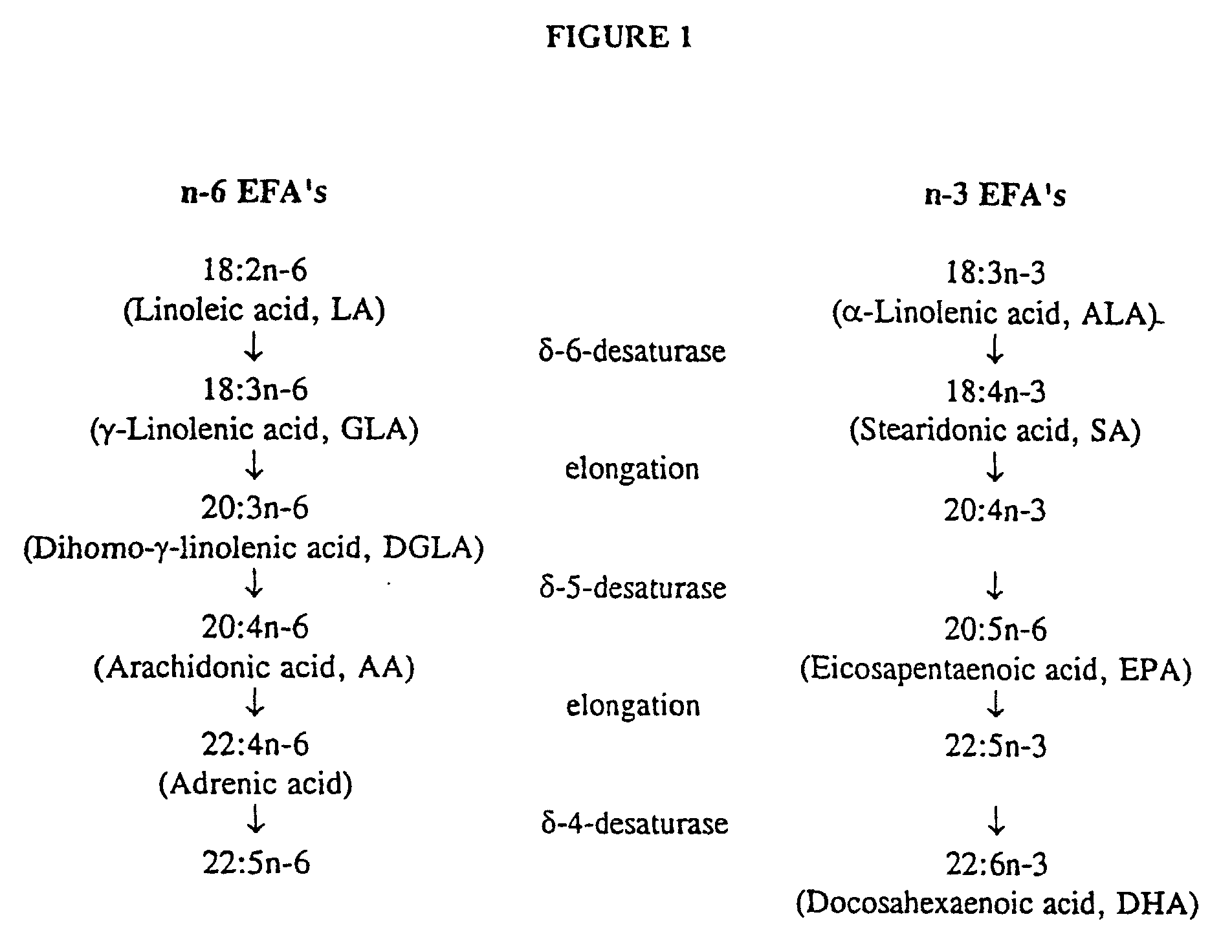
- In their own right GLA and DGLA have been shown to have anti-inflammatory effects, to lower blood pressure, to inhibit platelet aggregation, to lower cholesterol levels, to inhibit cancer cell growth, to reduce dyskinetic movements, to relieve breast pain, to improve calcium absorption and enhance its deposition in bone, to reduce the adverse effects of ionising radiation, to treat various psychiatric disorders, to cause vasodilation, to improve renal function, to treat the complications of diabetes, to dilate blood vessels and so on. Actives linked to GLA and DGLA will therefore not only become more lipophilic, enhancing penetration across all membranes, the skin and the blood brain barrier, but are also likely to exhibit new and additional therapeutic effects.
- Other fatty acids likely to be of especial value in this context are arachidonic acid and docosahexaenoic acid which are major constituents of all cell membranes; adrenic acid; and stearidonic acid and eicosapentaenoic acid which have ranges of desirable properties similar to those of GLA and DGLA. Fatty acids not included in the fatty acids of Figure 1 which are of particular interest are conjugated linoleic acid (cLA) and columbinic acid (CA). cLA has a range of interesting effects in treating and preventing cancer, in promoting growth particularly of protein-containing tissues, in preventing and treating cardiovascular disease and as an antioxidant. CA has many of the properties of essential fatty acids.
- Kinds of actives to be incorporated in compounds as set out herein may be broadly stated:-
- a) Drugs including antibiotics, antiprotozoals, antipsychotics, antidepressants and NSAIDs and compounds used in the treatment of cardiovascular, respiratory, dermatological, psychiatric, neurological, renal, muscular, gastrointestinal, reproductive and other diseases and in cancer.
- b) Hormones
- c) Amino acids
- d) Vitamins particularly of the B group, and other essential nutrients.
- e) Cytokines and peptides
- f) Neurotransmitters and neurotransmitter precursors.
- g) Phospholipid head groups such as inositol, choline, serine and ethanolamine, which may be linked directly or via the phosphate moiety.
- h) Aromatic fatty acids such as phenylacetic acid, phenyl butyric acid and cinnamic acid which are of particular value in cancer treatment.
-
- The combination of the therapeutic effect of a drug with the therapeutic effect of a fatty acid may be considered through examples:-
- a) Psychotropic drugs may be linked to fatty acids such as GLA, DGLA, arachidonic acid, eicosapentaenoic acid or docosahexaenoic acid which have important roles in brain function, so providing a dual therapeutic effect.
- b) Drugs used for the treatment of cardiovascular disease may be attached to a fatty acid which also has value in such treatment, such as eicosapentaenoic acid which lowers triglyceride levels and inhibits platelet aggregation, or GLA or DGLA which lower cholesterol levels and have vasodilator action, or arachidonic acid'which is a potent cholesterol lowering agent, or DHA which has anti-arrhythmic properties.
- c) Drugs used in the treatment of any form of inflammation may be linked to a fatty acid such as gammalinolenic acid, dihomo-gammalinolenic acid or eicosapentaenoic acid or docosahexaenoic acid which also has anti-inflammatory action.
- d) Drugs used in the management of osteoporosis may be linked to GLA or DGLA which enhance the incorporation of calcium into bone, or to EPA or DHA which reduces urinary calcium excretion.
- e) Drugs used in skin disease may be linked to GLA or DGLA which have anti-inflammatory effects on the skin.
- f) Drugs used in cancer may be linked to GLA, DGLA, arachidonic acid, EPA or DHA which have anticancer effects in their own right and which may reverse resistance to anticancer drugs.
-
- The essential fatty acids (EFAs) as already referred to, and well known, consist of a series of twelve compounds. Although linoleic acid, the parent compound of the n-6 series, and alpha-linolenic acid, the parent compound of the n-3 series, are the main dietary EFAs, these substances as such have relatively minor roles in the body. In order to be fully useful to the body, the parent compounds must be metabolised to longer chain and more highly unsaturated compounds. In quantitative terms, as judged by their levels in cell membranes and in other lipid reactions dihomogammalinolenic acid (DGLA) and arachidonic acid (AA) are the main EFA metabolites of the n-6 series while eicosapentaenoic acid (EPA) and docosahexaenoic acid (DHA) are the main metabolites of the n-3 series. DGLA, AA, EPA and DHA are important constituents of most of the lipids in the body. As well as being important in themselves they can also give rise to a wide range of oxygenated derivatives, the eicosanoids, including the prostaglandins, leukotrienes and other compounds. The fatty acids likely to be of particular value in therapy are DGLA, AA, EPA and DHA, together with GLA, the precursor of DGLA, stearidonic acid (SA), the precursor of EPA and DPA (22:5n-3), the precursor of DHA, and adrenic acid.
- Further there are fatty acids such as oleic acid, parinaric acid and columbinic acid that are not EFAs but may have significant effects in the body. One of the most interesting of these is conjugated linoleic acid which as noted earlier has a range of desirable effects.
- It used to be thought that, both in nutrition and in therapy of disease, it was sufficient to supply linoleic and alpha-linolenic acids and the body's own metabolism would do the rest. It is now widely accepted that this is not true. Different diseases may have different abnormal patterns of EFAs and because of problems in metabolism these cannot simply be corrected by giving linoleic or alpha-linolenic acid. It is therefore appropriate in many situations to provide increased amounts of one of the other EFAs or to give two or more of the EFAs simultaneously. While the EFAs can be supplied in various forms and in various mixtures, it is convenient in both nutrition and in medical treatment to be able to supply the fatty acids as particular molecules. Equally in various situations it may be desirable to give the EFA or other fatty acid in association with an amino acid, vitamin, drug or other molecule which in itself has desirable properties.
- To date, proposals for administration of two fatty acids simultaneously have been in terms of particular triglycerides, following the natural occurrence of essential fatty acids in triglyceride form. However, triglycerides, unless symmetrical about the 2-carbon, are chiral and that fact, coupled with acyl migration between the alpha and beta positions makes the synthesis of specific triglycerides a difficult task. Such migration may take place after synthesis creating particular problems in a drug regulatory context. The lack of specificity when two fatty acids are present in the same triglyceride molecule creates many problems in synthesis, pharmacology, formulation and stability. Moreover triglycerides can be slow and difficult to synthesise. When treated under similar conditions propane diol derivatives can be made much more rapidly.
- For purposes of convenient administration of different fatty acids simultaneously or indeed of a single fatty acid in high amounts in well tolerated form, use is thus desirably made of esters of diols.
- Derivatisation generally requires the formation of one or more ester bonds. Such chemistry may be achieved by any reasonable method of ester synthesis and especially:
- (a) by reaction of alcohol with acid chloride, acid anhydride or suitably activated ester with or without the presence of an organic tertiary base, e.g, pyridine, in a suitable inert solvent, e.g. dichloromethane, at a temperature between 0° and 120°C.
- (b) by reaction of alcohol with acid or acid, short or medium chain alkyl ester, in the presence of a suitable acid catalyst, e.g. 4-toluene sulfonic acid, with or without a suitable inert solvent, e.g. toluene, at a temperature between 50° and 180°C such that the water formed in the reaction is removed, e.g. under vacuum.
- (c) by reaction of alcohol with acid in the presence of a condensing agent, e.g. 1,3-dicyclohexylcarbodiimide, with or without the presence of a suitable organic tertiary base, e.g. 4-(N,N-dimethylaminopyridine), in an inert solvent, e.g. dichloromethane, at a temperature between 0° and 50°C.
- (d) by reaction of alcohol with acid or acid, short or medium chain alkyl ester, or acid, activated ester, e.g. vinyl, in the presence of a hydrolase enzyme, e.g. hog liver esterase, with or without a suitable solvent, e.g. hexane, at temperatures between 20° and 80°C under conditions such that the water or alcohol or aldehyde byproduct is removed, e.g. under vacuum.
- (e) by reaction of acid with suitable alcohol derivative, e.g. iodide, with or without the presence of a suitable base, e.g. potassium carbonate, in a suitable inert solvent, e.g. dimethylformamide, at a temperature between 0° and 180°C.
- (f) by reaction of alcohol with acid, short or medium chain alkyl ester, in the presence of a catalytic amount of an alkoxide of type M+OY- where M is an alkali or alkaline earth metal, e.g. sodium, and Y is an alkyl group containing 1-4 carbon atoms which may be branched, unbranched, saturated or unsaturated, with or without the presence of a suitable solvent, e.g. toluene, at temperatures between 50° and 180°C such that the lower alcohol, HOY, is removed from the reaction mixture, e.g. under vacuum.
-
- Derivatisation may require the formation of an amide bond. Such chemistry may be achieved by any reasonable method of amide synthesis and especially:
- (g) by reaction of amine with acid chloride, acid anhydride or suitably activated ester with or without the presence of an organic tertiary base, e.g. pyridine, in a suitable inert solvent, e.g. dichloromethane, at a temperature between 0° and 120°C.
- (h) by reaction of amine with acid in the presence of a condensing agent, e.g. 1,3-dicyclohexylcarbodiimide, with or without the presence of a suitable organic tertiary base, e.g. 4-(N,N-dimethylaminopyridine), in an inert solvent, e.g. dichloromethane, at a temperature between 0° and 50°C.
- (i) by reaction of amine with acid or acid, short or medium chain alkyl ester, or acid, activated ester, e.g. vinyl, in the presence of a hydrolase enzyme, e.g. hog liver esterase, with or without a suitable solvent, e.g. hexane, at temperatures between 20°and 80°C under conditions such that the water or alcohol or aldehyde byproduct is removed, e.g. under vacuum.
-
- Derivatisation may require the formation of phosphate ester bonds. Such chemistry may be achieved by any reasonable method of phosphate ester synthesis and especially:
- (j) by reaction of alcohol (e.g. UFA, 3-hydroxypropyl ester) with a suitably activated phosphate derivative (e.g. POCl3) with a tertiary base (e.g. Et3N) in a suitable solvent (e.g. THF) at a temperature less than 10°C to yield crude phosphorodichloridate. This is followed by reaction of alcohol (e.g. α-tocopherol) with the crude phosphorodichloridate with a tertiary base (e.g. Et3N) in a suitable solvent (e.g. THF) at around ambient temperature to yield crude phosphorochloridate. This may be hydrolysed (e.g. by addition of water and Et3N) to yield phosphodiester. Alternatively, addition of methanol yields a phosphotriester which may be demethylated using a suitable nucleophile (e.g. lithium bromide) in a suitable solvent (e.g. methyl ethyl ketone) to yield the phosphodiester.
- (k) by reaction of phosphomonoester (e.g. phosphate of UFA, 3-hydroxypropyl ester) with alcohol (e.g. choline) in the presence of a condensing agent (e.g. 1,3-dicyclohexylcarbodiimide) in a suitable solvent at a suitable temperature.
- (l) transphosphatidylation reaction of 2-deoxy-2-lysophosphatidylcholine with primary or secondary alcohol catalysed by phospholipase D.
-
- Examples of pairs of actives follow, the resulting compounds listed being, to our knowledge, largely novel. So far as that is so, they represent part of the invention as new chemical entities, as well as being novel in use in treatment or prevention of disease, whether or not currently claimed.
- GLA-OA (OA = Oleic Acid), GLA-GLA, EPA-EPA, GLA-EPA, GLA-DHA, AA-DHA, AA-EPA, GLA-AA, GLA-SA, SA-DHA, AA-SA, DGLA-DGLA, DGLA-GLA, DGLA-SA, DGLA-AA, DGLA-EPA, DGLA-DHA, AA-AA, EPA-SA, EPA-DHA, DHA-DHA, cLA-cLA, cLA-GLA, cLA-DGLA, cLA-AA, cLA-SA, cLA-EPA, cLA-DHA, CA-CA, CA-GLA, CA-DGLA, CA-AA, CA-SA, CA-EPA, CA-DHA.
- GLA-niacin, GLA-retinoic acid, GLA-retinol, GLA-pyridoxal, Di-GLA-pyridoxine, di-EPA-pyridoxal and in general any of e.g. GLA, DGLA, AA, SA, EPA or DHA with any vitamin including ascorbic acid, Vitamin D and its derivatives and analogues, Vitamin E and its derivatives and analogues, Vitamin K and its derivatives and analogues, Vitamin B1 (thiamin), Vitamin B2 (riboflavin), folic acid and related pterins, Vitamin B12, biotin and pantothenic acid.
- GLA-tryptophan, GLA-proline, GLA-arginine, GLA- or DHA-phenylalanine GLA-GABA, GLA-aminolevulinic acid and in general any of e.g. GLA, DGLA, AA, SA, EPA or DHA with any natural amino acid or related compound such as taurine and camitine.
- GLA-phenylbutyric acid, GLA-phenylacetic acid, GLA-trans-cinnamic acid and in general any of e.g. GLA, DGLA, AA, SA, EPA or DHA with any aryl alkanoic or aryl alkenoic acid.
- GLA-hydrocortisone, GLA-oestradiol, GLA- and DHA-dehydroepiandrosterone and in general any of e.g. GLA, DGLA, AA, SA, EPA or DHA with any natural or synthetic steroid, such as any oestrogen, any progestin, any adrenal steroid and any anti-inflammatory steroid, particularly betamethasone, prednisone, prednisolone, triamcinolone, budesonide, clobetasol, beclomethasone and other related steroids.
- GLA-lipoic acid, DHA-lipoic acid, GLA-tocopherol, di-GLA-3,3'-thiodipropionic acid and in general any of e.g. GLA, DGLA, AA, SA, EPA or DHA with any natural or synthetic anti-oxidant with which they can be chemically linked. These include phenolic anti-oxidants (e.g. eugenol, camosic acid, caffeic acid, BHT, gallic acid, tocopherols, tocotrienols and flavonoid anti-oxidants (e.g. myricetin, fisetin)), polyenes (e.g. retinoic acid), unsaturated sterols (e.g. Δ5-avenosterol), organosulfur compunds (e.g. allicin), terpenes (e.g. geraniol, abietic acid) and amino acid antioxidants (e.g. cysteine, carnosine).
- GLA and indomethacin, ibuprofen, fluoxetine, ampicillin, penicillin V, sulindac, salicylic acid, metronidazole, fluphenazine, dapsone, tranylcypromine, acetyl carnitine, haloperidol, mepacrine, chloroquine, penicillin, tetracycyline, pravastatin, bisphosphonates such as efidronic acid, pamidronic acid and clordronic acid and their sodium salts, adenosylosuccinate and adenylosuccinate and related compounds and agents used as x-ray contrast media, and in general any of e.g. GLA, DGLA, AA, SA, EPA or DHA with any drug, particularly any drug used in the treatment of infections, inflammatory diseases, including various forms of arthritis, cancer, cardiovascular, respiratory, dermatological, psychiatric, neurological, muscular, renal, gastrointestinal, reproductive and other diseases.
- Aspects of the invention are set out in the claims herein, the main claim referring to compounds, when for use in therapy wherein a 1,3 propane diol residue forms a link between residues R1 and R2 where R1 is an acyl or fatty alcohol group derived from a C12-30 preferably C16-30 fatty acid desirably with two or more cis or trans double bonds, and R2 is hydrogen, or an acyl or fatty alcohol group as R1 the same or different, or any other nutrient, drug or other bioactive residue.
- The compounds will generally be acid-function bearing actives esterified directly to the diol residue but for example with a fatty alcohol or other hydroxy-function bearing active, a phosphate, succinate or other difunctional acid group may be interposed between the R1 and/or R2 group and the 1,3-propane diol residue, particularly when R2 is a nutrient, drug or other bioactive with a hydroxy or amino function.
- The invention is also discussed broadly below, concerning a wide range of actives releasable in the body.
- As a compound the diol used as a link is, broadly, disclosed in the literature among many other diols but we have seen that its use in therapy in the form of an essential fatty acid diester or as a compound with an essential fatty acid at one position and a bioactive (not being an essential fatty acid) at the other, is both undisclosed and particularly significant. Indeed it offers a favourable way to give a single fatty acid as the monester or diester if a completely defined compound is required, as there is no chiral centre such as is present in glycerol 1(3)-monoesters and in diglycerides (α,β and 1,3 where the fatty acid at position 1 is different from that at position 3), nor do positional isomers exist. Further, apart from administering individual acids, such mono and diesters may have value in pharmaceutical formulation as emulsifiers. The 1,3-propane diol structure is close to the glycerol of natural triglycerides and an effective and safe delivery system. Moreover it allows ready and unequivocal synthesis of defined compounds without the problems of acyl migration shown in triglycerides and without complications by optical isomers. We have for example shown that intravenous infusion and oral administration of a 1,3 propane diol GLA/EPA diester emulsion leads to rapid in vivo release of free GLA and EPA and to further metabolism of the GLA to AA and of the EPA to DHA. Similarly, GLA-GLA and EPA-EPA diesters, and niacin-GLA and indomethacin-GLA diesters have been shown to be absorbed following oral administration and to release their active moieties.
- Furthermore, as far as we are aware, all of the 1,3-propane diol derived compounds in which actives are linked are novel compounds which have never before been described. The specific diols of two fatty acids listed, and the diols where a fatty acid drawn from the list of GLA, DGLA, AA, SA, EPA, DHA, cLA and CA is present at one position and at the other position is a vitamin, amino acid, aromatic acid, steroid, anti-oxidant or other therapeutic drug, are new substances.
- The fatty acid diesters have a wide variety of possible uses. They may be used as pharmaceuticals for the treatment or prevention of diseases in which abnormalities of fatty acids have been identified. They may be added to foods or added to or used as nutritional supplements for those who require the particular fatty acid for the treatment or prevention of diseases. They may also be used in foods or pharmaceuticals for veterinary use. They may further be used for skin care.
- As advantages or in various particular aspects the invention provides:
- (i) A convenient and safe way of administering, for therapeutic or nutritional purposes, one or two unsaturated fatty acid moieties, or one unsaturated fatty acid and one bioactive that is not a fatty acid.
- (ii) A derivative, of a bioactive required to cross lipid membranes in the body to exert its action whether in entry to a cell or in passing the skin, blood-brain or other barrier, through a 1,3-propane diol linkage to an essential fatty acid of the natural n-6 or n-3 series and especially GLA or DGLA, AA, SA, EPA or DHA or the related fatty acids cLA or CA.
- (iii) A fatty acid derivative of a drug such that the drug and fatty acid are mutually efficacious.
- (iv) A method of improving the transport of a drug across lipid membranes in the body, characterised by the administration of the drug in a form as above.
- (v) A method of manufacture of a medicament for improved therapy involving transport of a drug across lipid membranes in the body, characterised by incorporating the drug in a medicament in a form as above.
- (vi) A method of manufacture of a medicament for delivering one or two fatty acids from the list in (ii) above or for delivering one of those fatty acids in association with another active agent.
-
- Examples of specific compounds have been given earlier herein; synthesis examples come later.
- Particular uses of particular groups of compounds are indicated elsewhere herein but the usefulness, generally, of the 1,3-propane diol diesters may be illustrated by the following:
- 1. Improved tolerability of fatty acids. Apart from the triglycerides, most forms in which fatty acids can be administered including free acids, salts, ethyl esters and other glycerides cause some degree of gastrointestinal intolerance as shown by nausea, vomiting and diarrhoea. The propane diol diesters in animal studies in rats and mice have been found to be extremely well tolerated. For example, the GLA-GLA and GLA-EPA diesters have been given to rats and mice at doses of up to 10 g/kg without any evidence of diarrhoea. This shows that the diesters are a very acceptable way of delivering biologically active fatty acids.
- 2. Reduced toxicity of drugs. The non-steroidal anti-inflammatory drugs such as aspirin and indomethacin are notorious for causing severe gastrointestinal toxicity with ulceration of the stomach and intestines and bleeding into the gastrointestinal tract. Doses of indomethacin known to cause gastrointestinal ulceration (5-30 mg/kg) were given to fasted rats either in the form of free indomethacin or the same amount of indomethacin in a 1,3-propane diol diester with GLA in the other position. The animals were sacrificed after 24 hours and the whole gastrointestinal tract examined for ulceration. Whereas extensive ulceration was found in the animals treated with indomethacin alone, little or no ulceration was found in the animals treated with GLA-indomethacin.
- 3. Efficient delivery of a biologically active form of a fatty acid. GLA was administered in the form of either GLA-GLA or GLA-EPA and EPA was administered in the form of GLA-EPA or EPA-EPA. The diesters were given either orally by gavage or intravenously in the form of a 20% emulsion made using 2% of oat galactolipid as an emulsifier in doses from about 0.1 to 2.0 g/kg. Animals were killed after 1, 2, 4, 8 and 24 hours and plasma, red cells and liver collected. The presence of the unmetabolised diesters was identified by high pressure liquid chromatography. The presence of fatty acids derived from the diesters and of metabolites of those fatty acids was checked by lipid extraction of the liver, plasma or red cells, by separation of that lipid fraction into triglycerides, phospholipids, cholesterol esters and free fatty acids by thin layer chromatography, by methylation of the fatty acids derived from those separated fractions and by analysis of those fatty acids using gas chromatography using methods well described in standard texts. These experiments showed that after oral administration around 10% of the diester administered could be identified in the diester form. Most of the GLA or EPA was found in the free fatty acid or phospholipid and to a lesser extent in the cholesterol ester and triglyceride fractions. Moreover, particularly in the phospholipid fractions the metabolites of GLA, DGLA and arachidonic acid, and the metabolites of EPA, docosapentaenoic acid and DHA, could be found in increased amounts. These observations indicate that the fatty acids are readily released from the diester form and are then further metabolised into biologically active substances. Similar results were obtained from intravenous administration of the diester except that at one hour around 40% of the diester remained in the original form and the free fatty acids were released, metabolised and incorporated into other lipid fractions over the following 24 hours. It is possible that the unchanged diester forms may have biological activity themselves. Linoleic acid in a 1,3-diglyceride form has been found to have anticancer effects which were selective against cancer but not normal cells and which were not shared by other forms of linoleic acid (A. Matsuzaki et al, Cancer Res. 1989; 49: 5702-7). It is possible that this and perhaps other actions require the delivery of two molecules of the fatty acid spaced as in a 1,3-diglyceride. Similar spacing will be achieved by a 1,3-propane diol and there may therefore be a particular value in the intravenous administration of some of the propane diol derivatives which will ensure that the diol form circulates for some time before its complete metabolism.
-
- The fatty acids have a large number of desirable biological and therapeutic activities which have been detailed in numerous publications by the inventors and by others. Four of the fatty acids, GLA, DGLA, SA and EPA share a rather broad spectrum of effects which include:
- 1. Cardiovascular actions including vasodilatation, lowering of blood pressure, inhibition of platelet aggregation, lowering of triglyceride and LDL-cholesterol levels, elevation of HDL-cholesterol levels and inhibition of smooth muscle proliferation.
- 2. Anti-inflammatory actions including reduction of formation of pro-inflammatory mediators such as cytokines, and of eicosanoids derived from arachidonic acid, reduction of neutrophil migration and the neutrophil respiratory burst, reduction of local inflammatory responses, inhibition of inflammation in various animal models such as uric acid induced inflammation and adjuvant arthritis, and treatment of various inflammatory disorders such as osteoarthritis and rheumatoid arthritis.
- 3. Immunomodulatory functions including the damping down of excessive immune and allergic responses in animal models such as experimental allergic encephalomyelitis and uveitis, bronchial and cutaneous hyper-reactivity in sensitised animals, leading to the concept that they are of value in human diseases where excessive immune responses play a role.
- 4. Respiratory actions including bronchodilatation and inhibition of bronchoconstrictor actions.
- 5. Improvements in calcium balance with increased calcium absorption, reduced calcium excretion, increased deposition of calcium in bones and reduced ectopic deposition of calcium in tissues such as arteries and kidneys.
- 6. Anticancer effects of three sorts, selective cytotoxic damage and induction of apoptosis in cancer cells but not in normal cells, inhibition of growth by reduction of action of growth factors and interference with second messenger systems required for growth, inhibition of metastasis by various actions including increased expression of E-cadherins and inhibition of proteolytic enzymes such as urokinases, lipoxygenase and matrix metalloproteinases, and inhibition of cancer-associated cachexia.
- 7. Actions on nerve cells including maintenance of normal nerve membrane structure and function and the normal pre- and post-synaptic actions of neurotransmitters.
-
- These desirable actions mean that this group of fatty acids can be used in the treatment of may different disorders including cardiovascular disorders of many types, inflammatory disorders including rheumatoid arthritis, osteoarthritis, ulcerative colitis and Crohn's disease, respiratory disorders including asthma, psychiatric disorders including schizophrenia, alcoholism, attention deficit disorder, depression and Alzheimer's disease, neurological disorders including multiple sclerosis and Huntington's chorea, renal and urinary tract disorders including various types of renal inflammatory disease and urinary calcium stones, metabolic disorders including osteoporosis and ectopic calcification, and gastrointestinal ulcerative and inflammatory diseases. Although conjugated linoleic acid (cLA) has not been nearly as widely tested as, say GLA or EPA, it also seems to have a wide range of actions including effects valuable in the treatment of cancer, cardiovascular and metabolic diseases.
- GLA, DGLA, AA and columbinic acid have desirable actions on the skin and are particularly valuable in the treatment of skin diseases such as atopic eczema, psoriasis, urticaria and allergic reactions.
- AA is often regarded as a potentially harmful fatty acid. However, it is an essential constituent of all normal cell membranes and has been found to be present in low levels in various illnesses including atopic eczema, schizophrenia (Horrobin et at, Schizophrenia Res. 1994; 13: 195-207) and cardiovascular disorders (Horrobin, Prostaglandins Leukotr. EFAs 1995; 53: 385-96). AA is likely to be of particular value in these situations and also in other psychiatric disorders such as alcoholism and attention deficit disorder where levels are also often low.
- DHA shares some of the above actions of the EFAs but is found in particularly important amounts in cell membranes and especially in the membranes of the heart, the retina and the brain. DHA also has potent anti-inflammatory and desirable cardiovascular effects. DHA is likely to be of particular value in cardiovascular disorders, in retinal and visual disorders including retinitis pigmentosa, senile macular degeneration and dyslexia, and in psychiatric and neurological disorders including schizophrenia, attention deficit disorder, depression, alcoholism, Alzheimer's disease and other forms of dementia and multiple sclerosis.
- Infections have also recently been identified as likely to respond to fatty acids, especially to GLA and DGLA, EPA and DHA. Many bacteria are killed by these fatty acids, including strains which are highly resistant to antibiotics. Recent work from a number of laboratories has also shown that these highly unsaturated fatty acids are important in successful responses to diseases like malaria and to protozoal diseases.
- It is thus apparent that various specific fatty acids are likely to be able to add to the efficacy of drugs and other bioactive substances of almost any class, in both the treatment and prevention of disease, in skin care and in nutrition, as well as having valuable therapeutic effects when given in the diol form as a single fatty acid or as two different fatty acids in the same molecule. Of particular value in therapy is that under most circumstances the fatty acids are remarkably non-toxic and can be administered safely in large doses without the risk of important side effects.
- As a specific example of the therapeutic efficacy of the diesters, the 1,3 GLA-EPA propane diol diester was tested in the treatment of the ASPC-1 human pancreatic cancer transplanted subcutaneously into nude mice which because they lack thymus function are able to accept foreign transplants without rejection, 15 mice were each injected subcutaneously with 5 million ASPC-1 cells suspended in Matrigel and DMEM buffer. In all animals a tumour developed whose size could be measured using callipers and whose volume could be estimated from the linear dimensions. Tumour size in each animal was measured twice weekly for five weeks. The animals were divided into three groups. 5 animals were used as controls and received 10 g/kg corn oil per day only. 5 animals received 10 g/kg corn oil per day but in addition received two injections per week of a dose of 1.5 g/kg of the GLA-EPA diester. The diester was administered in the form of a 20% emulsion in which 2% of oat galactolipid was used as the emulsifier; the intravenous emulsion was very well tolerated and caused no haemolysis or thrombophlebitis or any other form of distress to the animals. The other 5 animals instead of the corn oil received 10 g/kg/day of the GLA-EPA diester. The treatments were continued for three weeks and then the tumours were allowed to grow for a further two weeks before the animals were sacrificed and the tumours excised and weighed. The mean tumour weights were: control group, 1240 ± 290 mg; intravenous GLA-EPA group, 820 ± 180 mg; oral GLA-EPA group, 490 ± 160 mg. Tumour growth was thus substantially inhibited by both oral and intravenous administration of the GLA-EPA diester without causing any side effects or distress in the animals. This demonstrates that the GLA-EPA diester can be effectively used in the treatment of cancer as would be predicted by the effects of GLA and EPA given separately in being able selectively to kill human cancer cells in culture in the laboratory. Thus the diesters are biologically active ways of administering the various fatty acids. The diesters can therefore be reasonably expected to exert the many desirable effects of the fatty acids which have been noted in many publications in the literature (e.g. Horrobin DF, ed., Omega-6 Essential Fatty Acids: Pathophysiology and Roles in Clinical Medicine: Wiley-Liss, New York, 1990. Simopoulos AP et al, eds, Health Effects of Omega-3 Polyunsaturated Fatty Acids in Seafoods, Karger, Basel, 1991. Fats and Oils in Human Nutrition, World Health Organization, Rome, 1994. Unsaturated Fatty Acids: Nutritional and Physiological Significance. British Nutrition Foundation, Chapman and Hall, London, 1992).
-
- 1. 1,3-propane diol as derivatives containing: two fatty acids in which one fatty
acid is GLA or DGLA and the other is GLA, DGLA, SA, EPA, DHA, cLA (conjugated
linoleic acid) or CA (columbinic acid) for the treatment of:-
- (a) complications of diabetes, particularly neuropathy and retinopathy; and improvement of responses to insulin in diabetes and pre-diabetes;
- (b) cancers;
- (c) osteoarthritis;
- (d) rheumatoid arthritis;
- (e) other inflammatory and auto-immune diseases including Sjogren's syndrome, systemic lupus, ulcerative colitis, Crohn's disease and uveitis;
- (f) respiratory diseases including asthma;
- (g) neurological disorders including multiple sclerosis, Parkinson's disease and Huntington's chorea;
- (h) renal and urinary tract disorders;
- (i) cardiovascular disorders;
- (j) degenerative diseases of the eye including retinitis pigmentosa and senile macular degeneration;
- (k) psychiatric disorders including schizophrenia, Alzheimer's disease, attention deficit disorder, alcoholism and depression;
- (l) prostatic hypertrophy and prostatitis;
- (m) impotence and male infertility;
- (n) mastalgia;
- (o) male pattern baldness;
- (p) osteoporosis;
- (q) dermatological disorders, including atopic eczema, hand eczema, psoriasis, urticaria and allergic disorders;
- (r) dyslexia and other learning disabilities;
- (s) cancer cachexia.
- 2. 1,3-propane diol as derivatives containing two fatty acids in which one fatty acid is AA and the other is AA, GLA, DHA, DGLA or EPA for treatment of the disorders as at (1) above and especially (a), (g), (i), (j), (k), (q) and (r).
- 3. 1,3-propane diol as derivatives containing two fatty acids in which one fatty acid is EPA and the other is EPA or DHA for the treatment of any of the disorders as at (1) above but especially (b), (c), (d), (e), (f), (g), (h), (i), (j), (k), (p), (r) and (s).
- 4. 1,3-propane diol as derivatives in which one position is occupied by a fatty
acid drawn from GLA, DGLA, AA, SA, cLA, EPA or DHA and the other position is
occupied by an agent, selected from the following list, whose chemical structure is such
that it can be linked to the 1,3-propane diol by one of the linkages described herein:
- (a) tryptophan for the treatment of any disease but particularly for psychiatric, neurological, behavioural, pain and other disorders and especially depression, sleep and migraine;
- (b) phenylalanine for the treatment of any disease, but especially depression, multiple sclerosis and chronic fatigue syndrome;
- (c) arginine for the treatment of any disease but particularly diseases in which the production of nitric oxide is defective;
- (d) carnitine or carnitine derivatives for the treatment of any disease but especially muscle weakness, cardiac failure, chronic fatigue syndrome, Alzheimer's disease, and peripheral neuropathies;
- (e) any other amino acid or related substance for the treatment of any disease or aminolevulinic acid or derivative thereof for the treatment of any disease but especially cancers;
- (f) adenylosuccinate or related substances for the treatment of any disease but especially muscular dystrophy, cardiac failure, chronic fatigue and Alzheimer's disease and other dementias;
- (g) aspirin, salicylic acid, indomethacin, ibuprofen, or any other non-steroidal anti-inflammatory drug for the treatment of any disease but especially of inflammatory disorders of pain, of Alzheimer's disease and other dementias and of any disease in which platelet aggregation should be inhibited;
- (h) any antibiotic for the treatment of any appropriate infectious disease but especially tetracycline, clindamycin, minocycline, chlortetracycline and erythromycin for the treatment of acne;
- (i) any anti malarial or anti-protozoal drug for the treatment of any disease, but especially chloroquine, mepacrine, quinacrine and mefloquine for the treatment of malaria, protozoal disorders, inflammatory disorders and schizophrenia;
- (j) any antifungal drug for the treatment of any disease but especially metronidazole and antifungal imidazoles and nitroimidazoles and amphotericin for the treatment of fungal infections of various types;
- (k) any anti-inflammatory steroid for the treatment of any disease but especially hydrocortisone and betamethasone for the treatment of skin disorders and beclomethasone and budesonide for the treatment of asthma.
- (l) any gonadal steroid for the treatment of any disease but especially oestrogens and progestogens for the treatment of ovarian deficiency and osteoporosis and androgens for the treatment of testicular deficiency;
- (m) any adrenal steroid for the treatment of any disease, but especially dehydroepiandrosterone for the treatment of disorders associated with ageing;
- (n) any retinoid for the treatment of any disease but especially tretinoin and isotretinoin for the treatment of dermatological disorders and for use in skin care;
- (o) any anticancer agent for the treatment of cancer;
- (p) any antipsychotic agent for the treatment of schizophrenia and other psychoses;
- (q) any antidepressive agent for the treatment of any disease but especially for the treatment of depression;
- (r) any anti-anxiety agent for the treatment of any disease, but especially for the treatment of anxiety and panic attacks;
- (s) any immunosuppressive agent for the treatment of any disease but especially cyclosporine and tacrolimus for the control of immunity after organ transplantation and for the treatment of autoimmune and inflammatory disorders including psoriasis, eczema, asthma, rheumatoid arthritis and inflammatory bowel disease;
- (t) any proton pump inhibitor or H2 antagonist for the treatment of any disease but especially diseases associated with excess gastric acid production or reduced defences against gastric acidity;
- (u) any diuretic for any disease, but especially for diseases associated with fluid retention and hypertension;
- (v) any calcium antagonist used for any disease but especially for cardiovascular diseases;
- (w) any angiotensin converting enzyme inhibitor or angiotensin antagonist used for any disease but especially for cardiovascular diseases;
- (x) any beta-blocker used for any disease but especially for cardiovascular disorders;
- (y) any antiepileptic drug used for any disease, but especially phenytoin, carbamazepine, valproate, ethosuximide, vigabatrin or lamotrigine for the treatment of epilepsy;
- (z) any hypolipidaemic agent for the treatment of any disease but especially fibrates and statins used for cholesterol lowering and cholesterol modification;
- (aa) any oral hypoglycaemic or insulin-sensitising agents used in the management of diabetes;
- (bb)any bisphosphonates used in the management of osteoporosis, Paget's disease or cancer;
- (cc) any contrast agents used in radiology including diatrizoate compounds, iodipamide, ioglycamates, iopanoates, iophendylate, iothalamate, ioxaglate, metrizamide and related compounds;
- (dd) any peptide or protein for use in the treatment of diseases for which the peptide or protein itself is used, including insulin, calcitonin, erythropoietin and other peptides;
- (ee) any vitamin used in the treatment of any disease, or used in foods, nutritional supplements or food additives as a way of providing the vitamin effectively;
- (ff) any antioxidant used in the management of any disease, but especially for those diseases in which antioxidants may be especially beneficial including cardiovascular diseases, cancer and inflammatory disorders and any antioxidant used as a food or other preservative or as a component of a food, food additive or nutritional supplement,
- (gg) any porphyrin chlorin or bacteriochlorin-based drug especially tetrakis (hydroxy phenyl) derivatives thereof used in photodynamic therapy of cancers.
-
- The following considers the advantages of use of 1,3-propane diol compared in particular to triglycerides.
- Specifically, it is proposed that 1,3-propane diol be used in place of glycerol in the esterification of fatty acids, especially where only one type of fatty acid (e.g. gamma-linolenic acid) is to be attached to the three-carbon chain "backbone". Although diesters and triglycerides are chemically very similar, the manufacture of di-esters can be carried out under very mild conditions, and in a matter of hours. To manufacture triglycerides, either harsh conditions are required, or fatty acid chlorides must be used, or biocatalysts (which require reaction times of several days) are necessary.
- A summary of triglyceride synthesis methods is: chemical reaction with metals, metal-chlorides, or organic acids as catalyst; use of fatty-acid chlorides; use of immobilised enzymes.
- All processes using acids, metals, or metal chlorides as catalysts are very similar and share a common list of advantages and disadvantages. Many of the problems are inherent to the methods, i.e. acidic conditions and high temperatures (140°C to 180°C). The p-TSA method probably exhibits the least problems, as this is carried out under the mildest conditions (140°C). Reaction of glycerol with fatty acid chlorides is done under "cold" conditions, but toxic gases are evolved and the reaction can go out of control if not monitored carefully. This method also suffers from the fact that the fatty acid chlorides themselves must first be manufactured; this additional step reduces the overall efficiency of the process. A particular family of enzymes, the lipases, can be used to catalyse the esterification reaction under very mild conditions (e.g. at 60°C), and are probably the catalysts of choice when polyunsaturated fatty acids are being used. However, most enzymes interact most effectively with the 1- and 3- positions of glycerol. Addition of fatty acid to the 2- position is slow, and often dependant upon "acyl migration", i.e. a fatty acid must first be attached to the 1- or 3- position, and then migrate to the 2- position, where it remains attached. Thus, triglyceride synthesis reactions which are catalysed by enzymes can take days to approach completion.
- In theory, the same methods can be applied to the esterification of 1,3-propanediol as can be applied to glycerol. However, when it is considered that enzymes catalyse preferentially the addition of fatty acids to the 1- and 3- positions of glycerol, it is clear they should be particularly effective when used to make diesters. This is indeed the case, with reactions being completed in a matter of hours and at temperatures which are even lower (e.g. 45°C to 60"C) than those required for triglyceride synthesis. After four hours free fatty acid can be absent, and after eight hours the yield of diester can be in excess of 95%, the balance being monoester.
- A further complexity with specific triglyceride syntheses is the presence within glycerol of both primary and secondary hydroxyl groups and a prochiral centre at the central carbon atom. These problems may be solved by the use of carefully selected protecting groups and by chiral synthesis. However, this results in multistep syntheses with decreasing yield and increasing impurity levels at each step. In contrast, however, 1,3-propane diol possesses only primary hydroxyl groups and no prochiral centres. The synthesis is consequently reduced to two steps maximum with improved overall yield and decreased impurity levels.
- In summary, the reaction which prepares diesters from polyunsaturated fatty acids and 1,3-propane diol is faster, and can be carried out under much milder conditions, than can the corresponding triglyceride synthesis. This leads to a more economical and less wasteful production process and minimises the risk of reactants or products becoming altered or degraded during processing.
- The compounds may be formulated in any way appropriate and which is known to those skilled in the art of preparing pharmaceuticals, skin care products or foods. They may be administered orally, enterally, topically, parenterally (subcutaneously, intramuscularly, intravenously), rectally, vaginally or by any other appropriate route.
- Like triglycerides, the 1,3-propane diol diesters, especially those containing two fatty acids, may be readily emulsified using phospholipid or particularly galactolipid emulsifiers. Such emulsions are particularly useful for administration via oral, enteral and intravenous routes.
- For example, fatty acid (UFA) diesters occur as free flowing oils and therefore can be formulated as follows:-
- Oral emulsions were prepared by high-pressure homogenisation. The particle size distributions and the zeta potential of the resulting emulsions were determined by dynamic light scattering at room temperature. The particle size measurements were carried out at room temperature (Zetasizer 4 Malvern Instruments Limited).
- An oil-in-water emulsion (batch size 200g) was prepared containing the following ingredients:
Ingredients % Emulsifier (Galactolipid) 2.00 Diester (GLA-EPA) 20.00 Ascorbyl Palmitate (AP) 0.02 Vitamin E 0.5 Water 100.00 - The emulsifier-galactolipid was dispersed in the diester and Vitamin E, AP and water were mixed. The oil phase was added to the aqueous phase under a high shear mix (Ultraturrax) at speed 4, for a few minutes. This pre-emulsion was then homogenised at 80 MPA and at 50°C for 6 cycles (mini-Lab 8.30 H; APV Rannie AS, Denmark). The emulsion formed has an average droplet size of 230 nm.
- Anti-microbial preservatives - potassium sorbate, and flavour, can also be added to the above oral emulsion.
- In a similar manner, 200g of an oil-in-water emulsion was prepared containing the following ingredients:
Ingredients % Emulsifier 2.0 Diester (GLA-EPA) 20.0 Glycerol 2.0 Water add to 100.00 - The above emulsion, homogenised for 6 minutes in a high pressure homogeniser had an average droplet size of 211 nm, a zeta potential of -40mV. These I.V. emulsions can be either filtered through a membrane with a pore size of 0.22 microns or can be autoclaved with change in droplet size.
- The doses of the actives to be administered largely range from 1mg to 200g per day, preferably 10 mg to 10 g and very preferably 10mg to 3g, according to their kind. In the treatment of cancer preferable doses may be in the 2-150g/day range. They may be administered topically where appropriate in preparations where the actives form from 0.001% to 50% of the topical preparation, preferably 0.05% to 20% and very preferably 0.1% to 10%.
- Illustrative syntheses of the linking of fatty acids or fatty acids, and other materials, directly or indirectly, through 1,3-propane diol residues follow, with other generally illustrative material.
- A solution of 1,3-dicyclohexylcarbodiimide (1.07g) and 4-(N,N-dimethylamino)pyridine (0.59g) in methylene chloride (5ml) was added to a solution of 1,3-dihydroxypropane (0. 152ml) and z,z,z-octadeca-6,9,12-trienoic acid (95%, 1.36g) in methylene chloride (15ml). The reaction was stirred at room temperature under nitrogen until it was complete as determined by tlc. Hexane (80ml) was added to the reaction. The precipitate was removed by filtration and washed thoroughly with hexane. The combined filtrates were concentrated and purified by flash chromatography to yield-1,3-(di-z,z,z-octadeca-6,9,12-trienoyloxy)propane as a pale yellow free flowing oil.
- A solution of z,z,z-octadeca-6,9,12-trienoic acid (150g) in methylene chloride (500ml) was added dropwise to a mixture of 1,3-dihydroxypropane (205g), 1,3-dicyclohexylcarbodiimide (130g) and 4-(N,N-dimethylamino)pyridine (87g) in methylene chloride (2500ml) at room temperature under nitrogen. When tlc indicated that the reaction had gone to completion the reaction mixture was filtered. The filtrate was washed with dilute hydrochloric acid, water and saturated sodium chloride solution. The solution was dried, concentrated and purified by dry column chromatography to yield 1-(z,z,z-octadeca-6,9,12-trienoyloxy)-3-hydroxypropane as a pale yellow oil.
- A solution of 1,3-dicyclohexylcarbodiimide (23.7g) and 4-(N,N-dimethylamino)pyridine (15.9g) in methylene chloride (200ml) was added to a solution of 1-(z,z,z-octadeca-6,9,12-trienoyloxy)-3-hydroxypropane (33 .6g) and z-octadeca-9-enoic acid (30g) in methylene chloride (400ml) under nitrogen at room temperature. On completion of reaction as evidenced by tlc analysis the solution was diluted with hexane, filtered, concentrated and purified by dry column chromatography to yield 1-(z,z,z-octadeca-6,9,12-trienoyloxy)-3-(z-octadeca-9-enoyloxy)propane as a free flowing pale yellow oil.
- Prepared as in Example 2, Part 2 but replacing z-octadeca-9-enoic acid with z,z,z,z,z-eicosa-5,8,11,14,17-pentaenoic acid. Chromatography yielded 1-(z,z,z-octadeca-6,9,12-trienoyloxy)-3-(z,z,z,z,z-eicosa-5,8,11,14,17-pentaenoyloxy)propane as a pale yellow oil.
- Prepared as in Example 2, Part 2 but replacing z-octadeca-9-enoic acid with z,z,z-octadeca-6,9,12-trienoicacid. Chromatography yielded 1,3-(di-z,z,z-octadeca-6,9,12-trienoyloxy)propane as a pale yellow oil.
- A mixture of 1,3-dicyclohexylcarbodiimide (720mg, 3.45mmol) and 4-(N,N-dimethylamino)pyridine (480mg, 3.98mmol) in tert-butyl methyl ether (15ml) was added to a mixture of lipoic acid (645mg, 3.12mmol) and 1-(z,z,z-octadeca-6,9,12-trienoyloxy)-3-hydroxypropane (1g, 3mmol) in tert-butyl methyl ether (30ml). The mixture was stirred at room temperature under nitrogen for 5h, the progress of reaction being monitored by tlc (40% ethyl acetate/hexane). On completion the mixture was filtered, concentrated and purified by flash chromatography (hexane, 2% ethyl acetate/hexane, 5% ethyl acetate/hexane and finally 10% ethyl acetate/hexane) to yield (±)-1-(1,2-dithiolane-3-pentanoyloxy)-3-(z,z,z-octadeca-6,9,12-trienoyloxy) propane as a viscous yellow oil.
- A solution of 1,3-dicyclohexylcarbodiimide (720mg, 3.45mmol) in tert butyl methyl ether (30ml) was added to a mixture of sulindac (1.12g, 3.15mmol), 4-(N,N-dimethylamino)pyridine (480mg, 3 .9mmol) and 1-(z,z,z-octadeca-6,9,12-trienoyloxy)-3-hydroxypropane (1g, 3mmol) in tert-butyl methyl ether (15ml). The mixture was stirred at room temperature under nitrogen for 5h, the progress of reaction being monitored by tlc (40% ethyl acetate/hexane). On completion the mixture was filtered, concentrated and purified by flash chromatography (40% ethyl acetate/hexane, then 50% ethyl acetate/hexane and finally 60% ethyl acetate/hexane) to yield 1-([Z]-5-fluoro-2-methyl-1-[4-{methylsulfinyl}benzylidene]indene-3-acetyloxy)-3-(z,z,z-octadeca-6,9,12-trienoyloxy)propane as a waxy yellow solid.
- Freshly distilled thionyl chloride (1.5ml) was slowly added to (R)-acetyl carnitine (1g) in a pear shaped flask. Care was taken to contain the reagents at the bottom of the flask until a clear solution resulted. After 4 hours at room temperature excess thionyl chloride was removed under reduced pressure (keeping the flask temperature less than 30°C). This yielded the acid chloride as a highly hygroscopic white solid which was used immediately without further purification. To the flask were added 1-(z,z,z-octadeca-6,9,12-trienoyloxy)-3-hydroxypropane (1.4g, 4.17mmol) and dry THF (4ml). The mixture was allowed to stand overnight at room temperature. Tlc analysis (40% ethyl acetate/hexane) indicated that the reaction had gone to completion. The reaction mixture was added dropwise to hexane (250ml) with vigorous stirring. A fine off white precipitate formed which was collected by centrifugation. On removal of the supernatant the solid was resuspended in hexane and centrifuged. The hexane washing procedure was carried out once more to yield 1-([R]-3-acetoxy-4-[trimethylammonio]butyroyloxy)-3-(z,z,z-octadeca-6,9,12-trienoyloxy)propane.
- A mixture of penicillin V (1g, 2.9mmol), 1-(z,z,z-octadeca-6,9,12-trienoyloxy)-3-hydroxypropane (860mg, 2 .6mmol), 1 ,3-dicyclohexylcarbodiimide (620mg, 3mmol) and 4-(N,N-dimethylamino)pyridine (catalytic amount) in dichloromethane (30ml) was stirred overnight at room temperature. The reaction mixture was diluted with hexane (50ml), filtered and concentrated to dryness. The residue was washed with hexane (3x50ml) to remove unreacted 1-(z,z,z-octadeca-6,9,12-trienoyloxy)-3-hydroxypropane. The semisolid residue was disolved in diethyl ether (150ml), washed with water (100ml) and dried. The ether solution was diluted with hexane (125ml) and the solution filtered through a bed of silica (4cm x 4cm). The filtrate was concentrated, yielding 1-(3 ,3-dimethyl-7-oxo-6-([phenoxy acetyl)amino]-4-thia-1-azabicyclo [3.2.0]heptan-2-oyloxy)-3-(z,z,z-octadeca-6,9,12-trienoyloxy)propane as a viscous colourless oil.
- A solution of 1,3-dicyclohexylcarbodiimide (58g, 0.28mol) and 4-(N,N-dimethylamino)pyridine (37.9g, 0.31mol) in methylene chloride (800ml) was added with stirring to a solution of 1-(z,z,z-octadeca-6,9,12-trienyloxy)-3-hydroxypropane (79.5g, 0.24mol) and indomethacin (93.2g, 0.26mol) in methylene chloride (400ml) at room temperature under nitrogen. Stirring was continued for 3h. The mixture was filtered, concentrated and purified by dry column chromatography (ethyl acetate / hexane). The product fractions were pooled and concentrated, yielding 1-(z,z,z-octadeca-6,9,12-trienyloxy)-3-(1-(4-chlorobenzoyl)-5-methoxy-2-methyl-indole-3-acetyloxy)propane as a bright yellow viscous oil.
- A solution of 1,3-dicyclohexylcarbodiimide (674mg, 3.3mmol) and and 4-(N,N-dimethylamino)pyridine (472mg, 3.9mmol) in methylene chloride (20ml) was added with stirring to a solution of 1-(z,z,z-octadeca-6,9,12-trienyloxy)-3-hydroxypropane (1g, 2.97mmol) and N-tBOC -proline (671mg, 3.12mmol) in methylene chloride (20ml) at room temperature under nitrogen. Stirring was continued for 7h and the mixture stored overnight at 0°C. The mixture was filtered and purified by column chromatography (methanol / methylene chloride) to yield 1-(z,z,z-octadeca-6,9,12-trienyloxy)-3-(N-tBOC-2-pyrrolidine carboxy)propane as a yellow oil.
- The protected product was dissolved in 10% v/v anisole / trifluoroacetic acid (10ml) and left at room temperature under nitrogen for 30 minutes. After tlc analysis indicated that deprotection was complete, the mixture was purified by column chromatography ( 8% methanol / 42% methylene chloride / 50% ethyl acetate) to yield 1-(z,z,z-octadeca-6,9,12-trienyloxy)-3-(2-pyrrolidine carboxy)propane as a viscous orange oil.
- A solution of 1,3-dicyclohexylcarbodiimide (674mg, 3.3mmol) and and 4-(N,N-dimethylamino)pyridine (472mg, 3.9mmol) in methylene chloride (20ml) was added with stirring to a solution of 1-(z,z,z-octadeca-6,9,12-trienyloxy)-3-hydroxypropane (1g, 2.97mmol) and N-tBOC -tryptophan (950mg, 3.12mmol) in methylene chloride (20ml) at room temperature under nitrogen. Stirring was continued for 7h and the mixture stored overnight at 0°C. The mixture was filtered and purified by column chromatography (methanol / methylene chloride) to yield 1-(z,z,z-octadeca-6,9,12-trienyloxy)-3-(N-tBOC-2-amino-3-indolylpropanoyloxy)propane as a yellow oil.
- The protected product was dissolved in 10% v/v anisole / trifluoroacetic acid (6.1ml) and left at room temperature under nitrogen for 15 minutes. After tlc analysis indicated that deprotection was complete, the mixture was purified by column chromatography ( 8% methanol / 42% methylene chloride / 50% ethyl acetate) to yield 1-(z,z,z-octadeca-6,9,12-trienyloxy)-3-(2-amino-3-indolylpropanoyloxy)propane as a viscous red wax.
- A solution of 1,3-dicyclohexylcarbodiimide (1.77g, 8.57mmol) and and 4-(N,N-dimethylamino)pyridine (1.24g, 10.13mmol) in methylene chloride (30ml) was added with stirring to a solution of 1-(z,z,z-octadeca-6,9,12-trienyloxy)-3-hydroxypropane (2.62g, 7.79mmol) and N-tBOC -phenylalanine (2.17g, 8.18mmol) in methylene chloride (30ml) at room temperature under nitrogen. Stirring was continued for 7h and the mixture stored overnight at 0°C. The mixture was filtered and purified by column chromatography (methanol / methylene chloride) to yield 1-(z,z,z-octadeca-6,9,12-trienyloxy)-3-(N-tBOC-α-amino-β-phenyl-propionyloxy)propane as a yellow oil.
- The protected product was dissolved in 10% v/v anisole / trifluoroacetic acid (17ml) and left at room temperature under nitrogen for 30 minutes. After tlc analysis indicated that deprotection was complete, the mixture was purified by column chromatography (8% methanol / 42% methylene chloride / 50% ethyl acetate) to yield 1-(z,z,z-octadeca-6,9,12-trienyloxy)-3-(α-amino-β-phenyl-propionyloxy)propane as a viscous yellow oil.
- A solution of 1,3-dicyclohexylcarbodiimide (0.84g, 4.06mmol) and and 4-(N,N-dimethylamino)pyridine (0.59g, 4.79mmol) in methylene chloride (10ml) was added with stirring to a solution of 1-(z,z,z-octadeca-6,9,12-trienyloxy)-3-hydroxypropane (1.24g, 3.69mmol) and N-tBOC -GABA (0.75g, 3.69mmol) in methylene chloride (15ml) at room temperature under nitrogen. Stirring was continued for 7h and the mixture stored overnight at 0°C. The mixture was filtered and purified by column chromatography (ethyl acetate / hexane) to yield 1-(z,z,z-octadeca-6,9,12-trienyloxy)-3-(N-tBOC- 4-amino butanoyloxy)propane as a colourless oil.
- The protected product was dissolved in 10% v/v anisole / trifluoroacetic acid (10.5ml) and left at room temperature under nitrogen for 30 minutes. After tlc analysis indicated that deprotection was complete, the mixture was purified by column chromatography (8% methanol / 42% methylene chloride / 50% ethyl acetate) to yield 1-(z,z,z-octadeca-6,9,12-trienoyloxy)-3-( 4-amino butanoyloxy)propane as a yellow oil.
- A solution of 1,3-dicyclohexylcarbodiimide (660mg, 3.22mmol) and 4-(N,N-dimethylamino)pyridine (445mg, 3.64mmol) in methylene chloride (10ml) was added with stirring to a solution of 1-(z,z,z-octadeca-6,9,12-trienyloxy)-3-hydroxypropane (940mg, 2.8mmol) and 3,3'-thiodipropionic acid (250mg, 1.4mmol) in methylene chloride (30ml) at room temperature under nitrogen. Stirring was continued for 4h. The mixture was diluted with hexane (50ml), filtered, concentrated and purified by flash chromatography (ethyl acetate / hexane). The product fractions were pooled and concentrated, yielding 3,3'-thio-di-(1-propionyloxy-(3-(z,z,z-octadeca-6,9,12-trienoyloxy)-propane)) as a colourless oil.
- A mixture of 1-(z,z,z-octadeca-6,9,12-trienyloxy)-3-hydroxypropane (10g, 30mmol) and succinic anhydride (3g, 30mmol) in dry THF (100ml) was stirred at room temperature until a clear solution resulted. This solution was cooled to 0°C and a solution of 1,8-diazabicyclo[5.4.0]undec-7-ene (4.5ml, 30mmol) in dry THF (50ml) added dropwise to it. After 3h, tlc analysis indicated that most of the monoester had reacted. A few more crystals of succinic anhydride were added and stirring continued for a further 30min. The reaction mixture was diluted with diethyl ether (250ml) and washed with 2M hydrochloric acid (2 x 250ml), water (250ml) and brine (250ml). It was then dried (sodium sulfate) and concentrated to dryness. The material was used without any further purification.
- Oxalyl chloride (3.9ml, 45mmol) was added to a solution of the product from part 1 (13g, 30mmol) in methylene chloride (75ml). The mixture was stirred at room temperature under nitrogen for 2h and concentrated to dryness. Hexane (75ml) was added and the mixture concentrated to dryness. This process was repeated with two further portions of hexane (75ml ea.). The material was used without any further purification.
- A solution of the acid chloride prepared in part 2 (1g, 2.2mmol) in methylene chloride (10ml) was added dropwise to a solution of z,z,z-octadeca-6,9,12-trienol (635mg, 2.4mmol), triethylamine (1ml, 7.2mmol) and 4-(N,N-dimethylamino)pyridine (cat. amount) in methylene chloride (20ml) at room temperature. On completion of reaction, the mixture was concentrated and purified by flash chromatography (ethyl acetate / hexane) to yield 1-(1-(z,z,z-octadeca-6,9,12-trienoyloxy)-3-propyl)-4-(z,z,z-octadeca-6,9,12-trienyl)butane-1,4-dioate as a colourless oil.
- 2,3,5-Triiodobenzoyl chloride (1.54g, 3.08mmol) was added to a mixture of 1-(z,z,z-octadeca-6,9,12-trienoyloxy)-3-liydroxypropane (1g, 2.97mmol) and triethylamine (1ml) in methylene chloride (80ml) and the resulting mixture stirred overnight at room temperature under nitrogen. The mixture was concentrated and purified by flash chromatography (ethyl acetate / hexane) to yield 1-(2,3,5-triiodobenzoyloxy)-3-(z,z,z-octadeca-6,9, 12-trienoyloxy)propane.
- A solution of z,z,z,z,z,z-docosa-4,7,10,13,16,19-hexaenoic acid (6.4g, 19.5mmol) in methylene chloride (225ml) was added dropwise to a solution of 1,3-propane diol (7.5g, 99mmol), 1,3-dicyclohexylcarbodiimide (4.65g, 20mmol) and 4-(N,N-dimethylamino)pyridine (2.1g, 17mmol) in methylene chloride (225ml) at -10°C. The reaction mixture was stirred overnight, warming up to room temperature. The reaction was filtered, concentrated and purified by flash chromatography (ethyl acetate / hexane) to yield 1-(z,z,z,z,z,z-docosa-4,7,10,13,16,19-hexaenoyloxy)-3-hydroxypropane as a pale yellow oil.
- A solution of 1,3-dicyclohexylcarbodiimide (720mg, 3.45mmol) and 4-(N,N-dimethylamino)pyridine (480mg, 3.9mmol) in methylene chloride (30ml) was added to a mixture of 1-(z,z,z,z,z,z-docosa-4,7,10,13,16,19-hexaenoyloxy)-3-hydroxypropane (1.16g, 3mmol) and lipoic acid (645mg, 3.12mmol) and methylene chloride (15ml). After 2.5h at room temperature under nitrogen the mixture was filtered, concentrated and purified by flash chromatography (ethyl acetate / hexane) to yield (±)-1-(1,2-dithiolane-3-pentanoyloxy)-3-(z,z,z,z.z,z-docosa-4,7,10,13,16,19-hexaenoyloxy)propane as a yellow oil.
- Triethylamine (3.74ml, 26.8mmol) was added dropwise to a cooled (0°C) solution of freshly distilled phosphorus oxychloride (2.74g, 17.9mmol) in anhydrous THF (15ml). To this mixture was added dropwise a solution of 1-(z,z,z-octadeca-6,9,12-trienoyloxy)-3-hydroxypropane (5g, 14.9mmol) in anhydrous THF (15ml). The temperature was kept at less than 10°C throughout and the reaction kept under an atmosphere of nitrogen. Tlc analysis after 15 min. indicated complete disappearance of starting material. The mixture was filtered and concentrated. Toluene (50ml) was added and the mixture concentrated. A further portion of toluene (50ml) was added and removed.
- A solution of 1-(z,z,z-octadeca-6,9,12-trienoyloxy)-3-hydroxypropane (3g, 9mmol) in anhydrous THF (10ml) was added dropwise to a solution of crude phosphochloridate (7.5 mmol) (half of the batch prepared in part 1 above) and triethylamine (3.2ml, 22.5 mmol) in anhydrous THF (20ml) at room temperature under nitrogen. The reaction was stored for 3 days at less than 10°C. Methanol (15ml) was added and the reaction kept at room temperature until tlc indicated complete reaction of the phoshorochloridate to form the desired phosphotriester. Purification by flash chromatography (ethyl acetate / hexane) yielded methyl-di(z,z,z-octadeca-6,9,12-trienoyloxypropyl)-phosphate as a colourless oil.
- Lithium bromide (104mg, 1.13mmol) in methyl ethyl ketone (1ml) was added to a solution of methyl-di(z,z,z-octadeca-6,9,12-trienoyloxypropyl)-phosphate (0.85g, 1.13mmol) (prepared as in example 18) in methyl ethyl ketone (lml) and the mixture was heated under reflux for 1h. After cooling, the mixture was dissolved in diethyl ether (3ml) and extracted with water (3ml). Emulsions formed were broken by the addition of a few drops of methanol. The organic layer was separated, dried (sodium sulfate), concentrated and purified by flash chromatography (methanol / chloroform) to yield di (z,z,z-octadeca-6,9,12-trienoyloxypropyl)phosphate as a waxy white solid.
- A mixture of ethanolamine (0.5ml, 8.25mmol) and triethylamine (4.2ml, 30mmol) in anhydrous THF (20ml) was added to a solution of crude phosphochloridate (7.5 mmol) (half of the batch prepared in example 18, part 1 above) in anhydrous THF (20ml), keeping the temperature less than 10°C. Progress of the reaction was monitored by tlc. The mixture was stored for 3 days at less than 5°C. After that time it was filtered, concentrated, diluted with hexane (50ml) and reconcentrated.
- The product obtained from part 1 was dissolved in isopropanol (100ml), acetic acid (10ml) and water (40ml) and the solution allowed to stand under nitrogen at room temperature. When tic indicated that the reaction had gone to completion the mixture was concentrated and partitioned between acetonitrile (50ml) and hexane (50ml). The hexane layer was separated, concentrated and purified by flash chromatography ( methanol /chloroform / water). The pure fractions were pooled and concentrated. Addition of ethyl acetate crashed out (2-aminoethyl)-(z,z,z-octadeca-6,9,12-trienoyloxypropyl) phosphate as a waxy cream coloured solid which was collected by centrifugation.
- A solution of 2-chloro-1,3,2-dioxaphospholane-2-oxide (430mg, 3.4mmol) in toluene (5ml) was added to a cooled (0°C) solution of 1-(z,z,z-octadeca-6,9,12-trienoyloxy)-3-hydroxypropane (1g, 2.98mmol) and triethylamine (0.57ml, 4.1mmol) in toluene (45ml). The mixture was stirred overnight, warming up to room temperature. Tlc analysis indicated that the reaction had not gone to completion. Further portions of triethylamine (0.3ml) and 2-chloro-1,3,2-dioxaphospholane-2-oxide (200mg) (as a solution in toluene (5ml)) were added and the reaction allowed to continue for a further overnight period. After that time tlc indicated complete reaction and the mixture was concentrated.
- The crude product from part I was dissolved in acetonitrile (60ml). A quarter of this solution (15ml) and trimethylamine (10ml) were heated in a sealed tube at 60°C for 5h (CAUTION). The reaction was cooled and concentrated under a stream of nitrogen to yield (z,z,z-octadeca-6,9,12-trienoyloxypropyl)-(2-(N,N,N-trimethylammonium) ethyl)phosphate.
- A solution of 1-(z,z,z-octadeca-6,9,12-trienoyloxy)-3-hydroxypropane (1.95g, 5.8mmol), pyridine (1.4ml, 17.3mmol) and anhydrous THF (15ml) was added dropwise with stirring to a cooled (0°C) solution of phosphorus oxychloride (1.02g, 6.6mmol) in anhydrous THF (5ml) and the resultant mixture was kept at 0°C for 3h. Aqueous sodium bicarbonate (10% w/w, 10ml) was added to the reaction mixture. After stirring for 20 min. the mixture was poured into ice/water (30ml) and the solution acidified to pH 1 by the dropwise addition of 2M hydrochloric acid. The mixture was extracted with diethyl ether (2 x 30ml). The ether extracts were combined, dried and concentrated. The resultant oil was azeotroped with dry pyridine to yield (z,z,z-octadeca-6,9,12-trienoyloxypropyl)phosphate as a viscous yellow oil.
- Triethylamine (7.5ml) was added to a solution of freshly distilled phosphorus oxychloride (1.26g, 8.25mmol) in anhydrous THF (7.5ml) at 0°C. After 15 min. a solution of 1-(z,z,z-octadeca-6,9,12-trienoyloxy)-3-hydroxypropane (2.5g, 7.5mmol) in anhydrous THF (7.5ml) was added dropwise over a period of 30 min. at 0°C. Stirring at this temperature was continued for 30 min. after the end of addition, α-Tocopherol (3.23g, 7.5mmol) in anhydrous THF (5ml) was added dropwise at 10°C and the resultant mixture was then stirred at 10°C for 1h and then overnight, warming up to room temperature.
- One quarter of the mixture prepared in part 1 above, triethylamine (0.8ml, 6mmol) and methanol (10ml) were stirred overnight under nitrogen at room temperature. The reaction mixture was concentrated and partitioned between ethyl acetate (30ml) and water (20ml) with sodium chloride and methanol being added to break the emulsion. The ethyl acetate layer was dried, concentrated and purified by flash chromatography (chloroform) to yield methyl-(z,z,z-octadeca6,9,12-trienoyloxypropyl)-(α-tocopheryl)phosphate.
- Triethylamine (2ml) and water (5ml) were added to one quarter of the reaction mixture as prepared in example 23, part 1. The mixture was stirred under nitrogen in an ice bath for 1h, acidified to pH 1 with 2M hydrochloric acid and extracted into ethyl acetate (20ml) and methanol (5ml). The extract was dried concentrated and purified by flash chromatography (chloroform) to yield (z,z,z-octadeca-6,9,12-trienoyloxypropyl)-(α -tocopheryl)phosphate.
- A solution-of 1,3-dicyclohexylcarbodiimide (710 mg, 3.45 mmol) and 4-(N,N-dimethylamino)pyridine (475 mg, 3.9 mmol) in methylene chloride (10 ml) was added to a solution of 1-(z,z,z-octadeca-6,9,12-trienoyloxy)-3-hydroxypropane (1g, 3mmol) and 4-phenylbutanoic acid (520 mg, 3.15 mmol) in methylene chloride (15 ml). The resultant mixture was stirred at room temperature under nitrogen until it was complete as indicated by tlc. The mixture was filtered, concentrated and purified by flash chromatography to yield 1-(z,z,z-octadeca-6,9,12-trienoyloxy)-3-(4-phenylbutanoyloxy)propane.
- In a similar manner to Example 49 but replacing the 4-phenylbutanoic acid with phenylacetic acid (430 mg, 3.15 mmol) was prepared 1-(z,z,z-octadeca-6,9,12-trienoyloxy)-3-(phenylacetoxy)propane.
- In a similar manner to Example 49 but replacing the 4-phenylbutanoic acid with trans-cinnamic acid (470 mg, 3.15 mmol) was prepared 1-(z,z,z-octadeca-6,9,12-trienoyloxy)-3-(trans-cinnamoyloxy)propane.
Claims (16)
- Compounds of the following 1,3-propane diol linked structure, for use in therapy:-where R1 comprises an acyl or fatty alcohol group derived from C12-30 preferably C16-30 fatty acid desirably with two or more cis or trans double bonds, and R2 is hydrogen, or comprises an acyl or fatty alcohol group as R1 the same or different, or any other nutrient, drug or other bioactive residue, other than a niacin residue.
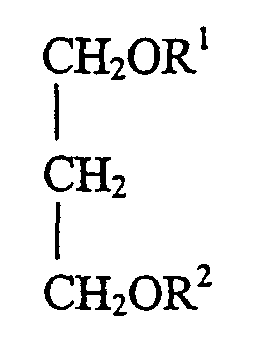
- A compound according to claim 1 wherein a phosphate succinate or other difunctional acid group is interposed between the R1 and/or R2 group and the 1,3-propane diol residue, particularly when R2 is a nutrient, drug or other bioactive with a hydroxy or amino function.
- A compound according to claim 1 or 2, wherein the fatty acid is an n-6 or n-3 series essential fatty acid or oleic acid or columbinic acid or parinaric acid or conjugated linoleic acid.
- A compound according to claim 3 wherein the fatty acid is gamma-linolenic acid, dihomo-gamma-linolenic acid, arachidonic acid, adrenic acid, stearidonic acid, eicosapentaenoic acid, docosapentaenoic acid n-3, docosahexaenoic acid or conjugated linoleic acid.
- A compound according to claim 1, 2, 3 or 4 where R2 is a drug or other active required to cross lipid membranes in the body to exert its action whether in entry to or movement within a cell in which it is to act, or in passing the skin, blood-brain or other barrier.
- A compound according to claim 1, 2, 3 or 4, wherein irrespective of any crossing of lipid membranes R2 is a drug, vitamin, amino acid, anti-oxidant or other active which is required to have an action additive to, complementary to, or synergistic with R1.
- A method of manufacture of a medicament for therapy involving i) transport of a drug or other active across lipid membranes in the body, or ii) an action additive to, complementary to or synergistic with R1, characterised by the use in the medicament of a compound as in any of claims 1 to 4
- Per se, compounds within claim 1, 2, 3 or 4, other than compounds in which R2 is hydrogen compounds in which both R1 and R2 are saturated fatty acid residues and compounds in which R1 is the same as R2 and is derived from oleic, linoleic or alpha-linolenic acids.
- Use in the preparation of formulations for care of the skin or hair or treatment of skin disorders, of a compound as set out in any one of claims 1 to 6.
- Use in the preparation of a food, food additive or food supplement of a compound as set out in any one of claims 1 to 6.
- 1,3-propane diol according to claim 1 as a derivative containing two fatty acids in which one fatty acid is gamma-linolenic acid (GLA) or dihomo-gamma-linolenic acid (DGLA) and the other is gamma-linolenic acid (GLA), dihomo-gamma-linolenic acid (DGLA), stearidonic acid (SA), eicosapentaenoic acid (EPA), docosahexaenoic acid (DHA), conjugated linoleic acid (cLA) or columbinic acid (CA), for use in therapy.
- 1,3-propane diol according to claim 1 as a derivative containing two fatty acids in which one fatty acid is arachidonic acid (AA) and the other is arachidonic acid (AA), gamma-linolenic acid (GLA), docosahexaenoic acid (DHA), dihomo-gamma-linolenic acid (DGLA) or eicosapentaenoic acid (EPA), for use in therapy.
- 1,3-propane diol according to claim 1 as a derivative containing two fatty acids in which one fatty acid is eicosapentaenoic acid (EPA) and the other is eicosapentaenoic acid (EPA) or docosahexaenoic acid (DHA), for use in therapy.
- Per se, 1,3-propane diol derivatives as set out in claims 11, 12 or 13..
- For use in therapy, 1,3-propane diol according to claim 1 as a derivative in which one position is occupied by a fatty acid drawn from gamma-linolenic acid (GLA), dihomo-gamma-linolenic acid (DGLA), arachidonic acid (AA), stearidonic acid (SA), conjugated linoleic acid (cLA), eicosapentaenoic acid (EPA) or docosahexaenoic acid (DHA) and the other position is occupied by an agent, selected from the following list, whose chemical structure is such that it can be linked to the 1,3-propane diol by a linkage through an available carboxyl, alcohol or amino group:-(a) tryptophan(b) phenylalanine(c) arginine(d) carnitine or carnitine derivatives(e) any other amino acid or their derivatives or aminolevulinic acid or derivative thereof(f) adenylosuccinate or derivatives(g) aspirin, salicylic acid, indomethacin, ibuprofen, or any other non-steroidal anti-inflammatory drug(h) any antibiotic especially tetracycline, clindamycin, minocycline, chlortetracycline and erythromycin;(i) any anti malarial or anti-protozoal drug, but especially chloroquine, mepacrine, quinacrine and mefloquine;(j) any antifungal drug especially metronidazole and antifungal imidazoles and nitroimidazoles and amphotericin;(k) any anti-inflammatory steroid especially hydrocortisone and betamethasone and beclomethasone and budesonide;(2) any gonadal steroid especially oestrogens and progestogens and androgens;(m) any adrenal steroid especially dehydroepiandrosterone;(n) any retinoid especially tretinoin and isotretinoin;(o) any anticancer agent;(p) any antipsychotic agent(q) any antidepressive agent;(r) any anti-anxiety agent;(s) any immunosuppressive especially cyclosporine and tacrolimus;(t) any proton pump inhibitor or H2 antagonist;(u) any diuretic;(v) any calcium antagonist;(w) any angiotensin converting enzyme inhibitor or angiotensin antagonist;(x) any beta-blocker;(y) any antiepileptic drug especially phenytoin, carbamazepine, valproate, ethosuximide, vigabatrin or lamotrigine;(z) any hypolipidaemic agent especially fibrates and statins;(aa) any oral hypoglycaemic or insulin-sensitising agents;(bb) any bisphosphonate;(cc) any contrast agent used in radiology including diatrizoate compounds, iodipamide, ioglycamates; iopanoates, iophendylate, iothalamate, ioxaglate, metrizamide and derivative thereof(dd) any peptide or protein including insulin, calcitonin, or erythropoietin;(ee) any vitamin;(ff) any antioxidant;(gg) any porphyrin, chlorin or bacteriochlorin-based drug, especially tetrakis (hydroxy phenyl) derivatives thereof;
- 1-3-propane diol of the structure of claim 15 (ee) and (ff) for use in food additives, foods or nutritional supplements.
Priority Applications (1)
| Application Number | Priority Date | Filing Date | Title |
|---|---|---|---|
| SI9630542T SI0823889T1 (en) | 1995-05-01 | 1996-05-01 | 1,3-propane diol derivatives as bioactive compounds |
Applications Claiming Priority (7)
| Application Number | Priority Date | Filing Date | Title |
|---|---|---|---|
| GBGB9508823.3A GB9508823D0 (en) | 1995-05-01 | 1995-05-01 | Drug Derivatives |
| GB9508823 | 1995-05-01 | ||
| GB9517107 | 1995-08-21 | ||
| GBGB9517107.0A GB9517107D0 (en) | 1995-08-21 | 1995-08-21 | Fatty acid esters |
| GBGB9605440.8A GB9605440D0 (en) | 1996-03-15 | 1996-03-15 | Presentaion of bioactives |
| GB9605440 | 1996-03-15 | ||
| PCT/GB1996/001053 WO1996034846A1 (en) | 1995-05-01 | 1996-05-01 | 1,3-propane diol derivatives as bioactive compounds |
Publications (2)
| Publication Number | Publication Date |
|---|---|
| EP0823889A1 EP0823889A1 (en) | 1998-02-18 |
| EP0823889B1 true EP0823889B1 (en) | 2002-09-18 |
Family
ID=27267691
Family Applications (2)
| Application Number | Title | Priority Date | Filing Date |
|---|---|---|---|
| EP96912138A Expired - Lifetime EP0823895B1 (en) | 1995-05-01 | 1996-05-01 | Fatty acid esters as bioactive compounds |
| EP96912139A Expired - Lifetime EP0823889B1 (en) | 1995-05-01 | 1996-05-01 | 1,3-propane diol derivatives as bioactive compounds |
Family Applications Before (1)
| Application Number | Title | Priority Date | Filing Date |
|---|---|---|---|
| EP96912138A Expired - Lifetime EP0823895B1 (en) | 1995-05-01 | 1996-05-01 | Fatty acid esters as bioactive compounds |
Country Status (28)
| Country | Link |
|---|---|
| US (4) | USRE40480E1 (en) |
| EP (2) | EP0823895B1 (en) |
| JP (3) | JP3960481B2 (en) |
| KR (2) | KR19990008243A (en) |
| AR (1) | AR004483A1 (en) |
| AT (2) | ATE224353T1 (en) |
| AU (2) | AU707600B2 (en) |
| BG (2) | BG102012A (en) |
| BR (2) | BR9606607A (en) |
| CA (2) | CA2218702C (en) |
| CZ (2) | CZ297646B6 (en) |
| DE (2) | DE69633008T2 (en) |
| DK (2) | DK0823889T3 (en) |
| EE (2) | EE9700281A (en) |
| ES (2) | ES2185772T3 (en) |
| HU (2) | HUP9802308A3 (en) |
| IL (1) | IL118061A (en) |
| IS (2) | IS4604A (en) |
| MY (2) | MY118354A (en) |
| NO (2) | NO975036L (en) |
| NZ (2) | NZ306509A (en) |
| PL (2) | PL323176A1 (en) |
| PT (2) | PT823895E (en) |
| RU (1) | RU2215733C2 (en) |
| SI (2) | SI0823889T1 (en) |
| SK (2) | SK285135B6 (en) |
| TR (2) | TR199701277T1 (en) |
| WO (2) | WO1996034846A1 (en) |
Families Citing this family (191)
| Publication number | Priority date | Publication date | Assignee | Title |
|---|---|---|---|---|
| EP0904072A4 (en) * | 1996-04-12 | 2003-07-30 | Peptide Technology Pty Ltd | METHODS FOR TREATING IMMUNOPATHOLOGIES USING POLYUNSATURATED FATTY ACIDS |
| US6576636B2 (en) * | 1996-05-22 | 2003-06-10 | Protarga, Inc. | Method of treating a liver disorder with fatty acid-antiviral agent conjugates |
| US5795909A (en) | 1996-05-22 | 1998-08-18 | Neuromedica, Inc. | DHA-pharmaceutical agent conjugates of taxanes |
| US5804210A (en) * | 1996-08-07 | 1998-09-08 | Wisconsin Alumni Research Foundation | Methods of treating animals to maintain or enhance bone mineral content and compositions for use therein |
| US5760083A (en) * | 1996-08-07 | 1998-06-02 | Wisconsin Alumni Research Foundation | Use of CLA to reduce the incidence of valgus and varus leg deforomities in poultry |
| GB9622636D0 (en) * | 1996-10-30 | 1997-01-08 | Scotia Holdings Plc | Presentation of bioactives |
| CZ326896A3 (en) * | 1996-11-07 | 1998-05-13 | Milo Olomouc, A. S. | Fat with specific antisclerotic activity |
| GB9705102D0 (en) * | 1997-03-12 | 1997-04-30 | Scotia Holdings Inc | Presentation of fatty acids |
| AU7222598A (en) * | 1997-04-29 | 1998-11-24 | Scotia Holdings Plc | Treatment of depression and anxiety using docosahexaenoic acid or natural antioxidants |
| DE19718245C5 (en) * | 1997-04-30 | 2004-11-11 | Cognis Deutschland Gmbh & Co. Kg | Synthetic triglycerides based on conjugated linoleic acid, process for their preparation and their use |
| GB9715444D0 (en) * | 1997-07-22 | 1997-09-24 | Scotia Holdings Plc | Therapeutic and dietary compositions |
| US6019990A (en) * | 1997-11-21 | 2000-02-01 | Natural Nutrition Ltd. As | Conjugated linoleic acid delivery system in cosmetic preparations |
| EP1041979A4 (en) * | 1997-12-23 | 2001-10-04 | Dcv Inc | Esters of conjugated linoleic acid or conjugated linolenic acid and uses thereof |
| JPH11209279A (en) * | 1998-01-05 | 1999-08-03 | Natural Ltd As | Method for decreasing body weight and treating obesity |
| US20020002154A1 (en) * | 1998-02-11 | 2002-01-03 | Pol-Henri Guivarc'h | Method and composition for treatment of inflammatory conditions |
| ATE241363T1 (en) * | 1998-02-11 | 2003-06-15 | Rtp Pharma Corp | COMBINATION PREPARATIONS CONTAINING UNSATURATED FATTY ACID AND STEROIDS FOR THE TREATMENT OF INFLAMMATION |
| GB9804361D0 (en) * | 1998-03-02 | 1998-04-22 | Scotia Holdings Plc | Cancer treatment |
| US7776353B1 (en) | 1998-03-17 | 2010-08-17 | Aker Biomarine Asa | Conjugated linoleic acid compositions |
| US6015833A (en) | 1998-03-17 | 2000-01-18 | Conlinco., Inc. | Conjugated linoleic acid compositions |
| DE69934627T2 (en) | 1998-03-17 | 2007-10-25 | Natural Asa | Conjugated linoleic acid composition |
| US6177580B1 (en) | 1998-04-21 | 2001-01-23 | Henkel Kommanditgesellschaft Auf Aktien | Conjugated linolenic acid-based synthetic triglycerides |
| US7101914B2 (en) | 1998-05-04 | 2006-09-05 | Natural Asa | Isomer enriched conjugated linoleic acid compositions |
| US6214372B1 (en) | 1998-05-04 | 2001-04-10 | Con Lin Co., Inc. | Method of using isomer enriched conjugated linoleic acid compositions |
| US6696584B2 (en) | 1998-05-04 | 2004-02-24 | Natural Asa | Isomer enriched conjugated linoleic acid compositions |
| US6060514A (en) * | 1998-05-04 | 2000-05-09 | Conlin Co., Inc. | Isomer enriched conjugated linoleic acid compositions |
| US6777388B1 (en) * | 1998-08-21 | 2004-08-17 | Clf Medical Technology Acceleration Program, Inc. | Leptin-related peptides |
| US6132582A (en) | 1998-09-14 | 2000-10-17 | The Perkin-Elmer Corporation | Sample handling system for a multi-channel capillary electrophoresis device |
| GB9901809D0 (en) * | 1999-01-27 | 1999-03-17 | Scarista Limited | Highly purified ethgyl epa and other epa derivatives for psychiatric and neurological disorderes |
| IT1308613B1 (en) | 1999-02-17 | 2002-01-09 | Pharmacia & Upjohn Spa | ESSENTIAL FATTY ACIDS IN THE PREVENTION OF CARDIOVASCULAR EVENTS. |
| US7235583B1 (en) | 1999-03-09 | 2007-06-26 | Luitpold Pharmaceuticals, Inc., | Fatty acid-anticancer conjugates and uses thereof |
| US6245800B1 (en) * | 1999-06-08 | 2001-06-12 | Sigma-Tau | Method of preventing or treating statin-induced toxic effects using L-carnitine or an alkanoyl L-carnitine |
| GB9918028D0 (en) * | 1999-07-30 | 1999-09-29 | Unilever Plc | Skin care composition |
| GB9927629D0 (en) * | 1999-11-24 | 2000-01-19 | Croda Int Plc | Compounds |
| CA2404799C (en) | 2000-04-06 | 2007-08-07 | Conlinco, Inc. | Conjugated linoleic acid compositions |
| US6756405B2 (en) | 2000-04-18 | 2004-06-29 | Natural Asa | Conjugated linoleic acid powder |
| US6380409B1 (en) | 2000-04-24 | 2002-04-30 | Conlin Co., Inc. | Methods for preparing CLA isomers |
| US6927239B1 (en) * | 2000-08-02 | 2005-08-09 | Pharmanutrients | Methods and compositions for the attenuation and/or prevention of stress/catabolic responses |
| US6506412B2 (en) * | 2000-11-29 | 2003-01-14 | Sciencebased Health | Treatment of dry eye syndrome |
| ITMI20010129A1 (en) | 2001-01-25 | 2002-07-25 | Pharmacia & Upjohn Spa | ESSENTIAL FATTY ACIDS IN THE THERAPY OF HEART INSUFFICIENCY AND HEART FAILURE |
| RU2203064C2 (en) * | 2001-03-11 | 2003-04-27 | Каменев Виктор Федорович | Method for treating aspirin bronchial asthma |
| US8552054B2 (en) * | 2001-03-23 | 2013-10-08 | Luitpold Pharmaceuticals, Inc. | Fatty amine drug conjugates |
| JP4634694B2 (en) * | 2001-03-23 | 2011-02-16 | ルイトポルド・ファーマシューティカルズ・インコーポレーテッド | Fatty alcohol drug complex |
| CN1259044C (en) | 2001-03-30 | 2006-06-14 | 日清奥利友集团株式会社 | Bone Metabolism Improver |
| CA2372450A1 (en) * | 2001-05-10 | 2001-09-19 | Pharmaceutical Partners Of Canada Inc. | Liquid injectable formulation of disodium pamidronate |
| US6838074B2 (en) | 2001-08-08 | 2005-01-04 | Bristol-Myers Squibb Company | Simultaneous imaging of cardiac perfusion and a vitronectin receptor targeted imaging agent |
| EP2201965A1 (en) * | 2001-11-08 | 2010-06-30 | Ziscoat N.V. | Intraluminal device with a coating containing a therapeutic agent |
| ITMI20012384A1 (en) * | 2001-11-12 | 2003-05-12 | Quatex Nv | USE OF POLYUNSATURATED FATTY ACIDS FOR THE PRIMARY PREVENTION OF MAJOR CARDIOVASCULAR EVENTS |
| US6677470B2 (en) | 2001-11-20 | 2004-01-13 | Natural Asa | Functional acylglycerides |
| RU2223765C1 (en) * | 2002-07-24 | 2004-02-20 | Открытое акционерное общество "Химико-фармацевтический комбинат "Акрихин" | Anti-inflammatory and anti-allergic composition |
| US6743931B2 (en) | 2002-09-24 | 2004-06-01 | Natural Asa | Conjugated linoleic acid compositions |
| WO2004028470A2 (en) * | 2002-09-27 | 2004-04-08 | Martek Biosciences Corporation | Prophylactic docosahexaenoic acid therapy for patients with subclinical inflammation |
| US7074418B2 (en) * | 2002-11-18 | 2006-07-11 | Changaris David G | Conjugated fatty acid based emulsion and methods for preparing and using same |
| US20050123500A1 (en) * | 2003-01-31 | 2005-06-09 | The Procter & Gamble Company | Means for improving the appearance of mammalian hair and nails |
| EP1587377A2 (en) * | 2003-01-31 | 2005-10-26 | The Procter & Gamble Company | Means for improving the appearance of mammalian keratinous tissue |
| WO2004091603A1 (en) * | 2003-04-07 | 2004-10-28 | Clinigenetics | Use of an ester of dha for the treatment of cardiovascular diseases |
| US7091369B2 (en) * | 2003-07-15 | 2006-08-15 | Board Of Trustees Operating Michigan State University | Synthesis of polyconjugated fatty acids |
| US7041286B2 (en) * | 2003-07-23 | 2006-05-09 | Nerenberg Arnold P | Composition for mitigating a pernicious thrombotic event |
| AU2004263164A1 (en) * | 2003-08-05 | 2005-02-17 | Board Of Supervisors Of Louisiana State University And Agricultural And Mechanical College | Neuroprotection protects against cellular apoptosis, neural stroke damage, alzheimer's disease and retinal degeneration |
| CA2436650A1 (en) * | 2003-08-06 | 2005-02-06 | Naturia Inc. | Conjugated linolenic acid (clnatm) compositions: synthesis, purification and uses |
| US20050074443A1 (en) * | 2003-10-03 | 2005-04-07 | Treadwell Benjamin V. | Methods of attenuating autoimmune disease and compositions useful therefor |
| US20050154059A1 (en) * | 2004-01-13 | 2005-07-14 | Cook Mark E. | Method of treating type III hypersensitive reaction-related diseases and conditions by using conjugated linoleic acid |
| US20060083768A1 (en) * | 2004-09-28 | 2006-04-20 | Atrium Medical Corporation | Method of thickening a coating using a drug |
| US8312836B2 (en) | 2004-09-28 | 2012-11-20 | Atrium Medical Corporation | Method and apparatus for application of a fresh coating on a medical device |
| US9012506B2 (en) | 2004-09-28 | 2015-04-21 | Atrium Medical Corporation | Cross-linked fatty acid-based biomaterials |
| US9000040B2 (en) | 2004-09-28 | 2015-04-07 | Atrium Medical Corporation | Cross-linked fatty acid-based biomaterials |
| WO2006037049A2 (en) * | 2004-09-28 | 2006-04-06 | Atrium Medical Corporation | Application of a coating on a medical device |
| US8124127B2 (en) | 2005-10-15 | 2012-02-28 | Atrium Medical Corporation | Hydrophobic cross-linked gels for bioabsorbable drug carrier coatings |
| US9592324B2 (en) | 2006-11-06 | 2017-03-14 | Atrium Medical Corporation | Tissue separating device with reinforced support for anchoring mechanisms |
| WO2007011385A2 (en) | 2004-09-28 | 2007-01-25 | Atrium Medical Corporation | Heat cured gel and method of making |
| US9801982B2 (en) | 2004-09-28 | 2017-10-31 | Atrium Medical Corporation | Implantable barrier device |
| US8367099B2 (en) | 2004-09-28 | 2013-02-05 | Atrium Medical Corporation | Perforated fatty acid films |
| MX2007006775A (en) * | 2004-12-06 | 2008-02-25 | Reliant Pharmaceuticals Inc | STABLE PHENOFIBRATE COMPOSITIONS WITH FATTY ACID ESTERS. |
| BRPI0518398A2 (en) * | 2004-12-06 | 2008-11-18 | Reliant Pharmaceuticals Inc | Omega-3 Fatty Acids and Delipidemic Agent for Lipid Therapy |
| CN101098690A (en) * | 2004-12-06 | 2008-01-02 | 瑞莱恩特医药品有限公司 | Omega-3 fatty acids and dyslipidemia agents for lipid therapy |
| US20060135610A1 (en) * | 2004-12-22 | 2006-06-22 | Bortz Jonathan D | Cardiovascular compositions |
| WO2006096806A2 (en) * | 2005-03-08 | 2006-09-14 | Reliant Pharmaceutiacals, Inc. | Treatment with statin and omega-3 fatty acids and a combination product thereof |
| US20060229366A1 (en) * | 2005-04-07 | 2006-10-12 | Lifschitz Carlos H | Method for preventing or treating respiratory infections in infants |
| US9278161B2 (en) | 2005-09-28 | 2016-03-08 | Atrium Medical Corporation | Tissue-separating fatty acid adhesion barrier |
| US9427423B2 (en) | 2009-03-10 | 2016-08-30 | Atrium Medical Corporation | Fatty-acid based particles |
| US20090306125A1 (en) * | 2005-11-22 | 2009-12-10 | Anders Marion W | Mitochondria-Targeted Antioxidant Prodrugs and Methods of Use |
| US8470861B2 (en) | 2005-11-22 | 2013-06-25 | University Of Rochester | Mitochondria-targeted antioxidant prodrugs and methods of use |
| ES2277557B1 (en) | 2005-12-21 | 2008-07-01 | Proyecto Empresarial Brudy, S.L. | USE OF DOCOSAHEXAENOIC ACID FOR THE TREATMENT OF OXIDATIVE CELL DAMAGE. |
| EP3263101A1 (en) * | 2005-12-21 | 2018-01-03 | Brudy Technology, S.L. | Use of dha, epa or dha-derived epa for treating a pathology associated with cellular oxidative damage |
| WO2007081773A2 (en) * | 2006-01-05 | 2007-07-19 | Reliant Pharmaceuticals, Inc | Treatment of fatty liver |
| WO2007088050A2 (en) * | 2006-02-03 | 2007-08-09 | San Raffaele Centro Fond | Method of treatment for muscular dystrophy |
| TWI389683B (en) * | 2006-02-06 | 2013-03-21 | Kyorin Seiyaku Kk | A therapeutic agent for an inflammatory bowel disease or an inflammatory bowel disease treatment using a 2-amino-1,3-propanediol derivative as an active ingredient |
| US7988883B2 (en) * | 2006-02-10 | 2011-08-02 | Dupont Tate & Lyle Bio Products Company, Llc | Heat transfer compositions comprising renewably-based biodegradable 1,3-propanediol |
| US20070275139A1 (en) * | 2006-02-10 | 2007-11-29 | Melissa Joerger | Food compositions comprising renewably-based, biodegradable1,3-propanediol |
| JP2009532506A (en) * | 2006-02-10 | 2009-09-10 | デユポン・テイト・アンド・ライル・バイオ・プロダクツ・カンパニー・エルエルシー | Biologically based compositions comprising mono- and diesters of 1,3-propanediol |
| JP5628480B2 (en) | 2006-03-09 | 2014-11-19 | グラクソスミスクライン エルエルシー | Coated capsule containing pharmaceutical ingredients |
| JP5099808B2 (en) * | 2006-05-29 | 2012-12-19 | 独立行政法人農業・食品産業技術総合研究機構 | Composition for improving lipid metabolism |
| US9492596B2 (en) | 2006-11-06 | 2016-11-15 | Atrium Medical Corporation | Barrier layer with underlying medical device and one or more reinforcing support structures |
| WO2008061187A1 (en) * | 2006-11-15 | 2008-05-22 | Dupont Tate & Lyle Bio Products Company, Llc | Preservative compositions comprising renewably-based, biodegradable 1,3-propanediol |
| US20090029944A1 (en) * | 2007-06-19 | 2009-01-29 | Skinner Keith K | Methods for adding fatty acids to agents in aqueous solution to improve bioavailability |
| SI2315740T1 (en) | 2008-07-08 | 2018-03-30 | Catabasis Pharmaceuticals, Inc. | Fatty acid acetylated salicylates and their uses |
| US9085527B2 (en) | 2008-07-08 | 2015-07-21 | Catabasis Pharmaceuticals, Inc. | Fatty acid acylated salicylates and their uses |
| US20120034155A1 (en) * | 2010-08-03 | 2012-02-09 | Searete Llc, A Limited Liability Corporation Of The State Of Delaware | Artificial cells |
| EP4137128A1 (en) | 2008-09-02 | 2023-02-22 | Amarin Pharmaceuticals Ireland Limited | Pharmaceutical composition comprising eicosapentaenoic acid and a statin, and methods of using same |
| US20100062057A1 (en) * | 2008-09-10 | 2010-03-11 | Pronova BioPharma Norge AS. | Formulation |
| FR2940281B1 (en) | 2008-12-22 | 2011-04-01 | Fabre Pierre Dermo Cosmetique | ESTER OF DIOL AND POLYUNSATURATED FATTY ACID AS ANTI-ACNE AGENT |
| ES2768091T3 (en) | 2009-02-10 | 2020-06-19 | Amarin Pharmaceuticals Ie Ltd | Use of Eicosapentaenoic Acid Ethyl Ester to Treat Hypertriglyceridemia |
| US9532963B2 (en) | 2009-03-09 | 2017-01-03 | Pronova Biopharma Norge As | Compositions comprising a fatty acid oil mixture and a free fatty acid, and methods and uses thereof |
| MX350088B (en) | 2009-04-29 | 2017-08-25 | Amarin Pharma Inc | Stable pharmaceutical composition and methods of using same. |
| NZ720946A (en) | 2009-04-29 | 2017-09-29 | Amarin Pharmaceuticals Ie Ltd | Pharmaceutical compositions comprising epa and a cardiovascular agent and methods of using the same |
| CN108096209A (en) | 2009-06-15 | 2018-06-01 | 阿马里纳制药公司 | Triglycerides, composition and method without increasing LDL-C levels are reduced in the object of associated Statins therapy |
| US20110038910A1 (en) | 2009-08-11 | 2011-02-17 | Atrium Medical Corporation | Anti-infective antimicrobial-containing biomaterials |
| USRE46608E1 (en) | 2009-09-01 | 2017-11-14 | Catabasis Pharmaceuticals, Inc. | Fatty acid niacin conjugates and their uses |
| RU2569063C2 (en) | 2009-09-01 | 2015-11-20 | Катабэйсис Фармасьютикалз, Инк. | Conjugates of fatty acids and niacin and application thereof |
| US20110071176A1 (en) | 2009-09-23 | 2011-03-24 | Amarin Pharma, Inc. | Pharmaceutical composition comprising omega-3 fatty acid and hydroxy-derivative of a statin and methods of using same |
| WO2011044138A1 (en) | 2009-10-05 | 2011-04-14 | Catabasis Pharmaceuticals, Inc. | Lipoic acid acylated salicylate derivatives and their uses |
| KR101904388B1 (en) | 2009-10-23 | 2018-10-05 | 프로노바 바이오파마 너지 에이에스 | Coated capsules and tablets of a fatty acid oil mixture |
| US20110212958A1 (en) * | 2010-02-26 | 2011-09-01 | Catabasis Pharmaceuticals, Inc. | Fatty acid raloxifene derivatives and their uses |
| PH12012501755A1 (en) * | 2010-03-04 | 2012-11-12 | Amarin Pharma Inc | Compositions and methods for treating and/or preventing cardiovascular disease |
| WO2011109681A1 (en) | 2010-03-05 | 2011-09-09 | Catabasis Pharmaceuticals, Inc. | Fatty acid cox inhibitor derivatives and their uses |
| JP2013526865A (en) | 2010-05-13 | 2013-06-27 | ニトロメガ コーポレーション | Nitro fatty acids, neuroprotection and / or suppression of cognitive decline |
| EP2593141B1 (en) | 2010-07-16 | 2018-07-04 | Atrium Medical Corporation | Composition and methods for altering the rate of hydrolysis of cured oil-based materials |
| NZ712068A (en) | 2010-11-29 | 2017-03-31 | Amarin Pharmaceuticals Ie Ltd | Low eructation composition and methods for treating and/or preventing cardiovascular disease in a subject with fish allergy/hypersensitivity |
| US11712429B2 (en) | 2010-11-29 | 2023-08-01 | Amarin Pharmaceuticals Ireland Limited | Low eructation composition and methods for treating and/or preventing cardiovascular disease in a subject with fish allergy/hypersensitivity |
| US8715648B2 (en) | 2011-02-16 | 2014-05-06 | Pivotal Therapeutics Inc. | Method for treating obesity with anti-obesity formulations and omega 3 fatty acids for the reduction of body weight in cardiovascular disease patients (CVD) and diabetics |
| US9119826B2 (en) | 2011-02-16 | 2015-09-01 | Pivotal Therapeutics, Inc. | Omega 3 fatty acid for use as a prescription medical food and omega 3 fatty acid diagniostic assay for the dietary management of cardiovascular patients with cardiovascular disease (CVD) who are deficient in blood EPA and DHA levels |
| US8952000B2 (en) | 2011-02-16 | 2015-02-10 | Pivotal Therapeutics Inc. | Cholesterol absorption inhibitor and omega 3 fatty acids for the reduction of cholesterol and for the prevention or reduction of cardiovascular, cardiac and vascular events |
| US8951514B2 (en) | 2011-02-16 | 2015-02-10 | Pivotal Therapeutics Inc. | Statin and omega 3 fatty acids for reduction of apolipoprotein-B levels |
| KR101560467B1 (en) | 2011-04-13 | 2015-10-14 | 이엘씨 매니지먼트 엘엘씨 | Conditioning agents for personal care compositions |
| US9242930B2 (en) | 2011-04-13 | 2016-01-26 | Elc Management Llc | Mild anionic surfactants suitable for personal care compositions |
| US8809560B2 (en) | 2011-05-17 | 2014-08-19 | Board Of Trustees Of The University Of Arkansas | Trans-, trans-conjugated linoleic acid compositions and use thereof |
| US11291643B2 (en) | 2011-11-07 | 2022-04-05 | Amarin Pharmaceuticals Ireland Limited | Methods of treating hypertriglyceridemia |
| US20130131170A1 (en) | 2011-11-07 | 2013-05-23 | Amarin Pharmaceuticals Ireland Limited | Methods of treating hypertriglyceridemia |
| WO2013068443A1 (en) | 2011-11-09 | 2013-05-16 | Sondboe Sverre | Membrane-based processes for reducing at least one impurity and making a concentrate comprising at least one natural component from a non-marine fatty acid oil mixture, and compositions resulting thereof |
| WO2013072767A1 (en) | 2011-11-18 | 2013-05-23 | Pronova Biopharma Norge As | Compositions and preconcentrates comprising at least one salicylate and omega-3 fatty acid oil mixture |
| US9301920B2 (en) | 2012-06-18 | 2016-04-05 | Therapeuticsmd, Inc. | Natural combination hormone replacement formulations and therapies |
| RS62297B1 (en) | 2011-11-23 | 2021-09-30 | Therapeuticsmd Inc | Natural combination hormone replacement formulations and therapies |
| EP2793867B1 (en) | 2011-12-22 | 2021-01-20 | Baes, Erik | Gelatin/alginate delayed release capsules comprising omega-3 fatty acids, and methods and uses thereof |
| ES2891473T3 (en) | 2012-01-06 | 2022-01-28 | Amarin Pharmaceuticals Ie Ltd | Compositions and methods for reducing high sensitivity levels (hs-CRP) in a subject |
| EP2822403B1 (en) | 2012-03-07 | 2022-05-04 | Children's Medical Center Corporation | Methods and uses for enhancing, improving, or increasing fertility or reproductive function |
| EP2833740B1 (en) | 2012-04-04 | 2016-09-14 | Pronova BioPharma Norge AS | Compositions comprising omega-3 fatty acids and vitamin d for acne vulgaris and/or eczema, and methods and uses thereof |
| US9585896B2 (en) | 2012-04-04 | 2017-03-07 | Pronova Biopharma Norge As | Compositions comprising omega-3 fatty acids and vitamin D for psoriasis, and methods and uses thereof |
| AU2013257710B2 (en) * | 2012-05-08 | 2016-10-20 | Cellixbio Private Limited | Compositions and methods for the treatment of neurological disorders |
| US9867880B2 (en) | 2012-06-13 | 2018-01-16 | Atrium Medical Corporation | Cured oil-hydrogel biomaterial compositions for controlled drug delivery |
| WO2013192109A1 (en) | 2012-06-17 | 2013-12-27 | Matinas Biopharma, Inc. | Omega-3 pentaenoic acid compositions and methods of use |
| US20150196640A1 (en) | 2012-06-18 | 2015-07-16 | Therapeuticsmd, Inc. | Progesterone formulations having a desirable pk profile |
| US20130338122A1 (en) | 2012-06-18 | 2013-12-19 | Therapeuticsmd, Inc. | Transdermal hormone replacement therapies |
| US10806697B2 (en) | 2012-12-21 | 2020-10-20 | Therapeuticsmd, Inc. | Vaginal inserted estradiol pharmaceutical compositions and methods |
| US10806740B2 (en) | 2012-06-18 | 2020-10-20 | Therapeuticsmd, Inc. | Natural combination hormone replacement formulations and therapies |
| CA3067012C (en) | 2012-06-29 | 2021-10-05 | Amarin Pharmaceuticals Ireland Limited | Methods of reducing the risk of a cardiovascular event in a subject on statin therapy |
| CA2873018A1 (en) * | 2012-07-03 | 2014-01-09 | Cellixbio Private Limited | Compositions and methods for the treatment of moderate to severe pain |
| JP2014050781A (en) * | 2012-09-06 | 2014-03-20 | Shiko Actec Kk | Deodorizing filter for soot-containing exhaust |
| WO2014074552A2 (en) | 2012-11-06 | 2014-05-15 | Amarin Pharmaceuticals Ireland Limited | Compositions and methods for lowering triglycerides without raising ldl-c levels in a subject on concomitant statin therapy |
| US9062276B2 (en) | 2012-12-03 | 2015-06-23 | Board Of Trustees Of The University Of Arkansas | Conjugated linoleic acid rich vegetable oil production from linoleic rich oils by heterogeneous catalysis |
| US10471072B2 (en) | 2012-12-21 | 2019-11-12 | Therapeuticsmd, Inc. | Vaginal inserted estradiol pharmaceutical compositions and methods |
| US9180091B2 (en) | 2012-12-21 | 2015-11-10 | Therapeuticsmd, Inc. | Soluble estradiol capsule for vaginal insertion |
| US11266661B2 (en) | 2012-12-21 | 2022-03-08 | Therapeuticsmd, Inc. | Vaginal inserted estradiol pharmaceutical compositions and methods |
| US10568891B2 (en) | 2012-12-21 | 2020-02-25 | Therapeuticsmd, Inc. | Vaginal inserted estradiol pharmaceutical compositions and methods |
| US11246875B2 (en) | 2012-12-21 | 2022-02-15 | Therapeuticsmd, Inc. | Vaginal inserted estradiol pharmaceutical compositions and methods |
| US10537581B2 (en) | 2012-12-21 | 2020-01-21 | Therapeuticsmd, Inc. | Vaginal inserted estradiol pharmaceutical compositions and methods |
| US20140187633A1 (en) | 2012-12-31 | 2014-07-03 | Amarin Pharmaceuticals Ireland Limited | Methods of treating or preventing nonalcoholic steatohepatitis and/or primary biliary cirrhosis |
| US9814733B2 (en) | 2012-12-31 | 2017-11-14 | A,arin Pharmaceuticals Ireland Limited | Compositions comprising EPA and obeticholic acid and methods of use thereof |
| US9452151B2 (en) | 2013-02-06 | 2016-09-27 | Amarin Pharmaceuticals Ireland Limited | Methods of reducing apolipoprotein C-III |
| US9624492B2 (en) | 2013-02-13 | 2017-04-18 | Amarin Pharmaceuticals Ireland Limited | Compositions comprising eicosapentaenoic acid and mipomersen and methods of use thereof |
| US9662307B2 (en) | 2013-02-19 | 2017-05-30 | The Regents Of The University Of Colorado | Compositions comprising eicosapentaenoic acid and a hydroxyl compound and methods of use thereof |
| US9283201B2 (en) | 2013-03-14 | 2016-03-15 | Amarin Pharmaceuticals Ireland Limited | Compositions and methods for treating or preventing obesity in a subject in need thereof |
| US20140271841A1 (en) | 2013-03-15 | 2014-09-18 | Amarin Pharmaceuticals Ireland Limited | Pharmaceutical composition comprising eicosapentaenoic acid and derivatives thereof and a statin |
| US20150182546A1 (en) * | 2013-03-15 | 2015-07-02 | Mitochondrial Concepts Llc | Therapeutic agent for enhancing mitochondrial function |
| US10966968B2 (en) | 2013-06-06 | 2021-04-06 | Amarin Pharmaceuticals Ireland Limited | Co-administration of rosiglitazone and eicosapentaenoic acid or a derivative thereof |
| WO2015011724A2 (en) | 2013-07-22 | 2015-01-29 | Kms Health Center Pvt Ltd | A novel omega -3 fatty acid composition with a plant extract |
| CN103417507B (en) * | 2013-08-23 | 2015-12-02 | 王显著 | Budesonide pharmaceutical composition |
| US20150065572A1 (en) | 2013-09-04 | 2015-03-05 | Amarin Pharmaceuticals Ireland Limited | Methods of treating or preventing prostate cancer |
| US9585859B2 (en) | 2013-10-10 | 2017-03-07 | Amarin Pharmaceuticals Ireland Limited | Compositions and methods for lowering triglycerides without raising LDL-C levels in a subject on concomitant statin therapy |
| ES2732153T3 (en) * | 2013-10-18 | 2019-11-20 | Blanchette Rockefeller Neurosciences Inst | Halogenated esters of cyclopropanate unsaturated fatty acids for use in the treatment of neurodegenerative diseases |
| US10130603B2 (en) | 2013-11-05 | 2018-11-20 | Colgate-Palmolive Company | Methods and compositions for improving kidney function |
| RU2016143081A (en) | 2014-05-22 | 2018-06-26 | Терапьютиксмд, Инк. | NATURAL COMBINED HORMONE SUBSTITUTION COMPOSITIONS AND THERAPIES |
| US10561631B2 (en) | 2014-06-11 | 2020-02-18 | Amarin Pharmaceuticals Ireland Limited | Methods of reducing RLP-C |
| US10172818B2 (en) | 2014-06-16 | 2019-01-08 | Amarin Pharmaceuticals Ireland Limited | Methods of reducing or preventing oxidation of small dense LDL or membrane polyunsaturated fatty acids |
| US10208014B2 (en) * | 2014-11-05 | 2019-02-19 | Cellix Bio Private Limited | Compositions and methods for the treatment of neurological disorders |
| US10328087B2 (en) | 2015-07-23 | 2019-06-25 | Therapeuticsmd, Inc. | Formulations for solubilizing hormones |
| CA2993647A1 (en) | 2015-07-28 | 2017-02-02 | The Lubrizol Corporation | Seal swell agents for lubricating compositions |
| US9968531B2 (en) | 2015-08-05 | 2018-05-15 | Dupont Tate & Lyle Bio Products Company, Llc | Deodorants containing 1,3-propanediol |
| KR101835860B1 (en) | 2015-10-30 | 2018-03-09 | 순천향대학교 산학협력단 | Anticancer composition for preventing or treating ovarian cancer and biomarker composition for diagnosing of the same |
| US10406130B2 (en) | 2016-03-15 | 2019-09-10 | Amarin Pharmaceuticals Ireland Limited | Methods of reducing or preventing oxidation of small dense LDL or membrane polyunsaturated fatty acids |
| US10286077B2 (en) | 2016-04-01 | 2019-05-14 | Therapeuticsmd, Inc. | Steroid hormone compositions in medium chain oils |
| US9931349B2 (en) | 2016-04-01 | 2018-04-03 | Therapeuticsmd, Inc. | Steroid hormone pharmaceutical composition |
| CN109715147A (en) * | 2016-06-20 | 2019-05-03 | 斯克利普斯研究院 | Anti-malarial compositions and uses thereof |
| FR3053252B1 (en) * | 2016-06-29 | 2020-04-24 | Laboratoires Carilene | PRODUCT, OR ACTIVE AGENT, OR COMPOSITION FOR THE CARE OF THE BREAST IN THE PRE-MONTHLY OR MENSTRUAL PERIOD OR FOR THE CARE OF THE SYMPTOMATOLOGY OF MASTODYNIA |
| WO2018213663A1 (en) | 2017-05-19 | 2018-11-22 | Amarin Pharmaceuticals Ireland Limited | Compositions and methods for lowering triglycerides in a subject having reduced kidney function |
| US10052300B1 (en) * | 2017-10-19 | 2018-08-21 | David G. Changaris | Methods and composition for suppression of deep seated fungal growth on skin |
| US11058661B2 (en) | 2018-03-02 | 2021-07-13 | Amarin Pharmaceuticals Ireland Limited | Compositions and methods for lowering triglycerides in a subject on concomitant statin therapy and having hsCRP levels of at least about 2 mg/L |
| KR102076314B1 (en) * | 2018-07-16 | 2020-02-11 | (주) 에프엔지리서치 | Novel compounds isolated from Cervus nippon and pharmaceutical use thereof |
| MA51766A (en) | 2018-09-24 | 2020-12-16 | Amarin Pharmaceuticals Ie Ltd | METHODS OF REDUCING THE RISK OF CARDIOVASCULAR EVENTS IN A SUBJECT |
| BR112022009189A2 (en) | 2019-11-12 | 2022-07-26 | Amarin Pharmaceuticals Ie Ltd | METHODS TO REDUCE THE RISK OF CARDIOVASCULAR EVENT IN A SUBJECT WITH ATRIAL FIBRILLATION AND/OR ATRIAL PALPITATION |
| US11633405B2 (en) | 2020-02-07 | 2023-04-25 | Therapeuticsmd, Inc. | Steroid hormone pharmaceutical formulations |
| US11986452B2 (en) | 2021-04-21 | 2024-05-21 | Amarin Pharmaceuticals Ireland Limited | Methods of reducing the risk of heart failure |
| EP4306101A1 (en) | 2022-07-14 | 2024-01-17 | Gat Therapeutics S.L. | Compositions comprising amarouciaxanthin a esters and uses thereof |
Citations (1)
| Publication number | Priority date | Publication date | Assignee | Title |
|---|---|---|---|---|
| US4268426A (en) * | 1979-05-07 | 1981-05-19 | Textron, Inc. | Water-dispersible urethane polymers, aqueous polymer dispersions and half-esters useful therein |
Family Cites Families (48)
| Publication number | Priority date | Publication date | Assignee | Title |
|---|---|---|---|---|
| US2924528A (en) * | 1955-08-22 | 1960-02-09 | Drew & Co Inc E F | Synthetic hard butter |
| US2993063A (en) * | 1956-12-17 | 1961-07-18 | Colgate Palmolive Co | Cocoa butter substitute and process of making same |
| CH389587A (en) * | 1957-10-10 | 1965-03-31 | Montedison Spa | Process for the preparation of a-B, D-e-unsaturated carboxyl derivatives |
| US3291816A (en) * | 1963-10-02 | 1966-12-13 | Leo A Goldblatt | Dehydration of lesquerolates |
| GB1135647A (en) * | 1965-06-29 | 1968-12-04 | Grace W R & Co | New esters |
| FR1782M (en) * | 1966-12-21 | 1963-04-22 | Rech S Pharmacotechniques Soc | Cetyl nicotinate as an analgesic and repellant and pharmaceutical compositions for its administration, in particular by the percutaneous route. |
| DE1912486B1 (en) * | 1969-03-12 | 1970-03-19 | Ruhrchemie Ag | Carboxylic acid ester based lubricants |
| US3686238A (en) * | 1970-01-19 | 1972-08-22 | Syntex Corp | Glycerol esterified with 2-naphthyl-acetic acids and fatty acids |
| US3989728A (en) * | 1975-02-12 | 1976-11-02 | The Procter & Gamble Company | Process for synthesizing specific complete mixed polyol esters |
| CH592192B5 (en) * | 1975-07-07 | 1977-10-14 | Ciba Geigy Ag | |
| CA1079294A (en) * | 1975-07-31 | 1980-06-10 | Takeshi Okano | Process for producing alkylene glycol esters |
| IL59407A (en) | 1979-03-06 | 1983-12-30 | Sanofi Sa | Di-n-propylacetic acid diesters of glycerol,their preparation and pharmaceutical compositions containing them |
| JPS5767511A (en) * | 1980-10-15 | 1982-04-24 | Lion Corp | Agent for imparting iridescent luster to cosmetic |
| US4469704A (en) * | 1980-12-26 | 1984-09-04 | Ss Pharmaceutical Co., Ltd. | 2,3-Butanediol diester derivatives, process for producing the same, and an antiulcer drug containing the same |
| EP0057797B1 (en) * | 1981-02-03 | 1986-06-25 | Imperial Chemical Industries Plc | Process for the extraction of metal values and novel metal extractants |
| DE3366838D1 (en) | 1982-03-01 | 1986-11-20 | Efamol Ltd | Pharmaceutical composition |
| IL67445A (en) * | 1982-12-09 | 1985-11-29 | Teva Pharma | Ethoxycarbonyloxy ethyl esters of non-steroidal anti-inflammatory carboxylic acids |
| GR82658B (en) * | 1983-08-01 | 1985-02-07 | Mclean Hospital Corp | |
| GB8326130D0 (en) | 1983-09-29 | 1983-11-02 | Efamol Ltd | Topical preparations containing tars and fatty acids |
| ATE37347T1 (en) * | 1983-10-28 | 1988-10-15 | Alfred Bolz | DEVICE FOR TRANSPORTING BODIES BY LIQUID FLOWING IN A PIPE. |
| US4619938A (en) * | 1984-03-21 | 1986-10-28 | Terumo Kabushiki Kaisha | Fatty acid derivatives of aminoalkyl nicotinic acid esters and platelet aggregation inhibitors |
| GB2161477B (en) * | 1984-03-30 | 1987-09-16 | Unilever Plc | Aliphatic esters of diols and compositions containing them |
| GB8412049D0 (en) * | 1984-05-11 | 1984-06-20 | Unilever Plc | Treatment |
| GB8420771D0 (en) | 1984-08-15 | 1984-09-19 | Efamol Ltd | Treatment of skin disorders |
| JPS61129190A (en) * | 1984-11-27 | 1986-06-17 | Nippon Oil & Fats Co Ltd | Polymerizable glycerophospholipid |
| DE3443993A1 (en) * | 1984-12-01 | 1986-06-05 | Bayer Ag, 5090 Leverkusen | METHOD FOR PRODUCING NEW INDOLDER DERIVATIVES AND THE USE THEREOF |
| FR2582000B1 (en) | 1985-05-14 | 1987-06-26 | Oreal | BI OR TRI-ENIC FATTY ESTERS OF ERYTHROMYCIN A, THEIR PREPARATION PROCESS AND PHARMACEUTICAL AND COSMETIC COMPOSITIONS CONTAINING THEM |
| JPS62174060A (en) * | 1985-10-11 | 1987-07-30 | Terumo Corp | 5-fluorouracil derivative and drug preparation containing same |
| CA1257199A (en) * | 1986-05-20 | 1989-07-11 | Paul Y. Wang | Preparation containing bioactive macromolecular substance for multi-months release in vivo |
| ATE130036T1 (en) * | 1987-10-14 | 1995-11-15 | Kao Corp | METHOD FOR PRODUCING A POLYOL FATTY ACID ESTER AND GLYCERIDE MIXTURE OBTAINED THEREFROM. |
| GB8729153D0 (en) | 1987-12-14 | 1988-01-27 | Efamol Ltd | Fatty acid compositions |
| EP0351897A3 (en) * | 1988-06-17 | 1990-03-21 | The Procter & Gamble Company | Skin penetration system for salts of amine-functional drugs |
| JPH02129119A (en) * | 1988-11-07 | 1990-05-17 | Nippon Oil & Fats Co Ltd | Liposome preparation |
| IE980216A1 (en) * | 1989-04-17 | 2000-02-23 | Scotia Holdings Plc | Anti-virals |
| CA2015946A1 (en) * | 1989-06-27 | 1990-12-27 | Lawrence P. Klemann | Diol lipid analogues as edible fat replacements |
| US5008126A (en) * | 1989-06-27 | 1991-04-16 | Nabisco Brands, Inc. | Long chain diol diesters as low calorie fat mimetics |
| CA2072360A1 (en) | 1989-12-26 | 1991-06-27 | Abraham J. Domb | Prodrug anhydride compositions |
| JP2887617B2 (en) * | 1990-08-17 | 1999-04-26 | ミヨシ油脂株式会社 | Method for producing phosphatidylcholine |
| DE4039996A1 (en) * | 1990-10-31 | 1992-05-07 | Nattermann A & Cie | METHOD FOR PRODUCING PHOSPHATIDYLCHOLINE DERIVATIVES |
| JPH07588B2 (en) * | 1991-11-21 | 1995-01-11 | 関本 博 | Polyenoic acid derivative |
| FR2692262B1 (en) * | 1992-06-10 | 1994-08-05 | Adir | NOVEL DIACYLGLYCEROLS NICOTINATES, THEIR PREPARATION PROCESS AND THE PHARMACEUTICAL COMPOSITIONS CONTAINING THEM. |
| JPH06253997A (en) * | 1992-09-18 | 1994-09-13 | Fumio Tsukasaki | Hand shower device with stop cock |
| AU673700B2 (en) | 1993-01-27 | 1996-11-21 | Scotia Holdings Plc | Triglycerides |
| US5466685A (en) * | 1993-05-13 | 1995-11-14 | Johnson & Johnson | Inhibition of expression of beta-lactamase using esters of fatty acid alcohols |
| WO1995004030A1 (en) * | 1993-08-02 | 1995-02-09 | Commonwealth Scientific And Industrial Research Organisation | Therapeutic compound - fatty acid conjugates |
| GB9403857D0 (en) * | 1994-03-01 | 1994-04-20 | Scotia Holdings Plc | Fatty acid derivatives |
| GB9508023D0 (en) | 1995-04-20 | 1995-06-07 | Scotia Holdings Plc | Fatty acid derivatives |
| US6015821A (en) * | 1995-05-01 | 2000-01-18 | Horrobin; David Frederick | Nicotinic acid esters and pharmaceutical compositions containing them |
-
1996
- 1996-04-26 MY MYPI96001594A patent/MY118354A/en unknown
- 1996-04-29 IL IL11806196A patent/IL118061A/en not_active IP Right Cessation
- 1996-04-30 MY MYPI96001647A patent/MY117596A/en unknown
- 1996-04-30 AR ARP960102410A patent/AR004483A1/en not_active Application Discontinuation
- 1996-05-01 WO PCT/GB1996/001053 patent/WO1996034846A1/en not_active Ceased
- 1996-05-01 HU HU9802308A patent/HUP9802308A3/en unknown
- 1996-05-01 AT AT96912139T patent/ATE224353T1/en not_active IP Right Cessation
- 1996-05-01 AU AU55080/96A patent/AU707600B2/en not_active Ceased
- 1996-05-01 BR BR9606607A patent/BR9606607A/en active Search and Examination
- 1996-05-01 CA CA002218702A patent/CA2218702C/en not_active Expired - Fee Related
- 1996-05-01 ES ES96912139T patent/ES2185772T3/en not_active Expired - Lifetime
- 1996-05-01 KR KR1019970707769A patent/KR19990008243A/en not_active Ceased
- 1996-05-01 EP EP96912138A patent/EP0823895B1/en not_active Expired - Lifetime
- 1996-05-01 SK SK1469-97A patent/SK285135B6/en not_active IP Right Cessation
- 1996-05-01 EP EP96912139A patent/EP0823889B1/en not_active Expired - Lifetime
- 1996-05-01 JP JP53312096A patent/JP3960481B2/en not_active Expired - Fee Related
- 1996-05-01 ES ES96912138T patent/ES2224166T3/en not_active Expired - Lifetime
- 1996-05-01 US US11/405,041 patent/USRE40480E1/en not_active Expired - Lifetime
- 1996-05-01 SK SK1470-97A patent/SK147097A3/en unknown
- 1996-05-01 PT PT96912138T patent/PT823895E/en unknown
- 1996-05-01 DE DE69633008T patent/DE69633008T2/en not_active Expired - Lifetime
- 1996-05-01 TR TR97/01277T patent/TR199701277T1/en unknown
- 1996-05-01 KR KR1019970707770A patent/KR19990008244A/en not_active Ceased
- 1996-05-01 US US12/230,018 patent/USRE43632E1/en not_active Expired - Fee Related
- 1996-05-01 PT PT96912139T patent/PT823889E/en unknown
- 1996-05-01 BR BR9606604A patent/BR9606604A/en not_active IP Right Cessation
- 1996-05-01 HU HU9802384A patent/HUP9802384A3/en unknown
- 1996-05-01 SI SI9630542T patent/SI0823889T1/en unknown
- 1996-05-01 EE EE9700281A patent/EE9700281A/en unknown
- 1996-05-01 US US08/945,667 patent/US6555700B1/en not_active Ceased
- 1996-05-01 JP JP53312196A patent/JP4213205B2/en not_active Expired - Fee Related
- 1996-05-01 WO PCT/GB1996/001052 patent/WO1996034855A1/en not_active Ceased
- 1996-05-01 CA CA002218699A patent/CA2218699C/en not_active Expired - Fee Related
- 1996-05-01 DK DK96912139T patent/DK0823889T3/en active
- 1996-05-01 SI SI9630690T patent/SI0823895T1/en unknown
- 1996-05-01 CZ CZ0341497A patent/CZ297646B6/en not_active IP Right Cessation
- 1996-05-01 EE EE9700275A patent/EE04462B1/en not_active IP Right Cessation
- 1996-05-01 DK DK96912138T patent/DK0823895T3/en active
- 1996-05-01 NZ NZ306509A patent/NZ306509A/en unknown
- 1996-05-01 RU RU97119631/04A patent/RU2215733C2/en not_active IP Right Cessation
- 1996-05-01 AU AU55079/96A patent/AU713858B2/en not_active Ceased
- 1996-05-01 TR TR97/01276T patent/TR199701276T1/en unknown
- 1996-05-01 PL PL96323176A patent/PL323176A1/en unknown
- 1996-05-01 AT AT96912138T patent/ATE272053T1/en not_active IP Right Cessation
- 1996-05-01 DE DE69623764T patent/DE69623764T2/en not_active Expired - Lifetime
- 1996-05-01 CZ CZ973413A patent/CZ341397A3/en unknown
-
1997
- 1997-10-20 PL PL96323152A patent/PL187172B1/en not_active IP Right Cessation
- 1997-10-20 NZ NZ306508A patent/NZ306508A/en unknown
- 1997-10-30 IS IS4604A patent/IS4604A/en unknown
- 1997-10-30 IS IS4603A patent/IS4603A/en unknown
- 1997-10-31 NO NO975036A patent/NO975036L/en not_active Application Discontinuation
- 1997-10-31 NO NO975035A patent/NO975035L/en not_active Application Discontinuation
- 1997-10-31 BG BG102012A patent/BG102012A/en unknown
- 1997-10-31 BG BG102011A patent/BG63892B1/en unknown
-
1999
- 1999-08-18 US US09/376,617 patent/US6245811B1/en not_active Expired - Fee Related
-
2007
- 2007-04-03 JP JP2007097560A patent/JP2007231020A/en not_active Ceased
Patent Citations (1)
| Publication number | Priority date | Publication date | Assignee | Title |
|---|---|---|---|---|
| US4268426A (en) * | 1979-05-07 | 1981-05-19 | Textron, Inc. | Water-dispersible urethane polymers, aqueous polymer dispersions and half-esters useful therein |
Also Published As
Similar Documents
| Publication | Publication Date | Title |
|---|---|---|
| USRE40480E1 (en) | 1,3-Propane diol esters and ethers and methods for their use in drug delivery | |
| WO1998018751A1 (en) | Presentation of bioactives | |
| CN109851593B (en) | Triglyceride prodrug based on lymph-mediated transport and preparation method thereof | |
| JP5552314B2 (en) | New lipid compounds | |
| CN100391930C (en) | 1,3-Propanediol derivatives as bioactive compounds | |
| CN101646426A (en) | Omega-3 Lipid Compounds | |
| USRE40546E1 (en) | 1,3-Propane diol esters and ethers and methods for their use in drug delivery | |
| HK1003882B (en) | 1, 3-propane diol derivatives as bioactive compounds | |
| TW546138B (en) | Compounds with 1,3-propane diol linked structure and 1,3-propane diol derivatives | |
| CN1187813A (en) | Fatty acid esters as bioactive compounds | |
| JPH11343249A (en) | Fat emulsion containing ceramide derivative, production method and use |
Legal Events
| Date | Code | Title | Description |
|---|---|---|---|
| PUAI | Public reference made under article 153(3) epc to a published international application that has entered the european phase |
Free format text: ORIGINAL CODE: 0009012 |
|
| 17P | Request for examination filed |
Effective date: 19971022 |
|
| AK | Designated contracting states |
Kind code of ref document: A1 Designated state(s): AT BE CH DE DK ES FI FR GB GR IE IT LI LU NL PT SE |
|
| AX | Request for extension of the european patent |
Free format text: LT PAYMENT 971022;LV PAYMENT 971022;SI PAYMENT 971022 |
|
| 17Q | First examination report despatched |
Effective date: 19981215 |
|
| GRAG | Despatch of communication of intention to grant |
Free format text: ORIGINAL CODE: EPIDOS AGRA |
|
| GRAG | Despatch of communication of intention to grant |
Free format text: ORIGINAL CODE: EPIDOS AGRA |
|
| GRAG | Despatch of communication of intention to grant |
Free format text: ORIGINAL CODE: EPIDOS AGRA |
|
| GRAH | Despatch of communication of intention to grant a patent |
Free format text: ORIGINAL CODE: EPIDOS IGRA |
|
| GRAH | Despatch of communication of intention to grant a patent |
Free format text: ORIGINAL CODE: EPIDOS IGRA |
|
| RAP1 | Party data changed (applicant data changed or rights of an application transferred) |
Owner name: SCARISTA LIMITED |
|
| GRAA | (expected) grant |
Free format text: ORIGINAL CODE: 0009210 |
|
| AK | Designated contracting states |
Kind code of ref document: B1 Designated state(s): AT BE CH DE DK ES FI FR GB GR IE IT LI LU NL PT SE |
|
| AX | Request for extension of the european patent |
Free format text: LT PAYMENT 19971022;LV PAYMENT 19971022;SI PAYMENT 19971022 |
|
| REF | Corresponds to: |
Ref document number: 224353 Country of ref document: AT Date of ref document: 20021015 Kind code of ref document: T |
|
| REG | Reference to a national code |
Ref country code: GB Ref legal event code: FG4D |
|
| REG | Reference to a national code |
Ref country code: CH Ref legal event code: EP |
|
| REG | Reference to a national code |
Ref country code: IE Ref legal event code: FG4D |
|
| REF | Corresponds to: |
Ref document number: 69623764 Country of ref document: DE Date of ref document: 20021024 |
|
| REG | Reference to a national code |
Ref country code: CH Ref legal event code: NV Representative=s name: R. A. EGLI & CO. PATENTANWAELTE |
|
| REG | Reference to a national code |
Ref country code: DK Ref legal event code: T3 |
|
| REG | Reference to a national code |
Ref country code: GR Ref legal event code: EP Ref document number: 20020404317 Country of ref document: GR |
|
| LTIE | Lt: invalidation of european patent or patent extension |
Effective date: 20020918 |
|
| REG | Reference to a national code |
Ref country code: PT Ref legal event code: SC4A Free format text: AVAILABILITY OF NATIONAL TRANSLATION Effective date: 20021218 |
|
| ET | Fr: translation filed | ||
| REG | Reference to a national code |
Ref country code: ES Ref legal event code: FG2A Ref document number: 2185772 Country of ref document: ES Kind code of ref document: T3 |
|
| PLBE | No opposition filed within time limit |
Free format text: ORIGINAL CODE: 0009261 |
|
| STAA | Information on the status of an ep patent application or granted ep patent |
Free format text: STATUS: NO OPPOSITION FILED WITHIN TIME LIMIT |
|
| 26N | No opposition filed |
Effective date: 20030619 |
|
| PGFP | Annual fee paid to national office [announced via postgrant information from national office to epo] |
Ref country code: CH Payment date: 20040428 Year of fee payment: 9 |
|
| REG | Reference to a national code |
Ref country code: SI Ref legal event code: IF |
|
| PG25 | Lapsed in a contracting state [announced via postgrant information from national office to epo] |
Ref country code: LI Free format text: LAPSE BECAUSE OF NON-PAYMENT OF DUE FEES Effective date: 20050531 Ref country code: CH Free format text: LAPSE BECAUSE OF NON-PAYMENT OF DUE FEES Effective date: 20050531 |
|
| REG | Reference to a national code |
Ref country code: CH Ref legal event code: PL |
|
| PGFP | Annual fee paid to national office [announced via postgrant information from national office to epo] |
Ref country code: IE Payment date: 20100924 Year of fee payment: 15 Ref country code: ES Payment date: 20100928 Year of fee payment: 15 |
|
| PGFP | Annual fee paid to national office [announced via postgrant information from national office to epo] |
Ref country code: SE Payment date: 20100913 Year of fee payment: 15 Ref country code: LU Payment date: 20100929 Year of fee payment: 15 Ref country code: IT Payment date: 20100925 Year of fee payment: 15 Ref country code: FR Payment date: 20101006 Year of fee payment: 15 Ref country code: FI Payment date: 20100927 Year of fee payment: 15 Ref country code: AT Payment date: 20100928 Year of fee payment: 15 |
|
| PGFP | Annual fee paid to national office [announced via postgrant information from national office to epo] |
Ref country code: GR Payment date: 20100928 Year of fee payment: 15 Ref country code: GB Payment date: 20100916 Year of fee payment: 15 |
|
| PGFP | Annual fee paid to national office [announced via postgrant information from national office to epo] |
Ref country code: PT Payment date: 20100927 Year of fee payment: 15 Ref country code: NL Payment date: 20100910 Year of fee payment: 15 Ref country code: DK Payment date: 20100929 Year of fee payment: 15 |
|
| PGFP | Annual fee paid to national office [announced via postgrant information from national office to epo] |
Ref country code: DE Payment date: 20100915 Year of fee payment: 15 Ref country code: BE Payment date: 20100915 Year of fee payment: 15 |
|
| REG | Reference to a national code |
Ref country code: PT Ref legal event code: MM4A Free format text: LAPSE DUE TO NON-PAYMENT OF FEES Effective date: 20111102 |
|
| BERE | Be: lapsed |
Owner name: *SCARISTA LTD Effective date: 20110531 |
|
| REG | Reference to a national code |
Ref country code: DE Ref legal event code: R119 Ref document number: 69623764 Country of ref document: DE |
|
| REG | Reference to a national code |
Ref country code: DE Ref legal event code: R119 Ref document number: 69623764 Country of ref document: DE |
|
| REG | Reference to a national code |
Ref country code: NL Ref legal event code: V1 Effective date: 20111201 |
|
| LTLA | Lt: lapse of european patent or patent extension |
Effective date: 20110501 |
|
| REG | Reference to a national code |
Ref country code: DK Ref legal event code: EBP |
|
| REG | Reference to a national code |
Ref country code: SE Ref legal event code: EUG |
|
| GBPC | Gb: european patent ceased through non-payment of renewal fee |
Effective date: 20110501 |
|
| PG25 | Lapsed in a contracting state [announced via postgrant information from national office to epo] |
Ref country code: NL Free format text: LAPSE BECAUSE OF NON-PAYMENT OF DUE FEES Effective date: 20111201 Ref country code: PT Free format text: LAPSE BECAUSE OF NON-PAYMENT OF DUE FEES Effective date: 20111102 Ref country code: FI Free format text: LAPSE BECAUSE OF NON-PAYMENT OF DUE FEES Effective date: 20110501 |
|
| REG | Reference to a national code |
Ref country code: SI Ref legal event code: KO00 Effective date: 20111205 |
|
| REG | Reference to a national code |
Ref country code: GR Ref legal event code: ML Ref document number: 20020404317 Country of ref document: GR Effective date: 20111202 |
|
| REG | Reference to a national code |
Ref country code: AT Ref legal event code: MM01 Ref document number: 224353 Country of ref document: AT Kind code of ref document: T Effective date: 20110501 |
|
| REG | Reference to a national code |
Ref country code: FR Ref legal event code: ST Effective date: 20120131 |
|
| PG25 | Lapsed in a contracting state [announced via postgrant information from national office to epo] |
Ref country code: AT Free format text: LAPSE BECAUSE OF NON-PAYMENT OF DUE FEES Effective date: 20110501 Ref country code: GR Free format text: LAPSE BECAUSE OF NON-PAYMENT OF DUE FEES Effective date: 20111202 Ref country code: IT Free format text: LAPSE BECAUSE OF NON-PAYMENT OF DUE FEES Effective date: 20110501 |
|
| REG | Reference to a national code |
Ref country code: IE Ref legal event code: MM4A |
|
| PG25 | Lapsed in a contracting state [announced via postgrant information from national office to epo] |
Ref country code: BE Free format text: LAPSE BECAUSE OF NON-PAYMENT OF DUE FEES Effective date: 20110531 |
|
| PG25 | Lapsed in a contracting state [announced via postgrant information from national office to epo] |
Ref country code: IE Free format text: LAPSE BECAUSE OF NON-PAYMENT OF DUE FEES Effective date: 20110501 Ref country code: FR Free format text: LAPSE BECAUSE OF NON-PAYMENT OF DUE FEES Effective date: 20110531 |
|
| PG25 | Lapsed in a contracting state [announced via postgrant information from national office to epo] |
Ref country code: GB Free format text: LAPSE BECAUSE OF NON-PAYMENT OF DUE FEES Effective date: 20110501 Ref country code: DK Free format text: LAPSE BECAUSE OF NON-PAYMENT OF DUE FEES Effective date: 20110531 |
|
| REG | Reference to a national code |
Ref country code: ES Ref legal event code: FD2A Effective date: 20121207 |
|
| PG25 | Lapsed in a contracting state [announced via postgrant information from national office to epo] |
Ref country code: ES Free format text: LAPSE BECAUSE OF NON-PAYMENT OF DUE FEES Effective date: 20110502 |
|
| PG25 | Lapsed in a contracting state [announced via postgrant information from national office to epo] |
Ref country code: SE Free format text: LAPSE BECAUSE OF NON-PAYMENT OF DUE FEES Effective date: 20110502 |
|
| PG25 | Lapsed in a contracting state [announced via postgrant information from national office to epo] |
Ref country code: LU Free format text: LAPSE BECAUSE OF NON-PAYMENT OF DUE FEES Effective date: 20110501 |
|
| PG25 | Lapsed in a contracting state [announced via postgrant information from national office to epo] |
Ref country code: DE Free format text: LAPSE BECAUSE OF NON-PAYMENT OF DUE FEES Effective date: 20111130 |