EP0822946B1 - Azaborolinyl metal complexes as olefin polymerization catalysts - Google Patents
Azaborolinyl metal complexes as olefin polymerization catalysts Download PDFInfo
- Publication number
- EP0822946B1 EP0822946B1 EP96909752A EP96909752A EP0822946B1 EP 0822946 B1 EP0822946 B1 EP 0822946B1 EP 96909752 A EP96909752 A EP 96909752A EP 96909752 A EP96909752 A EP 96909752A EP 0822946 B1 EP0822946 B1 EP 0822946B1
- Authority
- EP
- European Patent Office
- Prior art keywords
- catalyst
- alkyl
- halogen
- zirconium
- aryl
- Prior art date
- Legal status (The legal status is an assumption and is not a legal conclusion. Google has not performed a legal analysis and makes no representation as to the accuracy of the status listed.)
- Expired - Lifetime
Links
- -1 Azaborolinyl Chemical group 0.000 title claims description 21
- 229910052751 metal Inorganic materials 0.000 title description 3
- 239000002184 metal Substances 0.000 title description 3
- 150000001336 alkenes Chemical class 0.000 title 1
- JRZJOMJEPLMPRA-UHFFFAOYSA-N olefin Natural products CCCCCCCC=C JRZJOMJEPLMPRA-UHFFFAOYSA-N 0.000 title 1
- 239000002685 polymerization catalyst Substances 0.000 title 1
- 239000003054 catalyst Substances 0.000 claims abstract description 69
- 125000000217 alkyl group Chemical group 0.000 claims abstract description 21
- 229910052736 halogen Inorganic materials 0.000 claims abstract description 20
- 150000002367 halogens Chemical class 0.000 claims abstract description 16
- 239000000178 monomer Substances 0.000 claims abstract description 16
- QCWXUUIWCKQGHC-UHFFFAOYSA-N Zirconium Chemical group [Zr] QCWXUUIWCKQGHC-UHFFFAOYSA-N 0.000 claims abstract description 14
- 229910052739 hydrogen Inorganic materials 0.000 claims abstract description 14
- 239000001257 hydrogen Substances 0.000 claims abstract description 14
- 239000003446 ligand Substances 0.000 claims abstract description 14
- 229910052726 zirconium Inorganic materials 0.000 claims abstract description 14
- 125000003118 aryl group Chemical group 0.000 claims abstract description 10
- 125000000058 cyclopentadienyl group Chemical group C1(=CC=CC1)* 0.000 claims abstract description 10
- 239000002879 Lewis base Substances 0.000 claims abstract description 9
- ZSWFCLXCOIISFI-UHFFFAOYSA-N endo-cyclopentadiene Natural products C1C=CC=C1 ZSWFCLXCOIISFI-UHFFFAOYSA-N 0.000 claims abstract description 9
- 150000007527 lewis bases Chemical class 0.000 claims abstract description 9
- 229910052735 hafnium Chemical group 0.000 claims abstract description 7
- VBJZVLUMGGDVMO-UHFFFAOYSA-N hafnium atom Chemical group [Hf] VBJZVLUMGGDVMO-UHFFFAOYSA-N 0.000 claims abstract description 7
- 150000002431 hydrogen Chemical class 0.000 claims abstract description 7
- 125000002097 pentamethylcyclopentadienyl group Chemical group 0.000 claims abstract description 7
- YBYIRNPNPLQARY-UHFFFAOYSA-N 1H-indene Natural products C1=CC=C2CC=CC2=C1 YBYIRNPNPLQARY-UHFFFAOYSA-N 0.000 claims abstract description 6
- 206010007134 Candida infections Diseases 0.000 claims abstract description 6
- RTAQQCXQSZGOHL-UHFFFAOYSA-N Titanium Chemical compound [Ti] RTAQQCXQSZGOHL-UHFFFAOYSA-N 0.000 claims abstract description 6
- 125000004122 cyclic group Chemical group 0.000 claims abstract description 6
- 125000003454 indenyl group Chemical group C1(C=CC2=CC=CC=C12)* 0.000 claims abstract description 6
- 229910052719 titanium Inorganic materials 0.000 claims abstract description 6
- 239000010936 titanium Substances 0.000 claims abstract description 6
- 239000004711 α-olefin Substances 0.000 claims abstract description 6
- 125000002877 alkyl aryl group Chemical group 0.000 claims abstract description 5
- 125000003983 fluorenyl group Chemical group C1(=CC=CC=2C3=CC=CC=C3CC12)* 0.000 claims abstract description 5
- HDCXQTPVTAIPNZ-UHFFFAOYSA-N n-({[4-(aminosulfonyl)phenyl]amino}carbonyl)-4-methylbenzenesulfonamide Chemical compound C1=CC(C)=CC=C1S(=O)(=O)NC(=O)NC1=CC=C(S(N)(=O)=O)C=C1 HDCXQTPVTAIPNZ-UHFFFAOYSA-N 0.000 claims abstract description 5
- 238000004519 manufacturing process Methods 0.000 claims abstract description 4
- 230000000379 polymerizing effect Effects 0.000 claims abstract description 4
- 125000003710 aryl alkyl group Chemical group 0.000 claims abstract 3
- 229920013639 polyalphaolefin Polymers 0.000 claims abstract 3
- 238000000034 method Methods 0.000 claims description 26
- 239000000203 mixture Substances 0.000 claims description 13
- NFHFRUOZVGFOOS-UHFFFAOYSA-N palladium;triphenylphosphane Chemical compound [Pd].C1=CC=CC=C1P(C=1C=CC=CC=1)C1=CC=CC=C1.C1=CC=CC=C1P(C=1C=CC=CC=1)C1=CC=CC=C1.C1=CC=CC=C1P(C=1C=CC=CC=1)C1=CC=CC=C1.C1=CC=CC=C1P(C=1C=CC=CC=1)C1=CC=CC=C1 NFHFRUOZVGFOOS-UHFFFAOYSA-N 0.000 claims description 9
- 239000002253 acid Substances 0.000 claims description 7
- CPOFMOWDMVWCLF-UHFFFAOYSA-N methyl(oxo)alumane Chemical group C[Al]=O CPOFMOWDMVWCLF-UHFFFAOYSA-N 0.000 claims description 7
- 150000003839 salts Chemical class 0.000 claims description 7
- 229910052744 lithium Inorganic materials 0.000 claims description 6
- WHXSMMKQMYFTQS-UHFFFAOYSA-N Lithium Chemical compound [Li] WHXSMMKQMYFTQS-UHFFFAOYSA-N 0.000 claims description 5
- 125000002524 organometallic group Chemical group 0.000 claims description 5
- 125000000538 pentafluorophenyl group Chemical group FC1=C(F)C(F)=C(*)C(F)=C1F 0.000 claims description 5
- 239000000460 chlorine Substances 0.000 claims description 4
- 229910052801 chlorine Inorganic materials 0.000 claims description 4
- 125000002496 methyl group Chemical group [H]C([H])([H])* 0.000 claims description 4
- 125000000999 tert-butyl group Chemical group [H]C([H])([H])C(*)(C([H])([H])[H])C([H])([H])[H] 0.000 claims description 4
- 150000001450 anions Chemical class 0.000 claims description 3
- PFXYQVJESZAMSV-UHFFFAOYSA-K zirconium(iii) chloride Chemical compound Cl[Zr](Cl)Cl PFXYQVJESZAMSV-UHFFFAOYSA-K 0.000 claims description 3
- 125000006539 C12 alkyl group Chemical group [H]C([H])([H])C([H])([H])C([H])([H])C([H])([H])C([H])([H])C([H])([H])C([H])([H])C([H])([H])C([H])([H])C([H])([H])C([H])([H])C([H])([H])* 0.000 claims description 2
- 150000004645 aluminates Chemical class 0.000 claims description 2
- JLTDJTHDQAWBAV-UHFFFAOYSA-O dimethyl(phenyl)azanium Chemical compound C[NH+](C)C1=CC=CC=C1 JLTDJTHDQAWBAV-UHFFFAOYSA-O 0.000 claims description 2
- PAYRUJLWNCNPSJ-UHFFFAOYSA-O phenylazanium Chemical compound [NH3+]C1=CC=CC=C1 PAYRUJLWNCNPSJ-UHFFFAOYSA-O 0.000 claims description 2
- LWNGJAHMBMVCJR-UHFFFAOYSA-N (2,3,4,5,6-pentafluorophenoxy)boronic acid Chemical compound OB(O)OC1=C(F)C(F)=C(F)C(F)=C1F LWNGJAHMBMVCJR-UHFFFAOYSA-N 0.000 claims 4
- 125000005843 halogen group Chemical group 0.000 claims 4
- 125000001309 chloro group Chemical group Cl* 0.000 claims 3
- 125000004435 hydrogen atom Chemical group [H]* 0.000 claims 3
- 125000002221 trityl group Chemical group [H]C1=C([H])C([H])=C([H])C([H])=C1C([*])(C1=C(C(=C(C(=C1[H])[H])[H])[H])[H])C1=C([H])C([H])=C([H])C([H])=C1[H] 0.000 claims 1
- YXFVVABEGXRONW-UHFFFAOYSA-N Toluene Chemical compound CC1=CC=CC=C1 YXFVVABEGXRONW-UHFFFAOYSA-N 0.000 description 42
- 229920000642 polymer Polymers 0.000 description 25
- VGGSQFUCUMXWEO-UHFFFAOYSA-N Ethene Chemical compound C=C VGGSQFUCUMXWEO-UHFFFAOYSA-N 0.000 description 17
- 239000005977 Ethylene Substances 0.000 description 17
- 238000006116 polymerization reaction Methods 0.000 description 17
- VLKZOEOYAKHREP-UHFFFAOYSA-N n-Hexane Chemical compound CCCCCC VLKZOEOYAKHREP-UHFFFAOYSA-N 0.000 description 16
- 239000000243 solution Substances 0.000 description 16
- 230000000694 effects Effects 0.000 description 15
- WYURNTSHIVDZCO-UHFFFAOYSA-N Tetrahydrofuran Chemical compound C1CCOC1 WYURNTSHIVDZCO-UHFFFAOYSA-N 0.000 description 12
- 239000003426 co-catalyst Substances 0.000 description 11
- 239000002904 solvent Substances 0.000 description 11
- 150000001875 compounds Chemical class 0.000 description 8
- 239000000047 product Substances 0.000 description 8
- 239000002585 base Substances 0.000 description 7
- 238000009826 distribution Methods 0.000 description 7
- KWKAKUADMBZCLK-UHFFFAOYSA-N 1-octene Chemical compound CCCCCCC=C KWKAKUADMBZCLK-UHFFFAOYSA-N 0.000 description 6
- VVJKKWFAADXIJK-UHFFFAOYSA-N Allylamine Chemical compound NCC=C VVJKKWFAADXIJK-UHFFFAOYSA-N 0.000 description 6
- MZRVEZGGRBJDDB-UHFFFAOYSA-N N-Butyllithium Chemical compound [Li]CCCC MZRVEZGGRBJDDB-UHFFFAOYSA-N 0.000 description 6
- 239000000706 filtrate Substances 0.000 description 6
- 230000008569 process Effects 0.000 description 6
- 238000006243 chemical reaction Methods 0.000 description 5
- 239000002002 slurry Substances 0.000 description 5
- 229910052723 transition metal Inorganic materials 0.000 description 5
- 150000003624 transition metals Chemical class 0.000 description 5
- LIKMAJRDDDTEIG-UHFFFAOYSA-N 1-hexene Chemical compound CCCCC=C LIKMAJRDDDTEIG-UHFFFAOYSA-N 0.000 description 4
- RKMGAJGJIURJSJ-UHFFFAOYSA-N 2,2,6,6-tetramethylpiperidine Chemical compound CC1(C)CCCC(C)(C)N1 RKMGAJGJIURJSJ-UHFFFAOYSA-N 0.000 description 4
- DLZKBXWBIMOUJI-UHFFFAOYSA-N 4,5-dihydro-3h-azaborole Chemical group C1CB=NC1 DLZKBXWBIMOUJI-UHFFFAOYSA-N 0.000 description 4
- BTBUEUYNUDRHOZ-UHFFFAOYSA-N Borate Chemical compound [O-]B([O-])[O-] BTBUEUYNUDRHOZ-UHFFFAOYSA-N 0.000 description 4
- UFHFLCQGNIYNRP-UHFFFAOYSA-N Hydrogen Chemical compound [H][H] UFHFLCQGNIYNRP-UHFFFAOYSA-N 0.000 description 4
- 239000007787 solid Substances 0.000 description 4
- PBKONEOXTCPAFI-UHFFFAOYSA-N 1,2,4-trichlorobenzene Chemical compound ClC1=CC=C(Cl)C(Cl)=C1 PBKONEOXTCPAFI-UHFFFAOYSA-N 0.000 description 3
- UHOVQNZJYSORNB-UHFFFAOYSA-N Benzene Chemical compound C1=CC=CC=C1 UHOVQNZJYSORNB-UHFFFAOYSA-N 0.000 description 3
- RTZKZFJDLAIYFH-UHFFFAOYSA-N Diethyl ether Chemical compound CCOCC RTZKZFJDLAIYFH-UHFFFAOYSA-N 0.000 description 3
- VIMOWQNQLALXQC-UHFFFAOYSA-N N1BC=CC1 Chemical compound N1BC=CC1 VIMOWQNQLALXQC-UHFFFAOYSA-N 0.000 description 3
- VYPSYNLAJGMNEJ-UHFFFAOYSA-N Silicium dioxide Chemical compound O=[Si]=O VYPSYNLAJGMNEJ-UHFFFAOYSA-N 0.000 description 3
- ZMANZCXQSJIPKH-UHFFFAOYSA-N Triethylamine Chemical compound CCN(CC)CC ZMANZCXQSJIPKH-UHFFFAOYSA-N 0.000 description 3
- 238000010528 free radical solution polymerization reaction Methods 0.000 description 3
- 229930195733 hydrocarbon Natural products 0.000 description 3
- 150000002430 hydrocarbons Chemical class 0.000 description 3
- ANYSGBYRTLOUPO-UHFFFAOYSA-N lithium tetramethylpiperidide Chemical compound [Li]N1C(C)(C)CCCC1(C)C ANYSGBYRTLOUPO-UHFFFAOYSA-N 0.000 description 3
- 239000000463 material Substances 0.000 description 3
- 239000000155 melt Substances 0.000 description 3
- 239000012968 metallocene catalyst Substances 0.000 description 3
- TVMXDCGIABBOFY-UHFFFAOYSA-N n-Octanol Natural products CCCCCCCC TVMXDCGIABBOFY-UHFFFAOYSA-N 0.000 description 3
- 239000012071 phase Substances 0.000 description 3
- 238000002360 preparation method Methods 0.000 description 3
- 238000000425 proton nuclear magnetic resonance spectrum Methods 0.000 description 3
- 239000004215 Carbon black (E152) Substances 0.000 description 2
- XTHFKEDIFFGKHM-UHFFFAOYSA-N Dimethoxyethane Chemical compound COCCOC XTHFKEDIFFGKHM-UHFFFAOYSA-N 0.000 description 2
- FHUODBDRWMIBQP-UHFFFAOYSA-N Ethyl p-anisate Chemical compound CCOC(=O)C1=CC=C(OC)C=C1 FHUODBDRWMIBQP-UHFFFAOYSA-N 0.000 description 2
- YNQLUTRBYVCPMQ-UHFFFAOYSA-N Ethylbenzene Chemical compound CCC1=CC=CC=C1 YNQLUTRBYVCPMQ-UHFFFAOYSA-N 0.000 description 2
- CPLXHLVBOLITMK-UHFFFAOYSA-N Magnesium oxide Chemical compound [Mg]=O CPLXHLVBOLITMK-UHFFFAOYSA-N 0.000 description 2
- OFBQJSOFQDEBGM-UHFFFAOYSA-N Pentane Chemical compound CCCCC OFBQJSOFQDEBGM-UHFFFAOYSA-N 0.000 description 2
- 239000004698 Polyethylene Substances 0.000 description 2
- PPBRXRYQALVLMV-UHFFFAOYSA-N Styrene Chemical compound C=CC1=CC=CC=C1 PPBRXRYQALVLMV-UHFFFAOYSA-N 0.000 description 2
- GWEVSGVZZGPLCZ-UHFFFAOYSA-N Titan oxide Chemical compound O=[Ti]=O GWEVSGVZZGPLCZ-UHFFFAOYSA-N 0.000 description 2
- 229910052782 aluminium Inorganic materials 0.000 description 2
- 229910052796 boron Inorganic materials 0.000 description 2
- BMTKGBCFRKGOOZ-UHFFFAOYSA-K cyclopenta-1,3-diene;zirconium(4+);trichloride Chemical compound [Cl-].[Cl-].[Cl-].[Zr+4].C=1C=C[CH-]C=1 BMTKGBCFRKGOOZ-UHFFFAOYSA-K 0.000 description 2
- MTZQAGJQAFMTAQ-UHFFFAOYSA-N ethyl benzoate Chemical compound CCOC(=O)C1=CC=CC=C1 MTZQAGJQAFMTAQ-UHFFFAOYSA-N 0.000 description 2
- 238000001704 evaporation Methods 0.000 description 2
- 238000012685 gas phase polymerization Methods 0.000 description 2
- 125000005842 heteroatom Chemical group 0.000 description 2
- 238000010348 incorporation Methods 0.000 description 2
- KWGKDLIKAYFUFQ-UHFFFAOYSA-M lithium chloride Chemical compound [Li+].[Cl-] KWGKDLIKAYFUFQ-UHFFFAOYSA-M 0.000 description 2
- 150000002902 organometallic compounds Chemical class 0.000 description 2
- 229920000573 polyethylene Polymers 0.000 description 2
- 239000000843 powder Substances 0.000 description 2
- 239000002244 precipitate Substances 0.000 description 2
- 239000000376 reactant Substances 0.000 description 2
- 239000011541 reaction mixture Substances 0.000 description 2
- 239000007858 starting material Substances 0.000 description 2
- 238000003860 storage Methods 0.000 description 2
- VOITXYVAKOUIBA-UHFFFAOYSA-N triethylaluminium Chemical compound CC[Al](CC)CC VOITXYVAKOUIBA-UHFFFAOYSA-N 0.000 description 2
- RIOQSEWOXXDEQQ-UHFFFAOYSA-N triphenylphosphine Chemical compound C1=CC=CC=C1P(C=1C=CC=CC=1)C1=CC=CC=C1 RIOQSEWOXXDEQQ-UHFFFAOYSA-N 0.000 description 2
- VPGLGRNSAYHXPY-UHFFFAOYSA-L zirconium(2+);dichloride Chemical compound Cl[Zr]Cl VPGLGRNSAYHXPY-UHFFFAOYSA-L 0.000 description 2
- PRBHEGAFLDMLAL-GQCTYLIASA-N (4e)-hexa-1,4-diene Chemical compound C\C=C\CC=C PRBHEGAFLDMLAL-GQCTYLIASA-N 0.000 description 1
- OJOWICOBYCXEKR-KRXBUXKQSA-N (5e)-5-ethylidenebicyclo[2.2.1]hept-2-ene Chemical compound C1C2C(=C/C)/CC1C=C2 OJOWICOBYCXEKR-KRXBUXKQSA-N 0.000 description 1
- PRBHEGAFLDMLAL-UHFFFAOYSA-N 1,5-Hexadiene Natural products CC=CCC=C PRBHEGAFLDMLAL-UHFFFAOYSA-N 0.000 description 1
- DURPTKYDGMDSBL-UHFFFAOYSA-N 1-butoxybutane Chemical compound CCCCOCCCC DURPTKYDGMDSBL-UHFFFAOYSA-N 0.000 description 1
- INYHZQLKOKTDAI-UHFFFAOYSA-N 5-ethenylbicyclo[2.2.1]hept-2-ene Chemical compound C1C2C(C=C)CC1C=C2 INYHZQLKOKTDAI-UHFFFAOYSA-N 0.000 description 1
- ZOXJGFHDIHLPTG-UHFFFAOYSA-N Boron Chemical compound [B] ZOXJGFHDIHLPTG-UHFFFAOYSA-N 0.000 description 1
- VEXZGXHMUGYJMC-UHFFFAOYSA-M Chloride anion Chemical compound [Cl-] VEXZGXHMUGYJMC-UHFFFAOYSA-M 0.000 description 1
- ZAMOUSCENKQFHK-UHFFFAOYSA-N Chlorine atom Chemical compound [Cl] ZAMOUSCENKQFHK-UHFFFAOYSA-N 0.000 description 1
- 239000009566 Mao-to Substances 0.000 description 1
- KWYHDKDOAIKMQN-UHFFFAOYSA-N N,N,N',N'-tetramethylethylenediamine Chemical compound CN(C)CCN(C)C KWYHDKDOAIKMQN-UHFFFAOYSA-N 0.000 description 1
- YAZUDZVLOQZGOF-UHFFFAOYSA-N N1=BC(CC1)[Zr] Chemical compound N1=BC(CC1)[Zr] YAZUDZVLOQZGOF-UHFFFAOYSA-N 0.000 description 1
- CTQNGGLPUBDAKN-UHFFFAOYSA-N O-Xylene Chemical compound CC1=CC=CC=C1C CTQNGGLPUBDAKN-UHFFFAOYSA-N 0.000 description 1
- OAICVXFJPJFONN-UHFFFAOYSA-N Phosphorus Chemical compound [P] OAICVXFJPJFONN-UHFFFAOYSA-N 0.000 description 1
- KEAYESYHFKHZAL-UHFFFAOYSA-N Sodium Chemical compound [Na] KEAYESYHFKHZAL-UHFFFAOYSA-N 0.000 description 1
- 150000004703 alkoxides Chemical group 0.000 description 1
- XAGFODPZIPBFFR-UHFFFAOYSA-N aluminium Chemical group [Al] XAGFODPZIPBFFR-UHFFFAOYSA-N 0.000 description 1
- PNEYBMLMFCGWSK-UHFFFAOYSA-N aluminium oxide Inorganic materials [O-2].[O-2].[O-2].[Al+3].[Al+3] PNEYBMLMFCGWSK-UHFFFAOYSA-N 0.000 description 1
- 239000003963 antioxidant agent Substances 0.000 description 1
- 230000003078 antioxidant effect Effects 0.000 description 1
- 230000004888 barrier function Effects 0.000 description 1
- 150000001768 cations Chemical class 0.000 description 1
- 239000003153 chemical reaction reagent Substances 0.000 description 1
- 239000003795 chemical substances by application Substances 0.000 description 1
- 239000000356 contaminant Substances 0.000 description 1
- 229920001577 copolymer Polymers 0.000 description 1
- 238000005260 corrosion Methods 0.000 description 1
- 230000007797 corrosion Effects 0.000 description 1
- 230000002939 deleterious effect Effects 0.000 description 1
- DOIRQSBPFJWKBE-UHFFFAOYSA-N dibutyl phthalate Chemical compound CCCCOC(=O)C1=CC=CC=C1C(=O)OCCCC DOIRQSBPFJWKBE-UHFFFAOYSA-N 0.000 description 1
- 229960004132 diethyl ether Drugs 0.000 description 1
- YNLAOSYQHBDIKW-UHFFFAOYSA-M diethylaluminium chloride Chemical compound CC[Al](Cl)CC YNLAOSYQHBDIKW-UHFFFAOYSA-M 0.000 description 1
- 150000002148 esters Chemical class 0.000 description 1
- 150000002170 ethers Chemical class 0.000 description 1
- 229940052303 ethers for general anesthesia Drugs 0.000 description 1
- 125000001495 ethyl group Chemical group [H]C([H])([H])C([H])([H])* 0.000 description 1
- UAIZDWNSWGTKFZ-UHFFFAOYSA-L ethylaluminum(2+);dichloride Chemical compound CC[Al](Cl)Cl UAIZDWNSWGTKFZ-UHFFFAOYSA-L 0.000 description 1
- 229920001038 ethylene copolymer Polymers 0.000 description 1
- 230000008020 evaporation Effects 0.000 description 1
- 239000012530 fluid Substances 0.000 description 1
- 239000007789 gas Substances 0.000 description 1
- 239000000499 gel Substances 0.000 description 1
- 150000004820 halides Chemical group 0.000 description 1
- PYGSKMBEVAICCR-UHFFFAOYSA-N hexa-1,5-diene Chemical compound C=CCCC=C PYGSKMBEVAICCR-UHFFFAOYSA-N 0.000 description 1
- 229920001903 high density polyethylene Polymers 0.000 description 1
- 239000004700 high-density polyethylene Substances 0.000 description 1
- 150000004678 hydrides Chemical class 0.000 description 1
- 239000012535 impurity Substances 0.000 description 1
- 239000012442 inert solvent Substances 0.000 description 1
- 238000001746 injection moulding Methods 0.000 description 1
- 239000002198 insoluble material Substances 0.000 description 1
- 239000007791 liquid phase Substances 0.000 description 1
- 230000007774 longterm Effects 0.000 description 1
- 239000000395 magnesium oxide Substances 0.000 description 1
- DVSDBMFJEQPWNO-UHFFFAOYSA-N methyllithium Chemical compound C[Li] DVSDBMFJEQPWNO-UHFFFAOYSA-N 0.000 description 1
- 230000003472 neutralizing effect Effects 0.000 description 1
- SJYNFBVQFBRSIB-UHFFFAOYSA-N norbornadiene Chemical compound C1=CC2C=CC1C2 SJYNFBVQFBRSIB-UHFFFAOYSA-N 0.000 description 1
- JFNLZVQOOSMTJK-KNVOCYPGSA-N norbornene Chemical compound C1[C@@H]2CC[C@H]1C=C2 JFNLZVQOOSMTJK-KNVOCYPGSA-N 0.000 description 1
- 230000000269 nucleophilic effect Effects 0.000 description 1
- 238000004806 packaging method and process Methods 0.000 description 1
- 239000002245 particle Substances 0.000 description 1
- 150000003003 phosphines Chemical class 0.000 description 1
- 239000011574 phosphorus Substances 0.000 description 1
- 229910052698 phosphorus Inorganic materials 0.000 description 1
- 238000010094 polymer processing Methods 0.000 description 1
- 229920000098 polyolefin Polymers 0.000 description 1
- NTTOTNSKUYCDAV-UHFFFAOYSA-N potassium hydride Chemical compound [KH] NTTOTNSKUYCDAV-UHFFFAOYSA-N 0.000 description 1
- 229910000105 potassium hydride Inorganic materials 0.000 description 1
- 239000002243 precursor Substances 0.000 description 1
- QQONPFPTGQHPMA-UHFFFAOYSA-N propylene Natural products CC=C QQONPFPTGQHPMA-UHFFFAOYSA-N 0.000 description 1
- 125000004805 propylene group Chemical group [H]C([H])([H])C([H])([*:1])C([H])([H])[*:2] 0.000 description 1
- 238000000746 purification Methods 0.000 description 1
- 239000013557 residual solvent Substances 0.000 description 1
- 230000004044 response Effects 0.000 description 1
- 239000000741 silica gel Substances 0.000 description 1
- 229910002027 silica gel Inorganic materials 0.000 description 1
- 239000000377 silicon dioxide Substances 0.000 description 1
- 229910000104 sodium hydride Inorganic materials 0.000 description 1
- 239000012312 sodium hydride Substances 0.000 description 1
- 239000003381 stabilizer Substances 0.000 description 1
- 229910001220 stainless steel Inorganic materials 0.000 description 1
- 239000010935 stainless steel Substances 0.000 description 1
- 238000003756 stirring Methods 0.000 description 1
- 239000000126 substance Substances 0.000 description 1
- 239000006228 supernatant Substances 0.000 description 1
- 239000000725 suspension Substances 0.000 description 1
- 150000003512 tertiary amines Chemical class 0.000 description 1
- YLQBMQCUIZJEEH-UHFFFAOYSA-N tetrahydrofuran Natural products C=1C=COC=1 YLQBMQCUIZJEEH-UHFFFAOYSA-N 0.000 description 1
- 125000000383 tetramethylene group Chemical group [H]C([H])([*:1])C([H])([H])C([H])([H])C([H])([H])[*:2] 0.000 description 1
- XJDNKRIXUMDJCW-UHFFFAOYSA-J titanium tetrachloride Chemical compound Cl[Ti](Cl)(Cl)Cl XJDNKRIXUMDJCW-UHFFFAOYSA-J 0.000 description 1
- YONPGGFAJWQGJC-UHFFFAOYSA-K titanium(iii) chloride Chemical compound Cl[Ti](Cl)Cl YONPGGFAJWQGJC-UHFFFAOYSA-K 0.000 description 1
- 150000003623 transition metal compounds Chemical class 0.000 description 1
- TUQOTMZNTHZOKS-UHFFFAOYSA-N tributylphosphine Chemical compound CCCCP(CCCC)CCCC TUQOTMZNTHZOKS-UHFFFAOYSA-N 0.000 description 1
- RXJKFRMDXUJTEX-UHFFFAOYSA-N triethylphosphine Chemical compound CCP(CC)CC RXJKFRMDXUJTEX-UHFFFAOYSA-N 0.000 description 1
- 238000003828 vacuum filtration Methods 0.000 description 1
- JBIQAPKSNFTACH-UHFFFAOYSA-K vanadium oxytrichloride Chemical compound Cl[V](Cl)(Cl)=O JBIQAPKSNFTACH-UHFFFAOYSA-K 0.000 description 1
- 239000003643 water by type Substances 0.000 description 1
- 239000008096 xylene Substances 0.000 description 1
- DUNKXUFBGCUVQW-UHFFFAOYSA-J zirconium tetrachloride Chemical compound Cl[Zr](Cl)(Cl)Cl DUNKXUFBGCUVQW-UHFFFAOYSA-J 0.000 description 1
Classifications
-
- B—PERFORMING OPERATIONS; TRANSPORTING
- B01—PHYSICAL OR CHEMICAL PROCESSES OR APPARATUS IN GENERAL
- B01J—CHEMICAL OR PHYSICAL PROCESSES, e.g. CATALYSIS OR COLLOID CHEMISTRY; THEIR RELEVANT APPARATUS
- B01J31/00—Catalysts comprising hydrides, coordination complexes or organic compounds
- B01J31/16—Catalysts comprising hydrides, coordination complexes or organic compounds containing coordination complexes
- B01J31/18—Catalysts comprising hydrides, coordination complexes or organic compounds containing coordination complexes containing nitrogen, phosphorus, arsenic or antimony as complexing atoms, e.g. in pyridine ligands, or in resonance therewith, e.g. in isocyanide ligands C=N-R or as complexed central atoms
- B01J31/1805—Catalysts comprising hydrides, coordination complexes or organic compounds containing coordination complexes containing nitrogen, phosphorus, arsenic or antimony as complexing atoms, e.g. in pyridine ligands, or in resonance therewith, e.g. in isocyanide ligands C=N-R or as complexed central atoms the ligands containing nitrogen
-
- B—PERFORMING OPERATIONS; TRANSPORTING
- B01—PHYSICAL OR CHEMICAL PROCESSES OR APPARATUS IN GENERAL
- B01J—CHEMICAL OR PHYSICAL PROCESSES, e.g. CATALYSIS OR COLLOID CHEMISTRY; THEIR RELEVANT APPARATUS
- B01J31/00—Catalysts comprising hydrides, coordination complexes or organic compounds
- B01J31/02—Catalysts comprising hydrides, coordination complexes or organic compounds containing organic compounds or metal hydrides
- B01J31/12—Catalysts comprising hydrides, coordination complexes or organic compounds containing organic compounds or metal hydrides containing organo-metallic compounds or metal hydrides
- B01J31/14—Catalysts comprising hydrides, coordination complexes or organic compounds containing organic compounds or metal hydrides containing organo-metallic compounds or metal hydrides of aluminium or boron
- B01J31/143—Catalysts comprising hydrides, coordination complexes or organic compounds containing organic compounds or metal hydrides containing organo-metallic compounds or metal hydrides of aluminium or boron of aluminium
-
- B—PERFORMING OPERATIONS; TRANSPORTING
- B01—PHYSICAL OR CHEMICAL PROCESSES OR APPARATUS IN GENERAL
- B01J—CHEMICAL OR PHYSICAL PROCESSES, e.g. CATALYSIS OR COLLOID CHEMISTRY; THEIR RELEVANT APPARATUS
- B01J31/00—Catalysts comprising hydrides, coordination complexes or organic compounds
- B01J31/16—Catalysts comprising hydrides, coordination complexes or organic compounds containing coordination complexes
- B01J31/22—Organic complexes
- B01J31/2282—Unsaturated compounds used as ligands
- B01J31/2295—Cyclic compounds, e.g. cyclopentadienyls
-
- C—CHEMISTRY; METALLURGY
- C07—ORGANIC CHEMISTRY
- C07F—ACYCLIC, CARBOCYCLIC OR HETEROCYCLIC COMPOUNDS CONTAINING ELEMENTS OTHER THAN CARBON, HYDROGEN, HALOGEN, OXYGEN, NITROGEN, SULFUR, SELENIUM OR TELLURIUM
- C07F17/00—Metallocenes
-
- C—CHEMISTRY; METALLURGY
- C08—ORGANIC MACROMOLECULAR COMPOUNDS; THEIR PREPARATION OR CHEMICAL WORKING-UP; COMPOSITIONS BASED THEREON
- C08F—MACROMOLECULAR COMPOUNDS OBTAINED BY REACTIONS ONLY INVOLVING CARBON-TO-CARBON UNSATURATED BONDS
- C08F10/00—Homopolymers and copolymers of unsaturated aliphatic hydrocarbons having only one carbon-to-carbon double bond
-
- B—PERFORMING OPERATIONS; TRANSPORTING
- B01—PHYSICAL OR CHEMICAL PROCESSES OR APPARATUS IN GENERAL
- B01J—CHEMICAL OR PHYSICAL PROCESSES, e.g. CATALYSIS OR COLLOID CHEMISTRY; THEIR RELEVANT APPARATUS
- B01J2531/00—Additional information regarding catalytic systems classified in B01J31/00
- B01J2531/02—Compositional aspects of complexes used, e.g. polynuclearity
- B01J2531/0225—Complexes comprising pentahapto-cyclopentadienyl analogues
- B01J2531/0236—Azaborolyl ligands, e.g. 1,2-azaborolyl
-
- B—PERFORMING OPERATIONS; TRANSPORTING
- B01—PHYSICAL OR CHEMICAL PROCESSES OR APPARATUS IN GENERAL
- B01J—CHEMICAL OR PHYSICAL PROCESSES, e.g. CATALYSIS OR COLLOID CHEMISTRY; THEIR RELEVANT APPARATUS
- B01J2531/00—Additional information regarding catalytic systems classified in B01J31/00
- B01J2531/40—Complexes comprising metals of Group IV (IVA or IVB) as the central metal
- B01J2531/46—Titanium
-
- B—PERFORMING OPERATIONS; TRANSPORTING
- B01—PHYSICAL OR CHEMICAL PROCESSES OR APPARATUS IN GENERAL
- B01J—CHEMICAL OR PHYSICAL PROCESSES, e.g. CATALYSIS OR COLLOID CHEMISTRY; THEIR RELEVANT APPARATUS
- B01J2531/00—Additional information regarding catalytic systems classified in B01J31/00
- B01J2531/40—Complexes comprising metals of Group IV (IVA or IVB) as the central metal
- B01J2531/48—Zirconium
-
- B—PERFORMING OPERATIONS; TRANSPORTING
- B01—PHYSICAL OR CHEMICAL PROCESSES OR APPARATUS IN GENERAL
- B01J—CHEMICAL OR PHYSICAL PROCESSES, e.g. CATALYSIS OR COLLOID CHEMISTRY; THEIR RELEVANT APPARATUS
- B01J2531/00—Additional information regarding catalytic systems classified in B01J31/00
- B01J2531/40—Complexes comprising metals of Group IV (IVA or IVB) as the central metal
- B01J2531/49—Hafnium
-
- C—CHEMISTRY; METALLURGY
- C08—ORGANIC MACROMOLECULAR COMPOUNDS; THEIR PREPARATION OR CHEMICAL WORKING-UP; COMPOSITIONS BASED THEREON
- C08F—MACROMOLECULAR COMPOUNDS OBTAINED BY REACTIONS ONLY INVOLVING CARBON-TO-CARBON UNSATURATED BONDS
- C08F110/00—Homopolymers of unsaturated aliphatic hydrocarbons having only one carbon-to-carbon double bond
- C08F110/02—Ethene
-
- C—CHEMISTRY; METALLURGY
- C08—ORGANIC MACROMOLECULAR COMPOUNDS; THEIR PREPARATION OR CHEMICAL WORKING-UP; COMPOSITIONS BASED THEREON
- C08F—MACROMOLECULAR COMPOUNDS OBTAINED BY REACTIONS ONLY INVOLVING CARBON-TO-CARBON UNSATURATED BONDS
- C08F210/00—Copolymers of unsaturated aliphatic hydrocarbons having only one carbon-to-carbon double bond
- C08F210/16—Copolymers of ethene with alpha-alkenes, e.g. EP rubbers
-
- C—CHEMISTRY; METALLURGY
- C08—ORGANIC MACROMOLECULAR COMPOUNDS; THEIR PREPARATION OR CHEMICAL WORKING-UP; COMPOSITIONS BASED THEREON
- C08F—MACROMOLECULAR COMPOUNDS OBTAINED BY REACTIONS ONLY INVOLVING CARBON-TO-CARBON UNSATURATED BONDS
- C08F4/00—Polymerisation catalysts
- C08F4/42—Metals; Metal hydrides; Metallo-organic compounds; Use thereof as catalyst precursors
- C08F4/44—Metals; Metal hydrides; Metallo-organic compounds; Use thereof as catalyst precursors selected from light metals, zinc, cadmium, mercury, copper, silver, gold, boron, gallium, indium, thallium, rare earths or actinides
- C08F4/60—Metals; Metal hydrides; Metallo-organic compounds; Use thereof as catalyst precursors selected from light metals, zinc, cadmium, mercury, copper, silver, gold, boron, gallium, indium, thallium, rare earths or actinides together with refractory metals, iron group metals, platinum group metals, manganese, rhenium technetium or compounds thereof
- C08F4/62—Refractory metals or compounds thereof
- C08F4/64—Titanium, zirconium, hafnium or compounds thereof
- C08F4/659—Component covered by group C08F4/64 containing a transition metal-carbon bond
- C08F4/65908—Component covered by group C08F4/64 containing a transition metal-carbon bond in combination with an ionising compound other than alumoxane, e.g. (C6F5)4B-X+
-
- C—CHEMISTRY; METALLURGY
- C08—ORGANIC MACROMOLECULAR COMPOUNDS; THEIR PREPARATION OR CHEMICAL WORKING-UP; COMPOSITIONS BASED THEREON
- C08F—MACROMOLECULAR COMPOUNDS OBTAINED BY REACTIONS ONLY INVOLVING CARBON-TO-CARBON UNSATURATED BONDS
- C08F4/00—Polymerisation catalysts
- C08F4/42—Metals; Metal hydrides; Metallo-organic compounds; Use thereof as catalyst precursors
- C08F4/44—Metals; Metal hydrides; Metallo-organic compounds; Use thereof as catalyst precursors selected from light metals, zinc, cadmium, mercury, copper, silver, gold, boron, gallium, indium, thallium, rare earths or actinides
- C08F4/60—Metals; Metal hydrides; Metallo-organic compounds; Use thereof as catalyst precursors selected from light metals, zinc, cadmium, mercury, copper, silver, gold, boron, gallium, indium, thallium, rare earths or actinides together with refractory metals, iron group metals, platinum group metals, manganese, rhenium technetium or compounds thereof
- C08F4/62—Refractory metals or compounds thereof
- C08F4/64—Titanium, zirconium, hafnium or compounds thereof
- C08F4/659—Component covered by group C08F4/64 containing a transition metal-carbon bond
- C08F4/65912—Component covered by group C08F4/64 containing a transition metal-carbon bond in combination with an organoaluminium compound
-
- C—CHEMISTRY; METALLURGY
- C08—ORGANIC MACROMOLECULAR COMPOUNDS; THEIR PREPARATION OR CHEMICAL WORKING-UP; COMPOSITIONS BASED THEREON
- C08F—MACROMOLECULAR COMPOUNDS OBTAINED BY REACTIONS ONLY INVOLVING CARBON-TO-CARBON UNSATURATED BONDS
- C08F4/00—Polymerisation catalysts
- C08F4/42—Metals; Metal hydrides; Metallo-organic compounds; Use thereof as catalyst precursors
- C08F4/44—Metals; Metal hydrides; Metallo-organic compounds; Use thereof as catalyst precursors selected from light metals, zinc, cadmium, mercury, copper, silver, gold, boron, gallium, indium, thallium, rare earths or actinides
- C08F4/60—Metals; Metal hydrides; Metallo-organic compounds; Use thereof as catalyst precursors selected from light metals, zinc, cadmium, mercury, copper, silver, gold, boron, gallium, indium, thallium, rare earths or actinides together with refractory metals, iron group metals, platinum group metals, manganese, rhenium technetium or compounds thereof
- C08F4/62—Refractory metals or compounds thereof
- C08F4/64—Titanium, zirconium, hafnium or compounds thereof
- C08F4/659—Component covered by group C08F4/64 containing a transition metal-carbon bond
- C08F4/6592—Component covered by group C08F4/64 containing a transition metal-carbon bond containing at least one cyclopentadienyl ring, condensed or not, e.g. an indenyl or a fluorenyl ring
Definitions
- This invention relates to catalysts useful in homo- and co-polymerizing ethylene and other olefinic hydrocarbons.
- it relates to catalysts containing a transition metal ⁇ -bonded to a ligand that contains an azaboroline ring.
- polyolefins have been primarily made with conventional Ziegler catalyst systems. These catalysts typically consist of transition metal-containing compounds and one or more organometallic compound.
- polyethylene has been made using Ziegler catalysts such as titanium trichloride and diethylaluminum chloride, or a mixture of titanium tetrachloride, vanadium oxytrichloride, and triethylaluminum.
- Ziegler catalysts such as titanium trichloride and diethylaluminum chloride, or a mixture of titanium tetrachloride, vanadium oxytrichloride, and triethylaluminum.
- These catalysts are inexpensive but they have low activity and therefore must be used at high concentrations. As a result, it is sometimes necessary to remove catalyst residues from the polymer, which adds to production costs. Neutralizing agents and stabilizers must be added to the polymer to overcome the deleterious effects of the catalyst residues.
- a metallocene catalyst typically consists of a transition metal compound which has one or more cyclopentadienyl ring ligands. They have low activities when used with organometallic compounds, such as aluminum alkyls, which are used with traditional Ziegler catalysts, but very high activities when used with aluminoxanes as cocatalysts. The activities are generally so high that catalyst residues need not be removed from the polymer. Furthermore, they produce polymers with high molecular weights and narrow molecular weight distributions. They also incorporate ⁇ -olefin co-monomers well.
- metallocene catalysts tend to produce lower molecular weight polymers.
- they are useful for gas phase and slurry polymerizations of ethylene, which are conducted at about 80°C to about 95°C, but they do not generally work well in solution polymerizations of ethylene, at about 150°C to about 250°C.
- the polymerization of ethylene in solution is desirable because it allows great flexibility for producing polymers over a wide range of molecular weights and densities as well as the use of a large variety of different co-monomers.
- PE high molecular weight, high density polyethylene
- a catalyst for polymerising olefines comprising a ring structure with a heteroatom and a transition metal with high activity and resulting homo- or copolymers with high molecular weight, narrow comonomer distribution and narrow range of molecular weight distribution.
- hetero atom phosphorus (P) is preferred.
- the catalysts of this invention have unusually high activities, which means that they can be used in very small quantities. They are also very good at incorporating co-monomers into the polymer. They have good activity at higher temperatures and are therefore expected to be useful in solution polymerizations of ethylene.
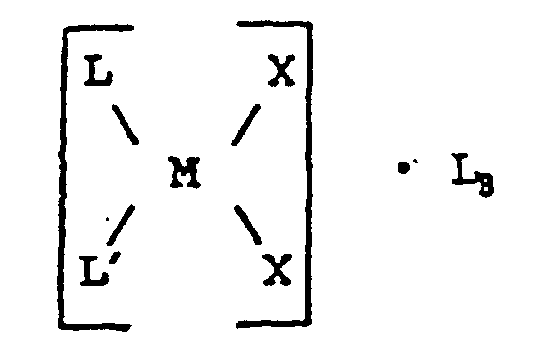
- the catalysts of this invention have the general formula
- L is a ligand having the formula L' is Cp, Cp*, indenyl, fluorenyl, NR 2 , OR, or halogen
- L can be bridged to L'
- X is halogen, NR 2 , OR, or alkyl from C 1 to C 12
- M is titanium, zirconium, or hafnium
- R is alkyl from C 1 to C 12 or aryl from C 6 to C 12
- R 1 is R, Si(R) 3 , or R 4
- R 4 is alkaryl from C 6 to C 12 aralkyl from C 6 to C 12 , or hydrogen
- R 2 is R 1 , R 4 , halogen, COR, COOR, SOR, or SOOR
- R 3 is R 2 , Si(R) 3 , OR, N(R) 2 , SR, or a fused ring system
- n is 0 to 3
- L B is an optional Lewis base
- Cp is cyclopen
- the L' ligand is preferably cp, Cp*, as those compounds are easy to make and have good activity.
- the X group is preferably halogen and most preferably chlorine as those compounds are more readily available.
- the R group is preferably alkyl from C 1 to C 4 , the R 1 group is preferably alkyl from C 3 to C 12 or aryl, the R 2 group is preferably t-butyl and the R 3 group is preferably hydrogen or methyl as those compounds are easier to make. Examples of fused ring structures that can be used for R 3 include
- the metal M is preferably zirconium, as the zirconium catalysts offer a good combination of activity and stability.
- L can be bridged to L'.
- Groups that can be used to bridged the two ligands include methylene, ethylene, 1,2-phenylene, dimethylsilyl, diphenylsilyl, diethylsilyl, and methylphenylsilyl. Normally, only a single bridge is used in a catalyst. It is believed that bridging the ligands changes the geometry around the catalytically active transition metal and improves the catalyst activity and other properties, such as comonomer incorporation and thermal stability.
- L B is an optional Lewis base. Up to an equimolar amount (with M) of base can be used. The use of the Lewis base is generally not preferred because it tends to decrease catalyst activity. However, it also tends to improve catalyst stability, so its inclusion may be desirable, depending upon the process in which the catalyst is to be used.
- the base may be residual solvent from the preparation of the azaboroline containing compound or it may be added separately in order to enhance the properties of the catalyst.
- bases examples include ethers such as diethylether, dibutylether, tetrahydrofuran, 1,2-dimethoxyethane, esters such as n-butylphthalate, ethylbenzoate, and ethyl p-anisate, tertiary amines such as triethylamine, and phosphines such as triethyl phosphine, tributyl phosphine, and triphenyl phosphine.
- ethers such as diethylether, dibutylether, tetrahydrofuran, 1,2-dimethoxyethane
- esters such as n-butylphthalate, ethylbenzoate, and ethyl p-anisate
- tertiary amines such as triethylamine
- phosphines such as triethyl phosphine, tributyl phosphin
- the catalysts of this invention can be prepared from commercially available starting materials. Specific starting materials that may not be commercially available can be prepared by techniques well-known in the literature as exemplified by the following.
- the azaboroline ligand precursor for the catalysts can be prepared from allyl amine by reacting its dianion (generated by a strong base) with an alkyl boron dihalide as described in the literature (J. Schulze, G. Schmid, J. Organomet. Chem., 193 , 1980, p. 83).
- strong bases that can be used include alkyl lithium compounds such as n-butyl lithium, methyl lithium, and hydrides such as sodium hydride and potassium hydride.
- allyl amine Two moles of base are used per mole of the allyl amine. This reaction will occur at room temperature in several hours in a hydrocarbon solvent such as pentane or hexane. Tetramethylethylene diamine in a 1:1 molar ratio with the allyl amine can be used to stabilize the alkyl lithium. The product can be isolated by vacuum and distilled to purify.
- the product is reacted with a base such as a hindered lithium reagent (e.g., lithium tetramethylpiperidide) to generate the azaborolinyl anion as described in the literature (G. Schmid et al., Chem. Ber., 115 , 1982, p. 3830):
- a base such as a hindered lithium reagent (e.g., lithium tetramethylpiperidide) to generate the azaborolinyl anion as described in the literature (G. Schmid et al., Chem. Ber., 115 , 1982, p. 3830):
- the product of the second step is cooled to about -60°C and MX 4 or MCpX 3 is added.
- the reactants are warmed to room temperature and the reaction is complete when the reactants dissolve and LiX precipitates:
- the catalyst is normally used in conjunction with an organometallic co-catalyst, it is preferable to dissolve the catalyst in a solvent in which the co-catalyst is also soluble.
- a solvent in which the co-catalyst is also soluble.
- MAO methylaluminoxane
- toluene, xylene, benzene, or ethylbenzene could be used as the solvent.
- co-catalysts include aluminum alkyls having the formula AlR' x (R 2 ) 3-x , where 1 ⁇ x ⁇ 3 and R 2 is hydrogen, halide, or alkyl or alkoxide from C 1 to C 20 , such as triethylaluminum and ethylaluminum dichloride.
- the preferred co-catalyst is MAO as it results in high activity and a polymer having a narrower molecular weight distribution.
- the mole ratio of the organometallic co-catalyst to catalyst when used in a polymerization is generally in the range 0.01:1 to 100,000:1, and preferably ranges from 1:1 to 10,000:1.
- An alternative co-catalyst is an acid salt that contains a non-coordinating inert anion (see U.S. Patent No. 5,064,802).
- the acid salt is generally a non-nucleophilic compound that consists of bulky ligands attached to a boron or aluminum atom, such as lithium tetrakis(pentafluorophenyl) borate, lithium tetrakis(pentafluorophenyl)aluminate, anilinium tetrakis(pentafluorophenyl) borate, N,N-dimethylanilinium tetrakis(pentafluorophenyl) borate, trityl tetrakis(pentafluorophenyl) borate, and mixtures thereof.
- the anion which results when these compounds react with the catalyst is believed to be weakly coordinated to the metal-containing cation.
- the mole ratio of acid salt to catalyst can range from about 0.01:1 to about 1000:1, but is preferably about 1:1 to 10:1. While there is no limitation on the method of preparing an active catalyst system from the catalyst and the acid salt, preferably they are mixed in an inert solvent at temperatures in the range of about -78°C to about 150°C. They can also be mixed in the presence of monomer if desired.
- the acid salt can be used in combination with the organometallic cocatalysts described earlier.
- the catalyst and co-catalyst can be used on a support such as silica gel, alumina, silica, magnesia, or titania, but supports are not preferred as they may leave contaminants in the polymer.
- a support may be required depending upon the process being utilized. For example, a support is generally needed in gas phase polymerization processes and slurry polymerization processes in order to control the particle size of the polymer being produced and in order to prevent fouling of the reactor walls.
- the support may also increase the thermal stability of the catalyst.
- the catalyst and co-catalyst are dissolved in the solvent and are precipitated onto the support material by, for example, evaporating the solvent.
- the co-catalyst can also be deposited on the support or it can be introduced into the reactor separately from the supported catalyst.
- the catalyst is used in a conventional manner in the polymerization of olefinic hydrocarbon monomers. While unsaturated monomers such as styrene can be polymerized using the catalysts of this invention, it is particularly useful for polymerizing ⁇ -olefins such as propylene, 1-butylene, 1-hexene, 1-octene, and especially ethylene.
- the catalyst is also useful in a conventional manner for copolymerizing mixtures of unsaturated monomers such as ethylene, propylene, 1-butene, 1-hexene, 1-octene, and the like; mixtures of ethylene and di-olefins such as 1,3-butadieue, 1,4-hexadiene, 1,5-hexadiene, and the like and mixtures of ethylene and unsaturated comonomers such as norbornene, ethylidene norbornene, vinyl norbornene, norbornadiene, and the like.
- unsaturated monomers such as ethylene, propylene, 1-butene, 1-hexene, 1-octene, and the like
- mixtures of ethylene and di-olefins such as 1,3-butadieue, 1,4-hexadiene, 1,5-hexadiene, and the like
- mixtures of ethylene and unsaturated comonomers such as norbornene,
- the catalysts of this invention can be utilized in a variety of different polymerization processes. They can be utilized in a liquid phase polymerization process (slurry, solution, suspension, bulk phase, or a combination of these), in a high pressure fluid phase, or in a gas phase polymerization process. The processes can be used in series or as individual single processes.
- the pressure in the polymerization reaction zones can range from about 15 psia to about 50,000 psia and the temperature can range from about -100°C to about 300°C.
- 2-Methyl-l-tert-butyl-1,2-azaborolinyllithium was prepared by adding a solution of 0.438 g (3.2 mmol) of 2-methyl-1-tert-butyl- ⁇ 3 -1,2-azaboroline (prepared according to the literature procedure: J. Schultze and G. Schmid, J. Organomet. Chem. , 1980 , 193, 83-91) in 6 mL of dry THF to a cold (-78°C) solution of lithium 2,2,6,6-tetramethylpiperidide (3.2 mmol) which had been prepared by reaction of equimolar amounts of 2,2,6,6-tetramethylpiperidine and n-butyllithium/hexanes in 10 mL THF.
- 2-Methyl-1-tert-butyl-1,2-azaborolinyllithium was prepared by adding a solution of 0.438 g (3.2 mmol) of 2-methyl-1-tert-butyl- ⁇ 3 -1,2-azaboroline (prepared according to the literature procedure: J. Schultze and G. Schmid, J. Organomet. Chem., 1980, 193, 83-91) in 10 mL of dry toluene to a cold (-78°C) solution of lithium 2,2,6,6-tetramethylpiperidide (3.2 mmol; prepared by reaction of equimolar amounts of 2,2,6,6-tetramethylpiperidine and n-butyllithium/hexanes in 15 mL THF).
- the ethylene was polymerized using the catalyst prepared according to Method 2A.
- the polymerizations were conducted in a stirred 1.7 liter autoclave at 80 to 110°C. Dry, oxygen-free toluene (840 ml) was charged to a clean, dry, oxygen-free reactor.
- MAO from Ethyl Corporation (10 wt% in toluene) was used in the polymerizations. The desired amount of MAO to give the ratio shown in the table which follows was added by syringe at 30°C.
- the reactor was heated to the desired temperature and sufficient ethylene was added to bring the reactor pressure to 150 psig.
- the reactor was allowed to equilibrate at the desired temperature and pressure.
- a solution of catalyst was prepared by dissolving 0.100 grams of product in 100 ml of toluene. The co-catalyst was injected into the reactor first and the catalyst was injected separately. The amount of this solution needed to give the amount of catalyst shown in the table was used to start a polymerization. Ethylene flowed into the reactor as needed in order to keep the pressure constant at 150 psig as polymer was produced.
- the melt index of the polymer was measured according to ASTM D-1238, Condition E and Condition F.
- MI2 is the melt index measured with a 2.16 kg weight (Condition E).
- MI20 is the melt index measured with a 21.6 kg weight (Condition F).
- MFR is the ratio of MI20 to MI2.
- the polymer density was measured according to ASTM D-1505.
- the molecular weight distribution of the polymer was measured using a Waters 150C gel permeation chromatograph at 135°C with 1,2,4-trichlorobenzene as the solvent. Both weight average molecular weight (M w ) and ratio of M w to M n (number average molecular weight) were used to characterize the molecular weight distribution.
- Solution polymerizations were conducted in a stirred 2.0 liter stainless steel autoclave at 150°C. 1.0 liter of dry, oxygen-free Isopar® G (from Exxon Chemical Company) was charged to the clean, dry, oxygen-free reactor. The reactor was then allowed to equilibrate at 150°C. It was pressured with sufficient ethylene to give an ethylene partial pressure of 150 psig. No hydrogen or co-monomer were added.
- a solution of catalyst described in Example 2 was mixed with a solution containing 10% methylaminumoxane (MAO) in toluene (from Albemarle Corporation and used without further purification). This mixture was stirred for 15 minutes. 10.0 ml of this mixture was injected into the reactor to start the polymerization. The amount of catalyst and MAO in the 10.0 ml is shown in Table 3 along with the experimental conditions. Ethylene was fed to the reactor in order to keep the pressure constant.
- MAO methylaminumoxane
Landscapes
- Chemical & Material Sciences (AREA)
- Organic Chemistry (AREA)
- Chemical Kinetics & Catalysis (AREA)
- Engineering & Computer Science (AREA)
- Materials Engineering (AREA)
- Health & Medical Sciences (AREA)
- Medicinal Chemistry (AREA)
- Polymers & Plastics (AREA)
- Inorganic Chemistry (AREA)
- Crystallography & Structural Chemistry (AREA)
- Transition And Organic Metals Composition Catalysts For Addition Polymerization (AREA)
Abstract
Description
- This invention relates to catalysts useful in homo- and co-polymerizing ethylene and other olefinic hydrocarbons. In particular, it relates to catalysts containing a transition metal π-bonded to a ligand that contains an azaboroline ring.
- Until recently, polyolefins have been primarily made with conventional Ziegler catalyst systems. These catalysts typically consist of transition metal-containing compounds and one or more organometallic compound. For example, polyethylene has been made using Ziegler catalysts such as titanium trichloride and diethylaluminum chloride, or a mixture of titanium tetrachloride, vanadium oxytrichloride, and triethylaluminum. These catalysts are inexpensive but they have low activity and therefore must be used at high concentrations. As a result, it is sometimes necessary to remove catalyst residues from the polymer, which adds to production costs. Neutralizing agents and stabilizers must be added to the polymer to overcome the deleterious effects of the catalyst residues. Failure to remove catalyst residues leads to polymers having a yellow or grey color and poor ultraviolet and long term stability. For example, chloride-containing residues can cause corrosion in polymer processing equipment. Furthermore, Ziegler catalysts produce polymers having a broad molecular weight distribution, which is undesirable for some applications such as injection molding. They are also poor at incorporating α-olefin co-monomers. Poor co-monomer incorporation makes it difficult to control the polymer density. Large quantities of excess co-monomer may be required to achieve a certain density and many higher α-olefins, such as 1-octene, may be incorporated at only very low levels, if at all.
- Although substantial improvements in Ziegler catalyst systems have occurred since their discovery, these catalysts are now being replaced with the recently discovered metallocene catalyst systems. A metallocene catalyst typically consists of a transition metal compound which has one or more cyclopentadienyl ring ligands. They have low activities when used with organometallic compounds, such as aluminum alkyls, which are used with traditional Ziegler catalysts, but very high activities when used with aluminoxanes as cocatalysts. The activities are generally so high that catalyst residues need not be removed from the polymer. Furthermore, they produce polymers with high molecular weights and narrow molecular weight distributions. They also incorporate α-olefin co-monomers well. However, at higher temperatures metallocene catalysts tend to produce lower molecular weight polymers. Thus, they are useful for gas phase and slurry polymerizations of ethylene, which are conducted at about 80°C to about 95°C, but they do not generally work well in solution polymerizations of ethylene, at about 150°C to about 250°C. The polymerization of ethylene in solution is desirable because it allows great flexibility for producing polymers over a wide range of molecular weights and densities as well as the use of a large variety of different co-monomers. One can produce polymers that are useful in many different applications. For example, high molecular weight, high density polyethylene (PE) film useful as a barrier film for food packaging and low density ethylene co-polymers with good toughness and high impact strength.
- In EP 0 590 486 A2 a catalyst for polymerising olefines is disclosed comprising a ring structure with a heteroatom and a transition metal with high activity and resulting homo- or copolymers with high molecular weight, narrow comonomer distribution and narrow range of molecular weight distribution.
- According to the working examples for the hetero atom phosphorus (P) is preferred.
- We have found a new class of catalysts based on an azaboroline ring structure and containing a transition metal. The catalysts of this invention have unusually high activities, which means that they can be used in very small quantities. They are also very good at incorporating co-monomers into the polymer. They have good activity at higher temperatures and are therefore expected to be useful in solution polymerizations of ethylene.
- We have also discovered that the hydrogen response of monomers polymerized with the catalysts of this invention is better than with other catalysts. That is, when the catalysts of this invention are used to polymerize monomers, small variations in the amount of hydrogen present have a large effect on the molecular weight of the resulting polymer.
- The catalysts of this invention have the general formula

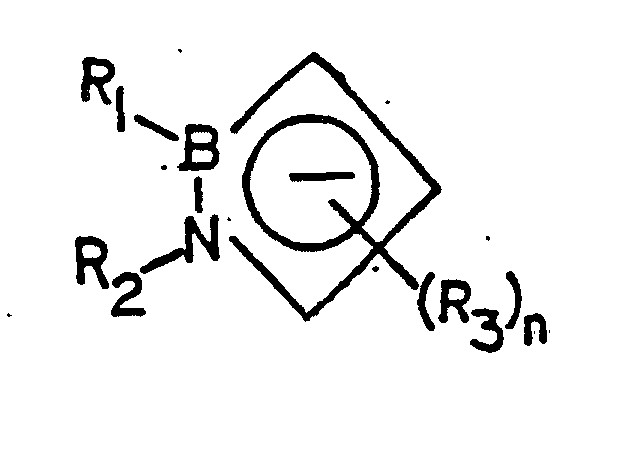
- Where L is a ligand having the formulaL' is Cp, Cp*, indenyl, fluorenyl, NR2, OR, or halogen, L can be bridged to L', X is halogen, NR2, OR, or alkyl from C1 to C12, M is titanium, zirconium, or hafnium, R is alkyl from C1 to C12 or aryl from C6 to C12, R1 is R, Si(R)3, or R4, R4 is alkaryl from C6 to C12 aralkyl from C6 to C12, or hydrogen, R2 is R1, R4, halogen, COR, COOR, SOR, or SOOR, R3 is R2, Si(R)3, OR, N(R)2, SR, or a fused ring system, n is 0 to 3, and LB is an optional Lewis base, Cp is cyclopentadienyl, and Cp* is pentamethylcyclopentadienyl, or a catalyst having the general formula
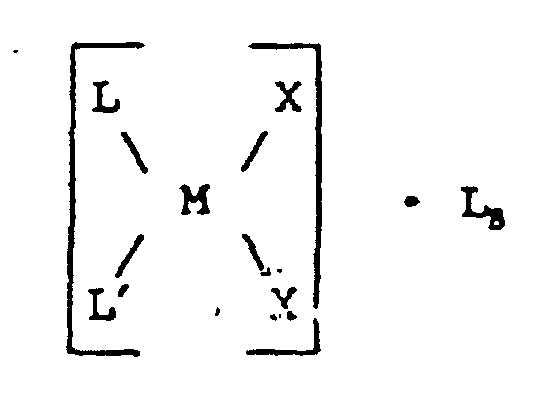
 where L is a ligand having the formula
 L' is L, cyclopentadienyl, pentamethylcyclopentadienyl, indenyl, fluorenyl, NR2, OR, or halogen, L can be bridged to L', X is halogen, NR2, OR, or alkyl from C1 to C12, M is titanium, zirconium, or hafnium, R is alkyl from C1 to C12 or aryl from C6 to C12, R1 is a C6 to C12 aryl group, a C6 to C12 alkaryl group, a C6 to C12 aralkyl group, hydrogen, or Si(R)3, R2 is R1, a C1 to C12 alkyl group, halogen, COR, COOR, SOR, or SOOR, R3 is R2, OR, N(R)2, SR, or a fused ring system, n is 0 to 3, and LB is an optional Lewis base.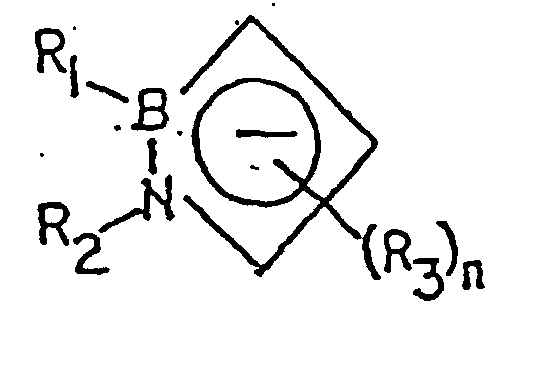
- The L' ligand is preferably cp, Cp*, as those compounds are easy to make and have good activity. The X group is preferably halogen and most preferably chlorine as those compounds are more readily available. The R group is preferably alkyl from C1 to C4, the R1 group is preferably alkyl from C3 to C12 or aryl, the R2 group is preferably t-butyl and the R3 group is preferably hydrogen or methyl as those compounds are easier to make. Examples of fused ring structures that can be used for R3 includeThe metal M is preferably zirconium, as the zirconium catalysts offer a good combination of activity and stability.

- Optionally, L can be bridged to L'. Groups that can be used to bridged the two ligands include methylene, ethylene, 1,2-phenylene, dimethylsilyl, diphenylsilyl, diethylsilyl, and methylphenylsilyl. Normally, only a single bridge is used in a catalyst. It is believed that bridging the ligands changes the geometry around the catalytically active transition metal and improves the catalyst activity and other properties, such as comonomer incorporation and thermal stability.
- In the general formula, LB is an optional Lewis base. Up to an equimolar amount (with M) of base can be used. The use of the Lewis base is generally not preferred because it tends to decrease catalyst activity. However, it also tends to improve catalyst stability, so its inclusion may be desirable, depending upon the process in which the catalyst is to be used. The base may be residual solvent from the preparation of the azaboroline containing compound or it may be added separately in order to enhance the properties of the catalyst. Examples of bases that can be used in this invention include ethers such as diethylether, dibutylether, tetrahydrofuran, 1,2-dimethoxyethane, esters such as n-butylphthalate, ethylbenzoate, and ethyl p-anisate, tertiary amines such as triethylamine, and phosphines such as triethyl phosphine, tributyl phosphine, and triphenyl phosphine.
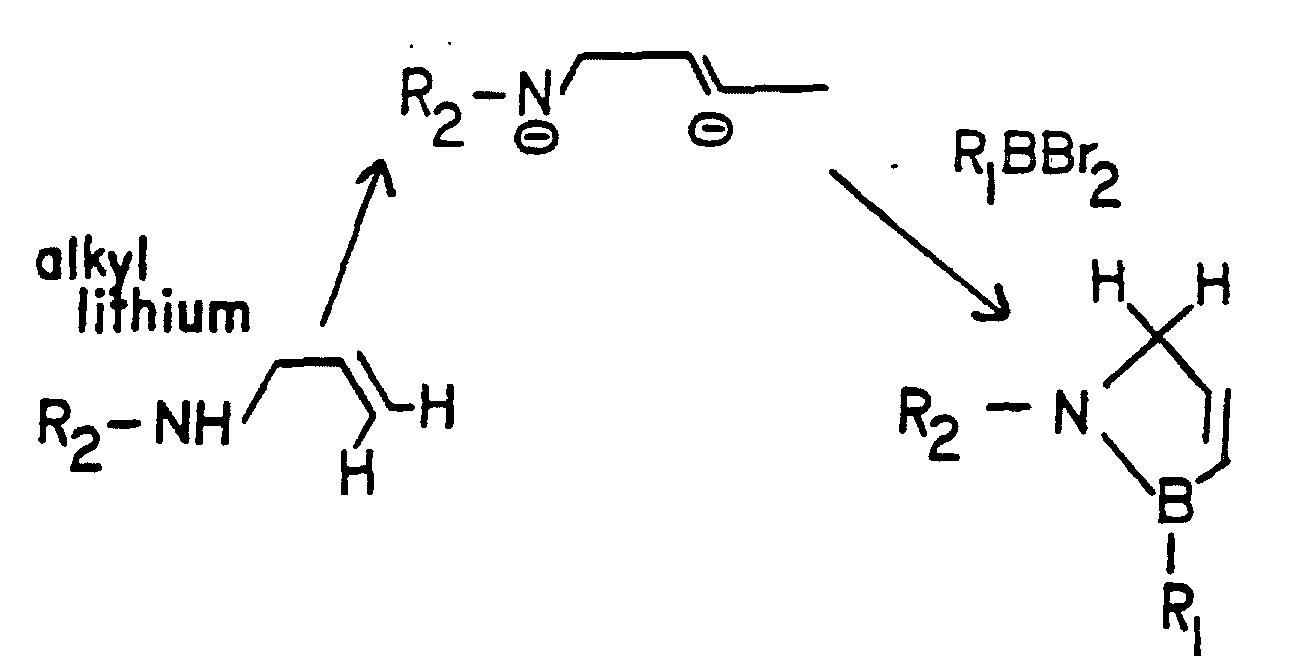
- The catalysts of this invention can be prepared from commercially available starting materials. Specific starting materials that may not be commercially available can be prepared by techniques well-known in the literature as exemplified by the following. The azaboroline ligand precursor for the catalysts can be prepared from allyl amine by reacting its dianion (generated by a strong base) with an alkyl boron dihalide as described in the literature (J. Schulze, G. Schmid, J. Organomet. Chem., 193, 1980, p. 83).Examples of strong bases that can be used include alkyl lithium compounds such as n-butyl lithium, methyl lithium, and hydrides such as sodium hydride and potassium hydride. Two moles of base are used per mole of the allyl amine. This reaction will occur at room temperature in several hours in a hydrocarbon solvent such as pentane or hexane. Tetramethylethylene diamine in a 1:1 molar ratio with the allyl amine can be used to stabilize the alkyl lithium. The product can be isolated by vacuum and distilled to purify.
- In the next step, the product is reacted with a base such as a hindered lithium reagent (e.g., lithium tetramethylpiperidide) to generate the azaborolinyl anion as described in the literature (G. Schmid et al., Chem. Ber., 115, 1982, p. 3830):

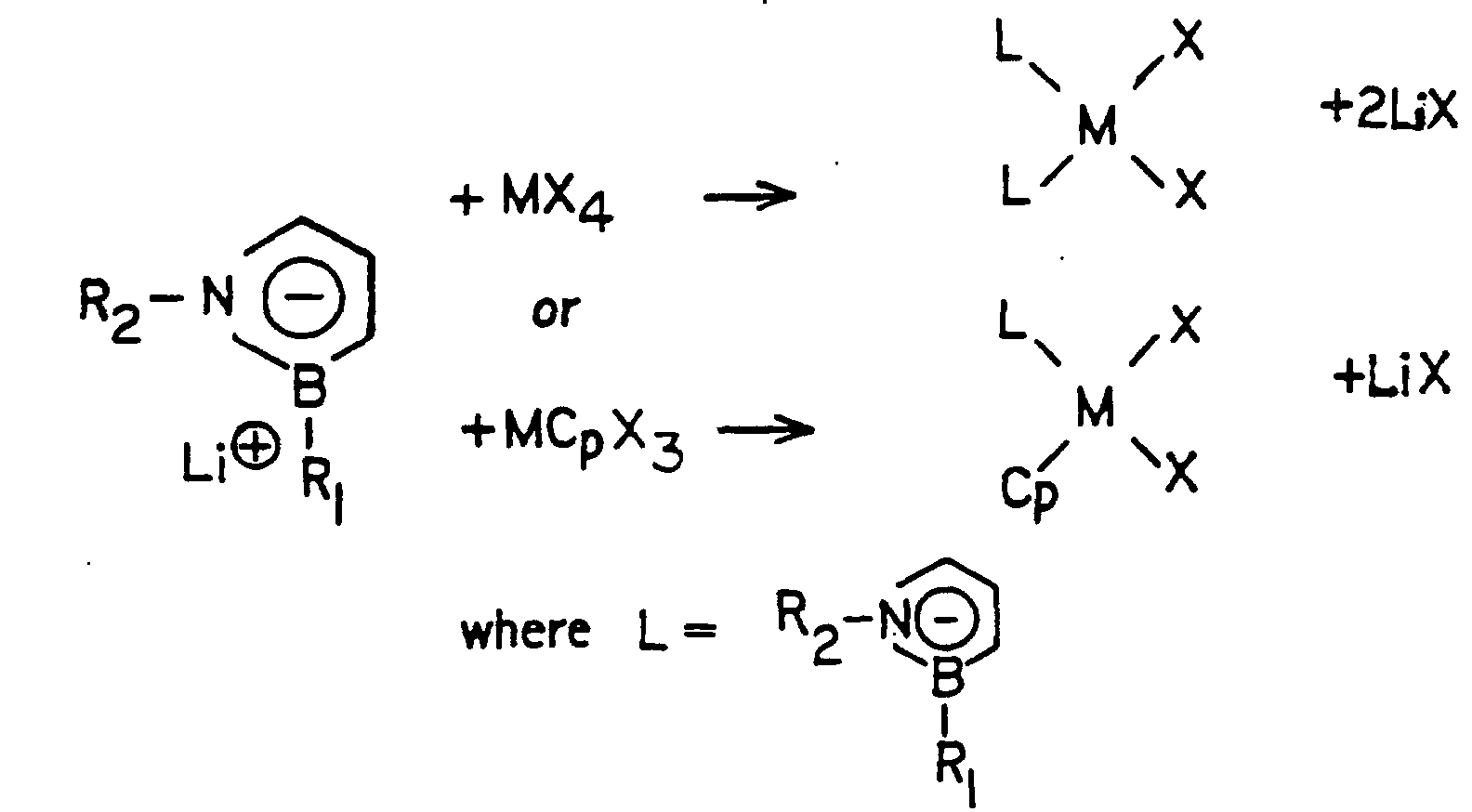
- In the final step, the product of the second step is cooled to about -60°C and MX4 or MCpX3 is added. The reactants are warmed to room temperature and the reaction is complete when the reactants dissolve and LiX precipitates:
- Since the catalyst is normally used in conjunction with an organometallic co-catalyst, it is preferable to dissolve the catalyst in a solvent in which the co-catalyst is also soluble. For example, if methylaluminoxane (MAO) is the co-catalyst then toluene, xylene, benzene, or ethylbenzene could be used as the solvent. Other suitable co-catalysts include aluminum alkyls having the formula AlR'x(R2)3-x, where 1 ≤ x ≤3 and R2 is hydrogen, halide, or alkyl or alkoxide from C1 to C20, such as triethylaluminum and ethylaluminum dichloride. The preferred co-catalyst is MAO as it results in high activity and a polymer having a narrower molecular weight distribution. The mole ratio of the organometallic co-catalyst to catalyst when used in a polymerization is generally in the range 0.01:1 to 100,000:1, and preferably ranges from 1:1 to 10,000:1.
- An alternative co-catalyst is an acid salt that contains a non-coordinating inert anion (see U.S. Patent No. 5,064,802). The acid salt is generally a non-nucleophilic compound that consists of bulky ligands attached to a boron or aluminum atom, such as lithium tetrakis(pentafluorophenyl) borate, lithium tetrakis(pentafluorophenyl)aluminate, anilinium tetrakis(pentafluorophenyl) borate, N,N-dimethylanilinium tetrakis(pentafluorophenyl) borate, trityl tetrakis(pentafluorophenyl) borate, and mixtures thereof. The anion which results when these compounds react with the catalyst is believed to be weakly coordinated to the metal-containing cation. The mole ratio of acid salt to catalyst can range from about 0.01:1 to about 1000:1, but is preferably about 1:1 to 10:1. While there is no limitation on the method of preparing an active catalyst system from the catalyst and the acid salt, preferably they are mixed in an inert solvent at temperatures in the range of about -78°C to about 150°C. They can also be mixed in the presence of monomer if desired. The acid salt can be used in combination with the organometallic cocatalysts described earlier.
- The catalyst and co-catalyst can be used on a support such as silica gel, alumina, silica, magnesia, or titania, but supports are not preferred as they may leave contaminants in the polymer. However, a support may be required depending upon the process being utilized. For example, a support is generally needed in gas phase polymerization processes and slurry polymerization processes in order to control the particle size of the polymer being produced and in order to prevent fouling of the reactor walls. The support may also increase the thermal stability of the catalyst. To use a support, the catalyst and co-catalyst are dissolved in the solvent and are precipitated onto the support material by, for example, evaporating the solvent. The co-catalyst can also be deposited on the support or it can be introduced into the reactor separately from the supported catalyst.
- Once the catalyst has been prepared it should be used as promptly as possible as it may lose some activity during storage. Storage of the catalyst should be at a low temperature, such as -100 to about 20°C. The catalyst is used in a conventional manner in the polymerization of olefinic hydrocarbon monomers. While unsaturated monomers such as styrene can be polymerized using the catalysts of this invention, it is particularly useful for polymerizing α-olefins such as propylene, 1-butylene, 1-hexene, 1-octene, and especially ethylene.
- The catalyst is also useful in a conventional manner for copolymerizing mixtures of unsaturated monomers such as ethylene, propylene, 1-butene, 1-hexene, 1-octene, and the like; mixtures of ethylene and di-olefins such as 1,3-butadieue, 1,4-hexadiene, 1,5-hexadiene, and the like and mixtures of ethylene and unsaturated comonomers such as norbornene, ethylidene norbornene, vinyl norbornene, norbornadiene, and the like.
- The catalysts of this invention can be utilized in a variety of different polymerization processes. They can be utilized in a liquid phase polymerization process (slurry, solution, suspension, bulk phase, or a combination of these), in a high pressure fluid phase, or in a gas phase polymerization process. The processes can be used in series or as individual single processes. The pressure in the polymerization reaction zones can range from about 15 psia to about 50,000 psia and the temperature can range from about -100°C to about 300°C.
- The following examples further illustrate this invention.
- 2-Methyl-l-tert-butyl-1,2-azaborolinyllithium was prepared by adding a solution of 0.438 g (3.2 mmol) of 2-methyl-1-tert-butyl-Δ3-1,2-azaboroline (prepared according to the literature procedure: J. Schultze and G. Schmid, J. Organomet. Chem., 1980, 193, 83-91) in 6 mL of dry THF to a cold (-78°C) solution of lithium 2,2,6,6-tetramethylpiperidide (3.2 mmol) which had been prepared by reaction of equimolar amounts of 2,2,6,6-tetramethylpiperidine and n-butyllithium/hexanes in 10 mL THF. The cold bath was allowed to warm up to 10°C over 1.5 hours after which the solvents were removed under vacuum. The yellow oily residue was treated with 35 mL toluene to give a yellow slurry. This was cooled to -60°C and zirconium (IV) chloride (0.37 g, 1.6 mmol) was added with good stirring. The bath was warmed to room temperature and the mixture stirred overnight. The solvent was evaporated under vacuum and residue was treated with 30 mL toluene and lithium chloride filtered off. The toluene filtrate was concentrated and the sticky yellow residue was extracted with hexane (2 X 15 mL) and filtered. Evaporation of hexane filtrate gave 0.14 g of a yellow solid. 1H NMR spectrum of the material showed it to be a ca. 2/3 mixture of Bis (1-tert-butyl-2-methyl-n5-1,2-azaborolinyl) zirconium dichloride and (1-tert-butyl-2-methyl-n5-1,2-azaborolinyl) zirconium trichloride, the desired compound.
- A solution of 2-methyl-1-tert-butyl-1,2-azaborolinyllithium prepared from 2-methyl-1-tert-butyl-Δ3-1,2-azaboroline (0.49 g, 3.5 mmol) in 20 mL THF as described above, was added dropwise via syringe to a stirred cold (-35°C) solution of cyclopentadienylzirconium trichloride (0.93 g, 3.52 mmol) in 50 mL THF. The bath was allowed to warm to room temperature and the mixture stirred overnight. The solvents were evaporated in vacuo and residue extracted with 35 mL toluene and filtered. The precipitate was washed with 10 mL toluene and the combined filtrate was evaporated. The resulting gummy residue was stirred with 25 mL dry hexane which produced a beige solid and a pale yellow supernatant. The mixture was filtered and the solid dried to give 0.77 g of product as a tan-colored amorphous powder. 1H NMR spectrum of the material indicated it to be desired product contaminated with some impurities.
- 2-Methyl-1-tert-butyl-1,2-azaborolinyllithium was prepared by adding a solution of 0.438 g (3.2 mmol) of 2-methyl-1-tert-butyl-Δ3-1,2-azaboroline (prepared according to the literature procedure: J. Schultze and G. Schmid, J. Organomet. Chem., 1980, 193, 83-91) in 10 mL of dry toluene to a cold (-78°C) solution of lithium 2,2,6,6-tetramethylpiperidide (3.2 mmol; prepared by reaction of equimolar amounts of 2,2,6,6-tetramethylpiperidine and n-butyllithium/hexanes in 15 mL THF). The solvents were evaporated in vacuo to one-third the initial volume, the solution was cooled to -78°C and 35 mL dry toluene was added. The clear yellow solution was stirred well while cyclopentadienylzirconium trichloride (0.84 g, 3.2 mmol) was added via transfer tube. The bath was warmed to room temperature and stirred overnight. The reaction mixture was filtered, and filtrate evaporated to dryness. To the solid residue was added 20 mL toluene and the mixture was filtered to remove a dark insoluble material from a yellow filtrate. The filtrate was concentrated to give 0.34 g of a yellow amorphous powder whose 1H NMR spectrum indicated it to be the desired product.
- The ethylene was polymerized using the catalyst prepared according to Method 2A. The polymerizations were conducted in a stirred 1.7 liter autoclave at 80 to 110°C. Dry, oxygen-free toluene (840 ml) was charged to a clean, dry, oxygen-free reactor. MAO from Ethyl Corporation (10 wt% in toluene) was used in the polymerizations. The desired amount of MAO to give the ratio shown in the table which follows was added by syringe at 30°C. The reactor was heated to the desired temperature and sufficient ethylene was added to bring the reactor pressure to 150 psig. The reactor was allowed to equilibrate at the desired temperature and pressure. A solution of catalyst was prepared by dissolving 0.100 grams of product in 100 ml of toluene. The co-catalyst was injected into the reactor first and the catalyst was injected separately. The amount of this solution needed to give the amount of catalyst shown in the table was used to start a polymerization. Ethylene flowed into the reactor as needed in order to keep the pressure constant at 150 psig as polymer was produced.
- At the end of 1 hour (less, if the activity was very high) the ethylene flow was stopped and the reactor was rapidly cooled to room temperature. The reactor was opened and the polymer was filtered from the toluene. The product was dried overnight in a vacuum oven and weighed. Table 1 gives the reaction conditions and Table 2 gives the results of polymerizations.


- The melt index of the polymer was measured according to ASTM D-1238, Condition E and Condition F. MI2 is the melt index measured with a 2.16 kg weight (Condition E). MI20 is the melt index measured with a 21.6 kg weight (Condition F). MFR is the ratio of MI20 to MI2. The polymer density was measured according to ASTM D-1505. The molecular weight distribution of the polymer was measured using a Waters 150C gel permeation chromatograph at 135°C with 1,2,4-trichlorobenzene as the solvent. Both weight average molecular weight (Mw) and ratio of Mw to Mn (number average molecular weight) were used to characterize the molecular weight distribution.
- Solution polymerizations were conducted in a stirred 2.0 liter stainless steel autoclave at 150°C. 1.0 liter of dry, oxygen-free Isopar® G (from Exxon Chemical Company) was charged to the clean, dry, oxygen-free reactor. The reactor was then allowed to equilibrate at 150°C. It was pressured with sufficient ethylene to give an ethylene partial pressure of 150 psig. No hydrogen or co-monomer were added. A solution of catalyst described in Example 2 was mixed with a solution containing 10% methylaminumoxane (MAO) in toluene (from Albemarle Corporation and used without further purification). This mixture was stirred for 15 minutes. 10.0 ml of this mixture was injected into the reactor to start the polymerization. The amount of catalyst and MAO in the 10.0 ml is shown in Table 3 along with the experimental conditions. Ethylene was fed to the reactor in order to keep the pressure constant.
- At the end of 15 minutes the ethylene flow was stopped and the reaction mixture was transferred to a vessel containing a solution of an antioxidant in Isopar® G The solution was cooled to room temperature overnight. The polymer was filtered from the solvent by vacuum filtration. It was dried overnight in a vacuum oven and weighed. The weight of the polymer was 12.1 grams. The polymer MI2 was 118 dg/min. Additional polymer properties are shown in Table 2.
- Slurry polymerization were conducted in a manner identical to that described in Examples 3 through 11. The catalyst described in Example 1 was used in those polymerizations. The polymerization conditions are shown in Table 3. The properties of the polymers which were produced are shown in Table 4.


Claims (20)
- A catalyst having the general formulawhere L is a ligand having the formula
 L' is cyclopentadienyl, pentamethpsyclopentadienyl, indenyl, fluorenyl, NR2, OR, or halogen, L' can be bridged to L; X is halogen, NR2, OR, or alkyl from C1 to C12, M is titanium, zirconium or hafnium, R is alkyl from C1 to C12 or aryl from C6 to C12, R1 is R, Si(R)3, or R4, R4 is alkaryl from C6 to C12, aralkyl from C6 to C12, or hydrogen, R2 is R, R4, halogen, COR, COOR, SOR, or SOOR, R3 is R2, Si(R)3 OR, N(R)2, SR, or a fused ring system, n is 0 to 3, and LB is an optional Lewis base.
- A catalyst according to Claim 1 wherein L' is cyclopentadienyl or pentamethylcyclopentadienyl, X is chlorine, M is zirconium, R is alkyl from C1 to C4, R1 is alkyl from C3 to C12 or aryl, R2 is t-butyl, and R3 is hydrogen or methyl.
- A catalyst according to Claim 1 which is (1-tert-butyl-2-methyl-n5-1,2-azaborolinyl) zirconium trichloride.
- A method of making a poly-α-olefin comprising polymerizing an α-olefin monomer using a catalyst that has the general formulawhere L is a ligand having the formula
 L' is cyclopentadienyl, pentamethylcydopentadienyl, indenyl, fiuorenyl, NR2, OR, or halogen, L' can be bridged to L; X is halogen, NR2, OR, or alkyl from C1 to C12, M is zirconium, titanium, or hafnium, R is alkyl from C1 to C12 or aryl from C6 to C12, R1 is R, Si(R)3, or R4, R4 is alkaryl from C6 to C12, aralkyl from C6 to C12, or hydrogen, R2 is R, R4, halogen, COR, COOR, SOR, or SOOR, R3 is R2, Si(R)3, OR, N(R)2, SR, or a fused ring system, n is 0 to 3, and LB is an optional Lewis base.
- A method according to Claim 4 wherein L' is cyclopentadienyl or pentamethylcyclopentadienyl.
- A method according to Claim 4 wherein X is halogen.
- A method according to Claim 6 wherein X is chlorine.
- A method according to Claim 4 wherein M is zirconium.
- A method according to Claim 4 wherein R is alkyl from C1 to C4.
- A method according to Claim 4 wherein R1' is alkyl from C3 to C12 or aryl.
- A method according to Claim 4 wherein R2 is t-butyl.
- A method according to Claim 4 wherein R3 is hydrogen or methyl.
- A method according to Claim 4 wherein said catalyst is used with 0.01 to 100,000 moles of an organometallic cocatalyst per mole of said catalyst.
- A method according to Claim 13 wherein said organometallic cocatalyst is methylaluminoxane.
- A method according to Claim 4 wherein said catalyst is used with 0.01 to 1000 moles of an acid salt that contains a non-coordinating inert anion per mole of said catalyst.
- A method according to Claim 15 wherein said acid salt is selected from the group consisting of lithium tetrakis (pentafluorophenyl) borate, lithium tetrakis (pentafluorophenyl) aluminate, anilinium tetrakis (pentafluorophenyl) borate, N,N-dimethylanilinium tetrakis (pentafluorophenyl) borate, trityl tetrakis (pentafluorophenyl) borate, and . mixtures thereof.
- A method of making a poly-α-olefin comprising polymerizing an α-cleftn monomer using a ctalyst that has the general formulawhere L is a ligand having the formula
 L' is cyclopentadienyl or pentamethylcyclopentadienyl, L' can be bridged to L, X is chlorine, M is zirconium, R is alkyl from C1 to C4, R1 is alkyl from C3 to C12 or aryl, R2 is t-butyl, R3 is hydrogen or methyl, n is 0 to 3, and LB is an optional Lewis base.
- A method according to Claim 17 wherein said catalyst is (1-tert-butyl-2-methyl-n5-1,2-azaborolinyl) zirconium trichloride.
- A catalyst according to Claim 1 wherein M is zirconium.
- A catalyst having the general formulawhere L is a ligand having the formula
 L' is L, cyclopentadienyl, pentamethylcyclopentadienyl, indenyl, fluorenyl, NR2, OR, or halogen, L can be bridged to L', X is halogen, NR2, OR, or alkyl from C1 to C12, M is titanium, zirconium, or hafnium, R is alkyl from C1 to C12 or aryl from C6 to C12, R1 is a C6 to C12 aryl group, a C6 to C12 alkaryl group, a C6 to C12 aralkyl group, hydrogen, or Si(R)3, R2 is R1, a C1 to C12 alkyl group, halogen, COR, COOR, SOR, or SOOR, R3 is R2, OR, N(R)2, SR, or a fused ring system, n is 0 to 3, and LB is an optional Lewis base.
Applications Claiming Priority (3)
| Application Number | Priority Date | Filing Date | Title |
|---|---|---|---|
| US42838495A | 1995-04-25 | 1995-04-25 | |
| US428384 | 1995-04-25 | ||
| PCT/US1996/003665 WO1996034021A1 (en) | 1995-04-25 | 1996-03-18 | Azaborolinyl metal complexes as olefin polymerization catalysts |
Publications (2)
| Publication Number | Publication Date |
|---|---|
| EP0822946A1 EP0822946A1 (en) | 1998-02-11 |
| EP0822946B1 true EP0822946B1 (en) | 2002-06-12 |
Family
ID=23698680
Family Applications (1)
| Application Number | Title | Priority Date | Filing Date |
|---|---|---|---|
| EP96909752A Expired - Lifetime EP0822946B1 (en) | 1995-04-25 | 1996-03-18 | Azaborolinyl metal complexes as olefin polymerization catalysts |
Country Status (13)
| Country | Link |
|---|---|
| US (1) | US5902866A (en) |
| EP (1) | EP0822946B1 (en) |
| JP (1) | JPH11504361A (en) |
| KR (1) | KR19990008050A (en) |
| CN (1) | CN1185787A (en) |
| AU (1) | AU5314796A (en) |
| BR (1) | BR9608010A (en) |
| DE (1) | DE69621796T2 (en) |
| ES (1) | ES2178704T3 (en) |
| MX (1) | MX9708182A (en) |
| RU (1) | RU2167879C2 (en) |
| TW (1) | TW434270B (en) |
| WO (1) | WO1996034021A1 (en) |
Families Citing this family (74)
| Publication number | Priority date | Publication date | Assignee | Title |
|---|---|---|---|---|
| DE69703438T2 (en) * | 1996-03-29 | 2001-03-08 | The Dow Chemical Co., Midland | METALLOCEN COCALYST |
| US6451938B1 (en) | 1997-02-25 | 2002-09-17 | Exxon Mobil Chemical Patents Inc. | Polymerization catalyst system comprising heterocyclic fused cyclopentadienide ligands |
| BR9911158A (en) | 1998-06-12 | 2001-04-03 | Univation Tech Llc | Olefin polymerization processes using lewis acid-base activated complexes |
| ATE355308T1 (en) * | 1998-07-16 | 2006-03-15 | Univation Tech Llc | LEWIS ACID COCATATALYST ALUMINUM-BASED FOR OLEFIN POLYMERIZATION |
| US6008394A (en) * | 1998-08-07 | 1999-12-28 | Arco Chemicals Technology, L.P. | Sulfonyl catalysts and method of using the same |
| US6121181A (en) * | 1998-08-07 | 2000-09-19 | Equistar Chemicals, L.P. | Cyclic oligomeric oxo- and imido- metal complexes as olefin polymerization catalysts |
| US6114270A (en) * | 1998-08-07 | 2000-09-05 | Equistar Chemicals, L.P. | Polymerization-stable anionic ancillary ligand containing alkylimido catalysts and method of using the same |
| US6204216B1 (en) | 1999-04-15 | 2001-03-20 | Equistar Chemicals, L.P. | Olefin polymerization catalysts containing amine derivatives |
| US6201076B1 (en) | 1999-04-29 | 2001-03-13 | Equistar Chemicals, L.P. | Olefin polymerization process with fatty amine additives for improved activity and reduced fouling |
| US6211311B1 (en) | 1999-05-25 | 2001-04-03 | Equistar Chemicals, L.P. | Supported olefin polymerization catalysts |
| US6291386B1 (en) * | 1999-05-25 | 2001-09-18 | Equistar Chemicals, Lp | Process for the in-situ preparation of single-site transition metal catalysts and polymerization process |
| US6194527B1 (en) | 1999-09-22 | 2001-02-27 | Equistar Chemicals, L.P. | Process for making polyolefins |
| US6232260B1 (en) | 1999-10-14 | 2001-05-15 | Equistar Chemicals, L.P. | Single-site catalysts for olefin polymerization |
| US6228959B1 (en) | 1999-10-15 | 2001-05-08 | Equistar Chemicals, L.P. | Single-site catalysts containing homoaromatic ligands |
| US6294626B1 (en) | 1999-11-15 | 2001-09-25 | Equistar Chemicals, Lp | Olefin polymerization catalysts containing modified boraaryl ligands |
| US6281155B1 (en) | 1999-11-19 | 2001-08-28 | Equistar Chemicals, L.P. | Supported olefin polymerization catalysts |
| US6281306B1 (en) | 1999-12-16 | 2001-08-28 | Univation Technologies, Llc | Method of polymerization |
| US6239239B1 (en) | 2000-02-17 | 2001-05-29 | Equistar Chemicals, L.P. | Quinolinoxy and pyridinoxy single-site catalysts containing benzyl ligands |
| US6476165B1 (en) | 2000-03-08 | 2002-11-05 | Equistar Chemicals, Lp | Olefin polymerization process using fatty amine additives and boron-modified supported catalyst |
| US6498221B1 (en) * | 2000-03-30 | 2002-12-24 | Equistar Chemicals, Lp | Single-site catalysts containing chelating N-oxide ligands |
| US6444765B1 (en) | 2000-06-14 | 2002-09-03 | Equistar Chemicals, Lp | Olefin polymerization process for producing broad MWD polymers |
| US6812304B2 (en) | 2000-06-14 | 2004-11-02 | Equistar Chemicals, Lp | Process for producing improved premixed supported boraaryl catalysts |
| US6414099B1 (en) | 2000-10-18 | 2002-07-02 | Equistar Chemicals, Lp | Single-site catalysts based on caged diimide ligands |
| US6660678B1 (en) * | 2000-11-21 | 2003-12-09 | Equistar Chemicals, Lp | Single-site catalysts for olefin polymerization |
| US6914027B2 (en) * | 2000-12-01 | 2005-07-05 | Univation Technologies, Llc | Polymerization reactor operability using static charge modifier agents |
| KR100884294B1 (en) * | 2001-02-08 | 2009-02-18 | 미쓰이 가가쿠 가부시키가이샤 | Random copolymers of ethylene and α-olefins having 3 to 20 carbon atoms and molded articles using the same |
| US6673882B2 (en) * | 2001-02-12 | 2004-01-06 | Equistar Chemicals, Lp | Supported single-site catalysts useful for olefin polymerization |
| US6414162B1 (en) | 2001-04-05 | 2002-07-02 | Equistar Chemicals, Lp | Bimetallic catalysts for olefin polymerization |
| US6579957B2 (en) * | 2001-04-11 | 2003-06-17 | Equistar Chemicals, Lp | Single-site catalysts based on anionic thiopyran dioxide ligands |
| US6759361B2 (en) * | 2001-06-04 | 2004-07-06 | Equistar Chemicals, Lp | Aluminoboronate activators for single-site olefin polymerization catalysts |
| US6489414B1 (en) * | 2001-06-06 | 2002-12-03 | Equistar Chemicals, Lp | Chelating pyrimidines as ligands for single-site olefin polymerization catalysts |
| US6544918B1 (en) | 2001-07-17 | 2003-04-08 | Equistar Chemicals, Lp | Olefin polymerization catalysts containing chelating dianionic ligands |
| WO2003010207A1 (en) | 2001-07-23 | 2003-02-06 | Shanghai Institute Of Organic Chemistry, Chinese Academy Of Sciences | Catalyst for polymerization or copolymerization of olefins, preparation and use of the same |
| US6583242B2 (en) | 2001-08-02 | 2003-06-24 | Equistar Chemicals, Lp | Supported olefin polymerization catalysts |
| US6586545B1 (en) | 2001-12-20 | 2003-07-01 | Equistar Chemicals, Lp | Complexes based on four-membered cyclic anionic six-electron-donor ligands |
| US6596826B1 (en) | 2001-12-20 | 2003-07-22 | Equistar Chemicals, Lp | Olefin polymerization catalysts containing 1,3-diboretanyl ligands |
| US6727331B2 (en) * | 2001-12-28 | 2004-04-27 | Equistar Chemicals, Lp | Preparation of polyethylene |
| US6780807B2 (en) | 2002-02-04 | 2004-08-24 | Equistar Chemicals L.P. | Acyclic anionic six-electron-donor ancillary ligands |
| US6689848B2 (en) | 2002-03-04 | 2004-02-10 | Equistar Chemicals, Lp | Late transition metal polymerization catalysts |
| WO2003087114A1 (en) * | 2002-04-12 | 2003-10-23 | Dow Global Technologies Inc. | Azaborolyl group 4 metal complexes, catalysts and olefin polymerization process |
| US6908972B2 (en) | 2002-04-16 | 2005-06-21 | Equistar Chemicals, Lp | Method for making polyolefins |
| US7094723B2 (en) * | 2002-04-18 | 2006-08-22 | Equistar Chemicals Lp | Catalysts containing at least one heterocyclic ligand for improving the catalysts' performance of olefin polymerization |
| US6642326B1 (en) | 2002-05-03 | 2003-11-04 | Equistar Chemicals, Lp | Use of silanes to enhance activity in single-site polymerizations |
| US6630547B1 (en) | 2002-06-11 | 2003-10-07 | Equistar Chemicals, Lp | Use of silanes to control molecular weight in olefin polymerizations |
| US6559251B1 (en) * | 2002-08-02 | 2003-05-06 | Equistar Chemicals, Lp | Process for making low-density polyolefins |
| US6765074B2 (en) | 2002-09-27 | 2004-07-20 | Equistar Chemicals, Lp | Olefin polymerization process |
| BR0315341B1 (en) | 2002-10-15 | 2014-02-18 | Adhesives comprising polyolefin. | |
| US7223822B2 (en) | 2002-10-15 | 2007-05-29 | Exxonmobil Chemical Patents Inc. | Multiple catalyst and reactor system for olefin polymerization and polymers produced therefrom |
| US6630548B1 (en) | 2002-11-01 | 2003-10-07 | Equistar Chemicals, Lp | Static reduction |
| US6841500B2 (en) * | 2002-12-03 | 2005-01-11 | Equistar Chemicals, Lp | Bimetallic indenoindolyl catalysts |
| US6713576B1 (en) | 2003-02-25 | 2004-03-30 | Equistar Chemicals, Lp | Olefin polymerization catalysts based on convex, polcyclic ligands |
| US20040176241A1 (en) * | 2003-03-04 | 2004-09-09 | Sandor Nagy | Benzoindenoindolyl metal catalysts for olefin polymerization |
| US6774078B1 (en) | 2003-04-23 | 2004-08-10 | Equistar Chemicals, Lp | Olefin polymerization catalysts based on annulated cyclopentadienyl ligands |
| US6812183B1 (en) * | 2003-04-23 | 2004-11-02 | Equistar Chemicals, Lp | Triple-decker catalysts based on delocalized dianionic ligands |
| US6984599B2 (en) * | 2003-04-23 | 2006-01-10 | Equistar Chemicals, Lp | Olefin polymerization catalysts based on hydroxyl-depleted calixarene ligands |
| US6995216B2 (en) * | 2003-06-16 | 2006-02-07 | Equistar Chemicals, Lp | Process for manufacturing single-site polyolefins |
| US6818713B1 (en) | 2003-08-11 | 2004-11-16 | Equistar Chemicals, Lp | Process for making polyethylene |
| US6939930B2 (en) | 2003-09-09 | 2005-09-06 | Equistar Chemicals, Lp | Hydrosilane additives for increased polyolefin molecular weight |
| US6903170B2 (en) * | 2003-09-29 | 2005-06-07 | Equistar Chemicals, Lp | Olefin polymerization process using triisobutylaluminum as a scavenger |
| US7005489B2 (en) * | 2003-09-29 | 2006-02-28 | Equistar Chemicals, Lp | Zwitterionic Metallocycles |
| US6958377B2 (en) * | 2003-10-15 | 2005-10-25 | Equistar Chemicals, Lp | Olefin polymerization process |
| US6982305B2 (en) * | 2004-01-26 | 2006-01-03 | Equistar Chemicals, Lp | Olefin polymerization in the presence of a dehydrogenation catalyst |
| JP2005266346A (en) | 2004-03-18 | 2005-09-29 | Seiko Epson Corp | Reference voltage generation circuit, data driver, display device and electronic device |
| US7402546B2 (en) * | 2004-09-23 | 2008-07-22 | Equistar Chemicals, Lp | Magnesium chloride support |
| US7273914B2 (en) * | 2005-08-03 | 2007-09-25 | Equistar Chemicals, Lp | Olefin polymerization methods |
| US7608327B2 (en) * | 2005-12-20 | 2009-10-27 | Equistar Chemicals, Lp | High tear strength film |
| US7544825B1 (en) | 2008-06-12 | 2009-06-09 | Basell Polyolefine Gmbh | Preparation of siloxy-bridged metallocenes |
| JP5488786B2 (en) * | 2009-03-31 | 2014-05-14 | 宇部興産株式会社 | Process for producing azaboracyclopentene compound and synthetic intermediate thereof |
| JP5423212B2 (en) * | 2009-07-30 | 2014-02-19 | 宇部興産株式会社 | Method for producing aminoazaboracyclopentene compound |
| CN104130294A (en) * | 2014-07-18 | 2014-11-05 | 同济大学 | Half-sandwich type polysubstituted nitrogen boron metallocene titanium metal chloride and synthetic method thereof |
| CN107001504B (en) | 2014-11-25 | 2020-07-17 | 尤尼威蒂恩技术有限责任公司 | Method for controlling melt index of polyolefin |
| CN114437273B (en) * | 2020-10-30 | 2023-07-25 | 中国石油天然气股份有限公司 | Preparation method of butyl rubber |
| US20240209124A1 (en) | 2021-04-30 | 2024-06-27 | Exxonmobil Chemical Patents Inc. | Processes for transitioning between different polymerization catalysts in a polymerization reactor |
| CN113388058B (en) * | 2021-06-08 | 2022-04-01 | 福州大学 | A method for full-spectrum-induced controllable radical polymerization using organic catalysts |
Family Cites Families (9)
| Publication number | Priority date | Publication date | Assignee | Title |
|---|---|---|---|---|
| GB916215A (en) * | 1960-09-06 | 1963-01-23 | Shell Res Ltd | Polymers |
| JP2502102B2 (en) * | 1987-10-08 | 1996-05-29 | 東燃株式会社 | Olefin polymerization catalyst |
| US5008302A (en) * | 1987-12-01 | 1991-04-16 | Ciba-Geigy Corporation | Titanocenes, the use thereof, and N-substituted pyrroles |
| US5237069A (en) * | 1990-10-26 | 1993-08-17 | The Dow Chemical Company | Hydridotris(pyrazolyl)borate metal complexes and polymerization process |
| TW237456B (en) * | 1992-04-09 | 1995-01-01 | Ciba Geigy | |
| EP0590486A3 (en) * | 1992-09-24 | 1994-08-24 | Idemitsu Kosan Co | Polymerization catalysts and process for producing polymers |
| JPH06329679A (en) * | 1993-01-20 | 1994-11-29 | Nissan Chem Ind Ltd | Optically active beta-aminoalkoxyborane complex |
| JPH07258322A (en) * | 1994-03-23 | 1995-10-09 | Idemitsu Kosan Co Ltd | Polymerization catalyst and method for producing polymer |
| US5554775A (en) * | 1995-01-17 | 1996-09-10 | Occidental Chemical Corporation | Borabenzene based olefin polymerization catalysts |
-
1996
- 1996-03-18 CN CN96194219A patent/CN1185787A/en active Pending
- 1996-03-18 WO PCT/US1996/003665 patent/WO1996034021A1/en not_active Ceased
- 1996-03-18 JP JP8532504A patent/JPH11504361A/en not_active Ceased
- 1996-03-18 EP EP96909752A patent/EP0822946B1/en not_active Expired - Lifetime
- 1996-03-18 BR BR9608010A patent/BR9608010A/en not_active Application Discontinuation
- 1996-03-18 RU RU97119644/04A patent/RU2167879C2/en active
- 1996-03-18 AU AU53147/96A patent/AU5314796A/en not_active Abandoned
- 1996-03-18 DE DE69621796T patent/DE69621796T2/en not_active Expired - Fee Related
- 1996-03-18 MX MX9708182A patent/MX9708182A/en not_active IP Right Cessation
- 1996-03-18 ES ES96909752T patent/ES2178704T3/en not_active Expired - Lifetime
- 1996-03-18 KR KR1019970707574A patent/KR19990008050A/en not_active Ceased
- 1996-05-20 TW TW085105943A patent/TW434270B/en not_active IP Right Cessation
- 1996-11-13 US US08/990,416 patent/US5902866A/en not_active Expired - Fee Related
Also Published As
| Publication number | Publication date |
|---|---|
| MX9708182A (en) | 1998-02-28 |
| ES2178704T3 (en) | 2003-01-01 |
| KR19990008050A (en) | 1999-01-25 |
| DE69621796D1 (en) | 2002-07-18 |
| BR9608010A (en) | 1999-01-05 |
| WO1996034021A1 (en) | 1996-10-31 |
| EP0822946A1 (en) | 1998-02-11 |
| AU5314796A (en) | 1996-11-18 |
| RU2167879C2 (en) | 2001-05-27 |
| DE69621796T2 (en) | 2003-01-02 |
| TW434270B (en) | 2001-05-16 |
| US5902866A (en) | 1999-05-11 |
| JPH11504361A (en) | 1999-04-20 |
| CN1185787A (en) | 1998-06-24 |
Similar Documents
| Publication | Publication Date | Title |
|---|---|---|
| US5902866A (en) | Azaborolinyl metal complexes as olefin polymerization catalysts | |
| AU692985B2 (en) | Borabenzene based olefin polymerization catalysts | |
| EP1059310B1 (en) | Polymerization of alpha-olefins with transition metal catalyst based on bidentate ligands containing pyridine or quinoline moiety | |
| US6034027A (en) | Borabenzene based olefin polymerization catalysts containing a group 3-10 metal | |
| MXPA97008182A (en) | S $! azaborolinilo metallic complexs as olefi polymerization catalysts | |
| CA1268754A (en) | Supported polymerization catalyst | |
| US5914408A (en) | Olefin polymerization catalysts containing benzothiazole | |
| US6114270A (en) | Polymerization-stable anionic ancillary ligand containing alkylimido catalysts and method of using the same | |
| US6228958B1 (en) | Azaborolinyl metal complexes as olefin polymerization catalysts | |
| US6121181A (en) | Cyclic oligomeric oxo- and imido- metal complexes as olefin polymerization catalysts | |
| US6008394A (en) | Sulfonyl catalysts and method of using the same | |
| CA2219816C (en) | Azaborolinyl metal complexes as olefin polymerization catalysts | |
| CA2218638C (en) | Polymerization of alpha-olefins with transition metal catalysts based on bidentate ligands containing pyridine or quinoline moiety |
Legal Events
| Date | Code | Title | Description |
|---|---|---|---|
| PUAI | Public reference made under article 153(3) epc to a published international application that has entered the european phase |
Free format text: ORIGINAL CODE: 0009012 |
|
| 17P | Request for examination filed |
Effective date: 19971022 |
|
| AK | Designated contracting states |
Kind code of ref document: A1 Designated state(s): BE DE ES FI FR GB IT NL |
|
| 17Q | First examination report despatched |
Effective date: 19980302 |
|
| RAP1 | Party data changed (applicant data changed or rights of an application transferred) |
Owner name: EQUISTAR CHEMICALS, LP. |
|
| GRAG | Despatch of communication of intention to grant |
Free format text: ORIGINAL CODE: EPIDOS AGRA |
|
| GRAG | Despatch of communication of intention to grant |
Free format text: ORIGINAL CODE: EPIDOS AGRA |
|
| GRAG | Despatch of communication of intention to grant |
Free format text: ORIGINAL CODE: EPIDOS AGRA |
|
| GRAG | Despatch of communication of intention to grant |
Free format text: ORIGINAL CODE: EPIDOS AGRA |
|
| GRAH | Despatch of communication of intention to grant a patent |
Free format text: ORIGINAL CODE: EPIDOS IGRA |
|
| GRAH | Despatch of communication of intention to grant a patent |
Free format text: ORIGINAL CODE: EPIDOS IGRA |
|
| GRAA | (expected) grant |
Free format text: ORIGINAL CODE: 0009210 |
|
| AK | Designated contracting states |
Kind code of ref document: B1 Designated state(s): BE DE ES FI FR GB IT NL |
|
| PG25 | Lapsed in a contracting state [announced via postgrant information from national office to epo] |
Ref country code: FI Free format text: LAPSE BECAUSE OF FAILURE TO SUBMIT A TRANSLATION OF THE DESCRIPTION OR TO PAY THE FEE WITHIN THE PRESCRIBED TIME-LIMIT Effective date: 20020612 |
|
| REG | Reference to a national code |
Ref country code: GB Ref legal event code: FG4D |
|
| REF | Corresponds to: |
Ref document number: 69621796 Country of ref document: DE Date of ref document: 20020718 |
|
| ET | Fr: translation filed | ||
| REG | Reference to a national code |
Ref country code: ES Ref legal event code: FG2A Ref document number: 2178704 Country of ref document: ES Kind code of ref document: T3 |
|
| PG25 | Lapsed in a contracting state [announced via postgrant information from national office to epo] |
Ref country code: GB Free format text: LAPSE BECAUSE OF NON-PAYMENT OF DUE FEES Effective date: 20030318 |
|
| PGFP | Annual fee paid to national office [announced via postgrant information from national office to epo] |
Ref country code: ES Payment date: 20030408 Year of fee payment: 8 |
|
| PLBE | No opposition filed within time limit |
Free format text: ORIGINAL CODE: 0009261 |
|
| STAA | Information on the status of an ep patent application or granted ep patent |
Free format text: STATUS: NO OPPOSITION FILED WITHIN TIME LIMIT |
|
| 26N | No opposition filed |
Effective date: 20030313 |
|
| GBPC | Gb: european patent ceased through non-payment of renewal fee |
Effective date: 20030318 |
|
| PG25 | Lapsed in a contracting state [announced via postgrant information from national office to epo] |
Ref country code: ES Free format text: LAPSE BECAUSE OF NON-PAYMENT OF DUE FEES Effective date: 20040320 |
|
| REG | Reference to a national code |
Ref country code: ES Ref legal event code: FD2A Effective date: 20040320 |
|
| PGFP | Annual fee paid to national office [announced via postgrant information from national office to epo] |
Ref country code: NL Payment date: 20080324 Year of fee payment: 13 |
|
| PGFP | Annual fee paid to national office [announced via postgrant information from national office to epo] |
Ref country code: BE Payment date: 20080410 Year of fee payment: 13 |
|
| PGFP | Annual fee paid to national office [announced via postgrant information from national office to epo] |
Ref country code: IT Payment date: 20090330 Year of fee payment: 14 Ref country code: DE Payment date: 20090327 Year of fee payment: 14 |
|
| BERE | Be: lapsed |
Owner name: *EQUISTAR CHEMICALS LP Effective date: 20090331 |
|
| PGFP | Annual fee paid to national office [announced via postgrant information from national office to epo] |
Ref country code: FR Payment date: 20090317 Year of fee payment: 14 |
|
| NLV4 | Nl: lapsed or anulled due to non-payment of the annual fee |
Effective date: 20091001 |
|
| PG25 | Lapsed in a contracting state [announced via postgrant information from national office to epo] |
Ref country code: NL Free format text: LAPSE BECAUSE OF NON-PAYMENT OF DUE FEES Effective date: 20091001 Ref country code: BE Free format text: LAPSE BECAUSE OF NON-PAYMENT OF DUE FEES Effective date: 20090331 |
|
| REG | Reference to a national code |
Ref country code: FR Ref legal event code: ST Effective date: 20101130 |
|
| PG25 | Lapsed in a contracting state [announced via postgrant information from national office to epo] |
Ref country code: FR Free format text: LAPSE BECAUSE OF NON-PAYMENT OF DUE FEES Effective date: 20100331 |
|
| PG25 | Lapsed in a contracting state [announced via postgrant information from national office to epo] |
Ref country code: DE Free format text: LAPSE BECAUSE OF NON-PAYMENT OF DUE FEES Effective date: 20101001 |
|
| PG25 | Lapsed in a contracting state [announced via postgrant information from national office to epo] |
Ref country code: IT Free format text: LAPSE BECAUSE OF NON-PAYMENT OF DUE FEES Effective date: 20100318 |