EP0822720B1 - Conditional access system using messages with multiple encryption keys - Google Patents
Conditional access system using messages with multiple encryption keys Download PDFInfo
- Publication number
- EP0822720B1 EP0822720B1 EP97401802A EP97401802A EP0822720B1 EP 0822720 B1 EP0822720 B1 EP 0822720B1 EP 97401802 A EP97401802 A EP 97401802A EP 97401802 A EP97401802 A EP 97401802A EP 0822720 B1 EP0822720 B1 EP 0822720B1
- Authority
- EP
- European Patent Office
- Prior art keywords
- message
- key
- mec
- encryption keys
- control word
- Prior art date
- Legal status (The legal status is an assumption and is not a legal conclusion. Google has not performed a legal analysis and makes no representation as to the accuracy of the status listed.)
- Expired - Lifetime
Links
Images



Classifications
-
- H—ELECTRICITY
- H04—ELECTRIC COMMUNICATION TECHNIQUE
- H04N—PICTORIAL COMMUNICATION, e.g. TELEVISION
- H04N7/00—Television systems
- H04N7/16—Analogue secrecy systems; Analogue subscription systems
- H04N7/162—Authorising the user terminal, e.g. by paying; Registering the use of a subscription channel, e.g. billing
- H04N7/163—Authorising the user terminal, e.g. by paying; Registering the use of a subscription channel, e.g. billing by receiver means only
-
- H—ELECTRICITY
- H04—ELECTRIC COMMUNICATION TECHNIQUE
- H04N—PICTORIAL COMMUNICATION, e.g. TELEVISION
- H04N21/00—Selective content distribution, e.g. interactive television or video on demand [VOD]
- H04N21/20—Servers specifically adapted for the distribution of content, e.g. VOD servers; Operations thereof
- H04N21/25—Management operations performed by the server for facilitating the content distribution or administrating data related to end-users or client devices, e.g. end-user or client device authentication, learning user preferences for recommending movies
- H04N21/266—Channel or content management, e.g. generation and management of keys and entitlement messages in a conditional access system, merging a VOD unicast channel into a multicast channel
- H04N21/26606—Channel or content management, e.g. generation and management of keys and entitlement messages in a conditional access system, merging a VOD unicast channel into a multicast channel for generating or managing entitlement messages, e.g. Entitlement Control Message [ECM] or Entitlement Management Message [EMM]
-
- H—ELECTRICITY
- H04—ELECTRIC COMMUNICATION TECHNIQUE
- H04N—PICTORIAL COMMUNICATION, e.g. TELEVISION
- H04N21/00—Selective content distribution, e.g. interactive television or video on demand [VOD]
- H04N21/40—Client devices specifically adapted for the reception of or interaction with content, e.g. set-top-box [STB]; Operations thereof
- H04N21/41—Structure of client; Structure of client peripherals
- H04N21/418—External card to be used in combination with the client device, e.g. for conditional access
- H04N21/4181—External card to be used in combination with the client device, e.g. for conditional access for conditional access
-
- H—ELECTRICITY
- H04—ELECTRIC COMMUNICATION TECHNIQUE
- H04N—PICTORIAL COMMUNICATION, e.g. TELEVISION
- H04N21/00—Selective content distribution, e.g. interactive television or video on demand [VOD]
- H04N21/40—Client devices specifically adapted for the reception of or interaction with content, e.g. set-top-box [STB]; Operations thereof
- H04N21/45—Management operations performed by the client for facilitating the reception of or the interaction with the content or administrating data related to the end-user or to the client device itself, e.g. learning user preferences for recommending movies, resolving scheduling conflicts
- H04N21/462—Content or additional data management e.g. creating a master electronic programme guide from data received from the Internet and a Head-end or controlling the complexity of a video stream by scaling the resolution or bit-rate based on the client capabilities
- H04N21/4623—Processing of entitlement messages, e.g. ECM [Entitlement Control Message] or EMM [Entitlement Management Message]
-
- H—ELECTRICITY
- H04—ELECTRIC COMMUNICATION TECHNIQUE
- H04N—PICTORIAL COMMUNICATION, e.g. TELEVISION
- H04N7/00—Television systems
- H04N7/16—Analogue secrecy systems; Analogue subscription systems
- H04N7/167—Systems rendering the television signal unintelligible and subsequently intelligible
- H04N7/1675—Providing digital key or authorisation information for generation or regeneration of the scrambling sequence
Definitions
- the present invention relates to a conditional access system.
- a conditional access system allows a service provider to supply his services solely to users having acquired entitlements to these services. Such is the case, for example, in pay television systems.
- the service supplied by a service provider consists of an item scrambled by control words.
- the scrambled item can be descrambled, and therefore read by the user, only with regard to the entitlements allocated to this user.
- the scrambled item will subsequently be denoted IE(ECG), where ECG represents the unscrambled item.
- the service provider supplies each user with the control words which served for scrambling the item.
- they are supplied after having been encrypted with an algorithm with key K.
- the various encrypted control words are sent to the various users in messages which, for convenience, will be denoted MEC in the subsequent description.
- the service provider supplies a smart card end a decoder to each of the users.
- the smart card makes it possible, on the one hand, to validate and record the entitlements which the user has to the service delivered and, on the other hand, to decrypt the encrypted control words.
- the smart card contains the key K of the algorithm which allowed the encryption of the control words.
- the decoder for its part, makes it possible to descramble the scrambled item on the basis of the item consisting of the decrypted control words from the smart card.
- a message MD dedicated to a user contains three main items:
- the encrypted control words are sent to the users by way of the messages MEC.
- a message MEC consists of a header and a body:
- the decoder of a user recognizes the address of the card associated therewith among the various addresses distributed by the service provider, the message MD corresponding to the recognized address is analysed.
- the analysis of the message MD is performed with the aid of an analysis algorithm controlled by the encryption key of the control words.
- Conditional access systems are mainly of two types.
- a first system is commonly called an on-line system.
- the scrambled item IE (ECG) is an item consisting of a signal distributed simultaneously to the various customers of the service provider from a single source. This distribution can be performed, for example, over the airways or else by cable.
- the messages MEC are sent by the service provider with the scrambled item IE (ECG).
- a second conditional access system is commonly called an off-line system.
- the scrambled item IE (ECG) and the messages MEC are contained on off-line information media such as, for example, compact discs, digital video discs, or else digital optical discs.
- the invention will be more particularly described in the case of off-line systems. However, as will emerge later, the invention relates to any type of access control system, be this system either of off-line or on-line type.
- the key of the encryption algorithm for the control words is contained in each user card. It follows that the pirating of a single card may lead to the knowledge of the key K. The service supplied by the provider is then no longer protected.
- the service provider must then supply each user with a new card containing a new key K.
- the off-line information medium constituted by, for example, the compact disc, the digital video disc or else the digital optical disc, has a fixed content which it is not possible to modify.
- the service provider is then compelled, not only to market new off-line information media compatible with the new encryption key, but also completely to renew the existing pool of off-line information media which he distributed before the change of encryption key of the control words.
- the invention does not have this drawback.
- the present invention relates to a novel conditional access system.
- the invention also relates to a novel definition of the messages MEC, a novel user card, as well as a novel off-line information medium in the case of off-line systems.
- the invention relates to a message (MEC) according to claim 1.
- the invention also relates to a method for descrambling a program scrambled by a control word according to claim 4.
- the invention also relates to a smart card according to claim 6.
- the key of the encryption algorithm for the control words is contained in each user card.
- the service provider when the pirating of the user cards leads to the knowledge of the key of the encryption algorithm for the control words, the service provider changes the key as well as the key index which are contained in the user cards by choosing a new encryption algorithm key as well as a new key index from among the keys and the key indices already contained in the messages MEC.
- an advantage of the invention is to prevent the change of encryption algorithm key for the control words from entailing the renewal of the entire pool of off-line information media distributed before the change of key.
- Figure 1 represents a format of a message MEC according to the prior art.
- the message MEC consists of a body C1 and a header 6, the content (H1) of which gives, among other things, the type and size of the items contained in the body C1.
- the body C1 comprises, among other things, a first item 1, the content (ID) of which makes it possible to identify the service provider, a second item 2 containing the set of access conditions associated with the service supplied by the provider, a third item 3, the content (I(K)) of which gives the index of the key K of the encryption algorithm for the control words, a fourth item 4 containing a control word Cwi encrypted with the algorithm with key K (E(Cwi)K) and a fifth item 5 containing a datum HASH K making it possible to validate and verify the content of the message MEC and, more particularly, access conditions contained in the message MEC.
- the datum HASH K is controlled by the key K for encryption of the control words.
- control word Cwi represents the current control word, that is to say that making it possible to descramble the part of the program being read.
- the message MEC which contains Cwi generally also contains a second control word.
- This second control word is the control word for the next descrambling period, that is to say the current control word of the message MEC which is to follow the message MEC which contains Cwi as current control word. It is so as not to needlessly encumber the drawing that this second control word has not been represented in Figure 1.
- the format of the message MEC described in Figure 1 is merely an MEC message format example.
- the order defining the succession of the various blocks 1, 2, 3, 4, 5 making up the message MEC can be modified.
- Figure 2 represents the schematic of a user card according to the prior art.
- the user card 7 contains five main circuits:
- the validation circuit 8 makes it possible to perform on the messages MD the operations of user address recognition and user entitlements analysis.
- the validation circuit 8 contains the key K of the encryption algorithm. If the message MD is validated, the user's entitlements contained in the message MD are stored in the validated entitlements storage circuit 9.
- the circuit 11 for validating the messages MEC makes it possible to perform on the access conditions 2 contained in the messages MEC operations identical to those performed by the validation circuit 8 on the user's entitlements contained in the messages MD.
- the validation circuit 11 contains the key K.
- the decryption circuit 12 makes it possible to decrypt the control words.
- the decryption circuit 12 also contains the key K of the encryption algorithm for the control words.
- the access control circuit 10 compares the validated access conditions with the validated entitlements of the user. If the validated access conditions correspond to the validated entitlements of the user, a signal S, emanating from the access control circuit 10 and applied to the decryption circuit 12, authorizes decryption of the control words. In the contrary case, the signal S does not authorize decryption.
- the decrypted control words Cwi are generated by the decryption circuit 12 so as to allow the descrambling of the scrambled item IE (ECG).
- Figure 3a represents a first MEC message format according to the invention.
- the message MEC consists of a body C2a and a header 13, the content (H2) of which gives, among other things, the type and size of the items contained in the body C2a.
- the body C2a comprises, among other things, an item 14, the content (ID) of which makes it possible to identify the service provider, n items Al, ... , Aj, ..., An respectively containing the same control word Cwi enciphered with algorithms with respective keys K1, ..., Kj , ...
- the datum HASH Q is controlled by a key Q preferably different from any one of the encryption keys K1, ..., Kj, ..., Kn.
- This may, for example, be the algorithm known by the abbreviation RSA ("RIVEST SHAMIR ADLEMAN”), the algorithm known by the abbreviation SDE ("Syndrome Decoding Engine”), or again the algorithm known by the abbreviation DES ("Data Encryption Standard").
- the various keys Kj which are used successively may be chosen with size increasing with the rank j of the key Kj. Any pirates are then placed in a situation in which the pirating of the various keys is made increasingly difficult.
- Figure 3b represents a second MEC message format according to the invention.
- the message MEC consists of a body C2b and a header 17, the content (H3) of which gives, among other things, the type and size of the items contained in the body C2b.
- the body C2b comprises, among other things:
- each of the n + m + ... + v + ... + w items A11, ..., Akj, ..., Apw contain the same control word Cwi encrypted with an algorithm with respective keys K11, ..., Kkj, ..., Kpw.
- the access conditions 18 are common to the p service providers. According to other embodiments of the invention, the access conditions are different from one service provider to another or from one group of service providers to another.
- the encryption algorithm with key Kkj can be different according to the rank k of the key Kkj.
- the various keys Kkj which are successively used by the same service provider may advantageously be of a size increasing with the rank j of the key Kkj so as to make pirating increasingly difficult.
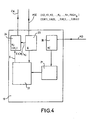
- Figure 4 represents a user card operating with a message MEC according to Figure 3a.
- the user card contains five main circuits:
- the validation circuit 20 makes it possible to perform on the messages MD the operations of user address recognition and user entitlements analysis.
- the analysis of the message MD is performed with the aid of an analysis algorithm depending on a key KC contained in the validation circuit 20.
- the validation circuit 23 makes it possible to perform on the access conditions contained in the messages MEC validation operations identical to those performed on the user's entitlements contained in the messages MD.
- the validation of the messages MEC is performed with the aid of a validation algorithm controlled by the key Q.
- the key Q is contained in the circuit 23.
- the decryption of the encrypted control word E(Cwi)Kj is performed with the aid of the key Kj of the encryption algorithm when the key Kj is the key contained in the deciphering circuit 24.
- the key Kj When the key Kj is contained in the decryption circuit 24, the latter also contains the index I(Kj) which makes it possible to recognize the encrypted control word E(Cwi)Kj from among the set of encrypted control words contained in the message MEC.
- the control word E(Cwi)Kj When the control word E(Cwi)Kj has been recognized, the latter is transferred from the validation circuit 23 to the decryption circuit 24. Decryption then takes place.
- the access control circuit 22 compares the validated access conditions with the validated entitlements of the user. If the validated access conditions correspond to the validated entitlements of the user, a signal S, emanating from the access control circuit 22, authorizes decryption of the control word. In the contrary case, the signal S does not authorize decryption.
- the pirating of a user card may lead to the knowledge of the control words encryption key contained in the user card.
- the service provider distributes new user cards.
- the decryption circuit for the control words of the new user cards then contains a new encryption key as well as a new encryption key index.
- the new encryption key as well as the new key index are contained in the messages MEC according to the invention.
- the service provider supplies his new customers with new off-line information media in which the control words encrypted with the key being pirated are deleted.
- the off-line information media distributed before the change of encryption key are still usable after this change.
- the use of these information media can be performed either with a card containing the new encryption key, or with an old card not containing the new encryption key.
- the off-line information media distributed after the change of encryption key can advantageously no longer be read with the user cards containing the old encryption key as is the case, particularly, in pirated cards.
- the service provider recovers the user cards containing the pirated key and replaces them with new cards containing a new encryption key such as that mentioned above.
- a transient period in respect of the distribution of new user cards may then be established.
- the messages MEC disseminated by the service provider contain control words encrypted with the key being pirated and the control words encrypted with the new encryption key.
- the service provider now issues only messages MEC containing the new encryption key.
- the number of versions of encryption of control words may be between 5 and 10.
- Figure 5 represents the schematic of a user card operating with a message MEC according to Figure 3b.
- the user card 25 of Figure 5 is the card associated with the service provider of rank k.
- the user card 25 contains five main circuits:
- the circuits 26, 27 and 28 have functions identical to those of the respective circuits 20, 21 and 22 described previously.
- the analysis of the messages MD is performed with the aid of an analysis algorithm depending on a key KC contained in the validation circuit 26.
- the key KC is preferably a different key from the encryption key contained in the decryption circuit 30.
- the circuit 29 makes it possible to perform the validation of the access conditions as well as that part of the message MEC associated with the service provider of rank k.
- the circuit 29 contains the control key index I(Qk) making it possible to recognize the datum HASH Qk within the message MEC as well as the key Qk making it possible to control the datum HASH Qk .
- the control words decryption circuit 30 contains the encryption key Kkj and the encryption key index I(Kkj).
- Validation of the access conditions contained in the messages MEC is performed with the aid of a validation algorithm controlled by the key Qk when the control words decryption circuit 30 contains the key Kkj and the index I(Kkj).
- the key index I(Kkj) makes it possible to recognize the encrypted control word E(Cwi)Kkj from among the set of encrypted control words.
- the control word E(Cwi)Kkj has been recognized, the latter is transferred from the validation circuit 29 to the decryption circuit 30.
- the decryption of the encrypted control word E(Cwi)Kkj is then performed with the aid of the key Kkj of the encryption algorithm.
- the message MEC described in Figure 3a comprises an encryption keys index field and the message MEC described in Figure 3b comprises p encryption keys index fields and one control keys index field.
- these keys indices allow recognition by the user card of the data associated with them.
- the messages MEC contain no encryption keys indices and/or control keys indices.
- the control words to be decrypted and the data making it possible to validate the messages MEC are recognized by the user card by virtue of their ordering and their size.
- the circuits 24 and 30 then contain items necessary for recognizing the ordering and size of the control words to be decrypted and the circuit 29 contains items necessary for recognizing the ordering and size of the data making it possible to validate and verify the messages MEC.
- the invention relates, in the case of off-line systems, to an off-line information medium containing an item scrambled by a string of N control words, characterized in that it comprises p strings of items consisting of N encrypted control words, each string of items making it possible to descramble the scrambled item, p being an integer greater than or equal to 1.
- the string of items consisting of the N encrypted control words consists of a string of identical encrypted control words, each control word being encrypted with an algorithm with different key.
- the off-line information media contain messages MEC such as those described in Figure 3a or Figure 3b.
- the messages MEC contained on the off-line information media then contain all the items necessary for descrambling the entire scrambled item.
- Figures 3a and 3b therefore also constitute a symbolic representation of two MEC message format examples contained on the off-line information media according to the invention.
- each string of items is preferably associated with a different service provider.
- the insertion of the messages MEC within the item contained on the off-line medium may be performed, by way of example, with the aid of the standard known to a person skilled in the art by the name "MPEG - 2 System".
- another mode of insertion of the messages MEC consists, for example, in retaining only one or a few messages MEC, for example 2 or 3 messages MEC, with the entirety of the programs contained on the medium and in placing these messages MEC in the header of each of the programs or of any other structure having a magnitude sufficient to store these few messages MEC.
- each service provider is then not compelled to press his own digital video discs.
- Various service providers can thus offer, on the same medium, all or some of their services at lesser cost without mutually disclosing their respective keys of the control words encryption algorithm.
- the invention also has another advantage in the context of on-line systems.
- the invention allows the various service providers to control the use of copies and/or recordings of the scrambled programs.
- the users are then compelled to request entitlements from the service provider.
- the reading of the copies and/or the recordings is then conditioned by the presence or otherwise of the corresponding entitlements in the user's card.
Landscapes
- Engineering & Computer Science (AREA)
- Multimedia (AREA)
- Signal Processing (AREA)
- Databases & Information Systems (AREA)
- Computer Security & Cryptography (AREA)
- Storage Device Security (AREA)
- Two-Way Televisions, Distribution Of Moving Picture Or The Like (AREA)
Description
- The present invention relates to a conditional access system.
- A conditional access system allows a service provider to supply his services solely to users having acquired entitlements to these services. Such is the case, for example, in pay television systems.
- Document
EP0 679 029 A1 discloses an example of such conditional access system. - As is known to a person skilled in the art, the service supplied by a service provider consists of an item scrambled by control words. The scrambled item can be descrambled, and therefore read by the user, only with regard to the entitlements allocated to this user. The scrambled item will subsequently be denoted IE(ECG), where ECG represents the unscrambled item.
- To descramble the item, the service provider supplies each user with the control words which served for scrambling the item. To keep the control words secret, they are supplied after having been encrypted with an algorithm with key K. The various encrypted control words are sent to the various users in messages which, for convenience, will be denoted MEC in the subsequent description.
- So as to accord access to its service solely to authorized users, the service provider supplies a smart card end a decoder to each of the users.
- The smart card makes it possible, on the one hand, to validate and record the entitlements which the user has to the service delivered and, on the other hand, to decrypt the encrypted control words. For this purpose, the smart card contains the key K of the algorithm which allowed the encryption of the control words.
- The decoder, for its part, makes it possible to descramble the scrambled item on the basis of the item consisting of the decrypted control words from the smart card.
- The entitlements of each user are sent in messages which, for convenience, will be denoted MD in the subsequent description.
- According to the prior art, a message MD dedicated to a user contains three main items:
- a first item giving the address of the user's card;
- a second item giving the description of the user's entitlements;
- a third item making it possible to validate the message MD and verify that the user's entitlements contained in the message MD are indeed the entitlements reserved for the user.
- As mentioned previously, the encrypted control words are sent to the users by way of the messages MEC.
- According to the prior art, a message MEC consists of a header and a body:
- the header gives, among other things, the type and size of the items contained in the body of the message MEC;
- the body consists, among other things, of an item containing the set of conditions of access to the service supplied by the provider, of an item containing a control word encrypted with the algorithm with key K and of an item containing a datum depending on the key K and making it possible to validate and verify the content of the message MEC and, more particularly, access conditions contained in the message MEC.
- When the decoder of a user recognizes the address of the card associated therewith among the various addresses distributed by the service provider, the message MD corresponding to the recognized address is analysed. The analysis of the message MD is performed with the aid of an analysis algorithm controlled by the encryption key of the control words.
- Conditional access systems are mainly of two types.
- A first system is commonly called an on-line system. In a conditional access system of the "on-line" type, the scrambled item IE (ECG) is an item consisting of a signal distributed simultaneously to the various customers of the service provider from a single source. This distribution can be performed, for example, over the airways or else by cable. As is known to a person skilled in the art, in such a conditional access system, the messages MEC are sent by the service provider with the scrambled item IE (ECG).
- A second conditional access system is commonly called an off-line system. In a conditional access system of "off-line" type, the scrambled item IE (ECG) and the messages MEC are contained on off-line information media such as, for example, compact discs, digital video discs, or else digital optical discs.
- The invention will be more particularly described in the case of off-line systems. However, as will emerge later, the invention relates to any type of access control system, be this system either of off-line or on-line type.
- As mentioned previously, the key of the encryption algorithm for the control words is contained in each user card. It follows that the pirating of a single card may lead to the knowledge of the key K. The service supplied by the provider is then no longer protected.
- The service provider must then supply each user with a new card containing a new key K. Now, in the case of off-line systems, the off-line information medium constituted by, for example, the compact disc, the digital video disc or else the digital optical disc, has a fixed content which it is not possible to modify. To ensure the continuity of the service he has to supply, the service provider is then compelled, not only to market new off-line information media compatible with the new encryption key, but also completely to renew the existing pool of off-line information media which he distributed before the change of encryption key of the control words.
- This represents a drawback, especially in terms of costs, since the number of off-line information media may frequently reach several hundred thousand, or even several million.
- The invention does not have this drawback.
- In general, the present invention relates to a novel conditional access system.
- More particularly, the invention also relates to a novel definition of the messages MEC, a novel user card, as well as a novel off-line information medium in the case of off-line systems.
- Thus, the invention relates to a message (MEC) according to
claim 1. - The invention also relates to a method for descrambling a program scrambled by a control word according to claim 4.
- The invention also relates to a smart card according to
claim 6. - Specific embodiments of the invention are set out in the dependant claims.
- The key of the encryption algorithm for the control words is contained in each user card.
- According to the invention, when the pirating of the user cards leads to the knowledge of the key of the encryption algorithm for the control words, the service provider changes the key as well as the key index which are contained in the user cards by choosing a new encryption algorithm key as well as a new key index from among the keys and the key indices already contained in the messages MEC.
- In the case of off-line systems, for example, an advantage of the invention is to prevent the change of encryption algorithm key for the control words from entailing the renewal of the entire pool of off-line information media distributed before the change of key.
- Other characteristics and advantages of the invention will emerge on reading a preferred embodiment given with reference to the appended figures in which:
- Figure 1 represents a format of a message MEC according to the prior art;
- Figure 2 represents the schematic of a user card according to the prior art;
- Figures 3a and 3b represent two formats of a message MEC according to the invention;
- Figure 4 represents the schematic of a user card operating with a message MEC according to Figure 3a;
- Figure 5 represents the schematic of a user card operating with a message MEC according to Figure 3b.
- In all the figures, the same labels designate the same elements.
- Figure 1 represents a format of a message MEC according to the prior art.
- The message MEC consists of a body C1 and a
header 6, the content (H1) of which gives, among other things, the type and size of the items contained in the body C1. - The body C1 comprises, among other things, a
first item 1, the content (ID) of which makes it possible to identify the service provider, asecond item 2 containing the set of access conditions associated with the service supplied by the provider, athird item 3, the content (I(K)) of which gives the index of the key K of the encryption algorithm for the control words, a fourth item 4 containing a control word Cwi encrypted with the algorithm with key K (E(Cwi)K) and afifth item 5 containing a datum HASHK making it possible to validate and verify the content of the message MEC and, more particularly, access conditions contained in the message MEC. The datum HASHK is controlled by the key K for encryption of the control words. - In Figure 1, the control word Cwi represents the current control word, that is to say that making it possible to descramble the part of the program being read. As is known to a person skilled in the art, the message MEC which contains Cwi generally also contains a second control word. This second control word is the control word for the next descrambling period, that is to say the current control word of the message MEC which is to follow the message MEC which contains Cwi as current control word. It is so as not to needlessly encumber the drawing that this second control word has not been represented in Figure 1.
- As is known to a person skilled in the art, the format of the message MEC described in Figure 1 is merely an MEC message format example. In particular, the order defining the succession of the
various blocks - Figure 2 represents the schematic of a user card according to the prior art.
- The user card 7 contains five main circuits:
- a
circuit 8 for validating the user's entitlements; - a circuit 9 for storing the validated entitlements of the user;
- a
circuit 10 for access control; - a
circuit 11 for validating the messages MEC; - a
circuit 12 for decrypting the encrypted control words. - The
validation circuit 8 makes it possible to perform on the messages MD the operations of user address recognition and user entitlements analysis. For this purpose, thevalidation circuit 8 contains the key K of the encryption algorithm. If the message MD is validated, the user's entitlements contained in the message MD are stored in the validated entitlements storage circuit 9. - The
circuit 11 for validating the messages MEC makes it possible to perform on theaccess conditions 2 contained in the messages MEC operations identical to those performed by thevalidation circuit 8 on the user's entitlements contained in the messages MD. Thevalidation circuit 11 contains the key K. - The
decryption circuit 12 makes it possible to decrypt the control words. For this purpose, thedecryption circuit 12 also contains the key K of the encryption algorithm for the control words. - The
access control circuit 10 compares the validated access conditions with the validated entitlements of the user. If the validated access conditions correspond to the validated entitlements of the user, a signal S, emanating from theaccess control circuit 10 and applied to thedecryption circuit 12, authorizes decryption of the control words. In the contrary case, the signal S does not authorize decryption. - At the completion of the various steps of the decryption procedure, the decrypted control words Cwi are generated by the
decryption circuit 12 so as to allow the descrambling of the scrambled item IE (ECG). - Figure 3a represents a first MEC message format according to the invention.
- The message MEC consists of a body C2a and a
header 13, the content (H2) of which gives, among other things, the type and size of the items contained in the body C2a. - The body C2a comprises, among other things, an
item 14, the content (ID) of which makes it possible to identify the service provider, n items Al, ... , Aj, ..., An respectively containing the same control word Cwi enciphered with algorithms with respective keys K1, ..., Kj , ... , Kn, n items DX1, ..., Dxj, ..., DXn containing the indices I(K1), ..., I(Kj), ..., I (Kn) making it possible to recognize the respective keys K1, ..., Kj, ..., Kn, anitem 15 containing the set of access conditions associated with the service supplied by the service provider, and anitem 16 containing a datum HASHQ making it possible to validate and verify the content of the message MEC and, more particularly, access conditions contained in the message MEC. The datum HASHQ is controlled by a key Q preferably different from any one of the encryption keys K1, ..., Kj, ..., Kn. - Acco rdi ng to a fi rs t embodiment of the invention, the algorithm with key Kj is the same irrespective of the rank j (j = 1, 2, ..., n) of the key Kj. This may, for example, be the algorithm known by the abbreviation RSA ("RIVEST SHAMIR ADLEMAN"), the algorithm known by the abbreviation SDE ("Syndrome Decoding Engine"), or again the algorithm known by the abbreviation DES ("Data Encryption Standard").
- According to the invention, the algorithm with key Kj can be identical or different for all or some of the keys Kj (j = 1, 2, ..., n).
- Advantageously, according to a particular embodiment of the invention, the various keys Kj which are used successively may be chosen with size increasing with the rank j of the key Kj. Any pirates are then placed in a situation in which the pirating of the various keys is made increasingly difficult.
- According to Figure 3a, the various items constituting the body of the message MEC according to the first format of the invention follow one another in a certain order. The invention relates, however, to the formats of messages MEC for which the order of the items is different from that represented in Figure 3a.
- Figure 3b represents a second MEC message format according to the invention.
- The message MEC consists of a body C2b and a
header 17, the content (H3) of which gives, among other things, the type and size of the items contained in the body C2b. - The body C2b comprises, among other things:
- p items ID1, ID2, IDK, ... IDp allowing each to identify one of the p service providers, p being an integer,
- n items A1l, ..., A1j, ... , A1n, for the provider of
rank 1, n being an integer, - m items A21, ... , A2j, ..., A2m, for the provider of
rank 2, m being an integer, - v items Ak1, ... , Akj, ..., Akv, for the provider of rank k, v being an integer,
- w items Ap1, ... , Apj, ..., Apw, for the provider of rank p, w being an integer,
- n items DX11, ..., DX1j, ..., DX1n for the provider of
rank 1, - m items DX21, ..., DX2j, ..., DX2n for the provider of
rank 2, - v items DXk1, ..., DXkj, ..., DXkv for the provider of rank k,
- w items DXp1, ..., DXpj, ..., DXpw, for the provider of rank p,
- an
item 18 containing the set of access conditions associated with the service supplied by the p service providers, the said access conditions being common to the p service providers according to the preferred embodiment of the invention, - a set of p data HASHQ1, ..., HASHQk, ..., HASHQP, the datum HASHQk making it possible to validate and verify the content of the access conditions contained in the message MEC as well as that part of the message MEC associated with the service provider of rank k. The datum HASHQk is controlled by a key Qk. The keys Q1, ..., Qj, ..., Qp being preferably different from one another and different from the encryption keys Kkj,
- a set of p data I(Q1), ..., I(Qk), ..., I(Qp) constituting a control keys index field, the key index I(Qk) making it possible, as will be specified later, to recognize datum HASHQk.
- According to the above-described preferred embodiment of the invention, each of the n + m + ... + v + ... + w items A11, ..., Akj, ..., Apw contain the same control word Cwi encrypted with an algorithm with respective keys K11, ..., Kkj, ..., Kpw.
- According to that embodiment of the invention described in Figure 3b, the
access conditions 18 are common to the p service providers. According to other embodiments of the invention, the access conditions are different from one service provider to another or from one group of service providers to another. - As mentioned previously, the order in which the various items constituting the body of the message MEC follow one another may be different f rom that represented in Figure 3b.
- According to a particular embodiment of the invention, the encryption algorithm with key Kkj of the service provider of rank k (k = 1, 2, ..., p) is the same irrespective of the rank j of the key Kkj.
- According to embodiments different from the particular embodiment mentioned above, the encryption algorithm with key Kkj can be different according to the rank k of the key Kkj.
- As in the case of the message MEC described in Figure 3a, the various keys Kkj which are successively used by the same service provider may advantageously be of a size increasing with the rank j of the key Kkj so as to make pirating increasingly difficult.
- Figure 4 represents a user card operating with a message MEC according to Figure 3a.
- The user card contains five main circuits:
- a
circuit 20 for validating the user's entitlements; - a
circuit 21 for storing the validated entitlements of the user; - a
circuit 22 for access control; - a
circuit 23 for validating the messages MEC; - a
circuit 24 for decrypting the encrypted control words. - The
validation circuit 20 makes it possible to perform on the messages MD the operations of user address recognition and user entitlements analysis. - The analysis of the message MD is performed with the aid of an analysis algorithm depending on a key KC contained in the
validation circuit 20. The key KC is preferably a different key from any one of the encryption keys Kj (j = 1, 2, ..., n). If the message MD is validated, the user's entitlements contained in the message MD are stored in the validated entitlements s to rage ci rcuit 21. - The
validation circuit 23 makes it possible to perform on the access conditions contained in the messages MEC validation operations identical to those performed on the user's entitlements contained in the messages MD. The validation of the messages MEC is performed with the aid of a validation algorithm controlled by the key Q. The key Q is contained in thecircuit 23. - The decryption of the encrypted control word E(Cwi)Kj is performed with the aid of the key Kj of the encryption algorithm when the key Kj is the key contained in the deciphering
circuit 24. - When the key Kj is contained in the
decryption circuit 24, the latter also contains the index I(Kj) which makes it possible to recognize the encrypted control word E(Cwi)Kj from among the set of encrypted control words contained in the message MEC. When the control word E(Cwi)Kj has been recognized, the latter is transferred from thevalidation circuit 23 to thedecryption circuit 24. Decryption then takes place. - The
access control circuit 22 compares the validated access conditions with the validated entitlements of the user. If the validated access conditions correspond to the validated entitlements of the user, a signal S, emanating from theaccess control circuit 22, authorizes decryption of the control word. In the contrary case, the signal S does not authorize decryption. - As mentioned previously, the pirating of a user card may lead to the knowledge of the control words encryption key contained in the user card. When pirating becomes excessive, the service provider distributes new user cards. The decryption circuit for the control words of the new user cards then contains a new encryption key as well as a new encryption key index.
- The new encryption key as well as the new key index are contained in the messages MEC according to the invention.
- In the case of off-line systems, to ensure the permanence of his service, the service provider supplies his new customers with new off-line information media in which the control words encrypted with the key being pirated are deleted.
- As mentioned previously, advantageously, according to the invention, the off-line information media distributed before the change of encryption key are still usable after this change. Thus, the use of these information media can be performed either with a card containing the new encryption key, or with an old card not containing the new encryption key. Likewise, and in reciprocal manner, the off-line information media distributed after the change of encryption key can advantageously no longer be read with the user cards containing the old encryption key as is the case, particularly, in pirated cards.
- In the case of on-line systems, the service provider recovers the user cards containing the pirated key and replaces them with new cards containing a new encryption key such as that mentioned above.
- Advantageously, a transient period in respect of the distribution of new user cards may then be established. Throughout the transient period, the messages MEC disseminated by the service provider contain control words encrypted with the key being pirated and the control words encrypted with the new encryption key. When all the user cards have been renewed, the service provider now issues only messages MEC containing the new encryption key.
- By way of non-limiting example, the number of versions of encryption of control words, that is to say the number of encryption algorithm keys for the control words, may be between 5 and 10.
- Figure 5 represents the schematic of a user card operating with a message MEC according to Figure 3b.
- The
user card 25 of Figure 5 is the card associated with the service provider of rank k. - The
user card 25 contains five main circuits: - a
circuit 26 for validating the user's entitlements; - a
circuit 27 for storing the validated entitlements of the user; - a
circuit 28 for access control; - a
circuit 29 for validating the messages MEC; - a
circuit 30 for decrypting the encrypted control words. - The
circuits respective circuits - The analysis of the messages MD is performed with the aid of an analysis algorithm depending on a key KC contained in the
validation circuit 26. The key KC is preferably a different key from the encryption key contained in thedecryption circuit 30. - The
circuit 29 makes it possible to perform the validation of the access conditions as well as that part of the message MEC associated with the service provider of rank k. For this purpose thecircuit 29 contains the control key index I(Qk) making it possible to recognize the datum HASHQk within the message MEC as well as the key Qk making it possible to control the datum HASHQk. - The control
words decryption circuit 30 contains the encryption key Kkj and the encryption key index I(Kkj). - Validation of the access conditions contained in the messages MEC is performed with the aid of a validation algorithm controlled by the key Qk when the control
words decryption circuit 30 contains the key Kkj and the index I(Kkj). - The key index I(Kkj) makes it possible to recognize the encrypted control word E(Cwi)Kkj from among the set of encrypted control words. When the control word E(Cwi)Kkj has been recognized, the latter is transferred from the
validation circuit 29 to thedecryption circuit 30. The decryption of the encrypted control word E(Cwi)Kkj is then performed with the aid of the key Kkj of the encryption algorithm. - According to the preferred embodiment of the invention, the message MEC described in Figure 3a comprises an encryption keys index field and the message MEC described in Figure 3b comprises p encryption keys index fields and one control keys index field. As mentioned previously, these keys indices allow recognition by the user card of the data associated with them.
- D > According to other examples not falling under scope of the claims, the messages MEC contain no encryption keys indices and/or control keys indices. The control words to be decrypted and the data making it possible to validate the messages MEC are recognized by the user card by virtue of their ordering and their size. In a manner known per se, the
circuits circuit 29 contains items necessary for recognizing the ordering and size of the data making it possible to validate and verify the messages MEC. - Irrespective of the type of message MEC of the invention, the invention relates, in the case of off-line systems, to an off-line information medium containing an item scrambled by a string of N control words, characterized in that it comprises p strings of items consisting of N encrypted control words, each string of items making it possible to descramble the scrambled item, p being an integer greater than or equal to 1.
- The string of items consisting of the N encrypted control words consists of a string of identical encrypted control words, each control word being encrypted with an algorithm with different key.
- Thus, the off-line information media according to the invention contain messages MEC such as those described in Figure 3a or Figure 3b. According to the invention, the messages MEC contained on the off-line information media then contain all the items necessary for descrambling the entire scrambled item.
- Figures 3a and 3b therefore also constitute a symbolic representation of two MEC message format examples contained on the off-line information media according to the invention.
- In the case in which the information medium contains several strings of items making it possible to descramble the scrambled item, each string of items is preferably associated with a different service provider.
- The insertion of the messages MEC within the item contained on the off-line medium may be performed, by way of example, with the aid of the standard known to a person skilled in the art by the name "MPEG - 2 System". In the case in which storage of the item on the off-line medium is not compatible with the "MPEG - 2 System" standard, another mode of insertion of the messages MEC consists, for example, in retaining only one or a few messages MEC, for example 2 or 3 messages MEC, with the entirety of the programs contained on the medium and in placing these messages MEC in the header of each of the programs or of any other structure having a magnitude sufficient to store these few messages MEC.
- According to a particular embodiment of the system described in Figure 5, several different service suppliers can distribute identical programs on the same off-line information medium such as, for example, a digital video disc.
- Advantageously, each service provider is then not compelled to press his own digital video discs. Various service providers can thus offer, on the same medium, all or some of their services at lesser cost without mutually disclosing their respective keys of the control words encryption algorithm.
- The advantage described above in the context of an off-line system applies also in the context of an on-line system. Several disseminators of programs can then offer access to the same program using messages MEC such as those described in Figure 3b.
- The invention also has another advantage in the context of on-line systems.
- Thus, in the context of on-line systems prohibiting any copying in clear of the scrambled programs disseminated, the invention allows the various service providers to control the use of copies and/or recordings of the scrambled programs. Thus, to see the copies and/or the recordings of the scrambled programs in clear, the users are then compelled to request entitlements from the service provider. The reading of the copies and/or the recordings is then conditioned by the presence or otherwise of the corresponding entitlements in the user's card.
- All the advantages mentioned previously in respect of the off-line information media used in the context of the invention therefore also appertain in respect of the copies and/or the recordings of scrambled programs.
Claims (13)
- Message (MEC) for delivering access conditions (15) to a program scrambled by a control word (CWj), characterised in that said message (MEC) contains:n items (A1,..., An) comprising said control word (CWj) encrypted by n different encryption keys K1, K2, ..., Kj, ..., Kn, andn additional items (DX1, ..., DXj, ..., DXn), each comprising a key index I(Kj) associated with one of said n encryption keys Kj (j = 1, 2, ..., n)wherein n is an integer greater than 1.
- Message (MEC) according to Claim 1, further comprising a second item (16) for validating and verifying the content of said message, the content of said second item being controlled by a validation key Q, wherein said validation key Q is different from all said encryption keys K1, K2, ..., Kj, ..., Kn.
- Message (MEC) according to Claim 1 or 2, characterised in that said various encryption keys Kj (j = 1, 2, ..., n) have a size increasing with rank j of the key Kj.
- Method for descrambling a program scrambled by a control word (CWi), characterised in that said method comprises the step of:supplying a message (MEC) containing access conditions associated with a user, n items comprising said control word (CWj) encrypted by n different encryption keys K1, K2, ..., Kj, ..., Kn, and n additional items (DX1, ..., DXj, ..., DXn), each comprising a key index I(Kj) associated with one of said n encryption keys Kj (j = 1, 2, ..., n)wherein n is an integer greater than 1,
said method further including the step of selecting one of said n items as a function of one of said encryption keys stored in a receiver of said message wherein the selecting step is made using a key index, stored with the encryption key in the receiver of said message. - Method according to Claim 4, characterised in that the step of supplying said message is performed with the aid of a second item (16) for validating and verifying the content of said message, the content of said second item being controlled by a validation key Q, said validation key Q being different from all said encryption keys K1, K2, ..., Kj, ..., Kn.
- Smart card for providing a control word (CWi) for descrambling a received scrambled program, wherein said program has been scrambled by the control word, characterised in that it comprises :means for receiving a first message (MEC), said first message containing data corresponding to access conditions associated with a user, n items comprising said control word encrypted by n different encryption keys K1, K2, ..., Kj, ..., Kn and n additional items (DX1, ..., DXj, ..., DXn), each comprising a key index I(Kj) associated with one of said n encryption keys Kj (j = 1, 2, ..., n), wherein n is an integer greater than 1; andmeans (24) for decrypting said control word, said decrypting means comprising at least one of said encryption keys (Kj) and the associated key index.
- Smart card according to Claim 6, characterised in that it further comprises :means (23) for validating said first message (MEC) using a validation key Q;wherein said validation key Q is different from all said encryption keys K1, K2, ..., Kj, ..., Kn.
- Smart card according to any one of Claims 6 or 7, characterised in that it further comprises :means for receiving a second message (MD), said second message containing data corresponding to entitlements associated with said user;means (20) for validating said second message using a control key (KC);wherein said control key (KC) is different from said validation key (Q) for validating said first message.
- Smart card according to claim 8, wherein said control key (KC) is different from all said encryption keys K1, K2, ..., Kj, ..., Kn.
- Conditional access system for selectively supplying programs to a user, comprising :means for providing a program scrambled by a control word (CWi), data associated with said user's entitlements and data associated with access conditions;a decoder for descrambling said scrambled program;a smart card for receiving said entitlement data and said access condition data and for providing said control word to said decoder,characterised in that said access conditions data are conveyed to said smart card in a message (MEC) according to any one of Claims 1 to 3 and said smart card is a card according to any one of Claims 6 to 9.
- Conditional access system according to Claim 10, characterized in that said system is an "on-line" type.
- Conditional access system according to Claim 10, characterized in that said system is an "off-line" type.
- Off-line information medium containing :a program scrambled by a string of N control words CW1, ..., CWi, ... CWN, N being an integer greater than 1; anda set of messages according to any one of claims 1 to 3.
Applications Claiming Priority (2)
| Application Number | Priority Date | Filing Date | Title |
|---|---|---|---|
| FR9609501 | 1996-07-29 | ||
| FR9609501A FR2751817B1 (en) | 1996-07-29 | 1996-07-29 | CONDITIONAL ACCESS SYSTEM USING MULTIPLE ENCRYPTION KEY MESSAGES |
Publications (2)
| Publication Number | Publication Date |
|---|---|
| EP0822720A1 EP0822720A1 (en) | 1998-02-04 |
| EP0822720B1 true EP0822720B1 (en) | 2007-06-13 |
Family
ID=9494574
Family Applications (1)
| Application Number | Title | Priority Date | Filing Date |
|---|---|---|---|
| EP97401802A Expired - Lifetime EP0822720B1 (en) | 1996-07-29 | 1997-07-28 | Conditional access system using messages with multiple encryption keys |
Country Status (6)
| Country | Link |
|---|---|
| US (1) | US6091818A (en) |
| EP (1) | EP0822720B1 (en) |
| JP (1) | JPH1098462A (en) |
| CN (1) | CN1145302C (en) |
| DE (1) | DE69737804T2 (en) |
| FR (1) | FR2751817B1 (en) |
Families Citing this family (29)
| Publication number | Priority date | Publication date | Assignee | Title |
|---|---|---|---|---|
| JP3565715B2 (en) | 1998-07-02 | 2004-09-15 | 松下電器産業株式会社 | Broadcast system and broadcast transceiver |
| DE69835670T2 (en) | 1998-09-01 | 2007-09-06 | Irdeto Access B.V. | Data transfer system |
| ATE325505T1 (en) * | 1998-09-01 | 2006-06-15 | Irdeto Access Bv | SECURE DATA SIGNAL TRANSMISSION SYSTEM |
| JP2000286836A (en) * | 1999-03-30 | 2000-10-13 | Fujitsu Ltd | Authentication device and recording medium |
| EP1111924A1 (en) | 1999-12-22 | 2001-06-27 | Irdeto Access B.V. | Method for controlling the use of a program signal in a broadcast system, and control device for a receiver for carrying out such a method |
| EP1111923A1 (en) * | 1999-12-22 | 2001-06-27 | Irdeto Access B.V. | Method for operating a conditional access system for broadcast applications |
| US6928162B1 (en) | 2000-04-07 | 2005-08-09 | International Business Machines Corporation | Method and system for manipulating and telescoping a hash function |
| GB2374998B (en) * | 2000-05-22 | 2004-10-13 | Nds Ltd | Dynamically shifting control word |
| EP1295467B1 (en) * | 2000-06-20 | 2004-01-21 | Fraunhofer-Gesellschaft zur Förderung der angewandten Forschung e.V. | Coding of parameter values |
| FR2811093A1 (en) * | 2000-06-30 | 2002-01-04 | St Microelectronics Sa | DEVICE AND METHOD FOR EVALUATING ALGORITHMS |
| US7023997B1 (en) * | 2000-12-21 | 2006-04-04 | Cisco Technology, Inc. | Secure messaging communication system |
| US20020136400A1 (en) * | 2001-01-08 | 2002-09-26 | Arif Askerov | R-conversion encryption method and system |
| US20020094083A1 (en) * | 2001-01-12 | 2002-07-18 | Prabir Bhattacharya | Encryption scheme for limiting the maximum number of accesses to a digital file of predetermined content |
| US7039803B2 (en) | 2001-01-26 | 2006-05-02 | International Business Machines Corporation | Method for broadcast encryption and key revocation of stateless receivers |
| DE10107523A1 (en) * | 2001-02-17 | 2002-09-19 | Deutsche Telekom Ag | Method for encrypting data packets |
| US7995603B2 (en) * | 2001-05-22 | 2011-08-09 | Nds Limited | Secure digital content delivery system and method over a broadcast network |
| US7242773B2 (en) * | 2002-09-09 | 2007-07-10 | Sony Corporation | Multiple partial encryption using retuning |
| US7398544B2 (en) * | 2003-05-12 | 2008-07-08 | Sony Corporation | Configurable cableCARD |
| JP4755189B2 (en) * | 2004-10-12 | 2011-08-24 | 韓国科学技術院 | Content encryption method, network content providing system and method using the same |
| KR100732668B1 (en) | 2005-05-27 | 2007-06-27 | 삼성전자주식회사 | Security devices in access control systems and methods of controlling illegal use of headends and access control systems |
| EP1798975A1 (en) * | 2005-12-15 | 2007-06-20 | Nagra France Sarl | Verschlüsselungs- und entschlüsselungs-Verfahren für Inhalt mit bedingtem Zugang. |
| WO2008074534A1 (en) * | 2006-12-21 | 2008-06-26 | International Business Machines Corporation | Key distribution for securing broadcast transmission to groups of users in wireless networks |
| CN101325684B (en) * | 2007-06-14 | 2010-10-06 | 中兴通讯股份有限公司 | Encrypted control information transmission method and system based on mobile multimedia broadcasting |
| CN100547955C (en) * | 2007-11-09 | 2009-10-07 | 北京创毅视讯科技有限公司 | A kind of method of protecting mobile multimedia service, system and equipment |
| JP2010104035A (en) * | 2010-01-25 | 2010-05-06 | Toshiba Corp | Receiver, and receiving method |
| JP2010119138A (en) * | 2010-02-15 | 2010-05-27 | Toshiba Corp | Receiving device and method |
| FR2970134B1 (en) * | 2010-12-29 | 2013-01-11 | Viaccess Sa | METHOD FOR TRANSMITTING AND RECEIVING MULTIMEDIA CONTENT |
| US9003204B2 (en) * | 2013-07-10 | 2015-04-07 | Sap Se | Optimal re-encryption strategy for joins in encrypted databases |
| US9396355B2 (en) | 2013-12-17 | 2016-07-19 | International Business Machines Corporation | Multi-part encrypted messages for support of sensitive systems |
Citations (1)
| Publication number | Priority date | Publication date | Assignee | Title |
|---|---|---|---|---|
| EP0817185A2 (en) * | 1996-06-28 | 1998-01-07 | Kabushiki Kaisha Toshiba | Enciphering method, deciphering method, recording and reproducing method, deciphering device, deciphering unit device, recording medium, recording-medium manufacturing method, and key control method |
Family Cites Families (8)
| Publication number | Priority date | Publication date | Assignee | Title |
|---|---|---|---|---|
| FR2583946B1 (en) * | 1985-06-24 | 1988-07-29 | France Etat | ACCESS CONTROL TELEVISION SYSTEM USING A VARIABLE ELECTRONIC KEY |
| US5191611A (en) * | 1989-04-03 | 1993-03-02 | Lang Gerald S | Method and apparatus for protecting material on storage media and for transferring material on storage media to various recipients |
| US5237610A (en) * | 1990-02-01 | 1993-08-17 | Scientific-Atlanta, Inc. | Independent external security module for a digitally upgradeable television signal decoder |
| IL110891A (en) * | 1993-09-14 | 1999-03-12 | Spyrus | System and method for data access control |
| MY125706A (en) * | 1994-08-19 | 2006-08-30 | Thomson Consumer Electronics | High speed signal processing smart card |
| US5721781A (en) * | 1995-09-13 | 1998-02-24 | Microsoft Corporation | Authentication system and method for smart card transactions |
| JP2004242206A (en) * | 2003-02-07 | 2004-08-26 | Hitachi Ltd | Optical network access device, access device operation input device, and access device control program |
| JP2004260709A (en) * | 2003-02-27 | 2004-09-16 | Net One Systems Co Ltd | Signal converting apparatus and communication system |
-
1996
- 1996-07-29 FR FR9609501A patent/FR2751817B1/en not_active Expired - Fee Related
-
1997
- 1997-07-28 EP EP97401802A patent/EP0822720B1/en not_active Expired - Lifetime
- 1997-07-28 CN CNB971046522A patent/CN1145302C/en not_active Expired - Fee Related
- 1997-07-28 JP JP9201600A patent/JPH1098462A/en active Pending
- 1997-07-28 DE DE69737804T patent/DE69737804T2/en not_active Expired - Lifetime
- 1997-07-28 US US08/901,842 patent/US6091818A/en not_active Expired - Lifetime
Patent Citations (1)
| Publication number | Priority date | Publication date | Assignee | Title |
|---|---|---|---|---|
| EP0817185A2 (en) * | 1996-06-28 | 1998-01-07 | Kabushiki Kaisha Toshiba | Enciphering method, deciphering method, recording and reproducing method, deciphering device, deciphering unit device, recording medium, recording-medium manufacturing method, and key control method |
Also Published As
| Publication number | Publication date |
|---|---|
| JPH1098462A (en) | 1998-04-14 |
| US6091818A (en) | 2000-07-18 |
| FR2751817B1 (en) | 1998-09-11 |
| CN1175142A (en) | 1998-03-04 |
| EP0822720A1 (en) | 1998-02-04 |
| DE69737804D1 (en) | 2007-07-26 |
| CN1145302C (en) | 2004-04-07 |
| DE69737804T2 (en) | 2007-10-31 |
| FR2751817A1 (en) | 1998-01-30 |
Similar Documents
| Publication | Publication Date | Title |
|---|---|---|
| US6091818A (en) | Conditional access system using messages with multiple encryption keys | |
| EP0817485B1 (en) | Conditional access system and smartcard allowing such access | |
| EP0800745B1 (en) | Time-shifted conditional access | |
| US6266415B1 (en) | Process for protecting an information item transmitted from a security element to a decoder and protection system using such a process | |
| EP0787391B1 (en) | Conditional access system | |
| US6035397A (en) | Process for data certification by scrambling and certification system using such a process | |
| EP1110399B1 (en) | System and method for copy protecting transmitted information | |
| KR100605825B1 (en) | Copy protection device and method of a broadcast receiving system having a hard disk drive | |
| JP3023160B2 (en) | Broadcast reception control method | |
| US5301233A (en) | Process for the transmission and reception of personalized programs | |
| AU751436B2 (en) | Mechanism for matching a receiver with a security module | |
| RU2547228C1 (en) | Method to protect recorded multimedia content | |
| EP0925686A2 (en) | Arrangement for independently requesting a playing authorization for a reproduced encrypted information signal | |
| NO324650B1 (en) | Procedure for recording digital information, and corresponding decoder / smart card combination and smart card. | |
| PL193782B1 (en) | Apparatus for receiving paid tv broadcasts through several doceders separately controlling access to their associated broadcasting stations | |
| US7616763B2 (en) | Validity verification method for a local digital network key | |
| EP0910217B1 (en) | Process for controlling access to a domestic network and device implementing the process | |
| JP4521392B2 (en) | Pay television systems associated with decoders and smart cards, rights revocation methods in such systems, and messages sent to such decoders | |
| EP1222819B1 (en) | System and method of verifying authorization for communicating protected content | |
| EP0884906A1 (en) | Conditional access system with programmable mode of access | |
| JP2825053B2 (en) | Pay broadcast transmission / reception system and pay broadcast receiving decoder | |
| KR100640032B1 (en) | Copy Protection System for Home Networks | |
| JP4150275B2 (en) | Security module, security module program, content receiving apparatus, and content receiving method | |
| JP4542518B2 (en) | Content usage control transmission device, content usage control reception device, content usage control system, content usage control transmission program, and content usage control reception program |
Legal Events
| Date | Code | Title | Description |
|---|---|---|---|
| PUAI | Public reference made under article 153(3) epc to a published international application that has entered the european phase |
Free format text: ORIGINAL CODE: 0009012 |
|
| AK | Designated contracting states |
Kind code of ref document: A1 Designated state(s): DE FR GB IT |
|
| 17P | Request for examination filed |
Effective date: 19980720 |
|
| AKX | Designation fees paid |
Free format text: DE FR GB IT |
|
| RBV | Designated contracting states (corrected) |
Designated state(s): DE FR GB IT |
|
| RBV | Designated contracting states (corrected) |
Designated state(s): DE FR GB IT |
|
| 17Q | First examination report despatched |
Effective date: 20001124 |
|
| GRAP | Despatch of communication of intention to grant a patent |
Free format text: ORIGINAL CODE: EPIDOSNIGR1 |
|
| GRAS | Grant fee paid |
Free format text: ORIGINAL CODE: EPIDOSNIGR3 |
|
| GRAA | (expected) grant |
Free format text: ORIGINAL CODE: 0009210 |
|
| AK | Designated contracting states |
Kind code of ref document: B1 Designated state(s): DE FR GB IT |
|
| REG | Reference to a national code |
Ref country code: GB Ref legal event code: FG4D |
|
| REF | Corresponds to: |
Ref document number: 69737804 Country of ref document: DE Date of ref document: 20070726 Kind code of ref document: P |
|
| ET | Fr: translation filed | ||
| PLBE | No opposition filed within time limit |
Free format text: ORIGINAL CODE: 0009261 |
|
| STAA | Information on the status of an ep patent application or granted ep patent |
Free format text: STATUS: NO OPPOSITION FILED WITHIN TIME LIMIT |
|
| PG25 | Lapsed in a contracting state [announced via postgrant information from national office to epo] |
Ref country code: IT Free format text: LAPSE BECAUSE OF FAILURE TO SUBMIT A TRANSLATION OF THE DESCRIPTION OR TO PAY THE FEE WITHIN THE PRESCRIBED TIME-LIMIT Effective date: 20070613 |
|
| 26N | No opposition filed |
Effective date: 20080314 |
|
| REG | Reference to a national code |
Ref country code: FR Ref legal event code: PLFP Year of fee payment: 19 |
|
| PGFP | Annual fee paid to national office [announced via postgrant information from national office to epo] |
Ref country code: GB Payment date: 20150728 Year of fee payment: 19 Ref country code: DE Payment date: 20150723 Year of fee payment: 19 |
|
| PGFP | Annual fee paid to national office [announced via postgrant information from national office to epo] |
Ref country code: FR Payment date: 20150720 Year of fee payment: 19 |
|
| REG | Reference to a national code |
Ref country code: DE Ref legal event code: R119 Ref document number: 69737804 Country of ref document: DE |
|
| GBPC | Gb: european patent ceased through non-payment of renewal fee |
Effective date: 20160728 |
|
| PG25 | Lapsed in a contracting state [announced via postgrant information from national office to epo] |
Ref country code: FR Free format text: LAPSE BECAUSE OF NON-PAYMENT OF DUE FEES Effective date: 20160801 Ref country code: DE Free format text: LAPSE BECAUSE OF NON-PAYMENT OF DUE FEES Effective date: 20170201 |
|
| REG | Reference to a national code |
Ref country code: FR Ref legal event code: ST Effective date: 20170331 |
|
| PG25 | Lapsed in a contracting state [announced via postgrant information from national office to epo] |
Ref country code: GB Free format text: LAPSE BECAUSE OF NON-PAYMENT OF DUE FEES Effective date: 20160728 |