EP0821890B1 - Shoe with supporting and stiffening structure and method for manufacturing said shoe - Google Patents
Shoe with supporting and stiffening structure and method for manufacturing said shoe Download PDFInfo
- Publication number
- EP0821890B1 EP0821890B1 EP97112597A EP97112597A EP0821890B1 EP 0821890 B1 EP0821890 B1 EP 0821890B1 EP 97112597 A EP97112597 A EP 97112597A EP 97112597 A EP97112597 A EP 97112597A EP 0821890 B1 EP0821890 B1 EP 0821890B1
- Authority
- EP
- European Patent Office
- Prior art keywords
- shoe
- sole
- parts
- supporting
- arc
- Prior art date
- Legal status (The legal status is an assumption and is not a legal conclusion. Google has not performed a legal analysis and makes no representation as to the accuracy of the status listed.)
- Expired - Lifetime
Links
- 238000004519 manufacturing process Methods 0.000 title claims description 7
- 238000000034 method Methods 0.000 title claims description 3
- 239000000463 material Substances 0.000 claims abstract description 11
- 229920003023 plastic Polymers 0.000 claims description 8
- 239000004033 plastic Substances 0.000 claims description 8
- 230000000284 resting effect Effects 0.000 claims 1
- 239000000725 suspension Substances 0.000 description 3
- 230000000694 effects Effects 0.000 description 2
- 235000009854 Cucurbita moschata Nutrition 0.000 description 1
- 240000001980 Cucurbita pepo Species 0.000 description 1
- 235000009852 Cucurbita pepo Nutrition 0.000 description 1
- 238000004026 adhesive bonding Methods 0.000 description 1
- 230000000386 athletic effect Effects 0.000 description 1
- 230000000670 limiting effect Effects 0.000 description 1
- 238000002844 melting Methods 0.000 description 1
- 230000008018 melting Effects 0.000 description 1
- 238000012986 modification Methods 0.000 description 1
- 230000004048 modification Effects 0.000 description 1
- 235000020354 squash Nutrition 0.000 description 1
Images


Classifications
-
- A—HUMAN NECESSITIES
- A43—FOOTWEAR
- A43B—CHARACTERISTIC FEATURES OF FOOTWEAR; PARTS OF FOOTWEAR
- A43B5/00—Footwear for sporting purposes
- A43B5/04—Ski or like boots
-
- A—HUMAN NECESSITIES
- A43—FOOTWEAR
- A43B—CHARACTERISTIC FEATURES OF FOOTWEAR; PARTS OF FOOTWEAR
- A43B3/00—Footwear characterised by the shape or the use
- A43B3/0036—Footwear characterised by the shape or the use characterised by a special shape or design
- A43B3/0047—Footwear characterised by the shape or the use characterised by a special shape or design parts having a male and corresponding female profile to fit together, e.g. form-fit
-
- A—HUMAN NECESSITIES
- A43—FOOTWEAR
- A43B—CHARACTERISTIC FEATURES OF FOOTWEAR; PARTS OF FOOTWEAR
- A43B5/00—Footwear for sporting purposes
-
- A—HUMAN NECESSITIES
- A43—FOOTWEAR
- A43B—CHARACTERISTIC FEATURES OF FOOTWEAR; PARTS OF FOOTWEAR
- A43B5/00—Footwear for sporting purposes
- A43B5/04—Ski or like boots
- A43B5/0427—Ski or like boots characterised by type or construction details
- A43B5/0482—Ski or like boots characterised by type or construction details made from materials with different rigidities
Definitions
- the present invention relates to a shoe with supporting and stiffening structure and to a method for manufacturing said shoe.
- Stiffening structures applied to sports shoes are conventionally used, as described for example in Italian utility model application no. 30626 B/84 and in Italian patent application no. 41517 A/85.
- Those patents disclose a structure formed by melting plastics and comprising an anatomical insole including the tip and the heel, the entire unit being formed monolithically.
- This structure can be inserted in the sports shoe during one of the various steps of the shoe assembly; it can be fitted between the lining and the padding, between the padding and the upper, between the innerboot or last and the upper, or outside the upper. When it is fitted in this last position, the structure can be covered by an injection-overmolding of plastic material adapted to impermeabilize the entire unit and rigidly couple the structure to the shoe.
- a plurality of sport shoes are currently commercially available which have a sole shaped and manufactured so as to improve its resistance to the lateral stresses whereto it is subjected.
- This structure ensures good lateral containment of the foot only if the structure rises well above the ordinary borders of the sole and in proportion to the thickness of the material being present. All this entails difficulties in manufacturing the sole and most of all considerable aesthetic constraints.
- DE-A-2 005 900 discloses such a shoe (actually a ski boot) where a pair of stiffening side pieces are attached to the periphery of the sole without discontinuity. A number of apertures along the said pieces permit only a limited flexibility to the shoe since their main purpose is to ensure the same pieces to be embedded in an outer shell.
- US-A-3 807 602 shows an athletic boot where arc-shaped flaps are provided on top of an outer shell due to be coupled to an inner shell.
- FR-A-2 208 279 discloses a shoe having a lower part monolithically including the sole and a pair of side parts which are extended from the heel unit through a portion of the foot length and also having a separate upper part, including the shoe tip, overmoulded onto the lower part.
- An aim of the present invention is to provide a shoe which solves the above-mentioned problems of the prior art.
- An object of the present invention is also to provide a shoe which is not necessarily constituted by a rigid shell but has optimum lateral containment.
- a further object of the present invention is to provide a shoe having a lateral supporting structure which allows to absorb different stresses in various directions.
- a further object of the present invention is to provide a shoe which can offer soft and gradual support instead of a rigid support like a conventional plastic shell.
- a further object of the present invention is to provide a shoe which can be adapted to the shape of the foot and to the specific sports activity.
- a further object of the present invention is to provide a shoe which is economically advantageous from the production point of view.
- a shoe comprising a supporting and stiffening structure, characterized in that it comprises at least one arch arranged longitudinally on each side of said shoe.
- the shoe according to the present invention comprises a supporting structure 1 composed of a lower part 2, which is adapted to connect a tip 3 to a heel unit 4, and of two arches 5.
- the arches 5 are arranged longitudinally on each side and have attachment lines 5a, 5b to the lower part 2 at, or near to, the tip 3 and the heel unit 4.
- a wide empty space 9 is provided between the front and the rear portion of the shoe, adjacent to the sole.
- each arch 5 is provided with a plurality of holes 8.
- the structure 1 is preferably assembled to the shoe 6 by injection-overmolding plastic material.
- a preferred manufacturing method is shown in Figs. 2, 3 and 4.
- the structure 1 is rested externally on a shoe 6 (Fig. 3) and a large rim 7 of plastic material (Fig. 4) is then formed which monolithically associates the structure 1 with the shoe 6.
- the shoe can be assembled by gluing or by means of stitches.
- the structure 1 can be arranged between the lining and the padding, between the padding and the upper, between the innerboot or last and the upper, or outside the upper.
- the two lateral arches 5 can be fully or partially embedded in the injection-overmolded part or can be visible or concealed. They can be shaped so as to duplicate the exact shape of the plantar arch and of the outer side of the foot, or they can assume a "standard" shape for simple lateral containment. Their shape affects the stress acting on them.
- Leaf-spring suspensions in fact absorb energy thanks to the deformation of the two opposite bundles of bars, which is allowed by the empty space between them, and occurs exclusively in a vertical direction.
- the two arches 5 are not constrained by the vertical direction of the stress but can absorb vertical, lateral or mixed stresses because of the presence of the empty space between the arch 5 and the lower part 2.
- Figs. 5, 6 and 7 schematically illustrate the "mixed" behavior of the shoe according to the present invention.
- This freedom of deformation allows cushioning, and therefore support, regardless of the stress direction imposed by the user.
- lateral containment can therefore be adapted to the use of the shoe and to the user's characteristics.
- Figs. 8 and 9 illustrate a second embodiment of the shoe according to the present invention, generally designated by the reference numeral 106.
- This embodiment offers the same support as the previous one and operates according to the same concepts.
- the supporting structure 101 is made of the same material used for the injection-overmolding.
- the supporting structure 101 is composed of a lower part 102, adapted to connect a tip 103 to a heel unit 104, and of two lateral arches 105.
- the proposed embodiment allows to provide a structure made of a material having varying degrees of rigidity, according to the specifications of the individual application, and characterized by arches arranged laterally to the foot.
- the lateral supporting structure allows to absorb several stresses in various directions.
- the shoe according to the present invention allows a soft and gradual support instead of a rigid one as in a plastic shell.
Landscapes
- Health & Medical Sciences (AREA)
- General Health & Medical Sciences (AREA)
- Physical Education & Sports Medicine (AREA)
- Chemical & Material Sciences (AREA)
- Engineering & Computer Science (AREA)
- Materials Engineering (AREA)
- Footwear And Its Accessory, Manufacturing Method And Apparatuses (AREA)
Abstract
Description
- The present invention relates to a shoe with supporting and stiffening structure and to a method for manufacturing said shoe.
- Stiffening structures applied to sports shoes are conventionally used, as described for example in Italian utility model application no. 30626 B/84 and in Italian patent application no. 41517 A/85. Those patents disclose a structure formed by melting plastics and comprising an anatomical insole including the tip and the heel, the entire unit being formed monolithically. This structure can be inserted in the sports shoe during one of the various steps of the shoe assembly; it can be fitted between the lining and the padding, between the padding and the upper, between the innerboot or last and the upper, or outside the upper. When it is fitted in this last position, the structure can be covered by an injection-overmolding of plastic material adapted to impermeabilize the entire unit and rigidly couple the structure to the shoe. In this manner, high rigidity of the lower part of the shoe is ensured which can be quantified according to the thicknesses and material used for the structure. This system ensures optimum rigidity of the insole, leaving it to the upper to support the remaining surface of the foot, particularly the lateral regions of the foot.
- A plurality of sport shoes are currently commercially available which have a sole shaped and manufactured so as to improve its resistance to the lateral stresses whereto it is subjected. There are in fact many soles which rise laterally with respect to the shoe beyond ordinary borders. Particular reference is made to shoes for basketball, volleyball, tennis, squash and trekking, wherein lateral support of the foot is particularly important because of the sudden and continuous direction changes during sports practice.
- This structure ensures good lateral containment of the foot only if the structure rises well above the ordinary borders of the sole and in proportion to the thickness of the material being present. All this entails difficulties in manufacturing the sole and most of all considerable aesthetic constraints.
- DE-A-2 005 900 discloses such a shoe (actually a ski boot) where a pair of stiffening side pieces are attached to the periphery of the sole without discontinuity. A number of apertures along the said pieces permit only a limited flexibility to the shoe since their main purpose is to ensure the same pieces to be embedded in an outer shell.
- US-A-3 807 602 shows an athletic boot where arc-shaped flaps are provided on top of an outer shell due to be coupled to an inner shell.
- FR-A-2 208 279 discloses a shoe having a lower part monolithically including the sole and a pair of side parts which are extended from the heel unit through a portion of the foot length and also having a separate upper part, including the shoe tip, overmoulded onto the lower part.
- An aim of the present invention is to provide a shoe which solves the above-mentioned problems of the prior art.
- An object of the present invention is also to provide a shoe which is not necessarily constituted by a rigid shell but has optimum lateral containment.
- A further object of the present invention is to provide a shoe having a lateral supporting structure which allows to absorb different stresses in various directions.
- A further object of the present invention is to provide a shoe which can offer soft and gradual support instead of a rigid support like a conventional plastic shell.
- A further object of the present invention is to provide a shoe which can be adapted to the shape of the foot and to the specific sports activity.
- A further object of the present invention is to provide a shoe which is economically advantageous from the production point of view.
- This aim, these objects, and others which will become apparent hereinafter are achieved by a shoe comprising a supporting and stiffening structure, characterized in that it comprises at least one arch arranged longitudinally on each side of said shoe.
- Further characteristics and advantages of the present invention will become apparent from the following detailed description of a preferred but not exclusive embodiment thereof, illustrated only by way of non-limitative example in the accompanying drawings, wherein:
- Fig. 1 is a perspective view of the supporting structure according to the present invention;
- Fig. 2 is a perspective view of a shoe before application of the structure according to the present invention;
- Fig. 3 is a perspective view of the shoe of Fig. 2, with the structure according to the present invention applied thereto;
- Fig. 4 is a perspective view of the shoe of the preceding figures, completed according to the present invention;
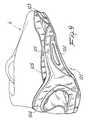
- Figs. 5, 6, and 7 are schematic rear views of the shoe in three different lateral flexing positions;
- Fig. 8 is a rear perspective view of the shoe according to another aspect of the present invention;
- Fig. 9 is a rear perspective view of the supporting structure of the shoe of Fig. 8.
-
- With reference to the above figures, the shoe according to the present invention, generally designated by the
reference numeral 6, comprises a supportingstructure 1 composed of alower part 2, which is adapted to connect atip 3 to aheel unit 4, and of twoarches 5. Thearches 5 are arranged longitudinally on each side and haveattachment lines lower part 2 at, or near to, thetip 3 and theheel unit 4. In this way a wideempty space 9 is provided between the front and the rear portion of the shoe, adjacent to the sole. Substantially above the saidempty space 9 eacharch 5 is provided with a plurality ofholes 8. - The
structure 1 is preferably assembled to theshoe 6 by injection-overmolding plastic material. A preferred manufacturing method is shown in Figs. 2, 3 and 4. Thestructure 1 is rested externally on a shoe 6 (Fig. 3) and alarge rim 7 of plastic material (Fig. 4) is then formed which monolithically associates thestructure 1 with theshoe 6. - As an alternative, the shoe can be assembled by gluing or by means of stitches. According to the assembly being used, the
structure 1 can be arranged between the lining and the padding, between the padding and the upper, between the innerboot or last and the upper, or outside the upper. The twolateral arches 5 can be fully or partially embedded in the injection-overmolded part or can be visible or concealed. They can be shaped so as to duplicate the exact shape of the plantar arch and of the outer side of the foot, or they can assume a "standard" shape for simple lateral containment. Their shape affects the stress acting on them. - Operation of the arches is very similar to that of leaf-spring suspensions used in cars.
- Leaf-spring suspensions in fact absorb energy thanks to the deformation of the two opposite bundles of bars, which is allowed by the empty space between them, and occurs exclusively in a vertical direction. With respect to leaf-spring suspensions, the two
arches 5 are not constrained by the vertical direction of the stress but can absorb vertical, lateral or mixed stresses because of the presence of the empty space between thearch 5 and thelower part 2. Figs. 5, 6 and 7 schematically illustrate the "mixed" behavior of the shoe according to the present invention. This freedom of deformation allows cushioning, and therefore support, regardless of the stress direction imposed by the user. According to the type of material used to manufacture the structure and to its thickness in the various deformation regions, lateral containment can therefore be adapted to the use of the shoe and to the user's characteristics. - Figs. 8 and 9 illustrate a second embodiment of the shoe according to the present invention, generally designated by the reference numeral 106. This embodiment offers the same support as the previous one and operates according to the same concepts. However, in this case the supporting
structure 101 is made of the same material used for the injection-overmolding. The supportingstructure 101 is composed of alower part 102, adapted to connect atip 103 to aheel unit 104, and of twolateral arches 105. - Is has been observed in practice that the present invention achieves the intended aim and objects, a shoe having been provided which is not necessarily constituted by a rigid shell but has excellent lateral containment.
- The proposed embodiment allows to provide a structure made of a material having varying degrees of rigidity, according to the specifications of the individual application, and characterized by arches arranged laterally to the foot.
- The lateral supporting structure allows to absorb several stresses in various directions.
- The shoe according to the present invention allows a soft and gradual support instead of a rigid one as in a plastic shell.
- It is also advantageous because it allows to adapt the structure to the foot shape and therefore to perfectly adapt the support to the kind of foot and sports activity.
- The shoe according to the present invention is susceptible of numerous modifications and variations, all of which are within the scope of the inventive concept as defined in the appended claims; all the details may also be replaced with technically equivalent elements.
- The materials employed, as well as the dimensions, may of course be any according to requirements and to the state of the art.
- Where technical features mentioned in any claim are followed by reference signs, those reference signs have been included for the sole purpose of increasing the intelligibility of the claims and accordingly, such reference signs do not have any limiting effect on the interpretation of each element identified by way of example by such reference signs.
Claims (11)
- A shoe (6) having a sole and a supporting and stiffening structure (1, 101) comprising a lower part (2, 102) for the mutual connection of a tip (3, 103) and a heel unit (4, 104) and also comprising at least a pair of parts (5, 105) arranged longitudinally on each side, characterized in that the said longitudinal parts (5, 105) are arch-shaped and have their attachment points (5a, 5b) to the said lower part (2) at, or in proximity of, the tip (3, 103) and the heel unit (4, 104) so as to provide an empty space (9) between the front and the rear portion of the shoe, adjacent to the sole.
- A shoe (6) according to claim 1, characterized in that said arch-shaped parts (5, 105) duplicate the plantar arch and the outer sides of the foot.
- A shoe (6) according to claim 1 or 2, characterized in that each one of said arc-shaped parts (5, 105) is provided with a plurality of holes (8) which are arranged substantially above the said empty space (9).
- A shoe according to one or more of the preceding claims, characterized in that it comprises an outer rim (7) adapted around said arc-shaped side parts (5, 105) to monolithically include said structure (1) arranged externally at least with respect to the sole of said shoe.
- A shoe according to one or more of the preceding claims, characterized in that said structure (1) is glued to the sole of said shoe.
- A shoe according to one or more of the preceding claims, characterized in that said structure (1) is stitched to the sole of said shoe.
- A shoe according to one or more of the preceding claims, characterized in that said structure (1) is arranged between a lining and a padding of said shoe.
- A shoe according to one or more of the preceding claims, characterized in that said structure (1) is arranged between a padding and an upper of said shoe.
- A shoe according to one or more of the preceding claims, characterized in that said structure (1) is arranged between an innerboot or last and an upper of said shoe.
- A shoe according to one or more of the preceding claims, characterized in that said structure (101) is formed monolithically together with an external plastic portion of said shoe.
- A method for manufacturing a shoe (6) having a sole and comprising a supporting and stiffening structure comprising a lower part (2, 102) for the mutual connection of a tip (3, 103) and a heel unit (4, 104) and also comprising at least at least a pair of arc-shaped parts (5, 105) arranged longitudinally, as defined in the previous claims, characterized in that it comprises the steps of : resting the said structure on the outside of at least the sole of the shoe and of injecting plastic material to realize an external rim (7) around said arc-shaped parts (5, 105) so as to make said structure (1,101) monolithically associated at least with the sole of the shoe (6).
Applications Claiming Priority (2)
| Application Number | Priority Date | Filing Date | Title |
|---|---|---|---|
| IT96MI001704A IT1283684B1 (en) | 1996-08-02 | 1996-08-02 | FOOTWEAR WITH SUPPORT AND STRENGTHENING STRUCTURE AND PROCEDURE FOR MAKING SUCH FOOTWEAR |
| ITMI961704 | 1996-08-02 |
Publications (2)
| Publication Number | Publication Date |
|---|---|
| EP0821890A1 EP0821890A1 (en) | 1998-02-04 |
| EP0821890B1 true EP0821890B1 (en) | 2002-05-22 |
Family
ID=11374773
Family Applications (1)
| Application Number | Title | Priority Date | Filing Date |
|---|---|---|---|
| EP97112597A Expired - Lifetime EP0821890B1 (en) | 1996-08-02 | 1997-07-23 | Shoe with supporting and stiffening structure and method for manufacturing said shoe |
Country Status (4)
| Country | Link |
|---|---|
| EP (1) | EP0821890B1 (en) |
| AT (1) | ATE217765T1 (en) |
| DE (1) | DE69712683T2 (en) |
| IT (1) | IT1283684B1 (en) |
Families Citing this family (2)
| Publication number | Priority date | Publication date | Assignee | Title |
|---|---|---|---|---|
| IT1311627B1 (en) * | 1999-01-18 | 2002-03-14 | Benetton Spa | SUPPORT STRUCTURE, PARTICULARLY FOR FOOTWEAR. |
| US9456653B2 (en) | 2012-10-12 | 2016-10-04 | Shimano Inc. | Bicycle shoe support and bicycle shoe |
Family Cites Families (5)
| Publication number | Priority date | Publication date | Assignee | Title |
|---|---|---|---|---|
| US3239952A (en) * | 1965-02-24 | 1966-03-15 | Robert B Lange | Ski boot |
| US3597862A (en) * | 1968-08-01 | 1971-08-10 | Raimund W Vogel | Ski boot |
| FR2032834A5 (en) * | 1969-02-10 | 1970-11-27 | Austin Luther Sons Ltd | |
| US3807062A (en) * | 1971-01-22 | 1974-04-30 | Karku Sport Ab | Athletic boot |
| CH561518A5 (en) * | 1972-11-28 | 1975-05-15 | Uhlmann Manyck |
-
1996
- 1996-08-02 IT IT96MI001704A patent/IT1283684B1/en active IP Right Grant
-
1997
- 1997-07-23 EP EP97112597A patent/EP0821890B1/en not_active Expired - Lifetime
- 1997-07-23 AT AT97112597T patent/ATE217765T1/en not_active IP Right Cessation
- 1997-07-23 DE DE69712683T patent/DE69712683T2/en not_active Expired - Fee Related
Also Published As
| Publication number | Publication date |
|---|---|
| DE69712683D1 (en) | 2002-06-27 |
| EP0821890A1 (en) | 1998-02-04 |
| DE69712683T2 (en) | 2002-11-14 |
| ITMI961704A1 (en) | 1998-02-02 |
| ITMI961704A0 (en) | 1996-08-02 |
| IT1283684B1 (en) | 1998-04-23 |
| ATE217765T1 (en) | 2002-06-15 |
Similar Documents
| Publication | Publication Date | Title |
|---|---|---|
| EP0505424B1 (en) | Moulded sole for footwear | |
| US4509276A (en) | Composite skate boot and method of making the same | |
| AU779654B2 (en) | Sole in the form of a midsole, inner sole or insertable sole for a shoe and a shoe with said sole | |
| EP2286684B1 (en) | Outsole and sports shoe | |
| US6634121B2 (en) | Shoe with a sole comprising a forefoot part divided into at least two elements | |
| EP0958752B1 (en) | Athletic shoe midsole design and construction | |
| US5024007A (en) | Sole for a sport shoe | |
| US6421933B1 (en) | Insole for shoes for soccer, running or similar sports | |
| US20050108898A1 (en) | Grid midsole insert | |
| US20020050078A1 (en) | Shoe with external torsion stability element | |
| US20040098881A1 (en) | Shoe structure | |
| US20030221337A1 (en) | Climbing slipper comprising a reinforcement insert | |
| US6944971B2 (en) | Composite reinforcement element, a boot and a binding incorporating such element, and a method of manufacturing same | |
| JP7476186B2 (en) | Skateboarding Shoes | |
| US6457265B1 (en) | Sport boot | |
| US4266314A (en) | Method of manufacture of sports shoes, and shoes manufactured by said method | |
| US20010032397A1 (en) | Footwear with fixedly secured insole for structural support | |
| US6092251A (en) | Method for manufacturing shoes and shoe obtained with the method | |
| EP0887028B1 (en) | Skate | |
| FI69957B (en) | KAENGA FOER TERRAENGSKIDNING VILKEN OMFATTAR ETT INNERSKAFT OC ETT YTTERSKAFT OCH FOERFARANDE FOER FRAMSTAELLNING AV DE N AEMNDA KAENGAN | |
| WO2000018264A1 (en) | Shoe construction | |
| US4793077A (en) | Article of athletic footwear, especially a ski boot | |
| US20060021258A1 (en) | Item of footwear, particularyly an item of sports footwear | |
| CA1061107A (en) | Articles of footwear | |
| EP0821890A1 (en) | Shoe with supporting and stiffening structure and method for manufacturing said shoe |
Legal Events
| Date | Code | Title | Description |
|---|---|---|---|
| PUAI | Public reference made under article 153(3) epc to a published international application that has entered the european phase |
Free format text: ORIGINAL CODE: 0009012 |
|
| AK | Designated contracting states |
Kind code of ref document: A1 Designated state(s): AT CH DE ES FR GB IT LI |
|
| AX | Request for extension of the european patent |
Free format text: AL;LT;LV;RO;SI |
|
| 17P | Request for examination filed |
Effective date: 19980803 |
|
| AKX | Designation fees paid |
Free format text: AT CH DE ES FR GB IT LI |
|
| AXX | Extension fees paid |
Free format text: SI PAYMENT 980803 |
|
| RBV | Designated contracting states (corrected) |
Designated state(s): AT CH DE ES FR GB IT LI |
|
| RAP1 | Party data changed (applicant data changed or rights of an application transferred) |
Owner name: ASOLO S.P.A. |
|
| RAP1 | Party data changed (applicant data changed or rights of an application transferred) |
Owner name: ASOLO S.P.A. |
|
| 17Q | First examination report despatched |
Effective date: 20000804 |
|
| GRAG | Despatch of communication of intention to grant |
Free format text: ORIGINAL CODE: EPIDOS AGRA |
|
| GRAG | Despatch of communication of intention to grant |
Free format text: ORIGINAL CODE: EPIDOS AGRA |
|
| GRAH | Despatch of communication of intention to grant a patent |
Free format text: ORIGINAL CODE: EPIDOS IGRA |
|
| GRAH | Despatch of communication of intention to grant a patent |
Free format text: ORIGINAL CODE: EPIDOS IGRA |
|
| GRAA | (expected) grant |
Free format text: ORIGINAL CODE: 0009210 |
|
| AX | Request for extension of the european patent |
Free format text: SI PAYMENT 19980803 |
|
| REF | Corresponds to: |
Ref document number: 217765 Country of ref document: AT Date of ref document: 20020615 Kind code of ref document: T |
|
| REG | Reference to a national code |
Ref country code: GB Ref legal event code: FG4D |
|
| REG | Reference to a national code |
Ref country code: CH Ref legal event code: EP |
|
| REF | Corresponds to: |
Ref document number: 69712683 Country of ref document: DE Date of ref document: 20020627 |
|
| REG | Reference to a national code |
Ref country code: CH Ref legal event code: NV Representative=s name: R. A. EGLI & CO. PATENTANWAELTE |
|
| ET | Fr: translation filed | ||
| PG25 | Lapsed in a contracting state [announced via postgrant information from national office to epo] |
Ref country code: ES Free format text: LAPSE BECAUSE OF FAILURE TO SUBMIT A TRANSLATION OF THE DESCRIPTION OR TO PAY THE FEE WITHIN THE PRESCRIBED TIME-LIMIT Effective date: 20021128 |
|
| PLBE | No opposition filed within time limit |
Free format text: ORIGINAL CODE: 0009261 |
|
| STAA | Information on the status of an ep patent application or granted ep patent |
Free format text: STATUS: NO OPPOSITION FILED WITHIN TIME LIMIT |
|
| 26N | No opposition filed |
Effective date: 20030225 |
|
| PGFP | Annual fee paid to national office [announced via postgrant information from national office to epo] |
Ref country code: DE Payment date: 20030617 Year of fee payment: 7 |
|
| PGFP | Annual fee paid to national office [announced via postgrant information from national office to epo] |
Ref country code: GB Payment date: 20030722 Year of fee payment: 7 |
|
| PGFP | Annual fee paid to national office [announced via postgrant information from national office to epo] |
Ref country code: AT Payment date: 20030725 Year of fee payment: 7 |
|
| PGFP | Annual fee paid to national office [announced via postgrant information from national office to epo] |
Ref country code: FR Payment date: 20030730 Year of fee payment: 7 |
|
| PGFP | Annual fee paid to national office [announced via postgrant information from national office to epo] |
Ref country code: CH Payment date: 20031028 Year of fee payment: 7 |
|
| PG25 | Lapsed in a contracting state [announced via postgrant information from national office to epo] |
Ref country code: GB Free format text: LAPSE BECAUSE OF NON-PAYMENT OF DUE FEES Effective date: 20040723 Ref country code: AT Free format text: LAPSE BECAUSE OF NON-PAYMENT OF DUE FEES Effective date: 20040723 |
|
| PG25 | Lapsed in a contracting state [announced via postgrant information from national office to epo] |
Ref country code: LI Free format text: LAPSE BECAUSE OF NON-PAYMENT OF DUE FEES Effective date: 20040731 Ref country code: CH Free format text: LAPSE BECAUSE OF NON-PAYMENT OF DUE FEES Effective date: 20040731 |
|
| PG25 | Lapsed in a contracting state [announced via postgrant information from national office to epo] |
Ref country code: DE Free format text: LAPSE BECAUSE OF NON-PAYMENT OF DUE FEES Effective date: 20050201 |
|
| REG | Reference to a national code |
Ref country code: CH Ref legal event code: PL |
|
| GBPC | Gb: european patent ceased through non-payment of renewal fee |
Effective date: 20040723 |
|
| PG25 | Lapsed in a contracting state [announced via postgrant information from national office to epo] |
Ref country code: FR Free format text: LAPSE BECAUSE OF NON-PAYMENT OF DUE FEES Effective date: 20050331 |
|
| REG | Reference to a national code |
Ref country code: FR Ref legal event code: ST |
|
| PG25 | Lapsed in a contracting state [announced via postgrant information from national office to epo] |
Ref country code: IT Free format text: LAPSE BECAUSE OF NON-PAYMENT OF DUE FEES;WARNING: LAPSES OF ITALIAN PATENTS WITH EFFECTIVE DATE BEFORE 2007 MAY HAVE OCCURRED AT ANY TIME BEFORE 2007. THE CORRECT EFFECTIVE DATE MAY BE DIFFERENT FROM THE ONE RECORDED. Effective date: 20050723 |