EP0821696B1 - Peptide antagonists of cellular mitogenesis and motogenesis and their therapeutic use - Google Patents
Peptide antagonists of cellular mitogenesis and motogenesis and their therapeutic use Download PDFInfo
- Publication number
- EP0821696B1 EP0821696B1 EP97903250A EP97903250A EP0821696B1 EP 0821696 B1 EP0821696 B1 EP 0821696B1 EP 97903250 A EP97903250 A EP 97903250A EP 97903250 A EP97903250 A EP 97903250A EP 0821696 B1 EP0821696 B1 EP 0821696B1
- Authority
- EP
- European Patent Office
- Prior art keywords
- val
- peptide
- tyr
- amino acid
- seq
- Prior art date
- Legal status (The legal status is an assumption and is not a legal conclusion. Google has not performed a legal analysis and makes no representation as to the accuracy of the status listed.)
- Expired - Lifetime
Links
- 108090000765 processed proteins & peptides Proteins 0.000 title claims description 143
- 230000001413 cellular effect Effects 0.000 title description 3
- 230000001225 therapeutic effect Effects 0.000 title description 3
- 239000005557 antagonist Substances 0.000 title description 2
- 150000001875 compounds Chemical class 0.000 claims description 118
- 150000001413 amino acids Chemical class 0.000 claims description 108
- 229910018828 PO3H2 Inorganic materials 0.000 claims description 56
- OUYCCCASQSFEME-QMMMGPOBSA-N L-tyrosine Chemical compound OC(=O)[C@@H](N)CC1=CC=C(O)C=C1 OUYCCCASQSFEME-QMMMGPOBSA-N 0.000 claims description 46
- 102000004196 processed proteins & peptides Human genes 0.000 claims description 34
- 230000001086 cytosolic effect Effects 0.000 claims description 23
- 238000000034 method Methods 0.000 claims description 22
- 238000011282 treatment Methods 0.000 claims description 22
- 108010089836 Proto-Oncogene Proteins c-met Proteins 0.000 claims description 20
- 125000000217 alkyl group Chemical group 0.000 claims description 15
- 125000004169 (C1-C6) alkyl group Chemical group 0.000 claims description 13
- 102000016914 ras Proteins Human genes 0.000 claims description 12
- 108010014186 ras Proteins Proteins 0.000 claims description 12
- 125000001493 tyrosinyl group Chemical group [H]OC1=C([H])C([H])=C(C([H])=C1[H])C([H])([H])C([H])(N([H])[H])C(*)=O 0.000 claims description 12
- 229910006069 SO3H Inorganic materials 0.000 claims description 10
- 239000001257 hydrogen Substances 0.000 claims description 9
- 229910052739 hydrogen Inorganic materials 0.000 claims description 9
- JNCMHMUGTWEVOZ-UHFFFAOYSA-N F[CH]F Chemical compound F[CH]F JNCMHMUGTWEVOZ-UHFFFAOYSA-N 0.000 claims description 8
- 125000004435 hydrogen atom Chemical group [H]* 0.000 claims description 8
- 150000003839 salts Chemical class 0.000 claims description 8
- OUYCCCASQSFEME-UHFFFAOYSA-N tyrosine Natural products OC(=O)C(N)CC1=CC=C(O)C=C1 OUYCCCASQSFEME-UHFFFAOYSA-N 0.000 claims description 8
- 201000010099 disease Diseases 0.000 claims description 7
- 208000037265 diseases, disorders, signs and symptoms Diseases 0.000 claims description 7
- 230000008569 process Effects 0.000 claims description 7
- 108091000080 Phosphotransferase Proteins 0.000 claims description 6
- 102000020233 phosphotransferase Human genes 0.000 claims description 6
- 125000000539 amino acid group Chemical group 0.000 claims description 5
- 125000004122 cyclic group Chemical group 0.000 claims description 5
- 125000001495 ethyl group Chemical group [H]C([H])([H])C([H])([H])* 0.000 claims description 5
- 238000010532 solid phase synthesis reaction Methods 0.000 claims description 5
- 108091008606 PDGF receptors Proteins 0.000 claims description 4
- 238000004519 manufacturing process Methods 0.000 claims description 4
- 230000001613 neoplastic effect Effects 0.000 claims description 4
- 239000008194 pharmaceutical composition Substances 0.000 claims description 4
- 102000027426 receptor tyrosine kinases Human genes 0.000 claims description 4
- 108091008598 receptor tyrosine kinases Proteins 0.000 claims description 4
- 102000001301 EGF receptor Human genes 0.000 claims description 3
- 108060006698 EGF receptor Proteins 0.000 claims description 3
- 125000003178 carboxy group Chemical group [H]OC(*)=O 0.000 claims description 3
- 239000003085 diluting agent Substances 0.000 claims description 3
- 238000002560 therapeutic procedure Methods 0.000 claims description 3
- 241001465754 Metazoa Species 0.000 claims description 2
- 239000007787 solid Substances 0.000 claims description 2
- 230000002194 synthesizing effect Effects 0.000 claims description 2
- 102000008022 Proto-Oncogene Proteins c-met Human genes 0.000 claims 3
- 101000818543 Homo sapiens Tyrosine-protein kinase ZAP-70 Proteins 0.000 claims 2
- 102000004422 Phospholipase C gamma Human genes 0.000 claims 2
- 108010056751 Phospholipase C gamma Proteins 0.000 claims 2
- 102000011653 Platelet-Derived Growth Factor Receptors Human genes 0.000 claims 2
- 102100021125 Tyrosine-protein kinase ZAP-70 Human genes 0.000 claims 2
- 108091006088 activator proteins Proteins 0.000 claims 2
- 150000003905 phosphatidylinositols Chemical class 0.000 claims 2
- 239000004480 active ingredient Substances 0.000 claims 1
- 239000003814 drug Substances 0.000 claims 1
- 229940024606 amino acid Drugs 0.000 description 111
- 235000001014 amino acid Nutrition 0.000 description 105
- 210000004027 cell Anatomy 0.000 description 71
- 239000000047 product Substances 0.000 description 55
- 238000002360 preparation method Methods 0.000 description 48
- 238000004949 mass spectrometry Methods 0.000 description 42
- 229920005989 resin Polymers 0.000 description 39
- 239000011347 resin Substances 0.000 description 39
- 238000004128 high performance liquid chromatography Methods 0.000 description 37
- 108090000623 proteins and genes Proteins 0.000 description 33
- YMWUJEATGCHHMB-UHFFFAOYSA-N Dichloromethane Chemical compound ClCCl YMWUJEATGCHHMB-UHFFFAOYSA-N 0.000 description 30
- 102100022623 Hepatocyte growth factor receptor Human genes 0.000 description 29
- 235000018102 proteins Nutrition 0.000 description 29
- 102000004169 proteins and genes Human genes 0.000 description 29
- ZMXDDKWLCZADIW-UHFFFAOYSA-N N,N-Dimethylformamide Chemical compound CN(C)C=O ZMXDDKWLCZADIW-UHFFFAOYSA-N 0.000 description 28
- 102000005962 receptors Human genes 0.000 description 26
- 108020003175 receptors Proteins 0.000 description 26
- SECXISVLQFMRJM-UHFFFAOYSA-N N-Methylpyrrolidone Chemical compound CN1CCCC1=O SECXISVLQFMRJM-UHFFFAOYSA-N 0.000 description 24
- 230000000694 effects Effects 0.000 description 24
- 102000014400 SH2 domains Human genes 0.000 description 20
- 108050003452 SH2 domains Proteins 0.000 description 20
- WEVYAHXRMPXWCK-UHFFFAOYSA-N Acetonitrile Chemical compound CC#N WEVYAHXRMPXWCK-UHFFFAOYSA-N 0.000 description 18
- QMMFVYPAHWMCMS-UHFFFAOYSA-N Dimethyl sulfide Chemical compound CSC QMMFVYPAHWMCMS-UHFFFAOYSA-N 0.000 description 18
- SJRJJKPEHAURKC-UHFFFAOYSA-N N-Methylmorpholine Chemical compound CN1CCOCC1 SJRJJKPEHAURKC-UHFFFAOYSA-N 0.000 description 18
- DCWXELXMIBXGTH-UHFFFAOYSA-N phosphotyrosine Chemical compound OC(=O)C(N)CC1=CC=C(OP(O)(O)=O)C=C1 DCWXELXMIBXGTH-UHFFFAOYSA-N 0.000 description 18
- 108010001441 Phosphopeptides Proteins 0.000 description 16
- 102000003745 Hepatocyte Growth Factor Human genes 0.000 description 15
- 108090000100 Hepatocyte Growth Factor Proteins 0.000 description 15
- 101100015729 Drosophila melanogaster drk gene Proteins 0.000 description 14
- DTQVDTLACAAQTR-UHFFFAOYSA-N Trifluoroacetic acid Chemical class OC(=O)C(F)(F)F DTQVDTLACAAQTR-UHFFFAOYSA-N 0.000 description 14
- -1 downstream Chemical compound 0.000 description 14
- 101150098203 grb2 gene Proteins 0.000 description 14
- XLYOFNOQVPJJNP-UHFFFAOYSA-N water Substances O XLYOFNOQVPJJNP-UHFFFAOYSA-N 0.000 description 13
- JGFZNNIVVJXRND-UHFFFAOYSA-N N,N-Diisopropylethylamine (DIPEA) Chemical compound CCN(C(C)C)C(C)C JGFZNNIVVJXRND-UHFFFAOYSA-N 0.000 description 12
- FAPWRFPIFSIZLT-UHFFFAOYSA-M Sodium chloride Chemical compound [Na+].[Cl-] FAPWRFPIFSIZLT-UHFFFAOYSA-M 0.000 description 12
- 238000004520 electroporation Methods 0.000 description 12
- 230000026731 phosphorylation Effects 0.000 description 12
- 238000006366 phosphorylation reaction Methods 0.000 description 12
- 239000000243 solution Substances 0.000 description 12
- XDEHMKQLKPZERH-BYPYZUCNSA-N (2s)-2-amino-3-methylbutanamide Chemical compound CC(C)[C@H](N)C(N)=O XDEHMKQLKPZERH-BYPYZUCNSA-N 0.000 description 11
- 238000006243 chemical reaction Methods 0.000 description 11
- 125000002496 methyl group Chemical group [H]C([H])([H])* 0.000 description 11
- 125000001151 peptidyl group Chemical group 0.000 description 11
- 230000019491 signal transduction Effects 0.000 description 11
- 230000009087 cell motility Effects 0.000 description 10
- 230000005764 inhibitory process Effects 0.000 description 10
- 239000000203 mixture Substances 0.000 description 10
- WFDIJRYMOXRFFG-UHFFFAOYSA-N Acetic anhydride Chemical compound CC(=O)OC(C)=O WFDIJRYMOXRFFG-UHFFFAOYSA-N 0.000 description 9
- XEKOWRVHYACXOJ-UHFFFAOYSA-N Ethyl acetate Chemical compound CCOC(C)=O XEKOWRVHYACXOJ-UHFFFAOYSA-N 0.000 description 9
- 108091008603 HGF receptors Proteins 0.000 description 9
- 229910018830 PO3H Inorganic materials 0.000 description 9
- 230000015916 branching morphogenesis of a tube Effects 0.000 description 9
- 239000012528 membrane Substances 0.000 description 9
- 238000004007 reversed phase HPLC Methods 0.000 description 9
- RTZKZFJDLAIYFH-UHFFFAOYSA-N Diethyl ether Chemical compound CCOCC RTZKZFJDLAIYFH-UHFFFAOYSA-N 0.000 description 8
- 238000004458 analytical method Methods 0.000 description 8
- 230000004663 cell proliferation Effects 0.000 description 8
- 238000005859 coupling reaction Methods 0.000 description 8
- 238000002474 experimental method Methods 0.000 description 8
- 230000001404 mediated effect Effects 0.000 description 8
- 229920005990 polystyrene resin Polymers 0.000 description 8
- 235000002374 tyrosine Nutrition 0.000 description 8
- UGNIYGNGCNXHTR-SFHVURJKSA-N (2s)-2-(9h-fluoren-9-ylmethoxycarbonylamino)-3-methylbutanoic acid Chemical compound C1=CC=C2C(COC(=O)N[C@@H](C(C)C)C(O)=O)C3=CC=CC=C3C2=C1 UGNIYGNGCNXHTR-SFHVURJKSA-N 0.000 description 7
- 102000005720 Glutathione transferase Human genes 0.000 description 7
- 108010070675 Glutathione transferase Proteins 0.000 description 7
- 206010028980 Neoplasm Diseases 0.000 description 7
- 230000003993 interaction Effects 0.000 description 7
- MYRTYDVEIRVNKP-UHFFFAOYSA-N 1,2-Divinylbenzene Chemical compound C=CC1=CC=CC=C1C=C MYRTYDVEIRVNKP-UHFFFAOYSA-N 0.000 description 6
- QTBSBXVTEAMEQO-UHFFFAOYSA-N Acetic acid Chemical compound CC(O)=O QTBSBXVTEAMEQO-UHFFFAOYSA-N 0.000 description 6
- OKKJLVBELUTLKV-UHFFFAOYSA-N Methanol Chemical compound OC OKKJLVBELUTLKV-UHFFFAOYSA-N 0.000 description 6
- YXFVVABEGXRONW-UHFFFAOYSA-N Toluene Chemical compound CC1=CC=CC=C1 YXFVVABEGXRONW-UHFFFAOYSA-N 0.000 description 6
- 238000003556 assay Methods 0.000 description 6
- 239000000872 buffer Substances 0.000 description 6
- 238000003776 cleavage reaction Methods 0.000 description 6
- 230000008878 coupling Effects 0.000 description 6
- 238000010168 coupling process Methods 0.000 description 6
- 102000037865 fusion proteins Human genes 0.000 description 6
- 108020001507 fusion proteins Proteins 0.000 description 6
- 230000007017 scission Effects 0.000 description 6
- 239000011780 sodium chloride Substances 0.000 description 6
- 239000002904 solvent Substances 0.000 description 6
- 125000000999 tert-butyl group Chemical group [H]C([H])([H])C(*)(C([H])([H])[H])C([H])([H])[H] 0.000 description 6
- 238000012360 testing method Methods 0.000 description 6
- CNBUSIJNWNXLQQ-NSHDSACASA-N (2s)-3-(4-hydroxyphenyl)-2-[(2-methylpropan-2-yl)oxycarbonylamino]propanoic acid Chemical compound CC(C)(C)OC(=O)N[C@H](C(O)=O)CC1=CC=C(O)C=C1 CNBUSIJNWNXLQQ-NSHDSACASA-N 0.000 description 5
- 101100512078 Caenorhabditis elegans lys-1 gene Proteins 0.000 description 5
- 102000018898 GTPase-Activating Proteins Human genes 0.000 description 5
- 108091006094 GTPase-accelerating proteins Proteins 0.000 description 5
- 230000008512 biological response Effects 0.000 description 5
- 239000012636 effector Substances 0.000 description 5
- 238000001914 filtration Methods 0.000 description 5
- 239000004417 polycarbonate Substances 0.000 description 5
- 230000000638 stimulation Effects 0.000 description 5
- MTCFGRXMJLQNBG-REOHCLBHSA-N (2S)-2-Amino-3-hydroxypropansäure Chemical compound OC[C@H](N)C(O)=O MTCFGRXMJLQNBG-REOHCLBHSA-N 0.000 description 4
- KJUGUADJHNHALS-UHFFFAOYSA-N 1H-tetrazole Chemical compound C=1N=NNN=1 KJUGUADJHNHALS-UHFFFAOYSA-N 0.000 description 4
- VHYFNPMBLIVWCW-UHFFFAOYSA-N 4-Dimethylaminopyridine Chemical compound CN(C)C1=CC=NC=C1 VHYFNPMBLIVWCW-UHFFFAOYSA-N 0.000 description 4
- WOVKYSAHUYNSMH-RRKCRQDMSA-N 5-bromodeoxyuridine Chemical compound C1[C@H](O)[C@@H](CO)O[C@H]1N1C(=O)NC(=O)C(Br)=C1 WOVKYSAHUYNSMH-RRKCRQDMSA-N 0.000 description 4
- 239000006144 Dulbecco’s modified Eagle's medium Substances 0.000 description 4
- AYFVYJQAPQTCCC-GBXIJSLDSA-N L-threonine Chemical compound C[C@@H](O)[C@H](N)C(O)=O AYFVYJQAPQTCCC-GBXIJSLDSA-N 0.000 description 4
- 206010027476 Metastases Diseases 0.000 description 4
- 102000000395 SH3 domains Human genes 0.000 description 4
- 108050008861 SH3 domains Proteins 0.000 description 4
- UIIMBOGNXHQVGW-UHFFFAOYSA-M Sodium bicarbonate Chemical compound [Na+].OC([O-])=O UIIMBOGNXHQVGW-UHFFFAOYSA-M 0.000 description 4
- HEDRZPFGACZZDS-MICDWDOJSA-N Trichloro(2H)methane Chemical compound [2H]C(Cl)(Cl)Cl HEDRZPFGACZZDS-MICDWDOJSA-N 0.000 description 4
- 238000006640 acetylation reaction Methods 0.000 description 4
- 230000004913 activation Effects 0.000 description 4
- 238000013459 approach Methods 0.000 description 4
- 230000001580 bacterial effect Effects 0.000 description 4
- 230000015572 biosynthetic process Effects 0.000 description 4
- 238000005251 capillar electrophoresis Methods 0.000 description 4
- 230000003197 catalytic effect Effects 0.000 description 4
- 239000003153 chemical reaction reagent Substances 0.000 description 4
- 235000019439 ethyl acetate Nutrition 0.000 description 4
- 238000011156 evaluation Methods 0.000 description 4
- 238000001704 evaporation Methods 0.000 description 4
- 230000008020 evaporation Effects 0.000 description 4
- RWSXRVCMGQZWBV-WDSKDSINSA-N glutathione Chemical compound OC(=O)[C@@H](N)CCC(=O)N[C@@H](CS)C(=O)NCC(O)=O RWSXRVCMGQZWBV-WDSKDSINSA-N 0.000 description 4
- 238000011065 in-situ storage Methods 0.000 description 4
- 230000003834 intracellular effect Effects 0.000 description 4
- 230000009401 metastasis Effects 0.000 description 4
- 238000003032 molecular docking Methods 0.000 description 4
- CMWYAOXYQATXSI-UHFFFAOYSA-N n,n-dimethylformamide;piperidine Chemical compound CN(C)C=O.C1CCNCC1 CMWYAOXYQATXSI-UHFFFAOYSA-N 0.000 description 4
- 230000037361 pathway Effects 0.000 description 4
- 229920000515 polycarbonate Polymers 0.000 description 4
- 238000003786 synthesis reaction Methods 0.000 description 4
- 125000002221 trityl group Chemical group [H]C1=C([H])C([H])=C([H])C([H])=C1C([*])(C1=C(C(=C(C(=C1[H])[H])[H])[H])[H])C1=C([H])C([H])=C([H])C([H])=C1[H] 0.000 description 4
- SWZCTMTWRHEBIN-QFIPXVFZSA-N (2s)-2-(9h-fluoren-9-ylmethoxycarbonylamino)-3-(4-hydroxyphenyl)propanoic acid Chemical compound C([C@@H](C(=O)O)NC(=O)OCC1C2=CC=CC=C2C2=CC=CC=C21)C1=CC=C(O)C=C1 SWZCTMTWRHEBIN-QFIPXVFZSA-N 0.000 description 3
- KJYAFJQCGPUXJY-UMSFTDKQSA-N (2s)-2-(9h-fluoren-9-ylmethoxycarbonylamino)-4-oxo-4-(tritylamino)butanoic acid Chemical compound C([C@@H](C(=O)O)NC(=O)OCC1C2=CC=CC=C2C2=CC=CC=C21)C(=O)NC(C=1C=CC=CC=1)(C=1C=CC=CC=1)C1=CC=CC=C1 KJYAFJQCGPUXJY-UMSFTDKQSA-N 0.000 description 3
- BDNKZNFMNDZQMI-UHFFFAOYSA-N 1,3-diisopropylcarbodiimide Chemical compound CC(C)N=C=NC(C)C BDNKZNFMNDZQMI-UHFFFAOYSA-N 0.000 description 3
- ASOKPJOREAFHNY-UHFFFAOYSA-N 1-Hydroxybenzotriazole Chemical class C1=CC=C2N(O)N=NC2=C1 ASOKPJOREAFHNY-UHFFFAOYSA-N 0.000 description 3
- WVDDGKGOMKODPV-UHFFFAOYSA-N Benzyl alcohol Chemical compound OCC1=CC=CC=C1 WVDDGKGOMKODPV-UHFFFAOYSA-N 0.000 description 3
- 102000004190 Enzymes Human genes 0.000 description 3
- 108090000790 Enzymes Proteins 0.000 description 3
- LFQSCWFLJHTTHZ-UHFFFAOYSA-N Ethanol Chemical compound CCO LFQSCWFLJHTTHZ-UHFFFAOYSA-N 0.000 description 3
- 108010037362 Extracellular Matrix Proteins Proteins 0.000 description 3
- 102000010834 Extracellular Matrix Proteins Human genes 0.000 description 3
- PEDCQBHIVMGVHV-UHFFFAOYSA-N Glycerine Chemical compound OCC(O)CO PEDCQBHIVMGVHV-UHFFFAOYSA-N 0.000 description 3
- 241001622557 Hesperia Species 0.000 description 3
- 101000972946 Homo sapiens Hepatocyte growth factor receptor Proteins 0.000 description 3
- 102100025087 Insulin receptor substrate 1 Human genes 0.000 description 3
- 101710201824 Insulin receptor substrate 1 Proteins 0.000 description 3
- 108091054455 MAP kinase family Proteins 0.000 description 3
- 102000043136 MAP kinase family Human genes 0.000 description 3
- 239000007832 Na2SO4 Substances 0.000 description 3
- PMZURENOXWZQFD-UHFFFAOYSA-L Sodium Sulfate Chemical compound [Na+].[Na+].[O-]S([O-])(=O)=O PMZURENOXWZQFD-UHFFFAOYSA-L 0.000 description 3
- CLZISMQKJZCZDN-UHFFFAOYSA-N [benzotriazol-1-yloxy(dimethylamino)methylidene]-dimethylazanium Chemical compound C1=CC=C2N(OC(N(C)C)=[N+](C)C)N=NC2=C1 CLZISMQKJZCZDN-UHFFFAOYSA-N 0.000 description 3
- 230000021736 acetylation Effects 0.000 description 3
- 239000002253 acid Substances 0.000 description 3
- 230000004071 biological effect Effects 0.000 description 3
- 238000007413 biotinylation Methods 0.000 description 3
- 230000006287 biotinylation Effects 0.000 description 3
- 210000000170 cell membrane Anatomy 0.000 description 3
- 238000001516 cell proliferation assay Methods 0.000 description 3
- KRKNYBCHXYNGOX-UHFFFAOYSA-N citric acid Chemical compound OC(=O)CC(O)(C(O)=O)CC(O)=O KRKNYBCHXYNGOX-UHFFFAOYSA-N 0.000 description 3
- 239000002299 complementary DNA Substances 0.000 description 3
- 239000013078 crystal Substances 0.000 description 3
- BGRWYRAHAFMIBJ-UHFFFAOYSA-N diisopropylcarbodiimide Natural products CC(C)NC(=O)NC(C)C BGRWYRAHAFMIBJ-UHFFFAOYSA-N 0.000 description 3
- RIFGWPKJUGCATF-UHFFFAOYSA-N ethyl chloroformate Chemical compound CCOC(Cl)=O RIFGWPKJUGCATF-UHFFFAOYSA-N 0.000 description 3
- 210000002744 extracellular matrix Anatomy 0.000 description 3
- 230000006870 function Effects 0.000 description 3
- 239000011521 glass Substances 0.000 description 3
- 230000012010 growth Effects 0.000 description 3
- 238000001727 in vivo Methods 0.000 description 3
- 238000011534 incubation Methods 0.000 description 3
- 239000002609 medium Substances 0.000 description 3
- 238000001000 micrograph Methods 0.000 description 3
- 230000004899 motility Effects 0.000 description 3
- FEMOMIGRRWSMCU-UHFFFAOYSA-N ninhydrin Chemical compound C1=CC=C2C(=O)C(O)(O)C(=O)C2=C1 FEMOMIGRRWSMCU-UHFFFAOYSA-N 0.000 description 3
- 239000012074 organic phase Substances 0.000 description 3
- DCWXELXMIBXGTH-QMMMGPOBSA-N phosphonotyrosine Chemical group OC(=O)[C@@H](N)CC1=CC=C(OP(O)(O)=O)C=C1 DCWXELXMIBXGTH-QMMMGPOBSA-N 0.000 description 3
- 125000006239 protecting group Chemical group 0.000 description 3
- 238000000746 purification Methods 0.000 description 3
- 230000001105 regulatory effect Effects 0.000 description 3
- 229910052938 sodium sulfate Inorganic materials 0.000 description 3
- 239000007790 solid phase Substances 0.000 description 3
- 239000013598 vector Substances 0.000 description 3
- 230000003612 virological effect Effects 0.000 description 3
- 230000004584 weight gain Effects 0.000 description 3
- 235000019786 weight gain Nutrition 0.000 description 3
- MGOGKPMIZGEGOZ-REOHCLBHSA-N (2s)-2-amino-3-hydroxypropanamide Chemical compound OC[C@H](N)C(N)=O MGOGKPMIZGEGOZ-REOHCLBHSA-N 0.000 description 2
- 125000003088 (fluoren-9-ylmethoxy)carbonyl group Chemical group 0.000 description 2
- UQZHJQWIISKTJN-YALINYFNSA-N 1-[6-[5-[(3as,4s,6ar)-2-oxo-1,3,3a,4,6,6a-hexahydrothieno[3,4-d]imidazol-4-yl]pentanoylamino]hexanoyloxy]-2,5-dioxopyrrolidine-3-sulfonic acid Chemical compound O=C1C(S(=O)(=O)O)CC(=O)N1OC(=O)CCCCCNC(=O)CCCC[C@H]1[C@H]2NC(=O)N[C@H]2CS1 UQZHJQWIISKTJN-YALINYFNSA-N 0.000 description 2
- HZAXFHJVJLSVMW-UHFFFAOYSA-N 2-Aminoethan-1-ol Chemical compound NCCO HZAXFHJVJLSVMW-UHFFFAOYSA-N 0.000 description 2
- QKNYBSVHEMOAJP-UHFFFAOYSA-N 2-amino-2-(hydroxymethyl)propane-1,3-diol;hydron;chloride Chemical compound Cl.OCC(N)(CO)CO QKNYBSVHEMOAJP-UHFFFAOYSA-N 0.000 description 2
- KDSNLYIMUZNERS-UHFFFAOYSA-N 2-methylpropanamine Chemical compound CC(C)CN KDSNLYIMUZNERS-UHFFFAOYSA-N 0.000 description 2
- FPQQSJJWHUJYPU-UHFFFAOYSA-N 3-(dimethylamino)propyliminomethylidene-ethylazanium;chloride Chemical compound Cl.CCN=C=NCCCN(C)C FPQQSJJWHUJYPU-UHFFFAOYSA-N 0.000 description 2
- WEVYNIUIFUYDGI-UHFFFAOYSA-N 3-[6-[4-(trifluoromethoxy)anilino]-4-pyrimidinyl]benzamide Chemical compound NC(=O)C1=CC=CC(C=2N=CN=C(NC=3C=CC(OC(F)(F)F)=CC=3)C=2)=C1 WEVYNIUIFUYDGI-UHFFFAOYSA-N 0.000 description 2
- FWMNVWWHGCHHJJ-SKKKGAJSSA-N 4-amino-1-[(2r)-6-amino-2-[[(2r)-2-[[(2r)-2-[[(2r)-2-amino-3-phenylpropanoyl]amino]-3-phenylpropanoyl]amino]-4-methylpentanoyl]amino]hexanoyl]piperidine-4-carboxylic acid Chemical compound C([C@H](C(=O)N[C@H](CC(C)C)C(=O)N[C@H](CCCCN)C(=O)N1CCC(N)(CC1)C(O)=O)NC(=O)[C@H](N)CC=1C=CC=CC=1)C1=CC=CC=C1 FWMNVWWHGCHHJJ-SKKKGAJSSA-N 0.000 description 2
- 229960000549 4-dimethylaminophenol Drugs 0.000 description 2
- 229920000936 Agarose Polymers 0.000 description 2
- 108090001008 Avidin Proteins 0.000 description 2
- WOVKYSAHUYNSMH-UHFFFAOYSA-N BROMODEOXYURIDINE Natural products C1C(O)C(CO)OC1N1C(=O)NC(=O)C(Br)=C1 WOVKYSAHUYNSMH-UHFFFAOYSA-N 0.000 description 2
- 0 B[C@](*)(C(N[C@](*)CC(N)=O)=O)NC([C@@](*)Cc1ccc(*)cc1)=O Chemical compound B[C@](*)(C(N[C@](*)CC(N)=O)=O)NC([C@@](*)Cc1ccc(*)cc1)=O 0.000 description 2
- 108010035532 Collagen Proteins 0.000 description 2
- 102000008186 Collagen Human genes 0.000 description 2
- IAZDPXIOMUYVGZ-WFGJKAKNSA-N Dimethyl sulfoxide Chemical compound [2H]C([2H])([2H])S(=O)C([2H])([2H])[2H] IAZDPXIOMUYVGZ-WFGJKAKNSA-N 0.000 description 2
- KCXVZYZYPLLWCC-UHFFFAOYSA-N EDTA Chemical compound OC(=O)CN(CC(O)=O)CCN(CC(O)=O)CC(O)=O KCXVZYZYPLLWCC-UHFFFAOYSA-N 0.000 description 2
- 108010024636 Glutathione Proteins 0.000 description 2
- 102000009465 Growth Factor Receptors Human genes 0.000 description 2
- 108010009202 Growth Factor Receptors Proteins 0.000 description 2
- VEXZGXHMUGYJMC-UHFFFAOYSA-N Hydrochloric acid Chemical compound Cl VEXZGXHMUGYJMC-UHFFFAOYSA-N 0.000 description 2
- DCXYFEDJOCDNAF-REOHCLBHSA-N L-asparagine Chemical compound OC(=O)[C@@H](N)CC(N)=O DCXYFEDJOCDNAF-REOHCLBHSA-N 0.000 description 2
- COLNVLDHVKWLRT-QMMMGPOBSA-N L-phenylalanine Chemical compound OC(=O)[C@@H](N)CC1=CC=CC=C1 COLNVLDHVKWLRT-QMMMGPOBSA-N 0.000 description 2
- 108090000744 Mitogen-Activated Protein Kinase Kinases Proteins 0.000 description 2
- 102000004232 Mitogen-Activated Protein Kinase Kinases Human genes 0.000 description 2
- 101100268066 Mus musculus Zap70 gene Proteins 0.000 description 2
- 102000003992 Peroxidases Human genes 0.000 description 2
- ISWSIDIOOBJBQZ-UHFFFAOYSA-N Phenol Chemical compound OC1=CC=CC=C1 ISWSIDIOOBJBQZ-UHFFFAOYSA-N 0.000 description 2
- 102000004160 Phosphoric Monoester Hydrolases Human genes 0.000 description 2
- 108090000608 Phosphoric Monoester Hydrolases Proteins 0.000 description 2
- NQRYJNQNLNOLGT-UHFFFAOYSA-N Piperidine Chemical compound C1CCNCC1 NQRYJNQNLNOLGT-UHFFFAOYSA-N 0.000 description 2
- 102000052575 Proto-Oncogene Human genes 0.000 description 2
- 108700020978 Proto-Oncogene Proteins 0.000 description 2
- 201000004681 Psoriasis Diseases 0.000 description 2
- 101150056500 Ptpn6 gene Proteins 0.000 description 2
- 102000004278 Receptor Protein-Tyrosine Kinases Human genes 0.000 description 2
- 108090000873 Receptor Protein-Tyrosine Kinases Proteins 0.000 description 2
- 102000007056 Recombinant Fusion Proteins Human genes 0.000 description 2
- 108010008281 Recombinant Fusion Proteins Proteins 0.000 description 2
- MTCFGRXMJLQNBG-UHFFFAOYSA-N Serine Natural products OCC(N)C(O)=O MTCFGRXMJLQNBG-UHFFFAOYSA-N 0.000 description 2
- AYFVYJQAPQTCCC-UHFFFAOYSA-N Threonine Natural products CC(O)C(N)C(O)=O AYFVYJQAPQTCCC-UHFFFAOYSA-N 0.000 description 2
- 239000004473 Threonine Substances 0.000 description 2
- IQFYYKKMVGJFEH-XLPZGREQSA-N Thymidine Chemical class O=C1NC(=O)C(C)=CN1[C@@H]1O[C@H](CO)[C@@H](O)C1 IQFYYKKMVGJFEH-XLPZGREQSA-N 0.000 description 2
- 102100021657 Tyrosine-protein phosphatase non-receptor type 6 Human genes 0.000 description 2
- 241000700605 Viruses Species 0.000 description 2
- 238000002835 absorbance Methods 0.000 description 2
- 125000002777 acetyl group Chemical group [H]C([H])([H])C(*)=O 0.000 description 2
- 230000001464 adherent effect Effects 0.000 description 2
- 150000003862 amino acid derivatives Chemical class 0.000 description 2
- 125000003277 amino group Chemical group 0.000 description 2
- 150000008064 anhydrides Chemical class 0.000 description 2
- 230000000259 anti-tumor effect Effects 0.000 description 2
- 239000002585 base Substances 0.000 description 2
- 239000011324 bead Substances 0.000 description 2
- HZDNRJRGRZEVCM-SFHVURJKSA-N benzyl (2s)-3-(4-hydroxyphenyl)-2-[(2-methylpropan-2-yl)oxycarbonylamino]propanoate Chemical compound C([C@H](NC(=O)OC(C)(C)C)C(=O)OCC=1C=CC=CC=1)C1=CC=C(O)C=C1 HZDNRJRGRZEVCM-SFHVURJKSA-N 0.000 description 2
- 230000033228 biological regulation Effects 0.000 description 2
- 210000004899 c-terminal region Anatomy 0.000 description 2
- 230000004709 cell invasion Effects 0.000 description 2
- 238000005119 centrifugation Methods 0.000 description 2
- 239000003795 chemical substances by application Substances 0.000 description 2
- 229920001436 collagen Polymers 0.000 description 2
- 230000007423 decrease Effects 0.000 description 2
- 238000010511 deprotection reaction Methods 0.000 description 2
- 229960004132 diethyl ether Drugs 0.000 description 2
- 230000002255 enzymatic effect Effects 0.000 description 2
- 102000052116 epidermal growth factor receptor activity proteins Human genes 0.000 description 2
- 108700015053 epidermal growth factor receptor activity proteins Proteins 0.000 description 2
- 238000009650 gentamicin protection assay Methods 0.000 description 2
- 229960003180 glutathione Drugs 0.000 description 2
- 239000003102 growth factor Substances 0.000 description 2
- 239000001963 growth medium Substances 0.000 description 2
- UYTPUPDQBNUYGX-UHFFFAOYSA-N guanine Chemical group O=C1NC(N)=NC2=C1N=CN2 UYTPUPDQBNUYGX-UHFFFAOYSA-N 0.000 description 2
- 210000003494 hepatocyte Anatomy 0.000 description 2
- 230000002401 inhibitory effect Effects 0.000 description 2
- 239000007791 liquid phase Substances 0.000 description 2
- 108010082117 matrigel Proteins 0.000 description 2
- 230000007246 mechanism Effects 0.000 description 2
- 238000010232 migration assay Methods 0.000 description 2
- YOHYSYJDKVYCJI-UHFFFAOYSA-N n-[3-[[6-[3-(trifluoromethyl)anilino]pyrimidin-4-yl]amino]phenyl]cyclopropanecarboxamide Chemical compound FC(F)(F)C1=CC=CC(NC=2N=CN=C(NC=3C=C(NC(=O)C4CC4)C=CC=3)C=2)=C1 YOHYSYJDKVYCJI-UHFFFAOYSA-N 0.000 description 2
- 239000013642 negative control Substances 0.000 description 2
- 210000002569 neuron Anatomy 0.000 description 2
- 239000003921 oil Substances 0.000 description 2
- 239000000816 peptidomimetic Substances 0.000 description 2
- 108040007629 peroxidase activity proteins Proteins 0.000 description 2
- 229960005190 phenylalanine Drugs 0.000 description 2
- 230000000865 phosphorylative effect Effects 0.000 description 2
- 230000035755 proliferation Effects 0.000 description 2
- 230000011664 signaling Effects 0.000 description 2
- 229910000030 sodium bicarbonate Inorganic materials 0.000 description 2
- CIHOLLKRGTVIJN-UHFFFAOYSA-N tert‐butyl hydroperoxide Chemical compound CC(C)(C)OO CIHOLLKRGTVIJN-UHFFFAOYSA-N 0.000 description 2
- 238000013518 transcription Methods 0.000 description 2
- 230000035897 transcription Effects 0.000 description 2
- 210000005239 tubule Anatomy 0.000 description 2
- 241000701447 unidentified baculovirus Species 0.000 description 2
- ZRHPMMZWDWMKPD-QFIPXVFZSA-N (2s)-2-(9h-fluoren-9-ylmethoxycarbonylamino)-3-[1-[(2-methylpropan-2-yl)oxycarbonyl]imidazol-4-yl]propanoic acid Chemical compound CC(C)(C)OC(=O)N1C=NC(C[C@H](NC(=O)OCC2C3=CC=CC=C3C3=CC=CC=C32)C(O)=O)=C1 ZRHPMMZWDWMKPD-QFIPXVFZSA-N 0.000 description 1
- SJVFAHZPLIXNDH-QFIPXVFZSA-N (2s)-2-(9h-fluoren-9-ylmethoxycarbonylamino)-3-phenylpropanoic acid Chemical compound C([C@@H](C(=O)O)NC(=O)OCC1C2=CC=CC=C2C2=CC=CC=C21)C1=CC=CC=C1 SJVFAHZPLIXNDH-QFIPXVFZSA-N 0.000 description 1
- UMRUUWFGLGNQLI-QFIPXVFZSA-N (2s)-2-(9h-fluoren-9-ylmethoxycarbonylamino)-6-[(2-methylpropan-2-yl)oxycarbonylamino]hexanoic acid Chemical compound C1=CC=C2C(COC(=O)N[C@@H](CCCCNC(=O)OC(C)(C)C)C(O)=O)C3=CC=CC=C3C2=C1 UMRUUWFGLGNQLI-QFIPXVFZSA-N 0.000 description 1
- KSDTXRUIZMTBNV-INIZCTEOSA-N (2s)-2-(9h-fluoren-9-ylmethoxycarbonylamino)butanedioic acid Chemical compound C1=CC=C2C(COC(=O)N[C@@H](CC(=O)O)C(O)=O)C3=CC=CC=C3C2=C1 KSDTXRUIZMTBNV-INIZCTEOSA-N 0.000 description 1
- QWXZOFZKSQXPDC-NSHDSACASA-N (2s)-2-(9h-fluoren-9-ylmethoxycarbonylamino)propanoic acid Chemical compound C1=CC=C2C(COC(=O)N[C@@H](C)C(O)=O)C3=CC=CC=C3C2=C1 QWXZOFZKSQXPDC-NSHDSACASA-N 0.000 description 1
- ZQHCDMSMVMNCER-DEOSSOPVSA-N (2s)-3-(4-dimethoxyphosphoryloxyphenyl)-2-(9h-fluoren-9-ylmethoxycarbonylamino)propanoic acid Chemical compound C1=CC(OP(=O)(OC)OC)=CC=C1C[C@@H](C(O)=O)NC(=O)OCC1C2=CC=CC=C2C2=CC=CC=C21 ZQHCDMSMVMNCER-DEOSSOPVSA-N 0.000 description 1
- CCLWUICKUOJJQS-MHZLTWQESA-N (2s)-3-[4-(diethoxyphosphorylmethyl)phenyl]-2-(9h-fluoren-9-ylmethoxycarbonylamino)propanoic acid Chemical compound C1=CC(CP(=O)(OCC)OCC)=CC=C1C[C@@H](C(O)=O)NC(=O)OCC1C2=CC=CC=C2C2=CC=CC=C21 CCLWUICKUOJJQS-MHZLTWQESA-N 0.000 description 1
- RYHBNJHYFVUHQT-UHFFFAOYSA-N 1,4-Dioxane Chemical compound C1COCCO1 RYHBNJHYFVUHQT-UHFFFAOYSA-N 0.000 description 1
- KZNQNBZMBZJQJO-UHFFFAOYSA-N 1-(2-azaniumylacetyl)pyrrolidine-2-carboxylate Chemical compound NCC(=O)N1CCCC1C(O)=O KZNQNBZMBZJQJO-UHFFFAOYSA-N 0.000 description 1
- NDKDFTQNXLHCGO-UHFFFAOYSA-N 2-(9h-fluoren-9-ylmethoxycarbonylamino)acetic acid Chemical compound C1=CC=C2C(COC(=O)NCC(=O)O)C3=CC=CC=C3C2=C1 NDKDFTQNXLHCGO-UHFFFAOYSA-N 0.000 description 1
- JKMHFZQWWAIEOD-UHFFFAOYSA-N 2-[4-(2-hydroxyethyl)piperazin-1-yl]ethanesulfonic acid Chemical compound OCC[NH+]1CCN(CCS([O-])(=O)=O)CC1 JKMHFZQWWAIEOD-UHFFFAOYSA-N 0.000 description 1
- SLRMQYXOBQWXCR-UHFFFAOYSA-N 2154-56-5 Chemical compound [CH2]C1=CC=CC=C1 SLRMQYXOBQWXCR-UHFFFAOYSA-N 0.000 description 1
- AIDYQYOPUBOMTR-FQEVSTJZSA-N 5-o-tert-butyl 1-o-(2,3,4,5,6-pentafluorophenyl) (2s)-2-(9h-fluoren-9-ylmethoxycarbonylamino)pentanedioate Chemical compound O=C([C@@H](NC(=O)OCC1C2=CC=CC=C2C2=CC=CC=C21)CCC(=O)OC(C)(C)C)OC1=C(F)C(F)=C(F)C(F)=C1F AIDYQYOPUBOMTR-FQEVSTJZSA-N 0.000 description 1
- QTBSBXVTEAMEQO-UHFFFAOYSA-M Acetate Chemical compound CC([O-])=O QTBSBXVTEAMEQO-UHFFFAOYSA-M 0.000 description 1
- USFZMSVCRYTOJT-UHFFFAOYSA-N Ammonium acetate Chemical compound N.CC(O)=O USFZMSVCRYTOJT-UHFFFAOYSA-N 0.000 description 1
- DCXYFEDJOCDNAF-UHFFFAOYSA-N Asparagine Natural products OC(=O)C(N)CC(N)=O DCXYFEDJOCDNAF-UHFFFAOYSA-N 0.000 description 1
- 238000000035 BCA protein assay Methods 0.000 description 1
- 101100315624 Caenorhabditis elegans tyr-1 gene Proteins 0.000 description 1
- 208000024172 Cardiovascular disease Diseases 0.000 description 1
- 102000004266 Collagen Type IV Human genes 0.000 description 1
- 108010042086 Collagen Type IV Proteins 0.000 description 1
- 102100021507 Costars family protein ABRACL Human genes 0.000 description 1
- QNAYBMKLOCPYGJ-UHFFFAOYSA-N D-alpha-Ala Natural products CC([NH3+])C([O-])=O QNAYBMKLOCPYGJ-UHFFFAOYSA-N 0.000 description 1
- 108020004414 DNA Proteins 0.000 description 1
- 101100001676 Emericella variicolor andK gene Proteins 0.000 description 1
- 108091008794 FGF receptors Proteins 0.000 description 1
- 102100022086 GRB2-related adapter protein 2 Human genes 0.000 description 1
- 208000034951 Genetic Translocation Diseases 0.000 description 1
- 102100033067 Growth factor receptor-bound protein 2 Human genes 0.000 description 1
- 108091009389 Growth factor receptor-bound protein 2 Proteins 0.000 description 1
- 101710184069 Hepatocyte growth factor receptor Proteins 0.000 description 1
- 101000677808 Homo sapiens Costars family protein ABRACL Proteins 0.000 description 1
- 101000900690 Homo sapiens GRB2-related adapter protein 2 Proteins 0.000 description 1
- 101000692455 Homo sapiens Platelet-derived growth factor receptor beta Proteins 0.000 description 1
- 101001059454 Homo sapiens Serine/threonine-protein kinase MARK2 Proteins 0.000 description 1
- DGAQECJNVWCQMB-PUAWFVPOSA-M Ilexoside XXIX Chemical compound C[C@@H]1CC[C@@]2(CC[C@@]3(C(=CC[C@H]4[C@]3(CC[C@@H]5[C@@]4(CC[C@@H](C5(C)C)OS(=O)(=O)[O-])C)C)[C@@H]2[C@]1(C)O)C)C(=O)O[C@H]6[C@@H]([C@H]([C@@H]([C@H](O6)CO)O)O)O.[Na+] DGAQECJNVWCQMB-PUAWFVPOSA-M 0.000 description 1
- 206010061218 Inflammation Diseases 0.000 description 1
- ONIBWKKTOPOVIA-BYPYZUCNSA-N L-Proline Chemical compound OC(=O)[C@@H]1CCCN1 ONIBWKKTOPOVIA-BYPYZUCNSA-N 0.000 description 1
- 108010085895 Laminin Proteins 0.000 description 1
- 239000006137 Luria-Bertani broth Substances 0.000 description 1
- 101000900711 Mus musculus GRB2-related adaptor protein 2 Proteins 0.000 description 1
- NQTADLQHYWFPDB-UHFFFAOYSA-N N-Hydroxysuccinimide Chemical compound ON1C(=O)CCC1=O NQTADLQHYWFPDB-UHFFFAOYSA-N 0.000 description 1
- 206010061309 Neoplasm progression Diseases 0.000 description 1
- 239000004677 Nylon Substances 0.000 description 1
- 108010038807 Oligopeptides Proteins 0.000 description 1
- 102000015636 Oligopeptides Human genes 0.000 description 1
- 102000043276 Oncogene Human genes 0.000 description 1
- 108700020796 Oncogene Proteins 0.000 description 1
- 229910019142 PO4 Inorganic materials 0.000 description 1
- KDLHZDBZIXYQEI-UHFFFAOYSA-N Palladium Chemical compound [Pd] KDLHZDBZIXYQEI-UHFFFAOYSA-N 0.000 description 1
- 102000007982 Phosphoproteins Human genes 0.000 description 1
- 108010089430 Phosphoproteins Proteins 0.000 description 1
- 102100026547 Platelet-derived growth factor receptor beta Human genes 0.000 description 1
- 239000004698 Polyethylene Substances 0.000 description 1
- 229920001213 Polysorbate 20 Polymers 0.000 description 1
- 102100033237 Pro-epidermal growth factor Human genes 0.000 description 1
- ONIBWKKTOPOVIA-UHFFFAOYSA-N Proline Natural products OC(=O)C1CCCN1 ONIBWKKTOPOVIA-UHFFFAOYSA-N 0.000 description 1
- 102000004022 Protein-Tyrosine Kinases Human genes 0.000 description 1
- 108090000412 Protein-Tyrosine Kinases Proteins 0.000 description 1
- 101150040459 RAS gene Proteins 0.000 description 1
- 230000010799 Receptor Interactions Effects 0.000 description 1
- 229920005654 Sephadex Polymers 0.000 description 1
- 239000012507 Sephadex™ Substances 0.000 description 1
- 102100028904 Serine/threonine-protein kinase MARK2 Human genes 0.000 description 1
- 241000256251 Spodoptera frugiperda Species 0.000 description 1
- 108010090804 Streptavidin Proteins 0.000 description 1
- 108010018242 Transcription Factor AP-1 Proteins 0.000 description 1
- 102100023132 Transcription factor Jun Human genes 0.000 description 1
- 239000007983 Tris buffer Substances 0.000 description 1
- 239000013504 Triton X-100 Substances 0.000 description 1
- 229920004890 Triton X-100 Polymers 0.000 description 1
- GLNADSQYFUSGOU-GPTZEZBUSA-J Trypan blue Chemical compound [Na+].[Na+].[Na+].[Na+].C1=C(S([O-])(=O)=O)C=C2C=C(S([O-])(=O)=O)C(/N=N/C3=CC=C(C=C3C)C=3C=C(C(=CC=3)\N=N\C=3C(=CC4=CC(=CC(N)=C4C=3O)S([O-])(=O)=O)S([O-])(=O)=O)C)=C(O)C2=C1N GLNADSQYFUSGOU-GPTZEZBUSA-J 0.000 description 1
- 102000004142 Trypsin Human genes 0.000 description 1
- 108090000631 Trypsin Proteins 0.000 description 1
- 108020005202 Viral DNA Proteins 0.000 description 1
- HMNZFMSWFCAGGW-XPWSMXQVSA-N [3-[hydroxy(2-hydroxyethoxy)phosphoryl]oxy-2-[(e)-octadec-9-enoyl]oxypropyl] (e)-octadec-9-enoate Chemical compound CCCCCCCC\C=C\CCCCCCCC(=O)OCC(COP(O)(=O)OCCO)OC(=O)CCCCCCC\C=C\CCCCCCCC HMNZFMSWFCAGGW-XPWSMXQVSA-N 0.000 description 1
- 230000002378 acidificating effect Effects 0.000 description 1
- 230000003213 activating effect Effects 0.000 description 1
- 125000002252 acyl group Chemical class 0.000 description 1
- 230000010933 acylation Effects 0.000 description 1
- 238000005917 acylation reaction Methods 0.000 description 1
- 238000005273 aeration Methods 0.000 description 1
- 229910052783 alkali metal Inorganic materials 0.000 description 1
- 230000000172 allergic effect Effects 0.000 description 1
- 125000000266 alpha-aminoacyl group Chemical group 0.000 description 1
- VZTDIZULWFCMLS-UHFFFAOYSA-N ammonium formate Chemical compound [NH4+].[O-]C=O VZTDIZULWFCMLS-UHFFFAOYSA-N 0.000 description 1
- 150000003863 ammonium salts Chemical class 0.000 description 1
- AVKUERGKIZMTKX-NJBDSQKTSA-N ampicillin Chemical compound C1([C@@H](N)C(=O)N[C@H]2[C@H]3SC([C@@H](N3C2=O)C(O)=O)(C)C)=CC=CC=C1 AVKUERGKIZMTKX-NJBDSQKTSA-N 0.000 description 1
- 229960000723 ampicillin Drugs 0.000 description 1
- 239000002257 antimetastatic agent Substances 0.000 description 1
- 239000007864 aqueous solution Substances 0.000 description 1
- 239000012300 argon atmosphere Substances 0.000 description 1
- 229960001230 asparagine Drugs 0.000 description 1
- 235000009582 asparagine Nutrition 0.000 description 1
- 150000001509 aspartic acid derivatives Chemical class 0.000 description 1
- 239000012298 atmosphere Substances 0.000 description 1
- 208000010668 atopic eczema Diseases 0.000 description 1
- 230000001363 autoimmune Effects 0.000 description 1
- 230000035578 autophosphorylation Effects 0.000 description 1
- 235000019445 benzyl alcohol Nutrition 0.000 description 1
- 125000001797 benzyl group Chemical group [H]C1=C([H])C([H])=C(C([H])=C1[H])C([H])([H])* 0.000 description 1
- IYYIVELXUANFED-UHFFFAOYSA-N bromo(trimethyl)silane Chemical compound C[Si](C)(C)Br IYYIVELXUANFED-UHFFFAOYSA-N 0.000 description 1
- 125000000484 butyl group Chemical group [H]C([*])([H])C([H])([H])C([H])([H])C([H])([H])[H] 0.000 description 1
- 201000011510 cancer Diseases 0.000 description 1
- 208000035269 cancer or benign tumor Diseases 0.000 description 1
- 239000003990 capacitor Substances 0.000 description 1
- 125000006364 carbonyl oxy methylene group Chemical group [H]C([H])([*:2])OC([*:1])=O 0.000 description 1
- 239000003054 catalyst Substances 0.000 description 1
- 108020001778 catalytic domains Proteins 0.000 description 1
- 238000004113 cell culture Methods 0.000 description 1
- 230000010261 cell growth Effects 0.000 description 1
- 230000003833 cell viability Effects 0.000 description 1
- 230000005754 cellular signaling Effects 0.000 description 1
- 230000006957 competitive inhibition Effects 0.000 description 1
- 230000009918 complex formation Effects 0.000 description 1
- 238000010276 construction Methods 0.000 description 1
- 230000001276 controlling effect Effects 0.000 description 1
- 239000013058 crude material Substances 0.000 description 1
- 230000003247 decreasing effect Effects 0.000 description 1
- 230000030609 dephosphorylation Effects 0.000 description 1
- 238000006209 dephosphorylation reaction Methods 0.000 description 1
- 206010012601 diabetes mellitus Diseases 0.000 description 1
- LGTLXDJOAJDFLR-UHFFFAOYSA-N diethyl chlorophosphate Chemical compound CCOP(Cl)(=O)OCC LGTLXDJOAJDFLR-UHFFFAOYSA-N 0.000 description 1
- 230000004069 differentiation Effects 0.000 description 1
- 125000001028 difluoromethyl group Chemical group [H]C(F)(F)* 0.000 description 1
- 238000010790 dilution Methods 0.000 description 1
- 239000012895 dilution Substances 0.000 description 1
- 229940042399 direct acting antivirals protease inhibitors Drugs 0.000 description 1
- 238000007599 discharging Methods 0.000 description 1
- 238000006073 displacement reaction Methods 0.000 description 1
- 238000010494 dissociation reaction Methods 0.000 description 1
- 230000005593 dissociations Effects 0.000 description 1
- 239000012153 distilled water Substances 0.000 description 1
- 239000003937 drug carrier Substances 0.000 description 1
- 238000001035 drying Methods 0.000 description 1
- 239000003480 eluent Substances 0.000 description 1
- 210000002919 epithelial cell Anatomy 0.000 description 1
- 150000002148 esters Chemical class 0.000 description 1
- 210000003020 exocrine pancreas Anatomy 0.000 description 1
- 239000013604 expression vector Substances 0.000 description 1
- 239000000284 extract Substances 0.000 description 1
- 102000052178 fibroblast growth factor receptor activity proteins Human genes 0.000 description 1
- 125000002485 formyl group Chemical group [H]C(*)=O 0.000 description 1
- 238000004108 freeze drying Methods 0.000 description 1
- 239000001046 green dye Substances 0.000 description 1
- 230000003394 haemopoietic effect Effects 0.000 description 1
- 125000004051 hexyl group Chemical group [H]C([H])([H])C([H])([H])C([H])([H])C([H])([H])C([H])([H])C([H])([H])* 0.000 description 1
- 102000057421 human MET Human genes 0.000 description 1
- 238000009396 hybridization Methods 0.000 description 1
- 150000002431 hydrogen Chemical group 0.000 description 1
- 208000026278 immune system disease Diseases 0.000 description 1
- 230000006872 improvement Effects 0.000 description 1
- 238000000338 in vitro Methods 0.000 description 1
- 238000010348 incorporation Methods 0.000 description 1
- AMGQUBHHOARCQH-UHFFFAOYSA-N indium;oxotin Chemical compound [In].[Sn]=O AMGQUBHHOARCQH-UHFFFAOYSA-N 0.000 description 1
- 208000015181 infectious disease Diseases 0.000 description 1
- 230000002757 inflammatory effect Effects 0.000 description 1
- 230000004054 inflammatory process Effects 0.000 description 1
- 239000003112 inhibitor Substances 0.000 description 1
- 230000000977 initiatory effect Effects 0.000 description 1
- 238000007689 inspection Methods 0.000 description 1
- 230000010354 integration Effects 0.000 description 1
- 238000012482 interaction analysis Methods 0.000 description 1
- 230000004068 intracellular signaling Effects 0.000 description 1
- 238000007918 intramuscular administration Methods 0.000 description 1
- 238000001990 intravenous administration Methods 0.000 description 1
- 230000009545 invasion Effects 0.000 description 1
- BPHPUYQFMNQIOC-NXRLNHOXSA-N isopropyl beta-D-thiogalactopyranoside Chemical compound CC(C)S[C@@H]1O[C@H](CO)[C@H](O)[C@H](O)[C@H]1O BPHPUYQFMNQIOC-NXRLNHOXSA-N 0.000 description 1
- 125000001449 isopropyl group Chemical group [H]C([H])([H])C([H])(*)C([H])([H])[H] 0.000 description 1
- 239000003446 ligand Substances 0.000 description 1
- 210000004185 liver Anatomy 0.000 description 1
- 238000011068 loading method Methods 0.000 description 1
- 239000006166 lysate Substances 0.000 description 1
- 229920002521 macromolecule Polymers 0.000 description 1
- 239000000463 material Substances 0.000 description 1
- 239000011159 matrix material Substances 0.000 description 1
- 238000005259 measurement Methods 0.000 description 1
- MYWUZJCMWCOHBA-VIFPVBQESA-N methamphetamine Chemical compound CN[C@@H](C)CC1=CC=CC=C1 MYWUZJCMWCOHBA-VIFPVBQESA-N 0.000 description 1
- 230000005012 migration Effects 0.000 description 1
- 239000002480 mineral oil Substances 0.000 description 1
- 235000010446 mineral oil Nutrition 0.000 description 1
- 239000003226 mitogen Substances 0.000 description 1
- 230000004048 modification Effects 0.000 description 1
- 238000012986 modification Methods 0.000 description 1
- 230000000877 morphologic effect Effects 0.000 description 1
- 125000001419 myristoyl group Chemical group O=C([*])C([H])([H])C([H])([H])C([H])([H])C([H])([H])C([H])([H])C([H])([H])C([H])([H])C([H])([H])C([H])([H])C([H])([H])C([H])([H])C([H])([H])C([H])([H])[H] 0.000 description 1
- 125000004108 n-butyl group Chemical group [H]C([H])([H])C([H])([H])C([H])([H])C([H])([H])* 0.000 description 1
- 125000004123 n-propyl group Chemical group [H]C([H])([H])C([H])([H])C([H])([H])* 0.000 description 1
- 230000010807 negative regulation of binding Effects 0.000 description 1
- 230000007935 neutral effect Effects 0.000 description 1
- 231100000252 nontoxic Toxicity 0.000 description 1
- 230000003000 nontoxic effect Effects 0.000 description 1
- 229920001778 nylon Polymers 0.000 description 1
- 125000002801 octanoyl group Chemical group C(CCCCCCC)(=O)* 0.000 description 1
- 230000006548 oncogenic transformation Effects 0.000 description 1
- 230000003287 optical effect Effects 0.000 description 1
- 230000003647 oxidation Effects 0.000 description 1
- 238000007254 oxidation reaction Methods 0.000 description 1
- 230000035515 penetration Effects 0.000 description 1
- 125000000538 pentafluorophenyl group Chemical group FC1=C(F)C(F)=C(*)C(F)=C1F 0.000 description 1
- 125000001147 pentyl group Chemical group C(CCCC)* 0.000 description 1
- 239000000137 peptide hydrolase inhibitor Substances 0.000 description 1
- 238000010647 peptide synthesis reaction Methods 0.000 description 1
- 230000035699 permeability Effects 0.000 description 1
- 239000003208 petroleum Substances 0.000 description 1
- 239000002831 pharmacologic agent Substances 0.000 description 1
- COLNVLDHVKWLRT-UHFFFAOYSA-N phenylalanine Natural products OC(=O)C(N)CC1=CC=CC=C1 COLNVLDHVKWLRT-UHFFFAOYSA-N 0.000 description 1
- NBIIXXVUZAFLBC-UHFFFAOYSA-K phosphate Chemical compound [O-]P([O-])([O-])=O NBIIXXVUZAFLBC-UHFFFAOYSA-K 0.000 description 1
- 239000010452 phosphate Substances 0.000 description 1
- 125000002467 phosphate group Chemical group [H]OP(=O)(O[H])O[*] 0.000 description 1
- 150000008300 phosphoramidites Chemical class 0.000 description 1
- 150000003013 phosphoric acid derivatives Chemical class 0.000 description 1
- 229920000573 polyethylene Polymers 0.000 description 1
- 238000003752 polymerase chain reaction Methods 0.000 description 1
- 239000000256 polyoxyethylene sorbitan monolaurate Substances 0.000 description 1
- 235000010486 polyoxyethylene sorbitan monolaurate Nutrition 0.000 description 1
- 239000011148 porous material Substances 0.000 description 1
- 230000035409 positive regulation of cell proliferation Effects 0.000 description 1
- 159000000001 potassium salts Chemical class 0.000 description 1
- 230000002265 prevention Effects 0.000 description 1
- 230000002062 proliferating effect Effects 0.000 description 1
- 125000001501 propionyl group Chemical group O=C([*])C([H])([H])C([H])([H])[H] 0.000 description 1
- 108020001580 protein domains Proteins 0.000 description 1
- 108700042226 ras Genes Proteins 0.000 description 1
- 238000010992 reflux Methods 0.000 description 1
- 230000008929 regeneration Effects 0.000 description 1
- 238000011069 regeneration method Methods 0.000 description 1
- 102000037983 regulatory factors Human genes 0.000 description 1
- 108091008025 regulatory factors Proteins 0.000 description 1
- 238000011160 research Methods 0.000 description 1
- 239000012146 running buffer Substances 0.000 description 1
- 229920006395 saturated elastomer Polymers 0.000 description 1
- 125000002914 sec-butyl group Chemical group [H]C([H])([H])C([H])([H])C([H])(*)C([H])([H])[H] 0.000 description 1
- 238000004904 shortening Methods 0.000 description 1
- 238000010898 silica gel chromatography Methods 0.000 description 1
- 239000011734 sodium Substances 0.000 description 1
- 229910052708 sodium Inorganic materials 0.000 description 1
- 239000001488 sodium phosphate Substances 0.000 description 1
- 229910000162 sodium phosphate Inorganic materials 0.000 description 1
- 238000000527 sonication Methods 0.000 description 1
- 241000894007 species Species 0.000 description 1
- 238000001228 spectrum Methods 0.000 description 1
- 238000010561 standard procedure Methods 0.000 description 1
- 239000007858 starting material Substances 0.000 description 1
- 230000004936 stimulating effect Effects 0.000 description 1
- 238000007920 subcutaneous administration Methods 0.000 description 1
- 239000000126 substance Substances 0.000 description 1
- 239000000758 substrate Substances 0.000 description 1
- 239000006228 supernatant Substances 0.000 description 1
- 125000004213 tert-butoxy group Chemical group [H]C([H])([H])C(O*)(C([H])([H])[H])C([H])([H])[H] 0.000 description 1
- 238000012546 transfer Methods 0.000 description 1
- 230000001131 transforming effect Effects 0.000 description 1
- 230000014616 translation Effects 0.000 description 1
- LENZDBCJOHFCAS-UHFFFAOYSA-N tris Chemical compound OCC(N)(CO)CO LENZDBCJOHFCAS-UHFFFAOYSA-N 0.000 description 1
- RYFMWSXOAZQYPI-UHFFFAOYSA-K trisodium phosphate Chemical compound [Na+].[Na+].[Na+].[O-]P([O-])([O-])=O RYFMWSXOAZQYPI-UHFFFAOYSA-K 0.000 description 1
- 239000012588 trypsin Substances 0.000 description 1
- 230000005751 tumor progression Effects 0.000 description 1
- 230000001173 tumoral effect Effects 0.000 description 1
- 231100000588 tumorigenic Toxicity 0.000 description 1
- 230000000381 tumorigenic effect Effects 0.000 description 1
- 150000003667 tyrosine derivatives Chemical class 0.000 description 1
- 230000035899 viability Effects 0.000 description 1
- 238000005406 washing Methods 0.000 description 1
- 238000001262 western blot Methods 0.000 description 1
Images


Classifications
-
- C—CHEMISTRY; METALLURGY
- C07—ORGANIC CHEMISTRY
- C07K—PEPTIDES
- C07K5/00—Peptides containing up to four amino acids in a fully defined sequence; Derivatives thereof
- C07K5/04—Peptides containing up to four amino acids in a fully defined sequence; Derivatives thereof containing only normal peptide links
- C07K5/08—Tripeptides
- C07K5/0827—Tripeptides containing heteroatoms different from O, S, or N
-
- A—HUMAN NECESSITIES
- A61—MEDICAL OR VETERINARY SCIENCE; HYGIENE
- A61K—PREPARATIONS FOR MEDICAL, DENTAL OR TOILETRY PURPOSES
- A61K38/00—Medicinal preparations containing peptides
- A61K38/04—Peptides having up to 20 amino acids in a fully defined sequence; Derivatives thereof
-
- A—HUMAN NECESSITIES
- A61—MEDICAL OR VETERINARY SCIENCE; HYGIENE
- A61P—SPECIFIC THERAPEUTIC ACTIVITY OF CHEMICAL COMPOUNDS OR MEDICINAL PREPARATIONS
- A61P35/00—Antineoplastic agents
-
- C—CHEMISTRY; METALLURGY
- C07—ORGANIC CHEMISTRY
- C07K—PEPTIDES
- C07K14/00—Peptides having more than 20 amino acids; Gastrins; Somatostatins; Melanotropins; Derivatives thereof
- C07K14/435—Peptides having more than 20 amino acids; Gastrins; Somatostatins; Melanotropins; Derivatives thereof from animals; from humans
- C07K14/705—Receptors; Cell surface antigens; Cell surface determinants
- C07K14/71—Receptors; Cell surface antigens; Cell surface determinants for growth factors; for growth regulators
-
- C—CHEMISTRY; METALLURGY
- C07—ORGANIC CHEMISTRY
- C07K—PEPTIDES
- C07K5/00—Peptides containing up to four amino acids in a fully defined sequence; Derivatives thereof
- C07K5/02—Peptides containing up to four amino acids in a fully defined sequence; Derivatives thereof containing at least one abnormal peptide link
- C07K5/0202—Peptides containing up to four amino acids in a fully defined sequence; Derivatives thereof containing at least one abnormal peptide link containing the structure -NH-X-X-C(=0)-, X being an optionally substituted carbon atom or a heteroatom, e.g. beta-amino acids
-
- C—CHEMISTRY; METALLURGY
- C07—ORGANIC CHEMISTRY
- C07K—PEPTIDES
- C07K5/00—Peptides containing up to four amino acids in a fully defined sequence; Derivatives thereof
- C07K5/04—Peptides containing up to four amino acids in a fully defined sequence; Derivatives thereof containing only normal peptide links
- C07K5/08—Tripeptides
- C07K5/0802—Tripeptides with the first amino acid being neutral
- C07K5/0812—Tripeptides with the first amino acid being neutral and aromatic or cycloaliphatic
-
- C—CHEMISTRY; METALLURGY
- C07—ORGANIC CHEMISTRY
- C07K—PEPTIDES
- C07K5/00—Peptides containing up to four amino acids in a fully defined sequence; Derivatives thereof
- C07K5/04—Peptides containing up to four amino acids in a fully defined sequence; Derivatives thereof containing only normal peptide links
- C07K5/10—Tetrapeptides
- C07K5/1002—Tetrapeptides with the first amino acid being neutral
- C07K5/1016—Tetrapeptides with the first amino acid being neutral and aromatic or cycloaliphatic
-
- C—CHEMISTRY; METALLURGY
- C07—ORGANIC CHEMISTRY
- C07K—PEPTIDES
- C07K5/00—Peptides containing up to four amino acids in a fully defined sequence; Derivatives thereof
- C07K5/04—Peptides containing up to four amino acids in a fully defined sequence; Derivatives thereof containing only normal peptide links
- C07K5/10—Tetrapeptides
- C07K5/1027—Tetrapeptides containing heteroatoms different from O, S, or N
Definitions
- the present invention relates to novel compounds and pharmaceutical compositions containing the compounds as useful pharmacological agents in the control or treatment of proliferative diseases such as cancer, against tumor growing and/or tumoral metastasis, and psoriasis and in the control or treatment of inflammatory, allergic, autoimmune, viral, and cardiovascular diseases.
- proliferative diseases such as cancer, against tumor growing and/or tumoral metastasis, and psoriasis and in the control or treatment of inflammatory, allergic, autoimmune, viral, and cardiovascular diseases.
- cytosolic signal transduction pathways from the receptor to the nucleus follow the interactions of extracellular growth factors with their receptors embedded in the cell membrane and involve an intracellular complex chain of biochemical events, still partially unknown, that leads signals to the nucleus in order to stimulate the proper biological response.
- an activated receptor transmits in some way a signal to cytosolic or membrane anchored proteins like one appearing to have a pivotal role in the mechanism, namely the p21 ras protein. In turn these proteins are able to transduce further the signal in a multistep way to the nucleus.
- cytosolic or membrane anchored proteins like one appearing to have a pivotal role in the mechanism, namely the p21 ras protein.
- these proteins are able to transduce further the signal in a multistep way to the nucleus.
- the frequency of activation may be very high; for example, activated ras gene occur in 30% of all human haemopoietic neoplasms and more than 90% of tumors of the exocrine pancreas.
- protooncogenes lead to normal proteins, like tyrosine kinase receptors and transducers, heavily involved in the cell signalling.
- Several oncogenes are mutated or overexpressed forms or chimeric genes from chromosomal translocation, coding for proteins that act in the signal transduction mechanism, and giving rise to constitutively activated signalling proteins that cause an uncontrolled cell growth resulting in tumor progression.
- Intracellular signalling is being elucidated more and more in the nature of its components and in their role, disclosing a more and more attractive set of possible targets for conceptually new approaches to antitumoral therapy.
- the signalling from the activated receptor to the nucleus seems to involve several proteins interacting along maybe redundant pathways, more or less interconnected.
- the growth factor for example EGF, FGF, PDGF, HGF, (7) activates its receptor, a protein spanning the cell membrane, by interacting with it and causing mutual proximity of the receptor molecules.
- the receptor molecules are brought close to each other allowing inside the cell a reciprocal phosphorylation at the level of intracellular domains operated by the kinase domain of one molecule on several tyrosine residues of the cytosolic portion of the adjacent molecule, or undergo a phosphorylation by an associated tyrosine kinase.
- the cytosolic regions of the receptor have several sites phosphorylated at tyrosine a molecular recognition can occur between these phosphorylated sites and proper domains of several other proteins.
- SH2 domains Src Homology 3
- SH3 domains also are non catalytic regions with high homology and that seem to have affinity for glycine-proline rich domains. Both SH2 and SH3 regions are thought to have a pivotal role in the signal transduction for intramolecular recognition.
- SH2 containing proteins includes proteins having an intrinsic enzymatic activity, hence endowed with catalytic domains (kinase domains or others) besides the SH2 domain, like the proteins Src, Abl, Syc, PTP1C, PLCg, GAP, vav.
- Another group comprises SH2 containing proteins devoid of any known catalytic domain, that seem to have the function of adaptors recruiting to the receptor other proteins endowed with catalytic properties. For example this is the case of p85 that provides a link between the activated (phosphorylated) receptor and the activity of phosphatidyl-inositol-3'-kinase (PI3K).
- Grb2 growth factor receptor binding protein 2 that links the phosphorylated receptor (EGF-R, PDGF-R, HGF-R, ...) to a protein that has a guanine nucleotide exchange activity on p21 ras , activating a system like ras, directly related to mitogenesis.
- SH2-containing adaptors seem to be Shc, Crk, Nck..
- the peculiar SH2 domain is able to recognize the phosphorylated tyrosines and the flanking sequences of the receptors or some other intermediate proteins.
- the core element of the rather conserved structure is an antiparallel ⁇ -sheet that is sandwiched between two ⁇ -helices and a small ⁇ -sheet protruding out from the sandwich; this structure has been clarified by X-ray and NMR studies (G. Waksman, D. Kominos, S.C. Robertson, N. Pant, D. Baltimore, R.B. Birge, D. Cowburn, H. Hanafusa, B.J. Mayer, M. Overduin, M.D. Resh, C.B. Rios, L. Silverman and J.
- the high specificity arises from the sequence surrounding the phosphotyrosine, particularly downstream, different recognition motifs occurring for each transducer (W.J. Fantl, J.A. Escobedo, G.A. Martin, C.W. Turck, M. del Rosario, F. McCormick and L.T. Williams, Cell, 1992, 69, 413 ).
- a phosphopeptide library has been done to analyze the sequence specificity of several cytosolic transducers and determining the relative consensus sequences (Z. Songyang, S.E. Shoelson, M. Chaudhuri, G. Gish, T. Pawson, W.G. Haser, F. King, T.
- HGF Hepatocyte Growth Factor
- HGF-SF Hepatocyte Growth Factor-Scatter Factor
- the growth factor receptor-bound protein 2 (Grb2) is a relatively small adapter simply constituted by a SH2 domain flanked by two SH3 domains and Grb2 forms a complex in vivo with another protein, SoS, through the binding of its SH3 domains with a 31 aminoacid proline-rich stretch located in the C-terminal domain of SoS , that in turn is able to interact with the ras system.
- Grb2 also in the complex form with SoS, is able to associate through its SH2 domain with specific tyrosine-phosphorylated sites of different receptors or transducers.
- the phosphorylated form of the cytosolic protein Shc can bind the SH2 domain of Grb2 (S.E. Egan, B.W.
- the protein SoS is also known as "exchanger", Guanine nucleotide Dissociation Stimulator (GDS), and in its active form, complexed with Grb2 , is able to promote the fast GDP release from the inactive Ras-GDP complex (C.F. Albright, B.W. Giddings, J. Liu, M. Vito and R.A. Weinberg, EMBO J ., 1993, 12 , 339 ).
- Ras-GTP Ras-GTP
- the membrane anchored complex Ras-GTP is the active form that acts on the effectors to transmit the mitogenesis signal to the nucleus. Its level is increased by the exchanger (GDS or SoS) activity and decreased by the GAP (GTPase activating protein) activity. Both these regulating enzymes are affected by growth factor receptor stimulation and furthermore their activity may depend from other regulatory factors. The two regulating enzymes, GDS and GAP, can have a different impact on Ras system in different cell type.
- Ras GTP the active form of the Ras system
- Raf the N-terminus of its own effector, recently identified as the serine/threonine kinase Raf , thus initiating a cascade of phosphorylation by the "mitogen-activated protein kinases" (MAPs).
- MAPs mitogen-activated protein kinases
- Raf provides the direct phosphorylation and hence activation of MAP kinase kinase (MEK) that in turn activates MAPK, leading to the activation of transcription (transcription factor AP1) in the nucleus (M.S. Marshall, Trends Biochem. Sci ., 1993, 18 , 250 ).
- this inhibition is probably the result of competitive inhibition wherein the phosphopeptide or its mimetic competes with the phosphorylated receptor or the phosphorylated transducer for the same binding site on the SH2 domain. Inhibition of this binding can effectively uncouple the TK receptor or a phosphorylated transducer from the signal transduction pathway utilized by the effector protein. Since it is well known in the field that the main drawback of this strategy is the strong possibility that this block point can be bypassed by the redundancy of the signal transduction pathways, the unprecedented ability of the compounds of this invention to inhibit several type of SH2 recognitions has to be considered a key factor for the efficacy in lowering the level of a disregulated signal transduction network.
- Object of the present invention are therefore small molecule compounds able to interfere with the association of phosphotyrosine containing receptors or trasducers with the SH2 domains of other membrane-anchored or cytosolic transducers crucial for growth and motility/scattering signals and hence able to reduce the level of uncontrolled proliferation as found in tumors and psoriasis and capable to inhibit cell invasiveness much involved in metastasis.
- the new compounds of the invention have been shown to inhibit particularly the binding of Grb2 trasducer to the phosphotyrosine docking site of HGF receptor , other growth factor receptors (like EGFR, PDGFR, erbB2/neu, FGFR) and other tyrosine-phosphorylated transducers (like Src, bcrabl, Stat, IRS-1). Nevertheless said compounds also inhibit the association of the phosphotyrosine docking site containing proteins with other SH2 containing transducers (like p85-PI3K, PLCg , Src, Shc, Stat, Zap70, Abl, Syc, PTP1C) with different potency. Otaka E.
- C 1 -C 6 alkyl means methyl, ethyl, i-propyl, n-propyl, n-butyl, s-butyl, pentyl or hexyl.
- C 7 -C 30 alkyl may be, for instance, C 10 -C 30 alkyl, C 12 -C 30 alkyl, C 18 -C 30 alkyl or C 20 -C 30 alkyl; or C 7 -C 25 alkyl, C 10 -C 25 alkyl, C 10 -C 20 alkyl, C 10 -C 18 alkyl or C 12 -C 25 alkyl.
- the alkyl groups in either case may be linear, branched or cyclic. According to the present invention the typical amino acid side chains have to be in the L configuration, having ascertained that the D analogues at every position are much less active.
- the compounds of the invention are chemically stable in solution at neutral pH, and can form pharmaceutically acceptable salts by acid or base addition depending on the nature of the peptide. All these forms are intended to be enclosed in the present invention.
- Suitable salts include base salts such as alkali metal salts (e.g. sodium or potassium salts) and ammonium salts; and acid addition salts such as hydrochloride, acetate and trifluoroacetate salts.
- the peptides of the invention can be synthesized according to standard method such as those described in Escobedo, J.A., et al., Mol. Cell. Biol. 11 : 1125-1132 (1991) or Turck, C.W. Peptide Res.
- the phosphopeptides can be prepared by introducing unprotected tyrosine and phosphorylating it after the peptide elongation either on solid or liquid phase.
- the peptides can be prepared by liquid or solid-phase methodologies known to those skilled in the art. (Schroeder et al., "The Peptides", Vol.
- the invention includes a process for preparing a peptide of the invention, which process comprises chemically synthesizing the peptide from single amino acids and/or preformed peptides of two or more amino acid residues.
- a prephosphorylated protected tyrosine residue may be introduced during a solid phase synthesis, or a tyrosine residue of a protected preformed peptide may be phosphorylated while the peptide is attached to a solid support.
- a tyrosine residue of a protected preformed peptide may be phosphorylated while the peptide is attached to a solid support.
- any manual or automatic peptide synthesizer can be used and the peptides can be assembled in a stepwise manner on a resin support using either Boc or Fmoc strategies. All the reagents used as starting materials are on the market or may be produced and purified in accordance with methods known in the art.
- a peptide containing a non-phosphorylated tyrosine can be first synthesized and subsequently a phosphate group can be introduced on the tyrosine residue either enzymatically or by chemical methods (in such a case the other functions susceptible of reaction with the phosphorylating agent must be suitably protected).
- the abbreviations used for amino acids and protecting groups are based on recommandations of the IUPAC-IUB Commission on Biochemical Nomenclature (see Eur. J. Biochem., vol 138, 9-37, 1984).
- Boc t-butyloxycarbonyl
- tBu t-butyl
- Bzl benzyl
- ClZ 4-chloro benzyloxycarbonyl
- DIC diisopropylcarbodiimide
- DCM dichloromethane
- DIEA diisopropylethylamine
- DMF dimethylformamide
- DMS dimethylsulfide
- Dnp dinitrophenyl
- ECC ethylchlorocarbonate
- Fmoc 9-fluorenylmethoxycarbonyl
- NMM N-methylmorpholine
- NMP N-methyl-2-pyrrolidone
- RP-HPLC reverse phase high performance liquid chromatography
- TBTU 2-(1H-benzotriazole-1-yl)-1,1,3,3-tetramethyluronium tetrafluoroborate
- Trt trityl.
- the capacity of the peptides of the invention to inhibit the binding of cytosolic signal transducers to the tyrosine kinase receptors or to other tyrosine phosphorylated transducers can be assessed by binding inhibition experiments, such as the BIAcore analysis shown in the experimental section.
- a further demonstration of the biological effects of the peptides of the invention is provided by their ability to interfere with the biological responses mediated by a receptor tyrosine kinase such as Hepatocyte Growth Factor Receptor (HGF-R).
- HGF-R Hepatocyte Growth Factor Receptor
- the peptides of the invention are able to interfere with the cell motility, cell proliferation, cell invasiveness and tubulogenesis mediated by HGF-R. It is well known to the expert in the art that these biological responses are strictly associated to the occurrance of neoplastic diseases.
- the peptides of the invention can therefore be used in the treatment of the human or the animal body by therapy, for example in the treatment of a neoplastic disease.
- the peptides of the invention are phosphorylated.
- the active form of the peptides is generally phosphorylated.
- the peptides of the invention may be administered to a patient by any convenient parenteral route as such or properly conjugated in order to increase enzymatic stability and cell permeability.
- the choice of whether subcutaneous, intravenous or intramuscular administration is adopted; of the dose; of the frequency of administration depends upon a variety of factors. These factors include the purpose of the administration, the age and weight of the patient being treated and the condition of the patient. A therapeutically effective amount is given.
- the peptide is administered in an amount of from 10 to 1000 mg per dose, more preferably from 50 to 500 mg per dose, for each route of administration.
- the peptide may be formulated in a pharmaceutical composition.
- the pharmaceutical composition also comprises a pharmaceutically acceptable carrier or diluent. Any appropriate carrier or diluent may be employed, depending upon the route of administration.
- the new compounds of the invention have been shown to inhibit particularly the binding of Grb2 transducer to the phosphotyrosine docking site of HGF receptor; said compounds also inhibit the association of the the phosphotyrosine docking site containing proteins with other SH2 containing transducers (like p85-PI3K, PLCg , Src). Examples of this inhibitory activity are shown in table 1 and table 2.
- Relative affinities were determined by measuring the ability of the phosphopeptides to inhibit the interaction of the SH2 domains with an immobilized phosphopeptide ( FCE 28942 6-biotinamido-hexanoyl-Gly-Gly-Gly-Gly-Gly-Ile-Gly-Glu-His-Tyr(PO 3 H)-Val-His-Val-Asn-Ala-Thr-Tyr(PO 3 H)-Val-Asn-Val-Lys-OH (SEQ ID No.
- Table 1 reports the data related to the inhibition of Grb2-SH2 interactions, while table 2 reports the inhibition data related to other transducers (p85, PLCg, Src).
- Table 1 reports the data related to the inhibition of Grb2-SH2 interactions, while table 2 reports the inhibition data related to other transducers (p85, PLCg, Src).
- the more active compounds have been tested also in another system with the BIAcore technique, namely for their ability to inhibit the association between the flowing Grb2-SH2 or p85-SH2 and the whole cytosolic part of the HGF receptor in the full active phosphorylated form and immobilized on the chip. This last more representative but more laborious method has been found perfectly equivalent to the previous one using the immobilized long phosphopeptides.
- the Biacore system provides a reliable and reproducible method to study the interaction between macromolecules. Binding is measured in real time under accurately controlled conditions, such as temperature and flow rate. Details of the construction and principle of operation of the BIAcore biosensor have been previously described (Panayotou et al., 1993). Protocols used were as follow: the SH2 domains used in these experiments were desalted through a Pharmacia column (Sephadex G-50 prepacked system) in order to achieve buffer exchange to the BIAcore running buffer, consisting of 20mM Hepes, pH 7.4, 150mM NaCl, 3.4mM EDTA, 0.005% Tween 20 and 4mM DTT.
- GST-SH2 domain fusion proteins were mixed with a range of concentrations (20 mM and 1 mM in most of the runs) of the examined competing phosphopeptides and injected over the surface at 5 mL/min for 120 sec at a constant temperature of 25 °C. The material bound to the surface was removed with a 4 sec pulse of 0.1% SDS, which brought the signal to background level.
- the GST/HGF-R (0.5 mg/mL) was immobilized on the sensor chip surface after activation with a 1:1 mixture of N-hydroxysuccinimide (NHS) and N-ethyl-N'-(3-dimethylaminopropyl)-carbodiimide hydrochloride (EDC) (Pharmacia). Excess reactive groups were blocked with ethanolamine (1.0 M).
- the biological effects of the compounds were evalauted based on their ability to interefere with the biological responses mediated by the HGF-R including: (a) cell motility (b) cell proliferation (c) cell invasiveness (d) tubulogenesis.
- HGF-R vascular endothelial growth factor receptor
- the effects of the compounds on HGF-R mediated cell proliferation was monitored using the Cell Proliferation Assay (Amersham) (see the Experimental Procudure section below). Peptides were delivered to MDCK cells by cell zapping.
- the HGF/SF receptor has a transforming counterpart in the constitutively active Tpr-Met protein (Ponzetto, C., Bardelli, A., Zhen, Z., Maina, F., Dalla Zonca, P., Giordano, S., Graziani, a., Panoyotou, G. & Comoglio P. M. (1994) Cell 77 , 1-20.) Tpr-Met transformed cells are higly tumorigenic in vivo and invade the extracellular matrix in vitro. The effects of the compound on Tpr-Met mediated cell invasiveness was evaluated using a chemoinvasion assay (see the Experimental Procudure section below).
- Tubulogenesis is a complex morphological process in which epithelial cells organize themselves in tridimensional structures.
- MOCK cells form tubules upon stimulation with HGF (Medico , E., Mongiovi, A., Huff, J., Jelinek, M., Follenzi A., Gaudino, G., Parsons J.T. and Comoglio P.M., Mol. Biol. of the Cell, 1996, in press)
- HGF Medico , E., Mongiovi, A., Huff, J., Jelinek, M., Follenzi A., Gaudino, G., Parsons J.T. and Comoglio P.M., Mol. Biol. of the Cell, 1996, in press
- HGF Medico , E., Mongiovi, A., Huff, J., Jelinek, M., Follenzi A., Gaudino, G., Parsons J.T. and Comoglio P.M., Mol. Biol
- FIG. 3 is a microphotograph showing the appearence of a two-days culture of electroporated MDCK. While the control peptide (negative reference FCE 29606: Ac-Phe-Val-Asn-Val-OH) (SEQ ID No. 24) allows cells to organize in normal tubular structures, FCE 29408 (SEQ ID No. 7) totally inhibits the tubulogenesis induced by HGF.
- Figure 1 shows the effect of a representative compound of the invention (FCE 29408) (SEQ ID No. 7) on cell motility (Figure 1A), cell invasion (Figure 1B) and cell proliferation (Figure 1C).In the ordinates of each graph it is shown the percentage of inhibition of motility (1A), invasion (1B) and proliferation (1C).
- FCE 29606 (SEQ ID No. 24) is used as negative control as explained in the experimental section.
- Figure 2 is a microphotograph illustrating the biological effect of FCE 29408 (SEQ ID No. 7) on cell motility as discussed in the experimental section.
- Figure 3 is a microphotograph illustrating the inhibition of the tubulogenesis induced by HGF as explained in the experimental section and it shows the appearance of a two-days culture of electroporated MDCK.
- the protected peptide on resin was synthesized by manual solid phase synthesis by sequential coupling of the following amino acids (in order of addition): Fmoc-Val-OH, Fmoc-Asn(Trt)-OH, Fmoc-Val-OH, Fmoc-Tyr-OH. After the last coupling the tyrosine residue was phosphorylated on solid phase (by using phosphoramidite chemistry and successive oxidation). The phosphorylation was followed by acidic treatment leading to side-chain deprotection and detachment from the resin.
- N-terminal acetylation was obtained by treatment of the peptidyl resin with 5 eq of acetic anhydride and 5 eq of DIEA in NMP for 30 min at 25°C.
- the cleavage from the resin and the removal of the protecting groups, except the phosphonate ethyl groups, were carried out as described in example 1.
- the 270 mg of crude peptide were suspended in refluxing DCM with 1 mL of trimethylbromosilane for 2 h. After evaporation of the solvent the completely deprotected peptide was purified by RP-HPLC as described in Example 1 (but with acetonitrile gradient 5-43.5 %) giving the title compound with chromatographic purity (HPLC) of 98.0%.
- Amino acid ratios Val 2 (2); Asx 1.3 (1).
- Peptide content 100%.
- FAB mass spectroscopy m/z 613 [MH] + . (MW 612.6).
- the asparagine N-alkylamide has been introduced starting from the corresponding aspartic acid derivative N-alkylamidated at the a-carboxy group by linking the side-chain carboxy group to the amide-generating resin in order to have the b-amide group after the cleavage.
- the noncommercial amino acid Fmoc-Asp-NH-CH 2 -CH(CH 3 ) 2 was obtained by reaction of Fmoc-Asp(t.Bu)-OH (10 mmol) and isobutylamine (11 mmol) via mixed anhydride method with 10 eq of NMM and 10 eq of ECC for 4 h, followed by deprotection of t.butyl with a solution of TFA/water 95:5.
- the title compound was obtained by analogous manner as described in Example 1, but using 4-hydroxymethylbenzyloxymethyl-copoly(styrene-1% divinylbenzene) resin (Wang).
- the first aminoacid in this case FmocVal(Boc)OH, is loaded on the resin through its symmetric anhydride (generated by treatment of 12 equiv. of amino acid derivative with 6 equiv. of DIC in DCM for 20 min, filtration and evaporation) that dissolved in DMF is made to react with the resin in the presence of a catalitic amount of DMAP for 2 h. This loading was determined spectrophotometrically.
- the preparation was continued analogously to what is described in Example 1.
- the title compound was obtained by analogous manner as described in Example 6 for the use of the resin and the introduction of the first amino acid and analogously to Example 1 for the rest of the synthesis, but using an automatic synthesizer Applied Biosystem Peptide Synthesizer 430A.
- the compound was obtained, with chromatographic purity (HPLC) of 99.0%.
- Amino acid ratios Val 1.9 (2); Asx 1 (1).
- Peptide content 41%.
- the title compound was obtained by reaction of BocTyrOH (2 g, 7 mmol) and benzyl alcohol (0.873 ml, 8.4 mmol) with DCC (1.8 g, 8.75 mmol) and DMAP (85 mg, 0.7 mmol) for 1 h at 0 °C and 1 night at room temperature in THF. After the filtration of DCU, the solvent was concentrated in vacuo and the residue was dissolved in EtOAc and washed several times with a solution of NaHCO 3 5% and of satured NaCl. The organic phase was dried (Na 2 SO 4 ) and concentrated. The crude material was purified by silica gel chromatography.
- the title compound was prepared by reaction of BocTyrOBzl (371 mg, 1 mmol) and diethylphosphorochloridate (258 mg, 1.5 mmol) with an excess of NaH (60% in mineral oil) in dry dioxane for 3.5 h at 50°C under argon atmosphere
- the solvent was concentrated in vacuo and the residue was dissolved in EtOAc and washed several times with a 5% solution of NaHCO 3 , a 10% solution of citric acid and a solution of satured NaCl.
- the organic phase was dried (Na 2 SO 4 ) and concentrated, giving an oil 254 mg (50% yield), that was used without purification for the next step.
- the title compound was prepared by reaction of crude BocTyr(P0 3 Et 2 )OBzl (1 mmol) and ammonium formate (4 mmol) with 10% Pd on charcoal for 20 min. at 50°C in methanol/acetic acid mixture. After the filtration of the catalyst the solvent was concentrated in vacuo and the residue was dissolved in EtOAc and washed several times with a solution of satured NaCl. The organic phase was dried (Na 2 SO 4 ) and concentrated, giving an oil 270 mg (70% yield), that was used without purification for the next step. FAB mass spectroscopy: m/z 409 [MNa] + .
- the title compound was obtained by analogous manner as described in Example 8, but performing biotinylation instead of acetylation.
- the N-terminal biotinylation was obtained, after removal of N-terminal Fmoc-protecting group with 20% piperidine-DMF, by treatment of the peptidyl resin with 3.3 eq of sulfosuccinimidyl 6-(biotinamido)hexanoate and a few drops of N-methylmorpholine in DMF for 70 h at 25°C ( till completeness of reaction checked by a ninhydrin test).
- the final compound was obtained with chromatographic purity (HPLC) of 98.8%.
- Amino acid ratios Val 2 (2); Asx 1.2 (1); Tyr 1.0 (1).
- Peptide content 97%.
- FAB mass spectroscopy m/z 912 [M]. (MW 912.02)
- the title compound was obtained by analogous manner as described in Example 1, but using 4-(2',4'-dimethoxyphenyl-Fmoc-aminomethyl)phenoxyacetamido-norleucyl-4-methylbenzhydrylamine-polystyrene resin (Rink MBHA).
- the compound was obtained with chromatographic purity (HPLC) of 98.6%.
- Amino acid ratios Asx 1 (1); Gly 0.9 (1); Tyr 0.8 (1).
- Peptide content 77%.
- the title compound was obtained by analogous manner as described in Example 1, but using 4-(2',4'-dimethoxyphenyl-Fmoc-aminomethyl)phenoxyacetamido-norleucyl-4-methylbenzhydrylamine-polystyrene resin (Rink MBHA).
- the compound was obtained with chromatographic purity (HPLC) of 99.3%.
- Amino acid ratios Glx 1 (1); Val 0.8 (1); Tyr 0.8 (1).
- Peptide content 81%.
- Chain assembly was carried out on a MilliGen 9050 Peptide Synthesizer starting from a 4-hydroxymethylphenoxyacetamidomethyl-polyethylene glycol-polystyrene resin with the first amino acid, Fmoc-L-Lys(Boc)-OH already attached to the resin through an ester bound (1.1 g ; 0.18 mmol/g).
- the resin was subjected to the following cycle comprising a double coupling within the steps 1 to 6 of treatments:
- the title compound was obtained by analogous manner as described in Example 6, but using an automatic synthesizer Applied Biosystem Peptide Synthesizer 430A, with the phosphorylation step as described in example 1.
- the compound was obtained with chromatographic purity (HPLC) of 99.0%.
- Amino acid ratios Lys 0.8 (1); Val 1.6 (2); Asx 1 (1).
- Peptide content 80%.
- Example 6 The title compound was obtained by analogous manner as described in Example 6 for the use of the resin and the introduction of the first amino acid and analogously to Example 1 for the rest of the synthesis.
- the compound was obtained with chromatographic purity (HPLC) of 97.6%.
- Amino acid ratios Val 2 (2); Asx 1.4 (1); Phe 0.9 (1).
- Peptide content 98%.
- the expression of the recombinant protein was induced by the addition of IPTG to a final concentration of 0.2-0.4 mM and further growth for 4-8 h at 37°C.
- the bacterial cells were then pelleted by centrifugation for 15 min at 2000 g, washed in PBS twice and lysed on ice in 40 ml of EB buffer (100mM Tris pH 7.4, 150mM NaCl, 5mM EDTA, 10% glycerol, 1% Triton X-100) containing protease inhibitors.
- the cells were subjected to mild sonication and then left on ice for a further 30 min. Cell debris was removed by centrifugation of the lysate at 14.000 rpm for 20 min at 4°C.
- the supernatant was incubated with 5 ml of glutathione agarose (Pharmacia) prewashed in EB buffer for 2 h with rotation at 4°C to allow affinity binding of the recombinant protein.
- the beads were then washed 4 X with EB, twice with 50 mM Tris-HCl [pH 8.0].
- the protein was eluted off the beads by competition with 20 mM glutathione in 50 ml Tris-HCl [pH 8.0] and collected in 1 ml fractions which were assayed for protein content using BCA Protein Assay Reagent (Pierce). Purified GST-fusion proteins were then used for BIAcore and biochemical analyses.
- the Intracellular domain of the human HGF-R cDNA as a GST fusion protein was inserted into the Baculovirus transfer vector PVL1393 (Invitrogen, San Diego, CA).
- the recombinant vector was cotransfected with the BsuI-digested BacPak6 viral DNA (Clontech Laboratories, Palo Alto, CA) into Spodoptera frugiperda insect cells (Sf9) by the Lipofectin procedure (Gibco-BRL, Gaithersburg, MD). Positive clones were identified and purified by dot-blot hybridization and plaque assay.
- the recombinant virus was used to infect Sf9 cells with dilutions of 10 -1 , 10 -2 , 10 -3 , 10 -6 . After one week, the infected cell extracts were blotted on a nylon filter and probed with radiolabelled full-length human HGF-R cDNA. The viruses containing the HGF-R cDNA gene were subsequently purified by plaque assay. Single viral clones were isolated and used for large scale infection of Sf9 cells. Expression of the viral clones was monitered by western blotting and high level expressing clones were subsequently used for large scale protein production. Purification of GST/HGF-R fusion protein was performed essentially as described for the SH2 domains.
- the latter consisted of a glass slide coated with electrically conductive, optically transparent indium-tin oxide, an alluminium negative electrode and an alluminium positive electrode.
- the glass slide was placed inside a 10 cm petri dish and sterilized with ethanol.
- MDCK cells were plated on the conductive surface.
- the growth medium DMEM 10% FCS
- the electroporation buffer 10mM sodium phosphate pH 7.0, 140mM NaCl, 1 mM KCl.
- the same buffer supplemented with the compounds under examination to be introduced was subsequently added to the cells.
- Electroporation was performed as a single pulse according to the following parameters: 50-100V and 1-20 mF. After the pulse cells were washed twice with growth medium and allowed to recover for 2 hours at 37°C. Cells viability was assessed by the addition of trypan blue 2 hours after electroporation. Electroporated cells were then detached from the glass slide and directly used in the migration and invasion assays.
- Stimulation of cell invasiveness was determined using a Costars culture chambers transwell (6.5 mm, Costar Corporation, Cambridge, Massachusetts). Polycarbonate membranes (8 mm pore size) on the bottoms of the upper compartment of the transwells were used. After electroporation with the compounds under evaluation as described in example 42, 10 5 cells in 200 ml of medium were placed on the polycarbonate membrane in the upper compartment. One ml of DMEM 5% FCS, alone or containing the stimulating factor (400 units of highly purified HGF), was added to the lower compartment. The plates were incubated at 37° C in a 5% CO 2 atmosphere saturated with H 2 O for 24h. At the end of incubation, the cells at the upper side of the polycarbonate filter were mechanically removed.
- Stimulation of cell proliferation was measured by incorporation of the thymidine analogue 5-bromo-2'-deoxyuridine (BrdU) using the Cell Proliferation Assay (Amersham).
- MDCK cells after electroporation with the compounds under evaluation as described in example 42, were plated in microtitre plate to reach subconfluence, starved in DMEM 0.2% FCS for 24-48h, then stimulated with purified recombinant HGF . After 6 h, BrdU was added and left to incorporate for a further 2 h. Incorporated BrdU was detected by a specific monoclonal antibody and a peroxidase-conjugated secondary antibody. Incubation with chromogen peroxidase substrate yields a soluble green dye, readable as absorbance at 410 nm.
- the traditional tubulogenesis assay (Medico et al., 1996) was modified to be performed in situ with electroporated cells.
- MDCK cells were grown to confluence in DMEM 10% FCS on conductive slides. After zapping with the compounds under evaluation as described in example 42, MDCK were coated by an artificial extracellular matrix, containing a 2% mixture of purified collagens, mainly type I (Seromed). The coated monolayers were cultured in the presence of purified recombinant HGF for 4-5 days. Every second day the HGF supplemented medium was refreshed.
- Tubulogenesis was monitored by daily observation with an inverted optical microscope (Leica) at a 400 x magnification. After two days of HGF stimulation tubular structure became evident.
Landscapes
- Chemical & Material Sciences (AREA)
- Organic Chemistry (AREA)
- Health & Medical Sciences (AREA)
- Life Sciences & Earth Sciences (AREA)
- Medicinal Chemistry (AREA)
- General Health & Medical Sciences (AREA)
- Proteomics, Peptides & Aminoacids (AREA)
- Biochemistry (AREA)
- Molecular Biology (AREA)
- Genetics & Genomics (AREA)
- Biophysics (AREA)
- Gastroenterology & Hepatology (AREA)
- Immunology (AREA)
- Toxicology (AREA)
- Animal Behavior & Ethology (AREA)
- Zoology (AREA)
- Crystallography & Structural Chemistry (AREA)
- Veterinary Medicine (AREA)
- Cell Biology (AREA)
- Public Health (AREA)
- Pharmacology & Pharmacy (AREA)
- General Chemical & Material Sciences (AREA)
- Nuclear Medicine, Radiotherapy & Molecular Imaging (AREA)
- Chemical Kinetics & Catalysis (AREA)
- Engineering & Computer Science (AREA)
- Bioinformatics & Cheminformatics (AREA)
- Epidemiology (AREA)
- Medicines That Contain Protein Lipid Enzymes And Other Medicines (AREA)
- Peptides Or Proteins (AREA)
- Pharmaceuticals Containing Other Organic And Inorganic Compounds (AREA)
Description
The signalling from the activated receptor to the nucleus seems to involve several proteins interacting along maybe redundant pathways, more or less interconnected. Among the main types of molecular events involved, some are of particular relevance: 1) protein tyrosine phosphorylation (kinase activity); 2) recognition (physical association between specific protein domains); 3) protein serine/threonine phosphorylation (kinase activity); 4) dephosphorylation by specific enzymes (phosphatases), because both tyrosine and serine/threonine phosphorylation are also regulated through the reversing effect. These events can occur more than once in the net of the signal transduction pathways. Among these main interactions, an appealing target for a therapeutical approach is the recognition of the phosphorylated tyrosine domain with the "cytosolic transducers".
As first step the growth factor (for example EGF, FGF, PDGF, HGF, ...) activates its receptor, a protein spanning the cell membrane, by interacting with it and causing mutual proximity of the receptor molecules. Indeed the receptor molecules are brought close to each other allowing inside the cell a reciprocal phosphorylation at the level of intracellular domains operated by the kinase domain of one molecule on several tyrosine residues of the cytosolic portion of the adjacent molecule, or undergo a phosphorylation by an associated tyrosine kinase. Once the cytosolic regions of the receptor have several sites phosphorylated at tyrosine a molecular recognition can occur between these phosphorylated sites and proper domains of several other proteins.
These proteins are "cytosolic transducers"; indeed they provide to continue the pathway of the signal transduction linking the ligand binding to the receptor to the regulation of nuclear factors controlling the transcription of genes and hence ultimately to the generation of biological responses such as cell proliferation (J. Schlessinger and A. Ullrich, Neuron, 1992, 9, 383; J. Schlessinger, Trends Biochem. Sci., 1993, 18, 273.). They all have a domain named SH2 (Src Homology 2) with a high degree of homology in the primary structure and even more conserved in the tertiary structure. These short (approximately 100 amino acids) SH2 domains are non-catalytic regions that are responsible for the binding with phosphotyrosine containing proteic segments (T. Pawson and G.D. Gish, Cell, 1992, 71, 359.). The interest and studies on structure and role of these SH2 domains have raised sharply in the last years. An analogous interest has been elicited by SH3 domains (Src Homology 3), less caracterized in function but often accompaning the presence of SH2 domains in the cytosolic transducers. SH3 domains also are non catalytic regions with high homology and that seem to have affinity for glycine-proline rich domains. Both SH2 and SH3 regions are thought to have a pivotal role in the signal transduction for intramolecular recognition. One group of SH2 containing proteins includes proteins having an intrinsic enzymatic activity, hence endowed with catalytic domains (kinase domains or others) besides the SH2 domain, like the proteins Src, Abl, Syc, PTP1C, PLCg, GAP, vav. Another group comprises SH2 containing proteins devoid of any known catalytic domain, that seem to have the function of adaptors recruiting to the receptor other proteins endowed with catalytic properties. For example this is the case of p85 that provides a link between the activated (phosphorylated) receptor and the activity of phosphatidyl-inositol-3'-kinase (PI3K). Another relevant example of adaptor is Grb2 (growth factor receptor binding protein 2) that links the phosphorylated receptor (EGF-R, PDGF-R, HGF-R, ...) to a protein that has a guanine nucleotide exchange activity on p21ras, activating a system like ras, directly related to mitogenesis. Other SH2-containing adaptors seem to be Shc, Crk, Nck.. Some of the mentioned transducers, particularly Grb2, and the related binding site on receptors like HGFR, particularly the site comprising Tyr 1356 of HGF receptor, seem to be strongly related to cell motogenesis, to invasiveness, and finally to metastasis. The peculiar SH2 domain is able to recognize the phosphorylated tyrosines and the flanking sequences of the receptors or some other intermediate proteins. The core element of the rather conserved structure is an antiparallel β-sheet that is sandwiched between two α-helices and a small β-sheet protruding out from the sandwich; this structure has been clarified by X-ray and NMR studies (G. Waksman, D. Kominos, S.C. Robertson, N. Pant, D. Baltimore, R.B. Birge, D. Cowburn, H. Hanafusa, B.J. Mayer, M. Overduin, M.D. Resh, C.B. Rios, L. Silverman and J. Kuriyan, Nature, 1992, 358, 646; G. Waksman, S.E. Shoelson, N. Pant, D. Cowburn and J. Kuriyan, Cell, 1993, 72, 779; M. Overduin, C.B. Rios, B.J. Mayer, D. Baltimore and D. Cowburn, Cell, 1992, 70, 697) also in the complex form with binding peptides, like in the case of the Src SH2 domain. Anyway loops and turns differ among the several transducers, and can be related to the recognition specificity. Analyzing the phosphorylated receptor interactions with the cytosolic transducers, we can see: 1) that each of the several receptors links with almost the same proteins and 2) that each of them can do it with a certain degree of regiospecificity, namely for several receptors different SH2 containing transducers bind different phosphotyrosine residues of the receptor cytosolic domain (J.A. Escobedo, D.R. Kaplan, W.M. Kavanaugh, C.W. Turck and L.T. Williams, Mol. Cell. Biol., 1991, 11, 1125; A. Kashishian, A. Kazlauskas and J.A. Cooper, EMBO J., 1992, 11, 1373; C.-H. Heldin, EMBO J., 1992, 11, 4251 ). The high specificity arises from the sequence surrounding the phosphotyrosine, particularly downstream, different recognition motifs occurring for each transducer (W.J. Fantl, J.A. Escobedo, G.A. Martin, C.W. Turck, M. del Rosario, F. McCormick and L.T. Williams, Cell, 1992, 69, 413 ). A phosphopeptide library has been done to analyze the sequence specificity of several cytosolic transducers and determining the relative consensus sequences (Z. Songyang, S.E. Shoelson, M. Chaudhuri, G. Gish, T. Pawson, W.G. Haser, F. King, T. Roberts, S. Ratnofsky, R.J. Lechleider, B.G. Neel, R.B. Birge, J. E. Fajardo, M.M. Chou, H. Hanafusa, B. Schaffhausen and L.C. Cantley, Cell, 1993, 72, 767 ).
Indeed for the receptor of Hepatocyte Growth Factor (HGF), that is a powerful mitogen for hepatocytes in primary cultures and the major mediator of liver regeneration in vivo (P.M. Comoglio, in Hepatocyte Growth Factor-Scatter Factor (HGF-SF) and the c-Met receptor. I.D. Goldberg and E.M. Rosen Eds. (Basel), Switzerland: Birkauser Verlag, 1993, 131-165 ), the interactions of all the cytosolic transducers seem to be concentrated on a same "supersite" involving two close phosphotyrosine residues (C. Ponzetto, A. Bardelli, Z. Zhen, P. dalla Zonca, F. Maina, S. Giordano, A. Graziani, G. Panayotou and P.M. Comoglio, Cell, 1994, 77, 261 ).
The growth factor receptor-bound protein 2 (Grb2) is a relatively small adapter simply constituted by a SH2 domain flanked by two SH3 domains and Grb2 forms a complex in vivo with another protein, SoS, through the binding of its SH3 domains with a 31 aminoacid proline-rich stretch located in the C-terminal domain of SoS , that in turn is able to interact with the ras system. Grb2, also in the complex form with SoS, is able to associate through its SH2 domain with specific tyrosine-phosphorylated sites of different receptors or transducers. Also the phosphorylated form of the cytosolic protein Shc can bind the SH2 domain of Grb2 (S.E. Egan, B.W. Giddings, M.W. Brooks, L. Buday, A.M. Sizeland and R.A. Weinberg, Nature, 1993, 363, 45 ). The connection of the Grb2/SoS complex with the Ras system is proved for HGFR (A. Graziani, D. Gramaglia, P. dalla Zonca and P.M. Comoglio, J. Biol. Chem., 1993, 268, 9165) and is largely supported by parallel cases with other receptors (EGFR , IRS-1) and in different biological species (J. Schlessinger and A. Ullrich, Neuron, 1992, 9, 383 ; J. Schlessinger, Trends Biochem. Sci., 1993, 18, 273 ; P. Polakis and F. McCormick, J. Biol. Chem., 1993, 268, 9157 ). The protein SoS is also known as "exchanger", Guanine nucleotide Dissociation Stimulator (GDS), and in its active form, complexed with Grb2 , is able to promote the fast GDP release from the inactive Ras-GDP complex (C.F. Albright, B.W. Giddings, J. Liu, M. Vito and R.A. Weinberg, EMBO J., 1993, 12, 339 ). Hence p21Ras can rapidly take GTP to form the active Ras-GTP, that in turn can act on the effectors of the Ras system transmitting the signal downstream to the nucleus (through the MAP kinase cascade). The membrane anchored complex Ras-GTP is the active form that acts on the effectors to transmit the mitogenesis signal to the nucleus. Its level is increased by the exchanger (GDS or SoS) activity and decreased by the GAP (GTPase activating protein) activity. Both these regulating enzymes are affected by growth factor receptor stimulation and furthermore their activity may depend from other regulatory factors. The two regulating enzymes, GDS and GAP, can have a different impact on Ras system in different cell type. Indeed, the mentioned regulations of the Ras system require a mature form of p21ras suitable to be anchored to the membrane (C.J. Marshall, Science, 1993, 259, 1865). In these cases cell culture results have confirmed that the Ras system is a valuable target for preventing relevant oncogenic transformations (J.B. Gibbs, A. Oliff, and N.E. Kohl, Cell, 1994, 77, 175). Continuing on the signal transduction pathway (downstream of Ras), the active form of the Ras system, namely Ras GTP, interacts with the N-terminus of its own effector, recently identified as the serine/threonine kinase Raf , thus initiating a cascade of phosphorylation by the "mitogen-activated protein kinases" (MAPs). Indeed, Raf provides the direct phosphorylation and hence activation of MAP kinase kinase (MEK) that in turn activates MAPK, leading to the activation of transcription (transcription factor AP1) in the nucleus (M.S. Marshall, Trends Biochem. Sci., 1993, 18, 250 ).
Object of the present invention are therefore small molecule compounds able to interfere with the association of phosphotyrosine containing receptors or trasducers with the SH2 domains of other membrane-anchored or cytosolic transducers crucial for growth and motility/scattering signals and hence able to reduce the level of uncontrolled proliferation as found in tumors and psoriasis and capable to inhibit cell invasiveness much involved in metastasis.
The new compounds of the invention have been shown to inhibit particularly the binding of Grb2 trasducer to the phosphotyrosine docking site of HGF receptor , other growth factor receptors (like EGFR, PDGFR, erbB2/neu, FGFR) and other tyrosine-phosphorylated transducers (like Src, bcrabl, Stat, IRS-1). Nevertheless said compounds also inhibit the association of the phosphotyrosine docking site containing proteins with other SH2 containing transducers (like p85-PI3K, PLCg , Src, Shc, Stat, Zap70, Abl, Syc, PTP1C) with different potency.
Otaka E. A., in Proceedings of the 32nd Symposium on Peptide Chemistry 1994, pages 9-12, reports the synthesis of F2Pmp-containing hexapeptides having an amino acid residue N-terminal to F2Pmp and four residues C-terminal to F2Pmp. However the compounds of the present invention are not longer than four amino acids.
Gordeev et al., Tetrahedron Letters, vol. 35, no. 41, 1994, pages 7585-7588, reports a method for preparing N-α-Fmoc-4-phosphono(difluoromethyl)-L-phenylalanine (Fmoc-L-F2Pmp-OH). The side chain unprotected form of Fmoc-L-F2Pmp-OH is then used as a convenient building block for the preparation of corresponding phosphotyrosine isostere peptides. Just the two peptides Ac-F2Pmp-Ile-Asn-Gln-NH2 and Ac-Glu-F2Pmp-Ile-Asn-Gln-NH2 are specifically disclosed and no other peptides are even suggested. The compounds of the present invention are different from those disclosed by Gordeev et al.
Garcia-Echeverria, Letters in Peptide Science, vol. 2, 1995, pages93-98, discloses a solid phase synthesis of peptides related to some of the autophosphorylation sites of the epidermal growth factor receptor. The compounds of the present invention are different from those disclosed by Garcia-Echeverria.
International patent application WO96/23813 discloses peptides that bind to src homology region 2 (SH2) domains and their use in the treatment of neoplasm, developmental and differentiation diseases, immune disorders, inflammation and diabetes mellitus. International patent applications WO97/08193 and WO97/07131 also discloses acylated oligopeptide derivatives, containing phosphotyrosine, for the prevention and treatment of diseases which respond to the inhibition of the interaction of a protein comprising an SH2 domain and a phosphoprotein All these patent applications have been published after the priority date of the present patent application and do not disclose the compounds of the present invention.

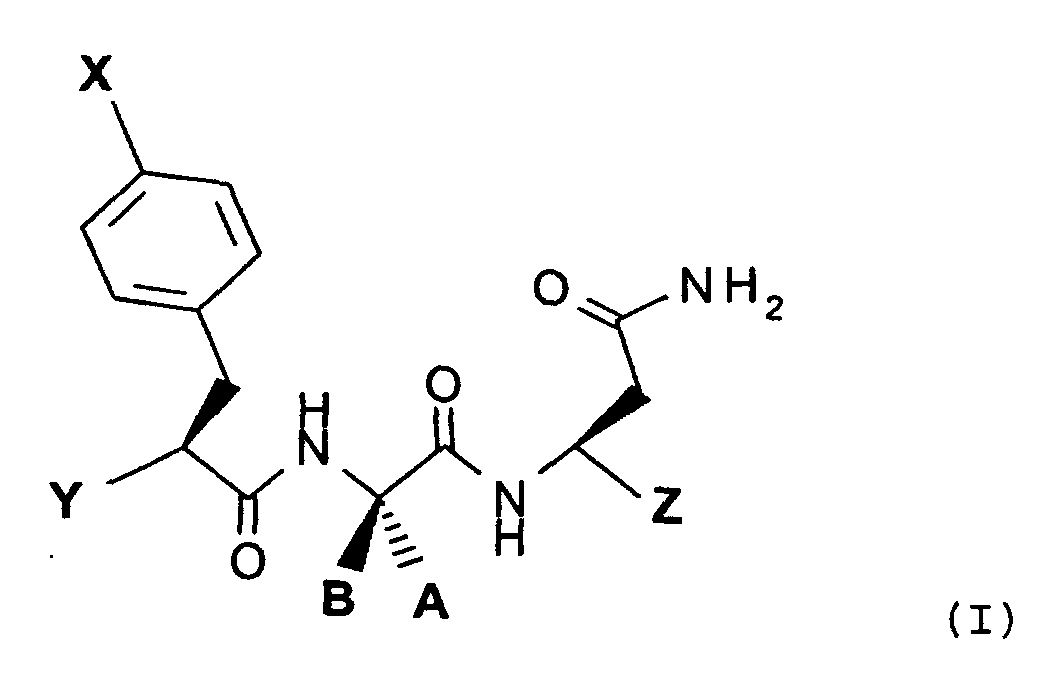
According to the present invention the typical amino acid side chains have to be in the L configuration, having ascertained that the D analogues at every position are much less active.
























The peptides of the invention can be synthesized according to standard method such as those described in Escobedo, J.A., et al., Mol. Cell. Biol. 11: 1125-1132 (1991) or Turck, C.W. Peptide Res. 5: 156-160 (1992), for example using a protected prephosphorylated tyrosine residue. Alternatively the phosphopeptides can be prepared by introducing unprotected tyrosine and phosphorylating it after the peptide elongation either on solid or liquid phase.
In particular the peptides can be prepared by liquid or solid-phase methodologies known to those skilled in the art. (Schroeder et al., "The Peptides", Vol. I, Academic Press 1965, or Bodanszky et al., "Peptide Synthesis", Interscience Publishers, 1966, or McOmie (ed.) "Protective Group in Organic Chemistry", Plenum Press, 1973, or Barany et al., "The Peptides: Analysis, Synthesis, Biology" 2, Chapter 1, Academic Press, 1980). Thus, the invention includes a process for preparing a peptide of the invention, which process comprises chemically synthesizing the peptide from single amino acids and/or preformed peptides of two or more amino acid residues.
When it is wished to prepare a peptide in which a tyrosine residue is phosphorylated, a prephosphorylated protected tyrosine residue may be introduced during a solid phase synthesis, or a tyrosine residue of a protected preformed peptide may be phosphorylated while the peptide is attached to a solid support.
In the case of solid-phase synthesis any manual or automatic peptide synthesizer can be used and the peptides can be assembled in a stepwise manner on a resin support using either Boc or Fmoc strategies.
All the reagents used as starting materials are on the market or may be produced and purified in accordance with methods known in the art.
The deprotected peptides are purified by reverse phase high performance liquid chromatography on a C18-Vydac column (Hesperia Calif.) in 0.05% trifluoroacetic acid by using a linear gradient of acetonitrile, and are isolated by lyophilization. All phosphopeptides are obtained as polyhydrated polytrifluoroacetates. The peptide content of all products is 65 to 90% and the chromatographic purity is more than 95% by HPLC peak relative integration at 1=215-220 nm.
Amino acid analysis were carried out on acid hydrolysates (110°C for 22 h in 6 N HCl + 0.1% phenol). Alternatively a peptide containing a non-phosphorylated tyrosine can be first synthesized and subsequently a phosphate group can be introduced on the tyrosine residue either enzymatically or by chemical methods (in such a case the other functions susceptible of reaction with the phosphorylating agent must be suitably protected).
In this specification, the abbreviations used for amino acids and protecting groups are based on recommandations of the IUPAC-IUB Commission on Biochemical Nomenclature (see Eur. J. Biochem., vol 138, 9-37, 1984). In particular, the following abbreviations were used throughout the text: Boc, t-butyloxycarbonyl; tBu, t-butyl; Bzl, benzyl; ClZ, 4-chloro benzyloxycarbonyl; DIC, diisopropylcarbodiimide; DCM, dichloromethane; DIEA, diisopropylethylamine; DMF, dimethylformamide; DMS, dimethylsulfide; Dnp, dinitrophenyl; ECC, ethylchlorocarbonate; Fmoc, 9-fluorenylmethoxycarbonyl; NMM, N-methylmorpholine; NMP, N-methyl-2-pyrrolidone; RP-HPLC, reverse phase high performance liquid chromatography; TBTU, 2-(1H-benzotriazole-1-yl)-1,1,3,3-tetramethyluronium tetrafluoroborate; Trt, trityl.
The capacity of the peptides of the invention to inhibit the binding of cytosolic signal transducers to the tyrosine kinase receptors or to other tyrosine phosphorylated transducers can be assessed by binding inhibition experiments, such as the BIAcore analysis shown in the experimental section.
A further demonstration of the biological effects of the peptides of the invention is provided by their ability to interfere with the biological responses mediated by a receptor tyrosine kinase such as Hepatocyte Growth Factor Receptor (HGF-R). As shown in the experimental section with a representative compound falling within the scope of the present invention, the peptides of the invention are able to interfere with the cell motility, cell proliferation, cell invasiveness and tubulogenesis mediated by HGF-R.
It is well known to the expert in the art that these biological responses are strictly associated to the occurrance of neoplastic diseases.The peptides of the invention can therefore be used in the treatment of the human or the animal body by therapy, for example in the treatment of a neoplastic disease.
The peptides of the invention are phosphorylated. The active form of the peptides is generally phosphorylated.
The peptides of the invention may be administered to a patient by any convenient parenteral route as such or properly conjugated in order to increase enzymatic stability and cell permeability.
The choice of whether subcutaneous, intravenous or intramuscular administration is adopted; of the dose; of the frequency of administration depends upon a variety of factors. These factors include the purpose of the administration, the age and weight of the patient being treated and the condition of the patient. A therapeutically effective amount is given. Typically, however, the peptide is administered in an amount of from 10 to 1000 mg per dose, more preferably from 50 to 500 mg per dose, for each route of administration.The peptide may be formulated in a pharmaceutical composition. The pharmaceutical composition also comprises a pharmaceutically acceptable carrier or diluent. Any appropriate carrier or diluent may be employed, depending upon the route of administration.

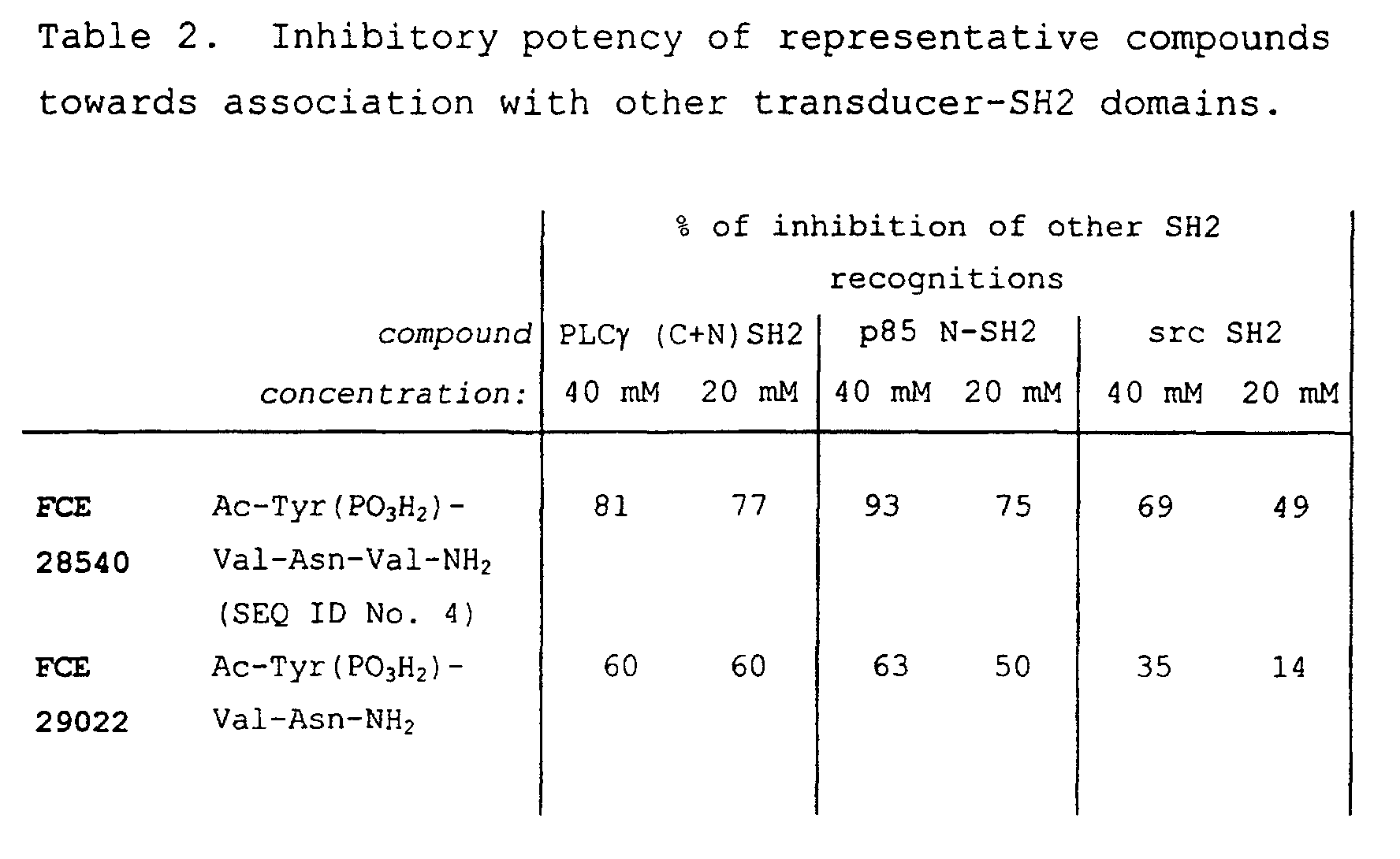
Each step was repeated as many times as necessary for either complete reaction of the resin (steps 2,4) or complete displacement of the previous reagent from the resin (steps 1, 3, 5). Samples of resin were taken after each cycle washed by DCM and checked for completeness of reaction by a ninhydrin test.
1-hydroxybenzotriazole esters of Fmoc-amino acids were formed just prior to use by reacting Fmoc-amino acid (0.5 mmol.), 1-hydroxybenzotriazole (0.5 mmol.), DIEA (1 mmol) and TBTU (0.5 mmol.) in NMP.
The cycle of reactions, steps 1 to 5, was repeated for each amino acid residues such as to provide the sequence of the title compound. The following protected amino acids were added in the order: Fmoc-Val-OH, Fmoc-Asn(Trt)-OH, Fmoc-Val-OH, Fmoc-Tyr-OH. After the last cycle the peptidyl resin was washed several times with DCM and dried. A weight gain of 0.19 g was obtained with respect to the starting resin.
After the last cycle the phosphorylation of Tyr residue was obtained directly on the peptide still attached on the resin by treatment of the peptidyl resin with a solution of 30 eq. of 1H-tetrazole and 10 eq. of di-ter-butyl-N,N-diisopropyl- phosphoramidite in distilled THF for 1.5 h at 25°C and subsequently with 30 eq. of ter-butylhydroperoxide in toluene for 1.5 h at 25°C. The N-terminal acetylation was obtained, after removal of N-terminal Fmoc-protecting group with 20% piperidine-DMF, by treatment of the peptidyl resin with 5 eq of acetic anhydride and 5 eq of DIEA in NMP for 30 min at 25°C. 0.79 g of the peptidyl resin was stirred with 20 ml of a mixture of trifluoroacetic acid/water 95 : 5 for 1.5 h at room temperature. Deprotected peptide was precipitated with diethylether and collected by filtration.
The crude peptide was purified by RP-HPLC on a C18-Vydac (Hesperia, CA) column (2,2 x 25 cm) in 0.05% trifluoroacetic acid using a linear gradient of acetonitrile in water from 5 to 32.5 % over 45 min. Fractions containing the product in pure form were combined, the acetonitrile was evaporated in vacuo and the remaining solution was lyophilized. The title compound was obtained (64 mg) with chromatographic purity (HPLC) of 99.9%.
Amino acid ratios: Val 2 (2); Asx 1.2 (1); Tyr 0.9 (1). Peptide content: 88%. FAB mass spectroscopy; m/z 615 [MH]+. (MW 614.6)
The noncommercial amino acid Fmoc-Asp-NH-CH2-CH(CH3)2 was obtained by reaction of Fmoc-Asp(t.Bu)-OH (10 mmol) and isobutylamine (11 mmol) via mixed anhydride method with 10 eq of NMM and 10 eq of ECC for 4 h, followed by deprotection of t.butyl with a solution of TFA/water 95:5.
Starting from 0.35 mmol of Fmoc-4-methoxy-4'-(g-carboxypropyloxy)-benzhydrylamine-alanylaminomethyl-polystyrene resin (DOD) the phosphopeptide was assembled on the resin phosphorylated and acetylated in analogous manner as described in the example 1, adding the following amino acids in the order: Fmoc-Asp-NH-CH2-CH(CH3)2, Fmoc-Val-OH, Fmoc-Tyr-OH. Using this resin the cleavage was performed at 37°C for 2 h with the mixture TFA/H2O/DMS 95:5:5. After evaporation of the solvent the completely deprotected peptide was purified by RP-HPLC as described in Example 1 giving the title compound with chromatographic purity (HPLC) of 99.8%. Amino acid ratios: Asx 0.9 (1); Val 1 (1); Tyr 1.1 (1). Peptide content: 73%. FAB mass spectroscopy: m/z 572 [MH]+. (MW 571.6).
Ac-Tyr(PO3Me2)-Val-Asn-Val-NH2 (FCE 29091) was obtained with chromatographic purity (HPLC) of 97.0%. Amino acid ratios: Val 2 (2); Asx 1.1(1); Tyr 0.9 (1). Peptide content: 83%. FAB mass spectroscopy: m/z 643 [MH]+. (MW 642.63)
Ac-Tyr(PO3HMe)-Val-Asn-Val-NH2 (FCE 29116) was obtained with chromatographic purity (HPLC) of 98.0%. Amino acid ratios: Val 2 (2); Asx 1.1 (1); Tyr 1.0 (1). Peptide content: 84%. FAB mass spectroscopy; m/z 651 [MNa]+, 667 [MK]+. (MW 628.6)
In each cycle the first coupling reaction (step 3) was carried out using Fmoc-amino acid pentafluorophenyl esters, with the exception of Fmoc-L-Asn(Trt)-OH, Fmoc-L-Tyr-OH, Fmoc-Gly-OH (in position 2 and 4 of peptide chain), which were coupled as 1-hydroxybenzotriazolyl esters, formed just prior to use by reacting Fmoc-amino acid, TBTU, 1-hydroxybenzotriazole (4 equivalents each) and N-methylmorpholine(8 equivalents). In each cycle the second coupling reaction (step 5) was carried out using Fmoc-amino acid 1-hydroxybenzotriazolyl esters formed just prior to use as described above, with the exception of Fmoc-L-Ala-OH, Fmoc-L-His(Boc)-OH, Fmoc-L-Glu(OtBu)-OH, which were coupled using their pentafluorophenyl esters.
After the last cycle the peptidyl resin was washed several times with DCM and dried. A weight gain of 1.2 g was obtained with respect to the starting resin. The phosphorylation of Tyr residue was obtained directly on the peptide still attached on the resin by treatment of the peptidyl resin with a solution of 30 eq. of 1H-tetrazole and 10 eq. of di-ter-butyl-N,N-diisopropyl-phosphoramidite in distilled THF for 1.5 h at 25°C and subsequently with 30 eq. of ter-butylhydroperoxide in toluene for 1.5 h at 25°C. The N-terminal biotinylation was obtained, after removal of N-terminal Fmoc-protecting group with 20% piperidine-DMF, by treatment of the peptidyl resin with 3.3 eq of sulfosuccinimidyl 6-(biotinamido)hexanoate and a few drops of N-methylmorpholine in DMF for 70 h at 25°C (till completeness of reaction checked by a ninhydrin test). The peptidyl resin was washed several times with DCM and dried. A weight gain of 1.5 g was obtained with respect to the starting resin. 0.70 g of the peptidyl resin were stirred with 8 ml of a mixture of trifluoroacetic acid/water/EMS 95 : 2.5 :2.5 for 1.5 h at room temperature. Deprotected peptide was precipitated with diethylether and collected by filtration.
The crude peptide was purified by RP-HPLC on a C18-Vydac (Hesperia, CA) column (2,2 x 25 cm) with a flow rate of 18 ml/min by eluting with stepwise isocratic conditions successively at 13.25% for 25 min, 16% for 35 min, 18.75% for 30 min and 21.5% for 10 min of acetonitrile in 0.05 N AcONH4 aqueous solution, using an UV detector at 220 nm wavelenght. Fractions containing the product in pure form were combined, the acetonitrile was evaporated in vacuo and the remaining solution was lyophilized twice. The title compound was obtained (12 mg) with chromatographic purity (HPLC) of 91.5%. Amino acid ratios: Lys 1 (1); Asx 2.37 (2); Gly 6.00 (6); Ile 0.9 (1); Thr 1.00 (1); Ala 1.00 (1); His 1.73 (2); Glx 1.10 (1); Val 3.63 (4); Tyr 1.83 (2). Peptide content: 82%. FAB mass spectroscopy; m/z 2627.2 [M+H]+ ; m/z 2625.5 [M-H]- ; (MW 2627.74) .
/note= "Xaa is Ac-Tyr(PO3H2)"
/note= "Xaa is Lys-NH2"
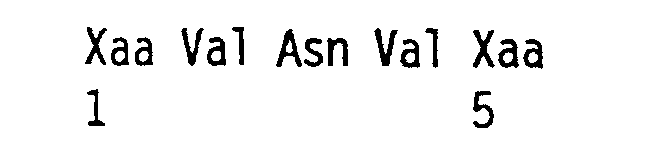
/note= "Xaa is Ac-Tyr(PO3H2)"
/note= "Xaa is Lys(Ac)-NH2"

/note= "Xaa is Ac-Tyr(PO3H2)"
/note= "Xaa is Val-OH"
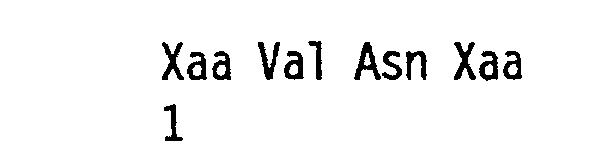
/note= "Xaa is Ac-Tyr(PO3H2)"
/note= "Xaa is Val-NH2"

/note= "Xaa is Ac-Phe(CH2PO3H2)"
/note= "Xaa is Lys-NH2"

/note= "Xaa is Ac-Phe(CH2SO3H)"
/note= "Xaa is Val-NH2"

/note= "Xaa is Ac-Phe(p-CH2PO3H2)"
/note= "Xaa is Val-NH2"

/note= "Xaa is Ac-Tyr(PO3H2)"

/note= "Xaa is Ac-Tyr(PO3H2)"
/note= "Xaa is Gln-NH2"

/note= "Xaa is 6-biotinamido-hexanoyl-Tyr(PO3H2)"
/note= "Xaa is Val-NH2"
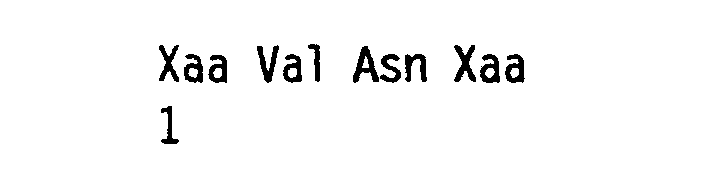
/note= "Xaa is Ac-Tyr(PO3Me2)"
/note= "Xaa is Val-NH2"

/note= "Xaa is Ac-Tyr(PO3HMe)"
/note= "Xaa is Val-NH2"
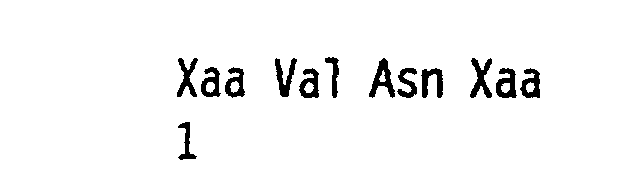
/note= "Xaa is Ac-Tyr(PO3Et2)"
/note= "Xaa is Val-NH2"

/note= "Xaa is Ac-Tyr(PO3H2)"
/note= "Xaa is Ser-NH2"
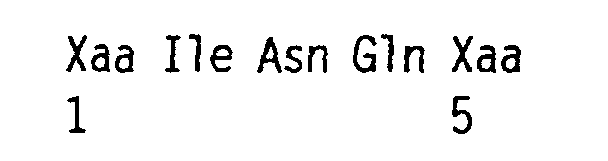
/note= "Xaa is Ac-Tyr(PO3H2)"
/note= "Xaa is Glu-NH2"
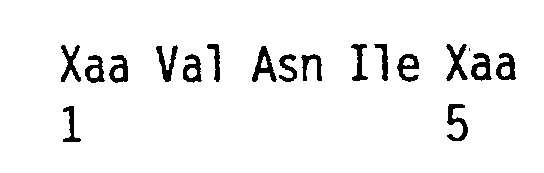
/note= "Xaa is Ac-Tyr(PO3H2)"
/note= "Xaa is Lys-NH2"
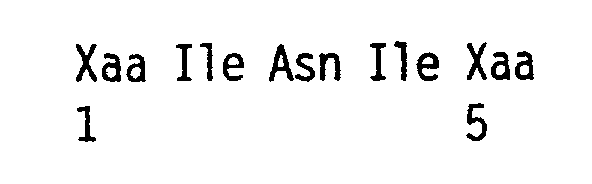
/note= "Xaa is CH3-(CH2)12-CO-Gly"
/note= "Xaa is Tyr(PO3H2)"
/note= "Xaa is Val-NH2"

/note= "Xaa is CH3-(CH2)12-CO-Tyr(PO3H2)"
/note= "Xaa is Val-NH2"
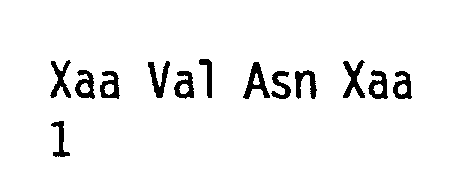
/note= "Xaa is CH3-(CH2)6-CO-Tyr(PO3H2)"
/note= "Xaa is Val-NH2"

/note= "Xaa is C6H11-CH2-CO-Tyr(PO3H2)"
/note= "Xaa is Val-NH2"

/note= "Xaa is 6-biotinamido-hexanoyl-Gly"
/note= "Xaa is Tyr(PO3H)"
/note= "Xaa is Tyr(PO3H)"
/note= "Xaa is Lys-OH"

/note= "Xaa is 6-biotinamido-hexanoyl-Gly"
/note= "Xaa is Tyr(PO3H)"
/note= "Xaa is Lys-OH"

/note= "Xaa is H-Tyr(PO3H2)"
/note= "Lys-OH"

/note= "Xaa is Ac-Phe"
/note= "Val-OH"

Claims (18)
- A peptide of the following formula (I):wherein Y is hydrogen, R-C(=O)NH- wherein R is hydrogen or C7-C30 alkyl, the alkyl group being linear, branched or cyclic; X is -OPO3H2 or a group selected from -CH2PO3H2, -CF2PO3H2, -CHFPO3H2, -CH2SO3H, -CF2SO3H, -CHFSO3H, -SPO3H2, -OPSO2H2, -SPSO2H2, -OPS2OH2, -OP(CH3)O2H, -SP(CH3)O2H, -OP(CH3)SOH, -OP(CF3)O2H, -OP(CHF2)O2H, -SP(CF3)O2H, -SP(CHF2)O2H and the C1-C6 alkyl esters thereof; A is CH3-, CH3CH2-, (CH3)2CH-, (CH3)3C-, or (CH3)2CHCH2-, B is H- or C1-C6 alkyl; Z is H, -COOH, -COR2 wherein R2= H, -NH2, an amino acid in the carboxylic or amidated form, or -NHR3 in which R3 is C1-C6 alkyl; or a pharmaceutically acceptable salt thereof.

- A peptide of the following formula (I):wherein Y is hydrogen, R-C(=O)NH- wherein R is hydrogen, C1-C6 alkyl or C7-C30 alkyl, the alkyl group in either case being linear, branched or cyclic; X is -OPO3H2 or a group selected from -CH2PO3H2, -CF2PO3H2, -CHFPO3H2, -CH2SO3H, -CF2SO3H, -CHFSO3H, -SPO3H2, -OPSO2H2, -SPSO2H2, -OPS2OH2, -OP(CH3)O2H, -SP(CH3)O2H, -OP(CH3)SOH, -OP(CF3)O2H, -OP(CHF2)O2H, -SP(CF3)O2H, -SP(CHF2)O2H and the C1-C6 alkyl esters thereof; A is CH3-, CH3CH2-, (CH3)2CH-, (CH3)3C-, or (CH3)2CHCH2-, B is H- or C1-C6 alkyl; Z is H or -CHO.

- A compound according to claim 1 wherein R2 is selected from -Val-NH2 or -Val-OH.
- A compound according to claim 1 wherein R3 is -CH2CH(CH3)2.
- A compound according to any one of the preceding claims which can bind to a cytosolic signal transducer.
- A compound according to claim 5 which can inhibit the binding of a cytosolic signal transducer to a receptor tyrosine kinase or to another tyrosine phosphorylated transducer.
- A compound according to claim 6 wherein the cytosolic signal transducer is selected from the group consisting of: Grb-2, Shc, the p85 subunit of phosphatidylinositol 3' kinase (PI3K), Src, ras GTPase activator protein (GAP), phospholipase Cγ (PLCγ), ZAP70, Syc and Stat and wherein the receptor tyrosine kinase is selected from the group consisting of Hepatocyte Growth Factor Receptor (HGF-R), Platelet Derived Growth Factor Receptor (PDGF-R), Epidermal Growth Factor Receptor (EGF-R) and their truncated or mutated forms maintaining the cytoplasmic domain.
- A compound according to claim 6 wherein the transducer is selected from the group consisting of: Grb-2, Shc, the p85 subunit of phosphatidylinositol 3' kinase (PI3K), Src, ras GTPase activator protein (GAP), phospholipase Cγ (PLCγ), ZAP70, Syc and Stat.
- A compound according to claim 7 wherein the cytosolic signal transducer is Grb-2 and the receptor tyrosine kinase is HGF-R or its related forms like Tpr-MET and other members of the same family like SEA and RON.
- A compound selected from the group consisting of:























- A process for preparing a compound as claimed in any one of the preceding claims, which process comprises chemically synthesizing a peptide of formula (I) from single amino acids and/or preformed peptides of two or more amino acid residues.
- A process according to claim 11 wherein a prephosphorylated protected tyrosine residue is introduced into the peptide during solid phase synthesis.
- A process according to claim 11 wherein a tyrosine residue of a protected preformed peptide is phosphorylated while the peptide is attached to a solid support.
- A process according to any one of claims 11 to 13 which comprises converting the peptide into a pharmaceutically acceptable salt thereof.
- A pharmaceutical composition comprising a physiologically acceptable carrier or diluent and, as active ingredient, a compound as claimed in any one of claims 1 to 10.
- A compound according to any one of claim 1 to 10 for use in the treatment of the human or animal body by therapy.
- A compound as claimed in claim 16 for use in treatment of a neoplastic disease.
- Use of a compound as claimed in any one of claims 1 to 10 in the manufacture of a medicament for use in the treatment of a neoplastic disease.
Applications Claiming Priority (3)
| Application Number | Priority Date | Filing Date | Title |
|---|---|---|---|
| GBGB9603227.1A GB9603227D0 (en) | 1996-02-15 | 1996-02-15 | Peptide antagonists of cellular mitogenesis and motogenesis and their therapeutic use |
| GB9603227 | 1996-02-15 | ||
| PCT/EP1997/000595 WO1997030079A1 (en) | 1996-02-15 | 1997-02-10 | Peptide antagonists of cellular mitogenesis and motogenesis and their therapeutic use |
Publications (2)
| Publication Number | Publication Date |
|---|---|
| EP0821696A1 EP0821696A1 (en) | 1998-02-04 |
| EP0821696B1 true EP0821696B1 (en) | 2004-05-06 |
Family
ID=10788833
Family Applications (1)
| Application Number | Title | Priority Date | Filing Date |
|---|---|---|---|
| EP97903250A Expired - Lifetime EP0821696B1 (en) | 1996-02-15 | 1997-02-10 | Peptide antagonists of cellular mitogenesis and motogenesis and their therapeutic use |
Country Status (21)
| Country | Link |
|---|---|
| US (1) | US6245742B1 (en) |
| EP (1) | EP0821696B1 (en) |
| JP (1) | JPH11504658A (en) |
| KR (1) | KR19990007783A (en) |
| CN (1) | CN1185785A (en) |
| AR (1) | AR005808A1 (en) |
| AT (1) | ATE266041T1 (en) |
| AU (1) | AU1768297A (en) |
| BR (1) | BR9702084A (en) |
| CA (1) | CA2218378A1 (en) |
| DE (1) | DE69728938D1 (en) |
| EA (1) | EA199700318A1 (en) |
| GB (1) | GB9603227D0 (en) |
| HU (1) | HUP9900661A3 (en) |
| IL (1) | IL121853A0 (en) |
| MX (1) | MX9707771A (en) |
| NO (1) | NO974750L (en) |
| NZ (1) | NZ328895A (en) |
| PL (1) | PL322779A1 (en) |
| WO (1) | WO1997030079A1 (en) |
| ZA (1) | ZA971171B (en) |
Families Citing this family (11)
| Publication number | Priority date | Publication date | Assignee | Title |
|---|---|---|---|---|
| FR2787793B1 (en) * | 1998-12-24 | 2001-03-23 | Inst Nat Sante Rech Med | PSEUDOPEPTIDE COMPOUNDS HAVING INHIBITORY ACTIVITY WITH RESPECT TO TYROSINE KINASE ACTIVATED PROTEINS AND PHARMACEUTICAL COMPOSITIONS CONTAINING THE SAME |
| US20020055463A1 (en) * | 1998-12-24 | 2002-05-09 | Christiane Garbay | Pseudopeptide compounds having an inhibiting activity with respect to paths activated by proteins with active tyrosine kinase activity and pharmaceutical compositions containing same |
| FR2793796A1 (en) * | 1999-04-14 | 2000-11-24 | Hoechst Marion Roussel Inc | Imidazole derivatives having Src SH2 receptor antagonist activity for the prevention and treatment of osteoporosis, auto-immune diseases, proliferative diseases, cancers, allergies and other disorders |
| FR2796381A1 (en) * | 1999-07-12 | 2001-01-19 | Hoechst Marion Roussel Inc | Thiazepin and caprolactam bicyclic derivatives, useful in the treatment of e.g. osteoporosis and other bone disorders, infections, allergies or cancers |
| US20040191926A1 (en) * | 2001-09-26 | 2004-09-30 | Zhong-Yin Zhang | Ptp1b inhibitors and ligands |
| WO2005114197A2 (en) * | 2004-04-15 | 2005-12-01 | Albert Einstein College Of Medicine Of Yeshiva University | Activity-based probes for protein tyrosine phosphatases |
| US9062283B2 (en) | 2007-02-26 | 2015-06-23 | Stemcell Technologies Inc. | Method of reducing curvature in a meniscus of liquid medium |
| US8703072B2 (en) | 2008-09-12 | 2014-04-22 | Oliver Egeler | Cell culture vessels for meniscus reduction with aqueous solutions |
| CN103387602B (en) * | 2012-05-09 | 2018-07-06 | 中国科学院上海药物研究所 | A kind of novel open chain tetrapeptide analogs and its preparation method and application |
| US10537891B2 (en) | 2013-01-10 | 2020-01-21 | Stemcell Technologies Inc. | Meniscus reducing member |
| WO2014107811A1 (en) | 2013-01-10 | 2014-07-17 | Stemcell Technologies Inc. | Meniscus reducing member |
Family Cites Families (6)
| Publication number | Priority date | Publication date | Assignee | Title |
|---|---|---|---|---|
| US5801149A (en) * | 1991-06-19 | 1998-09-01 | Joslin D-Abetes Center, Inc. | Inhibition of signal transduction molecules |
| US5739278A (en) * | 1993-05-10 | 1998-04-14 | University Of Washington | Compositions for protein tyrosine phosphatases |
| CA2142713A1 (en) | 1993-06-30 | 1995-01-12 | Paolo Comoglio | Peptide inhibitors of mitogenesis and motogenesis |
| WO1996023813A1 (en) * | 1995-02-01 | 1996-08-08 | Affymax Technologies N.V. | Peptides and compounds that bind to sh2 domains |
| GB9516842D0 (en) * | 1995-08-17 | 1995-10-18 | Ciba Geigy Ag | Various acylated oligopeptides |
| GB9517060D0 (en) * | 1995-08-17 | 1995-10-25 | Ciba Geigy Ag | Acylated oligopeptide derivatives |
-
1996
- 1996-02-15 GB GBGB9603227.1A patent/GB9603227D0/en active Pending
-
1997
- 1997-02-10 IL IL12185397A patent/IL121853A0/en unknown
- 1997-02-10 EP EP97903250A patent/EP0821696B1/en not_active Expired - Lifetime
- 1997-02-10 BR BR9702084A patent/BR9702084A/en unknown
- 1997-02-10 DE DE69728938T patent/DE69728938D1/en not_active Expired - Lifetime
- 1997-02-10 WO PCT/EP1997/000595 patent/WO1997030079A1/en not_active Ceased
- 1997-02-10 NZ NZ328895A patent/NZ328895A/en unknown
- 1997-02-10 JP JP9528961A patent/JPH11504658A/en not_active Withdrawn
- 1997-02-10 CA CA002218378A patent/CA2218378A1/en not_active Abandoned
- 1997-02-10 AU AU17682/97A patent/AU1768297A/en not_active Abandoned
- 1997-02-10 US US08/930,616 patent/US6245742B1/en not_active Expired - Fee Related
- 1997-02-10 KR KR1019970707306A patent/KR19990007783A/en not_active Withdrawn
- 1997-02-10 PL PL97322779A patent/PL322779A1/en unknown
- 1997-02-10 EA EA199700318A patent/EA199700318A1/en unknown
- 1997-02-10 HU HU9900661A patent/HUP9900661A3/en unknown
- 1997-02-10 CN CN97190189A patent/CN1185785A/en active Pending
- 1997-02-10 MX MX9707771A patent/MX9707771A/en unknown
- 1997-02-10 AT AT97903250T patent/ATE266041T1/en not_active IP Right Cessation
- 1997-02-12 ZA ZA9701171A patent/ZA971171B/en unknown
- 1997-02-13 AR ARP970100572A patent/AR005808A1/en not_active Application Discontinuation
- 1997-10-14 NO NO974750A patent/NO974750L/en unknown
Also Published As
| Publication number | Publication date |
|---|---|
| EP0821696A1 (en) | 1998-02-04 |
| NZ328895A (en) | 1999-03-29 |
| CA2218378A1 (en) | 1997-08-21 |
| HUP9900661A2 (en) | 1999-08-30 |
| GB9603227D0 (en) | 1996-04-17 |
| ZA971171B (en) | 1997-09-03 |
| CN1185785A (en) | 1998-06-24 |
| AR005808A1 (en) | 1999-07-14 |
| IL121853A0 (en) | 1998-02-22 |
| KR19990007783A (en) | 1999-01-25 |
| US6245742B1 (en) | 2001-06-12 |
| MX9707771A (en) | 1997-12-31 |
| ATE266041T1 (en) | 2004-05-15 |
| NO974750L (en) | 1997-12-10 |
| DE69728938D1 (en) | 2004-06-09 |
| BR9702084A (en) | 1999-07-20 |
| EA199700318A1 (en) | 1998-04-30 |
| JPH11504658A (en) | 1999-04-27 |
| WO1997030079A1 (en) | 1997-08-21 |
| AU1768297A (en) | 1997-09-02 |
| PL322779A1 (en) | 1998-02-16 |
| HUP9900661A3 (en) | 2000-03-28 |
| NO974750D0 (en) | 1997-10-14 |
Similar Documents
| Publication | Publication Date | Title |
|---|---|---|
| US5506208A (en) | Method for using synthetic analogs of thrombospondin for inhibiting angiogenesis activity | |
| US6593297B2 (en) | Compounds and methods for inhibiting cancer metastasis | |
| EP0478101B1 (en) | Therapeutic use of peptides having thrombospondin-like activity | |
| CA2085118A1 (en) | Modified peptide and peptide libraries with protease resistance, derivatives thereof and methods of producing and screening such | |
| CA2270871A1 (en) | Peptide compounds useful for modulating fgf receptor activity | |
| CZ20004327A3 (en) | Peptidic anti-angiogenic medicaments | |
| WO1994007913A1 (en) | Peptide antagonists of sh2 binding and therapeutic uses thereof | |
| US6245742B1 (en) | Peptide antagonists of cellular mitogenesis and motogenesis and their therapeutic use | |
| WO1996023813A1 (en) | Peptides and compounds that bind to sh2 domains | |
| WO2006116737A2 (en) | Compounds and methods for modulating cadherin-mediated processes | |
| US5654277A (en) | Peptides having thrombospondin-like activity and their therapeutic use | |
| WO1997007131A1 (en) | Acylated oligopeptides containing phosphotyrosine as inhibitors of protein tyrosine kinases | |
| JP2002525102A (en) | NCAM binding compound | |
| AU701677B2 (en) | Recombinant C140 receptor and its agonists and antagonists | |
| US6780845B2 (en) | Compounds and methods for cancer therapy | |
| EP0771210A1 (en) | TWO NON-CONTIGUOUS REGIONS CONTRIBUTE TO NIDOGEN BINDING TO A SINGLE EGF-LIKE MOTIF OF THE LAMININ $g(g)1 CHAIN | |
| US20040054143A1 (en) | Vegf peptides and their use for inhibiting angiogenesis | |
| US6239110B1 (en) | Synthetic analogs of thrombospondin and therapeutic use thereof | |
| US5648461A (en) | Synthetic analogs of thrombospondin and therapeutic use thereof | |
| JP2004501932A (en) | Peptide having tissue-specific activity and method for obtaining pharmaceutical composition based on the peptide | |
| Oliveira Jr et al. | Biological and conformational evaluation of angiotensin II lactam bridge containing analogues | |
| EP0922710A1 (en) | PEPTIDES PROMOTING THE ACTIVATION OF LATENT TGF-$g(b) AND METHOD FOR SCREENING TGF-$g(b) ACTIVITY REGULATORS | |
| WO2025193770A1 (en) | Macrocyclic peptides | |
| CN119390781B (en) | Peptides that specifically bind to Nectin-4 and their uses | |
| Szaniawska et al. | A novel fibronectin‐related structural motif that modulates cell migration |
Legal Events
| Date | Code | Title | Description |
|---|---|---|---|
| PUAI | Public reference made under article 153(3) epc to a published international application that has entered the european phase |
Free format text: ORIGINAL CODE: 0009012 |
|
| 17P | Request for examination filed |
Effective date: 19971013 |
|
| AK | Designated contracting states |
Kind code of ref document: A1 Designated state(s): AT BE CH DE DK ES FI FR GB GR IE IT LI NL PT SE |
|
| 17Q | First examination report despatched |
Effective date: 20000112 |
|
| RAP1 | Party data changed (applicant data changed or rights of an application transferred) |
Owner name: PHARMACIA ITALIA S.P.A. |
|
| GRAP | Despatch of communication of intention to grant a patent |
Free format text: ORIGINAL CODE: EPIDOSNIGR1 |
|
| GRAS | Grant fee paid |
Free format text: ORIGINAL CODE: EPIDOSNIGR3 |
|
| GRAA | (expected) grant |
Free format text: ORIGINAL CODE: 0009210 |
|
| AK | Designated contracting states |
Kind code of ref document: B1 Designated state(s): AT BE CH DE DK ES FI FR GB GR IE IT LI NL PT SE |
|
| PG25 | Lapsed in a contracting state [announced via postgrant information from national office to epo] |
Ref country code: NL Free format text: LAPSE BECAUSE OF FAILURE TO SUBMIT A TRANSLATION OF THE DESCRIPTION OR TO PAY THE FEE WITHIN THE PRESCRIBED TIME-LIMIT Effective date: 20040506 Ref country code: LI Free format text: LAPSE BECAUSE OF FAILURE TO SUBMIT A TRANSLATION OF THE DESCRIPTION OR TO PAY THE FEE WITHIN THE PRESCRIBED TIME-LIMIT Effective date: 20040506 Ref country code: IT Free format text: LAPSE BECAUSE OF FAILURE TO SUBMIT A TRANSLATION OF THE DESCRIPTION OR TO PAY THE FEE WITHIN THE PRE;WARNING: LAPSES OF ITALIAN PATENTS WITH EFFECTIVE DATE BEFORE 2007 MAY HAVE OCCURRED AT ANY TIME BEFORE 2007. THE CORRECT EFFECTIVE DATE MAY BE DIFFERENT FROM THE ONE RECORDED.SCRIBED TIME-LIMIT Effective date: 20040506 Ref country code: FR Free format text: LAPSE BECAUSE OF FAILURE TO SUBMIT A TRANSLATION OF THE DESCRIPTION OR TO PAY THE FEE WITHIN THE PRESCRIBED TIME-LIMIT Effective date: 20040506 Ref country code: FI Free format text: LAPSE BECAUSE OF FAILURE TO SUBMIT A TRANSLATION OF THE DESCRIPTION OR TO PAY THE FEE WITHIN THE PRESCRIBED TIME-LIMIT Effective date: 20040506 Ref country code: CH Free format text: LAPSE BECAUSE OF FAILURE TO SUBMIT A TRANSLATION OF THE DESCRIPTION OR TO PAY THE FEE WITHIN THE PRESCRIBED TIME-LIMIT Effective date: 20040506 Ref country code: BE Free format text: LAPSE BECAUSE OF FAILURE TO SUBMIT A TRANSLATION OF THE DESCRIPTION OR TO PAY THE FEE WITHIN THE PRESCRIBED TIME-LIMIT Effective date: 20040506 Ref country code: AT Free format text: LAPSE BECAUSE OF FAILURE TO SUBMIT A TRANSLATION OF THE DESCRIPTION OR TO PAY THE FEE WITHIN THE PRESCRIBED TIME-LIMIT Effective date: 20040506 |
|
| REG | Reference to a national code |
Ref country code: GB Ref legal event code: FG4D |
|
| REG | Reference to a national code |
Ref country code: CH Ref legal event code: EP |
|
| REF | Corresponds to: |
Ref document number: 69728938 Country of ref document: DE Date of ref document: 20040609 Kind code of ref document: P |
|
| REG | Reference to a national code |
Ref country code: IE Ref legal event code: FG4D |
|
| PG25 | Lapsed in a contracting state [announced via postgrant information from national office to epo] |
Ref country code: SE Free format text: LAPSE BECAUSE OF FAILURE TO SUBMIT A TRANSLATION OF THE DESCRIPTION OR TO PAY THE FEE WITHIN THE PRESCRIBED TIME-LIMIT Effective date: 20040806 Ref country code: GR Free format text: LAPSE BECAUSE OF FAILURE TO SUBMIT A TRANSLATION OF THE DESCRIPTION OR TO PAY THE FEE WITHIN THE PRESCRIBED TIME-LIMIT Effective date: 20040806 Ref country code: DK Free format text: LAPSE BECAUSE OF FAILURE TO SUBMIT A TRANSLATION OF THE DESCRIPTION OR TO PAY THE FEE WITHIN THE PRESCRIBED TIME-LIMIT Effective date: 20040806 |
|
| PG25 | Lapsed in a contracting state [announced via postgrant information from national office to epo] |
Ref country code: DE Free format text: LAPSE BECAUSE OF FAILURE TO SUBMIT A TRANSLATION OF THE DESCRIPTION OR TO PAY THE FEE WITHIN THE PRESCRIBED TIME-LIMIT Effective date: 20040807 |
|
| PG25 | Lapsed in a contracting state [announced via postgrant information from national office to epo] |
Ref country code: ES Free format text: LAPSE BECAUSE OF FAILURE TO SUBMIT A TRANSLATION OF THE DESCRIPTION OR TO PAY THE FEE WITHIN THE PRESCRIBED TIME-LIMIT Effective date: 20040817 |
|
| NLV1 | Nl: lapsed or annulled due to failure to fulfill the requirements of art. 29p and 29m of the patents act | ||
| REG | Reference to a national code |
Ref country code: CH Ref legal event code: PL |
|
| PG25 | Lapsed in a contracting state [announced via postgrant information from national office to epo] |
Ref country code: IE Free format text: LAPSE BECAUSE OF NON-PAYMENT OF DUE FEES Effective date: 20050210 Ref country code: GB Free format text: LAPSE BECAUSE OF NON-PAYMENT OF DUE FEES Effective date: 20050210 |
|
| PLBE | No opposition filed within time limit |
Free format text: ORIGINAL CODE: 0009261 |
|
| STAA | Information on the status of an ep patent application or granted ep patent |
Free format text: STATUS: NO OPPOSITION FILED WITHIN TIME LIMIT |
|
| EN | Fr: translation not filed | ||
| 26N | No opposition filed |
Effective date: 20050208 |
|
| GBPC | Gb: european patent ceased through non-payment of renewal fee |
Effective date: 20050206 |
|
| REG | Reference to a national code |
Ref country code: IE Ref legal event code: MM4A |
|
| PG25 | Lapsed in a contracting state [announced via postgrant information from national office to epo] |
Ref country code: PT Free format text: LAPSE BECAUSE OF NON-PAYMENT OF DUE FEES Effective date: 20041006 |