EP0821679B1 - Asymmetric epoxides, their synthesis and use - Google Patents
Asymmetric epoxides, their synthesis and use Download PDFInfo
- Publication number
- EP0821679B1 EP0821679B1 EP96910126A EP96910126A EP0821679B1 EP 0821679 B1 EP0821679 B1 EP 0821679B1 EP 96910126 A EP96910126 A EP 96910126A EP 96910126 A EP96910126 A EP 96910126A EP 0821679 B1 EP0821679 B1 EP 0821679B1
- Authority
- EP
- European Patent Office
- Prior art keywords
- process according
- epoxide
- formula
- butyl
- catalyst
- Prior art date
- Legal status (The legal status is an assumption and is not a legal conclusion. Google has not performed a legal analysis and makes no representation as to the accuracy of the status listed.)
- Expired - Lifetime
Links
- 150000002118 epoxides Chemical class 0.000 title abstract 3
- 238000003786 synthesis reaction Methods 0.000 title description 8
- 230000015572 biosynthetic process Effects 0.000 title description 6
- 238000006735 epoxidation reaction Methods 0.000 claims abstract description 15
- 239000003054 catalyst Substances 0.000 claims abstract description 14
- 238000006243 chemical reaction Methods 0.000 claims abstract description 10
- 125000004432 carbon atom Chemical group C* 0.000 claims abstract description 9
- 239000007800 oxidant agent Substances 0.000 claims abstract description 6
- 230000001590 oxidative effect Effects 0.000 claims abstract description 6
- 125000000217 alkyl group Chemical group 0.000 claims abstract description 5
- 150000001336 alkenes Chemical class 0.000 claims abstract description 4
- 125000000753 cycloalkyl group Chemical group 0.000 claims abstract description 3
- 238000004519 manufacturing process Methods 0.000 claims abstract description 3
- 125000001183 hydrocarbyl group Chemical group 0.000 claims abstract 2
- 238000000034 method Methods 0.000 claims description 33
- 150000002924 oxiranes Chemical class 0.000 claims description 20
- -1 amino-acid carboxy anhydride Chemical class 0.000 claims description 11
- 125000000999 tert-butyl group Chemical group [H]C([H])([H])C(*)(C([H])([H])[H])C([H])([H])[H] 0.000 claims description 10
- 239000003513 alkali Substances 0.000 claims description 7
- QGZKDVFQNNGYKY-UHFFFAOYSA-N Ammonia Chemical compound N QGZKDVFQNNGYKY-UHFFFAOYSA-N 0.000 claims description 6
- 238000006220 Baeyer-Villiger oxidation reaction Methods 0.000 claims description 6
- 125000001997 phenyl group Chemical class [H]C1=C([H])C([H])=C(*)C([H])=C1[H] 0.000 claims description 6
- 238000002360 preparation method Methods 0.000 claims description 6
- 230000003197 catalytic effect Effects 0.000 claims description 4
- 239000003960 organic solvent Substances 0.000 claims description 4
- 238000007142 ring opening reaction Methods 0.000 claims description 4
- 125000004172 4-methoxyphenyl group Chemical group [H]C1=C([H])C(OC([H])([H])[H])=C([H])C([H])=C1* 0.000 claims description 3
- 150000001412 amines Chemical class 0.000 claims description 3
- 229910021529 ammonia Inorganic materials 0.000 claims description 3
- 239000008346 aqueous phase Substances 0.000 claims description 3
- 125000003118 aryl group Chemical group 0.000 claims description 3
- 125000001559 cyclopropyl group Chemical group [H]C1([H])C([H])([H])C1([H])* 0.000 claims description 3
- 238000007257 deesterification reaction Methods 0.000 claims description 3
- HSUGRBWQSSZJOP-RTWAWAEBSA-N diltiazem Chemical compound C1=CC(OC)=CC=C1[C@H]1[C@@H](OC(C)=O)C(=O)N(CCN(C)C)C2=CC=CC=C2S1 HSUGRBWQSSZJOP-RTWAWAEBSA-N 0.000 claims description 3
- 229960004166 diltiazem Drugs 0.000 claims description 3
- 125000001072 heteroaryl group Chemical group 0.000 claims description 3
- 230000000269 nucleophilic effect Effects 0.000 claims description 3
- 239000012071 phase Substances 0.000 claims description 3
- IVRMZWNICZWHMI-UHFFFAOYSA-N Azide Chemical compound [N-]=[N+]=[N-] IVRMZWNICZWHMI-UHFFFAOYSA-N 0.000 claims description 2
- 238000006480 benzoylation reaction Methods 0.000 claims description 2
- 125000001743 benzylic group Chemical group 0.000 claims description 2
- XLYOFNOQVPJJNP-UHFFFAOYSA-M hydroxide Chemical compound [OH-] XLYOFNOQVPJJNP-UHFFFAOYSA-M 0.000 claims description 2
- XKBGEWXEAPTVCK-UHFFFAOYSA-M methyltrioctylammonium chloride Chemical compound [Cl-].CCCCCCCC[N+](C)(CCCCCCCC)CCCCCCCC XKBGEWXEAPTVCK-UHFFFAOYSA-M 0.000 claims description 2
- 239000000203 mixture Substances 0.000 claims description 2
- 239000003444 phase transfer catalyst Substances 0.000 claims description 2
- 229920001184 polypeptide Polymers 0.000 claims description 2
- 108090000765 processed proteins & peptides Proteins 0.000 claims description 2
- 102000004196 processed proteins & peptides Human genes 0.000 claims description 2
- 229920000642 polymer Polymers 0.000 claims 2
- YHFHIZDYJXYXOJ-MDZDMXLPSA-N (e)-4,4-dimethyl-1-phenylpent-1-en-3-one Chemical compound CC(C)(C)C(=O)\C=C\C1=CC=CC=C1 YHFHIZDYJXYXOJ-MDZDMXLPSA-N 0.000 claims 1
- 125000002252 acyl group Chemical group 0.000 claims 1
- 150000008064 anhydrides Chemical class 0.000 claims 1
- 125000003236 benzoyl group Chemical group [H]C1=C([H])C([H])=C(C([H])=C1[H])C(*)=O 0.000 claims 1
- LKKOTPSFKLPCQF-WDEREUQCSA-N tert-butyl (2r,3s)-3-phenyloxirane-2-carboxylate Chemical compound CC(C)(C)OC(=O)[C@@H]1O[C@H]1C1=CC=CC=C1 LKKOTPSFKLPCQF-WDEREUQCSA-N 0.000 claims 1
- HEMHJVSKTPXQMS-UHFFFAOYSA-M Sodium hydroxide Chemical compound [OH-].[Na+] HEMHJVSKTPXQMS-UHFFFAOYSA-M 0.000 description 9
- YMWUJEATGCHHMB-UHFFFAOYSA-N Dichloromethane Chemical compound ClCCl YMWUJEATGCHHMB-UHFFFAOYSA-N 0.000 description 6
- 239000000758 substrate Substances 0.000 description 6
- 150000001875 compounds Chemical class 0.000 description 5
- VLKZOEOYAKHREP-UHFFFAOYSA-N n-Hexane Chemical compound CCCCCC VLKZOEOYAKHREP-UHFFFAOYSA-N 0.000 description 5
- AOBSWBDDACZYAY-WDEREUQCSA-N 2,2-dimethyl-1-[(2r,3s)-3-phenyloxiran-2-yl]propan-1-one Chemical compound CC(C)(C)C(=O)[C@@H]1O[C@H]1C1=CC=CC=C1 AOBSWBDDACZYAY-WDEREUQCSA-N 0.000 description 4
- 230000003647 oxidation Effects 0.000 description 4
- 238000007254 oxidation reaction Methods 0.000 description 4
- 229940024606 amino acid Drugs 0.000 description 3
- 239000003153 chemical reaction reagent Substances 0.000 description 3
- 239000000543 intermediate Substances 0.000 description 3
- 108010050934 polyleucine Proteins 0.000 description 3
- HYJVYOWKYPNSTK-UONOGXRCSA-N (2r,3s)-3-benzamido-2-hydroxy-3-phenylpropanoic acid Chemical compound N([C@H]([C@@H](O)C(O)=O)C=1C=CC=CC=1)C(=O)C1=CC=CC=C1 HYJVYOWKYPNSTK-UONOGXRCSA-N 0.000 description 2
- 0 *[C@]1O[C@]1C(Cl)=O Chemical compound *[C@]1O[C@]1C(Cl)=O 0.000 description 2
- ROHFNLRQFUQHCH-RXMQYKEDSA-N D-leucine Chemical compound CC(C)C[C@@H](N)C(O)=O ROHFNLRQFUQHCH-RXMQYKEDSA-N 0.000 description 2
- MHAJPDPJQMAIIY-UHFFFAOYSA-N Hydrogen peroxide Chemical compound OO MHAJPDPJQMAIIY-UHFFFAOYSA-N 0.000 description 2
- 239000003377 acid catalyst Substances 0.000 description 2
- 150000001413 amino acids Chemical class 0.000 description 2
- HUMNYLRZRPPJDN-UHFFFAOYSA-N benzaldehyde Chemical compound O=CC1=CC=CC=C1 HUMNYLRZRPPJDN-UHFFFAOYSA-N 0.000 description 2
- 150000007942 carboxylates Chemical class 0.000 description 2
- CURLTUGMZLYLDI-UHFFFAOYSA-N epoxyketone group Chemical group O=C=O CURLTUGMZLYLDI-UHFFFAOYSA-N 0.000 description 2
- 125000005842 heteroatom Chemical group 0.000 description 2
- 150000002430 hydrocarbons Chemical group 0.000 description 2
- 150000002576 ketones Chemical class 0.000 description 2
- ZCSHNCUQKCANBX-UHFFFAOYSA-N lithium diisopropylamide Chemical compound [Li+].CC(C)[N-]C(C)C ZCSHNCUQKCANBX-UHFFFAOYSA-N 0.000 description 2
- 229910052751 metal Inorganic materials 0.000 description 2
- 239000002184 metal Substances 0.000 description 2
- 230000003287 optical effect Effects 0.000 description 2
- 239000002904 solvent Substances 0.000 description 2
- 125000001424 substituent group Chemical group 0.000 description 2
- UIQGEWJEWJMQSL-UHFFFAOYSA-N 2,2,4,4-tetramethylpentan-3-one Chemical group CC(C)(C)C(=O)C(C)(C)C UIQGEWJEWJMQSL-UHFFFAOYSA-N 0.000 description 1
- VEUMANXWQDHAJV-UHFFFAOYSA-N 2-[2-[(2-hydroxyphenyl)methylideneamino]ethyliminomethyl]phenol Chemical compound OC1=CC=CC=C1C=NCCN=CC1=CC=CC=C1O VEUMANXWQDHAJV-UHFFFAOYSA-N 0.000 description 1
- HOJZAHQWDXAPDJ-UHFFFAOYSA-N 3-anilino-2-hydroxypropanoic acid Chemical compound OC(=O)C(O)CNC1=CC=CC=C1 HOJZAHQWDXAPDJ-UHFFFAOYSA-N 0.000 description 1
- UUIWXKMULYUCRX-UHFFFAOYSA-N 6,6,6-trifluoro-5-hydroxy-2,2-dimethylhexan-3-one Chemical compound CC(C)(C)C(=O)CC(O)C(F)(F)F UUIWXKMULYUCRX-UHFFFAOYSA-N 0.000 description 1
- HBAQYPYDRFILMT-UHFFFAOYSA-N 8-[3-(1-cyclopropylpyrazol-4-yl)-1H-pyrazolo[4,3-d]pyrimidin-5-yl]-3-methyl-3,8-diazabicyclo[3.2.1]octan-2-one Chemical class C1(CC1)N1N=CC(=C1)C1=NNC2=C1N=C(N=C2)N1C2C(N(CC1CC2)C)=O HBAQYPYDRFILMT-UHFFFAOYSA-N 0.000 description 1
- DQFBYFPFKXHELB-UHFFFAOYSA-N Chalcone Natural products C=1C=CC=CC=1C(=O)C=CC1=CC=CC=C1 DQFBYFPFKXHELB-UHFFFAOYSA-N 0.000 description 1
- 229930182819 D-leucine Natural products 0.000 description 1
- 238000003476 Darzens condensation reaction Methods 0.000 description 1
- YCKRFDGAMUMZLT-UHFFFAOYSA-N Fluorine atom Chemical compound [F] YCKRFDGAMUMZLT-UHFFFAOYSA-N 0.000 description 1
- DGAQECJNVWCQMB-PUAWFVPOSA-M Ilexoside XXIX Chemical compound C[C@@H]1CC[C@@]2(CC[C@@]3(C(=CC[C@H]4[C@]3(CC[C@@H]5[C@@]4(CC[C@@H](C5(C)C)OS(=O)(=O)[O-])C)C)[C@@H]2[C@]1(C)O)C)C(=O)O[C@H]6[C@@H]([C@H]([C@@H]([C@H](O6)CO)O)O)O.[Na+] DGAQECJNVWCQMB-PUAWFVPOSA-M 0.000 description 1
- 229930012538 Paclitaxel Natural products 0.000 description 1
- RTAQQCXQSZGOHL-UHFFFAOYSA-N Titanium Chemical compound [Ti] RTAQQCXQSZGOHL-UHFFFAOYSA-N 0.000 description 1
- 239000002253 acid Substances 0.000 description 1
- 125000003545 alkoxy group Chemical group 0.000 description 1
- 150000004808 allyl alcohols Chemical class 0.000 description 1
- 230000009435 amidation Effects 0.000 description 1
- 238000007112 amidation reaction Methods 0.000 description 1
- 150000001408 amides Chemical class 0.000 description 1
- 230000001093 anti-cancer Effects 0.000 description 1
- 239000002220 antihypertensive agent Substances 0.000 description 1
- 229940127088 antihypertensive drug Drugs 0.000 description 1
- 238000011914 asymmetric synthesis Methods 0.000 description 1
- 229910052799 carbon Inorganic materials 0.000 description 1
- 150000001789 chalcones Chemical class 0.000 description 1
- 235000005513 chalcones Nutrition 0.000 description 1
- 238000010960 commercial process Methods 0.000 description 1
- 230000001268 conjugating effect Effects 0.000 description 1
- 239000000470 constituent Substances 0.000 description 1
- 238000005906 dihydroxylation reaction Methods 0.000 description 1
- 239000003814 drug Substances 0.000 description 1
- 150000002148 esters Chemical class 0.000 description 1
- 229910052731 fluorine Inorganic materials 0.000 description 1
- 239000011737 fluorine Substances 0.000 description 1
- 125000000524 functional group Chemical group 0.000 description 1
- 238000004128 high performance liquid chromatography Methods 0.000 description 1
- 229930195733 hydrocarbon Natural products 0.000 description 1
- 125000004435 hydrogen atom Chemical group [H]* 0.000 description 1
- 230000003301 hydrolyzing effect Effects 0.000 description 1
- 239000003622 immobilized catalyst Substances 0.000 description 1
- 125000001449 isopropyl group Chemical group [H]C([H])([H])C([H])(*)C([H])([H])[H] 0.000 description 1
- MMIPFLVOWGHZQD-UHFFFAOYSA-N manganese(3+) Chemical compound [Mn+3] MMIPFLVOWGHZQD-UHFFFAOYSA-N 0.000 description 1
- 230000000873 masking effect Effects 0.000 description 1
- 239000000463 material Substances 0.000 description 1
- 229930014626 natural product Natural products 0.000 description 1
- 229960001592 paclitaxel Drugs 0.000 description 1
- QNGNSVIICDLXHT-UHFFFAOYSA-N para-ethylbenzaldehyde Natural products CCC1=CC=C(C=O)C=C1 QNGNSVIICDLXHT-UHFFFAOYSA-N 0.000 description 1
- WBZFMJOAUABCPY-UHFFFAOYSA-N phenyl oxirane-2-carboxylate Chemical class C1OC1C(=O)OC1=CC=CC=C1 WBZFMJOAUABCPY-UHFFFAOYSA-N 0.000 description 1
- PJGSXYOJTGTZAV-UHFFFAOYSA-N pinacolone Chemical compound CC(=O)C(C)(C)C PJGSXYOJTGTZAV-UHFFFAOYSA-N 0.000 description 1
- 239000002243 precursor Substances 0.000 description 1
- 230000002035 prolonged effect Effects 0.000 description 1
- 230000035484 reaction time Effects 0.000 description 1
- 229910052708 sodium Inorganic materials 0.000 description 1
- 239000011734 sodium Substances 0.000 description 1
- 239000007858 starting material Substances 0.000 description 1
- 238000003756 stirring Methods 0.000 description 1
- 150000003440 styrenes Chemical class 0.000 description 1
- RCINICONZNJXQF-MZXODVADSA-N taxol Chemical compound O([C@@H]1[C@@]2(C[C@@H](C(C)=C(C2(C)C)[C@H](C([C@]2(C)[C@@H](O)C[C@H]3OC[C@]3([C@H]21)OC(C)=O)=O)OC(=O)C)OC(=O)[C@H](O)[C@@H](NC(=O)C=1C=CC=CC=1)C=1C=CC=CC=1)O)C(=O)C1=CC=CC=C1 RCINICONZNJXQF-MZXODVADSA-N 0.000 description 1
- BNWCETAHAJSBFG-UHFFFAOYSA-N tert-butyl 2-bromoacetate Chemical compound CC(C)(C)OC(=O)CBr BNWCETAHAJSBFG-UHFFFAOYSA-N 0.000 description 1
- LKKOTPSFKLPCQF-UHFFFAOYSA-N tert-butyl 3-phenyloxirane-2-carboxylate Chemical compound CC(C)(C)OC(=O)C1OC1C1=CC=CC=C1 LKKOTPSFKLPCQF-UHFFFAOYSA-N 0.000 description 1
- 239000010936 titanium Substances 0.000 description 1
- 229910052719 titanium Inorganic materials 0.000 description 1
- DQFBYFPFKXHELB-VAWYXSNFSA-N trans-chalcone Chemical class C=1C=CC=CC=1C(=O)\C=C\C1=CC=CC=C1 DQFBYFPFKXHELB-VAWYXSNFSA-N 0.000 description 1
- 238000010626 work up procedure Methods 0.000 description 1
- JPZXHKDZASGCLU-LBPRGKRZSA-N β-(2-naphthyl)-alanine Chemical compound C1=CC=CC2=CC(C[C@H](N)C(O)=O)=CC=C21 JPZXHKDZASGCLU-LBPRGKRZSA-N 0.000 description 1
Classifications
-
- C—CHEMISTRY; METALLURGY
- C07—ORGANIC CHEMISTRY
- C07D—HETEROCYCLIC COMPOUNDS
- C07D303/00—Compounds containing three-membered rings having one oxygen atom as the only ring hetero atom
- C07D303/02—Compounds containing oxirane rings
- C07D303/48—Compounds containing oxirane rings with hetero atoms or with carbon atoms having three bonds to hetero atoms with at the most one bond to halogen, directly attached to ring carbon atoms, e.g. ester or nitrile radicals
-
- C—CHEMISTRY; METALLURGY
- C07—ORGANIC CHEMISTRY
- C07C—ACYCLIC OR CARBOCYCLIC COMPOUNDS
- C07C227/00—Preparation of compounds containing amino and carboxyl groups bound to the same carbon skeleton
- C07C227/04—Formation of amino groups in compounds containing carboxyl groups
- C07C227/06—Formation of amino groups in compounds containing carboxyl groups by addition or substitution reactions, without increasing the number of carbon atoms in the carbon skeleton of the acid
- C07C227/08—Formation of amino groups in compounds containing carboxyl groups by addition or substitution reactions, without increasing the number of carbon atoms in the carbon skeleton of the acid by reaction of ammonia or amines with acids containing functional groups
-
- C—CHEMISTRY; METALLURGY
- C07—ORGANIC CHEMISTRY
- C07C—ACYCLIC OR CARBOCYCLIC COMPOUNDS
- C07C231/00—Preparation of carboxylic acid amides
- C07C231/02—Preparation of carboxylic acid amides from carboxylic acids or from esters, anhydrides, or halides thereof by reaction with ammonia or amines
-
- C—CHEMISTRY; METALLURGY
- C07—ORGANIC CHEMISTRY
- C07D—HETEROCYCLIC COMPOUNDS
- C07D303/00—Compounds containing three-membered rings having one oxygen atom as the only ring hetero atom
- C07D303/02—Compounds containing oxirane rings
- C07D303/12—Compounds containing oxirane rings with hydrocarbon radicals, substituted by singly or doubly bound oxygen atoms
- C07D303/32—Compounds containing oxirane rings with hydrocarbon radicals, substituted by singly or doubly bound oxygen atoms by aldehydo- or ketonic radicals
Definitions
- This invention relates to epoxides, their synthesis by the asymmetric epoxidation of enones, and their use.
- Optically-enriched epoxides are especially suited to nucleophilic ring-opening reactions to give, in stereocontrolled fashion, products bearing heteroatom functionality on adjacent chiral centres.
- (2 R ,3 S ) -syn -3-phenylisoserine synthons are reported by Boa et al , Contemporary Organic Synthesis (1994) 1:47, and references therein.
- Several methods proceed via trans- or cis -phenylglycidate intermediates, prepared by enantioselective oxidation (epoxidation and dihydroxylation) of styrene derivatives; see Greene, J. Org. Chem. (1990) 55:1957; Jacobsen, J. Org. Chem.
- the present invention enables the preparation of novel optically-enriched epoxides of formula I wherein R 1 , R 2 and R 3 are each independently selected from H, R, R-CO- and R-O-CO-, each R independently being substantially a hydrocarbon group of up to 20 carbon atoms, and X is an alkyl or cycloalkyl group of up to 10 carbon atoms, provided that -CO-X is not enolisable.
- Novel epoxides of formula I constitute a further aspect of the invention, i.e. wherein the enantiomeric excess is more than 80%, and R 1 is aryl or heteroaryl, optionally linked via an epoxide group to CR 2 .
- R 1 is not critical, providing that it does not interfere with the asymmetric epoxidation reaction.
- R 1 is essentially a spectator to the reaction, for which the non-enolisable nature of -CO-X is important.
- R 1 may be, for example, a group of up to 10 carbon atoms.
- R 2 and R 3 and optionally also R 1 , may be H.
- R 2 and R 3 may be linked, e.g. together are -(CH 2 ) 4 -. Any group other than H may comprise C and H atoms only, or may comprise one or more heteroatoms and/or substituents.
- R 1 is aryl or heteroaryl, optionally linked via a conjugating group to CR 2 , e.g. phenyl (or substituted phenyl).
- X is t-butyl (for example when R 1 is phenyl and R 2 and R 3 are each H), since the substrates for epoxidation are readily available, or simply obtainable from inexpensive readily-available starting materials such as pinacolone.
- Another simple non-enolisable group is provided when X is cyclopropyl.
- X as alkyl can readily be converted to alkoxy by the Baeyer-Villiger reaction. As indicated below, compounds in which X is t-butoxy are of particular interest.
- the present invention provides, for example, an asymmetric route to ⁇ , ⁇ -unsaturated esters or other carboxylates such as amides, in order to access, for instance, the phenylisoserine component of the anticancer natural product taxol or intermediates for the antihypertensive drug diltiazem (for which R 1 is 4-methoxyphenyl).
- enantiomer of the epoxide can be obtained with equal facility by using the appropriate catalyst, e.g. either the L- or the D-polyamino-acid.
- Other catalysts can be used, as may be found effective, by trial and error.
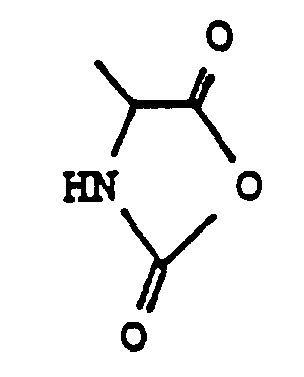
- the catalyst may be a material obtainable by nucleophile-promoted oligomerisation of an amino-acid carboxy anhydride.
- An alternative catalyst is the immobilised catalyst system described by Itsonu et al , J. Org. Chem. (1990).
- the oxidation system comprises the poly-amino-acid catalyst, an organic solvent such as dichloromethane, and an aqueous phase containing (sodium) perborate and alkali, e.g. sodium hydroxide.
- some phase transfer catalyst such as Aliquat 336 is added.
- Preactivation of the catalyst by stirring the mixture for 6 hours before addition of the ⁇ , ⁇ -unsaturated ketone, resulted in a shorter reaction time, e.g. of 1 to 3 days.
- Preferred solvents for these reactions are hydrocarbons such as hexane or chlorinated solvents such as dichloromethane.
- Optical purities (as given in Table 1) were as determined by HPLC on a Chiralpac AD column, and absolute configurations assigned as [2 R ,3 S ] for those epoxides obtained from using poly-L-leucine. The catalyst could be recovered and reused.
- Example 1 The results summarised in Table 1 show that the epoxidation reaction has a broad substrate specificity and is therefore not restricted to chalcones. Satisfactory enantioselectivities were obtained, including a case where the substrate has a second conjugated double bond (Example 4).
- Example A was a relatively prolonged reaction, by comparison with Examples 1 and 2, owing to the possibility of enolisation.
- a further aspect of the present invention is the use of (1 S ,2 R )-1,2-epoxy-4,4-dimethyl-1-phenyl-3-pentanone 2 (synthon 3 is an alternative) in processes for the preparation of taxol side-chain synthons such as ( 2R , 3S )- N -benzoyl-3-phenylisoserine synthons 4 , wherein the t-butyl ketone functionality serves as a masked carboxylate.
- conversion of 2 to 4 can be accomplished by either of the following sequences:
- Scheme 2 shows another use for a compound of the invention, i.e. in the synthesis of an ⁇ -hydroxyester precursor to L -2-naphthylalanine.
Landscapes
- Chemical & Material Sciences (AREA)
- Organic Chemistry (AREA)
- Chemical Kinetics & Catalysis (AREA)
- Epoxy Compounds (AREA)
- Organic Low-Molecular-Weight Compounds And Preparation Thereof (AREA)
- Low-Molecular Organic Synthesis Reactions Using Catalysts (AREA)
Abstract
Description
- This invention relates to epoxides, their synthesis by the asymmetric epoxidation of enones, and their use.
- The enantioselective epoxidation of prochiral alkenes is a valuable methodology, which enables two stereogenic centres to be created in a single synthetic operation. Established methods tend to be limited to specific classes of substrate. The best known is the titanium tartrate-catalysed epoxidation of allylic alcohols, which was first reported by Sharpless as a stoichiometric method, in Katsuki et al, J. Am. Chem. Soc. (1980) 102:5974, and later adapted into a catalytic variant; see Gao et al, J. Am. Chem. Soc (1987) 109:5765.
- More recently, epoxidations employing chiral (salen)Mn(III) catalysts have been applied to a variety of alkene substrates, both unfunctionalised and functionalised; see Jacobsen, chapter 4.2 in Catalytic Asymmetric Synthesis, ed. I. Ojima (1993) VCH, New York.
- Although both these known processes are proven as generic methodologies for laboratory-scale synthesis, reliance on metal-based catalysts and reagents means that operation on a large scale can be disadvantageous in terms of cost, work-up procedure and effluent disposal.
- A third and potentially more economical methodology is the use of metal-free synthetic polypeptides such as poly-L-leucine as catalysts for the asymmetric epoxidation of prochiral α,β-unsaturated ketones of the general formula

- This process was first reported by Juliá et al, Angew. Chem. Int. Ed. Engl. (1980) 19:929. However, it is reported that high enantioselectivities are confined to trans-chalcone derivatives; see Juliá et al, J. Chem. Soc., Perkin Trans. 1 (1982) 1317; Colonna et al, Tetrahedron (1983) 39:1635; Banfi et al, Tetrahedron (1984) 40:5297; Baures et al, Tetrahedron Lett. (1990) 31:6501; and Itsuno et al, J. Org. Chem. (1990) 55:5047. Thus, this reaction has been considered to be of restricted scope in organic synthesis.
- Optically-enriched epoxides are especially suited to nucleophilic ring-opening reactions to give, in stereocontrolled fashion, products bearing heteroatom functionality on adjacent chiral centres. In this respect, (2R,3S)-syn-3-phenylisoserine synthons are reported by Boa et al, Contemporary Organic Synthesis (1994) 1:47, and references therein. Several methods proceed via trans- or cis-phenylglycidate intermediates, prepared by enantioselective oxidation (epoxidation and dihydroxylation) of styrene derivatives; see Greene, J. Org. Chem. (1990) 55:1957; Jacobsen, J. Org. Chem. (1992) 57:4320; and Sharpless, J. Org. Chem. (1994) 59:5105. Although this is an effective overall strategy, provision of enantiopure phenylglycidates relies on the metal-based epoxidation methodologies described above, and aspects of the downstream chemistry are not well suited to operation on a large scale.
- Compounds of formula I are known in racemic form. For example, compounds wherein R1 is phenyl, R2 and R3 are each H, and X is t-butyl or cyclopropyl, are disclosed in EP-A-0336841 and WO-A-0113066, and by Matano, J. Chem. Soc. Perkin Trans. I (1994) 2703, Meth-Cohn, ib. 1517, and Treves, JACS (1967) 89:6257. The nature of the functional groups makes such compounds difficult to separate into constituent enantiomers, by conventional resolution techniques.
- An optically-enriched epoxide of formula I (R1 = CF3, R2 = R3 = H, X = t-butyl) is reported by Lin et al, J. Fluorine Chem. (1989) 44:113-120. Its synthesis is from optically-enriched 1,1,1-trifluoro-2-hydroxy-5,5-dimethylhexan-4-one, using lithium diisopropylamide. This is not a commercial process.
- Corey et al, Tetrahedron Lett. (1991) 32:2857, report the t-butyl glycidate 5 (see Scheme 1) as the product of a chiral Darzens reaction between t-butyl bromoacetate and benzaldehyde.
- It has surprisingly been discovered that asymmetric epoxidation of the type reported by Juliá et al can tolerate a greater range of substituents than is indicated by the prior art. More particularly, the present invention enables the preparation of novel optically-enriched epoxides of formula I wherein R1, R2 and R3 are each independently selected from H, R, R-CO- and R-O-CO-, each R independently being substantially a hydrocarbon group of up to 20 carbon atoms, and X is an alkyl or cycloalkyl group of up to 10 carbon atoms, provided that -CO-X is not enolisable. Novel epoxides of formula I constitute a further aspect of the invention, i.e. wherein the enantiomeric excess is more than 80%, and R1 is aryl or heteroaryl, optionally linked via an epoxide group to CR2.
- The nature of each of R1, R2 and R3 is not critical, providing that it does not interfere with the asymmetric epoxidation reaction. For example, R1 is essentially a spectator to the reaction, for which the non-enolisable nature of -CO-X is important. R1 may be, for example, a group of up to 10 carbon atoms. R2 and R3, and optionally also R1, may be H. R2 and R3 may be linked, e.g. together are -(CH2)4-. Any group other than H may comprise C and H atoms only, or may comprise one or more heteroatoms and/or substituents. One preference for R1 is aryl or heteroaryl, optionally linked via a conjugating group to CR2, e.g. phenyl (or substituted phenyl).
- Most preferably, X is t-butyl (for example when R1 is phenyl and R2 and R3 are each H), since the substrates for epoxidation are readily available, or simply obtainable from inexpensive readily-available starting materials such as pinacolone. Another simple non-enolisable group is provided when X is cyclopropyl.
- X as alkyl can readily be converted to alkoxy by the Baeyer-Villiger reaction. As indicated below, compounds in which X is t-butoxy are of particular interest.
- The present invention provides, for example, an asymmetric route to α,β-unsaturated esters or other carboxylates such as amides, in order to access, for instance, the phenylisoserine component of the anticancer natural product taxol or intermediates for the antihypertensive drug diltiazem (for which R1 is 4-methoxyphenyl).
- Obviously a benefit of the methodology is that either enantiomer of the epoxide can be obtained with equal facility by using the appropriate catalyst, e.g. either the L- or the D-polyamino-acid. Other catalysts can be used, as may be found effective, by trial and error. The catalyst may be a material obtainable by nucleophile-promoted oligomerisation of an amino-acid carboxy anhydride. An alternative catalyst is the immobilised catalyst system described by Itsonu et al, J. Org. Chem. (1990).
- The conditions reported by Juliá et al, supra, for the asymmetric epoxidation comprise a three-phase system of poly-amino-acid catalyst, an organic solvent such as n-hexane, and an aqueous phase containing a large excess of both oxidant (hydrogen peroxide) and alkali (sodium hydroxide). For the economic utilisation of the methodology for the manufacture of bulk single-enantiomer intermediates to, e.g. pharmaceuticals, it would be desirable to reduce the need for any excesses of reagents.
- It has been discovered that, by the use of solutions of perborates, the amount of alkali, e.g. hydroxide, required in the reaction can be cut down substantially. As a result, apart from the saving in reagents, substrates may be used that are otherwise sensitive to the high alkali concentrations present. In the novel conditions, the oxidation system comprises the poly-amino-acid catalyst, an organic solvent such as dichloromethane, and an aqueous phase containing (sodium) perborate and alkali, e.g. sodium hydroxide. In addition, some phase transfer catalyst such as Aliquat 336 is added. A discovery is that only one equivalent of the sodium hydroxide is required. These oxidation conditions may apply to other heterogeneous oxidations.
- Scheme 1 below illustrates reactions according to this invention, shows useful embodiments 1, 2 and 3, and an important, illustrative use of products of this invention. All these embodiments may be generalised to the scope of the invention.
- The following Examples illustrate the invention.
- As shown in Table 1, a variety of epoxyketones (R2 = R3 = H) have been prepared in good to excellent yield and excellent optical purity (Example A is for comparison). All these epoxidations were carried out at ambient temperature in a three-phase system with an organic solvent, a catalytic amount of poly-L-leucine synthesised according to Flisak et al, J. Org. Chem. (1993) 58:6247, or poly-D-leucine synthesised in the same way from D-leucine, and with a large excess of oxidant. Preactivation of the catalyst, by stirring the mixture for 6 hours before addition of the α,β-unsaturated ketone, resulted in a shorter reaction time, e.g. of 1 to 3 days. Preferred solvents for these reactions are hydrocarbons such as hexane or chlorinated solvents such as dichloromethane. Optical purities (as given in Table 1) were as determined by HPLC on a Chiralpac AD column, and absolute configurations assigned as [2R,3S] for those epoxides obtained from using poly-L-leucine. The catalyst could be recovered and reused.
Ex. R1 X Conditions Yield (%) ee (%) A Ph isopropyl 62 1 Ph t-butyl 92 >98 2 Ph t-butyl 90 >86 3 2-naphthyl cyclopropyl 61 90 4 Ph-CH=CH- cyclopropyl 73 74 - The results summarised in Table 1 show that the epoxidation reaction has a broad substrate specificity and is therefore not restricted to chalcones. Satisfactory enantioselectivities were obtained, including a case where the substrate has a second conjugated double bond (Example 4). Example A was a relatively prolonged reaction, by comparison with Examples 1 and 2, owing to the possibility of enolisation.
- With reference to Scheme 1, as exemplification of the value of epoxyketones 1, a further aspect of the present invention is the use of (1S,2R)-1,2-epoxy-4,4-dimethyl-1-phenyl-3-pentanone 2 (synthon 3 is an alternative) in processes for the preparation of taxol side-chain synthons such as (2R, 3S)-N-benzoyl-3-phenylisoserine synthons 4, wherein the t-butyl ketone functionality serves as a masked carboxylate. As summarised in Scheme 1, conversion of 2 to 4 can be accomplished by either of the following sequences:
- (a) Baeyer-Villiger oxidation to produce t-butyl 2,3-epoxy-3-phenylpropanoate 5, inversion of configuration at C-3 to afford cis-epoxide 6, nucleophilic ring opening at the benzylic position with either ammonia or azide anion (followed by reduction to the amine), N-benzoylation and optional acid-catalysed deesterification. In contrast to similar prior art processes for the corresponding n-alkyl ester (McChesney, Tetrahedron: Asymmetry (1994) 5:1683; Jacobsen, J. Org. Chem. (1992) 57:4320), during epoxide ring opening with ammonia the t-butyl ester provides effective protection against unwanted amidation at C-1, and allows final unmasking of the C-1 carboxyl group to be carried out under mild, non-hydrolytic conditions.
- (b) Similar to (a), but with Baeyer-Villiger oxidation carried out at the penultimate stage. By this route the t-Bu ketone provides effective masking for the C-1 carboxyl group through much of the synthesis.
-
- Scheme 2 shows another use for a compound of the invention, i.e. in the synthesis of an α-hydroxyester precursor to L-2-naphthylalanine.


Claims (29)
- A process for preparing an optically-enriched chiral epoxide of formula Iwherein R1, R2 and R3 are each independently selected from H, R, R-CO- and R-O-CO-, each R independently being substantially a hydrocarbon group of up to 20 carbon atoms, and X is an alkyl or cycloalkyl group of up to 10 carbon atoms, provided that -CO-X is not enolisable, which comprises the asymmetric epoxidation of a corresponding prochiral alkene of formula II

- A process according to claim 1, wherein the catalyst is a heterogeneous chiral polymer.
- A process according to claim 1, wherein the catalyst is a metal-free synthetic polypeptide.
- A process according to claim 1, wherein the catalyst is obtainable by nucleophile-promoted oligomerisation of an amino-acid carboxy anhydride.
- A process according to claim 4, wherein the anhydride has the partial formula
- A process according to claim 5, wherein the oligomerisation is caused by humidity or an amine.
- A process according to any preceding claim, which is conducted in the presence of alkali such as hydroxide.
- A process according to any of claims 2 to 6, which is conducted in a three-phase mixture of the polymer or oligomer, an organic solvent, and an aqueous phase containing the oxidant and alkali, in the presence of a catalytic amount of a phase-transfer catalyst such as Aliquat-336.
- A process according to claim 7 or claim 8, wherein not more than one equivalent of alkali is used.
- A process according to any preceding claim, wherein the oxidant is a perborate.
- A process according to any preceding claim, wherein R2 and R3 are each H.
- A process according to claim 11, wherein R1 is H.
- A process according to any of claims 1 to 11, wherein R1 is a group of up to 10 carbon atoms.
- A process according to any preceding claim, wherein X is t-butyl.
- A process according to claim 14, for the preparation of (1S,2R)-trans-1,2-epoxy-4,4-dimethyl-1-phenyl-3-pentanone from (E)-4,4-dimethyl-1-phenylpenten-3-one.
- An optically-enriched chiral epoxide of formula I as defined in claim 1, in more than 80% enantiomeric excess, wherein R1 is aryl or heteroaryl, optionally linked via a epoxide group to CR2.
- An epoxide according to claim 16, wherein R1 is optionally-substituted phenyl.
- An epoxide according to claim 16, wherein R1 is phenyl.
- An epoxide according to any of claims 16 to 18, wherein X is t-butyl or cyclopropyl.
- An epoxide according to claim 19, wherein X is t-butyl.
- An epoxide according to any of claims 16 to 18, wherein X is t-alkyl.
- A process for the preparation of an optically-enriched epoxide ester, which comprises conducting a process according to any of claims 1 to 15, and then converting X in the epoxide to OX, by the Baeyer-Villiger reaction.
- A process according to claim 22, wherein OX is t-butoxy.
- Use of (1S,2R)-trans-1,2-epoxy-4,4-dimethyl-1-phenyl-3-pentanone for the preparation of syn-3-phenylisoserine or a derivative thereof represented by the formulaenriched in the (2R,3S)-stereoisomer, wherein R' is H or acyl and R" is H or alkyl.
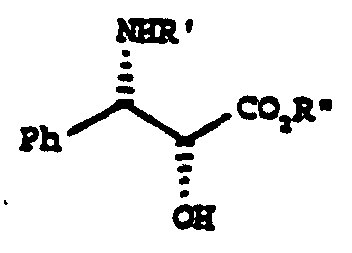
- Use according to claim 24, wherein R' is benzoyl.
- Use according to claim 24, which comprises:(i) Baeyer-Villiger oxidation to produce (2R,3S)-t-butyl 2,3-epoxy-3-phenylpropanoate;(ii) inversion of configuration at C-3 to afford the corresponding cis-epoxide;(iii) nucleophilic ring opening at the benzylic position with either ammonia or azide anion (followed by reduction to the amine); and(iv) N-benzoylation and, optionally, acid-catalysed deesterification.
- Use according to claim 24, which comprises:(i) conversion to an intermediate of formula 7; and(ii) Baeyer-Villiger oxidation to give the product wherein R" is H or t-butyl and, optionally, acid-catalysed deesterification.
- An epoxide according to claim 17, wherein R1 is 4-methoxyphenyl.
- A process for the preparation of diltiazem, which comprises conducting a process according to claim 13 when R1 is 4-methoxyphenyl, and converting the product to diltiazem.
Applications Claiming Priority (5)
| Application Number | Priority Date | Filing Date | Title |
|---|---|---|---|
| GB9508098 | 1995-04-20 | ||
| GBGB9508098.2A GB9508098D0 (en) | 1995-04-20 | 1995-04-20 | Epoxidation |
| GBGB9526379.4A GB9526379D0 (en) | 1995-12-22 | 1995-12-22 | Asymmetric epoxides their synthesis and use |
| GB9526379 | 1995-12-22 | ||
| PCT/GB1996/000953 WO1996033183A1 (en) | 1995-04-20 | 1996-04-19 | Asymmetric epoxides, their synthesis and use |
Publications (2)
| Publication Number | Publication Date |
|---|---|
| EP0821679A1 EP0821679A1 (en) | 1998-02-04 |
| EP0821679B1 true EP0821679B1 (en) | 2001-07-11 |
Family
ID=26306907
Family Applications (1)
| Application Number | Title | Priority Date | Filing Date |
|---|---|---|---|
| EP96910126A Expired - Lifetime EP0821679B1 (en) | 1995-04-20 | 1996-04-19 | Asymmetric epoxides, their synthesis and use |
Country Status (8)
| Country | Link |
|---|---|
| EP (1) | EP0821679B1 (en) |
| JP (1) | JPH11509173A (en) |
| AT (1) | ATE203018T1 (en) |
| AU (1) | AU705806B2 (en) |
| BR (1) | BR9608070A (en) |
| CA (1) | CA2216866A1 (en) |
| DE (1) | DE69613830T2 (en) |
| WO (1) | WO1996033183A1 (en) |
Families Citing this family (5)
| Publication number | Priority date | Publication date | Assignee | Title |
|---|---|---|---|---|
| DE19855858A1 (en) * | 1998-12-03 | 2000-06-08 | Degussa | Process for the enantioselective epoxidation of C-C double bonds |
| DE10136131B4 (en) * | 2001-07-27 | 2004-02-12 | Bayer Ag | Polyamino acid catalyzed process for the enantioselective epoxidation of α, β-unsaturated enones and α, β-unsaturated sulfones |
| DE10136485C1 (en) * | 2001-07-27 | 2003-03-06 | Bayer Ag | Polyamino acid catalyzed process for the enantioselective epoxidation of alpha, ß-unsaturated eons and alpha, ß-unsaturated sulfones |
| DE10136132C2 (en) * | 2001-07-27 | 2003-10-30 | Bayer Ag | Polyamino acid catalyzed process for the enantioselective epoxidation of alpha, beta-unsaturated enones and alpha, beta-unsaturated sulfones |
| DE10206793A1 (en) * | 2002-02-19 | 2003-08-28 | Bayer Ag | Poly-amino-acid for use as epoxidation catalyst is obtained by reacting amino acid N-carboxy-anhydride with initiator in an aromatic solvent, e.g. toluene |
Family Cites Families (4)
| Publication number | Priority date | Publication date | Assignee | Title |
|---|---|---|---|---|
| NL130300C (en) * | 1965-06-01 | |||
| DE3563209D1 (en) * | 1984-10-15 | 1988-07-14 | Firmenich & Cie | Unsaturated aliphatic ketone and its use as perfuming ingredient |
| US5110959A (en) * | 1989-06-14 | 1992-05-05 | Smithkline Beckman Corp. | Process for preparation of epoxy esters and intermediates prepared thereby |
| FR2658513B1 (en) * | 1990-02-21 | 1994-02-04 | Rhone Poulenc Sante | PROCESS FOR THE PREPARATION OF CIS-BETA-PHENYLGLYCIDIC- (2R, 3R) ACID. |
-
1996
- 1996-04-19 AT AT96910126T patent/ATE203018T1/en not_active IP Right Cessation
- 1996-04-19 AU AU53426/96A patent/AU705806B2/en not_active Ceased
- 1996-04-19 EP EP96910126A patent/EP0821679B1/en not_active Expired - Lifetime
- 1996-04-19 JP JP8531569A patent/JPH11509173A/en active Pending
- 1996-04-19 BR BR9608070A patent/BR9608070A/en not_active Application Discontinuation
- 1996-04-19 DE DE69613830T patent/DE69613830T2/en not_active Expired - Fee Related
- 1996-04-19 CA CA002216866A patent/CA2216866A1/en not_active Abandoned
- 1996-04-19 WO PCT/GB1996/000953 patent/WO1996033183A1/en not_active Ceased
Also Published As
| Publication number | Publication date |
|---|---|
| EP0821679A1 (en) | 1998-02-04 |
| WO1996033183A1 (en) | 1996-10-24 |
| BR9608070A (en) | 1999-01-26 |
| AU5342696A (en) | 1996-11-07 |
| CA2216866A1 (en) | 1996-10-24 |
| AU705806B2 (en) | 1999-06-03 |
| MX9708005A (en) | 1997-11-29 |
| DE69613830T2 (en) | 2001-10-31 |
| ATE203018T1 (en) | 2001-07-15 |
| JPH11509173A (en) | 1999-08-17 |
| DE69613830D1 (en) | 2001-08-16 |
Similar Documents
| Publication | Publication Date | Title |
|---|---|---|
| US5665890A (en) | Stereoselective ring opening reactions | |
| AU678139B2 (en) | Method of enantio selectively epoxidizing cinnamate derivatives | |
| Bodkin et al. | The Sharpless asymmetric aminohydroxylation | |
| Ricci et al. | Organocatalytic enantioselective decarboxylative addition of malonic half thioesters to imines | |
| CN115160158B (en) | Preparation method of chiral tertiary leucinol | |
| AU705806B2 (en) | Asymmetric epoxides, their synthesis and use | |
| Meninno et al. | Catalytic enantioselective one-pot approach to cis-and trans-2, 3-diaryl substituted 1, 5-benzothiazepines | |
| US6225482B1 (en) | Process for the enantioselective epoxidation of C═C double bonds | |
| Vachon et al. | Enantioselective olefin epoxidation using novel biphenyl and binaphthyl azepines and azepinium salts | |
| US6228955B1 (en) | Asymmetric epoxides, their synthesis and use | |
| Höft | Enantioselective epoxidation with peroxidic oxygen | |
| Mulzer et al. | Synthesis of Optically Active β, γ-Unsaturated α-Amino Acids and of α, β-Unsaturated | |
| CA2337269C (en) | Novel method for preparing synthesis intermediates | |
| Saito et al. | Asymmetric Mannich-type reactions with a chiral acetate: effect of Lewis acid on activation of aldimine | |
| Bergmeier et al. | Three-membered ring systems | |
| MXPA97008005A (en) | Asymmetric epoxides, their synthesis and | |
| Antolini et al. | Synthesis, enzymatic resolution and absolute configuration of ethyl trans-3-(trifluoromethyl) pyroglutamate | |
| Kohmura et al. | Oxidative Asymmetrization of Racemic Alkenes: Asymmetric Synthesis of Optically Active Dicyclopentadiene Derivatives | |
| Watanabe et al. | Synthesis of Compounds with Juvenile Hormone Activity; XXXI: 1 Stereocontrolled Synthesis of (+)-Juvabione from a Chiral Sulfoxide | |
| US5994583A (en) | Two step synthesis of D- and L- α-amino acids and D- and L- α-amino-aldehydes | |
| US6770766B2 (en) | Polyamino acid-catalyzed process for the enantioselective epoixdation of α,β-unsaturated enones and α,β-unsaturated sulfones | |
| Pégorier et al. | A synthetic route to anti aminoalkyl epoxides by stereocontrolled reductive amination of ketoepoxides | |
| US6054065A (en) | Chiral ligand and method for preparing cyanohydrins from aldehydes | |
| JP2000072743A (en) | Aziridination of alkenes | |
| JP5408662B2 (en) | Method for producing disulfonic acid compound, asymmetric Mannich catalyst, method for producing β-aminocarbonyl derivative, and novel disulfonate |
Legal Events
| Date | Code | Title | Description |
|---|---|---|---|
| PUAI | Public reference made under article 153(3) epc to a published international application that has entered the european phase |
Free format text: ORIGINAL CODE: 0009012 |
|
| 17P | Request for examination filed |
Effective date: 19971106 |
|
| AK | Designated contracting states |
Kind code of ref document: A1 Designated state(s): AT BE CH DE DK ES FI FR GB GR IE IT LI LU NL PT SE |
|
| 17Q | First examination report despatched |
Effective date: 19980908 |
|
| RAP1 | Party data changed (applicant data changed or rights of an application transferred) |
Owner name: CHIROTECH TECHNOLOGY LIMITED |
|
| GRAG | Despatch of communication of intention to grant |
Free format text: ORIGINAL CODE: EPIDOS AGRA |
|
| GRAG | Despatch of communication of intention to grant |
Free format text: ORIGINAL CODE: EPIDOS AGRA |
|
| GRAH | Despatch of communication of intention to grant a patent |
Free format text: ORIGINAL CODE: EPIDOS IGRA |
|
| GRAH | Despatch of communication of intention to grant a patent |
Free format text: ORIGINAL CODE: EPIDOS IGRA |
|
| GRAA | (expected) grant |
Free format text: ORIGINAL CODE: 0009210 |
|
| AK | Designated contracting states |
Kind code of ref document: B1 Designated state(s): AT BE CH DE DK ES FI FR GB GR IE IT LI LU NL PT SE |
|
| PG25 | Lapsed in a contracting state [announced via postgrant information from national office to epo] |
Ref country code: NL Free format text: LAPSE BECAUSE OF FAILURE TO SUBMIT A TRANSLATION OF THE DESCRIPTION OR TO PAY THE FEE WITHIN THE PRESCRIBED TIME-LIMIT Effective date: 20010711 Ref country code: LI Free format text: LAPSE BECAUSE OF FAILURE TO SUBMIT A TRANSLATION OF THE DESCRIPTION OR TO PAY THE FEE WITHIN THE PRESCRIBED TIME-LIMIT Effective date: 20010711 Ref country code: IT Free format text: LAPSE BECAUSE OF FAILURE TO SUBMIT A TRANSLATION OF THE DESCRIPTION OR TO PAY THE FEE WITHIN THE PRESCRIBED TIME-LIMIT;WARNING: LAPSES OF ITALIAN PATENTS WITH EFFECTIVE DATE BEFORE 2007 MAY HAVE OCCURRED AT ANY TIME BEFORE 2007. THE CORRECT EFFECTIVE DATE MAY BE DIFFERENT FROM THE ONE RECORDED. Effective date: 20010711 Ref country code: FI Free format text: LAPSE BECAUSE OF FAILURE TO SUBMIT A TRANSLATION OF THE DESCRIPTION OR TO PAY THE FEE WITHIN THE PRESCRIBED TIME-LIMIT Effective date: 20010711 Ref country code: CH Free format text: LAPSE BECAUSE OF FAILURE TO SUBMIT A TRANSLATION OF THE DESCRIPTION OR TO PAY THE FEE WITHIN THE PRESCRIBED TIME-LIMIT Effective date: 20010711 Ref country code: BE Free format text: LAPSE BECAUSE OF FAILURE TO SUBMIT A TRANSLATION OF THE DESCRIPTION OR TO PAY THE FEE WITHIN THE PRESCRIBED TIME-LIMIT Effective date: 20010711 Ref country code: AT Free format text: LAPSE BECAUSE OF FAILURE TO SUBMIT A TRANSLATION OF THE DESCRIPTION OR TO PAY THE FEE WITHIN THE PRESCRIBED TIME-LIMIT Effective date: 20010711 |
|
| REF | Corresponds to: |
Ref document number: 203018 Country of ref document: AT Date of ref document: 20010715 Kind code of ref document: T |
|
| REG | Reference to a national code |
Ref country code: CH Ref legal event code: EP |
|
| REF | Corresponds to: |
Ref document number: 69613830 Country of ref document: DE Date of ref document: 20010816 |
|
| REG | Reference to a national code |
Ref country code: IE Ref legal event code: FG4D |
|
| PG25 | Lapsed in a contracting state [announced via postgrant information from national office to epo] |
Ref country code: SE Free format text: LAPSE BECAUSE OF FAILURE TO SUBMIT A TRANSLATION OF THE DESCRIPTION OR TO PAY THE FEE WITHIN THE PRESCRIBED TIME-LIMIT Effective date: 20011011 Ref country code: PT Free format text: LAPSE BECAUSE OF FAILURE TO SUBMIT A TRANSLATION OF THE DESCRIPTION OR TO PAY THE FEE WITHIN THE PRESCRIBED TIME-LIMIT Effective date: 20011011 Ref country code: DK Free format text: LAPSE BECAUSE OF FAILURE TO SUBMIT A TRANSLATION OF THE DESCRIPTION OR TO PAY THE FEE WITHIN THE PRESCRIBED TIME-LIMIT Effective date: 20011011 |
|
| PG25 | Lapsed in a contracting state [announced via postgrant information from national office to epo] |
Ref country code: GR Free format text: LAPSE BECAUSE OF FAILURE TO SUBMIT A TRANSLATION OF THE DESCRIPTION OR TO PAY THE FEE WITHIN THE PRESCRIBED TIME-LIMIT Effective date: 20011012 |
|
| NLV1 | Nl: lapsed or annulled due to failure to fulfill the requirements of art. 29p and 29m of the patents act | ||
| ET | Fr: translation filed | ||
| REG | Reference to a national code |
Ref country code: GB Ref legal event code: IF02 |
|
| PG25 | Lapsed in a contracting state [announced via postgrant information from national office to epo] |
Ref country code: ES Free format text: LAPSE BECAUSE OF FAILURE TO SUBMIT A TRANSLATION OF THE DESCRIPTION OR TO PAY THE FEE WITHIN THE PRESCRIBED TIME-LIMIT Effective date: 20020131 |
|
| REG | Reference to a national code |
Ref country code: CH Ref legal event code: PL |
|
| PG25 | Lapsed in a contracting state [announced via postgrant information from national office to epo] |
Ref country code: LU Free format text: LAPSE BECAUSE OF NON-PAYMENT OF DUE FEES Effective date: 20020419 Ref country code: IE Free format text: LAPSE BECAUSE OF NON-PAYMENT OF DUE FEES Effective date: 20020419 |
|
| PLBE | No opposition filed within time limit |
Free format text: ORIGINAL CODE: 0009261 |
|
| STAA | Information on the status of an ep patent application or granted ep patent |
Free format text: STATUS: NO OPPOSITION FILED WITHIN TIME LIMIT |
|
| 26N | No opposition filed | ||
| REG | Reference to a national code |
Ref country code: IE Ref legal event code: MM4A |
|
| PGFP | Annual fee paid to national office [announced via postgrant information from national office to epo] |
Ref country code: FR Payment date: 20060410 Year of fee payment: 11 |
|
| PGFP | Annual fee paid to national office [announced via postgrant information from national office to epo] |
Ref country code: DE Payment date: 20060413 Year of fee payment: 11 |
|
| PGFP | Annual fee paid to national office [announced via postgrant information from national office to epo] |
Ref country code: GB Payment date: 20060419 Year of fee payment: 11 |
|
| GBPC | Gb: european patent ceased through non-payment of renewal fee |
Effective date: 20070419 |
|
| PG25 | Lapsed in a contracting state [announced via postgrant information from national office to epo] |
Ref country code: DE Free format text: LAPSE BECAUSE OF NON-PAYMENT OF DUE FEES Effective date: 20071101 |
|
| PG25 | Lapsed in a contracting state [announced via postgrant information from national office to epo] |
Ref country code: GB Free format text: LAPSE BECAUSE OF NON-PAYMENT OF DUE FEES Effective date: 20070419 |
|
| PG25 | Lapsed in a contracting state [announced via postgrant information from national office to epo] |
Ref country code: FR Free format text: LAPSE BECAUSE OF NON-PAYMENT OF DUE FEES Effective date: 20070430 |