EP0820452B1 - Carbonyl-piperazinyl and piperidinil compounds which inhibit farnesyl protein transferase - Google Patents
Carbonyl-piperazinyl and piperidinil compounds which inhibit farnesyl protein transferase Download PDFInfo
- Publication number
- EP0820452B1 EP0820452B1 EP96911440A EP96911440A EP0820452B1 EP 0820452 B1 EP0820452 B1 EP 0820452B1 EP 96911440 A EP96911440 A EP 96911440A EP 96911440 A EP96911440 A EP 96911440A EP 0820452 B1 EP0820452 B1 EP 0820452B1
- Authority
- EP
- European Patent Office
- Prior art keywords
- alkyl
- aryl
- substituted
- group
- compound
- Prior art date
- Legal status (The legal status is an assumption and is not a legal conclusion. Google has not performed a legal analysis and makes no representation as to the accuracy of the status listed.)
- Expired - Lifetime
Links
- 0 CC(C1)N(*)CCN1C(*)=O Chemical compound CC(C1)N(*)CCN1C(*)=O 0.000 description 16
- SJHSVXQMHYTEKW-UHFFFAOYSA-N CC(C)CNCC(C)=O Chemical compound CC(C)CNCC(C)=O SJHSVXQMHYTEKW-UHFFFAOYSA-N 0.000 description 1
- LQHBAECAFJXPIT-UHFFFAOYSA-N CC(CC1)NCC(C)N1C(OC(C)(C)C)=O Chemical compound CC(CC1)NCC(C)N1C(OC(C)(C)C)=O LQHBAECAFJXPIT-UHFFFAOYSA-N 0.000 description 1
- MUMLMFSJRXOGEI-UHFFFAOYSA-N CC(NCC1OCCC1)=O Chemical compound CC(NCC1OCCC1)=O MUMLMFSJRXOGEI-UHFFFAOYSA-N 0.000 description 1
- WFMJTCLDCCCFHE-UHFFFAOYSA-N CC(NCCOC)=O Chemical compound CC(NCCOC)=O WFMJTCLDCCCFHE-UHFFFAOYSA-N 0.000 description 1
- SOGZMDYBQZTXIJ-UHFFFAOYSA-N CCC(NCC1CCCCC1)=O Chemical compound CCC(NCC1CCCCC1)=O SOGZMDYBQZTXIJ-UHFFFAOYSA-N 0.000 description 1
- BKFSPPDAZOYKSD-UHFFFAOYSA-N CCC(NCCCCC1OCCCC1)=O Chemical compound CCC(NCCCCC1OCCCC1)=O BKFSPPDAZOYKSD-UHFFFAOYSA-N 0.000 description 1
- FYPYYALHHIJQSU-UHFFFAOYSA-N CCCCC(C1)N(C)CCC1=O Chemical compound CCCCC(C1)N(C)CCC1=O FYPYYALHHIJQSU-UHFFFAOYSA-N 0.000 description 1
- BSIMJOWORCXCMP-UHFFFAOYSA-N CCCCC(C1)N(C)CCC1Cl Chemical compound CCCCC(C1)N(C)CCC1Cl BSIMJOWORCXCMP-UHFFFAOYSA-N 0.000 description 1
- SWKQCSITMTXTBP-UHFFFAOYSA-N CCCCC(C1)NCCC1=O Chemical compound CCCCC(C1)NCCC1=O SWKQCSITMTXTBP-UHFFFAOYSA-N 0.000 description 1
- RPWXYCRIAGBAGY-UHFFFAOYSA-N CCOC(Cc1cnccc1)=O Chemical compound CCOC(Cc1cnccc1)=O RPWXYCRIAGBAGY-UHFFFAOYSA-N 0.000 description 1
Classifications
-
- C—CHEMISTRY; METALLURGY
- C07—ORGANIC CHEMISTRY
- C07D—HETEROCYCLIC COMPOUNDS
- C07D213/00—Heterocyclic compounds containing six-membered rings, not condensed with other rings, with one nitrogen atom as the only ring hetero atom and three or more double bonds between ring members or between ring members and non-ring members
- C07D213/02—Heterocyclic compounds containing six-membered rings, not condensed with other rings, with one nitrogen atom as the only ring hetero atom and three or more double bonds between ring members or between ring members and non-ring members having three double bonds between ring members or between ring members and non-ring members
- C07D213/89—Heterocyclic compounds containing six-membered rings, not condensed with other rings, with one nitrogen atom as the only ring hetero atom and three or more double bonds between ring members or between ring members and non-ring members having three double bonds between ring members or between ring members and non-ring members with hetero atoms directly attached to the ring nitrogen atom
-
- A—HUMAN NECESSITIES
- A61—MEDICAL OR VETERINARY SCIENCE; HYGIENE
- A61P—SPECIFIC THERAPEUTIC ACTIVITY OF CHEMICAL COMPOUNDS OR MEDICINAL PREPARATIONS
- A61P35/00—Antineoplastic agents
-
- A—HUMAN NECESSITIES
- A61—MEDICAL OR VETERINARY SCIENCE; HYGIENE
- A61P—SPECIFIC THERAPEUTIC ACTIVITY OF CHEMICAL COMPOUNDS OR MEDICINAL PREPARATIONS
- A61P43/00—Drugs for specific purposes, not provided for in groups A61P1/00-A61P41/00
-
- C—CHEMISTRY; METALLURGY
- C07—ORGANIC CHEMISTRY
- C07D—HETEROCYCLIC COMPOUNDS
- C07D211/00—Heterocyclic compounds containing hydrogenated pyridine rings, not condensed with other rings
- C07D211/04—Heterocyclic compounds containing hydrogenated pyridine rings, not condensed with other rings with only hydrogen or carbon atoms directly attached to the ring nitrogen atom
- C07D211/06—Heterocyclic compounds containing hydrogenated pyridine rings, not condensed with other rings with only hydrogen or carbon atoms directly attached to the ring nitrogen atom having no double bonds between ring members or between ring members and non-ring members
- C07D211/08—Heterocyclic compounds containing hydrogenated pyridine rings, not condensed with other rings with only hydrogen or carbon atoms directly attached to the ring nitrogen atom having no double bonds between ring members or between ring members and non-ring members with hydrocarbon or substituted hydrocarbon radicals directly attached to ring carbon atoms
- C07D211/18—Heterocyclic compounds containing hydrogenated pyridine rings, not condensed with other rings with only hydrogen or carbon atoms directly attached to the ring nitrogen atom having no double bonds between ring members or between ring members and non-ring members with hydrocarbon or substituted hydrocarbon radicals directly attached to ring carbon atoms with substituted hydrocarbon radicals attached to ring carbon atoms
- C07D211/34—Heterocyclic compounds containing hydrogenated pyridine rings, not condensed with other rings with only hydrogen or carbon atoms directly attached to the ring nitrogen atom having no double bonds between ring members or between ring members and non-ring members with hydrocarbon or substituted hydrocarbon radicals directly attached to ring carbon atoms with substituted hydrocarbon radicals attached to ring carbon atoms with hydrocarbon radicals, substituted by carbon atoms having three bonds to hetero atoms with at the most one bond to halogen, e.g. ester or nitrile radicals
-
- C—CHEMISTRY; METALLURGY
- C07—ORGANIC CHEMISTRY
- C07D—HETEROCYCLIC COMPOUNDS
- C07D211/00—Heterocyclic compounds containing hydrogenated pyridine rings, not condensed with other rings
- C07D211/04—Heterocyclic compounds containing hydrogenated pyridine rings, not condensed with other rings with only hydrogen or carbon atoms directly attached to the ring nitrogen atom
- C07D211/06—Heterocyclic compounds containing hydrogenated pyridine rings, not condensed with other rings with only hydrogen or carbon atoms directly attached to the ring nitrogen atom having no double bonds between ring members or between ring members and non-ring members
- C07D211/36—Heterocyclic compounds containing hydrogenated pyridine rings, not condensed with other rings with only hydrogen or carbon atoms directly attached to the ring nitrogen atom having no double bonds between ring members or between ring members and non-ring members with hetero atoms or with carbon atoms having three bonds to hetero atoms with at the most one bond to halogen, e.g. ester or nitrile radicals, directly attached to ring carbon atoms
- C07D211/38—Halogen atoms or nitro radicals
-
- C—CHEMISTRY; METALLURGY
- C07—ORGANIC CHEMISTRY
- C07D—HETEROCYCLIC COMPOUNDS
- C07D211/00—Heterocyclic compounds containing hydrogenated pyridine rings, not condensed with other rings
- C07D211/04—Heterocyclic compounds containing hydrogenated pyridine rings, not condensed with other rings with only hydrogen or carbon atoms directly attached to the ring nitrogen atom
- C07D211/06—Heterocyclic compounds containing hydrogenated pyridine rings, not condensed with other rings with only hydrogen or carbon atoms directly attached to the ring nitrogen atom having no double bonds between ring members or between ring members and non-ring members
- C07D211/36—Heterocyclic compounds containing hydrogenated pyridine rings, not condensed with other rings with only hydrogen or carbon atoms directly attached to the ring nitrogen atom having no double bonds between ring members or between ring members and non-ring members with hetero atoms or with carbon atoms having three bonds to hetero atoms with at the most one bond to halogen, e.g. ester or nitrile radicals, directly attached to ring carbon atoms
- C07D211/40—Oxygen atoms
- C07D211/44—Oxygen atoms attached in position 4
- C07D211/48—Oxygen atoms attached in position 4 having an acyclic carbon atom attached in position 4
- C07D211/50—Aroyl radical
-
- C—CHEMISTRY; METALLURGY
- C07—ORGANIC CHEMISTRY
- C07D—HETEROCYCLIC COMPOUNDS
- C07D213/00—Heterocyclic compounds containing six-membered rings, not condensed with other rings, with one nitrogen atom as the only ring hetero atom and three or more double bonds between ring members or between ring members and non-ring members
- C07D213/02—Heterocyclic compounds containing six-membered rings, not condensed with other rings, with one nitrogen atom as the only ring hetero atom and three or more double bonds between ring members or between ring members and non-ring members having three double bonds between ring members or between ring members and non-ring members
- C07D213/04—Heterocyclic compounds containing six-membered rings, not condensed with other rings, with one nitrogen atom as the only ring hetero atom and three or more double bonds between ring members or between ring members and non-ring members having three double bonds between ring members or between ring members and non-ring members having no bond between the ring nitrogen atom and a non-ring member or having only hydrogen or carbon atoms directly attached to the ring nitrogen atom
- C07D213/24—Heterocyclic compounds containing six-membered rings, not condensed with other rings, with one nitrogen atom as the only ring hetero atom and three or more double bonds between ring members or between ring members and non-ring members having three double bonds between ring members or between ring members and non-ring members having no bond between the ring nitrogen atom and a non-ring member or having only hydrogen or carbon atoms directly attached to the ring nitrogen atom with substituted hydrocarbon radicals attached to ring carbon atoms
- C07D213/54—Radicals substituted by carbon atoms having three bonds to hetero atoms with at the most one bond to halogen, e.g. ester or nitrile radicals
- C07D213/56—Amides
-
- C—CHEMISTRY; METALLURGY
- C07—ORGANIC CHEMISTRY
- C07D—HETEROCYCLIC COMPOUNDS
- C07D241/00—Heterocyclic compounds containing 1,4-diazine or hydrogenated 1,4-diazine rings
- C07D241/02—Heterocyclic compounds containing 1,4-diazine or hydrogenated 1,4-diazine rings not condensed with other rings
- C07D241/04—Heterocyclic compounds containing 1,4-diazine or hydrogenated 1,4-diazine rings not condensed with other rings having no double bonds between ring members or between ring members and non-ring members
-
- C—CHEMISTRY; METALLURGY
- C07—ORGANIC CHEMISTRY
- C07D—HETEROCYCLIC COMPOUNDS
- C07D401/00—Heterocyclic compounds containing two or more hetero rings, having nitrogen atoms as the only ring hetero atoms, at least one ring being a six-membered ring with only one nitrogen atom
- C07D401/02—Heterocyclic compounds containing two or more hetero rings, having nitrogen atoms as the only ring hetero atoms, at least one ring being a six-membered ring with only one nitrogen atom containing two hetero rings
- C07D401/06—Heterocyclic compounds containing two or more hetero rings, having nitrogen atoms as the only ring hetero atoms, at least one ring being a six-membered ring with only one nitrogen atom containing two hetero rings linked by a carbon chain containing only aliphatic carbon atoms
-
- C—CHEMISTRY; METALLURGY
- C07—ORGANIC CHEMISTRY
- C07D—HETEROCYCLIC COMPOUNDS
- C07D401/00—Heterocyclic compounds containing two or more hetero rings, having nitrogen atoms as the only ring hetero atoms, at least one ring being a six-membered ring with only one nitrogen atom
- C07D401/02—Heterocyclic compounds containing two or more hetero rings, having nitrogen atoms as the only ring hetero atoms, at least one ring being a six-membered ring with only one nitrogen atom containing two hetero rings
- C07D401/12—Heterocyclic compounds containing two or more hetero rings, having nitrogen atoms as the only ring hetero atoms, at least one ring being a six-membered ring with only one nitrogen atom containing two hetero rings linked by a chain containing hetero atoms as chain links
-
- C—CHEMISTRY; METALLURGY
- C07—ORGANIC CHEMISTRY
- C07D—HETEROCYCLIC COMPOUNDS
- C07D401/00—Heterocyclic compounds containing two or more hetero rings, having nitrogen atoms as the only ring hetero atoms, at least one ring being a six-membered ring with only one nitrogen atom
- C07D401/14—Heterocyclic compounds containing two or more hetero rings, having nitrogen atoms as the only ring hetero atoms, at least one ring being a six-membered ring with only one nitrogen atom containing three or more hetero rings
-
- Y—GENERAL TAGGING OF NEW TECHNOLOGICAL DEVELOPMENTS; GENERAL TAGGING OF CROSS-SECTIONAL TECHNOLOGIES SPANNING OVER SEVERAL SECTIONS OF THE IPC; TECHNICAL SUBJECTS COVERED BY FORMER USPC CROSS-REFERENCE ART COLLECTIONS [XRACs] AND DIGESTS
- Y02—TECHNOLOGIES OR APPLICATIONS FOR MITIGATION OR ADAPTATION AGAINST CLIMATE CHANGE
- Y02P—CLIMATE CHANGE MITIGATION TECHNOLOGIES IN THE PRODUCTION OR PROCESSING OF GOODS
- Y02P20/00—Technologies relating to chemical industry
- Y02P20/50—Improvements relating to the production of bulk chemicals
- Y02P20/582—Recycling of unreacted starting or intermediate materials
Definitions
- Ras oncoprotein To acquire transforming potential, the precursor of the Ras oncoprotein must undergo famesylation of the cysteine residue located in a carboxyl-terminal tetrapeptide. Inhibitors of the enzyme that catalyzes this modification, farnesyl protein transferase, have therefore been suggested as anticancer agents for tumors in which Ras contributes to transformation. Mutated, oncogenic forms of Ras are frequently found in many human cancers, most notably in more than 50% of colon and pancreatic carcinomas (Kohl et al., Science, Vol. 260, 1834 to 1837 - , 1993).
- the present invention is directed to novel carbonyl piperazinyl and piperidinyl compounds of the formula: or a pharmaceutically acceptable salt or solvate thereof, wherein:
- the present invention is directed toward the use compound (1.0) for the manufacture of a medicament for inhibiting the abnormal growth of cells, including transformed cells, comprising administering an effective amount of compound (1.0) to a mammal (e.g., a human) In need of such treatment.
- Abnormal growth of cells refers to cell growth independent of normal regulatory mechanisms (e.g., loss of contact inhibition). This includes the abnormal growth of: (1) tumor cells (tumors) expressing an activated Ras oncogene; (2) tumor cells in which the Ras protein is activated as a result of oncogenic mutation in another gene; (3) benign and malignant cells of other proliferative diseases in which aberrant Ras activation occurs, and (4) benign or malignant cells that are activated by mechanisms other than the Ras protein.
- the cells to be inhibited can be tumor cells expressing an activated ras oncogene.
- the types of cells that may be inhibited include pancreatic tumor cells, lung cancer cells, myeloid leukemia tumor cells; thyroid follicular tumor cells, myelodysplastic tumor cells, epidermal carcinoma tumor cells, bladder carcinoma tumor cells or colon tumors cells.
- the inhibition of the abnormal growth of cells by the treatment with compound (1.0) may be by inhibiting ras famesyl protein transferase.
- the inhibition may be of tumor cells wherein the Ras protein is activated as a result of oncogenic mutation in genes other than the Ras gene.
- compounds (1.0) may inhibit tumor cells activated by a protein other than the Ras protein.
- This invention also provides the use of compound (1.0) for the manufacture of a medicament for inhibiting proliferative diseases, both benign and malignant, wherein Ras proteins are aberrantly activated as a result of oncogenic mutation in other genes--i.e., the Ras gene itself is not activated by mutation to an oncogenic form-with said inhibition being accomplished by the administration of an effective amount of the carbonyl piperazinyl and piperidinyl compounds (1.0) described herein, to a mammal (e.g., a human) in need of such treatment.
- a mammal e.g., a human
- the benign proliferative disorder neurofibromatosis, or tumors in which Ras is activated due to mutation or overexpression of tyrosine kinase oncogenes may be inhibited by the carbonyl piperazinyl and piperidinyl compounds (1.0) described herein.
- the present invention is directed toward the use of compound (1.0) for the manufacture of a medicament for inhibiting ras farnesyl protein transferase and the farnesylation of the oncogene protein Ras by administering an effective amount of compound (1.0) to mammals, especially humans.
- the administration of the compounds of this invention to patients, to inhibit famesyl protein transferase, is useful in the treatment of the cancers described above.
- Certain basic compounds (1.0) can also form pharmaceutically acceptable salts, e.g., acid addition salts.
- the pyrido-nitrogen atoms may form salts with strong acid, while compounds having basic substituents such as amino groups also form salts with weaker acids.
- suitable acids for salt formation are hydrochloric, sulfuric, phosphoric, acetic, citric, oxalic, malonic, salicylic, malic, fumaric, succinic, ascorbic, maleic, methanesulfonic and other mineral and carboxylic acids well known to those in the art.
- the salts are prepared by contacting the free base form with a sufficient amount of the desired acid to produce a salt in the conventional manner.
- the carboxylic acids of formula (8.0) can be prepared by contacting the aromatic compounds of formula (3.0) with a base such as n-butyl lithium, followed by treatment with carbon dioxide, followed then by treatment with a suitable acid, such as hydrochloric acid, to give carboxylic acid (8.0), which are also compounds known in the art.
- a base such as n-butyl lithium
- carbon dioxide followed then by treatment with a suitable acid, such as hydrochloric acid
- Scheme 1 describes the synthesis of 2,3-disubstituted piperazines wherein R 2 independently represents H, alkyl, alkenyl, or alkynyl.
- Scheme 1 also describes the synthesis of 2,3-disubstituted piperazines wherein R 2 independently represents alkyl, alkenyl, or alkynyl which are substituted with substituent groups (a), (b), (c), (d) and (g) as defined above, with the exception that R8 and R 9 cannot be a group that is substituted with -C(O)R 13 or -SO 2 R 13 .
- BOC-protected amino acids (12.0) are available commercially or can be made by procedures well known in the art.
- amino acids can be coupled (step 1) to a commercially availble N-benzylprotected amino acid, ethyl ester using suitable coupling agents such as DCC or EDC in suitable solvents (e.g., N, N-dimethylformamide, chloroform or methylene chloride) to produce a compound of Formula 13.0.
- suitable solvents e.g., N, N-dimethylformamide, chloroform or methylene chloride
- this reaction is conducted at room temperature (i.e., about 25°C).
- the BOC protecting group is removed (step 2) at room temperature with suitable reagents such as trifluoroacetic acid, or hydrogen chloride in chloroform or dioxane.
- the deprotected dipeptide is cyclized (step 3) under basic conditions to produce the compound of Formula 14.0.
- the compound of Formula 14.0 is then reduced (step 4) using LiAIH 4 in refluxing ether (diethyl ether) or THF to give the piperazine of Formula 15.0.
- the unsubstituted nitrogen of the piperazine of Formula 15.0 is protected (step 5) with a BOC group by procedures well known in the art to give the compound of Formula 16.0.
- the N-benzyl group is removed (step 6) by catalytic hydrogenation (e.g., using Pd/C and hydrogen gas under pressure of about 60 psi) to give the compound of Formula (9.0).
- compound (15.0) can be converted to the FMOC derivative (15.3) by treatment with FMOC-CI in the presence of a base such as sodium bicarbonate in an aqueous dioxane.
- the FMOC derivative (15.3) can be debenzylated as described in step 6 above, to give compound (15.5).
- Compound (15.5) can be converted to the BOC-derivative (15.7) by procedures known in the art.
- Compound (15.7) can be converted to compound (4.0) by heating in a suitable hydroxyl solvent such as methanol.
- the unsubstituted nitrogen of compound (9.3) is protected (step 7) with a CBZ group by procedures known in the art to produce the compound (9.4).
- the group R 23 on compound (9.4) can be converted to R 2 , followed by deprotection of compound (9.4) by catalytic hydrogenation, i.e. palladium/carbon and hydrogen in a suitable solvent such as methanol, to give compound (9.0).
- the leaving group can be displaced by various nucleophiles such as organometallics (to produce R 2 with an (a) substituent), thiols (to produce R 2 with a (d) substituent), sulfenyls (to produce R 2 with an (e) substituent), sulfinyls (to produce R 2 with an (f) or (m) substituent), amines (to produce R 2 with a (g) substituent), and alcohols (to produce R 2 with a (c) substituent).
- the hydroxy group on R 23 in compound (9.4) can also be acylated (to produce R 2 with a (j) or (k) substituent) or alkylated (to produce R 2 with a (c) substituent).
- R 23 in compound (9.4) is alkyl having more than one carbon atom, or alkenyl or alkynyl
- the hydroxy group can be oxidized, as discussed above, to produce the corresponding carboxyl group (i.e., substituent (o) wherein R 8 is H).
- This carboxyl group can be esterified to produce compounds wherein substituent (o) is -C(O)OR 8 wherein R8 is other than H, or converted to amides to produce to produce R 2 with an (I) substituent by procedures well known in the art.
- the amine When the leaving group is displaced by an amine (e.g., -NR 8 R 9 ), the amine can then be converted to R 2 substituent groups (h), (i) or (n) by reacting the amine with an acyl halide (to produce R 2 with an (h) substituent), a carbamyl halide (to produce R 2 with an (i) substituent) or a sulfonyl halide (to produce R 2 with an (n) substituent) by procedures well known in the art, which following deprotection, give compound (9.0).
- an acyl halide to produce R 2 with an (h) substituent
- carbamyl halide to produce R 2 with an (i) substituent
- a sulfonyl halide to produce R 2 with an (n) substituent
- the compound of Formula 10.0 can be deprotected (i.e., the BOC group removed) by treatment with an acid (e.g. trifluoroacetic acid, or HCl-dioxane) to produce the compound (10.1).
- an acid e.g. trifluoroacetic acid, or HCl-dioxane
- Compound (10.1) can be converted to the desired piperazinyl compound (1.0), wherein X 1 is N, by acylation, acylation and deprotection or reductive alkylation, optionally with deprotection.
- compounds of Formula (1.0) wherein R 2 is -C(O)NR 8 R 9 can be prepared by reacting a compound (1.0) wherein R 2 is -CO 2 H with an amine R 8 R 9 NH in the presence of a coupling agent, such as DCC or DEC.
- a coupling agent such as DCC or DEC.
- Compounds (1.0) where the -Z group contains an N-O moiety can be prepared by treatment of the carboxylic acid (8.0) containing a nitrogen atom (N) in the aromatic ring, with an oxidizing reagent, such as m-chloroperoxybenzoic acid or hydrogen peroxide and acetic acid.
- an oxidizing reagent such as m-chloroperoxybenzoic acid or hydrogen peroxide and acetic acid.
- the subsequent carboxylic acid (8.0) containing the N-O moiety can be treated as described herein to give desired compound (1.0).
- compound (4.0) can be either acylated or reductively alkylated (ie. reductively aminated) as described hereinbefore, to incorporate the R 1 group to give compounds (5.1), (5.2) and (5.3) respectively.
- Compounds (5.1), (5.2) and (5.3) can be deprotected with any suitable acid, such as trifluoracetic acid (TFA) or dioxane saturated with HCI gas, in a suitable solvent, such as methylene chloride (CH 2 Cl 2 ) or dioxane to remove the BOC protecting group and yield compounds (6.1), (6.2) and (6.4), respectively.
- Piperidinyl Compounds and Starting Materials can be prepared according to the following overall Process C.
- the carboxylic acids (8.0) can be converted into amides (8.3) by treatment with ammonia and a coupling agent such as DCC or DEC.
- the amide (8.3) can then be dehydrated to nitrile (8.4) by treatment with a reagent such as phosphorous pentachloride (P 2 C1 5 ), thionyl chloride (SOCl 2 ) or acetic anhydride by methods well known to those skilled in the art, as taught in lan Harrison and Shuyen Harrison, Compendium of Organic Synthetic Methods, John Wiley and Sons, New York, (1971) and Volume 2, (1974).
- a reagent such as phosphorous pentachloride (P 2 C1 5 ), thionyl chloride (SOCl 2 ) or acetic anhydride
- nitrile (8.4) can be converted to ketone (29.0) by treatment with an organometallic reagent, such a Grignard reagent or an organolithium reagent, followed by hydrolysis with acid to give protonated piperidyl ketone (29.0).
- organometallic reagent such as a Grignard reagent or an organolithium reagent
- Compound (22.0) can be made according to the process:
- the substituted piperidines (22.0) may be prepared, as racemic mixtures, by essentially the same methods as described in D.L. Comins and J.D. Brown, Tetrahedron Letters, vol. 27 No. 38, pgs. 4549 -4552, 1986.
- 4-methoxypyridine (23.0) may be converted using a variety of alkyl Grignard reagents (wherein R 2 is as illustrated below) and benzylchloroformate to the desired unsaturated ketopiperidines (24.0). Removal of the benzylcarbamoyl group with concomitant reduction of the double bond by catalytic hydrogenation yields the substituted ketopiperidines (25.0).
- the benzylcarbamoyl group can be removed with either base or acid followed by metal hydride reduction of the double bond to produce compound (25.0).
- Alkylation of the compound (25.0) with a suitable alkyl iodide such as methyl iodide in the presence of sodium hydride gives the n-alkylketopiperidines (26.0).
- Reduction of compound (26.0) with sodium borohydride affords the hydroxypiperidine (27.0).
- Compound (27.0) is reacted with a suitable chlorinating agent such as thionyl chloride to afford the 4-chloropiperidine(28.0) which may in turn be converted by reaction with magnesium into compound (22.0).
- the N-methyl group on the piperidine ring can be converted to a carboethoxy group (-COOC 2 H 5 ) or a carbochloroethoxy group (-COOCHClCH 3 ) by reaction with excess ethyl chloroformate or 1-chloroethylchloroformate in dry toluene or dichloroethane containing triethylamine at a temperature of about 80°C.
- This procedure is similar to that described in U.S. Patents 4,282,233 and 4,335,036.
- the carboethoxy group can be removed by either acid or base hydrolysis to give the compound (30.0).
- the carbochloroethoxy group can be removed by heating in methanol to give (30.0).
- Compound (30.1), (30.2), (30.3) and (30.4) can be converted to the compound (1.0), wherein X 1 in (1.0) is CH, by acylation or reductive alkylation.
- the piperidinyl compounds (1.0) wherein X 1 is CH can be prepared from the piperidinyl ketone (30.0), by using the acylation, acylation and deprotection or reductive alkylation/optional deprotection procedures described for Process A or B.
- an encoded combinatorial library of compounds compounds (1.0) wherein X 1 is N and R 2 has a suitable functional group can be prepared using combinatorial methods on a solid phase as described in WO94/08051, April 1994, whose preparative teachings are incorporated herein by reference and according to the following Process D.
- a resin e.g. (resin)-F
- Suitable functional (-F) groups include primary and secondary amines, hydroxy, thiol, carboxylic acid, halide and the like.
- linkers include, but are not limited to 4-(bromomethyl)-3-nitrobenzoic acid and 4-(hydroxymethyl)phenol.
- the linker can be coupled to (resin)-F in a suitable solvent (e.g. DCM or methanol), optionally in the presence of a catalyst suitable for the particular coupling reaction.
- a suitable solvent e.g. DCM or methanol
- piperazine 1.55 has protecting groups, P 1 and P 2 orthogonal to each other and to the linker. Suitable protecting groups include but are not limited to BOC, FMOC, CBZ, allyloxycarbonyl (ALLOC), benzyl, o-nitrophenyl and the like.
- the resin/linker 1 can be coupled to N-protected piperazine 1.55 in the presence of a suitable solvent, optionally in the presence of a catalyst suitable for the particular coupling reaction to give the coupled piperazine 3.5.
- One of protecting groups P 1 or p 2 can be removed by treatment with a suitable deprotecting agent or process, including but not limited to TFA, piperidine, hydrogenolysis, photolysis and the like to give partially deprotected piperazine 4.35 or 4.55.
- Piperazine 4.35 or 4.55 can then be reacted with compound R 1 Y 1 wherein R 1 is as defined before and Y 1 is a suitable leaving group, in a suitable solvent, optionally in the presence of a catalyst suitable for the particular reaction, to give partially protected piperazine 5.35 and 5.55.
- Compound 5.35 and 5.55 can be deprotected as described above to give deprotected compound 6.35 or 6.55.
- Compound 6.35 and 6.55 can be reacted with carbonyl compound Z(CO)Y 2 wherein Z is defined before and Y 2 is a suitable leaving group to give compound 7.35 or 7.55.
- the " ⁇ " in moieties such as R 2 ⁇ , F ⁇ and L ⁇ indicate that at least one functional group in that moiety is covalently bonded to another functional group.
- Ethyl 3-pyridylacetic acid (10grams) (60.6 mmoles) is dissolved in dry CH 2 Cl 2 (120ml) and the solution is stirred at -18°C for 30 minutes.
- MCPBA 31.34 grams (181.6 mmoles) is added and the mixture is stirred at -18°C for 1 hour and then at 25°C for 87 hours.
- the reaction mixture is diluted with CH 2 Cl 2 and washed with saturated aqueous sodium bicarbonate and then water.
- the CH 2 Cl 2 is then dried (magnesium sulphate), filtered and evaporated to dryness.
- a 1.93 M solution of phosgene in toluene (20%) (584 mL) is diluted with dry CH 2 Cl 2 (1 L) and the mixture is stirred at O°C under nitrogen atmosphere.
- a solution of 3-aminopyridine (21.1 grams) and dry pyridine (19 mL) dissolved in dry CH 2 Cl 2 (600 mL) is added dropwise to the stirred solution at 0°C over a period of 5.5 hours. The mixture is stirred at 0-25°C for an additional 48 hours.
- Example 4 Dissolve the product of Example 4, Step B in methylene chloride and add excess trimethylsilylisocyanate. Stir under nitrogen for 18 hours. Wash with aqueous sodium bicarbonate solution. Dry the organic layer over magnesium sulfate, filter and concentrate in vacuo. Chromatograph the residue on silica gel using methanol-methylene chloride to give the product.
- Step B
- Example 13A The title compound from Example 13A (WO 95/00497) is reacted with benzyloxycarbonyl chloride under standard conditions known to one skilled in the art, to give the N-Cbz protected alcohol shown above. After purification in the usual way the latter may be reacted with a variety of reagents shown in Column 1 of Table 1 to give the corresponding N-Cbz protected intermediates where R is as defined in Column 2 of Table 1 .After purification in the usual way the latter may be deprotected using mild catalytic hydrogenation procedures known in the art, to give after suitable purification, the final desired intermediates shown in Column 2 of Table 1.
- Example 27D The title compound from Example 27D (WO 95/00497) is converted by the scheme shown above using standard procedures known to one skilled in the art into 1 -tert-butoxycarbonyl-2(S)-(4-acetylaminobutyl)piperazine.
- Step A Dissolve the product of Step A in ethanol containing 10% palladium on carbon and hydrogenate at 60 psi. Filter and concentrate in vacuo to obtain the product.
- the resin (0.28 mmol theoretical loading) was suspended in THF (10 mL) and treated with (aminomethyl)cyclopropane (5.6 mmol, 0.40g, 0.49 mL) at room temperature for 16h. The resin was then washed with THF (2 x 10 mL).
- the resin (0.28 mmol theoretical loading) is suspended in DCM (10mL) and reacted with 1-N-FMOC-4-BOC piperazine-2-acetic acid (1.12 mmol, 0.52g), HATU (1.12 mmol, 0.43g) and N,N-diisopropyethylamine (2.24 mmol, 0.29g, 0.39mL).
- the resin is shaken at room temperature for 16 h and is then washed with DCM (4 x 10 mL).
- the resin is then retreated with the same mixture of reagents in a second coupling cycle of 16h.
- the resin is then washed with DCM (6 x 10mL).
- the resin (0.28 mmol theoretical loading) is treated with a 30% solution of TFA in DCM (10 mL) at room temperature for 1h. The resin is then washed with DCM (2 x 10 mL) and methanol (3 x 10 mL) and then treated with a 20% solution of triethylamine in methanol (10 mL) for 30 min. The resin is then washed with methanol (2 x 10 mL) and DCM (4 x 10 mL).
- the resin (0.28 mmol theoretical loading) is suspended in DCM (10 mL) and treated with diphenylacetic acid (1.26 mmol, 0.27g), HATU (1.26 mmol, 0.48g) and N,N-diisopropylethylamine ( 2.52 mmol, 0.33g, 0.44 mL).
- the resin is shaken at room temperature for 16h and then washed with DCM (5 x 10 mL), DMF (3 x 10 mL) and methanol (3 x 10 mL).
- inert, pharmaceutically acceptable carriers can be either solid or liquid.
- Solid form preparations include powders, tablets, dispersible granules, capsules, cachets and suppositories.
- the powders and tablets may be comprised of from about 5 to about 70 percent active ingredient.
- Suitable solid carriers are known in the art, e.g. magnesium carbonate, magnesium stearate, talc, sugar, lactose. Tablets, powders, cachets and capsules can be used as solid dosage forms suitable for oral administration.
- a low melting wax such as a mixture of fatty acid glycerides or cocoa butter is first melted, and the active ingredient is dispersed homogeneously therein as by stirring. The molten homogeneous mixture is then poured into convenient sized molds, allowed to cool and thereby solidify.
- Liquid form preparations include solutions, suspensions and emulsions. As an example may be mentioned water or water-propylene glycol solutions for parenteral injection.
- Liquid form preparations may also include solutions for intranasal administration.
- Aerosol preparations suitable for inhalation may include solutions and solids in powder form, which may be in combination with a pharmaceutically acceptable carrier, such as an inert compressed gas.
- a pharmaceutically acceptable carrier such as an inert compressed gas.
- solid form preparations which are intended to be converted, shortly before use, to liquid form preparations for either oral or parenteral administration.
- liquid forms include solutions, suspensions and emulsions.
- the compounds of the invention may also be deliverable orally, or parentally, including the intravenous, intramuscular, intraperitoneal, subcutaneous, rectal, transdermal and topical routes of administration.
- the transdermal compositions can take the form of creams, lotions, aerosols and/or emulsions and can be included in a transdermal patch of the matrix or reservoir type as are conventional in the art for this purpose.
- sterile solutions of the active ingredient are usually prepared, and the pH of the solutions should be suitably adjusted and buffered.
- the total concentration of solutes should be controlled in order to render the preparation isotonic.
- the pharmaceutical preparation is in unit dosage form.
- the preparation is subdivided into unit doses containing appropriate quantities of the active component, e.g., an effective amount to achieve the desired purpose.
- the quantity of active compound in a unit dose of preparation may be varied or adjusted from about 0.1 mg to 1000 mg, more preferably from about 1 mg. to 300 mg, according to the particular application.
- the actual dosage employed may be varied depending upon the requirements of the patient and the severity of the condition being treated. Determination of the proper dosage for a particular situation is within the skill of the art. Generally, treatment is initiated with smaller dosages which are less than the optimum dose of the compound. Thereafter, the dosage is increased by small increments until the optimum effect under the circumstances is reached. For convenience, the total daily dosage may be divided and administered in portions during the day if desired.
- a typical recommended dosage regimen is oral administration of from 10 mg to 2000 mg/day preferably 10 to 1000 mg/day, in two to four divided doses to block tumor growth.
- the compounds are non-toxic when administered within this dosage range.
- Measurements of pharmacological activity of the present compounds can be made based upon a cell-based assay (i.e. FPT lC 50 ), cell mat assay (GGPT lC 50 ) or in vitro tumor activity (Cos Cell lC 50 ) as described by the methods in W095/10516.
- FPT lC 50 cell-based assay
- GGPT lC 50 cell mat assay
- Cos Cell lC 50 in vitro tumor activity
- FPT lC 50 values refer to concentration, in micromoles ( ⁇ M), of compound which inhibits 50% of FPT transferase
Landscapes
- Organic Chemistry (AREA)
- Chemical & Material Sciences (AREA)
- Health & Medical Sciences (AREA)
- Nuclear Medicine, Radiotherapy & Molecular Imaging (AREA)
- Life Sciences & Earth Sciences (AREA)
- Chemical Kinetics & Catalysis (AREA)
- General Chemical & Material Sciences (AREA)
- Medicinal Chemistry (AREA)
- Veterinary Medicine (AREA)
- Pharmacology & Pharmacy (AREA)
- Public Health (AREA)
- Animal Behavior & Ethology (AREA)
- General Health & Medical Sciences (AREA)
- Bioinformatics & Cheminformatics (AREA)
- Engineering & Computer Science (AREA)
- Pharmaceuticals Containing Other Organic And Inorganic Compounds (AREA)
- Hydrogenated Pyridines (AREA)
- Plural Heterocyclic Compounds (AREA)
Abstract
Description
- Chemical Abstracts No. 100:203138 & Registry No. 90126-04-8 of Shiozawa et. al., Chem. Pharm. Bull. (1984), Vol. 32, No. 2, 553-63 describes a series of 2-(2-aminoethyl)pyridines evaluated for antivertigo action.
- U.S. Patent 4,921,863 to Sugimoto et. al. describe cyclic amine derivatives for treating cerebral vascular dementia.
- Patent application WO 95/00497, WO 96/10035 and WO 96/06609 under the Patent Cooperation Treaty (PCT) describe compounds which inhibit farnesyl-protein transferase (FTase) and the farnesylation of the oncogene protein Ras. Oncogenes frequently encode protein components of signal transduction pathways which lead to stimulation of cell growth and mitogenesis. Oncogene expression in cultured cells leads to cellular transformation, characterized by the ability of cells to grow in soft agar and the growth of cells as dense foci lacking the contact inhibition exhibited by non-transformed cells. Mutation and/or overexpression of certain oncogenes is frequently associated with human cancer.
- To acquire transforming potential, the precursor of the Ras oncoprotein must undergo famesylation of the cysteine residue located in a carboxyl-terminal tetrapeptide. Inhibitors of the enzyme that catalyzes this modification, farnesyl protein transferase, have therefore been suggested as anticancer agents for tumors in which Ras contributes to transformation. Mutated, oncogenic forms of Ras are frequently found in many human cancers, most notably in more than 50% of colon and pancreatic carcinomas (Kohl et al., Science, Vol. 260, 1834 to 1837-, 1993).
- In view of the current interest in inhibitors of farnesyl protein transferase, a welcome contribution to the art would be additional compounds useful for the inhibition of farnesyl protein transferase. Such a contribution is provided by this invention.
- The present invention is directed to novel carbonyl piperazinyl and piperidinyl compounds of the formula:or a pharmaceutically acceptable salt or solvate thereof, wherein:

- (1) Z is a group which is:
wherein X1 is CH or N;

X2 can be the same or different and can be CH, N or N-O;
n is 0 or 1;
R20 is H, C1-C6 alkyl or halo; - (2) R1 is a group which is:
wherein
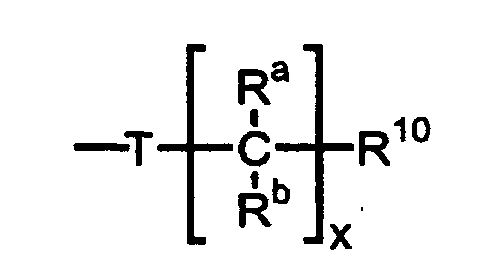
T can be―SO2― or a single bond,
x = 0, 1, 2, 3, 4, 5 or 6,
Ra and Rb independently represent H, phenyl, C1-C6 alkoxy,
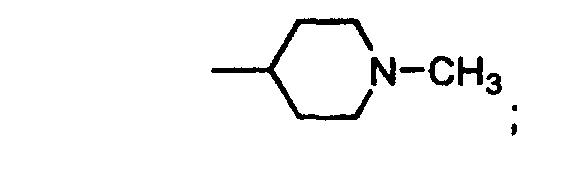
or Ra and Rb taken together can represent C3-C6 cycloalkyl, =N-O-(C1-C6)-alkyl orR10 can represent H, substituted or unsubstituted aryl, arylthio, substituted or unsubstituted heteroaryl, each as defined below, or
- (3) R2 is selected from the group which is:
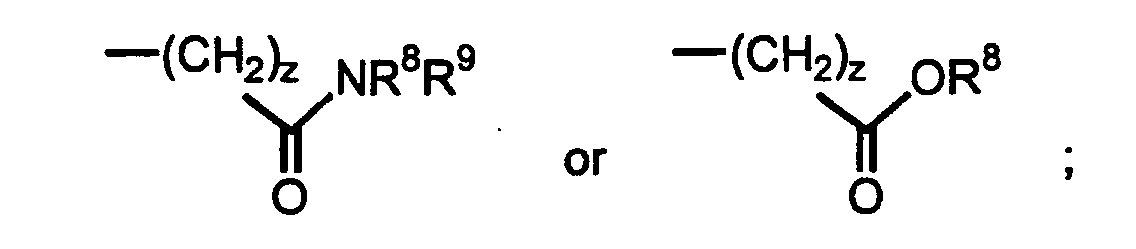
C1 to C8 alkyl, C2 to C8 alkenyl, C2 to C8 alkynyl,
wherein z is 0, 1, 2, 3 or 4; and said alkyl, alkenyl, or alkynyl group is optionally substituted with one or more groups which can independently represent:
- (a) aryl, aralkyl, heteroaryl, heteroarylalkyl or heterocycloalkyl, wherein each of said
aryl, aralkyl, heteroaryl, heteroarylalkyl or heterocycloalkyl group can be optionally
substituted with one or more of the following:
- C1 to C4 alkyl,
- (CH2)tOR8 wherein t is 0, 1, 2, 3 or 4,
- (CH2)tNR8R9 wherein t is 0, 1, 2, 3 or 4, or
- halogen;
- (b) C3 to C6 cycloalkyl (c) -OR8; (d) -SR8; (e) -S(O)R8;
(f) -SO2R8; (g) -NR8R9;
 (m) ―SO2―NR8R9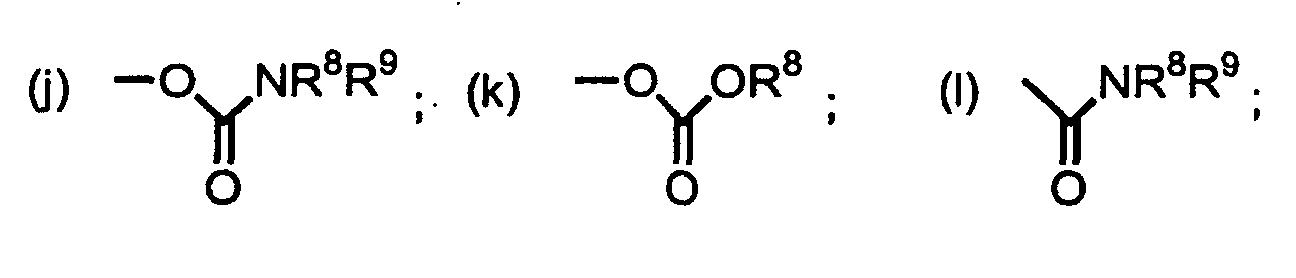
 wherein R8 and R9 can independently represent:
 - C1 to C4 alkoxy, substituted or unsubstituted aryl, aralkyl, substituted or unsubstituted heteroaryl, heteroarylalkyl, substituted or unsubstituted heterocycloalkyl,
- halogen, -OH, -C(O)R13, -N R14R15;
- -CONR8R9 or -N(R8)COR13; -CN; C3-C6 cycloalkyl, S(O)qR13;
-
- One skilled in the art will recognize that compounds (1.0) and (1.1) are identical when X1 is N and R1 is the same as the -C(O)Z substituent. One skilled will also recognize that compounds (1.0) and (1.1) are positional isomers when X1 is N and R1 is different from the -C(O)Z substituent. In the present specification, the procedures described herein for preparing compound (1.0) are also applicable for preparing compound (1.1).
- Also preferred is that Z is (-i-), (-ii-) or (-iii-), X2 is CH or N, R20 is H, C1-C6 alkyl or halo, n = O or 1;
X1 is N;
for R1, T is -CO-, -SO2- or a single bond, and Ra and Rb independently represent H or C1-C6 alkoxy or Ra and Rb taken together can form C3-C6 cycloalkyl, =N-O-C1-C6 alkyl orR10 is H, aryl, arytthio or heteroaryl;
R2 is H,z = 0 or 1, R8 is H and R9 is alkyl. cycloalkyl. aralkyl, heterocycloalkyl or substituted alkyl.
- In another embodiment, the present invention is directed toward a pharmaceutical composition for inhibiting the abnormal growth of cells comprising an effective amount of compound (1.0) in combination with a pharmaceutically acceptable carrier.
- In another embodiment, the present invention is directed toward the use compound (1.0) for the manufacture of a medicament for inhibiting the abnormal growth of cells, including transformed cells, comprising administering an effective amount of compound (1.0) to a mammal (e.g., a human) In need of such treatment. Abnormal growth of cells refers to cell growth independent of normal regulatory mechanisms (e.g., loss of contact inhibition). This includes the abnormal growth of: (1) tumor cells (tumors) expressing an activated Ras oncogene; (2) tumor cells in which the Ras protein is activated as a result of oncogenic mutation in another gene; (3) benign and malignant cells of other proliferative diseases in which aberrant Ras activation occurs, and (4) benign or malignant cells that are activated by mechanisms other than the Ras protein. Without wishing to be bound by theory, it is believed that these compounds may function either through the inhibition of G-protein function, such as ras p21, by blocking G-protein isoprenylation, thus making them useful in the treatment of proliferative diseases such as tumor growth and cancer, or through inhibition of ras famesyl protein transferase, thus making them useful for their antiproliferative activity against ras transformed cells.
- The cells to be inhibited can be tumor cells expressing an activated ras oncogene. For example, the types of cells that may be inhibited include pancreatic tumor cells, lung cancer cells, myeloid leukemia tumor cells; thyroid follicular tumor cells, myelodysplastic tumor cells, epidermal carcinoma tumor cells, bladder carcinoma tumor cells or colon tumors cells. Also, the inhibition of the abnormal growth of cells by the treatment with compound (1.0) may be by inhibiting ras famesyl protein transferase. The inhibition may be of tumor cells wherein the Ras protein is activated as a result of oncogenic mutation in genes other than the Ras gene. Alternatively, compounds (1.0) may inhibit tumor cells activated by a protein other than the Ras protein.
- This invention also provides the use of compound (1.0) for the manufacture by a medicament the use of compound (10) for the manufacture of a medicament for inhibiting tumor growth by administering an effective amount of compound (1.0) to a mammal (e.g., a human) in need of such treatment. In particular, this invention provides the use of compound (1.0) for the manufacture of a medicament for inhibiting the growth of tumors expressing an activated Ras oncogene by the administration of an effective amount of the above described compounds. Examples of tumors which may be inhibited include, but are not limited to, lung cancer (e.g., lung adenocarcinoma), pancreatic cancers (e.g., pancreatic carcinoma such as, for example, exocrine pancreatic carcinoma), colon cancers (e.g., colorectal carcinomas, such as, for example, colon adenocarcinoma and colon adenoma), myeloid leukemias (for example, acute myelogenous leukemia (AML)), thyroid follicular cancer, myelodysplastic syndrome (MDS), bladder carcinoma and epidermal carcinoma.
- This invention also provides the use of compound (1.0) for the manufacture of a medicament for inhibiting proliferative diseases, both benign and malignant, wherein Ras proteins are aberrantly activated as a result of oncogenic mutation in other genes--i.e., the Ras gene itself is not activated by mutation to an oncogenic form-with said inhibition being accomplished by the administration of an effective amount of the carbonyl piperazinyl and piperidinyl compounds (1.0) described herein, to a mammal (e.g., a human) in need of such treatment. For example, the benign proliferative disorder neurofibromatosis, or tumors in which Ras is activated due to mutation or overexpression of tyrosine kinase oncogenes (e.g., neu, src, abl, Ick, and fyn), may be inhibited by the carbonyl piperazinyl and piperidinyl compounds (1.0) described herein.
- In another embodiment, the present invention is directed toward the use of compound (1.0) for the manufacture of a medicament for inhibiting ras farnesyl protein transferase and the farnesylation of the oncogene protein Ras by administering an effective amount of compound (1.0) to mammals, especially humans. The administration of the compounds of this invention to patients, to inhibit famesyl protein transferase, is useful in the treatment of the cancers described above.
- As used herein, the following terms are used as defined below unless otherwise indicated:
- Ac - represents acetyl;
- acyl radical of a naturally occurring amino acid - represents a group of
the formula -C(O)C(NH2)R26R28, i.e.:
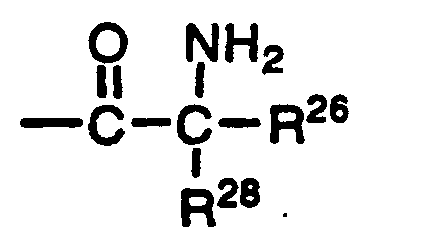 wherein R26 and R28 represent the substituents of an amino acid bound to the α-carbon;
for example R26 and R28 can be independently selected from H, alkyl, or
alkyl substituted with an R30 group, wherein R30 can be, for example, -OH, SH,
- SCH3, -NH2, phenyl, p-hydroxyphenyl, indolyl or imidazolyl, such that HO-C(O)C(NH2)R26R28
is an amino acid selected from, for example, alanine,
cysteine, cystine, glycine, histidine, isoleucine, leucine, lysine, methionine,
phenylalanine, serine, tryptophane, tyrosine or valine. Preferably the
stereochemistry of the amino acid is of the L absolute configuration.
wherein R26 and R28 represent the substituents of an amino acid bound to the α-carbon;
for example R26 and R28 can be independently selected from H, alkyl, or
alkyl substituted with an R30 group, wherein R30 can be, for example, -OH, SH,
- SCH3, -NH2, phenyl, p-hydroxyphenyl, indolyl or imidazolyl, such that HO-C(O)C(NH2)R26R28
is an amino acid selected from, for example, alanine,
cysteine, cystine, glycine, histidine, isoleucine, leucine, lysine, methionine,
phenylalanine, serine, tryptophane, tyrosine or valine. Preferably the
stereochemistry of the amino acid is of the L absolute configuration.
- alkyl-(including the alkyl portions of alkoxy, alkylamino and dialkylamino)-represents straight and branched carbon chains and contains from one to twenty carbon atoms, preferably one to six carbon atoms; for example methyl, ethyl, propyl, iso-propyl, n-butyl, t-butyl, n-pentyl, isopentyl, hexyl and the like; wherein said alkyl group may be optionally and independently substituted with one two or three of hydroxy, alkoxy, halo (e.g. CF3), amino, alkylamino, dialkylamino, N-acylalkylamino, N-alkyl-N-acylamino, -S(O)m-alkyl where m=0, 1 or 2 and alkyl is defined above;
- alkoxy-an alkyl moiety of one to 20 carbon atoms covalently bonded to an adjacent structural element through an oxygen atom, for example, methoxy, ethoxy, propoxy, butoxy, pentoxy, hexoxy and the like.
- alkenyl-represents straight and branched carbon chains having at least one carbon to carbon double bond and containing from 2 to 12 carbon atoms, preferably from 2 to 6 carbon atoms and most preferably from 3 to 6 carbon atoms;
- alkynyl-represents straight and branched carbon chains having at least one carbon to carbon triple bond and containing from 2 to 12 carbon atoms, preferably from 2 to 6 carbon atoms;
- aq - represents aqueous
- aralkyl - represents an alkyl group, as defined above, wherein one or more hydrogen atoms of the alkyl moiety have been replaced by one or more aryl groups, as defined below (e.g., benzyl, diphenylmethyl);
- aryl (including the aryl portion of aryloxy and aralkyl)-represents a carbocyclic group containing from 6 to 15 carbon atoms and having at least one aromatic ring (e.g., aryl is phenyl or napthyl), with all available substitutable carbon atoms of the carbocyclic group being intended as possible points of attachment, said carbocyclic group being optionally and independently substituted with one, two, three or more of halo, C1-C6 alkyl, C1-C6 alkoxy, amino, alkylamino, dialkylamino, aryl, aralkoxy, aryloxy, -NO2, -S(O)m-aryl wherein m=0, 1 or 2, C(O)R11 (wherein R11 is as defined hereinbefore), an acyl radical, -COOR16 (wherein R16 represents H, alkyl, aryl or aralkyl), or substituted C1-C6 alkyl wherein the alkyl group is substituted with one two or three of amino, alkylamino, dialkylamino, aryl, N-acylalkylamino, N-alkyl-N-acylamino, N-aralkyl-N-acylamino, hydroxy, alkoxy, halo, or heterocycloalkyl, provided that when there are two or more hydroxy, amino, alkylamino or dialkylamino substituents on the substituted C1-C6 alkyl group, the substituents are on different carbon atoms; or alternatively said aryl group may be fused through adjacent atoms to form a fused ring containing up to four carbon and/or heteroatoms (e.g. methylene dioxyphenyl, indanyl, tetralinyl, dihydrobenzofuranyl);
- aralkoxy - represents an aralkyl group, as defined above, in which the alkyl moiety is covalently bonded to an adjacent structural element through an oxygen atom, e.g. benzyloxy;
- aryloxy - represents an aryl group, as defined above, covalently bonded to an adjacent structural element through an oxygen atom, e.g, phenoxy;
- arylthio - represents an aryl group, as defined above, covalently bonded to an adjacent structural element through a sulfur atom, for example, phenylthio;
- BOC - represents tert-butoxycarbonyl;
- BOG-ON - represents [2-(tert-butoxycarbonyloxyimino)-2-phenylacetonitrile];
- C - represents carbon;
- CBZ - represents benzyloxycarbonyl;
- CPh3 - represents triphenylmethyl;
- cycloalkyl-represents a saturated carbocyclic ring, branched or unbranched, of from 3 to 20 carbon atoms, preferably 3 to 7 carbon atoms;
- DBU - represents 1,8-diazabicyclo[5.4.0]undec-7-ene;
- DCC - represents dicyclohexylcarbodiimide;
- DCM represents dichloromethane;
- DIC - represents diisopropylcarbodiimide;
- DMAP - represents 4-dimethylaminopyridine;
- DMF - represents N,N-dimethylformamide;
- EDC (also DEC) - represents 1-(3-dimethylaminopropyl)-3-ethylcarbodiimide hydrochloride or 1-ethyl-3-(3-dimethylaminopropyl)carbodiimide hydrochloride;
- FMOC - represents 9-fluorenylmethyoxycarbonyl;
- FMOC-CI - represents 9-fluoroenylmethyl chloroformate;
- HATU - represents [O-(7-azabenzotriazol-1-yl)-1,1,3,3-tetramethyluronium hexafluorophosphate];
- MCPBA - represents m-chloroperbenzoic acid;
- Ph - represents phenyl;
- TBAF - represents tetrabutylammonium fluoride;
- TFA - represents trifluoroacetic acid;
- THF - represents tetrahydrofuran;
- halogen (halo)-represents fluoro, chloro, bromo and iodo;
- haloalkyl - represents an alkyl group, as defined above, wherein one or more hydrogen atoms have been replaced by one or more halogen atoms, ie. chloromethyl and trifluromethyl;
- heterocycloalkyl-represents a saturated, branched or unbranched mono- bi- or tricyclic carbocylic rings) containing from 3 to 15 carbon atoms in each ring, preferably from 4 to 6 carbon atoms, wherein at least one carbocyclic ring is interrupted by 1 to 3 heteroatoms selected from -O- -S- or -N- (suitable heterocycloalkyl groups include 2- or 3-tetrahydrofuranyl, 2- or 3-tetrahydrothienyl. 2-, 3- or 4-piperidinyl, 2- or 3-pyrrolidinyl, 1-,2- or 3-morpholino, 2- or 3-piperizinyl, 2- or 4-dioxanyl, diaza-2,2,2-bicyclooctane etc.); with any of the available substitutable carbon and nitrogen atoms in the ring being optionally and independently substituted with one, two, three or more of C1-C6 alkyl, aryl, aralkyl, haloalkyl, amino, alkylamino, dialkylamino, -S(O)m-aryl where m=0, 1 or 2 and aryl is defined above, -C(O)R11 wherein R11 is defined above or an acyl radical of a naturally occuring amino acid;
- heteroaryl-represents cyclic groups having one, two or three heteroatom selected from -O-, -S- or -N-, said heteroatom interrupting a carbocyclic ring structure and having a sufficient number of delocalized pi electrons to provide aromatic character, with the aromatic heterocyclic groups preferably containing from 2 to 14 carbon atoms, e.g., quinolinyl, imidazolyl, furanyl, triazolyl, thiazolyl, indolyl, benzothienyl, 2- or 3- thienyl, 1-, 2-, 3- or 4-pyridyl or pyridyl N-oxide,
-
- Lines drawn into the ring systems indicate that the indicated bond may be attached to any of the substitutable ring carbon atoms.
- Certain compounds of the invention may exist in different isomeric (e.g., enantiomers and diastereoisomers) forms. The invention contemplates all such isomers both in pure form and in admixture, including racemic mixtures. Enol forms are also included.
- Certain compounds (1.0) will be acidic in nature, e.g. those compounds which possess a carboxyl or phenolic hydroxyl group. These compounds may form pharmaceutically acceptable salts. Examples of such salts may include sodium, potassium, calcium, aluminum, gold and silver salts. Also contemplated are salts formed with pharmaceutically acceptable amines such as ammonia, alkyl amines, hydroxyalkylamines, N-methylglucamine and the like.
- Certain basic compounds (1.0) can also form pharmaceutically acceptable salts, e.g., acid addition salts. For example, the pyrido-nitrogen atoms may form salts with strong acid, while compounds having basic substituents such as amino groups also form salts with weaker acids. Examples of suitable acids for salt formation are hydrochloric, sulfuric, phosphoric, acetic, citric, oxalic, malonic, salicylic, malic, fumaric, succinic, ascorbic, maleic, methanesulfonic and other mineral and carboxylic acids well known to those in the art. The salts are prepared by contacting the free base form with a sufficient amount of the desired acid to produce a salt in the conventional manner. The free base forms may be regenerated by treating the salt with a suitable dilute aqueous base solution such as dilute aqueous NaOH, potassium carbonate, ammonia or sodium bicarbonate. The free base forms differ from their respective salt forms somewhat in certain physical properties, such as solubility in polar solvents, but the acid and base salts are otherwise equivalent to their respective free base forms for purposes of the invention.
- All such acid and base salts are intended to be pharmaceutically acceptable salts within the scope of the invention and all acid and base salts are considered equivalent to the free forms of the corresponding compounds for purposes of the invention.
- The following processes may be employed to produce compounds of the invention. Various intermediates in the processes described below can be produced by methods known in the art, see for example, U.S. 3,409,621, U.S. 5,089,496, WO89/10369, WO92/20681, and WO93/02081, the disclosures of each being incorporated herein by reference thereto.
- The piperazinyl compounds of the present invention and starting materials thereof, can be prepared according to the following overall Process A.wherein Z, BOC, R1, R2 and (a-ooo) are as defined herein.

- The aromatic compounds ("Z") of formula (3.0)wherein Rn20 and X2 are as defined hereinbefore, and the solid floating bond indicates that Rn20 can be bonded to the aromatic ring at any suitable atom for attachment, ie.carbon, are known to those skilled in the art. The dotted floating bond indicates the subsequent site of introduction for the carboxyl group.

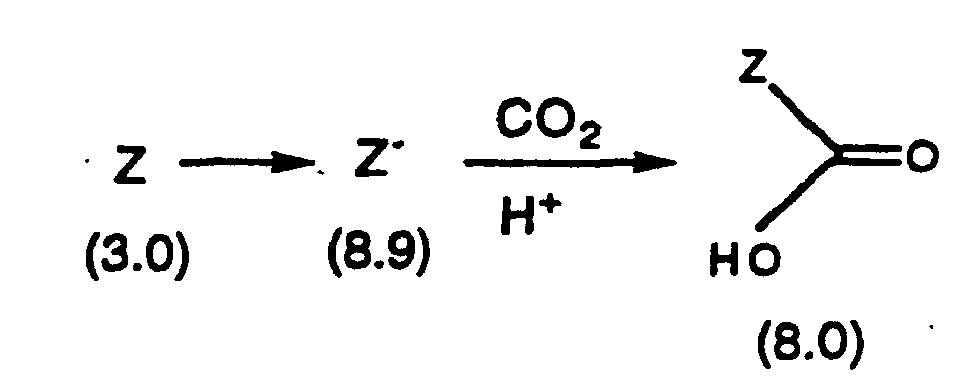
- Using a reaction such the Kolbe-Schmidt Reaction, the carboxylic acids of formula (8.0) can be prepared by contacting the aromatic compounds of formula (3.0) with a base such as n-butyl lithium, followed by treatment with carbon dioxide, followed then by treatment with a suitable acid, such as hydrochloric acid, to give carboxylic acid (8.0), which are also compounds known in the art.
- Alternatively, carboxylic acid (8.0), wherein b=0, can be prepared by reacting the aromatic halide (i.e.R20 is halo) of compound (3.0) and an organometallic such as n-butyl lithium to yield aromatic anion (8.9), which is then treated with carbon dioxide and acid as described above, to give carboxylic acid (8.0).

- In an alternative reaction, carboxylic acids (8.0) can be prepared by reacting aromatic compounds (3.0) with phosgene in the presence of a Lewis Acid, such as aluminum chloride (AlCl3) followed by hydrolysis of the acid chloride to give carboxylic acid (8.0).
- Also, carboxylic acids (8.0) wherein b=1, 2, 3 or 4 are also known in the art, e.g. 3-pyridylacetic acid, 3-phenylpropionic acid, 4-phenylbutyric acid and the like.
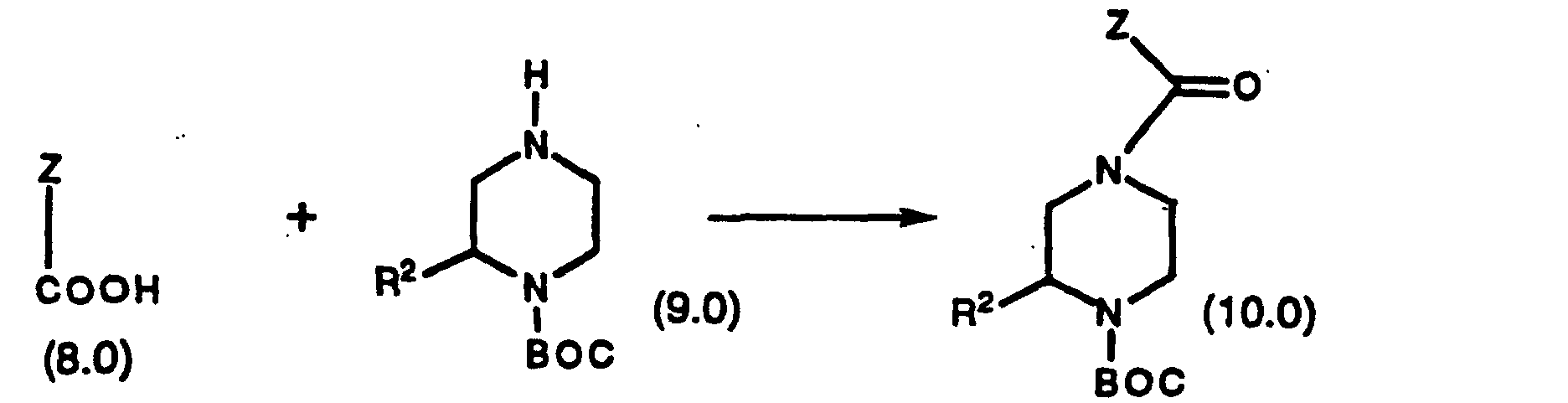
- The carboxylic acid (8.0) is then reacted with piperazinyl intermediate (9.0) in the presence of a coupling reagent (such as a carbodiimide, e.g., dicyclohexylcarbodiimide) in a suitable solvent such as DMF at a suitable temperature to produce the piperazinyl amide (10.0).
- The preparation of compounds of Formula 9.0 is described in WO 95/00497, published January 5, 1995.
- The preparation of piperazinyl intermediate (9.0) is depicted in Schemes 1 and 2.

- Scheme 1 describes the synthesis of 2,3-disubstituted piperazines wherein R2 independently represents H, alkyl, alkenyl, or alkynyl. Scheme 1 also describes the synthesis of 2,3-disubstituted piperazines wherein R2 independently represents alkyl, alkenyl, or alkynyl which are substituted with substituent groups (a), (b), (c), (d) and (g) as defined above, with the exception that R8 and R9 cannot be a group that is substituted with -C(O)R13 or -SO2R13. In Scheme 1, BOC-protected amino acids (12.0) are available commercially or can be made by procedures well known in the art. These amino acids can be coupled (step 1) to a commercially availble N-benzylprotected amino acid, ethyl ester using suitable coupling agents such as DCC or EDC in suitable solvents (e.g., N, N-dimethylformamide, chloroform or methylene chloride) to produce a compound of Formula 13.0. Generally, this reaction is conducted at room temperature (i.e., about 25°C). The BOC protecting group is removed (step 2) at room temperature with suitable reagents such as trifluoroacetic acid, or hydrogen chloride in chloroform or dioxane. The deprotected dipeptide is cyclized (step 3) under basic conditions to produce the compound of Formula 14.0. The compound of Formula 14.0 is then reduced (step 4) using LiAIH4 in refluxing ether (diethyl ether) or THF to give the piperazine of Formula 15.0. The unsubstituted nitrogen of the piperazine of Formula 15.0 is protected (step 5) with a BOC group by procedures well known in the art to give the compound of Formula 16.0. The N-benzyl group is removed (step 6) by catalytic hydrogenation (e.g., using Pd/C and hydrogen gas under pressure of about 60 psi) to give the compound of Formula (9.0). Alternatively, compound (15.0) can be converted to the FMOC derivative (15.3) by treatment with FMOC-CI in the presence of a base such as sodium bicarbonate in an aqueous dioxane. The FMOC derivative (15.3) can be debenzylated as described in step 6 above, to give compound (15.5). Compound (15.5) can be converted to the BOC-derivative (15.7) by procedures known in the art. Compound (15.7) can be converted to compound (4.0) by heating in a suitable hydroxyl solvent such as methanol.
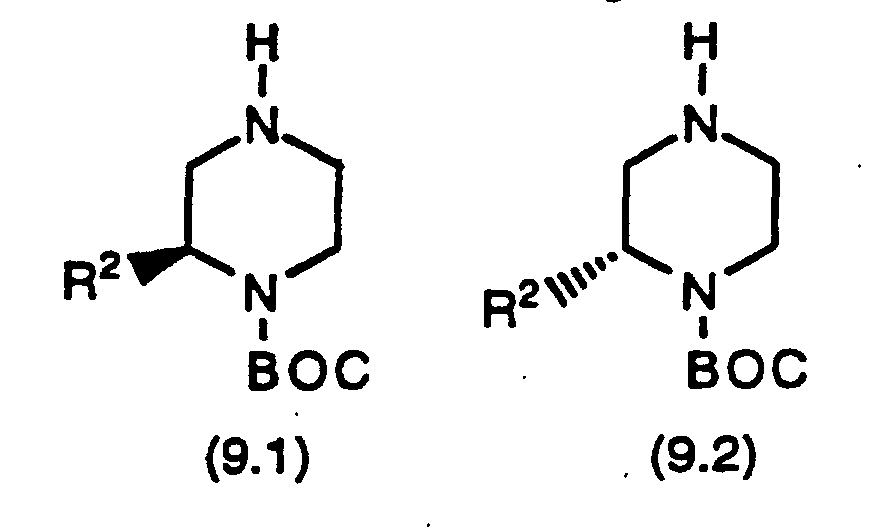
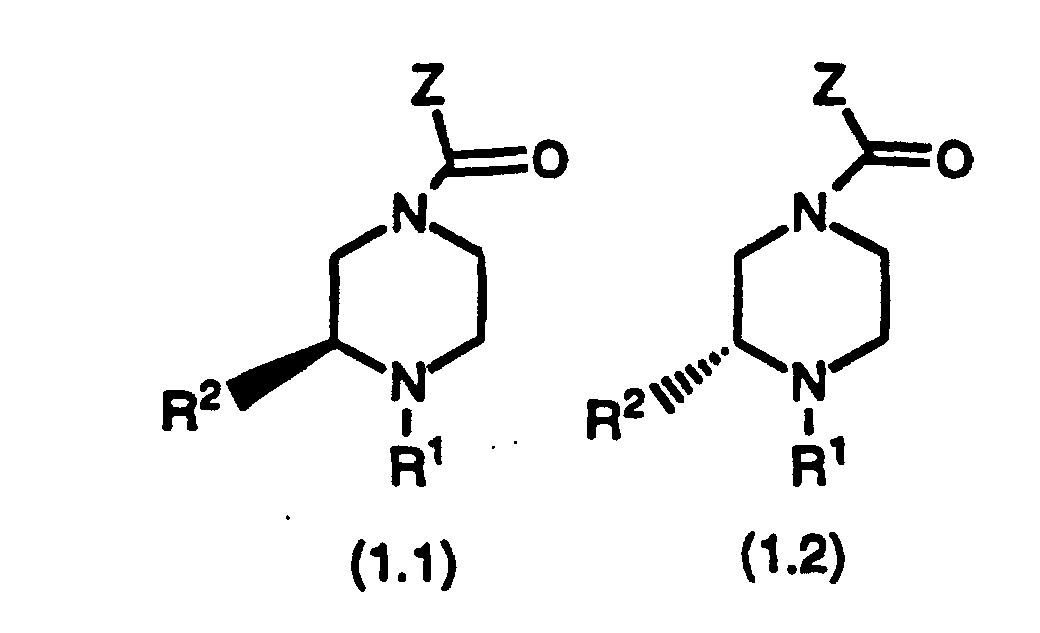
- Those skilled in the art will appreciate that the compound of Formula 9.0 can exist as the following enantiomersThese piperazinyl isomers yield the desired isomers of compound (1.0) shown below:

- Compounds (9.0), wherein R2 independently represents alkyl, alkenyl or alkynyl substituted with (a), (c), (d) or (g) groups wherein R8 or R9 are substituted with -C(O)R13 or -S(O)2R13 are made according to the process of Scheme 2. Compounds (9.0), whererin R2 independently represents -C(O)NR8R9 or -C(O)OR8, or wherein R2 independently represents alkyl, alkenyl or alkynyl substituted with its groups (e), (f), or (h)-(p) are also made according to the process of Scheme 2. Compounds (17.0) and (18.0), wherein R22 independently represents alkyl, alkenyl or alkynyl group containing either a -OH group, a -COOH or its corresponding ester, are available commercially or can be made by procedures known in the art. In Scheme 2, the compound (17.0) is reacted according to the procedures described for Scheme 1 (steps 1 to 4) to produce a compound (19.0) wherein R23 independently represents a hydroxy substituted alkyl, alkenyl or alkynyl group. The compound (19.0) is then protected with a BOC group and then debenzylated according to the procedures in Scheme 1 (Steps 5 and 6) to produce a compound (9.3). The unsubstituted nitrogen of compound (9.3) is protected (step 7) with a CBZ group by procedures known in the art to produce the compound (9.4). The group R23 on compound (9.4) can be converted to R2, followed by deprotection of compound (9.4) by catalytic hydrogenation, i.e. palladium/carbon and hydrogen in a suitable solvent such as methanol, to give compound (9.0).
- When R23 of compound (9.4) is -CH2OH, the hydroxy group can be oxidized to produce the corresponding carboxyl group-(COOH). This carboxyl group can them be esterified to produce compounds wherein R2 is -C(O)OR8, or the carboxyl. group can be converted to amides to produce compounds wherein R2 is -C(O)NR8R9 by procedures well known in the art.
- To produce compounds (9.0) in Scheme 2 wherein R2 is a substituent other than -C(O)OR8 or -C(O)NR8R9, the hydroxy group on R23 in compound (9.4) can be converted to a leaving group, such as chloro, mesyloxy or tosyloxy, by techniques well known in the art. Then the leaving group can be displaced by various nucleophiles such as organometallics (to produce R2 with an (a) substituent), thiols (to produce R2 with a (d) substituent), sulfenyls (to produce R2 with an (e) substituent), sulfinyls (to produce R2 with an (f) or (m) substituent), amines (to produce R2 with a (g) substituent), and alcohols (to produce R2 with a (c) substituent). The hydroxy group on R23 in compound (9.4) can also be acylated (to produce R2 with a (j) or (k) substituent) or alkylated (to produce R2 with a (c) substituent). When R23 in compound (9.4) is alkyl having more than one carbon atom, or alkenyl or alkynyl, the hydroxy group can be oxidized, as discussed above, to produce the corresponding carboxyl group (i.e., substituent (o) wherein R8 is H). This carboxyl group can be esterified to produce compounds wherein substituent (o) is -C(O)OR8 wherein R8 is other than H, or converted to amides to produce to produce R2 with an (I) substituent by procedures well known in the art. When the leaving group is displaced by an amine (e.g., -NR8R9), the amine can then be converted to R2 substituent groups (h), (i) or (n) by reacting the amine with an acyl halide (to produce R2 with an (h) substituent), a carbamyl halide (to produce R2 with an (i) substituent) or a sulfonyl halide (to produce R2 with an (n) substituent) by procedures well known in the art, which following deprotection, give compound (9.0).
- The compound of Formula 10.0 can be deprotected (i.e., the BOC group removed) by treatment with an acid (e.g. trifluoroacetic acid, or HCl-dioxane) to produce the compound (10.1).
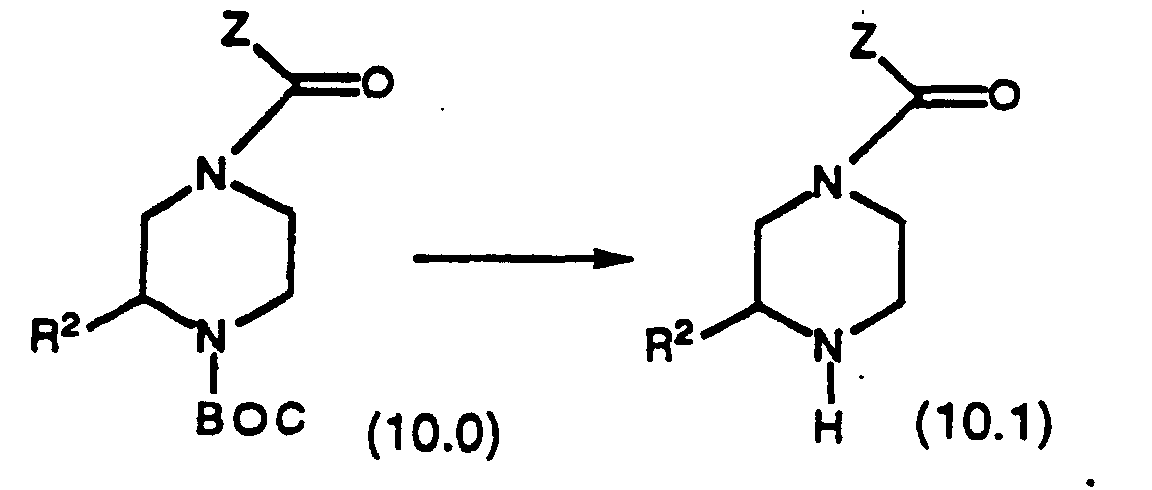
- Compound (10.1) can be converted to the desired piperazinyl compound (1.0), wherein X1 is N, by acylation, acylation and deprotection or reductive alkylation, optionally with deprotection.
- Acylation of the compound (10.1) can be carried out by reacting it with a compound having a carboxylic acid moiety contained in or part of the desired R1 group, with a coupling agent, such as a carbodiimide such as dicyclohexylcarbodiimide(DCC) or DEC (1-ethyl-3-(3-dimethylaminopropyl)carbodiimide). The acylation reaction can be carried out in a suitable organic solvent such as DMF, THF or methylene chloride at a temperature of about -10° to about 100°C, preferably at about 0° to about 50°C, and most preferably about room temperature. When the coupling reagent is DCC or DEC, the reaction is preferably conducted in the presence of HOBT.
- Compounds (1.0), wherein R1 is a substituent (a, d, j, k, i, 89-ii, ll, nn-ooo) can be made by reacting a compound (10.1) with R1-L. wherein R1 contains the -C(O)- group and L is a leaving group such as Cl, Br, I, or a carboxylate (an anhydride). The reaction is carried out in the presence of a base, preferably a tertiary amine such as triethylamine or N-methyl morpholine.
- When compounds of Formulas 10.1 (X1 is N) or 30.0 (X1 is CH) are acylated to make the compounds (1.0) wherein R1 is substituents (g) or (e), the protected compounds of Formulas 32.0 and 33.0, respectively are formed.
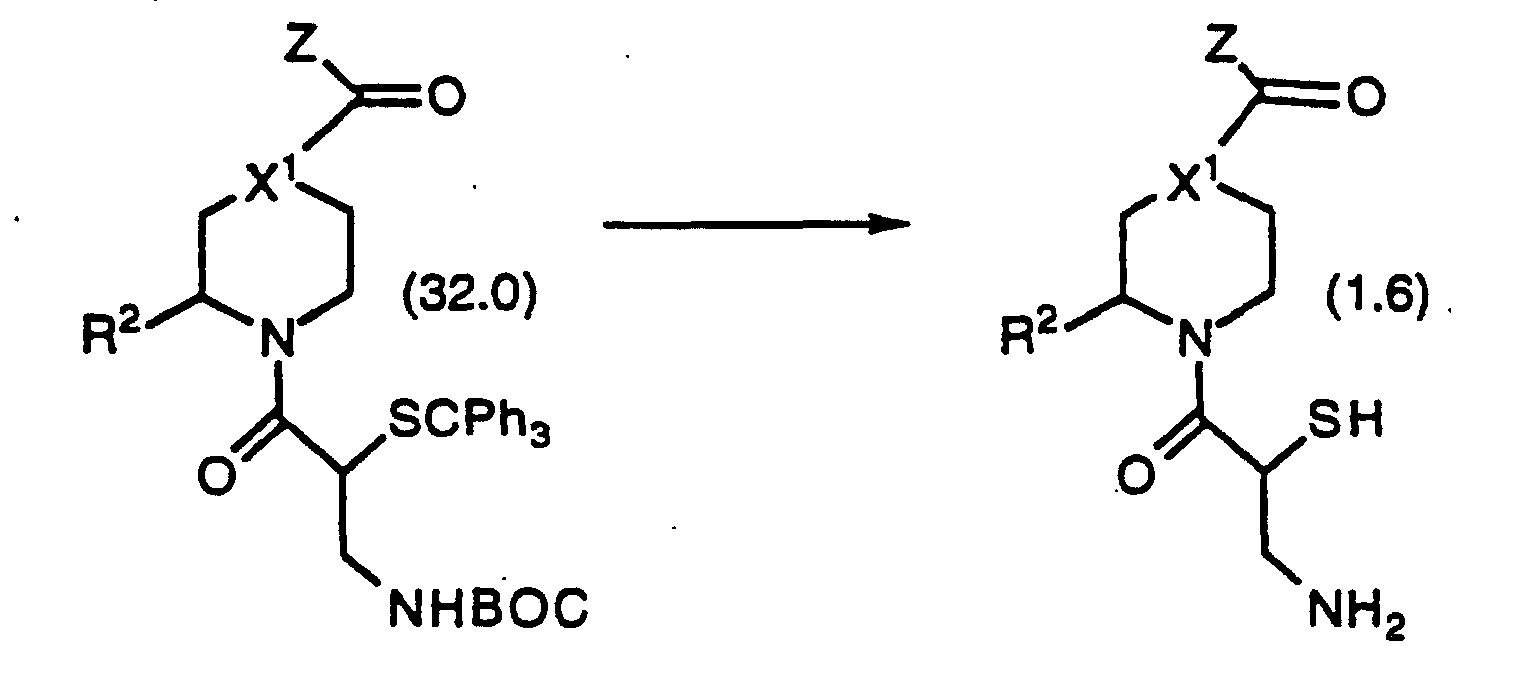 Protected compounds (32.0) and (33.0) can be deprotected by using trifluoroacetic acid and triethylsilane to yield compounds (1.6) and (1.3), respectively, which are isolated as the hydrochloride salts.
- Reductive alkylation (i.e. reductive amination) of compound (10.1) can be accomplished by reacting compound (10.1) with an aldehyde in DMF with a dehydrating agent such as molecular sieves at room temperature (about 25°C). This reaction is followed by reduction of the intermediate imine with a reducing agent such as sodium cyanoborohydride or sodium triacetoxyborohydride. The reduction is usually carried out at room temperature in a suitable solvent such as DMF.
- When compounds of Formulas 10.1 (X1 is N) or 30.0 (X1 is CH) are reductively alkylated to make the compounds (1.0) wherein R1 is substituents (h) or (f) the protected compounds (34.0) and (35.0), respectively are formed.
 These protected compounds can be deprotected by using trifluoroacetic acid and triethylsilane to give, respectively, compounds (1.4) and (1.5) which are isolated as the hydrochloride salts.
- Certain compounds of Formula (1.0) can be converted to other compounds of the Formula (1.0) using standard reaction conditions. For example, compounds of the formula (1.0) wherein R2 is -CO2H, (i.e., -C(O)OR8 and R8 is H), can be prepared by ozonolysis of a compound (1.0) wherein R2 is CH2=CH-, followed by oxidation of the resulting aldehyde to give other desired compounds (1.0).
- Compounds (1.0) wherein R2 is -C(O)OR8, where R8 is other than H, can be prepared from compound (1.0) wherein R2 is -CO2H by treating with SOCl2 or oxalyl chloride, then with an alcohol of the formula R8OH wherein R8 is as defined above. Similarly, compounds of formula (1.0) wherein R2 is -C(O)NR8R9 can be prepared from a compound (1.0) wherein R2 is -CO2H via essentially the same method but substituting an amine of the formula R8R9NH for the alcohol R8OH. Alternatively, compounds of Formula (1.0) wherein R2 is -C(O)NR8R9 can be prepared by reacting a compound (1.0) wherein R2 is -CO2H with an amine R8R9NH in the presence of a coupling agent, such as DCC or DEC.
- In an analogous manner, compounds (1.0) wherein R2 is alkyl substituted by a group of the formula -C(O)OR8 or -C(O)NR8R9 can be prepared via substantially the same procedures as described above to form compounds wherein R2 is -CO2H, -C(O)OR8 or -C(O)NR8R9, by replacing the compound (1.0) wherein R2 is CH2=CH- with an appropriate alkenyl group, (i.e., a group of the formula -(CH2)p-CH=CH2, wherein p is 1, 2, 3, 4, etc.).
- Compounds (1.0) wherein R2 contains a substituent of formula -S(O)tR8, wherein t = 1 or 2, can be prepared by oxidation of an analogous compound of the formula (1.0) wherein R2 contains a substituent of formula -S(O)tR8, wherein t = 0, using a suitable oxiding agent, such as a peracid, preferably MCPBA.
- Compounds (1.0) where the -Z group contains an N-O moiety, can be prepared by treatment of the carboxylic acid (8.0) containing a nitrogen atom (N) in the aromatic ring, with an oxidizing reagent, such as m-chloroperoxybenzoic acid or hydrogen peroxide and acetic acid. The subsequent carboxylic acid (8.0) containing the N-O moiety can be treated as described herein to give desired compound (1.0).
- In alternative Process B, the piperazinyl compounds (1.0) of the present invention can be prepared according to the following Process B.wherein Z, BOC, R1= (a-ooo), and R2 are as defined herein. It is also understood that groups R1=(r, s, t, mm) in compound 5.2 either N-protected as the BOC derivative or both N-protected as the BOC derivative and S-protected as the trityl (triphenylmethyl) derivative.

- Process B, compound (4.0) can be either acylated or reductively alkylated (ie. reductively aminated) as described hereinbefore, to incorporate the R1 group to give compounds (5.1), (5.2) and (5.3) respectively. Compounds (5.1), (5.2) and (5.3) can be deprotected with any suitable acid, such as trifluoracetic acid (TFA) or dioxane saturated with HCI gas, in a suitable solvent, such as methylene chloride (CH2Cl2) or dioxane to remove the BOC protecting group and yield compounds (6.1), (6.2) and (6.4), respectively. Reaction of compounds (6.1), (6.2) and (6.4) with carboxylic acid (8.0) under conditions and with reagents as described herein, gives the desired piperazinyl compounds (1.0) and (6.5).Compound (6.5) is deprotected as described herein to give compound (1.0).
- wherein Z, R, R1=(a-ooo) and R2 are as defined herein.

- The preparation of aromatic compounds (3.0) and their corresponding carboxylic acids (8.0) has been described in the section A1, for the preparation of the piperizinyl starting materials.The carboxylic acids (8.0) can be converted to esters (8.1) by reacting the carboxylic acid with an alcohol such as methanol, in the presence of an acid such as sulfuric or hydrochloric acid to give ester (8.1). Ester (8.1) can be converted to the piperidyl ketone (29.0) by reaction of ester (8.1) with an organometallic reagent (22.0), such as as a Grignard reagent or an organolithium reagent.
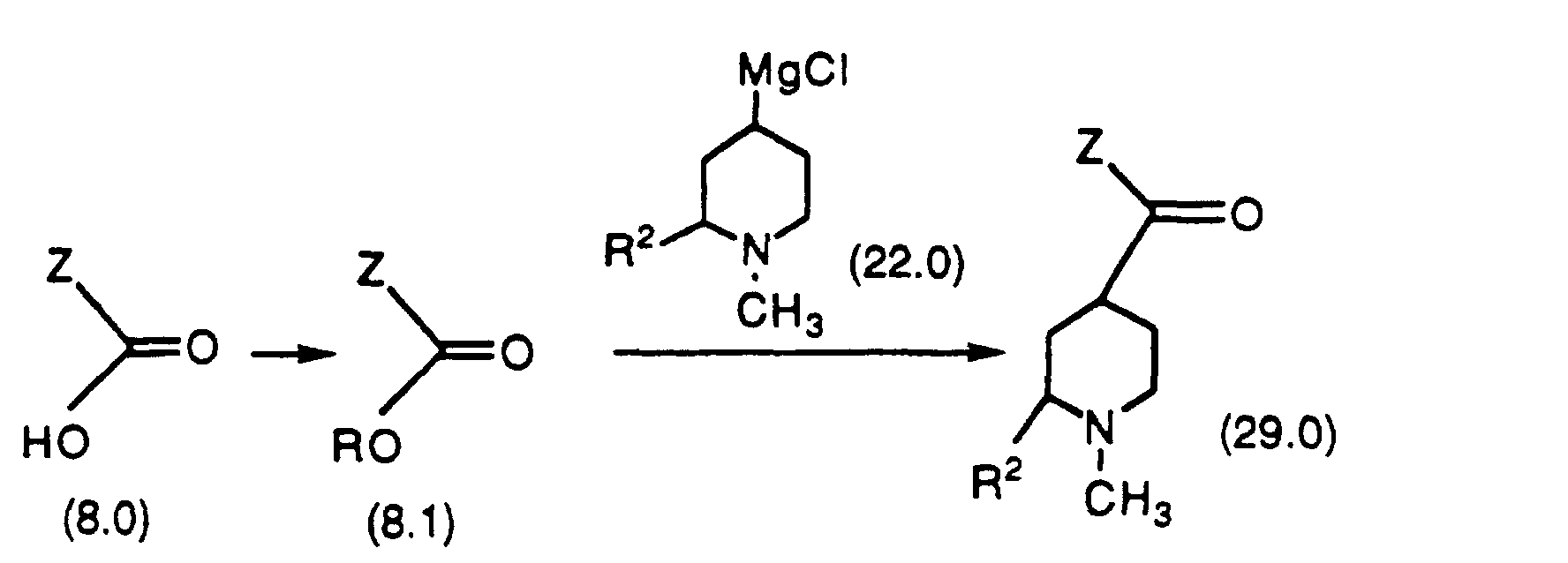
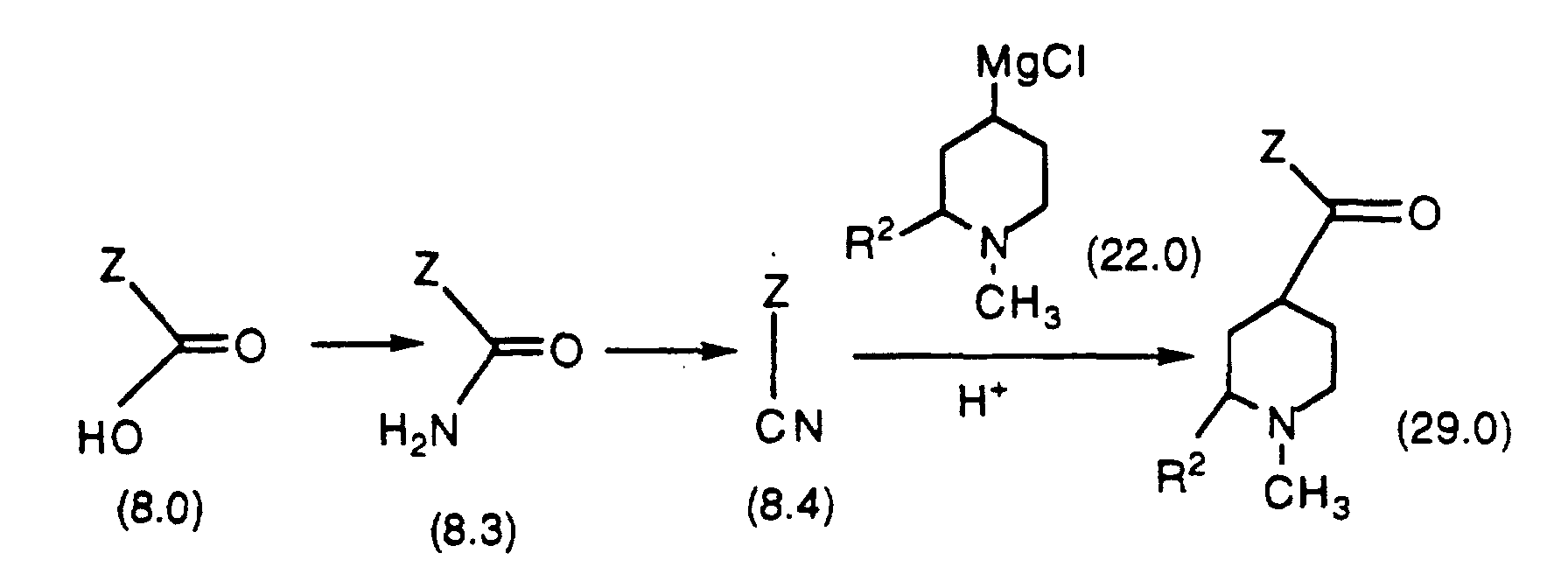
- In an alternative reaction, the carboxylic acids (8.0) can be converted into amides (8.3) by treatment with ammonia and a coupling agent such as DCC or DEC. The amide (8.3) can then be dehydrated to nitrile (8.4) by treatment with a reagent such as phosphorous pentachloride (P2C15), thionyl chloride (SOCl2) or acetic anhydride by methods well known to those skilled in the art, as taught in lan Harrison and Shuyen Harrison, Compendium of Organic Synthetic Methods, John Wiley and Sons, New York, (1971) and Volume 2, (1974). The nitrile (8.4) can be converted to ketone (29.0) by treatment with an organometallic reagent, such a Grignard reagent or an organolithium reagent, followed by hydrolysis with acid to give protonated piperidyl ketone (29.0).
- Compounds (1.0) wherein X1 is CH, and R2 is alkyl, alkenyl or alkynyl, or R2 is alkyl, alkenyl or alkynyl substituted with substituents (a), (b), (c), (d), or (g) with the exception that substituents R8 or R9 cannot have a halogen, -OH, - C(O)R13 or -SO2R13 substituent, can be made from compounds of the Formula 22.0:
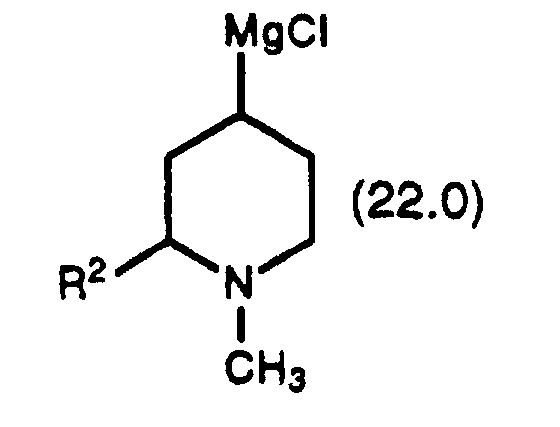
- Compound (22.0) can be made according to the process:

- The substituted piperidines (22.0) may be prepared, as racemic mixtures, by essentially the same methods as described in D.L. Comins and J.D. Brown, Tetrahedron Letters, vol. 27 No. 38, pgs. 4549 -4552, 1986. Thus, 4-methoxypyridine (23.0) may be converted using a variety of alkyl Grignard reagents (wherein R2 is as illustrated below) and benzylchloroformate to the desired unsaturated ketopiperidines (24.0). Removal of the benzylcarbamoyl group with concomitant reduction of the double bond by catalytic hydrogenation yields the substituted ketopiperidines (25.0). Alternatively, the benzylcarbamoyl group can be removed with either base or acid followed by metal hydride reduction of the double bond to produce compound (25.0). Alkylation of the compound (25.0) with a suitable alkyl iodide such as methyl iodide in the presence of sodium hydride gives the n-alkylketopiperidines (26.0). Reduction of compound (26.0) with sodium borohydride affords the hydroxypiperidine (27.0). Compound (27.0) is reacted with a suitable chlorinating agent such as thionyl chloride to afford the 4-chloropiperidine(28.0) which may in turn be converted by reaction with magnesium into compound (22.0).
- Compound (22.0) is reacted with the compound (8.1 or 8.4), described above, in a suitable solvent such as diethyl ether or THF. The reaction is conducted at room temperature (about 25°C) to about 50°C. This reaction is then followed by aqueous acid hydrolysis to yield ketones (29.0):
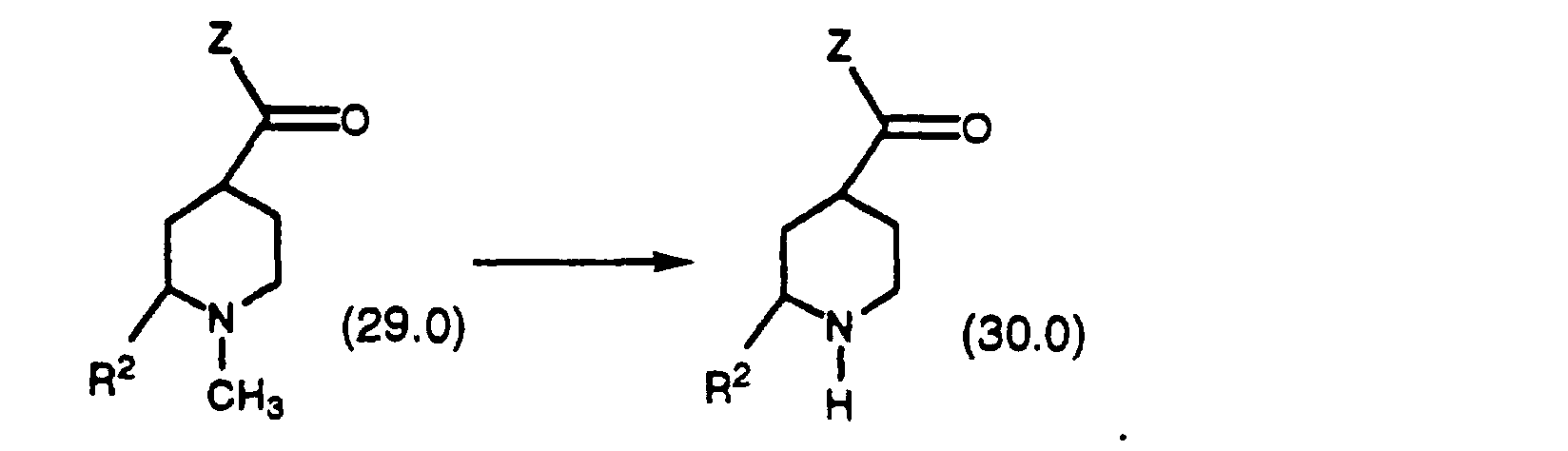
- The N-methyl group on the piperidine ring can be converted to a carboethoxy group (-COOC2H5) or a carbochloroethoxy group (-COOCHClCH3) by reaction with excess ethyl chloroformate or 1-chloroethylchloroformate in dry toluene or dichloroethane containing triethylamine at a temperature of about 80°C. This procedure is similar to that described in U.S. Patents 4,282,233 and 4,335,036. The carboethoxy group can be removed by either acid or base hydrolysis to give the compound (30.0). The carbochloroethoxy group can be removed by heating in methanol to give (30.0).
- Compounds (30.0) are prepared as diasteromeric mixtures. Preferably, the diasteriomers are separated into single isomers by classical resolution methods or by chiral HPLC to yield:

- Compound (30.1), (30.2), (30.3) and (30.4) can be converted to the compound (1.0), wherein X1 in (1.0) is CH, by acylation or reductive alkylation.
- The piperidinyl compounds (1.0) wherein X1 is CH, can be prepared from the piperidinyl ketone (30.0), by using the acylation, acylation and deprotection or reductive alkylation/optional deprotection procedures described for Process A or B.
- In an alternative embodiment, an encoded combinatorial library of compounds compounds (1.0) wherein X1 is N and R2 has a suitable functional group, can be prepared using combinatorial methods on a solid phase as described in WO94/08051, April 1994, whose preparative teachings are incorporated herein by reference and according to the following Process D.In Process D, a resin, e.g. (resin)-F, is selected which contains a functional group, (-F), which can couple, or form a covalent bond with a suitable linker (A-L-B). Suitable functional (-F) groups include primary and secondary amines, hydroxy, thiol, carboxylic acid, halide and the like. The linker can be any compound having (a) a complementary functional "A-" group (e.g. amine, hydroxy, thiol, carboxylic acid, halide and the like) which can couple, or form a covalent bond with (resin)-F, and (b) a functional "-B" group (e.g. hydroxy, primary or secondary amine, thiol, carboxylic acid and the like) capable of forming a covalent bond with a suitable functional group in R2 a substituted, N-protected piperazine (1.5), such as an amide or carboxylic acid group in R2, and (c) any organic or inorganic moiety L having bound to it functional groups A and B. Representative linkers include, but are not limited to 4-(bromomethyl)-3-nitrobenzoic acid and 4-(hydroxymethyl)phenol. The linker can be coupled to (resin)-F in a suitable solvent (e.g. DCM or methanol), optionally in the presence of a catalyst suitable for the particular coupling reaction.

- Reagents and reaction conditions for protecting and deprotecting compounds is well known, as described, for example, in T.W. Greene and P. Wuts, Protective Groups in Organic Synthesis, 2nd Ed., Wiley Interscience, N.Y. 1991, 473 pages. In addition to having a suitable functional group in its R2 group, piperazine 1.55 has protecting groups, P1 and P2 orthogonal to each other and to the linker. Suitable protecting groups include but are not limited to BOC, FMOC, CBZ, allyloxycarbonyl (ALLOC), benzyl, o-nitrophenyl and the like. The resin/linker 1 can be coupled to N-protected piperazine 1.55 in the presence of a suitable solvent, optionally in the presence of a catalyst suitable for the particular coupling reaction to give the coupled piperazine 3.5.
- One of protecting groups P1 or p2 can be removed by treatment with a suitable deprotecting agent or process, including but not limited to TFA, piperidine, hydrogenolysis, photolysis and the like to give partially deprotected piperazine 4.35 or 4.55. Piperazine 4.35 or 4.55 can then be reacted with compound R1Y1 wherein R1 is as defined before and Y1 is a suitable leaving group, in a suitable solvent, optionally in the presence of a catalyst suitable for the particular reaction, to give partially protected piperazine 5.35 and 5.55. Compound 5.35 and 5.55 can be deprotected as described above to give deprotected compound 6.35 or 6.55. Compound 6.35 and 6.55 can be reacted with carbonyl compound Z(CO)Y2 wherein Z is defined before and Y2 is a suitable leaving group to give compound 7.35 or 7.55. The "^" in moieties such as R2^, F^ and L^ indicate that at least one functional group in that moiety is covalently bonded to another functional group.
- Compound 1.0 can be prepared by cleaving the coupling between the linker and R2^ using a suitable reagent or process suitable for the particular bond coupling,.e.g. photolysis, acidolysis, hydrolysis and the like.
- Compounds of the present invention and preparative starting materials therof, are exemplified by the following examples, which should not be construed as limiting the scope of the disclosure. Alternative mechanistic pathways and analogous structures within the scope of the invention may be apparent to those skilled in the art, such as by the methods described In WO 95/10516. It will be appreciated that examples 1-7 and 11-14are provided for illustrative purposes. Compounds of the present invention may be synthesis by analogous proceduires
-

- Ethyl 3-pyridylacetic acid (10grams) (60.6 mmoles) is dissolved in dry CH2Cl2 (120ml) and the solution is stirred at -18°C for 30 minutes. MCPBA (31.34 grams) (181.6 mmoles) is added and the mixture is stirred at -18°C for 1 hour and then at 25°C for 87 hours. The reaction mixture is diluted with CH2Cl2 and washed with saturated aqueous sodium bicarbonate and then water. The CH2Cl2 is then dried (magnesium sulphate), filtered and evaporated to dryness. The residue was chromatographed on silica gel using 3% (10% concentrated ammonium hydroxide in methanol)-CH2Cl2 as the eluant to give the title compound (Yield: 8.45 grams, 77%, MH+ 182).
-

- Ethyl 3-Pyridylacetic acid 1-N-oxide (0.2747 grams) (1.5 mmoles) is dissolved in ethanol (200 proof) (1.22 ml.) and a 1 M solution of LiOH in water (3.64 ml.) (3.0 mmoles) is added and the mixture is stirred at 25°C for 4 hours. 1 N HCI (4.28 ml.) is added and the mixture is pumped down to dryness on a rotary evaporator to give the title compound (Yield: 0.2931 grams, 100%).
-
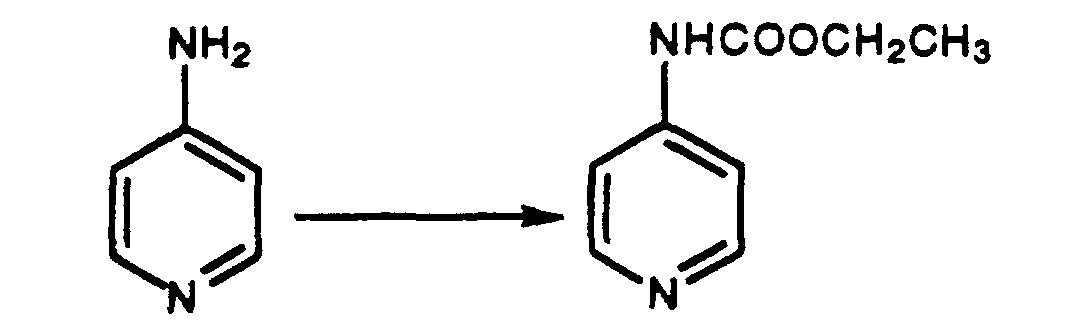
- 4-Aminopyridine (17.34 grams) (184.3) is dissolved in dry pyridine (217 ml.) and cooled to 0°C over 30 minutes. Ethyl chloroformate (17.2 ml.) (180.7 mmoles) is added and the solution is stirred at 0°C for 1 hour and then at 25°C for 40 hours. The mixture is diluted with CH2Cl2 and washed with saturated aqueous NaHCO3 and water. The CH2Cl2 is dried (MgSO4), filtered and evaporated to dryness. The residue is chromatographed on silica gel using 2%(10% saturated NH4OH in MeOH)-CH2Cl2 to give the title compound (Yield: 10 grams, 33%, M+ 166).
- By using essentially the same procedure, with the exception thatis used instead of 4-aminopyridine, the compound
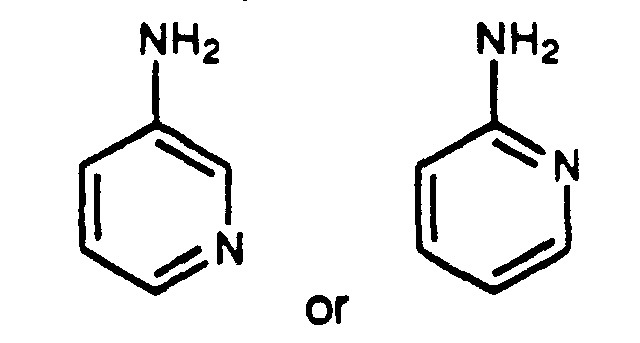 is obtained, respectively.
-

- 4-Pyridylacetic acid hydrochloride (7 grams) (40.4 mmoles) is hydrogenated in water (100 ml) using 10% Pd-C at 40 psi at 25°C for 24 hours. The catalyst is filtered off and washed with water. The aqueous solution is shaken with BioRad AG1X8 resin (OH- form) (23 ml bed) and after 5 minutes the resin is filtered off and washed with water. The aqueous solution is evaporated to give the title compound (Yield: 5.2 grams, 90%, MH+ 144).
-

- 4-Piperidinylacetic acid (5 grams) (35.0 mmoles) is reacted with acetic anhydride (10.7 grams) (105.0 mmoles) in MeOH (100 ml.) and the mixture is stirred at 25°C for 24 hours. The mixture is evaporated to dryness and the residue is azeotroped with toluene to give the title compound (Yield: 6.4 grams, 99%, MH+ 185).
-
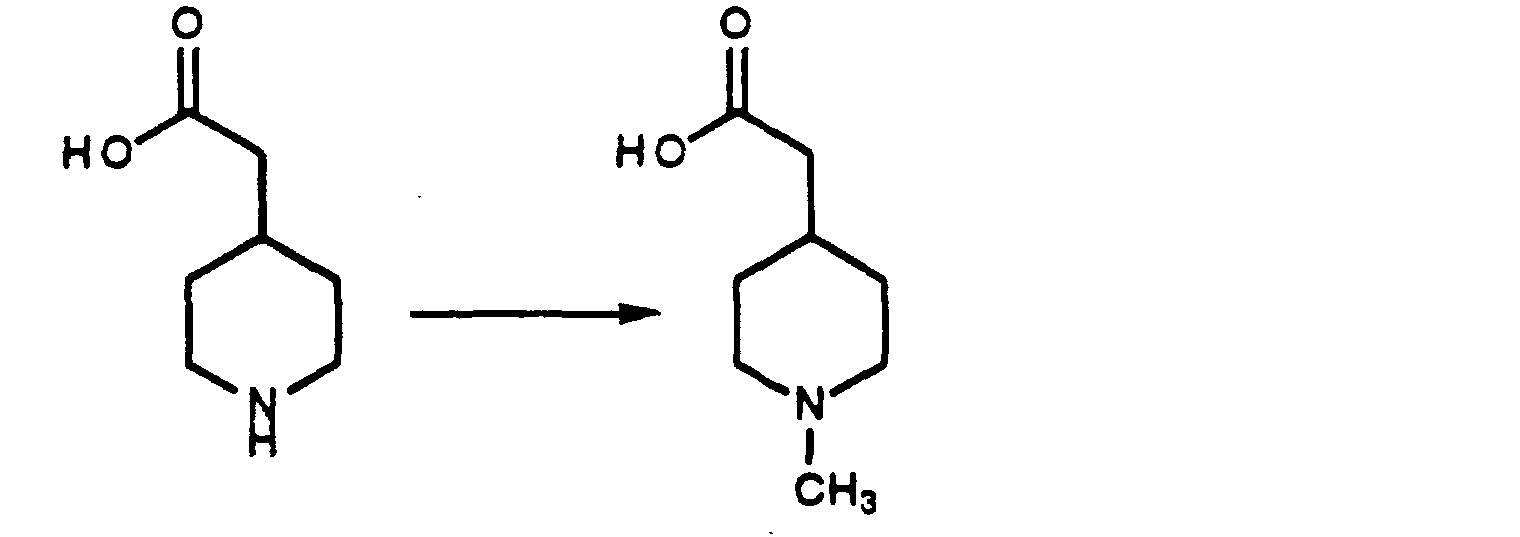
- 4-Piperidinylacetic acid (4 grams) (28.0 mmoles) from Preparative Example 3A is dissolved in water (50 ml) and 37% formalin (2.72 ml) (33.6 mmoles) is added. The mixture is hydrogenated over 10% Pd-C at 55psi at 25°C for 68 hours. The catalyst is filtered off and washed with water. The combined filtrates are evaporated to dryness to give the title compound ( MH+158).
-

- 4-Piperidinylacetic acid (41.24 grams) (288.4 mmoles) from Preparative Example 3A is dissolved in THF-water (1:1) (400 ml) and di-tert-butyldicarbonate (69.14 grams) (317.3 mmoles) and NaOH (11.52 grams) (288.4 mmoles) are added. The mixture is stirred at 25°C for 72 hours. The solution is then eluted through a bed of washed BioRad 50WX4 (RSO3H resin) (150 ml bed) and the resin is eluted with a 1:1 mixture of THF and water. The eluate is evaporated to dryness to give the title compound (Yield: 53.0 grams, 76%).
-

- 3-Pyridylacetic acid hydrochloride (13 grams) (74.9 mmoles) is hydrogenated as described in Preparative Example 3A to give a mixture of unreacted 3-pyridylacetic acid and the title compound (76:24) (8.63 grams, MH+ 144).
-

- The mixture of compounds from Preparative Example 4A (8.56 grams) are reacted with acetic anhydride (8.56 grams) as described in Preparative Example 3A and the crude mixture of products is diluted in methanol (60 ml) and passed over a bed of BioRad AG50WX4 resin (RSO3H) and the latter is eluted with methanol. The eluates are evaporated to dryness to give the title compound (Yield: 1.23 grams, MH+ 186).
-
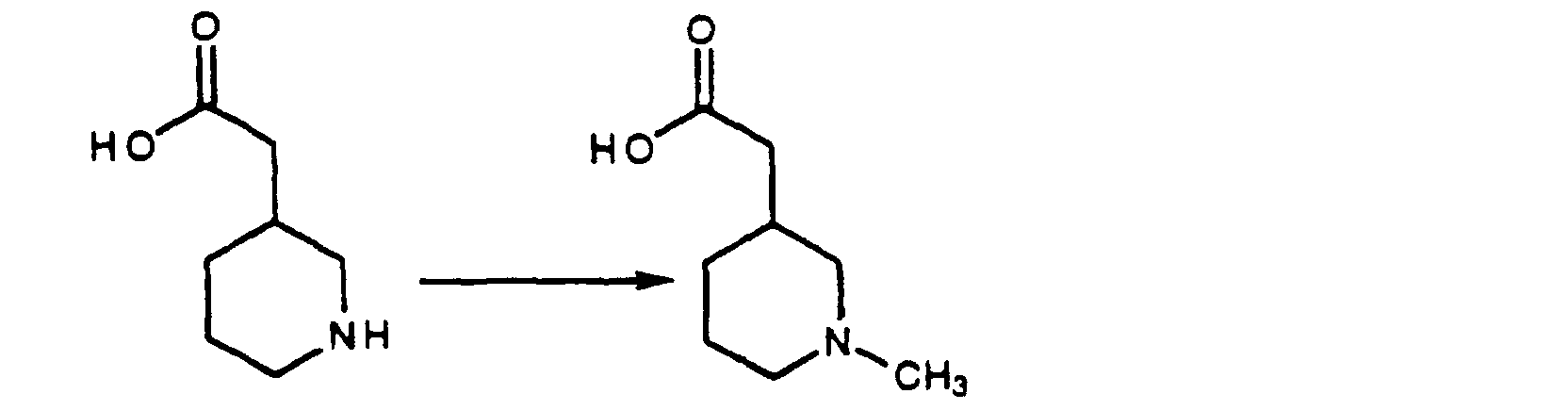
- The mixture of compounds from Preparative Example 4A (4 grams) and 37% formalin (2.72 ml.) are hydrogenated as described in Preparative Example 3C to give the title compound (MH+ 158).
-

- A 1.93 M solution of phosgene in toluene (20%) (584 mL) is diluted with dry CH2Cl2 (1 L) and the mixture is stirred at O°C under nitrogen atmosphere. A solution of 3-aminopyridine (21.1 grams) and dry pyridine (19 mL) dissolved in dry CH2Cl2 (600 mL) is added dropwise to the stirred solution at 0°C over a period of 5.5 hours. The mixture is stirred at 0-25°C for an additional 48 hours. A stream of nitrogen is passed through the solution to remove most of the phosgene and the solution is then evaporated until almost all of the solvent is removed to give the title compound which is then taken up in dry pyridine (850 mL) to give a stock solution of the title compound.
-
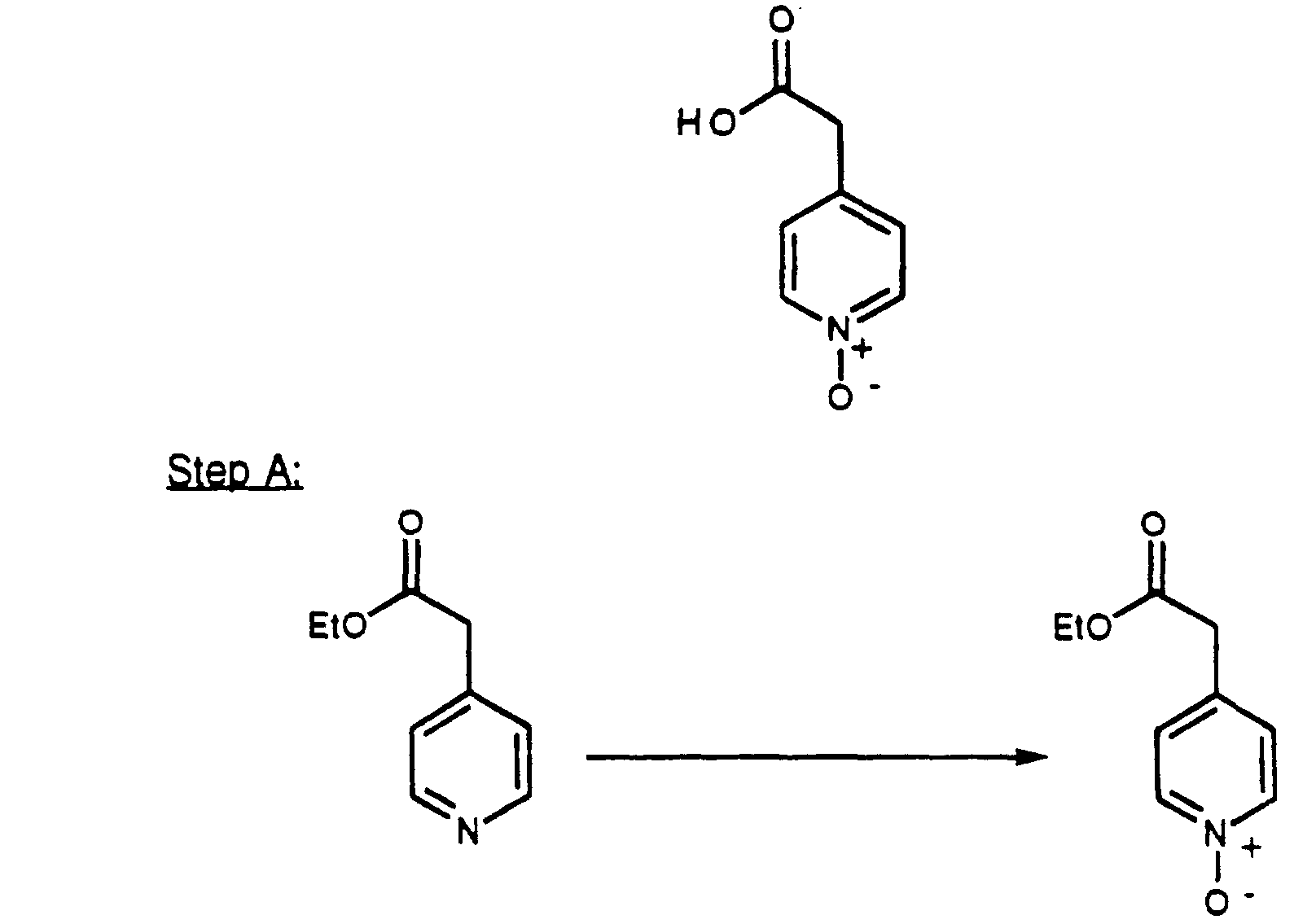
- Combine 10 g (60.5 mmol) of ethyl 4-pyridylacetate and 120 mL of dry CH2Cl2 at -20°C, add 10.45 g (60.5 mmol) of MCPBA and stir at -20°C for 1 hour and then at 25°C for 67 hours. Add an additional 3.48 g (20.2 mmoles) of MCPBA and stir at 25°C for 24 hours. Dilute with CH2Cl2 and wash with saturated NaHCO3 (aqueous) and then water. Dry over MgSO4, concentrate in vacuo to a residue, and chromatograph (silica gel, 2%-5.5% (10% NH4OH in MeOH)/CH2Cl2)to give 8.12 g of the product compound (Et represents -C2H5 in the formula). Mass Spec.: MH+ = 182.15
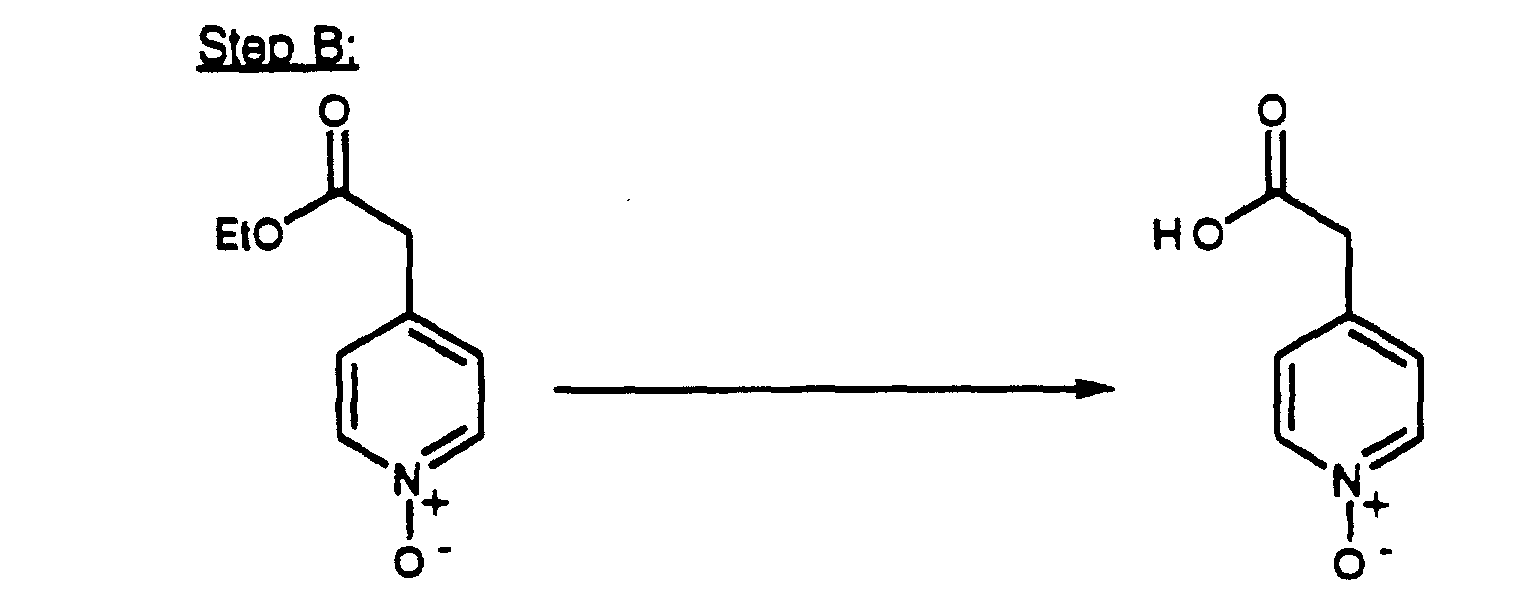
- Combine 3.5 g (19.3 mmòl) of the product of Step A, 17.5 mL of ethanol and 96.6 mL of 10% NaOH (aqueous) and heat the mixture at 67°C for 2 hours. Add 2 N HCl (aqueous) to adjust to pH = 2.37 and concentrate in vacuo to a residue. Add 200 mL of dry ethanol, filter through Celite® and wash the filter cake with dry EtOH (2X50 ml). Concentrate the combined filtrates in vacuo to give 2.43 g of the title compound.
-

- Combine 10 g (65.7 mmol) of 3-methoxycarbonylaminopyridine and 150 mL of CH2Cl2, cool to 0°C and slowly add (dropwise) a solution of 13.61 g (78.84 mmol) of MCPBA in 120 mL of CH2Cl2 at 0°C over a period of 1 hour. Stir the mixture at 25°C for 5 days, then wash with saturated NaHCO3 (aqueous), then water and dry over MgSO4. Concentrate in vacuo to a residue and chromatograph (silica gel, 2%-5% (10% NH4OH in MeOH)/CH2Cl2) to give the product compound. Mass Spec.: MH+ = 169
-
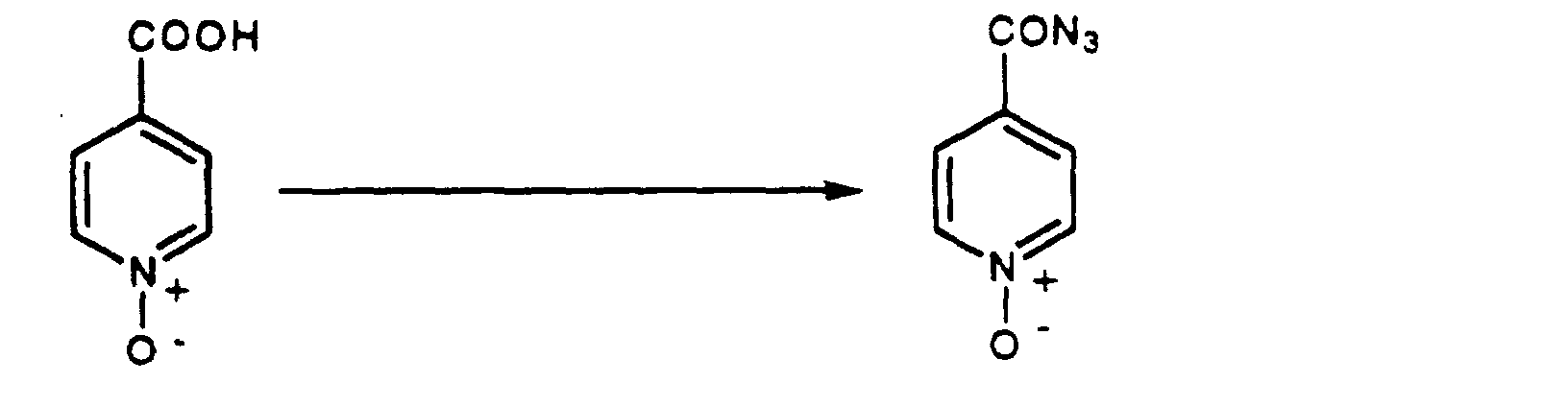
- Combine 5 g (36.0 mmol) of isonicotinic acid 1-N-oxide and 150 mL of anhydrous DMF, add 5.5 mL (39.6 mmol) of triethylamine and stir at 0°C for 0.5 hours. Slowly add (dropwise) 8.5 mL (39.6 mmol) of diphenyl-phosphoryl azide at 0°C over 10 minutes, stir at 0°C for 1 hour and then at 25°C for 24 hours (as generally described in Pavia, et al., Journal of Medicinal Chemistry, 33, 854-861 (1990). Concentrate in vacuo to a residue and chromatograph (silica gel, 0.5%-1% MeOH/CH2Cl2) to give 5.9 g of the product compound.
- Using nicotinic acid 1-N-oxide and substantially the same procedure as described for Preparative Example 8 the following compound is prepared:

-
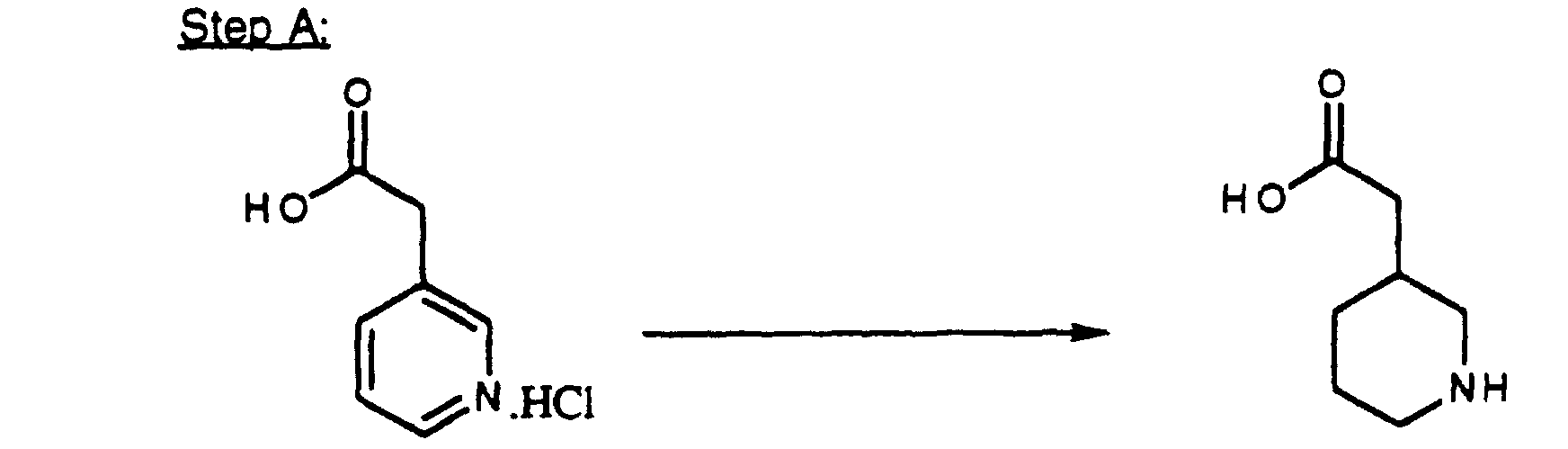
- Hydrogenate 25 g (144 mmol) of 3-pyridylacetic acid hydrochloride for 144 hours using the procedure described in Preparative Example 3A to give 20 g of the product compound. Mass Spec.: MH+ = 144.

- React 12 g (83.8 mmol) of the product of Step B for 148 hours using the procedure described in Preparative Example 3D, to give 17.5 g of the product compound. Mass Spec.: MH+ = 244.25
-
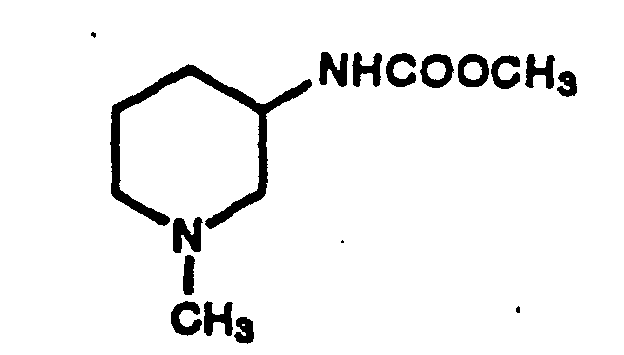
- Combine 25 g (164.4 mmol) of methyl 3-pyridylcarbamate and 163.3 mL of 1N HCl (aqueous), stir until all of the solid dissolves, then hydrogenate over 10% Pd/C at 25°C at 55 psi for 220 hours. Filter, wash the solids with water and treat the combined filtrates with 150 mL of BioRad AG1X8 ion exchange resin (OH-). Filter, wash the resin with water and concentrate the filtrate to a volume of 100 mL Add 16.43 mL (197.3 mmol) of 37% formalin and hydrogenate over 10% Pd/C at 25°C at 55 psi for 89 hours. Filter, wash the solids with water and concentrate in vacuo to give 24.3 g of the title compound. Mass Spec.: MH+ = 173.2.
-

- Combine 10 mL of dry CH2Cl2 and 914.6 mL (28.1 mmol) of a 1.93M solution of phosgene in toluene, cool to 0°C and slowly add (dropwise) a solution of 0.6484 g (5.62 mmol) of 4-hydroxy-1 -N-methylpiperidine, 1.214 mL (15 mmol) of pyridine and 10 mL of dry CH2Cl2 over 10 minutes, then stir at 0° to 25°C for 2 hours. Purge excess phosgene with N2 then concentrate in vacuo to give the title compound.
-
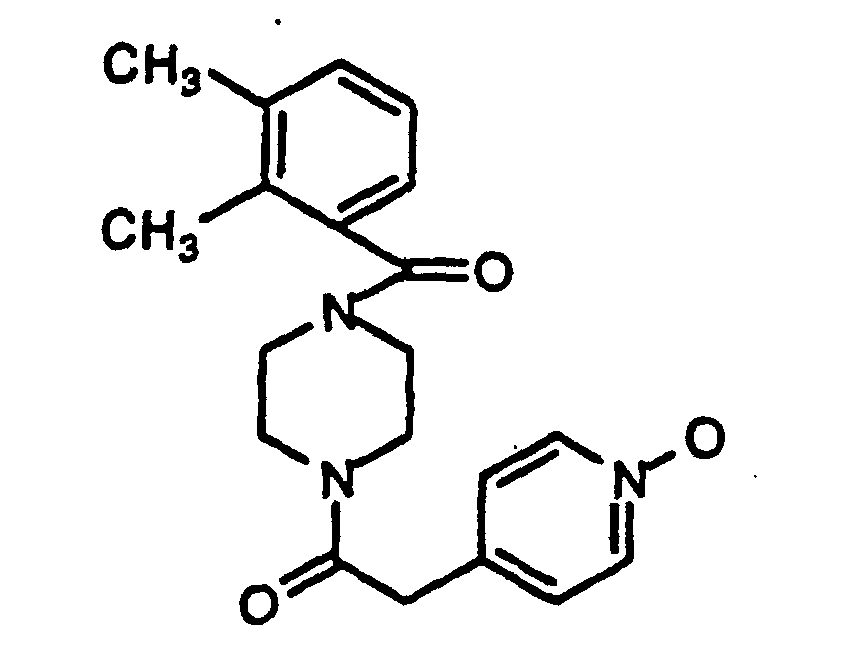
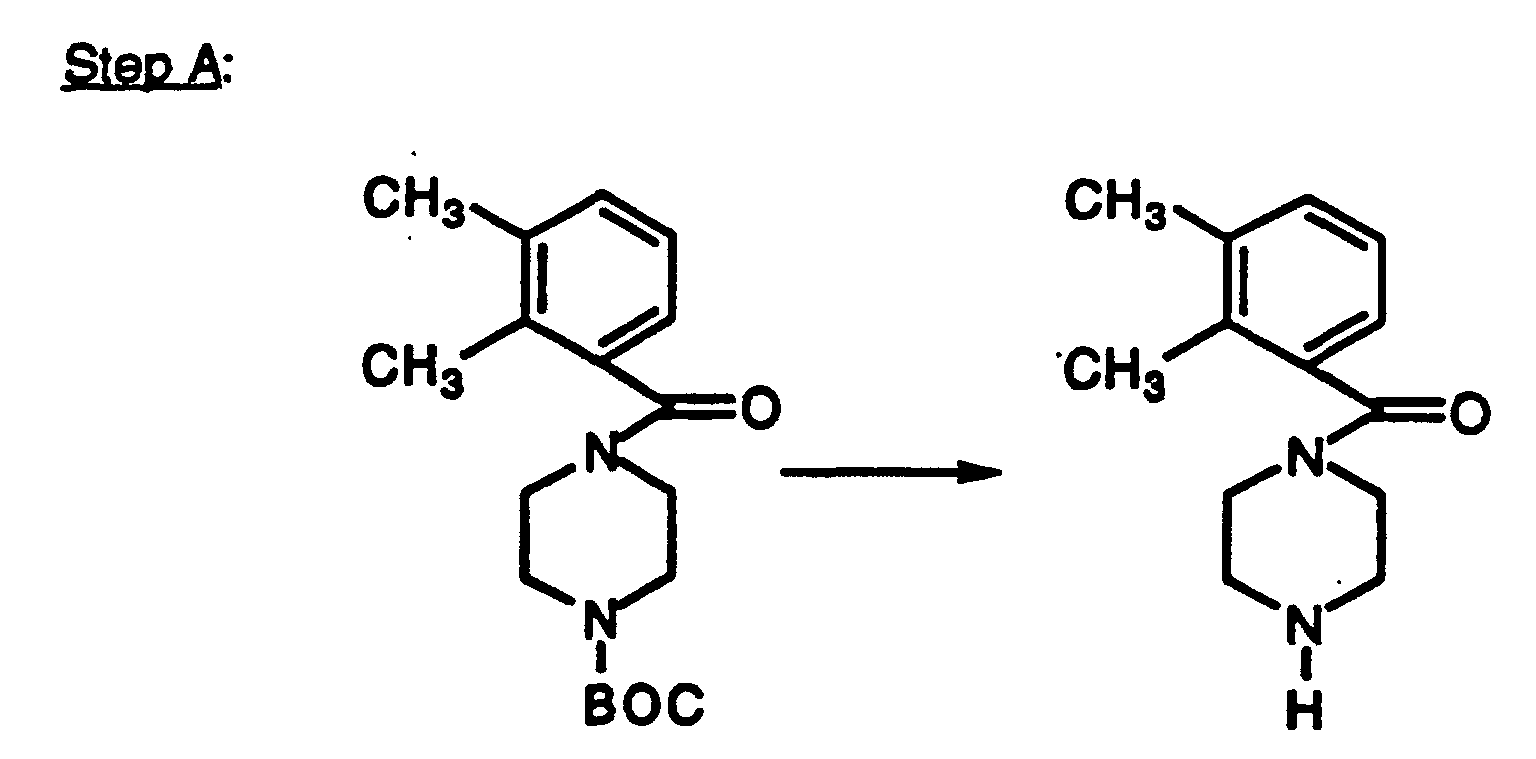
- Dissolve 1 -tert-butoxycarbonyl-4-(2,3-dimethylbenzoyl)-piperazine (described in WO 95/00497, p 45, Example 1) in dioxane saturated with HCl gas. After about one hour concentrate In vacuo and use the resulting HCI salt without purification.

- Dissolve the product of Step A in N.N-dimethyl formamide containing one equivalent of 1-hydroxybenzotriazole, (HOBT) one equivalent of 1-(3-dimethylaminopropyl)-3-ethylcarbodimide hydrochloride (DEC), one equivalent of 4-pyridylacetic acid-1-N-oxide and one equivalent of N-methylmorpholine. When reaction is complete, about 4 hours, the reaction is poured into water and extracted with ethyl acetate. The organic layer is dried over magnesium sulfate, filtered and concentrated in vacuo. The residue is chromotographed on silica gel using ethyl acetate-hexane to give the title compound.
- Perform the reaction of Example 1, Step B except use 4-pyridinylacetic acid instead of 4-pyridinylacetic acid-1-N-oxide to obtain the product.

-
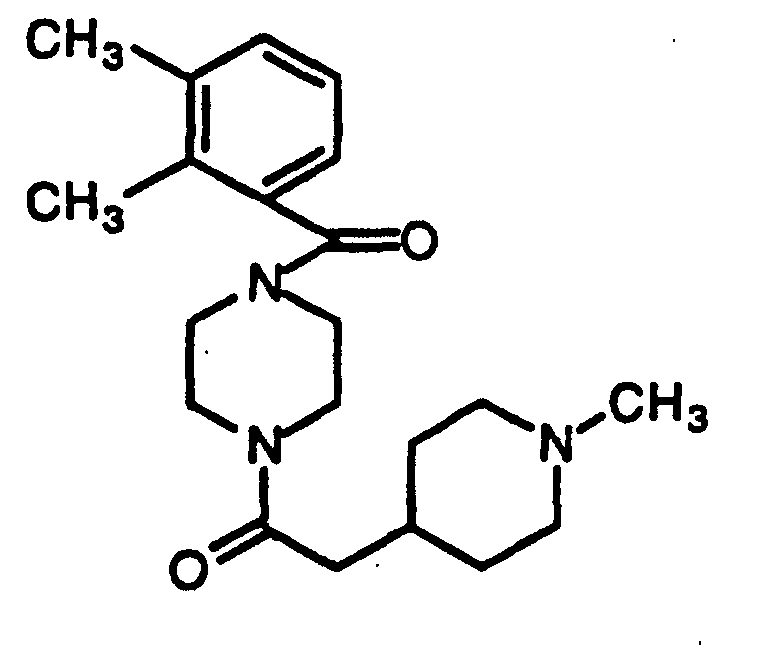
- Perform the reaction of Example of 1, Step B except use N-methyl-4-piperidinylacetic acid (Preprative Example 3. Step C) instead of 4-pyridinylacetic acid-1-N-oxide to obtain the product.
-


- Perform the reaction of Example 1, Step B except use N-tert-butoxycarbonyl-4-piperidinylacetic acid (Preparative Example 3, Step D) instead of 4-pyridinylacetic acid-1-N-oxide to obtain the product.
- Dissolve the product of Step A in dioxane saturated with HCI gas and and allow to stir until complete, about 4 hours. Concentrate under vacuo. Partition between aqueous sodium bicarbonate solution and ethyl acetate. Dry the organic layer over magnesium sulfate, filter and concentrate in vacuo to give the title compound.
-
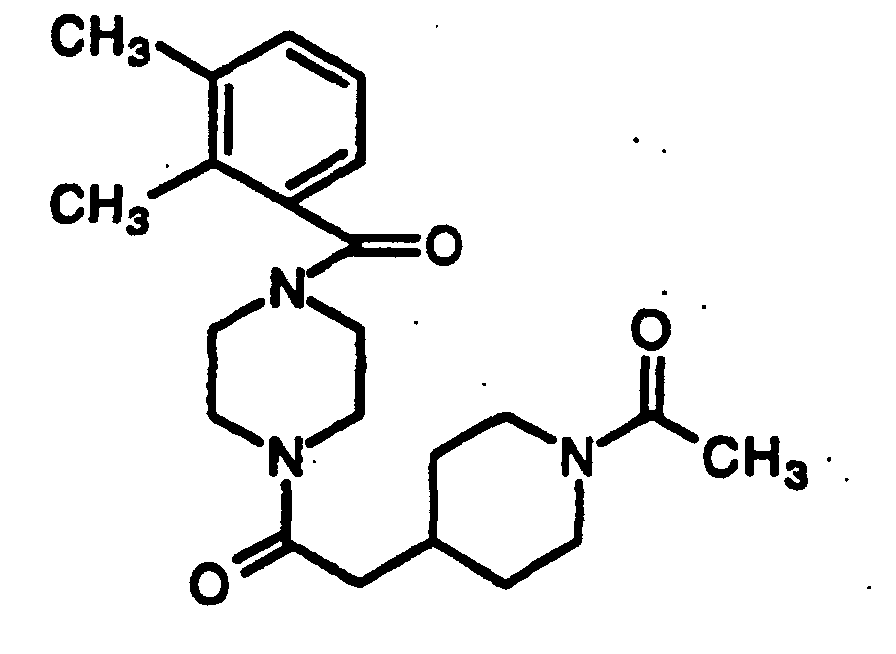
- Dissolve the product of Example 4, Step B in pyridine and add 0.5 equivalent of acetic anhydride. Stir until complete, about 8 hours. Concentrate under vacuo. Dissolve in ethyl acetate, wash with brine, dry organic layer over magnesium sulfate, filter and concentrate in vacuo. Chromotograph on silica gel using ethyl acetate-hexane to give the title product.
-

- Dissolve the product of Example 4, Step B in methylene chloride and add excess trimethylsilylisocyanate. Stir under nitrogen for 18 hours. Wash with aqueous sodium bicarbonate solution. Dry the organic layer over magnesium sulfate, filter and concentrate in vacuo. Chromatograph the residue on silica gel using methanol-methylene chloride to give the product.
-
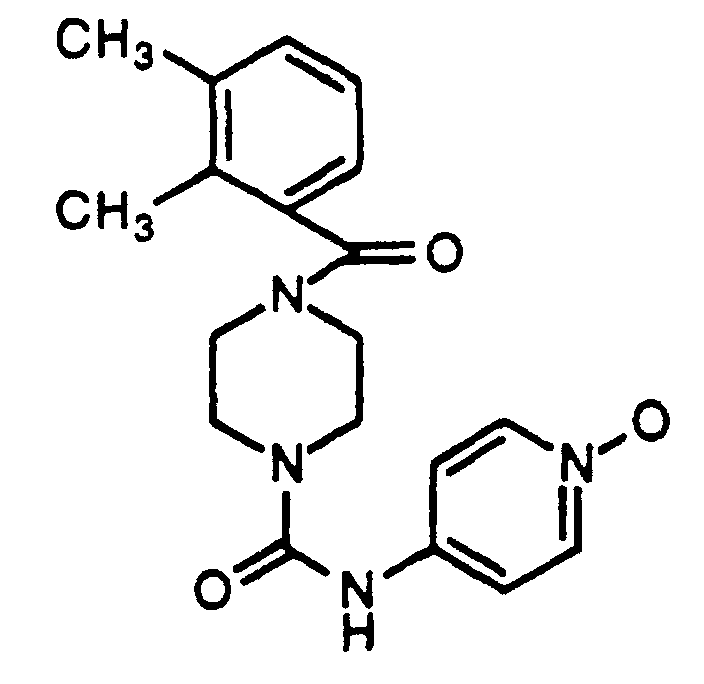
- Dissolve the product of Preparative Example 8 in toluene and reflux for 2 hours. Cool to 25°C and add one equivalent of the product of Example 1, Step A and allow to stand for 18 hours. Concentrate and chromatograph on silica gel using chloroform-methanol to give the product.
-
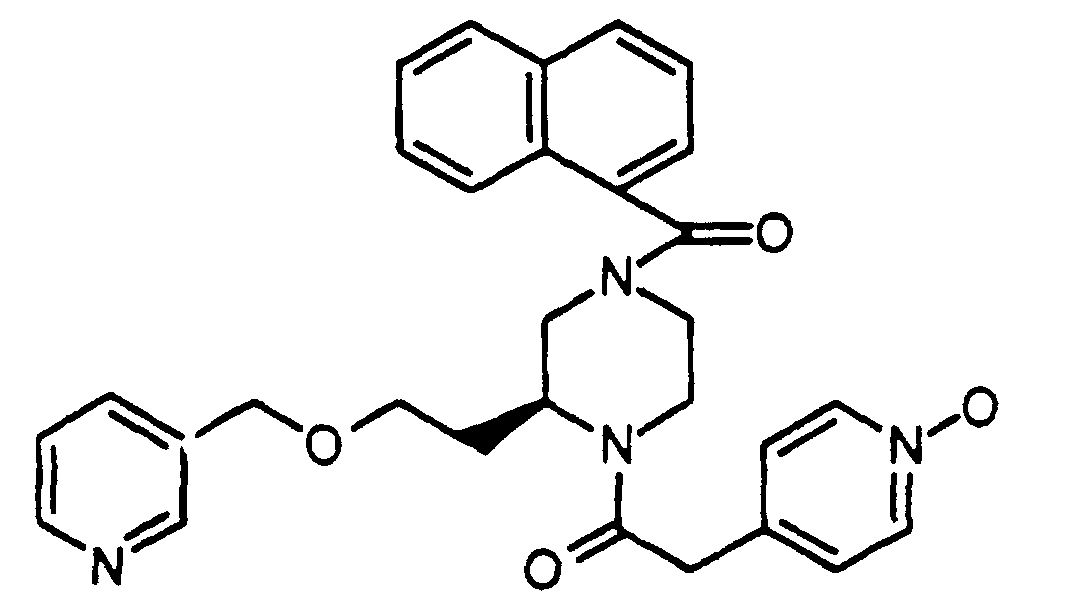
- Dissolve 1-tert-butoxycarbonyl-(2(S)-2-(3-pyridyl-methoxyethyl)-4-(1 -naphthoyl)piperazine (preparation described in WO 95/00497, Example 14) in dioxane saturated with HCI gas and allowed to stand until reaction is complete. Concentrate in vacuo and then react as described in Example 1, Step B to yield the product.
-

- React 2(S)-4-acetamidobutyl)-4-(1-napthyl)- piperazine (preparation described in WO 95/00497, Example 27, Step G) with N-methyl-4-piperidinyl acetic acid (Preparative Example 4, Step C) by the process described in Example 3 to give the product.
-

- React 1-tert-butoxycarbonyl-4-(2,3-dimethylbenzoyl)-2(S)-(2-methoxyethyl)-piperazine (preparation described in WO 95/00497, Example 7, Step E) with 4-pyridylacetic acid using the process described in Example 2 to give the product.
-
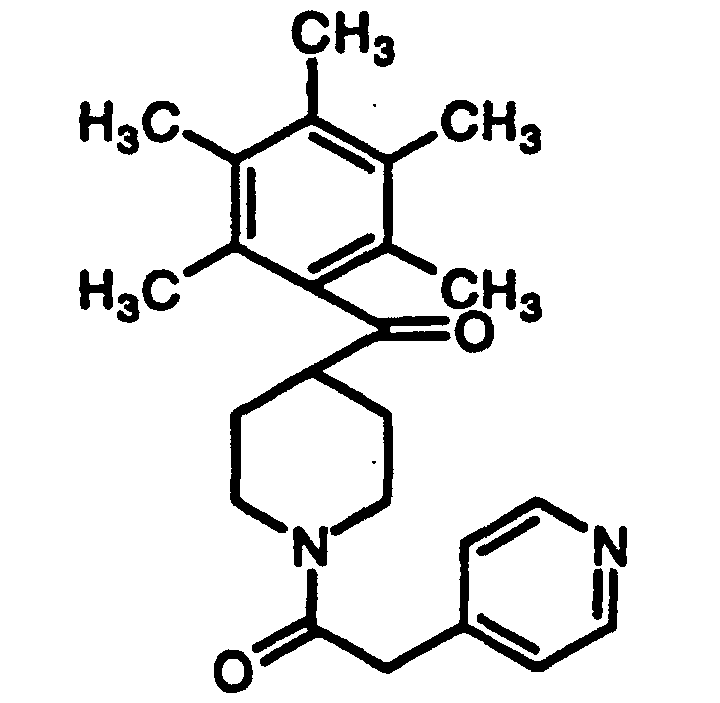
- React 4-(pentamethylbenzoyl)-piperidine with 4-pyridylacetic acid by the process described in Example 2 and purify the crude product by silica gel chromatography using methanol-methylene chloride-amonia to give the product as a white solid, M+ = 379.
-
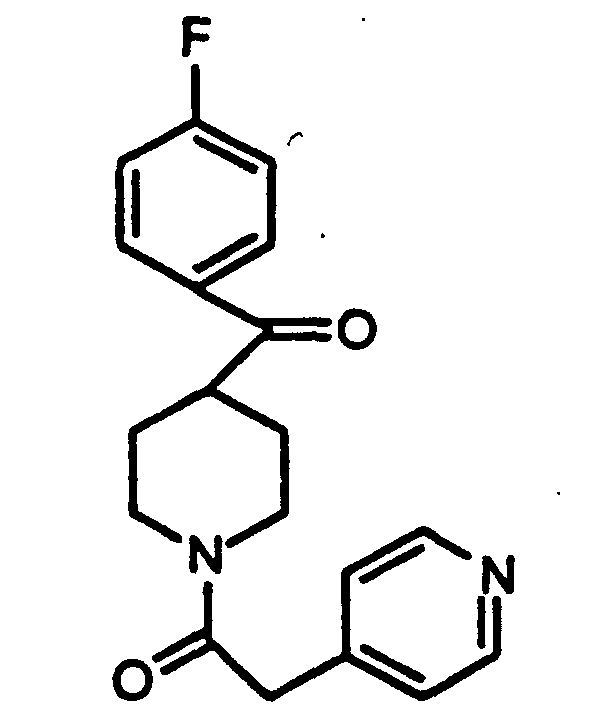
- React 4-(4-fluorobenzoyl)-piperidine with 4-pyridylacetic acid by the process described in Example 2 to give the product as a white solid, M+ = 327.
-
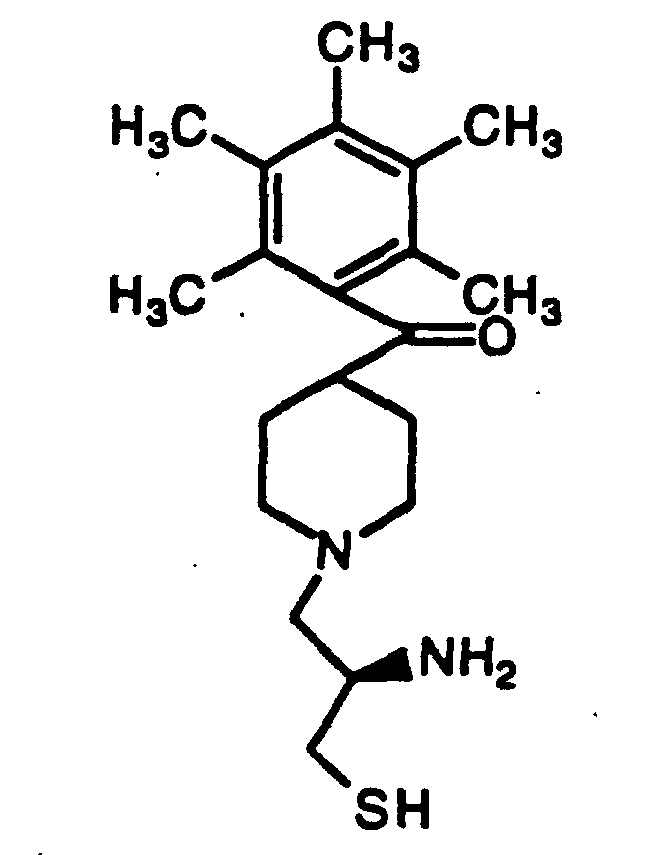
- Dissolve one equivalent of 4-(pentamethylbenzoyl)-piperidine in N,N-dimethyl formamide containing one equivalent of sodium triacetoxyborohydride and crushed molecular sieves. Cool this solution to 0°C and add dropwise, a solution of 1 equivalent of 2(R)-tert-butoxycarbonylamino-3-triphenylmethylthiopropanal (preparation described in WO 95/00497, Example 1, Step C, and by O.P. Goel, et al. Organic Synthesis (1988), 67, 69-75) in N,N-dimethylformamide. Allow reaction to warm to 20°C and stir under nitrogen for 2 hours. Concentrate in vacuo and partition the residue between ethyl acetate and saturated sodium bicarbonate solution. Dry the organic layer over magnesium sulfate, filter and concentrate in vacuo.
- Dissolve the product from Step A in methylene chloride and add five equivalents of triethylsilane. To this solution add trifluoroacetic (10 equivalents) and stir the reaction at 20°C for 30 min. Concentrate in vacuo and partition between water and hexane. Chromatograph the water layer on a C18 HPLC column using acetonitrile water and 0.1% trifluoroacetic acid. The combined fractions are evaporated, dissolved in water and passed through a Biorad AG 3x4 (Cl-) ion exchange column to give the product as a hydrochloride salt.
-
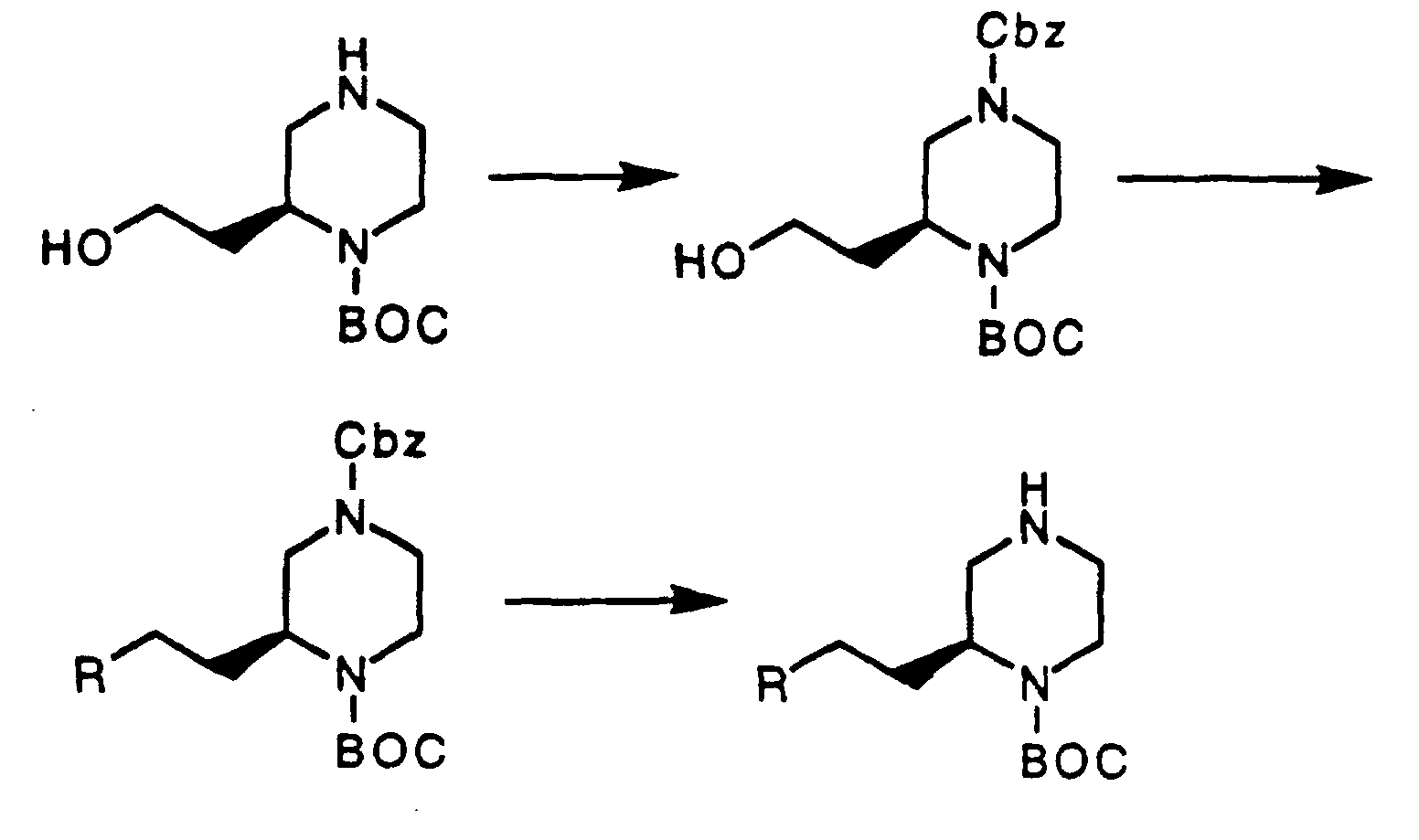
- The title compound from Example 13A (WO 95/00497) is reacted with benzyloxycarbonyl chloride under standard conditions known to one skilled in the art, to give the N-Cbz protected alcohol shown above. After purification in the usual way the latter may be reacted with a variety of reagents shown in Column 1 of Table 1 to give the corresponding N-Cbz protected intermediates where R is as defined in Column 2 of Table 1 .After purification in the usual way the latter may be deprotected using mild catalytic hydrogenation procedures known in the art, to give after suitable purification, the final desired intermediates shown in Column 2 of Table 1.

-
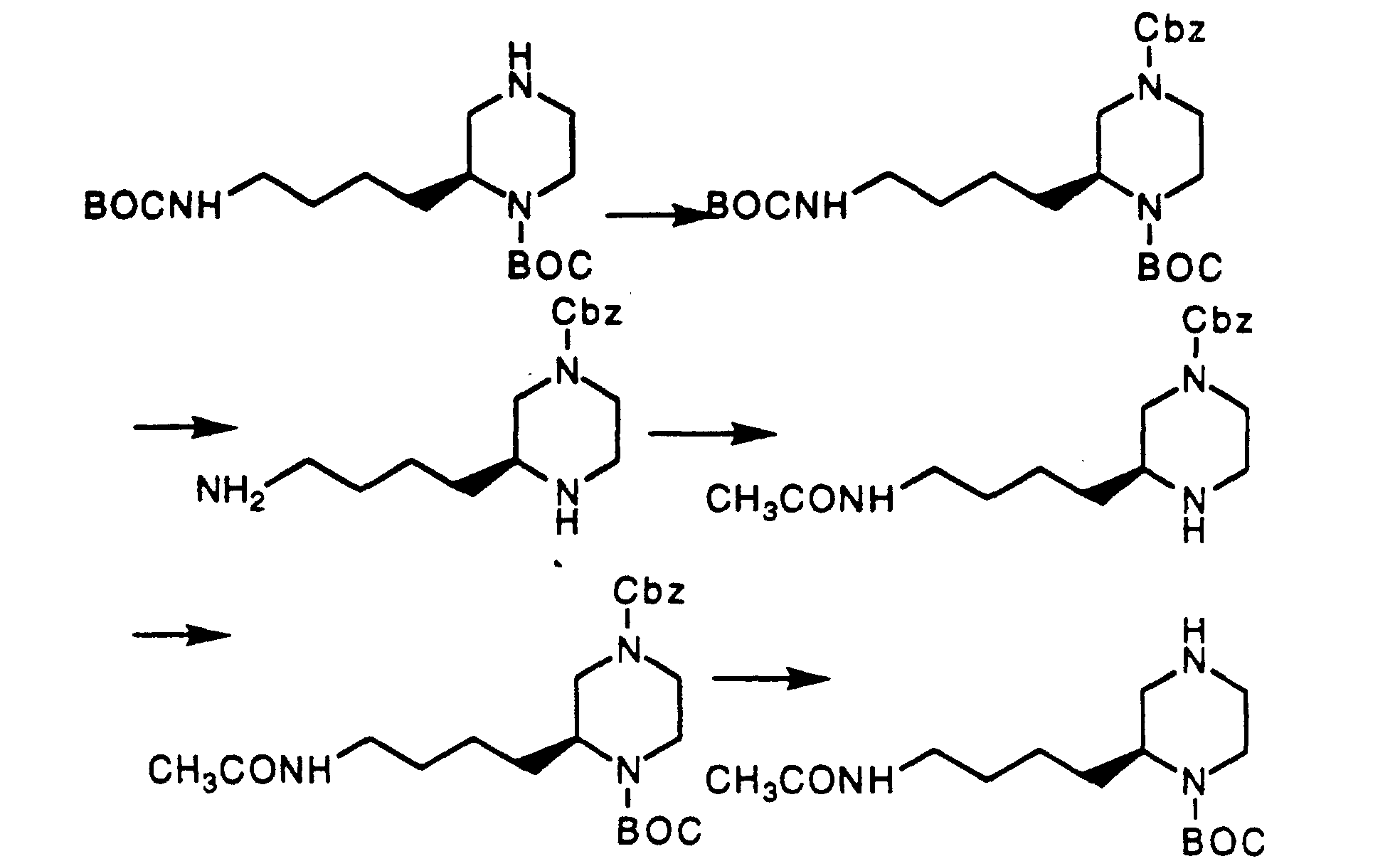
- The title compound from Example 27D (WO 95/00497) is converted by the scheme shown above using standard procedures known to one skilled in the art into 1 -tert-butoxycarbonyl-2(S)-(4-acetylaminobutyl)piperazine.
-

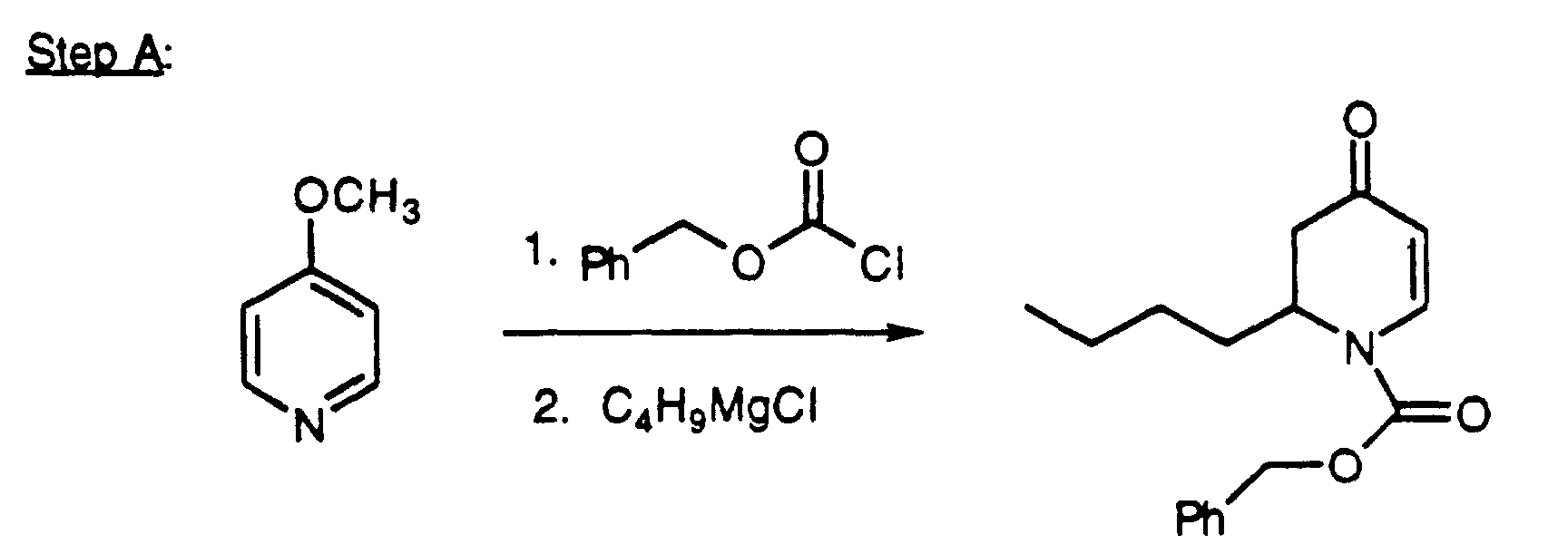
- As described by D.L. Comins, et al., Tet Lett 4549 (1986). Dissolve 4-methoxypyridine in THF and cool to -23°C. Add benzylchloroformate dropwise (1 equivalent) followed by 1 equivalent of butyl magnesium chloride in THF added dropwise. Pour into 10% hydrochloric acid and extract with ether. Dry over MgSO4 and concentrate.

- Dissolve the product of Step A in ethanol containing 10% palladium on carbon and hydrogenate at 60 psi. Filter and concentrate in vacuo to obtain the product.
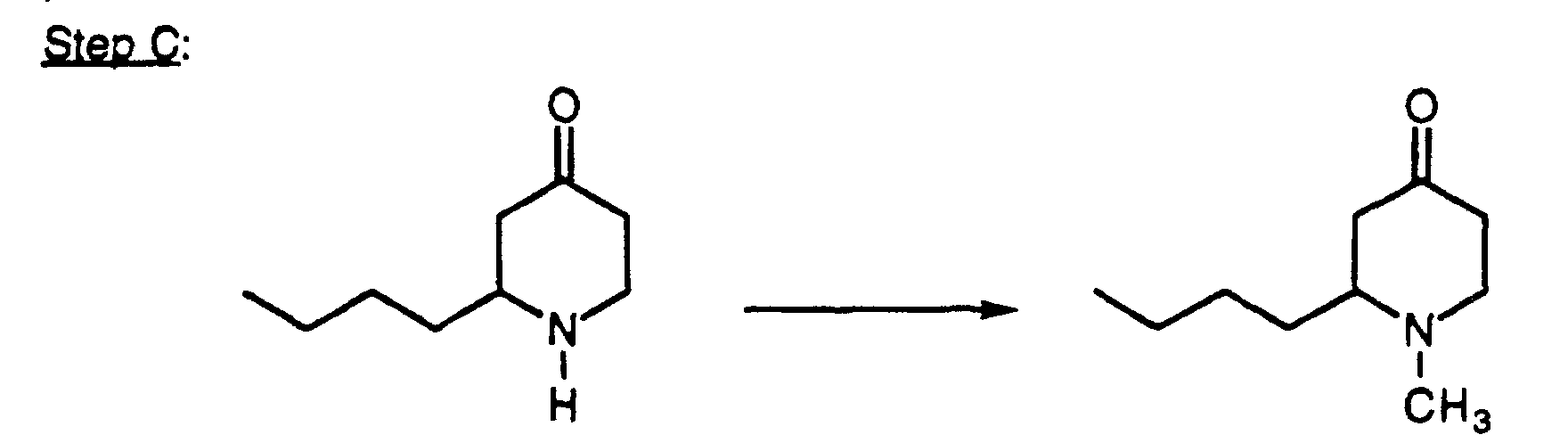
- Dissolve the product of Step B in tetrahydrofuran, cool to 0°C under nitrogen and add one equivalent of sodium hydride. After stirring for 15 min., one equivalent of methyl iodide is added. Stir reaction for 15 min., concentrate under vacuo and chromatograph on silica gel using methanol-methylene chloride.

- Dissolve the product of Step C in ethanol and add an excess of sodium borohydride. Concentrate in vacuo. Partition between water and ethyl acetate. Dry the organic layer over magnesium sulfate, filter and concentrate in vacuo.

- Dissolve the product of Step D in pyridine containing an excess of thionyl chloride. Stir for 18 hours and concentrate in vacuo. Partition between ethyl acetate and aqueous sodium bicarbonate. Dry the organic layer over magnesium sulfate, filter and concentrate in vacuo to obtain the product.
-

- Dissolve 2(S)-2-(3-pyridyl-methoxyethyl)-4-(1-naphthoiyi)piperazine (preparation described in WO 95/00497, Example 14, Step B) in methylene chloride containing one equivalent of triethylamine and cool to 0°C under nitrogen. Add one equivalent of the product of Preparative Example 11 and allow the reaction to warm to room temperature. Stir at 25°C until reaction is complete, about 10 hours. Concentrate in vacuo and chromatograph on silica gel using chloroform-methanol-ammonia to give the product.
-

- To the solution of above methyl 4-N-BOC-2-piperazine acetate (4.0) (5.2 g, 20 mmol) in THF (60 mL) is added 1N NaOH (60 mL). The reaction mixtures is stirred at room temperature for 6 hours, cooled to 0°C and acidified to pH=9-10 by 10% HCI followed by the addition of FMOC-Cl (5.2 g, 20 mmole). The pH of the reaction mixture is kept at 9-10 by adding 1N NaOH. After room temperature for 6 hours, reaction mixture is acidfied by 10% HCI to pH=1 and extracted with ethyl acetate twice. The combined organic layers are washed with brine, dried over MgSO4 and concentrated to give 4-N-BOC-1-N-FMOC-2-piperazine acetic acid (4.1) (8.56 g, 89%) as a white foam.To the above 4-N-BOC-1-N-FMOC-2-piperazine acetic acid (4.1) (460 mg, 1 mmol) in 5 mL CH2Cl2 is added EDC (230 mg, 1.2 mmol) followed by the addition of isopropyl amine (130 µL, 1.5 mmol). After stirring at room temperature for 6 hours, the reaction mixture is treated with 1N HCI (10 mL) and ethyl acetate (30 mL). The organic layer is separated, washed with saturated NaHCO3, dried over Na2SO4 and concentrated to provide isopropyl 4-N-BOC-1-N-FMOC-2-piperazine acetamide (4.2) (454.6 mg, 90%) as a white foam.
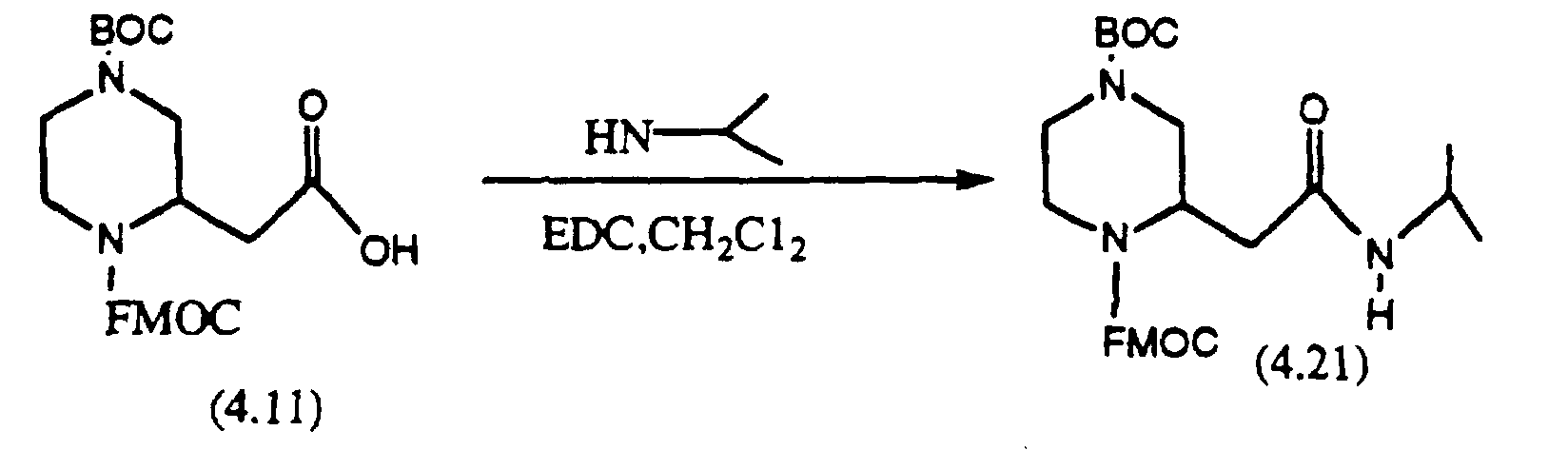
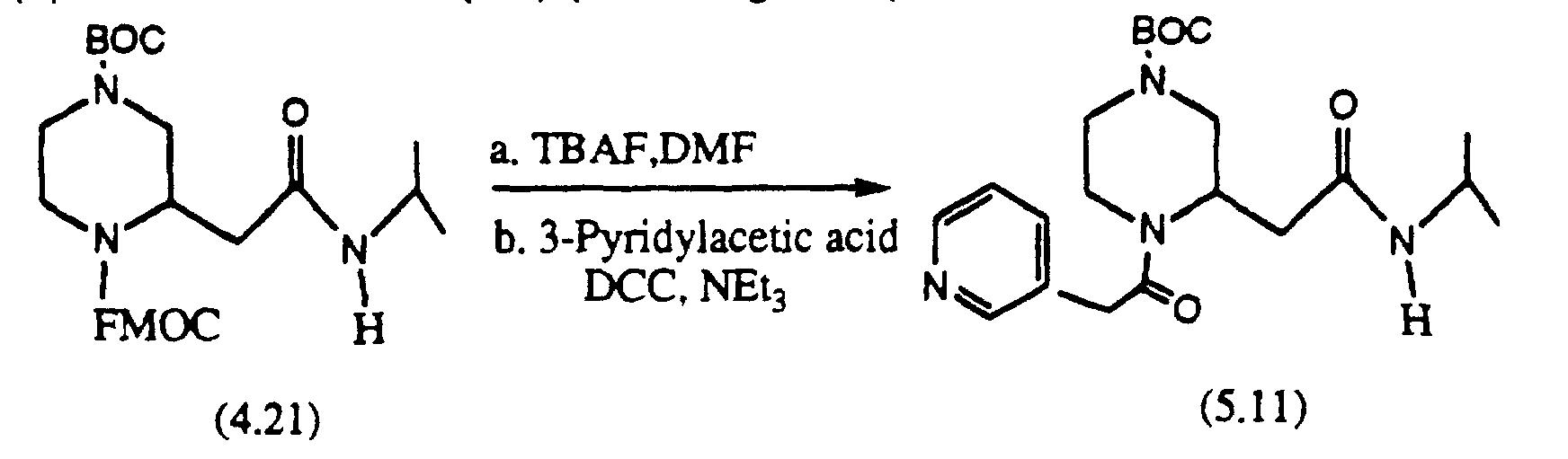
- To the solution of isopropyl 4-N-BOC-1-N-FMOC-2-piperazine acetamide (4.2) (150 mg, 0.3 mmol) in DMF is added TBAF (142 mg, 0.45 mmol). After stirring at room temperature for 1/2 hour, the reaction mixture is treated with 1 N HCl (5 mL) and ethyl acetate (10 ML). The aqueous layer is washed with ethyl acetate once, basified with saturated K2CO3 and extracted three times with ethyl acetate. The combined organic layers are dried over MgSO4 and concentrated to afford the desired intermediate isopropyl-4-N-BOC-2-piperazine acetamide which is used for the following reaction without further purification. To the solution of 3-pyridyiacetic acid (52 mg, 0.3 mmol) and triethyl amine (85 µL, 0.6 mmol) in 5 mL CH2Cl2 is added DCC (75 mg, 0.36 mmol) followed by the addition of isopropyl-4-N-BOC-2-piperazine acetamide in 2 mL CH2Cl2. The reaction mixture is stirred at room temperature for 8 hours and concentrated and purified by flash chromatography to give (5.1) (106.2 mg, 88%) as a colorless oil. Rf=0.4 (10% MeOH in CH2Cl2).

- To a solution of (5.1) (0.1g, 0.197 mmol) in DCM(6 mL) is added TFA (2 mL). The reaction mixture stirred at room temperature for one hour and is then evaporated to dryness in vacuo. The residue is dissolved in ethyl acetate (50 mL) and washed with water (40 mL). The aqueous phase is then basified with solid sodium carbonate and extracted with chloroform (5 x 20 mL). The organic phase is dried over MgSO4 and concentrated in vacuo affording the deprotected material as an oil in mass 0.069g (84%). To a solution of the oil (0.02g, 0.07 mmol) in DCM (1 mL) is added DCC (0.021g, 0.1 mmol) and 1-naphthoic acid (0.017g, 0.1 mmole). The reaction mixture is stirred at room temperature for 8 hours and is then purified directly by flash chromatography (SiO2, 5% methanol in DCM) affording (1.0) as an oil in mass 0.03g (94%)
-

- To a suspension of Tentagel S® NH2 Resin (Rapp Polymere Gmbh, Germany) (1.0g, 0.28 mmol/g loading, 0.28 mmol) in DCM (10mL) in a Merrifield reaction vessel was added 4-(bromomethyl)-3-nitrobenzoic acid (1.12 mmol, 0.29g), HOBT (1.12 mmol, 0.15g) and DIC (1.68 mmol, 0.21g, 0.26mL). The resin shook at room temperature for 16h and was then washed with DCM (4 x 10mL) and THF (3 x 10 mL).
-

- The resin (0.28 mmol theoretical loading) was suspended in THF (10 mL) and treated with (aminomethyl)cyclopropane (5.6 mmol, 0.40g, 0.49 mL) at room temperature for 16h. The resin was then washed with THF (2 x 10 mL).
-
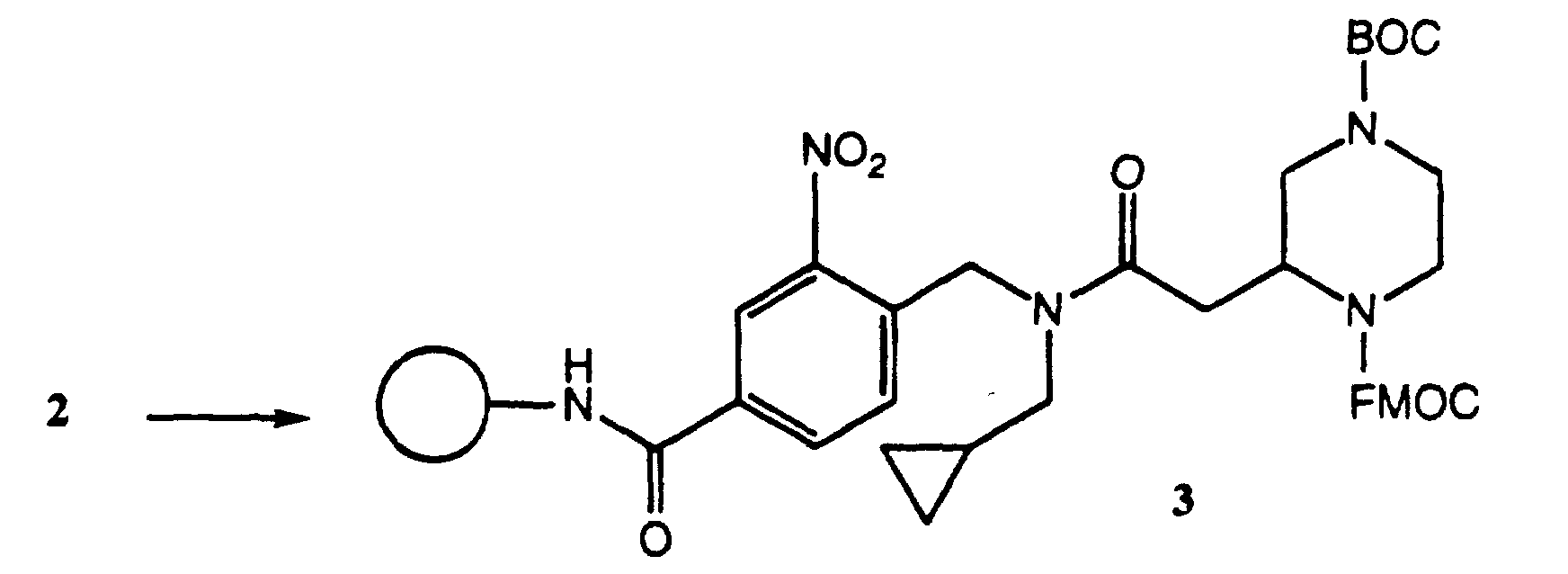
- The resin (0.28 mmol theoretical loading) is suspended in DCM (10mL) and reacted with 1-N-FMOC-4-BOC piperazine-2-acetic acid (1.12 mmol, 0.52g), HATU (1.12 mmol, 0.43g) and N,N-diisopropyethylamine (2.24 mmol, 0.29g, 0.39mL). The resin is shaken at room temperature for 16 h and is then washed with DCM (4 x 10 mL). The resin is then retreated with the same mixture of reagents in a second coupling cycle of 16h. The resin is then washed with DCM (6 x 10mL).
-

- The resin (0.28 mmol theoretical loading) is washed once with DMF (10 mL) and is then treated with a 30% solution of piperidine in DMF (total volume = 10 mL) at room temperature for 30 min. The resin is then washed with DMF (10 mL), methanol (2 x 10 mL) and DCM (3 x 10 mL).
-

- The resin (0.28 mmol theoretical loading) is suspended in DCM (10mL) and treated with (S)-(+)-α-methoxyphenylacetic acid (1.12 mmol, 0.19g), HATU (1.12 mmol, 0.43g) and N,N-diisopropylethylamine (2.24 mmol, 0.29g, 0.39 mL). The resin is shaken at room temperature for 16h and then washed with DCM (4 x 10 mL).
-
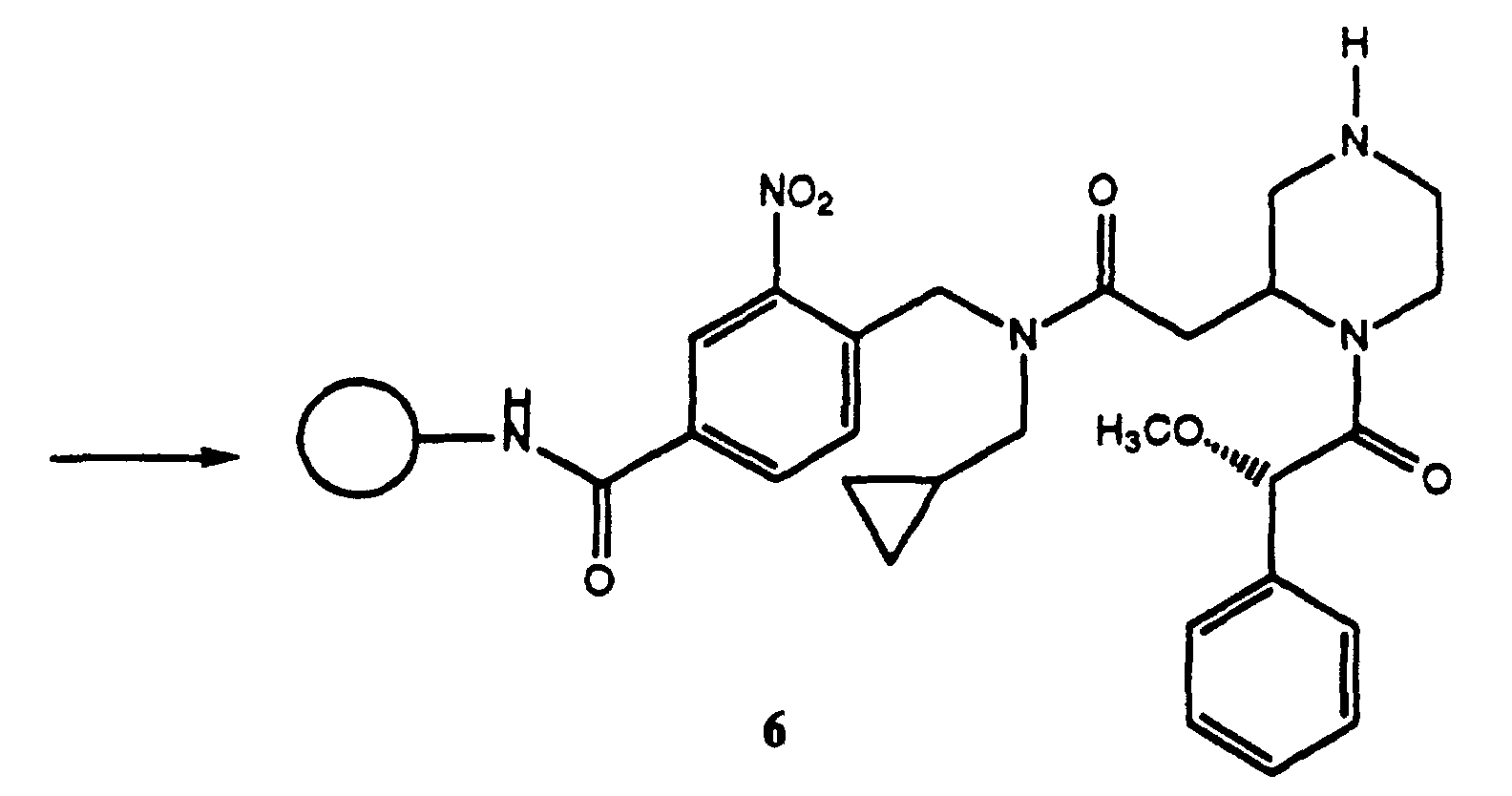
- The resin (0.28 mmol theoretical loading) is treated with a 30% solution of TFA in DCM (10 mL) at room temperature for 1h. The resin is then washed with DCM (2 x 10 mL) and methanol (3 x 10 mL) and then treated with a 20% solution of triethylamine in methanol (10 mL) for 30 min. The resin is then washed with methanol (2 x 10 mL) and DCM (4 x 10 mL).
- The resin (0.28 mmol theoretical loading) is suspended in DCM (10 mL) and treated with diphenylacetic acid (1.26 mmol, 0.27g), HATU (1.26 mmol, 0.48g) and N,N-diisopropylethylamine ( 2.52 mmol, 0.33g, 0.44 mL). The resin is shaken at room temperature for 16h and then washed with DCM (5 x 10 mL), DMF (3 x 10 mL) and methanol (3 x 10 mL).

-
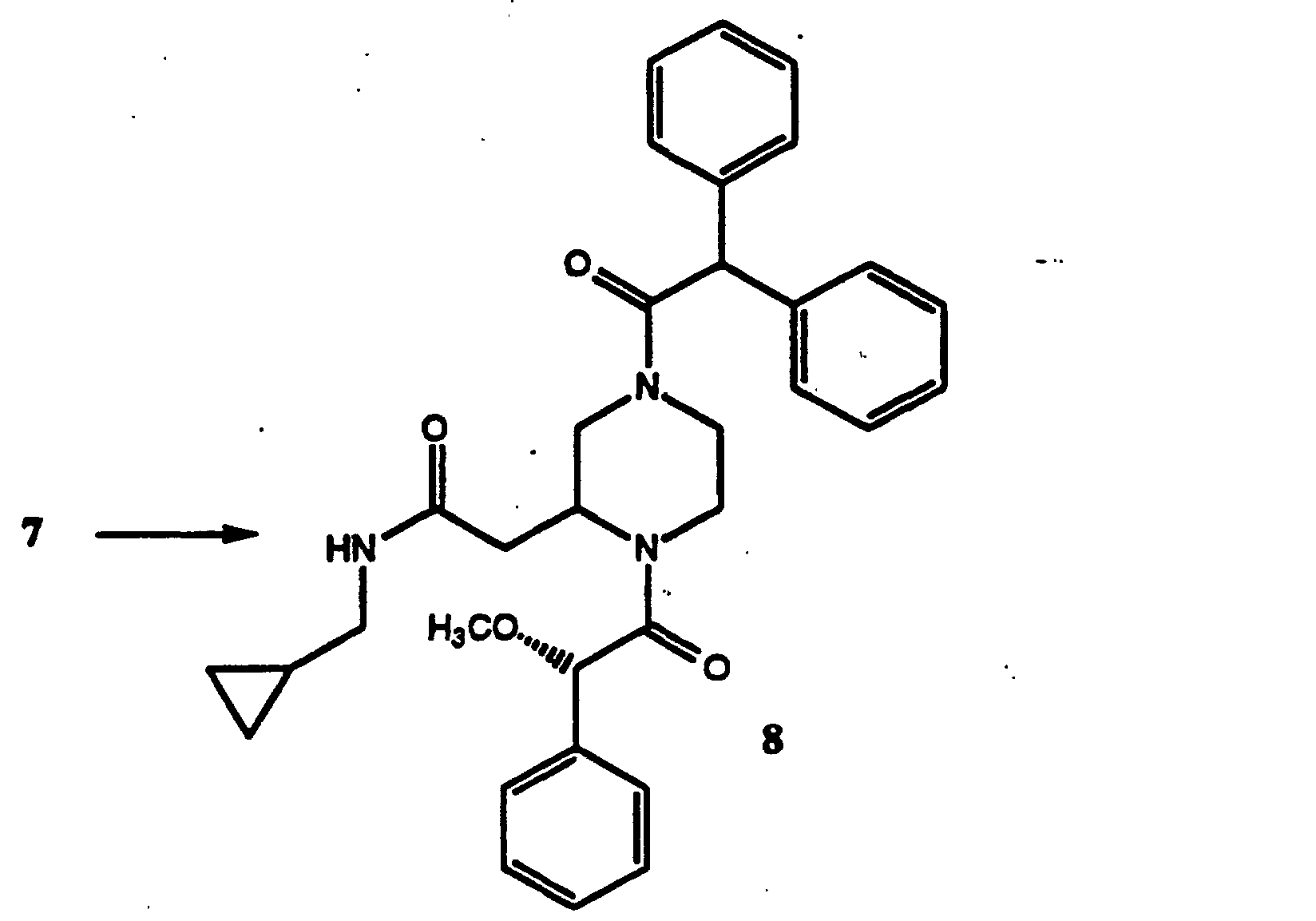
- The resin (0.28 mmol theoretical loading) is washed from the Merrifield vessel into a 25 mL round-bottomed flask with methanol (10 mL) and photolysed (UVP Blak-Ray tamp, 360nm) for 3h. The resin is filtered and washed with methanol (3 x 10 mL) and DCM (3 x 10 mL). The solvent and washings are combined and evaporated to dryness in vacuo giving compound 8.
Representative R1 groups in compounds (1.0) and (1.1) can include the following: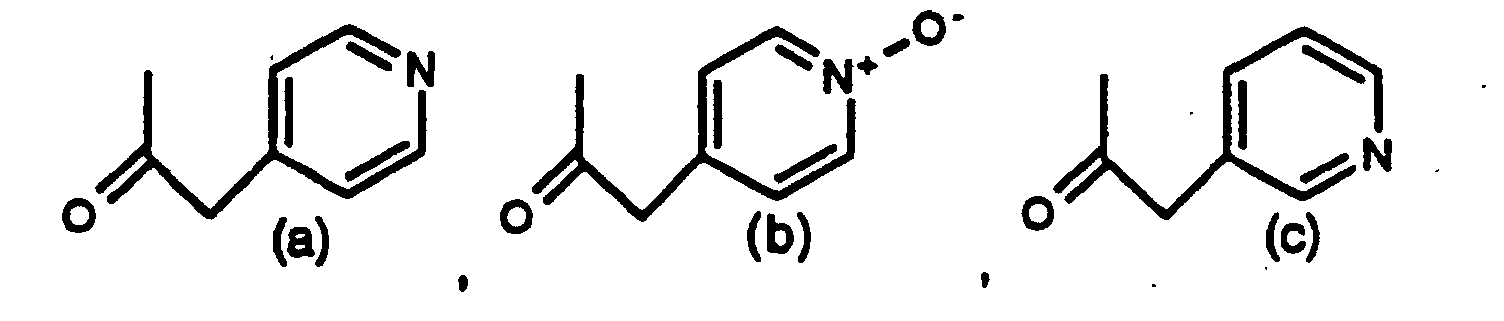
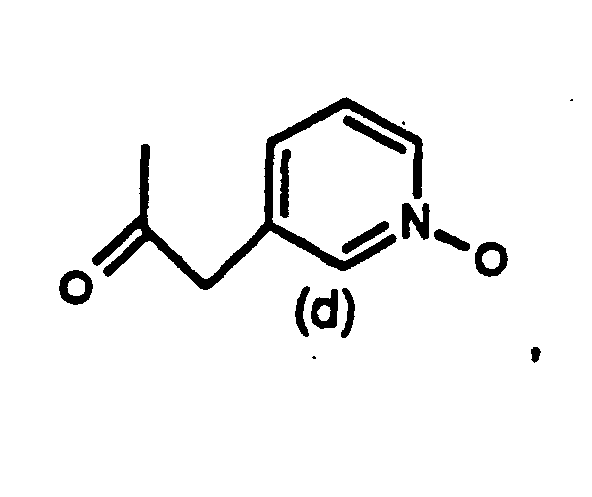

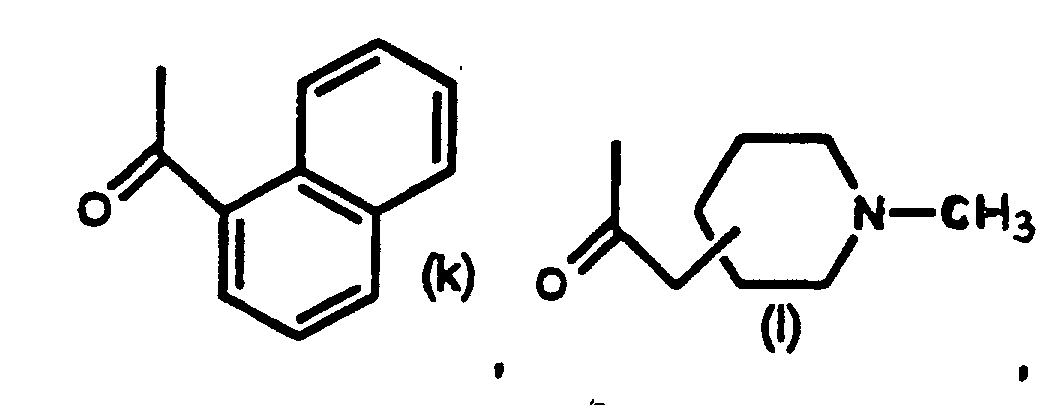


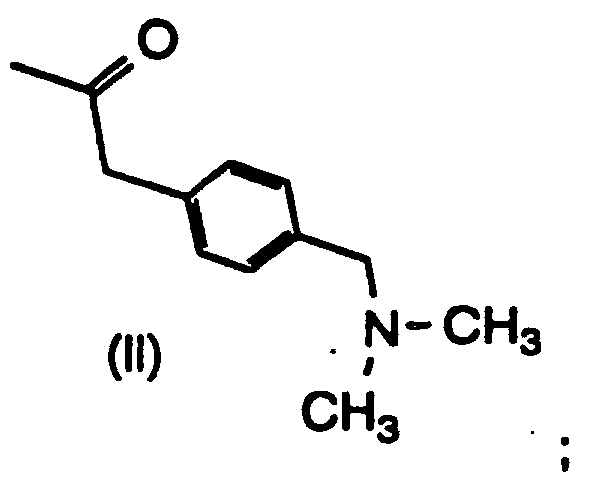
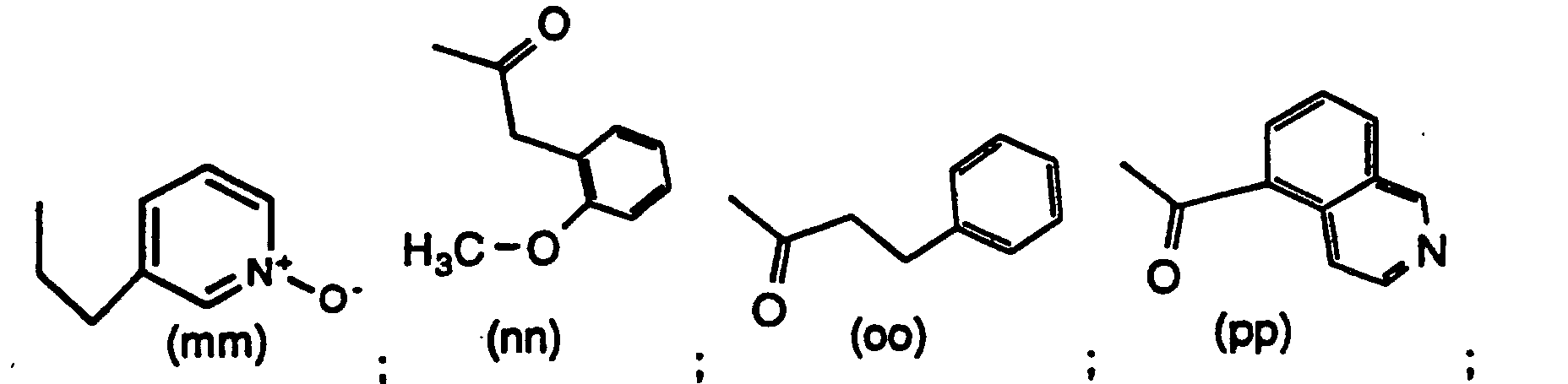

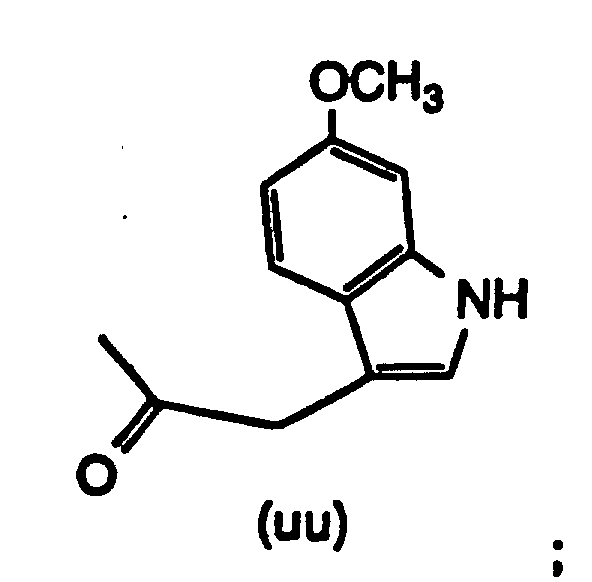
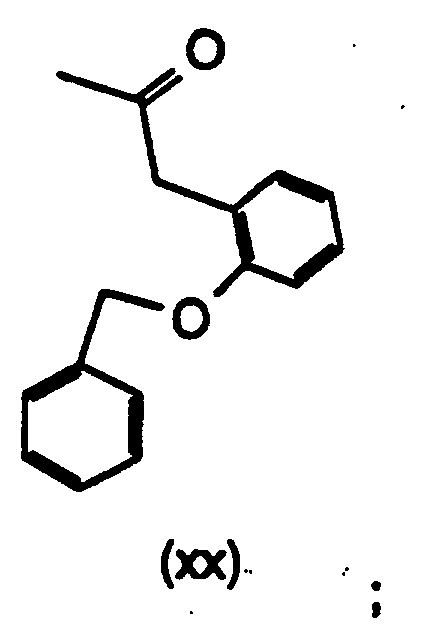

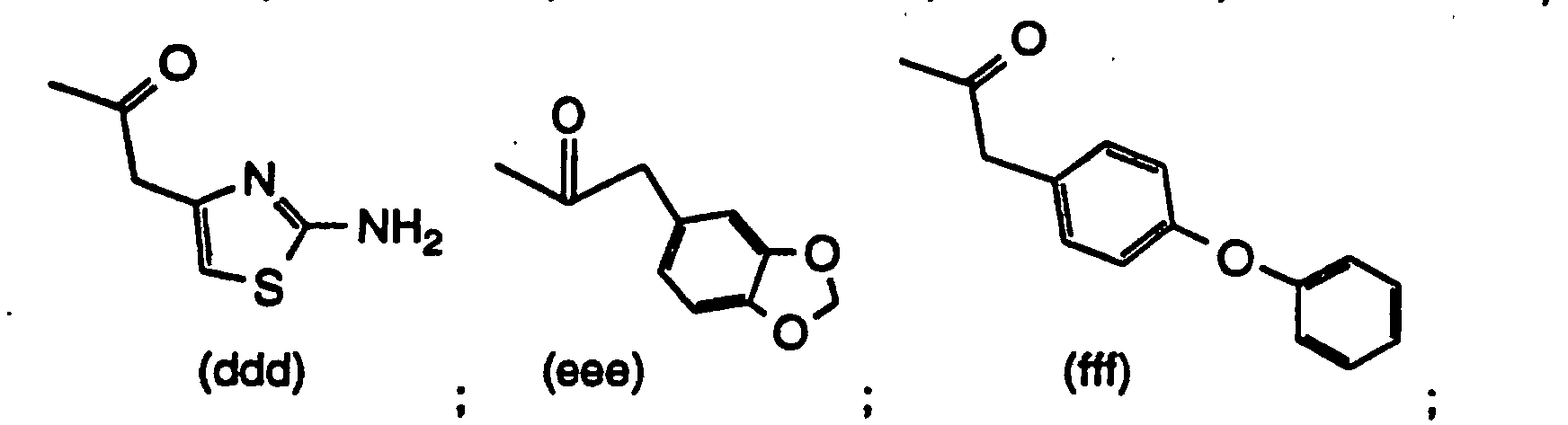
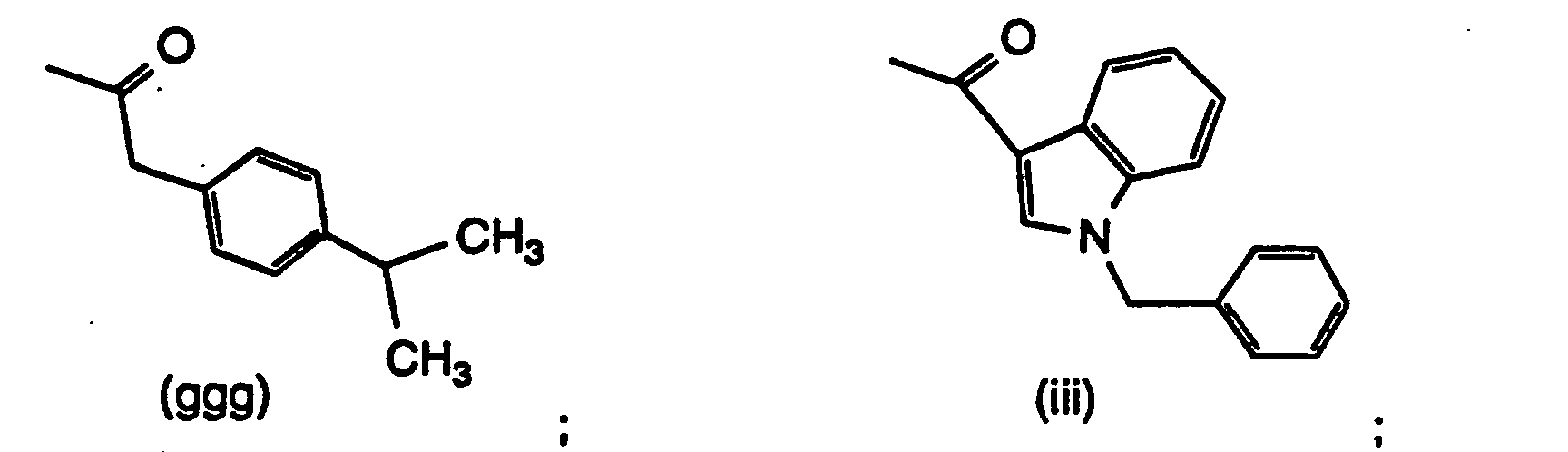
 Representative R2 in compounds (1.0) and (1.1) can include the following.


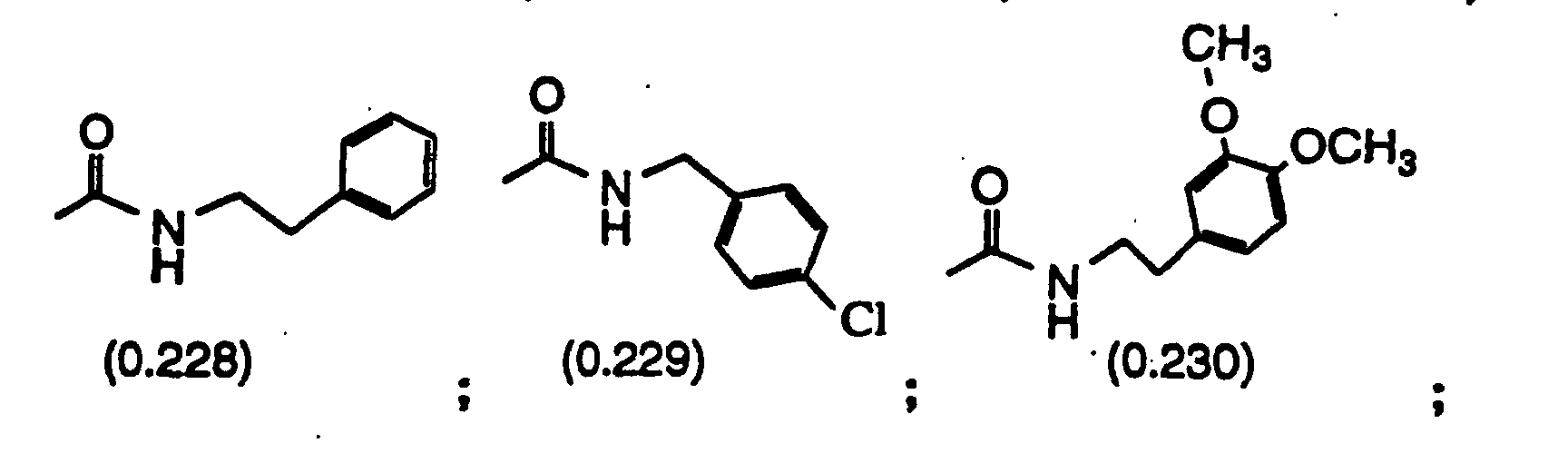


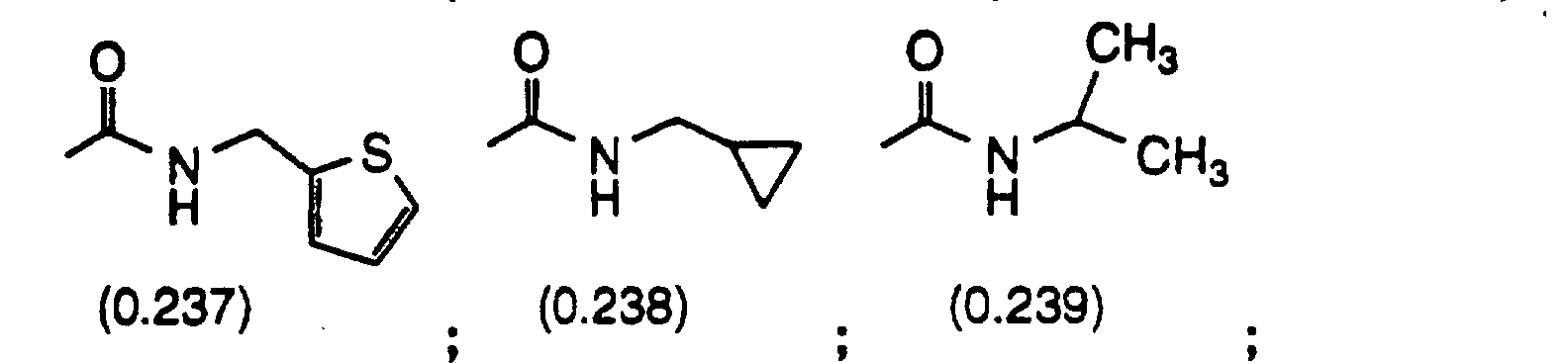


- For preparing pharmaceutical compositions from the compounds described by this invention, inert, pharmaceutically acceptable carriers can be either solid or liquid. Solid form preparations include powders, tablets, dispersible granules, capsules, cachets and suppositories. The powders and tablets may be comprised of from about 5 to about 70 percent active ingredient. Suitable solid carriers are known in the art, e.g. magnesium carbonate, magnesium stearate, talc, sugar, lactose. Tablets, powders, cachets and capsules can be used as solid dosage forms suitable for oral administration.
- For preparing suppositories, a low melting wax such as a mixture of fatty acid glycerides or cocoa butter is first melted, and the active ingredient is dispersed homogeneously therein as by stirring. The molten homogeneous mixture is then poured into convenient sized molds, allowed to cool and thereby solidify.
- Liquid form preparations include solutions, suspensions and emulsions. As an example may be mentioned water or water-propylene glycol solutions for parenteral injection.
- Liquid form preparations may also include solutions for intranasal administration.
- Aerosol preparations suitable for inhalation may include solutions and solids in powder form, which may be in combination with a pharmaceutically acceptable carrier, such as an inert compressed gas.
- Also included are solid form preparations which are intended to be converted, shortly before use, to liquid form preparations for either oral or parenteral administration. Such liquid forms include solutions, suspensions and emulsions.
- The compounds of the invention may also be deliverable orally, or parentally, including the intravenous, intramuscular, intraperitoneal, subcutaneous, rectal, transdermal and topical routes of administration. The transdermal compositions can take the form of creams, lotions, aerosols and/or emulsions and can be included in a transdermal patch of the matrix or reservoir type as are conventional in the art for this purpose. For intramuscular, intraperitoneal, subcutaneous and intravenous use, sterile solutions of the active ingredient are usually prepared, and the pH of the solutions should be suitably adjusted and buffered. For intravenous use, the total concentration of solutes should be controlled in order to render the preparation isotonic.
- Preferably, the pharmaceutical preparation is in unit dosage form. In such form, the preparation is subdivided into unit doses containing appropriate quantities of the active component, e.g., an effective amount to achieve the desired purpose.
- The quantity of active compound in a unit dose of preparation may be varied or adjusted from about 0.1 mg to 1000 mg, more preferably from about 1 mg. to 300 mg, according to the particular application.
- The actual dosage employed may be varied depending upon the requirements of the patient and the severity of the condition being treated. Determination of the proper dosage for a particular situation is within the skill of the art. Generally, treatment is initiated with smaller dosages which are less than the optimum dose of the compound. Thereafter, the dosage is increased by small increments until the optimum effect under the circumstances is reached. For convenience, the total daily dosage may be divided and administered in portions during the day if desired.
- The amount and frequency of administration of the compounds of the invention and the pharmaceutically acceptable salts thereof will be regulated according to the judgment of the attending clinician considering such factors as age, condition and size of the patient as well as severity of the symptoms being treated. A typical recommended dosage regimen is oral administration of from 10 mg to 2000 mg/day preferably 10 to 1000 mg/day, in two to four divided doses to block tumor growth. The compounds are non-toxic when administered within this dosage range.
- The following are examples of pharmaceutical dosage forms which contain a compound of the invention. The scope of the invention in its pharmaceutical composition aspect is not to be limited by the examples provided.
-
No. Ingredients mg/tablet mg/tablet 1. Active compound 100 500 2. Lactose USP 122 113 3. Corn Starch, Food Grade, as a 10% paste in Purified Water 30 40 4. Corn Starch, Food Grade 45 40 5. Magnesium Stearate 3 7 Total 300 700 - Mix Item Nos. 1 and 2 in a suitable mixer for 10-15 minutes. Granulate the mixture with Item No. 3. Mill the damp granules through a coarse screen (e.g., 1/4", 0.63 cm) if necessary. Dry the damp granules. Screen the dried granules if necessary and mix with Item No. 4 and mix for 10-15 minutes. Add Item No. 5 and mix for 1-3 minutes. Compress the mixture to appropriate size and weigh on a suitable tablet machine.
-
No. Ingredient mg/capsule mg/capsule 1. Active compound 100 500 2. Lactose USP 106 123 3. Corn Starch, Food Grade 40 70 4. Magnesium Stearate NF 7 7 Total 253 700 - Mix Item Nos. 1, 2 and 3 in a suitable blender for 10-15 minutes. Add Item No. 4 and mix for 1-3 minutes. Fill the mixture into suitable two-piece hard gelatin capsules on a suitable encapsulating machine.
- Measurements of pharmacological activity of the present compounds can be made based upon a cell-based assay (i.e. FPT lC50), cell mat assay (GGPT lC50) or in vitro tumor activity (Cos Cell lC50) as described by the methods in W095/10516.
- Under the test protocols employed, there were certain compounds within the scope of the present invention which did not exhibit activity. It is believed that such compounds would exhibit activity under a different test protocol. The following compounds exhibited biological activity at concentrations below 10 micromoles (um) using an in vitro assay measuring the inhibition of FTase.


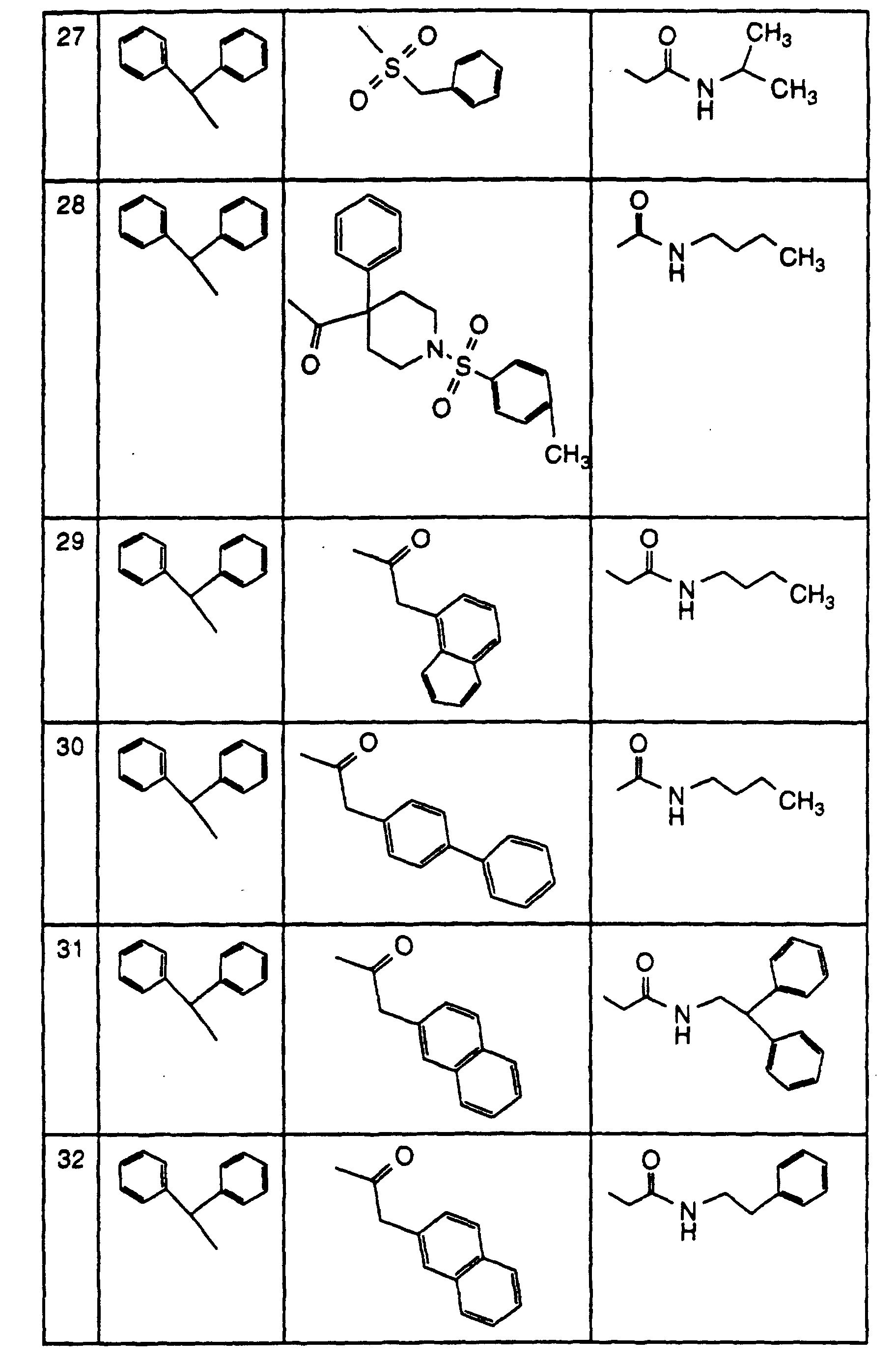

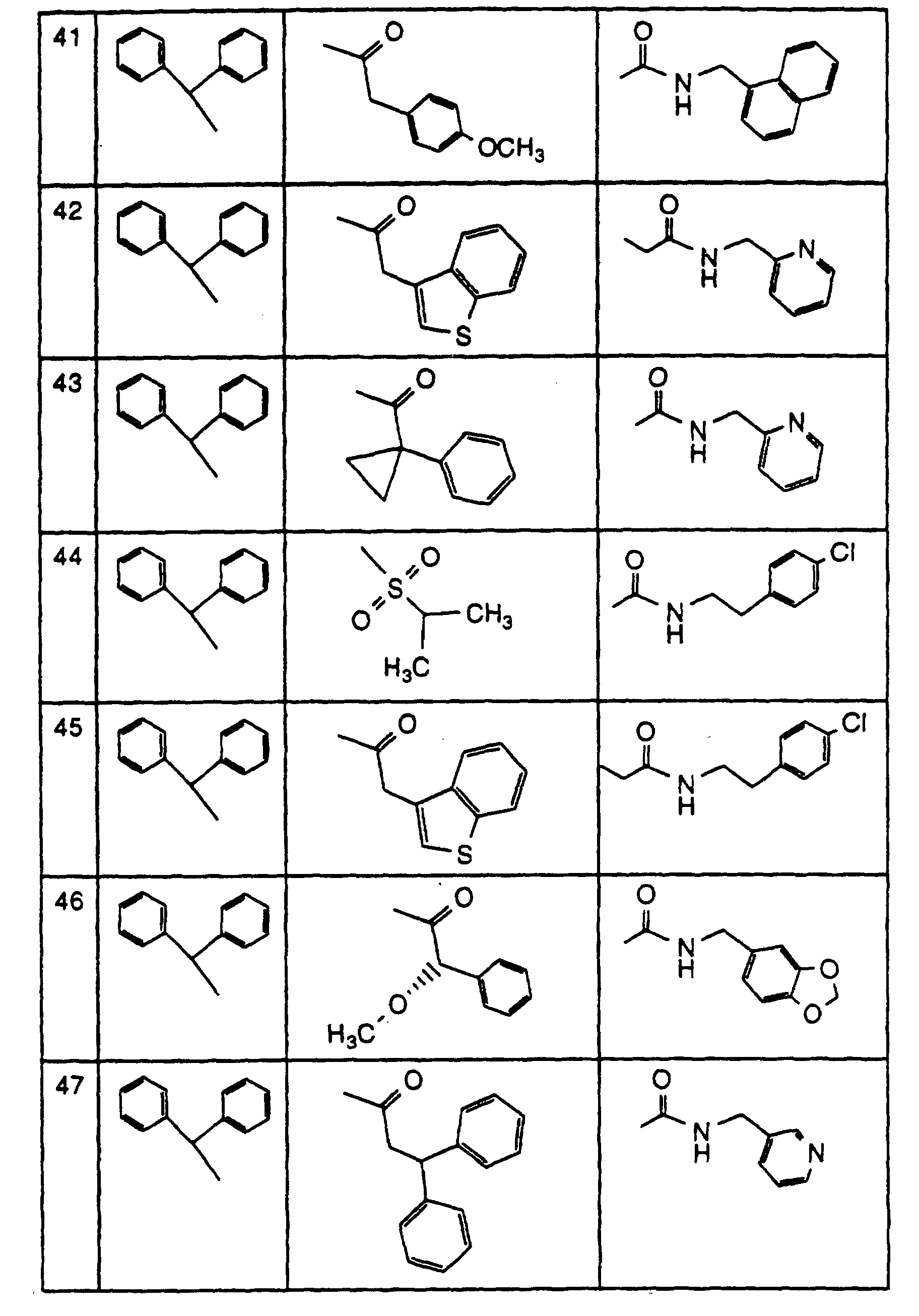


- FPT lC50 values refer to concentration, in micromoles (µM), of compound which inhibits 50% of FPT transferase

H, C1 to C4 alkyl, C3 to C6 cycloalkyl, heteroaryl, heteroarylalkyl, heterocycloalkyl, aryl or aralkyl, and each of said alkyl, cycloalkyl, heteroaryl, heteroarylalkyl, heterocycloalkyl, aryl or aralkyl can be optionally substituted with one to three of the following:
wherein R13 is selected from C1 to C4 alkyl, aryl or aralkyl each as defined below, and
R14 and R15 are independently selected from H, C1 to C4 alkyl or aralkyl; and optionally, when R8 and R9 are bound to the same nitrogen, R8 and R9, together with the nitrogen to which they are bound, can form a 5 to 7 membered heterocycloalkyl ring which may optionally contain O, NR8, S(O)q wherein q is 0, 1 or 2;
with the proviso that R8 is not H in substituents (e) and (f), and with the proviso that R8 or R9 is not -CH2OH or -CH2NR14R15 when R8 or R9 is directly attached to a heteroatom; and
optionally, when R8 and R9 are bound to the same nitrogen, R8 and R9, together with the nitrogen to which they are bound, can form a 5 to 7 membered heterocycloalkyl ring which may optionally contain O, NR8, S(O)q wherein q is 0, 1 or 2;
with the proviso that when X1 is N, then R1 is not

the terms "alkyl" (including alkyl portions of alkoxy, alkylamino and dialkylamino), "substituted alkyl", "aralkyl", "aryl", "substituted aryl", "heteroaryl", "substituted heteroaryl", "heterocycloalkyl" and "substituted heterocycloalkyl" are as defined herein.

heteroarylalkyl - represents an alkyl group, as defined above, wherein one or more hydrogen atoms have been replaced by heteroaryl groups (as defined above);
Claims (9)
- A compound of the formula:or a pharmaceutically acceptable salt or solvate thereof, wherein:
 wherein z is 0, 1, 2, 3 or 4; and said alkyl, alkenyl, or alkynyl group is optionally substituted with one or more groups which can independently represent:(1) Z is a group which is:wherein X1 is CH or N;
X2 can be the same or different and can be CH, N or N-O;
n isO or 1;
R20 is H, Ci-Cg alkyl or halo;(2) R1 is a group which is:wherein
T can be― SO2― or a single bond,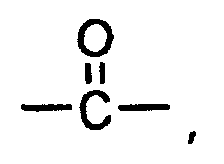
x = 0, 1, 2, 3, 4, 5 or 6,
Ra and Rb independently represent H, phenyl, C1-C6 alkoxy,
or Ra and Rb taken together can represent C3-C6 cycloalkyl, = N-O-(C1-C6)-alkyl orR10 can represent H, substituted or unsubstituted aryl, arylthio, substituted or unsubstituted heteroaryl, each as defined below, or
 (3) R2 is selected from the group which is:C1 to C8 alkyl, C2 to C8 alkenyl, C2 to C8 alkynyl,
 wherein R8 and R9 can independently represent:(a) aryl, aralkyl, heteroaryl, heteroarylalkyl or heterocycloalkyl, wherein each of said aryl, aralkyl, heteroaryl, heteroarylalkyl or heterocycloalkyl group can be optionally substituted with one or more of the following:C1 to C4 alkyl,(CH2)tOR8 wherein t is 0, 1, 2, 3 or 4,(CH2)tNR8R9 wherein t is 0, 1, 2, 3 or 4, orhalogen;(b) C3 to C6 cycloalkyl (c) -OR8; (d) -SR8; (e) -S(O)R8; (f) -SO2R8; (9) -NR8R9;
 (m) ―SO2―NR8R9
 wherein R13 is selected from C1 to C4 alkyl, aryl or aralkyl each as defined below, andH, C1 to C4 alkyl, C3 to C6 cycloalkyl, heteroaryl, heteroarylalkyl, heterocycloalkyl, aryl or aralkyl, and each of said alkyl, cycloalkyl, heteroaryl, heteroarylalkyl, heterocycloalkyl, aryl or aralkyl can be optionally substituted with one to three of the following:C1 to C4 alkoxy, substituted or unsubstituted aryl, aralkyl, substituted or unsubstituted heteroaryl, heteroarylalkyl, substituted or unsubstituted heterocycloalkyl,halogen, -OH, -C(O)R13, -NR14R15;-CONR8R9 or -N(R8)COR13; -CN; C3-C6 cycloalkyl, S(O)qR13;or C3-C10 alkoxyalkoxy wherein q is 0, 1 or 2;
R14 and R15 are independently selected from H, C1 to C4 alkyl or aralkyl;
and optionally, when R8 and R9 are bound to the same nitrogen, R8 and R9, together with the nitrogen to which they are bound, can form a 5 to 7 membered heterocycloalkyl ring which may optionally contain O, NR8, S(O)q wherein q is 0, 1 or 2;
with the proviso that R8 is not H in substituents (e) and (f), and with the proviso that R8 or R9 is not -CH2OH or -CH2NR14R15 when R8 or R9 is directly attached to a heteroatom; and
optionally, when R8 and R9 are bound to the same nitrogen, R8 and R9, together with the nitrogen to which they are bound, can form a 5 to 7 membered heterocycloalkyl ring which may optionally contain O, NR8, S(O)q wherein q is 0, 1 or 2;
with the proviso that when X1 is N, then R1 is notwherein, unless otherwise indicated,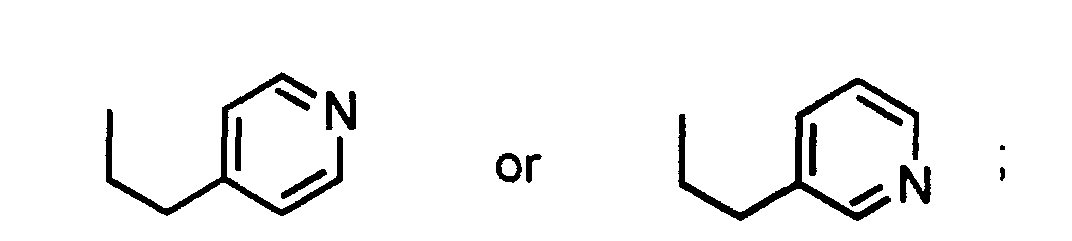
"alkyl" including alkyl portions of alkoxy, alkylamino and dialkylamino, represents unsubstituted straight and branched carbon chains and contain from one to twenty carbon atoms, preferably one to six carbon atoms;
"substituted alkyl" refers to alkyl groups as defined above that are independently substituted with one, two or three of hydroxy, alkyloxy, halo (e.g. CF3), amino, alkylamino, dialkylamino, N-acylalkylamino, N-alkylamino, N-alkyl-N-acylamino, -S(O)m-alkyl wherein m = 1 or 2 and wherein "alkyl" is as defined as above;
"aralkyl" represents an unsubstituted or substituted alkyl group as defined above, wherein one or more hydrogen atoms of the alkyl moiety are replaced by one or more aryl groups as defined below
"aryl", including the aryl portion of aryloxy and aralkyl, represents a carbocyclic group containing from 6 to 15 carbon atoms and having at least one aromatic ring, with all available substitutable carbon atoms of the carbocyclic group being possible points of attachment;
"substituted aryl" refers to aryl groups as defined above, wherein the carbocyclic group is independently substituted with one, two, three or more of halo, C1-C6 alkyl, C1-C6 alkoxy, amino, alkylamino, dialkylamino, aryl, aralkoxy, aryloxy wherein "aryl" and "alkyl" are as defined as above, -NO2, -S(O)m-aryl wherein m = 1 or 2 and "aryl" is as defined herein, an acyl radical, -COOR16 wherein R16 represents H, alkyl, aryl or aralkyl as defined above, or substituted C1-C6 alkyl wherein the alkyl group is substituted with one, two, or three of amino, alkylamino, dialkylamino, aryl, N-acylalkylamino, N-alkyl-N-acylamino, N-aralkyl-N-acylamino, hydroxy, alkyoxy, halo or heterocycloatkyl as herein defined, provided that when there are two or more hydroxy, amino, alkylamino or dialkylamino substituents on the substituted C1-C6 alkyl group, the substituents are on different carbon atoms; or alternatively said aryl group may be fused through adjacent atoms to form a fused ring containing up to four carbon and/or heteroatoms;
"heteroaryl" represents cyclic groups having one, two, or three heteroatoms selected from -O-, -S- or -N-, said heteroatoms interrupting a carbocyclic ring structure and having a sufficient number of delocalized pi electrons to provide aromatic character, with the aromatic heterocyclic groups preferably containing from 2 to 14 carbon atoms, with all available substitutable carbon and heteroatoms of the cyclic group being possible points of attachment;
"substituted heteroaryl" represent heteroaryl groups as defined above wherein the cyclic group is independently substituted with one, two, three or more of halo, alkyl, aryl, aralkyl, heteroaryl, hydroxy, alkyoxy, phenoxy, -NO2, CF3, amino, alkylamino, dialkylamino, and COOR16 wherein R16 represents H, alkyl, aryl or aralkyl as defined above;
"heterocycloalkyl" represents a saturated, branched or unbranched mono-, bi-, or tricyclic carbocyclic rings) containing from 3 to 15 carbon atoms in each ring, preferably from 4 to 6 carbon atoms, wherein at least one carbocyclic ring is interrupted by 1 to 3 heteroatoms selected from -O-, -S- or -N-;
"substituted heterocycloalkyl" represents a heterocycloalkyl group as defined above, wherein any of the available substitutable carbon and nitrogen atoms in the ring are independently substituted with one, two, three or more C1-C6 alkyl, aryl, aralkyl, haloalkyl, amino, alkylamino, dialkylamino or -S(O)m-(substituted or unsubstituted aryl) wherein m = 1 or 2 and "aryl" and "substituted aryl" are as defined as above. - The compound of Claim 1 wherein X1 is N.
- The compound of Claim 1 or Claim 2 wherein R2 isz = 0 or 1, R8 is H and R9 is alkyl, cycloalkyl, aralkyl, heterocycloalkyl or substituted alkyl.

- A pharmaceutical composition for inhibiting the abnormal growth of cells comprising an effective amount of compound of any of Claims 1-3 in combination with a pharmaceutically acceptable carrier.
- Use of a compound of any of Claims 1-3 for the manufacture of a medicament for inhibiting the abnormal growth of cells comprising administering an effective amount of said compound.
- Use according to Claim 5 wherein the cells inhibited are tumor cells expressing an activated ras oncogene.
- Use according to Claim 7 wherein the cells inhibited are pancreatic tumor cells, lung cancer cells, myeloid leukemia tumor cells, thyroid follicular tumor cells, myelodysplastic tumor cells, epidermal carcinoma tumor cells, bladder carcinoma tumor cells or colon tumors cells.
- Use according to Claim 5 wherein the inhibition of the abnormal growth of cells occurs by the inhibition of ras famesyl protein transferase.
- Use according to Claim 5 wherein the inhibition is of tumor cells wherein the Ras protein is activated as a result of oncogenic mutation in genes other than the Ras gene.
Applications Claiming Priority (3)
| Application Number | Priority Date | Filing Date | Title |
|---|---|---|---|
| US41831995A | 1995-04-07 | 1995-04-07 | |
| US418319 | 1995-04-07 | ||
| PCT/US1996/004169 WO1996031501A1 (en) | 1995-04-07 | 1996-04-03 | Carbonyl-piperazinyl and piperidinil compounds which inhibit farnesyl protein transferase |
Publications (2)
| Publication Number | Publication Date |
|---|---|
| EP0820452A1 EP0820452A1 (en) | 1998-01-28 |
| EP0820452B1 true EP0820452B1 (en) | 2003-06-04 |
Family
ID=23657621
Family Applications (1)
| Application Number | Title | Priority Date | Filing Date |
|---|---|---|---|
| EP96911440A Expired - Lifetime EP0820452B1 (en) | 1995-04-07 | 1996-04-03 | Carbonyl-piperazinyl and piperidinil compounds which inhibit farnesyl protein transferase |
Country Status (11)
| Country | Link |
|---|---|
| EP (1) | EP0820452B1 (en) |
| JP (1) | JP3038016B2 (en) |
| AT (1) | ATE242231T1 (en) |
| AU (1) | AU5432696A (en) |
| CA (1) | CA2217351C (en) |
| DE (1) | DE69628559T2 (en) |
| ES (1) | ES2194986T3 (en) |
| IL (1) | IL117805A0 (en) |
| MX (1) | MX9707561A (en) |
| WO (1) | WO1996031501A1 (en) |
| ZA (1) | ZA962694B (en) |
Families Citing this family (89)
| Publication number | Priority date | Publication date | Assignee | Title |
|---|---|---|---|---|
| US5885995A (en) * | 1996-04-03 | 1999-03-23 | Merck & Co., Inc. | Inhibitors of farnesyl-protein transferase |
| US5859015A (en) * | 1996-04-03 | 1999-01-12 | Merck & Co., Inc. | N-heterocyclic piperazinyl and H-heterocyclic piperazinonyl inhibitors of farnesyl-protein transferase |
| US5965578A (en) * | 1996-04-03 | 1999-10-12 | Merck & Co., Inc. | Inhibitors of farnesyl-protein transferase |
| US6001835A (en) * | 1996-04-03 | 1999-12-14 | Merck & Co., Inc. | Inhibitors of farnesyl-protein transferase |
| US5891889A (en) * | 1996-04-03 | 1999-04-06 | Merck & Co., Inc. | Inhibitors of farnesyl-protein transferase |
| US5972942A (en) * | 1997-03-27 | 1999-10-26 | Merck & Co., Inc. | Inhibitors of farnesyl-protein transferase |
| US6127390A (en) * | 1997-10-02 | 2000-10-03 | Merck & Co., Inc. | Inhibitors of prenyl-protein transferase |
| AU760434B2 (en) * | 1999-01-14 | 2003-05-15 | Astellas Pharma Inc. | Amide compounds |
| AUPP818099A0 (en) * | 1999-01-14 | 1999-02-11 | Fujisawa Pharmaceutical Co., Ltd. | New n-containing heterocyclic compounds |
| AU3247700A (en) | 1999-03-03 | 2000-09-21 | Merck & Co., Inc. | Inhibitors of prenyl-protein transferase |
| JP2002538120A (en) | 1999-03-03 | 2002-11-12 | メルク エンド カムパニー インコーポレーテッド | Inhibitors of prenyl protein transferase |
| AU4005300A (en) | 1999-03-03 | 2000-09-21 | Merck & Co., Inc. | Inhibitors of prenyl-protein transferase |
| CA2363169A1 (en) | 1999-03-03 | 2000-09-08 | Merck & Co., Inc. | Inhibitors of prenyl-protein transferase |
| TWI290136B (en) | 2000-04-05 | 2007-11-21 | Daiichi Seiyaku Co | Ethylenediamine derivatives |
| FR2815032B1 (en) * | 2000-10-10 | 2003-08-08 | Pf Medicament | NOVEL AMINOPHENYL PIPERAZINE OR AMINO PHENYL PIPERIDE DERIVATIVES PRENYL TRANSFERASE PROTEIN INHIBITORS AND PREPARATIONS THEREOF |
| WO2003000657A1 (en) | 2001-06-20 | 2003-01-03 | Daiichi Pharmaceutical Co., Ltd. | Diamine derivatives |
| GB0119797D0 (en) | 2001-08-14 | 2001-10-03 | Glaxo Group Ltd | Chemical compounds |
| PE20030705A1 (en) | 2001-10-17 | 2003-08-21 | Schering Corp | 17BETA-HYDROXIESTEROID DEHYDROGENASE TYPE 3 INHIBITORS FOR THE TREATMENT OF ANDROGEN-DEPENDENT DISEASES |
| AR044586A1 (en) * | 2003-06-04 | 2005-09-21 | Aventis Pharma Sa | ARIL PRODUCTS - HETEROAROMATICOS, COMPOSITIONS THAT CONTAIN THEM AND THEIR USE |
| FR2855825B1 (en) * | 2003-06-04 | 2008-08-22 | Aventis Pharma Sa | ARYL-HETEROAROMATIC PRODUCTS, COMPOSITIONS CONTAINING SAME AND USE THEREOF |
| GB0419072D0 (en) | 2004-08-26 | 2004-09-29 | Kudos Pharm Ltd | Phthalazinone derivatives |
| US8362075B2 (en) | 2005-05-17 | 2013-01-29 | Merck Sharp & Dohme Corp. | Cyclohexyl sulphones for treatment of cancer |
| TW200804345A (en) | 2005-08-30 | 2008-01-16 | Novartis Ag | Substituted benzimidazoles and methods of preparation |
| GB0603041D0 (en) | 2006-02-15 | 2006-03-29 | Angeletti P Ist Richerche Bio | Therapeutic compounds |
| DK2010528T3 (en) | 2006-04-19 | 2018-01-15 | Novartis Ag | 6-O-Substituted Benzoxazole and Benzothiazole Compounds and Methods for Inhibiting CSF-1R Signaling |
| JP5363315B2 (en) * | 2006-06-06 | 2013-12-11 | コーナーストーン セラピューティクス インコーポレイテッド | Novel piperazine, pharmaceutical composition, and method of use thereof |
| US7943622B2 (en) | 2006-06-06 | 2011-05-17 | Cornerstone Therapeutics, Inc. | Piperazines, pharmaceutical compositions and methods of use thereof |
| US8173629B2 (en) | 2006-09-22 | 2012-05-08 | Merck Sharp & Dohme Corp. | Method of treatment using fatty acid synthesis inhibitors |
| UY30639A1 (en) * | 2006-10-17 | 2008-05-31 | Kudos Pharm Ltd | SUBSTITUTED DERIVATIVES OF 2H-FTALAZIN-1-ONA, ITS CRYSTAL FORMS, PREPARATION PROCESS AND APPLICATIONS |
| US20110218176A1 (en) | 2006-11-01 | 2011-09-08 | Barbara Brooke Jennings-Spring | Compounds, methods, and treatments for abnormal signaling pathways for prenatal and postnatal development |
| EA016079B1 (en) | 2007-01-10 | 2012-01-30 | Институто Ди Ричерке Ди Биолоджиа Молеколаре П. Анджелетти Спа | Amide substituted indazoles as poly(adp-ribose)polymerase (parp) inhibitors |
| ES2431163T3 (en) | 2007-03-01 | 2013-11-25 | Novartis Ag | PIM kinase inhibitors and methods for use |
| BRPI0812159A2 (en) | 2007-05-21 | 2017-05-02 | Novartis Ag | csf-1r inhibitors, compositions and methods of use |
| AU2008269154B2 (en) | 2007-06-27 | 2014-06-12 | Merck Sharp & Dohme Llc | 4-carboxybenzylamino derivatives as histone deacetylase inhibitors |
| GB0813144D0 (en) | 2008-07-17 | 2008-08-27 | Glaxo Group Ltd | Novel compounds |
| GB0813142D0 (en) | 2008-07-17 | 2008-08-27 | Glaxo Group Ltd | Novel compounds |
| BR122021018683B1 (en) | 2008-10-07 | 2022-11-16 | Kudos Pharmaceuticals Limited | PHARMACEUTICAL FORMULATION OF 4-[3-(4-CYCLOPROPANOCARBONYL-PIPERAZINE-1-CARBONYL)-4-FLUORINE-BENZYL]-2H-PHTHALAZIN-1-ONE, USE OF A MATRIX POLYMER, DOSAGE FORM AND METHOD FOR PRODUCING A SOLID AMORPHAUS DISPERSION |
| WO2010114780A1 (en) | 2009-04-01 | 2010-10-07 | Merck Sharp & Dohme Corp. | Inhibitors of akt activity |
| EP2440058A4 (en) | 2009-06-12 | 2012-11-21 | Dana Farber Cancer Inst Inc | FOUNDED HETEROCYCLIC COMPOUNDS AND USES THEREOF |
| AR077428A1 (en) | 2009-07-29 | 2011-08-24 | Sanofi Aventis | (AZA) INDOLIZINACARBOXAMIDAS ITS PREPARATION AND ITS USE AS PHARMACEUTICAL AGENTS |
| JP5099731B1 (en) | 2009-10-14 | 2012-12-19 | メルク・シャープ・アンド・ドーム・コーポレーション | Substituted piperidines that increase p53 activity and uses thereof |
| EP2937345B1 (en) | 2009-12-29 | 2018-03-21 | Dana-Farber Cancer Institute, Inc. | Type ii raf kinase inhibitors |
| GB201000685D0 (en) | 2010-01-15 | 2010-03-03 | Glaxo Group Ltd | Novel compounds |
| BR112012023021A2 (en) | 2010-03-16 | 2016-05-31 | Dana Farber Cancer Inst Inc | indazole compounds and their uses |
| EP2584903B1 (en) | 2010-06-24 | 2018-10-24 | Merck Sharp & Dohme Corp. | Novel heterocyclic compounds as erk inhibitors |
| AU2011285909B2 (en) | 2010-08-02 | 2016-11-10 | Sirna Therapeutics, Inc. | RNA interference mediated inhibition of catenin (cadherin-associated protein), beta 1 (CTNNB1) gene expression using short interfering nucleic acid (siNA) |
| EP2606134B1 (en) | 2010-08-17 | 2019-04-10 | Sirna Therapeutics, Inc. | RNA INTERFERENCE MEDIATED INHIBITION OF HEPATITIS B VIRUS (HBV) GENE EXPRESSION USING SHORT INTERFERING NUCLEIC ACID (siNA) |
| US8883801B2 (en) | 2010-08-23 | 2014-11-11 | Merck Sharp & Dohme Corp. | Substituted pyrazolo[1,5-a]pyrimidines as mTOR inhibitors |
| EP2613782B1 (en) | 2010-09-01 | 2016-11-02 | Merck Sharp & Dohme Corp. | Indazole derivatives useful as erk inhibitors |
| US9242981B2 (en) | 2010-09-16 | 2016-01-26 | Merck Sharp & Dohme Corp. | Fused pyrazole derivatives as novel ERK inhibitors |
| EP3766975A1 (en) | 2010-10-29 | 2021-01-20 | Sirna Therapeutics, Inc. | Rna interference mediated inhibition of gene expression using short interfering nucleic acid (sina) |
| EP2654748B1 (en) | 2010-12-21 | 2016-07-27 | Merck Sharp & Dohme Corp. | Indazole derivatives useful as erk inhibitors |
| EP2699567A1 (en) | 2011-04-21 | 2014-02-26 | Merck Sharp & Dohme Corp. | Insulin-like growth factor-1 receptor inhibitors |
| WO2013063214A1 (en) | 2011-10-27 | 2013-05-02 | Merck Sharp & Dohme Corp. | Novel compounds that are erk inhibitors |
| WO2013074986A1 (en) | 2011-11-17 | 2013-05-23 | Dana-Farber Cancer Institute, Inc. | Inhibitors of c-jun-n-terminal kinase (jnk) |
| EP3358013B1 (en) | 2012-05-02 | 2020-06-24 | Sirna Therapeutics, Inc. | Short interfering nucleic acid (sina) compositions |
| KR20150060724A (en) | 2012-09-28 | 2015-06-03 | 머크 샤프 앤드 돔 코포레이션 | Novel compounds that are erk inhibitors |
| US10112927B2 (en) | 2012-10-18 | 2018-10-30 | Dana-Farber Cancer Institute, Inc. | Inhibitors of cyclin-dependent kinase 7 (CDK7) |
| US9758522B2 (en) | 2012-10-19 | 2017-09-12 | Dana-Farber Cancer Institute, Inc. | Hydrophobically tagged small molecules as inducers of protein degradation |
| US10000483B2 (en) | 2012-10-19 | 2018-06-19 | Dana-Farber Cancer Institute, Inc. | Bone marrow on X chromosome kinase (BMX) inhibitors and uses thereof |
| DK2925888T3 (en) | 2012-11-28 | 2017-12-18 | Merck Sharp & Dohme | COMPOSITIONS AND METHODS OF CANCER TREATMENT |
| EP2935263B1 (en) | 2012-12-20 | 2018-12-05 | Merck Sharp & Dohme Corp. | Substituted imidazopyridines as hdm2 inhibitors |
| US9540377B2 (en) | 2013-01-30 | 2017-01-10 | Merck Sharp & Dohme Corp. | 2,6,7,8 substituted purines as HDM2 inhibitors |
| WO2015034925A1 (en) | 2013-09-03 | 2015-03-12 | Moderna Therapeutics, Inc. | Circular polynucleotides |
| WO2015058140A1 (en) | 2013-10-18 | 2015-04-23 | Dana-Farber Cancer Institute, Inc. | Polycyclic inhibitors of cyclin-dependent kinase 7 (cdk7) |
| WO2015058126A1 (en) | 2013-10-18 | 2015-04-23 | Syros Pharmaceuticals, Inc. | Heteroaromatic compounds useful for the treatment of prolferative diseases |
| US10017477B2 (en) | 2014-04-23 | 2018-07-10 | Dana-Farber Cancer Institute, Inc. | Janus kinase inhibitors and uses thereof |
| WO2015164604A1 (en) | 2014-04-23 | 2015-10-29 | Dana-Farber Cancer Institute, Inc. | Hydrophobically tagged janus kinase inhibitors and uses thereof |
| JO3589B1 (en) | 2014-08-06 | 2020-07-05 | Novartis Ag | Protein kinase c inhibitors and methods of their use |
| AU2015371251B2 (en) | 2014-12-23 | 2020-06-11 | Dana-Farber Cancer Institute, Inc. | Inhibitors of cyclin-dependent kinase 7 (CDK7) |
| CN107427521B (en) | 2015-03-27 | 2021-08-03 | 达纳-法伯癌症研究所股份有限公司 | Inhibitors of cyclin-dependent kinases |
| EP3307728A4 (en) | 2015-06-12 | 2019-07-17 | Dana Farber Cancer Institute, Inc. | ASSOCIATION THERAPY USING TRANSCRIPTION INHIBITORS AND KINASE INHIBITORS |
| JP7028766B2 (en) | 2015-09-09 | 2022-03-02 | ダナ-ファーバー キャンサー インスティテュート, インコーポレイテッド | Inhibitor of cyclin-dependent kinase |
| EP3371151A4 (en) * | 2015-10-09 | 2019-03-27 | Agency For Science, Technology And Research | COMPOUNDS FOR THE TREATMENT OF CANCER AND EPIGENETICS |
| JOP20190055A1 (en) | 2016-09-26 | 2019-03-24 | Merck Sharp & Dohme | Anti-cd27 antibodies |
| WO2018071283A1 (en) | 2016-10-12 | 2018-04-19 | Merck Sharp & Dohme Corp. | Kdm5 inhibitors |
| WO2018190719A2 (en) | 2017-04-13 | 2018-10-18 | Aduro Biotech Holdings, Europe B.V. | Anti-sirp alpha antibodies |
| US11098059B2 (en) | 2017-11-08 | 2021-08-24 | Merck Sharp & Dohme Corp. | PRMT5 inhibitors |
| WO2019094311A1 (en) | 2017-11-08 | 2019-05-16 | Merck Sharp & Dohme Corp. | Prmt5 inhibitors |
| WO2019148412A1 (en) | 2018-02-01 | 2019-08-08 | Merck Sharp & Dohme Corp. | Anti-pd-1/lag3 bispecific antibodies |
| JP7590185B2 (en) | 2018-06-25 | 2024-11-26 | ダナ-ファーバー キャンサー インスティテュート, インコーポレイテッド | TAIRE FAMILY KINASE INHIBITORS AND USES THEREOF - Patent application |
| BR112021002267A8 (en) | 2018-08-07 | 2023-02-07 | Merck Sharp & Dohme | PRMT5 INHIBITORS |
| WO2020033285A1 (en) | 2018-08-07 | 2020-02-13 | Merck Sharp & Dohme Corp. | Prmt5 inhibitors |
| EP3833668B1 (en) | 2018-08-07 | 2025-03-19 | Merck Sharp & Dohme LLC | Prmt5 inhibitors |
| EP3833667B1 (en) | 2018-08-07 | 2024-03-13 | Merck Sharp & Dohme LLC | Prmt5 inhibitors |
| WO2020140098A1 (en) | 2018-12-28 | 2020-07-02 | Dana-Farber Cancer Institute, Inc. | Inhibitors of cyclin-dependent kinase 7 and uses thereof |
| EP4076460B1 (en) | 2019-12-17 | 2026-01-21 | Merck Sharp & Dohme LLC | 1,4-dihydro-2h-spiro[isoquinoline-3,4'-piperidine derivatives as prmt5 inhibitors for the treatment of cancer |
| BR112022012015A2 (en) | 2019-12-17 | 2022-08-30 | Merck Sharp & Dohme Llc | PRMT5 INHIBITORS |
| JP2026509792A (en) | 2023-03-02 | 2026-03-25 | カルツィムン ビオテック ゲゼルシャフト ミット ベシュレンクテル ハフツング | Means and methods for diagnosing cancer and/or acute inflammatory diseases |
Family Cites Families (3)
| Publication number | Priority date | Publication date | Assignee | Title |
|---|---|---|---|---|
| WO1995000497A1 (en) * | 1993-06-18 | 1995-01-05 | Merck & Co., Inc. | Inhibitors of farnesyl-protein transferase |
| US5576313A (en) * | 1994-08-29 | 1996-11-19 | Merck & Co., Inc. | Inhibitors of farnesyl-protein transferase |
| US5661161A (en) * | 1994-09-29 | 1997-08-26 | Merck & Co., Inc. | Inhibitors of farnesyl-protein transferase |
-
1996
- 1996-04-03 CA CA002217351A patent/CA2217351C/en not_active Expired - Fee Related
- 1996-04-03 WO PCT/US1996/004169 patent/WO1996031501A1/en not_active Ceased
- 1996-04-03 AU AU54326/96A patent/AU5432696A/en not_active Abandoned
- 1996-04-03 MX MX9707561A patent/MX9707561A/en not_active Application Discontinuation
- 1996-04-03 IL IL11780596A patent/IL117805A0/en unknown
- 1996-04-03 DE DE69628559T patent/DE69628559T2/en not_active Expired - Fee Related
- 1996-04-03 EP EP96911440A patent/EP0820452B1/en not_active Expired - Lifetime
- 1996-04-03 ZA ZA962694A patent/ZA962694B/en unknown
- 1996-04-03 JP JP08530361A patent/JP3038016B2/en not_active Expired - Fee Related
- 1996-04-03 ES ES96911440T patent/ES2194986T3/en not_active Expired - Lifetime
- 1996-04-03 AT AT96911440T patent/ATE242231T1/en not_active IP Right Cessation
Also Published As
| Publication number | Publication date |
|---|---|
| WO1996031501A1 (en) | 1996-10-10 |
| DE69628559T2 (en) | 2004-04-29 |
| IL117805A0 (en) | 1996-08-04 |
| CA2217351C (en) | 2003-03-18 |
| EP0820452A1 (en) | 1998-01-28 |
| ES2194986T3 (en) | 2003-12-01 |
| DE69628559D1 (en) | 2003-07-10 |
| JP3038016B2 (en) | 2000-05-08 |
| JPH10511979A (en) | 1998-11-17 |
| AU5432696A (en) | 1996-10-23 |
| MX9707561A (en) | 1997-12-31 |
| ZA962694B (en) | 1996-10-03 |
| ATE242231T1 (en) | 2003-06-15 |
| CA2217351A1 (en) | 1996-10-10 |
Similar Documents
| Publication | Publication Date | Title |
|---|---|---|
| CA2217351C (en) | Carbonyl-piperazinyl and piperidinyl compounds which inhibit farnesyl protein transferase | |
| US6214827B1 (en) | Tricyclic compounds useful for inhibition of G-protein function and for treatment of proliferative diseases | |
| EP0819121B1 (en) | Tricyclic compounds useful for inhibition of g-protein function and for treatment of proliferative diseases | |
| JP2999556B2 (en) | Tricyclic compounds useful for inhibiting farnesyl protein transferase | |
| US5880128A (en) | Carbonyl piperazinyl and piperidinyl compounds | |
| US6432959B1 (en) | Inhibitors of farnesyl-protein transferase | |
| US6239140B1 (en) | Compounds useful for inhibition of farnesyl protein transferase | |
| EP0931078B1 (en) | Novel tricyclic piperidinyl compounds useful as inhibitors of farnesyl-protein transferase | |
| EP0989983B1 (en) | Benzpyrido cycloheptane compounds useful for inhibition of farnesyl protein transferase | |
| WO1996031505A1 (en) | Tricyclic compounds useful for inhibition of g-protein function and for treatment of proliferative diseases | |
| EP0934303B1 (en) | Compounds useful for inhibition of farnesyl protein transferase | |
| US6218401B1 (en) | Phenyl-substituted tricyclic inhibitors of farnesyl-protein transferase | |
| WO1998057947A1 (en) | Tricyclic keto amide derivatives useful as farnesyl protein transferase inhibitors | |
| US5965570A (en) | Tricyclic piperidinyl compounds useful as inhibitors of farnesyl-protein transferase | |
| CA2293372C (en) | Benzo(5,6)cyclohepta(1,2b)pyridine derivatives useful for inhibition of farnesyl protein transferase | |
| US6689789B2 (en) | Compounds useful for inhibition of farnesyl protein transferase | |
| CA2293373C (en) | Benzo(5,6)cyclohepta(1,2b)pyridine derivatives useful for inhibition of farnesyl protein transferase | |
| ES2205255T3 (en) | DERIVATIVES OF BENZOCICLOHEPTAPIRIDINA SUBSTITUTED USEFUL TO INHIBIT THE FARNESIL-PROTEIN-TRANSFERASA. | |
| WO1998057964A1 (en) | Tricyclic compounds useful for inhibition of g-protein function and for treatment of proliferative diseases | |
| HK1002865A1 (en) | Tricyclic compounds useful for inhibition of g-protein function and for treatment of proliferative diseases | |
| HK1002865B (en) | Tricyclic compounds useful for inhibition of g-protein function and for treatment of proliferative diseases | |
| HK1028239B (en) | Benzo(5,6)cyclohepta(1,2b)pyridine derivatives useful for inhibition of farnesyl protein transferase | |
| HK1028238B (en) | Benzo(5,6)cyclohepta(1,2b)pyridine derivatives useful for inhibition of farnesyl protein transferase |
Legal Events
| Date | Code | Title | Description |
|---|---|---|---|
| PUAI | Public reference made under article 153(3) epc to a published international application that has entered the european phase |
Free format text: ORIGINAL CODE: 0009012 |
|
| 17P | Request for examination filed |
Effective date: 19971013 |
|
| AK | Designated contracting states |
Kind code of ref document: A1 Designated state(s): AT BE CH DE DK ES FI FR GB GR IE IT LI LU NL PT SE |
|
| AX | Request for extension of the european patent |
Free format text: LT PAYMENT 971013;LV PAYMENT 971013 |
|
| 17Q | First examination report despatched |
Effective date: 19990504 |
|
| GRAG | Despatch of communication of intention to grant |
Free format text: ORIGINAL CODE: EPIDOS AGRA |
|
| GRAG | Despatch of communication of intention to grant |
Free format text: ORIGINAL CODE: EPIDOS AGRA |
|
| GRAH | Despatch of communication of intention to grant a patent |
Free format text: ORIGINAL CODE: EPIDOS IGRA |
|
| GRAH | Despatch of communication of intention to grant a patent |
Free format text: ORIGINAL CODE: EPIDOS IGRA |
|
| GRAA | (expected) grant |
Free format text: ORIGINAL CODE: 0009210 |
|
| AK | Designated contracting states |
Designated state(s): AT BE CH DE DK ES FI FR GB GR IE IT LI LU NL PT SE |
|
| AX | Request for extension of the european patent |
Extension state: LT LV |
|
| PG25 | Lapsed in a contracting state [announced via postgrant information from national office to epo] |
Ref country code: NL Free format text: LAPSE BECAUSE OF FAILURE TO SUBMIT A TRANSLATION OF THE DESCRIPTION OR TO PAY THE FEE WITHIN THE PRESCRIBED TIME-LIMIT Effective date: 20030604 Ref country code: LI Free format text: LAPSE BECAUSE OF FAILURE TO SUBMIT A TRANSLATION OF THE DESCRIPTION OR TO PAY THE FEE WITHIN THE PRESCRIBED TIME-LIMIT Effective date: 20030604 Ref country code: FI Free format text: LAPSE BECAUSE OF FAILURE TO SUBMIT A TRANSLATION OF THE DESCRIPTION OR TO PAY THE FEE WITHIN THE PRESCRIBED TIME-LIMIT Effective date: 20030604 Ref country code: CH Free format text: LAPSE BECAUSE OF FAILURE TO SUBMIT A TRANSLATION OF THE DESCRIPTION OR TO PAY THE FEE WITHIN THE PRESCRIBED TIME-LIMIT Effective date: 20030604 Ref country code: BE Free format text: LAPSE BECAUSE OF FAILURE TO SUBMIT A TRANSLATION OF THE DESCRIPTION OR TO PAY THE FEE WITHIN THE PRESCRIBED TIME-LIMIT Effective date: 20030604 Ref country code: AT Free format text: LAPSE BECAUSE OF FAILURE TO SUBMIT A TRANSLATION OF THE DESCRIPTION OR TO PAY THE FEE WITHIN THE PRESCRIBED TIME-LIMIT Effective date: 20030604 |
|
| REG | Reference to a national code |
Ref country code: GB Ref legal event code: FG4D |
|
| REG | Reference to a national code |
Ref country code: CH Ref legal event code: EP |
|
| REG | Reference to a national code |
Ref country code: IE Ref legal event code: FG4D |
|
| REF | Corresponds to: |
Ref document number: 69628559 Country of ref document: DE Date of ref document: 20030710 Kind code of ref document: P |
|
| PG25 | Lapsed in a contracting state [announced via postgrant information from national office to epo] |
Ref country code: SE Free format text: LAPSE BECAUSE OF FAILURE TO SUBMIT A TRANSLATION OF THE DESCRIPTION OR TO PAY THE FEE WITHIN THE PRESCRIBED TIME-LIMIT Effective date: 20030904 Ref country code: PT Free format text: LAPSE BECAUSE OF FAILURE TO SUBMIT A TRANSLATION OF THE DESCRIPTION OR TO PAY THE FEE WITHIN THE PRESCRIBED TIME-LIMIT Effective date: 20030904 Ref country code: GR Free format text: LAPSE BECAUSE OF FAILURE TO SUBMIT A TRANSLATION OF THE DESCRIPTION OR TO PAY THE FEE WITHIN THE PRESCRIBED TIME-LIMIT Effective date: 20030904 Ref country code: DK Free format text: LAPSE BECAUSE OF FAILURE TO SUBMIT A TRANSLATION OF THE DESCRIPTION OR TO PAY THE FEE WITHIN THE PRESCRIBED TIME-LIMIT Effective date: 20030904 |
|
| NLV1 | Nl: lapsed or annulled due to failure to fulfill the requirements of art. 29p and 29m of the patents act | ||
| LTIE | Lt: invalidation of european patent or patent extension |
Effective date: 20030604 |
|
| REG | Reference to a national code |
Ref country code: CH Ref legal event code: PL |
|
| PG25 | Lapsed in a contracting state [announced via postgrant information from national office to epo] |
Ref country code: LU Free format text: LAPSE BECAUSE OF NON-PAYMENT OF DUE FEES Effective date: 20040403 |
|
| PG25 | Lapsed in a contracting state [announced via postgrant information from national office to epo] |
Ref country code: IE Free format text: LAPSE BECAUSE OF NON-PAYMENT OF DUE FEES Effective date: 20040405 |
|
| ET | Fr: translation filed | ||
| PLBE | No opposition filed within time limit |
Free format text: ORIGINAL CODE: 0009261 |
|
| STAA | Information on the status of an ep patent application or granted ep patent |
Free format text: STATUS: NO OPPOSITION FILED WITHIN TIME LIMIT |
|
| 26N | No opposition filed |
Effective date: 20040305 |
|
| REG | Reference to a national code |
Ref country code: GB Ref legal event code: 732E |
|
| REG | Reference to a national code |
Ref country code: IE Ref legal event code: MM4A |
|
| REG | Reference to a national code |
Ref country code: ES Ref legal event code: PC2A |
|
| REG | Reference to a national code |
Ref country code: FR Ref legal event code: TQ |
|
| REG | Reference to a national code |
Ref country code: HK Ref legal event code: WD Ref document number: 1008526 Country of ref document: HK |
|
| PGFP | Annual fee paid to national office [announced via postgrant information from national office to epo] |
Ref country code: FR Payment date: 20060403 Year of fee payment: 11 |
|
| PGFP | Annual fee paid to national office [announced via postgrant information from national office to epo] |
Ref country code: ES Payment date: 20060424 Year of fee payment: 11 |
|
| PGFP | Annual fee paid to national office [announced via postgrant information from national office to epo] |
Ref country code: DE Payment date: 20060428 Year of fee payment: 11 |
|
| PGFP | Annual fee paid to national office [announced via postgrant information from national office to epo] |
Ref country code: IT Payment date: 20060430 Year of fee payment: 11 |
|
| GBPC | Gb: european patent ceased through non-payment of renewal fee |
Effective date: 20070403 |
|
| PG25 | Lapsed in a contracting state [announced via postgrant information from national office to epo] |
Ref country code: DE Free format text: LAPSE BECAUSE OF NON-PAYMENT OF DUE FEES Effective date: 20071101 |
|
| PG25 | Lapsed in a contracting state [announced via postgrant information from national office to epo] |
Ref country code: GB Free format text: LAPSE BECAUSE OF NON-PAYMENT OF DUE FEES Effective date: 20070403 |
|
| REG | Reference to a national code |
Ref country code: ES Ref legal event code: FD2A Effective date: 20070404 |
|
| PG25 | Lapsed in a contracting state [announced via postgrant information from national office to epo] |
Ref country code: FR Free format text: LAPSE BECAUSE OF NON-PAYMENT OF DUE FEES Effective date: 20070430 |
|
| PG25 | Lapsed in a contracting state [announced via postgrant information from national office to epo] |
Ref country code: ES Free format text: LAPSE BECAUSE OF NON-PAYMENT OF DUE FEES Effective date: 20070404 |
|
| PGFP | Annual fee paid to national office [announced via postgrant information from national office to epo] |
Ref country code: GB Payment date: 20060314 Year of fee payment: 11 |
|
| PG25 | Lapsed in a contracting state [announced via postgrant information from national office to epo] |
Ref country code: IT Free format text: LAPSE BECAUSE OF NON-PAYMENT OF DUE FEES Effective date: 20070403 |