EP0820440B1 - Novel carbamate compounds having n-substituted thiocarbamoyl group and process for preparing the same - Google Patents
Novel carbamate compounds having n-substituted thiocarbamoyl group and process for preparing the same Download PDFInfo
- Publication number
- EP0820440B1 EP0820440B1 EP96909387A EP96909387A EP0820440B1 EP 0820440 B1 EP0820440 B1 EP 0820440B1 EP 96909387 A EP96909387 A EP 96909387A EP 96909387 A EP96909387 A EP 96909387A EP 0820440 B1 EP0820440 B1 EP 0820440B1
- Authority
- EP
- European Patent Office
- Prior art keywords
- phenyl
- represented
- propanediol
- carbamate
- formula
- Prior art date
- Legal status (The legal status is an assumption and is not a legal conclusion. Google has not performed a legal analysis and makes no representation as to the accuracy of the status listed.)
- Expired - Lifetime
Links
- 0 *CC(C*(N1CCOCC1)=S)c1ccccc1 Chemical compound *CC(C*(N1CCOCC1)=S)c1ccccc1 0.000 description 1
- PBWHJRFXUPLZDS-UHFFFAOYSA-N CCC(CC)c1ccccc1 Chemical compound CCC(CC)c1ccccc1 PBWHJRFXUPLZDS-UHFFFAOYSA-N 0.000 description 1
Classifications
-
- C—CHEMISTRY; METALLURGY
- C07—ORGANIC CHEMISTRY
- C07D—HETEROCYCLIC COMPOUNDS
- C07D295/00—Heterocyclic compounds containing polymethylene-imine rings with at least five ring members, 3-azabicyclo [3.2.2] nonane, piperazine, morpholine or thiomorpholine rings, having only hydrogen atoms directly attached to the ring carbon atoms
- C07D295/16—Heterocyclic compounds containing polymethylene-imine rings with at least five ring members, 3-azabicyclo [3.2.2] nonane, piperazine, morpholine or thiomorpholine rings, having only hydrogen atoms directly attached to the ring carbon atoms acylated on ring nitrogen atoms
- C07D295/20—Heterocyclic compounds containing polymethylene-imine rings with at least five ring members, 3-azabicyclo [3.2.2] nonane, piperazine, morpholine or thiomorpholine rings, having only hydrogen atoms directly attached to the ring carbon atoms acylated on ring nitrogen atoms by radicals derived from carbonic acid, or sulfur or nitrogen analogues thereof
- C07D295/21—Radicals derived from sulfur analogues of carbonic acid
-
- C—CHEMISTRY; METALLURGY
- C07—ORGANIC CHEMISTRY
- C07C—ACYCLIC OR CARBOCYCLIC COMPOUNDS
- C07C333/00—Derivatives of thiocarbamic acids, i.e. compounds containing any of the groups, the nitrogen atom not being part of nitro or nitroso groups
- C07C333/02—Monothiocarbamic acids; Derivatives thereof
-
- C—CHEMISTRY; METALLURGY
- C07—ORGANIC CHEMISTRY
- C07C—ACYCLIC OR CARBOCYCLIC COMPOUNDS
- C07C333/00—Derivatives of thiocarbamic acids, i.e. compounds containing any of the groups, the nitrogen atom not being part of nitro or nitroso groups
- C07C333/02—Monothiocarbamic acids; Derivatives thereof
- C07C333/04—Monothiocarbamic acids; Derivatives thereof having nitrogen atoms of thiocarbamic groups bound to hydrogen atoms or to acyclic carbon atoms
-
- C—CHEMISTRY; METALLURGY
- C07—ORGANIC CHEMISTRY
- C07C—ACYCLIC OR CARBOCYCLIC COMPOUNDS
- C07C333/00—Derivatives of thiocarbamic acids, i.e. compounds containing any of the groups, the nitrogen atom not being part of nitro or nitroso groups
- C07C333/02—Monothiocarbamic acids; Derivatives thereof
- C07C333/06—Monothiocarbamic acids; Derivatives thereof having nitrogen atoms of thiocarbamic groups bound to carbon atoms of rings other than six-membered aromatic rings
-
- C—CHEMISTRY; METALLURGY
- C07—ORGANIC CHEMISTRY
- C07C—ACYCLIC OR CARBOCYCLIC COMPOUNDS
- C07C333/00—Derivatives of thiocarbamic acids, i.e. compounds containing any of the groups, the nitrogen atom not being part of nitro or nitroso groups
- C07C333/02—Monothiocarbamic acids; Derivatives thereof
- C07C333/10—Monothiocarbamic acids; Derivatives thereof having nitrogen atoms of thiocarbamic groups being part of any of the groups, X being a hetero atom, Y being any atom, e.g., N-acyl-thiocarbamates
-
- C—CHEMISTRY; METALLURGY
- C07—ORGANIC CHEMISTRY
- C07C—ACYCLIC OR CARBOCYCLIC COMPOUNDS
- C07C2601/00—Systems containing only non-condensed rings
- C07C2601/02—Systems containing only non-condensed rings with a three-membered ring
Definitions
- the present invention relates to novel carbamate compounds derived from 2-phenyl-1,3-propanediol monocarbamates. More particularly, the present invention relates to 3-N-substituted thiocarbamoyl-2-phenyl-1,3-propanediol carbamate useful to treat the diseases of the central nervous system. Also the present invention is concerned with methods for preparing the same.
- Carbamates have been effectively used for controlling central nervous system (hereinafter referred to as "CNS") disorders, especially as antiepileptics and centrally acting muscle relaxants.
- CNS central nervous system
- 2-methyl-2-propyl-1,3-propanediol dicarbamate was reported in J. Am. Chem. Soc., 73, 5779 (1951), and the pharmaceutical activity thereof was ascertained in J. Pharmacol. Exp. Ther., 104, 229 (1952).
- U.S. Pat. No. 2,884,444 discloses 2-phenyl-1,3-propanediol dicarbamate and U.S. Pat. No. 2,937,119 discloses isopropyl meprobamate. These carbamate compounds are found to be very effective therapeutic medicines against CNS disorders, in particular, as an antiepileptic and a centrally acting muscle relaxant, respectively.
- thiocarbamoyl-introduced carbamates are pharmaceutically very useful in prophylaxis and treatment of CNS disorders, for example, epilepsy, cerebral apoplexy and nervous myalgia.
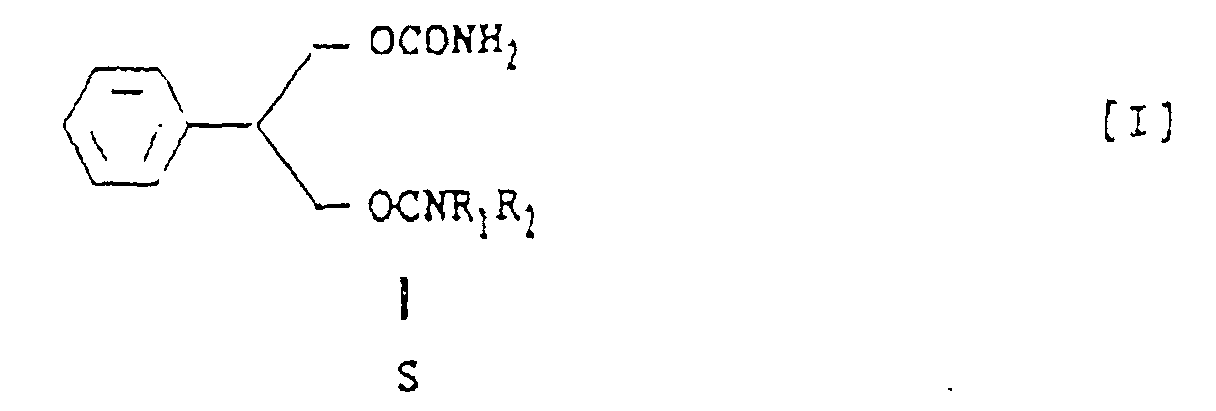
- novel carbamate derivatives that are pharmacologically superior in prophylaxis and treatment of CNS disorders, represented by the following structural formula I: wherein R 1 and R 2 may be the same as or different from each other and are independently selected from the group consisting of hydrogen, lower alkyl containing 1 to 8 carbon atoms, and 5 to 7-membered aliphatic cyclic compounds which may comprise two or less nitrogen or oxygen atoms directly unconnected, with a proviso that R 1 and R 2 both should not be hydrogen and the total number of carbon atom of R 1 and R 2 ranges from 1 to 16.
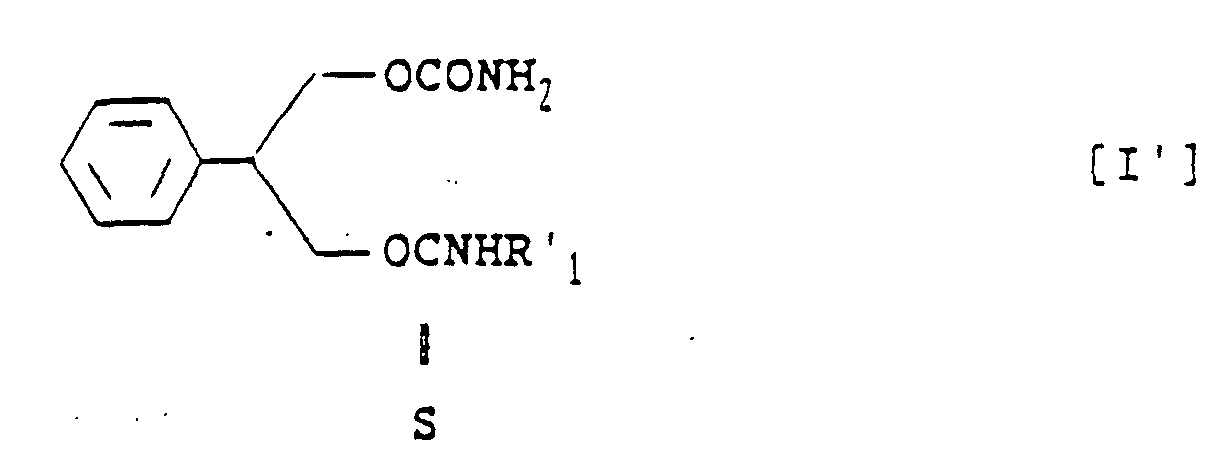
- novel carbamate derivatives that are pharmacologically superior in prophylaxis and treatment of CNS disorders, represented by the following structural formula I': wherein R' 1 is alkyloxy carbonyl containing 1 to 8 carbon atoms, phenyl, flurophenyl or chlorophenyl.
- the compound of structural formula I can be prepared as follows:
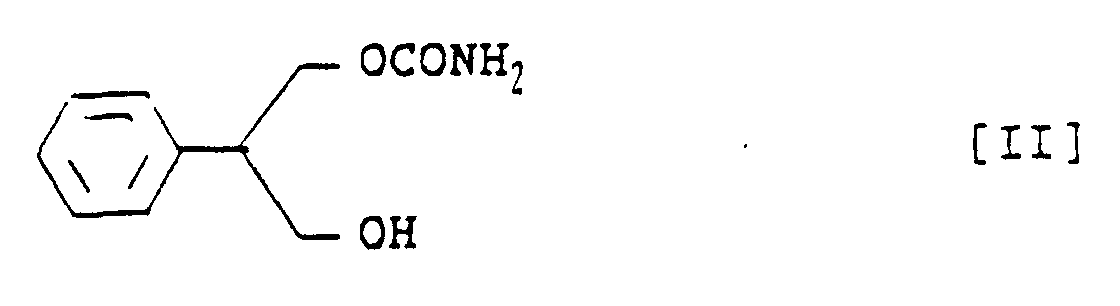
- 2-phenyl-1,3-propanediol monocarbamate represented by the following structural formula II: is first reacted with sodium hydride and carbon disulfide in a solvent. Without separation, the reaction solution is treated with alkyl iodide represented by the following structural formula IV: R 3 I wherein R 3 is a lower alkyl containing 1 to 3 carbon atoms, such as methyl, ethyl and propyl, with preference to methyl, to synthesize 3-(alkyldithiocarbonyl)-2-phenyl-1,3-propanediol carbamate, represented by the following structural formula III: wherein R 3 is as defined above.
- this carbamate is reacted with an amine, represented by the following structural formula V: HNR 1 R 2 wherein R 1 and R 2 may be the same or different from each other and are independently selected from the group consisting of hydrogen, lower alkyl containing 1 to 8 carbon atoms, and 5 to 7-membered aliphatic cyclic compound which may comprise two or less nitrogen or oxygen atoms directly unconnected, with a proviso that R 1 and R 2 both should not be hydrogen and the total number of carbon atoms of R 1 and R 2 ranges from 1 to 16, to give 3-N-substituted thiocarbamoyl-2-phenyl-1,3-propanediol carbamate, represented by the following structural formula I: wherein R 1 and R 2 are as defined above.
- the compound of structural formula II is added with about 1.0 to 2.0 equivalents of sodium hydride and carbon disulfide each.
- This reaction system also comprises the alkyl iodide at an amount of about 1.0 to 2.5 equivalents.
- the synthesis reaction of compound III from compound II is carried out at temperatures of -10 to 30 °C.
- the examples of solvent used in this reaction include amides such as dimethylformamide, sulfoxides such as dimethyl sulfoxide, and ethers such as ethyl ether and tetrahydrofuran, with preference to ethyl ether and tetrahydrofuran.
- the amine is added at an amount of about 1.0 to 5.0 equivalents. This reaction is preferably carried out at temperatures ranging from -10 to 30 °C in an ethereal solvent such as tetrahydrofuran.
- the compound represented by the structural formula II is reacted with isothiocyanate represented by the following structural formula VI: R' 1 NCS wherein R' 1 means an alkyloxy carbonyl containing 1 to 8 carbon atoms or an aryl containing benzene ring, in a solvent, to give 3-N-substituted thiocarbamoyl-2-phenyl-1,3-propanediol carbamate, represented by the following structural formula I': wherein R' 1 is an alkyloxy carbonyl containing 1 to 8 carbon atoms, phenyl, flurophenyl or chlorophenyl.
- Example II The procedure of Example II was repeated using 5.1 ml of isopropyl amine instead of 4.7 ml of 40% aqueous methyl amine solution, to obtain 5.3 g of 3-O-(N-isopropyl) thiocarbamoyl-2-phenyl-1,3-propanediol carbamate: Yield 90%.
- Example II The procedure of Example II was repeated using 4.2 ml of cyclopropyl amine instead of 4.7 ml of 40% aqueous methyl amine solution, to obtain 5.3 g of 3-O-(N-cyclo propyl)thiocarbamoyl-2-phenyl-1,3-propanediol carbamate: Yield 90%.
- Example II The procedure of Example II was repeated using 9.9 ml of octyl amine instead of 4.7 ml of 40% aqueous methyl amine solution, to obtain 7.2 g of 3-O-(N-octyl) thiocarbamoyl-2-phenyl-1,3-propanediol carbamate: Yield 98%.
- Example II The procedure of Example II was repeated using 6.0 ml of piperidine instead of 4.7 ml of 40% aqueous methyl amine solution, to obtain 6.1 g of 3-O-(N-piperidyl)thio carbamoyl-2-phenyl-1,3-propanediol carbamate: Yield 95%.
Landscapes
- Chemical & Material Sciences (AREA)
- Organic Chemistry (AREA)
- Organic Low-Molecular-Weight Compounds And Preparation Thereof (AREA)
- Acyclic And Carbocyclic Compounds In Medicinal Compositions (AREA)
Description
- The present invention relates to novel carbamate compounds derived from 2-phenyl-1,3-propanediol monocarbamates. More particularly, the present invention relates to 3-N-substituted thiocarbamoyl-2-phenyl-1,3-propanediol carbamate useful to treat the diseases of the central nervous system. Also the present invention is concerned with methods for preparing the same.
- Carbamates have been effectively used for controlling central nervous system (hereinafter referred to as "CNS") disorders, especially as antiepileptics and centrally acting muscle relaxants. For example, 2-methyl-2-propyl-1,3-propanediol dicarbamate was reported in J. Am. Chem. Soc., 73, 5779 (1951), and the pharmaceutical activity thereof was ascertained in J. Pharmacol. Exp. Ther., 104, 229 (1952).
- U.S. Pat. No. 2,884,444 discloses 2-phenyl-1,3-propanediol dicarbamate and U.S. Pat. No. 2,937,119 discloses isopropyl meprobamate. These carbamate compounds are found to be very effective therapeutic medicines against CNS disorders, in particular, as an antiepileptic and a centrally acting muscle relaxant, respectively.
- Active research and development efforts have been and continues to be directed to the application of carbamates for CNS disorders.
- As a result of intensive and thorough research for the derivatives of 2-phenyl-1,3-propanediol monocarbamates, the present inventors found that thiocarbamoyl-introduced carbamates are pharmaceutically very useful in prophylaxis and treatment of CNS disorders, for example, epilepsy, cerebral apoplexy and nervous myalgia.
- Accordingly, it is a principal object of the present invention to provide novel N-substituted thiocarbamoyl compounds effective for prophylaxis and treatment of CNS disorders.
- It is another object of the present invention to provide a method for preparing the novel N-substituted thiocarbamoyl compounds.
- In accordance with an aspect of the present invention, there are provided novel carbamate derivatives that are pharmacologically superior in prophylaxis and treatment of CNS disorders, represented by the following structural formula I:wherein R1 and R2 may be the same as or different from each other and are independently selected from the group consisting of hydrogen, lower alkyl containing 1 to 8 carbon atoms, and 5 to 7-membered aliphatic cyclic compounds which may comprise two or less nitrogen or oxygen atoms directly unconnected, with a proviso that R1 and R2 both should not be hydrogen and the total number of carbon atom of R1 and R2 ranges from 1 to 16.
- In accordance with another aspect of the present invention, there are provided novel carbamate derivatives that are pharmacologically superior in prophylaxis and treatment of CNS disorders, represented by the following structural formula I':wherein R'1 is alkyloxy carbonyl containing 1 to 8 carbon atoms, phenyl, flurophenyl or chlorophenyl.
- In accordance with the present invention, the compound of structural formula I can be prepared as follows:
- 2-phenyl-1,3-propanediol monocarbamate, represented by the following structural formula II:is first reacted with sodium hydride and carbon disulfide in a solvent. Without separation, the reaction solution is treated with alkyl iodide represented by the following structural formula IV:
 wherein R3 is as defined above. Then, this carbamate is reacted with an amine, represented by the following structural formula V:
 wherein R1 and R2 are as defined above.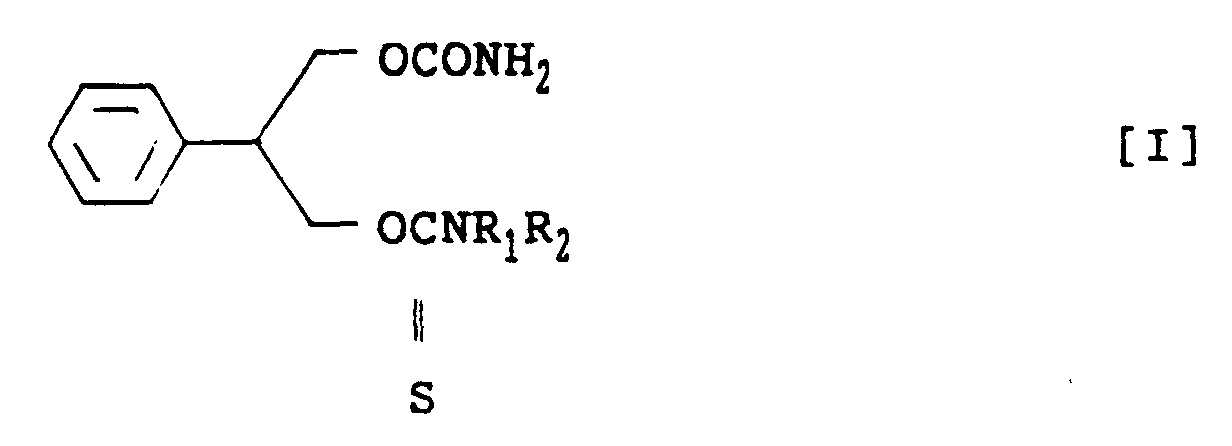
- This pathway is summarized in the following reaction scheme:

- In more detail, about 0.1 to 3.0 moles of the compound of structural formula II, the starting material, is added with about 1.0 to 2.0 equivalents of sodium hydride and carbon disulfide each. This reaction system also comprises the alkyl iodide at an amount of about 1.0 to 2.5 equivalents. The synthesis reaction of compound III from compound II is carried out at temperatures of -10 to 30 °C. The examples of solvent used in this reaction include amides such as dimethylformamide, sulfoxides such as dimethyl sulfoxide, and ethers such as ethyl ether and tetrahydrofuran, with preference to ethyl ether and tetrahydrofuran. When preparing compound I from compound III, the amine is added at an amount of about 1.0 to 5.0 equivalents. This reaction is preferably carried out at temperatures ranging from -10 to 30 °C in an ethereal solvent such as tetrahydrofuran.
- The following compounds, not limitative but illustrative, are those that can be synthesized by the above-mentioned method.

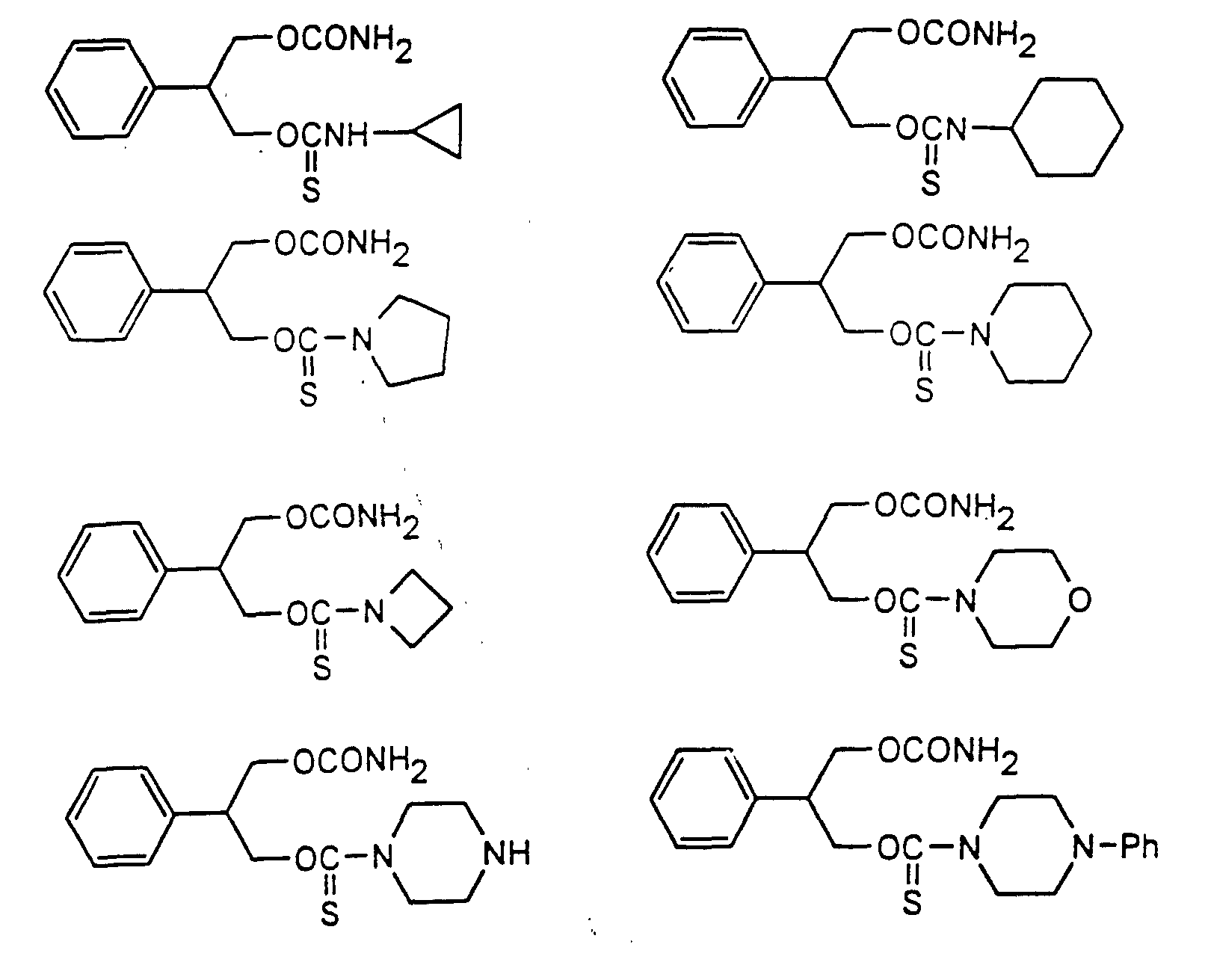
- The following is the method for preparing the compound I' of the present invention.
- The compound represented by the structural formula II, is reacted with isothiocyanate represented by the following structural formula VI:wherein R'1 is an alkyloxy carbonyl containing 1 to 8 carbon atoms, phenyl, flurophenyl or chlorophenyl.

- This pathway is summarized in the following reaction scheme:

- In the above method, about 0.1 to 3.0 moles of compound II are used along with about 1.0 to 2.0 equivalents of isothiocyanate. This reaction is carried out at temperatures ranging from 30 to 110 °C. As a solvent, a halogenated hydrocarbon such as dichloromethane and chloroform, an ethereal solvent such as ethyl ether and tetrahydrofuran, or an aromatic hydrocarbon such as benzene is available with preference to dichloromethane or chloroform.
- The following compounds, not limitative but illustrative, are those that can be prepared through the above method.


- A better understanding of the present invention may be obtained in light of following examples which are set forth to illustrate, but are not to be construed to limit, the present invention.
- 1000 ml flask equipped with a thermometer was well dried and purged by flowing nitrogen gas into the inside thereof to remove moisture and air which might be present therein, and maintained at 0 °C using an ice bath. After 30 min., 10 g of 2-phenyl-1,3-propanediol monocarbamate was dissolved in 250 ml of tetrahydrofuran purified with sodium metal and benzophenone and placed in the flask. A homogeneous solution was made by stirring for 30 min.
- While being maintained at 0 °C, the homogeneous solution was slowly added with 1.4 g of sodium hydride and stirred for 60 min, after which 3.6 ml of carbon disulfide was slowly added using a syringe.
- At about 60 min. after the addition of carbon disulfide, thin layer chromatography revealed that all of the starting material disappeared. Reaction was further proceeded by addition of 3.8 ml of methyl iodide while maintaining the reaction solution at 0 °C. The progress of the reaction was monitored by thin layer chromatography and liquid chromatography. It took about 2 hours to determine the reaction termination.
- Thereafter, the resulting reaction mixture was added with 300 ml of distilled water and 200 ml of ethyl ether, for the purpose of solvent extraction. The organic layer thus obtained was dried over anhydrous magnesium sulfate and the solvent was completely evaporated by a rotary evaporator, to give yellow liquid. This residue was subjected to column chromatography (mobile phase, ethylacetate:n-hexane=1:2) to give 11 g of 3-O-(N-methyl)dithiocarbonyl-2-phenyl-1,3-propanediolcarbamate: Yield 78%.
- 1H-NMR(CDCl3, 200 MHz), ppm (δ):
2.45-2.50(s,3H), 3.45-3.60(q,1H), 4.34-4.39(d,2H),
4.77-4.83(d,2H), 4.86-5.15(br,2H), 7.21-7.39(m,5H) - 1000 ml flask equipped with a thermometer was well dried and purged by flowing nitrogen gas into the inside thereof to remove moisture and air which might be present therein, and maintained at 0 °C using an ice bath. After 30 min., 5.7 g of 3-O-(N-methyl)dithiocarbonyl-2-phenyl-1,3-propanediol carbamate obtained in Example I was dissolved in 200 ml of tetrahydrofuran purified with sodium metal and benzophenone and placed in the flask. A homogeneous solution was made by stirring for 30 min.
- While being maintained at 0 °C, the homogeneous solution was slowly added with 4.7 ml of 40 % methylamine solution in water.
- At about 60 min. after the addition of the aqueous methyl amine solution, the ice bath was removed to proceed the reaction at room temperature. The progress of the reaction was monitored by thin layer chromatography and liquid chromatography. It took about 2 hours to determine the reaction termination.
- Thereafter, the resulting reaction mixture was added with 100 ml of distilled water and 100 ml of ethyl ether, for the purpose of solvent extraction. The organic layer thus obtained was dried over anhydrous magnesium sulfate and the solvent was completely evaporated by a rotary evaporator, to give yellow liquid. This concentrated residue was subjected to column chromatography (mobile phase, ethylacetate:n-hexane=1:1) to obtain 5.1 g of 3-O-(N-methyl)thiocarbamoyl-2-phenyl-1,3-propanediol carbamate: Yield 95%.
- 1H-NMR(CDCl3, 200 MHz), ppm (δ):
2.73-2.78(d,1H), 2.96-3.09(d,2H), 3.32-3.55(m,1H),
4.25-4.39(m,2H), 4.62-4.92(br,2H), 6.41-6.56
(br,1H), 6.92-7.05(br,1H), 7.10-7.38(m,5H) - The procedure of Example II was repeated using 6.8 ml of dimethyl amine instead of 4.7 ml of 40% aqueous methyl amine solution, to obtain 5.5 g of 3-O-(N,N-dimethyl) thiocarbamoyl-2-phenyl-1,3-propanediol carbamate: Yield 97%.
m.p. = 114.5-116 °C - 1H-NMR(CDCl3, 200 MHz), ppm (6):
2.94-3.04(s,3H), 3.28-3.36(s,3H), 3.39-3.51(q,1H),
4.32-4.40(d,2H), 4.63-4.70(d,2H), 4.71-4.83(br,2H),
7.20-7.36(m,5H) - The procedure of Example II was repeated using 5.1 ml of isopropyl amine instead of 4.7 ml of 40% aqueous methyl amine solution, to obtain 5.3 g of 3-O-(N-isopropyl) thiocarbamoyl-2-phenyl-1,3-propanediol carbamate: Yield 90%.
- 1H-NMR(CDCl3, 200 MHz), ppm (6):
1.00-1.13(m,3H), 1.16-1.27(d,3H), 3.38-3.57(m,1H),
3.71-3.90(m,1H), 4.29-4.38(m,2H), 4.51-4.79(m,4H),
6.03-6.10(br,1H), 6.38-6.46(br,1H), 7.18-7.39(m,5H) - The procedure of Example II was repeated using 4.2 ml of cyclopropyl amine instead of 4.7 ml of 40% aqueous methyl amine solution, to obtain 5.3 g of 3-O-(N-cyclo propyl)thiocarbamoyl-2-phenyl-1,3-propanediol carbamate: Yield 90%.
- 1H-NMR(CDCl3, 200 MHz), ppm (δ):
0.46-0.88(m,4h), 2.52-2.66(m,1H), 2.86-2.98(m,3H),
3.34-3.58(m,1H), 4.28-4.44(d,2H), 4.57-4.69(d,2H),
4.70-4.80(br,2H), 6.37-6.43(br,1H), 6.76-6.84 (br,1H), 7.16-7.32(m,5H) - The procedure of Example II was repeated using 9.9 ml of octyl amine instead of 4.7 ml of 40% aqueous methyl amine solution, to obtain 7.2 g of 3-O-(N-octyl) thiocarbamoyl-2-phenyl-1,3-propanediol carbamate: Yield 98%.
- 1H-NMR(CDCl3, 200 MHz), ppm (δ):
0.81-1.65(m,15H), 3.02-3.17(m,1H), 3.35-3.56(m,2H),
4.28-4.39(m,2H), 4.61-4.75(m,4H), 6.22-6.37(br,1H),
6.62-6.76(br,1H), 7.21-7.39(m,5H) - The procedure of Example II was repeated using 6.0 ml of piperidine instead of 4.7 ml of 40% aqueous methyl amine solution, to obtain 6.1 g of 3-O-(N-piperidyl)thio carbamoyl-2-phenyl-1,3-propanediol carbamate: Yield 95%.
- 1H-NMR(CDCl3, 200 MHz), ppm (δ):
1.34-1.68(m,6H), 3.39-3.57(m,3H), 3.88-4.06(br,2H),
4.28-4.41(d,2H), 4.53-4.64(br,2H), 4.64-4.75(d,2H),
7.17-7.34(m,5H) - 1000 ml flask equipped with a thermometer and a reflux condenser was well dried and purged by flowing nitrogen gas into the inside thereof for 30 min, to remove moisture and air which might be present therein. Then, 19.5 g of 2-phenyl-1,3-propanediol monocarbamate was dissolved in 300 ml of purified dichloromethane and placed in the flask. A homogeneous solution was made by stirring for 30 min.
- While being maintained at room temperature, the homogeneous solution was slowly added with 15.7 g of ethoxycarbonyl isothiocyanate using a syringe. Thereafter, temperature was slowly elevated to 40 °C at which the reaction was advanced with stirring. The progress of the reaction was monitored by thin layer chromatography and liquid chromatography. It took about 4 hours to determine the reaction termination.
- Thereafter, the resulting reaction mixture was added with 200 ml of distilled water, for the purpose of solvent extraction. The organic layer thus obtained was dried over anhydrous magnesium sulfate and the solvent was completely evaporated by a rotary evaporator, to give yellow liquid. This residue was subjected to column chromatography (mobile phase, ethylacetate:n-hexane=1:1) to give 26.1 g of 3-O-(N-ethoxycarbonyl)thiocarbamoyl-2-phenyl-1,3-propanediol carbamate: Yield 80%.
- 1H-NMR(CDCl3, 200 MHz), ppm (δ):
1.15-1.28(t,3H), 3.38-3.50(m,1H), 4.11-4.20(q,2H),
4.35-4.44(d,2H), 4.60-4.81(m,2H), 4.95-5.07(br,2H),
7.15-7.42(m,5H), 8.80-8.88(br,1H). - The present invention has been described in an illustrative manner, and it is to be understood the terminology used is intended to be in the nature of description rather than of limitation.
- Many modifications and variations of the present invention are possible in light of the above teachings. Therefore, it is to be understood that within the scope of the appended claims, the invention may be practiced otherwise than as specifically described.
Claims (15)
- 3-N-Substituted thiocarbamoyl-2-phenyl-1,3-propanediol carbamate, represented by the following structural formula I:wherein R1 and R2 may be the same or different from each other and are independently selected from the group consisting of hydrogen, lower alkyl containing 1 to 8 carbon atoms and 5 to 7-membered aliphatic cyclic compound which may comprise two or less nitrogen or oxygen atoms directly unconnected, with a proviso that R1 and R2 both should not be hydrogen and the total number of carbon atoms of R1 and R2 ranges from 1 to 16.

- A method for preparing 3-N-substituted thiocarbamoyl-2-phenyl-1,3-propanediol carbamate, represented by the following structural formula I:wherein R1 and R2 may be the same or different from each other and are independently selected from the group consisting of hydrogen, lower alkyl containing 1 to 8 carbon atoms and 5 to 7-membered aliphatic cyclic compound which may comprise two or less nitrogen or oxygen atoms directly unconnected, with a proviso that R1 and R2 both should not be hydrogen and the total number of carbon atoms of R1 and R2 ranges from 1 to 16, comprising the steps of:
 wherein R3 is a lower alkyl containing 1 to 3 carbon atoms, to synthesize 3-(alkyldithiocarbonyl)-2-phenyl-1,3-propanediol carbamate, represented by the following structural formula III:reacting 2-phenyl-1,3-propanediol monocarbamate, represented by the following structural formula II;with sodium hydride and carbon disulfide in a solvent;
 without separation thereof, treating the reaction solution with alkyl iodide, represented by the following structural formula IV;wherein R3 is as defined above; and
subjecting the carbamate of structural formula III to reaction with an amine, represented by the following formula V: - The method in accordance with claim 2, wherein R3 is methyl.
- 3-N-Substituted thiocarbamoyl-2-phenyl-1,3-propanediol carbamate, represented by the following structural formula I':wherein R'1 is an alkyloxy carbonyl containing 1 to 8 carbon atoms, phenyl, fluorophenyl or chlorophenyl.
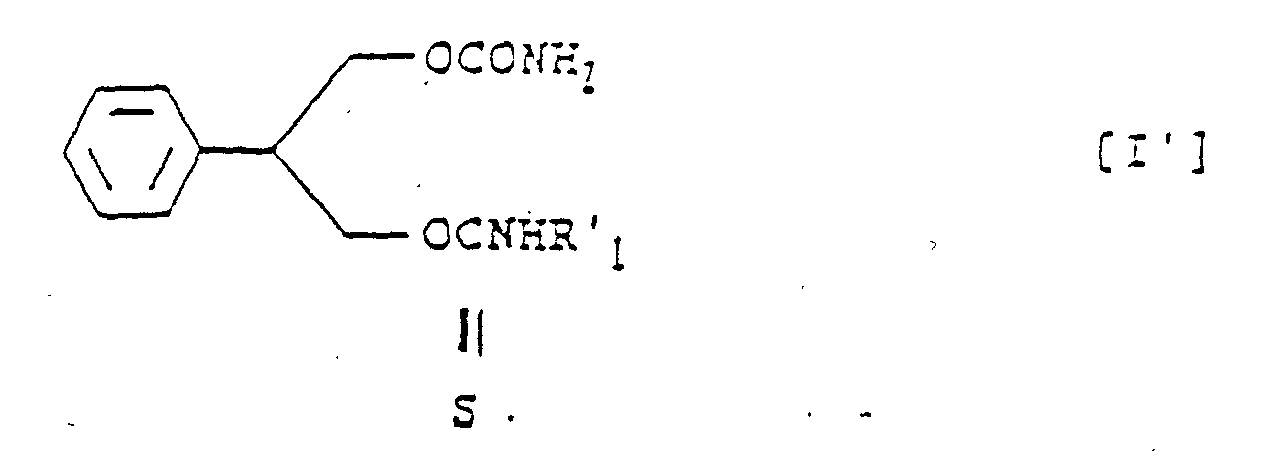
- The method for preparing 3-N-substituted thiocarbamlyl-2-phenyl-1,3-propanediol carbamate, represented by the following structural formula I':wherein R'1 is an alkyloxycarbonyl containing 1 to 8 carbon atoms or phenyl flurophenyl or chlorophenyl, comprising the reaction of 2-phenyl-1,3-propanediol monocarbamate, represented by the following structural formula II:
 with alkyloxy carbonyl isothiocyanate, represented by the following structural formula VI:
- 3-N-substituted thiocarbamoyl-2-phenyl-1,3-propanediol carbamate, represented by the structural formula;
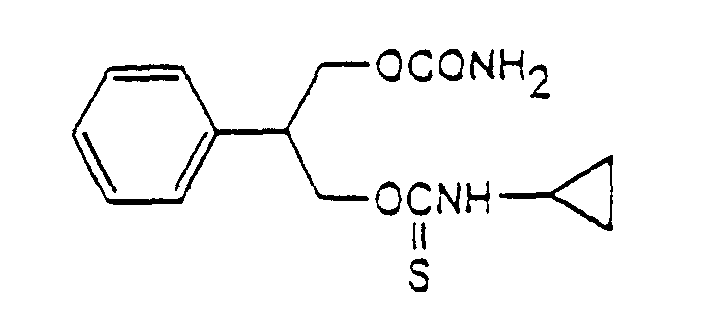
- 3-N-substituted thiocarbamoyl-2-phenyl-1,3-propanediol carbamate, represented by the structured formula ;

- 3-N-substituted thiocarbamoyl-2-phenyl-1,3-propanediol carbamate, represented by the structured formula ;

- 3-N-substituted thiocarbamoyl-2-phenyl-1,3-propanediol carbamate, represented by the structured formula ;
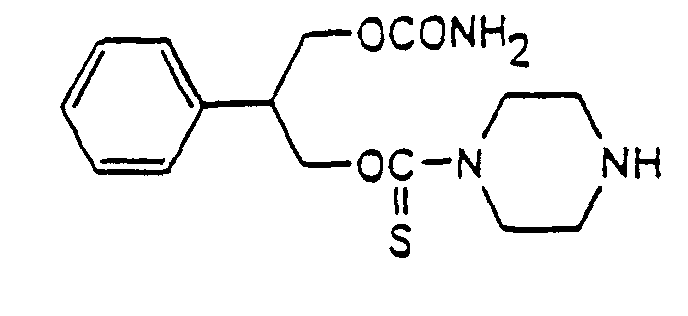
- 3-N-substituted thiocarbamoyl-2-phenyl-1,3-propanediol carbamate, represented by the structured formula ;
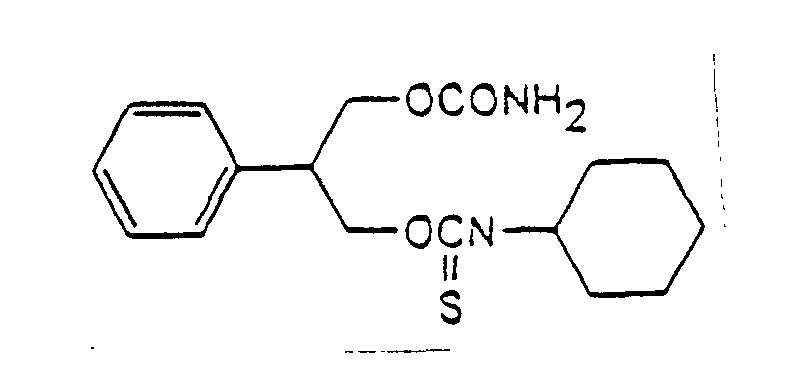
- 3-N-substituted thiocarbamoyl-2-phenyl-1,3-propanediol carbamate,represented by the structured formula ;
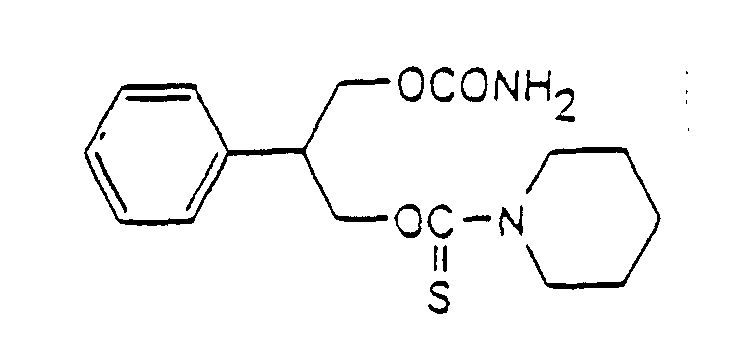
- 3-N-substituted thiocarbamoyl-2-phenyl-1,3-propanediol carbamate, represented by the structured formula ;

- 3-N-substituted thiocarbamoyl-2-phenyl-1,3-propanediol carbamate, represented by the structured formula ;
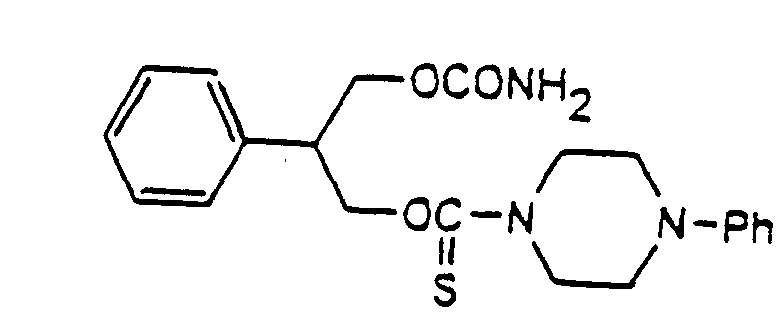
- A pharmaceutical composition for treating disorders of the central nervous system which comprises as an active ingredient an effective amount for treating disorders of the central nervous system of a compound of Formula (I) as defined in claim 1 or Formula (I') as defined in claim 4 or a compound as defined in any one of claims 6-13 and a pharmaceutically acceptable carrier.
- The composition of claim 14, wherein the CNS disorder being treated is selected from the group consisting of epilepsy, cerebral apoplexy and nervous myalgia.
Applications Claiming Priority (3)
| Application Number | Priority Date | Filing Date | Title |
|---|---|---|---|
| KR9508309 | 1995-04-10 | ||
| KR1019950008309A KR0173861B1 (en) | 1995-04-10 | 1995-04-10 | Novel carbamate compounds comprising N-substituted thiocarbamoyl groups and methods for their preparation |
| PCT/KR1996/000050 WO1996032378A1 (en) | 1995-04-10 | 1996-04-10 | Novel carbamate compounds having n-substituted thiocarbamoyl group and process for preparing the same |
Publications (2)
| Publication Number | Publication Date |
|---|---|
| EP0820440A1 EP0820440A1 (en) | 1998-01-28 |
| EP0820440B1 true EP0820440B1 (en) | 2001-08-29 |
Family
ID=19411863
Family Applications (1)
| Application Number | Title | Priority Date | Filing Date |
|---|---|---|---|
| EP96909387A Expired - Lifetime EP0820440B1 (en) | 1995-04-10 | 1996-04-10 | Novel carbamate compounds having n-substituted thiocarbamoyl group and process for preparing the same |
Country Status (10)
| Country | Link |
|---|---|
| US (1) | US5817858A (en) |
| EP (1) | EP0820440B1 (en) |
| JP (1) | JPH11503446A (en) |
| KR (1) | KR0173861B1 (en) |
| CN (2) | CN1070851C (en) |
| CA (1) | CA2217758A1 (en) |
| DE (1) | DE69614842T2 (en) |
| DK (1) | DK0820440T3 (en) |
| ES (1) | ES2163010T3 (en) |
| WO (1) | WO1996032378A1 (en) |
Families Citing this family (2)
| Publication number | Priority date | Publication date | Assignee | Title |
|---|---|---|---|---|
| CN1160329C (en) * | 1999-02-05 | 2004-08-04 | Sk株式会社 | O-thiocarbamoyl-aminoalkanol compounds, pharmaceutically acceptable salts thereof and process for preparing the same |
| CN113214200B (en) * | 2021-05-26 | 2022-03-29 | 神隆医药(常熟)有限公司 | Method for preparing vilazodone intermediate through copper catalytic coupling reaction |
Family Cites Families (1)
| Publication number | Priority date | Publication date | Assignee | Title |
|---|---|---|---|---|
| US2937199A (en) * | 1957-09-12 | 1960-05-17 | Hercules Powder Co Ltd | Treating protein hydrolysates |
-
1995
- 1995-04-10 KR KR1019950008309A patent/KR0173861B1/en not_active Expired - Fee Related
-
1996
- 1996-04-09 US US08/629,619 patent/US5817858A/en not_active Expired - Fee Related
- 1996-04-10 DK DK96909387T patent/DK0820440T3/en active
- 1996-04-10 DE DE69614842T patent/DE69614842T2/en not_active Expired - Fee Related
- 1996-04-10 EP EP96909387A patent/EP0820440B1/en not_active Expired - Lifetime
- 1996-04-10 JP JP8530904A patent/JPH11503446A/en not_active Ceased
- 1996-04-10 ES ES96909387T patent/ES2163010T3/en not_active Expired - Lifetime
- 1996-04-10 CA CA002217758A patent/CA2217758A1/en not_active Abandoned
- 1996-04-10 CN CN96193143A patent/CN1070851C/en not_active Expired - Fee Related
- 1996-04-10 WO PCT/KR1996/000050 patent/WO1996032378A1/en not_active Ceased
-
2001
- 2001-01-17 CN CNB011016078A patent/CN1171869C/en not_active Expired - Fee Related
Also Published As
| Publication number | Publication date |
|---|---|
| CN1171869C (en) | 2004-10-20 |
| DK0820440T3 (en) | 2001-12-17 |
| US5817858A (en) | 1998-10-06 |
| ES2163010T3 (en) | 2002-01-16 |
| JPH11503446A (en) | 1999-03-26 |
| KR0173861B1 (en) | 1999-04-01 |
| CA2217758A1 (en) | 1996-10-17 |
| DE69614842T2 (en) | 2002-04-11 |
| DE69614842D1 (en) | 2001-10-04 |
| CN1070851C (en) | 2001-09-12 |
| EP0820440A1 (en) | 1998-01-28 |
| CN1335305A (en) | 2002-02-13 |
| WO1996032378A1 (en) | 1996-10-17 |
| KR960037653A (en) | 1996-11-19 |
| CN1181067A (en) | 1998-05-06 |
Similar Documents
| Publication | Publication Date | Title |
|---|---|---|
| CA2212326C (en) | O-carbamoyl-(d)-phenylalanilol compounds and process for preparing the same | |
| US5756817A (en) | O-carbamoyl-phenylalaninol compounds, their pharmaceutically useful salts and process for preparing the same | |
| US6140532A (en) | O-carbamoyl-phenylalaninol having substituent at benzene ring, its pharmaceutically useful salts and method for preparing the same | |
| AU645935B2 (en) | Production of fluoxetine and new intermediates | |
| KR20060126965A (en) | Process for preparing O-carbamoyl compound in the presence of active amine group | |
| EP0873308A1 (en) | O-carbamoyl-phenylalaninol compounds, their pharmaceutically useful salts and process for preparing the same | |
| DE69128477T2 (en) | BENZOPYRANDERIVAT | |
| RU2044737C1 (en) | Derivatives of 2,3-dihydropyrano[2,3-b]pyridine or their salt, method of synthesis of 2-aminomethyl-2,3-dihydropyrano[2,3-b]pyridine as parental substance for synthesis of derivatives of 2,3-dihydropyrano[2,3-b]pyridine and a method of its synthesis | |
| US5817858A (en) | Carbamate compounds having N-substituted thiocarbamoyl group and process for preparing the same | |
| JP3180192B2 (en) | Dithiocarbamic acid salts, method for producing the same, and method for producing isothiocyanates using the dithiocarbamic acid salts | |
| EA003022B1 (en) | Process for the synthesis of hiv protease inhibitors | |
| FR2559766A1 (en) | PROCESS FOR THE PREPARATION OF CARBAMIC ACID DERIVATIVES | |
| US6235899B1 (en) | Method for preparing alkyloxy furanone derivatives, compounds obtained by said method and use of said compounds | |
| EP0155862B1 (en) | Process for the preparation of carbamic acid esters derivatives | |
| US5654461A (en) | Sulfamate compound containing carbamoyl group | |
| KR100576372B1 (en) | O-thiocarbamoyl-aminoalkanol compounds, pharmaceutically acceptable salts and preparation methods thereof | |
| JP4443771B2 (en) | O-thiocarbamoyl-aminoalkanol compound, pharmaceutically acceptable salts thereof, and production method thereof | |
| CA2504039A1 (en) | Continuous process for the preparation of fructopyranose sulfamate derivatives | |
| KR0150289B1 (en) | Novel carbamate compounds containing imidocarbonate group and process for preparing the same | |
| EA003088B1 (en) | Synthesis of thiophene derivatives | |
| EP0971916A1 (en) | N-(arginyl)benzenesulphonamide derivatives and use thereof as antithrombotic agents | |
| KR20000069552A (en) | Process for the Preparation of NMDA Antagonists |
Legal Events
| Date | Code | Title | Description |
|---|---|---|---|
| PUAI | Public reference made under article 153(3) epc to a published international application that has entered the european phase |
Free format text: ORIGINAL CODE: 0009012 |
|
| 17P | Request for examination filed |
Effective date: 19971028 |
|
| AK | Designated contracting states |
Kind code of ref document: A1 Designated state(s): BE CH DE DK ES FR GB IT LI NL SE |
|
| 17Q | First examination report despatched |
Effective date: 19990329 |
|
| GRAG | Despatch of communication of intention to grant |
Free format text: ORIGINAL CODE: EPIDOS AGRA |
|
| GRAG | Despatch of communication of intention to grant |
Free format text: ORIGINAL CODE: EPIDOS AGRA |
|
| GRAH | Despatch of communication of intention to grant a patent |
Free format text: ORIGINAL CODE: EPIDOS IGRA |
|
| RAP1 | Party data changed (applicant data changed or rights of an application transferred) |
Owner name: SK CORPORATION |
|
| GRAH | Despatch of communication of intention to grant a patent |
Free format text: ORIGINAL CODE: EPIDOS IGRA |
|
| GRAA | (expected) grant |
Free format text: ORIGINAL CODE: 0009210 |
|
| AK | Designated contracting states |
Kind code of ref document: B1 Designated state(s): BE CH DE DK ES FR GB IT LI NL SE |
|
| REG | Reference to a national code |
Ref country code: CH Ref legal event code: EP |
|
| REF | Corresponds to: |
Ref document number: 69614842 Country of ref document: DE Date of ref document: 20011004 |
|
| REG | Reference to a national code |
Ref country code: CH Ref legal event code: NV Representative=s name: MOINAS & SAVOYE SA |
|
| REG | Reference to a national code |
Ref country code: GB Ref legal event code: IF02 |
|
| REG | Reference to a national code |
Ref country code: ES Ref legal event code: FG2A Ref document number: 2163010 Country of ref document: ES Kind code of ref document: T3 |
|
| ET | Fr: translation filed | ||
| PLBE | No opposition filed within time limit |
Free format text: ORIGINAL CODE: 0009261 |
|
| STAA | Information on the status of an ep patent application or granted ep patent |
Free format text: STATUS: NO OPPOSITION FILED WITHIN TIME LIMIT |
|
| 26N | No opposition filed | ||
| PGFP | Annual fee paid to national office [announced via postgrant information from national office to epo] |
Ref country code: SE Payment date: 20070412 Year of fee payment: 12 |
|
| PGFP | Annual fee paid to national office [announced via postgrant information from national office to epo] |
Ref country code: ES Payment date: 20070416 Year of fee payment: 12 |
|
| PGFP | Annual fee paid to national office [announced via postgrant information from national office to epo] |
Ref country code: NL Payment date: 20070427 Year of fee payment: 12 Ref country code: DK Payment date: 20070427 Year of fee payment: 12 |
|
| PGFP | Annual fee paid to national office [announced via postgrant information from national office to epo] |
Ref country code: DE Payment date: 20070430 Year of fee payment: 12 Ref country code: CH Payment date: 20070430 Year of fee payment: 12 |
|
| PGFP | Annual fee paid to national office [announced via postgrant information from national office to epo] |
Ref country code: GB Payment date: 20070413 Year of fee payment: 12 |
|
| REG | Reference to a national code |
Ref country code: CH Ref legal event code: PFA Owner name: SK HOLDINGS CO., LTD. Free format text: SK CORPORATION#99, SEORIN DONG, JONGRO-KU#SEOUL 110-110 (KR) -TRANSFER TO- SK HOLDINGS CO., LTD.#99, SEORIN DONG, JONGRO-KU#SEOUL 110-110 (KR) |
|
| PGFP | Annual fee paid to national office [announced via postgrant information from national office to epo] |
Ref country code: IT Payment date: 20070607 Year of fee payment: 12 Ref country code: BE Payment date: 20070424 Year of fee payment: 12 |
|
| NLT1 | Nl: modifications of names registered in virtue of documents presented to the patent office pursuant to art. 16 a, paragraph 1 |
Owner name: SK HOLDINGS CO. LTD. |
|
| REG | Reference to a national code |
Ref country code: FR Ref legal event code: CD |
|
| PGFP | Annual fee paid to national office [announced via postgrant information from national office to epo] |
Ref country code: FR Payment date: 20070426 Year of fee payment: 12 |
|
| BERE | Be: lapsed |
Owner name: SK HOLDING CO. LTD Effective date: 20080430 |
|
| REG | Reference to a national code |
Ref country code: CH Ref legal event code: PL |
|
| REG | Reference to a national code |
Ref country code: DK Ref legal event code: EBP |
|
| EUG | Se: european patent has lapsed | ||
| GBPC | Gb: european patent ceased through non-payment of renewal fee |
Effective date: 20080410 |
|
| NLV4 | Nl: lapsed or anulled due to non-payment of the annual fee |
Effective date: 20081101 |
|
| PG25 | Lapsed in a contracting state [announced via postgrant information from national office to epo] |
Ref country code: NL Free format text: LAPSE BECAUSE OF NON-PAYMENT OF DUE FEES Effective date: 20081101 Ref country code: LI Free format text: LAPSE BECAUSE OF NON-PAYMENT OF DUE FEES Effective date: 20080430 Ref country code: DE Free format text: LAPSE BECAUSE OF NON-PAYMENT OF DUE FEES Effective date: 20081101 Ref country code: CH Free format text: LAPSE BECAUSE OF NON-PAYMENT OF DUE FEES Effective date: 20080430 |
|
| REG | Reference to a national code |
Ref country code: FR Ref legal event code: ST Effective date: 20081231 |
|
| PG25 | Lapsed in a contracting state [announced via postgrant information from national office to epo] |
Ref country code: BE Free format text: LAPSE BECAUSE OF NON-PAYMENT OF DUE FEES Effective date: 20080430 |
|
| PG25 | Lapsed in a contracting state [announced via postgrant information from national office to epo] |
Ref country code: FR Free format text: LAPSE BECAUSE OF NON-PAYMENT OF DUE FEES Effective date: 20080430 Ref country code: DK Free format text: LAPSE BECAUSE OF NON-PAYMENT OF DUE FEES Effective date: 20080430 |
|
| REG | Reference to a national code |
Ref country code: ES Ref legal event code: FD2A Effective date: 20080411 |
|
| PG25 | Lapsed in a contracting state [announced via postgrant information from national office to epo] |
Ref country code: GB Free format text: LAPSE BECAUSE OF NON-PAYMENT OF DUE FEES Effective date: 20080410 |
|
| PG25 | Lapsed in a contracting state [announced via postgrant information from national office to epo] |
Ref country code: ES Free format text: LAPSE BECAUSE OF NON-PAYMENT OF DUE FEES Effective date: 20080411 |
|
| PG25 | Lapsed in a contracting state [announced via postgrant information from national office to epo] |
Ref country code: IT Free format text: LAPSE BECAUSE OF NON-PAYMENT OF DUE FEES Effective date: 20080410 |
|
| PG25 | Lapsed in a contracting state [announced via postgrant information from national office to epo] |
Ref country code: SE Free format text: LAPSE BECAUSE OF NON-PAYMENT OF DUE FEES Effective date: 20080411 |