EP0819765A2 - Reagent for measuring an amount of cholesterol - Google Patents
Reagent for measuring an amount of cholesterol Download PDFInfo
- Publication number
- EP0819765A2 EP0819765A2 EP97112007A EP97112007A EP0819765A2 EP 0819765 A2 EP0819765 A2 EP 0819765A2 EP 97112007 A EP97112007 A EP 97112007A EP 97112007 A EP97112007 A EP 97112007A EP 0819765 A2 EP0819765 A2 EP 0819765A2
- Authority
- EP
- European Patent Office
- Prior art keywords
- cholesterol
- group
- reagent
- modified
- oxidase
- Prior art date
- Legal status (The legal status is an assumption and is not a legal conclusion. Google has not performed a legal analysis and makes no representation as to the accuracy of the status listed.)
- Withdrawn
Links
Images

Classifications
-
- G—PHYSICS
- G01—MEASURING; TESTING
- G01N—INVESTIGATING OR ANALYSING MATERIALS BY DETERMINING THEIR CHEMICAL OR PHYSICAL PROPERTIES
- G01N33/00—Investigating or analysing materials by specific methods not covered by groups G01N1/00 - G01N31/00
- G01N33/48—Biological material, e.g. blood, urine; Haemocytometers
- G01N33/50—Chemical analysis of biological material, e.g. blood, urine; Testing involving biospecific ligand binding methods; Immunological testing
- G01N33/92—Chemical analysis of biological material, e.g. blood, urine; Testing involving biospecific ligand binding methods; Immunological testing involving lipids, e.g. cholesterol, lipoproteins, or their receptors
-
- C—CHEMISTRY; METALLURGY
- C12—BIOCHEMISTRY; BEER; SPIRITS; WINE; VINEGAR; MICROBIOLOGY; ENZYMOLOGY; MUTATION OR GENETIC ENGINEERING
- C12Q—MEASURING OR TESTING PROCESSES INVOLVING ENZYMES, NUCLEIC ACIDS OR MICROORGANISMS; COMPOSITIONS OR TEST PAPERS THEREFOR; PROCESSES OF PREPARING SUCH COMPOSITIONS; CONDITION-RESPONSIVE CONTROL IN MICROBIOLOGICAL OR ENZYMOLOGICAL PROCESSES
- C12Q1/00—Measuring or testing processes involving enzymes, nucleic acids or microorganisms; Compositions therefor; Processes of preparing such compositions
- C12Q1/60—Measuring or testing processes involving enzymes, nucleic acids or microorganisms; Compositions therefor; Processes of preparing such compositions involving cholesterol
-
- Y—GENERAL TAGGING OF NEW TECHNOLOGICAL DEVELOPMENTS; GENERAL TAGGING OF CROSS-SECTIONAL TECHNOLOGIES SPANNING OVER SEVERAL SECTIONS OF THE IPC; TECHNICAL SUBJECTS COVERED BY FORMER USPC CROSS-REFERENCE ART COLLECTIONS [XRACs] AND DIGESTS
- Y10—TECHNICAL SUBJECTS COVERED BY FORMER USPC
- Y10S—TECHNICAL SUBJECTS COVERED BY FORMER USPC CROSS-REFERENCE ART COLLECTIONS [XRACs] AND DIGESTS
- Y10S435/00—Chemistry: molecular biology and microbiology
- Y10S435/962—Prevention or removal of interfering materials or reactants or other treatment to enhance results, e.g. determining or preventing nonspecific binding
Definitions
- the present invention relates to a method for measuring an amount of cholesterol in low density lipoproteins (LDL), which has been used for important factor for diagnosis of arteriosclerosis, disorder of lipid metabolism, etc. in the field of clinical chemistry test and also to a reagent used in this method.
- LDL low density lipoproteins
- Lipids in serum exist as lipoproteins and they are classified according to their density into chylomicrons, very low density lipoproteins (VLDL), LDL and high density lipoproteins (HDL). They are particles comprising proteins covalently bound to lipids and have a micelle-like spherical structure composed of a non-polar core consisting of triacylglycerol and cholesterol ester on one hand and proteins, cholesterol and phospholipid covering the core on the other hand, and apoproteins and lipids are different according to each lipoprotein.
- VLDL very low density lipoproteins
- HDL high density lipoproteins
- LDL has a particle size of about 180 to 280 angstroms in diameter and specific gravity of a range of l.006 to l.063 (g/ml) and its apoprotein is composed mainly of apoB- 100, and 80% thereof is occupied by lipid which contains a large amount of cholesterol.
- HDL is the smallest lipoprotein having a particle size of about 50 to 120 angstroms in a diameter and such higher specific gravity as 1.063 to 1.125 (g/ml), which is enriched with proteins (mainly apoA, about 50% thereof) containing lipid composed of mainly phospholipid and cholesterol.
- LDL has a role of transporting cholesterol synthesized in liver to peripheral cells and HDL has, on the other hand, a role of transporting it from peripheral tissues to liver.
- LDL has an action causing atherosclerosis which is most frequently found among arteriosclerosis (progressive disease caused by sedimentation of lipids in cells of smooth muscles in inner walls of arteries, particularly of coronary arteries), and thus an amount of cholesterol originated therefrom (LDL- cholesterol) has been remarked as a risk factor of arteriosclerosis.
- an ultra-centrifugation method which has been used from a middle of 1950, for instance, is accompanied with such defects that handling is troublesome, much work and cost are necessary, skill is required for conducting the method, only a few kind of samples can be treated in one batch, a large amount of sample is required for the test, further an electrophoresis method is also accompanied with such defect that long time and cost are required for the test, accurate quantitative analysis is rather doubtful because amounts of dyes for staining are different according to the kinds of lipoproteins, etc.
- the present invention has been completed under the circumstances mentioned above and the problem to be solved by the present invention is to provide a method and a reagent for directly measuring an amount of LDL- cholesterol after a simple procedure at high accuracy by using conventional automatic analyzers.
- the present invention has the purpose of solving the above problems and relates to a reagent for measuring an amount of cholesterol in low density lipoproteins, which comprises a cholesterol esterase and a cholesterol oxidase, at least one of the cholesterol esterase and the cholesterol oxidase being modified by binding to a sugar compound.
- the present invention relates to a method for measuring an amount of cholesterol in low density lipoproteins comprising using a cholesterol esterase and a cholesterol oxidase, which is characterized in that at least one of the cholesterol esterase and the cholesterol oxidase are modified by binding to a sugar compound.
- the present invention relates to a method for measuring an amount of cholesterol in low density lipoproteins of a living sample (in vitro) which comprises mixing the living sample with a first reagent solution containing a buffering agent, measuring an absorbance (OD1) of a resulting reaction solution, mixing the resulting solution with a second reagent solution containing a cholesterol esterase and a cholesterol oxidase, measuring an absorbance (OD2) of the latter resulting solution, subtracting a value obtained by multiplying OD1 with a correction coefficient from the OD2 to give OD3, applying thus obtained OD3 a calibration curve showing a relation between an amount of cholesterol and OD3 which is previously prepared by conducting the above process with the use of a standard solution containing a predetermined amount of cholesterol, wherein at least one of the cholesterol esterase and the cholesterol oxidase are modified by binding to a sugar compound and each of the coupler and the developer is incorporated in at least one of the first reagent and the second reagent.
- the present inventors have extensively studied to make function of enzyme change by modifying it chemically, and as a result of the study, the present inventors have found that a modified enzyme obtained by modifying an amino group or a carboxyl group of the cholesterol esterase and/or the cholesterol oxidase with a sugar compound has such characteristics that it does not react with cholesterol in HDL (HDL- cholesterol) and reacts specifically only with LDL- cholesterol and have continued to study on the basis of this finding to reach the present invention.
- HDL HDL- cholesterol
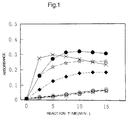
- Fig.1 shows reaction curves obtained in Example 1 where samples containing predetermined amount of low density lipoproteins (LDL) or high density lipoproteins (HDL) was reacted with the reagent of the present invention.
- LDL low density lipoproteins
- HDL high density lipoproteins
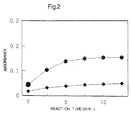
- Fig.2 shows reaction curves obtained in Example 1 where samples containing predetermined amount of very low density lipoproteins (VLDL) was reacted with the reagent of the present invention.
- VLDL very low density lipoproteins
- Fig.3 shows a calibration curve of LDL- cholesterol by the method of the present invention, which was obtained in Example 1.
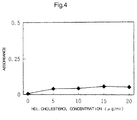
- Fig.4 shows a calibration curve of HDL- cholesterol by the method of the present invention, which was obtained in Example 1.
- the cholesterol oxidase in the present invention is not specifically limited by its origin and all of those which have so far been used in this field such as one originated from microorganisms belonging to genus Nocardia , genus Pseudomonas , etc. and one originated from animal organs such as bovine pancreas can be used.
- the cholesterol esterase in the present invention is not specifically limited by its origin and all of those which have so far been used in this field such as one originated from microorganisms belonging to genus Candida , genus Pseudomonas , etc. and one originated from animal organs such as bovine pancreas can be used.
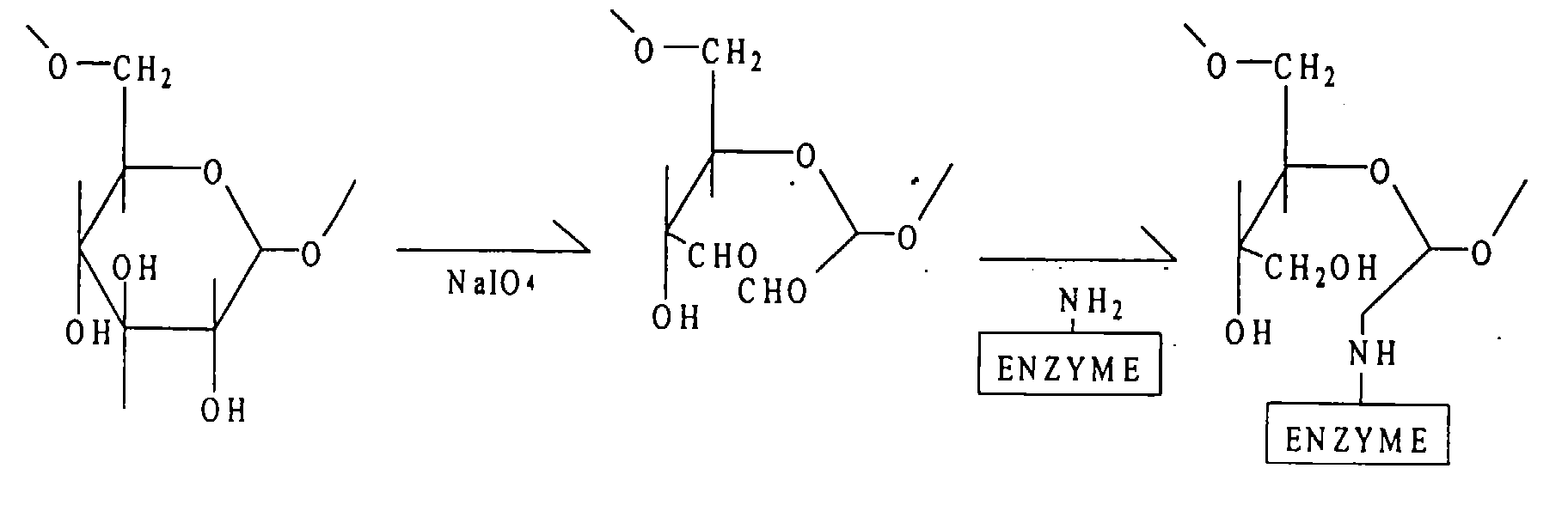
- a sugar compound to be used for binding to the cholesterol esterase or the cholesterol oxidase in the present invention includes a monosaccharide such as glucose, mannose, fructose, galactose, fucose, sorbitol, allose, xylose, arinose, lyxoso, ribose, talose, gulose, dose and altrose, a disaccharide such as saccharose, mannose, lactose, maltose, isomaltose, turanose, gentiobiose, mellbiose, planteobiose, primeverose, vicianose, nigerose, laminaribiose, trehalose, rutinose, cellobiose and xylobiose, a trisaccharide such as maltotriose, raffinose, gentianose, melezitose, planteose and ketose, a water soluble polys
- the molecular weight of the water soluble polysaccharide is not specifically limited and any of commercially available ones can be used and generally one having a molecular weight of 1000 to 2000000, preferably 10000 to 500000 is exemplified.
- the sugar compound may be those a part of whose hydroxy groups is modified.
- the modified sugar compounds are exemplified by those having an acid residue such as sulfuric acid residue and phosphoric acid residue, a carboxylalkyl group such as a carboxymethyl group, an amino group, a thiol group, an acyl group such as an acetoxy group, an alkyl group such as a methyl group and an ethyl group, an alkoxy group such as a methoxy group and an ethoxy group, a hydroxyalkyl group such as a hydroxymethyl group and a hydroxyethyl group, etc., and more specifically glucosamine, dextran sulfuric acid, pectic acid, alginic acid, heparin, heparan sulfuric acid, chondroitin, glycol chin, carboxymethyl chitin, dermatanic acid, carboxymethyl cellulose, carboxymethyl dextran, alpha-, beta- or gamma- methylated cyclodextrin, alpha-, beta- or gam
- those originaly containing an active group reactive to animo group(s) of an enzyme such as an amino group, an imino group, a carboxyl group, an aldehyde group, a cyanuryl group and an epichlorohydryl group (hereinafter abbreviated as the active group) can be directly subjected to the binding reaction with the cholesterol esterase or the cholesterol oxidase.
- the sugar compound having no active group is used after conversion to an active form by a method for inroducing the active group to the sugar compound.
- the active group(s) may be bound to the sugar compound through a spacer such as an alkylene chain having 1 to 6 carbon atoms.
- a method for introducing the active group may be any of those which have widely been used in this field. Typical examples of those methods are a method for intoroducing a cyanuryl group by cyanuryl chloride (e.g. J. Solid- phase Biochem., vol. 4, 2128, 1976), a method for intoroducing an aldehyde group by metaperiodic acid (e.g. Proc. Nati. Acad. Sci. U.S. A., vol. 73, 2128, 1976), a method for introducing a imino group by cyanogen bromide (e.g. Nature, vol.
- a suitable method can be selected from those mentioned above in accordance with the kind of the sugar compound and properties of the cholesterol esterase or the cholesterol oxidase to be used.
- a sugar compound originaly containing the active group(s) may be at first subjected to a method for introducing the active group mentioned above, so that additional active group(s) are introduced.
- the resulting solution containing the sugar compound, to which the active group was introduced may be put into use after desalting, adjustment of pH and adjustment of the kind of ions by dialysis, etc.
- the sugar compound containing the active group(s) is easily covalently bound to cholesterol esterase or the cholesterol oxidase by contacting the both with each other after known methods mentioned below.
- the sugar compound may be at first bound to a compound which can act as a ligand such as a succinidyl group for binding to an enzyme before the reaction with an enzyme.
- a carbodiimide method e.g. J. Biol. Chem., vol. 245, 3059, 1970
- an active esterification method e.g. Cancer Biochem., vol. 7, 175, 1984
- an acid anhydride method e.g. J. Biol.Chem., vol. 237, 1825, 1962
- an azide method e.g. Eur. J. Biochem., vol. 25, 129, 1972
- a carboxy chloride method e.g. Angew. Chem., vol. 67, 661, 1955
- an isocyanate method e.g. Nature, vol.
- amino group(s) of the enzyme especially amino group(s) of Lysine residue located at the surface of the enzyme is covalently bound to the active group(s) such as carboxyl group (s), amino group(s), imino group(s) or aldehyde group(s) of the sugar compound is preferable.
- Typical examples of the method for binding the enzyme to a sugar compound are illustrated , for example, as follows.
- Binding of the sugar compound to the cholesterol esterase or the cholesterol oxidase can easily be conducted as follows.
- One wt. part of the cholesterol esterase or the cholesterol oxidase and 0.1 to 100 wt parts of the sugar compound reactive with the enzyme as mentioned above are subjected to a reaction in a suitable solvent such as a buffer solution of pH 4 to 10, preferably 6 to 9 in the presence of, if necessary, a suitable amount of glutaraldehyde, a divalent cross- linking agent such as a dimaleimide compound including N,N'- phenylene dimaleimide, a carbodiimide reagent such as 1- ethyl- 3- (3- dimethylaminopropyl) carbodiimide and dicyclohexyl carbodiimide, a condensation agent including a Woodward reagent such as N- ethyl- 5- phenyl isoxazolium- 3'- sulfonate, etc. at 1 to 50 °C , preferably 4 to 40 °C , for generally 30 minutes to 1 week, preferably 1 hour to 3 days, where
- modified cholesterol esterase or cholesterol oxidase is, if necessary, dialyzed into a suitable buffer solution and further the resultant may be condensed or freeze- dried after a suitable method.
- the weight ratio of the sugar compound to the enzyme is generally 100 to 1 ⁇ 1 to 5, preferably 20 to 1 ⁇ 1 to 1.
- the mole ratio of the sugar compound to the enzyme is generally 500 to 1 ⁇ 1 to 50, preferably 65 to 1 ⁇ 1 to 50.
- the ratio of the enzyme molecule to monosaccharide units of the sugar compound for example, including glucose unit, mannose unit , fructose unit, galactose unit, fucose unit, etc., is generally 1 to 2800000 ⁇ 1 to 100, preferably 1 to 360000 ⁇ 1 to 100.
- stabilizer may be added to the reaction solution in order to prevent deactivation of the enzyme.
- the substance for this purpose is exemplified by all of those which have been known as a stabilizer, including protein such as bovine serum albumin, a polyol such as glycerol, a compound similar to the substrate to be used, co- enzyme, EDTA, a metal salt, etc.
- buffer solution used in the reaction of the cholesterol esterase or the cholesterol oxidase with a sugar compound as a reaction solvent use can be made of all buffer solutions which have been used in this field without any limitation, and preferable examples include those prepared from Good's buffer, phosphate buffer, borate buffer, etc., which has pH 4 to 10, preferably 6 to 9 and concentration of 5 mM to 0.5 M, preferably 10 mM to 100mM.
- the measuring an amount of LDL- cholesterol can be conducted according to a method which has been used in this field with the use of reagents which have generally been known in this field as reagents for measuring an amount of cholesterol, such as a reagent prepared by a method for preparation of a reagent containing a cholesterol oxidase, a cholesterol esterase, a peroxidase (POD), an oxidizable color forming agent, etc., using at least one, preferably two of the modified cholesterol esterase bound to the sugar compound (hereinafter abbreviated as the modified cholesterol esterase) and the modified cholesterol oxidase bound to the sugar compound (hereinafter abbreviated as the modified cholesterol oxidase) as prepared above.
- a reagent prepared by a method for preparation of a reagent containing a cholesterol oxidase, a cholesterol esterase, a peroxidase (POD), an oxidizable color forming agent, etc. using at least one, preferably two of
- the oxidizable color forming agent used in the reagent may be any of those which can react with hydrogen peroxide in the presence of a peroxidase to cause color formation, and is exemplified by a combination of a coupler such as 4- aminoantipyrine with a developer forming color by oxidative condensation with the coupler, including a combination of 4- aminoantipyrine with a phenol compound, a naphthol compound or an aniline compound, a combination of 3- methyl- 2- benzothiazolinone hydrazone with an aniline compound, etc., and by a color former which forms color by itself by oxidation, including 2,2'- azinobis(3- ethylbenzothiazoline- 6- sulfonic acid), a triphenylmethane compound, a diphenylamine derivative, a benzidine derivative, a triallyl imidazole derivative, a leuco methylene blue derivative, an o- phenylenediamine derivative,
- phenol compound as the developer are phenol, p- chlorophenol, 2,4- dichlorophenol, etc.
- those of the naphthol compound are 1- naphthol, 1- naphthol- 2- sulfonic acid, 1- naphthol- 2- carboxylic acid, etc.
- aniline compound N,N- diethylamine, N- ethyl- N- ( ⁇ - hydroxyethyl)- m- toluidine, N- ethyl- N- (2- hydroxy- 3- sulfopropyl)- 3,5- dimethoxyaniline (DAOS), N- ethyl- N- (2- hydroxy- 3- sulfopropyl)- 3,5- dimethoxy- 4- fluoroaniline (FDAOS), N- (2- hydroxy- 3- sulfopropyl)- 3,5- dimethoxyaniline (HDAOS), N- ethyl- N- (2- hydroxy- 3- sulfopropyl)- m- toluidine (TOOS), N- ethyl- N- (3- methylphenyl)- N'- succinyl- ethylenediamine (EMSE), etc.
- DAOS dimethoxyaniline
- FDAOS fluoroaniline
- an amount of the coupler to be used is not generalized because it is different according to the kind of the coupler and the developer to be combined, and it is usually selected from a range of generally 0.01 to 100 mM, preferably 0.1 to 10 mM, as concentration in the reaction solution upon measurement of cholesterol, and an amount in case of using 4- aminoantipyrine as the coupler is selected from a range of generally 0.01 to 50 mM, preferably 0.1 to 5 mM as concentration in the reaction solution upon measurement of cholesterol.
- An amount of the developer to be used is not generalized because it is different according to the kind of the devloper to be used and the coupler to be combined, and it is usually selected from a range of generally 0.01 to 50 mM, preferably 0.1 to 5 mM as concentration in the reaction solution upon measurement of cholesterol.
- triphenylmethane compund examples include leuco Malachite Green, bis (p- diethylaminophenyl)- 2- sulfophenylmethane, bis (p- diethylaminophenyl)- 3,4- disulfopropoxyphenylmethane disodium salt, etc.
- those of the diphenylamine derivatives are bis [4- di(2- butoxyethyl) amino- 2- methylphenyl] amine, N,N- bis (4- diethylamino- 2- methylphenyl)- N'- p- toluene sulfonyl urea, etc.
- those of leuco methylene blue derivative are l0- (carboxymethylaminocarbonyl)- 3,7- bis (dimethylamino) phenothiazin sodium salt, 10- [3- (methoxycarbonylaminomethyl) phenylmethylaminocarbonyl]- 3,7- bis (d
- Amounts of each component in the reagent may be selected suitably from a range which has generally been used in measurement in this field.
- a buffer solution usable in the measurement of this invention may be any of one which has generally been used in this field and there is no specific limitation thereto. Concentration of the buffer solution is selected from a range generally of 2 mM to 1M, preferably 50 mM to 0.5 M, though there is no specific limitation thereto, and a pH range may be any one so far as it is within a suitable range for enzymes, and is selected from a range preferably of 6 to 8, more preferably around 7.
- an enzymatic activity of the enzyme after bound to the sugar compound is variable according to the origin of the enzyme, the kind of the sugar compound to be bound and the method for binding reaction, and thus an amount of the modified cholesterol esterase and the modified cholesterol oxidase to be used in the measuring method of the present invention is not limited specifically so far as it is within an amount capable of conducting the measurement, and it is generally selected from a range of 0.1 to 10 u/ml, preferably 0.5 to 2 u/ml as the concentration in the reaction solution in case of the modified cholesterol esterase and from a range of 0.1 to 10 u/ml, preferably 0.5 to 2 u/ml as the concentration in the reaction solution in case of the cholesterol oxidase.
- Those two enzymes may be incorporated in one and the same reagent or may be incorporated each in different reagents separately.
- the reagent for measuring an amount of LDL- cholesterol of the present invention can be prepared as so- called one- reagent system or two-or more- reagent system, and there is no specific limitation thereto.
- the reagent for measuring an amount of LDL- cholesterol by the method of the present invention may contain a surfactant.
- the surfactant used for this purpose includes any of nonionic, amphoteric, cationic and anionic ones without any specific limitation so far as it does not prevent the measurement of LDL- cholesterol, including specifically nonionic surfactant such as polyoxyethylene alkylphenyl ether (for example, polyoxyethylene isooctylphenyl ether, polyoxyethylene nonylphenyl ether, etc.), polyoxyethylene cetyl ether, polyoxyethylene oleyl ether, polyethyleneglycol monolaurate and polyoxyethylene lauryl ether; amphoteric surfactants such as stearyl betaine and 2- alkyl- N- carboxymethyl- N- hydroxyethyl imidazolinium betaine; cationic surfactants such as stearyl trimethylammonium chloride and alkylbenzyl dimethyl; anionic surfactants such as cholic acid,
- the surfactant may be used alone or in combination of two or more thereof.
- An amount of the surfactant to be used is generally 0.001 to 1 (W/V%) in the reaction solution, though there is no specific limitation thereto.
- the reagent for measuring an amount of LDL- cholesterol by the method of the present invention may contain an ionic compound.
- the ionic compound used for this purpose includes anionic compounds such as dextran sulfate, heparin, heparan sulfate, and phosphotungstic acid. They can be used in combination with a cation such as Mg 2+ , Mn 2+ and Ca 2+ (or a metal salt generating the cation).
- An amount of the ionic compound to be used is not specifically limited and generally 0.01 to 10 (W/V%) in the reaction solution.
- one or more of monoclonal antibodies or polyclonal antibodies may be incorporated in order to prevent the influence of cholesterols in lipoproteins other than LDL in the reaction.
- the antibody used for this purpose includes anti- apoprotein A antibody, anti- alpha- lipoprotein antibody, etc.
- An amount of the antibody to be used is not specifically limited so far as it is not less than one preventing the influence of cholesterols in lipoproteins other than LDL, and generally 0.001 to 10 mgAb/ml, preferably 0.01 to l mgAb/ml as the final concentration in the reaction solution.
- a method for measuring an amout of LDL- cholesterol of the present invention after so- called two- reagent system is conducted, for instance, as follows.
- a living sample such as serum and plasma is mixed with a first reagent solution containing a coupler and a buffering agent and, if necessary, a metal salt, an anionic substance, an antibody, etc., followed by allowing a reaction to take place at 2 to 40 °C for 1 to 30 minutes, and then an absorbance (OD1) is measured, and then the resulting reaction solution is mixed with a second reagent solution containing the modified cholesterol esterase, the modified cholesterol oxidase, a developer, a peroxidase and if necessary a surfactant, followed by allowing a reaction to take place at 2 to 40 °C for l to 60 minutes and an absorbance (OD2) is measured.
- a first reagent solution containing a coupler and a buffering agent and, if necessary, a metal salt, an anionic substance, an antibody, etc.
- a value derived from the OD1 (for instance, value obtained by multiplying OD1 with a correction coefficient) is subtracted from the OD2 to give OD3.
- OD3 is applied to a calibration curve showing a relation between an amount of cholesterol and OD3 which is previously prepared by conducting the above process with the use of a standard solution containing a predetermined amount of cholesterol, whereby LDL- cholesterol amount in the living sample can be detected.
- each of the coupler, the developer and the peroxidase may be incorporated in at least one of the first reagent and the second reagent.
- one of the coupler and the developer is contained the first reagent and the other is contaioned in the second reagent.
- the method for measuring an amount of LDL- cholesterol of the present invention can also be conducted by an one- reagent method as mentioned below.
- a living sample such as serum and plasma is mixed with a reagent solution containing, for instance, the modified cholesterol esterase, the modified cholesterol oxidase, a peroxidase, an oxidizable color forming agent( or a coupler and a developer), a buffer agent, and if necessary, a metal salt, an anionic substance, an antibody, a surfactant, etc., followed by allowing a reaction to take place at 2 to 40 °C for 1 to 30 minutes, and an absorbance (OD1') is measured.
- a reagent solution containing, for instance, the modified cholesterol esterase, the modified cholesterol oxidase, a peroxidase, an oxidizable color forming agent( or a coupler and a developer), a buffer agent, and if necessary, a metal salt, an anionic substance, an antibody, a surfactant, etc.
- the reagent for measuring an amount of LDL- cholesterol of the present invention is used for measuring an amount of LDL- cholesterol in a living sample such as serum and plasma, and the preferable embodiments of each ingredient, etc. and specific examples thereof are as mentioned above.
- the characteristic feature of the present invention lies in that at least one of the cholesterol esterase and the cholesterol oxidase used in measuring an amount of LDL- cholesterol is a modified enzyme which is bound to a sugar compound, and it is quite unexpected that when LDL- cholesterol, VLDL- cholesterol and HDL- cholesterol are measured with the use of such modified enzymes, speeds of reactions with LDL- cholesterol, VLDL- cholesterol and HDL- cholesterol are clearly different from one another and thus LDL- cholesterol can specifically and separately be measured. Further, the modified enzymes of the present invention is found to be improved in their stability in an aqueous solution and thus their storage stability in solutions as compared with non- modified ones.
- Phosphate buffer solution (0.1 M, pH 7.0, 3 ml) containing 0.4 mg of linolic acid cholesterol, 0.6 mg of 4- aminoantipyrine, 2 mg of phenol and 6 u of POD is charged in a cell of a spectrophotometer, and heated at 37 C for 5 minutes.
- Phosphate buffer solution (0.1 M, pH 7.0, 0.3 ml) containing 115 ⁇ g of cholesterol, 160 ⁇ g of 4- aminoantipyrine, 1.6 mg of phenol, 8.4 mg of Poly oxyethylene (10) pctylphenyl ether and 8.2 u of POD is charged in a cell of a spectrophotometer, and heated at 37 °C for 5 minutes.
- the mole ratio of dextran to the cholesterol esterase in the modified cholesterol esterase about 16 to 3.
- the ratio of the cholesterol esterase molecule to glucose units of dextran in the modified cholesterol esterase about 1 to 300.
- Fifty millimole phosphate buffer solution (pH 7.0) containing 50 mg of the pullulan modified by 5- aminocaproic acid was mixed with 50 mg of cholesterol oxidase (originated from genus Nocardia , manufactured and sold by Boehringer Mannheim GmbH) dissolved in 5 ml of the same buffer solution, and 85 mg of water soluble carbodiimide was further added thereto, followed by allowing a reaction to take place at 15 °C for 18 hours.
- the resultant was dialyzed with 20 mM of phosphate buffer solution (pH 7.0) (each 1 liter ⁇ 3 times) to give a modified cholesterol oxidase.
- the mole ratio of dextran to the cholesterol oxidase in the modified cholesterol oxidase about 6 to 10.
- the ratio of the cholesterol oxidase molecule to glucose units of dextran in the modified cholesterol oxidase about 1 to 340.
- non- modified enzyme reagent solution was prepared by the same procedure as above except for using non-modified enzymes in place the modified enzymes.
- Fig.1 The result is shown in Fig.1.
- - ⁇ - shows the result in the sample l containing LDL (LDL concentration: 10 ⁇ g/ml)
- - - shows the result in the sample 2 containing LDL (LDL concentration: 20 ⁇ g/ml)
- - ⁇ - shows the result in the sample 3 containing LDL (LDL concentration: 30 ⁇ g/ml)
- - ⁇ - shows the result in the sample 4 containing HDL (HDL concentration: 5 ⁇ g/ml)
- - ⁇ - shows the result in the sample 5 containing HDL (HDL concentration: 10 ⁇ g/ml)
- - ⁇ - shows the result in the sample 6 containing HDL (HDL concentration: 15 ⁇ g/ml), respectively.
- Fig.2 there are shown result of measurement in case of VLDL using non-modified enzymes and using the modified enzymes obtained in Reference Examples 1 and 2.
- - ⁇ - shows measurement result of the sample 7 containing VLDL (VLDL concentration: 10 ⁇ g/ml) using the reagent solution containing non- modified enzymes
- - ⁇ - shows that of the sample 7 containing VLDL (VLDL concentration: 10 ⁇ g/ml) using the reagent solution containing the modified enzymes.
- an amount of cholesterol in LDL can specifically be measured by the method of the present invention.
- an amount of cholesterol in LDL can specifically and quantitatively be measured by the method of the present invention.
- the reagent solution containing the modified enzymes which was prepared in Example 1 and a reagent solution containing non- modified enzymes which was prepared in Example 1 were respectively stored in an incubator at 37 °C for 1 month, and then the remaining activities of each enzyme (relative activity when the enzymatic activity just after preparation is 100 %) are measured.
- the present invention provides a method for measuring an amount of LDL- cholesterol in samples specifically and accurately and also a reagent used for the method, and by using the present invention, such effect can be attained that LDL- cholesterol can be measured directly using so far widely used automatic analyzer, which has been impossible in known measurement methods, and therefore the present invention can give great contribution in this kind of technical field.
Landscapes
- Life Sciences & Earth Sciences (AREA)
- Chemical & Material Sciences (AREA)
- Health & Medical Sciences (AREA)
- Engineering & Computer Science (AREA)
- Organic Chemistry (AREA)
- Molecular Biology (AREA)
- Zoology (AREA)
- Wood Science & Technology (AREA)
- Proteomics, Peptides & Aminoacids (AREA)
- Immunology (AREA)
- Biophysics (AREA)
- Microbiology (AREA)
- Biotechnology (AREA)
- General Health & Medical Sciences (AREA)
- Analytical Chemistry (AREA)
- Biochemistry (AREA)
- Physics & Mathematics (AREA)
- Bioinformatics & Cheminformatics (AREA)
- Urology & Nephrology (AREA)
- Genetics & Genomics (AREA)
- General Engineering & Computer Science (AREA)
- Biomedical Technology (AREA)
- Hematology (AREA)
- Cell Biology (AREA)
- Endocrinology (AREA)
- Food Science & Technology (AREA)
- Medicinal Chemistry (AREA)
- General Physics & Mathematics (AREA)
- Pathology (AREA)
- Measuring Or Testing Involving Enzymes Or Micro-Organisms (AREA)
- Investigating Or Analysing Biological Materials (AREA)
- Steroid Compounds (AREA)
Abstract
Description



| Remaining activity of each enzyme in reagent solutions (37 °C , l month) | |
| Enzyme | Remaining Activity (%) |
| modified cholesterol esterase | 64.1 |
| non- modified cholesterol esterase | 30.6 |
| modified cholesterol oxidase | 100 |
| non- modified cholesterol oxidase | 86.3 |
Claims (13)
- A reagent for measuring an amount of cholesterol in low density lipoproteins, which comprises a cholesterol esterase and a cholesterol oxidase, at least one of the cholesterol esterase and the cholesterol oxidase being modified by binding to a sugar compound.
- A reagent according to Claim 1, wherein the cholesterol esterase and the cholesterol oxidase are modified.
- A reagent according to Claim 1, the modified cholesterol esterase is one in which amino group(s) of the cholesterol esterase is covalently bound to amino group(s), imino group(s), carboxyl group(s), aldehyde group(s), cyanuryl group(s) or epichlorohydryl group(s) of a sugar compound.
- A reagent according to Claim 1, the modified cholesterol oxidase is one in which amino group(s) of the cholesterol oxidase is covalently bound to amino group(s), imino group(s), carboxyl group(s), aldehyde group(s), cyanuryl group(s) or epichlorohydryl group(s) of a sugar compound.
- A reagent according to Claim 1, wherein the reagent further comprises a peroxidase and an oxidazable color forming agent.
- A reagent according to Claim 5, wherein the oxidizable color forming agent comprises a coupler and a developer.
- A reagent according to Claim 5, wherein the reagent further comprises a buffer and a surfactant.
- A method for measuring an amount of cholesterol in low density lipoproteins comprising using a cholesterol esterase and a cholesterol oxidase, which is characterized in that at least one of the cholesterol esterase and the colesterol oxidase are modified by binding to a sugar compound.
- A method for measuring an amount of cholesterol in low density lipoproteins of a living sample, which comprises mixing the living sample with a first reagent solution containing a buffering agent, measuring an absorbance (OD1) of a resulting reaction solution, mixing the resulting solution with a second reagent solution containing a cholesterol esterase and a cholesterol oxidase, measuring an absorbance (OD2) of the latter resulting solution, subtracting a value obtained by multiplying OD1 with a correction coefficient from the OD2 to give OD3, applying thus obtained OD3 a calibration curve showing a relation between an amount of cholesterol and OD3 which is previously prepared by conducting the above process with the use of a standard solution containing a predetermined amount of cholesterol, wherein at least one of the cholesterol esterase and the cholesterol oxidase are modified by binding to a sugar compound and each of the coupler, the developer and the peroxidase is incorporated in at least one of the first reagent and the second reagent.
- A method according to Claim 9, wherein one of the coupler and the developer is contained in the first reagent and the other is contained in the second reagent.
- A method according to Claim 9, wherein the cholesterol esterase and the cholesterol oxidase are the modified ones.
- A method according to Claim 9, the modified cholesterol esterase is one in which amino group(s) of the cholesterol esterase is covalently bound to amino group(s), imino group(s), carboxyl group(s), aldehyde group(s), cyanuryl group(s) or epichlorohydryl group(s) of a sugar compound.
- A method according to Claim 9, the modified cholesterol oxidase is one in which amino group(s) of the cholesterol oxidase is covalently bound to amino group(s), imino group(s), carboxyl group(s), aldehyde group(s), cyanuryl group(s) or epichlorohydryl group(s) of a sugar compound.
Applications Claiming Priority (2)
| Application Number | Priority Date | Filing Date | Title |
|---|---|---|---|
| JP20777096 | 1996-07-18 | ||
| JP207770/96 | 1996-07-18 |
Publications (2)
| Publication Number | Publication Date |
|---|---|
| EP0819765A2 true EP0819765A2 (en) | 1998-01-21 |
| EP0819765A3 EP0819765A3 (en) | 1998-12-30 |
Family
ID=16545248
Family Applications (1)
| Application Number | Title | Priority Date | Filing Date |
|---|---|---|---|
| EP97112007A Withdrawn EP0819765A3 (en) | 1996-07-18 | 1997-07-15 | Reagent for measuring an amount of cholesterol |
Country Status (4)
| Country | Link |
|---|---|
| US (1) | US5879901A (en) |
| EP (1) | EP0819765A3 (en) |
| KR (1) | KR980010429A (en) |
| CA (1) | CA2210783A1 (en) |
Families Citing this family (5)
| Publication number | Priority date | Publication date | Assignee | Title |
|---|---|---|---|---|
| CA2344055C (en) * | 1998-09-18 | 2010-08-17 | Kyowa Medex Co., Ltd. | Method for fractional determination of cholesterol in lipoproteins and a reagent therefor |
| JP3441993B2 (en) | 1999-01-27 | 2003-09-02 | 松下電器産業株式会社 | Cholesterol sensor |
| WO2000078998A1 (en) * | 1999-06-18 | 2000-12-28 | Polymer Technology Systems, Inc. | Apparatus and method for determining substances contained in a body fluid |
| US7087397B2 (en) * | 2001-12-21 | 2006-08-08 | Polymer Technology Systems, Inc, | Method for determining HDL concentration from whole blood or plasma |
| CN105784801B (en) * | 2016-05-20 | 2018-10-23 | 桂林电子科技大学 | A kind of method of double enzyme concerted catalysis deposition of silver detection low density lipoprotein cholesterol |
Family Cites Families (9)
| Publication number | Priority date | Publication date | Assignee | Title |
|---|---|---|---|---|
| EP0006822B1 (en) * | 1978-07-04 | 1982-10-13 | Laboratoires Goella | Method and reagents for measuring the cholesterol content in serum |
| DE3208253A1 (en) * | 1982-03-08 | 1983-09-15 | Boehringer Mannheim Gmbh, 6800 Mannheim | METHOD FOR SPECIFIC DETERMINATION OF THE CHOLESTERIN OF THE LDL FRACTION IN SERUM |
| DE3636851A1 (en) * | 1986-10-29 | 1988-05-11 | Boehringer Mannheim Gmbh | METHOD AND REAGENT FOR SPECIFIC DETERMINATION OF THE CHOLESTERIN OF THE HDL FACTION |
| WO1992008790A1 (en) * | 1990-11-14 | 1992-05-29 | Cargill, Incorporated | Conjugates of poly(vinylsaccharide) with proteins for the stabilization of proteins |
| US5286626A (en) * | 1991-12-13 | 1994-02-15 | Actimed Laboratories, Inc. | Process and apparatus for direct determination of low density lipoprotein |
| JPH07163339A (en) * | 1993-09-21 | 1995-06-27 | Toyobo Co Ltd | Novel protein-modifying agent and protein chemically modified with the same |
| JP2653755B2 (en) * | 1994-03-08 | 1997-09-17 | 協和メデックス株式会社 | Determination of cholesterol in high density lipoprotein |
| JP3219181B2 (en) * | 1995-01-10 | 2001-10-15 | 東洋紡績株式会社 | Stabilization method of cholesterol oxidase |
| CN1148891A (en) * | 1995-03-20 | 1997-04-30 | 协和梅迪克斯株式会社 | Quantification of cholesterol in low density lipoprotein or very low density lipoprotein |
-
1997
- 1997-07-11 KR KR1019970032313A patent/KR980010429A/en not_active Ceased
- 1997-07-15 EP EP97112007A patent/EP0819765A3/en not_active Withdrawn
- 1997-07-17 US US08/895,879 patent/US5879901A/en not_active Expired - Fee Related
- 1997-07-17 CA CA002210783A patent/CA2210783A1/en not_active Abandoned
Also Published As
| Publication number | Publication date |
|---|---|
| US5879901A (en) | 1999-03-09 |
| EP0819765A3 (en) | 1998-12-30 |
| CA2210783A1 (en) | 1998-01-18 |
| KR980010429A (en) | 1998-04-30 |
Similar Documents
| Publication | Publication Date | Title |
|---|---|---|
| CA2190282C (en) | Method for determination of cholesterol in low-density lipoprotein | |
| EP0878716B1 (en) | Measurement of LDL-cholesterol | |
| KR100496753B1 (en) | Method for measuring ldl-cholesterol | |
| US20160177371A1 (en) | Method of pretreatment of sample for quantitating cholesterol and method for quantitating cholesterol in specific lipoproteins by using the same | |
| JPWO1996028734A1 (en) | Quantitative method for cholesterol in low-density lipoproteins | |
| JPH11504808A (en) | Measurement of glycated protein | |
| US5879901A (en) | Reagent and methods for measuring LDL-cholesterol | |
| JPH08116996A (en) | Measurement of hdl-cholesterol in serum or plasma | |
| EP1715060A1 (en) | Method, reagent, and kit for determining cholesterol in very-low-density lipoprotein remnant (vldl remnant) | |
| EP1953240A1 (en) | Method for measuring triglyceride in low-density lipoprotein and kit for measurement | |
| EP1164376B1 (en) | Method for quantitating cholesterol | |
| JP2000060600A (en) | Determination of ldl-cholesterol | |
| US5885788A (en) | Method for measuring an amount of LDL-Cholesterol | |
| JPH1130617A (en) | Ldl-cholesterol measuring method | |
| JPH10311833A (en) | Method for determinating ldl-cholesterol | |
| JPH1080300A (en) | Reagent for measuring cholesterol | |
| JPH1084997A (en) | Assay of ldl-cholesterol | |
| KR100276749B1 (en) | Method of quantitating cholesterol in low-density lipoprotein | |
| AU2015202990B2 (en) | Method of pretreatment of sample for quantitating cholesterol and method for quantitating cholesterol in specific lipoproteins by using the same | |
| AU2012203506A1 (en) | Method of pretreatment of sample for quantitating cholesterol and method for quantitating cholesterol in specific lipoproteins by using the same | |
| HK1000721A (en) | Method of quantitating cholesterol in low-density lipoprotein | |
| HK1109648B (en) | Method, reagent and kit for determination of cholesterol in remnant-like particles (rlp) | |
| HK1109648A1 (en) | Method, reagent and kit for determination of cholesterol in remnant-like particles (rlp) | |
| AU2005202380A1 (en) | Method of pretreatment of sample for quantitating cholesterol and method for quantitating cholesterol in specific lipoproteins by using the same |
Legal Events
| Date | Code | Title | Description |
|---|---|---|---|
| PUAI | Public reference made under article 153(3) epc to a published international application that has entered the european phase |
Free format text: ORIGINAL CODE: 0009012 |
|
| AK | Designated contracting states |
Kind code of ref document: A2 Designated state(s): DE ES FR GB IT |
|
| AX | Request for extension of the european patent |
Free format text: AL;LT;LV;RO;SI |
|
| PUAL | Search report despatched |
Free format text: ORIGINAL CODE: 0009013 |
|
| AK | Designated contracting states |
Kind code of ref document: A3 Designated state(s): AT BE CH DE DK ES FI FR GB GR IE IT LI LU MC NL PT SE |
|
| AX | Request for extension of the european patent |
Free format text: AL;LT;LV;RO;SI |
|
| 17P | Request for examination filed |
Effective date: 19990619 |
|
| AKX | Designation fees paid |
Free format text: DE ES FR GB IT |
|
| STAA | Information on the status of an ep patent application or granted ep patent |
Free format text: STATUS: THE APPLICATION IS DEEMED TO BE WITHDRAWN |
|
| 18D | Application deemed to be withdrawn |
Effective date: 20010201 |