EP0819446A2 - Radiation therapy method and device more particularly suitable for implantation - Google Patents
Radiation therapy method and device more particularly suitable for implantation Download PDFInfo
- Publication number
- EP0819446A2 EP0819446A2 EP97304916A EP97304916A EP0819446A2 EP 0819446 A2 EP0819446 A2 EP 0819446A2 EP 97304916 A EP97304916 A EP 97304916A EP 97304916 A EP97304916 A EP 97304916A EP 0819446 A2 EP0819446 A2 EP 0819446A2
- Authority
- EP
- European Patent Office
- Prior art keywords
- medical device
- stent
- radioisotope
- radiation
- component
- Prior art date
- Legal status (The legal status is an assumption and is not a legal conclusion. Google has not performed a legal analysis and makes no representation as to the accuracy of the status listed.)
- Withdrawn
Links
- 238000000034 method Methods 0.000 title claims description 18
- 238000002513 implantation Methods 0.000 title abstract description 7
- 238000001959 radiotherapy Methods 0.000 title description 2
- 230000005855 radiation Effects 0.000 claims abstract description 24
- 239000002738 chelating agent Substances 0.000 claims abstract description 20
- 125000006850 spacer group Chemical group 0.000 claims abstract description 14
- 238000000576 coating method Methods 0.000 claims description 8
- 239000011248 coating agent Substances 0.000 claims description 7
- 230000002285 radioactive effect Effects 0.000 claims description 5
- PCHJSUWPFVWCPO-UHFFFAOYSA-N gold Chemical compound [Au] PCHJSUWPFVWCPO-UHFFFAOYSA-N 0.000 claims description 3
- 239000010931 gold Substances 0.000 claims description 3
- 229910052737 gold Inorganic materials 0.000 claims description 3
- 238000007654 immersion Methods 0.000 claims 1
- 239000000463 material Substances 0.000 description 14
- 208000037803 restenosis Diseases 0.000 description 12
- 239000012857 radioactive material Substances 0.000 description 8
- 230000002792 vascular Effects 0.000 description 5
- 210000004204 blood vessel Anatomy 0.000 description 3
- KRKNYBCHXYNGOX-UHFFFAOYSA-N citric acid Chemical compound OC(=O)CC(O)(C(O)=O)CC(O)=O KRKNYBCHXYNGOX-UHFFFAOYSA-N 0.000 description 3
- 230000000694 effects Effects 0.000 description 3
- YRKCREAYFQTBPV-UHFFFAOYSA-N acetylacetone Chemical compound CC(=O)CC(C)=O YRKCREAYFQTBPV-UHFFFAOYSA-N 0.000 description 2
- 238000013459 approach Methods 0.000 description 2
- 238000011161 development Methods 0.000 description 2
- WJJMNDUMQPNECX-UHFFFAOYSA-N dipicolinic acid Chemical compound OC(=O)C1=CC=CC(C(O)=O)=N1 WJJMNDUMQPNECX-UHFFFAOYSA-N 0.000 description 2
- 239000007943 implant Substances 0.000 description 2
- 230000007774 longterm Effects 0.000 description 2
- 239000002184 metal Substances 0.000 description 2
- 229910052751 metal Inorganic materials 0.000 description 2
- 239000012038 nucleophile Substances 0.000 description 2
- 229910001220 stainless steel Inorganic materials 0.000 description 2
- 239000010935 stainless steel Substances 0.000 description 2
- CVBUKMMMRLOKQR-UHFFFAOYSA-N 1-phenylbutane-1,3-dione Chemical compound CC(=O)CC(=O)C1=CC=CC=C1 CVBUKMMMRLOKQR-UHFFFAOYSA-N 0.000 description 1
- FCKYPQBAHLOOJQ-UHFFFAOYSA-N Cyclohexane-1,2-diaminetetraacetic acid Chemical compound OC(=O)CN(CC(O)=O)C1CCCCC1N(CC(O)=O)CC(O)=O FCKYPQBAHLOOJQ-UHFFFAOYSA-N 0.000 description 1
- KCXVZYZYPLLWCC-UHFFFAOYSA-N EDTA Chemical compound OC(=O)CN(CC(O)=O)CCN(CC(O)=O)CC(O)=O KCXVZYZYPLLWCC-UHFFFAOYSA-N 0.000 description 1
- 229920000219 Ethylene vinyl alcohol Polymers 0.000 description 1
- 206010073306 Exposure to radiation Diseases 0.000 description 1
- 206010063562 Radiation skin injury Diseases 0.000 description 1
- 150000001242 acetic acid derivatives Chemical class 0.000 description 1
- 150000001298 alcohols Chemical class 0.000 description 1
- 125000001931 aliphatic group Chemical group 0.000 description 1
- 150000001412 amines Chemical class 0.000 description 1
- 238000002399 angioplasty Methods 0.000 description 1
- 230000003143 atherosclerotic effect Effects 0.000 description 1
- 125000001743 benzylic group Chemical group 0.000 description 1
- 230000031018 biological processes and functions Effects 0.000 description 1
- 239000008280 blood Substances 0.000 description 1
- 210000004369 blood Anatomy 0.000 description 1
- 230000017531 blood circulation Effects 0.000 description 1
- 210000001124 body fluid Anatomy 0.000 description 1
- 235000013877 carbamide Nutrition 0.000 description 1
- 210000000748 cardiovascular system Anatomy 0.000 description 1
- 238000006243 chemical reaction Methods 0.000 description 1
- 150000001805 chlorine compounds Chemical class 0.000 description 1
- 238000010276 construction Methods 0.000 description 1
- 238000007887 coronary angioplasty Methods 0.000 description 1
- 208000029078 coronary artery disease Diseases 0.000 description 1
- 125000005265 dialkylamine group Chemical group 0.000 description 1
- 125000005442 diisocyanate group Chemical group 0.000 description 1
- 150000002148 esters Chemical class 0.000 description 1
- 238000000605 extraction Methods 0.000 description 1
- 238000007429 general method Methods 0.000 description 1
- 230000035876 healing Effects 0.000 description 1
- 239000000017 hydrogel Substances 0.000 description 1
- 238000001727 in vivo Methods 0.000 description 1
- 238000005468 ion implantation Methods 0.000 description 1
- 150000002500 ions Chemical class 0.000 description 1
- 150000002576 ketones Chemical class 0.000 description 1
- 230000003211 malignant effect Effects 0.000 description 1
- 238000004519 manufacturing process Methods 0.000 description 1
- 230000007246 mechanism Effects 0.000 description 1
- 238000012986 modification Methods 0.000 description 1
- 230000004048 modification Effects 0.000 description 1
- 150000002763 monocarboxylic acids Chemical class 0.000 description 1
- 150000002825 nitriles Chemical class 0.000 description 1
- 238000009377 nuclear transmutation Methods 0.000 description 1
- 238000010534 nucleophilic substitution reaction Methods 0.000 description 1
- 239000002245 particle Substances 0.000 description 1
- 229920000642 polymer Polymers 0.000 description 1
- 229920002635 polyurethane Polymers 0.000 description 1
- 239000004814 polyurethane Substances 0.000 description 1
- 229920002451 polyvinyl alcohol Polymers 0.000 description 1
- 230000035755 proliferation Effects 0.000 description 1
- 239000000941 radioactive substance Substances 0.000 description 1
- 238000009877 rendering Methods 0.000 description 1
- 238000001179 sorption measurement Methods 0.000 description 1
- 238000004659 sterilization and disinfection Methods 0.000 description 1
- 238000003860 storage Methods 0.000 description 1
- 239000000126 substance Substances 0.000 description 1
- 238000001356 surgical procedure Methods 0.000 description 1
- 150000003573 thiols Chemical class 0.000 description 1
- 150000003672 ureas Chemical class 0.000 description 1
- 210000005166 vasculature Anatomy 0.000 description 1
Images
Classifications
-
- A—HUMAN NECESSITIES
- A61—MEDICAL OR VETERINARY SCIENCE; HYGIENE
- A61K—PREPARATIONS FOR MEDICAL, DENTAL OR TOILETRY PURPOSES
- A61K51/00—Preparations containing radioactive substances for use in therapy or testing in vivo
- A61K51/12—Preparations containing radioactive substances for use in therapy or testing in vivo characterised by a special physical form, e.g. emulsion, microcapsules, liposomes, characterized by a special physical form, e.g. emulsions, dispersions, microcapsules
- A61K51/1282—Devices used in vivo and carrying the radioactive therapeutic or diagnostic agent, therapeutic or in vivo diagnostic kits, stents
-
- A—HUMAN NECESSITIES
- A61—MEDICAL OR VETERINARY SCIENCE; HYGIENE
- A61F—FILTERS IMPLANTABLE INTO BLOOD VESSELS; PROSTHESES; DEVICES PROVIDING PATENCY TO, OR PREVENTING COLLAPSING OF, TUBULAR STRUCTURES OF THE BODY, e.g. STENTS; ORTHOPAEDIC, NURSING OR CONTRACEPTIVE DEVICES; FOMENTATION; TREATMENT OR PROTECTION OF EYES OR EARS; BANDAGES, DRESSINGS OR ABSORBENT PADS; FIRST-AID KITS
- A61F2/00—Filters implantable into blood vessels; Prostheses, i.e. artificial substitutes or replacements for parts of the body; Appliances for connecting them with the body; Devices providing patency to, or preventing collapsing of, tubular structures of the body, e.g. stents
- A61F2/82—Devices providing patency to, or preventing collapsing of, tubular structures of the body, e.g. stents
-
- A—HUMAN NECESSITIES
- A61—MEDICAL OR VETERINARY SCIENCE; HYGIENE
- A61F—FILTERS IMPLANTABLE INTO BLOOD VESSELS; PROSTHESES; DEVICES PROVIDING PATENCY TO, OR PREVENTING COLLAPSING OF, TUBULAR STRUCTURES OF THE BODY, e.g. STENTS; ORTHOPAEDIC, NURSING OR CONTRACEPTIVE DEVICES; FOMENTATION; TREATMENT OR PROTECTION OF EYES OR EARS; BANDAGES, DRESSINGS OR ABSORBENT PADS; FIRST-AID KITS
- A61F2/00—Filters implantable into blood vessels; Prostheses, i.e. artificial substitutes or replacements for parts of the body; Appliances for connecting them with the body; Devices providing patency to, or preventing collapsing of, tubular structures of the body, e.g. stents
- A61F2/82—Devices providing patency to, or preventing collapsing of, tubular structures of the body, e.g. stents
- A61F2/86—Stents in a form characterised by the wire-like elements; Stents in the form characterised by a net-like or mesh-like structure
- A61F2/90—Stents in a form characterised by the wire-like elements; Stents in the form characterised by a net-like or mesh-like structure characterised by a net-like or mesh-like structure
- A61F2/91—Stents in a form characterised by the wire-like elements; Stents in the form characterised by a net-like or mesh-like structure characterised by a net-like or mesh-like structure made from perforated sheets or tubes, e.g. perforated by laser cuts or etched holes
-
- A—HUMAN NECESSITIES
- A61—MEDICAL OR VETERINARY SCIENCE; HYGIENE
- A61F—FILTERS IMPLANTABLE INTO BLOOD VESSELS; PROSTHESES; DEVICES PROVIDING PATENCY TO, OR PREVENTING COLLAPSING OF, TUBULAR STRUCTURES OF THE BODY, e.g. STENTS; ORTHOPAEDIC, NURSING OR CONTRACEPTIVE DEVICES; FOMENTATION; TREATMENT OR PROTECTION OF EYES OR EARS; BANDAGES, DRESSINGS OR ABSORBENT PADS; FIRST-AID KITS
- A61F2210/00—Particular material properties of prostheses classified in groups A61F2/00 - A61F2/26 or A61F2/82 or A61F9/00 or A61F11/00 or subgroups thereof
- A61F2210/0095—Particular material properties of prostheses classified in groups A61F2/00 - A61F2/26 or A61F2/82 or A61F9/00 or A61F11/00 or subgroups thereof radioactive
-
- A—HUMAN NECESSITIES
- A61—MEDICAL OR VETERINARY SCIENCE; HYGIENE
- A61N—ELECTROTHERAPY; MAGNETOTHERAPY; RADIATION THERAPY; ULTRASOUND THERAPY
- A61N5/00—Radiation therapy
- A61N5/10—X-ray therapy; Gamma-ray therapy; Particle-irradiation therapy
- A61N5/1001—X-ray therapy; Gamma-ray therapy; Particle-irradiation therapy using radiation sources introduced into or applied onto the body; brachytherapy
- A61N2005/1019—Sources therefor
-
- A—HUMAN NECESSITIES
- A61—MEDICAL OR VETERINARY SCIENCE; HYGIENE
- A61N—ELECTROTHERAPY; MAGNETOTHERAPY; RADIATION THERAPY; ULTRASOUND THERAPY
- A61N5/00—Radiation therapy
- A61N5/10—X-ray therapy; Gamma-ray therapy; Particle-irradiation therapy
- A61N5/1001—X-ray therapy; Gamma-ray therapy; Particle-irradiation therapy using radiation sources introduced into or applied onto the body; brachytherapy
Definitions
- the present invention generally relates to the use of radiation therapy to treat a condition such as restenosis and, more particularly, pertains to the use of an implantable device to deliver a dose of radiation.
- PTCA Percutaneous transluminal coronary angioplasty
- Restenosis is the development of further blockage in the intravascular structure, following an otherwise successful angioplasty procedure. Restenosis is believed to be an exaggerated form of the normal healing process of the stretched tissue. Restenosis is thought to be caused by fibrointimal proliferation of the stretched wall in which the injured cells lining the vascular structure multiply and form fibrous tissue. Such growth at the vascular wall is an almost malignant phenomenon in which normal cells multiply at a high rate, thereby creating a new obstruction to flow through the vascular structure. It occurs in the range of approximately 15-50 percent of the PTCA cases and typically presents within the first six months following PTCA.
- Stents have been implanted in expanded vessels in an effort to maintain patency but do not appear to have much of an effect on the restenosis rate. In the event a stent has been implanted, the growth tends to occur around its ends and through any openings in its walls.
- Localized irradiation of the vessel from within the vessel has been found to be effective in reducing the incidence of restenosis.
- such radiation has been delivered via a number of different vehicles, including by guide wire, balloon, temporarily implantable wire or permanently-implantable stent.
- the delivery device either is partially or wholly formed of radioactive material or alternatively, is coated with a radioactive substance. Material giving off high levels of radiation may be introduced briefly into the body and then removed. Alternatively, material giving off a relatively lower level of radiation and with an appropriately short half-life may be introduced temporarily or, in some instances, left in place.
- the present invention seeks to overcome the shortcomings of the techniques and devices heretofore employed to deliver a dose of radiation to a vascular site.
- a method is provided for precisely controlling the dosage that is delivered to the patient, while concerns relating to shelf-life of the device are obviated. Moreover, the hazards with respect to the handling of radioactive devices are substantially mitigated.
- embodiments of the invention provide a method for quickly and easily rendering an implantable device radioactive. More particularly, an implantable device is prepared so as to readily adsorb a preselected amount of radioactive material and to form a sufficiently strong bond therewith so as to substantially minimize any subsequent loss thereof upon contact with bodily fluids.
- Embodiments of the invention further provide a stent or other implantable device which facilitates the practice of such method.
- a stent that facilitates the adsorption of a predictable amount of radioactive material thereon in the surgery room. More particularly, a stent is provided that is coated with a chelating agent. A base material and, optionally, a spacer material first is coated onto the device, after which the chelator is applied. This approach obviates any shelf life concerns related to the stent itself and obviates the need for special handling of the stent prior to loading. The base material is selected to both form a strong bond with the surface of the stent as well as with the spacer or chelator applied thereover.
- the spacer is selected to form a strong bond with the underlying base layer as well as with the chelator and serves to impart a degree of mobility to the chelator or to increase the number of active sites.
- the chelator is selected to form a strong bond with the base layer or spacer layer therebelow and of course ultimately adsorb the radioactive isotope.
- the chelator-coated device is immersed in a solution containing the appropriate radioactive material to adsorb the radioisotope.
- the chelator-isotope combination can be chosen such that the loading is quantitative with virtually no subsequent release of the radioactive material from the implanted stent. Knowing the activity of the material along with the half-life of the radioisotope renders precisely calculable the total dosage of radiation that will be delivered. Precautions relating to the radiation must only be taken when handling the vial containing the radioactive material and when handling the stent during and after the loading step.
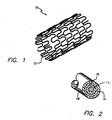
- FIGURE 1 is a perspective view of a typical stent having an open lattice structure and embodying features of the present invention.
- FIG. 2 is a cross-section of one wire strut of the stent of FIG. 1 depicting the various layers attached to the stent.
- Particular embodiments of the present invention provide a system for delivering a precise dose of radiation to a vascular site via an implantable device.
- the device for example may be used to prevent restenosis in a blood vessel that had been subjected to an angioplastic procedure.
- One device embodying the present invention takes the form of a permanently implantable stent 10.
- the stent 10 initially is provided in a collapsed state and positioned about an inflatable balloon on the distal end of a catheter.
- the balloon Upon maneuvering the balloon into place within the target blood vessel, the balloon is inflated, which causes the stent to radially expand.
- Any of various mechanisms well known in the art may be incorporated in the stent in order to lock the stent into its expanded state.
- Subsequent deflation of the balloon and extraction of the catheter leaves the expanded stent in place to maintain the patency of the blood vessel.
- Further details of expandable stents and a balloon catheter delivery system are found in U.S. Patent No. 5,569,295 which issued October 29, 1996 to Advanced Cardiovascular Systems, Inc. on an application filed May 3, 1995.
- FIGS. 1 and 2 depict the stent 10.
- the exterior surface 12 of the stent 10 first is selectively coated with a base layer 14 that serves as a primer or foundation.
- the base material is selected for its ability to adhere or bond to the surface of the stent while providing a surface to which the next layer readily bonds.
- An intermediate spacer layer 16 optionally is bonded to the base layer for the purpose of providing sufficient mobility to the chelating functionality that subsequently is applied thereto and/or to increase the number of active sites available to the chelating moiety thereby serving as a chemical amplifier.
- the chelator 18 is attached covalently to either the spacer material 16 or directly to the base layer 14.
- the chelator is selected to form a strong bond with the underlying material and to have a strong affinity for the particular radioisotope to be used.
- the top layer is applied just prior to use and comprises the radioisotope that is adsorbed by the chelator.
- the radioisotope is selected based on the type of radiation it emits and its half-life.
- the stent may be constructed of metal or a polymer. Stainless steel is the preferred material of construction.
- the base layer may comprise gold or any organic coating that contains a nucleophile, or potential nucleophile. These sites potentially could be aliphatic, or benzylic carbons ⁇ to an ester, ketone or nitrile. Alternatively, they could be alcohols, amines, ureas or thiols. Possible base layers include polyurethane, poly (ethylene-vinyl alcohols) , poly (vinyl alcohols), most hydrogels and polyarcylates.
- the spacer layer preferably is attached to the base layer by nucleophilic substitution due to the degree of control afforded by such reaction.
- radical grafting processes may be employed.
- Possible spacer materials include ⁇ , ⁇ - mercaptoalkylamines, diisocyanates, diacid chlorides, dialkylamines, ⁇ , ⁇ - hydroxyalkylamines, dihydroxyalkanes (PEO) and dimercaptoalkanes.
- the chelator is selected to form a covalent bond with the underlying layer, i.e. , either the spacer or the base, and for a very high binding affinity for the radioisotope.
- Possible chelator functionalities include acetates (monocarboxylic acids), acetylacetone, benzoylacetone, citric acid, 1,2-diaminocyclohexane-N,N,N',N' -tetraacetic acid, ethylenediamine-N,N,N',N' -tetraacetic acid, and pyridine-2,6-dicarboxylic acid.
- the radioisotope is selected based on the type of emission, its half-life and the strength of its bond to the chelator, which must be sufficient so as not to be displaced by ions present in the blood.
- the preferred isotope is a ⁇ -emitter, because ⁇ -radiation penetrates too deeply into tissue and the energy of ⁇ -particles is insufficient.
- the half-life of the radioisotope should be between 24 hours and 2 months, preferably between 2-18 days. The shorter the half-life, the more problematic becomes the shipping and storage of the radioactive material, while the longer the half-life, the more excessive becomes the delivered the dosage in view of the biological process currently understood to be involved in the processes of restenosis.
- the most preferred combination of materials is a stainless steel stent, a gold base layer, ⁇ , ⁇ -mercaptoalkylamine as a spacer, N 1 -(2-hydroxethyl) ethylenedramine - N,N,N 1 - triacetic acid as a chelator and Ir 192 as the radioisotope.
- the stent first is prepared by applying the base layer, then optionally the spacer layer and finally the chelator.
- the coated stent subsequently is sterilized and processed along with the stent and associated devices.
- the subsequent shelf life and handling constraints substantially are dictated by the base stent and catheter rather than by the coating.
- the radioisotope suspended in a solution contained in a vial, is handled separately according to the general methods with which hospitals are acquainted.
- the stent is immersed in the vial in order to allow the chelator to adsorb the radioisotope.
- the loaded stent subsequently is maneuvered into position within the patient and expanded to be permanently left in place.
- the radiation emitted by stent gradually diminishes as a function of its half-life but is sufficient during the critical six month time frame to preclude or at least minimize the chance of restenosis. Radiation subsequently continues to subside to insignificant levels obviating the need to remove the device.
- any type of implantable device may be prepared in accordance with the invention and the method may be practiced to treat any type of condition that has been found to respond to the localized irradiation of tissue. Accordingly, it is not intended that the invention be limited except by the appended claims.
Landscapes
- Health & Medical Sciences (AREA)
- Chemical & Material Sciences (AREA)
- Physics & Mathematics (AREA)
- Optics & Photonics (AREA)
- Epidemiology (AREA)
- Dispersion Chemistry (AREA)
- Medicinal Chemistry (AREA)
- Pharmacology & Pharmacy (AREA)
- Heart & Thoracic Surgery (AREA)
- Life Sciences & Earth Sciences (AREA)
- Animal Behavior & Ethology (AREA)
- General Health & Medical Sciences (AREA)
- Public Health (AREA)
- Veterinary Medicine (AREA)
- Radiation-Therapy Devices (AREA)
- Medicines That Contain Protein Lipid Enzymes And Other Medicines (AREA)
- Media Introduction/Drainage Providing Device (AREA)
Abstract
Description
- The present invention generally relates to the use of radiation therapy to treat a condition such as restenosis and, more particularly, pertains to the use of an implantable device to deliver a dose of radiation.
- A variety of conditions have been found to be amenable to treatment by the local irradiation of tissue. In order to appropriately limit the amount of tissue that is irradiated, it sometimes is necessary to implant a small source of radiation and, in order to expose the tissue to a sufficient dosage of radiation, it has been found advantageous to implant such device for an extended period of time.
- Percutaneous transluminal coronary angioplasty (PTCA) is an established treatment for coronary artery disease. The procedure involves inserting a balloon catheter through the vasculature to a position where atherosclerotic plaqee has collected on the vessel wall. The plaque is compressed against the vessel wall by inflating the balloon located at the distal end of the catheter in order to increase the diameter of the vessel and thereby reduce the restriction to blood flow. After sufficient expansion has been achieved, the balloon is deflated and removed, and the area of disruption begins to heal.
- While this procedure is very widely used, one problem associated with PTCA is a condition known as restenosis. Restenosis is the development of further blockage in the intravascular structure, following an otherwise successful angioplasty procedure. Restenosis is believed to be an exaggerated form of the normal healing process of the stretched tissue. Restenosis is thought to be caused by fibrointimal proliferation of the stretched wall in which the injured cells lining the vascular structure multiply and form fibrous tissue. Such growth at the vascular wall is an almost malignant phenomenon in which normal cells multiply at a high rate, thereby creating a new obstruction to flow through the vascular structure. It occurs in the range of approximately 15-50 percent of the PTCA cases and typically presents within the first six months following PTCA. Stents have been implanted in expanded vessels in an effort to maintain patency but do not appear to have much of an effect on the restenosis rate. In the event a stent has been implanted, the growth tends to occur around its ends and through any openings in its walls.
- Localized irradiation of the vessel from within the vessel has been found to be effective in reducing the incidence of restenosis. To date, such radiation has been delivered via a number of different vehicles, including by guide wire, balloon, temporarily implantable wire or permanently-implantable stent. The delivery device either is partially or wholly formed of radioactive material or alternatively, is coated with a radioactive substance. Material giving off high levels of radiation may be introduced briefly into the body and then removed. Alternatively, material giving off a relatively lower level of radiation and with an appropriately short half-life may be introduced temporarily or, in some instances, left in place.
- A number of shortcomings or disadvantages are associated with the prior art devices and techniques. With respect to temporarily implanted devices, implantation time is limited and therefore the radiation dose necessarily must be very high. At such high dosage rates, local radiation burns may be caused on one side of the vessel while the opposite side may receive a suboptimum dose. Moreover, due to the tendency of restenosis to occur throughout a six month period, repeated irradiation procedures would be necessary in order to adequately address the vagaries of onset.
- In the case of permanently implanted devices, a compromise be made between the shelf life of the device and its in vivo efficacious lifetime. If materials with chort half-lives are used, in order to reduce the long term exposure of the patient to radiation, then the shelf life of the device necessarily must be short and therefore is undesirable. If, on the other hand, an isotope is used which will permit a substantial shelf life, i.e., an isotope having a long half-life, then the exposure of the patient to radiation will be long term and may be excessive. Moreover, in view of the fact that the development of restenosis typically occurs within the first six months, it has been recognized that it is desirable to limit irradiation to such a time frame. Of course, attempting to substantially restrict the release of radiation from a permanently implantable device to such a limited period of time imposes further constraints on the shelf life of the device.
- Another disadvantage inherent in the heretofore known delivery devices is related to the need to adequately protect from exposure to unreasonable radiation dosages all who handle the device, including the manufacturing, stocking, and shipping personnel, catheter laboratory personnel, and physicians. This requires the use of large and cumbersome containers that further complicate handling and disposal concerns. Some of the radioisotopes being considered in the industry require ion implantation into the device or transmutation of the metal in the device. The complexity of such processes greatly increases the cost of the devices.
- A new approach is necessary that would overcome the shortcomings of the prior art. It would be desirable to provide a system by which a very predictable dosage of radiation can be delivered via a permanently implantable device. Moreover, it would be most desirable for such device to be producible at minimal cost, to have a substantial shelf life and present a minimal risk of exposure to radiation.
- The present invention seeks to overcome the shortcomings of the techniques and devices heretofore employed to deliver a dose of radiation to a vascular site. A method is provided for precisely controlling the dosage that is delivered to the patient, while concerns relating to shelf-life of the device are obviated. Moreover, the hazards with respect to the handling of radioactive devices are substantially mitigated. Additionally, embodiments of the invention provide a method for quickly and easily rendering an implantable device radioactive. More particularly, an implantable device is prepared so as to readily adsorb a preselected amount of radioactive material and to form a sufficiently strong bond therewith so as to substantially minimize any subsequent loss thereof upon contact with bodily fluids. Embodiments of the invention further provide a stent or other implantable device which facilitates the practice of such method.
- These advantages generally are achieved by maintaining separate the implantable hardware and the radioactive material until just prior to implantation. By loading a precisely known quantity of material with a known half-life onto the device and immediately proceeding with the implantation procedure, a very precise dose of radiation can be delivered to the patient over a desired period of time.
- Particular embodiments of present invention provide a stent that facilitates the adsorption of a predictable amount of radioactive material thereon in the surgery room. More particularly, a stent is provided that is coated with a chelating agent. A base material and, optionally, a spacer material first is coated onto the device, after which the chelator is applied. This approach obviates any shelf life concerns related to the stent itself and obviates the need for special handling of the stent prior to loading. The base material is selected to both form a strong bond with the surface of the stent as well as with the spacer or chelator applied thereover. The spacer is selected to form a strong bond with the underlying base layer as well as with the chelator and serves to impart a degree of mobility to the chelator or to increase the number of active sites. Finally, the chelator is selected to form a strong bond with the base layer or spacer layer therebelow and of course ultimately adsorb the radioactive isotope. Such combinations of coatings are fairly tenacious, are substantially unaffected by the disinfection processes the stent is normally subjected to and have no effect on the shelf life of the stent.
- Just prior to implantation, the chelator-coated device is immersed in a solution containing the appropriate radioactive material to adsorb the radioisotope. The chelator-isotope combination can be chosen such that the loading is quantitative with virtually no subsequent release of the radioactive material from the implanted stent. Knowing the activity of the material along with the half-life of the radioisotope renders precisely calculable the total dosage of radiation that will be delivered. Precautions relating to the radiation must only be taken when handling the vial containing the radioactive material and when handling the stent during and after the loading step.
- These and other features and advantages of the present invention will become apparent from the following detailed description of preferred embodiments which, taken in conjunction with the accompanying drawing, illustrate by way of example the principles of the invention.
- FIGURE 1 is a perspective view of a typical stent having an open lattice structure and embodying features of the present invention.
- FIG. 2 is a cross-section of one wire strut of the stent of FIG. 1 depicting the various layers attached to the stent.
- Particular embodiments of the present invention provide a system for delivering a precise dose of radiation to a vascular site via an implantable device. The device for example may be used to prevent restenosis in a blood vessel that had been subjected to an angioplastic procedure.
- One device embodying the present invention takes the form of a permanently
implantable stent 10. Thestent 10 initially is provided in a collapsed state and positioned about an inflatable balloon on the distal end of a catheter. Upon maneuvering the balloon into place within the target blood vessel, the balloon is inflated, which causes the stent to radially expand. Any of various mechanisms well known in the art may be incorporated in the stent in order to lock the stent into its expanded state. Subsequent deflation of the balloon and extraction of the catheter leaves the expanded stent in place to maintain the patency of the blood vessel. Further details of expandable stents and a balloon catheter delivery system are found in U.S. Patent No. 5,569,295 which issued October 29, 1996 to Advanced Cardiovascular Systems, Inc. on an application filed May 3, 1995. - Such October 29, 1996
stent 10 may be prepared in accordance with an embodiment of the present invention to deliver a preselected dose of radiation. FIGS. 1 and 2 depict thestent 10. Theexterior surface 12 of thestent 10 first is selectively coated with abase layer 14 that serves as a primer or foundation. The base material is selected for its ability to adhere or bond to the surface of the stent while providing a surface to which the next layer readily bonds. Anintermediate spacer layer 16 optionally is bonded to the base layer for the purpose of providing sufficient mobility to the chelating functionality that subsequently is applied thereto and/or to increase the number of active sites available to the chelating moiety thereby serving as a chemical amplifier. Thechelator 18 is attached covalently to either thespacer material 16 or directly to thebase layer 14. The chelator is selected to form a strong bond with the underlying material and to have a strong affinity for the particular radioisotope to be used. The top layer is applied just prior to use and comprises the radioisotope that is adsorbed by the chelator. The radioisotope is selected based on the type of radiation it emits and its half-life. - The stent may be constructed of metal or a polymer. Stainless steel is the preferred material of construction.
- The base layer may comprise gold or any organic coating that contains a nucleophile, or potential nucleophile. These sites potentially could be aliphatic, or benzylic carbons α to an ester, ketone or nitrile. Alternatively, they could be alcohols, amines, ureas or thiols. Possible base layers include polyurethane, poly (ethylene-vinyl alcohols) , poly (vinyl alcohols), most hydrogels and polyarcylates.
- The spacer layer preferably is attached to the base layer by nucleophilic substitution due to the degree of control afforded by such reaction. Alternatively, radical grafting processes may be employed. Possible spacer materials include α, ω- mercaptoalkylamines, diisocyanates, diacid chlorides, dialkylamines, α, ω- hydroxyalkylamines, dihydroxyalkanes (PEO) and dimercaptoalkanes.
- The chelator is selected to form a covalent bond with the underlying layer, i.e., either the spacer or the base, and for a very high binding affinity for the radioisotope. Possible chelator functionalities include acetates (monocarboxylic acids), acetylacetone, benzoylacetone, citric acid, 1,2-diaminocyclohexane-N,N,N',N' -tetraacetic acid, ethylenediamine-N,N,N',N' -tetraacetic acid, and pyridine-2,6-dicarboxylic acid.
- The radioisotope is selected based on the type of emission, its half-life and the strength of its bond to the chelator, which must be sufficient so as not to be displaced by ions present in the blood. The preferred isotope is a β-emitter, because γ-radiation penetrates too deeply into tissue and the energy of α-particles is insufficient. The half-life of the radioisotope should be between 24 hours and 2 months, preferably between 2-18 days. The shorter the half-life, the more problematic becomes the shipping and storage of the radioactive material, while the longer the half-life, the more excessive becomes the delivered the dosage in view of the biological process currently understood to be involved in the processes of restenosis.
- The most preferred combination of materials is a stainless steel stent, a gold base layer, α, ω-mercaptoalkylamine as a spacer, N1-(2-hydroxethyl) ethylenedramine - N,N,N1 - triacetic acid as a chelator and Ir192 as the radioisotope.
- According to a preferred embodiment, the stent first is prepared by applying the base layer, then optionally the spacer layer and finally the chelator. The coated stent subsequently is sterilized and processed along with the stent and associated devices. The subsequent shelf life and handling constraints substantially are dictated by the base stent and catheter rather than by the coating.
- The radioisotope, suspended in a solution contained in a vial, is handled separately according to the general methods with which hospitals are acquainted. Just prior to implantation, the stent is immersed in the vial in order to allow the chelator to adsorb the radioisotope. The loaded stent subsequently is maneuvered into position within the patient and expanded to be permanently left in place. The radiation emitted by stent gradually diminishes as a function of its half-life but is sufficient during the critical six month time frame to preclude or at least minimize the chance of restenosis. Radiation subsequently continues to subside to insignificant levels obviating the need to remove the device.
- While a particular form of the invention has been illustrated and described, it also will be apparent to those skilled in the art that various modifications can be made without departing from the scope of the invention. More particularly, any type of implantable device may be prepared in accordance with the invention and the method may be practiced to treat any type of condition that has been found to respond to the localized irradiation of tissue. Accordingly, it is not intended that the invention be limited except by the appended claims.
Claims (10)
- An intravascular medical device (10) for providing radiation treatment, comprising:an implantable, component;a chelating coating (18) attached to a preselected (14 or 16) surface of said component, said chelating coating being selected to have a binding affinity for a preselected radioisotope.
- The medical device of claim 1, wherein said implantable component comprises an expandable stent.
- The medical device of claim 1, further comprising a base layer (14) attached to said preselected surface of said component and disposed below said chelating coating.
- The medical device of claim 3, further comprising a spacer layer (16) bonded tto said base layer and disposed below said chelating coating.
- The medical device of claim 4, wherein said base layer comprises gold and said spacer layer comprises α,ω-mercapto-alkyamine.
- The medical device of claim 1, further comprising a radioactive isotope adsorbed by said chelating coating.
- The medical device of claim 6, wherein said radioactive isotope comprises a β-emitter.
- The medical device of claim 7, wherein said β-emitter has a half-life of between 24 hours and 2 months.
- The medical device of claim 8, wherein said β-emitter has a half-life of between 2 and 18 days.
- A method for delivering a preselected dosage of radiation to a desired site, comprising the steps of:providing a component having preselected sections thereof coated with chelator (18), said chelator being selected to have a bonding affinity for a preselected radioisotope;providing said radioisotope in solution;immersing said implantable component in said solution; andimmediately after said immersion step, delivering said component to said desired site.
Applications Claiming Priority (2)
| Application Number | Priority Date | Filing Date | Title |
|---|---|---|---|
| US685447 | 1996-07-19 | ||
| US08/685,447 US5871436A (en) | 1996-07-19 | 1996-07-19 | Radiation therapy method and device |
Publications (2)
| Publication Number | Publication Date |
|---|---|
| EP0819446A2 true EP0819446A2 (en) | 1998-01-21 |
| EP0819446A3 EP0819446A3 (en) | 2000-01-26 |
Family
ID=24752244
Family Applications (1)
| Application Number | Title | Priority Date | Filing Date |
|---|---|---|---|
| EP97304916A Withdrawn EP0819446A3 (en) | 1996-07-19 | 1997-07-04 | Radiation therapy method and device more particularly suitable for implantation |
Country Status (6)
| Country | Link |
|---|---|
| US (2) | US5871436A (en) |
| EP (1) | EP0819446A3 (en) |
| JP (1) | JPH1057382A (en) |
| AU (1) | AU696973B2 (en) |
| CA (1) | CA2206394A1 (en) |
| MX (1) | MX9705373A (en) |
Cited By (17)
| Publication number | Priority date | Publication date | Assignee | Title |
|---|---|---|---|---|
| WO1998048850A1 (en) * | 1997-04-26 | 1998-11-05 | Universität Karlsruhe | Radionuclide microparticles bound to elastomeric hose for the endovascular therapy |
| WO1998057706A1 (en) * | 1997-06-17 | 1998-12-23 | Medtronic, Inc. | An implantable device for delivering localized radiation in vivo and method for making the same |
| WO1998048851A3 (en) * | 1997-04-30 | 1999-04-22 | Schering Ag | Stents with a radioactive surface coating |
| WO1998048852A3 (en) * | 1997-04-30 | 1999-04-22 | Schering Ag | Polymer-coated stents |
| WO1999002195A3 (en) * | 1997-07-07 | 1999-05-20 | Implant Sciences Corp | Coronary stent with a radioactive, radiopaque coating |
| WO1999029354A3 (en) * | 1997-12-10 | 1999-09-16 | Varian Mediacal Systems Inc | Method and apparatus creating a radioactive layer on an implantable substrate |
| DE19819426A1 (en) * | 1998-04-30 | 1999-11-11 | Christoph Hehrlein | Catheters and vascular supports, in particular for combined radioactive radiation and medication therapy and methods for their production |
| EP0955016A3 (en) * | 1998-05-05 | 2000-04-19 | Jomed Implantate GmbH | Radioactive stent |
| WO2000045892A1 (en) * | 1999-02-08 | 2000-08-10 | Advanced Cardiovascular Systems, Inc. | Method for intravascular radiation therapy |
| FR2797175A1 (en) * | 1999-08-02 | 2001-02-09 | Jacques Seguin | Device for treatment of narrowing of vascular blood vessel or bilious duct, comprises catheter, radially extensible tubular element called stent, mounted on catheter, and means of expansion and radial deployment of stent |
| WO2001014617A1 (en) * | 1999-08-23 | 2001-03-01 | Angiogene Inc. | Radioactively coated device and method of making same for preventing restenosis |
| WO2001049358A1 (en) * | 1999-12-30 | 2001-07-12 | St. Jude Medical, Inc. | Medical devices that resist restenosis |
| WO2006056984A3 (en) * | 2004-11-26 | 2006-10-05 | Novik Shai | Chelating and binding chemicals to a medical implant |
| WO2017031065A1 (en) * | 2015-08-17 | 2017-02-23 | Boston Scientific Scimed, Inc. | Radioactive stent |
| US20170203011A1 (en) * | 2016-01-15 | 2017-07-20 | Cook Medical Technologies Llc | Coated medical device and method of coating such a device |
| EP3659634A1 (en) | 2018-11-29 | 2020-06-03 | Cook Medical Technologies LLC | Bioactive agent coated medical device and method of coating such a device |
| US11752019B2 (en) | 2018-11-29 | 2023-09-12 | Cook Medical Technologies Llc | Bioactive agent coated medical device and method of coating such a device |
Families Citing this family (97)
| Publication number | Priority date | Publication date | Assignee | Title |
|---|---|---|---|---|
| DK0633041T3 (en) | 1993-07-01 | 2000-04-03 | Schneider Europ Gmbh | Medical apparatus for the treatment of blood vessels by means of ionizing radiation |
| US5857956A (en) | 1994-06-08 | 1999-01-12 | United States Surgical Corporation | Flexible source wire for localized internal irradiation of tissue |
| ATE170708T1 (en) | 1994-06-10 | 1998-09-15 | Schneider Europ Gmbh | MEDICINAL DEVICE FOR THE TREATMENT OF A PART OF BODY VESSEL USING IONIZATION RADIATION |
| ATE196742T1 (en) | 1994-06-24 | 2000-10-15 | Schneider Europ Gmbh | MEDICINAL DEVICE FOR THE TREATMENT OF A PART OF A BODY VESSEL USING IONIZATION RADIATION |
| US6099454A (en) | 1996-02-29 | 2000-08-08 | Scimed Life Systems, Inc. | Perfusion balloon and radioactive wire delivery system |
| US6234951B1 (en) | 1996-02-29 | 2001-05-22 | Scimed Life Systems, Inc. | Intravascular radiation delivery system |
| US5855546A (en) | 1996-02-29 | 1999-01-05 | Sci-Med Life Systems | Perfusion balloon and radioactive wire delivery system |
| US5782740A (en) * | 1996-08-29 | 1998-07-21 | Advanced Cardiovascular Systems, Inc. | Radiation dose delivery catheter with reinforcing mandrel |
| US6261320B1 (en) | 1996-11-21 | 2001-07-17 | Radiance Medical Systems, Inc. | Radioactive vascular liner |
| US6458069B1 (en) | 1998-02-19 | 2002-10-01 | Endology, Inc. | Multi layer radiation delivery balloon |
| US6491619B1 (en) | 1997-01-31 | 2002-12-10 | Endologix, Inc | Radiation delivery catheters and dosimetry methods |
| US5782742A (en) | 1997-01-31 | 1998-07-21 | Cardiovascular Dynamics, Inc. | Radiation delivery balloon |
| US6676590B1 (en) | 1997-03-06 | 2004-01-13 | Scimed Life Systems, Inc. | Catheter system having tubular radiation source |
| US6059713A (en) | 1997-03-06 | 2000-05-09 | Scimed Life Systems, Inc. | Catheter system having tubular radiation source with movable guide wire |
| US6110097A (en) | 1997-03-06 | 2000-08-29 | Scimed Life Systems, Inc. | Perfusion balloon catheter with radioactive source |
| US6059812A (en) | 1997-03-21 | 2000-05-09 | Schneider (Usa) Inc. | Self-expanding medical device for centering radioactive treatment sources in body vessels |
| US6776792B1 (en) | 1997-04-24 | 2004-08-17 | Advanced Cardiovascular Systems Inc. | Coated endovascular stent |
| US6210312B1 (en) | 1997-05-20 | 2001-04-03 | Advanced Cardiovascular Systems, Inc. | Catheter and guide wire assembly for delivery of a radiation source |
| US6019718A (en) | 1997-05-30 | 2000-02-01 | Scimed Life Systems, Inc. | Apparatus for intravascular radioactive treatment |
| CH691846A5 (en) | 1997-06-20 | 2001-11-15 | Ecole Polytech | intravascular implant expansion deflector. |
| JP2001517505A (en) | 1997-09-23 | 2001-10-09 | ユナイテッド ステイツ サージカル コーポレーション | Source wire for radiation therapy |
| EP0904798B1 (en) | 1997-09-26 | 2002-11-06 | Schneider ( Europe) GmbH | Carbon dioxide inflated radio-therapy balloon catheter |
| US6254552B1 (en) * | 1997-10-03 | 2001-07-03 | E.I. Du Pont De Nemours And Company | Intra-coronary radiation devices containing Ce-144 or Ru-106 |
| US6030333A (en) * | 1997-10-24 | 2000-02-29 | Radiomed Corporation | Implantable radiotherapy device |
| US6264596B1 (en) * | 1997-11-03 | 2001-07-24 | Meadox Medicals, Inc. | In-situ radioactive medical device |
| US6048299A (en) * | 1997-11-07 | 2000-04-11 | Radiance Medical Systems, Inc. | Radiation delivery catheter |
| US6149574A (en) * | 1997-12-19 | 2000-11-21 | Radiance Medical Systems, Inc. | Dual catheter radiation delivery system |
| US6120540A (en) * | 1998-01-21 | 2000-09-19 | Apple; Marc G. | Radio prosthesis |
| US6224535B1 (en) | 1998-02-17 | 2001-05-01 | Advanced Cardiovascular Systems, Inc. | Radiation centering catheters |
| JP2002503530A (en) | 1998-02-19 | 2002-02-05 | ラディアンス・メディカル・システムズ・インコーポレイテッド | Thin film irradiation source |
| US20060078493A1 (en) * | 1998-05-05 | 2006-04-13 | Randolf Von Oepen | Methods and apparatus for localized administration of inhibitory moieties to a patient |
| US6053858A (en) * | 1998-06-04 | 2000-04-25 | Advanced Cardiovascular Systems, Inc. | Radiation source |
| US6406488B1 (en) * | 1998-08-27 | 2002-06-18 | Heartstent Corporation | Healing transmyocardial implant |
| US6413203B1 (en) | 1998-09-16 | 2002-07-02 | Scimed Life Systems, Inc. | Method and apparatus for positioning radioactive fluids within a body lumen |
| US6132677A (en) * | 1999-04-26 | 2000-10-17 | Lockheed Martin Energy Research Corporation | Method for making radioactive metal articles having small dimensions |
| IL146555A0 (en) * | 1999-05-19 | 2002-07-25 | Malte Neuss | Radially expandable vessel support |
| US6547816B1 (en) * | 1999-07-12 | 2003-04-15 | Civatech Corporation | Formable integral source material for medical devices |
| US6582417B1 (en) * | 1999-09-22 | 2003-06-24 | Advanced Cardiovascular Systems, Inc. | Methods and apparatuses for radiation treatment |
| US6605031B1 (en) | 1999-09-22 | 2003-08-12 | Advanced Cardiovascular Systems, Inc. | Stepped centering balloon for optimal radiation delivery |
| US6352501B1 (en) | 1999-09-23 | 2002-03-05 | Scimed Life Systems, Inc. | Adjustable radiation source |
| US6203485B1 (en) | 1999-10-07 | 2001-03-20 | Scimed Life Systems, Inc. | Low attenuation guide wire for intravascular radiation delivery |
| US6398709B1 (en) | 1999-10-19 | 2002-06-04 | Scimed Life Systems, Inc. | Elongated member for intravascular delivery of radiation |
| US6500108B1 (en) | 1999-10-22 | 2002-12-31 | The Regents Of The University Of California | Radiation delivery system and method |
| ATE352268T1 (en) | 1999-11-23 | 2007-02-15 | Sorin Biomedica Cardio Srl | METHOD FOR TRANSFER OF RADIOACTIVE SUBSTANCES TO STENTS IN ANGIOPLASTY AND KIT |
| US7163504B1 (en) | 2000-02-16 | 2007-01-16 | Advanced Cardiovascular Systems, Inc. | Multi-lumen fluted balloon radiation centering catheter |
| US7994449B2 (en) | 2000-02-16 | 2011-08-09 | Advanced Cardiovascular Systems, Inc. | Square-wave laser bonding |
| US6416457B1 (en) | 2000-03-09 | 2002-07-09 | Scimed Life Systems, Inc. | System and method for intravascular ionizing tandem radiation therapy |
| US6302865B1 (en) | 2000-03-13 | 2001-10-16 | Scimed Life Systems, Inc. | Intravascular guidewire with perfusion lumen |
| US6783793B1 (en) * | 2000-10-26 | 2004-08-31 | Advanced Cardiovascular Systems, Inc. | Selective coating of medical devices |
| US6638205B1 (en) * | 2000-11-17 | 2003-10-28 | Mds (Canada) Inc. | Radioactive medical device for radiation therapy |
| US6524232B1 (en) | 2000-12-22 | 2003-02-25 | Advanced Cardiovascular Systems, Inc. | Method for radioactive stent delivery |
| US6547812B1 (en) | 2000-12-29 | 2003-04-15 | Advanced Cardiovascular Systems, Inc. | Radiation therapy using a radioactive implantable device and a radiosensitizer agent |
| US6641607B1 (en) | 2000-12-29 | 2003-11-04 | Advanced Cardiovascular Systems, Inc. | Double tube stent |
| US6800055B2 (en) | 2001-02-21 | 2004-10-05 | Cordis Corporation | Low attenuating radioactive seeds |
| US6669621B2 (en) | 2001-03-14 | 2003-12-30 | Cordis Corporation | Method and assembly for containing radioactive materials |
| US6497646B1 (en) | 2001-03-14 | 2002-12-24 | Cordis Corporation | Intravascular radiotherapy source ribbon having variable radiopacity |
| US6764505B1 (en) * | 2001-04-12 | 2004-07-20 | Advanced Cardiovascular Systems, Inc. | Variable surface area stent |
| US20030153801A1 (en) * | 2001-05-29 | 2003-08-14 | Pharmacia Corporation | Compositions of cyclooxygenase-2 selective inhibitors and radiation for inhibition or prevention of cardiovascular disease |
| US7862495B2 (en) * | 2001-05-31 | 2011-01-04 | Advanced Cardiovascular Systems, Inc. | Radiation or drug delivery source with activity gradient to minimize edge effects |
| US6565659B1 (en) | 2001-06-28 | 2003-05-20 | Advanced Cardiovascular Systems, Inc. | Stent mounting assembly and a method of using the same to coat a stent |
| US6656216B1 (en) * | 2001-06-29 | 2003-12-02 | Advanced Cardiovascular Systems, Inc. | Composite stent with regioselective material |
| US8303651B1 (en) * | 2001-09-07 | 2012-11-06 | Advanced Cardiovascular Systems, Inc. | Polymeric coating for reducing the rate of release of a therapeutic substance from a stent |
| US6645547B1 (en) * | 2002-05-02 | 2003-11-11 | Labcoat Ltd. | Stent coating device |
| US7048962B2 (en) * | 2002-05-02 | 2006-05-23 | Labcoat, Ltd. | Stent coating device |
| US7709048B2 (en) * | 2002-05-02 | 2010-05-04 | Labcoat, Ltd. | Method and apparatus for coating a medical device |
| US8318235B2 (en) * | 2003-01-22 | 2012-11-27 | Cordis Corporation | Method for applying drug coating to a medical device in surgeon room |
| WO2005011561A2 (en) | 2003-08-04 | 2005-02-10 | Labcoat, Ltd. | Stent coating apparatus and method |
| US20050048194A1 (en) * | 2003-09-02 | 2005-03-03 | Labcoat Ltd. | Prosthesis coating decision support system |
| US20050058768A1 (en) * | 2003-09-16 | 2005-03-17 | Eyal Teichman | Method for coating prosthetic stents |
| US7198675B2 (en) | 2003-09-30 | 2007-04-03 | Advanced Cardiovascular Systems | Stent mandrel fixture and method for selectively coating surfaces of a stent |
| US7563324B1 (en) | 2003-12-29 | 2009-07-21 | Advanced Cardiovascular Systems Inc. | System and method for coating an implantable medical device |
| US7553377B1 (en) | 2004-04-27 | 2009-06-30 | Advanced Cardiovascular Systems, Inc. | Apparatus and method for electrostatic coating of an abluminal stent surface |
| US7632307B2 (en) * | 2004-12-16 | 2009-12-15 | Advanced Cardiovascular Systems, Inc. | Abluminal, multilayer coating constructs for drug-delivery stents |
| ES2691646T3 (en) | 2005-07-15 | 2018-11-28 | Micell Technologies, Inc. | Polymer coatings containing controlled morphology drug powder |
| WO2007011708A2 (en) | 2005-07-15 | 2007-01-25 | Micell Technologies, Inc. | Stent with polymer coating containing amorphous rapamycin |
| US7867547B2 (en) | 2005-12-19 | 2011-01-11 | Advanced Cardiovascular Systems, Inc. | Selectively coating luminal surfaces of stents |
| CA2996768C (en) | 2006-04-26 | 2020-12-08 | Micell Technologies, Inc. | Coatings containing multiple drugs |
| US8069814B2 (en) | 2006-05-04 | 2011-12-06 | Advanced Cardiovascular Systems, Inc. | Stent support devices |
| US8603530B2 (en) | 2006-06-14 | 2013-12-10 | Abbott Cardiovascular Systems Inc. | Nanoshell therapy |
| US8048448B2 (en) | 2006-06-15 | 2011-11-01 | Abbott Cardiovascular Systems Inc. | Nanoshells for drug delivery |
| US8017237B2 (en) | 2006-06-23 | 2011-09-13 | Abbott Cardiovascular Systems, Inc. | Nanoshells on polymers |
| US7686756B2 (en) * | 2006-08-29 | 2010-03-30 | Ciratech Oncology | Brachytherapy devices and related methods and computer program products |
| CN101711137B (en) | 2007-01-08 | 2014-10-22 | 米歇尔技术公司 | Stent with biodegradable layer |
| US11426494B2 (en) | 2007-01-08 | 2022-08-30 | MT Acquisition Holdings LLC | Stents having biodegradable layers |
| US8048441B2 (en) | 2007-06-25 | 2011-11-01 | Abbott Cardiovascular Systems, Inc. | Nanobead releasing medical devices |
| CA2721832C (en) | 2008-04-17 | 2018-08-07 | Micell Technologies, Inc. | Stents having bioabsorbable layers |
| WO2010009335A1 (en) | 2008-07-17 | 2010-01-21 | Micell Technologies, Inc. | Drug delivery medical device |
| CN102481195B (en) | 2009-04-01 | 2015-03-25 | 米歇尔技术公司 | coated stent |
| EP3366326A1 (en) | 2009-04-17 | 2018-08-29 | Micell Technologies, Inc. | Stents having controlled elution |
| EP2453834A4 (en) | 2009-07-16 | 2014-04-16 | Micell Technologies Inc | Drug delivery medical device |
| EP2531140B1 (en) | 2010-02-02 | 2017-11-01 | Micell Technologies, Inc. | Stent and stent delivery system with improved deliverability |
| WO2011133655A1 (en) | 2010-04-22 | 2011-10-27 | Micell Technologies, Inc. | Stents and other devices having extracellular matrix coating |
| WO2012009684A2 (en) | 2010-07-16 | 2012-01-19 | Micell Technologies, Inc. | Drug delivery medical device |
| US10117972B2 (en) | 2011-07-15 | 2018-11-06 | Micell Technologies, Inc. | Drug delivery medical device |
| US10188772B2 (en) | 2011-10-18 | 2019-01-29 | Micell Technologies, Inc. | Drug delivery medical device |
| CN110269959A (en) | 2013-03-12 | 2019-09-24 | 脉胜医疗技术公司 | Bioabsorbable biomedical implants |
| WO2014186532A1 (en) | 2013-05-15 | 2014-11-20 | Micell Technologies, Inc. | Bioabsorbable biomedical implants |
Citations (1)
| Publication number | Priority date | Publication date | Assignee | Title |
|---|---|---|---|---|
| US5569295A (en) | 1993-12-28 | 1996-10-29 | Advanced Cardiovascular Systems, Inc. | Expandable stents and method for making same |
Family Cites Families (39)
| Publication number | Priority date | Publication date | Assignee | Title |
|---|---|---|---|---|
| WO1985002779A1 (en) * | 1983-12-27 | 1985-07-04 | Board Of Trustees Of Leland Stanford Junior Univer | Catheter for treatment of tumors and method for using same |
| US4697575A (en) * | 1984-11-21 | 1987-10-06 | Henry Ford Hospital | Delivery system for interstitial radiation therapy including substantially non-deflecting elongated member |
| US4706652A (en) * | 1985-12-30 | 1987-11-17 | Henry Ford Hospital | Temporary radiation therapy |
| US4994560A (en) * | 1987-06-24 | 1991-02-19 | The Dow Chemical Company | Functionalized polyamine chelants and radioactive rhodium complexes thereof for conjugation to antibodies |
| US5575815A (en) * | 1988-08-24 | 1996-11-19 | Endoluminal Therapeutics, Inc. | Local polymeric gel therapy |
| US4969863A (en) * | 1988-10-28 | 1990-11-13 | Eric van't Hooft | Adaptor for remote after-loading apparatus for radiotherapy |
| US4861520A (en) * | 1988-10-28 | 1989-08-29 | Eric van't Hooft | Capsule for radioactive source |
| US5263963A (en) * | 1989-09-08 | 1993-11-23 | Advanced Cardiovascular Systems, Inc. | Expandable cage catheter for repairing a damaged blood vessel |
| US5002560A (en) * | 1989-09-08 | 1991-03-26 | Advanced Cardiovascular Systems, Inc. | Expandable cage catheter with a rotatable guide |
| US5034001A (en) * | 1989-09-08 | 1991-07-23 | Advanced Cardiovascular Systems, Inc. | Method of repairing a damaged blood vessel with an expandable cage catheter |
| US5180368A (en) * | 1989-09-08 | 1993-01-19 | Advanced Cardiovascular Systems, Inc. | Rapidly exchangeable and expandable cage catheter for repairing damaged blood vessels |
| US5320824A (en) * | 1989-10-12 | 1994-06-14 | Mallinckrodt Medical, Inc. | Radionuclide labelled particles useful for radiation synovectomy |
| US5176617A (en) * | 1989-12-11 | 1993-01-05 | Medical Innovative Technologies R & D Limited Partnership | Use of a stent with the capability to inhibit malignant growth in a vessel such as a biliary duct |
| US5059166A (en) * | 1989-12-11 | 1991-10-22 | Medical Innovative Technologies R & D Limited Partnership | Intra-arterial stent with the capability to inhibit intimal hyperplasia |
| US5199939B1 (en) * | 1990-02-23 | 1998-08-18 | Michael D Dake | Radioactive catheter |
| US5213561A (en) * | 1990-09-06 | 1993-05-25 | Weinstein Joseph S | Method and devices for preventing restenosis after angioplasty |
| US5354257A (en) * | 1991-01-29 | 1994-10-11 | Med Institute, Inc. | Minimally invasive medical device for providing a radiation treatment |
| US5484384A (en) * | 1991-01-29 | 1996-01-16 | Med Institute, Inc. | Minimally invasive medical device for providing a radiation treatment |
| US5137709A (en) * | 1991-02-15 | 1992-08-11 | The Dow Chemical Company | Layered mixed metal hydroxides for the stabilization of radioactive colloids |
| US5133956A (en) * | 1991-05-30 | 1992-07-28 | The Dow Chemical Company | Radiolabeled metal-binding protein for the treatment of arthritis |
| US5302168A (en) * | 1991-09-05 | 1994-04-12 | Hess Robert L | Method and apparatus for restenosis treatment |
| WO1993004735A1 (en) * | 1991-09-05 | 1993-03-18 | Cedars-Sinai Medical Center | Method and apparatus for restenosis treatment |
| CA2124329C (en) * | 1991-11-27 | 2008-11-18 | Gregory A. Kopia | Compounds, compositions and methods for binding bio-affecting substances to surface membranes of bio-particles |
| GB9203037D0 (en) * | 1992-02-11 | 1992-03-25 | Salutar Inc | Contrast agents |
| WO1994025106A1 (en) * | 1993-05-04 | 1994-11-10 | Omnitron International Incorporated | Radioactive source wire, apparatus and treatment methods |
| US5456667A (en) * | 1993-05-20 | 1995-10-10 | Advanced Cardiovascular Systems, Inc. | Temporary stenting catheter with one-piece expandable segment |
| DK0633041T3 (en) * | 1993-07-01 | 2000-04-03 | Schneider Europ Gmbh | Medical apparatus for the treatment of blood vessels by means of ionizing radiation |
| US5498227A (en) * | 1993-09-15 | 1996-03-12 | Mawad; Michel E. | Retrievable, shielded radiotherapy implant |
| US5503613A (en) * | 1994-01-21 | 1996-04-02 | The Trustees Of Columbia University In The City Of New York | Apparatus and method to reduce restenosis after arterial intervention |
| US5618266A (en) * | 1994-03-31 | 1997-04-08 | Liprie; Samuel F. | Catheter for maneuvering radioactive source wire to site of treatment |
| US5503614A (en) * | 1994-06-08 | 1996-04-02 | Liprie; Samuel F. | Flexible source wire for radiation treatment of diseases |
| ATE196742T1 (en) * | 1994-06-24 | 2000-10-15 | Schneider Europ Gmbh | MEDICINAL DEVICE FOR THE TREATMENT OF A PART OF A BODY VESSEL USING IONIZATION RADIATION |
| US5730698A (en) * | 1995-05-09 | 1998-03-24 | Fischell; Robert E. | Balloon expandable temporary radioisotope stent system |
| US5609629A (en) * | 1995-06-07 | 1997-03-11 | Med Institute, Inc. | Coated implantable medical device |
| AU712953B2 (en) * | 1996-03-11 | 1999-11-18 | Focal, Inc. | Polymeric delivery of radionuclides and radiopharmaceuticals |
| WO1997038730A2 (en) * | 1996-04-17 | 1997-10-23 | Olivier Bertrand | Radioactivity local delivery system |
| US5924973A (en) * | 1996-09-26 | 1999-07-20 | The Trustees Of Columbia University In The City Of New York | Method of treating a disease process in a luminal structure |
| DE19724230C1 (en) * | 1997-04-30 | 1998-11-26 | Schering Ag | Applying radioactive coating to stent that has been treated with adhesion promoter |
| JP2001509493A (en) * | 1997-07-11 | 2001-07-24 | インナーダイン, インコーポレイテッド | Methods and systems for preparation and sealing of radiation delivery structures |
-
1996
- 1996-07-19 US US08/685,447 patent/US5871436A/en not_active Expired - Lifetime
-
1997
- 1997-05-21 AU AU23541/97A patent/AU696973B2/en not_active Ceased
- 1997-05-27 CA CA002206394A patent/CA2206394A1/en not_active Abandoned
- 1997-07-04 EP EP97304916A patent/EP0819446A3/en not_active Withdrawn
- 1997-07-16 MX MX9705373A patent/MX9705373A/en unknown
- 1997-07-22 JP JP19590897A patent/JPH1057382A/en not_active Withdrawn
-
1999
- 1999-02-10 US US09/247,632 patent/US6210313B1/en not_active Expired - Lifetime
Patent Citations (1)
| Publication number | Priority date | Publication date | Assignee | Title |
|---|---|---|---|---|
| US5569295A (en) | 1993-12-28 | 1996-10-29 | Advanced Cardiovascular Systems, Inc. | Expandable stents and method for making same |
Cited By (26)
| Publication number | Priority date | Publication date | Assignee | Title |
|---|---|---|---|---|
| US6231495B1 (en) | 1997-04-26 | 2001-05-15 | Universitat Karlsruhe | Radiation emitting, elastic hose for the endovascular therapy |
| WO1998048850A1 (en) * | 1997-04-26 | 1998-11-05 | Universität Karlsruhe | Radionuclide microparticles bound to elastomeric hose for the endovascular therapy |
| WO1998048851A3 (en) * | 1997-04-30 | 1999-04-22 | Schering Ag | Stents with a radioactive surface coating |
| WO1998048852A3 (en) * | 1997-04-30 | 1999-04-22 | Schering Ag | Polymer-coated stents |
| US6712846B1 (en) | 1997-04-30 | 2004-03-30 | Schering Aktiengesellschaft | Polymer-coated stents, processes for producing the same and their use for restenosis prevention |
| EP1321155A3 (en) * | 1997-04-30 | 2003-12-17 | Schering Aktiengesellschaft | Polymer-coated stents, methods for preparing same and their use for restenosis prevention |
| WO1998057706A1 (en) * | 1997-06-17 | 1998-12-23 | Medtronic, Inc. | An implantable device for delivering localized radiation in vivo and method for making the same |
| WO1999002195A3 (en) * | 1997-07-07 | 1999-05-20 | Implant Sciences Corp | Coronary stent with a radioactive, radiopaque coating |
| WO1999029354A3 (en) * | 1997-12-10 | 1999-09-16 | Varian Mediacal Systems Inc | Method and apparatus creating a radioactive layer on an implantable substrate |
| US6129658A (en) * | 1997-12-10 | 2000-10-10 | Varian Associates, Inc. | Method and apparatus creating a radioactive layer on a receiving substrate for in vivo implantation |
| US6626815B1 (en) | 1997-12-10 | 2003-09-30 | Varian Medical Systems, Inc. | Method and apparatus creating a radioactive layer on a receiving substrate for in vivo implantation |
| DE19819426A1 (en) * | 1998-04-30 | 1999-11-11 | Christoph Hehrlein | Catheters and vascular supports, in particular for combined radioactive radiation and medication therapy and methods for their production |
| EP0955016A3 (en) * | 1998-05-05 | 2000-04-19 | Jomed Implantate GmbH | Radioactive stent |
| WO2000045892A1 (en) * | 1999-02-08 | 2000-08-10 | Advanced Cardiovascular Systems, Inc. | Method for intravascular radiation therapy |
| US6224536B1 (en) | 1999-02-08 | 2001-05-01 | Advanced Cardiovascular Systems | Method for delivering radiation therapy to an intravascular site in a body |
| FR2797175A1 (en) * | 1999-08-02 | 2001-02-09 | Jacques Seguin | Device for treatment of narrowing of vascular blood vessel or bilious duct, comprises catheter, radially extensible tubular element called stent, mounted on catheter, and means of expansion and radial deployment of stent |
| WO2001014617A1 (en) * | 1999-08-23 | 2001-03-01 | Angiogene Inc. | Radioactively coated device and method of making same for preventing restenosis |
| US6491617B1 (en) | 1999-12-30 | 2002-12-10 | St. Jude Medical, Inc. | Medical devices that resist restenosis |
| WO2001049358A1 (en) * | 1999-12-30 | 2001-07-12 | St. Jude Medical, Inc. | Medical devices that resist restenosis |
| WO2006056984A3 (en) * | 2004-11-26 | 2006-10-05 | Novik Shai | Chelating and binding chemicals to a medical implant |
| WO2017031065A1 (en) * | 2015-08-17 | 2017-02-23 | Boston Scientific Scimed, Inc. | Radioactive stent |
| US20170203011A1 (en) * | 2016-01-15 | 2017-07-20 | Cook Medical Technologies Llc | Coated medical device and method of coating such a device |
| US10772994B2 (en) | 2016-01-15 | 2020-09-15 | Cook Medical Technologies Llc | Coated medical device and method of coating such a device |
| EP3192534B1 (en) * | 2016-01-15 | 2021-08-18 | Cook Medical Technologies LLC | Coated medical device and method of coating such a device |
| EP3659634A1 (en) | 2018-11-29 | 2020-06-03 | Cook Medical Technologies LLC | Bioactive agent coated medical device and method of coating such a device |
| US11752019B2 (en) | 2018-11-29 | 2023-09-12 | Cook Medical Technologies Llc | Bioactive agent coated medical device and method of coating such a device |
Also Published As
| Publication number | Publication date |
|---|---|
| MX9705373A (en) | 1998-04-30 |
| US5871436A (en) | 1999-02-16 |
| US6210313B1 (en) | 2001-04-03 |
| AU696973B2 (en) | 1998-09-24 |
| JPH1057382A (en) | 1998-03-03 |
| EP0819446A3 (en) | 2000-01-26 |
| AU2354197A (en) | 1998-01-29 |
| CA2206394A1 (en) | 1998-01-19 |
Similar Documents
| Publication | Publication Date | Title |
|---|---|---|
| US5871436A (en) | Radiation therapy method and device | |
| MXPA97005373A (en) | Method and device for radiac therapy | |
| US7018371B2 (en) | Combination ionizing radiation and radiosensitizer delivery devices and methods for inhibiting hyperplasia | |
| US6685618B2 (en) | Method for delivering radiation to an intraluminal site in the body | |
| US5851171A (en) | Catheter assembly for centering a radiation source within a body lumen | |
| DE69729778T2 (en) | Stent for the dilation of stenotic damage of a blood vessel | |
| US6537195B2 (en) | Combination x-ray radiation and drug delivery devices and methods for inhibiting hyperplasia | |
| JP3372950B2 (en) | Drug delivery system | |
| US6390967B1 (en) | Radiation for inhibiting hyperplasia after intravascular intervention | |
| US6458069B1 (en) | Multi layer radiation delivery balloon | |
| US6106454A (en) | Medical device for delivering localized radiation | |
| US5840008A (en) | Radiation emitting sleeve catheter and methods | |
| US5873811A (en) | Composition containing a radioactive component for treatment of vessel wall | |
| US6422988B1 (en) | Combined angioplasty and intravascular radiotherapy method and apparatus | |
| US20050147644A1 (en) | Reduced restenosis drug containing stents | |
| US20060015170A1 (en) | Contrast coated stent and method of fabrication | |
| JP2010264275A (en) | Coated medical devices | |
| WO2001024734A1 (en) | A chamber for applying therapeutic substances to an implantable device | |
| US6547812B1 (en) | Radiation therapy using a radioactive implantable device and a radiosensitizer agent | |
| JP2007501095A5 (en) | ||
| JP2001509493A (en) | Methods and systems for preparation and sealing of radiation delivery structures | |
| CA2202421A1 (en) | Radiation-emitting flow-through temporary stent | |
| KR19990053747A (en) | Radioactive baluns used in balloon ware and manufacturing method thereof | |
| NZ314866A (en) | Intravascular implantable stent with a chelating coating that binds to a preselected radioisotope | |
| CA2270783A1 (en) | Radioactive stent |
Legal Events
| Date | Code | Title | Description |
|---|---|---|---|
| PUAI | Public reference made under article 153(3) epc to a published international application that has entered the european phase |
Free format text: ORIGINAL CODE: 0009012 |
|
| AK | Designated contracting states |
Kind code of ref document: A2 Designated state(s): BE CH DE FR GB IT LI NL |
|
| PUAL | Search report despatched |
Free format text: ORIGINAL CODE: 0009013 |
|
| RIC1 | Information provided on ipc code assigned before grant |
Free format text: 7A 61N 5/10 A, 7A 61K 51/12 B |
|
| AK | Designated contracting states |
Kind code of ref document: A3 Designated state(s): AT BE CH DE DK ES FI FR GB GR IE IT LI LU MC NL PT SE |
|
| 17P | Request for examination filed |
Effective date: 20000627 |
|
| AKX | Designation fees paid |
Free format text: BE CH DE FR GB IT LI NL |
|
| STAA | Information on the status of an ep patent application or granted ep patent |
Free format text: STATUS: THE APPLICATION HAS BEEN WITHDRAWN |
|
| 18W | Application withdrawn |
Withdrawal date: 20010710 |