EP0817784B1 - Process for the synthesis of nucleoside analogues - Google Patents
Process for the synthesis of nucleoside analogues Download PDFInfo
- Publication number
- EP0817784B1 EP0817784B1 EP96911954A EP96911954A EP0817784B1 EP 0817784 B1 EP0817784 B1 EP 0817784B1 EP 96911954 A EP96911954 A EP 96911954A EP 96911954 A EP96911954 A EP 96911954A EP 0817784 B1 EP0817784 B1 EP 0817784B1
- Authority
- EP
- European Patent Office
- Prior art keywords
- ethoxy
- oxathiolan
- compound
- formula
- pyrimidin
- Prior art date
- Legal status (The legal status is an assumption and is not a legal conclusion. Google has not performed a legal analysis and makes no representation as to the accuracy of the status listed.)
- Expired - Lifetime
Links
- 238000000034 method Methods 0.000 title claims description 33
- 230000015572 biosynthetic process Effects 0.000 title description 3
- 229940127073 nucleoside analogue Drugs 0.000 title description 3
- 238000003786 synthesis reaction Methods 0.000 title description 2
- 150000001875 compounds Chemical class 0.000 claims description 47
- 239000000203 mixture Substances 0.000 claims description 36
- LFQSCWFLJHTTHZ-UHFFFAOYSA-N Ethanol Chemical compound CCO LFQSCWFLJHTTHZ-UHFFFAOYSA-N 0.000 claims description 19
- 238000002360 preparation method Methods 0.000 claims description 15
- -1 hydroxy, amino Chemical group 0.000 claims description 14
- 229910052739 hydrogen Inorganic materials 0.000 claims description 11
- 239000003795 chemical substances by application Substances 0.000 claims description 10
- 239000002841 Lewis acid Substances 0.000 claims description 9
- YXFVVABEGXRONW-UHFFFAOYSA-N Toluene Chemical compound CC1=CC=CC=C1 YXFVVABEGXRONW-UHFFFAOYSA-N 0.000 claims description 9
- 229910052736 halogen Chemical group 0.000 claims description 9
- 150000002367 halogens Chemical group 0.000 claims description 9
- 150000007517 lewis acids Chemical class 0.000 claims description 9
- 125000004169 (C1-C6) alkyl group Chemical group 0.000 claims description 8
- 239000001257 hydrogen Substances 0.000 claims description 8
- 150000002431 hydrogen Chemical group 0.000 claims description 8
- 239000001677 (2R,5R)-1,4-dithiane-2,5-diol Substances 0.000 claims description 7
- YUIOPHXTILULQC-UHFFFAOYSA-N 1,4-Dithiane-2,5-diol Chemical compound OC1CSC(O)CS1 YUIOPHXTILULQC-UHFFFAOYSA-N 0.000 claims description 7
- SYSQUGFVNFXIIT-UHFFFAOYSA-N n-[4-(1,3-benzoxazol-2-yl)phenyl]-4-nitrobenzenesulfonamide Chemical class C1=CC([N+](=O)[O-])=CC=C1S(=O)(=O)NC1=CC=C(C=2OC3=CC=CC=C3N=2)C=C1 SYSQUGFVNFXIIT-UHFFFAOYSA-N 0.000 claims description 7
- VTGOHKSTWXHQJK-UHFFFAOYSA-N pyrimidin-2-ol Chemical compound OC1=NC=CC=N1 VTGOHKSTWXHQJK-UHFFFAOYSA-N 0.000 claims description 7
- CLJNSJBNZBWLSU-BDAKNGLRSA-N 4-ethoxy-1-[(2s,5r)-2-(hydroxymethyl)-1,3-oxathiolan-5-yl]pyrimidin-2-one Chemical compound O=C1N=C(OCC)C=CN1[C@@H]1O[C@H](CO)SC1 CLJNSJBNZBWLSU-BDAKNGLRSA-N 0.000 claims description 6
- 125000004191 (C1-C6) alkoxy group Chemical group 0.000 claims description 5
- 229910021627 Tin(IV) chloride Inorganic materials 0.000 claims description 5
- 239000003880 polar aprotic solvent Substances 0.000 claims description 5
- HPGGPRDJHPYFRM-UHFFFAOYSA-J tin(iv) chloride Chemical compound Cl[Sn](Cl)(Cl)Cl HPGGPRDJHPYFRM-UHFFFAOYSA-J 0.000 claims description 5
- GRHZLQBPAJAHDM-SPRQWYLLSA-N [(3as,4r,6ar)-2,3,3a,4,5,6a-hexahydrofuro[2,3-b]furan-4-yl] n-[(2s,4s,5s)-5-[[2-(2,6-dimethylphenoxy)acetyl]amino]-4-hydroxy-1,6-diphenylhexan-2-yl]carbamate Chemical group CC1=CC=CC(C)=C1OCC(=O)N[C@H]([C@@H](O)C[C@H](CC=1C=CC=CC=1)NC(=O)O[C@@H]1[C@@H]2CCO[C@@H]2OC1)CC1=CC=CC=C1 GRHZLQBPAJAHDM-SPRQWYLLSA-N 0.000 claims description 4
- 238000006243 chemical reaction Methods 0.000 claims description 4
- 239000003153 chemical reaction reagent Substances 0.000 claims description 4
- 238000002425 crystallisation Methods 0.000 claims description 4
- DLNKOYKMWOXYQA-UHFFFAOYSA-N dl-pseudophenylpropanolamine Natural products CC(N)C(O)C1=CC=CC=C1 DLNKOYKMWOXYQA-UHFFFAOYSA-N 0.000 claims description 4
- 150000007530 organic bases Chemical class 0.000 claims description 4
- FJKYFKBZMRPFGI-UHFFFAOYSA-N 2-(2,2-dimethoxyethoxy)-4-ethoxy-5-fluoropyrimidine Chemical compound CCOC1=NC(OCC(OC)OC)=NC=C1F FJKYFKBZMRPFGI-UHFFFAOYSA-N 0.000 claims description 3
- NLFRDKMWZHMSFP-UHFFFAOYSA-N 2-(4-ethoxy-5-fluoropyrimidin-2-yl)oxyacetaldehyde Chemical compound CCOC1=NC(OCC=O)=NC=C1F NLFRDKMWZHMSFP-UHFFFAOYSA-N 0.000 claims description 3
- HIFHEYYHDHORTR-UHFFFAOYSA-N 2-(4-ethoxypyrimidin-2-yl)oxyacetaldehyde Chemical compound CCOC1=CC=NC(OCC=O)=N1 HIFHEYYHDHORTR-UHFFFAOYSA-N 0.000 claims description 3
- RUWZHDXXQQVYBD-UHFFFAOYSA-N 2-[(4-ethoxy-5-fluoropyrimidin-2-yl)oxymethyl]-1,3-oxathiolan-5-ol Chemical compound C1=C(F)C(OCC)=NC(OCC2SCC(O)O2)=N1 RUWZHDXXQQVYBD-UHFFFAOYSA-N 0.000 claims description 3
- FAXWOOXWNJNCJE-UHFFFAOYSA-N 2-[(4-ethoxypyrimidin-2-yl)oxymethyl]-1,3-oxathiolan-5-ol Chemical compound CCOC1=CC=NC(OCC2SCC(O)O2)=N1 FAXWOOXWNJNCJE-UHFFFAOYSA-N 0.000 claims description 3
- HGDZDHQIQFSJIX-UHFFFAOYSA-N [2-[(4-ethoxy-5-fluoropyrimidin-2-yl)oxymethyl]-1,3-oxathiolan-5-yl] acetate Chemical compound C1=C(F)C(OCC)=NC(OCC2SCC(O2)OC(C)=O)=N1 HGDZDHQIQFSJIX-UHFFFAOYSA-N 0.000 claims description 3
- NOMSWCCJZPAACH-UHFFFAOYSA-N [2-[(4-ethoxypyrimidin-2-yl)oxymethyl]-1,3-oxathiolan-5-yl] acetate Chemical compound CCOC1=CC=NC(OCC2SCC(O2)OC(C)=O)=N1 NOMSWCCJZPAACH-UHFFFAOYSA-N 0.000 claims description 3
- 230000001629 suppression Effects 0.000 claims description 3
- FTVLMFQEYACZNP-UHFFFAOYSA-N trimethylsilyl trifluoromethanesulfonate Chemical compound C[Si](C)(C)OS(=O)(=O)C(F)(F)F FTVLMFQEYACZNP-UHFFFAOYSA-N 0.000 claims description 3
- DLNKOYKMWOXYQA-VXNVDRBHSA-N (+)-norephedrine Chemical compound C[C@@H](N)[C@@H](O)C1=CC=CC=C1 DLNKOYKMWOXYQA-VXNVDRBHSA-N 0.000 claims description 2
- DLNKOYKMWOXYQA-CBAPKCEASA-N (-)-norephedrine Chemical compound C[C@H](N)[C@H](O)C1=CC=CC=C1 DLNKOYKMWOXYQA-CBAPKCEASA-N 0.000 claims description 2
- NNSWGDKXSOGUOD-SFYZADRCSA-N 4-ethoxy-5-fluoro-1-[(2s,5r)-2-(hydroxymethyl)-1,3-oxathiolan-5-yl]pyrimidin-2-one Chemical compound C1=C(F)C(OCC)=NC(=O)N1[C@@H]1O[C@H](CO)SC1 NNSWGDKXSOGUOD-SFYZADRCSA-N 0.000 claims description 2
- YBPDNNKTCJHWCS-WCQYABFASA-N [(2r,5s)-5-(4-ethoxy-2-oxopyrimidin-1-yl)-1,3-oxathiolan-2-yl]methyl butanoate Chemical compound C1S[C@H](COC(=O)CCC)O[C@@H]1N1C(=O)N=C(OCC)C=C1 YBPDNNKTCJHWCS-WCQYABFASA-N 0.000 claims description 2
- HCFNMJURBCTBIM-CMPLNLGQSA-N [(2r,5s)-5-(4-ethoxy-5-fluoro-2-oxopyrimidin-1-yl)-1,3-oxathiolan-2-yl]methyl butanoate Chemical compound C1S[C@H](COC(=O)CCC)O[C@@H]1N1C(=O)N=C(OCC)C(F)=C1 HCFNMJURBCTBIM-CMPLNLGQSA-N 0.000 claims description 2
- 238000001212 derivatisation Methods 0.000 claims description 2
- 239000002777 nucleoside Substances 0.000 abstract description 6
- 239000000543 intermediate Substances 0.000 abstract description 5
- 230000000840 anti-viral effect Effects 0.000 abstract description 4
- UDVWSTBKKYWADN-UHFFFAOYSA-N 4-ethoxypyrimidine Chemical class CCOC1=CC=NC=N1 UDVWSTBKKYWADN-UHFFFAOYSA-N 0.000 abstract 1
- 239000000047 product Substances 0.000 description 37
- OKKJLVBELUTLKV-UHFFFAOYSA-N Methanol Chemical compound OC OKKJLVBELUTLKV-UHFFFAOYSA-N 0.000 description 27
- HEDRZPFGACZZDS-MICDWDOJSA-N Trichloro(2H)methane Chemical compound [2H]C(Cl)(Cl)Cl HEDRZPFGACZZDS-MICDWDOJSA-N 0.000 description 26
- 238000005160 1H NMR spectroscopy Methods 0.000 description 24
- 229910001868 water Inorganic materials 0.000 description 23
- XEKOWRVHYACXOJ-UHFFFAOYSA-N Ethyl acetate Chemical compound CCOC(C)=O XEKOWRVHYACXOJ-UHFFFAOYSA-N 0.000 description 22
- VLKZOEOYAKHREP-UHFFFAOYSA-N n-Hexane Chemical class CCCCCC VLKZOEOYAKHREP-UHFFFAOYSA-N 0.000 description 22
- 239000002904 solvent Substances 0.000 description 17
- HEDRZPFGACZZDS-UHFFFAOYSA-N Chloroform Chemical compound ClC(Cl)Cl HEDRZPFGACZZDS-UHFFFAOYSA-N 0.000 description 16
- 239000000243 solution Substances 0.000 description 15
- 239000007832 Na2SO4 Substances 0.000 description 14
- PMZURENOXWZQFD-UHFFFAOYSA-L Sodium Sulfate Chemical compound [Na+].[Na+].[O-]S([O-])(=O)=O PMZURENOXWZQFD-UHFFFAOYSA-L 0.000 description 14
- 229910052938 sodium sulfate Inorganic materials 0.000 description 14
- YMWUJEATGCHHMB-UHFFFAOYSA-N Dichloromethane Chemical compound ClCCl YMWUJEATGCHHMB-UHFFFAOYSA-N 0.000 description 12
- 239000008346 aqueous phase Substances 0.000 description 11
- 235000019439 ethyl acetate Nutrition 0.000 description 11
- 239000007787 solid Substances 0.000 description 11
- JUJWROOIHBZHMG-UHFFFAOYSA-N Pyridine Chemical compound C1=CC=NC=C1 JUJWROOIHBZHMG-UHFFFAOYSA-N 0.000 description 10
- 239000003921 oil Substances 0.000 description 10
- 235000019198 oils Nutrition 0.000 description 10
- QTBSBXVTEAMEQO-UHFFFAOYSA-N Acetic acid Chemical compound CC(O)=O QTBSBXVTEAMEQO-UHFFFAOYSA-N 0.000 description 8
- RTZKZFJDLAIYFH-UHFFFAOYSA-N Diethyl ether Chemical compound CCOCC RTZKZFJDLAIYFH-UHFFFAOYSA-N 0.000 description 8
- IAZDPXIOMUYVGZ-WFGJKAKNSA-N Dimethyl sulfoxide Chemical compound [2H]C([2H])([2H])S(=O)C([2H])([2H])[2H] IAZDPXIOMUYVGZ-WFGJKAKNSA-N 0.000 description 8
- 150000002148 esters Chemical class 0.000 description 8
- 239000000284 extract Substances 0.000 description 8
- 239000012074 organic phase Substances 0.000 description 8
- QGZKDVFQNNGYKY-UHFFFAOYSA-N Ammonia Chemical compound N QGZKDVFQNNGYKY-UHFFFAOYSA-N 0.000 description 7
- XQSPYNMVSIKCOC-NTSWFWBYSA-N Emtricitabine Chemical compound C1=C(F)C(N)=NC(=O)N1[C@H]1O[C@@H](CO)SC1 XQSPYNMVSIKCOC-NTSWFWBYSA-N 0.000 description 6
- UIIMBOGNXHQVGW-UHFFFAOYSA-M Sodium bicarbonate Chemical class [Na+].OC([O-])=O UIIMBOGNXHQVGW-UHFFFAOYSA-M 0.000 description 6
- HEMHJVSKTPXQMS-UHFFFAOYSA-M Sodium hydroxide Chemical compound [OH-].[Na+] HEMHJVSKTPXQMS-UHFFFAOYSA-M 0.000 description 6
- ZMANZCXQSJIPKH-UHFFFAOYSA-N Triethylamine Chemical compound CCN(CC)CC ZMANZCXQSJIPKH-UHFFFAOYSA-N 0.000 description 6
- 239000000460 chlorine Substances 0.000 description 6
- JTEGQNOMFQHVDC-NKWVEPMBSA-N lamivudine Chemical compound O=C1N=C(N)C=CN1[C@H]1O[C@@H](CO)SC1 JTEGQNOMFQHVDC-NKWVEPMBSA-N 0.000 description 6
- 239000012299 nitrogen atmosphere Substances 0.000 description 6
- 238000003818 flash chromatography Methods 0.000 description 5
- 238000000746 purification Methods 0.000 description 5
- UMJSCPRVCHMLSP-UHFFFAOYSA-N pyridine Natural products COC1=CC=CN=C1 UMJSCPRVCHMLSP-UHFFFAOYSA-N 0.000 description 5
- CSCPPACGZOOCGX-UHFFFAOYSA-N Acetone Chemical compound CC(C)=O CSCPPACGZOOCGX-UHFFFAOYSA-N 0.000 description 4
- WEVYAHXRMPXWCK-UHFFFAOYSA-N Acetonitrile Chemical compound CC#N WEVYAHXRMPXWCK-UHFFFAOYSA-N 0.000 description 4
- ZAMOUSCENKQFHK-UHFFFAOYSA-N Chlorine atom Chemical compound [Cl] ZAMOUSCENKQFHK-UHFFFAOYSA-N 0.000 description 4
- PXGOKWXKJXAPGV-UHFFFAOYSA-N Fluorine Chemical compound FF PXGOKWXKJXAPGV-UHFFFAOYSA-N 0.000 description 4
- 229910000831 Steel Inorganic materials 0.000 description 4
- DTQVDTLACAAQTR-UHFFFAOYSA-N Trifluoroacetic acid Chemical compound OC(=O)C(F)(F)F DTQVDTLACAAQTR-UHFFFAOYSA-N 0.000 description 4
- 239000012267 brine Substances 0.000 description 4
- 229910052801 chlorine Inorganic materials 0.000 description 4
- 229910052731 fluorine Inorganic materials 0.000 description 4
- 239000011737 fluorine Substances 0.000 description 4
- 238000004128 high performance liquid chromatography Methods 0.000 description 4
- 239000000463 material Substances 0.000 description 4
- 229910000069 nitrogen hydride Inorganic materials 0.000 description 4
- XHXFXVLFKHQFAL-UHFFFAOYSA-N phosphoryl trichloride Chemical compound ClP(Cl)(Cl)=O XHXFXVLFKHQFAL-UHFFFAOYSA-N 0.000 description 4
- HPALAKNZSZLMCH-UHFFFAOYSA-M sodium;chloride;hydrate Chemical compound O.[Na+].[Cl-] HPALAKNZSZLMCH-UHFFFAOYSA-M 0.000 description 4
- 239000010959 steel Substances 0.000 description 4
- XLYOFNOQVPJJNP-UHFFFAOYSA-N water Substances O XLYOFNOQVPJJNP-UHFFFAOYSA-N 0.000 description 4
- 108090000371 Esterases Proteins 0.000 description 3
- 239000007864 aqueous solution Substances 0.000 description 3
- YHASWHZGWUONAO-UHFFFAOYSA-N butanoyl butanoate Chemical compound CCCC(=O)OC(=O)CCC YHASWHZGWUONAO-UHFFFAOYSA-N 0.000 description 3
- 150000001720 carbohydrates Chemical class 0.000 description 3
- 230000013595 glycosylation Effects 0.000 description 3
- 238000006206 glycosylation reaction Methods 0.000 description 3
- 210000004185 liver Anatomy 0.000 description 3
- 229910052757 nitrogen Inorganic materials 0.000 description 3
- QDRKDTQENPPHOJ-UHFFFAOYSA-N sodium ethoxide Chemical compound [Na+].CC[O-] QDRKDTQENPPHOJ-UHFFFAOYSA-N 0.000 description 3
- 239000000725 suspension Substances 0.000 description 3
- 0 *C(C(*)=N1)=CN(C2OC(CO)SC2)C1=O Chemical compound *C(C(*)=N1)=CN(C2OC(CO)SC2)C1=O 0.000 description 2
- NYPNCQTUZYWFGG-UHFFFAOYSA-N 2,2-dimethoxyethanol Chemical compound COC(CO)OC NYPNCQTUZYWFGG-UHFFFAOYSA-N 0.000 description 2
- WJRPLNODFHBCQD-UHFFFAOYSA-N 2-(2,2-dimethoxyethoxy)-4-ethoxypyrimidine Chemical compound CCOC1=CC=NC(OCC(OC)OC)=N1 WJRPLNODFHBCQD-UHFFFAOYSA-N 0.000 description 2
- HBAQYPYDRFILMT-UHFFFAOYSA-N 8-[3-(1-cyclopropylpyrazol-4-yl)-1H-pyrazolo[4,3-d]pyrimidin-5-yl]-3-methyl-3,8-diazabicyclo[3.2.1]octan-2-one Chemical class C1(CC1)N1N=CC(=C1)C1=NNC2=C1N=C(N=C2)N1C2C(N(CC1CC2)C)=O HBAQYPYDRFILMT-UHFFFAOYSA-N 0.000 description 2
- IKHGUXGNUITLKF-UHFFFAOYSA-N Acetaldehyde Chemical compound CC=O IKHGUXGNUITLKF-UHFFFAOYSA-N 0.000 description 2
- WFDIJRYMOXRFFG-UHFFFAOYSA-N Acetic anhydride Chemical compound CC(=O)OC(C)=O WFDIJRYMOXRFFG-UHFFFAOYSA-N 0.000 description 2
- IJGRMHOSHXDMSA-UHFFFAOYSA-N Atomic nitrogen Chemical compound N#N IJGRMHOSHXDMSA-UHFFFAOYSA-N 0.000 description 2
- FERIUCNNQQJTOY-UHFFFAOYSA-N Butyric acid Natural products CCCC(O)=O FERIUCNNQQJTOY-UHFFFAOYSA-N 0.000 description 2
- 108090000790 Enzymes Proteins 0.000 description 2
- 102000004190 Enzymes Human genes 0.000 description 2
- GHASVSINZRGABV-UHFFFAOYSA-N Fluorouracil Chemical compound FC1=CNC(=O)NC1=O GHASVSINZRGABV-UHFFFAOYSA-N 0.000 description 2
- LRHPLDYGYMQRHN-UHFFFAOYSA-N N-Butanol Chemical compound CCCCO LRHPLDYGYMQRHN-UHFFFAOYSA-N 0.000 description 2
- 229910019142 PO4 Inorganic materials 0.000 description 2
- DKGAVHZHDRPRBM-UHFFFAOYSA-N Tert-Butanol Chemical compound CC(C)(C)O DKGAVHZHDRPRBM-UHFFFAOYSA-N 0.000 description 2
- 150000001298 alcohols Chemical class 0.000 description 2
- 239000000872 buffer Substances 0.000 description 2
- UHDGCWIWMRVCDJ-ZAKLUEHWSA-N cytidine Chemical class O=C1N=C(N)C=CN1[C@H]1[C@H](O)[C@@H](O)[C@H](CO)O1 UHDGCWIWMRVCDJ-ZAKLUEHWSA-N 0.000 description 2
- GGSUCNLOZRCGPQ-UHFFFAOYSA-N diethylaniline Chemical compound CCN(CC)C1=CC=CC=C1 GGSUCNLOZRCGPQ-UHFFFAOYSA-N 0.000 description 2
- 239000000706 filtrate Substances 0.000 description 2
- 229960002949 fluorouracil Drugs 0.000 description 2
- 238000010438 heat treatment Methods 0.000 description 2
- 125000000623 heterocyclic group Chemical group 0.000 description 2
- 239000005457 ice water Substances 0.000 description 2
- 239000002480 mineral oil Substances 0.000 description 2
- 235000010446 mineral oil Nutrition 0.000 description 2
- NBIIXXVUZAFLBC-UHFFFAOYSA-K phosphate Chemical compound [O-]P([O-])([O-])=O NBIIXXVUZAFLBC-UHFFFAOYSA-K 0.000 description 2
- 239000010452 phosphate Substances 0.000 description 2
- BDERNNFJNOPAEC-UHFFFAOYSA-N propan-1-ol Chemical compound CCCO BDERNNFJNOPAEC-UHFFFAOYSA-N 0.000 description 2
- 229920006395 saturated elastomer Polymers 0.000 description 2
- 238000000926 separation method Methods 0.000 description 2
- 239000007858 starting material Substances 0.000 description 2
- 238000003756 stirring Methods 0.000 description 2
- NOOLISFMXDJSKH-UTLUCORTSA-N (+)-Neomenthol Chemical compound CC(C)[C@@H]1CC[C@@H](C)C[C@@H]1O NOOLISFMXDJSKH-UTLUCORTSA-N 0.000 description 1
- WJJSZTJGFCFNKI-UHFFFAOYSA-N 1,3-oxathiolane Chemical compound C1CSCO1 WJJSZTJGFCFNKI-UHFFFAOYSA-N 0.000 description 1
- SIPSOOMVWYSLRP-UHFFFAOYSA-N 1,3-oxathiolane;pyrimidine Chemical compound C1CSCO1.C1=CN=CN=C1 SIPSOOMVWYSLRP-UHFFFAOYSA-N 0.000 description 1
- RQEUFEKYXDPUSK-UHFFFAOYSA-N 1-phenylethylamine Chemical compound CC(N)C1=CC=CC=C1 RQEUFEKYXDPUSK-UHFFFAOYSA-N 0.000 description 1
- WHPFEQUEHBULBW-UHFFFAOYSA-N 2,4-dichloro-5-fluoropyrimidine Chemical compound FC1=CN=C(Cl)N=C1Cl WHPFEQUEHBULBW-UHFFFAOYSA-N 0.000 description 1
- BTTNYQZNBZNDOR-UHFFFAOYSA-N 2,4-dichloropyrimidine Chemical compound ClC1=CC=NC(Cl)=N1 BTTNYQZNBZNDOR-UHFFFAOYSA-N 0.000 description 1
- WXPLCAAIRDJMFJ-UHFFFAOYSA-N 2,5-dimethylfuran-3,4-dicarboxamide Chemical compound CC=1OC(C)=C(C(N)=O)C=1C(N)=O WXPLCAAIRDJMFJ-UHFFFAOYSA-N 0.000 description 1
- HRPOUYCSSTWMEQ-UHFFFAOYSA-N 2-chloro-4-ethoxy-5-fluoropyrimidine Chemical compound CCOC1=NC(Cl)=NC=C1F HRPOUYCSSTWMEQ-UHFFFAOYSA-N 0.000 description 1
- PXTBPZQWBZWDFS-UHFFFAOYSA-N 2-chloro-4-ethoxypyrimidine Chemical compound CCOC1=CC=NC(Cl)=N1 PXTBPZQWBZWDFS-UHFFFAOYSA-N 0.000 description 1
- JTEGQNOMFQHVDC-RQJHMYQMSA-N 4-amino-1-[(2s,5r)-2-(hydroxymethyl)-1,3-oxathiolan-5-yl]pyrimidin-2-one Chemical compound O=C1N=C(N)C=CN1[C@@H]1O[C@H](CO)SC1 JTEGQNOMFQHVDC-RQJHMYQMSA-N 0.000 description 1
- WKBOTKDWSSQWDR-UHFFFAOYSA-N Bromine atom Chemical compound [Br] WKBOTKDWSSQWDR-UHFFFAOYSA-N 0.000 description 1
- NOOLISFMXDJSKH-UHFFFAOYSA-N DL-menthol Natural products CC(C)C1CCC(C)CC1O NOOLISFMXDJSKH-UHFFFAOYSA-N 0.000 description 1
- KFZMGEQAYNKOFK-UHFFFAOYSA-N Isopropanol Chemical compound CC(C)O KFZMGEQAYNKOFK-UHFFFAOYSA-N 0.000 description 1
- JGFZNNIVVJXRND-UHFFFAOYSA-N N,N-Diisopropylethylamine (DIPEA) Chemical compound CCN(C(C)C)C(C)C JGFZNNIVVJXRND-UHFFFAOYSA-N 0.000 description 1
- 235000019502 Orange oil Nutrition 0.000 description 1
- KDCGOANMDULRCW-UHFFFAOYSA-N Purine Natural products N1=CNC2=NC=NC2=C1 KDCGOANMDULRCW-UHFFFAOYSA-N 0.000 description 1
- CZPWVGJYEJSRLH-UHFFFAOYSA-N Pyrimidine Chemical compound C1=CN=CN=C1 CZPWVGJYEJSRLH-UHFFFAOYSA-N 0.000 description 1
- 239000004809 Teflon Substances 0.000 description 1
- 229920006362 Teflon® Polymers 0.000 description 1
- 150000001338 aliphatic hydrocarbons Chemical class 0.000 description 1
- 229910021529 ammonia Inorganic materials 0.000 description 1
- 150000004945 aromatic hydrocarbons Chemical class 0.000 description 1
- GDTBXPJZTBHREO-UHFFFAOYSA-N bromine Substances BrBr GDTBXPJZTBHREO-UHFFFAOYSA-N 0.000 description 1
- 229910052794 bromium Inorganic materials 0.000 description 1
- 229910052799 carbon Inorganic materials 0.000 description 1
- 150000001244 carboxylic acid anhydrides Chemical class 0.000 description 1
- 230000015556 catabolic process Effects 0.000 description 1
- 150000008280 chlorinated hydrocarbons Chemical class 0.000 description 1
- 238000004587 chromatography analysis Methods 0.000 description 1
- 238000009833 condensation Methods 0.000 description 1
- 230000005494 condensation Effects 0.000 description 1
- 238000011109 contamination Methods 0.000 description 1
- 238000007796 conventional method Methods 0.000 description 1
- 238000006731 degradation reaction Methods 0.000 description 1
- 230000001419 dependent effect Effects 0.000 description 1
- 230000000694 effects Effects 0.000 description 1
- 238000000921 elemental analysis Methods 0.000 description 1
- 230000007071 enzymatic hydrolysis Effects 0.000 description 1
- 238000006047 enzymatic hydrolysis reaction Methods 0.000 description 1
- 230000032050 esterification Effects 0.000 description 1
- 238000005886 esterification reaction Methods 0.000 description 1
- 150000002170 ethers Chemical class 0.000 description 1
- 125000001301 ethoxy group Chemical group [H]C([H])([H])C([H])([H])O* 0.000 description 1
- 150000002243 furanoses Chemical class 0.000 description 1
- 239000007789 gas Substances 0.000 description 1
- 230000002140 halogenating effect Effects 0.000 description 1
- 230000007062 hydrolysis Effects 0.000 description 1
- 238000006460 hydrolysis reaction Methods 0.000 description 1
- 150000002440 hydroxy compounds Chemical class 0.000 description 1
- PNDPGZBMCMUPRI-UHFFFAOYSA-N iodine Chemical compound II PNDPGZBMCMUPRI-UHFFFAOYSA-N 0.000 description 1
- 229910052740 iodine Inorganic materials 0.000 description 1
- ZXEKIIBDNHEJCQ-UHFFFAOYSA-N isobutanol Chemical compound CC(C)CO ZXEKIIBDNHEJCQ-UHFFFAOYSA-N 0.000 description 1
- 229940041616 menthol Drugs 0.000 description 1
- 239000002808 molecular sieve Substances 0.000 description 1
- 125000004433 nitrogen atom Chemical group N* 0.000 description 1
- 239000012038 nucleophile Substances 0.000 description 1
- 239000010502 orange oil Substances 0.000 description 1
- 239000003208 petroleum Substances 0.000 description 1
- 230000003389 potentiating effect Effects 0.000 description 1
- IGFXRKMLLMBKSA-UHFFFAOYSA-N purine Chemical compound N1=C[N]C2=NC=NC2=C1 IGFXRKMLLMBKSA-UHFFFAOYSA-N 0.000 description 1
- 239000002718 pyrimidine nucleoside Substances 0.000 description 1
- URGAHOPLAPQHLN-UHFFFAOYSA-N sodium aluminosilicate Chemical compound [Na+].[Al+3].[O-][Si]([O-])=O.[O-][Si]([O-])=O URGAHOPLAPQHLN-UHFFFAOYSA-N 0.000 description 1
- 238000010561 standard procedure Methods 0.000 description 1
- 239000000126 substance Substances 0.000 description 1
- 150000003512 tertiary amines Chemical class 0.000 description 1
- 125000002088 tosyl group Chemical group [H]C1=C([H])C(=C([H])C([H])=C1C([H])([H])[H])S(*)(=O)=O 0.000 description 1
Classifications
-
- C—CHEMISTRY; METALLURGY
- C07—ORGANIC CHEMISTRY
- C07D—HETEROCYCLIC COMPOUNDS
- C07D411/00—Heterocyclic compounds containing two or more hetero rings, at least one ring having oxygen and sulfur atoms as the only ring hetero atoms
- C07D411/02—Heterocyclic compounds containing two or more hetero rings, at least one ring having oxygen and sulfur atoms as the only ring hetero atoms containing two hetero rings
- C07D411/04—Heterocyclic compounds containing two or more hetero rings, at least one ring having oxygen and sulfur atoms as the only ring hetero atoms containing two hetero rings directly linked by a ring-member-to-ring-member bond
-
- C—CHEMISTRY; METALLURGY
- C07—ORGANIC CHEMISTRY
- C07D—HETEROCYCLIC COMPOUNDS
- C07D239/00—Heterocyclic compounds containing 1,3-diazine or hydrogenated 1,3-diazine rings
Definitions
- the present invention is concerned with a process for the preparation of anti-viral 1,3-oxathiolane nucleosides, which employs an intramolecular glycosylation to produce exclusively the ⁇ -diastereomer.
- the invention also relates to novel intermediates obtained by the process.
- 1,3-Oxathiolane nucleosides possess two chiral centres (at the C1'- and C4'-positions according to the furanose numbering system) and typically exist as diastereomeric pairs of the ⁇ - and ⁇ -forms, each form comprising two enantiomers.
- the ⁇ - and ⁇ -diastereoisomers tend to have different anti-viral activities, the ⁇ -form typically being the more potent.
- the enantiomeric pairs of each diastereomer tend to have different properties.
- ⁇ -Diastereomers have traditionally been obtained by preparation of the diastereomeric mixture followed by laborious separation of the ⁇ -form by physical means such as differential solubility or chromatography. It follows that the overall yield of ⁇ -isomer is typically less than 50%.
- the intramolecular glycosylation of 5'-tethered furanose nucleosides is known from, inter alia, Japanese Patent No. 06263792-A, but the prior art comprises no reports of applying such methodology to the preparation of anti-viral 1,3-oxathiolane nucleosides.
- the resulting ⁇ -diastereomer may be hydrolysed to the corresponding cytidine analogue or may be resolved by any suitable technique known to a skilled person, for example, by esterification followed by selective enzymatic hydrolysis, removal of the 'unwanted' enantiomer and hydrolysis of the ester of desired enantiomeric configuration.
- Suitable Lewis acids include, for example, stannic chloride or trimethylsilyl triflate. Reaction with a Lewis acid is suitably conducted at reduced temperature (e.g. 0°C to -20°C) in a polar aprotic solvent followed by treatment with base.
- the group OR 2 may conveniently be converted to a leaving group by reaction with a halogenating agent such as a thionyl halide or an oxalyl halide, or a tosyl or mesyl halide.
- a halogenating agent such as a thionyl halide or an oxalyl halide, or a tosyl or mesyl halide.
- variable R may represent the same group at each position, or different groups.
- halogen means bromine, chlorine, fluorine or iodine, especially chlorine or fluorine, more especially fluorine.
- chiral auxiliary describes an asymmetric molecule that is used to effect the chemical resolution of a racemic mixture.
- Such chiral auxiliaries may possess one chiral centre such as ⁇ -methylbenzylamine or several chiral centres such as menthol.
- the purpose of the chiral auxiliary, once built into the starting material, is to allow simple separation of the resulting diastereomeric mixture. See, for example, J Jacques et al., Enantiomers, Racemates and Resolutions , pp. 251-369, John Wiley & Sons, New York (1981).
- R 1 represents a chiral auxiliary it will preferably be selected from (d)-menthyl, (l)-menthyl, (d)-8-phenylmenthyl, (l)-8-phenylmenthyl, (+)-norephedrine and (-)-norephedrine. More preferably R 1 is (I)-menthyl, or (d)-menthyl, most preferably (l)-menthyl.
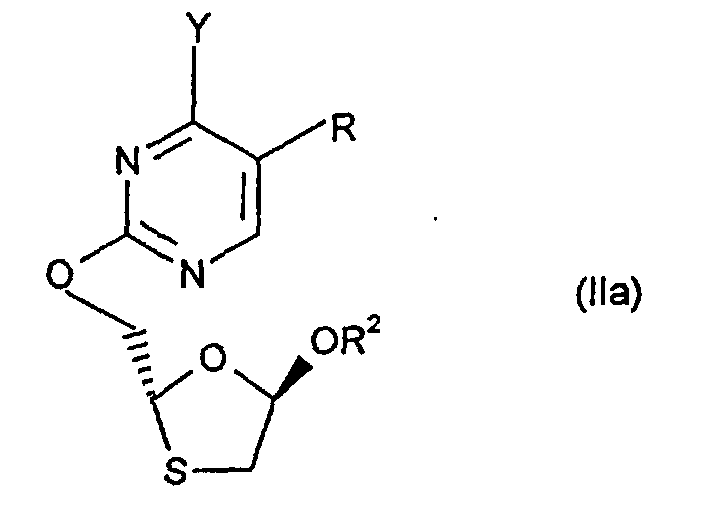
- the present invention provides a process for the preparation of a compound of formula (Ia) wherein R and Y are as previously defined, which process comprises treating a compound of formula (Ila) wherein R, Y and R 2 are as previously defined with a suitable Lewis acid or a reagent apt to convert the group OR 2 to a leaving group.
- a process for the preparation of compounds of formula (II) which comprises reacting a compound of formula (III) wherein R and Y are as hereinbefore defined, with 1,4-dithiane-2,5-diol at elevated temperature (e.g. 100°C) in a non-polar aprotic solvent to give a compound of formula (II) wherein R 2 is H.
- Compounds of formula (II) wherein R 2 is other than H may be prepared from the corresponding hydroxy compound by derivatisation using any standard procedure, for example, treatment with alkanoyl halide/base or carboxylic anhydride/base.
- the present invention accordingly provides a method for obtaining the compound of formula (IIa) wherein R is H and Y is OR 1 from a mixture of isomers by treatment of the mixture of isomers, at least partially in solution, with an agent capable of effecting interconversion of the isomers without complete suppression of the crystallisation of the desired single enantiomer (Ila), said agent being an alcohol or an organic base.
- Other compounds of formula (Ila) may be prepared from compounds of formula (IIa) wherein R is H and Y is OR 1 by conventional methods.
- Alcohols capable of effecting interconversion of the isomers without complete suppression of the crystallisation of the trans isomers are alcohols, such as, for example, methanol, ethanol, n-propanol, i-propanol, n-butanol, i-butanol, t-butanol, and organic bases, in particular tertiary amines, for example, pyridine and triethylamine and Hunig's base.
- a preferred agent is triethylamine.
- the interconversion of isomers may be effected in any suitable solvent or mixture of solvents which does not otherwise react with the alcohols of formula (II), under conditions of concentration and temperature which permit crystallisation of the desired isomer or isomers and which do not cause significant degradation of the desired isomer or isomers.
- suitable solvents may include for example, aliphatic or aromatic hydrocarbons, ethers, esters and chlorinated hydrocarbons.
- the interconversion will preferably be effected at a temperature of about -20° to 120°C, more preferably in the range of about -10° to 80°C, such as about 0° to 50°C.
- the quantity of the interconversion agent is best conducted as an integrated exercise dependent on the nature of the groups R, R 1 and R 2 present in the isomers.
- the preferred quantity is generally less than two mole-equivalents based on the total of all isomers of (II) present.
- the interconversion of isomers may be conducted separately from the preparation of the isomeric mixture; however, it is conveniently conducted concomitantly with that preparation.
- the interconversion procedure may also be used to increase the isomeric purity of isolated (Ila).
- the isolated yield of the desired isomer (Ila) may be enhanced to greater than 50% of theory (based on formation of all stereoisomers), typically to between about 60% and about 90% of theory; but it is not ruled out that yields approaching 100% of theory may be obtained.
- Compounds of formula (III) may be prepared by reacting a compound of formula (IV) wherein R (which may be the same or different) and Y are as hereinbefore defined, with aqueous trifluoroacetic acid (90%) at elevated temperature.
- Compounds of formula (IV) may be prepared by reacting a compound of formula (V) wherein R and Y are as hereinbefore defined and Z is a suitable leaving group, for example, chlorine, with a compound of formula (VI) wherein R (which may be the same or different) are as hereinbefore defined, at reduced temperature in a polar aprotic solvent in the presence of base.
- Compounds of formula (V) may be prepared by reacting a compound of formula (VII) wherein R and Z (which may be the same or different) are as hereinbefore defined, with a suitable nucleophile, for example, in the case where Y in the compound of formula (V) is to be ethoxy, EtO - (NaOEt/EtOH).
- the racemic ⁇ -diastereomer (I) is esterified at the C5'-position using, for example, butyric anhydride, and the racemic ester (VIII) is treated with a suitable enzyme, typically pig liver esterase, to preferentially hydrolyse the 'unwanted' enantiomer back to the 5'-OH compound (IX) which is water-soluble and can be separated from the desired (unhydrolysed) enantiomer (X).
- a suitable enzyme typically pig liver esterase
- the process of the invention finds particular application in the preparation of (2R,5S)-5-fluoro-1-[2-(hydroxymethyl)-1,3-oxathiolan-5-yl]cytosine, (2R,5S)-1-[2-(hydroxymethyl)-1,3-oxathiolan-5-yl]cytosine, ( ⁇ )-cis-5-fluoro-1-[2-(hydroxymethyl)-1,3-oxathiolan-5-yl]-cytosine and ( ⁇ )-cis-1-[2-(hydroxymethyl)-1 ,3-oxathiolan-5-yl]cytosine.
- novel compounds of formulae (IV), (III), (II) and (I) which latter includes the racemate, the (2S,5R)-enantiomer (IX), the esterified racemate (VIII) and the esterified (2R,5S)-enantiomer (X)).
- step (e) To a solution of the product from step (e) (1.0 g, 3.62 mmol) and pyridine (0.8 mL, 0.78 g, 9.88 mmol) in CH 2 Cl 2 (12 mL) at 0°C was added AcCI (0.35 mL, 0.37 g, 4.7 mmol). After 1 hour at ambient temperature, saturated NaHCO 3 /H 2 O was added and the aqueous phase was extracted with CHCl 3 .
- step (g) To a solution of the product from step (g) (90 mg) in pyridine (0.2 mL) was added butyric anhydride (1.0 mL) and the resulting mixture was stirred at ambient temperature for 18 hours. Ice-water was added and the aqueous solution was adjusted to pH 2 with 1N HC1/H 2 O and extracted with CHCl 3 (x3). The combined organic phase was washed with saturated NaHCO 3 /H 2 O and brine, dried (Na 2 SO 4 ) and concentrated in vacuo.
- step (b) A mixture of the product from step (b) (6.0 g, 24.4 mmol) and 90% TFA/H 2 O (45 ml) was heated at 50°C for 2 hours. Solvent was evaporated in vacuo and the residue partitioned between CHCl 3 and saturated NaHCO 3 /H 2 O.
- step (e) To a solution of the product from step (e) (0.20 g, 0.66 mmol) in anhydrous CH 3 CN (12 mL) at 0°C under nitrogen atmosphere was slowly added stannic chloride (Aldrich, 0.12 mL, 0.27 g, 1.05 mmol). After stirring for 2 hours at 0°C, I M NaOH/H 2 O (5.5 ml, 5.5 mmol) was added. After 1 hour at 0°C, the mixture was neutralized with AcOH. Solvent was evaporated in vacuo and the residue partitioned between CHCl 3 and water. The aqueous phase was extracted with CHCl 3 (x2) and the combined extracts were dried (Na 2 SO 4 ) and concentrated in vacuo.
- stannic chloride Aldrich, 0.12 mL, 0.27 g, 1.05 mmol
- step (f) To a solution of the product from step (f) (0.30 g, 1.16 mmol) in pyridine (0.19 mL, 0.18 g, 2.32 mmol) was added butyric anhydride (0.37 mL, 0.36 g, 2.32 mmol) and the resulting mixture was stirred at ambient temperature for 2 hours.
- step (g) To a solution of the product from step (g) (10 mg) in 20% CH 3 CN/buffer (3.0 mL, 0.05 M. pH 8.0, phosphate) is added PLE (pig liver esterase, 1.5 ⁇ L, Sigma) and the mixture is stirred at ambient temperature for 24 hours. The aqueous solution is extracted with hexane (x2) and the combined extracts were dried (Na 2 SO 4 ) and concentrated in vacuo to give the desired product. HPLC analysis of the organic phase indicates the presence of a single enantiomeric butyrate ester. The enantiomeric alcohol is detected in the aqueous phase.
Landscapes
- Chemical & Material Sciences (AREA)
- Organic Chemistry (AREA)
- Plural Heterocyclic Compounds (AREA)
- Pharmaceuticals Containing Other Organic And Inorganic Compounds (AREA)
- Saccharide Compounds (AREA)
- Cephalosporin Compounds (AREA)
Abstract
Description
- The present invention is concerned with a process for the preparation of anti-viral 1,3-oxathiolane nucleosides, which employs an intramolecular glycosylation to produce exclusively the β-diastereomer. The invention also relates to novel intermediates obtained by the process.
- 1,3-Oxathiolane nucleosides possess two chiral centres (at the C1'- and C4'-positions according to the furanose numbering system) and typically exist as diastereomeric pairs of the α- and β-forms, each form comprising two enantiomers. The α- and β-diastereoisomers tend to have different anti-viral activities, the β-form typically being the more potent. Similarly, the enantiomeric pairs of each diastereomer tend to have different properties.
- β-Diastereomers have traditionally been obtained by preparation of the diastereomeric mixture followed by laborious separation of the β-form by physical means such as differential solubility or chromatography. It follows that the overall yield of β-isomer is typically less than 50%.
- International Patent Application No. WO91/11186 describes a process whereby 1,3-oxathiolane nucleosides may be obtained with high β-diastereoselectivity by condensing a carbohydrate or carbohydrate-like moiety with a heterocyclic base in the presence of a specific Lewis acid, typically stannic chloride. The process is further exemplified in International Patent Application No. WO92/14743.
- Further diastereoselective processes for the preparation of nucleoside analogues involving condensation of a carbohydrate or like moiety with a purine or pyrimidine base are described in WO92/20669 and WO95/29174.
- We have now developed an efficient new process which provides exclusively the β-diastereomer of a 1,3-oxathiolane pyrimidine nucleoside with no α-contamination. The critical steps involved in the synthesis are cyclisation of an appropriate heterocyclic acetaldehyde with 1,4-dithiane-2,5-diol to give a "5'-tethered" 1,3-oxathiolane nucleoside analogue which then undergoes an intramolecular glycosylation on the same face of the carbohydrate ring to give exclusively the (1'-tethered) β-diastereomer. The intramolecular glycosylation of 5'-tethered furanose nucleosides is known from, inter alia, Japanese Patent No. 06263792-A, but the prior art comprises no reports of applying such methodology to the preparation of anti-viral 1,3-oxathiolane nucleosides. The resulting β-diastereomer may be hydrolysed to the corresponding cytidine analogue or may be resolved by any suitable technique known to a skilled person, for example, by esterification followed by selective enzymatic hydrolysis, removal of the 'unwanted' enantiomer and hydrolysis of the ester of desired enantiomeric configuration. Alternatively, it may be possible, for example, by use of a chiral auxiliary, to obtain intermediates substantially enantiomerically pure which intermediates can be carried forward to yield the desired enantiomerically pure product.
- According to one aspect of the present invention, there is provided a process for the preparation of compounds of formula (I)wherein R is hydrogen, C1-6 alkyl, or halogen and Y is hydroxy, amino, C1-6 alkoxy or OR1, where R1 is a chiral auxiliary, which process comprises treating a compound of formula (II)
 wherein R and Y are as hereinbefore defined and R2 represents hydrogen, C1-6acyl, C1-6alkyl or halogen with a suitable Lewis acid or a reagent apt to convert the group OR2 to a leaving group.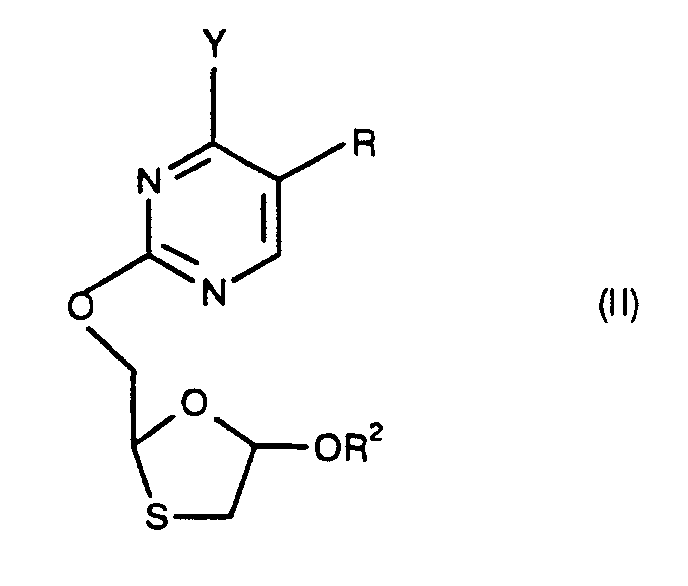
- Suitable Lewis acids include, for example, stannic chloride or trimethylsilyl triflate. Reaction with a Lewis acid is suitably conducted at reduced temperature (e.g. 0°C to -20°C) in a polar aprotic solvent followed by treatment with base.
- Where R2 is H, the group OR2 may conveniently be converted to a leaving group by reaction with a halogenating agent such as a thionyl halide or an oxalyl halide, or a tosyl or mesyl halide. Other methods for converting OR2 to a leaving group (i.e. a group which can be readily displaced by the ring nitrogen atom) will be apparent to those skilled in the art.
- It is to be understood that where the variable R occurs more than once in a general formula, it may represent the same group at each position, or different groups.
- As used herein halogen means bromine, chlorine, fluorine or iodine, especially chlorine or fluorine, more especially fluorine.
- The term "chiral auxiliary" describes an asymmetric molecule that is used to effect the chemical resolution of a racemic mixture. Such chiral auxiliaries may possess one chiral centre such as α-methylbenzylamine or several chiral centres such as menthol. The purpose of the chiral auxiliary, once built into the starting material, is to allow simple separation of the resulting diastereomeric mixture. See, for example, J Jacques et al., Enantiomers, Racemates and Resolutions, pp. 251-369, John Wiley & Sons, New York (1981).
- Where R1 represents a chiral auxiliary it will preferably be selected from (d)-menthyl, (l)-menthyl, (d)-8-phenylmenthyl, (l)-8-phenylmenthyl, (+)-norephedrine and (-)-norephedrine. More preferably R1 is (I)-menthyl, or (d)-menthyl, most preferably (l)-menthyl.
- According to a further aspect, the present invention provides a process for the preparation of a compound of formula (Ia)wherein R and Y are as previously defined, which process comprises treating a compound of formula (Ila)
 wherein R, Y and R2 are as previously defined with a suitable Lewis acid or a reagent apt to convert the group OR2 to a leaving group.
- According to another aspect of the invention, there is provided a process for the preparation of compounds of formula (II) which comprises reacting a compound of formula (III)wherein R and Y are as hereinbefore defined, with 1,4-dithiane-2,5-diol at elevated temperature (e.g. 100°C) in a non-polar aprotic solvent to give a compound of formula (II) wherein R2 is H. Compounds of formula (II) wherein R2 is other than H may be prepared from the corresponding hydroxy compound by derivatisation using any standard procedure, for example, treatment with alkanoyl halide/base or carboxylic anhydride/base.

- Reaction of a compound of formula (III) with 1,4-dithiane-2,5-diol results in a mixture of isomers of the compounds of formula (II) wherein R2 is H. Where Y is OR1, the compounds of formula (Ila) may be selectively crystallized from the diastereomeric mixture. In a further or alternative aspect, the present invention accordingly provides a method for obtaining the compound of formula (IIa) wherein R is H and Y is OR1 from a mixture of isomers by treatment of the mixture of isomers, at least partially in solution, with an agent capable of effecting interconversion of the isomers without complete suppression of the crystallisation of the desired single enantiomer (Ila), said agent being an alcohol or an organic base. Other compounds of formula (Ila) may be prepared from compounds of formula (IIa) wherein R is H and Y is OR1 by conventional methods.
- Agents capable of effecting interconversion of the isomers without complete suppression of the crystallisation of the trans isomers are alcohols, such as, for example, methanol, ethanol, n-propanol, i-propanol, n-butanol, i-butanol, t-butanol, and organic bases, in particular tertiary amines, for example, pyridine and triethylamine and Hunig's base. A preferred agent is triethylamine.
- The interconversion of isomers may be effected in any suitable solvent or mixture of solvents which does not otherwise react with the alcohols of formula (II), under conditions of concentration and temperature which permit crystallisation of the desired isomer or isomers and which do not cause significant degradation of the desired isomer or isomers. Suitable solvents may include for example, aliphatic or aromatic hydrocarbons, ethers, esters and chlorinated hydrocarbons. The interconversion will preferably be effected at a temperature of about -20° to 120°C, more preferably in the range of about -10° to 80°C, such as about 0° to 50°C.
- It will be appreciated by those skilled in the art that selection of solvent, temperature, interconversion agent and, particularly, the quantity of the interconversion agent is best conducted as an integrated exercise dependent on the nature of the groups R, R1 and R2 present in the isomers. However, when an organic base is used as the interconversion agent, the preferred quantity is generally less than two mole-equivalents based on the total of all isomers of (II) present.
- The interconversion of isomers may be conducted separately from the preparation of the isomeric mixture; however, it is conveniently conducted concomitantly with that preparation.
- The interconversion procedure may also be used to increase the isomeric purity of isolated (Ila).
- By means of the interconversion process, the isolated yield of the desired isomer (Ila) may be enhanced to greater than 50% of theory (based on formation of all stereoisomers), typically to between about 60% and about 90% of theory; but it is not ruled out that yields approaching 100% of theory may be obtained.
- Compounds of formula (III) may be prepared by reacting a compound of formula (IV)wherein R (which may be the same or different) and Y are as hereinbefore defined, with aqueous trifluoroacetic acid (90%) at elevated temperature.

- Compounds of formula (IV) may be prepared by reacting a compound of formula (V)wherein R and Y are as hereinbefore defined and Z is a suitable leaving group, for example, chlorine, with a compound of formula (VI)
 wherein R (which may be the same or different) are as hereinbefore defined, at reduced temperature in a polar aprotic solvent in the presence of base.
- Compounds of formula (V) may be prepared by reacting a compound of formula (VII)wherein R and Z (which may be the same or different) are as hereinbefore defined, with a suitable nucleophile, for example, in the case where Y in the compound of formula (V) is to be ethoxy, EtO- (NaOEt/EtOH).

- Compounds of formulae (VI) and (VII) may be obtained commercially or prepared from commercially available starting materials by methods known to a skilled person, for example, in the case where R in the compound of formula (VII) is to be fluorine and Z chlorine, by treating 5-fluorouracil with phosphorus oxychloride at elevated temperature in the presence of base.
- As indicated, compounds of formula (I) wherein Y at the C4-position is C1-6 alkoxy or OR1 may be converted to a cytidine analogue (Y=NH2) by heating with ammoniacal methanol or, where racemic, may be resolved by any suitable technique known to a skilled person, for example, by one of the enzyme procedures described in International Patent No. WO92/14743.
- According to such a procedure, the racemic β-diastereomer (I) is esterified at the C5'-position using, for example, butyric anhydride, and the racemic ester (VIII) is treated with a suitable enzyme, typically pig liver esterase, to preferentially hydrolyse the 'unwanted' enantiomer back to the 5'-OH compound (IX) which is water-soluble and can be separated from the desired (unhydrolysed) enantiomer (X). The latter is converted to the 4-NH2, 5'-OH compound of desired enantiomeric configuration by heating with ammoniacal methanol.

- The process of the invention finds particular application in the preparation of (2R,5S)-5-fluoro-1-[2-(hydroxymethyl)-1,3-oxathiolan-5-yl]cytosine, (2R,5S)-1-[2-(hydroxymethyl)-1,3-oxathiolan-5-yl]cytosine, (±)-cis-5-fluoro-1-[2-(hydroxymethyl)-1,3-oxathiolan-5-yl]-cytosine and (±)-cis-1-[2-(hydroxymethyl)-1 ,3-oxathiolan-5-yl]cytosine.
- According to a further aspect of the invention, there are provided novel compounds of formulae (IV), (III), (II) and (I) (which latter includes the racemate, the (2S,5R)-enantiomer (IX), the esterified racemate (VIII) and the esterified (2R,5S)-enantiomer (X)). Specific intermediate compounds arising from the preparation of (2R,5S)-5-fluoro-1-[2-(hydroxymethyl)-1,3-oxathiolan-5-yl]cytosine, (2R,5S)-1-[2-(hydroxymethyl)-1,3-oxathiolan-5-yl]cytosine, (±)-cis-5-fluoro-1-[2-(hydroxymethyl)-1,3-oxathiolan-5-yl]cytosine and (±)-cis-1-[2-(hydroxymethyl)-1,3-oxathiolan-5-yl]cytosine include:
- 2-(2,2-Dimethoxyethoxy)-4-ethoxy-5-fluoropyrimidine
- 2-(2,2-Dimethoxyethoxy)-4-ethoxypyrimidine
- 2-[(4-Ethoxy-5-fluoro-2-pyrimidinyl)oxy]acetaldehyde
- 2-[(4-Ethoxy-2-pyrimidinyl)oxy]acetaldehyde
- 2-{[(4-Ethoxy-5-fluoro-2-pyrimidinyl)oxy]methyl}-1,3-oxathiolan-5-ol
- 2-{[(4-Ethoxy-2-pyrimidinyl)oxy]methyl}-1,3-oxathiolan-5-ol
- 2-{[(4-Ethoxy-5-fluoro-2-pyrimidinyl)oxy]methyl}-1,3-oxathiolan-5-yl acetate
- 2-{[(4-Ethoxy-2-pyrimidinyl)oxy]methyl}-1,3-oxathiolan-5-yl acetate
- (2S*, 5R*)-4-Ethoxy-5-fluoro-1-[2-(hydroxymethyl)-1,3-oxathiolan-5-yl]pyrimidin-2-one
- (2S*, 5R*)-4-Ethoxy-1-[2-(hydroxymethyl)-1,3-oxathiolan-5-yl]pyrimidin-2-one
- (2S*, 5R*)-4-Ethoxy-5-fluoro-1-[2-(butanoyloxymethyl)-1,3-oxathiolan-5-yl]pyrimidin-2-one
- (2S*, 5R*)-4-Ethoxy-1-[2-(butanoyloxymethyl)-1,3-oxathiolan-5-yl]pyrimidin-2-one
- (2S, 5R)-4-Ethoxy-5-fluoro-1-[2-(hydroxymethyl)-1,3-oxathiolan-5-yl]pyrimidin-2-one
- (2S, 5R)-4-Ethoxy-1-[2-(hydroxymethyl)-1,3-oxathiolan-5-yl]pyrimidin-2-one
- (2R, 5S)-4-Ethoxy-5-fluoro-1-[2-(butanoyloxymethyl)-1,3-oxathiolan-5-yl]pyrimidin-2-one
- (2R, 5S)-4-Ethoxy-1-[2-(butanoyloxymethyl)-1,3-oxathiolan-5-yl]pyrimidin-2-one
-
- The following examples of the process of the invention are for illustration. In all cases, 1H NMR and C,H,N elemental analysis were consistent with the proposed structure.
- To a suspension of 5-fluorouracil (Aldrich, 8.00 g, 61.5 mmol) in phosphorus oxychloride (25.0 mL, 41.12 g, 268 mmol) was added N,N-diethylaniline (12.6 mL, 11.81 g, 80 mmol) and the mixture was heated at 100°C for 1.5 hours. Solvent was evaporated in vacuo and the residue poured into cold H2O/Et2O (400 mL, 1:1). The aqueous phase was extracted with Et2O and the combined organic phase was dried (Na2SO4) and evaporated (water aspirator pump, 35°C) to give the desired product (10.2 g, 99%) as a yellowish solid: mp 34-36°C (lit. 35-36°C).
- To a solution of the product from step (a) (10.0 g, 59.9 mmol) in abs. EtOH (40 mL) at 0°C under nitrogen atmosphere was added 1M NaOEt/EtOH (61 mL, 61 mmol) and the mixture was stirred for 1 hour. Solvent was evaporated in vacuo and the residue partitioned between H2O and Et2O. The aqueous phase was extracted with Et2O and the combined organic phase was washed with brine, dried (Na2SO4) and evaporated (water aspirator pump, 35°C) to provide the desired product (8.74 g, 83%) as a yellowish solid: mp 30-32°C (lit. 31-32°C); 1H NMR (CDCl3): δ 1.46 (t, J = 7.0 Hz, 3H), 4.53 (quartet, J = 7 Hz, 2H), 8.17 (d, J = 2.1 Hz, 1H); MS m/z 179 (M + 3, 17%), 177 (M + 1, 50%), 149 (100%). Anal. Calcd. for C6H6ClFN2O: C, 40.81; H, 3.42; N, 15.86. Found, C, 40.90; H, 3.45; N, 15.81.
- To a suspension of 60% NaH/mineral oil (2.88 g, 72.2 mmol) in anhydrous DMF (70 mL) at 0°C under nitrogen atmosphere was slowly added glycolaldehyde dimethyl acetal (Lancaster, 6.13 g, 57.7 mmol). The mixture was stirred at ambient temperature for 1 hour and then transferred to a solution of the product from step (b) (8.5 g, 48.1 mmol) in anhydrous DMF (70 mL) at -55°C over 15 minutes. The mixture was allowed to warm to -20°C over 2 hours and then neutralized with AcOH. Solvent was evaporated in vacuo and the residue partitioned between H2O and CH2Cl2. The aqueous phase was extracted with CH2Cl2 and the combined organic phase was dried (Na2SO4) and evaporated. The residue was flash chromatographed (EtOAc/hexanes, 1:5) to give the desired product (9.75 g, 82%) as an oil: 1H NMR (CDCl3): δ 1.42 (t, J = 7.0 Hz, 3H), 3.43 (s, 6H), 4.32 (d, J = 5.2 Hz, 2H), 4.50 (quartet, J = 7.0 Hz, 2H), 4.75 (t, J = 5.2 Hz, 1H), 8.03 (d, J = 2.4 Hz, 1H); MS m/z 215 (M - OCH3, 100%). Anal. Calcd. for C10H15FN2O4: C, 48.78; H, 6.14; N, 11.38. Found: C, 48.84; H, 6.06; N, 11.36.
- A mixture of the product from step (c) (6.0 g, 24.4 mmol) and 90% TFA/H2O (50 ml) was heated at 50°C for 2.5 hours. Solvent was evaporated in vacuo and the residue partitioned between CHCl3 and saturated NaHCO3/H2O. The aqueous phase was extracted with CHCl3 (x2) and the combined extracts dried (Na2SO4) and evaporated to give the desired product (4.82 g, 99%) as a colourless oil which was used in the next step without further purification. Flash chromatography (EtOAc/hexanes, 1:2) gave analytically pure material as a colourless oil: 1H NMR (CDCl3): δ 1.43 (t, J = 7.0 Hz, 3H), 4.40 (quartet, J = 7.0 Hz, 2H), 4.81 (s, 2H), 8.03 (d, J = 1.8 Hz, 1H), 9,74 (s, 1H); MS m/z 201 (M + 1, 100%). Anal. Calcd. for C8H9FN2O3•0.25 H2O: C, 46.95; H, 4.68; N, 13.69. Found: C, 46.81; H, 4.61; N, 13.64.
- A mixture of the product from step (d) (4.6 g, 23.0 mmol) and 1,4-dithiane-2,5-diol (Aldrich, 1.92 g, 12.65 mmol) in anhydrous toluene (90 mL) was heated at 100°C for 2 hours. The mixture was filtered and the filtrate was concentrated and dried in vacuo to give the desired product (6.27 g, 99%) as a waxy pale yellow solid which was used in the next step without further purification (∼1:1 diastereomeric ratio by 1H NMR spectroscopy). Flash chromatography (EtOAc/hexanes, 1:2) afforded analytically pure material as a white solid: mp 85-87°C; 1H NMR (CDCl3): δ 1.41 (t, J = 7.0 Hz, 3H), 2.42 (br s, 1H), 3.10 (d, J = 11.0 Hz, 1H), 3.20 (dd, J = 11.0, 3.5 Hz, 1H), 4.40 (dd, J = 12.0, 3.5 Hz, 1H), 4.43 (quartet, J = 7.0 Hz, 2H), 4.77 (dd, J = 12.0, 7.0 Hz, 1H), 5.70 (dd, J = 7.0, 3.5 Hz, 2H), 5.92 (d, J = 3.5 Hz, 1 H), 8.04 (d, J = 2.5 Hz, 1H); a similar set of signals appeared for the other diastereomer; MS m/z 201 (M - C2H3OS, 100%). Anal. Calcd. for C10H13FN2O4S: C, 43.47; H, 4.74; N, 10.14; S, 11.61. Found: C, 43.56; H, 4.78; N, 10.04; 11.66.
- To a solution of the product from step (e) (1.0 g, 3.62 mmol) and pyridine (0.8 mL, 0.78 g, 9.88 mmol) in CH2Cl2 (12 mL) at 0°C was added AcCI (0.35 mL, 0.37 g, 4.7 mmol). After 1 hour at ambient temperature, saturated NaHCO3/H2O was added and the aqueous phase was extracted with CHCl3. The combined organic phase was washed with brine, dried (Na2SO4), evaporated and dried in vacuo to give the desired product (1.13 g, 99%) as a yellow oil which was used in the next step without further purification (∼2:1 diastereomeric ratio by 1H NMR spectroscopy). Flash chromatography (acetone/CH2Cl2, 1:24) gave analytically pure material as a colourless oil: 1H NMR (CDCl3): δ 1.42 (t, J = 7.0 Hz, 3H), 2.07 (s, 3H), 3.15 (d, J = 11.5 Hz, 1 H), 3.38 (dd, J = 11.5, 4.0 Hz, 1 H), 4.40-4.60 (m, 4H), 5.73 (m, 1 H), 6.70 (d, J = 4.0 Hz, 1 H), 8.03 (d, J = 2.5 Hz, 1 H); a similar set of signals appeared for the minor diastereomer; MS m/z 259 (M - OAc, 9%), 159 (100%). Anal. Calcd. for C12H15FN2O5S: C, 45.28; H, 4.75; N, 8.80; S, 10.07. Found: C, 45.35; H, 4.76; N, 8.83; S, 10.11.
- To a mixture of the product from step (f) (0.21 g, 0.66 mmol) and 4Å molecular sieves (0.3 g) in anhydrous CH3CN (20 mL) at -20°C under nitrogen atmosphere was slowly added trimethylsilyl triflate (Aldrich, 0.14 mL, 0.16 g, 0.73 mmol). After stirring the mixture for 2 hours at -20°C, 1M NaOH/H2O (2.0 mL, 2.0 mmol) was added. After 2 hours at 0°C, the mixture was neutralized with AcOH. Solvent was evaporated in vacuo and the residue flash chromatographed (EtOAc/hexanes, 9:1) to give the desired product (0.11 g, 60%) as a white solid: mp 162-164°C; 1H NMR (DMSO-d6): δ 1.39 (t, J = 7.0 Hz, 3H), 3.29 (dd, J = 12.0, 2.7 Hz, 1H), 3.60 (dd, J = 12.0, 5.4 Hz, 1H), 3.82 (ddd, J = 12.5, 5.4, 3.5 Hz, 1H), 3.95 (ddd, J = 12.5, 5.4, 3.5 Hz, 1H), 4.45 (quartet, J = 7.0 Hz, 2H), 5.31 (t, J = 3.5 Hz, 1H), 5.63 (t, J = 5.4 Hz, 1H), 6.20 (m, 1H), 8.74 (d, J = 6.7 Hz, 1H); MS m/z 277 (M + 1, 4%), 159 (100%). Anal. Calcd. for C10H13FN2O4S: C, 43.47; H, 4.74; N, 10.14; S, 11.61. Found: C, 43.54; H, 4.76; N, 10.18; S, 11.52.
- To a solution of the product from step (g) (90 mg) in pyridine (0.2 mL) was added butyric anhydride (1.0 mL) and the resulting mixture was stirred at ambient temperature for 18 hours. Ice-water was added and the aqueous solution was adjusted to pH 2 with 1N HC1/H2O and extracted with CHCl3 (x3). The combined organic phase was washed with saturated NaHCO3/H2O and brine, dried (Na2SO4) and concentrated in vacuo. The resulting oil was dried in vacuo at 50°C for 18 hours under a stream of nitrogen to obtain the desired product (100 mg) as a colourless solid: 1H NMR (CDCl3): δ 0.99 (t, 3H), 1.42 (t, 3H), 1.70 (sextuplet, 2H), 2.42 (t, 2H), 3.23 (d, 1H), 3.60 (dd, 1H), 4.45 (dd, 1H), 4.50 (quartet, 2H), 4.65 (dd, 1H), 5.40 (m, 1H), 6.30 (m, 1H), 8.15 (d, 1H); MS m/z 347 (M + 1, 25%), 159 (100%).
- To a solution of the product from step (h) (10 mg) in 20% CH3CN/buffer (3.0 mL, 0.05 M, pH 8.0, phosphate) was added PLE (pig liver esterase, 1.5 µL, Sigma) and the mixture was stirred at ambient temperature for 24 hours. The aqueous solution was extracted with hexane (x2) and the combined extracts were dried (Na2SO4) and concentrated in vacuo. HPLC analysis (Chiral Pack AS; EtOH; 1.5 ml/min) of the organic extracts indicated the presence of a single enantiomeric butyrate ester (4 mg). The enantiomeric alcohol was detected in the aqueous phase. Ester: 1H NMR (CDCl3): δ 0.97 (t, J = 7.4 Hz, 3H), 1.42 (t, J = 7.0 Hz, 3H), 1.67 (sextuplet, J = 7.4 Hz, 2H), 2.40 (t, J = 7.4 Hz, 2H), 3.23 (d, J = 12.8 Hz, 1H), 3.60 (dd, J = 12.8, 5.3 Hz, 1H), 4.46 (dd, J = 12.6, 2.5 Hz, 1H), 4.52 (quartet, J = 7.0 Hz, 2H), 4.65 (dd, J = 12.6, 4.0 Hz, 1H), 5.37 (m, 1H), 6.29 (m, 1H), 8.12 (d, J = 6 Hz, 1H).
- A solution of the ester from step (i) (4 mg) in NH3/MeOH (2 mL) was placed in a steel bomb with a Teflon™ liner, sealed and heated at 70°C for 18 hours. Solvent was evaporated in vacuo to provide the desired product (2 mg) with HPLC, 1H NMR and MS properties identical to those of an authentic sample.
- To a solution of 2,4-dichloropyrimidine (Aldrich, 10.0 g, 67.12 mmol) in abs. EtOH (120 mL) at -3°C under nitrogen atmosphere was slowly added (over 2 hours) 1M NaOEt/EtOH (68 mL, 68 mmol) and the resulting mixture stirred for 1 hour. Solvent was evaporated in vacuo and the residue partitioned between H2O and Et2O. The aqueous phase was extracted with Et2O and the combined organic phase was washed with brine, dried (Na2SO4) and evaporated (water aspirator pump, 35°C). The resulting residue was filtered and washed with petroleum ether to provide the desired product (8.05 g, 75%) as a yellowish solid: mp 30-31°C (lit. 35°C); 1H NMR (CDCl3): δ 1.40 (t, J = 7.2 Hz, 3H), 4.44 (quartet, J = 7.2 Hz, 2H), 6.62 (d, J = 5.7 Hz, 1H), 8.27 (d, J = 5.7 Hz, 1H); MS m/z 161 (M + 3, 34%), 159 (M + 1, 100%). Anal. Calcd. for C6H7ClN2O: C, 45.44; H, 4.45; N, 17.66; Cl, 22.36. Found: C, 45.32; H, 4.41; N, 17.60; Cl, 22.43.
- To a suspension of 60% NaH/mineral oil (2.55 g, 63.96 mmol) in anhydrous DMF (70 mL) at 0°C under nitrogen atmosphere was slowly added glycolaldehyde dimethyl acetal (Aldrich, 5.65 g, 53.3 mmol). The mixture was stirred at ambient temperature for 1 hour and then transferred to a solution of the product from step (a) (8.05 g, 50.76 mmol) in anhydrous DMF (70 mL) at -55°C over 15 minutes. The mixture was allowed to warm to -20°C over 2 hours and then neutralized with AcOH. Solvent was evaporated in vacuo and the residue partitioned between H2O and CH2Cl2. The aqueous phase was extracted with CH2Cl2 and the combined organic phase was dried (Na2SO4) and evaporated in vacuo. The residue was flash chromatographed (EtOAc/hexanes, 1:4) to give the desired product (7.92 g, 69%) as a colourless oil: 1H NMR (CDCl3): δ 1.37 (t, J = 7.0 Hz, 3H), 3.44 (s, 6H), 4.36-4.43 (m, 4H), 4.78 (t, J = 5.0 Hz, 1 H), 6.34 (d, J = 6.0 Hz, 1H), 8.15 (d, J = 6.0 Hz, 1H); MS m/z 229 (M = 1, 13%), 197 (100%). Anal Calcd. for C10H16N2O4: C, 52.62; H, 7.07; N, 12.27. Found: C, 52.45; H, 7.01; N, 12.26.
- A mixture of the product from step (b) (6.0 g, 24.4 mmol) and 90% TFA/H2O (45 ml) was heated at 50°C for 2 hours. Solvent was evaporated in vacuo and the residue partitioned between CHCl3 and saturated NaHCO3/H2O. The aqueous phase was extracted with CHCl3 (x2) and the combined extracts were dried (Na2SO4), and evaporated in vacuo to give the desired product (4.48 g, 94%) as a colourless oil: 1H NMR (CDCl3): δ 1.38 (t, J = 7.0 Hz, 3H), 4.37 (quartet, J = 7.0 Hz, 2H), 4.80 (s, 2H), 6.40 (d, J = 6.0 Hz, 1H), 8.15 (d, J = 6.0 Hz, 1 H), 9.74 (s, 1 H); MS m/z 183 (M + 1, 100%). Anal. Calcd. for C8H10N2O3•0.25 H2O: C, 51.47; H, 5.67; N, 15.01. Found: C, 51.38; H, 5.69; N, 14.76.
- A mixture of the product from step (c) (4.0 g, 22.0 mmol) and 1,4-dithiane-2,5-diol (Aldrich, 1.67 g, 11.0 mmol) in anhydrous toluene (80 mL) was heated at 100°C for 2 hours. The mixture was filtered and the filtrate concentrated and dried in vacuo to give the desired product (6.27 g, 99%) as a waxy pale yellow oil which was used in the next step without further purification (∼1:1 diastereomeric ratio by 1H NMR spectroscopy). Flash chromatography (EtOAc/hexanes, 2:3) gave analytically pure material as a colourless oil: 1H NMR (CDCl3): δ 1.37 (t, J = 7.0 Hz, 3H), 3.07 (d, J = 11.0 Hz, 1H), 3.18 (d, J = 2.3 Hz, 1H), 3.26 (dm, J = 11.0 Hz, 1H), 4.38-4.58 (m, 3H), 4.85 (dd, J = 12.0, 6.0 Hz, 1H), 5.72 (dd, J = 6.0, 4.5 Hz, 1H), 5.92 (m, 1H), 6.39 (d, J = 6.0 Hz, 1H), 8.15 (d, J = 6.0 Hz, 1H); a similar set of signals appeared for the other diastereomer; MS m/z 197 (M - C2H5O, 41%), 133 (100%). Anal. Calcd. for C10H14N2O4S: C, 46.50; H, 5.46; N, 10.85; S, 12.41. Found: C, 46.40; H, 5.44; N, 10.79; S, 12.49.
- A mixture of the product from step (d) (1.0 g, 3.9 mmol), pyridine (0.7 mL, 0.68 g, 8.65 mmol) and Ac2O (2.0 mL, 2.26 g, 21.2 mmol) was stirred at ambient temperature for 1.5 hours. Ice-water was added and the resulting mixture stirred for 15 minutes. The mixture was extracted with EtOAc and the combined extracts washed with saturated NaHCO3/H2O, dried (Na2SO4), evaporated and dried in vacuo to give the desired product (1.15 g, 99%) as an orange oil which was used in the next step without further purification (∼2:1 diastereomeric ratio by 1H NMR spectroscopy). 1H NMR (CDCl3): δ 1.40 (t, 3H), 2.05 (s, 3H), 3.08 (d, 1H), 3.27 (dd, 1H), 4.40-4.70 (m, 4H), 5.79 (m, 1H), 6.38 (d, 1H), 6.75 (d, 1H), 8.18 (d, 1H); a similar set of signals appeared for the minor diastereomer; MS m/z 241 (M - OAc, 4%), 141 (100%). Anal. Calcd. for C12H16N2O5S: C, 47.99; H, 5.37; N, 9.33; S, 10.68. Found: C, 47.88; H, 5.43; N, 9.22; S, 10.60.
- To a solution of the product from step (e) (0.20 g, 0.66 mmol) in anhydrous CH3CN (12 mL) at 0°C under nitrogen atmosphere was slowly added stannic chloride (Aldrich, 0.12 mL, 0.27 g, 1.05 mmol). After stirring for 2 hours at 0°C, I M NaOH/H2O (5.5 ml, 5.5 mmol) was added. After 1 hour at 0°C, the mixture was neutralized with AcOH. Solvent was evaporated in vacuo and the residue partitioned between CHCl3 and water. The aqueous phase was extracted with CHCl3 (x2) and the combined extracts were dried (Na2SO4) and concentrated in vacuo. The residue was flash chromatographed (EtOAc/hexanes, 2:1, then EtOAc) to give the desired product (0.10 g, 60%) as a white solid: mp 117-118°C; 1H NMR (DMSO-d6 ): δ 1.26 (t, J = 7.0 Hz, 3H), 3.15 (dd, J = 12.0, 3.5 Hz, 1H), 3.51 (dd, J = 12.0, 5.5 Hz, 1H), 3.71-3.84 (m, 2H), 4.26 (quartet, J = 7.0 Hz, 2H), 5.22 (t, J = 4.0 Hz, 1 H), 5.40 (t, J = 6.0 Hz, 1 H), 6.0 (d, J = 7.4 Hz, 1 H), 6.18 (dd, J = 5.5, 3.5 Hz, 1H), 8.25 (d, J = 7.4 Hz, 1H); MS m/z 259 (M+1, 4%), 141 (100%). Anal. Calcd. for C10H14N2O4S: C, 46.50; H, 5.46; N, 10.85; S, 12.41. Found: C, 46.58; H, 5.49; N, 10.84; S, 12.34.
- To a solution of the product from step (f) (0.30 g, 1.16 mmol) in pyridine (0.19 mL, 0.18 g, 2.32 mmol) was added butyric anhydride (0.37 mL, 0.36 g, 2.32 mmol) and the resulting mixture was stirred at ambient temperature for 2 hours. Saturated NaHCO3/H2O was added and, after 1 hour, the mixture was extracted with EtOAc (x2) and the combined extracts were dried (Na2SO4), concentrated in vacuo and flash chromatographed (EtOAc/hexanes, 1:1) to give the desired product (0.21 g, 55%) as a yellowish solid: mp 59-61°C; 1H NMR (CDCl3): 8 0.96 (t, J = 7.4 Hz, 3H), 1.36 (t, J = 7.1 Hz, 3H), 1.68 (sextuplet, J = 7.4 Hz, 2H), 1.80 (br s, 1H), 2.36 (t, J = 7.4 Hz, 2H), 3.14 (dd, J = 12.3, 3.5 Hz, 1H), 3.59 (dd, J = 12.3, 5.2 Hz, 1H), 4.40 (m, 3H), 4.59 (dd, J = 12.3, 5.2 Hz, 1H), 5.36 (dd, J = 5.2, 3.4 Hz, 1H), 5.89 (d, J = 7.3 Hz, 1H), 6.34 (dd, J = 5.2, 3.9 Hz, 1H), 7.91 (d, J = 7.3 Hz, 1H); MS m/z 329 (M = 1, 11%), 141 (100%). Anal. Calcd. for C14H20N2O5S: C, 51.21; H, 6.14; N, 8.53; S, 9.76. Found: C, 51.08; H, 6.15; N, 8.39; S, 9.69.
- To a solution of the product from step (g) (10 mg) in 20% CH3CN/buffer (3.0 mL, 0.05 M. pH 8.0, phosphate) is added PLE (pig liver esterase, 1.5 µL, Sigma) and the mixture is stirred at ambient temperature for 24 hours. The aqueous solution is extracted with hexane (x2) and the combined extracts were dried (Na2SO4) and concentrated in vacuo to give the desired product. HPLC analysis of the organic phase indicates the presence of a single enantiomeric butyrate ester. The enantiomeric alcohol is detected in the aqueous phase.
- A solution of the ester from step (h) (4 mg) in NH3/MeOH (2 mL) is placed in a steel bomb with a Teflon™ liner, sealed and heated at 70°C for 18 hours. Solvent is evaporated in vacuo to give the desired product with HPLC, 1H NMR and MS properties identical to those of an authentic sample.
- A solution of the product from step (g) (10 mg) in NH3/MeOH (2 mL of MeOH saturated with NH3 gas at 0°C for 45 minutes) was placed in a steel bomb with a teflon liner, sealed and heated at 70°C for 18 hours. Solvent was evaporated in vacuo and acetone added to give the desired product (8.8 mg, 99%) as a white solid: mp 195-196°C; 1H NMR (DMSO-d6 ): δ 3.10 (dd, J = 12.0, 4.2 Hz, 1H), 3.40 (dd, J = 12.0, 5.3 Hz, 1H), 3.70 (ddd, J = 12.0, 5.5, 3.5 Hz, 1H), 3.77 (ddd, J = 12.0, 5.5, 3.5 Hz, 1H), 5.16 (t, J = 3.5 Hz, 1H), 5.39 (t, J = 5.5 Hz, 1H), 6.11 (m, 1H), 7.56 (br s, 1H), 7.80 (br s, 1H), 8.17 (d, J = 7.4 Hz, 1H); MS m/z 248 (M + 1, 34%), 130 (100%). Anal. Calcd. for C8H10FN3O3S: C, 38.86; H, 4.08; N, 17.00; S, 12.97. Found: C, 38.97; H, 4.05; N, 16.96; S, 12.95.
- A solution of (2S*, 5R*)-4-ethoxy-1-[2-(hydroxymethyl)-1,3-oxathiolan-5-yl]pyrimidin-2-one (0.21g) in ammonia/methanol (8 mL of methanol saturated with ammonia gas at 0°C for 45 minutes) was placed in a steel bomb with a Teflon™ liner, sealed and heated at 70°C for 18 hours. Solvent was evaporated in vacuo and the residue subjected to flash chromatography to give the desired product (0.16g, 89%) as a white solid: mp 184-185°C; 1H NMR (DMSO-d6 ): δ 3.00 (dd, J = 11.8, 5.0 Hz, 1H), 3.38 (dd, J = 11.8, 5.5 Hz, 1H), 3.63-3.80 (m, 2H), 5.15 (t, J = 4.5 Hz, 1H), 5.30 (t, J=6.0 Hz, 1H), 5.70 (d, J = 7.3 Hz, 1H); 6.18 (t, J=5.0 Hz, 1H), 7.20 (brd, 2H, NH2), 7.79 (d, J=7.3 Hz, 1H); MS m/z 229.8 (M + 1, 4%), 112 (100%). Anal. Calcd. for C8H11N3O3S: C, 41.91; H, 4.84; N, 18.33; S, 13.99. Found: C, 41.97; H, 4.83; N, 18.24; S, 13.93
Claims (16)
- A process for the preparation of compounds of formula (I)wherein R is hydrogen, C1-6 alkyl, or halogen and Y is hydroxy, amino, C1-6 alkoxy or OR1, where R1 is a chiral auxiliary;
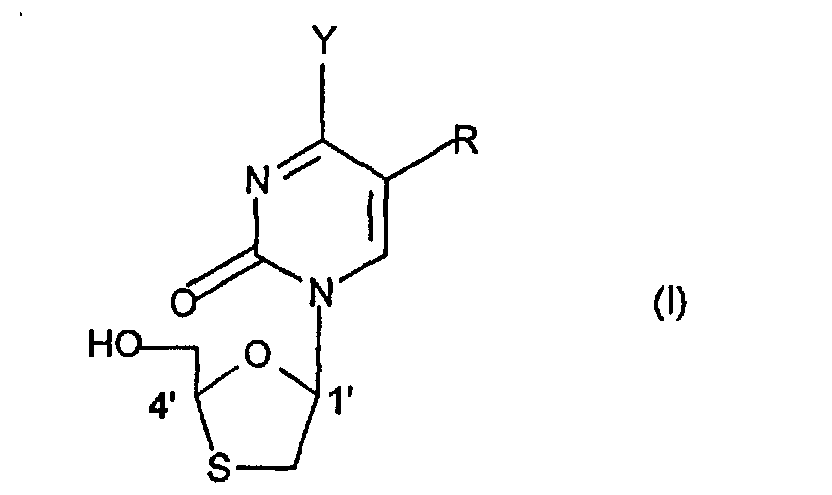
which process comprises treating a compound of formula (II)wherein R and Y are as hereinbefore defined and R2 represents hydrogen, C1-6acyl, C1-6alkyl or halogen with a suitable Lewis acid or a reagent apt to convert the group OR2 to a leaving group.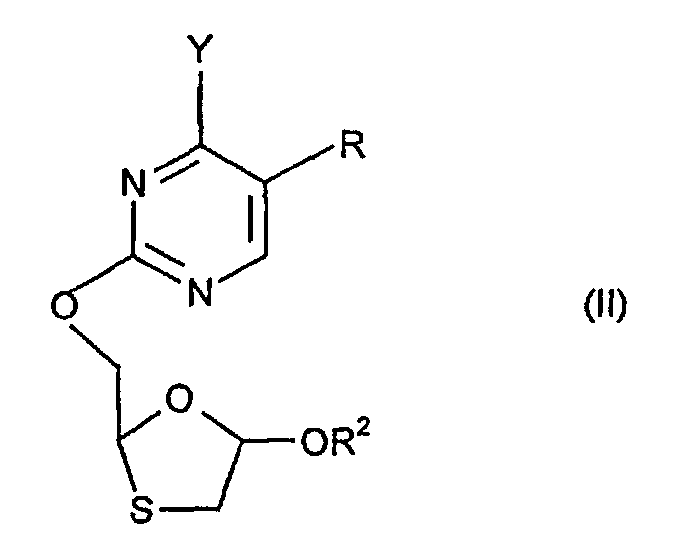
- A process according to Claim 1 for the preparation of a compound of formula (la)wherein R is hydrogen, C1-6alkyl,or halogen, and Y is hydroxy, amino, C1-6 alkoxy or OR1, where R1 is a chiral auxiliary, which process comprises treating a compound of formula (Ila)
 wherein R, Y and R2 are as previously defined with a suitable Lewis acid or a reagent apt to convert the group OR2 to a leaving group.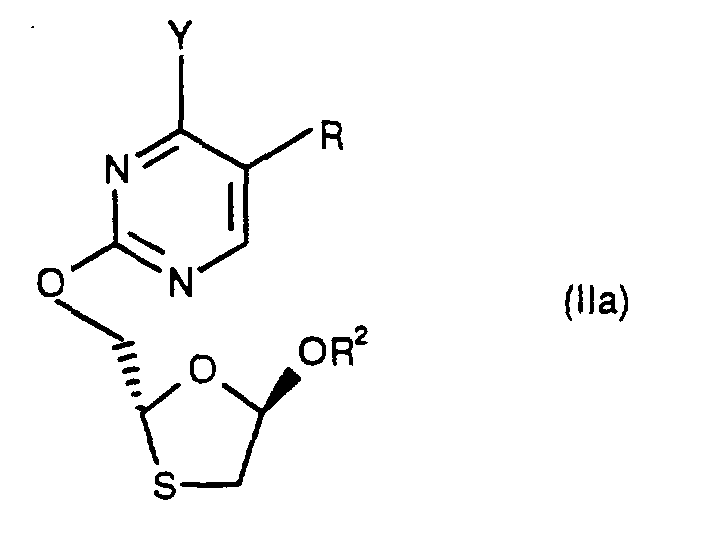
- A process according to Claim 1 or Claim 2 wherein the Lewis acid is stannic chloride or trimethylsilyl triflate.
- A process according to Claim 3 wherein the Lewis acid is stannic chloride and the treatment is carried out at reduced temperature in a polar aprotic solvent.
- A process according to any of Claims 1 to 4 wherein the compound of formula (II) is prepared by reacting a compound of formula (III)wherein R is hydrogen, C1-6 alkyl, or halogen, and Y is hydroxy, amino, C1-6 alkoxy, or OR1 where R1 is a chiral auxiliary, with 1,4-dithiane-2,5-diol at elevated temperature in a non-polar aprotic solvent, to give a compound of formula (II) wherein R2 is H, followed if necessary or desired by derivatisation to produce a compound of formula (II) wherein R2 is other than H.

- A process according to Claim 5 wherein the reaction with 1,4-dithiane-2,5-diol is carried out at about 100°C in anhydrous toluene.
- A method for obtaining a compound of formula (IIa) wherein R is H and Y is OR1 from a mixture of isomers by treatment of the mixture of isomers, at least partially in solution, with an agent capable of effecting interconversion of the isomers without complete suppression of the crystallisation of the desired single enantiomer (Ila), said agent being an alcohol or an organic base.
- A compound selected from 2-(2,2-dimethoxyethoxy)-4-ethoxy-5-fluoropyrimidine and 2-(2,2-dimethoxyethoxy)-4-ethoxy-5-pyrimidine.
- A compound selected from 2-[(4-ethoxy-5-fluoro-2-pyrimidinyl)oxy]acetaldehyde and 2-[(4-ethoxy-2-pyrimidinyl)oxy]acetaldehyde.
- A compound selected from 2-{[(4-ethoxy-5-fluoro-2-pyrimidinyl)oxy]methyl}-1,3-oxathiolan-5-ol and 2-{[(4-ethoxy-2-pyrimidinyl)oxy]methyl}-1,3-oxathiolan-5-ol, 2-{[(4-ethoxy-5-fluoro-2-pyrimidinyl)oxy]methyl}-1,3-oxathiolan-5-yl acetate and 2-{[(4-ethoxy-2-pyrimidinyl)oxy]methyl}-1,3-oxathiolan-5-yl acetate.
- A compound of formula (Ila)wherein R represents hydrogen, C1-6alkyl or halogen, R2 represents hydrogen, C1-6acyl, C1-6alkyl or halogen and Y represents OR1 wherein R1 represents (d)-menthyl, (I)-menthyl, (d)-8-phenylmenthyl, (l)-8-phenylmenthyl, (+)-norephedrine or (-)-norephedrine.
- A compound as claimed in Claim 11 wherein R1 represents (I)-menthyl.
- A compound selected from (2S*, 5R*)-4-ethoxy-5-fluoro-1-[2-(hydroxymethyl)-1,3-oxathiolan-5-yl]pyrimidin-2-one and (2S*, 5R*)-4-ethoxy-1-[2-(hydroxymethyl)-1,3-oxathiolan-5-yl]pyrimidin-2-one.
- A compound selected from (2S*, 5R*)-4-ethoxy-5-fluoro-1-[2-butanoyloxymethyl)-1,3-oxathiolan-5-yl]pyrimidin-2-one and (2S*, 5R*)-4-ethoxy-1-[2-(butanoyloxymethyl)-1,3-oxathiolan-5-yl]pyrimidin-2-one.
- A compound selected from (2S, 5R)-4-ethoxy-5-fluoro-1-[2-(hydroxymethyl)-1,3-oxathiolan-5-yl]pyrimidin-2-one and (2S, 5R)-4-ethoxy-1-[2-(hydroxymethyl)-1,3-oxathiolan-5-yl]pyrimidin-2-one.
- A compound selected from (2R, 5S)-4-ethoxy-5-fluoro-1-[2-(butanoyloxymethyl)-1,3-oxathiolan-5-yl]pyrimidin-2-one and (2R, 5S)-4-ethoxy-1-[2-(butanoyloxymethyl)-1,3-oxathiolan-5-yl]pyrimidin-2-one.
Priority Applications (1)
| Application Number | Priority Date | Filing Date | Title |
|---|---|---|---|
| SI9630621T SI0817784T1 (en) | 1995-03-31 | 1996-03-26 | Process for the synthesis of nucleoside analogues |
Applications Claiming Priority (3)
| Application Number | Priority Date | Filing Date | Title |
|---|---|---|---|
| GBGB9506644.5A GB9506644D0 (en) | 1995-03-31 | 1995-03-31 | Preparation of nucleoside analogues |
| GB9506644 | 1995-03-31 | ||
| PCT/EP1996/001353 WO1996030369A1 (en) | 1995-03-31 | 1996-03-26 | Process for the synthesis of nucleoside analogues |
Publications (2)
| Publication Number | Publication Date |
|---|---|
| EP0817784A1 EP0817784A1 (en) | 1998-01-14 |
| EP0817784B1 true EP0817784B1 (en) | 2003-05-28 |
Family
ID=10772237
Family Applications (1)
| Application Number | Title | Priority Date | Filing Date |
|---|---|---|---|
| EP96911954A Expired - Lifetime EP0817784B1 (en) | 1995-03-31 | 1996-03-26 | Process for the synthesis of nucleoside analogues |
Country Status (16)
| Country | Link |
|---|---|
| US (2) | US6143748A (en) |
| EP (1) | EP0817784B1 (en) |
| JP (1) | JP4173195B2 (en) |
| CN (2) | CN1290845C (en) |
| AT (1) | ATE241619T1 (en) |
| AU (1) | AU5497396A (en) |
| BR (2) | BRPI9607850B8 (en) |
| DE (1) | DE69628424T2 (en) |
| DK (1) | DK0817784T3 (en) |
| ES (1) | ES2200060T3 (en) |
| GB (1) | GB9506644D0 (en) |
| HU (1) | HU223100B1 (en) |
| NO (1) | NO316174B1 (en) |
| PL (1) | PL188693B1 (en) |
| PT (1) | PT817784E (en) |
| WO (1) | WO1996030369A1 (en) |
Families Citing this family (4)
| Publication number | Priority date | Publication date | Assignee | Title |
|---|---|---|---|---|
| GB9506644D0 (en) * | 1995-03-31 | 1995-05-24 | Wellcome Found | Preparation of nucleoside analogues |
| JP4249393B2 (en) | 1998-08-12 | 2009-04-02 | トライアングル・ファーマシューティカルズ,インコーポレイテッド | Method for producing 1,3-oxathiolane nucleotide |
| US6979561B1 (en) | 1998-10-09 | 2005-12-27 | Gilead Sciences, Inc. | Non-homogeneous systems for the resolution of enantiomeric mixtures |
| CN110156699A (en) * | 2019-05-22 | 2019-08-23 | 南京合巨药业有限公司 | A kind of preparation method of 4- ethyoxyl -1H- pyrimid-2-one |
Family Cites Families (6)
| Publication number | Priority date | Publication date | Assignee | Title |
|---|---|---|---|---|
| US5204466A (en) * | 1990-02-01 | 1993-04-20 | Emory University | Method and compositions for the synthesis of bch-189 and related compounds |
| ZA923641B (en) * | 1991-05-21 | 1993-02-24 | Iaf Biochem Int | Processes for the diastereoselective synthesis of nucleosides |
| GB9116601D0 (en) * | 1991-08-01 | 1991-09-18 | Iaf Biochem Int | 1,3-oxathiolane nucleoside analogues |
| JP3499896B2 (en) * | 1993-03-12 | 2004-02-23 | 財団法人野口研究所 | Method for producing 2'-deoxynucleosides |
| IL113432A (en) * | 1994-04-23 | 2000-11-21 | Glaxo Group Ltd | Process for the diastereoselective synthesis of nucleoside analogues |
| GB9506644D0 (en) * | 1995-03-31 | 1995-05-24 | Wellcome Found | Preparation of nucleoside analogues |
-
1995
- 1995-03-31 GB GBGB9506644.5A patent/GB9506644D0/en active Pending
-
1996
- 1996-03-26 JP JP52893296A patent/JP4173195B2/en not_active Expired - Lifetime
- 1996-03-26 US US08/930,224 patent/US6143748A/en not_active Expired - Lifetime
- 1996-03-26 CN CNB961930160A patent/CN1290845C/en not_active Expired - Lifetime
- 1996-03-26 AT AT96911954T patent/ATE241619T1/en active
- 1996-03-26 DE DE69628424T patent/DE69628424T2/en not_active Expired - Lifetime
- 1996-03-26 DK DK96911954T patent/DK0817784T3/en active
- 1996-03-26 HU HU9801576A patent/HU223100B1/en active IP Right Grant
- 1996-03-26 PL PL96322503A patent/PL188693B1/en unknown
- 1996-03-26 PT PT96911954T patent/PT817784E/en unknown
- 1996-03-26 ES ES96911954T patent/ES2200060T3/en not_active Expired - Lifetime
- 1996-03-26 BR BRPI9607850A patent/BRPI9607850B8/en unknown
- 1996-03-26 WO PCT/EP1996/001353 patent/WO1996030369A1/en not_active Ceased
- 1996-03-26 AU AU54973/96A patent/AU5497396A/en not_active Abandoned
- 1996-03-26 BR BRPI9607850-2A patent/BR9607850B1/en not_active IP Right Cessation
- 1996-03-26 CN CN200710001872XA patent/CN1995022B/en not_active Expired - Lifetime
- 1996-03-26 EP EP96911954A patent/EP0817784B1/en not_active Expired - Lifetime
-
1997
- 1997-09-29 NO NO19974512A patent/NO316174B1/en not_active IP Right Cessation
-
1999
- 1999-06-28 US US09/340,123 patent/US6066733A/en not_active Expired - Lifetime
Non-Patent Citations (1)
| Title |
|---|
| JUNG M.E.: "New Approach to the Synthesis of Beta-2'-Deoxyribonucleosides: Intramolecular Vorbrüggen Coupling", JOURNAL OF ORGANIC CHEMISTRY, vol. 58, 1993, pages 807 - 808 * |
Also Published As
| Publication number | Publication date |
|---|---|
| BRPI9607850B8 (en) | 2019-11-05 |
| GB9506644D0 (en) | 1995-05-24 |
| PL322503A1 (en) | 1998-02-02 |
| HU223100B1 (en) | 2004-03-29 |
| ES2200060T3 (en) | 2004-03-01 |
| CN1180356A (en) | 1998-04-29 |
| EP0817784A1 (en) | 1998-01-14 |
| HUP9801576A2 (en) | 1999-05-28 |
| US6066733A (en) | 2000-05-23 |
| CN1290845C (en) | 2006-12-20 |
| JPH11502826A (en) | 1999-03-09 |
| HK1009451A1 (en) | 1999-09-10 |
| ATE241619T1 (en) | 2003-06-15 |
| NO316174B1 (en) | 2003-12-22 |
| DE69628424D1 (en) | 2003-07-03 |
| BR9607850A (en) | 1998-07-14 |
| DE69628424T2 (en) | 2004-03-18 |
| HUP9801576A3 (en) | 2000-07-28 |
| US6143748A (en) | 2000-11-07 |
| CN1995022A (en) | 2007-07-11 |
| PL188693B1 (en) | 2005-03-31 |
| NO974512L (en) | 1997-09-29 |
| BR9607850B1 (en) | 2010-11-30 |
| DK0817784T3 (en) | 2003-09-08 |
| NO974512D0 (en) | 1997-09-29 |
| PT817784E (en) | 2003-10-31 |
| CN1995022B (en) | 2013-01-02 |
| AU5497396A (en) | 1996-10-16 |
| WO1996030369A1 (en) | 1996-10-03 |
| JP4173195B2 (en) | 2008-10-29 |
Similar Documents
| Publication | Publication Date | Title |
|---|---|---|
| RU2105009C1 (en) | Method of diastereoselective synthesis of optically active cis-nucleosides, nucleoside analogs or derivatives and intermediate compounds for this method | |
| US5466806A (en) | Processes for preparing substituted 1,3-oxathiolanes with antiviral properties | |
| AU706328B2 (en) | Method and compositions for the synthesis of dioxolane nucleosides with beta-configuration | |
| NO313048B1 (en) | Process for the preparation of a therapeutically active racemic cis-1,3-oxathiolane | |
| RO117916B1 (en) | Stereoselective process for preparing cis-nucleoside derivatives and analogues | |
| JPH08504212A (en) | Method for preparing substituted 1,3-oxathiolanes with antiviral properties | |
| US6066733A (en) | 4-ethoxy-pyrimidines | |
| EP0654031B1 (en) | Stereoselective synthesis of nucleoside analogues using bicyclic intermediate | |
| CZ293942B6 (en) | Method for the increase of yield of one of alcohol enantiomers | |
| US6034087A (en) | Nucleoside derivatives and process for preparing thereof | |
| KR20070085075A (en) | 1,3-dioxolane nucleoside preparation method | |
| US5478928A (en) | 2',3'-dideoxy-4'-thioribonucleosides and synthetic precursors thereof | |
| WO2003040139A1 (en) | Diastereoselective process for the preparation of the antiviral agent4-amino-1-(2r-hydroxymethyl-[1,3]oxathiolan-5s-yl)-1h-pyrimidin-2-one | |
| HK1008673B (en) | Stereoselective synthesis of nucleoside analogues using bicyclic intermediate | |
| IE920656A1 (en) | Novel tetrahydrofuran intermediates |
Legal Events
| Date | Code | Title | Description |
|---|---|---|---|
| PUAI | Public reference made under article 153(3) epc to a published international application that has entered the european phase |
Free format text: ORIGINAL CODE: 0009012 |
|
| 17P | Request for examination filed |
Effective date: 19970806 |
|
| AK | Designated contracting states |
Kind code of ref document: A1 Designated state(s): AT BE CH DE DK ES FI FR GB GR IE IT LI LU MC NL PT SE |
|
| AX | Request for extension of the european patent |
Free format text: AL PAYMENT 970806;LT PAYMENT 970806;LV PAYMENT 970806;SI PAYMENT 970806 |
|
| 17Q | First examination report despatched |
Effective date: 19971229 |
|
| GRAH | Despatch of communication of intention to grant a patent |
Free format text: ORIGINAL CODE: EPIDOS IGRA |
|
| GRAH | Despatch of communication of intention to grant a patent |
Free format text: ORIGINAL CODE: EPIDOS IGRA |
|
| GRAA | (expected) grant |
Free format text: ORIGINAL CODE: 0009210 |
|
| AK | Designated contracting states |
Designated state(s): AT BE CH DE DK ES FI FR GB GR IE IT LI LU MC NL PT SE |
|
| AX | Request for extension of the european patent |
Extension state: AL LT LV SI |
|
| REG | Reference to a national code |
Ref country code: GB Ref legal event code: FG4D |
|
| REG | Reference to a national code |
Ref country code: CH Ref legal event code: EP |
|
| REG | Reference to a national code |
Ref country code: IE Ref legal event code: FG4D |
|
| REF | Corresponds to: |
Ref document number: 69628424 Country of ref document: DE Date of ref document: 20030703 Kind code of ref document: P |
|
| REG | Reference to a national code |
Ref country code: CH Ref legal event code: NV Representative=s name: INTERPAT LAW AG |
|
| REG | Reference to a national code |
Ref country code: DK Ref legal event code: T3 |
|
| REG | Reference to a national code |
Ref country code: SE Ref legal event code: TRGR |
|
| REG | Reference to a national code |
Ref country code: GR Ref legal event code: EP Ref document number: 20030403164 Country of ref document: GR |
|
| LTIE | Lt: invalidation of european patent or patent extension |
Effective date: 20030528 |
|
| REG | Reference to a national code |
Ref country code: ES Ref legal event code: FG2A Ref document number: 2200060 Country of ref document: ES Kind code of ref document: T3 |
|
| ET | Fr: translation filed | ||
| PLBE | No opposition filed within time limit |
Free format text: ORIGINAL CODE: 0009261 |
|
| STAA | Information on the status of an ep patent application or granted ep patent |
Free format text: STATUS: NO OPPOSITION FILED WITHIN TIME LIMIT |
|
| 26N | No opposition filed |
Effective date: 20040302 |
|
| REG | Reference to a national code |
Ref country code: SI Ref legal event code: IF |
|
| REG | Reference to a national code |
Ref country code: CH Ref legal event code: PCAR Free format text: ISLER & PEDRAZZINI AG;POSTFACH 1772;8027 ZUERICH (CH) |
|
| REG | Reference to a national code |
Ref country code: ES Ref legal event code: GD2A Effective date: 20091229 |
|
| REG | Reference to a national code |
Ref country code: ES Ref legal event code: GD2A Effective date: 20100118 |
|
| REG | Reference to a national code |
Ref country code: FR Ref legal event code: PLFP Year of fee payment: 20 |
|
| PGFP | Annual fee paid to national office [announced via postgrant information from national office to epo] |
Ref country code: MC Payment date: 20150227 Year of fee payment: 20 Ref country code: PT Payment date: 20150226 Year of fee payment: 20 Ref country code: LU Payment date: 20150318 Year of fee payment: 20 Ref country code: NL Payment date: 20150310 Year of fee payment: 20 Ref country code: CH Payment date: 20150126 Year of fee payment: 20 Ref country code: FI Payment date: 20150305 Year of fee payment: 20 Ref country code: ES Payment date: 20150318 Year of fee payment: 20 Ref country code: IE Payment date: 20150226 Year of fee payment: 20 Ref country code: DK Payment date: 20150223 Year of fee payment: 20 Ref country code: IT Payment date: 20150316 Year of fee payment: 20 |
|
| PGFP | Annual fee paid to national office [announced via postgrant information from national office to epo] |
Ref country code: GB Payment date: 20150224 Year of fee payment: 20 Ref country code: FR Payment date: 20150224 Year of fee payment: 20 Ref country code: SE Payment date: 20150306 Year of fee payment: 20 Ref country code: AT Payment date: 20150223 Year of fee payment: 20 Ref country code: GR Payment date: 20150226 Year of fee payment: 20 |
|
| PGFP | Annual fee paid to national office [announced via postgrant information from national office to epo] |
Ref country code: DE Payment date: 20150331 Year of fee payment: 20 |
|
| PGFP | Annual fee paid to national office [announced via postgrant information from national office to epo] |
Ref country code: BE Payment date: 20150317 Year of fee payment: 20 |
|
| REG | Reference to a national code |
Ref country code: DE Ref legal event code: R071 Ref document number: 69628424 Country of ref document: DE |
|
| REG | Reference to a national code |
Ref country code: DK Ref legal event code: EUP Effective date: 20160326 |
|
| REG | Reference to a national code |
Ref country code: NL Ref legal event code: MK Effective date: 20160325 |
|
| REG | Reference to a national code |
Ref country code: CH Ref legal event code: PL |
|
| REG | Reference to a national code |
Ref country code: PT Ref legal event code: MM4A Free format text: MAXIMUM VALIDITY LIMIT REACHED Effective date: 20160326 |
|
| REG | Reference to a national code |
Ref country code: GB Ref legal event code: PE20 Expiry date: 20160325 |
|
| PG25 | Lapsed in a contracting state [announced via postgrant information from national office to epo] |
Ref country code: GB Free format text: LAPSE BECAUSE OF EXPIRATION OF PROTECTION Effective date: 20160325 |
|
| REG | Reference to a national code |
Ref country code: SE Ref legal event code: EUG |
|
| REG | Reference to a national code |
Ref country code: IE Ref legal event code: MK9A |
|
| REG | Reference to a national code |
Ref country code: AT Ref legal event code: MK07 Ref document number: 241619 Country of ref document: AT Kind code of ref document: T Effective date: 20160326 |
|
| REG | Reference to a national code |
Ref country code: GR Ref legal event code: MA Ref document number: 20030403164 Country of ref document: GR Effective date: 20160327 |
|
| REG | Reference to a national code |
Ref country code: ES Ref legal event code: FD2A Effective date: 20160701 |
|
| PG25 | Lapsed in a contracting state [announced via postgrant information from national office to epo] |
Ref country code: ES Free format text: LAPSE BECAUSE OF EXPIRATION OF PROTECTION Effective date: 20160327 Ref country code: IE Free format text: LAPSE BECAUSE OF EXPIRATION OF PROTECTION Effective date: 20160326 |
|
| PG25 | Lapsed in a contracting state [announced via postgrant information from national office to epo] |
Ref country code: PT Free format text: LAPSE BECAUSE OF EXPIRATION OF PROTECTION Effective date: 20160401 |