EP0816969A2 - Capability security for distributed object systems - Google Patents
Capability security for distributed object systems Download PDFInfo
- Publication number
- EP0816969A2 EP0816969A2 EP97304578A EP97304578A EP0816969A2 EP 0816969 A2 EP0816969 A2 EP 0816969A2 EP 97304578 A EP97304578 A EP 97304578A EP 97304578 A EP97304578 A EP 97304578A EP 0816969 A2 EP0816969 A2 EP 0816969A2
- Authority
- EP
- European Patent Office
- Prior art keywords
- objects
- public key
- message
- receiving
- capability
- Prior art date
- Legal status (The legal status is an assumption and is not a legal conclusion. Google has not performed a legal analysis and makes no representation as to the accuracy of the status listed.)
- Withdrawn
Links
Images






Classifications
-
- G—PHYSICS
- G06—COMPUTING OR CALCULATING; COUNTING
- G06F—ELECTRIC DIGITAL DATA PROCESSING
- G06F9/00—Arrangements for program control, e.g. control units
- G06F9/06—Arrangements for program control, e.g. control units using stored programs, i.e. using an internal store of processing equipment to receive or retain programs
- G06F9/46—Multiprogramming arrangements
- G06F9/468—Specific access rights for resources, e.g. using capability register
-
- G—PHYSICS
- G06—COMPUTING OR CALCULATING; COUNTING
- G06F—ELECTRIC DIGITAL DATA PROCESSING
- G06F21/00—Security arrangements for protecting computers, components thereof, programs or data against unauthorised activity
- G06F21/60—Protecting data
- G06F21/62—Protecting access to data via a platform, e.g. using keys or access control rules
-
- G—PHYSICS
- G06—COMPUTING OR CALCULATING; COUNTING
- G06F—ELECTRIC DIGITAL DATA PROCESSING
- G06F12/00—Accessing, addressing or allocating within memory systems or architectures
- G06F12/14—Protection against unauthorised use of memory or access to memory
- G06F12/1458—Protection against unauthorised use of memory or access to memory by checking the subject access rights
- G06F12/1483—Protection against unauthorised use of memory or access to memory by checking the subject access rights using an access-table, e.g. matrix or list
-
- G—PHYSICS
- G06—COMPUTING OR CALCULATING; COUNTING
- G06F—ELECTRIC DIGITAL DATA PROCESSING
- G06F2211/00—Indexing scheme relating to details of data-processing equipment not covered by groups G06F3/00 - G06F13/00
- G06F2211/007—Encryption, En-/decode, En-/decipher, En-/decypher, Scramble, (De-)compress
- G06F2211/008—Public Key, Asymmetric Key, Asymmetric Encryption
-
- G—PHYSICS
- G06—COMPUTING OR CALCULATING; COUNTING
- G06F—ELECTRIC DIGITAL DATA PROCESSING
- G06F2221/00—Indexing scheme relating to security arrangements for protecting computers, components thereof, programs or data against unauthorised activity
- G06F2221/21—Indexing scheme relating to G06F21/00 and subgroups addressing additional information or applications relating to security arrangements for protecting computers, components thereof, programs or data against unauthorised activity
- G06F2221/2107—File encryption
-
- G—PHYSICS
- G06—COMPUTING OR CALCULATING; COUNTING
- G06F—ELECTRIC DIGITAL DATA PROCESSING
- G06F2221/00—Indexing scheme relating to security arrangements for protecting computers, components thereof, programs or data against unauthorised activity
- G06F2221/21—Indexing scheme relating to G06F21/00 and subgroups addressing additional information or applications relating to security arrangements for protecting computers, components thereof, programs or data against unauthorised activity
- G06F2221/2145—Inheriting rights or properties, e.g., propagation of permissions or restrictions within a hierarchy
Definitions
- the present invention relates generally to object-oriented computer languages for distributed computing and, particularly, to systems and methods for providing secure messaging among distributed objects.
- FIG. 1 It is well known how to construct distributed, object-oriented applications, components of which (i.e., the application's constituent objects), execute on different machines and communicate (i.e., exchange messages) across the machine boundaries.
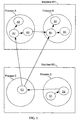
- One such system is shown in Figure 1, consisting of two machines M1, M2 and four processes A, B, C, D. Each process runs in a different address space in its respective host machine and includes one or more objects which perform the tasks associated with the process.
- the process A includes three objects A1, A2, A3.
- inter-object communications can be represented in the form: destination.message_name().
- a programmer can specify that the object C1 issue a message to the object A1 using the syntax: "A/A1.foo()", where "foo()" denotes the message ("foo" being the message name and "()" the arguments) and "A/A1" is the message destination (object A1 in process A).
- “foo" denotes the message ("foo" being the message name and "()” the arguments)
- A/A1 is the message destination (object A1 in process A).
- this syntax is used to highlight the process and object to which a message is being sent.
- Intra-process communications are faster and more reliable then the other types of communications, consisting of the simple passing of local pointers.
- Inter-process messaging is also fast, since it occurs within a machine, but additionally requires that object addresses be translated between different processes.
- Inter-machine communications are much slower and less reliable than the other two types of messaging due to latency associated with issuing messages across an external communications channel and the relatively greater likelihood of channel failure. All of these issues are dealt with in one way or another by the prior art.
- Object security is a significant issue raised by distributed object systems.
- Security problems arise due to the potential lack of trustworthiness of objects, processes and machines.
- the objects A1 and A2 are, respectively, a very powerful object and a misbehaving object. If A2 were somehow given access to the full power (i.e., methods) of A1, then A2 could disrupt process A using the full power of Al's methods. Similar security problems can arise between processes (e.g., when access to a process is given to an object in an untrustworthy process) or between machines (e.g., where a misbehaving machine issues unauthorized messages to an object running on another machine).
- capability security only allows an object to acquire the capability (i.e., object reference) to access a particular object in one of the following ways:
- the object A1 is a very powerful object whose respective methods (not shown) are accessed through the messages msg1, msg2, and msg3.
- the objects A2, A3 and A4 are less powerful front-end objects that only respond to a subset of the messages supported by A1.
- the object A2 only responds to msgl. This means that, even though the object A2 can access the object A1, it only exercises the limited set of A1's powers corresponding to msg1. Therefore, by exporting references to different subsets of the front end objects, different capability subsets with respect to the object A1 can be created.
- the Requestor only has the capability (an object has a capability if it (1) has a right of access and (2) knows the ID/location of the object for which it possesses the right) to access the object A2, which means that it can only invoke the methods of the object A1 that are triggered by msg1.
- the Requestor could, by receiving a reference to the object A3, also acquire the additional capability to cause msg2 to be issued to the object A1.
- the presence of a capability security system ensures that rights can only be passed by authorized objects.
- capability security does not make explicit all of the security problems that can arise in distributed object systems. Because capability security was not designed with distributed systems in mind its inventors did not include in their formulation techniques for solving the problems of distributed systems that are due to possibly misbehaving processes and remote objects and insecure communications channels.
- the traditional definition of capability security does not explicitly forbid an imposter from interfering with the normal process of message reception and/or decoding so as to stand in for one of the capabilities transmitted. For example, referring again to Figure 1, if the object C1 passed a reference for the object B1 to the object A1, but the object D1 interfered with the reception and/or decoding of the message by A1, A1 might then come to hold a capability to D1, thinking that it got this capability from C1.
- A1 might then send messages to D1 that it intended to send only to the object referred to it by C1. Therefore, there is a need for an extended definition of capability security for distributed object systems to indicate that the capabilities that a recipient receives correspond exactly to those that the sender sent.
- a security system in accordance with the traditional definition of capability security would not prevent some of the aforementioned security problems that can arise in distributed systems.
- objects exchange data and references via a common broadcast medium, called a blackboard, which is not secure and is therefore susceptible to either masquerading (the first problem) or spoofing. Therefore, there is a need for an extended definition of capability security that can be applied within or between processes.
- the present invention is a system that provides capability security for distributed object-oriented programs. More particularly, the present invention is adapted to be used within or between the processes in a distributed object system.
- a first preferred embodiment of the present invention is an object-oriented capability security system that includes a plurality of objects, each object being associated with a "public" key and a private key.
- a public key constitutes the object reference of its associated object.
- a particular object is accessible only to other objects that know the particular object's public key, which is made available to the other objects according to rules of capability security.
- Each of the objects is configured to pass a public key and, if they are not co-located, a location associated with another object to a receiving object using an object reference message wherein the public key and optional location being passed is encrypted with the receiving object's public key.
- the receiving object is configured, upon receiving the object reference message, to decrypt the encrypted public key and optional location using the receiving object's private key, the receiving object thereby gaining the authority to access the object whose reference was passed.
- This inter-object encryption and decryption prevents a first misbehaving object from unauthorized access to another object and prevents a second misbehaving object from intercepting object reference messages (because they are encrypted with another object's public key).
- Another preferred embodiment of the present invention is a capability security system for distributed object systems that includes a plurality of processes, a plurality of objects distributed among said processes and a public and private key associated with each of the objects, where a public key constitutes the object reference of its associated object.
- a particular object is accessible only to other objects that know the particular object's public key, which is made available to the other objects according to rules of capability security.
- Each object is configured to pass a public key and location associated with another object to a receiving object in a different process using an object reference message wherein the public key and location being passed are encrypted.
- the receiving object in a different process is configured, upon receiving the object reference message, to decrypt the encrypted public key and location, thereby gaining the authority to access the object whose reference was passed.
- each of the objects is configured to pass a public key associated with another object to a receiving object in the same process using language-level pointers.
- the receiving object in the same process is configured to receive directly such local object reference messages and thereby gain the capability to access the referenced object.
- inventions of the present invention are capability security systems and methods for distributed objects in which message encryption and decryption are performed by process objects using public key encryption or single key encryption (such as the data encryption standard).
- process-oriented embodiments include a registrar object that maintains a secret number table with an entry for each registered local object.
- the registrar and secret number table ensure that an object that gains access to a process can not access any and all objects in that process without the authority to do so. That is, in these process-oriented embodiments, a remote object is not allowed to access an object unless it knows the object's secret number. This rule is administered by the local registrar and is what enables the provision of capability security in these embodiments.
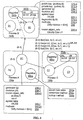
- Figure 1 is a depiction of a distributed object system consisting of two machines, four processes and multiple objects.
- Figure 2 is a block diagram showing a prior art capability security system for distributed, object-oriented programs.
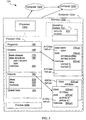
- FIG. 3 is a block diagram of a computer system in which the present invention is implemented.
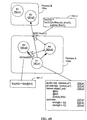
- Figure 4A is a depiction of a preferred embodiment of a capability security system for distributed, object-oriented programs that makes use of public key/private key encryption techniques for all inter-object messages.
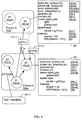
- Figure 4B is a depiction of an alternate preferred embodiment of a capability security system for distributed, object-oriented programs that makes use of public key/private key encryption techniques only for inter-process messages.
- Figure 5 is a depiction of a preferred embodiment of a capability security system for distributed, object-oriented programs that makes use of Diffie-Helman key exchange encryption techniques to provide security between objects.
- Figure 6 is a depiction of a preferred embodiment of a capability security system for distributed, object-oriented programs that makes use of Diffie-Helman key exchange encryption techniques to provide security between processes.
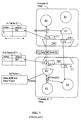
- Figure 7 is a depiction of a prior art transparent distributed object system.
- Figure 8 is a depiction of a preferred embodiment of a capability security system for transparent, distributed, object-oriented programs that makes use of Diffie-Helman key exchange encryption techniques to provide security between processes.
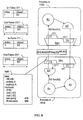
- Figure 9A is a depiction of a first step in a third-party object reference passing operation as implemented by a preferred embodiment of a capability security system for transparent, distributed, object-oriented programs that makes use of Diffie-Helman key exchange encryption techniques to provide security between processes and secret numbers to provide security between objects passing object references across more than two processes.
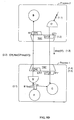
- Figure 9B is a depiction of a second step in a third-party object reference passing operation as implemented by the preferred embodiment of Figure 9A.
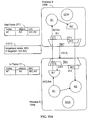
- Figure 9C is a depiction of a third step in a third-party object reference passing operation as implemented by the preferred embodiment of Figures 9A and 9B.
- Figure 9D is a depiction of a garbage collection problem that can arise in distributed object systems.
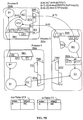
- Figure 10A is a depiction of a preferred embodiment of a garbage collection system that is compatible with transparent, distributed object systems.
- Figure 10B depicts the status of the garbage collector of Figure 10 prior to A1 sending an object reference for A2 to B2.
- Figure 10C depicts the status of the garbage collector of Figure 10 after A1 sends the object reference for A2 to B2 but before that reference is received by B2.
- Figure 10D depicts the status of the garbage collector of Figure 10 after a number of process B objects delete their references to A2.
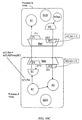
- Figure 11 is a depiction of a preferred embodiment of a garbage collection system that is compatible with transparent, distributed object systems that support three-party object-reference passing.
- Figure 12A shows a first embodiment of a system by which the garbage collection system of Figure 11 deletes object pointers from the local registrar.
- Figure 12B shows a second embodiment of a system by which the garbage collection system of Figure 11 deletes object pointers from the local registrar.
- the distributed computer system 100 includes one or more inter-connected computers 120a, 120b, 120c, each of which includes a processor 130 and a memory 150.
- This memory 150 could be a fast primary memory, such as a random access memory; a cache memory; a slower secondary memory, such as a hard disk; or any combination of those three types.
- Each of the computers 120 contains similar software and hardware components, details of which are presented for a representative computer 120a.
- the memory 150a of the computer 120a includes an operating system 152 and one or more processes 154a, 154b, each of which occupies a separate address space in the memory 150a at runtime.
- Each process 154 includes programs 156, class and object specifications 158, 160 and a data area 164.
- the operating system 152 executes in the processor as long as the computer 120 is operational and provides system services for the processor 150 and programs 156 being executed in the processor 150.
- the operating system 152 besides including the basic components common to most operating systems (not shown), also includes an optional security module 270 that provides routines for secure inter-process object messaging.
- the programs 156 can be any kind of program, including the object-oriented programs to which the present application is directed.
- a program 156 written in an object-oriented language, such as C++ includes class definitions 158 and object declarations 160.
- Each class definition 158 outlines the data structures 180 and methods 200 associated with that class, where a data structure declaration 180 defines the type of the data item (e.g., whether the data item is a pointer, an integer, or a user-defined type) and optionally, the accessibility of the data item (i.e., whether the data item is public, meaning accessible to all objects, or private (“pvt"), meaning visible only within object instances of the declared class).
- a class definition 158 can also optionally identify one or more base classes 170 from which that class inherits methods and data structures.
- an "A1Class” 158-a1 can be defined with the following elements:
- Objects are instances of one or more classes 158 and incorporate all of the properties (i.e., methods and data structures) of the classes of which they are instances.
- Each object's storage 160 includes a "class" field 220 that indicates the associated classes of which the particular object 160 is an instance and the data 230 and methods 250 that are derived from those associated classes (note: in some object-oriented systems the methods 250 are not held in the object storage 160, but in the associated class 158; however, for the purposes of illustration, the methods are shown as being in the object storage 160).
- the "A1Obj" 160-a1 is declared to be an object instance of the A1Class 158-a1 via a "class" field 220-a1 whose contents are "A1Class".
- the data 230-al and methods 250-a1 (not shown) of the A1Obj 160-a1 are as specified for the A1 Class.
- the values of the data 230-a1 can be set through an initialization step after the object is created (constructed) or during program execution and are associated only with that object 160-a1.
- the pubkey.a1 and privkey.a1 variables represent values associated with a particular instance ("A1 Obj") of the A1 Class.
- Figure 3 also shows an A2Obj 160-a2, which is an instance of the ClassA2 158-a2. As the A2Obj 160-a2 is defined similarly to the A1Obj 160-a1, no additional details are shown for this object.
- the basic tenet of capability security is that the right to do something to an object (e.g., invoke a particular object's methods) is represented solely by the holding of a reference to the particular object.
- the present invention provides a revised formulation of capability security that meets the two constraints set out in the background on acquiring a capability as well as a new rule called the "message integrity rule".
- the message integrity rule states that:
- the first clause plugs the loopholes illustrated by the two problems set out in the background and, therefore, provides a more faithful formulation of what has been meant by capability security.
- the extra precision inherent in the first clause has not been needed in single machine capability systems, because virtually all plausible engineering choices happen to provide implicitly for message integrity. When engineering distributed capability systems, however, the extra precision becomes crucial. In this latter engineering domain, one is more likely not to provide the message integrity property if it has not been articulated.
- an object is presumed to hold legitimately a reference to a particular object only if the object knows some unpublicized (except under the conditions required by capability security) key associated with the particular object.
- an object reference and an object key can be used to the same effect in these embodiments.
- the system of the present invention ensures that objects seeking access to other objects have acquired those capabilities legitimately. This is accomplished in these embodiments through the use of public key cryptography, Diffie-Helman cryptography or other cryptographic techniques implemented in the objects, wherein a target object uses a secret key to decode messages encoded by the issuing object with the unpublicized key.
- five embodiments are described, each corresponding to a different way of handling this object-implemented cryptography. The first of these embodiments is presented in Figure 4A.
- Figure 4A there is shown a first preferred embodiment of a system that provides capability security for distributed object systems.
- Figure 4A shows (1) the communications links (depicted as directed arrows) between plural objects 160 resident in a multitude of processes 154 and (2) the form of particular messages 161 issued by one object to another along a subset of those links. More particularly, the embodiment of Figure 4A is illustrated for a Process A 154a that includes three objects: A1 160-a1, A2 160-a2 and A3 160-a3, and a Process B 154b that includes two objects: B1 160-b1 and B2 160-b2. Each of these objects is an instance of a respective class.
- the objects A1 and A2 are instances of the classes ClassAl 158-a1 and ClassA2 158-a2 (Fig 3), respectively.
- public key and private key refer to pairs of encryption/decryption keys, where messages encoded with a public key can be decoded only through use of the corresponding private key.
- the public keys are not made freely available; instead, they are publicized by their associated objects only on a very restricted basis (i.e., according to conditions imposed on object reference passing by capability security).
- the private keys are truly private and are typically never transmitted.
- each object 160 has a data area 230 that includes a unique public key (“pubkey”) 232 and private key (“pvtkey”) 234 that can be used to encode and decode messages transmitted to and received by that object.
- pubkey public key
- pvtkey private key
- the object and location associated with a particular key is indicated after that key's name or reference number.
- object A1 160-a1 has respective public and private keys pubkey.a1 232-a1 and pvtkey.a1 234-a1.
- the data area 230 also includes a list of all object public keys (i.e., references 236) that are known to a particular object 160. These object references 236 constitute the list of objects an object is authorized to access.
- the object references 236-a1 for the object A1, which has communications links to the objects A2, A3 and B2, include pubkey.a2, pubkey.a3 and pubkey.B/b2.
- Each of these object references 236-a1 includes the referenced object's public key and the object's location. All of this information is contained in the name of the object reference 236-a1.
- the reference "pubkey.B/b2" corresponds to the encryption key of object "b2" in the process "B".
- each object also includes methods 250 inherited from its associated class.
- these methods 250 include an encryption routine "E()" 252 and a decryption routine "D()" 254 that are used by the objects 160 respectively to encrypt and decrypt messages sent to and received from other objects.
- the methods 252, 254 are known from public key-private key cryptography.
- messages may be (1) encrypted by a sender with the sender's private key before transmission and then, after transmission, decrypted by the intended receiver using the sender's public key, or (2) encrypted by a sender with the intended recipient's public key before transmission and then, after transmission, decrypted by the intended receiver using the intended receiver's private key.
- Method (1) is known as signing and is not used by the preferred embodiment.
- the preferred embodiment employs the methods 252, 254 (using the intended recipient's key pair) to guarantee that (1) only the intended recipient can decode a message passing an object reference 236, and (2) no object can spoof another object into believing that the spoofing object has an object reference 236 it doesn't possess.
- the embodiment of Figure 4A is able to provide capability security for distributed object systems.
- Each message 161 includes the following fields:
- receiver.foo() can be used to issue an (encoded) message to an object that is not local to the object that is passing the object reference.
- the object A1 forms the message 161-2 shown in Figure 4A.
- the message 161-2 is encoded with the public key of the object B2 (pubkey.B/b2).
- the encoded message, "B/B2.foo()” indicates the full path to the object B2 ("B/b2", which is short for "Process B, object b2").
- an object Upon receiving an encoded message (e.g., A2.foo), an object decodes the message using its decoding method D() 254 and private key pvtkey 234 and adds the decoded public reference to its list of known object_refs 236. This decoding step ensures that only the object that is the intended recipient of an object reference can actually receive that reference.
- an encoded message e.g., A2.foo
- object references are equivalent to public keys, which are controlled according to the tenets of capability security, it is not possible for a misbehaving object to appear to hold a capability it does not have or to masquerade as another object. Also, a misbehaving object cannot eavesdrop on messages to another object because all inter-object messages are encoded and can only be decoded by the intended recipient using its private key. Thus, this embodiment is particularly useful in a class of current object-systems where objects co-resident in a process use common data structures, such as a blackboard, to broadcast messages to one another.
- blackboard systems do not allow objects to manufacture references to or to reach into other objects (one aspect of capability security), they do not provide capability security because the messaging channel (i.e., the blackboard) is not secure, being accessible to all communicating objects.
- a blackboard system consistent with the teachings of this embodiment; i.e., where objects encode and decode their messages, can provide object-to-object communications that are secure within the extended definition of capability security.
- the embodiment of Figure 4A provides true capability security for distributed objects.
- this embodiment is not suitable for transparent distributed object systems because it requires an object to know the destination (including process and machine) of the objects with which it communicates.
- This embodiment is also extremely inefficient as it requires all messages relayed between objects to be encoded and decoded using public-key encryption techniques, whether or not the communicating objects are co-located (in the same process).
- Public-key encryption and decoding is expensive in terms of the CPU resources used. This overhead is reduced in the embodiment of Figure 4B.
- FIG. 4B there is shown an alternate preferred embodiment of a capability security system for distributed, object-oriented programs that makes use of public key/private key encryption techniques.
- the only difference between the embodiments of Figures 4A and 4B is that, instead of encrypting and decrypting all messages 161, as in Figure 4A, the embodiment of Figure 4B encrypts only the messages 161 that are transmitted between different processes and/or machines.
- An acceptable level of security for local messages 161 can be provided by the optional, operating system security module 270 and, sometimes, by features of the object-oriented language in which the programs 156 were written.
- each object 160 holds the local pointers of known objects alongside the public keys of the remote objects for which object references are available.
- the known object_refs 236-a1 section of the object 160-a1 include two language-level pointers, "&A2" and "&A3" ("&" denotes a local address), which are, respectively, pointers to the local objects A2 and A3.
- & denotes a local address
- the object B2 is not local, its public key, pubkey.B/b2
- the object_refs 236-a1 Because the object B2 is not local, its public key, pubkey.B/b2, is still stored in the object_refs 236-a1.
- messages issued to remote objects such as the message 161-2, are the same as in the embodiment described in reference to Figure 4A.
- the local messages are, however, different from those shown in Figure 4A.
- the message 161-1' which accomplishes the same purpose as the message 161-1 (Fig. 4A), includes only the pointer to the object A3 ("&A3").
- each of the objects 160 includes a generator 238-1 and a modulus (m) 238-2, which are described below.
- Each of the objects 160 also includes respective public and private keys 232, 234.
- the object A3 has keys 232-a3, 234-a3 ("y") and the object B2 has keys 232-b2, 234-b2 ("x").
- the objects 160 (Fig. 5) perform the encryption and decryption steps that allow capability security to be provided for distributed object systems. These steps are embodied in the method DH() (short for Diffie-Helman) 256, which is included in each of the objects 160. Alternatively, any type of key-exchange or agreed-key cryptography can be substituted for the Diffie-Helman techniques. Additionally, note that the present invention does not strictly require that all links between processes support encryption.
- the preferred embodiment can also provide capability security in distributed object systems where the machines are trusted and the only cryptography is provided by the link (e.g., by a link, such as a Netscape Secure Socket Layer (SSL), that provides encrypted, bi-directional data streams between machines).
- SSL Netscape Secure Socket Layer
- Figure 5 shows a situation where A1 is passing B2 an object reference (public key) 311-1 for the object A3.
- B2 uses the public key 311-1 to generate with A3 (according to Diffie-Helman's teachings) a single agreed key (AK) that B2 and A3 can use to encrypt and decrypt their messages to one another.
- AK agreed key
- Each object 160 has a public key ("pubkey") 232 of the form shown in equation 1, where "g”, “m”, “pvtkey” and “%” respectively designate the generator, modulus, the object's private key and the arithmetic modulo operation.
- Pubkey a public key
- g m
- pvtkey a public key
- % arithmetic modulo operation.
- the object A3 has a private key "y” 234-a3
- its particular public key 232-a3 can be represented as shown in equation 2.
- This value 232-a3 is packaged in the message 311-1 when A1 sends B2 the object reference to A3.
- pubkey ( g pvtkey )% m
- pubkey.a3 ( g y )% m
- A3 Upon receiving the message 311-2, A3 computes the agreed key (AK 240-1) for receiving messages from B2 and returning results from its own private key and B2's special public key 232-b2a3 as shown in equation 3. Due to properties of modulo arithmetic, this value can be more simply represented as shown in equation 4.
- AK (( g y )% m ) x % m
- AK (g xy )%m
- B2 is also able to compute the agreed key AK 240-1 without any further exchange of keys with A3. This ensures that the agreed key 240-1 is completely secure (as it was generated by the objects using their private keys and was never broadcast).
- B2 and A3 can send secure messages using the AK as the single key in a single key encryption scheme (e.g., DES).
- B2 can delete the special purpose key pair pubkey.b2a3 and pvtkey.b2a3; B2 still needs to store A3's public key to be able to pass references to A3.
- the advantage of this embodiment is that two objects in different processes can still pass object references in such a way that capability security is maintained while avoiding the overhead of public key encryption.
- the advantage of the previous embodiment is that it implicitly provided some degree of non-repudiation, by virtue of its direct use of public key cryptography, while this embodiment does not.
- a goal of the present invention is to produce a faithful implementation of capability security, and capability security is not defined to include the property of non-repudiation, this lack is not a problem.
- the embodiment of Figure 6 also employs Diffie-Helman cryptography. However, instead of requiring an agreed key to be generated for every pair of objects involved in inter-process messaging, this embodiment only requires that one agreed key AK be generated per process pair (this implies that each process must have public and private keys) and that the processes, not the objects, perform the necessary encryption and decryption.
- a process 154 includes data such as a public key 370, a private key 372, a generator 238-1, a modulus 238-2, known object references 236, agreed keys 240 for communicating with other processes, such as the agreed key AK.AB 240-1 used by process B for communicating with process A, and methods 376, such as Diffie-Helman DH() 256.
- each process also includes a fingerprint 378 (e.g., 378-b), which is the hash of the process's public key 370.
- the fingerprint 378 is a much smaller substitute for the public key 370 (e.g., whereas a typical Diffie-Helman public key has on the order of 1000 bits, a reasonable fingerprint needs only to be between 64 and 128 bits in length) and can be used as a substitute for the public key when two processes are establishing a secure Diffie-Helman communications channel.
- One requirement for choosing the hash function used to generate the fingerprint 378 is that it must be highly unlikely for a third party to generate a public key that hashes to that same value.
- One such hash function that is employed by the present invention generates a fingerprint 378 equaling the 128 low-order bits of the public key 370.
- a new agreed key 240 is generated each time a new connection is established between a pair of processes.
- an object A1 in the process A only needs to know the agreed key for the process pair AB (e.g., AK.AB) to send an encrypted message (e.g., a message) to an object B1 in the process B.
- the process pair AB e.g., AK.AB
- an encrypted message e.g., a message
- two processes can generate their agreed key as described in reference to Figure 5 as long as one of the processes knows the public key of the other process or, alternatively, the fingerprint of the other process.
- process A wants to establish a secure inter-process channel with process B and only knows B's fingerprint 378-b
- process A would first issue a message asking the process with the fingerprint 378-b (i.e., process B) to return its public key 370-b.
- Process B would then return its public key 370-b to process A, which uses the fingerprint 378-b and the appropriate hash function to verify that the returned public key was indeed from process B.
- process A has verified process B's public key, the two processes can establish their Diffie-Helman agreed key AK-AB as already described.
- misbehaving object could access any object in any process whose agreed key is known to the misbehaving object. For example, as long as A1 knows the agreed key for the process pair AB, it could send a message to the object B2, even if not authorized to do so.
- the preferred embodiment of Figure 6 includes in each process a "registrar" object 350, which maintains a table of unguessable secret numbers 352 for co-located objects (i.e., objects in its own process).
- any kind of secret code can be used in lieu of secret “numbers”.
- unguessable it is meant that the secret numbers must be practically unguessable given the ever-changing state of computer power and cryptography.
- the registrar objects have access to a random number generation method for generating unguessable secret numbers, which in the preferred embodiment are at least 64 bits in length.
- Each registrar 350 also includes a remember method 354 that registers unique secret numbers for objects when there is a need for an inter-process reference for a previously un-registered object and a lookup method 356 that handles all inter-process communications directed to registered objects in its process. Because secret numbers are known only to the appropriate registrar and to objects that have the capability to access registered objects across process boundaries, this embodiment preserves capability security for distributed objects. Also, because the individual objects do not have to handle the task of generating unique agreed keys for any objects with which they wish to communicate, the present embodiment does away with much of the overhead of the previous embodiments.
- the object A1 before the object A1 can pass an object reference for the object C1 to the object B2, the object A1 must first know the agreed key for the process pair A-B ("AK.AB”), the network location of process C (“Cloc”), process C's public key (“pubkey.C”), from which one can authenticate C, and the secret number for the object C1 ("sn.C1"), which indicates that A has the capability to access C1.
- the object A can form a message (6-0) consisting of C's location, C's fingerprint (fp-C) 378-C (generated by A from C's public key) and C1's secret number.
- Al then forms an encrypted message (6-1) by prepending to the message (6-0) B2's secret number (which the registrar 350b uses to locate B2) and encrypting the augmented message using the agreed key for the process pair AB (AK.AB).
- encryption is represented using superscript notation.
- the message (6-1) is represented as (sn.B2,(Cloc, fp.C, sn.C1)) AK.AB ).
- Al sends the encrypted message (6-1) to Process B, which, upon receiving the message (6-1), decrypts it using the agreed key AK.AB. This step allows process B to verify that the encrypted message was actually sent by an object in process A (which prevents spoofing).
- Process B then sends the decoded message (6-2) to its registrar 350b, which verifies the secret number of the recipient (i.e., B2). Once it verifies the secret number, the registrar 350b sends the unpackaged object reference (6-3) to object B2, which stores the information in its list of known object refs 236-b2.
- an object ref consists of an object's location and cryptographic information (process public key and object secret number).
- the object reference for C1 stored in B2's data area 236-b2 is "Cloc/fp.C/sn.C1", where "Cloc” is the location of process C, "fp.C” is process C's fingerprint and "sn.C1" is object C1's secret number.
- C's public key could be substituted for the fingerprint fp.C in the messages (6-0) through (6-3).
- Diffie-Helman cryptography utilizes single key encryption for communication between two entities once an agreed key has been computed, which is, generally, significantly more computationally efficient than public key cryptography.
- the extra overhead associated with computing an agreed key is more than made up by lower computational requirements of single key encryption so long as a reasonable number of messages are transmitted using the agreed key.
- Figure 6 While the embodiment of Figure 6 efficiently provides capability security for distributed object systems, it is also less than transparent. This is because an object must format messages differently when communicating with co-located objects as opposed to remote objects. In the prior art, there are well-known methods that provide transparency in distributed object systems; albeit without capability security. One such system is shown in Figure 7, which is now briefly described.
- the prior art system in Figure 7 provides transparency in distributed object systems through the use of object proxies, which act as intermediaries between objects in different processes, and transport managers (TM), which handle inter-process communications and create and destroy proxies as needed.
- object proxies act as intermediaries between objects in different processes
- transport managers TM
- objects pass messages using only language pointers/local addresses (i.e., an object only needs to know how to pass messages within its object space).
- TM transport managers
- a local proxy object is created in the first object's process to act as a local stand-in for the remote object (the proxy's "sibling"), I.e., the proxy object picks up messages intended for its remote sibling by local objects and ensures that those messages are delivered, via a transport manager, to its sibling.
- each proxy object inherits from two interfaces: (1) ) the interface of the object for which it is a proxy (so it can respond to all of its sibling object's messages) and the "Proxy" interface, which defines the methods associated with all proxies.
- an object proxy B2' is an instance of B2IFace and Proxy.
- TM transport managers
- IT in-table
- OT out-table
- An in-table contains pointers to local objects, using indices corresponding to those used by the corresponding out-table in the corresponding TM for the corresponding proxy.
- Each proxy knows its index in the local out-table.
- Arguments to be sent by value are encoded directly.
- Arguments that are local objects which are already known to the remote process are encoded using their index in the remote process's out-tables.
- Local objects for which the remote process does not have an entry are first added at a new index in the local process's in-table and then encoded as a known local object.
- Objects that are locally known via a proxy to the destination process are encoded using their index in the destination TM's in-table.
- Objects which are local proxies to objects stored somewhere other than the destination process require a three-party handoff (described below in reference to Figure 9),
- a TM When an incoming message is received by a TM, it finds the receiver in the in-table corresponding to the source of the message using the slot identified in the message (e.g., "i(1)" in Figure 7). Arguments sent by value are created directly from their encoding. Arguments that are local to the destination system are decoded (as was the receiver itself) by look-up in the destination TM's in-table. Objects which are local to the source are decoded by look-up in the destination out-table (e.g., "A2Proxy(3)" in Figure 7). If the indicated slot in the out-table is empty, a new proxy is created at the indicated index with the indicated type.
- a proxy object B2' exists in process A for the remote object B2.
- the proxy object B2' is an instance of the B2IFace and Proxy classes.
- the transport managers TM1 and TM1' coordinate communications between the processes A and B. These transport managers TM1 and TM1' link B2's proxy and B2 by respectively assigning the objects 82' and B2 a slot index of 1 in the output and input tables OT1, IT1'.
- the in-tables IT are defined using a two-way mapping (indicated by the two-headed arrow below the respective columns) that allows a transport manager to look-up an object in the IT by index (when pulling a message to the object off the wire) or identity (when determining whether there is an in-table entry for the object).
- the out-tables OT only allow objects to be looked-up by index.
- A1 initiates the process of sending the object reference for A2 to B2 by issuing the language level message "B2.foo(A2)".
- This message is picked up by the local proxy object B2', which in turn issues the message "i(1).foo(A2)" to the transport manager object TM1.
- This message tells the transport manager TM1 to issue an appropriate message containing a reference for A2 to its sibling TM1' via index 1 of its in-table IT1' (this is the index shared by B2 and B2').
- the transport manager TM1 responds by looking-up A2 by identity in its in-table IT1. If there is no entry for A2, TM1 allocates an entry with an unused index. If there is an entry, TM uses the existing index.
- the transport manager TM1 issues the network message "i(1).foo(A2Proxy(3))" to TM1'.
- This message tells the remote transport manager object TM1' to issue the language level message "foo(A2)" to the local object "B2" associated with the in-table index 1, thereby completing the process of passing the object reference for the object A2 to the object B2.
- B2 knows about A2', it can issue language-level messages to A2' (e.g, "A2'.foo()"), which are handled by the A2Proxy and the transports TM1, TM1' as described above.
- the embodiment of Figure 8 includes the same basic components as Figure 7 (i.e., processes, transports, in-tables, out-tables, objects and object proxies).
- the transport managers of Figure 8 include an additional security method that enables them to encrypt and decrypt inter-process messages sent between their associated processes.
- this method is the already discussed DH() 156, which enables transport pairs to generate an agreed key in accordance with Diffie-Helman key exchange cryptography as described in reference to Figure 6.
- the transports TM1 and TM1' would use the method DH() to generate a single agreed key AK.AB associated with the processes A and B.
- each of a pair of transports TM could have its own public and private keys and public key encryption and decryption methods E(), D(), which the transport manager could use to securely encrypt and decrypt inter-process messages.
- E(), D() public key encryption and decryption methods
- the individual objects do not have to be concerned with cryptography or where a particular object is located, which enables capability security to be provided for transparent distributed object systems.
- encryption is only performed for inter-process messages. All local messages are passed using language-level pointers with security provided by the operating system or the computer language.
- slots in each transport manager's in-table are assigned by a method associated with the transport manager. More specifically, any object requiring an index value for an in-table slot calls an in-table slot assignment method, passing as an argument a language pointer to a specified object for which an in-table slot is required.
- the slot assignment method determines if the specified object has already been assigned a slot, assigns an unused slot if the object has not already been assigned a slot, and then retums the object's assigned slot number.
- A1 initially issues the message B2.foo(A2), which is picked-up by the proxy object B2' (recall, a proxy object is responsive to the same messages as its sibling).
- B2' relays this message to the transport manager TM1, designating B2 as the recipient by using the index common to both B2 and B2' (i.e., 1).
- the transport manager TM1, making used of its two-party method 458, encrypts the corresponding network message (e.g., i(1).foo(A2Proxy(3)) using either public/private key or Diffie-Helman techniques.
- the encrypted message (i(1).foo(A2Proxy(3)) AK.AB is then relayed by the transport manager TM1 to TM1'.
- the transport manager TM1' decrypts the received message and, if the proxy does not already exist, creates an object instance A2' of the class "A2Proxy", associates the object A2' with the out-table index 3 in OT1' and issues the message B2.foo(A2) ("A2" in this message is equivalent to "A2'").
- the proxy object A2' can be used by B2 (and other objects in process B) to issue messages to the object A2.
- the second situation differs from the two process situation described in reference to Figure 8 in that, due to the requirements of capability security, the object in the third process (i.e., the object that is the intended recipient of the message) cannot make use of the in-table and out-table index of the referenced object in the transport managers that coordinate communications and security between the processes of the sending and referenced objects.
- the object in the third process i.e., the object that is the intended recipient of the message
- slot indices are private to the transport managers that maintain them and to objects in the corresponding processes that have the capability to access the objects associated with those particular slot indices. If access to transport managers were shared among more than two processes, a misbehaving process could pretend to have access to objects counter to the rules of capability security by creating local proxies corresponding to indices it merely guessed.
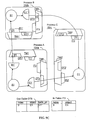
- FIG. 9A there is illustrated the first stage of the three-process object-reference passing situation.
- This figure shows three processes, A, B and C, each of which includes a respective registrar RA (not shown), RB (not shown), RC and program object A1, B1, C1.
- Process A also includes a registrar proxy RC' and a C1 proxy object C1', which can be used by objects in Process A to communicate transparently with the registrar RC and the object C1, respectively.
- every process has a registrar object. Whenever two processes set up a transport manager pair (as described above) registrar proxies are automatically generated in each process to enable communication with the other process's registrar.
- Inter-process communication services between the processes A and B and the processes A and C are provided respectively by the transport manager pairs TM1, TM1' and TM2, TM2'.
- each of these transport managers includes in-tables IT and out-tables OT, wherein an object and its proxy are linked using a common slot index.
- the object C1 has already been assigned the slot index 3 in both OT2 (in TM2) and IT2' (in TM2'). This slot index is the object reference that is used in two-process reference passing situations.
- the object C1 has also been assigned the secret number sn.C1, which is stored in the secret number table 352c maintained by the registrar RC.
- this secret number sn.C1 constitutes the object reference that is passed to B1 as a result of Al issuing B1 a message referring to C1.
- this secret number is provided to B1 has to do with interactions between the sending object A1, the sending transport manager TM1, the process C registrar proxy RC' and its analog, the registrar proxy RC.
- a key to these interactions is the way the preferred embodiment allows objects (including transport managers) to access remote registrars via slot indices in paired transport managers such as TM2 and TM2'.
- each registrar is assigned a fixed slot index of 0 in all transport managers. Consequently, whenever an object needs to send a message to a remote registrar, it relays the message to the appropriate registrar's proxy object, which then routes the message to its analog via the slot index 0 of corresponding out and in tables.
- the object TM1 issues a message to the registrar RC by sending the message to "the object in process A whose out-table index in the transport manager TM2 is 0" (the part in quotes represents the object reference of the registrar proxy RC').
- the transport manager TM2 encrypts the message and then relays the encrypted message to slot 0 of the in-table of the transport manager TM2'.
- the transport manger TM2' then decrypts the message and automatically passes the decrypted message on to the registrar RC.
- the third-party handoff situation requires the various objects to support call-return messaging, which is where a sending object issues a message that requires the recipient to return a value to the sending object.
- This feature is not assumed to be provided by the foundations of the distributed object system of the present invention, where all of the messaging might be one way.
- the preferred embodiment achieves the effect of call-return messages through "hole" objects, which are created specifically to be bound to a value retumed by an initial message recipient using a second message.
- hole objects are linked across different processes with common slot indices in a pair of input and output tables.
- the objects HC and HC' represent such a pair of hole objects that are used in the third-party handoff situation. How these hole objects are created and used will become apparent in the course of the following description.
- the teachings of the present invention with regard to the third-party handoff situation are also applicable to any N-process message passing situation, where N is an integer greater than 3.
- the object Al initiates a third party handoff to B1' of a reference to C1' by issuing the language-level message "B1'.foo(C1')" (9-1).
- this message is relayed by B1' to TM1, which associates B1 and B1'.
- the TM1 Upon receiving the message 9-1, the TM1 realizes that C1' is a proxy that is related to a third-process (C), which realization causes the TM1 to invoke its third-party method 460.
- the TM1 requests the secret number of the object C1 by issuing the remember message 9-2 to the registrar corresponding to C1'.
- this message is represented as "RC'.remember(C1')”.
- TM1 finds the local registrar (RC') for C1' by sending the message C1'.registrar().
- the remember message 9-2 is picked up by the registrar proxy object RC' and relayed to the transport manager TM2 with the receiver designated with the slot index 0.
- TM2 creates a hole object HC to be bound to the secret number retumed by RC and associates HC with an available slot index (7) in the in-table IT2.
- the TM2 also issues the network message 9-3 "i(0).remember((i(3), HoleProxy(7))", which tells the remote object associated with slot index 0 in the in-table IT2' (i.e.
- the registrar RC to generate ("remember") a secret number associated with the object with slot index 3 in the in-table OT2 (i.e., the object C1) and create a hole proxy (HC1') in process C with an associated slot index of 7 in the out-table OT2' (the hole proxy HC' is actually created by the transport manager TM2').
- This hole proxy HC' is used by the registrar RC to return the value of Cl's secret number to the hole object HC.
- the TM2 waits for the secret number sn.C1 to be bound to the hole object HC and, when that occurs, returns the secret number sn.C1 to the TM1.
- the registrar RC generates a secret number for C1 (e.g., 395276) and stores it in its secret number table 352c.
- the registrar RC issues a bind message 9-4 ("i(7).bind (395276")), which specifies the in-table slot index, i(7), of the hole object HC and C1's secret number, to which the hole object HC is to be bound.
- This message is picked up by HC' (which shares the slot index 7 with HC) and returned to HC via the slot index 7 of the transport managers TM2' and TM2.
- TM1 Once TM1 knows Cl's secret number, it issues the network message 9-5 ("i(2).foo(thirdParty (Cloc, fp.C, sn.C1, PHP(43)"). This message is relayed through the transport manager TM1' to the object B1, which has a slot index in the in-table IT1' of 2. The argument of the message "foo(. . )" indicates that the message is a thirdParty object reference ("third Party”) for an object with the following location and cryptographic information:
- TM1' establishes a secure communications channel with process C consisting of a third pair of transports TM3, TM3', each of which includes the corresponding out-table and in-table pairs OT3, IT3 and OT3', IT3'.
- TM1' constructs a registrar proxy RC" that is linked to the process C registrar RC via slot index 0 of the out-table OT3 and the in-table IT3'.
- TM1' issues the language level message 9-6 (RC”.lookup(39527)), which RC" forwards through TM3 as the network message 9-7 ("i(0).lookup(395276, HoleProxy(5)").
- This message tells the registrar RC to lookup in its secret number table 352c the local object whose secret number is 395276 (i.e., object C1) and then form a HoleProxy HC2' associated with slot index 5 of its out-table OT3' for relaying an object reference for object C1 to object B1 (as in Fig. 9A, a hole proxy HC2 exists in process B to receive the return value, in this case, the object reference).
- the registrar RC In processing the "lookup" message, the registrar RC directs TM3' to reserve an index (3) in its out-table for the referenced object C1 and issues a language-level hole bind message ("HC2'.bind (C1proxy)”) to the hole proxy HC2'.
- the hole proxy HC2' relays this message to TM3', and then TM3' relays an equivalent network message 9-8 ("i(5).bind (C1proxy(3))" to TM3.
- This- causes TM3 to deliver the bind message to the hole object HC2, which, as a result, binds the return value, "C1Proxy(3)".
- TM1' constructs an object of the class C1Proxy (a proxy for a C1 object instance), or C", associated with the slot index 3 in the out-table OT3, which corresponds to the in-table slot index reserved for the object C1 in the transport manager TM3.
- This solution also provides immediate path shortening between objects, because, ultimately, any passed object reference results in a direct link, consisting of a pair of transport managers TM, being formed between the processes hosting the referenced object and the object to which the reference was passed.
- language-level messages for passing an object reference for an object C1 from a first object A1 to another object B1 is the same, regardless of whether objects C1 and B1 are in the same or different processes from object A1.
- object receiving such a message is a proxy object, because the intended recipient is in another process, methods associated with the proxy object automatically repackage the message so as to enable the receiving object to access the referenced object.
- the repackaged message enables the receiving transport manager to generate a local proxy object, if needed, and to determine which transport manager and which transport manager slot to use to access the referenced object, including (in the case of three process object reference passing) the information needed to set up a new transport manager to communicate with the process in which the referenced object is located.
- the present invention provides transparent object access, while also providing a high degree of security in an efficient manner.
- An embodiment of the invention is compatible with local garbage collectors that perform either ref-count or "full” garbage collection (a term that refers to well-known garbage collection methods such as "stop and copy” and “mark and sweep”).
- a distributed garbage collection system The purpose of a distributed garbage collection system is to provide a number of garbage collectors, each of which periodically visits all objects in its process and reclaims (collects) the memory allocated for objects that are no longer being accessed by any other object in the same or other processes.
- objects can be accessed through two different kinds of pointers: weak pointers (i.e., pointers that refer to an object and can be followed, but which don't cause storage to be retained - used for the link between an out-table slot and the local proxy associated with that out-table slot) and strong pointers (pointers that establish a chain of storage during garbage collection).
- an unmarshaling count UC that represents the number of received messages referencing the remote object associated with the out-table slot.
- a transport TM is configured, upon receiving a message including a reference to a local proxy, to increment the unmarshaling count UC for that proxy.
- a transport TM is configured, upon all local objects dropping their references to a proxy for which the transport has an out-table entry, to delete the proxy's out-table entry and to issue a forget message to the transport in the process hosting the proxy's sibling.
- the forget message includes the current unmarshaling count UC and a slot number identifying the in-table slot associated with the particular object.
- a transport TM is configured, upon receiving a forget message, to subtract the unmarshaling count UC from the marshaling count MC associated with the slot number designated in the forget message.
- the transport TM is also configured, upon the marshaling count MC going to zero, to (A) delete the designated in-table IT slot and the strong pointer linking the designated in-table slot to the particular object whose remote references were dropped, and (B) issue a second message to the registrar R notifying the registrar R that the in-table slot was deleted.
- the garbage collector (or the reference counting mechanism) will destroy the proxy.
- the weak pointer from the out-table e.g., the out-table in process 2 will therefore collapse, triggering the transport manager to (1) clean up the out-table and (2) send a drop message to its sibling TM (e.g., in process 1, TM1 sends a drop message (1.3) to TM1') that tells the sibling to delete the corresponding slot (e.g., slot 37).
- TM1 receives the CProxy message and associates a new object C' with slot 37, which is now available (TM1 having deleted it previously), and passes the object reference for C' to the local object B.
- TM1' has deleted slot 37 from its in-table IT1'; meaning that it considers that slot unallocated.
- Traditional garbage collectors can handle this problem, but does so in a way that is susceptible to attack from misbehaving processes that are a part of the distributed system.
- the method used by traditional distributed garbage collectors is to tenure/grandfather any object that becomes known to non-local objects, rendering it immune to collection. This means that even if garbage collection is performed while inter-process messages are in-transit, the local objects referenced in those messages are not collected.
- the present invention avoids the problems caused by message-passing latency by taking into account two types of object references:
- FIG. 10A The preferred embodiment of the distributed garbage collection system of the present invention is now described in reference to Figure 10A, where there are shown two processes A, B, a representative in-table IT1 in process A, out-table OT1' in process B and objects A1, A2, A2' (a proxy for object A2), B1 and B1' (a proxy for object B1), and garbage collectors GCA, GCB.
- the in-table IT1 in addition to the fields already described, includes a marshaling count for each slot.
- a marshaling count (MC) keeps track of the number of references (actual and in transit) sent to remote objects via a pair of transports for a local object.
- the marshaling count MC.A2 represents the number of messages sent (marshaled) by TM1 to TM1' that mention A2. So the marshaling count accurately reflects both actual and in transit references, it is incremented every time a message is sent to an object in another process. Moreover, there can be several different marshaling counts for a single object in a given process because an object can have an active in-table slot in multiple transports.
- a forget message (10-1) has two fields:
- a process Upon receiving a "forget” message, a process subtracts the unmarshaling count contained in the forget message from the marshaling count in the in-table slot designated in the forget message.
- the process receiving the forget message knows there are no references in transit to the local object and that the in-table slot designated in the message can safely be re-used.
- the TM deletes the in-table pointer to the referenced object and marks that slot for re-use.
- the marshaling count becomes negative, an error is detected.
- This mechanism allows the transport manager TM to continue to handle incoming references as it did earlier.
- the TM1 looks at the indicated out-table index. If a proxy is there, it must be the right one. If the slot is empty, the TM can create a new proxy from the information in the message.
- the garbage collector (GC) of the preferred embodiment will not collect the object or reuse its index. This avoids the problems outlined above, where objects are collected and in-table slots are reused while a reference is in transit. This is not possible in the preferred embodiment described herein because the marshaling count cannot go to zero unless all remote and in-transit references have already been received and accounted for in an unmarshaling count maintained by a remote proxy. Note that a marshaling count is not a ref-count.
- the object A2 which is associated with slot 47 in the in-table IT1, initially has a marshaling count (MC.A2) of 3 and the proxy object A2' has an unmarshaling count (UC.A2) of 3.
- MC.A2 marshaling count
- UC.A2 unmarshaling count
- the object A1 passes an A2 reference message 10-1 to object B1, after which Al increments the marshaling count in the slot 47 of the in-table IT1.
- the marshaling count MC.A2 in slot 47 is 4, while the unmarshaling count UC.A2 maintained by the proxy object A2' is 3.
- the object A1 drops its pointer to A2, and the process B objects (BObjs.) drop all references to A2' and, as a result, process B sends the forget message ("forget(47, 3)") to TM1.
- the GCA does not collect A2.
- a conventional garbage collector which did not track the number of references sent to and received by remote processes would have collected A2 at this point because it would not have considered the reference to A2 in transit.
- a garbage collection system According to an embodiment of the present invention, another feature is provided by a garbage collection system according to an embodiment of the present invention.
- This additional feature prevents the garbage collection problem wherein the in-table reference to the object to which a third-party reference is being passed (e.g., C1 in Fig. 9A) is deleted before the object receiving the reference (B1) can set up a pair of transports and an active index and marshaling count for the referenced object (C1).
- the reference to C1 is lost to the processes A and B completely and there is no way to regain it.
- This problem can arise when the object sending the reference (e.g., A1 ) drops its proxy (C1') to the referenced object just after issuing the third-party message.
- a third party message e.g., 11-1
- the sending object e.g., A1
- the sending object might immediately drop its own reference to the proxy object (C1') after sending the message, neither the proxy object (C1') nor the in-table slot (slot 47 in IT2') are collected.
- the proxy holder PH allows the receiver object (e.g., B1) to access the referenced object (e.g., C1) through the existing proxy object (C1') if the receiver object is unable to establish a direct connection to the referenced object (e.g., C1 ) via a new pair of transport managers (not shown) and proxy (C1").
- the receiver object can only communicate with the proxy holder PH via a proxy object (a proxy holder proxy PH') in its own process.
- every thirdParty message (11-1) also includes a proxyHolder field (mentioned above in reference to Figures 9A-9C) that identifies the slot index (e.g., 43) in the relevant pair of transports to be used for communications by the proxy holder PH and the proxy holder proxy PH'.
- a proxyHolder field (mentioned above in reference to Figures 9A-9C) that identifies the slot index (e.g., 43) in the relevant pair of transports to be used for communications by the proxy holder PH and the proxy holder proxy PH'.
- the receiver (B1) Once the receiver (B1) establishes a direct connection with the referenced object (C1), the receiver (B1) simply drops its reference to PH', which eventually results in the garbage collector running in process B (GCB) collecting PH' (because PH' has no more local references) and the garbage collector in process A (GCA) collecting PH (through the process of marshaling and unmarshaling counts, described above).
- GCB garbage collector running in process B
- GCA garbage collector in process A
- An embodiment of the invention also provides one additional safeguard that enables garbage collection to be performed in the distributed object environment of the present invention.
- This feature has to do with the fact that each secret number table entry 352-i maintained by a registrar 350 includes a strong pointer to its associated object.
- the garbage collector of the preferred embodiment provides a mechanism whereby a registrar 350 keeps track of the number of in-table references for objects it has registered and deletes its strong pointer when a registered object is no longer referenced in any in-table IT. Two different embodiments of this mechanism are now described in reference to Figures 12A and 12B, respectively.
- FIG 12A shows process C and an object C1 with an associated slot in the in-table ITC and an entry in the secret number table maintained by the registrar RC.
- Each entry of the secret number table 352c includes a strong pointer to the one object, the unguessable secret number (SN) for that object, and a transport counter (TC), which is a number that equals the number of in-tables entries for a particular object.
- the registrar RC increments an object's transport counter every time a local object is newly entered into an in-table.
- the transport in which the deletion occurred sends an update_TC message 12-1 (e.g., "update_TC(C)") to the registrar RC, which tells the registrar to deduct 1 from the TC for a particular object.
- update_TC message 12-1 e.g., "update_TC(C)"
- the registrar RC deletes its strong pointer to that object and the object is collected (unless it is referenced by some local object).
- FIG. 12B The other embodiment is shown in Figure 12B.
- This embodiment includes the same basic elements as shown in Figure 12A, except the secret number table does not include a transport counter for each entry.
- the respective transport manager e.g., TMC
- issues a check_if_absent message 12-2 e.g., "check_if_absent(C1)"
- the registrar RC which then checks to sea whether it can delete the entry in the secret number table that corresponds to the object whose in-table reference was deleted.
- return_count(C1) e.g., "return_count(C1)"
- An advantage of these methods is that they operate under attack (where one misbehaving process tries to convince another process that it has accounted for all marshaling counts). This is because a misbehaving process can't zero out marshaling counts of objects in transports other than its own. As a result, a registrar won't delete its strong pointer to an object solely by virtue of the misbehaving pointer zeroing out all of its marshaling counts. In such a case, all the misbehaving object will have accomplished is deleting its own reference to that particular object.
- Such operation under attack is provided by the cryptographic features of the present invention and is not possible in present distributed garbage collection systems, which do not provide capability security.
Landscapes
- Engineering & Computer Science (AREA)
- Theoretical Computer Science (AREA)
- Software Systems (AREA)
- Physics & Mathematics (AREA)
- General Engineering & Computer Science (AREA)
- General Physics & Mathematics (AREA)
- Health & Medical Sciences (AREA)
- Bioethics (AREA)
- General Health & Medical Sciences (AREA)
- Computer Hardware Design (AREA)
- Computer Security & Cryptography (AREA)
- Storage Device Security (AREA)
- Multi Processors (AREA)
Abstract
Description
- public_key
- a private variable of the user defined type "key" that is used by an instance of the class A1 to hold its public encryption key;
- private_key
- a private variable of the user defined type "key" that is used by an instance of the class A1 to hold its private decryption key;
- encrypt() {};
- a method used by an instance of the class A1 to encrypt outgoing messages with the public key of the receiving object;
- decrypt() {};
- a method used by an instance of the class A1 to decrypt incoming messages with its private key;
- (1) Cloc
- the network location of process C, which is used by process B to locate process C;
- (2) fp.C
- the fingerprint of process C, which process B will use to get and verify C's public key;
- (3) sn.C1
- C1's unguessable secret number, which acts as the network object reference to the object C1 ; and
- (4) PHP(43)
- A submessage that tells process B to construct a
proxy object of the class proxyHolderProxy
associated with
index 43 in the out-table OT1'. The proxyHolderProxy and its associated proxyHolder in process A exist only until the object B1 has been able to establish its own two-process link with the object C1.
An embodiment of the invention also provides one additional safeguard that enables garbage collection to be performed in the distributed object environment of the present invention. This feature has to do with the fact that each secret number table entry 352-i maintained by a registrar 350 includes a strong pointer to its associated object. Thus, if this strong pointer is never deleted, the associated object will never be deleted by its co-located garbage collector, even if the sum of all marshaling counts and local ref-counts for that object are zero. Consequently, the garbage collector of the preferred embodiment provides a mechanism whereby a registrar 350 keeps track of the number of in-table references for objects it has registered and deletes its strong pointer when a registered object is no longer referenced in any in-table IT. Two different embodiments of this mechanism are now described in reference to Figures 12A and 12B, respectively.
Claims (10)
- A capability security system for distributed object systems, comprising:a plurality of objects;a public and private key associated with each of said objects, said public key constituting the object reference of its associated object;one of said objects being accessible only to other of said objects that know said one object's public key, said one object's public key being made available to said other objects according to rules of capability security;a sending object being configured to pass a public key associated with one of said objects to a receiving object using an object reference message wherein the public key being passed is encrypted with said receiving object's public key;said encryption preventing a first misbehaving object from unauthorized access to another object and preventing a second misbehaving object from intercepting object reference messages encrypted with another object's public key.
- The capability security system of claim 1, further comprising: said receiving object being configured, upon receiving said object reference message, to decrypt said encrypted public key using said receiving object's private key, said receiving object thereby gaining the authority to access said one object.
- The capability security system of claim 2, further comprising:a plurality of processes;wherein said plurality of objects are distributed among said processes;each of said sending objects being configured to pass a public key associated with one of said objects to a receiving object in a different one of said processes using an object reference message wherein the public key being passed is encrypted;said receiving object in a different one of said processes being configured to, upon receiving said object reference message, decrypt said encrypted public key, said receiving object thereby gaining the authority to access said one object;said encryption and decryption preventing a first misbehaving object from unauthorized access to another object and preventing a second misbehaving object from intercepting object reference messages encrypted with another object's public key; andeach of said sending objects being configured to pass a public key associated with one of said objects to a receiving object in the same processes using language-level pointers, said receiving object in said same process being configured to receive directly said object reference message and thereby gain the capability to access said one object.
- The capability security system of claim 3, wherein:said objects are configured to encrypt said public key being passed using the public key of said receiving object; andsaid receiving objects are configured to decrypt said encrypted public key using said receiving object's private key.
- The capability security system of claim 3, wherein:said sending objects are configured to encrypt said public key being passed using an agreed key previously negotiated by said sending object passing the reference and said receiving object; andsaid receiving objects are configured to decrypt said encrypted public key using said agreed key.
- A capability security system for distributed object systems, comprising:a plurality of objects;a public and private key associated with each of said objects, said public key constituting the object reference of its associated object;one of said objects being accessible only to other of said objects that know said one object's public key, said one object's public key being made available to said other objects according to rules of capability security;an encrypted object reference message directed to a receiving object, said encrypted message including a public key associated with one of said objects that is encrypted with said receiving object's public key; andsaid receiving object being configured to, upon receiving said encrypted object reference message, decrypt said encrypted public key using said receiving object's private key, said receiving object thereby gaining the authority to access said one object;said encryption and decryption preventing a first misbehaving object from unauthorized access to another object and preventing a second misbehaving object from intercepting object reference messages encrypted with another object's public key.
- A capability security system for distributed systems, comprising:a plurality of objects, each having a respective location;a cryptographic key that, along with said location, represents a capability to access one of said objects; anda secure message transmitting facility;messages referring to said one object via said cryptographic key and location being transmitted via said secure message transmitting facility so that said capability is distributed according to rules of capability security.
- The system of claim 7, further comprisinga plurality of processes among which said objects are distributed; andlinks between said processes;wherein said secure Message transmitting facility is implemented within a subset of said links as an encryptor on the sending side of said subset of said links and a decryptor on the receiving side of said subset of links.
- A method for passing an object reference between a sending object and a receiving object that preserves capability security, said method comprising the steps of:generating a public and private key for each of said objects, said public key constituting the object reference of its associated object; one of said objects being accessible only to other of said objects that know said one object's public key, said one object's public key being made available to said other objects according to rules of capability security;said sending object forming an object reference message whose contents include the public key associated with said one object; andsaid sending object encrypting said object reference message with said receiving object's public key and issuing the encrypted object reference message to said receiving object.
- The method of claim 9, further comprising the step of:
said receiving object, upon receiving said encrypted object reference message, decrypting said encrypted object reference message using said receiving object's private key, said receiving object thereby gaining the authority to access said one object.
Applications Claiming Priority (2)
| Application Number | Priority Date | Filing Date | Title |
|---|---|---|---|
| US674128 | 1996-07-01 | ||
| US08/674,128 US5852666A (en) | 1996-07-01 | 1996-07-01 | Capability security for distributed object systems |
Publications (2)
| Publication Number | Publication Date |
|---|---|
| EP0816969A2 true EP0816969A2 (en) | 1998-01-07 |
| EP0816969A3 EP0816969A3 (en) | 2002-06-26 |
Family
ID=24705407
Family Applications (1)
| Application Number | Title | Priority Date | Filing Date |
|---|---|---|---|
| EP97304578A Withdrawn EP0816969A3 (en) | 1996-07-01 | 1997-06-26 | Capability security for distributed object systems |
Country Status (2)
| Country | Link |
|---|---|
| US (1) | US5852666A (en) |
| EP (1) | EP0816969A3 (en) |
Cited By (5)
| Publication number | Priority date | Publication date | Assignee | Title |
|---|---|---|---|---|
| WO2000010295A1 (en) * | 1998-08-13 | 2000-02-24 | Koninklijke Philips Electronics N.V. | Home-network autoconfiguration |
| WO2002013437A3 (en) * | 2000-08-04 | 2002-10-31 | Xtradyne Technologies Ag | Method and system for session based authorization and access control for networked application objects |
| EP1220079A3 (en) * | 2000-12-28 | 2004-05-12 | Kabushiki Kaisha Toshiba | Method for sharing encrypted data region among processes in tamper resistant processor |
| US6850915B1 (en) * | 1997-09-02 | 2005-02-01 | Siemens Aktiengesellschaft | Method for controlling distribution and use of software products with net-work-connected computers |
| WO2013130609A1 (en) * | 2012-03-02 | 2013-09-06 | Apple Inc. | Data protection for opaque data structures |
Families Citing this family (28)
| Publication number | Priority date | Publication date | Assignee | Title |
|---|---|---|---|---|
| US7904722B2 (en) * | 1994-07-19 | 2011-03-08 | Certco, Llc | Method for securely using digital signatures in a commercial cryptographic system |
| US6161121A (en) * | 1996-07-01 | 2000-12-12 | Sun Microsystems, Inc. | Generic transfer of exclusive rights |
| US6005939A (en) * | 1996-12-06 | 1999-12-21 | International Business Machines Corporation | Method and apparatus for storing an internet user's identity and access rights to world wide web resources |
| US6263444B1 (en) * | 1997-03-11 | 2001-07-17 | National Aerospace Laboratory Of Science & Technology Agency | Network unauthorized access analysis method, network unauthorized access analysis apparatus utilizing the method, and computer-readable recording medium having network unauthorized access analysis program recorded thereon |
| US6167521A (en) * | 1997-08-29 | 2000-12-26 | International Business Machines Corporation | Securely downloading and executing code from mutually suspicious authorities |
| US6725373B2 (en) * | 1998-03-25 | 2004-04-20 | Intel Corporation | Method and apparatus for verifying the integrity of digital objects using signed manifests |
| GB2337671B (en) * | 1998-05-16 | 2003-12-24 | Ibm | Security mechanisms in a web server |
| US7130831B2 (en) * | 1999-02-08 | 2006-10-31 | Copyright Clearance Center, Inc. | Limited-use browser and security system |
| US6772333B1 (en) * | 1999-09-01 | 2004-08-03 | Dickens Coal Llc | Atomic session-start operation combining clear-text and encrypted sessions to provide id visibility to middleware such as load-balancers |
| US7412462B2 (en) * | 2000-02-18 | 2008-08-12 | Burnside Acquisition, Llc | Data repository and method for promoting network storage of data |
| KR20020009328A (en) * | 2000-07-26 | 2002-02-01 | 양태연 | Secure distributed object oriented middleware flatform supported secure socket communication and service method thereof |
| KR20020009744A (en) * | 2000-07-26 | 2002-02-02 | 양태연 | Secure distributed object oriented middleware flatform supported several cryptographic algorithms and service method thereof |
| US7386621B1 (en) | 2000-08-31 | 2008-06-10 | Sharp Laboratories Of America, Inc. | Efficient and reliable transmission via a hybrid broadcast-point-to-point system |
| US7543304B2 (en) * | 2000-12-14 | 2009-06-02 | Borland Software Corporation | Method for efficient location of corba objects based on an unmarshaled object key in a request |
| US7478233B2 (en) * | 2002-05-30 | 2009-01-13 | Microsoft Corporation | Prevention of software tampering |
| US7478096B2 (en) * | 2003-02-26 | 2009-01-13 | Burnside Acquisition, Llc | History preservation in a computer storage system |
| EP1589419A1 (en) * | 2004-04-19 | 2005-10-26 | Sun Microsystems, Inc. | System and method for controlling the use of a method in an object-oriented computer environment |
| US7873941B2 (en) * | 2004-06-14 | 2011-01-18 | Alcatel-Lucent Usa Inc. | Manager component that causes first software component to obtain information from second software component |
| WO2006131921A2 (en) * | 2005-06-08 | 2006-12-14 | Discretix Technologies Ltd. | Method, device, and system of maintaining a context of a secure execution environment |
| US20060288209A1 (en) * | 2005-06-20 | 2006-12-21 | Vogler Dean H | Method and apparatus for secure inter-processor communications |
| US8024770B2 (en) * | 2006-06-21 | 2011-09-20 | Microsoft Corporation | Techniques for managing security contexts |
| US8166487B2 (en) * | 2007-10-01 | 2012-04-24 | Research In Motion Limited | Application associating based on cryptographic identification |
| DE202009019149U1 (en) * | 2008-12-22 | 2017-01-30 | Google Inc. | Asynchronous distributed garbage collection for replicated storage clusters |
| US8838656B1 (en) | 2009-07-31 | 2014-09-16 | Hiscamp Systems, Inc. | Hardware-protected reference count-based memory management using weak references |
| US9251337B2 (en) * | 2011-04-27 | 2016-02-02 | International Business Machines Corporation | Scalable, highly available, dynamically reconfigurable cryptographic provider with quality-of-service control built from commodity backend providers |
| US11165714B2 (en) | 2014-12-15 | 2021-11-02 | Royal Bank Of Canada | Verification of data processes in a network of computing resources |
| EP4242957A3 (en) | 2014-12-15 | 2023-11-22 | Royal Bank Of Canada | Verification of data processes in a network of computing resources |
| US10372897B2 (en) | 2016-10-20 | 2019-08-06 | Hewlett Packard Enterprise Development Lp | Encrypted capabilities stored in global memory |
Family Cites Families (1)
| Publication number | Priority date | Publication date | Assignee | Title |
|---|---|---|---|---|
| US5414852A (en) * | 1992-10-30 | 1995-05-09 | International Business Machines Corporation | Method for protecting data in a computer system |
-
1996
- 1996-07-01 US US08/674,128 patent/US5852666A/en not_active Expired - Lifetime
-
1997
- 1997-06-26 EP EP97304578A patent/EP0816969A3/en not_active Withdrawn
Non-Patent Citations (5)
| Title |
|---|
| DONNELLEY J E: "Managing Domains in a Network Operating System" PROCEEDINGS OF LOCAL NETWORKS AND DISTRIBUTED OFFICE SYSTEMS CONFERENCE, May 1981 (1981-05), pages 263-279, XP002197364 London * |
| LANDAU C R: "SECURITY IN A SECURE CAPABILITY-BASED SYSTEM" OPERATING SYSTEMS REVIEW (SIGOPS), ACM HEADQUARTER. NEW YORK, US, vol. 23, no. 4, 1 October 1989 (1989-10-01), pages 2-4, XP000140303 * |
| ROBINSON D C ET AL: "Domain-based access control for distributed computing systems" SOFTWARE ENGINEERING JOURNAL, SEPT. 1988, UK, vol. 3, no. 5, pages 161-169, XP000007601 ISSN: 0268-6961 * |
| VAN DOORN L ET AL: "Secure network objects" SECURITY AND PRIVACY, 1996. PROCEEDINGS., 1996 IEEE SYMPOSIUM ON OAKLAND, CA, USA 6-8 MAY 1996, LOS ALAMITOS, CA, USA,IEEE COMPUT. SOC, US, 6 May 1996 (1996-05-06), pages 211-221, XP010164939 ISBN: 0-8186-7417-2 * |
| YIALELIS N ET AL: "A security framework supporting domain-based access control in distributed systems" PROCEEDINGS OF THE SYMPOSIUM ON NETWORK AND DISTRIBUTED SYSTEM SECURITY, PROCEEDINGS OF INTERNET SOCIETY SYMPOSIUM ON NETWORK AND DISTRIBUTED SYSTEMS SECURITY, SAN DIEGO, CA, USA, 22-23 FEB. 1996, pages 26-39, XP010158983 1996, Los Alamitos, CA, USA, IEEE Comput. Soc. Press, USA ISBN: 0-8186-7222-6 * |
Cited By (8)
| Publication number | Priority date | Publication date | Assignee | Title |
|---|---|---|---|---|
| US6850915B1 (en) * | 1997-09-02 | 2005-02-01 | Siemens Aktiengesellschaft | Method for controlling distribution and use of software products with net-work-connected computers |
| WO2000010295A1 (en) * | 1998-08-13 | 2000-02-24 | Koninklijke Philips Electronics N.V. | Home-network autoconfiguration |
| WO2002013437A3 (en) * | 2000-08-04 | 2002-10-31 | Xtradyne Technologies Ag | Method and system for session based authorization and access control for networked application objects |
| US7441265B2 (en) | 2000-08-04 | 2008-10-21 | Prismtech Gmbh | Method and system for session based authorization and access control for networked application objects |
| EP1220079A3 (en) * | 2000-12-28 | 2004-05-12 | Kabushiki Kaisha Toshiba | Method for sharing encrypted data region among processes in tamper resistant processor |
| US7657760B2 (en) | 2000-12-28 | 2010-02-02 | Kabushiki Kaisha Toshiba | Method for sharing encrypted data region among processes in tamper resistant processor |
| WO2013130609A1 (en) * | 2012-03-02 | 2013-09-06 | Apple Inc. | Data protection for opaque data structures |
| US9424049B2 (en) | 2012-03-02 | 2016-08-23 | Apple Inc. | Data protection for opaque data structures |
Also Published As
| Publication number | Publication date |
|---|---|
| US5852666A (en) | 1998-12-22 |
| EP0816969A3 (en) | 2002-06-26 |
Similar Documents
| Publication | Publication Date | Title |
|---|---|---|
| US5852666A (en) | Capability security for distributed object systems | |
| US5781633A (en) | Capability security for transparent distributed object systems | |
| US5960087A (en) | Distributed garbage collection system and method | |
| Tanenbaum et al. | Using sparse capabilities in a distributed operating system | |
| Karnik | Security in mobile agent systems | |
| US6049838A (en) | Persistent distributed capabilities | |
| KR101433978B1 (en) | Processor-accessible memory, device, and computer-implemented method for secure distributed application information delivery | |
| EP3574432B1 (en) | Abstract enclave identity | |
| Karnik et al. | Security in the Ajanta mobile agent system | |
| US7415606B2 (en) | Method and apparatus for managing secure collaborative transactions | |
| US20210385066A1 (en) | Sealed distributed ledger system | |
| US7454477B2 (en) | Zero-copy transfer of memory between address spaces | |
| US6934757B1 (en) | Method and system for cross-domain service invocation using a single data handle associated with the stored common data and invocation-specific data | |
| CN110214321B (en) | Nested Boundary Identity | |
| Watson | Chapter 2. Distributed system architecture model | |
| Weng et al. | Efficient registered attribute based access control with same sub-policies in mobile cloud computing | |
| Sansom et al. | Extending a capability based system into a network environment | |
| US8719574B2 (en) | Certificate generation using virtual attributes | |
| US11252138B2 (en) | Redundant device locking key management system | |
| Pandya et al. | Decentralized Information-Flow Control for ROS2. | |
| Satamraju et al. | A secured and authenticated internet of things model using blockchain architecture | |
| Yialelis | Domain-based security for distributed object systems | |
| JP6830635B1 (en) | Data management method | |
| Ono et al. | A security scheme for Aglets | |
| Lu et al. | DCR: DataCapsule Replication System |
Legal Events
| Date | Code | Title | Description |
|---|---|---|---|
| PUAI | Public reference made under article 153(3) epc to a published international application that has entered the european phase |
Free format text: ORIGINAL CODE: 0009012 |
|
| AK | Designated contracting states |
Kind code of ref document: A2 Designated state(s): AT BE CH DE DK ES FI FR GB GR IE IT LI LU MC NL PT SE |
|
| PUAL | Search report despatched |
Free format text: ORIGINAL CODE: 0009013 |
|
| RIC1 | Information provided on ipc code assigned before grant |
Free format text: 7G 06F 1/00 A, 7G 06F 9/46 B |
|
| AK | Designated contracting states |
Kind code of ref document: A3 Designated state(s): AT BE CH DE DK ES FI FR GB GR IE IT LI LU MC NL PT SE |
|
| AKX | Designation fees paid | ||
| REG | Reference to a national code |
Ref country code: DE Ref legal event code: 8566 |
|
| STAA | Information on the status of an ep patent application or granted ep patent |
Free format text: STATUS: THE APPLICATION IS DEEMED TO BE WITHDRAWN |
|
| 18D | Application deemed to be withdrawn |
Effective date: 20021228 |