EP0815090B1 - Process for tetraazacycloalkane preparation - Google Patents
Process for tetraazacycloalkane preparation Download PDFInfo
- Publication number
- EP0815090B1 EP0815090B1 EP96904202A EP96904202A EP0815090B1 EP 0815090 B1 EP0815090 B1 EP 0815090B1 EP 96904202 A EP96904202 A EP 96904202A EP 96904202 A EP96904202 A EP 96904202A EP 0815090 B1 EP0815090 B1 EP 0815090B1
- Authority
- EP
- European Patent Office
- Prior art keywords
- formula
- iii
- reaction
- group
- groups
- Prior art date
- Legal status (The legal status is an assumption and is not a legal conclusion. Google has not performed a legal analysis and makes no representation as to the accuracy of the status listed.)
- Expired - Lifetime
Links
- 238000000034 method Methods 0.000 title claims description 21
- 238000002360 preparation method Methods 0.000 title claims description 9
- 238000006243 chemical reaction Methods 0.000 claims description 16
- LEQAOMBKQFMDFZ-UHFFFAOYSA-N glyoxal Chemical compound O=CC=O LEQAOMBKQFMDFZ-UHFFFAOYSA-N 0.000 claims description 10
- 239000003795 chemical substances by application Substances 0.000 claims description 8
- 238000007126 N-alkylation reaction Methods 0.000 claims description 6
- -1 haloacetyl halide Chemical class 0.000 claims description 6
- 150000001875 compounds Chemical class 0.000 claims description 5
- 229940015043 glyoxal Drugs 0.000 claims description 5
- 125000001424 substituent group Chemical group 0.000 claims description 5
- 125000004169 (C1-C6) alkyl group Chemical group 0.000 claims description 4
- 239000002168 alkylating agent Substances 0.000 claims description 4
- 229940100198 alkylating agent Drugs 0.000 claims description 4
- 229910052739 hydrogen Inorganic materials 0.000 claims description 4
- 239000001257 hydrogen Substances 0.000 claims description 4
- 125000004356 hydroxy functional group Chemical group O* 0.000 claims description 4
- AVXURJPOCDRRFD-UHFFFAOYSA-N Hydroxylamine Chemical compound ON AVXURJPOCDRRFD-UHFFFAOYSA-N 0.000 claims description 3
- 125000003118 aryl group Chemical group 0.000 claims description 3
- 125000002915 carbonyl group Chemical group [*:2]C([*:1])=O 0.000 claims description 3
- 125000003178 carboxy group Chemical group [H]OC(*)=O 0.000 claims description 3
- ABLZXFCXXLZCGV-UHFFFAOYSA-N phosphonic acid group Chemical group P(O)(O)=O ABLZXFCXXLZCGV-UHFFFAOYSA-N 0.000 claims description 3
- 125000004191 (C1-C6) alkoxy group Chemical group 0.000 claims description 2
- UFHFLCQGNIYNRP-UHFFFAOYSA-N Hydrogen Chemical compound [H][H] UFHFLCQGNIYNRP-UHFFFAOYSA-N 0.000 claims description 2
- 239000002253 acid Substances 0.000 claims description 2
- 150000001350 alkyl halides Chemical class 0.000 claims description 2
- 150000001408 amides Chemical class 0.000 claims description 2
- 150000002148 esters Chemical class 0.000 claims description 2
- 125000004435 hydrogen atom Chemical group [H]* 0.000 claims description 2
- 239000000543 intermediate Substances 0.000 description 21
- QBPPRVHXOZRESW-UHFFFAOYSA-N 1,4,7,10-tetraazacyclododecane Chemical compound C1CNCCNCCNCCN1 QBPPRVHXOZRESW-UHFFFAOYSA-N 0.000 description 16
- LFQSCWFLJHTTHZ-UHFFFAOYSA-N Ethanol Chemical compound CCO LFQSCWFLJHTTHZ-UHFFFAOYSA-N 0.000 description 7
- 239000013522 chelant Substances 0.000 description 7
- 229910052751 metal Inorganic materials 0.000 description 7
- 239000002184 metal Substances 0.000 description 7
- QJGQUHMNIGDVPM-UHFFFAOYSA-N nitrogen group Chemical group [N] QJGQUHMNIGDVPM-UHFFFAOYSA-N 0.000 description 7
- 125000000217 alkyl group Chemical group 0.000 description 6
- HHLZCENAOIROSL-UHFFFAOYSA-N 2-[4,7-bis(carboxymethyl)-1,4,7,10-tetrazacyclododec-1-yl]acetic acid Chemical compound OC(=O)CN1CCNCCN(CC(O)=O)CCN(CC(O)=O)CC1 HHLZCENAOIROSL-UHFFFAOYSA-N 0.000 description 5
- ZMXDDKWLCZADIW-UHFFFAOYSA-N N,N-Dimethylformamide Chemical compound CN(C)C=O ZMXDDKWLCZADIW-UHFFFAOYSA-N 0.000 description 5
- 239000002738 chelating agent Substances 0.000 description 5
- 238000009833 condensation Methods 0.000 description 5
- 230000005494 condensation Effects 0.000 description 5
- 239000000047 product Substances 0.000 description 4
- 230000002285 radioactive effect Effects 0.000 description 4
- APQIUTYORBAGEZ-UHFFFAOYSA-N 1,1-dibromoethane Chemical compound CC(Br)Br APQIUTYORBAGEZ-UHFFFAOYSA-N 0.000 description 3
- HEMHJVSKTPXQMS-UHFFFAOYSA-M Sodium hydroxide Chemical compound [OH-].[Na+] HEMHJVSKTPXQMS-UHFFFAOYSA-M 0.000 description 3
- QAOWNCQODCNURD-UHFFFAOYSA-N Sulfuric acid Chemical compound OS(O)(=O)=O QAOWNCQODCNURD-UHFFFAOYSA-N 0.000 description 3
- 239000002872 contrast media Substances 0.000 description 3
- 125000004122 cyclic group Chemical group 0.000 description 3
- 150000002500 ions Chemical class 0.000 description 3
- 150000002678 macrocyclic compounds Chemical class 0.000 description 3
- 229910021645 metal ion Inorganic materials 0.000 description 3
- 230000005298 paramagnetic effect Effects 0.000 description 3
- 125000000547 substituted alkyl group Chemical group 0.000 description 3
- 238000006467 substitution reaction Methods 0.000 description 3
- 239000001117 sulphuric acid Substances 0.000 description 3
- 235000011149 sulphuric acid Nutrition 0.000 description 3
- PAAZPARNPHGIKF-UHFFFAOYSA-N 1,2-dibromoethane Chemical compound BrCCBr PAAZPARNPHGIKF-UHFFFAOYSA-N 0.000 description 2
- VILCJCGEZXAXTO-UHFFFAOYSA-N 2,2,2-tetramine Chemical compound NCCNCCNCCN VILCJCGEZXAXTO-UHFFFAOYSA-N 0.000 description 2
- IJGRMHOSHXDMSA-UHFFFAOYSA-N Atomic nitrogen Chemical compound N#N IJGRMHOSHXDMSA-UHFFFAOYSA-N 0.000 description 2
- WKBOTKDWSSQWDR-UHFFFAOYSA-N Bromine atom Chemical compound [Br] WKBOTKDWSSQWDR-UHFFFAOYSA-N 0.000 description 2
- ZAMOUSCENKQFHK-UHFFFAOYSA-N Chlorine atom Chemical compound [Cl] ZAMOUSCENKQFHK-UHFFFAOYSA-N 0.000 description 2
- HEDRZPFGACZZDS-UHFFFAOYSA-N Chloroform Chemical compound ClC(Cl)Cl HEDRZPFGACZZDS-UHFFFAOYSA-N 0.000 description 2
- 125000002015 acyclic group Chemical group 0.000 description 2
- 125000003545 alkoxy group Chemical group 0.000 description 2
- 230000015572 biosynthetic process Effects 0.000 description 2
- GDTBXPJZTBHREO-UHFFFAOYSA-N bromine Substances BrBr GDTBXPJZTBHREO-UHFFFAOYSA-N 0.000 description 2
- 229910052794 bromium Inorganic materials 0.000 description 2
- 125000004432 carbon atom Chemical group C* 0.000 description 2
- 150000004697 chelate complex Chemical class 0.000 description 2
- 229910052801 chlorine Inorganic materials 0.000 description 2
- 239000000460 chlorine Substances 0.000 description 2
- 238000005881 detosylation reaction Methods 0.000 description 2
- 150000004985 diamines Chemical class 0.000 description 2
- WBJINCZRORDGAQ-UHFFFAOYSA-N ethyl formate Chemical compound CCOC=O WBJINCZRORDGAQ-UHFFFAOYSA-N 0.000 description 2
- 125000005843 halogen group Chemical group 0.000 description 2
- 229910052747 lanthanoid Inorganic materials 0.000 description 2
- 150000002602 lanthanoids Chemical class 0.000 description 2
- 238000002595 magnetic resonance imaging Methods 0.000 description 2
- 238000004519 manufacturing process Methods 0.000 description 2
- 238000006263 metalation reaction Methods 0.000 description 2
- 229910052757 nitrogen Inorganic materials 0.000 description 2
- 239000012299 nitrogen atmosphere Substances 0.000 description 2
- 125000001997 phenyl group Chemical group [H]C1=C([H])C([H])=C(*)C([H])=C1[H] 0.000 description 2
- 125000002924 primary amino group Chemical group [H]N([H])* 0.000 description 2
- 238000001959 radiotherapy Methods 0.000 description 2
- 238000007363 ring formation reaction Methods 0.000 description 2
- 239000002904 solvent Substances 0.000 description 2
- 239000007858 starting material Substances 0.000 description 2
- KXDHJXZQYSOELW-UHFFFAOYSA-N Carbamic acid Chemical group NC(O)=O KXDHJXZQYSOELW-UHFFFAOYSA-N 0.000 description 1
- OKTJSMMVPCPJKN-UHFFFAOYSA-N Carbon Chemical compound [C] OKTJSMMVPCPJKN-UHFFFAOYSA-N 0.000 description 1
- VGCXGMAHQTYDJK-UHFFFAOYSA-N Chloroacetyl chloride Chemical compound ClCC(Cl)=O VGCXGMAHQTYDJK-UHFFFAOYSA-N 0.000 description 1
- 229910052692 Dysprosium Inorganic materials 0.000 description 1
- 229910052693 Europium Inorganic materials 0.000 description 1
- 229910052688 Gadolinium Inorganic materials 0.000 description 1
- 229910052689 Holmium Inorganic materials 0.000 description 1
- 238000010306 acid treatment Methods 0.000 description 1
- 230000029936 alkylation Effects 0.000 description 1
- 238000005804 alkylation reaction Methods 0.000 description 1
- 125000006242 amine protecting group Chemical group 0.000 description 1
- 239000011260 aqueous acid Substances 0.000 description 1
- JHVLLYQQQYIWKX-UHFFFAOYSA-N benzyl 2-bromoacetate Chemical compound BrCC(=O)OCC1=CC=CC=C1 JHVLLYQQQYIWKX-UHFFFAOYSA-N 0.000 description 1
- KCXMKQUNVWSEMD-UHFFFAOYSA-N benzyl chloride Chemical compound ClCC1=CC=CC=C1 KCXMKQUNVWSEMD-UHFFFAOYSA-N 0.000 description 1
- 229940073608 benzyl chloride Drugs 0.000 description 1
- 238000005574 benzylation reaction Methods 0.000 description 1
- 229910052799 carbon Inorganic materials 0.000 description 1
- 239000000969 carrier Substances 0.000 description 1
- 239000007795 chemical reaction product Substances 0.000 description 1
- 239000003153 chemical reaction reagent Substances 0.000 description 1
- 229910052804 chromium Inorganic materials 0.000 description 1
- 238000006482 condensation reaction Methods 0.000 description 1
- 238000007796 conventional method Methods 0.000 description 1
- 150000004696 coordination complex Chemical class 0.000 description 1
- 230000008878 coupling Effects 0.000 description 1
- 238000010168 coupling process Methods 0.000 description 1
- 238000005859 coupling reaction Methods 0.000 description 1
- 238000007257 deesterification reaction Methods 0.000 description 1
- 239000002961 echo contrast media Substances 0.000 description 1
- 230000000694 effects Effects 0.000 description 1
- 230000008030 elimination Effects 0.000 description 1
- 238000003379 elimination reaction Methods 0.000 description 1
- 125000004185 ester group Chemical group 0.000 description 1
- MFOMDTCBCZQHQZ-UHFFFAOYSA-N ethoxymethanetriol Chemical compound CCOC(O)(O)O MFOMDTCBCZQHQZ-UHFFFAOYSA-N 0.000 description 1
- 238000000605 extraction Methods 0.000 description 1
- 238000001914 filtration Methods 0.000 description 1
- 238000003818 flash chromatography Methods 0.000 description 1
- RYHQMKVRYNEBNJ-BMWGJIJESA-K gadoterate meglumine Chemical compound [Gd+3].CNC[C@H](O)[C@@H](O)[C@H](O)[C@H](O)CO.OC(=O)CN1CCN(CC([O-])=O)CCN(CC([O-])=O)CCN(CC([O-])=O)CC1 RYHQMKVRYNEBNJ-BMWGJIJESA-K 0.000 description 1
- DPNNNPAKRZOSMO-UHFFFAOYSA-K gadoteridol Chemical compound [Gd+3].CC(O)CN1CCN(CC([O-])=O)CCN(CC([O-])=O)CCN(CC([O-])=O)CC1 DPNNNPAKRZOSMO-UHFFFAOYSA-K 0.000 description 1
- 229910001385 heavy metal Inorganic materials 0.000 description 1
- 125000002768 hydroxyalkyl group Chemical group 0.000 description 1
- 229910052742 iron Inorganic materials 0.000 description 1
- 239000012280 lithium aluminium hydride Substances 0.000 description 1
- 229910052748 manganese Inorganic materials 0.000 description 1
- 239000000463 material Substances 0.000 description 1
- 238000003328 mesylation reaction Methods 0.000 description 1
- 150000002739 metals Chemical class 0.000 description 1
- 125000004170 methylsulfonyl group Chemical group [H]C([H])([H])S(*)(=O)=O 0.000 description 1
- XJFQPBHOGJVOHU-UHFFFAOYSA-N n'-[2-(2-aminoethylamino)ethyl]ethane-1,2-diamine;hydrate Chemical compound O.NCCNCCNCCN XJFQPBHOGJVOHU-UHFFFAOYSA-N 0.000 description 1
- 125000004433 nitrogen atom Chemical group N* 0.000 description 1
- 125000004043 oxo group Chemical group O=* 0.000 description 1
- 229920000768 polyamine Polymers 0.000 description 1
- 239000002244 precipitate Substances 0.000 description 1
- 125000006239 protecting group Chemical group 0.000 description 1
- 238000010992 reflux Methods 0.000 description 1
- 125000006413 ring segment Chemical group 0.000 description 1
- 238000010583 slow cooling Methods 0.000 description 1
- 238000003756 stirring Methods 0.000 description 1
- 239000000725 suspension Substances 0.000 description 1
- 238000003786 synthesis reaction Methods 0.000 description 1
- BNWCETAHAJSBFG-UHFFFAOYSA-N tert-butyl 2-bromoacetate Chemical compound CC(C)(C)OC(=O)CBr BNWCETAHAJSBFG-UHFFFAOYSA-N 0.000 description 1
- AGGKEGLBGGJEBZ-UHFFFAOYSA-N tetramethylenedisulfotetramine Chemical compound C1N(S2(=O)=O)CN3S(=O)(=O)N1CN2C3 AGGKEGLBGGJEBZ-UHFFFAOYSA-N 0.000 description 1
- 125000002088 tosyl group Chemical group [H]C1=C([H])C(=C([H])C([H])=C1C([H])([H])[H])S(*)(=O)=O 0.000 description 1
- 229910052723 transition metal Inorganic materials 0.000 description 1
- 150000003624 transition metals Chemical class 0.000 description 1
- XLYOFNOQVPJJNP-UHFFFAOYSA-N water Substances O XLYOFNOQVPJJNP-UHFFFAOYSA-N 0.000 description 1
Classifications
-
- C—CHEMISTRY; METALLURGY
- C07—ORGANIC CHEMISTRY
- C07D—HETEROCYCLIC COMPOUNDS
- C07D257/00—Heterocyclic compounds containing rings having four nitrogen atoms as the only ring hetero atoms
- C07D257/02—Heterocyclic compounds containing rings having four nitrogen atoms as the only ring hetero atoms not condensed with other rings
Definitions
- This invention relates to a novel process for the preparation of tetraazacycloalkanes, in particular cyclen and ring-substituted cyclen derivatives.
- cyclen's tetraaza macrocycle can be by a variety of synthetic routes, for example via diamine:diamine or triamine:monoamine cyclic condensations such as are described by Tweedle in EP-A-232751 and EP-A-292689. Such condensations generally produce N-substituted cyclen derivatives in which the ring nitrogens are protected by tosyl or mesyl groups which then have to be removed before the cyclen can be alkylated to yield the macrocyclic chelating agent.
- Detosylation involves high temperature treatment with sulphuric acid, a commercially unattractive route. Detosylation moreover requires continuous extraction with chloroform over a period of days making it an environmentally unattractive procedure. Mesylation and demesylation are similarly difficult and unattractive on a commercial scale.
- macrocyclic tetraazacycloalkanes such as cyclen
- a cyclization process which involves first coupling the four nitrogens of the starting material to a bridging agent to produce a tricyclic intermediate and then converting this intermediate to the tetraaza-macrocycle.
- the bridging moiety in the tricyclic intermediate which can be a monoatomic or polyatomic entity, serves as a template to present the terminal nitrogens of the initially acyclic tetramine in a suitable configuration for the ring closing cyclization.
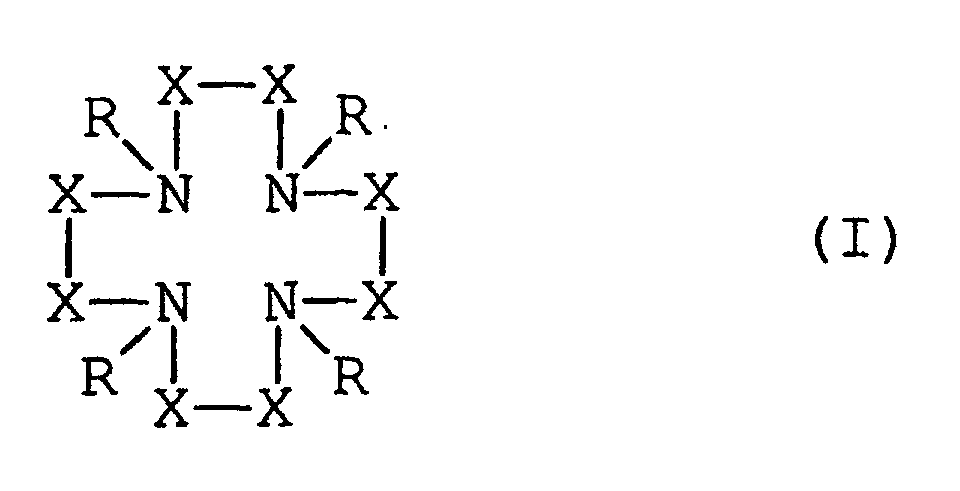
- a process for the preparation of a tetraazacycloalkane of formula (I) (where each R independently is hydrogen or an optionally substituted C 1-6 alkyl group in which any substituent is selected from hydroxy, C 1-6 alkoxy, aryl, carboxy, and phosphonic acid groups and esters and amides thereof, and each X independently is a group CHR where R is as defined above), which process comprises
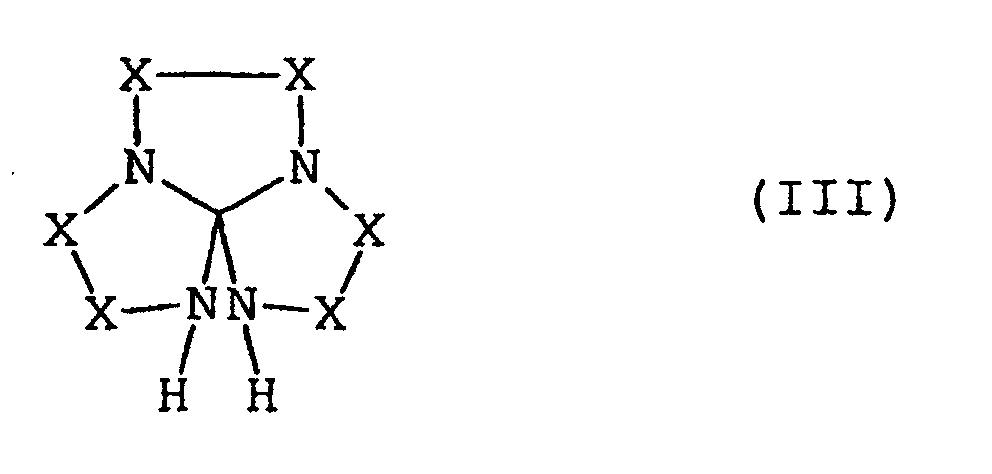
- tricyclic intermediate of formula (III) or (IV) is a particularly important aspect of the process of the invention as it positions the terminal nitrogens for reaction with a bridging moiety to produce the tetraazamacrocycle.
- 5,5,5 intermediates of formula (III) may particularly effectively be prepared by reaction of the tetraazaalkane starting material of formula (II) with an alkylorthocarbonate, for example C(OC 2 H 5 ) 4 , e.g. as in the following reaction:
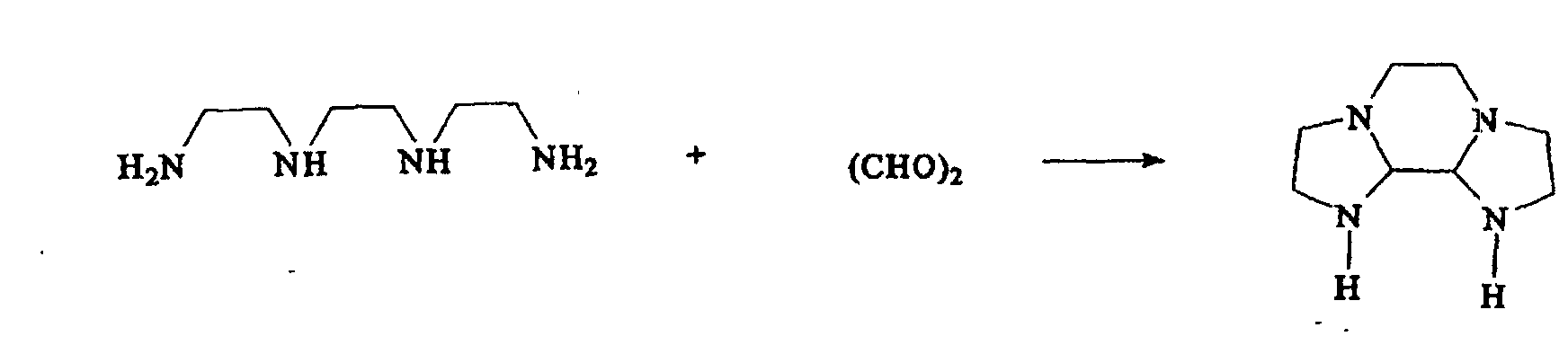
- 5,6,5 intermediates of formula (IV) are particularly preferably prepared by reaction of a tetraazaalkane of formula (II) with glyoxal, e.g. as in the reaction:
- the displaceable leaving groups Lv may, for example, be halogen atoms (e.g. chlorine or bromine) or sulphonyloxy groups such as OMs or OTs, e.g. as in the reaction: or
- Decoupling of a C 1 bridging moiety in accordance with step (iii) may, for example, be effected using the following scheme:
- Sequences involving 5,5,5 intermediates of formula (III) are particularly advantageous in offering the possibility for monosubstitution of the ring-nitrogens during the macrocycle synthesis at the 5,5,8 intermediate stage.
- reaction of a 5,5,8 intermediate of formula (VI) with water gives a mono-formyl product whereas reaction with an alkylating agent yields an N-monoalkylated 5,5,8 compound which can be converted by acid treatment, for example with sulphuric acid, to N-monoalkylated cyclen, e.g. as follows: (where R 1 is an optionally substituted alkyl group).
- the alkyl group introduced in this way may be a group desired in the end product or it may for example be an amine protecting group which can subsequently be removed for example after substitution of the other ring nitrogens. If removed, the unprotected nitrogen can then if desired be alkylated to introduce a different alkyl group.
- This procedure is particularly attractive for the preparation of DO3A and DO3A derivatives such as HPDO3A and the DO3A dimers recently proposed by Nycomed Salutar and Schering, i.e. cyclen derivatives in which three ring nitrogens carry one form of substituent and the fourth is either unsubstituted or is substituted with a different form of substituent.
- Decoupling of a C 2 bridging moiety in accordance with step (iii) may, for example, be effected by reaction with hydroxylamine or an acid such as HBr, e.g. as in the reaction:
- the products will generally be subjected to N-alkylation in order to produce the desired chelating agents.
- the N-alkylation step to introduce desired alkyl or substituted alkyl groups onto the macrocyclic skeleton can be performed using conventional alkylation techniques, for example involving reaction with an alkylhalide R 2 -Hal (where Hal is a halogen atom such as chlorine or bromine and R 2 is an alkyl group optionally substituted, for example by hydroxy or alkoxy groups or by chelant moieties, such as carboxyamide groups or carboxyl or phosphonic acid groups (optionally protected by ester groups)).
- R 2 -Hal where Hal is a halogen atom such as chlorine or bromine and R 2 is an alkyl group optionally substituted, for example by hydroxy or alkoxy groups or by chelant moieties, such as carboxyamide groups or carboxyl or phosphonic acid groups (optionally protected by ester groups)
- the alkyl moiety in R 2 will conveniently contain 1 to 6 carbon atoms and any chelant moiety will preferably be on the alpha or beta carbon.
- Metallation of the macrocyclic chelating agent may be effected by conventional methods, for example as described in the patent literature relating to MR contrast agents (see for example EP-A-71564, EP-A-130934, EP-A-165728, EP-A-258616, WO-A-86/06605, etc.).
- metal ions to be complexed will depend upon the intended end use for the chelate complex. Especially preferred are ions of metals of atomic numbers 22 to 32, 42 to 44, 49 and 57 to 83, in particular Gd.
- the chelated metal species is conveniently a paramagnetic ion of a transition metal or a lanthanide, preferably having an atomic number of 21 to 29, 42, 44 or 57 to 71.
- Complexes of Eu, Gd, Dy, Ho, Cr, Mn and Fe are especially preferred and Gd 3+ , Mn 2+ and Dy 3+ are particularly preferred ions.
- the paramagnetic metal species is conveniently non-radioactive as radioactivity is a characteristic which is neither required nor desirable.
- the metal is preferably a heavy metal such as a non-radioactive metal with an atomic number greater than 37, preferably greater than 50, for example Dy 3+ .
- the chelated metal species must of course be radioactive and any conventional complexable radioactive isotope, such as 99m Tc or 111 In for example may be used.
- the chelated metal may for example be 153 Sm, 67 Cu or 90 Y.
- alkyl groups preferably contain 1 to 6 carbon atoms, especially 1,2,3 or 4 carbons and optionally substituted alkyl groups may carry substituents selected from aryl (in particular phenyl and substituted phenyl), hydroxy, oxo, amino, and alkoxy groups or chelant or substituted chelant moieties such as are described for R 2 .
- 1,4,7,10-tetraazacylododecane 3 (cyclen): 2 was added to ca. 20 parts by volume of absolute ethanol and 10 mole equivalents of hydroxyamine. The suspension was heated to reflux for 16 hours. Slow cooling gave 3 . as an off-white precipitate which was collected by filtration and washed with cold ethanol. The yield of 3 was 80% based on 2 .
- Triethylenetetraamine is reacted with ethyl orthocarbonate (C(OEt) 4 ) in absolute ethanol.
- C(OEt) 4 ethyl orthocarbonate
- the 5,5,5 tricyclic intermediate 4 formed is divided into batches and used in subsequent Examples.
- 5,5,5-tricyclic intermediate 4 is reacted with 1,2-dibromoethane in DMF under a nitrogen atmosphere to yield the 5,5,5,5 fused tetracyclic intermediate 5 which is treated with aqueous acid to yield cyclen 3.
- 5,5,5-tricylic intermediate 4 is treated with HCl and subsequently with ClCH 2 COCl.
- the 5,5,8 tricyclic intermediate 6 which is formed is then reduced with lithium aluminium hydride to yield cyclen 3 .
- 5,5,5-tricyclic intermediate 4 is reacted with 1,2-dibromoethane and subsequently reduced with NaBHCN to yield a 5,5,8 tricyclic intermediate 7 .
- the 5,5,8 tricyclic intermediate 7 is N-benzylated with benzyl chloride and then treated with sulphuric acid to yield mono-N-benzylcyclen 8 .
- the N-benzyl group may function as a temporary protecting group to be removed after substitution of the remaining ring nitrogens to yield DO3A or DO3A analogues.
- other N-alkylations may be performed analogously, e.g. to introduce hydroxyalkyl groups.
- N-benzylcyclen 8 is reacted with bromoacetic acid in sodium hydroxide solution pH 10 to yield N-Benzyl-D03A 9 . If desired t-butyl bromoacetate or benzyl bromoacetate may be used in place of bromoacetic acid.
Landscapes
- Chemical & Material Sciences (AREA)
- Organic Chemistry (AREA)
- Nitrogen Condensed Heterocyclic Rings (AREA)
- Organic Low-Molecular-Weight Compounds And Preparation Thereof (AREA)
- Nitrogen And Oxygen Or Sulfur-Condensed Heterocyclic Ring Systems (AREA)
- Medicines Containing Antibodies Or Antigens For Use As Internal Diagnostic Agents (AREA)
- Steroid Compounds (AREA)
Description
- This invention relates to a novel process for the preparation of tetraazacycloalkanes, in particular cyclen and ring-substituted cyclen derivatives.
- In the field of magnetic resonance imaging, various lanthanide chelates of cyclen-derivative macrocyclic chelating agents have been proposed. Two, GdHP-DO3A (ProHance from Squibb) and GdDOTA (Dotarem from Guerbet), are available commercially. These macrocyclic chelating agents form particularly stable chelate complexes with the contrast-generating paramagnetic metal ions and thus are suitable carriers for the metal ions to ensure appropriate biodistribution and elimination.
- Cyclen itself (1,4,7,10-tetraazacyclododecane) is a key and somewhat expensive intermediate in the preparation of these macrocyclic chelants.
- Production of cyclen's tetraaza macrocycle can be by a variety of synthetic routes, for example via diamine:diamine or triamine:monoamine cyclic condensations such as are described by Tweedle in EP-A-232751 and EP-A-292689. Such condensations generally produce N-substituted cyclen derivatives in which the ring nitrogens are protected by tosyl or mesyl groups which then have to be removed before the cyclen can be alkylated to yield the macrocyclic chelating agent. Detosylation involves high temperature treatment with sulphuric acid, a commercially unattractive route. Detosylation moreover requires continuous extraction with chloroform over a period of days making it an environmentally unattractive procedure. Mesylation and demesylation are similarly difficult and unattractive on a commercial scale.
- Other processes for the preparation of cyclic polyamines such as tetraaza macrocycles involving cyclising condensation reactions are described in EP-A-427595 and US-A-3485818.
- Condensation of glyoxal with macrocyclic tetraamines is described by Weisman in Tetrahedron Letters vol. 21, no. 4, 1980, pp. 335-338.
- Preparation of monofunctional cyclic tetraamines by substitution of the unprotected nitrogen atom of tri-N-protected tetraazacycloalkanes is described in EP-A-389359.
- The preparation and properties of various aza polycycles are described in EP-A-329195, Tetrahedron vol. 30, no. 13, 1974, pp. 1769-1774, and US-A-3932451.
- We have now found that macrocyclic tetraazacycloalkanes, such as cyclen, can advantageously be prepared from acyclic tetraazaalkanes by a cyclization process which involves first coupling the four nitrogens of the starting material to a bridging agent to produce a tricyclic intermediate and then converting this intermediate to the tetraaza-macrocycle.
- In effect, the bridging moiety in the tricyclic intermediate, which can be a monoatomic or polyatomic entity, serves as a template to present the terminal nitrogens of the initially acyclic tetramine in a suitable configuration for the ring closing cyclization.
- According to the present invention there is provided a process for the preparation of a tetraazacycloalkane of formula (I)(where each R independently is hydrogen or an optionally substituted C1-6 alkyl group in which any substituent is selected from hydroxy, C1-6 alkoxy, aryl, carboxy, and phosphonic acid groups and esters and amides thereof, and each X independently is a group CHR where R is as defined above), which process comprises
- (i) reacting a tetraazaalkane of formula (II)
or
 (where each X is as defined above),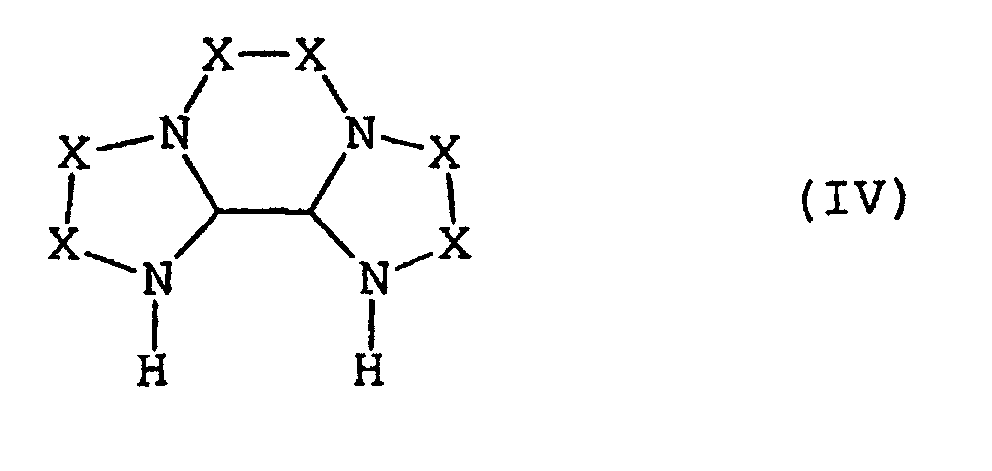
- (ii) reacting said intermediate of formula (III) or
(IV) with a difunctional bridging agent to introduce a C2
alkylene bridge between the secondary amine nitrogens in
the outer rings of said intermediate, said difunctional
bridging agent being a haloacetyl halide, an allyl
halide epoxide or a compound of formula (V)
- (iii) decoupling the C1 or C2 bridging moiety introduced in step (i) and if necessary reducing any ring carbonyl groups and/or effecting N-alkylation to introduce one or more N-attached R groups other than hydrogen.
-
- The formation of the tricyclic intermediate of formula (III) or (IV) is a particularly important aspect of the process of the invention as it positions the terminal nitrogens for reaction with a bridging moiety to produce the tetraazamacrocycle.
- 5,5,5 intermediates of formula (III) (the numbering refers to the number of ring atoms in each of the fused rings) may particularly effectively be prepared by reaction of the tetraazaalkane starting material of formula (II) with an alkylorthocarbonate, for example C(OC2H5)4, e.g. as in the following reaction:

- 5,6,5 intermediates of formula (IV) are particularly preferably prepared by reaction of a tetraazaalkane of formula (II) with glyoxal, e.g. as in the reaction:
- In step (ii) of the process, where a compound of formula (V) is used as the difunctional bridging agent,the displaceable leaving groups Lv may, for example, be halogen atoms (e.g. chlorine or bromine) or sulphonyloxy groups such as OMs or OTs, e.g. as in the reaction:or
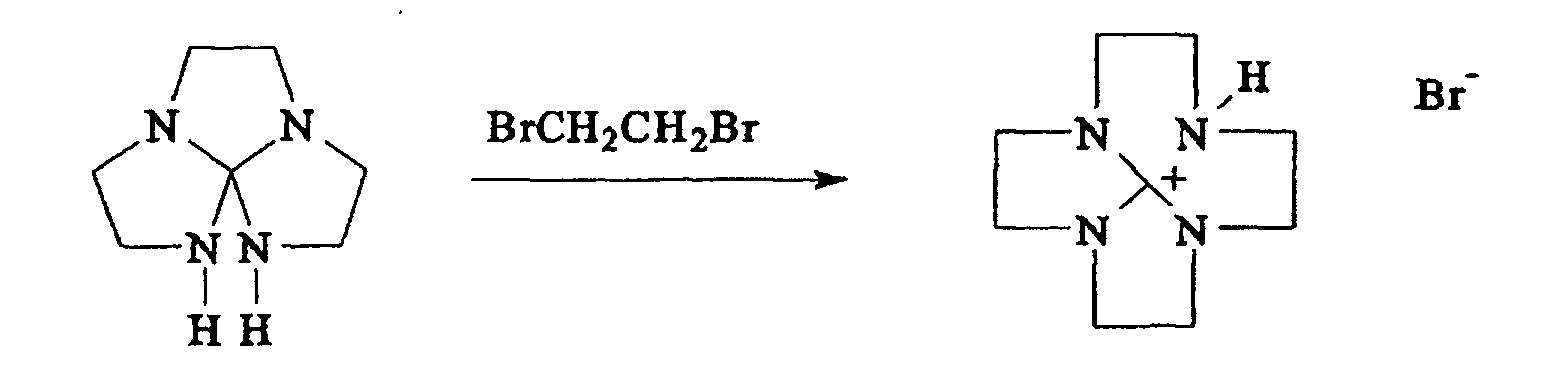

- Decoupling of a C1 bridging moiety in accordance with step (iii) may, for example, be effected using the following scheme:

- Sequences involving 5,5,5 intermediates of formula (III) are particularly advantageous in offering the possibility for monosubstitution of the ring-nitrogens during the macrocycle synthesis at the 5,5,8 intermediate stage. Thus reaction of a 5,5,8 intermediate of formula (VI)with water gives a mono-formyl product whereas reaction with an alkylating agent yields an N-monoalkylated 5,5,8 compound which can be converted by acid treatment, for example with sulphuric acid, to N-monoalkylated cyclen, e.g. as follows:
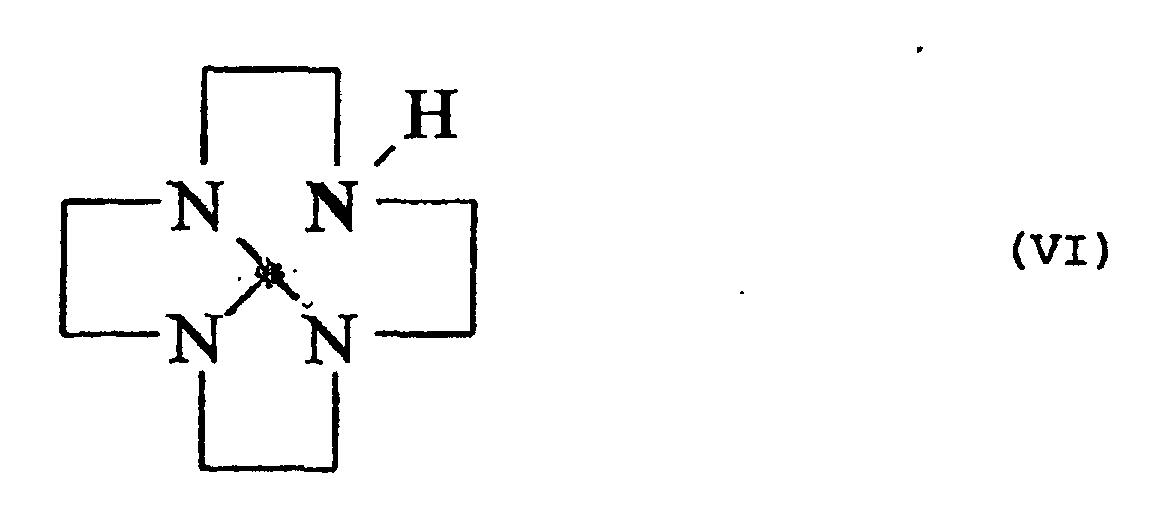 (where R1 is an optionally substituted alkyl group). The alkyl group introduced in this way may be a group desired in the end product or it may for example be an amine protecting group which can subsequently be removed for example after substitution of the other ring nitrogens. If removed, the unprotected nitrogen can then if desired be alkylated to introduce a different alkyl group. This procedure is particularly attractive for the preparation of DO3A and DO3A derivatives such as HPDO3A and the DO3A dimers recently proposed by Nycomed Salutar and Schering, i.e. cyclen derivatives in which three ring nitrogens carry one form of substituent and the fourth is either unsubstituted or is substituted with a different form of substituent.
- Decoupling of a C2 bridging moiety in accordance with step (iii) may, for example, be effected by reaction with hydroxylamine or an acid such as HBr, e.g. as in the reaction:

- Following production of the macrocyclic tetraazacycloalkanes according to the process of the invention, and if necessary the reduction of any ring carbonyl groups, the products will generally be subjected to N-alkylation in order to produce the desired chelating agents. The N-alkylation step to introduce desired alkyl or substituted alkyl groups onto the macrocyclic skeleton can be performed using conventional alkylation techniques, for example involving reaction with an alkylhalide R2-Hal (where Hal is a halogen atom such as chlorine or bromine and R2 is an alkyl group optionally substituted, for example by hydroxy or alkoxy groups or by chelant moieties, such as carboxyamide groups or carboxyl or phosphonic acid groups (optionally protected by ester groups)). The alkyl moiety in R2 will conveniently contain 1 to 6 carbon atoms and any chelant moiety will preferably be on the alpha or beta carbon. If a protected chelant group is introduced in this fashion, it may subsequently be deprotected, for example by ester cleavage to make the group available for metallation.
- Metallation of the macrocyclic chelating agent may be effected by conventional methods, for example as described in the patent literature relating to MR contrast agents (see for example EP-A-71564, EP-A-130934, EP-A-165728, EP-A-258616, WO-A-86/06605, etc.).
- The choice of metal ions to be complexed will depend upon the intended end use for the chelate complex. Especially preferred are ions of metals of atomic numbers 22 to 32, 42 to 44, 49 and 57 to 83, in particular Gd.
- Where the chelate is to be used as an MR contrast agent, the chelated metal species is conveniently a paramagnetic ion of a transition metal or a lanthanide, preferably having an atomic number of 21 to 29, 42, 44 or 57 to 71. Complexes of Eu, Gd, Dy, Ho, Cr, Mn and Fe are especially preferred and Gd3+, Mn2+ and Dy3+ are particularly preferred ions. For use as contrast agents in MRI, the paramagnetic metal species is conveniently non-radioactive as radioactivity is a characteristic which is neither required nor desirable.
- Where the chelate complex is to be used as an X-ray or ultrasound contrast agent, the metal is preferably a heavy metal such as a non-radioactive metal with an atomic number greater than 37, preferably greater than 50, for example Dy3+.
- Where the metal complex is to be used in scintigraphy or radiotherapy, the chelated metal species must of course be radioactive and any conventional complexable radioactive isotope, such as 99mTc or 111In for example may be used. For radiotherapy the chelated metal may for example be 153Sm, 67Cu or 90Y.
- In the definitions of the reagents given above, unless otherwise stated, alkyl groups preferably contain 1 to 6 carbon atoms, especially 1,2,3 or 4 carbons and optionally substituted alkyl groups may carry substituents selected from aryl (in particular phenyl and substituted phenyl), hydroxy, oxo, amino, and alkoxy groups or chelant or substituted chelant moieties such as are described for R2.
- All particulars referred to herein are hereby incorporated herein by reference.
- The invention is illustrated further by reference to the following non-limiting Examples:
- Condensation of glyoxal with triethylenetetramine: To a flask was added 10g (61mmol) of triethylenetetramine mono-hydrate and 200mL of absolute ethanol. To this solution was added 8.9g (61mmol) of 40% aqueous glyoxal. After stirring overnight at ambient temperature the solvent was evaporated to afford the 5,6,5-tricyclic product 1 [formula (IV), all X's = CH2] as an amber oil (75-80% purity). This material was used directly in the subsequent step.
- Condensation of dibromoethane with 1: Crude 1 was dissolved in ten parts (by volume) of dimethylformamide. To this solution was added 1.5 mole equivalent of dibromoethane. The solution was stirred for 20 hours at ambient temperature. After removing the solvent and excess dibromoethane under reduced pressure the product 2 was isolated by flash chromatography (silca gel /-CH3CN:NH3:EtOH). The yield of 2 is ca. 70% based on 1.
- 1,4,7,10-tetraazacylododecane 3 (cyclen): 2 was added to ca. 20 parts by volume of absolute ethanol and 10 mole equivalents of hydroxyamine. The suspension was heated to reflux for 16 hours. Slow cooling gave 3. as an off-white precipitate which was collected by filtration and washed with cold ethanol. The yield of 3 was 80% based on 2.
-
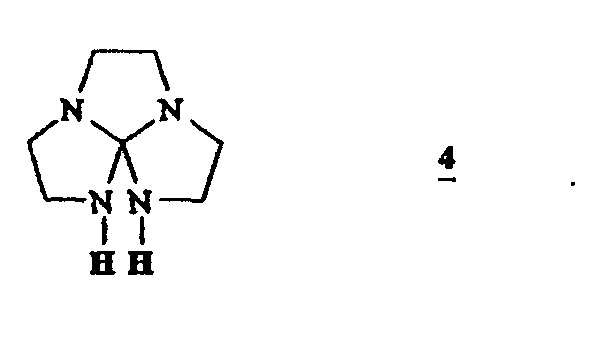
- Triethylenetetraamine is reacted with ethyl orthocarbonate (C(OEt)4) in absolute ethanol. The 5,5,5 tricyclic intermediate 4 formed is divided into batches and used in subsequent Examples.
-

- 5,5,5-tricyclic intermediate 4 is reacted with 1,2-dibromoethane in DMF under a nitrogen atmosphere to yield the 5,5,5,5 fused tetracyclic intermediate 5 which is treated with aqueous acid to yield cyclen 3.
-

- 5,5,5-tricylic intermediate 4 is treated with HCl and subsequently with ClCH2COCl. The 5,5,8 tricyclic intermediate 6 which is formed is then reduced with lithium aluminium hydride to yield cyclen 3.
-

- 5,5,5-tricyclic intermediate 4 is reacted with 1,2-dibromoethane and subsequently reduced with NaBHCN to yield a 5,5,8 tricyclic intermediate 7.
- Under a nitrogen atmosphere the 5,5,8 tricyclic intermediate 7 is N-benzylated with benzyl chloride and then treated with sulphuric acid to yield mono-N-benzylcyclen 8. The N-benzyl group may function as a temporary protecting group to be removed after substitution of the remaining ring nitrogens to yield DO3A or DO3A analogues. However in place of N-benzylation other N-alkylations may be performed analogously, e.g. to introduce hydroxyalkyl groups.
- N-benzylcyclen 8 is reacted with bromoacetic acid in sodium hydroxide solution pH 10 to yield N-Benzyl-D03A 9 . If desired t-butyl bromoacetate or benzyl bromoacetate may be used in place of bromoacetic acid.
Claims (8)
- A process for the preparation of a tetraazacycloalkane of formula (I)(where each R independently is hydrogen or an optionally substituted C1-6 alkyl group in which any substituent is selected from hydroxy, C1-6 alkoxy, aryl, carboxy, and phosphonic acid groups and esters and amides thereof, and each X independently is a group CHR where R is as defined above), which process comprises
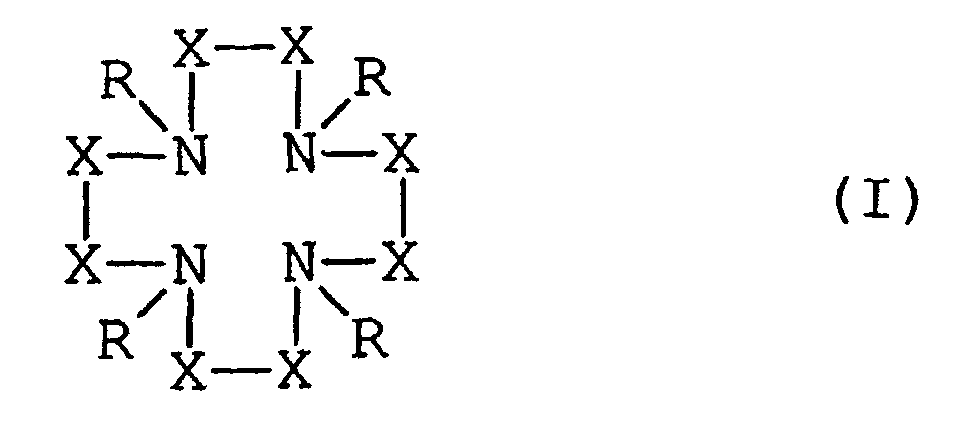 (i) reacting a tetraazaalkane of formula (II)or
 (where each X is as defined above),
 (ii) reacting said intermediate of formula (III) or (IV) with a difunctional bridging agent to introduce a C2 alkylene bridge between the secondary amine nitrogens in the outer rings of said intermediate, said difunctional bridging agent being a haloacetyl halide, an allyl halide epoxide or a compound of formula (V)(iii) decoupling the C1 or C2 bridging moiety introduced in step (i) and if necessary reducing any ring carbonyl groups and/or effecting N-alkylation to introduce one or more N-attached R groups other than hydrogen.
 - A process as claimed in claim 1 wherein said tetraazaalkane of formula (II) is reacted with glyoxal in order to yield an intermediate of formula (IV).
- A process as claimed in claim 1 or claim 2 wherein decoupling of a C2 bridging moiety in step (iii) is effected by reaction with hydroxylamine or acid.
- A process as claimed in claim 1 wherein said tetraazaalkane of formula (II) is reacted with an alkylorthocarbonate in order to yield an intermediate of formula (III).
- A process as claimed in claim 1 or claim 4 wherein an intermediate of formula (III) is converted to a 5,5,8 intermediate of formula (VI)(where each X is as defined in claim 1) which is N-monoalkylated by reaction with an alkylating agent before decoupling of the C1 bridging moiety residue.

- A process as claimed in claim 5 wherein the N-monoalkylated tetraazocycloalkane produced following said decoupling is N-alkylated by reaction with a further alkylating agent to produce a compound of formula (VII)(where each X is as defined in claim 1, and R1 and R2 are each optionally substituted C1-6 alkyl groups as defined in claim 1, R2 being different from R1).

- A process as claimed in claim 6 wherein the R1 group is subsequently removed and the resulting product is N-alkylated by reaction with a third alkylating agent to introduce an N-attached R3 group (where R3 is an optionally substituted C1-6 alkyl group as defined in claim 1, R3 being different from R2) .
- A process as claimed in any of the preceding claims wherein N-alkylation is performed by reaction with a corresponding alkyl halide.
Applications Claiming Priority (3)
| Application Number | Priority Date | Filing Date | Title |
|---|---|---|---|
| GB9504922 | 1995-03-10 | ||
| GBGB9504922.7A GB9504922D0 (en) | 1995-03-10 | 1995-03-10 | Process |
| PCT/GB1996/000462 WO1996028432A1 (en) | 1995-03-10 | 1996-03-01 | Process for tetraazacycloalkane preparation |
Publications (2)
| Publication Number | Publication Date |
|---|---|
| EP0815090A1 EP0815090A1 (en) | 1998-01-07 |
| EP0815090B1 true EP0815090B1 (en) | 2003-05-28 |
Family
ID=10771034
Family Applications (1)
| Application Number | Title | Priority Date | Filing Date |
|---|---|---|---|
| EP96904202A Expired - Lifetime EP0815090B1 (en) | 1995-03-10 | 1996-03-01 | Process for tetraazacycloalkane preparation |
Country Status (11)
| Country | Link |
|---|---|
| US (1) | US5589595A (en) |
| EP (1) | EP0815090B1 (en) |
| JP (1) | JP3128137B2 (en) |
| KR (1) | KR19980702927A (en) |
| CN (1) | CN1183776A (en) |
| AU (1) | AU4838996A (en) |
| CA (1) | CA2214991A1 (en) |
| DE (1) | DE69628421T2 (en) |
| GB (1) | GB9504922D0 (en) |
| NO (1) | NO974169L (en) |
| WO (1) | WO1996028432A1 (en) |
Families Citing this family (20)
| Publication number | Priority date | Publication date | Assignee | Title |
|---|---|---|---|---|
| IT1284046B1 (en) * | 1996-06-21 | 1998-05-08 | Bracco Spa | PROCESS FOR THE PREPARATION OF TETRAAZAMACROCYCLES |
| IT1290457B1 (en) * | 1997-04-04 | 1998-12-03 | Bracco Spa | PROCESS FOR THE PREPARATION OF TETRAAZAMACROCYCLES |
| IT1291673B1 (en) * | 1997-04-28 | 1999-01-19 | Bracco Spa | PROCESS FOR THE PREPARATION OF 1,4,7,10 - TETRAAZACICLODODECANO |
| IT1293777B1 (en) * | 1997-07-25 | 1999-03-10 | Bracco Spa | PROCESS FOR THE PREPARATION OF TETRAAZAMACROCYCLES |
| IT1293778B1 (en) * | 1997-07-25 | 1999-03-10 | Bracco Spa | 1,4,7,10-TETRAAZABICICLO (8.2.2.)TETRADECAN-2 ONE, ITS PREPARATION AND USE FOR THE PREPARATION OF TETRAAZAMACROCYCLES |
| DE19809543A1 (en) * | 1998-03-05 | 1999-09-09 | Clariant Gmbh | Process for the preparation of macropolycyclic polymanines |
| DE19856481C1 (en) * | 1998-12-02 | 2000-07-06 | Schering Ag | Process for the production of cycles |
| US6156890A (en) * | 1999-01-15 | 2000-12-05 | Schering Aktiengesellschaft | Process for the production of cyclene |
| IT1309601B1 (en) * | 1999-03-09 | 2002-01-24 | Bracco Spa | PROCESS FOR THE PREPARATION OF 1,4,7,10 TETRAAZACICLODODECANO. |
| IT1318465B1 (en) | 2000-04-14 | 2003-08-25 | Bracco Int Bv | PROCESS FOR THE PREPARATION OF DECAIDRO-2A, 4A, 6A, 8A-TETRAAZACICLOPENT (FG) ACENAFTILENE AND FUNCTIONALIZED DERIVATIVES. |
| FR2810035B1 (en) * | 2000-06-13 | 2004-04-16 | Air Liquide | PROCESS FOR THE PREPARATION OF TETRAAZA MACROCYCLES AND NEW COMPOUNDS |
| FR2830253B1 (en) * | 2001-09-28 | 2005-02-04 | Air Liquide | NOVEL PROCESS FOR THE PREPARATION OF C-FUNCTIONALIZED NITROGEN MACROCYCLES AND NOVEL INTERMEDIATES OBTAINED |
| FR2856063B1 (en) * | 2003-06-13 | 2005-10-07 | Air Liquide | PROCESS FOR THE PREPARATION OF CIS-8B-METHYLDECAHYDRO-2A, 4A, 6A, 8A-TETRAAZACYCLOPENTA [FG] ACENAPHTHYLENE, OR CIS-DECAHYDRO-2A, 4A, 6A, 8A-TETRAAZACYCLOPENTA [FG] ACENAPHTHYLENE, CYCLENE, AND CYCLENES FUNCTIONALISED |
| US9512150B2 (en) * | 2014-07-31 | 2016-12-06 | Empire Technology Development Llc | Thermal conductive compositions and methods for their preparation and use |
| WO2018204872A2 (en) | 2017-05-05 | 2018-11-08 | Fusion Pharmaceuticals Inc. | Igf-1r monoclonal antibodies and uses thereof |
| AU2018261888B2 (en) | 2017-05-05 | 2022-06-30 | Centre For Probe Development And Commercialization | Pharmacokinetic enhancements of bifunctional chelates and uses thereof |
| US10093741B1 (en) | 2017-05-05 | 2018-10-09 | Fusion Pharmaceuticals Inc. | IGF-1R monoclonal antibodies and uses thereof |
| EP4067348A1 (en) * | 2021-03-30 | 2022-10-05 | Bracco Imaging SPA | Process for the preparation of cyclen |
| CN113956262B (en) * | 2021-10-18 | 2023-03-07 | 苏州百灵威超精细材料有限公司 | Synthesis method of tetraazacycloalkane compound and intermediate thereof |
| CN115785013A (en) * | 2022-11-17 | 2023-03-14 | 安庆朗坤药业有限公司 | Preparation method of cycleanine |
Citations (2)
| Publication number | Priority date | Publication date | Assignee | Title |
|---|---|---|---|---|
| US3932451A (en) * | 1973-11-27 | 1976-01-13 | E. I. Du Pont De Nemours & Company | 1,4,7,10-Tetraazatetracyclo[5.5.1.04,13.010,13 ]tridecane and its conjugate acids |
| EP0329195A2 (en) * | 1982-12-27 | 1989-08-23 | Exxon Research And Engineering Company | Polycyclic polyamine multifunctional lubricating oil additives |
Family Cites Families (9)
| Publication number | Priority date | Publication date | Assignee | Title |
|---|---|---|---|---|
| US3485818A (en) * | 1968-04-05 | 1969-12-23 | Jerome B Thompson | 1,4,7,10-tetraazacyclododecene and 1,4,7,10,13 - pentaazacyclopentadecene and process for their manufacture |
| US4085106A (en) * | 1976-01-07 | 1978-04-18 | E. I. Du Pont De Nemours And Company | Bicyclic and tricyclic trisaminomethanes |
| DE3772785D1 (en) * | 1986-01-23 | 1991-10-17 | Squibb & Sons Inc | 1-SUBSTITUTED-4,7,10-TRISCARBOXYMETHYL-1,4,7,10-TETRAAZACYCLODODECAN AND ANALOG. |
| US4885363A (en) * | 1987-04-24 | 1989-12-05 | E. R. Squibb & Sons, Inc. | 1-substituted-1,4,7-triscarboxymethyl-1,4,7,10-tetraazacyclododecane and analogs |
| FR2644453A1 (en) * | 1989-03-20 | 1990-09-21 | Centre Nat Rech Scient | PROCESS FOR THE PREPARATION OF MONOFUNCTIONALIZED CYCLIC TETRAMINES |
| FR2654102B1 (en) * | 1989-11-09 | 1992-01-10 | Air Liquide | PROCESS FOR THE SYNTHESIS OF CYCLIC POLYAZOT DERIVATIVES. |
| IT1243801B (en) * | 1990-08-29 | 1994-06-28 | Bracco Ind Chimica Spa | INTERMEDIATES FOR CHELATING AGENTS WITH PRE-FIXED SYMMETRY, AND PROCEDURES FOR THEIR PREPARATION |
| DE4218744C2 (en) * | 1992-06-04 | 1997-11-06 | Schering Ag | Process for the preparation of N-β-hydroxyalkyl-tri-N-carboxylalkyl-1,4,7,10-tetraazacyclododecane and N-β-hydroxyalkyl-tri-N-carboxyalkyl-1,4,8,11-tetraazacyclotetradecane derivatives and their metal complexes |
| US5284944A (en) * | 1992-06-30 | 1994-02-08 | Lever Brothers Company, Division Of Conopco, Inc. | Improved synthesis of 1,4,7-triazacyclononane |
-
1995
- 1995-03-10 GB GBGB9504922.7A patent/GB9504922D0/en active Pending
- 1995-06-07 US US08/483,189 patent/US5589595A/en not_active Expired - Lifetime
-
1996
- 1996-03-01 DE DE69628421T patent/DE69628421T2/en not_active Expired - Lifetime
- 1996-03-01 AU AU48389/96A patent/AU4838996A/en not_active Abandoned
- 1996-03-01 JP JP08527350A patent/JP3128137B2/en not_active Expired - Fee Related
- 1996-03-01 KR KR1019970706335A patent/KR19980702927A/en not_active Ceased
- 1996-03-01 WO PCT/GB1996/000462 patent/WO1996028432A1/en not_active Ceased
- 1996-03-01 EP EP96904202A patent/EP0815090B1/en not_active Expired - Lifetime
- 1996-03-01 CN CN96193746A patent/CN1183776A/en active Pending
- 1996-03-01 CA CA002214991A patent/CA2214991A1/en not_active Abandoned
-
1997
- 1997-09-09 NO NO974169A patent/NO974169L/en not_active Application Discontinuation
Patent Citations (2)
| Publication number | Priority date | Publication date | Assignee | Title |
|---|---|---|---|---|
| US3932451A (en) * | 1973-11-27 | 1976-01-13 | E. I. Du Pont De Nemours & Company | 1,4,7,10-Tetraazatetracyclo[5.5.1.04,13.010,13 ]tridecane and its conjugate acids |
| EP0329195A2 (en) * | 1982-12-27 | 1989-08-23 | Exxon Research And Engineering Company | Polycyclic polyamine multifunctional lubricating oil additives |
Non-Patent Citations (1)
| Title |
|---|
| RICHMAN J.E., SIMMONS H.E., TETRAHEDRON, vol. 30, 1974, pages 1769 - 1774 * |
Also Published As
| Publication number | Publication date |
|---|---|
| CN1183776A (en) | 1998-06-03 |
| CA2214991A1 (en) | 1996-09-19 |
| NO974169L (en) | 1997-11-07 |
| JP3128137B2 (en) | 2001-01-29 |
| DE69628421T2 (en) | 2004-05-06 |
| DE69628421D1 (en) | 2003-07-03 |
| WO1996028432A1 (en) | 1996-09-19 |
| GB9504922D0 (en) | 1995-04-26 |
| NO974169D0 (en) | 1997-09-09 |
| MX9706901A (en) | 1997-11-29 |
| JPH11509516A (en) | 1999-08-24 |
| KR19980702927A (en) | 1998-09-05 |
| EP0815090A1 (en) | 1998-01-07 |
| US5589595A (en) | 1996-12-31 |
| AU4838996A (en) | 1996-10-02 |
Similar Documents
| Publication | Publication Date | Title |
|---|---|---|
| US5589595A (en) | Process for tetraazacycloalkane preparation | |
| US5049667A (en) | Nitrogen-containing cyclic ligands | |
| Carvalho et al. | Synthesis and metal complex selectivity of macrocyclic DTPA and EDTA bis (amide) ligands | |
| Denat et al. | Strategies for the regioselective N-functionalization of tetraazacycloalkanes. From cyclam and cyclen towards more sophisticated molecules | |
| IE62582B1 (en) | Nitrogen-containing cyclic ligands, metallic complexes formed by these ligands, diagnostic compositions containing these complexes and process for the preparation of the ligands | |
| US6048979A (en) | Preparation of N-arylmethyl aziridine derivatives, 1,4,7,10-tetraazacyclododecane derivatives obtained therefrom and N-arylmethyl-ethanol-amine sulphonate esters as intermediates | |
| IE67643B1 (en) | 1,4,7,10-tetraazacyclodedecane butyltriols processes for their production and pharmaceutical agents containing them | |
| JP2633944B2 (en) | Method for producing complex compound | |
| US5976498A (en) | Methods of diagnostic image analysis using metal complexes of nitrogen-containing macrocyclic ligands | |
| HUT61306A (en) | Process for producing new chelating agents and pharmaceutical compositions comprising same as active ingredient | |
| US6489472B2 (en) | Process for preparation of N-1 protected N ring nitrogen containing cyclic polyamines and products thereof | |
| JP2002511884A (en) | 1,4,7,10-Tetraazabicyclo [8.2.2] tetradecan-2-one, a process for its preparation and its use for preparing a tetraaza macrocycle | |
| US5705637A (en) | Polyazacycloalkane compounds | |
| EP0730616B1 (en) | Process for preparing polyazamacrocycles | |
| JP4699693B2 (en) | Novel process for the preparation of C-functionalized nitrogen-containing macrocyclic compounds and the resulting novel intermediates | |
| MXPA97006901A (en) | Process for the preparation of tetraazacicloalca | |
| JP3059488B2 (en) | Polyazacycloalkane compounds | |
| MXPA97006900A (en) | Compounds of poliazacicloalc | |
| MXPA97006899A (en) | Preparation of derivatives of n-arilmetil aziridine, derivatives of 1,4,7,10-tetraazaciclododange obtained from these and esters of n-arilmetil-etanol-amina sulfonato as itermediar | |
| KR19980702879A (en) | N-arylmethyl aziridine derivatives, 1,4,7,10- tetraazacyclododecane derivatives obtained therefrom and a method for producing N-arylmethylethanolaminesulfonate esters as intermediates |
Legal Events
| Date | Code | Title | Description |
|---|---|---|---|
| PUAI | Public reference made under article 153(3) epc to a published international application that has entered the european phase |
Free format text: ORIGINAL CODE: 0009012 |
|
| 17P | Request for examination filed |
Effective date: 19970929 |
|
| AK | Designated contracting states |
Kind code of ref document: A1 Designated state(s): DE ES FR GB IE IT |
|
| RAP1 | Party data changed (applicant data changed or rights of an application transferred) |
Owner name: NYCOMED IMAGING AS |
|
| 17Q | First examination report despatched |
Effective date: 19990622 |
|
| GRAG | Despatch of communication of intention to grant |
Free format text: ORIGINAL CODE: EPIDOS AGRA |
|
| GRAG | Despatch of communication of intention to grant |
Free format text: ORIGINAL CODE: EPIDOS AGRA |
|
| GRAH | Despatch of communication of intention to grant a patent |
Free format text: ORIGINAL CODE: EPIDOS IGRA |
|
| GRAH | Despatch of communication of intention to grant a patent |
Free format text: ORIGINAL CODE: EPIDOS IGRA |
|
| GRAA | (expected) grant |
Free format text: ORIGINAL CODE: 0009210 |
|
| RAP1 | Party data changed (applicant data changed or rights of an application transferred) |
Owner name: AMERSHAM HEALTH AS |
|
| AK | Designated contracting states |
Designated state(s): DE ES FR GB IE IT |
|
| REG | Reference to a national code |
Ref country code: GB Ref legal event code: FG4D |
|
| REG | Reference to a national code |
Ref country code: IE Ref legal event code: FG4D |
|
| REF | Corresponds to: |
Ref document number: 69628421 Country of ref document: DE Date of ref document: 20030703 Kind code of ref document: P |
|
| PG25 | Lapsed in a contracting state [announced via postgrant information from national office to epo] |
Ref country code: ES Free format text: LAPSE BECAUSE OF FAILURE TO SUBMIT A TRANSLATION OF THE DESCRIPTION OR TO PAY THE FEE WITHIN THE PRESCRIBED TIME-LIMIT Effective date: 20030908 |
|
| PG25 | Lapsed in a contracting state [announced via postgrant information from national office to epo] |
Ref country code: IE Free format text: LAPSE BECAUSE OF NON-PAYMENT OF DUE FEES Effective date: 20040301 |
|
| ET | Fr: translation filed | ||
| PLBE | No opposition filed within time limit |
Free format text: ORIGINAL CODE: 0009261 |
|
| STAA | Information on the status of an ep patent application or granted ep patent |
Free format text: STATUS: NO OPPOSITION FILED WITHIN TIME LIMIT |
|
| 26N | No opposition filed |
Effective date: 20040302 |
|
| REG | Reference to a national code |
Ref country code: IE Ref legal event code: MM4A |
|
| REG | Reference to a national code |
Ref country code: FR Ref legal event code: CD |
|
| REG | Reference to a national code |
Ref country code: DE Ref legal event code: R082 Ref document number: 69628421 Country of ref document: DE Representative=s name: J D REYNOLDS & CO., GB |
|
| PGFP | Annual fee paid to national office [announced via postgrant information from national office to epo] |
Ref country code: GB Payment date: 20130327 Year of fee payment: 18 Ref country code: DE Payment date: 20130327 Year of fee payment: 18 |
|
| PGFP | Annual fee paid to national office [announced via postgrant information from national office to epo] |
Ref country code: FR Payment date: 20140317 Year of fee payment: 19 Ref country code: IT Payment date: 20140324 Year of fee payment: 19 |
|
| REG | Reference to a national code |
Ref country code: DE Ref legal event code: R119 Ref document number: 69628421 Country of ref document: DE |
|
| GBPC | Gb: european patent ceased through non-payment of renewal fee |
Effective date: 20140301 |
|
| REG | Reference to a national code |
Ref country code: DE Ref legal event code: R119 Ref document number: 69628421 Country of ref document: DE Effective date: 20141001 |
|
| PG25 | Lapsed in a contracting state [announced via postgrant information from national office to epo] |
Ref country code: GB Free format text: LAPSE BECAUSE OF NON-PAYMENT OF DUE FEES Effective date: 20140301 Ref country code: DE Free format text: LAPSE BECAUSE OF NON-PAYMENT OF DUE FEES Effective date: 20141001 |
|
| PG25 | Lapsed in a contracting state [announced via postgrant information from national office to epo] |
Ref country code: IT Free format text: LAPSE BECAUSE OF NON-PAYMENT OF DUE FEES Effective date: 20150301 |
|
| REG | Reference to a national code |
Ref country code: FR Ref legal event code: ST Effective date: 20151130 |
|
| PG25 | Lapsed in a contracting state [announced via postgrant information from national office to epo] |
Ref country code: FR Free format text: LAPSE BECAUSE OF NON-PAYMENT OF DUE FEES Effective date: 20150331 |