EP0812347B1 - Method for manufacturing coal agglomerates for use in direct iron smelting reducing furnace - Google Patents
Method for manufacturing coal agglomerates for use in direct iron smelting reducing furnace Download PDFInfo
- Publication number
- EP0812347B1 EP0812347B1 EP96943358A EP96943358A EP0812347B1 EP 0812347 B1 EP0812347 B1 EP 0812347B1 EP 96943358 A EP96943358 A EP 96943358A EP 96943358 A EP96943358 A EP 96943358A EP 0812347 B1 EP0812347 B1 EP 0812347B1
- Authority
- EP
- European Patent Office
- Prior art keywords
- coal
- fine coal
- reducing furnace
- smelting reducing
- agglomerates
- Prior art date
- Legal status (The legal status is an assumption and is not a legal conclusion. Google has not performed a legal analysis and makes no representation as to the accuracy of the status listed.)
- Expired - Lifetime
Links
Images

Classifications
-
- C—CHEMISTRY; METALLURGY
- C10—PETROLEUM, GAS OR COKE INDUSTRIES; TECHNICAL GASES CONTAINING CARBON MONOXIDE; FUELS; LUBRICANTS; PEAT
- C10B—DESTRUCTIVE DISTILLATION OF CARBONACEOUS MATERIALS FOR PRODUCTION OF GAS, COKE, TAR, OR SIMILAR MATERIALS
- C10B53/00—Destructive distillation, specially adapted for particular solid raw materials or solid raw materials in special form
-
- C—CHEMISTRY; METALLURGY
- C10—PETROLEUM, GAS OR COKE INDUSTRIES; TECHNICAL GASES CONTAINING CARBON MONOXIDE; FUELS; LUBRICANTS; PEAT
- C10L—FUELS NOT OTHERWISE PROVIDED FOR; NATURAL GAS; SYNTHETIC NATURAL GAS OBTAINED BY PROCESSES NOT COVERED BY SUBCLASSES C10G OR C10K; LIQUIFIED PETROLEUM GAS; USE OF ADDITIVES TO FUELS OR FIRES; FIRE-LIGHTERS
- C10L9/00—Treating solid fuels to improve their combustion
- C10L9/08—Treating solid fuels to improve their combustion by heat treatments, e.g. calcining
-
- C—CHEMISTRY; METALLURGY
- C10—PETROLEUM, GAS OR COKE INDUSTRIES; TECHNICAL GASES CONTAINING CARBON MONOXIDE; FUELS; LUBRICANTS; PEAT
- C10L—FUELS NOT OTHERWISE PROVIDED FOR; NATURAL GAS; SYNTHETIC NATURAL GAS OBTAINED BY PROCESSES NOT COVERED BY SUBCLASSES C10G OR C10K; LIQUIFIED PETROLEUM GAS; USE OF ADDITIVES TO FUELS OR FIRES; FIRE-LIGHTERS
- C10L5/00—Solid fuels
- C10L5/02—Solid fuels such as briquettes consisting mainly of carbonaceous materials of mineral or non-mineral origin
- C10L5/06—Methods of shaping, e.g. pelletizing or briquetting
-
- C—CHEMISTRY; METALLURGY
- C21—METALLURGY OF IRON
- C21B—MANUFACTURE OF IRON OR STEEL
- C21B13/00—Making spongy iron or liquid steel, by direct processes
- C21B13/0066—Preliminary conditioning of the solid carbonaceous reductant
Definitions
- the present invention relates to a method for manufacturing coal agglomerates for use in a direct iron smelting reducing furnace. More specifically, the present invention relates to a method for manufacturing coal agglomerates, in which fine coal is agglomerated at a high temperature.
- the coal which is used in a direct smelting reducing furnace as an energy source has to have a uniform particle size (8-35 mm).
- 50% or more of the coal which is supplied for use in the direct smelting reducing furnace is fine coal having a particle size of 8 mm or less. This fine coal is flown into the generator gas line when it is put into the smelting furnace, and therefore, the fine coal becomes useless.
- the supplied ordinary coal is subjected to a particle size classification, and the agglomerates having a size of 8 mm or more are put into the smelting reducing furnace after dewatering them.
- the fine coal having a particle size of 8 mm or less cannot be used.
- the fine coal having a particle size of 8 mm or less is to be used in the smelting reducing process, it has to be first agglomerated.
- a method of agglomerating the fine coal is disclosed in U.S. Patent 3,869,350 which relates to a method for heat-treating a coking coal.
- the fine coal is injected into a tube in which a high temperature gas flows, thereby agglomerating the fine coal.
- the present inventor carried out researches and experiments, and based on the result of the researches and experiments, the present invention is proposed.
- the method for manufacturing coal agglomerates for use in a direct smelting reducing furnace according to the present invention is characterized as defined in Claim 2.
- the coal which is preferably used in agglomerating the fine coal according to the present invention is the ordinary coal having a particle size of 8 mm or less, and a free swelling index of 3.0 or more.
- the above defined ordinary coal is obtained from a direct smelting reducing process.
- the fine coal has to be maintained at 600°C for 5 minutes or more.
- the reason is as follows. If the maintaining temperature (agglomerating temperature) is below 600°C, the coal agglomerates are easily broken, and the compressive strength required in the direct smelting reducing furnace cannot be obtained.
- a maintaining temperature of 650-800°C should be preferably applied.
- the maintaining time (agglomerating time) has to be 5 minutes or more, and the reason is as follows. That is, if it is maintained for less than 5 minutes, the compressive strength is lowered.
- the coal agglomerates can also be manufactured in such a manner that the fine coal is mixed with a low free swelling coal having a low sticking property or with anthracite having no sticking property, and the mixture is maintained at 600°C or over for 5 minutes or more.
- the mixing proportion of the low free swelling coal or the anthracite has to be 70 weight %, and the reason is as follows. That is, if the proportion is more than 70%, the compressive strength which is suitable for the direct smelting reducing furnace cannot be obtained.
- the fine coal is agglomerated according to the present invention, thereby producing coal agglomerates having a particle size of 8 mm or more.
- coal agglomerates refer to that which is obtained from the fine coal through agglomeration.
- a waste heat generated from the smelting reducing furnace is used as the heat source.
- the fine coal is preferably obtained from the direct iron smelting reducing process, and the nanufactured coal agglomerates are for use in the direct smelting reducing furnace.
- the reducing gas which is generated from a smelting reducing furnace has a temperature of about 1100°C.
- the optimum temperature which is required by an upper shaft furnace is about 850°C. Therefore, prior to entering into the shaft furnace, about 20% of the reducing gas of about 850°C is cooled down to about 50°C during the passage through a ventury scrubber. This recycled cooled gas is flown into the generator gas line, so as to be used as a temperature control means for the reducing gas.
- the high temperature fine coal agglomerating facility is installed upstream of the ventury scrubber.
- the waste heat of the high temperature (about 850°C) reducing gas the fine coal is agglomerated according to the present invention.
- the high temperature coal agglomerates which are obtained in the above described method can be put into the top of the direct iron ore smelting reducing furnace.
- the coal agglomerates for use in the direct smelting reducing furnace is manufactured by utilizing the waste heat generated in the smelting reducing furnace as the heat source, and by utilizing the fine coal obtained from the direct iron ore smelting reducing furnace.
- the waste heat generated in the smelting reducing furnace as the heat source
- the fine coal obtained from the direct iron ore smelting reducing furnace there are the following advantages.
- the fine coal of less than 8 mm obtained from the direct smelting reducing furnace can be turned to a useful purpose.
- the fine coal can be agglomerated by mixing it with the low free swelling coal or with anthracite. Further, not only the waste heat of the reducing gas can be utilized to a useful purpose, but also the coal agglomerates which is heated to a high temperature (about 600°C or over) can be directly put into the top of the direct iron ore smelting reducing furnace. Therefore, the temperature raising heat which is required in the case of using a normal temperature coal can be saved.
- the M.T. coal of Example 1 was used with a maintaining interval of 10 minutes, and by varying the maintaining temperature (reaction temperature) by 50°C up to 600-850°C, thereby agglomerating the coal. Then the compressive strength was measured at the end of every temperature interval of 50°C, and the measured results are shown in FIG. 2.
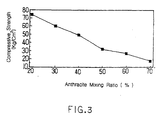
- Example 2 The M. T. coal of Example 1 was heated in such a manner that the reaction temperature was fixed to 850°C, and the reaction interval was fixed to 10 minutes. Further, anthracite was mixed increasingly by 10% starting from 20% to 70%, thereby agglomerating the mixture coal. Thus the compressive strength was measured at every 10% increase of anthracite, and the measured results are shown in FIG. 3.
- the fine coal which is obtained from the direct iron ore smelting reducing process can be agglomerated in a simple manner.
- the anthracite having no sticking property or low free swelling coal can be mixed with the fine coal, and therefore, the energy utilization is done in an advantageous manner.
- the anthracite or the low free swelling coal having a low free swelling index can be utilized, thereby making it possible to use even low quality coals.
- the coal which is heated to a high temperature is put into the top of the direct iron ore smelting reducing furnace, and therefore, the dome shaped portion is naturally heated, with the result that the energy can be saved.
Landscapes
- Chemical & Material Sciences (AREA)
- Engineering & Computer Science (AREA)
- Organic Chemistry (AREA)
- Oil, Petroleum & Natural Gas (AREA)
- Materials Engineering (AREA)
- Physics & Mathematics (AREA)
- Geology (AREA)
- Geochemistry & Mineralogy (AREA)
- Life Sciences & Earth Sciences (AREA)
- Thermal Sciences (AREA)
- General Life Sciences & Earth Sciences (AREA)
- Combustion & Propulsion (AREA)
- Manufacturing & Machinery (AREA)
- Environmental & Geological Engineering (AREA)
- Metallurgy (AREA)
- Manufacture And Refinement Of Metals (AREA)
- Manufacture Of Iron (AREA)
- Solid Fuels And Fuel-Associated Substances (AREA)
Abstract
Description
Claims (4)
- A method for manufacturing coal agglomerates for use in a direct iron ore smelting reducing furnace by using a fine coal,
characterised in that said fine coal has a free swelling index of 3.0 or more and a particle size of 8mm or less, and in that said fine coal is agglomerated by heating it to a temperature of 600-850°C for 5 minutes or more. - The method as claimed in Claim 1, wherein said fine coal is agglomerated at a temperature of 650-800°C.
- The method as claimed in any one of Claims 1 and 2, wherein said fine coal is mixed with a low free swelling or anthracite in an amount of 70 weight % or less.
- The method as claimed in any one of Claims 1, 2 or 3, wherein said fine coal is obtained from a direct iron ore smelting reduction process.
Applications Claiming Priority (3)
| Application Number | Priority Date | Filing Date | Title |
|---|---|---|---|
| KR1019950065206A KR100206500B1 (en) | 1995-12-29 | 1995-12-29 | Method for manufacturing hardened coal for direct steel melting furnace |
| KR9565206 | 1995-12-29 | ||
| PCT/KR1996/000251 WO1997024414A1 (en) | 1995-12-29 | 1996-12-27 | Method for manufacturing coal agglomerates for use in direct iron smelting reducing furnace |
Publications (2)
| Publication Number | Publication Date |
|---|---|
| EP0812347A1 EP0812347A1 (en) | 1997-12-17 |
| EP0812347B1 true EP0812347B1 (en) | 2002-10-09 |
Family
ID=19446974
Family Applications (1)
| Application Number | Title | Priority Date | Filing Date |
|---|---|---|---|
| EP96943358A Expired - Lifetime EP0812347B1 (en) | 1995-12-29 | 1996-12-27 | Method for manufacturing coal agglomerates for use in direct iron smelting reducing furnace |
Country Status (13)
| Country | Link |
|---|---|
| US (1) | US5897674A (en) |
| EP (1) | EP0812347B1 (en) |
| JP (1) | JP2891384B2 (en) |
| KR (1) | KR100206500B1 (en) |
| AT (1) | ATE225838T1 (en) |
| AU (1) | AU701975B2 (en) |
| BR (1) | BR9607052A (en) |
| CA (1) | CA2212104C (en) |
| DE (1) | DE69624224T2 (en) |
| RU (1) | RU2122012C1 (en) |
| UA (1) | UA43398C2 (en) |
| WO (1) | WO1997024414A1 (en) |
| ZA (1) | ZA9610909B (en) |
Families Citing this family (8)
| Publication number | Priority date | Publication date | Assignee | Title |
|---|---|---|---|---|
| WO1997038064A1 (en) * | 1996-04-10 | 1997-10-16 | Ilecard Pty. Ltd. | Process for treating coal tailings |
| US7745142B2 (en) * | 1997-09-15 | 2010-06-29 | Molecular Devices Corporation | Molecular modification assays |
| US7070921B2 (en) | 2000-04-28 | 2006-07-04 | Molecular Devices Corporation | Molecular modification assays |
| US7632651B2 (en) * | 1997-09-15 | 2009-12-15 | Mds Analytical Technologies (Us) Inc. | Molecular modification assays |
| US20050227294A1 (en) * | 1997-09-15 | 2005-10-13 | Molecular Devices Corporation | Molecular modification assays involving lipids |
| DE60014006T2 (en) * | 1999-10-25 | 2005-09-29 | Spotware Technologies, Inc., San Diego | System, procedure, signal, user interface and software for displaying thumbnail banners |
| RU2537151C1 (en) * | 2013-06-18 | 2014-12-27 | Открытое акционерное общество "Восточный научно-исследовательский углехимический институт" (ОАО "ВУХИН") | Preparation of free-burning coal |
| CN104894367B (en) * | 2014-03-05 | 2020-11-03 | 华北理工大学 | Method for sintering acid pellet and alkaline material mixed super-thick material layer |
Family Cites Families (10)
| Publication number | Priority date | Publication date | Assignee | Title |
|---|---|---|---|---|
| US1810070A (en) * | 1928-11-15 | 1931-06-16 | New Jersey Zinc Co | Preparation of coked agglomerates |
| DE2128949B1 (en) * | 1971-06-11 | 1972-12-28 | Eschweiler Bergwerks Verein, 5122 Kohlscheid | Thermal pretreatment process for the hot chain binding of baking hard coals |
| CA1099901A (en) * | 1976-03-31 | 1981-04-28 | Earl W. Bennethum | Agglomerating process and apparatus |
| CA1118207A (en) * | 1977-06-17 | 1982-02-16 | Eugene A. Thiers | Continuous coke production from fine coal, char and low grade coal agglomerates by agglomeration and hardening stages |
| CA1110068A (en) * | 1977-06-17 | 1981-10-06 | Eugene A. Thiers | Method utilizing co.sub.2 for cooling agglomerates of coke |
| US4234320A (en) * | 1979-04-23 | 1980-11-18 | Shell Oil Company | Process for the agglomeration of solids |
| US4770766A (en) * | 1986-03-12 | 1988-09-13 | Otisca Industries, Ltd. | Time-controlled processes for agglomerating coal |
| SU1527250A1 (en) * | 1987-08-17 | 1989-12-07 | Донецкий политехнический институт | Method of producing granulated coal |
| US4830637A (en) * | 1988-03-28 | 1989-05-16 | Consolidation Coal Company | Preagglomeration of fine coal before thermal dryer in a preparation plant |
| FR2662172B1 (en) * | 1990-05-16 | 1992-09-04 | Normandie Combustibles | COMBUSTIBLE AGGLOMERATES COMPRISING A GRANULAR CARBON FUEL MATERIAL AND A BINDER AND THEIR MANUFACTURING METHOD. |
-
1995
- 1995-12-29 KR KR1019950065206A patent/KR100206500B1/en not_active Expired - Fee Related
-
1996
- 1996-12-27 DE DE69624224T patent/DE69624224T2/en not_active Expired - Lifetime
- 1996-12-27 RU RU97115897A patent/RU2122012C1/en not_active IP Right Cessation
- 1996-12-27 WO PCT/KR1996/000251 patent/WO1997024414A1/en not_active Ceased
- 1996-12-27 US US08/894,681 patent/US5897674A/en not_active Expired - Lifetime
- 1996-12-27 UA UA97094744A patent/UA43398C2/en unknown
- 1996-12-27 CA CA002212104A patent/CA2212104C/en not_active Expired - Fee Related
- 1996-12-27 AT AT96943358T patent/ATE225838T1/en active
- 1996-12-27 AU AU12117/97A patent/AU701975B2/en not_active Ceased
- 1996-12-27 EP EP96943358A patent/EP0812347B1/en not_active Expired - Lifetime
- 1996-12-27 JP JP9524231A patent/JP2891384B2/en not_active Expired - Fee Related
- 1996-12-27 BR BR9607052A patent/BR9607052A/en not_active IP Right Cessation
- 1996-12-30 ZA ZA9610909A patent/ZA9610909B/en unknown
Also Published As
| Publication number | Publication date |
|---|---|
| UA43398C2 (en) | 2001-12-17 |
| JP2891384B2 (en) | 1999-05-17 |
| WO1997024414A1 (en) | 1997-07-10 |
| RU2122012C1 (en) | 1998-11-20 |
| US5897674A (en) | 1999-04-27 |
| EP0812347A1 (en) | 1997-12-17 |
| AU701975B2 (en) | 1999-02-11 |
| JPH10512920A (en) | 1998-12-08 |
| ATE225838T1 (en) | 2002-10-15 |
| CA2212104C (en) | 2000-08-22 |
| AU1211797A (en) | 1997-07-28 |
| CA2212104A1 (en) | 1997-07-10 |
| KR970042952A (en) | 1997-07-26 |
| BR9607052A (en) | 1997-12-30 |
| KR100206500B1 (en) | 1999-07-01 |
| DE69624224D1 (en) | 2002-11-14 |
| ZA9610909B (en) | 1997-07-09 |
| DE69624224T2 (en) | 2003-07-10 |
Similar Documents
| Publication | Publication Date | Title |
|---|---|---|
| CA2290131C (en) | Pellets incorporated with carbonaceous material and method of producing reduced iron | |
| CN102206723B (en) | Air-base direct reduction iron-making method for reducing iron concentrate powder by self-reforming of gas rich in methane | |
| US4940488A (en) | Method of smelting reduction of ores containing metal oxides | |
| TW442571B (en) | Method for the production of liquid metal and plant for carring out the same | |
| US5897674A (en) | Method for manufacturing coal agglomerates for use in direct iron smelting reducing furnace | |
| US6277324B1 (en) | Apparatus for manufacturing molten pig iron and reduced iron by utilizing a fluidized bed | |
| US12000011B2 (en) | System and method for the production of hot briquetted iron (HBI) containing flux and/or carbonaceous material at a direct reduction plant | |
| CN105671228A (en) | Oxygen blast furnace and gas base shaft furnace combined production system and method | |
| CA1329482C (en) | Method for the pretreatment of a lumpy carbon carrier | |
| JPS59140316A (en) | Refinement for at least partially reduced iron ore | |
| US4455165A (en) | Increasing blast temperature | |
| EP1718775A2 (en) | Pre-treatment process for feed material for direct reduction process | |
| CA1118207A (en) | Continuous coke production from fine coal, char and low grade coal agglomerates by agglomeration and hardening stages | |
| US4102750A (en) | Process for producing formed coke for metallurgical use | |
| EP0319966B1 (en) | Method of smelting reduction of ores containing metal oxides | |
| CN110760358A (en) | Method for manufacturing coal aggregate of direct smelting reduction furnace | |
| CN107129792A (en) | The method of compound binding agent and preparation production calcium carbide mixing pelletizing | |
| JPS63161108A (en) | Molten iron producing apparatus | |
| KR20050068245A (en) | Method for manufacturing molten irons using shaped coals with improved strength | |
| CN105671229A (en) | Oxygen blast furnace and gas base shaft furnace combined production system and method | |
| CN121518743A (en) | A method for generating foam slag in LF refining using waste graphite electrodes | |
| JPS62227008A (en) | Melt reduction method for iron ore | |
| JPS61188488A (en) | Production of coke | |
| CZ9904783A3 (en) | Process and apparatus for producing molten metal | |
| JPH07179914A (en) | Operating method of blast furnace using molded coke |
Legal Events
| Date | Code | Title | Description |
|---|---|---|---|
| PUAI | Public reference made under article 153(3) epc to a published international application that has entered the european phase |
Free format text: ORIGINAL CODE: 0009012 |
|
| 17P | Request for examination filed |
Effective date: 19970818 |
|
| AK | Designated contracting states |
Kind code of ref document: A1 Designated state(s): AT DE GB IT LU SE |
|
| GRAG | Despatch of communication of intention to grant |
Free format text: ORIGINAL CODE: EPIDOS AGRA |
|
| 17Q | First examination report despatched |
Effective date: 20011012 |
|
| GRAG | Despatch of communication of intention to grant |
Free format text: ORIGINAL CODE: EPIDOS AGRA |
|
| GRAH | Despatch of communication of intention to grant a patent |
Free format text: ORIGINAL CODE: EPIDOS IGRA |
|
| RAP1 | Party data changed (applicant data changed or rights of an application transferred) |
Owner name: RESEARCH INSTITUTE OF INDUSTRIAL SCIENCE & TECHNO Owner name: POHANG IRON & STEEL CO., LTD. |
|
| GRAH | Despatch of communication of intention to grant a patent |
Free format text: ORIGINAL CODE: EPIDOS IGRA |
|
| GRAA | (expected) grant |
Free format text: ORIGINAL CODE: 0009210 |
|
| AK | Designated contracting states |
Kind code of ref document: B1 Designated state(s): AT DE GB IT LU SE |
|
| REF | Corresponds to: |
Ref document number: 225838 Country of ref document: AT Date of ref document: 20021015 Kind code of ref document: T |
|
| REG | Reference to a national code |
Ref country code: GB Ref legal event code: FG4D |
|
| REF | Corresponds to: |
Ref document number: 69624224 Country of ref document: DE Date of ref document: 20021114 |
|
| PLBE | No opposition filed within time limit |
Free format text: ORIGINAL CODE: 0009261 |
|
| STAA | Information on the status of an ep patent application or granted ep patent |
Free format text: STATUS: NO OPPOSITION FILED WITHIN TIME LIMIT |
|
| 26N | No opposition filed |
Effective date: 20030710 |
|
| PGFP | Annual fee paid to national office [announced via postgrant information from national office to epo] |
Ref country code: LU Payment date: 20121018 Year of fee payment: 17 |
|
| PGFP | Annual fee paid to national office [announced via postgrant information from national office to epo] |
Ref country code: DE Payment date: 20121016 Year of fee payment: 17 |
|
| PGFP | Annual fee paid to national office [announced via postgrant information from national office to epo] |
Ref country code: SE Payment date: 20121015 Year of fee payment: 17 Ref country code: GB Payment date: 20121015 Year of fee payment: 17 Ref country code: IT Payment date: 20121015 Year of fee payment: 17 |
|
| PGFP | Annual fee paid to national office [announced via postgrant information from national office to epo] |
Ref country code: AT Payment date: 20121016 Year of fee payment: 17 |
|
| REG | Reference to a national code |
Ref country code: DE Ref legal event code: R119 Ref document number: 69624224 Country of ref document: DE |
|
| REG | Reference to a national code |
Ref country code: SE Ref legal event code: EUG |
|
| REG | Reference to a national code |
Ref country code: AT Ref legal event code: MM01 Ref document number: 225838 Country of ref document: AT Kind code of ref document: T Effective date: 20131227 |
|
| GBPC | Gb: european patent ceased through non-payment of renewal fee |
Effective date: 20131227 |
|
| PG25 | Lapsed in a contracting state [announced via postgrant information from national office to epo] |
Ref country code: LU Free format text: LAPSE BECAUSE OF NON-PAYMENT OF DUE FEES Effective date: 20131227 Ref country code: SE Free format text: LAPSE BECAUSE OF NON-PAYMENT OF DUE FEES Effective date: 20131228 |
|
| REG | Reference to a national code |
Ref country code: DE Ref legal event code: R119 Ref document number: 69624224 Country of ref document: DE Effective date: 20140701 |
|
| PG25 | Lapsed in a contracting state [announced via postgrant information from national office to epo] |
Ref country code: DE Free format text: LAPSE BECAUSE OF NON-PAYMENT OF DUE FEES Effective date: 20140701 |
|
| PG25 | Lapsed in a contracting state [announced via postgrant information from national office to epo] |
Ref country code: AT Free format text: LAPSE BECAUSE OF NON-PAYMENT OF DUE FEES Effective date: 20131227 Ref country code: GB Free format text: LAPSE BECAUSE OF NON-PAYMENT OF DUE FEES Effective date: 20131227 |
|
| PG25 | Lapsed in a contracting state [announced via postgrant information from national office to epo] |
Ref country code: IT Free format text: LAPSE BECAUSE OF NON-PAYMENT OF DUE FEES Effective date: 20131231 |
|
| PG25 | Lapsed in a contracting state [announced via postgrant information from national office to epo] |
Ref country code: IT Free format text: LAPSE BECAUSE OF NON-PAYMENT OF DUE FEES Effective date: 20131227 |