EP0812336B1 - Coating composition based on a binder containing hydroxyl groups, and its use in processes for the production of coatings - Google Patents
Coating composition based on a binder containing hydroxyl groups, and its use in processes for the production of coatings Download PDFInfo
- Publication number
- EP0812336B1 EP0812336B1 EP96910353A EP96910353A EP0812336B1 EP 0812336 B1 EP0812336 B1 EP 0812336B1 EP 96910353 A EP96910353 A EP 96910353A EP 96910353 A EP96910353 A EP 96910353A EP 0812336 B1 EP0812336 B1 EP 0812336B1
- Authority
- EP
- European Patent Office
- Prior art keywords
- weight
- acid
- monomers
- hydroxy
- acrylate
- Prior art date
- Legal status (The legal status is an assumption and is not a legal conclusion. Google has not performed a legal analysis and makes no representation as to the accuracy of the status listed.)
- Expired - Lifetime
Links
- 125000002887 hydroxy group Chemical group [H]O* 0.000 title claims abstract description 67
- 239000008199 coating composition Substances 0.000 title claims abstract description 57
- 239000011230 binding agent Substances 0.000 title claims abstract description 20
- 238000000576 coating method Methods 0.000 title claims description 27
- 238000000034 method Methods 0.000 title claims description 15
- 230000008569 process Effects 0.000 title claims description 8
- 238000004519 manufacturing process Methods 0.000 title claims description 5
- 239000002253 acid Substances 0.000 claims abstract description 42
- 239000003431 cross linking reagent Substances 0.000 claims abstract description 21
- 125000003118 aryl group Chemical group 0.000 claims abstract description 15
- 150000008064 anhydrides Chemical class 0.000 claims abstract description 8
- 239000000178 monomer Substances 0.000 claims description 47
- 239000000203 mixture Substances 0.000 claims description 40
- 239000004925 Acrylic resin Substances 0.000 claims description 32
- 239000005056 polyisocyanate Substances 0.000 claims description 27
- 229920001228 polyisocyanate Polymers 0.000 claims description 27
- 229920001225 polyester resin Polymers 0.000 claims description 24
- -1 aromatic vinyl hydrocarbon Chemical class 0.000 claims description 23
- WPYMKLBDIGXBTP-UHFFFAOYSA-N benzoic acid Chemical class OC(=O)C1=CC=CC=C1 WPYMKLBDIGXBTP-UHFFFAOYSA-N 0.000 claims description 23
- 229920000180 alkyd Polymers 0.000 claims description 18
- 150000002148 esters Chemical class 0.000 claims description 16
- LGRFSURHDFAFJT-UHFFFAOYSA-N phthalic anhydride Chemical compound C1=CC=C2C(=O)OC(=O)C2=C1 LGRFSURHDFAFJT-UHFFFAOYSA-N 0.000 claims description 15
- 239000005711 Benzoic acid Chemical class 0.000 claims description 12
- 235000010233 benzoic acid Nutrition 0.000 claims description 12
- 125000001931 aliphatic group Chemical group 0.000 claims description 11
- 229920001567 vinyl ester resin Polymers 0.000 claims description 11
- 239000011248 coating agent Substances 0.000 claims description 9
- CERQOIWHTDAKMF-UHFFFAOYSA-N Methacrylic acid Chemical compound CC(=C)C(O)=O CERQOIWHTDAKMF-UHFFFAOYSA-N 0.000 claims description 8
- SMZOUWXMTYCWNB-UHFFFAOYSA-N 2-(2-methoxy-5-methylphenyl)ethanamine Chemical compound COC1=CC=C(C)C=C1CCN SMZOUWXMTYCWNB-UHFFFAOYSA-N 0.000 claims description 7
- NIXOWILDQLNWCW-UHFFFAOYSA-N 2-Propenoic acid Natural products OC(=O)C=C NIXOWILDQLNWCW-UHFFFAOYSA-N 0.000 claims description 6
- NDWUBGAGUCISDV-UHFFFAOYSA-N 4-hydroxybutyl prop-2-enoate Chemical compound OCCCCOC(=O)C=C NDWUBGAGUCISDV-UHFFFAOYSA-N 0.000 claims description 6
- 239000000758 substrate Substances 0.000 claims description 6
- 229930195733 hydrocarbon Natural products 0.000 claims description 5
- 230000001681 protective effect Effects 0.000 claims description 5
- JRCGLALFKDKSAN-UHFFFAOYSA-N 3-hydroxybutyl prop-2-enoate Chemical compound CC(O)CCOC(=O)C=C JRCGLALFKDKSAN-UHFFFAOYSA-N 0.000 claims description 4
- YKXAYLPDMSGWEV-UHFFFAOYSA-N 4-hydroxybutyl 2-methylprop-2-enoate Chemical compound CC(=C)C(=O)OCCCCO YKXAYLPDMSGWEV-UHFFFAOYSA-N 0.000 claims description 4
- VHNJXLWRTQNIPD-UHFFFAOYSA-N 3-hydroxybutyl 2-methylprop-2-enoate Chemical compound CC(O)CCOC(=O)C(C)=C VHNJXLWRTQNIPD-UHFFFAOYSA-N 0.000 claims description 3
- 239000004215 Carbon black (E152) Substances 0.000 claims description 2
- 230000000379 polymerizing effect Effects 0.000 claims description 2
- 229920002554 vinyl polymer Polymers 0.000 claims description 2
- 125000000217 alkyl group Chemical group 0.000 claims 3
- 150000001559 benzoic acids Chemical class 0.000 claims 1
- 238000002360 preparation method Methods 0.000 description 32
- NIXOWILDQLNWCW-UHFFFAOYSA-M Acrylate Chemical compound [O-]C(=O)C=C NIXOWILDQLNWCW-UHFFFAOYSA-M 0.000 description 28
- 239000003999 initiator Substances 0.000 description 23
- 229920005989 resin Polymers 0.000 description 23
- 239000011347 resin Substances 0.000 description 23
- 238000006116 polymerization reaction Methods 0.000 description 22
- 229920000058 polyacrylate Polymers 0.000 description 20
- 239000002904 solvent Substances 0.000 description 19
- 150000007513 acids Chemical class 0.000 description 16
- CTQNGGLPUBDAKN-UHFFFAOYSA-N O-Xylene Chemical compound CC1=CC=CC=C1C CTQNGGLPUBDAKN-UHFFFAOYSA-N 0.000 description 14
- 150000001875 compounds Chemical class 0.000 description 14
- 239000008096 xylene Substances 0.000 description 14
- DKPFZGUDAPQIHT-UHFFFAOYSA-N Butyl acetate Natural products CCCCOC(C)=O DKPFZGUDAPQIHT-UHFFFAOYSA-N 0.000 description 13
- 239000004645 polyester resin Substances 0.000 description 13
- 239000007787 solid Substances 0.000 description 13
- PPBRXRYQALVLMV-UHFFFAOYSA-N Styrene Chemical compound C=CC1=CC=CC=C1 PPBRXRYQALVLMV-UHFFFAOYSA-N 0.000 description 12
- 239000003795 chemical substances by application Substances 0.000 description 11
- 238000007792 addition Methods 0.000 description 10
- 239000000654 additive Substances 0.000 description 10
- PEDCQBHIVMGVHV-UHFFFAOYSA-N Glycerine Chemical compound OCC(O)CO PEDCQBHIVMGVHV-UHFFFAOYSA-N 0.000 description 9
- FUZZWVXGSFPDMH-UHFFFAOYSA-N hexanoic acid Chemical compound CCCCCC(O)=O FUZZWVXGSFPDMH-UHFFFAOYSA-N 0.000 description 9
- 230000000873 masking effect Effects 0.000 description 9
- 229920000647 polyepoxide Polymers 0.000 description 9
- JHIWVOJDXOSYLW-UHFFFAOYSA-N butyl 2,2-difluorocyclopropane-1-carboxylate Chemical compound CCCCOC(=O)C1CC1(F)F JHIWVOJDXOSYLW-UHFFFAOYSA-N 0.000 description 8
- 238000006243 chemical reaction Methods 0.000 description 8
- 229920000728 polyester Polymers 0.000 description 8
- ZJCCRDAZUWHFQH-UHFFFAOYSA-N Trimethylolpropane Chemical compound CCC(CO)(CO)CO ZJCCRDAZUWHFQH-UHFFFAOYSA-N 0.000 description 7
- 125000004432 carbon atom Chemical group C* 0.000 description 7
- RRAMGCGOFNQTLD-UHFFFAOYSA-N hexamethylene diisocyanate Chemical compound O=C=NCCCCCCN=C=O RRAMGCGOFNQTLD-UHFFFAOYSA-N 0.000 description 7
- 125000002768 hydroxyalkyl group Chemical group 0.000 description 7
- 239000003981 vehicle Substances 0.000 description 7
- 125000000391 vinyl group Chemical group [H]C([*])=C([H])[H] 0.000 description 7
- XZOYHFBNQHPJRQ-UHFFFAOYSA-N 7-methyloctanoic acid Chemical compound CC(C)CCCCCC(O)=O XZOYHFBNQHPJRQ-UHFFFAOYSA-N 0.000 description 6
- UHOVQNZJYSORNB-UHFFFAOYSA-N Benzene Chemical compound C1=CC=CC=C1 UHOVQNZJYSORNB-UHFFFAOYSA-N 0.000 description 6
- 239000005057 Hexamethylene diisocyanate Substances 0.000 description 6
- WOBHKFSMXKNTIM-UHFFFAOYSA-N Hydroxyethyl methacrylate Chemical compound CC(=C)C(=O)OCCO WOBHKFSMXKNTIM-UHFFFAOYSA-N 0.000 description 6
- VVQNEPGJFQJSBK-UHFFFAOYSA-N Methyl methacrylate Chemical compound COC(=O)C(C)=C VVQNEPGJFQJSBK-UHFFFAOYSA-N 0.000 description 6
- 238000009835 boiling Methods 0.000 description 6
- 229910052799 carbon Inorganic materials 0.000 description 6
- 125000003178 carboxy group Chemical group [H]OC(*)=O 0.000 description 6
- 239000003054 catalyst Substances 0.000 description 6
- 239000007795 chemical reaction product Substances 0.000 description 6
- 230000000052 comparative effect Effects 0.000 description 6
- IQPQWNKOIGAROB-UHFFFAOYSA-N isocyanate group Chemical group [N-]=C=O IQPQWNKOIGAROB-UHFFFAOYSA-N 0.000 description 6
- 150000002763 monocarboxylic acids Chemical class 0.000 description 6
- 239000003921 oil Substances 0.000 description 6
- 239000000049 pigment Substances 0.000 description 6
- 229920003002 synthetic resin Polymers 0.000 description 6
- CXWXQJXEFPUFDZ-UHFFFAOYSA-N tetralin Chemical compound C1=CC=C2CCCCC2=C1 CXWXQJXEFPUFDZ-UHFFFAOYSA-N 0.000 description 6
- LDHQCZJRKDOVOX-UHFFFAOYSA-N trans-crotonic acid Natural products CC=CC(O)=O LDHQCZJRKDOVOX-UHFFFAOYSA-N 0.000 description 6
- XLYOFNOQVPJJNP-UHFFFAOYSA-N water Substances O XLYOFNOQVPJJNP-UHFFFAOYSA-N 0.000 description 6
- 229920002818 (Hydroxyethyl)methacrylate Polymers 0.000 description 5
- HIXDQWDOVZUNNA-UHFFFAOYSA-N 2-(3,4-dimethoxyphenyl)-5-hydroxy-7-methoxychromen-4-one Chemical compound C=1C(OC)=CC(O)=C(C(C=2)=O)C=1OC=2C1=CC=C(OC)C(OC)=C1 HIXDQWDOVZUNNA-UHFFFAOYSA-N 0.000 description 5
- 239000004793 Polystyrene Substances 0.000 description 5
- 239000013065 commercial product Substances 0.000 description 5
- 238000009833 condensation Methods 0.000 description 5
- 230000005494 condensation Effects 0.000 description 5
- RTZKZFJDLAIYFH-UHFFFAOYSA-N ether Substances CCOCC RTZKZFJDLAIYFH-UHFFFAOYSA-N 0.000 description 5
- 238000005227 gel permeation chromatography Methods 0.000 description 5
- ZFSLODLOARCGLH-UHFFFAOYSA-N isocyanuric acid Chemical compound OC1=NC(O)=NC(O)=N1 ZFSLODLOARCGLH-UHFFFAOYSA-N 0.000 description 5
- NIMLQBUJDJZYEJ-UHFFFAOYSA-N isophorone diisocyanate Chemical compound CC1(C)CC(N=C=O)CC(C)(CN=C=O)C1 NIMLQBUJDJZYEJ-UHFFFAOYSA-N 0.000 description 5
- 229920005862 polyol Polymers 0.000 description 5
- 229920002223 polystyrene Polymers 0.000 description 5
- NQBXSWAWVZHKBZ-UHFFFAOYSA-N 2-butoxyethyl acetate Chemical compound CCCCOCCOC(C)=O NQBXSWAWVZHKBZ-UHFFFAOYSA-N 0.000 description 4
- 239000005058 Isophorone diisocyanate Substances 0.000 description 4
- 150000001252 acrylic acid derivatives Chemical class 0.000 description 4
- 230000000996 additive effect Effects 0.000 description 4
- 150000001336 alkenes Chemical class 0.000 description 4
- 150000001735 carboxylic acids Chemical class 0.000 description 4
- NNBZCPXTIHJBJL-UHFFFAOYSA-N decalin Chemical compound C1CCCC2CCCCC21 NNBZCPXTIHJBJL-UHFFFAOYSA-N 0.000 description 4
- LSXWFXONGKSEMY-UHFFFAOYSA-N di-tert-butyl peroxide Chemical compound CC(C)(C)OOC(C)(C)C LSXWFXONGKSEMY-UHFFFAOYSA-N 0.000 description 4
- 125000003700 epoxy group Chemical group 0.000 description 4
- 239000000945 filler Substances 0.000 description 4
- BDAGIHXWWSANSR-UHFFFAOYSA-N methanoic acid Natural products OC=O BDAGIHXWWSANSR-UHFFFAOYSA-N 0.000 description 4
- 239000003960 organic solvent Substances 0.000 description 4
- 239000003791 organic solvent mixture Substances 0.000 description 4
- 238000012643 polycondensation polymerization Methods 0.000 description 4
- 239000002952 polymeric resin Substances 0.000 description 4
- 239000000047 product Substances 0.000 description 4
- CIHOLLKRGTVIJN-UHFFFAOYSA-N tert‐butyl hydroperoxide Chemical compound CC(C)(C)OO CIHOLLKRGTVIJN-UHFFFAOYSA-N 0.000 description 4
- OMIGHNLMNHATMP-UHFFFAOYSA-N 2-hydroxyethyl prop-2-enoate Chemical compound OCCOC(=O)C=C OMIGHNLMNHATMP-UHFFFAOYSA-N 0.000 description 3
- ZDFKSZDMHJHQHS-UHFFFAOYSA-N 2-tert-butylbenzoic acid Chemical compound CC(C)(C)C1=CC=CC=C1C(O)=O ZDFKSZDMHJHQHS-UHFFFAOYSA-N 0.000 description 3
- LYCAIKOWRPUZTN-UHFFFAOYSA-N Ethylene glycol Chemical compound OCCO LYCAIKOWRPUZTN-UHFFFAOYSA-N 0.000 description 3
- OFOBLEOULBTSOW-UHFFFAOYSA-N Propanedioic acid Natural products OC(=O)CC(O)=O OFOBLEOULBTSOW-UHFFFAOYSA-N 0.000 description 3
- UKLDJPRMSDWDSL-UHFFFAOYSA-L [dibutyl(dodecanoyloxy)stannyl] dodecanoate Chemical compound CCCCCCCCCCCC(=O)O[Sn](CCCC)(CCCC)OC(=O)CCCCCCCCCCC UKLDJPRMSDWDSL-UHFFFAOYSA-L 0.000 description 3
- 229920006243 acrylic copolymer Polymers 0.000 description 3
- 230000008901 benefit Effects 0.000 description 3
- 150000001721 carbon Chemical group 0.000 description 3
- LDHQCZJRKDOVOX-NSCUHMNNSA-N crotonic acid Chemical compound C\C=C\C(O)=O LDHQCZJRKDOVOX-NSCUHMNNSA-N 0.000 description 3
- 239000012975 dibutyltin dilaurate Substances 0.000 description 3
- MTHSVFCYNBDYFN-UHFFFAOYSA-N diethylene glycol Chemical compound OCCOCCO MTHSVFCYNBDYFN-UHFFFAOYSA-N 0.000 description 3
- 238000005516 engineering process Methods 0.000 description 3
- 150000002118 epoxides Chemical class 0.000 description 3
- 125000000524 functional group Chemical group 0.000 description 3
- 150000002430 hydrocarbons Chemical class 0.000 description 3
- LDHQCZJRKDOVOX-IHWYPQMZSA-N isocrotonic acid Chemical compound C\C=C/C(O)=O LDHQCZJRKDOVOX-IHWYPQMZSA-N 0.000 description 3
- 150000002734 metacrylic acid derivatives Chemical class 0.000 description 3
- 238000002156 mixing Methods 0.000 description 3
- 239000003505 polymerization initiator Substances 0.000 description 3
- 150000003077 polyols Chemical class 0.000 description 3
- 150000003254 radicals Chemical class 0.000 description 3
- 125000001302 tertiary amino group Chemical group 0.000 description 3
- VZCYOOQTPOCHFL-UHFFFAOYSA-N trans-butenedioic acid Natural products OC(=O)C=CC(O)=O VZCYOOQTPOCHFL-UHFFFAOYSA-N 0.000 description 3
- 150000007934 α,β-unsaturated carboxylic acids Chemical class 0.000 description 3
- MUTGBJKUEZFXGO-OLQVQODUSA-N (3as,7ar)-3a,4,5,6,7,7a-hexahydro-2-benzofuran-1,3-dione Chemical compound C1CCC[C@@H]2C(=O)OC(=O)[C@@H]21 MUTGBJKUEZFXGO-OLQVQODUSA-N 0.000 description 2
- PCHXZXKMYCGVFA-UHFFFAOYSA-N 1,3-diazetidine-2,4-dione Chemical compound O=C1NC(=O)N1 PCHXZXKMYCGVFA-UHFFFAOYSA-N 0.000 description 2
- KBPLFHHGFOOTCA-UHFFFAOYSA-N 1-Octanol Chemical compound CCCCCCCCO KBPLFHHGFOOTCA-UHFFFAOYSA-N 0.000 description 2
- UAJRSHJHFRVGMG-UHFFFAOYSA-N 1-ethenyl-4-methoxybenzene Chemical compound COC1=CC=C(C=C)C=C1 UAJRSHJHFRVGMG-UHFFFAOYSA-N 0.000 description 2
- ULQISTXYYBZJSJ-UHFFFAOYSA-N 12-hydroxyoctadecanoic acid Chemical compound CCCCCCC(O)CCCCCCCCCCC(O)=O ULQISTXYYBZJSJ-UHFFFAOYSA-N 0.000 description 2
- FPZWZCWUIYYYBU-UHFFFAOYSA-N 2-(2-ethoxyethoxy)ethyl acetate Chemical compound CCOCCOCCOC(C)=O FPZWZCWUIYYYBU-UHFFFAOYSA-N 0.000 description 2
- KIHBGTRZFAVZRV-UHFFFAOYSA-N 2-Hydroxyoctadecanoic acid Natural products CCCCCCCCCCCCCCCCC(O)C(O)=O KIHBGTRZFAVZRV-UHFFFAOYSA-N 0.000 description 2
- SVONRAPFKPVNKG-UHFFFAOYSA-N 2-ethoxyethyl acetate Chemical compound CCOCCOC(C)=O SVONRAPFKPVNKG-UHFFFAOYSA-N 0.000 description 2
- OSWFIVFLDKOXQC-UHFFFAOYSA-N 4-(3-methoxyphenyl)aniline Chemical compound COC1=CC=CC(C=2C=CC(N)=CC=2)=C1 OSWFIVFLDKOXQC-UHFFFAOYSA-N 0.000 description 2
- OAOABCKPVCUNKO-UHFFFAOYSA-N 8-methyl Nonanoic acid Chemical compound CC(C)CCCCCCC(O)=O OAOABCKPVCUNKO-UHFFFAOYSA-N 0.000 description 2
- WDJHALXBUFZDSR-UHFFFAOYSA-N Acetoacetic acid Natural products CC(=O)CC(O)=O WDJHALXBUFZDSR-UHFFFAOYSA-N 0.000 description 2
- SOGAXMICEFXMKE-UHFFFAOYSA-N Butylmethacrylate Chemical compound CCCCOC(=O)C(C)=C SOGAXMICEFXMKE-UHFFFAOYSA-N 0.000 description 2
- UGFAIRIUMAVXCW-UHFFFAOYSA-N Carbon monoxide Chemical compound [O+]#[C-] UGFAIRIUMAVXCW-UHFFFAOYSA-N 0.000 description 2
- XDTMQSROBMDMFD-UHFFFAOYSA-N Cyclohexane Chemical compound C1CCCCC1 XDTMQSROBMDMFD-UHFFFAOYSA-N 0.000 description 2
- FBPFZTCFMRRESA-FSIIMWSLSA-N D-Glucitol Natural products OC[C@H](O)[C@H](O)[C@@H](O)[C@H](O)CO FBPFZTCFMRRESA-FSIIMWSLSA-N 0.000 description 2
- FBPFZTCFMRRESA-JGWLITMVSA-N D-glucitol Chemical compound OC[C@H](O)[C@@H](O)[C@H](O)[C@H](O)CO FBPFZTCFMRRESA-JGWLITMVSA-N 0.000 description 2
- OTMSDBZUPAUEDD-UHFFFAOYSA-N Ethane Chemical class CC OTMSDBZUPAUEDD-UHFFFAOYSA-N 0.000 description 2
- VZCYOOQTPOCHFL-OWOJBTEDSA-N Fumaric acid Chemical compound OC(=O)\C=C\C(O)=O VZCYOOQTPOCHFL-OWOJBTEDSA-N 0.000 description 2
- AMIMRNSIRUDHCM-UHFFFAOYSA-N Isopropylaldehyde Chemical compound CC(C)C=O AMIMRNSIRUDHCM-UHFFFAOYSA-N 0.000 description 2
- 229920000877 Melamine resin Polymers 0.000 description 2
- LRHPLDYGYMQRHN-UHFFFAOYSA-N N-Butanol Chemical compound CCCCO LRHPLDYGYMQRHN-UHFFFAOYSA-N 0.000 description 2
- 229910000831 Steel Inorganic materials 0.000 description 2
- KKEYFWRCBNTPAC-UHFFFAOYSA-N Terephthalic acid Chemical compound OC(=O)C1=CC=C(C(O)=O)C=C1 KKEYFWRCBNTPAC-UHFFFAOYSA-N 0.000 description 2
- 239000006096 absorbing agent Substances 0.000 description 2
- WNLRTRBMVRJNCN-UHFFFAOYSA-N adipic acid Chemical compound OC(=O)CCCCC(O)=O WNLRTRBMVRJNCN-UHFFFAOYSA-N 0.000 description 2
- 125000005907 alkyl ester group Chemical group 0.000 description 2
- 150000001412 amines Chemical class 0.000 description 2
- 229920003180 amino resin Polymers 0.000 description 2
- 239000003849 aromatic solvent Substances 0.000 description 2
- 229910002091 carbon monoxide Inorganic materials 0.000 description 2
- 150000001732 carboxylic acid derivatives Chemical class 0.000 description 2
- 229920001577 copolymer Polymers 0.000 description 2
- QSAWQNUELGIYBC-UHFFFAOYSA-N cyclohexane-1,2-dicarboxylic acid Chemical compound OC(=O)C1CCCCC1C(O)=O QSAWQNUELGIYBC-UHFFFAOYSA-N 0.000 description 2
- ZQMIGQNCOMNODD-UHFFFAOYSA-N diacetyl peroxide Chemical compound CC(=O)OOC(C)=O ZQMIGQNCOMNODD-UHFFFAOYSA-N 0.000 description 2
- 125000005442 diisocyanate group Chemical group 0.000 description 2
- 239000006185 dispersion Substances 0.000 description 2
- POULHZVOKOAJMA-UHFFFAOYSA-N dodecanoic acid Chemical compound CCCCCCCCCCCC(O)=O POULHZVOKOAJMA-UHFFFAOYSA-N 0.000 description 2
- 238000001035 drying Methods 0.000 description 2
- 238000006735 epoxidation reaction Methods 0.000 description 2
- JBKVHLHDHHXQEQ-UHFFFAOYSA-N epsilon-caprolactam Chemical compound O=C1CCCCCN1 JBKVHLHDHHXQEQ-UHFFFAOYSA-N 0.000 description 2
- 230000032050 esterification Effects 0.000 description 2
- 238000005886 esterification reaction Methods 0.000 description 2
- 125000001495 ethyl group Chemical group [H]C([H])([H])C([H])([H])* 0.000 description 2
- 235000019253 formic acid Nutrition 0.000 description 2
- 238000010528 free radical solution polymerization reaction Methods 0.000 description 2
- 230000006872 improvement Effects 0.000 description 2
- 229910052500 inorganic mineral Inorganic materials 0.000 description 2
- QQVIHTHCMHWDBS-UHFFFAOYSA-N isophthalic acid Chemical compound OC(=O)C1=CC=CC(C(O)=O)=C1 QQVIHTHCMHWDBS-UHFFFAOYSA-N 0.000 description 2
- 239000004611 light stabiliser Substances 0.000 description 2
- VZCYOOQTPOCHFL-UPHRSURJSA-N maleic acid Chemical compound OC(=O)\C=C/C(O)=O VZCYOOQTPOCHFL-UPHRSURJSA-N 0.000 description 2
- 239000011976 maleic acid Substances 0.000 description 2
- VUZPPFZMUPKLLV-UHFFFAOYSA-N methane;hydrate Chemical compound C.O VUZPPFZMUPKLLV-UHFFFAOYSA-N 0.000 description 2
- 239000011707 mineral Substances 0.000 description 2
- 239000003595 mist Substances 0.000 description 2
- 238000000465 moulding Methods 0.000 description 2
- SLCVBVWXLSEKPL-UHFFFAOYSA-N neopentyl glycol Chemical compound OCC(C)(C)CO SLCVBVWXLSEKPL-UHFFFAOYSA-N 0.000 description 2
- 229940117969 neopentyl glycol Drugs 0.000 description 2
- BDJRBEYXGGNYIS-UHFFFAOYSA-N nonanedioic acid Chemical compound OC(=O)CCCCCCCC(O)=O BDJRBEYXGGNYIS-UHFFFAOYSA-N 0.000 description 2
- WXZMFSXDPGVJKK-UHFFFAOYSA-N pentaerythritol Chemical compound OCC(CO)(CO)CO WXZMFSXDPGVJKK-UHFFFAOYSA-N 0.000 description 2
- 150000002989 phenols Chemical class 0.000 description 2
- XNGIFLGASWRNHJ-UHFFFAOYSA-N phthalic acid Chemical compound OC(=O)C1=CC=CC=C1C(O)=O XNGIFLGASWRNHJ-UHFFFAOYSA-N 0.000 description 2
- 229920002857 polybutadiene Polymers 0.000 description 2
- HJWLCRVIBGQPNF-UHFFFAOYSA-N prop-2-enylbenzene Chemical class C=CCC1=CC=CC=C1 HJWLCRVIBGQPNF-UHFFFAOYSA-N 0.000 description 2
- CYIDZMCFTVVTJO-UHFFFAOYSA-N pyromellitic acid Chemical compound OC(=O)C1=CC(C(O)=O)=C(C(O)=O)C=C1C(O)=O CYIDZMCFTVVTJO-UHFFFAOYSA-N 0.000 description 2
- 238000010992 reflux Methods 0.000 description 2
- CXMXRPHRNRROMY-UHFFFAOYSA-N sebacic acid Chemical compound OC(=O)CCCCCCCCC(O)=O CXMXRPHRNRROMY-UHFFFAOYSA-N 0.000 description 2
- 239000000600 sorbitol Substances 0.000 description 2
- 235000015096 spirit Nutrition 0.000 description 2
- 239000007921 spray Substances 0.000 description 2
- 229910001220 stainless steel Inorganic materials 0.000 description 2
- 239000010935 stainless steel Substances 0.000 description 2
- 239000007858 starting material Substances 0.000 description 2
- 125000004079 stearyl group Chemical group [H]C([*])([H])C([H])([H])C([H])([H])C([H])([H])C([H])([H])C([H])([H])C([H])([H])C([H])([H])C([H])([H])C([H])([H])C([H])([H])C([H])([H])C([H])([H])C([H])([H])C([H])([H])C([H])([H])C([H])([H])C([H])([H])[H] 0.000 description 2
- 239000010959 steel Substances 0.000 description 2
- 150000005846 sugar alcohols Polymers 0.000 description 2
- 239000000057 synthetic resin Substances 0.000 description 2
- 125000000999 tert-butyl group Chemical group [H]C([H])([H])C(*)(C([H])([H])[H])C([H])([H])[H] 0.000 description 2
- ARCGXLSVLAOJQL-UHFFFAOYSA-N trimellitic acid Chemical compound OC(=O)C1=CC=C(C(O)=O)C(C(O)=O)=C1 ARCGXLSVLAOJQL-UHFFFAOYSA-N 0.000 description 2
- AVWRKZWQTYIKIY-UHFFFAOYSA-N urea-1-carboxylic acid Chemical group NC(=O)NC(O)=O AVWRKZWQTYIKIY-UHFFFAOYSA-N 0.000 description 2
- JOYRKODLDBILNP-UHFFFAOYSA-N urethane group Chemical group NC(=O)OCC JOYRKODLDBILNP-UHFFFAOYSA-N 0.000 description 2
- PXXNTAGJWPJAGM-UHFFFAOYSA-N vertaline Natural products C1C2C=3C=C(OC)C(OC)=CC=3OC(C=C3)=CC=C3CCC(=O)OC1CC1N2CCCC1 PXXNTAGJWPJAGM-UHFFFAOYSA-N 0.000 description 2
- DTGKSKDOIYIVQL-WEDXCCLWSA-N (+)-borneol Chemical group C1C[C@@]2(C)[C@@H](O)C[C@@H]1C2(C)C DTGKSKDOIYIVQL-WEDXCCLWSA-N 0.000 description 1
- NIDNOXCRFUCAKQ-UMRXKNAASA-N (1s,2r,3s,4r)-bicyclo[2.2.1]hept-5-ene-2,3-dicarboxylic acid Chemical compound C1[C@H]2C=C[C@@H]1[C@H](C(=O)O)[C@@H]2C(O)=O NIDNOXCRFUCAKQ-UMRXKNAASA-N 0.000 description 1
- HGXJDMCMYLEZMJ-UHFFFAOYSA-N (2-methylpropan-2-yl)oxy 2,2-dimethylpropaneperoxoate Chemical compound CC(C)(C)OOOC(=O)C(C)(C)C HGXJDMCMYLEZMJ-UHFFFAOYSA-N 0.000 description 1
- MFEWNFVBWPABCX-UHFFFAOYSA-N 1,1,2,2-tetraphenylethane-1,2-diol Chemical compound C=1C=CC=CC=1C(C(O)(C=1C=CC=CC=1)C=1C=CC=CC=1)(O)C1=CC=CC=C1 MFEWNFVBWPABCX-UHFFFAOYSA-N 0.000 description 1
- NNOZGCICXAYKLW-UHFFFAOYSA-N 1,2-bis(2-isocyanatopropan-2-yl)benzene Chemical compound O=C=NC(C)(C)C1=CC=CC=C1C(C)(C)N=C=O NNOZGCICXAYKLW-UHFFFAOYSA-N 0.000 description 1
- ZTNJGMFHJYGMDR-UHFFFAOYSA-N 1,2-diisocyanatoethane Chemical compound O=C=NCCN=C=O ZTNJGMFHJYGMDR-UHFFFAOYSA-N 0.000 description 1
- UBRWPVTUQDJKCC-UHFFFAOYSA-N 1,3-bis(2-tert-butylperoxypropan-2-yl)benzene Chemical compound CC(C)(C)OOC(C)(C)C1=CC=CC(C(C)(C)OOC(C)(C)C)=C1 UBRWPVTUQDJKCC-UHFFFAOYSA-N 0.000 description 1
- RTTZISZSHSCFRH-UHFFFAOYSA-N 1,3-bis(isocyanatomethyl)benzene Chemical compound O=C=NCC1=CC=CC(CN=C=O)=C1 RTTZISZSHSCFRH-UHFFFAOYSA-N 0.000 description 1
- OHTRJOZKRSVAOX-UHFFFAOYSA-N 1,3-diisocyanato-2-methylcyclohexane Chemical compound CC1C(N=C=O)CCCC1N=C=O OHTRJOZKRSVAOX-UHFFFAOYSA-N 0.000 description 1
- PXGZQGDTEZPERC-UHFFFAOYSA-N 1,4-cyclohexanedicarboxylic acid Chemical compound OC(=O)C1CCC(C(O)=O)CC1 PXGZQGDTEZPERC-UHFFFAOYSA-N 0.000 description 1
- ALQLPWJFHRMHIU-UHFFFAOYSA-N 1,4-diisocyanatobenzene Chemical compound O=C=NC1=CC=C(N=C=O)C=C1 ALQLPWJFHRMHIU-UHFFFAOYSA-N 0.000 description 1
- 229940008841 1,6-hexamethylene diisocyanate Drugs 0.000 description 1
- UWFRVQVNYNPBEF-UHFFFAOYSA-N 1-(2,4-dimethylphenyl)propan-1-one Chemical compound CCC(=O)C1=CC=C(C)C=C1C UWFRVQVNYNPBEF-UHFFFAOYSA-N 0.000 description 1
- NVZWEEGUWXZOKI-UHFFFAOYSA-N 1-ethenyl-2-methylbenzene Chemical compound CC1=CC=CC=C1C=C NVZWEEGUWXZOKI-UHFFFAOYSA-N 0.000 description 1
- JZHGRUMIRATHIU-UHFFFAOYSA-N 1-ethenyl-3-methylbenzene Chemical compound CC1=CC=CC(C=C)=C1 JZHGRUMIRATHIU-UHFFFAOYSA-N 0.000 description 1
- MIYFFZILCMZNRY-UHFFFAOYSA-N 1-hydroxypentyl prop-2-enoate Chemical compound CCCCC(O)OC(=O)C=C MIYFFZILCMZNRY-UHFFFAOYSA-N 0.000 description 1
- ICLCCFKUSALICQ-UHFFFAOYSA-N 1-isocyanato-4-(4-isocyanato-3-methylphenyl)-2-methylbenzene Chemical group C1=C(N=C=O)C(C)=CC(C=2C=C(C)C(N=C=O)=CC=2)=C1 ICLCCFKUSALICQ-UHFFFAOYSA-N 0.000 description 1
- RQBUVIFBALZGPC-UHFFFAOYSA-N 1-isocyanato-4-(4-isocyanatophenyl)benzene Chemical group C1=CC(N=C=O)=CC=C1C1=CC=C(N=C=O)C=C1 RQBUVIFBALZGPC-UHFFFAOYSA-N 0.000 description 1
- RTBFRGCFXZNCOE-UHFFFAOYSA-N 1-methylsulfonylpiperidin-4-one Chemical compound CS(=O)(=O)N1CCC(=O)CC1 RTBFRGCFXZNCOE-UHFFFAOYSA-N 0.000 description 1
- JRZJOMJEPLMPRA-UHFFFAOYSA-N 1-nonene Chemical compound CCCCCCCC=C JRZJOMJEPLMPRA-UHFFFAOYSA-N 0.000 description 1
- QEDJMOONZLUIMC-UHFFFAOYSA-N 1-tert-butyl-4-ethenylbenzene Chemical compound CC(C)(C)C1=CC=C(C=C)C=C1 QEDJMOONZLUIMC-UHFFFAOYSA-N 0.000 description 1
- FXNDIJDIPNCZQJ-UHFFFAOYSA-N 2,4,4-trimethylpent-1-ene Chemical group CC(=C)CC(C)(C)C FXNDIJDIPNCZQJ-UHFFFAOYSA-N 0.000 description 1
- XMNIXWIUMCBBBL-UHFFFAOYSA-N 2-(2-phenylpropan-2-ylperoxy)propan-2-ylbenzene Chemical compound C=1C=CC=CC=1C(C)(C)OOC(C)(C)C1=CC=CC=C1 XMNIXWIUMCBBBL-UHFFFAOYSA-N 0.000 description 1
- WMYINDVYGQKYMI-UHFFFAOYSA-N 2-[2,2-bis(hydroxymethyl)butoxymethyl]-2-ethylpropane-1,3-diol Chemical compound CCC(CO)(CO)COCC(CC)(CO)CO WMYINDVYGQKYMI-UHFFFAOYSA-N 0.000 description 1
- WFSMVVDJSNMRAR-UHFFFAOYSA-N 2-[2-(2-ethoxyethoxy)ethoxy]ethanol Chemical compound CCOCCOCCOCCO WFSMVVDJSNMRAR-UHFFFAOYSA-N 0.000 description 1
- TXBCBTDQIULDIA-UHFFFAOYSA-N 2-[[3-hydroxy-2,2-bis(hydroxymethyl)propoxy]methyl]-2-(hydroxymethyl)propane-1,3-diol Chemical compound OCC(CO)(CO)COCC(CO)(CO)CO TXBCBTDQIULDIA-UHFFFAOYSA-N 0.000 description 1
- JITXMLLVGWGFGV-UHFFFAOYSA-N 2-chloro-4-(3-chloro-4-isocyanatophenyl)-1-isocyanatobenzene Chemical group C1=C(N=C=O)C(Cl)=CC(C=2C=C(Cl)C(N=C=O)=CC=2)=C1 JITXMLLVGWGFGV-UHFFFAOYSA-N 0.000 description 1
- SBYMUDUGTIKLCR-UHFFFAOYSA-N 2-chloroethenylbenzene Chemical class ClC=CC1=CC=CC=C1 SBYMUDUGTIKLCR-UHFFFAOYSA-N 0.000 description 1
- DBWWINQJTZYDFK-UHFFFAOYSA-N 2-ethenyl-1,4-dimethylbenzene Chemical compound CC1=CC=C(C)C(C=C)=C1 DBWWINQJTZYDFK-UHFFFAOYSA-N 0.000 description 1
- NJRHMGPRPPEGQL-UHFFFAOYSA-N 2-hydroxybutyl prop-2-enoate Chemical compound CCC(O)COC(=O)C=C NJRHMGPRPPEGQL-UHFFFAOYSA-N 0.000 description 1
- VHSHLMUCYSAUQU-UHFFFAOYSA-N 2-hydroxypropyl methacrylate Chemical compound CC(O)COC(=O)C(C)=C VHSHLMUCYSAUQU-UHFFFAOYSA-N 0.000 description 1
- PHIGUQOUWMSXFV-UHFFFAOYSA-N 2-methyl-2-[2-(2-methylbutan-2-ylperoxy)propan-2-ylperoxy]butane Chemical compound CCC(C)(C)OOC(C)(C)OOC(C)(C)CC PHIGUQOUWMSXFV-UHFFFAOYSA-N 0.000 description 1
- IFXDUNDBQDXPQZ-UHFFFAOYSA-N 2-methylbutan-2-yl 2-ethylhexaneperoxoate Chemical compound CCCCC(CC)C(=O)OOC(C)(C)CC IFXDUNDBQDXPQZ-UHFFFAOYSA-N 0.000 description 1
- RFSCGDQQLKVJEJ-UHFFFAOYSA-N 2-methylbutan-2-yl benzenecarboperoxoate Chemical compound CCC(C)(C)OOC(=O)C1=CC=CC=C1 RFSCGDQQLKVJEJ-UHFFFAOYSA-N 0.000 description 1
- QZWKEPYTBWZJJA-UHFFFAOYSA-N 3,3'-Dimethoxybenzidine-4,4'-diisocyanate Chemical group C1=C(N=C=O)C(OC)=CC(C=2C=C(OC)C(N=C=O)=CC=2)=C1 QZWKEPYTBWZJJA-UHFFFAOYSA-N 0.000 description 1
- VYZKQGGPNIFCLD-UHFFFAOYSA-N 3,3-dimethylhexane-2,2-diol Chemical compound CCCC(C)(C)C(C)(O)O VYZKQGGPNIFCLD-UHFFFAOYSA-N 0.000 description 1
- XIRDTMSOGDWMOX-UHFFFAOYSA-N 3,4,5,6-tetrabromophthalic acid Chemical compound OC(=O)C1=C(Br)C(Br)=C(Br)C(Br)=C1C(O)=O XIRDTMSOGDWMOX-UHFFFAOYSA-N 0.000 description 1
- WZHHYIOUKQNLQM-UHFFFAOYSA-N 3,4,5,6-tetrachlorophthalic acid Chemical compound OC(=O)C1=C(Cl)C(Cl)=C(Cl)C(Cl)=C1C(O)=O WZHHYIOUKQNLQM-UHFFFAOYSA-N 0.000 description 1
- RNLHGQLZWXBQNY-UHFFFAOYSA-N 3-(aminomethyl)-3,5,5-trimethylcyclohexan-1-amine Chemical compound CC1(C)CC(N)CC(C)(CN)C1 RNLHGQLZWXBQNY-UHFFFAOYSA-N 0.000 description 1
- CARSMBZECAABMO-UHFFFAOYSA-N 3-chloro-2,6-dimethylbenzoic acid Chemical compound CC1=CC=C(Cl)C(C)=C1C(O)=O CARSMBZECAABMO-UHFFFAOYSA-N 0.000 description 1
- YNGIFMKMDRDNBQ-UHFFFAOYSA-N 3-ethenylphenol Chemical compound OC1=CC=CC(C=C)=C1 YNGIFMKMDRDNBQ-UHFFFAOYSA-N 0.000 description 1
- GNSFRPWPOGYVLO-UHFFFAOYSA-N 3-hydroxypropyl 2-methylprop-2-enoate Chemical compound CC(=C)C(=O)OCCCO GNSFRPWPOGYVLO-UHFFFAOYSA-N 0.000 description 1
- QZPSOSOOLFHYRR-UHFFFAOYSA-N 3-hydroxypropyl prop-2-enoate Chemical compound OCCCOC(=O)C=C QZPSOSOOLFHYRR-UHFFFAOYSA-N 0.000 description 1
- QMYGFTJCQFEDST-UHFFFAOYSA-N 3-methoxybutyl acetate Chemical group COC(C)CCOC(C)=O QMYGFTJCQFEDST-UHFFFAOYSA-N 0.000 description 1
- UVHLUYZMNUCVJN-UHFFFAOYSA-N 3-methyloctane-4,4-diol Chemical compound CCCCC(O)(O)C(C)CC UVHLUYZMNUCVJN-UHFFFAOYSA-N 0.000 description 1
- UPMLOUAZCHDJJD-UHFFFAOYSA-N 4,4'-Diphenylmethane Diisocyanate Chemical compound C1=CC(N=C=O)=CC=C1CC1=CC=C(N=C=O)C=C1 UPMLOUAZCHDJJD-UHFFFAOYSA-N 0.000 description 1
- JLBJTVDPSNHSKJ-UHFFFAOYSA-N 4-Methylstyrene Chemical compound CC1=CC=C(C=C)C=C1 JLBJTVDPSNHSKJ-UHFFFAOYSA-N 0.000 description 1
- GQWAOUOHRMHSHL-UHFFFAOYSA-N 4-ethenyl-n,n-dimethylaniline Chemical compound CN(C)C1=CC=C(C=C)C=C1 GQWAOUOHRMHSHL-UHFFFAOYSA-N 0.000 description 1
- YWVFNWVZBAWOOY-UHFFFAOYSA-N 4-methylcyclohexane-1,2-dicarboxylic acid Chemical compound CC1CCC(C(O)=O)C(C(O)=O)C1 YWVFNWVZBAWOOY-UHFFFAOYSA-N 0.000 description 1
- KDVYCTOWXSLNNI-UHFFFAOYSA-N 4-t-Butylbenzoic acid Chemical compound CC(C)(C)C1=CC=C(C(O)=O)C=C1 KDVYCTOWXSLNNI-UHFFFAOYSA-N 0.000 description 1
- YXMRXFHNTUWZHS-UHFFFAOYSA-N 6,9-bis(isocyanatomethyl)-3-methyltricyclo[6.2.1.02,7]undecane Chemical compound C12C(C)CCC(CN=C=O)C2C2C(CN=C=O)CC1C2 YXMRXFHNTUWZHS-UHFFFAOYSA-N 0.000 description 1
- OCIFJWVZZUDMRL-UHFFFAOYSA-N 6-hydroxyhexyl prop-2-enoate Chemical compound OCCCCCCOC(=O)C=C OCIFJWVZZUDMRL-UHFFFAOYSA-N 0.000 description 1
- JSCDRVVVGGYHSN-UHFFFAOYSA-N 8-hydroxyoctyl prop-2-enoate Chemical compound OCCCCCCCCOC(=O)C=C JSCDRVVVGGYHSN-UHFFFAOYSA-N 0.000 description 1
- COCLLEMEIJQBAG-UHFFFAOYSA-N 8-methylnonyl 2-methylprop-2-enoate Chemical compound CC(C)CCCCCCCOC(=O)C(C)=C COCLLEMEIJQBAG-UHFFFAOYSA-N 0.000 description 1
- HRPVXLWXLXDGHG-UHFFFAOYSA-N Acrylamide Chemical compound NC(=O)C=C HRPVXLWXLXDGHG-UHFFFAOYSA-N 0.000 description 1
- NLHHRLWOUZZQLW-UHFFFAOYSA-N Acrylonitrile Chemical compound C=CC#N NLHHRLWOUZZQLW-UHFFFAOYSA-N 0.000 description 1
- FERIUCNNQQJTOY-UHFFFAOYSA-M Butyrate Chemical compound CCCC([O-])=O FERIUCNNQQJTOY-UHFFFAOYSA-M 0.000 description 1
- FERIUCNNQQJTOY-UHFFFAOYSA-N Butyric acid Natural products CCCC(O)=O FERIUCNNQQJTOY-UHFFFAOYSA-N 0.000 description 1
- LSPHULWDVZXLIL-UHFFFAOYSA-N Camphoric acid Natural products CC1(C)C(C(O)=O)CCC1(C)C(O)=O LSPHULWDVZXLIL-UHFFFAOYSA-N 0.000 description 1
- ZAMOUSCENKQFHK-UHFFFAOYSA-N Chlorine atom Chemical compound [Cl] ZAMOUSCENKQFHK-UHFFFAOYSA-N 0.000 description 1
- 102100026735 Coagulation factor VIII Human genes 0.000 description 1
- PMPVIKIVABFJJI-UHFFFAOYSA-N Cyclobutane Chemical compound C1CCC1 PMPVIKIVABFJJI-UHFFFAOYSA-N 0.000 description 1
- RWSOTUBLDIXVET-UHFFFAOYSA-N Dihydrogen sulfide Chemical class S RWSOTUBLDIXVET-UHFFFAOYSA-N 0.000 description 1
- 101000911390 Homo sapiens Coagulation factor VIII Proteins 0.000 description 1
- OWYWGLHRNBIFJP-UHFFFAOYSA-N Ipazine Chemical compound CCN(CC)C1=NC(Cl)=NC(NC(C)C)=N1 OWYWGLHRNBIFJP-UHFFFAOYSA-N 0.000 description 1
- 239000005639 Lauric acid Substances 0.000 description 1
- 238000005684 Liebig rearrangement reaction Methods 0.000 description 1
- CERQOIWHTDAKMF-UHFFFAOYSA-M Methacrylate Chemical compound CC(=C)C([O-])=O CERQOIWHTDAKMF-UHFFFAOYSA-M 0.000 description 1
- 229920002732 Polyanhydride Polymers 0.000 description 1
- 239000005062 Polybutadiene Substances 0.000 description 1
- 239000002202 Polyethylene glycol Substances 0.000 description 1
- QQONPFPTGQHPMA-UHFFFAOYSA-N Propene Chemical compound CC=C QQONPFPTGQHPMA-UHFFFAOYSA-N 0.000 description 1
- 238000006887 Ullmann reaction Methods 0.000 description 1
- XTXRWKRVRITETP-UHFFFAOYSA-N Vinyl acetate Chemical compound CC(=O)OC=C XTXRWKRVRITETP-UHFFFAOYSA-N 0.000 description 1
- QYKIQEUNHZKYBP-UHFFFAOYSA-N Vinyl ether Chemical class C=COC=C QYKIQEUNHZKYBP-UHFFFAOYSA-N 0.000 description 1
- ORLQHILJRHBSAY-UHFFFAOYSA-N [1-(hydroxymethyl)cyclohexyl]methanol Chemical compound OCC1(CO)CCCCC1 ORLQHILJRHBSAY-UHFFFAOYSA-N 0.000 description 1
- KXBFLNPZHXDQLV-UHFFFAOYSA-N [cyclohexyl(diisocyanato)methyl]cyclohexane Chemical compound C1CCCCC1C(N=C=O)(N=C=O)C1CCCCC1 KXBFLNPZHXDQLV-UHFFFAOYSA-N 0.000 description 1
- ZVQOOHYFBIDMTQ-UHFFFAOYSA-N [methyl(oxido){1-[6-(trifluoromethyl)pyridin-3-yl]ethyl}-lambda(6)-sulfanylidene]cyanamide Chemical compound N#CN=S(C)(=O)C(C)C1=CC=C(C(F)(F)F)N=C1 ZVQOOHYFBIDMTQ-UHFFFAOYSA-N 0.000 description 1
- 230000002378 acidificating effect Effects 0.000 description 1
- 230000009471 action Effects 0.000 description 1
- 125000002015 acyclic group Chemical group 0.000 description 1
- 239000001361 adipic acid Substances 0.000 description 1
- 235000011037 adipic acid Nutrition 0.000 description 1
- 150000001298 alcohols Chemical class 0.000 description 1
- 125000002723 alicyclic group Chemical group 0.000 description 1
- 150000001338 aliphatic hydrocarbons Chemical class 0.000 description 1
- XYLMUPLGERFSHI-UHFFFAOYSA-N alpha-Methylstyrene Chemical compound CC(=C)C1=CC=CC=C1 XYLMUPLGERFSHI-UHFFFAOYSA-N 0.000 description 1
- HSFWRNGVRCDJHI-UHFFFAOYSA-N alpha-acetylene Natural products C#C HSFWRNGVRCDJHI-UHFFFAOYSA-N 0.000 description 1
- 125000003368 amide group Chemical group 0.000 description 1
- JFCQEDHGNNZCLN-UHFFFAOYSA-N anhydrous glutaric acid Natural products OC(=O)CCCC(O)=O JFCQEDHGNNZCLN-UHFFFAOYSA-N 0.000 description 1
- 229940053200 antiepileptics fatty acid derivative Drugs 0.000 description 1
- 150000001491 aromatic compounds Chemical class 0.000 description 1
- 150000004945 aromatic hydrocarbons Chemical class 0.000 description 1
- 229960002255 azelaic acid Drugs 0.000 description 1
- 125000000751 azo group Chemical group [*]N=N[*] 0.000 description 1
- 150000001558 benzoic acid derivatives Chemical class 0.000 description 1
- 239000004305 biphenyl Substances 0.000 description 1
- RSOILICUEWXSLA-UHFFFAOYSA-N bis(1,2,2,6,6-pentamethylpiperidin-4-yl) decanedioate Chemical compound C1C(C)(C)N(C)C(C)(C)CC1OC(=O)CCCCCCCCC(=O)OC1CC(C)(C)N(C)C(C)(C)C1 RSOILICUEWXSLA-UHFFFAOYSA-N 0.000 description 1
- OHJMTUPIZMNBFR-UHFFFAOYSA-N biuret Chemical group NC(=O)NC(N)=O OHJMTUPIZMNBFR-UHFFFAOYSA-N 0.000 description 1
- 230000001680 brushing effect Effects 0.000 description 1
- CDQSJQSWAWPGKG-UHFFFAOYSA-N butane-1,1-diol Chemical class CCCC(O)O CDQSJQSWAWPGKG-UHFFFAOYSA-N 0.000 description 1
- 125000006226 butoxyethyl group Chemical group 0.000 description 1
- CQEYYJKEWSMYFG-UHFFFAOYSA-N butyl acrylate Chemical compound CCCCOC(=O)C=C CQEYYJKEWSMYFG-UHFFFAOYSA-N 0.000 description 1
- LSPHULWDVZXLIL-QUBYGPBYSA-N camphoric acid Chemical compound CC1(C)[C@H](C(O)=O)CC[C@]1(C)C(O)=O LSPHULWDVZXLIL-QUBYGPBYSA-N 0.000 description 1
- 239000006229 carbon black Substances 0.000 description 1
- 150000001244 carboxylic acid anhydrides Chemical class 0.000 description 1
- 229940072282 cardura Drugs 0.000 description 1
- 230000003197 catalytic effect Effects 0.000 description 1
- 239000003638 chemical reducing agent Substances 0.000 description 1
- 239000000460 chlorine Substances 0.000 description 1
- 229910052801 chlorine Inorganic materials 0.000 description 1
- 238000001816 cooling Methods 0.000 description 1
- 238000005336 cracking Methods 0.000 description 1
- 238000004132 cross linking Methods 0.000 description 1
- NMLPOMYJCKHTER-UHFFFAOYSA-N ctk2i4373 Chemical compound C1C2CC(N=C=O)C1C1C2CC(N=C=O)C1 NMLPOMYJCKHTER-UHFFFAOYSA-N 0.000 description 1
- YQHLDYVWEZKEOX-UHFFFAOYSA-N cumene hydroperoxide Chemical compound OOC(C)(C)C1=CC=CC=C1 YQHLDYVWEZKEOX-UHFFFAOYSA-N 0.000 description 1
- CURBACXRQKTCKZ-UHFFFAOYSA-N cyclobutane-1,2,3,4-tetracarboxylic acid Chemical compound OC(=O)C1C(C(O)=O)C(C(O)=O)C1C(O)=O CURBACXRQKTCKZ-UHFFFAOYSA-N 0.000 description 1
- IFDVQVHZEKPUSC-UHFFFAOYSA-N cyclohex-3-ene-1,2-dicarboxylic acid Chemical compound OC(=O)C1CCC=CC1C(O)=O IFDVQVHZEKPUSC-UHFFFAOYSA-N 0.000 description 1
- RZIPTXDCNDIINL-UHFFFAOYSA-N cyclohexane-1,1,2,2-tetracarboxylic acid Chemical compound OC(=O)C1(C(O)=O)CCCCC1(C(O)=O)C(O)=O RZIPTXDCNDIINL-UHFFFAOYSA-N 0.000 description 1
- PDXRQENMIVHKPI-UHFFFAOYSA-N cyclohexane-1,1-diol Chemical compound OC1(O)CCCCC1 PDXRQENMIVHKPI-UHFFFAOYSA-N 0.000 description 1
- XBZSBBLNHFMTEB-UHFFFAOYSA-N cyclohexane-1,3-dicarboxylic acid Chemical compound OC(=O)C1CCCC(C(O)=O)C1 XBZSBBLNHFMTEB-UHFFFAOYSA-N 0.000 description 1
- XXKOQQBKBHUATC-UHFFFAOYSA-N cyclohexylmethylcyclohexane Chemical compound C1CCCCC1CC1CCCCC1 XXKOQQBKBHUATC-UHFFFAOYSA-N 0.000 description 1
- 238000000354 decomposition reaction Methods 0.000 description 1
- 125000002704 decyl group Chemical group [H]C([H])([H])C([H])([H])C([H])([H])C([H])([H])C([H])([H])C([H])([H])C([H])([H])C([H])([H])C([H])([H])C([H])([H])* 0.000 description 1
- 230000006735 deficit Effects 0.000 description 1
- 239000012933 diacyl peroxide Substances 0.000 description 1
- WOWBFOBYOAGEEA-UHFFFAOYSA-N diafenthiuron Chemical compound CC(C)C1=C(NC(=S)NC(C)(C)C)C(C(C)C)=CC(OC=2C=CC=CC=2)=C1 WOWBFOBYOAGEEA-UHFFFAOYSA-N 0.000 description 1
- JGFBRKRYDCGYKD-UHFFFAOYSA-N dibutyl(oxo)tin Chemical compound CCCC[Sn](=O)CCCC JGFBRKRYDCGYKD-UHFFFAOYSA-N 0.000 description 1
- KORSJDCBLAPZEQ-UHFFFAOYSA-N dicyclohexylmethane-4,4'-diisocyanate Chemical compound C1CC(N=C=O)CCC1CC1CCC(N=C=O)CC1 KORSJDCBLAPZEQ-UHFFFAOYSA-N 0.000 description 1
- 235000014113 dietary fatty acids Nutrition 0.000 description 1
- GYZLOYUZLJXAJU-UHFFFAOYSA-N diglycidyl ether Chemical class C1OC1COCC1CO1 GYZLOYUZLJXAJU-UHFFFAOYSA-N 0.000 description 1
- 239000003085 diluting agent Substances 0.000 description 1
- 238000007598 dipping method Methods 0.000 description 1
- LQZZUXJYWNFBMV-UHFFFAOYSA-N dodecan-1-ol Chemical compound CCCCCCCCCCCCO LQZZUXJYWNFBMV-UHFFFAOYSA-N 0.000 description 1
- 125000003438 dodecyl group Chemical group [H]C([H])([H])C([H])([H])C([H])([H])C([H])([H])C([H])([H])C([H])([H])C([H])([H])C([H])([H])C([H])([H])C([H])([H])C([H])([H])C([H])([H])* 0.000 description 1
- RUZYUOTYCVRMRZ-UHFFFAOYSA-N doxazosin Chemical compound C1OC2=CC=CC=C2OC1C(=O)N(CC1)CCN1C1=NC(N)=C(C=C(C(OC)=C2)OC)C2=N1 RUZYUOTYCVRMRZ-UHFFFAOYSA-N 0.000 description 1
- 239000003822 epoxy resin Substances 0.000 description 1
- UIWXSTHGICQLQT-UHFFFAOYSA-N ethenyl propanoate Chemical compound CCC(=O)OC=C UIWXSTHGICQLQT-UHFFFAOYSA-N 0.000 description 1
- 150000002170 ethers Chemical class 0.000 description 1
- UHKJHMOIRYZSTH-UHFFFAOYSA-N ethyl 2-ethoxypropanoate Chemical compound CCOC(C)C(=O)OCC UHKJHMOIRYZSTH-UHFFFAOYSA-N 0.000 description 1
- 125000002534 ethynyl group Chemical group [H]C#C* 0.000 description 1
- 239000003925 fat Substances 0.000 description 1
- 229930195729 fatty acid Natural products 0.000 description 1
- 239000000194 fatty acid Substances 0.000 description 1
- 150000004665 fatty acids Chemical class 0.000 description 1
- 239000001530 fumaric acid Substances 0.000 description 1
- 239000011521 glass Substances 0.000 description 1
- 125000003055 glycidyl group Chemical group C(C1CO1)* 0.000 description 1
- 238000010438 heat treatment Methods 0.000 description 1
- TZMQHOJDDMFGQX-UHFFFAOYSA-N hexane-1,1,1-triol Chemical compound CCCCCC(O)(O)O TZMQHOJDDMFGQX-UHFFFAOYSA-N 0.000 description 1
- ACCCMOQWYVYDOT-UHFFFAOYSA-N hexane-1,1-diol Chemical class CCCCCC(O)O ACCCMOQWYVYDOT-UHFFFAOYSA-N 0.000 description 1
- 125000004051 hexyl group Chemical group [H]C([H])([H])C([H])([H])C([H])([H])C([H])([H])C([H])([H])C([H])([H])* 0.000 description 1
- 150000002483 hydrogen compounds Chemical class 0.000 description 1
- 238000010348 incorporation Methods 0.000 description 1
- 125000000959 isobutyl group Chemical group [H]C([H])([H])C([H])(C([H])([H])[H])C([H])([H])* 0.000 description 1
- 239000012948 isocyanate Substances 0.000 description 1
- 150000002513 isocyanates Chemical class 0.000 description 1
- 125000001972 isopentyl group Chemical group [H]C([H])([H])C([H])(C([H])([H])[H])C([H])([H])C([H])([H])* 0.000 description 1
- 125000001449 isopropyl group Chemical group [H]C([H])([H])C([H])(*)C([H])([H])[H] 0.000 description 1
- 150000002628 limonene derivativess Chemical class 0.000 description 1
- 239000007788 liquid Substances 0.000 description 1
- BTAUEIDLAAYHSL-UHFFFAOYSA-M lithium;octanoate Chemical compound [Li+].CCCCCCCC([O-])=O BTAUEIDLAAYHSL-UHFFFAOYSA-M 0.000 description 1
- JDSHMPZPIAZGSV-UHFFFAOYSA-N melamine Chemical compound NC1=NC(N)=NC(N)=N1 JDSHMPZPIAZGSV-UHFFFAOYSA-N 0.000 description 1
- 229910052751 metal Inorganic materials 0.000 description 1
- 239000002184 metal Substances 0.000 description 1
- 150000002739 metals Chemical class 0.000 description 1
- 125000002496 methyl group Chemical group [H]C([H])([H])* 0.000 description 1
- 239000002480 mineral oil Substances 0.000 description 1
- 235000010446 mineral oil Nutrition 0.000 description 1
- 150000002762 monocarboxylic acid derivatives Chemical class 0.000 description 1
- NRMSDBSOGLOCJI-UHFFFAOYSA-N n-(4-ethenylphenyl)acetamide Chemical compound CC(=O)NC1=CC=C(C=C)C=C1 NRMSDBSOGLOCJI-UHFFFAOYSA-N 0.000 description 1
- 125000004108 n-butyl group Chemical group [H]C([H])([H])C([H])([H])C([H])([H])C([H])([H])* 0.000 description 1
- 125000001280 n-hexyl group Chemical group C(CCCCC)* 0.000 description 1
- 125000004957 naphthylene group Chemical group 0.000 description 1
- 229920003986 novolac Polymers 0.000 description 1
- DLTZIQGUEWGCCS-UHFFFAOYSA-N octahydro-2,5-bis(isocyanatomethyl)-4,7-methano-1h-indene Chemical compound C1C2CC(CN=C=O)C1C1C2CC(CN=C=O)C1 DLTZIQGUEWGCCS-UHFFFAOYSA-N 0.000 description 1
- 125000002347 octyl group Chemical group [H]C([*])([H])C([H])([H])C([H])([H])C([H])([H])C([H])([H])C([H])([H])C([H])([H])C([H])([H])[H] 0.000 description 1
- 238000006384 oligomerization reaction Methods 0.000 description 1
- 150000007524 organic acids Chemical class 0.000 description 1
- 235000005985 organic acids Nutrition 0.000 description 1
- 230000001151 other effect Effects 0.000 description 1
- 125000000466 oxiranyl group Chemical group 0.000 description 1
- 125000000913 palmityl group Chemical group [H]C([*])([H])C([H])([H])C([H])([H])C([H])([H])C([H])([H])C([H])([H])C([H])([H])C([H])([H])C([H])([H])C([H])([H])C([H])([H])C([H])([H])C([H])([H])C([H])([H])C([H])([H])C([H])([H])[H] 0.000 description 1
- 239000002245 particle Substances 0.000 description 1
- 125000001147 pentyl group Chemical group C(CCCC)* 0.000 description 1
- 125000002081 peroxide group Chemical group 0.000 description 1
- 150000004965 peroxy acids Chemical class 0.000 description 1
- 239000003208 petroleum Substances 0.000 description 1
- 229920003023 plastic Polymers 0.000 description 1
- 239000004033 plastic Substances 0.000 description 1
- 239000004014 plasticizer Substances 0.000 description 1
- 238000005498 polishing Methods 0.000 description 1
- 229920001515 polyalkylene glycol Polymers 0.000 description 1
- 229920000768 polyamine Polymers 0.000 description 1
- 229920005906 polyester polyol Polymers 0.000 description 1
- 229920001223 polyethylene glycol Polymers 0.000 description 1
- 229920001451 polypropylene glycol Polymers 0.000 description 1
- 229920003226 polyurethane urea Polymers 0.000 description 1
- ULWHHBHJGPPBCO-UHFFFAOYSA-N propane-1,1-diol Chemical class CCC(O)O ULWHHBHJGPPBCO-UHFFFAOYSA-N 0.000 description 1
- 125000001436 propyl group Chemical group [H]C([*])([H])C([H])([H])C([H])([H])[H] 0.000 description 1
- 230000009257 reactivity Effects 0.000 description 1
- 239000001054 red pigment Substances 0.000 description 1
- 238000005096 rolling process Methods 0.000 description 1
- 150000003335 secondary amines Chemical class 0.000 description 1
- 238000004904 shortening Methods 0.000 description 1
- 229920002545 silicone oil Polymers 0.000 description 1
- 238000005507 spraying Methods 0.000 description 1
- 239000000126 substance Substances 0.000 description 1
- 238000010345 tape casting Methods 0.000 description 1
- WYKYCHHWIJXDAO-UHFFFAOYSA-N tert-butyl 2-ethylhexaneperoxoate Chemical compound CCCCC(CC)C(=O)OOC(C)(C)C WYKYCHHWIJXDAO-UHFFFAOYSA-N 0.000 description 1
- GJBRNHKUVLOCEB-UHFFFAOYSA-N tert-butyl benzenecarboperoxoate Chemical compound CC(C)(C)OOC(=O)C1=CC=CC=C1 GJBRNHKUVLOCEB-UHFFFAOYSA-N 0.000 description 1
- UFDHBDMSHIXOKF-UHFFFAOYSA-N tetrahydrophthalic acid Natural products OC(=O)C1=C(C(O)=O)CCCC1 UFDHBDMSHIXOKF-UHFFFAOYSA-N 0.000 description 1
- RUELTTOHQODFPA-UHFFFAOYSA-N toluene 2,6-diisocyanate Chemical compound CC1=C(N=C=O)C=CC=C1N=C=O RUELTTOHQODFPA-UHFFFAOYSA-N 0.000 description 1
- JOXIMZWYDAKGHI-UHFFFAOYSA-N toluene-4-sulfonic acid Chemical compound CC1=CC=C(S(O)(=O)=O)C=C1 JOXIMZWYDAKGHI-UHFFFAOYSA-N 0.000 description 1
- QXJQHYBHAIHNGG-UHFFFAOYSA-N trimethylolethane Chemical compound OCC(C)(CO)CO QXJQHYBHAIHNGG-UHFFFAOYSA-N 0.000 description 1
- XSQUKJJJFZCRTK-UHFFFAOYSA-N urea group Chemical group NC(=O)N XSQUKJJJFZCRTK-UHFFFAOYSA-N 0.000 description 1
- 239000002023 wood Substances 0.000 description 1
- 238000004383 yellowing Methods 0.000 description 1
- PAPBSGBWRJIAAV-UHFFFAOYSA-N ε-Caprolactone Chemical compound O=C1CCCCCO1 PAPBSGBWRJIAAV-UHFFFAOYSA-N 0.000 description 1
Classifications
-
- C—CHEMISTRY; METALLURGY
- C08—ORGANIC MACROMOLECULAR COMPOUNDS; THEIR PREPARATION OR CHEMICAL WORKING-UP; COMPOSITIONS BASED THEREON
- C08G—MACROMOLECULAR COMPOUNDS OBTAINED OTHERWISE THAN BY REACTIONS ONLY INVOLVING UNSATURATED CARBON-TO-CARBON BONDS
- C08G18/00—Polymeric products of isocyanates or isothiocyanates
- C08G18/06—Polymeric products of isocyanates or isothiocyanates with compounds having active hydrogen
- C08G18/28—Polymeric products of isocyanates or isothiocyanates with compounds having active hydrogen characterised by the compounds used containing active hydrogen
- C08G18/40—High-molecular-weight compounds
- C08G18/62—Polymers of compounds having carbon-to-carbon double bonds
- C08G18/6216—Polymers of alpha-beta ethylenically unsaturated carboxylic acids or of derivatives thereof
- C08G18/622—Polymers of esters of alpha-beta ethylenically unsaturated carboxylic acids
- C08G18/6225—Polymers of esters of acrylic or methacrylic acid
- C08G18/6229—Polymers of hydroxy groups containing esters of acrylic or methacrylic acid with aliphatic polyalcohols
- C08G18/6233—Polymers of hydroxy groups containing esters of acrylic or methacrylic acid with aliphatic polyalcohols the monomers or polymers being esterified with carboxylic acids or lactones
-
- C—CHEMISTRY; METALLURGY
- C08—ORGANIC MACROMOLECULAR COMPOUNDS; THEIR PREPARATION OR CHEMICAL WORKING-UP; COMPOSITIONS BASED THEREON
- C08G—MACROMOLECULAR COMPOUNDS OBTAINED OTHERWISE THAN BY REACTIONS ONLY INVOLVING UNSATURATED CARBON-TO-CARBON BONDS
- C08G18/00—Polymeric products of isocyanates or isothiocyanates
- C08G18/06—Polymeric products of isocyanates or isothiocyanates with compounds having active hydrogen
- C08G18/28—Polymeric products of isocyanates or isothiocyanates with compounds having active hydrogen characterised by the compounds used containing active hydrogen
- C08G18/2805—Compounds having only one group containing active hydrogen
- C08G18/281—Monocarboxylic acid compounds
-
- C—CHEMISTRY; METALLURGY
- C08—ORGANIC MACROMOLECULAR COMPOUNDS; THEIR PREPARATION OR CHEMICAL WORKING-UP; COMPOSITIONS BASED THEREON
- C08G—MACROMOLECULAR COMPOUNDS OBTAINED OTHERWISE THAN BY REACTIONS ONLY INVOLVING UNSATURATED CARBON-TO-CARBON BONDS
- C08G18/00—Polymeric products of isocyanates or isothiocyanates
- C08G18/06—Polymeric products of isocyanates or isothiocyanates with compounds having active hydrogen
- C08G18/28—Polymeric products of isocyanates or isothiocyanates with compounds having active hydrogen characterised by the compounds used containing active hydrogen
- C08G18/40—High-molecular-weight compounds
- C08G18/42—Polycondensates having carboxylic or carbonic ester groups in the main chain
- C08G18/4205—Polycondensates having carboxylic or carbonic ester groups in the main chain containing cyclic groups
- C08G18/4208—Polycondensates having carboxylic or carbonic ester groups in the main chain containing cyclic groups containing aromatic groups
- C08G18/4211—Polycondensates having carboxylic or carbonic ester groups in the main chain containing cyclic groups containing aromatic groups derived from aromatic dicarboxylic acids and dialcohols
- C08G18/4219—Polycondensates having carboxylic or carbonic ester groups in the main chain containing cyclic groups containing aromatic groups derived from aromatic dicarboxylic acids and dialcohols from aromatic dicarboxylic acids and dialcohols in combination with polycarboxylic acids and/or polyhydroxy compounds which are at least trifunctional
-
- C—CHEMISTRY; METALLURGY
- C08—ORGANIC MACROMOLECULAR COMPOUNDS; THEIR PREPARATION OR CHEMICAL WORKING-UP; COMPOSITIONS BASED THEREON
- C08G—MACROMOLECULAR COMPOUNDS OBTAINED OTHERWISE THAN BY REACTIONS ONLY INVOLVING UNSATURATED CARBON-TO-CARBON BONDS
- C08G18/00—Polymeric products of isocyanates or isothiocyanates
- C08G18/06—Polymeric products of isocyanates or isothiocyanates with compounds having active hydrogen
- C08G18/28—Polymeric products of isocyanates or isothiocyanates with compounds having active hydrogen characterised by the compounds used containing active hydrogen
- C08G18/65—Low-molecular-weight compounds having active hydrogen with high-molecular-weight compounds having active hydrogen
- C08G18/6541—Low-molecular-weight compounds having active hydrogen with high-molecular-weight compounds having active hydrogen the low-molecular compounds being compounds of group C08G18/34
-
- C—CHEMISTRY; METALLURGY
- C09—DYES; PAINTS; POLISHES; NATURAL RESINS; ADHESIVES; COMPOSITIONS NOT OTHERWISE PROVIDED FOR; APPLICATIONS OF MATERIALS NOT OTHERWISE PROVIDED FOR
- C09D—COATING COMPOSITIONS, e.g. PAINTS, VARNISHES OR LACQUERS; FILLING PASTES; CHEMICAL PAINT OR INK REMOVERS; INKS; CORRECTING FLUIDS; WOODSTAINS; PASTES OR SOLIDS FOR COLOURING OR PRINTING; USE OF MATERIALS THEREFOR
- C09D175/00—Coating compositions based on polyureas or polyurethanes; Coating compositions based on derivatives of such polymers
- C09D175/04—Polyurethanes
Definitions
- the present invention relates to a coating composition which comprises
- the present invention also relates to processes for the production of protective and/or decorative coatings on a substrate surface and to the use of the coating compositions in the area of automotive refinishing.
- DE-A-40 24 204 has already disclosed coating compositions which contain, as binder, a polyacrylate resin which contains hydroxyl groups and has been prepared in the presence of a polyester which contains hydroxyl groups.
- these coating compositions are applied at low temperatures, from about 8 to 12°C, the masking resistance and solvent resistance of the resulting coatings is in need of improvement.
- the masking resistance of the resulting coatings is of particular importance. This is because large-size vehicles are commonly provided with written characters, whose application requires the adjacent area to be masked off. If the masking resistance is inadequate, the marks must be removed by hand, by laborious sanding and polishing, which entails a considerable financial outlay.
- coating compositions must also cure as rapidly as possible, in order to avoid excessive standing times between the individual operations in the coating plant.
- These coating compositions must also, of course, possess good application properties and lead to coatings having good mechanical properties.
- DE-A-31 33 769 discloses that the curing rate of coating compositions based on amines and on compounds containing isocyanate groups can be increased by the addition of benzoic acid.
- US-A-3,897,396 discloses that the curing rate of molding compositions based on polyurethane-ureas can be increased by the addition of alkyl- or alkoxyben2oic acid, without thereby shortening the pot life.
- the molding compositions known from US-A-3,897,395 contain as crosslinking agents polyamines and as binders prepolymers which are based on reaction products of a polyetherpolyol, polyesterpolyol or hydrocarbon-polyol with isocyanates.
- DE-A-44 07 409 discloses coating compositions containing a polyacrylate resin, which contains hydroxyl groups and is based on hydroxy-n-butyl acrylate, and a crosslinking agent.
- the document EP-A-0532899 discloses a polyacrylate resin containing hydroxyl groups, a polyisocyanate and a pot life extending amount of a polyanhydride.
- the polyacrylate comprises hydroxyethylmethacrylate.
- the documents JF-A-54153900/Derwent:80-04353C and JP-A-790102514/Derwent:81-33237D disclose coating compositions containing e.g. an acrylic polyol, a polyisocyanate and benzoic or phtalic acid.
- the document GB-A-954179 discloses the use of carboxylic acid anhydride in a polyesterol/diisocyanate system.
- the technical problem underlying the present invention is to provide coating compositions which exhibit rapid drying coupled with a long pot life, i.e. which can be processed in the ready-to-use state over a long period.
- the coating compositions should provide a masking resistance of the resulting coatings which is improved in comparison with that of conventional coating compositions.
- the coating compositions should at least meet the requirements conventionally placed on a topcoat or clearcoat.
- the coating compositions should therefore, for example, exhibit good spray-mist assimilation, good topcoat holdout and good leveling.
- they should lead to coatings having good solvent resistance and a high degree of surface hardness.
- the coating compositions should cure at room temperature or at slightly elevated temperature, so that they can be employed in automotive refinishing.
- the invention furthermore relates to a process for the production of a protective and/or decorative coatings on a substrate surface, using these coating compositions, and to the use of these coating compositions for refinishing.
- An additional advantage is that the improvement of the masking resistance of the coatings can surprisingly be achieved without any impairment of the leveling, topcoat holdout and pot life. Finally, an additional advantage is that the resulting coatings possess good solvent resistance and surface hardness.
- binders containing hydroxyl groups which are employed as component (A) in addition to the claimed polyacrylate (A2) are hydroxy group-containing polyester resins, hydroxy group-containing alkyd resins.
- Hydroxy group-containing polyester resins and hydroxy group-containing alkyd resins are well known and are obtainable by reacting
- polycarboxylic acids which can be employed as component (p1) are aromatic, aliphatic and cycloaliphatic polycarboxylic acids. It is preferred to employ aromatic and/or aliphatic polycarboxylic acids as component (p1).
- polycarboxylic acids examples include phthalic acid, isophthalic acid, terephthalic acid, halophthalic acids, such as tetrachloro- or tetrabromophthalic acid, adipic acid, glutaric acid, nonanedioic acid, sebacic acid, fumaric acid, maleic acid, trimellitic acid, pyromellitic acid, tetrahydrophthalic acid, hexahydrophthalic acid, 1,2-cyclohexanedicarboxylic acid, 1,3-cyclohexane dicarboxylic acid, 1,4-cyclohexane dicarboxylic acid, 4-methylhexahydrophthalic acid, endomethylenetetrahydrophthalic acid, tricyclodecane dicarboxylic acid, endoethylenehexahydrophthalic acid, camphoric acid, cyclohexanetetracarboxylic acid, cyclobutanetetracarboxylic acid etc.
- the cycloaliphatic polycarboxylic acids may be employed either in their cis or in their trans form or as a mixture of the two forms. Also suitable are the esterifiable derivatives of the abovementioned polycarboxylic acids, for example their single or multiple esters with aliphatic alcohols having 1 to 4 carbon atoms or hydroxy alcohols having 1 to 4 carbon atoms. In addition, it is also possible to employ the anhydrides of the abovementioned acids, where they exist.
- monocarboxylic acids can also be employed together with the polycarboxylic acids, examples being benzoic acid, tert-butylbenzoic acid, lauric acid, isononanoic acid and fatty acids of naturally occurring oils.
- the monocarboxylic acid preferably employed is isononanoic acid.
- Polyol components (p2) suitable for the preparation of the hydroxy group-containing polyester or alkyd resins are polyhydric alcohols such as ethylene glycol, propanediols, butanediols, hexanediols, neopentylglycol, diethylene glycol, cyclohexanediol, cyclohexanedimethanol, trimethylpentanediol, ethylbutylpropanediol, ditrimethylolpropane, trimethylolethane, trimethylolpropane, glycerol, pentaerythritol, dipentaerythritol, trishydroxyethyl isocyanurate, polyethylene glycol, and polypropylene glycol.
- suitable monools are butanol, octanol, lauryl alcohol, and ethoxylated and/or propoxylated phenols.
- Suitable components (p3) for the preparation of the hydroxy group-containing polyester or alkyd resins are in particular compounds which contain a group which is reactive with respect to the functional groups of the polyester or alkyd resins.
- the modifying component (p3) it is preferred to use polyisocyanates and/or diepoxide compounds, and also - if desired - monoisocyanates and/or monoepoxide compounds. Examples of suitable components (p3) are described in DE-A-40 24 204 on page 4, lines 4 to 9.
- As component (p3) compounds are also suitable which also contain, in addition to a group which is reactive with respect to functional groups of the polyester or alkyd resin, a tertiary amino group, for example monoisocyanates having at least one tertiary amino group or mercapto compounds having at least one tertiary amino group.
- a tertiary amino group for example monoisocyanates having at least one tertiary amino group or mercapto compounds having at least one tertiary amino group.
- the hydroxy group-containing polyester resins and the hydroxy group containg alkyd resins used as component (A) peferrably have an OH number of from 90 to 130, more preferably from 90 to 110, mg of KOH/g, an acid number of less than 12 mg of KOH/g, preferably from 1 to 8 mg of KOH/g, a number-average molecular weight of from 1300 to 3500, preferably from 1350 to 2000, and a polydispersity of from 5 to 50, preferably from 5 to 10.
- the polydispersity is in this context defined as the ratio of the weight-average molecular weight to the number-average molecular weight.
- the molecular weights are in each case determined by gel permeation chromatography against a polystyrene standard.
- the hydroxy group-containing polyester resins and the hydroxy group-containing alkyd resins are prepared by the known methods of esterification (cf. various standard works, for example:
- the reaction is conventionally carried out at temperatures of between 180 and 280°C, in the presence if desired of an appropriate esterification catalyst, for example lithium octanoate, dibutyltin oxide, dibutyltin dilaurate, para-toluenesulfonic acid and the like.
- an appropriate esterification catalyst for example lithium octanoate, dibutyltin oxide, dibutyltin dilaurate, para-toluenesulfonic acid and the like.
- the preparation of the hydroxy group containing polyester resins and the hydroxy group-containing alkyd resins is conventionally carried out in the presence of small quantities of a suitable solvent as entraining agent.
- a suitable solvent as entraining agent.
- the entraining agents employed are aromatic hydrocarbons, in particular xylene and (cyclo)aliphatic hydrocarbons, for example cyclohexane.
- Hydroxy group-containing polyacrylate resins are also well known. They may contain, in addition to the hydroxy groups, carboxy groups and/or amide groups and/or epoxy groups, preferably carboxy groups.
- the hydroxy group-containing polyacrylate resins used as component (A) preferably have an OH number in the range of from 20 to 360 mg KOH/g, more preferably of from 50 to 150 mg KOH/g, most preferably of from 70 to 105 mg of KOH/g and an acid number in the range of from 0 to 140 mg KOH/g, preferably of from 0 to 50 mgKOH/g, more preferably of from 0 to 12 mg of KOH/g and most preferably of from 0 to 4 mg of KOH/g.
- hydroxy group-containing polyacrylate resins having a number average molecular weight of at most 10,000, whereby polyacrylate resins having a number average molecular weight of from 1,000 to 5,000, preferably of from 2000 to 4000 are particularly preferred.
- the number average molecular weight is determined by gel-permeation chromatography using polystyrene as the standard.
- the hydroxy group-containing polyacrylate resins may be prepared in accordance with usual processes as for example solution polymerization in the presence of an initiator and, optionally, in the presence of a polymerization regulator.
- the polymerization is carried out at temperatures in the range of from 100 to 180 °C.
- Peroxide group-containing initiators, azo group-containing initiators, and thermolabile compounds as for example compounds on the basis of highly substituted ethane derivatives, are suitable as initiators.
- hydroxy group-containing polyacrylate resins there may be employed all monomers which are usually employed for this purpose.
- Suitable hydroxy group-containing monomers are for example hydroxyalkyl esters of ⁇ , ⁇ -unsaturated carboxylic acids with compounds containing primary or secondary hydroxy groups. If a high reactivity of the acrylic copolymer is desired, there may be employed hydroxyalkyl esters having primary hydroxy groups exclusively. If the polyacrylate is intended to be less reactive, there may be used hydroxyalkyl esters having secondary hydroxy groups exclusively. Of course, there may also be employed mixtures of hydroxyalkyl esters having primary hydroxy groups and of hydroxyalkyl esters having secondary hydroxy groups.
- Suitable hydroxyalkyl esters of ⁇ , ⁇ -unsaturated carboxylic acids with compounds having primary hydroxy groups are hydroxyethyl acrylate, 3-hydroxy-n-propyl acrylate, 4-hydroxy-n-butyl acrylate, hydroxyamyl acrylate, hydroxyhexyl acrylate, and hydroxyoctyl acrylate as well as the corresponding methacrylates.
- suitable hydroxyalkyl esters having secondary hydroxy groups there may be mentioned 2-hydroxybutyl acrylate, 3-hydroxy-n-butyl acrylate as well as the corresponding methacrylates. It goes without saying that the corresponding esters of other ⁇ , ⁇ -unsaturated carboxylic acids may also be employed, e. g. esters of crotonic acid or isocrotonic acid.
- the hydroxy group-containing monomer may at least partly be a reaction product of 1 mole hydroxyethyl acrylate and/or hydroxyethyl methacrylate and, on average, 2 moles of ⁇ -caprolactone.
- the hydroxy group-containing monomer there may also be used, at least partly, a reaction product of acrylic acid and/or methacrylic acid with an equivalent amount of a glycidyl ester of a carboxylic acid having a tertiary ⁇ -carbon atom.
- Glycidyl esters of highly branched monocarboxylic acids for example branched carboxylic acids having 11 to 13 carbon atoms (Versatic acid)
- Carlsatic acid are commercially available under the trade name "Cardura".
- the reaction of said acrylic acid or methacrylic acid with said glycidyl ester of a carboxylic acid having a tertiary ⁇ -carbon atom may be carried out before, during or after the polymerization reaction.
- Hydroxypentyl (meth)acrylates, hydroxyhexyl (meth)acrylates, and hydroxyoctyl (meth)acrylates also can be used as hydroxy group-containing monomers.
- aliphatic and cycloaliphatic esters of ethylenically unsaturated carboxylic acids as for example aliphatic or cycloaliphatic esters of (meth)acrylic acid, crotonic acid, isocrotonic acid and maleic acid are suitable monomers for the preparation of the hydroxy group-containing polyacrylate resins.
- methyl (meth)acrylate methyl (meth)acrylate, ethyl (meth) acrylate, propyl (meth)acrylate, n-butyl (meth)acrylate, isobutyl (meth)acrylate, t-butyl (meth)acrylate, isopropyl (meth)acrylate, pentyl (meth)acrylate, n-hexyl (meth)acrylate, coclohexyl (meth)acrylate, isobornyl (meth)acrylate, t-butylcyclohexyl (meth)acrylate, isoamyl (meth)acrylate, hexyl (meth)acrylate, 2-ethylhexyl (meth)acrylate, furfuryl (meth)acrylate, octyl (meth)acrylate, 3,5,5-trimethylhexyl (meth)acrylate, decyl (meth)acrylate, lau
- vinylaromatic compounds are also suitable comonomers.
- the vinylaromatic compound contains 8 to 9 carbon atoms per molecule.
- Styrene, vinyltoluenes, ⁇ -methyl styrene, chlorostyrenes, o-, m-and p-methylstyrene, 2,5-dimethylstyrene, p-methoxystyrene, p-t-butylstyrene, p-dimethylaminostyrene, p-acetamidostyrene and m-vinylphenol are examples of suitable comonomers.
- vinyltoluenes as well as particularly styrene are employed.
- Suitable comonomers are alkoxyethyl acrylates, aryloxyethyl acrylates as well as the corresponding methacrylates as for example butoxyethyl (meth)acrylate and phenoxyethyl (meth)acrylate as well as (meth)acrylic acid, (meth)acrylamid, (meth)acrylonitril and alkyl esters of other ethylenically unsaturated carboxylic acids, e. g.
- alkyl esters of crotonic acid and isocrotonic acid as well as polymerizable vinyl ethers and vinyl esters such as vinyl esters of monocarboxylic acids , preferably vinyl esters of -branched monocarboxylic acids having 5 to 15 carbon atoms per molecule.
- the branched monocarboxylic acids can be obtained by reacting formic acid or carbon monoxide and water with olefins in the presence of a liquid, strongly acidic catalyst; the olefins may be products of the cracking of paraffinic hydrocarbons, such as mineral oil fractions, and may contain both branched and straight-chain acyclic and/or cycloaliphatic olefins.
- a mixture is formed of carboxylic acids in which the carboxyl groups are located predominantly at a quaternary carbon atom.
- carboxylic acids in which the carboxyl groups are located predominantly at a quaternary carbon atom.
- examples of other olefinic starting materials are propylene trimer, propylene tetramer and diisobutylene.
- the vinyl esters may also be produced from the acids in a manner known per se, for example by reacting the acids with acetylene. Vinyl esters of saturated aliphatic monocarboxylic acids having 9-11 carbon atoms and branched at the carbon atom are ready available. Furthermore, particular preference is given to the vinyl ester of p-tertiary-butyl benzoic acid. Examples of other suitable vinyl esters are vinyl acetate and vinyl propionate.
- Prefered polyacrylate resins are polyacrylate resins containing one or more monomers selected from the group consisting of 4-hydroxy-n-butyl acrylate, 4 hydroxy-n-butyl methacrylate, 3-hydroxy-n-butyl acrylate and 3-hydroxy-n-butyl methacrylate, together if desired with hydroxyethyl methacrylate.
- the preparation of the polyacrylate resins which are employed in accordance with the invention can be carried out by polymerization methods which are generally well known. Polymerization methods for the preparation of polyacrylate resins are generally known and have been described in numerous references (cf. e.g.: Houben-Weyl, Methoden der organischen Chemie [Methods in Organic Chemistry], 4th edition, volume 14/1, pages 24 to 255 (1961)).
- the hydroxy group-containing polyacrylate resins employed in accordance with the invention are preferably prepared using the solution polymerization method.
- this method it is conventional to take an organic solvent or solvent mixture and to heat the mixture to boiling.
- the monomer mixture to be polymerized and one or more polymerization initiators are then added continuously to the organic solvent or solvent mixture.
- Polymerization takes place at temperatures of between 100 and 160°C, preferably between 130 and 150°C.
- the polymerization is preferably carried out in a high-boiling organic solvent which is inert with respect to the monomer employed.
- suitable solvents are relatively highly substituted aromatics, for example Solvent Naphtha, heavy benzene, various Solvesso grades, various Shellsol grades and Deasol and relatively high-boiling aliphatic and cycloaliphatic hydrocarbons, for example various white spirits, mineral terpentine oil, tetralin and decalin and various esters, for example ethylglycol acetate, butylglycol acetate, ethyldiglycol acetate and the like.
- the polymerization initiators preferably employed are initiators which form free radicals.
- the nature and quantity of initiator are usually selected such that, at the temperature of polymerization, the supply of free radicals is substantially constant during the feed phase.
- Cited examples of initiators which can be employed are di-tert-butyl peroxide, tert-butyl hydroperoxide, tert-butyl peroxybenzoate, tert-butyl peroxypivalate, tert-butyl peroxy-3,5,5trimethylhexanoate, tert-butyl peroxy-2-ethylhexanoate, dicumyl peroxide, cumyl hydroperoxide, tert-amyl peroxybenzoate, tert-amyl peroxy-2-ethylhexanoate, diacyl peroxides, for example diacetyl peroxide, peroxyketals, 2,2-di(tert-amylperoxy-)propane, ethyl 3,3-di(tert-amylperoxy-)butyrate and thermally labile highly substituted ethane derivatives, based for example on silyl-substituted ethane
- the quantity of initiator is in most cases from 0.1 to 8% by weight, based on the quantity of monomer to be processed, although it can be even higher if desired.
- the initiator dissolved in a portion of the solvent employed for the polymerization, is metered in gradually during the polymerization reaction.
- the initiator feed preferably takes from about 0.5 to 2 hours longer than the monomer feed, so as to achieve a good action during the after-polymerization phase as well.
- the feed of initiator is commenced about 15 minutes before the addition of the monomers, so as to ensure a good supply of free radicals at the beginning of the polymerization. If initiators are employed which only have a low rate of decomposition under the prevailing reaction conditions, then it is also possible to include the initiator in the initial charge.
- the polymerization conditions (reaction temperature, feed time of the monomer mixture, nature and quantity of the organic solvents and polymerization initiators, possible use of molecular weight regulators, for example mercaptans, thioglycolic esters and chlorine-containing hydrogen compounds) are selected such that the polyacrylate resins employed in accordance with the invention have the desired molecular weight.
- the acid number of the polyacrylate resins employed in accordance with the invention can be adjusted by the person skilled in the art via the use of appropriate quantities of monomers which contain carboxyl groups (for example acrylic or methacrylic acid). Similar comments apply to the adjustment of the hydroxyl number. It can be controlled via the quantity of hydroxyl group-containing monomers which are employed.
- compositions according to the present invention most preferably contain as component (A) a binder comprising
- the binder composed of (A1) and (A2) preferably has a hydroxyl number of from 80 to 150, particularly preferably from 85 to 105, mg of KOH/g and an acid number of from 0.1 to 12, preferably from 4 to 8 mg of KOH/g.
- component (A1) the above described hydroxy group-containing polyester or alkyd resins can be employed and as component (A2) the above described hydroxy group containing polyacrylate resins is employed. Also suitable as component (A2) are polyacrylate resins with an OH number in the range of from 0 to 20 mg KOH/g.
- the polyacrylate resin (A2) is prepared at least partially in the presence of the hydroxy group-containing polyester or alkyd resin (A1).
- the initiators employed are preferably those containing tert-butyl groups, for example di-tert-butyl peroxide, tert-butyl hydroperoxide, 2,2-di-tert-butylperoxybutane and 1,3-bis(tert-butylperoxyisopropyl)benzene, since they promote grafting of the polyacrylate resin onto the polyester or alkyd resin.
- the possible residual quantity of component (A2) is added to the binder solution or to the coating composition subsequently.
- this added resin it is possible for this added resin to have the same monomer composition as the addition polymer resin built up in the presence of the condensation polymer resin.
- the coating compositions according to the invention contain as component (B) at least one crosslinking agent.
- crosslinking agents which can be employed as component (B) are polyisocyanates, aminoplast resins and/or polyepoxides. It is prefered to employ polyisocyanates and mixtures of polyisocyanates and aminoplast resins as crosslinking agent (B). Very particular preference is given to employing at least one polyisocyanate as crosslinking agent (B).
- any organic polyisocyanate is suitable which contains free isocyanate groups which are attached to aliphatic, cycloaliphatic, araliphatic and/or aromatic structures.
- the polyisocyanates preferably employed are those containing 2 to 5 isocyanate groups per molecule. It is possible if desired to add to the polyisocyanates small quantities of organic solvent, preferably from 1 to 25% by weight, based on pure polyisocyanate, so as to improve the ease of incorporation of the polyisocyanate.
- solvents which are suitable as additives for the polyisocyanates are ethoxyethyl propionate, butyl acetate and the like.
- Suitable examples are 1,2-ethylene diisocyanate, 1,4-tetramethylene diisocyanate, 1,6-hexamethylene diisocyanate, 2,2,4- or 2,4,4-trimethyl-1,6-hexamethylene diisocyanate, 1,12-dodecane diisocyanate, ,'-diisocyanato-dipropyl ether, cyclobutane 1,3-diisocyanate, cyclohexane 1,3- and 1,4-diiso-cyanate, 2,4- and 2,6-diisocyanato-1-methyl-cyclo-hexane, 3-isocyanatomethyl-3,5,5-trimethyl-cyclo-hexyl isocyanate ("isophorone diisocyanate”), 2,5- and 3,5-bis(isocyanatomethyl)-8-methyl-1,4-methano-decahydro-naphthalene, 1,5-, 2,5-, 1,6- and 2,6-bis(
- polyisocyanates preferably employed, in combination if desired with the abovementioned polyisocyanates are those containing isocyanurate groups and/or biuret groups and/or allophanate groups and/or urethane groups and/or urea groups.
- Polyisocyanates containing urethane groups are obtained, for example, by reacting some of the isocyanate groups with polyols such as polyalkylene glycols, alkyd resins, neopentyl glycol, hexane triol, trimethylolpropane and glycerol.
- aliphatic or cycloaliphatic polyisocyanates especially hexamethylene diisocyanate, dimerized and trimerized hexamethylene diisocyanate, isophorone diisocyanate, dicyclohexylmethane 2,4'-diisocyanate or dicyclohexylmethane 4,4'-diisocyanate, or mixtures of these polyisocyanates.
- capped polyisocyanates for example the above-described polyisocyanates which are reacted with the usual capping agents, e. g. with phenols, alcohols, esters of acetoacetic acid, ketoxims and ⁇ -caprolactam.
- capping agents e. g. with phenols, alcohols, esters of acetoacetic acid, ketoxims and ⁇ -caprolactam.
- These compositions are stable at room temperature and generally cure at temperatures only in excess of 100 °C.
- a crosslinking may already occur below 100 °C.
- the quantity of the crosslinking agent employed is selected such that the ratio of the isocyanate groups of the crosslinking agent (B) to the hydroxyl groups of the binder component (A) is in the range from 1:3 to 3:1.
- binder (A) contain carboxy groups as the functional groups, there may additionally be used as crosslinking agents polyepoxide compounds having at least 2 epoxy groups per molecule. Since resulting in a low preference for yellowing, there are particularly used aliphatic and/or alicyclic polyepoxides.
- the polyepoxide is usually employed in such an amount that the ratio of free carboxy groups of the binder (A) to the epoxy groups of the polyepoxide is in a range of from 1 : 3 to 3 : 1.
- polyepoxides suitable as crosslinking agents are cycloaliphatic bisepoxides, epoxidized polybutadienes originating from a reaction of commercially available polybutadiene oils with peracids or mixtures of organic acids and H 2 O 2 , respectively, products of the epoxidation of fats, oils, fatty acid derivatives and modified oils found in nature, epoxy group-containing novolaks, glycidyl ethers of polyhydric alcohols, e. g.
- suitable polyacrylate resins having side-chain oxirane groups there may be employed as crosslinking agents reaction products of hydroxy group-containing polyepoxides with di- or polyisocyanates, for example the compounds obtained by a reaction of OH-functional epoxides (e. g. sorbitol polyglycidyl ethers) with isophorone diisocyanate.
- Polar polyepoxides are also suitable as crosslinking agents, for example compounds on the basis of a reaction product of melamine resins with acrylamide, with subsequent epoxidation of the acrylic double bond.
- This class of substances is exemplified by the commercially available products "Santolink LSE 114" and “Santolink LSE 120" of Monsanto Company.
- the epoxide resin backbone is a binuclear melamine wherein the number average molecular weight is about 1,200 to 2,000 and the epoxide equivalent weight is about 300 to 350.
- the coating compositions according to the invention usually contain from 15 to 50%, preferably 20 to 40% by weight of the component (A) and from 6 to 50%, preferably from 6 to 20% by weight of the crosslinking agent (B), based in each case on the overall weight of the coating composition.
- the coating compositions according to the invention contain as component (C) at least one aromatic mono-and/or polycarboxylic acid and/or at least one anhydride of an aromatic mono- and/or polycarboxylic acid.
- Component (C) is usually added to the binder component (A).
- Component (C) preferably is added to the binder component (A) after its preparation.
- Component (C) also can be added to the finished coating composition, i.e. after the addition of pigments, fillers, auxiliaries and crosslinking agents.
- component (C) is added to the binder component (A) and dispersed to give a maximum degree of homogeneity.
- aromatic mono- and polycarboxylic acids and anhydrides of aromatic mono- and polycarboxylic acids suitable as component (C) are phthalic anhydride, alkyl-and/or alkoxy-substituted phtalic anhydride, half-esters of phtalic anhydride, half esters of alkyl- and/or alkoxy-substituted phtalic anhydride, benzoic acid, alkyl- and/or alkoxy-substituted benzoic acid and mixtures of such aromatic mono- and polycarboxylic acids and anhydrides of aromatic mono- and polycarboxylic acids. It is particularly preferred to add benzoic acid as component(C).
- the amount of component (C) is preferably from 0.1 to 2% by weight, more preferably from 0.1 to 1% by weight, most preferably from 0.4 to 0.9% by weight, related to the weight of the hydroxyl group-containing binder component (A), calculated as solid resin, i.e. without the solvent fraction.
- the acid is added preferably at a temperature of from 20 to 120°C, particularly preferably at a temperature of from 40 to 100°C.
- the anhydride is added preferably at a temperature of from 100 to 180°C, particularly preferably at a temperature of from 130 to 170°C.
- the coating compositions according to the invention also contain one or more organic solvents. These solvents are usually employed in quantities of from 20 to 70% by weight, preferably from 30 to 60% by weight, based in each case on the overall weight of the coating composition.
- suitable solvents are relatively highly substituted aromatic compounds, for example solvent naphtha, heavy benzene, various Solvesso grades, various Shellsol grades and Deasol, and relatively high-boiling aliphatic and cycloaliphatic hydrocarbons, for example various white spirits, mineral terpentine oil, tetralin and decalin, and various esters, for example ethylglycol acetate, butylglycol acetate, ethyldiglycol acetate and the like.
- relatively highly substituted aromatic compounds for example solvent naphtha, heavy benzene, various Solvesso grades, various Shellsol grades and Deasol
- relatively high-boiling aliphatic and cycloaliphatic hydrocarbons for example various white spirits, mineral terpentine oil, tetralin and decalin
- esters for example ethylglycol acetate, butylglycol acetate, ethyldiglycol acetate and the
- the coating compositions according to the invention may furthermore contain conventional auxiliaries and additives in conventional quantities, preferably from 0.01 to 10% by weight based on the overall weight of the coating composition.
- auxiliaries and additives are leveling agents such as silicone oils, plasticizers such as phosphoric esters and phthalic esters, viscosity-controlling additives, flatting agents, UV absorbers, light stabilizers, texturing agents and, if desired, fillers.
- coating compositions according to the present invention can contain reactive diluents such as polyaldimines, for example the reaction product of isobutyraldehyde and isophoronediamine, and/or secondary amines.
- reactive diluents such as polyaldimines, for example the reaction product of isobutyraldehyde and isophoronediamine, and/or secondary amines.
- the coating compositions according to the invention may also contain conventional pigments in conventional quantities, preferably from 0 to 40% by weight based on the overall weight of the coating composition.
- suitable pigments are organic, inorganic, metallic and other effect pigments.
- the coating compositions are prepared in a known manner, by mixing and - if desired - dispersing the individual components.
- These coating compositions may be applied to a substrate, by spraying, flow coating, dipping, rolling, knife coating or brushing, in the form of a film, the film subsequently being cured to give a firmly adhering coating.
- the curing of these coating compositions is carried out conventionally at room temperature or at slightly elevated temperature, preferably at slightly elevated temperature, advantageously at temperatures below 120°C and preferably at temperatures of between 80°C and 60°C.
- the coating compositions can, however, also be cured under baking conditions, i.e. at temperatures of at least 120°C.
- Particularly suitable substrates are metals and also wood, plastic, glass and the like.
- the coating compositions according to the invention are preferably employed for automotive refinishing, and for the finishing of large-size vehicles and goods-vehicle bodies.
- crosslinking agent employed, they may also be used for the production-line finishing of motor vehicles.
- they are particularly suitable as solid-color topcoat.
- primer, basecoat and clearcoat in particular over a metallic basecoat or a solid-color basecoat.
- the present invention also relates to a process for the production of a protective and/or decorative coating on a substrate surface, which process is characterized in that a coating composition according to the invention is applied.
- a pigmented coating composition was prepared from 169.3 parts of a black pigment dispersion (1.6% carbon black pigment dispersed in 53.8% acrylic copolymer of 24% methyl methacrylate, 20% styrene, 27.5% hydroxyethyl methacrylate, 17.6% isodecyl methacrylate and 10.9% n-butyl acrylate (number average molecular weight below 2500; weight average molecular weight below 6500) with 2.1% dispersion aid additives in 42.5% solvents common to the art), 82,8 parts of a polyisocyanate blend (31% of the isocyanurate of hexamethylenediisocyanate and 10.4% of the isocyanurate of isophorone diisocyanate in 58.6% solvents common to the art), 72.6 parts of a reducer blend (4.1% UV absorber, dibutyltin dilaurate and slip and mar additives in 95.9% solvents common to the art) and 0.8 parts of
- the resulting polyester has a solids content of 66.5%, ar acid number of 5 mg of KOH/g, a (theoretical) OH number of 97.2 mg of KOH/g and a viscosity of 70 dPas (original).
- the number-average molecular weight Mn is 1493
- the weight-average molecular weight Mw is 13,243
- the polydispersity Mw/Mn is 8.87 (each determined by gel permeation chromatography against a polystyrene standard).
- the resulting polyester has a solids content of 65.4%, an acid number of 8.9 mg of KOH/g, a (theoretical) OH number of 101 mg of KOH/g and a viscosity of 50 dPas (original).
- the number-average molecular weight Mn is 1350, the weight-average molecular weight Mw is 7830 and the polydispersity Mw/Mn is 5.8 (each determined by gel permeation chromatography against a polystyrene standard).
- the resulting polyester has a solids content of 66.5%, an acid number of 13 mg of KOH/g, a (theoretical) OH number of 104 mg of KOH/g and a viscosity of 22 dPas (original).
- the number-average molecular weight Mn is 1241
- the weight-average molecular weight Mw is 5843
- the polydispersity Mw/Mn is 4.71 (each determined by gel permeation chromatography against a polystyrene standard).
- the resulting polyester has a solids content of 66.5%, an acid number of 16 mg of KOH/g, a theoretical OH number of 114 mg of KOH/g and a viscosity of >90 dPas (original). Because of the high viscosity of the resulting polyester, no further reactions were carried out.
- the preparation of the acrylate copolymers was in each case carried out in a 4 liter stainless steel polymerization vessel fitted with stirrer, reflux condenser, a monomer feed and an initiator feed.
- the components, specified in each case in Table 1, are weighed in and then the initial charge is heated to 165°C. All of the additions are commenced at the same time; the monomer feed is metered in at a uniform rate over the course of 4 h, and the initiator feed is metered in at a uniform rate over the course of 5 h.
- the temperature in the vessel is held at 160-165°C.
- the resulting acrylate resin solution has a solids content of 80%.
- the temperature is then lowered to 120°C and the acrylate resin is diluted with butyl acetate to a solids content of 65%, and the quantity of benzoic acid indicated in Table 1, or the quantity of tert-butyl benzoic acid or hydroxystearic acid indicated in Table 1, is added.
- polyester resin A1 or A2 or A3 and the commercially available vinyl ester of Versatic acid (commercial product VeoVa 10 from Shell Chemie), in each case in the quantities specified in Table 1, are weighed into the initial charge.
- the preparation of the acrylate copolymer according to the invention was carried out in each case in a 4 liter stainless steel polymerization vessel fitted with stirrer, reflux condenser, a monomer feed and an initiator feed.
- the components, indicated in Table 1, of the initial charge, of the monomer feed and of the initiator feed are weighed in, and the initial charge is then heated to 165°C.
- the monomer feed is metered in uniformly over the course of 4 h
- the initiator feed is metered in uniformly over the course of 5 h.
- the temperature in the vessel is held at 160-165°C. After this, polymerization is continued for a further 2 h.
- the resulting acrylate resin solution has a solids content of 80%.
- 7.5 parts of phthalic anhydride are added at 165°C, and the temperature is held at 165°C for about a further 2 hours. The temperature is then lowered to 120°C and the acrylate resin is diluted with butyl acetate to a solids content of 65%.
- the polyacrylate resin obtained in this way has a solids content of 64.4%, an acid number of 4.4 mg of KOH/g, a viscosity of 3.0 dPas (55% in butyl acetate) and a hydroxyl number of about 90.
- the preparation of the hydroxyl group-containing acrylate resin C7 was carried out analogously to the preparation of the acrylate resin E6, but adding 7.8 parts of hexahydrophthalic anhydride instead of phthalic anhydride.
- the preparation of the hydroxyl group-containing acrylate resin C 8 is carried out analogously to the preparation of the acrylate resin C 1, the acrylic acid likewise being weighed into the monomer feed and added with the other monomers.
- the polymerization is carried out analogously to the preparation of the polyacrylate resin C1, by heating the initial charge at 165°C. All of the additions are commenced at the same time; the monomer feed is metered in uniformly over the course of 4 h, and the initiator feed is metered in uniformly over the course of 5 h.
- the temperature in the vessel is held at 160-165°C. After this, polymerization is continued for a further 2 h.
- the resulting acrylate resin solution has a solids content of 80%.
- the temperature is then lowered to 120°C and the acrylate resin is diluted with butyl acetate to a solids content of 65%. 3.94 parts of benzoic acid are then added. After this, 1133 parts of polyester resin A1 are added to the polyacrylate resin solution.
- the polyacrylate resin/polyester mixture obtained in this way has a solids content of 64.5%, an acid number of 4.0 mg of KOH/g, a viscosity of 7.2 dPas (55% in butyl acetate) and a hydroxyl number of about 90. Because of the high viscosity of the polyacrylate resin/polyester mixture, no coating composition was prepared using this mixture.
- the curing agent solutions are prepared by mixing the components specified below: 4 parts of catalyst solution) 50.6 parts of Desmodur N 3390 10.0 parts of Solvent naphtha 7.5 parts of xylene 1.5 parts of n-butyl acetate 98/100 0.6 part of Baysilon coating additive OL44) 14.0 parts of 1-methoxypropyl 2-acetate 11.0 parts of butylglycol acetate
- An adjustment additive is prepared by mixing the components specified below: Xylene 15.0 parts Solvent naphtha 13.0 parts Petroleum spirit 135/180 10.0 parts Butylglycol acetate 3.0 parts n-Butyl acetate 98/100 50.0 parts 1-Methoxypropyl 2-acetate 5.0 parts Butoxyl 2.0 parts Dipentenes 2.0 parts
- the topcoats are prepared by adding 5.5 parts of a commercially available organic red pigment (commercial product Novopermrot F2RK 70 from Hoechst) to 38.8 parts of the respective acrylate resin solution together with 3.2 parts of butyl acetate 98/100.
- the batch is first placed in a dissolver at 2000 revolutions/min for 10 min and then, with cooling, is ground to a Hegmann particle fineness of ⁇ 10 m.
- the resulting topcoat is then applied to phosphatized steel panels which have been treated with filler.
- the phosphatized steel panels are for this purpose coated with a commercially available, conventional filler (commercial product Glasurit Grund Valller [primer surfacer] 283-1874 from Glasurit GmbH, Weg) based on a binder containing epoxide groups and on an aminofunctional curing agent, and are subjected to intermediate drying at room temperature for 1 h.
- the topcoat is applied in 2 spray passes, with a flash-off time of 15 min in between, and dried at 20°C for 16 h.
- the dry film thickness is from 50 to 60 m.
- example 2 is a comparative example where as Example C9 is not a comparative example.
- A1, A2, A3, polyester resin A1, A2 and A3 respectively
- VeoVa commercially available mixture of vinyl esters of saturated aliphatic monocarboxylic acids having predominantly 10 carbon atoms and being branched at the carbon atom
- HBA 4-hydroxy-n-butyl methacrylate
- HEMA hydroxyethyl methacrylate
- HPMA hydroxypropyl methacrylate
- HEA hydroxyethyl acrylate
- MMA methyl methacrylate
- BA benzoic acid
- PA phthalic anhydride
- HSA hydroxystearic acid
- HPA hexahydrophthalic anhydride
- tBBA t-butylbenzoic acid
- the solvent resistance of the resulting coatings is only acceptable at a rating of 2 or better. Coatings with a rating > 2 exhibit dulling phenomena and are no longer acceptable. Therefore the coatings of Comparative Examples C2, C3, C4 and C5 are not suitable with respect to solvent resistance. All the coating compositions show an adequate pot life of at least 3-4h.
- the coatings of Comparative Examples C2, C3, C4, C5 and C8 exhibit a masking resistance which is completely inadequate. The best masking resistance is shown by the coating of Example 1.
Landscapes
- Chemical & Material Sciences (AREA)
- Organic Chemistry (AREA)
- Health & Medical Sciences (AREA)
- Chemical Kinetics & Catalysis (AREA)
- Medicinal Chemistry (AREA)
- Polymers & Plastics (AREA)
- Life Sciences & Earth Sciences (AREA)
- Engineering & Computer Science (AREA)
- Materials Engineering (AREA)
- Wood Science & Technology (AREA)
- Paints Or Removers (AREA)
- Application Of Or Painting With Fluid Materials (AREA)
Abstract
Description
The resulting polyester has a solids content of 66.5%, ar acid number of 5 mg of KOH/g, a (theoretical) OH number of 97.2 mg of KOH/g and a viscosity of 70 dPas (original). The number-average molecular weight Mn is 1493, the weight-average molecular weight Mw is 13,243 and the polydispersity Mw/Mn is 8.87 (each determined by gel permeation chromatography against a polystyrene standard).
25 parts of xylene
are weighed into the initiator feed. This composition of the initiator feed is employed in the preparation of all of the acrylate resins.
The polyacrylate resin obtained in this way has a solids content of 64.4%, an acid number of 4.4 mg of KOH/g, a viscosity of 3.0 dPas (55% in butyl acetate) and a hydroxyl number of about 90.
565 parts of styrene
250 parts of hydroxy-n-butyl acrylate and
201 parts of methyl methacrylate are weighed into the monomer feed.
22.6 parts of di-tert-butyl peroxide,
71 parts of Shellsol A (commercially available aromatic solvent mixture having a boiling range of 165 to 185°C) and
40 parts of xylene
are weighed into the initiator feed.
| 4 | parts of catalyst solution) |
| 50.6 | parts of Desmodur N 3390 |
| 10.0 | parts of Solvent naphtha |
| 7.5 | parts of xylene |
| 1.5 | parts of n-butyl acetate 98/100 |
| 0.6 | part of Baysilon coating additive OL44) |
| 14.0 | parts of 1-methoxypropyl 2-acetate |
| 11.0 | parts of butylglycol acetate |
| Xylene | 15.0 parts |
| Solvent naphtha | 13.0 parts |
| Petroleum spirit 135/180 | 10.0 parts |
| Butylglycol acetate | 3.0 parts |
| n-Butyl acetate 98/100 | 50.0 parts |
| 1-Methoxypropyl 2-acetate | 5.0 parts |
| Butoxyl | 2.0 parts |
| Dipentenes | 2.0 parts |
In order to prepare the topcoats, in each case 4 parts by volume of the resulting mixture are mixed with 1 part by volume of the curing agent solution described above and 1 part by volume of the adjustment additive described above.

VeoVa = commercially available mixture of vinyl esters of saturated aliphatic monocarboxylic acids having predominantly 10 carbon atoms and being branched at the carbon atom
HBA = 4-hydroxy-n-butyl methacrylate
HEMA = hydroxyethyl methacrylate
HPMA = hydroxypropyl methacrylate
HEA = hydroxyethyl acrylate
MMA = methyl methacrylate
AA = acrylic acid
BA = benzoic acid
PA = phthalic anhydride
HSA = hydroxystearic acid
HPA = hexahydrophthalic anhydride
tBBA = t-butylbenzoic acid
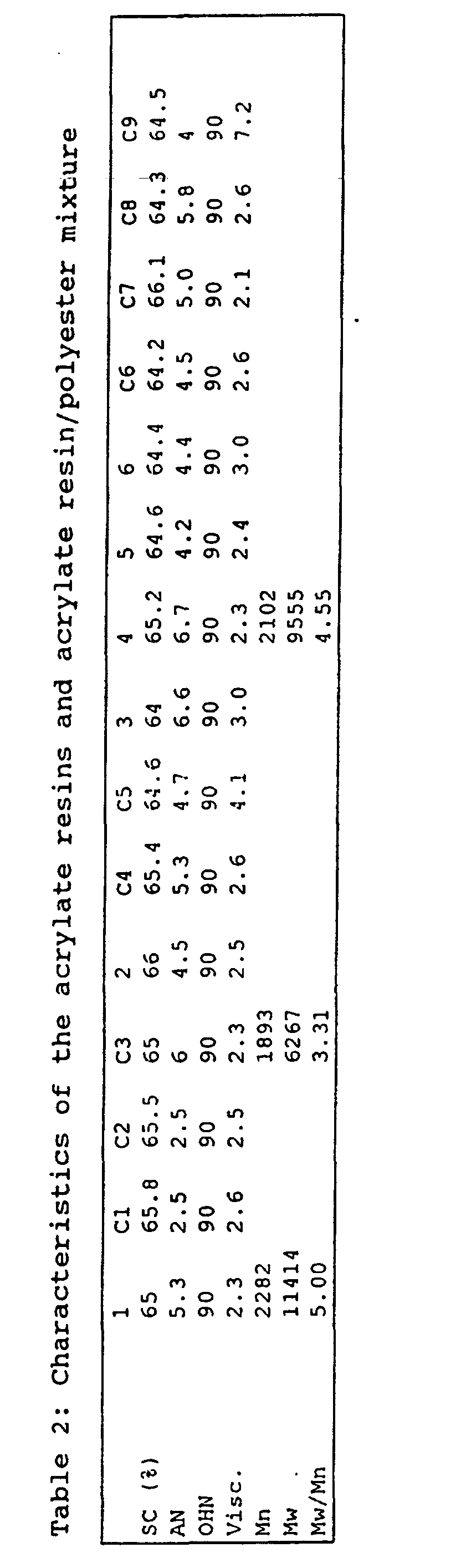

Claims (6)
- Coating compositions comprising as a component (A)the sum of the proportions by weight of monomers (a) to (f) being in each case 100% by weight,(A1)at least one hydroxy group containing polyester or alkyd resin and(A2)at least one binder containing hydroxyl groups being a polyacrylate resin obtainable by polymerizing(a) from 5 to 50% by weight of one or more monomers selected from the group consisting of 4-hydroxy-n-butyl acrylate, 4-hydroxy-n-butyl methacrylate, 3-hydroxy-n-butyl acrylate, and/or 3-hydroxy-n-butyl methacrylate,(b) from 0 to 50% by weight of an ethylenically unsaturated, copolymerizable monomer which is not (a) and contains hydroxyl groups, or a mixture of such monomers,(c) from 5 to 95% by weight of an aliphatic and/or cycloaliphatic ester of methacrylic and/or acrylic acid which is not (a) or (b), or a mixture of such monomers,(d) from 0 to 30% by weight of a copolymerizable vinyl ester which is not (a), (b) or (c), or a mixture of such monomers,(e) from 0 to 85% by weight of an aromatic vinyl hydrocarbon which is not (a), (b), (c) or (d), or a mixture of such monomers, and(f) from 0 to 10% by weight, preferably from 0 to 8% by weight, of a further ethylenically unsaturated monomer which is not (a), (b), (c), (d) or (e), or a mixture of such monomers,(B) at least one crosslinking agent being a di- and/or polyisocyanate,(C) at least one aromatic mono- and/or polycarboxylic acid and/or at least one anhydride of an aromatic mono-and/or polycarboxylic acid.
- Coating compositions according to claim 1 characterized in that it comprises
from 20 to 60% by weight of the hydroxy group-containing polyester or alkyd resin (A1) and
from 40 to 80% by weight of the polyacrylate resin (A2) which has been prepared, at least partially, in the presence of component (A1). - Coating compositions according to one of claims 1 or 2, characterized in that the amount of component (C) is 0.1 to 2% by weight, based on the weight of component (A).
- Coating compositions according to one of claims 1 to 3, characterized in that they contain as component (C) phtalic anhydride, alkyl and/or alkoxy-substituted phtalic anhydride, a half ester of phtalic anhydride, a half ester of alkyl and/or alkoxy-substituted phtalic anhydride, benzoic acid or alkyl and/or alkoxysubstituted benzoic acid.
- Process for the production of a protective and/or decorative coating on a substrate surface, characterized in that a coating composition according to one of claims 1 to 4 is applied.
- Process according to claim 5 characterized in that the protective and/or decorative coating is a refinish coating.
Applications Claiming Priority (9)
| Application Number | Priority Date | Filing Date | Title |
|---|---|---|---|
| US39602795A | 1995-02-28 | 1995-02-28 | |
| US39603095A | 1995-02-28 | 1995-02-28 | |
| US39602895A | 1995-02-28 | 1995-02-28 | |
| US39602995A | 1995-02-28 | 1995-02-28 | |
| US396027 | 1995-02-28 | ||
| US396030 | 1995-02-28 | ||
| US396029 | 1995-02-28 | ||
| US396028 | 1995-02-28 | ||
| PCT/US1996/002794 WO1996026969A1 (en) | 1995-02-28 | 1996-02-27 | Coating composition based on a binder containing hydroxyl groups, and its use in processes for the production of coatings |
Publications (2)
| Publication Number | Publication Date |
|---|---|
| EP0812336A1 EP0812336A1 (en) | 1997-12-17 |
| EP0812336B1 true EP0812336B1 (en) | 2002-09-04 |
Family
ID=27503390
Family Applications (1)
| Application Number | Title | Priority Date | Filing Date |
|---|---|---|---|
| EP96910353A Expired - Lifetime EP0812336B1 (en) | 1995-02-28 | 1996-02-27 | Coating composition based on a binder containing hydroxyl groups, and its use in processes for the production of coatings |
Country Status (8)
| Country | Link |
|---|---|
| EP (1) | EP0812336B1 (en) |
| JP (1) | JPH11501068A (en) |
| AT (1) | ATE223450T1 (en) |
| BR (1) | BR9607397A (en) |
| CA (1) | CA2213557A1 (en) |
| DE (1) | DE69623448T2 (en) |
| ES (1) | ES2182970T3 (en) |
| WO (1) | WO1996026969A1 (en) |
Families Citing this family (4)
| Publication number | Priority date | Publication date | Assignee | Title |
|---|---|---|---|---|
| US6107403A (en) * | 1995-02-28 | 2000-08-22 | Basf Corporation | Coating composition containing hydroxyl groups, and its use in processes for the production of coatings |
| DE10044670C1 (en) * | 2000-09-09 | 2002-06-13 | Basf Coatings Ag | Non-aqueous coating material curable thermally or thermally and with actinic radiation, process for its production and its use |
| CN111087990B (en) * | 2018-10-23 | 2022-03-15 | 中国石油化工股份有限公司 | High-temperature-resistant gel plugging agent composition and preparation method and application thereof |
| CN114907538B (en) * | 2022-06-27 | 2023-07-14 | 韦尔通科技股份有限公司 | Ultraviolet light curing resin, ultraviolet light curing adhesive and preparation method thereof |
Family Cites Families (5)
| Publication number | Priority date | Publication date | Assignee | Title |
|---|---|---|---|---|
| DE1261260B (en) * | 1961-03-28 | 1968-02-15 | Beck & Co G M B H Dr | Process for the production of storage-stable, heat-curing electrical insulating paints |
| JPS54153900A (en) * | 1978-05-23 | 1979-12-04 | Asahi Chem Ind Co Ltd | Polyurethane coating composition |
| JPS5626962A (en) * | 1979-08-11 | 1981-03-16 | Asahi Chem Ind Co Ltd | Coating composition |
| JPS5845218A (en) * | 1981-09-10 | 1983-03-16 | Sumitomo Chem Co Ltd | Polyurethane composition |
| US5157100A (en) * | 1991-09-20 | 1992-10-20 | The Sherwin-Williams Company | Method for extending the pot-life of polyol-polyisocyanate mixtures |
-
1996
- 1996-02-27 AT AT96910353T patent/ATE223450T1/en not_active IP Right Cessation
- 1996-02-27 EP EP96910353A patent/EP0812336B1/en not_active Expired - Lifetime
- 1996-02-27 WO PCT/US1996/002794 patent/WO1996026969A1/en not_active Ceased
- 1996-02-27 ES ES96910353T patent/ES2182970T3/en not_active Expired - Lifetime
- 1996-02-27 BR BR9607397A patent/BR9607397A/en not_active Application Discontinuation
- 1996-02-27 JP JP8526418A patent/JPH11501068A/en active Pending
- 1996-02-27 DE DE69623448T patent/DE69623448T2/en not_active Expired - Lifetime
- 1996-02-27 CA CA002213557A patent/CA2213557A1/en not_active Abandoned
Also Published As
| Publication number | Publication date |
|---|---|
| ATE223450T1 (en) | 2002-09-15 |
| MX9706383A (en) | 1997-11-29 |
| DE69623448D1 (en) | 2002-10-10 |
| ES2182970T3 (en) | 2003-03-16 |
| CA2213557A1 (en) | 1996-09-06 |
| EP0812336A1 (en) | 1997-12-17 |
| WO1996026969A1 (en) | 1996-09-06 |
| DE69623448T2 (en) | 2003-04-30 |
| JPH11501068A (en) | 1999-01-26 |
| BR9607397A (en) | 1998-06-30 |
Similar Documents
| Publication | Publication Date | Title |
|---|---|---|
| US5326820A (en) | Coating agents based on hydroxyl-containing polycondensation and polyaddition products and their use | |
| US6120851A (en) | Coating agent based on a branched hydroxyl group-containing polyester-modified polyacrylate resin and use thereof | |
| US6309707B1 (en) | Coating composition comprising at least 3 components, process for its preparation, and its use | |
| US5276097A (en) | Coating agent based on polymers containing carboxyl groups and crosslinking agents containing epoxide groups, processes for the preparation of the coating agent and its use | |
| US5759631A (en) | Coating composition based on a hydroxyl group-containing polyacrylate resin and its use in processes for producing a multicoat finish | |
| US6107403A (en) | Coating composition containing hydroxyl groups, and its use in processes for the production of coatings | |
| US6984693B2 (en) | Two stage cure two component coating composition containing hydroxylbutyl acrylate polymers | |
| US6512044B1 (en) | Coating agent, method for producing said coating agent and use of the same as a coating lacquer or a clear lacquer, especially for coating plastics | |
| JP5044407B2 (en) | Coating composition and method for producing a multilayer coating | |
| AU710473B2 (en) | Coating composition based on a hydroxyl-containing polyacrylate resin and its use in processes for the production of a multilayer coating | |
| US6180180B1 (en) | Aqueous two-component polyurethane coating agent, process for its production, its use as a finishing coating material or clear coating material, and its use for coating plastics | |
| CA2235077A1 (en) | Coating composition comprising at least 3 components, process for its preparation, and its use | |
| US6099912A (en) | Coating agent on the basis of a polyacrylate resin containing an hydroxyl group, and its use in a method of producing a multiple-layer paint coating | |
| US7049370B2 (en) | Non-aqueous coating material which is thermally hardenable or hardenable in a thermal manner and by means of actinic radiation, method for the production and use thereof | |
| US6268021B1 (en) | Binder vehicle and coating medium composition and the use thereof for multi-layer coating | |
| EP1570012B1 (en) | Coating composition containing acid functional acrylic copolymer and silica | |
| US6113988A (en) | 3-component coating composition of high solvent resistance and high masking resistance | |
| EP1541647A1 (en) | Aqueous two-component coating compositions | |
| EP0812336A1 (en) | Coating composition based on a binder containing hydroxyl groups, and its use in processes for the production of coatings | |
| EP0885908A1 (en) | Coating composition based on a polyacrylate resin containing hydroxyl groups, and its use in processes for the production of coatings | |
| EP0885907A1 (en) | Coating composition based on a polyacrylate resin containing hydroxyl groups, and its use in processes for the production of coatings | |
| MXPA97006383A (en) | Coating composition based on a aglomerante containing oxhydryl groups, and its use inprocesses for the production of coatings | |
| CA2170474A1 (en) | Coating composition containing hydroxyl groups, and its use in processes for the production of coatings | |
| CA2170475A1 (en) | Coating composition based on a polyacrylate resin containing hydroxyl groups, and its use in processes for the production of coatings | |
| CA2232875C (en) | 3-component coating composition of high solvent resistance and high masking resistance |
Legal Events
| Date | Code | Title | Description |
|---|---|---|---|
| PUAI | Public reference made under article 153(3) epc to a published international application that has entered the european phase |
Free format text: ORIGINAL CODE: 0009012 |
|
| 17P | Request for examination filed |
Effective date: 19970822 |
|
| AK | Designated contracting states |
Kind code of ref document: A1 Designated state(s): AT BE CH DE DK ES FR GB IT LI NL SE |
|
| 17Q | First examination report despatched |
Effective date: 19980119 |
|
| GRAG | Despatch of communication of intention to grant |
Free format text: ORIGINAL CODE: EPIDOS AGRA |
|
| GRAG | Despatch of communication of intention to grant |
Free format text: ORIGINAL CODE: EPIDOS AGRA |
|
| GRAH | Despatch of communication of intention to grant a patent |
Free format text: ORIGINAL CODE: EPIDOS IGRA |
|
| GRAH | Despatch of communication of intention to grant a patent |
Free format text: ORIGINAL CODE: EPIDOS IGRA |
|
| GRAA | (expected) grant |
Free format text: ORIGINAL CODE: 0009210 |
|
| AK | Designated contracting states |
Kind code of ref document: B1 Designated state(s): AT BE CH DE DK ES FR GB IT LI NL SE |
|
| PG25 | Lapsed in a contracting state [announced via postgrant information from national office to epo] |
Ref country code: NL Free format text: LAPSE BECAUSE OF FAILURE TO SUBMIT A TRANSLATION OF THE DESCRIPTION OR TO PAY THE FEE WITHIN THE PRESCRIBED TIME-LIMIT Effective date: 20020904 Ref country code: LI Free format text: LAPSE BECAUSE OF FAILURE TO SUBMIT A TRANSLATION OF THE DESCRIPTION OR TO PAY THE FEE WITHIN THE PRESCRIBED TIME-LIMIT Effective date: 20020904 Ref country code: CH Free format text: LAPSE BECAUSE OF FAILURE TO SUBMIT A TRANSLATION OF THE DESCRIPTION OR TO PAY THE FEE WITHIN THE PRESCRIBED TIME-LIMIT Effective date: 20020904 Ref country code: BE Free format text: LAPSE BECAUSE OF FAILURE TO SUBMIT A TRANSLATION OF THE DESCRIPTION OR TO PAY THE FEE WITHIN THE PRESCRIBED TIME-LIMIT Effective date: 20020904 Ref country code: AT Free format text: LAPSE BECAUSE OF FAILURE TO SUBMIT A TRANSLATION OF THE DESCRIPTION OR TO PAY THE FEE WITHIN THE PRESCRIBED TIME-LIMIT Effective date: 20020904 |
|
| REF | Corresponds to: |
Ref document number: 223450 Country of ref document: AT Date of ref document: 20020915 Kind code of ref document: T |
|
| REG | Reference to a national code |
Ref country code: GB Ref legal event code: FG4D |
|
| REG | Reference to a national code |
Ref country code: CH Ref legal event code: EP |
|
| REF | Corresponds to: |
Ref document number: 69623448 Country of ref document: DE Date of ref document: 20021010 |
|
| PG25 | Lapsed in a contracting state [announced via postgrant information from national office to epo] |
Ref country code: SE Free format text: LAPSE BECAUSE OF FAILURE TO SUBMIT A TRANSLATION OF THE DESCRIPTION OR TO PAY THE FEE WITHIN THE PRESCRIBED TIME-LIMIT Effective date: 20021204 Ref country code: DK Free format text: LAPSE BECAUSE OF FAILURE TO SUBMIT A TRANSLATION OF THE DESCRIPTION OR TO PAY THE FEE WITHIN THE PRESCRIBED TIME-LIMIT Effective date: 20021204 |
|
| NLV1 | Nl: lapsed or annulled due to failure to fulfill the requirements of art. 29p and 29m of the patents act | ||
| ET | Fr: translation filed | ||
| REG | Reference to a national code |
Ref country code: CH Ref legal event code: PL |
|
| REG | Reference to a national code |
Ref country code: ES Ref legal event code: FG2A Ref document number: 2182970 Country of ref document: ES Kind code of ref document: T3 |
|
| PLBQ | Unpublished change to opponent data |
Free format text: ORIGINAL CODE: EPIDOS OPPO |
|
| PLBI | Opposition filed |
Free format text: ORIGINAL CODE: 0009260 |
|
| PLAX | Notice of opposition and request to file observation + time limit sent |
Free format text: ORIGINAL CODE: EPIDOSNOBS2 |
|
| 26 | Opposition filed |
Opponent name: AKZO NOBEL N.V. Effective date: 20030602 |
|
| PLAX | Notice of opposition and request to file observation + time limit sent |
Free format text: ORIGINAL CODE: EPIDOSNOBS2 |
|
| PLBB | Reply of patent proprietor to notice(s) of opposition received |
Free format text: ORIGINAL CODE: EPIDOSNOBS3 |
|
| PLCK | Communication despatched that opposition was rejected |
Free format text: ORIGINAL CODE: EPIDOSNREJ1 |
|
| PLBN | Opposition rejected |
Free format text: ORIGINAL CODE: 0009273 |
|
| STAA | Information on the status of an ep patent application or granted ep patent |
Free format text: STATUS: OPPOSITION REJECTED |
|
| 27O | Opposition rejected |
Effective date: 20050707 |
|
| PGFP | Annual fee paid to national office [announced via postgrant information from national office to epo] |
Ref country code: IT Payment date: 20140220 Year of fee payment: 19 Ref country code: FR Payment date: 20140224 Year of fee payment: 19 Ref country code: ES Payment date: 20140321 Year of fee payment: 19 |
|
| PGFP | Annual fee paid to national office [announced via postgrant information from national office to epo] |
Ref country code: GB Payment date: 20140228 Year of fee payment: 19 |
|
| PGFP | Annual fee paid to national office [announced via postgrant information from national office to epo] |
Ref country code: DE Payment date: 20140430 Year of fee payment: 19 |
|
| REG | Reference to a national code |
Ref country code: DE Ref legal event code: R119 Ref document number: 69623448 Country of ref document: DE |
|
| GBPC | Gb: european patent ceased through non-payment of renewal fee |
Effective date: 20150227 |
|
| REG | Reference to a national code |
Ref country code: FR Ref legal event code: ST Effective date: 20151030 |
|
| PG25 | Lapsed in a contracting state [announced via postgrant information from national office to epo] |
Ref country code: IT Free format text: LAPSE BECAUSE OF NON-PAYMENT OF DUE FEES Effective date: 20150227 |
|
| PG25 | Lapsed in a contracting state [announced via postgrant information from national office to epo] |
Ref country code: GB Free format text: LAPSE BECAUSE OF NON-PAYMENT OF DUE FEES Effective date: 20150227 Ref country code: DE Free format text: LAPSE BECAUSE OF NON-PAYMENT OF DUE FEES Effective date: 20150901 |
|
| PG25 | Lapsed in a contracting state [announced via postgrant information from national office to epo] |
Ref country code: FR Free format text: LAPSE BECAUSE OF NON-PAYMENT OF DUE FEES Effective date: 20150302 |
|
| REG | Reference to a national code |
Ref country code: ES Ref legal event code: FD2A Effective date: 20160329 |
|
| PG25 | Lapsed in a contracting state [announced via postgrant information from national office to epo] |
Ref country code: ES Free format text: LAPSE BECAUSE OF NON-PAYMENT OF DUE FEES Effective date: 20150228 |