EP0811511A2 - Aircraft brake heat shield having easily removed heat shield sections - Google Patents
Aircraft brake heat shield having easily removed heat shield sections Download PDFInfo
- Publication number
- EP0811511A2 EP0811511A2 EP97108875A EP97108875A EP0811511A2 EP 0811511 A2 EP0811511 A2 EP 0811511A2 EP 97108875 A EP97108875 A EP 97108875A EP 97108875 A EP97108875 A EP 97108875A EP 0811511 A2 EP0811511 A2 EP 0811511A2
- Authority
- EP
- European Patent Office
- Prior art keywords
- heat shield
- wheel
- tube well
- carriers
- torque
- Prior art date
- Legal status (The legal status is an assumption and is not a legal conclusion. Google has not performed a legal analysis and makes no representation as to the accuracy of the status listed.)
- Granted
Links
Images



Classifications
-
- B—PERFORMING OPERATIONS; TRANSPORTING
- B60—VEHICLES IN GENERAL
- B60C—VEHICLE TYRES; TYRE INFLATION; TYRE CHANGING; CONNECTING VALVES TO INFLATABLE ELASTIC BODIES IN GENERAL; DEVICES OR ARRANGEMENTS RELATED TO TYRES
- B60C23/00—Devices for measuring, signalling, controlling, or distributing tyre pressure or temperature, specially adapted for mounting on vehicles; Arrangement of tyre inflating devices on vehicles, e.g. of pumps or of tanks; Tyre cooling arrangements
- B60C23/18—Tyre cooling arrangements, e.g. heat shields
-
- B—PERFORMING OPERATIONS; TRANSPORTING
- B60—VEHICLES IN GENERAL
- B60B—VEHICLE WHEELS; CASTORS; AXLES FOR WHEELS OR CASTORS; INCREASING WHEEL ADHESION
- B60B19/00—Wheels not otherwise provided for or having characteristics specified in one of the subgroups of this group
- B60B19/10—Wheels not otherwise provided for or having characteristics specified in one of the subgroups of this group with cooling fins
-
- F—MECHANICAL ENGINEERING; LIGHTING; HEATING; WEAPONS; BLASTING
- F16—ENGINEERING ELEMENTS AND UNITS; GENERAL MEASURES FOR PRODUCING AND MAINTAINING EFFECTIVE FUNCTIONING OF MACHINES OR INSTALLATIONS; THERMAL INSULATION IN GENERAL
- F16D—COUPLINGS FOR TRANSMITTING ROTATION; CLUTCHES; BRAKES
- F16D55/00—Brakes with substantially-radial braking surfaces pressed together in axial direction, e.g. disc brakes
- F16D55/24—Brakes with substantially-radial braking surfaces pressed together in axial direction, e.g. disc brakes with a plurality of axially-movable discs, lamellae, or pads, pressed from one side towards an axially-located member
- F16D55/26—Brakes with substantially-radial braking surfaces pressed together in axial direction, e.g. disc brakes with a plurality of axially-movable discs, lamellae, or pads, pressed from one side towards an axially-located member without self-tightening action
- F16D55/36—Brakes with a plurality of rotating discs all lying side by side
-
- F—MECHANICAL ENGINEERING; LIGHTING; HEATING; WEAPONS; BLASTING
- F16—ENGINEERING ELEMENTS AND UNITS; GENERAL MEASURES FOR PRODUCING AND MAINTAINING EFFECTIVE FUNCTIONING OF MACHINES OR INSTALLATIONS; THERMAL INSULATION IN GENERAL
- F16D—COUPLINGS FOR TRANSMITTING ROTATION; CLUTCHES; BRAKES
- F16D55/00—Brakes with substantially-radial braking surfaces pressed together in axial direction, e.g. disc brakes
- F16D2055/0004—Parts or details of disc brakes
- F16D2055/0058—Fully lined, i.e. braking surface extending over the entire disc circumference
-
- F—MECHANICAL ENGINEERING; LIGHTING; HEATING; WEAPONS; BLASTING
- F16—ENGINEERING ELEMENTS AND UNITS; GENERAL MEASURES FOR PRODUCING AND MAINTAINING EFFECTIVE FUNCTIONING OF MACHINES OR INSTALLATIONS; THERMAL INSULATION IN GENERAL
- F16D—COUPLINGS FOR TRANSMITTING ROTATION; CLUTCHES; BRAKES
- F16D65/00—Parts or details
- F16D65/02—Braking members; Mounting thereof
- F16D2065/13—Parts or details of discs or drums
- F16D2065/134—Connection
- F16D2065/1356—Connection interlocking
- F16D2065/1368—Connection interlocking with relative movement both radially and axially
Definitions
- the invention is in the field of heat shields for aircraft wheel and brake assemblies. More particularly, the invention relates to such heat shields having removable sections.
- Heat shields have been used for many years in aircraft wheel and brake assemblies in order to prevent conduction and radiation to the aircraft wheel of heat energy generated in the brake disks during braking. Excessive temperatures in the aircraft wheel can damage the wheel and the aircraft tire. The heat shield also prevents hot brake material ejected from the brake disks during braking from being slung against the inside of the wheel, which can also damage the wheel and further contribute to excessive temperatures.
- An early example of a heat shield is described by United States Patent 3,051,528 issued in 1962 to R.R. Rogers. The Rogers heat shield comprises a multitude of curved heat shield sections captivated between adjacent drive keys. More recent examples are described by United States Patent 4,017,123 issued in 1977 to Horner et al.
- a single piece full circle heat shield is attached to the wheel and brake assembly between the wheel and the torque bars.
- the heat shield is spaced from both the torque bars and the aircraft wheel in order to minimize heat conduction to the heat shield from the torque bars.
- the heat shield comprises two cylindrical stainless steel sheets spaced from each other, with insulation in between.
- a heat shield constructed in such manner, though certainly safe and effective, embodies some undesirable characteristics. For example, the shield tends to warp and buckle during use due to thermal expansion and contraction induced by braking cycles.
- removing a damaged heat shield generally requires removing all the torque bars from the aircraft wheel assembly.
- a heat shield that partially solves these problems is described in United States Patent 5,002,342 issued in 1991 to Dyko.
- the Dyko shield comprises a plurality of heat shield sectors that together define a full circle heat shield.
- the edges of the heat shield are interleaved in a manner that permits relative expansion and contraction of the heat shield sectors induced by thermal gradients. This feature reduces the tendency of the heat shield to warp and buckle during use. Dividing the heat shield into sectors requires only the removal of those torque bars corresponding to that sector. Individual sectors may be removed and replaced as necessary without replacing the entire heat shield.
- a similar heat shield having sectors connected by hinged edges is described in United State Patent 5,236,249 issued in 1993 to Han et al.
- a heat shield for attachment to an aircraft wheel having a hub and a tube well concentric with the hub, a web interconnecting the hub and the tube well, and a plurality of torque bars fixed to the wheel generally parallel to the axis of rotation of the wheel and spaced from the tube well, comprising:
- a wheel and heat shield assembly is provided, and a wheel and brake assembly having a heat shield is provided, the heat shield having the characteristics noted in the previous paragraph.
- the heat shield according to the invention has easily removed heat shield sections that are removable without loosening or removing any torque bars, and the heat shield is suitable for use with carbon/carbon brake disks.
- FIG-1 is a side cross-sectional view of a wheel and brake assembly according to an aspect of the invention mounted on an aircraft bogie axle.
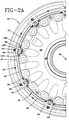
- FIG -2A is the left half of a front view of a full wheel and heat shield assembly according to an aspect of the invention, looking into the wheel from the left side of FIG-1.
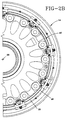
- FIG-2B is the right half of a front view of a full wheel and heat shield assembly according to an aspect of the invention, looking into the wheel from the left side of FIG-1.
- FIG-3A is the top view of an elongate heat shield carrier according to an aspect of the invention.
- FIG-3B is a front elevation view of the FIG-3A elongate heat shield carrier.
- FIG-3C is a cross-sectional side view along line 3C-3C of FIG-3A.
- FIG-4A is the top view of a heat shield section according to an aspect of the invention.
- FIG-4B is a front elevation view of the FIG-4A heat shield section.
- FIG-4C is a cross-sectional side view along line 4C-4C of FIG-4A.
- FIG-5 is a top view of a heat shield section engaged with an elongate heat shield carrier, according to an aspect of the invention.
- FIG. 1 a side cross-sectional view is presented of an aircraft wheel and brake assembly 10 according to an aspect of the invention mounted on an aircraft bogie axle 12.
- the wheel and brake assembly 10 comprises a wheel 14 (only one wheel-half shown for clarity) having a hub 16 and a tube well 18 concentric with the hub 16, and a web 20 interconnecting the hub 16 and the tube well 18.
- a torque take-out assembly 22 aligned with the hub 16, and the wheel 14 is rotatable relative to the torque take-out assembly 22.
- a plurality of torque bars 24 are fixed to the wheel 14 generally parallel to the axis of rotation 26 of the wheel and spaced from the tube well 18.
- a heat sink 28 is disposed within the wheel 14, and comprises brake or friction disks in the form of rotors 32 and stators 34.
- the rotors 32 are engaged against rotation to the torque bars 24, and the stators 34 are engaged against rotation to the torque take-out assembly 22.
- the stators 34 may also comprise a pressure plate 36 and end plate 38 on the ends of the heat sink 28, which are also engaged against rotation to the torque take-out assembly 22.
- the friction disks may be formed from any material suitable for friction disks, including metals, such as steel with a sintered metallic friction lining, and ceramics or carbon materials, such as a carbon/carbon material.
- the heat sink 28 is a carbon/carbon composite heat sink having at least one carbon/carbon rotor 32 interleaved with a plurality of carbon/carbon stators 34.
- At least one actuator 30 is fixed to the torque take-out assembly 22 configured to compress the heat sink 28.
- the actuator is a hydraulically actuated piston, but other types of actuators may be used in the practice of the invention, such as electro-mechanical actuators.
- a heat shield 40 is attached to the wheel 14 disposed between the tube well 18 and the heat sink 28.
- the heat shield 40 is concentric with the tube well 18 and has a plurality of heat shield sections 42 disposed between adjacent torque bars 24 and spaced from the tube well 18, and a plurality of elongate heat shield carriers 44 fixed to the wheel 14 generally parallel to the axis of rotation 26 of the wheel 14 intermediate the torque bars 24 and the tube well 18.
- the heat shield carriers are spaced from the tube well 18, and 44 superpose the torque bars 24 and engage the plurality of heat shield sections 42.
- the heat shield 40 and the tube well 18 define an annular space 46 therebetween, preferably occupied by air. Contact of the heat shield sections 42 and/or the heat shield carriers 44 with the tube well 18 can cause fretting and increase conductive heat transfer to the tube well 18, both of which are undesirable. The manner in which the heat shield carriers engage the heat shield sections 42 will be discussed in greater detail with reference to Figures 3-5.
- the torque bars 24 and heat shield carriers 44 are preferably attached to the wheel 14 by torque bar bolts 48.
- the torque bars 24 are spaced from the tube well 18 in order to minimize heat transfer into the tube well 18 during braking.
- Each torque bar 24 preferably has a pin 50 at the end opposite the torque bar bolts 48 that is received within a hole 52 in the web 20.
- the heat shield carriers 44 are preferably spaced from the torque bars 24 toward the tube well 18.
- the space 60 between the torque bars 24 and heat shield carriers 44 is preferably filled with air, and serves to insulate the heat shield carriers 44 from the torque bars 24, and reduces the maximum temperature generated in the heat shield carrier 44 during braking. Reducing the maximum temperature in the heat shield carrier 44 reduces the amount of heat energy radiated to the tube well 18 during braking, thereby increasing the effectiveness of the heat shield 40.
- the heat shield carriers may have support portions 56 that ride on the torque bars 24, and resilient restraints 58 that contact the tube well 18 that restrain radial movement of the heat shield carriers 44 toward the tube well 18.
- the area of contact between the torque bars 24 and heat shield carriers 44 is preferably minimized in order to minimize the amount of heat conduction into the heat shield carriers 44 during braking.
- the heat shield sections 42 are removable without loosening and/or removing any torque bars 24.
- the heat shield sections 42 may be attached to the tube well 18 by suitable fasteners, for example, heat shield bolts 54.
- the heat shield sections 42 may accumulate damage that necessitates replacement before scheduled maintenance of the wheel and brake assembly. If this occurs, one or more damaged heat shield sections 42 may be replaced by removing the heat shield bolts 54 for those sections, pulling the damaged sections from the wheel and heat assembly, inserting new heat shield sections 42, and replacing the heat shield bolts 54. This may be accomplished without removing a single torque bar 24. This greatly facilitates field repair of the heat shield 40.
- the elongate heat shield carrier 44 is preferably generally flat (not arcuate about the axis of rotation 26), and may be manufactured by forming or stamping a flat piece of stainless steel in a series of operations.
- the heat shield carriers 44 is generally configured as a flat strip having a pair of opposite edges 62. Referring to Figures 1 and 3, the opposite edges 62 of the heat shield carrier 44 are generally parallel to the axis of rotation 26 of the wheel 14, and may be configured as a groove-like edge.
- each groove-like edge refers to any edge geometry that receives a tongue or tab structure and restrains inward and outward radial movement of such structure.
- each groove-like edge comprises a first tab 64 proximate the web 20 configured to restrain radial movement of an adjacent heat shield section 42 toward the tube well 18, and a second consecutive tab 66 spaced from the web 20 configured to restrain radial movement of the heat shield section 42 toward the torque bar 24.
- Other configurations for the groove-like edges are apparent to those skilled in the art, in light of the description provided herein, any of which are considered to fall within the purview of the invention.
- both the first tab 64 and second tab 66 could extend the full length of the edges 62.
- the example presented is inexpensive to manufacture, and is effective in restraining radial movement of the heat shield sections 42.
- a mounting hole 68 that receives the torque bar bolt 48 is provided in a mounting portion 104 of the heat shield carrier 44.
- a raised edge 94 encircling the mounting hole 68 may be provided. As will become evident, the raised portion 94 minimizes or prevents radial movement of the mounting portion 104.
- a spacer 96 is provided between the torque bar 24 and the wheel 14.
- the spacer 96 has a channel 98 keyed to a pair of ledges 100 on the torque bar 24.
- the spacer 96 is recessed between the ledges 100, thus providing a spacer air space 102 which reduces conductive heat transfer from the torque bar 24 to the wheel 14.
- the mounting portion 104 of heat shield carrier 44 is inserted into spacer air space 102.
- the raised edge 94 in combination with the thickness the mounting portion 104, is dimensioned equal to or just slightly less than the thickness of the spacer air space 102, thereby restraining undesired radial movement of the mounting portion 104 within spacer air space 102 between the wheel 14 and spacer 96.
- Dimensioning the raised edge 94 also limits or prevents imposing a compressive force on the mounting portion 104 when the torque bar bolts 48 are installed and tightened.
- the support portion 56 is formed as a tab offset from the body of the heat shield carrier 44.
- the support portion 56 has a pair of ears 70 bent around the torque bar 24 spaced from each other a distance slightly greater than the width of the torque bar 24.
- a hole is also provided to receive the resilient restraint 58, which may be formed from resilient materials having good insulating qualities and suitable resistance to the associated application temperatures, for example a silicone elastomer. The resilient restrain 58 prevents the heat shield carrier 44 from rubbing against the tube well 18 during rotation, as well as ensuring engagement of the heat shield carrier 44 with the torque bar 24.
- Heat shield section 42 preferably comprises an upper sheet 72, and a lower sheet 74.
- the upper sheet 72 may take the shape of a pan having a lip 76, and is joined to the lower sheet 74 around the circumference of the heat shield section 42 at the lip 76 by suitable means, including spot welding and/or bending a tab from the lower sheet 74 around the lip 76.
- a portion of the lip 76 preferably forms a pair of opposite tongue-like edges 78 generally parallel to the axis of rotation 26 of the wheel 14 ( Figure 1).
- Joints that permit relative movement induced by thermal expansion and contraction are generally employed, where possible, to provide thermal stress relief and minimize thermal stress warpage of the heat shield section 42.
- tabs from the lower sheet 74 are bent around the lip 76 along edges 78 without rigidly fixing the upper sheet 72 and lower sheet 74 to each other in order to permit relative movement due to thermal expansion and contraction.
- the upper sheet 72 and lower sheet 74 at one or both of end portions 80 of lip 76 may be rigidly fixed by suitable means, including spot and seam welding. Welding only one end portion 80 of lip 76 provides the maximum amount of movement for thermal expansion and contraction.
- tabs (not shown) from the lower sheet 74 are bent around only one end portion 80 of lip 76 opposite the end portion 80 that is welded.
- a cup 82 may be inserted through a corresponding hole in the lower sheet 74 and be rigidly fixed to the lower sheet 74 by suitable means, including spot welding.
- the upper sheet 72 and lower sheet 74 define a space 84 therebetween.
- the cup 82 may be configured to help maintain a desired spacing between the upper sheet and 72 and lower sheet 74 by defining a ledge 84 that rests against the upper sheet 72.
- the space 86 may be filled with only air, but is preferably filled with a suitable insulating material 88, for example, a ceramic paper. If filled with air, a thin stainless steel foil may be provided as a radiant heat barrier between the upper sheet 72 and lower sheet 74. The stainless steel foil may be dimpled to maintain its position between the upper and lower sheets 72 and 74.
- a heat shield mounting hole 90 may be formed in the cup 82 and top sheet 72 for receiving a heat shield bolt 54 ( Figures 1 and 2) that fixes the heat shield section 42 to the wheel 14.
- a raised bearing surface 92 may also be provided to help ensure that the bulk of the heat shield section 42 is spaced from the tube well 18.
- the upper sheet 72, the lower sheet 74, and the cup 82 are preferably formed from a stainless steel alloy.
- the heat shield section may be flat or curved (arcuate), but is preferably curved in order optimize space inside the wheel and brake assembly, as presented in the drawings. Configuring the heat shield sections 42 in the manner described herein permits the heat shield sections 42 to closely follow the geometry of the tube well 18 and optimize heat shield geometry to maximize heat shielding in the available space.
- FIG. 5 a top view of a heat shield section 42 engaged with an adjacent elongate heat shield carrier 44 is presented, according to an aspect of the invention.
- the opposite edges 62 of the heat shield carrier 44 are configured as groove-like edges, and receive the tongue-like edges 78 of the heat shield section 42.
- Tab 64 is configured to restrain radial movement of the heat shield section 42 toward the tube well 18 ( Figures 1 and 2)
- Tab 66 is configured to restrain radial movement of the heat shield section 42 toward the torque bar 24 ( Figures 1 and 2).
- the opposite edges 62 of the heat shield carrier 44 are configured to cooperate with the heat shield sections 42 to restrain radial movement of the heat shield sections 42.
- the opposite edges 62 of the heat shield carrier 44 also cooperate with the heat shield sections 42 to restrain rotation of the heat shield sections 42 around the heat shield bolts 54.
- the distance between the tongue-like edges 78 is dimensioned to allow circumferential thermal expansion and contraction of the heat shield sections 42 when installed between the heat shield carriers 44.
Landscapes
- Engineering & Computer Science (AREA)
- Mechanical Engineering (AREA)
- General Engineering & Computer Science (AREA)
- Braking Arrangements (AREA)
Abstract
Description
- The invention is in the field of heat shields for aircraft wheel and brake assemblies. More particularly, the invention relates to such heat shields having removable sections.
- Heat shields have been used for many years in aircraft wheel and brake assemblies in order to prevent conduction and radiation to the aircraft wheel of heat energy generated in the brake disks during braking. Excessive temperatures in the aircraft wheel can damage the wheel and the aircraft tire. The heat shield also prevents hot brake material ejected from the brake disks during braking from being slung against the inside of the wheel, which can also damage the wheel and further contribute to excessive temperatures. An early example of a heat shield is described by United States Patent 3,051,528 issued in 1962 to R.R. Rogers. The Rogers heat shield comprises a multitude of curved heat shield sections captivated between adjacent drive keys. More recent examples are described by United States Patent 4,017,123 issued in 1977 to Horner et al. and United States Patent 4,084,857 issued in 1978 to VanderVeen. These heat shields also comprise curved heat shield sections captivated between adjacent drive keys. The Horner et al. heat shield sections are captive between the drive key caps and ledges formed on the drive keys. The edges and drive keys are integrally formed with the wheel, which is typical of wheel and brake assemblies having steel disks. Horner et al. states that the heat shield sections could be used with the removable keys presented in Rogers. However, exactly how this would be accomplished is not clear because the Rogers drive keys do not have ledges or drive key caps. The VanderVeen heat shield section is captive between the drive key cap and an additional cap having a pair of wings that extend from either side of the drive key. The drive keys are integrally formed with the wheel, and wings eliminate the need for the edges of Horner et al. The heat shields described thus far are representative of the technology developed for wheel and brake assemblies having steel brake disks with metallic friction linings.
- The advent of carbon/carbon brake disks instigated further development of heat shields. Carbon/carbon brakes generally operate at a much higher temperature than their steel counter-parts, which necessitated further steps to minimize conduction and radiation of heat energy into the aircraft wheel. Most wheel and brake assemblies having carbon/carbon brakes now have removable torque bars that are spaced from the inside of the aircraft wheel, with attachments at either end. This arrangement minimizes the conductive path from the torque bars to the wheel. Heat shield contact with the torque bars is preferably minimized for the same reasons. In addition, radiation is a major source of heat transfer from carbon/carbon brakes, which necessitates that the heat shield fully encircle the brake disks with minimum holes or breaks that permit direct radiation of heat energy to the aircraft wheel. Conduction is another major source of heat transfer in carbon/carbon brakes, which is minimized by minimizing contact of the torque bars and heat shield with the aircraft wheel. These considerations caused a significant departure from the previous heat shield technology for steel brakes.
- According to one prior art approach, a single piece full circle heat shield is attached to the wheel and brake assembly between the wheel and the torque bars. The heat shield is spaced from both the torque bars and the aircraft wheel in order to minimize heat conduction to the heat shield from the torque bars. The heat shield comprises two cylindrical stainless steel sheets spaced from each other, with insulation in between. A heat shield constructed in such manner, though certainly safe and effective, embodies some undesirable characteristics. For example, the shield tends to warp and buckle during use due to thermal expansion and contraction induced by braking cycles. In addition, removing a damaged heat shield generally requires removing all the torque bars from the aircraft wheel assembly. A heat shield that partially solves these problems is described in United States Patent 5,002,342 issued in 1991 to Dyko. The Dyko shield comprises a plurality of heat shield sectors that together define a full circle heat shield. The edges of the heat shield are interleaved in a manner that permits relative expansion and contraction of the heat shield sectors induced by thermal gradients. This feature reduces the tendency of the heat shield to warp and buckle during use. Dividing the heat shield into sectors requires only the removal of those torque bars corresponding to that sector. Individual sectors may be removed and replaced as necessary without replacing the entire heat shield. A similar heat shield having sectors connected by hinged edges is described in United State Patent 5,236,249 issued in 1993 to Han et al.
- In spite of these improvements, the Dyko and Han et al. heat shields still require removal of at least some torque bars to replace a sector, and each sector comprises a relatively large portion of the entire heat shield. Removing and replacing any of the torque bars is preferably avoided. Therefore, a heat shield is desired having easily removed individual heat shield sections without removing any torque bars, and the heat shield should be suitable for use with carbon/carbon brake disks.
- According to an aspect of the invention, a heat shield is provided for attachment to an aircraft wheel having a hub and a tube well concentric with the hub, a web interconnecting the hub and the tube well, and a plurality of torque bars fixed to the wheel generally parallel to the axis of rotation of the wheel and spaced from the tube well, comprising:
- a plurality of heat shield sections to be disposed between adjacent torque bars and spaced from the tube well; and,
- a plurality of elongate heat shield carriers to be fixed to the wheel generally parallel to the axis of rotation of the wheel and spaced from the tube well with the heat shield carriers superposing the torque bars and engaging the plurality of heat shield sections, the plurality of heat shield sections and the plurality of elongate heat shield carriers thereby defining a generally cylindrical wall concentric with the tube well and defining an annular space therebetween.
- According to further aspects of the invention, a wheel and heat shield assembly is provided, and a wheel and brake assembly having a heat shield is provided, the heat shield having the characteristics noted in the previous paragraph. The heat shield according to the invention has easily removed heat shield sections that are removable without loosening or removing any torque bars, and the heat shield is suitable for use with carbon/carbon brake disks.
- FIG-1 is a side cross-sectional view of a wheel and brake assembly according to an aspect of the invention mounted on an aircraft bogie axle.
- FIG -2A is the left half of a front view of a full wheel and heat shield assembly according to an aspect of the invention, looking into the wheel from the left side of FIG-1.
- FIG-2B is the right half of a front view of a full wheel and heat shield assembly according to an aspect of the invention, looking into the wheel from the left side of FIG-1.
- FIG-3A is the top view of an elongate heat shield carrier according to an aspect of the invention.
- FIG-3B is a front elevation view of the FIG-3A elongate heat shield carrier.
- FIG-3C is a cross-sectional side view along
line 3C-3C of FIG-3A. - FIG-4A is the top view of a heat shield section according to an aspect of the invention.
- FIG-4B is a front elevation view of the FIG-4A heat shield section.
- FIG-4C is a cross-sectional side view along
line 4C-4C of FIG-4A. - FIG-5 is a top view of a heat shield section engaged with an elongate heat shield carrier, according to an aspect of the invention.
- Various aspects of the invention are presented in Figures 1-5,
wherein like components are numbered alike. Referring now to Figure 1, a side cross-sectional view is presented of an aircraft wheel andbrake assembly 10 according to an aspect of the invention mounted on an aircraft bogie axle 12. The wheel andbrake assembly 10 comprises a wheel 14 (only one wheel-half shown for clarity) having ahub 16 and a tube well 18 concentric with thehub 16, and aweb 20 interconnecting thehub 16 and thetube well 18. A torque take-out assembly 22 aligned with thehub 16, and thewheel 14 is rotatable relative to the torque take-out assembly 22. A plurality oftorque bars 24 are fixed to thewheel 14 generally parallel to the axis ofrotation 26 of the wheel and spaced from the tube well 18. Aheat sink 28 is disposed within thewheel 14, and comprises brake or friction disks in the form ofrotors 32 andstators 34. Therotors 32 are engaged against rotation to the torque bars 24, and thestators 34 are engaged against rotation to the torque take-outassembly 22. Thestators 34 may also comprise apressure plate 36 and end plate 38 on the ends of theheat sink 28, which are also engaged against rotation to the torque take-outassembly 22. The friction disks may be formed from any material suitable for friction disks, including metals, such as steel with a sintered metallic friction lining, and ceramics or carbon materials, such as a carbon/carbon material. According to a preferred embodiment, theheat sink 28 is a carbon/carbon composite heat sink having at least one carbon/carbon rotor 32 interleaved with a plurality of carbon/carbon stators 34. At least oneactuator 30 is fixed to the torque take-outassembly 22 configured to compress theheat sink 28. In the example presented, the actuator is a hydraulically actuated piston, but other types of actuators may be used in the practice of the invention, such as electro-mechanical actuators. Aheat shield 40, according to an aspect of the invention, is attached to thewheel 14 disposed between thetube well 18 and theheat sink 28. - Referring now to Figures 2A and 2B, the left and right half portions of a front view of a full wheel and heat shield assembly is presented looking into the
wheel 14 from the left side of Figure 1. Pertinent features previously discussed in relation to Figure 1 are also presented in Figure 2. Theheat shield 40 is concentric with thetube well 18 and has a plurality ofheat shield sections 42 disposed between adjacent torque bars 24 and spaced from thetube well 18, and a plurality of elongateheat shield carriers 44 fixed to thewheel 14 generally parallel to the axis ofrotation 26 of thewheel 14 intermediate the torque bars 24 and thetube well 18. The heat shield carriers are spaced from thetube well heat shield sections 42. Spacing the heat shield carriers from the torque bars 24 minimizes conductive heat transfer to thewheel 14, and superposing theheat shield carriers 44 over the torque bars 24 minimizes radiation heat transfer from the torque bars to thetube well 18. Theheat shield 40 and the tube well 18 define anannular space 46 therebetween, preferably occupied by air. Contact of theheat shield sections 42 and/or theheat shield carriers 44 with the tube well 18 can cause fretting and increase conductive heat transfer to thetube well 18, both of which are undesirable. The manner in which the heat shield carriers engage theheat shield sections 42 will be discussed in greater detail with reference to Figures 3-5. Referring to Figures 1, 2A and 2B, the torque bars 24 andheat shield carriers 44 are preferably attached to thewheel 14 bytorque bar bolts 48. The torque bars 24 are spaced from the tube well 18 in order to minimize heat transfer into the tube well 18 during braking. Eachtorque bar 24 preferably has apin 50 at the end opposite thetorque bar bolts 48 that is received within ahole 52 in theweb 20. - As best presented in Figure 1, the
heat shield carriers 44 are preferably spaced from the torque bars 24 toward thetube well 18. Thespace 60 between the torque bars 24 andheat shield carriers 44 is preferably filled with air, and serves to insulate theheat shield carriers 44 from the torque bars 24, and reduces the maximum temperature generated in theheat shield carrier 44 during braking. Reducing the maximum temperature in theheat shield carrier 44 reduces the amount of heat energy radiated to the tube well 18 during braking, thereby increasing the effectiveness of theheat shield 40. The heat shield carriers may havesupport portions 56 that ride on the torque bars 24, andresilient restraints 58 that contact the tube well 18 that restrain radial movement of theheat shield carriers 44 toward thetube well 18. The area of contact between the torque bars 24 andheat shield carriers 44 is preferably minimized in order to minimize the amount of heat conduction into theheat shield carriers 44 during braking. - According to a preferred embodiment, the
heat shield sections 42 are removable without loosening and/or removing any torque bars 24. Referring again to Figures 1 and 2, theheat shield sections 42 may be attached to the tube well 18 by suitable fasteners, for example,heat shield bolts 54. Theheat shield sections 42 may accumulate damage that necessitates replacement before scheduled maintenance of the wheel and brake assembly. If this occurs, one or more damagedheat shield sections 42 may be replaced by removing theheat shield bolts 54 for those sections, pulling the damaged sections from the wheel and heat assembly, inserting newheat shield sections 42, and replacing theheat shield bolts 54. This may be accomplished without removing asingle torque bar 24. This greatly facilitates field repair of theheat shield 40. - Referring now to Figures 3A, 3B, and 3C, various views are presented of an embodiment of a heat shield carrier according to an aspect of the invention. The elongate
heat shield carrier 44 is preferably generally flat (not arcuate about the axis of rotation 26), and may be manufactured by forming or stamping a flat piece of stainless steel in a series of operations. Theheat shield carriers 44 is generally configured as a flat strip having a pair of opposite edges 62. Referring to Figures 1 and 3, theopposite edges 62 of theheat shield carrier 44 are generally parallel to the axis ofrotation 26 of thewheel 14, and may be configured as a groove-like edge. As used herein, the term "groove-like edge" refers to any edge geometry that receives a tongue or tab structure and restrains inward and outward radial movement of such structure. In the example presented, each groove-like edge comprises afirst tab 64 proximate theweb 20 configured to restrain radial movement of an adjacentheat shield section 42 toward thetube well 18, and a secondconsecutive tab 66 spaced from theweb 20 configured to restrain radial movement of theheat shield section 42 toward thetorque bar 24. Other configurations for the groove-like edges are apparent to those skilled in the art, in light of the description provided herein, any of which are considered to fall within the purview of the invention. For example, both thefirst tab 64 andsecond tab 66 could extend the full length of theedges 62. However, the example presented is inexpensive to manufacture, and is effective in restraining radial movement of theheat shield sections 42. - A mounting
hole 68 that receives thetorque bar bolt 48 is provided in a mounting portion 104 of theheat shield carrier 44. A raised edge 94 encircling the mountinghole 68 may be provided. As will become evident, the raised portion 94 minimizes or prevents radial movement of the mounting portion 104. As best depicted in Figure 2A, aspacer 96 is provided between thetorque bar 24 and thewheel 14. Thespacer 96 has achannel 98 keyed to a pair ofledges 100 on thetorque bar 24. Thespacer 96 is recessed between theledges 100, thus providing aspacer air space 102 which reduces conductive heat transfer from thetorque bar 24 to thewheel 14. Referring again to Figures 3A-3B, the mounting portion 104 ofheat shield carrier 44 is inserted intospacer air space 102. The raised edge 94, in combination with the thickness the mounting portion 104, is dimensioned equal to or just slightly less than the thickness of thespacer air space 102, thereby restraining undesired radial movement of the mounting portion 104 withinspacer air space 102 between thewheel 14 andspacer 96. Dimensioning the raised edge 94, as noted, also limits or prevents imposing a compressive force on the mounting portion 104 when thetorque bar bolts 48 are installed and tightened. - The
support portion 56 is formed as a tab offset from the body of theheat shield carrier 44. Thesupport portion 56 has a pair ofears 70 bent around thetorque bar 24 spaced from each other a distance slightly greater than the width of thetorque bar 24. A hole is also provided to receive theresilient restraint 58, which may be formed from resilient materials having good insulating qualities and suitable resistance to the associated application temperatures, for example a silicone elastomer. The resilient restrain 58 prevents theheat shield carrier 44 from rubbing against the tube well 18 during rotation, as well as ensuring engagement of theheat shield carrier 44 with thetorque bar 24. - Referring now to Figures 4A, 4B, and 4C, various views are presented of an embodiment of a heat shield section according to a further aspect of the invention.
Heat shield section 42 preferably comprises anupper sheet 72, and alower sheet 74. Theupper sheet 72 may take the shape of a pan having alip 76, and is joined to thelower sheet 74 around the circumference of theheat shield section 42 at thelip 76 by suitable means, including spot welding and/or bending a tab from thelower sheet 74 around thelip 76. A portion of thelip 76 preferably forms a pair of opposite tongue-like edges 78 generally parallel to the axis ofrotation 26 of the wheel 14 (Figure 1). Joints that permit relative movement induced by thermal expansion and contraction are generally employed, where possible, to provide thermal stress relief and minimize thermal stress warpage of theheat shield section 42. In the example presented, tabs from thelower sheet 74 are bent around thelip 76 alongedges 78 without rigidly fixing theupper sheet 72 andlower sheet 74 to each other in order to permit relative movement due to thermal expansion and contraction. Theupper sheet 72 andlower sheet 74 at one or both ofend portions 80 oflip 76 may be rigidly fixed by suitable means, including spot and seam welding. Welding only oneend portion 80 oflip 76 provides the maximum amount of movement for thermal expansion and contraction. In such case, tabs (not shown) from thelower sheet 74 are bent around only oneend portion 80 oflip 76 opposite theend portion 80 that is welded. In practice however, bending tabs from thelower sheet 74 around anarcuate end portion 80 is difficult and increases manufacturing cost, and aheat shield section 42 having theupper sheet 72 andlower sheet 74 welded together at bothend portions 80 has been found to be sufficiently resistant to thermal stress warping. Acup 82 may be inserted through a corresponding hole in thelower sheet 74 and be rigidly fixed to thelower sheet 74 by suitable means, including spot welding. - When completed, the
upper sheet 72 andlower sheet 74 define aspace 84 therebetween. Thecup 82 may be configured to help maintain a desired spacing between the upper sheet and 72 andlower sheet 74 by defining aledge 84 that rests against theupper sheet 72. Thespace 86 may be filled with only air, but is preferably filled with a suitable insulatingmaterial 88, for example, a ceramic paper. If filled with air, a thin stainless steel foil may be provided as a radiant heat barrier between theupper sheet 72 andlower sheet 74. The stainless steel foil may be dimpled to maintain its position between the upper andlower sheets shield mounting hole 90 may be formed in thecup 82 andtop sheet 72 for receiving a heat shield bolt 54 (Figures 1 and 2) that fixes theheat shield section 42 to thewheel 14. A raisedbearing surface 92 may also be provided to help ensure that the bulk of theheat shield section 42 is spaced from thetube well 18. Theupper sheet 72, thelower sheet 74, and thecup 82 are preferably formed from a stainless steel alloy. The heat shield section may be flat or curved (arcuate), but is preferably curved in order optimize space inside the wheel and brake assembly, as presented in the drawings. Configuring theheat shield sections 42 in the manner described herein permits theheat shield sections 42 to closely follow the geometry of thetube well 18 and optimize heat shield geometry to maximize heat shielding in the available space. - Referring now to Figure 5, a top view of a
heat shield section 42 engaged with an adjacent elongateheat shield carrier 44 is presented, according to an aspect of the invention. The opposite edges 62 of theheat shield carrier 44 are configured as groove-like edges, and receive the tongue-like edges 78 of theheat shield section 42.Tab 64 is configured to restrain radial movement of theheat shield section 42 toward the tube well 18 (Figures 1 and 2), andTab 66 is configured to restrain radial movement of theheat shield section 42 toward the torque bar 24 (Figures 1 and 2). Thus, theopposite edges 62 of theheat shield carrier 44 are configured to cooperate with theheat shield sections 42 to restrain radial movement of theheat shield sections 42. The opposite edges 62 of theheat shield carrier 44 also cooperate with theheat shield sections 42 to restrain rotation of theheat shield sections 42 around theheat shield bolts 54. The distance between the tongue-like edges 78 is dimensioned to allow circumferential thermal expansion and contraction of theheat shield sections 42 when installed between theheat shield carriers 44. Other geometric configurations are evident to those skilled in the art, and any such variations are considered to fall within the purview of this invention. - It is evident that many variations are possible without departing from the true scope of the invention, as defined by the following claims.
Claims (22)
- An aircraft wheel and heat shield assembly, comprising:a wheel having a hub and a tube well concentric with said hub, and a web interconnecting said hub and said tube well;a plurality of torque bars fixed to said wheel generally parallel to the axis of rotation of said wheel and spaced from said tube well; and,a heat shield attached to said wheel concentric with said tube well and having a plurality of heat shield sections disposed between adjacent torque bars and spaced from said tube well, and a plurality of elongate heat shield carriers fixed to said wheel generally parallel to the axis of rotation of said wheel and spaced from said tube well, said heat shield carriers superposing said torque bars and engaging said plurality of heat shield sections, said heat shield and said tube well defining an annular space therebetween.
- The assembly of claim 1, wherein said heat shield sections are removable without removing any torque bars.
- The assembly of claim 1, wherein said elongate heat shield carriers are generally flat.
- The assembly of claim 1, wherein said elongate heat shield carriers are spaced from said torque bars toward said tube well.
- The assembly of claim 1, wherein said elongate heat shield carriers are spaced from said torque bars toward said tube well, said heat shield carriers having support portions that ride on said torque bars, and resilient restraints contacting said tube well that restrain radial movement of said heat shield carriers toward said tube well.
- The assembly of claim 1, further comprising a plurality of torque bar fasteners that attach said torque bars to said wheel, said heat shield sections being removable without loosening said torque bar fasteners.
- The assembly of claim 1, further comprising a plurality of torque bar fasteners that attach said torque bars and said heat shield carriers to said wheel, said heat shield sections being removable without loosening said torque bar fasteners.
- The assembly of claim 1, wherein said heat shield sections comprise a pair of opposite edges generally parallel to the axis of rotation of the wheel, said elongate heat shield carriers cooperating with said opposite edges to restrain radial movement of said heat shield sections.
- The assembly of claim 1, wherein said heat shield sections comprise a pair of opposite tongue-like edges generally parallel to the axis of rotation of said wheel, said heat shield carriers having a pair of groove-like edges that receive said tongue-like edges to restrain radial movement of said curved heat shield sections.
- The assembly of claim 1, wherein said heat shield carriers comprise a pair of opposite edges generally parallel to the axis of rotation of said wheel, each said edge having a first tab proximate said web configured to restrain radial movement of an adjacent heat shield section toward said tube well and a second consecutive tab spaced from said web configured to restrain radial movement of said adjacent heat shield section toward said torque bar.
- An aircraft wheel and heat shield assembly, comprising:a wheel having a hub and a tube well concentric with said hub, and a web interconnecting said hub and, said tube well;a plurality of torque bars fixed to said wheel generally parallel to the axis of rotation of said wheel and spaced from said tube well;a heat shield attached to said wheel concentric with said tube well and having a plurality of heat shield sections disposed between adjacent torque bars and spaced from said tube well, said heat shield sections being removable without removing any torque bars, and a plurality of elongate heat shield carriers fixed to said wheel generally parallel to the axis of rotation of said wheel intermediate said torque bars and said tube well, said heat shield carriers being spaced from said torque bars and said tube well, said heat shield carriers superposing said torque bars and engaging said plurality of heat shield sections, said heat shield and said tube well defining an annular space therebetween.
- The assembly of claim 11, wherein said heat shield carriers have support portions that ride on said torque bars, and resilient restraints contacting said tube well that restrain radial movement of said heat shield carriers toward said tube well.
- The assembly of claim 11, wherein said heat shield carriers comprise a pair of opposite edges generally parallel to the axis of rotation of said wheel, each said edge having a first tab proximate said web configured to restrain radial movement of an adjacent heat shield section toward said tube well and a second consecutive tab spaced from said web configured to restrain radial movement of said adjacent heat shield section toward said torque bar.
- A heat shield for attachment to an aircraft wheel having a hub and a tube well concentric with the hub, a web interconnecting the hub and the tube well, and a plurality of torque bars fixed to the wheel generally parallel to the axis of rotation of the wheel and spaced from the tube well, comprising:a plurality of heat shield sections to be disposed between adjacent torque bars and spaced from the tube well; and,a plurality of elongate heat shield carriers to be fixed to the wheel generally parallel to the axis of rotation of the wheel and spaced from the tube well with said heat shield carriers superposing the torque bars and engaging said plurality of heat shield sections, said plurality of heat shield sections and said plurality of elongate heat shield carriers thereby defining a generally cylindrical wall concentric with said tube well and defining an annular space therebetween.
- The heat shield of claim 14, wherein said elongate heat shield carriers are generally flat.
- The heat shield of claim 14, wherein said heat shield carriers have support portions that ride on the torque bars, and resilient restraints that contact the tube well and restrain radial movement of said heat shield carriers toward the tube well.
- The heat shield of claim 14, wherein said heat shield sections comprise a pair of opposite edges generally parallel to the axis of rotation of the wheel, said elongate heat shield carriers cooperating with said opposite edges to restrain radial movement of said heat shield sections.
- The heat shield of claim 14, wherein said heat shield sections comprise a pair of opposite tongue-like edges generally parallel to the axis of rotation of the wheel, said heat shield carriers having a pair of groove-like edges that receive said tongue-like edges to restrain radial movement of said heat shield sections.
- The heat shield of claim 14, wherein said heat shield carriers comprise a pair of opposite edges generally parallel to the axis of rotation of the wheel, each said edge having a first tab proximate said web configured to restrain radial movement of an adjacent heat shield section toward said tube well and a second consecutive tab spaced from said web configured to restrain radial movement of said adjacent heat shield section toward said torque bar.
- An aircraft wheel assembly, comprising:a wheel having a hub and a tube well concentric with said hub, and a web interconnecting said hub and said tube well;a torque take-out assembly aligned with said hub, said wheel being rotatable relative to said torque take-out assembly;a plurality of torque bars fixed to said wheel generally parallel to the axis of rotation of said wheel and spaced from said tube well;a carbon/carbon composite heat sink having at least one carbon/carbon rotor interleaved with a plurality of carbon/carbon stators, said rotors being engaged against rotation to said torque bars, said stators being engaged against rotation to said torque take-out assembly;at least one actuator fixed to said torque take-out assembly configured to compress said heat sink;a heat shield concentric with said tube well and having a plurality of heat shield sections disposed between adjacent torque bars and spaced from said tube well, said heat shield sections being removable without removing any torque bars, and a plurality of elongate heat shield carriers fixed to said wheel generally parallel to the axis of rotation of said wheel intermediate said torque bars and said tube well, said heat shield carriers being spaced from said torque bars and said tube well, said heat shield carriers superposing said torque bars and engaging said plurality of heat shield sections, said heat shield and said tube well defining an annular space therebetween.
- The assembly of claim 20, wherein said heat shield carriers have support portions that ride on said torque bars, and resilient restraints contacting said tube well that restrain radial movement of said heat shield carriers toward said tube well.
- The assembly of claim 20, wherein said heat shield carriers comprise a pair of opposite edges generally parallel to the axis of rotation of said wheel, each said opposite edge having a first tab proximate said web configured to restrain radial movement of an adjacent heat shield section toward said tube well and a second consecutive tab spaced from said web configured to restrain radial movement of said adjacent heat shield section toward said torque bar.
Applications Claiming Priority (2)
| Application Number | Priority Date | Filing Date | Title |
|---|---|---|---|
| US656750 | 1996-06-03 | ||
| US08/656,750 US5851056A (en) | 1996-06-03 | 1996-06-03 | Aircraft brake heat shield having easily removed heat shield sections |
Publications (3)
| Publication Number | Publication Date |
|---|---|
| EP0811511A2 true EP0811511A2 (en) | 1997-12-10 |
| EP0811511A3 EP0811511A3 (en) | 1999-04-21 |
| EP0811511B1 EP0811511B1 (en) | 2002-09-11 |
Family
ID=24634397
Family Applications (1)
| Application Number | Title | Priority Date | Filing Date |
|---|---|---|---|
| EP97108875A Expired - Lifetime EP0811511B1 (en) | 1996-06-03 | 1997-06-03 | Aircraft brake heat shield having easily removed heat shield sections |
Country Status (2)
| Country | Link |
|---|---|
| US (1) | US5851056A (en) |
| EP (1) | EP0811511B1 (en) |
Cited By (11)
| Publication number | Priority date | Publication date | Assignee | Title |
|---|---|---|---|---|
| FR2785345A1 (en) * | 1998-10-29 | 2000-05-05 | Aircraft Braking Systems Corp | Wheel brake for aircraft has brake assembly with envelope filled with insulation to form heat shield |
| GB2346125B (en) * | 1999-01-27 | 2002-08-14 | Caterpillar Inc | Heat shielded mid-roller |
| EP1304240A1 (en) * | 2001-10-10 | 2003-04-23 | Goodrich Corporation | Heat shield assembly for aircraft wheel and brake assembly |
| EP1516754A1 (en) * | 2001-10-10 | 2005-03-23 | Goodrich Corporation | Heat shield assembly for an aircraft wheel and brake assembly |
| EP1780057A3 (en) * | 2001-10-10 | 2007-05-16 | Goodrich Corporation | Heat shield assembly for an aircraft wheel and brake assembly |
| WO2012038305A1 (en) | 2010-09-24 | 2012-03-29 | Oceanvolt Oy | Mount for a boat propulsion unit |
| EP3572556A1 (en) * | 2018-04-25 | 2019-11-27 | Goodrich Corporation | Hybrid torque bar for a wheel assembly |
| EP3712054A1 (en) * | 2019-03-19 | 2020-09-23 | Goodrich Corporation | Covered retainer for segmented annular heat shield |
| US11713111B2 (en) | 2019-03-19 | 2023-08-01 | Goodrich Corporation | Retainer for segmented annular heat shield |
| EP4286180A1 (en) * | 2022-05-31 | 2023-12-06 | Goodrich Corporation | Heat shield retainers and heat shield bumper placement |
| US12415381B2 (en) | 2022-06-22 | 2025-09-16 | Goodrich Corporation | Heat shield retainers and bumper standoffs for heat shield retainers |
Families Citing this family (33)
| Publication number | Priority date | Publication date | Assignee | Title |
|---|---|---|---|---|
| GB2320299B (en) * | 1996-12-12 | 2000-11-22 | T & N Technology Ltd | Disc brake system |
| US6003954A (en) * | 1997-08-25 | 1999-12-21 | Aircraft Braking Systems Corporation | Aircraft wheel and beam key attachment |
| US6591671B2 (en) | 1999-08-16 | 2003-07-15 | The Goodyear Tire & Rubber Company | Monitoring pneumatic tire conditions |
| DE10046705C1 (en) * | 2000-09-21 | 2002-07-25 | Knorr Bremse Systeme | Brake disc / hub connection for vehicle disc brakes |
| PT1426099E (en) * | 2002-12-06 | 2007-12-04 | Systems Ag | Static mixer and method |
| US7255208B2 (en) * | 2004-02-13 | 2007-08-14 | Honeywell International Inc. | Aircraft brake wheel heat shield |
| US7390067B2 (en) * | 2006-04-05 | 2008-06-24 | Honeywell International Inc. | Apparatus and methods for wheel balancing via rotor drive keys |
| EP2076687B1 (en) * | 2006-10-23 | 2011-06-22 | Goodrich Corporation | Segmented heat shield retention |
| US8776955B2 (en) * | 2007-02-02 | 2014-07-15 | Warner Electric Technology Llc | Liquid cooled brake with support columns |
| US9566957B2 (en) | 2011-03-31 | 2017-02-14 | Gunite Corporation | Disk brake hub assembly |
| US8950556B2 (en) | 2011-03-31 | 2015-02-10 | Gunite Corporation | Disk brake hub assembly |
| US9897154B2 (en) | 2011-03-31 | 2018-02-20 | Gunite Corporation | Disk brake hub assembly |
| US8668276B2 (en) * | 2011-07-14 | 2014-03-11 | Meggitt Aircraft Braking Systems | Wheel assembly heat shield |
| FR2999982B1 (en) * | 2012-12-20 | 2015-02-20 | Messier Bugatti Dowty | AIRCRAFT WHEEL EQUIPPED WITH BOLTS-BARRETTES. |
| US9850968B2 (en) * | 2014-04-29 | 2017-12-26 | Goodrich Corporation | Torque bar and methods for making |
| US9718317B2 (en) | 2015-10-15 | 2017-08-01 | Goodrich Corporation | Short trapezoidal wheel gasket |
| US9938003B2 (en) * | 2015-12-21 | 2018-04-10 | Goodrich Corporation | Multipart torque bar for vibration suppression |
| US10077818B2 (en) * | 2016-06-17 | 2018-09-18 | Goodrich Corporation | Scalloped aircraft wheel rotor drive bar attachment boss for reduced thermal conduction |
| FR3054200B1 (en) * | 2016-07-19 | 2021-08-13 | Safran Landing Systems | PERFORATED AIRCRAFT BRAKE WHEEL THERMAL SCREEN |
| FR3072648B1 (en) * | 2017-10-23 | 2021-11-12 | Safran Landing Systems | AIRCRAFT BRAKED WHEEL SHIM |
| US10967961B2 (en) | 2018-02-02 | 2021-04-06 | Goodrich Corporation | Laminated dimpled foil metallic heat shield |
| US10766609B2 (en) * | 2018-06-28 | 2020-09-08 | Goodrich Corporation | Torque bar retention for wheel assemblies |
| US11453484B2 (en) * | 2018-12-17 | 2022-09-27 | Goodrich Corporation | Heat shield retainer and method |
| EP3753793B1 (en) * | 2019-06-21 | 2023-02-22 | Goodrich Corporation | Braking system for an aircraft wheel |
| US11644071B2 (en) * | 2019-07-08 | 2023-05-09 | Honeywell International Inc. | Rotor drive key assembly |
| US11274715B2 (en) * | 2019-07-16 | 2022-03-15 | Goodrich Corporation | Heat shield retainer and methods |
| US12017487B2 (en) * | 2020-12-09 | 2024-06-25 | Goodrich Corporation | Wheel assembly with torque bar bracket ribs |
| EP4155571B1 (en) | 2021-09-24 | 2024-08-14 | Goodrich Corporation | Heat shield panel attachment bracket |
| US12140192B2 (en) * | 2021-12-13 | 2024-11-12 | Goodrich Corporation | Bifurcated heat shield attachment bracket |
| EP4289637B1 (en) * | 2022-06-09 | 2025-02-19 | Goodrich Corporation | Heat shield panel retainer |
| US12545397B2 (en) * | 2022-07-14 | 2026-02-10 | Goodrich Corporation | Heat shield retaining clasp |
| EP4321769B1 (en) * | 2022-08-12 | 2026-02-18 | Goodrich Corporation | Heat shield panel |
| US12545398B2 (en) * | 2023-02-09 | 2026-02-10 | Goodrich Corporation | Use of profiled reaction face in hybrid torque bar applications |
Family Cites Families (10)
| Publication number | Priority date | Publication date | Assignee | Title |
|---|---|---|---|---|
| US3051528A (en) * | 1960-08-15 | 1962-08-28 | Bendix Corp | Segmented heat shield for wheels |
| US3958833A (en) * | 1974-10-29 | 1976-05-25 | The Bendix Corporation | Heat shield and drive key apparatus for disc brake |
| US4017123A (en) * | 1976-04-02 | 1977-04-12 | The Bendix Corporation | Dual layer heat shield for wheels |
| US4084857A (en) * | 1976-12-20 | 1978-04-18 | The Bendix Corporation | Drive key heat shield and support for wheel rim heat shield of multiple disc brake |
| US4856619A (en) * | 1988-06-06 | 1989-08-15 | Loral Corporation | Aircraft wheel drive key and heatshield assembly |
| US5024297A (en) * | 1989-05-16 | 1991-06-18 | The B. F. Goodrich Company | Torque transmitting beam for wheel having brake torque drives |
| US5002342A (en) * | 1989-12-28 | 1991-03-26 | Aircraft Braking Systems Corporation | Brake assembly heat shield |
| US5107968A (en) * | 1991-02-12 | 1992-04-28 | The B. F. Goodrich Company | Heatshield for aircraft brake |
| US5236249A (en) * | 1991-08-07 | 1993-08-17 | Allied-Signal Inc. | Wheel assembly hinged heat shield |
| US5248013A (en) * | 1992-02-13 | 1993-09-28 | The B. F. Goodrich Company | Heatshield installation for aircraft brake |
-
1996
- 1996-06-03 US US08/656,750 patent/US5851056A/en not_active Expired - Lifetime
-
1997
- 1997-06-03 EP EP97108875A patent/EP0811511B1/en not_active Expired - Lifetime
Cited By (20)
| Publication number | Priority date | Publication date | Assignee | Title |
|---|---|---|---|---|
| FR2785345A1 (en) * | 1998-10-29 | 2000-05-05 | Aircraft Braking Systems Corp | Wheel brake for aircraft has brake assembly with envelope filled with insulation to form heat shield |
| GB2345103A (en) * | 1998-10-29 | 2000-06-28 | Aircraft Braking Systems Corp | Aircraft wheel and brake assembly with heat shield and cooling apertures |
| GB2345103B (en) * | 1998-10-29 | 2003-07-23 | Aircraft Braking Systems Corp | Apparatus for aircraft brake thermal management |
| GB2346125B (en) * | 1999-01-27 | 2002-08-14 | Caterpillar Inc | Heat shielded mid-roller |
| EP1304240A1 (en) * | 2001-10-10 | 2003-04-23 | Goodrich Corporation | Heat shield assembly for aircraft wheel and brake assembly |
| EP1516754A1 (en) * | 2001-10-10 | 2005-03-23 | Goodrich Corporation | Heat shield assembly for an aircraft wheel and brake assembly |
| US7051845B2 (en) | 2001-10-10 | 2006-05-30 | Goodrich Corporation | Heat shield assembly for aircraft wheel and brake assembly |
| US7093697B2 (en) | 2001-10-10 | 2006-08-22 | Goodrich Corporation | Heat shield assembly for aircraft wheel and brake assembly |
| EP1780057A3 (en) * | 2001-10-10 | 2007-05-16 | Goodrich Corporation | Heat shield assembly for an aircraft wheel and brake assembly |
| US7546910B2 (en) | 2001-10-10 | 2009-06-16 | Goodrich Corporation | Heat shield assembly for aircraft wheel and brake assembly |
| WO2012038305A1 (en) | 2010-09-24 | 2012-03-29 | Oceanvolt Oy | Mount for a boat propulsion unit |
| EP3572556A1 (en) * | 2018-04-25 | 2019-11-27 | Goodrich Corporation | Hybrid torque bar for a wheel assembly |
| US11092203B2 (en) | 2018-04-25 | 2021-08-17 | Goodrich Corporation | Hybrid torque bar |
| US11668360B2 (en) | 2018-04-25 | 2023-06-06 | Goodrich Corporation | Hybrid torque bar |
| EP3712054A1 (en) * | 2019-03-19 | 2020-09-23 | Goodrich Corporation | Covered retainer for segmented annular heat shield |
| US11346418B2 (en) | 2019-03-19 | 2022-05-31 | Goodrich Corporation | Covered retainer for segmented annular heat shield |
| US11713111B2 (en) | 2019-03-19 | 2023-08-01 | Goodrich Corporation | Retainer for segmented annular heat shield |
| EP4286180A1 (en) * | 2022-05-31 | 2023-12-06 | Goodrich Corporation | Heat shield retainers and heat shield bumper placement |
| US12515476B2 (en) | 2022-05-31 | 2026-01-06 | Goodrich Corporation | Heat shield retainers and heat shield bumper placement |
| US12415381B2 (en) | 2022-06-22 | 2025-09-16 | Goodrich Corporation | Heat shield retainers and bumper standoffs for heat shield retainers |
Also Published As
| Publication number | Publication date |
|---|---|
| EP0811511B1 (en) | 2002-09-11 |
| EP0811511A3 (en) | 1999-04-21 |
| US5851056A (en) | 1998-12-22 |
Similar Documents
| Publication | Publication Date | Title |
|---|---|---|
| EP0811511B1 (en) | Aircraft brake heat shield having easily removed heat shield sections | |
| US7546910B2 (en) | Heat shield assembly for aircraft wheel and brake assembly | |
| EP0555822B1 (en) | Heatshield installation for aircraft brake | |
| EP0744560B1 (en) | Friction disk with renewable wear faces | |
| US8668276B2 (en) | Wheel assembly heat shield | |
| US3754624A (en) | Flexible key for disc brake | |
| US4084857A (en) | Drive key heat shield and support for wheel rim heat shield of multiple disc brake | |
| EP0650562B1 (en) | Aircraft brake vibration damper | |
| US5107968A (en) | Heatshield for aircraft brake | |
| EP0555820B1 (en) | Heatshield installation for aircraft brake | |
| US5709288A (en) | Clamshell cup friction article and method | |
| US4703837A (en) | Thermally protected disk brake for a vehicle wheel, in particular for aircraft | |
| EP4234269B1 (en) | High thermal conductivity heat shield | |
| US3892293A (en) | Disc brakes | |
| EP4215423B1 (en) | Braking system for an aircraft wheel | |
| EP1516754B1 (en) | Heat shield assembly for an aircraft wheel and brake assembly | |
| EP1780057A2 (en) | Heat shield assembly for an aircraft wheel and brake assembly | |
| WO2009082397A1 (en) | Wheel and brake assembly with torque bar | |
| EP4417833B1 (en) | Heat shield assembly | |
| EP4253784B1 (en) | Wheel and brake assembly | |
| EP2066912B1 (en) | Brake disc and hub device for a motor vehicle | |
| RU2849101C1 (en) | Brake disc with temperature expansion compensation | |
| HK1004291A1 (en) | Disc brake lining with sinter friction elements. |
Legal Events
| Date | Code | Title | Description |
|---|---|---|---|
| PUAI | Public reference made under article 153(3) epc to a published international application that has entered the european phase |
Free format text: ORIGINAL CODE: 0009012 |
|
| AK | Designated contracting states |
Kind code of ref document: A2 Designated state(s): FR GB |
|
| PUAL | Search report despatched |
Free format text: ORIGINAL CODE: 0009013 |
|
| AK | Designated contracting states |
Kind code of ref document: A3 Designated state(s): AT BE CH DE DK ES FI FR GB GR IE IT LI LU MC NL PT SE |
|
| 17P | Request for examination filed |
Effective date: 19990820 |
|
| AKX | Designation fees paid |
Free format text: FR GB |
|
| REG | Reference to a national code |
Ref country code: DE Ref legal event code: 8566 |
|
| 17Q | First examination report despatched |
Effective date: 20010328 |
|
| GRAG | Despatch of communication of intention to grant |
Free format text: ORIGINAL CODE: EPIDOS AGRA |
|
| GRAG | Despatch of communication of intention to grant |
Free format text: ORIGINAL CODE: EPIDOS AGRA |
|
| GRAH | Despatch of communication of intention to grant a patent |
Free format text: ORIGINAL CODE: EPIDOS IGRA |
|
| GRAH | Despatch of communication of intention to grant a patent |
Free format text: ORIGINAL CODE: EPIDOS IGRA |
|
| GRAA | (expected) grant |
Free format text: ORIGINAL CODE: 0009210 |
|
| RAP1 | Party data changed (applicant data changed or rights of an application transferred) |
Owner name: GOODRICH CORPORATION |
|
| AK | Designated contracting states |
Kind code of ref document: B1 Designated state(s): FR GB |
|
| REG | Reference to a national code |
Ref country code: GB Ref legal event code: FG4D |
|
| ET | Fr: translation filed | ||
| PLBE | No opposition filed within time limit |
Free format text: ORIGINAL CODE: 0009261 |
|
| STAA | Information on the status of an ep patent application or granted ep patent |
Free format text: STATUS: NO OPPOSITION FILED WITHIN TIME LIMIT |
|
| 26N | No opposition filed |
Effective date: 20030612 |
|
| REG | Reference to a national code |
Ref country code: FR Ref legal event code: PLFP Year of fee payment: 20 |
|
| PGFP | Annual fee paid to national office [announced via postgrant information from national office to epo] |
Ref country code: GB Payment date: 20160527 Year of fee payment: 20 |
|
| PGFP | Annual fee paid to national office [announced via postgrant information from national office to epo] |
Ref country code: FR Payment date: 20160526 Year of fee payment: 20 |
|
| REG | Reference to a national code |
Ref country code: GB Ref legal event code: PE20 Expiry date: 20170602 |
|
| PG25 | Lapsed in a contracting state [announced via postgrant information from national office to epo] |
Ref country code: GB Free format text: LAPSE BECAUSE OF EXPIRATION OF PROTECTION Effective date: 20170602 |