EP0810870B1 - Isolated tumor rejection antigen precursor mage-2 derived peptides, and uses thereof - Google Patents
Isolated tumor rejection antigen precursor mage-2 derived peptides, and uses thereof Download PDFInfo
- Publication number
- EP0810870B1 EP0810870B1 EP95914792A EP95914792A EP0810870B1 EP 0810870 B1 EP0810870 B1 EP 0810870B1 EP 95914792 A EP95914792 A EP 95914792A EP 95914792 A EP95914792 A EP 95914792A EP 0810870 B1 EP0810870 B1 EP 0810870B1
- Authority
- EP
- European Patent Office
- Prior art keywords
- seq
- amino acid
- sequence
- peptide
- type
- Prior art date
- Legal status (The legal status is an assumption and is not a legal conclusion. Google has not performed a legal analysis and makes no representation as to the accuracy of the status listed.)
- Expired - Lifetime
Links
Images

Classifications
-
- C—CHEMISTRY; METALLURGY
- C07—ORGANIC CHEMISTRY
- C07K—PEPTIDES
- C07K14/00—Peptides having more than 20 amino acids; Gastrins; Somatostatins; Melanotropins; Derivatives thereof
- C07K14/435—Peptides having more than 20 amino acids; Gastrins; Somatostatins; Melanotropins; Derivatives thereof from animals; from humans
- C07K14/46—Peptides having more than 20 amino acids; Gastrins; Somatostatins; Melanotropins; Derivatives thereof from animals; from humans from vertebrates
- C07K14/47—Peptides having more than 20 amino acids; Gastrins; Somatostatins; Melanotropins; Derivatives thereof from animals; from humans from vertebrates from mammals
- C07K14/4701—Peptides having more than 20 amino acids; Gastrins; Somatostatins; Melanotropins; Derivatives thereof from animals; from humans from vertebrates from mammals not used
- C07K14/4748—Tumour specific antigens; Tumour rejection antigen precursors [TRAP], e.g. MAGE
-
- A—HUMAN NECESSITIES
- A61—MEDICAL OR VETERINARY SCIENCE; HYGIENE
- A61P—SPECIFIC THERAPEUTIC ACTIVITY OF CHEMICAL COMPOUNDS OR MEDICINAL PREPARATIONS
- A61P35/00—Antineoplastic agents
-
- A—HUMAN NECESSITIES
- A61—MEDICAL OR VETERINARY SCIENCE; HYGIENE
- A61P—SPECIFIC THERAPEUTIC ACTIVITY OF CHEMICAL COMPOUNDS OR MEDICINAL PREPARATIONS
- A61P37/00—Drugs for immunological or allergic disorders
-
- C—CHEMISTRY; METALLURGY
- C07—ORGANIC CHEMISTRY
- C07K—PEPTIDES
- C07K14/00—Peptides having more than 20 amino acids; Gastrins; Somatostatins; Melanotropins; Derivatives thereof
- C07K14/435—Peptides having more than 20 amino acids; Gastrins; Somatostatins; Melanotropins; Derivatives thereof from animals; from humans
- C07K14/705—Receptors; Cell surface antigens; Cell surface determinants
-
- A—HUMAN NECESSITIES
- A61—MEDICAL OR VETERINARY SCIENCE; HYGIENE
- A61K—PREPARATIONS FOR MEDICAL, DENTAL OR TOILETRY PURPOSES
- A61K39/00—Medicinal preparations containing antigens or antibodies
- A61K2039/51—Medicinal preparations containing antigens or antibodies comprising whole cells, viruses or DNA/RNA
- A61K2039/515—Animal cells
- A61K2039/5158—Antigen-pulsed cells, e.g. T-cells
-
- A—HUMAN NECESSITIES
- A61—MEDICAL OR VETERINARY SCIENCE; HYGIENE
- A61K—PREPARATIONS FOR MEDICAL, DENTAL OR TOILETRY PURPOSES
- A61K38/00—Medicinal preparations containing peptides
-
- A—HUMAN NECESSITIES
- A61—MEDICAL OR VETERINARY SCIENCE; HYGIENE
- A61K—PREPARATIONS FOR MEDICAL, DENTAL OR TOILETRY PURPOSES
- A61K39/00—Medicinal preparations containing antigens or antibodies
-
- Y—GENERAL TAGGING OF NEW TECHNOLOGICAL DEVELOPMENTS; GENERAL TAGGING OF CROSS-SECTIONAL TECHNOLOGIES SPANNING OVER SEVERAL SECTIONS OF THE IPC; TECHNICAL SUBJECTS COVERED BY FORMER USPC CROSS-REFERENCE ART COLLECTIONS [XRACs] AND DIGESTS
- Y10—TECHNICAL SUBJECTS COVERED BY FORMER USPC
- Y10S—TECHNICAL SUBJECTS COVERED BY FORMER USPC CROSS-REFERENCE ART COLLECTIONS [XRACs] AND DIGESTS
- Y10S530/00—Chemistry: natural resins or derivatives; peptides or proteins; lignins or reaction products thereof
- Y10S530/827—Proteins from mammals or birds
- Y10S530/828—Cancer
-
- Y—GENERAL TAGGING OF NEW TECHNOLOGICAL DEVELOPMENTS; GENERAL TAGGING OF CROSS-SECTIONAL TECHNOLOGIES SPANNING OVER SEVERAL SECTIONS OF THE IPC; TECHNICAL SUBJECTS COVERED BY FORMER USPC CROSS-REFERENCE ART COLLECTIONS [XRACs] AND DIGESTS
- Y10—TECHNICAL SUBJECTS COVERED BY FORMER USPC
- Y10S—TECHNICAL SUBJECTS COVERED BY FORMER USPC CROSS-REFERENCE ART COLLECTIONS [XRACs] AND DIGESTS
- Y10S530/00—Chemistry: natural resins or derivatives; peptides or proteins; lignins or reaction products thereof
- Y10S530/868—Chemistry: natural resins or derivatives; peptides or proteins; lignins or reaction products thereof involving autoimmunity, allergy, immediate hypersensitivity, delayed hypersensitivity, immunosuppression, or immunotolerance
Definitions
- This invention relates to immunogenetics and to peptide chemistry. More particularly, it relates to nonapeptides useful in various ways, including immunogens and as ligands for the HLA-A2 molecule. More particularly, it relates to a so-called "tumor rejection antigen", derived from the tumor rejection antigen precursor encoded by gene MAGE-2, and presented by the MHC-class I molecule HLA-A2.
- tum antigen presenting cell lines are immunogenic variants obtained by mutagenesis of mouse tumor cells or cell lines, as described by Boon et al., J. Exp. Med. 152: 1184-1193 (1980).
- turn antigens are obtained by mutating tumor cells which do not generate an immune response in syngeneic mice and will form tumors (i.e., "tum + " cells).
- tum + cells When these tum + cells are mutagenized, they are rejected by syngeneic mice, and fail to form tumors (thus "tum - ").
- Boon et al. Proc. Natl. Acad. Sci. USA 74: 272 (1977). Many tumor types have been shown to exhibit this phenomenon. See, e.g., Frost et al., Cancer Res. 43: 125 (1983).
- mice acquire an immune memory which permits them to resist subsequent challenge to the same tum - variant, even when immunosuppressive amounts of radiation are administered with the following challenge of cells (Boon et al., Proc. Natl, Acad. Sci. USA 74: 272-275 (1977); Van Pel et al., supra; Uyttenhove et al., supra).
- TRAs tumor rejection antigens
- CTL cytolytic T cell
- a tumor exemplary of the subject matter described supra is known as P815. See DePlaen et al., Proc. Natl. Acad. Sci. USA 85: 2274-2278 (1988); Szikora et al., EMBO J 9: 1041-1050 (1990), and Sibille et al., J. Exp. Med. 172: 35-45 (1990).
- the P815 tumor is a mastocytoma, induced in a DBA/2 mouse with methylcholanthrene and cultured as both an in vitro tumor and a cell line.
- the P815 line has generated many tum - variants following mutagenesis, including variants referred to as P91A (DePlaen, supra) , 35B (Szikora, supra) , and P198 (Sibille, supra).
- P91A DePlaen, supra
- 35B Szikora, supra
- P198 Sudle, supra
- Tumor rejection antigens are only present after the tumor cells are mutagenized. Tumor rejection antigens are present on cells of a given tumor without mutagenesis.
- a cell line can be tum + , such as the line referred to as "P1", and can be provoked to produce tum variants. Since the tum - phenotype differs from that of the parent cell line, one expects a difference in the DNA of tum - cell lines as compared to their tum + parental lines, and this difference can be exploited to locate the gene of interest in tum - cells. As a result, it was found that genes of tum - variants such as P91A, 35B and P198 differ from their normal alleles by point mutations in the coding regions of the gene.
- WO 94 03205 discloses the general principle of nonapeptide or decapeptide compositions with conserved residues at positon 2 and 9 capable of specifically binding selected MHC allele and inducing T cell activation in T cells restricted by the MHC allele.
- the peptides are useful to elicit an immune response against a desired antigen.
- Epitopes from a number of immunogenic target proteins are described including peptides derived from prostate cancer specific antigen, Hepatitis B core and surface antigens, melanoma antigens, human immunodeficiency virus antigens and human papilloma virus antigens.
- Peptides were synthesized by solid phase strategies on an automated multiple peptide synthesizer (Abimed AMS 422) (see Gausepohl and Frank, 1990; Gausepohl et al., (1990).
- the peptides were made in various runs, in each of which 48 different peptides were synthesized simultaneously.
- Repetitive couplings were performed by adding a mixture of 90 ⁇ l 0.67 M BOP (Gausepohl et al., 1988; Castro et al., 1975) in NMP, 20 ⁇ l NMM in NMP 2/1 (v/v) and 100 ⁇ l of an 0.60 M solution of the appropriate Fmoc amino acid (Fields and Noble, 1990) in NMP (6-fold excess) to each reaction vessel. At 70% of the reaction time approximately 50 ⁇ l dichloromethane was added to each reaction vessel.
- Fmoc-deprotection was performed by adding 3 times 0.8 ml of piperidine/DMA 1/4 (v/v) to each reaction vessel.
- Each of the peptides was dissolved in 2 ml water (or 2 ml 10 vol.% acetic acid), the solution frozen in liquid nitrogen for 3 min, and lyophilized while being centrifuged (1300 rpm, 8-16 h).
- the purity of the peptides was determined by reversed phase HPLC; an aliquot of about 50 nmol was dissolved in 100 ⁇ l 30 vol.% acetic acid. Of this solution 30 ⁇ l was applied to an RP-HPLC system equipped with a ternary solvent system; A: water, B: acetonitrile, C: 2 vol.% TFA in water.
- 174CEM.T2 cells were cultured in Iscove's modified Dulbecco's medium (Biochrom KG Seromed Berlin, Germany: F0465) supplemented with 100IU/ml penicillin (Biocades Pharma, Sensedorp, The Netherlands), 100 ⁇ g/ml kanamycin (Sigma St. Louis, USA: K-0254), 2mM glutamine (ICN Biomedicals Inc. Costa Mesa, CA, USA: 15-801-55) and 10% fetal calf serum (FCS, Hyclone Laboratories Inc. Logan, Utah, USA: A-1115-L). Cells were cultured at a density of 2.5 x 10 5 /ml during 3 days at 37°C, 5% CO 2 in humidified air.
- 174CEM.T2 cells were washed twice in culture medium without FCS and put in serum-free culture medium to a density of 2 x 10 6 cells/ml.
- 40 ⁇ l was put into a V bottomed 96 well plate (Greiner GmbH, Frickenhausen, Germany: 651101) together with 10 ⁇ l of two fold serial dilutions in 0.9% NaCl of the individual peptide dilutions (ranging from 500 ug/ml to 15.6 ⁇ g/ml).
- the end concentrations range from 200 ⁇ g/ml to 3.1 ⁇ g/ml peptide with 8x10 4 174CEM.T2 cells.
- the 174CEM.T2 cell line expresses "empty" and unstable HLA-A2.1 molecule that can be stabilized when a peptide is binding to the peptide presenting groove of these molecules.
- a stabilized HLA-A2.1 molecule that will not easily degrade is the result of binding of an analyzed peptide. This leads to an increase in cell surface expression of the HLA-A2.1 molecule.
- This example shows in vitro induction of primary immune response.
- primary responses including MAGE-2 peptides
- MAGE-2 peptides such responses against HPV peptides using the processing defective cell line 174CEM.T2 are shown.
- T2 HLA-A2.1 cells
- APC antigen presenting cells
- IMDM Iscoves Modified Dulbecco's Medium: Biochrom KG, Seromed Berlin, Germany, cat.n
- T2 cells were spun down and subsequently treated in a density of 20 x 10 6 cells/ml with Mitomycin C (50 ⁇ g/ml) in serum-free RPMI (Gibco Paislan Scotland, cat.nr 041-02409) medium for one hour at 37°C.
- Mitomycin C 50 ⁇ g/ml
- RPMI serum-free RPMI
- the PBL were separated from a buffy coat by Ficoll-procedure (Ficoll preparation: Lymphoprep of Nycomedpharma, Oslo, Norway, cat.nr. 105033) and washed two times in RPMI. After separation and washing, the PBL were resuspended in complete RPMI medium with 30% human pooled serum (HPS) (HPS is tested for a suppression activity in Mixed Lymphocyte Cultures).
- Ficoll-procedure Ficoll preparation: Lymphoprep of Nycomedpharma, Oslo, Norway, cat.nr. 105033
- HPS human pooled serum
- a cytotoxicity assay was performed with 65 clones and one bulk as effector cells and T2 (with or without the relevant peptide MLDLQPETT) as target cells. Background killing is defined as killing of T2 cells incubated with an irrelevant (but HLA-A2.1 binding) peptide: GILGFVFTL.
- This influenza matrix protein-derived peptide is the epitope for HLA-A2.1 restricted influenza specific CTL.
- HLA-A2.1 binding peptides were found using the HLA-A2.1 motif (compilation of Rammensee et al., 1991, Hunt et al., 1992 and Nijman et al., 1993). Only 1 additional HLA-A2.1 binding peptide was found using the extended HLA-A2.1 motif (Ruppert et al., 1993).
- This invention includes the use of polypeptides generated by every means, whether genetic engineering, peptide synthesis with solid phase techniques or others.
- the foregoing peptides may have various chemical modifications made at the terminal ends and still be within the scope of the present invention. Also other chemical modifications are possible, particularly cyclic and dimeric configurations.
- the term "derivatives" intends to cover all such modified peptides.
- polypeptides of the present invention find utility for the treatment or prevention of diseases involving MAGE-2 expressing cells including melanomas cells and other cancer cells.
- the peptides are administered in an immunogenic form. Since the peptides are relatively short, this may necessitate conjugation with an immunogenicity conferring carrier material such as lipids or others or the use of adjuvants.
- polypeptides of this invention will, of course, vary with the group of patients (age, sex, weight, etcetera), the nature of the severity of the condition to be treated, the particular polypeptide of this invention and its route of administration. Any suitable route of administration may be employed to achieve an effective dosage of a polypeptide identified by this invention, as well as any dosage form well known in the art of pharmacy.
- the polypeptides may also be administered by controlled release means and/or delivery devices. They may also be administered in combination with other active substances, such as, in particular, T-cell activating agents like interleukin-2 etc.
- the peptides of this invention may also be useful for other purposes, such as diagnostic use. For example, they may be used to check whether a vaccination with a peptide according to the invention has been successful. This may be done in vitro by testing whether said peptide is able to activate T cells of the vaccinated person.
Landscapes
- Health & Medical Sciences (AREA)
- Chemical & Material Sciences (AREA)
- Life Sciences & Earth Sciences (AREA)
- Organic Chemistry (AREA)
- Medicinal Chemistry (AREA)
- General Health & Medical Sciences (AREA)
- Immunology (AREA)
- Biochemistry (AREA)
- Biophysics (AREA)
- Gastroenterology & Hepatology (AREA)
- Genetics & Genomics (AREA)
- Zoology (AREA)
- Molecular Biology (AREA)
- Proteomics, Peptides & Aminoacids (AREA)
- Toxicology (AREA)
- General Chemical & Material Sciences (AREA)
- Public Health (AREA)
- Chemical Kinetics & Catalysis (AREA)
- Cell Biology (AREA)
- Nuclear Medicine, Radiotherapy & Molecular Imaging (AREA)
- Pharmacology & Pharmacy (AREA)
- Animal Behavior & Ethology (AREA)
- Veterinary Medicine (AREA)
- Bioinformatics & Cheminformatics (AREA)
- Engineering & Computer Science (AREA)
- Peptides Or Proteins (AREA)
- Medicines Containing Material From Animals Or Micro-Organisms (AREA)
- Medicines That Contain Protein Lipid Enzymes And Other Medicines (AREA)
- Medicines Containing Antibodies Or Antigens For Use As Internal Diagnostic Agents (AREA)
- Micro-Organisms Or Cultivation Processes Thereof (AREA)
- Preparation Of Compounds By Using Micro-Organisms (AREA)
Abstract
Description
- This invention relates to immunogenetics and to peptide chemistry. More particularly, it relates to nonapeptides useful in various ways, including immunogens and as ligands for the HLA-A2 molecule. More particularly, it relates to a so-called "tumor rejection antigen", derived from the tumor rejection antigen precursor encoded by gene MAGE-2, and presented by the MHC-class I molecule HLA-A2.
- The study of the recognition or lack of recognition of cancer cells by a host organism has proceeded in many different directions. Understanding of the field presumes some understanding of both basic immunology and oncology.
- Early research on mouse tumors revealed that these displayed molecules which led to rejection of tumor cells when transplanted into syngeneic animals. These molecules are "recognized" by T-cells in the recipient animal, and provoke a cytolytic T-cell response with lysis of the transplanted cells. This evidence was first obtained with tumors induced in vitro by chemical carcinogens, such as methylcholanthrene. The antigens expressed by the tumors and which elicited the T-cell response were found to be different for each tumor. See Prehn, et al., J. Natl. Canc. Inst. 18: 769-778 (1957); Klein et al., Cancer Res. 20: 1561-1572 (1960); Gross, Cancer Res. 3: 326-333 (1943), Basombrio, Cancer Res. 30: 2458-2462 (1970) for general teachings on inducing tumors with chemical carcinogens and differences in cell surface antigens. This class of antigens has come to be known as "tumor specific transplantation antigens" or "TSTAs". Following the observation of the presentation of such antigens when induced by chemical carcinogens, similar results were obtained when tumors were induced in vitro via ultraviolet radiation. See Kripke, J. Natl. Canc. Inst. 53: 333-1336 (1974).
- While T-cell mediated immune responses were observed for the types of tumor described supra, spontaneous tumors were thought to be generally non-immunogenic. These were therefore believed not to present antigens which provoked a response to the tumor in the tumor carrying subject. See Hewitt, et al., Brit. J. Cancer 33: 241-259 (1976).
- The family of tum antigen presenting cell lines are immunogenic variants obtained by mutagenesis of mouse tumor cells or cell lines, as described by Boon et al., J. Exp. Med. 152: 1184-1193 (1980). To elaborate, turn antigens are obtained by mutating tumor cells which do not generate an immune response in syngeneic mice and will form tumors (i.e., "tum+" cells). When these tum+ cells are mutagenized, they are rejected by syngeneic mice, and fail to form tumors (thus "tum-"). See Boon et al., Proc. Natl. Acad. Sci. USA 74: 272 (1977). Many tumor types have been shown to exhibit this phenomenon. See, e.g., Frost et al., Cancer Res. 43: 125 (1983).
- It appears that turn" variants fail to form progressive tumors because they initiate an immune rejection process. The evidence in favor of this hypothesis includes the ability of "tum-" variants of tumors, i.e., those which do not normally form tumors, to do so in mice with immune systems suppressed by sublethal irradiation, Van Pel et al., Proc. Natl. Acad. Sci. USA 76: 5282-5285 (1979); and the observation that intraperitoneally injected tum cells of mastocytoma P815 multiply exponentially for 12-15 days, and then are eliminated in only a few days in the midst of an influx of lymphocytes and macrophages (Uyttenhove et al., J. Exp. Med. 152: 1175-1183 (1980)). Further evidence includes the observation that mice acquire an immune memory which permits them to resist subsequent challenge to the same tum- variant, even when immunosuppressive amounts of radiation are administered with the following challenge of cells (Boon et al., Proc. Natl, Acad. Sci. USA 74: 272-275 (1977); Van Pel et al., supra; Uyttenhove et al., supra).
- Later research found that when spontaneous tumors were subjected to mutagenesis, immunogenic variants were produced which did generate a response. Indeed, these variants were able to elicit an immune protective response against the original tumor. See Van Pel et al., J. Exp. Med. 157: 1992-2001 (1983). Thus, it has been shown that it is possible to elicit presentation of a so-called "tumor rejection antigen" in a tumor which is a target for a syngeneic rejection response. Similar results have been obtained when foreign genes have been transfected into spontaneous tumors. See Fearson et al., Cancer Res. 48: 2975-1980 (1988) in this regard.
- A class of antigens has been recognized which are presented on the surface of tumor cells and are recognized by cytolytic T cells, leading to lysis. This class of antigens will be referred to as "tumor rejection antigens" or "TRAs" hereafter. TRAs may or may not elicit antibody responses. The extent to which these antigens have been studied, has been via cytolytic T cell characterization studies, in vitro i.e., the study of the identification of the antigen by a particular cytolytic T cell ("CTL" hereafter) subset. The subset proliferates upon recognition of the presented tumor rejection antigen, and the cells presenting the antigen are lysed. Characterization studies have identified CTL clones which specifically lyse cells expressing the antigens. Examples of this work may be found in Levy et al., Adv. Cancer Res. 24: 1-59 (1977); Boon et al., J. Exp. Med. 152: 1184-1193 (1980); Brunner et al., J. Immunol. 124: 1627-1634 (1980); Maryanski et al., Eur. J. Immunol. 124: 1627-1634 (1980); Maryanski et al., Eur. J. Immunol. 12: 406-412 (1982); Palladino et al., Canc. Res. 47: 5074-5079 (1987). This type of analysis is required for other types of antigens recognized by CTLs, including minor histocompatibility antigens, the male specific H-Y antigens, and the class of antigens referred to as "turn-" antigens, and discussed herein.
- A tumor exemplary of the subject matter described supra is known as P815. See DePlaen et al., Proc. Natl. Acad. Sci. USA 85: 2274-2278 (1988); Szikora et al., EMBO J 9: 1041-1050 (1990), and Sibille et al., J. Exp. Med. 172: 35-45 (1990).
- The P815 tumor is a mastocytoma, induced in a DBA/2 mouse with methylcholanthrene and cultured as both an in vitro tumor and a cell line. The P815 line has generated many tum- variants following mutagenesis, including variants referred to as P91A (DePlaen, supra), 35B (Szikora, supra), and P198 (Sibille, supra). In contrast to tumor rejection antigens - and this is a key distinction - the tum- antigens are only present after the tumor cells are mutagenized. Tumor rejection antigens are present on cells of a given tumor without mutagenesis. Hence, with reference to the literature, a cell line can be tum+, such as the line referred to as "P1", and can be provoked to produce tum variants. Since the tum- phenotype differs from that of the parent cell line, one expects a difference in the DNA of tum- cell lines as compared to their tum+ parental lines, and this difference can be exploited to locate the gene of interest in tum- cells. As a result, it was found that genes of tum- variants such as P91A, 35B and P198 differ from their normal alleles by point mutations in the coding regions of the gene. See Szikora and Sibille, supra, and Lurquin et al., Cell 58: 293-303 (1989). This has proved not to be the case with the TRAs of this invention. These papers also demonstrated that peptides derived from the tum antigen are presented by the Ld molecule for recognition by CTLs. P91A is presented by Ld, P35 by Dd and P198 by Kd.
- PCT application PCT/US92/04354, filed on May 22, 1992 assigned to the same assignee as the subject application, teaches a family of human tumor rejection antigen precursor coding genes, referred to as the MAGE family. Several of these genes are also discussed in van der Bruggen et al., Science 254: 1643 (1991). It is now clear that the various genes of the MAGE family are expressed in tumor cells, and can serve as markers for the diagnosis of such tumors, as well as for other purposes discussed therein. See also Traversari et al., Immunogenetics 35: 145 (1992); van der Bruggen et al., Science 254: 1643 (1991). The mechanism by which a protein is processed and presented on a cell surface has now been fairly well documented. A cursory review of the development of the field may be found in Barinaga, "Getting Some 'Backbone': How MHC Binds Peptides", Science 257: 880 (1992); also, see Fremont et al., Science 257: 919 (1992); Matsumura et al., Science 257: 927 (1992); Latron et al., Science 257: 964 (1992). These papers generally point to a requirement that the peptide which binds to an MHC/HLA molecule be nine amino acids long (a "nonapeptide"), and to the importance of the first and ninth residues of the nonapeptide.
- WO 94 03205 discloses the general principle of nonapeptide or decapeptide compositions with conserved residues at positon 2 and 9 capable of specifically binding selected MHC allele and inducing T cell activation in T cells restricted by the MHC allele. The peptides are useful to elicit an immune response against a desired antigen. Epitopes from a number of immunogenic target proteins are described including peptides derived from prostate cancer specific antigen, Hepatitis B core and surface antigens, melanoma antigens, human immunodeficiency virus antigens and human papilloma virus antigens.
- Studies on the MAGE family of genes have now revealed that a particular nonapeptide is in fact presented on the surface of some tumor cells, and that the presentation of the nonapeptide requires that the presenting molecule be HLA-A1. Complexes of the MAGE-1 tumor rejection antigen (the "TRA" or nonapeptide") leads to lysis of the cell presenting it by cytolytic T cells ("CTLs").
- Attention is drawn, e.g., to concurrently filed application Serial No. 217,187 (patent no. 5,554,506) to Traversari et al., and Serial No. 217,186 (patent no. 5,585,461) to Townsend et al., both of which present work on other, MAGE-derived peptides.
- Research presented in, e.g., U.S. patent application Serial No. 07/938,334 (US 5,405,940) filed August 31, 1992, and in U.S. patent application Serial No. 073,103 (US 5,462,871), filed June 7, 1993, when comparing homologous regions of various MAGE genes to the region of the MAGE-1 gene coding for the relevant nonapeptide, there is a great deal of homology. Indeed, these observations lead to one of the aspects of the invention disclosed and claimed therein, which is a family of nonapeptides all of which have the same N-terminal and C-terminal amino acids. These nonapeptides were described as being useful for various purposes which includes their use as immunogens, either alone or coupled to carrier peptides. Nonapeptides are of sufficient size to constitute an antigenic epitope, and the antibodies generated thereto were described as being useful for identifying the nonapeptide, either as it exists alone, or as part of a larger polypeptide.
- These references, especially Serial No. 073,103 (US 5,462,871) showed a connection between HLA-Al and MAGE-3; however, only about 26% of the caucasian population and 17 % of the negroid population presents HLA-Al molecules on cell surfaces. Thus, it would be useful to have additional information on peptides presented by other types of MHC molecules, so that appropriate portions of the population may benefit from the research discussed supra.
- It has now been found that antigen presentation of MAGE-2 derived peptides set forth, in the disclosure which follows, identifies peptides which complex with MHC class I molecule HLA-A2. The ramifications of this discovery, which include therapeutic and diagnostic uses, are among the subjects of the invention, set forth in the disclosure which follows.
- All experiments were performed at room temperature unless stated otherwise. All Fmoc protected amino acids, synthesis polymers, peptides and TFA were stored at -20°C.
- Peptides were synthesized by solid phase strategies on an automated multiple peptide synthesizer (Abimed AMS 422) (see Gausepohl and Frank, 1990; Gausepohl et al., (1990).
- The peptides were made in various runs, in each of which 48 different peptides were synthesized simultaneously.
- Tentagel S AC (Rapp et al., 1990; Sheppard and Williams, 1982), a graft polymer of polyethyleneglycol spacer arms on a polystyrene matrix, was used as a resin (40-60 mg per peptide, 10 µmol Fmoc amino acid loading).
- Repetitive couplings were performed by adding a mixture of 90 µl 0.67 M BOP (Gausepohl et al., 1988; Castro et al., 1975) in NMP, 20 µl NMM in NMP 2/1 (v/v) and 100 µl of an 0.60 M solution of the appropriate Fmoc amino acid (Fields and Noble, 1990) in NMP (6-fold excess) to each reaction vessel. At 70% of the reaction time approximately 50 µl dichloromethane was added to each reaction vessel.
- Fmoc-deprotection was performed by adding 3 times 0.8 ml of piperidine/DMA 1/4 (v/v) to each reaction vessel.
- Coupling- and deprotection times were increased as the synthesis proceeded, starting with 30 min and 3 times 3 min respectively.
- Washings after couplings and Fmoc-deprotections were done with 6 times 1.2 ml DMA. After the required sequence had been reached and the last Fmoc-protection was removed the peptidylresin was washed extensively with DMA, dichloromethane, dichloromethane/ether 1/1 (v/v) and ether respectively, and dried.
- Cleavage of the petides from the resin and removal of the side chain protecting groups was performed by adding 6 times 200 µl TFA/water 19/1 (v/v) at 5 min intervals to each reaction vessel, thus yielding free carboxylic peptides. For Trp-containing peptides TFA/water/ethanethiol 18/1/1/ (v/v/v) was used.
- Two hours after the first TFA addition to the peptides were precipitated from the combined filtrates by addition of 10 ml ether/pentane 1/1 (v/v) and cooling to -20°C. The peptides were isolated by centrifugation (-20°C, 2500g, 10 min) .
- After treatment of the pellet with ether/pentane 1/1 (v/v) and isolation by the same centrifugation procedure, the peptides were dried at 45°C for 15 min.
- Each of the peptides was dissolved in 2 ml water (or 2
ml 10 vol.% acetic acid), the solution frozen in liquid nitrogen for 3 min, and lyophilized while being centrifuged (1300 rpm, 8-16 h). - The purity of the peptides was determined by reversed phase HPLC; an aliquot of about 50 nmol was dissolved in 100 µl 30 vol.% acetic acid. Of this solution 30 µl was applied to an RP-HPLC system equipped with a ternary solvent system; A: water, B: acetonitrile, C: 2 vol.% TFA in water.
- Gradient elution (1.0 ml/min) was performed from 90% A, 5% B, 5% C to 20% A, 75% B, 5% C in 30 min. Detection was at 214 nm.
- Samples taken at random were analyzed by mass spectrometry on a PDMS. The 31 binding peptides were all analyzed by mass spectrometry on a PDMS and by quantitative amino acid analysis after hydrolysis on a HP Aminoquant. Of all analyzed samples the difference between calculated and measured masses was within the experimental error (0.1%) as specified by the producer of the equipment used. All amino acid compositions were as expected.
- Of all 71 MAGE-2 peptides that had been freeze dried, 1 mg was weighed and dissolved in 10 µl of DMSO. Of all dissolved peptides a dilution of 0.5 mg/ml in 0.9% NaCl was made and the pH was neutralized to pH 7 with 5% acetic acid diluted in distilled water (CH3COOH, Merck Darmstadt, Germany: 56-1000) or 1N NaOH diluted in distilled water (Merck Darmstadt, Germany: 6498).
- 174CEM.T2 cells were cultured in Iscove's modified Dulbecco's medium (Biochrom KG Seromed Berlin, Germany: F0465) supplemented with 100IU/ml penicillin (Biocades Pharma, Leiderdorp, The Netherlands), 100 µg/ml kanamycin (Sigma St. Louis, USA: K-0254), 2mM glutamine (ICN Biomedicals Inc. Costa Mesa, CA, USA: 15-801-55) and 10% fetal calf serum (FCS, Hyclone Laboratories Inc. Logan, Utah, USA: A-1115-L). Cells were cultured at a density of 2.5 x 10⁵/ml during 3 days at 37°C, 5% CO2 in humidified air.
- 174CEM.T2 cells were washed twice in culture medium without FCS and put in serum-free culture medium to a density of 2 x 10⁶ cells/ml. Of this
suspension 40 µl was put into a V bottomed 96 well plate (Greiner GmbH, Frickenhausen, Germany: 651101) together with 10 µl of two fold serial dilutions in 0.9% NaCl of the individual peptide dilutions (ranging from 500 ug/ml to 15.6 µg/ml). The end concentrations range from 200 µg/ml to 3.1 µg/ml peptide with 8x10⁴ 174CEM.T2 cells. This solution was gently agitated for 3 minutes after which an incubation time of 16 hours at 37°C, 5% CO2 in humified air took place. Then cells were washed once with 100 µl 0.9% NaCl, 0.5% bovine serum albumin (Sigma St. Louis, USA: A-7409), 0.02% NaN3 (Merck Darmstadt, Germany: 822335). After a centrifuge round of 1200 rpm the pellet was resuspended in 50 µl of saturating amounts of HLA-A2.1 specific mouse monoclonal antibody BB7.2 for 30 minutes at 4°C. Then cells were washed twice and incubated for 30 minutes with F(ab)2 fragments of goat anti-mouse IgG that had been conjugated with fluorescein isothiocyanate (Tago Inc. Burlingame, CA, USA: 4350) in a dilution of 1:40 and a total volume of 25 µl. - After the last incubation, cells were washed twice and fluorescence was measured at 488 nanometer on a FACScan flowcytometer (Becton Dickinson, Franklin Lakes, NJ, USA). The concentration at which the 0.5 maximum upregulation of HLA-A2.1 on 174CEM.T2 cells was achieved was determined using graphs in which the fluorescence index was plotted against the peptide concentration. The results are shown in Table I.

- The 174CEM.T2 cell line expresses "empty" and unstable HLA-A2.1 molecule that can be stabilized when a peptide is binding to the peptide presenting groove of these molecules. A stabilized HLA-A2.1 molecule that will not easily degrade is the result of binding of an analyzed peptide. This leads to an increase in cell surface expression of the HLA-A2.1 molecule. The fluorescence index is a measure for the amount of upregulation of HLA-A2.1 molecules. This fluorescence index is calculated according to the following formula:
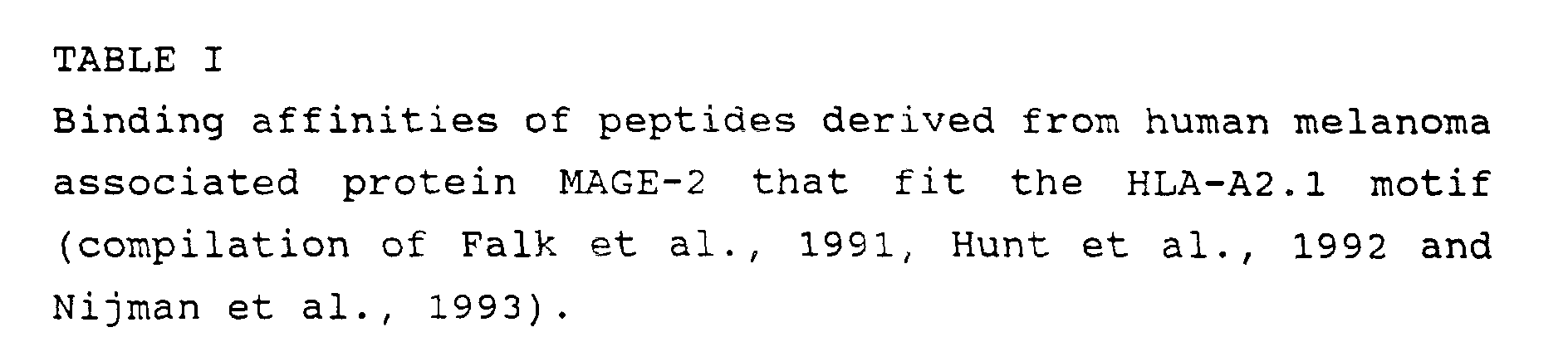
- In order to identify MAGE-2 peptides that could bind to HLA-A2.1 molecules expressed by 174CEM.T2 cells, the amino acid sequence of MAGE-2 was examined (4). All nine, ten or eleven amino acid long peptides that fitted the published HLA-A2.1 binding motif were examined (Table I).
- Only the peptides Nos. 1-11 of Table II were able to upregulates the expression of HLA-A2.1 molecules at a low peptide concentration, indicating their binding to the HLA-A2.1 molecule as described in Example 2. None of the 60 other peptides were able to do this. The results of the fluorescence measurement are given in Table I. The 0.5 maximum upregulation of HLA-A2.1 molecules on 174CEM.T2 cells was determined using graphs in which the FI was plotted against the peptide concentration for each individual peptide.
- These experiments indicate that only a limited proportion of peptides that fit the HLA-A2.1 motif have he ability to bind to this HLA molecule with high affinity and are therefore the only candidates of the MAGE-2 protein to be recognized by human CTL, because CTL recognize peptides only when bound to HLA molecules.


- This example shows in vitro induction of primary immune response. As an illustration for the possibility to induce primary responses in general, including MAGE-2 peptides, such responses against HPV peptides using the processing defective cell line 174CEM.T2 are shown.
- The expression of HLA-A2.1 cells (T2) is increased by incubating T2 cells in medium containing relevant peptide. T2 cells will present the relevant peptide bound to HLA-A2.1 in high amount and therefore are good antigen presenting cells (APC). In the response inducing method described recently (Kast et al., 1993) the T2 cell line is used as APC and post-Ficoll mononuclear cells are used as responder cells.
- T2 cells in a concentration of 2 x 10⁶ cells per ml were incubated for 13 hours at 37°C in a T 25 flask (Becton Dickinson, Falcon, Plymouth Engeland cat.nr. 3013) in serum-free IMDM (= Iscoves Modified Dulbecco's Medium: Biochrom KG, Seromed Berlin, Germany, cat.nr. F0465) with glutamine (2mM, ICN Biochemicals Inc., Costa Meisa, USA, cat.nr. 15-801-55), antibiotics (100 IU/ml penicillin (Brocades Pharma, Leiderdorp, The Netherlands, 100 µg/ml kanamycin (Sigma, St. Louis, USA, K-0245)) and the selected peptide MLDLQPETT in a concentration of 80 µg/ml.
- These incubated T2 cells were spun down and subsequently treated in a density of 20 x 106 cells/ml with Mitomycin C (50 µg/ml) in serum-free RPMI (Gibco Paislan Scotland, cat.nr 041-02409) medium for one hour at 37°C. Hereafter the T2 cells were washed three times in RPMI.
- All wells of a 96-well-U-bottom plate (Costar, Cambridge, USA, cat.nr. 3799) were filled with 100,000 Mitomycin C-treated T2 cells in 50 µl serum-free, complete RPMI medium (glutamine (2 mM, ICN Biochemicals Inc., costa Meisa, USA, cat.nr. 15-801-55), penicillin (100 IU/ml, Brocades Pharma, Leiderdorp, The Netherlands), kanamycin (100 µg/ml, Sigma, St. Louis, USA, K-0245)) and the peptide MLDLQPETT in a concentration of 80 µg/ml.
- Responder cells are mononuclear peripheral blood lymphocytes (PBL) of a HLA-A2.1 subtyped donor (= C.B). The PBL were separated from a buffy coat by Ficoll-procedure (Ficoll preparation: Lymphoprep of Nycomedpharma, Oslo, Norway, cat.nr. 105033) and washed two times in RPMI. After separation and washing, the PBL were resuspended in complete RPMI medium with 30% human pooled serum (HPS) (HPS is tested for a suppression activity in Mixed Lymphocyte Cultures).
- 400,000 PBL-C.B. in 50 µl of medium (the medium described in header 4) were added to each well of the 96-well-U-bottom plate already filled with T2 cells and cultured for 7 days at 37°C in an incubator with 5% CO2 and 90% humidity.
- On day 7 after incubation of PBL, peptide MLDLQPETT and T2 cells (headers 1-5), the PBL-C.B. were restimulated with peptide MLDLQPETT. For this purpose all cells and medium out of the 96 wells were harvested. Viable cells were isolated by ficoll-procedure and washed in RPMI. In a new 96-well-U-bottom plate 50,000 of these viable cells were seeded to each well together with 50 µl complete RPMI medium with 15% HPS. Per well 20,000 autologous, irradiated (3000 rad) PBL and 50,000 autologous, irradiated (10000 rad) EBV-transformed B-lymphocytes (= EBV-C.B.) were added together with 50 µl of complete RPMI medium with 15% HPS and peptide MLDLQPETT in a concentration of 80 µg/ml. The cells were cultured for 7 days at 37°C in an incubator with 5% CO2 and 90% humidity.
- On day 14 after incubation of PBL, peptide MLDLQPETT and T2 cells (headers 1-5), the PBL-c.B. were restimulated with peptide MLDLQPETT. To do so the procedure under header 6 is repeated.
- On day 21 after incubation of PBL, peptide MLDLQPETT and T2 cells, cells and medium out of the 96 wells were harvested. Viable cells were isolated by Ficoll-procedure and washed in complete RPMI with 15% HPS. This bulk of viable cells was cloned by Limiting Dilution. Into each well of a new 96-well-U-bottom plate (Costar, Cambridge, USA, cat. nr. 3799) 50 µl complete RPMI medium with 15% HPS was added together with 100 viable cells (= HPV16 bulk anti MLDLQPETT). For other new 96-well-U-bottom plates this was exactly repeated except for the number of cells for wells: subsequent plates contained 10, 1, or 0.3 cells per well. To all wells 20,000 pooled and irradiated (3000 rad) PBL of four different donors and 10,000 pooled and irradiated (10,000 rad) EBV-transformed B-cells of three different HLA-A2.1 donors (VU-4/518/JY) were added together with 50 µl of complete RPMI medium with 15% HPS and peptide MLDLQPETT in a concentration of 40 µg/ml, Leucoagglutinin in a concentration of 2% (Pharmacia, Uppsala, Sweden, cat.nr. 17-063-01), human recombinant IL-2 in a concentration of 120 IU/ml (Eurocetus, Amsterdam, The Netherlands).
- Add per well, in a final volume of 100 µl =>
- 25,000 viable cells
- 20,000 irradiated PBL-pool (as in header 8)
- 10,000 irradiated EBV-pool (as in header 8)
- 2 µg peptide MLDLQPETT
- 6 IU recombinant IL-2.
- On day 49 a cytotoxicity assay was performed with 65 clones and one bulk as effector cells and T2 (with or without the relevant peptide MLDLQPETT) as target cells. Background killing is defined as killing of T2 cells incubated with an irrelevant (but HLA-A2.1 binding) peptide: GILGFVFTL. This influenza matrix protein-derived peptide is the epitope for HLA-A2.1 restricted influenza specific CTL.
- Most HLA-A2.1 binding peptides were found using the HLA-A2.1 motif (compilation of Rammensee et al., 1991, Hunt et al., 1992 and Nijman et al., 1993). Only 1 additional HLA-A2.1 binding peptide was found using the extended HLA-A2.1 motif (Ruppert et al., 1993).
- This invention includes the use of polypeptides generated by every means, whether genetic engineering, peptide synthesis with solid phase techniques or others. The foregoing peptides may have various chemical modifications made at the terminal ends and still be within the scope of the present invention. Also other chemical modifications are possible, particularly cyclic and dimeric configurations. The term "derivatives" intends to cover all such modified peptides.
- The polypeptides of the present invention find utility for the treatment or prevention of diseases involving MAGE-2 expressing cells including melanomas cells and other cancer cells.
- For all applications the peptides are administered in an immunogenic form. Since the peptides are relatively short, this may necessitate conjugation with an immunogenicity conferring carrier material such as lipids or others or the use of adjuvants.
- The magnitude of a prophylactic or a therapeutic dose of polypeptides of this invention will, of course, vary with the group of patients (age, sex, weight, etcetera), the nature of the severity of the condition to be treated, the particular polypeptide of this invention and its route of administration. Any suitable route of administration may be employed to achieve an effective dosage of a polypeptide identified by this invention, as well as any dosage form well known in the art of pharmacy. In addition the polypeptides may also be administered by controlled release means and/or delivery devices. They may also be administered in combination with other active substances, such as, in particular, T-cell activating agents like interleukin-2 etc.
- The peptides of this invention may also be useful for other purposes, such as diagnostic use. For example, they may be used to check whether a vaccination with a peptide according to the invention has been successful. This may be done in vitro by testing whether said peptide is able to activate T cells of the vaccinated person.
- Other aspects of the invention will be clear to the skilled artisan, and need not be repeated here.
- (1) GENERAL INFORMATION:
- (i) APPLICANTS: Melief, Cornelis J. M.
Visseren, M. J. W.
Kast; W. M.
van der Bruggen, Pierre
Boon-Falleur, Thierry - (ii) TITLE OF INVENTION: Isolated Tumor Rejection Antigen Precursor MAGE-2 Derived Peptides, and Uses Thereof
- (iii) NUMBER OF SEQUENCES: 62
- (iv) CORRESPONDENCE ADDRESS:
- (A) ADDRESSEE: Felfe & Lynch
- (B) STREET: 805 Third Avenue
- (C) CITY: New York City
- (D) STATE: New York
- (E) COUNTRY: USA
- (F) ZIP: 10022
- (v) COMPUTER READABLE FORM:
- (A) MEDIUM TYPE: Diskette, 5.25 inch, 360 kb storage
- (B) COMPUTER: IBM PS/2
- (C) OPERATING SYSTEM: PC-DOS
- (D) SOFTWARE: Wordperfect
- (vi) CURRENT APPLICATION DATA:
- (A) APPLICATION NUMBER:
- (B) FILING DATE:
- (C) CLASSIFICATION:
- (vi) CURRENT APPLICATION DATA:
- (A) APPLICATION NUMBER: 08/217,188
- (B) FILING DATE: 24-MARCH-1994
- (viii) ATTORNEY/AGENT INFORMATION:
- (A) NAME: Hanson, Norman D.
- (B) REGISTRATION NUMBER: 30,946
- (C) REFERENCE/DOCKET NUMBER: LUD 5340-PCT
- (ix) TELECOMMUNICATION INFORMATION:
- (A) TELEPHONE: (212) 688-9200
- (B) TELEFAX: (212) 838-3884
- (2) INFORMATION FOR SEQUENCE ID NO: 1:
- (i) SEQUENCE CHARACTERISTICS:
- (A) LENGTH: 11 amino acid residues
- (B) TYPE: amino acid
- (D) TOPOLOGY: linear
- (ii) MOLECULE TYPE: protein
- (xi) SEQUENCE DESCRIPTION: SEQ ID NO: 1:

- (2) INFORMATION FOR SEQUENCE ID NO: 2:
- (i) SEQUENCE CHARACTERISTICS:
- (A) LENGTH: 9 amino acid residues
- (B) TYPE: amino acid
- (D) TOPOLOGY: linear
- (ii) MOLECULE TYPE: protein
- (xi) SEQUENCE DESCRIPTION: SEQ ID NO: 2:

- (2) INFORMATION FOR SEQUENCE ID NO: 3:
- (i) SEQUENCE CHARACTERISTICS:
- (A) LENGTH: 9 amino acid residues
- (B) TYPE: amino acid
- (D) TOPOLOGY: linear
- (ii) MOLECULE TYPE: protein
- (xi) SEQUENCE DESCRIPTION: SEQ ID NO: 3:

- (2) INFORMATION FOR SEQUENCE ID NO: 4:
- (i) SEQUENCE CHARACTERISTICS:
- (A) LENGTH: 10 amino acid residues
- (B) TYPE: amino acid
- (D) TOPOLOGY: linear
- (ii) MOLECULE TYPE: protein
- (xi) SEQUENCE DESCRIPTION: SEQ ID NO: 4:

- (2) INFORMATION FOR SEQUENCE ID NO: 5:
- (i) SEQUENCE CHARACTERISTICS:
- (A) LENGTH: 10 amino acid residues
- (B) TYPE: amino acid
- (D) TOPOLOGY: linear
- (ii) MOLECULE TYPE: protein
- (xi) SEQUENCE DESCRIPTION: SEQ ID NO: 5:

- (2) INFORMATION FOR SEQUENCE ID NO: 6:
- (i) SEQUENCE CHARACTERISTICS:
- (A) LENGTH: 9 amino acid residues
- (B) TYPE: amino acid
- (D) TOPOLOGY: linear
- (ii) MOLECULE TYPE: protein
- (xi) SEQUENCE DESCRIPTION: SEQ ID NO: 6:

- (2) INFORMATION FOR SEQUENCE ID NO: 7:
- (i) SEQUENCE CHARACTERISTICS:
- (A) LENGTH: 11 amino acid residues
- (B) TYPE: amino acid
- (D) TOPOLOGY: linear
- (ii) MOLECULE TYPE: protein
- (xi) SEQUENCE DESCRIPTION: SEQ ID NO: 7:

- (2) INFORMATION FOR SEQUENCE ID NO: 8:
- (i) SEQUENCE CHARACTERISTICS:
- (A) LENGTH: 9 amino acid residues
- (B) TYPE: amino acid
- (D) TOPOLOGY: linear
- (ii) MOLECULE TYPE: protein
- (xi) SEQUENCE DESCRIPTION: SEQ ID NO: 8:

- (2) INFORMATION FOR SEQUENCE ID NO: 9:
- (i) SEQUENCE CHARACTERISTICS:
- (A) LENGTH: 11 amino acid residues
- (B) TYPE: amino acid
- (D) TOPOLOGY: linear
- (ii) MOLECULE TYPE: protein
- (xi) SEQUENCE DESCRIPTION: SEQ ID NO: 9:

- (2) INFORMATION FOR SEQUENCE ID NO: 10:
- (i) SEQUENCE CHARACTERISTICS:
- (A) LENGTH: 10 amino acid residues
- (B) TYPE: amino acid
- (D) TOPOLOGY: linear
- (ii) MOLECULE TYPE: protein
- (xi) SEQUENCE DESCRIPTION: SEQ ID NO: 10:

- (2) INFORMATION FOR SEQUENCE ID NO: 11:
- (i) SEQUENCE CHARACTERISTICS:
- (A) LENGTH: 9 amino acid residues
- (B) TYPE: amino acid
- (D) TOPOLOGY: linear
- (ii) MOLECULE TYPE: protein
- (xi) SEQUENCE DESCRIPTION: SEQ ID NO: 11:

- (2) INFORMATION FOR SEQUENCE ID NO: 12:
- (i) SEQUENCE CHARACTERISTICS:
- (A) LENGTH: 11 amino acid residues
- (B) TYPE: amino acid
- (D) TOPOLOGY: linear
- (ii) MOLECULE TYPE: protein
- (xi) SEQUENCE DESCRIPTION: SEQ ID NO: 12:

- (2) INFORMATION FOR SEQUENCE ID NO: 13:
- (i) SEQUENCE CHARACTERISTICS:
- (A) LENGTH: 9 amino acid residues
- (B) TYPE: amino acid
- (D) TOPOLOGY: linear
- (ii) MOLECULE TYPE: protein
- (xi) SEQUENCE DESCRIPTION: SEQ ID NO: 13:

- (2) INFORMATION FOR SEQUENCE ID NO: 14:
- (i) SEQUENCE CHARACTERISTICS:
- (A) LENGTH: 9 amino acid residues
- (B) TYPE: amino acid
- (D) TOPOLOGY: linear
- (ii) MOLECULE TYPE: protein
- (xi) SEQUENCE DESCRIPTION: SEQ ID NO: 14:

- (2) INFORMATION FOR SEQUENCE ID NO: 15:
- (i) SEQUENCE CHARACTERISTICS:
- (A) LENGTH: 9 amino acid residues
- (B) TYPE: amino acid
- (D) TOPOLOGY: linear
- (ii) MOLECULE TYPE: protein
- (xi) SEQUENCE DESCRIPTION: SEQ ID NO: 15:

- (2) INFORMATION FOR SEQUENCE ID NO: 16:
- (i) SEQUENCE CHARACTERISTICS:
- (A) LENGTH: 9 amino acid residues
- (B) TYPE: amino acid
- (D) TOPOLOGY: linear
- (ii) MOLECULE TYPE: protein
- (xi) SEQUENCE DESCRIPTION: SEQ ID NO: 16:

- (2) INFORMATION FOR SEQUENCE ID NO: 17:
- (i) SEQUENCE CHARACTERISTICS:
- (A) LENGTH: 10 amino acid residues
- (B) TYPE: amino acid
- (D) TOPOLOGY: linear
- (ii) MOLECULE TYPE: protein
- (xi) SEQUENCE DESCRIPTION: SEQ ID NO: 17:

- (2) INFORMATION FOR SEQUENCE ID NO: 18:
- (i) SEQUENCE CHARACTERISTICS:
- (A) LENGTH: 10 amino acid residues
- (B) TYPE: amino acid
- (D) TOPOLOGY: linear
- (ii) MOLECULE TYPE: protein
- (xi) SEQUENCE DESCRIPTION: SEQ ID NO: 18:

- (2) INFORMATION FOR SEQUENCE ID NO: 19:
- (i) SEQUENCE CHARACTERISTICS:
- (A) LENGTH: 9 amino acid residues
- (B) TYPE: amino acid
- (D) TOPOLOGY: linear
- (ii) MOLECULE TYPE: protein
- (xi) SEQUENCE DESCRIPTION: SEQ ID NO: 19:

- (2) INFORMATION FOR SEQUENCE ID NO: 20:
- (i) SEQUENCE CHARACTERISTICS:
- (A) LENGTH: 10 amino acid residues
- (B) TYPE: amino acid
- (D) TOPOLOGY: linear
- (ii) MOLECULE TYPE: protein
- (xi) SEQUENCE DESCRIPTION: SEQ ID NO: 20:

- (2) INFORMATION FOR SEQUENCE ID NO: 21:
- (i) SEQUENCE CHARACTERISTICS:
- (A) LENGTH: 11 amino acid residues
- (B) TYPE: amino acid
- (D) TOPOLOGY: linear
- (ii) MOLECULE TYPE: protein
- (xi) SEQUENCE DESCRIPTION: SEQ ID NO: 21:

- (2) INFORMATION FOR SEQUENCE ID NO: 22:
- (i) SEQUENCE CHARACTERISTICS:
- (A) LENGTH: 11 amino acid residues
- (B) TYPE: amino acid
- (D) TOPOLOGY: linear
- (ii) MOLECULE TYPE: protein
- (xi) SEQUENCE DESCRIPTION: SEQ ID NO: 22:

- (2) INFORMATION FOR SEQUENCE ID NO: 23:
- (i) SEQUENCE CHARACTERISTICS:
- (A) LENGTH: 10 amino acid residues
- (B) TYPE: amino acid
- (D) TOPOLOGY: linear
- (ii) MOLECULE TYPE: protein
- (xi) SEQUENCE DESCRIPTION: SEQ ID NO: 23:

- (2) INFORMATION FOR SEQUENCE ID NO: 24:
- (i) SEQUENCE CHARACTERISTICS:
- (A) LENGTH: 11 amino acid residues
- (B) TYPE: amino acid
- (D) TOPOLOGY: linear
- (ii) MOLECULE TYPE: protein
- (xi) SEQUENCE DESCRIPTION: SEQ ID NO: 24:

- (2) INFORMATION FOR SEQUENCE ID NO: 25:
- (i) SEQUENCE CHARACTERISTICS:
- (A) LENGTH: 11 amino acid residues
- (B) TYPE: amino acid
- (D) TOPOLOGY: linear
- (ii) MOLECULE TYPE: protein
- (xi) SEQUENCE DESCRIPTION: SEQ ID NO: 25:

- (2) INFORMATION FOR SEQUENCE ID NO: 26:
- (i) SEQUENCE CHARACTERISTICS:
- (A) LENGTH: 10 amino acid residues
- (B) TYPE: amino acid
- (D) TOPOLOGY: linear
- (ii) MOLECULE TYPE: protein
- (xi) SEQUENCE DESCRIPTION: SEQ ID NO: 26:

- (2) INFORMATION FOR SEQUENCE ID NO: 27:
- (i) SEQUENCE CHARACTERISTICS:
- (A) LENGTH: 9 amino acid residues
- (B) TYPE: amino acid
- (D) TOPOLOGY: linear
- (ii) MOLECULE TYPE: protein
- (xi) SEQUENCE DESCRIPTION: SEQ ID NO: 27:

- (2) INFORMATION FOR SEQUENCE ID NO: 28:
- (i) SEQUENCE CHARACTERISTICS:
- (A) LENGTH: 9 amino acid residues
- (B) TYPE: amino acid
- (D) TOPOLOGY: linear
- (ii) MOLECULE TYPE: protein
- (xi) SEQUENCE DESCRIPTION: SEQ ID NO: 28:

- (2) INFORMATION FOR SEQUENCE ID NO: 29:
- (i) SEQUENCE CHARACTERISTICS:
- (A) LENGTH: 11 amino acid residues
- (B) TYPE: amino acid
- (D) TOPOLOGY: linear
- (ii) MOLECULE TYPE: protein
- (xi) SEQUENCE DESCRIPTION: SEQ ID NO: 29:

- (2) INFORMATION FOR SEQUENCE ID NO: 30:
- (i) SEQUENCE CHARACTERISTICS:
- (A) LENGTH: 9 amino acid residues
- (B) TYPE: amino acid
- (D) TOPOLOGY: linear
- (ii) MOLECULE TYPE: protein
- (xi) SEQUENCE DESCRIPTION: SEQ ID NO: 30:

- (2) INFORMATION FOR SEQUENCE ID NO: 31:
- (i) SEQUENCE CHARACTERISTICS:
- (A) LENGTH: 9 amino acid residues
- (B) TYPE: amino acid
- (D) TOPOLOGY: linear
- (ii) MOLECULE TYPE: protein
- (xi) SEQUENCE DESCRIPTION: SEQ ID NO: 31:

- (2) INFORMATION FOR SEQUENCE ID NO: 32:
- (i) SEQUENCE CHARACTERISTICS:
- (A) LENGTH: 10 amino acid residues
- (B) TYPE: amino acid
- (D) TOPOLOGY: linear
- (ii) MOLECULE TYPE: protein
- (xi) SEQUENCE DESCRIPTION: SEQ ID NO: 32:

- (2) INFORMATION FOR SEQUENCE ID NO: 33:
- (i) SEQUENCE CHARACTERISTICS:
- (A) LENGTH: 9 amino acid residues
- (B) TYPE: amino acid
- (D) TOPOLOGY: linear
- (ii) MOLECULE TYPE: protein
- (xi) SEQUENCE DESCRIPTION: SEQ ID NO: 33:

- (2) INFORMATION FOR SEQUENCE ID NO: 34:
- (i) SEQUENCE CHARACTERISTICS:
- (A) LENGTH: 10 amino acid residues
- (B) TYPE: amino acid
- (D) TOPOLOGY: linear
- (ii) MOLECULE TYPE: protein
- (xi) SEQUENCE DESCRIPTION: SEQ ID NO: 34:

- (2) INFORMATION FOR SEQUENCE ID NO: 35:
- (i) SEQUENCE CHARACTERISTICS:
- (A) LENGTH: 11 amino acid residues
- (B) TYPE: amino acid
- (D) TOPOLOGY: linear
- (ii) MOLECULE TYPE: protein
- (xi) SEQUENCE DESCRIPTION: SEQ ID NO: 35:

- (2) INFORMATION FOR SEQUENCE ID NO: 36:
- (i) SEQUENCE CHARACTERISTICS:
- (A) LENGTH: 9 amino acid residues
- (B) TYPE: amino acid
- (D) TOPOLOGY: linear
- (ii) MOLECULE TYPE: protein
- (xi) SEQUENCE DESCRIPTION: SEQ ID NO: 36:

- (2) INFORMATION FOR SEQUENCE ID NO: 37:
- (i) SEQUENCE CHARACTERISTICS:
- (A) LENGTH: 10 amino acid residues
- (B) TYPE: amino acid
- (D) TOPOLOGY: linear
- (ii) MOLECULE TYPE: protein
- (xi) SEQUENCE DESCRIPTION: SEQ ID NO: 37:

- (2) INFORMATION FOR SEQUENCE ID NO: 38:
- (i) SEQUENCE CHARACTERISTICS:
- (A) LENGTH: 11 amino acid residues
- (B) TYPE: amino acid
- (D) TOPOLOGY: linear
- (ii) MOLECULE TYPE: protein
- (xi) SEQUENCE DESCRIPTION: SEQ ID NO: 38:

- (2) INFORMATION FOR SEQUENCE ID NO: 39:
- (i) SEQUENCE CHARACTERISTICS:
- (A) LENGTH: 9 amino acid residues
- (B) TYPE: amino acid
- (D) TOPOLOGY: linear
- (ii) MOLECULE TYPE: protein
- (xi) SEQUENCE DESCRIPTION: SEQ ID NO: 39:

- (2) INFORMATION FOR SEQUENCE ID NO: 40:
- (i) SEQUENCE CHARACTERISTICS:
- (A) LENGTH: 10 amino acid residues
- (B) TYPE: amino acid
- (D) TOPOLOGY: linear
- (ii) MOLECULE TYPE: protein
- (xi) SEQUENCE DESCRIPTION: SEQ ID NO: 40:

- (2) INFORMATION FOR SEQUENCE ID NO: 41:
- (i) SEQUENCE CHARACTERISTICS:
- (A) LENGTH: 11 amino acid residues
- (B) TYPE: amino acid
- (D) TOPOLOGY: linear
- (ii) MOLECULE TYPE: protein
- (xi) SEQUENCE DESCRIPTION: SEQ ID NO: 41:

- (2) INFORMATION FOR SEQUENCE ID NO: 42:
- (i) SEQUENCE CHARACTERISTICS:
- (A) LENGTH: 9 amino acid residues
- (B) TYPE: amino acid
- (D) TOPOLOGY: linear
- (ii) MOLECULE TYPE: protein
- (xi) SEQUENCE DESCRIPTION: SEQ ID NO: 42:

- (2) INFORMATION FOR SEQUENCE ID NO: 43:
- (i) SEQUENCE CHARACTERISTICS:
- (A) LENGTH: 10 amino acid residues
- (B) TYPE: amino acid
- (D) TOPOLOGY: linear
- (ii) MOLECULE TYPE: protein
- (xi) SEQUENCE DESCRIPTION: SEQ ID NO: 43:

- (2) INFORMATION FOR SEQUENCE ID NO: 44:
- (i) SEQUENCE CHARACTERISTICS:
- (A) LENGTH: 9 amino acid residues
- (B) TYPE: amino acid
- (D) TOPOLOGY: linear
- (ii) MOLECULE TYPE: protein
- (xi) SEQUENCE DESCRIPTION: SEQ ID NO: 44:

- (2) INFORMATION FOR SEQUENCE ID NO: 45:
- (i) SEQUENCE CHARACTERISTICS:
- (A) LENGTH: 9 amino acid residues
- (B) TYPE: amino acid
- (D) TOPOLOGY: linear
- (ii) MOLECULE TYPE: protein
- (xi) SEQUENCE DESCRIPTION: SEQ ID NO: 45:

- (2) INFORMATION FOR SEQUENCE ID NO: 46:
- (i) SEQUENCE CHARACTERISTICS:
- (A) LENGTH: 11 amino acid residues
- (B) TYPE: amino acid
- (D) TOPOLOGY: linear
- (ii) MOLECULE TYPE: protein
- (xi) SEQUENCE DESCRIPTION: SEQ ID NO: 46:

- (2) INFORMATION FOR SEQUENCE ID NO: 47:
- (i) SEQUENCE CHARACTERISTICS:
- (A) LENGTH: 9 amino acid residues
- (B) TYPE: amino acid
- (D) TOPOLOGY: linear
- (ii) MOLECULE TYPE: protein
- (xi) SEQUENCE DESCRIPTION: SEQ ID NO: 47:

- (2) INFORMATION FOR SEQUENCE ID NO: 48:
- (i) SEQUENCE CHARACTERISTICS:
- (A) LENGTH: 9 amino acid residues
- (B) TYPE: amino acid
- (D) TOPOLOGY: linear
- (ii) MOLECULE TYPE: protein
- (xi) SEQUENCE DESCRIPTION: SEQ ID NO: 48:

- (2) INFORMATION FOR SEQUENCE ID NO: 49:
- (i) SEQUENCE CHARACTERISTICS:
- (A) LENGTH: 11 amino acid residues
- (B) TYPE: amino acid
- (D) TOPOLOGY: linear
- (ii) MOLECULE TYPE: protein
- (xi) SEQUENCE DESCRIPTION: SEQ ID NO: 49:

- (2) INFORMATION FOR SEQUENCE ID NO: 50:
- (i) SEQUENCE CHARACTERISTICS:
- (A) LENGTH: 10 amino acid residues
- (B) TYPE: amino acid
- (D) TOPOLOGY: linear
- (ii) MOLECULE TYPE: protein
- (xi) SEQUENCE DESCRIPTION: SEQ ID NO: 50:

- (2) INFORMATION FOR SEQUENCE ID NO: 51:
- (i) SEQUENCE CHARACTERISTICS:
- (A) LENGTH: 11 amino acid residues
- (B) TYPE: amino acid
- (D) TOPOLOGY: linear
- (ii) MOLECULE TYPE: protein
- (xi) SEQUENCE DESCRIPTION: SEQ ID NO: 51:

- (2) INFORMATION FOR SEQUENCE ID NO: 52:
- (i) SEQUENCE CHARACTERISTICS:
- (A) LENGTH: 9 amino acid residues
- (B) TYPE: amino acid
- (D) TOPOLOGY: linear
- (ii) MOLECULE TYPE: protein
- (xi) SEQUENCE DESCRIPTION: SEQ ID NO: 52:

- (2) INFORMATION FOR SEQUENCE ID NO: 53:
- (i) SEQUENCE CHARACTERISTICS:
- (A) LENGTH: 10 amino acid residues
- (B) TYPE: amino acid
- (D) TOPOLOGY: linear
- (ii) MOLECULE TYPE: protein
- (xi) SEQUENCE DESCRIPTION: SEQ ID NO: 53:

- (2) INFORMATION FOR SEQUENCE ID NO: 54:
- (i) SEQUENCE CHARACTERISTICS:
- (A) LENGTH: 9 amino acid residues
- (B) TYPE: amino acid
- (D) TOPOLOGY: linear
- (ii) MOLECULE TYPE: protein
- (xi) SEQUENCE DESCRIPTION: SEQ ID NO: 54:

- (2) INFORMATION FOR SEQUENCE ID NO: 55:
- (i) SEQUENCE CHARACTERISTICS:
- (A) LENGTH: 10 amino acid residues
- (B) TYPE: amino acid
- (D) TOPOLOGY: linear
- (ii) MOLECULE TYPE: protein
- (xi) SEQUENCE DESCRIPTION: SEQ ID NO: 55:

- (2) INFORMATION FOR SEQUENCE ID NO: 56:
- (i) SEQUENCE CHARACTERISTICS:
- (A) LENGTH: 11 amino acid residues
- (B) TYPE: amino acid
- (D) TOPOLOGY: linear
- (ii) MOLECULE TYPE: protein
- (xi) SEQUENCE DESCRIPTION: SEQ ID NO: 56:

- (2) INFORMATION FOR SEQUENCE ID NO: 57:
- (i) SEQUENCE CHARACTERISTICS:
- (A) LENGTH: 11 amino acid residues
- (B) TYPE: amino acid
- (D) TOPOLOGY: linear
- (ii) MOLECULE TYPE: protein
- (xi) SEQUENCE DESCRIPTION: SEQ ID NO: 57:

- (2) INFORMATION FOR SEQUENCE ID NO: 58:
- (i) SEQUENCE CHARACTERISTICS:
- (A) LENGTH: 9 amino acid residues
- (B) TYPE: amino acid
- (D) TOPOLOGY: linear
- (ii) MOLECULE TYPE: protein
- (xi) SEQUENCE DESCRIPTION: SEQ ID NO: 58:

- (2) INFORMATION FOR SEQUENCE ID NO: 59:
- (i) SEQUENCE CHARACTERISTICS:
- (A) LENGTH: 10 amino acid residues
- (B) TYPE: amino acid
- (D) TOPOLOGY: linear
- (ii) MOLECULE TYPES protein
- (xi) SEQUENCE DESCRIPTION: SEQ ID NO: 59:

- (2) INFORMATION FOR SEQUENCE ID NO: 60:
- (i) SEQUENCE CHARACTERISTICS:
- (A) LENGTH: 11 amino acid residues
- (B) TYPE: amino acid
- (D) TOPOLOGY: linear
- (ii) MOLECULE TYPE: protein
- (xi) SEQUENCE DESCRIPTION: SEQ ID NO: 60:

- (2) INFORMATION FOR SEQUENCE ID NO: 61:
- (i) SEQUENCE CHARACTERISTICS:
- (A) LENGTH: 11 amino acid residues
- (B) TYPE: amino acid
- (D) TOPOLOGY: linear
- (ii) MOLECULE TYPE: protein
- (xi) SEQUENCE DESCRIPTION: SEQ ID NO: 61:

- (2) INFORMATION FOR SEQUENCE ID NO: 62:
- (i) SEQUENCE CHARACTERISTICS:
- (A) LENGTH: 9 amino acid residues
- (B) TYPE: amino acid
- (D) TOPOLOGY: linear
- (ii) MOLECULE TYPE: protein
- (xi) SEQUENCE DESCRIPTION: SEQ ID NO: 62:

-
Claims (20)
- Isolated peptide selected from the group consisting of SEQ ID NO: 1, SEQ ID NO: 2, SEQ ID NO: 4, SEQ ID NO: 6, SEQ ID NO: 7, SEQ ID NO: 8, SEQ ID NO: 9, SEQ ID NO: 10 and SEQ ID NO: 11.
- The isolated peptide of claim 1, designated SEQ ID NO: 1.
- The isolated peptide of claim 1, designated SEQ ID NO: 6.
- The isolated peptide of claim 1, designated SEQ ID NO: 9.
- Isolated complex of HLA-A2 and the isolated peptide of claim 1.
- The isolated complex of claim 5, wherein said peptide is designated SEQ ID NO: 1.
- The isolated complex of claim 5, wherein said peptide is designated SEQ ID NO: 6.
- The isolated complex of claim 5, wherein said peptide is designated SEQ ID NO: 9.
- Isolated cytolytic T cell clone specific for a complex of HLA-A2 and a peptide selected from the group consisting of SEQ ID NO: 1, SEQ ID NO: 2, SEQ ID NO: 4, SEQ ID NO: 6, SEQ ID NO: 7, SEQ ID NO: 8, SEQ ID NO: 9, SEQ ID NO: 10 and SEQ ID NO: 11.
- The isolated cytolytic T cell clone of claim 9, wherein said peptide is SEQ ID NO: 1.
- The isolated cytolytic T cell clone of claim 9, wherein said peptide is SEQ ID NO: 6.
- The isolated cytolytic T cell clone of claim 9, wherein said peptide is SEQ ID NO: 9.
- Monoclonal antibody which specifically binds to a complex of HLA-A2 and a peptide selected from the group consisting of SEQ ID NO: 1, SEQ ID NO: 2, SEQ ID NO: 4, SEQ ID NO: 6, SEQ ID NO: 7, SEQ ID NO: 8, SEQ ID NO: 9, SEQ ID NO: 10 and SEQ ID NO: 11.
- The monoclonal antibody of claim 13, wherein said peptide is SEQ ID NO: 1.
- The monoclonal antibody of claim 13, wherein said peptide is SEQ ID NO: 6.
- The monoclonal antibody of claim 13, wherein said peptide is SEQ ID NO: 9.
- A therapeutic composition comprising at least one cytolytic T- cell clone sufficient to lyse a cancer cell which presents a complex of HLA-A2 and a peptide selected from SEQ ID NO: 1, 2, 4, 6 - 11 on their cell surface.
- A therapeutic composition of claim 17, wherein said peptide is SEQ ID NO: 1.
- A therapeutic composition of claim 17, wherein said peptide is SEQ ID NO: 6.
- A therapeutic composition of claim 17, wherein said peptide is SEQ ID NO: 9.
Applications Claiming Priority (3)
| Application Number | Priority Date | Filing Date | Title |
|---|---|---|---|
| US217188 | 1994-03-24 | ||
| US08/217,188 US5554724A (en) | 1994-03-24 | 1994-03-24 | Isolated tumor rejection antigen precursor MAGE-2 derived peptides, and uses thereof |
| PCT/US1995/003535 WO1995025530A1 (en) | 1994-03-24 | 1995-03-21 | Isolated tumor rejection antigen precursor mage-2 derived peptides, and uses thereof |
Publications (3)
| Publication Number | Publication Date |
|---|---|
| EP0810870A1 EP0810870A1 (en) | 1997-12-10 |
| EP0810870A4 EP0810870A4 (en) | 1998-11-25 |
| EP0810870B1 true EP0810870B1 (en) | 2001-05-16 |
Family
ID=22810016
Family Applications (1)
| Application Number | Title | Priority Date | Filing Date |
|---|---|---|---|
| EP95914792A Expired - Lifetime EP0810870B1 (en) | 1994-03-24 | 1995-03-21 | Isolated tumor rejection antigen precursor mage-2 derived peptides, and uses thereof |
Country Status (17)
| Country | Link |
|---|---|
| US (3) | US5554724A (en) |
| EP (1) | EP0810870B1 (en) |
| JP (1) | JP3360137B2 (en) |
| CN (1) | CN1149257A (en) |
| AT (1) | ATE201214T1 (en) |
| AU (1) | AU682597B2 (en) |
| CA (1) | CA2186006A1 (en) |
| DE (1) | DE69520959T2 (en) |
| DK (1) | DK0810870T3 (en) |
| ES (1) | ES2158943T3 (en) |
| FI (1) | FI963780L (en) |
| GR (1) | GR3036320T3 (en) |
| NO (1) | NO963918L (en) |
| NZ (2) | NZ283561A (en) |
| PT (1) | PT810870E (en) |
| WO (1) | WO1995025530A1 (en) |
| ZA (1) | ZA952375B (en) |
Families Citing this family (31)
| Publication number | Priority date | Publication date | Assignee | Title |
|---|---|---|---|---|
| US7252829B1 (en) * | 1998-06-17 | 2007-08-07 | Idm Pharma, Inc. | HLA binding peptides and their uses |
| IL105554A (en) * | 1992-05-05 | 1999-08-17 | Univ Leiden | Peptides of human papilloma virus for use in human t cell response inducing compositions |
| US5686068A (en) * | 1994-03-24 | 1997-11-11 | Ludwig Institute For Cancer Research | Isolated peptides derived from MAGE-2, cytolytic T cells specific to complexes of peptide and HLA-A2 molecules, and uses thereof |
| US5554724A (en) * | 1994-03-24 | 1996-09-10 | University Of Leiden | Isolated tumor rejection antigen precursor MAGE-2 derived peptides, and uses thereof |
| US5830753A (en) * | 1994-09-30 | 1998-11-03 | Ludwig Institute For Cancer Research | Isolated nucleic acid molecules coding for tumor rejection antigen precursor dage and uses thereof. |
| US5587289A (en) * | 1995-03-14 | 1996-12-24 | Ludwig Institute For Cancer Research | Isolated nucleic acid molecules which are members of the MAGE-Xp family and uses thereof |
| US5821122A (en) * | 1995-06-07 | 1998-10-13 | Inserm (Institute Nat'l De La Sante Et De La Recherche . .) | Isolated nucleic acid molecules, peptides which form complexes with MHC molecule HLA-A2 and uses thereof |
| EP0954601A4 (en) * | 1996-03-20 | 2004-08-18 | Genzyme Corp | A method for identifying cytotoxic t-cell epitopes |
| US6087441A (en) | 1997-02-05 | 2000-07-11 | Ludwig Institute For Cancer Research | Structurally modified peptides that are resistant to peptidase degradation |
| US6680191B1 (en) | 1997-04-25 | 2004-01-20 | Ludwig Institute For Cancer | Isolated nucleic acid molecules coding for tumor rejection antigen precursors of members of the MAGE-C and MAGE-B FAMILIES and uses thereof |
| US6027924A (en) * | 1997-04-25 | 2000-02-22 | Ludwig Institute For Cancer Research | Isolated nucleic acid molecule coding for tumor rejection antigen precursor MAGE-C1 and uses thereof |
| EP1012173B1 (en) | 1997-06-23 | 2007-10-31 | Ludwig Institute For Cancer Research | Isolated decapeptides which bind to hla molecules, and the use thereof |
| US6025470A (en) * | 1997-06-23 | 2000-02-15 | Ludwig Institute For Cancer Research | Isolated nona- and decapeptides which bind to HLA molecules, and the use thereof |
| CN1262562C (en) * | 1998-07-28 | 2006-07-05 | 株式会社绿多肽 | HLA-A2 Restricted Tumor Antigen Peptides Derived from SART-1 |
| GB9826143D0 (en) * | 1998-11-27 | 1999-01-20 | Ludwig Inst Cancer Res | Tumour rejection antigens |
| CA2388301C (en) | 1999-10-22 | 2011-01-04 | Aventis Pasteur Limited | Modified gp100 and uses thereof |
| US7851212B2 (en) | 2000-05-10 | 2010-12-14 | Sanofi Pasteur Limited | Immunogenic polypeptides encoded by MAGE minigenes and uses thereof |
| MXPA04005382A (en) * | 2001-11-07 | 2005-02-24 | Mannkind Corp | EXPRESSION VECTORS CODING ANTIGEN EPITHOPES ASSOCIATED WITH THE OBJECTIVE AND METHODS FOR THEIR DESIGN. |
| ATE369895T1 (en) | 2002-04-09 | 2007-09-15 | Sanofi Pasteur Ltd | MODIFIED CEA NUCLIC ACID AND EXPRESSION VECTORS |
| WO2005035773A2 (en) * | 2003-10-08 | 2005-04-21 | Sanofi Pasteur, Inc. | Modified cea /b7 vector |
| WO2004015390A2 (en) * | 2002-08-09 | 2004-02-19 | Applera Corporation | Lung cancer target proteins and use thereof |
| WO2004037284A1 (en) * | 2002-10-22 | 2004-05-06 | Sanofi Pasteur Limited | Anti-cancer vaccines and high-dose cytokines as adjuvants |
| SI1620456T1 (en) * | 2003-04-18 | 2014-05-30 | Biotech Synergy, Inc. | Hla-a2 tumor associated antigen peptides and compositions |
| WO2006113540A2 (en) | 2005-04-14 | 2006-10-26 | Duke University | Use of ntrosylated hemoglobin |
| EP2391635B1 (en) | 2009-01-28 | 2017-04-26 | Epimmune Inc. | Pan-dr binding polypeptides and uses thereof |
| US9175070B2 (en) | 2009-09-25 | 2015-11-03 | The United States Of America, As Represented By The Secretary, Department Of Health And Human Services | Neutralizing antibodies to HIV-1 and their use |
| BR112013023027A2 (en) | 2011-03-07 | 2016-08-16 | Creative Neail Design Inc | compositions and methods for UV curable nail polishes |
| EP2825572B1 (en) | 2012-03-15 | 2022-07-27 | ExxonMobil Chemical Patents Inc. | Oxygen tailoring of polyethylene |
| FR3008099B1 (en) | 2013-07-05 | 2020-08-07 | Commissariat Energie Atomique | TUMOR ANTIGEN CYCLINE B1 IMMUNOGEN PEPTIDES |
| FR3090319A1 (en) | 2018-12-21 | 2020-06-26 | Commissariat A L'energie Atomique Et Aux Energies Alternatives | MIXTURES OF CD8 T + EPITOPE CYCLINE B1 IMMUNOGENS |
| CN116731155B (en) * | 2022-09-21 | 2024-03-22 | 新景智源生物科技(苏州)有限公司 | Human papillomavirus-specific T cell receptor, cells expressing same and uses thereof |
Family Cites Families (9)
| Publication number | Priority date | Publication date | Assignee | Title |
|---|---|---|---|---|
| US5342774A (en) * | 1991-05-23 | 1994-08-30 | Ludwig Institute For Cancer Research | Nucleotide sequence encoding the tumor rejection antigen precursor, MAGE-1 |
| IL106610A0 (en) * | 1992-08-07 | 1993-12-08 | Cytel Corp | Hla binding peptides and their uses |
| US5462871A (en) * | 1992-08-31 | 1995-10-31 | Ludwig Institute For Cancer Research | Isolated nucleic acid molecules which encode MAGE derived nonapeptides |
| US5405940A (en) * | 1992-08-31 | 1995-04-11 | Ludwig Institute For Cancer Research | Isolated nonapeptides derived from MAGE genes and uses thereof |
| US5487974A (en) * | 1992-12-22 | 1996-01-30 | Ludwig Institute For Cancer-Research | Method for detecting complexes containing human leukocyte antigen A2 (HLA-A2) molecules and a tyrosinase drived peptide on abnormal cells |
| SG49008A1 (en) * | 1993-03-05 | 1998-05-18 | Cytel Corp | Hla-a2.1 binding peptides and their uses |
| US5554506A (en) * | 1994-03-24 | 1996-09-10 | Ludwig Institute For Cancer Research | Isolated, MAGE-3 derived peptides which complex with HLA-A2 molecules and uses thereof |
| US5554724A (en) * | 1994-03-24 | 1996-09-10 | University Of Leiden | Isolated tumor rejection antigen precursor MAGE-2 derived peptides, and uses thereof |
| US5686068A (en) * | 1994-03-24 | 1997-11-11 | Ludwig Institute For Cancer Research | Isolated peptides derived from MAGE-2, cytolytic T cells specific to complexes of peptide and HLA-A2 molecules, and uses thereof |
-
1994
- 1994-03-24 US US08/217,188 patent/US5554724A/en not_active Expired - Lifetime
-
1995
- 1995-03-21 NZ NZ283561A patent/NZ283561A/en not_active IP Right Cessation
- 1995-03-21 AU AU21893/95A patent/AU682597B2/en not_active Expired
- 1995-03-21 CA CA002186006A patent/CA2186006A1/en not_active Abandoned
- 1995-03-21 DE DE69520959T patent/DE69520959T2/en not_active Expired - Lifetime
- 1995-03-21 JP JP52477995A patent/JP3360137B2/en not_active Expired - Lifetime
- 1995-03-21 NZ NZ329695A patent/NZ329695A/en unknown
- 1995-03-21 AT AT95914792T patent/ATE201214T1/en active
- 1995-03-21 ES ES95914792T patent/ES2158943T3/en not_active Expired - Lifetime
- 1995-03-21 WO PCT/US1995/003535 patent/WO1995025530A1/en not_active Ceased
- 1995-03-21 EP EP95914792A patent/EP0810870B1/en not_active Expired - Lifetime
- 1995-03-21 DK DK95914792T patent/DK0810870T3/en active
- 1995-03-21 CN CN95192262A patent/CN1149257A/en active Pending
- 1995-03-21 PT PT95914792T patent/PT810870E/en unknown
- 1995-03-21 FI FI963780A patent/FI963780L/en unknown
- 1995-03-23 ZA ZA952375A patent/ZA952375B/en unknown
-
1996
- 1996-06-21 US US08/667,725 patent/US6063900A/en not_active Expired - Lifetime
- 1996-09-19 NO NO963918A patent/NO963918L/en not_active Application Discontinuation
-
1998
- 1998-01-15 US US09/007,748 patent/US6147187A/en not_active Expired - Lifetime
-
2001
- 2001-08-03 GR GR20010401171T patent/GR3036320T3/en unknown
Non-Patent Citations (2)
| Title |
|---|
| GARBOCZI ET AL.: ' HLA-A2-peptide complexes: refolding and cristallization of molecules expressed in Escherischia coli and complexed with single antigenic peptides' PNAS, vol. 89, April 1992, pages 3429-3433. * |
| ZHONG ETAL.: 'Production, specificity, and functionality of monoclonal antibodies to specific peptide-major histocompatibility complex class II complexes formed by processing of exogenous protein' PNAS, vol. 94, December 1997, pages 13856-13861. * |
Also Published As
| Publication number | Publication date |
|---|---|
| US6147187A (en) | 2000-11-14 |
| US5554724A (en) | 1996-09-10 |
| JPH10502329A (en) | 1998-03-03 |
| NZ329695A (en) | 2000-05-26 |
| ATE201214T1 (en) | 2001-06-15 |
| DK0810870T3 (en) | 2001-07-23 |
| NZ283561A (en) | 1998-04-27 |
| ES2158943T3 (en) | 2001-09-16 |
| PT810870E (en) | 2001-09-28 |
| FI963780A7 (en) | 1996-09-23 |
| AU2189395A (en) | 1995-10-09 |
| WO1995025530A1 (en) | 1995-09-28 |
| JP3360137B2 (en) | 2002-12-24 |
| ZA952375B (en) | 1995-12-15 |
| FI963780A0 (en) | 1996-09-23 |
| AU682597B2 (en) | 1997-10-09 |
| US6063900A (en) | 2000-05-16 |
| CA2186006A1 (en) | 1995-09-28 |
| NO963918L (en) | 1996-11-20 |
| FI963780L (en) | 1996-09-23 |
| EP0810870A1 (en) | 1997-12-10 |
| NO963918D0 (en) | 1996-09-19 |
| EP0810870A4 (en) | 1998-11-25 |
| DE69520959T2 (en) | 2002-03-28 |
| GR3036320T3 (en) | 2001-11-30 |
| CN1149257A (en) | 1997-05-07 |
| DE69520959D1 (en) | 2001-06-21 |
Similar Documents
| Publication | Publication Date | Title |
|---|---|---|
| AU682597B2 (en) | Isolated tumor rejection antigen precursor mage-2 derived peptides, and uses thereof | |
| AU693664B2 (en) | Isolated nonapeptides presented by HLA molecules, and uses thereof | |
| US5695994A (en) | Isolated cytolytic T cells specific for complexes of MAGE related peptides and HLA molecules | |
| US5462871A (en) | Isolated nucleic acid molecules which encode MAGE derived nonapeptides | |
| US6488932B1 (en) | Method for treating cancer by administering MAGE-derived peptides | |
| AU710887B2 (en) | Isolated peptides derived from mage-2 | |
| AU682956B2 (en) | Isolated, mage-3 derived peptides which complex with HLA-A2 molecules and uses thereof | |
| CN1151170C (en) | Isolated peptides derived from MAGE tumor rejection antigen precursops which complex with HLA-A2 molecules | |
| US7009035B2 (en) | Isolated peptides which bind to HLA-C molecules and uses thereof | |
| AU2001293051A1 (en) | Isolated peptides which bind to HLA-C molecules and uses thereof |
Legal Events
| Date | Code | Title | Description |
|---|---|---|---|
| PUAI | Public reference made under article 153(3) epc to a published international application that has entered the european phase |
Free format text: ORIGINAL CODE: 0009012 |
|
| 17P | Request for examination filed |
Effective date: 19961018 |
|
| AK | Designated contracting states |
Kind code of ref document: A1 Designated state(s): AT BE CH DE DK ES FR GB GR IE IT LI LU MC NL PT SE |
|
| RHK1 | Main classification (correction) |
Ipc: C07K 14/05 |
|
| A4 | Supplementary search report drawn up and despatched |
Effective date: 19981008 |
|
| AK | Designated contracting states |
Kind code of ref document: A4 Designated state(s): AT BE CH DE DK ES FR GB GR IE IT LI LU MC NL PT SE |
|
| 17Q | First examination report despatched |
Effective date: 19990506 |
|
| GRAG | Despatch of communication of intention to grant |
Free format text: ORIGINAL CODE: EPIDOS AGRA |
|
| RIC1 | Information provided on ipc code assigned before grant |
Free format text: 7C 07K 7/06 A, 7C 12N 5/06 B, 7A 61K 38/08 B, 7A 61K 38/17 B |
|
| RIC1 | Information provided on ipc code assigned before grant |
Free format text: 7C 07K 7/06 A, 7C 12N 5/06 B, 7A 61K 38/08 B, 7A 61K 38/17 B |
|
| GRAG | Despatch of communication of intention to grant |
Free format text: ORIGINAL CODE: EPIDOS AGRA |
|
| GRAH | Despatch of communication of intention to grant a patent |
Free format text: ORIGINAL CODE: EPIDOS IGRA |
|
| GRAH | Despatch of communication of intention to grant a patent |
Free format text: ORIGINAL CODE: EPIDOS IGRA |
|
| GRAA | (expected) grant |
Free format text: ORIGINAL CODE: 0009210 |
|
| AK | Designated contracting states |
Kind code of ref document: B1 Designated state(s): AT BE CH DE DK ES FR GB GR IE IT LI LU MC NL PT SE |
|
| REF | Corresponds to: |
Ref document number: 201214 Country of ref document: AT Date of ref document: 20010615 Kind code of ref document: T |
|
| REG | Reference to a national code |
Ref country code: CH Ref legal event code: EP |
|
| RAP2 | Party data changed (patent owner data changed or rights of a patent transferred) |
Owner name: UNIVERSITEIT LEIDEN Owner name: LUDWIG INSTITUTE FOR CANCER RESEARCH |
|
| REG | Reference to a national code |
Ref country code: IE Ref legal event code: FG4D |
|
| REF | Corresponds to: |
Ref document number: 69520959 Country of ref document: DE Date of ref document: 20010621 |
|
| REG | Reference to a national code |
Ref country code: DK Ref legal event code: T3 |
|
| NLT2 | Nl: modifications (of names), taken from the european patent patent bulletin |
Owner name: LUDWIG INSTITUTE FOR CANCER RESEARCH EN UNIVERSITE |
|
| ITF | It: translation for a ep patent filed | ||
| ET | Fr: translation filed | ||
| REG | Reference to a national code |
Ref country code: CH Ref legal event code: PFA Free format text: LUDWIG INSTITUTE FOR CANCER RESEARCH,1345 AVENUE OF THE AMERICAS,NEW YORK, NEW YORK 10105 (US);UNIVERSITEIT LEIDEN,STATIONSWEG 46,2312 AV LEIDEN (NL) TRANSFER- LUDWIG INSTITUTE FOR CANCER RESEARCH,1345 AVENUE OF THE AMERICAS,NEW YORK, NEW YORK 10105 (US);UNIVERSITEIT LEIDEN,RAPENBURG 70,2300 RA LEIDEN (NL) |
|
| RAP2 | Party data changed (patent owner data changed or rights of a patent transferred) |
Owner name: UNIVERSITEIT LEIDEN Owner name: LUDWIG INSTITUTE FOR CANCER RESEARCH |
|
| REG | Reference to a national code |
Ref country code: CH Ref legal event code: NV Representative=s name: BRAUN & PARTNER PATENT-, MARKEN-, RECHTSANWAELTE |
|
| REG | Reference to a national code |
Ref country code: ES Ref legal event code: FG2A Ref document number: 2158943 Country of ref document: ES Kind code of ref document: T3 |
|
| REG | Reference to a national code |
Ref country code: PT Ref legal event code: SC4A Free format text: AVAILABILITY OF NATIONAL TRANSLATION Effective date: 20010619 |
|
| NLT2 | Nl: modifications (of names), taken from the european patent patent bulletin |
Owner name: LUDWIG INSTITUTE FOR CANCER RESEARCH EN UNIVERSITE |
|
| REG | Reference to a national code |
Ref country code: PT Ref legal event code: TE4A Free format text: LUDWIG INSTITUTE FOR CANCER RESEARCH US Effective date: 20010802 |
|
| REG | Reference to a national code |
Ref country code: GB Ref legal event code: IF02 |
|
| PLBE | No opposition filed within time limit |
Free format text: ORIGINAL CODE: 0009261 |
|
| STAA | Information on the status of an ep patent application or granted ep patent |
Free format text: STATUS: NO OPPOSITION FILED WITHIN TIME LIMIT |
|
| 26N | No opposition filed | ||
| PGFP | Annual fee paid to national office [announced via postgrant information from national office to epo] |
Ref country code: NL Payment date: 20140320 Year of fee payment: 20 Ref country code: LU Payment date: 20140324 Year of fee payment: 20 Ref country code: DE Payment date: 20140325 Year of fee payment: 20 Ref country code: IE Payment date: 20140324 Year of fee payment: 20 Ref country code: MC Payment date: 20140324 Year of fee payment: 20 Ref country code: DK Payment date: 20140325 Year of fee payment: 20 Ref country code: SE Payment date: 20140324 Year of fee payment: 20 Ref country code: CH Payment date: 20140324 Year of fee payment: 20 |
|
| PGFP | Annual fee paid to national office [announced via postgrant information from national office to epo] |
Ref country code: FR Payment date: 20140319 Year of fee payment: 20 Ref country code: ES Payment date: 20140324 Year of fee payment: 20 Ref country code: IT Payment date: 20140327 Year of fee payment: 20 Ref country code: AT Payment date: 20140320 Year of fee payment: 20 Ref country code: GR Payment date: 20140320 Year of fee payment: 20 |
|
| PGFP | Annual fee paid to national office [announced via postgrant information from national office to epo] |
Ref country code: PT Payment date: 20140312 Year of fee payment: 20 Ref country code: GB Payment date: 20140324 Year of fee payment: 20 |
|
| PGFP | Annual fee paid to national office [announced via postgrant information from national office to epo] |
Ref country code: BE Payment date: 20140320 Year of fee payment: 20 |
|
| REG | Reference to a national code |
Ref country code: DE Ref legal event code: R071 Ref document number: 69520959 Country of ref document: DE |
|
| REG | Reference to a national code |
Ref country code: DE Ref legal event code: R071 Ref document number: 69520959 Country of ref document: DE |
|
| REG | Reference to a national code |
Ref country code: DK Ref legal event code: EUP Effective date: 20150321 |
|
| REG | Reference to a national code |
Ref country code: CH Ref legal event code: PL Ref country code: PT Ref legal event code: MM4A Free format text: MAXIMUM VALIDITY LIMIT REACHED Effective date: 20150321 |
|
| REG | Reference to a national code |
Ref country code: NL Ref legal event code: V4 Effective date: 20150321 |
|
| REG | Reference to a national code |
Ref country code: GB Ref legal event code: PE20 Expiry date: 20150320 |
|
| PG25 | Lapsed in a contracting state [announced via postgrant information from national office to epo] |
Ref country code: PT Free format text: LAPSE BECAUSE OF EXPIRATION OF PROTECTION Effective date: 20150331 |
|
| REG | Reference to a national code |
Ref country code: SE Ref legal event code: EUG |
|
| REG | Reference to a national code |
Ref country code: IE Ref legal event code: MK9A |
|
| REG | Reference to a national code |
Ref country code: AT Ref legal event code: MK07 Ref document number: 201214 Country of ref document: AT Kind code of ref document: T Effective date: 20150321 |
|
| REG | Reference to a national code |
Ref country code: GR Ref legal event code: MA Ref document number: 20010401171 Country of ref document: GR Effective date: 20150322 |
|
| REG | Reference to a national code |
Ref country code: ES Ref legal event code: FD2A Effective date: 20150528 |
|
| PG25 | Lapsed in a contracting state [announced via postgrant information from national office to epo] |
Ref country code: GB Free format text: LAPSE BECAUSE OF EXPIRATION OF PROTECTION Effective date: 20150320 |
|
| PG25 | Lapsed in a contracting state [announced via postgrant information from national office to epo] |
Ref country code: ES Free format text: LAPSE BECAUSE OF EXPIRATION OF PROTECTION Effective date: 20150322 |
|
| PG25 | Lapsed in a contracting state [announced via postgrant information from national office to epo] |
Ref country code: IE Free format text: LAPSE BECAUSE OF EXPIRATION OF PROTECTION Effective date: 20150321 |