EP0810231B1 - Process for hydrogenation of conjugated diene polymers and catalyst compositions suitable for use therein - Google Patents
Process for hydrogenation of conjugated diene polymers and catalyst compositions suitable for use therein Download PDFInfo
- Publication number
- EP0810231B1 EP0810231B1 EP97201573A EP97201573A EP0810231B1 EP 0810231 B1 EP0810231 B1 EP 0810231B1 EP 97201573 A EP97201573 A EP 97201573A EP 97201573 A EP97201573 A EP 97201573A EP 0810231 B1 EP0810231 B1 EP 0810231B1
- Authority
- EP
- European Patent Office
- Prior art keywords
- compounds
- aluminium
- titanium
- catalyst composition
- dimethylphospholyl
- Prior art date
- Legal status (The legal status is an assumption and is not a legal conclusion. Google has not performed a legal analysis and makes no representation as to the accuracy of the status listed.)
- Expired - Lifetime
Links
- 229920000642 polymer Polymers 0.000 title claims description 63
- 239000003054 catalyst Substances 0.000 title claims description 60
- 238000005984 hydrogenation reaction Methods 0.000 title claims description 46
- 239000000203 mixture Substances 0.000 title claims description 30
- 238000000034 method Methods 0.000 title claims description 19
- 230000008569 process Effects 0.000 title claims description 17
- 150000001993 dienes Chemical class 0.000 title description 31
- -1 phenyloxy Chemical group 0.000 claims description 89
- 150000001875 compounds Chemical class 0.000 claims description 21
- 239000004411 aluminium Substances 0.000 claims description 14
- 229910052782 aluminium Inorganic materials 0.000 claims description 14
- 125000001997 phenyl group Chemical group [H]C1=C([H])C([H])=C(*)C([H])=C1[H] 0.000 claims description 14
- 239000001257 hydrogen Substances 0.000 claims description 13
- 229910052739 hydrogen Inorganic materials 0.000 claims description 13
- UFHFLCQGNIYNRP-UHFFFAOYSA-N Hydrogen Chemical compound [H][H] UFHFLCQGNIYNRP-UHFFFAOYSA-N 0.000 claims description 9
- 239000010936 titanium Substances 0.000 claims description 9
- RTAQQCXQSZGOHL-UHFFFAOYSA-N Titanium Chemical compound [Ti] RTAQQCXQSZGOHL-UHFFFAOYSA-N 0.000 claims description 8
- 125000004432 carbon atom Chemical group C* 0.000 claims description 8
- 229910052719 titanium Inorganic materials 0.000 claims description 8
- ZAMOUSCENKQFHK-UHFFFAOYSA-N Chlorine atom Chemical compound [Cl] ZAMOUSCENKQFHK-UHFFFAOYSA-N 0.000 claims description 7
- 239000004593 Epoxy Chemical class 0.000 claims description 7
- XAGFODPZIPBFFR-UHFFFAOYSA-N aluminium Chemical compound [Al] XAGFODPZIPBFFR-UHFFFAOYSA-N 0.000 claims description 7
- 239000000460 chlorine Substances 0.000 claims description 7
- 229910052801 chlorine Inorganic materials 0.000 claims description 7
- 125000002887 hydroxy group Chemical group [H]O* 0.000 claims description 7
- 229910000103 lithium hydride Inorganic materials 0.000 claims description 7
- 229910052783 alkali metal Inorganic materials 0.000 claims description 6
- 229910000102 alkali metal hydride Inorganic materials 0.000 claims description 6
- 150000008046 alkali metal hydrides Chemical class 0.000 claims description 6
- 125000000217 alkyl group Chemical group 0.000 claims description 6
- 150000003609 titanium compounds Chemical class 0.000 claims description 6
- 125000003545 alkoxy group Chemical group 0.000 claims description 5
- 150000001399 aluminium compounds Chemical class 0.000 claims description 5
- 229940077746 antacid containing aluminium compound Drugs 0.000 claims description 5
- 125000002915 carbonyl group Chemical group [*:2]C([*:1])=O 0.000 claims description 5
- 125000000058 cyclopentadienyl group Chemical group C1(=CC=CC1)* 0.000 claims description 5
- YNLAOSYQHBDIKW-UHFFFAOYSA-M diethylaluminium chloride Chemical compound CC[Al](Cl)CC YNLAOSYQHBDIKW-UHFFFAOYSA-M 0.000 claims description 5
- 239000003446 ligand Substances 0.000 claims description 5
- 150000002681 magnesium compounds Chemical class 0.000 claims description 5
- 150000003752 zinc compounds Chemical class 0.000 claims description 5
- KVMMKBBNQATNSV-UHFFFAOYSA-L [Cl-].[Cl-].C1(=CC=CC=C1)C=1PC(=CC=1[Ti+2]C1C=CC=C1)C1=CC=CC=C1 Chemical compound [Cl-].[Cl-].C1(=CC=CC=C1)C=1PC(=CC=1[Ti+2]C1C=CC=C1)C1=CC=CC=C1 KVMMKBBNQATNSV-UHFFFAOYSA-L 0.000 claims description 4
- SVKDZKDXDZCIFL-UHFFFAOYSA-L [Cl-].[Cl-].CC1C([Ti++]c2[pH]cc(C)c2C)=Cc2ccccc12 Chemical compound [Cl-].[Cl-].CC1C([Ti++]c2[pH]cc(C)c2C)=Cc2ccccc12 SVKDZKDXDZCIFL-UHFFFAOYSA-L 0.000 claims description 4
- 150000001340 alkali metals Chemical class 0.000 claims description 4
- 229910000091 aluminium hydride Inorganic materials 0.000 claims description 4
- 229910052736 halogen Inorganic materials 0.000 claims description 4
- 150000002367 halogens Chemical class 0.000 claims description 4
- 125000000623 heterocyclic group Chemical group 0.000 claims description 4
- 150000002431 hydrogen Chemical class 0.000 claims description 4
- SIAPCJWMELPYOE-UHFFFAOYSA-N lithium hydride Chemical group [LiH] SIAPCJWMELPYOE-UHFFFAOYSA-N 0.000 claims description 4
- VOITXYVAKOUIBA-UHFFFAOYSA-N triethylaluminium Chemical compound CC[Al](CC)CC VOITXYVAKOUIBA-UHFFFAOYSA-N 0.000 claims description 4
- MDDPTCUZZASZIQ-UHFFFAOYSA-N tris[(2-methylpropan-2-yl)oxy]alumane Chemical compound [Al+3].CC(C)(C)[O-].CC(C)(C)[O-].CC(C)(C)[O-] MDDPTCUZZASZIQ-UHFFFAOYSA-N 0.000 claims description 4
- 125000001797 benzyl group Chemical group [H]C1=C([H])C([H])=C(C([H])=C1[H])C([H])([H])* 0.000 claims description 3
- 125000003178 carboxy group Chemical group [H]OC(*)=O 0.000 claims description 3
- 125000001495 ethyl group Chemical group [H]C([H])([H])C([H])([H])* 0.000 claims description 3
- MGDOJPNDRJNJBK-UHFFFAOYSA-N ethylaluminum Chemical compound [Al].C[CH2] MGDOJPNDRJNJBK-UHFFFAOYSA-N 0.000 claims description 3
- UAIZDWNSWGTKFZ-UHFFFAOYSA-L ethylaluminum(2+);dichloride Chemical compound CC[Al](Cl)Cl UAIZDWNSWGTKFZ-UHFFFAOYSA-L 0.000 claims description 3
- 125000003454 indenyl group Chemical group C1(C=CC2=CC=CC=C12)* 0.000 claims description 3
- 125000002071 phenylalkoxy group Chemical group 0.000 claims description 3
- 125000000999 tert-butyl group Chemical group [H]C([H])([H])C(*)(C([H])([H])[H])C([H])([H])[H] 0.000 claims description 3
- WKBOTKDWSSQWDR-UHFFFAOYSA-N Bromine atom Chemical compound [Br] WKBOTKDWSSQWDR-UHFFFAOYSA-N 0.000 claims description 2
- AOUPYZLNNOSBPT-UHFFFAOYSA-N C1(C=CC=C1)[Ti]C=1PC=C(C=1C)C Chemical compound C1(C=CC=C1)[Ti]C=1PC=C(C=1C)C AOUPYZLNNOSBPT-UHFFFAOYSA-N 0.000 claims description 2
- CIUVQWNDNDXQMG-UHFFFAOYSA-N C1(C=CC=C1)[Zn]C1C=CC=C1 Chemical compound C1(C=CC=C1)[Zn]C1C=CC=C1 CIUVQWNDNDXQMG-UHFFFAOYSA-N 0.000 claims description 2
- BGDAUNOSAWNQKO-UHFFFAOYSA-N C[O-].C[O-].CC1C([Ti++]c2ccc[pH]2)=Cc2ccccc12 Chemical compound C[O-].C[O-].CC1C([Ti++]c2ccc[pH]2)=Cc2ccccc12 BGDAUNOSAWNQKO-UHFFFAOYSA-N 0.000 claims description 2
- HVEWRTJVBFITCT-UHFFFAOYSA-N C[O-].C[O-].COC=1C=C2C=CC(C2=CC1OC)[Ti+2]C1=C(PC(=C1)C1=CC=CC=C1)C1=CC=CC=C1 Chemical compound C[O-].C[O-].COC=1C=C2C=CC(C2=CC1OC)[Ti+2]C1=C(PC(=C1)C1=CC=CC=C1)C1=CC=CC=C1 HVEWRTJVBFITCT-UHFFFAOYSA-N 0.000 claims description 2
- GHVUCSNQKAWCNL-UHFFFAOYSA-N C[O-].C[O-].COC=1C=C2C=CC(C2=CC1OC)[Ti+2]C=1PC=C(C1C)C Chemical compound C[O-].C[O-].COC=1C=C2C=CC(C2=CC1OC)[Ti+2]C=1PC=C(C1C)C GHVUCSNQKAWCNL-UHFFFAOYSA-N 0.000 claims description 2
- BIDKXQOBWBSRJC-UHFFFAOYSA-L [Cl-].[Cl-].CC1C([Ti++]c2ccc[pH]2)=Cc2ccccc12 Chemical compound [Cl-].[Cl-].CC1C([Ti++]c2ccc[pH]2)=Cc2ccccc12 BIDKXQOBWBSRJC-UHFFFAOYSA-L 0.000 claims description 2
- NVOFPORXASUILT-UHFFFAOYSA-L [Cl-].[Cl-].CC=1C(C=CC=1)[Ti+2]C=1PC=C(C=1C)C Chemical compound [Cl-].[Cl-].CC=1C(C=CC=1)[Ti+2]C=1PC=C(C=1C)C NVOFPORXASUILT-UHFFFAOYSA-L 0.000 claims description 2
- UWHQDGGWNXWGJN-UHFFFAOYSA-L [O-]c1ccccc1.[O-]c1ccccc1.Cc1c[pH]c([Ti++]C2C=Cc3ccccc23)c1C Chemical compound [O-]c1ccccc1.[O-]c1ccccc1.Cc1c[pH]c([Ti++]C2C=Cc3ccccc23)c1C UWHQDGGWNXWGJN-UHFFFAOYSA-L 0.000 claims description 2
- 125000003710 aryl alkyl group Chemical group 0.000 claims description 2
- GDTBXPJZTBHREO-UHFFFAOYSA-N bromine Substances BrBr GDTBXPJZTBHREO-UHFFFAOYSA-N 0.000 claims description 2
- 229910052794 bromium Inorganic materials 0.000 claims description 2
- 229910052799 carbon Inorganic materials 0.000 claims description 2
- HQWPLXHWEZZGKY-UHFFFAOYSA-N diethylzinc Chemical compound CC[Zn]CC HQWPLXHWEZZGKY-UHFFFAOYSA-N 0.000 claims description 2
- KZLUHGRPVSRSHI-UHFFFAOYSA-N dimethylmagnesium Chemical compound C[Mg]C KZLUHGRPVSRSHI-UHFFFAOYSA-N 0.000 claims description 2
- MKRVHLWAVKJBFN-UHFFFAOYSA-N diphenylzinc Chemical compound C=1C=CC=CC=1[Zn]C1=CC=CC=C1 MKRVHLWAVKJBFN-UHFFFAOYSA-N 0.000 claims description 2
- 125000004051 hexyl group Chemical group [H]C([H])([H])C([H])([H])C([H])([H])C([H])([H])C([H])([H])C([H])([H])* 0.000 claims description 2
- BHEPBYXIRTUNPN-UHFFFAOYSA-N hydridophosphorus(.) (triplet) Chemical compound [PH] BHEPBYXIRTUNPN-UHFFFAOYSA-N 0.000 claims description 2
- 238000011065 in-situ storage Methods 0.000 claims description 2
- 125000001449 isopropyl group Chemical group [H]C([H])([H])C([H])(*)C([H])([H])[H] 0.000 claims description 2
- IWCVDCOJSPWGRW-UHFFFAOYSA-M magnesium;benzene;chloride Chemical compound [Mg+2].[Cl-].C1=CC=[C-]C=C1 IWCVDCOJSPWGRW-UHFFFAOYSA-M 0.000 claims description 2
- NXPHGHWWQRMDIA-UHFFFAOYSA-M magnesium;carbanide;bromide Chemical compound [CH3-].[Mg+2].[Br-] NXPHGHWWQRMDIA-UHFFFAOYSA-M 0.000 claims description 2
- CCERQOYLJJULMD-UHFFFAOYSA-M magnesium;carbanide;chloride Chemical compound [CH3-].[Mg+2].[Cl-] CCERQOYLJJULMD-UHFFFAOYSA-M 0.000 claims description 2
- DLPASUVGCQPFFO-UHFFFAOYSA-N magnesium;ethane Chemical compound [Mg+2].[CH2-]C.[CH2-]C DLPASUVGCQPFFO-UHFFFAOYSA-N 0.000 claims description 2
- FRIJBUGBVQZNTB-UHFFFAOYSA-M magnesium;ethane;bromide Chemical compound [Mg+2].[Br-].[CH2-]C FRIJBUGBVQZNTB-UHFFFAOYSA-M 0.000 claims description 2
- YCCXQARVHOPWFJ-UHFFFAOYSA-M magnesium;ethane;chloride Chemical compound [Mg+2].[Cl-].[CH2-]C YCCXQARVHOPWFJ-UHFFFAOYSA-M 0.000 claims description 2
- 150000002736 metal compounds Chemical class 0.000 claims description 2
- 125000002496 methyl group Chemical group [H]C([H])([H])* 0.000 claims description 2
- 125000004108 n-butyl group Chemical group [H]C([H])([H])C([H])([H])C([H])([H])C([H])([H])* 0.000 claims description 2
- 125000004123 n-propyl group Chemical group [H]C([H])([H])C([H])([H])C([H])([H])* 0.000 claims description 2
- QJGQUHMNIGDVPM-UHFFFAOYSA-N nitrogen group Chemical group [N] QJGQUHMNIGDVPM-UHFFFAOYSA-N 0.000 claims description 2
- ANRQGKOBLBYXFM-UHFFFAOYSA-M phenylmagnesium bromide Chemical compound Br[Mg]C1=CC=CC=C1 ANRQGKOBLBYXFM-UHFFFAOYSA-M 0.000 claims description 2
- 125000002914 sec-butyl group Chemical group [H]C([H])([H])C([H])([H])C([H])(*)C([H])([H])[H] 0.000 claims description 2
- JLTRXTDYQLMHGR-UHFFFAOYSA-N trimethylaluminium Chemical compound C[Al](C)C JLTRXTDYQLMHGR-UHFFFAOYSA-N 0.000 claims description 2
- VEXZGXHMUGYJMC-UHFFFAOYSA-M Chloride anion Chemical compound [Cl-] VEXZGXHMUGYJMC-UHFFFAOYSA-M 0.000 claims 1
- YZULXLRVERRITJ-UHFFFAOYSA-L [Cl-].[Cl-].CC1=CC(C=C1C)[Ti+2]C=1PC=C(C=1C)C Chemical compound [Cl-].[Cl-].CC1=CC(C=C1C)[Ti+2]C=1PC=C(C=1C)C YZULXLRVERRITJ-UHFFFAOYSA-L 0.000 claims 1
- ZWYDDDAMNQQZHD-UHFFFAOYSA-L titanium(ii) chloride Chemical compound [Cl-].[Cl-].[Ti+2] ZWYDDDAMNQQZHD-UHFFFAOYSA-L 0.000 claims 1
- 229920001577 copolymer Polymers 0.000 description 21
- KAKZBPTYRLMSJV-UHFFFAOYSA-N Butadiene Chemical compound C=CC=C KAKZBPTYRLMSJV-UHFFFAOYSA-N 0.000 description 14
- MZRVEZGGRBJDDB-UHFFFAOYSA-N N-Butyllithium Chemical compound [Li]CCCC MZRVEZGGRBJDDB-UHFFFAOYSA-N 0.000 description 10
- 238000006243 chemical reaction Methods 0.000 description 10
- RRHGJUQNOFWUDK-UHFFFAOYSA-N Isoprene Chemical compound CC(=C)C=C RRHGJUQNOFWUDK-UHFFFAOYSA-N 0.000 description 9
- PPBRXRYQALVLMV-UHFFFAOYSA-N Styrene Chemical compound C=CC1=CC=CC=C1 PPBRXRYQALVLMV-UHFFFAOYSA-N 0.000 description 8
- 229930195733 hydrocarbon Natural products 0.000 description 8
- 229920001400 block copolymer Polymers 0.000 description 7
- 239000002638 heterogeneous catalyst Substances 0.000 description 7
- 150000002430 hydrocarbons Chemical class 0.000 description 7
- 238000004519 manufacturing process Methods 0.000 description 7
- 239000002815 homogeneous catalyst Substances 0.000 description 6
- 239000002904 solvent Substances 0.000 description 6
- 239000004215 Carbon black (E152) Substances 0.000 description 5
- RTZKZFJDLAIYFH-UHFFFAOYSA-N Diethyl ether Chemical compound CCOCC RTZKZFJDLAIYFH-UHFFFAOYSA-N 0.000 description 5
- MYRTYDVEIRVNKP-UHFFFAOYSA-N 1,2-Divinylbenzene Chemical compound C=CC1=CC=CC=C1C=C MYRTYDVEIRVNKP-UHFFFAOYSA-N 0.000 description 4
- WHXSMMKQMYFTQS-UHFFFAOYSA-N Lithium Chemical compound [Li] WHXSMMKQMYFTQS-UHFFFAOYSA-N 0.000 description 4
- 239000002253 acid Substances 0.000 description 4
- 150000001336 alkenes Chemical class 0.000 description 4
- 150000004945 aromatic hydrocarbons Chemical class 0.000 description 4
- 230000000694 effects Effects 0.000 description 4
- 229920001971 elastomer Polymers 0.000 description 4
- 239000000806 elastomer Substances 0.000 description 4
- UBJFKNSINUCEAL-UHFFFAOYSA-N lithium;2-methylpropane Chemical compound [Li+].C[C-](C)C UBJFKNSINUCEAL-UHFFFAOYSA-N 0.000 description 4
- WGOPGODQLGJZGL-UHFFFAOYSA-N lithium;butane Chemical compound [Li+].CC[CH-]C WGOPGODQLGJZGL-UHFFFAOYSA-N 0.000 description 4
- 229910052751 metal Inorganic materials 0.000 description 4
- 239000002184 metal Substances 0.000 description 4
- 150000002900 organolithium compounds Chemical class 0.000 description 4
- ZWEHNKRNPOVVGH-UHFFFAOYSA-N 2-Butanone Chemical compound CCC(C)=O ZWEHNKRNPOVVGH-UHFFFAOYSA-N 0.000 description 3
- JECYUBVRTQDVAT-UHFFFAOYSA-N 2-acetylphenol Chemical compound CC(=O)C1=CC=CC=C1O JECYUBVRTQDVAT-UHFFFAOYSA-N 0.000 description 3
- HCFAJYNVAYBARA-UHFFFAOYSA-N 4-heptanone Chemical compound CCCC(=O)CCC HCFAJYNVAYBARA-UHFFFAOYSA-N 0.000 description 3
- QTBSBXVTEAMEQO-UHFFFAOYSA-N Acetic acid Chemical compound CC(O)=O QTBSBXVTEAMEQO-UHFFFAOYSA-N 0.000 description 3
- CSCPPACGZOOCGX-UHFFFAOYSA-N Acetone Chemical compound CC(C)=O CSCPPACGZOOCGX-UHFFFAOYSA-N 0.000 description 3
- XDTMQSROBMDMFD-UHFFFAOYSA-N Cyclohexane Chemical compound C1CCCCC1 XDTMQSROBMDMFD-UHFFFAOYSA-N 0.000 description 3
- LFQSCWFLJHTTHZ-UHFFFAOYSA-N Ethanol Chemical compound CCO LFQSCWFLJHTTHZ-UHFFFAOYSA-N 0.000 description 3
- KFZMGEQAYNKOFK-UHFFFAOYSA-N Isopropanol Chemical compound CC(C)O KFZMGEQAYNKOFK-UHFFFAOYSA-N 0.000 description 3
- OKKJLVBELUTLKV-UHFFFAOYSA-N Methanol Chemical compound OC OKKJLVBELUTLKV-UHFFFAOYSA-N 0.000 description 3
- LRHPLDYGYMQRHN-UHFFFAOYSA-N N-Butanol Chemical compound CCCCO LRHPLDYGYMQRHN-UHFFFAOYSA-N 0.000 description 3
- MUBZPKHOEPUJKR-UHFFFAOYSA-N Oxalic acid Chemical compound OC(=O)C(O)=O MUBZPKHOEPUJKR-UHFFFAOYSA-N 0.000 description 3
- 239000004793 Polystyrene Substances 0.000 description 3
- OFOBLEOULBTSOW-UHFFFAOYSA-N Propanedioic acid Natural products OC(=O)CC(O)=O OFOBLEOULBTSOW-UHFFFAOYSA-N 0.000 description 3
- DKGAVHZHDRPRBM-UHFFFAOYSA-N Tert-Butanol Chemical compound CC(C)(C)O DKGAVHZHDRPRBM-UHFFFAOYSA-N 0.000 description 3
- YXFVVABEGXRONW-UHFFFAOYSA-N Toluene Chemical compound CC1=CC=CC=C1 YXFVVABEGXRONW-UHFFFAOYSA-N 0.000 description 3
- 230000032683 aging Effects 0.000 description 3
- 125000003118 aryl group Chemical group 0.000 description 3
- 230000008901 benefit Effects 0.000 description 3
- ZTQSAGDEMFDKMZ-UHFFFAOYSA-N butyric aldehyde Natural products CCCC=O ZTQSAGDEMFDKMZ-UHFFFAOYSA-N 0.000 description 3
- 230000003197 catalytic effect Effects 0.000 description 3
- 230000008030 elimination Effects 0.000 description 3
- 238000003379 elimination reaction Methods 0.000 description 3
- ZSWFCLXCOIISFI-UHFFFAOYSA-N endo-cyclopentadiene Natural products C1C=CC=C1 ZSWFCLXCOIISFI-UHFFFAOYSA-N 0.000 description 3
- 230000006872 improvement Effects 0.000 description 3
- 150000002739 metals Chemical class 0.000 description 3
- 239000000178 monomer Substances 0.000 description 3
- VLKZOEOYAKHREP-UHFFFAOYSA-N n-Hexane Chemical compound CCCCCC VLKZOEOYAKHREP-UHFFFAOYSA-N 0.000 description 3
- JRZJOMJEPLMPRA-UHFFFAOYSA-N olefin Natural products CCCCCCCC=C JRZJOMJEPLMPRA-UHFFFAOYSA-N 0.000 description 3
- 150000002902 organometallic compounds Chemical class 0.000 description 3
- 230000003647 oxidation Effects 0.000 description 3
- 238000007254 oxidation reaction Methods 0.000 description 3
- NHKJPPKXDNZFBJ-UHFFFAOYSA-N phenyllithium Chemical compound [Li]C1=CC=CC=C1 NHKJPPKXDNZFBJ-UHFFFAOYSA-N 0.000 description 3
- 229920002223 polystyrene Polymers 0.000 description 3
- 229910052703 rhodium Inorganic materials 0.000 description 3
- 239000010948 rhodium Substances 0.000 description 3
- 125000001424 substituent group Chemical group 0.000 description 3
- 229920002725 thermoplastic elastomer Polymers 0.000 description 3
- PUPZLCDOIYMWBV-UHFFFAOYSA-N (+/-)-1,3-Butanediol Chemical compound CC(O)CCO PUPZLCDOIYMWBV-UHFFFAOYSA-N 0.000 description 2
- HJIAMFHSAAEUKR-UHFFFAOYSA-N (2-hydroxyphenyl)-phenylmethanone Chemical compound OC1=CC=CC=C1C(=O)C1=CC=CC=C1 HJIAMFHSAAEUKR-UHFFFAOYSA-N 0.000 description 2
- MLCPSWPIYHDOKG-BUHFOSPRSA-N (3e)-3-(2-oxo-1h-indol-3-ylidene)-1h-indol-2-one Chemical compound O=C\1NC2=CC=CC=C2C/1=C1/C2=CC=CC=C2NC1=O MLCPSWPIYHDOKG-BUHFOSPRSA-N 0.000 description 2
- PMJHHCWVYXUKFD-SNAWJCMRSA-N (E)-1,3-pentadiene Chemical compound C\C=C\C=C PMJHHCWVYXUKFD-SNAWJCMRSA-N 0.000 description 2
- RBACIKXCRWGCBB-UHFFFAOYSA-N 1,2-Epoxybutane Chemical compound CCC1CO1 RBACIKXCRWGCBB-UHFFFAOYSA-N 0.000 description 2
- DURPTKYDGMDSBL-UHFFFAOYSA-N 1-butoxybutane Chemical compound CCCCOCCCC DURPTKYDGMDSBL-UHFFFAOYSA-N 0.000 description 2
- XDOFQFKRPWOURC-UHFFFAOYSA-N 16-methylheptadecanoic acid Chemical compound CC(C)CCCCCCCCCCCCCCC(O)=O XDOFQFKRPWOURC-UHFFFAOYSA-N 0.000 description 2
- SULYEHHGGXARJS-UHFFFAOYSA-N 2',4'-dihydroxyacetophenone Chemical compound CC(=O)C1=CC=C(O)C=C1O SULYEHHGGXARJS-UHFFFAOYSA-N 0.000 description 2
- YPTJKHVBDCRKNF-UHFFFAOYSA-N 2',6'-Dihydroxyacetophenone Chemical compound CC(=O)C1=C(O)C=CC=C1O YPTJKHVBDCRKNF-UHFFFAOYSA-N 0.000 description 2
- FGQLGYBGTRHODR-UHFFFAOYSA-N 2,2-diethoxypropane Chemical compound CCOC(C)(C)OCC FGQLGYBGTRHODR-UHFFFAOYSA-N 0.000 description 2
- FJJYHTVHBVXEEQ-UHFFFAOYSA-N 2,2-dimethylpropanal Chemical compound CC(C)(C)C=O FJJYHTVHBVXEEQ-UHFFFAOYSA-N 0.000 description 2
- SDJHPPZKZZWAKF-UHFFFAOYSA-N 2,3-dimethylbuta-1,3-diene Chemical compound CC(=C)C(C)=C SDJHPPZKZZWAKF-UHFFFAOYSA-N 0.000 description 2
- LKMJVFRMDSNFRT-UHFFFAOYSA-N 2-(methoxymethyl)oxirane Chemical compound COCC1CO1 LKMJVFRMDSNFRT-UHFFFAOYSA-N 0.000 description 2
- LSWYGACWGAICNM-UHFFFAOYSA-N 2-(prop-2-enoxymethyl)oxirane Chemical compound C=CCOCC1CO1 LSWYGACWGAICNM-UHFFFAOYSA-N 0.000 description 2
- WNZQDUSMALZDQF-UHFFFAOYSA-N 2-benzofuran-1(3H)-one Chemical compound C1=CC=C2C(=O)OCC2=C1 WNZQDUSMALZDQF-UHFFFAOYSA-N 0.000 description 2
- RCJMVGJKROQDCB-UHFFFAOYSA-N 2-methylpenta-1,3-diene Chemical compound CC=CC(C)=C RCJMVGJKROQDCB-UHFFFAOYSA-N 0.000 description 2
- NMOFYYYCFRVWBK-UHFFFAOYSA-N 2-pentyloxirane Chemical compound CCCCCC1CO1 NMOFYYYCFRVWBK-UHFFFAOYSA-N 0.000 description 2
- BNDRWEVUODOUDW-UHFFFAOYSA-N 3-Hydroxy-3-methylbutan-2-one Chemical compound CC(=O)C(C)(C)O BNDRWEVUODOUDW-UHFFFAOYSA-N 0.000 description 2
- XJLDYKIEURAVBW-UHFFFAOYSA-N 3-decanone Chemical compound CCCCCCCC(=O)CC XJLDYKIEURAVBW-UHFFFAOYSA-N 0.000 description 2
- LUJMEECXHPYQOF-UHFFFAOYSA-N 3-hydroxyacetophenone Chemical compound CC(=O)C1=CC=CC(O)=C1 LUJMEECXHPYQOF-UHFFFAOYSA-N 0.000 description 2
- GNKZMNRKLCTJAY-UHFFFAOYSA-N 4'-Methylacetophenone Chemical compound CC(=O)C1=CC=C(C)C=C1 GNKZMNRKLCTJAY-UHFFFAOYSA-N 0.000 description 2
- TXFPEBPIARQUIG-UHFFFAOYSA-N 4'-hydroxyacetophenone Chemical compound CC(=O)C1=CC=C(O)C=C1 TXFPEBPIARQUIG-UHFFFAOYSA-N 0.000 description 2
- YEJRWHAVMIAJKC-UHFFFAOYSA-N 4-Butyrolactone Chemical compound O=C1CCCO1 YEJRWHAVMIAJKC-UHFFFAOYSA-N 0.000 description 2
- NPFYZDNDJHZQKY-UHFFFAOYSA-N 4-Hydroxybenzophenone Chemical compound C1=CC(O)=CC=C1C(=O)C1=CC=CC=C1 NPFYZDNDJHZQKY-UHFFFAOYSA-N 0.000 description 2
- NTPLXRHDUXRPNE-UHFFFAOYSA-N 4-methoxyacetophenone Chemical compound COC1=CC=C(C(C)=O)C=C1 NTPLXRHDUXRPNE-UHFFFAOYSA-N 0.000 description 2
- VGVHNLRUAMRIEW-UHFFFAOYSA-N 4-methylcyclohexan-1-one Chemical group CC1CCC(=O)CC1 VGVHNLRUAMRIEW-UHFFFAOYSA-N 0.000 description 2
- ROWKJAVDOGWPAT-UHFFFAOYSA-N Acetoin Chemical compound CC(O)C(C)=O ROWKJAVDOGWPAT-UHFFFAOYSA-N 0.000 description 2
- KWOLFJPFCHCOCG-UHFFFAOYSA-N Acetophenone Chemical compound CC(=O)C1=CC=CC=C1 KWOLFJPFCHCOCG-UHFFFAOYSA-N 0.000 description 2
- XKRFYHLGVUSROY-UHFFFAOYSA-N Argon Chemical compound [Ar] XKRFYHLGVUSROY-UHFFFAOYSA-N 0.000 description 2
- IJGRMHOSHXDMSA-UHFFFAOYSA-N Atomic nitrogen Chemical compound N#N IJGRMHOSHXDMSA-UHFFFAOYSA-N 0.000 description 2
- FERIUCNNQQJTOY-UHFFFAOYSA-N Butyric acid Chemical compound CCCC(O)=O FERIUCNNQQJTOY-UHFFFAOYSA-N 0.000 description 2
- VTYYLEPIZMXCLO-UHFFFAOYSA-L Calcium carbonate Chemical compound [Ca+2].[O-]C([O-])=O VTYYLEPIZMXCLO-UHFFFAOYSA-L 0.000 description 2
- RGSFGYAAUTVSQA-UHFFFAOYSA-N Cyclopentane Chemical compound C1CCCC1 RGSFGYAAUTVSQA-UHFFFAOYSA-N 0.000 description 2
- VZCYOOQTPOCHFL-OWOJBTEDSA-N Fumaric acid Chemical compound OC(=O)\C=C\C(O)=O VZCYOOQTPOCHFL-OWOJBTEDSA-N 0.000 description 2
- IMNFDUFMRHMDMM-UHFFFAOYSA-N N-Heptane Chemical compound CCCCCCC IMNFDUFMRHMDMM-UHFFFAOYSA-N 0.000 description 2
- CBENFWSGALASAD-UHFFFAOYSA-N Ozone Chemical compound [O-][O+]=O CBENFWSGALASAD-UHFFFAOYSA-N 0.000 description 2
- OFBQJSOFQDEBGM-UHFFFAOYSA-N Pentane Chemical compound CCCCC OFBQJSOFQDEBGM-UHFFFAOYSA-N 0.000 description 2
- ISWSIDIOOBJBQZ-UHFFFAOYSA-N Phenol Chemical compound OC1=CC=CC=C1 ISWSIDIOOBJBQZ-UHFFFAOYSA-N 0.000 description 2
- NBBJYMSMWIIQGU-UHFFFAOYSA-N Propionic aldehyde Chemical compound CCC=O NBBJYMSMWIIQGU-UHFFFAOYSA-N 0.000 description 2
- VYPSYNLAJGMNEJ-UHFFFAOYSA-N Silicium dioxide Chemical compound O=[Si]=O VYPSYNLAJGMNEJ-UHFFFAOYSA-N 0.000 description 2
- KKEYFWRCBNTPAC-UHFFFAOYSA-N Terephthalic acid Chemical compound OC(=O)C1=CC=C(C(O)=O)C=C1 KKEYFWRCBNTPAC-UHFFFAOYSA-N 0.000 description 2
- WYURNTSHIVDZCO-UHFFFAOYSA-N Tetrahydrofuran Chemical compound C1CCOC1 WYURNTSHIVDZCO-UHFFFAOYSA-N 0.000 description 2
- DIVQEABUHOSRDY-UHFFFAOYSA-L [Cl-].[Cl-].CC1=C(PC=C1C)[Ti+2]C1C=CC=C1 Chemical compound [Cl-].[Cl-].CC1=C(PC=C1C)[Ti+2]C1C=CC=C1 DIVQEABUHOSRDY-UHFFFAOYSA-L 0.000 description 2
- BZEZSORUWZUMNU-UHFFFAOYSA-N [Li]CCCC[Li] Chemical compound [Li]CCCC[Li] BZEZSORUWZUMNU-UHFFFAOYSA-N 0.000 description 2
- YRKCREAYFQTBPV-UHFFFAOYSA-N acetylacetone Chemical compound CC(=O)CC(C)=O YRKCREAYFQTBPV-UHFFFAOYSA-N 0.000 description 2
- WNLRTRBMVRJNCN-UHFFFAOYSA-N adipic acid Chemical compound OC(=O)CCCCC(O)=O WNLRTRBMVRJNCN-UHFFFAOYSA-N 0.000 description 2
- 125000001931 aliphatic group Chemical group 0.000 description 2
- 150000001339 alkali metal compounds Chemical class 0.000 description 2
- 150000004703 alkoxides Chemical class 0.000 description 2
- XYLMUPLGERFSHI-UHFFFAOYSA-N alpha-Methylstyrene Chemical compound CC(=C)C1=CC=CC=C1 XYLMUPLGERFSHI-UHFFFAOYSA-N 0.000 description 2
- 125000000129 anionic group Chemical group 0.000 description 2
- DFYRUELUNQRZTB-UHFFFAOYSA-N apocynin Chemical compound COC1=CC(C(C)=O)=CC=C1O DFYRUELUNQRZTB-UHFFFAOYSA-N 0.000 description 2
- 239000012298 atmosphere Substances 0.000 description 2
- QVGXLLKOCUKJST-UHFFFAOYSA-N atomic oxygen Chemical compound [O] QVGXLLKOCUKJST-UHFFFAOYSA-N 0.000 description 2
- HUMNYLRZRPPJDN-UHFFFAOYSA-N benzaldehyde Chemical compound O=CC1=CC=CC=C1 HUMNYLRZRPPJDN-UHFFFAOYSA-N 0.000 description 2
- WPYMKLBDIGXBTP-UHFFFAOYSA-N benzoic acid Chemical compound OC(=O)C1=CC=CC=C1 WPYMKLBDIGXBTP-UHFFFAOYSA-N 0.000 description 2
- ISAOCJYIOMOJEB-UHFFFAOYSA-N benzoin Chemical compound C=1C=CC=CC=1C(O)C(=O)C1=CC=CC=C1 ISAOCJYIOMOJEB-UHFFFAOYSA-N 0.000 description 2
- BTANRVKWQNVYAZ-UHFFFAOYSA-N butan-2-ol Chemical compound CCC(C)O BTANRVKWQNVYAZ-UHFFFAOYSA-N 0.000 description 2
- WERYXYBDKMZEQL-UHFFFAOYSA-N butane-1,4-diol Chemical compound OCCCCO WERYXYBDKMZEQL-UHFFFAOYSA-N 0.000 description 2
- 239000004568 cement Substances 0.000 description 2
- 239000007795 chemical reaction product Substances 0.000 description 2
- ZWAJLVLEBYIOTI-UHFFFAOYSA-N cyclohexene oxide Chemical compound C1CCCC2OC21 ZWAJLVLEBYIOTI-UHFFFAOYSA-N 0.000 description 2
- FWFSEYBSWVRWGL-UHFFFAOYSA-N cyclohexene oxide Natural products O=C1CCCC=C1 FWFSEYBSWVRWGL-UHFFFAOYSA-N 0.000 description 2
- BGTOWKSIORTVQH-UHFFFAOYSA-N cyclopentanone Chemical compound O=C1CCCC1 BGTOWKSIORTVQH-UHFFFAOYSA-N 0.000 description 2
- SWXVUIWOUIDPGS-UHFFFAOYSA-N diacetone alcohol Chemical compound CC(=O)CC(C)(C)O SWXVUIWOUIDPGS-UHFFFAOYSA-N 0.000 description 2
- XBDQKXXYIPTUBI-UHFFFAOYSA-N dimethylselenoniopropionate Natural products CCC(O)=O XBDQKXXYIPTUBI-UHFFFAOYSA-N 0.000 description 2
- POULHZVOKOAJMA-UHFFFAOYSA-N dodecanoic acid Chemical compound CCCCCCCCCCCC(O)=O POULHZVOKOAJMA-UHFFFAOYSA-N 0.000 description 2
- JBKVHLHDHHXQEQ-UHFFFAOYSA-N epsilon-caprolactam Chemical compound O=C1CCCCCN1 JBKVHLHDHHXQEQ-UHFFFAOYSA-N 0.000 description 2
- 150000002148 esters Chemical class 0.000 description 2
- 235000019441 ethanol Nutrition 0.000 description 2
- 238000005227 gel permeation chromatography Methods 0.000 description 2
- VOZRXNHHFUQHIL-UHFFFAOYSA-N glycidyl methacrylate Chemical compound CC(=C)C(=O)OCC1CO1 VOZRXNHHFUQHIL-UHFFFAOYSA-N 0.000 description 2
- LEQAOMBKQFMDFZ-UHFFFAOYSA-N glyoxal Chemical compound O=CC=O LEQAOMBKQFMDFZ-UHFFFAOYSA-N 0.000 description 2
- 229920000578 graft copolymer Polymers 0.000 description 2
- NIOYUNMRJMEDGI-UHFFFAOYSA-N hexadecanal Chemical compound CCCCCCCCCCCCCCCC=O NIOYUNMRJMEDGI-UHFFFAOYSA-N 0.000 description 2
- IPCSVZSSVZVIGE-UHFFFAOYSA-N hexadecanoic acid Chemical compound CCCCCCCCCCCCCCCC(O)=O IPCSVZSSVZVIGE-UHFFFAOYSA-N 0.000 description 2
- ZSIAUFGUXNUGDI-UHFFFAOYSA-N hexan-1-ol Chemical compound CCCCCCO ZSIAUFGUXNUGDI-UHFFFAOYSA-N 0.000 description 2
- XLSMFKSTNGKWQX-UHFFFAOYSA-N hydroxyacetone Chemical compound CC(=O)CO XLSMFKSTNGKWQX-UHFFFAOYSA-N 0.000 description 2
- 239000003999 initiator Substances 0.000 description 2
- JXDYKVIHCLTXOP-UHFFFAOYSA-N isatin Chemical compound C1=CC=C2C(=O)C(=O)NC2=C1 JXDYKVIHCLTXOP-UHFFFAOYSA-N 0.000 description 2
- QQVIHTHCMHWDBS-UHFFFAOYSA-N isophthalic acid Chemical compound OC(=O)C1=CC=CC(C(O)=O)=C1 QQVIHTHCMHWDBS-UHFFFAOYSA-N 0.000 description 2
- CETVQRFGPOGIQJ-UHFFFAOYSA-N lithium;hexane Chemical compound [Li+].CCCCC[CH2-] CETVQRFGPOGIQJ-UHFFFAOYSA-N 0.000 description 2
- BDAGIHXWWSANSR-UHFFFAOYSA-N methanoic acid Natural products OC=O BDAGIHXWWSANSR-UHFFFAOYSA-N 0.000 description 2
- GDOPTJXRTPNYNR-UHFFFAOYSA-N methylcyclopentane Chemical compound CC1CCCC1 GDOPTJXRTPNYNR-UHFFFAOYSA-N 0.000 description 2
- GYHFUZHODSMOHU-UHFFFAOYSA-N nonanal Chemical compound CCCCCCCCC=O GYHFUZHODSMOHU-UHFFFAOYSA-N 0.000 description 2
- BDJRBEYXGGNYIS-UHFFFAOYSA-N nonanedioic acid Chemical compound OC(=O)CCCCCCCC(O)=O BDJRBEYXGGNYIS-UHFFFAOYSA-N 0.000 description 2
- FBUKVWPVBMHYJY-UHFFFAOYSA-N nonanoic acid Chemical compound CCCCCCCCC(O)=O FBUKVWPVBMHYJY-UHFFFAOYSA-N 0.000 description 2
- QUAMTGJKVDWJEQ-UHFFFAOYSA-N octabenzone Chemical compound OC1=CC(OCCCCCCCC)=CC=C1C(=O)C1=CC=CC=C1 QUAMTGJKVDWJEQ-UHFFFAOYSA-N 0.000 description 2
- FWWQKRXKHIRPJY-UHFFFAOYSA-N octadecanal Chemical compound CCCCCCCCCCCCCCCCCC=O FWWQKRXKHIRPJY-UHFFFAOYSA-N 0.000 description 2
- RPQRDASANLAFCM-UHFFFAOYSA-N oxiran-2-ylmethyl prop-2-enoate Chemical compound C=CC(=O)OCC1CO1 RPQRDASANLAFCM-UHFFFAOYSA-N 0.000 description 2
- 239000001301 oxygen Substances 0.000 description 2
- 229910052760 oxygen Inorganic materials 0.000 description 2
- RARSHUDCJQSEFJ-UHFFFAOYSA-N p-Hydroxypropiophenone Chemical compound CCC(=O)C1=CC=C(O)C=C1 RARSHUDCJQSEFJ-UHFFFAOYSA-N 0.000 description 2
- XNLICIUVMPYHGG-UHFFFAOYSA-N pentan-2-one Chemical compound CCCC(C)=O XNLICIUVMPYHGG-UHFFFAOYSA-N 0.000 description 2
- FDPIMTJIUBPUKL-UHFFFAOYSA-N pentan-3-one Chemical compound CCC(=O)CC FDPIMTJIUBPUKL-UHFFFAOYSA-N 0.000 description 2
- HGBOYTHUEUWSSQ-UHFFFAOYSA-N pentanal Chemical compound CCCCC=O HGBOYTHUEUWSSQ-UHFFFAOYSA-N 0.000 description 2
- XNGIFLGASWRNHJ-UHFFFAOYSA-N phthalic acid Chemical compound OC(=O)C1=CC=CC=C1C(O)=O XNGIFLGASWRNHJ-UHFFFAOYSA-N 0.000 description 2
- WLJVNTCWHIRURA-UHFFFAOYSA-N pimelic acid Chemical compound OC(=O)CCCCCC(O)=O WLJVNTCWHIRURA-UHFFFAOYSA-N 0.000 description 2
- XUWHAWMETYGRKB-UHFFFAOYSA-N piperidin-2-one Chemical compound O=C1CCCCN1 XUWHAWMETYGRKB-UHFFFAOYSA-N 0.000 description 2
- PMJHHCWVYXUKFD-UHFFFAOYSA-N piperylene Natural products CC=CC=C PMJHHCWVYXUKFD-UHFFFAOYSA-N 0.000 description 2
- 239000002861 polymer material Substances 0.000 description 2
- MHOVAHRLVXNVSD-UHFFFAOYSA-N rhodium atom Chemical compound [Rh] MHOVAHRLVXNVSD-UHFFFAOYSA-N 0.000 description 2
- 229910052707 ruthenium Inorganic materials 0.000 description 2
- CXMXRPHRNRROMY-UHFFFAOYSA-N sebacic acid Chemical compound OC(=O)CCCCCCCCC(O)=O CXMXRPHRNRROMY-UHFFFAOYSA-N 0.000 description 2
- 238000001179 sorption measurement Methods 0.000 description 2
- 229910001220 stainless steel Inorganic materials 0.000 description 2
- 239000010935 stainless steel Substances 0.000 description 2
- 229920006132 styrene block copolymer Polymers 0.000 description 2
- TYFQFVWCELRYAO-UHFFFAOYSA-N suberic acid Chemical compound OC(=O)CCCCCCC(O)=O TYFQFVWCELRYAO-UHFFFAOYSA-N 0.000 description 2
- 239000000725 suspension Substances 0.000 description 2
- VZCYOOQTPOCHFL-UHFFFAOYSA-N trans-butenedioic acid Natural products OC(=O)C=CC(O)=O VZCYOOQTPOCHFL-UHFFFAOYSA-N 0.000 description 2
- KQTIIICEAUMSDG-UHFFFAOYSA-N tricarballylic acid Chemical compound OC(=O)CC(C(O)=O)CC(O)=O KQTIIICEAUMSDG-UHFFFAOYSA-N 0.000 description 2
- 229920002554 vinyl polymer Polymers 0.000 description 2
- 238000004073 vulcanization Methods 0.000 description 2
- AHAREKHAZNPPMI-AATRIKPKSA-N (3e)-hexa-1,3-diene Chemical compound CC\C=C\C=C AHAREKHAZNPPMI-AATRIKPKSA-N 0.000 description 1
- SWFHGTMLYIBPPA-UHFFFAOYSA-N (4-methoxyphenyl)-phenylmethanone Chemical compound C1=CC(OC)=CC=C1C(=O)C1=CC=CC=C1 SWFHGTMLYIBPPA-UHFFFAOYSA-N 0.000 description 1
- ULPMRIXXHGUZFA-UHFFFAOYSA-N (R)-4-Methyl-3-hexanone Natural products CCC(C)C(=O)CC ULPMRIXXHGUZFA-UHFFFAOYSA-N 0.000 description 1
- DSZTYVZOIUIIGA-UHFFFAOYSA-N 1,2-Epoxyhexadecane Chemical compound CCCCCCCCCCCCCCC1CO1 DSZTYVZOIUIIGA-UHFFFAOYSA-N 0.000 description 1
- NCACHWDYQSAFEP-UHFFFAOYSA-N 1,2-diphenylethane-1,2-dione;propan-2-one Chemical compound CC(C)=O.C=1C=CC=CC=1C(=O)C(=O)C1=CC=CC=C1 NCACHWDYQSAFEP-UHFFFAOYSA-N 0.000 description 1
- OTKCEEWUXHVZQI-UHFFFAOYSA-N 1,2-diphenylethanone Chemical compound C=1C=CC=CC=1C(=O)CC1=CC=CC=C1 OTKCEEWUXHVZQI-UHFFFAOYSA-N 0.000 description 1
- LFKLPJRVSHJZPL-UHFFFAOYSA-N 1,2:7,8-diepoxyoctane Chemical compound C1OC1CCCCC1CO1 LFKLPJRVSHJZPL-UHFFFAOYSA-N 0.000 description 1
- RYHBNJHYFVUHQT-UHFFFAOYSA-N 1,4-Dioxane Chemical compound C1COCCO1 RYHBNJHYFVUHQT-UHFFFAOYSA-N 0.000 description 1
- UWFRVQVNYNPBEF-UHFFFAOYSA-N 1-(2,4-dimethylphenyl)propan-1-one Chemical compound CCC(=O)C1=CC=C(C)C=C1C UWFRVQVNYNPBEF-UHFFFAOYSA-N 0.000 description 1
- KBPLFHHGFOOTCA-UHFFFAOYSA-N 1-Octanol Chemical compound CCCCCCCCO KBPLFHHGFOOTCA-UHFFFAOYSA-N 0.000 description 1
- RMSGQZDGSZOJMU-UHFFFAOYSA-N 1-butyl-2-phenylbenzene Chemical group CCCCC1=CC=CC=C1C1=CC=CC=C1 RMSGQZDGSZOJMU-UHFFFAOYSA-N 0.000 description 1
- RTBFRGCFXZNCOE-UHFFFAOYSA-N 1-methylsulfonylpiperidin-4-one Chemical compound CS(=O)(=O)N1CCC(=O)CC1 RTBFRGCFXZNCOE-UHFFFAOYSA-N 0.000 description 1
- SQAINHDHICKHLX-UHFFFAOYSA-N 1-naphthaldehyde Chemical compound C1=CC=C2C(C=O)=CC=CC2=C1 SQAINHDHICKHLX-UHFFFAOYSA-N 0.000 description 1
- CVBUKMMMRLOKQR-UHFFFAOYSA-N 1-phenylbutane-1,3-dione Chemical compound CC(=O)CC(=O)C1=CC=CC=C1 CVBUKMMMRLOKQR-UHFFFAOYSA-N 0.000 description 1
- ZMYIIHDQURVDRB-UHFFFAOYSA-N 1-phenylethenylbenzene Chemical group C=1C=CC=CC=1C(=C)C1=CC=CC=C1 ZMYIIHDQURVDRB-UHFFFAOYSA-N 0.000 description 1
- VLJLXEKIAALSJE-UHFFFAOYSA-N 13-oxabicyclo[10.1.0]tridecane Chemical compound C1CCCCCCCCCC2OC21 VLJLXEKIAALSJE-UHFFFAOYSA-N 0.000 description 1
- 238000005160 1H NMR spectroscopy Methods 0.000 description 1
- YBYIRNPNPLQARY-UHFFFAOYSA-N 1H-indene Natural products C1=CC=C2CC=CC2=C1 YBYIRNPNPLQARY-UHFFFAOYSA-N 0.000 description 1
- XIROXSOOOAZHLL-UHFFFAOYSA-N 2',3',4'-Trihydroxyacetophenone Chemical compound CC(=O)C1=CC=C(O)C(O)=C1O XIROXSOOOAZHLL-UHFFFAOYSA-N 0.000 description 1
- 229940002520 2'-hydroxyacetophenone Drugs 0.000 description 1
- KDUWXMIHHIVXER-UHFFFAOYSA-N 2'-hydroxypropiophenone Chemical compound CCC(=O)C1=CC=CC=C1O KDUWXMIHHIVXER-UHFFFAOYSA-N 0.000 description 1
- MEZZCSHVIGVWFI-UHFFFAOYSA-N 2,2'-Dihydroxy-4-methoxybenzophenone Chemical compound OC1=CC(OC)=CC=C1C(=O)C1=CC=CC=C1O MEZZCSHVIGVWFI-UHFFFAOYSA-N 0.000 description 1
- YIYBRXKMQFDHSM-UHFFFAOYSA-N 2,2'-Dihydroxybenzophenone Chemical compound OC1=CC=CC=C1C(=O)C1=CC=CC=C1O YIYBRXKMQFDHSM-UHFFFAOYSA-N 0.000 description 1
- UIQGEWJEWJMQSL-UHFFFAOYSA-N 2,2,4,4-tetramethylpentan-3-one Chemical compound CC(C)(C)C(=O)C(C)(C)C UIQGEWJEWJMQSL-UHFFFAOYSA-N 0.000 description 1
- GELKGHVAFRCJNA-UHFFFAOYSA-N 2,2-Dimethyloxirane Chemical compound CC1(C)CO1 GELKGHVAFRCJNA-UHFFFAOYSA-N 0.000 description 1
- PQXKWPLDPFFDJP-UHFFFAOYSA-N 2,3-dimethyloxirane Chemical compound CC1OC1C PQXKWPLDPFFDJP-UHFFFAOYSA-N 0.000 description 1
- ZXDDPOHVAMWLBH-UHFFFAOYSA-N 2,4-Dihydroxybenzophenone Chemical compound OC1=CC(O)=CC=C1C(=O)C1=CC=CC=C1 ZXDDPOHVAMWLBH-UHFFFAOYSA-N 0.000 description 1
- JAHNSTQSQJOJLO-UHFFFAOYSA-N 2-(3-fluorophenyl)-1h-imidazole Chemical compound FC1=CC=CC(C=2NC=CN=2)=C1 JAHNSTQSQJOJLO-UHFFFAOYSA-N 0.000 description 1
- BIOCRZSYHQYVSG-UHFFFAOYSA-N 2-(4-ethenylphenyl)-n,n-diethylethanamine Chemical compound CCN(CC)CCC1=CC=C(C=C)C=C1 BIOCRZSYHQYVSG-UHFFFAOYSA-N 0.000 description 1
- OHDSHGBRKMRPHC-UHFFFAOYSA-N 2-(4-ethenylphenyl)-n,n-dimethylethanamine Chemical compound CN(C)CCC1=CC=C(C=C)C=C1 OHDSHGBRKMRPHC-UHFFFAOYSA-N 0.000 description 1
- YSUQLAYJZDEMOT-UHFFFAOYSA-N 2-(butoxymethyl)oxirane Chemical class CCCCOCC1CO1 YSUQLAYJZDEMOT-UHFFFAOYSA-N 0.000 description 1
- UUHSRUZICHRYDT-UHFFFAOYSA-N 2-cyclohexylhexanoic acid Chemical compound CCCCC(C(O)=O)C1CCCCC1 UUHSRUZICHRYDT-UHFFFAOYSA-N 0.000 description 1
- IOHJQSFEAYDZGF-UHFFFAOYSA-N 2-dodecyloxirane Chemical compound CCCCCCCCCCCCC1CO1 IOHJQSFEAYDZGF-UHFFFAOYSA-N 0.000 description 1
- QBJWYMFTMJFGOL-UHFFFAOYSA-N 2-hexadecyloxirane Chemical compound CCCCCCCCCCCCCCCCC1CO1 QBJWYMFTMJFGOL-UHFFFAOYSA-N 0.000 description 1
- NJWSNNWLBMSXQR-UHFFFAOYSA-N 2-hexyloxirane Chemical compound CCCCCCC1CO1 NJWSNNWLBMSXQR-UHFFFAOYSA-N 0.000 description 1
- JQPFYXFVUKHERX-UHFFFAOYSA-N 2-hydroxy-2-cyclohexen-1-one Natural products OC1=CCCCC1=O JQPFYXFVUKHERX-UHFFFAOYSA-N 0.000 description 1
- MRXPNWXSFCODDY-UHFFFAOYSA-N 2-methyl-2-phenyloxirane Chemical compound C=1C=CC=CC=1C1(C)CO1 MRXPNWXSFCODDY-UHFFFAOYSA-N 0.000 description 1
- ROGIWVXWXZRRMZ-UHFFFAOYSA-N 2-methylbuta-1,3-diene;styrene Chemical compound CC(=C)C=C.C=CC1=CC=CC=C1 ROGIWVXWXZRRMZ-UHFFFAOYSA-N 0.000 description 1
- QTWJRLJHJPIABL-UHFFFAOYSA-N 2-methylphenol;3-methylphenol;4-methylphenol Chemical compound CC1=CC=C(O)C=C1.CC1=CC=CC(O)=C1.CC1=CC=CC=C1O QTWJRLJHJPIABL-UHFFFAOYSA-N 0.000 description 1
- PJKVFARRVXDXAD-UHFFFAOYSA-N 2-naphthaldehyde Chemical compound C1=CC=CC2=CC(C=O)=CC=C21 PJKVFARRVXDXAD-UHFFFAOYSA-N 0.000 description 1
- BHZBVWCLMYQFQX-UHFFFAOYSA-N 2-octadecyloxirane Chemical compound CCCCCCCCCCCCCCCCCCC1CO1 BHZBVWCLMYQFQX-UHFFFAOYSA-N 0.000 description 1
- AAMHBRRZYSORSH-UHFFFAOYSA-N 2-octyloxirane Chemical compound CCCCCCCCC1CO1 AAMHBRRZYSORSH-UHFFFAOYSA-N 0.000 description 1
- KGIGUEBEKRSTEW-UHFFFAOYSA-N 2-vinylpyridine Chemical compound C=CC1=CC=CC=N1 KGIGUEBEKRSTEW-UHFFFAOYSA-N 0.000 description 1
- ZPSJGADGUYYRKE-UHFFFAOYSA-N 2H-pyran-2-one Chemical compound O=C1C=CC=CO1 ZPSJGADGUYYRKE-UHFFFAOYSA-N 0.000 description 1
- WQXWIKCZNIGMAP-UHFFFAOYSA-N 3',5'-Dihydroxyacetophenone Chemical compound CC(=O)C1=CC(O)=CC(O)=C1 WQXWIKCZNIGMAP-UHFFFAOYSA-N 0.000 description 1
- VZXXYILNWWRSGE-UHFFFAOYSA-N 3,5-dimethylheptan-4-one Chemical compound CCC(C)C(=O)C(C)CC VZXXYILNWWRSGE-UHFFFAOYSA-N 0.000 description 1
- GOLORTLGFDVFDW-UHFFFAOYSA-N 3-(1h-benzimidazol-2-yl)-7-(diethylamino)chromen-2-one Chemical compound C1=CC=C2NC(C3=CC4=CC=C(C=C4OC3=O)N(CC)CC)=NC2=C1 GOLORTLGFDVFDW-UHFFFAOYSA-N 0.000 description 1
- PFCHFHIRKBAQGU-UHFFFAOYSA-N 3-hexanone Chemical compound CCCC(=O)CC PFCHFHIRKBAQGU-UHFFFAOYSA-N 0.000 description 1
- RXNYJUSEXLAVNQ-UHFFFAOYSA-N 4,4'-Dihydroxybenzophenone Chemical compound C1=CC(O)=CC=C1C(=O)C1=CC=C(O)C=C1 RXNYJUSEXLAVNQ-UHFFFAOYSA-N 0.000 description 1
- OCTVDLUSQOJZEK-UHFFFAOYSA-N 4,5-diethylocta-1,3-diene Chemical compound CCCC(CC)C(CC)=CC=C OCTVDLUSQOJZEK-UHFFFAOYSA-N 0.000 description 1
- OSWFIVFLDKOXQC-UHFFFAOYSA-N 4-(3-methoxyphenyl)aniline Chemical compound COC1=CC=CC(C=2C=CC(N)=CC=2)=C1 OSWFIVFLDKOXQC-UHFFFAOYSA-N 0.000 description 1
- JLBJTVDPSNHSKJ-UHFFFAOYSA-N 4-Methylstyrene Chemical compound CC1=CC=C(C=C)C=C1 JLBJTVDPSNHSKJ-UHFFFAOYSA-N 0.000 description 1
- LVSQXDHWDCMMRJ-UHFFFAOYSA-N 4-hydroxybutan-2-one Chemical compound CC(=O)CCO LVSQXDHWDCMMRJ-UHFFFAOYSA-N 0.000 description 1
- OBKXEAXTFZPCHS-UHFFFAOYSA-N 4-phenylbutyric acid Chemical compound OC(=O)CCCC1=CC=CC=C1 OBKXEAXTFZPCHS-UHFFFAOYSA-N 0.000 description 1
- UGWOAPBVIGCNOV-UHFFFAOYSA-N 5-ethenyldec-5-ene Chemical compound CCCCC=C(C=C)CCCC UGWOAPBVIGCNOV-UHFFFAOYSA-N 0.000 description 1
- 239000005711 Benzoic acid Substances 0.000 description 1
- OKTJSMMVPCPJKN-UHFFFAOYSA-N Carbon Chemical compound [C] OKTJSMMVPCPJKN-UHFFFAOYSA-N 0.000 description 1
- 229920000089 Cyclic olefin copolymer Polymers 0.000 description 1
- QSJXEFYPDANLFS-UHFFFAOYSA-N Diacetyl Chemical group CC(=O)C(C)=O QSJXEFYPDANLFS-UHFFFAOYSA-N 0.000 description 1
- ZFIVKAOQEXOYFY-UHFFFAOYSA-N Diepoxybutane Chemical compound C1OC1C1OC1 ZFIVKAOQEXOYFY-UHFFFAOYSA-N 0.000 description 1
- GXBYFVGCMPJVJX-UHFFFAOYSA-N Epoxybutene Chemical compound C=CC1CO1 GXBYFVGCMPJVJX-UHFFFAOYSA-N 0.000 description 1
- 239000005639 Lauric acid Substances 0.000 description 1
- FYYHWMGAXLPEAU-UHFFFAOYSA-N Magnesium Chemical compound [Mg] FYYHWMGAXLPEAU-UHFFFAOYSA-N 0.000 description 1
- UIHCLUNTQKBZGK-UHFFFAOYSA-N Methyl isobutyl ketone Natural products CCC(C)C(C)=O UIHCLUNTQKBZGK-UHFFFAOYSA-N 0.000 description 1
- UAEPNZWRGJTJPN-UHFFFAOYSA-N Methylcyclohexane Natural products CC1CCCCC1 UAEPNZWRGJTJPN-UHFFFAOYSA-N 0.000 description 1
- ZOKXTWBITQBERF-UHFFFAOYSA-N Molybdenum Chemical compound [Mo] ZOKXTWBITQBERF-UHFFFAOYSA-N 0.000 description 1
- AMQJEAYHLZJPGS-UHFFFAOYSA-N N-Pentanol Chemical compound CCCCCO AMQJEAYHLZJPGS-UHFFFAOYSA-N 0.000 description 1
- 235000021314 Palmitic acid Nutrition 0.000 description 1
- 239000005643 Pelargonic acid Substances 0.000 description 1
- 239000005062 Polybutadiene Substances 0.000 description 1
- GOOHAUXETOMSMM-UHFFFAOYSA-N Propylene oxide Chemical compound CC1CO1 GOOHAUXETOMSMM-UHFFFAOYSA-N 0.000 description 1
- ARCJQKUWGAZPFX-KBPBESRZSA-N S-trans-stilbene oxide Chemical compound C1([C@H]2[C@@H](O2)C=2C=CC=CC=2)=CC=CC=C1 ARCJQKUWGAZPFX-KBPBESRZSA-N 0.000 description 1
- 235000021355 Stearic acid Nutrition 0.000 description 1
- 244000028419 Styrax benzoin Species 0.000 description 1
- 235000000126 Styrax benzoin Nutrition 0.000 description 1
- AWMVMTVKBNGEAK-UHFFFAOYSA-N Styrene oxide Chemical compound C1OC1C1=CC=CC=C1 AWMVMTVKBNGEAK-UHFFFAOYSA-N 0.000 description 1
- KDYFGRWQOYBRFD-UHFFFAOYSA-N Succinic acid Natural products OC(=O)CCC(O)=O KDYFGRWQOYBRFD-UHFFFAOYSA-N 0.000 description 1
- PCSMJKASWLYICJ-UHFFFAOYSA-N Succinic aldehyde Chemical compound O=CCCC=O PCSMJKASWLYICJ-UHFFFAOYSA-N 0.000 description 1
- 235000008411 Sumatra benzointree Nutrition 0.000 description 1
- YNLHRXDNOYIDIQ-UHFFFAOYSA-L [Cl-].[Cl-].CC=1C(C=C(C=1)C)[Ti+2]C=1PC=C(C=1C)C Chemical compound [Cl-].[Cl-].CC=1C(C=C(C=1)C)[Ti+2]C=1PC=C(C=1C)C YNLHRXDNOYIDIQ-UHFFFAOYSA-L 0.000 description 1
- OFKDPNJNZHUJKK-UHFFFAOYSA-L [Cl-].[Cl-].Cc1c[pH]c([Ti++]C2C=Cc3ccccc23)c1C Chemical compound [Cl-].[Cl-].Cc1c[pH]c([Ti++]C2C=Cc3ccccc23)c1C OFKDPNJNZHUJKK-UHFFFAOYSA-L 0.000 description 1
- FYOQEFGAZKEPGG-UHFFFAOYSA-N [Li]C1=CC=C(C)C=C1 Chemical compound [Li]C1=CC=C(C)C=C1 FYOQEFGAZKEPGG-UHFFFAOYSA-N 0.000 description 1
- IKHGUXGNUITLKF-XPULMUKRSA-N acetaldehyde Chemical compound [14CH]([14CH3])=O IKHGUXGNUITLKF-XPULMUKRSA-N 0.000 description 1
- 235000011054 acetic acid Nutrition 0.000 description 1
- 239000001361 adipic acid Substances 0.000 description 1
- 235000011037 adipic acid Nutrition 0.000 description 1
- 150000001338 aliphatic hydrocarbons Chemical class 0.000 description 1
- 125000002877 alkyl aryl group Chemical group 0.000 description 1
- PNEYBMLMFCGWSK-UHFFFAOYSA-N aluminium oxide Inorganic materials [O-2].[O-2].[O-2].[Al+3].[Al+3] PNEYBMLMFCGWSK-UHFFFAOYSA-N 0.000 description 1
- 125000003368 amide group Chemical group 0.000 description 1
- JFCQEDHGNNZCLN-UHFFFAOYSA-N anhydrous glutaric acid Natural products OC(=O)CCCC(O)=O JFCQEDHGNNZCLN-UHFFFAOYSA-N 0.000 description 1
- 150000001450 anions Chemical class 0.000 description 1
- 229910052786 argon Inorganic materials 0.000 description 1
- 239000003849 aromatic solvent Substances 0.000 description 1
- WULPUQZASCZTPO-UHFFFAOYSA-N azacycloundecan-2-one Chemical compound O=C1CCCCCCCCCN1 WULPUQZASCZTPO-UHFFFAOYSA-N 0.000 description 1
- KBLFLMTZLPQGIF-UHFFFAOYSA-N azecan-2-one Chemical compound O=C1CCCCCCCCN1 KBLFLMTZLPQGIF-UHFFFAOYSA-N 0.000 description 1
- MNFORVFSTILPAW-UHFFFAOYSA-N azetidin-2-one Chemical compound O=C1CCN1 MNFORVFSTILPAW-UHFFFAOYSA-N 0.000 description 1
- CJYXCQLOZNIMFP-UHFFFAOYSA-N azocan-2-one Chemical compound O=C1CCCCCCN1 CJYXCQLOZNIMFP-UHFFFAOYSA-N 0.000 description 1
- YDLSUFFXJYEVHW-UHFFFAOYSA-N azonan-2-one Chemical compound O=C1CCCCCCCN1 YDLSUFFXJYEVHW-UHFFFAOYSA-N 0.000 description 1
- 235000010233 benzoic acid Nutrition 0.000 description 1
- 229960002130 benzoin Drugs 0.000 description 1
- RWCCWEUUXYIKHB-UHFFFAOYSA-N benzophenone Chemical compound C=1C=CC=CC=1C(=O)C1=CC=CC=C1 RWCCWEUUXYIKHB-UHFFFAOYSA-N 0.000 description 1
- 239000012965 benzophenone Substances 0.000 description 1
- VEZXCJBBBCKRPI-UHFFFAOYSA-N beta-propiolactone Chemical compound O=C1CCO1 VEZXCJBBBCKRPI-UHFFFAOYSA-N 0.000 description 1
- RFVHVYKVRGKLNK-UHFFFAOYSA-N bis(4-methoxyphenyl)methanone Chemical compound C1=CC(OC)=CC=C1C(=O)C1=CC=C(OC)C=C1 RFVHVYKVRGKLNK-UHFFFAOYSA-N 0.000 description 1
- MTAZNLWOLGHBHU-UHFFFAOYSA-N butadiene-styrene rubber Chemical compound C=CC=C.C=CC1=CC=CC=C1 MTAZNLWOLGHBHU-UHFFFAOYSA-N 0.000 description 1
- KDYFGRWQOYBRFD-NUQCWPJISA-N butanedioic acid Chemical compound O[14C](=O)CC[14C](O)=O KDYFGRWQOYBRFD-NUQCWPJISA-N 0.000 description 1
- 229910000019 calcium carbonate Inorganic materials 0.000 description 1
- CREMABGTGYGIQB-UHFFFAOYSA-N carbon carbon Chemical compound C.C CREMABGTGYGIQB-UHFFFAOYSA-N 0.000 description 1
- 239000011203 carbon fibre reinforced carbon Substances 0.000 description 1
- 150000001768 cations Chemical class 0.000 description 1
- 239000003638 chemical reducing agent Substances 0.000 description 1
- 125000001309 chloro group Chemical group Cl* 0.000 description 1
- YACLQRRMGMJLJV-UHFFFAOYSA-N chloroprene Chemical compound ClC(=C)C=C YACLQRRMGMJLJV-UHFFFAOYSA-N 0.000 description 1
- 229910052804 chromium Inorganic materials 0.000 description 1
- 230000008878 coupling Effects 0.000 description 1
- 239000007822 coupling agent Substances 0.000 description 1
- 238000010168 coupling process Methods 0.000 description 1
- 238000005859 coupling reaction Methods 0.000 description 1
- 229930003836 cresol Natural products 0.000 description 1
- HJZLEGIHUQOJBA-UHFFFAOYSA-N cyclohexane propionic acid Chemical compound OC(=O)CCC1CCCCC1 HJZLEGIHUQOJBA-UHFFFAOYSA-N 0.000 description 1
- OILAIQUEIWYQPH-UHFFFAOYSA-N cyclohexane-1,2-dione Chemical compound O=C1CCCCC1=O OILAIQUEIWYQPH-UHFFFAOYSA-N 0.000 description 1
- KSFCHHFBQJDGFF-UHFFFAOYSA-L cyclopenta-1,3-diene;dichlorotitanium Chemical compound Cl[Ti]Cl.C1C=CC=C1.C1C=CC=C1 KSFCHHFBQJDGFF-UHFFFAOYSA-L 0.000 description 1
- SRKKQWSERFMTOX-UHFFFAOYSA-N cyclopentane;titanium Chemical class [Ti].[CH]1C=CC=C1 SRKKQWSERFMTOX-UHFFFAOYSA-N 0.000 description 1
- 238000000354 decomposition reaction Methods 0.000 description 1
- 125000004188 dichlorophenyl group Chemical group 0.000 description 1
- HFJRKMMYBMWEAD-UHFFFAOYSA-N dodecanal Chemical compound CCCCCCCCCCCC=O HFJRKMMYBMWEAD-UHFFFAOYSA-N 0.000 description 1
- DLAHAXOYRFRPFQ-UHFFFAOYSA-N dodecyl benzoate Chemical compound CCCCCCCCCCCCOC(=O)C1=CC=CC=C1 DLAHAXOYRFRPFQ-UHFFFAOYSA-N 0.000 description 1
- 239000000839 emulsion Substances 0.000 description 1
- 125000003700 epoxy group Chemical group 0.000 description 1
- 125000004185 ester group Chemical group 0.000 description 1
- 150000002170 ethers Chemical class 0.000 description 1
- BLHLJVCOVBYQQS-UHFFFAOYSA-N ethyllithium Chemical compound [Li]CC BLHLJVCOVBYQQS-UHFFFAOYSA-N 0.000 description 1
- FWQHNLCNFPYBCA-UHFFFAOYSA-N fluoran Chemical compound C12=CC=CC=C2OC2=CC=CC=C2C11OC(=O)C2=CC=CC=C21 FWQHNLCNFPYBCA-UHFFFAOYSA-N 0.000 description 1
- 125000001153 fluoro group Chemical group F* 0.000 description 1
- 235000019253 formic acid Nutrition 0.000 description 1
- 239000001530 fumaric acid Substances 0.000 description 1
- 229940015043 glyoxal Drugs 0.000 description 1
- 235000019382 gum benzoic Nutrition 0.000 description 1
- 125000005843 halogen group Chemical group 0.000 description 1
- DMEGYFMYUHOHGS-UHFFFAOYSA-N heptamethylene Natural products C1CCCCCC1 DMEGYFMYUHOHGS-UHFFFAOYSA-N 0.000 description 1
- FXHGMKSSBGDXIY-UHFFFAOYSA-N heptanal Chemical compound CCCCCCC=O FXHGMKSSBGDXIY-UHFFFAOYSA-N 0.000 description 1
- 125000005842 heteroatom Chemical group 0.000 description 1
- JARKCYVAAOWBJS-UHFFFAOYSA-N hexanal Chemical compound CCCCCC=O JARKCYVAAOWBJS-UHFFFAOYSA-N 0.000 description 1
- FUZZWVXGSFPDMH-UHFFFAOYSA-N hexanoic acid Chemical compound CCCCCC(O)=O FUZZWVXGSFPDMH-UHFFFAOYSA-N 0.000 description 1
- 229920001519 homopolymer Polymers 0.000 description 1
- WJRBRSLFGCUECM-UHFFFAOYSA-N hydantoin Chemical compound O=C1CNC(=O)N1 WJRBRSLFGCUECM-UHFFFAOYSA-N 0.000 description 1
- 229940091173 hydantoin Drugs 0.000 description 1
- GFAZHVHNLUBROE-UHFFFAOYSA-N hydroxymethyl propionaldehyde Natural products CCC(=O)CO GFAZHVHNLUBROE-UHFFFAOYSA-N 0.000 description 1
- 239000011261 inert gas Substances 0.000 description 1
- 239000004615 ingredient Substances 0.000 description 1
- 230000002452 interceptive effect Effects 0.000 description 1
- 229910052742 iron Inorganic materials 0.000 description 1
- IQPQWNKOIGAROB-UHFFFAOYSA-N isocyanate group Chemical group [N-]=C=O IQPQWNKOIGAROB-UHFFFAOYSA-N 0.000 description 1
- VDBNYAPERZTOOF-UHFFFAOYSA-N isoquinolin-1(2H)-one Chemical compound C1=CC=C2C(=O)NC=CC2=C1 VDBNYAPERZTOOF-UHFFFAOYSA-N 0.000 description 1
- 150000002576 ketones Chemical class 0.000 description 1
- 229940089454 lauryl aldehyde Drugs 0.000 description 1
- 235000021388 linseed oil Nutrition 0.000 description 1
- 239000000944 linseed oil Substances 0.000 description 1
- 229910052744 lithium Inorganic materials 0.000 description 1
- 239000012280 lithium aluminium hydride Substances 0.000 description 1
- 150000002642 lithium compounds Chemical class 0.000 description 1
- XBEREOHJDYAKDA-UHFFFAOYSA-N lithium;propane Chemical compound [Li+].CC[CH2-] XBEREOHJDYAKDA-UHFFFAOYSA-N 0.000 description 1
- OVWYEQOVUDKZNU-UHFFFAOYSA-N m-tolualdehyde Chemical compound CC1=CC=CC(C=O)=C1 OVWYEQOVUDKZNU-UHFFFAOYSA-N 0.000 description 1
- 229910052749 magnesium Inorganic materials 0.000 description 1
- 239000011777 magnesium Substances 0.000 description 1
- CQRPUKWAZPZXTO-UHFFFAOYSA-M magnesium;2-methylpropane;chloride Chemical compound [Mg+2].[Cl-].C[C-](C)C CQRPUKWAZPZXTO-UHFFFAOYSA-M 0.000 description 1
- VZCYOOQTPOCHFL-UPHRSURJSA-N maleic acid Chemical compound OC(=O)\C=C/C(O)=O VZCYOOQTPOCHFL-UPHRSURJSA-N 0.000 description 1
- 239000011976 maleic acid Substances 0.000 description 1
- 239000000463 material Substances 0.000 description 1
- WSFSSNUMVMOOMR-NJFSPNSNSA-N methanone Chemical compound O=[14CH2] WSFSSNUMVMOOMR-NJFSPNSNSA-N 0.000 description 1
- MQWCXKGKQLNYQG-UHFFFAOYSA-N methyl cyclohexan-4-ol Natural products CC1CCC(O)CC1 MQWCXKGKQLNYQG-UHFFFAOYSA-N 0.000 description 1
- SYBYTAAJFKOIEJ-UHFFFAOYSA-N methyl iso-propyl ketone Natural products CC(C)C(C)=O SYBYTAAJFKOIEJ-UHFFFAOYSA-N 0.000 description 1
- GYNNXHKOJHMOHS-UHFFFAOYSA-N methyl-cycloheptane Natural products CC1CCCCCC1 GYNNXHKOJHMOHS-UHFFFAOYSA-N 0.000 description 1
- LVHBHZANLOWSRM-UHFFFAOYSA-N methylenebutanedioic acid Natural products OC(=O)CC(=C)C(O)=O LVHBHZANLOWSRM-UHFFFAOYSA-N 0.000 description 1
- DVSDBMFJEQPWNO-UHFFFAOYSA-N methyllithium Chemical compound C[Li] DVSDBMFJEQPWNO-UHFFFAOYSA-N 0.000 description 1
- 239000003607 modifier Substances 0.000 description 1
- 229910052750 molybdenum Inorganic materials 0.000 description 1
- 239000011733 molybdenum Substances 0.000 description 1
- WQEPLUUGTLDZJY-UHFFFAOYSA-N n-Pentadecanoic acid Natural products CCCCCCCCCCCCCCC(O)=O WQEPLUUGTLDZJY-UHFFFAOYSA-N 0.000 description 1
- 229910052759 nickel Inorganic materials 0.000 description 1
- 229910052757 nitrogen Inorganic materials 0.000 description 1
- BTFQKIATRPGRBS-UHFFFAOYSA-N o-tolualdehyde Chemical compound CC1=CC=CC=C1C=O BTFQKIATRPGRBS-UHFFFAOYSA-N 0.000 description 1
- QIQXTHQIDYTFRH-UHFFFAOYSA-N octadecanoic acid Chemical compound CCCCCCCCCCCCCCCCCC(O)=O QIQXTHQIDYTFRH-UHFFFAOYSA-N 0.000 description 1
- OQCDKBAXFALNLD-UHFFFAOYSA-N octadecanoic acid Natural products CCCCCCCC(C)CCCCCCCCC(O)=O OQCDKBAXFALNLD-UHFFFAOYSA-N 0.000 description 1
- NUJGJRNETVAIRJ-UHFFFAOYSA-N octanal Chemical compound CCCCCCCC=O NUJGJRNETVAIRJ-UHFFFAOYSA-N 0.000 description 1
- TVMXDCGIABBOFY-UHFFFAOYSA-N octane Chemical compound CCCCCCCC TVMXDCGIABBOFY-UHFFFAOYSA-N 0.000 description 1
- 150000002899 organoaluminium compounds Chemical class 0.000 description 1
- 125000002524 organometallic group Chemical group 0.000 description 1
- 125000001181 organosilyl group Chemical group [SiH3]* 0.000 description 1
- 235000006408 oxalic acid Nutrition 0.000 description 1
- UHHKSVZZTYJVEG-UHFFFAOYSA-N oxepane Chemical compound C1CCCOCC1 UHHKSVZZTYJVEG-UHFFFAOYSA-N 0.000 description 1
- DXGLGDHPHMLXJC-UHFFFAOYSA-N oxybenzone Chemical compound OC1=CC(OC)=CC=C1C(=O)C1=CC=CC=C1 DXGLGDHPHMLXJC-UHFFFAOYSA-N 0.000 description 1
- VWMVAQHMFFZQGD-UHFFFAOYSA-N p-Hydroxybenzyl acetone Natural products CC(=O)CC1=CC=C(O)C=C1 VWMVAQHMFFZQGD-UHFFFAOYSA-N 0.000 description 1
- FXLOVSHXALFLKQ-UHFFFAOYSA-N p-tolualdehyde Chemical compound CC1=CC=C(C=O)C=C1 FXLOVSHXALFLKQ-UHFFFAOYSA-N 0.000 description 1
- 229910052763 palladium Inorganic materials 0.000 description 1
- QNGNSVIICDLXHT-UHFFFAOYSA-N para-ethylbenzaldehyde Natural products CCC1=CC=C(C=O)C=C1 QNGNSVIICDLXHT-UHFFFAOYSA-N 0.000 description 1
- XGQJZNCFDLXSIJ-UHFFFAOYSA-N pentadecanal Chemical compound CCCCCCCCCCCCCCC=O XGQJZNCFDLXSIJ-UHFFFAOYSA-N 0.000 description 1
- WXZMFSXDPGVJKK-UHFFFAOYSA-N pentaerythritol Chemical compound OCC(CO)(CO)CO WXZMFSXDPGVJKK-UHFFFAOYSA-N 0.000 description 1
- 125000000538 pentafluorophenyl group Chemical group FC1=C(F)C(F)=C(*)C(F)=C1F 0.000 description 1
- ROTJZTYLACIJIG-UHFFFAOYSA-N pentane-1,3,5-tricarboxylic acid Chemical compound OC(=O)CCC(C(O)=O)CCC(O)=O ROTJZTYLACIJIG-UHFFFAOYSA-N 0.000 description 1
- 125000000951 phenoxy group Chemical group [H]C1=C([H])C([H])=C(O*)C([H])=C1[H] 0.000 description 1
- 229910052697 platinum Inorganic materials 0.000 description 1
- 229920002589 poly(vinylethylene) polymer Polymers 0.000 description 1
- 229920002857 polybutadiene Polymers 0.000 description 1
- 229920001195 polyisoprene Polymers 0.000 description 1
- 238000006116 polymerization reaction Methods 0.000 description 1
- 229920005672 polyolefin resin Polymers 0.000 description 1
- 150000007519 polyprotic acids Polymers 0.000 description 1
- 229920005990 polystyrene resin Polymers 0.000 description 1
- 229920000346 polystyrene-polyisoprene block-polystyrene Polymers 0.000 description 1
- 238000002360 preparation method Methods 0.000 description 1
- 239000000047 product Substances 0.000 description 1
- 229960000380 propiolactone Drugs 0.000 description 1
- 235000019260 propionic acid Nutrition 0.000 description 1
- KRIOVPPHQSLHCZ-UHFFFAOYSA-N propiophenone Chemical compound CCC(=O)C1=CC=CC=C1 KRIOVPPHQSLHCZ-UHFFFAOYSA-N 0.000 description 1
- HNJBEVLQSNELDL-UHFFFAOYSA-N pyrrolidin-2-one Chemical compound O=C1CCCN1 HNJBEVLQSNELDL-UHFFFAOYSA-N 0.000 description 1
- IUVKMZGDUIUOCP-BTNSXGMBSA-N quinbolone Chemical compound O([C@H]1CC[C@H]2[C@H]3[C@@H]([C@]4(C=CC(=O)C=C4CC3)C)CC[C@@]21C)C1=CCCC1 IUVKMZGDUIUOCP-BTNSXGMBSA-N 0.000 description 1
- LISFMEBWQUVKPJ-UHFFFAOYSA-N quinolin-2-ol Chemical compound C1=CC=C2NC(=O)C=CC2=C1 LISFMEBWQUVKPJ-UHFFFAOYSA-N 0.000 description 1
- 150000003254 radicals Chemical class 0.000 description 1
- 229920005604 random copolymer Polymers 0.000 description 1
- NJGBTKGETPDVIK-UHFFFAOYSA-N raspberry ketone Chemical compound CC(=O)CCC1=CC=C(O)C=C1 NJGBTKGETPDVIK-UHFFFAOYSA-N 0.000 description 1
- 239000000376 reactant Substances 0.000 description 1
- 230000035484 reaction time Effects 0.000 description 1
- 229920005989 resin Polymers 0.000 description 1
- 239000011347 resin Substances 0.000 description 1
- 150000003284 rhodium compounds Chemical class 0.000 description 1
- 238000007151 ring opening polymerisation reaction Methods 0.000 description 1
- 150000003839 salts Chemical class 0.000 description 1
- 229920006395 saturated elastomer Polymers 0.000 description 1
- 238000000926 separation method Methods 0.000 description 1
- 239000000377 silicon dioxide Substances 0.000 description 1
- 239000007787 solid Substances 0.000 description 1
- 241000894007 species Species 0.000 description 1
- 239000008117 stearic acid Substances 0.000 description 1
- 238000003756 stirring Methods 0.000 description 1
- 229920003048 styrene butadiene rubber Polymers 0.000 description 1
- 150000003462 sulfoxides Chemical class 0.000 description 1
- UHUFTBALEZWWIH-UHFFFAOYSA-N tetradecanal Chemical compound CCCCCCCCCCCCCC=O UHUFTBALEZWWIH-UHFFFAOYSA-N 0.000 description 1
- YLQBMQCUIZJEEH-UHFFFAOYSA-N tetrahydrofuran Natural products C=1C=COC=1 YLQBMQCUIZJEEH-UHFFFAOYSA-N 0.000 description 1
- 150000003623 transition metal compounds Chemical class 0.000 description 1
- SQBBHCOIQXKPHL-UHFFFAOYSA-N tributylalumane Chemical compound CCCC[Al](CCCC)CCCC SQBBHCOIQXKPHL-UHFFFAOYSA-N 0.000 description 1
- BGEHHAVMRVXCGR-UHFFFAOYSA-N tridecanal Chemical compound CCCCCCCCCCCCC=O BGEHHAVMRVXCGR-UHFFFAOYSA-N 0.000 description 1
- 125000004360 trifluorophenyl group Chemical group 0.000 description 1
- WFKWXMTUELFFGS-UHFFFAOYSA-N tungsten Chemical compound [W] WFKWXMTUELFFGS-UHFFFAOYSA-N 0.000 description 1
- 229910052721 tungsten Inorganic materials 0.000 description 1
- 239000010937 tungsten Substances 0.000 description 1
- KMPQYAYAQWNLME-UHFFFAOYSA-N undecanal Chemical compound CCCCCCCCCCC=O KMPQYAYAQWNLME-UHFFFAOYSA-N 0.000 description 1
- 150000003672 ureas Chemical group 0.000 description 1
- JOYRKODLDBILNP-UHFFFAOYSA-N urethane group Chemical group NC(=O)OCC JOYRKODLDBILNP-UHFFFAOYSA-N 0.000 description 1
- 125000000391 vinyl group Chemical group [H]C([*])=C([H])[H] 0.000 description 1
- PAPBSGBWRJIAAV-UHFFFAOYSA-N ε-Caprolactone Chemical compound O=C1CCCCCO1 PAPBSGBWRJIAAV-UHFFFAOYSA-N 0.000 description 1
Classifications
-
- B—PERFORMING OPERATIONS; TRANSPORTING
- B01—PHYSICAL OR CHEMICAL PROCESSES OR APPARATUS IN GENERAL
- B01J—CHEMICAL OR PHYSICAL PROCESSES, e.g. CATALYSIS OR COLLOID CHEMISTRY; THEIR RELEVANT APPARATUS
- B01J31/00—Catalysts comprising hydrides, coordination complexes or organic compounds
- B01J31/02—Catalysts comprising hydrides, coordination complexes or organic compounds containing organic compounds or metal hydrides
- B01J31/12—Catalysts comprising hydrides, coordination complexes or organic compounds containing organic compounds or metal hydrides containing organo-metallic compounds or metal hydrides
- B01J31/14—Catalysts comprising hydrides, coordination complexes or organic compounds containing organic compounds or metal hydrides containing organo-metallic compounds or metal hydrides of aluminium or boron
- B01J31/143—Catalysts comprising hydrides, coordination complexes or organic compounds containing organic compounds or metal hydrides containing organo-metallic compounds or metal hydrides of aluminium or boron of aluminium
-
- B—PERFORMING OPERATIONS; TRANSPORTING
- B01—PHYSICAL OR CHEMICAL PROCESSES OR APPARATUS IN GENERAL
- B01J—CHEMICAL OR PHYSICAL PROCESSES, e.g. CATALYSIS OR COLLOID CHEMISTRY; THEIR RELEVANT APPARATUS
- B01J31/00—Catalysts comprising hydrides, coordination complexes or organic compounds
- B01J31/02—Catalysts comprising hydrides, coordination complexes or organic compounds containing organic compounds or metal hydrides
- B01J31/0201—Oxygen-containing compounds
-
- B—PERFORMING OPERATIONS; TRANSPORTING
- B01—PHYSICAL OR CHEMICAL PROCESSES OR APPARATUS IN GENERAL
- B01J—CHEMICAL OR PHYSICAL PROCESSES, e.g. CATALYSIS OR COLLOID CHEMISTRY; THEIR RELEVANT APPARATUS
- B01J31/00—Catalysts comprising hydrides, coordination complexes or organic compounds
- B01J31/02—Catalysts comprising hydrides, coordination complexes or organic compounds containing organic compounds or metal hydrides
- B01J31/0201—Oxygen-containing compounds
- B01J31/0205—Oxygen-containing compounds comprising carbonyl groups or oxygen-containing derivatives, e.g. acetals, ketals, cyclic peroxides
-
- B—PERFORMING OPERATIONS; TRANSPORTING
- B01—PHYSICAL OR CHEMICAL PROCESSES OR APPARATUS IN GENERAL
- B01J—CHEMICAL OR PHYSICAL PROCESSES, e.g. CATALYSIS OR COLLOID CHEMISTRY; THEIR RELEVANT APPARATUS
- B01J31/00—Catalysts comprising hydrides, coordination complexes or organic compounds
- B01J31/02—Catalysts comprising hydrides, coordination complexes or organic compounds containing organic compounds or metal hydrides
- B01J31/0234—Nitrogen-, phosphorus-, arsenic- or antimony-containing compounds
- B01J31/0235—Nitrogen containing compounds
- B01J31/0245—Nitrogen containing compounds being derivatives of carboxylic or carbonic acids
- B01J31/0247—Imides, amides or imidates (R-C=NR(OR))
-
- B—PERFORMING OPERATIONS; TRANSPORTING
- B01—PHYSICAL OR CHEMICAL PROCESSES OR APPARATUS IN GENERAL
- B01J—CHEMICAL OR PHYSICAL PROCESSES, e.g. CATALYSIS OR COLLOID CHEMISTRY; THEIR RELEVANT APPARATUS
- B01J31/00—Catalysts comprising hydrides, coordination complexes or organic compounds
- B01J31/02—Catalysts comprising hydrides, coordination complexes or organic compounds containing organic compounds or metal hydrides
- B01J31/12—Catalysts comprising hydrides, coordination complexes or organic compounds containing organic compounds or metal hydrides containing organo-metallic compounds or metal hydrides
- B01J31/121—Metal hydrides
-
- B—PERFORMING OPERATIONS; TRANSPORTING
- B01—PHYSICAL OR CHEMICAL PROCESSES OR APPARATUS IN GENERAL
- B01J—CHEMICAL OR PHYSICAL PROCESSES, e.g. CATALYSIS OR COLLOID CHEMISTRY; THEIR RELEVANT APPARATUS
- B01J31/00—Catalysts comprising hydrides, coordination complexes or organic compounds
- B01J31/02—Catalysts comprising hydrides, coordination complexes or organic compounds containing organic compounds or metal hydrides
- B01J31/12—Catalysts comprising hydrides, coordination complexes or organic compounds containing organic compounds or metal hydrides containing organo-metallic compounds or metal hydrides
- B01J31/122—Metal aryl or alkyl compounds
-
- B—PERFORMING OPERATIONS; TRANSPORTING
- B01—PHYSICAL OR CHEMICAL PROCESSES OR APPARATUS IN GENERAL
- B01J—CHEMICAL OR PHYSICAL PROCESSES, e.g. CATALYSIS OR COLLOID CHEMISTRY; THEIR RELEVANT APPARATUS
- B01J31/00—Catalysts comprising hydrides, coordination complexes or organic compounds
- B01J31/16—Catalysts comprising hydrides, coordination complexes or organic compounds containing coordination complexes
- B01J31/22—Organic complexes
- B01J31/2282—Unsaturated compounds used as ligands
- B01J31/2295—Cyclic compounds, e.g. cyclopentadienyls
-
- B—PERFORMING OPERATIONS; TRANSPORTING
- B01—PHYSICAL OR CHEMICAL PROCESSES OR APPARATUS IN GENERAL
- B01J—CHEMICAL OR PHYSICAL PROCESSES, e.g. CATALYSIS OR COLLOID CHEMISTRY; THEIR RELEVANT APPARATUS
- B01J31/00—Catalysts comprising hydrides, coordination complexes or organic compounds
- B01J31/16—Catalysts comprising hydrides, coordination complexes or organic compounds containing coordination complexes
- B01J31/24—Phosphines, i.e. phosphorus bonded to only carbon atoms, or to both carbon and hydrogen atoms, including e.g. sp2-hybridised phosphorus compounds such as phosphabenzene, phosphole or anionic phospholide ligands
- B01J31/2404—Cyclic ligands, including e.g. non-condensed polycyclic ligands, the phosphine-P atom being a ring member or a substituent on the ring
- B01J31/2419—Cyclic ligands, including e.g. non-condensed polycyclic ligands, the phosphine-P atom being a ring member or a substituent on the ring comprising P as ring member
-
- C—CHEMISTRY; METALLURGY
- C07—ORGANIC CHEMISTRY
- C07F—ACYCLIC, CARBOCYCLIC OR HETEROCYCLIC COMPOUNDS CONTAINING ELEMENTS OTHER THAN CARBON, HYDROGEN, HALOGEN, OXYGEN, NITROGEN, SULFUR, SELENIUM OR TELLURIUM
- C07F17/00—Metallocenes
-
- C—CHEMISTRY; METALLURGY
- C08—ORGANIC MACROMOLECULAR COMPOUNDS; THEIR PREPARATION OR CHEMICAL WORKING-UP; COMPOSITIONS BASED THEREON
- C08C—TREATMENT OR CHEMICAL MODIFICATION OF RUBBERS
- C08C19/00—Chemical modification of rubber
- C08C19/02—Hydrogenation
-
- C—CHEMISTRY; METALLURGY
- C08—ORGANIC MACROMOLECULAR COMPOUNDS; THEIR PREPARATION OR CHEMICAL WORKING-UP; COMPOSITIONS BASED THEREON
- C08F—MACROMOLECULAR COMPOUNDS OBTAINED BY REACTIONS ONLY INVOLVING CARBON-TO-CARBON UNSATURATED BONDS
- C08F8/00—Chemical modification by after-treatment
- C08F8/04—Reduction, e.g. hydrogenation
-
- B—PERFORMING OPERATIONS; TRANSPORTING
- B01—PHYSICAL OR CHEMICAL PROCESSES OR APPARATUS IN GENERAL
- B01J—CHEMICAL OR PHYSICAL PROCESSES, e.g. CATALYSIS OR COLLOID CHEMISTRY; THEIR RELEVANT APPARATUS
- B01J2231/00—Catalytic reactions performed with catalysts classified in B01J31/00
- B01J2231/60—Reduction reactions, e.g. hydrogenation
- B01J2231/64—Reductions in general of organic substrates, e.g. hydride reductions or hydrogenations
- B01J2231/641—Hydrogenation of organic substrates, i.e. H2 or H-transfer hydrogenations, e.g. Fischer-Tropsch processes
- B01J2231/645—Hydrogenation of organic substrates, i.e. H2 or H-transfer hydrogenations, e.g. Fischer-Tropsch processes of C=C or C-C triple bonds
-
- B—PERFORMING OPERATIONS; TRANSPORTING
- B01—PHYSICAL OR CHEMICAL PROCESSES OR APPARATUS IN GENERAL
- B01J—CHEMICAL OR PHYSICAL PROCESSES, e.g. CATALYSIS OR COLLOID CHEMISTRY; THEIR RELEVANT APPARATUS
- B01J2531/00—Additional information regarding catalytic systems classified in B01J31/00
- B01J2531/02—Compositional aspects of complexes used, e.g. polynuclearity
- B01J2531/0225—Complexes comprising pentahapto-cyclopentadienyl analogues
- B01J2531/023—Phospholyl ligands, i.e. [CnP(5-n)Rn]- in which n is 0-4 and R is H or hydrocarbyl, or analogous condensed ring systems
-
- B—PERFORMING OPERATIONS; TRANSPORTING
- B01—PHYSICAL OR CHEMICAL PROCESSES OR APPARATUS IN GENERAL
- B01J—CHEMICAL OR PHYSICAL PROCESSES, e.g. CATALYSIS OR COLLOID CHEMISTRY; THEIR RELEVANT APPARATUS
- B01J2531/00—Additional information regarding catalytic systems classified in B01J31/00
- B01J2531/40—Complexes comprising metals of Group IV (IVA or IVB) as the central metal
- B01J2531/46—Titanium
Definitions
- the present invention relates to a process for the hydrogenation of conjugated diene polymers and catalyst compositions suitable for use therein.
- the invention relates to a process for the hydrogenation of polymers and copolymers of conjugated diene polymers, using a hydrogenation catalyst composition comprising at least a titanium compound and an alkali metal compound.
- Heterogeneous catalysts are widely used in industry, but compared with the homogeneous catalyst they are less active and hence, in order to carry out the desired hydrogenation with these heterogeneous catalysts, large quantities of catalyst are needed and the reaction must be carried out at relatively high pressures and temperatures.
- the homogeneous catalysts are generally more active; a small amount of catalyst is sufficient, and the hydrogenation reaction can be carried out under milder pressure and temperature conditions.
- Polymers of conjugated dienes such as 1,3-butadiene and isoprene and the copolymers of these dienes with vinylaromatic monomers, e.g. with styrene, are widely used in industry as elastomers. These polymers contain double bonds in their chain, which permit their vulcanization, but whose presence causes a low resistance to ageing and oxidation.
- Some block copolymers of conjugated dienes and vinylaromatic hydrocarbons are used without vulcanization as thermoplastic elastomers, as transparent impact-resistant resins, or as modifiers or compatibilisers of polystyrene and polyolefin resins.
- these copolymers have a low resistance to ageing and oxidation by atmospheric oxygen and by ozone, due to the presence of double bonds in their chain. Hence, the use of these copolymers in applications requiring exposure to the external environment is limited.
- the resistance to oxidation by oxygen and ozone, and, in general, the resistance to ageing may be considerably improved by hydrogenating these polymers to obtain total or partial saturation of the double bonds.
- Numerous processes have been proposed for the hydrogenation of polymers which contain olefinic double bonds. Two types of processes are generally involved: those which use the aforementioned supported heterogeneous catalysts, and those using homogeneous catalysts of the Ziegler type or organometallic compounds of rhodium and titanium.
- the polymer to be hydrogenated is first dissolved in a suitable solvent and then contacted with hydrogen in the presence of the heterogeneous catalyst.
- the contact of the reactants with the catalyst is difficult due to the relatively high viscosity of the polymer solution, to steric hindrances of the polymer chain, and to the high adsorption of the polymer which, once hydrogenated, tends to remain on the surface of the catalyst, interfering with the access to the active centres of the nonhydrogenated polymer.
- large quantities of catalyst and severe reaction conditions are required. Usually this causes decomposition and gelification of the polymer.
- the reaction takes place substantially in a homogeneous medium, and hence the hydrogenation of copolymers may be carried out under mild pressure and temperature conditions. Moreover, by adequately selecting the conditions of hydrogenation it is possible to selectively hydrogenate the double bonds of the poly(conjugated diene) blocks and without hydrogenating the aromatic rings of the poly(vinylaromatic hydrocarbon) blocks.
- European Patent application 0460725 describes the use of a similar catalyst system for the hydrogenation of polymers that had been synthesised by means of an organolithium compound and which have been terminated by the addition of hydrogen, the presence of the lithium hydride formed in the final reaction being necessary in this case to generate an active catalyst.
- the examples of both publications use the compound bis(cyclopentadienyl) titanium dichloride (Cp 2 TiCl 2 ).
- European Patent Application No. 0434469 A2 describes the use of an extraordinarily complex catalytic system, comprising a bis-cyclopentadienyltitanium compound in combination with an organometallic compound of aluminium or magnesium and alkaline metals in the presence of alkoxides of alkaline metals and polar compounds of the ether, ketone, sulfoxide, etc. type.
- Said catalytic system is capable of hydrogenating the double bonds of polymers and copolymers of conjugated dienes.
- one object of the present invention is formed by an improved hydrogenation process as defined hereinbefore. It will be appreciated that another object of the present invention is formed by a catalyst composition to be used for said process.
- the present invention relates to a catalyst composition for hydrogenation of polymers containing ethylenical unsaturation, which comprises at least:
- the molar ratio of the alkali metal:titanium is preferably at least 2:1.
- alkali metal hydride is preferably used lithium hydride.
- the polymerisation initiator to be used for the starting living polymer of at least one conjugated diene and the optional additional amounts of alkali metal compound to form additional alkali metal hydride are preferably organolithium compounds. They are preferably selected from methyllithium, ethyllithium, n-propyl lithium, n-butyllithium, sec-butyl lithium, tert butyl lithium, n-hexyllithium, phenyl lithium, p-tolyl lithium, xyllithium , 1,4-dilithiobutane, alkylene dilithium or a reaction product of butyl lithium and divinyl benzene.
- n-butyl lithium, sec butyl lithium, tert-butyl lithium and phenyllithium Particularly preferred are n-butyl lithium, sec butyl lithium, tert-butyl lithium and phenyllithium. Most preferred are tert butyllithium, sec-butyllithium or n-butyllithium.
- the molar ratio of lithium hydride to titanium in the catalyst composition is more preferably at least 6 and most preferably in the range of from 6 to 25.
- the titanium compound (a) is normally used in amounts of from 5 to 100 mg per kg of conjugated diene polymer to be hydrogenated, and preferably in amounts from 20 to 60 mg/kg of conjugated diene polymer to be hydrogenated.
- Preferred ligands L 1 and L 2 in component (a) are selected from chlorine, bromine, carbonyl, methyl, ethyl, n-propyl, isopropyl, n-butyl, tert-butyl, sec-butyl, trimethylsilyloxy, benzyl, phenyl, hexyl, methoxy, ethoxy, n-propoxy, isopropoxy, butoxy, tert butoxy, sec butoxy, pentoxy, neopentoxy, phenoxy, phenylmethoxy, phenylethoxy and a CH 2 P(phenyl) 2 group.
- L 1 and L 2 in the titanium catalyst component are both chlorine, benzyl, phenyl, methoxy, ethoxy, isopropoxy, tert-butoxy, n-butoxy, phenoxy or CH 2 P(phenyl) 2 group, and most preferably both are chlorine.
- the heterocyclic five membered ring, the cyclopentadienyl or the indenyl ring may optionally be substituted by one or more of the same or different groups, which may be selected from halogen or phenyl which optionally may bear one or more the same or different substituents, lower alkyl, alkoxy, phenoxy, phenylalkoxy, benzyl and a bulky substituent containing one or more hetero atoms such as tri (loweralkyl)silyl, ⁇ NPh 2 , ⁇ NHPh, ⁇ BPh 2 and ⁇ B(OPh) 2 .
- R represents phenyl
- this may optionally be substituted by one or more substituents selected from lower alkyl, halogen, preferably fluoro or chloro, and lower alkoxy.
- Examples thereof are para-tert butylphenyl, pentafluorophenyl, dichlorophenyl, 3,5 di(t-butyl)-4-methoxy phenyl, trifluorophenyl.
- lower alkyl and “lower alkoxy” as used throughout this specification, is meant that these groups contain from 1 to 4 carbon atoms.
- titanium compounds are (1-indenyl) (3,4-dimethylphospholyl)titanium dichloride, (1-indenyl)(3,4-dimethylphospholyl)titanium diphenoxide, (indenyl)(3,4-dimethylphospholyl) titanium dimethoxide, (cyclopentadienyl) (3,4-dimethylphospholyl)titanium dichoride (cyclopentadienyl) (2,5-diphenylphospholyl)titanium dichloride, (cyclopentadienyl) (3,4-dimethylphospholyl) titanium dimethoxide, (cyclopentadienyl) (2,5-diphenylphospholyl)titanium dimethoxide, (2-methylcyclopentadienyl) (3,4-dimethylphospholyl)titanium dichloride, (dimethoxycyclopentadienyl)(3,4-dimethylphospholyl)
- Another aspect of the present invention is formed by a process for the hydrogenation of polymers containing ethylenical unsaturation (double C-C bonds) by bringing a polymer solution in intensive contact with hydrogen in the presence of at least the catalyst components (a) and (b).
- one or more promoters (c) may be present in addition to the beforementioned catalyst components (a) and (b).
- Said promoters (c) can be selected from polar ketone compounds, hydroxy group containing ketone compounds, aldehyde compounds, ester compounds, lactone compounds, lactam compounds and epoxy compounds, or from a reducing organometal compound selected from the group consisting of aluminium compounds, zinc compounds and magnesium compounds.
- ketone compounds especially preferred are ketone compounds, hydroxy group-containing ketone compounds, aldehyde compounds, ester compounds and epoxy compounds.
- ketone compounds include acetone, diethyl ketone, di-n-propyl ketone, di-i-propyl ketone, di-sec-butyl ketone, di-t-butyl ketone, methyl ethyl ketone, i-propyl methyl ketone, i-butyl methyl ketone, 2-pentanone, 3-hexanone, 3-decanone, diacetyl, acetophenone, 4'-methoxy acetophenone, 4'-methyl acetophenone, propiophenone, benzophenone, 4-methoxy benzophenone, 4,4'-dimethoxy benzophenone, benzyl phenyl ketone, benzil acetone, benzoyl acetone, cyclopentanone, cyclohexanone, 4-methyl cyclohexanone, 1,2-cyclohexane dione, cyclopheptanone, and
- Hydroxy group-containing ketone compounds are defined as compounds having both a hydroxy group and a ketone carbonyl group in the molecule.
- Specific examples of preferred compounds are hydroxyacetone, acetoin, 4-hydroxy-2-butanone, 3-hydroxy-3-methyl-2-butanone, 5-hydroxy-2-butanone, diacetone alcohol, 4-(p-hydroxyphenyl)-2-butanone, 2-hydroxyacetophenone, 2'-hydroxyacetophenone, 3'-hydroxyacetophenone, 4'-hydroxyacetophenone, 4'-hydroxy-3'-methoxyacetophenone, 2-hydroxyphenyl ethyl ketone, 4'-hydroxypropiophenone, 2',4'-dihydroxyacetophenone, 2,', 5'-dihydroxyacetophenone, 2',6'-dihydroxyaceto-phenone, 3',5'-dihydroxyacetophenone, 2',3',4'-trihydroxyacetophenone, 2-hydroxybenzophenone, 4-
- aldehyde compounds either aliphatic or aromatic aldehyde compounds can be used.
- the aliphatic group in aliphatic aldehyde compounds may be either saturated or unsaturated and either linear or branched.
- preferable aldehyde compounds are formaldehyde, acetaldehyde, propionaldehyde, n-butylaldehyde, i-butylaldehyde, n-valeraldehyde, i-valeraldehyde, pivalaldehyde, n-capronaldehyde, 2-ethylhexyladehyde, n-heptaldehyde, n-caprylaldehyde, pelargonaldehyde, n-caprinaldehyde, n-undecylaldehyde, laurylaldehyde, tridecylaldehyde, myristylaldehyde
- ester compounds are esters formed by a monobasic acid, e.g. formic acid, acetic acid, propionic acid, butyric acid, capronic acid, pelargonic acid, lauric acid, palmitic acid, stearic acid, isostearic acid, cyclohexylpropionic acid, cyclohexylcapronic acid, benzoic acid, phenylbutyric acid, etc., a dibasic acid, e.g., oxalic acid, maleic acid, malonic acid, fumaric acid, succinic acid, glutaric acid, adipic acid, pimelic acid, suberic acid, sebacic acid, itaconic acid, phthalic acid, isophthalic acid, terephthalic acid, azelaic acid, etc., or a polybasic acid, e.g., 1,2,3-propanetricarboxylic acid, 1,3,5-n-pentanetricarbox
- lactone compounds are ⁇ -propiolactone, ⁇ -butyrolactone, ⁇ -caprolactone, ⁇ , ⁇ -crotonlactone, ⁇ , ⁇ -crotonlactone, coumarin, phthalide, ⁇ -pyrone, sydonone, and fluoran.
- lactam compounds are ⁇ -propiolactam, 2-pyrrolidone, 2-piperidone, ⁇ -caprolactam, n-heptanelactam, 8-octanelactam, 9-nonanelactam, 10-decanelactam, 2-quinolone, 1-isoquinolone, oxinedole, iso-indigo, isatin, hydantoin, and quinolidinone.
- epoxy compounds include 1,3-butadiene monoxide, 1,3-butadiene dioxide, 1,2-butylene oxide, 2,3-butylene oxide, cyclohexene oxide, 1,2-epoxy cyclododecane, 1,2-epoxy decane, 1,2-epoxy eicosane, 1,2-epoxy heptane, 1,2-epoxy hexadecane, 1,2-epoxy octadecane, 1,2-epoxy octane, ethylene glycol diglycidyl ether, 1,2-epoxy heptane, 1,2-epoxy tetradecane, hexamethylene oxide, isobutylene oxide, 1,7-octadiene diepoxide, 2-phenylpropylene oxide, propylene oxide, trans-stilbene oxide, styrene oxide epoxylated 1,2-polybutadiene, epoxylated linseed oil, glycidyl
- a suitable molar ratio of component (a) to component (c) consisting of a polar ketone compound, hydroxy ketone compound, aldehyde compound, ester compound, lactone compound, lactam compound or epoxy compound is in the range of from 10 to 1/2 and more preferably in the range of from 5 to 1 and most preferably in the range of from 2 to 1.
- a reducing organic metal compound selected from the group consisting of aluminium compounds, zinc compounds, and magnesium compounds can be used.
- aluminium compounds trimethyl aluminium, triethyl aluminium, tri-i-butyl aluminium, triphenyl aluminium, diethyl aluminium chloride, ethyl aluminium dichloride, methyl aluminium sesquichloride, ethyl aluminium sesquichloride, diethyl aluminium hydride, di-i-butyl aluminium hydride, tri(2-ethylhexyl) aluminium, aluminium tri-i-propoxide, aluminium tri-t-butoxide, and diethyl aluminium ethoxide; as zinc compounds, diethyl zinc, bis(cyclopentadienyl) zinc, and diphenyl zinc; and as magnesium compounds, dimethyl magnesium, diethyl magnesium, methyl magnesium bromide, methyl magnesium chloride, ethyl magnesium bromide, ethyl
- component (c) compounds containing two or more reducing metals, such as lithium aluminium hydride, can be used as component (c).
- triethyl aluminium, tri-i-butyl aluminium, diethyl aluminium chloride, ethyl alumnium dichloride, aluminium tri-i-propoxide, and aluminium tri-t-butoxide are preferred from the aspect of their ready availability and handling easiness.
- the molar ratio of component (a) and (c) is preferably greater than 1/20, more preferably in the range of from 1/1 to 1/18 and most preferably in the range of from 1/2 to 1/15.
- Polymers with a high degree of hydrogenation can be obtained according to the process of the present invention, wherein the catalyst system has been surprisingly found to show a significantly higher activity in combination with a high selectivity, resulting in a higher hydrogenation rate of the starting polymer or enabling the use of a smaller concentration of catalyst per part by weight of polymer, as compared with prior art homogeneous Ti catalyst hydrogenation processes. Moreover this catalyst can be dosed more accurately and shows an excellent reproductivity.
- a clear advantage of the process of the present invention is formed by the fact that there seems to be not any distinction during hydrogenation between different types of double C-C bonds, i.e. those in 1,2 vinyl pendant groups, those in the backbone chain without substituted C atoms involved, and those in the backbone chain with substituted C-atoms involved.
- the hydrogenation process can be performed at partial hydrogen pressures in the range of from 1 to 50 bar and preferably in the range of from 1 to 35 bar.
- olefinically unsaturated polymers to be hydrogenated by the catalyst composition of the present invention are all polymers containing olefinically carbon-carbon unsaturated double bonds in the polymer main chain or side chains.
- Typical examples are conjugated diene polymers and random, block, or graft polymers of conjugated diene and olefin.
- conjugated diene polymers are conjugated diene homopolymers and copolymers produced from conjugated dienes or from at least one conjugated diene and at least one olefin copolymerisable with the conjugated diene.
- conjugated dienes used for the production of these conjugated diene polymers are conjugated dienes having 4-12 carbon atoms.
- Specific examples are 1,3-butadiene, isoprene, 2,3-dimethyl-1,3-butadiene, 1,3-pentadiene, 2-methyl-1,3-pentadiene, 1,3-pentadiene, 1,3-hexadiene, 4,5-diethyl-1,3-octadiene, 3-butyl-1,3-octadiene, and chloroprene.
- 1,3-butadiene and isoprene are particularly preferably.
- Elastomers such as polybutadiene, polyisoprene, butadiene/isoprene copolymers are especially preferred polymer materials used in the present invention. There are no specific limitations as to the micro-structures of the polymers. All these polymers are suitable materials in the application of the hydrogenation using the catalyst composition of the present invention.
- the above-mentioned copolymers produced from at least one conjugated diene and at least one olefin copolymerisable with the conjugated diene are also suitable polymer materials to which the hydrogenation using the catalyst composition of the present invention is applied.
- conjugated diene monomers can be used for the manufacture of this type of copolymers. Any olefins copolymerisable with these conjugated dienes are usable for the manufacture of the copolymer, with vinyl-substituted aromatic hydrocarbons being particular preferred.
- Copolymers of conjugated dienes and vinyl-substituted aromatic hydrocarbons are of particular importance for the production of industrially useful and valuable elastomers or thermoplastic elastomers.
- vinyl-substituted aromatic hydrocarbons used in the manufacture of this type of copolymers are styrene, ⁇ -methylstyrene, p-methylstyrene, divinylbenzene, 1,1-diphenylethylene, N,N-dimethyl-p-aminoethylstyrene, N,N-diethyl-p-aminoethylstyrene, and vinylpyridine.
- styrene and ⁇ -methylstyrene are particular preferred.
- Specific copolymers providing industrially valuable hydrogenated copolymers are butadiene/styrene copolymer, isoprene/styrene copolymer, and butadiene/ ⁇ -methylstyrene copolymer.
- copolymers include random copolymers in which monomers are randomly distributed throughout the polymers, progressively reducing block copolymers, complete block copolymers, and graft copolymers and preferably butadiene-styrene block copolymer, isoprene-styrene block copolymers or butadiene/isoprene-styrene block copolymer of linear or radial, multiarmed shape.
- a preferable amount of vinyl-substituted aromatic hydrocarbons is in the range of from 15 to 45% by weight.
- a content of vinyl bonds in the conjugated diene units of 10% or more of the total conjugated diene units is desirable for obtaining hydrogenated polymers with superior characteristics.
- polymers which can be used in the hydrogenating process using the catalyst composition of the present invention are those of linear type, as well as branched type or radial or star type produced by coupling using a coupling agent.
- polymers to be hydrogenated according to the present invention are those having terminals modified with polar groups after the living anionic polymerisation or by other means. Hydroxy group, carboxyl group, ester group, isocyanate group, urethane group, amide group, ureas group, and thiourethane group can be used as the polar group.
- any polymer manufactured by any polymerisation methods e.g., anion polymerisation, cation polymerisation, co-ordination polymerisation, radical polymerisation, solution polymerisation, or emulsion polymerisation can be used in the present invention.
- cyclic olefin polymers manufactured by ring-opening polymerisation using a methathesis catalyst, such as molybdenum or tungsten are included in polymers having olefinically unsaturated bonds.
- the olefinically unsaturated polymers may be hydrogenated in a condition where they are dissolved in a hydrocarbon solvent, or the olefinically unsaturated polymers maybe produced by polymerisation in a hydrocarbon solvent and may successively be hydrogenated.
- Hydrocarbon solvents used in the hydrogenation reaction may be aliphatic hydrocarbons, e.g. pentane, hexane, heptane, octane, etc.; alicyclic hydrocarbons, e.g. cyclopentane, methyl cyclopentane, cyclohexane, or an aromatic solvent such as toluene.
- These hydrocarbon solvent may contain 20% by weight or a smaller amount of ethers such as diethyl ether, tetrahydrofuran, dibutyl ether, diethoxypropane, or dioxane.
- the concentration of polymers in carrying out the hydrogenation reaction of the present invention is in the range of from 1 to 30% by weight, and preferably in the range of from 3 to 20% by weight.
- the hydrogenation reaction is effected, after the addition of the hydrogenation catalyst composition under an inert gas atmosphere, e.g. in nitrogen or argon, or under a hydrogen atmosphere, by supplying hydrogen, with or without stirring while maintaining the temperature of the polymer solution at a specified temperature.
- a temperature suitable for the hydrogenation reaction is in the range of from 0 to 150°C.
- a temperature lower than 0°C is uneconomical, since at a temperature lower than 0°C not only the catalyst activity is lowered, but also the rate of hydrogenation is retarded. If the temperature is higher than 150°C, on the other hand, not only the polymers tend to decompose or to gel, but also aromatic rings are hydrogenated at the same time, leading to a poor hydrogenation selectivity.
- a more preferred temperature is in the range of from 20 to 140°C, and most preferred in the range of from 50 to 130°C.
- the reaction may be carried out at a comparatively higher temperature, resulting in a higher rate of reaction and a higher yield.
- the hydrogenation reaction is carried out for a period of time in the range of from 1 minute to 5 hours.
- the optionally substituted five membered heterocyclic titanium catalyst components (a) of formula I may be prepared by methods which are in principle known e.g. from F. Nieff, L. Richard and F. Mathey, Organometallics 1989 (8), 1473-1477, and F. Mathey, J Organometal. Chem 1990 (400) 149-164.
- a 30 L batch of polystyrene-polybutadiene-polystyrene (SBS) block copolymer having an apparent molecular weight of 70,000 (as measured with gel chromatography (GPC) using polystyrene calibration standards) was prepared by sequential anionic polymerisation using sec-butylithium as the initiator in a stainless steel reactor. The polymerisation was conducted in cyclohexane, to which had been added 140 ppm of diethoxypropane at 18 wt% solids. The 1,2-content of the SBS polymer was 40 wt%. At the end of the polymerisation reaction the reactor was sparged with hydrogen for 2 hrs to terminate the living SBS-Li polymer and produce SBS and LiH. The LiH content of the batch was determined to be 2.2 mmol/litre.
- a stainless steel reactor was charged with 190 grams of SBS cement, prepared as in Example 1. The temperature of the reactor was fixed at 70°C and the reactor was pressurised to 10 bar of hydrogen to saturate the cement. Meanwhile a suspension of 17 mg (40.5 mmol) of (2,5-diphenylphospholyl)-(cyclopentadienyl)titaniumdichloride in 10 ml of cyclohexane was prepared. The catalyst suspension was added to the reactor and the hydrogen pressure was raised to 50 bar. The hydrogenation was allowed to run for 3 hours, during which period samples were drawn from the reactor and analysed by 1H NMR to determine the conversion of the olefinic double bonds. Results are shown in Table 1.
Landscapes
- Chemical & Material Sciences (AREA)
- Organic Chemistry (AREA)
- Chemical Kinetics & Catalysis (AREA)
- Engineering & Computer Science (AREA)
- Materials Engineering (AREA)
- General Chemical & Material Sciences (AREA)
- Health & Medical Sciences (AREA)
- Medicinal Chemistry (AREA)
- Polymers & Plastics (AREA)
- Inorganic Chemistry (AREA)
- Addition Polymer Or Copolymer, Post-Treatments, Or Chemical Modifications (AREA)
Description
- The present invention relates to a process for the hydrogenation of conjugated diene polymers and catalyst compositions suitable for use therein.
- More in particular the invention relates to a process for the hydrogenation of polymers and copolymers of conjugated diene polymers, using a hydrogenation catalyst composition comprising at least a titanium compound and an alkali metal compound.
- Numerous catalyst are known for the hydrogenation of compounds containing unsaturated double bonds, catalysts which may be classified into two groups:
- (1) Heterogeneous catalysts, generally consisting of a metal such as Ni, Pd, Pt, Ru, etc. optionally deposited on a support such as carbon, silica, alumina, calcium carbonate, etc.; and
- (2) homogeneous catalysts such as (a) Ziegler catalysts consisting of a combination of an organic salt of Ni, Co, Fe, Cr, etc. and a reducing agent such as for instance organoaluminium compounds, and (b) single component organometallic compounds of Ru, Rh, Ti, La, etc.
-
- Heterogeneous catalysts are widely used in industry, but compared with the homogeneous catalyst they are less active and hence, in order to carry out the desired hydrogenation with these heterogeneous catalysts, large quantities of catalyst are needed and the reaction must be carried out at relatively high pressures and temperatures. The homogeneous catalysts are generally more active; a small amount of catalyst is sufficient, and the hydrogenation reaction can be carried out under milder pressure and temperature conditions.
- Polymers of conjugated dienes such as 1,3-butadiene and isoprene and the copolymers of these dienes with vinylaromatic monomers, e.g. with styrene, are widely used in industry as elastomers. These polymers contain double bonds in their chain, which permit their vulcanization, but whose presence causes a low resistance to ageing and oxidation. Some block copolymers of conjugated dienes and vinylaromatic hydrocarbons are used without vulcanization as thermoplastic elastomers, as transparent impact-resistant resins, or as modifiers or compatibilisers of polystyrene and polyolefin resins. However, these copolymers have a low resistance to ageing and oxidation by atmospheric oxygen and by ozone, due to the presence of double bonds in their chain. Hence, the use of these copolymers in applications requiring exposure to the external environment is limited. The resistance to oxidation by oxygen and ozone, and, in general, the resistance to ageing, may be considerably improved by hydrogenating these polymers to obtain total or partial saturation of the double bonds. Numerous processes have been proposed for the hydrogenation of polymers which contain olefinic double bonds. Two types of processes are generally involved: those which use the aforementioned supported heterogeneous catalysts, and those using homogeneous catalysts of the Ziegler type or organometallic compounds of rhodium and titanium.
- In the processes using supported heterogeneous catalysts, the polymer to be hydrogenated is first dissolved in a suitable solvent and then contacted with hydrogen in the presence of the heterogeneous catalyst. The contact of the reactants with the catalyst is difficult due to the relatively high viscosity of the polymer solution, to steric hindrances of the polymer chain, and to the high adsorption of the polymer which, once hydrogenated, tends to remain on the surface of the catalyst, interfering with the access to the active centres of the nonhydrogenated polymer. Hence, to achieve complete hydrogenation of the double bonds, large quantities of catalyst and severe reaction conditions are required. Usually this causes decomposition and gelification of the polymer. Furthermore, in the hydrogenation of copolymers of conjugated dienes with vinylaromatic hydrocarbons the aromatic nuclei are also hydrogenated, and it is difficult to effect a selective hydrogenation of the double bonds of the polydiene units. Likewise, the physical separation of the catalyst from the solution of hydrogenated polymer is extremely difficult, and in some cases a complete elimination is impossible due to the strong adsorption of the polymer on the heterogeneous catalyst.
- In processes using Ziegler-type catalytic systems (as mentioned hereinbefore), the reaction takes place substantially in a homogeneous medium, and hence the hydrogenation of copolymers may be carried out under mild pressure and temperature conditions. Moreover, by adequately selecting the conditions of hydrogenation it is possible to selectively hydrogenate the double bonds of the poly(conjugated diene) blocks and without hydrogenating the aromatic rings of the poly(vinylaromatic hydrocarbon) blocks.
- Nevertheless the elimination of the catalyst residues from the reaction product - which is absolutely necessary because these residues have an unfavourable effect on the stability of the hydrogenated polymers - is a complicated and costly step.
- Other processes using other homogeneous catalysts, e.g. the rhodium compounds described in US. Patent No. 3,898,208 and in the Japanese patent JP 01.289,805 have the disadvantage of the high cost of the rhodium catalysts.
- It is known that hydrogenation catalysts in which one of the components is a derivative of cyclopentadienyltitanium (US. Patent No. 4,501,857) are used - necessarily in the presence of organolithium compounds - for the hydrogenation of the olefinic double bonds of the polymers of conjugated dienes.
- European Patent application 0460725 describes the use of a similar catalyst system for the hydrogenation of polymers that had been synthesised by means of an organolithium compound and which have been terminated by the addition of hydrogen, the presence of the lithium hydride formed in the final reaction being necessary in this case to generate an active catalyst. The examples of both publications use the compound bis(cyclopentadienyl) titanium dichloride (Cp2TiCl2).
- In the European patent application nos. 0549063 A and 0532099 A further improvements of this conception were described, using an alkali metal hydride to titanium molar ratio in the terminated polymer solution of at least 6:1 and using an alkyl benzoate as additional promoter during the hydrogenation.
- The examples of these beforementioned publications actually used the compound Cp2TiCl2 only, which appeared to be very sparingly soluble in industrially applied solvents.
- In British Patent Application No. 2,159,819 A it is indicated that species of the Cp2TiR2 type (R = alkylaryl groups) are catalysts capable of selectively hydrogenating the double bonds of polymers and copolymers of conjugated dienes, without requiring the presence of an organolithium compound.
- European Patent Application No. 0434469 A2 describes the use of an extraordinarily complex catalytic system, comprising a bis-cyclopentadienyltitanium compound in combination with an organometallic compound of aluminium or magnesium and alkaline metals in the presence of alkoxides of alkaline metals and polar compounds of the ether, ketone, sulfoxide, etc. type. Said catalytic system is capable of hydrogenating the double bonds of polymers and copolymers of conjugated dienes.
- An alleged further improvement of the latter conception has been described in European Patent application no. 0544304 A, using a catalyst composition comprising
- (a) a bis(cyclopentadienyl) transition metal compound and in particular bis(cyclopentadienyl) titanium dichloride or bis(cyclopentadienyl) titanium dibenzyl,
- (b) at least one polar compound selected from the group consisting of carbonyl group-containing compounds and epoxy group containing compounds, and in particular esters of a monobasic acid or dibasic acid, lactone compounds, lactam compounds and epoxy compounds such as glycidyl methyl ether, glycidyl n-butyl ethers, glycidyl allyl ether, glycidyl methacrylate, glycidyl acrylate; 1,2-butylene oxide, cyclohexene oxide. and
- (c) an organic lithium compound and in particular n-butyllithium, sec-butyllithium, t-butyllithium, phenyllithium, n-hexyllithium, p-tolyllithium, xylyllithium, 1,4-dilithiobutane, alkylenedilithium and living polymers having lithium at their terminals, and preferably in addition
- (d) a reducing organometal compound selected from the group consisting of aluminium compounds, zinc compounds and magnesium compounds, such as triethyl aluminium, tri-i-butylaluminium, diethyl aluminium chloride, ethyl aluminium, diethyl aluminium chloride, ethyl aluminium dichloride, aluminium, tri-i-propoxide and aluminium tri-t-butoxide. The molar ratio between the components (a) and (b) has been indicated to be smaller than 1/0.5 and more preferably in the range of from 1/2 to 1/30; the molar ratio between the components (a) and (c) has been indicated to be in the range of from 1/1 to 1/40 and most preferably in the range of from 1/3 to 1/30.
-
- Further alleged improvements, emanating from this conception of the use of titanium compounds as hydrogenation catalyst ingredients, have been described in the European Patent Applications nos. 0545844 A and 0601953 A, wherein the cyclopentadienyl ligands have been fully methylated or have been linked together by a dimethylsilylene group and wherein the other ligands R represent an alkoxide group, containing from 1 to 20 carbon atoms, or a halogen atom or CH2PPh2, PPh2 or CH2SiMe3 or PhOR ligands.
- However, said processes did not provide any significant advantage over the earlier discussed prior art.
- To obtain more economical hydrogenation processes, present-day industry feels the need of having homogeneous catalysts available which are more effective that those currently known, which are stable, and active in concentrations that are sufficiently low so as to be able to avoid the costly step of elimination of catalyst residues from the hydrogenated polymer.
- Therefore one object of the present invention is formed by an improved hydrogenation process as defined hereinbefore. It will be appreciated that another object of the present invention is formed by a catalyst composition to be used for said process.
- As a result of extensive research and experimentation there has been surprisingly found such a catalyst and process aimed at.
- Accordingly, the present invention relates to a catalyst composition for hydrogenation of polymers containing ethylenical unsaturation, which comprises at least:
- (a) a titanium compound of the formula
wherein A1 represents an optionally substituted heterocyclic five membered ring comprising a phosphorous or nitrogen heteroatom, and A2 has the same meaning as A1 or alternatively represents an optionally substituted cyclopentadienyl group or indenyl group, and wherein L1 and L2 may be the same or different and each may be selected from hydrogen, halogen and preferred chlorine, lower alkyl, phenyl, aralkyl, having from 7 to 10 carbons, lower alkoxy group, phenyloxy, phenylalkoxy group having from 7 to 10 carbon atoms, carboxyl, carbonyl, a ∼CH2P(Phenyl)2,-CH2 Si(lower alkyl)3 or ∼P(phenyl)2 group; and
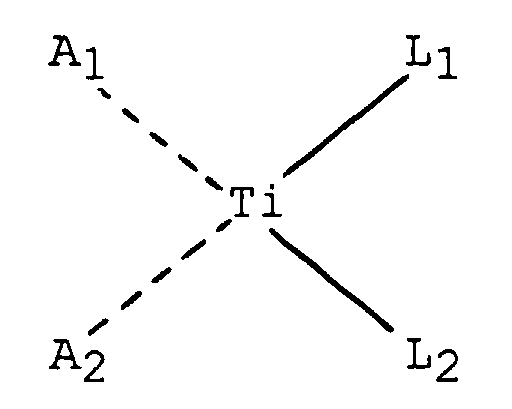
- (b) an alkali metal hydride, added as such or prepared in situ in the polymer solution from the alkali metal terminated living polymer and/or from additionally added alkali metal alkyl.
-
- The molar ratio of the alkali metal:titanium is preferably at least 2:1.
- As alkali metal hydride is preferably used lithium hydride. The polymerisation initiator to be used for the starting living polymer of at least one conjugated diene and the optional additional amounts of alkali metal compound to form additional alkali metal hydride are preferably organolithium compounds. They are preferably selected from methyllithium, ethyllithium, n-propyl lithium, n-butyllithium, sec-butyl lithium, tert butyl lithium, n-hexyllithium, phenyl lithium, p-tolyl lithium, xyllithium , 1,4-dilithiobutane, alkylene dilithium or a reaction product of butyl lithium and divinyl benzene.
- Particularly preferred are n-butyl lithium, sec butyl lithium, tert-butyl lithium and phenyllithium. Most preferred are tert butyllithium, sec-butyllithium or n-butyllithium. The molar ratio of lithium hydride to titanium in the catalyst composition is more preferably at least 6 and most preferably in the range of from 6 to 25.
- The titanium compound (a) is normally used in amounts of from 5 to 100 mg per kg of conjugated diene polymer to be hydrogenated, and preferably in amounts from 20 to 60 mg/kg of conjugated diene polymer to be hydrogenated.
- Preferred ligands L1 and L2 in component (a) are selected from chlorine, bromine, carbonyl, methyl, ethyl, n-propyl, isopropyl, n-butyl, tert-butyl, sec-butyl, trimethylsilyloxy, benzyl, phenyl, hexyl, methoxy, ethoxy, n-propoxy, isopropoxy, butoxy, tert butoxy, sec butoxy, pentoxy, neopentoxy, phenoxy, phenylmethoxy, phenylethoxy and a CH2P(phenyl)2 group.
- More preferably L1 and L2 in the titanium catalyst component are both chlorine, benzyl, phenyl, methoxy, ethoxy, isopropoxy, tert-butoxy, n-butoxy, phenoxy or CH2P(phenyl)2 group, and most preferably both are chlorine.
- The heterocyclic five membered ring, the cyclopentadienyl or the indenyl ring may optionally be substituted by one or more of the same or different groups, which may be selected from halogen or phenyl which optionally may bear one or more the same or different substituents, lower alkyl, alkoxy, phenoxy, phenylalkoxy, benzyl and a bulky substituent containing one or more hetero atoms such as tri (loweralkyl)silyl, ∼NPh2, ∼NHPh, ∼BPh2 and ∼B(OPh)2.
- When one or more, and preferably one or two, of the symbols R represent phenyl, this may optionally be substituted by one or more substituents selected from lower alkyl, halogen, preferably fluoro or chloro, and lower alkoxy.
- Examples thereof are para-tert butylphenyl, pentafluorophenyl, dichlorophenyl, 3,5 di(t-butyl)-4-methoxy phenyl, trifluorophenyl.
- With the terms "lower alkyl" and "lower alkoxy" as used throughout this specification, is meant that these groups contain from 1 to 4 carbon atoms.
- The most preferred titanium compounds are (1-indenyl) (3,4-dimethylphospholyl)titanium dichloride, (1-indenyl)(3,4-dimethylphospholyl)titanium diphenoxide, (indenyl)(3,4-dimethylphospholyl) titanium dimethoxide, (cyclopentadienyl) (3,4-dimethylphospholyl)titanium dichoride (cyclopentadienyl) (2,5-diphenylphospholyl)titanium dichloride, (cyclopentadienyl) (3,4-dimethylphospholyl) titanium dimethoxide, (cyclopentadienyl) (2,5-diphenylphospholyl)titanium dimethoxide, (2-methylcyclopentadienyl) (3,4-dimethylphospholyl)titanium dichloride, (dimethoxycyclopentadienyl)(3,4-dimethylphospholyl)titanium dimethoxide, (2,4-dimethylcyclopentadienyl) (3,4-dimethylphospholyl) titanium dichloride, (1-methylindenyl)(3,4-dimethyl phospholyl)titanium dichloride, (5, 6-dimethoxyindenyl) (3,4-dimethylphospholyl) titanium dimethoxide, (1-methylindenyl)(3,4-dimethylphospholyl)titanium dichloride, (5, 6-dimethoxyindenyl)(2,5-diphenylphospholyl)titanium dimethoxide, (1-methylindenyl) (phospholyl)titanium dimethoxide, and (1-methylindenyl) (phospholyl)titanium dichloride.
- It will be appreciated that another aspect of the present invention is formed by a process for the hydrogenation of polymers containing ethylenical unsaturation (double C-C bonds) by bringing a polymer solution in intensive contact with hydrogen in the presence of at least the catalyst components (a) and (b).
- According to a more preferred embodiment of the hydrogenation process of the present invention one or more promoters (c) may be present in addition to the beforementioned catalyst components (a) and (b).
- Said promoters (c) can be selected from polar ketone compounds, hydroxy group containing ketone compounds, aldehyde compounds, ester compounds, lactone compounds, lactam compounds and epoxy compounds, or from a reducing organometal compound selected from the group consisting of aluminium compounds, zinc compounds and magnesium compounds.
- Of the beforementioned promoters especially preferred are ketone compounds, hydroxy group-containing ketone compounds, aldehyde compounds, ester compounds and epoxy compounds.
- Specific examples of preferred ketone compounds include acetone, diethyl ketone, di-n-propyl ketone, di-i-propyl ketone, di-sec-butyl ketone, di-t-butyl ketone, methyl ethyl ketone, i-propyl methyl ketone, i-butyl methyl ketone, 2-pentanone, 3-hexanone, 3-decanone, diacetyl, acetophenone, 4'-methoxy acetophenone, 4'-methyl acetophenone, propiophenone, benzophenone, 4-methoxy benzophenone, 4,4'-dimethoxy benzophenone, benzyl phenyl ketone, benzil acetone, benzoyl acetone, cyclopentanone, cyclohexanone, 4-methyl cyclohexanone, 1,2-cyclohexane dione, cyclopheptanone, and acetyl acetone.
- Hydroxy group-containing ketone compounds are defined as compounds having both a hydroxy group and a ketone carbonyl group in the molecule. Specific examples of preferred compounds are hydroxyacetone, acetoin, 4-hydroxy-2-butanone, 3-hydroxy-3-methyl-2-butanone, 5-hydroxy-2-butanone, diacetone alcohol, 4-(p-hydroxyphenyl)-2-butanone, 2-hydroxyacetophenone, 2'-hydroxyacetophenone, 3'-hydroxyacetophenone, 4'-hydroxyacetophenone, 4'-hydroxy-3'-methoxyacetophenone, 2-hydroxyphenyl ethyl ketone, 4'-hydroxypropiophenone, 2',4'-dihydroxyacetophenone, 2,', 5'-dihydroxyacetophenone, 2',6'-dihydroxyaceto-phenone, 3',5'-dihydroxyacetophenone, 2',3',4'-trihydroxyacetophenone, 2-hydroxybenzophenone, 4-hydroxybenzophenone, 2-hydroxy-4-methoxybenzophenone, 2-hydroxy-4-n-octyloxybenzophenone, 2,2'-dihydroxybenzophenone, 2,4-dihydroxybenzophenone, 4,4'-dihydroxybenzophenone, 2,2'-dihydroxy-4-methoxybenzo-phenone, 2,,4'-trihydroxybenzophenone, and benzoin.
- As aldehyde compounds, either aliphatic or aromatic aldehyde compounds can be used. The aliphatic group in aliphatic aldehyde compounds may be either saturated or unsaturated and either linear or branched. Given as examples of preferable aldehyde compounds are formaldehyde, acetaldehyde, propionaldehyde, n-butylaldehyde, i-butylaldehyde, n-valeraldehyde, i-valeraldehyde, pivalaldehyde, n-capronaldehyde, 2-ethylhexyladehyde, n-heptaldehyde, n-caprylaldehyde, pelargonaldehyde, n-caprinaldehyde, n-undecylaldehyde, laurylaldehyde, tridecylaldehyde, myristylaldehyde, pentadecylaldehyde, palmitylaldehyde, margarylaldehyde, stearylaldehyde, glyoxal, succinaldehyde, benzaldehyde, o-tolualdehyde, m-tolualdehyde, p-tolualdehyde, α-naphthaldehyde, β-naphthaldehyde, and phenylacetnaphthaldehyde.
- Examples of ester compounds are esters formed by a monobasic acid, e.g. formic acid, acetic acid, propionic acid, butyric acid, capronic acid, pelargonic acid, lauric acid, palmitic acid, stearic acid, isostearic acid, cyclohexylpropionic acid, cyclohexylcapronic acid, benzoic acid, phenylbutyric acid, etc., a dibasic acid, e.g., oxalic acid, maleic acid, malonic acid, fumaric acid, succinic acid, glutaric acid, adipic acid, pimelic acid, suberic acid, sebacic acid, itaconic acid, phthalic acid, isophthalic acid, terephthalic acid, azelaic acid, etc., or a polybasic acid, e.g., 1,2,3-propanetricarboxylic acid, 1,3,5-n-pentanetricarboxylic acid, etc., and an alcohol, e.g., methyl alcohol, ethyl alcohol, isopropyl alcohol, n-butyl alcohol, sec-butyl alcohol, tert-butyl alcohol, amyl alcohol, hexyl alcohol, octyl alcohol, phenol, cresol, 1,3-butanediol, 1,4-butanediol, piniacol, pentaerythritol, etc.
- Specific examples of lactone compounds are β-propiolactone, γ-butyrolactone, ε-caprolactone, Δα,β-crotonlactone, Δβ,γ-crotonlactone, coumarin, phthalide, α-pyrone, sydonone, and fluoran.
- Given as specific examples of lactam compounds are β -propiolactam, 2-pyrrolidone, 2-piperidone, ε-caprolactam, n-heptanelactam, 8-octanelactam, 9-nonanelactam, 10-decanelactam, 2-quinolone, 1-isoquinolone, oxinedole, iso-indigo, isatin, hydantoin, and quinolidinone.
- Specific examples of preferably epoxy compounds include 1,3-butadiene monoxide, 1,3-butadiene dioxide, 1,2-butylene oxide, 2,3-butylene oxide, cyclohexene oxide, 1,2-epoxy cyclododecane, 1,2-epoxy decane, 1,2-epoxy eicosane, 1,2-epoxy heptane, 1,2-epoxy hexadecane, 1,2-epoxy octadecane, 1,2-epoxy octane, ethylene glycol diglycidyl ether, 1,2-epoxy heptane, 1,2-epoxy tetradecane, hexamethylene oxide, isobutylene oxide, 1,7-octadiene diepoxide, 2-phenylpropylene oxide, propylene oxide, trans-stilbene oxide, styrene oxide epoxylated 1,2-polybutadiene, epoxylated linseed oil, glycidyl methyl ether, glyciyl n-butyl ether, glycidyl allyl ether, glycidyl methacrylate, and glycidyl acrylate.
- A suitable molar ratio of component (a) to component (c) consisting of a polar ketone compound, hydroxy ketone compound, aldehyde compound, ester compound, lactone compound, lactam compound or epoxy compound is in the range of from 10 to 1/2 and more preferably in the range of from 5 to 1 and most preferably in the range of from 2 to 1.
- A reducing organic metal compound selected from the group consisting of aluminium compounds, zinc compounds, and magnesium compounds can be used. Given as specific examples are: as aluminium compounds, trimethyl aluminium, triethyl aluminium, tri-i-butyl aluminium, triphenyl aluminium, diethyl aluminium chloride, ethyl aluminium dichloride, methyl aluminium sesquichloride, ethyl aluminium sesquichloride, diethyl aluminium hydride, di-i-butyl aluminium hydride, tri(2-ethylhexyl) aluminium, aluminium tri-i-propoxide, aluminium tri-t-butoxide, and diethyl aluminium ethoxide; as zinc compounds, diethyl zinc, bis(cyclopentadienyl) zinc, and diphenyl zinc; and as magnesium compounds, dimethyl magnesium, diethyl magnesium, methyl magnesium bromide, methyl magnesium chloride, ethyl magnesium bromide, ethyl magnesium chloride, phenyl magnesium bromide, phenyl magnesium chloride, and t-butyl magnesium chloride.
- Beside these compounds, compounds containing two or more reducing metals, such as lithium aluminium hydride, can be used as component (c).
- Of the above compounds, triethyl aluminium, tri-i-butyl aluminium, diethyl aluminium chloride, ethyl alumnium dichloride, aluminium tri-i-propoxide, and aluminium tri-t-butoxide are preferred from the aspect of their ready availability and handling easiness. The molar ratio of component (a) and (c) is preferably greater than 1/20, more preferably in the range of from 1/1 to 1/18 and most preferably in the range of from 1/2 to 1/15.
- Polymers with a high degree of hydrogenation can be obtained according to the process of the present invention, wherein the catalyst system has been surprisingly found to show a significantly higher activity in combination with a high selectivity, resulting in a higher hydrogenation rate of the starting polymer or enabling the use of a smaller concentration of catalyst per part by weight of polymer, as compared with prior art homogeneous Ti catalyst hydrogenation processes. Moreover this catalyst can be dosed more accurately and shows an excellent reproductivity.
- A clear advantage of the process of the present invention is formed by the fact that there seems to be not any distinction during hydrogenation between different types of double C-C bonds, i.e. those in 1,2 vinyl pendant groups, those in the backbone chain without substituted C atoms involved, and those in the backbone chain with substituted C-atoms involved.
- As the catalyst system in the present process can be applied in a significantly lower concentration, its concentration in the final hydrogenated product is much lower. The hydrogenation process can be performed at partial hydrogen pressures in the range of from 1 to 50 bar and preferably in the range of from 1 to 35 bar.
- Included in the olefinically unsaturated polymers to be hydrogenated by the catalyst composition of the present invention are all polymers containing olefinically carbon-carbon unsaturated double bonds in the polymer main chain or side chains. Typical examples are conjugated diene polymers and random, block, or graft polymers of conjugated diene and olefin.
- Included in the above conjugated diene polymers are conjugated diene homopolymers and copolymers produced from conjugated dienes or from at least one conjugated diene and at least one olefin copolymerisable with the conjugated diene.
- Given as typical examples of conjugated dienes used for the production of these conjugated diene polymers are conjugated dienes having 4-12 carbon atoms. Specific examples are 1,3-butadiene, isoprene, 2,3-dimethyl-1,3-butadiene, 1,3-pentadiene, 2-methyl-1,3-pentadiene, 1,3-pentadiene, 1,3-hexadiene, 4,5-diethyl-1,3-octadiene, 3-butyl-1,3-octadiene, and chloroprene.
- From the aspect of manufacturing elastomers having superior characteristics and industrial advantages, 1,3-butadiene and isoprene are particularly preferably. Elastomers, such as polybutadiene, polyisoprene, butadiene/isoprene copolymers are especially preferred polymer materials used in the present invention. There are no specific limitations as to the micro-structures of the polymers. All these polymers are suitable materials in the application of the hydrogenation using the catalyst composition of the present invention.
- The above-mentioned copolymers produced from at least one conjugated diene and at least one olefin copolymerisable with the conjugated diene are also suitable polymer materials to which the hydrogenation using the catalyst composition of the present invention is applied.
- The above-described conjugated diene monomers can be used for the manufacture of this type of copolymers. Any olefins copolymerisable with these conjugated dienes are usable for the manufacture of the copolymer, with vinyl-substituted aromatic hydrocarbons being particular preferred.
- Copolymers of conjugated dienes and vinyl-substituted aromatic hydrocarbons are of particular importance for the production of industrially useful and valuable elastomers or thermoplastic elastomers. Given as specific examples of vinyl-substituted aromatic hydrocarbons used in the manufacture of this type of copolymers are styrene, α-methylstyrene, p-methylstyrene, divinylbenzene, 1,1-diphenylethylene, N,N-dimethyl-p-aminoethylstyrene, N,N-diethyl-p-aminoethylstyrene, and vinylpyridine. Of these styrene and α-methylstyrene are particular preferred. Specific copolymers providing industrially valuable hydrogenated copolymers are butadiene/styrene copolymer, isoprene/styrene copolymer, and butadiene/α-methylstyrene copolymer.
- These copolymers include random copolymers in which monomers are randomly distributed throughout the polymers, progressively reducing block copolymers, complete block copolymers, and graft copolymers and preferably butadiene-styrene block copolymer, isoprene-styrene block copolymers or butadiene/isoprene-styrene block copolymer of linear or radial, multiarmed shape.
- In order to manufacture industrially useful thermoplastic elastomers, a preferable amount of vinyl-substituted aromatic hydrocarbons is in the range of from 15 to 45% by weight.
- A content of vinyl bonds in the conjugated diene units of 10% or more of the total conjugated diene units is desirable for obtaining hydrogenated polymers with superior characteristics.
- Included also in polymers which can be used in the hydrogenating process using the catalyst composition of the present invention are those of linear type, as well as branched type or radial or star type produced by coupling using a coupling agent.
- Also included in the polymers to be hydrogenated according to the present invention are those having terminals modified with polar groups after the living anionic polymerisation or by other means. Hydroxy group, carboxyl group, ester group, isocyanate group, urethane group, amide group, ureas group, and thiourethane group can be used as the polar group.
- Beside the above-mentioned polymers, any polymer manufactured by any polymerisation methods, e.g., anion polymerisation, cation polymerisation, co-ordination polymerisation, radical polymerisation, solution polymerisation, or emulsion polymerisation can be used in the present invention.
- In addition, cyclic olefin polymers manufactured by ring-opening polymerisation using a methathesis catalyst, such as molybdenum or tungsten, are included in polymers having olefinically unsaturated bonds.
- In the hydrogenation reaction using the catalyst composition of the present invention, the olefinically unsaturated polymers may be hydrogenated in a condition where they are dissolved in a hydrocarbon solvent, or the olefinically unsaturated polymers maybe produced by polymerisation in a hydrocarbon solvent and may successively be hydrogenated.
- Hydrocarbon solvents used in the hydrogenation reaction may be aliphatic hydrocarbons, e.g. pentane, hexane, heptane, octane, etc.; alicyclic hydrocarbons, e.g. cyclopentane, methyl cyclopentane, cyclohexane, or an aromatic solvent such as toluene. These hydrocarbon solvent may contain 20% by weight or a smaller amount of ethers such as diethyl ether, tetrahydrofuran, dibutyl ether, diethoxypropane, or dioxane.
- There are no restrictions as to the concentration of polymers in carrying out the hydrogenation reaction of the present invention. Usually, however, the polymer concentration is in the range of from 1 to 30% by weight, and preferably in the range of from 3 to 20% by weight. The hydrogenation reaction is effected, after the addition of the hydrogenation catalyst composition under an inert gas atmosphere, e.g. in nitrogen or argon, or under a hydrogen atmosphere, by supplying hydrogen, with or without stirring while maintaining the temperature of the polymer solution at a specified temperature.
- A temperature suitable for the hydrogenation reaction is in the range of from 0 to 150°C. A temperature lower than 0°C is uneconomical, since at a temperature lower than 0°C not only the catalyst activity is lowered, but also the rate of hydrogenation is retarded. If the temperature is higher than 150°C, on the other hand, not only the polymers tend to decompose or to gel, but also aromatic rings are hydrogenated at the same time, leading to a poor hydrogenation selectivity. A more preferred temperature is in the range of from 20 to 140°C, and most preferred in the range of from 50 to 130°C. In the hydrogenation reaction using the catalyst composition of the present invention, the reaction may be carried out at a comparatively higher temperature, resulting in a higher rate of reaction and a higher yield.
- The hydrogenation reaction is carried out for a period of time in the range of from 1 minute to 5 hours. The larger the amount of the catalyst composition used and the higher the pressure, the reaction time may be shorter.
- The optionally substituted five membered heterocyclic titanium catalyst components (a) of formula I may be prepared by methods which are in principle known e.g. from F. Nieff, L. Richard and F. Mathey, Organometallics 1989 (8), 1473-1477, and F. Mathey, J Organometal. Chem 1990 (400) 149-164.
- The invention will now be illustrated by means of the following Examples.
- A 30 L batch of polystyrene-polybutadiene-polystyrene (SBS) block copolymer having an apparent molecular weight of 70,000 (as measured with gel chromatography (GPC) using polystyrene calibration standards) was prepared by sequential anionic polymerisation using sec-butylithium as the initiator in a stainless steel reactor. The polymerisation was conducted in cyclohexane, to which had been added 140 ppm of diethoxypropane at 18 wt% solids. The 1,2-content of the SBS polymer was 40 wt%. At the end of the polymerisation reaction the reactor was sparged with hydrogen for 2 hrs to terminate the living SBS-Li polymer and produce SBS and LiH. The LiH content of the batch was determined to be 2.2 mmol/litre.
- A stainless steel reactor was charged with 190 grams of SBS cement, prepared as in Example 1. The temperature of the reactor was fixed at 70°C and the reactor was pressurised to 10 bar of hydrogen to saturate the cement. Meanwhile a suspension of 17 mg (40.5 mmol) of (2,5-diphenylphospholyl)-(cyclopentadienyl)titaniumdichloride in 10 ml of cyclohexane was prepared. The catalyst suspension was added to the reactor and the hydrogen pressure was raised to 50 bar. The hydrogenation was allowed to run for 3 hours, during which period samples were drawn from the reactor and analysed by 1H NMR to determine the conversion of the olefinic double bonds. Results are shown in Table 1.
- Another hydrogenation run was performed in the same fashion as above, however with the use of 12 mg (40.9 mmol) of (3,4-dimethylphospholyl)(cyclopentadienyl)titaniumdichloride. Results are shown in Table 1.
Run 15 min conversion 60 min conversion 180 min conversion Example 2 69 92 100 Example 3 46 56 61
Claims (15)
- Catalyst composition suitable for hydrogenation of polymers containing ethylenical unsaturation which comprises at least:(a) a titanium compound of the formulawherein A1 represents an optionally substituted heterocyclic five membered ring comprising a phosphorous or nitrogen heteroatom, and A2 has the same meaning as A1 or alternatively represents an optionally substituted cyclopentadienyl group or indenyl group, and wherein L1 and L2 may be the same or different and each may be selected from hydrogen, halogen, lower alkyl groups containing 1-4 carbons, phenyl, aralkyl, having from 7 to 10 carbons, lower alkoxy groups containing 1-4 carbons, phenyloxy, phenylalkoxy group having from 7 to 10 carbon atoms, carboxyl, carbonyl, a ∼CH2P(Phenyl)2, -CH2 Si(1 to 4 carbon atom containing alkyl group alkyl)3 or ∼P(phenyl)2 group; and
 (b) an alkali metal hydride, added as such or prepared in situ in the polymer solution from the alkali metal terminated living polymer and/or from additionally added alkali metal alkyl.
 - Catalyst composition according to claim 1,
characterised in that the molar ratio alkali metal: titanium is at least 2:1. - Catalyst composition according to claims 1 or 2, characterised in that the alkali metal hydride is lithium hydride.
- Catalyst composition according to claim 3, characterised in that the molar ratio of lithium hydride to titanium is in the range of from 6 to 25.
- Catalyst composition according to any one of claims 1 to 4, characterised in that ligands L1 and L2 in component (a) are selected from chlorine, bromine, carbonyl, methyl, ethyl, n-propyl, isopropyl, n-butyl, tert-butyl, sec-butyl, trimethylsilyloxy, benzyl, phenyl, hexyl, methoxy, ethoxy, n-propoxy, isopropoxy, butoxy, tert butoxy, sec butoxy, pentoxy, neopentoxy, phenoxy, phenylmethoxy, phenylethoxy or a CH2P(phenyl)2 group.
- Catalyst composition according to claim 5, characterised in that L1 and L2 are both chlorine, benzyl, phenyl, methoxy, ethoxy, isopropoxy, tert-butoxy, n-butoxy, phenoxy or a CH2P(phenyl)2 group.
- Catalyst composition according to claim 6, characterised in that L1 and L2 are both chlorine.
- Catalyst composition according to any one of claims 1 to 7 characterised in that , the component (a) is selected from (1-indenyl) (3,4-dimethylpbospholyl)titanium dichloride, (1-indenyl)(3,4-dimethylphospholyl)titanium diphenoxide, (indenyl) (3,4-dimethylphospholyl)titanium dimethoxide, (cyclopentadienyl) (3,4-dimethylphospholyl)titanium dichoride, (cyclopentadienyl) (2,5-diphenylphospholyl)titanium dichloride, (cyclopentadienyl) (3,4-dimethylphospholyl)titanium dimethoxide, (cyclopentadienyl) (2,5-diphenylphospholyl)titanium dimethoxide, (2-methylcyclopentadienyl) (3,4-dimethylphospholyl)titanium dichloride, (dimethoxycyclopentadienyl) (3,4-dimethylphospholyl)titanium dimethoxide, (3,4-dimethylcyclopentadienyl) (3,4-dimethylphospholyl)titanium dichloride, (1-methylindenyl)(3,4-dimethylphospholyl)titanium dichloride, (5,6-dimethoxyindenyl)(3,4-dimethylphospholyl)titanium dimethoxide, (1-methylindenyl)(3,4-dimethylphospholyl)titanium dichloride, (5,6-dimethoxyindenyl)(2,5-diphenylphospholyl)titanium dimethoxide, (1-methylindenyl)(phospholyl)titanium dimethoxide, or (1-methylindenyl(phospholyl)titanium dichloride.
- Catalyst composition according to any one of claims 1 to 8, characterised in that it comprises in addition to components (a) and (b) one or more promotors (c), selected from polar ketone compounds, hydroxy group containing ketone compounds, aldehyde compounds, ester compounds, lactone compounds, lactam compounds or epoxy compounds.
- Catalyst composition according to claim 9 characterised in that it comprises a promotor selected from ketone compounds, hydroxy group containing ketone compounds, aldehyde compounds, ester compounds or epoxy compounds.
- Catalyst composition according to claim 9 or 10 characterised in that the molar ratio of component (a) to component (c) is in the range of from 10 to 1/2.
- Catalyst composition according to any one of claims 1 to 8, characterised in that it comprises in addition to components (a) and (b) one or more promotors (c), representing a reducing organic metal compound, selected from the group consisting of aluminium compounds, zinc compounds, and magnesium compounds.
- Catalyst compositions according to claim 12, characterised in that the reducing organometal compound is selected from trimethyl aluminium, triethyl aluminium, tri-i-butyl aluminium, triphenyl aluminium, diethyl aluminium chloride, ethyl aluminium dichloride, methyl aluminium sesquichloride, ethyl aluminium sesquichloride, diethyl aluminium hydride, di-i-butyl aluminium hydride, tri(2-ethylhexyl) aluminium, aluminium tri-i-propoxide, aluminium tri-t-butoxide, diethyl aluminium ethoxide, diethyl zinc, bis(cyclopentadienyl) zinc, diphenyl zinc, dimethyl magnesium, diethyl magnesium, methyl magnesium bromide, methyl magnesium chloride, ethyl magnesium bromide, ethyl magnesium chloride, phenyl magnesium bromide, phenyl magnesium chloride, or t-butyl malgnesium chloride.
- Catalyst compositions according to claim 12 or 13, characterised in that the molar ratio of component (a) and (c) is in the range of from 1/1 to 1/18.
- Process for the hydrogenation of polymers containing ethylenical unsaturation, comprising bringing a polymer solution in intensive contact with hydrogen in the presence of at least the catalyst composition according to any one of claims 1 to 14.
Priority Applications (1)
| Application Number | Priority Date | Filing Date | Title |
|---|---|---|---|
| EP97201573A EP0810231B1 (en) | 1996-05-29 | 1997-05-28 | Process for hydrogenation of conjugated diene polymers and catalyst compositions suitable for use therein |
Applications Claiming Priority (3)
| Application Number | Priority Date | Filing Date | Title |
|---|---|---|---|
| EP96303815 | 1996-05-29 | ||
| EP96303815 | 1996-05-29 | ||
| EP97201573A EP0810231B1 (en) | 1996-05-29 | 1997-05-28 | Process for hydrogenation of conjugated diene polymers and catalyst compositions suitable for use therein |
Publications (2)
| Publication Number | Publication Date |
|---|---|
| EP0810231A1 EP0810231A1 (en) | 1997-12-03 |
| EP0810231B1 true EP0810231B1 (en) | 2000-01-19 |
Family
ID=8224956
Family Applications (1)
| Application Number | Title | Priority Date | Filing Date |
|---|---|---|---|
| EP97201573A Expired - Lifetime EP0810231B1 (en) | 1996-05-29 | 1997-05-28 | Process for hydrogenation of conjugated diene polymers and catalyst compositions suitable for use therein |
Country Status (6)
| Country | Link |
|---|---|
| US (1) | US5886107A (en) |
| EP (1) | EP0810231B1 (en) |
| JP (1) | JPH1053614A (en) |
| DE (1) | DE69701169T2 (en) |
| ES (1) | ES2140944T3 (en) |
| TW (1) | TW422849B (en) |
Families Citing this family (15)
| Publication number | Priority date | Publication date | Assignee | Title |
|---|---|---|---|---|
| JPH10101727A (en) * | 1996-09-24 | 1998-04-21 | Shell Internatl Res Maatschappij Bv | Catalysts and methods for hydrogenating olefins or polymers |
| JP3777810B2 (en) | 1998-07-24 | 2006-05-24 | Jsr株式会社 | Olefinic unsaturated compound hydrogenation catalyst and hydrogenation method |
| KR100267080B1 (en) * | 1998-08-03 | 2000-10-02 | 박찬구 | Method for hydrogenation of conjugated diene polymer |
| KR100287961B1 (en) * | 1998-09-30 | 2001-05-02 | 박찬구 | Hydrogenation method of polymer containing conjugated diene |
| TW583027B (en) * | 1998-10-30 | 2004-04-11 | Shell Int Research | A method for preparing a hydrogenation catalyst system |
| KR100295601B1 (en) * | 1999-01-18 | 2001-07-03 | 박찬구 | Process for selective hydrogenation of conjugated diene polymer |
| US6313230B1 (en) * | 1999-09-21 | 2001-11-06 | Industrial Technology Research Institute | Catalyst composition for hydrogenation of conjugated diene based synthetic rubbers |
| KR100348761B1 (en) * | 1999-11-26 | 2002-08-13 | 금호석유화학 주식회사 | Method for the selective hydrogenation of the conjugated diene containing polymer |
| KR100356533B1 (en) * | 2000-02-09 | 2002-10-18 | 금호석유화학 주식회사 | Method for the selective hydrogenation of the conjugated diene polymer |
| ATE297415T1 (en) | 2000-07-28 | 2005-06-15 | Kraton Polymers Res Bv | METHOD FOR PRODUCING PARTIALLY HYDROGENATED BUTADIENE POLYMERS |
| NZ526235A (en) | 2000-12-01 | 2005-07-29 | Kraton Polymers Res B | Bituminous composition with reduced gelation tendency |
| US7166679B2 (en) * | 2003-09-24 | 2007-01-23 | Kraton Polymers Llc | Conjugated diene polymers and copolymer blocks having high vinyl content prepared using mixed microstructure control agents and process for preparing same |
| CN100564402C (en) * | 2006-02-10 | 2009-12-02 | 台橡股份有限公司 | Method for hydrogenating polymer containing conjugated diene unit and hydrogenation catalyst composition thereof |
| US9182560B2 (en) | 2011-02-18 | 2015-11-10 | Kraton Polymers U.S. Llc | Curable polymeric compositions for cable filling |
| CN113368903A (en) * | 2021-07-09 | 2021-09-10 | 浙江众立合成材料科技股份有限公司 | Three-component composite catalyst for preparing hydrogenated polymer |
Family Cites Families (16)
| Publication number | Priority date | Publication date | Assignee | Title |
|---|---|---|---|---|
| BE737574A (en) * | 1968-09-05 | 1970-02-02 | ||
| GB2134909B (en) * | 1983-01-20 | 1986-08-20 | Asahi Chemical Ind | Catalytic hydrogenation of conjugated diene polymer |
| JPS60220147A (en) * | 1984-04-18 | 1985-11-02 | Asahi Chem Ind Co Ltd | Olefin hydrogenation catalyst and hydrogenation of polymer using said catalyst |
| JP2969771B2 (en) * | 1989-12-22 | 1999-11-02 | ジェイエスアール株式会社 | Method for hydrogenating olefinically unsaturated polymer and catalyst composition for hydrogenation |
| US5039755A (en) * | 1990-05-29 | 1991-08-13 | Shell Oil Company | Selective hydrogenation of conjugated diolefin polymers |
| US5206307A (en) * | 1991-09-09 | 1993-04-27 | Shell Oil Company | Process for selective hydrogenation of conjugated diolefin polymers |
| US5270274A (en) * | 1991-11-28 | 1993-12-14 | Japan Synthetic Rubber Co., Ltd. | Catalyst composition for hydrogenating olefinically unsaturated polymers |
| ES2053363B1 (en) * | 1991-12-05 | 1995-02-16 | Repsol Quimica Sa | OLEPHINE HYDROGENATION PROCEDURE. |
| US5173537A (en) * | 1991-12-20 | 1992-12-22 | Shell Oil Company | Selective hydrogenation of conjugated diolefin poylmers |
| WO1995025136A1 (en) * | 1992-03-05 | 1995-09-21 | Exxon Research And Engineering Co. | Sulfonated unhydrogenated copolymers of styrene and butadiene |
| US5434116A (en) * | 1992-06-05 | 1995-07-18 | Tosoh Corporation | Organic transition metal compound having π-bonding heterocyclic ligand and method of polymerizing olefin by using the same |
| US5242986A (en) * | 1992-08-10 | 1993-09-07 | Shell Oil Company | Selective partial hydrogenation of conjugated diolefin polymers |
| ES2050620B1 (en) * | 1992-11-03 | 1994-12-16 | Repsol Quimica Sa | HYDROGENATION PROCEDURE IN DISSOLUTION OF THE DOUBLE LINKS OF CONJUGATED DIES POLYMERS AND COPOLYMER HYDROGENATED BLOCK PRODUCED. |
| BE1007262A3 (en) * | 1993-07-09 | 1995-05-02 | Dsm Nv | Catalyst compound and method for the polymerisation of an olefin |
| EP0638593A1 (en) * | 1993-08-02 | 1995-02-15 | Shell Internationale Researchmaatschappij B.V. | Catalyst compositions |
| US5541272A (en) * | 1994-06-03 | 1996-07-30 | Phillips Petroleum Company | High activity ethylene selective metallocenes |
-
1997
- 1997-05-27 JP JP9136789A patent/JPH1053614A/en not_active Withdrawn
- 1997-05-28 ES ES97201573T patent/ES2140944T3/en not_active Expired - Lifetime
- 1997-05-28 DE DE69701169T patent/DE69701169T2/en not_active Expired - Fee Related
- 1997-05-28 EP EP97201573A patent/EP0810231B1/en not_active Expired - Lifetime
- 1997-05-28 US US08/864,602 patent/US5886107A/en not_active Expired - Lifetime
- 1997-06-19 TW TW086108603A patent/TW422849B/en not_active IP Right Cessation
Also Published As
| Publication number | Publication date |
|---|---|
| TW422849B (en) | 2001-02-21 |
| US5886107A (en) | 1999-03-23 |
| EP0810231A1 (en) | 1997-12-03 |
| JPH1053614A (en) | 1998-02-24 |
| DE69701169D1 (en) | 2000-02-24 |
| DE69701169T2 (en) | 2000-07-13 |
| ES2140944T3 (en) | 2000-03-01 |
Similar Documents
| Publication | Publication Date | Title |
|---|---|---|
| EP0801079B1 (en) | Process for hydrogenation of conjugated diene polymers and catalyst compositions suitable for use therein | |
| US5270274A (en) | Catalyst composition for hydrogenating olefinically unsaturated polymers | |
| EP0795564B1 (en) | Process for hydrogenation of conjugated diene polymers and catalyst compositions suitable for use therein | |
| US5886107A (en) | Process for hydrogenation of conjugated diene polymers and catalyst compositions suitable for use therein | |
| JP3166137B2 (en) | Method for hydrogenating olefinically unsaturated polymer and hydrogenation catalyst | |
| JP3326772B2 (en) | Method for hydrogenating olefinically unsaturated polymer and hydrogenation catalyst | |
| JP3227678B2 (en) | Method for hydrogenating olefinically unsaturated polymer and hydrogenation catalyst | |
| MXPA97001870A (en) | Process for the hydrogenation of conjugated diameter polymers and catalyzing compositions adequate to be used in mi | |
| EP2913348B1 (en) | Method of producing hydrogenation catalyst composition and hydrogenation catalyst composition | |
| JP2001163919A (en) | Selective hydrogenation method for polymer containing conjugated diene | |
| KR100267080B1 (en) | Method for hydrogenation of conjugated diene polymer | |
| RU2609020C2 (en) | Catalyst composition for hydrogenation and hydrogenation method using same | |
| JP3617553B2 (en) | Olefin hydrogenated composite catalyst and process for producing hydrogenated conjugated diene polymer | |
| US9211532B2 (en) | Catalyst for the hydrogenation of unsaturated compounds | |
| JP3326773B2 (en) | Method for hydrogenating polymer containing olefinically unsaturated bond and hydrogenation catalyst | |
| KR100525744B1 (en) | Catalyst Composition Appropriate for Hydrogenation of Conjugated Diene Polymers and Their Uses | |
| JPH0841081A (en) | New titanocene compound, catalyst composition for hydrogenating olefin compound and method for hydrogenating olefin compound using the same catalyst composition | |
| JP3282166B2 (en) | Method for hydrogenating olefinically unsaturated polymer and hydrogenation catalyst | |
| JP3328916B2 (en) | Method for hydrogenating polymer containing olefinically unsaturated bond and hydrogenation catalyst | |
| JP3227679B2 (en) | Method for hydrogenating olefinically unsaturated polymer and hydrogenation catalyst |
Legal Events
| Date | Code | Title | Description |
|---|---|---|---|
| PUAI | Public reference made under article 153(3) epc to a published international application that has entered the european phase |
Free format text: ORIGINAL CODE: 0009012 |
|
| AK | Designated contracting states |
Kind code of ref document: A1 Designated state(s): BE DE ES FR GB IT NL |
|
| 17P | Request for examination filed |
Effective date: 19980518 |
|
| 17Q | First examination report despatched |
Effective date: 19981126 |
|
| GRAG | Despatch of communication of intention to grant |
Free format text: ORIGINAL CODE: EPIDOS AGRA |
|
| GRAG | Despatch of communication of intention to grant |
Free format text: ORIGINAL CODE: EPIDOS AGRA |
|
| GRAH | Despatch of communication of intention to grant a patent |
Free format text: ORIGINAL CODE: EPIDOS IGRA |
|
| GRAH | Despatch of communication of intention to grant a patent |
Free format text: ORIGINAL CODE: EPIDOS IGRA |
|
| GRAA | (expected) grant |
Free format text: ORIGINAL CODE: 0009210 |
|
| AK | Designated contracting states |
Kind code of ref document: B1 Designated state(s): BE DE ES FR GB IT NL |
|
| ITF | It: translation for a ep patent filed | ||
| REF | Corresponds to: |
Ref document number: 69701169 Country of ref document: DE Date of ref document: 20000224 |
|
| REG | Reference to a national code |
Ref country code: ES Ref legal event code: FG2A Ref document number: 2140944 Country of ref document: ES Kind code of ref document: T3 |
|
| ET | Fr: translation filed | ||
| PLBE | No opposition filed within time limit |
Free format text: ORIGINAL CODE: 0009261 |
|
| STAA | Information on the status of an ep patent application or granted ep patent |
Free format text: STATUS: NO OPPOSITION FILED WITHIN TIME LIMIT |
|
| 26N | No opposition filed | ||
| REG | Reference to a national code |
Ref country code: GB Ref legal event code: IF02 |
|
| PGFP | Annual fee paid to national office [announced via postgrant information from national office to epo] |
Ref country code: FR Payment date: 20050314 Year of fee payment: 9 |
|
| PGFP | Annual fee paid to national office [announced via postgrant information from national office to epo] |
Ref country code: GB Payment date: 20050426 Year of fee payment: 9 |
|
| PGFP | Annual fee paid to national office [announced via postgrant information from national office to epo] |
Ref country code: NL Payment date: 20050510 Year of fee payment: 9 |
|
| PGFP | Annual fee paid to national office [announced via postgrant information from national office to epo] |
Ref country code: ES Payment date: 20050513 Year of fee payment: 9 |
|
| PGFP | Annual fee paid to national office [announced via postgrant information from national office to epo] |
Ref country code: BE Payment date: 20050517 Year of fee payment: 9 |
|
| PGFP | Annual fee paid to national office [announced via postgrant information from national office to epo] |
Ref country code: DE Payment date: 20050523 Year of fee payment: 9 |
|
| PG25 | Lapsed in a contracting state [announced via postgrant information from national office to epo] |
Ref country code: GB Free format text: LAPSE BECAUSE OF NON-PAYMENT OF DUE FEES Effective date: 20060528 |
|
| PG25 | Lapsed in a contracting state [announced via postgrant information from national office to epo] |
Ref country code: ES Free format text: LAPSE BECAUSE OF NON-PAYMENT OF DUE FEES Effective date: 20060529 |
|
| PG25 | Lapsed in a contracting state [announced via postgrant information from national office to epo] |
Ref country code: BE Free format text: LAPSE BECAUSE OF NON-PAYMENT OF DUE FEES Effective date: 20060531 |
|
| PGFP | Annual fee paid to national office [announced via postgrant information from national office to epo] |
Ref country code: IT Payment date: 20060531 Year of fee payment: 10 |
|
| PG25 | Lapsed in a contracting state [announced via postgrant information from national office to epo] |
Ref country code: NL Free format text: LAPSE BECAUSE OF NON-PAYMENT OF DUE FEES Effective date: 20061201 Ref country code: DE Free format text: LAPSE BECAUSE OF NON-PAYMENT OF DUE FEES Effective date: 20061201 |
|
| GBPC | Gb: european patent ceased through non-payment of renewal fee |
Effective date: 20060528 |
|
| NLV4 | Nl: lapsed or anulled due to non-payment of the annual fee |
Effective date: 20061201 |
|
| REG | Reference to a national code |
Ref country code: FR Ref legal event code: ST Effective date: 20070131 |
|
| REG | Reference to a national code |
Ref country code: ES Ref legal event code: FD2A Effective date: 20060529 |
|
| BERE | Be: lapsed |
Owner name: *SHELL INTERNATIONALE RESEARCH MAATSCHAPPIJ B.V. Effective date: 20060531 |
|
| PG25 | Lapsed in a contracting state [announced via postgrant information from national office to epo] |
Ref country code: FR Free format text: LAPSE BECAUSE OF NON-PAYMENT OF DUE FEES Effective date: 20060531 |
|
| PG25 | Lapsed in a contracting state [announced via postgrant information from national office to epo] |
Ref country code: IT Free format text: LAPSE BECAUSE OF NON-PAYMENT OF DUE FEES Effective date: 20070528 |