EP0810201B1 - Preventive/remedy for liver disease - Google Patents
Preventive/remedy for liver disease Download PDFInfo
- Publication number
- EP0810201B1 EP0810201B1 EP96901951A EP96901951A EP0810201B1 EP 0810201 B1 EP0810201 B1 EP 0810201B1 EP 96901951 A EP96901951 A EP 96901951A EP 96901951 A EP96901951 A EP 96901951A EP 0810201 B1 EP0810201 B1 EP 0810201B1
- Authority
- EP
- European Patent Office
- Prior art keywords
- lipid emulsion
- group
- prophylactic
- therapeutic agent
- carbon atoms
- Prior art date
- Legal status (The legal status is an assumption and is not a legal conclusion. Google has not performed a legal analysis and makes no representation as to the accuracy of the status listed.)
- Expired - Lifetime
Links
- 208000019423 liver disease Diseases 0.000 title claims abstract description 50
- 230000003449 preventive effect Effects 0.000 title 1
- 239000002960 lipid emulsion Substances 0.000 claims abstract description 72
- IOKNBNASFGBUTI-UHFFFAOYSA-N 3-methylbuta-1,3-dien-1-amine Chemical class CC(=C)C=CN IOKNBNASFGBUTI-UHFFFAOYSA-N 0.000 claims abstract description 56
- 150000003839 salts Chemical class 0.000 claims abstract description 22
- -1 methylenedioxy Chemical group 0.000 claims abstract description 20
- 125000004435 hydrogen atom Chemical group [H]* 0.000 claims abstract description 9
- 125000001997 phenyl group Chemical group [H]C1=C([H])C([H])=C(*)C([H])=C1[H] 0.000 claims abstract description 9
- 125000005843 halogen group Chemical group 0.000 claims abstract description 6
- 125000002887 hydroxy group Chemical group [H]O* 0.000 claims abstract description 6
- 125000002541 furyl group Chemical group 0.000 claims abstract description 5
- 125000001544 thienyl group Chemical group 0.000 claims abstract description 5
- 125000004076 pyridyl group Chemical group 0.000 claims abstract description 4
- 229910052739 hydrogen Inorganic materials 0.000 claims abstract 3
- 239000001257 hydrogen Substances 0.000 claims abstract 3
- XLYOFNOQVPJJNP-UHFFFAOYSA-N water Substances O XLYOFNOQVPJJNP-UHFFFAOYSA-N 0.000 claims description 43
- 239000003814 drug Substances 0.000 claims description 29
- PEDCQBHIVMGVHV-UHFFFAOYSA-N Glycerine Chemical compound OCC(O)CO PEDCQBHIVMGVHV-UHFFFAOYSA-N 0.000 claims description 24
- 125000004432 carbon atom Chemical group C* 0.000 claims description 23
- 230000000069 prophylactic effect Effects 0.000 claims description 23
- 229940124597 therapeutic agent Drugs 0.000 claims description 22
- 238000002347 injection Methods 0.000 claims description 14
- 239000007924 injection Substances 0.000 claims description 14
- 239000003995 emulsifying agent Substances 0.000 claims description 12
- 235000012424 soybean oil Nutrition 0.000 claims description 11
- 239000003549 soybean oil Substances 0.000 claims description 11
- 239000003381 stabilizer Substances 0.000 claims description 11
- 125000001931 aliphatic group Chemical group 0.000 claims description 10
- 125000000217 alkyl group Chemical group 0.000 claims description 8
- HVYWMOMLDIMFJA-DPAQBDIFSA-N cholesterol Chemical compound C1C=C2C[C@@H](O)CC[C@]2(C)[C@@H]2[C@@H]1[C@@H]1CC[C@H]([C@H](C)CCCC(C)C)[C@@]1(C)CC2 HVYWMOMLDIMFJA-DPAQBDIFSA-N 0.000 claims description 8
- 102000009027 Albumins Human genes 0.000 claims description 7
- 108010088751 Albumins Proteins 0.000 claims description 7
- 239000007951 isotonicity adjuster Substances 0.000 claims description 7
- 150000004676 glycans Chemical class 0.000 claims description 6
- 150000003904 phospholipids Chemical class 0.000 claims description 6
- 229920001282 polysaccharide Polymers 0.000 claims description 6
- 239000005017 polysaccharide Substances 0.000 claims description 6
- 235000015112 vegetable and seed oil Nutrition 0.000 claims description 6
- 239000008158 vegetable oil Substances 0.000 claims description 6
- PORPENFLTBBHSG-MGBGTMOVSA-N 1,2-dihexadecanoyl-sn-glycerol-3-phosphate Chemical compound CCCCCCCCCCCCCCCC(=O)OC[C@H](COP(O)(O)=O)OC(=O)CCCCCCCCCCCCCCC PORPENFLTBBHSG-MGBGTMOVSA-N 0.000 claims description 5
- JLPULHDHAOZNQI-ZTIMHPMXSA-N 1-hexadecanoyl-2-(9Z,12Z-octadecadienoyl)-sn-glycero-3-phosphocholine Chemical compound CCCCCCCCCCCCCCCC(=O)OC[C@H](COP([O-])(=O)OCC[N+](C)(C)C)OC(=O)CCCCCCC\C=C/C\C=C/CCCCC JLPULHDHAOZNQI-ZTIMHPMXSA-N 0.000 claims description 5
- 125000003545 alkoxy group Chemical group 0.000 claims description 5
- 230000001804 emulsifying effect Effects 0.000 claims description 5
- 239000008347 soybean phospholipid Substances 0.000 claims description 5
- 150000001413 amino acids Chemical class 0.000 claims description 4
- 235000012000 cholesterol Nutrition 0.000 claims description 4
- GVJHHUAWPYXKBD-UHFFFAOYSA-N d-alpha-tocopherol Natural products OC1=C(C)C(C)=C2OC(CCCC(C)CCCC(C)CCCC(C)C)(C)CCC2=C1C GVJHHUAWPYXKBD-UHFFFAOYSA-N 0.000 claims description 4
- 229960001295 tocopherol Drugs 0.000 claims description 4
- 229930003799 tocopherol Natural products 0.000 claims description 4
- 235000010384 tocopherol Nutrition 0.000 claims description 4
- 239000011732 tocopherol Substances 0.000 claims description 4
- GVJHHUAWPYXKBD-IEOSBIPESA-N α-tocopherol Chemical compound OC1=C(C)C(C)=C2O[C@@](CCC[C@H](C)CCC[C@H](C)CCCC(C)C)(C)CCC2=C1C GVJHHUAWPYXKBD-IEOSBIPESA-N 0.000 claims description 4
- TZCPCKNHXULUIY-RGULYWFUSA-N 1,2-distearoyl-sn-glycero-3-phosphoserine Chemical compound CCCCCCCCCCCCCCCCCC(=O)OC[C@H](COP(O)(=O)OC[C@H](N)C(O)=O)OC(=O)CCCCCCCCCCCCCCCCC TZCPCKNHXULUIY-RGULYWFUSA-N 0.000 claims description 3
- JZNWSCPGTDBMEW-UHFFFAOYSA-N Glycerophosphorylethanolamin Natural products NCCOP(O)(=O)OCC(O)CO JZNWSCPGTDBMEW-UHFFFAOYSA-N 0.000 claims description 3
- ZWZWYGMENQVNFU-UHFFFAOYSA-N Glycerophosphorylserin Natural products OC(=O)C(N)COP(O)(=O)OCC(O)CO ZWZWYGMENQVNFU-UHFFFAOYSA-N 0.000 claims description 3
- REYJJPSVUYRZGE-UHFFFAOYSA-N Octadecylamine Chemical compound CCCCCCCCCCCCCCCCCCN REYJJPSVUYRZGE-UHFFFAOYSA-N 0.000 claims description 3
- 150000002016 disaccharides Chemical class 0.000 claims description 3
- 239000008344 egg yolk phospholipid Substances 0.000 claims description 3
- 229940068998 egg yolk phospholipid Drugs 0.000 claims description 3
- 238000010253 intravenous injection Methods 0.000 claims description 3
- 150000004667 medium chain fatty acids Chemical class 0.000 claims description 3
- 125000002496 methyl group Chemical group [H]C([H])([H])* 0.000 claims description 3
- 239000001788 mono and diglycerides of fatty acids Substances 0.000 claims description 3
- 150000002772 monosaccharides Chemical class 0.000 claims description 3
- 150000008104 phosphatidylethanolamines Chemical class 0.000 claims description 3
- 150000005846 sugar alcohols Chemical class 0.000 claims description 3
- 150000003626 triacylglycerols Chemical class 0.000 claims description 3
- 235000014113 dietary fatty acids Nutrition 0.000 claims 4
- 239000000194 fatty acid Substances 0.000 claims 4
- 229930195729 fatty acid Natural products 0.000 claims 4
- 150000004665 fatty acids Chemical class 0.000 claims 2
- 235000019960 monoglycerides of fatty acid Nutrition 0.000 claims 2
- 239000004094 surface-active agent Substances 0.000 claims 2
- 239000008194 pharmaceutical composition Substances 0.000 claims 1
- 150000001875 compounds Chemical class 0.000 abstract description 29
- 238000002360 preparation method Methods 0.000 abstract description 10
- 230000000694 effects Effects 0.000 abstract description 5
- 125000001424 substituent group Chemical group 0.000 abstract description 4
- 125000004178 (C1-C4) alkyl group Chemical group 0.000 abstract 2
- 125000000229 (C1-C4)alkoxy group Chemical group 0.000 abstract 1
- HEDRZPFGACZZDS-MICDWDOJSA-N Trichloro(2H)methane Chemical compound [2H]C(Cl)(Cl)Cl HEDRZPFGACZZDS-MICDWDOJSA-N 0.000 description 62
- 230000000052 comparative effect Effects 0.000 description 55
- XEKOWRVHYACXOJ-UHFFFAOYSA-N Ethyl acetate Chemical compound CCOC(C)=O XEKOWRVHYACXOJ-UHFFFAOYSA-N 0.000 description 48
- 238000005160 1H NMR spectroscopy Methods 0.000 description 32
- 238000007796 conventional method Methods 0.000 description 24
- 238000000034 method Methods 0.000 description 24
- VZGDMQKNWNREIO-UHFFFAOYSA-N tetrachloromethane Chemical compound ClC(Cl)(Cl)Cl VZGDMQKNWNREIO-UHFFFAOYSA-N 0.000 description 24
- 239000000203 mixture Substances 0.000 description 23
- RGHHSNMVTDWUBI-UHFFFAOYSA-N 4-hydroxybenzaldehyde Chemical compound OC1=CC=C(C=O)C=C1 RGHHSNMVTDWUBI-UHFFFAOYSA-N 0.000 description 22
- VEXZGXHMUGYJMC-UHFFFAOYSA-N Hydrochloric acid Chemical compound Cl VEXZGXHMUGYJMC-UHFFFAOYSA-N 0.000 description 20
- 239000000243 solution Substances 0.000 description 20
- 102100036475 Alanine aminotransferase 1 Human genes 0.000 description 19
- 108010082126 Alanine transaminase Proteins 0.000 description 19
- 108010003415 Aspartate Aminotransferases Proteins 0.000 description 19
- 102000004625 Aspartate Aminotransferases Human genes 0.000 description 19
- CPELXLSAUQHCOX-UHFFFAOYSA-M Bromide Chemical compound [Br-] CPELXLSAUQHCOX-UHFFFAOYSA-M 0.000 description 19
- CSNNHWWHGAXBCP-UHFFFAOYSA-L Magnesium sulfate Chemical compound [Mg+2].[O-][S+2]([O-])([O-])[O-] CSNNHWWHGAXBCP-UHFFFAOYSA-L 0.000 description 18
- 239000000126 substance Substances 0.000 description 18
- 230000005764 inhibitory process Effects 0.000 description 16
- 239000013078 crystal Substances 0.000 description 15
- VLKZOEOYAKHREP-UHFFFAOYSA-N n-Hexane Chemical compound CCCCCC VLKZOEOYAKHREP-UHFFFAOYSA-N 0.000 description 15
- 239000002245 particle Substances 0.000 description 15
- 239000000839 emulsion Substances 0.000 description 14
- 235000008504 concentrate Nutrition 0.000 description 13
- 239000012141 concentrate Substances 0.000 description 13
- 239000012153 distilled water Substances 0.000 description 13
- CSCPPACGZOOCGX-UHFFFAOYSA-N Acetone Chemical compound CC(C)=O CSCPPACGZOOCGX-UHFFFAOYSA-N 0.000 description 12
- WEVYAHXRMPXWCK-UHFFFAOYSA-N Acetonitrile Chemical compound CC#N WEVYAHXRMPXWCK-UHFFFAOYSA-N 0.000 description 12
- HEDRZPFGACZZDS-UHFFFAOYSA-N Chloroform Chemical compound ClC(Cl)Cl HEDRZPFGACZZDS-UHFFFAOYSA-N 0.000 description 12
- LFQSCWFLJHTTHZ-UHFFFAOYSA-N Ethanol Chemical compound CCO LFQSCWFLJHTTHZ-UHFFFAOYSA-N 0.000 description 11
- 239000007788 liquid Substances 0.000 description 11
- 238000010792 warming Methods 0.000 description 11
- IPCSVZSSVZVIGE-UHFFFAOYSA-N hexadecanoic acid Chemical compound CCCCCCCCCCCCCCCC(O)=O IPCSVZSSVZVIGE-UHFFFAOYSA-N 0.000 description 10
- 230000002401 inhibitory effect Effects 0.000 description 10
- 239000011541 reaction mixture Substances 0.000 description 10
- 238000010898 silica gel chromatography Methods 0.000 description 10
- 239000002904 solvent Substances 0.000 description 10
- 238000003756 stirring Methods 0.000 description 10
- ZILSBZLQGRBMOR-UHFFFAOYSA-N 1,3-benzodioxol-5-ylmethanamine Chemical compound NCC1=CC=C2OCOC2=C1 ZILSBZLQGRBMOR-UHFFFAOYSA-N 0.000 description 9
- 239000002253 acid Substances 0.000 description 9
- RTZKZFJDLAIYFH-UHFFFAOYSA-N ether Substances CCOCC RTZKZFJDLAIYFH-UHFFFAOYSA-N 0.000 description 9
- 229910052943 magnesium sulfate Inorganic materials 0.000 description 9
- 235000019341 magnesium sulphate Nutrition 0.000 description 9
- 239000012267 brine Substances 0.000 description 8
- OAYLNYINCPYISS-UHFFFAOYSA-N ethyl acetate;hexane Chemical compound CCCCCC.CCOC(C)=O OAYLNYINCPYISS-UHFFFAOYSA-N 0.000 description 8
- HPALAKNZSZLMCH-UHFFFAOYSA-M sodium;chloride;hydrate Chemical compound O.[Na+].[Cl-] HPALAKNZSZLMCH-UHFFFAOYSA-M 0.000 description 8
- 238000012360 testing method Methods 0.000 description 8
- 229940079593 drug Drugs 0.000 description 7
- 239000003925 fat Substances 0.000 description 7
- 235000019197 fats Nutrition 0.000 description 7
- 210000002966 serum Anatomy 0.000 description 7
- 206010008909 Chronic Hepatitis Diseases 0.000 description 6
- 239000004378 Glycyrrhizin Substances 0.000 description 6
- DNIAPMSPPWPWGF-UHFFFAOYSA-N Propylene glycol Chemical compound CC(O)CO DNIAPMSPPWPWGF-UHFFFAOYSA-N 0.000 description 6
- 239000002775 capsule Substances 0.000 description 6
- LPLVUJXQOOQHMX-UHFFFAOYSA-N glycyrrhetinic acid glycoside Natural products C1CC(C2C(C3(CCC4(C)CCC(C)(CC4C3=CC2=O)C(O)=O)C)(C)CC2)(C)C2C(C)(C)C1OC1OC(C(O)=O)C(O)C(O)C1OC1OC(C(O)=O)C(O)C(O)C1O LPLVUJXQOOQHMX-UHFFFAOYSA-N 0.000 description 6
- 229960004949 glycyrrhizic acid Drugs 0.000 description 6
- UYRUBYNTXSDKQT-UHFFFAOYSA-N glycyrrhizic acid Natural products CC1(C)C(CCC2(C)C1CCC3(C)C2C(=O)C=C4C5CC(C)(CCC5(C)CCC34C)C(=O)O)OC6OC(C(O)C(O)C6OC7OC(O)C(O)C(O)C7C(=O)O)C(=O)O UYRUBYNTXSDKQT-UHFFFAOYSA-N 0.000 description 6
- 235000019410 glycyrrhizin Nutrition 0.000 description 6
- LPLVUJXQOOQHMX-QWBHMCJMSA-N glycyrrhizinic acid Chemical compound O([C@@H]1[C@@H](O)[C@H](O)[C@H](O[C@@H]1O[C@@H]1C([C@H]2[C@]([C@@H]3[C@@]([C@@]4(CC[C@@]5(C)CC[C@@](C)(C[C@H]5C4=CC3=O)C(O)=O)C)(C)CC2)(C)CC1)(C)C)C(O)=O)[C@@H]1O[C@H](C(O)=O)[C@@H](O)[C@H](O)[C@H]1O LPLVUJXQOOQHMX-QWBHMCJMSA-N 0.000 description 6
- MSWZFWKMSRAUBD-GASJEMHNSA-N 2-amino-2-deoxy-D-galactopyranose Chemical compound N[C@H]1C(O)O[C@H](CO)[C@H](O)[C@@H]1O MSWZFWKMSRAUBD-GASJEMHNSA-N 0.000 description 5
- 235000021314 Palmitic acid Nutrition 0.000 description 5
- MSWZFWKMSRAUBD-UHFFFAOYSA-N beta-D-galactosamine Natural products NC1C(O)OC(CO)C(O)C1O MSWZFWKMSRAUBD-UHFFFAOYSA-N 0.000 description 5
- 229940125904 compound 1 Drugs 0.000 description 5
- 235000019441 ethanol Nutrition 0.000 description 5
- 208000006454 hepatitis Diseases 0.000 description 5
- WQEPLUUGTLDZJY-UHFFFAOYSA-N n-Pentadecanoic acid Natural products CCCCCCCCCCCCCCC(O)=O WQEPLUUGTLDZJY-UHFFFAOYSA-N 0.000 description 5
- 239000008345 purified egg yolk phospholipid Substances 0.000 description 5
- 108010010803 Gelatin Proteins 0.000 description 4
- 241000699670 Mus sp. Species 0.000 description 4
- 235000019483 Peanut oil Nutrition 0.000 description 4
- 235000021355 Stearic acid Nutrition 0.000 description 4
- BJEPYKJPYRNKOW-UHFFFAOYSA-N alpha-hydroxysuccinic acid Natural products OC(=O)C(O)CC(O)=O BJEPYKJPYRNKOW-UHFFFAOYSA-N 0.000 description 4
- 230000000840 anti-viral effect Effects 0.000 description 4
- 239000004359 castor oil Substances 0.000 description 4
- 235000019438 castor oil Nutrition 0.000 description 4
- 229940125782 compound 2 Drugs 0.000 description 4
- GHVNFZFCNZKVNT-UHFFFAOYSA-N decanoic acid Chemical compound CCCCCCCCCC(O)=O GHVNFZFCNZKVNT-UHFFFAOYSA-N 0.000 description 4
- 238000011161 development Methods 0.000 description 4
- 239000008273 gelatin Substances 0.000 description 4
- 229920000159 gelatin Polymers 0.000 description 4
- 235000019322 gelatine Nutrition 0.000 description 4
- 235000011852 gelatine desserts Nutrition 0.000 description 4
- ZEMPKEQAKRGZGQ-XOQCFJPHSA-N glycerol triricinoleate Natural products CCCCCC[C@@H](O)CC=CCCCCCCCC(=O)OC[C@@H](COC(=O)CCCCCCCC=CC[C@@H](O)CCCCCC)OC(=O)CCCCCCCC=CC[C@H](O)CCCCCC ZEMPKEQAKRGZGQ-XOQCFJPHSA-N 0.000 description 4
- QIQXTHQIDYTFRH-UHFFFAOYSA-N octadecanoic acid Chemical compound CCCCCCCCCCCCCCCCCC(O)=O QIQXTHQIDYTFRH-UHFFFAOYSA-N 0.000 description 4
- OQCDKBAXFALNLD-UHFFFAOYSA-N octadecanoic acid Natural products CCCCCCCC(C)CCCCCCCCC(O)=O OQCDKBAXFALNLD-UHFFFAOYSA-N 0.000 description 4
- 239000000312 peanut oil Substances 0.000 description 4
- 239000007901 soft capsule Substances 0.000 description 4
- 239000007787 solid Substances 0.000 description 4
- 239000008117 stearic acid Substances 0.000 description 4
- 238000002560 therapeutic procedure Methods 0.000 description 4
- IWZSHWBGHQBIML-ZGGLMWTQSA-N (3S,8S,10R,13S,14S,17S)-17-isoquinolin-7-yl-N,N,10,13-tetramethyl-2,3,4,7,8,9,11,12,14,15,16,17-dodecahydro-1H-cyclopenta[a]phenanthren-3-amine Chemical compound CN(C)[C@H]1CC[C@]2(C)C3CC[C@@]4(C)[C@@H](CC[C@@H]4c4ccc5ccncc5c4)[C@@H]3CC=C2C1 IWZSHWBGHQBIML-ZGGLMWTQSA-N 0.000 description 3
- QTBSBXVTEAMEQO-UHFFFAOYSA-N Acetic acid Chemical compound CC(O)=O QTBSBXVTEAMEQO-UHFFFAOYSA-N 0.000 description 3
- QGZKDVFQNNGYKY-UHFFFAOYSA-O Ammonium Chemical compound [NH4+] QGZKDVFQNNGYKY-UHFFFAOYSA-O 0.000 description 3
- 206010002091 Anaesthesia Diseases 0.000 description 3
- WVDDGKGOMKODPV-UHFFFAOYSA-N Benzyl alcohol Chemical compound OCC1=CC=CC=C1 WVDDGKGOMKODPV-UHFFFAOYSA-N 0.000 description 3
- FBPFZTCFMRRESA-FSIIMWSLSA-N D-Glucitol Natural products OC[C@H](O)[C@H](O)[C@@H](O)[C@H](O)CO FBPFZTCFMRRESA-FSIIMWSLSA-N 0.000 description 3
- FBPFZTCFMRRESA-JGWLITMVSA-N D-glucitol Chemical compound OC[C@H](O)[C@@H](O)[C@H](O)[C@H](O)CO FBPFZTCFMRRESA-JGWLITMVSA-N 0.000 description 3
- 206010016654 Fibrosis Diseases 0.000 description 3
- 206010019755 Hepatitis chronic active Diseases 0.000 description 3
- 241001465754 Metazoa Species 0.000 description 3
- OKKJLVBELUTLKV-UHFFFAOYSA-N Methanol Chemical compound OC OKKJLVBELUTLKV-UHFFFAOYSA-N 0.000 description 3
- MUBZPKHOEPUJKR-UHFFFAOYSA-N Oxalic acid Chemical compound OC(=O)C(O)=O MUBZPKHOEPUJKR-UHFFFAOYSA-N 0.000 description 3
- HEMHJVSKTPXQMS-UHFFFAOYSA-M Sodium hydroxide Chemical compound [OH-].[Na+] HEMHJVSKTPXQMS-UHFFFAOYSA-M 0.000 description 3
- 239000004480 active ingredient Substances 0.000 description 3
- 239000000654 additive Substances 0.000 description 3
- 230000037005 anaesthesia Effects 0.000 description 3
- 239000008280 blood Substances 0.000 description 3
- 210000004369 blood Anatomy 0.000 description 3
- 230000007882 cirrhosis Effects 0.000 description 3
- 208000019425 cirrhosis of liver Diseases 0.000 description 3
- KRKNYBCHXYNGOX-UHFFFAOYSA-N citric acid Chemical compound OC(=O)CC(O)(C(O)=O)CC(O)=O KRKNYBCHXYNGOX-UHFFFAOYSA-N 0.000 description 3
- 229940125810 compound 20 Drugs 0.000 description 3
- 229940126214 compound 3 Drugs 0.000 description 3
- 150000002148 esters Chemical class 0.000 description 3
- JAXFJECJQZDFJS-XHEPKHHKSA-N gtpl8555 Chemical compound OC(=O)C[C@H](N)C(=O)N[C@@H](CCC(O)=O)C(=O)N[C@@H](C(C)C)C(=O)N[C@@H](C(C)C)C(=O)N1CCC[C@@H]1C(=O)N[C@H](B1O[C@@]2(C)[C@H]3C[C@H](C3(C)C)C[C@H]2O1)CCC1=CC=C(F)C=C1 JAXFJECJQZDFJS-XHEPKHHKSA-N 0.000 description 3
- 238000007912 intraperitoneal administration Methods 0.000 description 3
- 239000003921 oil Substances 0.000 description 3
- 235000019198 oils Nutrition 0.000 description 3
- 238000007911 parenteral administration Methods 0.000 description 3
- 239000000843 powder Substances 0.000 description 3
- 229960002920 sorbitol Drugs 0.000 description 3
- 238000010998 test method Methods 0.000 description 3
- 230000003612 virological effect Effects 0.000 description 3
- AOSZTAHDEDLTLQ-AZKQZHLXSA-N (1S,2S,4R,8S,9S,11S,12R,13S,19S)-6-[(3-chlorophenyl)methyl]-12,19-difluoro-11-hydroxy-8-(2-hydroxyacetyl)-9,13-dimethyl-6-azapentacyclo[10.8.0.02,9.04,8.013,18]icosa-14,17-dien-16-one Chemical compound C([C@@H]1C[C@H]2[C@H]3[C@]([C@]4(C=CC(=O)C=C4[C@@H](F)C3)C)(F)[C@@H](O)C[C@@]2([C@@]1(C1)C(=O)CO)C)N1CC1=CC=CC(Cl)=C1 AOSZTAHDEDLTLQ-AZKQZHLXSA-N 0.000 description 2
- GLGNXYJARSMNGJ-VKTIVEEGSA-N (1s,2s,3r,4r)-3-[[5-chloro-2-[(1-ethyl-6-methoxy-2-oxo-4,5-dihydro-3h-1-benzazepin-7-yl)amino]pyrimidin-4-yl]amino]bicyclo[2.2.1]hept-5-ene-2-carboxamide Chemical compound CCN1C(=O)CCCC2=C(OC)C(NC=3N=C(C(=CN=3)Cl)N[C@H]3[C@H]([C@@]4([H])C[C@@]3(C=C4)[H])C(N)=O)=CC=C21 GLGNXYJARSMNGJ-VKTIVEEGSA-N 0.000 description 2
- SZUVGFMDDVSKSI-WIFOCOSTSA-N (1s,2s,3s,5r)-1-(carboxymethyl)-3,5-bis[(4-phenoxyphenyl)methyl-propylcarbamoyl]cyclopentane-1,2-dicarboxylic acid Chemical compound O=C([C@@H]1[C@@H]([C@](CC(O)=O)([C@H](C(=O)N(CCC)CC=2C=CC(OC=3C=CC=CC=3)=CC=2)C1)C(O)=O)C(O)=O)N(CCC)CC(C=C1)=CC=C1OC1=CC=CC=C1 SZUVGFMDDVSKSI-WIFOCOSTSA-N 0.000 description 2
- RFQOAYLJQNAKNA-ZOZCVGJUSA-N (2E,6E)-N-(1,3-benzodioxol-5-ylmethyl)-3,7,11,15,19,23,27,31-octamethyldotriaconta-2,6,10,14,18,22,26,30-octaen-1-amine hydrochloride Chemical compound CC(=CCCC(=CCCC(=CCCC(=CCCC(=CCCC(=CCC/C(=C/CC/C(=C/CNCC1=CC2=C(C=C1)OCO2)/C)/C)C)C)C)C)C)C.Cl RFQOAYLJQNAKNA-ZOZCVGJUSA-N 0.000 description 2
- NPCJMTYQKVEGIJ-CWJXFUKCSA-N (2E,6E)-N-(1,3-benzodioxol-5-ylmethyl)-3,7,11,15,19-pentamethylicosa-2,6,10,14,18-pentaen-1-amine hydrochloride Chemical compound Cl.C(C=C(C)CCC=C(C)CCC=C(C)C)C/C(=C/CC/C(=C/CNCC1=CC=2OCOC2C=C1)/C)/C NPCJMTYQKVEGIJ-CWJXFUKCSA-N 0.000 description 2
- MBWGDJULWNSCRE-NYLIMWLESA-N (2E,6E,10E,14E)-N-(1,3-benzodioxol-5-ylmethyl)-3,7,11,15,19,23,27-heptamethyloctacosa-2,6,10,14,18,22,26-heptaen-1-amine hydrochloride Chemical compound Cl.C(C=C(C)CCC=C(C)CCC=C(C)C)C/C(=C/CC/C(=C/CC/C(=C/CC/C(=C/CNCC1=CC=2OCOC2C=C1)/C)/C)/C)/C MBWGDJULWNSCRE-NYLIMWLESA-N 0.000 description 2
- GHYOCDFICYLMRF-UTIIJYGPSA-N (2S,3R)-N-[(2S)-3-(cyclopenten-1-yl)-1-[(2R)-2-methyloxiran-2-yl]-1-oxopropan-2-yl]-3-hydroxy-3-(4-methoxyphenyl)-2-[[(2S)-2-[(2-morpholin-4-ylacetyl)amino]propanoyl]amino]propanamide Chemical compound C1(=CCCC1)C[C@@H](C(=O)[C@@]1(OC1)C)NC([C@H]([C@@H](C1=CC=C(C=C1)OC)O)NC([C@H](C)NC(CN1CCOCC1)=O)=O)=O GHYOCDFICYLMRF-UTIIJYGPSA-N 0.000 description 2
- MNJINTJPLXBJFB-MJNGABERSA-N (2e,6e,10e)-n-(1,3-benzodioxol-5-ylmethyl)-3,7,11,15-tetramethylhexadeca-2,6,10,14-tetraen-1-amine;hydrochloride Chemical compound Cl.CC(C)=CCC\C(C)=C\CC\C(C)=C\CC\C(C)=C\CNCC1=CC=C2OCOC2=C1 MNJINTJPLXBJFB-MJNGABERSA-N 0.000 description 2
- WWTBZEKOSBFBEM-SPWPXUSOSA-N (2s)-2-[[2-benzyl-3-[hydroxy-[(1r)-2-phenyl-1-(phenylmethoxycarbonylamino)ethyl]phosphoryl]propanoyl]amino]-3-(1h-indol-3-yl)propanoic acid Chemical compound N([C@@H](CC=1C2=CC=CC=C2NC=1)C(=O)O)C(=O)C(CP(O)(=O)[C@H](CC=1C=CC=CC=1)NC(=O)OCC=1C=CC=CC=1)CC1=CC=CC=C1 WWTBZEKOSBFBEM-SPWPXUSOSA-N 0.000 description 2
- QFLWZFQWSBQYPS-AWRAUJHKSA-N (3S)-3-[[(2S)-2-[[(2S)-2-[5-[(3aS,6aR)-2-oxo-1,3,3a,4,6,6a-hexahydrothieno[3,4-d]imidazol-4-yl]pentanoylamino]-3-methylbutanoyl]amino]-3-(4-hydroxyphenyl)propanoyl]amino]-4-[1-bis(4-chlorophenoxy)phosphorylbutylamino]-4-oxobutanoic acid Chemical compound CCCC(NC(=O)[C@H](CC(O)=O)NC(=O)[C@H](Cc1ccc(O)cc1)NC(=O)[C@@H](NC(=O)CCCCC1SC[C@@H]2NC(=O)N[C@H]12)C(C)C)P(=O)(Oc1ccc(Cl)cc1)Oc1ccc(Cl)cc1 QFLWZFQWSBQYPS-AWRAUJHKSA-N 0.000 description 2
- BJEPYKJPYRNKOW-REOHCLBHSA-N (S)-malic acid Chemical compound OC(=O)[C@@H](O)CC(O)=O BJEPYKJPYRNKOW-REOHCLBHSA-N 0.000 description 2
- ONBQEOIKXPHGMB-VBSBHUPXSA-N 1-[2-[(2s,3r,4s,5r)-3,4-dihydroxy-5-(hydroxymethyl)oxolan-2-yl]oxy-4,6-dihydroxyphenyl]-3-(4-hydroxyphenyl)propan-1-one Chemical compound O[C@@H]1[C@H](O)[C@@H](CO)O[C@H]1OC1=CC(O)=CC(O)=C1C(=O)CCC1=CC=C(O)C=C1 ONBQEOIKXPHGMB-VBSBHUPXSA-N 0.000 description 2
- UNILWMWFPHPYOR-KXEYIPSPSA-M 1-[6-[2-[3-[3-[3-[2-[2-[3-[[2-[2-[[(2r)-1-[[2-[[(2r)-1-[3-[2-[2-[3-[[2-(2-amino-2-oxoethoxy)acetyl]amino]propoxy]ethoxy]ethoxy]propylamino]-3-hydroxy-1-oxopropan-2-yl]amino]-2-oxoethyl]amino]-3-[(2r)-2,3-di(hexadecanoyloxy)propyl]sulfanyl-1-oxopropan-2-yl Chemical compound O=C1C(SCCC(=O)NCCCOCCOCCOCCCNC(=O)COCC(=O)N[C@@H](CSC[C@@H](COC(=O)CCCCCCCCCCCCCCC)OC(=O)CCCCCCCCCCCCCCC)C(=O)NCC(=O)N[C@H](CO)C(=O)NCCCOCCOCCOCCCNC(=O)COCC(N)=O)CC(=O)N1CCNC(=O)CCCCCN\1C2=CC=C(S([O-])(=O)=O)C=C2CC/1=C/C=C/C=C/C1=[N+](CC)C2=CC=C(S([O-])(=O)=O)C=C2C1 UNILWMWFPHPYOR-KXEYIPSPSA-M 0.000 description 2
- MASUWVVNWALEEM-UHFFFAOYSA-M 1-methoxy-5-methylphenazin-5-ium;methyl sulfate Chemical compound COS([O-])(=O)=O.C1=CC=C2N=C3C(OC)=CC=CC3=[N+](C)C2=C1 MASUWVVNWALEEM-UHFFFAOYSA-M 0.000 description 2
- VBICKXHEKHSIBG-UHFFFAOYSA-N 1-monostearoylglycerol Chemical compound CCCCCCCCCCCCCCCCCC(=O)OCC(O)CO VBICKXHEKHSIBG-UHFFFAOYSA-N 0.000 description 2
- PAYRUJLWNCNPSJ-UHFFFAOYSA-N Aniline Chemical compound NC1=CC=CC=C1 PAYRUJLWNCNPSJ-UHFFFAOYSA-N 0.000 description 2
- 239000005632 Capric acid (CAS 334-48-5) Substances 0.000 description 2
- 229920002134 Carboxymethyl cellulose Polymers 0.000 description 2
- CLLPHTWXFHLDOH-UHFFFAOYSA-N Cl.CC(C)=CCCC(C)=CCCC(C)=CCCC(C)=CCCC(C)=CCCC(C)=CCNCC1=CC=C2OCOC2=C1 Chemical compound Cl.CC(C)=CCCC(C)=CCCC(C)=CCCC(C)=CCCC(C)=CCCC(C)=CCNCC1=CC=C2OCOC2=C1 CLLPHTWXFHLDOH-UHFFFAOYSA-N 0.000 description 2
- 229940126657 Compound 17 Drugs 0.000 description 2
- 229920002261 Corn starch Polymers 0.000 description 2
- LYCAIKOWRPUZTN-UHFFFAOYSA-N Ethylene glycol Chemical compound OCCO LYCAIKOWRPUZTN-UHFFFAOYSA-N 0.000 description 2
- 208000004930 Fatty Liver Diseases 0.000 description 2
- VZCYOOQTPOCHFL-OWOJBTEDSA-N Fumaric acid Chemical compound OC(=O)\C=C\C(O)=O VZCYOOQTPOCHFL-OWOJBTEDSA-N 0.000 description 2
- DHMQDGOQFOQNFH-UHFFFAOYSA-N Glycine Chemical compound NCC(O)=O DHMQDGOQFOQNFH-UHFFFAOYSA-N 0.000 description 2
- 208000000857 Hepatic Insufficiency Diseases 0.000 description 2
- 206010019663 Hepatic failure Diseases 0.000 description 2
- 206010019708 Hepatic steatosis Diseases 0.000 description 2
- 229920002153 Hydroxypropyl cellulose Polymers 0.000 description 2
- 102000014150 Interferons Human genes 0.000 description 2
- 108010050904 Interferons Proteins 0.000 description 2
- KZSNJWFQEVHDMF-BYPYZUCNSA-N L-valine Chemical compound CC(C)[C@H](N)C(O)=O KZSNJWFQEVHDMF-BYPYZUCNSA-N 0.000 description 2
- OYHQOLUKZRVURQ-HZJYTTRNSA-N Linoleic acid Chemical compound CCCCC\C=C/C\C=C/CCCCCCCC(O)=O OYHQOLUKZRVURQ-HZJYTTRNSA-N 0.000 description 2
- AFVFQIVMOAPDHO-UHFFFAOYSA-N Methanesulfonic acid Chemical compound CS(O)(=O)=O AFVFQIVMOAPDHO-UHFFFAOYSA-N 0.000 description 2
- OPFJDXRVMFKJJO-ZHHKINOHSA-N N-{[3-(2-benzamido-4-methyl-1,3-thiazol-5-yl)-pyrazol-5-yl]carbonyl}-G-dR-G-dD-dD-dD-NH2 Chemical compound S1C(C=2NN=C(C=2)C(=O)NCC(=O)N[C@H](CCCN=C(N)N)C(=O)NCC(=O)N[C@H](CC(O)=O)C(=O)N[C@H](CC(O)=O)C(=O)N[C@H](CC(O)=O)C(N)=O)=C(C)N=C1NC(=O)C1=CC=CC=C1 OPFJDXRVMFKJJO-ZHHKINOHSA-N 0.000 description 2
- NBIIXXVUZAFLBC-UHFFFAOYSA-N Phosphoric acid Chemical compound OP(O)(O)=O NBIIXXVUZAFLBC-UHFFFAOYSA-N 0.000 description 2
- 239000002202 Polyethylene glycol Substances 0.000 description 2
- 235000019484 Rapeseed oil Nutrition 0.000 description 2
- 235000019485 Safflower oil Nutrition 0.000 description 2
- FAPWRFPIFSIZLT-UHFFFAOYSA-M Sodium chloride Chemical compound [Na+].[Cl-] FAPWRFPIFSIZLT-UHFFFAOYSA-M 0.000 description 2
- QAOWNCQODCNURD-UHFFFAOYSA-N Sulfuric acid Chemical compound OS(O)(=O)=O QAOWNCQODCNURD-UHFFFAOYSA-N 0.000 description 2
- LNUFLCYMSVYYNW-ZPJMAFJPSA-N [(2r,3r,4s,5r,6r)-2-[(2r,3r,4s,5r,6r)-6-[(2r,3r,4s,5r,6r)-6-[(2r,3r,4s,5r,6r)-6-[[(3s,5s,8r,9s,10s,13r,14s,17r)-10,13-dimethyl-17-[(2r)-6-methylheptan-2-yl]-2,3,4,5,6,7,8,9,11,12,14,15,16,17-tetradecahydro-1h-cyclopenta[a]phenanthren-3-yl]oxy]-4,5-disulfo Chemical compound O([C@@H]1[C@@H](COS(O)(=O)=O)O[C@@H]([C@@H]([C@H]1OS(O)(=O)=O)OS(O)(=O)=O)O[C@@H]1[C@@H](COS(O)(=O)=O)O[C@@H]([C@@H]([C@H]1OS(O)(=O)=O)OS(O)(=O)=O)O[C@@H]1[C@@H](COS(O)(=O)=O)O[C@H]([C@@H]([C@H]1OS(O)(=O)=O)OS(O)(=O)=O)O[C@@H]1C[C@@H]2CC[C@H]3[C@@H]4CC[C@@H]([C@]4(CC[C@@H]3[C@@]2(C)CC1)C)[C@H](C)CCCC(C)C)[C@H]1O[C@H](COS(O)(=O)=O)[C@@H](OS(O)(=O)=O)[C@H](OS(O)(=O)=O)[C@H]1OS(O)(=O)=O LNUFLCYMSVYYNW-ZPJMAFJPSA-N 0.000 description 2
- ABRVLXLNVJHDRQ-UHFFFAOYSA-N [2-pyridin-3-yl-6-(trifluoromethyl)pyridin-4-yl]methanamine Chemical compound FC(C1=CC(=CC(=N1)C=1C=NC=CC=1)CN)(F)F ABRVLXLNVJHDRQ-UHFFFAOYSA-N 0.000 description 2
- 230000002378 acidificating effect Effects 0.000 description 2
- 150000007513 acids Chemical class 0.000 description 2
- 231100000354 acute hepatitis Toxicity 0.000 description 2
- 230000001476 alcoholic effect Effects 0.000 description 2
- 229940024606 amino acid Drugs 0.000 description 2
- 235000001014 amino acid Nutrition 0.000 description 2
- 239000003708 ampul Substances 0.000 description 2
- MMCPOSDMTGQNKG-UHFFFAOYSA-N anilinium chloride Chemical compound Cl.NC1=CC=CC=C1 MMCPOSDMTGQNKG-UHFFFAOYSA-N 0.000 description 2
- 239000007864 aqueous solution Substances 0.000 description 2
- KGNDCEVUMONOKF-UGPLYTSKSA-N benzyl n-[(2r)-1-[(2s,4r)-2-[[(2s)-6-amino-1-(1,3-benzoxazol-2-yl)-1,1-dihydroxyhexan-2-yl]carbamoyl]-4-[(4-methylphenyl)methoxy]pyrrolidin-1-yl]-1-oxo-4-phenylbutan-2-yl]carbamate Chemical compound C1=CC(C)=CC=C1CO[C@H]1CN(C(=O)[C@@H](CCC=2C=CC=CC=2)NC(=O)OCC=2C=CC=CC=2)[C@H](C(=O)N[C@@H](CCCCN)C(O)(O)C=2OC3=CC=CC=C3N=2)C1 KGNDCEVUMONOKF-UGPLYTSKSA-N 0.000 description 2
- WGQKYBSKWIADBV-UHFFFAOYSA-N benzylamine Chemical compound NCC1=CC=CC=C1 WGQKYBSKWIADBV-UHFFFAOYSA-N 0.000 description 2
- 230000037396 body weight Effects 0.000 description 2
- 239000001768 carboxy methyl cellulose Substances 0.000 description 2
- 235000010948 carboxy methyl cellulose Nutrition 0.000 description 2
- 239000008112 carboxymethyl-cellulose Substances 0.000 description 2
- 239000003795 chemical substances by application Substances 0.000 description 2
- 229940125773 compound 10 Drugs 0.000 description 2
- 229940125797 compound 12 Drugs 0.000 description 2
- 229940126543 compound 14 Drugs 0.000 description 2
- 229940125758 compound 15 Drugs 0.000 description 2
- 229940126142 compound 16 Drugs 0.000 description 2
- 229940126086 compound 21 Drugs 0.000 description 2
- 229940126208 compound 22 Drugs 0.000 description 2
- 229940125833 compound 23 Drugs 0.000 description 2
- 229940125898 compound 5 Drugs 0.000 description 2
- 239000008120 corn starch Substances 0.000 description 2
- 239000002385 cottonseed oil Substances 0.000 description 2
- 235000012343 cottonseed oil Nutrition 0.000 description 2
- 238000004945 emulsification Methods 0.000 description 2
- 208000010706 fatty liver disease Diseases 0.000 description 2
- 238000001914 filtration Methods 0.000 description 2
- 239000008187 granular material Substances 0.000 description 2
- 239000007902 hard capsule Substances 0.000 description 2
- 238000010438 heat treatment Methods 0.000 description 2
- FUZZWVXGSFPDMH-UHFFFAOYSA-N hexanoic acid Chemical compound CCCCCC(O)=O FUZZWVXGSFPDMH-UHFFFAOYSA-N 0.000 description 2
- 239000001863 hydroxypropyl cellulose Substances 0.000 description 2
- 235000010977 hydroxypropyl cellulose Nutrition 0.000 description 2
- 229940079322 interferon Drugs 0.000 description 2
- ZLVXBBHTMQJRSX-VMGNSXQWSA-N jdtic Chemical compound C1([C@]2(C)CCN(C[C@@H]2C)C[C@H](C(C)C)NC(=O)[C@@H]2NCC3=CC(O)=CC=C3C2)=CC=CC(O)=C1 ZLVXBBHTMQJRSX-VMGNSXQWSA-N 0.000 description 2
- 229960004232 linoleic acid Drugs 0.000 description 2
- 210000004185 liver Anatomy 0.000 description 2
- 229940049920 malate Drugs 0.000 description 2
- 239000001630 malic acid Substances 0.000 description 2
- 235000011090 malic acid Nutrition 0.000 description 2
- FSVCQIDHPKZJSO-UHFFFAOYSA-L nitro blue tetrazolium dichloride Chemical compound [Cl-].[Cl-].COC1=CC(C=2C=C(OC)C(=CC=2)[N+]=2N(N=C(N=2)C=2C=CC=CC=2)C=2C=CC(=CC=2)[N+]([O-])=O)=CC=C1[N+]1=NC(C=2C=CC=CC=2)=NN1C1=CC=C([N+]([O-])=O)C=C1 FSVCQIDHPKZJSO-UHFFFAOYSA-L 0.000 description 2
- 239000002736 nonionic surfactant Substances 0.000 description 2
- WWZKQHOCKIZLMA-UHFFFAOYSA-N octanoic acid Chemical compound CCCCCCCC(O)=O WWZKQHOCKIZLMA-UHFFFAOYSA-N 0.000 description 2
- 239000004006 olive oil Substances 0.000 description 2
- 235000008390 olive oil Nutrition 0.000 description 2
- 229920001223 polyethylene glycol Polymers 0.000 description 2
- 238000011321 prophylaxis Methods 0.000 description 2
- QJZUKDFHGGYHMC-UHFFFAOYSA-N pyridine-3-carbaldehyde Chemical compound O=CC1=CC=CN=C1 QJZUKDFHGGYHMC-UHFFFAOYSA-N 0.000 description 2
- 235000005713 safflower oil Nutrition 0.000 description 2
- 239000003813 safflower oil Substances 0.000 description 2
- 239000000600 sorbitol Substances 0.000 description 2
- 235000010356 sorbitol Nutrition 0.000 description 2
- 231100000240 steatosis hepatitis Toxicity 0.000 description 2
- 239000000829 suppository Substances 0.000 description 2
- 239000000725 suspension Substances 0.000 description 2
- 208000024891 symptom Diseases 0.000 description 2
- TUNFSRHWOTWDNC-HKGQFRNVSA-N tetradecanoic acid Chemical compound CCCCCCCCCCCCC[14C](O)=O TUNFSRHWOTWDNC-HKGQFRNVSA-N 0.000 description 2
- 231100000419 toxicity Toxicity 0.000 description 2
- 230000001988 toxicity Effects 0.000 description 2
- VZCYOOQTPOCHFL-UHFFFAOYSA-N trans-butenedioic acid Natural products OC(=O)C=CC(O)=O VZCYOOQTPOCHFL-UHFFFAOYSA-N 0.000 description 2
- MWOOGOJBHIARFG-UHFFFAOYSA-N vanillin Chemical compound COC1=CC(C=O)=CC=C1O MWOOGOJBHIARFG-UHFFFAOYSA-N 0.000 description 2
- 238000005303 weighing Methods 0.000 description 2
- OHYVRWITIQJGCH-QVYGKBJXSA-N (2E,6E)-N-(1,3-benzodioxol-5-ylmethyl)-3,7,11,15,19,23,27,31-octamethyldotriaconta-2,6,10,14,18,22,26,30-octaen-1-amine Chemical compound C(C=C(C)CCC=C(C)CCC=C(C)C)CC(=CCCC(=CCCC(=CCC/C(=C/CC/C(=C/CNCC1=CC=2OCOC=2C=C1)/C)/C)C)C)C OHYVRWITIQJGCH-QVYGKBJXSA-N 0.000 description 1
- MSOXWJFKFRLSLM-BADPTTOQSA-N (2E,6E)-N-(1,3-benzodioxol-5-ylmethyl)-3,7,11,15,19-pentamethylicosa-2,6,10,14,18-pentaen-1-amine Chemical compound C(C=C(C)CCC=C(C)CCC=C(C)C)C/C(=C/CC/C(=C/CNCC1=CC=2OCOC=2C=C1)/C)/C MSOXWJFKFRLSLM-BADPTTOQSA-N 0.000 description 1
- JQEQROIXEYJBSY-LLYVWTMFSA-N (2E,6E,10E,14E)-N-(1,3-benzodioxol-5-ylmethyl)-3,7,11,15,19,23,27-heptamethyloctacosa-2,6,10,14,18,22,26-heptaen-1-amine Chemical compound C(C=C(C)CCC=C(C)CCC=C(C)C)C/C(=C/CC/C(=C/CC/C(=C/CC/C(=C/CNCC1=CC=2OCOC=2C=C1)/C)/C)/C)/C JQEQROIXEYJBSY-LLYVWTMFSA-N 0.000 description 1
- ZVEPYMVWPAGTKY-QIRCYJPOSA-N (2e,6e,10e)-1-bromo-3,7,11,15-tetramethylhexadeca-2,6,10,14-tetraene Chemical compound CC(C)=CCC\C(C)=C\CC\C(C)=C\CC\C(C)=C\CBr ZVEPYMVWPAGTKY-QIRCYJPOSA-N 0.000 description 1
- JDZLLSZLOUWVKA-HWLCIYHLSA-N (2e,6e,10e)-n-(1,3-benzodioxol-5-ylmethyl)-3,7,11,15-tetramethylhexadeca-2,6,10,14-tetraen-1-amine Chemical compound CC(C)=CCC\C(C)=C\CC\C(C)=C\CC\C(C)=C\CNCC1=CC=C2OCOC2=C1 JDZLLSZLOUWVKA-HWLCIYHLSA-N 0.000 description 1
- DIVNUTGTTIRPQA-UHFFFAOYSA-N (3,4-dimethoxyphenyl)methanamine Chemical compound COC1=CC=C(CN)C=C1OC DIVNUTGTTIRPQA-UHFFFAOYSA-N 0.000 description 1
- OYHQOLUKZRVURQ-NTGFUMLPSA-N (9Z,12Z)-9,10,12,13-tetratritiooctadeca-9,12-dienoic acid Chemical compound C(CCCCCCC\C(=C(/C\C(=C(/CCCCC)\[3H])\[3H])\[3H])\[3H])(=O)O OYHQOLUKZRVURQ-NTGFUMLPSA-N 0.000 description 1
- WRIDQFICGBMAFQ-UHFFFAOYSA-N (E)-8-Octadecenoic acid Natural products CCCCCCCCCC=CCCCCCCC(O)=O WRIDQFICGBMAFQ-UHFFFAOYSA-N 0.000 description 1
- XGNXYCFREOZBOL-UHFFFAOYSA-N 1,3-benzodioxol-5-amine Chemical compound NC1=CC=C2OCOC2=C1 XGNXYCFREOZBOL-UHFFFAOYSA-N 0.000 description 1
- IIZPXYDJLKNOIY-JXPKJXOSSA-N 1-palmitoyl-2-arachidonoyl-sn-glycero-3-phosphocholine Chemical compound CCCCCCCCCCCCCCCC(=O)OC[C@H](COP([O-])(=O)OCC[N+](C)(C)C)OC(=O)CCC\C=C/C\C=C/C\C=C/C\C=C/CCCCC IIZPXYDJLKNOIY-JXPKJXOSSA-N 0.000 description 1
- OWEGMIWEEQEYGQ-UHFFFAOYSA-N 100676-05-9 Natural products OC1C(O)C(O)C(CO)OC1OCC1C(O)C(O)C(O)C(OC2C(OC(O)C(O)C2O)CO)O1 OWEGMIWEEQEYGQ-UHFFFAOYSA-N 0.000 description 1
- OUWUDTLJMYMXNE-UHFFFAOYSA-N 2,3,4,5-tetramethoxy-6-methylbenzaldehyde Chemical compound COC1=C(C)C(C=O)=C(OC)C(OC)=C1OC OUWUDTLJMYMXNE-UHFFFAOYSA-N 0.000 description 1
- LQJBNNIYVWPHFW-UHFFFAOYSA-N 20:1omega9c fatty acid Natural products CCCCCCCCCCC=CCCCCCCCC(O)=O LQJBNNIYVWPHFW-UHFFFAOYSA-N 0.000 description 1
- IDCKZBGINKOTOL-UHFFFAOYSA-N 3,4-Methylenedioxyphenyl-1-propanal Chemical compound O=CCCC1=CC=C2OCOC2=C1 IDCKZBGINKOTOL-UHFFFAOYSA-N 0.000 description 1
- BNBFKXFYXJETEM-UHFFFAOYSA-N 3,4-bis(oxan-2-yloxy)benzaldehyde Chemical compound C1CCCOC1OC1=CC(C=O)=CC=C1OC1CCCCO1 BNBFKXFYXJETEM-UHFFFAOYSA-N 0.000 description 1
- BMYNFMYTOJXKLE-UHFFFAOYSA-N 3-azaniumyl-2-hydroxypropanoate Chemical compound NCC(O)C(O)=O BMYNFMYTOJXKLE-UHFFFAOYSA-N 0.000 description 1
- AVPYQKSLYISFPO-UHFFFAOYSA-N 4-chlorobenzaldehyde Chemical compound ClC1=CC=C(C=O)C=C1 AVPYQKSLYISFPO-UHFFFAOYSA-N 0.000 description 1
- QSBYPNXLFMSGKH-UHFFFAOYSA-N 9-Heptadecensaeure Natural products CCCCCCCC=CCCCCCCCC(O)=O QSBYPNXLFMSGKH-UHFFFAOYSA-N 0.000 description 1
- 240000001889 Brahea edulis Species 0.000 description 1
- WKBOTKDWSSQWDR-UHFFFAOYSA-N Bromine atom Chemical compound [Br] WKBOTKDWSSQWDR-UHFFFAOYSA-N 0.000 description 1
- SMDDPRWMFBNHIE-UHFFFAOYSA-N CC(C)=CCCC(C)=CCCC(C)=CCCC(C)=CCCC(C)=CCCC(C)=CCNCC1=CC=C2OCOC2=C1 Chemical compound CC(C)=CCCC(C)=CCCC(C)=CCCC(C)=CCCC(C)=CCCC(C)=CCNCC1=CC=C2OCOC2=C1 SMDDPRWMFBNHIE-UHFFFAOYSA-N 0.000 description 1
- CGHSLHLGZBSTGF-WLRTZDKTSA-N CC(C)C/C(/C)=C/CC(C)Nc1ccc2OCOc2c1 Chemical compound CC(C)C/C(/C)=C/CC(C)Nc1ccc2OCOc2c1 CGHSLHLGZBSTGF-WLRTZDKTSA-N 0.000 description 1
- 0 C[C@](C=C(C)C*)NCc(cc1)cc(OC)c1OC Chemical compound C[C@](C=C(C)C*)NCc(cc1)cc(OC)c1OC 0.000 description 1
- OYPRJOBELJOOCE-UHFFFAOYSA-N Calcium Chemical compound [Ca] OYPRJOBELJOOCE-UHFFFAOYSA-N 0.000 description 1
- 239000005635 Caprylic acid (CAS 124-07-2) Substances 0.000 description 1
- ZAMOUSCENKQFHK-UHFFFAOYSA-N Chlorine atom Chemical compound [Cl] ZAMOUSCENKQFHK-UHFFFAOYSA-N 0.000 description 1
- QNAYBMKLOCPYGJ-UHFFFAOYSA-N D-alpha-Ala Natural products CC([NH3+])C([O-])=O QNAYBMKLOCPYGJ-UHFFFAOYSA-N 0.000 description 1
- 229920002307 Dextran Polymers 0.000 description 1
- 239000004375 Dextrin Substances 0.000 description 1
- 229920001353 Dextrin Polymers 0.000 description 1
- FEWJPZIEWOKRBE-JCYAYHJZSA-N Dextrotartaric acid Chemical compound OC(=O)[C@H](O)[C@@H](O)C(O)=O FEWJPZIEWOKRBE-JCYAYHJZSA-N 0.000 description 1
- 102000004190 Enzymes Human genes 0.000 description 1
- 108090000790 Enzymes Proteins 0.000 description 1
- 229930091371 Fructose Natural products 0.000 description 1
- 239000005715 Fructose Substances 0.000 description 1
- RFSUNEUAIZKAJO-ARQDHWQXSA-N Fructose Chemical compound OC[C@H]1O[C@](O)(CO)[C@@H](O)[C@@H]1O RFSUNEUAIZKAJO-ARQDHWQXSA-N 0.000 description 1
- WQZGKKKJIJFFOK-GASJEMHNSA-N Glucose Natural products OC[C@H]1OC(O)[C@H](O)[C@@H](O)[C@@H]1O WQZGKKKJIJFFOK-GASJEMHNSA-N 0.000 description 1
- WHUUTDBJXJRKMK-UHFFFAOYSA-N Glutamic acid Natural products OC(=O)C(N)CCC(O)=O WHUUTDBJXJRKMK-UHFFFAOYSA-N 0.000 description 1
- 239000004471 Glycine Substances 0.000 description 1
- 206010019759 Hepatitis chronic persistent Diseases 0.000 description 1
- 239000004354 Hydroxyethyl cellulose Substances 0.000 description 1
- 229920000663 Hydroxyethyl cellulose Polymers 0.000 description 1
- 229920001612 Hydroxyethyl starch Polymers 0.000 description 1
- QNAYBMKLOCPYGJ-UWTATZPHSA-N L-Alanine Natural products C[C@@H](N)C(O)=O QNAYBMKLOCPYGJ-UWTATZPHSA-N 0.000 description 1
- QNAYBMKLOCPYGJ-REOHCLBHSA-N L-alanine Chemical compound C[C@H](N)C(O)=O QNAYBMKLOCPYGJ-REOHCLBHSA-N 0.000 description 1
- CKLJMWTZIZZHCS-REOHCLBHSA-N L-aspartic acid Chemical compound OC(=O)[C@@H](N)CC(O)=O CKLJMWTZIZZHCS-REOHCLBHSA-N 0.000 description 1
- WHUUTDBJXJRKMK-VKHMYHEASA-N L-glutamic acid Chemical compound OC(=O)[C@@H](N)CCC(O)=O WHUUTDBJXJRKMK-VKHMYHEASA-N 0.000 description 1
- GUBGYTABKSRVRQ-QKKXKWKRSA-N Lactose Natural products OC[C@H]1O[C@@H](O[C@H]2[C@H](O)[C@@H](O)C(O)O[C@@H]2CO)[C@H](O)[C@@H](O)[C@H]1O GUBGYTABKSRVRQ-QKKXKWKRSA-N 0.000 description 1
- 240000007472 Leucaena leucocephala Species 0.000 description 1
- 235000010643 Leucaena leucocephala Nutrition 0.000 description 1
- 208000002720 Malnutrition Diseases 0.000 description 1
- GUBGYTABKSRVRQ-PICCSMPSSA-N Maltose Natural products O[C@@H]1[C@@H](O)[C@H](O)[C@@H](CO)O[C@@H]1O[C@@H]1[C@@H](CO)OC(O)[C@H](O)[C@H]1O GUBGYTABKSRVRQ-PICCSMPSSA-N 0.000 description 1
- 208000001940 Massive Hepatic Necrosis Diseases 0.000 description 1
- 229920000168 Microcrystalline cellulose Polymers 0.000 description 1
- 239000005642 Oleic acid Substances 0.000 description 1
- ZQPPMHVWECSIRJ-UHFFFAOYSA-N Oleic acid Natural products CCCCCCCCC=CCCCCCCCC(O)=O ZQPPMHVWECSIRJ-UHFFFAOYSA-N 0.000 description 1
- 235000019482 Palm oil Nutrition 0.000 description 1
- 229920003171 Poly (ethylene oxide) Polymers 0.000 description 1
- OFOBLEOULBTSOW-UHFFFAOYSA-N Propanedioic acid Natural products OC(=O)CC(O)=O OFOBLEOULBTSOW-UHFFFAOYSA-N 0.000 description 1
- 239000004373 Pullulan Substances 0.000 description 1
- 229920001218 Pullulan Polymers 0.000 description 1
- 235000019774 Rice Bran oil Nutrition 0.000 description 1
- VYPSYNLAJGMNEJ-UHFFFAOYSA-N Silicium dioxide Chemical compound O=[Si]=O VYPSYNLAJGMNEJ-UHFFFAOYSA-N 0.000 description 1
- KEAYESYHFKHZAL-UHFFFAOYSA-N Sodium Chemical compound [Na] KEAYESYHFKHZAL-UHFFFAOYSA-N 0.000 description 1
- KDYFGRWQOYBRFD-UHFFFAOYSA-N Succinic acid Natural products OC(=O)CCC(O)=O KDYFGRWQOYBRFD-UHFFFAOYSA-N 0.000 description 1
- 235000019486 Sunflower oil Nutrition 0.000 description 1
- FEWJPZIEWOKRBE-UHFFFAOYSA-N Tartaric acid Natural products [H+].[H+].[O-]C(=O)C(O)C(O)C([O-])=O FEWJPZIEWOKRBE-UHFFFAOYSA-N 0.000 description 1
- 244000299461 Theobroma cacao Species 0.000 description 1
- 235000005764 Theobroma cacao ssp. cacao Nutrition 0.000 description 1
- 235000005767 Theobroma cacao ssp. sphaerocarpum Nutrition 0.000 description 1
- GWEVSGVZZGPLCZ-UHFFFAOYSA-N Titan oxide Chemical compound O=[Ti]=O GWEVSGVZZGPLCZ-UHFFFAOYSA-N 0.000 description 1
- 241000700605 Viruses Species 0.000 description 1
- TVXBFESIOXBWNM-UHFFFAOYSA-N Xylitol Natural products OCCC(O)C(O)C(O)CCO TVXBFESIOXBWNM-UHFFFAOYSA-N 0.000 description 1
- VJHCJDRQFCCTHL-UHFFFAOYSA-N acetic acid 2,3,4,5,6-pentahydroxyhexanal Chemical compound CC(O)=O.OCC(O)C(O)C(O)C(O)C=O VJHCJDRQFCCTHL-UHFFFAOYSA-N 0.000 description 1
- 229960003767 alanine Drugs 0.000 description 1
- 150000001298 alcohols Chemical class 0.000 description 1
- DTOSIQBPPRVQHS-PDBXOOCHSA-N alpha-linolenic acid Chemical compound CC\C=C/C\C=C/C\C=C/CCCCCCCC(O)=O DTOSIQBPPRVQHS-PDBXOOCHSA-N 0.000 description 1
- 235000020661 alpha-linolenic acid Nutrition 0.000 description 1
- 229910000147 aluminium phosphate Inorganic materials 0.000 description 1
- CEGOLXSVJUTHNZ-UHFFFAOYSA-K aluminium tristearate Chemical compound [Al+3].CCCCCCCCCCCCCCCCCC([O-])=O.CCCCCCCCCCCCCCCCCC([O-])=O.CCCCCCCCCCCCCCCCCC([O-])=O CEGOLXSVJUTHNZ-UHFFFAOYSA-K 0.000 description 1
- 229940063655 aluminum stearate Drugs 0.000 description 1
- WMGSQTMJHBYJMQ-UHFFFAOYSA-N aluminum;magnesium;silicate Chemical compound [Mg+2].[Al+3].[O-][Si]([O-])([O-])[O-] WMGSQTMJHBYJMQ-UHFFFAOYSA-N 0.000 description 1
- 150000001412 amines Chemical class 0.000 description 1
- 125000003277 amino group Chemical group 0.000 description 1
- 235000003704 aspartic acid Nutrition 0.000 description 1
- 235000019445 benzyl alcohol Nutrition 0.000 description 1
- WQZGKKKJIJFFOK-VFUOTHLCSA-N beta-D-glucose Chemical compound OC[C@H]1O[C@@H](O)[C@H](O)[C@@H](O)[C@@H]1O WQZGKKKJIJFFOK-VFUOTHLCSA-N 0.000 description 1
- OQFSQFPPLPISGP-UHFFFAOYSA-N beta-carboxyaspartic acid Natural products OC(=O)C(N)C(C(O)=O)C(O)=O OQFSQFPPLPISGP-UHFFFAOYSA-N 0.000 description 1
- 239000011230 binding agent Substances 0.000 description 1
- 230000015572 biosynthetic process Effects 0.000 description 1
- 238000010241 blood sampling Methods 0.000 description 1
- 210000001124 body fluid Anatomy 0.000 description 1
- 239000010839 body fluid Substances 0.000 description 1
- GDTBXPJZTBHREO-UHFFFAOYSA-N bromine Substances BrBr GDTBXPJZTBHREO-UHFFFAOYSA-N 0.000 description 1
- 229910052794 bromium Inorganic materials 0.000 description 1
- KDYFGRWQOYBRFD-NUQCWPJISA-N butanedioic acid Chemical compound O[14C](=O)CC[14C](O)=O KDYFGRWQOYBRFD-NUQCWPJISA-N 0.000 description 1
- 235000014121 butter Nutrition 0.000 description 1
- 235000001046 cacaotero Nutrition 0.000 description 1
- 239000011575 calcium Substances 0.000 description 1
- 229910052791 calcium Inorganic materials 0.000 description 1
- 239000001506 calcium phosphate Substances 0.000 description 1
- 229910000389 calcium phosphate Inorganic materials 0.000 description 1
- 235000011010 calcium phosphates Nutrition 0.000 description 1
- CJZGTCYPCWQAJB-UHFFFAOYSA-L calcium stearate Chemical compound [Ca+2].CCCCCCCCCCCCCCCCCC([O-])=O.CCCCCCCCCCCCCCCCCC([O-])=O CJZGTCYPCWQAJB-UHFFFAOYSA-L 0.000 description 1
- 239000008116 calcium stearate Substances 0.000 description 1
- 235000013539 calcium stearate Nutrition 0.000 description 1
- 229920002678 cellulose Polymers 0.000 description 1
- 239000001913 cellulose Substances 0.000 description 1
- 235000010980 cellulose Nutrition 0.000 description 1
- 239000000460 chlorine Substances 0.000 description 1
- 229910052801 chlorine Inorganic materials 0.000 description 1
- 239000003240 coconut oil Substances 0.000 description 1
- 235000019864 coconut oil Nutrition 0.000 description 1
- 238000004737 colorimetric analysis Methods 0.000 description 1
- 229920001577 copolymer Polymers 0.000 description 1
- 235000005687 corn oil Nutrition 0.000 description 1
- 239000002285 corn oil Substances 0.000 description 1
- 238000010511 deprotection reaction Methods 0.000 description 1
- 235000019425 dextrin Nutrition 0.000 description 1
- 239000002612 dispersion medium Substances 0.000 description 1
- 239000008157 edible vegetable oil Substances 0.000 description 1
- 230000002500 effect on skin Effects 0.000 description 1
- CCIVGXIOQKPBKL-UHFFFAOYSA-M ethanesulfonate Chemical compound CCS([O-])(=O)=O CCIVGXIOQKPBKL-UHFFFAOYSA-M 0.000 description 1
- BEFDCLMNVWHSGT-UHFFFAOYSA-N ethenylcyclopentane Chemical compound C=CC1CCCC1 BEFDCLMNVWHSGT-UHFFFAOYSA-N 0.000 description 1
- LBAQSKZHMLAFHH-UHFFFAOYSA-N ethoxyethane;hydron;chloride Chemical compound Cl.CCOCC LBAQSKZHMLAFHH-UHFFFAOYSA-N 0.000 description 1
- MVEAAGBEUOMFRX-UHFFFAOYSA-N ethyl acetate;hydrochloride Chemical compound Cl.CCOC(C)=O MVEAAGBEUOMFRX-UHFFFAOYSA-N 0.000 description 1
- 125000001495 ethyl group Chemical group [H]C([H])([H])C([H])([H])* 0.000 description 1
- 239000004403 ethyl p-hydroxybenzoate Substances 0.000 description 1
- 235000010228 ethyl p-hydroxybenzoate Nutrition 0.000 description 1
- 229940043351 ethyl-p-hydroxybenzoate Drugs 0.000 description 1
- NUVBSKCKDOMJSU-UHFFFAOYSA-N ethylparaben Chemical compound CCOC(=O)C1=CC=C(O)C=C1 NUVBSKCKDOMJSU-UHFFFAOYSA-N 0.000 description 1
- 238000011049 filling Methods 0.000 description 1
- 238000009472 formulation Methods 0.000 description 1
- CNUDBTRUORMMPA-UHFFFAOYSA-N formylthiophene Chemical compound O=CC1=CC=CS1 CNUDBTRUORMMPA-UHFFFAOYSA-N 0.000 description 1
- 238000004108 freeze drying Methods 0.000 description 1
- 239000001530 fumaric acid Substances 0.000 description 1
- 235000011087 fumaric acid Nutrition 0.000 description 1
- DDRPCXLAQZKBJP-UHFFFAOYSA-N furfurylamine Chemical compound NCC1=CC=CO1 DDRPCXLAQZKBJP-UHFFFAOYSA-N 0.000 description 1
- 239000000499 gel Substances 0.000 description 1
- 239000008103 glucose Substances 0.000 description 1
- 235000013922 glutamic acid Nutrition 0.000 description 1
- 239000004220 glutamic acid Substances 0.000 description 1
- 229940075507 glyceryl monostearate Drugs 0.000 description 1
- 229960002449 glycine Drugs 0.000 description 1
- 125000000623 heterocyclic group Chemical group 0.000 description 1
- 235000019447 hydroxyethyl cellulose Nutrition 0.000 description 1
- DNZMDASEFMLYBU-RNBXVSKKSA-N hydroxyethyl starch Chemical compound OC[C@H]1O[C@H](O)[C@H](O)[C@@H](O)[C@@H]1O.OCCOC[C@H]1O[C@H](OCCO)[C@H](OCCO)[C@@H](OCCO)[C@@H]1OCCO DNZMDASEFMLYBU-RNBXVSKKSA-N 0.000 description 1
- 229940050526 hydroxyethylstarch Drugs 0.000 description 1
- 239000001866 hydroxypropyl methyl cellulose Substances 0.000 description 1
- 235000010979 hydroxypropyl methyl cellulose Nutrition 0.000 description 1
- 229920003088 hydroxypropyl methyl cellulose Polymers 0.000 description 1
- UFVKGYZPFZQRLF-UHFFFAOYSA-N hydroxypropyl methyl cellulose Chemical compound OC1C(O)C(OC)OC(CO)C1OC1C(O)C(O)C(OC2C(C(O)C(OC3C(C(O)C(O)C(CO)O3)O)C(CO)O2)O)C(CO)O1 UFVKGYZPFZQRLF-UHFFFAOYSA-N 0.000 description 1
- 238000001727 in vivo Methods 0.000 description 1
- 230000001939 inductive effect Effects 0.000 description 1
- 238000001802 infusion Methods 0.000 description 1
- 229910052500 inorganic mineral Inorganic materials 0.000 description 1
- 238000010255 intramuscular injection Methods 0.000 description 1
- 238000001990 intravenous administration Methods 0.000 description 1
- INQOMBQAUSQDDS-UHFFFAOYSA-N iodomethane Chemical compound IC INQOMBQAUSQDDS-UHFFFAOYSA-N 0.000 description 1
- 125000000959 isobutyl group Chemical group [H]C([H])([H])C([H])(C([H])([H])[H])C([H])([H])* 0.000 description 1
- QXJSBBXBKPUZAA-UHFFFAOYSA-N isooleic acid Natural products CCCCCCCC=CCCCCCCCCC(O)=O QXJSBBXBKPUZAA-UHFFFAOYSA-N 0.000 description 1
- 125000001449 isopropyl group Chemical group [H]C([H])([H])C([H])(*)C([H])([H])[H] 0.000 description 1
- 239000008101 lactose Substances 0.000 description 1
- 239000000787 lecithin Substances 0.000 description 1
- 235000010445 lecithin Nutrition 0.000 description 1
- 229940067606 lecithin Drugs 0.000 description 1
- 229960004488 linolenic acid Drugs 0.000 description 1
- KQQKGWQCNNTQJW-UHFFFAOYSA-N linolenic acid Natural products CC=CCCC=CCC=CCCCCCCCC(O)=O KQQKGWQCNNTQJW-UHFFFAOYSA-N 0.000 description 1
- 231100000053 low toxicity Toxicity 0.000 description 1
- 239000000314 lubricant Substances 0.000 description 1
- 229960003511 macrogol Drugs 0.000 description 1
- VZCYOOQTPOCHFL-UPHRSURJSA-N maleic acid Chemical compound OC(=O)\C=C/C(O)=O VZCYOOQTPOCHFL-UPHRSURJSA-N 0.000 description 1
- 239000011976 maleic acid Substances 0.000 description 1
- 239000000463 material Substances 0.000 description 1
- HEBKCHPVOIAQTA-UHFFFAOYSA-N meso ribitol Natural products OCC(O)C(O)C(O)CO HEBKCHPVOIAQTA-UHFFFAOYSA-N 0.000 description 1
- 229940098779 methanesulfonic acid Drugs 0.000 description 1
- RRIRDPSOCUCGBV-UHFFFAOYSA-N methylenedioxyphenethylamine Chemical compound NCCC1=CC=C2OCOC2=C1 RRIRDPSOCUCGBV-UHFFFAOYSA-N 0.000 description 1
- 229940016286 microcrystalline cellulose Drugs 0.000 description 1
- 235000019813 microcrystalline cellulose Nutrition 0.000 description 1
- 239000008108 microcrystalline cellulose Substances 0.000 description 1
- 235000010755 mineral Nutrition 0.000 description 1
- 239000011707 mineral Substances 0.000 description 1
- 238000002156 mixing Methods 0.000 description 1
- VMGAPWLDMVPYIA-HIDZBRGKSA-N n'-amino-n-iminomethanimidamide Chemical compound N\N=C\N=N VMGAPWLDMVPYIA-HIDZBRGKSA-N 0.000 description 1
- 125000004108 n-butyl group Chemical group [H]C([H])([H])C([H])([H])C([H])([H])C([H])([H])* 0.000 description 1
- 125000004123 n-propyl group Chemical group [H]C([H])([H])C([H])([H])C([H])([H])* 0.000 description 1
- 229930027945 nicotinamide-adenine dinucleotide Natural products 0.000 description 1
- BOPGDPNILDQYTO-NNYOXOHSSA-N nicotinamide-adenine dinucleotide Chemical compound C1=CCC(C(=O)N)=CN1[C@H]1[C@H](O)[C@H](O)[C@@H](COP(O)(=O)OP(O)(=O)OC[C@@H]2[C@H]([C@@H](O)[C@@H](O2)N2C3=NC=NC(N)=C3N=C2)O)O1 BOPGDPNILDQYTO-NNYOXOHSSA-N 0.000 description 1
- 239000002687 nonaqueous vehicle Substances 0.000 description 1
- 239000007764 o/w emulsion Substances 0.000 description 1
- 229960002446 octanoic acid Drugs 0.000 description 1
- 235000014593 oils and fats Nutrition 0.000 description 1
- 239000002674 ointment Substances 0.000 description 1
- ZQPPMHVWECSIRJ-KTKRTIGZSA-N oleic acid Chemical compound CCCCCCCC\C=C/CCCCCCCC(O)=O ZQPPMHVWECSIRJ-KTKRTIGZSA-N 0.000 description 1
- 235000021313 oleic acid Nutrition 0.000 description 1
- 150000007524 organic acids Chemical class 0.000 description 1
- 235000005985 organic acids Nutrition 0.000 description 1
- 239000003960 organic solvent Substances 0.000 description 1
- 230000003204 osmotic effect Effects 0.000 description 1
- 235000006408 oxalic acid Nutrition 0.000 description 1
- AICOOMRHRUFYCM-ZRRPKQBOSA-N oxazine, 1 Chemical compound C([C@@H]1[C@H](C(C[C@]2(C)[C@@H]([C@H](C)N(C)C)[C@H](O)C[C@]21C)=O)CC1=CC2)C[C@H]1[C@@]1(C)[C@H]2N=C(C(C)C)OC1 AICOOMRHRUFYCM-ZRRPKQBOSA-N 0.000 description 1
- FXLOVSHXALFLKQ-UHFFFAOYSA-N p-tolualdehyde Chemical compound CC1=CC=C(C=O)C=C1 FXLOVSHXALFLKQ-UHFFFAOYSA-N 0.000 description 1
- 239000002540 palm oil Substances 0.000 description 1
- 229940098695 palmitic acid Drugs 0.000 description 1
- 230000001717 pathogenic effect Effects 0.000 description 1
- 230000003950 pathogenic mechanism Effects 0.000 description 1
- 239000000546 pharmaceutical excipient Substances 0.000 description 1
- 239000000825 pharmaceutical preparation Substances 0.000 description 1
- WTJKGGKOPKCXLL-RRHRGVEJSA-N phosphatidylcholine Chemical compound CCCCCCCCCCCCCCCC(=O)OC[C@H](COP([O-])(=O)OCC[N+](C)(C)C)OC(=O)CCCCCCCC=CCCCCCCCC WTJKGGKOPKCXLL-RRHRGVEJSA-N 0.000 description 1
- OXNIZHLAWKMVMX-UHFFFAOYSA-N picric acid Chemical compound OC1=C([N+]([O-])=O)C=C([N+]([O-])=O)C=C1[N+]([O-])=O OXNIZHLAWKMVMX-UHFFFAOYSA-N 0.000 description 1
- 235000010482 polyoxyethylene sorbitan monooleate Nutrition 0.000 description 1
- 229920000053 polysorbate 80 Polymers 0.000 description 1
- 239000001267 polyvinylpyrrolidone Substances 0.000 description 1
- 235000013855 polyvinylpyrrolidone Nutrition 0.000 description 1
- 229920000036 polyvinylpyrrolidone Polymers 0.000 description 1
- 159000000001 potassium salts Chemical class 0.000 description 1
- 230000003389 potentiating effect Effects 0.000 description 1
- 239000003755 preservative agent Substances 0.000 description 1
- 230000002035 prolonged effect Effects 0.000 description 1
- 239000004405 propyl p-hydroxybenzoate Substances 0.000 description 1
- 235000010232 propyl p-hydroxybenzoate Nutrition 0.000 description 1
- 235000013772 propylene glycol Nutrition 0.000 description 1
- QELSKZZBTMNZEB-UHFFFAOYSA-N propylparaben Chemical compound CCCOC(=O)C1=CC=C(O)C=C1 QELSKZZBTMNZEB-UHFFFAOYSA-N 0.000 description 1
- 235000019423 pullulan Nutrition 0.000 description 1
- 238000004080 punching Methods 0.000 description 1
- 238000000746 purification Methods 0.000 description 1
- BOLDJAUMGUJJKM-LSDHHAIUSA-N renifolin D Natural products CC(=C)[C@@H]1Cc2c(O)c(O)ccc2[C@H]1CC(=O)c3ccc(O)cc3O BOLDJAUMGUJJKM-LSDHHAIUSA-N 0.000 description 1
- 239000008165 rice bran oil Substances 0.000 description 1
- 229920006395 saturated elastomer Polymers 0.000 description 1
- 125000002914 sec-butyl group Chemical group [H]C([H])([H])C([H])([H])C([H])(*)C([H])([H])[H] 0.000 description 1
- 239000008159 sesame oil Substances 0.000 description 1
- 235000011803 sesame oil Nutrition 0.000 description 1
- 229910000033 sodium borohydride Inorganic materials 0.000 description 1
- 239000012279 sodium borohydride Substances 0.000 description 1
- 239000011780 sodium chloride Substances 0.000 description 1
- 239000012312 sodium hydride Substances 0.000 description 1
- 229910000104 sodium hydride Inorganic materials 0.000 description 1
- 229940045870 sodium palmitate Drugs 0.000 description 1
- 159000000000 sodium salts Chemical class 0.000 description 1
- GGXKEBACDBNFAF-UHFFFAOYSA-M sodium;hexadecanoate Chemical compound [Na+].CCCCCCCCCCCCCCCC([O-])=O GGXKEBACDBNFAF-UHFFFAOYSA-M 0.000 description 1
- 239000004334 sorbic acid Substances 0.000 description 1
- 235000010199 sorbic acid Nutrition 0.000 description 1
- 229940075582 sorbic acid Drugs 0.000 description 1
- 238000001256 steam distillation Methods 0.000 description 1
- 229960004274 stearic acid Drugs 0.000 description 1
- 230000003637 steroidlike Effects 0.000 description 1
- 238000010254 subcutaneous injection Methods 0.000 description 1
- 239000000758 substrate Substances 0.000 description 1
- 239000002600 sunflower oil Substances 0.000 description 1
- 239000000375 suspending agent Substances 0.000 description 1
- 239000006188 syrup Substances 0.000 description 1
- 235000020357 syrup Nutrition 0.000 description 1
- 239000003826 tablet Substances 0.000 description 1
- 239000000454 talc Substances 0.000 description 1
- 229910052623 talc Inorganic materials 0.000 description 1
- 239000011975 tartaric acid Substances 0.000 description 1
- 235000002906 tartaric acid Nutrition 0.000 description 1
- 125000004213 tert-butoxy group Chemical group [H]C([H])([H])C(O*)(C([H])([H])[H])C([H])([H])[H] 0.000 description 1
- 125000000999 tert-butyl group Chemical group [H]C([H])([H])C(*)(C([H])([H])[H])C([H])([H])[H] 0.000 description 1
- OGIDPMRJRNCKJF-UHFFFAOYSA-N titanium oxide Inorganic materials [Ti]=O OGIDPMRJRNCKJF-UHFFFAOYSA-N 0.000 description 1
- DKZBBWMURDFHNE-UHFFFAOYSA-N trans-coniferylaldehyde Natural products COC1=CC(C=CC=O)=CC=C1O DKZBBWMURDFHNE-UHFFFAOYSA-N 0.000 description 1
- QORWJWZARLRLPR-UHFFFAOYSA-H tricalcium bis(phosphate) Chemical compound [Ca+2].[Ca+2].[Ca+2].[O-]P([O-])([O-])=O.[O-]P([O-])([O-])=O QORWJWZARLRLPR-UHFFFAOYSA-H 0.000 description 1
- 235000000112 undernutrition Nutrition 0.000 description 1
- 229960004295 valine Drugs 0.000 description 1
- FGQOOHJZONJGDT-UHFFFAOYSA-N vanillin Natural products COC1=CC(O)=CC(C=O)=C1 FGQOOHJZONJGDT-UHFFFAOYSA-N 0.000 description 1
- 239000003981 vehicle Substances 0.000 description 1
- 239000000811 xylitol Substances 0.000 description 1
- 235000010447 xylitol Nutrition 0.000 description 1
- 229960002675 xylitol Drugs 0.000 description 1
- HEBKCHPVOIAQTA-SCDXWVJYSA-N xylitol Chemical compound OC[C@H](O)[C@@H](O)[C@H](O)CO HEBKCHPVOIAQTA-SCDXWVJYSA-N 0.000 description 1
Classifications
-
- C—CHEMISTRY; METALLURGY
- C07—ORGANIC CHEMISTRY
- C07D—HETEROCYCLIC COMPOUNDS
- C07D213/00—Heterocyclic compounds containing six-membered rings, not condensed with other rings, with one nitrogen atom as the only ring hetero atom and three or more double bonds between ring members or between ring members and non-ring members
- C07D213/02—Heterocyclic compounds containing six-membered rings, not condensed with other rings, with one nitrogen atom as the only ring hetero atom and three or more double bonds between ring members or between ring members and non-ring members having three double bonds between ring members or between ring members and non-ring members
- C07D213/04—Heterocyclic compounds containing six-membered rings, not condensed with other rings, with one nitrogen atom as the only ring hetero atom and three or more double bonds between ring members or between ring members and non-ring members having three double bonds between ring members or between ring members and non-ring members having no bond between the ring nitrogen atom and a non-ring member or having only hydrogen or carbon atoms directly attached to the ring nitrogen atom
- C07D213/24—Heterocyclic compounds containing six-membered rings, not condensed with other rings, with one nitrogen atom as the only ring hetero atom and three or more double bonds between ring members or between ring members and non-ring members having three double bonds between ring members or between ring members and non-ring members having no bond between the ring nitrogen atom and a non-ring member or having only hydrogen or carbon atoms directly attached to the ring nitrogen atom with substituted hydrocarbon radicals attached to ring carbon atoms
- C07D213/36—Radicals substituted by singly-bound nitrogen atoms
- C07D213/38—Radicals substituted by singly-bound nitrogen atoms having only hydrogen or hydrocarbon radicals attached to the substituent nitrogen atom
-
- A—HUMAN NECESSITIES
- A61—MEDICAL OR VETERINARY SCIENCE; HYGIENE
- A61K—PREPARATIONS FOR MEDICAL, DENTAL OR TOILETRY PURPOSES
- A61K31/00—Medicinal preparations containing organic active ingredients
- A61K31/33—Heterocyclic compounds
- A61K31/335—Heterocyclic compounds having oxygen as the only ring hetero atom, e.g. fungichromin
- A61K31/357—Heterocyclic compounds having oxygen as the only ring hetero atom, e.g. fungichromin having two or more oxygen atoms in the same ring, e.g. crown ethers, guanadrel
- A61K31/36—Compounds containing methylenedioxyphenyl groups, e.g. sesamin
-
- A—HUMAN NECESSITIES
- A61—MEDICAL OR VETERINARY SCIENCE; HYGIENE
- A61P—SPECIFIC THERAPEUTIC ACTIVITY OF CHEMICAL COMPOUNDS OR MEDICINAL PREPARATIONS
- A61P1/00—Drugs for disorders of the alimentary tract or the digestive system
- A61P1/16—Drugs for disorders of the alimentary tract or the digestive system for liver or gallbladder disorders, e.g. hepatoprotective agents, cholagogues, litholytics
-
- C—CHEMISTRY; METALLURGY
- C07—ORGANIC CHEMISTRY
- C07C—ACYCLIC OR CARBOCYCLIC COMPOUNDS
- C07C211/00—Compounds containing amino groups bound to a carbon skeleton
- C07C211/01—Compounds containing amino groups bound to a carbon skeleton having amino groups bound to acyclic carbon atoms
- C07C211/26—Compounds containing amino groups bound to a carbon skeleton having amino groups bound to acyclic carbon atoms of an unsaturated carbon skeleton containing at least one six-membered aromatic ring
- C07C211/27—Compounds containing amino groups bound to a carbon skeleton having amino groups bound to acyclic carbon atoms of an unsaturated carbon skeleton containing at least one six-membered aromatic ring having amino groups linked to the six-membered aromatic ring by saturated carbon chains
-
- C—CHEMISTRY; METALLURGY
- C07—ORGANIC CHEMISTRY
- C07C—ACYCLIC OR CARBOCYCLIC COMPOUNDS
- C07C211/00—Compounds containing amino groups bound to a carbon skeleton
- C07C211/01—Compounds containing amino groups bound to a carbon skeleton having amino groups bound to acyclic carbon atoms
- C07C211/26—Compounds containing amino groups bound to a carbon skeleton having amino groups bound to acyclic carbon atoms of an unsaturated carbon skeleton containing at least one six-membered aromatic ring
- C07C211/29—Compounds containing amino groups bound to a carbon skeleton having amino groups bound to acyclic carbon atoms of an unsaturated carbon skeleton containing at least one six-membered aromatic ring the carbon skeleton being further substituted by halogen atoms or by nitro or nitroso groups
-
- C—CHEMISTRY; METALLURGY
- C07—ORGANIC CHEMISTRY
- C07C—ACYCLIC OR CARBOCYCLIC COMPOUNDS
- C07C215/00—Compounds containing amino and hydroxy groups bound to the same carbon skeleton
- C07C215/46—Compounds containing amino and hydroxy groups bound to the same carbon skeleton having hydroxy groups bound to carbon atoms of at least one six-membered aromatic ring and amino groups bound to acyclic carbon atoms or to carbon atoms of rings other than six-membered aromatic rings of the same carbon skeleton
- C07C215/48—Compounds containing amino and hydroxy groups bound to the same carbon skeleton having hydroxy groups bound to carbon atoms of at least one six-membered aromatic ring and amino groups bound to acyclic carbon atoms or to carbon atoms of rings other than six-membered aromatic rings of the same carbon skeleton with amino groups linked to the six-membered aromatic ring, or to the condensed ring system containing that ring, by carbon chains not further substituted by hydroxy groups
- C07C215/50—Compounds containing amino and hydroxy groups bound to the same carbon skeleton having hydroxy groups bound to carbon atoms of at least one six-membered aromatic ring and amino groups bound to acyclic carbon atoms or to carbon atoms of rings other than six-membered aromatic rings of the same carbon skeleton with amino groups linked to the six-membered aromatic ring, or to the condensed ring system containing that ring, by carbon chains not further substituted by hydroxy groups with amino groups and the six-membered aromatic ring, or the condensed ring system containing that ring, bound to the same carbon atom of the carbon chain
-
- C—CHEMISTRY; METALLURGY
- C07—ORGANIC CHEMISTRY
- C07C—ACYCLIC OR CARBOCYCLIC COMPOUNDS
- C07C217/00—Compounds containing amino and etherified hydroxy groups bound to the same carbon skeleton
- C07C217/54—Compounds containing amino and etherified hydroxy groups bound to the same carbon skeleton having etherified hydroxy groups bound to carbon atoms of at least one six-membered aromatic ring and amino groups bound to acyclic carbon atoms or to carbon atoms of rings other than six-membered aromatic rings of the same carbon skeleton
- C07C217/56—Compounds containing amino and etherified hydroxy groups bound to the same carbon skeleton having etherified hydroxy groups bound to carbon atoms of at least one six-membered aromatic ring and amino groups bound to acyclic carbon atoms or to carbon atoms of rings other than six-membered aromatic rings of the same carbon skeleton with amino groups linked to the six-membered aromatic ring, or to the condensed ring system containing that ring, by carbon chains not further substituted by singly-bound oxygen atoms
- C07C217/58—Compounds containing amino and etherified hydroxy groups bound to the same carbon skeleton having etherified hydroxy groups bound to carbon atoms of at least one six-membered aromatic ring and amino groups bound to acyclic carbon atoms or to carbon atoms of rings other than six-membered aromatic rings of the same carbon skeleton with amino groups linked to the six-membered aromatic ring, or to the condensed ring system containing that ring, by carbon chains not further substituted by singly-bound oxygen atoms with amino groups and the six-membered aromatic ring, or the condensed ring system containing that ring, bound to the same carbon atom of the carbon chain
-
- C—CHEMISTRY; METALLURGY
- C07—ORGANIC CHEMISTRY
- C07D—HETEROCYCLIC COMPOUNDS
- C07D307/00—Heterocyclic compounds containing five-membered rings having one oxygen atom as the only ring hetero atom
- C07D307/02—Heterocyclic compounds containing five-membered rings having one oxygen atom as the only ring hetero atom not condensed with other rings
- C07D307/34—Heterocyclic compounds containing five-membered rings having one oxygen atom as the only ring hetero atom not condensed with other rings having two or three double bonds between ring members or between ring members and non-ring members
- C07D307/38—Heterocyclic compounds containing five-membered rings having one oxygen atom as the only ring hetero atom not condensed with other rings having two or three double bonds between ring members or between ring members and non-ring members with substituted hydrocarbon radicals attached to ring carbon atoms
- C07D307/52—Radicals substituted by nitrogen atoms not forming part of a nitro radical
-
- C—CHEMISTRY; METALLURGY
- C07—ORGANIC CHEMISTRY
- C07D—HETEROCYCLIC COMPOUNDS
- C07D317/00—Heterocyclic compounds containing five-membered rings having two oxygen atoms as the only ring hetero atoms
- C07D317/08—Heterocyclic compounds containing five-membered rings having two oxygen atoms as the only ring hetero atoms having the hetero atoms in positions 1 and 3
- C07D317/44—Heterocyclic compounds containing five-membered rings having two oxygen atoms as the only ring hetero atoms having the hetero atoms in positions 1 and 3 ortho- or peri-condensed with carbocyclic rings or ring systems
- C07D317/46—Heterocyclic compounds containing five-membered rings having two oxygen atoms as the only ring hetero atoms having the hetero atoms in positions 1 and 3 ortho- or peri-condensed with carbocyclic rings or ring systems condensed with one six-membered ring
- C07D317/48—Methylenedioxybenzenes or hydrogenated methylenedioxybenzenes, unsubstituted on the hetero ring
- C07D317/50—Methylenedioxybenzenes or hydrogenated methylenedioxybenzenes, unsubstituted on the hetero ring with only hydrogen atoms, hydrocarbon or substituted hydrocarbon radicals, directly attached to atoms of the carbocyclic ring
- C07D317/58—Radicals substituted by nitrogen atoms
-
- C—CHEMISTRY; METALLURGY
- C07—ORGANIC CHEMISTRY
- C07D—HETEROCYCLIC COMPOUNDS
- C07D317/00—Heterocyclic compounds containing five-membered rings having two oxygen atoms as the only ring hetero atoms
- C07D317/08—Heterocyclic compounds containing five-membered rings having two oxygen atoms as the only ring hetero atoms having the hetero atoms in positions 1 and 3
- C07D317/44—Heterocyclic compounds containing five-membered rings having two oxygen atoms as the only ring hetero atoms having the hetero atoms in positions 1 and 3 ortho- or peri-condensed with carbocyclic rings or ring systems
- C07D317/46—Heterocyclic compounds containing five-membered rings having two oxygen atoms as the only ring hetero atoms having the hetero atoms in positions 1 and 3 ortho- or peri-condensed with carbocyclic rings or ring systems condensed with one six-membered ring
- C07D317/48—Methylenedioxybenzenes or hydrogenated methylenedioxybenzenes, unsubstituted on the hetero ring
- C07D317/62—Methylenedioxybenzenes or hydrogenated methylenedioxybenzenes, unsubstituted on the hetero ring with hetero atoms or with carbon atoms having three bonds to hetero atoms with at the most one bond to halogen, e.g. ester or nitrile radicals, directly attached to atoms of the carbocyclic ring
- C07D317/66—Nitrogen atoms not forming part of a nitro radical
-
- C—CHEMISTRY; METALLURGY
- C07—ORGANIC CHEMISTRY
- C07D—HETEROCYCLIC COMPOUNDS
- C07D333/00—Heterocyclic compounds containing five-membered rings having one sulfur atom as the only ring hetero atom
- C07D333/02—Heterocyclic compounds containing five-membered rings having one sulfur atom as the only ring hetero atom not condensed with other rings
- C07D333/04—Heterocyclic compounds containing five-membered rings having one sulfur atom as the only ring hetero atom not condensed with other rings not substituted on the ring sulphur atom
- C07D333/06—Heterocyclic compounds containing five-membered rings having one sulfur atom as the only ring hetero atom not condensed with other rings not substituted on the ring sulphur atom with only hydrogen atoms, hydrocarbon or substituted hydrocarbon radicals, directly attached to the ring carbon atoms
- C07D333/14—Radicals substituted by singly bound hetero atoms other than halogen
- C07D333/20—Radicals substituted by singly bound hetero atoms other than halogen by nitrogen atoms
Definitions
- This invention relates to an isoprenylamine derivative, a lipid emulsion containing the isoprenylamine derivative, a prophylactic and therapeutic agent for hepatic diseases containing an isoprenylamine derivative as an active ingredient and a prophylactic and therapeutic method for hepatic diseases by administering the isoprenylamine derivative.
- Liver may be affected by various pathogenic causes such as viruses, alcohols, chemical substances and undernutrition, whereby hepatic diseases such as acute hepatitis, chronic hepatitis, fatty liver and cirrhosis could be caused. Because there are various pathogenic mechanisms of the development of hepatic diseases and because there are many unknown points involved, a development of a prophylactic and therapeutic agent for hepatic diseases is extremely difficult at present.
- the representative drug widely used for the therapy and prophylaxis of hepatic diseases and clinically appreciated includes a glycyrrhizin preparation.
- the efficacy of the glycyrrhizin preparation is not so potent, so that it should be administered in a large volume through an intravenous drip infusion to develop a certain level of its efficacy. This is disadvantageous because a very heavy burden is imposed on both patients and physicians.
- the glycyrrhizin preparation offers a problem that it has steroid-like side effects, and it is reported that the development rate of the side effects tends to increase when the drug is administered in a large amount.
- isoprenylamine derivatives having the general formula (III) wherein p is 9 or 10, a and b jointly form a bond between a and b, m is an integer of 1 - 3, R 1 represents a hydrogen atom, a nonaprenyl group or a decaprenyl group and X is an optionally substituted heterocyclic group and pharmacologically acceptable salts thereof are also publicly known and disclosed, for instance, in Japanese Patent Publication No. 43740/1989 and others.
- the present inventors have made searches and studies to develop a prophylactic or therapeutic agent for hepatic diseases which is free from the aforesaid problems and, as a result, found that the isoprenylamine derivatives of this invention and the lipid emulsion containing the same can exert a remarkable inhibiting action on hepatopathy at a lower dose, upon which this invention has been completed.
- a part of the present isoprenylamine derivatives is publicly known as explained above and is known to have an antiviral activity.
- the inhibitory action on hepatopathy of the present isoprenylamine derivatives was observed at a 1/100 or less dose than that for the above antiviral action, and as for the lipid emulsion containing the said isoprenylamine derivatives it was observed at a 1/10000 or less dose than that for the above antiviral action.
- any invention relating to the lipid emulsion containing the present isoprenylamine derivatives and to a prophylactic or therapeutic agent for hepatic diseases comprising the said lipid emulsion.
- interferon has been currently used as a therapeutic agent for viral chronic active hepatitis
- the present isoprenylamine derivatives and the lipid emulsion containing the same can be expected to be effective not only on viral chronic active hepatitis, but also on a wide variety of hepatopathies and hepatic diseases such as chronic persistent hepatitis, alcoholic hepatopathy, fatty liver, cirrhosis, drug-induced hepatopathy and hepatic insufficiency.
- This invention is directed to an isoprenylamine derivative represented by the general formula (I) [wherein n' represents an integer of 11 - 12, m represents an integer of 0 - 3, Ar represents a phenyl, furyl, thienyl or pyridyl group optionally substituted by one or more of an alkyl group of 1 - 4 carbon atoms, an alkoxy group of 1 - 4 carbon atoms, a methylenedioxy group, a hydroxy group or a halogen atom, and R represents a hydrogen atom or an alkyl group of 1 - 4 carbon atoms] or a pharmacologically acceptable salt thereof, and to a lipid emulsion comprising the isoprenylamine derivative represented by the general formula (I), as well as a prophylactic or therapeutic agent for hepatic diseases comprising the isoprenylamine derivative and a prophylactic or therapeutic method by administering the isoprenylamine derivative.
- n'
- examples of the alkyl group of 1 - 4 carbon atoms include a methyl, ethyl, n-propyl, isopropyl, n-butyl, isobutyl, sec-butyl or tert-butyl group
- examples of the alkoxy group of 1 - 4 carbon atoms include a methoxy, ethoxy, n-propoxy, isopropoxy, n-butoxy, isobutoxy, sec-butoxy or tert-butoxy group.
- Ar represents a phenyl group, a furyl group, a thienyl group or a pyridiyl group, which may be substituted with one or more substituents selected from an alkyl group of 1 - 4 carbon atoms, an alkoxy group of 1 - 4 carbon atoms, a methylenedioxy group, a hydroxy group or a halogen atom.
- substituents selected from an alkyl group of 1 - 4 carbon atoms, an alkoxy group of 1 - 4 carbon atoms, a methylenedioxy group, a hydroxy group or a halogen atom.
- substituents selected from an alkyl group of 1 - 4 carbon atoms, an alkoxy group of 1 - 4 carbon atoms, a methylenedioxy group, a hydroxy group or a halogen atom.
- the halogen atom include chlorine and bromine.
- Ar include a furyl group, a thienyl group, a pyridyl group, a 3,4-methylenedioxyphenyl group and a phenyl group unsubstituted or substituted with 1 - 5 of the above alkyl group, alkoxy group, hydroxy group or halogen atom.
- the pharmacologically acceptable salts of the isoprenylamine derivatives represented by the general formula (I) of this invention include those salts with conventional acids such as mineral acids e.g. hydrochloric acid, sulfuric acid, phosphoric acid, hydrobromic acid, organic acids e.g. acetic acid, oxalic acid, succinic acid, citric acid, maleic acid, malic acid, fumaric acid, tartaric acid, picric acid, methanesulfonic acid, ethanesulfonic acid, acidic amino acids e.g. glutamic acid, aspartic acid.
- mineral acids e.g. hydrochloric acid, sulfuric acid, phosphoric acid, hydrobromic acid
- organic acids e.g. acetic acid, oxalic acid, succinic acid, citric acid, maleic acid, malic acid, fumaric acid, tartaric acid, picric acid, methanesulfonic acid, ethanesulfonic acid,
- the present isoprenylamine derivatives of the general formula (I), the present prophylactic and therapeutic agents for hepatic diseases which comprise as an active ingredient the isoprenylamine derivatives of the general formula (I) and the present prophylactic and therapeutic agents for hepatic diseases which comprise a lipid emulsion containing the said isoprenylamine derivatives are useful for prophylaxis of a wide variety of hepatic diseases and hepatopathies, namely, acute hepatitis, chronic hepatitis, fulminant hepatitis, alcoholic hepatopathy, drug-induced hepatopathyl or cirrhosis and hepatic insufficiency as well as for the protection of liver after surgical operation and others.
- the present isoprenylamine derivatives and pharmacologically acceptable salts thereof are administered orally or parenterally, preferably via parenteral route.
- Parenteral administration include subcutaneous, intramuscular or intravenous injection or intrarectal administration or dermal administration.
- compositions for administration may be prepared in any conventional manner.
- Preparations for oral administration can be prepared, for example, in the form of tablets, powders, granules, hard capsules, soft capsules or liquid preparations, while preparations for parenteral administration can be in the form of, for example, injections, suppositories, ointments, and plasters.
- the tablets and capsules for oral administration include conventional components such as binders e.g. dextrin, hydroxypropylcellulose, hydroxypropylmethylcellulose, polyvinylpyrrolidone or macrogol; excipients e.g. lactose, corn starch, calcium phosphate, magnesium aluminate metasilicate; lubricants e.g. calcium stearate or talc; disintegrators e.g. carboxymethylcellulose or crystalline cellulose.
- binders e.g. dextrin, hydroxypropylcellulose, hydroxypropylmethylcellulose, polyvinylpyrrolidone or macrogol
- excipients e.g. lactose, corn starch, calcium phosphate, magnesium aluminate metasilicate
- lubricants e.g. calcium stearate or talc
- disintegrators e.g. carboxymethylcellulose or crystalline cellulose.
- Liquid preparations for oral administration may be either aqueous or oily suspensions, emulsions, solutions, syrups, elixirs and others or dried products capable of being redissolved in water or any other suitable vehicles before use.
- Such liquid preparations may contain conventional additives such as suspending agents e.g. sorbitol syrup, carboxymethylcellulose, gelatin, hydroxyethylcellulose, aluminum stearate gel, hydrogenated edible oils and fats; emulsifying agents e.g. lecithin, glyceryl monostearate, acacia; nonaqueous vehicles e.g. palm oil, propylene glycol, ethyl alcohol; preservatives e.g. ethyl p-hydroxybenzoate or sorbic acid.
- suspending agents e.g. sorbitol syrup, carboxymethylcellulose, gelatin, hydroxyethylcellulose, aluminum stearate gel, hydrogenated edible oils and fats
- the present isoprenylamine derivatives or pharmacologically acceptable salts thereof may be formulated into an oily solution, an aqueous solution, an emulsion or a lipid emulsion as done in the present invention, optionally with emulsifying agents or stabilizers commonly employed in the art.
- the present isoprenylamine derivatives and/or pharmacologically acceptable salts thereof are administered in the form of suppositories, they can be prepared according to a conventional method using lipophilic bases such as cacao butter and Witepsol or hydrophilic bases such as polyethylene glycol, or alternatively they can be applied in the form of rectal capsules wherein a mixture of polyethylene glycol, sesame oil, peanut oil, germ oil, and fractionated coconut oil is wrapped in a gelatin sheet. Rectal capsules may be coated, if necessary, with waxy materials.
- a dose of the present isoprenylamine derivatives or pharmacologically acceptable salts thereof may vary depending upon the age, sexuality and symptoms of patients and the administration route and, where other formulations than the lipid emulsion are applied, the dose in the parenteral administration may be in the range of 0.5 - 500 ⁇ g/kg, preferably 5 - 500 ⁇ g/kg once or in 2 - 4 divided forms daily.
- the present lipid emulsion can be prepared by incorporating the present isoprenylamine derivative of the general formula (I) into fatty particles of a conventional lipid emulsion. It may be readily prepared, for example, by dissolving or dispersing the isoprenylamine derivative of the general formula (I) in a lipid emulsion base and further dispersing the mixture into water using an emulsifying agent to form an oil-in-water emulsion.
- the lipid emulsion bases which can be used in preparing the present lipid emulsion include any pharmaceutically acceptable fats and oils conventionally employed in preparing lipid emulsions, for example, vegetable oils such as soybean oil, cotton seed oil, rapeseed oil, peanut oil, safflower oil, corn oil, rice bran oil, sunflower oil; triglycerides of medium chain fatty acids having 8 - 12 carbon atoms, usually referred to simply as MCT, such as caprylic acid, capric acid, myristic acid, palmitic acid; mono- or di-glycerides of aliphatic acid having 6 - 18 carbon atoms such as caproic acid, capric acid, myristic acid, palmitic acid, stearic acid, oleic acid, linolic acid, linoleic acid, which may be applied alone or in any combination therewith.
- vegetable oils such as soybean oil, cotton seed oil, rapeseed oil, peanut oil, safflower oil,
- soybean oil cotton seed oil, rape seed oil, safflower oil and the like are preferably employed and soybean oil is more preferred.
- These oils are preferably used in their purified forms and those of a higher purity obtained by further purification by steam distillation are more preferably used.
- the emulsifying agents with which the said lipid emulsion base can be dispersed stably into water there is used at least one emulsifying agent selected from a physiologically acceptable phospholipid and a nonionic surfactant.
- the physiologically acceptable phospholipid includes egg yolk phospholipid, soybean phospholipid, phosphatidyl choline, and the nonionic surfactant includes polyoxyalkylene copolymers (such as polyoxyethylenepolyoxyalkylene derivatives having an average molecular weight of 1000 - 20000, for example, a hardened castor oil polyoxyethylene-(40)-ether or hardened castor oil polyoxyethylene-(20)-ether).
- polyoxyalkylene copolymers such as polyoxyethylenepolyoxyalkylene derivatives having an average molecular weight of 1000 - 20000, for example, a hardened castor oil polyoxyethylene-(40)-ether or hardened castor oil polyoxyethylene-(20)-ether.
- Such emulsifying agents may be employed each alone or together with two or more thereof.
- Water which is used as a dispersion medium in preparing the present lipid emulsion may be distilled water or ion-exchanged water in a suitable amount, optionally in admixture with a small amount of a water-miscible organic solvent such as ethanol.
- the present lipid emulsion may further include additives, as usually done, such as isotonic agents or stabilizers, if required.
- the isotonic agents which can be incorporated include, for example, glycerol; a sugar alcohol such as sorbitol or xylitol; a monosaccharide such as glucose or fructose; a disaccharide such as maltose; an amino acid such as L-alanine, L-valine or glycine, among which one or more are suitably selected for use.
- isotonic agents are added to adjust the osmotic pressure of the lipid emulsion to be approximately isotonic with that of body fluid.
- the emulsifying aids or co-emulsifying agents which can be suitably incorporated include, for example, aliphatic acids having 6 - 22 carbon atoms, such as stearic acid, palmitic acid, linolic acid, linolenic acid and salts thereof (such as sodium salts or potassium salts), phosphatidylethanolamine, phosphatidylserine and stearylamine.
- aliphatic acids having 6 - 22 carbon atoms such as stearic acid, palmitic acid, linolic acid, linolenic acid and salts thereof (such as sodium salts or potassium salts), phosphatidylethanolamine, phosphatidylserine and stearylamine.
- Stabilizers which can be used include cholesterol, tocopherol and phosphatidic acid.
- Albumin and aliphatic acid amide derivatives thereof, as well as polysaccharides and aliphatic acid ester derivatives thereof can also be used as the stabilizer.
- Albumin used for preparing a drug for human is desirably the human-derived albumin from the standpoint of antigenicity, and the aliphatic acid amide derivatives thereof include those wherein 5 - 40% of all amino groups present in albumin are amidated with an aliphatic acid having 14 - 18 carbon atoms such as palmitic acid or stearic acid.
- the polysaccharides include dextran, pullulan, hydroxyethylstarch, and the aliphatic acid ester derivatives thereof include those wherein 5 - 40% of all hydroxy groups present in the said polysaccharide are esterified with an aliphatic acid having 14 - 18 carbon atoms such as palmitic acid or stearic acid.
- the present lipid emulsion comprises the isoprenylamine derivative having the general formula (I) or a pharmacologically acceptable salt thereof in an amount of 0.0001 - 1% (w/v), preferably 0.001 - 0.1% (w/v), the lipid emulsion base in an amount of 5 - 50% (w/v), preferably 1 - 20% (w/v) and emulsifying agent in an amount of 0.05 - 25% (w/v), preferably 0.5 - 5% (w/v), with water being added so as to make up a total volume of 100%.
- an emulsifying aid for example, an amount of up to 0.3% (w/v) of an aliphatic acid having 6 - 22 carbon atoms, preferably 12 - 20 carbon atoms, or a pharmacologically acceptable salt thereof
- a stabilizer for example, an amount of not more than 1.2% (w/v), preferably 0.2 - 0.4 % (w/v), of a cholesterol, an amount of not more than 2.5% (w/v), preferably 0.2 - 0.8% (w/v), of tocopherol or an amount of not more than 5% (w/v), preferably not more than 1% (w/v), of phosphatidic acid, 0.02 - 5% (w/v), preferably 0.2 - 2.5% (w/v), of albumin and an aliphatic acid amide derivative thereof and a polysaccharide and an aliphatic acid ester derivative thereof].
- the present lipid emulsion can be prepared according to an emulsification procedure known per se .
- a conventional homogenizer may be used as an emulsifier, but it is convenient to use two sorts of homogenizers for preparing a stable and fine lipid emulsion.
- the present lipid emulsion may be prepared, for example, by dissolving and mixing a given amount of the isoprenylamine derivative of the general formula I in the lipid emulsion base such as soybean oil while heating suitably, adding to the mixture a given amount of an emulsifying agent such as purified egg yolk phospholipid and, if necessary, other additives such as emulsifying aids, stabilizers or isotonic agents, warming while stirring to form a uniform mixture, then adding water, treating by a homogenizer to form an oil-in-water crude emulsion and then further homogenizing the resulting emulsion by means of a high pressure homogenizer such as Manton-Gaulin homogenizer or a microfluidics homogenizer. It is also feasible to add the stabilizer and isotonic agent to the resultant lipid emulsion.
- an emulsifying agent such as purified egg yolk phospholipid and, if necessary, other additives such as emulsifying aid
- the above emulsification procedure may be preferably carried out until an average particle diameter of the dispersed fatty particles in the resulting lipid emulsion reaches to approximately not more than 1 ⁇ m, preferably not more than 0.3 ⁇ m.
- the present lipid emulsion prepared as described above may be freeze-dried as required and the powders obtained by freeze-drying can be reconstituted to the original lipid emulsion upon redissolving in water.
- the "lipid emulsion" as used herein is meant to include the freeze-dried products.
- the present isoprenylamine derivatives or pharmacologically acceptable salts thereof are incorporated as an active ingredient into the lipid emulsion, it may be administered in the range of 0.01 - 100 ⁇ g/kg, preferably 0.1 - 30 ⁇ g/kg, once or in 2 - 4 divided doses daily depending upon the age, sexuality and symptoms of patients and the administration route.
- the lipid emulsion is usually administered parenterally by injection, preferably by intravenous injection.
- N-geranylgeranylpiperonylamine hydrochloride represented by the following formula (hereinafter referred to as "Comparative Compound 1”) was obtained by a conventional method.
- IR(KBr)cm -1 2890, 2778, 1505, 1489, 1473, 1444, 1383, 1251, 1203, 1104, 1048, 987, 929, 894, 814, 774
- N-farnesylgeranylpiperonylamine hydrochloride represented by the following formula (hereinafter referred to as "Comparative Compound 2”) was obtained by a conventional method.
- IR(KBr)cm -1 2856, 1573, 1504, 1489, 1473, 1445, 1384, 1251, 1104, 1048, 982,929, 814, 774
- N-farnesylfarnesylpiperonylamine hydrochloride represented by the following formula (hereinafter referred to as "Comparative Compound 3") was obtained by a conventional method.
- IR(KBr)cm -1 3450, 2926, 2780, 1574, 1503, 1488, 1445, 1385, 1252, 1104, 1048,981, 930, 814
- N-farnesylgeranylgeranylpiperonylamine hydrochloride represented by the following formula (hereinafter referred to as "Comparative Compound 4") was obtained by a conventional method.
- IR(KBr)cm -1 2922, 1505, 1489, 1445, 1383, 1252, 1104, 1047, 985, 929, 813
- N-farnesylfarnesylgeranylpiperonylamine hydrochloride represented by the following formula (hereinafter referred to as "Comparative Compound 5") was obtained by a conventional method.
- IR(KBr)cm -1 2856, 2782, 1673, 1574, 1504, 1445, 1384, 1252, 1104, 1048, 980,943, 814, 635
- N-solanesylbenzylamine hydrochloride represented by the following formula (hereinafter referred to as "Comparative Compound 7") was obtained according to a conventional method.
- IR(KBr)cm -1 2926, 1499, 1447, 1428, 1385, 982, 876, 799, 748, 697
- 1 H-NMR( ⁇ value in CDCl 3 ): 1.59(s,3H), 1.60(s,24H), 1.68(s,3H), 1.92-2.13(m,32H), 3.38-3.45(m,2H), 3.95-4.00(m,2H), 5.05-5.14(m,8H), 5.43(t,1H,J 7.0Hz), 7.30-7.40(m,3H), 7.52-7.57(m,2H), 9.82(br.s,2H)
- the concentrate was dissolved in acetonitrile and extracted with hexane (100 ml x 2).
- the hexane layer was washed with acetonitrile, the hexane was distilled off and concentrated and purified by silica gel column chromatography (using ethyl acetate as a developing solvent) to give 1.50 g of N-solanesyl-4-hydroxybenzylamine as a yellow oily substance.
- N-solanesylveratrylamine hydrochloride represented by the following formula (hereinafter referred to as "Comparative Compound 13") was obtained according to a conventional method.
- IR(KBr)cm -1 2920, 1612, 1596, 1526, 1453, 1428, 1384, 1271, 1253, 1164, 1143,1038, 1022, 853, 823
- the concentrate was purified by silica gel column chromatography (using as a developing solvent hexane-ethyl acetate (9 : 1)) to give 1.5 g of N-methyl-N-solanesylpiperonylamine represented by the following formula as a yellow liquid (hereinafter referred to as "Comparative Compound 19").
- N-decaprenylpiperonylamine hydrochloride represented by the following formula (hereinafter referred to as "Comparative Compound 20") was obtained according to a conventional method.
- IR(KBr)cm -1 3398, 2924, 1503, 1484, 1444, 1384, 1252, 1048, 929, 875, 813
- N-undecaprenylpiperonylamine hydrochloride represented by the following formula (hereinafter referred to as "Compound 1") was obtained according to a conventional method.
- 1 H-NMR( ⁇ value in CDCl 3 ) 1.60(s,33H), 1.68(s,3H), 1.91-2.14(m,40H), 3.40-3.48(m,2H), 3.86-3.94(m,2H), 5.05-5.15(m,10H), 5.39-5.48(m, 1H), 5.90-5.93(m,2H), 6.76-6.81(m,1H), 6.95-7.01(m, 1H), 7.06-7.11(m,1H), 9.78(br.s,2H)
- N-undecaprenyl-3-methoxy-4-hydroxybenzylamine hydrochloride represented by the following formula (hereinafter referred to as "Compound 2") was obtained as pale yellow crystals according to a conventional method.
- m.p.: 47 - 49°C 1 H-NMR( ⁇ value in CDCl 3 ): 1.59(s,3H), 1.60(s,30H), 1.68(s.3H), 1.94-2.13(m,40H), 3.35-3.43(m,2H), 3.92-3.96(m,5H), 5.05-5.15(m,10H), 5.41(t,1H,J 6.8Hz), 5.67(s,1H), 6.80-6.87(m,2H), 7.38-7.41(m,1H), 9.74-9.90(m,2H)
- N-dodecaprenylpiperonylamine hydrochloride represented by the following formula (hereinafter referred to as "Compound 3") was obtained according to a conventional method.
- N-undecaprenyl-3-pyridylmethylamine dihydrochloride represented by the following formula (hereinafter referred to as "Compound 4") was obtained according to a conventional method as a white amorphous solid.
- 1 H-NMR( ⁇ value in CDCl 3 ): 1.60(s,30H), 1.68(s.3H), 1.82(s,3H), 1.93-2.16(m,40H), 3.83-3.92(m,2H), 4.40-4.50(m,2H), 5.05-5.15(m, 10H), 5.58(t,1H,J 6.8Hz), 7.98-8.06(m,1H), 8.84-8.90(m,1H), 8.95-9.02(m,1H), 9.60-9.67(m, 1H), 10.25-1047(m,2H)
- a gelatin solution comprising 93 g of gelatin, 19 g of glycerol, 10 g of D-sorbitol, 0.2 g of propyl p-hydroxybenzoate and 0.4 g of titanium oxide was prepared which was used as a soft capsule film-forming agent.
- Soft capsules were prepared using the said solution by means of a manual type flat punching machine to prepare capsules each containing 30 mg of Compound 1.
- Comparative Compound 19 0.5 g of Comparative Compound 19, an appropriate amount of peanut oil and 1 g of benzyl alcohol were mixed and made a total volume of 100 cc with peanut oil. The resulting solution was poured portionwise into ampoules at 1 cc per ampoule under aseptic manipulation, which were then sealed.
- Comparative Compound 4 0.5 g of Comparative Compound 4, 5.0 g of hydrogenated castor oil polyoxyethylene-(60)-ether (Nikkol HCO 60 manufactured by Nikko Chemicals Co.), 20 g of propylene glycol, 10 g of glycerol and 5.0 g of ethanol were mixed and 100 ml of distilled water was added and stirred. The solution was poured portionwise into ampoules at 1.4 ml per ampoule under aseptic manipulation, which were then sealed.
- hydrogenated castor oil polyoxyethylene-(60)-ether Nikkol HCO 60 manufactured by Nikko Chemicals Co.
- GPT glutamic-pyruvic transaminase
- GOT glutamic-oxaloacetic transaminase
- the experimental hepatopathy model was prepared by intraperitoneal administration of 0.02 ml/kg carbon tetrachloride to ddY strain male mice (6 weeks old, body weight of about 30 g). Carbon tetrachloride was diluted with olive oil to a concentration of 0.5% when administered.
- the present isoprenylamine derivatives were formulated into the lipid emulsions according to the method described in Pharmaceutical Example 8 and intravenously administered at a dose of 0.1 - 10 ⁇ g/kg one hour before the administration of carbon tetrachloride.
- the experimental hepatopathy model was prepared by intraperitoneal administration of 0.02 ml/kg carbon tetrachloride to ddY strain male mice (6 weeks old, body weight of about 30 g). Carbon tetrachloride was diluted with olive oil to a concentration of 0.5% when administered.
- Comparison Compound 6 was formulated to a suspension with 2% Tween 80 and intravenously administered at a dose of 0.1 mg/kg one hour before the administration of carbon tetrachloride.
- the experimental hepatopathy model was prepared by intraperitoneal administration of D-galactosamine at 400 mg/kg to Wistar strain male mice weighing about 170 g.
- the present isoprenylamine derivative was formulated to a lipid emulsion according to the method described in Pharmaceutical Example 8, and was intravenously administered at a dose of 10 - 30 ⁇ g/kg 2 hours after the administration of D-galactosamine.
- glycyrrhizin ammonium (Tokyo Kasei Co.) dissolved in distilled water was administered in a similar manner to that for the isoprenylamine derivatives, blood sampling and determination were conducted and the serum GPT and GOT inhibition rates were calculated.
- Toxicity of the lipid emulsion containing the isoprenylamine derivatives was studied by the following test.
- mice weighing about 30 g was intravenously administered the lipid emulsion prepared according to the method described in Pharmaceutical Example 8, using the inventive and the comparison isoprenylamine derivatives as indicated in the Table 1 at a dose of 1000 ⁇ g/kg. No mortality was observed in every case.
- the present isoprenylamine derivatives have an extremely low toxicity and a high safety, as apparent from this Test Example.
- the present isoprenylamine derivatives in view of the properties as a prophylactic or therapeutic agent for hepatic diseases, will often have to be continuously administered over a prolonged period of time and they may also be very useful in this respect.
- a prophylactic and therapeutic agent for hepatic diseases comprising the isoprenylamine derivatives represented by the above general formula I according to this invention, as well as a prophylactic or therapeutic agent for hepatic diseases comprising a lipid emulsion comprising the said isoprenylamine derivatives can exert a satisfactory inhibitory action on hepatopathy at a lower dose.
Landscapes
- Chemical & Material Sciences (AREA)
- Organic Chemistry (AREA)
- Health & Medical Sciences (AREA)
- Pharmacology & Pharmacy (AREA)
- Veterinary Medicine (AREA)
- Public Health (AREA)
- General Health & Medical Sciences (AREA)
- Animal Behavior & Ethology (AREA)
- Medicinal Chemistry (AREA)
- Life Sciences & Earth Sciences (AREA)
- Chemical Kinetics & Catalysis (AREA)
- General Chemical & Material Sciences (AREA)
- Bioinformatics & Cheminformatics (AREA)
- Engineering & Computer Science (AREA)
- Gastroenterology & Hepatology (AREA)
- Epidemiology (AREA)
- Nuclear Medicine, Radiotherapy & Molecular Imaging (AREA)
- Pharmaceuticals Containing Other Organic And Inorganic Compounds (AREA)
- Acyclic And Carbocyclic Compounds In Medicinal Compositions (AREA)
- Furan Compounds (AREA)
- Pyridine Compounds (AREA)
- Organic Low-Molecular-Weight Compounds And Preparation Thereof (AREA)
- Heterocyclic Compounds That Contain Two Or More Ring Oxygen Atoms (AREA)
- Heterocyclic Compounds Containing Sulfur Atoms (AREA)
Abstract
Description
- This invention relates to an isoprenylamine derivative, a lipid emulsion containing the isoprenylamine derivative, a prophylactic and therapeutic agent for hepatic diseases containing an isoprenylamine derivative as an active ingredient and a prophylactic and therapeutic method for hepatic diseases by administering the isoprenylamine derivative.
- Liver may be affected by various pathogenic causes such as viruses, alcohols, chemical substances and undernutrition, whereby hepatic diseases such as acute hepatitis, chronic hepatitis, fatty liver and cirrhosis could be caused. Because there are various pathogenic mechanisms of the development of hepatic diseases and because there are many unknown points involved, a development of a prophylactic and therapeutic agent for hepatic diseases is extremely difficult at present. Presently, the representative drug widely used for the therapy and prophylaxis of hepatic diseases and clinically appreciated includes a glycyrrhizin preparation. However, the efficacy of the glycyrrhizin preparation is not so potent, so that it should be administered in a large volume through an intravenous drip infusion to develop a certain level of its efficacy. This is disadvantageous because a very heavy burden is imposed on both patients and physicians. Moreover, the glycyrrhizin preparation offers a problem that it has steroid-like side effects, and it is reported that the development rate of the side effects tends to increase when the drug is administered in a large amount.
- Under these circumstances, there exists a great interest in the development of a superior drug which may exert a remarkable inhibitory action against hepatopathy in a smaller amount with a higher safety.
- Publicly known are the isoprenylamine derivatives having the general formula (III)[wherein p represents an integer of 2 - 10, a and b represent a hydrogen atom or jointly form a bond between a and b, m represents an integer of 0 - 4, R1 represents a hydrogen atom, and X represents a phenyl group optionally having a substituent on the nucleus] and a pharmacologically acceptable salt thereof, as disclosed, for instance, in Japanese Patent Kokai No. 192342/1982 (corresponding to U.S. Patent No. 4,514,573) and others.
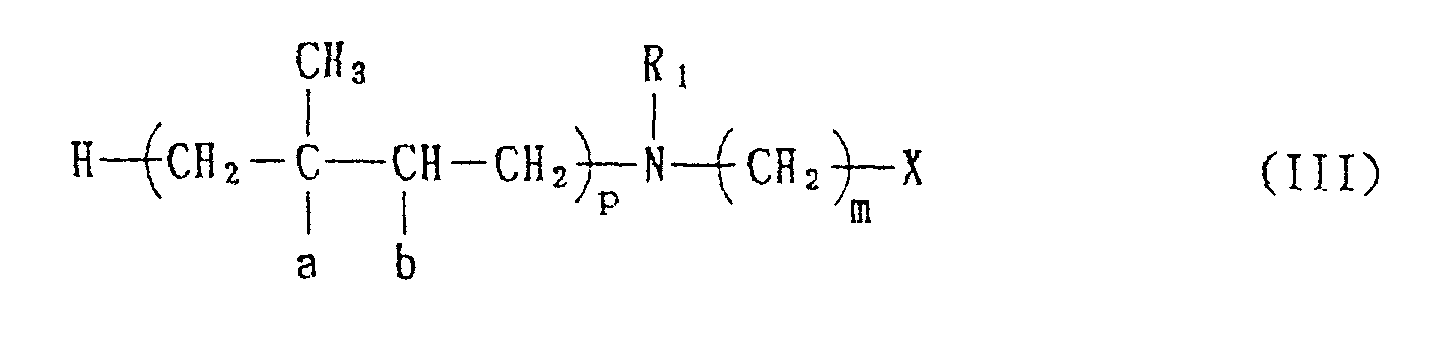
- The isoprenylamine derivatives having the general formula (III) wherein p is 9, a and b jointly form a bond between a and b, m is an integer of 0 - 2, R1 represents a hydrogen atom, a lower alkyl group or a nonaprenyl group and X is a phenyl group and pharmacologically acceptable salts thereof are also publicly known and disclosed, for instance, in Japanese Patent Publication No. 53502/1987 (corresponding to U.S.-A- 4,322,555) and US-A- 4,514,573.
- Further, the isoprenylamine derivatives having the general formula (III) wherein p is 9 or 10, a and b jointly form a bond between a and b, m is an integer of 1 - 3, R1 represents a hydrogen atom, a nonaprenyl group or a decaprenyl group and X is an optionally substituted heterocyclic group and pharmacologically acceptable salts thereof are also publicly known and disclosed, for instance, in Japanese Patent Publication No. 43740/1989 and others.
- It is said that these isoprenylamine derivatives have an in vivo inducing action of the interferon which has been currently used for the therapy of viral chronic active hepatitis, and also have an antiviral activity derived from said action.
- However, there have not yet been known the isoprenylamine derivatives having the undermentioned general formula (I) wherein n' is 11 or more.
- The present inventors have made searches and studies to develop a prophylactic or therapeutic agent for hepatic diseases which is free from the aforesaid problems and, as a result, found that the isoprenylamine derivatives of this invention and the lipid emulsion containing the same can exert a remarkable inhibiting action on hepatopathy at a lower dose, upon which this invention has been completed.
- A part of the present isoprenylamine derivatives is publicly known as explained above and is known to have an antiviral activity. However, the inhibitory action on hepatopathy of the present isoprenylamine derivatives was observed at a 1/100 or less dose than that for the above antiviral action, and as for the lipid emulsion containing the said isoprenylamine derivatives it was observed at a 1/10000 or less dose than that for the above antiviral action. In addition, there has not yet been reported any invention relating to the lipid emulsion containing the present isoprenylamine derivatives and to a prophylactic or therapeutic agent for hepatic diseases comprising the said lipid emulsion. Moreover, interferon has been currently used as a therapeutic agent for viral chronic active hepatitis, whereas the present isoprenylamine derivatives and the lipid emulsion containing the same can be expected to be effective not only on viral chronic active hepatitis, but also on a wide variety of hepatopathies and hepatic diseases such as chronic persistent hepatitis, alcoholic hepatopathy, fatty liver, cirrhosis, drug-induced hepatopathy and hepatic insufficiency.
- This invention will be more fully explained below.
- This invention is directed to an isoprenylamine derivative represented by the general formula (I)[wherein n' represents an integer of 11 - 12, m represents an integer of 0 - 3, Ar represents a phenyl, furyl, thienyl or pyridyl group optionally substituted by one or more of an alkyl group of 1 - 4 carbon atoms, an alkoxy group of 1 - 4 carbon atoms, a methylenedioxy group, a hydroxy group or a halogen atom, and R represents a hydrogen atom or an alkyl group of 1 - 4 carbon atoms] or a pharmacologically acceptable salt thereof, and to a lipid emulsion comprising the isoprenylamine derivative represented by the general formula (I), as well as a prophylactic or therapeutic agent for hepatic diseases comprising the isoprenylamine derivative and a prophylactic or therapeutic method by administering the isoprenylamine derivative.

- In the above general formula (I), examples of the alkyl group of 1 - 4 carbon atoms include a methyl, ethyl, n-propyl, isopropyl, n-butyl, isobutyl, sec-butyl or tert-butyl group, and examples of the alkoxy group of 1 - 4 carbon atoms include a methoxy, ethoxy, n-propoxy, isopropoxy, n-butoxy, isobutoxy, sec-butoxy or tert-butoxy group.
- In the general formula (I), Ar represents a phenyl group, a furyl group, a thienyl group or a pyridiyl group, which may be substituted with one or more substituents selected from an alkyl group of 1 - 4 carbon atoms, an alkoxy group of 1 - 4 carbon atoms, a methylenedioxy group, a hydroxy group or a halogen atom. When two or more of the said substituents are present, they may be the same or different each other. Examples of the halogen atom include chlorine and bromine. Preferable examples of Ar include a furyl group, a thienyl group, a pyridyl group, a 3,4-methylenedioxyphenyl group and a phenyl group unsubstituted or substituted with 1 - 5 of the above alkyl group, alkoxy group, hydroxy group or halogen atom.
- The pharmacologically acceptable salts of the isoprenylamine derivatives represented by the general formula (I) of this invention include those salts with conventional acids such as mineral acids e.g. hydrochloric acid, sulfuric acid, phosphoric acid, hydrobromic acid, organic acids e.g. acetic acid, oxalic acid, succinic acid, citric acid, maleic acid, malic acid, fumaric acid, tartaric acid, picric acid, methanesulfonic acid, ethanesulfonic acid, acidic amino acids e.g. glutamic acid, aspartic acid.
- The present isoprenylamine derivatives of the general formula (I), the present prophylactic and therapeutic agents for hepatic diseases which comprise as an active ingredient the isoprenylamine derivatives of the general formula (I) and the present prophylactic and therapeutic agents for hepatic diseases which comprise a lipid emulsion containing the said isoprenylamine derivatives are useful for prophylaxis of a wide variety of hepatic diseases and hepatopathies, namely, acute hepatitis, chronic hepatitis, fulminant hepatitis, alcoholic hepatopathy, drug-induced hepatopathyl or cirrhosis and hepatic insufficiency as well as for the protection of liver after surgical operation and others.
- The present isoprenylamine derivatives and pharmacologically acceptable salts thereof are administered orally or parenterally, preferably via parenteral route. Parenteral administration include subcutaneous, intramuscular or intravenous injection or intrarectal administration or dermal administration.
- Pharmaceutical preparations for administration may be prepared in any conventional manner. Preparations for oral administration can be prepared, for example, in the form of tablets, powders, granules, hard capsules, soft capsules or liquid preparations, while preparations for parenteral administration can be in the form of, for example, injections, suppositories, ointments, and plasters.
- The tablets and capsules for oral administration include conventional components such as binders e.g. dextrin, hydroxypropylcellulose, hydroxypropylmethylcellulose, polyvinylpyrrolidone or macrogol; excipients e.g. lactose, corn starch, calcium phosphate, magnesium aluminate metasilicate; lubricants e.g. calcium stearate or talc; disintegrators e.g. carboxymethylcellulose or crystalline cellulose. These preparations may be coated in a conventional manner well-known in the art.
- Liquid preparations for oral administration may be either aqueous or oily suspensions, emulsions, solutions, syrups, elixirs and others or dried products capable of being redissolved in water or any other suitable vehicles before use. Such liquid preparations may contain conventional additives such as suspending agents e.g. sorbitol syrup, carboxymethylcellulose, gelatin, hydroxyethylcellulose, aluminum stearate gel, hydrogenated edible oils and fats; emulsifying agents e.g. lecithin, glyceryl monostearate, acacia; nonaqueous vehicles e.g. palm oil, propylene glycol, ethyl alcohol; preservatives e.g. ethyl p-hydroxybenzoate or sorbic acid.
- When administered in the form of injections, the present isoprenylamine derivatives or pharmacologically acceptable salts thereof may be formulated into an oily solution, an aqueous solution, an emulsion or a lipid emulsion as done in the present invention, optionally with emulsifying agents or stabilizers commonly employed in the art.
- When the present isoprenylamine derivatives and/or pharmacologically acceptable salts thereof are administered in the form of suppositories, they can be prepared according to a conventional method using lipophilic bases such as cacao butter and Witepsol or hydrophilic bases such as polyethylene glycol, or alternatively they can be applied in the form of rectal capsules wherein a mixture of polyethylene glycol, sesame oil, peanut oil, germ oil, and fractionated coconut oil is wrapped in a gelatin sheet. Rectal capsules may be coated, if necessary, with waxy materials.
- A dose of the present isoprenylamine derivatives or pharmacologically acceptable salts thereof may vary depending upon the age, sexuality and symptoms of patients and the administration route and, where other formulations than the lipid emulsion are applied, the dose in the parenteral administration may be in the range of 0.5 - 500 µg/kg, preferably 5 - 500 µg/kg once or in 2 - 4 divided forms daily.
- The present lipid emulsion can be prepared by incorporating the present isoprenylamine derivative of the general formula (I) into fatty particles of a conventional lipid emulsion. It may be readily prepared, for example, by dissolving or dispersing the isoprenylamine derivative of the general formula (I) in a lipid emulsion base and further dispersing the mixture into water using an emulsifying agent to form an oil-in-water emulsion.
- The lipid emulsion bases which can be used in preparing the present lipid emulsion include any pharmaceutically acceptable fats and oils conventionally employed in preparing lipid emulsions, for example, vegetable oils such as soybean oil, cotton seed oil, rapeseed oil, peanut oil, safflower oil, corn oil, rice bran oil, sunflower oil; triglycerides of medium chain fatty acids having 8 - 12 carbon atoms, usually referred to simply as MCT, such as caprylic acid, capric acid, myristic acid, palmitic acid; mono- or di-glycerides of aliphatic acid having 6 - 18 carbon atoms such as caproic acid, capric acid, myristic acid, palmitic acid, stearic acid, oleic acid, linolic acid, linoleic acid, which may be applied alone or in any combination therewith.
- Among these vegetable oils, soybean oil, cotton seed oil, rape seed oil, safflower oil and the like are preferably employed and soybean oil is more preferred. These oils are preferably used in their purified forms and those of a higher purity obtained by further purification by steam distillation are more preferably used.
- As the emulsifying agents with which the said lipid emulsion base can be dispersed stably into water, there is used at least one emulsifying agent selected from a physiologically acceptable phospholipid and a nonionic surfactant.
- The physiologically acceptable phospholipid includes egg yolk phospholipid, soybean phospholipid, phosphatidyl choline, and the nonionic surfactant includes polyoxyalkylene copolymers (such as polyoxyethylenepolyoxyalkylene derivatives having an average molecular weight of 1000 - 20000, for example, a hardened castor oil polyoxyethylene-(40)-ether or hardened castor oil polyoxyethylene-(20)-ether). Such emulsifying agents may be employed each alone or together with two or more thereof.
- Water which is used as a dispersion medium in preparing the present lipid emulsion may be distilled water or ion-exchanged water in a suitable amount, optionally in admixture with a small amount of a water-miscible organic solvent such as ethanol.
- The present lipid emulsion may further include additives, as usually done, such as isotonic agents or stabilizers, if required. The isotonic agents which can be incorporated include, for example, glycerol; a sugar alcohol such as sorbitol or xylitol; a monosaccharide such as glucose or fructose; a disaccharide such as maltose; an amino acid such as L-alanine, L-valine or glycine, among which one or more are suitably selected for use.
- These isotonic agents are added to adjust the osmotic pressure of the lipid emulsion to be approximately isotonic with that of body fluid.
- The emulsifying aids or co-emulsifying agents which can be suitably incorporated include, for example, aliphatic acids having 6 - 22 carbon atoms, such as stearic acid, palmitic acid, linolic acid, linolenic acid and salts thereof (such as sodium salts or potassium salts), phosphatidylethanolamine, phosphatidylserine and stearylamine.
- Stabilizers which can be used include cholesterol, tocopherol and phosphatidic acid. Albumin and aliphatic acid amide derivatives thereof, as well as polysaccharides and aliphatic acid ester derivatives thereof can also be used as the stabilizer. Albumin used for preparing a drug for human is desirably the human-derived albumin from the standpoint of antigenicity, and the aliphatic acid amide derivatives thereof include those wherein 5 - 40% of all amino groups present in albumin are amidated with an aliphatic acid having 14 - 18 carbon atoms such as palmitic acid or stearic acid. On the other hand, the polysaccharides include dextran, pullulan, hydroxyethylstarch, and the aliphatic acid ester derivatives thereof include those wherein 5 - 40% of all hydroxy groups present in the said polysaccharide are esterified with an aliphatic acid having 14 - 18 carbon atoms such as palmitic acid or stearic acid.
- The present lipid emulsion comprises the isoprenylamine derivative having the general formula (I) or a pharmacologically acceptable salt thereof in an amount of 0.0001 - 1% (w/v), preferably 0.001 - 0.1% (w/v), the lipid emulsion base in an amount of 5 - 50% (w/v), preferably 1 - 20% (w/v) and emulsifying agent in an amount of 0.05 - 25% (w/v), preferably 0.5 - 5% (w/v), with water being added so as to make up a total volume of 100%.
- And, if required, there may be added an emulsifying aid [for example, an amount of up to 0.3% (w/v) of an aliphatic acid having 6 - 22 carbon atoms, preferably 12 - 20 carbon atoms, or a pharmacologically acceptable salt thereof], and a stabilizer (for example, an amount of not more than 1.2% (w/v), preferably 0.2 - 0.4 % (w/v), of a cholesterol, an amount of not more than 2.5% (w/v), preferably 0.2 - 0.8% (w/v), of tocopherol or an amount of not more than 5% (w/v), preferably not more than 1% (w/v), of phosphatidic acid, 0.02 - 5% (w/v), preferably 0.2 - 2.5% (w/v), of albumin and an aliphatic acid amide derivative thereof and a polysaccharide and an aliphatic acid ester derivative thereof].
- The present lipid emulsion can be prepared according to an emulsification procedure known per se. In this instance, a conventional homogenizer may be used as an emulsifier, but it is convenient to use two sorts of homogenizers for preparing a stable and fine lipid emulsion. Illustratively, the present lipid emulsion may be prepared, for example, by dissolving and mixing a given amount of the isoprenylamine derivative of the general formula I in the lipid emulsion base such as soybean oil while heating suitably, adding to the mixture a given amount of an emulsifying agent such as purified egg yolk phospholipid and, if necessary, other additives such as emulsifying aids, stabilizers or isotonic agents, warming while stirring to form a uniform mixture, then adding water, treating by a homogenizer to form an oil-in-water crude emulsion and then further homogenizing the resulting emulsion by means of a high pressure homogenizer such as Manton-Gaulin homogenizer or a microfluidics homogenizer. It is also feasible to add the stabilizer and isotonic agent to the resultant lipid emulsion.
- In general, the above emulsification procedure may be preferably carried out until an average particle diameter of the dispersed fatty particles in the resulting lipid emulsion reaches to approximately not more than 1 µm, preferably not more than 0.3 µm.
- The present lipid emulsion prepared as described above may be freeze-dried as required and the powders obtained by freeze-drying can be reconstituted to the original lipid emulsion upon redissolving in water. Thus, it should be understood that the "lipid emulsion" as used herein is meant to include the freeze-dried products.
- When the present isoprenylamine derivatives or pharmacologically acceptable salts thereof are incorporated as an active ingredient into the lipid emulsion, it may be administered in the range of 0.01 - 100 µg/kg, preferably 0.1 - 30 µg/kg, once or in 2 - 4 divided doses daily depending upon the age, sexuality and symptoms of patients and the administration route. The lipid emulsion is usually administered parenterally by injection, preferably by intravenous injection.
- The preparative examples of the isoprenylamine derivatives of this invention will be given below.
- In 200 ml of THF was dissolved 20.5 g of geranylgeranyl bromide, 14.4 ml of piperonylamine was added and stirred at room temperature for one hour. To the reaction mixture was added water and extracted with ethyl acetate. The extract was washed with water and then brine, dried over magnesium sulfate and then concentrated. The concentrate was purified by silica gel column chromatography (using as a developing solvent hexane-ethyl acetate (4 : 1) → ethyl acetate) to give 17.6 g of N-geranylgeranylpiperonylamine as a yellow liquid.
1H-NMR (δ value in CDCl3) :
1.60(9H,s), 1.62(3H,s), 1.68(3H,s), 1.97-2.11(12H,m), 3.22(2H,d,J=6.4Hz), 3.69(2H,s), 5.10-5.13(3H,m), 5.28(1H,t,J=6.4Hz), 5.93(2H,s), 6.75(2H,s), 6.86(1H,s) - Then, N-geranylgeranylpiperonylamine hydrochloride represented by the following formula (hereinafter referred to as "Comparative Compound 1") was obtained by a conventional method.IR(KBr)cm-1 :
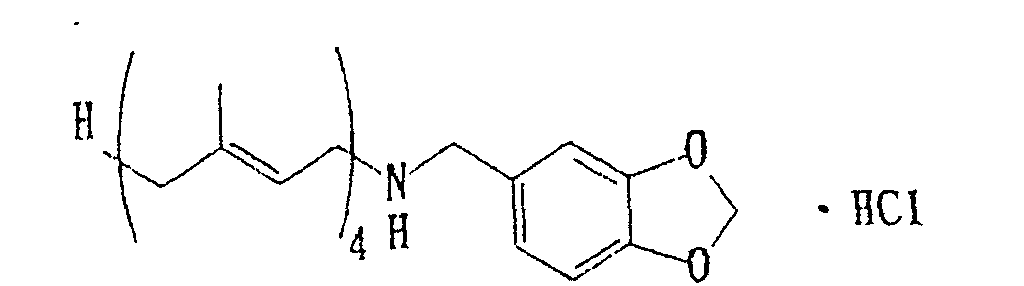
2890, 2778, 1505, 1489, 1473, 1444, 1383, 1251, 1203, 1104, 1048, 987, 929, 894, 814, 774
1H-NMR (δ value in CDCl3) :
1.57-1.62(m,12H), 1.68(s,3H), 1.92-2.15(m, 12H), 3.40-3.48(m,2H), 3.88-3.94(m,2H), 5.04-5.13(m,3H), 5.43(t,1H,J=6.8Hz), 5.92(s, 2H), 6.79(d,1H,J=7.8Hz), 6.99(dd, 1H, J=1.5 and 7.8Hz), 7.08(d, 1H, J=1.5Hz), 9.75-9.95(m,2H) - In 40 ml of THF was dissolved 7.56 g of piperonylamine, a solution of 2.11 g of farnesylgeranyl bromide in 10 ml of THF was added dropwise at room temperature and stirred at room temperature for 12 hours. Then, the THF was concentrated under reduced pressure. The concentrate was dissolved in chloroform and then washed with a 5% sodium hydroxide solution. After the chloroform layer was concentrated under reduced pressure, the concentrate was dissolved in acetonitrile and extracted with hexane (150 ml x 2). The hexane layer was washed with acetonitrile (50 ml x 2) and concentrated under reduced pressure. The concentrate was purified by silica gel column chromatography (using ethyl acetate as a developing solvent) to give 2.0 g of N-farnesylgeranylpiperonylamine as a yellow oily substance.
- Then, N-farnesylgeranylpiperonylamine hydrochloride represented by the following formula (hereinafter referred to as "Comparative Compound 2") was obtained by a conventional method.m.p.: 109 - 112°C

IR(KBr)cm-1 :
2856, 1573, 1504, 1489, 1473, 1445, 1384, 1251, 1104, 1048, 982,929, 814, 774
1H-NMR (δ value in CDCl3) :
1.60(s,6H), 1.61(s,9H), 1.68(s,3H), 1.93-2.15(m,16H), 3.40-3.48(m,2H), 3.88-3.94(m,2H), 5.05-5.14(m,4H), 5.43(t,1H,J=7.2Hz), 5.92(s,2H), 6.79(d, 1H, J=8.0Hz), 6.98(dd,1H,J=2.0 and 8.0Hz), 7.08(d,1H,J=2.0Hz), 9.82(br.s,2H) - The same procedure as described in Preparative Example 2 was carried out except that 1.96 g of farnesylfarnesyl bromide was used instead of the farnesylgeranyl bromide to give 1.80 g of N-farnesylfarnesylpiperonylamine as a yellow oily substance.
- Then, N-farnesylfarnesylpiperonylamine hydrochloride represented by the following formula (hereinafter referred to as "Comparative Compound 3") was obtained by a conventional method.m.p.: 106 - 110°C
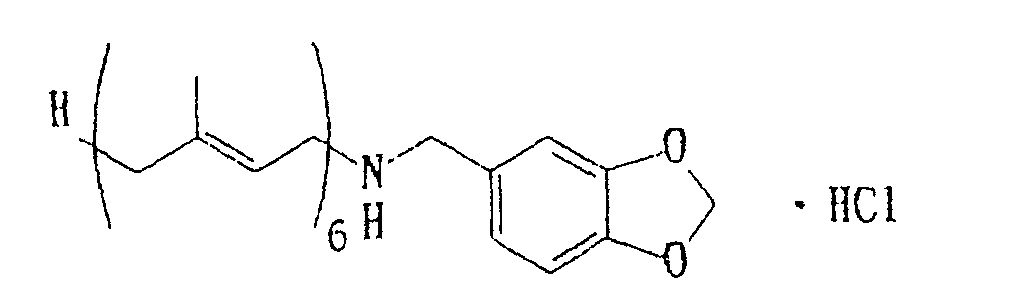
IR(KBr)cm-1 :
3450, 2926, 2780, 1574, 1503, 1488, 1445, 1385, 1252, 1104, 1048,981, 930, 814
1H-NMR (δ value in CDCl3):
1.60(s,18H), 1.68(s,3H), 1.93-2.15(m,20H), 3.40-3.48(m,2H), 3.88-3.94(m, 2H), 5.05-5.14(m,5H), 5.43(t, 1H, J=7.2Hz), 5.92(s,2H), 6.79(d, 1H, J=8.0Hz), 6.98(dd,1H,J=2.0 and 8.0Hz), 7.08(d,1H J=2.0Hz), 9.81(br.s,1H) - In 10 ml of THF was dissolved 4.56 g of farnesylgeranylgeranyl bromide, 3.01 g of piperonylamine was added and stirred at room temperature for one hour. To the reaction mixture was added water and extracted with ethyl acetate. The extract was washed with water and then brine, dried over magnesium sulfate and then concentrated. The concentrate was purified by silica gel column chromatography (using as a developing solvent hexane-ethyl acetate (4 : 1) → ethyl acetate) to give 1.14 g of N-farnesylgeranylgeranylpiperonylamine as a yellow liquid.
- Then, N-farnesylgeranylgeranylpiperonylamine hydrochloride represented by the following formula (hereinafter referred to as "Comparative Compound 4") was obtained by a conventional method.IR(KBr)cm-1 :
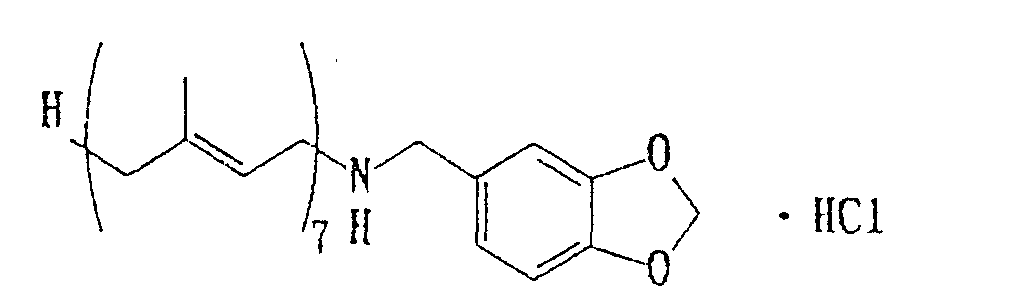
2922, 1505, 1489, 1445, 1383, 1252, 1104, 1047, 985, 929, 813
1H-NMR(δ value in CDCl3):
1.58(s,3H), 1.60(s,18H), 1.68(s,3H), 1.90-2.15(m,24H), 3.40-3.48(m,2H), 3.88-3.94(m,2H), 5.04-5.15(m,6H), 5.43(t,1H,J=6.8Hz), 5.92(s,2H), 6.79(d,1H,J=8.0Hz), 6.98(dd,1H, J=1.5 and 8.0Hz), 7.08(d,1H,J=1.5Hz), 9.81(br.s,2H) - The same procedure as described in Preparative Example 2 was carried out except that 1.97 g of farnesylfarnesylgeranyl bromide was used instead of the farnesylgeranyl bromide to give 1.32 g of N-farnesylfarnesylgeranylpiperonylamine as a yellow oily substance.
- Then, N-farnesylfarnesylgeranylpiperonylamine hydrochloride represented by the following formula (hereinafter referred to as "Comparative Compound 5") was obtained by a conventional method.m.p.: 96 - 99°C
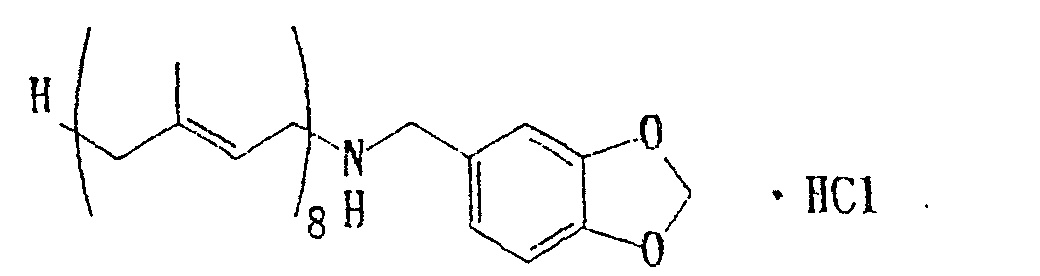
IR(KBr)cm-1 :
2856, 2782, 1673, 1574, 1504, 1445, 1384, 1252, 1104, 1048, 980,943, 814, 635
1H-NMR ( δ value in CDCl3) :
1.60(s,24H), 1.68(s,3H), 1.92-2.16(m,28H), 3.40-3.48(m,2H), 3.91(br.s,2H), 5.05-5.15(m,7H), 5.43(t, 1H, J=7.2Hz), 5.92(s,2H), 6.79(d,1H,J=8.0Hz), 6.98(dd,1H,J=2.0 and 8.0Hz), 7.08(d,1H,J=2.0Hz), 9.80(br.s,1H) - In 50 ml of THF was dissolved 20 g of solanesyl bromide, 7.2 ml of piperonylamine was added and stirred at room temperature for one hour. To the reaction mixture was added water and extracted with ethyl acetate. The extract was washed with water and then brine, dried over magnesium sulfate and then concentrated. The concentrate was purified by silica gel column chromatography (using as a developing solvent hexane-ethyl acetate (4 : 1) → ethyl acetate) to give 9.2 g of N-solanesylpiperonylamine as a yellow liquid.
1H-NMR (δ value in CDCl3) :
1.60(24H,s), 1.61(3H,s), 1.68(3H,s), 1.96-2.12(32H,m), 3.22(2H,d,J=6.4Hz), 3.69(2H,s), 5.10-5.13(8H,m), 5.28(1H,t,J=6.4Hz), 5.93(2H,s), 6.75(2H,s), 6.83(1H,s) - In 15 ml of acetone was dissolved 3.0 g of the N-solanesylpiperonylamine obtained according to the above procedure, the solution was made slightly acidic by the addition of a hydrogen chloride - ether solution and allowed to stand in a refrigerator overnight. The crystals thus separated out were recovered by filtration and dried to give 2.0 g of N-solanesylpiperonylamine hydrochloride of the following formula (hereinafter referred to as "Comparative Compound 6") as white crystals.m.p.: 97.1 - 98.0°C

1H-NMR (δ value in CDCl3) :
1.60(24H,s), 1.61(3H,s), 1.68(3H,s), 1.97-2.14(32H,m), 3.44(2H,dJ=6.8Hz), 3.90(2H,s), 5.08-5.13(8H,m), 5.43(1H, t J=6.8Hz), 5.93(2H,s), 6.78(1H,d J=7.8Hz), 6.98(1H, d J=7.8Hz), 7.08(1H,s), 9.84(2H,bs) - In 10 ml of THF was dissolved 6.94 g of solanesyl bromide, 2.14 g of benzylamine was added and stirred at room temperature for one hour. To the reaction mixture was added water and extracted with ethyl acetate. The extract was washed with water and then brine, dried over magnesium sulfate and then concentrated. The concentrate was purified by silica gel column chromatography (using as a developing solvent hexane-ethyl acetate (4 : 1) → ethyl acetate) to give 1.5 g of N-solanesylbenzylamine as a yellow liquid.
- Then, N-solanesylbenzylamine hydrochloride represented by the following formula (hereinafter referred to as "Comparative Compound 7") was obtained according to a conventional method.IR(KBr)cm-1 :
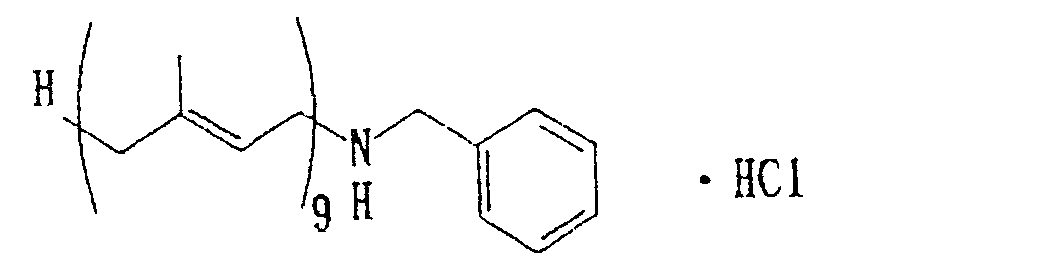
2926, 1499, 1447, 1428, 1385, 982, 876, 799, 748, 697
1H-NMR(δ value in CDCl3):
1.59(s,3H), 1.60(s,24H), 1.68(s,3H), 1.92-2.13(m,32H), 3.38-3.45(m,2H), 3.95-4.00(m,2H), 5.05-5.14(m,8H), 5.43(t,1H,J=7.0Hz), 7.30-7.40(m,3H), 7.52-7.57(m,2H), 9.82(br.s,2H) - In 20 ml of methanol was dissolved 0.61 g of 4-hydroxybenzaldehyde and 10 ml of a solution of 3.10 g of solanesylamine in chloroform was added dropwise at room temperature. After completion of the dropwise addition, the mixture was stirred at room temperature for 12 hours. To this solution was added portionwise 0.227 g of sodium borohydride at room temperature and stirred for further 3 hours. The reaction mixture was concentrated under reduced pressure, water was added to the concentrate and extracted with chloroform (100 ml x 2). The chloroform layer was washed with water and then a saturated aqueous solution of sodium chloride, dried over magnesium sulfate and concentrated under reduced pressure. The concentrate was dissolved in acetonitrile and extracted with hexane (100 ml x 2). The hexane layer was washed with acetonitrile, the hexane was distilled off and concentrated and purified by silica gel column chromatography (using ethyl acetate as a developing solvent) to give 1.50 g of N-solanesyl-4-hydroxybenzylamine as a yellow oily substance.
- Then, N-solanesyl-4-hydroxybenzylamine hydrochloride represented by the following formula (hereinafter referred to as "Comparative Compound 8") was obtained as pale yellow crystals according to a conventional method.m.p.: 58 - 64°C

IR(KBr)cm-1 :
2962, 2914, 1616, 1521, 1448, 1385, 1266, 1213, 1178, 1108, 877,796
1H-NMR( δ value in CDCl3 ) :
1.50-1.70(m,30H), 1.93-2.20(m,32H), 3.53-3.60(m,2H), 3.84-3.94(m,2H), 5.06-5.15(m,8H), 5.43-5.50(m,1H), 6.75(d,2H,J=8.0Hz), 7.24(d,2H,J=8.0Hz), 7.68(br.s,1H), 9.28(br.s, 1H) - The same procedure as described in Preparative Example 8 was carried out except that 0.70 g of 4-chlorobenzaldehyde was used instead of the 4-hydroxybenzaldehyde to give 2.70 g of N-solanesyl-4-chlorobenzylamine as a yellow oily substance.
- Then, N-solanesyl-4-chlorobenzylamine hydrochloride represented by the following formula (hereinafter referred to as "Comparative Compound 9") was obtained as white crystals according to a conventional method.m.p.: 110 - 124°C

1H-NMR (δ value in CDCl3) :
1.56(s,3H), 1.60(s,24H), 1.68(s,3H), 1.94-2.14(m,32H), 3.39(d,2H,J=7.0Hz), 3.94(s,2H), 5.05-5.15(m,8H), 5.40(t, 1H, J=7.0Hz), 7.32-7.37(m,2H), 7.48-7.53(m,2H), 9.94(br.s,2H) - The same procedure as described in Preparative Example 8 was carried out except that 0.60 g of p-tolualdehyde was used instead of the 4-hydroxybenzaldehyde to give 3.09 g of N-solanesyl-4-methylbenzylamine as a yellow oily substance.
- Then, N-solanesyl-4-methylbenzylamine hydrochloride represented by the following formula (hereinafter referred to as "Comparative Compound 10") was obtained as white crystals according to a conventional method.m.p.: 102 - 108°C
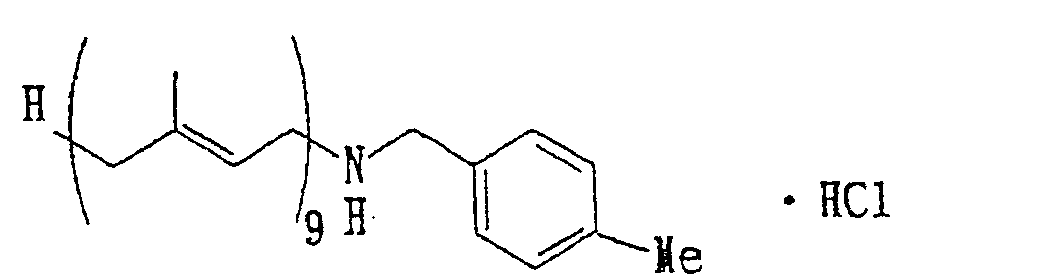
1H-NMR(δ value in CDCl3):
1.54(s,3H), 1.60(s,24H), 1.68(s,3H), 1.93-2.13(m,32H), 2.28(s,3H), 3.35-3.43(m,2H), 3.88-3.94(m,2H), 5.05-5.15(m,8H), 5.42(t,1H,J=7.3Hz), 7.16(d,2H,J=7.8Hz), 7.41(d,2H,J=7.8Hz), 9.82(br.s,2H) - The same procedure as described in Preparative Example 8 was carried out except that 1.53 g of 3,4-ditetrahydropyranyloxybenzaldehyde was used instead of the 4-hydroxybenzaldehyde to give 2.30 g of N-solanesyl-3,4-ditetrahydropyranyloxybenzylamine as a yellow oily substance.
- Then, the compound was dissolved in acetone and a 4N hydrochloric acid-ethyl acetate solution was added dropwise at room temperature to conduct the deprotection an the formation of hydrochloride concurrently, thereby producing N-solanesyl-3,4-dihydroxybenzylamine hydrochlorid represented by the following formula (hereinafter referred to as "Comparative Compound 11") as white amorphous solid.m.p.: 46 - 48°C

1H-NMR(δ value in CDCl3):
1.60(s,24H), 1.67(s,3H), 1.68(s.3H), 1.72-1.85(m,2H), 1.92-2.15(m,32H), 3.60(br.s,2H), 3.84(br.s,2H), 5.05-5.15(m,8H), 5.43-5.50(m,1H), 6.65-6.80(m,2H), 7.10(s,1H), 8.85(br.s,2H) - The same procedure as described in Preparative Example 8 was carried out except that 0.76 g of 4-hydroxy-3-methoxybenzaldehyde was used instead of the 4-hydroxybenzaldehyde to give 2.64 g of N-solanesyl-4-hydroxy-3-methoxybenzylamine as a yellow oily substance.
- Then, N-solanesyl-4-hydroxy-3-methoxybenzylamine hydrochloride represented by the following formula (hereinafter referred to as "Comparative Compound 12") was obtained as white powders according to a conventional method.m.p.: 55 - 60°C

IR(KBr)cm-1 :
3425, 2962, 2916, 1605, 1526, 1450, 1384, 1283, 1161, 1131, 1033, 876, 797
1H-NMR(δ value in CDCl3) :
1.55(s,3H), 1.60(s,24H), 1.68(s.3H), 1.93-2.14(m,32H), 3.35-3.43(m,2H), 3.90-3.97(m,5H), 5.04-5.15(m,8H), 5.41(t,1H,J=7.0Hz), 5.68(s,2H), 6.81(dd,1H,J=1.5 and 8.0Hz), 6.85(d,1H,J=8.0Hz), 7.39(d,1H,J=1.5Hz), 9.79(br.s,2H) - In 10 ml of THF was dissolved 6.94 g of solanesyl bromide, 3.34 g of veratrylamine was added and stirred at room temperature for one hour. To the reaction mixture was then added water and extracted with ethyl acetate. The extract was washed with water and then brine, dried over magnesium sulfate and then concentrated. The concentrate was purified by silica gel column chromatography (using as a developing solvent hexane-ethyl acetate (4 : 1) → ethyl acetate) to give 1.5 g of N-solanesylveratrylamine as a yellow liquid.
- Then, N-solanesylveratrylamine hydrochloride represented by the following formula (hereinafter referred to as "Comparative Compound 13") was obtained according to a conventional method.IR(KBr)cm-1 :
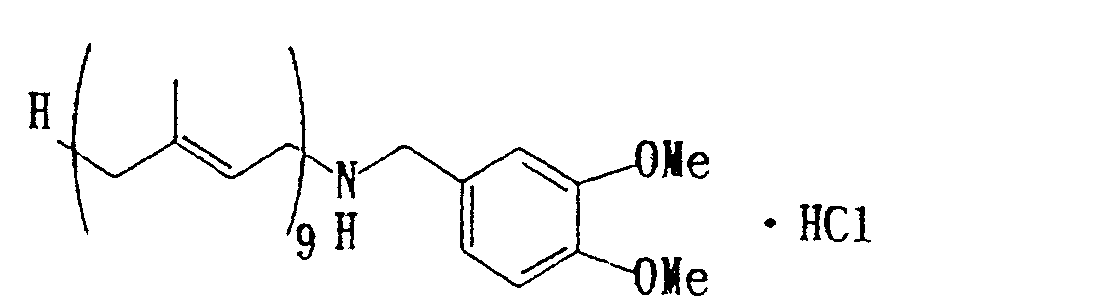
2920, 1612, 1596, 1526, 1453, 1428, 1384, 1271, 1253, 1164, 1143,1038, 1022, 853, 823
1H-NMR ( δ value in CDCl3) :
1.55(s,3H), 1.60(s,24H), 1.68(s,3H), 1.93-2.12(m,32H), 3.37-3.43(m,2H), 3.82(s,3H), 3.91-3.95(m,2H), 3.95(s,3H), 5.05-5.14(m,8H), 5.42(t,1H,J=7.0Hz), 6.79(d,1H,J=8.0Hz), 6.93(dd,1H,J=8.0Hz), 7.34(d,1H,J=2.0Hz), 9.83(br.s,2H) - The same procedure as described in Preparative Example 8 was carried out except that 1.20 g of 2,3,4,5-tetramethoxy-6-methylbenzaldehyde was used instead of the 4-hydroxybenzaldehyde to give 3.80 g of N-solanesyl-2,3,4,5-tetramethoxy-6-methylbenzylamine as a yellow oily substance.
- Then, N-solanesyl-2,3,4,5-tetramethoxy-6-methylbenzylamine hydrochloride represented by the following formula (hereinafter referred to as "Comparative Compound 14") was obtained as white crystals according to a conventional method.m.p.: 34°C
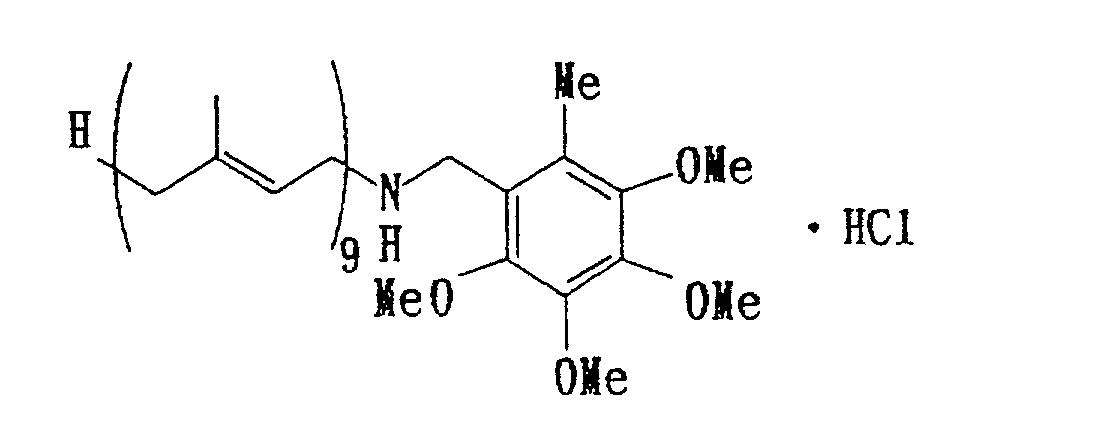
IR(KBr)cm-1 :
3410, 2850, 1575, 1472, 1447, 1410, 1384, 1355, 1270, 1198, 1110, 1052, 979
1H-NMR(δ value in CDCl3) :
1.60(s,24H), 1.68(s.3H), 1.68(s.3H), 1.93-2.14(m, 32H), 2.29(s,3H), 3.52-3.60(m, 2H), 3.76(s,3H), 3.88(s,3H), 3.92(s,2H), 3.96(s,3H), 4.07-4.12(m,2H), 5.04-5.15(m, 8H), 5.48(t,1H,J=6.8Hz), 9.16(br.s,2H) - In 10 ml of ethanol was dissolved 1.8 g of N-solanesylpiperonylamine obtained in Preparative Example 6, 0.47 g of malic acid was added and completely dissolved by heating to 40°C. The reaction mixture was stirred under icecooling to separate out crystals. The crystals thus separated out was recovered by filtration and dried to give 1.3 g of N-solanesylpiperonylamine malate represented by the following formula as white crystals (hereinafter referred to as "Comparative Compound 15").m.p.: 50°C

1H-NMR( δ value in CDCl3):
1.60(24H,s), 1.62(3H,s), 1.68(3H,s), 1.97-2.09(32H,m), 2.70-2.73(2H,m), 3.52(2H,d J=7.3Hz), 3.98(2H,s), 4.15-4.19(1H,m), 5.10-5.13(8H,m), 5.41(1H,t J=7.3Hz), 5.95(2H,s), 6.77(1H,d J=7.8Hz), 6.84(1H,d J=7.8Hz), 6.92(1H,s) - The same procedure as described in Preparative Example 2 was carried out except that 6.86 g of 3,4-methylenedioxyaniline was used instead of the piperonylamine and 3.47 g of solanesyl bromide was used instead of the farnesylgeranyl bromide to give 1.83 g of N-solanesyl-(3,4-methylenedioxy)aniline as white crystals.
- Then, N-solanesyl-(3,4-methylenedioxy)aniline hydrochloride represented by the following formula (hereinafter referred to as "Comparative Compound 16") was obtained as white crystals according to a conventional method.m.p.: 51 - 53°C
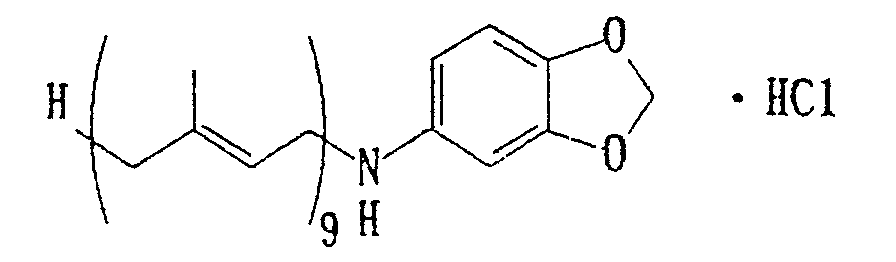
IR(KBr)cm-1 :
3435, 2964, 2912, 1506, 1446, 1385, 1259, 1108, 1035, 920, 878, 796
1H-NMR( δ value in CDCl3):
1.48(s,3H), 1.60(s,24H), 1.68(s,3H), 1.92-2.11(m,32H), 3.85(d,1H,J=7.5Hz), 4.98-5.04(m,1H), 5.06-5.15(m,7H), 5.40(t,1H,J=7.5Hz), 5.99(s,2H), 6.74-6.78(m,1H), 7.01-7.05(m,2H), 11.33(br.s,2H) - The same procedure as described in Preparative Example 2 was carried out except that 1.90 g of 2-(3,4-methylenedioxyphenyl)ethylamine was used instead of the piperonylamine and 6.94 g of solanesyl bromide was used instead of the farnesylgeranyl bromide to give 1.2 g of N-solanesyl-2-(3,4-methylenedioxyphenyl)ethylamine as a yellow oily substance.
- Then, N-solanesyl-2-(3,4-methylenedioxyphenyl)-ethylamine hydrochloride represented by the following formula (hereinafter referred to as "Comparative Compound 17") was obtained as white crystals according to a conventional method.m.p.: 110 - 114°C
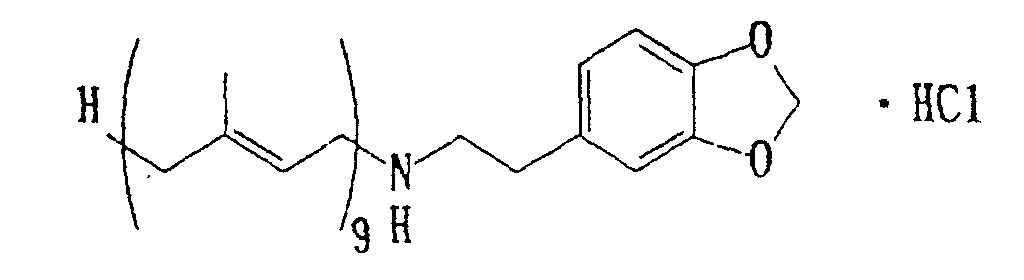
IR(KBr)cm-1:
3420, 2962, 2918, 1505, 1487, 1441, 1385, 1245, 1195, 1153, 1110, 1043, 941, 926, 875, 815, 799
1H-NMR( δ value in CDCl3):
1.57(s,3H), 1.60(s,21H), 1.68(s,3H), 1.70(s,3H), 1.90-2.12(m, 32H), 2.99-3.20(m,4H), 3.59-3.67(m,2H), 4.99-5.15(m,8H), 5.43(t,1H,J=6.8Hz), 5.92(s,2H), 6.66-6.75(m, 3H), 9.69(br.s,2H) - The same procedure as described in Preparative Example 8 was carried out except that 0.70 g of 3-(3,4-methylenedioxyphenyl)propionaldehyde was used instead of the 4-hydroxybenzaldehyde to give 1.09 g of N-solanesyl-3-(3,4-methylenedioxyphenyl)propylamine as a yellow oily substance.
- Then, N-solanesyl-3-(3,4-methylenedioxyphenyl)propylamine hydrochloride represented by the following formula (hereinafter referred to as "Comparative Compound 18") was obtained as white crystals according to a conventional method.m.p.: 72 - 75°C
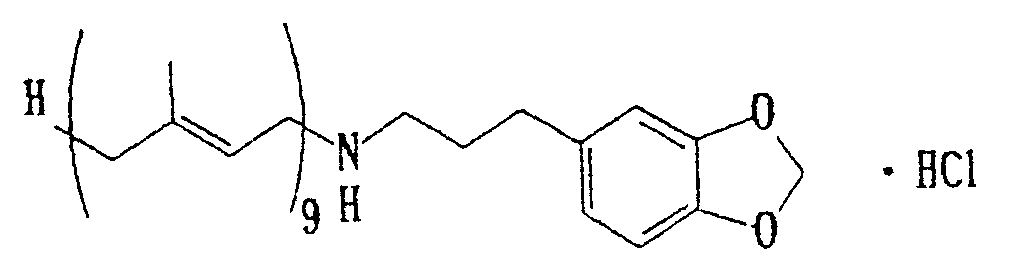
IR(KBr)cm-1:
3394, 2962, 2852, 1505, 1491, 1445, 1384, 1265, 1245, 1103, 1040, 924, 874, 812, 799
1H-NMR(δ value in CDCl3):
1.60(s,24H), 1.67(s.3H), 1.68(s.3H), 1.93-2.18(m,32H), 2.62(t,2H,J=7.3Hz), 2.77-2.87(m,2H), 3.53-3.60(m,2H), 5.03-5.15(m,8H), 5.38(t,1H,J=6.8Hz), 5.89(s,2H), 6.60-6.71(m,3H), 9.56(br.s,2H) - In 10 ml of THF was suspended 0.3 g of 60% sodium hydride, a solution of 4.0 g of N-solanesylpiperonyl amine in 10 ml of THF was added dropwise while stirring at room temperature. After stirring the mixture at room temperature for 30 minutes, 1.0 ml of methyl iodide was added slowly, followed by stirring at room temperature for 30 minutes. To the reaction mixture was added portionwise water while icecooling and stirring and then extracted with chloroform. The extract was washed with water and then brine, dried over magnesium sulfate and then concentrated. The concentrate was purified by silica gel column chromatography (using as a developing solvent hexane-ethyl acetate (9 : 1)) to give 1.5 g of N-methyl-N-solanesylpiperonylamine represented by the following formula as a yellow liquid (hereinafter referred to as "Comparative Compound 19").1H-NMR(δ value in CDCl3):
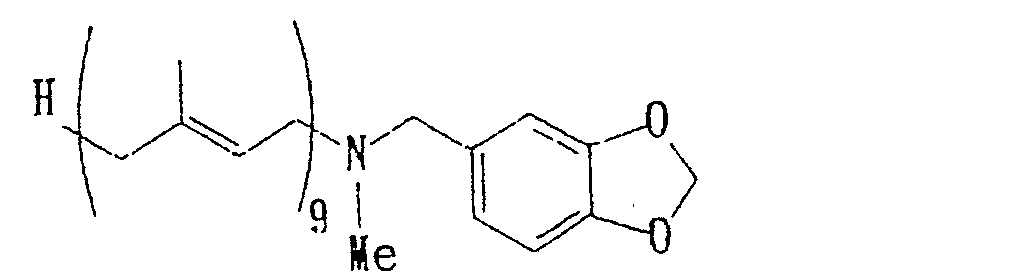
1.60(24H,s), 1.62(3H,s), 1.68(3H,s), 1.96-2.12(32H,m), 2.16(3H,s), 2.96(2H,d J=6.8Hz), 3.38(2H,s), 5.08-5.13(8H,m), 5.30(1H,t J=6.8Hz), 5.92(2H,s), 6.73(2H,s), 6.83(1H,s) - In 10 ml of THF was dissolved 7.63 g of decaprenyl bromide, 3.01 g of piperonylamine was added and stirred at room temperature for one hour. To the reaction mixture was added water and extracted with ethyl acetate. The extract was washed with water and then brine, dried over magnesium sulfate and then concentrated. The concentrate was purified by silica gel column chromatography (using as a developing solvent hexane-ethyl acetate (4 : 1) → ethyl acetate) to give 1.5 g of N-decaprenylpiperonylamine as a yellow liquid.
- Then, N-decaprenylpiperonylamine hydrochloride represented by the following formula (hereinafter referred to as "Comparative Compound 20") was obtained according to a conventional method.IR(KBr)cm-1:

3398, 2924, 1503, 1484, 1444, 1384, 1252, 1048, 929, 875, 813
1H-NMR ( δ value in CDCl3):
1.60(s,30H), 1.68(s,3H), 1.92-2.15(m,36H), 3.40-3.48(m,2H), 3.85-3.95(m,2H), 5.04-5.16(m,9H), 5.43(t, 1H, J=7.0Hz), 5.92(s,2H),6.78(d,1H,J=7.8Hz), 6.98(dd,1H,J=2.0 and 7.8Hz), 7.08(d,1H,J=2.0Hz), 9.82(br.s,2H) - In 10 ml of THF was dissolved 8.30 g of undecaprenyl bromide, 3.01 g of piperonylamine was added and stirred at room temperature for one hour. To the reaction mixture was added water and extracted with ethyl acetate. The extract was washed with water and then brine, dried over magnesium sulfate and then concentrated. The concentrate was purified by silica gel column chromatography (using as a developing solvent hexane-ethyl acetate (4 : 1) → ethyl acetate) to give 0.2 g of N-undecaprenylpiperonylamine as a yellow liquid.
- Then, N-undecaprenylpiperonylamine hydrochloride represented by the following formula (hereinafter referred to as "Compound 1") was obtained according to a conventional method.1H-NMR( δ value in CDCl3) :

1.60(s,33H), 1.68(s,3H), 1.91-2.14(m,40H), 3.40-3.48(m,2H), 3.86-3.94(m,2H), 5.05-5.15(m,10H), 5.39-5.48(m, 1H), 5.90-5.93(m,2H), 6.76-6.81(m,1H), 6.95-7.01(m, 1H), 7.06-7.11(m,1H), 9.78(br.s,2H) - The same procedure as described in Preparative Example 8 was carried out except that 0.192 g of 3-methoxy-4-hydroxybenzaldehyde was used instead of the 4-hydroxybenzaldehyde and 1.15 g of undecaprenylamine was used instead of the solanesylamine to give 1.16 g of N-undecaprenyl-3-methoxy-4-hydroxybenzylamine as a yellow oily substance.
1H-NMR(δ value in CDCl3) :
1.60(s,30H), 1.62(s,3H), 1.68(s,3H), 1.94-2.13(m,40H), 3.26(d,2H, J=6.8Hz), 3.73(s,2H), 3.89(s,3H), 5.06-5.16(m,10H), 5.30(t,1H,J=6.8Hz), 6.78(dd,1H,J=1.5 and 8.3Hz), 6.85(d,1H,J=8.3Hz), 6.92(d, 1H, J=1.5Hz) - Then, N-undecaprenyl-3-methoxy-4-hydroxybenzylamine hydrochloride represented by the following formula (hereinafter referred to as "Compound 2") was obtained as pale yellow crystals according to a conventional method.m.p.: 47 - 49°C

1H-NMR(δ value in CDCl3):
1.59(s,3H), 1.60(s,30H), 1.68(s.3H), 1.94-2.13(m,40H), 3.35-3.43(m,2H), 3.92-3.96(m,5H), 5.05-5.15(m,10H), 5.41(t,1H,J=6.8Hz), 5.67(s,1H), 6.80-6.87(m,2H), 7.38-7.41(m,1H), 9.74-9.90(m,2H) - The same procedure as described in Preparative Example 2 was carried out except that 2.24 g of dodecaprenyl bromide was used instead of the farnesylgeranyl bromide to give 1.71 g of N-dodecaprenylpiperonylamine as a yellow oily substance.
1H-NMR( δ value in CDCl3):
1.60(s,33H), 1.62(s,3H), 1.68(s,3H), 1.93-2.14(m,44H), 3.22(d, 2H,J=6.8Hz), 3.69(s,2H), 5.07-5.15(m,7H), 5.28(t,1H,J=6.8Hz), 6.75(s,2H), 6.84(s, 1H) - Then, N-dodecaprenylpiperonylamine hydrochloride represented by the following formula (hereinafter referred to as "Compound 3") was obtained according to a conventional method.m.p.: 91 - 93°C

1H-NMR(δ value in CDCl):
1.60(s,36H), 1.69(s,3H), 1.93-2.14(m,44H), 3.40-3.48(m,2H), 3.88-3.94(m,2H), 5.05-5.15(m,12H), 5.43(t,1H,J=6.8Hz), 5.92(s,2H), 6.79(d,1H,J=8.3Hz), 6.98(dd,1H,J=2.0 and 8.3Hz), 7.08(d, 1H, J=2.0Hz), 9.75-9.95(m,2H) - The same procedure as described in Preparative Example 2 was carried out except that 9.71 g of furfuryl amine was used instead of the piperonylamine and 3.47 g of solanesyl bromide was used for the farnesylgeranyl bromide to give 3.00 g of N-solanesyl-2-furfurylamine as a yellow oily substance.
- Then, N-solanesyl-2-furfurylamine hydrochloride represented by the following formula (hereinafter referred to as "Comparative Compound 21") was obtained according to a conventional method as a pale yellow amorphous solid.m.p.: 90 - 94°C
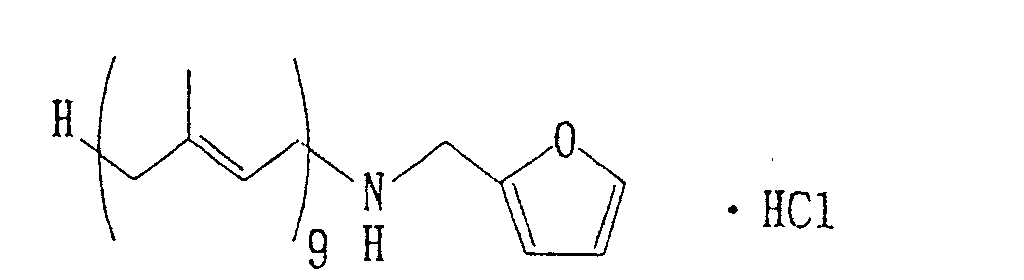
1H-NMR(δ value in CDCl3):
1.60(s,24H), 1.65(s,3H),1.68(s,3H), 1.93-2.14(m,32H), 3.50-3.58(m,2H), 4.10(-t, 2H, J=4.9Hz), 5.05-5.15(m, 8H), 5.43(t,1H,J=6.8Hz),6.39(dd,1H,J=2.0 and 3.5Hz), 6.69(d, 1H, J=3.5Hz), 7.45(d,1H,J=2.0Hz), 9.93(br.s,2H) - The same procedure as described in Preprative Example 8 was carried out except that 0.67 g of 2-thienylaldehyde was used instead of the 4-hydroxybenzaldehyde to give 2.38 g of N-solanesyl-2-thienylamine as a yellow oily substance.
- Then, N-solanesyl-2-thienylamine hydrochloride represented by the following formula (hereinafter referred to as "Comparative Compound 22") was obtained according to a conventional method as white crystals.m.p.: 102 - 105°C

1H-NMR( δ value in CDCl3):
1.60(s,24H), 1.62(s.3H), 1.68(s.3H), 1.93-2.14(m,32H), 3.48-3.55(m,2H), 4.20(br.s,2H), 5.05-5.15(m,8H), 5.43(t,1H,J=6.8Hz), 7.02(dd,1H,J=3.5 and 5.0Hz), 7.32(dd,1H,J=1.0 and 5.0Hz), 7.40(dd,1H,J=1.0 and 3.5Hz) - The same procedure as described in Preparative Example 8 was carried out except that 0.64 g of 3-pyridylaldehyde was used instead of the 4-hydroxybenzaldehyde to give 2.70 g of N-solanesyl-3-pyridylmethylamine as a yellow oily substance.
- Then, N-solanesyl-3-pyridylmethylamine dihydrochloride represented by the following formula (hereinafter referred to as "Comparative Compound 23") was obtained according to a conventional method as a white amorphous solid.m.p.: 129 - 135°C
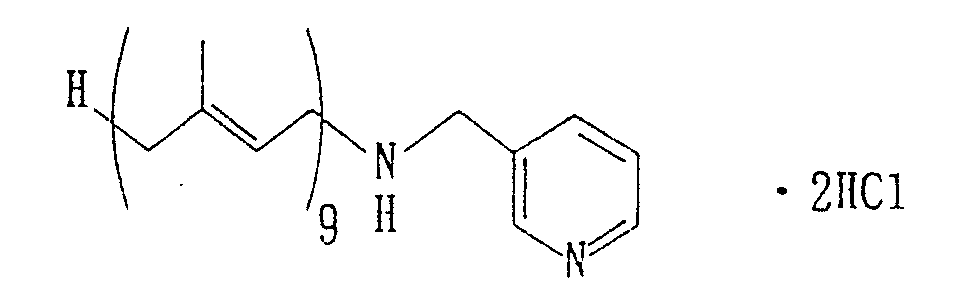
1H-NMR(δ value in CDCl3):
1.60(s,24H), 1.68(s.3H), 1.82(s,3H), 1.93-2.17(m,32H), 3.83-3.92(m,2H), 4.39-4.50(m,2H), 5.05-5.15(m,8H), 5.58(t,1H,J=7.2Hz), 8.01(dd,1H,J=6.0 and 8.0Hz), 8.85(d,1H,J=5.0Hz), 8.98(d,1H,J=8.0Hz), 9.62(s,1H), 10.36(br.s,2H) - The same procedure as described in Preparative Example 8 was carried out except that 0.177 g of 3-pyridylaldehyde was used instead of the 4-hydroxybenzaldehyde and 1.15 g of undecaprenylamine was used instead of the solanesylamine to give 0.65 g of N-undecaprenyl-3-pyridylmethylamine as a yellow oily substance.
1H-NMR(δ value in CDCl3):
1.60(s,30H), 1.62(s,3H), 1.68(s,3H), 1.93-2.14(m,40H), 3.24(d,2H,J=6.8Hz), 3.79(s,2H), 5.07-5.15(m,10H), 5.28(t, 1H, J=6.8Hz), 7.23-7.28(m,1H), 7.65-7.72(m, 1H), 8.50(dd,1H,J=1.5 and 4.8Hz), 8.56(d, 1H, J=2.0Hz) - Then, N-undecaprenyl-3-pyridylmethylamine dihydrochloride represented by the following formula (hereinafter referred to as "Compound 4") was obtained according to a conventional method as a white amorphous solid.1H-NMR(δ value in CDCl3):

1.60(s,30H), 1.68(s.3H), 1.82(s,3H), 1.93-2.16(m,40H), 3.83-3.92(m,2H), 4.40-4.50(m,2H), 5.05-5.15(m, 10H), 5.58(t,1H,J=6.8Hz), 7.98-8.06(m,1H), 8.84-8.90(m,1H), 8.95-9.02(m,1H), 9.60-9.67(m, 1H), 10.25-1047(m,2H) - Pharmaceutical examples usable for the invention will be given below.
- 25 g of Comparative Compound 6 and 7.5 g of polyoxyethylene castor oil dissolved in acetone was mixed with 25 g of silicic anhydride. After the acetone was evaporated, the mixture was further mixed with 5 g of calcium carboxymethylcellulose, 5 g of corn starch, 7.5 g of hydroxypropylcellulose and 20 g of microcrystalline cellulose and 30 ml of water was added thereto, kneaded, dried and then sized. The granules passed through No. 24 mesh screen were capsulated by means of a capsule filling machine so that each capsule can contain 30 mg of Comparative Compound 6.
- 50 g of Compound 1 and 130 g of Macrogol 400 were mixed to form a uniform solution. Separately, a gelatin solution comprising 93 g of gelatin, 19 g of glycerol, 10 g of D-sorbitol, 0.2 g of propyl p-hydroxybenzoate and 0.4 g of titanium oxide was prepared which was used as a soft capsule film-forming agent. Soft capsules were prepared using the said solution by means of a manual type flat punching machine to prepare capsules each containing 30 mg of Compound 1.
- 0.5 g of Comparative Compound 19, an appropriate amount of peanut oil and 1 g of benzyl alcohol were mixed and made a total volume of 100 cc with peanut oil. The resulting solution was poured portionwise into ampoules at 1 cc per ampoule under aseptic manipulation, which were then sealed.
- 0.5 g of Comparative Compound 4, 5.0 g of hydrogenated castor oil polyoxyethylene-(60)-ether (Nikkol HCO 60 manufactured by Nikko Chemicals Co.), 20 g of propylene glycol, 10 g of glycerol and 5.0 g of ethanol were mixed and 100 ml of distilled water was added and stirred. The solution was poured portionwise into ampoules at 1.4 ml per ampoule under aseptic manipulation, which were then sealed.
- To 10 g of purified soybean oil was added 30 mg of Comparative Compound 6 and the mixture was dissolved by warming. To the resulting solution were added 1.2 g of purified egg yolk phospholipid and 2.5 g of glycerol and the mixture was dissolved by warming while vigorously stirring and then an appropriate volume of distilled water was added. The mixture was stirred by means of Polytron Homogenizer (trade name, sold by KINEMATICA AG) to prepare a crude emulsion. The crude emulsion was further emulsified under elevated pressure by means of a microfluidics homogenizer and was made to 100 ml by the addition of distilled water to prepare an extremely fine lipid emulsion. The average diameter of dispersed fat particles in the lipid emulsion was 0.2 - 0.3 µ and no particles having the diameter of not less than 1 µ were contained.
- To 10 g of purified soybean oil was added 110 mg of Comparative Compound 2 and the mixture was dissolved by warming. To the resulting solution were added 1.2 g of purified egg yolk phospholipid and 2.5 g of glycerol and the mixture was dissolved by warming while vigorously stirring and then an appropriate volume of distilled water was added. The mixture was stirred by means of Polytron Homogenizer to prepare a crude emulsion. The crude emulsion was further emulsified under elevated pressure by means of a microfluidics homogenizer and was made to 100 ml by the addition of distilled water to prepare an extremely fine lipid emulsion. The average diameter of dispersed fat particles in the lipid emulsion was 0.2 - 0.3 µ and no particles having the diameter of not less than 1 µ were contained.
- To 10 g of purified soybean oil was added 30 mg of Comparative Compound 6 and the mixture was dissolved by warming. To the solution were added 1.2 g of purified egg yolk phospholipid and 6.5 g of D-sorbitol and the mixture was dissolved by warming while vigorously stirring and then an appropriate volume of distilled water was added. The mixture was stirred by means of Polytron Homogenizer to prepare a crude emulsion. The crude emulsion was further emulsified under elevated pressure by means of a microfluidics homogenizer and was made to 100 ml by the addition of distilled water to prepare an extremely fine lipid emulsion. The average diameter of dispersed fat particles in the lipid emulsion was 0.2 - 0.3 µ and no particles having the diameter of not less than 1 µ were contained.
- To 10 g of purified soybean oil was added 30 mg of Comparative Compound 1 and the mixture was dissolved by warming. To the resulting solution were added 1.2 g of purified soybean phospholipid and 2.5 g of glycerol and the mixture was dissolved by warming while vigorously stirring and then an appropriate volume of distilled water was added. The mixture was stirred by means of Polytron Homogenizer to prepare a crude emulsion. The crude emulsion was further emulsified under elevated pressure by means of a microfluidics homogenizer and was made to 100 ml by the addition of distilled water to prepare an extremely fine lipid emulsion. The average diameter of dispersed fat particles in the lipid emulsion was 0.2 - 0.3 µ and no particles having the diameter of not less than 1 µ were contained.
- To 5 g of purified soybean oil and 5 g of MCT was added 10 mg of Compound 1 and the mixture was dissolved by warming. To the resulting solution were added 0.6 g of purified soybean phospholipid and 0.6 g of purified egg yolk phospholipid and the mixture was dissolved by warming while vigorously stirring and then an appropriate volume of distilled water was added. The mixture was stirred by means of Polytron Homogenizer to prepare a crude emulsion. The crude emulsion was further emulsified under elevated pressure by means of a microfluidics homogenizer and was made to 100 ml by the addition of distilled water to prepare an extremely fine lipid emulsion. The average diameter of dispersed fat particles in the lipid emulsion was 0.2 - 0.3 µ and no particles having the diameter of not less than 1 µ were contained.
- The same procedure as described in Pharmaceutical Example 3 was carried out except that 50 mg of sodium palmitate and 50 mg of phosphatidic acid were further added, thereby forming 100 ml of the lipid emulsion containing 30 mg of Comparative Compound 6. The average diameter of dispersed fat particles in the lipid emulsion was 0.2 - 0.3 µ and no particles having the diameter of not less than 1 µ were contained.
- The effect of the drugs containing the present isoprenylamine derivatives will be illustrated below by way of the test examples.
- In these tests, GPT (glutamic-pyruvic transaminase) and GOT (glutamic-oxaloacetic transaminase) were determined using kits for the determination of GPT and GOT upon the method by U. Lippi et al., Iatrozyme TA-Lq (available from Iatron Laboratories Inc.), wherein the NADH formed when enzymes act upon substrates can reduce nitrotetrazolium blue (NTB) via 1-methoxy-5-methylphenazinium methylsulfate (1-methoxy PMS) to form formazan, which is then subjected to colorimetric analysis at a wavelength of 560 nm.
- Inhibitory action of lipid emulsions containing the inventive and the comparison isoprenylamine derivatives was evaluated by inhibition rates of GPT and GOT in experimental hepatopathy models prepared by administering carbon tetrachloride.
- The experimental hepatopathy model was prepared by intraperitoneal administration of 0.02 ml/kg carbon tetrachloride to ddY strain male mice (6 weeks old, body weight of about 30 g). Carbon tetrachloride was diluted with olive oil to a concentration of 0.5% when administered.
- The present isoprenylamine derivatives were formulated into the lipid emulsions according to the method described in Pharmaceutical Example 8 and intravenously administered at a dose of 0.1 - 10 µg/kg one hour before the administration of carbon tetrachloride.
- 20 hours after the administration of carbon tetrachloride, blood samples were collected from animals under ether anesthesia and centrifuged. Then, serum GPT and GOT were determined and the respective inhibition rates were calculated on the bases of the serum GPT and GOT values obtained when the present isoprenylamine derivative was not administered being defined as 100, respectively.
- The GPT and GOT inhibition rates of the present isoprenylamine derivatives are shown in Table 1, respectively.
Compound No. Dose (µg/kg) GPT inhibition (%) GOT inhibition (%) Comp. Compound 1 1 21 13 Comp. Compound 4 1 22 28 Comp. Compound 6 1 40 50 Comp. Compound 7 1 42 42 Comp. Compound 8 10 22 25 Comp. Compound 13 0.1 21 14 Comp. Compound 15 10 24 18 Comp. Compound 19 1 31 43 Comp. Compound 20 0.1 60 53 Compound 1 1 33 38 - Inhibitory actions of the inventive and the comparison isoprenylamine derivatives was evaluated by inhibition rates of GPT and GOT in experimental hepatopathy models prepared by administering carbon tetrachloride.
- The experimental hepatopathy model was prepared by intraperitoneal administration of 0.02 ml/kg carbon tetrachloride to ddY strain male mice (6 weeks old, body weight of about 30 g). Carbon tetrachloride was diluted with olive oil to a concentration of 0.5% when administered.
- Comparison Compound 6 was formulated to a suspension with 2% Tween 80 and intravenously administered at a dose of 0.1 mg/kg one hour before the administration of carbon tetrachloride.
- 20 hours after the administration of carbon tetrachloride, blood samples were collected from animals under ether anesthesia and centrifuged. Then, serum GPT and GOT were determined and the respective inhibition rates were calculated on the bases of the serum GPT and GOT values obtained when Compound 6 was not administered being defined as 100, respectively.
- The GPT and GOT inhibition rates of Comparison Compound 6 are shown in Table 2, respectively.
Compound No. Dose (mg/kg) GPT inhibition (%) GOT inhibition (%) Comparison Compound 6 0.1 34 37 - Inhibitory action of lipid emulsions containing the inventive and the comparison isoprenylamine derivatives was evaluated by inhibition rates of GPT and GOT in experimental hepatopathy models prepared by D-galactosamine administration.
- The experimental hepatopathy model was prepared by intraperitoneal administration of D-galactosamine at 400 mg/kg to Wistar strain male mice weighing about 170 g. The present isoprenylamine derivative was formulated to a lipid emulsion according to the method described in Pharmaceutical Example 8, and was intravenously administered at a dose of 10 - 30 µg/kg 2 hours after the administration of D-galactosamine.
- 24 hours after the D-galactosamine administration, blood samples were collected from animals under ether anesthesia and centrifuged. Then, serum GPT and GOT were determined and the respective inhibition rates were calculated on the bases of the serum GPT and GOT values obtained when the present isoprenylamine derivatives were not administered being defined as 100, respectively.
- For comparison, glycyrrhizin ammonium (Tokyo Kasei Co.) dissolved in distilled water was administered in a similar manner to that for the isoprenylamine derivatives, blood sampling and determination were conducted and the serum GPT and GOT inhibition rates were calculated.
- The GPT and GOT inhibition rates of the present isoprenylamine derivatives and glycyrrhizin ammonium are shown in Table 3.
Compound No. Dose (µg/kg) GPT inhibition (%) GOT inhibition (%) Comp. Compound 2 10 23 23 Comp. Compound 3 10 20 21 Comp. Compound 4 10 30 31 Comp. Compound 5 10 27 29 Comp. Compound 6 10 40 40 Comp. Compound 9 30 53 47 Comp. Compound 10 30 63 54 Comp. Compound 11 30 55 41 Comp. Compound 12 30 53 42 Comp. Compound 14 30 64 55 Comp. Compound 16 30 43 48 Comp. Compound 17 30 23 24 Comp. Compound 18 30 20 22 Comp. Compound 20 10 43 44 Comp. Compound 21 30 25 30 Comp. Compound 22 30 30 32 Comp. Compound 23 30 35 40 Glycyrrhizin ammonium 3000 25 22 - Toxicity of the lipid emulsion containing the isoprenylamine derivatives was studied by the following test.
- To 6-week old ddY strain male mice weighing about 30 g was intravenously administered the lipid emulsion prepared according to the method described in Pharmaceutical Example 8, using the inventive and the comparison isoprenylamine derivatives as indicated in the Table 1 at a dose of 1000 µg/kg. No mortality was observed in every case.
- The present isoprenylamine derivatives have an extremely low toxicity and a high safety, as apparent from this Test Example.
- The present isoprenylamine derivatives, in view of the properties as a prophylactic or therapeutic agent for hepatic diseases, will often have to be continuously administered over a prolonged period of time and they may also be very useful in this respect.
- A prophylactic and therapeutic agent for hepatic diseases comprising the isoprenylamine derivatives represented by the above general formula I according to this invention, as well as a prophylactic or therapeutic agent for hepatic diseases comprising a lipid emulsion comprising the said isoprenylamine derivatives can exert a satisfactory inhibitory action on hepatopathy at a lower dose.
- Accordingly, it is very clinically useful as a prophylactic or therapeutic agent for hepatic diseases with the advantages of lowered doses, reduced side effects and others.
Claims (21)
- An isoprenylamine derivative represented by the general formula (I)[wherein n' represents an integer of 11 - 12, m represents an integer of 0 - 3, Ar represents a phenyl group, a furyl group, a thienyl group or a pyridyl group, said group being optionally substituted with one or more of an alkyl group of 1 - 4 carbon atoms, an alkoxy group of 1 - 4 carbon atoms, a methylenedioxy group, a hydroxy group or a halogen atom, and R represents a hydrogen atom or an alkyl group of 1 - 4 carbon atoms] or a pharmacologically acceptable salt thereof.

- A pharmaceutical composition which comprises an isoprenylamine derivative or a pharmacologically acceptable salt thereof as claimed in claim 1.
- A lipid emulsion for injection which comprises(a) an amount of 0.0001 - 1% (w/v) of the isoprenylamine derivative according to claim 1 or a pharmacologically acceptable salt thereof,(b) an amount of 5 - 50% (w/v) of at least one of lipid emulsion bases selected from vegetable oils, triglycerides of medium chain fatty acids having 8 - 12 carbon atoms and di- and mono-glycerides of fatty acids having 6 - 18 carbon atoms,(c) an amount of 0.05 - 25% (w/v) of at least one of emulsifying agents selected from phospholipids and nonionic surface active agents, and(d) water.
- A lipid emulsion for injection as claimed in claim 3 wherein n' is 11, m is 1, R is hydrogen or methyl, Ar is phenyl, 3,4-methylenedioxyphenyl, 3,4-dihydroxyphenyl or 4-hydroxy-3-methoxyphenyl group in the formula (I).
- A lipid emulsion for injection as claimed in claim 3 which is used for an intravenous injection.
- A lipid emulsion for injection as claimed in claim 3 wherein said vegetable oil is soybean oil.
- A lipid emulsion for injection as claimed in claim 3 wherein said phospholipid is egg yolk phospholipid or soybean phospholipid.
- A lipid emulsion for injection as claimed in claim 3 wherein it further comprises at least one of isotonic agents selected from glycerol, sugar alcohols, monosaccharides, disaccharides and amino acids.
- A lipid emulsion for injection as claimed in claim 3 wherein it further comprises at least one of emulsifying aids selected from aliphatic acids having 6 - 22 carbon atoms and pharmacologically acceptable salts thereof, phosphatidylethanolamine, phosphatidylserine and stearylamine.
- A lipid emulsion for injection as claimed in claim 3 wherein it further comprises at least one of stabilizers selected from cholesterol, tocopherol and phosphatidic acid.
- A lipid emulsion for injection as claimed in claim 3 wherein it further comprises at least one of stabilizers selected from albumin and fatty acid amide derivatives thereof and polysaccharides and fatty acid ester derivatives thereof.
- A prophylactic and therapeutic agent for hepatic diseases which comprises the isoprenylamine derivative according to claim 1 or a pharmacologically acceptable salt thereof.
- A prophylactic and therapeutic agent for hepatic diseases as claimed in claim 12 wherein n' is 11, m is 1, R is hydrogen or methyl group, Ar is phenyl, 3,4-methylenedioxyphenyl, 3,4-dihydroxyphenyl or 4-hydroxy-3-methoxyphenyl group in the formula (I).
- A prophylactic and therapeutic agent for hepatic diseases as claimed in claim 12 or 13 wherein it is in the form of a lipid emulsion.
- A prophylactic and therapeutic agent for hepatic diseases as claimed in claim 14 wherein said lipid emulsion comprises(a) an amount of 0.0001 - 1% (w/v) of the isoprenylamine derivative according to claim 1 or a pharmacologically acceptable salt thereof,(b) an amount of 5 - 50% (w/v) of at least one of lipid emulsion bases selected from vegetable oils, triglycerides of medium chain fatty acids having 8 - 12 carbon atoms and di- and mono-glycerides of fatty acids having 6 - 18 carbon atoms,(c) an amount of 0.05 - 25% (w/v) of at least one of emulsifying agents selected from phospholipids and nonionic surface active agents, and(d) water.
- A prophylactic and therapeutic agent for hepatic diseases as claimed in claim 15 wherein said vegetable oil is soybean oil.
- A prophylactic and therapeutic agent for hepatic diseases as claimed in claim 15 wherein said phospholipid is egg yolk phospholipid or soybean phospholipid.
- A prophylactic and therapeutic agent for hepatic diseases as claimed in claim 15 wherein it further comprises at least one of isotonic agent selected from glycerol, sugar alcohols, monosaccharides, disaccharides and amino acids.
- A prophylactic and therapeutic agent for hepatic diseases as claimed in claim 15 wherein it further comprises at least one of emulsifying aids selected from aliphatic acids having 6 - 22 carbon atoms and pharmacologically acceptable salts thereof, phosphatidylethanolamine, phosphatidylserine and stearylamine.
- A prophylactic and therapeutic agent for hepatic diseases as claimed in claim 15 wherein it further comprises at least one of stabilizers selected from cholesterol, tocopherol and phosphatidic acid.
- A prophylactic and therapeutic agent for hepatic diseases as claimed in claim 15 wherein it further comprises at least one of stabilizers selected from albumin and fatty acid amide derivatives thereof and polysaccharides and fatty acid ester derivatives thereof.
Applications Claiming Priority (4)
| Application Number | Priority Date | Filing Date | Title |
|---|---|---|---|
| JP2023795 | 1995-02-08 | ||
| JP20237/95 | 1995-02-08 | ||
| JP2023795 | 1995-02-08 | ||
| PCT/JP1996/000255 WO1996024575A1 (en) | 1995-02-08 | 1996-02-07 | Preventive/remedy for liver disease |
Publications (3)
| Publication Number | Publication Date |
|---|---|
| EP0810201A1 EP0810201A1 (en) | 1997-12-03 |
| EP0810201A4 EP0810201A4 (en) | 1998-05-20 |
| EP0810201B1 true EP0810201B1 (en) | 2001-12-12 |
Family
ID=12021594
Family Applications (1)
| Application Number | Title | Priority Date | Filing Date |
|---|---|---|---|
| EP96901951A Expired - Lifetime EP0810201B1 (en) | 1995-02-08 | 1996-02-07 | Preventive/remedy for liver disease |
Country Status (6)
| Country | Link |
|---|---|
| US (1) | US6048882A (en) |
| EP (1) | EP0810201B1 (en) |
| JP (1) | JP3863562B2 (en) |
| KR (1) | KR19980702090A (en) |
| DE (1) | DE69617918T2 (en) |
| WO (1) | WO1996024575A1 (en) |
Family Cites Families (10)
| Publication number | Priority date | Publication date | Assignee | Title |
|---|---|---|---|---|
| DE2338819A1 (en) * | 1972-08-03 | 1974-02-14 | Ciba Geigy Ag | Terpenoid amines - with insecticidal and miteovicidal activity |
| GB1403851A (en) * | 1973-01-03 | 1975-08-28 | Pierrel Spa | Isoprenoid amines |
| JPS56150047A (en) * | 1980-04-23 | 1981-11-20 | Nisshin Flour Milling Co Ltd | Nonaprenylamine derivative |
| JPS57192339A (en) * | 1981-05-18 | 1982-11-26 | Nisshin Flour Milling Co Ltd | Isoprenylamine derivative |
| JPS57192360A (en) * | 1981-05-18 | 1982-11-26 | Nisshin Flour Milling Co Ltd | Isoprenylamine derivative |
| JPS57192342A (en) * | 1981-05-18 | 1982-11-26 | Nisshin Flour Milling Co Ltd | Isoprenylamine derivative |
| JPS58210049A (en) * | 1982-06-02 | 1983-12-07 | Kuraray Co Ltd | Novel polyprenyl compound |
| JPS6253502A (en) * | 1985-09-03 | 1987-03-09 | Tokyo Keiki Co Ltd | Structure of ultra high-frequency filter |
| JPS62143740A (en) * | 1985-12-19 | 1987-06-27 | Mazda Motor Corp | Constant speed running device for automobile |
| AU7317391A (en) * | 1990-02-14 | 1991-09-03 | Chugai Seiyaku Kabushiki Kaisha | Inhibitor of denatured ldl formation |
-
1996
- 1996-02-07 US US08/875,759 patent/US6048882A/en not_active Expired - Fee Related
- 1996-02-07 EP EP96901951A patent/EP0810201B1/en not_active Expired - Lifetime
- 1996-02-07 WO PCT/JP1996/000255 patent/WO1996024575A1/en not_active Ceased
- 1996-02-07 JP JP52413696A patent/JP3863562B2/en not_active Expired - Fee Related
- 1996-02-07 DE DE69617918T patent/DE69617918T2/en not_active Expired - Fee Related
- 1996-02-07 KR KR1019970705485A patent/KR19980702090A/en not_active Withdrawn
Also Published As
| Publication number | Publication date |
|---|---|
| DE69617918T2 (en) | 2002-05-16 |
| US6048882A (en) | 2000-04-11 |
| KR19980702090A (en) | 1998-07-15 |
| EP0810201A4 (en) | 1998-05-20 |
| EP0810201A1 (en) | 1997-12-03 |
| WO1996024575A1 (en) | 1996-08-15 |
| JP3863562B2 (en) | 2006-12-27 |
| DE69617918D1 (en) | 2002-01-24 |
Similar Documents
| Publication | Publication Date | Title |
|---|---|---|
| US6030960A (en) | Method of treating hepatitis virus infections | |
| US5162346A (en) | Pharmaceutical composition comprising flupirtine and its use to combat muscular tension | |
| KR101722289B1 (en) | TOFA Analogs Useful in Treating Dermatological Disorders or Conditions | |
| CA2104196C (en) | Methods of combating pneumocystis carinii pneumonia and compounds useful therefor | |
| US6455580B1 (en) | Method and composition for antiviral therapy | |
| US12102616B2 (en) | Psilocin mucate | |
| DE69911755T2 (en) | SYNTHETIC ENDOGENIC CANNABINOID ANALOGS AND THEIR USE | |
| US4340760A (en) | Monophenylamine derivatives | |
| WO1999000346A1 (en) | Synthesis of dihydrohonokiol compositions | |
| US6048882A (en) | Prophylactic and therapeutic agent for hepatic diseases | |
| US20050272772A1 (en) | Pharmaceutical compositions for the treatment of pruritus | |
| US4324916A (en) | Decaprenylamine derivatives | |
| JPWO1996024575A1 (en) | Preventive and therapeutic agents for liver disease | |
| US4322555A (en) | Nonaprenylamine derivatives | |
| US4265910A (en) | Isoprenylamines | |
| CN100367948C (en) | Production of pure stereoisomers of tricyclo[5.2.1.02.6]-dec-9-yl xanthogenate and medicaments therefrom | |
| US4755601A (en) | Nonyl prenyl-N heterocyclics | |
| JPH1045685A (en) | Isoprenylamine derivative and medicinal composition comprising the same as active ingredient | |
| DE3043446C2 (en) | ||
| EP1167353A1 (en) | Morphan derivatives or salts thereof and medicinal compositions containing the same | |
| US4431811A (en) | Decaprenylamine derivatives | |
| US4380668A (en) | Decaprenylamine derivatives | |
| JPH06116147A (en) | Antiarteriosclerotic agent | |
| JPH0733656A (en) | Immunopotentiator | |
| JP2000302761A (en) | Morphan derivative or its salt |
Legal Events
| Date | Code | Title | Description |
|---|---|---|---|
| PUAI | Public reference made under article 153(3) epc to a published international application that has entered the european phase |
Free format text: ORIGINAL CODE: 0009012 |
|
| 17P | Request for examination filed |
Effective date: 19970822 |
|
| AK | Designated contracting states |
Kind code of ref document: A1 Designated state(s): DE FR GB IT |
|
| A4 | Supplementary search report drawn up and despatched |
Effective date: 19980403 |
|
| AK | Designated contracting states |
Kind code of ref document: A4 Designated state(s): DE FR GB IT |
|
| 17Q | First examination report despatched |
Effective date: 19990720 |
|
| GRAG | Despatch of communication of intention to grant |
Free format text: ORIGINAL CODE: EPIDOS AGRA |
|
| GRAG | Despatch of communication of intention to grant |
Free format text: ORIGINAL CODE: EPIDOS AGRA |
|
| GRAG | Despatch of communication of intention to grant |
Free format text: ORIGINAL CODE: EPIDOS AGRA |
|
| GRAH | Despatch of communication of intention to grant a patent |
Free format text: ORIGINAL CODE: EPIDOS IGRA |
|
| GRAH | Despatch of communication of intention to grant a patent |
Free format text: ORIGINAL CODE: EPIDOS IGRA |
|
| GRAA | (expected) grant |
Free format text: ORIGINAL CODE: 0009210 |
|
| RAP1 | Party data changed (applicant data changed or rights of an application transferred) |
Owner name: NISSHIN SEIFUN GROUP INC. |
|
| AK | Designated contracting states |
Kind code of ref document: B1 Designated state(s): DE FR GB IT |
|
| REG | Reference to a national code |
Ref country code: GB Ref legal event code: IF02 |
|
| REF | Corresponds to: |
Ref document number: 69617918 Country of ref document: DE Date of ref document: 20020124 |
|
| ET | Fr: translation filed | ||
| PLBE | No opposition filed within time limit |
Free format text: ORIGINAL CODE: 0009261 |
|
| STAA | Information on the status of an ep patent application or granted ep patent |
Free format text: STATUS: NO OPPOSITION FILED WITHIN TIME LIMIT |
|
| 26N | No opposition filed | ||
| PGFP | Annual fee paid to national office [announced via postgrant information from national office to epo] |
Ref country code: DE Payment date: 20070201 Year of fee payment: 12 |
|
| PGFP | Annual fee paid to national office [announced via postgrant information from national office to epo] |
Ref country code: GB Payment date: 20070207 Year of fee payment: 12 |
|
| PGFP | Annual fee paid to national office [announced via postgrant information from national office to epo] |
Ref country code: IT Payment date: 20070528 Year of fee payment: 12 |
|
| PGFP | Annual fee paid to national office [announced via postgrant information from national office to epo] |
Ref country code: FR Payment date: 20070208 Year of fee payment: 12 |
|
| GBPC | Gb: european patent ceased through non-payment of renewal fee |
Effective date: 20080207 |
|
| REG | Reference to a national code |
Ref country code: FR Ref legal event code: ST Effective date: 20081031 |
|
| PG25 | Lapsed in a contracting state [announced via postgrant information from national office to epo] |
Ref country code: DE Free format text: LAPSE BECAUSE OF NON-PAYMENT OF DUE FEES Effective date: 20080902 |
|
| PG25 | Lapsed in a contracting state [announced via postgrant information from national office to epo] |
Ref country code: FR Free format text: LAPSE BECAUSE OF NON-PAYMENT OF DUE FEES Effective date: 20080229 |
|
| PG25 | Lapsed in a contracting state [announced via postgrant information from national office to epo] |
Ref country code: GB Free format text: LAPSE BECAUSE OF NON-PAYMENT OF DUE FEES Effective date: 20080207 |
|
| PG25 | Lapsed in a contracting state [announced via postgrant information from national office to epo] |
Ref country code: IT Free format text: LAPSE BECAUSE OF NON-PAYMENT OF DUE FEES Effective date: 20080207 |