EP0808796B1 - Process for the preparation of hydrogen peroxide - Google Patents
Process for the preparation of hydrogen peroxide Download PDFInfo
- Publication number
- EP0808796B1 EP0808796B1 EP97106075A EP97106075A EP0808796B1 EP 0808796 B1 EP0808796 B1 EP 0808796B1 EP 97106075 A EP97106075 A EP 97106075A EP 97106075 A EP97106075 A EP 97106075A EP 0808796 B1 EP0808796 B1 EP 0808796B1
- Authority
- EP
- European Patent Office
- Prior art keywords
- process according
- acid
- palladium
- phenanthroline
- ligand
- Prior art date
- Legal status (The legal status is an assumption and is not a legal conclusion. Google has not performed a legal analysis and makes no representation as to the accuracy of the status listed.)
- Expired - Lifetime
Links
- MHAJPDPJQMAIIY-UHFFFAOYSA-N Hydrogen peroxide Chemical compound OO MHAJPDPJQMAIIY-UHFFFAOYSA-N 0.000 title claims description 85
- 238000000034 method Methods 0.000 title claims description 72
- 230000008569 process Effects 0.000 title claims description 67
- 238000002360 preparation method Methods 0.000 title description 6
- KDLHZDBZIXYQEI-UHFFFAOYSA-N Palladium Chemical compound [Pd] KDLHZDBZIXYQEI-UHFFFAOYSA-N 0.000 claims description 60
- 239000003446 ligand Substances 0.000 claims description 43
- 238000006243 chemical reaction Methods 0.000 claims description 33
- 239000002253 acid Substances 0.000 claims description 27
- 229910052763 palladium Inorganic materials 0.000 claims description 27
- QAOWNCQODCNURD-UHFFFAOYSA-N Sulfuric acid Chemical compound OS(O)(=O)=O QAOWNCQODCNURD-UHFFFAOYSA-N 0.000 claims description 23
- PBKONEOXTCPAFI-UHFFFAOYSA-N 1,2,4-trichlorobenzene Chemical compound ClC1=CC=C(Cl)C(Cl)=C1 PBKONEOXTCPAFI-UHFFFAOYSA-N 0.000 claims description 21
- XLYOFNOQVPJJNP-UHFFFAOYSA-N water Substances O XLYOFNOQVPJJNP-UHFFFAOYSA-N 0.000 claims description 21
- 229910001868 water Inorganic materials 0.000 claims description 21
- QVGXLLKOCUKJST-UHFFFAOYSA-N atomic oxygen Chemical compound [O] QVGXLLKOCUKJST-UHFFFAOYSA-N 0.000 claims description 19
- 229910052760 oxygen Inorganic materials 0.000 claims description 19
- 239000001301 oxygen Substances 0.000 claims description 19
- LRHPLDYGYMQRHN-UHFFFAOYSA-N N-Butanol Chemical compound CCCCO LRHPLDYGYMQRHN-UHFFFAOYSA-N 0.000 claims description 18
- LFQSCWFLJHTTHZ-UHFFFAOYSA-N Ethanol Chemical compound CCO LFQSCWFLJHTTHZ-UHFFFAOYSA-N 0.000 claims description 16
- MVPPADPHJFYWMZ-UHFFFAOYSA-N chlorobenzene Chemical compound ClC1=CC=CC=C1 MVPPADPHJFYWMZ-UHFFFAOYSA-N 0.000 claims description 16
- UGFAIRIUMAVXCW-UHFFFAOYSA-N Carbon monoxide Chemical compound [O+]#[C-] UGFAIRIUMAVXCW-UHFFFAOYSA-N 0.000 claims description 15
- 229910002091 carbon monoxide Inorganic materials 0.000 claims description 15
- 239000003960 organic solvent Substances 0.000 claims description 15
- 239000012074 organic phase Substances 0.000 claims description 14
- 150000002940 palladium Chemical class 0.000 claims description 13
- 230000003197 catalytic effect Effects 0.000 claims description 12
- 239000000203 mixture Substances 0.000 claims description 10
- 239000002904 solvent Substances 0.000 claims description 10
- JOXIMZWYDAKGHI-UHFFFAOYSA-N toluene-4-sulfonic acid Chemical compound CC1=CC=C(S(O)(=O)=O)C=C1 JOXIMZWYDAKGHI-UHFFFAOYSA-N 0.000 claims description 10
- OKKJLVBELUTLKV-UHFFFAOYSA-N Methanol Chemical compound OC OKKJLVBELUTLKV-UHFFFAOYSA-N 0.000 claims description 9
- YXFVVABEGXRONW-UHFFFAOYSA-N Toluene Chemical compound CC1=CC=CC=C1 YXFVVABEGXRONW-UHFFFAOYSA-N 0.000 claims description 9
- 150000001298 alcohols Chemical class 0.000 claims description 9
- GNKZMNRKLCTJAY-UHFFFAOYSA-N 4'-Methylacetophenone Chemical compound CC(=O)C1=CC=C(C)C=C1 GNKZMNRKLCTJAY-UHFFFAOYSA-N 0.000 claims description 8
- KWOLFJPFCHCOCG-UHFFFAOYSA-N Acetophenone Chemical compound CC(=O)C1=CC=CC=C1 KWOLFJPFCHCOCG-UHFFFAOYSA-N 0.000 claims description 8
- RDOXTESZEPMUJZ-UHFFFAOYSA-N anisole Chemical compound COC1=CC=CC=C1 RDOXTESZEPMUJZ-UHFFFAOYSA-N 0.000 claims description 8
- YJVFFLUZDVXJQI-UHFFFAOYSA-L palladium(ii) acetate Chemical group [Pd+2].CC([O-])=O.CC([O-])=O YJVFFLUZDVXJQI-UHFFFAOYSA-L 0.000 claims description 8
- 150000007513 acids Chemical class 0.000 claims description 7
- BDERNNFJNOPAEC-UHFFFAOYSA-N propan-1-ol Chemical compound CCCO BDERNNFJNOPAEC-UHFFFAOYSA-N 0.000 claims description 7
- QTBSBXVTEAMEQO-UHFFFAOYSA-N Acetic acid Chemical compound CC(O)=O QTBSBXVTEAMEQO-UHFFFAOYSA-N 0.000 claims description 6
- YMWUJEATGCHHMB-UHFFFAOYSA-N Dichloromethane Chemical compound ClCCl YMWUJEATGCHHMB-UHFFFAOYSA-N 0.000 claims description 6
- DTQVDTLACAAQTR-UHFFFAOYSA-N Trifluoroacetic acid Chemical compound OC(=O)C(F)(F)F DTQVDTLACAAQTR-UHFFFAOYSA-N 0.000 claims description 6
- 239000003153 chemical reaction reagent Substances 0.000 claims description 6
- 150000001875 compounds Chemical class 0.000 claims description 6
- VUZPPFZMUPKLLV-UHFFFAOYSA-N methane;hydrate Chemical compound C.O VUZPPFZMUPKLLV-UHFFFAOYSA-N 0.000 claims description 6
- DNKGIDURJINUOA-UHFFFAOYSA-N 2,9-dichloro-1,10-phenanthroline Chemical compound C1=C(Cl)N=C2C3=NC(Cl)=CC=C3C=CC2=C1 DNKGIDURJINUOA-UHFFFAOYSA-N 0.000 claims description 5
- STTGYIUESPWXOW-UHFFFAOYSA-N 2,9-dimethyl-4,7-diphenyl-1,10-phenanthroline Chemical compound C=12C=CC3=C(C=4C=CC=CC=4)C=C(C)N=C3C2=NC(C)=CC=1C1=CC=CC=C1 STTGYIUESPWXOW-UHFFFAOYSA-N 0.000 claims description 5
- NACXMBPTPBZQHY-UHFFFAOYSA-N 6,7-dimethyl-2,3-dipyridin-2-ylquinoxaline Chemical compound C=1C=CC=NC=1C=1N=C2C=C(C)C(C)=CC2=NC=1C1=CC=CC=N1 NACXMBPTPBZQHY-UHFFFAOYSA-N 0.000 claims description 5
- 238000004519 manufacturing process Methods 0.000 claims description 5
- UHOVQNZJYSORNB-UHFFFAOYSA-N monobenzene Natural products C1=CC=CC=C1 UHOVQNZJYSORNB-UHFFFAOYSA-N 0.000 claims description 5
- SNGREZUHAYWORS-UHFFFAOYSA-N perfluorooctanoic acid Chemical compound OC(=O)C(F)(F)C(F)(F)C(F)(F)C(F)(F)C(F)(F)C(F)(F)C(F)(F)F SNGREZUHAYWORS-UHFFFAOYSA-N 0.000 claims description 5
- ZDPAWHACYDRYIW-UHFFFAOYSA-N 1-(4-fluorophenyl)ethanone Chemical compound CC(=O)C1=CC=C(F)C=C1 ZDPAWHACYDRYIW-UHFFFAOYSA-N 0.000 claims description 4
- JTPNRXUCIXHOKM-UHFFFAOYSA-N 1-chloronaphthalene Chemical compound C1=CC=C2C(Cl)=CC=CC2=C1 JTPNRXUCIXHOKM-UHFFFAOYSA-N 0.000 claims description 4
- KMVWNDHKTPHDMT-UHFFFAOYSA-N 2,4,6-tripyridin-2-yl-1,3,5-triazine Chemical compound N1=CC=CC=C1C1=NC(C=2N=CC=CC=2)=NC(C=2N=CC=CC=2)=N1 KMVWNDHKTPHDMT-UHFFFAOYSA-N 0.000 claims description 4
- IJGRMHOSHXDMSA-UHFFFAOYSA-N Atomic nitrogen Chemical compound N#N IJGRMHOSHXDMSA-UHFFFAOYSA-N 0.000 claims description 4
- HEDRZPFGACZZDS-UHFFFAOYSA-N Chloroform Chemical compound ClC(Cl)Cl HEDRZPFGACZZDS-UHFFFAOYSA-N 0.000 claims description 4
- AFVFQIVMOAPDHO-UHFFFAOYSA-N Methanesulfonic acid Chemical compound CS(O)(=O)=O AFVFQIVMOAPDHO-UHFFFAOYSA-N 0.000 claims description 4
- KWYHDKDOAIKMQN-UHFFFAOYSA-N N,N,N',N'-tetramethylethylenediamine Chemical compound CN(C)CCN(C)C KWYHDKDOAIKMQN-UHFFFAOYSA-N 0.000 claims description 4
- NBIIXXVUZAFLBC-UHFFFAOYSA-N Phosphoric acid Chemical compound OP(O)(O)=O NBIIXXVUZAFLBC-UHFFFAOYSA-N 0.000 claims description 4
- JUJWROOIHBZHMG-UHFFFAOYSA-N Pyridine Chemical compound C1=CC=NC=C1 JUJWROOIHBZHMG-UHFFFAOYSA-N 0.000 claims description 4
- 125000001931 aliphatic group Chemical group 0.000 claims description 4
- 125000000217 alkyl group Chemical group 0.000 claims description 4
- 125000003118 aryl group Chemical group 0.000 claims description 4
- 125000004429 atom Chemical group 0.000 claims description 4
- WPYMKLBDIGXBTP-UHFFFAOYSA-N benzoic acid Chemical compound OC(=O)C1=CC=CC=C1 WPYMKLBDIGXBTP-UHFFFAOYSA-N 0.000 claims description 4
- 125000004432 carbon atom Chemical group C* 0.000 claims description 4
- UZKWTJUDCOPSNM-UHFFFAOYSA-N methoxybenzene Substances CCCCOC=C UZKWTJUDCOPSNM-UHFFFAOYSA-N 0.000 claims description 4
- LPNBBFKOUUSUDB-UHFFFAOYSA-N p-toluic acid Chemical compound CC1=CC=C(C(O)=O)C=C1 LPNBBFKOUUSUDB-UHFFFAOYSA-N 0.000 claims description 4
- 150000003839 salts Chemical class 0.000 claims description 4
- SCYULBFZEHDVBN-UHFFFAOYSA-N 1,1-Dichloroethane Chemical compound CC(Cl)Cl SCYULBFZEHDVBN-UHFFFAOYSA-N 0.000 claims description 3
- LSGGPELKXXFMGO-UHFFFAOYSA-N 2,9-dibutyl-1,10-phenanthroline Chemical compound C1=C(CCCC)N=C2C3=NC(CCCC)=CC=C3C=CC2=C1 LSGGPELKXXFMGO-UHFFFAOYSA-N 0.000 claims description 3
- -1 aromatic chlorinated hydrocarbons Chemical class 0.000 claims description 3
- 150000007522 mineralic acids Chemical class 0.000 claims description 3
- 150000007524 organic acids Chemical class 0.000 claims description 3
- 125000004178 (C1-C4) alkyl group Chemical group 0.000 claims description 2
- OZKOMUDCMCEDTM-UHFFFAOYSA-N 1,7-phenanthroline Chemical group C1=CC=C2C3=NC=CC=C3C=CC2=N1 OZKOMUDCMCEDTM-UHFFFAOYSA-N 0.000 claims description 2
- HDIJZFORGDBEKL-UHFFFAOYSA-N 2,3,4-trimethylbenzoic acid Chemical compound CC1=CC=C(C(O)=O)C(C)=C1C HDIJZFORGDBEKL-UHFFFAOYSA-N 0.000 claims description 2
- ZWMQMLROBLOILU-UHFFFAOYSA-N 2,9-dibutyl-1,10-phenanthroline;2,9-dimethyl-1,10-phenanthroline Chemical compound C1=C(C)N=C2C3=NC(C)=CC=C3C=CC2=C1.C1=C(CCCC)N=C2C3=NC(CCCC)=CC=C3C=CC2=C1 ZWMQMLROBLOILU-UHFFFAOYSA-N 0.000 claims description 2
- HKOAFLAGUQUJQG-UHFFFAOYSA-N 2-pyrimidin-2-ylpyrimidine Chemical compound N1=CC=CN=C1C1=NC=CC=N1 HKOAFLAGUQUJQG-UHFFFAOYSA-N 0.000 claims description 2
- KSACKJIWQPGKMJ-UHFFFAOYSA-N 3,8-dimethyl-1,10-phenanthroline Chemical compound CC1=CN=C2C3=NC=C(C)C=C3C=CC2=C1 KSACKJIWQPGKMJ-UHFFFAOYSA-N 0.000 claims description 2
- MNJSMYACTNTXGN-UHFFFAOYSA-N 4,7-dichloro-1,10-phenanthroline;3,4,7,8-tetramethyl-1,10-phenanthroline Chemical compound C1=CC2=C(Cl)C=CN=C2C2=C1C(Cl)=CC=N2.CC1=CN=C2C3=NC=C(C)C(C)=C3C=CC2=C1C MNJSMYACTNTXGN-UHFFFAOYSA-N 0.000 claims description 2
- JIVLDFFWTQYGSR-UHFFFAOYSA-N 4,7-dimethyl-[1,10]phenanthroline Chemical compound C1=CC2=C(C)C=CN=C2C2=C1C(C)=CC=N2 JIVLDFFWTQYGSR-UHFFFAOYSA-N 0.000 claims description 2
- DHDHJYNTEFLIHY-UHFFFAOYSA-N 4,7-diphenyl-1,10-phenanthroline Chemical compound C1=CC=CC=C1C1=CC=NC2=C1C=CC1=C(C=3C=CC=CC=3)C=CN=C21 DHDHJYNTEFLIHY-UHFFFAOYSA-N 0.000 claims description 2
- NAZZKEZTSOOCSZ-UHFFFAOYSA-N 4-methyl-1,10-phenanthroline Chemical compound C1=CC2=CC=CN=C2C2=C1C(C)=CC=N2 NAZZKEZTSOOCSZ-UHFFFAOYSA-N 0.000 claims description 2
- NBPGPQJFYXNFKN-UHFFFAOYSA-N 4-methyl-2-(4-methylpyridin-2-yl)pyridine Chemical group CC1=CC=NC(C=2N=CC=C(C)C=2)=C1 NBPGPQJFYXNFKN-UHFFFAOYSA-N 0.000 claims description 2
- AWPTXKRBSJRRSQ-UHFFFAOYSA-N 4-methyl-5-(4-methyl-1,3-oxazol-5-yl)-1,3-oxazole Chemical compound N1=COC(C2=C(N=CO2)C)=C1C AWPTXKRBSJRRSQ-UHFFFAOYSA-N 0.000 claims description 2
- OXMSMRJQZMTIMT-UHFFFAOYSA-N 4-phenyl-2-(4-phenylpyridin-2-yl)pyridine Chemical group C1=CC=CC=C1C1=CC=NC(C=2N=CC=C(C=2)C=2C=CC=CC=2)=C1 OXMSMRJQZMTIMT-UHFFFAOYSA-N 0.000 claims description 2
- UJAQYOZROIFQHO-UHFFFAOYSA-N 5-methyl-1,10-phenanthroline Chemical compound C1=CC=C2C(C)=CC3=CC=CN=C3C2=N1 UJAQYOZROIFQHO-UHFFFAOYSA-N 0.000 claims description 2
- LECLRDWVJRSFSE-UHFFFAOYSA-N 5-methyl-2-pyridin-2-ylpyridine Chemical group N1=CC(C)=CC=C1C1=CC=CC=N1 LECLRDWVJRSFSE-UHFFFAOYSA-N 0.000 claims description 2
- PTRATZCAGVBFIQ-UHFFFAOYSA-N Abametapir Chemical group N1=CC(C)=CC=C1C1=CC=C(C)C=N1 PTRATZCAGVBFIQ-UHFFFAOYSA-N 0.000 claims description 2
- 239000005711 Benzoic acid Substances 0.000 claims description 2
- ROFVEXUMMXZLPA-UHFFFAOYSA-N Bipyridyl Chemical group N1=CC=CC=C1C1=CC=CC=N1 ROFVEXUMMXZLPA-UHFFFAOYSA-N 0.000 claims description 2
- HXQPUEQDBSPXTE-UHFFFAOYSA-N Diisobutylcarbinol Chemical compound CC(C)CC(O)CC(C)C HXQPUEQDBSPXTE-UHFFFAOYSA-N 0.000 claims description 2
- NTIZESTWPVYFNL-UHFFFAOYSA-N Methyl isobutyl ketone Chemical compound CC(C)CC(C)=O NTIZESTWPVYFNL-UHFFFAOYSA-N 0.000 claims description 2
- UIHCLUNTQKBZGK-UHFFFAOYSA-N Methyl isobutyl ketone Natural products CCC(C)C(C)=O UIHCLUNTQKBZGK-UHFFFAOYSA-N 0.000 claims description 2
- QAOWNCQODCNURD-UHFFFAOYSA-L Sulfate Chemical compound [O-]S([O-])(=O)=O QAOWNCQODCNURD-UHFFFAOYSA-L 0.000 claims description 2
- DGEZNRSVGBDHLK-UHFFFAOYSA-N [1,10]phenanthroline Chemical compound C1=CN=C2C3=NC=CC=C3C=CC2=C1 DGEZNRSVGBDHLK-UHFFFAOYSA-N 0.000 claims description 2
- 229910000147 aluminium phosphate Inorganic materials 0.000 claims description 2
- 150000004945 aromatic hydrocarbons Chemical class 0.000 claims description 2
- SRSXLGNVWSONIS-UHFFFAOYSA-N benzenesulfonic acid Chemical compound OS(=O)(=O)C1=CC=CC=C1 SRSXLGNVWSONIS-UHFFFAOYSA-N 0.000 claims description 2
- 229940092714 benzenesulfonic acid Drugs 0.000 claims description 2
- 235000010233 benzoic acid Nutrition 0.000 claims description 2
- 150000004292 cyclic ethers Chemical class 0.000 claims description 2
- BEQVQKJCLJBTKZ-UHFFFAOYSA-N diphenylphosphinic acid Chemical compound C=1C=CC=CC=1P(=O)(O)C1=CC=CC=C1 BEQVQKJCLJBTKZ-UHFFFAOYSA-N 0.000 claims description 2
- 150000002391 heterocyclic compounds Chemical class 0.000 claims description 2
- 150000002576 ketones Chemical class 0.000 claims description 2
- 229940098779 methanesulfonic acid Drugs 0.000 claims description 2
- 229940043265 methyl isobutyl ketone Drugs 0.000 claims description 2
- 150000002825 nitriles Chemical class 0.000 claims description 2
- 229910052757 nitrogen Inorganic materials 0.000 claims description 2
- 125000000962 organic group Chemical group 0.000 claims description 2
- GPNDARIEYHPYAY-UHFFFAOYSA-N palladium(ii) nitrate Chemical compound [Pd+2].[O-][N+]([O-])=O.[O-][N+]([O-])=O GPNDARIEYHPYAY-UHFFFAOYSA-N 0.000 claims description 2
- UMJSCPRVCHMLSP-UHFFFAOYSA-N pyridine Natural products COC1=CC=CN=C1 UMJSCPRVCHMLSP-UHFFFAOYSA-N 0.000 claims description 2
- QENJZWZWAWWESF-UHFFFAOYSA-N tri-methylbenzoic acid Natural products CC1=CC(C)=C(C(O)=O)C=C1C QENJZWZWAWWESF-UHFFFAOYSA-N 0.000 claims description 2
- 125000001997 phenyl group Chemical group [H]C1=C([H])C([H])=C(*)C([H])=C1[H] 0.000 claims 1
- 150000003138 primary alcohols Chemical class 0.000 claims 1
- 150000003333 secondary alcohols Chemical class 0.000 claims 1
- 150000003509 tertiary alcohols Chemical class 0.000 claims 1
- 239000008346 aqueous phase Substances 0.000 description 14
- 230000007306 turnover Effects 0.000 description 14
- 239000003054 catalyst Substances 0.000 description 9
- 238000003756 stirring Methods 0.000 description 9
- 239000000243 solution Substances 0.000 description 8
- 230000000694 effects Effects 0.000 description 7
- 239000007864 aqueous solution Substances 0.000 description 6
- 239000012071 phase Substances 0.000 description 5
- 230000015572 biosynthetic process Effects 0.000 description 4
- 230000003647 oxidation Effects 0.000 description 4
- 238000007254 oxidation reaction Methods 0.000 description 4
- MYMOFIZGZYHOMD-UHFFFAOYSA-N Dioxygen Chemical compound O=O MYMOFIZGZYHOMD-UHFFFAOYSA-N 0.000 description 3
- 239000003708 ampul Substances 0.000 description 3
- 230000008901 benefit Effects 0.000 description 3
- JFDZBHWFFUWGJE-UHFFFAOYSA-N benzonitrile Chemical compound N#CC1=CC=CC=C1 JFDZBHWFFUWGJE-UHFFFAOYSA-N 0.000 description 3
- 239000011521 glass Substances 0.000 description 3
- 238000011065 in-situ storage Methods 0.000 description 3
- 239000012286 potassium permanganate Substances 0.000 description 3
- 238000003786 synthesis reaction Methods 0.000 description 3
- XYFCBTPGUUZFHI-UHFFFAOYSA-N Phosphine Chemical compound P XYFCBTPGUUZFHI-UHFFFAOYSA-N 0.000 description 2
- 230000002051 biphasic effect Effects 0.000 description 2
- 230000000052 comparative effect Effects 0.000 description 2
- 230000009467 reduction Effects 0.000 description 2
- 230000001172 regenerating effect Effects 0.000 description 2
- 238000000926 separation method Methods 0.000 description 2
- FJERMCQUSONQAU-UHFFFAOYSA-N 2,4,6-tripyridin-2-yl-1h-triazine Chemical compound N1N(C=2N=CC=CC=2)N=C(C=2N=CC=CC=2)C=C1C1=CC=CC=N1 FJERMCQUSONQAU-UHFFFAOYSA-N 0.000 description 1
- RBFQJDQYXXHULB-UHFFFAOYSA-N arsane Chemical compound [AsH3] RBFQJDQYXXHULB-UHFFFAOYSA-N 0.000 description 1
- 238000010923 batch production Methods 0.000 description 1
- 230000003115 biocidal effect Effects 0.000 description 1
- 239000003139 biocide Substances 0.000 description 1
- 239000007844 bleaching agent Substances 0.000 description 1
- 239000006227 byproduct Substances 0.000 description 1
- 125000002915 carbonyl group Chemical group [*:2]C([*:1])=O 0.000 description 1
- 239000003795 chemical substances by application Substances 0.000 description 1
- 238000007796 conventional method Methods 0.000 description 1
- 230000009849 deactivation Effects 0.000 description 1
- 230000003247 decreasing effect Effects 0.000 description 1
- 230000007613 environmental effect Effects 0.000 description 1
- 238000000605 extraction Methods 0.000 description 1
- 230000002349 favourable effect Effects 0.000 description 1
- 239000007792 gaseous phase Substances 0.000 description 1
- 229910052751 metal Inorganic materials 0.000 description 1
- 239000002184 metal Substances 0.000 description 1
- PIBWKRNGBLPSSY-UHFFFAOYSA-L palladium(II) chloride Chemical compound Cl[Pd]Cl PIBWKRNGBLPSSY-UHFFFAOYSA-L 0.000 description 1
- 229910000073 phosphorus hydride Inorganic materials 0.000 description 1
- 238000000746 purification Methods 0.000 description 1
- 239000011541 reaction mixture Substances 0.000 description 1
- 238000011084 recovery Methods 0.000 description 1
- 239000000126 substance Substances 0.000 description 1
- 230000002277 temperature effect Effects 0.000 description 1
- 239000004753 textile Substances 0.000 description 1
- 230000001131 transforming effect Effects 0.000 description 1
- ITMCEJHCFYSIIV-UHFFFAOYSA-N triflic acid Chemical compound OS(=O)(=O)C(F)(F)F ITMCEJHCFYSIIV-UHFFFAOYSA-N 0.000 description 1
- BPLUKJNHPBNVQL-UHFFFAOYSA-N triphenylarsine Chemical compound C1=CC=CC=C1[As](C=1C=CC=CC=1)C1=CC=CC=C1 BPLUKJNHPBNVQL-UHFFFAOYSA-N 0.000 description 1
Images

Classifications
-
- C—CHEMISTRY; METALLURGY
- C01—INORGANIC CHEMISTRY
- C01B—NON-METALLIC ELEMENTS; COMPOUNDS THEREOF; METALLOIDS OR COMPOUNDS THEREOF NOT COVERED BY SUBCLASS C01C
- C01B15/00—Peroxides; Peroxyhydrates; Peroxyacids or salts thereof; Superoxides; Ozonides
- C01B15/01—Hydrogen peroxide
- C01B15/027—Preparation from water
- C01B15/0275—Preparation by reaction of water, carbon monoxide and oxygen
Definitions
- the present invention relates to a process for the preparation of hydrogen peroxide by the reaction of carbon monoxide, oxygen and water in an organic solvent immiscible with water, in the presence of a catalytic complex soluble in the organic solvent deriving from the combination of a palladium salt, a non-coordinating organic or inorganic acid and a ligand capable of binding itself to the palladium atom, characterized in that said ligand is a mono or polydentate nitrogenated compound.
- Hydrogen peroxide is a commercially important compound which is widely used as a bleach agent in textile and paper industries, in the chemical industry in oxidation processes and in the environmental field as a biocide.
- U.S. 4.462.978 describes a process for the synthesis of hydrogen peroxide in a carbonyl or nitrile organic solvent, miscible or immiscible with water, which uses as catalyst a palladium salt, especially palladium chloride, without a ligand.
- the reaction is generally carried out in homogeneous phase, at room temperature. Operating according to this process it is possible to obtain H 2 O 2 in concentrations of up to 0.85% by weight, with a turnover of the catalyst of 2.4.
- U.S. 4.711.772 discloses a process for the synthesis of hydrogen peroxide starting from carbon monoxide, water and oxygen, which uses a palladium salt as catalyst, a phosphine or arsine as ligand and a non-coordinating acid.
- the reaction is carried out in a biphasic solvent/water system, at room temperature, using the ligand in wide excess with respect to the catalyst.
- This process has disadvantages deriving from the low production yields of H 2 O 2 and from the instability of the catalytic system under the operating conditions, mainly due to the oxidation of the ligand.
- this nitrogenated ligand has considerable advantages, and in particular: it is possible to operate with reduced quantities of ligand; it allows a process to be carried out in continuous or with consecutive cycles without the necessity of regenerating the ligand, which would create a considerable increase in costs; it enables the preparation of hydrogen peroxide with high yields.
- a first aspect of the present invention relates to a process for the preparation of hydrogen peroxide by the reaction of carbon monoxide, water and oxygen in an organic solvent immiscible with water, in the presence of a catalytic complex soluble in the organic solvent, deriving from the combination of:
- the catalytic complex used in the process of the present invention can be prepared in situ, or it can be a preformed complex. In the latter case the production reaction of hydrogen peroxide can be carried out without free acid.
- Monodentate nitrogenated ligands suitable for the purposes of the present invention can be nitrogenated heterocyclic compounds such as pyridine and its derivatives such as, for example, alkylpyridine.
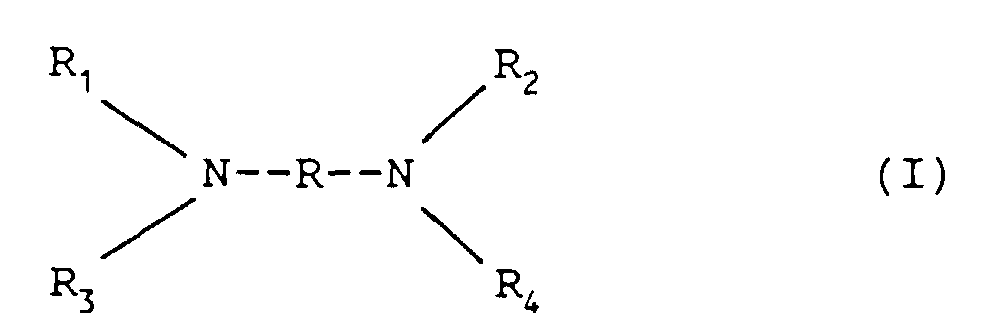
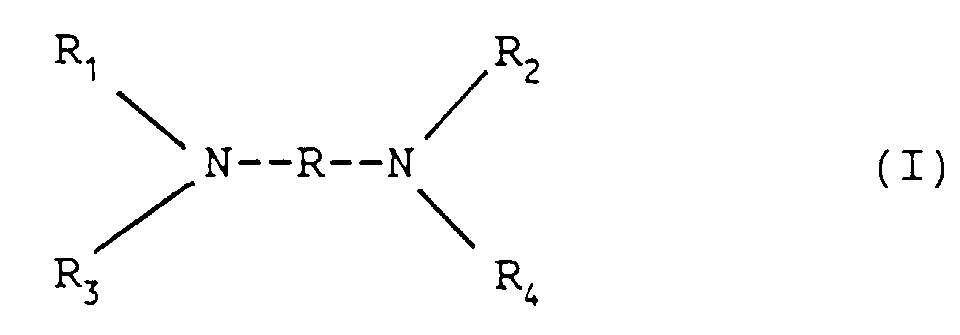
- Bidentate nitrogenated ligands can be selected from those having general formula (I) wherein: R represents a C 2 -C 4 alkyl radical optionally substituted with an alkyl or aryl group; R 1 -R 4 , the same or different, each represent a C 1 -C 10 alkyl radical, a C 3 -C 10 cycloalkyl radical or a C 6 -C 12 aromatic radical possibly substituted with a C 1 -C 4 alkyl or alkoxyl radical; or from those having general formula (II): wherein: X and Y, the same or different, represent a bridged organic group having at least three atoms in the bridge of which at least two are carbon atoms. When, as well as the carbon atoms, groups X and Y contain other atoms, these are preferably selected from oxygen or nitrogen.
- polydentate nitrogenated ligands are: N,N,N',N'-tetramethylethylenediamine-1,2; N,N,N',N'-tetramethylpropanediamine-1,3; 2,2'-bipyridyl; 4,4'-dimethyl-2,2'bipyridyl; 4,4'-diphenyl-2,2'bipyridyl; 5,5'-dimethyl-2,2'-bipyridyl; 5-methyl-2,2'bipyridyl; 1,10-phenanthroline; 4-methyl-1,10-phenanthroline; 5-methyl-1,10-phenanthroline; 4,7-dimethyl-1,10-phenanthroline; 3,8-dimethyl-1,10-phenanthroline; 4,7-diphenyl-1,10-phenanthroline; 4,7-dichloro-1,10-phenanthroline; 3,4,7,8-tetramethyl-1,10-phenanthroline; 4,4
- Preferred ligands for the purposes of the present invention are 2,4,6-tri-(2-pyridyl)-1,3,5-triazine, 6,7-dimethyl-2,3-di(2-pyridyl)-quinoxaline and phenanthrolines substituted in position 2,9 such as for example: 2,9-dichloro-1,10-phenanthroline, 2,9-dimethyl-4,7-diphenyl-1,10-phenanthroline and 2,9-dibutylphenanthroline.
- a molar ratio ligand/palladium is used of between 1:1 and 20:1, preferably between 3:1 and 8:1.
- Examples of palladium salts which can be used in the process of the present invention can be selected from palladium acetate, palladium nitrate, palladium sulfate. Palladium acetate is preferred.
- the quantity of palladium salt used in the process of the present invention is generally between 0.001 and 0.5 moles per litre of organic phase, preferably between 0.003 and 0.007 moles per litre of organic phase.
- non-coordinating acids which can be used in the process of the present invention are selected from p-toluenesulfonic acid, phosphoric acid, acetic acid, sulfuric acid, trifluoroacetic acid, benzoic acid, p-toluic acid, trimethylbenzoic acid, methanesulfonic acid, benzenesulfonic acid, diphenylphosphinic acid and perfluoroalkylcarboxylic acids having the formula C n F 2n+1 COOH wherein n is between 5 and 15, preferably between 5 and 9.
- P-toluenesulfonic acid, sulfuric acid and perfluorooctanoic acid are preferred.
- the quantity of acid used in the process of the present invention is selected so as to obtain a molar ratio non-coordinating acid/palladium of between 1/1 and 60/1, preferably between 3/1 and 20/1.
- Solvents which can be used in the process of the present invention can be aliphatic, aromatic hydrocarbons, aliphatic or aromatic chlorinated hydrocarbons, linear or cyclic ethers, ketones or alcohols, on the condition that, when the non-coordinating acid is sulfuric acid, the solvent is a mixture consisting of an alcohol and an organic solvent non-miscible with water, with a volumetric ratio of between 5:95 and 95:5 and preferably from 50:50 to 60:40.
- solvents suitable for the purposes of the present invention are: benzene, toluene, chlorobenzene, dichloromethane, dichloroethane, chloroform and chloronaphthalene, 1,2,4-trichlorobenzene, methyl-terbutyl-ketone, methyl-isobutyl-ketone, acetophenone, p-fluoroacetophenone, p-methylacetophenone, anisole, benzonitrile.
- the alcohols are selected from primary, secondary or tertiary aliphatic alcohols, linear or branched substituted by alkyl or aryl residues, such as for example, 2,6-dimethyl-4-heptanol, ter-amylic alcohol, ter-butylic alcohol, n-amylic alcohol, n-butanol, n-propanol, ethanol or methanol. N-propanol, n-butanol and n-amylic alcohol are preferred.
- the quantity of gaseous phase, carbon monoxide and oxygen, used in the reaction is selected so as to maintain a total pressure of more than 1 atm and preferably between 5 and 100 atm.
- the molar ratio CO/O 2 is conveniently between 1:99 and 12:88, preferably between 3:97 and 10:90.
- the reaction can be carried out using air instead of pure oxygen.
- the molar ratio CO:O 2 is between 1:99 and 20:80, preferably between 3:97 and 15:85.
- the quantity of water, which forms one of the reagents, is selected so as to generate a double phase.
- the volumetric ratio water:solvent is conveniently between 30:70 and 70:30 and is preferably 50:50.
- the process of the present invention can be carried out in batch or in continuous using a catalytic complex which is either preformed or prepared in situ .
- the palladium salt and nitrogenated ligand are dissolved in the organic solvent and the resulting mixture is reacted at room temperature, under stirring, for a time which is necessary to guarantee the complete formation of the ligand:palladium catalytic complex.
- aqueous solution of a non-coordinating acid is added to this solution to obtain a biphasic system into which the carbon monoxide and oxygen are fed at the desired pressures and quantities, as defined above.
- the reaction is typically carried out at temperatures of between -20° and 100°C and for a period of time ranging from 15 minutes to 10 hours. It is preferably carried out at a temperature of between 20° and 80°C and for a period of from 30 minutes to 2 hours.
- the aqueous phase containing the hydrogen peroxide is separated from the organic phase with the usual separation techniques.
- the aqueous phase can be used directly or it can be further concentrated using the known methods as described for example in patents DE-2.233.159, DE-A- 2 125 192 and DE-1.945.754.
- the organic phase containing the catalytic complex can be reused in a subsequent synthesis cycle of hydrogen peroxide operating as described above.
- the process can be identically repeated for a large number of cycles without deactivation of the catalytic system.
- the process in continuous can be carried out with the conventional techniques removing the hydrogen peroxide and CO 2 produced and reintegrating the reagents.
- an aqueous phase is discharged from the reactor, with a content of hydrogen peroxide of from 2 to about 10% by weight, with residence times of 1 to 3 hours.
- the process of the present invention has the fundamental advantage of transforming the reagents into H 2 O 2 with high yields, using reduced quantities of ligand and acid. There are obvious benefits relating to the economy of the process.
- hourly turnover of palladium relates to the efficiency of the catalyst and is calculated as a molar ratio between the hydrogen peroxide produced in 1 hour and the palladium charged.
- the reaction is carried out under vigorous stirring, at a temperature of 50°C.
- the reactor is depressurized and the aqueous phase is separated from the organic phase.
- An aliquot (0.5 ml) of the aqueous phase is titrated with a solution of potassium permanganate to determine the concentration of hydrogen peroxide, which proves to be equal to about 1.2% by weight. This corresponds to an hourly turnover of palladium of 68.
- reaction is carried out as described in example 1, but operating at 60°C and with different molar ratios CO:O 2 .
- the reaction is carried out under vigorous stirring, at a temperature of 70°C.
- the reactor is depressurized and the aqueous phase is separated from the organic phase.
- An aliquot (0.5 ml) of the aqueous phase is titrated with a solution of potassium permanganate to determine the concentration of hydrogen peroxide, which proves to be equal to 4.0% by weight. This corresponds to an hourly turnover of palladium of 236 and an hourly productivity of 0.040 Kg of hydrogen peroxide per litre of aqueous phase.
- the reaction is carried out under vigorous stirring, at a temperature of 70°C.
- the reactor is depressurized and the aqueous phase is separated from the organic phase.
- An aliquot (0.5 ml) of the aqueous phase is titrated with a solution of potassium permanganate to determine the concentration of hydrogen peroxide, which proves to be equal to 2.8% by weight. This corresponds to an hourly turnover of palladium of 332 and an hourly productivity of 0.028 Kg of hydrogen peroxide per litre of aqueous phase.
- the procedure described in example 12 is identically repeated for a total of 4 cycles, reusing each time the organic phase containing the palladium-ligand complex, separated from the aqueous phase, and reintegrating the acidified aqueous solution.
- the concentration of hydrogen peroxide is 3.9% corresponding to a turnover of 229;
- hydrogen peroxide is obtained at a concentration of 4.0%, corresponding to a turnover of 234;
- hydrogen peroxide is obtained at a concentration of 3.9%, corresponding to a turnover of 230.
- the average hourly productivity for a process of 4 consecutive cycles is 0.040 Kg of hydrogen peroxide per litre of aqueous solution, corresponding to an average concentration of 4% and to an average hourly turnover of 233.
- the autoclave is closed and pressurized with 3 atm of CO and 62 atm of oxygen.
- the reaction is carried out at 20°C under vigorous stirring. After 1 hour the reactor is depressurized and the phases separated.
- the concentration of hydrogen peroxide in the aqueous phase is 0.8% corresponding to a turnover of 76.
- the organic phase is again charged into the autoclave and reintegrated with 8 ml of water and 100 mg of concentrated sulfuric acid. The procedure is repeated for a total of 4 cycles, reusing each time the organic phase separated from the aqueous phase and reintegrating with 8 ml of aqueous solution of sulfuric acid.
Landscapes
- Chemical & Material Sciences (AREA)
- Organic Chemistry (AREA)
- Chemical Kinetics & Catalysis (AREA)
- Inorganic Chemistry (AREA)
- Catalysts (AREA)
- Organic Low-Molecular-Weight Compounds And Preparation Thereof (AREA)
- Pharmaceuticals Containing Other Organic And Inorganic Compounds (AREA)
- Oxygen, Ozone, And Oxides In General (AREA)
Description
or from those having general formula (II):

| Temperature °C | H2O2 % | TN/h |
| 20 | 0.3 | 18 |
| 30 | 0.5 | 28 |
| 40 | 0.7 | 43 |
| 50 | 1.2 | 68 |
| 60 | 1.6 | 95 |
| 70 | 2.1 | 122 |
| Acid | H2O2 | TN/h |
| H2SO4 | 1.2 | 68 |
| CF3COOH | 0.85 | 50 |
| Ph2POOH | 0.6 | 33 |
| CF3SO3H | 0.085 | 5 |
| Me3PhCOOH | 0.15 | 9 |
| C7F15COOH | 1.3 | 75 |
| ALCOHOL | H2O2 | TN/h |
| ter-amylic | 0.17 | 10 |
| ter-butylic | 0.6 | 35 |
| n-amylic | 1.05 | 62 |
| n-butylic | 1.2 | 68 |
| n-propylic | 1.14 | 67 |
| methanol | 0.17 | 10 |
| Alcohol % | Chlorobenzene | |
| TN/h | H2O2% | |
| 20 | 48 | 0.8 |
| 50 | 68 | 1.2 |
| 60 | 90 | 1.5 |
| SOLVENT | H2O2 | TN/h |
| chlorobenzene | 1.2 | 68 |
| dichloroethane | 0.7 | 40 |
| chloronaphthalene | 0.44 | 26 |
| 1,2,4-trichlorobenzene | 1.0 | 70 |
| toluene | 0.9 | 51 |
| methyl-terbutyl-ketone | 0.4 | 22 |
| methyl-sobutyl-ketone | 0.4 | 23 |
| acetophenone | 1.1 | 66 |
| p-fluoro-acetophenone | 1.2 | 70 |
| p-methyl-acetophenone | 1.0 | 59 |
| anisole | 1.0 | 59 |
| Ligand | H2O2% | TN/h |
| batocuproine | 1.2 | 68 |
| 2,4,6-tri(2-pyridyl)triazine | 0.1 | 8 |
| 2,9-dichloro-1,10-phenanthroline | 0.17 | 10 |
| 6,7-dimethyl-2,3-di(2-pyridyl)-quinoxaline | 0.09 | 5 |
| 2,9-dibutylphenanthroline | 0.5 | 30 |
| millimoles of acid | molar ratio Acid:Pd | TN/h | H2O2% |
| 0.125 | 5:1 | 65 | 1.1 |
| 0.25 | 10:1 | 66 | 1.1 |
| 0.5 | 20:1 | 68 | 1.2 |
| 1.0 | 40:1 | 68 | 1.2 |
| 1.5 | 60:1 | 69 | 1.2 |
| CO% | O2 | air | ||
| TN/h | H2O2% | TN/h | H2O2% | |
| 3.0 | 88 | 1.5 | 70 | 1.2 |
| 4.5 | 100 | 1.7 | 88 | 1.5 |
| 7.0 | 124 | 2.1 | 70 | 1.2 |
| 14.5 | - | - | 18 | 0.3 |
| 95.5 | 0 | 0 | 0 | - |
| Ligand:Pd | TN/h | % H2O2 |
| 20:1 | 31 | 0.5 |
| 8:1 | 52 | 0.9 |
| 5:1 | 68 | 1.1 |
| 3:1 | 68 | 1.1 |
Claims (34)
- A process for the production of hydrogen peroxide by reaction of carbon monoxide, oxygen and water in an organic solvent immiscible with water, and in the presence of a catalytic complex soluble in the organic solvent deriving from the combination of:wherein said process is characterized in that the ligand (c) is a mono or polydentate nitrogenated compound.(a) a salt of palladium;(b) a non-coordinating organic or inorganic acid; and(c) a ligand capable of binding itself to the palladium atom;
- The process according to claim 1, characterized in that the monodentate nitrogenated ligand is a nitrogenated heterocyclic compound selected from pyridine and alkylpyridine.
- The process according to claim 1, characterized in that the polydentate nitrogenated ligand is selected from compounds having formula (I)wherein: R represents a C2-C4 alkyl radical possibly substituted with an alkyl or aryl group; R1-R4, the same or different, each represent a C1-C10 alkyl radical, a C3-C10 cycloalkyl radical or a C6-C12 aromatic radical possibly substituted with a C1-C4 alkyl or alkoxyl radical.
- The process according to claim 1, characterized in that the nitrogenated ligand is selected from compounds having formula (II):wherein: X and Y, the same or different, represent a bridged organic group having at least three atoms in the bridge of which at least two are carbon atoms.

- The process according to claim 4, wherein when, as well as the carbon atoms, groups X and Y contain other atoms, these are selected from oxygen and nitrogen.
- The process according to claim 1, characterized in that the polydentate nitrogenated ligand is selected from N,N,N',N'-tetramethylethylenediamine-1,2; N,N,N',N'-tetramethylpropanediamine-1,3; 2,2'-bipyridyl; 4,4'-dimethyl-2,2'bipyridyl; 4,4'-diphenyl-2,2'bipyridyl; 5,5'-dimethyl-2,2'-bipyridyl; 5-methyl-2,2'-bipyridyl; 1,10-phenanthroline; 4-methyl-1,10-phenanthroline; 5-methyl-1,10-phenanthroline; 4,7-dimethyl-1,10-phenanthroline; 3,8-dimethyl-1,10-phenanthroline; 4,7-diphenyl-1,10-phenanthroline; 4,7-dichloro-1,10-phenanthroline; 3,4,7,8-tetramethyl-1,10-phenanthroline; 4,4'-dimethyl-5,5'-bioxazole; 2,2'-bipyrimidine; 2,2'-tetrahydro-bioxazole; 2,9-dichloro-1,10-phenanthroline; 2,9-dibutylphenanthroline 2,9-dimethylphenanthroline; 2,9-dimethyl-4,7-diphenyl-1,10-phenanthroline; 2,4,6-tri-(2-pyridyl)-1,3,5-triazine and 6,7-dimethyl-2,3-di(2-pyridyl)-quinoxaline.
- The process according to claim 6, characterized in that the ligand is selected from 2,4,6-tri-(2-pyridyl)-1,3,5-triazine, 6,7-dimethyl-2,3-di(2-pyridyl)-quinoxaline and phenanthrolines substituted in position 2,9 such as 2,9-dichloro-1,10-phenanthroline, 2,9-dimethyl-4,7-diphenyl-1,10-phenanthroline and 2,9-dibutylphenanthroline.
- The process according to claims 1 to 7, characterized in that the molar ratio ligand:palladium is between 1:1 and 20:1.
- The process according to claim 8, characterized in that the molar ratio ligand:palladium is between 3:1 and 8:1.
- The process according to claim 1, characterized in that the palladium salt is selected from palladium acetate, palladium nitrate and palladium sulfate.
- The process according to claim 10, characterized in that the palladium salt is palladium acetate.
- The process according to claim 1, characterized in that the concentration of palladium salt is between 0.001 and 0.5 moles of palladium salt per litre of organic phase.
- The process according to claim 12, characterized in that the concentration of palladium salt is between 0.003 and 0.007 moles of palladium salt per litre of organic phase.
- The process according to claim 1, characterized in that the acid is selected from p-toluenesulfonic acid, phosphoric acid, acetic acid, sulfuric acid, trifluoroacetic acid, benzoic acid, p-toluic acid, trimethylbenzoic acid, methanesulfonic acid, benzenesulfonic acid, diphenylphosphinic acid and perfluoroalkylcarboxylic acids having the formula CnF2n+1COOH wherein n is between 5 and 15.
- The process according to claim 14, wherein the perfluoroalkylcarboxylic acids are represented by the formula CnF2n+1COOH wherein n is between 5 and 9.
- The process according to claim 14, wherein the acids are selected from p-toluenesulfonic acid, sulfuric acid and perfluorooctanoic acid.
- The process according to claim 1, characterized in that the molar ratio acid:palladium is between 1:1 and 60:1.
- The process according to claim 17, characterized in that the molar ratio acid:palladium is between 3:1 and 20:1.
- The process according to claim 1, characterized in that the organic solvent is selected from aliphatic, aromatic hydrocarbons, aliphatic or aromatic chlorinated hydrocarbons, linear or cyclic ethers, ketones or alcohols, or their mixtures.
- The process according to claim 19, characterized in that the organic solvent is selected from benzene, toluene, chlorobenzene, dichloromethane, dichloroethane, chloroform and chloronaphthalene, 1,2,4-trichlorobenzene, methyl-terbutyl-ketone, methyl-isobutyl-ketone, acetophenone, p-fluoroacetophenone, p-methylacetophenone, anisole, nitrile.
- The process according to claim 19, characterized in that the alcohols are selected from primary, secondary or tertiary alcohols, linear or branched, substituted by alkyl or aryl residues.
- The process according to claim 21, characterized in that the alcohols are selected from 2,6-dimethyl-4-heptanol, ter-amylic alcohol, ter-butylic alcohol, n-amylic alcohol, n-butanol, n-propanol or methanol.
- The process according to claim 22, characterized in that the alcohols are n-propanol, n-butanol and n-amylic alcohol.
- The process according to claim 1, characterized in that, when the non-coordinating acid is sulfuric acid, the solvent is a mixture consisting of an alcohol and an organic solvent with a volumetric ratio of between 5:95 and 95:5.
- The process according to claim 24, characterized in that the volumetric ratio alcohol/organic solvent is between 50:50 and 60:40.
- The process according to claim 1, characterized in that the reaction is carried out at a total pressure of more than 1 atm and with a molar ratio carbon monoxide:oxygen of between 1:99 and 12:88.
- The process according to claim 26, characterized in that the pressure is between 5 atm and 100 atm and the molar ratio carbon monoxide:oxygen is between 3:97 and 10:90.
- The process according to claim 1, wherein the reaction is carried out using air as oxygen source.
- The process according to claim 28, wherein the molar ratio carbon monoxide:oxygen is between 1:99 and 20:80.
- The process according to claim 29, wherein the molar ratio carbon monoxide:oxygen is between 3:97 and 15:85.
- The process according to claim 1, characterized in that the reaction is carried out at a temperature of between -20 and 100°C.
- The process according to claim 31, wherein the temperature is between 20°C and 80°C.
- The process according to claim 1, wherein the catalytic complex is preformed.
- The process according to claim 1, which is carried out in continuous removing the hydrogen peroxide and the CO2 and reintegrating the reagents.
Applications Claiming Priority (2)
| Application Number | Priority Date | Filing Date | Title |
|---|---|---|---|
| IT96MI001015A IT1283040B1 (en) | 1996-05-21 | 1996-05-21 | PROCEDURE FOR THE PREPARATION OF OXYGEN WATER |
| ITMI961015 | 1996-05-21 |
Publications (2)
| Publication Number | Publication Date |
|---|---|
| EP0808796A1 EP0808796A1 (en) | 1997-11-26 |
| EP0808796B1 true EP0808796B1 (en) | 2000-02-09 |
Family
ID=11374291
Family Applications (1)
| Application Number | Title | Priority Date | Filing Date |
|---|---|---|---|
| EP97106075A Expired - Lifetime EP0808796B1 (en) | 1996-05-21 | 1997-04-14 | Process for the preparation of hydrogen peroxide |
Country Status (6)
| Country | Link |
|---|---|
| US (1) | US5783164A (en) |
| EP (1) | EP0808796B1 (en) |
| JP (1) | JPH111306A (en) |
| DE (1) | DE69701271T2 (en) |
| ES (1) | ES2142119T3 (en) |
| IT (1) | IT1283040B1 (en) |
Families Citing this family (5)
| Publication number | Priority date | Publication date | Assignee | Title |
|---|---|---|---|---|
| ITMI20011016A1 (en) * | 2001-05-17 | 2002-11-17 | Enichem Spa | DIRECT SYNTHESIS OF OXYGENATED WATER IN A NEW MULTI-COMPONENT SOLVENT SYSTEM |
| US7147833B2 (en) | 2002-03-25 | 2006-12-12 | Huckins Harold A | Method for producing hydrogen peroxide from hydrogen and oxygen |
| US7008607B2 (en) * | 2002-10-25 | 2006-03-07 | Basf Aktiengesellschaft | Process for preparing hydrogen peroxide from the elements |
| CN102603618B (en) * | 2012-01-20 | 2013-09-25 | 山东师范大学 | Biphenyl compound, synthetic method and application thereof |
| JP7370332B2 (en) * | 2018-09-13 | 2023-10-27 | 三菱瓦斯化学株式会社 | Palladium-containing composition and method for producing hydrogen peroxide |
Family Cites Families (4)
| Publication number | Priority date | Publication date | Assignee | Title |
|---|---|---|---|---|
| US4462978A (en) * | 1982-12-10 | 1984-07-31 | The Halcon Sd Group, Inc. | Preparation of hydrogen peroxide |
| JPS60191005A (en) * | 1984-03-13 | 1985-09-28 | Japan Carlit Co Ltd:The | Production of hydrogen peroxide |
| DE3676800D1 (en) * | 1985-11-29 | 1991-02-14 | Shell Int Research | CATALYST COMPOSITION AND METHOD FOR COPOLYMERIZING ETHEN WITH CARBON MONOXIDE. |
| US4711772A (en) * | 1986-09-18 | 1987-12-08 | The Boc Group, Inc. | Preparation of hydrogen peroxide |
-
1996
- 1996-05-21 IT IT96MI001015A patent/IT1283040B1/en active IP Right Grant
-
1997
- 1997-04-14 ES ES97106075T patent/ES2142119T3/en not_active Expired - Lifetime
- 1997-04-14 DE DE69701271T patent/DE69701271T2/en not_active Expired - Lifetime
- 1997-04-14 EP EP97106075A patent/EP0808796B1/en not_active Expired - Lifetime
- 1997-04-21 US US08/844,675 patent/US5783164A/en not_active Expired - Lifetime
- 1997-05-21 JP JP9131343A patent/JPH111306A/en active Pending
Also Published As
| Publication number | Publication date |
|---|---|
| EP0808796A1 (en) | 1997-11-26 |
| IT1283040B1 (en) | 1998-04-07 |
| US5783164A (en) | 1998-07-21 |
| DE69701271T2 (en) | 2000-07-06 |
| JPH111306A (en) | 1999-01-06 |
| DE69701271D1 (en) | 2000-03-16 |
| ITMI961015A1 (en) | 1997-11-21 |
| ES2142119T3 (en) | 2000-04-01 |
| ITMI961015A0 (en) | 1996-05-21 |
Similar Documents
| Publication | Publication Date | Title |
|---|---|---|
| US4347232A (en) | Preparation of hydrogen peroxide from its elements | |
| US6630118B2 (en) | Process for the direct synthesis of hydrogen peroxide | |
| PL107856B1 (en) | METHOD OF PRODUCING N-PHOSPHONOMETHYLOGLYCINE METHOD OF PRODUCING N-PHOSPHONOMETHYLOGLYCINE | |
| US4853159A (en) | Process for producing N-phosphonomethylglycine | |
| CA2083660A1 (en) | Synthesis of manganese oxidation catalyst | |
| AU2008241528A1 (en) | Novel opiate reduction utilizing catalytic hydrogen transfer reaction | |
| US5783164A (en) | Process for the preparation of hydrogen peroxide | |
| US5591890A (en) | Process for producing ortho-nitro aromatic acids by oxidation of ortho-nitroalkylaromatic compounds | |
| JPS6051150A (en) | Production of biphenyltetracarboxylic acid ester | |
| Bianchi et al. | A novel palladium catalyst for the synthesis of hydrogen peroxide from carbon monoxide, water and oxygen | |
| AU746496B2 (en) | Method for producing N-substituted 3-hydroxypyrazoles | |
| JPS5837300B2 (en) | Production method of P-nitrobenzoic acid | |
| EP0853064B1 (en) | Process for the synthesis of hydrogen peroxide | |
| JPH068305B2 (en) | Method for producing N-phosphonomethylglycine | |
| ITMI971806A1 (en) | PHENOL SYNTHESIS PROCEDURE FOR BENZENE | |
| US6610881B1 (en) | Method for producing sulfonated aryl phosphines | |
| EP1353750B1 (en) | Stable free nitroxyl radicals as oxidation catalysts and process for oxidation | |
| ITMI971128A1 (en) | IMPROVED PROCEDURE FOR THE SYNTHESIS OF OXYGEN WATER | |
| US3907841A (en) | Process for preparing 5-nitro-naphthoquinone-(1,4) | |
| JP4568400B2 (en) | Method for producing 5,5'-bi-1H-tetrazole diammonium salt using hydrated hydrazine and dicyan as raw materials | |
| EP0788998A1 (en) | Process for the preparation of hydrogen peroxide | |
| JPH01203227A (en) | Recovery rhodium from aqueous solution containing rhodium complex | |
| ES2209628B2 (en) | PHOTOCHEMICAL SYNTHESIS OF ACID DERIVATIVES OF PHOSPHORUS AND ITS ESTERS FROM WHITE ELEMENTAL PHOSPHORUS. | |
| Speier | Quercetin 2, 3-dioxygenase mimicking chemistry | |
| ITMI981031A1 (en) | PROCESS FOR THE SYNTHESIS OF OXYGEN WATER AND ITS USE IN OXIDATION PROCESSES WITH TITANIUM SILICALITE |
Legal Events
| Date | Code | Title | Description |
|---|---|---|---|
| PUAI | Public reference made under article 153(3) epc to a published international application that has entered the european phase |
Free format text: ORIGINAL CODE: 0009012 |
|
| AK | Designated contracting states |
Kind code of ref document: A1 Designated state(s): BE DE ES FR GB IT NL SE |
|
| 17P | Request for examination filed |
Effective date: 19980318 |
|
| 17Q | First examination report despatched |
Effective date: 19990121 |
|
| GRAG | Despatch of communication of intention to grant |
Free format text: ORIGINAL CODE: EPIDOS AGRA |
|
| GRAG | Despatch of communication of intention to grant |
Free format text: ORIGINAL CODE: EPIDOS AGRA |
|
| GRAH | Despatch of communication of intention to grant a patent |
Free format text: ORIGINAL CODE: EPIDOS IGRA |
|
| GRAH | Despatch of communication of intention to grant a patent |
Free format text: ORIGINAL CODE: EPIDOS IGRA |
|
| GRAA | (expected) grant |
Free format text: ORIGINAL CODE: 0009210 |
|
| AK | Designated contracting states |
Kind code of ref document: B1 Designated state(s): BE DE ES FR GB IT NL SE |
|
| ITF | It: translation for a ep patent filed | ||
| REF | Corresponds to: |
Ref document number: 69701271 Country of ref document: DE Date of ref document: 20000316 |
|
| REG | Reference to a national code |
Ref country code: ES Ref legal event code: FG2A Ref document number: 2142119 Country of ref document: ES Kind code of ref document: T3 |
|
| ET | Fr: translation filed | ||
| PLBE | No opposition filed within time limit |
Free format text: ORIGINAL CODE: 0009261 |
|
| STAA | Information on the status of an ep patent application or granted ep patent |
Free format text: STATUS: NO OPPOSITION FILED WITHIN TIME LIMIT |
|
| 26N | No opposition filed | ||
| REG | Reference to a national code |
Ref country code: GB Ref legal event code: IF02 |
|
| REG | Reference to a national code |
Ref country code: FR Ref legal event code: PLFP Year of fee payment: 20 |
|
| PGFP | Annual fee paid to national office [announced via postgrant information from national office to epo] |
Ref country code: NL Payment date: 20160426 Year of fee payment: 20 |
|
| PGFP | Annual fee paid to national office [announced via postgrant information from national office to epo] |
Ref country code: GB Payment date: 20160427 Year of fee payment: 20 Ref country code: DE Payment date: 20160427 Year of fee payment: 20 Ref country code: ES Payment date: 20160426 Year of fee payment: 20 |
|
| PGFP | Annual fee paid to national office [announced via postgrant information from national office to epo] |
Ref country code: IT Payment date: 20160421 Year of fee payment: 20 Ref country code: SE Payment date: 20160427 Year of fee payment: 20 Ref country code: FR Payment date: 20160425 Year of fee payment: 20 Ref country code: BE Payment date: 20160427 Year of fee payment: 20 |
|
| REG | Reference to a national code |
Ref country code: DE Ref legal event code: R071 Ref document number: 69701271 Country of ref document: DE |
|
| REG | Reference to a national code |
Ref country code: NL Ref legal event code: MK Effective date: 20170413 |
|
| REG | Reference to a national code |
Ref country code: GB Ref legal event code: PE20 Expiry date: 20170413 |
|
| REG | Reference to a national code |
Ref country code: ES Ref legal event code: FD2A Effective date: 20170726 |
|
| PG25 | Lapsed in a contracting state [announced via postgrant information from national office to epo] |
Ref country code: GB Free format text: LAPSE BECAUSE OF EXPIRATION OF PROTECTION Effective date: 20170413 |
|
| PG25 | Lapsed in a contracting state [announced via postgrant information from national office to epo] |
Ref country code: ES Free format text: LAPSE BECAUSE OF EXPIRATION OF PROTECTION Effective date: 20170415 |