EP0808708B1 - Method for the injection overmolding of plastics - Google Patents
Method for the injection overmolding of plastics Download PDFInfo
- Publication number
- EP0808708B1 EP0808708B1 EP97107703A EP97107703A EP0808708B1 EP 0808708 B1 EP0808708 B1 EP 0808708B1 EP 97107703 A EP97107703 A EP 97107703A EP 97107703 A EP97107703 A EP 97107703A EP 0808708 B1 EP0808708 B1 EP 0808708B1
- Authority
- EP
- European Patent Office
- Prior art keywords
- injection
- channels
- overmolding
- component
- regions
- Prior art date
- Legal status (The legal status is an assumption and is not a legal conclusion. Google has not performed a legal analysis and makes no representation as to the accuracy of the status listed.)
- Expired - Lifetime
Links
Images
Classifications
-
- B—PERFORMING OPERATIONS; TRANSPORTING
- B29—WORKING OF PLASTICS; WORKING OF SUBSTANCES IN A PLASTIC STATE IN GENERAL
- B29D—PRODUCING PARTICULAR ARTICLES FROM PLASTICS OR FROM SUBSTANCES IN A PLASTIC STATE
- B29D35/00—Producing footwear
- B29D35/02—Producing footwear made in one piece using a moulding technique, e.g. by injection moulding or casting
- B29D35/04—Producing footwear made in one piece using a moulding technique, e.g. by injection moulding or casting having multilayered parts
-
- A—HUMAN NECESSITIES
- A43—FOOTWEAR
- A43B—CHARACTERISTIC FEATURES OF FOOTWEAR; PARTS OF FOOTWEAR
- A43B5/00—Footwear for sporting purposes
- A43B5/04—Ski or like boots
- A43B5/0427—Ski or like boots characterised by type or construction details
-
- A—HUMAN NECESSITIES
- A43—FOOTWEAR
- A43B—CHARACTERISTIC FEATURES OF FOOTWEAR; PARTS OF FOOTWEAR
- A43B5/00—Footwear for sporting purposes
- A43B5/04—Ski or like boots
- A43B5/0486—Ski or like boots characterized by the material
Definitions
- the present invention relates to a method for the injection overmolding of plastics, to obtain components for sports shoes, such as for example shells for ski boots or for roller skates or ice skates or for ice shoes.
- Sports shoes such as for example ski boots, are currently manufactured by using injection molds.
- the material injected in adapted presses therefore assumes the shape which is preset by the molds; the thickness is also predefined, since it is dictated by the structural requirements of the shoe.
- the material used for injection must have rigidity properties which meet the technical requirements and the stresses affecting the shoe.
- the shell has regions wherein particular hardness is required and regions wherein the stresses or the transmission of forces are considerably reduced. Accordingly, regions are provided in which the technical requirements do not demand the injected material to have high-level hardness properties.
- EP-A-0 645 101 discloses a ski boot with improved lateral containment having a rigid element which can be applied to a shell so as to affect the metatarsal, heel, and malleolar regions thereof at least at the inner side of the foot.
- the rigid element has allowed to provide, for example, a shell by using a material to be injected which can be considered soft and has merely protective functions at a low cost.
- soft material is used to define, for example, a polyurethane having a hardness of 54 Shore D, available for example from the German manufacturer Bayer AG, and commercially known as DESMOPAN (registered trademark) 150 S.
- soft can be used to indicate a thermoplastic rubber having a hardness of 52 Shore D, commercially available under the trade-name MEGOL (registered trademark) DE 52, and manufactured by the Italian company API S.p.A..
- rigid material is used to define material, such as polyurethane or polypropylene, which is harder than the material referenced to as “soft”; for example, polyurethane having a hardness of 67 Shore D, of the type produced commercially by Bayer AG under the trade-name DESMOPAN (registered trademark) 8410, can be considered as a "rigid” material.
- DESMOPAN registered trademark 8410
- polypropylene having a hardness of 72 Shore D marketed by the Dutch company DSM N.V. under the trade-name STAMILAN (registered trademark) PHC 22, can be considered as a "rigid" material.
- An aim of the present invention is to solve the described problems, by eliminating the drawbacks of the cited prior art.
- a further advantage of the present invention is to provide an injection-overmolding process which allows to achieve greater flexibility and tolerance during design.
- a further advantage of the present invention is to provide a method for injection-overmolding a second harder material over a first soft material which allows to obtain a product offering good precision in the regions that delimit the two materials.
- Still a further advantage of the present invention is to provide a method which has low costs for producing the molds, thus achieving a production which is affected by a low number of rejects.
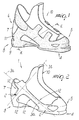
- the reference numeral 1 designates a shell of a sports shoe, such as for example a ski boot, to illustrate an application of the method according to the present invention.
- the method according to the invention comprises a first injection of a first "soft" material (according for example to the above-described specifications) in order to obtain the shell and form one or more channels or grooves 2, that may be interconnected, obtained along clearly defined primary lines.
- the primary lines designated by the reference numerals 3a and 3b, follow the directions along which the forces acting on the boot and caused by the forces applied by the leg to the ski produce the highest stress; said lines are inclined with respect to the resting plane of the sole 4 and connect the toe region 5 to the region 6 lying above the heel 7 of the foot, as well as the region 8 adjacent to the heel 9 of the sole 4 to the foot instep region 10.
- the method performs an injection-overmolding of a second "rigid" material (according to the above-stated specifications) which is such as to form a strong load-bearing frame 11 for the sports shoe; said injection-overmolding and the corresponding flow of the second material occur inside the mold along the channels 2, so as to affect not only the channels but also regions 12 adjacent thereto.
- the injection-overmolding of the "rigid" material entails the production of a greater thickness for the shell 1 at the channels 2 and therefore along the primary lines 3a, 3b whereat the greatest stresses occur during sports practice.
- the thickness of the "rigid" material injection-overmolded on the first "soft” material determines the pressure acting in the mold closure regions; if said pressure is high, it does not cause seepages, because the second "rigid” material also affects the neighboring regions 12 of the channels 2, which are characterized by a reduction in the thickness of the second "rigid” material during its injection which therefore entails a limited pressure and therefore a dramatic reduction in seepage possibilities.
- Regions having different rigidities according to the stresses that act in each individual region, for example of the boot, are thus formed.
- the described method allows to obtain an excellent finish of the injection-overmolded edge, avoiding seepage of the "rigid" material owing to the lower pressure applied by the reduced perimetric thickness thereof at the regions 12 which are adjacent to the channels 2.
- the method also allows to tolerate unexpected shrinkages of the "rigid” material without causing in any case a "groove” effect in the region where injection-overmolding on the first "soft” material is performed.
- a component for sports shoes is also obtained which has a desired outward aesthetic appearance; at the same time, a reduction in the design and production costs of the mold and in the production costs of the product is achieved, since extremely accurate design and construction of the molds is not required. It is thus possible to use a "soft" material, which is less expensive than the "rigid” material, at the same time achieving optimum comfort for the user and in any case an optimum transmission of forces to the sports implement.
- the method also allows to reduce the number of rejects caused by shrinkage of the injection-overmolded material, by virtue of the tolerance provided at the regions 12 adjacent to the channels 2, which in turn allow to differentiate the component of the sports shoe from the point of view of rigidity.
- the method also eliminates the possibility of perimetric seepages along the edge of the second mold for the injection-overmolding of the "rigid" material, allowing to achieve an excellent finish of the overmolded edge by means of the calibrated compression performed by the second mold during injection-overmolding.
- the materials and the dimensions which constitute the individual channels, and/or the extent and extension of the regions 12 adjacent to the channels, and the thicknesses of the first and second materials, may also be the most pertinent according to specific requirements.
Landscapes
- Health & Medical Sciences (AREA)
- General Health & Medical Sciences (AREA)
- Physical Education & Sports Medicine (AREA)
- Engineering & Computer Science (AREA)
- Mechanical Engineering (AREA)
- Injection Moulding Of Plastics Or The Like (AREA)
- Footwear And Its Accessory, Manufacturing Method And Apparatuses (AREA)
- Materials For Medical Uses (AREA)
Abstract
Description
- The present invention relates to a method for the injection overmolding of plastics, to obtain components for sports shoes, such as for example shells for ski boots or for roller skates or ice skates or for ice shoes.
- Sports shoes, such as for example ski boots, are currently manufactured by using injection molds.
- The material injected in adapted presses therefore assumes the shape which is preset by the molds; the thickness is also predefined, since it is dictated by the structural requirements of the shoe.
- The material used for injection must have rigidity properties which meet the technical requirements and the stresses affecting the shoe.
- However, it has been observed that in sports shoes, and particularly in ski boots, for example, the shell has regions wherein particular hardness is required and regions wherein the stresses or the transmission of forces are considerably reduced. Accordingly, regions are provided in which the technical requirements do not demand the injected material to have high-level hardness properties.
- The optional use of a lower-quality material is also justified by a reduction in the weight of the shoe and in its costs.
- EP-A-0 645 101, by this same Applicant, discloses a ski boot with improved lateral containment having a rigid element which can be applied to a shell so as to affect the metatarsal, heel, and malleolar regions thereof at least at the inner side of the foot.
- Use of the rigid element has allowed to provide, for example, a shell by using a material to be injected which can be considered soft and has merely protective functions at a low cost.
- The term "soft material» is used to define, for example, a polyurethane having a hardness of 54 Shore D, available for example from the German manufacturer Bayer AG, and commercially known as DESMOPAN (registered trademark) 150 S.
- As an alternative, the term "soft" can be used to indicate a thermoplastic rubber having a hardness of 52 Shore D, commercially available under the trade-name MEGOL (registered trademark) DE 52, and manufactured by the Italian company API S.p.A..
- These materials are two of the possible examples of the use of "soft" materials, this term being used to designate any material which can deform during sports practice and therefore does not have such mechanical characteristics as to withstand the stresses or forces applied during sports practice.
- However, the hypothesis of producing the rigid element described in the cited application by injection-overmolding a "rigid" material on a base entailed problems, since the above-described conventional processes related to the issue being presented entail seepage of the "rigid» material or problems in centering the component of the shoe in the mold, and this accordingly entails many inaccuracies in the regions for delimiting one material from the other.
- The term "rigid material" is used to define material, such as polyurethane or polypropylene, which is harder than the material referenced to as "soft"; for example, polyurethane having a hardness of 67 Shore D, of the type produced commercially by Bayer AG under the trade-name DESMOPAN (registered trademark) 8410, can be considered as a "rigid" material.
- As an alternative, polypropylene having a hardness of 72 Shore D, marketed by the Dutch company DSM N.V. under the trade-name STAMILAN (registered trademark) PHC 22, can be considered as a "rigid" material.
- In this case, too, those skilled in the art will know immediately which injectable material to choose, among the possible solutions in addition to those which have been described, in order to achieve a desired mechanical rigidity or a desired softness for the various parts of the component of the sports shoe.
- The above-cited problems have also been observed in the production of the product disclosed in the above-cited EP-A-0 645 101, which also discloses a ski boot comprising a shell and a quarter, one whereof is constituted by a rigid lattice-like frame and by a soft covering element which is injection-overmolded or associated with the frame.
- Use of conventional injection-overmolding processes has in fact entailed seepages of material and difficulties in centering the components in the mold.
- Therefore, if the prior art is used to achieve the injection-overmolding of two materials having different characteristics, even if there are clearly delimited regions in which injection-overmolding occurs, problems occur related to seepage of the injection-overmolded material onto the underlying one, caused by inaccurate closure of the mold, as well as optimization problems if the injection-overmolding occurs "flush" with the underlying material.
- One possibility of obviating these problems might be to design and manufacture the molds very accurately, but this would entail very high consequent production costs and in any case production would be affected by a large number of rejects.
- An aim of the present invention is to solve the described problems, by eliminating the drawbacks of the cited prior art.
- This aim is achieved by the method according to
claim 1. - A further advantage of the the present invention is to provide an injection-overmolding process which allows to achieve greater flexibility and tolerance during design.
- A further advantage of the present invention is to provide a method for injection-overmolding a second harder material over a first soft material which allows to obtain a product offering good precision in the regions that delimit the two materials.
- Still a further advantage of the present invention is to provide a method which has low costs for producing the molds, thus achieving a production which is affected by a low number of rejects.
- The particular characteristics and advantages of the present invention will become apparent from the following detailed description of a particular but not exclusive embodiment of the method as illustrated in the accompanying drawings, wherein:
- figure 1 is a lateral perspective view of a component of a sports shoe which is constituted by a shell of a ski boot;
- figure 2 is a view, similar to the preceding one, of the component, in which the first injection of a first soft material has been performed;
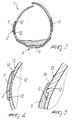
- figure 3 is a sectional view, taken along the plane III-III of figure 1;
- figure 4 is a view of a detail of figure 3;
- figure 5 is a view of a detail of figure 4.
-
- With reference to the above figures, the
reference numeral 1 designates a shell of a sports shoe, such as for example a ski boot, to illustrate an application of the method according to the present invention.
By means of a mold which may be produced with conventional systems, the method according to the invention comprises a first injection of a first "soft" material (according for example to the above-described specifications) in order to obtain the shell and form one or more channels orgrooves 2, that may be interconnected, obtained along clearly defined primary lines. - The primary lines, designated by the reference numerals 3a and 3b, follow the directions along which the forces acting on the boot and caused by the forces applied by the leg to the ski produce the highest stress; said lines are inclined with respect to the resting plane of the sole 4 and connect the
toe region 5 to the region 6 lying above theheel 7 of the foot, as well as theregion 8 adjacent to the heel 9 of the sole 4 to thefoot instep region 10. - The method performs an injection-overmolding of a second "rigid" material (according to the above-stated specifications) which is such as to form a strong load-bearing
frame 11 for the sports shoe; said injection-overmolding and the corresponding flow of the second material occur inside the mold along thechannels 2, so as to affect not only the channels but alsoregions 12 adjacent thereto. - The injection-overmolding of the "rigid" material entails the production of a greater thickness for the
shell 1 at thechannels 2 and therefore along the primary lines 3a, 3b whereat the greatest stresses occur during sports practice. - The thickness of the "rigid" material injection-overmolded on the first "soft" material determines the pressure acting in the mold closure regions; if said pressure is high, it does not cause seepages, because the second "rigid" material also affects the neighboring
regions 12 of thechannels 2, which are characterized by a reduction in the thickness of the second "rigid" material during its injection which therefore entails a limited pressure and therefore a dramatic reduction in seepage possibilities. - In order to further reduce this possibility, and thus increase the finish degree of the component of the sports shoe, it is possible to achieve optimum mold closure by adjusting the closing pressure of the second mold so that the injection-overmolding performed on the semifinished part obtained by the first injection of the first "soft" material achieves a compression of said soft material in a
region 13 which is adjacent to theedge 14 of the impression formed to obtain theframe 11. - Regions having different rigidities according to the stresses that act in each individual region, for example of the boot, are thus formed.
- The described method allows to obtain an excellent finish of the injection-overmolded edge, avoiding seepage of the "rigid" material owing to the lower pressure applied by the reduced perimetric thickness thereof at the
regions 12 which are adjacent to thechannels 2. - The method also allows to tolerate unexpected shrinkages of the "rigid" material without causing in any case a "groove" effect in the region where injection-overmolding on the first "soft" material is performed.
- A component for sports shoes is also obtained which has a desired outward aesthetic appearance; at the same time, a reduction in the design and production costs of the mold and in the production costs of the product is achieved, since extremely accurate design and construction of the molds is not required. It is thus possible to use a "soft" material, which is less expensive than the "rigid" material, at the same time achieving optimum comfort for the user and in any case an optimum transmission of forces to the sports implement.
- The method also allows to reduce the number of rejects caused by shrinkage of the injection-overmolded material, by virtue of the tolerance provided at the
regions 12 adjacent to thechannels 2, which in turn allow to differentiate the component of the sports shoe from the point of view of rigidity. - Once again it is noted that the method also eliminates the possibility of perimetric seepages along the edge of the second mold for the injection-overmolding of the "rigid" material, allowing to achieve an excellent finish of the overmolded edge by means of the calibrated compression performed by the second mold during injection-overmolding.
- Finally, it is noted that the provision of the channels and the injection-overmolding of the "rigid" material at the
regions 12 which are adjacent thereto allow to vary the aesthetic appearance of the frame of the sports shoe without having to redefine said channels and therefore without having to remake the molds, as instead occurs in the prior art. - The method according to the invention is of course susceptible of numerous modifications and variations, within the scope of the claims.
- Likewise, the materials and the dimensions which constitute the individual channels, and/or the extent and extension of the
regions 12 adjacent to the channels, and the thicknesses of the first and second materials, may also be the most pertinent according to specific requirements. - Where technical features mentioned in any claim are followed by reference signs, those reference signs have been included for the sole purpose of increasing the intelligibility of the claims and accordingly, such reference signs do not have any limiting effect on the interpretation of each element identified by way of example by such reference signs.
Claims (8)
- A method for the injection-overmolding of plastics, for obtaining a component for sports shoes, comprising a first injection of a first soft material and an injection-overmolding of a second harder material, characterized in that said first injection produces channels (2) in the component (1) of the sports shoe arranged above the sole (4) and in that said injection overmolding of said second harder material affects said channels (2) and also affects regions (12) adjacent to said channels (2), said regions (12) delimiting the injection overmolded edge and the thickness of said second harder material in said regions (12) being reduced.
- A method according to claim 1, characterized in that a first injection of a first soft material is performed by means of a first mold, obtained by conventional methods, in order to form said component for sports shoes and form channels.
- A method according to claim 2, characterized in that said channels are obtained along primary lines (3a,3b) which follow the directions along which the forces applied to said component during sports practice produce the highest stresses.
- A method according to claim 2 for obtaining a shell for a ski boot or a skate, characterized in that said channels are formed along primary lines (3a,3b) which are inclined with respect to the resting plane of the sole (4) and connect the toe region (5) to the region lying above the heel (7) of the foot and connect the region lying adjacent to the heel of the sole (4) to the foot instep region.
- A method according to claim 2, characterized in that an injection-overmolding of a second rigid material is performed inside a second mold along said channels (2) so as to affect not only said channels (2) but also regions adjacent thereto.
- A method according to claim 5, characterized in that said injection-overmolding produces a strong load-bearing frame for said component of said sports shoe.
- A method according to claim 5, characterized in that said injection-overmolding of said rigid material produces, at said channels (2) and at said regions adjacent thereto, a higher thickness for said component with respect to said first injection of soft material.
- A method according to claim 5, characterized in that the closing pressure of said second mold is adjusted so that it forms an impression on said component of said sports shoe arranged above the sole obtained from said first injection of said first soft material in a region (13) adjacent to the edge (14) of the injection-overmolding which constitutes a frame.
Applications Claiming Priority (2)
| Application Number | Priority Date | Filing Date | Title |
|---|---|---|---|
| IT96TV000064A IT1288617B1 (en) | 1996-05-20 | 1996-05-20 | PROCEDURE FOR PLASTIC SUPRAINJECTION |
| ITTV960064 | 1996-05-20 |
Publications (2)
| Publication Number | Publication Date |
|---|---|
| EP0808708A1 EP0808708A1 (en) | 1997-11-26 |
| EP0808708B1 true EP0808708B1 (en) | 2002-09-04 |
Family
ID=11419923
Family Applications (1)
| Application Number | Title | Priority Date | Filing Date |
|---|---|---|---|
| EP97107703A Expired - Lifetime EP0808708B1 (en) | 1996-05-20 | 1997-05-12 | Method for the injection overmolding of plastics |
Country Status (4)
| Country | Link |
|---|---|
| EP (1) | EP0808708B1 (en) |
| AT (1) | ATE223303T1 (en) |
| DE (1) | DE69715086C5 (en) |
| IT (1) | IT1288617B1 (en) |
Families Citing this family (5)
| Publication number | Priority date | Publication date | Assignee | Title |
|---|---|---|---|---|
| CH696512A5 (en) * | 2003-03-24 | 2007-07-31 | Lange Int Sa | Sports shoe, in particular for gliding board. |
| AT510266B1 (en) | 2010-11-16 | 2012-03-15 | Atomic Austria Gmbh | METHOD FOR PRODUCING A SHELL PART OF A SPORTS SHOE AND A SHELL THAT MADE ACCORDING TO THIS METHOD AND A SPORTS SHOE EQUIPPED WITH THIS SHOE PART |
| AT510836B1 (en) * | 2011-04-07 | 2012-07-15 | Atomic Austria Gmbh | BOWL OF A SPORTS SHORT, ESPECIALLY OF A SCHISCHUHS, AND A METHOD FOR PRODUCING SUCH A BOWL |
| FR3043893B1 (en) * | 2015-11-23 | 2019-05-31 | Salomon Sas | LOWER HULL FOR SKI SHOE AND SKI SHOE INCLUDING SUCH HULL |
| EP3673761B1 (en) * | 2018-12-27 | 2021-08-11 | Rossignol Lange S.R.L. | Cross-country ski boot element obtained by co-injection |
Family Cites Families (3)
| Publication number | Priority date | Publication date | Assignee | Title |
|---|---|---|---|---|
| US4150455A (en) * | 1973-10-03 | 1979-04-24 | Tatsuo Fukuoka | Method for manufacturing a footwear and footwear |
| IT1010267B (en) * | 1974-04-30 | 1977-01-10 | Brilli | METHOD AND MOLD FOR FORMING INSERTS IN THE SOLES OF FOOTWEAR AND PRODUCT THUS OBTAINED |
| US5588228A (en) * | 1993-09-10 | 1996-12-31 | Nordica S.P.A. | Sports shoe with a reinforcing shell-frame |
-
1996
- 1996-05-20 IT IT96TV000064A patent/IT1288617B1/en active IP Right Grant
-
1997
- 1997-05-12 EP EP97107703A patent/EP0808708B1/en not_active Expired - Lifetime
- 1997-05-12 AT AT97107703T patent/ATE223303T1/en active
- 1997-05-12 DE DE69715086T patent/DE69715086C5/en not_active Expired - Lifetime
Also Published As
| Publication number | Publication date |
|---|---|
| IT1288617B1 (en) | 1998-09-23 |
| DE69715086C5 (en) | 2013-07-11 |
| DE69715086T2 (en) | 2003-01-02 |
| ITTV960064A1 (en) | 1997-11-20 |
| DE69715086D1 (en) | 2002-10-10 |
| ATE223303T1 (en) | 2002-09-15 |
| EP0808708A1 (en) | 1997-11-26 |
| ITTV960064A0 (en) | 1996-05-20 |
Similar Documents
| Publication | Publication Date | Title |
|---|---|---|
| US6295679B1 (en) | Method of making footwear | |
| CN100536708C (en) | Shoe and method for manufacturing shoe | |
| US3863366A (en) | Footwear with molded sole | |
| US5727271A (en) | Method for obtaining a shoe | |
| EP0800777A2 (en) | Innerboot particularly for sports shoes | |
| US4279049A (en) | Process for manufacturing footwear from a plastic material such as polyurethane | |
| US4146981A (en) | Footwear structure with interchangeable elements | |
| US20120144703A1 (en) | Method for producing a shell part of a sports shoe and a shell part produced according to this method | |
| US5547620A (en) | Method of manufacturing a footwear insole having an integrated comfort and support pad | |
| EP0342462B1 (en) | Shell structure particularly for ski boots | |
| EP0808708A1 (en) | Method for the injection overmolding of plastics | |
| GB2113971A (en) | Improvements in or relating to sports shoes | |
| CA2003961A1 (en) | Ski boot | |
| US4974346A (en) | Hull for ski-boots | |
| EP0372297B1 (en) | Inner shoe particularly for ski boots | |
| EP0424769B1 (en) | Ski boot quarter | |
| EP1095580B1 (en) | Method for manufacturing a boot made of synthetic material | |
| WO1994007386A1 (en) | Innerboot for sports shoes | |
| CA2224285C (en) | Manufacture of sandals | |
| EP0553071B1 (en) | Method for manufacturing moulded footwear in different widths | |
| EP1230867A1 (en) | Shell, particularly for sports shoes | |
| EP1468815A1 (en) | Mold and method for forming shoe soles and shoe sole portions, and shoe soles and shoe sole portions obtained thereby | |
| EP0786210A2 (en) | Method for producing innerboots for sports shoes, and products obtained with said method | |
| CA2513268C (en) | Method of making a skate boot | |
| RU2845575C2 (en) | Orthopaedic shoe insole blank made of polyurethane foam plastic |
Legal Events
| Date | Code | Title | Description |
|---|---|---|---|
| PUAI | Public reference made under article 153(3) epc to a published international application that has entered the european phase |
Free format text: ORIGINAL CODE: 0009012 |
|
| AK | Designated contracting states |
Kind code of ref document: A1 Designated state(s): AT DE FR IT |
|
| 17P | Request for examination filed |
Effective date: 19980429 |
|
| RAP1 | Party data changed (applicant data changed or rights of an application transferred) |
Owner name: BENETTON GROUP S.P.A. |
|
| 17Q | First examination report despatched |
Effective date: 20000405 |
|
| GRAG | Despatch of communication of intention to grant |
Free format text: ORIGINAL CODE: EPIDOS AGRA |
|
| GRAG | Despatch of communication of intention to grant |
Free format text: ORIGINAL CODE: EPIDOS AGRA |
|
| GRAH | Despatch of communication of intention to grant a patent |
Free format text: ORIGINAL CODE: EPIDOS IGRA |
|
| GRAH | Despatch of communication of intention to grant a patent |
Free format text: ORIGINAL CODE: EPIDOS IGRA |
|
| GRAA | (expected) grant |
Free format text: ORIGINAL CODE: 0009210 |
|
| AK | Designated contracting states |
Kind code of ref document: B1 Designated state(s): AT DE FR IT |
|
| REF | Corresponds to: |
Ref document number: 223303 Country of ref document: AT Date of ref document: 20020915 Kind code of ref document: T |
|
| REF | Corresponds to: |
Ref document number: 69715086 Country of ref document: DE Date of ref document: 20021010 |
|
| ET | Fr: translation filed | ||
| PLBE | No opposition filed within time limit |
Free format text: ORIGINAL CODE: 0009261 |
|
| STAA | Information on the status of an ep patent application or granted ep patent |
Free format text: STATUS: NO OPPOSITION FILED WITHIN TIME LIMIT |
|
| 26N | No opposition filed |
Effective date: 20030605 |
|
| REG | Reference to a national code |
Ref country code: DE Ref legal event code: R082 Ref document number: 69715086 Country of ref document: DE Representative=s name: GRUENECKER, KINKELDEY, STOCKMAIR & SCHWANHAEUS, DE |
|
| REG | Reference to a national code |
Ref country code: DE Ref legal event code: R079 Ref document number: 69715086 Country of ref document: DE Free format text: PREVIOUS MAIN CLASS: B29D0031505000 Ipc: B29D0035040000 |
|
| REG | Reference to a national code |
Ref country code: DE Ref legal event code: R082 Ref document number: 69715086 Country of ref document: DE Representative=s name: GRUENECKER PATENT- UND RECHTSANWAELTE PARTG MB, DE Effective date: 20110707 Ref country code: DE Ref legal event code: R082 Ref document number: 69715086 Country of ref document: DE Representative=s name: GRUENECKER, KINKELDEY, STOCKMAIR & SCHWANHAEUS, DE Effective date: 20110707 Ref country code: DE Ref legal event code: R081 Ref document number: 69715086 Country of ref document: DE Owner name: TECNICA GROUP SPA, IT Free format text: FORMER OWNER: NORDICA S.P.A., GIAVERA DEL MONTELLO, IT Effective date: 20110707 Ref country code: DE Ref legal event code: R079 Ref document number: 69715086 Country of ref document: DE Free format text: PREVIOUS MAIN CLASS: B29D0031505000 Ipc: B29D0035040000 Effective date: 20110802 |
|
| PGFP | Annual fee paid to national office [announced via postgrant information from national office to epo] |
Ref country code: AT Payment date: 20120521 Year of fee payment: 16 |
|
| REG | Reference to a national code |
Ref country code: DE Ref legal event code: R043 Ref document number: 69715086 Country of ref document: DE Effective date: 20121002 |
|
| REG | Reference to a national code |
Ref country code: DE Ref legal event code: R206 Ref document number: 69715086 Country of ref document: DE Effective date: 20130711 |
|
| PGFP | Annual fee paid to national office [announced via postgrant information from national office to epo] |
Ref country code: DE Payment date: 20130522 Year of fee payment: 17 |
|
| PGFP | Annual fee paid to national office [announced via postgrant information from national office to epo] |
Ref country code: IT Payment date: 20130525 Year of fee payment: 17 Ref country code: FR Payment date: 20130604 Year of fee payment: 17 |
|
| REG | Reference to a national code |
Ref country code: DE Ref legal event code: R119 Ref document number: 69715086 Country of ref document: DE |
|
| REG | Reference to a national code |
Ref country code: AT Ref legal event code: MM01 Ref document number: 223303 Country of ref document: AT Kind code of ref document: T Effective date: 20140512 |
|
| REG | Reference to a national code |
Ref country code: DE Ref legal event code: R119 Ref document number: 69715086 Country of ref document: DE Effective date: 20141202 |
|
| PG25 | Lapsed in a contracting state [announced via postgrant information from national office to epo] |
Ref country code: AT Free format text: LAPSE BECAUSE OF NON-PAYMENT OF DUE FEES Effective date: 20140512 |
|
| REG | Reference to a national code |
Ref country code: FR Ref legal event code: ST Effective date: 20150130 |
|
| PG25 | Lapsed in a contracting state [announced via postgrant information from national office to epo] |
Ref country code: IT Free format text: LAPSE BECAUSE OF NON-PAYMENT OF DUE FEES Effective date: 20140512 Ref country code: DE Free format text: LAPSE BECAUSE OF NON-PAYMENT OF DUE FEES Effective date: 20141202 |
|
| PG25 | Lapsed in a contracting state [announced via postgrant information from national office to epo] |
Ref country code: FR Free format text: LAPSE BECAUSE OF NON-PAYMENT OF DUE FEES Effective date: 20140602 |