EP0806888A1 - Ballast circuit for a gas discharge lamp - Google Patents
Ballast circuit for a gas discharge lamp Download PDFInfo
- Publication number
- EP0806888A1 EP0806888A1 EP97303193A EP97303193A EP0806888A1 EP 0806888 A1 EP0806888 A1 EP 0806888A1 EP 97303193 A EP97303193 A EP 97303193A EP 97303193 A EP97303193 A EP 97303193A EP 0806888 A1 EP0806888 A1 EP 0806888A1
- Authority
- EP
- European Patent Office
- Prior art keywords
- circuit
- signal
- producing
- feedback
- level
- Prior art date
- Legal status (The legal status is an assumption and is not a legal conclusion. Google has not performed a legal analysis and makes no representation as to the accuracy of the status listed.)
- Ceased
Links
- 230000000737 periodic effect Effects 0.000 claims abstract description 22
- 239000004020 conductor Substances 0.000 claims abstract description 12
- 230000004044 response Effects 0.000 claims abstract description 7
- 230000002457 bidirectional effect Effects 0.000 claims abstract description 5
- 230000003750 conditioning effect Effects 0.000 claims abstract description 5
- 239000003990 capacitor Substances 0.000 claims description 16
- 238000006243 chemical reaction Methods 0.000 claims 4
- 239000000872 buffer Substances 0.000 description 4
- 238000010586 diagram Methods 0.000 description 4
- 230000000903 blocking effect Effects 0.000 description 3
- 230000008859 change Effects 0.000 description 3
- 230000009471 action Effects 0.000 description 2
- 230000007423 decrease Effects 0.000 description 2
- 238000012986 modification Methods 0.000 description 2
- 230000004048 modification Effects 0.000 description 2
- 238000006842 Henry reaction Methods 0.000 description 1
- 241000233805 Phoenix Species 0.000 description 1
- 230000001154 acute effect Effects 0.000 description 1
- 238000012937 correction Methods 0.000 description 1
- 230000003247 decreasing effect Effects 0.000 description 1
- 230000003111 delayed effect Effects 0.000 description 1
- 238000013461 design Methods 0.000 description 1
- 238000003780 insertion Methods 0.000 description 1
- 230000037431 insertion Effects 0.000 description 1
- 238000000034 method Methods 0.000 description 1
- 230000001172 regenerating effect Effects 0.000 description 1
- 239000004065 semiconductor Substances 0.000 description 1
- 230000007704 transition Effects 0.000 description 1
- 238000004804 winding Methods 0.000 description 1
Images


Classifications
-
- H—ELECTRICITY
- H05—ELECTRIC TECHNIQUES NOT OTHERWISE PROVIDED FOR
- H05B—ELECTRIC HEATING; ELECTRIC LIGHT SOURCES NOT OTHERWISE PROVIDED FOR; CIRCUIT ARRANGEMENTS FOR ELECTRIC LIGHT SOURCES, IN GENERAL
- H05B41/00—Circuit arrangements or apparatus for igniting or operating discharge lamps
- H05B41/14—Circuit arrangements
- H05B41/36—Controlling
- H05B41/38—Controlling the intensity of light
- H05B41/39—Controlling the intensity of light continuously
- H05B41/392—Controlling the intensity of light continuously using semiconductor devices, e.g. thyristor
- H05B41/3921—Controlling the intensity of light continuously using semiconductor devices, e.g. thyristor with possibility of light intensity variations
- H05B41/3925—Controlling the intensity of light continuously using semiconductor devices, e.g. thyristor with possibility of light intensity variations by frequency variation
-
- H—ELECTRICITY
- H05—ELECTRIC TECHNIQUES NOT OTHERWISE PROVIDED FOR
- H05B—ELECTRIC HEATING; ELECTRIC LIGHT SOURCES NOT OTHERWISE PROVIDED FOR; CIRCUIT ARRANGEMENTS FOR ELECTRIC LIGHT SOURCES, IN GENERAL
- H05B41/00—Circuit arrangements or apparatus for igniting or operating discharge lamps
- H05B41/14—Circuit arrangements
- H05B41/26—Circuit arrangements in which the lamp is fed by power derived from DC by means of a converter, e.g. by high-voltage DC
- H05B41/28—Circuit arrangements in which the lamp is fed by power derived from DC by means of a converter, e.g. by high-voltage DC using static converters
- H05B41/282—Circuit arrangements in which the lamp is fed by power derived from DC by means of a converter, e.g. by high-voltage DC using static converters with semiconductor devices
- H05B41/2825—Circuit arrangements in which the lamp is fed by power derived from DC by means of a converter, e.g. by high-voltage DC using static converters with semiconductor devices by means of a bridge converter in the final stage
- H05B41/2828—Circuit arrangements in which the lamp is fed by power derived from DC by means of a converter, e.g. by high-voltage DC using static converters with semiconductor devices by means of a bridge converter in the final stage using control circuits for the switching elements
-
- Y—GENERAL TAGGING OF NEW TECHNOLOGICAL DEVELOPMENTS; GENERAL TAGGING OF CROSS-SECTIONAL TECHNOLOGIES SPANNING OVER SEVERAL SECTIONS OF THE IPC; TECHNICAL SUBJECTS COVERED BY FORMER USPC CROSS-REFERENCE ART COLLECTIONS [XRACs] AND DIGESTS
- Y02—TECHNOLOGIES OR APPLICATIONS FOR MITIGATION OR ADAPTATION AGAINST CLIMATE CHANGE
- Y02B—CLIMATE CHANGE MITIGATION TECHNOLOGIES RELATED TO BUILDINGS, e.g. HOUSING, HOUSE APPLIANCES OR RELATED END-USER APPLICATIONS
- Y02B20/00—Energy efficient lighting technologies, e.g. halogen lamps or gas discharge lamps
-
- Y—GENERAL TAGGING OF NEW TECHNOLOGICAL DEVELOPMENTS; GENERAL TAGGING OF CROSS-SECTIONAL TECHNOLOGIES SPANNING OVER SEVERAL SECTIONS OF THE IPC; TECHNICAL SUBJECTS COVERED BY FORMER USPC CROSS-REFERENCE ART COLLECTIONS [XRACs] AND DIGESTS
- Y10—TECHNICAL SUBJECTS COVERED BY FORMER USPC
- Y10S—TECHNICAL SUBJECTS COVERED BY FORMER USPC CROSS-REFERENCE ART COLLECTIONS [XRACs] AND DIGESTS
- Y10S315/00—Electric lamp and discharge devices: systems
- Y10S315/07—Starting and control circuits for gas discharge lamp using transistors
Definitions
- the present invention relates to a power supply, or ballast, circuit for a gas discharge lamp. More particularly, it relates to a power supply circuit with plural power switches controlled by a feedback circuit in such manner as to allow a user to dynamically adjust the level of light output by the lamp.
- a gas discharge lamp such as a fluorescent lamp, typically utilizes a power supply, or ballast, circuit to convert an a.c. line voltage to a high frequency a.c. voltage which is impressed across a resonant load circuit containing the gas discharge lamp.
- the resonant load circuit includes a resonant inductor and a resonant capacitor for determining the frequency of resonance of current in the resonant load circuit.
- the power supply circuit includes a series half-bridge d.c.-to-a.c. converter having a pair of power switches that alternately connect one end of the resonant load circuit to a d.c. bus voltage and then to a ground, thereby impressing the mentioned a.c. voltage across the resonant load circuit.
- ballast circuit of the foregoing type is disclosed in co-pending U.S. patent 5,341,068, issued August 23, 1994, entitled “Electronic Ballast Arrangement for a Compact Fluorescent Lamp,” by Louis R. Nerone, the present inventor, and assigned to the present assignee.
- the disclosed ballast circuit utilizes a feedback circuit for controlling the mentioned pair of power switches of the d.c.-to-a.c. converter.
- the feedback circuit operates in response to a feedback signal representing an a.c. current in the resonant load circuit.
- the use of the foregoing circuit for controlling the power switches beneficially results in regenerative, or so-called self-resonant, control of the power switches. Accordingly, the ballast circuit of the foregoing patent application avoids the expense and bulk of extra circuitry for switch control.
- the feedback circuit of the foregoing patent application utilizes a magnetic-core transformer with multiple windings.
- the inclusion of such transformer adds considerable bulk to ballast size, which is an especially acute issue with so-called compact fluorescent lamps having a standard screw-type base for insertion into a conventional incandescent lamp socket.
- a feedback circuit avoiding the use of a magnetic transformer is disclosed in the above cross-referenced application Serial No. (attorney docket no. LD 10606).
- the feedback circuit is of the self-resonant type, and is comprised of components which can be implemented in solid-state form, and the majority of which can be incorporated into an integrated circuit.
- the present invention therefore seeks to provide a ballast circuit for a gas discharge lamp that includes, for controlling a pair of power switches, a self-resonant feedback circuit which allows a user to adjust the output of the lamp during lamp operation.
- the invention also seeks to provide, for a ballast circuit of the foregoing type, a user-selectable setpoint of an output parameter of the lamp at which the lamp will more accurately operate.
- the invention seeks to provide still further, for a ballast circuit of the foregoing type, a self-resonant feedback comprised of components which can be implemented in solid-state form, and the majority of which can be incorporated into an integrated circuit.
- a ballast circuit for a gas discharge lamp comprising: (a) a resonant load circuit incorporating a gas discharge lamp and including first and second resonant impedances whose values determine the operating frequency of said resonant load circuit; (b) a d.c.-to-a.c. converter circuit coupled to said resonant load circuit so as to induce an a.c. current in said resonant load circuit, and comprising first and second switches serially connected between a bus conductor at a d.c.
- a ballast circuit for a gas discharge lamp comprising: (a) a resonant load circuit incorporating a gas discharge lamp and including first and second resonant impedances whose values determine the operating frequency of said resonant load circuit; (b) a d.c.-to-a.c. converter circuit coupled to said resonant load circuit so as to induce an a.c. current in said resonant load circuit, and comprising first and second switches serially connected between a bus conductor at a d.c.
- said bidirectional load current flows: (c) an arrangement for allowing a user to select a setpoint signal during lamp operation that determines the amount of light output by the lamp; and (d) a feedback arrangement for regeneratively controlling said first and second switches; said arrangement including a circuit for sensing a.c. current in said resonant load circuit and producing an a.c. feedback signal in proportion to said a.c. current; a circuit for producing a d.c. feedback signal representing an average value of lamp current; and a circuit for generating an error signal between said setpoint signal and said d.c. feedback signal; said feedback arrangement further including: (i) a comparator circuit for comparing said a.c.
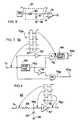
- Fig. 1 is a schematic representation of a ballast circuit for a gas discharge lamp which exclusively uses electronic components in a feedback circuit for implementing self-resonant control of a pair of power switches, and which allows a user to dynamically select a level of light output.
- Fig. 2 shows various voltage waveforms together with state diagrams for the output V o of comparator 31 and of switch 39 of Fig. 1.
- Fig. 3 is a schematic representation of an exemplary implementation of phase splitter, dead time & level shift circuit 50 of Fig. 1.
- Fig. 4 is a schematic representation of an exemplary implementation of dead time circuit 60 of Fig. 3.
- Fig. 5 is a schematic representation of an exemplary implementation of a low pass filter circuit that approximates integrator 37 of Fig. 1.
- an electronic ballast arrangement for a compact fluorescent lamp is effective for converting a standard power line current into a high frequency pulsed signal for driving a compact fluorescent lamp 12.
- the ballast converter circuit 10 receives a d.c. input signal at terminals a-a', which input signal has been derived from an a.c. input power line and has been rectified and, optionally, corrected for power factor by a rectification and power factor correction circuit (not shown).
- ballast circuit 10 The d.c. input signal. received by ballast circuit 10 is coupled across a pair of serially connected power MOSFETs designated Q 1 and Q 2 , which can be provided by International Rectifier of El Segundo, California under the product designation HEXFET MOSFET (HEXFET is a registered trademark of International Rectifier).
- the power MOSFETs Q 1 and Q 2 are effective upon receiving a control signal at their respective gate, or control, terminals thereto (g 1 and g 2 ) for alternately switching between an on and an off condition at a high frequency.
- Node b-b' is a series resonant lamp circuit which consists of the resonant circuit 14, having the inductor and capacitor elements L R and C R selected in size using conventional design means to achieve the desired resonant operating frequency of the lamp 12; capacitor C 2 , which blocks d.c. current from reaching lamp 12; and the lamp 12, which may comprise a compact fluorescent lamp.
- Node b' is also shown as ground 15.
- Self-resonant feedback control of power MOSFET switches Q 1 and Q 2 in Fig. 1 is implemented in Fig. 1 with electronic components, the majority of which can be conveniently incorporated into an integrated circuit for controlling operation of ballast arrangement 10.
- phase control for controlling the alternate switching of MOSFET switches Q 1 and Q 2 is provided by a phase control circuit 30.
- a comparator 31 in circuit 30 receives at its inverting input a feedback voltage V F1 that is proportional to current in lamp 12.
- Shown in dashed lines leading from lamp 12 are alternative conductors 42 and 43. Either one of such conductors is used, the other being omitted.
- Conductor 42 is preferably used for a relatively low d.c. input voltage to circuit 10, e.g. 160 volts, whereas conductor 43 is preferably used for a relatively high d.c. input voltage, e.g. 300 volts.
- Feedback voltage V F1 is derived from the voltage across resistor 44, via a d.c. blocking capacitor 45. Resistor 46 provides a d.c. path to ground 38 from the inverting input of comparator 31.
- Feedback voltage V F1 has an a.c. waveform that typically approximates a sinusoidal waveform, as shown in Fig. 2
- Voltage V F1 is approximately symmetrical about zero-voltage axis, or analog ground 38, and, if necessary, may be provided with a d.c. offset before being input into comparator 31. (Such an offset may typically be required for comparator 31 to properly operate within its input common mode range if incorporated in an integrated circuit having only a single-polarity voltage supply.)
- comparator 31 receives a voltage V +, which is preferably a triangular waveform as shown in Fig. 1.
- Voltage V + is produced in response to a setpoint voltage V S and a feedback voltage V F .
- Setpoint voltage V S is typically proportional to a user-selected value for the amount of light output desired, and could be provided from a rheostat-type control, for instance.
- Feedback voltage V F represents an average value of a lamp output parameter, such as lamp current or lamp lumens. It could, for instance, comprise the same voltage as a.c. feedback signal V F1 that is applied to the inverting input of comparator 31.
- a circuit 32 produces a d.c. feedback voltage V F2 as an average value of feedback voltage V F .
- average is meant herein a d.c. average value such as an r.m.s. value, or a time-averaged value (e.g. during half a cycle of lamp current).
- circuit 32 could comprise an a.c. to r.m.s. converter circuit, or an integrator circuit, both of which are known in the art.
- a summing amplifier 33 receives setpoint voltage V S on its inverting input, and d.c. feedback voltage V F2 on its non-inverting input.
- the error signal produced by summing amplifier 33 is then scaled by a gain factor of G by an amplifier 34, and fed through a p-n, Schottky or other rectifying diode 35.
- the voltage on cathode 36 of diode 35 will have a non-negative value, owing to the diode.
- Such voltage may be as shown in the voltage (V) versus time (T) graph shown in Fig. 1 for a value that is constant for some time.
- the voltage on cathode 36 is received by an non-inverting integrator 37 as a rectangular waveform, as shown in Fig. 1, which is referenced to an analog ground 38.
- Analog ground 38 will usually be different from previously mentioned ground 15 shown beneath transistor Q 1 if the supply voltage (not shown) for phase control circuit 30 is unipolar; if the supply voltage is bipolar, analog ground 38 and ground 15 can be the same.
- Integrator 37 may be approximated by a low pass filter of the resistor-capacitor type, by way of example, as described below (Fig. 5).
- switch 39 Through the switching action of a single-pole, double throw switch 39, integrator 37 is alternately connected directly to p-n diode cathode 36 (via conductor 40) in one switch condition, or connected to cathode 36 through a standard unity-gain inverter 41 in another switch condition.
- Switch 39 may comprise, for instance, an analog switch sold under product designation CD4053 by Harris Semiconductor, of Melbourne, Florida; or, an analog switch sold under product designation MC14053B by Motorola, of Phoenix, Arizona.
- Switch 39 is responsive to output voltage V o of comparator 31 such that, when the comparator output changes state, the switch 36 alternates in its connection to p-n diode cathode 36. This switching action is illustrated in Fig. 2.
- Fig. 2 shows voltage waveforms for comparator input voltages V F1 and V + on the same voltage scale, and shows a d.c. offset voltage, which is assumed the same for both voltages V F1 and V + .
- Fig. 2 also shows a high/low state diagram for comparator output voltage V o , and an up/down state diagram for switch 39 as will be further explained below; these state diagrams have arbitrary vertical scales relative to comparator input voltages V F1 and V + .
- comparator output voltage V o is shown initially as being in a low state.
- switch 39 is connected to conductor 40, which is shown above the switch in Fig. 1 and, during this time, is thus designated as being "UP” in Fig. 2.
- comparator output voltage V o rises to its high state as shown.
- Switch 39 is then connected to unity-gain inverter 41, which shown below the switch in Fig. 1 and, during this time, is thus designated as "DOWN” in Fig. 2.
- comparator output voltage V o switches back to its low state as shown.
- Non-inverting comparator input voltage V + will approximate a triangular waveform where integrator 37 is of the resistive-capacitor type. It is preferred that the upward and downward slopes of voltage V + be fairly linear. This insures at time t, in Fig. 3, for instance, that input voltage V + distinctly surpasses the magnitude of input voltage V F1 so that comparator 31 will reliably change its output state to a low value; if, in contrast, voltage V + rounded off to a more level slope at time t 1 , the desired change of output state of the comparator would be less certain to occur. (The invention would work, however, even if voltage V + is comprised of a predominantly positive-going portion and a predominantly negative-going portion, so long as the following comparator operation occurs.)
- comparator output V o changes from a low level to a high level when input non-inverting input V + exceeds feedback voltage input V F1 , shown at time t 1 in Fig. 2, and changes from a high level to a low level when feedback voltage V F1 exceeds input V + , shown at time t 2 in Fig. 2.
- the output of comparator 31 may be alternatively described as changing levels whenever the absolute value of the a.c. portion of non-inverting voltage V + becomes higher than the absolute value of the a.c.
- Both the waveform for voltage V + and the waveform for feedback voltage V F1 have excursions above an axis of strength that are substantially mirror-images of their excursions below such reference axis, although shifted in time with respect to each other.
- Comparator output voltage V o will typically have a phase advance of, e.g., 20°, to offset the phase delay of, e.g. 20°, occurring in ballast arrangement 10 (Fig. 1) between power switches Q 1 and Q 2 and current-sensing resistor 44. More generally, however, the phase advance of comparator output voltage V o could additionally include 360°, or multiples of 360°, phase advance. Comparator output V o contains the necessary phase information to control operation of power MOSFET switches Q 1 and Q 2 , as will be further described below.
- the power level of lamp 12 can be adjusted by changing the upward and downward slopes of non-inverting voltage V + .
- the comparator output will change earlier, causing the frequency of switching of switches Q 1 and Q 2 to increase, as is apparent from Fig. 2, which decreases the power level of the lamp.
- This can be done by a user decreasing setpoint voltage V s .
- a user would increase setpoint voltage V S , causing the frequency of switching of switches Q 1 and Q 2 to decrease, which increases the power level of the lamp.
- comparator output V o is received by phase splitter, dead time & level shift circuit 50, described below in connection with Fig. 3.
- Circuit 50 provides appropriate signals on lines 50A and 50B that are respectively received by conventional buffers 70 and 72. These buffers are used to drive the gates of MOSFET switches Q 1 and Q 2 with a low impedance.
- Fig. 3 shows an exemplary implementation of phase splitter, dead time & level shift circuit 50 of Fig. 1.
- comparator output voltage V o is applied to a dead time circuit 60, one implementation of which is shown in Fig. 4.
- a circuit comprising resistor 63 and capacitor 65 receives comparator output voltage V o , and provides a delayed input, shown as voltage V 65 , to a logic NOT gate 67.
- Gate 67 is of the type having hysteresis, as indicated by the hysteresis notation in the symbol for gate 67, whereby its input threshold voltage is a function of the state of its output voltage.
- Gate 67 produces an output voltage V 60 , which transitions in the opposite manner from comparator output V o , but only after respective delay (or dead-time) intervals 61.
- a typical delay interval 61 for a lamp operating at a frequency of 50 kilohertz is one microsecond.
- dead-time circuit output voltage V 60 is then input into a logic AND gate 51.
- the other input to gate 51 is the output of logic NOT gate 52, which inverts comparator output V o .
- the output of AND gate 51, voltage V 51 is shown in Fig. 3.
- the output V 51 is then level-shifted by a conventional level shift circuit 54, to provide an appropriate signal on conductor 50A to drive the gate of upper MOSFET Q 1 in Fig. 2 after passing through buffer 70 (Fig. 2).
- a gate-driving voltage V 58 is produced by the circuit of Fig. 3.
- a logic NOT gate 56 first inverts dead-time circuit output V 60 and applies the resulting voltage as one input to logic AND gate 58.
- the other input to AND gate 58 is comparator output voltage V o . Due to the inclusion of NOT gate 56, the gate-driving output voltage V 58 of AND gate 58 appears as shown in the figure, with its phase shifted 180° from the phase of gate-drive signal V 51 . This realizes the phase-splitting function of circuit 50.
- the high states of gate-drive signal V 58 are separated from the high states of gate-drive signal V 51 , on both leading and trailing sides, by dead-time intervals 61. This assures high speed operation of MOSFET switches Q 1 and Q 2 , since so-called soft switching techniques (e.g., zero-voltage switching) can be employed.
- phase splitter, dead time & level shift circuit 50 of Figs. 1 and 3, as well as the function of buffers 70 and 72 in Fig. 1, can be implemented in an obvious manner by those of ordinary skill in the art.
- an IR2155 self-oscillating power MOSFET/IGBT gate driver from International Rectifier of El Segundo, California, could be utilized with the connections illustrated for "bootstrap operation" in its Provisional Data Sheet 6.029, dated January 13, 1994.
- the so-called RT input can be left open, and the present comparator output V o can be applied to the so-called CT input of the gate driver.
- the ability to set the dead time of present dead-time circuit 60 of Figs. 3 and 4 is not present with the use of the foregoing gate driver.
- Fig. 5 shows a low pass filter circuit that approximates integrator 37 of Fig. 1.
- a resistor 80 is connected between the output of analog switch 39 and the non-inverting input of comparator 31.
- a capacitor 81 is connected between the non-inverting input of the comparator and analog ground 38.
- the values of resistor 80 and capacitor 81 are preferably chosen to result in non-inverting input voltage V. (Fig. 2) being approximately linear, for the reasons mentioned above.
- Exemplary circuit values for a circuit for 20-watt fluorescent lamp 12 with an operating current of 50 kilo-hertz, with a d.c. input voltage of 300 volts are as follows: In Fig. 1, resonant inductor L R , 750 micro henries; resonant capacitor C R , 6.8 nanofarads; d.c. blocking capacitor C 2 , 0.47 microfarads; resistor 44, 1.5 ohms; d.c. blocking capacitor 45, 0.5 microfarads; in Fig. 4, resistor 63 and capacitor 65 selected to provide a delay interval 61 of one microsecond; and in Fig. 5, resistor 80, 6.2 k ohms; and capacitor 81, 3.3 nanofarads.
- ballast circuit for a gas discharge lamp that includes, for controlling a pair of power switches, a self-resonant feedback circuit whose components can be implemented in solid-state form, as opposed to the use of a magnetic transformer.
- a user-controllable input is provided to adjust the level of light produced by the lamp.
- the majority of the components of the self-resonant feedback circuit can beneficially be incorporated into an integrated circuit.
- the invention provides a ballast circuit for a gas discharge lamp that includes, for controlling a pair of power switches, a self-resonant feedback circuit which allows a user to adjust the output of the lamp during lamp operation. Additionally, the ballast circuit enables a user to select a setpoint for an output parameter of the lamp at which the lamp will more accurately operate.
- the ballast circuit moreover, includes a self-resonant feedback comprised of components which can be implemented in solid-state form, and the majority of which can be incorporated into an integrated circuit.
Landscapes
- Circuit Arrangements For Discharge Lamps (AREA)
Abstract
Description
- This application is related to commonly assigned application Serial No. (attorney docket no. LD 10606). entitled "Lamp Power Supply Circuit with Electronic Feedback Circuit for Switch Control," by Louis R. Nerone, the present inventor. The foregoing application was concurrently filed with, and is co-pending with, the instant application.
- The present invention relates to a power supply, or ballast, circuit for a gas discharge lamp. More particularly, it relates to a power supply circuit with plural power switches controlled by a feedback circuit in such manner as to allow a user to dynamically adjust the level of light output by the lamp.
- A gas discharge lamp, such as a fluorescent lamp, typically utilizes a power supply, or ballast, circuit to convert an a.c. line voltage to a high frequency a.c. voltage which is impressed across a resonant load circuit containing the gas discharge lamp. The resonant load circuit includes a resonant inductor and a resonant capacitor for determining the frequency of resonance of current in the resonant load circuit. The power supply circuit includes a series half-bridge d.c.-to-a.c. converter having a pair of power switches that alternately connect one end of the resonant load circuit to a d.c. bus voltage and then to a ground, thereby impressing the mentioned a.c. voltage across the resonant load circuit.
- A prior ballast circuit of the foregoing type is disclosed in co-pending U.S. patent 5,341,068, issued August 23, 1994, entitled "Electronic Ballast Arrangement for a Compact Fluorescent Lamp," by Louis R. Nerone, the present inventor, and assigned to the present assignee. The disclosed ballast circuit utilizes a feedback circuit for controlling the mentioned pair of power switches of the d.c.-to-a.c. converter. The feedback circuit operates in response to a feedback signal representing an a.c. current in the resonant load circuit. The use of the foregoing circuit for controlling the power switches beneficially results in regenerative, or so-called self-resonant, control of the power switches. Accordingly, the ballast circuit of the foregoing patent application avoids the expense and bulk of extra circuitry for switch control.
- The feedback circuit of the foregoing patent application, however, utilizes a magnetic-core transformer with multiple windings. The inclusion of such transformer adds considerable bulk to ballast size, which is an especially acute issue with so-called compact fluorescent lamps having a standard screw-type base for insertion into a conventional incandescent lamp socket. A feedback circuit avoiding the use of a magnetic transformer is disclosed in the above cross-referenced application Serial No. (attorney docket no. LD 10606). The feedback circuit is of the self-resonant type, and is comprised of components which can be implemented in solid-state form, and the majority of which can be incorporated into an integrated circuit.
- Different levels of lamp current can be accommodated by the circuitry disclosed in the foregoing application Serial No. (attorney docket no. LD 10606). However, this typically requires the selection of values for the components (e.g. resistors) of the feedback circuit which, for size considerations, are preferably discrete components rather than adjustable. For applications where control of lamp current is required while the lamp is operating, such as for dimmable lamps, it would be desirable to provide, in a lamp ballast, a feedback circuit for facilitating simple control of lamp current during lamp operation. It would also be desirable to enable more accurate operation of a lamp at a user-selected setpoint.
- The present invention therefore seeks to provide a ballast circuit for a gas discharge lamp that includes, for controlling a pair of power switches, a self-resonant feedback circuit which allows a user to adjust the output of the lamp during lamp operation.
- The invention also seeks to provide, for a ballast circuit of the foregoing type, a user-selectable setpoint of an output parameter of the lamp at which the lamp will more accurately operate.
- The invention seeks to provide still further, for a ballast circuit of the foregoing type, a self-resonant feedback comprised of components which can be implemented in solid-state form, and the majority of which can be incorporated into an integrated circuit.
- According to a first aspect of the invention, there is provided a ballast circuit for a gas discharge lamp, comprising: (a) a resonant load circuit incorporating a gas discharge lamp and including first and second resonant impedances whose values determine the operating frequency of said resonant load circuit; (b) a d.c.-to-a.c. converter circuit coupled to said resonant load circuit so as to induce an a.c. current in said resonant load circuit, and comprising first and second switches serially connected between a bus conductor at a d.c. voltage and ground, and having a common node through which said bidirectional load current flows; (c) an arrangement for allowing a user to select a setpoint signal during lamp operation that determines the amount of light output by the lamp; and (d) a feedback arrangement for regeneratively controlling said first and second switches; said arrangement including a circuit for sensing a.c. current in said resonant load circuit and producing an a.c. feedback signal in proportion to said a.c. current; a circuit for producing a d.c. feedback signal representing an average value of a lamp output parameter, and a circuit for generating an error signal between said setpoint signal and said d.c. feedback signal; said feedback arrangement further including; (i) a comparator circuit for comparing said a.c. feedback signal with a periodic reference signal, and for producing a comparator output signal that changes state when a first one of the compared signals becomes greater than the second of the compared signals, and that further changes state when the second of the compared signals then becomes greater than the first of the compared signals; (ii) a circuit for generating said periodic reference signal in response to both said comparator output signal and said error signal; and (iii) a conditioning circuit receptive of said comparator output signal for controlling said first and second switches.
- According to a second aspect of the invention, there is provided a ballast circuit for a gas discharge lamp, comprising: (a) a resonant load circuit incorporating a gas discharge lamp and including first and second resonant impedances whose values determine the operating frequency of said resonant load circuit; (b) a d.c.-to-a.c. converter circuit coupled to said resonant load circuit so as to induce an a.c. current in said resonant load circuit, and comprising first and second switches serially connected between a bus conductor at a d.c. voltage and ground, and having a common node through which said bidirectional load current flows: (c) an arrangement for allowing a user to select a setpoint signal during lamp operation that determines the amount of light output by the lamp; and (d) a feedback arrangement for regeneratively controlling said first and second switches; said arrangement including a circuit for sensing a.c. current in said resonant load circuit and producing an a.c. feedback signal in proportion to said a.c. current; a circuit for producing a d.c. feedback signal representing an average value of lamp current; and a circuit for generating an error signal between said setpoint signal and said d.c. feedback signal; said feedback arrangement further including: (i) a comparator circuit for comparing said a.c. feedback signal with a periodic reference signal, and for producing a comparator output signal that changes state when a first one of the compared signals becomes greater than the second of the compared signals, and that further changes state when the second of the compared signals then becomes greater than the first of the compared signals; (ii) a circuit for generating said periodic reference signal in response to both said comparator output signal and said error signal; and (iii) a conditioning circuit receptive of said comparator output signal for controlling said first and second switches.
- The invention will now be described in greater detail, by way of example, with reference to the drawings in which:
- In the following detailed description, reference will be made to the attached drawings in which like reference numerals refer to like, or corresponding elements, throughout the following figures, and in which:
- Fig. 1 is a schematic representation of a ballast circuit for a gas discharge lamp which exclusively uses electronic components in a feedback circuit for implementing self-resonant control of a pair of power switches, and which allows a user to dynamically select a level of light output.
- Fig. 2 shows various voltage waveforms together with state diagrams for the output Vo of
comparator 31 and ofswitch 39 of Fig. 1. - Fig. 3 is a schematic representation of an exemplary implementation of phase splitter, dead time &
level shift circuit 50 of Fig. 1. - Fig. 4 is a schematic representation of an exemplary implementation of
dead time circuit 60 of Fig. 3. - Fig. 5 is a schematic representation of an exemplary implementation of a low pass filter circuit that approximates
integrator 37 of Fig. 1. - As shown in Fig. 1, an electronic ballast arrangement for a compact fluorescent lamp, referenced generally as 10, is effective for converting a standard power line current into a high frequency pulsed signal for driving a compact
fluorescent lamp 12. Theballast converter circuit 10 receives a d.c. input signal at terminals a-a', which input signal has been derived from an a.c. input power line and has been rectified and, optionally, corrected for power factor by a rectification and power factor correction circuit (not shown). - The d.c. input signal. received by
ballast circuit 10 is coupled across a pair of serially connected power MOSFETs designated Q1 and Q2, which can be provided by International Rectifier of El Segundo, California under the product designation HEXFET MOSFET (HEXFET is a registered trademark of International Rectifier). The power MOSFETs Q1 and Q2 are effective upon receiving a control signal at their respective gate, or control, terminals thereto (g1 and g2) for alternately switching between an on and an off condition at a high frequency. - Connected across nodes b-b' is a series resonant lamp circuit which consists of the
resonant circuit 14, having the inductor and capacitor elements LR and CR selected in size using conventional design means to achieve the desired resonant operating frequency of thelamp 12; capacitor C2, which blocks d.c. current from reachinglamp 12; and thelamp 12, which may comprise a compact fluorescent lamp. Node b' is also shown asground 15. - Self-resonant feedback control of power MOSFET switches Q1 and Q2 in Fig. 1 is implemented in Fig. 1 with electronic components, the majority of which can be conveniently incorporated into an integrated circuit for controlling operation of
ballast arrangement 10. - In Fig. 1, phase control for controlling the alternate switching of MOSFET switches Q1 and Q2 is provided by a
phase control circuit 30. Acomparator 31 incircuit 30 receives at its inverting input a feedback voltage VF1 that is proportional to current inlamp 12. Shown in dashed lines leading fromlamp 12 arealternative conductors Conductor 42 is preferably used for a relatively low d.c. input voltage tocircuit 10, e.g. 160 volts, whereasconductor 43 is preferably used for a relatively high d.c. input voltage, e.g. 300 volts. In any event, the current directed through aresistor 44 and the resulting voltage across such resistor have the same phase as the current inlamp 12. Feedback voltage VF1 is derived from the voltage acrossresistor 44, via a d.c. blockingcapacitor 45.Resistor 46 provides a d.c. path to ground 38 from the inverting input ofcomparator 31. Feedback voltage VF1 has an a.c. waveform that typically approximates a sinusoidal waveform, as shown in Fig. 2 Voltage VF1 is approximately symmetrical about zero-voltage axis, oranalog ground 38, and, if necessary, may be provided with a d.c. offset before being input intocomparator 31. (Such an offset may typically be required forcomparator 31 to properly operate within its input common mode range if incorporated in an integrated circuit having only a single-polarity voltage supply.) - At its non-inverting input,
comparator 31 receives a voltage V+, which is preferably a triangular waveform as shown in Fig. 1. Voltage V+, in turn, is produced in response to a setpoint voltage VS and a feedback voltage VF. Setpoint voltage VS is typically proportional to a user-selected value for the amount of light output desired, and could be provided from a rheostat-type control, for instance. Feedback voltage VF represents an average value of a lamp output parameter, such as lamp current or lamp lumens. It could, for instance, comprise the same voltage as a.c. feedback signal VF1 that is applied to the inverting input ofcomparator 31. - A
circuit 32 produces a d.c. feedback voltage VF2 as an average value of feedback voltage VF. By "average" value is meant herein a d.c. average value such as an r.m.s. value, or a time-averaged value (e.g. during half a cycle of lamp current). Thus,circuit 32 could comprise an a.c. to r.m.s. converter circuit, or an integrator circuit, both of which are known in the art. - A summing
amplifier 33 receives setpoint voltage VS on its inverting input, and d.c. feedback voltage VF2 on its non-inverting input. The error signal produced by summingamplifier 33 is then scaled by a gain factor of G by anamplifier 34, and fed through a p-n, Schottky or other rectifying diode 35. At this point, the voltage on cathode 36 of diode 35 will have a non-negative value, owing to the diode. Such voltage may be as shown in the voltage (V) versus time (T) graph shown in Fig. 1 for a value that is constant for some time. - The voltage on cathode 36 is received by an
non-inverting integrator 37 as a rectangular waveform, as shown in Fig. 1, which is referenced to ananalog ground 38.Analog ground 38 will usually be different from previously mentionedground 15 shown beneath transistor Q1 if the supply voltage (not shown) forphase control circuit 30 is unipolar; if the supply voltage is bipolar,analog ground 38 andground 15 can be the same.Integrator 37 may be approximated by a low pass filter of the resistor-capacitor type, by way of example, as described below (Fig. 5). - Through the switching action of a single-pole,
double throw switch 39,integrator 37 is alternately connected directly to p-n diode cathode 36 (via conductor 40) in one switch condition, or connected to cathode 36 through a standard unity-gain inverter 41 in another switch condition.Switch 39 may comprise, for instance, an analog switch sold under product designation CD4053 by Harris Semiconductor, of Melbourne, Florida; or, an analog switch sold under product designation MC14053B by Motorola, of Phoenix, Arizona.Switch 39 is responsive to output voltage Vo ofcomparator 31 such that, when the comparator output changes state, the switch 36 alternates in its connection to p-n diode cathode 36. This switching action is illustrated in Fig. 2. - Fig. 2 shows voltage waveforms for comparator input voltages VF1 and V+ on the same voltage scale, and shows a d.c. offset voltage, which is assumed the same for both voltages VF1 and V+. Fig. 2 also shows a high/low state diagram for comparator output voltage Vo, and an up/down state diagram for
switch 39 as will be further explained below; these state diagrams have arbitrary vertical scales relative to comparator input voltages VF1 and V+. - In Fig. 2, comparator output voltage Vo is shown initially as being in a low state. During this time,
switch 39 is connected toconductor 40, which is shown above the switch in Fig. 1 and, during this time, is thus designated as being "UP" in Fig. 2. When non-inverting voltage V+ then rises above feedback voltage VF1 at time t1, comparator output voltage Vo rises to its high state as shown.Switch 39 is then connected to unity-gain inverter 41, which shown below the switch in Fig. 1 and, during this time, is thus designated as "DOWN" in Fig. 2. When non-inverting input voltage V+ then falls below feedback voltage VF1, at time t2, comparator output voltage Vo switches back to its low state as shown. - Non-inverting comparator input voltage V+ will approximate a triangular waveform where
integrator 37 is of the resistive-capacitor type. It is preferred that the upward and downward slopes of voltage V+ be fairly linear. This insures at time t, in Fig. 3, for instance, that input voltage V+ distinctly surpasses the magnitude of input voltage VF1 so thatcomparator 31 will reliably change its output state to a low value; if, in contrast, voltage V+ rounded off to a more level slope at time t1, the desired change of output state of the comparator would be less certain to occur. (The invention would work, however, even if voltage V+ is comprised of a predominantly positive-going portion and a predominantly negative-going portion, so long as the following comparator operation occurs.) - In accordance with operation of comparator 31 (Fig. 1), comparator output Vo changes from a low level to a high level when input non-inverting input V+ exceeds feedback voltage input VF1, shown at time t1 in Fig. 2, and changes from a high level to a low level when feedback voltage VF1 exceeds input V+, shown at time t2 in Fig. 2. The output of
comparator 31 may be alternatively described as changing levels whenever the absolute value of the a.c. portion of non-inverting voltage V+ becomes higher than the absolute value of the a.c. portion of feedback voltage VF1, where the following condition is satisfied: Both the waveform for voltage V+ and the waveform for feedback voltage VF1 have excursions above an axis of strength that are substantially mirror-images of their excursions below such reference axis, although shifted in time with respect to each other. - Comparator output voltage Vo will typically have a phase advance of, e.g., 20°, to offset the phase delay of, e.g. 20°, occurring in ballast arrangement 10 (Fig. 1) between power switches Q1 and Q2 and current-sensing
resistor 44. More generally, however, the phase advance of comparator output voltage Vo could additionally include 360°, or multiples of 360°, phase advance. Comparator output Vo contains the necessary phase information to control operation of power MOSFET switches Q1 and Q2, as will be further described below. - Beneficially, using the
phase control circuit 30 of Fig. 1, the power level oflamp 12 can be adjusted by changing the upward and downward slopes of non-inverting voltage V+. By making the slopes both steeper, the comparator output will change earlier, causing the frequency of switching of switches Q1 and Q2 to increase, as is apparent from Fig. 2, which decreases the power level of the lamp. This can be done by a user decreasing setpoint voltage Vs. On the other hand, to increase the power of the lamp, a user would increase setpoint voltage VS, causing the frequency of switching of switches Q1 and Q2 to decrease, which increases the power level of the lamp. - Referring again to Fig. 1, comparator output Vo is received by phase splitter, dead time &
level shift circuit 50, described below in connection with Fig. 3.Circuit 50 provides appropriate signals onlines conventional buffers - Fig. 3 shows an exemplary implementation of phase splitter, dead time &
level shift circuit 50 of Fig. 1. As Fig. 3 shows, comparator output voltage Vo is applied to adead time circuit 60, one implementation of which is shown in Fig. 4. In Fig. 4, acircuit comprising resistor 63 andcapacitor 65 receives comparator output voltage Vo, and provides a delayed input, shown as voltage V65, to alogic NOT gate 67.Gate 67 is of the type having hysteresis, as indicated by the hysteresis notation in the symbol forgate 67, whereby its input threshold voltage is a function of the state of its output voltage.Gate 67 produces an output voltage V60, which transitions in the opposite manner from comparator output Vo, but only after respective delay (or dead-time)intervals 61. Atypical delay interval 61 for a lamp operating at a frequency of 50 kilohertz is one microsecond. - Referring back to Fig. 3, dead-time circuit output voltage V60 is then input into a logic AND
gate 51. The other input togate 51 is the output oflogic NOT gate 52, which inverts comparator output Vo. The output of ANDgate 51, voltage V51, is shown in Fig. 3. The output V51, is then level-shifted by a conventionallevel shift circuit 54, to provide an appropriate signal onconductor 50A to drive the gate of upper MOSFET Q1 in Fig. 2 after passing through buffer 70 (Fig. 2). - For driving the gate of the lower MOSFET Q2 in Fig. 2, a gate-driving voltage V58 is produced by the circuit of Fig. 3. To accomplish this, a
logic NOT gate 56 first inverts dead-time circuit output V60 and applies the resulting voltage as one input to logic ANDgate 58. The other input to ANDgate 58 is comparator output voltage Vo. Due to the inclusion ofNOT gate 56, the gate-driving output voltage V58 of ANDgate 58 appears as shown in the figure, with its phase shifted 180° from the phase of gate-drive signal V51. This realizes the phase-splitting function ofcircuit 50. - As further shown in Fig. 3, the high states of gate-drive signal V58 are separated from the high states of gate-drive signal V51, on both leading and trailing sides, by dead-
time intervals 61. This assures high speed operation of MOSFET switches Q1 and Q2, since so-called soft switching techniques (e.g., zero-voltage switching) can be employed. - The various functions of phase splitter, dead time &
level shift circuit 50 of Figs. 1 and 3, as well as the function ofbuffers time circuit 60 of Figs. 3 and 4 is not present with the use of the foregoing gate driver. - Fig. 5 shows a low pass filter circuit that approximates
integrator 37 of Fig. 1. As shown in the figure, aresistor 80 is connected between the output ofanalog switch 39 and the non-inverting input ofcomparator 31. Acapacitor 81 is connected between the non-inverting input of the comparator andanalog ground 38. The values ofresistor 80 andcapacitor 81 are preferably chosen to result in non-inverting input voltage V. (Fig. 2) being approximately linear, for the reasons mentioned above. - Exemplary circuit values for a circuit for 20-
watt fluorescent lamp 12 with an operating current of 50 kilo-hertz, with a d.c. input voltage of 300 volts, are as follows: In Fig. 1, resonant inductor LR, 750 micro henries; resonant capacitor CR, 6.8 nanofarads; d.c. blocking capacitor C2, 0.47 microfarads;resistor 44, 1.5 ohms; d.c. blockingcapacitor 45, 0.5 microfarads; in Fig. 4,resistor 63 andcapacitor 65 selected to provide adelay interval 61 of one microsecond; and in Fig. 5,resistor 80, 6.2 k ohms; andcapacitor 81, 3.3 nanofarads. - The foregoing describes a ballast circuit for a gas discharge lamp that includes, for controlling a pair of power switches, a self-resonant feedback circuit whose components can be implemented in solid-state form, as opposed to the use of a magnetic transformer. A user-controllable input is provided to adjust the level of light produced by the lamp. Moreover, the majority of the components of the self-resonant feedback circuit can beneficially be incorporated into an integrated circuit.
- As will be realized from the foregoing description, the invention provides a ballast circuit for a gas discharge lamp that includes, for controlling a pair of power switches, a self-resonant feedback circuit which allows a user to adjust the output of the lamp during lamp operation. Additionally, the ballast circuit enables a user to select a setpoint for an output parameter of the lamp at which the lamp will more accurately operate. The ballast circuit, moreover, includes a self-resonant feedback comprised of components which can be implemented in solid-state form, and the majority of which can be incorporated into an integrated circuit.
- While the invention has been described with respect to specific embodiments by way of illustration, many modifications and changes will occur to those skilled in the art. For instance, either electrodeless or electroded gas discharge lamps may be used with the invention. It is, therefore, to be understood that the appended claims are intended to cover all such modifications and changes as fall within the scope of the invention.
Claims (10)
- A ballast circuit for a gas discharge lamp, comprising:(a) a resonant load circuit incorporating a gas discharge lamp and including first and second resonant impedances whose values determine the operating frequency of said resonant load circuit;(b) a d.c.-to-a.c. converter circuit coupled to said resonant load circuit so as to induce an a.c. current in said resonant load circuit, and comprising first and second switches serially connected between a bus conductor at a d.c. voltage and ground, and having a common node through which said bidirectional load current flows;(c) an arrangement for allowing a user to select a setpoint signal during lamp operation that determines the amount of light output by the lamp; and(d) a feedback arrangement for regeneratively controlling said first and second switches; said arrangement including a circuit for sensing a.c. current in said resonant load circuit and producing an a.c. feedback signal in proportion to said a.c. current; a circuit for producing a d.c. feedback signal representing an average value of a lamp output parameter, and a circuit for generating an error signal between said setpoint signal and said d.c. feedback signal; said feedback arrangement further including:(i) a comparator circuit for comparing said a.c. feedback signal with a periodic reference signal, and for producing a comparator output signal that changes state when a first one of the compared signals becomes greater than the second of the compared signals, and that further changes state when the second of the compared signals then becomes greater than the first of the compared signals;(ii) a circuit for generating said periodic reference signal in response to both said comparator output signal and said error signal; and(iii) a conditioning circuit receptive of said comparator output signal for controlling said first and second switches.
- The ballast circuit of claim 1, wherein said circuit for generating a periodic reference signal comprises:(a) a circuit responsive to said error signal for producing a bi-level output signal having one level when an output of said comparator circuit is at a first level, and having another level when said output of said comparator circuit is at a second level; and(b) a conversion circuit for producing an upgoing portion of said periodic reference signal when said bi-level output signal is at one level and for producing a downgoing portion of said periodic reference signal when said bi-level output signal is at another level.
- The ballast circuit of claim 2, wherein said conversion circuit comprises:(a) a resistor receiving said bi-level output signal on one end and producing said periodic reference signal on another end; and(b) a capacitor connected between said another end of said resistor and a ground potential.
- The ballast circuit of claim 1, wherein said circuit for generating a periodic reference signal is effective for producing a substantially triangular reference waveform whose excursions above a reference axis of strength are substantially mirror-images of excursions of the foregoing signal below said reference axis, although shifted in time with respect to each other.
- The ballast circuit of claim 4, wherein:(a) said circuit for producing a feedback signal is effective for producing a feedback waveform whose excursions above a reference axis of strength are substantially mirror-images of excursions of said signal below the foregoing reference axis, although shifted in time with respect to each other; and(b) the mentioned reference axes of strength of said periodic reference signal and of said feedback signal are approximately equal to each other.
- A ballast circuit for a gas discharge lamp, comprising:(a) a resonant load circuit incorporating a gas discharge lamp and including first and second resonant impedances whose values determine the operating frequency of said resonant load circuit;(b) a d.c.-to.c. converter circuit coupled to said resonant load circuit so as to induce an a.c. current in said resonant load circuit, and comprising first and second switches serially connected between a bus conductor at a d.c. voltage and ground, and having a common node through which said bidirectional load current flows;(c) an arrangement for allowing a user to select a setpoint signal during lamp operation that determines the amount of light output by the lamp; and(d) a feedback arrangement for regeneratively controlling said first and second switches; said arrangement including a circuit for sensing a.c. current in said resonant load circuit and producing an a.c. feedback signal in proportion to said a.c. current; a circuit for producing a d.c. feedback signal representing an average value of lamp current; and a circuit for generating an error signal between said setpoint signal and said d.c. feedback signal; said feedback arrangement further including:(i) a comparator circuit for comparing said a.c. feedback signal with a periodic reference signal, and for producing a comparator output signal that changes state when a first one of the compared signals becomes greater than the second of the compared signals, and that further changes state when the second of the compared signals then becomes greater than the first of the compared signals;(ii) a circuit for generating said periodic reference signal in response to both said comparator output signal and said error signal; and(iii) a conditioning circuit receptive of said comparator output signal for controlling said first and second switches.
- The ballast circuit of claim 6, wherein said circuit for generating a periodic reference signal comprises:(a) a circuit responsive to said error signal for producing a bi-level output signal having one level when an output of said comparator circuit is at a first level, and having another level when said output of said comparator circuit is at a second level; and(b) a conversion circuit for producing an upgoing portion of said periodic reference signal when said bi-level output signal is at one level and for producing a downgoing portion of said periodic reference signal when said bi-level output signal is at another level.
- The ballast circuit of claim 7, wherein said conversion circuit comprises:(a) a resistor receiving said bi-level output signal on one end and producing said periodic reference signal on another end; and(b) a capacitor connected between said another end of said resistor and a ground potential.
- The ballast circuit of claim 6, wherein said circuit for generating a periodic reference signal is effective for producing a substantially triangular reference waveform whose excursions above a reference axis of strength are substantially mirror-images of excursions of the foregoing signal below said reference axis, although shifted in time with respect to each other.
- The ballast circuit of claim 9, wherein:(a) said circuit for producing a feedback signal is effective for producing a feedback waveform whose excursions above a reference axis of strength are substantially mirror-images of excursions of said signal below the foregoing reference axis, although shifted in time with respect to each other; and(b) the mentioned reference axes of strength of said periodic reference signal and of said feedback signal are approximately equal to each other.
Applications Claiming Priority (2)
| Application Number | Priority Date | Filing Date | Title |
|---|---|---|---|
| US08/644,318 US5717295A (en) | 1996-05-10 | 1996-05-10 | Lamp power supply circuit with feedback circuit for dynamically adjusting lamp current |
| US644318 | 2000-08-23 |
Publications (1)
| Publication Number | Publication Date |
|---|---|
| EP0806888A1 true EP0806888A1 (en) | 1997-11-12 |
Family
ID=24584390
Family Applications (1)
| Application Number | Title | Priority Date | Filing Date |
|---|---|---|---|
| EP97303193A Ceased EP0806888A1 (en) | 1996-05-10 | 1997-05-09 | Ballast circuit for a gas discharge lamp |
Country Status (4)
| Country | Link |
|---|---|
| US (1) | US5717295A (en) |
| EP (1) | EP0806888A1 (en) |
| JP (1) | JPH1050490A (en) |
| CN (1) | CN1180987A (en) |
Cited By (6)
| Publication number | Priority date | Publication date | Assignee | Title |
|---|---|---|---|---|
| EP0831678A2 (en) * | 1996-09-19 | 1998-03-25 | General Electric Company | High voltage IC-driven half-bridge gas discharge lamp ballast |
| EP0827370A3 (en) * | 1996-09-03 | 1998-11-04 | Hitachi, Ltd. | Resonance type power converter unit, lighting apparatus for illumination using the same and method for control of the converter unit and lighting apparatus |
| US6222327B1 (en) | 1996-09-03 | 2001-04-24 | Hitachi, Ltd. | Lighting device for illumination and lamp provided with the same |
| FR2828627A1 (en) * | 2001-08-10 | 2003-02-14 | Sono Eclair | ELECTRONIC BALLAST DEVICE FOR CONTROLLING THE POWER ABSORBED BY A DISCHARGE LAMP, AND THE METHOD IMPLEMENTED IN SAID DEVICE |
| WO2004071136A1 (en) * | 2003-02-04 | 2004-08-19 | Koninklijke Philips Electronics N.V. | Circuit arrangement |
| RU2314661C1 (en) * | 2006-04-17 | 2008-01-10 | Открытое акционерное общество ОАО "Орбита" | Set-point generator of device for managing launching and regulating apparatus of luminescent lamp |
Families Citing this family (20)
| Publication number | Priority date | Publication date | Assignee | Title |
|---|---|---|---|---|
| EP0876742B1 (en) * | 1996-01-26 | 2002-04-24 | Tridonic Bauelemente GmbH | Method and control circuit for regulation of the operational characteristics of gas discharge lamps |
| DE19805733A1 (en) * | 1997-02-12 | 1998-08-20 | Int Rectifier Corp | Integrated driver circuit for AC supply to fluorescent lamp |
| JP2972691B2 (en) * | 1997-02-12 | 1999-11-08 | インターナショナル・レクチファイヤー・コーポレーション | Phase control circuit for electronic ballast |
| US6300777B1 (en) | 1997-10-15 | 2001-10-09 | International Rectifier Corporation | Lamp ignition detection circuit |
| US6008592A (en) * | 1998-06-10 | 1999-12-28 | International Rectifier Corporation | End of lamp life or false lamp detection circuit for an electronic ballast |
| US6495971B1 (en) | 1998-06-13 | 2002-12-17 | Hatch Transformers, Inc. | High intensity discharge lamp ballast |
| EP0984670B1 (en) | 1998-06-13 | 2009-12-09 | Greenwood Soar IP Limited | High intensity discharge lamp ballast |
| US6204614B1 (en) * | 1999-05-07 | 2001-03-20 | Philips Electronics North America Corporation | Bi-level output electronic high intensity discharge (HID) ballast system |
| JP3322261B2 (en) * | 2000-03-27 | 2002-09-09 | 松下電器産業株式会社 | Discharge lamp lighting device |
| CA2436545C (en) * | 2000-10-31 | 2013-05-28 | Osram Sylvania Inc. | Ballast self oscillating inverter with phase controlled voltage feedback |
| EP1579743A1 (en) * | 2002-12-20 | 2005-09-28 | Koninklijke Philips Electronics N.V. | Bistate hid operation |
| US7589480B2 (en) * | 2006-05-26 | 2009-09-15 | Greenwood Soar Ip Ltd. | High intensity discharge lamp ballast |
| CN101227781A (en) * | 2006-08-28 | 2008-07-23 | 亨特风扇公司 | System and method for current and/or temperature control of light fixture |
| CN101175359B (en) * | 2006-10-30 | 2011-11-30 | 鸿富锦精密工业(深圳)有限公司 | Electric ballast |
| US8482213B1 (en) | 2009-06-29 | 2013-07-09 | Panasonic Corporation | Electronic ballast with pulse detection circuit for lamp end of life and output short protection |
| US8344634B2 (en) * | 2010-01-19 | 2013-01-01 | Green Solution Technology Co., Ltd. | Lamp driving apparatus and level shift driving circuit |
| US8947020B1 (en) | 2011-11-17 | 2015-02-03 | Universal Lighting Technologies, Inc. | End of life control for parallel lamp ballast |
| EP2952067B1 (en) * | 2013-01-29 | 2017-07-19 | Philips Lighting Holding B.V. | A method of controlling a lighting system and a lighting system |
| WO2016100567A1 (en) | 2014-12-16 | 2016-06-23 | Hampton Products International Corporation | Security lighting fixture |
| CN112688565B (en) * | 2019-10-18 | 2024-06-11 | 三垦电气株式会社 | Control device and method of current resonance circuit and current resonance power supply |
Citations (2)
| Publication number | Priority date | Publication date | Assignee | Title |
|---|---|---|---|---|
| US5329209A (en) * | 1991-12-11 | 1994-07-12 | Marelli Autronica S.P.A. | Self-oscillating circuit for driving a gas discharge lamp, particularly for use on board a motor vehicle |
| US5406177A (en) * | 1994-04-18 | 1995-04-11 | General Electric Company | Gas discharge lamp ballast circuit with compact starting circuit |
Family Cites Families (9)
| Publication number | Priority date | Publication date | Assignee | Title |
|---|---|---|---|---|
| US4251752A (en) * | 1979-05-07 | 1981-02-17 | Synergetics, Inc. | Solid state electronic ballast system for fluorescent lamps |
| US4383203A (en) * | 1981-06-29 | 1983-05-10 | Litek International Inc. | Circuit means for efficiently driving an electrodeless discharge lamp |
| US4523131A (en) * | 1982-12-10 | 1985-06-11 | Honeywell Inc. | Dimmable electronic gas discharge lamp ballast |
| NL8800288A (en) * | 1988-02-08 | 1989-09-01 | Nedap Nv | BALLAST FOR A FLUORESCENT LAMP. |
| US5075599A (en) * | 1989-11-29 | 1991-12-24 | U.S. Philips Corporation | Circuit arrangement |
| CA2076127A1 (en) * | 1991-09-26 | 1993-03-27 | Louis R. Nerone | Electronic ballast arrangement for a compact fluorescent lamp |
| US5363020A (en) * | 1993-02-05 | 1994-11-08 | Systems And Service International, Inc. | Electronic power controller |
| US5414325A (en) * | 1994-04-13 | 1995-05-09 | General Electric Company | Gas discharge lamp ballast circuit with automatically calibrated light feedback control |
| US5550436A (en) * | 1994-09-01 | 1996-08-27 | International Rectifier Corporation | MOS gate driver integrated circuit for ballast circuits |
-
1996
- 1996-05-10 US US08/644,318 patent/US5717295A/en not_active Expired - Fee Related
-
1997
- 1997-05-09 JP JP9118535A patent/JPH1050490A/en not_active Withdrawn
- 1997-05-09 EP EP97303193A patent/EP0806888A1/en not_active Ceased
- 1997-05-10 CN CN97113026A patent/CN1180987A/en active Pending
Patent Citations (2)
| Publication number | Priority date | Publication date | Assignee | Title |
|---|---|---|---|---|
| US5329209A (en) * | 1991-12-11 | 1994-07-12 | Marelli Autronica S.P.A. | Self-oscillating circuit for driving a gas discharge lamp, particularly for use on board a motor vehicle |
| US5406177A (en) * | 1994-04-18 | 1995-04-11 | General Electric Company | Gas discharge lamp ballast circuit with compact starting circuit |
Cited By (9)
| Publication number | Priority date | Publication date | Assignee | Title |
|---|---|---|---|---|
| EP0827370A3 (en) * | 1996-09-03 | 1998-11-04 | Hitachi, Ltd. | Resonance type power converter unit, lighting apparatus for illumination using the same and method for control of the converter unit and lighting apparatus |
| US5977725A (en) * | 1996-09-03 | 1999-11-02 | Hitachi, Ltd. | Resonance type power converter unit, lighting apparatus for illumination using the same and method for control of the converter unit and lighting apparatus |
| US6222327B1 (en) | 1996-09-03 | 2001-04-24 | Hitachi, Ltd. | Lighting device for illumination and lamp provided with the same |
| EP0831678A2 (en) * | 1996-09-19 | 1998-03-25 | General Electric Company | High voltage IC-driven half-bridge gas discharge lamp ballast |
| FR2828627A1 (en) * | 2001-08-10 | 2003-02-14 | Sono Eclair | ELECTRONIC BALLAST DEVICE FOR CONTROLLING THE POWER ABSORBED BY A DISCHARGE LAMP, AND THE METHOD IMPLEMENTED IN SAID DEVICE |
| WO2004071136A1 (en) * | 2003-02-04 | 2004-08-19 | Koninklijke Philips Electronics N.V. | Circuit arrangement |
| US7259523B2 (en) | 2003-02-04 | 2007-08-21 | Koninklijke Philips Electronics N.V. | Circuit arrangement |
| CN100539800C (en) * | 2003-02-04 | 2009-09-09 | 皇家飞利浦电子股份有限公司 | Circuit arrangement |
| RU2314661C1 (en) * | 2006-04-17 | 2008-01-10 | Открытое акционерное общество ОАО "Орбита" | Set-point generator of device for managing launching and regulating apparatus of luminescent lamp |
Also Published As
| Publication number | Publication date |
|---|---|
| CN1180987A (en) | 1998-05-06 |
| JPH1050490A (en) | 1998-02-20 |
| US5717295A (en) | 1998-02-10 |
Similar Documents
| Publication | Publication Date | Title |
|---|---|---|
| US5717295A (en) | Lamp power supply circuit with feedback circuit for dynamically adjusting lamp current | |
| CN1143606C (en) | ballast circuit | |
| US7061189B2 (en) | Electronic ballast | |
| US6184630B1 (en) | Electronic lamp ballast with voltage source power feedback to AC-side | |
| EP0679049B1 (en) | Gas discharge lamp ballast circuit | |
| US6495971B1 (en) | High intensity discharge lamp ballast | |
| US5166579A (en) | Discharge lamp operating circuit | |
| US5382882A (en) | Power supply circuit for a gas discharge lamp | |
| EP0479352B1 (en) | Converter for discharge lamps with dimming means | |
| US5075602A (en) | Discharge lamp control circuit arrangement | |
| JP3851092B2 (en) | Half-bridge inverter circuit | |
| AU2003205038A1 (en) | Drive for a half-bridge inverter | |
| EP0641149B1 (en) | Power control of an inverter for a discharge lamp | |
| CN1153447A (en) | Circuit arrangement | |
| EP1605734B1 (en) | Electronic ballast | |
| US5729098A (en) | Power supply and electronic ballast with a novel boost converter control circuit | |
| EP0835044A2 (en) | Lamp ballast circuit with cathode preheat function | |
| EP1374380A1 (en) | Dc-dc converter. | |
| US6756746B2 (en) | Method of delaying and sequencing the starting of inverters that ballast lamps | |
| JP4491234B2 (en) | Method and apparatus for driving a gas discharge lamp | |
| US5703439A (en) | Lamp power supply circuit with electronic feedback circuit for switch control | |
| EP1387489B1 (en) | Pulse width modulation circuit and illuminating device incorporating same | |
| JPH07106088A (en) | Electronic lighting device for ultraviolet radiation discharge lamp | |
| WO1997033454A1 (en) | An electronic ballast for a compact fluorescent lamp | |
| EP1397943B1 (en) | Electronic ballast |
Legal Events
| Date | Code | Title | Description |
|---|---|---|---|
| PUAI | Public reference made under article 153(3) epc to a published international application that has entered the european phase |
Free format text: ORIGINAL CODE: 0009012 |
|
| AK | Designated contracting states |
Kind code of ref document: A1 Designated state(s): DE FR GB IT |
|
| 17P | Request for examination filed |
Effective date: 19980512 |
|
| GRAG | Despatch of communication of intention to grant |
Free format text: ORIGINAL CODE: EPIDOS AGRA |
|
| RIC1 | Information provided on ipc code assigned before grant |
Free format text: 7H 05B 41/295 A, 7H 05B 41/392 B, 7G 05F 1/70 B |
|
| RIC1 | Information provided on ipc code assigned before grant |
Free format text: 7H 05B 41/295 A, 7H 05B 41/392 B, 7G 05F 1/70 B |
|
| 17Q | First examination report despatched |
Effective date: 20011218 |
|
| STAA | Information on the status of an ep patent application or granted ep patent |
Free format text: STATUS: THE APPLICATION HAS BEEN REFUSED |
|
| 18R | Application refused |
Effective date: 20020614 |