EP0805222B1 - Solution and process for black chromating - Google Patents
Solution and process for black chromating Download PDFInfo
- Publication number
- EP0805222B1 EP0805222B1 EP19960303068 EP96303068A EP0805222B1 EP 0805222 B1 EP0805222 B1 EP 0805222B1 EP 19960303068 EP19960303068 EP 19960303068 EP 96303068 A EP96303068 A EP 96303068A EP 0805222 B1 EP0805222 B1 EP 0805222B1
- Authority
- EP
- European Patent Office
- Prior art keywords
- solution
- range
- carboxylic acid
- sulfonated
- salts
- Prior art date
- Legal status (The legal status is an assumption and is not a legal conclusion. Google has not performed a legal analysis and makes no representation as to the accuracy of the status listed.)
- Expired - Lifetime
Links
Classifications
-
- C—CHEMISTRY; METALLURGY
- C23—COATING METALLIC MATERIAL; COATING MATERIAL WITH METALLIC MATERIAL; CHEMICAL SURFACE TREATMENT; DIFFUSION TREATMENT OF METALLIC MATERIAL; COATING BY VACUUM EVAPORATION, BY SPUTTERING, BY ION IMPLANTATION OR BY CHEMICAL VAPOUR DEPOSITION, IN GENERAL; INHIBITING CORROSION OF METALLIC MATERIAL OR INCRUSTATION IN GENERAL
- C23C—COATING METALLIC MATERIAL; COATING MATERIAL WITH METALLIC MATERIAL; SURFACE TREATMENT OF METALLIC MATERIAL BY DIFFUSION INTO THE SURFACE, BY CHEMICAL CONVERSION OR SUBSTITUTION; COATING BY VACUUM EVAPORATION, BY SPUTTERING, BY ION IMPLANTATION OR BY CHEMICAL VAPOUR DEPOSITION, IN GENERAL
- C23C22/00—Chemical surface treatment of metallic material by reaction of the surface with a reactive liquid, leaving reaction products of surface material in the coating, e.g. conversion coatings, passivation of metals
- C23C22/05—Chemical surface treatment of metallic material by reaction of the surface with a reactive liquid, leaving reaction products of surface material in the coating, e.g. conversion coatings, passivation of metals using aqueous solutions
- C23C22/06—Chemical surface treatment of metallic material by reaction of the surface with a reactive liquid, leaving reaction products of surface material in the coating, e.g. conversion coatings, passivation of metals using aqueous solutions using aqueous acidic solutions with pH less than 6
- C23C22/24—Chemical surface treatment of metallic material by reaction of the surface with a reactive liquid, leaving reaction products of surface material in the coating, e.g. conversion coatings, passivation of metals using aqueous solutions using aqueous acidic solutions with pH less than 6 containing hexavalent chromium compounds
- C23C22/26—Chemical surface treatment of metallic material by reaction of the surface with a reactive liquid, leaving reaction products of surface material in the coating, e.g. conversion coatings, passivation of metals using aqueous solutions using aqueous acidic solutions with pH less than 6 containing hexavalent chromium compounds containing also organic compounds
- C23C22/27—Acids
Definitions
- the present invention relates to a black chromate solution used for forming a highly anticorrosive black chromate film on a Zn plate, Zn-plating, Zn alloy plating such as Zn-Ni alloy plating, and a method of forming a chromate film thereon, especially on a Zn-Ni alloy.
- the plating thus formed has defects that the corrosion resistance thereof is yet insufficient under severe conditions when it is kept in an overheated engine room or on an icy road, when it is exposed to a chemical used for removing snow when it snows, or when it is damaged by salty sea breezes.
- various Zn alloy platings capable of forming a plating film having a corrosion resistance far superior to that of a zinc plating were investigated and developed.
- a high corrosion resistance of a Zn-Ni alloy attracts attention mainly in the automobile field.
- a monotony tint and a high grace are inclined to be liked by the users recently, a substance for blacking the Zn-Ni alloy plating is demanded.
- a primary object of the present invention is to provide a chemically stable black chromate solution capable of forming a highly anticorrosive black chromate film on a Zn-plating, Zn alloy plating and the like, the components being easily soluble in the solution.
- Another object of the present invention is to provide a method of forming a black chromate film on a Zn-Ni alloy.
- the present invention has been completed on the basis of a finding that the above-described problems can be efficiently solved by using a sulfo-aromatic carboxylic acid, its salt, sulfonated aliphatic dicarboxylic acid or its salt as the organic acid to be contained in the black chromate solution.
- the present invention provides a black chromate solution which comprises hexavalent chromium, sulfate ions, soluble silver, a carboxylic acid, and water; characterised in that the carboxylic acid is a sulfonated carboxylic acid selected from the group consisting of sulfo-aromatic carboxylic acids, sulfonated aliphatic dicarboxylic acids and salts thereof.
- the present invention further provides a method of forming a black chromate film on a Zn-Ni alloy plating which comprises immersing the Zn-Ni alloy plating into a black chromate solution comprising hexavalent chromium, sulfate ions, soluble silver, a carboxylic acid and water; characterised in that the carboxylic acid is a sulfonated carboxylic acid selected from the group consisting of sulfo-aromatic carboxylic acids, sulfonated aliphatic dicarboxylic acids and salts thereof.
- Examples of the sulfo-aromatic carboxylic acids usable in the present invention include those having 7 to 15 carbon atoms such as sulfobenzoic acid, sulfophthalic acid, sulfoterephthalic acid and sulfonated naphthalic acid.
- the sulfonated aliphatic dicarboxylic acids include, for example, those having 3 to 10 carbon atoms such as sulfonated succinic acid and adipic acid.
- the salt of them may be any of those soluble in the black chromate solution. Examples of the salts include sodium and ammonium salts.
- the sulfonated carboxylic acids can be used either singly or in the form of a mixture of two or more of them in the present invention.
- the amount of the sulfonated carboxylic acid is not particularly limited, it is preferable that the concentration thereof in the black chromate solution be 0.5 to 100 g/l, more preferably 5 to 40 g/l.
- the black chromate solution of the present invention contains hexavalent chromium, sulfate ion (So 4 2- ) and soluble silver.
- Compounds usable as the hexavalent chromium source are, for example, chromic acid, salts thereof, bichromic acid, salts thereof and mixtures of two or more of them.
- the compounds for forming the sulfate ion include sulfuric acid, salts thereof (such as sodium, potassium and ammonium salts thereof) and mixtures of two or more of them.
- the compounds for forming the soluble silver include, for example, silver sulfate.
- the black chromate solution of the present invention can contain these components in optional amounts. Preferably, it contains 1 to 50 g/l of hexavalent chromium, 1 to 50 g/l of sulfate ion, 0.05 to 1.0 g/l of soluble silver and 0.5 to 100 g/l of the sulfonated carboxylic acid.
- the pH of the black chromate solution of the present invention is preferably controlled in the range of 0.5 to 2.5.
- the weight ratio of the sulfate ion to hexavalent chromium is preferably in the range of from 0.2 to 2.0.
- the black chromate solution of the present invention contains water as the balance. Further, amines such as methylamine, ethylenediamine and diethylenetriamine can be incorporated into the solution.
- the black chromate solution of the present invention is effective in forming a black chromate film on a Zn-Ni alloy plating having any composition. It exhibits an excellent effect particularly when a blanch chromate film is formed on a Zn-Ni alloy plating having a Ni deposition rate of not higher than 15% by weight, preferably in the range of 3 to 12 % by weight. Namely, when the black chromate film is to be conventionally formed on the Zn-Ni alloy plating of this composition, the formed film, even when it can be obtained, is not uniform and the corrosion resistance is seriously impaired, since the pH is rapidly increased at the boundary (interface) between them.
- the interface formed by the chromate film is exposed to a stable pH atmosphere to make the stable formation of the film possible.
- the high anticorrosive function of the Zn-Ni alloy plating is not impaired, and further, more excellent anticorrosive effect can be obtained.
- the treatment with the black chromate is usually conducted by immersing the substrate to be treated in the black chromate solution of the present invention.
- the substrate is immersed in the solution having a temperature of 15 to 50°C for 30 to 300 seconds, preferably 30 to 180 seconds to form a black chromate film having a thickness of 0.5 to 3 ⁇ m, preferably 1 to 2 ⁇ m.
- the substrate is plated with a Zn-Ni alloy (Ni deposition rate: preferably 3 to 12 % by weight) (thickness of the plating: at least 2 ⁇ m, preferably 5 to 20 ⁇ m) and then the black chromate film is formed by the above-described process.
- the black chromate film can be uniformly formed on the Zn-Ni alloy plating. Since the specified sulfonated carboxylic acid exhibits a buffer action under chromic acid-acidic conditions in a pH range of 1 to 3.5, the uniform black chromate film can be formed and, as a result, the corrosion resistance can be improved and excellent stability can be obtained.
- the products obtained by forming the black chromate film by the process of the present invention can be widely used in the fields of automobiles, domestic electric appliances, building materials and parts, etc.
- a steel plate plated with a Zn-Ni alloy (Ni content: 3, 5, 7, 9, 12 or 15 % by weight) in a thickness of 8 ⁇ m was immersed in a chromate solution having a composition given below at 25°C for 90 seconds.
- a chromate solution having a composition given below at 25°C for 90 seconds.
- an excellent black chromate film was formed when the Ni content was 3, 5, 7, 9 or 12 % and, on the contrary, a black chromate film having an interference color was obtained when the Ni content was 15 %.
- a Zn-Ni plating having a thickness of 6 ⁇ m and Ni content of 6 % was treated with a chromate solution having the following composition at 20°C for 3 minutes to obtain a uniform black chromate film: CrO 3 5 g/l Na 2 Cr 2 O 7 ⁇ 2H 2 O 20 g/l Na 2 SO 4 25 g/l H 2 SO 4 2 g/l Ag 2 SO 4 0.5 g/l sulfoterephthalic acid 3 g/l water balance pH 1.6 (adjusted with NaOH).
- a Zn-Ni plating having a thickness of 10 ⁇ m and Ni content of 8 % was treated with a chromate solution having the following composition at 25 °C for 2 minutes to obtain a uniform black chromate film: Na 2 Cr 2 O 7 ⁇ 2H 2 O 15 g/l H 2 SO 4 5 g/l Ag 2 SO 4 0.5 g/l sodium salt of sulfonated adipic acid 15 g/l water balance pH 1.5 (adjusted with NaOH).
- a steel plate was plated with Zn to form a plating film having 8 ⁇ m thickness.
- the plate was then treated with a black chromate solution ZB-547 (a product provided by Dipsol Chemical Co., Ltd.) for Zn plating at 25 °C for 1 minute.
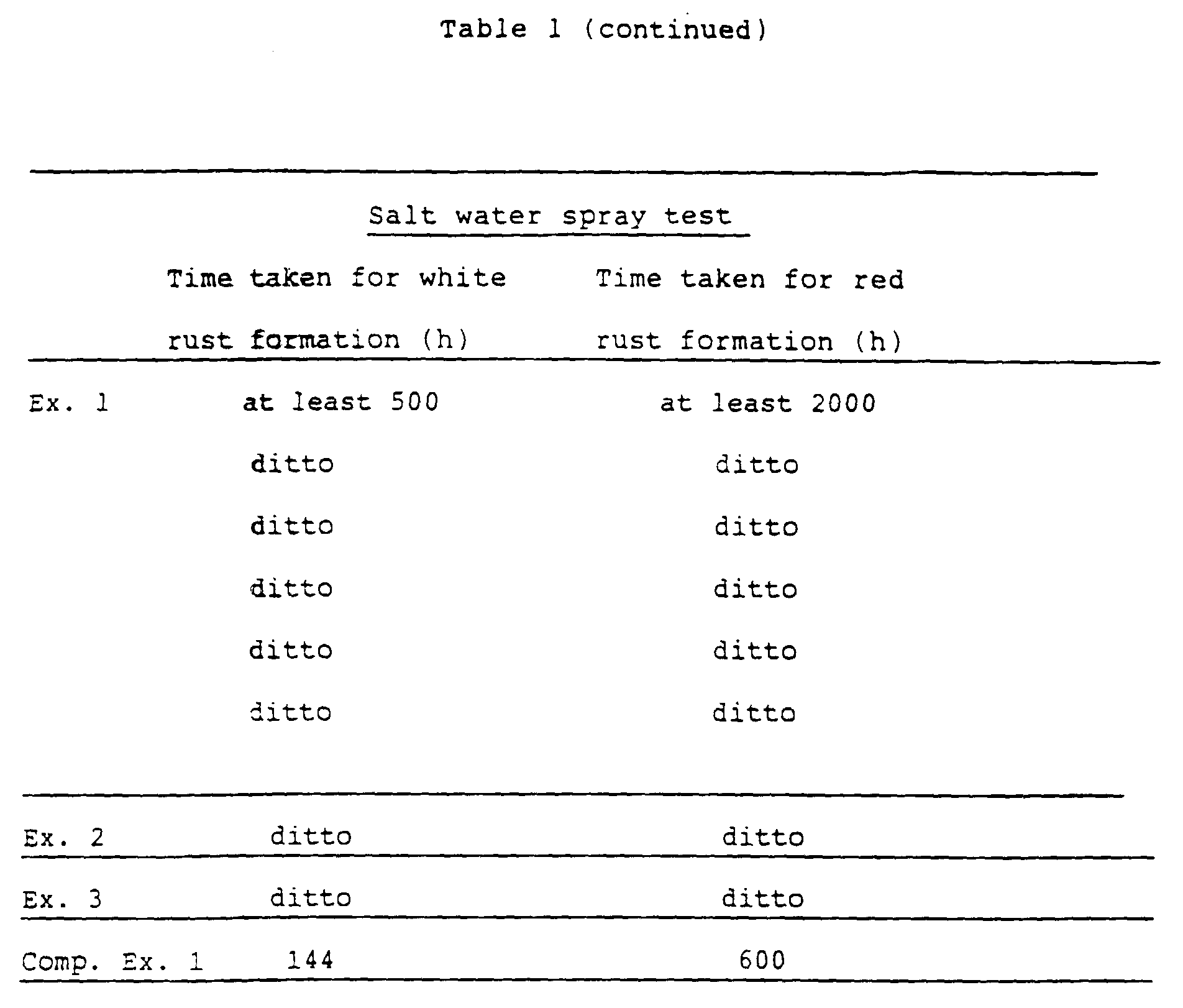
- Table 1 shows the results of the corrosion resistance tests of the products having the black chromate film obtained in above Examples 1 to 3 and Comparative Example 1 (the salt water spray test was conducted according to JIS 2371).
Landscapes
- Chemical & Material Sciences (AREA)
- General Chemical & Material Sciences (AREA)
- Chemical Kinetics & Catalysis (AREA)
- Engineering & Computer Science (AREA)
- Materials Engineering (AREA)
- Mechanical Engineering (AREA)
- Metallurgy (AREA)
- Organic Chemistry (AREA)
- Chemical Treatment Of Metals (AREA)
Description
- The present invention relates to a black chromate solution used for forming a highly anticorrosive black chromate film on a Zn plate, Zn-plating, Zn alloy plating such as Zn-Ni alloy plating, and a method of forming a chromate film thereon, especially on a Zn-Ni alloy.
- The treatment of a zinc plating with a chromate is still widely employed for the purposes of decoration and anticorrosion in the fields of automobiles, domestic electric appliances, etc.
- However, the plating thus formed has defects that the corrosion resistance thereof is yet insufficient under severe conditions when it is kept in an overheated engine room or on an icy road, when it is exposed to a chemical used for removing snow when it snows, or when it is damaged by salty sea breezes. Under these conditions, various Zn alloy platings capable of forming a plating film having a corrosion resistance far superior to that of a zinc plating were investigated and developed. Among them, a high corrosion resistance of a Zn-Ni alloy attracts attention mainly in the automobile field. As a monotony tint and a high grace are inclined to be liked by the users recently, a substance for blacking the Zn-Ni alloy plating is demanded. In addition, there is investigated a black chromate which does not impair the properties of the Zn-Ni alloy plating and further a chemically stable black chromate solution useful when the Ni deposition rate is in the practical range of 3 to 12% by weight. The best technique comprises adding an aliphatic carboxylic acid to an ordinary black chromate solution for treating Zn to form a black chromate film on the Zn-Ni alloy plating. Examples of solutions which comprise an organic acid added to an ordinary black chromate solution are disclosed in JP-A-0297682 and JP-A-04056782.
- However, the process wherein formic acid, citric acid or tartaric acid is used as the aliphatic carboxylic acid has a problem that the treating solution is impractical, since the solution is chemically unstable and the ingredients in the solution tend to be decomposed. The process disclosed in JP-A-04056782 wherein succinic acid is used has a problem that the appearance thereof is yet insufficient in the blackness and gloss, though the treating solution is chemically stable.
- The use of soluble silver compounds in a solution for treating Zn, Zn/Mg and Cd/Mg to form a black chromate film is disclosed in GB-A-618667.
- A primary object of the present invention is to provide a chemically stable black chromate solution capable of forming a highly anticorrosive black chromate film on a Zn-plating, Zn alloy plating and the like, the components being easily soluble in the solution.
- Another object of the present invention is to provide a method of forming a black chromate film on a Zn-Ni alloy.
- These and other objects of the present invention will be apparent from the following description and examples.
- The present invention has been completed on the basis of a finding that the above-described problems can be efficiently solved by using a sulfo-aromatic carboxylic acid, its salt, sulfonated aliphatic dicarboxylic acid or its salt as the organic acid to be contained in the black chromate solution.
- Namely, the present invention provides a black chromate solution which comprises hexavalent chromium, sulfate ions, soluble silver, a carboxylic acid, and water; characterised in that the carboxylic acid is a sulfonated carboxylic acid selected from the group consisting of sulfo-aromatic carboxylic acids, sulfonated aliphatic dicarboxylic acids and salts thereof.
- The present invention further provides a method of forming a black chromate film on a Zn-Ni alloy plating which comprises immersing the Zn-Ni alloy plating into a black chromate solution comprising hexavalent chromium, sulfate ions, soluble silver, a carboxylic acid and water; characterised in that the carboxylic acid is a sulfonated carboxylic acid selected from the group consisting of sulfo-aromatic carboxylic acids, sulfonated aliphatic dicarboxylic acids and salts thereof.
- Examples of the sulfo-aromatic carboxylic acids usable in the present invention include those having 7 to 15 carbon atoms such as sulfobenzoic acid, sulfophthalic acid, sulfoterephthalic acid and sulfonated naphthalic acid. The sulfonated aliphatic dicarboxylic acids include, for example, those having 3 to 10 carbon atoms such as sulfonated succinic acid and adipic acid. The salt of them may be any of those soluble in the black chromate solution. Examples of the salts include sodium and ammonium salts.
- The sulfonated carboxylic acids can be used either singly or in the form of a mixture of two or more of them in the present invention. Although the amount of the sulfonated carboxylic acid is not particularly limited, it is preferable that the concentration thereof in the black chromate solution be 0.5 to 100 g/l, more preferably 5 to 40 g/l.
- The black chromate solution of the present invention contains hexavalent chromium, sulfate ion (So4 2-) and soluble silver. Compounds usable as the hexavalent chromium source are, for example, chromic acid, salts thereof, bichromic acid, salts thereof and mixtures of two or more of them. The compounds for forming the sulfate ion include sulfuric acid, salts thereof (such as sodium, potassium and ammonium salts thereof) and mixtures of two or more of them. The compounds for forming the soluble silver include, for example, silver sulfate.
- The black chromate solution of the present invention can contain these components in optional amounts. Preferably, it contains 1 to 50 g/l of hexavalent chromium, 1 to 50 g/l of sulfate ion, 0.05 to 1.0 g/l of soluble silver and 0.5 to 100 g/l of the sulfonated carboxylic acid. The pH of the black chromate solution of the present invention is preferably controlled in the range of 0.5 to 2.5. The weight ratio of the sulfate ion to hexavalent chromium is preferably in the range of from 0.2 to 2.0.
- The black chromate solution of the present invention contains water as the balance. Further, amines such as methylamine, ethylenediamine and diethylenetriamine can be incorporated into the solution.
- The black chromate solution of the present invention is effective in forming a black chromate film on a Zn-Ni alloy plating having any composition. It exhibits an excellent effect particularly when a blanch chromate film is formed on a Zn-Ni alloy plating having a Ni deposition rate of not higher than 15% by weight, preferably in the range of 3 to 12 % by weight. Namely, when the black chromate film is to be conventionally formed on the Zn-Ni alloy plating of this composition, the formed film, even when it can be obtained, is not uniform and the corrosion resistance is seriously impaired, since the pH is rapidly increased at the boundary (interface) between them. On the contrary, in the present invention wherein the specified sulfonated carboxylic acid is used, the interface formed by the chromate film is exposed to a stable pH atmosphere to make the stable formation of the film possible. Thus, the high anticorrosive function of the Zn-Ni alloy plating is not impaired, and further, more excellent anticorrosive effect can be obtained.
- The treatment with the black chromate is usually conducted by immersing the substrate to be treated in the black chromate solution of the present invention. For example, the substrate is immersed in the solution having a temperature of 15 to 50°C for 30 to 300 seconds, preferably 30 to 180 seconds to form a black chromate film having a thickness of 0.5 to 3 µm, preferably 1 to 2 µm.
- Thus, in a preferred embodiment, the substrate is plated with a Zn-Ni alloy (Ni deposition rate: preferably 3 to 12 % by weight) (thickness of the plating: at least 2 µm, preferably 5 to 20 µm) and then the black chromate film is formed by the above-described process.
- By the process of the present invention, the black chromate film can be uniformly formed on the Zn-Ni alloy plating. Since the specified sulfonated carboxylic acid exhibits a buffer action under chromic acid-acidic conditions in a pH range of 1 to 3.5, the uniform black chromate film can be formed and, as a result, the corrosion resistance can be improved and excellent stability can be obtained.
- Therefore, the products obtained by forming the black chromate film by the process of the present invention can be widely used in the fields of automobiles, domestic electric appliances, building materials and parts, etc.
- The following Examples will further illustrate the present invention.
- A steel plate plated with a Zn-Ni alloy (Ni content: 3, 5, 7, 9, 12 or 15 % by weight) in a thickness of 8 µm was immersed in a chromate solution having a composition given below at 25°C for 90 seconds. As a result, an excellent black chromate film was formed when the Ni content was 3, 5, 7, 9 or 12 % and, on the contrary, a black chromate film having an interference color was obtained when the Ni content was 15 %.
CrO3 10 g/l Na2SO4 15 g/l AgNO3 0.8 g/l sulfonaphthalic acid 7 g/l water balance pH 1.3 (adjusted with NaOH). - A Zn-Ni plating having a thickness of 6 µm and Ni content of 6 % was treated with a chromate solution having the following composition at 20°C for 3 minutes to obtain a uniform black chromate film:
CrO3 5 g/l Na2Cr2O7 · 2H2O 20 g/l Na2SO4 25 g/l H2SO4 2 g/l Ag2SO4 0.5 g/l sulfoterephthalic acid 3 g/l water balance pH 1.6 (adjusted with NaOH). - A Zn-Ni plating having a thickness of 10 µm and Ni content of 8 % was treated with a chromate solution having the following composition at 25 °C for 2 minutes to obtain a uniform black chromate film:
Na2Cr2O7 · 2H2O 15 g/l H2SO4 5 g/l Ag2SO4 0.5 g/l sodium salt of sulfonated adipic acid 15 g/l water balance pH 1.5 (adjusted with NaOH). - A steel plate was plated with Zn to form a plating film having 8 µm thickness. The plate was then treated with a black chromate solution ZB-547 (a product provided by Dipsol Chemical Co., Ltd.) for Zn plating at 25 °C for 1 minute.
- Table 1 shows the results of the corrosion resistance tests of the products having the black chromate film obtained in above Examples 1 to 3 and Comparative Example 1 (the salt water spray test was conducted according to JIS 2371).

Claims (17)
- A black chromate solution which comprises hexavalent chromium, sulfate ions, soluble silver, a carboxylic acid, and water; characterised in that the carboxylic acid is a sulfonated carboxylic acid selected from the group consisting of sulfo-aromatic carboxylic acids, sulfonated aliphatic dicarboxylic acids and salts thereof.
- A chromate solution as claimed in claim 1 wherein the sulfo-aromatic carboxylic acids or salts thereof have from 7 to 15 carbon atoms.
- A chromate solution as claimed in claim 1 wherein the sulfonated aliphatic dicarboxylic acids or salts thereof have from 3 to 10 carbon atoms.
- A chromate solution as claimed in any one of the preceding claims which comprises in the range of from 1 to 50 g/l of hexavalent chromium, 1 to 50 g/l of sulfate ion, 0.05 to 1.0 g/l of soluble silver and 0.5 to 100 g/l of the sulfonated carboxylic acid.
- A chromate solution as claimed in any one of the preceding claims wherein the pH of the solution is in the range of from 0.5 to 2.5.
- A chromate solution as claimed in any one of the preceding claims wherein the weight ratio of the sulfate ion to hexavalent chromium is in the range of from 0.2 to 2.0.
- A black chromate solution as claimed in claim 1 which comprises in the range of from 1 to 50 g/l of hexavalent chromium, 1 to 50 g/l of sulfate ion, 0.05 to 1.0 g/l of soluble silver, 0.5 to 100 g/l of a sulfonated carboxylic acid selected from the group consisting of sulfo-aromatic carboxylic acids having from 7 to 15 carbon atoms, sulfonated aliphatic dicarboxylic acids having from 3 to 10 carbon atoms and salts thereof, and water, the solution having a pH in the range of from 0.5 to 2.5.
- A method of forming a black chromate film on a Zn-Ni alloy plating which comprises immersing the Zn-Ni alloy plating into a black chromate solution comprising hexavalent chromium, sulfate ions, soluble silver, a carboxylic acid, and water; characterised in that the carboxylic acid is a sulfonated carboxylic acid selected from the group consisting of sulfo-aromatic carboxylic acids, sulfonated aliphatic dicarboxylic acids and salts thereof.
- A method as claimed in claim 8 wherein the Zn-Ni alloy plating contains not more than approximately 15 % by weight of Ni.
- A method as claimed in claim 8 or claim 9 wherein the Zn-Ni alloy plating is immersed in the solution having a temperature in the range of from 15 to 50 °C for from 30 to 300 seconds.
- A method as claimed in any one of claims 8 to 10 wherein the sulfo-aromatic carboxylic acids or salts thereof have from 7 to 15 carbon atoms.
- A method as claimed in any one of claims 8 to 10 wherein the sulfonated aliphatic dicarboxylic acids or salts thereof have from 3 to 10 carbon atoms.
- A method as claimed in any one of claims 8 to 12 wherein the black chromate solution comprises in the range of from 1 to 50 g/l of hexavalent chromium, 1 to 50 g/l of sulfate ion, 0.05 to 1.0 g/l of soluble silver and 0.5 to 100 g/l of the sulfonated carboxylic acid, the solution having a pH in the range of from 0.5 to 2.5.
- A method as claimed in any one of claims 8 to 13 wherein a weight ratio of the sulfate ion to hexavalent chromium is in the range of from 0.2 to 2.0.
- A method of forming a black chromate film on a Zn-Ni alloy plating as claimed in claim 8 which comprises immersing the Zn-Ni alloy plating into a black chromate solution comprising in the range of from 1 to 50 g/l of hexavalent chromium, 1 to 50 g/l of sulfate ion, 0.05 to 1.0 g/l of soluble silver, 0.5 to 100 g/l of a sulfonated carboxylic acid selected from the group consisting of sulfo-aromatic carboxylic acids having from 7 to 15 carbon atoms, sulfonated aliphatic dicarboxylic acids having from 3 to 10 carbon atoms and salts thereof, and water, the solution having a pH in the range of from 0.5 to 2.5, at a temperature in the range of from 15 to 50 °C for from 30 to 300 seconds.
- A method as claimed in claim 15 wherein the Zn-Ni alloy plating contains not more than approximately 15 % by weight of Ni.
- A method as claimed in claim 15 or claim 16 wherein the Zn-Ni alloy plating contains in the range of from 3 to 12 % by weight of Ni.
Priority Applications (2)
| Application Number | Priority Date | Filing Date | Title |
|---|---|---|---|
| EP19960303068 EP0805222B1 (en) | 1996-05-01 | 1996-05-01 | Solution and process for black chromating |
| DE1996605894 DE69605894T2 (en) | 1996-05-01 | 1996-05-01 | Solution and method for black chromations |
Applications Claiming Priority (1)
| Application Number | Priority Date | Filing Date | Title |
|---|---|---|---|
| EP19960303068 EP0805222B1 (en) | 1996-05-01 | 1996-05-01 | Solution and process for black chromating |
Publications (2)
| Publication Number | Publication Date |
|---|---|
| EP0805222A1 EP0805222A1 (en) | 1997-11-05 |
| EP0805222B1 true EP0805222B1 (en) | 1999-12-29 |
Family
ID=8224912
Family Applications (1)
| Application Number | Title | Priority Date | Filing Date |
|---|---|---|---|
| EP19960303068 Expired - Lifetime EP0805222B1 (en) | 1996-05-01 | 1996-05-01 | Solution and process for black chromating |
Country Status (2)
| Country | Link |
|---|---|
| EP (1) | EP0805222B1 (en) |
| DE (1) | DE69605894T2 (en) |
Family Cites Families (4)
| Publication number | Priority date | Publication date | Assignee | Title |
|---|---|---|---|---|
| US2483510A (en) * | 1945-04-14 | 1949-10-04 | United Chromium Inc | Composition for dip coating solution and dip process for coloring zinc |
| JPH0730456B2 (en) * | 1988-10-05 | 1995-04-05 | 日本表面化学株式会社 | Treatment liquid for forming black chromate film on zinc / nickel alloy plating |
| US5080733A (en) * | 1990-04-09 | 1992-01-14 | Macdermid, Incorporated | Method for producing chromate conversion coatings |
| JP2953750B2 (en) * | 1990-06-22 | 1999-09-27 | ディップソール株式会社 | Black chromate treatment solution for Zn-Ni alloy plating |
-
1996
- 1996-05-01 DE DE1996605894 patent/DE69605894T2/en not_active Expired - Lifetime
- 1996-05-01 EP EP19960303068 patent/EP0805222B1/en not_active Expired - Lifetime
Also Published As
| Publication number | Publication date |
|---|---|
| DE69605894D1 (en) | 2000-02-03 |
| DE69605894T2 (en) | 2000-05-11 |
| EP0805222A1 (en) | 1997-11-05 |
Similar Documents
| Publication | Publication Date | Title |
|---|---|---|
| US4419199A (en) | Process for phosphatizing metals | |
| US4263059A (en) | Coating solutions of trivalent chromium for coating zinc and cadmium surfaces | |
| CA1274156A (en) | Chromate coating of zinc surfaces | |
| US4278477A (en) | Metal treatment | |
| US4359345A (en) | Trivalent chromium passivate solution and process | |
| US4298404A (en) | Chromium-free or low-chromium metal surface passivation | |
| US5876517A (en) | Chromate-plating bath and process for finishing zinc zinc alloy or cadmium surfaces | |
| CA2230330A1 (en) | Alkaline zinc and zinc alloy electroplating baths and processes | |
| JPH01123080A (en) | Zinc phosphate type film treatment method and solution, and replenishing agent | |
| US4470897A (en) | Method of electroplating a corrosion-resistant zinc-containing deposit | |
| GB2155493A (en) | Electroplating zinc-iron alloy from alkaline bath | |
| GB2155960A (en) | Processes and compositions for coating metal surfaces | |
| US4444601A (en) | Metal article passivated by a bath having an organic activator and a film-forming element | |
| JP2775210B2 (en) | Method for sealing chromate conversion coating on electroplated zinc | |
| US5565042A (en) | Black chromate solution | |
| US4749417A (en) | Corrosion resistant coating | |
| NL8200774A (en) | COMPOSITIONS FOR ELECTROLYTIC COATING OF METALS AND METHOD FOR USING THESE COMPOSITIONS. | |
| US4591416A (en) | Chromate composition and process for treating zinc-nickel alloys | |
| JPS60190588A (en) | Method for blackening zinc or zinc alloy plated steel sheet | |
| GB2077764A (en) | Electrodepositing cobalt-zinc alloys stimulating a chromium plating | |
| GB2113721A (en) | Chromate composition for treating electrodeposited zinc- nickel alloys | |
| EP0805222A1 (en) | Solution and process for black chromating | |
| EP0451409A1 (en) | Composition and method for producing chromate conversion coatings | |
| GB2094349A (en) | Metal plating compositions and processes | |
| US3411958A (en) | Treatment of steel parts |
Legal Events
| Date | Code | Title | Description |
|---|---|---|---|
| PUAI | Public reference made under article 153(3) epc to a published international application that has entered the european phase |
Free format text: ORIGINAL CODE: 0009012 |
|
| AK | Designated contracting states |
Kind code of ref document: A1 Designated state(s): DE FR GB |
|
| 17P | Request for examination filed |
Effective date: 19980212 |
|
| 17Q | First examination report despatched |
Effective date: 19980310 |
|
| GRAG | Despatch of communication of intention to grant |
Free format text: ORIGINAL CODE: EPIDOS AGRA |
|
| GRAG | Despatch of communication of intention to grant |
Free format text: ORIGINAL CODE: EPIDOS AGRA |
|
| GRAH | Despatch of communication of intention to grant a patent |
Free format text: ORIGINAL CODE: EPIDOS IGRA |
|
| GRAH | Despatch of communication of intention to grant a patent |
Free format text: ORIGINAL CODE: EPIDOS IGRA |
|
| GRAA | (expected) grant |
Free format text: ORIGINAL CODE: 0009210 |
|
| AK | Designated contracting states |
Kind code of ref document: B1 Designated state(s): DE FR GB |
|
| REF | Corresponds to: |
Ref document number: 69605894 Country of ref document: DE Date of ref document: 20000203 |
|
| ET | Fr: translation filed | ||
| PLBE | No opposition filed within time limit |
Free format text: ORIGINAL CODE: 0009261 |
|
| STAA | Information on the status of an ep patent application or granted ep patent |
Free format text: STATUS: NO OPPOSITION FILED WITHIN TIME LIMIT |
|
| 26N | No opposition filed | ||
| REG | Reference to a national code |
Ref country code: GB Ref legal event code: IF02 |
|
| PGFP | Annual fee paid to national office [announced via postgrant information from national office to epo] |
Ref country code: FR Payment date: 20100520 Year of fee payment: 15 |
|
| PGFP | Annual fee paid to national office [announced via postgrant information from national office to epo] |
Ref country code: GB Payment date: 20100525 Year of fee payment: 15 Ref country code: DE Payment date: 20100629 Year of fee payment: 15 |
|
| REG | Reference to a national code |
Ref country code: DE Ref legal event code: R119 Ref document number: 69605894 Country of ref document: DE |
|
| REG | Reference to a national code |
Ref country code: DE Ref legal event code: R119 Ref document number: 69605894 Country of ref document: DE |
|
| GBPC | Gb: european patent ceased through non-payment of renewal fee |
Effective date: 20110501 |
|
| REG | Reference to a national code |
Ref country code: FR Ref legal event code: ST Effective date: 20120131 |
|
| PG25 | Lapsed in a contracting state [announced via postgrant information from national office to epo] |
Ref country code: FR Free format text: LAPSE BECAUSE OF NON-PAYMENT OF DUE FEES Effective date: 20110531 |
|
| PG25 | Lapsed in a contracting state [announced via postgrant information from national office to epo] |
Ref country code: GB Free format text: LAPSE BECAUSE OF NON-PAYMENT OF DUE FEES Effective date: 20110501 |
|
| PG25 | Lapsed in a contracting state [announced via postgrant information from national office to epo] |
Ref country code: DE Free format text: LAPSE BECAUSE OF NON-PAYMENT OF DUE FEES Effective date: 20111130 |