EP0805180B1 - Curable compositions of fluoroelastomers - Google Patents
Curable compositions of fluoroelastomers Download PDFInfo
- Publication number
- EP0805180B1 EP0805180B1 EP97106794A EP97106794A EP0805180B1 EP 0805180 B1 EP0805180 B1 EP 0805180B1 EP 97106794 A EP97106794 A EP 97106794A EP 97106794 A EP97106794 A EP 97106794A EP 0805180 B1 EP0805180 B1 EP 0805180B1
- Authority
- EP
- European Patent Office
- Prior art keywords
- mono
- hydroxypolyfluoroethers
- additives
- molecular weight
- class
- Prior art date
- Legal status (The legal status is an assumption and is not a legal conclusion. Google has not performed a legal analysis and makes no representation as to the accuracy of the status listed.)
- Expired - Lifetime
Links
Classifications
-
- C—CHEMISTRY; METALLURGY
- C08—ORGANIC MACROMOLECULAR COMPOUNDS; THEIR PREPARATION OR CHEMICAL WORKING-UP; COMPOSITIONS BASED THEREON
- C08L—COMPOSITIONS OF MACROMOLECULAR COMPOUNDS
- C08L27/00—Compositions of homopolymers or copolymers of compounds having one or more unsaturated aliphatic radicals, each having only one carbon-to-carbon double bond, and at least one being terminated by a halogen; Compositions of derivatives of such polymers
- C08L27/02—Compositions of homopolymers or copolymers of compounds having one or more unsaturated aliphatic radicals, each having only one carbon-to-carbon double bond, and at least one being terminated by a halogen; Compositions of derivatives of such polymers not modified by chemical after-treatment
- C08L27/12—Compositions of homopolymers or copolymers of compounds having one or more unsaturated aliphatic radicals, each having only one carbon-to-carbon double bond, and at least one being terminated by a halogen; Compositions of derivatives of such polymers not modified by chemical after-treatment containing fluorine atoms
-
- C—CHEMISTRY; METALLURGY
- C08—ORGANIC MACROMOLECULAR COMPOUNDS; THEIR PREPARATION OR CHEMICAL WORKING-UP; COMPOSITIONS BASED THEREON
- C08L—COMPOSITIONS OF MACROMOLECULAR COMPOUNDS
- C08L27/00—Compositions of homopolymers or copolymers of compounds having one or more unsaturated aliphatic radicals, each having only one carbon-to-carbon double bond, and at least one being terminated by a halogen; Compositions of derivatives of such polymers
- C08L27/02—Compositions of homopolymers or copolymers of compounds having one or more unsaturated aliphatic radicals, each having only one carbon-to-carbon double bond, and at least one being terminated by a halogen; Compositions of derivatives of such polymers not modified by chemical after-treatment
- C08L27/12—Compositions of homopolymers or copolymers of compounds having one or more unsaturated aliphatic radicals, each having only one carbon-to-carbon double bond, and at least one being terminated by a halogen; Compositions of derivatives of such polymers not modified by chemical after-treatment containing fluorine atoms
- C08L27/16—Homopolymers or copolymers or vinylidene fluoride
-
- C—CHEMISTRY; METALLURGY
- C08—ORGANIC MACROMOLECULAR COMPOUNDS; THEIR PREPARATION OR CHEMICAL WORKING-UP; COMPOSITIONS BASED THEREON
- C08L—COMPOSITIONS OF MACROMOLECULAR COMPOUNDS
- C08L71/00—Compositions of polyethers obtained by reactions forming an ether link in the main chain; Compositions of derivatives of such polymers
Definitions
- the present invention relates to additives to improve the friction coefficient of curable compositions of fluoroelastomers without lowering the adhesion with bonding agents to metal reinforcements.
- Vinylidene fluoride based copolymers cured elastomers in which the vinylidene fluoride is copolymerized with one or more monomers containing an ethylene unsaturation and at least a fluorine atom, are well known and are widely utilized in a variety of application fields where an exceptional chemical resistance to solvents, lubricants, fuels, acids and similar products is required.
- seals in general, both in static and dynamic conditions, in the motor, aeronautical, missile, naval, mechanical, chemical field, in protective proofing of various supports, such as protective clothes for the contact with aggressive chemical agents.
- Vinylidene fluoride based fluoroelastomers curable compositions can be cured by ionic and/or radical way.
- compositions are described in patents GB 1,356,344, US 3,876,654, US 4,259,463.
- fluoroelastomers are those crosslinked by radical curing.
- the fluoroelastomer must contain radical curing sites deriving from the introduction in the chain of monomers subject to radical attack, for instance bromo-containing compounds such as bromoperfluoro-olefins, for instance bromotrifluoroethylene, or bromoperfluoroalkylvinylethers, for instance bromoperfluoroethylvinylether.
- the chain end groups contain iodine atoms deriving from saturated organic compounds such as for instance Rf'I or Rf'I 2 wherein Rf' is an hydrofluorocarbon, chlorofluorocarbon or hydrocarbon radical having from 1 to 12 carbon atoms, preferably from 4 to 6 carbon atoms.
- Rf' is an hydrofluorocarbon, chlorofluorocarbon or hydrocarbon radical having from 1 to 12 carbon atoms, preferably from 4 to 6 carbon atoms.
- the formulations are crosslinked with the addition of radical initiators, generally of peroxide type, such as alkylperoxides and the addition of crosslinking agents, such as for instance triallylisocyanurate (TAIC), triallylcyanurate (TAC), triallylphosphate. Acceptors of acids such as for instance zinc or lead oxide are also added.
- inert fillers such as silicates, sulfates and carbon black are also present; processing coadjuvants which have the purpose to improve the product processability.
- the technical problem to be solved by the present invention is that to have available cured fluoroelastomeric compositions combining to the rheologic properties, processability, chemical and thermal resistance characteristics of the known fluoroelastomers also a lower friction coefficient, both static and dynamic, which is maintained during the time, also maintaining the capacity of adhering to metal surfaces pretreated with bonding agents.
- An improved friction coefficient is desirable since long time by the utilizers since it brings for instance to a longer duration of the manufactured product and the application of less energy in the running phase.
- the monohydroxypolyfluoroethers class preferably comprises fluoropolyethers having number average molecular weight from 500 to 5,000, preferably from 600 to 3,000, wherein the repeating units statistically distributed along the chain are selected from the following:
- the dihydroxypolyfluoroethers class comprises fluoropolyethers having number average molecular weight from 800 to 10,000, preferably from 1,000 to 5,000, more preferably from 2,000 to 4,000 wherein the repeating units statistically distributed along the chain are selected from the following:
- hydroxylated compounds of the above classed can be utilized also in admixture with each other.
- Monohydroxypolyfluoroethers of class 2) are in particular selected from those comprised in the following general formula: C 3 F 7 O(C 3 F 6 O) r' -CF(CF 3 )-Z-H wherein r' is an integer and such as to give the molecular weight indicated above, Z has the indicated meaning.
- Monohydroxypolyfluoroethers of class 3) are in particular selected from those comprised in the following general formula: F(CH 2 CF 2 CF 2 O) s' -CH 2 CF 2 -Z-H wherein s' is an integer such as to give the molecular weight indicated above, Z has the indicated meaning.
- Fluoropolyoxyalkylene diols belonging to class 4) are in particular selected from those comprised in the following general formula: HZ-CF 2 O(C 2 F 4 O) m (CF 2 O) n CF 2 -ZH wherein Z has the meaning described above, m and n are integers such as to give the molecular weight indicated above and m/n is comprised between 0.5 and 1.5 with the oxyfluoroalkylene units statistically distributed along the chain.
- the preparation of these compounds can be carried out, for instance, according to the methods described in US patent 3,810,874.
- Fluoro-containing diols belonging to class 5 are in particular selected from the compounds representable with the following general formula: HZ-CF 2 O-(C 3 F 6 O) r (C 2 F 4 O) s (CFXO) t -CF 2 -ZH wherein X is -F or -CF 3 , the r, s, t indexes are integers such as to give the molecular weight indicated above and Z has the meaning previously specified.
- Such compounds are obtainable by photooxidation of mixtures of C 3 F 6 and C 2 F 4 , as described in US patent 3,665,041 and subsequent transformation of terminals -COF into groups containing the -OH terminal, carried out with known methods described in the patents USP 3,847,978 and USP 3,810,874.
- Fluoro-containing diols belonging to class 6) are in particular selected from the compounds having the general formula: HZ-CF 2 CH 2 (OCF 2 CF 2 CH 2 ) p -OR' f -O-(CH 2 CF 2 CF 2 O) q CH 2 CF 2 -ZH wherein Z and R' f have the indicated meaning, described in the published European patent application EP 148,482 wherein the -COF terminal groups can be transformed so as to have -OH terminal groups as described in the patents USP 3,847,978 and USP 3,810,874; p and q are integers such as to give the molecular weight indicated above.
- Fluoro-containing diols belonging to class 7) are in particular selected from the compounds having the general formula: A-CF(CF 3 )-(OCF 2 CF(CF 3 )) a -OR f O-(CF(CF 3 )CF 2 O) b -CF(CF 3 )-A wherein A is a group comprising the -OH end group, for instance CH 2 OH, R f is a fluoroalkylene group as defined above, a and b are integers such as to indicate the molecular weight mentioned above.
- the fluoroelastomers utilizable according to the present invention are copolymers of vinylidene fluoride with at least another unsaturated monomer, totally or partially fluorinated.
- vinylidene fluoride copolymers with hexafluoropropene, containing or not tetrafluoroethylene can be mentioned.
- chlorotrifluoroethylene 1-hydropentafluoropropene
- 2-hydropentafluoropropene and perfluoroalkylvinylethers can be employed.
- the amount of perfluoroalkylvinylether and/or perfluoropropene is generally comprised between 0.5 and 30% by moles on the total of the copolymer; TFE ranges from 0 to 60% by moles, VdF generally ranges between 10-80% by moles.
- fluoro-containing monomers can also be used as comonomers provided they contain a double bond of ethylene type and at least a fluorine atom.
- Said fluoroelastomers can be prepared as described in the literature (Kirk-Othmer, Encyclopaedia of Chem. Technology vol. 8, pag. 500 and seq., 1979) preferably by operating in aqueous emulsion and optionally in the presence of chain transfer agents such as those described in the US patent 4,000,356 .
- elastomers wherein the vinylidene fluoride is comprised between 40% and 85% by moles, perfluoropropene between 15% and 30% by moles, and tetrafluoroethylene between 0 and 30% by moles, are preferred.
- the preferred accelerants of the classes previously mentioned are the following:
- the basic reactants necessary to cure are inorganic compounds such as for instance ZnO, MgO, PbO, CaO or an oxide and hydroxide mixture of these metals or salts of weak acids as described in patent USP 3,876,654.
- the curing agent in ionic curing is a known polyhydroxylated compound as curing agent for fluoroelastomers.
- the curable compositions of the type indicated above are cured by a process consisting in heating at first said compositions under pressure, at temperatures from 130°C to 230°C, preferably from 160°C to 200°C, for a time from 0.5 to 60 minutes and preferably from 1 to 20 minutes; successively the manufactured articles so obtained are post-cured in oven, at atmospheric pressure, at temperatures from 130°C to 315°C, preferably from 200°C to 275°C, for a time comprised between 5 and 48 and preferably between 10 and 24 hours.
- the Applicant has unexpectedly found that the additives of the invention during the curing process, although they give a chemical reaction with the elastomeric chain (see the extraction tests with appropriate solvent of the examples) result unexpectedly present in a sufficient amount to modify the surface properties of the cured rubber and such as to bring to a lowering of the static and dynamic friction coefficient.
- the curable compositions according to the present invention contain moreover in addition to the substances indicated before and to the additive of the invention, inert fillers such as for instance carbon black, white and colored fillers.
- inert fillers such as carbon black, white and colored fillers.
- the present invention does not consider the use of known plastifiers and lubricants, such as stearates, arylphosphates, polyethers, polyesters, polyethylene, sulfones, sulfoxides, and other known additives, which would lead to the indicated inconveniences.
- the components of the curable compositions according to the present invention are easily incorporable, both separately and premixed, in the vinylidene fluoride elastomeric copolymer.
Landscapes
- Chemical & Material Sciences (AREA)
- Health & Medical Sciences (AREA)
- Chemical Kinetics & Catalysis (AREA)
- Medicinal Chemistry (AREA)
- Polymers & Plastics (AREA)
- Organic Chemistry (AREA)
- Compositions Of Macromolecular Compounds (AREA)
- Adhesives Or Adhesive Processes (AREA)
- Polyethers (AREA)
Abstract
Description
- The present invention relates to additives to improve the friction coefficient of curable compositions of fluoroelastomers without lowering the adhesion with bonding agents to metal reinforcements.
- Vinylidene fluoride based copolymers cured elastomers, in which the vinylidene fluoride is copolymerized with one or more monomers containing an ethylene unsaturation and at least a fluorine atom, are well known and are widely utilized in a variety of application fields where an exceptional chemical resistance to solvents, lubricants, fuels, acids and similar products is required.
- Cured articles obtained from these elastomeric polymers find the most suitable employment as seals (gaskets) in general, both in static and dynamic conditions, in the motor, aeronautical, missile, naval, mechanical, chemical field, in protective proofing of various supports, such as protective clothes for the contact with aggressive chemical agents.
- Vinylidene fluoride based fluoroelastomers curable compositions can be cured by ionic and/or radical way.
- In ionic curing the essential components are the following:
- (A) a vinylidene fluoride copolymer with at least another fluoro-containing monomer having an ethylenic unsaturation;
- (B) a curing accelerant selected in particular from the following: quaternary ammonium salt, quaternary phosphonium salt, phosphoranammine derivative;
- (C) one or more basic acceptors, such for instance MgO and Ca(OH)2;
- (D) a polyhydroxylated crosslinking agent.
-
- Examples of these compositions are described in patents GB 1,356,344, US 3,876,654, US 4,259,463.
- Other utilizable fluoroelastomers are those crosslinked by radical curing. In this case the fluoroelastomer must contain radical curing sites deriving from the introduction in the chain of monomers subject to radical attack, for instance bromo-containing compounds such as bromoperfluoro-olefins, for instance bromotrifluoroethylene, or bromoperfluoroalkylvinylethers, for instance bromoperfluoroethylvinylether. Preferably the chain end groups contain iodine atoms deriving from saturated organic compounds such as for instance Rf'I or Rf'I2 wherein Rf' is an hydrofluorocarbon, chlorofluorocarbon or hydrocarbon radical having from 1 to 12 carbon atoms, preferably from 4 to 6 carbon atoms. The formulations are crosslinked with the addition of radical initiators, generally of peroxide type, such as alkylperoxides and the addition of crosslinking agents, such as for instance triallylisocyanurate (TAIC), triallylcyanurate (TAC), triallylphosphate. Acceptors of acids such as for instance zinc or lead oxide are also added.
- In both types of curing, inert fillers, such as silicates, sulfates and carbon black are also present; processing coadjuvants which have the purpose to improve the product processability.
- The technical problem to be solved by the present invention is that to have available cured fluoroelastomeric compositions combining to the rheologic properties, processability, chemical and thermal resistance characteristics of the known fluoroelastomers also a lower friction coefficient, both static and dynamic, which is maintained during the time, also maintaining the capacity of adhering to metal surfaces pretreated with bonding agents.
- In the measurement of the friction coefficient there are generally three main phases:
- I starting,
- II sliding,
- III static.
- An improved friction coefficient is desirable since long time by the utilizers since it brings for instance to a longer duration of the manufactured product and the application of less energy in the running phase.
- The use of processing coadjuvants to improve the extrudability characteristics of the blends and to reduce the phenomena of adhesion to the moulds and/or of mould fouling of the same, is well known. For instance vegetable waxes, low molecular weight polyurethanes, stearates, polyesters, fluorosilicone oils can be mentioned. It is to be noticed that the number of coadjuvants employed in the fluoroelastomers in the art, is very high. However no indication or teaching in any patent or publication of the art is given to solve the problem to have available fluoroelastomers with a lower friction coefficient which maintains during the time combined to the adhesion properties specified above.
- Tests carried out by the Applicant have shown that with the coadjuvants described above it is not possible to obtain a reduction of the friction coefficient lasting in the time.
- It has now surprisingly found by the Applicant that by utilizing the additives of the present invention it is possible to achieve a reduction of the friction coefficient which maintains in the time in combination with an optimal balance of the other properties defined above.
- An object of the present invention are therefore the use of additives of the classes of mono- and/or di-hydroxypolyfluoroethers comprising the fluoropolyoxyalkylene repeating units selected from:
(C3F6O); (CFXO) wherein X = F, CF3;
(CH2CF2CF2O); (CF2(CF2)zCF2O) wherein z is an integer equal to 1 or 2; (C2F4O). - The monohydroxypolyfluoroethers class preferably comprises fluoropolyethers having number average molecular weight from 500 to 5,000, preferably from 600 to 3,000, wherein the repeating units statistically distributed along the chain are selected from the following:
- 1) (C3F6O), (CFXO);
- 2) (C3F6O);
- 3) (CH2CF2CF2O).
-
- Preferably the dihydroxypolyfluoroethers class comprises fluoropolyethers having number average molecular weight from 800 to 10,000, preferably from 1,000 to 5,000, more preferably from 2,000 to 4,000 wherein the repeating units statistically distributed along the chain are selected from the following:
- 4) (C2F4O), (CF2O);
- 5) (C3F6O), (C2F4O), (CFXO);
- 6) (CH2-CF2-CF2-O), said units being linked among each other
inside the fluoropolyoxyalkylene chain as follows:
- 7) (CF(CF3)CF2O)
said units being linked among each other inside the fluoropolyoxyalkylene chain as follows: -
- The hydroxylated compounds of the above classed can be utilized also in admixture with each other.
- Monohydroxypolyfluoroethers of class 1) are in particular selected from those comprised in the following general formula:
wherein D and E are equal to or different from each other and selected from H, CH3 and CF3, C is a carbon atom, X = F or CF3; m' and n' are positive integers such that the m'/n' ratio ranges from 5 to 40 and m'and n' are such as to give the molecular weight indicated above. - These compounds are obtained by the process described in the patent USP 3,513,203, or USP 3,847,978 wherein the COF-terminal group is transformed into OH group according to the patents USP 3,810,874, USP 5,143,589.
- Monohydroxypolyfluoroethers of class 2) are in particular selected from those comprised in the following general formula:
- These products are described in patent USP 3,242,218, wherein the COF group is transformed so as to have the terminal group OH, as described in the patents USP 3,847,978 and USP 3,810,874.
- Monohydroxypolyfluoroethers of class 3) are in particular selected from those comprised in the following general formula:
- These products are described in the published European patent application No. 148,482, wherein the COF group is transformed so as to have the terminal group OH, as described in the USP patents 3,847,978 and USP 3,810,874.
- Fluoropolyoxyalkylene diols belonging to class 4) are in particular selected from those comprised in the following general formula:
- Fluoro-containing diols belonging to class 5) are in particular selected from the compounds representable with the following general formula:
- Such compounds are obtainable by photooxidation of mixtures of C3F6 and C2F4, as described in US patent 3,665,041 and subsequent transformation of terminals -COF into groups containing the -OH terminal, carried out with known methods described in the patents USP 3,847,978 and USP 3,810,874.
- Fluoro-containing diols belonging to class 6) are in particular selected from the compounds having the general formula:
- Fluoro-containing diols belonging to class 7) are in particular selected from the compounds having the general formula:
- Such compounds are described in the published European patent application EP 151,877.
- The fluoroelastomers utilizable according to the present invention, as already said, are copolymers of vinylidene fluoride with at least another unsaturated monomer, totally or partially fluorinated.
- As comonomers we can cite hexafluoropropene, tetrafluoroethylene, chorotrifluoroethylene, 1-hydropentafluoropropene, 2-hydropentafluoropropene, perfluoroalkylvinylethers wherein alkyl has a number of C atoms from 1 to 3.
- In particular vinylidene fluoride copolymers with hexafluoropropene, containing or not tetrafluoroethylene, can be mentioned.
- Instead of hexafluoropropene, chlorotrifluoroethylene, 1-hydropentafluoropropene, 2-hydropentafluoropropene and perfluoroalkylvinylethers can be employed.
- Mixtures of the comonomers indicated above can also be employed.
- The amount of perfluoroalkylvinylether and/or perfluoropropene is generally comprised between 0.5 and 30% by moles on the total of the copolymer; TFE ranges from 0 to 60% by moles, VdF generally ranges between 10-80% by moles.
- Other fluoro-containing monomers can also be used as comonomers provided they contain a double bond of ethylene type and at least a fluorine atom.
- Said fluoroelastomers can be prepared as described in the literature (Kirk-Othmer, Encyclopaedia of Chem. Technology vol. 8, pag. 500 and seq., 1979) preferably by operating in aqueous emulsion and optionally in the presence of chain transfer agents such as those described in the US patent 4,000,356.
- In particular elastomers wherein the vinylidene fluoride is comprised between 40% and 85% by moles, perfluoropropene between 15% and 30% by moles, and tetrafluoroethylene between 0 and 30% by moles, are preferred.
- In ionic curing, the preferred accelerants of the classes previously mentioned, are the following:
- among quaternary ammonium salts: methyl-trioctylammonium chloride, laurylpyridinium bromide, benzyltrioctylammonium chloride; tetrabutylammonium chloride.
- among phosphonium quaternary salts: benzyltriphenylphosphonium chloride, benzyltriphenylphosphonium tetrafluoroborate, methyltrioctylphosphonium acetate, carbetoxymethyltriphenylphosphonium bromide; tetrabutylphosphonium chloride.
- among the phosphoramine or amino phosphonium salts: 1-chloro, 1-benzyl, 1,1-diphenyl, N(diethyl)-phosphoranamine and 1-tetrafluoroborate, 1-benzyl, N,N',N'' (hexamethyl)-phosphorantriamine, 1-bromo, 1-benzyl, 1-phenyl, N,N'(tetraethyl) phosphorandiamine.
- The basic reactants necessary to cure are inorganic compounds such as for instance ZnO, MgO, PbO, CaO or an oxide and hydroxide mixture of these metals or salts of weak acids as described in patent USP 3,876,654.
- In radical curing, according to the present invention, also small amounts of the accelerants and of the basic rectants indicated above for the ionic curing, are used.
- The curing agent in ionic curing is a known polyhydroxylated compound as curing agent for fluoroelastomers. We can mention: hydroquinone, resorcin, 2,2'-bis(p.hydroxyphenyl)-hexafluoropropane or bisphenol AF, 2,2'-bis(p.hydroxyphenyl)-propane or bisphenol A.
- Examples of these compounds are reported in the patent USP 3,876,654.
- In general for 100 parts by weight of an elastomeric copolymer of the vinylidene fluoride (A) with one or more fluoro-containing monomers as indicated above, are employed:
- from 1 to 40 parts by weight of the acceptor of inorganic acids, consisting of one or more basic oxides of bivalent metals, as indicated above, optionally in the form of complexes or cationic chelates, optionally in the presence of 0-10 parts by weight of one or more basic compounds, selected from the group comprising the calcium, strontium and barium hydrates, the metal salts of weak acids such as carbonates, benzoates and calcium, strontium, barium, sodium and potassium phosphates, optionally in the form of complexes with the normal chelants or cationic complexants of a type well known to the skilled in the art;
- from 0.5 to 4 parts by weight, preferably from 1 and 2, of mono- and/or dihydroxypolyfluoroether additives of the invention;
- from 0.2 to 4 parts of a curing accelerant selected from those of the classes described above;
- from 0.3 to 6 parts of curing agent both in ionic and peroxidic curing. Said crosslinking agents are indicatd above;
- for the curing of radical type from 0.5 to 10 parts of radical initiator.
- The curable compositions of the type indicated above are cured by a process consisting in heating at first said compositions under pressure, at temperatures from 130°C to 230°C, preferably from 160°C to 200°C, for a time from 0.5 to 60 minutes and preferably from 1 to 20 minutes; successively the manufactured articles so obtained are post-cured in oven, at atmospheric pressure, at temperatures from 130°C to 315°C, preferably from 200°C to 275°C, for a time comprised between 5 and 48 and preferably between 10 and 24 hours.
- The Applicant has unexpectedly found that the additives of the invention during the curing process, although they give a chemical reaction with the elastomeric chain (see the extraction tests with appropriate solvent of the examples) result unexpectedly present in a sufficient amount to modify the surface properties of the cured rubber and such as to bring to a lowering of the static and dynamic friction coefficient.
- As already said, this reduced friction coefficient, besides being combined to the good rubber processability properties, is also combined to the surprising fact that the adhesion to the metal reinforcements treated with bonding agents does not suffer any reduction. This further result is quite surprising since the conventional processing coadjuvants utilized to improve the processability of fluoroelastomers must be used in very low amounts, generally only up to 1 phr at most, in order to avoid undesired effects on the adhesion.
- The curable compositions according to the present invention contain moreover in addition to the substances indicated before and to the additive of the invention, inert fillers such as for instance carbon black, white and colored fillers. The present invention does not consider the use of known plastifiers and lubricants, such as stearates, arylphosphates, polyethers, polyesters, polyethylene, sulfones, sulfoxides, and other known additives, which would lead to the indicated inconveniences.
- The components of the curable compositions according to the present invention are easily incorporable, both separately and premixed, in the vinylidene fluoride elastomeric copolymer.
- In this way good curing rates at the normal processing temperatures can be reached without meeting any danger of scorching (precuring) in the preliminary working phases, prior to the real curing operation.
- Some examples are reported for illustrative purposes.
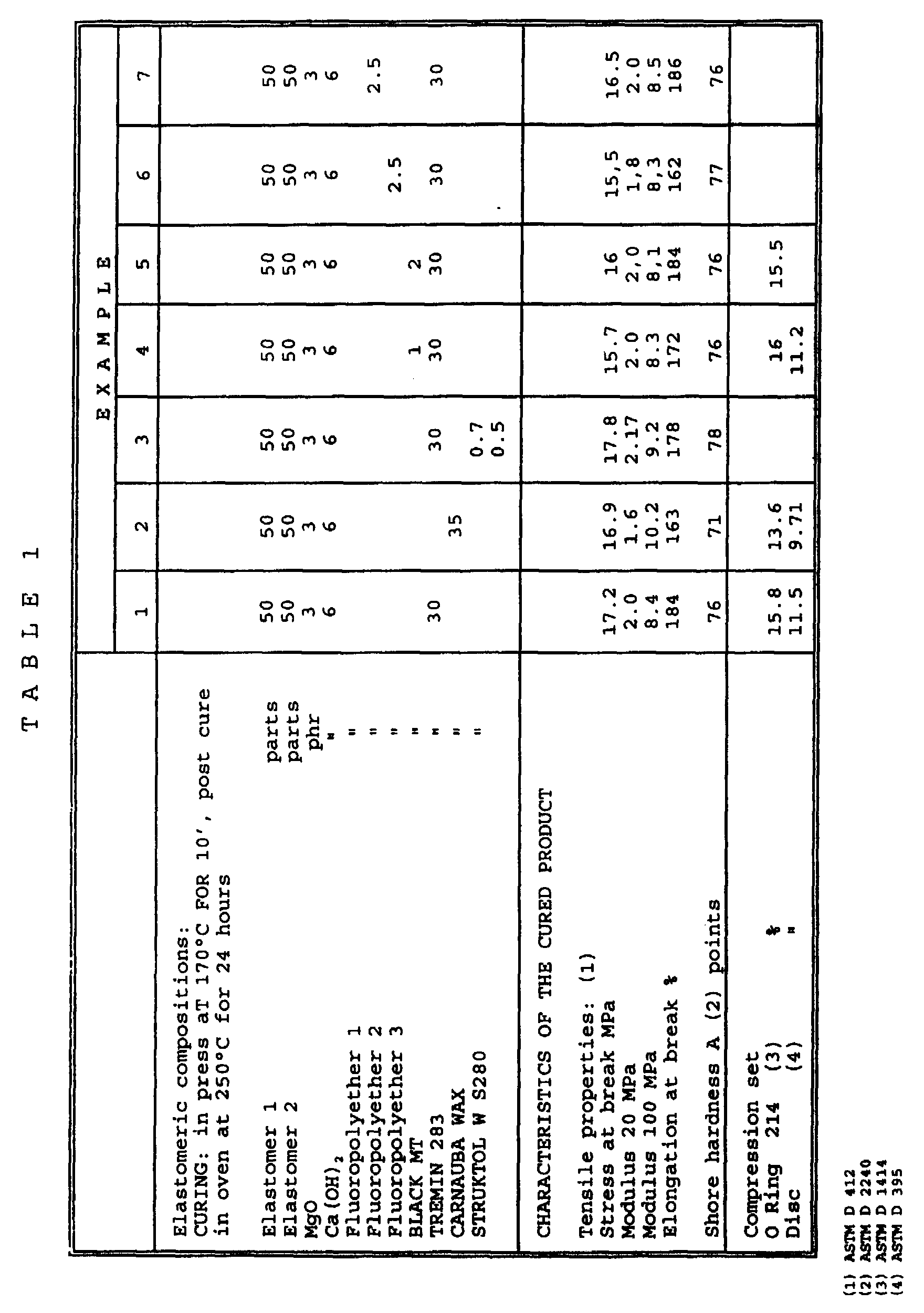
- In the examples reported in Tables 1-4 the following products were used:
- Fluoroelastomer 1° = copolymer CH2=CF2/C3F6 in molar ratio 4/1
having specific weight 1.8 at 25°C, known as TECNOFLON® FOR
420 by AUSIMONT; Mooney (1+10) at 121°C equal to 22 (ASTM D
1646).
Composition of the formulation:Polymer 100 parts Bisphenol AF 2.1 phr Accelerant 1 chloro-1,1 diphenyl-1 benzyl-N,N diethyl-phosphoranamine: 0.4 phr - Fluoroelastomer 2° = copolymer CH2=CF2/C3F6 in molar ratio 4/1,
specific weight 1.8 at 25°C; Mooney (1+10) at 121°C equal to
34 (ASTM D 1646).
Composition of the formulation:Polymer 100 parts Bisphenolo AF 2.1 phr Accelerant 1 chloro-1,1 diphenyl-1 benzyl-N,N diethyl-phosphoranamine: 0.42 phr - Fluoropolyether 1 of formula:
- Fluoropolyether 2 of general formula:
- Fluoropolyether 3 of general formula as fluoropolyether 2 and molecular weight 4,000.
- Black MT: Medium Thermal Carbonblack
- Tremin 283 600 EST: Wollastonite treated with epoxysilanes.
- STRUKTOL WS 280: silicone oil supported on inorganic carrier (25%).
-
- The results of the tests are reported in Tables 1, 2, 4.
- Determination of the friction coefficient.
The adopted procedure is the following: - The rubber sheets after moulding and after post curing were kept hung in a container to avoid any surface pollution.
- The sheets were conditioned at 23°C and 50% HR (relative humidity) for at least 48 hours.
- The sheets were placed on an horizontal rigid plane of the dynamometer and let adhere by adhesive double tape.
- The device containing the two steel spheres having a diameter of 12.7 mm was put on the test plate after having carefully cleaned the two spheres with acetone and having perfectly dried them.
- The test was carried out at the sliding rate of 100 mm/min by applying on the spheres three different levels of load (2.11 N, 4.07 N and 7.01 N) each time considering different zones of the sheet. For each sample two sheets were examined.
- The test cycle consisted in sliding the spheres for a
stretch of about 60 mm and then stopping the machine by
continuing to register the friction force.
In this way curves of friction force vs. time were obtained, from which the friction force values were taken:- I starting
- II sliding
- III static.
- The friction coefficient (f.c.) for each phase is determined by the well known equation:
- F = friction force
- W = weight applied on the spheres.
-
- The variation of the friction coefficient depending on the ageing time at 200°C for instance 1, 11 and 2, 12 is reported in Table 4.
- The extraction tests of the fluoroethers 1,2,3 of the examples 5, 9, 11, 12 from the cured rubber with 1,1,2 trichloro-1,2,2 trifluoroethane in azeotropic mixture with acetone carried out in SOXTEC SYSTEM HT2 1045 Extraction Unit are shown in Table 3.
- The 19F NMR analysis of the extracts showed the presence of polymers having low molecular weight attributable to the starting elastomer and only 2-3% of the extract resulted to be fluoroether.


Examples Extract 5 0.10 % 9 0.0045 % 11 0.060 % 12 0.0055 % 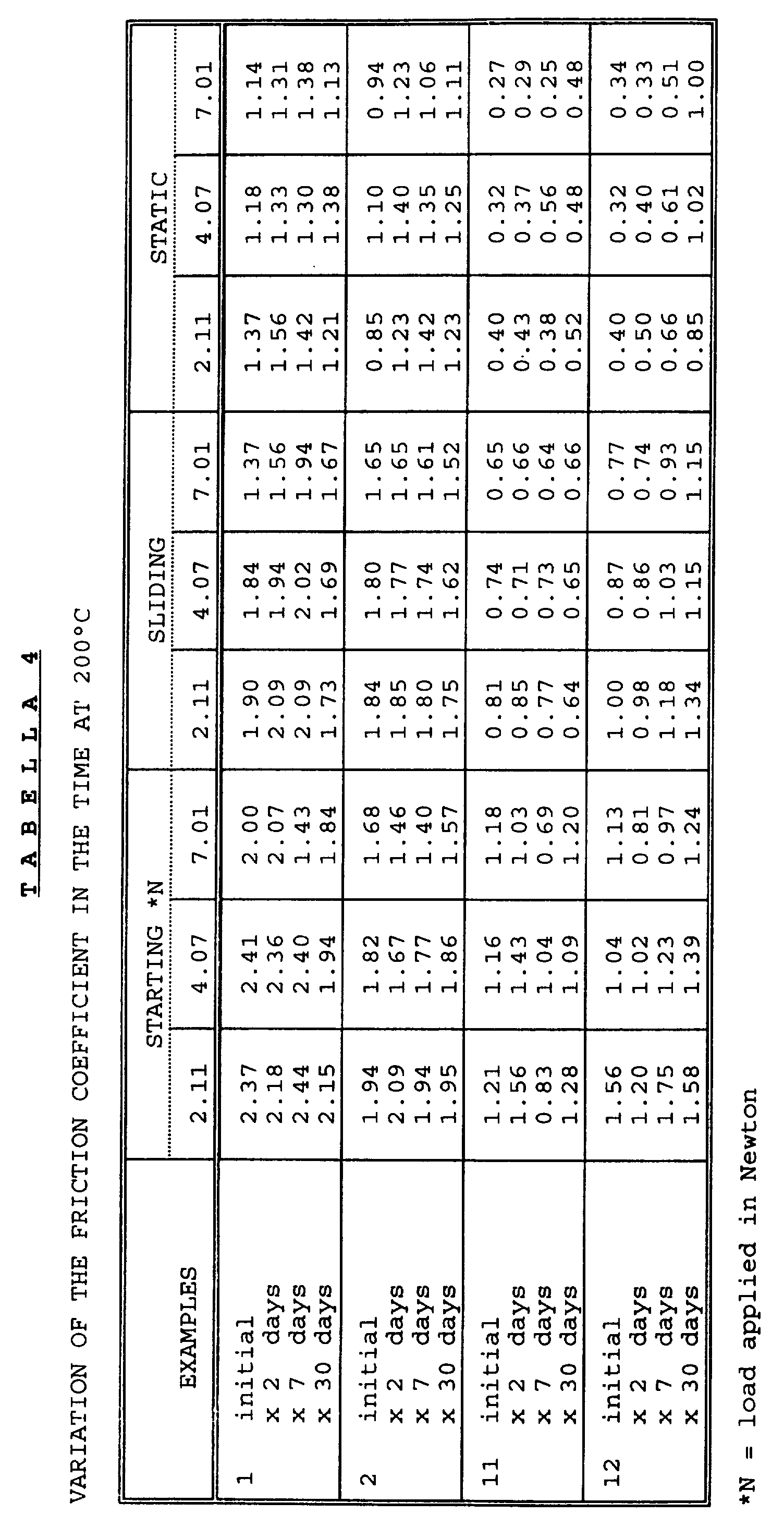
Claims (14)
- Use of additives of the mono- and/or di-hydroxypolyfluoroethers classes comprising the fluoropolyoxy-alkylene repeating units selected from the following:
(C3F6O); (CFXO) wherein X = F, CF3;
(CH2CF2CF2O); (CF2(CF2)2CF2O) wherein z is an integer equal to 1 or 2; (C2F4O),
in curable compositions of fluoroelastomers to improve the friction coefficient without lowering the adhesion with bonding agents to metal reinforcements. - Use of additives of the mono- and/or di-hydroxypolyfluoroethers classes according to claim 1 wherein the mono hyroxypolyfluoroethers class comprises fluoropolyethers having number average molecular weight from 500 to 5,000, wherein the repeating units statistically distributed along the chain are selected from the following:the dihydroxypolyfluoroethers class comprises fluoropolyethers having number average molecular weight from 800 to 10,000, wherein the repeating units statistically distributed along the chain are selected from the following:1) (C3F6O) (CFXO);2) (C3F6O);3) (CH2CF2CF2O);4) (C2F4O), (CF2O);5) (C3F6O), (C2F4O), (CFXO);6) (CH2-CF2-CF2-O), said units being linked among each other inside the fluoropolyoxyalkylene chain as follows:7) (CF(CF3)CF2O)
said units being linked among each other inside the fluoropolyoxyalkylene chain as follows: - Use of additives of the mono- and/or di-hydroxypolyfluoroethers classes according to claim 2 wherein the mono hydroxypolyfluoroethers class has molecular weight comprised from 600 to 3,000; the di-hydroxypolyfluoroethers class has molecular weight from 2,000 to 4,000.
- Use of additives of the mono- and/or di-hydroxypolyfluoroethers classes according to claims 2-3 wherein monohydroxypolyfluoroethers of class 1) are chosen from those comprised in the following general formula:
wherein D and E are equal to or different from each other and selected from H, CH3 and CF3, C is a carbon atom, X = F or CF3; m' and n' are positive integers such that the m'/n' ratio ranges from 5 to 40 and m'and n' are such as to give the molecular weight indicated above;
monohydroxypolyfluoroethers of class 2) are chosen from those comprised in the following general formula:
monohydroxypolyfluoroethers of class 3) are chosen from those comprised in the following general formula:
those of class 4) are chosen from the ones comprised in the following general formula:
those of class 5) are chosen from the compounds representable with the following general formula:
those of class 6) are chosen from the compounds having the general formula:
those of class 7) are chosen from the compounds having the general formula: - Use of additives of the mono- and/or di-hydroxypolyfluoroethers classes according to claims 2-3, wherein fluoroelastomers are capable of giving unsaturations subject to nucleophilic attack.
- Use of additives of the mono- and/or di-hydroxypolyfluoroethers classes according to claims 2-3, wherein fluoroelastomes are based on vinylidene fluoride copolymers.
- Use of additives of the mono- and/or di-hydroxypolyfluoroethers classes according to claim 6, wherein fluoroelastomers are cured by ionic and/or radical way.
- Use of additives of the mono- and/or di-hydroxypolyfluoroethers classes according to claims 5-7, wherein fluoroelastomers are copolymers of vinylidene fluoride with at least another monomer, totally or partially fluorinated, comprising an ethylene unsaturation.
- Use of additives of the mono- and/or di-hydroxypolyfluoroethers classes according to claim 8, wherein the comonomers are hexafluoropropene, tetrafluoroethylene, chorotrifluoroethylene, l-hydropentafluoropropene, 2-hydropentafluoropropene, perfluoroalkylvinylethers wherein alkyl has a number of C atoms from 1 to 3.
- Use of additives of the mono- and/or di-hydroxypolyfluoroethers classes according to claim 9, wherein the fluoroelastomers are copolymers of vinylidene fluoride with hexafluoropropene, containing or not tetrafluoroethylene.
- Use of additives of the mono- and/or di-hydroxypolyfluoroethers classes according to claims 9-10, wherein the amount of perfluoroalkylvinylether and/or perfluoropropene is comprised from 0.5 to 30% by moles on the total of copolymer, TFE ranges from 0 to 60% by moles, VdF generally ranges from 10-80% by moles.
- Use of additives of the mono- and/or di-hydroxypolyfluoroethers classes according to claim 11, wherein the vinylidene fluoride is comprised from 40% to 85% by moles, perfluoropropene from 15% to 30% by moles, and the tetrafluoroethylene from 0 to 30% by moles.
- Use of additives of the mono- and/or di-hydroxypolyfluoroethers classes according to claims 1-12, wherein the amount of mono- and/or dihydroxypolyfluoroether ranges from 0.5 to 4 parts by weight per 100 parts by weight of fluoroelastomer.
- Use of additives of the mono- and/or di-hydroxypolyfluoroethers classes according to claims 13, wherein the amount of mono- and/or dihydroxypolyfluoroether ranges between 1 and 2.
Applications Claiming Priority (2)
| Application Number | Priority Date | Filing Date | Title |
|---|---|---|---|
| IT96MI000850A IT1282390B1 (en) | 1996-05-02 | 1996-05-02 | VULCANIZABLE COMPOSITIONS OF FLUOROELASTOMERS |
| ITMI960850 | 1996-05-02 |
Publications (2)
| Publication Number | Publication Date |
|---|---|
| EP0805180A1 EP0805180A1 (en) | 1997-11-05 |
| EP0805180B1 true EP0805180B1 (en) | 1999-09-29 |
Family
ID=11374171
Family Applications (1)
| Application Number | Title | Priority Date | Filing Date |
|---|---|---|---|
| EP97106794A Expired - Lifetime EP0805180B1 (en) | 1996-05-02 | 1997-04-24 | Curable compositions of fluoroelastomers |
Country Status (9)
| Country | Link |
|---|---|
| US (1) | US6005054A (en) |
| EP (1) | EP0805180B1 (en) |
| JP (1) | JP3966575B2 (en) |
| KR (1) | KR100454411B1 (en) |
| AT (1) | ATE185159T1 (en) |
| CA (1) | CA2203980C (en) |
| DE (1) | DE69700560T2 (en) |
| IT (1) | IT1282390B1 (en) |
| MX (1) | MX9703251A (en) |
Families Citing this family (8)
| Publication number | Priority date | Publication date | Assignee | Title |
|---|---|---|---|---|
| IT1306200B1 (en) | 1999-01-14 | 2001-05-30 | Ausimont Spa | VULCANIZABLE COMPOSITIONS OF FLUOROELASTOMERS. |
| ITMI20020598A1 (en) * | 2002-03-22 | 2003-09-22 | Ausimont Spa | VULCANIZABLE FLUOROELASTOMERS |
| JP4182338B2 (en) * | 2003-03-06 | 2008-11-19 | 信越化学工業株式会社 | Thermosetting perfluoropolyether rubber composition and rubber product |
| US20040236028A1 (en) * | 2003-05-21 | 2004-11-25 | Ming-Hong Hung | Fluoroelastomer composition having excellent low temperature properties |
| JP5061905B2 (en) * | 2005-11-16 | 2012-10-31 | Nok株式会社 | Fluororubber composition and method for producing crosslinked fluororubber |
| US9416234B2 (en) * | 2008-09-09 | 2016-08-16 | Daikin Industries, Ltd. | Method for producing fluorine-containing rubber molded article |
| US20220002505A1 (en) | 2018-10-31 | 2022-01-06 | Solvay Specialty Polymers Italy S.P.A. | Curable composition of elastomers |
| WO2021099336A1 (en) | 2019-11-22 | 2021-05-27 | Solvay Specialty Polymers Italy S.P.A. | Method for improving coefficient of friction in cured fluororubber parts |
Family Cites Families (7)
| Publication number | Priority date | Publication date | Assignee | Title |
|---|---|---|---|---|
| DE2123110A1 (en) * | 1970-05-20 | 1971-12-02 | Du Pont | Vulcanizable mixture of fluorine-substituted elastomers |
| JPS5838707A (en) * | 1981-08-20 | 1983-03-07 | イ−・アイ・デユポン・デ・ニモアス・アンド・カンパニ− | Amorphous copolymer of perfluoro-2,2-dimethyl- 1,3-dioxol |
| DE3486428T2 (en) * | 1983-12-26 | 1996-10-10 | Daikin Ind Ltd | Halogen containing polyether |
| US4647413A (en) * | 1983-12-27 | 1987-03-03 | Minnesota Mining And Manufacturing Company | Perfluoropolyether oligomers and polymers |
| IT1209669B (en) * | 1985-11-15 | 1989-08-30 | Ausimont Spa | FLUOROELASTOMER VULCANIZABLE COMPOSITIONS HAVING IMPROVED PROCESSABILITY AND CHEMICAL STABILITY CHARACTERISTICS. |
| IT1188202B (en) * | 1985-11-15 | 1988-01-07 | Ausimont Spa | VULCANIZABLE ELASTOMERIC COMPOSITIONS OF FLUOROELASTOMERS |
| WO1992012199A1 (en) * | 1991-01-11 | 1992-07-23 | Minnesota Mining And Manufacturing Company | Curing fluorocarbon elastomers |
-
1996
- 1996-05-02 IT IT96MI000850A patent/IT1282390B1/en active IP Right Grant
-
1997
- 1997-04-24 DE DE69700560T patent/DE69700560T2/en not_active Expired - Lifetime
- 1997-04-24 AT AT97106794T patent/ATE185159T1/en not_active IP Right Cessation
- 1997-04-24 EP EP97106794A patent/EP0805180B1/en not_active Expired - Lifetime
- 1997-04-29 US US08/848,660 patent/US6005054A/en not_active Expired - Lifetime
- 1997-04-29 CA CA002203980A patent/CA2203980C/en not_active Expired - Fee Related
- 1997-04-30 MX MX9703251A patent/MX9703251A/en not_active Application Discontinuation
- 1997-05-01 JP JP11393197A patent/JP3966575B2/en not_active Expired - Fee Related
- 1997-05-02 KR KR1019970017129A patent/KR100454411B1/en not_active Expired - Fee Related
Also Published As
| Publication number | Publication date |
|---|---|
| JPH1072542A (en) | 1998-03-17 |
| CA2203980A1 (en) | 1997-11-02 |
| DE69700560T2 (en) | 2000-02-17 |
| MX9703251A (en) | 1998-04-30 |
| KR100454411B1 (en) | 2005-02-23 |
| DE69700560D1 (en) | 1999-11-04 |
| JP3966575B2 (en) | 2007-08-29 |
| CA2203980C (en) | 2009-12-01 |
| IT1282390B1 (en) | 1998-03-20 |
| US6005054A (en) | 1999-12-21 |
| EP0805180A1 (en) | 1997-11-05 |
| ITMI960850A0 (en) | 1996-05-02 |
| KR970074844A (en) | 1997-12-10 |
| ITMI960850A1 (en) | 1997-11-02 |
| ATE185159T1 (en) | 1999-10-15 |
Similar Documents
| Publication | Publication Date | Title |
|---|---|---|
| US5384374A (en) | Curing fluorocarbon elastomers | |
| US5266650A (en) | Curing fluorocarbon elastomers | |
| EP0684277B1 (en) | Curable fluoroelastomeric compositions | |
| US5268405A (en) | Low temperature perfluoroelastomers | |
| EP0222408B1 (en) | Vulcanizable compositions of fluoroelastomers exhibiting improved processability and chemical stability | |
| US7381774B2 (en) | Perfluoroelastomer compositions for low temperature applications | |
| JP5841141B2 (en) | Fluoroelastomer composition | |
| EP0842980B1 (en) | Fluorocarbon elastomer composition | |
| US4810760A (en) | Vulcanizable elastomeric compositions of fluoroelastomers | |
| EP3571235A1 (en) | Fluorinated block copolymers derived from nitrile cure-site monomers | |
| US6005054A (en) | Curable composition of fluoroelastomers | |
| MXPA97003251A (en) | Curable compositions of fluoroelastome | |
| EP0879851B1 (en) | Curable fluoroelastomeric compositions | |
| CA2096673C (en) | Fluoroelastomeric and fluoroplastomeric copolymers having a high resistance to bases | |
| US6448319B1 (en) | Curable fluoroelastomer compositions | |
| EP0831105B1 (en) | Low molecular weight vinylidene fluoride copolymers curable at room temperature | |
| JPS6392664A (en) | Curable composition based on fluoroelastomer and vulcanizable by peroxide |
Legal Events
| Date | Code | Title | Description |
|---|---|---|---|
| PUAI | Public reference made under article 153(3) epc to a published international application that has entered the european phase |
Free format text: ORIGINAL CODE: 0009012 |
|
| AK | Designated contracting states |
Kind code of ref document: A1 Designated state(s): AT BE CH DE DK ES FR GB IE IT LI NL SE |
|
| 17P | Request for examination filed |
Effective date: 19980403 |
|
| GRAG | Despatch of communication of intention to grant |
Free format text: ORIGINAL CODE: EPIDOS AGRA |
|
| 17Q | First examination report despatched |
Effective date: 19990204 |
|
| GRAG | Despatch of communication of intention to grant |
Free format text: ORIGINAL CODE: EPIDOS AGRA |
|
| GRAH | Despatch of communication of intention to grant a patent |
Free format text: ORIGINAL CODE: EPIDOS IGRA |
|
| GRAH | Despatch of communication of intention to grant a patent |
Free format text: ORIGINAL CODE: EPIDOS IGRA |
|
| GRAA | (expected) grant |
Free format text: ORIGINAL CODE: 0009210 |
|
| ITF | It: translation for a ep patent filed | ||
| AK | Designated contracting states |
Kind code of ref document: B1 Designated state(s): AT BE CH DE DK ES FR GB IE IT LI NL SE |
|
| PG25 | Lapsed in a contracting state [announced via postgrant information from national office to epo] |
Ref country code: SE Free format text: THE PATENT HAS BEEN ANNULLED BY A DECISION OF A NATIONAL AUTHORITY Effective date: 19990929 Ref country code: LI Free format text: LAPSE BECAUSE OF FAILURE TO SUBMIT A TRANSLATION OF THE DESCRIPTION OR TO PAY THE FEE WITHIN THE PRESCRIBED TIME-LIMIT Effective date: 19990929 Ref country code: ES Free format text: THE PATENT HAS BEEN ANNULLED BY A DECISION OF A NATIONAL AUTHORITY Effective date: 19990929 Ref country code: CH Free format text: LAPSE BECAUSE OF FAILURE TO SUBMIT A TRANSLATION OF THE DESCRIPTION OR TO PAY THE FEE WITHIN THE PRESCRIBED TIME-LIMIT Effective date: 19990929 Ref country code: AT Free format text: LAPSE BECAUSE OF FAILURE TO SUBMIT A TRANSLATION OF THE DESCRIPTION OR TO PAY THE FEE WITHIN THE PRESCRIBED TIME-LIMIT Effective date: 19990929 |
|
| REF | Corresponds to: |
Ref document number: 185159 Country of ref document: AT Date of ref document: 19991015 Kind code of ref document: T |
|
| REG | Reference to a national code |
Ref country code: CH Ref legal event code: EP |
|
| ET | Fr: translation filed | ||
| REF | Corresponds to: |
Ref document number: 69700560 Country of ref document: DE Date of ref document: 19991104 |
|
| REG | Reference to a national code |
Ref country code: IE Ref legal event code: FG4D |
|
| PG25 | Lapsed in a contracting state [announced via postgrant information from national office to epo] |
Ref country code: DK Free format text: LAPSE BECAUSE OF FAILURE TO SUBMIT A TRANSLATION OF THE DESCRIPTION OR TO PAY THE FEE WITHIN THE PRESCRIBED TIME-LIMIT Effective date: 19991229 |
|
| REG | Reference to a national code |
Ref country code: CH Ref legal event code: PL |
|
| PG25 | Lapsed in a contracting state [announced via postgrant information from national office to epo] |
Ref country code: IE Free format text: LAPSE BECAUSE OF NON-PAYMENT OF DUE FEES Effective date: 20000424 |
|
| PLBE | No opposition filed within time limit |
Free format text: ORIGINAL CODE: 0009261 |
|
| STAA | Information on the status of an ep patent application or granted ep patent |
Free format text: STATUS: NO OPPOSITION FILED WITHIN TIME LIMIT |
|
| 26N | No opposition filed | ||
| REG | Reference to a national code |
Ref country code: IE Ref legal event code: MM4A |
|
| REG | Reference to a national code |
Ref country code: GB Ref legal event code: IF02 |
|
| PGFP | Annual fee paid to national office [announced via postgrant information from national office to epo] |
Ref country code: IT Payment date: 20120320 Year of fee payment: 16 |
|
| PGFP | Annual fee paid to national office [announced via postgrant information from national office to epo] |
Ref country code: GB Payment date: 20130424 Year of fee payment: 17 Ref country code: DE Payment date: 20130508 Year of fee payment: 17 Ref country code: BE Payment date: 20130415 Year of fee payment: 17 |
|
| PGFP | Annual fee paid to national office [announced via postgrant information from national office to epo] |
Ref country code: FR Payment date: 20130625 Year of fee payment: 17 Ref country code: NL Payment date: 20130416 Year of fee payment: 17 |
|
| REG | Reference to a national code |
Ref country code: DE Ref legal event code: R119 Ref document number: 69700560 Country of ref document: DE |
|
| REG | Reference to a national code |
Ref country code: NL Ref legal event code: V1 Effective date: 20141101 |
|
| GBPC | Gb: european patent ceased through non-payment of renewal fee |
Effective date: 20140424 |
|
| REG | Reference to a national code |
Ref country code: FR Ref legal event code: ST Effective date: 20141231 |
|
| REG | Reference to a national code |
Ref country code: DE Ref legal event code: R119 Ref document number: 69700560 Country of ref document: DE Effective date: 20141101 |
|
| PG25 | Lapsed in a contracting state [announced via postgrant information from national office to epo] |
Ref country code: DE Free format text: LAPSE BECAUSE OF NON-PAYMENT OF DUE FEES Effective date: 20141101 Ref country code: GB Free format text: LAPSE BECAUSE OF NON-PAYMENT OF DUE FEES Effective date: 20140424 |
|
| PG25 | Lapsed in a contracting state [announced via postgrant information from national office to epo] |
Ref country code: FR Free format text: LAPSE BECAUSE OF NON-PAYMENT OF DUE FEES Effective date: 20140430 Ref country code: NL Free format text: LAPSE BECAUSE OF NON-PAYMENT OF DUE FEES Effective date: 20141101 |
|
| PG25 | Lapsed in a contracting state [announced via postgrant information from national office to epo] |
Ref country code: IT Free format text: LAPSE BECAUSE OF NON-PAYMENT OF DUE FEES Effective date: 20140424 |
|
| PG25 | Lapsed in a contracting state [announced via postgrant information from national office to epo] |
Ref country code: BE Free format text: LAPSE BECAUSE OF NON-PAYMENT OF DUE FEES Effective date: 20140430 |