EP0804046B1 - Method and apparatus for updating the software of a mobile terminal using the air interface - Google Patents
Method and apparatus for updating the software of a mobile terminal using the air interface Download PDFInfo
- Publication number
- EP0804046B1 EP0804046B1 EP97302830A EP97302830A EP0804046B1 EP 0804046 B1 EP0804046 B1 EP 0804046B1 EP 97302830 A EP97302830 A EP 97302830A EP 97302830 A EP97302830 A EP 97302830A EP 0804046 B1 EP0804046 B1 EP 0804046B1
- Authority
- EP
- European Patent Office
- Prior art keywords
- computer program
- terminal
- program
- memory
- receiving
- Prior art date
- Legal status (The legal status is an assumption and is not a legal conclusion. Google has not performed a legal analysis and makes no representation as to the accuracy of the status listed.)
- Expired - Lifetime
Links
- 238000000034 method Methods 0.000 title claims description 28
- 230000015654 memory Effects 0.000 claims description 103
- 238000004590 computer program Methods 0.000 claims description 73
- 238000004891 communication Methods 0.000 claims description 34
- 230000004044 response Effects 0.000 claims description 12
- 230000002457 bidirectional effect Effects 0.000 claims description 6
- 239000000872 buffer Substances 0.000 description 7
- 230000001413 cellular effect Effects 0.000 description 7
- 230000005540 biological transmission Effects 0.000 description 4
- 230000006870 function Effects 0.000 description 4
- 230000008901 benefit Effects 0.000 description 3
- 230000011664 signaling Effects 0.000 description 3
- 238000010586 diagram Methods 0.000 description 2
- IRLPACMLTUPBCL-KQYNXXCUSA-N 5'-adenylyl sulfate Chemical compound C1=NC=2C(N)=NC=NC=2N1[C@@H]1O[C@H](COP(O)(=O)OS(O)(=O)=O)[C@@H](O)[C@H]1O IRLPACMLTUPBCL-KQYNXXCUSA-N 0.000 description 1
- 230000010267 cellular communication Effects 0.000 description 1
- 238000010276 construction Methods 0.000 description 1
- 125000004122 cyclic group Chemical group 0.000 description 1
- 238000013144 data compression Methods 0.000 description 1
- 230000006837 decompression Effects 0.000 description 1
- 230000002950 deficient Effects 0.000 description 1
- 238000011065 in-situ storage Methods 0.000 description 1
- 238000012986 modification Methods 0.000 description 1
- 230000004048 modification Effects 0.000 description 1
- 230000000717 retained effect Effects 0.000 description 1
- 238000003860 storage Methods 0.000 description 1
- 208000011580 syndromic disease Diseases 0.000 description 1
Images


Classifications
-
- H—ELECTRICITY
- H04—ELECTRIC COMMUNICATION TECHNIQUE
- H04W—WIRELESS COMMUNICATION NETWORKS
- H04W8/00—Network data management
- H04W8/22—Processing or transfer of terminal data, e.g. status or physical capabilities
- H04W8/24—Transfer of terminal data
- H04W8/245—Transfer of terminal data from a network towards a terminal
-
- H—ELECTRICITY
- H04—ELECTRIC COMMUNICATION TECHNIQUE
- H04M—TELEPHONIC COMMUNICATION
- H04M1/00—Substation equipment, e.g. for use by subscribers
- H04M1/72—Mobile telephones; Cordless telephones, i.e. devices for establishing wireless links to base stations without route selection
- H04M1/724—User interfaces specially adapted for cordless or mobile telephones
- H04M1/72403—User interfaces specially adapted for cordless or mobile telephones with means for local support of applications that increase the functionality
- H04M1/72406—User interfaces specially adapted for cordless or mobile telephones with means for local support of applications that increase the functionality by software upgrading or downloading
Definitions
- This invention relates generally to radiotelephones and, in particular, to mobile terminals such as those capable of operation with a cellular network.
- a selective call receiver includes a processor and a memory.
- the processor receives upgrade data and upgrade installation software, upgrades the modem's application software using the upgrade data, and then deletes the upgrade installation software and upgrade data.
- the ability to update the software of a mobile terminal using the air interface is a significant advantage to both network subscribers and network providers, as the update can be accomplished without requiring the subscriber to return the terminal to a dealer or service center.
- Using the air interface to upgrade the terminal's software enables the service provider to download new and enhanced value-added features to requesting mobile terminals, and/or to update all subscriber terminals to take advantage of revisions to the applicable air interface standard.
- An air interface standard can be considered to be a set of rules or protocols which must be followed to successfully operate the mobile terminal in a given network over the air (i.e., wireless radio) interface.
- the standard known as IS-136.1 is one such air interface standard.
- a terminal comprises a microprocessor and two or more RAMs to store respective operating software.
- the terminal includes a selection device to select one of the RAMs for downloading thereto new software and to select one of the RAMs to provide a program for execution by the microprocessor.
- US-A-5046082 describes a system for allowing remote access to cellular telephone programming through a PSTN.
- the present invention seeks to provide an improved method of operating a wireless user terminal
- a method for operating a wireless user terminal having a transceiver for conducting bidirectional RF communications with a communications network comprising the steps of operating the terminal with a first computer program that is stored in a first memory, the step of operating including a step of receiving a second computer program from the communications network and storing the received second computer program into a second memory, and after the second computer program is stored in the second memory, operating the terminal with the second computer program, wherein the step of receiving the second computer program includes temporarily terminating receipt of the second computer program in the event an operator of the terminal requires the use of the transceiver and resuming receipt of the second computer program at a point where receipt of the second computer program was terminated.
- the step of receiving preferably receives the second computer program as a plurality of code blocks.
- a communications system comprising a communications network and a plurality of wireless user terminals each comprising a transceiver for conducting bidirectional RF communications with the communications network and a data processor for executing a stored program for controlling the operation of the terminal
- a method for operating the system comprising the steps of operating each of the plurality of terminals with a first computer program that is stored in a first memory, transmitting a second computer program from the communications network to at least one of the plurality of terminals, and in at least one of the plurality of terminals, receiving the second computer program from the communications network and storing the received second computer program into a second memory
- receiving the step of second computer program from the communications network includes temporarily terminating receipt of the second computer program in the event an operator of the mobile terminal requires the use of the transceiver and resuming receipt of the second computer program at a point where receipt of the second computer program was terminated.
- the terminal may be configured to be capable of downloading a computer program while making or receiving a call and the method may further comprise placing the terminal into a given program download mode such that the terminal is inhibited from receiving and making calls while receiving the second computer program and terminating the given program download mode so as to permit the operator of the terminal to make a call.
- the step of transmitting simultaneously preferably transmits the second computer program to at least two of the plurality of terminals.
- the step of transmitting may be accomplished in response to a call made by a terminal to the communications network.
- the step of transmitting may be accomplished in response to a call made by the communications network to a terminal.
- the step of storing may include a step of changing a value of a flag for indicating which of the first and second memories is a currently Active memory that stores the received second computer program.
- the method may further comprise the steps of receiving a command from the communications network to activate the stored second computer program, in response to the command, setting a flag to indicate that the stored second computer program is a currently active computer program, and operating the terminal with the stored second computer program.
- the method may further comprise the steps of receiving a second command from the communications network to deactivate the stored second computer program and to reactivate the first stored computer program, in response to the command, setting a flag to indicate that the stored first computer program is a currently active computer program, and operating the terminal with the stored first computer program.
- the method may further comprise the step of terminating the step of transmitting in response to a user originating a call from the terminal.
- the step of transmitting may be terminated in response to the user originating a call to a predetermined telephone number.
- a wireless user terminal comprising a transceiver for conducting bidirectional RF communications with a communications network and a data processor for controlling the operation of the terminal, the terminal further comprising a first memory capable of storing a data processor program, a second memory capable of storing a data processor program, means for storing a flag for indicating which of the first and second memories is a currently Active memory that stores a currently active data processor program and which of the first and second memories is a currently Idle memory; and means for receiving another data processor program from the communications network and for storing the received another data processor program into the Idle memory, while the data processor executes the data processor program stored in the Active memory, wherein the receiving means including means for temporarily terminating receipt of the other computer program in the event an operator of the terminal requires use of the transceiver and resuming receipt of the second computer program at a point where the receipt of the second computer program was terminated.
- the terminal may be configured to be capable of downloading a computer program while making or receiving a call and may further comprise means for placing the terminal into a given program download mode such that the terminal is inhibited from receiving and making calls while receiving the second computer program and means for terminating the given program download mode so as to permit the operator of the terminal to make a call.
- a wireless user or mobile terminal 10 such as but not limited to a cellular radiotelephone or a personal communicator, that is suitable for practicing this invention.
- the mobile terminal 10 includes an antenna 12 for transmitting signals to and for receiving signals from a base site or base station 30.
- the base station 30 is a part of a cellular network comprising the BMI 32 that includes a Mobile Switching Center (MSC) 34.
- the MSC 34 provides a connection to landline trunks when the mobile terminal 10 is registered with the network.
- the mobile terminal includes a modulator (MOD) 14A, a transmitter 14, a receiver 16, a demodulator (DEMOD) 16A, and a controller 18 that provides signals to and receives signals from the transmitter 14 and receiver 16, respectively.
- These signals include signalling information in accordance with the air interface standard of the applicable cellular system, and also user speech and/or user generated data.
- a user interface includes a conventional earphone or speaker 17, a conventional microphone 19, a display 20, and a user input device, typically a keypad 22, all of which are coupled to the controller 18.
- the keypad 22 includes the conventional numeric (0-9) and related keys (#,*) 22a, and other keys 22b used for operating the mobile terminal 10. These other keys 22b may include, by example, a SEND key, various menu scrolling and soft keys, and a PWR key.
- the mobile terminal 10 also includes various memories, shown collectively as the memory 24, wherein are stored a plurality of constants and variables that are used by the controller 18 during the operation of the mobile terminal.
- the memory 24 stores the values of various cellular system parameters and the number assignment module (NAM).
- NAM number assignment module
- An operating program for controlling the operation of controller 18 is also stored in the memory 24 (typically in a ROM device).
- the memory 24 may also store data, including user messages, that is received from the BMI 32 prior to the display of the messages to the user.
- the construction of the memory 24, and its interface to the controller 18, is described in greater detail below with reference to Fig. 3.
- the mobile terminal 10 also includes a battery 26 for powering the various circuits that are required to operate the terminal.
- the mobile terminal 10 can be a vehicle mounted or a handheld device. It should further be appreciated that the mobile terminal 10 can be capable of operating with one or more air interface standards, modulation types, and access types. By example, the mobile terminal may be capable of operating with any of a number of air interface standards, including but not limited to IS-136, GSM, EIA/TIA 627, IS-91 and IS-95 (CDMA). Narrow-band AMPS (NAMPS), as well as TACS, mobile terminals may also benefit from the teaching of this invention. It should thus be clear that the teaching of this invention is not to be construed to be limited to any one particular type of mobile terminal or air interface standard.
- the operating program in the memory 24 may include routines to present messages and message-related functions to the user on the display 20, typically as various menu items.
- the memory 24 also includes routines for implementing the method described below in relation to Fig. 3.
- the controller 18 is shown to be comprised of a digital signal processor (DSP) 18a and a microprocessor control unit (MCU) 18b.
- the DSP 18a is connected to the output of the receiver 16 and functions to demodulate received transmissions, decode any encoded voice or other transmissions, and to generally perform high speed signal processing of the received transmissions.
- the MCU 18b is connected to the DSP 18a, and operates on the decoded information to generally control the operation of the terminal 10 to place and receive calls, to operate the keypad 22 and the display 20, to monitor the charge state of the battery 26, and other required functions.
- the software routines executed by the MCU 18b to operate the mobile terminal 10 are referred to herein as its operating program.
- a typical size of the operating program for a modern mobile terminal, such as a cellular telephone, is several hundred kilobytes.
- the memory 24 is shown to include a non-volatile memory (NVM) 24a, such as an EEPROM, in which is stored the terminal's NAM(s), status flags, and other information that is required to be maintained when the terminal is powered down.
- NAM non-volatile memory
- the memory 24 also includes a first memory (MEM1) 24b and a second memory (MEM2) 24c, both of which are addressable though an address bus sourced by the MCU 18b.
- the memories 24b and 24c are provided to store the operating program for the MCU 18b.
- the memories 24b and 24c may be conventional Flash-type memories that can be programmed in-situ, typically by providing an appropriate programming voltage that is derived either from the terminal's normal power supply or from an external power adapter/recharger.
- the memories 24b and 24c can be, by example, one Flash memory chip that is divided into two memory banks (each of which is considered as a separate memory for the purposes of this invention), or can be two separate Flash memories chips.
- one of the memories is at any given time designated as the Active memory, while the other is designated as the Idle memory.
- the MCU 18b executes program instructions out of the Active memory. Further in accordance with this invention the MCU 18b is enabled to load a received operating program into the currently Idle memory while continuing to operate the mobile terminal 10 from the Active memory.
- an operating program is preferably stored into one or the other of the memories 24b or 24c.
- the NVM 24a stores an Active Memory (ACT_MEM) flag for specifying which of the memories 24b or 24c is the currently Active memory.
- the Active Memory flag can be a single bit.
- the state of the Active Memory flag can be considered as a memory select (MEM_SEL) signal used for enabling one of the memories 24b or 24c for being read by the MCU 18b, while enabling the MCU 18b to store an operating program into the other memory.
- MEM_SEL memory select
- This function is indicated schematically by the buffers 19a-19d (active high) which couple the memories 24b and 24c to the MCU data bus.
- the buffer 19a When the Active Memory flag is zero then the buffer 19a is enabled for reading out of MEM1 24b, the buffer 19d is enabled for writing into MEM2 24c, and the buffers 19b and 19c are disabled. Conversely, when the Active Memory flag is a one buffers 19a and 19d are disabled, buffer 19c is enabled for reading out of MEM2 24c, and buffer 19b is enabled for writing into MEM1 24b.
- the Idle memory when not being loaded, may be powered down to conserve battery power.
- the MEM1 24b stores a currently valid operating program for the MCU 18b, and that the Active Memory flag is set to zero.
- the mobile terminal 10 receives a message from the BMI 32 that a download of a new or revised operating program is to occur.
- the BMI 32 begins transmitting the new or revised operating program to the mobile terminal 10 as a plurality of code blocks.
- the code blocks can be sent using Short Message Service (SMS) messages, or can be sent over a data channel, or can be sent using System Operator Code (SOC) signalling, all of which are specified for use in the standard referred to as IS-136.
- SMS Short Message Service
- SOC System Operator Code
- Each code block is comprised of a plurality of machine-readable instructions, data, and the like that are required by the microprocessor which implements the MCU 18b to execute the mobile terminal operating program.
- Each code block also preferably includes some type of data integrity portion, such as cyclic redundancy check (CRC) syndrome bits and/or parity bits.
- CRC cyclic redundancy check
- the correct receipt of each code block may be required to be acknowledged (ACKed) by the MCU 18b before the next code block is transmitted by the BMI 32, or the MCU 18b may send a negative acknowledgement (NAK) only when an erroneous and uncorrectable code block is received.
- the received code blocks are passed through the DSP 18a to the MCU 18b, which stores the received code blocks into the MEM2 24c.
- the MCU 18b changes the Active Memory flag in the NVM 24a to a one, thereby designating MEM2 24c as the Active memory and MEM1 24b as the Idle memory.
- the MCU 18b then resets itself to an initial state and begins executing code from the memory 24c.
- the previous program in the now-idle MEM1 24b can be erased by the MCU 18b, or it can be left intact until the next program download occurs, at which time it can be erased or simply written over.
- the mobile terminal 10 could be instructed by the BMI 32 to revert to the previous program for operation. This would be accomplished by simply changing the state of (i.e., toggling) the Active Memory flag.
- download control program itself in, by example, the NVM 24a, or to include it as part of the currently active program. That is, a download control program module of the currently active program is used to download the new program version into the Idle memory.
- the downloaded program may be compressed prior to transmission by the BMI 32, and then decompressed by the mobile terminal 10 prior to storage into the currently Idle memory 24b or 24c.
- a number of suitable data compression and decompression techniques are well known in the art.
- the mobile terminal 10 can remain registered with the network, can continue to make and receive calls, can send and receive messages, and can otherwise operate in a normal fashion. That is, the code blocks may be sent to the mobile terminal 10 over an extended period of time, during which the mobile terminal 10 continues to operate out of the currently Active memory 24b or 24c. It is within the scope of this invention, when operating in this mode, that the code blocks may be transmitted to the mobile terminal 10 even during an ongoing voice call as a background task. For example, code blocks may be sent on a digital speech channel during pauses in a conversation. Of course, the proper
- the mobile terminal 10 In order to download the new or revised operating program in a rapid fashion, it is also within the scope of this invention to place the mobile terminal 10 into a dedicated program download mode of operation, wherein the code blocks are continuously sent by the BMI 32 and received by the mobile terminal 10.
- the dedicated download mode can be terminated automatically if the user makes a call to an emergency service number. It may also be desirable to enable the user to terminate the dedicated download mode of operation so as to make a call, and to then reenter the dedicated download mode at the termination of the call.
- the BMI 32 would begin by sending the next code block in the sequence of code blocks, at the point where the download operation was interrupted.
- the mobile terminal 10 continues to operate out the memory 24b or 24c that stores the currently active program until the BMI 32 indicates that the program download operation is completed.
- the mobile terminal 10 is enabled to toggle the Active Memory flag, and to subsequently begin operating with the most-recently downloaded program. It should be noted that the mobile terminal 10 need not immediately begin operating with the new program. By example, a particular service provider may download a new operating program to several thousand mobile terminals over a period of days or weeks, and then later send a message to all of the mobile terminals to instruct them to begin using the new program.
- the new or revised program download operation can be initiated by a call placed from the mobile terminal 10 to the service provider, or vice versa.
- the program download can be accomplished in a point-to-point mode, that is, to one specific mobile terminal, or in a broadcast mode wherein a plurality of mobile terminals simultaneously receive the downloaded program.
- a given operating program will typically be specific to a particular type of mobile terminal (e.g., manufacturer, model number, version, etc.), and will be written so as to be compatible with the particular microprocessor that implements the MCU 18b, the particular hardware and software architecture of the terminal, etc.
- the BMI 32 may be required to download a plurality of different versions of the new program, with each particular version being transmitted to a particular class or type of mobile terminal.
- each of the memories 24b and 24c may be comprised of a plurality of memory chips, depending on the capacity of available memory chips and the size of the operating program.
Landscapes
- Engineering & Computer Science (AREA)
- Computer Networks & Wireless Communication (AREA)
- Signal Processing (AREA)
- Databases & Information Systems (AREA)
- Human Computer Interaction (AREA)
- Mobile Radio Communication Systems (AREA)
- Transceivers (AREA)
Description
- This invention relates generally to radiotelephones and, in particular, to mobile terminals such as those capable of operation with a cellular network.
- It is known in the prior art to download information into a wireless telephone subscriber set or radio modem through the air interface from a central site, as evidenced by U.S. Patent No. 5,297,191, "Method and Apparatus for Remotely Programming a Wireless Telephone Set" by I. Gerszberg, and by U.S. Patent No. 5,418,524, "Method and Apparatus for Over-the-Air Upgrading of Radio Modem Application Software", by R.D. Fennell.
- In this latter U.S. patent a selective call receiver includes a processor and a memory. The processor receives upgrade data and upgrade installation software, upgrades the modem's application software using the upgrade data, and then deletes the upgrade installation software and upgrade data.
- It can be appreciated that the ability to update the software of a mobile terminal using the air interface is a significant advantage to both network subscribers and network providers, as the update can be accomplished without requiring the subscriber to return the terminal to a dealer or service center. Using the air interface to upgrade the terminal's software enables the service provider to download new and enhanced value-added features to requesting mobile terminals, and/or to update all subscriber terminals to take advantage of revisions to the applicable air interface standard. An air interface standard can be considered to be a set of rules or protocols which must be followed to successfully operate the mobile terminal in a given network over the air (i.e., wireless radio) interface. The standard known as IS-136.1 is one such air interface standard.
- It can then further be appreciated that it is important to provide an efficient and accurate technique to upgrade the operating program of a mobile terminal over the air interface so as to cause a minimum impact on the availability of the mobile terminal to the user.
- Reference is made to EP-A-045344 which describes an arrangement for updating software. A terminal comprises a microprocessor and two or more RAMs to store respective operating software. The terminal includes a selection device to select one of the RAMs for downloading thereto new software and to select one of the RAMs to provide a program for execution by the microprocessor.
- US-A-5046082 describes a system for allowing remote access to cellular telephone programming through a PSTN.
- The present invention seeks to provide an improved method of operating a wireless user terminal
- According to the present invention there is provided a method for operating a wireless user terminal having a transceiver for conducting bidirectional RF communications with a communications network, comprising the steps of operating the terminal with a first computer program that is stored in a first memory, the step of operating including a step of receiving a second computer program from the communications network and storing the received second computer program into a second memory, and after the second computer program is stored in the second memory, operating the terminal with the second computer program, wherein the step of receiving the second computer program includes temporarily terminating receipt of the second computer program in the event an operator of the terminal requires the use of the transceiver and resuming receipt of the second computer program at a point where receipt of the second computer program was terminated. The step of receiving preferably receives the second computer program as a plurality of code blocks.
- According to the present invention there is also provided in a communications system comprising a communications network and a plurality of wireless user terminals each comprising a transceiver for conducting bidirectional RF communications with the communications network and a data processor for executing a stored program for controlling the operation of the terminal, a method for operating the system comprising the steps of operating each of the plurality of terminals with a first computer program that is stored in a first memory, transmitting a second computer program from the communications network to at least one of the plurality of terminals, and in at least one of the plurality of terminals, receiving the second computer program from the communications network and storing the received second computer program into a second memory, wherein receiving the step of second computer program from the communications network includes temporarily terminating receipt of the second computer program in the event an operator of the mobile terminal requires the use of the transceiver and resuming receipt of the second computer program at a point where receipt of the second computer program was terminated.
- The terminal may be configured to be capable of downloading a computer program while making or receiving a call and the method may further comprise placing the terminal into a given program download mode such that the terminal is inhibited from receiving and making calls while receiving the second computer program and terminating the given program download mode so as to permit the operator of the terminal to make a call.
- The step of transmitting simultaneously preferably transmits the second computer program to at least two of the plurality of terminals. The step of transmitting may be accomplished in response to a call made by a terminal to the communications network. The step of transmitting may be accomplished in response to a call made by the communications network to a terminal. The step of storing may include a step of changing a value of a flag for indicating which of the first and second memories is a currently Active memory that stores the received second computer program.
- The method may further comprise the steps of receiving a command from the communications network to activate the stored second computer program, in response to the command, setting a flag to indicate that the stored second computer program is a currently active computer program, and operating the terminal with the stored second computer program. The method may further comprise the steps of receiving a second command from the communications network to deactivate the stored second computer program and to reactivate the first stored computer program, in response to the command, setting a flag to indicate that the stored first computer program is a currently active computer program, and operating the terminal with the stored first computer program. The method may further comprise the step of terminating the step of transmitting in response to a user originating a call from the terminal. The step of transmitting may be terminated in response to the user originating a call to a predetermined telephone number.
- According to the present invention there is further provided a wireless user terminal comprising a transceiver for conducting bidirectional RF communications with a communications network and a data processor for controlling the operation of the terminal, the terminal further comprising a first memory capable of storing a data processor program, a second memory capable of storing a data processor program, means for storing a flag for indicating which of the first and second memories is a currently Active memory that stores a currently active data processor program and which of the first and second memories is a currently Idle memory; and means for receiving another data processor program from the communications network and for storing the received another data processor program into the Idle memory, while the data processor executes the data processor program stored in the Active memory, wherein the receiving means including means for temporarily terminating receipt of the other computer program in the event an operator of the terminal requires use of the transceiver and resuming receipt of the second computer program at a point where the receipt of the second computer program was terminated.
- The terminal may be configured to be capable of downloading a computer program while making or receiving a call and may further comprise means for placing the terminal into a given program download mode such that the terminal is inhibited from receiving and making calls while receiving the second computer program and means for terminating the given program download mode so as to permit the operator of the terminal to make a call.
- Embodiments of the present invention will now be described, by way of example, of which:
- Fig. 1 is a block diagram of a mobile terminal that is constructed and operated in accordance with an embodiment of this invention;
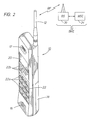
- Fig. 2 is an elevational view of the mobile terminal shown in Fig. 1, and which further illustrates a cellular communication system to which the mobile terminal is bidirectionally coupled through wireless RF links; and
- Fig. 3 is block diagram that illustrates in greater detail a portion of the mobile terminal of Fig. 1.
- Reference is made to Figs. 1 and 2 for illustrating a wireless user or
mobile terminal 10, such as but not limited to a cellular radiotelephone or a personal communicator, that is suitable for practicing this invention. Themobile terminal 10 includes anantenna 12 for transmitting signals to and for receiving signals from a base site orbase station 30. Thebase station 30 is a part of a cellular network comprising theBMI 32 that includes a Mobile Switching Center (MSC) 34. The MSC 34 provides a connection to landline trunks when themobile terminal 10 is registered with the network. - The mobile terminal includes a modulator (MOD) 14A, a
transmitter 14, areceiver 16, a demodulator (DEMOD) 16A, and acontroller 18 that provides signals to and receives signals from thetransmitter 14 andreceiver 16, respectively. These signals include signalling information in accordance with the air interface standard of the applicable cellular system, and also user speech and/or user generated data. - A user interface includes a conventional earphone or
speaker 17, aconventional microphone 19, adisplay 20, and a user input device, typically akeypad 22, all of which are coupled to thecontroller 18. Thekeypad 22 includes the conventional numeric (0-9) and related keys (#,*) 22a, andother keys 22b used for operating themobile terminal 10. Theseother keys 22b may include, by example, a SEND key, various menu scrolling and soft keys, and a PWR key. - The
mobile terminal 10 also includes various memories, shown collectively as thememory 24, wherein are stored a plurality of constants and variables that are used by thecontroller 18 during the operation of the mobile terminal. For example, thememory 24 stores the values of various cellular system parameters and the number assignment module (NAM). An operating program for controlling the operation ofcontroller 18 is also stored in the memory 24 (typically in a ROM device). Thememory 24 may also store data, including user messages, that is received from theBMI 32 prior to the display of the messages to the user. The construction of thememory 24, and its interface to thecontroller 18, is described in greater detail below with reference to Fig. 3. - The
mobile terminal 10 also includes abattery 26 for powering the various circuits that are required to operate the terminal. - It should be understood that the
mobile terminal 10 can be a vehicle mounted or a handheld device. It should further be appreciated that themobile terminal 10 can be capable of operating with one or more air interface standards, modulation types, and access types. By example, the mobile terminal may be capable of operating with any of a number of air interface standards, including but not limited to IS-136, GSM, EIA/TIA 627, IS-91 and IS-95 (CDMA). Narrow-band AMPS (NAMPS), as well as TACS, mobile terminals may also benefit from the teaching of this invention. It should thus be clear that the teaching of this invention is not to be construed to be limited to any one particular type of mobile terminal or air interface standard. - The operating program in the
memory 24 may include routines to present messages and message-related functions to the user on thedisplay 20, typically as various menu items. Thememory 24 also includes routines for implementing the method described below in relation to Fig. 3. - Reference is now made to Fig. 3 for showing a portion of (P/O) the
mobile terminal 10 of Fig. 1 in greater detail. More particularly, thecontroller 18 is shown to be comprised of a digital signal processor (DSP) 18a and a microprocessor control unit (MCU) 18b. The DSP 18a is connected to the output of thereceiver 16 and functions to demodulate received transmissions, decode any encoded voice or other transmissions, and to generally perform high speed signal processing of the received transmissions. The MCU 18b is connected to the DSP 18a, and operates on the decoded information to generally control the operation of theterminal 10 to place and receive calls, to operate thekeypad 22 and thedisplay 20, to monitor the charge state of thebattery 26, and other required functions. The software routines executed by the MCU 18b to operate themobile terminal 10 are referred to herein as its operating program. A typical size of the operating program for a modern mobile terminal, such as a cellular telephone, is several hundred kilobytes. - The
memory 24 is shown to include a non-volatile memory (NVM) 24a, such as an EEPROM, in which is stored the terminal's NAM(s), status flags, and other information that is required to be maintained when the terminal is powered down. - In accordance with this invention the
memory 24 also includes a first memory (MEM1) 24b and a second memory (MEM2) 24c, both of which are addressable though an address bus sourced by theMCU 18b. Thememories 24b and 24c are provided to store the operating program for theMCU 18b. Thememories 24b and 24c may be conventional Flash-type memories that can be programmed in-situ, typically by providing an appropriate programming voltage that is derived either from the terminal's normal power supply or from an external power adapter/recharger. Thememories 24b and 24c can be, by example, one Flash memory chip that is divided into two memory banks (each of which is considered as a separate memory for the purposes of this invention), or can be two separate Flash memories chips. In either case, one of the memories is at any given time designated as the Active memory, while the other is designated as the Idle memory. TheMCU 18b executes program instructions out of the Active memory. Further in accordance with this invention theMCU 18b is enabled to load a received operating program into the currently Idle memory while continuing to operate the mobile terminal 10 from the Active memory. When themobile terminal 10 is first constructed an operating program is preferably stored into one or the other of thememories 24b or 24c. - The NVM 24a stores an Active Memory (ACT_MEM) flag for specifying which of the
memories 24b or 24c is the currently Active memory. The Active Memory flag can be a single bit. The state of the Active Memory flag can be considered as a memory select (MEM_SEL) signal used for enabling one of thememories 24b or 24c for being read by theMCU 18b, while enabling theMCU 18b to store an operating program into the other memory. This function is indicated schematically by thebuffers 19a-19d (active high) which couple thememories 24b and 24c to the MCU data bus. By example, assume that when the Active Memory flag is zero the MEM 1 24b is specified as the Active memory, and when the Active Memory flag is a one the MEM2 24c is specified as the Active memory. When the Active Memory flag is zero then thebuffer 19a is enabled for reading out ofMEM1 24b, thebuffer 19d is enabled for writing into MEM2 24c, and thebuffers buffer 19c is enabled for reading out of MEM2 24c, andbuffer 19b is enabled for writing intoMEM1 24b. The Idle memory, when not being loaded, may be powered down to conserve battery power. - It should be realized that the interface circuitry shown in Fig. 3 is not intended to represent an actual hardware implementation, but is provided to aid in the conceptual understanding of the invention. Those skilled in the art may devise a number of suitable hardware implementations for interfacing the
memories 24b and 24c to theMCU 18b, when guided by the teaching of this invention. - As an example of the operation of the invention, assume that the
MEM1 24b stores a currently valid operating program for theMCU 18b, and that the Active Memory flag is set to zero. Themobile terminal 10 then receives a message from theBMI 32 that a download of a new or revised operating program is to occur. Subsequently theBMI 32 begins transmitting the new or revised operating program to themobile terminal 10 as a plurality of code blocks. By example, the code blocks can be sent using Short Message Service (SMS) messages, or can be sent over a data channel, or can be sent using System Operator Code (SOC) signalling, all of which are specified for use in the standard referred to as IS-136. Each code block is comprised of a plurality of machine-readable instructions, data, and the like that are required by the microprocessor which implements theMCU 18b to execute the mobile terminal operating program. Each code block also preferably includes some type of data integrity portion, such as cyclic redundancy check (CRC) syndrome bits and/or parity bits. The correct receipt of each code block may be required to be acknowledged (ACKed) by theMCU 18b before the next code block is transmitted by theBMI 32, or theMCU 18b may send a negative acknowledgement (NAK) only when an erroneous and uncorrectable code block is received. The received code blocks are passed through the DSP 18a to theMCU 18b, which stores the received code blocks into the MEM2 24c. After the new or revised program is completely received, theMCU 18b changes the Active Memory flag in the NVM 24a to a one, thereby designating MEM2 24c as the Active memory andMEM1 24b as the Idle memory. TheMCU 18b then resets itself to an initial state and begins executing code from the memory 24c. - The previous program in the now-
idle MEM1 24b can be erased by theMCU 18b, or it can be left intact until the next program download occurs, at which time it can be erased or simply written over. In some applications it may be desirable to leave the previous program stored in the Idle memory in case that it later becomes desirable to revert back to the previous operating program. By example, in the unlikely event that it is later discovered that the most recently loaded operating program was defective, themobile terminal 10 could be instructed by theBMI 32 to revert to the previous program for operation. This would be accomplished by simply changing the state of (i.e., toggling) the Active Memory flag. - It is also within the scope of the invention to store, in either the NVM 24a or the
Active memory 24b or 24c, an indication of the revision level of the currently active program, as well as the source of the program, the time and date at which the program was downloaded, and any other related information. For the case where the previous program is not erased, this identification information could also be retained. The stored program identification information may be subsequently interrogated from theBMI 32. - It is within the scope of the invention to provide the download control program itself in, by example, the NVM 24a, or to include it as part of the currently active program. That is, a download control program module of the currently active program is used to download the new program version into the Idle memory.
- The downloaded program may be compressed prior to transmission by the
BMI 32, and then decompressed by themobile terminal 10 prior to storage into the currentlyIdle memory 24b or 24c. A number of suitable data compression and decompression techniques are well known in the art. - It can be appreciated that during a program download the
mobile terminal 10 can remain registered with the network, can continue to make and receive calls, can send and receive messages, and can otherwise operate in a normal fashion. That is, the code blocks may be sent to themobile terminal 10 over an extended period of time, during which themobile terminal 10 continues to operate out of the currentlyActive memory 24b or 24c. It is within the scope of this invention, when operating in this mode, that the code blocks may be transmitted to themobile terminal 10 even during an ongoing voice call as a background task. For example, code blocks may be sent on a digital speech channel during pauses in a conversation. Of course, the proper | signalling and protocol must be first established between themobile terminal 10 and theBMI 32 to implement this feature. - In order to download the new or revised operating program in a rapid fashion, it is also within the scope of this invention to place the
mobile terminal 10 into a dedicated program download mode of operation, wherein the code blocks are continuously sent by theBMI 32 and received by themobile terminal 10. When operating in this mode themobile terminal 10 may be inhibited from receiving and originating calls and messages. However, the dedicated download mode can be terminated automatically if the user makes a call to an emergency service number. It may also be desirable to enable the user to terminate the dedicated download mode of operation so as to make a call, and to then reenter the dedicated download mode at the termination of the call. In this case theBMI 32 would begin by sending the next code block in the sequence of code blocks, at the point where the download operation was interrupted. - In either mode of operation the
mobile terminal 10 continues to operate out thememory 24b or 24c that stores the currently active program until theBMI 32 indicates that the program download operation is completed. When the download operation is completed, themobile terminal 10 is enabled to toggle the Active Memory flag, and to subsequently begin operating with the most-recently downloaded program. It should be noted that themobile terminal 10 need not immediately begin operating with the new program. By example, a particular service provider may download a new operating program to several thousand mobile terminals over a period of days or weeks, and then later send a message to all of the mobile terminals to instruct them to begin using the new program. - In the various embodiments of this invention the new or revised program download operation can be initiated by a call placed from the
mobile terminal 10 to the service provider, or vice versa. The program download can be accomplished in a point-to-point mode, that is, to one specific mobile terminal, or in a broadcast mode wherein a plurality of mobile terminals simultaneously receive the downloaded program. - It should be realized that a given operating program will typically be specific to a particular type of mobile terminal (e.g., manufacturer, model number, version, etc.), and will be written so as to be compatible with the particular microprocessor that implements the
MCU 18b, the particular hardware and software architecture of the terminal, etc. As such, and by example, in order to implement one or more new network features theBMI 32 may be required to download a plurality of different versions of the new program, with each particular version being transmitted to a particular class or type of mobile terminal. - It should be apparent that while the invention has been described in the context of a number of exemplary embodiments thereof, a number of modifications to these embodiments may occur to one skilled in the art. For example, each of the
memories 24b and 24c may be comprised of a plurality of memory chips, depending on the capacity of available memory chips and the size of the operating program.
Claims (15)
- A method for operating a wireless user terminal (10) having a transceiver (14,16) for conducting bidirectional RF communications with a communications network (32), comprising the steps of:operating the terminal (10) with a first computer program that is stored in a first memory (24b);the step of operating including a step of receiving a second computer program from the communications network (18) and storing the received second computer program into a second memory (24c); andafter the second computer program is stored in the second memory (24c), operating the terminal (10) with the second computer program; characterized in thatthe step of receiving the second computer program includes temporarily terminating receipt of the second computer program in the event an operator of the terminal requires the use of the transceiver and resuming receipt of the second computer program at a point where receipt of the second computer program was terminated.
- A method as set forth in claim 1, wherein the step of receiving receives the second computer program as a plurality of code blocks.
- A method for operating a communications system comprising a communications network (32) and a plurality of wireless user terminals (10) each comprising a transceiver (14,16) for conducting bidirectional RF communications with the communications network (32) and a data processor (18b) for executing a stored program for controlling the operation of the terminal (10), the method for operating the system comprising the steps of:operating each of the plurality of terminals (10) with a first computer program that is stored in a first memory (24b);transmitting a second computer program from the communications network (32) to at least one of the plurality of terminals (10); andin at least one of the plurality of terminals (10), receiving the second computer program from the communications network (32) and storing the received second computer program into a second memory (24b); characterized in thatthe step of receiving the second computer program from the communications network includes temporarily terminating receipt of the second computer program in the event an operator of the mobile terminal requires the use of the transceiver and resuming receipt of the second computer program at a point where receipt of the second computer program was terminated.
- A method as claimed in any preceding claim wherein the terminal is configured to be capable of downloading a computer program while making or receiving a call and the method further comprising:placing the terminal into a given program download mode such that the terminal is inhibited from receiving and making calls while receiving the second computer program; andterminating said given program download mode so as to permit the operator of the terminal to make a call.
- A method as set forth in claim 3 or 4, wherein the step of transmitting simultaneously transmits the second computer program to at least two of the plurality of terminals (10).
- A method as set forth in claim 3 or 4, wherein the step of transmitting is accomplished in response to a call made by a terminal (10) to the communications network (32).
- A method as set forth in claim 3 or 4, wherein the step of transmitting is accomplished in response to a call made by the communications network (32) to a terminal (10).
- A method as set forth in claim 4, wherein the step of storing includes a step of changing a value of a flag for indicating which of the first and second memories is a currently Active memory that stores the received second computer program.
- A method as set forth in claim 4, and further comprising the steps of:receiving a command from the communications network (32) to activate the stored second computer program;in response to the command, setting a flag to indicate that the stored second computer program is a currently active computer program; andoperating the terminal (10) with the stored second computer program.
- A method as set forth in claim 9, and further comprising the steps of:receiving a second command from the communications network (32) to deactivate the stored second computer program and to reactivate the first stored computer program;in response to the command, setting a flag to indicate that the stored first computer program is a currently active computer program; andoperating the terminal (10) with the stored first computer program.
- A method as set forth in claim 3 or 4, and further comprising a step of terminating the step of transmitting in response to a user originating a call from the terminal (10).
- A method as set forth in claim 11, wherein the step of transmitting is terminated in response to the user originating a call to a predetermined telephone number.
- A method according to any preceding claim, further comprising decompressing the received second computer program.
- A wireless user terminal comprising a transceiver for conducting bidirectional RF communications with a communications network and a data processor (18b) for controlling the operation of the terminal (10), said terminal (10) further comprising:a first memory (24b) capable of storing a data processor program; a second memory (24c) capable of storing a data processor program;means (24a) for storing a flag for indicating which of the first and second memories is a currently Active memory that stores a currently active data processor program and which of the first and second memories is a currently Idle memory; andmeans for receiving another data processor program from the communications network (32) and for storing the received another data processor program into the Idle memory, while the data processor (18b) executes the data processor program stored in the Active memory; characterized in thatsaid receiving means including means for temporarily terminating receipt of the other computer program in the event an operator of the terminal requires use of the transceiver and resuming receipt of the second computer program at a point where receipt of the second computer program was terminated.
- A terminal as claimed in claim 14, wherein the terminal is configured to be capable of downloading a computer program while making or receiving a call and further comprises means for placing the terminal into a given program download mode such that the terminal is inhibited from receiving and making calls while receiving the second computer program; and means for terminating said given program download mode so as to permit the operator of the terminal to make a call.
Applications Claiming Priority (2)
| Application Number | Priority Date | Filing Date | Title |
|---|---|---|---|
| US638126 | 1996-04-26 | ||
| US08/638,126 US5887254A (en) | 1996-04-26 | 1996-04-26 | Methods and apparatus for updating the software of a mobile terminal using the air interface |
Publications (3)
| Publication Number | Publication Date |
|---|---|
| EP0804046A2 EP0804046A2 (en) | 1997-10-29 |
| EP0804046A3 EP0804046A3 (en) | 1999-07-14 |
| EP0804046B1 true EP0804046B1 (en) | 2006-09-20 |
Family
ID=24558755
Family Applications (1)
| Application Number | Title | Priority Date | Filing Date |
|---|---|---|---|
| EP97302830A Expired - Lifetime EP0804046B1 (en) | 1996-04-26 | 1997-04-24 | Method and apparatus for updating the software of a mobile terminal using the air interface |
Country Status (3)
| Country | Link |
|---|---|
| US (1) | US5887254A (en) |
| EP (1) | EP0804046B1 (en) |
| DE (1) | DE69736687T2 (en) |
Families Citing this family (110)
| Publication number | Priority date | Publication date | Assignee | Title |
|---|---|---|---|---|
| US6748209B2 (en) | 1995-10-30 | 2004-06-08 | At&T Wireless Services, Inc. | Method and apparatus for storing activation data in a cellular telephone |
| US6724833B1 (en) | 1996-06-10 | 2004-04-20 | Infineon Technologies Ag | Method and apparatus for communicating information |
| US6643506B1 (en) * | 1996-08-07 | 2003-11-04 | Telxon Corporation | Wireless software upgrades with version control |
| US6122503A (en) * | 1996-10-08 | 2000-09-19 | At&T Wireless Services Inc | Method and apparatus for over-the-air programming of telecommunication services |
| US6223028B1 (en) * | 1997-03-17 | 2001-04-24 | Nortel Networks Ltd | Enhanced method and system for programming a mobile telephone over the air within a mobile telephone communication network |
| US6504580B1 (en) * | 1997-03-24 | 2003-01-07 | Evolve Products, Inc. | Non-Telephonic, non-remote controller, wireless information presentation device with advertising display |
| US6324411B1 (en) * | 1997-05-20 | 2001-11-27 | Telefonaktiebolaget Lm Ericsson (Publ) | Background software loading in cellular telecommunication systems |
| DE19741703C2 (en) * | 1997-09-22 | 2000-02-24 | Siemens Ag | Process for loading operating software and mobile phone therefor |
| DE19750364B4 (en) * | 1997-11-14 | 2010-04-08 | Robert Bosch Gmbh | Method for updating information stored in a car radio or motor vehicle navigation device in the form of operating software, transmitter tables or navigation data as well as car radio or motor vehicle navigation device |
| US6356543B2 (en) * | 1997-11-25 | 2002-03-12 | Telefonaktiebolaget Lm Ericsson (Publ) | Controlling mobile phone system user views from the world-wide web |
| JP3055514B2 (en) * | 1997-12-05 | 2000-06-26 | 日本電気株式会社 | Voice recognition device for telephone line |
| US6134434A (en) * | 1997-12-08 | 2000-10-17 | Qualcomm Incorporated | System and method for providing service negotiation in a communications network |
| US6650892B1 (en) * | 1998-02-24 | 2003-11-18 | Solaic | Mobile communications apparatus adapted for executing computer game programs |
| FI110987B (en) | 1998-03-31 | 2003-04-30 | Nokia Corp | Method of connecting data transfer streams |
| DE19818515C2 (en) * | 1998-04-24 | 2001-02-01 | Siemens Ag | Method for programming a programmable radio and a corresponding programmable radio |
| FI107984B (en) * | 1998-05-20 | 2001-10-31 | Nokia Networks Oy | Prevention of illegal use of service |
| EP0966136A1 (en) * | 1998-06-17 | 1999-12-22 | Robert Bosch Gmbh | Method and apparatus for updating text data in an electrical device |
| JP2000023251A (en) | 1998-06-26 | 2000-01-21 | Kokusai Electric Co Ltd | Mobile communication device and mobile communication system |
| US7277424B1 (en) | 1998-07-21 | 2007-10-02 | Dowling Eric M | Method and apparatus for co-socket telephony |
| US6587684B1 (en) * | 1998-07-28 | 2003-07-01 | Bell Atlantic Nynex Mobile | Digital wireless telephone system for downloading software to a digital telephone using wireless data link protocol |
| FI108200B (en) | 1998-09-14 | 2001-11-30 | Nokia Mobile Phones Ltd | Switching the connection between mobile networks |
| DE19845823A1 (en) * | 1998-09-25 | 2000-04-06 | Siemens Ag | Method for transferring data into a memory of a device connected in particular to a communication network |
| GB2342252A (en) * | 1998-09-29 | 2000-04-05 | Motorola Gmbh | Mobile radio and method of loading data into a radio |
| TW527604B (en) | 1998-10-05 | 2003-04-11 | Toshiba Corp | A memory systems |
| US6522875B1 (en) * | 1998-11-17 | 2003-02-18 | Eric Morgan Dowling | Geographical web browser, methods, apparatus and systems |
| US6973300B1 (en) * | 1998-12-23 | 2005-12-06 | Nortel Networks Limited | Intelligent wireless terminal with virtual memory |
| US6594488B1 (en) | 1998-12-30 | 2003-07-15 | At&T Corp. | Method and apparatus for over-the-air activation of neighborhood cordless-type services |
| US7181207B1 (en) | 1998-12-30 | 2007-02-20 | At&T Corp. | Method and apparatus for over-the-air activation of neighborhood cordless-type services |
| JP2000207219A (en) | 1999-01-18 | 2000-07-28 | Fujitsu Ten Ltd | Communication system between in-vehicle terminal and center, and in-vehicle terminal used for communication system |
| JP4296624B2 (en) * | 1999-03-01 | 2009-07-15 | ソニー株式会社 | Data receiver |
| GB2349548A (en) * | 1999-04-27 | 2000-11-01 | Roke Manor Research | Downloading software to mobile telecommunication users |
| US6885862B1 (en) * | 1999-04-30 | 2005-04-26 | Harris Canada, Inc. | Wireless subscriber terminal programming using a broadcast control channel |
| US6577614B1 (en) | 1999-05-27 | 2003-06-10 | Qwest Communications International Inc. | System and method for OTA over CDMA data channel |
| DE19930170A1 (en) * | 1999-06-30 | 2001-01-18 | Siemens Ag | Method for transmitting program and / or operational information stored centrally in a communication network to several decentralized communication devices |
| EP1192824B1 (en) * | 1999-07-05 | 2011-10-19 | TeleCommunication Systems, Inc. | A method of transmitting data items to a number of mobile stations, a mobile station, and a storage module |
| DE19932455A1 (en) * | 1999-07-12 | 2001-04-05 | Siemens Ag | Transmission structure update and/or adjustment in communication system |
| US6674731B1 (en) | 1999-08-27 | 2004-01-06 | Tachyon, Inc. | Transmission and reception of TCP/IP data over a wireless communication channel |
| US6665292B1 (en) | 1999-08-27 | 2003-12-16 | Tachyon, Inc. | Transmission and reception of TCP/IP data over a wireless communication channel |
| WO2001017298A1 (en) * | 1999-09-02 | 2001-03-08 | Automated Business Companies | Communication and proximity authorization systems |
| JP3669619B2 (en) * | 1999-09-06 | 2005-07-13 | 富士通株式会社 | Software updating method and apparatus for wireless terminal device |
| FR2800963B1 (en) * | 1999-11-09 | 2001-12-07 | Wavecom Sa | METHOD FOR UPDATING A MAIN PROGRAM EXECUTED BY A RADIOCOMMUNICATION MODULE AND / OR DATA ASSOCIATED WITH THIS MAIN PROGRAM, AND CORRESPONDING RADIOCOMMUNICATION MODULE |
| DE19959434A1 (en) * | 1999-12-09 | 2001-06-21 | Siemens Ag | Method for changing the operating system of a telecommunication terminal |
| US6738766B2 (en) | 2000-02-02 | 2004-05-18 | Doongo Technologies, Inc. | Apparatus and methods for providing personalized application search results for wireless devices based on user profiles |
| US6816944B2 (en) | 2000-02-02 | 2004-11-09 | Innopath Software | Apparatus and methods for providing coordinated and personalized application and data management for resource-limited mobile devices |
| GB0003313D0 (en) | 2000-02-15 | 2000-04-05 | Koninkl Philips Electronics Nv | Software reconfiguration of communications apparatus |
| AU2000233850A1 (en) * | 2000-02-29 | 2001-09-12 | Qualcomm Incorporated | Programmable mobile communications terminal with randomized off-peak transmissions |
| US6993328B1 (en) * | 2000-05-08 | 2006-01-31 | Nokia Corporation | Method for over the air mobile station management |
| CA2409851C (en) | 2000-05-23 | 2013-03-26 | M2M Solutions Llc | Programmable communicator |
| WO2002007465A1 (en) * | 2000-07-19 | 2002-01-24 | Siemens Aktiengesellschaft | Data transmission in a communication system |
| US6914950B1 (en) | 2000-07-31 | 2005-07-05 | Lyrtech Inc. | Multi-protocol receiver |
| US6687496B1 (en) * | 2000-08-02 | 2004-02-03 | Intel Corporation | Memory programming method and system |
| FR2813153B1 (en) * | 2000-08-21 | 2003-01-31 | Sagem | METHOD FOR PROGRAMMING A TERMINAL FOR CONNECTION TO A TELECOMMUNICATION NETWORK OVER THE WIRE OF ONE OR MORE FIXED TELEPHONE SETS OF A LINE OF THE WIRED TELEPHONE NETWORK |
| US6686838B1 (en) | 2000-09-06 | 2004-02-03 | Xanboo Inc. | Systems and methods for the automatic registration of devices |
| JP2002094639A (en) * | 2000-09-13 | 2002-03-29 | Nec Access Technica Ltd | Mobile phone, software rewriting method used therefor, and recording medium recording control program therefor |
| WO2002030143A2 (en) * | 2000-10-05 | 2002-04-11 | Qualcomm Incorporated | Method and apparatus for appliance reconfiguration |
| US7035932B1 (en) * | 2000-10-27 | 2006-04-25 | Eric Morgan Dowling | Federated multiprotocol communication |
| US6901429B2 (en) * | 2000-10-27 | 2005-05-31 | Eric Morgan Dowling | Negotiated wireless peripheral security systems |
| US6965914B2 (en) * | 2000-10-27 | 2005-11-15 | Eric Morgan Dowling | Negotiated wireless peripheral systems |
| JP4609682B2 (en) * | 2000-11-29 | 2011-01-12 | ソニー株式会社 | Communication system and information processing method |
| US7343408B2 (en) * | 2000-12-05 | 2008-03-11 | Mformation Technologies, Inc. | System and method for wireless data terminal management using telecommunication signaling network |
| US7725748B1 (en) | 2000-12-29 | 2010-05-25 | Intel Corporation | Low power subsystem for portable computers |
| ES2233593T3 (en) * | 2001-01-24 | 2005-06-16 | Aastra Technologies Limited | PROCEDURE FOR THE TRANSMISSION OF OPERATIONAL DATA TO MOBILE RADIOCUMICATION TERMINAL EQUIPMENT OF A WIRELESS TELEPHONE AND TELEPHONE TELECOMMUNICATION SYSTEM FOR THE SAME. |
| AU2004203674B2 (en) * | 2001-01-31 | 2008-03-20 | Ntt Docomo, Inc. | System for program delivery to a storage module of a mobile terminal |
| KR20020079922A (en) * | 2001-01-31 | 2002-10-19 | 엔티티 도꼬모 인코퍼레이티드 | System for delivering program to storage module of mobile terminal |
| US7079775B2 (en) | 2001-02-05 | 2006-07-18 | Finisar Corporation | Integrated memory mapped controller circuit for fiber optics transceiver |
| SE523692C2 (en) * | 2001-02-28 | 2004-05-11 | Followit Ab C O Elander Invest | Procedure for dynamic control of functions of a modular transponder for positioning objects, as well as modular transponder for the purpose |
| DE20104839U1 (en) * | 2001-03-20 | 2002-08-22 | Agere Systems Guardian Corp., Orlando, Fla. | Mobile phone with a device for storing downloaded data |
| WO2002079981A1 (en) * | 2001-03-30 | 2002-10-10 | Nokia Corporation | Downloading application software to a mobile terminal |
| US6879847B1 (en) * | 2001-04-09 | 2005-04-12 | Mitsubishi Electric Corporation | Systems and methods for displaying a message on a mobile communication device |
| AUPR471401A0 (en) * | 2001-05-02 | 2001-05-24 | Keycorp Limited | Method of manufacturing smart cards |
| US20030208550A1 (en) * | 2001-06-28 | 2003-11-06 | Hamilton Tony G. | Method to provide direct system storage access within a notebook computer via a wireless interconnect and a low power high-speed data management bus while the main CPU is idle |
| EP1415286A1 (en) * | 2001-07-02 | 2004-05-06 | Swissvoice AG | Method for controlling a mobile terminal and mobile terminal |
| US20030186689A1 (en) * | 2001-08-06 | 2003-10-02 | Samsung Electronics Co., Ltd | System and method for IOTA software download notification for wireless communication devices |
| DE10155998A1 (en) * | 2001-11-15 | 2003-06-05 | T Mobile Deutschland Gmbh | Method for renewing program files of a programmable mobile telecommunication terminal |
| US6731930B2 (en) * | 2002-08-14 | 2004-05-04 | Motorola, Inc. | Over-the-air programming method for wireless communication device |
| US6810245B1 (en) * | 2002-08-28 | 2004-10-26 | Motorola, Inc. | Intelligent remote software loading method for wireless portable communication device |
| JP2004102698A (en) * | 2002-09-10 | 2004-04-02 | Ntt Docomo Inc | Download method, area management device, mobile communication terminal, program, and recording medium |
| US7046997B2 (en) * | 2002-12-23 | 2006-05-16 | Intel Corporation | Trial upgrade capability for wireless handheld devices |
| US20040198447A1 (en) * | 2003-03-07 | 2004-10-07 | Anders Larsson | Mobile terminals programmed with wireless signaling software from a removable memory module and methods of programming the same |
| US20040204205A1 (en) * | 2003-04-11 | 2004-10-14 | Paul Goodjohn | Cable-free programmable radio |
| FR2856489B1 (en) * | 2003-06-23 | 2005-08-26 | Bouygues Telecom Sa | METHOD FOR DOWNLOADING FILES ON MOBILE EQUIPMENT |
| US7409208B1 (en) | 2003-07-02 | 2008-08-05 | Cellco Partnership | Self-subscription to catalogs of mobile application software |
| KR100606052B1 (en) * | 2004-01-26 | 2006-07-28 | 삼성전자주식회사 | Error data recovery system and method of mobile communication terminal |
| JP2005236795A (en) * | 2004-02-20 | 2005-09-02 | Nec Corp | Radio communication system, firmware updating method for radio communication terminal therein |
| DE102004025734B4 (en) * | 2004-05-26 | 2006-07-27 | Siemens Ag | Method for optimizing reconfiguration processes in mobile radio networks with reconfigurable terminals by collecting and providing suitable measurement data and a corresponding arrangement |
| US20060035631A1 (en) * | 2004-08-13 | 2006-02-16 | Christopher White | Wireless device service activation from the wireless device |
| JP2006115036A (en) * | 2004-10-13 | 2006-04-27 | Nec Corp | Mobile telephone set, automatic program updating method used therefor, and program thereof |
| KR100653179B1 (en) * | 2004-12-17 | 2006-12-04 | 한국전자통신연구원 | Wireless communication terminal with platform dynamic upgrade function and its method |
| US7200390B1 (en) | 2004-12-30 | 2007-04-03 | Cellco Partnership | Device software update transport and download |
| US20060217116A1 (en) * | 2005-03-18 | 2006-09-28 | Cassett Tia M | Apparatus and methods for providing performance statistics on a wireless communication device |
| KR100764791B1 (en) * | 2005-04-08 | 2007-10-11 | 엘지전자 주식회사 | Device Management System and Device Management Scheduling Method in the System |
| US20070142046A1 (en) * | 2005-12-15 | 2007-06-21 | Welnick William E | Method and system for acquiring a carrier system by a terminal device |
| US7542759B2 (en) * | 2006-04-18 | 2009-06-02 | Edwards Bryan T | Method and apparatus for broadcasting software update information to mobile phones over a wireless communications network |
| US8437751B2 (en) | 2006-04-25 | 2013-05-07 | Core Wireless Licensing S.A.R.L. | Method, apparatus and computer program product for providing confirmed over-the-air terminal configuration |
| KR101292979B1 (en) * | 2006-08-17 | 2013-08-02 | 삼성전자주식회사 | Method for managing software in terminal using device management server |
| EP2069925A4 (en) * | 2006-09-29 | 2011-06-29 | Nokia Corp | METHOD AND APPARATUS FOR UPDATING A FIRMWARE AS A BACKGROUND TASK |
| US8081751B1 (en) * | 2006-10-04 | 2011-12-20 | Sprint Spectrum L.P. | Method for triggering content download during call setup |
| US8059800B1 (en) | 2006-10-17 | 2011-11-15 | Sprint Spectrum L.P. | Method for viral distribution of ringback media |
| US8509754B2 (en) * | 2006-12-29 | 2013-08-13 | United States Cellular Corporation | Distributing mobile-device applications |
| US20090013317A1 (en) * | 2007-02-08 | 2009-01-08 | Airnet Communications Corporation | Software Management for Software Defined Radio in a Distributed Network |
| TW200847021A (en) * | 2007-05-17 | 2008-12-01 | Asustek Comp Inc | Automatic backup, restore and update BIOS computer system |
| US20090075641A1 (en) * | 2007-09-18 | 2009-03-19 | Metropcs Wireless, Inc. | Automated over-the-air firmware update for a wireless phone |
| US8135745B2 (en) | 2008-03-04 | 2012-03-13 | Core Wireless Licensing S.A.R.L. | Storage management |
| US8159956B2 (en) | 2008-07-01 | 2012-04-17 | Finisar Corporation | Diagnostics for serial communication busses |
| CN101437224A (en) * | 2008-12-22 | 2009-05-20 | 中兴通讯股份有限公司 | Method for updating mobile terminal software and mobile terminal |
| US8453140B2 (en) * | 2009-04-28 | 2013-05-28 | Qualcomm Incorporated | Method for generically handling carrier specific provisioning for computer cellular wireless cards |
| US8417234B2 (en) * | 2009-05-17 | 2013-04-09 | Qualcomm Incorporated | Method and apparatus for tracking the programming of a mobile device with multiple service accounts |
| US8417231B2 (en) * | 2009-05-17 | 2013-04-09 | Qualcomm Incorporated | Method and apparatus for programming a mobile device with multiple service accounts |
| US8756256B2 (en) | 2010-05-26 | 2014-06-17 | Qualcomm Incorporated | Method and systems for the management of non volatile items and provisioning files for a communication device with multiple service accounts |
| WO2020222845A1 (en) * | 2019-05-02 | 2020-11-05 | Siemens Aktiengesellschaft | External module for network connection to programmable logic controller (plc) backplane |
Family Cites Families (28)
| Publication number | Priority date | Publication date | Assignee | Title |
|---|---|---|---|---|
| US3304372A (en) * | 1963-06-28 | 1967-02-14 | Ibm | Voice-data multiplexing system for transmitting data during pauses in the voice signals |
| US4434461A (en) * | 1980-09-15 | 1984-02-28 | Motorola, Inc. | Microprocessor with duplicate registers for processing interrupts |
| CA1177558A (en) * | 1982-04-15 | 1984-11-06 | Groupe Videotron Ltee. (Le) | Cable network data transmission system |
| AU577742B2 (en) * | 1984-07-13 | 1988-09-29 | Motorola, Inc. | Cellular voice and data radiotelephone system |
| JPS63182795A (en) * | 1987-01-20 | 1988-07-28 | インターナシヨナル・ビジネス・マシーンズ・コーポレーシヨン | Portable card and manufacture thereof |
| GB2204973A (en) * | 1987-05-19 | 1988-11-23 | Gen Electric Co Plc | Data processing system |
| US5127040A (en) * | 1987-06-02 | 1992-06-30 | Motorola, Inc. | Radiotelephone telephone number down loading |
| US4831647A (en) * | 1987-06-02 | 1989-05-16 | Motorola, Inc. | Radiotelephone credit card data communications |
| US5249302A (en) * | 1987-10-09 | 1993-09-28 | Motorola, Inc. | Mixed-mode transceiver system |
| US4912756A (en) * | 1989-04-07 | 1990-03-27 | Unilink Corporation | Method and apparatus for error-free digital data transmission during cellular telephone handoff, etc. |
| US5046082A (en) * | 1990-05-02 | 1991-09-03 | Gte Mobile Communications Service Corporation | Remote accessing system for cellular telephones |
| US5109403A (en) * | 1990-05-11 | 1992-04-28 | Goldstar Products Co., Limited | System for programming of features of a mobile cellular telephone unit |
| FR2662891A1 (en) * | 1990-05-30 | 1991-12-06 | Cit Alcatel | SOFTWARE DOWNLOAD DEVICE FOR TELECOMMUNICATION TERMINAL. |
| GB2249923B (en) * | 1990-09-10 | 1995-03-08 | Oki America Inc | Remotely programmable radiotelephone |
| EP0478231B1 (en) * | 1990-09-28 | 1997-01-29 | AT&T Corp. | Method and apparatus for remotely programming a wireless telephone set |
| US5297191A (en) * | 1990-09-28 | 1994-03-22 | At&T Bell Laboratories | Method and apparatus for remotely programming a wireless telephone set |
| US5436960A (en) * | 1991-05-20 | 1995-07-25 | Campana, Jr.; Thomas J. | Electronic mail system with RF communications to mobile processors and method of operation thereof |
| FI912875A7 (en) * | 1991-06-14 | 1992-12-15 | Nokia Mobile Phones Ltd | Recording a program on your walkie-talkie |
| US5381346A (en) * | 1992-06-30 | 1995-01-10 | Motorola, Inc. | Virtual data source for a radio transceiver |
| GB2269032B (en) * | 1992-07-21 | 1996-03-20 | Orbitel Mobile Communications | Reprogramming methods and apparatus |
| US5302947A (en) * | 1992-07-31 | 1994-04-12 | Motorola, Inc. | Method and apparatus for loading a software program from a radio modem into an external computer |
| FI109064B (en) * | 1992-09-18 | 2002-05-15 | Nokia Corp | Method of initiating a short message transmission in a cellular radio network, cellular radio network and subscriber register in a cellular radio network |
| US5418837A (en) * | 1993-07-30 | 1995-05-23 | Ericsson-Ge Mobile Communications Inc. | Method and apparatus for upgrading cellular mobile telephones |
| US5471518A (en) * | 1993-08-10 | 1995-11-28 | Novatel Communications Ltd. | Method and apparatus for non-volatile data storage in radio telephones and the like |
| US5524135A (en) * | 1994-02-14 | 1996-06-04 | Sony Corporation | Method and apparatus for secure downloading of operational information into a wireless communications device |
| US5742910A (en) * | 1995-05-23 | 1998-04-21 | Mci Corporation | Teleadministration of subscriber ID modules |
| US5740542A (en) * | 1995-08-02 | 1998-04-14 | Motorola, Inc. | Method of transmitting data during voice pauses in a synchronous communication system |
| US5797101A (en) * | 1996-01-31 | 1998-08-18 | Motorola, Inc. | Radiotelephone subscriber unit having a generic phone number |
-
1996
- 1996-04-26 US US08/638,126 patent/US5887254A/en not_active Expired - Lifetime
-
1997
- 1997-04-24 EP EP97302830A patent/EP0804046B1/en not_active Expired - Lifetime
- 1997-04-24 DE DE69736687T patent/DE69736687T2/en not_active Expired - Lifetime
Also Published As
| Publication number | Publication date |
|---|---|
| DE69736687D1 (en) | 2006-11-02 |
| EP0804046A2 (en) | 1997-10-29 |
| US5887254A (en) | 1999-03-23 |
| EP0804046A3 (en) | 1999-07-14 |
| DE69736687T2 (en) | 2007-09-13 |
Similar Documents
| Publication | Publication Date | Title |
|---|---|---|
| US5887254A (en) | Methods and apparatus for updating the software of a mobile terminal using the air interface | |
| CN1108718C (en) | Method and apparatus for remotely upgrading control software in a cellular telephone | |
| US7634261B2 (en) | Mobile communications terminal and software updating method for mobile communications terminal | |
| US8285268B2 (en) | System and method for delta-based over-the-air software upgrades for a wireless mobile station | |
| US6064880A (en) | Mobile station having short code memory system-level backup and restoration function | |
| US7461373B2 (en) | Apparatus and method for upgrading software of a wireless mobile station | |
| EP1587333A2 (en) | Mobile terminal having network services activation through the use of point-to-piont short message service | |
| US20110087830A1 (en) | System, method and apparatus for embedded firmware code update | |
| EP1049346A2 (en) | Wireless subscriber terminal programming using a broadcast control channel | |
| JP3955443B2 (en) | Wireless communication terminal, software providing system, software updating method, software providing method, program, and recording medium | |
| JP2001197196A (en) | Mobile terminal and display information management method for mobile terminal | |
| EP1576442B1 (en) | System and method for software download to wireless communication device | |
| JPH1063498A (en) | Operation program modifying method for radio base station | |
| JP4823239B2 (en) | Wireless communication apparatus and wireless communication system having the apparatus | |
| KR100593549B1 (en) | Data transmission device between computer and mobile communication terminal using UBS | |
| CN113031985B (en) | Wireless upgrading method | |
| JP2002524926A (en) | Programmable hands-free telephone system | |
| US20010024961A1 (en) | Operating method for a mobile telephone | |
| AU734670B2 (en) | Method and apparatus for remotely upgrading control software in a cellular telephone | |
| KR20000040304A (en) | Method for upgrading user information of mobile communication terminal using computer | |
| JP2004040501A (en) | Wireless communication device | |
| JP2003152629A (en) | Portable radio communication device and method for downloading built-in software | |
| MXPA99007333A (en) | Method and apparatus for remotely upgrading control software in a cellular telephone | |
| JP2001211265A (en) | Telephone terminal for information communication system | |
| KR20060057285A (en) | Data communication system and communication method using mobile communication terminal |
Legal Events
| Date | Code | Title | Description |
|---|---|---|---|
| PUAI | Public reference made under article 153(3) epc to a published international application that has entered the european phase |
Free format text: ORIGINAL CODE: 0009012 |
|
| AK | Designated contracting states |
Kind code of ref document: A2 Designated state(s): DE FR GB SE |
|
| PUAL | Search report despatched |
Free format text: ORIGINAL CODE: 0009013 |
|
| AK | Designated contracting states |
Kind code of ref document: A3 Designated state(s): DE FR GB SE |
|
| 17P | Request for examination filed |
Effective date: 20000114 |
|
| RAP1 | Party data changed (applicant data changed or rights of an application transferred) |
Owner name: NOKIA CORPORATION |
|
| 17Q | First examination report despatched |
Effective date: 20040204 |
|
| GRAP | Despatch of communication of intention to grant a patent |
Free format text: ORIGINAL CODE: EPIDOSNIGR1 |
|
| GRAS | Grant fee paid |
Free format text: ORIGINAL CODE: EPIDOSNIGR3 |
|
| GRAA | (expected) grant |
Free format text: ORIGINAL CODE: 0009210 |
|
| AK | Designated contracting states |
Kind code of ref document: B1 Designated state(s): DE FR GB SE |
|
| REG | Reference to a national code |
Ref country code: GB Ref legal event code: FG4D |
|
| REF | Corresponds to: |
Ref document number: 69736687 Country of ref document: DE Date of ref document: 20061102 Kind code of ref document: P |
|
| PG25 | Lapsed in a contracting state [announced via postgrant information from national office to epo] |
Ref country code: SE Free format text: LAPSE BECAUSE OF FAILURE TO SUBMIT A TRANSLATION OF THE DESCRIPTION OR TO PAY THE FEE WITHIN THE PRESCRIBED TIME-LIMIT Effective date: 20061220 |
|
| PLBI | Opposition filed |
Free format text: ORIGINAL CODE: 0009260 |
|
| PLAX | Notice of opposition and request to file observation + time limit sent |
Free format text: ORIGINAL CODE: EPIDOSNOBS2 |
|
| 26 | Opposition filed |
Opponent name: QUALCOMM INCORPORATED Effective date: 20070620 |
|
| PLAF | Information modified related to communication of a notice of opposition and request to file observations + time limit |
Free format text: ORIGINAL CODE: EPIDOSCOBS2 |
|
| PLAF | Information modified related to communication of a notice of opposition and request to file observations + time limit |
Free format text: ORIGINAL CODE: EPIDOSCOBS2 |
|
| PLBB | Reply of patent proprietor to notice(s) of opposition received |
Free format text: ORIGINAL CODE: EPIDOSNOBS3 |
|
| PLBP | Opposition withdrawn |
Free format text: ORIGINAL CODE: 0009264 |
|
| PLBD | Termination of opposition procedure: decision despatched |
Free format text: ORIGINAL CODE: EPIDOSNOPC1 |
|
| PLBM | Termination of opposition procedure: date of legal effect published |
Free format text: ORIGINAL CODE: 0009276 |
|
| STAA | Information on the status of an ep patent application or granted ep patent |
Free format text: STATUS: OPPOSITION PROCEDURE CLOSED |
|
| 27C | Opposition proceedings terminated |
Effective date: 20081205 |
|
| REG | Reference to a national code |
Ref country code: DE Ref legal event code: R008 Ref document number: 69736687 Country of ref document: DE |
|
| REG | Reference to a national code |
Ref country code: DE Ref legal event code: R082 Ref document number: 69736687 Country of ref document: DE Representative=s name: SAMSON & PARTNER PATENTANWAELTE MBB, DE Ref country code: DE Ref legal event code: R082 Ref document number: 69736687 Country of ref document: DE Representative=s name: SAMSON & PARTNER, PATENTANWAELTE, DE |
|
| REG | Reference to a national code |
Ref country code: DE Ref legal event code: R097 Ref document number: 69736687 Country of ref document: DE |
|
| REG | Reference to a national code |
Ref country code: DE Ref legal event code: R039 Ref document number: 69736687 Country of ref document: DE Effective date: 20121029 |
|
| REG | Reference to a national code |
Ref country code: DE Ref legal event code: R008 Ref document number: 69736687 Country of ref document: DE |
|
| REG | Reference to a national code |
Ref country code: DE Ref legal event code: R040 Ref document number: 69736687 Country of ref document: DE Effective date: 20130114 |
|
| REG | Reference to a national code |
Ref country code: DE Ref legal event code: R039 Ref document number: 69736687 Country of ref document: DE Effective date: 20130513 |
|
| REG | Reference to a national code |
Ref country code: DE Ref legal event code: R097 Ref document number: 69736687 Country of ref document: DE Ref country code: DE Ref legal event code: R040 Ref document number: 69736687 Country of ref document: DE |
|
| REG | Reference to a national code |
Ref country code: DE Ref legal event code: R079 Ref document number: 69736687 Country of ref document: DE Free format text: PREVIOUS MAIN CLASS: H04Q0007320000 Ipc: H04W0088020000 |
|
| REG | Reference to a national code |
Ref country code: DE Ref legal event code: R079 Ref document number: 69736687 Country of ref document: DE Free format text: PREVIOUS MAIN CLASS: H04Q0007320000 Ipc: H04W0088020000 Effective date: 20140526 Ref country code: DE Ref legal event code: R040 Ref document number: 69736687 Country of ref document: DE Effective date: 20140218 |
|
| REG | Reference to a national code |
Ref country code: GB Ref legal event code: 732E Free format text: REGISTERED BETWEEN 20150910 AND 20150916 |
|
| REG | Reference to a national code |
Ref country code: DE Ref legal event code: R082 Ref document number: 69736687 Country of ref document: DE Representative=s name: SAMSON & PARTNER PATENTANWAELTE MBB, DE Ref country code: DE Ref legal event code: R081 Ref document number: 69736687 Country of ref document: DE Owner name: NOKIA TECHNOLOGIES OY, FI Free format text: FORMER OWNER: NOKIA CORP., 02610 ESPOO, FI |
|
| REG | Reference to a national code |
Ref country code: FR Ref legal event code: PLFP Year of fee payment: 20 |
|
| PGFP | Annual fee paid to national office [announced via postgrant information from national office to epo] |
Ref country code: FR Payment date: 20160309 Year of fee payment: 20 |
|
| PGFP | Annual fee paid to national office [announced via postgrant information from national office to epo] |
Ref country code: GB Payment date: 20160420 Year of fee payment: 20 Ref country code: DE Payment date: 20160419 Year of fee payment: 20 |
|
| REG | Reference to a national code |
Ref country code: FR Ref legal event code: TP Owner name: NOKIA TECHNOLOGIES OY, FI Effective date: 20170109 |
|
| REG | Reference to a national code |
Ref country code: DE Ref legal event code: R071 Ref document number: 69736687 Country of ref document: DE |
|
| REG | Reference to a national code |
Ref country code: GB Ref legal event code: PE20 Expiry date: 20170423 |
|
| PG25 | Lapsed in a contracting state [announced via postgrant information from national office to epo] |
Ref country code: GB Free format text: LAPSE BECAUSE OF EXPIRATION OF PROTECTION Effective date: 20170423 |