EP0802915B1 - Camptothecin derivatives and its manufacturing method - Google Patents
Camptothecin derivatives and its manufacturing method Download PDFInfo
- Publication number
- EP0802915B1 EP0802915B1 EP96900458A EP96900458A EP0802915B1 EP 0802915 B1 EP0802915 B1 EP 0802915B1 EP 96900458 A EP96900458 A EP 96900458A EP 96900458 A EP96900458 A EP 96900458A EP 0802915 B1 EP0802915 B1 EP 0802915B1
- Authority
- EP
- European Patent Office
- Prior art keywords
- compound
- camptothecin
- ethyl
- och
- dichloromethane
- Prior art date
- Legal status (The legal status is an assumption and is not a legal conclusion. Google has not performed a legal analysis and makes no representation as to the accuracy of the status listed.)
- Expired - Lifetime
Links
- VSJKWCGYPAHWDS-FQEVSTJZSA-N camptothecin Chemical class C1=CC=C2C=C(CN3C4=CC5=C(C3=O)COC(=O)[C@]5(O)CC)C4=NC2=C1 VSJKWCGYPAHWDS-FQEVSTJZSA-N 0.000 title claims description 51
- 238000004519 manufacturing process Methods 0.000 title claims description 6
- 150000001875 compounds Chemical class 0.000 claims description 121
- 229940127093 camptothecin Drugs 0.000 claims description 42
- VSJKWCGYPAHWDS-UHFFFAOYSA-N dl-camptothecin Natural products C1=CC=C2C=C(CN3C4=CC5=C(C3=O)COC(=O)C5(O)CC)C4=NC2=C1 VSJKWCGYPAHWDS-UHFFFAOYSA-N 0.000 claims description 42
- KLWPJMFMVPTNCC-UHFFFAOYSA-N Camptothecin Natural products CCC1(O)C(=O)OCC2=C1C=C3C4Nc5ccccc5C=C4CN3C2=O KLWPJMFMVPTNCC-UHFFFAOYSA-N 0.000 claims description 41
- 125000001495 ethyl group Chemical group [H]C([H])([H])C([H])([H])* 0.000 claims description 24
- 238000000034 method Methods 0.000 claims description 22
- 229910052739 hydrogen Inorganic materials 0.000 claims description 21
- 239000000203 mixture Substances 0.000 claims description 19
- 239000001257 hydrogen Substances 0.000 claims description 17
- -1 acetoxyethyl Chemical group 0.000 claims description 16
- 125000004435 hydrogen atom Chemical group [H]* 0.000 claims description 16
- 125000001449 isopropyl group Chemical group [H]C([H])([H])C([H])(*)C([H])([H])[H] 0.000 claims description 14
- 125000002496 methyl group Chemical group [H]C([H])([H])* 0.000 claims description 13
- 125000006239 protecting group Chemical group 0.000 claims description 11
- 150000001412 amines Chemical class 0.000 claims description 8
- 150000003839 salts Chemical class 0.000 claims description 7
- GAWIXWVDTYZWAW-UHFFFAOYSA-N C[CH]O Chemical group C[CH]O GAWIXWVDTYZWAW-UHFFFAOYSA-N 0.000 claims description 5
- 125000001797 benzyl group Chemical group [H]C1=C([H])C([H])=C(C([H])=C1[H])C([H])([H])* 0.000 claims description 5
- 230000015572 biosynthetic process Effects 0.000 claims description 5
- 125000001436 propyl group Chemical group [H]C([*])([H])C([H])([H])C([H])([H])[H] 0.000 claims description 5
- 238000003786 synthesis reaction Methods 0.000 claims description 5
- 125000001997 phenyl group Chemical group [H]C1=C([H])C([H])=C(*)C([H])=C1[H] 0.000 claims description 4
- 230000002378 acidificating effect Effects 0.000 claims description 3
- 230000008569 process Effects 0.000 claims description 2
- 201000010099 disease Diseases 0.000 claims 2
- 208000037265 diseases, disorders, signs and symptoms Diseases 0.000 claims 2
- 239000003814 drug Substances 0.000 claims 2
- 230000001613 neoplastic effect Effects 0.000 claims 2
- 125000004200 2-methoxyethyl group Chemical group [H]C([H])([H])OC([H])([H])C([H])([H])* 0.000 claims 1
- 239000008194 pharmaceutical composition Substances 0.000 claims 1
- HEDRZPFGACZZDS-MICDWDOJSA-N Trichloro(2H)methane Chemical compound [2H]C(Cl)(Cl)Cl HEDRZPFGACZZDS-MICDWDOJSA-N 0.000 description 66
- YMWUJEATGCHHMB-UHFFFAOYSA-N Dichloromethane Chemical compound ClCCl YMWUJEATGCHHMB-UHFFFAOYSA-N 0.000 description 63
- 239000011541 reaction mixture Substances 0.000 description 43
- 238000005160 1H NMR spectroscopy Methods 0.000 description 41
- 206010028980 Neoplasm Diseases 0.000 description 38
- 238000002360 preparation method Methods 0.000 description 38
- XLYOFNOQVPJJNP-UHFFFAOYSA-N water Substances O XLYOFNOQVPJJNP-UHFFFAOYSA-N 0.000 description 34
- QTBSBXVTEAMEQO-UHFFFAOYSA-N Acetic acid Chemical compound CC(O)=O QTBSBXVTEAMEQO-UHFFFAOYSA-N 0.000 description 31
- 239000000047 product Substances 0.000 description 27
- 210000004027 cell Anatomy 0.000 description 26
- 125000000217 alkyl group Chemical group 0.000 description 24
- 238000006243 chemical reaction Methods 0.000 description 24
- 239000000243 solution Substances 0.000 description 22
- OKKJLVBELUTLKV-UHFFFAOYSA-N Methanol Chemical compound OC OKKJLVBELUTLKV-UHFFFAOYSA-N 0.000 description 21
- 241000699670 Mus sp. Species 0.000 description 21
- YXFVVABEGXRONW-UHFFFAOYSA-N Toluene Chemical compound CC1=CC=CC=C1 YXFVVABEGXRONW-UHFFFAOYSA-N 0.000 description 21
- WFDIJRYMOXRFFG-UHFFFAOYSA-N acetic acid anhydride Natural products CC(=O)OC(C)=O WFDIJRYMOXRFFG-UHFFFAOYSA-N 0.000 description 19
- 238000004440 column chromatography Methods 0.000 description 18
- WGLUMOCWFMKWIL-UHFFFAOYSA-N dichloromethane;methanol Chemical compound OC.ClCCl WGLUMOCWFMKWIL-UHFFFAOYSA-N 0.000 description 18
- 239000007787 solid Substances 0.000 description 18
- 239000012044 organic layer Substances 0.000 description 17
- LFQSCWFLJHTTHZ-UHFFFAOYSA-N Ethanol Chemical compound CCO LFQSCWFLJHTTHZ-UHFFFAOYSA-N 0.000 description 15
- IAZDPXIOMUYVGZ-WFGJKAKNSA-N Dimethyl sulfoxide Chemical compound [2H]C([2H])([2H])S(=O)C([2H])([2H])[2H] IAZDPXIOMUYVGZ-WFGJKAKNSA-N 0.000 description 14
- IAZDPXIOMUYVGZ-UHFFFAOYSA-N Dimethylsulphoxide Chemical compound CS(C)=O IAZDPXIOMUYVGZ-UHFFFAOYSA-N 0.000 description 13
- 239000012267 brine Substances 0.000 description 13
- 230000000694 effects Effects 0.000 description 13
- HPALAKNZSZLMCH-UHFFFAOYSA-M sodium;chloride;hydrate Chemical compound O.[Na+].[Cl-] HPALAKNZSZLMCH-UHFFFAOYSA-M 0.000 description 13
- CSNNHWWHGAXBCP-UHFFFAOYSA-L Magnesium sulfate Chemical compound [Mg+2].[O-][S+2]([O-])([O-])[O-] CSNNHWWHGAXBCP-UHFFFAOYSA-L 0.000 description 12
- ZMXDDKWLCZADIW-UHFFFAOYSA-N N,N-Dimethylformamide Chemical compound CN(C)C=O ZMXDDKWLCZADIW-UHFFFAOYSA-N 0.000 description 12
- 230000000259 anti-tumor effect Effects 0.000 description 12
- VEXZGXHMUGYJMC-UHFFFAOYSA-N Hydrochloric acid Chemical compound Cl VEXZGXHMUGYJMC-UHFFFAOYSA-N 0.000 description 11
- 229960000583 acetic acid Drugs 0.000 description 11
- 238000002474 experimental method Methods 0.000 description 11
- 125000002887 hydroxy group Chemical group [H]O* 0.000 description 11
- 102000003915 DNA Topoisomerases Human genes 0.000 description 10
- 108090000323 DNA Topoisomerases Proteins 0.000 description 10
- 239000002904 solvent Substances 0.000 description 10
- 238000012360 testing method Methods 0.000 description 10
- UHOVQNZJYSORNB-UHFFFAOYSA-N Benzene Chemical compound C1=CC=CC=C1 UHOVQNZJYSORNB-UHFFFAOYSA-N 0.000 description 9
- ZMANZCXQSJIPKH-UHFFFAOYSA-N Triethylamine Chemical compound CCN(CC)CC ZMANZCXQSJIPKH-UHFFFAOYSA-N 0.000 description 9
- 230000005764 inhibitory process Effects 0.000 description 9
- 125000003545 alkoxy group Chemical group 0.000 description 8
- 201000011510 cancer Diseases 0.000 description 8
- JOXIMZWYDAKGHI-UHFFFAOYSA-N toluene-4-sulfonic acid Chemical compound CC1=CC=C(S(O)(=O)=O)C=C1 JOXIMZWYDAKGHI-UHFFFAOYSA-N 0.000 description 8
- UIIMBOGNXHQVGW-UHFFFAOYSA-M Sodium bicarbonate Chemical class [Na+].OC([O-])=O UIIMBOGNXHQVGW-UHFFFAOYSA-M 0.000 description 7
- 239000007864 aqueous solution Substances 0.000 description 7
- 125000000956 methoxy group Chemical group [H]C([H])([H])O* 0.000 description 7
- 238000010992 reflux Methods 0.000 description 7
- 0 C*(c1ccccc1[N+]([O-])=O)=O Chemical compound C*(c1ccccc1[N+]([O-])=O)=O 0.000 description 6
- WSFSSNUMVMOOMR-UHFFFAOYSA-N Formaldehyde Chemical compound O=C WSFSSNUMVMOOMR-UHFFFAOYSA-N 0.000 description 6
- WMFOQBRAJBCJND-UHFFFAOYSA-M Lithium hydroxide Chemical compound [Li+].[OH-] WMFOQBRAJBCJND-UHFFFAOYSA-M 0.000 description 6
- JUJWROOIHBZHMG-UHFFFAOYSA-N Pyridine Chemical compound C1=CC=NC=C1 JUJWROOIHBZHMG-UHFFFAOYSA-N 0.000 description 6
- WGQKYBSKWIADBV-UHFFFAOYSA-N benzylamine Chemical compound NCC1=CC=CC=C1 WGQKYBSKWIADBV-UHFFFAOYSA-N 0.000 description 6
- 229910002092 carbon dioxide Inorganic materials 0.000 description 6
- 238000003818 flash chromatography Methods 0.000 description 6
- 238000000338 in vitro Methods 0.000 description 6
- 238000011081 inoculation Methods 0.000 description 6
- 239000002953 phosphate buffered saline Substances 0.000 description 6
- SUGXZLKUDLDTKX-UHFFFAOYSA-N 1-(2-nitrophenyl)ethanone Chemical compound CC(=O)C1=CC=CC=C1[N+]([O-])=O SUGXZLKUDLDTKX-UHFFFAOYSA-N 0.000 description 5
- CURLTUGMZLYLDI-UHFFFAOYSA-N Carbon dioxide Chemical compound O=C=O CURLTUGMZLYLDI-UHFFFAOYSA-N 0.000 description 5
- OKKJLVBELUTLKV-MZCSYVLQSA-N Deuterated methanol Chemical compound [2H]OC([2H])([2H])[2H] OKKJLVBELUTLKV-MZCSYVLQSA-N 0.000 description 5
- 241001465754 Metazoa Species 0.000 description 5
- 229930040373 Paraformaldehyde Natural products 0.000 description 5
- 230000009471 action Effects 0.000 description 5
- 230000000118 anti-neoplastic effect Effects 0.000 description 5
- 231100000135 cytotoxicity Toxicity 0.000 description 5
- 230000003013 cytotoxicity Effects 0.000 description 5
- 230000002401 inhibitory effect Effects 0.000 description 5
- 239000002609 medium Substances 0.000 description 5
- 230000003287 optical effect Effects 0.000 description 5
- 229920002866 paraformaldehyde Polymers 0.000 description 5
- 230000004083 survival effect Effects 0.000 description 5
- 230000004614 tumor growth Effects 0.000 description 5
- HEDRZPFGACZZDS-UHFFFAOYSA-N Chloroform Chemical compound ClC(Cl)Cl HEDRZPFGACZZDS-UHFFFAOYSA-N 0.000 description 4
- QUSNBJAOOMFDIB-UHFFFAOYSA-N Ethylamine Chemical compound CCN QUSNBJAOOMFDIB-UHFFFAOYSA-N 0.000 description 4
- JGFZNNIVVJXRND-UHFFFAOYSA-N N,N-Diisopropylethylamine (DIPEA) Chemical compound CCN(C(C)C)C(C)C JGFZNNIVVJXRND-UHFFFAOYSA-N 0.000 description 4
- ATUOYWHBWRKTHZ-UHFFFAOYSA-N Propane Chemical compound CCC ATUOYWHBWRKTHZ-UHFFFAOYSA-N 0.000 description 4
- RWRDLPDLKQPQOW-UHFFFAOYSA-N Pyrrolidine Chemical group C1CCNC1 RWRDLPDLKQPQOW-UHFFFAOYSA-N 0.000 description 4
- CDBYLPFSWZWCQE-UHFFFAOYSA-L Sodium Carbonate Chemical compound [Na+].[Na+].[O-]C([O-])=O CDBYLPFSWZWCQE-UHFFFAOYSA-L 0.000 description 4
- QAOWNCQODCNURD-UHFFFAOYSA-N Sulfuric acid Chemical compound OS(O)(=O)=O QAOWNCQODCNURD-UHFFFAOYSA-N 0.000 description 4
- DTQVDTLACAAQTR-UHFFFAOYSA-N Trifluoroacetic acid Chemical compound OC(=O)C(F)(F)F DTQVDTLACAAQTR-UHFFFAOYSA-N 0.000 description 4
- 229940034982 antineoplastic agent Drugs 0.000 description 4
- 239000002246 antineoplastic agent Substances 0.000 description 4
- 125000003118 aryl group Chemical group 0.000 description 4
- 238000003556 assay Methods 0.000 description 4
- 230000008859 change Effects 0.000 description 4
- 239000003153 chemical reaction reagent Substances 0.000 description 4
- 239000012043 crude product Substances 0.000 description 4
- 125000000753 cycloalkyl group Chemical group 0.000 description 4
- 238000011161 development Methods 0.000 description 4
- 150000005690 diesters Chemical class 0.000 description 4
- 238000001914 filtration Methods 0.000 description 4
- 208000032839 leukemia Diseases 0.000 description 4
- 239000003921 oil Substances 0.000 description 4
- LPNYRYFBWFDTMA-UHFFFAOYSA-N potassium tert-butoxide Chemical compound [K+].CC(C)(C)[O-] LPNYRYFBWFDTMA-UHFFFAOYSA-N 0.000 description 4
- WGYKZJWCGVVSQN-UHFFFAOYSA-N propylamine Chemical compound CCCN WGYKZJWCGVVSQN-UHFFFAOYSA-N 0.000 description 4
- JVBXVOWTABLYPX-UHFFFAOYSA-L sodium dithionite Chemical compound [Na+].[Na+].[O-]S(=O)S([O-])=O JVBXVOWTABLYPX-UHFFFAOYSA-L 0.000 description 4
- LPXPTNMVRIOKMN-UHFFFAOYSA-M sodium nitrite Chemical compound [Na+].[O-]N=O LPXPTNMVRIOKMN-UHFFFAOYSA-M 0.000 description 4
- 239000000725 suspension Substances 0.000 description 4
- 210000004881 tumor cell Anatomy 0.000 description 4
- 238000010626 work up procedure Methods 0.000 description 4
- BIAAQBNMRITRDV-UHFFFAOYSA-N 1-(chloromethoxy)-2-methoxyethane Chemical compound COCCOCCl BIAAQBNMRITRDV-UHFFFAOYSA-N 0.000 description 3
- MKEJMUZBTUVRDO-UHFFFAOYSA-N 3-morpholin-4-yl-1-(2-nitrophenyl)propan-1-one Chemical compound [O-][N+](=O)C1=CC=CC=C1C(=O)CCN1CCOCC1 MKEJMUZBTUVRDO-UHFFFAOYSA-N 0.000 description 3
- NLXLAEXVIDQMFP-UHFFFAOYSA-N Ammonia chloride Chemical class [NH4+].[Cl-] NLXLAEXVIDQMFP-UHFFFAOYSA-N 0.000 description 3
- 206010003445 Ascites Diseases 0.000 description 3
- XEKOWRVHYACXOJ-UHFFFAOYSA-N Ethyl acetate Chemical compound CCOC(C)=O XEKOWRVHYACXOJ-UHFFFAOYSA-N 0.000 description 3
- 208000001382 Experimental Melanoma Diseases 0.000 description 3
- KDLHZDBZIXYQEI-UHFFFAOYSA-N Palladium Chemical compound [Pd] KDLHZDBZIXYQEI-UHFFFAOYSA-N 0.000 description 3
- KWYUFKZDYYNOTN-UHFFFAOYSA-M Potassium hydroxide Chemical compound [OH-].[K+] KWYUFKZDYYNOTN-UHFFFAOYSA-M 0.000 description 3
- 239000012980 RPMI-1640 medium Substances 0.000 description 3
- PMZURENOXWZQFD-UHFFFAOYSA-L Sodium Sulfate Chemical compound [Na+].[Na+].[O-]S([O-])(=O)=O PMZURENOXWZQFD-UHFFFAOYSA-L 0.000 description 3
- HEMHJVSKTPXQMS-UHFFFAOYSA-M Sodium hydroxide Chemical compound [OH-].[Na+] HEMHJVSKTPXQMS-UHFFFAOYSA-M 0.000 description 3
- 125000003342 alkenyl group Chemical group 0.000 description 3
- 239000003054 catalyst Substances 0.000 description 3
- 239000012230 colorless oil Substances 0.000 description 3
- 239000012153 distilled water Substances 0.000 description 3
- OAYLNYINCPYISS-UHFFFAOYSA-N ethyl acetate;hexane Chemical compound CCCCCC.CCOC(C)=O OAYLNYINCPYISS-UHFFFAOYSA-N 0.000 description 3
- 239000012091 fetal bovine serum Substances 0.000 description 3
- 239000000706 filtrate Substances 0.000 description 3
- 239000001963 growth medium Substances 0.000 description 3
- 238000001727 in vivo Methods 0.000 description 3
- UWKQSNNFCGGAFS-XIFFEERXSA-N irinotecan Chemical compound C1=C2C(CC)=C3CN(C(C4=C([C@@](C(=O)OC4)(O)CC)C=4)=O)C=4C3=NC2=CC=C1OC(=O)N(CC1)CCC1N1CCCCC1 UWKQSNNFCGGAFS-XIFFEERXSA-N 0.000 description 3
- 239000000463 material Substances 0.000 description 3
- 238000005259 measurement Methods 0.000 description 3
- 238000012986 modification Methods 0.000 description 3
- 230000004048 modification Effects 0.000 description 3
- 125000004123 n-propyl group Chemical group [H]C([H])([H])C([H])([H])C([H])([H])* 0.000 description 3
- 150000002832 nitroso derivatives Chemical class 0.000 description 3
- UMJSCPRVCHMLSP-UHFFFAOYSA-N pyridine Natural products COC1=CC=CN=C1 UMJSCPRVCHMLSP-UHFFFAOYSA-N 0.000 description 3
- 229910000030 sodium bicarbonate Inorganic materials 0.000 description 3
- 125000001424 substituent group Chemical group 0.000 description 3
- 238000006257 total synthesis reaction Methods 0.000 description 3
- 231100000419 toxicity Toxicity 0.000 description 3
- 230000001988 toxicity Effects 0.000 description 3
- OZFAFGSSMRRTDW-UHFFFAOYSA-N (2,4-dichlorophenyl) benzenesulfonate Chemical compound ClC1=CC(Cl)=CC=C1OS(=O)(=O)C1=CC=CC=C1 OZFAFGSSMRRTDW-UHFFFAOYSA-N 0.000 description 2
- YTMKQEFAAGSGEX-UHFFFAOYSA-N 1-(2-aminophenyl)-3-morpholin-4-ylpropan-1-one Chemical compound NC1=CC=CC=C1C(=O)CCN1CCOCC1 YTMKQEFAAGSGEX-UHFFFAOYSA-N 0.000 description 2
- GQIUKYBMDCWSDU-UHFFFAOYSA-N 1-(2-aminophenyl)-3-piperidin-1-ylpropan-1-one Chemical compound NC1=CC=CC=C1C(=O)CCN1CCCCC1 GQIUKYBMDCWSDU-UHFFFAOYSA-N 0.000 description 2
- MUMUDFZUKMKFRR-UHFFFAOYSA-N 1-(2-aminophenyl)-3-pyrrolidin-1-ylpropan-1-one Chemical compound NC1=CC=CC=C1C(=O)CCN1CCCC1 MUMUDFZUKMKFRR-UHFFFAOYSA-N 0.000 description 2
- IAWUUJITIDANOQ-UHFFFAOYSA-N 2-(1,3-dioxolan-2-yl)aniline Chemical compound NC1=CC=CC=C1C1OCCO1 IAWUUJITIDANOQ-UHFFFAOYSA-N 0.000 description 2
- HZAXFHJVJLSVMW-UHFFFAOYSA-N 2-Aminoethan-1-ol Chemical compound NCCO HZAXFHJVJLSVMW-UHFFFAOYSA-N 0.000 description 2
- QBKCSNMODSUQSU-UHFFFAOYSA-N 2-[[3-(2-nitrophenyl)-3-oxopropyl]-phenylmethoxycarbonylamino]ethyl acetate Chemical compound C=1C=CC=CC=1COC(=O)N(CCOC(=O)C)CCC(=O)C1=CC=CC=C1[N+]([O-])=O QBKCSNMODSUQSU-UHFFFAOYSA-N 0.000 description 2
- GSLTVFIVJMCNBH-UHFFFAOYSA-N 2-isocyanatopropane Chemical compound CC(C)N=C=O GSLTVFIVJMCNBH-UHFFFAOYSA-N 0.000 description 2
- JJKWHOSQTYYFAE-UHFFFAOYSA-N 2-methoxyacetyl chloride Chemical compound COCC(Cl)=O JJKWHOSQTYYFAE-UHFFFAOYSA-N 0.000 description 2
- VHYFNPMBLIVWCW-UHFFFAOYSA-N 4-Dimethylaminopyridine Chemical compound CN(C)C1=CC=NC=C1 VHYFNPMBLIVWCW-UHFFFAOYSA-N 0.000 description 2
- IJGRMHOSHXDMSA-UHFFFAOYSA-N Atomic nitrogen Chemical compound N#N IJGRMHOSHXDMSA-UHFFFAOYSA-N 0.000 description 2
- 108091003079 Bovine Serum Albumin Proteins 0.000 description 2
- XJUZRXYOEPSWMB-UHFFFAOYSA-N Chloromethyl methyl ether Chemical compound COCCl XJUZRXYOEPSWMB-UHFFFAOYSA-N 0.000 description 2
- RTZKZFJDLAIYFH-UHFFFAOYSA-N Diethyl ether Chemical compound CCOCC RTZKZFJDLAIYFH-UHFFFAOYSA-N 0.000 description 2
- XTHFKEDIFFGKHM-UHFFFAOYSA-N Dimethoxyethane Chemical compound COCCOC XTHFKEDIFFGKHM-UHFFFAOYSA-N 0.000 description 2
- 239000012591 Dulbecco’s Phosphate Buffered Saline Substances 0.000 description 2
- KFZMGEQAYNKOFK-UHFFFAOYSA-N Isopropanol Chemical compound CC(C)O KFZMGEQAYNKOFK-UHFFFAOYSA-N 0.000 description 2
- 231100000002 MTT assay Toxicity 0.000 description 2
- 238000000134 MTT assay Methods 0.000 description 2
- 238000006683 Mannich reaction Methods 0.000 description 2
- AFVFQIVMOAPDHO-UHFFFAOYSA-N Methanesulfonic acid Chemical compound CS(O)(=O)=O AFVFQIVMOAPDHO-UHFFFAOYSA-N 0.000 description 2
- YNAVUWVOSKDBBP-UHFFFAOYSA-N Morpholine Chemical compound C1COCCN1 YNAVUWVOSKDBBP-UHFFFAOYSA-N 0.000 description 2
- 241000699666 Mus <mouse, genus> Species 0.000 description 2
- CTQNGGLPUBDAKN-UHFFFAOYSA-N O-Xylene Chemical compound CC1=CC=CC=C1C CTQNGGLPUBDAKN-UHFFFAOYSA-N 0.000 description 2
- NBIIXXVUZAFLBC-UHFFFAOYSA-N Phosphoric acid Chemical compound OP(O)(O)=O NBIIXXVUZAFLBC-UHFFFAOYSA-N 0.000 description 2
- NQRYJNQNLNOLGT-UHFFFAOYSA-N Piperidine Chemical compound C1CCNCC1 NQRYJNQNLNOLGT-UHFFFAOYSA-N 0.000 description 2
- SMWDFEZZVXVKRB-UHFFFAOYSA-N Quinoline Chemical compound N1=CC=CC2=CC=CC=C21 SMWDFEZZVXVKRB-UHFFFAOYSA-N 0.000 description 2
- 239000007868 Raney catalyst Substances 0.000 description 2
- NPXOKRUENSOPAO-UHFFFAOYSA-N Raney nickel Chemical compound [Al].[Ni] NPXOKRUENSOPAO-UHFFFAOYSA-N 0.000 description 2
- 229910000564 Raney nickel Inorganic materials 0.000 description 2
- 239000002253 acid Substances 0.000 description 2
- 125000004103 aminoalkyl group Chemical group 0.000 description 2
- 238000010171 animal model Methods 0.000 description 2
- 150000004945 aromatic hydrocarbons Chemical class 0.000 description 2
- 239000002585 base Substances 0.000 description 2
- 230000005587 bubbling Effects 0.000 description 2
- 239000000872 buffer Substances 0.000 description 2
- 239000001569 carbon dioxide Substances 0.000 description 2
- 230000003197 catalytic effect Effects 0.000 description 2
- 239000006285 cell suspension Substances 0.000 description 2
- 238000007385 chemical modification Methods 0.000 description 2
- FCYRSDMGOLYDHL-UHFFFAOYSA-N chloromethoxyethane Chemical compound CCOCCl FCYRSDMGOLYDHL-UHFFFAOYSA-N 0.000 description 2
- 238000009833 condensation Methods 0.000 description 2
- 230000005494 condensation Effects 0.000 description 2
- 239000006184 cosolvent Substances 0.000 description 2
- 238000002330 electrospray ionisation mass spectrometry Methods 0.000 description 2
- 125000003754 ethoxycarbonyl group Chemical group C(=O)(OCC)* 0.000 description 2
- 229940093915 gynecological organic acid Drugs 0.000 description 2
- 238000002513 implantation Methods 0.000 description 2
- 238000005462 in vivo assay Methods 0.000 description 2
- 239000012442 inert solvent Substances 0.000 description 2
- JJWLVOIRVHMVIS-UHFFFAOYSA-N isopropylamine Chemical compound CC(C)N JJWLVOIRVHMVIS-UHFFFAOYSA-N 0.000 description 2
- 150000002576 ketones Chemical class 0.000 description 2
- 238000007273 lactonization reaction Methods 0.000 description 2
- 125000004184 methoxymethyl group Chemical group [H]C([H])([H])OC([H])([H])* 0.000 description 2
- 150000007522 mineralic acids Chemical class 0.000 description 2
- 150000007524 organic acids Chemical class 0.000 description 2
- 235000005985 organic acids Nutrition 0.000 description 2
- 229910000489 osmium tetroxide Inorganic materials 0.000 description 2
- 229910052760 oxygen Inorganic materials 0.000 description 2
- DGTNSSLYPYDJGL-UHFFFAOYSA-N phenyl isocyanate Chemical compound O=C=NC1=CC=CC=C1 DGTNSSLYPYDJGL-UHFFFAOYSA-N 0.000 description 2
- BASFCYQUMIYNBI-UHFFFAOYSA-N platinum Chemical compound [Pt] BASFCYQUMIYNBI-UHFFFAOYSA-N 0.000 description 2
- BWHMMNNQKKPAPP-UHFFFAOYSA-L potassium carbonate Chemical compound [K+].[K+].[O-]C([O-])=O BWHMMNNQKKPAPP-UHFFFAOYSA-L 0.000 description 2
- 239000000843 powder Substances 0.000 description 2
- 125000002924 primary amino group Chemical group [H]N([H])* 0.000 description 2
- 239000001294 propane Substances 0.000 description 2
- 235000017557 sodium bicarbonate Nutrition 0.000 description 2
- 229910000029 sodium carbonate Inorganic materials 0.000 description 2
- 235000010288 sodium nitrite Nutrition 0.000 description 2
- 239000000126 substance Substances 0.000 description 2
- 238000006467 substitution reaction Methods 0.000 description 2
- 231100000338 sulforhodamine B assay Toxicity 0.000 description 2
- 238000003210 sulforhodamine B staining Methods 0.000 description 2
- VZGDMQKNWNREIO-UHFFFAOYSA-N tetrachloromethane Chemical compound ClC(Cl)(Cl)Cl VZGDMQKNWNREIO-UHFFFAOYSA-N 0.000 description 2
- BDZBKCUKTQZUTL-UHFFFAOYSA-N triethyl phosphite Chemical compound CCOP(OCC)OCC BDZBKCUKTQZUTL-UHFFFAOYSA-N 0.000 description 2
- 239000008096 xylene Substances 0.000 description 2
- FBDOJYYTMIHHDH-OZBJMMHXSA-N (19S)-19-ethyl-19-hydroxy-17-oxa-3,13-diazapentacyclo[11.8.0.02,11.04,9.015,20]henicosa-2,4,6,8,10,14,20-heptaen-18-one Chemical class CC[C@@]1(O)C(=O)OCC2=CN3Cc4cc5ccccc5nc4C3C=C12 FBDOJYYTMIHHDH-OZBJMMHXSA-N 0.000 description 1
- SCYULBFZEHDVBN-UHFFFAOYSA-N 1,1-Dichloroethane Chemical compound CC(Cl)Cl SCYULBFZEHDVBN-UHFFFAOYSA-N 0.000 description 1
- WSLDOOZREJYCGB-UHFFFAOYSA-N 1,2-Dichloroethane Chemical compound ClCCCl WSLDOOZREJYCGB-UHFFFAOYSA-N 0.000 description 1
- RYHBNJHYFVUHQT-UHFFFAOYSA-N 1,4-Dioxane Chemical compound C1COCCO1 RYHBNJHYFVUHQT-UHFFFAOYSA-N 0.000 description 1
- VPCULVUQAJGQEY-UHFFFAOYSA-N 1-(2-nitrophenyl)-3-piperidin-1-ylpropan-1-one Chemical compound [O-][N+](=O)C1=CC=CC=C1C(=O)CCN1CCCCC1 VPCULVUQAJGQEY-UHFFFAOYSA-N 0.000 description 1
- YCKBIQDCBROTJD-UHFFFAOYSA-N 1-(2-nitrophenyl)-3-pyrrolidin-1-ylpropan-1-one Chemical compound [O-][N+](=O)C1=CC=CC=C1C(=O)CCN1CCCC1 YCKBIQDCBROTJD-UHFFFAOYSA-N 0.000 description 1
- BCMYXYHEMGPZJN-UHFFFAOYSA-N 1-chloro-2-isocyanatoethane Chemical compound ClCCN=C=O BCMYXYHEMGPZJN-UHFFFAOYSA-N 0.000 description 1
- HAWSQZCWOQZXHI-FQEVSTJZSA-N 10-Hydroxycamptothecin Chemical compound C1=C(O)C=C2C=C(CN3C4=CC5=C(C3=O)COC(=O)[C@]5(O)CC)C4=NC2=C1 HAWSQZCWOQZXHI-FQEVSTJZSA-N 0.000 description 1
- IOOMXAQUNPWDLL-UHFFFAOYSA-N 2-[6-(diethylamino)-3-(diethyliminiumyl)-3h-xanthen-9-yl]-5-sulfobenzene-1-sulfonate Chemical compound C=12C=CC(=[N+](CC)CC)C=C2OC2=CC(N(CC)CC)=CC=C2C=1C1=CC=C(S(O)(=O)=O)C=C1S([O-])(=O)=O IOOMXAQUNPWDLL-UHFFFAOYSA-N 0.000 description 1
- LDLCZOVUSADOIV-UHFFFAOYSA-N 2-bromoethanol Chemical compound OCCBr LDLCZOVUSADOIV-UHFFFAOYSA-N 0.000 description 1
- 125000000954 2-hydroxyethyl group Chemical group [H]C([*])([H])C([H])([H])O[H] 0.000 description 1
- JTNCEQNHURODLX-UHFFFAOYSA-N 2-phenylethanimidamide Chemical compound NC(=N)CC1=CC=CC=C1 JTNCEQNHURODLX-UHFFFAOYSA-N 0.000 description 1
- 125000000972 4,5-dimethylthiazol-2-yl group Chemical group [H]C([H])([H])C1=C(N=C(*)S1)C([H])([H])[H] 0.000 description 1
- IGKWOGMVAOYVSJ-UHFFFAOYSA-N 4-ethyl-4-hydroxy-7,8-dihydro-1h-pyrano[3,4-f]indolizine-3,6,10-trione Chemical compound C1=C2C(=O)CCN2C(=O)C2=C1C(CC)(O)C(=O)OC2 IGKWOGMVAOYVSJ-UHFFFAOYSA-N 0.000 description 1
- FUXVKZWTXQUGMW-FQEVSTJZSA-N 9-Aminocamptothecin Chemical compound C1=CC(N)=C2C=C(CN3C4=CC5=C(C3=O)COC(=O)[C@]5(O)CC)C4=NC2=C1 FUXVKZWTXQUGMW-FQEVSTJZSA-N 0.000 description 1
- HAWSQZCWOQZXHI-UHFFFAOYSA-N CPT-OH Natural products C1=C(O)C=C2C=C(CN3C4=CC5=C(C3=O)COC(=O)C5(O)CC)C4=NC2=C1 HAWSQZCWOQZXHI-UHFFFAOYSA-N 0.000 description 1
- 241000759905 Camptotheca acuminata Species 0.000 description 1
- OKTJSMMVPCPJKN-UHFFFAOYSA-N Carbon Chemical compound [C] OKTJSMMVPCPJKN-UHFFFAOYSA-N 0.000 description 1
- 239000004215 Carbon black (E152) Substances 0.000 description 1
- 229940123780 DNA topoisomerase I inhibitor Drugs 0.000 description 1
- CEAZRRDELHUEMR-URQXQFDESA-N Gentamicin Chemical compound O1[C@H](C(C)NC)CC[C@@H](N)[C@H]1O[C@H]1[C@H](O)[C@@H](O[C@@H]2[C@@H]([C@@H](NC)[C@@](C)(O)CO2)O)[C@H](N)C[C@@H]1N CEAZRRDELHUEMR-URQXQFDESA-N 0.000 description 1
- 229930182566 Gentamicin Natural products 0.000 description 1
- UFHFLCQGNIYNRP-UHFFFAOYSA-N Hydrogen Chemical compound [H][H] UFHFLCQGNIYNRP-UHFFFAOYSA-N 0.000 description 1
- 206010058467 Lung neoplasm malignant Diseases 0.000 description 1
- FXHOOIRPVKKKFG-UHFFFAOYSA-N N,N-Dimethylacetamide Chemical compound CN(C)C(C)=O FXHOOIRPVKKKFG-UHFFFAOYSA-N 0.000 description 1
- 206010028813 Nausea Diseases 0.000 description 1
- ZLMJMSJWJFRBEC-UHFFFAOYSA-N Potassium Chemical compound [K] ZLMJMSJWJFRBEC-UHFFFAOYSA-N 0.000 description 1
- NBBJYMSMWIIQGU-UHFFFAOYSA-N Propionic aldehyde Chemical compound CCC=O NBBJYMSMWIIQGU-UHFFFAOYSA-N 0.000 description 1
- DWAQJAXMDSEUJJ-UHFFFAOYSA-M Sodium bisulfite Chemical compound [Na+].OS([O-])=O DWAQJAXMDSEUJJ-UHFFFAOYSA-M 0.000 description 1
- FAPWRFPIFSIZLT-UHFFFAOYSA-M Sodium chloride Chemical compound [Na+].[Cl-] FAPWRFPIFSIZLT-UHFFFAOYSA-M 0.000 description 1
- QAOWNCQODCNURD-UHFFFAOYSA-L Sulfate Chemical compound [O-]S([O-])(=O)=O QAOWNCQODCNURD-UHFFFAOYSA-L 0.000 description 1
- ATJFFYVFTNAWJD-UHFFFAOYSA-N Tin Chemical compound [Sn] ATJFFYVFTNAWJD-UHFFFAOYSA-N 0.000 description 1
- 239000000365 Topoisomerase I Inhibitor Substances 0.000 description 1
- DTQVDTLACAAQTR-UHFFFAOYSA-M Trifluoroacetate Chemical compound [O-]C(=O)C(F)(F)F DTQVDTLACAAQTR-UHFFFAOYSA-M 0.000 description 1
- 239000007983 Tris buffer Substances 0.000 description 1
- XSQUKJJJFZCRTK-UHFFFAOYSA-N Urea Chemical compound NC(N)=O XSQUKJJJFZCRTK-UHFFFAOYSA-N 0.000 description 1
- 206010047700 Vomiting Diseases 0.000 description 1
- JJLKTTCRRLHVGL-UHFFFAOYSA-L [acetyloxy(dibutyl)stannyl] acetate Chemical compound CC([O-])=O.CC([O-])=O.CCCC[Sn+2]CCCC JJLKTTCRRLHVGL-UHFFFAOYSA-L 0.000 description 1
- WETWJCDKMRHUPV-UHFFFAOYSA-N acetyl chloride Chemical compound CC(Cl)=O WETWJCDKMRHUPV-UHFFFAOYSA-N 0.000 description 1
- 239000012346 acetyl chloride Substances 0.000 description 1
- 239000004480 active ingredient Substances 0.000 description 1
- 230000001476 alcoholic effect Effects 0.000 description 1
- 150000001298 alcohols Chemical class 0.000 description 1
- 239000003513 alkali Substances 0.000 description 1
- 125000003282 alkyl amino group Chemical group 0.000 description 1
- 229910000147 aluminium phosphate Inorganic materials 0.000 description 1
- 150000001408 amides Chemical class 0.000 description 1
- 125000003277 amino group Chemical group 0.000 description 1
- 238000013459 approach Methods 0.000 description 1
- 125000004429 atom Chemical group 0.000 description 1
- QVGXLLKOCUKJST-UHFFFAOYSA-N atomic oxygen Chemical compound [O] QVGXLLKOCUKJST-UHFFFAOYSA-N 0.000 description 1
- HSDAJNMJOMSNEV-UHFFFAOYSA-N benzyl chloroformate Chemical compound ClC(=O)OCC1=CC=CC=C1 HSDAJNMJOMSNEV-UHFFFAOYSA-N 0.000 description 1
- LIPOTWIHYSXXKH-UHFFFAOYSA-N benzyl n-[1-(2-aminophenyl)-1-oxopropan-2-yl]-n-propan-2-ylcarbamate Chemical compound C=1C=CC=CC=1COC(=O)N(C(C)C)C(C)C(=O)C1=CC=CC=C1N LIPOTWIHYSXXKH-UHFFFAOYSA-N 0.000 description 1
- VKLBKDNHMOOLKR-UHFFFAOYSA-N benzyl n-[3-(2-nitrophenyl)-3-oxopropyl]-n-propylcarbamate Chemical compound C=1C=CC=CC=1COC(=O)N(CCC)CCC(=O)C1=CC=CC=C1[N+]([O-])=O VKLBKDNHMOOLKR-UHFFFAOYSA-N 0.000 description 1
- SFDIRZUDANLZOA-UHFFFAOYSA-N benzyl n-benzyl-n-[3-(2-nitrophenyl)-3-oxopropyl]carbamate Chemical compound [O-][N+](=O)C1=CC=CC=C1C(=O)CCN(C(=O)OCC=1C=CC=CC=1)CC1=CC=CC=C1 SFDIRZUDANLZOA-UHFFFAOYSA-N 0.000 description 1
- 150000003939 benzylamines Chemical class 0.000 description 1
- 230000005907 cancer growth Effects 0.000 description 1
- 229910052799 carbon Inorganic materials 0.000 description 1
- 238000009903 catalytic hydrogenation reaction Methods 0.000 description 1
- 230000010261 cell growth Effects 0.000 description 1
- 210000001072 colon Anatomy 0.000 description 1
- 239000013078 crystal Substances 0.000 description 1
- 125000004122 cyclic group Chemical group 0.000 description 1
- 201000003146 cystitis Diseases 0.000 description 1
- 231100000433 cytotoxic Toxicity 0.000 description 1
- 230000001472 cytotoxic effect Effects 0.000 description 1
- 238000006567 deketalization reaction Methods 0.000 description 1
- 230000001419 dependent effect Effects 0.000 description 1
- WBKFWQBXFREOFH-UHFFFAOYSA-N dichloromethane;ethyl acetate Chemical compound ClCCl.CCOC(C)=O WBKFWQBXFREOFH-UHFFFAOYSA-N 0.000 description 1
- YVHPHQBRUPLYOS-UHFFFAOYSA-N dichloromethane;methane Chemical compound C.ClCCl YVHPHQBRUPLYOS-UHFFFAOYSA-N 0.000 description 1
- XHIKCWBOQBWVPU-UHFFFAOYSA-N dichloromethane;n,n-diethylethanamine;ethanol Chemical compound CCO.ClCCl.CCN(CC)CC XHIKCWBOQBWVPU-UHFFFAOYSA-N 0.000 description 1
- LOKCTEFSRHRXRJ-UHFFFAOYSA-I dipotassium trisodium dihydrogen phosphate hydrogen phosphate dichloride Chemical compound P(=O)(O)(O)[O-].[K+].P(=O)(O)([O-])[O-].[Na+].[Na+].[Cl-].[K+].[Cl-].[Na+] LOKCTEFSRHRXRJ-UHFFFAOYSA-I 0.000 description 1
- 210000004696 endometrium Anatomy 0.000 description 1
- 229940093499 ethyl acetate Drugs 0.000 description 1
- 235000019439 ethyl acetate Nutrition 0.000 description 1
- 238000011156 evaluation Methods 0.000 description 1
- 230000001605 fetal effect Effects 0.000 description 1
- 229960002518 gentamicin Drugs 0.000 description 1
- 239000012362 glacial acetic acid Substances 0.000 description 1
- 230000012010 growth Effects 0.000 description 1
- 229910052736 halogen Inorganic materials 0.000 description 1
- 125000005843 halogen group Chemical group 0.000 description 1
- 150000002367 halogens Chemical class 0.000 description 1
- 238000010438 heat treatment Methods 0.000 description 1
- 125000000623 heterocyclic group Chemical group 0.000 description 1
- 229930195733 hydrocarbon Natural products 0.000 description 1
- QAOWNCQODCNURD-UHFFFAOYSA-M hydrogensulfate Chemical compound OS([O-])(=O)=O QAOWNCQODCNURD-UHFFFAOYSA-M 0.000 description 1
- 230000007062 hydrolysis Effects 0.000 description 1
- 238000006460 hydrolysis reaction Methods 0.000 description 1
- JXYZHMPRERWTPM-UHFFFAOYSA-N hydron;morpholine;chloride Chemical compound Cl.C1COCCN1 JXYZHMPRERWTPM-UHFFFAOYSA-N 0.000 description 1
- 238000007031 hydroxymethylation reaction Methods 0.000 description 1
- 238000000099 in vitro assay Methods 0.000 description 1
- 229910010272 inorganic material Inorganic materials 0.000 description 1
- 239000011147 inorganic material Substances 0.000 description 1
- 239000000543 intermediate Substances 0.000 description 1
- 229960004768 irinotecan Drugs 0.000 description 1
- 238000002955 isolation Methods 0.000 description 1
- 210000003734 kidney Anatomy 0.000 description 1
- 150000002596 lactones Chemical group 0.000 description 1
- 230000035777 life prolongation Effects 0.000 description 1
- 210000004072 lung Anatomy 0.000 description 1
- 201000005202 lung cancer Diseases 0.000 description 1
- 208000020816 lung neoplasm Diseases 0.000 description 1
- 229940098779 methanesulfonic acid Drugs 0.000 description 1
- 125000004573 morpholin-4-yl group Chemical group N1(CCOCC1)* 0.000 description 1
- VMGAPWLDMVPYIA-HIDZBRGKSA-N n'-amino-n-iminomethanimidamide Chemical compound N\N=C\N=N VMGAPWLDMVPYIA-HIDZBRGKSA-N 0.000 description 1
- DXASQZJWWGZNSF-UHFFFAOYSA-N n,n-dimethylmethanamine;sulfur trioxide Chemical group CN(C)C.O=S(=O)=O DXASQZJWWGZNSF-UHFFFAOYSA-N 0.000 description 1
- 230000008693 nausea Effects 0.000 description 1
- 229910052757 nitrogen Inorganic materials 0.000 description 1
- QJGQUHMNIGDVPM-UHFFFAOYSA-N nitrogen group Chemical group [N] QJGQUHMNIGDVPM-UHFFFAOYSA-N 0.000 description 1
- 150000007530 organic bases Chemical class 0.000 description 1
- 238000006053 organic reaction Methods 0.000 description 1
- 210000001672 ovary Anatomy 0.000 description 1
- 230000003647 oxidation Effects 0.000 description 1
- 238000007254 oxidation reaction Methods 0.000 description 1
- 239000001301 oxygen Substances 0.000 description 1
- 229910052763 palladium Inorganic materials 0.000 description 1
- 244000052769 pathogen Species 0.000 description 1
- 230000001717 pathogenic effect Effects 0.000 description 1
- 238000009520 phase I clinical trial Methods 0.000 description 1
- 125000000587 piperidin-1-yl group Chemical group [H]C1([H])N(*)C([H])([H])C([H])([H])C([H])([H])C1([H])[H] 0.000 description 1
- 229910052697 platinum Inorganic materials 0.000 description 1
- 239000011591 potassium Substances 0.000 description 1
- 229910052700 potassium Inorganic materials 0.000 description 1
- 229910000343 potassium bisulfate Inorganic materials 0.000 description 1
- 229910000027 potassium carbonate Inorganic materials 0.000 description 1
- 239000002243 precursor Substances 0.000 description 1
- KRIOVPPHQSLHCZ-UHFFFAOYSA-N propiophenone Chemical compound CCC(=O)C1=CC=CC=C1 KRIOVPPHQSLHCZ-UHFFFAOYSA-N 0.000 description 1
- UBQKCCHYAOITMY-UHFFFAOYSA-N pyridin-2-ol Chemical group OC1=CC=CC=N1 UBQKCCHYAOITMY-UHFFFAOYSA-N 0.000 description 1
- 125000002112 pyrrolidino group Chemical group [*]N1C([H])([H])C([H])([H])C([H])([H])C1([H])[H] 0.000 description 1
- 230000035484 reaction time Effects 0.000 description 1
- 230000009257 reactivity Effects 0.000 description 1
- 230000008707 rearrangement Effects 0.000 description 1
- 230000009467 reduction Effects 0.000 description 1
- BOLDJAUMGUJJKM-LSDHHAIUSA-N renifolin D Natural products CC(=C)[C@@H]1Cc2c(O)c(O)ccc2[C@H]1CC(=O)c3ccc(O)cc3O BOLDJAUMGUJJKM-LSDHHAIUSA-N 0.000 description 1
- 239000011347 resin Substances 0.000 description 1
- 229920005989 resin Polymers 0.000 description 1
- 238000012552 review Methods 0.000 description 1
- 229920006395 saturated elastomer Polymers 0.000 description 1
- 150000003335 secondary amines Chemical class 0.000 description 1
- 210000002966 serum Anatomy 0.000 description 1
- 231100000004 severe toxicity Toxicity 0.000 description 1
- 239000002356 single layer Substances 0.000 description 1
- 239000002002 slurry Substances 0.000 description 1
- 239000011780 sodium chloride Substances 0.000 description 1
- 238000010561 standard procedure Methods 0.000 description 1
- 210000002784 stomach Anatomy 0.000 description 1
- 229910052717 sulfur Inorganic materials 0.000 description 1
- 239000006228 supernatant Substances 0.000 description 1
- 125000001412 tetrahydropyranyl group Chemical group 0.000 description 1
- UCFGDBYHRUNTLO-QHCPKHFHSA-N topotecan Chemical compound C1=C(O)C(CN(C)C)=C2C=C(CN3C4=CC5=C(C3=O)COC(=O)[C@]5(O)CC)C4=NC2=C1 UCFGDBYHRUNTLO-QHCPKHFHSA-N 0.000 description 1
- 229960000303 topotecan Drugs 0.000 description 1
- ITMCEJHCFYSIIV-UHFFFAOYSA-N triflic acid Chemical compound OS(=O)(=O)C(F)(F)F ITMCEJHCFYSIIV-UHFFFAOYSA-N 0.000 description 1
- LENZDBCJOHFCAS-UHFFFAOYSA-N tris Chemical compound OCC(N)(CO)CO LENZDBCJOHFCAS-UHFFFAOYSA-N 0.000 description 1
- 125000000391 vinyl group Chemical group [H]C([*])=C([H])[H] 0.000 description 1
- 229920002554 vinyl polymer Polymers 0.000 description 1
- 230000008673 vomiting Effects 0.000 description 1
- 238000005303 weighing Methods 0.000 description 1
- 238000011911 α-alkylation Methods 0.000 description 1
Images


Classifications
-
- C—CHEMISTRY; METALLURGY
- C07—ORGANIC CHEMISTRY
- C07D—HETEROCYCLIC COMPOUNDS
- C07D491/00—Heterocyclic compounds containing in the condensed ring system both one or more rings having oxygen atoms as the only ring hetero atoms and one or more rings having nitrogen atoms as the only ring hetero atoms, not provided for by groups C07D451/00 - C07D459/00, C07D463/00, C07D477/00 or C07D489/00
- C07D491/02—Heterocyclic compounds containing in the condensed ring system both one or more rings having oxygen atoms as the only ring hetero atoms and one or more rings having nitrogen atoms as the only ring hetero atoms, not provided for by groups C07D451/00 - C07D459/00, C07D463/00, C07D477/00 or C07D489/00 in which the condensed system contains two hetero rings
- C07D491/04—Ortho-condensed systems
-
- C—CHEMISTRY; METALLURGY
- C07—ORGANIC CHEMISTRY
- C07D—HETEROCYCLIC COMPOUNDS
- C07D491/00—Heterocyclic compounds containing in the condensed ring system both one or more rings having oxygen atoms as the only ring hetero atoms and one or more rings having nitrogen atoms as the only ring hetero atoms, not provided for by groups C07D451/00 - C07D459/00, C07D463/00, C07D477/00 or C07D489/00
- C07D491/12—Heterocyclic compounds containing in the condensed ring system both one or more rings having oxygen atoms as the only ring hetero atoms and one or more rings having nitrogen atoms as the only ring hetero atoms, not provided for by groups C07D451/00 - C07D459/00, C07D463/00, C07D477/00 or C07D489/00 in which the condensed system contains three hetero rings
- C07D491/14—Ortho-condensed systems
-
- A—HUMAN NECESSITIES
- A61—MEDICAL OR VETERINARY SCIENCE; HYGIENE
- A61K—PREPARATIONS FOR MEDICAL, DENTAL OR TOILETRY PURPOSES
- A61K31/00—Medicinal preparations containing organic active ingredients
- A61K31/33—Heterocyclic compounds
- A61K31/395—Heterocyclic compounds having nitrogen as a ring hetero atom, e.g. guanethidine or rifamycins
- A61K31/435—Heterocyclic compounds having nitrogen as a ring hetero atom, e.g. guanethidine or rifamycins having six-membered rings with one nitrogen as the only ring hetero atom
- A61K31/47—Quinolines; Isoquinolines
-
- A—HUMAN NECESSITIES
- A61—MEDICAL OR VETERINARY SCIENCE; HYGIENE
- A61P—SPECIFIC THERAPEUTIC ACTIVITY OF CHEMICAL COMPOUNDS OR MEDICINAL PREPARATIONS
- A61P35/00—Antineoplastic agents
-
- Y—GENERAL TAGGING OF NEW TECHNOLOGICAL DEVELOPMENTS; GENERAL TAGGING OF CROSS-SECTIONAL TECHNOLOGIES SPANNING OVER SEVERAL SECTIONS OF THE IPC; TECHNICAL SUBJECTS COVERED BY FORMER USPC CROSS-REFERENCE ART COLLECTIONS [XRACs] AND DIGESTS
- Y02—TECHNOLOGIES OR APPLICATIONS FOR MITIGATION OR ADAPTATION AGAINST CLIMATE CHANGE
- Y02P—CLIMATE CHANGE MITIGATION TECHNOLOGIES IN THE PRODUCTION OR PROCESSING OF GOODS
- Y02P20/00—Technologies relating to chemical industry
- Y02P20/50—Improvements relating to the production of bulk chemicals
- Y02P20/55—Design of synthesis routes, e.g. reducing the use of auxiliary or protecting groups
Definitions
- This invention relates to camptothecin derivatives and pharmaceutically acceptable salts thereof, expressed by the following chemical formula (I), its manufacturing method and antineoplastic agent containing it as an active ingredient Wherein;
- camptothecin Since the isolation of camptothecin from the Chinese tree, Camptotheca acuminata , by Wall and co-workers (J. Am. Chem. Soc., 1966, 88, 3888), there had been many approaches to synthesize camptothecin. However, the development of camptothecin as an effective antineoplastic agent was unsuccessful due to its severe toxicity in the first clinical trial in 1970.
- camptothecin had a specific mode of action to inhibit topoisomerase I.
- camptothecin since topoisomerase I inhibitor itself was not used clinically, it is expected that with its actual development, camptothecin may be very efficiently used in combination with other antineoplastic chemotherapeutics having different modes of action.
- camptothecin derivatives have been proposed in order to reduce the toxicity of camptothecin and to further enhance its antineoplastic activities.
- CPT-11(Irinotecan) synthesized by Yakurt-Honsha Co. of Japan in 1986 showed that it exhibited excellent antineoplastic activities with less toxicity (Japanese Patent Laid Open Publication No. 64-61482) and followed by other pharmaceutical companies such as Smithkline Beecham (Topotecan) and Glaxo (MDO-camptothecin and 9-aminocamptothecin).
- CPT-11 is launched.
- it is noticeable that said CPT-11 compound has exhibited excellent antineoplastic activities in the treatment of incurable solid tumors such as the lung cancer.
- camptothecin derivatives developed hitherto were semi-synthetic compounds which were obtained from the chemical modification of camptothecin, there were some difficulties in procuring camptothecin and in developing derivatives with a variety of structures because of restrictions of said chemical modification. In addition, these reported total synthesis are not satisfactory in view of both chemical and optical yields.
- Camptothecin is a fused ring system, composed of a quinoline (A and B), fused to a pyrrolidine ring (C), fused to an alpha-pyridone ring (D) which in turn is fused to a lactone ring(E).
- camptothecin binds covalently with topoisomerase I [ J. Med. Chem., 1992, 35, 4160-4164], the modification of camptothecin at E-ring was attempted so as to enhance its reactivity.
- camptothecin derivatives and its intermediates are described in more detail as set forth hereunder, in accordance with the practice of this invention.
- the condensation of the compounds (II) and (III) is conducted, in general, in the presence of acid at room temperature or under the heating condition.
- inert solvents should be used for the reactions so as not to affect the reactions, for example, aromatic hydrocarbons(toluene, benzene, xylene etc.), hydrocarbon halide(dichloromethane, chloroform, 1,1-dichloroethane, 1,2-dichoroethane etc.), lower alcohols, amides (N,N-dimethylformamide etc.), or acetic acid.
- the reactions may be conducted using inorganic acid(hydrochloric acid or sulfuric acid) or organic acids (methanesulfonic acid, trifluoromethanesulfonic acid, p-toluenesulfonic acid, acetic acid, etc.).
- the reaction time ranges from 1 to 48 hrs, and the reaction temperature is 30 to 150°C.
- reflux is made available in the presence of ⁇ -toluenesulfonic acid in toluene.
- the compound expressed by the general formula(I) can be obtained by using the catalytic amounts of tin complex (e.g., di-n-butyltin diacetate, etc.).
- tin complex e.g., di-n-butyltin diacetate, etc.
- aminoketone(II) can be prepared in accordance with Scheme 2.
- a novel aminoketone compound(II) of this invention can be prepared as follows:
- the reaction is conducted at 30-80°C for 1 to 48 hrs.
- Cbz is a preferable protecting group of amine.
- the compound(IV) is treated with sodium dithionite in lower alcohol solvent to give the compound(II).
- the reaction is conducted at 30 to 100°C for 1 to 10 hrs.
- the compound(IX) reacts with base such as KOtBu or NaH in inert solvent including N, N-dimethylformamid or 1,2-dimethoxyethane. Then, the reaction mixture is reacted with 2-bromoethanol protected with tetrahydropyranyl, methoxymethyl or methoxyethoxymethyl to give the compound(VIII).
- base such as KOtBu or NaH in inert solvent including N, N-dimethylformamid or 1,2-dimethoxyethane.
- the reaction is preferably conducted at 30 to 60°C for 18 to 48 hrs.
- the preferable protecting group of this invention is methoxymethyl or methoxyethoxymethyl.
- the compound(VII) was obtained by the reduction of compound(VIII) using Raney-Nickel as a catalyst in a co-solvent of acetic acid and acetic anhydride.
- the reaction is conducted at 30 to 80°C for 1 to 10 hrs.
- nitroso compound The rearrangement via nitroso compound is done by reacting the compound(VII) with sodium nitrite in a co-solvent of acetic anhydride and acetic acid at 0 to 50°C for 1 to 24 hrs.
- a co-solvent of acetic anhydride and acetic acid at 0 to 50°C for 1 to 24 hrs.
- obtained nitroso compound is refluxed in the solvent such as CCl 4 at 60 to 90°C for 5 to 18 hrs to give the compound(VI).
- n 1 or 2
- the reaction route of the diester (VI) becomes slightly different.
- compound(VI) is hydrolyzed in alkali aqueous solution including LiOH, NaOH and KOH in methanol and treated with acidic aqueous solution such as acetic acid or hydrochloric acid to give the compound(Vc).
- Said hydrolysis is conducted at 0 to 50°C for 30 mins to 5 hrs.
- the lactonization in acidic aqueous solution is conducted at 0 to 50°C for 1 to 48 hrs.
- Compound(Vc) is treated with base such as potassium t-butoxide in the amine solvents such as N,N-dimethylformamide or N,N-dimethylacetamide and oxidized with the bubbling of O 2 under triethylphosphite to give the compound(V).
- base such as potassium t-butoxide
- the amine solvents such as N,N-dimethylformamide or N,N-dimethylacetamide
- the reaction is conducted at -10 to 50°C for 30 mins to 5 hrs.
- compound(VI) is treated with organic base such as DBU, DBN or triethylamine in aromatic hydrocarbon solvent such as benzene, toluene or xylene to produce the compound(Va).
- organic base such as DBU, DBN or triethylamine in aromatic hydrocarbon solvent such as benzene, toluene or xylene
- the reaction is conducted at 0°C to 100°C for 10 mins to 5 hrs.
- the compound(Va) is treated with OsO 4 in a pyridine solvent to give the compound(Vb). This reaction is conducted at 10 to 50°C for 1 to 10 hrs.
- the lactonization of the compound(Vb) is carried out as the same as described in the above.
- the compound(V) where n is 2 is treated with acid to produce compound (III).
- the reaction is conducted at 10 to 80°C for 30 mins to 10 hrs.
- said deketalization is done after introducing the substituent by treating R 6 NCO for the preparation of the compound(III).
- reaction mixture was stirred under reflux for 30 hrs. This reaction mixture was then cooled to room temperature, alkalized with 10% sodium carbonate solution, and the reaction mixture was extracted with dichloromethane (3 x 50ml).The organic layer was dried over anhydrous magnesium sulfate and concentrated under reduced pressure to give the crude product, which was dissolved in dichloromethane and cooled to 0°C. To this mixture, triethylamine (1.2g, 0.012mol) was added and followed by another dropwise addition of benzylchloroformate(2ml). The reaction mixture was stirred under nitrogen flow at 0°C for 1 hr, heated to room temperature and then stirred for additional 5 hrs.
- reaction mixture was stirred in a Dean-Stark trap under reflux for 9 hrs.
- the solvent was removed under reduced pressure and the residue was purified by flash column chromatography with ethylacetate-dichloromethane (1:1) to give the desired product(507mg, 59%) as a yellow powder.
- 6-Cyano-1,1-(ethylenedioxy)-7-[(ethoxycarbonyl)methyl]-5-oxo- ⁇ 6(8) -tetrahydroindolizine(608.6mg, 2mmol) was dissolved in anhydrous dimethylformamide(3ml), cooled to 5°C and after addition of potassium t-butoxide(258.1mg, 2.3mmol), the reaction mixture was stirred at the same temperature for 30 mins. To this mixture, 2-brmoethanolmethoxy-methylether (1.352g, 8mmol) was added and the reaction mixture was stirred at 45-50°C for 20 hrs. The reaction mixture was diluted with water(50ml), extracted with dichloromethane (100ml).
- reaction mixture was extracted with dichloromethane (30ml x 2 times), washed with water(20ml), and brine(20ml) and dried over anhydrous magnesium sulfate.
- the organic layer was concentrated under reduced pressure.
- the residue was purified by column chromatography with dichloromethane -methanol(25:1) to give the desired product (416.4mg, 69.8%) as a white solid.
- Methoxymethyl chloride (6 ⁇ l, 0.08mmol) and diisopropylethylamine(12 ⁇ l, 0.07mmol) was added to a suspension of dl-18-hydroxycamptothecin(20mg, 0.05mmol) in dichloromethane(2ml) and stirred at 25 to 30°C for 48 hrs.
- EXAMPLE 48 Preparation of 6-cyano-1,1-(ethylenedioxy) -7-[1'-(ethoxycarbonyl)-2'-(methoxyethoxymethyloxyethyl)] -5-oxo- ⁇ 6(8) -tetrahydroindolizine
- Dichloromethane(0.7ml) was added to the compound(51.6mg, 0.15mmol) obtained in EXAMPLE 47 and cooled in ice bath. Then, with a slow addition of diisopropylethylamine (30 ⁇ l, 0.17mmol) and MEM-Cl (35 ⁇ l, 0.31mmol), the resulting solution was stirred at 25 to 30°C for 20 hrs. To the reaction mixture, dichloromethane (15ml) was added and washed with a saturated sodium bicarbonate aqueous solution (10ml x 2 times), water(10ml) and brine (10ml). The separated organic layer was dried over anhydrous magnesium sulfate and concentrated under reduced pressure.
- EXAMPLE 50 Preparation of 6-(acetoxymethyl)-1,1-(ethylenedioxy)-7-[1'-(ethoxycarbonyl)-2'-(methoxyethoxym ethyloxyethyl)]-5-oxo- ⁇ 6(8) -tetrahydroindolizine
- the compound(119mg, 0.38mmol) obtained in EXAMPLE 53 was dissolved in anhydrous dichloromethane(10ml) and with addition of pyridine(93 ⁇ l, 1.15mmol) and acetic anhydride(47 ⁇ l, 0.50mmol), the reaction mixture was stirred at room temperature for 20 hrs. The reaction mixture was diluted with dichloromethane(20ml), washed with 10% potassium bisulfate aqueous solution(20ml), water(20ml) and brine(20ml), and dried over anhydrous magnesium sulfate.
- the compounds of EXAMPLE 55 to 57 were prepared from a reaction between the compound obtained in EXAMPLE 53 and, respectively, phenyl isocyanate in EXAMPLE 55, isopropyl isocyanate in EXAMPLE 56, and methoxyacetyl chloride in EXAMPLE 57; and the results were as follows :
- reaction mixture was concentrated under reduced pressure to remove methanol and stirred in an ice bath for 30 mins until the pH of the solution became controlled 3-3.5 with 1N HCl.
- the solid, so formed, was filtrated, washed with water, isopropanol and ether successively, and under P 2 O 5 , dried in vacuum for 3 hrs to give the desired product (83mg,66%) as a yellowish white soild.
- the following cell lines purchased from ATCC(U.S.A.), were used for the experiments as the target organisms: L1210(ATCC CCL 219), A172(ATCC CRL 1620), A427(ATCC HTB 53), A549(ATCC CCL185), SK-NEP-1(ATCC HTB 48), CAOV-3(ATCC HTB 75), HEC -1-B(ATCC HTB 113), DLD-1(ATCC CCL 221) and KATO-III(ATCC HTB 103), CAKI-2(ATCC HTB 47).
- Distilled water was used for the preparation of culture medium. 1 liter of powdered RPMI 1640 medium was dissolved in distilled water and with addition of NaHCO 3 (2.0g), the resulting solution was stirred. After the pH of the solution was adjusted to 6.8 to 7.4, the medium was filtered by 0.22 ⁇ m filter. The fetal bovine serum was thermally treated at 56°C for 30 mins before use.
- RPMI 1640 culture medium for cancer cells fetal bovine serum, sodium bicarbonate and trypsin-EDTA buffer were purchased from Gibco Co.
- MTT(3,4,5-dimethylthiazol -2-yl) -2,5-diphenyltetrazolium bromide) and sulforhodamine B(SRB) reagent were obtained from Sigma Co. and other general reagents were of G.R. degree.
- Camptothecin purchased from Sigma Co., was dissolved in dimethylsulfoxide and with addition of Dulbec co's phosphate buffered saline(DPBS), the concentration of dimethylsulfoxide was adjusted to 10% before use. In case of the synthesized test materials dissolved in dimethylsulfoxide, the concentration of dimethylsulfoxide was also adjusted to 10%, while the other packed with DPBS. The final concentration of dimethyl sulfoxide given to cancer cells was adjusted to less than 1%, which had no influence on the growth of cancer cells.
- DPBS Dulbec co's phosphate buffered saline
- the cancer cells were grown at 37°C, 5% CO 2 in RPMI 1640 medium containing 10%(v/v) fetal serum(FBS), 50 ⁇ g/ml gentamicin and 2 g/L sodium bicarbonate. (In order to detach anchorage-dependent cell lines grown by adhering to a culture flask) the medium was removed, washed with PBS one time and with addition of 2 to 3ml of trypsin-EDTA buffer,the monolayers of cancer cells were wholly covered to stand for the time being. Then, a suspension of the cultured cancer cells was prepared, diluted with a medium and inoculated on 96-well plate so that the number of cells may be the same as described in the following Table 1.
- anchorage-independent cell such as L1210
- cells were inoculated so that the number of cell may also be the same as described in the following Table 1. After being cultured for 2 days, the cytotoxicity against the cells were measured by MTT assay[Test Scheme 2].
- the optical density was measured using an automatic microplate reader.
- the concentration of cell-growth inhibition rate by 50% was calculated by GI 50 (computer PCS version 4.1 by Probit method).
- GI 50 computer PCS version 4.1 by Probit method.
- the mean of optical density on about 2 to 3 wells was used for the calculation.
- Test Scheme 1 SRB assay
- the antitumor activities may be usually proven by determining tumor growth inhibitory effects on solid tumor and prolongation effects of life span on artificially tumor-bearing animals.
- Antitumor activities were measured through the experiments on prolongation effects of life span against L1210-bearing mice and tumor growth inhibitory effects against B16-bearing mice.
- To evaluate the antitumor activities on L1210 leukemia a certain number of L1210 cells(in vitro) was intraperitoneally inoculated for propagation and the L1210 cells in ascites were harvested from animals sacrificed by cervical dislocation on 7th day after tumor was implanted.
- B16 cells(in vitro) were subcutaneously inoculated for propagation and tumor cells were resected from animals scrificed by cervical dislocation on 14th day after tumor was implanted.
- mice Male BDF 1 mice, weighing about 20 grams, were used. Animal rooms were controlled at 23 ⁇ 2°C and 60 ⁇ 5% relative humidity, under HEPA filter, and maintained in specific pathogen free (SPF).
- SPF pathogen free
- L1210 leukemia cell obtained in vitro form, were intraperitoneally inoculated in BDF 1 mice for propagation.
- the L1210 tumor cells in ascites were aseptically harvested from BDF 1 mice sacrificed by cervical dislocation on 7th day after tumor implantation.
- the tumor cells were passaged at least three times prior to use in the test.
- mice 5 x 10 5 cell were intraperitoneally inoculated into BDF 1 mice on day 0 and the sample (0.1ml/10g) were intraperitoneally administration on days 1, 3 and 5. Six mice were used for each experimental group.
- Antitumor activities were evaluated by the mean survival time of a group of mice and also expressed by the ILS(%) value and the mean animal weights for day 1 and day 5.
- ILS(%) ⁇ (MST of sample treated group /MST of solvent group)-1 ⁇ x 100
- Prolongation effects of life aginst L1210 in the compound of example 18 Compound Dose (mg/kg) Survival days 30 days survivor B.
- the compound of example 30 given 1st, 3rd and 5th days after the day of tumor inoculation increased the life span(ILS) of L1210-bearing mice by 42% and 119% at total doses of 10mg/kg and 50mg/kg, respectively (Table 6).
- Prolongation effects of life against L1210 of the compound prepared in example 30 Compound Dose (mg/kg) Survival days 30 days survivor B.
- the antitumor activity of the compound of example 30 against intraperitoneally-implanted L1210 was evaluated in parallel with that of camptothecin as shown in Figure 1.
- the compound of example 30 gave higher ILS(%) and wider range where the effect was siginificant.
- B16 melanoma cell 10 6 of B16 melanoma cell, obtained in vitro form, were subcutaneously in BDF 1 mice for propagation.
- the B16 melanomas were transfered on day 14.
- the fresh tumors except for necrotized center were aseptically resected from tumor-bearing mice sacrificed by cervical dislocation.
- the tumor cells were passaged at least injected three times prior to use in the test.
- 1g subcutaneously donor tumor to be subcutaneously was homogenized in cold sterilized saline to give a final concentration of 1g/10ml.
- the 1:10 tumor suspension is injected into all BDF 1 mice subcutaneously using 0.2ml/mouse.
- mice were subcutaneously implanted with such homogenized solution and 7 to 8th day after the tumor implantation, the mice having a certain size of tumors were selected for experiments.
- Each experimental group were administered with the sample (0.1ml/10g) on 8th, 12th and 16th day after the inoculation of tumor. Eight mice were used for each experimental group.
- Tumor size (a 2 b)/2
Landscapes
- Chemical & Material Sciences (AREA)
- Organic Chemistry (AREA)
- Health & Medical Sciences (AREA)
- Life Sciences & Earth Sciences (AREA)
- Medicinal Chemistry (AREA)
- Pharmacology & Pharmacy (AREA)
- Animal Behavior & Ethology (AREA)
- General Health & Medical Sciences (AREA)
- Public Health (AREA)
- Veterinary Medicine (AREA)
- Nuclear Medicine, Radiotherapy & Molecular Imaging (AREA)
- General Chemical & Material Sciences (AREA)
- Chemical Kinetics & Catalysis (AREA)
- Epidemiology (AREA)
- Pharmaceuticals Containing Other Organic And Inorganic Compounds (AREA)
- Nitrogen Condensed Heterocyclic Rings (AREA)
Description
- This invention relates to camptothecin derivatives and pharmaceutically acceptable salts thereof, expressed by the following chemical formula (I), its manufacturing method and antineoplastic agent containing it as an active ingredientWherein;

- R is -(CH2)2-NR1R2, (R1 is hydrogen or a general protecting group of amine; R2 is an ethyl, propyl, isopropyl, benzyl, hydroxyethyl or acetoxyethyl ;
- n is 1 or 2; R3 is hydrogen or -OR4 [R4 is hydrogen
or
R5(R5 is methyl or CH3OCH2-) ;
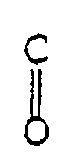 NH R6(R6 is isopropyl, phenyl or -CH2CH2Cl ); CH2OR7(R7 is methyl, ethyl or CH3OCH2CH2-)] ;
-
- Since the isolation of camptothecin from the Chinese tree, Camptotheca acuminata, by Wall and co-workers (J. Am. Chem. Soc., 1966, 88, 3888), there had been many approaches to synthesize camptothecin. However, the development of camptothecin as an effective antineoplastic agent was unsuccessful due to its severe toxicity in the first clinical trial in 1970.
- Thereafter, Liu et al. reported in 1985 that camptothecin had a specific mode of action to inhibit topoisomerase I. Thus, considerable interest has focused on this compound. In particular, since topoisomerase I inhibitor itself was not used clinically, it is expected that with its actual development, camptothecin may be very efficiently used in combination with other antineoplastic chemotherapeutics having different modes of action.
- Recently, various studies for the development of camptothecin derivatives have been proposed in order to reduce the toxicity of camptothecin and to further enhance its antineoplastic activities. Among these related studies, the clinical trial of CPT-11(Irinotecan) synthesized by Yakurt-Honsha Co. of Japan in 1986 showed that it exhibited excellent antineoplastic activities with less toxicity (Japanese Patent Laid Open Publication No. 64-61482) and followed by other pharmaceutical companies such as Smithkline Beecham (Topotecan) and Glaxo (MDO-camptothecin and 9-aminocamptothecin). Among them, CPT-11 is launched. In particular, it is noticeable that said CPT-11 compound has exhibited excellent antineoplastic activities in the treatment of incurable solid tumors such as the lung cancer.
- Water-soluble (aminoalkyl)camptothecin analogues, as well as the inhibition of topoisomerase I and the antitumor activity of said analogues, are described in J. Med. Chem., 1991, 34, 98-107. Said analogues were prepared in which aminoalkyl groups were introduced into ring A or B. Most of the analogues were prepared by oxidation of camptothecin to 10-hydroxycamptothecins followed by a Mannich reaction to give N-substituted 9-(aminomethyl)-10-hydroxycamptothecins or by subsequent modification fo a Mannich product. Others were obtained by modification of the hydroxyl group of 10-hydroxy camptothecin or by total synthesis. These analogues, as well as some of their synthetic precursors, were evaluated for inhibition of topoismerase I, cytotoxicity, and antitumor activity. Although there was not quantitative correlation between these assays, compounds that inhibited topoisemerase I were also cytotoxic and demonstrated antitumor activity in vivo. Further evaluation of the most active water-soluble analogue led to the selection of 9-[(dimethylamino)methyl]-10-hydroxycampthotecin (SK&F 104864) for development as antitumor agent. In addition to its water solubility, ease of synthesis from natural camptothecin, and high potency, said compound demonstrated broad-spectrum activity in preclinical tumor models and was undergoing Phase I clinical trials in cancer patients, at the time of publication. EP-A-0540 099 relates to water soluble, camptothecin derivatives of formula (A).wherein :
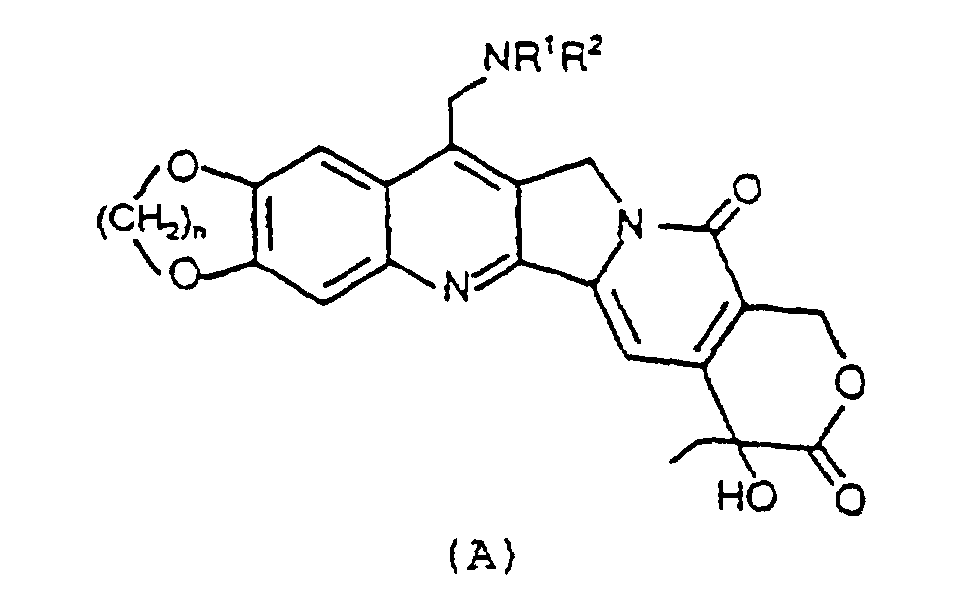
- n represents the integer 1 or 2 ; and
- i)R1 and R2 represent independently, hydrogen, lower alkyl, (C3-7)cycloalkyl, (C3-7)cyclo lower alkyl, lower alkenyl, hydroxy lower alkyl, lower alkoxy lower alkyl ;
- ii) R1 represents hydrogen, lower lakyl, (C3-7)cycloalkyl,
(C3-7)cycloalkyl lower alkyl, lower alkenyl, hydroxy lower
alkyl or lower alkoxy lower alkyl, and
R2 represents -COR3 wherein R3 represents hydrogen, lower alkyl, perhalo-lower alkyl, (C3-7)cycloalkyl, (C3-7)cycloakyl lower alkyl, lower alkenyl, hydroxy lower alkyl, lower alkoxy, lower alkoxy lower alkyl ; or - iii) R1 and R2 taken together with the linking nitrogen
form a saturated 3 to 7 atom heterocyclic group of formula
(IA)
 wherein : Y represents O, S, CH2, NR4 wherein R4 represents
hydrogen, lower alkyl, perhalo-lower alkyl, aryl, aryl
substituted with one or more lower alkyl, halogen, nitro,
amino, lower alkyl amino, perhalo-lower alkyl, hydroxy lower
alkyl, lower alkoxy, lower alkoxy lower alkyl groups or;
wherein : Y represents O, S, CH2, NR4 wherein R4 represents
hydrogen, lower alkyl, perhalo-lower alkyl, aryl, aryl
substituted with one or more lower alkyl, halogen, nitro,
amino, lower alkyl amino, perhalo-lower alkyl, hydroxy lower
alkyl, lower alkoxy, lower alkoxy lower alkyl groups or; -
- Since a majority of camptothecin derivatives developed hitherto were semi-synthetic compounds which were obtained from the chemical modification of camptothecin, there were some difficulties in procuring camptothecin and in developing derivatives with a variety of structures because of restrictions of said chemical modification. In addition, these reported total synthesis are not satisfactory in view of both chemical and optical yields.
- Accordingly, the inventor et al. have confirmed that through the total synthesis for a series of novel compounds expressed by said general formula (I) and followed by in vitro test, these compounds with different mode of action may be used as effective antineoplastic agents. Thus, the present invention has been completed.
- Camptothecin is a fused ring system, composed of a quinoline (A and B), fused to a pyrrolidine ring (C), fused to an alpha-pyridone ring (D) which in turn is fused to a lactone ring(E).
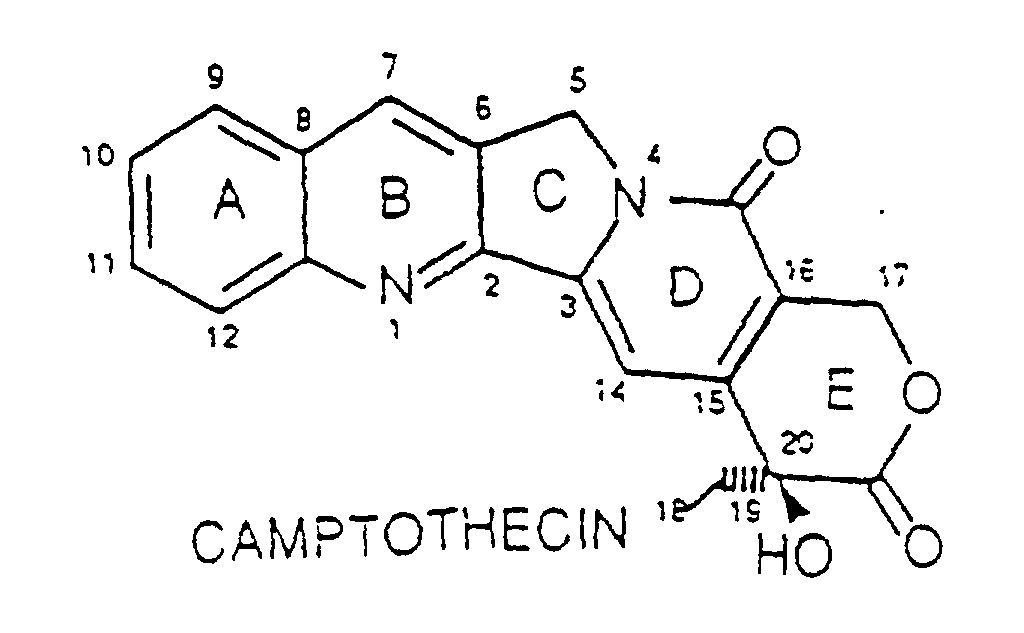
- In particular, further careful review has been made on camptothecin's mode of action to inhibit topoisomerase I and various structures of camptothecin derivatives developed hitherto, and attempts have been also made in such a manner to modify the substituents of B-ring or E-ring in camptothecin.
- In consideration of the fact that the conventionally developed derivatives have suffered from some side effects such as nausea, vomiting and cystitis due to extremely poor water solubility, the introduction of side chain at B-ring of camptothecin was made in such a manner that in order to enhance the solubility. Hence, the side chain including amino groups was introduced at the 7-position of camptothecin.
- In view of the mode of action suggested by Crow that camptothecin binds covalently with topoisomerase I [J. Med. Chem., 1992, 35, 4160-4164], the modification of camptothecin at E-ring was attempted so as to enhance its reactivity.
- The processes for manufacturing camptothecin derivatives and its intermediates are described in more detail as set forth hereunder, in accordance with the practice of this invention.
- The compounds based upon EXAMPLES can be prepared in accordance with the practice of this invention as specified in the following Scheme 1.Wherein;

R, n and R3 are the same as described in the above and R' is -(CH2)2-NR1R2; R1 is a general protecting group of amine; R2 is the same as described in the above. Friedlander condensation of aminoketone compound(II) with tricyclic Ketone(III) affords the compound expressed by the general formula(I) [Organic reactions, 28, 37-202, Wiley & Sons Inc, New York (1932)]. - The condensation of the compounds (II) and (III) is conducted, in general, in the presence of acid at room temperature or under the heating condition.
- The following inert solvents should be used for the reactions so as not to affect the reactions, for example, aromatic hydrocarbons(toluene, benzene, xylene etc.), hydrocarbon halide(dichloromethane, chloroform, 1,1-dichloroethane, 1,2-dichoroethane etc.), lower alcohols, amides (N,N-dimethylformamide etc.), or acetic acid.
- The reactions may be conducted using inorganic acid(hydrochloric acid or sulfuric acid) or organic acids (methanesulfonic acid, trifluoromethanesulfonic acid, p-toluenesulfonic acid, acetic acid, etc.).
- The reaction time ranges from 1 to 48 hrs, and the reaction temperature is 30 to 150°C.
- As a typical reaction condition, it is most preferable that reflux is made available in the presence of ρ-toluenesulfonic acid in toluene.
- When R is -CH2CH2NHR2(R1 is hydrogen) in the synthesis of general formula(I), said amino protecting group is removed through the catalytic hydrogenation using platinum or palladium.
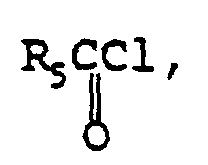
- When R3 is hydroxy group in the compound(III), thus obtained compound(I), wherein R3 is hydroxy group, is reacted with such reagents asR6 NCO and R7OCH2Cl to produce the compound(I) wherein the hydroxy group of R3 is thus modified.
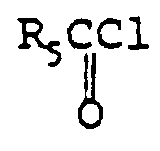
- In particular, when R6NCO is used, the compound expressed by the general formula(I) can be obtained by using the catalytic amounts of tin complex (e.g., di-n-butyltin diacetate, etc.).
- The aminoketone(II) can be prepared in accordance with Scheme 2.Wherein;

- R', R1 and R2 are the same as described in the above.
-
- A novel aminoketone compound(II) of this invention can be prepared as follows:
- 2'-nitroacetophenone reacts with ethylamine, propylamine or isopropylamine, benzylamine in the presence of conc. hydrochloric acid, through Mannich reaction with paraformaldehyde to give the compound(IV).
-
- The reaction is conducted at 30-80°C for 1 to 48 hrs.
- In case of the compound(IV) having monoalkylamine or monoarylamine, the general protecting group of amine is introduced to give the said compound(IV).
- According to this invention, Cbz is a preferable protecting group of amine.
- The compound(IV) is treated with sodium dithionite in lower alcohol solvent to give the compound(II).
- The reaction is conducted at 30 to 100°C for 1 to 10 hrs.
- As specified in Scheme 3 below, a novel tricyclic ketone(III) of this invention can be prepared from the compound(IX) which is already known.
- From the compound(III), tricyclicketone(n is 2 and R3 is H) is already known compound prepared in accordance with a convention method(U.S. Pat. 4,894,456(1990)).Wherein;

R3, n, R5 and R6 are the same as described in the above and R8 is the general protecting group of hydroxyl group. - During α-alkylation reaction where n is 2, the compound(IX) reacts with base such as KOtBu or NaH in inert solvent including N, N-dimethylformamid or 1,2-dimethoxyethane. Then, the reaction mixture is reacted with 2-bromoethanol protected with tetrahydropyranyl, methoxymethyl or methoxyethoxymethyl to give the compound(VIII).
- The reaction is preferably conducted at 30 to 60°C for 18 to 48 hrs.
- Meanwhile, when n is 1, α-hydroxymethylation is conducted using formaldehyde in alcoholic solvent and followed by the protection with the general protecting group of OH to give the compound(VIII).
- The preferable protecting group of this invention is methoxymethyl or methoxyethoxymethyl.
- The compound(VII) was obtained by the reduction of compound(VIII) using Raney-Nickel as a catalyst in a co-solvent of acetic acid and acetic anhydride.
- The reaction is conducted at 30 to 80°C for 1 to 10 hrs.
- The rearrangement via nitroso compound is done by reacting the compound(VII) with sodium nitrite in a co-solvent of acetic anhydride and acetic acid at 0 to 50°C for 1 to 24 hrs. Thus, obtained nitroso compound is refluxed in the solvent such as CCl4 at 60 to 90°C for 5 to 18 hrs to give the compound(VI).
- When n is 1 or 2, the reaction route of the diester (VI) becomes slightly different. In case that n is 2, compound(VI) is hydrolyzed in alkali aqueous solution including LiOH, NaOH and KOH in methanol and treated with acidic aqueous solution such as acetic acid or hydrochloric acid to give the compound(Vc).
- Said hydrolysis is conducted at 0 to 50°C for 30 mins to 5 hrs.
- The lactonization in acidic aqueous solution is conducted at 0 to 50°C for 1 to 48 hrs.
- Compound(Vc) is treated with base such as potassium t-butoxide in the amine solvents such as N,N-dimethylformamide or N,N-dimethylacetamide and oxidized with the bubbling of O2 under triethylphosphite to give the compound(V).
- The reaction is conducted at -10 to 50°C for 30 mins to 5 hrs.
- Meanwhile, when n is 1, compound(VI) is treated with organic base such as DBU, DBN or triethylamine in aromatic hydrocarbon solvent such as benzene, toluene or xylene to produce the compound(Va).
- The reaction is conducted at 0°C to 100°C for 10 mins to 5 hrs.
- The compound(Va) is treated with OsO4 in a pyridine solvent to give the compound(Vb). This reaction is conducted at 10 to 50°C for 1 to 10 hrs. The lactonization of the compound(Vb) is carried out as the same as described in the above.
- The compound(V) where n is 2, is treated with acid to produce compound (III). The reaction is conducted at 10 to 80°C for 30 mins to 10 hrs. In case of the compound(V) wherein n is 1, said deketalization is done after introducing the substituent by treatingR6NCO for the preparation of the compound(III).
- The conversion of the secondary amine of the CH2CH2NR1R2 group into the salts of inorganic acids(e.g., hydrochloric acid, sulfuric acid, phosphoric acid, etc.) or organic acids (e.g., acetic acid) makes it possible to prepare physiologically acceptable salts.
-
- Figure 1 illustrates the difference of ILS(%) in various dose between the compound prepared in example 30 and camptothecin.
- Figure 2 illustrates the inhibitory effects on mice melanorma cells in accordance with the compound prepared in example 30.
-
- This invention is explained in more detail by the following examples and experiments, but the claims are not limited to these examples and experiments.
- A solution of morpholine(2.27g, 0.026mol) in ethanol (10ml) was treated with c-HCl(3ml) for 10 mins, concentrated under reduced pressure to prepare morpholine HCl salt. To this mixture, 2'-nitroacetophenone (3.3g, 0.02mol), paraformaldehyde(0.8g, 0.029mol), c-HCl(0.1ml) and anhydrous ethanol(10ml) were added. The reaction mixture was stirred under reflux for 30 hrs. This reaction mixture was then cooled to room temperature, alkalized with 10% sodium carbonate solution, and the reaction mixture was extracted with dichloromethane(3 x 50ml). The organic layer was dried over anhydrous sodium sulfate and concentrated under reduced pressure to give the crude product. The crude product was purified by flash column chromatography with 5% ethanol in dichloromethane to give the desired product(1.5g, 35%) as an oil.
1H-NMR (CDCl3) δ
3.1(m, 3H), 3.5(m, 4H), 3.75(m, 3H), 3.99(m, 2H), 7.85(m, 3H), 8.15(d, 1H, J=8Hz) - In the same procedure as in EXAMPLE 1, the desired product (458mg,29%) was yielded using piperidine (515mg, 6.06mmol), 2'-nitroacetophenone(1g, 6.06mmol), paraformaldehyde(260mg, 8.67mmol), c-HCl (1ml) and anhydrous ethanol.
1H-NMR(CDCl3) δ
1.5(m, 6H), 2.38(t, 4H, J=5Hz), 2.76(t, 2H, J=6Hz), 3.00(t, 2H, J=6Hz), 3.99(m, 2H), 7.40-7.75(m, 3H), 8.13(d, 1H, J=8Hz) - In the same procedure as in EXAMPLE 1, the desired product (347mg, 23%) was yielded using pyrrolidine(560mg, 7.88mmol), 2'-nitroacetophenone(1g, 6.06mmol), paraformaldehyde (260mg, 8.67mmol), c-HCl (1ml) and anhydrous ethanol(5ml).
- A solution of benzylamine(2.79g, 0.026mol) in ethanol(10ml) was treated with c-HCl(3ml) for 10 min, concentrated under reduced pressure to prepare benzylamine·HCl salt.
- To this solution, 2'-nitroacetophenone (3.3g, 0.02mol), paraformaldehyde (800mg, 0.029mol), c-HCl(0.1ml) and anhydrous ethanol(10ml) were added.
- The reaction mixture was stirred under reflux for 30 hrs. This reaction mixture was then cooled to room temperature, alkalized with 10% sodium carbonate solution, and the reaction mixture was extracted with dichloromethane (3 x 50ml).The organic layer was dried over anhydrous magnesium sulfate and concentrated under reduced pressure to give the crude product, which was dissolved in dichloromethane and cooled to 0°C. To this mixture, triethylamine (1.2g, 0.012mol) was added and followed by another dropwise addition of benzylchloroformate(2ml). The reaction mixture was stirred under nitrogen flow at 0°C for 1 hr, heated to room temperature and then stirred for additional 5 hrs.
- After removing the solvent under reduced pressure, the mixture was dissolved in ethylacetate(100ml). The organic layer was washed with water (3 x 30ml) and brine (30ml) and dried over anhydrous sodium sulfate. After the filtration, the crude product was obtained by removing the solvent. The residue was purified by flash column chromatography with n-hexane-ethylacetate(1:10) to give the desired product (1.5g, 36%).
1H-NMR(CDCl3) δ
3.0(m, 2H), 3.70(t, 2H, J=7Hz), 4.60(s, 2H), 5.17(s, 2H), 7.10-7.70(m, 13H), 8.10(d, 1H, J=8Hz) - Using the same procedure as in EXAMPLE 4 ,the compounds of EXAMPLE 5-8 were prepared using ethylamine in EXAMPLE 5, n-propylamine in EXAMPLE 6, isopropylamine in EXAMPLE 7 and ethanolamine in EXAMPLE 8, instead of benzylamine ; and the results were as follows:

EXAMPLE R 1H-NMR : δ 5 CH2CH3 8.102(d, 1H, J=1.2Hz), 7.596-7.315(m, 8H), 5.125(s, 2H), 3.762-3.61(m, 4H), 1.853(t, 2H, J=6.4Hz), 1.159(t, 3H, J=7.2Hz) 6 CH2CH2CH3 8.124(d, 1H, J=1.2Hz), 7.700-7.272(m, 8H), 5.125(s, 2H), 3.717(t, 2H, J=3.6Hz), 3.322-3.279(m, 2H), 1.624-1.546(m, 4H) 0.894(t, 3H) 7 CH(CH3)2 8.115(d, 1H), 7.613-7.261(m,8H) 5.135(s, 2H), 4.488-4.210(m,1H) 3.639(t, 2H, J=7.2Hz), 1.260(t, 2H,J=7.2Hz), 1.165(d,6H,J=6.4Hz) 8 CH2CH2OH 8.119(d, 1H, J=8.0Hz), 7.623-7.261(m, 8H), 5.127(s, 2H), 3.802-3.719(m, 2H), 3.557(t,2H, J=5.2Hz), 3.392-3.353(m, 2H), 3.068-3.051(m, 2H) - A mixture of 3-[(N-(2'-hydoxyethyl)-N-carbobenzyloxyamino )]-1-(2'-nitrophenyl)propane -1-one(40mg, 0.107mmol) and 4-dimethylamino pyridine (1.2mg, 0.01mmol) was dissolved in anhydrous dichloromethane(2ml), then added triethylamine (0.02ml, 0.160mmol) and acetic anhydride(0.02ml, 0.214mmol). The reaction mixture was stirred at room temperature for 30 mins and washed with a saturated ammonium chloride aqueous solution, water and brine successively. Then, the organic layer was dried over anhydrous magnesium sulfate and concentrated under reduced pressure. The residue, so obtained, was purified by column chromatography with ethylacetate-n-hexane(1:3) to give the desired product(40mg,90%) as a yellow oil.
1H-NMR(400MHz, CDCl3) δ
8.123(d, 1H, J=8.4Hz), 7.607-7.261(m, 8H), 5.136(s, 2H), 4.194(m, H), 3.784-3.754(m, 2H), 3.660-3.646(m, 2H), 3.172(m, 2H), 2.047(s, 3H) - To a solution of 3-morpholino-1-(2'-nitrophenyl) propane-1-one(200mg, 0.758mmol) dissolved in 10ml of 95% ethanol was added sodium dithionite(660mg, 3.79mmol) and the reaction mixture was stirred under reflux for 3 hrs. The reaction mixture was concentrated under reduced pressure. The residue was purified by flash column chromatography with ethanol-dichloromethane-triethylamine to yield the desired product (174mg, 89%) as an oil.
1H-NMR (CDCl3) δ
3.20(m, 3H), 3.50(m, 3H), 3.5(m, 4H), 3.99(m, 2H), 7.5-7.8(m, 3H), 8.08(d, 1H, J=8Hz) - The same procedure as in EXAMPLE 10 was applied to the compound of EXAMPLE 2(200mg, 0.758mmol) and sodium dithionite(660mg, 3.79mmol) so that the desired product (174mg,89%) was yielded.
- The same procedure as in EXAMPLE 10 was applied to the compound of EXAMPLE 3 (400mg) and sodium dithionite (1.052g, 6.05mmol) so that the desired product(235mg) was yielded.
- Using the same procedure as used in Reference EXAMPLE 10, the compounds of EXAMPLE 13-17 were prepared using 3-(N-ethyl-N-carbo-benzyloxyamino)-1-(2'-nitrophenyl) propane-1-one in EXAMPLE 13, 3-(N-n-propyl-N-carbobenzyloxyamino)-1-(2'-nitrophenyl)propane-1-one in EXAMPLE 14, 3-(N-isopropyl-N-carbo-benzyloxyamino)-1-(2'-nitrophenyl)propane-1-one in EXAMPLE 15, 3-(N-benzyl-N-carbobenzyloxyamino)-1-(2'-nitrophenyl) propane(-1-one in EXAMPLE 16, and 3-(N-acetoxyethyl-N-carbobenzyloxyamino)-1-(2'-nitrophenyl)propane-1-one in EXAMPLE 17, respectively, instead of 3-morpholino-1-(2'-nitrophenyl) propane-1-one; and the results were as follows :

EXAMPLE R2 R1 1H-NMR : δ 13 CH2CH3 Cbz 7.365-7.262(m, 9H), 5.144(s, 2H), 3.764-3.71(m, 4H), 1.871-1.838(m, 2H), 1,253(t, 3H, J=7.2Hz) 14 CH2CH2CH3 Cbz 7.885-7.230(m, 9H), 5.142(s, 2H), 3.668-3.613(m, 2H), 3.265(t, 2H, J=6.4Hz), 1.616-1.513(m, 4H), 0.895(t, 3H) 15 CH(CH3)2 Cbz 7.496(d, 1H, J=7.28Hz), 7.377-7.349(m, 3H), 7.299-2.227(m, 5H), 5.172(s, 2H), 4.376-4.216(m, 1H), 3.534-3.371(m, 4H), 1.240-1.044(m, 6H) 16 CH2Ph Cbz 3.17(m, 2H), 3.65(m, 2H), 4.55(s, 2H), 5.10(s, 2H), 6.20(brs, NH2), 7.10-7.70(m, 13H), 8.10(d, 1H, J=8Hz) 17 CH2CH2OAc Cbz 7.771(d, 1H, J=7.6Hz), 7.574-7.262(m, 8H), 6.641(d, 2H,J=7.6 Hz), 5.114(s, 2H), 4.186(m, 2H) 3.773-3.169(m, 6H), 2.042(s, 3H) - A mixture of 3-(N-benzyl-N-carbobenzyloxyamino) -1-(2'-aminophenyl)propane-1-one(543mg, 1.4mmol) and 4-ethyl-6-oxo-1,4,7,8-tetrahydro-4-hydroxy-pyrano [3,4-f]indolizine-3,10(6H)-dione(263mg, 1.0mmol) was dissolved in toluene(50ml). The reaction mixture was stirred under reflux for 30 mins, and ρ-toluenesulfonic acid(25mg, 0.13mmol) was added to the mixture. The reaction mixture was stirred in a Dean-Stark trap under reflux for 9 hrs. The solvent was removed under reduced pressure and the residue was purified by flash column chromatography with ethylacetate-dichloromethane (1:1) to give the desired product(507mg, 59%) as a yellow powder.
1H-NMR (CDCl3) δ
1.04(t, 3H, J=8Hz), 1.90(m, 2H), 3.10-3.90(m, 4H), 4.53(s, 1/2 x 2H), 4.61(s, 1/2 x 2H), 4.95(s, 1/2 x 2H), 5.07(s, 1/2 x 2H), 5.30(s, 2H), 5.31(d, 1H, J=16Hz), 5.75(d, 1H, J=16Hz), 7.20-8.20(m, 15H) - Using the same procedure as in EXAMPLE 18, the compounds of EXAMPLES 19 to 24 were prepared from a reaction between 4-ethyl-6-oxo-1,4,7,8-tetrahydro-4-hydroxy-pyrano[3,4-f]indolizine-3,10(6H)-dione and 3-(N-n-propyl)-N-carbobenzyloxyamino)-1-(2'-aminophenyl)-propane-1-one in EXAMPLE 19, 3-(N-isopropyl)-N-carbobenzyloxyamino)-1-(2'-aminophenyl)propane-1-one in EXAMPLE 20, 3-(N-acetoxyethyl)-N-carbobenzyloxyamino)-1-(2'-amino-phenyl)-propane-1-one in EXAMPLE 21, 3-piperidino -1-(2'-aminophenyl)propane-1-one in Reference EXAMPLE 22, 3- pyrrolidino -1-(2'-aminophenyl)propane-1-one in Reference EXAMPLE 23, and 3- morpholino -1-(2'-aminophenyl) propane-1-one in Reference EXAMPLE 24; and the results were as follows :

EXAMLPE R2 R1 1H-NMR(CDCl3) δ 19 CH2CH2CH3 Cbz 8.236-7.261(m, 10H),5.757, 5.324 (ABq, 2H, J=16Hz), 5.293(s, 2H), 5.193(s, 2H), 3.593-3.199(m, 4H) 1.942-1.863(m, 2H), 1.634-1.516 (m, 4H), 1.047(t, 3H, J=7.2Hz), 0.944-0.842(m, 3H) 20 CH(CH3)2 Cbz 8.197(d, 1H), 7.926-7.628(m, 3H) 7.485-7.365(m, 6H), 5.694(d, 1H, J=13.08Hz), 5.552-5.270(m, 3H) 5.246(s, 2H), 4.476-4.310(m,1H), 3.514-3.456(m, 4H), 1.997-1.910 (m, 2H), 1.248-1,208(m, 6H), 1.044(t, 3H, J=5.92Hz) 21 CH2CH2OAc Cbz 8.344-7.261(m, 10H), 5.748(d, 1H J=16.8Hz), 5.308(d, 1H,J=16.8Hz) 5.298(s, 2H), 5.113(s, 2H), 4.255-4.126(m, 2H), 3.791-3.371 (m, 6H), 2.041(s, 3H),1.954-1.610 (m, 2H), 1.042(t, 3H, J= 7.2Hz) 
EXAMPLE R1 R2 1H-NMR(CDCl) δ Ref. 22 piperidino 1H-NMR(200MHz, DMSO-d6) 0.92(t, J=6Hz, 3H), 1.32(m, 6H), 1.90(m, 2H), 2.34(s, 3H), 2.90(m, 2H), 3.30 (m, 6H), 5.48(s, 2H), 5.49(s, 2H), 6.58(s, 1H), 7.16(d, J=8Hz, 2H), 7.52(d, J=8Hz, 2H), 7.77-8.30(m, 4H) Ref. 23 pyrrolidino 1H-NMR(200MHz, DMSO-d6) 0.94(t, J= 6Hz, 3H), 1.25(m, 4H), 1.87(m, 2H), 2.33(s, 3H), 2.90(m, 2H),3.11(m,6H), 3.53(s, 1H), 5.52(s, 2H), 5.53 (s, 2H), 6.60(s, 1H), 7.15(d, J=8Hz,2H), 7.51(d, J=8Hz, 2H),7.77-8.30(m, 4H) Ref. 24 morpholino 1H-NMR(200MHz, CDCl3) δ 0.86(t,J= 6Hz, 3H), 1.89(m, 2H), 2.25(s, 3H), 2.85(m, 2H), 3.05(m, 2H), 3.51(m, 4H), 3.71(m, 4H), 5.39(s, 2H), 5.40 (s, 2H), 6.49(s, 1H), 7.08(d, J=8Hz, 2H), 7.44(d, J=8Hz, 2H), 7.70-8.30(m, 4H) - A mixture of dl-7-[2-(N-acetoxyethyl-N-carbobenzyloxyamino) ethyl] camptothecin(28.2mg, 0.05mmol) and potassium carbonate (25mg, 0.15mmol) was dissolved in mixed a solution of methanol and water(1:1, 1.5ml) and the reaction mixture solution was stirred at room temperature for 3 hrs. The reaction mixture was acidified with 1N HCl solution, extracted with dichloromethane and washed with brine. The organic layer was dried over anhydrous sodium sulfate, filtered and concentrated under reduced pressure. The residue was purified by flash column chromatography with dichloromethane-methanol(20:1) to give the desired product (17mg, 60%) as a yellow solid.
1H-NMR (400MHz, CDCl3) δ
8.171-7.762(m, 10H), 5.710(d, 2H, J=16.8Hz), 5.308 (d, 2H, J=16.8Hz),5.301(s, 2H), 5.207(s, 2H), 3.868-3.466(m, 8H), 1.926-1.832(m, 2H), 1.033(t, 3H, J=7.6Hz) - dl-7-[2-(N-Benzyl-N-carbobenzyloxyamino)ethyl] camptothecin(50mg, 0.08mmol) was dissolved in glacial acetic acid(20ml) and treated with 10% Pd/C(25mg). The reaction mixture was stirred under hydrogen flow of 40 psi for 9 hrs, and the catalyst was removed through cellite pad by filtration under reduced pressure. The filtrate was concentrated under reduced pressure. The residue was purified by flash column chromatography with 10% methanol-dichloromethane to give the desired product (24mg, 63%) as a yellow powder.
1H-NMR (400MHz, CDCl3) δ
0.89(t, 3H, J=8Hz), 1.87(m, 2H), 2.90(m, 2H), 3.5(m, 4H), 3.73(s, 1H), 5.33(s, 2H), 5.43(s, 2H), 6.52(s, 1H), 7.25(m, 6H), 7.70-8.30(m, 4H) - The same procedure as in EXAMPLE 26, was carried out, but dl-7-[2- (N-acetoxyethyl-N-carbobenzyloxyamino) ethyl] camptothecin was used.
1H-NMR (400MHz, CDCl3+MeOH-d4) δ
8.323(d, 1H, J=8.8Hz), 8.138(d, 1H, J=8.4Hz), 7.812 (t, 1H, J=6.8Hz), 7.675(t, 1H, J=6.8Hz), 7.647(s, 1H), 5.742(d, 1H J=16.4Hz), 5.324-5.284(m, 2H), 4.169-4.122(m, 2H), 3.373(t, 2H, J=7.6Hz), 3.108-3.040(m, 4H), 2.090(s, 3H), 2.024(s, 3H), 1.955-1.803(m, 2H), 1.033(t, 3H, J=7.6Hz) - The same procedure as in EXAMPLE 26, was carried out, but dl-7-[2-(N-hydroxyethyl-N-carbobenzyloxyamino) ethyl] camptothecin was used.
1H-NMR (CDCl3-MeOH-d4)
8.284(d, 1H, J=8.0Hz), 8.226(d, 1H, J=8.8Hz), 7.863(t, 1H, J=6.8Hz), 7.756(t, 1H, J=6.8Hz), 7.730(s, 1H), 5.682(d, 1H, J=13.6Hz), 5.641(d, 1H, J=13.6Hz), 5.130(s, 2H), 3.800-3.190(m, 8H), 1.962-1.898(m, 2H), 1.031(t, 3H, J=4.4Hz), 2.035(s, 3H). - A mixture of 2'-amino-2-(N-carbobenzyloxy-N -ethylamino)propiophenone(34mg, 0.11mmol) and 4-ethyl-6-oxo-1,4,7,8-tetrahydro-4-hydroxy-pyrano[3, 4-f]indolizine-3, 10(6H)-dione(34mg, 0.1mmol) was dissolved in toluene and was refluxed for 30 mins. After addition of p-toluenesulfonic acid (19.2mg, 0.1mmol), the reaction mixture was then refluxed in a Dean-Stark trap for 3 hrs. The reaction mixture was concentrated under reduced pressure, and the residue was purified by column chromatography with dichloromethane-methanol(10:1) to give the desired product( 40mg,67%) as a solid.
1H-NMR (400MHz, DMSO-d6) δ
8.280(d, 1H, J=8.6Hz), 8.184(d, 1H, J=7.4Hz), 7.873-7.753(m, 2H), 7.471(d, 2H, J=7.2Hz), 7.111(d, 2H, J=7.2Hz), 7.356(s, 1H), 6.523(s, 1H), 5.439(s, 2H), 3.534-2.753(m, 6H), 2.217(s, 3H), 1.671-1.643 (m, 2H), 1.230(t, 3H, J=6.8Hz), 0.743(t, 3H, J=7.2Hz) - The same procedure as in Example 29 was carried out, but 2'-amino-2-(N-carbobenzyloxy-N-isopropyl amino) propiophenone was used with 4-ethyl-6-oxo-1,4,7,8-tetrahydro-4-hydroxypyrano[3,4-f]indolizine-3,10-(6H)-dione,
1H-NMR (400MHz, DMSO-d6) δ
8.870-8.567(m, 2H), 8.298-8.155(m, 2H), 7.867(d,2H, J=7.6Hz), 7.741(s, 1H), 7.500(d, 2H, J=7.6Hz), 5.828(s, 2H), 5.795(s, 2H), 3.958-3.820(m, 2H), 2.666(s, 3H), 2.320-2.200(m, 2H), 1.614(d, 6H, J=6.4Hz), 1.533(t, 2H), 1.267(t, 3H) - The same procedure as in EXAMPLE 24 was carried out except that trifluoroacetic acid was used instead of ρ-toluenesulfonic acid.
1H-NMR (200MHz, DMSO-d6) δ
0.92(t, J=6Hz, 3H), 1.94(m, 2H), 2.90(m, 4H), 3.30-3.65(m, 8H), 5.47(s, 2H), 5.48(s, 2H), 6.56(s, 1H), 7.70-8.30(m, 4H) - 6-Cyano-1,1-(ethylenedioxy)-7-[(ethoxycarbonyl)methyl]-5-oxo-Δ6(8)-tetrahydroindolizine(608.6mg, 2mmol) was dissolved in anhydrous dimethylformamide(3ml), cooled to 5°C and after addition of potassium t-butoxide(258.1mg, 2.3mmol), the reaction mixture was stirred at the same temperature for 30 mins. To this mixture, 2-brmoethanolmethoxy-methylether (1.352g, 8mmol) was added and the reaction mixture was stirred at 45-50°C for 20 hrs. The reaction mixture was diluted with water(50ml), extracted with dichloromethane (100ml). The organic layer was washed with water(80ml) and brine(80ml), dried over anhydrous magnesium sulfate and concentrated under reduced pressure. The residue was purified by column chromatography with ethylacetate -n-hexane( 2:1) to give the desired product(734.8mg, 95%) as a pale yellow solid.
IR(neat) 2224, 1734, 1656 cm-1
1H-NMR (400MHz, CDCl3) δ
1.254(t, 3H, J=6.8Hz), 1.987-2.020(m, 1H), 2.410(t, 2H, J=6.8Hz), 2.43-2.449(m, 1H), 3.447-3.485(m, 1H) 3.564-3.603(m, 1H), 4.117-4.201(m, 7H), 4.225(q, 2H J=7.6Hz),4.584, 4.609(ABq, 2H, J=6.8Hz),6.367(s, 1H)
MS(EI) m/e
392(M+), 377(M+-CH3), 361(M+-OCH3), 347(M+-C2H5O) - 250 Drops of Raney-Nickel(50% aqueous slurry) was washed with water (5ml) and acetic acid (10ml) 5 times respectively and added into a parr bottle.
- To this solution, a compound(743.8mg, 1.9mmol), obtained in EXAMPLE 32, acetic anhydride(30ml) and acetic acid(10ml) were added and the reaction mixture was hydrogenated at a pressure of 45 psi and 45-50°C for 3 hrs. The catalyst was removed by filtration and the filtrate was concentrated under reduced pressure. The residue was purified by column chromatography with dichloromethane -methanol(20:1) to give the desired product(789.5mg,95%) as a yellow oil.
IR(neat) 1733, 1660, 1635 cm-1
1H-NMR (400MHz, CDCl3) δ
1.214(t, 3H, J=6.8Hz), 1.924(s, 3H), 1.939-1.98(m, 1H), 2.382(t, 2H, J=6.8Hz), 2.399-2.40(m, 1H), 3.343(s, 3H), 3.44-3.58(m, 2H), 4.075-4.131(m, 7H), 4.145(q, 2H), 4.34, 4.39(d, d, 2H), 4.571, 4.592 (ABq, 2H, J=6.8Hz), 6.306(s, 1H), 6.61(brs, 1H)
MS(EI) m/e
438(M+), 423 (M+-CH3), 407(M+-OCH3), 395(M+-COCH3), 393(M+-C2H5O) - To a compound(789.5mg, 1.8mmol) obtained in EXAMPLE 33, acetic anhydride(15ml), acetic acid(5ml) and sodium nitrite(621.2mg, 9mmol) were added and the reaction mixture was stirred at 5 to 10°C for 6 hrs. After removing the inorganic material, so formed by filtration, the filtrate was concentrated under reduced pressure to give nitroso compound. With addition of carbon tetrachlonride (50ml), the mixture was heated under reflux for 18 hrs. The reaction mixture was washed with water(10ml) and brine(10ml), dried over anhydrous magnesium sulfate and concentrated under reduced pressure. The residue was purified by column chromatography with dichloromethane -methanol( 20:1) to give the desired product(720mg,91%) as a colorless oil.
IR(neat) 1740, 1733, 1654 cm-1
1H-NMR (400MHz, CDCl3) δ
1.217(t, 3H, J=6.8Hz), 1.86-1.95(m, 1H), 2.056(s, 3H), 2.368(t, 2H), 2.38-2.43(m, 1H), 3.333(s, 3H), 3.41-3.57(m, 2H), 4.087-4.119(m, 9H), 4.569(s, 2H), 5.259(s, 2H), 6.304(s, 1H)
MS(EI) m/e 439(M+), 408(M+-OCH3), 396(M+-COCH3) - A mixture of the compound (720mg,1.64mmol) obtained in prepared by EXAMPLE 34 and methanol(15ml) was added to LiOH·H2O (172mg, 4.1mmol) dissolved in water(5ml) and stirred at 25 to 30°C for 2 hrs. The reaction mixture was concentrated under reduced pressure to remove methanol and with addition of water(15ml), dichloromethane(50ml) and acetic acid(5ml), the reaction mixture was stirred at 25 to 30°C for 10 hrs. The organic layer was separated from the reaction mixture, washed with water (10ml) and brine(10ml) and dried over anhydrous magnesium sulfate. The organic layer was concentrated under reduced pressure. The residue was purified by column chromatography with dichloromethane-methanol(30:1) to give the desired product(720mg,91%) as a white solid.
IR(neat) 1747, 1662 cm-1
1H-NMR (400MHz, CDCl3) δ
2.178-2.216(m, 2H), 2.404(t, 2H, J=6.8Hz), 3.371(s, 3H), 3.599-3.643(m, 2H), 3.701(t, 1H, J=6.8Hz), 4.109-4.192(m, 6H), 4.618(s, 2H), 5.278, 5.43(ABq, 2H, J=16.4Hz), 6.169(s, 1H)
MS(EI) m/e 351(M+), 320(M+-OCH3), 307(M+-CO2) - Potassium t-butoxide(273mg, 2.43mmol) was added to a mixture of the compound(570.3mg, 1.63mmol) obtained in EXAMPLE 35 dissolved in anhydrous DMF(20ml) and stirred at 0 to 5°C for 30 mins. The reaction mixture was cooled to -10 to -5°C and with addition of triethyl phosphite (974 µl, 5.68mmol), the mixture was stirred for 2.5 hrs, while bubbling the oxygen. Water(10ml) was added to the mixture and pH was adjusted to 3.5 with 1N-HCl. Then, the reaction mixture was extracted with dichloromethane (30ml x 2 times), washed with water(20ml), and brine(20ml) and dried over anhydrous magnesium sulfate. The organic layer was concentrated under reduced pressure. The residue was purified by column chromatography with dichloromethane -methanol(25:1) to give the desired product (416.4mg, 69.8%) as a white solid.
IR(neat) 3503, 1749, 1654 cm-1
1H-NMR (400MHz, CDCl3) δ
1.919-1.974(m, 1H), 2.010-2.063(m, 1H), 2.348(t,2H, J=6.8Hz), 3.30(s, 3H), 3.542-3.597(m, 1H), 3.639-3.684(m, 1H), 4.002-4.1541(m, 7H), 4.516, 4.494 (ABq, 2H, J=6.4Hz), 5.111, 5.557(ABq, 2H, J=16Hz), 6.541(s, 1H)
MS(EI) m/e 367(M+), 336(M+-OCH3), 323(M+-CO2) - A mixture of THF(200ml), water(1ml) and 6N HCl(2.5ml) was added to the compound(146.1mg, 0.4mmol) obtained in EXAMPLE 36 and stirred at 50-55°C for 1 hr. The reaction mixture was concentrated under reduced pressure. The residue was purified by DianionR HP-20 (Mitsubishi) with acetonitrile-water(4:1) and concentrated under reduced pressure to give the desired product (93.2mg,84%) as a black resin.
IR(KBr) 3470, 1749, 1654 cm-1
1H-NMR (400MHz, CDCl3) δ
1.92-2.11(m, 2H), 2.962(t, 2H, J=6.0Hz), 3.674-3.86 (m, 2H), 4.326(t, 2H, J=6.0Hz), 5.259, 5.627(ABq, 2H, J=16.8Hz), 5.287(s, 1H), 7.284(s, 1H)
MS(EI) m/e 279(M+), 261(M+-H2O), 235(M+-C2H5OH) - A solution of 2-aminobenzaldehyde ethyleneacetal (75.6mg, 0.46mmol) and toluene (8ml) was added to the compound(85.2mg, 0.31mmol) obtained in EXAMPLE 37 and refluxed in a Dean-Stark apparatus for 1 hr. ρ-toluene-sulfonic acid (catalytic amount) was added to the reaction mixture and refluxed again for 3 hrs. The solid, so formed, was filtered and purified by column chromatography with dichloromethane-methanol(15:1) to give the desired product(57.8mg,52%) as a pale brown solid.
IR(neat) 3400, 1743, 1658 cm-1
1H-NMR (400MHz, CDCl3:DMSO-d6 = 3:1) δ 2.01-2.20(m, 2H), 3.51-3.86(m, 2H), 5.315(s, 2H), 5.34, 5.55(ABq, 2H), 6.418(s, 1H), 7.557(s, 1H), 7.676(t, 1H), 7.83(t, 1H), 8.03(d, 1H), 8.18(d, 1H), 8.570(s, 1H)
MS(EI) m/e 364(M+), 320 (M+-CO2) - Methoxymethyl chloride (6µl, 0.08mmol) and diisopropylethylamine(12µl, 0.07mmol) was added to a suspension of dl-18-hydroxycamptothecin(20mg, 0.05mmol) in dichloromethane(2ml) and stirred at 25 to 30°C for 48 hrs.
- With addition of dichloromethane(25ml), the reaction mixture was washed with a saturated ammonium chloride(10ml), water(10ml), 10% hydrogen sulfate potassium(10ml), water(10ml) and brine(10ml) successively. The organic layer was dried over anhydrous magnesium sulfate and concentrated under reduced pressure. The residue was purified by column chromatography with dichloromethane-methanol(30:1) and PTLC with dichloromethane-methanol(20:1) to give the desired product (5mg,23%) as a yellow solid.
IR(KBr) 3566, 1733, 1652 cm-1
1H-NMR (400MHz, CDCl3) δ
2.15-2.34(m, 2H), 3.387(s, 3H), 4.08-4.22(m, 2H), 4.604(d, d, 2H), 5.313(s, 2H), 5.62, 5.78(ABq, 2H), 6.6(s, 1H), 7.68(t, 1H), 7.726(s, 1H), 7.84(t, 1H), 7.96(d, 1H), 8.24(d, 1H), 8.41(s, 1H)
MS(EI) m/e 408(M+)
HRMS m/e M+ Calcd; 408.1321, Obsd; 408.1336 - In the same manner as in Reference EXAMPLE 39, the compounds (R=H and n=2) of Reference EXAMPLE 40 to 46, expressed by the general formula(I), were prepared from dl-18-hydroxycamptothecin and, respectively, acetyl chloride in Reference EXAMPLE 40, methoxyacetylchloride in Reference EXAMPLE 41 , ethoxymethylchloride in Reference EXAMPLE 42, methoxyethoxymethyl chloride in Reference EXAMPLE 43, phenyl isocyanate in Reference EXAMPLE 44, 2-chloroethyl isocyanate in Reference EXAMPLE 45, and isopropyl isocyanate in Reference EXAMPLE 46.
EXAMPLE R3 1H-NMR(CDCl3 or CDCl3 ÷ CD3OD) δ Ref. 40 OCOCH3 1.970(s,3H), 2.26-2.37(m, 2H), 4.126 -4.216(m, 2H), 5.32(s, 2H), 5.66, 5.79 (Aq, 2H), 6.36(s, 1H), 7.65(s, 1H), 7.69(t, 1H), 7.86(t, 1H), 7.95 (d, 1H), 8.25(d, 1H), 8.41(s, 1H) Ref. 41 OCOCH2OCH3 8.3975(s, 1H), 8.2429(d, 1H, J=8.5Hz) 7.9401(d, 1H, J=8.3Hz), 7.8358(t,1H), 7.6936(s, 1H), 7.6845(t, 1H), 5.7928 5.3225(ABq, 2H, J=16.2Hz), 5.3064(s, 2H), 4,2762-4.2991(m, 1H), 4.18-4.22 (m, 1H), 3.9794(d, 2H, J=2.4Hz), 3.4106(s, 3H), 2.2333-2.2444(m, 2H) Ref. 42 OCH2OCH2CH3 8.4035(s, 1H), 8.2411(d, 1H, J=8.4Hz) 7.945(d, 1H, J=7.4Hz), 7.8409(t, 1H, J=7.0Hz), 7.7274(s, 1H), 7.6744(t, 1H J=7.0Hz), 5.7673, 5.3189(ABq, 2H, J= 16.2Hz), 5.3132(s, 2H), 4.6547(ABq, 2H), 4.3373(s, 1H), 4.2345(q, 2H), 3.81(m, 1H), 3.7144(m, 1H), 2.22(m, 1H), 2.11(m, 1H), 1.2186(t, 3H) Ref. 43 OCH2OCH2 -CH2OCH3 8.4018(s,1H), 8.2391(d,1H, J=8.4Hz), 7.9423(d,1H, J=7.6Hz), 7.8388(t,1H), 7.7236(s, 1H), 7.6925(t, 1H), 5.7629, 5.3223(ABq, 2H,J=16.3Hz), 5.3111(s, 2H), 4.6934(d, d, 2H), 3.8514(m, 1H) 3.7011-3.7435(m, 2H), 3.65(m, 1H), 3.5602-3.5828(m, 2H), 3.3976(s, 3H), 2.01-2.22(m, 2H) Ref. 44 OCONHPh 2.074-2.188(m, 1H),2.308-2.361(m,1H), 4.122-4.163(m, 1H), 4.279-4.303(m, 1H) 5.153, 5.263(ABq, 2H, J=19.2Hz) 5.464 (s, 2H), 6.707(t, 1H, J=7.2Hz) 7.013(t, 2H, J=8.0Hz), 7.202(d, 2H, J=8.0Hz), 7.350(s, 1H), 7.693(t, 1H J=7.2Hz), 7.842(t, 1H, J=8.4Hz), 8.086(d, 1H, J=8.4Hz), 8.122(d, 1H, J=8.0Hz), 8.611(s, 1H),9.337(brs,1H) Ref. 45 OCONHCH2CH2-Cl 9.19(brs, 1H), 8.3989(s, 1H), 8.2469 (d, 1H, J=8.4Hz), 7.9399(d, 1H, J=7.9 Hz), 7.8384(t, 1H), 7.7171(s, 1H), 7.6727(t, 1H), 5.7667, 5.3430(ABq, 2H), 5.2748(q, 2H), 3.8914(m, 1H), 3.78(m, 1H), 3.5472-3.5995(m, 2H), 3.4507-3.4833(m, 2H), 2.22(m, 2H) Ref. 46 OCONH i-Pr. 8.3909(s, 1H), 8.2033(d, 1H, J=8.7Hz) 7.9206(d, 1H, J=7.5Hz), 7.8150(t,1H) 7.7022(s, 1H), 7.6551(t 1H), 5.7112, 5.2815(ABq, 2H, J=16.2Hz), 5.2778(s, 2H), 4.2720(m, 1H), 4.1706-4.1982(m, 1H), 3.6538(m, 1H), 2.2597(m, 2H), 1.1270(d, 6H) - A mixture of 35% formaldehyde(30ml), dioxane(50ml), water(20ml) and ethanol(20ml) was added to 6-cyano-1,1-(ethylenedioxy)-7-[(ethoxycarbonyl)methyl]-5-oxo-Δ6(8)-tetrahydroindolizine(500mg, 1.64mmol) and stirred at 25 to 30°C for 15 hrs. With addition of dichloromethane (120ml), the reaction mixture was washed with water(120ml x 3 times) and brine(120ml). The separated organic layer was dried over anhydrous magnesum sulfate and concentrated under reduced pressure. The residue was purified by column chromatography with dichloromethane -methanol( 25:1) to give the desired product( 318mg, 58%) as a white solid.
IR(KBr) 3310, 2224, 1735, 1647 cm-1
1H-NMR (400MHz, CDCl3) δ
1.275(t, 3H, J=7.2Hz), 2.407(t, 2H, J=6.8Hz), 4.029-4.221(m, 9H), 4.239(q, 2H), 6.383(s, 1H)
MS(EI) m/e
334(M+), 316 (M+-H2O), 304(M+-CH3OH) - Dichloromethane(0.7ml) was added to the compound(51.6mg, 0.15mmol) obtained in EXAMPLE 47 and cooled in ice bath. Then, with a slow addition of diisopropylethylamine (30µl, 0.17mmol) and MEM-Cl (35µl, 0.31mmol), the resulting solution was stirred at 25 to 30°C for 20 hrs. To the reaction mixture, dichloromethane (15ml) was added and washed with a saturated sodium bicarbonate aqueous solution (10ml x 2 times), water(10ml) and brine (10ml). The separated organic layer was dried over anhydrous magnesium sulfate and concentrated under reduced pressure. The residue was purified by column chromatography with dichloromethane-methanol(25:1) to give the desired product(41mg, 62%) as a white solid.
IR(neat) 2224, 1734, 1661 cm-1
1H-NMR (400MHz, CDCl3) δ
1.289(t, 3H, J=6.8Hz), 2.422(t, 2H, J=6.8Hz), 3.410 (s, 3H), 3.548-3.598(m, 2H), 3.653-3.680(m, 1H), 3.725-3.748(m, 1H), 3.912(dd, 1H, J=10Hz, J=6.8Hz), 4.098(dd, 1H, J=10Hz, J=6.8Hz), 4.129-4.216(m, 6H), 4.236(q, 2H), 4.336(t, 1H, J=6.8Hz), 4.706, 4.742 (ABq, 2H, J=6.8Hz), 6.441(s, 1H)
MS (EI) m/e
423(M++H), 422(M+), 392 (M+-OCH3) , 378 (M+-C2H5O) - With the compound(39.6mg, 0.09mmol) obtained in EXAMPLE 48, the reaction and work-up was carried out in the same procedure as in EXAMPLE 33 and then, the residue was purified by column chromatography with dichloromethane-methanol ( 20 : 1) to give the desired compound(42mg, 96%) as a colorless oil.
IR(neat) 1733, 1661, 1656 cm-1
1H-NMR (400MHz, CDCl3) δ
1.247(t, 3H, J=7.2Hz), 1.943(s, 3H), 2.393(t, 2H, J=6.8Hz), 3.405(s, 3H), 3.546-3.569(m, 2H), 3.660 -3.686(m, 2H), 3.809(dd, 1H, J=6.4Hz, J=9.2Hz), 4.093-4.192(m, 7H), 4.205(g, 2H), 4.467(dq, 2H, J=6.4Hz), 4.652(t, 2H, J=6.8Hz), 4.719, 4.750(ABq, 2H, J=6.8Hz), 6.349(s, 1H), 6.658(s, 1H)
MS(EI) m/e
468(M+), 453(M+-CH3), 425(M+-C2H5O) - With the compound(359mg, 0.76mmol) obtained in EXAMPLE 49, the reaction and work-up was carried out in the same procedure as used in EXAMPLE 34 and then, the residue was purified by column chromatography with dichloromethane : methanol (30:1) to give the desired compound(234mg,65%) as a colorless oil.
IR(neat) 1733, 1740, 1661 cm-1
1H-NMR (400MHz, CDCl3) δ 1.230(t, 2H, J=7.2Hz), 2.057(s, 3H), 2.361(t, 2H, J=6.8Hz), 3.381(s, 3H), 3.521-3.542(m, 2H), 3.620-3.653(m, 2H), 3.723(dd, 1H, J=6.0Hz, J=9.6Hz), 4.082-4.209(m, 8H), 4.225(5, 2H), 4.716-4.675(ABq, 2H, J=6.8Hz), 5.259(s, 2H), 6.313(s, 1H)
MS(EI) m/e
469(M+), 426(M+-COCH3) - A mixture of dry benzene(8ml) and DBU(416µl, 2.78mmol) was added to the compound(522mg, 1.1mmol) obtained in EXAMPLE 50 and stirred at room temperature for 3 hrs. With addition of dichloromethane (20ml), the reaction mixture was washed with a saturated ammonium chloride aqueous solution(15ml x 2) and water(15ml). The separated organic layer was dried over anhydrous magnesium sulfate and concentrated under reduced pressure. The residue was purified by column chromatography with dichloromethane- methanol(30:1) to give the desired product(363mg, 90%) as a yellowish white solid.
IR(neat) 1729, 1719, 1655 cm-1
1H-NMR (400MHz, CDCl3) δ
6.551(s, 1H), 6.109, 5.773(s, s, 1H x 2), 5.008(s, 2H), 4.243(q, 2H, J=7.2Hz), 4.104-4.161(m, 6H), 2.398(t, 2H, J=6.8Hz), 2.021(s, 3H), 1.293(t, 3H, J=7.2Hz)
MS(EI) m/e
363(M+), 320 - Pyridine(3.9ml) was added to the compound(285mg, 1.79mmol) obtained in EXAMPLE 51, injected with OsO4 (240mg, 0.94mmol) (0.08M toluene, 11.8ml) and stirred at room temperature for 4 hrs in the dark. After the reaction was completed, the reaction mixture was added with a solution of NaHSO3(480mg) and water(7ml) and stirred for 1 hr. The reaction mixture was extracted with dichloromethane (30ml x 5), and the combined organic layers were washed with brine and dried over anhydrous magnesium sulfate.
- The organic layer was concentrated under reduced pressure. The residue was purified by column chromatography with dichloromethane-methanol(20:1) to give the desired product(280mg,90%) as a white solid.
IR(neat) 3307, 1735, 1654 cm-1
1H-NMR (400MHz, CDCl3) δ
6.455(s, 1H), 5.303(ABq, 2H, J=11.7Hz), 4.611(s,1H) 4.085-4.611(m, 9H), 3.855, 3.826(dd, 1H, J=6.8, 11.2Hz), 2.641(brt, 1H, J=6.8Hz), 2.384(t, 2H, J=6.8Hz), 2.063(s, 3H), 1.290(t, 3H, J=6.8Hz)
MS(EI) m/e 397(M+), 354 - With the compound(325mg, 0.82mmol) obtained in EXAMPLE 52, the reaction and work-up was carried out in the same procedure as in EXAMPLE 35 and then, the residue was purified by column chromatography with dichloromethane-methanol(20:1) to give the desired compound (211mg, 84%) as a white solid.
IR(neat) 3421, 1750, 1654 cm- 1
1H-NMR (400MHz, CDCl3) δ
6.599(s, 1H), 5.564, 5.255(ABq, 2H, J=16.0Hz), 4.072-4.238(m, 7H), 3.772, 3.733(dd, 2H, J=11.6Hz), 2.418(t, 2H, J=6.8Hz)
MS (EI) m/e
309(M+), 293, 280, 279, 265
HRMS m/e (M+) Calcd : 309, 0849, Obsd : 309, 0.847 - The compound(119mg, 0.38mmol) obtained in EXAMPLE 53 was dissolved in anhydrous dichloromethane(10ml) and with addition of pyridine(93µl, 1.15mmol) and acetic anhydride(47µl, 0.50mmol), the reaction mixture was stirred at room temperature for 20 hrs. The reaction mixture was diluted with dichloromethane(20ml), washed with 10% potassium bisulfate aqueous solution(20ml), water(20ml) and brine(20ml), and dried over anhydrous magnesium sulfate.
- The organic layer was concentrated under reduced pressure. The residue was purified by column chromatography with dichloromethane-methane(20:1) to give the desired compound(127mg,94%) as a white solid.
IR(neat) 3437, 1751, 1657 cm-1
1H-NMR (400MHz, CDCl3) δ
6.586(s, 1H), 5.636, 5.295(ABq, 2H, J=16.4Hz), 4.302(d, 1H, J=11.2Hz), 4.116-4.215(m, 7H), 4.004 (s, 1H), 2.427(t, 2H, J=6.8Hz), 2.084(s, 3H) - Using the same procedure as used in EXAMPLE 54, the compounds of EXAMPLE 55 to 57 were prepared from a reaction between the compound obtained in EXAMPLE 53 and, respectively, phenyl isocyanate in EXAMPLE 55, isopropyl isocyanate in EXAMPLE 56, and methoxyacetyl chloride in EXAMPLE 57; and the results were as follows :
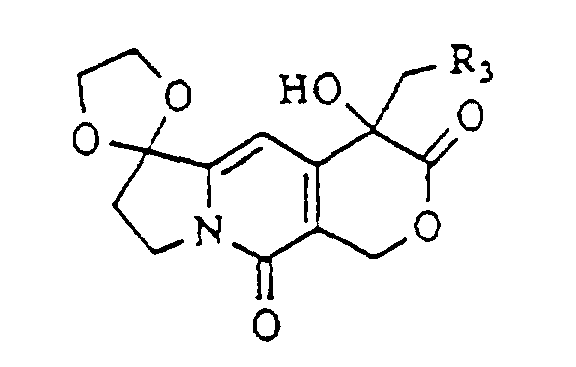

- 80% trifluoroacetic acid(1.3ml) was added to the compound(127mg, 0.36mmol) obtained in EXAMPLE 54 and stirred at room temperature for 2 hrs. The reaction mixture was concentrated under reduced pressure and with addition of brine, the reaction mixture was extracted with dichloromethane(20ml x 3) and dried over anhydrous magnesium sulfate. The organic layer was concentrated under reduced pressure. The residue was purified by column chromatography with dichloromethane- methanol(20:1) to give desired product(theoretical yield) as a yellow solid.
IR(KBr) 3412, 1746, 1660 cm-1
1H-NMR (400MHz, CDCl3)δ
7.318(s, 1H), 5.687, 5.388(ABq, 2H, J=17.1Hz), 4.405(t, 2H), 4.370(d, 1H, J=11.7Hz), 4.155(d, 1H, J=11.7Hz), 3.007(t, 2H, J=6.8Hz), 2.080(s, 3H)
MS(EI) m/e 307(M+) - In the same manner as used in EXAMPLE 58, the compounds (R = H and n = 1) of EXAMPLES 59, 60 and 61, expressed by the general formula (III), were prepared from compounds of EXAMPLES 55, 56 and 57, respectively.
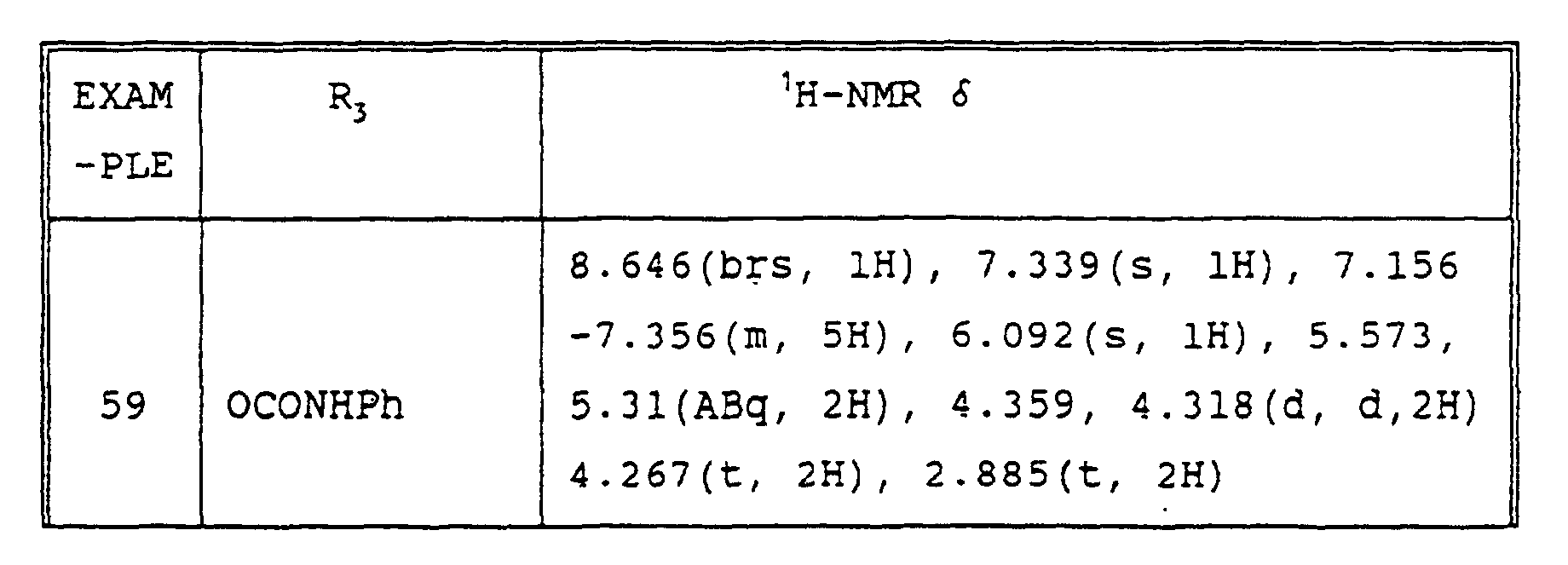
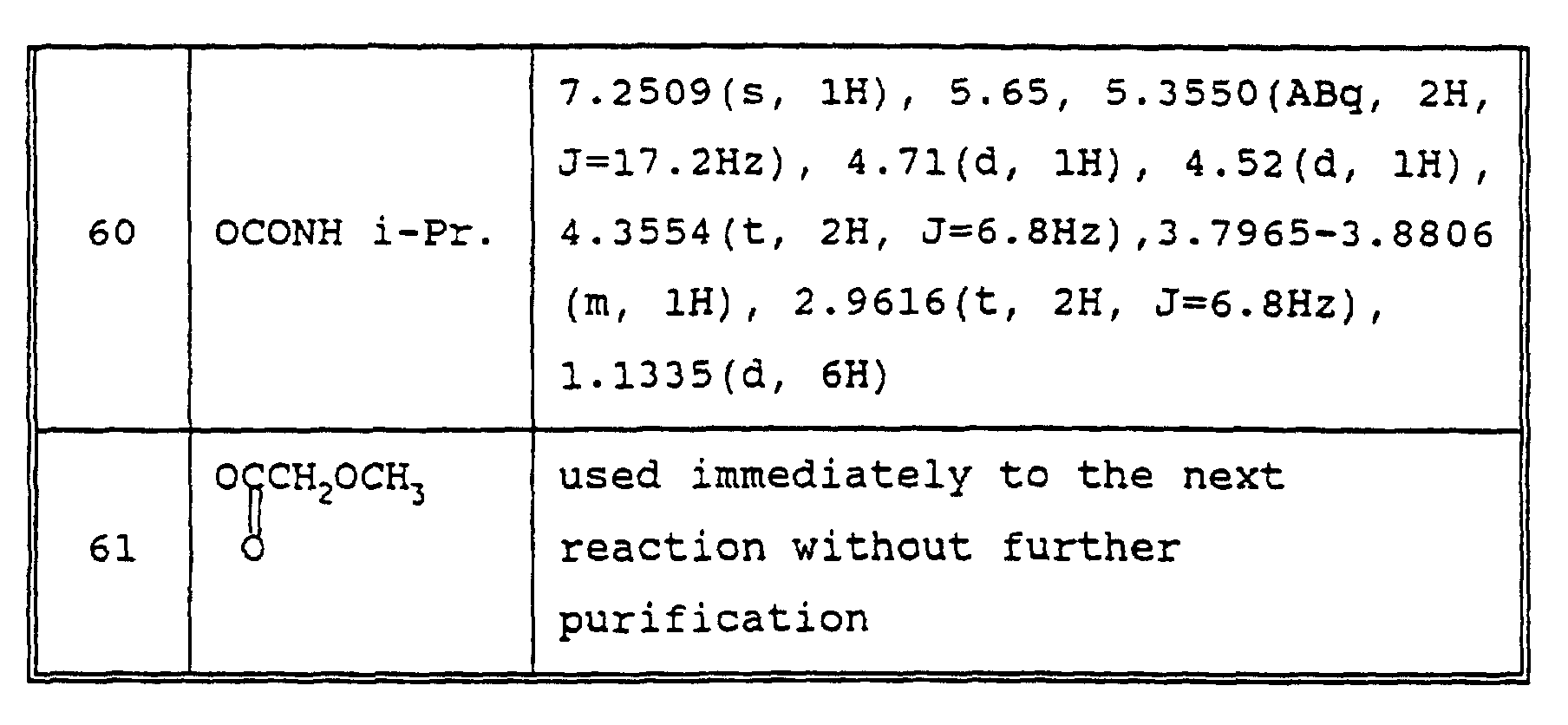
- With the compound(19mg, 0.06mmol) obtained from EXAMPLE 58 and N-(2-aminobenzylidene)-p-toluidine(20mg, 0.09mmol), the reaction and work-up was carried out in the same procedure as in Reference EXAMPLE 38 and then, the residue was purified by PTLC with dichloromethane -methanol(20:1) to give the desired compound(9mg, 36%) as a brown solid.
IR(CHCl3) 3400, 1749, 1740, 1654 cm-1
1H-NMR (400MHz, CDCl3+CD3OD=4:1)
8.493(s, 1H), 8.223(d, 1H, J=8.4Hz), 7.988(d, 1H, J=8.0Hz), 7.867(t, 1H, J=7.2Hz), 7.767(s, 1H), 7.703(t, 1H, J=7.2Hz), 5.697, 5.433(ABq, 2H, J=16.4Hz), 5.334(s, 2H), 4.460(d, 1H, J=11.2Hz), 4.330(d, 1H, J=11.2Hz), 2.087(s, 3H)
LRMS(EI) m/e
392(M+), 331, 320, 305
HRMS m/e (M+) Calcd : 392.1008, Obsd : 392.1006 - In the same manner as in Reference EXAMPLE 38, the compounds (R=H and n=1) of Reference EXAMPLE 63, 64 and 65, expressed by the general formula(I), were prepared from a reaction of a compound from example 59, 60 and 61, respectively, with 2-aminobenzaldehyde ethylene acetal.

- A mixture of methanol(6ml), water(2ml) and LiOH· H2O(33mg, 0.78mmol) was added to dl-20-desethyl-20-acetoxymethylcamptothecin (140mg, 0.36mmol) and the reaction mixture was stirred at room temperature for 1.5 hrs.
- The reaction mixture was concentrated under reduced pressure to remove methanol and stirred in an ice bath for 30 mins until the pH of the solution became controlled 3-3.5 with 1N HCl. The solid, so formed, was filtrated, washed with water, isopropanol and ether successively, and under P2O5, dried in vacuum for 3 hrs to give the desired product (83mg,66%) as a yellowish white soild.
IR(KBr) 3436, 1743, 1657 cm-1
1H-NMR (400MHz, CDCl3+DMSO-d6=1:1) δ
8.608(s, 1H, 8.157(d, 1H, J=8.0Hz), 8.106(s, 1H), 8.050(d, 1H, J=8.0Hz), 7.829(t, 1H, J=7.3Hz), 7.673 (t, 1H, J=7.3Hz), 6.741(s, 1H), 5.441, 5.360(ABq, 2H, J=16.1Hz), 5.304(s, 2H), 3.850-3.89(m, 1H), 3.681-3.723(m, 1H)
LRMS(EI) m/e 350(M+), 320, 306
HRMS m/e (M+) Calcd : 350.0903, Obsd : 350. 0917 - In the same manner as in Reference EXAMPLE 39, the compounds(R=H and n=1) of Reference EXAMPLE 67,68 and 69, expressed by the general formula(I), were prepared from dl-20-desethyl-20-hydroxymethylcampothecin and, respectively, methoxymethyl chloride in Reference EXAMPLE 67, ethoxymethyl-chloride in Reference EXAMPLE 68, and methoxyethoxymethyl chloride in Reference EXAMPLE 69.
EXAMPLE R3 1H-NMR(CDCl3) δ Ref. 67 OCH2OCH3 8.397(s, 1H), 8.240(d, 1H, J=8.0Hz), 7.939(d, 1H, J=80Hz), 7.838(t, 1H, J=8.0Hz), 7.700(s, 1H), 7.670(t, 1H, J=8.0Hz), 5.713, 5.410(ABq, 2H, J=16.4Hz), 5.313(s, 2H), 4.626, 4.587(ABq, 2H, J=6.8Hz), 4.187(s, 1H), 3.839(d, d, 2H, J=10.4Hz), 3.315(s, 3H) Ref. 68 OCH2OEt 8.4192(s, 1H), 8.2621(d, 1H, J=8.4Hz) 7.9602(d, 1H, J=8.4Hz), 7.8588(t, 1H) 7.7240(s, 1H), 7.6917(t, 1H, J=8.0Hz) 5.7287, 5.4221(ABq, 2H, J=16.3Hz), 5.3344(s, 2H), 4.7030, 4.6508(ABq, 2H, J=6.9Hz), 4.2620(s, 1H),3.8727(q 2H, J=7.0Hz), 3.6212-3.6628(m,1H), 3.5079-3.5554(m, 1H), 1.2136(t, 3H, J=7.0Hz) Ref. 69 OCH2OCH2CH2 -OCH3 8.3955(s, 1H), 8.1848(d, 1H, J=8.4Hz) 7.9156(d, 1H, J=7.6Hz), 7.8082(t, 1H) 7.7868(s, 1H), 7.6908(t, 1H), 5.6227, 5.3642(ABq, 2H, J=16.4Hz), 5.2757(s, 2H), 4.6619(d, 1H, J=6.9Hz), 4.6218 (d,1H, J=6.9Hz), 3.8422(dd, 2H, J=2,3,10.0Hz), 3.6112-3.6380(m, 1H), 3.5719-3.5952(m, 1H),3.4664-3.4924(m, 2H), 3.3192(s,3H) - In the determination of cytotoxicity, the following cell lines, purchased from ATCC(U.S.A.), were used for the experiments as the target organisms: L1210(ATCC CCL 219), A172(ATCC CRL 1620), A427(ATCC HTB 53), A549(ATCC CCL185), SK-NEP-1(ATCC HTB 48), CAOV-3(ATCC HTB 75), HEC -1-B(ATCC HTB 113), DLD-1(ATCC CCL 221) and KATO-III(ATCC HTB 103), CAKI-2(ATCC HTB 47).
- Distilled water was used for the preparation of culture medium. 1 liter of powdered RPMI 1640 medium was dissolved in distilled water and with addition of NaHCO3(2.0g), the resulting solution was stirred. After the pH of the solution was adjusted to 6.8 to 7.4, the medium was filtered by 0.22µm filter. The fetal bovine serum was thermally treated at 56°C for 30 mins before use.
- RPMI 1640 culture medium for cancer cells, fetal bovine serum, sodium bicarbonate and trypsin-EDTA buffer were purchased from Gibco Co. And MTT(3,4,5-dimethylthiazol -2-yl) -2,5-diphenyltetrazolium bromide) and sulforhodamine B(SRB) reagent were obtained from Sigma Co. and other general reagents were of G.R. degree.
- Camptothecin, purchased from Sigma Co., was dissolved in dimethylsulfoxide and with addition of Dulbec co's phosphate buffered saline(DPBS), the concentration of dimethylsulfoxide was adjusted to 10% before use. In case of the synthesized test materials dissolved in dimethylsulfoxide, the concentration of dimethylsulfoxide was also adjusted to 10%, while the other packed with DPBS. The final concentration of dimethyl sulfoxide given to cancer cells was adjusted to less than 1%, which had no influence on the growth of cancer cells.
- The cancer cells were grown at 37°C, 5% CO2 in RPMI 1640 medium containing 10%(v/v) fetal serum(FBS), 50 µg/ml gentamicin and 2 g/L sodium bicarbonate. (In order to detach anchorage-dependent cell lines grown by adhering to a culture flask) the medium was removed, washed with PBS one time and with addition of 2 to 3ml of trypsin-EDTA buffer,the monolayers of cancer cells were wholly covered to stand for the time being. Then, a suspension of the cultured cancer cells was prepared, diluted with a medium and inoculated on 96-well plate so that the number of cells may be the same as described in the following Table 1.
- 20 µl of sample(PBS solution in a control well) was inoculated to 96-well microplate and cultured for 3 days. After cultivation, the anti-neoplastic activites were measured by SRB assay[Test Scheme 1].
- As for anchorage-independent cell such as L1210, cells were inoculated so that the number of cell may also be the same as described in the following Table 1. After being cultured for 2 days, the cytotoxicity against the cells were measured by MTT assay[Test Scheme 2].
- The optical density was measured using an automatic microplate reader. The concentration of cell-growth inhibition rate by 50% was calculated by GI50 (computer PCS version 4.1 by Probit method). As per the experiment one time, the mean of optical density on about 2 to 3 wells was used for the calculation.
Number of inoculated cells per Cell Line Origin No. of inoculated cells(well) Property (Human) A427 or A549 Lung 5,000 A172 CNS 5,000 DLD-1 Colon 5,000 monolayer HEC-1-b Endometrium 5,000 CAOV-3 Ovary 20,000 SK-NEP-1 or CAKi-2 Kidney 20,000 KATO-III Stomach 10,000 (Mice) L1210 Leukemia 14,000 suspension -
-
- The cytotoxicity results of each cell line were as table 2 and 3:
Example NO. A427 A172 DLD-1 HEC-1-B CAOV-3 SK-NEP-1 KATO III L1210 MEAN 18 0.14 0.73 0.65 1.8 1.21 0.0077 8.6 0.43 1.83 19 0.31 1.32 0.31 4.7 0.08 0.013 0.29 0.62 1 26 0.23 0.15 0.17 1.37 0.09 0.0031 0.46 2.18 0.35 29 0.07 0.05 0.26 7.68 0.12 0.015 0.21 0.38 1.19 30 0.057 0.065 0.064 1.65 0.025 0.00077 0.024 0.08 0.27 Ref. 38 0.83 1.63 0.91 20.5 2.3 0.17 3.54 2.3 4.27 Ref. 39 0.45 1.07 0.76 1.34 0.23 0.018 0.13 0.18 0.57 Ref. 40 2.4 1.62 2.86 2.57 1.72 0.12 0.4 2.07 1.67 Ref. 44 2.6 0.028 0.58 10.3 1.8 3.1 2.6 3.32 3 Camptothecin 0.032 0.017 0.047 0.081 0.02 0.00019 0.092 0.024 0.041 Example NO. A549 A172 DLD-1 HEC-1-B CAOV-3 SK-NEP-1 KATO III L1210 MEAN 20 0.08 0.54 1.04 4.22 0.023 0.061 1.05 0.73 0.968 21 2.51 11.34 9.68 10.16 2.74 25.16 10.17 5.55 9.66 25 0.94 1.09 5.53 11.44 0.65 7.55 7.86 1.65 4.59 27 3.43 0.4 1.87 7.54 0.47 0.17 0.44 2.34 2.08 28 0.98 11.54 4.35 12.33 2.29 8.89 23.64 6.45 8.81 Ref. 41 1.15 3.05 13.88 16.23 2.79 1.90 1.33 10.71 6.38 Ref. 42 0.092 0.58 0.45 1.99 0.78 0.82 8.08 0.6 1.674 Ref. 43 0.25 1.83 6.84 8.88 0.87 0.99 23.98 2.25 5.74 Ref. 46 0.56 2.36 4.92 25.27 0.64 3.11 20.88 4.23 7.75 Ref. 62 0.05 0.6 0.48 5.15 0.32 2.45 3.7 0.67 1.68 Ref. 63 0.34 1.3 1.99 7.95 0.74 6.17 6.13 1.3 3.24 Ref. 64 3.28 4.89 10.2 39.75 9.79 51.3 31.48 2.6 19.16 Ref. 65 2.06 7.43 19.91 20.2 5.45 7.66 53.69 5.75 15.27 Ref. 66 0.88 2.52 6.24 6.43 0.76 10.79 4.04 1.39 4.13 Ref. 67 0.2 3.31 0.95 5.4 1.58 2.78 9.17 0.65 3.01 Ref. 68 1.72 4.55 6.98 14.23 7.18 16.3 16.64 1.39 8.62 Ref. 69 1.55 1.92 11.32 19.78 2.63 2.13 36.61 9.73 10.71 Camptothecin 0.02 0.05 0.07 0.4 0.01 0.2 0.4 0.06 0.2 - The antitumor activities may be usually proven by determining tumor growth inhibitory effects on solid tumor and prolongation effects of life span on artificially tumor-bearing animals.
- Antitumor activities were measured through the experiments on prolongation effects of life span against L1210-bearing mice and tumor growth inhibitory effects against B16-bearing mice. To evaluate the antitumor activities on L1210 leukemia, a certain number of L1210 cells(in vitro) was intraperitoneally inoculated for propagation and the L1210 cells in ascites were harvested from animals sacrificed by cervical dislocation on 7th day after tumor was implanted.
- To investigate tumor growth inhibitory effects against B16 melanoma, a certain number of B16 cells(in vitro) was subcutaneously inoculated for propagation and tumor cells were resected from animals scrificed by cervical dislocation on 14th day after tumor was implanted.
- The following is a detailed description of this EXPERIMENT for antitumor activities.
- Male BDF1 mice, weighing about 20 grams, were used. Animal rooms were controlled at 23±2°C and 60±5% relative humidity, under HEPA filter, and maintained in specific pathogen free (SPF).
- 5x10⁵ of L1210 leukemia cell, obtained in vitro form, were intraperitoneally inoculated in BDF1 mice for propagation. The L1210 tumor cells in ascites were aseptically harvested from BDF1 mice sacrificed by cervical dislocation on 7th day after tumor implantation.
- The tumor cells were passaged at least three times prior to use in the test.
- 5 x 10⁵ cell were intraperitoneally inoculated into BDF1 mice on day 0 and the sample (0.1ml/10g) were intraperitoneally administration on days 1, 3 and 5. Six mice were used for each experimental group.
- Antitumor activities were evaluated by the mean survival time of a group of mice and also expressed by the ILS(%) value and the mean animal weights for day 1 and day 5.
-
- The compound of example 18 given 1st, 3rd and 5th days after the day of tumor inocualtion increased the life span(ILS) of L1210-bearing mice by 33% and 64% at total doses of 10mg/kg and 50mg/kg, respectively (Tabel 4).
Prolongation effects of life aginst L1210 in the compound of example 18 Compound Dose (mg/kg) Survival days 30 days survivor B. W. Change(g) MST ILS(%) Control 9.75 0 0/6 0 Compound of example 18 10 13.00 33 0/6 -0.25 Compound of example 18 50 16.00 64 0/6 - 0.80 - The compound of example 26 given 1st, 3rd and 5th days after the day of tumor inoculation increased the life span(ILS) of L1210-bearing mice by 72% and 75% at total doses of 10mg/kg and 50mg/kg, respectively (Table 5).
Prolongation effects of life against L1210 of the compound prepared in example 26 Compound Dose (mg/kg) Survival days 30 days survivor B. W. Change(g) MST ILS(%) Control 9.125 0 0/6 + 1.77 Compound of example 26 10 15.67 72 0/6 - 0.09 Compound of example 26 50 16.00 75 0/6 - 0.57 - The compound of example 30 given 1st, 3rd and 5th days after the day of tumor inoculation increased the life span(ILS) of L1210-bearing mice by 42% and 119% at total doses of 10mg/kg and 50mg/kg, respectively (Table 6).
Prolongation effects of life against L1210 of the compound prepared in example 30 Compound Dose (mg/kg) Survival days 30 days survivor B. W. Change(g) MST ILS(%) Control 9.125 0 0/6 + 1.77 Compound of example 30 10 13.00 42 0/6 + 0.74 Compound of example 30 50 20.00 119 0/6 - 0.57 - Since the compound of example 30 exhibited better dose dependency and ILS(%) than other compound, the inventor et al. tried to elucidate a higher dose level and amounts showing antitumor activities in experimental animals administered with a higher dose.
- When the compound of example 30 was given 1st, 3rd and 5th days after the inoculation at total doses of 8.75, 17.5, 35, 70 and 140mg/kg, the ILS(%) showed 58.7, 79.7, 92.4, 143 and 110%, respectively(Table 7).
Prolongation effects of life against L1210 of the compound prepared in example 30 in various dose Compound Dose (mg/kg) Survival days 30 days survivor B.W. Change(g) MST ILS(%) Control 9.875 0 0/6 + 1.44 Compound of example 30 8.75 15.67 58.7 0/6 + 0.7 Compound of example 30 17.5 17.75 79.7 0/6 + 0.45 Compound of example 30 35 19.00 92.4 0/6 - 0.12 Compound of example 30 70 24.00 143 0/6 - 0.79 Compound of example 30 140 20.75 110 0/6 - 0.93 - When the compound of example 30 was given on day 1, 3 and 5 after the tumor inoculation, the maximum ILS of 143% was obtained at total dose of 70mg/kg.
- The antitumor activity of the compound of example 30 against intraperitoneally-implanted L1210 was evaluated in parallel with that of camptothecin as shown in Figure 1. The compound of example 30 gave higher ILS(%) and wider range where the effect was siginificant.
- 106 of B16 melanoma cell, obtained in vitro form, were subcutaneously in BDF1 mice for propagation. The B16 melanomas were transfered on day 14. The fresh tumors except for necrotized center were aseptically resected from tumor-bearing mice sacrificed by cervical dislocation.
- The tumor cells were passaged at least injected three times prior to use in the test.
- 1g subcutaneously donor tumor to be subcutaneously was homogenized in cold sterilized saline to give a final concentration of 1g/10ml. The 1:10 tumor suspension is injected into all BDF1 mice subcutaneously using 0.2ml/mouse.
- The mice were subcutaneously implanted with such homogenized solution and 7 to 8th day after the tumor implantation, the mice having a certain size of tumors were selected for experiments. Each experimental group were administered with the sample (0.1ml/10g) on 8th, 12th and 16th day after the inoculation of tumor. Eight mice were used for each experimental group.
- The size of the tumors was calculated by direct measurement of the diameter of the tumors, using the formula.
- Where b is the largest diameter and a is the diameter perpendicular to b and growth curves were thus obtained.(Figure 2)
- The inhibition rate of tumor growth on the basis of tumor size was calculated according to the formula.
Wherein; - TWt is the mean tumor volume(weight) of sample-treated groups.
- TWc is the mean tumor volume(weight) of control group.
-
- When the compound of example 30 was given 8, 12 and 16 days after the tumor inoculation at total doses of 35, 70 and 140mg/kg , the IR(%) showed 27, 54.8 and 67.72%, respectively (Table 8).

- Futher, 20th day after the compound of example 30 was administered, the percentage of IR on the weight of the incised tumor showed 40, 56 and 71.6%, respectively.
- The maximum IR of 67.72% was obtained at total dose of 140mg/kg. The changes in tumor volumes were outlined in Figure 2. Such results clearly imply that the compound of example 30 has not only better antitumor activity on ascites tumor and solid type tumor, but also less toxicity and a wide range of safety margin, compared with camptothecin.
-COR5 wherein R5 represents hydrogen, lower alkyl, perhalo-lower alkyl, lower alkoxy, aryl, aryl substituted with one or more lower alkyl, perhalo-lower alkyl, hydroxy lower alkyl, lower alkoxy lower alkyl groups ; and the pharmaceutically acceptable salts thereof ; their use in the treatment of tumors and methods of their preparation.
Finally, the synthesis and structure activity of novel camptothecin analogues is described in J. Med. Chem., 1993, 36, 2689-2700. More specifically, a large number of camptothecin (CPT) analogues have been prepared in the 20S, 20RS, and 20R configurations with a number of ring A substituents. Topoisomerase I (T-I) inhibition data (IC50) have been obtained by standard procedures. In general, substitution at the 9 or 10 positions with amino, halogeno, or hydroxyl groups in compounds with 20S configuration results in compounds with enhanced T-I inhibition. Compounds in the 20RS configuration were less active in vitro and in vivo and those in the 20R configuration were inactive. Compounds with 10,11-methylenedioxy substitution on ring A displayed a marked increase in potency in the T-I inhibition assay. The activities of some of the analogues as determined in a variety of in vivo assays including the L-1210 mouse leukemia assay were, in general, in accord with T-I inhibition. A number of water-soluble analogues such as 20-glycinate esters, 9-glycinamides, or hydrolyzed lactone salts were prepared and tested in in vitro and in vivo assays. In general, these compounds were less active than CPT both in terms of T-I inhibition and life prolongation in the L-1210 assay. However, certain 20-glycinate esters showed good in vivo activity after iv administration.
Claims (7)
- Camptothecin derivative and pharmaceutically acceptable salts thereof, expressed by the following general formula [I] :wherein :
 R represents -(CH2)2-NR1R2, (R1 is hydrogen or a general protecting group of amine ; R2 is an ethyl, propyl, isopropyl, benzyl, hydroxyethyl or acetoxyethyl;n is 1 or 2 ; R3 is hydrogen or -OR4 [R4 is hydrogen or(R5 is methyl or CH3OCH2-);
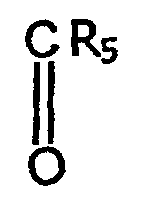 (R6 is isopropyl, phenyl or -CH2CH2Cl); CH2OR7 (R7 is methyl, ethyl or CH3OCH2CH2-)].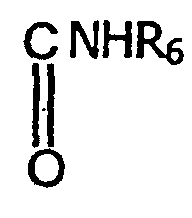
- Intermediate of camptothecin synthesis expressed by the following formula [II]:wherein :
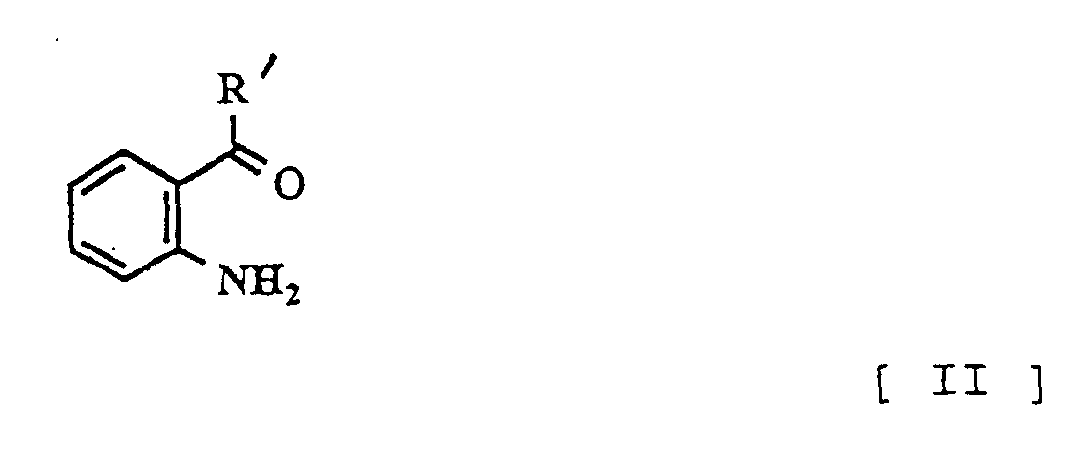 R' is -(CH2)2-NR1R2, (R1 is a general protecting group of amine; R2 is an ethyl, propyl, isopropyl, benzyl, hydroxyethyl, or acetoxyethyl.
 - Intermediate of camptothecin synthesis expressed by the following formula [III] :
 n is 1 or 2; R3 is OR4 [R4 is hydrogen or(R5 is methyl or CH3OCH2-);
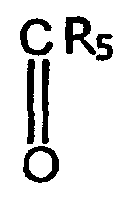 (R6 is isopropyl, phenyl, and -CH2CH2Cl); CH2OR7 (R7 is methyl, ethyl or -CH2CH2OCH3)].
- Process for manufacturing the compound expressed by the following general formula [I] wherein the compound expressed by the following formula [II] is reacted with the compound expressed by the compound [III] under acidic condition

 wherein : R, n and R3 are as defined in claim 1; and R' is -(CH2)2-NR1R2, (R1 is a general protecting group of amine; R2 is an ethyl, propyl, isopropyl, benzyl, hydroxyethyl or acetoxyethyl.
- A pharmaceutical composition comprising camptothecin derivatives according to claim 1 expressed by the following general formula [I] :wherein :
 as well as pharmaceutically acceptable salts thereof.R represents -(CH2)2-NR1R2, (R1 is hydrogen or a carbobenzyloxyl (Cbz) group; R2 is an ethyl, propyl, isopropyl, benzyl, hydroxyethyl, or acetoxyethyl ;n is 1 or 2; R3 is hydrogen or -OR4 [R4 is hydrogen or C(O)R5 (R5 is methyl or CH3OCH2- ; C(O)NHR6 (R6 is isopropyl, phenyl or -CH2CH2Cl); CH2OR7 (R7 is methyl, ethyl or CH3OCH2CH2-)];
 - Use of composition according to claim 5 for the manufacture of a medicament for treating a neoplastic disease.
- Use of camptothecin derivates according to claims 1 and 5 expressed by the following general formula [I] :wherein: R, n and R3 are as defined in claim 5 ; as well as pharmaceutically acceptable salts thereof for the manufacture of a medicament for treating a neoplastic disease.
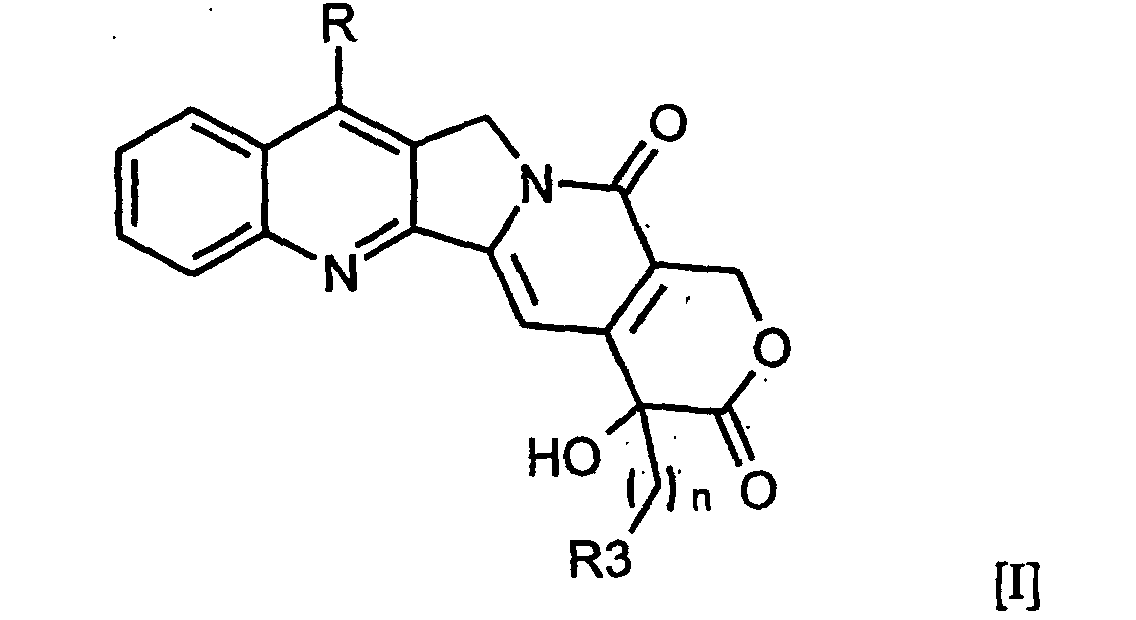
Applications Claiming Priority (4)
| Application Number | Priority Date | Filing Date | Title |
|---|---|---|---|
| KR1995269 | 1995-01-09 | ||
| KR1019950000269A KR960029336A (en) | 1995-01-09 | 1995-01-09 | Camptothecin derivatives, preparation method thereof and anticancer agent containing same |
| KR9500269 | 1995-01-09 | ||
| PCT/KR1996/000004 WO1996021666A1 (en) | 1995-01-09 | 1996-01-09 | Camptothecin derivatives and its manufacturing method |
Publications (2)
| Publication Number | Publication Date |
|---|---|
| EP0802915A1 EP0802915A1 (en) | 1997-10-29 |
| EP0802915B1 true EP0802915B1 (en) | 2002-12-04 |
Family
ID=19406538
Family Applications (1)
| Application Number | Title | Priority Date | Filing Date |
|---|---|---|---|
| EP96900458A Expired - Lifetime EP0802915B1 (en) | 1995-01-09 | 1996-01-09 | Camptothecin derivatives and its manufacturing method |
Country Status (9)
| Country | Link |
|---|---|
| US (2) | US6265413B1 (en) |
| EP (1) | EP0802915B1 (en) |
| JP (1) | JP3023990B2 (en) |
| KR (2) | KR960029336A (en) |
| CN (1) | CN1077575C (en) |
| AU (1) | AU4400696A (en) |
| CA (1) | CA2208639C (en) |
| DE (1) | DE69625176T2 (en) |
| WO (1) | WO1996021666A1 (en) |
Families Citing this family (22)
| Publication number | Priority date | Publication date | Assignee | Title |
|---|---|---|---|---|
| WO1997001539A1 (en) * | 1995-06-27 | 1997-01-16 | Takeda Chemical Industries, Ltd. | 4-acylamino(halogeno) alkyl-quinoline derivatives, their preparation and their use as melatonin agonists |
| SG88737A1 (en) * | 1996-10-30 | 2002-05-21 | Tanabe Seiyaku Co | S type 2-substituted hydroxy-2-indolidinylbutyric ester compounds and process for preparation thereof |
| IN189180B (en) | 1997-07-09 | 2003-01-04 | Chong Kun Dang Corp | |
| US6352996B1 (en) * | 1999-08-03 | 2002-03-05 | The Stehlin Foundation For Cancer Research | Liposomal prodrugs comprising derivatives of camptothecin and methods of treating cancer using these prodrugs |
| AR035684A1 (en) * | 2001-02-21 | 2004-06-23 | Yakult Honsha Kk | PROCEDURE TO PREPARE 2'-AMINO-5'-HYDROXYPROPIOPHENONE, USE OF THE SAME FOR THE PREPARATION OF CAMPTOTECHINE ANALOGS, PROCEDURE TO PREPARE THEM, INTERMEDIATE COMPOUNDS, PROCEDURE TO PREPARE A TRICYCLINT KITONE USED IN THE CAMP |
| EP1433789A1 (en) * | 2002-12-24 | 2004-06-30 | Aponetics AG | Pyrrolopyrazines and their use as selective apoptosis inducers |
| ZA200604758B (en) * | 2003-12-17 | 2007-10-31 | Bionumerik Pharmaceuticals Inc | Process for making camptothecin derivatives |
| ITMI20061475A1 (en) * | 2006-07-26 | 2008-01-27 | Indena Spa | DERIVATIVES OF CAMPTOTECIN WITH ANTITUMORAL ACTIVITY |
| CN101824038B (en) * | 2009-03-06 | 2013-08-21 | 复旦大学 | Camptothecin and method for preparing analogues thereof |
| WO2016027757A1 (en) * | 2014-08-18 | 2016-02-25 | 国立大学法人大阪大学 | Novel 2-aminbenzoyl derivative |
| SG11201702105QA (en) * | 2014-10-22 | 2017-05-30 | Vivacitas Oncology Inc | Methods and systems for camptothecin analog synthesis |
| CN119219654A (en) * | 2017-12-15 | 2024-12-31 | 四川科伦博泰生物医药股份有限公司 | Bioactive substance conjugate and preparation method and use thereof |
| CN118652275A (en) * | 2019-01-30 | 2024-09-17 | 四川科伦博泰生物医药股份有限公司 | Camptothecin derivatives and water-soluble prodrugs thereof, pharmaceutical compositions containing the same, and preparation methods and uses thereof |
| WO2022217022A1 (en) | 2021-04-10 | 2022-10-13 | Profoundbio Us Co. | Folr1 binding agents, conjugates thereof and methods of using the same |
| CA3216459A1 (en) | 2021-04-23 | 2022-10-27 | Profoundbio Us Co. | Anti-cd70 antibodies, conjugates thereof and methods of using the same |
| TW202320857A (en) | 2021-07-06 | 2023-06-01 | 美商普方生物製藥美國公司 | Linkers, drug linkers and conjugates thereof and methods of using the same |
| CN116253741B (en) * | 2022-12-30 | 2024-02-02 | 上海禧耀医药科技有限公司 | Synthesis method of belotekang derivative |
| CN116478051B (en) * | 2023-04-13 | 2024-06-21 | 戊言医药科技(上海)有限公司 | Preparation method of belote hydrochloride and key intermediate thereof |
| AR133955A1 (en) | 2023-09-26 | 2025-11-19 | Profoundbio Us Co | PTK7 BINDING AGENTS, CONJUGATES THEREOF AND METHODS OF USE THEREOF |
| TW202547866A (en) | 2024-01-10 | 2025-12-16 | 丹麥商珍美寶股份有限公司 | Slitrk6 binding agents, conjugates thereof and methods of using the same |
| WO2025181219A1 (en) | 2024-02-29 | 2025-09-04 | Genmab A/S | Egfr and c-met bispecific binding agents, conjugates thereof and methods of using the same |
| CN118307550A (en) * | 2024-05-07 | 2024-07-09 | 河南东泰制药有限公司 | A preparation process of camptothecin derivatives |
Citations (2)
| Publication number | Priority date | Publication date | Assignee | Title |
|---|---|---|---|---|
| GB1531574A (en) * | 1975-02-20 | 1978-11-08 | Shionogi & Co | Camptothecin analogues |
| EP0540099A1 (en) * | 1991-10-29 | 1993-05-05 | Glaxo Wellcome Inc. | Water soluble camptothecin derivatives |
Family Cites Families (5)
| Publication number | Priority date | Publication date | Assignee | Title |
|---|---|---|---|---|
| JPS5839685A (en) | 1981-09-04 | 1983-03-08 | Yakult Honsha Co Ltd | Novel camptothecin derivative and its preparation |
| JPS58154582A (en) | 1982-03-10 | 1983-09-14 | Yakult Honsha Co Ltd | Novel camptothecin derivative and its preparation |
| US4894456A (en) | 1987-03-31 | 1990-01-16 | Research Triangle Institute | Synthesis of camptothecin and analogs thereof |
| DK0547165T3 (en) | 1990-09-28 | 2000-03-27 | Smithkline Beecham Corp | Process for the preparation of water-soluble camptothecin analogs as well as the compounds 10-hydroxy-11-C (1-6) -alkoxyc |
| US5391745A (en) * | 1992-07-23 | 1995-02-21 | Sloan-Kettering Institute For Cancer Research | Methods of preparation of camptothecin analogs |
-
1995
- 1995-01-09 KR KR1019950000269A patent/KR960029336A/en active Pending
-
1996
- 1996-01-09 US US08/860,655 patent/US6265413B1/en not_active Expired - Lifetime
- 1996-01-09 AU AU44006/96A patent/AU4400696A/en not_active Abandoned
- 1996-01-09 DE DE69625176T patent/DE69625176T2/en not_active Expired - Lifetime
- 1996-01-09 WO PCT/KR1996/000004 patent/WO1996021666A1/en not_active Ceased
- 1996-01-09 CA CA002208639A patent/CA2208639C/en not_active Expired - Lifetime
- 1996-01-09 KR KR1019960000248A patent/KR0163267B1/en not_active Expired - Lifetime
- 1996-01-09 EP EP96900458A patent/EP0802915B1/en not_active Expired - Lifetime
- 1996-01-09 JP JP8521569A patent/JP3023990B2/en not_active Expired - Lifetime
- 1996-01-09 CN CN96191392A patent/CN1077575C/en not_active Expired - Lifetime
-
1999
- 1999-03-26 US US09/277,178 patent/US6177568B1/en not_active Expired - Lifetime
Patent Citations (2)
| Publication number | Priority date | Publication date | Assignee | Title |
|---|---|---|---|---|
| GB1531574A (en) * | 1975-02-20 | 1978-11-08 | Shionogi & Co | Camptothecin analogues |
| EP0540099A1 (en) * | 1991-10-29 | 1993-05-05 | Glaxo Wellcome Inc. | Water soluble camptothecin derivatives |
Non-Patent Citations (3)
| Title |
|---|
| KINGSBURY ET AL: "Synthesis of water-soluble aminoalkylcamptothecin analogues: inhibition of topoisomerase I and antitumour activity.", J. MED. CHEM., vol. 34, 1991, pages 98 - 107 * |
| SUGASAWA ET AL: "Experiments on the synthesis of dl-camptothecin. 4. Synthesis and antileukemic activity of dl-camptothecin analogues.", J. MED. CHEM., vol. 19, 1976, pages 675 - 679, XP002014410 * |
| WALL ET AL: "Plant antitumor agents. 30. Synthesis and structure activity of novel camptothecin analogs.", J. MED. CHEM., vol. 36, 1993, pages 2689 - 2700, XP000652227, DOI: doi:10.1021/jm00070a013 * |
Also Published As
| Publication number | Publication date |
|---|---|
| DE69625176D1 (en) | 2003-01-16 |
| KR960029337A (en) | 1996-08-17 |
| DE69625176T2 (en) | 2003-07-10 |
| US6177568B1 (en) | 2001-01-23 |
| CA2208639A1 (en) | 1996-07-18 |
| KR0163267B1 (en) | 1998-12-01 |
| CN1077575C (en) | 2002-01-09 |
| KR960029336A (en) | 1996-08-17 |
| JP3023990B2 (en) | 2000-03-21 |
| US6265413B1 (en) | 2001-07-24 |
| WO1996021666A1 (en) | 1996-07-18 |
| CN1168139A (en) | 1997-12-17 |
| EP0802915A1 (en) | 1997-10-29 |
| AU4400696A (en) | 1996-07-31 |
| JPH10503525A (en) | 1998-03-31 |
| CA2208639C (en) | 2001-07-31 |
Similar Documents
| Publication | Publication Date | Title |
|---|---|---|
| US6177568B1 (en) | Intermediates for the synthesis of camptothecin derivatives | |
| AU652728B2 (en) | Camptothecin analogs as potent inhibitors of human colorectal cancer | |
| Sawada et al. | Synthesis and antitumor activity of 20 (S)-camptothecin derivatives: Carbamate-linked, water-soluble derivaties of 7-ethyl-10-hydroxycamptothecin | |
| TW202527946A (en) | Tricyclic compounds and their medical uses | |
| AU2007205962B2 (en) | Spiro compounds and methods of use | |
| JP3545416B2 (en) | Huperzine A derivatives, their production and their use | |
| EP0436653A1 (en) | Synthesis of camptothecin and analogs thereof | |
| US5364858A (en) | Camptothecin analogs as potent inhibitors of topoisomerase I | |
| EP0614898B1 (en) | Indole derivative, process for producing the same, and medicinal use thereof | |
| EP1390371B1 (en) | Oxazolo-and furopyrimidines and their use in medicaments against tumors | |
| US5340817A (en) | Method of treating tumors with anti-tumor effective camptothecin compounds | |
| CN116375707A (en) | Menin inhibitors and uses thereof | |
| KR960002854B1 (en) | Fluoroethylcamptothecin derivatives | |
| KR20050053613A (en) | Antitumoral analogs of lamellarins | |
| CN115433207A (en) | Macrocyclic heterocyclic compound as EGFR inhibitor and application thereof | |
| RU2450007C2 (en) | Camptothecin derivatives with anticancer activity | |
| RU2230745C2 (en) | Optically pure analogs of camptothecin | |
| AU2002300268B2 (en) | New benzo[b]pyrano[3,2-h]acridin-7-one compounds, a process for their preparation and pharmaceutical compositions containing them | |
| US6187783B1 (en) | Phenanthridinium derivatives | |
| BRPI0617730A2 (en) | agent for preventing or treating pancreatic cancer, ovarian cancer or liver cancer containing new water-soluble prodrug | |
| JP3364473B2 (en) | 7-oxo-2,3,7,14-tetrahydro-1H-benzo [b] pyrano [3,2-h] acridinecarboxylate new compounds, processes for their preparation and pharmaceutical compositions containing them | |
| NO329005B1 (en) | Hexycyclic compounds, pharmaceutical compositions comprising the compounds, uses of the compounds for the manufacture of medicaments, and methods for the preparation of the compounds and methods for the preparation of intermediates | |
| AU2005200459A1 (en) | New benzo[b]chromeno-naphthyridin-7-one and pyrano[2',3':7,8]quino[2,3-b]quinoxalin-7-one compounds, process for their preparation and pharmaceutical compositions containing them | |
| JPH10195074A (en) | Novel ellipticine compounds, methods for their preparation and pharmaceutical compositions containing them | |
| JPH06122684A (en) | Pyrroloindoledicarboxylic acid diester derivative and its production |
Legal Events
| Date | Code | Title | Description |
|---|---|---|---|
| PUAI | Public reference made under article 153(3) epc to a published international application that has entered the european phase |
Free format text: ORIGINAL CODE: 0009012 |
|
| 17P | Request for examination filed |
Effective date: 19970725 |
|
| AK | Designated contracting states |
Kind code of ref document: A1 Designated state(s): DE FR GB IT SE |
|
| 17Q | First examination report despatched |
Effective date: 19990813 |
|
| GRAG | Despatch of communication of intention to grant |
Free format text: ORIGINAL CODE: EPIDOS AGRA |
|
| GRAG | Despatch of communication of intention to grant |
Free format text: ORIGINAL CODE: EPIDOS AGRA |
|
| GRAH | Despatch of communication of intention to grant a patent |
Free format text: ORIGINAL CODE: EPIDOS IGRA |
|
| GRAH | Despatch of communication of intention to grant a patent |
Free format text: ORIGINAL CODE: EPIDOS IGRA |
|
| GRAA | (expected) grant |
Free format text: ORIGINAL CODE: 0009210 |
|
| AK | Designated contracting states |
Kind code of ref document: B1 Designated state(s): DE FR GB IT SE |
|
| REG | Reference to a national code |
Ref country code: GB Ref legal event code: FG4D |
|
| REF | Corresponds to: |
Ref document number: 69625176 Country of ref document: DE Date of ref document: 20030116 |
|
| ET | Fr: translation filed | ||
| PLBE | No opposition filed within time limit |
Free format text: ORIGINAL CODE: 0009261 |
|
| STAA | Information on the status of an ep patent application or granted ep patent |
Free format text: STATUS: NO OPPOSITION FILED WITHIN TIME LIMIT |
|
| 26N | No opposition filed |
Effective date: 20030905 |
|
| REG | Reference to a national code |
Ref country code: DE Ref legal event code: R082 Ref document number: 69625176 Country of ref document: DE Representative=s name: CBDL PATENTANWAELTE, DE |
|
| REG | Reference to a national code |
Ref country code: DE Ref legal event code: R082 Ref document number: 69625176 Country of ref document: DE Representative=s name: CBDL PATENTANWAELTE, DE |
|
| REG | Reference to a national code |
Ref country code: DE Ref legal event code: R082 Ref document number: 69625176 Country of ref document: DE Representative=s name: CBDL PATENTANWAELTE, DE |
|
| REG | Reference to a national code |
Ref country code: DE Ref legal event code: R082 Ref document number: 69625176 Country of ref document: DE Representative=s name: CBDL PATENTANWAELTE, DE Effective date: 20141120 Ref country code: DE Ref legal event code: R082 Ref document number: 69625176 Country of ref document: DE Representative=s name: CBDL PATENTANWAELTE, DE Effective date: 20141118 Ref country code: DE Ref legal event code: R082 Ref document number: 69625176 Country of ref document: DE Representative=s name: CBDL PATENTANWAELTE, DE Effective date: 20141119 Ref country code: DE Ref legal event code: R081 Ref document number: 69625176 Country of ref document: DE Owner name: CHONG KUN DANG PHARMACEUTICAL CORP., KR Free format text: FORMER OWNER: CHONG KUN DANG HOLDINGS CORP., SEOUL, KR Effective date: 20141120 Ref country code: DE Ref legal event code: R081 Ref document number: 69625176 Country of ref document: DE Owner name: CHONG KUN DANG PHARMACEUTICAL CORP., KR Free format text: FORMER OWNER: CHONG KUN DANG CORP., SEOUL, KR Effective date: 20141118 |
|
| REG | Reference to a national code |
Ref country code: FR Ref legal event code: TP Owner name: CHONG KUN DANG PHARMACEUTICAL CORP., KR Effective date: 20141126 Ref country code: FR Ref legal event code: CD Owner name: CHONG KUN DANG PHARMACEUTICAL CORP., KR Effective date: 20141126 Ref country code: FR Ref legal event code: CA Effective date: 20141126 |
|
| PGFP | Annual fee paid to national office [announced via postgrant information from national office to epo] |
Ref country code: FR Payment date: 20141208 Year of fee payment: 20 |
|
| PGFP | Annual fee paid to national office [announced via postgrant information from national office to epo] |
Ref country code: DE Payment date: 20150109 Year of fee payment: 20 Ref country code: IT Payment date: 20150115 Year of fee payment: 20 |
|
| PGFP | Annual fee paid to national office [announced via postgrant information from national office to epo] |
Ref country code: SE Payment date: 20150121 Year of fee payment: 20 Ref country code: GB Payment date: 20150114 Year of fee payment: 20 |
|
| REG | Reference to a national code |
Ref country code: DE Ref legal event code: R071 Ref document number: 69625176 Country of ref document: DE |
|
| REG | Reference to a national code |
Ref country code: GB Ref legal event code: PE20 Expiry date: 20160108 |
|
| REG | Reference to a national code |
Ref country code: SE Ref legal event code: EUG |
|
| PG25 | Lapsed in a contracting state [announced via postgrant information from national office to epo] |
Ref country code: GB Free format text: LAPSE BECAUSE OF EXPIRATION OF PROTECTION Effective date: 20160108 |