EP0802222A1 - Method of adhesion improvement for silicone compositions - Google Patents
Method of adhesion improvement for silicone compositions Download PDFInfo
- Publication number
- EP0802222A1 EP0802222A1 EP97302512A EP97302512A EP0802222A1 EP 0802222 A1 EP0802222 A1 EP 0802222A1 EP 97302512 A EP97302512 A EP 97302512A EP 97302512 A EP97302512 A EP 97302512A EP 0802222 A1 EP0802222 A1 EP 0802222A1
- Authority
- EP
- European Patent Office
- Prior art keywords
- accordance
- substrate
- silicone composition
- monoketoester
- ethylacetoacetate
- Prior art date
- Legal status (The legal status is an assumption and is not a legal conclusion. Google has not performed a legal analysis and makes no representation as to the accuracy of the status listed.)
- Withdrawn
Links
- 239000000203 mixture Substances 0.000 title claims abstract description 96
- 238000000034 method Methods 0.000 title claims abstract description 27
- 229920001296 polysiloxane Polymers 0.000 title claims description 12
- 239000000758 substrate Substances 0.000 claims abstract description 51
- RTAQQCXQSZGOHL-UHFFFAOYSA-N Titanium Chemical compound [Ti] RTAQQCXQSZGOHL-UHFFFAOYSA-N 0.000 claims abstract description 38
- 239000003054 catalyst Substances 0.000 claims abstract description 30
- 125000003545 alkoxy group Chemical group 0.000 claims abstract description 22
- 229940093858 ethyl acetoacetate Drugs 0.000 claims abstract description 18
- 239000004971 Cross linker Substances 0.000 claims abstract description 16
- XYIBRDXRRQCHLP-UHFFFAOYSA-N ethyl acetoacetate Chemical compound CCOC(=O)CC(C)=O XYIBRDXRRQCHLP-UHFFFAOYSA-N 0.000 claims abstract description 16
- 239000000945 filler Substances 0.000 claims abstract description 14
- 239000000463 material Substances 0.000 claims abstract description 8
- 125000001301 ethoxy group Chemical group [H]C([H])([H])C([H])([H])O* 0.000 claims abstract description 6
- 125000000956 methoxy group Chemical group [H]C([H])([H])O* 0.000 claims abstract description 6
- 229910052719 titanium Inorganic materials 0.000 claims description 33
- 239000010936 titanium Substances 0.000 claims description 29
- XUIMIQQOPSSXEZ-UHFFFAOYSA-N Silicon Chemical group [Si] XUIMIQQOPSSXEZ-UHFFFAOYSA-N 0.000 claims description 16
- -1 methoxy, ethoxy, propoxy Chemical group 0.000 claims description 16
- 239000004215 Carbon black (E152) Substances 0.000 claims description 13
- 229930195733 hydrocarbon Natural products 0.000 claims description 13
- 229910052782 aluminium Inorganic materials 0.000 claims description 12
- XAGFODPZIPBFFR-UHFFFAOYSA-N aluminium Chemical compound [Al] XAGFODPZIPBFFR-UHFFFAOYSA-N 0.000 claims description 12
- JJQZDUKDJDQPMQ-UHFFFAOYSA-N dimethoxy(dimethyl)silane Chemical group CO[Si](C)(C)OC JJQZDUKDJDQPMQ-UHFFFAOYSA-N 0.000 claims description 11
- 229920003023 plastic Polymers 0.000 claims description 9
- 239000004033 plastic Substances 0.000 claims description 9
- 125000001495 ethyl group Chemical group [H]C([H])([H])C([H])([H])* 0.000 claims description 7
- 239000003446 ligand Substances 0.000 claims description 7
- 125000002496 methyl group Chemical group [H]C([H])([H])* 0.000 claims description 7
- BFXIKLCIZHOAAZ-UHFFFAOYSA-N methyltrimethoxysilane Chemical compound CO[Si](C)(OC)OC BFXIKLCIZHOAAZ-UHFFFAOYSA-N 0.000 claims description 7
- 229910052751 metal Inorganic materials 0.000 claims description 6
- 239000002184 metal Substances 0.000 claims description 6
- 125000004432 carbon atom Chemical group C* 0.000 claims description 5
- 229910052710 silicon Inorganic materials 0.000 claims description 5
- 125000004106 butoxy group Chemical group [*]OC([H])([H])C([H])([H])C(C([H])([H])[H])([H])[H] 0.000 claims description 4
- 125000001997 phenyl group Chemical group [H]C1=C([H])C([H])=C(*)C([H])=C1[H] 0.000 claims description 4
- 125000001931 aliphatic group Chemical group 0.000 claims description 3
- 125000000391 vinyl group Chemical group [H]C([*])=C([H])[H] 0.000 claims description 3
- 229920002554 vinyl polymer Chemical group 0.000 claims description 3
- NIXOWILDQLNWCW-UHFFFAOYSA-N acrylic acid group Chemical group C(C=C)(=O)O NIXOWILDQLNWCW-UHFFFAOYSA-N 0.000 claims description 2
- 125000000484 butyl group Chemical group [H]C([*])([H])C([H])([H])C([H])([H])C([H])([H])[H] 0.000 claims description 2
- 125000000740 n-pentyl group Chemical group [H]C([H])([H])C([H])([H])C([H])([H])C([H])([H])C([H])([H])* 0.000 claims description 2
- 125000001436 propyl group Chemical group [H]C([*])([H])C([H])([H])C([H])([H])[H] 0.000 claims description 2
- 125000003253 isopropoxy group Chemical group [H]C([H])([H])C([H])(O*)C([H])([H])[H] 0.000 claims 1
- 229920002631 room-temperature vulcanizate silicone Polymers 0.000 abstract description 49
- 229920000642 polymer Polymers 0.000 description 21
- VYPSYNLAJGMNEJ-UHFFFAOYSA-N silicon dioxide Inorganic materials O=[Si]=O VYPSYNLAJGMNEJ-UHFFFAOYSA-N 0.000 description 17
- 229920002972 Acrylic fiber Polymers 0.000 description 14
- 239000004800 polyvinyl chloride Substances 0.000 description 13
- 229920000915 polyvinyl chloride Polymers 0.000 description 13
- 239000003570 air Substances 0.000 description 11
- YHWCPXVTRSHPNY-UHFFFAOYSA-N butan-1-olate;titanium(4+) Chemical compound [Ti+4].CCCC[O-].CCCC[O-].CCCC[O-].CCCC[O-] YHWCPXVTRSHPNY-UHFFFAOYSA-N 0.000 description 11
- 239000004615 ingredient Substances 0.000 description 11
- 239000002985 plastic film Substances 0.000 description 11
- 239000011324 bead Substances 0.000 description 10
- VXUYXOFXAQZZMF-UHFFFAOYSA-N titanium(IV) isopropoxide Chemical compound CC(C)O[Ti](OC(C)C)(OC(C)C)OC(C)C VXUYXOFXAQZZMF-UHFFFAOYSA-N 0.000 description 10
- XLYOFNOQVPJJNP-UHFFFAOYSA-N water Substances O XLYOFNOQVPJJNP-UHFFFAOYSA-N 0.000 description 9
- XEKOWRVHYACXOJ-UHFFFAOYSA-N Ethyl acetate Chemical compound CCOC(C)=O XEKOWRVHYACXOJ-UHFFFAOYSA-N 0.000 description 6
- 238000002156 mixing Methods 0.000 description 6
- 239000000377 silicon dioxide Substances 0.000 description 6
- 150000001875 compounds Chemical class 0.000 description 5
- 238000007654 immersion Methods 0.000 description 5
- 125000004430 oxygen atom Chemical group O* 0.000 description 5
- 238000002360 preparation method Methods 0.000 description 5
- 239000000565 sealant Substances 0.000 description 5
- VTYYLEPIZMXCLO-UHFFFAOYSA-L Calcium carbonate Chemical compound [Ca+2].[O-]C([O-])=O VTYYLEPIZMXCLO-UHFFFAOYSA-L 0.000 description 4
- 239000002318 adhesion promoter Substances 0.000 description 4
- OKKJLVBELUTLKV-UHFFFAOYSA-N Methanol Chemical compound OC OKKJLVBELUTLKV-UHFFFAOYSA-N 0.000 description 3
- BLRPTPMANUNPDV-UHFFFAOYSA-N Silane Chemical compound [SiH4] BLRPTPMANUNPDV-UHFFFAOYSA-N 0.000 description 3
- 150000002739 metals Chemical class 0.000 description 3
- 229910000077 silane Inorganic materials 0.000 description 3
- 238000003860 storage Methods 0.000 description 3
- LFQSCWFLJHTTHZ-UHFFFAOYSA-N Ethanol Chemical compound CCO LFQSCWFLJHTTHZ-UHFFFAOYSA-N 0.000 description 2
- VGGSQFUCUMXWEO-UHFFFAOYSA-N Ethene Chemical compound C=C VGGSQFUCUMXWEO-UHFFFAOYSA-N 0.000 description 2
- 239000005977 Ethylene Substances 0.000 description 2
- UQSXHKLRYXJYBZ-UHFFFAOYSA-N Iron oxide Chemical compound [Fe]=O UQSXHKLRYXJYBZ-UHFFFAOYSA-N 0.000 description 2
- KFZMGEQAYNKOFK-UHFFFAOYSA-N Isopropanol Chemical compound CC(C)O KFZMGEQAYNKOFK-UHFFFAOYSA-N 0.000 description 2
- GWEVSGVZZGPLCZ-UHFFFAOYSA-N Titan oxide Chemical compound O=[Ti]=O GWEVSGVZZGPLCZ-UHFFFAOYSA-N 0.000 description 2
- 235000010216 calcium carbonate Nutrition 0.000 description 2
- 235000013870 dimethyl polysiloxane Nutrition 0.000 description 2
- 238000001125 extrusion Methods 0.000 description 2
- 239000011152 fibreglass Substances 0.000 description 2
- 229910021485 fumed silica Inorganic materials 0.000 description 2
- 239000011521 glass Substances 0.000 description 2
- 239000010438 granite Substances 0.000 description 2
- 239000001301 oxygen Substances 0.000 description 2
- 229910052760 oxygen Inorganic materials 0.000 description 2
- 230000000704 physical effect Effects 0.000 description 2
- 239000011120 plywood Substances 0.000 description 2
- 229920000435 poly(dimethylsiloxane) Polymers 0.000 description 2
- 229920002635 polyurethane Polymers 0.000 description 2
- 239000004814 polyurethane Substances 0.000 description 2
- 230000001737 promoting effect Effects 0.000 description 2
- 239000010453 quartz Substances 0.000 description 2
- 230000001105 regulatory effect Effects 0.000 description 2
- 230000003014 reinforcing effect Effects 0.000 description 2
- 239000004590 silicone sealant Substances 0.000 description 2
- 238000012360 testing method Methods 0.000 description 2
- JMXKSZRRTHPKDL-UHFFFAOYSA-N titanium ethoxide Chemical compound [Ti+4].CC[O-].CC[O-].CC[O-].CC[O-] JMXKSZRRTHPKDL-UHFFFAOYSA-N 0.000 description 2
- 239000011800 void material Substances 0.000 description 2
- 239000003039 volatile agent Substances 0.000 description 2
- WYTZZXDRDKSJID-UHFFFAOYSA-N (3-aminopropyl)triethoxysilane Chemical compound CCO[Si](OCC)(OCC)CCCN WYTZZXDRDKSJID-UHFFFAOYSA-N 0.000 description 1
- LTMRRSWNXVJMBA-UHFFFAOYSA-L 2,2-diethylpropanedioate Chemical compound CCC(CC)(C([O-])=O)C([O-])=O LTMRRSWNXVJMBA-UHFFFAOYSA-L 0.000 description 1
- OTWQDBYIWQRQHS-UHFFFAOYSA-N 4-ethyl-3-oxo-2,2-di(propan-2-yloxy)hexanoic acid Chemical compound CCC(CC)C(=O)C(OC(C)C)(OC(C)C)C(O)=O OTWQDBYIWQRQHS-UHFFFAOYSA-N 0.000 description 1
- OKTJSMMVPCPJKN-UHFFFAOYSA-N Carbon Chemical compound [C] OKTJSMMVPCPJKN-UHFFFAOYSA-N 0.000 description 1
- IEPRKVQEAMIZSS-UHFFFAOYSA-N Di-Et ester-Fumaric acid Natural products CCOC(=O)C=CC(=O)OCC IEPRKVQEAMIZSS-UHFFFAOYSA-N 0.000 description 1
- IEPRKVQEAMIZSS-WAYWQWQTSA-N Diethyl maleate Chemical compound CCOC(=O)\C=C/C(=O)OCC IEPRKVQEAMIZSS-WAYWQWQTSA-N 0.000 description 1
- UFHFLCQGNIYNRP-UHFFFAOYSA-N Hydrogen Chemical compound [H][H] UFHFLCQGNIYNRP-UHFFFAOYSA-N 0.000 description 1
- 239000005909 Kieselgur Substances 0.000 description 1
- 239000004698 Polyethylene Substances 0.000 description 1
- BOTDANWDWHJENH-UHFFFAOYSA-N Tetraethyl orthosilicate Chemical compound CCO[Si](OCC)(OCC)OCC BOTDANWDWHJENH-UHFFFAOYSA-N 0.000 description 1
- JJAXNPOSDSDEPV-UHFFFAOYSA-J [Ti+4].C(C)(C)C(C(=O)[O-])(C(=O)C(CC)CC)C(C)C.C(C)(C)C(C(=O)[O-])(C(=O)C(CC)CC)C(C)C.C(C)(C)C(C(=O)[O-])(C(=O)C(CC)CC)C(C)C.C(C)(C)C(C(=O)[O-])(C(=O)C(CC)CC)C(C)C Chemical compound [Ti+4].C(C)(C)C(C(=O)[O-])(C(=O)C(CC)CC)C(C)C.C(C)(C)C(C(=O)[O-])(C(=O)C(CC)CC)C(C)C.C(C)(C)C(C(=O)[O-])(C(=O)C(CC)CC)C(C)C.C(C)(C)C(C(=O)[O-])(C(=O)C(CC)CC)C(C)C JJAXNPOSDSDEPV-UHFFFAOYSA-J 0.000 description 1
- 239000000853 adhesive Substances 0.000 description 1
- 230000001070 adhesive effect Effects 0.000 description 1
- 125000000217 alkyl group Chemical group 0.000 description 1
- WNROFYMDJYEPJX-UHFFFAOYSA-K aluminium hydroxide Chemical compound [OH-].[OH-].[OH-].[Al+3] WNROFYMDJYEPJX-UHFFFAOYSA-K 0.000 description 1
- PNEYBMLMFCGWSK-UHFFFAOYSA-N aluminium oxide Inorganic materials [O-2].[O-2].[O-2].[Al+3].[Al+3] PNEYBMLMFCGWSK-UHFFFAOYSA-N 0.000 description 1
- 239000012080 ambient air Substances 0.000 description 1
- 230000015572 biosynthetic process Effects 0.000 description 1
- 238000009835 boiling Methods 0.000 description 1
- 229910000019 calcium carbonate Inorganic materials 0.000 description 1
- 238000003490 calendering Methods 0.000 description 1
- 239000006229 carbon black Substances 0.000 description 1
- 125000002915 carbonyl group Chemical group [*:2]C([*:1])=O 0.000 description 1
- 230000003197 catalytic effect Effects 0.000 description 1
- 239000011248 coating agent Substances 0.000 description 1
- 238000000576 coating method Methods 0.000 description 1
- 239000003086 colorant Substances 0.000 description 1
- 238000009833 condensation Methods 0.000 description 1
- 230000005494 condensation Effects 0.000 description 1
- 238000004320 controlled atmosphere Methods 0.000 description 1
- 238000007796 conventional method Methods 0.000 description 1
- 230000002939 deleterious effect Effects 0.000 description 1
- 239000004205 dimethyl polysiloxane Substances 0.000 description 1
- YYLGKUPAFFKGRQ-UHFFFAOYSA-N dimethyldiethoxysilane Chemical compound CCO[Si](C)(C)OCC YYLGKUPAFFKGRQ-UHFFFAOYSA-N 0.000 description 1
- 239000002320 enamel (paints) Substances 0.000 description 1
- 125000004185 ester group Chemical group 0.000 description 1
- FWDBOZPQNFPOLF-UHFFFAOYSA-N ethenyl(triethoxy)silane Chemical compound CCO[Si](OCC)(OCC)C=C FWDBOZPQNFPOLF-UHFFFAOYSA-N 0.000 description 1
- NKSJNEHGWDZZQF-UHFFFAOYSA-N ethenyl(trimethoxy)silane Chemical compound CO[Si](OC)(OC)C=C NKSJNEHGWDZZQF-UHFFFAOYSA-N 0.000 description 1
- SBRXLTRZCJVAPH-UHFFFAOYSA-N ethyl(trimethoxy)silane Chemical compound CC[Si](OC)(OC)OC SBRXLTRZCJVAPH-UHFFFAOYSA-N 0.000 description 1
- HTSRFYSEWIPFNI-UHFFFAOYSA-N ethyl-dimethoxy-methylsilane Chemical compound CC[Si](C)(OC)OC HTSRFYSEWIPFNI-UHFFFAOYSA-N 0.000 description 1
- 239000000417 fungicide Substances 0.000 description 1
- 239000010439 graphite Substances 0.000 description 1
- 229910002804 graphite Inorganic materials 0.000 description 1
- 238000009499 grossing Methods 0.000 description 1
- 238000010438 heat treatment Methods 0.000 description 1
- 125000004836 hexamethylene group Chemical group [H]C([H])([*:2])C([H])([H])C([H])([H])C([H])([H])C([H])([H])C([H])([H])[*:1] 0.000 description 1
- 150000002430 hydrocarbons Chemical class 0.000 description 1
- 239000001257 hydrogen Substances 0.000 description 1
- 229910052739 hydrogen Inorganic materials 0.000 description 1
- 230000007062 hydrolysis Effects 0.000 description 1
- 238000006460 hydrolysis reaction Methods 0.000 description 1
- 238000006459 hydrosilylation reaction Methods 0.000 description 1
- 125000002887 hydroxy group Chemical group [H]O* 0.000 description 1
- 238000002347 injection Methods 0.000 description 1
- 239000007924 injection Substances 0.000 description 1
- 229910010272 inorganic material Inorganic materials 0.000 description 1
- 239000011147 inorganic material Substances 0.000 description 1
- 125000000959 isobutyl group Chemical group [H]C([H])([H])C([H])(C([H])([H])[H])C([H])([H])* 0.000 description 1
- 125000001449 isopropyl group Chemical group [H]C([H])([H])C([H])(*)C([H])([H])[H] 0.000 description 1
- 125000000468 ketone group Chemical group 0.000 description 1
- 238000004519 manufacturing process Methods 0.000 description 1
- 238000005259 measurement Methods 0.000 description 1
- 230000007935 neutral effect Effects 0.000 description 1
- QIQXTHQIDYTFRH-UHFFFAOYSA-N octadecanoic acid Chemical compound CCCCCCCCCCCCCCCCCC(O)=O QIQXTHQIDYTFRH-UHFFFAOYSA-N 0.000 description 1
- 150000002894 organic compounds Chemical group 0.000 description 1
- 239000000049 pigment Substances 0.000 description 1
- 150000003058 platinum compounds Chemical class 0.000 description 1
- 229920000573 polyethylene Polymers 0.000 description 1
- HKJYVRJHDIPMQB-UHFFFAOYSA-N propan-1-olate;titanium(4+) Chemical compound CCCO[Ti](OCCC)(OCCC)OCCC HKJYVRJHDIPMQB-UHFFFAOYSA-N 0.000 description 1
- 238000005096 rolling process Methods 0.000 description 1
- 230000035945 sensitivity Effects 0.000 description 1
- 239000010703 silicon Substances 0.000 description 1
- 238000002791 soaking Methods 0.000 description 1
- 239000000243 solution Substances 0.000 description 1
- 150000003609 titanium compounds Chemical class 0.000 description 1
- 239000004408 titanium dioxide Substances 0.000 description 1
- DENFJSAFJTVPJR-UHFFFAOYSA-N triethoxy(ethyl)silane Chemical compound CCO[Si](CC)(OCC)OCC DENFJSAFJTVPJR-UHFFFAOYSA-N 0.000 description 1
- CPUDPFPXCZDNGI-UHFFFAOYSA-N triethoxy(methyl)silane Chemical compound CCO[Si](C)(OCC)OCC CPUDPFPXCZDNGI-UHFFFAOYSA-N 0.000 description 1
- JCVQKRGIASEUKR-UHFFFAOYSA-N triethoxy(phenyl)silane Chemical compound CCO[Si](OCC)(OCC)C1=CC=CC=C1 JCVQKRGIASEUKR-UHFFFAOYSA-N 0.000 description 1
- ZNOCGWVLWPVKAO-UHFFFAOYSA-N trimethoxy(phenyl)silane Chemical compound CO[Si](OC)(OC)C1=CC=CC=C1 ZNOCGWVLWPVKAO-UHFFFAOYSA-N 0.000 description 1
- BPSIOYPQMFLKFR-UHFFFAOYSA-N trimethoxy-[3-(oxiran-2-ylmethoxy)propyl]silane Chemical compound CO[Si](OC)(OC)CCCOCC1CO1 BPSIOYPQMFLKFR-UHFFFAOYSA-N 0.000 description 1
Classifications
-
- C—CHEMISTRY; METALLURGY
- C09—DYES; PAINTS; POLISHES; NATURAL RESINS; ADHESIVES; COMPOSITIONS NOT OTHERWISE PROVIDED FOR; APPLICATIONS OF MATERIALS NOT OTHERWISE PROVIDED FOR
- C09K—MATERIALS FOR MISCELLANEOUS APPLICATIONS, NOT PROVIDED FOR ELSEWHERE
- C09K3/00—Materials not provided for elsewhere
- C09K3/10—Materials in mouldable or extrudable form for sealing or packing joints or covers
- C09K3/1006—Materials in mouldable or extrudable form for sealing or packing joints or covers characterised by the chemical nature of one of its constituents
- C09K3/1018—Macromolecular compounds having one or more carbon-to-silicon linkages
-
- C—CHEMISTRY; METALLURGY
- C08—ORGANIC MACROMOLECULAR COMPOUNDS; THEIR PREPARATION OR CHEMICAL WORKING-UP; COMPOSITIONS BASED THEREON
- C08K—Use of inorganic or non-macromolecular organic substances as compounding ingredients
- C08K5/00—Use of organic ingredients
- C08K5/04—Oxygen-containing compounds
- C08K5/10—Esters; Ether-esters
-
- C—CHEMISTRY; METALLURGY
- C08—ORGANIC MACROMOLECULAR COMPOUNDS; THEIR PREPARATION OR CHEMICAL WORKING-UP; COMPOSITIONS BASED THEREON
- C08L—COMPOSITIONS OF MACROMOLECULAR COMPOUNDS
- C08L83/00—Compositions of macromolecular compounds obtained by reactions forming in the main chain of the macromolecule a linkage containing silicon with or without sulfur, nitrogen, oxygen or carbon only; Compositions of derivatives of such polymers
- C08L83/14—Compositions of macromolecular compounds obtained by reactions forming in the main chain of the macromolecule a linkage containing silicon with or without sulfur, nitrogen, oxygen or carbon only; Compositions of derivatives of such polymers in which at least two but not all the silicon atoms are connected by linkages other than oxygen atoms
-
- C—CHEMISTRY; METALLURGY
- C09—DYES; PAINTS; POLISHES; NATURAL RESINS; ADHESIVES; COMPOSITIONS NOT OTHERWISE PROVIDED FOR; APPLICATIONS OF MATERIALS NOT OTHERWISE PROVIDED FOR
- C09K—MATERIALS FOR MISCELLANEOUS APPLICATIONS, NOT PROVIDED FOR ELSEWHERE
- C09K3/00—Materials not provided for elsewhere
- C09K3/10—Materials in mouldable or extrudable form for sealing or packing joints or covers
- C09K2003/1034—Materials or components characterised by specific properties
- C09K2003/1056—Moisture-curable materials
-
- C—CHEMISTRY; METALLURGY
- C09—DYES; PAINTS; POLISHES; NATURAL RESINS; ADHESIVES; COMPOSITIONS NOT OTHERWISE PROVIDED FOR; APPLICATIONS OF MATERIALS NOT OTHERWISE PROVIDED FOR
- C09K—MATERIALS FOR MISCELLANEOUS APPLICATIONS, NOT PROVIDED FOR ELSEWHERE
- C09K2200/00—Chemical nature of materials in mouldable or extrudable form for sealing or packing joints or covers
- C09K2200/06—Macromolecular organic compounds, e.g. prepolymers
- C09K2200/068—Containing also other elements than carbon, oxygen or nitrogen in the polymer main chain
- C09K2200/0685—Containing silicon
Definitions
- This invention introduces a method of bonding room temperature vulcanizable (RTV) silicone compositions to substrates.
- RTV room temperature vulcanizable
- the monoketoester ingredient of this invention is mixed with the conventional ingredients of RTV silicone compositions that typically include a polydiorganosiloxane having endgroups containing a silicon atom which has at least two silicon-bonded alkoxy groups selected from methoxy, ethoxy, propoxy and butoxy; crosslinker having at least two silicon-bonded alkoxy groups per molecule where the alkoxy is methoxy or ethoxy; filler and titanium catalyst for promoting room temperature cure of the silicone sealant composition.
- RTV silicone compositions typically include a polydiorganosiloxane having endgroups containing a silicon atom which has at least two silicon-bonded alkoxy groups selected from methoxy, ethoxy, propoxy and butoxy; crosslinker having at least two silicon-bonded alkoxy groups per molecule where the alkoxy is methoxy or ethoxy; filler and titanium catalyst for promoting room temperature cure of the silicone sealant composition.
- polydiorganosiloxanes are also potential mixtures of polymers wherein some of the polydiorganosiloxane molecules have one endgroup as a triorganosiloxy unit, such as trimethylsiloxy or vinyldimethylsiloxy, and the other endgroup is a silicon-bonded alkoxy unit.
- the adhesion to the substrates shown in Table 1 was determined by the following procedure: Each substrate was wiped with a 50/50 weight solution of isopropanol and water and then allowed to dry. The RTV silicone composition was then applied as a 0.6 cm bead of sealant which was immediately tooled with a small spatula to provide a bead of 0.3 cm in depth. The bead was then allowed to cure 10 days by exposure to ambient air. One end of the cured bead was undercut with a razor blade and pulled up at 90 degrees and the percentage of cohesive failure was judged by observation. Adhesion was also done for some substrates by soaking the cured bead, prepared as describe above, for 1 day in water and then evaluating the adhesion in the same manner.
Landscapes
- Chemical & Material Sciences (AREA)
- Organic Chemistry (AREA)
- Health & Medical Sciences (AREA)
- Chemical Kinetics & Catalysis (AREA)
- Medicinal Chemistry (AREA)
- Polymers & Plastics (AREA)
- Engineering & Computer Science (AREA)
- Materials Engineering (AREA)
- Adhesives Or Adhesive Processes (AREA)
- Compositions Of Macromolecular Compounds (AREA)
- Sealing Material Composition (AREA)
- Application Of Or Painting With Fluid Materials (AREA)
- Paints Or Removers (AREA)
Abstract
A method is disclosed for adhesion improvement of a room temperature vulcanizable (RTV) silicone composition to substrates. This is accomplished by adding a monoketoester, such as ethylacetoacetate, to an RTV silicone composition which is comprised of an alkoxy ended polydiorganosiloxane, a crosslinker having silicon-bonded methoxy or ethoxy group, a filler and a titanate catalyst. Then by applying this composition to a substrate to form intimate contact between the substrate and uncured composition. Thereafter, the composition is exposed to atmospheric moisture for a sufficient time to obtain a cured material. When tested, the bond between the cured material and the substrate surprisingly exhibits cohesive failure.
Description
- This invention introduces a method of bonding room temperature vulcanizable (RTV) silicone compositions to substrates.
- The use of silicone compositions to bond substrates together in various configurations, such as gasket formation, has been widely used in the automotive industry. The use of a neutral silicone sealant for such purposes is highly desirable because sealants have little or no deleterious effects on metal or plastic substrates against which they are cured. However, when such sealants are used, especially those which contain silicon-bonded alkoxy and titanate curing catalyst, the adhesion to various substrates is not as good as customer demand. In particular, the adhesion of these sealants to plastics and metals is less than desirable and there is a longfelt need to find a way to improve that adhesion.
- Australian Patent 621,150 discloses a process for improving cure time and reducing tendency to slump. This process mixes a hydroxyl or alkoxy endblocked polydiorganosiloxane, an alkoxysilane crosslinker, tetraorganotitanate catalyst and ethylacetoacetate; then devolatilizes the mixture; and packages in the absence of moisture. The use of ethylacetoacetate to produce adhesion, when combined with a polydiorganosiloxane having alkoxy endgroups, an alkoxysilane crosslinker, a filler and a titanium catalyst is not taught or suggested.
- An object of this invention is to improve the bond between a substrate and the cured products of RTV silicone compositions which cure by the hydrolysis and condensation of silicon-bonded alkoxy groups.
- Our invention provides a method of improving the adhesion of a RTV silicone composition to substrates comprising:
- (I) adding a monoketoester to a curable RTV silicone composition comprising a polydiorganosiloxane having endgroups containing for each terminal silicon atom at least two silicon-bonded methoxy, ethoxy, propoxy or butoxy groups; crosslinker having at least two silicon-bonded methoxy or ethoxy groups per molecule; filler and titanium catalyst; where there is present 0.25 to 3 moles of monoketoester per mole of titanium atom of the titanium catalyst;
- (II) applying the resulting silicone composition from (I) to a substrate surface; and
- (III) exposing said composition to atmospheric moisture for a sufficient time to obtain a cured material which is bonded to the substrate surface and where the bond between said cured material and said substrate surface is such that any failure is cohesive.
- In our method, a RTV silicone composition is modified by adding a monoketoester, either as the monoketoester per se or as a ligand on the titanium catalyst or by a combination of both. The monoketoester is added to the silicone composition in an amount such that there is from 0.25 to 3 moles of monoketoester per mole of titanium atom in the composition. Because many of the ingredients in these RTV silicone compositions are sensitive to moisture, it is preferred that the preparation be done under dry conditions (as moisture free as practical). These ingredients also vary in their sensitivity to moisture and one should evaluate the specific manufacturing methods for the intended formulated product to determine how carefully the moisture should be regulated.
- After the RTV silicone composition containing the monoketoester is prepared, it may be stored in suitable containers which exclude the ingress of moisture. When one desires to continue with the next step, such as curing, one extrudes our modified RTV silicone composition from its storage container and applies it to a substrate surface. The particular technique for applying our composition is not critical, so long as, the composition comes into intimate contact with the substrate surface to which it is to be bonded. When the substrate-composition combination is properly accomplished for its intended purpose, the resulting product is exposed to atmospheric moisture for a sufficient time to obtain a cured material and to form an adhesive bond between the substrate and the cured RTV silicone composition. The bond between the substrate and the cured RTV silicone composition is such that any failure is only cohesive failure.
- The substrates herein are any of those to which RTV silicone compositions are to be bonded and include plastics, metals, glass and the like. Because plastic substrates often lack sufficiently strong bonds with RTV silicone compositions containing silicon-bonded alkoxy groups, a means for improving this bond is very desirable. Therefore, it is unexpected that use of a monoketoester in an RTV silicone composition containing alkoxy groups would significantly improve the adhesion to plastics. Substrates to which our cured RTV compositions are successfully adhered, such that any failure is a cohesive failure, include plastics of acrylic, polyvinylchloride and polyurethane; metals such as anodized aluminum or bronzed anodized aluminum; enameled surfaces; glasses such as fiberglass; natural inorganic materials such as granite; and woods such as plywood.
- The claimed RTV silicone composition is applied to one or more substrate surfaces such that they will become bonded together when the RTV composition cures. This composition is applied by conventional techniques which are commonly used to apply such compositions to substrates. The RTV silicone compositions are preferably sealant compositions that are extruded from a storage container without difficulty, for example, by using a hand extruder or mechanized extruder.
- The RTV silicone composition is conveniently brought into intimate contact with the substrate surface to which it is to be bonded. The composition is then applied by various techniques known in the industry, such as troweling or tooling onto a surface or into a void or crack; calendaring onto a substrate sheet; extruding into a void; and simultaneously smoothing the surface. The composition is preferably applied to the substrate surface such that voids (air bubbles) are not formed at the interface between said substrate and said silicone composition. Voids at the interface are potential weak points where the bond might fail at lower applied forces than if such voids were not present.
- After our curable RTV silicone composition is applied to the substrate and the substrate and uncured composition are properly assembled, as per the users desires, the combination is exposed to a curing atmosphere which is usually air. The air may be natural atmospheric air or it may be air that has controlled relative humidity either with or without regulated temperature. The type of exposure will generally depend upon the type of substrate and where it is located.
- For example, if the substrate is part of a building, it is most impractical to control the moisture and temperature of the air to which our RTV composition is exposed, although some air control might be considered useful if atmospheric conditions so demand. Other situations may allow the use of air where humidity and temperature are controlled, such as in the preparation of parts for automobiles or for preformed windows and wherein the parts are placed in controlled atmosphere chambers. The curing begins almost immediately upon exposure to air and a surface skin will form within a few minutes to a hour. Complete cure is accomplished within a week's time at which time the bond between said substrate and said composition is such that any failure will be cohesive failure.
- The monoketoester ingredient of this invention is mixed with the conventional ingredients of RTV silicone compositions that typically include a polydiorganosiloxane having endgroups containing a silicon atom which has at least two silicon-bonded alkoxy groups selected from methoxy, ethoxy, propoxy and butoxy; crosslinker having at least two silicon-bonded alkoxy groups per molecule where the alkoxy is methoxy or ethoxy; filler and titanium catalyst for promoting room temperature cure of the silicone sealant composition. These RTV silicone compositions are prepared from ingredients well known in the art and are illustrated by the following US-As 3,151,099; 3,161,614; 3,175,993; 3,334,067; 4,871,827; 4,898,910 and 4,956,435, which show ingredients used to prepare typical RTV silicone compositions and methods of their preparation.
- For this invention, a monoketoester is an organic compound which contains one ketone group and one ester group. It can be a compound such as ethylacetoacetate,

- The polydiorganosiloxanes for the RTV silicone compositions are those which have endgroups containing silicon atoms with at least two alkoxy groups per terminal. These polydiorganosiloxanes include those in which the linkages between the silicon atoms of the polymer chain are oxygen atoms and those polymers where the linkages between the silicon atoms are oxygen atoms and the end segments contain at least one linkage of a divalent hydrocarbon radical between said silicon atoms of said polymer chain. These polydiorgano-siloxanes are known in the art. These polydiorganosiloxanes are also potential mixtures of polymers wherein some of the polydiorganosiloxane molecules have one endgroup as a triorganosiloxy unit, such as trimethylsiloxy or vinyldimethylsiloxy, and the other endgroup is a silicon-bonded alkoxy unit.
- In these mixtures, less than 50 percent of the total endgroups are triorganosiloxy for those polydiorgano-siloxanes with divalent oxygen atoms linking the silicon atoms of the polymer chain, preferably less than 20 percent of the endgroups are triorganosiloxy. In those mixtures which have end segments where divalent hydrocarbon radicals link some of the polymer chain silicon atoms, there is from 3 to 40 percent of the endgroups as triorganosiloxy units. Preferably, the triorganosiloxy units are vinyldimethylsiloxy, and more preferably the triorganosiloxy endgroups are present in less than 25 percent of the total endgroups. Each endgroup which bears silicon-bonded alkoxy groups have, on average, at least two alkoxy groups per endgroup of the silicon atom. The alkoxy groups are methoxy, ethoxy, propoxy or butoxy.
- The polydiorganosiloxanes having endgroups containing silicon atoms with at least two silicon-bonded alkoxy groups per silicon and where the silicon atoms of the polymer chain are linked by oxygen atoms are exemplified by the disclosures of US-As 3,151,099 or 3,161,614 and are illustrated by the formula


- The polydiorganosiloxanes with end segments containing linkages of divalent hydrocarbon radicals between some of the silicon atoms of the polymer chain are described by U.S. Patents 3,175,993; 4,871,827 and 4,898,910, which disclose polydiorganosiloxanes having end segments with at least one divalent hydrocarbon radical linkage between polymer chain silicon atoms and their methods of preparation. These latter polydiorganosiloxanes are illustrated by the following general formula


- These polydiorganosiloxanes are prepared by reacting a hydrogen endblocked polydiorganosiloxane with a silane having an alkenyl radical in the presence of a hydrosilylation catalyst such as a platinum compound or complex. If one uses a silane of the following formula, a polydiorganosiloxane described in US-A 3,175,993, is produced having the formula


- The crosslinkers of our curable RTV silicone compositions are alkoxysilanes which have at least two alkoxy groups per molecule wherein the alkoxy groups are either methoxy or ethoxy. These alkoxysilanes preferably contain two, three, or four alkoxy groups per molecule, and are illustrated by methyltrimethoxysilane, methyltri-ethoxysilane, vinyltrimethoxysilane, vinyltriethoxysilane, ethyltrimethoxysilane, ethyltriethoxysilane, phenyltrimethoxysilane, phenyltriethoxysilane, tetraethoxysilane, mixtures of these alkoxysilanes and their partial hydrolyzates.
- Those alkoxysilanes which contain two methoxy or ethoxy groups per silane molecule are illustrated by dimethyldimethoxysilane, dimethyldiethoxysilane, and methylethyldimethoxysilane. Preferably, the alkoxysilanes are dimethyldimethoxysilane, methyltrimethoxysilane, or mixtures with other alkoxysilanes wherein methyltri-methoxysilane comprises a majority of the alkoxysilanes in the mixture. The amount of alkoxysilane crosslinker is preferably from 1 to 10 weight percent based on the total weight of our RTV silicone composition, more preferred is from 3 to 8 weight percent.
- The claimed RTV silicone compositions also comprise a filler which is selected from those known useful in the art. These fillers include calcium carbonate both ground, precipitated and colloidal; calcium carbonates which are treated with stearate; crushed quartz, ground quartz; alumina; aluminum hydroxide; titanium dioxide; diatomaceous earth; reinforcing silicas, such as fumed silica, precipitated silica and hydrophobed reinforcing silica, iron oxide; carbon black and graphite. The amount of filler is preferably from 5 to 50 weight percent based on the total weight of our curable RTV silicone composition.
- The titanium catalyst for promoting the cure of our RTV silicone compositions are those illustrated in US-As 3,151,099; 3,161,614 and 3,175,993. The titanium catalyst is either tetraalkoxytitanates or chelated titanium compounds. Examples of these are tetraethyl titanate, tetraisopropyl titanate (TPT), tetra-n-propyl titanate, tetrabutyl titanate (TBT), bis-acetylacetonyldiisopropyl titanate, diisopropyl-bis-ethylacetoacetate titanium and 1,3-dioxypropane-titanium-bis(ethylacetoacetate). The latter is more completely described by US-A 4,722,967, which provides chelated titanates. The amount of titanium catalyst is a catalytic amount for curing our claimed RTV silicone compositions and is preferably from 0.1 to 5 weight percent, based on the total weight of the RTV silicone composition. As previously explained, when the titanium catalyst is one which contains a monoketoester ligand, the monoketoester compound per se does not need to be added if the amount of the ligand is present in an amount of from 0.25 to 3 moles of monoketoester per one mole of titanium atom in the titanium catalyst.
- Other ingredients which are conventionally used in RTV silicone compositions, such as adhesion promoters, fungicides, colorants, pigments and plasticitizers can be added as long as they do not interfere with the adhesion between the substrate and the cured material, the curing properties or their physical properties.
- A devolatilization step can be used while ingredient mixing is taking place. Reduced pressure (partial vacuum) alone, or with heating, can also be used if the heat generated by mixing is insufficient to effectively remove volatiles, especially the by-produced methanol or ethanol. The mixing procedure is usually done under conditions which exclude atmospheric moisture, especially if the resulting modified RTV silicone composition, is to be packaged and stored for either shipment or later use. When the preparation of our RTV silicone composition involves removal of volatiles after crosslinker is added, such as a devolatilization step, the crosslinkers with low boiling points might be lost and one should ensure that the resulting compositions are storage stable and will not cure in their containers.
- Our modified RTV silicone composition enhances the bond between a substrate and a cured RTV silicone composition, especially during bonding of at least two substrate surfaces. The modified RTV silicone composition is then brought into contact with at least one surface by conventional means, such as by extrusion, coating, injection, knifing and rolling. The surfaces of the substrates are brought together to form a confined configuration wherein said substrates are adhered to each other by a strong bond formed by our claimed silicone composition. After our modified RTV silicone composition is applied to a substrate, it is exposed to atmospheric moisture to cause cure of the silicone material and to bond with the substrate.
- This invention is further illustrated by the following example which is presented for that purpose and to properly delineate the claims. In the example, "part" or "parts" refer to part or parts by weight and the viscosities were measured at 25°C. NT represents "not tested" in this example.
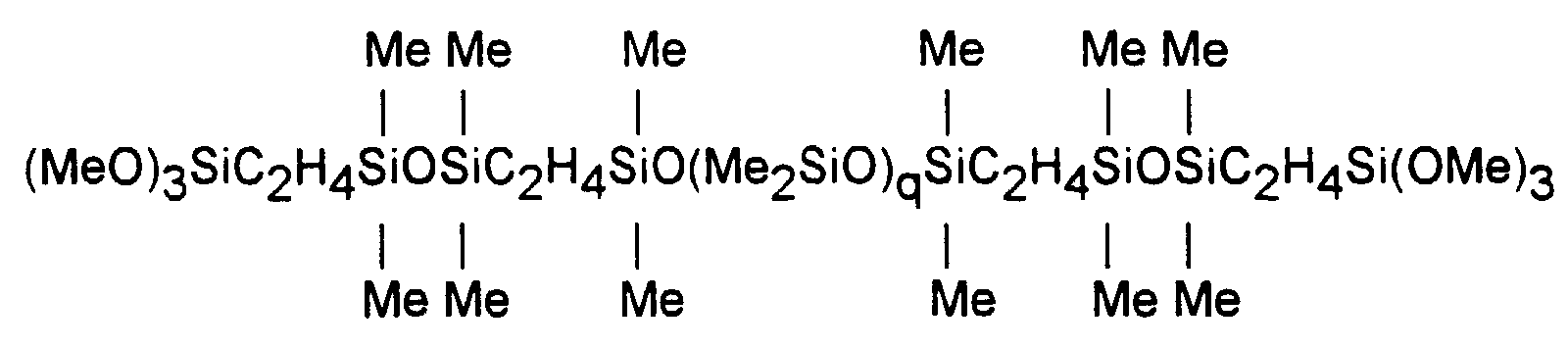
- Room temperature vulvanizable (RTV) silicone compositions were obtained by mixing under reduced pressure in a change can mixer, 70 parts of a polydiorganosiloxane mixture (Polymer A), having a viscosity of 60 Pas, and made by the process of US-A 4,898,910, and having polydiorganosiloxanes of the following formulae

- The adhesion to the substrates shown in Table 1 was determined by the following procedure: Each substrate was wiped with a 50/50 weight solution of isopropanol and water and then allowed to dry. The RTV silicone composition was then applied as a 0.6 cm bead of sealant which was immediately tooled with a small spatula to provide a bead of 0.3 cm in depth. The bead was then allowed to cure 10 days by exposure to ambient air. One end of the cured bead was undercut with a razor blade and pulled up at 90 degrees and the percentage of cohesive failure was judged by observation. Adhesion was also done for some substrates by soaking the cured bead, prepared as describe above, for 1 day in water and then evaluating the adhesion in the same manner. The observed results are shown in Table 1.
TABLE 1 SAMPLE NO. 1 2 3 4 5 6 Adhesion Promoter, parts 0.5 1 0.5 1 1 0.5 Titanium Catalyst, type TBT TBT TPT TPT TBT TPT Titanium Catalyst, parts 1.6 1.6 1.3 1.3 1.6 1.3 Ethylacetoacetate, parts 0 0 0 0 0 1.24 Cohesive Failure, % 10 days at room temperature Acrylic plastic sheet 0 0 0 0 0 100 Polyvinylchloride 0 0 0 0 0 100 Concrete 0 0 0 0 0 0 Anodized aluminum 0 0 0 0 50 100 Cohesive Failure, % 1 day immersion in water Acrylic plastic sheet 0 0 0 0 0 100 Polyvinylchloride 0 0 0 0 0 0 Concrete 0 0 0 0 0 0 Anodized aluminum 0 0 0 0 50 100 - RTV silicone compositions were again prepared as described in Example 1, using the same ingredients and procedure, except various carbonyl (C=O) containing compounds were substituted for the ethylacetoacetate. These compounds are identified in Table 2 and were used in the indicated amounts. The adhesion of cured RTV silicone compositions to various substrates was also done as described in Example 1.
TABLE 2 SAMPLE NO. 7 8 9 10 11 12 13 Adhesion Promoter, parts 0.5 0.5 0.5 0.5 0.5 0.5 0.5 Mixture of TBT and C=O compound, parts 2.4 3.2 2.4 3.2 1.6 2.2 2.8 TBT, moles 1 1 1 1 50% 1 2 Ethylacetoacetate, moles 0 0 0 0 0 1 2 Diethylmalonate, moles 1 2 0 0 0 0 0 Diethylmaleate, moles 0 0 1 2 0 0 0 Ethyl acetate, weight 0 0 0 0 50% 0 0 Cohesive Failure, % 10 days at room temperature Acrylic plastic sheet 0 0 0 0 0 100 100 Polyvinylchloride 0 0 0 0 0 100 100 Anodized aluminum 0 0 0 0 0 100 100 Acrylic plastic** 0 0 0 0 0 100 100 Cohesive Failure, % 1 day immersion in water Acrylic plastic sheet NT NT NT NT NT 0 0 Polyvinylchloride NT NT NT NT NT 100 100*** Anodized aluminum NT NT NT NT NT 100 100 Acrylic plastic** NT NT NT NT NT NT NT *Sample No. 11 was prepared using 50 weight percent TBT and 50 weight percent ethyl acetate
**This acrylic plastic was different from the acrylic plastic sheet and has a trade name Duracron™.***One of two samples evaluated had 100% cohesive failure after water immersion and the other had 0% cohesive failure after water immersion. - RTV silicone compositions were again prepared as in Example 1, with Sample No. 1 using the same ingredients and procedure, except amount of silica filler, the amounts of dimethyldimethoxysilane and ethylacetoacetate are shown in Table 3, and the titanium catalyst was tetrabutyl titanate present in an amount of 1.6 parts. The adhesion of cured RTV silicone compositions to various substrates was as described in Example 1.
TABLE 3 SAMPLE NO. 14 15 16 17 Silica filler, parts 10 11 11 9 Dimethyldimethoxysilane, parts 3.2 3 3 3 Ethylacetoacetate, parts 0.62 0.6 1.2 0.6 Slump, mm 5 0 0 15 Cohesive Failure, % 6 days at room temperature Acrylic plastic sheet 100 100 100 100 Polyvinylchloride, gray 100 100 100 100 Polyvinylchloride, brown 100 100 100 100 Cohesive Failure, % 6 days immersed in water Acrylic plastic sheet 0 0 0 0 Polyvinylchloride, gray 100 100 100 100 Polyvinylchloride, brown 100 100 100 100 - RTV silicone compositions were again prepared per Example 1, with Sample No. 1 using the same ingredients and procedure, except the titanium catalyst was diisoproxy-bis-ethylacetoacetate in an amount of 2 parts, the crosslinker was dimethyldimethoxysilane (DMDM) in Sample No. 18 and was present in an amount of 3 parts, the crosslinker was methyltrimethoxysilane (MTM) in Sample No. 19 and was present in an amount of 2 parts, and no ethylacetoacetate was present. The adhesion of cured RTV silicone compositions to various substrates was repeated as in Example 1 and the results are shown in Table 4.
TABLE 4 SAMPLE NO. 18 19 Cohesive Failure, % 7 days at room temperature Acrylic plastic sheet 100 100 Polyvinylchloride 100 100 Anodized aluminum 100 100 Cohesive Failure, % 13 days at room temperature Acrylic plastic sheet 100 100 Polyvinylchloride 100 100 Anodized aluminum 100 100 Cohesive Failure, % 13 days at room temperature and 1 day immersion in water Acrylic plastic sheet 75 25 Polyvinylchloride 10 0 Anodized aluminum 100 100 Cohesive Failure, % 13 days at room temperature and 4 days immersed in water Acrylic plastic sheet 60 35 Polyvinylchloride 10 NT Anodized aluminum 100 100 - RTV silicone compositions were prepared by mixing 100 parts of a polydiorganosiloxane and an amount of crosslinker as shown in Table 5; adding titanium catalyst and mixing; and then adding silica filler and ethylacetoacetate. The polydiorganosiloxanes were Polymer A, Polymer B was the same as Polymer A except that the polymer had 10 percent of the endgroups as vinyldimethylsiloxy units, and Polymer C was the same as Polymer A except that none of the endgroups were vinyldimethylsiloxy units. The crosslinker was DMDM or MTM as identified in Table 5, the titanium catalyst was tetrabutyl titanate in the amounts shown in Table 5, and the ethylacetoacetate was present in the amounts of Table 5. The adhesion was again evaluated as in Example 1 and the results are in Table 5.
- The physical properties of each RTV silicone composition were evaluated after test pieces were prepared and allowed to cure for 14 days at ambient conditions. The measured properties were durometer on the Shore A scale, tensile strength at break and elongation at break. The extrusion rate was determined on the uncured RTV silicone composition by extruding it through a nozzle with a 0.3175 cm orifice using a 620.5 kPa pressure and by measuring the amount extruded in grams per minute (g/min). Additional measurements used to evaluate the curing characteristics of the composition were skin-overtime (SOT) and tack-free-time (TFT). The durometer was determined according to ASTM D 2240, Scale A. The tensile strength at break, the elongation at break, and the 100% modulus were determined by ASTM D 412. SOT was the time in minutes measured between the time a bead of the composition was extruded into air atmosphere and the time at which a light touch of a finger to the bead surface did not stick to the finger. TFT was the time in minutes measured between the time a bead of composition was extruded in air atmosphere and the time a square of polyethylene film, placed on said bead, was removed without marring the bead surface. The slump was determine by ASTM D 2202.
TABLE 5 SAMPLE NO. 20 21 22 Polymer A, parts 0 0 100 Polymer B, parts 100 0 0 Polymer C, parts 0 100 0 DMDM, parts 0 7 0 MTM, parts 8 0 7 TBT, parts 1.5 1.6 1.6 Silica filler, parts 10 10 9 Ethylacetoacetate, parts 0 0 0.61 Durometer, Shore A scale 32 28 29 Tensile strength at break, kPa 2075 2868 1979 Elongation at break, % 301 682 360 Slump, mm 127 711 51 SOT, minutes 13 10 13 TFT, minutes 75 40 57 Cohesive Failure, % 14 days at room temperature Bronzed anodized aluminum 0 0 100 Enamel paint 0 0 100 Fiberglass 0 0 100 Polyurethane plastic 0 0 100 Granite 0 0 100 Plywood 0 0 100
Claims (10)
- A method of improving the adhesion of a room temperature vulcanizable silicone composition to substrates comprising(I) adding a monoketoester to a room temperature vulcanizable silicone composition comprising a polydiorganosiloxane having endgroups containing for each terminal silicon atom at least two silicon-bonded methoxy, ethoxy, propoxy or butoxy groups; a crosslinker having at least two silicon-bonded methoxy or ethoxy groups per molecule; filler; and titanium catalyst; characterized by the presence of 0.25 to 3 moles of monoketoester per one mole of titanium atom in the titanium catalyst;(II) applying the resulting silicone composition from (I) to a substrate surface,(III) exposing the silicone composition to atmospheric moisture for a sufficient time to obtain a cured material bonded to the substrate.
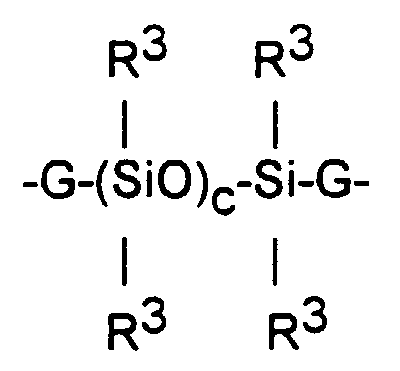
- The method in accordance with claim 1 in which the silicone composition has as the polydiorganosiloxane, a polydiorganosiloxane of the formula

- The method in accordance with claim 1 or claim 2 in which the monoketoester is ethylacetoacetate.
- The method in accordance with any of claims 1 to 3 in which the crosslinker is selected from dimethyldimethoxysilane or methyltrimethoxysilane.
- The method in accordance with any of claims 1 to 4 in which the titanium catalyst is a tetraalkyl titanate of the formula Ti(OR)4 where R is ethyl, propyl, butyl or amyl.
- The method in accordance with any of claims 1 to 4 in which the titanium catalyst is dialkoxy-bis-ethylacetoacetate titanium and the ethylacetoacetate ligand of said titanium catalyst is at least a portion of the required monoketoester.
- The method in accordance with claim 6 in which the alkoxy group in the dialkoxy-bis-ethylacetoacetate titanium is isopropoxy.
- The method in accordance with any of claims 1 to 7 in which the substrate is a plastic or metal substrate.
- The method in accordance with claim 8 in which the plastic substrate is acrylic.
- The method in accordance with claim 8 in which the metal substrate is anodized aluminum.
Applications Claiming Priority (2)
| Application Number | Priority Date | Filing Date | Title |
|---|---|---|---|
| US63449896A | 1996-04-18 | 1996-04-18 | |
| US634498 | 2006-12-06 |
Publications (1)
| Publication Number | Publication Date |
|---|---|
| EP0802222A1 true EP0802222A1 (en) | 1997-10-22 |
Family
ID=24544047
Family Applications (1)
| Application Number | Title | Priority Date | Filing Date |
|---|---|---|---|
| EP97302512A Withdrawn EP0802222A1 (en) | 1996-04-18 | 1997-04-11 | Method of adhesion improvement for silicone compositions |
Country Status (4)
| Country | Link |
|---|---|
| EP (1) | EP0802222A1 (en) |
| JP (1) | JPH1036673A (en) |
| KR (1) | KR970070159A (en) |
| AU (1) | AU1892497A (en) |
Cited By (17)
| Publication number | Priority date | Publication date | Assignee | Title |
|---|---|---|---|---|
| EP0926205A1 (en) * | 1997-12-23 | 1999-06-30 | Dow Corning Corporation | Method of forming a seal in a confined configuration using an alkoxy-functional rtv composition |
| EP0967246A1 (en) * | 1998-06-26 | 1999-12-29 | Dow Corning Corporation | Silica filled RTV compositions having adhesion to glass and ceramic materials |
| WO2001049774A3 (en) * | 2000-01-06 | 2002-02-07 | Dow Corning | Organosiloxane compositions |
| WO2001049789A3 (en) * | 2000-01-06 | 2002-03-21 | Dow Corning Sa | Organosiloxane compositions |
| WO2004094503A1 (en) * | 2003-04-03 | 2004-11-04 | Dow Corning Corporation | Moisture curable organosiloxane compositions |
| US7022800B2 (en) | 2000-01-06 | 2006-04-04 | Dow Corning S.A. | Organosiloxane compositions |
| WO2013036546A3 (en) * | 2011-09-07 | 2013-08-15 | Dow Corning Corporation | Titanium containing complex and condensation reaction catalysts, methods for preparing the catalysts, and compositions containing the catalysts |
| WO2015098119A1 (en) | 2013-12-27 | 2015-07-02 | Dow Corning Toray Co., Ltd. | Room-temperature-curable silicone rubber composition, and the use thereof |
| US9139699B2 (en) | 2012-10-04 | 2015-09-22 | Dow Corning Corporation | Metal containing condensation reaction catalysts, methods for preparing the catalysts, and compositions containing the catalysts |
| CN107286897A (en) * | 2017-07-05 | 2017-10-24 | 广州市高士实业有限公司 | A kind of Single-component low-viscosity dealcoholized type organic silicon potting adhesive and preparation method thereof |
| WO2017187356A1 (en) | 2016-04-28 | 2017-11-02 | Soudal | Improved method for producing moisture-sensitive products |
| BE1024173B1 (en) * | 2016-04-28 | 2017-12-05 | Soudal | Making moisture-sensitive products with pressure changes |
| US20210179904A1 (en) * | 2018-08-24 | 2021-06-17 | Sika Technology Ag | Moisture-curing rtv silicone composition with homogeneous deep-cure |
| US11655404B2 (en) | 2019-12-23 | 2023-05-23 | Dow Silicones Corporation | Sealant composition |
| CN117757419A (en) * | 2023-12-20 | 2024-03-26 | 广东高士高科实业有限公司 | Organosilicon section sealant and preparation method thereof |
| US12378362B2 (en) | 2019-12-17 | 2025-08-05 | Dow Silicones Corporation | Polydiorganosiloxane preparation |
| US12448539B2 (en) | 2019-12-17 | 2025-10-21 | Dow Silicones Corporation | Sealant composition |
Families Citing this family (2)
| Publication number | Priority date | Publication date | Assignee | Title |
|---|---|---|---|---|
| JP5329624B2 (en) * | 2011-08-31 | 2013-10-30 | モメンティブ・パフォーマンス・マテリアルズ・ジャパン合同会社 | Method for preparing room temperature curable polyorganosiloxane composition |
| CN110922936A (en) * | 2019-12-13 | 2020-03-27 | 东莞市博君来胶粘材料科技有限公司 | A kind of dealcoholized silicone adhesive and its preparation method and application |
Citations (15)
| Publication number | Priority date | Publication date | Assignee | Title |
|---|---|---|---|---|
| US3151099A (en) | 1960-05-30 | 1964-09-29 | Rhone Poulenc Sa | Water curable organopolysiloxanes containing silicic esters and zirconic or titanic esters |
| US3161614A (en) | 1961-10-16 | 1964-12-15 | Dow Corning | Polyfunctional alkoxy endblocked polysiloxanes and their cured compositions |
| US3175993A (en) | 1961-10-16 | 1965-03-30 | Dow Corning | Polyfunctional siloxanes containing terminal alkoxyl groups |
| US3334067A (en) | 1966-04-08 | 1967-08-01 | Dow Corning | Method of making one component room temperature curing siloxane rubbers |
| US3856839A (en) * | 1971-01-06 | 1974-12-24 | Gen Electric | Alkanedioxy titanium chelates |
| GB2079745A (en) * | 1980-07-02 | 1982-01-27 | Gen Electric | Titanium chelate catalyst for silicone compositions |
| US4680364A (en) * | 1985-06-18 | 1987-07-14 | General Electric Company | Room temperature vulcanizable silicone compositions having improved adhesion |
| EP0236043A2 (en) * | 1986-03-03 | 1987-09-09 | Dow Corning Corporation | Improved room-temperature curing silicone sealants |
| US4722967A (en) | 1980-07-02 | 1988-02-02 | General Electric Company | Titanium chelate catalyst for silicone compositions |
| US4871827A (en) | 1986-03-03 | 1989-10-03 | Dow Corning Corporation | Method of improving shelf life of silicone elastomeric sealant |
| US4898910A (en) | 1988-09-26 | 1990-02-06 | Dow Corning Corporation | Modulus control in silicone sealant |
| EP0361803A2 (en) * | 1988-09-26 | 1990-04-04 | Dow Corning Corporation | In situ formed titanium chelate catalysts |
| US4956435A (en) | 1989-03-22 | 1990-09-11 | Dow Corning Corporation | Neutral cure silicone sealants |
| US4962076A (en) * | 1988-11-28 | 1990-10-09 | Dow Corning Corporation | Silicone sealants having reduced color |
| US5051455A (en) * | 1990-01-16 | 1991-09-24 | Dow Corning Corporation | Adhesion of silicone sealants |
-
1997
- 1997-04-11 EP EP97302512A patent/EP0802222A1/en not_active Withdrawn
- 1997-04-17 AU AU18924/97A patent/AU1892497A/en not_active Abandoned
- 1997-04-17 JP JP9100472A patent/JPH1036673A/en not_active Withdrawn
- 1997-04-17 KR KR1019970014117A patent/KR970070159A/en not_active Withdrawn
Patent Citations (16)
| Publication number | Priority date | Publication date | Assignee | Title |
|---|---|---|---|---|
| US3151099A (en) | 1960-05-30 | 1964-09-29 | Rhone Poulenc Sa | Water curable organopolysiloxanes containing silicic esters and zirconic or titanic esters |
| US3161614A (en) | 1961-10-16 | 1964-12-15 | Dow Corning | Polyfunctional alkoxy endblocked polysiloxanes and their cured compositions |
| US3175993A (en) | 1961-10-16 | 1965-03-30 | Dow Corning | Polyfunctional siloxanes containing terminal alkoxyl groups |
| US3334067A (en) | 1966-04-08 | 1967-08-01 | Dow Corning | Method of making one component room temperature curing siloxane rubbers |
| US3856839A (en) * | 1971-01-06 | 1974-12-24 | Gen Electric | Alkanedioxy titanium chelates |
| US4722967A (en) | 1980-07-02 | 1988-02-02 | General Electric Company | Titanium chelate catalyst for silicone compositions |
| GB2079745A (en) * | 1980-07-02 | 1982-01-27 | Gen Electric | Titanium chelate catalyst for silicone compositions |
| US4680364A (en) * | 1985-06-18 | 1987-07-14 | General Electric Company | Room temperature vulcanizable silicone compositions having improved adhesion |
| EP0236043A2 (en) * | 1986-03-03 | 1987-09-09 | Dow Corning Corporation | Improved room-temperature curing silicone sealants |
| US4871827A (en) | 1986-03-03 | 1989-10-03 | Dow Corning Corporation | Method of improving shelf life of silicone elastomeric sealant |
| US4898910A (en) | 1988-09-26 | 1990-02-06 | Dow Corning Corporation | Modulus control in silicone sealant |
| EP0361803A2 (en) * | 1988-09-26 | 1990-04-04 | Dow Corning Corporation | In situ formed titanium chelate catalysts |
| AU621150B2 (en) | 1988-09-26 | 1992-03-05 | Dow Corning Corporation | In situ formed titanium chelate catalysts |
| US4962076A (en) * | 1988-11-28 | 1990-10-09 | Dow Corning Corporation | Silicone sealants having reduced color |
| US4956435A (en) | 1989-03-22 | 1990-09-11 | Dow Corning Corporation | Neutral cure silicone sealants |
| US5051455A (en) * | 1990-01-16 | 1991-09-24 | Dow Corning Corporation | Adhesion of silicone sealants |
Cited By (30)
| Publication number | Priority date | Publication date | Assignee | Title |
|---|---|---|---|---|
| US6132664A (en) * | 1997-12-23 | 2000-10-17 | Dow Corning Corporation | Method of forming a seal in a confined configuration with an alkoxy-functional RTV composition |
| EP0926205A1 (en) * | 1997-12-23 | 1999-06-30 | Dow Corning Corporation | Method of forming a seal in a confined configuration using an alkoxy-functional rtv composition |
| EP0967246A1 (en) * | 1998-06-26 | 1999-12-29 | Dow Corning Corporation | Silica filled RTV compositions having adhesion to glass and ceramic materials |
| US6107435A (en) * | 1998-06-26 | 2000-08-22 | Dow Corning Corporation | Silica filled RTV compositions having adhesion to glass and ceramic materials |
| WO2001049774A3 (en) * | 2000-01-06 | 2002-02-07 | Dow Corning | Organosiloxane compositions |
| WO2001049789A3 (en) * | 2000-01-06 | 2002-03-21 | Dow Corning Sa | Organosiloxane compositions |
| US7022800B2 (en) | 2000-01-06 | 2006-04-04 | Dow Corning S.A. | Organosiloxane compositions |
| WO2004094503A1 (en) * | 2003-04-03 | 2004-11-04 | Dow Corning Corporation | Moisture curable organosiloxane compositions |
| US9371422B2 (en) | 2011-09-07 | 2016-06-21 | Dow Corning Corporation | Titanium containing complex and condensation reaction catalysts, methods for preparing the catalysts, and compositions containing the catalysts |
| WO2013036546A3 (en) * | 2011-09-07 | 2013-08-15 | Dow Corning Corporation | Titanium containing complex and condensation reaction catalysts, methods for preparing the catalysts, and compositions containing the catalysts |
| CN103781823A (en) * | 2011-09-07 | 2014-05-07 | 道康宁公司 | Titanium containing complex and condensation reaction catalysts, methods for preparing the catalysts, and compositions containing the catalysts |
| CN103781823B (en) * | 2011-09-07 | 2016-08-17 | 道康宁公司 | Containing titanium complex and condensation catalyst, prepare the method for this catalyst and comprise the compositions of this catalyst |
| US9469799B2 (en) | 2011-10-04 | 2016-10-18 | Dow Corning Corporation | Metal containing condensation reaction catalysts, methods for preparing the catalysts, and compositions containing the catalysts |
| US9139699B2 (en) | 2012-10-04 | 2015-09-22 | Dow Corning Corporation | Metal containing condensation reaction catalysts, methods for preparing the catalysts, and compositions containing the catalysts |
| US10072151B2 (en) | 2013-12-27 | 2018-09-11 | Dow Corning Toray Co., Ltd. | Room-temperature-curable silicone rubber composition, and the use thereof |
| WO2015098119A1 (en) | 2013-12-27 | 2015-07-02 | Dow Corning Toray Co., Ltd. | Room-temperature-curable silicone rubber composition, and the use thereof |
| EP3087144A4 (en) * | 2013-12-27 | 2017-08-02 | Dow Corning Toray Co., Ltd. | Room-temperature-curable silicone rubber composition, and the use thereof |
| EP3448920B1 (en) | 2016-04-28 | 2020-03-04 | Soudal | Improved method for producing moisture-sensitive products |
| BE1024173B1 (en) * | 2016-04-28 | 2017-12-05 | Soudal | Making moisture-sensitive products with pressure changes |
| WO2017187355A3 (en) * | 2016-04-28 | 2017-12-21 | Soudal | Production of moisture-sensitive products with pressure changes |
| WO2017187356A1 (en) | 2016-04-28 | 2017-11-02 | Soudal | Improved method for producing moisture-sensitive products |
| US10907015B2 (en) | 2016-04-28 | 2021-02-02 | Soudal | Method for producing moisture-sensitive products |
| CN107286897A (en) * | 2017-07-05 | 2017-10-24 | 广州市高士实业有限公司 | A kind of Single-component low-viscosity dealcoholized type organic silicon potting adhesive and preparation method thereof |
| CN107286897B (en) * | 2017-07-05 | 2020-07-28 | 广州市高士实业有限公司 | Single-component low-viscosity dealcoholized organic silicon pouring sealant and preparation method thereof |
| US20210179904A1 (en) * | 2018-08-24 | 2021-06-17 | Sika Technology Ag | Moisture-curing rtv silicone composition with homogeneous deep-cure |
| US12378362B2 (en) | 2019-12-17 | 2025-08-05 | Dow Silicones Corporation | Polydiorganosiloxane preparation |
| US12448539B2 (en) | 2019-12-17 | 2025-10-21 | Dow Silicones Corporation | Sealant composition |
| US11655404B2 (en) | 2019-12-23 | 2023-05-23 | Dow Silicones Corporation | Sealant composition |
| CN117757419A (en) * | 2023-12-20 | 2024-03-26 | 广东高士高科实业有限公司 | Organosilicon section sealant and preparation method thereof |
| CN117757419B (en) * | 2023-12-20 | 2024-05-31 | 广东高士高科实业有限公司 | Organosilicon section sealant and preparation method thereof |
Also Published As
| Publication number | Publication date |
|---|---|
| AU1892497A (en) | 1997-10-23 |
| JPH1036673A (en) | 1998-02-10 |
| KR970070159A (en) | 1997-11-07 |
Similar Documents
| Publication | Publication Date | Title |
|---|---|---|
| EP0802222A1 (en) | Method of adhesion improvement for silicone compositions | |
| US5833798A (en) | Adhesion method employing organosiloxane compositions | |
| EP0438221B1 (en) | Improved adhesion of silicone sealants | |
| EP1723201B1 (en) | Rtv silicone composition offering rapid bond strength | |
| JP3602650B2 (en) | Organosiloxane composition | |
| CA2682191C (en) | Rapid deep-section cure silicone compositions | |
| EP0368455A1 (en) | Modulus control in silicone sealant | |
| GB2152523A (en) | Organopolysiloxane composition curable to an elastomer and use thereof | |
| JPH09506668A (en) | Room temperature curable silicone compositions using phenyl-substituted tris-functional ketoxime silanes | |
| JPH0848963A (en) | Pressure-sensitive silicone adhesive composition | |
| US6254811B1 (en) | Organopolysilozane compositions crosslinkable with elimination of alcohols to give elastomer | |
| CN1340084A (en) | Polyorganosiloxane RTV compositions | |
| EP0345645B1 (en) | Room temperature-curable organopolysiloxane composition | |
| US6777471B1 (en) | Organopolysiloxane compositions hardening into translucent elastomers at room temperature in the presence of humidity | |
| EP1361254B1 (en) | Room temperature curable organopolysiloxane compositions | |
| EP0361803A2 (en) | In situ formed titanium chelate catalysts | |
| EP0586184B1 (en) | Polydimethylsiloxanes for modulus reduction and method for their preparation | |
| EP0799860A2 (en) | Method for enhancing longevity of a surface drying oil on a silicone composition modified by incorporation of zinc oxide | |
| EP1302512B1 (en) | Non-staining silicone rubber compositions, their preparation and use | |
| KR102246572B1 (en) | Crosslinkable substances based on organopolysiloxanes containing organyloxy groups | |
| US5492728A (en) | Method of reducing the bubble formation when curing a room temperature vulcanizable silicone sealant composition with silicon-bonded alkoxy crosslinker on a hot porous surface | |
| JPH0645755B2 (en) | Material that crosslinks to an elastomer at room temperature, method for producing the same, and paint-compatible sealant containing the material | |
| EP0799859A2 (en) | Silicone compositions containing UV degradable fungicides modified by incorporation of zinc oxide | |
| EP0693533A1 (en) | Room temperature-curing silicone elastomer composition | |
| US7582717B2 (en) | Crosslinkable composition based on organosilicon compounds |
Legal Events
| Date | Code | Title | Description |
|---|---|---|---|
| PUAI | Public reference made under article 153(3) epc to a published international application that has entered the european phase |
Free format text: ORIGINAL CODE: 0009012 |
|
| AK | Designated contracting states |
Kind code of ref document: A1 Designated state(s): BE DE FR GB IT |
|
| 17P | Request for examination filed |
Effective date: 19971203 |
|
| 17Q | First examination report despatched |
Effective date: 19980119 |
|
| STAA | Information on the status of an ep patent application or granted ep patent |
Free format text: STATUS: THE APPLICATION IS DEEMED TO BE WITHDRAWN |
|
| 18D | Application deemed to be withdrawn |
Effective date: 19980530 |