EP0801063B1 - Thiazolidinedione derivatives having antidiabetic, hypolipidaemic, antihypertensive properties, process for their preparation and pharmaceutical compositions containing them - Google Patents
Thiazolidinedione derivatives having antidiabetic, hypolipidaemic, antihypertensive properties, process for their preparation and pharmaceutical compositions containing them Download PDFInfo
- Publication number
- EP0801063B1 EP0801063B1 EP96105590A EP96105590A EP0801063B1 EP 0801063 B1 EP0801063 B1 EP 0801063B1 EP 96105590 A EP96105590 A EP 96105590A EP 96105590 A EP96105590 A EP 96105590A EP 0801063 B1 EP0801063 B1 EP 0801063B1
- Authority
- EP
- European Patent Office
- Prior art keywords
- ethoxy
- compound
- thiazolidine
- dione
- formula
- Prior art date
- Legal status (The legal status is an assumption and is not a legal conclusion. Google has not performed a legal analysis and makes no representation as to the accuracy of the status listed.)
- Expired - Lifetime
Links
- 238000000034 method Methods 0.000 title claims abstract description 95
- 239000008194 pharmaceutical composition Substances 0.000 title claims abstract description 13
- 238000002360 preparation method Methods 0.000 title claims description 155
- 150000001467 thiazolidinediones Chemical class 0.000 title claims description 16
- 230000008569 process Effects 0.000 title claims description 10
- 239000003472 antidiabetic agent Substances 0.000 title description 5
- 230000003178 anti-diabetic effect Effects 0.000 title description 4
- 230000003276 anti-hypertensive effect Effects 0.000 title 1
- 230000000055 hyoplipidemic effect Effects 0.000 title 1
- 150000001875 compounds Chemical class 0.000 claims abstract description 206
- 125000003118 aryl group Chemical group 0.000 claims abstract description 24
- 125000004432 carbon atom Chemical group C* 0.000 claims abstract description 24
- 239000001257 hydrogen Substances 0.000 claims abstract description 24
- 229910052739 hydrogen Inorganic materials 0.000 claims abstract description 24
- 125000003710 aryl alkyl group Chemical group 0.000 claims abstract description 21
- 125000001424 substituent group Chemical group 0.000 claims abstract description 19
- 125000000217 alkyl group Chemical group 0.000 claims abstract description 16
- 125000005161 aryl oxy carbonyl group Chemical group 0.000 claims abstract description 16
- 125000004435 hydrogen atom Chemical class [H]* 0.000 claims abstract description 15
- 125000003342 alkenyl group Chemical group 0.000 claims abstract description 11
- UFHFLCQGNIYNRP-UHFFFAOYSA-N Hydrogen Chemical compound [H][H] UFHFLCQGNIYNRP-UHFFFAOYSA-N 0.000 claims abstract description 10
- NINIDFKCEFEMDL-UHFFFAOYSA-N Sulfur Chemical compound [S] NINIDFKCEFEMDL-UHFFFAOYSA-N 0.000 claims abstract description 9
- 125000002252 acyl group Chemical group 0.000 claims abstract description 9
- 125000002947 alkylene group Chemical group 0.000 claims abstract description 9
- QVGXLLKOCUKJST-UHFFFAOYSA-N atomic oxygen Chemical compound [O] QVGXLLKOCUKJST-UHFFFAOYSA-N 0.000 claims abstract description 9
- 239000001301 oxygen Substances 0.000 claims abstract description 9
- 229910052760 oxygen Inorganic materials 0.000 claims abstract description 9
- 125000000304 alkynyl group Chemical group 0.000 claims abstract description 7
- 239000005864 Sulphur Substances 0.000 claims abstract description 6
- 125000000623 heterocyclic group Chemical group 0.000 claims abstract description 4
- FYRVDDJMNISIKJ-UWVGGRQHSA-N Asn-Tyr Chemical compound NC(=O)C[C@H](N)C(=O)N[C@H](C(O)=O)CC1=CC=C(O)C=C1 FYRVDDJMNISIKJ-UWVGGRQHSA-N 0.000 claims abstract description 3
- 125000002723 alicyclic group Chemical group 0.000 claims abstract description 3
- 125000005842 heteroatom Chemical group 0.000 claims abstract description 3
- -1 phenyloxy Chemical group 0.000 claims description 56
- 238000006243 chemical reaction Methods 0.000 claims description 29
- 125000001797 benzyl group Chemical group [H]C1=C([H])C([H])=C(C([H])=C1[H])C([H])([H])* 0.000 claims description 28
- 150000003839 salts Chemical class 0.000 claims description 27
- XLYOFNOQVPJJNP-UHFFFAOYSA-N water Substances O XLYOFNOQVPJJNP-UHFFFAOYSA-N 0.000 claims description 27
- ZOBPZXTWZATXDG-UHFFFAOYSA-N 1,3-thiazolidine-2,4-dione Chemical compound O=C1CSC(=O)N1 ZOBPZXTWZATXDG-UHFFFAOYSA-N 0.000 claims description 25
- 125000001997 phenyl group Chemical group [H]C1=C([H])C([H])=C(*)C([H])=C1[H] 0.000 claims description 21
- 125000001301 ethoxy group Chemical group [H]C([H])([H])C([H])([H])O* 0.000 claims description 20
- 125000001624 naphthyl group Chemical group 0.000 claims description 20
- 239000012453 solvate Substances 0.000 claims description 20
- 125000000094 2-phenylethyl group Chemical group [H]C1=C([H])C([H])=C(C([H])=C1[H])C([H])([H])C([H])([H])* 0.000 claims description 15
- WPYMKLBDIGXBTP-UHFFFAOYSA-N benzoic acid Chemical compound OC(=O)C1=CC=CC=C1 WPYMKLBDIGXBTP-UHFFFAOYSA-N 0.000 claims description 14
- 125000005196 alkyl carbonyloxy group Chemical group 0.000 claims description 12
- 125000004103 aminoalkyl group Chemical group 0.000 claims description 12
- 125000000051 benzyloxy group Chemical group [H]C1=C([H])C([H])=C(C([H])=C1[H])C([H])([H])O* 0.000 claims description 12
- 125000004663 dialkyl amino group Chemical group 0.000 claims description 12
- 125000001188 haloalkyl group Chemical group 0.000 claims description 12
- 125000002768 hydroxyalkyl group Chemical group 0.000 claims description 12
- 125000004001 thioalkyl group Chemical group 0.000 claims description 12
- 125000005843 halogen group Chemical group 0.000 claims description 11
- 125000000446 sulfanediyl group Chemical group *S* 0.000 claims description 11
- 238000011282 treatment Methods 0.000 claims description 11
- 125000003236 benzoyl group Chemical group [H]C1=C([H])C([H])=C(C([H])=C1[H])C(*)=O 0.000 claims description 10
- 229910052736 halogen Inorganic materials 0.000 claims description 10
- 150000002367 halogens Chemical class 0.000 claims description 10
- 125000004448 alkyl carbonyl group Chemical group 0.000 claims description 9
- 125000005129 aryl carbonyl group Chemical group 0.000 claims description 9
- 125000004104 aryloxy group Chemical group 0.000 claims description 9
- 125000004093 cyano group Chemical group *C#N 0.000 claims description 9
- 125000001038 naphthoyl group Chemical group C1(=CC=CC2=CC=CC=C12)C(=O)* 0.000 claims description 9
- 125000005186 naphthyloxy group Chemical group C1(=CC=CC2=CC=CC=C12)O* 0.000 claims description 9
- 125000000027 (C1-C10) alkoxy group Chemical group 0.000 claims description 8
- 125000000008 (C1-C10) alkyl group Chemical group 0.000 claims description 8
- 239000002253 acid Substances 0.000 claims description 8
- 125000003545 alkoxy group Chemical group 0.000 claims description 8
- UMGDCJDMYOKAJW-UHFFFAOYSA-N thiourea Chemical compound NC(N)=S UMGDCJDMYOKAJW-UHFFFAOYSA-N 0.000 claims description 8
- 239000003085 diluting agent Substances 0.000 claims description 7
- 125000001495 ethyl group Chemical group [H]C([H])([H])C([H])([H])* 0.000 claims description 7
- 125000002887 hydroxy group Chemical group [H]O* 0.000 claims description 7
- 125000000449 nitro group Chemical group [O-][N+](*)=O 0.000 claims description 7
- 208000001072 type 2 diabetes mellitus Diseases 0.000 claims description 7
- 125000004453 alkoxycarbonyl group Chemical group 0.000 claims description 6
- 239000012298 atmosphere Substances 0.000 claims description 6
- 239000003054 catalyst Substances 0.000 claims description 6
- 125000003178 carboxy group Chemical group [H]OC(*)=O 0.000 claims description 5
- 125000000325 methylidene group Chemical group [H]C([H])=* 0.000 claims description 5
- 125000001639 phenylmethylene group Chemical group [H]C(=*)C1=C([H])C([H])=C([H])C([H])=C1[H] 0.000 claims description 5
- 125000002924 primary amino group Chemical group [H]N([H])* 0.000 claims description 5
- 229920006395 saturated elastomer Polymers 0.000 claims description 5
- 208000024172 Cardiovascular disease Diseases 0.000 claims description 4
- 208000031226 Hyperlipidaemia Diseases 0.000 claims description 4
- 206010020772 Hypertension Diseases 0.000 claims description 4
- XSQUKJJJFZCRTK-UHFFFAOYSA-N Urea Natural products NC(N)=O XSQUKJJJFZCRTK-UHFFFAOYSA-N 0.000 claims description 4
- 125000003282 alkyl amino group Chemical group 0.000 claims description 4
- 238000007796 conventional method Methods 0.000 claims description 4
- 230000007062 hydrolysis Effects 0.000 claims description 4
- 238000006460 hydrolysis reaction Methods 0.000 claims description 4
- 125000006832 (C1-C10) alkylene group Chemical group 0.000 claims description 3
- SMZOUWXMTYCWNB-UHFFFAOYSA-N 2-(2-methoxy-5-methylphenyl)ethanamine Chemical compound COC1=CC=C(C)C=C1CCN SMZOUWXMTYCWNB-UHFFFAOYSA-N 0.000 claims description 3
- NIXOWILDQLNWCW-UHFFFAOYSA-N 2-Propenoic acid Natural products OC(=O)C=C NIXOWILDQLNWCW-UHFFFAOYSA-N 0.000 claims description 3
- ICIVVTHCJYUIFR-UHFFFAOYSA-N 5-[[4-[2-[(5-hydroxy-2,2,4,6,7-pentamethyl-3h-1-benzofuran-3-yl)methyl-methylamino]ethoxy]phenyl]methyl]-1,3-thiazolidine-2,4-dione Chemical compound CC1=C(C)C(O)=C(C)C2=C1OC(C)(C)C2CN(C)CCOC(C=C1)=CC=C1CC1SC(=O)NC1=O ICIVVTHCJYUIFR-UHFFFAOYSA-N 0.000 claims description 3
- UQTBFJKRXXWVLC-UHFFFAOYSA-N 5-[[4-[2-[(5-hydroxy-2,2,4,6,7-pentamethyl-3h-1-benzofuran-3-yl)methyl-methylamino]ethoxy]phenyl]methylidene]-1,3-thiazolidine-2,4-dione Chemical compound CC1=C(C)C(O)=C(C)C2=C1OC(C)(C)C2CN(C)CCOC(C=C1)=CC=C1C=C1SC(=O)NC1=O UQTBFJKRXXWVLC-UHFFFAOYSA-N 0.000 claims description 3
- KMNLASVDSCDDGU-UHFFFAOYSA-N 5-[[4-[2-[(6-hydroxy-2,5,7,8-tetramethyl-3,4-dihydrochromen-2-yl)methyl-methylamino]ethoxy]phenyl]methylidene]-1,3-thiazolidine-2,4-dione Chemical compound C1CC2=C(C)C(O)=C(C)C(C)=C2OC1(C)CN(C)CCOC(C=C1)=CC=C1C=C1SC(=O)NC1=O KMNLASVDSCDDGU-UHFFFAOYSA-N 0.000 claims description 3
- USTAUHMNZWDQKS-UHFFFAOYSA-N 5-[[4-[2-[benzyl(methyl)amino]ethoxy]phenyl]methylidene]-1,3-thiazolidine-2,4-dione Chemical compound C=1C=CC=CC=1CN(C)CCOC(C=C1)=CC=C1C=C1SC(=O)NC1=O USTAUHMNZWDQKS-UHFFFAOYSA-N 0.000 claims description 3
- NTSLZSKOGORMFG-UHFFFAOYSA-N 5-[[4-[2-[methyl(3-phenylpropyl)amino]ethoxy]phenyl]methyl]-1,3-thiazolidine-2,4-dione Chemical compound C=1C=C(CC2C(NC(=O)S2)=O)C=CC=1OCCN(C)CCCC1=CC=CC=C1 NTSLZSKOGORMFG-UHFFFAOYSA-N 0.000 claims description 3
- DBJMMBNPCMSAJI-UHFFFAOYSA-N 5-[[4-[2-[methyl(pyridin-2-ylmethyl)amino]ethoxy]phenyl]methylidene]-1,3-thiazolidine-2,4-dione Chemical compound C=1C=CC=NC=1CN(C)CCOC(C=C1)=CC=C1C=C1SC(=O)NC1=O DBJMMBNPCMSAJI-UHFFFAOYSA-N 0.000 claims description 3
- DKTFEUJGLCUSHM-UHFFFAOYSA-N 5-[[4-[2-[methyl-[(2,2,4,6,7-pentamethyl-5-phenylmethoxy-3h-1-benzofuran-3-yl)methyl]amino]ethoxy]phenyl]methylidene]-1,3-thiazolidine-2,4-dione Chemical compound CC1=C(C)C(OCC=2C=CC=CC=2)=C(C)C2=C1OC(C)(C)C2CN(C)CCOC(C=C1)=CC=C1C=C1SC(=O)NC1=O DKTFEUJGLCUSHM-UHFFFAOYSA-N 0.000 claims description 3
- IUCVMFQGKCHLPG-UHFFFAOYSA-N 5-[[4-[2-[methyl-[(2,5,7,8-tetramethyl-6-phenylmethoxy-3,4-dihydrochromen-2-yl)methyl]amino]ethoxy]phenyl]methylidene]-1,3-thiazolidine-2,4-dione Chemical compound C1CC2=C(C)C(OCC=3C=CC=CC=3)=C(C)C(C)=C2OC1(C)CN(C)CCOC(C=C1)=CC=C1C=C1SC(=O)NC1=O IUCVMFQGKCHLPG-UHFFFAOYSA-N 0.000 claims description 3
- YHSYBNSJKPBAQT-UHFFFAOYSA-N 5-[[4-[2-[methyl-[(5-methyl-2-phenyl-1,3-oxazol-4-yl)methyl]amino]ethoxy]phenyl]methyl]-1,3-thiazolidine-2,4-dione Chemical compound N1=C(C=2C=CC=CC=2)OC(C)=C1CN(C)CCOC(C=C1)=CC=C1CC1SC(=O)NC1=O YHSYBNSJKPBAQT-UHFFFAOYSA-N 0.000 claims description 3
- 201000001320 Atherosclerosis Diseases 0.000 claims description 3
- CLTDXLRHXYUWBS-UHFFFAOYSA-N C1CC2=C(C)C(OCC=3C=CC=CC=3)=C(C)C(C)=C2OC1(C)CN(CC)CCOC(C=C1)=CC=C1C=C1SC(=O)NC1=O Chemical compound C1CC2=C(C)C(OCC=3C=CC=CC=3)=C(C)C(C)=C2OC1(C)CN(CC)CCOC(C=C1)=CC=C1C=C1SC(=O)NC1=O CLTDXLRHXYUWBS-UHFFFAOYSA-N 0.000 claims description 3
- YYQXPWMCBQCLAJ-UHFFFAOYSA-N C=1C=C(C=C2C(NC(=O)S2)=O)C=CC=1OCCN(C)CCCC1=CC=CC=C1 Chemical compound C=1C=C(C=C2C(NC(=O)S2)=O)C=CC=1OCCN(C)CCCC1=CC=CC=C1 YYQXPWMCBQCLAJ-UHFFFAOYSA-N 0.000 claims description 3
- 208000030814 Eating disease Diseases 0.000 claims description 3
- 208000019454 Feeding and Eating disease Diseases 0.000 claims description 3
- 125000003277 amino group Chemical group 0.000 claims description 3
- 125000004618 benzofuryl group Chemical group O1C(=CC2=C1C=CC=C2)* 0.000 claims description 3
- 125000004619 benzopyranyl group Chemical group O1C(C=CC2=C1C=CC=C2)* 0.000 claims description 3
- 125000001164 benzothiazolyl group Chemical group S1C(=NC2=C1C=CC=C2)* 0.000 claims description 3
- 125000004541 benzoxazolyl group Chemical group O1C(=NC2=C1C=CC=C2)* 0.000 claims description 3
- 229910052794 bromium Inorganic materials 0.000 claims description 3
- 229910052801 chlorine Inorganic materials 0.000 claims description 3
- 235000014632 disordered eating Nutrition 0.000 claims description 3
- 239000003937 drug carrier Substances 0.000 claims description 3
- 150000002148 esters Chemical class 0.000 claims description 3
- 125000002541 furyl group Chemical group 0.000 claims description 3
- 125000001475 halogen functional group Chemical group 0.000 claims description 3
- 125000004356 hydroxy functional group Chemical group O* 0.000 claims description 3
- 238000011321 prophylaxis Methods 0.000 claims description 3
- 125000004076 pyridyl group Chemical group 0.000 claims description 3
- 125000004105 2-pyridyl group Chemical group N1=C([*])C([H])=C([H])C([H])=C1[H] 0.000 claims description 2
- GBUHQAOIIHHDRE-UHFFFAOYSA-N 5-[[4-[2-[benzyl(methyl)amino]ethoxy]phenyl]methyl]-1,3-thiazolidine-2,4-dione Chemical compound C=1C=CC=CC=1CN(C)CCOC(C=C1)=CC=C1CC1SC(=O)NC1=O GBUHQAOIIHHDRE-UHFFFAOYSA-N 0.000 claims description 2
- IDCRXMOPFLSPGO-UHFFFAOYSA-N 5-[[4-[2-[ethyl-[(6-hydroxy-2,5,7,8-tetramethyl-3,4-dihydrochromen-2-yl)methyl]amino]ethoxy]phenyl]methylidene]-1,3-thiazolidine-2,4-dione Chemical compound C1CC2=C(C)C(O)=C(C)C(C)=C2OC1(C)CN(CC)CCOC(C=C1)=CC=C1C=C1SC(=O)NC1=O IDCRXMOPFLSPGO-UHFFFAOYSA-N 0.000 claims description 2
- MKANAPUHSMPCJR-UHFFFAOYSA-N 5-[[4-[2-[methyl(3-phenylprop-2-enyl)amino]ethoxy]phenyl]methyl]-1,3-thiazolidine-2,4-dione Chemical compound C=1C=CC=CC=1C=CCN(C)CCOC(C=C1)=CC=C1CC1SC(=O)NC1=O MKANAPUHSMPCJR-UHFFFAOYSA-N 0.000 claims description 2
- BGTXGKFUJMEKCT-UHFFFAOYSA-N 5-[[4-[2-[methyl(3-phenylprop-2-enyl)amino]ethoxy]phenyl]methylidene]-1,3-thiazolidine-2,4-dione Chemical compound C=1C=CC=CC=1C=CCN(C)CCOC(C=C1)=CC=C1C=C1SC(=O)NC1=O BGTXGKFUJMEKCT-UHFFFAOYSA-N 0.000 claims description 2
- BZFIBRBIXABFGD-UHFFFAOYSA-N 5-[[4-[2-[methyl-[2-(2,5,7,8-tetramethyl-6-phenylmethoxy-3,4-dihydrochromen-2-yl)ethyl]amino]ethoxy]phenyl]methyl]-1,3-thiazolidine-2,4-dione Chemical compound C1CC2=C(C)C(OCC=3C=CC=CC=3)=C(C)C(C)=C2OC1(C)CCN(C)CCOC(C=C1)=CC=C1CC1SC(=O)NC1=O BZFIBRBIXABFGD-UHFFFAOYSA-N 0.000 claims description 2
- JRTOYISRPBGBFX-UHFFFAOYSA-N 5-[[4-[2-[methyl-[2-(2,5,7,8-tetramethyl-6-phenylmethoxy-3,4-dihydrochromen-2-yl)ethyl]amino]ethoxy]phenyl]methylidene]-1,3-thiazolidine-2,4-dione Chemical compound C1CC2=C(C)C(OCC=3C=CC=CC=3)=C(C)C(C)=C2OC1(C)CCN(C)CCOC(C=C1)=CC=C1C=C1SC(=O)NC1=O JRTOYISRPBGBFX-UHFFFAOYSA-N 0.000 claims description 2
- 125000004429 atom Chemical group 0.000 claims description 2
- 238000006193 diazotization reaction Methods 0.000 claims description 2
- 125000004185 ester group Chemical group 0.000 claims description 2
- 125000000250 methylamino group Chemical group [H]N(*)C([H])([H])[H] 0.000 claims description 2
- 125000005561 phenanthryl group Chemical group 0.000 claims description 2
- 229910052717 sulfur Inorganic materials 0.000 claims description 2
- 239000011593 sulfur Chemical group 0.000 claims description 2
- ONTCCPFHLSWQPY-UHFFFAOYSA-N 5-[[4-[2-[[hydroxy-(2,5,7,8-tetramethyl-3,4-dihydrochromen-2-yl)methyl]-methylamino]ethoxy]phenyl]methyl]-1,3-thiazolidine-2,4-dione Chemical compound C1CC2=C(C)C=C(C)C(C)=C2OC1(C)C(O)N(C)CCOC(C=C1)=CC=C1CC1SC(=O)NC1=O ONTCCPFHLSWQPY-UHFFFAOYSA-N 0.000 claims 1
- YUBWLRAZOGWYGJ-UHFFFAOYSA-N 5-[[4-[2-[ethyl-[(2,5,7,8-tetramethyl-6-phenylmethoxy-3,4-dihydrochromen-2-yl)methyl]amino]ethoxy]phenyl]methyl]-1,3-thiazolidine-2,4-dione Chemical compound C1CC2=C(C)C(OCC=3C=CC=CC=3)=C(C)C(C)=C2OC1(C)CN(CC)CCOC(C=C1)=CC=C1CC1SC(=O)NC1=O YUBWLRAZOGWYGJ-UHFFFAOYSA-N 0.000 claims 1
- VJMHULNUVIPUIZ-UHFFFAOYSA-N 5-[[4-[2-[ethyl-[(6-hydroxy-2,5,7,8-tetramethyl-3,4-dihydrochromen-2-yl)methyl]amino]ethoxy]phenyl]methyl]-1,3-thiazolidine-2,4-dione Chemical compound C1CC2=C(C)C(O)=C(C)C(C)=C2OC1(C)CN(CC)CCOC(C=C1)=CC=C1CC1SC(=O)NC1=O VJMHULNUVIPUIZ-UHFFFAOYSA-N 0.000 claims 1
- IZJCEJKCAWMMHW-UHFFFAOYSA-N 5-[[6-[2-[(6-hydroxy-2,5,7,8-tetramethyl-3,4-dihydrochromen-2-yl)methyl-methylamino]ethoxy]naphthalen-2-yl]methylidene]-1,3-thiazolidine-2,4-dione Chemical compound C1CC2=C(C)C(O)=C(C)C(C)=C2OC1(C)CN(C)CCOC(C=C1C=C2)=CC=C1C=C2C=C1SC(=O)NC1=O IZJCEJKCAWMMHW-UHFFFAOYSA-N 0.000 claims 1
- 125000004705 ethylthio group Chemical group C(C)S* 0.000 claims 1
- IJGRMHOSHXDMSA-UHFFFAOYSA-N Atomic nitrogen Chemical compound N#N IJGRMHOSHXDMSA-UHFFFAOYSA-N 0.000 abstract description 8
- 229910052757 nitrogen Inorganic materials 0.000 abstract description 4
- 125000001931 aliphatic group Chemical group 0.000 abstract description 2
- 125000004122 cyclic group Chemical group 0.000 abstract description 2
- HEDRZPFGACZZDS-MICDWDOJSA-N Trichloro(2H)methane Chemical compound [2H]C(Cl)(Cl)Cl HEDRZPFGACZZDS-MICDWDOJSA-N 0.000 description 156
- 238000005160 1H NMR spectroscopy Methods 0.000 description 79
- XEKOWRVHYACXOJ-UHFFFAOYSA-N Ethyl acetate Chemical compound CCOC(C)=O XEKOWRVHYACXOJ-UHFFFAOYSA-N 0.000 description 67
- OKKJLVBELUTLKV-UHFFFAOYSA-N Methanol Chemical compound OC OKKJLVBELUTLKV-UHFFFAOYSA-N 0.000 description 30
- 239000000203 mixture Substances 0.000 description 27
- 235000019439 ethyl acetate Nutrition 0.000 description 26
- 239000000243 solution Substances 0.000 description 25
- RTZKZFJDLAIYFH-UHFFFAOYSA-N Diethyl ether Chemical compound CCOCC RTZKZFJDLAIYFH-UHFFFAOYSA-N 0.000 description 24
- ZMXDDKWLCZADIW-UHFFFAOYSA-N N,N-Dimethylformamide Chemical compound CN(C)C=O ZMXDDKWLCZADIW-UHFFFAOYSA-N 0.000 description 23
- FYSNRJHAOHDILO-UHFFFAOYSA-N thionyl chloride Chemical compound ClS(Cl)=O FYSNRJHAOHDILO-UHFFFAOYSA-N 0.000 description 20
- 239000002904 solvent Substances 0.000 description 19
- IAZDPXIOMUYVGZ-UHFFFAOYSA-N Dimethylsulphoxide Chemical compound CS(C)=O IAZDPXIOMUYVGZ-UHFFFAOYSA-N 0.000 description 18
- PMZURENOXWZQFD-UHFFFAOYSA-L Sodium Sulfate Chemical compound [Na+].[Na+].[O-]S([O-])(=O)=O PMZURENOXWZQFD-UHFFFAOYSA-L 0.000 description 16
- BWHMMNNQKKPAPP-UHFFFAOYSA-L potassium carbonate Chemical compound [K+].[K+].[O-]C([O-])=O BWHMMNNQKKPAPP-UHFFFAOYSA-L 0.000 description 16
- QTBSBXVTEAMEQO-UHFFFAOYSA-N Acetic acid Chemical compound CC(O)=O QTBSBXVTEAMEQO-UHFFFAOYSA-N 0.000 description 14
- VYPSYNLAJGMNEJ-UHFFFAOYSA-N Silicium dioxide Chemical compound O=[Si]=O VYPSYNLAJGMNEJ-UHFFFAOYSA-N 0.000 description 14
- 239000008280 blood Substances 0.000 description 13
- 210000004369 blood Anatomy 0.000 description 13
- 239000011541 reaction mixture Substances 0.000 description 13
- CSCPPACGZOOCGX-UHFFFAOYSA-N Acetone Chemical compound CC(C)=O CSCPPACGZOOCGX-UHFFFAOYSA-N 0.000 description 12
- UHOVQNZJYSORNB-UHFFFAOYSA-N Benzene Chemical compound C1=CC=CC=C1 UHOVQNZJYSORNB-UHFFFAOYSA-N 0.000 description 12
- 239000000741 silica gel Substances 0.000 description 12
- 229910002027 silica gel Inorganic materials 0.000 description 12
- 229960001866 silicon dioxide Drugs 0.000 description 12
- 229910052938 sodium sulfate Inorganic materials 0.000 description 12
- VEXZGXHMUGYJMC-UHFFFAOYSA-N Hydrochloric acid Chemical compound Cl VEXZGXHMUGYJMC-UHFFFAOYSA-N 0.000 description 11
- WYURNTSHIVDZCO-UHFFFAOYSA-N Tetrahydrofuran Chemical compound C1CCOC1 WYURNTSHIVDZCO-UHFFFAOYSA-N 0.000 description 11
- 0 C*(C)C(*(*)*)(C(*1)=O)NC1=O Chemical compound C*(C)C(*(*)*)(C(*1)=O)NC1=O 0.000 description 10
- 239000012267 brine Substances 0.000 description 10
- HPALAKNZSZLMCH-UHFFFAOYSA-M sodium;chloride;hydrate Chemical compound O.[Na+].[Cl-] HPALAKNZSZLMCH-UHFFFAOYSA-M 0.000 description 10
- 239000003208 petroleum Substances 0.000 description 9
- 229910000104 sodium hydride Inorganic materials 0.000 description 9
- 238000012360 testing method Methods 0.000 description 9
- RGHHSNMVTDWUBI-UHFFFAOYSA-N 4-hydroxybenzaldehyde Chemical compound OC1=CC=C(C=O)C=C1 RGHHSNMVTDWUBI-UHFFFAOYSA-N 0.000 description 8
- HEDRZPFGACZZDS-UHFFFAOYSA-N Chloroform Chemical compound ClC(Cl)Cl HEDRZPFGACZZDS-UHFFFAOYSA-N 0.000 description 8
- OPKOKAMJFNKNAS-UHFFFAOYSA-N N-methylethanolamine Chemical compound CNCCO OPKOKAMJFNKNAS-UHFFFAOYSA-N 0.000 description 8
- 239000007832 Na2SO4 Substances 0.000 description 8
- KDLHZDBZIXYQEI-UHFFFAOYSA-N Palladium Chemical compound [Pd] KDLHZDBZIXYQEI-UHFFFAOYSA-N 0.000 description 8
- KEAYESYHFKHZAL-UHFFFAOYSA-N Sodium Chemical compound [Na] KEAYESYHFKHZAL-UHFFFAOYSA-N 0.000 description 8
- 229910000027 potassium carbonate Inorganic materials 0.000 description 8
- 239000012312 sodium hydride Substances 0.000 description 8
- RIOQSEWOXXDEQQ-UHFFFAOYSA-N triphenylphosphine Chemical compound C1=CC=CC=C1P(C=1C=CC=CC=1)C1=CC=CC=C1 RIOQSEWOXXDEQQ-UHFFFAOYSA-N 0.000 description 8
- LFQSCWFLJHTTHZ-UHFFFAOYSA-N Ethanol Chemical compound CCO LFQSCWFLJHTTHZ-UHFFFAOYSA-N 0.000 description 7
- 239000012043 crude product Substances 0.000 description 7
- 239000000543 intermediate Substances 0.000 description 7
- 239000000047 product Substances 0.000 description 7
- UOQXIWFBQSVDPP-UHFFFAOYSA-N 4-fluorobenzaldehyde Chemical compound FC1=CC=C(C=O)C=C1 UOQXIWFBQSVDPP-UHFFFAOYSA-N 0.000 description 6
- YMWUJEATGCHHMB-UHFFFAOYSA-N Dichloromethane Chemical compound ClCCl YMWUJEATGCHHMB-UHFFFAOYSA-N 0.000 description 6
- CDBYLPFSWZWCQE-UHFFFAOYSA-L Sodium Carbonate Chemical compound [Na+].[Na+].[O-]C([O-])=O CDBYLPFSWZWCQE-UHFFFAOYSA-L 0.000 description 6
- UIIMBOGNXHQVGW-UHFFFAOYSA-M Sodium bicarbonate Chemical compound [Na+].OC([O-])=O UIIMBOGNXHQVGW-UHFFFAOYSA-M 0.000 description 6
- YXFVVABEGXRONW-UHFFFAOYSA-N Toluene Chemical compound CC1=CC=CC=C1 YXFVVABEGXRONW-UHFFFAOYSA-N 0.000 description 6
- ZMANZCXQSJIPKH-UHFFFAOYSA-N Triethylamine Chemical compound CCN(CC)CC ZMANZCXQSJIPKH-UHFFFAOYSA-N 0.000 description 6
- 239000002585 base Substances 0.000 description 6
- 238000010828 elution Methods 0.000 description 6
- 239000000725 suspension Substances 0.000 description 6
- BTJIUGUIPKRLHP-UHFFFAOYSA-N 4-nitrophenol Chemical compound OC1=CC=C([N+]([O-])=O)C=C1 BTJIUGUIPKRLHP-UHFFFAOYSA-N 0.000 description 5
- NKOHRVBBQISBSB-UHFFFAOYSA-N 5-[(4-hydroxyphenyl)methyl]-1,3-thiazolidine-2,4-dione Chemical compound C1=CC(O)=CC=C1CC1C(=O)NC(=O)S1 NKOHRVBBQISBSB-UHFFFAOYSA-N 0.000 description 5
- 241000699670 Mus sp. Species 0.000 description 5
- 238000004821 distillation Methods 0.000 description 5
- 230000000694 effects Effects 0.000 description 5
- 239000003480 eluent Substances 0.000 description 5
- 239000000284 extract Substances 0.000 description 5
- 239000007787 solid Substances 0.000 description 5
- UFTFJSFQGQCHQW-UHFFFAOYSA-N triformin Chemical compound O=COCC(OC=O)COC=O UFTFJSFQGQCHQW-UHFFFAOYSA-N 0.000 description 5
- GHACYLXHMVEOAU-UHFFFAOYSA-N 2-chloro-n-methyl-n-[(2,2,4,6,7-pentamethyl-5-phenylmethoxy-3h-1-benzofuran-3-yl)methyl]ethanamine Chemical compound O1C(C)(C)C(CN(CCCl)C)C(C=2C)=C1C(C)=C(C)C=2OCC1=CC=CC=C1 GHACYLXHMVEOAU-UHFFFAOYSA-N 0.000 description 4
- IAZDPXIOMUYVGZ-WFGJKAKNSA-N Dimethyl sulfoxide Chemical compound [2H]C([2H])([2H])S(=O)C([2H])([2H])[2H] IAZDPXIOMUYVGZ-WFGJKAKNSA-N 0.000 description 4
- AFVFQIVMOAPDHO-UHFFFAOYSA-N Methanesulfonic acid Chemical class CS(O)(=O)=O AFVFQIVMOAPDHO-UHFFFAOYSA-N 0.000 description 4
- 238000001816 cooling Methods 0.000 description 4
- 201000010099 disease Diseases 0.000 description 4
- 208000037265 diseases, disorders, signs and symptoms Diseases 0.000 description 4
- 239000000706 filtrate Substances 0.000 description 4
- 238000010992 reflux Methods 0.000 description 4
- 235000011152 sodium sulphate Nutrition 0.000 description 4
- RYHBNJHYFVUHQT-UHFFFAOYSA-N 1,4-Dioxane Chemical compound C1COCCO1 RYHBNJHYFVUHQT-UHFFFAOYSA-N 0.000 description 3
- HZAXFHJVJLSVMW-UHFFFAOYSA-N 2-Aminoethan-1-ol Chemical compound NCCO HZAXFHJVJLSVMW-UHFFFAOYSA-N 0.000 description 3
- WOUANPHGFPAJCA-UHFFFAOYSA-N 2-[benzyl(methyl)amino]ethanol Chemical compound OCCN(C)CC1=CC=CC=C1 WOUANPHGFPAJCA-UHFFFAOYSA-N 0.000 description 3
- WFSJRZPXBKNVBV-UHFFFAOYSA-N 2-[methyl-[(5-methyl-2-phenyl-1,3-oxazol-4-yl)methyl]amino]ethanol Chemical compound O1C(C)=C(CN(CCO)C)N=C1C1=CC=CC=C1 WFSJRZPXBKNVBV-UHFFFAOYSA-N 0.000 description 3
- LEVZZZHXELNWBC-UHFFFAOYSA-N 2-chloro-n-methyl-n-[(2,5,7,8-tetramethyl-6-phenylmethoxy-3,4-dihydrochromen-2-yl)methyl]ethanamine Chemical compound CC=1C(C)=C2OC(CN(CCCl)C)(C)CCC2=C(C)C=1OCC1=CC=CC=C1 LEVZZZHXELNWBC-UHFFFAOYSA-N 0.000 description 3
- KTZQARDFZDKYBY-UHFFFAOYSA-N 5-[[4-[2-[methyl-[(5-methyl-2-phenyl-1,3-oxazol-4-yl)methyl]amino]ethoxy]phenyl]methylidene]-1,3-thiazolidine-2,4-dione Chemical compound N1=C(C=2C=CC=CC=2)OC(C)=C1CN(C)CCOC(C=C1)=CC=C1C=C1SC(=O)NC1=O KTZQARDFZDKYBY-UHFFFAOYSA-N 0.000 description 3
- UXVMQQNJUSDDNG-UHFFFAOYSA-L Calcium chloride Chemical compound [Cl-].[Cl-].[Ca+2] UXVMQQNJUSDDNG-UHFFFAOYSA-L 0.000 description 3
- PEDCQBHIVMGVHV-UHFFFAOYSA-N Glycerine Chemical compound OCC(O)CO PEDCQBHIVMGVHV-UHFFFAOYSA-N 0.000 description 3
- DNIAPMSPPWPWGF-UHFFFAOYSA-N Propylene glycol Chemical compound CC(O)CO DNIAPMSPPWPWGF-UHFFFAOYSA-N 0.000 description 3
- HEMHJVSKTPXQMS-UHFFFAOYSA-M Sodium hydroxide Chemical compound [OH-].[Na+] HEMHJVSKTPXQMS-UHFFFAOYSA-M 0.000 description 3
- 150000007513 acids Chemical class 0.000 description 3
- 229910052783 alkali metal Inorganic materials 0.000 description 3
- 230000037396 body weight Effects 0.000 description 3
- 239000001110 calcium chloride Substances 0.000 description 3
- 229910001628 calcium chloride Inorganic materials 0.000 description 3
- 239000000969 carrier Substances 0.000 description 3
- HRYZWHHZPQKTII-UHFFFAOYSA-N chloroethane Chemical compound CCCl HRYZWHHZPQKTII-UHFFFAOYSA-N 0.000 description 3
- KRKNYBCHXYNGOX-UHFFFAOYSA-N citric acid Chemical compound OC(=O)CC(O)(C(O)=O)CC(O)=O KRKNYBCHXYNGOX-UHFFFAOYSA-N 0.000 description 3
- 238000004440 column chromatography Methods 0.000 description 3
- 229940079593 drug Drugs 0.000 description 3
- 239000003814 drug Substances 0.000 description 3
- 239000002024 ethyl acetate extract Substances 0.000 description 3
- 229960003750 ethyl chloride Drugs 0.000 description 3
- FVOVPMIXOSNWOK-UHFFFAOYSA-N n-(2-chloroethyl)-n-methyl-3-phenylprop-2-en-1-amine Chemical compound ClCCN(C)CC=CC1=CC=CC=C1 FVOVPMIXOSNWOK-UHFFFAOYSA-N 0.000 description 3
- WVXXCYQMQSIJEH-UHFFFAOYSA-N n-(2-chloroethyl)-n-methyl-3-phenylpropan-1-amine Chemical compound ClCCN(C)CCCC1=CC=CC=C1 WVXXCYQMQSIJEH-UHFFFAOYSA-N 0.000 description 3
- JNTMWPCEVGHVML-UHFFFAOYSA-N n-benzyl-2-chloro-n-methylethanamine Chemical compound ClCCN(C)CC1=CC=CC=C1 JNTMWPCEVGHVML-UHFFFAOYSA-N 0.000 description 3
- 229910000030 sodium bicarbonate Inorganic materials 0.000 description 3
- 229910000029 sodium carbonate Inorganic materials 0.000 description 3
- 239000012258 stirred mixture Substances 0.000 description 3
- HJUGFYREWKUQJT-UHFFFAOYSA-N tetrabromomethane Chemical compound BrC(Br)(Br)Br HJUGFYREWKUQJT-UHFFFAOYSA-N 0.000 description 3
- 239000003981 vehicle Substances 0.000 description 3
- BQZRDNUETNFRGR-UHFFFAOYSA-N (2,5,7,8-tetramethyl-6-phenylmethoxy-3,4-dihydrochromen-2-yl)methyl methanesulfonate Chemical compound CC1=C(C)C=2OC(C)(COS(C)(=O)=O)CCC=2C(C)=C1OCC1=CC=CC=C1 BQZRDNUETNFRGR-UHFFFAOYSA-N 0.000 description 2
- 125000006527 (C1-C5) alkyl group Chemical group 0.000 description 2
- JXYWFNAQESKDNC-BTJKTKAUSA-N (z)-4-hydroxy-4-oxobut-2-enoate;2-[(4-methoxyphenyl)methyl-pyridin-2-ylamino]ethyl-dimethylazanium Chemical compound OC(=O)\C=C/C(O)=O.C1=CC(OC)=CC=C1CN(CCN(C)C)C1=CC=CC=N1 JXYWFNAQESKDNC-BTJKTKAUSA-N 0.000 description 2
- CDUNJJXLNMZKTK-UHFFFAOYSA-N 2-[(2,5,7,8-tetramethyl-6-phenylmethoxy-3,4-dihydrochromen-2-yl)methylamino]ethanol Chemical compound CC1=C(C)C=2OC(C)(CNCCO)CCC=2C(C)=C1OCC1=CC=CC=C1 CDUNJJXLNMZKTK-UHFFFAOYSA-N 0.000 description 2
- OIXWPWIFDXEMOQ-UHFFFAOYSA-N 2-[ethyl-[(2,5,7,8-tetramethyl-6-phenylmethoxy-3,4-dihydrochromen-2-yl)methyl]amino]ethanol Chemical compound CC=1C(C)=C2OC(CN(CCO)CC)(C)CCC2=C(C)C=1OCC1=CC=CC=C1 OIXWPWIFDXEMOQ-UHFFFAOYSA-N 0.000 description 2
- ZONYGGHYMHLGLC-UHFFFAOYSA-N 2-[methyl(3-phenylprop-2-enyl)amino]ethanol Chemical compound OCCN(C)CC=CC1=CC=CC=C1 ZONYGGHYMHLGLC-UHFFFAOYSA-N 0.000 description 2
- CGKNVPPWAKNYMZ-UHFFFAOYSA-N 2-[methyl(3-phenylpropyl)amino]ethanol Chemical compound OCCN(C)CCCC1=CC=CC=C1 CGKNVPPWAKNYMZ-UHFFFAOYSA-N 0.000 description 2
- XCNAIYLRHXGKQM-UHFFFAOYSA-N 2-[methyl(pyridin-2-ylmethyl)amino]ethanol Chemical compound OCCN(C)CC1=CC=CC=N1 XCNAIYLRHXGKQM-UHFFFAOYSA-N 0.000 description 2
- PKAREXYHQWJNOG-UHFFFAOYSA-N 2-[methyl-[(2,2,4,6,7-pentamethyl-5-phenylmethoxy-3h-1-benzofuran-3-yl)methyl]amino]ethanol Chemical compound O1C(C)(C)C(CN(CCO)C)C(C=2C)=C1C(C)=C(C)C=2OCC1=CC=CC=C1 PKAREXYHQWJNOG-UHFFFAOYSA-N 0.000 description 2
- CRGBECTZKQTMAJ-UHFFFAOYSA-N 2-[methyl-[(2,5,7,8-tetramethyl-6-phenylmethoxy-3,4-dihydrochromen-2-yl)methyl]amino]ethanol Chemical compound CC=1C(C)=C2OC(CN(CCO)C)(C)CCC2=C(C)C=1OCC1=CC=CC=C1 CRGBECTZKQTMAJ-UHFFFAOYSA-N 0.000 description 2
- MAPBHKHWOMRJBF-UHFFFAOYSA-N 2-chloro-n-ethyl-n-[(2,5,7,8-tetramethyl-6-phenylmethoxy-3,4-dihydrochromen-2-yl)methyl]ethanamine Chemical compound CC=1C(C)=C2OC(CN(CCCl)CC)(C)CCC2=C(C)C=1OCC1=CC=CC=C1 MAPBHKHWOMRJBF-UHFFFAOYSA-N 0.000 description 2
- SPIRYBUGFZIXRE-UHFFFAOYSA-N 4-[2-[(2,5,7,8-tetramethyl-6-phenylmethoxy-3,4-dihydrochromen-2-yl)methylamino]ethoxy]benzaldehyde Chemical compound C1CC=2C(C)=C(OCC=3C=CC=CC=3)C(C)=C(C)C=2OC1(C)CNCCOC1=CC=C(C=O)C=C1 SPIRYBUGFZIXRE-UHFFFAOYSA-N 0.000 description 2
- WUNNTPGCXHFYIV-UHFFFAOYSA-N 4-[2-[benzyl(methyl)amino]ethoxy]benzaldehyde Chemical compound C=1C=CC=CC=1CN(C)CCOC1=CC=C(C=O)C=C1 WUNNTPGCXHFYIV-UHFFFAOYSA-N 0.000 description 2
- XUNRSDQXJTWYPE-UHFFFAOYSA-N 4-[2-[benzyl(methyl)amino]ethylsulfanyl]aniline Chemical compound C=1C=CC=CC=1CN(C)CCSC1=CC=C(N)C=C1 XUNRSDQXJTWYPE-UHFFFAOYSA-N 0.000 description 2
- AIMWRVOXRMOZEH-UHFFFAOYSA-N 4-[2-[ethyl-[(2,5,7,8-tetramethyl-6-phenylmethoxy-3,4-dihydrochromen-2-yl)methyl]amino]ethoxy]aniline Chemical compound C1CC2=C(C)C(OCC=3C=CC=CC=3)=C(C)C(C)=C2OC1(C)CN(CC)CCOC1=CC=C(N)C=C1 AIMWRVOXRMOZEH-UHFFFAOYSA-N 0.000 description 2
- JKXKCFNSNAQBDJ-UHFFFAOYSA-N 4-[2-[ethyl-[(2,5,7,8-tetramethyl-6-phenylmethoxy-3,4-dihydrochromen-2-yl)methyl]amino]ethoxy]benzaldehyde Chemical compound C1CC2=C(C)C(OCC=3C=CC=CC=3)=C(C)C(C)=C2OC1(C)CN(CC)CCOC1=CC=C(C=O)C=C1 JKXKCFNSNAQBDJ-UHFFFAOYSA-N 0.000 description 2
- CUVWELLHQOGKBH-UHFFFAOYSA-N 4-[2-[methyl(3-phenylprop-2-enyl)amino]ethoxy]benzaldehyde Chemical compound C=1C=CC=CC=1C=CCN(C)CCOC1=CC=C(C=O)C=C1 CUVWELLHQOGKBH-UHFFFAOYSA-N 0.000 description 2
- GBIDSHWDTFNRLF-UHFFFAOYSA-N 4-[2-[methyl(3-phenylpropyl)amino]ethoxy]benzaldehyde Chemical compound C=1C=C(C=O)C=CC=1OCCN(C)CCCC1=CC=CC=C1 GBIDSHWDTFNRLF-UHFFFAOYSA-N 0.000 description 2
- AXUIMPZRWVDHNS-UHFFFAOYSA-N 4-[2-[methyl(pyridin-2-ylmethyl)amino]ethoxy]benzaldehyde Chemical compound C=1C=CC=NC=1CN(C)CCOC1=CC=C(C=O)C=C1 AXUIMPZRWVDHNS-UHFFFAOYSA-N 0.000 description 2
- VWPBMCCMDXXRDR-UHFFFAOYSA-N 4-[2-[methyl-[(2,2,4,6,7-pentamethyl-5-phenylmethoxy-3h-1-benzofuran-3-yl)methyl]amino]ethoxy]aniline Chemical compound CC1=C(C)C(OCC=2C=CC=CC=2)=C(C)C2=C1OC(C)(C)C2CN(C)CCOC1=CC=C(N)C=C1 VWPBMCCMDXXRDR-UHFFFAOYSA-N 0.000 description 2
- LOZUHMCAORNHMZ-UHFFFAOYSA-N 4-[2-[methyl-[(2,2,4,6,7-pentamethyl-5-phenylmethoxy-3h-1-benzofuran-3-yl)methyl]amino]ethoxy]benzaldehyde Chemical compound CC1=C(C)C(OCC=2C=CC=CC=2)=C(C)C2=C1OC(C)(C)C2CN(C)CCOC1=CC=C(C=O)C=C1 LOZUHMCAORNHMZ-UHFFFAOYSA-N 0.000 description 2
- NMBUVUUVAMKOFD-UHFFFAOYSA-N 4-[2-[methyl-[(2,5,7,8-tetramethyl-6-phenylmethoxy-3,4-dihydrochromen-2-yl)methyl]amino]ethoxy]aniline Chemical compound C1CC2=C(C)C(OCC=3C=CC=CC=3)=C(C)C(C)=C2OC1(C)CN(C)CCOC1=CC=C(N)C=C1 NMBUVUUVAMKOFD-UHFFFAOYSA-N 0.000 description 2
- ZQWXCIIZVGFMOI-UHFFFAOYSA-N 4-[2-[methyl-[(2,5,7,8-tetramethyl-6-phenylmethoxy-3,4-dihydrochromen-2-yl)methyl]amino]ethoxy]benzaldehyde Chemical compound C1CC2=C(C)C(OCC=3C=CC=CC=3)=C(C)C(C)=C2OC1(C)CN(C)CCOC1=CC=C(C=O)C=C1 ZQWXCIIZVGFMOI-UHFFFAOYSA-N 0.000 description 2
- HKRAWSANXKREQR-UHFFFAOYSA-N 4-[2-[methyl-[(5-methyl-2-phenyl-1,3-oxazol-4-yl)methyl]amino]ethoxy]benzaldehyde Chemical compound N1=C(C=2C=CC=CC=2)OC(C)=C1CN(C)CCOC1=CC=C(C=O)C=C1 HKRAWSANXKREQR-UHFFFAOYSA-N 0.000 description 2
- UHBFAKSTKPPMEN-UHFFFAOYSA-N 4-[2-[methyl-[2-(2,5,7,8-tetramethyl-6-phenylmethoxy-3,4-dihydrochromen-2-yl)ethyl]amino]ethoxy]benzaldehyde Chemical compound C1CC2=C(C)C(OCC=3C=CC=CC=3)=C(C)C(C)=C2OC1(C)CCN(C)CCOC1=CC=C(C=O)C=C1 UHBFAKSTKPPMEN-UHFFFAOYSA-N 0.000 description 2
- YYROPELSRYBVMQ-UHFFFAOYSA-N 4-toluenesulfonyl chloride Chemical compound CC1=CC=C(S(Cl)(=O)=O)C=C1 YYROPELSRYBVMQ-UHFFFAOYSA-N 0.000 description 2
- ZJWKOBGIZFTCQF-UHFFFAOYSA-N 5-[[4-[2-[(2,5,7,8-tetramethyl-6-phenylmethoxy-3,4-dihydrochromen-2-yl)methylamino]ethoxy]phenyl]methylidene]-1,3-thiazolidine-2,4-dione Chemical compound C1CC=2C(C)=C(OCC=3C=CC=CC=3)C(C)=C(C)C=2OC1(C)CNCCOC(C=C1)=CC=C1C=C1SC(=O)NC1=O ZJWKOBGIZFTCQF-UHFFFAOYSA-N 0.000 description 2
- PUZNPKYWTAXHCD-UHFFFAOYSA-N 5-[[4-[2-[(6-hydroxy-2,5,7,8-tetramethyl-3,4-dihydrochromen-2-yl)methyl-methylamino]ethoxy]phenyl]methyl]-1,3-thiazolidine-2,4-dione Chemical compound C1CC2=C(C)C(O)=C(C)C(C)=C2OC1(C)CN(C)CCOC(C=C1)=CC=C1CC1SC(=O)NC1=O PUZNPKYWTAXHCD-UHFFFAOYSA-N 0.000 description 2
- SUVAPDACORRSQW-UHFFFAOYSA-N 5-[[4-[2-[methyl-[(2,5,7,8-tetramethyl-6-phenylmethoxy-3,4-dihydrochromen-2-yl)methyl]amino]ethoxy]phenyl]methyl]-1,3-thiazolidine-2,4-dione Chemical compound C1CC2=C(C)C(OCC=3C=CC=CC=3)=C(C)C(C)=C2OC1(C)CN(C)CCOC(C=C1)=CC=C1CC1SC(=O)NC1=O SUVAPDACORRSQW-UHFFFAOYSA-N 0.000 description 2
- 244000215068 Acacia senegal Species 0.000 description 2
- 235000006491 Acacia senegal Nutrition 0.000 description 2
- PAYRUJLWNCNPSJ-UHFFFAOYSA-N Aniline Chemical compound NC1=CC=CC=C1 PAYRUJLWNCNPSJ-UHFFFAOYSA-N 0.000 description 2
- XKRFYHLGVUSROY-UHFFFAOYSA-N Argon Chemical compound [Ar] XKRFYHLGVUSROY-UHFFFAOYSA-N 0.000 description 2
- 229920000084 Gum arabic Polymers 0.000 description 2
- XEEYBQQBJWHFJM-UHFFFAOYSA-N Iron Chemical compound [Fe] XEEYBQQBJWHFJM-UHFFFAOYSA-N 0.000 description 2
- KFZMGEQAYNKOFK-UHFFFAOYSA-N Isopropanol Chemical compound CC(C)O KFZMGEQAYNKOFK-UHFFFAOYSA-N 0.000 description 2
- FYYHWMGAXLPEAU-UHFFFAOYSA-N Magnesium Chemical compound [Mg] FYYHWMGAXLPEAU-UHFFFAOYSA-N 0.000 description 2
- LRHPLDYGYMQRHN-UHFFFAOYSA-N N-Butanol Chemical compound CCCCO LRHPLDYGYMQRHN-UHFFFAOYSA-N 0.000 description 2
- NQRYJNQNLNOLGT-UHFFFAOYSA-N Piperidine Chemical compound C1CCNCC1 NQRYJNQNLNOLGT-UHFFFAOYSA-N 0.000 description 2
- XBDQKXXYIPTUBI-UHFFFAOYSA-M Propionate Chemical compound CCC([O-])=O XBDQKXXYIPTUBI-UHFFFAOYSA-M 0.000 description 2
- VMHLLURERBWHNL-UHFFFAOYSA-M Sodium acetate Chemical compound [Na+].CC([O-])=O VMHLLURERBWHNL-UHFFFAOYSA-M 0.000 description 2
- WQDUMFSSJAZKTM-UHFFFAOYSA-N Sodium methoxide Chemical compound [Na+].[O-]C WQDUMFSSJAZKTM-UHFFFAOYSA-N 0.000 description 2
- QAOWNCQODCNURD-UHFFFAOYSA-N Sulfuric acid Chemical compound OS(O)(=O)=O QAOWNCQODCNURD-UHFFFAOYSA-N 0.000 description 2
- NPISSBDRIUMFBN-UHFFFAOYSA-N [2,5,7,8-tetramethyl-2-[[methyl-[2-(4-nitrophenoxy)ethyl]amino]methyl]-3,4-dihydrochromen-6-yl] acetate Chemical compound C1CC2=C(C)C(OC(C)=O)=C(C)C(C)=C2OC1(C)CN(C)CCOC1=CC=C([N+]([O-])=O)C=C1 NPISSBDRIUMFBN-UHFFFAOYSA-N 0.000 description 2
- DGZLMKMZEABOKQ-UHFFFAOYSA-N [2-[[2-(4-aminophenoxy)ethyl-methylamino]methyl]-2,5,7,8-tetramethyl-3,4-dihydrochromen-6-yl] acetate Chemical compound C1CC2=C(C)C(OC(C)=O)=C(C)C(C)=C2OC1(C)CN(C)CCOC1=CC=C(N)C=C1 DGZLMKMZEABOKQ-UHFFFAOYSA-N 0.000 description 2
- 235000010489 acacia gum Nutrition 0.000 description 2
- 229910052786 argon Inorganic materials 0.000 description 2
- 239000002775 capsule Substances 0.000 description 2
- 238000004587 chromatography analysis Methods 0.000 description 2
- 238000011161 development Methods 0.000 description 2
- 206010012601 diabetes mellitus Diseases 0.000 description 2
- 239000006185 dispersion Substances 0.000 description 2
- IEQRXYPQIAZYNS-UHFFFAOYSA-N ethyl 2-bromo-3-[4-[2-[methyl-[(2,2,4,6,7-pentamethyl-5-phenylmethoxy-3h-1-benzofuran-3-yl)methyl]amino]ethoxy]phenyl]propanoate Chemical compound C1=CC(CC(Br)C(=O)OCC)=CC=C1OCCN(C)CC1C(C)(C)OC2=C1C(C)=C(OCC=1C=CC=CC=1)C(C)=C2C IEQRXYPQIAZYNS-UHFFFAOYSA-N 0.000 description 2
- YZHHNCNKUFHGQR-UHFFFAOYSA-N ethyl 2-bromo-3-[4-[2-[methyl-[(2,5,7,8-tetramethyl-6-phenylmethoxy-3,4-dihydrochromen-2-yl)methyl]amino]ethoxy]phenyl]propanoate Chemical compound C1=CC(CC(Br)C(=O)OCC)=CC=C1OCCN(C)CC1(C)OC2=C(C)C(C)=C(OCC=3C=CC=CC=3)C(C)=C2CC1 YZHHNCNKUFHGQR-UHFFFAOYSA-N 0.000 description 2
- HSMVPSGKMKVZSM-UHFFFAOYSA-N ethyl 2-bromo-3-[4-[2-[methyl-[2-(2,5,7,8-tetramethyl-6-phenylmethoxy-3,4-dihydrochromen-2-yl)ethyl]amino]ethoxy]phenyl]propanoate Chemical compound C1=CC(CC(Br)C(=O)OCC)=CC=C1OCCN(C)CCC1(C)OC2=C(C)C(C)=C(OCC=3C=CC=CC=3)C(C)=C2CC1 HSMVPSGKMKVZSM-UHFFFAOYSA-N 0.000 description 2
- UURAVHRNTOEEIB-UHFFFAOYSA-N ethyl 3-[4-[2-[(6-acetyloxy-2,5,7,8-tetramethyl-3,4-dihydrochromen-2-yl)methyl-methylamino]ethoxy]phenyl]-2-bromopropanoate Chemical compound C1=CC(CC(Br)C(=O)OCC)=CC=C1OCCN(C)CC1(C)OC2=C(C)C(C)=C(OC(C)=O)C(C)=C2CC1 UURAVHRNTOEEIB-UHFFFAOYSA-N 0.000 description 2
- QELHJZFUENJVGT-UHFFFAOYSA-N ethyl 3-[4-[2-[benzyl(methyl)amino]ethylsulfanyl]phenyl]-2-bromopropanoate Chemical compound C1=CC(CC(Br)C(=O)OCC)=CC=C1SCCN(C)CC1=CC=CC=C1 QELHJZFUENJVGT-UHFFFAOYSA-N 0.000 description 2
- 239000000796 flavoring agent Substances 0.000 description 2
- 235000003599 food sweetener Nutrition 0.000 description 2
- 125000002485 formyl group Chemical group [H]C(*)=O 0.000 description 2
- 229910052740 iodine Inorganic materials 0.000 description 2
- ZXEKIIBDNHEJCQ-UHFFFAOYSA-N isobutanol Chemical compound CC(C)CO ZXEKIIBDNHEJCQ-UHFFFAOYSA-N 0.000 description 2
- 239000007788 liquid Substances 0.000 description 2
- QZZBHBGRJDYWDE-UHFFFAOYSA-N n-(2-chloroethyl)-n-methyl-2-(2,5,7,8-tetramethyl-6-phenylmethoxy-3,4-dihydrochromen-2-yl)ethanamine Chemical compound CC=1C(C)=C2OC(CCN(CCCl)C)(C)CCC2=C(C)C=1OCC1=CC=CC=C1 QZZBHBGRJDYWDE-UHFFFAOYSA-N 0.000 description 2
- OSTPSSZGPQSEPE-UHFFFAOYSA-N n-ethyl-2-(4-nitrophenoxy)-n-[(2,5,7,8-tetramethyl-6-phenylmethoxy-3,4-dihydrochromen-2-yl)methyl]ethanamine Chemical compound C1CC2=C(C)C(OCC=3C=CC=CC=3)=C(C)C(C)=C2OC1(C)CN(CC)CCOC1=CC=C([N+]([O-])=O)C=C1 OSTPSSZGPQSEPE-UHFFFAOYSA-N 0.000 description 2
- ANNWKYNENNAFJI-UHFFFAOYSA-N n-methyl-2-(4-nitrophenoxy)-n-[(2,5,7,8-tetramethyl-6-phenylmethoxy-3,4-dihydrochromen-2-yl)methyl]ethanamine Chemical compound C1CC2=C(C)C(OCC=3C=CC=CC=3)=C(C)C(C)=C2OC1(C)CN(C)CCOC1=CC=C([N+]([O-])=O)C=C1 ANNWKYNENNAFJI-UHFFFAOYSA-N 0.000 description 2
- HWCMCQXFPWFQBA-UHFFFAOYSA-N n-methyl-n-[2-(4-nitrophenoxy)ethyl]-2-(2,5,7,8-tetramethyl-6-phenylmethoxy-3,4-dihydrochromen-2-yl)ethanamine Chemical compound C1CC2=C(C)C(OCC=3C=CC=CC=3)=C(C)C(C)=C2OC1(C)CCN(C)CCOC1=CC=C([N+]([O-])=O)C=C1 HWCMCQXFPWFQBA-UHFFFAOYSA-N 0.000 description 2
- LQNUZADURLCDLV-UHFFFAOYSA-N nitrobenzene Chemical compound [O-][N+](=O)C1=CC=CC=C1 LQNUZADURLCDLV-UHFFFAOYSA-N 0.000 description 2
- 239000003921 oil Substances 0.000 description 2
- 235000019198 oils Nutrition 0.000 description 2
- 239000012044 organic layer Substances 0.000 description 2
- 239000002798 polar solvent Substances 0.000 description 2
- 239000000843 powder Substances 0.000 description 2
- LPXPTNMVRIOKMN-UHFFFAOYSA-M sodium nitrite Chemical compound [Na+].[O-]N=O LPXPTNMVRIOKMN-UHFFFAOYSA-M 0.000 description 2
- 239000003765 sweetening agent Substances 0.000 description 2
- 239000006188 syrup Substances 0.000 description 2
- 235000020357 syrup Nutrition 0.000 description 2
- 239000003826 tablet Substances 0.000 description 2
- JOXIMZWYDAKGHI-UHFFFAOYSA-N toluene-4-sulfonic acid Chemical class CC1=CC=C(S(O)(=O)=O)C=C1 JOXIMZWYDAKGHI-UHFFFAOYSA-N 0.000 description 2
- GXPHKUHSUJUWKP-UHFFFAOYSA-N troglitazone Chemical compound C1CC=2C(C)=C(O)C(C)=C(C)C=2OC1(C)COC(C=C1)=CC=C1CC1SC(=O)NC1=O GXPHKUHSUJUWKP-UHFFFAOYSA-N 0.000 description 2
- 229960001641 troglitazone Drugs 0.000 description 2
- GXPHKUHSUJUWKP-NTKDMRAZSA-N troglitazone Natural products C([C@@]1(OC=2C(C)=C(C(=C(C)C=2CC1)O)C)C)OC(C=C1)=CC=C1C[C@H]1SC(=O)NC1=O GXPHKUHSUJUWKP-NTKDMRAZSA-N 0.000 description 2
- WGIBNVWKXOOEGX-UHFFFAOYSA-N (2,2,4,6,7-pentamethyl-5-phenylmethoxy-3h-1-benzofuran-3-yl)methyl methanesulfonate Chemical compound CC=1C(C)=C2OC(C)(C)C(COS(C)(=O)=O)C2=C(C)C=1OCC1=CC=CC=C1 WGIBNVWKXOOEGX-UHFFFAOYSA-N 0.000 description 1
- 125000004454 (C1-C6) alkoxycarbonyl group Chemical group 0.000 description 1
- OLFOMRGAYNYZMA-UHFFFAOYSA-N 2-(2,5,7,8-tetramethyl-6-phenylmethoxy-3,4-dihydrochromen-2-yl)ethyl methanesulfonate Chemical compound CC1=C(C)C=2OC(C)(CCOS(C)(=O)=O)CCC=2C(C)=C1OCC1=CC=CC=C1 OLFOMRGAYNYZMA-UHFFFAOYSA-N 0.000 description 1
- NJWIMFZLESWFIM-UHFFFAOYSA-N 2-(chloromethyl)pyridine Chemical compound ClCC1=CC=CC=N1 NJWIMFZLESWFIM-UHFFFAOYSA-N 0.000 description 1
- MIJDSYMOBYNHOT-UHFFFAOYSA-N 2-(ethylamino)ethanol Chemical compound CCNCCO MIJDSYMOBYNHOT-UHFFFAOYSA-N 0.000 description 1
- XNWFRZJHXBZDAG-UHFFFAOYSA-N 2-METHOXYETHANOL Chemical compound COCCO XNWFRZJHXBZDAG-UHFFFAOYSA-N 0.000 description 1
- ODARFQSZFSMQGZ-UHFFFAOYSA-N 2-[[2-chloroethyl(methyl)amino]methyl]-2,5,7,8-tetramethyl-3,4-dihydrochromen-6-ol Chemical compound OC1=C(C)C(C)=C2OC(CN(CCCl)C)(C)CCC2=C1C ODARFQSZFSMQGZ-UHFFFAOYSA-N 0.000 description 1
- FTTSDGFZKKVADZ-UHFFFAOYSA-N 2-[methyl-[2-(2,5,7,8-tetramethyl-6-phenylmethoxy-3,4-dihydrochromen-2-yl)ethyl]amino]ethanol Chemical compound CC=1C(C)=C2OC(CCN(CCO)C)(C)CCC2=C(C)C=1OCC1=CC=CC=C1 FTTSDGFZKKVADZ-UHFFFAOYSA-N 0.000 description 1
- OQNTUUHZMHXZQV-UHFFFAOYSA-N 2-amino-5-[[4-[2-[benzyl(methyl)amino]ethylsulfanyl]phenyl]methyl]-1,3-thiazol-4-one Chemical compound C=1C=CC=CC=1CN(C)CCSC(C=C1)=CC=C1CC1SC(=N)NC1=O OQNTUUHZMHXZQV-UHFFFAOYSA-N 0.000 description 1
- UAFMNIZWQIZIFN-UHFFFAOYSA-N 2-bromo-n-methyl-n-[(2,5,7,8-tetramethyl-6-phenylmethoxy-3,4-dihydrochromen-2-yl)methyl]ethanamine Chemical compound CC=1C(C)=C2OC(CN(CCBr)C)(C)CCC2=C(C)C=1OCC1=CC=CC=C1 UAFMNIZWQIZIFN-UHFFFAOYSA-N 0.000 description 1
- GKJIRJITKNLKRA-UHFFFAOYSA-N 2-chloro-n-[(2,5,7,8-tetramethyl-6-phenylmethoxy-3,4-dihydrochromen-2-yl)methyl]ethanamine Chemical compound CC1=C(C)C=2OC(C)(CNCCCl)CCC=2C(C)=C1OCC1=CC=CC=C1 GKJIRJITKNLKRA-UHFFFAOYSA-N 0.000 description 1
- KRWWNBSPJWUGIL-UHFFFAOYSA-N 2-chloro-n-methyl-n-[(5-methyl-2-phenyl-1,3-oxazol-4-yl)methyl]ethanamine Chemical compound O1C(C)=C(CN(CCCl)C)N=C1C1=CC=CC=C1 KRWWNBSPJWUGIL-UHFFFAOYSA-N 0.000 description 1
- IPUDBCXGMBSQGH-UHFFFAOYSA-N 2-methoxybutan-1-ol Chemical compound CCC(CO)OC IPUDBCXGMBSQGH-UHFFFAOYSA-N 0.000 description 1
- BMYNFMYTOJXKLE-UHFFFAOYSA-N 3-azaniumyl-2-hydroxypropanoate Chemical compound NCC(O)C(O)=O BMYNFMYTOJXKLE-UHFFFAOYSA-N 0.000 description 1
- RUROFEVDCUGKHD-UHFFFAOYSA-N 3-bromoprop-1-enylbenzene Chemical compound BrCC=CC1=CC=CC=C1 RUROFEVDCUGKHD-UHFFFAOYSA-N 0.000 description 1
- YQADPICFWYQTNO-UHFFFAOYSA-N 3-phenylpropyl methanesulfonate Chemical compound CS(=O)(=O)OCCCC1=CC=CC=C1 YQADPICFWYQTNO-UHFFFAOYSA-N 0.000 description 1
- VCTKYTBWZTZPHF-UHFFFAOYSA-N 4-(chloromethyl)-5-methyl-2-phenyl-1,3-oxazole Chemical compound ClCC1=C(C)OC(C=2C=CC=CC=2)=N1 VCTKYTBWZTZPHF-UHFFFAOYSA-N 0.000 description 1
- UXHQLGLGLZKHTC-CUNXSJBXSA-N 4-[(3s,3ar)-3-cyclopentyl-7-(4-hydroxypiperidine-1-carbonyl)-3,3a,4,5-tetrahydropyrazolo[3,4-f]quinolin-2-yl]-2-chlorobenzonitrile Chemical compound C1CC(O)CCN1C(=O)C1=CC=C(C=2[C@@H]([C@H](C3CCCC3)N(N=2)C=2C=C(Cl)C(C#N)=CC=2)CC2)C2=N1 UXHQLGLGLZKHTC-CUNXSJBXSA-N 0.000 description 1
- XIYPLBQSYZSAMQ-UHFFFAOYSA-N 4-[2-[methyl-[2-(2,5,7,8-tetramethyl-6-phenylmethoxy-3,4-dihydrochromen-2-yl)ethyl]amino]ethoxy]aniline Chemical compound C1CC2=C(C)C(OCC=3C=CC=CC=3)=C(C)C(C)=C2OC1(C)CCN(C)CCOC1=CC=C(N)C=C1 XIYPLBQSYZSAMQ-UHFFFAOYSA-N 0.000 description 1
- WCDSVWRUXWCYFN-UHFFFAOYSA-N 4-aminobenzenethiol Chemical compound NC1=CC=C(S)C=C1 WCDSVWRUXWCYFN-UHFFFAOYSA-N 0.000 description 1
- MWSRLOOOXGXSRO-UHFFFAOYSA-N 5-[(6-hydroxynaphthalen-2-yl)methylidene]-1,3-thiazolidine-2,4-dione Chemical compound C1=CC2=CC(O)=CC=C2C=C1C=C1SC(=O)NC1=O MWSRLOOOXGXSRO-UHFFFAOYSA-N 0.000 description 1
- REZLHJHWHCIPJL-UHFFFAOYSA-N 5-[[4-[2-[(6-hydroxy-2,5,7,8-tetramethyl-3,4-dihydrochromen-2-yl)methylamino]ethoxy]phenyl]methylidene]-1,3-thiazolidine-2,4-dione Chemical compound C1CC=2C(C)=C(O)C(C)=C(C)C=2OC1(C)CNCCOC(C=C1)=CC=C1C=C1SC(=O)NC1=O REZLHJHWHCIPJL-UHFFFAOYSA-N 0.000 description 1
- HJMBDXJHYMXELH-UHFFFAOYSA-N 5-[[4-[2-[2-(6-hydroxy-2,5,7,8-tetramethyl-3,4-dihydrochromen-2-yl)ethyl-methylamino]ethoxy]phenyl]methyl]-1,3-thiazolidine-2,4-dione Chemical compound C1CC2=C(C)C(O)=C(C)C(C)=C2OC1(C)CCN(C)CCOC(C=C1)=CC=C1CC1SC(=O)NC1=O HJMBDXJHYMXELH-UHFFFAOYSA-N 0.000 description 1
- RLOQZTHESZKXEB-UHFFFAOYSA-N 5-[[4-[2-[2-(6-hydroxy-2,5,7,8-tetramethyl-3,4-dihydrochromen-2-yl)ethyl-methylamino]ethoxy]phenyl]methylidene]-1,3-thiazolidine-2,4-dione Chemical compound C1CC2=C(C)C(O)=C(C)C(C)=C2OC1(C)CCN(C)CCOC(C=C1)=CC=C1C=C1SC(=O)NC1=O RLOQZTHESZKXEB-UHFFFAOYSA-N 0.000 description 1
- BPBGQQKQFPJSTR-UHFFFAOYSA-N 5-[[4-[2-[benzyl(methyl)amino]ethylsulfanyl]phenyl]methyl]-1,3-thiazolidine-2,4-dione Chemical compound C=1C=CC=CC=1CN(C)CCSC(C=C1)=CC=C1CC1SC(=O)NC1=O BPBGQQKQFPJSTR-UHFFFAOYSA-N 0.000 description 1
- FXOUINVVVPKHFS-UHFFFAOYSA-N 5-[[4-[2-[methyl-[(2,2,4,6,7-pentamethyl-5-phenylmethoxy-3h-1-benzofuran-3-yl)methyl]amino]ethoxy]phenyl]methyl]-1,3-thiazolidine-2,4-dione Chemical compound CC1=C(C)C(OCC=2C=CC=CC=2)=C(C)C2=C1OC(C)(C)C2CN(C)CCOC(C=C1)=CC=C1CC1SC(=O)NC1=O FXOUINVVVPKHFS-UHFFFAOYSA-N 0.000 description 1
- RDBMIJMTNVUWDR-UHFFFAOYSA-N 5-[[6-[2-[methyl-[(2,5,7,8-tetramethyl-6-phenylmethoxy-3,4-dihydrochromen-2-yl)methyl]amino]ethoxy]naphthalen-2-yl]methylidene]-1,3-thiazolidine-2,4-dione Chemical compound C1CC2=C(C)C(OCC=3C=CC=CC=3)=C(C)C(C)=C2OC1(C)CN(C)CCOC(C=C1C=C2)=CC=C1C=C2C=C1SC(=O)NC1=O RDBMIJMTNVUWDR-UHFFFAOYSA-N 0.000 description 1
- QTBSBXVTEAMEQO-UHFFFAOYSA-M Acetate Chemical compound CC([O-])=O QTBSBXVTEAMEQO-UHFFFAOYSA-M 0.000 description 1
- QGZKDVFQNNGYKY-UHFFFAOYSA-O Ammonium Chemical compound [NH4+] QGZKDVFQNNGYKY-UHFFFAOYSA-O 0.000 description 1
- VHUUQVKOLVNVRT-UHFFFAOYSA-N Ammonium hydroxide Chemical compound [NH4+].[OH-] VHUUQVKOLVNVRT-UHFFFAOYSA-N 0.000 description 1
- 239000005711 Benzoic acid Substances 0.000 description 1
- 206010065553 Bone marrow failure Diseases 0.000 description 1
- FERIUCNNQQJTOY-UHFFFAOYSA-M Butyrate Chemical compound CCCC([O-])=O FERIUCNNQQJTOY-UHFFFAOYSA-M 0.000 description 1
- FERIUCNNQQJTOY-UHFFFAOYSA-N Butyric acid Natural products CCCC(O)=O FERIUCNNQQJTOY-UHFFFAOYSA-N 0.000 description 1
- YYQXPWMCBQCLAJ-CAPFRKAQSA-N CN(CCCc1ccccc1)CCOc1ccc(/C=C(\C(N2)=O)/SC2=O)cc1 Chemical compound CN(CCCc1ccccc1)CCOc1ccc(/C=C(\C(N2)=O)/SC2=O)cc1 YYQXPWMCBQCLAJ-CAPFRKAQSA-N 0.000 description 1
- BGTXGKFUJMEKCT-JEZXPMEWSA-N CN(CCOc1ccc(/C=C(\C(N2)=O)/SC2=O)cc1)C/C=C/c1ccccc1 Chemical compound CN(CCOc1ccc(/C=C(\C(N2)=O)/SC2=O)cc1)C/C=C/c1ccccc1 BGTXGKFUJMEKCT-JEZXPMEWSA-N 0.000 description 1
- QPLDLSVMHZLSFG-UHFFFAOYSA-N Copper oxide Chemical compound [Cu]=O QPLDLSVMHZLSFG-UHFFFAOYSA-N 0.000 description 1
- 239000005751 Copper oxide Substances 0.000 description 1
- XTHFKEDIFFGKHM-UHFFFAOYSA-N Dimethoxyethane Chemical compound COCCOC XTHFKEDIFFGKHM-UHFFFAOYSA-N 0.000 description 1
- VGGSQFUCUMXWEO-UHFFFAOYSA-N Ethene Chemical compound C=C VGGSQFUCUMXWEO-UHFFFAOYSA-N 0.000 description 1
- JIGUQPWFLRLWPJ-UHFFFAOYSA-N Ethyl acrylate Chemical compound CCOC(=O)C=C JIGUQPWFLRLWPJ-UHFFFAOYSA-N 0.000 description 1
- 239000005977 Ethylene Substances 0.000 description 1
- WQZGKKKJIJFFOK-GASJEMHNSA-N Glucose Natural products OC[C@H]1OC(O)[C@H](O)[C@@H](O)[C@@H]1O WQZGKKKJIJFFOK-GASJEMHNSA-N 0.000 description 1
- 239000004366 Glucose oxidase Substances 0.000 description 1
- 108010015776 Glucose oxidase Proteins 0.000 description 1
- CPELXLSAUQHCOX-UHFFFAOYSA-N Hydrogen bromide Chemical compound Br CPELXLSAUQHCOX-UHFFFAOYSA-N 0.000 description 1
- 206010022489 Insulin Resistance Diseases 0.000 description 1
- 150000000994 L-ascorbates Chemical class 0.000 description 1
- 241000124008 Mammalia Species 0.000 description 1
- 241001465754 Metazoa Species 0.000 description 1
- AFVFQIVMOAPDHO-UHFFFAOYSA-M Methanesulfonate Chemical compound CS([O-])(=O)=O AFVFQIVMOAPDHO-UHFFFAOYSA-M 0.000 description 1
- 206010067482 No adverse event Diseases 0.000 description 1
- 102000004316 Oxidoreductases Human genes 0.000 description 1
- 108090000854 Oxidoreductases Proteins 0.000 description 1
- 235000019483 Peanut oil Nutrition 0.000 description 1
- 102000003992 Peroxidases Human genes 0.000 description 1
- OFOBLEOULBTSOW-UHFFFAOYSA-N Propanedioic acid Natural products OC(=O)CC(O)=O OFOBLEOULBTSOW-UHFFFAOYSA-N 0.000 description 1
- 229910006124 SOCl2 Inorganic materials 0.000 description 1
- 244000000231 Sesamum indicum Species 0.000 description 1
- 229940100389 Sulfonylurea Drugs 0.000 description 1
- ATJFFYVFTNAWJD-UHFFFAOYSA-N Tin Chemical compound [Sn] ATJFFYVFTNAWJD-UHFFFAOYSA-N 0.000 description 1
- HCHKCACWOHOZIP-UHFFFAOYSA-N Zinc Chemical compound [Zn] HCHKCACWOHOZIP-UHFFFAOYSA-N 0.000 description 1
- FICORQYMZGIWER-UHFFFAOYSA-N [2-[[2-chloroethyl(methyl)amino]methyl]-2,5,7,8-tetramethyl-3,4-dihydrochromen-6-yl] acetate Chemical compound CC(=O)OC1=C(C)C(C)=C2OC(CN(CCCl)C)(C)CCC2=C1C FICORQYMZGIWER-UHFFFAOYSA-N 0.000 description 1
- 230000005856 abnormality Effects 0.000 description 1
- 239000006096 absorbing agent Substances 0.000 description 1
- 238000010521 absorption reaction Methods 0.000 description 1
- 150000001242 acetic acid derivatives Chemical class 0.000 description 1
- WETWJCDKMRHUPV-UHFFFAOYSA-N acetyl chloride Chemical compound CC(Cl)=O WETWJCDKMRHUPV-UHFFFAOYSA-N 0.000 description 1
- 239000012346 acetyl chloride Substances 0.000 description 1
- 230000001476 alcoholic effect Effects 0.000 description 1
- 150000001298 alcohols Chemical class 0.000 description 1
- 150000001447 alkali salts Chemical class 0.000 description 1
- 229910052784 alkaline earth metal Inorganic materials 0.000 description 1
- 229910052782 aluminium Inorganic materials 0.000 description 1
- XAGFODPZIPBFFR-UHFFFAOYSA-N aluminium Chemical compound [Al] XAGFODPZIPBFFR-UHFFFAOYSA-N 0.000 description 1
- 150000003863 ammonium salts Chemical class 0.000 description 1
- 239000007864 aqueous solution Substances 0.000 description 1
- 125000006615 aromatic heterocyclic group Chemical group 0.000 description 1
- 125000005098 aryl alkoxy carbonyl group Chemical group 0.000 description 1
- 235000010323 ascorbic acid Nutrition 0.000 description 1
- 235000010233 benzoic acid Nutrition 0.000 description 1
- 150000001558 benzoic acid derivatives Chemical class 0.000 description 1
- AGEZXYOZHKGVCM-UHFFFAOYSA-N benzyl bromide Chemical compound BrCC1=CC=CC=C1 AGEZXYOZHKGVCM-UHFFFAOYSA-N 0.000 description 1
- 230000004071 biological effect Effects 0.000 description 1
- 150000001642 boronic acid derivatives Chemical class 0.000 description 1
- 125000001246 bromo group Chemical group Br* 0.000 description 1
- 244000309464 bull Species 0.000 description 1
- 229910052799 carbon Inorganic materials 0.000 description 1
- 125000002915 carbonyl group Chemical group [*:2]C([*:1])=O 0.000 description 1
- 231100000060 cardiovascular toxicity Toxicity 0.000 description 1
- 230000007681 cardiovascular toxicity Effects 0.000 description 1
- 239000003153 chemical reaction reagent Substances 0.000 description 1
- 239000003795 chemical substances by application Substances 0.000 description 1
- 125000001309 chloro group Chemical group Cl* 0.000 description 1
- WORJEOGGNQDSOE-UHFFFAOYSA-N chloroform;methanol Chemical compound OC.ClC(Cl)Cl WORJEOGGNQDSOE-UHFFFAOYSA-N 0.000 description 1
- 150000001860 citric acid derivatives Chemical class 0.000 description 1
- 229910000431 copper oxide Inorganic materials 0.000 description 1
- BERDEBHAJNAUOM-UHFFFAOYSA-N copper(I) oxide Inorganic materials [Cu]O[Cu] BERDEBHAJNAUOM-UHFFFAOYSA-N 0.000 description 1
- 238000002425 crystallisation Methods 0.000 description 1
- KRFJLUBVMFXRPN-UHFFFAOYSA-N cuprous oxide Chemical compound [O-2].[Cu+].[Cu+] KRFJLUBVMFXRPN-UHFFFAOYSA-N 0.000 description 1
- 125000000392 cycloalkenyl group Chemical group 0.000 description 1
- 125000000753 cycloalkyl group Chemical group 0.000 description 1
- 150000008049 diazo compounds Chemical class 0.000 description 1
- 229940031098 ethanolamine Drugs 0.000 description 1
- KJZDUAILETZZAB-UHFFFAOYSA-N ethyl 2-bromo-3-[4-[2-[ethyl-[(2,5,7,8-tetramethyl-6-phenylmethoxy-3,4-dihydrochromen-2-yl)methyl]amino]ethoxy]phenyl]propanoate Chemical compound C1=CC(CC(Br)C(=O)OCC)=CC=C1OCCN(CC)CC1(C)OC2=C(C)C(C)=C(OCC=3C=CC=CC=3)C(C)=C2CC1 KJZDUAILETZZAB-UHFFFAOYSA-N 0.000 description 1
- FCZCIXQGZOUIDN-UHFFFAOYSA-N ethyl 2-diethoxyphosphinothioyloxyacetate Chemical compound CCOC(=O)COP(=S)(OCC)OCC FCZCIXQGZOUIDN-UHFFFAOYSA-N 0.000 description 1
- 238000002474 experimental method Methods 0.000 description 1
- 239000000945 filler Substances 0.000 description 1
- 125000001153 fluoro group Chemical group F* 0.000 description 1
- 239000007789 gas Substances 0.000 description 1
- 239000008103 glucose Substances 0.000 description 1
- 229940116332 glucose oxidase Drugs 0.000 description 1
- 235000019420 glucose oxidase Nutrition 0.000 description 1
- 150000002315 glycerophosphates Chemical class 0.000 description 1
- 230000002140 halogenating effect Effects 0.000 description 1
- 231100000304 hepatotoxicity Toxicity 0.000 description 1
- FUZZWVXGSFPDMH-UHFFFAOYSA-N hexanoic acid Chemical group CCCCCC(O)=O FUZZWVXGSFPDMH-UHFFFAOYSA-N 0.000 description 1
- 150000004677 hydrates Chemical class 0.000 description 1
- 150000002430 hydrocarbons Chemical group 0.000 description 1
- 229940126904 hypoglycaemic agent Drugs 0.000 description 1
- 239000005457 ice water Substances 0.000 description 1
- 230000001771 impaired effect Effects 0.000 description 1
- 238000001727 in vivo Methods 0.000 description 1
- 239000011261 inert gas Substances 0.000 description 1
- 238000002347 injection Methods 0.000 description 1
- 239000007924 injection Substances 0.000 description 1
- 229910052500 inorganic mineral Inorganic materials 0.000 description 1
- 238000007918 intramuscular administration Methods 0.000 description 1
- 229910052742 iron Inorganic materials 0.000 description 1
- 230000007794 irritation Effects 0.000 description 1
- 239000010410 layer Substances 0.000 description 1
- 150000002632 lipids Chemical class 0.000 description 1
- 229910052744 lithium Inorganic materials 0.000 description 1
- 239000012280 lithium aluminium hydride Substances 0.000 description 1
- 210000004185 liver Anatomy 0.000 description 1
- 230000007056 liver toxicity Effects 0.000 description 1
- 239000011777 magnesium Substances 0.000 description 1
- 229910052749 magnesium Inorganic materials 0.000 description 1
- VZCYOOQTPOCHFL-UPHRSURJSA-N maleic acid Chemical compound OC(=O)\C=C/C(O)=O VZCYOOQTPOCHFL-UPHRSURJSA-N 0.000 description 1
- 239000011976 maleic acid Substances 0.000 description 1
- 150000002688 maleic acid derivatives Chemical class 0.000 description 1
- MJGFBOZCAJSGQW-UHFFFAOYSA-N mercury sodium Chemical compound [Na].[Hg] MJGFBOZCAJSGQW-UHFFFAOYSA-N 0.000 description 1
- 229910052751 metal Inorganic materials 0.000 description 1
- 239000002184 metal Substances 0.000 description 1
- 229910052987 metal hydride Inorganic materials 0.000 description 1
- 150000004681 metal hydrides Chemical class 0.000 description 1
- 229940098779 methanesulfonic acid Drugs 0.000 description 1
- QARBMVPHQWIHKH-UHFFFAOYSA-N methanesulfonyl chloride Chemical compound CS(Cl)(=O)=O QARBMVPHQWIHKH-UHFFFAOYSA-N 0.000 description 1
- 125000002496 methyl group Chemical group [H]C([H])([H])* 0.000 description 1
- 239000011707 mineral Substances 0.000 description 1
- 235000010755 mineral Nutrition 0.000 description 1
- TURWGBFTDXDYNA-UHFFFAOYSA-N n-methyl-2-(4-nitrophenoxy)-n-[(2,2,4,6,7-pentamethyl-5-phenylmethoxy-3h-1-benzofuran-3-yl)methyl]ethanamine Chemical compound CC1=C(C)C(OCC=2C=CC=CC=2)=C(C)C2=C1OC(C)(C)C2CN(C)CCOC1=CC=C([N+]([O-])=O)C=C1 TURWGBFTDXDYNA-UHFFFAOYSA-N 0.000 description 1
- 125000004923 naphthylmethyl group Chemical group C1(=CC=CC2=CC=CC=C12)C* 0.000 description 1
- 150000002823 nitrates Chemical class 0.000 description 1
- 239000012299 nitrogen atmosphere Substances 0.000 description 1
- 231100000252 nontoxic Toxicity 0.000 description 1
- 235000016709 nutrition Nutrition 0.000 description 1
- 230000035764 nutrition Effects 0.000 description 1
- 239000004533 oil dispersion Substances 0.000 description 1
- 238000003305 oral gavage Methods 0.000 description 1
- 238000007911 parenteral administration Methods 0.000 description 1
- 239000000312 peanut oil Substances 0.000 description 1
- 239000008188 pellet Substances 0.000 description 1
- PNJWIWWMYCMZRO-UHFFFAOYSA-N pent‐4‐en‐2‐one Natural products CC(=O)CC=C PNJWIWWMYCMZRO-UHFFFAOYSA-N 0.000 description 1
- 239000000546 pharmaceutical excipient Substances 0.000 description 1
- RAIYODFGMLZUDF-UHFFFAOYSA-N piperidin-1-ium;acetate Chemical compound CC([O-])=O.C1CC[NH2+]CC1 RAIYODFGMLZUDF-UHFFFAOYSA-N 0.000 description 1
- BASFCYQUMIYNBI-UHFFFAOYSA-N platinum Chemical compound [Pt] BASFCYQUMIYNBI-UHFFFAOYSA-N 0.000 description 1
- 229910052700 potassium Chemical class 0.000 description 1
- SCVFZCLFOSHCOH-UHFFFAOYSA-M potassium acetate Chemical compound [K+].CC([O-])=O SCVFZCLFOSHCOH-UHFFFAOYSA-M 0.000 description 1
- 230000003389 potentiating effect Effects 0.000 description 1
- BDERNNFJNOPAEC-UHFFFAOYSA-N propan-1-ol Chemical compound CCCO BDERNNFJNOPAEC-UHFFFAOYSA-N 0.000 description 1
- 239000003586 protic polar solvent Substances 0.000 description 1
- 238000000746 purification Methods 0.000 description 1
- 230000035484 reaction time Effects 0.000 description 1
- 238000011160 research Methods 0.000 description 1
- MHOVAHRLVXNVSD-UHFFFAOYSA-N rhodium atom Chemical compound [Rh] MHOVAHRLVXNVSD-UHFFFAOYSA-N 0.000 description 1
- 239000008159 sesame oil Substances 0.000 description 1
- 235000011803 sesame oil Nutrition 0.000 description 1
- 229910052708 sodium Inorganic materials 0.000 description 1
- 239000011734 sodium Chemical class 0.000 description 1
- 239000001632 sodium acetate Substances 0.000 description 1
- 235000017281 sodium acetate Nutrition 0.000 description 1
- 229910001023 sodium amalgam Inorganic materials 0.000 description 1
- WXMKPNITSTVMEF-UHFFFAOYSA-M sodium benzoate Chemical compound [Na+].[O-]C(=O)C1=CC=CC=C1 WXMKPNITSTVMEF-UHFFFAOYSA-M 0.000 description 1
- 235000017557 sodium bicarbonate Nutrition 0.000 description 1
- 238000003756 stirring Methods 0.000 description 1
- 150000003890 succinate salts Chemical class 0.000 description 1
- HXJUTPCZVOIRIF-UHFFFAOYSA-N sulfolane Chemical compound O=S1(=O)CCCC1 HXJUTPCZVOIRIF-UHFFFAOYSA-N 0.000 description 1
- 150000003467 sulfuric acid derivatives Chemical class 0.000 description 1
- 150000003892 tartrate salts Chemical class 0.000 description 1
- 230000001225 therapeutic effect Effects 0.000 description 1
- 239000011135 tin Substances 0.000 description 1
- 231100000331 toxic Toxicity 0.000 description 1
- 230000002588 toxic effect Effects 0.000 description 1
- 231100000419 toxicity Toxicity 0.000 description 1
- 230000001988 toxicity Effects 0.000 description 1
- 230000002110 toxicologic effect Effects 0.000 description 1
- 231100000759 toxicological effect Toxicity 0.000 description 1
- 231100000027 toxicology Toxicity 0.000 description 1
- VZCYOOQTPOCHFL-UHFFFAOYSA-N trans-butenedioic acid Natural products OC(=O)C=CC(O)=O VZCYOOQTPOCHFL-UHFFFAOYSA-N 0.000 description 1
- ITMCEJHCFYSIIV-UHFFFAOYSA-N triflic acid Chemical class OS(=O)(=O)C(F)(F)F ITMCEJHCFYSIIV-UHFFFAOYSA-N 0.000 description 1
- 239000011701 zinc Substances 0.000 description 1
- 229910052725 zinc Inorganic materials 0.000 description 1
Classifications
-
- C—CHEMISTRY; METALLURGY
- C07—ORGANIC CHEMISTRY
- C07D—HETEROCYCLIC COMPOUNDS
- C07D417/00—Heterocyclic compounds containing two or more hetero rings, at least one ring having nitrogen and sulfur atoms as the only ring hetero atoms, not provided for by group C07D415/00
- C07D417/02—Heterocyclic compounds containing two or more hetero rings, at least one ring having nitrogen and sulfur atoms as the only ring hetero atoms, not provided for by group C07D415/00 containing two hetero rings
- C07D417/12—Heterocyclic compounds containing two or more hetero rings, at least one ring having nitrogen and sulfur atoms as the only ring hetero atoms, not provided for by group C07D415/00 containing two hetero rings linked by a chain containing hetero atoms as chain links
-
- C—CHEMISTRY; METALLURGY
- C07—ORGANIC CHEMISTRY
- C07C—ACYCLIC OR CARBOCYCLIC COMPOUNDS
- C07C211/00—Compounds containing amino groups bound to a carbon skeleton
- C07C211/01—Compounds containing amino groups bound to a carbon skeleton having amino groups bound to acyclic carbon atoms
- C07C211/26—Compounds containing amino groups bound to a carbon skeleton having amino groups bound to acyclic carbon atoms of an unsaturated carbon skeleton containing at least one six-membered aromatic ring
- C07C211/27—Compounds containing amino groups bound to a carbon skeleton having amino groups bound to acyclic carbon atoms of an unsaturated carbon skeleton containing at least one six-membered aromatic ring having amino groups linked to the six-membered aromatic ring by saturated carbon chains
-
- C—CHEMISTRY; METALLURGY
- C07—ORGANIC CHEMISTRY
- C07C—ACYCLIC OR CARBOCYCLIC COMPOUNDS
- C07C215/00—Compounds containing amino and hydroxy groups bound to the same carbon skeleton
- C07C215/02—Compounds containing amino and hydroxy groups bound to the same carbon skeleton having hydroxy groups and amino groups bound to acyclic carbon atoms of the same carbon skeleton
- C07C215/04—Compounds containing amino and hydroxy groups bound to the same carbon skeleton having hydroxy groups and amino groups bound to acyclic carbon atoms of the same carbon skeleton the carbon skeleton being saturated
- C07C215/06—Compounds containing amino and hydroxy groups bound to the same carbon skeleton having hydroxy groups and amino groups bound to acyclic carbon atoms of the same carbon skeleton the carbon skeleton being saturated and acyclic
- C07C215/08—Compounds containing amino and hydroxy groups bound to the same carbon skeleton having hydroxy groups and amino groups bound to acyclic carbon atoms of the same carbon skeleton the carbon skeleton being saturated and acyclic with only one hydroxy group and one amino group bound to the carbon skeleton
-
- C—CHEMISTRY; METALLURGY
- C07—ORGANIC CHEMISTRY
- C07C—ACYCLIC OR CARBOCYCLIC COMPOUNDS
- C07C217/00—Compounds containing amino and etherified hydroxy groups bound to the same carbon skeleton
- C07C217/02—Compounds containing amino and etherified hydroxy groups bound to the same carbon skeleton having etherified hydroxy groups and amino groups bound to acyclic carbon atoms of the same carbon skeleton
- C07C217/04—Compounds containing amino and etherified hydroxy groups bound to the same carbon skeleton having etherified hydroxy groups and amino groups bound to acyclic carbon atoms of the same carbon skeleton the carbon skeleton being acyclic and saturated
- C07C217/06—Compounds containing amino and etherified hydroxy groups bound to the same carbon skeleton having etherified hydroxy groups and amino groups bound to acyclic carbon atoms of the same carbon skeleton the carbon skeleton being acyclic and saturated having only one etherified hydroxy group and one amino group bound to the carbon skeleton, which is not further substituted
- C07C217/14—Compounds containing amino and etherified hydroxy groups bound to the same carbon skeleton having etherified hydroxy groups and amino groups bound to acyclic carbon atoms of the same carbon skeleton the carbon skeleton being acyclic and saturated having only one etherified hydroxy group and one amino group bound to the carbon skeleton, which is not further substituted the oxygen atom of the etherified hydroxy group being further bound to a carbon atom of a six-membered aromatic ring
- C07C217/18—Compounds containing amino and etherified hydroxy groups bound to the same carbon skeleton having etherified hydroxy groups and amino groups bound to acyclic carbon atoms of the same carbon skeleton the carbon skeleton being acyclic and saturated having only one etherified hydroxy group and one amino group bound to the carbon skeleton, which is not further substituted the oxygen atom of the etherified hydroxy group being further bound to a carbon atom of a six-membered aromatic ring the six-membered aromatic ring or condensed ring system containing that ring being further substituted
- C07C217/22—Compounds containing amino and etherified hydroxy groups bound to the same carbon skeleton having etherified hydroxy groups and amino groups bound to acyclic carbon atoms of the same carbon skeleton the carbon skeleton being acyclic and saturated having only one etherified hydroxy group and one amino group bound to the carbon skeleton, which is not further substituted the oxygen atom of the etherified hydroxy group being further bound to a carbon atom of a six-membered aromatic ring the six-membered aromatic ring or condensed ring system containing that ring being further substituted by carbon atoms having at least two bonds to oxygen atoms
-
- C—CHEMISTRY; METALLURGY
- C07—ORGANIC CHEMISTRY
- C07C—ACYCLIC OR CARBOCYCLIC COMPOUNDS
- C07C323/00—Thiols, sulfides, hydropolysulfides or polysulfides substituted by halogen, oxygen or nitrogen atoms, or by sulfur atoms not being part of thio groups
- C07C323/50—Thiols, sulfides, hydropolysulfides or polysulfides substituted by halogen, oxygen or nitrogen atoms, or by sulfur atoms not being part of thio groups containing thio groups and carboxyl groups bound to the same carbon skeleton
- C07C323/62—Thiols, sulfides, hydropolysulfides or polysulfides substituted by halogen, oxygen or nitrogen atoms, or by sulfur atoms not being part of thio groups containing thio groups and carboxyl groups bound to the same carbon skeleton having the sulfur atom of at least one of the thio groups bound to a carbon atom of a six-membered aromatic ring of the carbon skeleton
-
- C—CHEMISTRY; METALLURGY
- C07—ORGANIC CHEMISTRY
- C07D—HETEROCYCLIC COMPOUNDS
- C07D213/00—Heterocyclic compounds containing six-membered rings, not condensed with other rings, with one nitrogen atom as the only ring hetero atom and three or more double bonds between ring members or between ring members and non-ring members
- C07D213/02—Heterocyclic compounds containing six-membered rings, not condensed with other rings, with one nitrogen atom as the only ring hetero atom and three or more double bonds between ring members or between ring members and non-ring members having three double bonds between ring members or between ring members and non-ring members
- C07D213/04—Heterocyclic compounds containing six-membered rings, not condensed with other rings, with one nitrogen atom as the only ring hetero atom and three or more double bonds between ring members or between ring members and non-ring members having three double bonds between ring members or between ring members and non-ring members having no bond between the ring nitrogen atom and a non-ring member or having only hydrogen or carbon atoms directly attached to the ring nitrogen atom
- C07D213/24—Heterocyclic compounds containing six-membered rings, not condensed with other rings, with one nitrogen atom as the only ring hetero atom and three or more double bonds between ring members or between ring members and non-ring members having three double bonds between ring members or between ring members and non-ring members having no bond between the ring nitrogen atom and a non-ring member or having only hydrogen or carbon atoms directly attached to the ring nitrogen atom with substituted hydrocarbon radicals attached to ring carbon atoms
- C07D213/36—Radicals substituted by singly-bound nitrogen atoms
- C07D213/38—Radicals substituted by singly-bound nitrogen atoms having only hydrogen or hydrocarbon radicals attached to the substituent nitrogen atom
-
- C—CHEMISTRY; METALLURGY
- C07—ORGANIC CHEMISTRY
- C07D—HETEROCYCLIC COMPOUNDS
- C07D263/00—Heterocyclic compounds containing 1,3-oxazole or hydrogenated 1,3-oxazole rings
- C07D263/02—Heterocyclic compounds containing 1,3-oxazole or hydrogenated 1,3-oxazole rings not condensed with other rings
- C07D263/30—Heterocyclic compounds containing 1,3-oxazole or hydrogenated 1,3-oxazole rings not condensed with other rings having two or three double bonds between ring members or between ring members and non-ring members
- C07D263/32—Heterocyclic compounds containing 1,3-oxazole or hydrogenated 1,3-oxazole rings not condensed with other rings having two or three double bonds between ring members or between ring members and non-ring members with only hydrogen atoms, hydrocarbon or substituted hydrocarbon radicals, directly attached to ring carbon atoms
-
- C—CHEMISTRY; METALLURGY
- C07—ORGANIC CHEMISTRY
- C07D—HETEROCYCLIC COMPOUNDS
- C07D277/00—Heterocyclic compounds containing 1,3-thiazole or hydrogenated 1,3-thiazole rings
- C07D277/02—Heterocyclic compounds containing 1,3-thiazole or hydrogenated 1,3-thiazole rings not condensed with other rings
- C07D277/20—Heterocyclic compounds containing 1,3-thiazole or hydrogenated 1,3-thiazole rings not condensed with other rings having two or three double bonds between ring members or between ring members and non-ring members
- C07D277/32—Heterocyclic compounds containing 1,3-thiazole or hydrogenated 1,3-thiazole rings not condensed with other rings having two or three double bonds between ring members or between ring members and non-ring members with hetero atoms or with carbon atoms having three bonds to hetero atoms with at the most one bond to halogen, e.g. ester or nitrile radicals, directly attached to ring carbon atoms
- C07D277/34—Oxygen atoms
-
- C—CHEMISTRY; METALLURGY
- C07—ORGANIC CHEMISTRY
- C07D—HETEROCYCLIC COMPOUNDS
- C07D307/00—Heterocyclic compounds containing five-membered rings having one oxygen atom as the only ring hetero atom
- C07D307/77—Heterocyclic compounds containing five-membered rings having one oxygen atom as the only ring hetero atom ortho- or peri-condensed with carbocyclic rings or ring systems
- C07D307/78—Benzo [b] furans; Hydrogenated benzo [b] furans
- C07D307/79—Benzo [b] furans; Hydrogenated benzo [b] furans with only hydrogen atoms, hydrocarbon or substituted hydrocarbon radicals, directly attached to carbon atoms of the hetero ring
- C07D307/81—Radicals substituted by nitrogen atoms not forming part of a nitro radical
-
- C—CHEMISTRY; METALLURGY
- C07—ORGANIC CHEMISTRY
- C07D—HETEROCYCLIC COMPOUNDS
- C07D311/00—Heterocyclic compounds containing six-membered rings having one oxygen atom as the only hetero atom, condensed with other rings
- C07D311/02—Heterocyclic compounds containing six-membered rings having one oxygen atom as the only hetero atom, condensed with other rings ortho- or peri-condensed with carbocyclic rings or ring systems
- C07D311/04—Benzo[b]pyrans, not hydrogenated in the carbocyclic ring
- C07D311/58—Benzo[b]pyrans, not hydrogenated in the carbocyclic ring other than with oxygen or sulphur atoms in position 2 or 4
- C07D311/70—Benzo[b]pyrans, not hydrogenated in the carbocyclic ring other than with oxygen or sulphur atoms in position 2 or 4 with two hydrocarbon radicals attached in position 2 and elements other than carbon and hydrogen in position 6
- C07D311/72—3,4-Dihydro derivatives having in position 2 at least one methyl radical and in position 6 one oxygen atom, e.g. tocopherols
Definitions
- the present invention relates to novel antidiabetic compounds, their tautomeric forms, their derivatives, their pharmaceutically acceptable salts, their pharmaceutically acceptable solvates and pharmaceutically acceptable compositions containing them.
- This invention particularly relates to novel thiazolidinedione derivatives (I), and their pharmaceutically acceptable salts, pharmaceutically acceptable solvates and a pharmaceutical composition containing them.
- the present invention also relates to a process for the preparation of the above said novel.
- the present invention relates to novel antidiabetic compounds, their tautomeric forms, their derivatives, their pharmaceutically acceptable salts, their pharmaceutically acceptable solvates and pharmaceutical compositions containing them.
- This invention particularly relates to novel thiazolidinedione derivatives of the formula (I), their tautomeric forms, their derivatives, their pharmaceutically acceptable salts and pharmaceutically acceptable compositions containing them.
- the thiazolidinedione derivatives of the present invention are useful for the treatment of diseases such as type II diabetes, hyperlipidaemia, hypertension, other cardiovascular disorders including atherosclerosis as well as certain eating disorders.
- the present invention also relates to a process for the preparation of the above said novel thiazolidinedione derivatives, their tautomeric forms, their pharmaceutically acceptable salts, their pharmaceutically acceptable solvates and novel intermediates.
- Some of the above referred hitherto known antidiabetic compounds seem to possess bone marrow depression, liver and cardiovascular toxicities and modest potency and consequently their regular use for the treatment and control of diabetes is becoming limited and restricted.
- NIDDM non-insulin-dependent-diabetes mellitus
- the main objective of the present invention is therefore, to provide novel thiazolidinedione derivatives, their tautomeric forms, their pharmaceutically acceptable salts, their pharmaceutically acceptable solvates and pharmaceutical compositions containing them, or their mixtures.
- Another objective of the present invention is to provide novel thiazolidinedione derivatives, their tautomeric forms, their pharmaceutically acceptable salts, their pharmaceutically acceptable solvates and pharmaceutical compositions containing them or their mixtures having enhanced activities, no toxic effect or reduced toxic effect.
- A represents a substituted or unsubstituted alicyclic group, or A represents a substituted or unsubstituted, unsaturated aromatic selected from phenyl, naphthyl or phenanthryl; wherein when A is substituted the substituent is selected from C 1 -C 10 alkyl, C 1 -C 10 alkoxy, aryl selected from phenyl or naphthyl, halogen, aralkyl selected from benzyl or phenethyl, aryloxy selected from phenyloxy or naphthyloxy, aralkoxy selected from benzyloxy or phenethyloxy, amino, (C 1 -C 8 )mono alkylamino, (C 1 -C 8 )dialkylamino, aminoalkyl, hydroxyalkyl, thio, thioalkyl, haloalkyl, carboxy, formyl, C 2 -C 10 alkylcarbon
- Suitable aliphatic groups that may form the A group include alkenyl and alkynyl groups of 1 to 10 carbon atoms, typically of from 1 to 5 carbon atoms.
- A may also be a cycloalkyl or cycloalkenyl group of 3 to 10 carbon atoms either as a single or as a fused ring system.
- suitable substituents include alkyl of 1 to 10 carbon atoms, alkoxy of 1 to 10 carbon atoms, aryl selected from phenyl or naphthyl, halo (particularly fluoro, chloro or bromo), aralkyl selected from benzyl and phenethyl, aryloxy selected from phenyloxy, and naphthyloxy; aralkoxy selected from benzyloxy, and phenethyloxy; amino, mono or dialkylamino where each alkyl group is of from 1 to 8 carbon atoms, carboxy group, formyl group, alkylcarbonyl of 2 to 10 carbon atoms, arylcarbonyl selected from benzoyl and naphthoyl, aryloxycarbonyl, benzoate, C 2 -C 10 alkylcarbonyloxy such as acetate, propionate, butyrate and hexanoate groups, hydroxy, thio, thi
- B groups may have up to 10 carbon atoms, preferably, up to 4 carbon atoms. Particularly useful B groups include methylene, and ethylene.
- R groups are hydrogen, substituted or unsubstituted alkyl, alkenyl or alkynyl groups, preferably having up to 6 carbon atoms, or aralkyl groups such as benzyl, phenethyl and naphthylmethyl groups. R groups may also be alkoxy-carbonyl or aryloxycarbonyl groups when A groups are not phenyl or naphthyl. The aryl moiety of an aralkyl group may be substituted by any substituents that may be selected from the same groups that may substitute A.
- D groups may have from 1 to 10 carbon atoms, preferably from 1 to 4 carbon atoms.
- Suitable substituents include hydroxy, C 1 -C 10 alkylene, C 2 -C 6 alkoxy, aralkoxy selected from benzyloxy or phenethyloxy, amino, monoalkylamino, dialkylamino, hydroxyalkyl, aminoalkyl, thio, thioalkyl, halo, haloalkyl, carboxy, alkoxycarbonyl, aryloxycarbonyl, alkylcarbonyloxy, or benzoate groups.
- Y groups of N-Y comprising the X moiety are typically hydrogen, alkylene groups of from 1 to 10 carbon atoms, preferably up to 6 carbon atoms, aryl groups selected from phenyl and naphthyl, aralkyl selected from benzyl and phenethyl. Such groups may, if desired be substituted by groups such as alkyl, alkoxy, hydroxy, halo and amino groups.
- Y may be an acyl group of 2 to 14 carbon atoms, for example, an alkanoyl group of 2 to 8 carbon atoms or an optionally substituted benzoyl group, wherein any substituent is selected from the same group, that may substitute R.
- Suitable Ar groups include phenyl, naphthyl, pyridyl, furyl, benzofuryl, benzopyranyl, benzoxazolyl and benzothiazolyl groups. Such groups may be substituted by any of the same groups that may substitute A as mentioned above.
- R 1 and R 2 represent hydrogen or jointly form a bond resulting in an unsaturated link between the thiazolidinedione ring and the adjacent carbon atom.
- Pharmaceutically acceptable salts forming part of this invention include salts of the thiazolidinedione moiety such as alkali salts like Li, Na, and K salts and salts of carboxy group wherever appropriate, such as aluminum, alkali metal salts, alkaline earth metal salts, ammonium or substituted ammonium salts.
- Salts may include acid addition salts which are sulphates, nitrates, borates, hydrohalides, acetates, tartrates, maleates, citrates, succinates, methanesulphonates, benzoates, ascorbates, glycerophosphates, ketoglurarates and the like.
- Pharmaceutically acceptable solvate may be hydrates.
- Particularly useful compounds according to the invention include:
- Novel intermediates are described herein which also possess similar activity as the thiazolidinedione derivatives of the general formula (I) as defined above.
- the novel intermediates have the general formula (III) and (IV) wherein, A, B, R, D, X, Ar are as defined earlier, E represents hydroxy, halogen (Cl, Br, I), methanesulphonates, p-toluenesulphonates, trifluoromethanesulphonates, etc. and G represents CHO, NO 2 , NH 2 , CH 2 -CHR a -COOR b wherein R a is halogen atom and R b represents hydrogen, alkyl, aralkyl group etc.
- Still another objective of the present invention is to produce a process for the preparation of thiazolidinedione derivatives of the formula (I) as defined above.
- Yet another objective of the present invention is to provide a pharmaceutical composition containing the compound of the formula (I), their tautomers, their salts, solvates or their mixtures in combination with suitable carriers, diluents and media normally employed in preparing such composition.
- the present invention provides a process for the preparation of novel thiazolidinedione derivatives, their tautomeric forms, their pharmaceutically acceptable salts, their pharmaceutically acceptable solvates of the formula (I) wherein each of the symbol is as defined earlier, which comprises
- the novel intermediate of the general formula (IX) defined and obtained in the step (b) above can be prepared by reacting the compound of the general formula (XI) wherein A, B, R, D, L 1 as defined earlier with a compound of the general formula (XII) where Ar is as defined earlier HO ⁇ Ar ⁇ CHO
- the compound of general formula (XI) used for the preparation of the compound of the general formula (IX) can be prepared by reacting a compound of general formula (VII) with MeSO 2 Cl, p-TsCl, CBr 4 /PPh 3 , CCI 4 /PPh 3 , CI 4 /PPh 3 , SOCl 2 or such other halogenating agents.
- the compound of the general formula (I), their tautomeric forms, their pharmaceutically acceptable salts and their pharmaceutically acceptable solvates can also be prepared by reacting a compound of the general formula (XI) where A, B, R, D, L 1 are as defined above with a compound of the general formula (XIII) wherein, Ar, R 1 , R 2 are as defined above.
- the compound of the general formula (I) as defined above can also be prepared by reacting a compound of the general formula (VII) with a substituted halonitroarene of the general formula (XIV), to produce a novel intermediate compound of the general formula (XV) where L 2 represents halogen atom and each of the symbol is as defined earlier and reducing by known methods the compound of the general formula (XV) to yield a compound of general formula (XVI), L 2 ⁇ Ar ⁇ NO 2 wherein A, B, R, D, Ar, X are as defined before, diazotizing the compound of general formula (XVI) by known methods, followed by treatment with acrylic acid or its esters to yield a compound of general formula (XVII) wherein each of the symbol is as defined earlier, K is a halogen atom and J is an acid or an ester group and treating the resulting compound of the general formula (XVII) with thiourea followed by hydrolysis by known methods to yield the compound of general formula (I)
- the intermediate of the general formula (XV) defined and obtained as above can be prepared by reacting the compound of the general formula (XI) where A, B, R, D and L 1 are as defined earlier, with a compound of formula (XVIII) HX ⁇ Ar ⁇ NO 2 where X and Ar are as defined earlier.
- the amount of compound of the formula (V) and the compound of the formula (VI) used in the step (a) may range from 1 to 2 equivalents and from 1 to 200 equivalents, respectively.
- the temperature employed may range from 20 °C - 200 °C, preferably ranging from 50 °C - 150 °C.
- the reaction time normally may range from 2 - 70 hours, preferably it may range from 6 to 48 hours.
- the reaction of the compound of formula (VII) with compound of the formula (VIII) in step (b) to produce a compound of the formula (IX) may be carried out in the presence of solvents such as THF, DMF, DMSO, DME.
- solvents such as THF, DMF, DMSO, DME.
- the inert atmosphere is maintained by using inert gases such as N 2 , Ar, He.
- the reaction may be effected in the presence of a base such as K 2 CO 3 , Na 2 CO 3 , NaH.
- the reaction temperature may range from 20 °C - 120°C, preferably, at a temperature in the range of 30 °C - 80°C.
- the duration of the reaction may range from 1 - 12 hours, preferably from 2 to 6 hours.
- the reaction between the compound of the general formula (IX) with 2,4-thiazolidinedione in step (c) may be carried out neat or in the presence of a solvent such as benzene, toluene, methoxyethanol.
- a solvent such as benzene, toluene, methoxyethanol.
- the reaction temperature may range from 80 to 140 °C depending upon the solvents employed.
- Suitable catalyst such as piperidinium acetate or benzoate, sodium acetate may also be employed.
- the water produced in the reaction may be removed, for example, by using Dean Stark water separator or by using water absorbing agents like molecular seives.
- the reduction of the compound of the formula (X) in step (d) to yield a compound of the general formula (I) may be carried out in the presence of gaseous hydrogen and a catalyst such as Pd/C, Rh/C, Pt/C, and the like.
- the reaction may also be conducted in the presence of solvents such as dioxane, acetic acid, ethyl acetate and the like. A pressure between atmospheric pressure and 80 psi may be employed.
- the catalyst may be 5 - 10 % Pd/C and the amount of catalyst used may range from 50 - 100 % w/w.
- the reaction may also be carried out by employing metal solvent reduction such as magnesium in methanol or sodium amalgam in methanol.
- the reaction between the compound of the formula (XI) and the compound of the formula (XII) may be carried out in the presence of solvents such as DMF, DMSO, THF.
- the reaction may be effected in the presence of a base such as sodium hydride or potassium carbonate.
- the temperature may range from 20 °C - 120 °C, preferably at 30 °C - 80 °C.
- the reaction may be conducted for a period ranging from 2-12 hours, preferably from 4 to 12 hours.
- reaction of compound of formula (XI) with compound of general formula (XIII) may be carried out in the presence of solvents such as DMF, DMSO, THF.
- solvents such as DMF, DMSO, THF.
- the reaction may also be effected in the presence of a base such as sodium hydride or potassium carbonate.
- the temperature of the reaction may range from 0 - 120 °C, preferably from 20 to 100 °C.
- the duration of the reaction may range from 1 - 24 hours, preferably from 2 to 8 hours.
- reaction of compound of general formula (VII) with halosubstituted nitroarenes of formula (XIV) may be carried out in the presence of polar solvents such as DMF, DMSO, THF.
- polar solvents such as DMF, DMSO, THF.
- the reaction may also be effected in the presence of a base such as sodium hydride or potassium carbonate.
- the temperature of the reaction may range from 0 - 120 °C, preferably from 20 to 80 °C.
- the duration of reaction may range from 2-12 hours, preferably from 2 to 8 hours.
- the subsequent reaction of the compound of the general formula (XV) to prepare the compound of the general formula (XVI) may be carried out by reduction.
- the reagents such as H 2 /Pd/C or zinc or iron and acetic acid, tin and hydrochloric acid, metal hydrides such as lithium aluminum hydride and the like may be used.
- the diazotization of the compound of the formula (XVI) may be carried out with alkali metal nitrites and the resulting diazo compound is treated with acrylic acid or its esters in the presence of copper oxide as a catalyst in the presence of hydrohalo acid to give a compound of formula (XVII).
- the reaction of the compound of the general formula (XVII) with thiourea is normally carried out in the presence of protic solvents such as methanol, ethanol, propanol, isopropanol, butanol, isobutanol, 2-methoxybutanol etc. or DMSO or sulfolane.
- the reaction may be conducted at a temperature in the range between 20 - 180 °C preferably in the range of 20 to 100 °C.
- the reaction may also be conducted in the presence of alkali metal acetate like NaOAc, KOAc etc. followed by hydrolysis.
- the hydrolysis may be carried out by using aqueous or alcoholic mineral acids such as hydrohalo acids, sulfuric acid etc. at 50 - 100 °C.
- reaction of compound of formula (XI) with compound of formula (XVIII) is carried out in the presence of polar solvents such as DMF, DMSO, THF in the presence of a base such as sodium hydride or potassium carbonate under inert atmosphere of nitrogen, argon or the like.
- polar solvents such as DMF, DMSO, THF
- a base such as sodium hydride or potassium carbonate under inert atmosphere of nitrogen, argon or the like.
- the temperature of the reaction may range between 20 - 120 °C, preferably at 30 - 100 °C.
- the reaction may be conducted for a period ranging from 1 - 24 hours, preferably from 2 - 6 hours.
- the pharmaceutically acceptable salts are prepared by reacting the compound of formula (I) with one equivalent of a base such as sodium hydroxide, sodium methoxide, sodium hydride in solvents like ether, THF etc. Alternatively, they are prepared by treatment with acids such as hydrochloric acid, hydrobromic acid, p-toluene sulphonic acid, methane sulfonic acid, acetic acid, citric acid, maleic acid and the like in solvents like ethyl acetate, ether, alcohols etc.
- a base such as sodium hydroxide, sodium methoxide, sodium hydride in solvents like ether, THF etc.
- acids such as hydrochloric acid, hydrobromic acid, p-toluene sulphonic acid, methane sulfonic acid, acetic acid, citric acid, maleic acid and the like in solvents like ethyl acetate, ether, alcohols etc.
- the present invention also provides a pharmaceutical composition, containing the compounds of the general formula (I), as defined above, their tautomeric forms, their pharmaceutically acceptable salts, their pharmaceutically acceptable solvates in combination with the usual pharmaceutically employed carriers, diluents and the like, useful for the treatment of type II diabetes, as a hypoglycemic agent, for prophylactic treatment, hyperlipidaemia, hypertension, other cardiovascular diseases including atherosclerosis as well as certain eating disorders.
- the pharmaceutical composition may be in the forms normally employed, such as tablets, capsules, powders, syrups, solutions, suspensions and the like, may contain flavourant, sweeteners etc. in suitable solid or liquid carriers or diluents, or in suitable sterile media to form injectable solutions or suspensions.
- Such compositions typically contain from 1 to 20 %, preferably 1 to 10 % by weight of active compound, the remainder of the composition being pharmaceutically acceptable carrier, diluent or solvent.
- the compound of the formula (I) as defined above are clinically administered to mammals, including man, via either oral or parenteral routes. Administration by the oral route is preferred, being more convenient and avoiding the possible pain and irritation of injection. However, in circumstances where the patient cannot swallow the medication, or absorption following oral administration is impaired, as by disease or other abnormality, it is essential that the drug be administered parenterally.
- the dosage is in the range of about 0.10 to about 50 mg / kg body weight of the subject per day or preferably about 0.10 to about 10 mg /kg body weight per day administered singly or as a divided dose.
- the optimum dosage for the individual subject being treated will be determined by the person responsible for treatment, generally smaller doses being administered initially and thereafter increments made to determine the most suitable dosage.
- Suitable pharmaceutically acceptable carriers include solid fillers or diluents and sterile aqueous or organic solutions.
- the active compound will be present in such pharmaceutical compositions in amounts sufficient to provide the desired dosage amount in the range described above.
- the compounds can be combined with a suitable solid or liquid carrier or diluent to form capsules, tablets, powders, syrups, solutions, suspensions and the like.
- the pharmaceutical compositions may, if desired, contain additional components such as flavourants, sweeteners, excipients and the like.
- the compounds can be combined with sterile aqueous or organic media to form injectable solutions or suspensions.
- solutions in sesame or peanut oil, aqueous propylene glycol and the like can be used, as well as aqueous solutions of water-soluble pharmaceutically-acceptable acid addition salts of the compounds.
- the injectable solutions prepared in this manner can then be administered intravenously, intraperitoneally, subcutaneously, or intramuscularly, with intramuscular administration being preferred in man.
- the title compound was prepared from 6-benzyloxy-2,5,7,8-tetramethylchroman-2-ylmethyl methanesulphonate (10 g) and 2-(ethyl amino)ethanol (40 ml) by an analogous procedure to that described in preparation 1.
- the title compound was prepared from 2-[N-(6-benzyloxy-2,5,7,8-tetramethylchroman-2-ylmethyl)-N-methylamino]ethanol (4 g), obtained in the preparation 1, and thionyl chloride (2.5 ml) by a similar procedure to that used in preparation 12.
- the title compound was prepared from 2-[N-(6-benzyloxy-2,5,7,8-tetramethylchroman-2-ylmethyl)-N-ethylamino]ethanol (10 g), obtained in preparation 4 and thionyl chloride (6 ml) by a similar procedure to that used in preparation 12.
- the title compound was prepared from 2-[N-methyl-N-(2-pyridylmethyl)amino]ethanol (2.5 g) obtained in preparation 7 and 4-fluorobenzaldehyde (2.4 ml) by an analogous procedure to that described in preparation 23.
- the title compound was prepared from 2-[N-(6-acetoxy-2,5,7,8-tetramethylchroman-2-ylmethyl)-N-methylamino]ethyl chloride (2.5 g), obtained in preparation 15 and 4-nitrophenol (1.1 g) in a similar manner to that described in preparation 33.
- the title compound was prepared from 4-[2-[N-[2-(6-benzyloxy-2,5,7,8-tetramethylchromaa-2-yl)ethyl]-N-methylamino]ethoxy]aniline (1 g), obtained in preparation 40, by a similar procedure to that described in preparation 44.
- the title compound was also prepared from 2-[N-[2-(6-benzyloxy-2,5,7,8-tetramethychroman-2-yl)ethyl]-N-methylamino]ethyl chloride (2.3 g), obtained in preparation 16, and 5-[(4-hydroxyphenyl)methyl]thiazolidine-2,4-dione (1.2 g) by a similar procedure to that described in example 6.
- the title compound was also prepared from 2-[N-(5-benzyloxy-2,3-dihydro-2,2,4,6,7-pentamethyl-1-benzofuran-3-ylmethyl)-N-methylamino]ethyl chloride (2 g), obtained in preparation 19, and 5-[(4-hydroxyphenyl)methyl]thiazolidine-2,4-dione (1.1 g) by a similar procedure to that described in example 6.
- the title compound was prepared from 2-[N-methyl-N-(3-phenyl propyl)amino]ethyl chloride (1 g), obtained in preparation 21, and 5-[(4-hydroxyphenyl)methyl]thiazolidine-2,4-dione (1.36 g) by a similar procedure to that described in Method A of the example 28.
- the title compound was also prepared from 5-[4-[2-[N-methyl-N-(3-phenylpropyl)amino]ethoxy]phenyl methylene]thiazolidine-2,4-dione, obtained in example 21, by a similar procedure to that described in Method A of the example 23.
- the title compound was prepared from 2-[N-methyl-N-(3-phenylprop-2-enyl)amino]ethyl chloride (1 g), obtained in preparation 22, and 5-[(4-hydroxyphenyl)methyl]thiazolidine-2,4-dione (1.38 g) by a similar procedure to that described in Method A of the example 28.
- the title compound was also prepared from 5-[4-[2-[N-methyl-N-(3-phenylprop-2-enyl)amino]ethoxy]phenylmethylene]thiazolidine-2,4-dione, obtained in example 22, by a similar procedure to that described in Method A of the example 23.
- the biological activity of the compound of the present invention on reducing blood sugar and blood lipid levels based on the ability of improving insulin resistance has been demonstrated by the following in vivo test.
- mice of 6 weeks age procured from the Jackson Laboratory, USA were used in the experiment.
- the mice were provided with standard pellets made by National Institute of Nutrition, Hyderabad, India and ad libitum water.
- the mice of 8 to 14 weeks age, having body weight 40 to 55 grams or more were used for testing.
- the random blood sugar (RBS) values were measured by withdrawing blood (20 ul) through orbital sinus, using heparinised capillary, centrifuging the blood to obtain plasma and measuring the glucose level in the plasma by the glucose oxidase method using Stangen glucose-kit.
- the triglyceride levels in plasma were measured by glycerol 3 PO 4 oxidase / peroxidase enzyme method using Stangen kit.
- mice in a group having 300 mg / dl or more of the blood sugar level were used for the test.
- test compounds were suspended in 2.0 % gum acacia and administered to test group at a dose of 200 mg / kg, through oral gavage daily for 10 days.
- the control group received the vehicle (Gum acacia 2 % 10 ml / kg).
- the random blood sugar levels and triglyceride levels were measured at diffirent time intervals before and after administration of test compounds.
- Troglitazone, (200 mg / kg daily dose) was used as a standard compound in the protocol.
- the ability of reducing blood sugar level was determined as described below.
- TG blood triglyceride
- Compound Maximum reduction in RBS level in a 9 days treatment (%) Triglyceride lowering (%)
- Example 12 43 70 Troglitazone 26 Not Determined Toxicology : No toxicological effects were indicated for any of the mentioned compounds of invention in any of the above mentioned test.
- novel compounds of the present invention can also be a potential therapeutic utility for the treatment and / or prophylactic treatment of various cardiovascular diseases such as hypertension, hyperlipidaemia and other diseases ; as it is known from the literature such diseases are interrelated to each other.
Landscapes
- Chemical & Material Sciences (AREA)
- Organic Chemistry (AREA)
- Pharmaceuticals Containing Other Organic And Inorganic Compounds (AREA)
Abstract
Description
- The present invention relates to novel antidiabetic compounds, their tautomeric forms, their derivatives, their pharmaceutically acceptable salts, their pharmaceutically acceptable solvates and pharmaceutically acceptable compositions containing them. This invention particularly relates to novel thiazolidinedione derivatives (I), and their pharmaceutically acceptable salts, pharmaceutically acceptable solvates and a pharmaceutical composition containing them.

- The present invention also relates to a process for the preparation of the above said novel. thiazolidinedione derivatives, their tautomeric forms, their pharmaceutically acceptable salts, pharmaceutically acceptable solvates, novel intermediates and pharmaceutical compositions containing them.
- The present invention relates to novel antidiabetic compounds, their tautomeric forms, their derivatives, their pharmaceutically acceptable salts, their pharmaceutically acceptable solvates and pharmaceutical compositions containing them. This invention particularly relates to novel thiazolidinedione derivatives of the formula (I), their tautomeric forms, their derivatives, their pharmaceutically acceptable salts and pharmaceutically acceptable compositions containing them.
- The thiazolidinedione derivatives of the present invention are useful for the treatment of diseases such as type II diabetes, hyperlipidaemia, hypertension, other cardiovascular disorders including atherosclerosis as well as certain eating disorders.
- The present invention also relates to a process for the preparation of the above said novel thiazolidinedione derivatives, their tautomeric forms, their pharmaceutically acceptable salts, their pharmaceutically acceptable solvates and novel intermediates.
- The most significant and effective drug for the treatment of diabetes after the advent of the sulfonyl ureas has been the development of a group of compounds by Takeda, which are the derivatives of 5-(4-alkoxybenzyl)-2,4-thiazolidinediones of the formula (II) (Ref. Chem. Pharm. Bull. 1982, 30, 3580-3600). In the formula (II), V represents substituted or unsubstituted divalent aromatic group and U represents various groups which have been reported in various patent documents.By way of examples, U may represent the following groups :
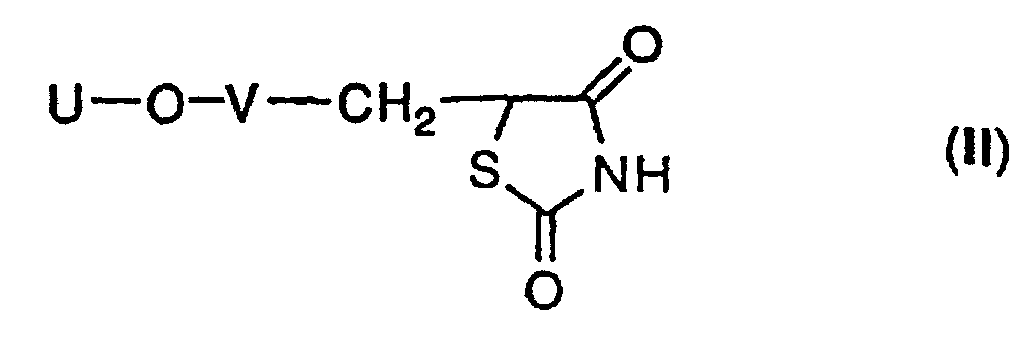
- (i) a group of the formula (IIa) where R1 is hydrogen or hydrocarbon residue or heterocyclic
residue which may each be substituted, R2 is hydrogen or a lower alkyl which may be substituted
by hydroxy group, X is an oxygen or sulphur atom, Z is a hydroxylated methylene or a carbonyl,
m is 0 or 1, n is an integer of 1-3. These compounds have been disclosed in the European Patent
Application No. 0 177 353
An example of these compounds is shown in formula (IIb)
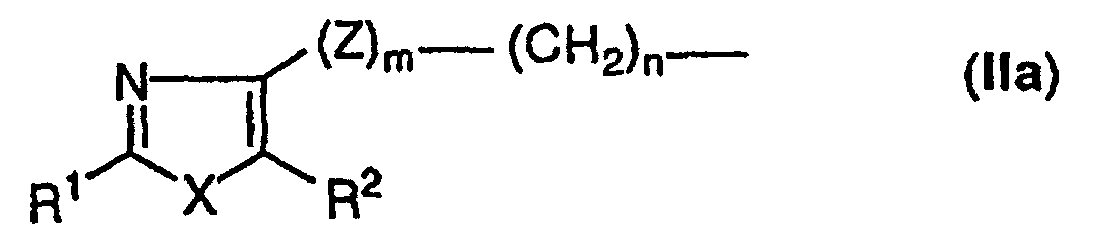
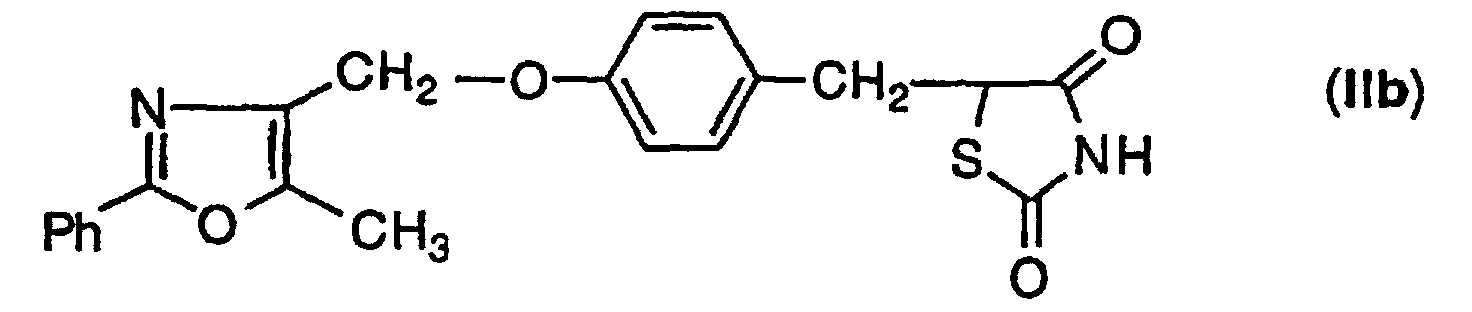
- (ii) a group of the formula (IIc) wherein R1 and R2 are the same or different and each represents
hydrogen or C1-C5 alkyl, R3 represents hydrogen, acyl group, a (C1-C6) alkoxycarbonyl group
or aralkyloxycarbonyl group, R4- R5 are same or different and each represent hydrogen, C1-C5
alkyl or C1-C5 alkoxy or R4, R5 together represent C1-C4 alkenedioxy group, n is 1, 2, or 3, W
represents CH2, CO, CHOR6 group in which R6 represents any one of the items or groups
defined for R3 and may be the same or different from R3. These compounds are disclosed in the
European Patent Application No. 0 139 421.
An example of these compounds is shown in (IId)
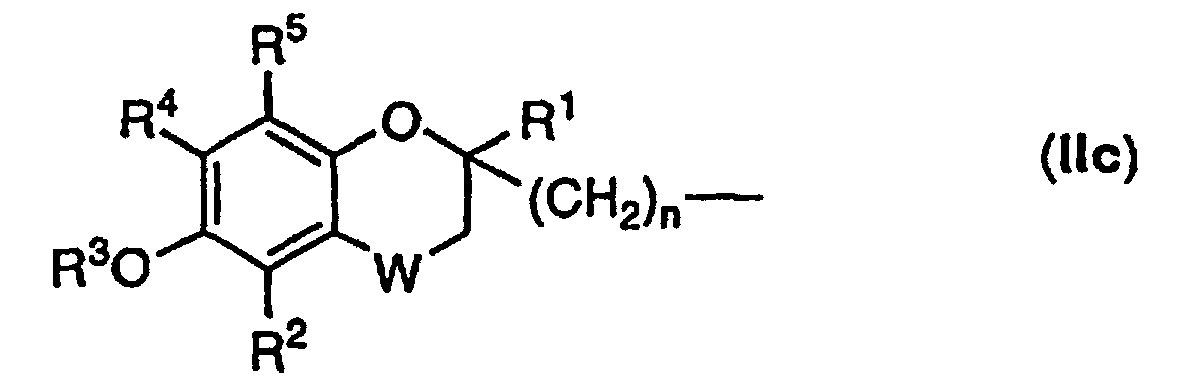
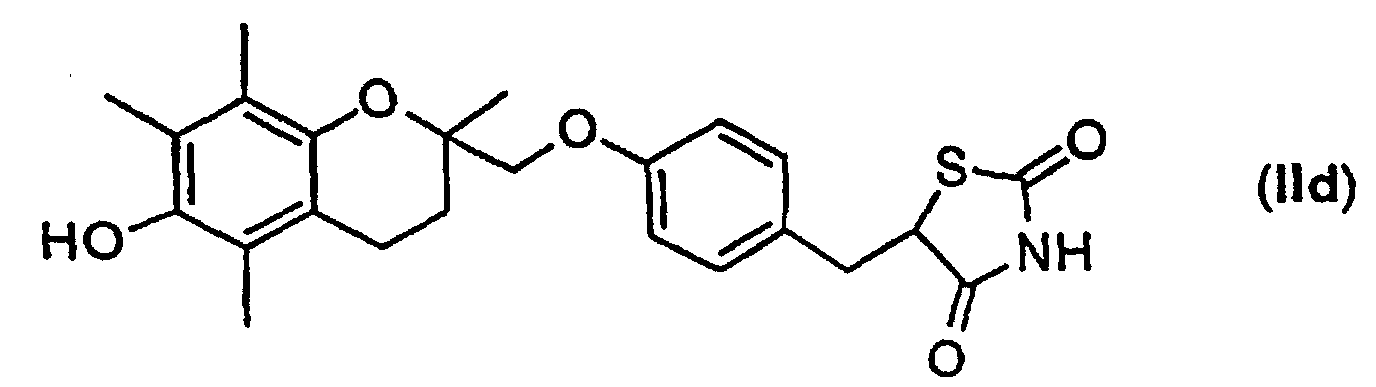
- iii) A group of formula (IIe) where A1 represents substituted or unsubstituted aromatic
heterocyclic group, R1 represents a hydrogen atom, alkyl group, acyl group, an aralkyl group
wherein the aryl moiety may be substituted or unsubstituted, or a substituted or unsubstituted aryl
group, n represents an integer in the range from 2 to 6. These compounds are disclosed in
European Patent No. 0 306 228.
An example of this compound is shown in formula (IIf)
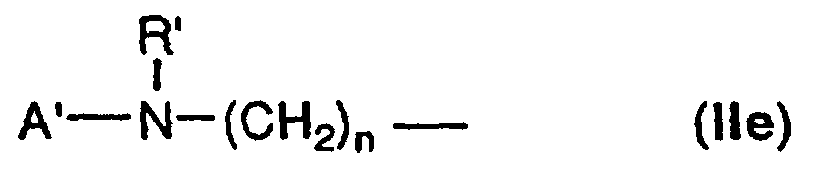

- iv) A group of formula (IIg) where Y represents N or CR5, R1, R2, R3, R4 and R5 represents
hydrogen, halogen, alkyl and the like and R6 represents hydrogen, alkyl, aryl and the like, n
represents an integer of 0 to 3. These compounds are disclosed in European Patent Application
0 604 983.

-
- An example of this compound is shown in formula (IIh)
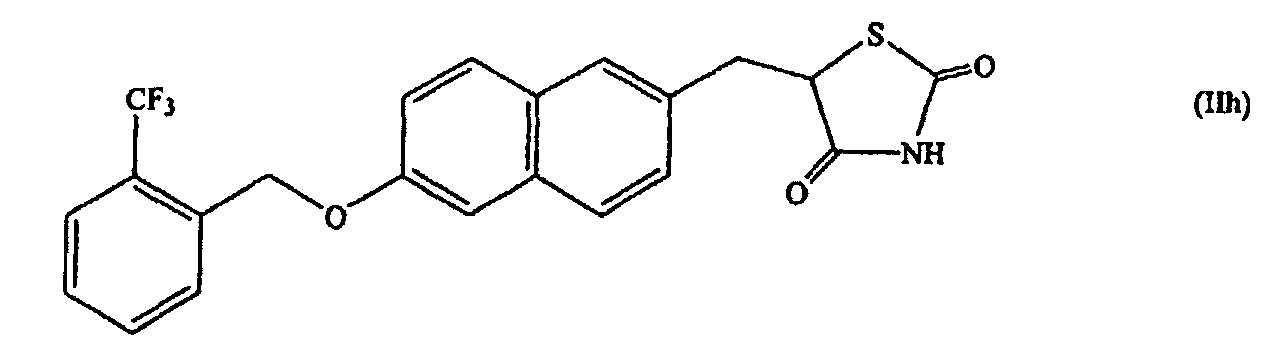
- Some of the above referred hitherto known antidiabetic compounds seem to possess bone marrow depression, liver and cardiovascular toxicities and modest potency and consequently their regular use for the treatment and control of diabetes is becoming limited and restricted.
- With an object of developing newer compounds for the treatment of type II diabetes [non-insulin-dependent-diabetes mellitus(NIDDM)]which could be more potent at relatively lower doses and better efficacy having lower toxicity, we focussed our research efforts in a direction of incorporating safety factor and to have better efficacy, which has resulted in the development of novel thiazolidinedione derivatives having the general formula (I) as defined above.
- The main objective of the present invention is therefore, to provide novel thiazolidinedione derivatives, their tautomeric forms, their pharmaceutically acceptable salts, their pharmaceutically acceptable solvates and pharmaceutical compositions containing them, or their mixtures.
- Another objective of the present invention is to provide novel thiazolidinedione derivatives, their tautomeric forms, their pharmaceutically acceptable salts, their pharmaceutically acceptable solvates and pharmaceutical compositions containing them or their mixtures having enhanced activities, no toxic effect or reduced toxic effect.
- Thiazolidinedione derivatives of the present invention have the general formula (1)
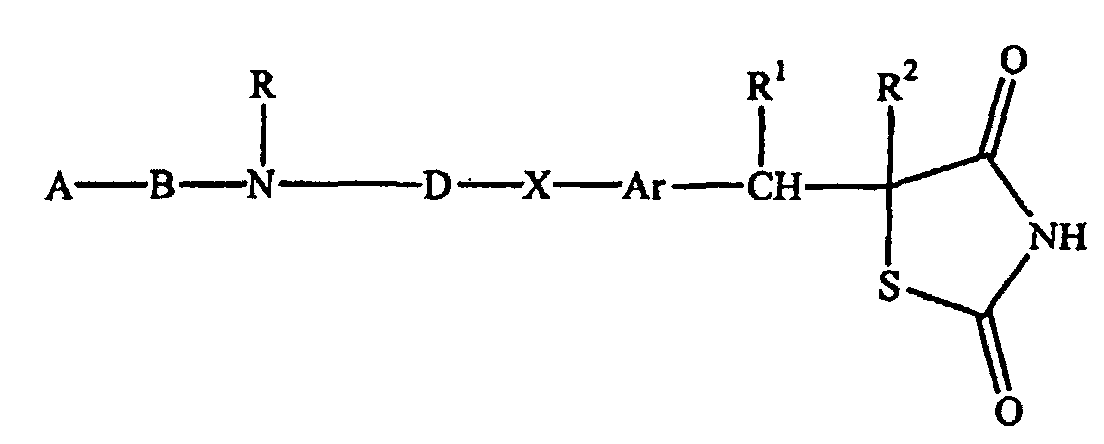
- In the formula (I), A represents a substituted or unsubstituted alicyclic group, or A represents a substituted or unsubstituted, unsaturated aromatic selected from phenyl, naphthyl or phenanthryl; wherein when A is substituted the substituent is selected from C1-C10 alkyl, C1-C10 alkoxy, aryl selected from phenyl or naphthyl, halogen, aralkyl selected from benzyl or phenethyl, aryloxy selected from phenyloxy or naphthyloxy, aralkoxy selected from benzyloxy or phenethyloxy, amino, (C1-C8)mono alkylamino, (C1-C8)dialkylamino, aminoalkyl, hydroxyalkyl, thio, thioalkyl, haloalkyl, carboxy, formyl, C2-C10 alkylcarbonyl, arylcarbonyl selected from benzoyl or naphthoyl, aryloxycarbonyl, benzoate, C2-C10 alkylcarbonyloxy, nitro, hydroxy, or cyano, or A represents a saturated or unsaturated heterocyclic group selected from 6-benzoyl-2,5,7,8-tetramethylchroman-2-yl, 6-hydroxy-2,5,7,8-tetramethylchroman-2-yl, 2-pyridyl, 5-methyl-2-phenyl-4-oxazolyl, 2,3-dihydro-5-hydroxy-2,2,4,6,7-pentamethyl-1-benzofuran-3-yl or 2-benzothiazolyl; B represents unsubstituted divalent alkylene group of 1 to 10 carbon atoms or divalent alkenyl group of 2 to 10 carbon atoms; D represents a substituted or unsubstituted divalent alkylene, alkenyl or alkynyl group, wherein when D is substituted the substituent is selected from hydroxy, C1-C10 alkylene, C2-C6 alkoxy, aralkoxy selected from benzyloxy or phenethyloxy, amino, monoalkylamino, dialkylamino, hydroxyalkyl, aminoalkyl, thio, thioalkyl, halo, haloalkyl, carboxy, alkoxycarbonyl, aryloxycarbonyl, alkylcarbonyloxy, or benzoate groups; R represents hydrogen, substituted or unsubstituted alkylene having 1 to 10 atoms, alkenyl or alkynyl group of 2 to 10 carbon atoms or aralkyl group selected from benzyl or phenethyl; or alkoxycarbonyl or aryloxycarbonyl group when A is not phenyl or naphthyl, wherein when R is substituted the substituent is selected from C1-C10 alkyl, C1-C10 alkoxy, aryl selected from phenyl or naphthyl, halogen, aralkyl selected from benzyl or phenethyl, aryloxy selected from phenyloxy or naphthyloxy, aralkoxy selected from benzyloxy or phenethyloxy, amino, C1-C8 monoalkylamino, C1-C8 dialkylamino, aminoalkyl, hydroxyalkyl, thio, thioalkyl, haloalkyl, carboxy, formyl, C2-C10 alkylcarbonyl, arylcarbonyl selected from benzoyl or naphthoyl, benzoate, C2-C10 alkylcarbonyloxy, aryloxycarbonyl, nitro, cyano or hydroxy; X represents CH2, C=O, CH-OH, sulphur, oxygen, N-Y, where Y represents hydrogen, substituted or unsubstituted alkyl, aryl selected from phenyl or naphthyl, or aralkyl selected from benzyl or phenethyl, wherein when the alkyl, aryl or aralkyl group is substituted the substituent is selected from alkyl, alkoxy, hydroxy, halo or amino groups or Y may be acyl wherein when the acyl is substituted, the substituent is selected from C1-C10 alkyl, C1-C10 alkoxy, aryl selected from phenyl or naphthyl, halogen, aralkyl selected from benzyl or phenethyl, aryloxy selected from phenyloxy or naphthyloxy, aralkoxy selected from benzyloxy or phenethyloxy, amino, C1-C8 monoalkylamino, C1-C8 dialkylamino, aminoalkyl, hydroxyalkyl, thio, thioalkyl, haloalkyl, carboxy, formyl, C2-C10 alkylcarbonyl, arylcarbonyl selected from benzoyl or naphthoyl, benzoate, C2-C10 alkylcarbonyloxy, aryloxycarbonyl, nitro, hydroxy or cyano; Ar represents substituted or unsubstituted phenyl, naphthyl, pyridyl, furyl, benzofuryl, benzopyranyl, benzoxazolyl or benzothiazolyl, wherein when Ar is substituted, the substituent is selected from C1-C10 alkyl, C1-C10 alkoxy, aryl selected from phenyl or naphthyl, halogen, aralkyl selected from benzyl or phenethyl, aryloxy selected from phenyloxy or naphthyloxy, aralkoxy selected from benzyloxy or phenethyloxy, amino, C1-C8 mono alkylamino, C1-C8 dialkylamino, aminoalkyl, hydroxyalkyl, thio, thioalkyl, haloalkyl, carboxy, formyl, C2-C10 alkylcarbonyl, arylcarbonyl selected from benzoyl or naphthoyl, benzoate, C2-C10 alkylcarbonyloxy, aryloxycarbonyl, nitro, hydroxy or cyano; and R1 and R2 each represents hydrogen or together represent a bond.
- Suitable aliphatic groups that may form the A group include alkenyl and alkynyl groups of 1 to 10 carbon atoms, typically of from 1 to 5 carbon atoms. A may also be a cycloalkyl or cycloalkenyl group of 3 to 10 carbon atoms either as a single or as a fused ring system.
- When the A groups are substituted suitable substituents include alkyl of 1 to 10 carbon atoms, alkoxy of 1 to 10 carbon atoms, aryl selected from phenyl or naphthyl, halo (particularly fluoro, chloro or bromo), aralkyl selected from benzyl and phenethyl, aryloxy selected from phenyloxy, and naphthyloxy; aralkoxy selected from benzyloxy, and phenethyloxy; amino, mono or dialkylamino where each alkyl group is of from 1 to 8 carbon atoms, carboxy group, formyl group, alkylcarbonyl of 2 to 10 carbon atoms, arylcarbonyl selected from benzoyl and naphthoyl, aryloxycarbonyl, benzoate, C2-C10 alkylcarbonyloxy such as acetate, propionate, butyrate and hexanoate groups, hydroxy, thio, thioalkyl, hydroxyalkyl, haloalkyl, aminoalkyl, nitro and cyano groups.
- B groups may have up to 10 carbon atoms, preferably, up to 4 carbon atoms. Particularly useful B groups include methylene, and ethylene.
- R groups are hydrogen, substituted or unsubstituted alkyl, alkenyl or alkynyl groups, preferably having up to 6 carbon atoms, or aralkyl groups such as benzyl, phenethyl and naphthylmethyl groups. R groups may also be alkoxy-carbonyl or aryloxycarbonyl groups when A groups are not phenyl or naphthyl. The aryl moiety of an aralkyl group may be substituted by any substituents that may be selected from the same groups that may substitute A.
- D groups may have from 1 to 10 carbon atoms, preferably from 1 to 4 carbon atoms. Suitable substituents include hydroxy, C1-C10 alkylene, C2-C6 alkoxy, aralkoxy selected from benzyloxy or phenethyloxy, amino, monoalkylamino, dialkylamino, hydroxyalkyl, aminoalkyl, thio, thioalkyl, halo, haloalkyl, carboxy, alkoxycarbonyl, aryloxycarbonyl, alkylcarbonyloxy, or benzoate groups.
- Y groups of N-Y comprising the X moiety are typically hydrogen, alkylene groups of from 1 to 10 carbon atoms, preferably up to 6 carbon atoms, aryl groups selected from phenyl and naphthyl, aralkyl selected from benzyl and phenethyl. Such groups may, if desired be substituted by groups such as alkyl, alkoxy, hydroxy, halo and amino groups. Alternatively, Y may be an acyl group of 2 to 14 carbon atoms, for example, an alkanoyl group of 2 to 8 carbon atoms or an optionally substituted benzoyl group, wherein any substituent is selected from the same group, that may substitute R.
- Suitable Ar groups include phenyl, naphthyl, pyridyl, furyl, benzofuryl, benzopyranyl, benzoxazolyl and benzothiazolyl groups. Such groups may be substituted by any of the same groups that may substitute A as mentioned above.
- R1 and R2 represent hydrogen or jointly form a bond resulting in an unsaturated link between the thiazolidinedione ring and the adjacent carbon atom.
- Pharmaceutically acceptable salts forming part of this invention include salts of the thiazolidinedione moiety such as alkali salts like Li, Na, and K salts and salts of carboxy group wherever appropriate, such as aluminum, alkali metal salts, alkaline earth metal salts, ammonium or substituted ammonium salts. Salts may include acid addition salts which are sulphates, nitrates, borates, hydrohalides, acetates, tartrates, maleates, citrates, succinates, methanesulphonates, benzoates, ascorbates, glycerophosphates, ketoglurarates and the like. Pharmaceutically acceptable solvate may be hydrates.
- Particularly useful compounds according to the invention include:
- 5-[4-[2-[N-(6-benzyloxy-2,5,7,8-tetramethylchroman-2-yl-methyl)-N-methylamino]ethoxy]benzyl]thiazolidine-2,4-dione,
- 5-[4-[2-[N-(6-hydroxy-2,5,7,8-tetramethylchroman-2-ylmethyl)-N-methylamino] ethoxy]benzyl]thiazolidine-2,4-dione,
- 5-[4-[2-[N-(6-benzyloxy-2,5,7,8-tetramethylchroman-2-ylmethyl)-N-methylamino]ethoxy]phenyl methylene]thiazolidine-2,4-dione,
- 5-[4-[2-[N-(6-hydroxy-2,5,7,8-tetramethylchroman-2-ylmethyl)-N-methylamino] ethoxy]phenyl methylene]thiazolidine-2,4-dione,
- 5-[4-[2-[N-[2-(6-hydroxy-2,5,7,8-tetramethylchroman-2-yl )ethyl)-N-methylamino]ethoxy]benzyl]thiazolidine-2,4-dione,
- 5-[4-[2-[N-methyl-N-(2-pyridyl)methyl)amino]ethoxy]benzyl]thiazolidine-2,4-dione,
- 5-[4-[2-[N-methyl-N-(2-pyridyl methyl)amino]ethoxy]phenyl methylene] thiazolidine-2,4-dione,
- 5-[4-[2-[N-methyl-N-(5-methyl-2-phenyl-4-oxazolyl)methylamino]ethoxy] benzyl]thiazolidine-2,4-dione,
- 5-[4-[2-[N-methyl-N-(5-methyl-2-phenyl-4-oxazolyl)methylamino]ethoxy]phenyl methylene]thiazolidine-2,4-dione,
- 5-[4-[2-[N-(2,3-dihydro-5-hydroxy-2,2,4,6,7-pentamethyl-1- benzofuran-3-ylmethyl)-N-methylamino]ethoxy]phenyl methylene]thiazolidine-2,4-dione,
- 5-[4-[2-[N-(2,3-dihydro-5-hydroxy-2,2,4,6,7-pentamethyl-1-benzofuran-3-ylmethyl)-N-methylamino]ethoxy]benzyl]thiazolidine-2,4-dione.
-
- Novel intermediates are described herein which also possess similar activity as the thiazolidinedione derivatives of the general formula (I) as defined above.
The novel intermediates have the general formula (III) and (IV) wherein, A, B, R, D, X, Ar are as defined earlier, E represents hydroxy, halogen (Cl, Br, I), methanesulphonates, p-toluenesulphonates, trifluoromethanesulphonates, etc. and G represents CHO, NO2, NH2, CH2-CHRa-COORb wherein Ra is halogen atom and Rb represents hydrogen, alkyl, aralkyl group etc.
- Still another objective of the present invention is to produce a process for the preparation of thiazolidinedione derivatives of the formula (I) as defined above.
- Yet another objective of the present invention is to provide a pharmaceutical composition containing the compound of the formula (I), their tautomers, their salts, solvates or their mixtures in combination with suitable carriers, diluents and media normally employed in preparing such composition.
- Accordingly, the present invention provides a process for the preparation of novel thiazolidinedione derivatives, their tautomeric forms, their pharmaceutically acceptable salts, their pharmaceutically acceptable solvates of the formula (I) wherein each of the symbol is as defined earlier, which comprises
- (a) reacting a compound of the general formula (V)
where D and R are as defined earlier, X may be oxygen, sulphur or NH to yield a compound of the general formula (VII)
 where A, B, R, D, X are as defined earlier.
- b) reacting a compound of general formula (VII) obtained in step (a) with a compound of
general formula (VIII)
where A, B, R, D, Ar are as defined earlier, X may be oxygen, sulfur or other hetero atoms.

- (c) reacting the compound of the general formula (IX) obtained in step (b) with 2,4-thiazolidinedione
to yield a compound of general formula (X).
where A, B, R, D, Ar, X are as defined earlier and removing the water formed during the reaction by conventional methods.

- (d) reducing by known method the compound of the general formula (X) obtained in step (c) to obtain the compound of general formula (I) as defined above and if desired,
- (e) converting the compound of the general formula (I) obtained in step (d) into their pharmaceutically acceptable salts, their pharmaceutically acceptable solvates by conventional methods.
-
- In an embodiment of the invention, the novel intermediate of the general formula (IX) defined and obtained in the step (b) above can be prepared by reacting the compound of the general formula (XI) wherein A, B, R, D, L1 as defined earlier with a compound of the general formula (XII) where Ar is as defined earlier

- The compound of general formula (XI) used for the preparation of the compound of the general formula (IX) can be prepared by reacting a compound of general formula (VII) with MeSO2Cl, p-TsCl, CBr4/PPh3, CCI4/PPh3, CI4/PPh3, SOCl2 or such other halogenating agents.
- In another embodiment of the present invention, the compound of the general formula (I), their tautomeric forms, their pharmaceutically acceptable salts and their pharmaceutically acceptable solvates can also be prepared by reacting a compound of the general formula (XI) where A, B, R, D, L1 are as defined above with a compound of the general formula (XIII)wherein, Ar, R1, R2 are as defined above.

- In yet another embodiment of the invention, the compound of the general formula (I) as defined above can also be prepared by reacting a compound of the general formula (VII) with a substituted halonitroarene of the general formula (XIV), to produce a novel intermediate compound of the general formula (XV) where L2 represents halogen atom and each of the symbol is as defined earlier and reducing by known methods the compound of the general formula (XV) to yield a compound of general formula (XVI),
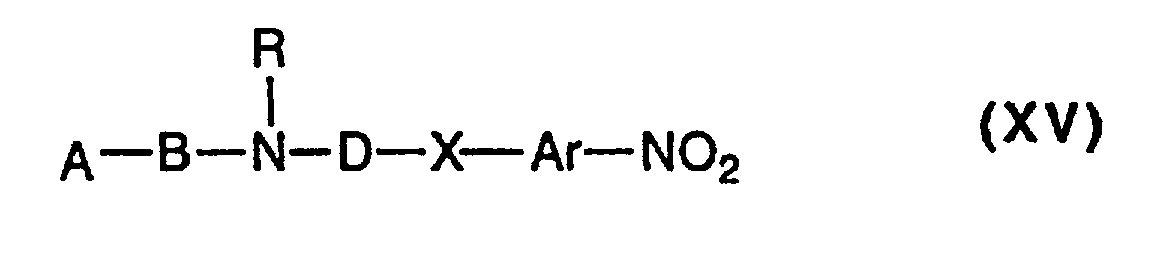 wherein A, B, R, D, Ar, X are as defined before, diazotizing the compound of general formula (XVI) by known methods, followed by treatment with acrylic acid or its esters to yield a compound of general formula (XVII)
 wherein each of the symbol is as defined earlier, K is a halogen atom and J is an acid or an ester group and treating the resulting compound of the general formula (XVII) with thiourea followed by hydrolysis by known methods to yield the compound of general formula (I) as definded before.
- In another embodiment of the invention, the intermediate of the general formula (XV) defined and obtained as above, can be prepared by reacting the compound of the general formula (XI)where A, B, R, D and L1 are as defined earlier, with a compound of formula (XVIII)

- The amount of compound of the formula (V) and the compound of the formula (VI) used in the step (a) may range from 1 to 2 equivalents and from 1 to 200 equivalents, respectively. The temperature employed may range from 20 °C - 200 °C, preferably ranging from 50 °C - 150 °C. The reaction time normally may range from 2 - 70 hours, preferably it may range from 6 to 48 hours.
- The reaction of the compound of formula (VII) with compound of the formula (VIII) in step (b) to produce a compound of the formula (IX) may be carried out in the presence of solvents such as THF, DMF, DMSO, DME. The inert atmosphere is maintained by using inert gases such as N2, Ar, He. The reaction may be effected in the presence of a base such as K2CO3, Na2CO3, NaH. The reaction temperature may range from 20 °C - 120°C, preferably, at a temperature in the range of 30 °C - 80°C. The duration of the reaction may range from 1 - 12 hours, preferably from 2 to 6 hours.
- The reaction between the compound of the general formula (IX) with 2,4-thiazolidinedione in step (c) may be carried out neat or in the presence of a solvent such as benzene, toluene, methoxyethanol. The reaction temperature may range from 80 to 140 °C depending upon the solvents employed. Suitable catalyst such as piperidinium acetate or benzoate, sodium acetate may also be employed. The water produced in the reaction may be removed, for example, by using Dean Stark water separator or by using water absorbing agents like molecular seives.
- The reduction of the compound of the formula (X) in step (d) to yield a compound of the general formula (I) may be carried out in the presence of gaseous hydrogen and a catalyst such as Pd/C, Rh/C, Pt/C, and the like. The reaction may also be conducted in the presence of solvents such as dioxane, acetic acid, ethyl acetate and the like. A pressure between atmospheric pressure and 80 psi may be employed. The catalyst may be 5 - 10 % Pd/C and the amount of catalyst used may range from 50 - 100 % w/w. The reaction may also be carried out by employing metal solvent reduction such as magnesium in methanol or sodium amalgam in methanol.
- The reaction between the compound of the formula (XI) and the compound of the formula (XII) may be carried out in the presence of solvents such as DMF, DMSO, THF. The reaction may be effected in the presence of a base such as sodium hydride or potassium carbonate. The temperature may range from 20 °C - 120 °C, preferably at 30 °C - 80 °C. The reaction may be conducted for a period ranging from 2-12 hours, preferably from 4 to 12 hours.
- The reaction of compound of formula (XI) with compound of general formula (XIII) may be carried out in the presence of solvents such as DMF, DMSO, THF. The reaction may also be effected in the presence of a base such as sodium hydride or potassium carbonate. The temperature of the reaction may range from 0 - 120 °C, preferably from 20 to 100 °C. The duration of the reaction may range from 1 - 24 hours, preferably from 2 to 8 hours.
- The reaction of compound of general formula (VII) with halosubstituted nitroarenes of formula (XIV) may be carried out in the presence of polar solvents such as DMF, DMSO, THF. The reaction may also be effected in the presence of a base such as sodium hydride or potassium carbonate. The temperature of the reaction may range from 0 - 120 °C, preferably from 20 to 80 °C. The duration of reaction may range from 2-12 hours, preferably from 2 to 8 hours.
- The subsequent reaction of the compound of the general formula (XV) to prepare the compound of the general formula (XVI) may be carried out by reduction. The reagents such as H2/Pd/C or zinc or iron and acetic acid, tin and hydrochloric acid, metal hydrides such as lithium aluminum hydride and the like may be used.
- The diazotization of the compound of the formula (XVI) may be carried out with alkali metal nitrites and the resulting diazo compound is treated with acrylic acid or its esters in the presence of copper oxide as a catalyst in the presence of hydrohalo acid to give a compound of formula (XVII).
- The reaction of the compound of the general formula (XVII) with thiourea is normally carried out in the presence of protic solvents such as methanol, ethanol, propanol, isopropanol, butanol, isobutanol, 2-methoxybutanol etc. or DMSO or sulfolane. The reaction may be conducted at a temperature in the range between 20 - 180 °C preferably in the range of 20 to 100 °C. The reaction may also be conducted in the presence of alkali metal acetate like NaOAc, KOAc etc. followed by hydrolysis. The hydrolysis may be carried out by using aqueous or alcoholic mineral acids such as hydrohalo acids, sulfuric acid etc. at 50 - 100 °C.
- The reaction of compound of formula (XI) with compound of formula (XVIII) is carried out in the presence of polar solvents such as DMF, DMSO, THF in the presence of a base such as sodium hydride or potassium carbonate under inert atmosphere of nitrogen, argon or the like. The temperature of the reaction may range between 20 - 120 °C, preferably at 30 - 100 °C. The reaction may be conducted for a period ranging from 1 - 24 hours, preferably from 2 - 6 hours.
- The pharmaceutically acceptable salts are prepared by reacting the compound of formula (I) with one equivalent of a base such as sodium hydroxide, sodium methoxide, sodium hydride in solvents like ether, THF etc. Alternatively, they are prepared by treatment with acids such as hydrochloric acid, hydrobromic acid, p-toluene sulphonic acid, methane sulfonic acid, acetic acid, citric acid, maleic acid and the like in solvents like ethyl acetate, ether, alcohols etc.
- The present invention also provides a pharmaceutical composition, containing the compounds of the general formula (I), as defined above, their tautomeric forms, their pharmaceutically acceptable salts, their pharmaceutically acceptable solvates in combination with the usual pharmaceutically employed carriers, diluents and the like, useful for the treatment of type II diabetes, as a hypoglycemic agent, for prophylactic treatment, hyperlipidaemia, hypertension, other cardiovascular diseases including atherosclerosis as well as certain eating disorders. The pharmaceutical composition may be in the forms normally employed, such as tablets, capsules, powders, syrups, solutions, suspensions and the like, may contain flavourant, sweeteners etc. in suitable solid or liquid carriers or diluents, or in suitable sterile media to form injectable solutions or suspensions. Such compositions typically contain from 1 to 20 %, preferably 1 to 10 % by weight of active compound, the remainder of the composition being pharmaceutically acceptable carrier, diluent or solvent.
- The compound of the formula (I) as defined above are clinically administered to mammals, including man, via either oral or parenteral routes. Administration by the oral route is preferred, being more convenient and avoiding the possible pain and irritation of injection. However, in circumstances where the patient cannot swallow the medication, or absorption following oral administration is impaired, as by disease or other abnormality, it is essential that the drug be administered parenterally. By either route, the dosage is in the range of about 0.10 to about 50 mg / kg body weight of the subject per day or preferably about 0.10 to about 10 mg /kg body weight per day administered singly or as a divided dose. However, the optimum dosage for the individual subject being treated will be determined by the person responsible for treatment, generally smaller doses being administered initially and thereafter increments made to determine the most suitable dosage.
- Suitable pharmaceutically acceptable carriers include solid fillers or diluents and sterile aqueous or organic solutions. The active compound will be present in such pharmaceutical compositions in amounts sufficient to provide the desired dosage amount in the range described above. Thus, for oral administration, the compounds can be combined with a suitable solid or liquid carrier or diluent to form capsules, tablets, powders, syrups, solutions, suspensions and the like. The pharmaceutical compositions, may, if desired, contain additional components such as flavourants, sweeteners, excipients and the like. For parenteral administration, the compounds can be combined with sterile aqueous or organic media to form injectable solutions or suspensions. For example, solutions in sesame or peanut oil, aqueous propylene glycol and the like can be used, as well as aqueous solutions of water-soluble pharmaceutically-acceptable acid addition salts of the compounds. The injectable solutions prepared in this manner can then be administered intravenously, intraperitoneally, subcutaneously, or intramuscularly, with intramuscular administration being preferred in man.
- The invention is described in detail in the examples given below which are provided by way of illustration only and therefore should not be construed to limit the scope of the invention.
-
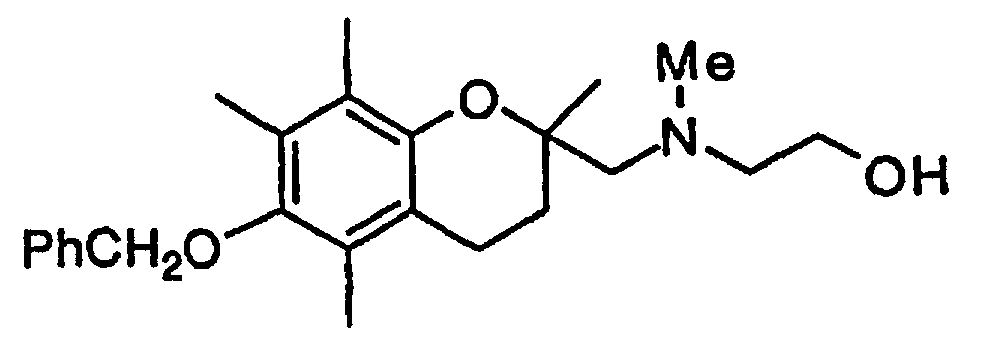
- A mixture of 6-benzyloxy-2,5,7,84etramethylchroman-2-ylmethyl methanesulphonate (20 g) and 2-(methylamino)ethanol (80 ml) was heated under nitrogen atmosphere at 120 °C with stirring for 12 h. The mixture was cooled to room temperature and poured into water and the solution was extracted with ethyl acetate repeatedly. The combined organic extracts were washed with brine, dried (Na2SO4) and evaporated to dryness under reduced pressure to give 18 g of the title compound.
1H NMR (CDCl3, 200 MHz) : δ 1.2 (s, 3H), 1.7 (m, 1H), 2.0 (m, 1H), 2.15 (s, 3H), 2.2 (s, 3H). 2.25 (s, 3H), 2.45 (s, 3H), 2.55 - 2.85 (m, 6H), 3.6 (t, J = 5.1 Hz, 2H), 4.7 (s, 2H), 7.3 - 7.55 (m. 5H). -
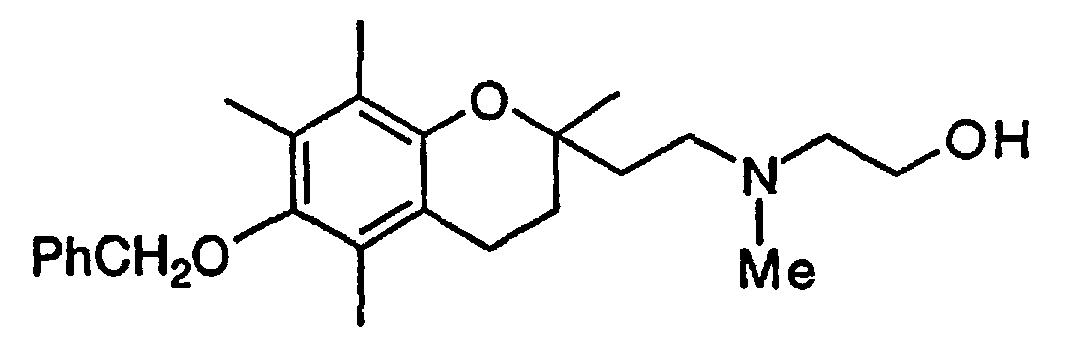
- The title compound was prepared from 6-benzyloxy-2,5,7,8-tetramethylchroman-2-ylethyl methanesulphonate (3.8 g) and 2-(methylamino)ethanol (7.2 ml) by an analogous procedure to that described in preparation 1.
1H NMR (CDCl3, 200 MHz) : δ 1.25 (s, 3H), 1.8 (m, 4H), 2.1 (s, 3H), 2.15 (s, 3H), 2.23 (s, 3H), 2.25 (s, 3H), 2.5 - 2.7 (m, 6H), 3.55 (t, J = 6.4 Hz, 2H), 4.7 (s, 2H), 7.3 - 7.55 (m, 5H). -

- The title compound was prepared from 6-benzyloxy-2,5,7,8-tetramethylchroman-2-ylmethyl methanesulphonate (4 g) and ethanol amine (12 ml) by an analogous procedure to that described in preparation 1.
1H NMR (CDCl3, 200 MHz) : δ 1.30 (s, 3H), 1.65 - 1.83 (m, 1H), 1.95 - 2.06 (m, 1H), 2.11 (s, 3H), 2.19 (s, 3H), 2.24 (s, 3H), 2.65 (t, J = 7.2 Hz, 2H), 2.79 (s, 2H), 2.85 (m, 2H), 3.63 (t, J = 5.2 Hz, 2H), 4.71 (s, 2H), 7.35 - 7.63 (m, 5H). -
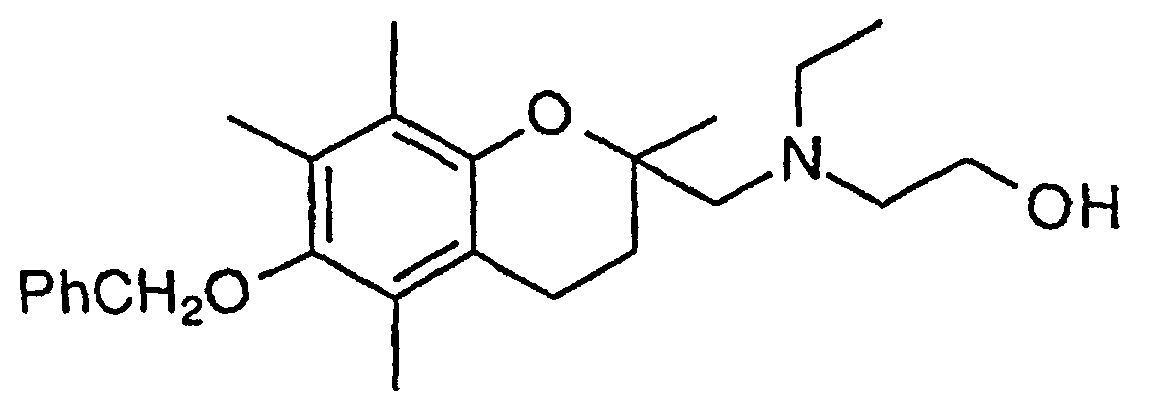
- The title compound was prepared from 6-benzyloxy-2,5,7,8-tetramethylchroman-2-ylmethyl methanesulphonate (10 g) and 2-(ethyl amino)ethanol (40 ml) by an analogous procedure to that described in preparation 1.
1H NMR (CDCl3, 200 MHz) : δ 1.05 (t, J = 7.2 Hz, 3H), 1.22 (s, 3H), 1.65 - 1.80 (m, 1H), 1.85 - 2.05 (m, 1H), 2.10 (s, 3H), 2.17 (s, 3H), 2.22 (s, 3H), 2.65 - 2.85 (m, 8H), 3.45 - 3.70 (m, 2H), 4.70 (s, 2H), 7.30 - 7.65 (m, 5H). -

- The title compound was prepared from 5-benzyloxy-2,3-dihydro-2,2,4,6,7-pentamethyl-1-benzofuran-3-ylmethyl methanesulphonate (5 g) and 2-(methylamino)ethanol (10 ml) by an analogous procedure to that described in preparation 1.
1HNMR (CDCl3, 200 MHz): δ 1.33 (s, 3H), 1.58 (s, 3H), 2.08 (s, 3H), 2.19 (s, 3H), 2.22 (s, 3H), 2.34 (s, 3H), 2.39 (m, 2H), 2.71 (m, 2H), 3.08 (m, 1H), 3.62 (m, 2H), 4.73 (s, 2H), 7.43 (m, 5H). -
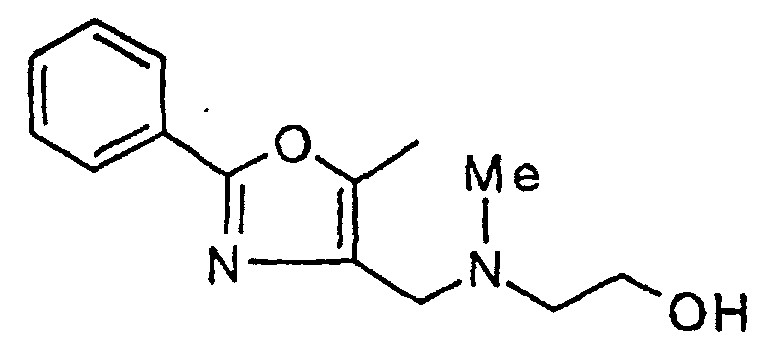
- The title compound was prepared from 4-chloromethyl-5-methyl-2-phenyloxazole (10 g) and 2-(methylamino)ethanol (36 ml) by an analogous procedure to that described in preparation 1.
1H NMR (CDCl3, 200 MHz) : δ 2.32 (s, 3H), 2.35 (s, 3H), 2.61 (t, J = 5.4 Hz, 2H), 3.1 (bs, 1H), 3.51 (s, 2H), 3.64 (t, J = 5.0 Hz, 2H), 7.39 (m, 3H), 7.96 (m, 2H). -

- The title compound was prepared from 2-picolyl chloride (3 g) and 2-(methylamino)ethanol (19 ml) by an analogous procedure to that described in preparation 1.
1H NMR (CDCl3, 200 MHz) : δ 2.4 (s, 3H), 2.72 (t, J = 5.2 Hz, 2H), 3.0 (bs, 1H), 3.68 (t, J = 5.2 Hz, 2H), 3.8 (s, 2H), 7.22 (dd, J1 = 12.7 Hz, J2=8.0 Hz, 1H), 7.38 (d, J = 7.8 Hz, 1H), 7.70 (t, J = 8.0 Hz, 1H), 8.56 (d, J = 4.2 Hz, 1H). -

- The title compound was prepared from benzyl bromide (4 g) and 2-(methylamino)ethanol (18.6 ml) by an analogous procedure to that described in preparation 1.
1H NMR (CDCl3, 200 MHz) : δ 2.25 (s, 3H), 2.6 (t, J = 6.78 Hz, 2H), 2.8 (bs, 1H), 3.55 (s, 2H), 3.65 (t, J = 6.78 Hz, 2H), 7.3 (s, 5H). -

- The title compound was prepared from 3-phenylpropyl methanesulphonate (4.5 g) and 2-(methylamino)ethanol ( 16.7 ml) by an analogous procedure to that described in preparation 1.
1H NMR (CDCl3, 200 MHz) : δ 1.8 (m, 2H), 2.3 (s, 3H), 2.4 - 2.7 (m, 6H), 3.6 (t, J = 6.7 Hz, 2H), 3.95 (bs, 1H), 7.2 (m, 5H). -
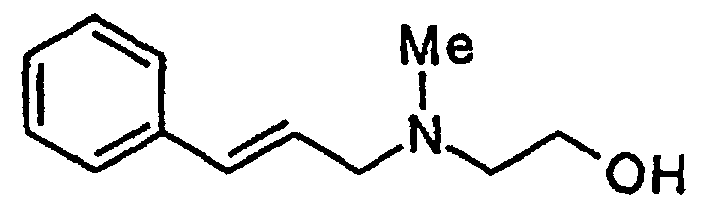
- The title compound was prepared from 3-bromo-1-phenylprop-1-ene (0.77 g) and 2-(methylamino)ethanol (3.1 ml) by an analogous procedure to that described in preparation 1.
1H NMR (CDCl3, 200 MHz) : δ 2.35, (s, 3H), 2.7 (t, J = 5.2 Hz, 2H), 3.3 (d, J = 6.8 Hz, 2H), 3.7 (t, J = 5.0 Hz, 2H), 3.95 (bs, 1H), 6.15 - 6.3 (m, 1H), 6.55 (d, J = 15.8, 1H), 7.3 (m, 5H). -
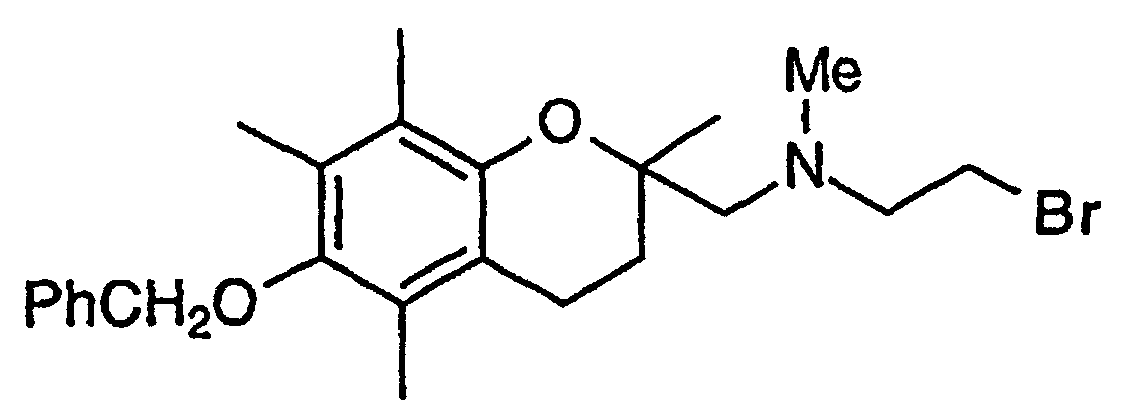
- To an ice cooled solution of the product obtained in the preparation 1 (3 g) and carbon tetrabromide (3.87 g) in dichloromethane (100 ml) was added triphenyl phosphine (3.66 g). The mixture was stirred for 1h at room temperature. At the end of this time, the reaction mixture was washed with water, dried (CaCl2) and concentrated. The crude product was purified by column chromatography using 20 % EtOAc in petroleum ether as eluent to get 3.1 g of the title compound.
1H NMR (CDCl3, 200 MHz): δ 1.25 (s, 3H), 1.65 (m, 1H), 2.0 (m, 1H), 2.1 (s, 3H), 2.18 (s, 3H), 2.2 (s, 3H), 2.48 (s, 3H), 2.6 (bs, 4H), 2.97 (m, 2H), 3.4 (t, J = 6.45 Hz, 2H), 4.7 (s, 2H), 7.3 - 7.55 (m, 5H). -
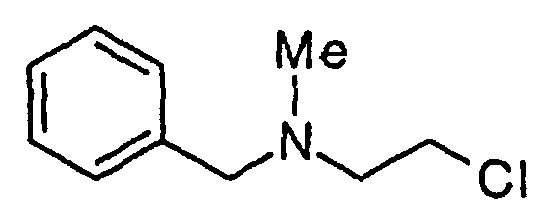
- Thionyl chloride (2 ml) was added dropwise to a stirred, ice cooled solution of 2-[N-benzyl-N-methylamino]ethanol (4 g) obtained in preparation 8, in dry benzene (10 ml). The resulting mixture was stirred at 0 °C for 2 h and then diluted with ethyl acetate (40 ml), washed with saturated aqueous sodium bicarbonate solution (2 x 25 ml), water (50 ml), brine (50 ml) and dried. The ethyl acetate layer was evaporated and the residue was chromatographed on silica gel with 20 % ethyl acetate in petroleum ether as eluent to give 2.6 g of the title compound.
1H NMR (CDCl3, 200 MHz) : δ 2.3 (s, 3H), 2.75 (t, J = 6.5 Hz, 2H), 3.55 - 3.65 (t, J = 6.5 Hz, 2H), 3.6 (s, 2H), 7.35 (s,5H). -

- The title compound was prepared from 2-[N-(6-benzyloxy-2,5,7,8-tetramethylchroman-2-ylmethyl)-N-methylamino]ethanol (4 g), obtained in the preparation 1, and thionyl chloride (2.5 ml) by a similar procedure to that used in preparation 12.
1H NMR (CDCl3, 200 MHz) : δ 1.25 (s, 3H), 1.6 - 1.8 (m, 1H), 1.9 - 2.07 (m, 1H), 2.10 (s, 3H), 2.17 (s, 3H), 2.22 (s, 3H), 2.49 (s, 3H), 2.55 - 2.75 (m, 4H), 2.94 (t, J = 7.0 Hz, 2H), 3.60 (t, J = 7.0 Hz, 2H), 4.69 (s, 2H), 7.3 - 7.6 (m, 5H). -

- To a solution of 4 g of 2-[N-(6-benzyloxy-2,5,7,8-tetramethylchroman-2-ylmethyl)-N-methylamino]ethyl chloride, obtained in preparation 13, in 120 ml of AcOH was added 40 ml of concentrated hydrochloric acid. The resulting mixture was heated at 60 °C for 1 h. At the end of this time, the solvent was removed under reduced pressure and the residue was diluted with EtOAc and washed with saturated aqueous NaHCO3 solution followed by brine. The organic layer was dried over anhydrous sodium sulphate and the solvent was removed by distillation under reduced pressure to give 3 g of the title compound.
1H NMR (CDCl3, 200 MHz) : δ 1.25 (s, 3H), 1.55 - 1.80 (m, 1H), 1.85 - 2.08 (m, 1H), 2.15 (s, 6H), 2.19 (s, 3H), 2.49 (s, 3H), 2.55 - 2.75 (m, 4H), 2.8 - 3.0 (m, 2H), 3.60 (t, J = 7.2 Hz, 2H). -

- To an ice cold solution of the product obtained in the preparation 14 (20 g) and triethylamine (18 ml) in dichloromethane (100 ml), acetyl chloride (5.5 ml) was added and the mixture was stirred for 5 h at room temperature. At the end of this time the reaction mixture was washed with water, dried (CaCl2) and concentrated. The crude product was purified by column chromatography using 30 % EtOAc in petroleum ether as eluent to get 21 g of the title compound.
1H NMR (CDCl3, 200 MHz) : δ 1.21 (s, 3H), 1.60 - 1.80 (m, 1H), 1.85 - 2.05 (m, 1H), 1.98 (s, 3H), 2.02 (s, 3H), 2.08 (s, 3H), 2.32 (s, 3H), 2.44 (s, 3H), 2.55 - 2.75 (m, 4H), 2.90 (m, 2H), 3.55 (t, J = 7 Hz, 2H). -

- The title compound was prepared from the product obtained in preparation 2 (1 g) and thionyl chloride (1.5 ml) by a similar procedure to that used in preparation 12.
1H NMR (CDCl3, 200 MHz) : δ 1.25 (s, 3H), 1.85 (m, 4H), 2.1 (s, 3H), 2.15 (s, 3H), 2.25 (s, 3H), 2.35 (s, 3H), 2.55 - 2.85 (m, 6H), 3.55 (t, J = 6.4 Hz, 2H), 4.7 (s, 2H), 7.3 - 7.6 (m, 5H). -

- The title compound was prepared from 2-[N-(6-benzyloxy-2,5,7,8-tetramethylchroman-2-ylmethyl)amino]ethanol (10 g), obtained in preparation 3 and thionyl chloride (6 ml) by a similar procedure to that described in preparation 12.
1H NMR (CDCl3, 200 MHz) : δ 1.30 (s, 3H), 1.70 - 1.90 (m, 1H), 1.95 - 2.05 (m, 1H), 2.11 (s, 3H), 2.18 (s, 3H), 2.22 (s, 3H), 2.64 (t, J = 6.8 Hz, 2H), 2.81 (s, 2H), 3.05 (t, J =5.6 Hz, 2H), 3.69 (t, J = 5.6 Hz, 2H), 4.70 (s, 2H), 7.30 - 7.55 (m, 5H). -

- The title compound was prepared from 2-[N-(6-benzyloxy-2,5,7,8-tetramethylchroman-2-ylmethyl)-N-ethylamino]ethanol (10 g), obtained in preparation 4 and thionyl chloride (6 ml) by a similar procedure to that used in preparation 12.
1H NMR (CDCl3, 200 MHz) : δ 1.05 (t, J = 7.2 Hz, 3H), 1.21 (s, 3H), 1.60 - 1.75 (m, 1H), 1.90 - 2.05 (m, 1H), 2.11 (s, 3H), 2.18 (s, 3H), 2.24 (s, 3H), 2.65 - 2.85 (m, 6H), 2.95 - 3.10 (m, 2H), 3.54 (t, J = 7.6 Hz, 2H), 4.71 (s, 2H), 7.35 - 7.65 (m, 5H). -

- The title compound was prepared from 2-[N-(5-benzyloxy-2,3-dihydro-2,2,4,6,7-pentamethyl-1-benzofuran-3-ylmethyl)-N-methylamino]ethanol (2.7 g), obtained in preparation 5 and thionyl chloride (2.5 ml) by a similar procedure to that used in preparation 12.
1H NMR (CDCl3, 200 MHz) : δ 1.33 (s, 3H), 1.59 (s, 3H), 2.08 (s, 3H), 2.19 (s, 3H), 2.21 (s, 3H), 2.23 (s, 3H), 2.70 (m, 2H), 2.81 (m, 2H), 3.05 (m, 1H), 3.53 (t, J = 5.5 Hz, 2H), 4.71 (s, 2H), 7.43 (m, 5H). -
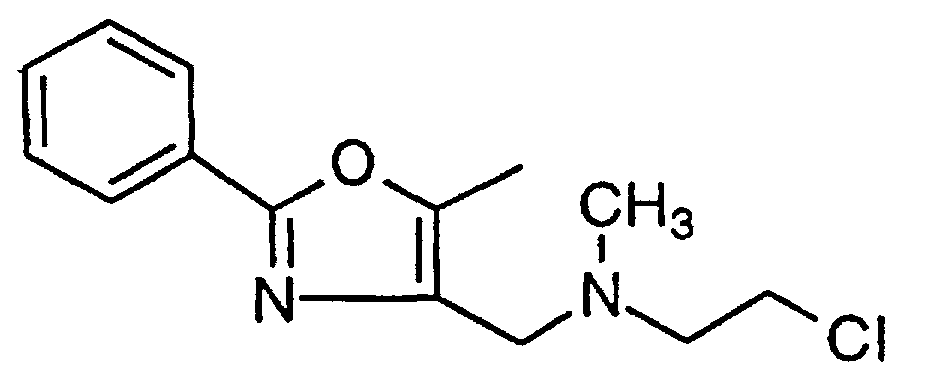
- The title compound was prepared from 2-[N-Methyl-N-(5-methyl-2-phenyl-4-oxazolyl)methylamino]ethanol (10 g), obtained in preparation 6 and thionyl chloride (9 ml) by a similar procedure to that used in preparation 12.
1H NMR (CDCl3, 200 MHz) : δ 2.35 (s, 3H), 2.38 (s, 3H), 2.83 (t, J = 7.2 Hz, 2H), 3.55 (s, 2H), 3.65 (t, J = 7.0 Hz, 2H), 7.41 (m, 3H), 8.02 (m, 2H). -

- The title compound was prepared from 2-[N-methyl-N-(3-phenylpropyl)amino]ethanol (2 g), obtained in preparation 9 and thionyl chloride (3.8 ml) by a similar procedure to that used in preparation 12.
1H NMR (CDCl3, 200 MHz) δ 1.7 - 1.95 (m, 2H), 2.35 (s, 3H), 2.45 (t, J = 6.6 Hz, 2H), 2.6 - 2.8 (m, 4H), 3.55 (t, J = 6.6 Hz, 2H), 7.25 (m, 5H). -

- The title compound was prepared from 2-[N-methyl-N-(3-phenylprop-2-enyl)amino]ethanol (5.8 g), obtained in preparation 10 and thionyl chloride (13.3 ml) by a similar procedure to that used in preparation 12.
1H NMR (CDCl3, 200 MHz) : δ 2.4 (s, 3H), 2.80 (t, J = 6.8 Hz, 2H), 3.3 (d, J = 8.6 Hz, 2H), 3.65 (t, J = 7.0 Hz, 2H), 6.15 - 6.35 (m, 1H), 6.65 (d, J = 15.8 Hz, 1H), 7.2 - 7.45 (m, 5H). -

- A solution of 9.4 g of the product obtained in the preparation 1 in 50 ml of dry N,N-dimethylformamide was added dropwise while cooling, to a suspension of 1.7 g (50 % w/w oil dispersion) of sodium hydride in 20 ml of dry DMF. The mixture was then stirred for 1 h at room temperature, after which 3.9 g of 4-fluorobenzaldehyde was added dropwise at room temperature. The resulting mixture was then stirred at room temperature for 2 h. At the end of this time, water was added to the reaction mixture. The mixture was extracted with ethyl acetate and dried over anhydrous sodium sulphate. The solvent was removed by distillation under reduced pressure to give 10.5 g of the crude compound which was chromatographed on silicagel using 10 to 20 % (gradient elution) of ethyl acetate in petroleum ether to afford the pure compound.
1H NMR (CDCl3, 200 MHz) : δ 1.25 (s, 3H), 1.65 (m, 1H), 2.0 (m, 1H), 2.1 (s, 3H), 2.18 (s, 3H), 2.2 (s, 3H), 2.5 (s, 3H), 2.55 - 2.85 (m, 4H), 3.05 (m, 2H), 4.19 (t, J = 5.8 Hz, 2H), 4.7 (s, 2H), 6.98 (d, J = 8.6 Hz, 2H), 7.4 (m, 5H), 7.8 (d, J = 8.8 Hz, 2H), 9.85 (s, 1H). -

- The title compound was prepared from 5.4 g of the product obtained in the preparation 2 and 4-fluorobenzaldehyde (1.8 g) in a similar manner to that described in preparation 23.
1H NMR (CDCl3, 200 MHz) : δ 1.3 (s, 3H), 1.7 - 1.95 (m, 4H), 2.1 (s, 3H), 2.15 (s, 3H), 2.2 (s, 3H), 2.4 (s, 3H), 2.55 - 2.8 (m, 4H), 2.85 (t, J = 6.2 Hz, 2H), 4.15 (t, J = 6.2 Hz, 2H), 4.7 (s, 2H), 7.0 (d, J = 6.9 Hz, 2H), 7.3 - 7.55 (m, 5H), 7.8 (d, J = 6.9 Hz, 2H), 9.9 (s, 1H). -
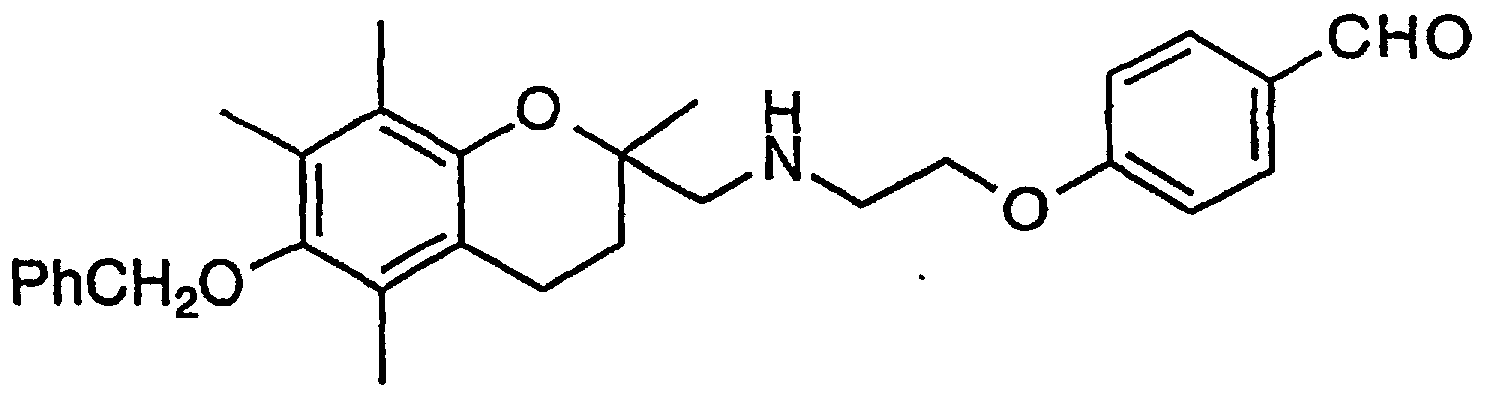
- The title compound was prepared from 2-[N-(6-benzyloxy-2,5,7,8-tetramethylchroman-2-ylmethyl)amino]ethanol (5 g) obtained in preparation 3 and 4-fluorobenzaldehyde (2.1 ml) by an analogous procedure to that described in preparation 23.
1H NMR (CDCl3, 200 MHz) : δ 1.30 (s, 3H), 1.65 - 1.85 (m, 1H), 1.90 - 2.05 (m, 1H), 2.10 (s, 3H), 2.17 (s, 3H), 2.21 (s, 3H), 2.64 (t, J = 7.0 Hz, 2H), 2.85 (s, 2H), 3.10 (t, J = 5.2 Hz, 2H), 4.17 (t, J = 5 Hz, 2H), 4.7 (s, 2H), 7.0 (d, J = 8.6 Hz, 2H), 7.3 - 7.6 (m, 5H), 7.83 (d, J = 8.8 Hz, 2H), 9.90 (s, 1H). -
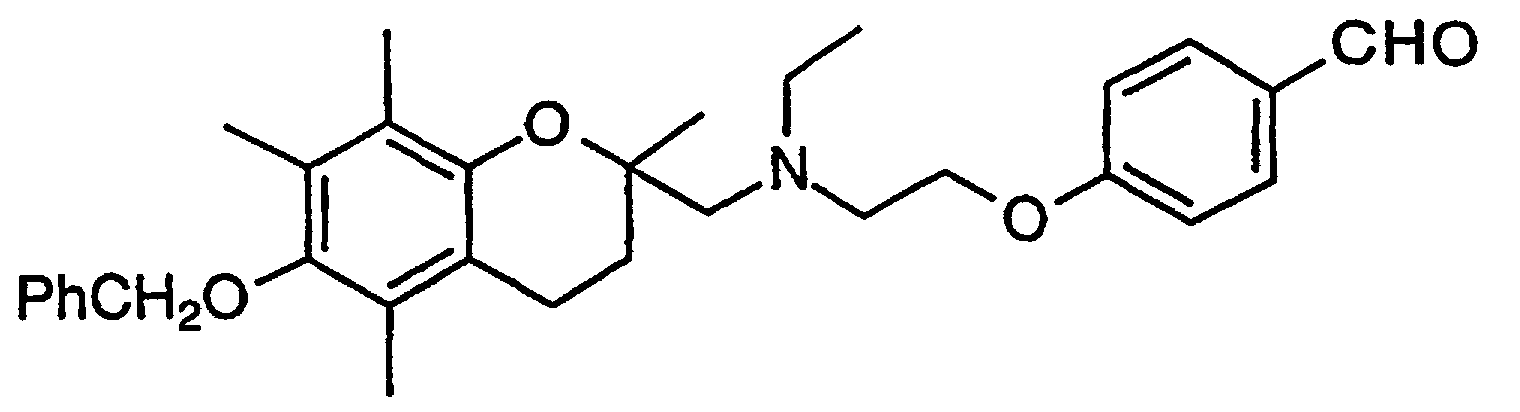
- To a mixture of 2-[N-(6-benzyloxy-2,5,7,8-tetramethylchroman-2-ylmethyl)-N-ethylamino]ethyl chloride (3.9 g) obtained in preparation 18, and 4-hydroxy benzaldehyde (1.3 g) in dry DMF, K2CO3 (4.8 g) was added and the mixture was stirred at 80 °C for 6 h. At the end of this time, the reaction mixture was cooled, added water and extracted with EtOAc. The EtOAc extract was washed with 5·% aqueous Na2CO3 solution, followed by brine and dried over anhydrous sodium sulphate. The solvent was then removed by distillation under reduced pressure to give 4.2 g of the crude compound. This was chromatographed on silicagel using 10 to 20 % (gradient elution) of ethyl acetate in petroleum ether to afford the pure compound.
1H NMR (CDCl3, 200 MHz) : δ 1.07 (t, J = 7.0 Hz, 3H), 1.23 (s, 3H), 1.60 - 1.80 (m, 1H), 1.9 - 2.05 (m, 1H), 2.06 (s, 3H), 2.18 (s, 3H), 2.20 (s, 3H), 2.55 - 2.85 (m, 6H), 3.09 (t, J = 6.2 Hz, 2H), 4.13 (t, J = 6.2 Hz, 2H), 4.70 (s, 2H), 6.95 (d, J = 8.8 Hz, 2H), 7.30 - 7.60 (m, 5H), 7.80 (d, J = 8.6 Hz, 2H), 9.90 (s, 1H) -

- The title compound was prepared from 2-[N-(5-benzyloxy-2,3-dihydro-2,2,4,6,7-pentamethyl-1-benzofuran-3-ylmethyl)-N-methylamino]ethyl chloride (4 g) obtained in preparation 19 and 4-hydroxybenzaldehyde (1.2 g) in a similar manner to that described in preparation 26.
1H NMR (CDCl3, 200 MHz) : δ 1.36 (s, 3H), 1.61 (s, 3H), 2.11 (s, 3H), 2.22 (s, 3H), 2.27 (s, 3H), 2.41 (s, 3H), 2.76 (m, 2H), 2.96 (m, 2H), 3.10 (m, 1H), 4.13 (t, J = 5.7 Hz, 2H), 4.73 (s, 2H), 7.03 (d, J = 8.7 Hz, 2H), 7.43 (m, 5H), 7.85 (d, J = 8.6 Hz, 2H), 9.91 (s, 1H). -

- The title compound was prepared from 2-[N-methyl-N-(5-methyl-2-phenyl-4-oxazolyl)methylamino]ethanol (2.93 g) obtained in preparation 6 and 4-fluorobenzaldehyde (6.5 ml) by an analogous procedure to that described in preparation 23. 1H NMR (CDCl3, 200 MHz) δ 2.45 (2s, 6H), 3.0 (m, 2H), 3.65 (s, 2H), 4.25 (t, J = 5.6 Hz, 2H), 7.0 (d, J = 8.6 Hz, 2H), 7.45 (m, 3H), 7.85 (d, J = 8.8 Hz, 2H), 8.05 (m, 2H), 9.85 (s, 1H).
-
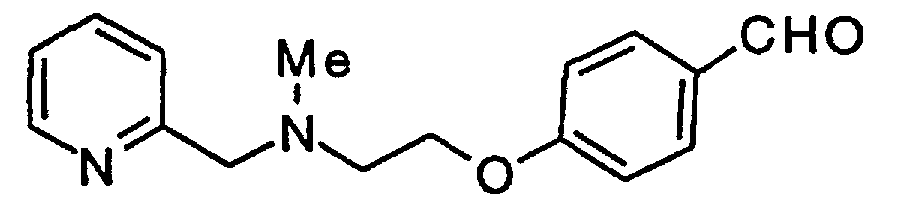
- The title compound was prepared from 2-[N-methyl-N-(2-pyridylmethyl)amino]ethanol (2.5 g) obtained in preparation 7 and 4-fluorobenzaldehyde (2.4 ml) by an analogous procedure to that described in preparation 23.
1H NMR (CDCl3, 200 MHz): δ 2.45 (s, 3H), 2.95 (m, 2H), 3.85 (s, 2H), 4.2 (t, J = 6.25 Hz, 2H), 7.0 (d, J = 8.3 Hz, 2H), 7.2 (m, 1H), 7.45 (d, J = 8.3 Hz, 1H), 7.77 (t, J = 6.2 Hz, 1H), 7.85 (d, J = 8.3 Hz, 2H), 8.55 (m, 1H), 9.9 (s, 1H). -
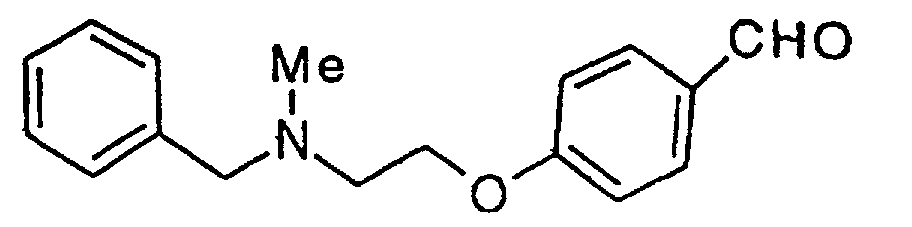
- The title compound was prepared from 2-(N-benzyl-N-methylamino)ethanol (2.5 g) obtained in example 8 and 4-fluorobenzaldehyde (2 ml) by an analogous procedure to that described in preparation 23. 1H NMR (CDCl3, 200 MHz) : δ 2.4 (s, 3H), 2.85 (t, J = 6.25 Hz, 2H), 3.68 (s, 2H), 4.15 (t, J = 6.25 Hz, 2H), 7.0 (d, J = 8.3 Hz, 2H), 7.35 (m, 5H), 7.85 (d, J = 8.3 Hz, 2H), 9.9 (s, 1H).
-
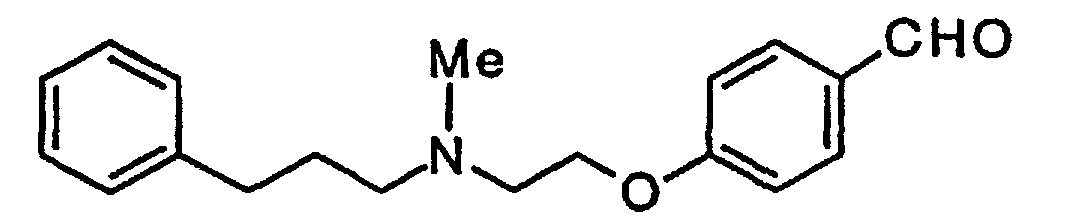
- The title compound was prepared from 2-[N-Methyl-N-(3-phenylpropyl)amino]ethyl chloride (7 g) obtained in preparation 21 and 4-hydroxybenzaldehyde(6 g) in a similar manner to that described in preparation 26.
1H NMR (CDCl3, 200 MHz) : δ 1.8 - 2.1 (m, 2H), 2.45 (s, 3H), 2.5 - 2.8 (m, 4H), 2.9 (m, 2H), 4.2 (t, J = 6.25 Hz, 2H), 7.0 (d, J = 8.5 Hz, 2H), 7.1 - 7.4 (m, 5H), 7.85 (d, J = 8.5 Hz, 2H), 9.9 (s, 1H) -

- The title compound was prepared from 2-[N-Methyl-N-(3-phenylprop-2-enyl)amino]ethyl chloride (4 g), obtained in preparation 22 and 4-hydroxy benzaldehyde (3.4 g) in a similar manner to that described in preparation 26.
1H NMR (CDCl3, 200 MHz) : δ 2.41 (s, 3H), 2.89 (t, J = 5.6 Hz, 2H), 3.29 (d, J = 6.6 Hz, 2H), 4.18 (t, J = 5.8 Hz, 2H), 6.20 - 6.40 (m, 1H), 6.55 (d, J = 15.8 Hz, 1H), 7.02 (d, J = 8.4 Hz, 2H), 7.15 - 7.50 (m, 5H), 7.82 (d, J = 8.6 Hz, 2H), 9.90 (s, 1H). -
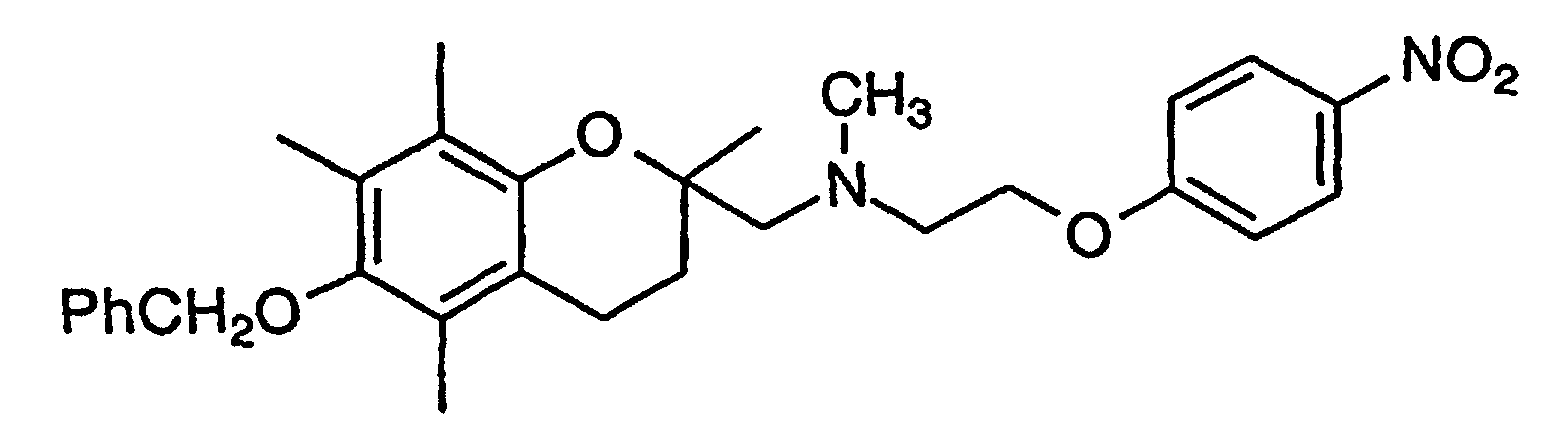
- A stirred mixture of 2-[N-(6-benzyloxy-2,5,7,8-tetramethylchroman-2-ylmethyl)-N-methylamino]ethyl chloride (4 g), obtained in preparation 13, 4-nitrophenol (1.4 g) and K2CO3 (3.5 g) in anhydrous DMF (20 ml) was heated at 80 °C for 4 h. At the end of this time, the reaction mixture was cooled, water was added and the mixture was extracted with EtOAc. The extract was washed with 5 % aqueous Na2CO3 followed by brine and dried (over Na2SO4). The solvent was removed by distillation under reduced pressure to give 4.5 g of the crude product. The crude product was chromatographed on silicagel using 10 to 20 % (gradient elution) of ethyl acetate in petroleum ether to afford the pure compound.
1H NMR (CDCl3, 200 MHz) : δ 1.25 (s, 3H), 1.60 - 1.80 (m, 1H), 1.95 - 2.05 (m, 1H), 2.06 (s, 3H), 2.17 (s, 3H), 2.20 (s, 3H), 2.52 (s, 3H), 2.55 - 2.75 (m, 4H), 3.04 (m, 2H), 4.15 (m, 2H), 4.68 (s, 2H), 6.92 (d, J = 9.2 Hz, 2H), 7.35 - 7.60 (m, 5H), 8.17 (d, J = 9Hz, 2H). -
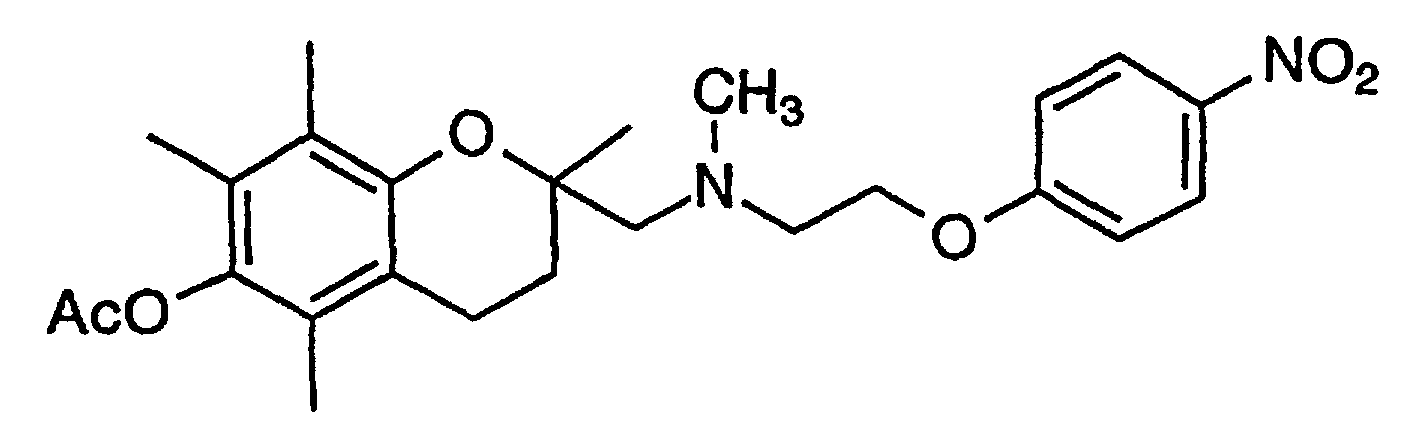
- The title compound was prepared from 2-[N-(6-acetoxy-2,5,7,8-tetramethylchroman-2-ylmethyl)-N-methylamino]ethyl chloride (2.5 g), obtained in preparation 15 and 4-nitrophenol (1.1 g) in a similar manner to that described in preparation 33.
1H NMR (CDCl3, 200 MHz) : δ 1.23 (s, 3H), 1.60 - 1.80 (m, 1H), 1.95 - 2.05 (m, 1H), 1.97 (s, 3H), 2.0 (s, 3H), 2.05 (s, 3H), 2.33 (s, 3H), 2.50 (s, 3H), 2.60 - 2.80 (m, 4H), 3.02 (t, J = 5.6 Hz, 2H), 4.14 (t, J = 5.8 Hz, 2H), 6.89 (d, J = 9.2 Hz, 2H), 8.16 (d, J = 9.2 Hz, 2H). -

- The title compound was prepared from 2-[N-[2-(6-benzyloxy-2,5,7,8-tetramethylchroman-2-yl)ethyl]-N-methylamino]ethyl chloride (4.2 g), obtained in preparation 16 and 4-nitrophenol (2 g) in a similar manner to that described in preparation 33.
1H NMR (CDCl3, 200 MHz) : δ 1.27 (s, 3H), 1.6 - 2.05 (m, 4H), 2.08 (s, 3H), 2.16 (s, 3H), 2.20 (s, 3H), 2.35 (s, 3H), 2.50 - 2.70 (m, 4H), 2.83 (t, J = 5.8 Hz, 2H), 4.12 (t, J = 5.8 Hz, 2H), 4.68 (s, 2H), 6.95 (d, J = 9.2 Hz, 2H), 7.3 - 7.6 (m, 5H), 8.19 (d, J = 9.2 Hz, 2H). -
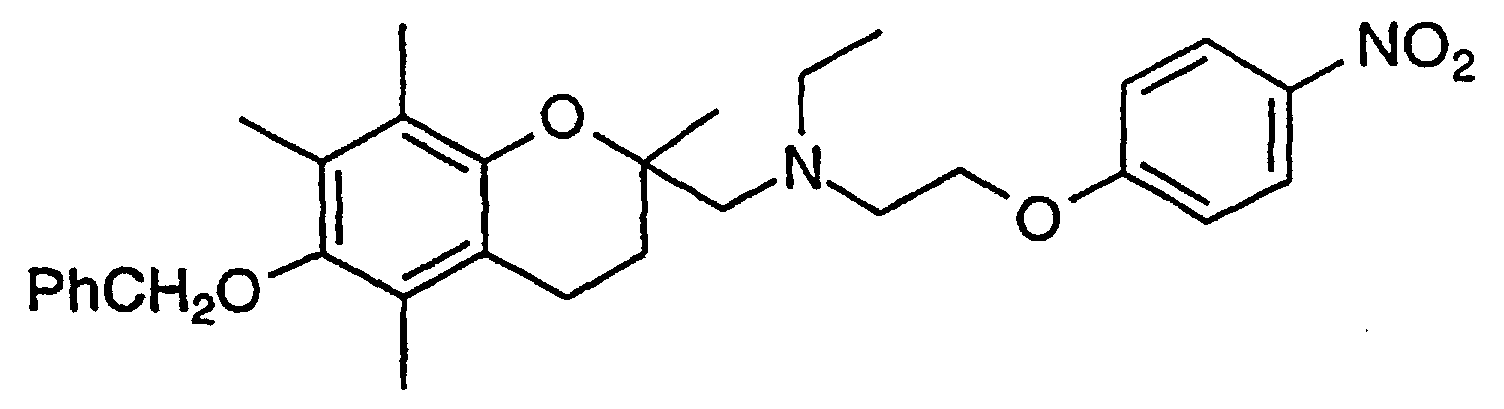
- The title compound was prepared from 2-[N-(6-benzyloxy-2,5,7,8-tetramethylchroman-2-ylmethyl)-N-ethylamino]ethyl chloride (5 g), obtained in preparation 18 and 4-nitrophenol (1.7 g) in a similar manner to that described in preparation 33.
1H NMR (CDCl3, 200 MHz) : δ 1.06, (t, J = 7.2 Hz, 3H), 1.21 (s, 3H), 1.50 - 1.80 (m, 1H), 1.95 - 2.05 (m, 1H), 2.04 (s, 3H), 2.17 (s, 3H), 2.19 (s, 3H), 2.55 - 2.85 (m, 6H), 3.09 (t, J = 6.4 Hz, 2H), 4.12 (t, J = 6.2 Hz, 2H), 4.70 (s, 2H), 6.90 (d, J = 9.2 Hz, 2H), 7.30 - 7.60 (m, 5H), 8.15 (d, J = 9.0 Hz, 2H). -
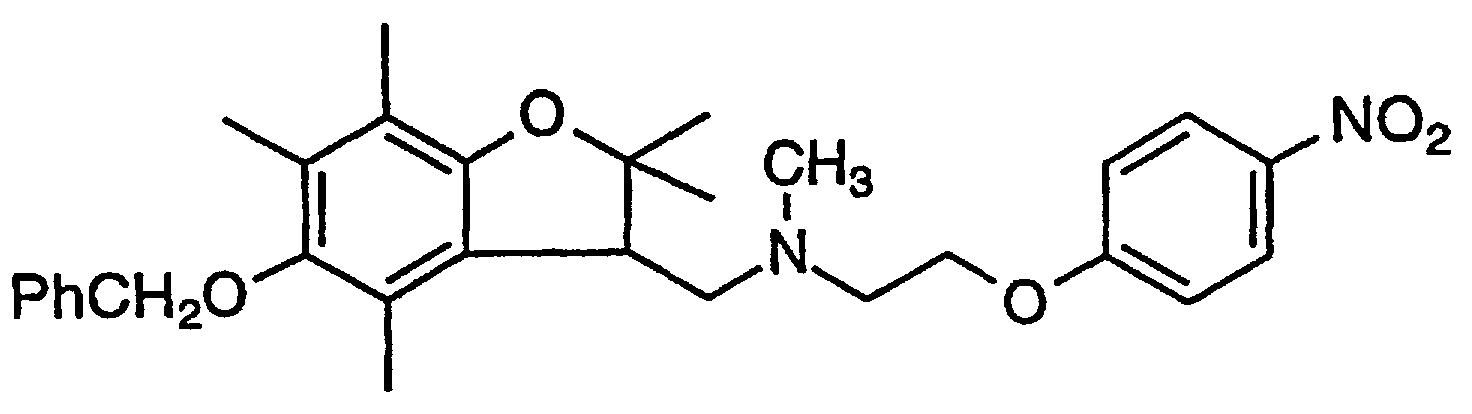
- The title compound was prepared from 2-[N-(5-benzyloxy-2,3-dihydro-2,2,4,6,7-pentamethyl-1-benzofuran-3-ylmethyl)-N-methylamino]ethyl chloride (10 g), obtained in preparation 19 and 4-nitrophenol (5 g) in a similar manner to that described in preparation 33.
1H NMR (CDCl3, 200 MHz) : δ 1.35 (s, 3H), 1.60 (s, 3H), 2.10 (s, 3H), 2.22 (s, 3H), 2.25 (s, 3H), 2.40 (s, 3H), 2.74 (m, 2H), 2.93 (m, 2H), 3.08 (m, 1H), 4.09 (m, 2H), 4.70 (s, 2H), 6.92 (d, J = 9.0 Hz, 2H), 7.43 (m, 5H), 8.19 (d, J = 9.0 Hz, 2H). -

- 4-[2-[N-(6-benzyloxy-2,5,7,8-tetramethylchroman-2-ylmethyl)-N-methylamino]ethoxy] nitrobenzene (1 g) obtained in preparation 33, was dissolved in EtOAc (6 ml) and was reduced with hydrogen (60 psi) in the presence of 10 % palladium on charcoal (100 mg) at ambient temperature until hydrogen uptake (nearly 8 h) ceased. The solution was filtered through a bed of celite, the filter pad was washed exhaustively with EtOAc. The combined filtrate was evaporated to dryness under reduced pressure. The crude product was chromatographed on silica gel using 2 to 10 % (gradient elution) of methanol in chloroform to afford 0.9 g of the title compound.
1H NMR (CDCl3, 200 MHz) : δ 1.28 (s, 3H), 1.65 - 1.90 (m, 1H), 1.95 - 2.10 (m, 1H), 2.11 (s, 3H), 2.18 (s, 3H), 2.23 (s, 3H), 2.53 (s, 3H), 2.6-2.8 (m, 4H), 3.0 (m, 2H), 4.05 (t, J = 6.2 Hz, 2H), 4.71 (s, 2H), 6.63 (d, J = 8.8 Hz, 2H), 6.75 (d, J = 8.8 Hz, 2H), 7.35 - 7.65 (m, 5H). -

- The title compound was prepared from 4-[2-[N-(6-acetoxy-2,5,7,8-tetramethylchroman-2-ylmethyl)-N-methylamino]ethoxy]nitrobenzene (10 g), obtained in preparation 34, by a similar procedure to that described in preparation 38.
1H NMR (CDCl3, 200 MHz) : δ 1.25 (s, 3H), 1.6 - 1.8 (m, 1H), 1.90 - 2.05 (m, 1H), 1.99 (s, 3H), 2.02 (s, 3H), 2.07 (s, 3H), 2.34 (s, 3H), 2.45 (s, 3H), 2.55 - 2.70 (m, 4H), 2.95 (m, 2H), 4.05 (m, 2H), 6.62 (d, J = 8.8 Hz, 2H), 6.73 (d, J = 8.6 Hz, 2H). -
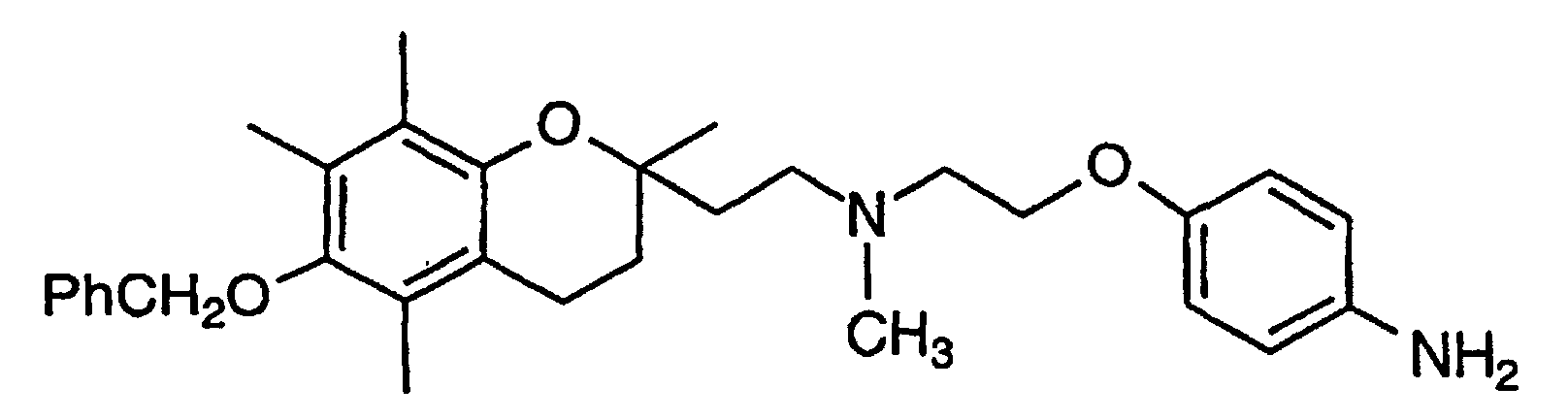
- The title compound was prepared from 4-[2-[N-[2-(6-benzyloxy-2,5,7,8-tetramethylchroman-2-yl)ethyl]-N-methylamino]ethoxy]nitrobenzene (2 g), obtained in preparation 35, by a similar procedure to that described in preparation 38.
1H NMR (CDCl3, 200 MHz) : δ 1.26 (s, 3H), 1.65 - 2.05 (m, 4H), 2.08 (s, 3H), 2.15 (s, 3H), 2.20 (s, 3H), 2.34 (s, 3H), 2.50 - 2.75 (m, 4H), 2.79 (t, J = 6.0 Hz, 2H), 3.99 (t, J = 6.2 Hz, 2H), 4.68 (s, 2H), 6.62 (d, J = 9.0 Hz, 2H), 6.73 (d, J = 8.8 Hz, 2H), 7.30 - 7.60 (m, 5H). -

- The title compound was prepared from 4-[2-[N-(6-benzyloxy-2,5,7,8-tetramethylchroman-2-yl methyl)-N-ethylamino]ethoxy]nitrobenzene (20 g), obtained in preparation 36, by a similar procedure to that described in preparation 38.
1H NMR (CDCl3, 200 MHz) : δ 1.06 (t, J = 7.2 Hz, 3H), 1.24 (s, 3H), 1.55 - 1.80 (m, 1H), 1.90 - 2.05 (m, 1H), 2.08 (s, 3H), 2.18 (s, 3H), 2.22 (s, 3H), 2.50 - 2.90 (m, 6H), 3.01 (t, J = 6.0 Hz, 2H), 3.99 (t, J = 6.2 Hz, 2H), 4.7 (s, 2H), 6.62 (d, J = 8.4 Hz, 2H), 6.73 (d, J = 8.8 Hz, 2H), 7.30 - 7.65 (m, 5H). -
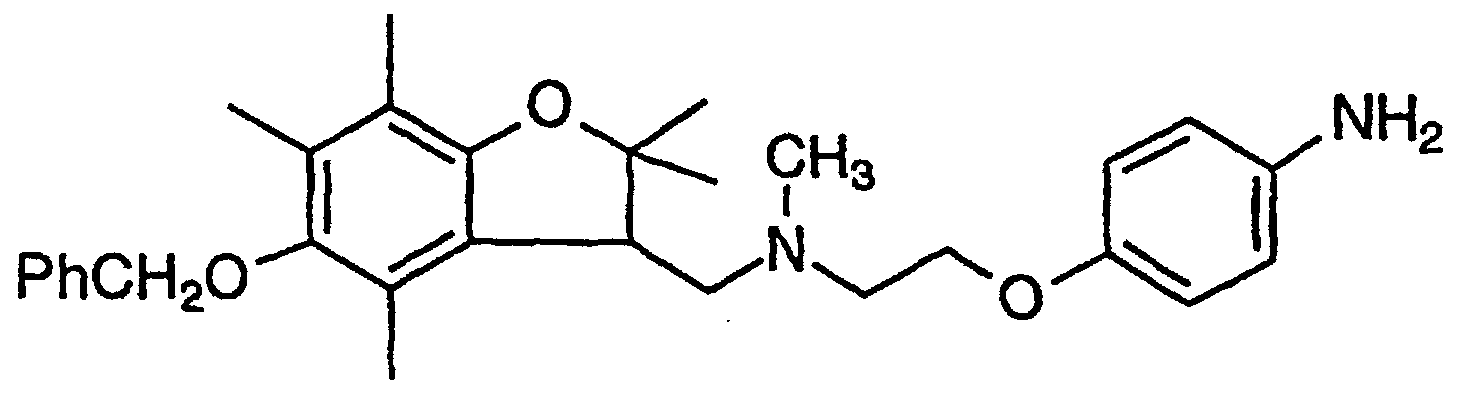
- The title compound was prepared from 4-[2-[N-(5-benzyloxy-2,3,-dihydro-2,2,4,6,7-pentamethyl-1-benzofuran-3-ylmethyl)-N-methylamino]ethoxy]nitro benzene (10 g), obtained in preparation 37, by a similar procedure to that described in preparation 38.
1H NMR (CDCl3, 200 MHz) : δ 1.34 (s, 3H), 1.62 (s, 3H), 2.08 (s, 3H), 2.22 (s, 3H), 2.27 (s, 3H), 2.38 (s, 3H), 2.74 (m, 2H), 2.93 (m, 2H), 3.10 (m, 1H), 3.98 (t, J = 5.5 Hz, 2H), 4.70 (s, 2H), 6.62 (d, J = 8.0 Hz, 2H), 6.73 (d, J = 8.0 Hz, 2H), 7.40 (m, 5H). -

- A stirred mixture of 2-(N-benzyl-N-methylamino)ethyl chloride (2 g) obtained in preparation 12, 4-aminothiophenol (1.25 g) and potassium carbonate (4.1 g) was heated at reflux for 6 h in dry acetone (15 ml); After cooling, the reaction mixture was filtered and the filtrate was evaporated to dryness. The residue was chromatographed on silica gel with 10 % ethyl acetate in pet. ether as eluent to give 1.2 g of the title compound.
1H NMR (CDCl3, 200 MHz) : δ 2.21 (s, 3H), 2.62 (dd, J1 = 9.2 Hz, J2 = 5.0 Hz, 2H), 2.92 (dd, J1 = 9.1 Hz, J2 = 6.6 Hz, 2H), 3.5 (s, 2H), 6.6 (d, J = 8.6 Hz, 2H), 7.2 (d, J = 8.4 Hz, 2H), 7.29 (s, 5H). -

- A solution of NaNO2 (1.3 g) in H2O (2.5 ml) was added dropwise to a stirred and ice cooled mixture of 4-[2-(N-benzyl-N-methylamino)ethylthio]aniline (5 g), obtained in preparation 43, aqueous HBr (48 %, 12.7 ml), MeOH (17 ml) and acetone (42 ml) below 5 °C. The solution was stirred at 5 °C for 30 min. and ethyl acrylate (12 ml) was added and the temperature was raised to 38 °C. Powder Cu2O (160 mg) was added in small portions to the vigorously stirred mixture. After the N2 gas evolution has ceased, the reaction mixture was concentrated in vacuo. The residue was diluted with water, made alkaline with concentrated NH4OH and extracted with EtOAc. The EtOAc extract was washed with brine, dried (Na2SO4) and concentrated in vacuo to give 3.7 g of the title compound.
1H NMR (CDCl3, 200 MHz) : δ 1.25 (t, J = 6.7 Hz, 3H), 2.25 (s, 3H), 2.65 (m, 2H), 3.1 (m, 2H), 3.2 (dd, J1 = 13.3 Hz, J2 = 6.6 Hz, 1H), 3.45 (dd, J1 = 13.5 Hz, J2 = 6.7 Hz, 1H), 3.55 (s, 2H), 4.15 (q, J = 6.7 Hz, 2H), 4.35 (t, J = 6.7 Hz, 1H), 7.1 (d, J = 8.3 Hz, 2H), 7.2 (d, J = 8.3 Hz, 2H), 7.3 (s, 5H). -

- The title compound was prepared from 4-[2-[N-(6-benzyloxy-2,5,7,8-tetramethylchroman-2-ylmethyl)-N-methylamino]ethoxy]aniline (10 g), obtained in preparation 38, by a similar procedure to that described in preparation 44.
1H NMR (CDCl3, 200 MHz) : δ 1.10 - 1.40 (m, 6H), 1.60 - 1.80 (m, 1H), 1.90 - 2.05 (m, 1H), 2.08 (s, 3H), 2.16 (s, 3H), 2.20 (s, 3H), 2.51 (s, 3H), 2.55 - 2.75 (m, 4H), 3.0 (m, 2H), 3.10 - 3.25 (m, 1H), 3.30 - 3.50 (m, 1H), 4.0 - 4.25 (m, 4H), 4.28 - 4.40 (m, 1H), 4.70 (s, 2H), 6.80 (d, J = 8.6 Hz, 2H), 7.10 (d, J = 8.6 Hz, 2H), 7.30 - 7.60 (m, 5H). -

- The title compound was prepared from 4-[2-[N-(6-acetoxy-2,5,7,8-tetramethylchroman-2-ylmethyl)-N-methylamino]ethoxy]aniline (5 g), obtained in preparation 39, by a similar procedure to that described in preparation 44.
1H NMR (CDCl3, 200 MHz) : δ 1.25 (m, 6H), 1.60 - 1.80 (m, 1H), 1.90 - 2.05 (m, 1H), 1.98 (s, 3H), 2.01 (s, 3H), 2.07 (s, 3H), 2.34 (s, 3H), 2.52 (s, 3H), 2.55 - 2.80 (m, 4H), 2.95 - 3.05 (m, 2H), 3.10 - 3.25 (m, 1H), 3.30 - 3.50 (m, 1H), 4.0 - 4.25 (m, 4H), 4.30 - 4.40 (m, 1H), 6.81 (d, J = 8.6 Hz, 2H), 7.11 (d, J = 8.4 Hz, 2H). -

- The title compound was prepared from 4-[2-[N-[2-(6-benzyloxy-2,5,7,8-tetramethylchromaa-2-yl)ethyl]-N-methylamino]ethoxy]aniline (1 g), obtained in preparation 40, by a similar procedure to that described in preparation 44.
1H NMR (CDCl3, 200 MHz) : δ 1.10 - 1.35 (m, 6H), 1.65 - 2.0 (m, 4H), 2.08 (s, 3H), 2.16 (s, 3H), 2.20 (s, 3H), 2.36 (s, 3H), 2.55 - 2.90 (m, 6H), 3.10 - 3.25 (m, 1H), 3.30 - 3.45 (m, 1H), 4.0 - 4.40 (m, 5H), 4.69 (s, 2H), 6.81 (d, J = 8.4 Hz, 2H), 7.11 (d, J 8.2 Hz, 2H), 7.3 - 7.6 (m, 5H). -
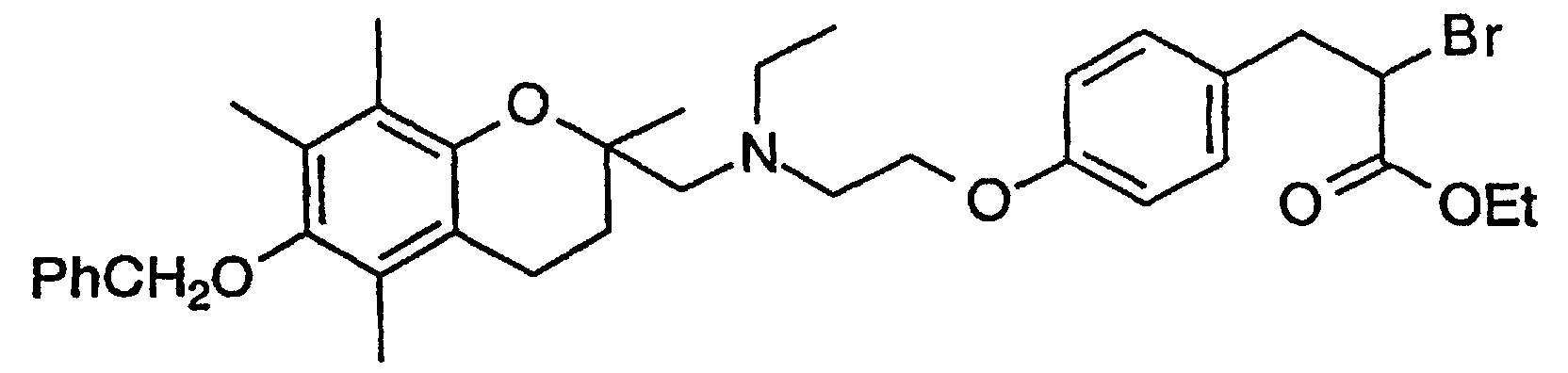
- The title compound was prepared from 4-[2-[N-(6-benzyloxy-2,5,7,8-tetramethylchroman-2-ylmethyl)-N-ethylamino]ethoxy]aniline (4 g), obtained in preparation 41, by a similar procedure to that described in preparation 44.
1H NMR (CDCl3, 200 MHz) : 1.08 (t, J = 6.8 Hz, 3H), 1.15 - 1.40 (m, 6H), 1.60 - 1.80 (m, 1H), 1.90 - 2.05 (m, 1H), 2.06 (s, 3H), 2.17 (s, 3H), 2.20 (s, 3H), 2.55 - 2.90 (m, 6H), 3.0 - 3.25 (m, 3H), 3.30 - 3.50 (m, 1H), 4.0 - 4.25 (m, 4H), 4.25 - 4.40 (m, 1H), 4.69 (s, 2H), 6.80 (d, J = 8.4 Hz, 2H), 7.10 (d, J = 8.6 Hz, 2H), 7.30 - 7.60 (m, 5H). -
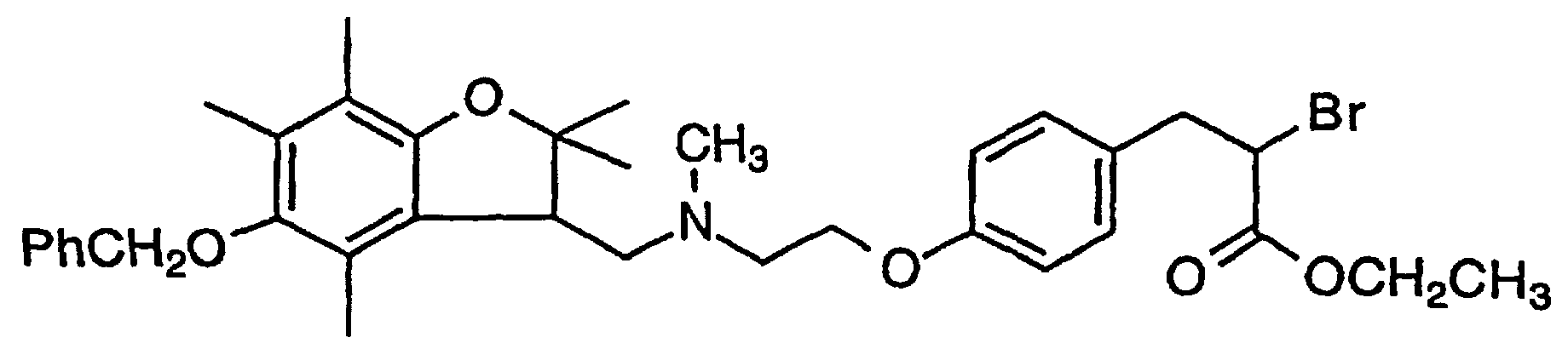
- The title compound was prepared from 4-[2-[N-(5-benzyloxy-2,3-dihydro-2,2,4,6,7-pentamethyl-1-benzofuran-3-ylmethyl)-N-methylamino]ethoxy]aniline (4.3 g), obtained in preparation 42, by a similar procedure to that described in preparation 44.
1H NMR (CDCl3, 200 MHz) : 1.28 (t, J = 6.9 Hz, 3H), 1.38 (s, 3H), 1.63 (s, 3H), 2.11 (s, 3H), 2.23 (s, 3H), 2.28 (s, 3H), 2.41 (s, 3H), 2.72 (m, 2H), 2.91 (m, 2H), 3.10 (m, 1H), 3.22 (m, 1H), 3.40 (m, 1H), 4.08 (m, 2H), 4.18 (q, J = 6.9 Hz, 2H), 4.36 (m, 1H), 4.72 (s, 2H), 6.82 (d, J = 8.2 Hz, 2H), 7.14 (d, J = 8.2 Hz, 2H), 7.48 (m, 5H). -

- A solution of 4-[2-[N-(6-benzyloxy-2,5,7,8-tetramethylchroman-2-ylmethyl)-N-methylamino] ethoxy]benzaldehyde (12.8 g) obtained preparation 23 and 2,4-thiazolidinedione (3.2 g) in toluene (100 ml) containing piperidine (0.3 g) and benzoic acid (0.4 g) was heated at reflux for 2 h using a Dean Stark apparatus. The reaction mixture was cooled and filtered; the filtrate was washed with H2O, dried (Na2SO4) and evaporated under reduced pressure. The crude product was chromatographed on silicagel using 2 to 10 % (gradient elution) of methanol in benzene to afford 15.3 g of the title compound.
1H NMR (CDCl3, 200 MHz) : δ 1.25 (s, 3H), 1.70 (m, 1H), 2.0 (m, 1H), 2.07 (s, 3H), 2.18 (s, 3H), 2.2 (s, 3H), 2.52 (s, 3H), 2.65 (t, J = 10.9 Hz, 2H), 2.7 (s, 2H), 3.05 (t, J = 5.8 Hz, 2H), 4.15 (t, J = 5.8 Hz, 2H), 4.7 (s, 2H), 6.95 (d, J = 8.8 Hz, 2H), 7.4 (m, 7H), 7.75 (s, 1H). -

- The title compound was prepared from 4-[2-[N-[2-(6-benzyloxy-2,5,7,8-tetramethylchroman-2-yl)ethyl]-N-methylamino]ethoxy]benzaldehyde, obtained in preparation 24, by a similar procedure to that described in example 1. 1H NMR (CDCl3, 200 MHz) : δ 1.3 (s, 3H), 1.85 (m, 4H), 2.05 (s, 3H), 2.15 (s, 3H), 2.22 (s, 3H), 2.45 (s, 3H), 2.65 - 3.0 (m, 6H), 4.15 (m, 2H), 4.7 (s, 2H), 6.95 (d, J = 8.5 Hz, 2H), 7.3 - 7.55 (m, 7H), 7.6 (s, 1H).
-

- The title compound was prepared from 4-[2-[N-(6-benzyloxy-2,5,7,8-tetramethylchroman-2-ylmethyl)amino]ethoxy]benzaldehyde, obtained in preparation 25, by a similar procedure to that described in example 1.
1H NMR (DMSO-d6, 200 MHz) : δ 1.25 (s, 3H), 1.65 - 1.82 (m, 1H), 1.85 - 2.05 (m, 1H), 2.02 (s, 3H), 2.10 (s, 3H), 2.12 (s, 3H), 2.58 (m, 2H), 2.89 (s, 2H), 3.11 (m, 2H), 4.18 (m, 2H), 4.61 (s, 2H), 7.07 (d, J = 8.8 Hz, 2H), 7.30 - 7.70 (m, 8H). -
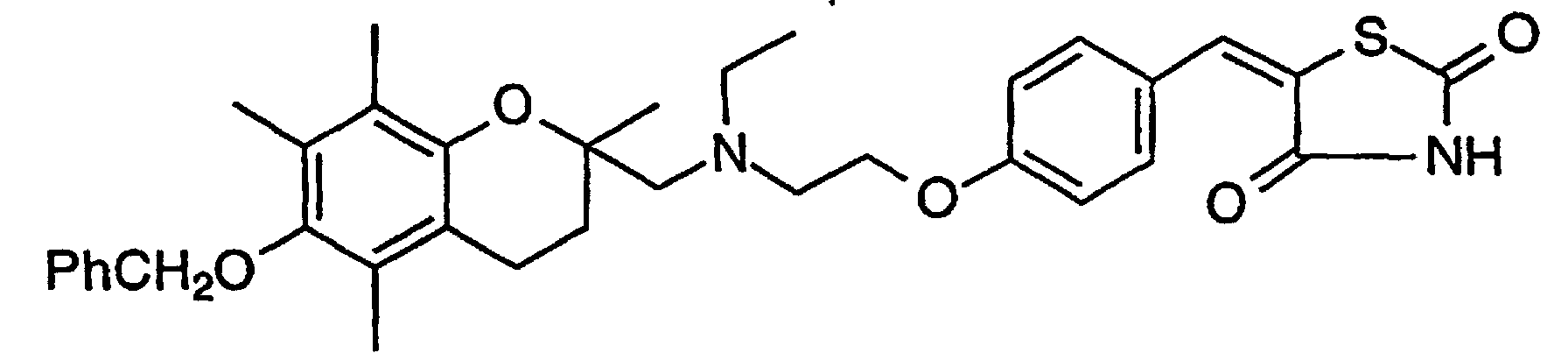
- The title compound was prepared from 4-[2-[N-(6-benzyloxy-2,5,7,8-tetramethylchroman-2-ylmethyl)-N-ethylamino]ethoxy]benzaldehyde, obtained in preparation 26, by a similar procedure to that described in example 1.
1H NMR (CDCl3, 200 MHz) : δ 1.08 (m, 3H), 1.23 (s, 3H), 1.60 - 1.80 (m, 1H), 1.95 - 2.05 (m, 1H), 2.05 (s, 3H), 2.17 (s, 3H), 2.19 (s, 3H), 2.55 - 2.90 (m, 6H), 3.09 (m, 2H), 4.11 (m, 2H), 4.69 (s, 2H), 6.94 (d, J = 8.2 Hz, 2H), 7.20 - 7.60 (m, 7H), 7.78 (s, 1H). -
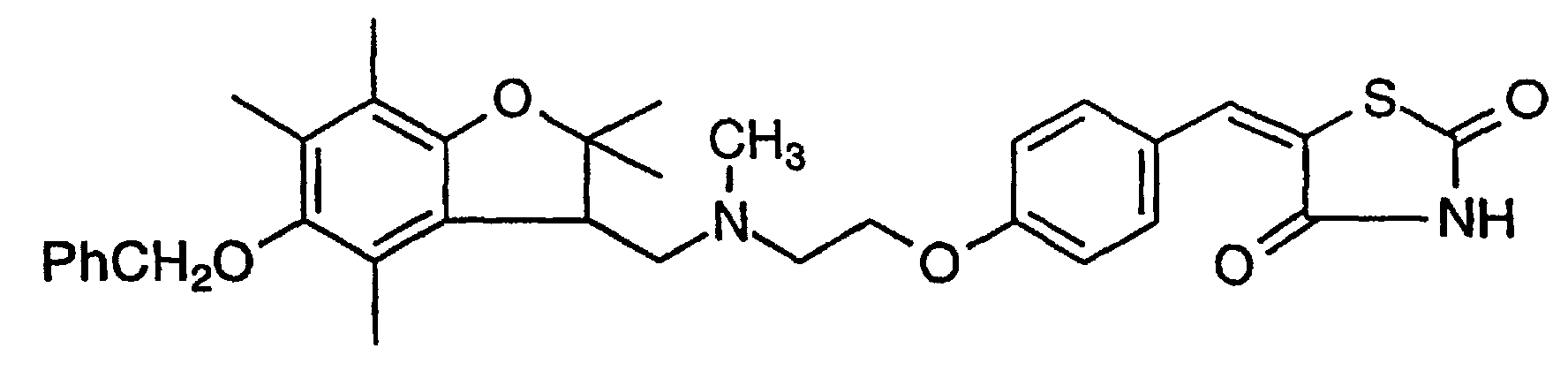
- The title compound was prepared from 4-[2-[N-(5-benzyloxy-2,3-dihydro-2,2,4,6,7-pentamethyl-1-benzofuran-3-ylmethyl)-N-methylamino]ethoxy] benzaldehyde, obtained in preparation 27, by a similar procedure to that described in example 1.
1H NMR (CDCl3, 200 MHz) : δ 1.32 (s, 3H), 1.63 (s, 3H), 2.11 (s, 3H), 2.22 (s, 3H), 2.27 (s, 3H), 2.43 (s, 3H), 2.79 (m, 2H), 2.98 (m, 2H), 3.10 (m, 1H), 4.14 (m, 2H), 4.73 (s, 2H), 7.0 (d, J = 8.3 Hz, 2H), 7.45 (m, 7H), 7.82 (s, 1H). -

- Sodium hydride (0.17 g, 50 % dispersion in oil) was added in portions to a stirred solution of 5-[(6-hydroxy-2-naphthyl)methylene]-2,4-thiazolidinedione (1.3 g) in dry DMF (30 ml) under an atmosphere of nitrogen. After the effervescence has ceased, 2-(N-(6-benzyloxy-2,5,7,8-tetramethylchroman)-2-ylmethyl)-N-methylamino]ethyl chloride (1.9 g), obtained in preparation 13, was added and the reaction mixture was stirred at 80 °C for 3 hours. After cooling, the mixture was added to water (50 ml) and extracted with ethyl acetate (3 x 25 ml). The combined organic extract was washed with water, brine, dried (Na2SO4) and evaporated to dryness. Chromatography of the residue on silicagel with 30 % EtOAc in petroleum ether afforded (1.2 g) the title compound.
1H NMR (CDCl3, 200 MHz) : δ 1.3 (s, 3H), 1.65 - 1.80 (m, 1H), 1.90 - 2.05 (m, 1H), 2.08 (s, 3H), 2.15 (s, 3H), 2.20 (s, 3H), 2.55 (s, 3H), 2.60 - 2.85 (m, 4H), 3.1 (m, 2H), 4.25 (m, 2H), 4.7 (s, 2H), 7.05 - 7.95 (m, 12H). -

- A mixture of ethyl 2-bromo-3-[4-[2-(N-benzyl-N-methylamino)ethylthio]phenyl]propionate (3 g), obtained in preparation 44, thiourea (520 mg), NaOAc (570 mg) and EtOH (21 ml) was stirred under reflux for 5 h and extracted with EtOAc, dried (Na2SO4) and concentrated to get 2-imino-5-[4-[2-(N-benzyl-N-methylamino)ethylthio]benzyl]-4-thiazolidinone which was used in the next step without further purification.
- A mixture of the above crude compound, 2N HCl (34 ml) and EtOH (34 ml) was stirred under reflux for 12 h. The reaction mixture was concentrated in vacuo. The residue was diluted with water, neutralised with saturated aqueous NaHCO3 and extracted with ethyl acetate. The EtOAc extract was washed with brine, dried (Na2SO4) and concentrated in vacuo. The residue was chromatographed on silicagel with 40 % EtOAc in petroleum ether as eluent to afford the title compound.
1H NMR (CDCl3, 200 MHz) : δ 2.26 (s, 3H), 2.66 (t, J = 4.7 Hz, 2H), 3.1 (m, 3H), 3.45 (m, 1H), 3.55 (s, 2H), 4.52 (dd, J1 = 9.5 Hz, J2 = 3.6 Hz, 1H), 7.15 (d, J = 8.2 Hz, 2H), 7.25 (d, J = 8.2 Hz, 2H), 7.3 (s, 5H). -

- The title compound was prepared from ethyl 2-bromo-3-[4-[2-[N-(6-benzyloxy-2,5,7,8-tetramethylchroman-2-ylmethyl)-N-methylamino]ethoxy]phenyl]propionate, obtained in preparation 45, by a similar procedure to that described in example 7.
1H NMR (CDCl3, 200 MHz) : δ 1.26 (s, 3H), 1.60 - 1.80 (m, 1H), 1.90 - 2.05 (m, 1H), 2.09 (s, 3H), 2.17 (s, 3H), 2.22 (s, 3H), 2.52 (s, 3H), 2.60 - 2.80 (m, 4H), 2.90 - 3.20 (m, 3H), 3.35 - 3.50 (m, 1H), 4.1 (m, 2H), 4.40 - 4.55 (m, 1H), 4.69 (s, 2H), 6.82 (d, J = 8.2 Hz, 2H), 7.12 (d, J = 8.2 Hz, 2H), 7.30 - 7.60 (m, 5H). -

- The title compound was prepared from Ethyl 2-bromo-3-[4-[2-[N-[2-(6-benzyloxy-2,5,7,8-tetramethylchroman-2-yl)ethyl]-N-methylamino]ethoxy]phenyl]propionate, obtained in preparation 47, by a similar procedure to that described in example 7.
- The title compound was also prepared from 2-[N-[2-(6-benzyloxy-2,5,7,8-tetramethychroman-2-yl)ethyl]-N-methylamino]ethyl chloride (2.3 g), obtained in preparation 16, and 5-[(4-hydroxyphenyl)methyl]thiazolidine-2,4-dione (1.2 g) by a similar procedure to that described in example 6.
1H NMR (CDCl3, 200 MHz) : δ 1.27 (s, 3H), 1.70 - 2.05 (m, 4H), 2.08 (s, 3H), 2.16 (s, 3H), 2.2 (s, 3H), 2.39 (s, 3H), 2.6 (t, J = 6.4 Hz, 2H), 2.78 (t, J = 7.9 Hz, 2H), 2.87 (t, J = 5.1 Hz, 2H), 3.0 - 3.15 (m, 1H), 3.30 - 3.45 (m, 1H), 4.05 (m, 2H), 4.25 - 4.40 (dd, J1 = 8.7 Hz, J2 = 3.8 Hz, 1H), 4.68 (s, 2H), 6.76 (d, J = 8.2 Hz, 2H), 7.11 (d, J = 8.4 Hz, 2H), 7.3 - 7.55 (m, 5H). -

- The title compound was prepared from ethyl 2-bromo-3-[4-[2-[N-(6-benzyloxy-2,5,7,8-tetramethylchroman-2-ylmethyl)-N-ethylamino]ethoxy]phenyl]propionate, obtained in preparation 48, by a similar procedure to that described in example 7.
1H NMR (CDCl3, 200 MHz) : δ 1.07 (t, J = 6.6 Hz, 3H), 1.24 (s, 3H), 1.60 - 1.80 (m, 1H), 1.85 - 2.05 (m, 1H), 2.10 (s, 3H), 2.16 (s, 3H), 2.20 (s, 3H), 2.60 - 2.90 (m, 6H), 3.0 - 3.2 (m, 3H), 3.35 - 3.50 (m, 1H), 4.05 (m, 2H), 4.45 - 4.55 (m, 1H), 4.69 (s, 2H), 6.79 (d, J = 8.2 Hz, 2H), 7.1 (d, J = 8.4 Hz, 2H), 7.30 - 7.60 (m, 5H). -
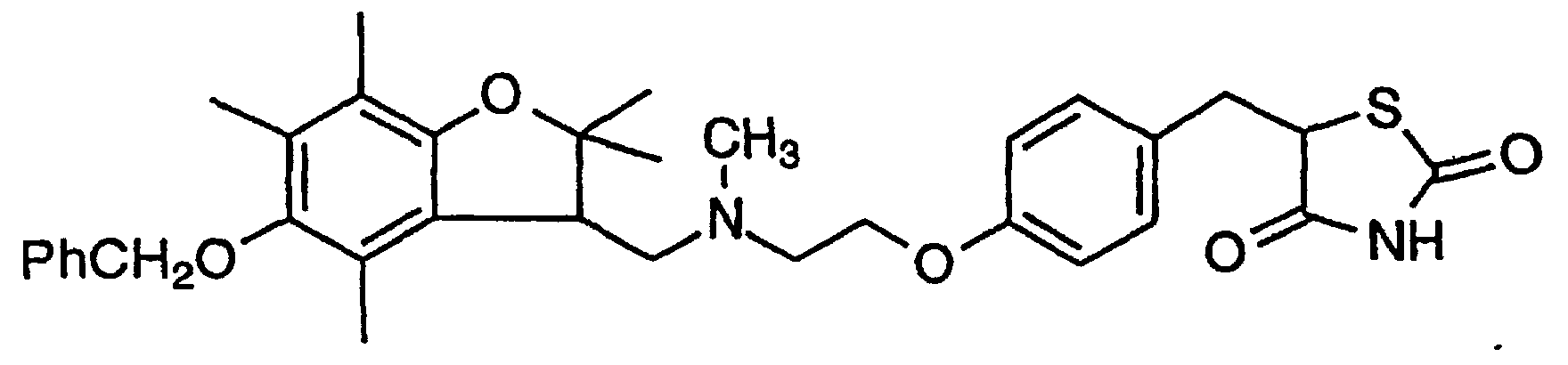
- The title compound was prepared from ethyl 2-bromo-3-[4-[2-[N-(5-benzyloxy-2,3-dihydro-2,2,4,6,7-pentamethyl-1-benzofuran-3-ylmethyl)-N-methylamino]ethoxy]phenyl]propionate, obtained in preparation 49, by a similar procedure to that described in example 7.
- The title compound was also prepared from 2-[N-(5-benzyloxy-2,3-dihydro-2,2,4,6,7-pentamethyl-1-benzofuran-3-ylmethyl)-N-methylamino]ethyl chloride (2 g), obtained in preparation 19, and 5-[(4-hydroxyphenyl)methyl]thiazolidine-2,4-dione (1.1 g) by a similar procedure to that described in example 6.
1H NMR (CDCl3, 200 MHz) : δ 1.33 (s, 3H), 1.58 (s, 3H), 2.08 (s, 3H), 2.18 (s, 3H), 2.23 (s, 3H), 2.36 (s, 3H), 2.73 (m, 2H), 2.91 (m, 2H), 3.08 (m, 2H), 3.42 (dd, J1 = 14.1 Hz, J2 = 3.7 Hz, 1H), 4.05 (t, J = 5.6 Hz, 2H), 4.47 (dd, J1 = 9.3 Hz, J2 = 3.8 Hz, 1H), 4.70 (s, 2H), 6.82 (d, J = 8.0 Hz, 2H), 7.12 (d, J = 8.0 Hz, 2H), 7.45 (m, 5H). -
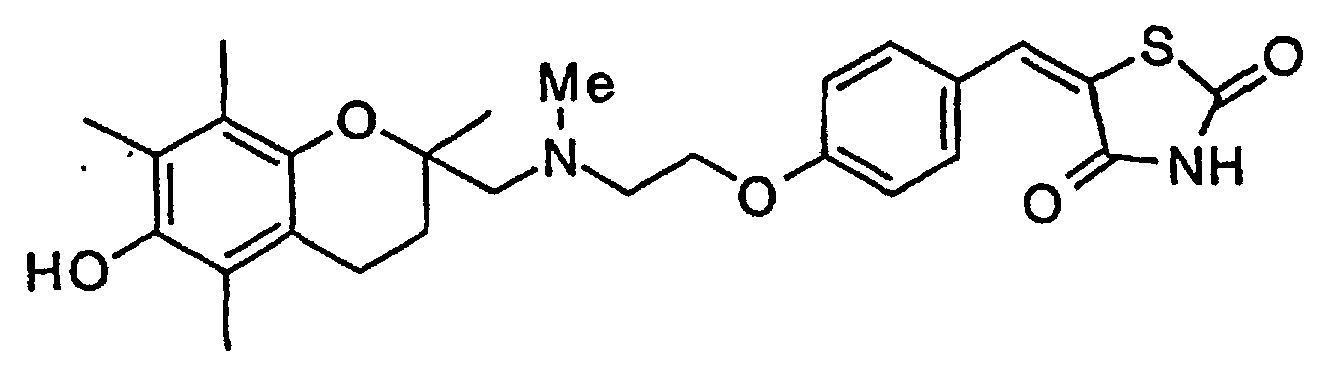
- To a solution of 12.5 g of the product obtained in example 1, in 120 ml of acetic acid was added 40 ml of concentrated hydrochloric acid. The resulting mixture was heated at 60 °C for 1h. At the end of this time, the solvent was removed under reduced pressure and the residue was diluted with acetone. The resulting white solid was filtered and washed with excess of acetone. The solid was suspended in methanol and the pH was adjusted to 7 by the addition of triethylamine. The solvent was removed under reduced pressure and the resulting residue was dissolved in ethyl acetate and washed with water followed by brine. The organic layer was dried over anhydrous sodium sulphate and the solvent was removed by distillation under reduced pressure. The crude product was purified by column chromatography on silicagel using 2 to 10 % (gradient elution) of methanol in chloroform to afford 9.8 g of the title compound.
1H NMR (CDCl3, 200 MHz) : δ 1.2 (s, 3H), 1.65 (m, 1H), 2.0 (m, 1H), 2.05 (s, 3H), 2.1 (s, 3H), 2.15 (s, 3H), 2.51 (s, 3H), 2.65 (m, 2H), 2.70 (s, 2H), 3.0 (t, J = 5.6 Hz, 2H), 4.15 (t, J = 5.8 Hz, 2H), 6.95 (d, J = 8.8 Hz, 2H), 7.4 (d, J = 8.8 Hz, 2H), 7.78 (s, 1H). -

- The title compound was prepared from the compound obtained in example 2, by a similar procedure to that described in example 12.
1H NMR (CDCl3, 200 MHz): δ 1.3 (s, 3H), 1.85 (m, 4H), 2.1 (s, 6H), 2.15 (s, 3H), 2.45 (s, 3H), 2.65 (t, J = 6.8 Hz, 2H), 2.8 (t, J = 7.6 Hz, 2H), 2.9 (t, J = 5.0 Hz, 2H), 4.15 (t, J = 5.0 Hz, 2H), 6.95 (d, J = 8.8 Hz, 2H), 7.35 (d, J = 8.8 Hz, 2H), 7.55 (s, 1H). -
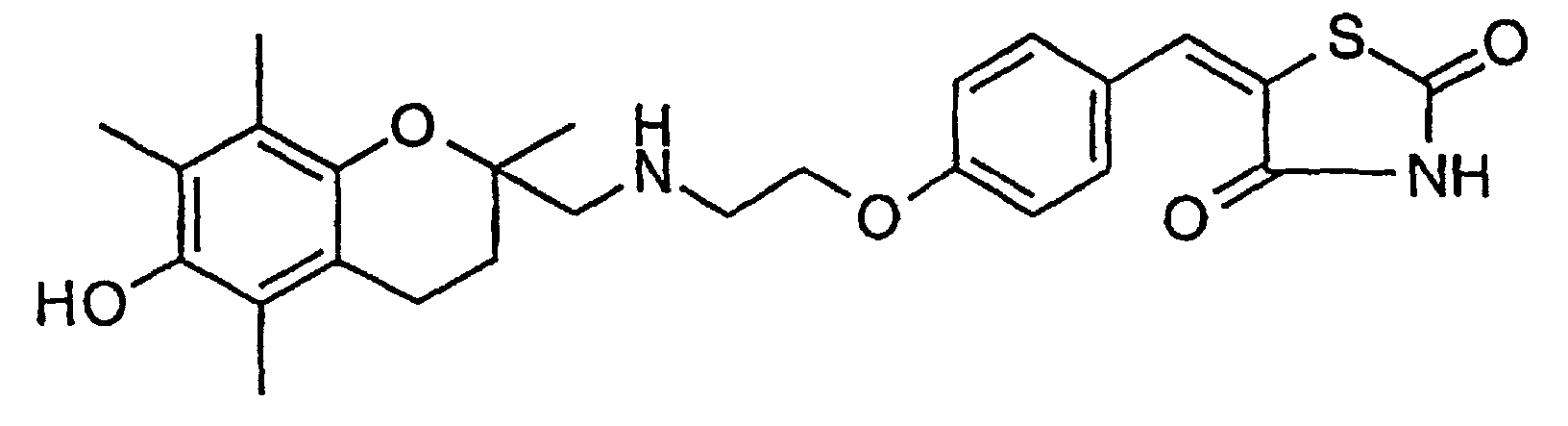
- The title compound was prepared from 5-[4-[2-[N-(6-benzyloxy-2,5,7,8-tetramethylchroman-2-ylmethyl)amino]ethoxy]phenyl methylene]thiazolidine-2,4-dione, obtained in example 3, by an analogous procedure to that described in example 12.
1H NMR (CDCl3, 200 MHz): δ 1.29 (s, 3H), 1.70 - 2.05 (m, 2H), 2.10 (s, 6H), 2.15 (s, 3H), 2.65 (t, J = 6.6 Hz, 2H), 2.87 (s, 2H), 3.12 (t, J = 4.6 Hz,2H), 4.14 (t, J = 4.8 Hz, 2H), 6.94 (d. J = 8.6 Hz, 2H), 7.38 (d, J = 8.6 Hz, 2H), 7.85 (s, 1H). -

- The title compound was prepared from 5-[4-[2-[N-(6-benzyloxy-2,5,7,8-tetramethylchroman-2-ylmethyl)-N-ethylamino]ethoxy]phenyl methylene]thiazolidine-2,4-dione, obtained in example 4, by an analogous procedure to that described in example 12.
1H NMR (CDCl3, 200 MHz): δ 1.08 (t, J = 7 Hz, 3H), 1.21 (s, 3H), 1.6 - 1.8 (m, 1H), 1.9 - 2.05 (m, 1H), 2.05 (s, 3H), 2.11 (s, 3H), 2.13 (s, 3H), 2.6 - 2.9 (m, 6H), 3.11 (t, J = 5.8 Hz, 2H), 4.13 (t, J = 5.8 Hz, 2H), 6.93 (d, J = 8.6 Hz, 2H), 7.39 (d, J = 8.6 Hz, 2H), 7.77 (s, 1H). -
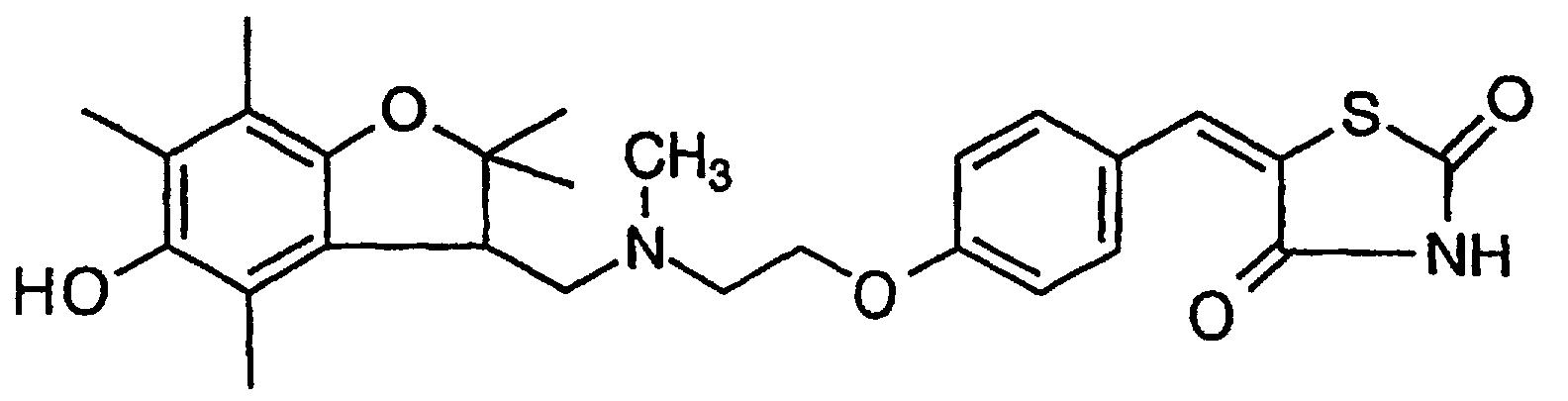
- The title compound was prepared from 5-[4-[2-[N-(5-benzyloxy-2,3-dihydro-2,2,4,6,7-pentamethyl-1-benzofuran-3-ylmethyl)-N-methylamino]ethoxy]phenyl methylene]thiazolidine-2,4-dione, obtained in example 5, by an analogous procedure to that described in example 12.
1H NMR (CDCl3, 200 MHz) : δ 1.34 (s, 3H), 1.59 (s, 3H), 2.11 (s, 3H), 2.15 (s, 3H), 2.22 (s, 3H), 2.41 (s, 3H), 2.74 (m, 2H), 2.93 (m, 2H), 3.06 (m, 1H), 4.08 (m, 2H), 4.16 (bs, 1H), 6.98 (d, J = 8.6 Hz, 2H), 7.48 (d, J = 8.7 Hz, 2H), 7.83 (s, 1H). -
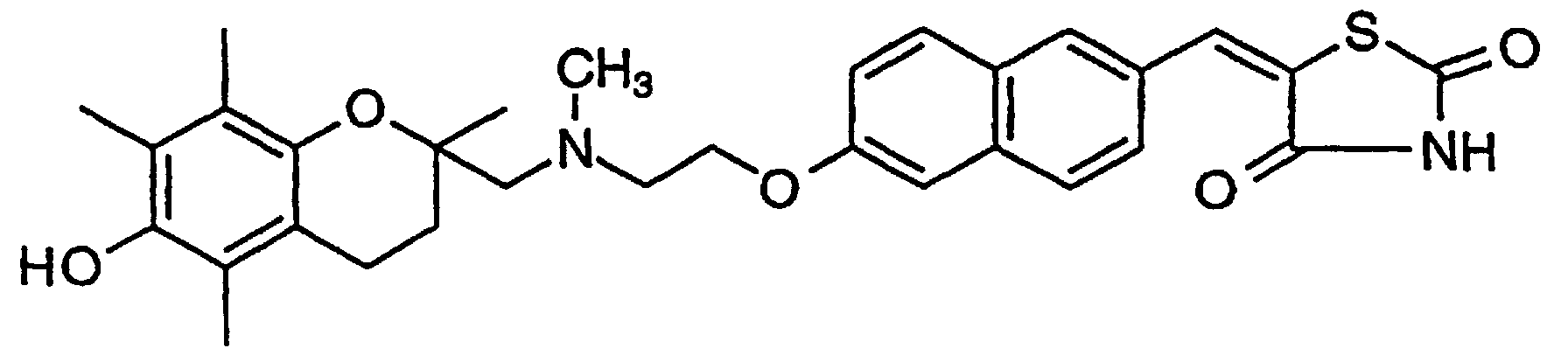
- The title compound was prepared from 5-[6-[2-[N-(6-benzyloxy-2,5,7,8-tetramethylchroman-2-ylmethyl)-N-methylamino]ethoxy]-2-naphthyl methylene]thiazolidine-2,4-dione, obtained in example 6, by an analogous procedure to that described in example 12.
1H NMR (CDCl3, 200 MHz) : δ 1.25 (s, 3H), 1.60 - 1.80 (m, 1H), 1.90 - 2.05 (m, 1H), 2.07 - 2.20 (3s, 9H), 2.35 - 2.80 (m, 7H), 3.10 (m, 2H), 4.20 (m, 2H), 7.10 - 8.0 (m, 7H). -
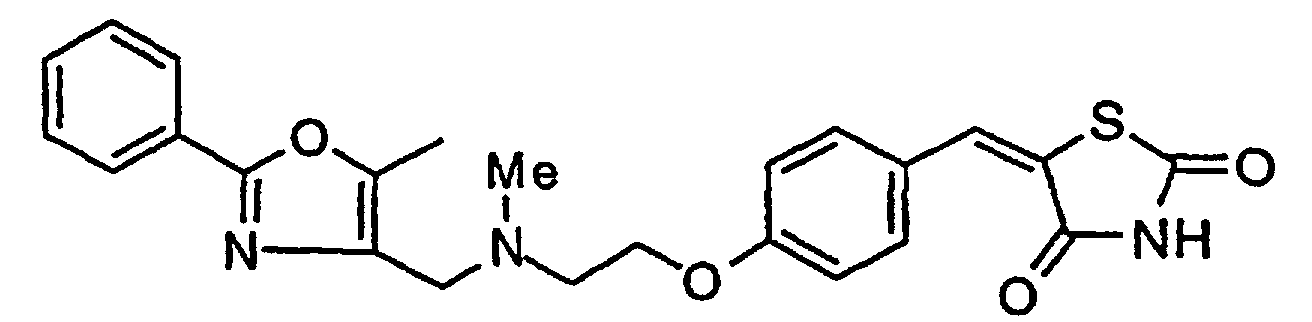
- The title compound was prepared from 4-[2-[N-methyl-N-(5-methyl-2-phenyl-4-oxazolyl)methylamino]ethoxy]benzaldehyde, obtained in preparation 28, by a similar procedure to that described in example 1.
1H NMR (CDCl3, 200 MHz) : δ 2.4 (s, 3H), 2.5 (s, 3H), 3.05 (t, J = 5.3 Hz, 2H), 3.75 (s, 2H), 4.25 (t, J = 5.3 Hz, 2H), 6.9 (d, J = 10.7 Hz, 2H), 7.35 (d, J = 10.7 Hz, 2H), 7.45 (m, 3H), 7.55 (s, 1H), 8.0 (m, 2H). -
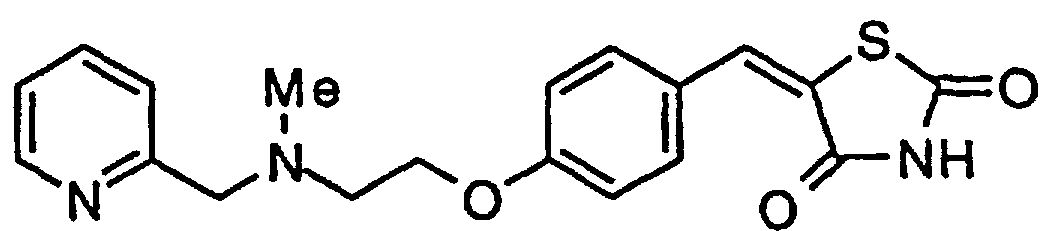
- The title compound was prepared from 4-[2-[N-methyl-N-(2-pyridylmethyl)amino]ethoxy] benzaldehyde, obtained in preparation 29, by a similar procedure to that described in example 1. 1H NMR (CDCl3, 200 MHz) : δ 2.45 (s, 3H), 2.95 (m, 2H), 3.9 (s, 2H), 4.2 (m, 2H), 6.95 (d, J = 7.4 Hz, 2H), 7.25 (m, 1H), 7.4 (d, J = 7.4, 2H), 7.5 (d, J = 7.3 Hz, 1H), 7.6 (s, 1H), 7.75 (t, J = 7.4 Hz, 1H), 8.6 (d, J = 3.7 Hz, 1H).
-
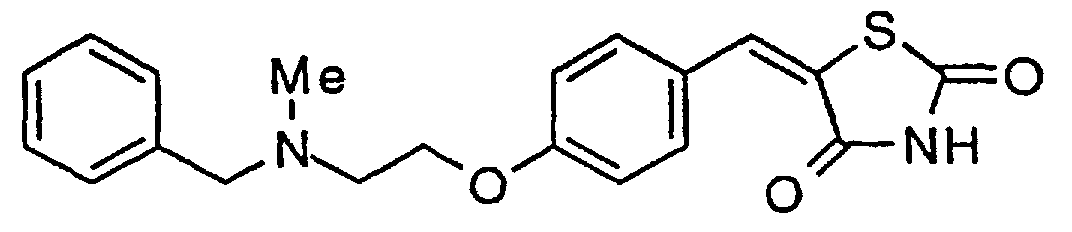
- The title compound was prepared from 4-[2-[N-benzyl-N-methylamino]ethoxy]benzaldehyde, obtained in preparation 30, by a similar procedure to that described in example 1.
1H NMR (CDCl3, 200 MHz) : δ 2.4 (s, 3H), 2.9 (t, J = 5.9 Hz, 2H), 3.7 (s, 2H), 4.15 (t, J = 5.9 Hz, 2H), 6.95 (d, J = 8.6 Hz, 2H), 7.2 - 7.6 (m, 7H), 7.65 (s, 1H). -
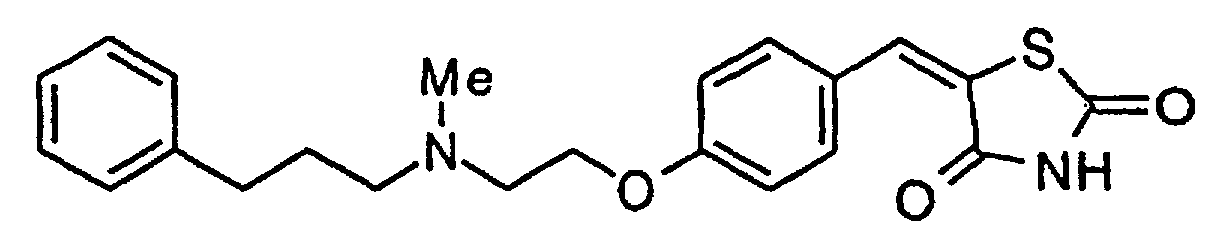
- The title compound was prepared from 4-[2-[N-methyl-N-(3-phenylpropyl)amino]ethoxy] benzaldehyde, obtained in preparation 31, by a similar procedure to that described in example 1.
1H NMR (CDCl3 + DMSO-d6, 200 MHz) δ 1.8 - 2.0 (m, 2H), 2.4 (s, 3H), 2.5 - 2.75 (m, 4H), 2.85 (t, J = 5.4 Hz, 2H), 4.15 (t, J = 5.6 Hz, 2H), 6.95 (d, J = 8.8 Hz, 2H), 7.1 - 7.35 (m, 5H), 7.45 (d, J = 8.6 Hz, 2H), 7.7 (s, 1H). -

- The title compound was prepared from 4-[2-[N-methyl-N-(3-phenylprop-2-enyl)amino]ethoxy]benzaldehyde, obtained in preparation 32, by a similar procedure to that described in example 1.
1H NMR (CDCl3, 200 MHz) : δ 2.53 (s, 3H), 3.0 (t, J = 4.8 Hz, 2H), 3.43 (d, J = 6.2 Hz, 2H), 4.22 (t, J = 4.8 Hz, 2H), 6.35 - 6.50 (m, 1H), 6.61 (d, J = 16.2Hz, 1H), 6.93 (d, J = 8.4 Hz, 2H), 7.20 - 7.60 (m, 8H). -

- To a stirred suspension of the product obtained in the example 13, (4.25 g) in methanol (50 ml) at room temperature was added magnesium turnings (3.7 g) and the reaction mixture was stirred overnight at the same temperature. The reaction mixture was added to ice water (20 ml), the pH was adjusted to 6.5 - 7 using 10 % aqueous hydrochloric acid and the solution was extracted with chloroform (3 x 75 ml). The combined organic extract was washed with H2O, dried (CaCl2) and the solvent was removed under reduced pressure. The residual mass was chromatographed on silicagel using 3 % methanol in chloroform to give 3.9 g of the title compound.
- The title compound was also prepared from 5-[4-[2-[N-(6-benzyloxy-2,5,7,8-tetramethylchroman-2-ylmethyl)-N-methylamino]ethoxy]benzyl]thiazolidine-2,4-dione, obtained in example 8, by a similar procedure to that described in example 12.
- The title compound was also prepared from Ethyl 2-bromo-3-[4-[2-[N-(6-acetoxy-2,5,7,8-tetramethylchroman-2-ylmethyl)-N-methylamino]ethoxy]phenyl]propionate, obtained in preparation 46, by a similar procedure to that described in example 7.
1H NMR (CDCl3, 200 MHz) : δ 1.25 (s, 3H), 1.7 (m, 1H), 2.0 (m, 1H), 2.09 (s, 3H), 2.11 (s, 3H), 2.15 (s, 3H), 2.5 (s, 3H), 2.65 (bs, 4H), 2.97 (m, 2H), 3.1 (dd, J1 = 14.1 Hz, J2 = 9.4 Hz, 1H), 3.42 (dd, J1 = 14.0 Hz, J2 = 3.8 Hz, 1H), 4.05 (m, 2H), 4.5 (dd, J1 = 8.9 Hz, J2 = 4.0 Hz, 1H), 6.8 (d, J = 9.35 Hz, 2H), 7.15 (d, J = 9.55, 2H). -

- The title compound was prepared from 5-[4-[2-[N-[2-(6-benzyloxy-2,5,7,8-tetramethylchroman-2-yl)ethyl]-N-methylamino]ethoxy]benzyl]thiazolidine-2,4-dione obtained in example 9, by an analogous procedure to that described in example 12.
1H NMR (CDCl3, 200 MHz) : δ 1.25 (s, 3H), 1.7 - 1.95 (m, 4H), 2.08 (s, 3H), 2.10 (s, 3H), 2.15 (s, 3H), 2.39 (s, 3H), 2.6 (t, J = 6.6 Hz, 2H), 2.78 (t, J = 7.9 Hz, 2H), 2.87 (t, J = 5.4 Hz, 2H), 3.0 - 3.12 (m, 1H), 3.30 - 3.45 (m, 1H), 4.05 (m, 2H), 4.39 - 4.45 (dd, J1 = 8.7 Hz, J2 = 3.7 Hz, 1H), 6.76 (d, J = 8.2 Hz, 2H), 7.11 (d, J = 8.4 Hz, 2H). -
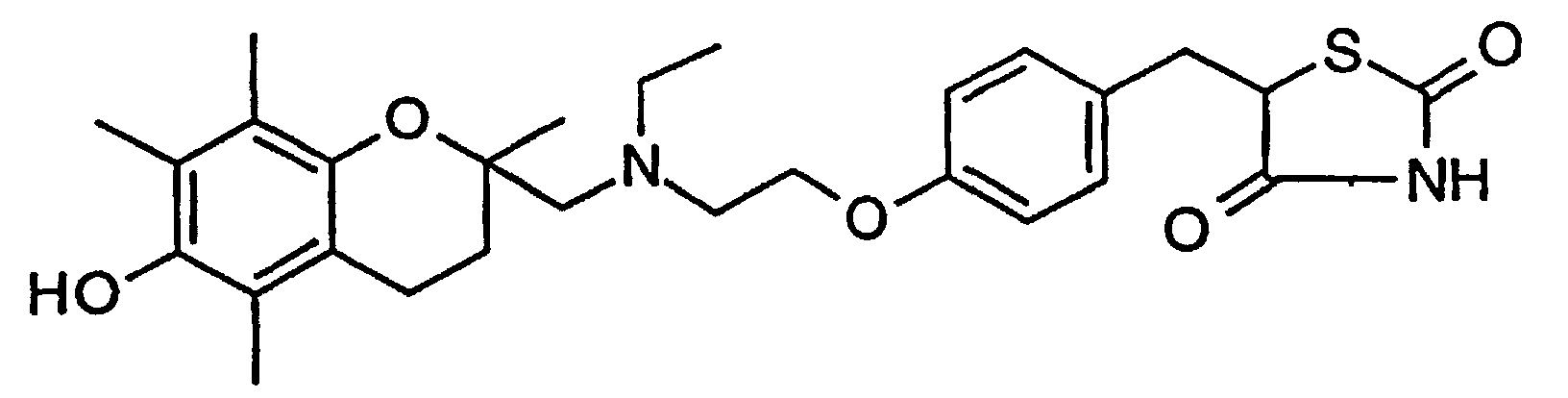
- The title compound was prepared from 5-[4-[2-[N-(6-benzyloxy-2,5,7,8-tetramethylchroman-2-ylmethyl)-N-ethylamino)ethoxy]benzyl]thiazolidine-2,4-dione, obtained in example 10, by a similar procedure to that described in example12.
1H NMR (CDCl3, 200 MHz) : δ 1.08 (t, J = 7.0 Hz, 3H), 1.23 (s, 3H), 1.60 - 1.80 (m, 1H), 1.90 - 2.05 (m, 1H), 2.08 (s, 3H), 2.12 (s, 3H), 2.15 (s, 3H), 2.6 - 2.9 (m; 6H), 3.0 - 3.2 (m, 3H), 3.40 - 3.55 (m, 1H), 4.05 (m, 2H), 4.45 - 4.55 (m, 1H), 6.81 (d, J = 8.4 Hz, 2H), 7.15 (d, J = 8.6 Hz, 2H). -

- The title compound was prepared from 5-[4-[2-[N-(5-benzyloxy-2,3-dihydro-2,2,4,6,7-pentamethyl-1-benzofuran-3-ylmethyl)-N-methylamino]ethoxy]benzyl]thiazolidine-2,4-dione, obtained in example 11, by a similar procedure to that described in example 12.
1H NMR (CDCl3, 200 MHz) : δ 1.3 (s, 3H), 1.57 (s, 3H), 2.08 (s, 3H), 2.11 (s, 3H), 2.17 (s, 3H), 2.38 (s, 3H), 2.89 (m, 2H), 2.91 (m, 2H), 3.08 (m, 2H), 3.44 (dd, J1 = 13.8 Hz, J2 = 3.3 Hz, 1H), 4.0 (t, J = 5.4 Hz, 2H), 4.49 (dd, J1 = 9.4 Hz, J2 = 3.8 Hz, 1H), 6.81 (d, J = 8.3 Hz, 2H), 7.4 (d, J = 8.3 Hz, 2H). -

- 5-[4-[2-[N-methyl-N-(5-methyl-2-phenyl-4-oxazolyl)methylamino]ethoxy]phenyl methylene]thiazolidine-2,4-dione (2.5 g) obtained in example 18, was dissolved in dry 1,4-dioxane (100 ml) and was reduced with hydrogen (50 psig) in the presence of 10 % palladium on charcoal (2.5 g) at ambient temperature until hydrogen uptake ceased. The solution was filtered through a bed of celite, the filter pad was washed exhaustively with dioxane and the combined filtrate was evaporated to dryness under reduced pressure to afford 2.5 g of the title compound after crystallisation from a mixture of benzene and petroleum ether.
1H NMR (CDCl3, 200 MHz) : δ 2.4 (s, 3H), 2.5 (s, 3H), 3.05 (m, 3H), 3.45 (dd, J1 = 13.7 Hz, J2 = 5.1 Hz, 1H), 3.7 (s, 2H), 4.2 (t, J = 5.1 Hz, 2H), 4.45 (dd, J1 = 10.3 Hz, J2 = 3.4 Hz, 1H), 6.85 (d, J = 6.8 Hz, 2H), 7.15 (d, J = 6.8 Hz, 2H), 7.45 (m, 3H), 8.0 (m, 2H). -
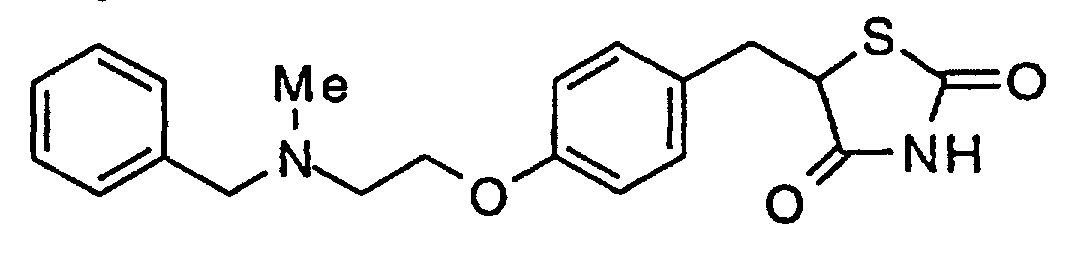
- Sodium hydride (0.73 g, 50 % dispersion in oil) was added in portions to a stirred solution of 5-[(4-hydroxyphenyl)methyl]thiazolidine-2,4-dione (1.4 g) in dry DMF (10 ml) under an atmosphere of nitrogen. After the effervescence has ceased, 2-[N-benzyl-N-methylamino]ethyl chloride (1 g), obtained in preparation 12, was added and the reaction mixture was stirred at room temperature overnight. After cooling, the mixture was added to water (50 ml) and extracted with ethyl acetate (3 x 50 ml). The combined organic extracts were washed with water, brine, dried (Na2SO4) and evaporated to dryness. Chromatography of the residue on silicagel with 2 % methanol-chloroform gave 1.0 g of the title compound.
- The title compound was also prepared from 5-[4-[2-[N-Benzyl-N-methylamino]ethoxy] phenyl methylene]thiazolidine-2,4-dione, obtained in example 20, by a similar procedure to that described in example 27.
1H NMR (CDCl3, 200 MHz) : δ 2.36 (s, 3H), 2.85 (t, J = 5.8 Hz, 2H), 3.05 - 3.16 (dd, J1 = 14.1 Hz, J2 = 9.4 Hz, 1H), 3.39 - 3.50 (dd, J1 = 14.1 Hz, J2 = 4.0 Hz, 1H), 3.65 (s, 2H), 4.1 (t, J = 5.8 Hz, 2H), 4.42 - 4.55 (dd, J1 = 9.3 Hz, J2 = 4.0 Hz, 1H), 6.85 (d, J = 8.6 Hz, 2H), 7.15 (d, J = 8.2 Hz, 2H), 7.35 (m, 5H). -

- The title compound was prepared from 2-[N-methyl-N-(3-phenyl propyl)amino]ethyl chloride (1 g), obtained in preparation 21, and 5-[(4-hydroxyphenyl)methyl]thiazolidine-2,4-dione (1.36 g) by a similar procedure to that described in Method A of the example 28.
- The title compound was also prepared from 5-[4-[2-[N-methyl-N-(3-phenylpropyl)amino]ethoxy]phenyl methylene]thiazolidine-2,4-dione, obtained in example 21, by a similar procedure to that described in Method A of the example 23.
1H NMR (CDCl3, 200 MHz) : δ 1.7 - 2.0 (m, 2H), 2.4 (s, 3H), 2.5 - 2.7 (m, 4H), 2.89 (t, J = 5.4 Hz, 2H), 2.95 - 3.15 (dd, J1 = 14.1 Hz, J2 = 9.2 Hz, 1H), 3.3 - 3.35 (dd, J1 = 14.1 Hz, J2 = 3.8Hz, 1H), 4.05 (t, J = 5.4 Hz, 2H), 4.35 - 4.45 (dd, J1 = 9.1 Hz, J2 = 3.8 Hz, 1H), 6.75 (d, J = 8.4 Hz, 2H), 7.1 - 7.35 (m, 7H). -

- The title compound was prepared from 2-[N-methyl-N-(3-phenylprop-2-enyl)amino]ethyl chloride (1 g), obtained in preparation 22, and 5-[(4-hydroxyphenyl)methyl]thiazolidine-2,4-dione (1.38 g) by a similar procedure to that described in Method A of the example 28.
- The title compound was also prepared from 5-[4-[2-[N-methyl-N-(3-phenylprop-2-enyl)amino]ethoxy]phenylmethylene]thiazolidine-2,4-dione, obtained in example 22, by a similar procedure to that described in Method A of the example 23. 1H NMR (CDCl3, 200 MHz) : δ 2.4 (s, 3H), 2.87 (t, J = 5.6 Hz, 2H), 3.0 - 3.15 (dd, J 1 = 14.2 Hz, J2 = 9.2 Hz, 1H), 3.3 (d, J = 6.6 Hz, 2H), 3.35 - 3.50 (dd, J1 = 14.1 Hz, J2 = 3.2 Hz, 1H), 4.1 (t, J = 5.6 Hz, 2H), 4.35 - 4.50 (dd, J1 = 9.3 Hz, J2 = 3.8 Hz, 1H), 6.2 - 6.4 (m, 1H), 6.55 (d, J = 15.8 Hz, 1H), 6.85 (d, J = 8.4 Hz, 2H), 7.10 (d, J = 8.4 Hz, 2H), 7.2 - 7.5 (m, 5H).
- The biological activity of the compound of the present invention on reducing blood sugar and blood lipid levels based on the ability of improving insulin resistance has been demonstrated by the following in vivo test.
- Male C57BL/KsJ-db/db mice of 6 weeks age procured from the Jackson Laboratory, USA were used in the experiment. The mice were provided with standard pellets made by National Institute of Nutrition, Hyderabad, India and ad libitum water. The mice of 8 to 14 weeks age, having body weight 40 to 55 grams or more were used for testing.
- The random blood sugar (RBS) values were measured by withdrawing blood (20 ul) through orbital sinus, using heparinised capillary, centrifuging the blood to obtain plasma and measuring the glucose level in the plasma by the glucose oxidase method using Stangen glucose-kit. The triglyceride levels in plasma were measured by glycerol 3 PO4 oxidase / peroxidase enzyme method using Stangen kit. Four mice in a group having 300 mg / dl or more of the blood sugar level were used for the test.
- The test compounds were suspended in 2.0 % gum acacia and administered to test group at a dose of 200 mg / kg, through oral gavage daily for 10 days. The control group received the vehicle (Gum acacia 2 % 10 ml / kg). The random blood sugar levels and triglyceride levels were measured at diffirent time intervals before and after administration of test compounds. Troglitazone, (200 mg / kg daily dose) was used as a standard compound in the protocol.
- The ability of reducing blood sugar level was determined as described below. The mean blood sugar values on zero day before administering the control vehicle (ZC) and treated group (TC) and the means of blood sugar values of the vehicle treated control on 3rd, 6th and 9th day and test compound treated group day control (DC) and day treated (DT).
- The blood sugar lowering effect of test compound is calculated according to the following formula :
- The blood triglyceride (TG) lowering activity was calculated as percent reduction on the 9th day as compared to the control animal values.
Compound Maximum reduction in RBS level in a 9 days treatment (%) Triglyceride lowering (%) Example 12 43 70 Troglitazone 26 Not Determined - The experimental results from the db/db mice suggest that the novel compounds of the present invention can also be a potential therapeutic utility for the treatment and / or prophylactic treatment of various cardiovascular diseases such as hypertension, hyperlipidaemia and other diseases ; as it is known from the literature such diseases are interrelated to each other.
Claims (9)
- A compound of the general formula (I),its tautomeric forms, its pharmaceutically acceptable salts, or its pharmaceutically acceptable solvates, wherein A represents a substituted or unsubstituted alicyclic group, or A represents a substituted or unsubstituted, unsaturated aromatic group selected from phenyl, naphthyl or phenanthryl; wherein when A is substituted the substituent is selected from C1-C10 alkyl, C1-C10 alkoxy, aryl selected from phenyl or naphthyl, halogen, aralkyl selected from benzyl or phenethyl, aryloxy selected from phenyloxy or naphthyloxy, aralkoxy selected from benzyloxy or phenethyloxy, amino, (C1-C8)mono alkylamino, (C1-C8)dialkylamino, aminoalkyl, hydroxyalkyl, thio, thioalkyl, haloalkyl, carboxy, formyl, C2-C10 alkylcarbonyl, arylcarbonyl selected from benzoyl or naphthoyl, aryloxycarbonyl, benzoate, C2-C10 alkylcarbonyloxy, nitro, hydroxy, or cyano, or A represents a saturated or unsaturated heterocyclic group selected from 6-benzoyl-2,5,7,8-tetramethylchroman-2-yl, 6-hydroxy-2,5,7,8-tetramethylchroman-2-yl, 2-pyridyl, 5-methyl-2-phenyl-4-oxazolyl, 2,3-dihydro-5-hydroxy-2,2,4,6,7-pentamethyl-1-benzofuran-3-yl or 2-benzothiazolyl; B represents unsubstituted divalent alkylene group of 1 to 10 carbon atoms or divalent alkenyl group of 2 to 10 carbon atoms; D represents a substituted or unsubstituted divalent alkylene, alkenyl or alkynyl group, wherein when D is substituted the substituent is selected from hydroxy, C1-C10 alkylene, C2-C6 alkoxy, aralkoxy selected from benzyloxy or phenethyloxy, amino, monoalkylamino, dialkylamino, hydroxyalkyl, aminoalkyl, thio, thioalkyl, halo, haloalkyl, carboxy, alkoxycarbonyl, aryloxycarbonyl, alkylcarbonyloxy, or benzoate groups; R represents hydrogen, substituted or unsubstituted alkylene having 1 to 10 atoms, alkenyl or alkynyl group of 2 to 10 carbon atoms or aralkyl group selected from benzyl or phenethyl; or alkoxycarbonyl or aryloxycarbonyl group when A is not phenyl or naphthyl, wherein when R is substituted the substituent is selected from C1-C10 alkyl, C1-C10 alkoxy, aryl selected from phenyl or naphthyl, halogen, aralkyl selected from benzyl or phenethyl, aryloxy selected from phenyloxy or naphthyloxy, aralkoxy selected from benzyloxy or phenethyloxy, amino, C1-C8 monoalkylamino, C1-C8 dialkylamino, aminoalkyl, hydroxyalkyl, thio, thioalkyl, haloalkyl, carboxy, formyl, C2-C10 alkylcarbonyl, arylcarbonyl selected from benzoyl or naphthoyl, benzoate, C2-C10 alkylcarbonyloxy, aryloxycarbonyl, nitro, cyano or hydroxy; X represents CH2, C=O, CH-OH, sulphur, oxygen, N-Y, where Y represents hydrogen, substituted or unsubstituted alkyl, aryl selected from phenyl or naphthyl, or aralkyl selected from benzyl or phenethyl, wherein when the alkyl, aryl or aralkyl group is substituted the substituent is selected from alkyl, alkoxy, hydroxy, halo or amino groups or Y may be acyl wherein when the acyl is substituted, the substituent is selected from C1-C10 alkyl, C1-C10 alkoxy, aryl selected from phenyl or naphthyl, halogen, aralkyl selected from benzyl or phenethyl, aryloxy selected from phenyloxy or naphthyloxy, aralkoxy selected from benzyloxy or phenethyloxy, amino, C1-C8 monoalkylamino, C1-C8 dialkylamino, aminoalkyl, hydroxyalkyl, thio, thioalkyl, haloalkyl, carboxy, formyl, C2-C10 alkylcarbonyl, arylcarbonyl selected from benzoyl or naphthoyl, benzoate, C2-C10 alkylcarbonyloxy, aryloxycarbonyl, nitro, hydroxy or cyano; Ar represents substituted or unsubstituted phenyl, naphthyl, pyridyl, furyl, benzofuryl, benzopyranyl, benzoxazolyl or benzothiazolyl, wherein when Ar is substituted, the substituent is selected from C1-C10 alkyl, C1-C10 alkoxy, aryl selected from phenyl or naphthyl, halogen, aralkyl selected from benzyl or phenethyl, aryloxy selected from phenyloxy or naphthyloxy, aralkoxy selected from benzyloxy or phenethyloxy, amino, C1-C8 mono alkylamino, C1-C8 dialkylamino, aminoalkyl, hydroxyalkyl, thio, thioalkyl, haloalkyl, carboxy, formyl, C2-C10 alkylcarbonyl, arylcarbonyl selected from benzoyl or naphthoyl, benzoate, C2-C10 alkylcarbonyloxy, aryloxycarbonyl, nitro, hydroxy or cyano; and R1 and R2 each represents hydrogen or together represent a bond.

- A process for the preparation of thiazolidinedione derivatives, of formula (I), as defined in claim 1, their tautomeric forms, their pharmaceutically acceptable salts, or their pharmaceutically acceptable solvates, which comprises(a) reacting a compound of formula (V)where D and R are as defined in claim 1, X is selected from oxygen, sulphur or NH to obtain a compound of formula (VII)
 where A, B, R and D are as defined in claim 1 and X is as defined above;
 (b) reacting a compound of formula (VII) obtained in step (a) with a compound of formula (VIII)where A, B, R, D and Ar are as defined in claim 1, X is oxygen, sulfur or other hetero atom;
 (c) reacting the compound of formula (IX) obtained in step (b) with 2,4-thiazolidinedione in the presence of a catalyst, to yield a compound of formula (X)where A, B, R, D, Ar, are as defined in claim 1 and X is as defined above and removing water formed during the reaction by conventional methods;
 (d) reducing by known methods the compound of formula (X) obtained in step (c) to obtain a compound of formula (I) as defined in claim 1 and if desired;(e) converting the compound of formula (I) obtained in step (d) into its pharmaceutically acceptable salts, its tautomeric forms or pharmaceutically acceptable solvates by conventional methods.
 - A process as claimed in claim 2, wherein the compound of formula (IX) of step (b) is prepared by reacting a compound of formula (XI)wherein A, B, R, D, L1 are as defined in claim 2, with a compound of formula (XII)

- A process for the preparation of thiazolidinedione derivatives of formula (I) as defined in claim 1, their tautomeric forms, their pharmaceutically acceptable salts, or their pharmaceutically acceptable solvates which comprises reacting a compound of formula (XI)wherein A, B, R, D, L1 are as defined in claim 2 with a compound of formula (XIII)
 wherein Ar, R1, R2 are as defined in claim 1.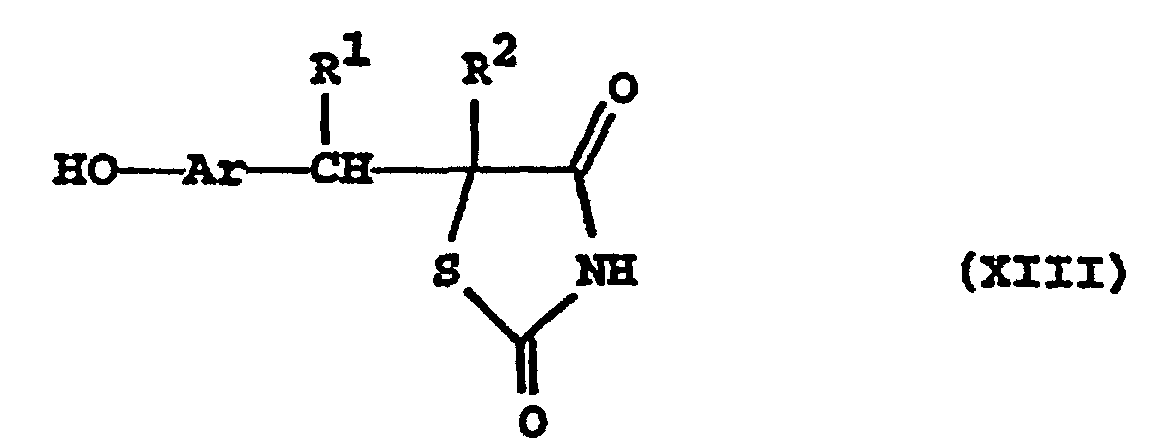
- A process for the preparation of thiazolidinedione derivatives of formula (I) as defined in claim 1, their tautomeric forms, their pharmaceutically acceptable salts, or their pharmaceutically acceptable solvates which comprises(a) reacting a compound of formula (VII)with the compound of formula (XIV) in the presence of a base
 where A, B, R, D, X and Ar are as defined above;
 (b) reducing a compound of formula (XV) to yield a compound of formula (XVI),where A, B, R, D, X and Ar are as defined above;
 (c) reacting a compound of general formula (XVI) under diazotization conditions and subsequently treating with acrylic acid or its esters to obtain a compound of formula (XVII)where A, B, R, D, X and Ar are as defined above, K is a halogen atom and J is an acid or an ester group;
 (d) treating the compound of formula (XVII) with thiourea followed by hydrolysis to yield a compound of formula (I).
 - A process as claimed in claim 5, wherein the compound of formula (XV) of step (a) is prepared by reacting a compound of formula (XI)wherein A, B, R, D, L1 are as defined in claim 2, with a compound of formula (XVIII)

- A compound selected from:5-[4-[2-[N-(6-Benzyloxy-2,5,7,8-tetramethylchroman-2-ylmethyl)-N-methylamino]ethoxy] phenyl methylene]thiazolidine-2,4-dione;5-[4-[2-[N-[2-(6-Benzyloxy-2,5,7,8-tetramethylchroman-2-yl)ethyl]-N-methylamino]ethoxy] phenyl methylene]thiazolidine-2,4-dione;5-[4-[2-[N-(6-Benzyloxy-2,5,7,8-tetramethylchroman-2-ylmethyl)amino]ethoxy]phenyl methylene]thiazolidine-2,4-drone;5-[4-[2-[N-(6-Benzyloxy-2,5,7,8-tetramethylchroman-2-ylmethyl)-N-ethylamino]ethoxy] phenyl methylene]thiazolidine-2,4-dione;5-[4-[2-[N-(5-Benzyloxy-2,3-dihydro-2,2,4,6,7-pentamethyl-1-benzofuran-3-ylmethyl)-N-methylamino]ethoxy]phenyl methylene]thiazolidine-2,4-dione;5-[6-[2-[N-(6-Benzyloxy-2,5,7,8-tetramethylchroman-2-ylmethyl)-N-tnethylamino]ethoxy-2-naphthyl methylene]thiazolidine-2,4-dione;5-[4-[2-(N-Benzyl-N-methylamino]ethylthio]benzyl]thiazolidine-2,4-dione;5-[4-[2-[N-(6-Benzyloxy-2,5,7,8-tetramethylchroman-2-ylmethy)-N-methylamino]ethoxy]benzyl]thiazolidine-2,4-dione;5-[4-[2-[N-[2-(6-Benzyloxy-2,5,7,8-tetramethylchroman-2-yl)ethyl]-N-methylamino]ethoxy] benzyl]thiazolidine-2,4-dione;5-[4-[2-[N-(6-Benzyloxy-2,5,7,8-tetramethylchroman-2-ylmethyl)-N-ethylamino]ethoxy] benzyl]thiazolidine-2,4-dione;5-[4-[2-[N-(5-Benzyloxy-2,3-dihydro-2,2,4,6,7-pentamethyl-1-benzofuran-3-ylmethyl-N-methyl-amino]ethoxy]benzyl]thiazolidine-2,4-dione;5-[4-[2-[N-(6-Hydroxy-2,5,7,8-tetramethylchroman-2-ylmethyl)-N-methylamino]ethoxy] phenyl methylene]thiazolidine-2,4-dione;5-[4-(2-[N-[2-(6-Hydroxy-2,5,7,8-tetramethylchroman-2-yl)ethyl]-N-methylamino]ethoxy] phenyl methylene]thiazolidine-2,4-dione;5-[4-[2-[N-(6-Hydroxy-2,5,7,8-tetramethylchmman-2-ylmethyl)amino] ethoxy]phenyl methylene]thiazolidine-2,4-dione;5-[4-[2-[N-(6-Hydroxy-2,5,7,8-tetramethylchroman-2-ylmethyl)-N-ethylamino]ethoxy] phenyl methylene]thiazolidine-2,4-dione;5-[4-[2-[N-(2,3-Dihydro-5-hydroxy-2,2,4,6,7-pentamethyl-1-benzofuran-3-ylmethyl)-N-methylamino]ethoxy]phenyl methylene]thiazolidine-2,4-dione;5-[6-[2-[N-(6-Hydroxy-2,5,7,8-tetramethylchroman-2-ylmethyl)-N-methylamino]ethoxy]-2-naphthyl methylene]thiazolidine-2,4-dione;5-[4-[N-Methyl-N-(5-methyl-2-phenyl-4-oxazolyl)methylamino] ethoxy]phenyl methylene]thiazolidine-2,4-dione;5-[4-[2-[N-Methyl-N-(2-pyridylmethyl)amino]ethoxy]phenyl methylene]thiazolidine-2,4-dione;5-[4-[2-[N-Benzyl-N-methylamino]ethoxy]phenyl methylene] thiazolidine-2,4-dione;5-[4-[2-[N-Methyl-N-(3-phenylpropyl)amino]ethoxy]phenyl methylene]thiazolidine-2,4-dione;5-[4-[2-[N-Methyl-N-(3-phenylprop-2-enyl)amino]ethoxy]phenyl methylene]thiazolidine-2,4-dione;5-[4-[2-[N-(Hydroxy-2,5,7,8-tetramethylchroman-2-ylmethyl)-N-methylamino]ethoxy]benzyl]thiazolidine-2,4-dione;5-[4-[2-[N-[2-(6-Hydroxy-2,5,7,8-tetramethylchroman-2-yl)ethyl)-N-methylamino]ethoxy)benzyl]thiazolidine-2,4-dione;5-[4-[2-[N-(6-Hydroxy-2,5,7,8-tetramethylchroman-2-ylmethyl)-N-ethylamino]ethoxy]benzyl]thiazolidine-2,4-dione;5-[4-[2-[N-(2,3-Dihydro-5-hydroxy-2,2,4,6,7-pentamethyl-1-benzofuran-3-ylmethyl)-N-methylamino]ethoxy]benzyl]thiazolidine-2,4-dione;5-[4-[2-[N-Methyl-N-(5-methyl-2-phenyl-4-oxazolyl)methylamino] ethoxy]benzyl]thiazolidine-2,4-dione;5-[4-[2-[N-Benzyl-N-methylamino]ethoxy]benzyl]thiazolidine-2,4-dione;5-[4-[2-[N-Methyl-N-(3-phenylpropyl)amino]ethoxy]benzyl] thiazolidine-2,4-dione; and5-[4-[2-[N-Methyl-N-(3-phenylprop-2-enyl)amino]ethoxy]benzyl] thiazolidine 2,4-dione.
- 5-[4-[2-[N-(5-Benzyloxy-2,3-dihydro-2,2,4,6,7-pentamethyl-1-benzofuran-3-ylmethyl-N-methylamino]ethoxy]benzyl]thiazolidine-2,4-dione of the formulaits tautomeric forms, its pharmaceutically acceptable salts or its pharmaceutically acceptable solvates.
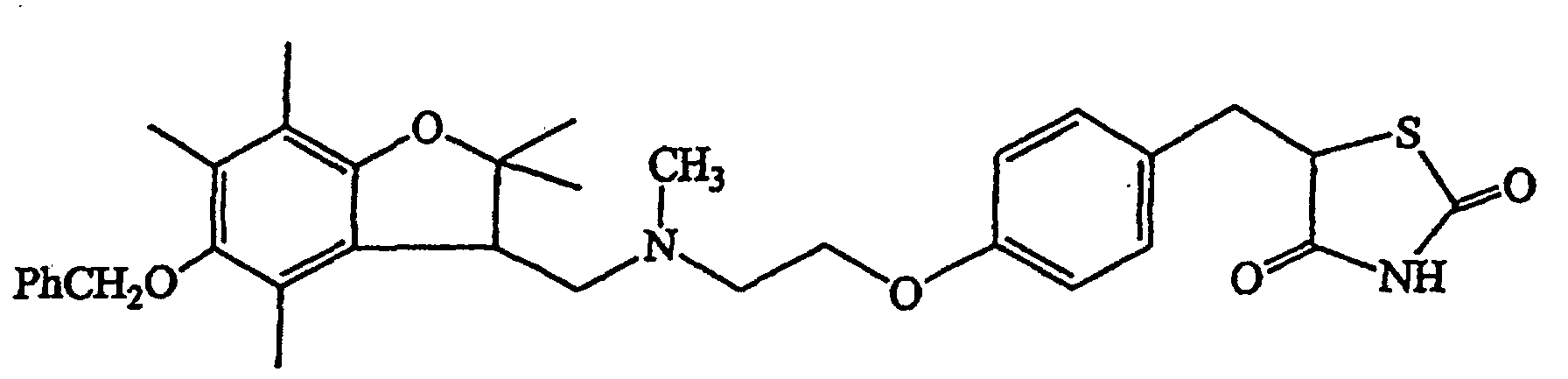
- A pharmaceutical composition useful for the treatment of type II diabetes, for prophylactic treatment, hyperlipidaemia, hypertension, cardiovascular diseases including atherosclerosis as well as certain eating disorders which comprises a compound of the general formula (I) as defined in claim 1, 7 or 8, together with usual pharmaceutically acceptable carrier, diluent, solvate or the like.
Priority Applications (3)
| Application Number | Priority Date | Filing Date | Title |
|---|---|---|---|
| EP96105590A EP0801063B1 (en) | 1996-04-09 | 1996-04-09 | Thiazolidinedione derivatives having antidiabetic, hypolipidaemic, antihypertensive properties, process for their preparation and pharmaceutical compositions containing them |
| DE69625795T DE69625795T2 (en) | 1996-04-09 | 1996-04-09 | Thiazolidinedione derivatives with antidiabetic, hypolipidemic and antihypertensive properties, processes for their preparation and pharmaceutical compositions containing them |
| AT96105590T ATE231136T1 (en) | 1996-04-09 | 1996-04-09 | THIAZOLIDINEDIONE DERIVATIVES HAVING ANTIDIABETIC, HYPOLIPIDEMIC AND ANTIHYPERTENSIVE PROPERTIES, METHOD FOR THE PRODUCTION THEREOF AND PHARMACEUTICAL COMPOSITIONS CONTAINING THEM |
Applications Claiming Priority (1)
| Application Number | Priority Date | Filing Date | Title |
|---|---|---|---|
| EP96105590A EP0801063B1 (en) | 1996-04-09 | 1996-04-09 | Thiazolidinedione derivatives having antidiabetic, hypolipidaemic, antihypertensive properties, process for their preparation and pharmaceutical compositions containing them |
Publications (2)
| Publication Number | Publication Date |
|---|---|
| EP0801063A1 EP0801063A1 (en) | 1997-10-15 |
| EP0801063B1 true EP0801063B1 (en) | 2003-01-15 |
Family
ID=8222652
Family Applications (1)
| Application Number | Title | Priority Date | Filing Date |
|---|---|---|---|
| EP96105590A Expired - Lifetime EP0801063B1 (en) | 1996-04-09 | 1996-04-09 | Thiazolidinedione derivatives having antidiabetic, hypolipidaemic, antihypertensive properties, process for their preparation and pharmaceutical compositions containing them |
Country Status (3)
| Country | Link |
|---|---|
| EP (1) | EP0801063B1 (en) |
| AT (1) | ATE231136T1 (en) |
| DE (1) | DE69625795T2 (en) |
Cited By (2)
| Publication number | Priority date | Publication date | Assignee | Title |
|---|---|---|---|---|
| US7592342B2 (en) | 2007-05-10 | 2009-09-22 | Smithkline Beecham Corporation | Quinoxaline derivatives as PI3 kinase inhibitors |
| US8138347B2 (en) | 2007-05-18 | 2012-03-20 | Glaxosmithkline Llc | Quinoline derivatives as PI3 kinase inhibitors |
Families Citing this family (6)
| Publication number | Priority date | Publication date | Assignee | Title |
|---|---|---|---|---|
| KR100608416B1 (en) * | 1999-11-12 | 2006-08-02 | 후지모토 쿄다이 가부시키가이샤 | 2- (N-cyanoimino) thiazolidin-4-one derivative |
| US6784199B2 (en) | 2000-09-21 | 2004-08-31 | Aryx Therapeutics | Isoxazolidine compounds useful in the treatment of diabetes, hyperlipidemia, and atherosclerosis in mammals |
| US6768008B2 (en) * | 2000-04-24 | 2004-07-27 | Aryx Therapeutics | Materials and methods for the treatment of diabetes, hyperlipidemia, hypercholesterolemia, and atherosclerosis |
| US6680387B2 (en) | 2000-04-24 | 2004-01-20 | Aryx Therapeutics | Materials and methods for the treatment of diabetes, hyperlipidemia, hypercholesterolemia, and atherosclerosis |
| US6958355B2 (en) | 2000-04-24 | 2005-10-25 | Aryx Therapeutics, Inc. | Materials and methods for the treatment of diabetes, hyperlipidemia, hypercholesterolemia, and atherosclerosis |
| GB0021785D0 (en) * | 2000-09-05 | 2000-10-18 | Smithkline Beecham Plc | Novel Pharmaceutical |
Citations (3)
| Publication number | Priority date | Publication date | Assignee | Title |
|---|---|---|---|---|
| EP0236624A2 (en) * | 1985-11-21 | 1987-09-16 | Beecham Group Plc | Substituted phenyl ethanol amines, processes for their preparation and pharmaceutical compositions containing them |
| EP0543662A2 (en) * | 1991-11-20 | 1993-05-26 | Sankyo Company Limited | Aromatic amino-alcohol derivatives having anti-diabetic and anti-obesity properties, their preparation and their therapeutic uses |
| EP0678511A2 (en) * | 1994-03-23 | 1995-10-25 | Sankyo Company Limited | Thiazolidine and oxazolidine derivatives, their preparation and their medical use |
Family Cites Families (6)
| Publication number | Priority date | Publication date | Assignee | Title |
|---|---|---|---|---|
| JPS6051189A (en) * | 1983-08-30 | 1985-03-22 | Sankyo Co Ltd | Thiazolidine derivative and its preparation |
| ATE186724T1 (en) * | 1987-09-04 | 1999-12-15 | Beecham Group Plc | SUBSTITUTED THIAZOLIDINEDIONE DERIVATIVES |
| GB8820389D0 (en) * | 1988-08-26 | 1988-09-28 | Beecham Group Plc | Novel compounds |
| GB8919434D0 (en) * | 1989-08-25 | 1989-10-11 | Beecham Group Plc | Novel compounds |
| GB8919417D0 (en) * | 1989-08-25 | 1989-10-11 | Beecham Group Plc | Novel compounds |
| GB9023584D0 (en) * | 1990-10-30 | 1990-12-12 | Beecham Group Plc | Novel compounds |
-
1996
- 1996-04-09 EP EP96105590A patent/EP0801063B1/en not_active Expired - Lifetime
- 1996-04-09 AT AT96105590T patent/ATE231136T1/en not_active IP Right Cessation
- 1996-04-09 DE DE69625795T patent/DE69625795T2/en not_active Expired - Fee Related
Patent Citations (3)
| Publication number | Priority date | Publication date | Assignee | Title |
|---|---|---|---|---|
| EP0236624A2 (en) * | 1985-11-21 | 1987-09-16 | Beecham Group Plc | Substituted phenyl ethanol amines, processes for their preparation and pharmaceutical compositions containing them |
| EP0543662A2 (en) * | 1991-11-20 | 1993-05-26 | Sankyo Company Limited | Aromatic amino-alcohol derivatives having anti-diabetic and anti-obesity properties, their preparation and their therapeutic uses |
| EP0678511A2 (en) * | 1994-03-23 | 1995-10-25 | Sankyo Company Limited | Thiazolidine and oxazolidine derivatives, their preparation and their medical use |
Cited By (5)
| Publication number | Priority date | Publication date | Assignee | Title |
|---|---|---|---|---|
| US7592342B2 (en) | 2007-05-10 | 2009-09-22 | Smithkline Beecham Corporation | Quinoxaline derivatives as PI3 kinase inhibitors |
| US8138347B2 (en) | 2007-05-18 | 2012-03-20 | Glaxosmithkline Llc | Quinoline derivatives as PI3 kinase inhibitors |
| US8404837B2 (en) | 2007-05-18 | 2013-03-26 | Glaxosmithkline Llc | Quinoline derivatives as P13 kinase inhibitors |
| US8633187B2 (en) | 2007-05-18 | 2014-01-21 | Glaxosmithkline Llc | Quinoline derivatives as PI3 kinase inhibitors |
| US8785433B2 (en) | 2007-05-18 | 2014-07-22 | Glaxosmithkline Llc | Quinoline derivatives as PI3 kinase inhibitors |
Also Published As
| Publication number | Publication date |
|---|---|
| ATE231136T1 (en) | 2003-02-15 |
| DE69625795D1 (en) | 2003-02-20 |
| DE69625795T2 (en) | 2003-08-14 |
| EP0801063A1 (en) | 1997-10-15 |
Similar Documents
| Publication | Publication Date | Title |
|---|---|---|
| US5925656A (en) | Compounds having antidiabetic, hypolipidemic, antihypertensive properties, process for their preparation and pharmaceutical compositions containing them | |
| CA1277323C (en) | Thiazolidinedione derivatives, their production and use | |
| EP0971917B1 (en) | Thiazolidinedione and oxazolidinedione derivatives having antidiabetic, hypolipidaemic and antihypertensive properties | |
| EP0981526B1 (en) | Novel antidiabetic compounds having hypolipidaemic, antihypertensive properties, process for their preparation and pharmaceutical compositions containing them | |
| US5391565A (en) | Oxazolidine dione derivatives | |
| US5143930A (en) | Thiazolidine derivatives with anti-diabetic activity, their preparation and their use | |
| KR100579765B1 (en) | Methods for the preparation of novel heterocyclic compounds, their pharmaceutical compositions and their use in the treatment of diabetes and related diseases | |
| US5075300A (en) | Novel compounds | |
| US6313113B1 (en) | Heterocyclic compounds having antidiabetic, hypolipidemic and antihypertensive properties, process for their preparation and pharmaceutical compositions containing them | |
| HK1005451B (en) | Thiazolidine derivatives with anti-diabetic activity, their preparation and their use | |
| US6686475B2 (en) | Compounds | |
| EP0801063A1 (en) | Thiazolidinedione derivatives having antidiabetic, hypolipidaemic antihypertensive properties, process for their preparation and pharmaceutical compositions containing them | |
| US5889032A (en) | Heterocyclic compounds having antidiabetic, hypolipidaemic, antihypertensive properties, process for their preparation and pharmaceutical compositions containing them | |
| EP1036075B1 (en) | Substituted thiazolidinedione and oxazolidinedione having antidiabetic, hypolipidemia and antihypertensive properties | |
| JP2003531200A (en) | Materials and methods for the treatment of diabetes, hyperlipidemia, hypercholesterolemia, and atherosclerosis | |
| EP0894089B1 (en) | Novel heterocyclic compounds having antidiabetic, hypolipidaemic, antihypertensive properties, process for their preparation and pharmaceutical compositions containing them | |
| CA2173660A1 (en) | Thiazolidinedione derivatives having antidiabetic, hypolipidaemic, and antihypertensive properties | |
| US20080267888A1 (en) | Heterocyclic Derivatives | |
| US20100305174A1 (en) | Novel Heterocyclic Derivatives | |
| KR0169463B1 (en) | Substituted Thiazolidinedione Derivative Compounds | |
| WO2007042878A1 (en) | Novel heterocyclic analogs of biphenyl ethers | |
| WO2007029062A2 (en) | Novel pyridine derivatives | |
| WO2004089945A1 (en) | Rosiglitazone derivatives as antidiabetic agents | |
| HK1026204B (en) | Heterocyclic compounds process for their preparation and pharmaceutical compositions containing them and their use in the treatment of diabetes and related diseases | |
| HK1026204A1 (en) | Heterocyclic compounds process for their preparation and pharmaceutical compositions containing them and their use in the treatment of diabetes and related diseases |
Legal Events
| Date | Code | Title | Description |
|---|---|---|---|
| PUAI | Public reference made under article 153(3) epc to a published international application that has entered the european phase |
Free format text: ORIGINAL CODE: 0009012 |
|
| AK | Designated contracting states |
Kind code of ref document: A1 Designated state(s): AT BE CH DE DK FR GB IT LI LU NL SE |
|
| RIN1 | Information on inventor provided before grant (corrected) |
Inventor name: CASTURI, SESHAGIRI RAO Inventor name: RAMANUJAM, RAJAGOPALAN Inventor name: PINGALI, HARIKISHORE Inventor name: ALLA, SEKHAR REDDY Inventor name: LOHRAY, VIDYA BHUSHAN Inventor name: KALLAM, ANJI REDDY |
|
| RTI1 | Title (correction) |
Inventor name: CASTURI, SESHAGIRI RAO Inventor name: RAMANUJAM, RAJAGOPALAN Inventor name: PINGALI, HARIKISHORE Inventor name: ALLA, SEKHAR REDDY Inventor name: LOHRAY, VIDYA BHUSHAN |
|
| 17P | Request for examination filed |
Effective date: 19980217 |
|
| 17Q | First examination report despatched |
Effective date: 19991108 |
|
| GRAG | Despatch of communication of intention to grant |
Free format text: ORIGINAL CODE: EPIDOS AGRA |
|
| GRAG | Despatch of communication of intention to grant |
Free format text: ORIGINAL CODE: EPIDOS AGRA |
|
| GRAG | Despatch of communication of intention to grant |
Free format text: ORIGINAL CODE: EPIDOS AGRA |
|
| GRAH | Despatch of communication of intention to grant a patent |
Free format text: ORIGINAL CODE: EPIDOS IGRA |
|
| RAP1 | Party data changed (applicant data changed or rights of an application transferred) |
Owner name: DR. REDDY'S LABORATORIES LTD. |
|
| GRAH | Despatch of communication of intention to grant a patent |
Free format text: ORIGINAL CODE: EPIDOS IGRA |
|
| GRAA | (expected) grant |
Free format text: ORIGINAL CODE: 0009210 |
|
| AK | Designated contracting states |
Kind code of ref document: B1 Designated state(s): AT BE CH DE DK FR GB IT LI LU NL SE |
|
| PG25 | Lapsed in a contracting state [announced via postgrant information from national office to epo] |
Ref country code: NL Free format text: LAPSE BECAUSE OF FAILURE TO SUBMIT A TRANSLATION OF THE DESCRIPTION OR TO PAY THE FEE WITHIN THE PRESCRIBED TIME-LIMIT Effective date: 20030115 Ref country code: IT Free format text: LAPSE BECAUSE OF FAILURE TO SUBMIT A TRANSLATION OF THE DESCRIPTION OR TO PAY THE FEE WITHIN THE PRE;WARNING: LAPSES OF ITALIAN PATENTS WITH EFFECTIVE DATE BEFORE 2007 MAY HAVE OCCURRED AT ANY TIME BEFORE 2007. THE CORRECT EFFECTIVE DATE MAY BE DIFFERENT FROM THE ONE RECORDED.SCRIBED TIME-LIMIT Effective date: 20030115 Ref country code: BE Free format text: LAPSE BECAUSE OF FAILURE TO SUBMIT A TRANSLATION OF THE DESCRIPTION OR TO PAY THE FEE WITHIN THE PRESCRIBED TIME-LIMIT Effective date: 20030115 Ref country code: AT Free format text: LAPSE BECAUSE OF FAILURE TO SUBMIT A TRANSLATION OF THE DESCRIPTION OR TO PAY THE FEE WITHIN THE PRESCRIBED TIME-LIMIT Effective date: 20030115 |
|
| REG | Reference to a national code |
Ref country code: GB Ref legal event code: FG4D Ref country code: CH Ref legal event code: EP |
|
| REG | Reference to a national code |
Ref country code: CH Ref legal event code: NV Representative=s name: A. BRAUN, BRAUN, HERITIER, ESCHMANN AG PATENTANWAE |
|
| REF | Corresponds to: |
Ref document number: 69625795 Country of ref document: DE Date of ref document: 20030220 Kind code of ref document: P |
|
| PG25 | Lapsed in a contracting state [announced via postgrant information from national office to epo] |
Ref country code: LU Free format text: LAPSE BECAUSE OF NON-PAYMENT OF DUE FEES Effective date: 20030409 |
|
| PG25 | Lapsed in a contracting state [announced via postgrant information from national office to epo] |
Ref country code: DK Free format text: LAPSE BECAUSE OF FAILURE TO SUBMIT A TRANSLATION OF THE DESCRIPTION OR TO PAY THE FEE WITHIN THE PRESCRIBED TIME-LIMIT Effective date: 20030415 |
|
| REG | Reference to a national code |
Ref country code: SE Ref legal event code: TRGR |
|
| NLV1 | Nl: lapsed or annulled due to failure to fulfill the requirements of art. 29p and 29m of the patents act | ||
| ET | Fr: translation filed | ||
| PLBE | No opposition filed within time limit |
Free format text: ORIGINAL CODE: 0009261 |
|
| STAA | Information on the status of an ep patent application or granted ep patent |
Free format text: STATUS: NO OPPOSITION FILED WITHIN TIME LIMIT |
|
| 26N | No opposition filed |
Effective date: 20031016 |
|
| PGFP | Annual fee paid to national office [announced via postgrant information from national office to epo] |
Ref country code: FR Payment date: 20040421 Year of fee payment: 9 |
|
| PGFP | Annual fee paid to national office [announced via postgrant information from national office to epo] |
Ref country code: DE Payment date: 20040422 Year of fee payment: 9 |
|
| PGFP | Annual fee paid to national office [announced via postgrant information from national office to epo] |
Ref country code: SE Payment date: 20040427 Year of fee payment: 9 |
|
| PGFP | Annual fee paid to national office [announced via postgrant information from national office to epo] |
Ref country code: CH Payment date: 20040428 Year of fee payment: 9 |
|
| PGFP | Annual fee paid to national office [announced via postgrant information from national office to epo] |
Ref country code: GB Payment date: 20040607 Year of fee payment: 9 |
|
| PG25 | Lapsed in a contracting state [announced via postgrant information from national office to epo] |
Ref country code: GB Free format text: LAPSE BECAUSE OF NON-PAYMENT OF DUE FEES Effective date: 20050409 |
|
| PG25 | Lapsed in a contracting state [announced via postgrant information from national office to epo] |
Ref country code: SE Free format text: LAPSE BECAUSE OF NON-PAYMENT OF DUE FEES Effective date: 20050410 |
|
| PG25 | Lapsed in a contracting state [announced via postgrant information from national office to epo] |
Ref country code: LI Free format text: LAPSE BECAUSE OF NON-PAYMENT OF DUE FEES Effective date: 20050430 Ref country code: CH Free format text: LAPSE BECAUSE OF NON-PAYMENT OF DUE FEES Effective date: 20050430 |
|
| PG25 | Lapsed in a contracting state [announced via postgrant information from national office to epo] |
Ref country code: DE Free format text: LAPSE BECAUSE OF NON-PAYMENT OF DUE FEES Effective date: 20051101 |
|
| EUG | Se: european patent has lapsed | ||
| REG | Reference to a national code |
Ref country code: CH Ref legal event code: PL |
|
| GBPC | Gb: european patent ceased through non-payment of renewal fee |
Effective date: 20050409 |
|
| PG25 | Lapsed in a contracting state [announced via postgrant information from national office to epo] |
Ref country code: FR Free format text: LAPSE BECAUSE OF NON-PAYMENT OF DUE FEES Effective date: 20051230 |
|
| REG | Reference to a national code |
Ref country code: FR Ref legal event code: ST Effective date: 20051230 |