EP0801062A1 - Pyrimidine derivatives - Google Patents
Pyrimidine derivatives Download PDFInfo
- Publication number
- EP0801062A1 EP0801062A1 EP95940471A EP95940471A EP0801062A1 EP 0801062 A1 EP0801062 A1 EP 0801062A1 EP 95940471 A EP95940471 A EP 95940471A EP 95940471 A EP95940471 A EP 95940471A EP 0801062 A1 EP0801062 A1 EP 0801062A1
- Authority
- EP
- European Patent Office
- Prior art keywords
- compound
- pyrimidinyl
- methoxyphenoxy
- pyrimidinyloxy
- synthesis
- Prior art date
- Legal status (The legal status is an assumption and is not a legal conclusion. Google has not performed a legal analysis and makes no representation as to the accuracy of the status listed.)
- Granted
Links
- 0 CC(C(*)N)C=C(*)N=C(C)C(C)=NC(*C(C=CC*)=C)=C Chemical compound CC(C(*)N)C=C(*)N=C(C)C(C)=NC(*C(C=CC*)=C)=C 0.000 description 4
Images

Classifications
-
- C—CHEMISTRY; METALLURGY
- C07—ORGANIC CHEMISTRY
- C07D—HETEROCYCLIC COMPOUNDS
- C07D239/00—Heterocyclic compounds containing 1,3-diazine or hydrogenated 1,3-diazine rings
- C07D239/02—Heterocyclic compounds containing 1,3-diazine or hydrogenated 1,3-diazine rings not condensed with other rings
- C07D239/24—Heterocyclic compounds containing 1,3-diazine or hydrogenated 1,3-diazine rings not condensed with other rings having three or more double bonds between ring members or between ring members and non-ring members
- C07D239/28—Heterocyclic compounds containing 1,3-diazine or hydrogenated 1,3-diazine rings not condensed with other rings having three or more double bonds between ring members or between ring members and non-ring members with hetero atoms or with carbon atoms having three bonds to hetero atoms with at the most one bond to halogen, directly attached to ring carbon atoms
- C07D239/69—Benzenesulfonamido-pyrimidines
Definitions
- the present invention relates to novel pyrimidine derivatives and their salts, and to pharmaceuticals containing these compounds as active ingredients.
- Endothelin having potent vasoconstrictive effect, blood pressure elevating effect, and cell proliferation effect, is considered to be a substance that contributes to various diseases and disorders including heart diseases such as ischemic heart infarction, congestive heart failure, arrhythmia, and unstable angina; airway diseases such as asthma; hypertonia such as pulmonary hypertension, renal hypertension, and hypertension accompanying organ transplantation; circulatory diseases such as subarachnoid hemorrhage and post-PTCA reconstriction or vasospasm; kidney diseases such as acute and chronic renal failure; diabetes, hyperlipemia, and other diseases that are accompanied by vascular lesion, as well as arteriosclerosis; liver diseases such as alcohol-induced liver disorders; gastrointestinal disorders such as those of gastric mucosa; bone diseases; prostatic hypertrophy and urinary disorders; cancer; and skin diseases concurrent with proliferation of melanocytes [ Saishin - Igaku (may be translated to "Medicine Up-to-date"), 94, 335-431 (1994),
- the present invention is directed to the discovery of a compound that has potent endothelin antagonism, as well as to the provision of pharmaceuticals containing such a compound as the active ingredient.
- the present inventors carried out careful studies, and found that the pyrimidine derivatives represented by the following formula (1) and their salts exhibit excellent endothelin antagonism and thus are useful as medicines - particularly those for circulatory diseases.
- the present invention was accomplished based on this finding.
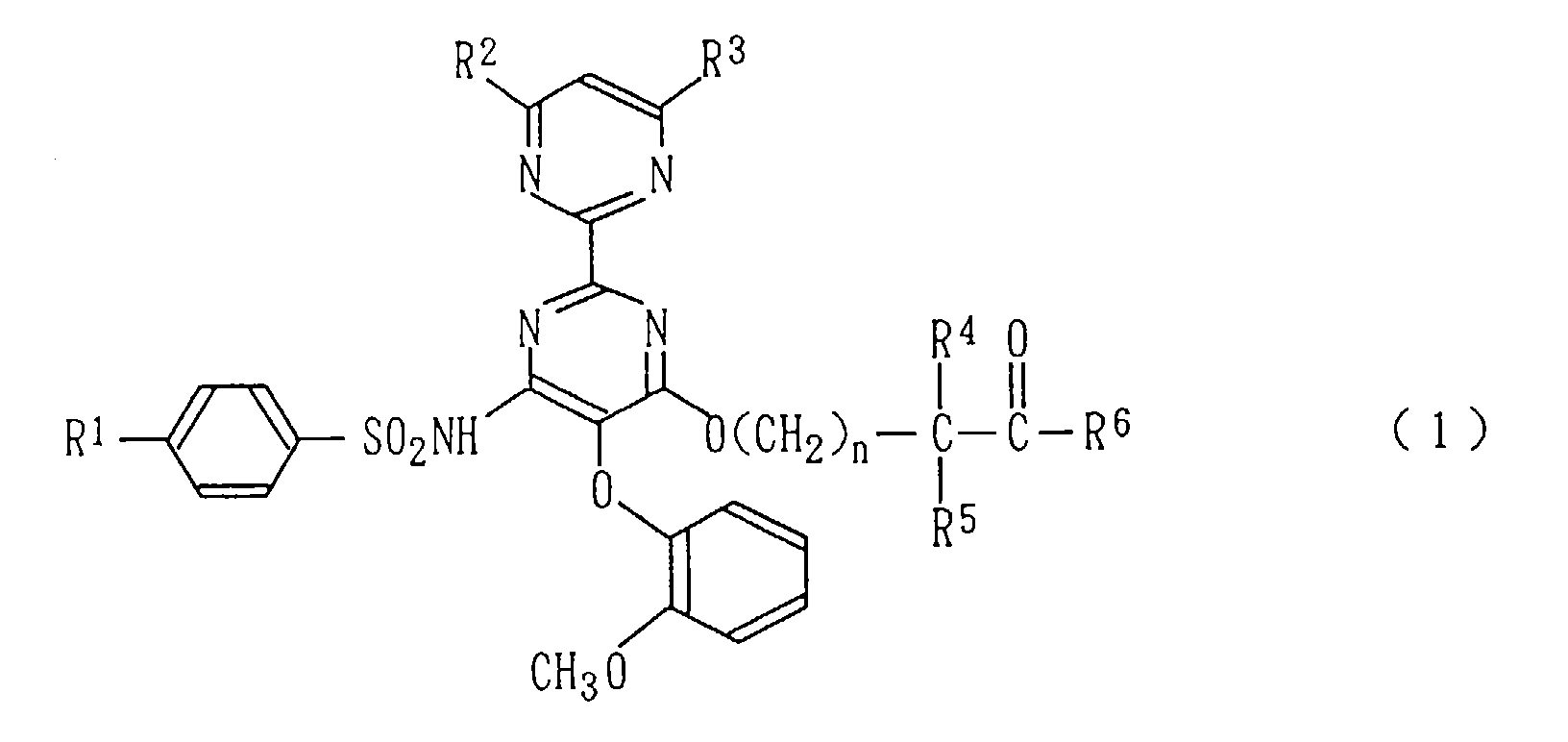
- the present invention provides a pyrimidine derivative of the following formula (1) or a salt thereof:
- R 1 represents a lower alkyl group
- each of R 2 and R 3 which are identical to or different from each other, represents a hydrogen atom, a lower alkyl group, or a lower alkoxyl group
- each of R 4 and R 5 which are identical to or different from each other, represents a hydrogen atom or a lower alkyl group
- R 6 represents a lower alkyl group, -OR 7 , or -NR 8 R 9
- n is a number between 0 and 3 inclusive
- R 7 represents a hydrogen atom, a lower alkyl group, a phenyl group which may have a substituent, or an aralkyl group which may have a substituent
- each of R 8 and R 9 which are identical to or different from each other, represents a hydrogen atom, a hydroxyl group, a lower alkyl group which may have a substituent
- the present invention also provides a medicine containing a pyrimidine derivative of formula (1) or a salt thereof.
- the present invention also provides a pharmaceutical composition containing a pyrimidine derivative of formula (1) or a salt thereof and a pharmaceutically acceptable carrier.
- the present invention also provides use as a medicine of a pyrimidine derivative of formula (1) or a salt thereof.
- the present invention also provides a method for treating diseases induced by endothelin, wherein the method is characterized by administering an effective amount of a pyrimidine derivative of formula (1) or a salt thereof.
- Fig. 1 is a graph showing the ET A receptor antagonism of Compound No. 92.
- Fig. 2 is a graph showing the ET B receptor antagonism of Compound No. 68.
- the term “lower” is used to indicate that the number of carbon atoms is between 1 and 6 inclusive.
- the lower alkyl groups represented by R 1 , R 2 , R 3 , R 4 , R 5 , R 6 , R 7 , R 8 , and R 9 include linear, branched, or cyclic alkyl groups having 1-6 carbon atoms, examples of which include methyl, ethyl, n-propyl, isopropyl, n-butyl, isobutyl, sec-butyl, tert-butyl, n-pentyl, n-hexyl, cyclopropyl, cyclopentyl, and cyclohexyl.
- R 1 is preferably isopropyl or tert-butyl, with tert-butyl being particularly preferred.
- the lower alkoxyl groups represented by R 2 and R 3 include linear, branched, or cyclic alkoxyl groups having 1-6 carbon atoms, examples of which include methoxy, ethoxy, n-propoxy, isopropoxy, and n-butoxy.
- phenyl group which may have a substituent and which is represented by R 7 include phenyl groups substituted by C1-C6 alkyl groups, C1-C6 alkoxyl groups, or by halogen atoms. Specific examples of such phenyl groups include methylphenyl, ethylphenyl, isopropylphenyl, methoxyphenyl, ethoxyphenyl, chlorophenyl, bromophenyl, and fluorophenyl.
- the aralkyl groups which may have substituents and which are represented by R 7 , R 8 , and R 9 include phenylalkyl groups, naphthylalkyl groups, biphenylalkyl groups, and indanyl groups. These groups may be substituted by hydroxy, C1-C6 alkyl, C1-C6 alkoxyl, C1-C3 alkylenedioxy, halogen, nitro, trifluoromethyl, or cyano groups. Examples of the alkyl moieties of the aralkyl groups include C1-6 alkyl groups. The aralkyl groups may be substituted by one to three groups of the above-mentioned substituents.
- substituents may be substituted at either the aryl moiety or the alkyl moiety of the aralkyl group.
- aralkyl groups which may have substituents include benzyl, phenethyl, phenylpropyl, naphthylmethyl, naphthylethyl, biphenylmethyl, and indan-1-yl groups, and these groups may be substituted by one to three groups selected from among the groups consisting of chloro, fluoro, methoxy, ethoxy, methyl, ethyl, nitro, cyano, and trifluoromethyl groups.
- the lower alkyl groups which may have substituents and which are represented by R 8 and R 9 include, in addition to the lower alkyl groups listed for R 1 through R 9 groups, alkyl groups substituted by one to three halogen atoms, hydroxyl groups, etc.
- the lower alkenyl groups which may have substituents include linear, branched, or cyclic alkenyl groups having 2-6 carbon atoms, as well as the same groups substituted by one to three halogen atoms, hydroxyl groups, etc. Specific examples include vinyl, propenyl, and isobutenyl groups.
- aryl group may be phenyl or naphtyl which may be substituted by one to three C1-C6 alkyl groups, C2-C6 alkenyl groups, C1-C6 alkoxyl groups, C1-C6 alkylthio groups, halogen atoms, hydroxy groups, amino groups, nitro groups, alkoxycarbonyl groups or C1-C6 haloalkyl groups, etc.
- amino groups which may have substituents and which are represented by R 8 and R 9 include arylamino groups, heterocyclic amino groups, alkylamino groups, and alkenylamino groups. More specifically, mention may be given to phenylamino groups, C1-C6 alkyl-substituted phenylamino groups, pyridylamino groups, and C1-C6 alkylamino groups.
- heterocyclic group which may have a substituent or the heterocyclic-alkyl group which may have a substituent examples include furyl groups, thienyl groups, pyrazolyl groups, thiazolyl groups, thiadiazolyl groups, imidazolyl groups, pyridyl groups, pyrimidinyl groups, pyrazinyl groups, furylalkyl groups, thienylalkyl groups, pyrazolylalkyl groups, thiazolylalkyl groups, imidazolylalkyl groups, pyridylalkyl groups, and pyrimidinylalkyl groups, and these groups may be substituted by C1-C6 alkyl groups, C1-C6 alkoxyl groups, C1-C6 haloalkyl groups, or halogen atoms.
- furyl groups include furyl groups, thienyl groups, pyrazolyl groups, thiazolyl groups, pyridyl groups, pyrimidinyl groups, pyrazinyl groups, furfuryl groups, thienylmethyl groups, pyrazolylmethyl groups, thiazolylmethyl groups, imidazolylmethyl groups, pyridylmethyl groups, and pyrimidinylmethyl groups, all of which groups may be substituted by a group selected from among the groups consisting of methyl, ethyl, methoxy, ethoxy, chloro, fluoro, and trifluoromethyl.
- Examples of the 5- to 7-membered ring formed by -NR 8 R 9 include pyrrolidinyl groups, piperidinyl groups, and perhydroazepinyl groups.
- the salts of the compound (1) of the present invention are not particularly limited so long as they are pharmaceutically acceptable.
- the salts include mineral acid salts such as hydrochloric acid salts and sulfuric acid salts; organic acid salts such as acetic acid salts, oxalic acid salts, and citric acid salts; alkali metal salts such as sodium salts and potassium salts, alkaline earth metal salts such as calcium salts and magnesium salts; and salts of organic bases such as 1,8-diazabicyclo[5.4.0]undec-7-ene (DBU) salts.
- mineral acid salts such as hydrochloric acid salts and sulfuric acid salts
- organic acid salts such as acetic acid salts, oxalic acid salts, and citric acid salts
- alkali metal salts such as sodium salts and potassium salts
- alkaline earth metal salts such as calcium salts and magnesium salts
- salts of organic bases such as 1,8-diazabicyclo[5.4.0
- the compound (1) of the present invention encompasses its hydrates and solvates.
- the compound (1) of the present invention may be prepared in accordance with the following reaction scheme.
- R 7a represents a lower alkyl group, a substituted or unsubstituted phenyl group, or a substituted or unsubstituted aralkyl group
- R 10 represents a lower alkyl group
- a compound (2) is reacted with a hydroxy fatty acid ester to obtain a compound (1a).
- a compound (2) is reacted with an alcohol to obtain a compound (3), and the thus-obtained compound (3) is oxidized to afford a compound (1b).
- Compounds (1a) and (1b) are mutually transformable through hydrolysis or esterification.
- compound (1b) is reacted with an amine [HNR 8 R 9 ]
- a compound (1c) is obtained.
- the obtained compound (1c) affords a compound (1d) through a nucleophilic reaction by use of an organic metal reagent.
- the compounds (2) and (3) are known compounds and can be obtained by a known method (see Japanese Patent Application Laid-Open ( kokai ) No. 5-222003). Each step of the above-described reaction scheme will next be described.
- Compound (2) may be reacted with a hydroxy fatty acid ester without use of any solvent or in a polar solvent such as N,N-dimethylformamide (DMF) or dimethylsulfoxide (DMSO), in the presence of a base such as sodium, sodium hydride, potassium hydride, potassium t-butoxide, or potassium carbonate.
- a polar solvent such as N,N-dimethylformamide (DMF) or dimethylsulfoxide (DMSO)
- a base such as sodium, sodium hydride, potassium hydride, potassium t-butoxide, or potassium carbonate.
- Compound (3) may be placed in a polar solvent such as DMF, acetone, etc., and oxidized through use of an oxidizer such as chromate typified by pyridinium dichromate (PDC) and a Jones reagent, ruthenium chloride-sodium periodide, etc.
- a polar solvent such as DMF, acetone, etc.
- an oxidizer such as chromate typified by pyridinium dichromate (PDC) and a Jones reagent, ruthenium chloride-sodium periodide, etc.
- Compound (1a) may be subjected to a conventional hydrolysis using, for example, an alkali (NaOH, KOH, etc.).
- an alkali NaOH, KOH, etc.
- Compound (1b) may be esterified by use of the following materials or methods: (1) use of an acid catalyst (e.g., sulfuric acid, hydrochloric acid, p-toluenesulfonic acid), (2) use of a dehydration-condensing agent (use of a dehydration-condensing agent such as dicyclohexylcarbodiimide (DCC) or 1-(3-dimethylaminopropyl)-3-ethylcarbodiimide (WSC) in the presence or absence of dimethylaminopyridine), (3) a method via an acid chloride by use of thionyl chloride or oxalyl chloride, (4) a method via an acid anhydride mixture by use of ethyl chlorocarbonate, isobutyl chlorocarbonate, etc., and (5) a method in which the alcohol moiety is activated with thionyl chloride, etc.
- an acid catalyst e.g., sulfuric acid, hydro
- Compound (1b) may be amidified by use of the following materials or methods: (1) use of a dehydration-condensing agent such as DCC or WSC, (2) a method via an active ester (a phenyl ester such as p-nitrophenyl ester, N-hydroxybenzotriazol ester, N-hydroxysuccinimide ester, etc.) produced by use of the above-mentioned dehydration-condensing agent, (3) a method via an acid chloride by use of thionyl chloride or oxalyl chloride, (4) a method via an acid anhydride mixture by use of ethyl chlorocarbonate, isobutyl chlorocarbonate, etc., (5) a method in which a Woodward K reagent is used, and (6) a method in which a reagent ordinarily used for amidification (such as N-ethyl-2'-hydroxybenzoisoxazolium trifluoroborate, N-ethyl-5
- Compound (1c) may be alkylated by use of any of the following organic metallic reagents (a) - (d): (a) organic magnesium reagents, (b) organic lithium reagents, (c) organic copper reagents, and (d) organic zinc reagents.
- Compound (1b) of the present invention may also be prepared through the following reaction scheme (B) or (C).
- compound (2) is reacted with alcohol (4) to obtain an ether compound (5).
- a compound (1e) is obtained.
- a compound (1b) can be obtained.
- compound (3) is oxidized to be transformed into an aldehyde (6).
- compound (1b) can be obtained.
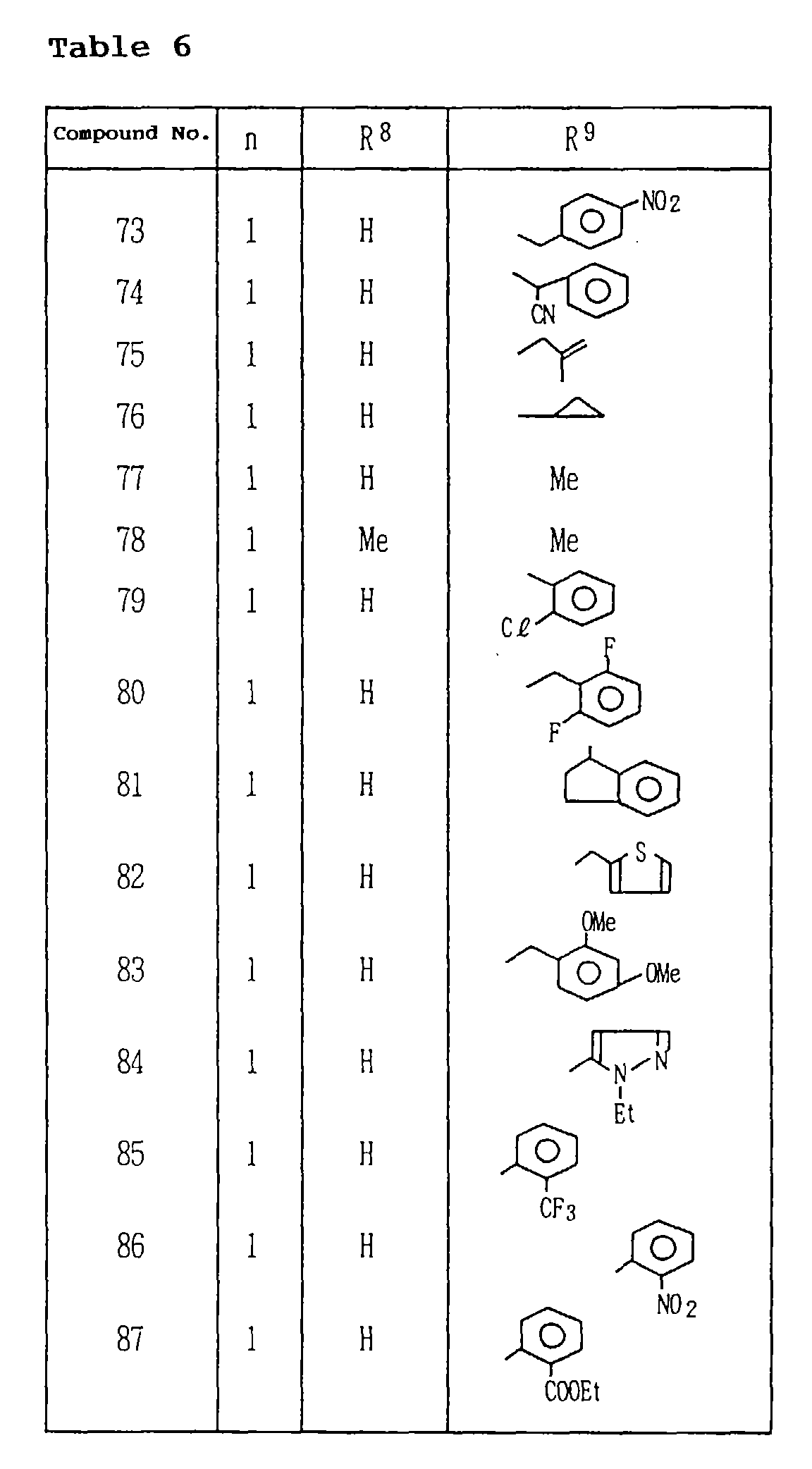
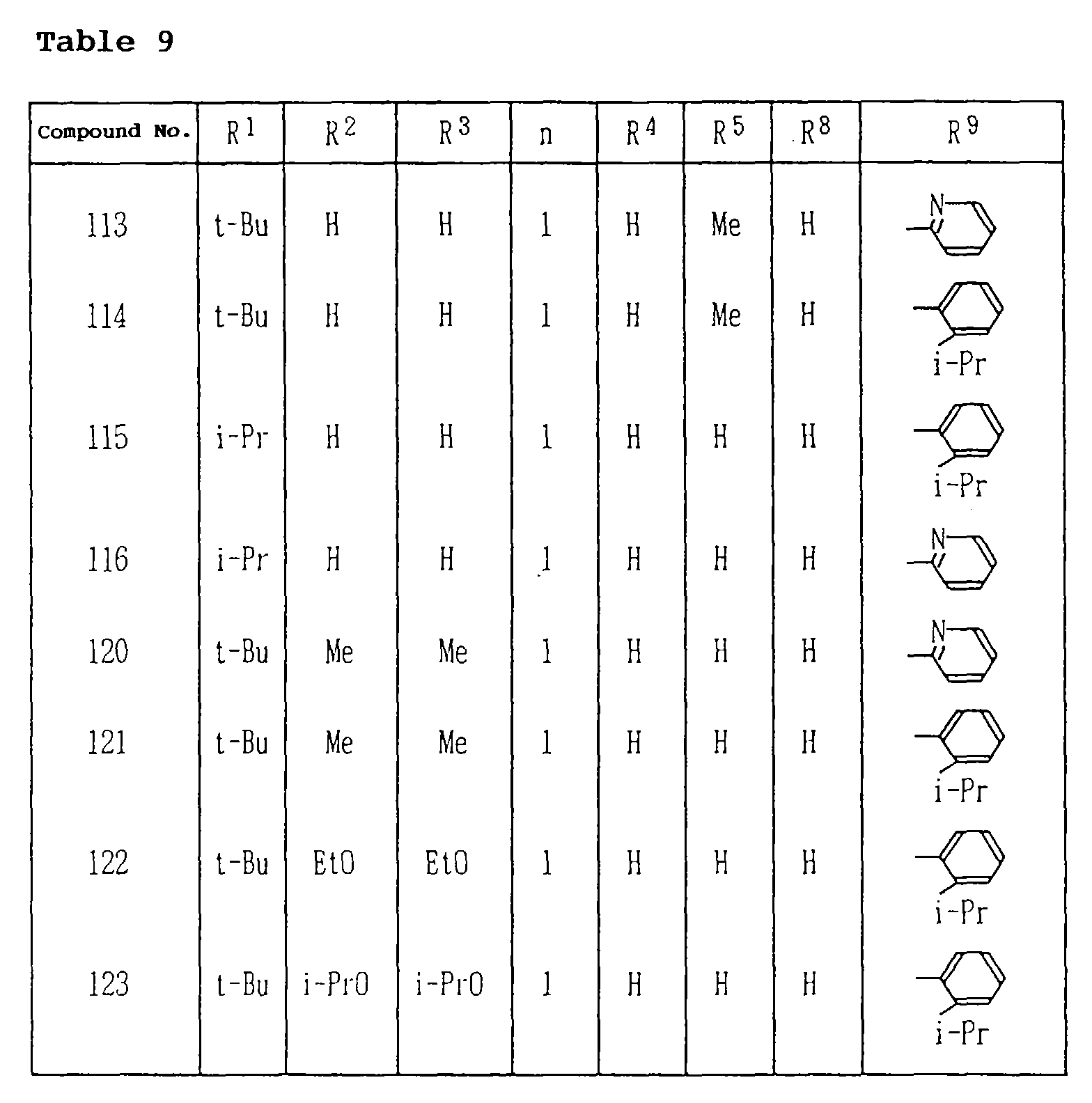
- Typical compounds of formula (1) of the present invention are shown in the following Tables 1 through 9.
- Me stands for methyl
- Et stands for ethyl
- t-Bu stands for tert-butyl
- i-Pr stands for isopropyl
- n-Pen stands for n-pentyl
- n-Hex stands for n-hexyl
- Ph stands for phenyl
- Bn stands for benzyl.
- Table 2 Compound No.
- the pyrimidine derivative (1) of the present invention or a salt thereof, after being processed together with a pharmaceutically acceptable carrier according to a customary method, may be formed into various peroral or parenteral pharmaceutical compositions of a solid type, semi-solid type, or liquid type.
- peroral preparations examples include tablets, pills, granules, soft and hard capsules, powders, fine granules, emulsions, syrups, pellets, and elixirs.
- parenteral preparations include injections, instillations, transfusions, ointments, lotions, tonics, sprays, suspensions, oils, emulsions, and suppositories.
- known methods may be used, and there may also be used as required surfactants, excipients, coloring agents, odor improving agents, preservatives, stabilizers, buffers, suspension bases, isotonic agents, etc.
- the amount of administration of the pyrimidine derivative (1) or a salt thereof varies in accordance with the identity of the compound, the disease which is to be treated or prevented, the manner of administration, the age and symptoms of the patient, duration of treatment, etc.
- the amount of administration is preferably between 0.01 and 30 mg/kg for subcutaneous, intravenous, intramuscular, or rectal administration.
- the compound is preferably administered in an amount of 0.01-100 mg/kg, more preferably 0.5-30 mg/kg.
- Example 3 The procedure described in Example 3 was repeated using 4-t-butyl-N-[6-(4-hydroxybutyloxy)-5-(2-methoxyphenoxy)-2-(2-pyrimidinyl)-4-pyrimidinyl]benzenesulfonamide, to obtain 4-[6-(4-t-butylphenylsulfonylamino)-5-(2-methoxyphenoxy)-2-(2-pyrimidinyl)-4-pyrimidinyloxy]butyric acid as a pale yellow powder.
- Example 3 The procedure described in Example 3 was repeated using 4-t-butyl-N-[6-(5-hydroxypentyloxy)-5-(2-methoxyphenoxy)-2-(2-pyrimidinyl)-4-pyrimidinyl]benzenesulfonamide, to obtain 5-[6-(4-t-butylphenylsulfonylamino)-5-(2-methoxyphenoxy)-2-(2-pyrimidinyl)-4-pyrimidinyloxy]pentanoic acid as a of yellow powder.
- Example 6 The procedure described in Example 6 was repeated using Compound No. 3 and benzyl alcohol, to obtain benzyl 3-[6-(4-t-butylphenylsulfonylamino)-5-(2-methoxyphenoxy)-2-(2-pyrimidinyl)-4-pyrimidinyloxy]propionate as a pale yellow oil.
- Example 6 The procedure described in Example 6 was repeated using Compound No. 3 and n-hexyl alcohol, to obtain n-hexyl 3-[6-(4-t-butylphenylsulfonylamino)-5-(2-methoxyphenoxy)-2-(2-pyrimidinyl)-4- pyrimidinyloxy]propionate as a pale yellow oil.
- Example 6 The procedure described in Example 6 was repeated using Compound No. 3 and ethanol, to obtain ethyl 3-[6-(4-t-butylphenylsulfonylamino)-5-(2-methoxyphenoxy)-2-(2-pyrimidinyl)-4-pyrimidinyloxy]propionate as a pale yellow oil.
- Example 6 The procedure described in Example 6 was repeated using Compound No. 2 and benzyl alcohol, to obtain benzyl [6-(4-t-butylphenylsulfonylamino)-5-(2-methoxyphenoxy)-2-(2-pyrimidinyl)-4-pyrimidinyloxy]acetate as a pale yellow oil.
- Example 6 The procedure described in Example 6 was repeated using Compound No. 4 and 4-methoxybenzyl alcohol, to obtain 4-methoxybenzyl 4-[6-(4-t-butylphenylsulfonylamino)-5-(2-methoxyphenoxy)-2-(2-pyrimidinyl)-4-pyrimidinyloxy]butyrate as a pale yellow oil.
- Example 14 The procedure described in Example 14 was repeated using Compound No. 2 and benzylamine, to obtain N-benzyl[6-(4-t-butylphenylsulfonylamino)-5-(2-methoxyphenoxy)-2-(2-pyrimidinyl)-4-pyrimidinyloxy]acetamide as a pale yellow powder.
- Example 14 The procedure described in Example 14 was repeated using Compound No. 4 and benzylamine, to obtain N-benzyl-4-[6-(4-t-butylphenylsulfonylamino)-5-(2-methoxyphenoxy)-2-(2-pyrimidinyl)-4-pyrimidinyloxy]butyramide as a pale yellow powder.
- Example 14 The procedure described in Example 14 was repeated using Compound No. 5 and benzylamine, to obtain N-benzyl-5-[6-(4-t-butylphenylsulfonylamino)-5-(2-methoxyphenoxy)-2-(2-pyrimidinyl)-4-pyrimidinyloxy]pentanamide as a pale yellow powder.
- Example 14 The procedure described in Example 14 was repeated using Compound No. 2 and phenethylamine, to obtain N-phenethyl-[6-(4-t-butylphenylsulfonylamino)-5-(2-methoxyphenoxy)-2-(2-pyrimidinyl)-4-pyrimidinyloxy]acetamide as a pale yellow oil.
- Example 14 The procedure described in Example 14 was repeated using Compound No. 4 and aniline, to obtain N-phenyl-4-[6-(4-t-butylphenylsulfonylamino)-5-(2-methoxyphenoxy)-2-(2-pyrimidinyl)-4-pyrimidinyloxy]butyramide as a pale yellow powder.
- Example 14 The procedure described in Example 14 was repeated using Compound No. 4 and 2-methoxyaniline, to obtain N-(2-methoxyphenyl)-4-[6-(4-t-butylphenylsulfonylamino)-5-(2-methoxyphenoxy)-2-(2-pyrimidinyl)-4-pyrimidinyloxy]butyramide as a pale yellow powder.
- Example 14 The procedure described in Example 14 was repeated using Compound No. 4 and 3-chloroaniline, to obtain N-(3-chlorophenyl)-4-[6-(4-t-butylphenylsulfonylamino)-5-(2- methoxyphenoxy)-2-(2-pyrimidinyl)-4-pyrimidinyloxy]butyramide as a colorless powder.
- Example 14 The procedure described in Example 14 was repeated using Compound No. 2 and 2-methoxyaniline, to obtain N-(2-methoxyphenyl)-[6-(4-t-butylphenylsulfonylamino)-5-(2-methoxyphenoxy)-2-(2-pyrimidinyl)-4-pyrimidinyloxy]acetamide as a colorless powder.
- Example 14 The procedure described in Example 14 was repeated using Compound No. 2 and 3-chloroaniline, to obtain N-(3-chlorophenyl)-[6-(4-t-butylphenylsulfonylamino)-5-(2-methoxyphenoxy)-2-(2-pyrimidinyl)-4-pyrimidinyloxy]acetamide as a colorless powder.
- Example 14 The procedure described in Example 14 was repeated using Compound No. 2 and aniline, to obtain N-phenyl-[6-(4-t-butylphenylsulfonylamino)-5-(2-methoxyphenoxy)-2-(2-pyrimidinyl)-4-pyrimidinyloxy]acetamide as a pale yellow oil.
- Example 14 The procedure described in Example 14 was repeated using Compound No. 2 and 1-naphthalenemethylamine, to obtain N-(1-naphthylmethyl)-[6-(4-t-butylphenylsulfonylamino)-5-(2-methoxyphenoxy)-2-(2-pyrimidinyl)-4-pyrimidinyloxy]acetamide as a pale yellow oil.
- Example 14 The procedure described in Example 14 was repeated using Compound No. 4 and 3-methoxybenzylamine, to obtain N-(3-methoxybenzyl)-4-[6-(4-t-butylphenylsulfonylamino)-5-(2-methoxyphenoxy)-2-(2-pyrimidinyl)-4-pyrimidinyloxy]butyramide as a pale yellow oil.
- Example 14 The procedure described in Example 14 was repeated using Compound No. 4 and 2-chlorophenethylamine, to obtain N-(2-chlorophenethyl)-4-[6-(4-t-butylphenylsulfonylamino)-5-(2-methoxyphenoxy)-2-(2-pyrimidinyl)-4-pyrimidinyloxy]butylamide as a pale yellow oil.
- Example 14 The procedure described in Example 14 was repeated using Compound No. 5 and 2-methoxybenzylamine, to obtain N-(2-methoxybenzyl)-5-[6-(4-t-butylphenylsulfonylamino)-5-(2-methoxyphenoxy)-2-(2-pyrimidinyl)-4-pyrimidinyloxy]pentanamide as a pale yellow oil.
- Example 14 The procedure described in Example 14 was repeated using Compound No. 5 and 3-chlorobenzylamine, to obtain N-(3-chlorobenzyl)-5-[6-(4-t-butylphenylsulfonylamino)-5-(2-methoxyphenoxy)-2-(2-pyrimidinyl)-4-pyrimidinyloxy] pentanamide as a pale yellow oil.
- Example 14 The procedure described in Example 14 was repeated using Compound No. 3 and 2-methylbenzylamine, to obtain N-(2-methylbenzyl)-3-[6-(4-t-butylphenylsulfonylamino)-5-(2-methoxyphenoxy)-2-(2-pyrimidinyl)-4-pyrimidinyloxy]propionamide as a pale yellow oil.
- Example 14 The procedure described in Example 14 was repeated using Compound No. 4 and phenethylamine, to obtain N-phenethyl-4-[6-(4-t-butylphenylsulfonylamino)-5-(2-methoxyphenoxy)-2-(2-pyrimidinyl)-4-pyrimidinyloxy]butyramide as a pale yellow oil.
- Example 14 The procedure described in Example 14 was repeated using Compound No. 5 and 2-chlorophenethylamine, to obtain N-(2-chlorophenethyl)-5-[6-(4-t-butylphenylsulfonylamino)-5-(2-methoxyphenoxy)-2-(2-pyrimidinyl)-4- pyrimidinyloxy]pentanamide as a pale yellow oil.
- Example 14 The procedure described in Example 14 was repeated using Compound No. 5 and phenethylamine, to obtain N-phenethyl-5-[6-(4-t-butylphenylsulfonylamino)-5-(2-methoxyphenoxy)-2-(2-pyrimidinyl)-4-pyrimidinyloxy]pentanamide as a pale yellow oil.
- Example 34 The procedure described in Example 34 was repeated using Compound No. 3 and aniline, to obtain a sodium salt of N-phenyl-3-[6-(4-t-butylphenylsulfonylamino)-5-(2-methoxyphenoxy)-2-(2-pyrimidinyl)-4-pyrimidinyloxy]propionamide as a pale yellow powder.
- Example 34 The procedure described in Example 34 was repeated using Compound No. 3 and 3,4-methylenedioxybenzylamine, to obtain a sodium salt of N-(3,4-methylenedioxybenzyl)-3-[6-(4-t-butylphenylsulfonylamino)-5-(2-methoxyphenoxy)-2-(2-pyrimidinyl)-4-pyrimidinyloxy]propionamide as a colorless powder.
- Example 34 The procedure described in Example 34 was repeated using Compound No. 3 and 4-chlorobenzylamine, to obtain a sodium salt of N-(4-chlorobenzyl)-3-[6-(4-t-butylphenylsulfonylamino)-5-(2-methoxyphenoxy)-2-(2-pyrimidinyl)-4-pyrimidinyloxy]propionamide as a colorless powder.
- Example 34 The procedure described in Example 34 was repeated using Compound No. 3 and 2-chlorophenethylamine, to obtain a sodium salt of N-(2-chlorophenethyl)-3-[6-(4-t-butylphenylsulfonylamino)-5-(2-methoxyphenoxy)-2-(2-pyrimidinyl)-4-pyrimidinyloxy]propionamide as a colorless powder.
- Example 34 The procedure described in Example 34 was repeated using Compound No. 3 and 4-methoxyphenethylamine, to obtain a sodium salt of N-(4-methoxyphenethyl)-3-[6-(4-t-butylphenylsulfonylamino)-5-(2-methoxyphenoxy)-2-(2-pyrimidinyl)-4-pyrimidinyloxy]propionamide as a pale yellow powder.
- Example 34 The procedure described in Example 34 was repeated using Compound No. 3 and 3-methoxyaniline, to obtain a sodium salt of N-(methoxyphenyl)-3-[6-(4-t-butylphenylsulfonylamino)-5-(2-methoxyphenoxy)-2-(2-pyrimidinyl)-4-pyrimidinyloxy]-propionamide as a colorless powder.
- Example 34 The procedure described in Example 34 was repeated using Compound No. 3 and phenethylamine, to obtain a sodium salt of N-phenethyl-3-[6-(4-t-butylphenylsulfonylamino)-5-(2-methoxyphenoxy)-2-(2-pyrimidinyl)-4-pyrimidinyloxy]propionamide as a pale yellow powder.
- Example 34 The procedure described in Example 34 was repeated using Compound No. 3 and 4-chloroaniline, to obtain a sodium salt of N-(4-chlorophenyl)-3-[6-(4-t-butylphenylsulfonylamino)-5-(2-methoxyphenoxy)-2-(2-pyrimidinyl)-4-pyrimidinyloxy]-propionamide as a pale yellow powder.
- Example 34 The procedure dexcribed in Example 34 was repeated using Compound No. 3 and 3,4,5-trimethoxybenzylamine, to obtain a sodium salt of N-(3,4,5-trimethoxybenzyl)-3-[6-(4-t-butylphenylsulfonylamino)-5-(2-methoxyphenoxy)-2-(2- pyrimidinyl)-4-pyrimidinyloxy]propionamide as a pale yellow powder.
- Example 34 The procedure described in Example 34 was repeated using Compound No. 3 and 2-methoxybenzylamine, to obtain a sodium salt of N-(2-methoxybenzyl)-3-[6-(4-t-butylphenylsulfonylamino)-5-(2-methoxyphenoxy)-2-(2-pyrimidinyl)-4-pyrimidinyloxy]propionamide as a colorless powder.
- Example 34 The procedure described in Example 34 was repeated using Compound No. 3 and cyclohexylamine, to obtain a sodium salt of N-cyclohexyl-3-[6-(4-t-butylphenylsulfonylamino)-5-(2-methoxyphenoxy)-2-(2-pyrimidinyl)-4-pyrimidinyloxy]-propionamide as a pale yellow powder.
- Example 34 The procedure described in Example 34 was repeated using Compound No. 3 and n-pentylamine, to obtain a sodium salt of N-(n-pentyl)-3-[6-(4-t-butylphenylsulfonylamino)-5-(2-methoxyphenoxy)-2-(2-pyrimidinyl)-4-pyrimidinyloxy]propionamide as a pale yellow powder.
- Example 34 The procedure described in Example 34 was repeated using Compound No. 5 and 3-phenyl-1-propylamine, to obtain a sodium salt of N-(3-phenyl-1-propyl)-5-[6-(4-t-butylphenylsulfonylamino)-5-(2-methoxyphenoxy)-2-(2-pyrimidinyl)-4-pyrimidinyloxy]pentanamide as a pale yellow powder.
- Example 34 The procedure described in Example 34 was repeated using Compound No. 3 and 2-methoxyaniline, to obtain a sodium salt of N-(2-methoxyphenyl)-3-[6-(4-t-butylphenylsulfonylamino)-5-(2-methoxyphenoxy)-2-(2-pyrimidinyl)-4-pyrimidinyloxy]propionamide as a pale yellow powder.
- the resultant sodium salt was transformed into a free form by a customary method.
- the NMR data of the free compound are shown below.
- Example 34 The procedure described in Example 34 was repeated using Compound No. 3, N-methylmorpholine, and an equivalent amount of ethylamine ⁇ HCl, to obtain a sodium salt of N-ethyl-3-[6-(4-t-butylphenylsulfonylamino)-5-(2-methoxyphenoxy)-2-(2-pyrimidinyl)-4-pyrimidinyloxy]propionamide as a colorless powder.
- Example 14 The procedure described in Example 14 was repeated using Compound No. 3 and homopiperidine, to obtain homopiperidino-3-[6-(4-t-butylphenylsulfonylamino)-5-(2-methoxyphenoxy)-2-(2-pyrimidinyl)-4-pyrimidinyloxy]propionamide as a pale yellow oil.
- Example 14 The procedure described in Example 14 was repeated using Compound No. 3 and 3-methylaniline, to obtain N-(3-methylphenyl)-3-[6-(4-t-butylphenylsulfonylamino)-5-(2-methoxyphenoxy)-2-(2-pyrimidinyl)-4-pyrimidinyloxy]propionamide as a pale yellow oil.
- Example 14 The procedure described in Example 14 was repeated using Compound No. 3 and 2-isopropylaniline, to obtain N-(2-isopropylphenyl)-3-[6-(4-t-butylphenylsulfonylamino)-5-(2-methoxyphenoxy)-2-(2-pyrimidinyl)-4-pyrimidinyloxy] propionamide as a pale yellow oil.
- Oxalyl chloride (9.5 mg) was added to a solution of Compound No. 3 (40.2 mg) in methylene chloride (0.3 ml). One droplet of dimethylformamide was added thereto, and the resulting mixture was stirred at room temperature for 30 minutes. Subsequently, 2-amino-5-trifluoromethyl-1,3,4-thiadiazole (24.1 mg) was added, and the mixture was stirred overnight at room temperature. Ethyl acetate (10 ml) was added to the reaction mixture, followed by washing successively with sat. aq. NaHCO 3 , water, 1N-HCl, water, and saturated brine and drying over anhydrous sodium sulfate.
- Example 14 The procedure described in Example 14 was repeated using Compound No. 3 and 2-ethylaniline, to obtain N-(2-ethylphenyl)-3-[6-(4-t-butylphenylsulfonylamino)-5-(2- methoxyphenoxy)-2-(2-pyrimidinyl)-4-pyrimidinyloxy] propionamide as a pale yellow powder.
- Example 54 The procedure dexcribed in Example 54 was repeated using Compound No. 3 and 1,2-phenylenediamine, to obtain N-(2-aminophenyl)-3-[6-(4-t-butylphenylsulfonylamino)-5-(2-methoxyphenoxy)-2-(2-pyrimidinyl)-4-pyrimidinyloxy]propionamide as a pale yellow powder.
- Example 14 The procedure described in Example 14 was repeated using Compound No. 3 and phenylhydrazine, to obtain N'-phenyl-3-[6-(4-t-butylphenylsulfonylamino)-5-(2-methoxyphenoxy)-2-(2-pyrimidinyl)-4-pyrimidinyloxy]propionohydrazide as a pale yellow powder.
- Example 54 The procedure dexcribed in Example 54 was repeated using Compound No. 3 and 2-aminopyridine, to obtain N-(2-pyridyl)-3-[6-(4-t-butylphenylsulfonylamino)-5-(2-methoxyphenoxy)-2-(2-pyrimidinyl)-4-pyrimidinyloxy]propionamide as a pale yellow powder.
- Example 14 The procedure dexcribed in Example 14 was repeated using Compound No. 3 and 2-isopropenylaniline, to obtain N-(2-isopropenylphenyl)-3-[6-(4-t-butylphenylsulfonylamino)-5-(2-methoxyphenoxy)-2-(2-pyrimidinyl)-4-pyrimidinyloxy]propionamide as a pale yellow powder.
- Example 14 The procedure described in Example 14 was repeated using Compound No. 3 and 2-(methylthio)aniline, to obtain N-(2-methylthiophenyl)-3-[6-(4-t-butylphenylsulfonylamino)-5-(2-methoxyphenoxy)-2-(2-pyrimidinyl)-4-pyrimidinyloxy] propionamide as a pale yellow powder.
- Example 14 The procedure described in Example 14 was repeated using Compound No. 3 and 2-t-butylaniline, to obtain N-(2-t-butylphenyl)-3-[6-(4-t-butylphenylsulfonylamino)-5-(2-methoxyphenoxy)-2-(2-pyrimidinyl)-4-pyrimidinyloxy]propionamide as a pale yellow powder.
- Example 54 The procedure dexcribed in Example 54 was repeated using Compound No. 3 and 3-aminopyridine, to obtain N-(3-pyridyl)-3-[6-(4-t-butylphenylsulfonylamino)-5-(2-methoxyphenoxy)-2-(2-pyrimidinyl)-4-pyrimidinyloxy]propionamide as a pale yellow powder.
- Example 54 The procedure described in Example 54 was repeated using Compound No. 2 and 2-aminopyridine, to obtain N-(2-pyridyl)-[6-(4-t-butylphenylsulfonylamino)-5-(2-methoxyphenoxy)-2-(2-pyrimidinyl)-4-pyrimidinyloxy]acetamide as a pale yellow powder.
- Example 54 The procedure described in Example 54 was repeated using Compound No. 4 and 2-aminopyridine, to obtain N-(2-pyridyl)-4-[6-(4-t-butylphenylsulfonylamino)-5-(2-methoxyphenoxy)-2-(2-pyrimidinyl)-4-pyrimidinyloxy]butyramide as a pale yellow powder.
- Example 54 The procedure dexcribed in Example 54 was repeated using Compound No. 3 and 2,6-diisopropylaniline, to obtain N-(2,6-diisopropylphenyl)-3-[6-(4-t-butylphenylsulfonylamino)-5-(2-methoxyphenoxy)-2-(2-pyrimidinyl)-4-pyrimidinyloxy]-propionamide as a pale yellow powder.
- Example 14 The procedure described in Example 14 was repeated using Compound No. 3 and allylamine, to obtain N-allyl-3-[6-(4-t-butylphenylsulfonylamino)-5-(2-methoxyphenoxy)-2-(2-pyrimidinyl)-4-pyrimidinyloxy]propionamide as a pale yellow powder.
- Example 54 The procedure described in Example 54 was repeated using Compound No. 2 and 2-amino-3-methylpyridine, to obtain N-(3-methyl-2-pyridyl)-[6-(4-t-butylphenylsulfonylamino)-5-(2-methoxyphenoxy)-2-(2-pyrimidinyl)-4-pyrimidinyloxy]acetamide as a pale yellow powder.
- Example 14 The procedure described in Example 14 was repeated using Compound No. 3 and 1-naphthylamine, to obtain N-(1-naphthyl)-3-[6-(4-t-butylphenylsulfonylamino)-5-(2-methoxyphenoxy)-2-(2-pyrimidinyl)-4-pyrimidinyloxy]propionamide as a pale yellow powder.
- Example 14 The procedure described in Example 14 was repeated using Compound No. 3 and 2-aminothiazoline, to obtain N-(2-thiazolinyl)-3-[6-(4-t-butylphenylsulfonylamino)-5-(2-methoxyphenoxy)-2-(2-pyrimidinyl)-4-pyrimidinyloxy]propionamide as a pale yellow powder.
- Example 54 The procedure described in Example 54 was repeated using Compound No. 3 and aminopyrazine, to obtain N-(2-pyrazinyl)-3-[6-(4-t-butylphenylsulfonylamino)-5-(2-methoxyphenoxy)-2-(2-pyrimidinyl)-4-pyrimidinyloxy]propionamide as a pale yellow powder.
- Example 54 The procedure described in Example 54 was repeated using Compound No. 3 and 2-aminopyrimidine, to obtain N-(2-pyrimidinyl)-3-[6-(4-t-butylphenylsulfonylamino)-5-(2-methoxyphenoxy)-2-(2-pyrimidinyl)-4-pyrimidinyloxy]propionamide as a pale yellow powder.
- Example 14 The procedure described in Example 14 was repeated using Compound No. 2 and 2-pyridylhydrazine, to obtain N'-(2-pyridyl)-[6-(4-t-butylphenylsulfonylamino)-5-(2-methoxyphenoxy)-2-(2-pyrimidinyl)-4-pyrimidinyloxy]acetohydrazide as a pale yellow powder.
- Example 14 The procedure described in Example 14 was repeated using Compound No. 3 and 2-pyridylhydrazine, to obtain N'-(2-pyridyl)-3-[6-(4-t-butylphenylsulfonylamino)-5-(2-methoxyphenoxy)-2-(2-pyrimidinyl)-4-pyrimidinyloxy]propionohydrazide as a pale yellow powder.
- Example 14 The procedure described in Example 14 was repeated using Compound No. 3 and 2,6-dimethylaniline, to obtain N-(2,6-dimethylphenyl)-3-[6-(4-t-butylphenylsulfonylamino)-5-(2-methoxyphenoxy)-2-(2-pyrimidinyl)-4-pyrimidinyloxy]propionamide as a pale yellow oil.
- Example 6 The procedure described in Example 6 was repeated using Compound No. 2 and methanol, to obtain methyl[6-(4-t-butylphenylsulfonylamino)-5-(2-methoxyphenoxy)-2-(2-pyrimidinyl)-4-pyrimidinyloxy]acetate as a pale yellow oil.
- Example 6 The procedure described in Example 6 was repeated using Compound No. 4 and methanol, to obtain methyl 4-[6-(4-t-butylphenylsulfonylamino)-5-(2-methoxyphenoxy)-2-(2-pyrimidinyl)-4-pyrimidinyloxy]butyrate as a pale yellow oil.
- Example 6 The procedure described in Example 6 was repeated using Compound No. 3 and isopropyl alcohol, to obtain isopropyl 3-[6-(4-t-butylphenylsulfonylamino)-5-(2-methoxyphenoxy)-2-(2-pyrimidinyl)-4-pyrimidinyloxy]propionate as a pale yellow oil.
- Example 14 The procedure described in Example 14 was repeated using Compound No. 2 and N-benzylethanolamine, to obtain N-benzyl-N-(2-hydroxyethyl)-[6-(4-t-butylphenylsulfonylamino)-5-(2-methoxyphenoxy)-2-(2-pyrimidinyl)-4-pyrimidinyloxy]acetamide as a pale yellow oil.
- Example 14 The procedure described in Example 14 was repeated using Compound No. 3 and 2-(aminomethyl)pyridine, to obtain N-(2-pyridylmethyl)-3-[6-(4-t-butylphenylsulfonylamino)-5-(2-methoxyphenoxy)-2-(2-pyrimidinyl)-4-pyrimidinyloxy] propionamide as a pale yellow oil.
- Example 14 The procedure described in Example 14 was repeated using Compound No. 3 and 2-(2-aminoethyl)pyridine, to obtain N-[2-(2-pyridyl)ethyl)-3-[6-(4-t-butylphenylsulfonylamino)-5-(2-methoxyphenoxy)-2-(2-pyrimidinyl)-4-pyrimidinyloxy] propionamide as a pale yellow oil.
- Example 14 The procedure described in Example 14 was repeated using Compound No. 3 and ⁇ -methylbenzylamine, to obtain N-( ⁇ -methylbenzyl)-3-[6-(4-t-butylphenylsulfonylamino)-5-(2-methoxyphenoxy)-2-(2-pyrimidinyl)-4-pyrimidinyloxy]propionamide as a pale yellow oil.
- Example 14 The procedure described in Example 14 was repeated using Compound No. 3 and N-benzylmethylamine, to obtain N-benzyl-N-methyl-3-[6-(4-t-butylphenylsulfonylamino)-5-(2-methoxyphenoxy)-2-(2-pyrimidinyl)-4-pyrimidinyloxy]propionamide as a pale yellow oil.
- Example 14 The procedure described in Example 14 was repeated using Compound No. 3 and N-methylaniline, to obtain N-methyl-N-phenyl-3-[6-(4-t-butylphenylsulfonylamino)-5-(2-methoxyphenoxy)-2-(2-pyrimidinyl)-4-pyrimidinyloxy]propionamide as a pale yellow oil.
- Example 14 The procedure described in Example 14 was repeated using Compound No. 3 and 2-(trifluoromethyl)benzylamine, to obtain N-(2-trifluoromethylbenzyl)-3-[6-(4-t-butylphenylsulfonylamino)-5-(2-methoxyphenoxy)-2-(2-pyrimidinyl)-4-pyrimidinyloxy]propionamide as a pale yellow oil.
- Example 14 The procedure described in Example 14 was repeated using Compound No. 3 and furfurylamine, to obtain N-furfuryl-3-[6-(4-t-butylphenylsulfonylamino)-5-(2- methoxyphenoxy)-2-(2-pyrimidinyl)-4-pyrimidinyloxy]propionamide as a pale yellow oil.
- Example 14 The procedure described in Example 14 was repeated using Compound No. 2 and 2-methoxybenzylamine, to obtain N-(2-methoxybenzyl)-[6-(4-t-butylphenylsulfonylamino)-5-(2-methoxyphenoxy)-2-(2-pyrimidinyl)-4-pyrimidinyloxy]acetamide as a pale yellow oil.
- Example 14 The procedure described in Example 14 was repeated using Compound No. 2 and ⁇ -methylbenzylamine, to obtain N-( ⁇ -methylbenzyl)-[6-(4-t-butylphenylsulfonylamino)-5-(2-methoxyphenoxy)-2-(2-pyrimidinyl)-4-pyrimidinyloxy]acetamide as a pale yellow oil.
- Example 14 The procedure dexcribed in Example 14 was repeated using Compound No. 3 and 2-aminothiazole, to obtain N-(2-thiazolyl)-3-[6-(4-t-butylphenylsulfonylamino)-5-(2-methoxyphenoxy)-2-(2-pyrimidinyl)-4-pyrimidinyloxy]propionamide as a yellowish white powder.
- Example 14 The procedure described in Example 14 was repeated using Compound No. 3 and 2,5-dimethoxyaniline, to obtain N-(2,5-dimethoxyphenyl)-3-[6-(4-t-butylphenylsulfonylamino)-5-(2-methoxyphenoxy)-2-(2-pyrimidinyl)-4-pyrimidinyloxy]propionamide as a brown oil.
- Example 14 The procedure described in Example 14 was repeated using Compound No. 3 and 2-aminophenol, to obtain N-(2-hydroxyphenyl)-3-[6-(4-t-butylphenylsulfonylamino)-5-(2-methoxyphenoxy)-2-(2-pyrimidinyl)-4-pyrimidinyloxy]propionamide as a pale yellow oil.
- Example 14 The procedure described in Example 14 was repeated using Compound No. 3 and 2-phenylglycinol, to obtain N-( ⁇ -hydroxymethylbenzyl)-3-[6-(4-t-butylphenylsulfonylamino)-5-(2-methoxyphenoxy)-2-(2-pyrimidinyl)-4-pyrimidinyloxy]propionamide as a pale yellow oil.
- Example 14 The procedure described in Example 14 was repeated using Compound No. 3 and aminodiphenylmethane, to obtain N-diphenylmethyl-3-[6-(4-t-butylphenylsulfonylamino)-5-(2-methoxyphenoxy)-2-(2-pyrimidinyl)-4-pyrimidinyloxy]propionamide as a pale yellow oil.
- Example 14 The procedure described in Example 14 was repeated using Compound No. 3 and 4-nitrobenzylamine, to obtain N-(4-nitrobenzyl)-3-[6-(4-t-butylphenylsulfonylamino)-5-(2-methoxyphenoxy)-2-(2-pyrimidinyl)-4-pyrimidinyloxy]propionamide as a pale yellow oil.
- Example 14 The procedure described in Example 14 was repeated using Compound No. 3 and 2-phenylglycinonitrile, to obtain N-(phenylcyanomethyl)-3-[6-(4-t-butylphenylsulfonylamino)-5-(2-methoxyphenoxy)-2-(2-pyrimidinyl)-4-pyrimidinyloxy]propionamide as a pale yellow oil.
- Example 14 The procedure described in Example 14 was repeated using Compound No. 3 and 2-methylallylamine, to obtain N-(2-methylallyl)-3-[6-(4-t-butylphenylsulfonylamino)-5-(2-methoxyphenoxy)-2-(2-pyrimidinyl)-4-pyrimidinyloxy]propionamide as a pale yellow oil.
- Example 14 The procedure described in Example 14 was repeated using Compound No. 3 and cyclopropylamine, to obtain N-cyclopropyl-3-[6-(4-t-butylphenylsulfonylamino)-5-(2-methoxyphenoxy)-2-(2-pyrimidinyl)-4-pyrimidinyloxy]propionamide as a pale yellow oil.
- Example 14 The procedure described in Example 14 was repeated using Compound No. 3 and methylamine, to obtain N-methyl-3-[6-(4-t-butylphenylsulfonylamino)-5-(2-methoxyphenoxy)-2-(2-pyrimidinyl)-4-pyrimidinyloxy]propionamide as a pale yellow oil.
- Example 14 The procedure described in Example 14 was repeated using Compound No. 3 and dimethylamine, to obtain N,N-dimethyl-3-[6-(4-t-butylphenylsulfonylamino)-5-(2-methoxyphenoxy)-2-(2-pyrimidinyl)-4-pyrimidinyloxy]propionamide as apale yellow oil.
- Example 14 The procedure described in Example 14 was repeated using Compound No. 3 and 2-chloroaniline, to obtain N-(2-chlorophenyl)-3-[6-(4-t-butylphenylsulfonylamino)-5-(2-methoxyphenoxy)-2-(2-pyrimidinyl)-4-pyrimidinyloxy]propionamide as a pale yellow oil.
- Example 14 The procedure described in Example 14 was repeated using Compound No. 3 and 2,6-difluorobenzylamine, to obtain N-(2,6-difluorobenzyl)-3-[6-(4-t-butylphenylsulfonylamino)-5-(2-methoxyphenoxy)-2-(2-pyrimidinyl)-4-pyrimidinyloxy]propionamide as a pale yellow oil.
- Example 14 The procedure described in Example 14 was repeated using Compound No. 3 and 1-aminoindan, to obtain N-(1-indanyl)-3-[6-(4-t-butylphenylsulfonylamino)-5-(2-methoxyphenoxy)-2-(2-pyrimidinyl)-4-pyrimidinyloxy]propionamide as a pale yellow oil.
- Example 14 The procedure described in Example 14 was repeated using Compound No. 3 and 2-thiophenemethylamine, to obtain N-(2-thenyl)-3-[6-(4-t-butylphenylsulfonylamino)-5-(2-methoxyphenoxy)-2-(2-pyrimidinyl)-4-pyrimidinyloxy]propionamide as a pale yellow oil.
- Example 14 The procedure described in Example 14 was repeated using Compound No. 3 and 2,4-dimethoxybenzylamine, to obtain N-(2,4-dimethoxybenzyl)-3-[6-(4-t-butylphenylsulfonylamino)-5-(2-methoxyphenoxy)-2-(2-pyrimidinyl)-4-pyrimidinyloxy]propionamide as a pale yellow oil.
- Example 54 The procedure described in Example 54 was repeated using Compound No. 3 and 5-amino-1-ethylpyrazole, to obtain N-(1-ethyl-5-pyrazolyl)-3-[6-(4-t-butylphenylsulfonylamino)-5-(2-methoxyphenoxy)-2-(2-pyrimidinyl)-4-pyrimidinyloxy] propionamide as a pale yellow oil.
- Example 54 The procedure described in Example 54 was repeated using Compound No. 3 and 2-aminobenzofluoride, to obtain N-(2-trifluoromethylphenyl)-3-[6-(4-t-butylphenylsulfonylamino)-5-(2-methoxyphenoxy)-2-(2-pyrimidinyl)-4-pyrimidinyloxy]propionamide as a pale yellow oil.
- Example 54 The procedure described in Example 54 was repeated using Compound No. 3 and 2-nitroaniline, to obtain N-(2-nitrophenyl)-3-[6-(4-t-butylphenylsulfonylamino)-5-(2- methoxyphenoxy)-2-(2-pyrimidinyl)-4-pyrimidinyloxy]propionamide as a pale yellow oil.
- Example 54 The procedure described in Example 54 was repeated using Compound No. 3 and ethyl 2-aminobenzoate, to obtain N-(2-ethoxycarbonylphenyl)-3-[6-(4-t-butylphenylsulfonylamino)-5-(2-methoxyphenoxy)-2-(2-pyrimidinyl)-4-pyrimidinyloxy]propionamide as a pale yellow oil.
- Example 3 The procedure described in Example 3 was repeated using 4-t-butyl-N-[6-(2,2-dimethyl-3-hydroxypropyloxy)-5-(2-methoxyphenoxy)-2-(2-pyrimidinyl)-4-pyrimidinyl]benzenesulfonamide, to obtain 3-[6-(4-t-butylphenylsulfonylamino)-5-(2-methoxyphenoxy)-2-(2-pyrimidinyl)-4-pyrimidinyloxy]-2,2-dimethylpropionic acid as a pale yellow powder.
- Example 3 The procedure described in Example 3 was repeated using 4-t-butyl-N-[6-(2,2-diethyl-3-hydroxypropyloxy)-5-(2-methoxyphenoxy)-2-(2-pyrimidinyl)-4-pyrimidinyl]benzenesulfonamide, to obtain 2-[[6-(4-t-butylphenylsulfonylamino)-5-(2-methoxyphenoxy)-2-(2-pyrimidinyl)-4-pyrimidinyloxy]]methyl-2-ethylbutanoic acid as a pale yellow powder.
- Example 3 The procedure described in Example 3 was repeated using 4-t-butyl-N-[6-(3-hydroxy-2-methylpropyloxy)-5-(2-methoxyphenoxy)-2-(2-pyrimidinyl)-4-pyrimidinyl]benzenesulfonamide, to obtain 3-[6-(4-t-butylphenylsulfonylamino)-5-(2-methoxyphenoxy)-2-(2-pyrimidinyl)-4-pyrimidinyloxy]-2-methylpropionic acid as a pale yellow powder.
- Example 3 The procedure described in Example 3 was repeated using 4-t-butyl-N-[6-(3-hydroxypropyloxy)-2-(4,6-dimethyl-2-pyrimidinyl)-5-(2-methoxyphenoxy)-4-pyrimidinyl]benzenesulfonamide, to obtain 3-[6-(4-t-butylphenylsulfonylamino)-2-(4,6-dimethyl-2-pyrimidinyl)-5-(2-methoxyphenoxy)-4-pyrimidinyloxy]propionic acid as a white powder.
- Example 3 The procedure described in Example 3 was repeated using 4-isopropyl-N-[6-(3-hydroxypropyloxy)-5-(2-methoxyphenoxy)-2-(2-pyrimidinyl)-4-pyrimidinyl]benzenesulfonamide, to obtain 3-[6-(4-t-isopropylphenylsulfonylamino)-5-(2-methoxyphenoxy)-2-(2-pyrimidinyl)-4-pyrimidinyloxy]propionic acid as a pale yellow powder.
- Example 54 The procedure described in Example 54 was repeated using Compound No. 112 and 2-aminopyridine, to obtain N-(2-pyridyl)-3-[6-(4-t-butylphenylsulfonylamino)-5-(2-methoxyphenoxy)-2-(2-pyrimidinyl)-4-pyrimidinyloxy]-2-methylpropionamide as a pale yellow oil.
- Example 14 The procedure described in Example 14 was repeated using Compound No. 112 and 2-isopropylaniline, to obtain N-(2-isopropylphenyl)-3-[6-(4-t-butylphenylsulfonylamino)-5-(2-methoxyphenoxy)-2-(2-pyrimidinyl)-4-pyrimidinyloxy]-2-methylpropionamide as a pale yellow oil.
- Example 6 The procedure described in Example 6 was repeated using Compound No. 3 and methanol, to obtain methyl 3-[6-(4-t-butylphenylsulfonylamino)-5-(2-methoxyphenoxy)-2-(2-pyrimidinyl)-4-pyrimidinyloxy]propionate as a pale yellow oil.
- Example 14 The procedure described in Example 14 was repeated using Compound No. 124 and 2-isopropylaniline, to obtain N-(2-isopropylphenyl)-3-[6-(4-isopropylphenylsulfonylamino)-5-(2-methoxyphenoxy)-2-(2-pyrimidinyl)-4-pyrimidinyloxy]propionamide as a pale brown oil.
- Example 54 The procedure described in Example 54 was repeated using Compound No. 124 and 2-aminopyridine, to obtain N-(2-pyridyl)-3-[6-(4-isopropylphenylsulfonylamino)-5-(2-methoxyphenoxy)-2-(2-pyrimidinyl)-4-pyrimidinyloxy]propionamide as a pale yellow oil.
- Example 54 The procedure described in Example 54 was repeated using Compound No. 117 and 2-aminopyridine, to obtain N-(2-pyridyl)-3-[6-(4-t-butylphenylsulfonylamino)-2-(4,6-dimethyl-2-pyrimidinyl)-5-(2-methoxyphenoxy)-4-pyrimidinyloxy]propionamide as a pale yellow oil.
- Example 14 The procedure described in Example 14 was repeated using Compound No. 117 and 2-isopropylaniline, to obtain N-(2-isopropylphenyl)-3-[6-(4-t-butylphenylsulfonylamino)-2-(4,6-dimethyl-2-pyrimidinyl)-5-(2-methoxyphenoxy)-4-pyrimidinyloxy]propionamide as a pale yellow oil.
- Example 14 The procedure described in Example 14 was repeated using Compound No. 118 and 2-isopropylaniline, to obtain N-(2-isopropylphenyl)-3-[6-(4-t-butylphenylsulfonylamino)-2-(4,6-diethoxy-2-pyrimidinyl)-5-(2-methoxyphenoxy)-4-pyrimidinyloxy]propionamide as a pale yellow oil.
- Example 14 The procedure described in Example 14 was repeated using Compound No. 119 and 2-isopropylaniline, to obtain N-(2-isopropylphenyl)-3-[6-(4-t-butylphenylsulfonylamino)-2-(4,6-diisopropyl-2-pyrimidinyl)-5-(2-methoxyphenoxy)-4-pyrimidinyloxy]propionamide as a pale yellow powder.
- Example 123 The procedure described in Example 123 was repeated using 4-t-butyl-N-[2-(4,6-di(3-hydroxypropyloxy)-2-pyrimidinyl)-6-(3-hydroxypropyloxy)-5-(2-methoxyphenoxy)-4-pyrimidinyl]-benzenesulfonamide and isopropyl alcohol, to obtain 3-[6-(4-t-butylphenylsulfonylamino)-2-(4,6-diisopropyloxy-2-pyrimidinyl)-5-(2-methoxyphenoxy)-4-pyrimidinyloxy]propionic acid (23 mg) as a pale yellow oil.
- Porcine thoracic aorta which was separated from the fatty tissue and then was removed endothelium with gauze was minced, and then homogenized in three times the volume of Tris-HCl buffer (pH 7.4) (buffer A) containing 0.25 M sucrose, 3mM ethylenediaminetetraacetic acid, 5 ⁇ g/ml of aprotinin, 10 ⁇ g/ml of pepstatin A, 10 ⁇ g/ml of leupeptin, and 0.1 ⁇ M p-amidinophenyl-methanesulfonyl fluoride. After centrifugation for 30 minutes at 1,000 x g, the supernatant was further centrifuged for 30 minutes at 100,000 x g. The pellets were suspended in buffer A, and recentrifuged for 30 minutes at 100,000 x g. The pellets were suspended in buffer A and the suspension was stored at -80°C.
- the thus-obtained membrane sample (1 ⁇ l) was incubated together with 125 I-endothelin-1 (2 x 10 -11 M) and various concentrations of the compounds, for 2 hours at 25°C, in 250 ⁇ l in total volume of 50 mM Tris-HCl buffer (pH 7.4) containing 0.5 % bovine serum albumin.
- the incubated mixture was filtered by use of an HVPP filters (pore size 0.45 ⁇ m, product of Milipore). The filters were washed with cold buffer A four times, and then measured with a gamma-ray counter (Aroka Autowell Gamma System ARC-251).
- Rat brain tissue was minced, and a crude receptor membrane sample was prepared in a manner similar to that used in the aforementioned case of porcine thoracic aorta. Also, 125 I-endothelin-1 assay was performed in the same manner as described above.
- Table 10 Compound No. IC 50 ( ⁇ M) ET A ET B 2 9.4 0.8 9 0.72 2.9 10 0.51 0.65 12 0.32 0.82 14 0.82 0.0028 15 3.2 0.016 18 0.15 0.023 25 1.9 0.037 29 3.1 0.03 34 0.39 0.22 38 16.9 0.019 48 0.16 0.00075 53 0.098 0.00082 92 0.0095 0.1
- the thoracic aorta was removed from a male SD rat, and ring samples of the aorta each having a width of 3 mm were prepared. Each ring, while subjected to a static tension of 2 g, was suspended in an organ bath filled with a 37°C Krebs-Henseleit solution (NaCl 118.4 mM, KCl 4.7 mM, CaCl 2 2.5 mM, MgSO 4 1.2 mM, KH 2 PO 4 1.2 mM, NaHCO 3 25.0 mM, glucose 10.0 mM) aerated with a gas mixture of 95% O 2 and 5% CO 2 .
- a 37°C Krebs-Henseleit solution NaCl 118.4 mM, KCl 4.7 mM, CaCl 2 2.5 mM, MgSO 4 1.2 mM, KH 2 PO 4 1.2 mM, NaHCO 3 25.0 mM, glucose 10.0 mM
- vascular sample was pretreated for 20 minutes by use of either 10 -7 - 10 -5 M Compound No. 92 or a solvent therefor. Subsequently, endothelin-1 dissolved in brine containing 0.1% bovine serum albumin was added in a cumulative manner, and isometric contraction was observed in the range of 1 to 100 ng/ml (4 x 10 -9 to 4 x 10 -8 M) of endothelin, to thereby investigate the effects of the compounds.
- Fig. 1 shows contraction responses (%) normalized with respect to the contraction response obtained through application of 80 mM KCl.
- the pulmonary artery was removed from a male NZW rabbit, and each of arterial samples prepared as described above was suspended in an organ bath in a manner similar to that described above, with the application of a static tension of 1 g.
- the sample was pretreated for 30 minutes by use of either 3 x 10 -8 - 3 x 10 -7 M Compound No. 68 or a solvent therefor.
- sarafotoxin (SRTX) S6c which is a selective agonist for ET B receptor, was added was added in a cumulative manner, and isometric contraction was observed in the range of 10 -12 to 3 x 10 -7 M sarafotoxin S6c, to thereby investigate the effects of the compounds.
- Fig. 2 shows contraction responses (%) normalized with respect to the contraction response obtained through application of 60 mM KCl.
- the novel pyrimidine derivatives (1) of the present invention exhibit strong binding inhibitory activity against endothelin having very strong vasoconstrictive effect and cell proliferation effect. Therefore, the compounds are effective as remedies for various endothelin-related diseases and disorders including heart diseases such as ischemic heart infarction, congestive heart failure, arrhythmia, and unstable angina; airway diseases such as asthma; hypertonia such as pulmonary hypertension, renal hypertension, and hypertension accompanying organ transplantation; circulatory diseases such as subarachnoid hemorrhage and vasospasm; kidney diseases such as acute and chronic renal failure; diabetes, hyperlipemia, and other diseases that are accompanied by vascular lesion; arteriosclerosis; liver diseases such as alcohol-induced liver disorders; gastrointestinal disorders such as those of gastric mucosa; bone diseases; prostatic hypertrophy; urinary disorders; cancer; and skin diseases concurrent with proliferation of melanocytes.
- heart diseases such as ischemic heart infarction, congestive heart failure, arrhythmia, and unstable
Landscapes
- Chemical & Material Sciences (AREA)
- Organic Chemistry (AREA)
- Plural Heterocyclic Compounds (AREA)
- Pharmaceuticals Containing Other Organic And Inorganic Compounds (AREA)
Abstract
Description
- The present invention relates to novel pyrimidine derivatives and their salts, and to pharmaceuticals containing these compounds as active ingredients.
- Endothelin, having potent vasoconstrictive effect, blood pressure elevating effect, and cell proliferation effect, is considered to be a substance that contributes to various diseases and disorders including heart diseases such as ischemic heart infarction, congestive heart failure, arrhythmia, and unstable angina; airway diseases such as asthma; hypertonia such as pulmonary hypertension, renal hypertension, and hypertension accompanying organ transplantation; circulatory diseases such as subarachnoid hemorrhage and post-PTCA reconstriction or vasospasm; kidney diseases such as acute and chronic renal failure; diabetes, hyperlipemia, and other diseases that are accompanied by vascular lesion, as well as arteriosclerosis; liver diseases such as alcohol-induced liver disorders; gastrointestinal disorders such as those of gastric mucosa; bone diseases; prostatic hypertrophy and urinary disorders; cancer; and skin diseases concurrent with proliferation of melanocytes [Saishin-Igaku (may be translated to "Medicine Up-to-date"), 94, 335-431 (1994), Igaku-no-Ayumi (may be translated to "Progress of Medicine"), 168, 675-692 (1994), Igaku-no-Ayumi, 170, 357 (1994), Pharmac. Rev., 46, 325 (1994), and Gendai-Iryo (may be translated to "Modern Remedies"), 27, 1 (1995)].
- It has come to be elucidated that a variety of actions of endothelin are triggered upon binding of endothelin to its receptors in organs of the body, and that the vasoconstriction caused by endothelin is induced by the mediation of at least two different receptors (ETA receptor and ETB receptor). Therefore, a compound that prevents endothelin from binding to these two receptors should be useful as a preventive and therapeutic agent for the above-mentioned diseases in which endothelin participates. Heretofore, a number of compounds have been reported as exhibiting endothelin antagonism [J. Med. Chem., 36, 2585 (1993), Nature, 365, 759 (1993), Circulation, 88, 1-316 (1994), Saishin-Igaku, 94, 424-431 (1994), J. Med. Chem. 37, 1553 (1994), and Japanese Patent Application Laid-Open (kokai) No. 5-222003)].
- However, there have not yet been found compounds that exhibit satisfactory endothelin antagonism.
- Accordingly, the present invention is directed to the discovery of a compound that has potent endothelin antagonism, as well as to the provision of pharmaceuticals containing such a compound as the active ingredient.
- Under the above circumstances, the present inventors carried out careful studies, and found that the pyrimidine derivatives represented by the following formula (1) and their salts exhibit excellent endothelin antagonism and thus are useful as medicines - particularly those for circulatory diseases. The present invention was accomplished based on this finding.
- Accordingly, the present invention provides a pyrimidine derivative of the following formula (1) or a salt thereof:

- The present invention also provides a medicine containing a pyrimidine derivative of formula (1) or a salt thereof.
- The present invention also provides a pharmaceutical composition containing a pyrimidine derivative of formula (1) or a salt thereof and a pharmaceutically acceptable carrier.
- The present invention also provides use as a medicine of a pyrimidine derivative of formula (1) or a salt thereof.
- The present invention also provides a method for treating diseases induced by endothelin, wherein the method is characterized by administering an effective amount of a pyrimidine derivative of formula (1) or a salt thereof.
- Fig. 1 is a graph showing the ETA receptor antagonism of Compound No. 92. Fig. 2 is a graph showing the ETB receptor antagonism of Compound No. 68.
- In the present invention, the term "lower" is used to indicate that the number of carbon atoms is between 1 and 6 inclusive.
- In the formula (1), the lower alkyl groups represented by R1, R2, R3, R4, R5, R6, R7, R8, and R9 include linear, branched, or cyclic alkyl groups having 1-6 carbon atoms, examples of which include methyl, ethyl, n-propyl, isopropyl, n-butyl, isobutyl, sec-butyl, tert-butyl, n-pentyl, n-hexyl, cyclopropyl, cyclopentyl, and cyclohexyl.
- Of the listed groups, R1 is preferably isopropyl or tert-butyl, with tert-butyl being particularly preferred.
- The lower alkoxyl groups represented by R2 and R3 include linear, branched, or cyclic alkoxyl groups having 1-6 carbon atoms, examples of which include methoxy, ethoxy, n-propoxy, isopropoxy, and n-butoxy.
- Examples of the phenyl group which may have a substituent and which is represented by R7 include phenyl groups substituted by C1-C6 alkyl groups, C1-C6 alkoxyl groups, or by halogen atoms. Specific examples of such phenyl groups include methylphenyl, ethylphenyl, isopropylphenyl, methoxyphenyl, ethoxyphenyl, chlorophenyl, bromophenyl, and fluorophenyl.
- The aralkyl groups which may have substituents and which are represented by R7, R8, and R9 include phenylalkyl groups, naphthylalkyl groups, biphenylalkyl groups, and indanyl groups. These groups may be substituted by hydroxy, C1-C6 alkyl, C1-C6 alkoxyl, C1-C3 alkylenedioxy, halogen, nitro, trifluoromethyl, or cyano groups. Examples of the alkyl moieties of the aralkyl groups include C1-6 alkyl groups. The aralkyl groups may be substituted by one to three groups of the above-mentioned substituents. These substituents may be substituted at either the aryl moiety or the alkyl moiety of the aralkyl group. Specific examples of the aralkyl groups which may have substituents include benzyl, phenethyl, phenylpropyl, naphthylmethyl, naphthylethyl, biphenylmethyl, and indan-1-yl groups, and these groups may be substituted by one to three groups selected from among the groups consisting of chloro, fluoro, methoxy, ethoxy, methyl, ethyl, nitro, cyano, and trifluoromethyl groups.
- The lower alkyl groups which may have substituents and which are represented by R8 and R9 include, in addition to the lower alkyl groups listed for R1 through R9 groups, alkyl groups substituted by one to three halogen atoms, hydroxyl groups, etc.
- The lower alkenyl groups which may have substituents include linear, branched, or cyclic alkenyl groups having 2-6 carbon atoms, as well as the same groups substituted by one to three halogen atoms, hydroxyl groups, etc. Specific examples include vinyl, propenyl, and isobutenyl groups.
- Examples of the aryl group may be phenyl or naphtyl which may be substituted by one to three C1-C6 alkyl groups, C2-C6 alkenyl groups, C1-C6 alkoxyl groups, C1-C6 alkylthio groups, halogen atoms, hydroxy groups, amino groups, nitro groups, alkoxycarbonyl groups or C1-C6 haloalkyl groups, etc. Specific examples of the aryl group which may have a substituent include phenyl, naphthyl, mono- or di-chlorophenyl, mono- or di-fluorophenyl, mono-, di-, or tri-methoxyphenyl, mono- or di-methylphenyl, mono- or di-ethylphenyl, mono- or di-isopropylphenyl, tert-butylphenyl, isopropenylphenyl, hydroxyphenyl, nitrophenyl, aminophenyl, ethoxycarbonylphenyl, and methylthiophenyl.
- Examples of the amino groups which may have substituents and which are represented by R8 and R9 include arylamino groups, heterocyclic amino groups, alkylamino groups, and alkenylamino groups. More specifically, mention may be given to phenylamino groups, C1-C6 alkyl-substituted phenylamino groups, pyridylamino groups, and C1-C6 alkylamino groups.
- Examples of the heterocyclic group which may have a substituent or the heterocyclic-alkyl group which may have a substituent include furyl groups, thienyl groups, pyrazolyl groups, thiazolyl groups, thiadiazolyl groups, imidazolyl groups, pyridyl groups, pyrimidinyl groups, pyrazinyl groups, furylalkyl groups, thienylalkyl groups, pyrazolylalkyl groups, thiazolylalkyl groups, imidazolylalkyl groups, pyridylalkyl groups, and pyrimidinylalkyl groups, and these groups may be substituted by C1-C6 alkyl groups, C1-C6 alkoxyl groups, C1-C6 haloalkyl groups, or halogen atoms. Specific examples include furyl groups, thienyl groups, pyrazolyl groups, thiazolyl groups, pyridyl groups, pyrimidinyl groups, pyrazinyl groups, furfuryl groups, thienylmethyl groups, pyrazolylmethyl groups, thiazolylmethyl groups, imidazolylmethyl groups, pyridylmethyl groups, and pyrimidinylmethyl groups, all of which groups may be substituted by a group selected from among the groups consisting of methyl, ethyl, methoxy, ethoxy, chloro, fluoro, and trifluoromethyl.
- Examples of the 5- to 7-membered ring formed by -NR8R9 include pyrrolidinyl groups, piperidinyl groups, and perhydroazepinyl groups.
- The salts of the compound (1) of the present invention are not particularly limited so long as they are pharmaceutically acceptable. Examples of the salts include mineral acid salts such as hydrochloric acid salts and sulfuric acid salts; organic acid salts such as acetic acid salts, oxalic acid salts, and citric acid salts; alkali metal salts such as sodium salts and potassium salts, alkaline earth metal salts such as calcium salts and magnesium salts; and salts of organic bases such as 1,8-diazabicyclo[5.4.0]undec-7-ene (DBU) salts.
- Also, the compound (1) of the present invention encompasses its hydrates and solvates.
- The compound (1) of the present invention may be prepared in accordance with the following reaction scheme.
-

- Briefly, a compound (2) is reacted with a hydroxy fatty acid ester


- The compounds (2) and (3) are known compounds and can be obtained by a known method (see Japanese Patent Application Laid-Open (kokai) No. 5-222003). Each step of the above-described reaction scheme will next be described.
- Compound (2) may be reacted with a hydroxy fatty acid ester without use of any solvent or in a polar solvent such as N,N-dimethylformamide (DMF) or dimethylsulfoxide (DMSO), in the presence of a base such as sodium, sodium hydride, potassium hydride, potassium t-butoxide, or potassium carbonate.
- Compound (3) may be placed in a polar solvent such as DMF, acetone, etc., and oxidized through use of an oxidizer such as chromate typified by pyridinium dichromate (PDC) and a Jones reagent, ruthenium chloride-sodium periodide, etc. Method for obtaining compound (1b) from compound (1a):
- Compound (1a) may be subjected to a conventional hydrolysis using, for example, an alkali (NaOH, KOH, etc.).
- Compound (1b) may be esterified by use of the following materials or methods: (1) use of an acid catalyst (e.g., sulfuric acid, hydrochloric acid, p-toluenesulfonic acid), (2) use of a dehydration-condensing agent (use of a dehydration-condensing agent such as dicyclohexylcarbodiimide (DCC) or 1-(3-dimethylaminopropyl)-3-ethylcarbodiimide (WSC) in the presence or absence of dimethylaminopyridine), (3) a method via an acid chloride by use of thionyl chloride or oxalyl chloride, (4) a method via an acid anhydride mixture by use of ethyl chlorocarbonate, isobutyl chlorocarbonate, etc., and (5) a method in which the alcohol moiety is activated with thionyl chloride, etc.
- Compound (1b) may be amidified by use of the following materials or methods: (1) use of a dehydration-condensing agent such as DCC or WSC, (2) a method via an active ester (a phenyl ester such as p-nitrophenyl ester, N-hydroxybenzotriazol ester, N-hydroxysuccinimide ester, etc.) produced by use of the above-mentioned dehydration-condensing agent, (3) a method via an acid chloride by use of thionyl chloride or oxalyl chloride, (4) a method via an acid anhydride mixture by use of ethyl chlorocarbonate, isobutyl chlorocarbonate, etc., (5) a method in which a Woodward K reagent is used, and (6) a method in which a reagent ordinarily used for amidification (such as N-ethyl-2'-hydroxybenzoisoxazolium trifluoroborate, N-ethyl-5-phenylisoxazolium-3'-sulfonate, 1-ethoxycarbonyl-2-ethoxy-1,2-dihydroxyquinoline, benzotriazolyl-N-hydroxytrisdimethylaminophosphonium hexafluorophosphate salts, and diphenylphosphoryl azide) is used.
- Compound (1c) may be alkylated by use of any of the following organic metallic reagents (a) - (d): (a) organic magnesium reagents, (b) organic lithium reagents, (c) organic copper reagents, and (d) organic zinc reagents.
- Compound (1b) of the present invention may also be prepared through the following reaction scheme (B) or (C).
-

- Briefly, compound (2) is reacted with alcohol (4) to obtain an ether compound (5). When the compound (5) is subjected to hydrolysis, a compound (1e) is obtained. After the ester moiety of the compound (1e) is hydrolyzed, a compound (1b) can be obtained.
-


- According to the reaction scheme (C), compound (3) is oxidized to be transformed into an aldehyde (6). When the aldehyde (6) is further oxidized, compound (1b) can be obtained.
- Typical compounds of formula (1) of the present invention are shown in the following Tables 1 through 9. In the Tables, Me stands for methyl, Et stands for ethyl, t-Bu stands for tert-butyl, i-Pr stands for isopropyl, n-Pen stands for n-pentyl, n-Hex stands for n-hexyl, Ph stands for phenyl, and Bn stands for benzyl.


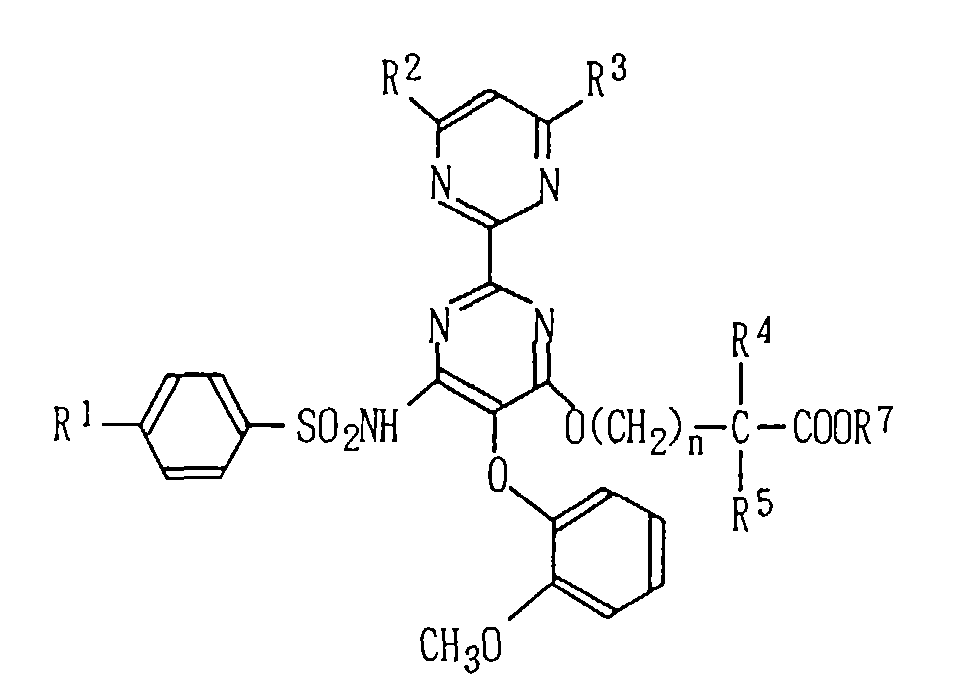
Table 2 Compound No. R1 R2 R3 n R4 R5 R7 110 t-Bu H H 1 Me Me H 111 t-Bu H H 1 Et Et H 112 t-Bu H H 1 H Me H 117 t-Bu Me Me 1 H H H 118 t-Bu EtO EtO 1 H H H 119 t-Bu i-PrO i-PrO 1 H H H 124 i-Pr H H 1 H H H 




- The pyrimidine derivative (1) of the present invention or a salt thereof, after being processed together with a pharmaceutically acceptable carrier according to a customary method, may be formed into various peroral or parenteral pharmaceutical compositions of a solid type, semi-solid type, or liquid type.
- Examples of peroral preparations include tablets, pills, granules, soft and hard capsules, powders, fine granules, emulsions, syrups, pellets, and elixirs. Examples of parenteral preparations include injections, instillations, transfusions, ointments, lotions, tonics, sprays, suspensions, oils, emulsions, and suppositories. In order to prepare a pharmaceutical composition containing the compound of the present invention as the active ingredient, known methods may be used, and there may also be used as required surfactants, excipients, coloring agents, odor improving agents, preservatives, stabilizers, buffers, suspension bases, isotonic agents, etc.
- The amount of administration of the pyrimidine derivative (1) or a salt thereof varies in accordance with the identity of the compound, the disease which is to be treated or prevented, the manner of administration, the age and symptoms of the patient, duration of treatment, etc. In the case of parenteral administration, the amount of administration is preferably between 0.01 and 30 mg/kg for subcutaneous, intravenous, intramuscular, or rectal administration. In contrast, in the case of peroral administration, the compound is preferably administered in an amount of 0.01-100 mg/kg, more preferably 0.5-30 mg/kg.
- The present invention will next be described in more detail by the examples, which should not be construed as limiting the invention thereto.
- Metallic sodium (160 mg) was added to ethyl glycolate (5 g) and the mixture was stirred for 30 minutes at room temperature. To the resultant transparent solution was added 4-t-butyl-N-[6-chloro-5-(2-methoxyphenoxy)-2-(2-pyrimidinyl)-4-pyrimidinyl]benzenesulfonamide (993 mg), and the mixture was stirred for 5 hours at 95°C. Ethyl acetate was added to the reaction mixture, followed by successive washing with 1N-HCl, water, and saturated brine.
- The organic layer was dried over anhydrous sodium sulfate. The solvent was evaporated under reduced pressure. The residue was purified by silica gel column chromatography (chloroform-methanol 30:1), to give 732 mg of ethyl [6-(4-t-butylphenylsulfonylamino)-5-(2-methoxyphenoxy)-2-(2-pyrimidinyl)-4-pyrimidinyloxy]acetate as a pale yellow oil.
- 1H-NMR(CDCℓ3, ppm, TMS) : 1.22(3H, t, J=7.1Hz), 1.29(9H, s), 4.01(3H, s), 4.18(2H, q, J=7.1Hz), 5.10(2H, s), 6.89(1H, brt, J=7.8Hz), 7.00(1H, brd, J=7.8Hz), 7.12(1H, brt, J=7.8Hz), 7.33(1H, brd, J=7.8Hz), 7.40(1H, t, J=4.6Hz), 7.41(2H, d, J=8.8Hz), 8.34(2H, m), 8.97(2H, d, J=4.6Hz)
- IR(KBr)cm-1 : 2965, 1755, 1620, 1580, 1560, 1500, 1345, 1255, 1175, 1085, 750
- 1N-NaOH (10 ml) was added to a solution of Compound No. 1 (625 mg) in ethanol (20 ml). The mixture was stirred overnight at room temperature, then solvent was evaporated under reduced pressure. 1N-HCl (10 ml) was added, and the mixture was extracted with chloroform (20 ml), followed by washing successively with water and saturated brine. Drying over anhydrous sodium sulfate and concentrating under reduced pressure gave 586 mg of [6-(4-t-butylphenylsulfonylamino)-5-(2-methoxyphenoxy)-2-(2-pyrimidinyl)-4-pyrimidinyloxy]acetic acid as a pale yellow powder.
- 1H-NMR(CDCℓ3, ppm, TMS) : 1.26(9H, s), 4.02(3H, s), 5.40(2H, s), 6.92(1H, dt, J=7.9, 1.5Hz), 7.02(1H, dd, J=7.9, 1.5Hz), 7.14(1H, dt, J=7.9, 1.5Hz), 7.34(1H, dd, J=7.9, 1.5Hz), 7.39(2H, d, J=8.5Hz), 7.43(1H, t, J=4.9Hz), 8.44(2H, d, J=8.5Hz), 9.14(2H, d, J=4.9Hz)
- To a solution of 4-t-butyl-N-[6-(3-hydroxypropyloxy)-5-(2-methoxyphenoxy)-2-(2-pyrimidinyl)-4-pyrimidinyl]benzene sulfonamide (3.2 g) in dimethylformamide (50 ml) was added pyridinium dichromate (31.9 g). The mixture was stirred for 12 hours at room temperature, and subsequently supplemented with pyridinium dichromate (10.6 g), followed by stirring for 12 hours. Ethyl acetate was added, and the mixture was washed with 1N-HCl and then with water. The organic layer was extracted with sat. aq. NaHCO3, and the aqueous layer was washed with ethyl acetate. The aqueous layer was acidified with dilute HCL, and then extracted with ethyl acetate. The organic layer was washed with saturated brine. Drying over anhydrous magnesium sulfate and concentrating under reduced pressure gave 1.85 g of 3-[6-(4-t-butylphenylsulfonylamino)-5-(2-methoxyphenoxy)-2-(2-pyrimidinyl)-4-pyrimidinyloxy]propionic acid as a pale yellow powder.
- 1H-NMR(CDCℓ3-CD3OD(4:1), ppm, TMS) : 1.29(9H, s), 2.64(2H, t, J=6.2Hz), 3.91(3H, s), 4.75(2H, t, J=6.2Hz), 6.84(1H, dt, J=7.9, 1.5Hz), 6.96(1H, brd, J=7.9Hz), 6.98(1H, dd, J=7.9, 1.5Hz), 7.09(1H, dt, J=7.9, 1.5Hz), 7.43(2H, d, J=8.8Hz), 7.50(1H, t, J=4.9Hz), 8.31(2H, m), 9.02(2H, d, J=4.9Hz)
- IR(KBr)cm-1 : 3400, 2965, 1730, 1620, 1580, 1560, 1500, 1340, 1255, 1175, 1080, 750
- The procedure described in Example 3 was repeated using 4-t-butyl-N-[6-(4-hydroxybutyloxy)-5-(2-methoxyphenoxy)-2-(2-pyrimidinyl)-4-pyrimidinyl]benzenesulfonamide, to obtain 4-[6-(4-t-butylphenylsulfonylamino)-5-(2-methoxyphenoxy)-2-(2-pyrimidinyl)-4-pyrimidinyloxy]butyric acid as a pale yellow powder.
- 1H-NMR(CDCℓ3, ppm, TMS) : 1.29(9H, s), 1.95(2H, m), 2.25(2H, t, J=7.2Hz), 3.90(3H, s), 4.52(2H, t, J=6.1Hz), 6.84(1H, dt, J=7.7, 1.5Hz), 6.96(1H, dd, J=7.7, 1.5Hz), 6.97(1H, dd, J=7.7, 1.5Hz), 7.09(1H, dt, J=7.7, 1.5Hz), 7.42(2H, d, J=8.6Hz), 7.45(1H, t, J=4.9Hz), 8.34(2H, m), 9.06(2H, d, J=4.9Hz)
- IR(KBr)cm-1 : 3305, 2965, 1735, 1685, 1615, 1565, 1500, 1335, 1260, 1165, 1115, 1075, 750
- The procedure described in Example 3 was repeated using 4-t-butyl-N-[6-(5-hydroxypentyloxy)-5-(2-methoxyphenoxy)-2-(2-pyrimidinyl)-4-pyrimidinyl]benzenesulfonamide, to obtain 5-[6-(4-t-butylphenylsulfonylamino)-5-(2-methoxyphenoxy)-2-(2-pyrimidinyl)-4-pyrimidinyloxy]pentanoic acid as a of yellow powder.
- 1H-NMR(CDCℓ3, ppm, TMS) : 1.29(9H, s), 1.57(2H, m), 1.70(2H, m), 2.29(2H, t, J=7.3Hz), 3.90(3H, s), 4.49(2H, t, J=6.2Hz), 6.83(1H, dt, J=7.8, 1.5Hz), 6.95(1H, dd, J=7.8, 1.5Hz), 7.00(1H, brd, J=7.8Hz), 7.08(1H, dt, J=7.8, 1.5Hz), 7.43(2H, d, J=8.6Hz), 7.46(1H, t, J=4.9Hz), 8.33(2H, brd, J=8.6Hz), 9.08(2H, d, J=4.9Hz)
- Concentrated sulfuric acid (2 droplets) was added to a solution of Compound No. 5 (41.3 mg) in isopropyl alcohol (2 ml). The mixture was stirred overnight at room temperature, then solvent was evaporated under reduced pressure. The residue was dissolved in ethyl acetate, and the mixture was washed successively with sat. ag. NaHCO3, water, 1N-HCl, and saturated brine. Drying over anhydrous sodium sulfate and concentrating under reduced pressure gave 34.9 mg of isopropyl 5-[6-(4-t-butylphenyl-sulfonylamino)-5-(2-methoxyphenoxy)-2-(2-pyrimidinyl)-4-pyrimidinyloxy]pentanoate as a pale yellow oil.
- 1H-NMR(CDCℓ3, ppm, TMS) : 1.19(6H, d, J=6.1Hz), 1.29(9H, s), 1.53(2H, m), 1.66(2H, m), 2.19(2H, t, J=7.3Hz), 3.91(3H, s), 4.48(2H, t, J=6.1Hz), 4.97(1H, sep, J=6.1Hz), 6.83(1H, dt, J=7.8, 1.5Hz), 6.96(1H, dd, J=7.8, 1.5Hz), 6.98(1H, brd, J=7.8Hz), 7.08(1H, dt, J=7.8, 1.5Hz), 7.42(1H, t, J=4.9Hz), 7.42(2H, d, J=8.6Hz), 8.32(2H, m), 9.02(2H, d, J=4.9Hz)
- IR(KBr)cm-1 : 2965, 1725, 1620, 1580, 1560, 1500, 1340, 1255, 1170, 1080, 750
- The procedure described in Example 6 was repeated using Compound No. 3 and benzyl alcohol, to obtain benzyl 3-[6-(4-t-butylphenylsulfonylamino)-5-(2-methoxyphenoxy)-2-(2-pyrimidinyl)-4-pyrimidinyloxy]propionate as a pale yellow oil.
- 1H-NMR(CDCℓ3, ppm, TMS) : 1.29(9H, s), 2.72(2H, t, J=6.1Hz), 3.90(3H, s), 4.80(2H, t, J=6.1Hz), 5.03(2H, s), 6.79(1H, dt, J=7.7, 1.5Hz), 6.93(1H, dd, J=7.7, 1.5Hz), 6.99(1H, brd, J=7.7Hz), 7.06(1H, dt, J=7.7, 1.5Hz), 7.28(5H, m), 7.41(1H, t, J=4.9Hz), 7.42(2H, d, J=8.6Hz), 8.35(2H, m), 9.00(2H, d, J=4.9Hz)
- The procedure described in Example 6 was repeated using Compound No. 3 and n-hexyl alcohol, to obtain n-hexyl 3-[6-(4-t-butylphenylsulfonylamino)-5-(2-methoxyphenoxy)-2-(2-pyrimidinyl)-4- pyrimidinyloxy]propionate as a pale yellow oil.
- 1H-NMR(CDCℓ3, ppm, TMS) : 0.85(3H, t, J=6.8Hz), 1.25(6H, m), 1.29(9H, s), 1.54(2H, m), 2.68(2H, t, J=6.2Hz), 3.93(3H, s), 4.00(2H, t, J=6.7Hz), 4.78(2H, t, J=6.2Hz), 6.78∼7.18(4H, m), 7.41(2H, d, J=8.6Hz), 7.42(1H, t, J=4.9Hz), 8.34(2H, m), 9.01(2H, d, J=4.9Hz)
- The procedure described in Example 6 was repeated using Compound No. 3 and ethanol, to obtain ethyl 3-[6-(4-t-butylphenylsulfonylamino)-5-(2-methoxyphenoxy)-2-(2-pyrimidinyl)-4-pyrimidinyloxy]propionate as a pale yellow oil.
- 1H-NMR(CDCℓ3, ppm, TMS) : 1.18(3H, t, J=7.2Hz), 1.29(9H, s), 2.67(2H, t, J=6.2Hz), 3.94(3H, s), 4.06(2H, q, J=7.2Hz), 4.78(2H, t, J=6.2Hz), 6.77∼7.18(4H, m), 7.42(2H, d, J=8.5Hz), 7.42(1H, t, J=4.9Hz), 8.35(2H, m), 9.00(2H, d, J=4.9Hz)
- The procedure described in Example 6 was repeated using Compound No. 2 and benzyl alcohol, to obtain benzyl [6-(4-t-butylphenylsulfonylamino)-5-(2-methoxyphenoxy)-2-(2-pyrimidinyl)-4-pyrimidinyloxy]acetate as a pale yellow oil.
- 1H-NMR(CDCℓ3, ppm, TMS) : 1.29(9H, s), 3.98(3H, s), 5.15(2H, s), 5.17(2H, s), 6.78(1H, dt, J=7.7, 1.5Hz), 6.98(1H, dd, J=7.7, 1.5Hz), 7.09(1H, dt, J=7.7, 1.5Hz), 7.24(6H, m), 7.41(1H, t, J=4.9Hz), 7.42(2H, d, J=8.5Hz), 8.35(2H, m), 8.98(2H, d, J=4.9Hz)
- IR(KBr)cm-1 : 2965, 1755, 1620, 1580, 1560, 1500, 1345, 1255, 1175, 1085, 750
- The procedure described in Example 6 was repeated using Compound No. 4 and 4-methoxybenzyl alcohol, to obtain 4-methoxybenzyl 4-[6-(4-t-butylphenylsulfonylamino)-5-(2-methoxyphenoxy)-2-(2-pyrimidinyl)-4-pyrimidinyloxy]butyrate as a pale yellow oil.
- 1H-NMR(CDCℓ3, ppm, TMS) : 1.29(9H, s), 1.93(2H, m), 2.17(2H, t, J=7.6Hz), 3.80(3H, s), 3.85(3H, s), 4.48(2H, t, J=6.0Hz), 5.00(2H, s), 6.77(1H, dt, J=7.7, 1.5Hz), 6.87(2H, d, J=8.5Hz), 6.83∼6.97(2H, m), 7.02(1H, dt, J=7.7, 1.5Hz), 7.26(2H, d, J=8.5Hz), 7.42(1H, t, J=4.9Hz), 7.42(2H, d, J=8.5Hz), 8.35(2H, m), 9.01(2H, d, J=4.9Hz)
- IR(KBr)cm-1 : 2965, 1730, 1615, 1580, 1560, 1500, 1340, 1250, 1170, 1080, 750
- To a solution of Compound No. 2 (40 mg) in methylenechloride-dimethylformamide (3:1, 2 ml) were added 3-chlorophenol (45 ml), N,N-dimethylaminopyridine (1 mg), and 1-(3-dimethylaminopropyl)-3-ethylcarbodiimide·HCl (16.3 mg), and the mixture was stirred overnight at room temperature. Solvent was evaporated under reduced pressure, and the residue was dissolved in ethyl acetate. The solution was successively washed with sat. aq. NaHCO3, water, 1N-HCl, and saturated brine. The residue resulting from drying over anhydrous sodium sulfate and concentrating under reduced pressure was purified by preparative thin-layer chromatography (by Merck; eluent: chloroform-methanol (10:1)). The purified material was dissolved in ethyl acetate, and the solution was washed with 1N-HCl and saturated brine, then brought to dryness over anhydrous sodium sulfate. When the solvent was evaporated under reduced pressure, there was obtained 3-chlorophenyl [6-(4-t-butylphenylsulfonylamino)-5-(2-methoxyphenoxy)-2-(2-pyrimidinyl)-4-pyrimidinyloxy]acetate as a pale yellow oil.
- 1H-NMR(CDCℓ3, ppm, TMS) : 1.29(9H, s), 3.98(3H, s), 5.26(2H, s), 6.84(1H, dt, J=7.8, 1.5Hz), 6.95∼7.04(2H, m), 7.10(1H, d, J=7.8, 1.5Hz), 7.15∼7.30(4H, m), 7.43(2H, d, J=8.6Hz), 7.45(1H, t, J=4.9Hz), 8.36(2H, m), 9.03(2H, d, J=4.9Hz)
- IR(KBr)cm-1 : 2965, 1780, 1620, 1580, 1560, 1500, 1340, 1255, 1175, 1085, 750
- To a solution of Compound No. 3 (21.8 mg) in dimethylformamide (0.5 ml) were added N-hydroxybenzotriazole ammonium salt (6.4 mg) and 1-(3-dimethylaminopropyl)-3-ethylcarbodiimide·HCl (8.0 mg), and the mixture was stirred for 2.5 hours at room temperature. Ethyl acetate (10 ml) was added to the reaction mixture, followed by washing successively with 1N-HCl, water, sat. aq. NaHCO3, water, and saturated brine, and drying over anhydrous sodium sulfate. Solvent was evaporated under reduced pressure, and the residue was purified by preparative thin-layer chromatography (eluent:chloroform-methanol (5:1)). The purified material was dissolved in ethyl acetate, and the resultant solution was washed with 1N-HCl and saturated brine, then brought to dryness over anhydrous sodium sulfate. When the solvent was evaporated under reduced pressure, there was obtained 3-[6-(4-t-butylphenylsulfonylamino)-5-(2-methoxyphenoxy)-2-(2-pyrimidinyl)-4-pyrimidinyloxy]propionamide (5.8 mg) as a pale yellow oil.
- 1H-NMR(CDCℓ3, ppm, TMS) : 1.29(9H, s), 2.60(2H, t, J=6.5Hz), 3.93(3H, s), 4.76(2H, t, J=6.5Hz), 6.80∼7.17(4H, m), 7.44(2H, d, J=8.8Hz), 7.48(1H, t, J=4.9Hz), 8.36(2H, m), 9.01(2H, d, J=4.9Hz)
- To a solution of Compound No. 3 (100 mg) in 1:1 dimethylformamide-methylene chloride (8 ml) were added N-hydroxybenzotriazole·H2O (53.8 mg), benzylamine (95.9 mg), and 1-(3-dimethylaminopropyl)-3-ethylcarbodiimide·HCl (40 mg), and the mixture was stirred overnight at room temperature. Solvent was evaporated under reduced pressure, and the residue was dissolved in ethyl acetate (20 ml). The resultant solution was successively washed with sat. aq. NaHCO3, water, 1N-HCl, and saturated brine, and dried over anhydrous sodium sulfate. When the residue was concentrated under reduced pressure, there was obtained N-benzyl-3-[6-(4-t-butylphenylsulfonylamino)-5-(2-methoxyphenoxy)-2-(2-pyrimidinyl)-4-pyrimidinyloxy]-propionamide (100.9 mg) as a oil.
- 1H-NMR(CDCℓ3, ppm, TMS) : 1.29(9H, s), 2.67(2H, t, J=6.5Hz), 3.90(3H, s), 4.39(2H, d, J=5.9Hz), 4.82(2H, t, J=6.5Hz), 6.75(1H, m), 6.81(1H, dt, J=7.8, 1.5Hz), 6.94(1H, dd, J=7.8, 1.5Hz), 6.97(1H, brd, J=7.8Hz), 7.08(1H, dt, J=7.8, 1.5Hz), 7.14∼7.25(5H, m), 7.36(1H, t, J=4.9Hz), 7.42(2H, d, J=8.6Hz), 8.35(2H, m), 8.87(2H, d, J=4.9Hz)
- The procedure described in Example 14 was repeated using Compound No. 2 and benzylamine, to obtain N-benzyl[6-(4-t-butylphenylsulfonylamino)-5-(2-methoxyphenoxy)-2-(2-pyrimidinyl)-4-pyrimidinyloxy]acetamide as a pale yellow powder.
- 1H-NMR(CDCℓ3, ppm, TMS) : 1.29(9H, s), 3.68(3H, s), 4.29(2H, d, J=6.1Hz), 5.02(2H, s), 6.20(1H, m), 6.69(1H, dt, J=7.8, 1.5Hz), 6.78(1H, dd, J=7.8, 1.5Hz), 6.90(1H, brd, J=7.8Hz), 6.97(1H, dt, J=7.8, 1.5Hz), 7.05∼7.33(5H, m), 7.43(1H, t, J=4.9Hz), 7.44(2H, d, J=8.5Hz), 8.38(2H, m), 8.98(2H, d, J=4.9Hz)
- The procedure described in Example 14 was repeated using Compound No. 4 and benzylamine, to obtain N-benzyl-4-[6-(4-t-butylphenylsulfonylamino)-5-(2-methoxyphenoxy)-2-(2-pyrimidinyl)-4-pyrimidinyloxy]butyramide as a pale yellow powder.
- 1H-NMR(CDCℓ3, ppm, TMS) : 1.29(9H, s), 2.01(4H, m), 3.82(3H, s), 4.35(2H, d, J=5.6Hz), 4.49(2H, m), 5.85(1H, m), 6.74(1H, dt, J=7.7, 1.5Hz), 6.81∼6.90(2H, m), 6.96(1H, dt, J=7.7, 1.5Hz), 7.16∼7.32(5H, m), 7.40(1H, t, J=4.9Hz), 7.43(2H, d, J=8.5Hz), 8.35(2H, m), 8.96(2H, d, J=4.9Hz)
- The procedure described in Example 14 was repeated using Compound No. 5 and benzylamine, to obtain N-benzyl-5-[6-(4-t-butylphenylsulfonylamino)-5-(2-methoxyphenoxy)-2-(2-pyrimidinyl)-4-pyrimidinyloxy]pentanamide as a pale yellow powder.
- 1H-NMR(CDCℓ3, ppm, TMS) : 1.29(9H, s), 1.52∼1.76(4H, m), 2.22(2H, t, J=7.0Hz), 3.89(3H, s), 4.35(2H, d, J=5.9Hz), 4.53(2H, t, J=5.9Hz), 6.36(1H, m), 6.79(1H, t, J=7.6Hz), 6.88∼6.98(2H, m), 7.04(1H, t, J=7.7Hz), 7.12∼7.29(5H, m), 7.37(1H, t, J=4.6Hz), 7.43(2H, d, J=8.6Hz), 8.36(2H, m), 8.92(2H, d, J=4.6Hz)
- IR(KBr)cm-1 : 2965, 1650, 1620, 1580, 1560, 1500, 1340, 1255, 1175, 1080, 750
- The procedure described in Example 14 was repeated using Compound No. 2 and phenethylamine, to obtain N-phenethyl-[6-(4-t-butylphenylsulfonylamino)-5-(2-methoxyphenoxy)-2-(2-pyrimidinyl)-4-pyrimidinyloxy]acetamide as a pale yellow oil.
- 1H-NMR(CDCℓ3, ppm, TMS) : 1.29(9H, s), 2.65(2H, t, J=7.1Hz), 3.32(2H, m), 3.81(3H, s), 4.96(2H, s), 5.98(1H, m), 6.75(1H, dt, J=7.8, 1.5Hz), 6.79(1H, dd, J=7.8, 1.5Hz), 6.93(1H, dd, J=7.8, 1.5Hz), 7.01∼7.20(6H, m), 7.45(1H, t, J=4.9Hz), 7.45(2H, d, J=8.6Hz), 8.37(2H, m), 9.01(2H, d, J=4.9Hz)
- The procedure described in Example 14 was repeated using Compound No. 4 and aniline, to obtain N-phenyl-4-[6-(4-t-butylphenylsulfonylamino)-5-(2-methoxyphenoxy)-2-(2-pyrimidinyl)-4-pyrimidinyloxy]butyramide as a pale yellow powder.
- 1H-NMR(CDCℓ3, ppm, TMS) : 1.29(9H, s), 2.06(2H, m), 2.20(2H, m), 3.90(3H, s), 4.53(2H, t, J=5.6Hz), 6.80∼7.31(6H, m), 7.34∼7.48(5H, m) 7.63(1H, m), 8.37(2H, m), 8.94(2H, d, J=4.9Hz)
- IR(KBr)cm-1 : 2965, 1670, 1620, 1580, 1560, 1500, 1340, 1255, 1175, 1080, 755
- The procedure described in Example 14 was repeated using Compound No. 4 and 2-methoxyaniline, to obtain N-(2-methoxyphenyl)-4-[6-(4-t-butylphenylsulfonylamino)-5-(2-methoxyphenoxy)-2-(2-pyrimidinyl)-4-pyrimidinyloxy]butyramide as a pale yellow powder.
- 1H-NMR(CDCℓ3, ppm, TMS) : 1.29(9H, s), 2.04(2H, m), 2.13(2H, m), 3.85(3H, s), 3.88(3H, s), 4.55(2H, t, J=5.6Hz), 6.81∼7.01(6H, m), 7.02(1H, dt, J=7.7, 1.5Hz), 7.11(1H, dt, J=7.7, 1.5Hz), 7.41(1H, t, J=4.9Hz), 7.43(2H, d, J=8.8Hz), 8.31(2H, m), 8.99(2H, d, J=4.9Hz)
- The procedure described in Example 14 was repeated using Compound No. 4 and 3-chloroaniline, to obtain N-(3-chlorophenyl)-4-[6-(4-t-butylphenylsulfonylamino)-5-(2- methoxyphenoxy)-2-(2-pyrimidinyl)-4-pyrimidinyloxy]butyramide as a colorless powder.
- 1H-NMR(CDCℓ3, ppm, TMS) : 1.29(9H, s), 2.06(2H, m), 2.23(2H, t, J=7.1Hz), 3.90(3H, s), 4.55(2H, t, J=5.6Hz), 6.86(1H, dt, J=7.8, 1.5Hz), 6.95(1H, dd, J=7.8, 1.5Hz), 6.98(1H, dd, J=7.8, 1.5Hz), 7.04(1H, m), 7.11(1H, dt, J=7.8, 1.5Hz), 7.17(1H, t, J=8.1Hz), 7.28(1H, m), 7.41(1H, t, J=4.9Hz), 7.43(2H, d, J=8.8Hz), 7.55(1H, brs), 8.33(2H, m), 8.95(2H, d, J=4.9Hz)
- The procedure described in Example 14 was repeated using Compound No. 2 and 2-methoxyaniline, to obtain N-(2-methoxyphenyl)-[6-(4-t-butylphenylsulfonylamino)-5-(2-methoxyphenoxy)-2-(2-pyrimidinyl)-4-pyrimidinyloxy]acetamide as a colorless powder.
- 1H-NMR(CDCℓ3, ppm, TMS) : 1.29(9H, s), 3.58(3H, s), 3.99(3H, s), 5.20(2H, s), 7.30∼7.67(7H, m), 7.36∼7.48(3H, m), 8.26(1H, dd, J=8.1, 1.5Hz), 8.37(2H, m), 8.69(1H, brs), 9.00(2H, d, J=4.6Hz)
- IR(KBr)cm-1 : 2965, 1695, 1620, 1580, 1560, 1500, 1340, 1255, 1175, 1085, 750
- The procedure described in Example 14 was repeated using Compound No. 2 and 3-chloroaniline, to obtain N-(3-chlorophenyl)-[6-(4-t-butylphenylsulfonylamino)-5-(2-methoxyphenoxy)-2-(2-pyrimidinyl)-4-pyrimidinyloxy]acetamide as a colorless powder.
- 1H-NMR(CDCℓ3, ppm, TMS) : 1.29(9H, s), 3.90(3H, s), 5.09(2H, s), 6.88(1H, dt, J=7.7, 1.5Hz), 6.95∼7.10(3H, m), 7.14(1H, dt, J=7.7, 1.5Hz), 7.19(1H, t, J=7.9Hz), 7.32(1H, t, J=1.8Hz), 7.37(2H, m), 7.44(2H, d, J=8.8Hz), 7.48(1H, t, J=4.9Hz), 8.35(2H, m), 9.04(2H, d, J=4.9Hz)
- The procedure described in Example 14 was repeated using Compound No. 2 and aniline, to obtain N-phenyl-[6-(4-t-butylphenylsulfonylamino)-5-(2-methoxyphenoxy)-2-(2-pyrimidinyl)-4-pyrimidinyloxy]acetamide as a pale yellow oil.
- 1H-NMR(CDCℓ3, ppm, TMS) : 1.29(9H, s), 3.86(3H, s), 5.11(2H, s), 6.85(1H, dt, J=7.7, 1.5Hz), 6.98(1H, dd, J=7.7, 1.5Hz), 7.01(1H, brd, J=7.7Hz), 7.05∼7.14(2H, m), 7.22∼7.38(4H, m), 7.43(2H, d, J=8.5Hz), 7.45(1H, t, J=4.9Hz), 8.38(2H, m), 9.01(2H, d, J=4.9Hz)
- IR(KBr)cm-1 : 2965, 1700, 1620, 1580, 1560, 1500, 1340, 1255, 1175, 1085, 755
- The procedure described in Example 14 was repeated using Compound No. 2 and 1-naphthalenemethylamine, to obtain N-(1-naphthylmethyl)-[6-(4-t-butylphenylsulfonylamino)-5-(2-methoxyphenoxy)-2-(2-pyrimidinyl)-4-pyrimidinyloxy]acetamide as a pale yellow oil.
- 1H-NMR(CDCℓ3, ppm, TMS) : 1.29(9H, s), 3.58(3H, s), 4.78(2H, d, J=5.6Hz), 5.05(2H, s), 6.30(1H, m), 6.42(1H, dt, J=7.8, 1.5Hz), 6.56(1H, dd, J=7.8, 1.5Hz), 6.72(2H, m), 7.26(1H, m), 7.35∼7.50(6H, m), 7.78∼7.88(3H, m), 8.34(2H, m), 8.94(2H, d, J=4.9Hz)
- IR(KBr)cm-1 : 2965, 1675, 1620, 1580, 1560, 1500, 1340, 1255, 1175, 1085, 750
- The procedure described in Example 14 was repeated using Compound No. 4 and 3-methoxybenzylamine, to obtain N-(3-methoxybenzyl)-4-[6-(4-t-butylphenylsulfonylamino)-5-(2-methoxyphenoxy)-2-(2-pyrimidinyl)-4-pyrimidinyloxy]butyramide as a pale yellow oil.
- 1H-NMR(CDCℓ3, ppm, TMS) : 1.29(9H, s), 2.01(4H, m), 3.74(3H, s), 3.83(3H, s), 4.33(2H, d, J=5.6Hz), 4.49(2H, m), 5.88(1H, m), 6.70∼6.81(5H, m), 6.87(1H, dd, J=7.8, 1.5Hz), 6.98(1H, dt, J=7.8, 1.5Hz), 7.18(1H, dt, J=7.8, 1.5Hz), 7.41(1H, t, J=4.9Hz), 7.43(2H, d, J=8.8Hz), 8.33(2H, m), 8.94(2H, d, J=4.9Hz)
- IR(KBr)cm-1 : 2965, 1655, 1615, 1580, 1560, 1500, 1340, 1260, 1170, 1080, 750
- The procedure described in Example 14 was repeated using Compound No. 4 and 2-chlorophenethylamine, to obtain N-(2-chlorophenethyl)-4-[6-(4-t-butylphenylsulfonylamino)-5-(2-methoxyphenoxy)-2-(2-pyrimidinyl)-4-pyrimidinyloxy]butylamide as a pale yellow oil.
- 1H-NMR(CDCℓ3, ppm, TMS) : 1.29(9H, s), 1.95(4H, m), 2.90(2H, t, J=7.0Hz), 3.46(2H, m), 3.87(3H, s), 4.45(2H, m), 5.62(1H, m), 6.76(1H, dt, J=7.8, 1.5Hz), 6.87(1H, dd, J=7.8, 1.5Hz), 6.91(1H, dd, J=7.8, 1.5Hz), 6.99(1H, dt, J=7.8, 1.5Hz), 7.05∼7.19(3H, m), 7.30(1H, m), 7.43(1H, t, J=4.9Hz), 7.43(2H, d, J=8.8Hz), 8.33(2H, m), 9.00(2H, d, J=4.9Hz)
- IR(KBr)cm-1 : 2965, 1655, 1620, 1580, 1560, 1500, 1340, 1255, 1175, 1080, 755
- The procedure described in Example 14 was repeated using Compound No. 5 and 2-methoxybenzylamine, to obtain N-(2-methoxybenzyl)-5-[6-(4-t-butylphenylsulfonylamino)-5-(2-methoxyphenoxy)-2-(2-pyrimidinyl)-4-pyrimidinyloxy]pentanamide as a pale yellow oil.
- 1H-NMR(CDCℓ3, ppm, TMS) : 1.29(9H, s), 1.56(2H, m), 1.65(2H, m), 2.15(2H, t, J=7.2Hz), 3.75(3H, s), 3.88(3H, s), 4.38(2H, d, J=5.6Hz), 4.50(2H, t, J=6.1Hz), 6.30(1H, m), 6.73∼6.97(5H, m), 7.03(1H, dt, J=7.8, 1.5Hz), 7.15 ∼7.24(2H, m), 7.39(1H, t, J=4.9Hz), 7.43(2H, d, J=8.6Hz), 8.32(2H, m), 8.96(2H, d, J=4.9Hz)
- IR(KBr)cm-1 : 2960, 1650, 1620, 1580, 1560, 1500, 1340, 1245, 1175, 1080, 755
- The procedure described in Example 14 was repeated using Compound No. 5 and 3-chlorobenzylamine, to obtain N-(3-chlorobenzyl)-5-[6-(4-t-butylphenylsulfonylamino)-5-(2-methoxyphenoxy)-2-(2-pyrimidinyl)-4-pyrimidinyloxy] pentanamide as a pale yellow oil.
- 1H-NMR(CDCℓ3, ppm, TMS) : 1.29(9H, s), 1.69(4H, m), 2.24(2H, t, J=6.6Hz) 3.90(3H, s), 4.32(2H, d, J=5.9Hz), 4.54(2H, t, J=6.0Hz), 6.51(1H, m), 6.80(1H, brt, J=8.3Hz), 6.94(2H, m), 7.00∼7.20(5H, m), 7.39(1H, t, J=4.9Hz), 7.43(2H, d, J=8.8Hz), 8.32(2H, m), 8.93(2H, d, J=4.9Hz)
- The procedure described in Example 14 was repeated using Compound No. 3 and 2-methylbenzylamine, to obtain N-(2-methylbenzyl)-3-[6-(4-t-butylphenylsulfonylamino)-5-(2-methoxyphenoxy)-2-(2-pyrimidinyl)-4-pyrimidinyloxy]propionamide as a pale yellow oil.
- 1H-NMR(CDCℓ3, ppm, TMS) : 1.29(9H, s), 2.24(3H, s), 2.67(2H, t, J=6.4Hz), 3.90(3H, s), 4.37(2H, d, J=5.6Hz), 4.82(2H, t, J=6.4Hz), 6.52(1H, m), 6.80(1H, t, J=7.8Hz), 6.94(1H, d, J=7.8Hz), 6.96∼7.18(6H, m), 7.34(1H, t, J=4.9Hz), 7.42(2H, d, J=8.7Hz), 8.37(2H, m), 8.82(2H, d, J=4.9Hz)
- IR(KBr)cm-1 : 2965, 1655, 1620, 1580, 1560, 1500, 1340, 1255, 1175, 1080, 750
- The procedure described in Example 14 was repeated using Compound No. 4 and phenethylamine, to obtain N-phenethyl-4-[6-(4-t-butylphenylsulfonylamino)-5-(2-methoxyphenoxy)-2-(2-pyrimidinyl)-4-pyrimidinyloxy]butyramide as a pale yellow oil.
- 1H-NMR(CDCℓ3, ppm, TMS) : 1.29(9H, s), 1.91(4H, m), 2.75(2H, t, J=6.5Hz), 3.46(2H, m), 3.86(3H, s), 4.43(2H, m), 5.52(1H, m), 6.72(1H, dt, J=7.8, 1.5Hz), 6.84(1H, d, J=7.8Hz), 6.88(1H, dd, J=7.8, 1.5Hz), 6.95(1H, dt, J=7.8, 1.5Hz), 7.10∼7.30(5H, s 7.42(1H, t, J=4.9Hz), 7.43(2H, d, J=8.5Hz), 8.36(2H, m), 8.99(2H, d, J=4.9Hz)
- IR(KBr)cm-1 : 2965, 1655, 1620, 1580, 1560, 1500, 1340, 1255, 1175, 1080, 750
- The procedure described in Example 14 was repeated using Compound No. 5 and 2-chlorophenethylamine, to obtain N-(2-chlorophenethyl)-5-[6-(4-t-butylphenylsulfonylamino)-5-(2-methoxyphenoxy)-2-(2-pyrimidinyl)-4- pyrimidinyloxy]pentanamide as a pale yellow oil.
- 1H-NMR(CDCℓ3, ppm, TMS) : 1.29(9H, s), 1.52∼1.70(4H, m), 2.13(2H, t, J=7.1Hz), 2.90(2H, t, J=7.0Hz), 3.48(2H, m), 3.92(3H, s), 4.50(2H, t, J=6.0Hz), 6.05(1H, m), 6.81(1H, t, J=8.0Hz), 6.90∼7.26(7H, m), 7.42(1H, t, J=4.9Hz), 7.42(2H, d, J=8.5Hz), 8.35(2H, m), 8.95(2H, d, J=4.9Hz)
- IR(KBr)cm-1 : 2960, 1650, 1580, 1560, 1500, 1340, 1255, 1170, 1080, 750
- The procedure described in Example 14 was repeated using Compound No. 5 and phenethylamine, to obtain N-phenethyl-5-[6-(4-t-butylphenylsulfonylamino)-5-(2-methoxyphenoxy)-2-(2-pyrimidinyl)-4-pyrimidinyloxy]pentanamide as a pale yellow oil.
- 1H-NMR(CDCℓ3, ppm, TMS) : 1.29(9H, s), 1.52∼1.67(4H, m), 2.11(2H, t, J=7.7Hz), 2.76(2H, t, J=7.0Hz), 3.45(2H, q, J=6.6Hz), 3.91(3H, s), 4.49(2H, t, J=6.1Hz), 5.91(1H, m), 6.80(1H, dt, J=7.0, 1.5Hz), 6.90∼7.26(8H, m), 7.42(2H, d, J=8.6Hz), 7.43(1H, t, J=4.6Hz), 8.29∼8.40(2H, m), 8.94(2H, d, J=4.6Hz)
- IR(KBr)cm-1 : 2960, 1650, 1580, 1560, 1500, 1340, 1255, 1170, 1080, 750
- To a solution of Compound No. 3 (51 mg) in 2:1 dimethylformamide-methylene chloride (1.5 ml) were added N-hydroxybenzotriazole·H2O (27 mg), 4-methoxybenzylamine (57.5 µl), and 1-(3-dimethylaminopropyl)-3-ethylcarbodiimide·HCl (17 mg), and the mixture was stirred overnight at room temperature. Solvent was evaporated under reduced pressure, and the residue was dissolved in ethyl acetate (15 ml). The resultant solution was successively washed with 1N-HCl, water, sat. aq. NaHCO3, and saturated brine, and dried over anhydrous sodium sulfate. When the residue was concentrated under reduced pressure, there was obtained a sodium salt of N-(4-methoxybenzyl)-3-[6-(4-t-butylphenylsulfonylamino)-5-(2-methoxyphenoxy)-2-(2-pyrimidinyl)-4-pyrimidinyloxy]propionamide as a colorless powder (38 mg).
- Melting point: 129-131°C
- IR(KBr)cm-1 : 2965, 1655, 1615, 1560, 1500, 1380, 1250, 1180, 1135, 1080, 750
- The procedure described in Example 34 was repeated using Compound No. 3 and aniline, to obtain a sodium salt of N-phenyl-3-[6-(4-t-butylphenylsulfonylamino)-5-(2-methoxyphenoxy)-2-(2-pyrimidinyl)-4-pyrimidinyloxy]propionamide as a pale yellow powder.
- Melting point: 162-163°C
- IR(KBr)cm-1 : 2965, 1670, 1600, 1560, 1500, 1380, 1250, 1135, 1080, 755
- The procedure described in Example 34 was repeated using Compound No. 3 and 3,4-methylenedioxybenzylamine, to obtain a sodium salt of N-(3,4-methylenedioxybenzyl)-3-[6-(4-t-butylphenylsulfonylamino)-5-(2-methoxyphenoxy)-2-(2-pyrimidinyl)-4-pyrimidinyloxy]propionamide as a colorless powder.
- Melting point: 142-145°C
- IR(KBr)cm-1 : 2965, 1655, 1560, 1500, 1380, 1250, 1180, 1080, 750
- The procedure described in Example 34 was repeated using Compound No. 3 and 4-chlorobenzylamine, to obtain a sodium salt of N-(4-chlorobenzyl)-3-[6-(4-t-butylphenylsulfonylamino)-5-(2-methoxyphenoxy)-2-(2-pyrimidinyl)-4-pyrimidinyloxy]propionamide as a colorless powder.
- Melting point: 161-163°C
- IR(KBr)cm-1 : 2965, 1655, 1560, 1500, 1360, 1250, 1180, 1080, 750
- The procedure described in Example 34 was repeated using Compound No. 3 and 2-chlorophenethylamine, to obtain a sodium salt of N-(2-chlorophenethyl)-3-[6-(4-t-butylphenylsulfonylamino)-5-(2-methoxyphenoxy)-2-(2-pyrimidinyl)-4-pyrimidinyloxy]propionamide as a colorless powder.
- Melting point: 148-149°C
- IR(KBr)cm-1 : 2965, 1655, 1560, 1500, 1365, 1250, 1180, 1080, 755
- The procedure described in Example 34 was repeated using Compound No. 3 and 4-methoxyphenethylamine, to obtain a sodium salt of N-(4-methoxyphenethyl)-3-[6-(4-t-butylphenylsulfonylamino)-5-(2-methoxyphenoxy)-2-(2-pyrimidinyl)-4-pyrimidinyloxy]propionamide as a pale yellow powder.
- Melting point: 140-142°C
- IR(KBr)cm-1 : 2965, 1650, 1560, 1500, 1365, 1250, 1180, 1080, 750
- The procedure described in Example 34 was repeated using Compound No. 3 and 3-methoxyaniline, to obtain a sodium salt of N-(methoxyphenyl)-3-[6-(4-t-butylphenylsulfonylamino)-5-(2-methoxyphenoxy)-2-(2-pyrimidinyl)-4-pyrimidinyloxy]-propionamide as a colorless powder.
- Melting point: 160-161°C
- IR(KBr)cm-1 : 2965, 1670, 1600, 1560, 1500, 1380, 1250, 1180, 1080, 750
- The procedure described in Example 34 was repeated using Compound No. 3 and phenethylamine, to obtain a sodium salt of N-phenethyl-3-[6-(4-t-butylphenylsulfonylamino)-5-(2-methoxyphenoxy)-2-(2-pyrimidinyl)-4-pyrimidinyloxy]propionamide as a pale yellow powder.
- Melting point: 149-150°C
- IR(KBr)cm-1 : 2965, 1655, 1560, 1500, 1365, 1250, 1180, 1080, 750
- The procedure described in Example 34 was repeated using Compound No. 3 and 4-chloroaniline, to obtain a sodium salt of N-(4-chlorophenyl)-3-[6-(4-t-butylphenylsulfonylamino)-5-(2-methoxyphenoxy)-2-(2-pyrimidinyl)-4-pyrimidinyloxy]-propionamide as a pale yellow powder.
- Melting point: 165-168°C
- IR(KBr)cm-1 : 2965, 1675, 1595, 1560, 1500, 1380, 1250, 1180, 1080, 750
- The procedure dexcribed in Example 34 was repeated using Compound No. 3 and 3,4,5-trimethoxybenzylamine, to obtain a sodium salt of N-(3,4,5-trimethoxybenzyl)-3-[6-(4-t-butylphenylsulfonylamino)-5-(2-methoxyphenoxy)-2-(2- pyrimidinyl)-4-pyrimidinyloxy]propionamide as a pale yellow powder.
- Melting point: 142-145°C
- IR(KBr)cm-1 : 2965, 1655, 1590, 1580, 1560, 1500, 1330, 1250, 1180, 1080, 750
- The procedure described in Example 34 was repeated using Compound No. 3 and 2-methoxybenzylamine, to obtain a sodium salt of N-(2-methoxybenzyl)-3-[6-(4-t-butylphenylsulfonylamino)-5-(2-methoxyphenoxy)-2-(2-pyrimidinyl)-4-pyrimidinyloxy]propionamide as a colorless powder.
- Melting point: 138-139°C
- IR(KBr)cm-1 : 2965, 1655, 1580, 1560, 1500, 1360, 1250, 1175, 1080, 755
- The procedure described in Example 34 was repeated using Compound No. 3 and cyclohexylamine, to obtain a sodium salt of N-cyclohexyl-3-[6-(4-t-butylphenylsulfonylamino)-5-(2-methoxyphenoxy)-2-(2-pyrimidinyl)-4-pyrimidinyloxy]-propionamide as a pale yellow powder.
- Melting point: 162-164°C
- IR(KBr)cm-1 : 2935, 1650, 1560, 1500, 1365, 1250, 1180, 1080, 750
- The procedure described in Example 34 was repeated using Compound No. 3 and n-pentylamine, to obtain a sodium salt of N-(n-pentyl)-3-[6-(4-t-butylphenylsulfonylamino)-5-(2-methoxyphenoxy)-2-(2-pyrimidinyl)-4-pyrimidinyloxy]propionamide as a pale yellow powder.
- Melting point: 142-144°C
- IR(KBr)cm-1 : 2960, 1655, 1560, 1365, 1250, 1180, 1080, 750
- The procedure described in Example 34 was repeated using Compound No. 5 and 3-phenyl-1-propylamine, to obtain a sodium salt of N-(3-phenyl-1-propyl)-5-[6-(4-t-butylphenylsulfonylamino)-5-(2-methoxyphenoxy)-2-(2-pyrimidinyl)-4-pyrimidinyloxy]pentanamide as a pale yellow powder.
- Melting point: 118-120°C
- The procedure described in Example 34 was repeated using Compound No. 3 and 2-methoxyaniline, to obtain a sodium salt of N-(2-methoxyphenyl)-3-[6-(4-t-butylphenylsulfonylamino)-5-(2-methoxyphenoxy)-2-(2-pyrimidinyl)-4-pyrimidinyloxy]propionamide as a pale yellow powder.
- Melting point: 120-122°C
- IR(KBr)cm-1 : 2965, 1675, 1600, 1560, 1500, 1255, 1135, 1080, 750
- The resultant sodium salt was transformed into a free form by a customary method. The NMR data of the free compound are shown below.
- 1H-NMR(CDCℓ3, ppm, TMS) : 1.29(9H, s), 2.77(2H, t, J=5.9Hz), 3.74(3H, s), 3.87(3H, s), 4.89(2H, t, J=5.9Hz), 6.59(1H, t, J=7.2Hz), 6.77∼7.09(6H, m), 7.40(1H, t, J=4.9Hz), 7.42(2H, d, J=8.5Hz), 7.90(1H, brs), 8.29(1H, d, J=7.3Hz), 8.38(2H, d, J=8.5Hz), 8.82(1H, brs), 8.99(2H, d, J=4.9Hz)
- The procedure described in Example 34 was repeated using Compound No. 3, N-methylmorpholine, and an equivalent amount of ethylamine·HCl, to obtain a sodium salt of N-ethyl-3-[6-(4-t-butylphenylsulfonylamino)-5-(2-methoxyphenoxy)-2-(2-pyrimidinyl)-4-pyrimidinyloxy]propionamide as a colorless powder.
- Melting point: 117-120°C
- To a solution of Compound No. 2 (57.6 mg) in 1:1 dimethylformamide-methylene chloride (2 ml) were added N-hydroxybenzotriazole·H2O (30.6 mg) and 1-(3-dimethylaminopropyl)-3-ethylcarbodiimide·HCl (21.1 mg), and the mixture was stirred for 1 hour. Subsequently, hydroxylamine·HCl (39.8 mg) and triethylamine (0.08 ml) were added, and the mixture was stirred overnight at room temperature. Solvent was evaporated under reduced pressure, and the residue was dissolved in ethyl acetate (5 ml). The resultant solution was successively washed with 1N-HCl, water, sat. aq. NaHCO3, and saturated brine, and dried over anhydrous sodium sulfate. The residue was concentrated under reduced pressure, and subjected to preparative thin-layer chromatography for purification by use of chloroform-methanol (10:1) as an eluent. The purified material was dissolved in ethyl acetate , and the resultant solution was successively washed with 1N HCl and brine, and dried over anhydrous magnesium sulfate. When solvent was evaporated, there was obtained N-hydroxy-[6-(4-t-butylphenylsulfonylamino)-5-(2-methoxyphenoxy)-2-(2-pyrimidinyl)-4-pyrimidinyloxy]acetamide as a colorless powder (12 mg).
- 1H-NMR(CDCℓ3, ppm, TMS) : 1.29(9H, s), 4.00(3H, s), 5.14(2H, s), 6.89(1H, t, J=7.6Hz), 7.00(1H, d, J=7.6Hz), 7.12(1H, t, J=7.6Hz), 7.32(1H, d, J=7.6Hz), 7.40(1H, t, J=4.9Hz), 7.42(2H, d, J=8.3Hz), 8.37(2H, m), 8.99(2H, d, J=4.9Hz)
- The procedure described in Example 14 was repeated using Compound No. 3 and homopiperidine, to obtain homopiperidino-3-[6-(4-t-butylphenylsulfonylamino)-5-(2-methoxyphenoxy)-2-(2-pyrimidinyl)-4-pyrimidinyloxy]propionamide as a pale yellow oil.
- 1H-NMR(CDCℓ3, ppm, TMS) : 1.28(9H, s), 1.49(4H, m), 1.64(4H, m), 2.72(2H, t, J=6.7Hz), 3.36(2H, t, J=6.1Hz), 3.46(2H, t, J=6.1Hz), 3.96(3H, s), 4.88(2H, t, J=6.7Hz), 6.82(1H, t, J=8.1Hz), 6.92∼7.14(3H, m), 7.40(1H, t, J=4.9Hz), 7.40(2H, d, J=8.6Hz), 8.32(2H, m), 9.00(2H, d, J=4.9Hz)
- The procedure described in Example 14 was repeated using Compound No. 3 and 3-methylaniline, to obtain N-(3-methylphenyl)-3-[6-(4-t-butylphenylsulfonylamino)-5-(2-methoxyphenoxy)-2-(2-pyrimidinyl)-4-pyrimidinyloxy]propionamide as a pale yellow oil.
- 1H-NMR(CDCℓ3, ppm, TMS) : 1.29(9H, s), 2.29(3H, s), 2.74(2H, t, J=6.2Hz), 3.86(3H, s), 4.85(2H, t, J=6.2Hz), 6.70(1H, dt, J=7.8, 1.5Hz), 6.85∼7.30(7H, m), 7.40(1H, t, J=4.9Hz), 7.42(2H, d, J=8.8Hz), 8.36(2H, m), 8.93(2H, d, J=4.9Hz)
- IR(KBr)cm-1 : 2965, 1685, 1615, 1580, 1560, 1500, 1340, 1255, 1175, 1085, 750
- The procedure described in Example 14 was repeated using Compound No. 3 and 2-isopropylaniline, to obtain N-(2-isopropylphenyl)-3-[6-(4-t-butylphenylsulfonylamino)-5-(2-methoxyphenoxy)-2-(2-pyrimidinyl)-4-pyrimidinyloxy] propionamide as a pale yellow oil.
- 1H-NMR(CDCℓ3, ppm, TMS) : 1.06(6H, d, J=6.8Hz), 1.29(9H, s), 2.86(2H, t, J=6.5Hz), 3.03(1H, sep, J=6.8Hz), 3.92(3H, s), 4.92(2H, t, J=6.5Hz), 6.80(1H, t, J=7.7Hz), 6.95(1H, d, J=7.1Hz), 6.99∼7.32(6H, m), 7.36(1H, d, J=8.1Hz), 7.43(2H, d, J=8.6Hz), 8.43(2H, d, J=8.6Hz), 8.59(2H, d, J=4.9Hz), 8.86(1H, brs)
- Oxalyl chloride (9.5 mg) was added to a solution of Compound No. 3 (40.2 mg) in methylene chloride (0.3 ml). One droplet of dimethylformamide was added thereto, and the resulting mixture was stirred at room temperature for 30 minutes. Subsequently, 2-amino-5-trifluoromethyl-1,3,4-thiadiazole (24.1 mg) was added, and the mixture was stirred overnight at room temperature. Ethyl acetate (10 ml) was added to the reaction mixture, followed by washing successively with sat. aq. NaHCO3, water, 1N-HCl, water, and saturated brine and drying over anhydrous sodium sulfate. Solvent was evaporated under reduced pressure, then the residue was purified by preparative thin layer chromatography (eluent: chloroform-methanol (5:1)), dissolved in ethyl acetate, washed with 1N-HCl and saturated brine, and dried over anhydrous sodium sulfate. When the solvent was evaporated under reduced pressure, there was obtained N-(5-trifluoromethyl-1,3,4-thiadiazole-2-yl)-3-[6-(4-t-butylphenylsulfonylamino)-5-(2-methoxyphenoxy)-2-(2-pyrimidinyl)-4-pyrimidinyloxy]propionamide as a pale yellow powder (32.9 mg).
- 1H-NMR(CDCℓ3, ppm, TMS) : 1.29(9H, s), 3.12(2H, t, J=6.7Hz), 3.85(3H, s), 4.83(2H, t, J=6.7Hz), 6.74(1H, t, J=7.6Hz), 6.86(1H, d, J=7.6Hz), 6.90(1H, d, J=7.6Hz), 6.99(1H, t, J=7.6Hz), 7.45(2H, d, J=8.6Hz), 7.49(1H, t, J=4.9Hz), 8.44(2H, m), 9.00(1H, brs), 9.26(2H, d, J=4.9Hz)
- IR(KBr)cm-1 : 2965, 1700, 1620, 1580, 1560, 1500, 1330, 1255, 1175, 1085, 750
- The procedure described in Example 14 was repeated using Compound No. 3 and 2-ethylaniline, to obtain N-(2-ethylphenyl)-3-[6-(4-t-butylphenylsulfonylamino)-5-(2- methoxyphenoxy)-2-(2-pyrimidinyl)-4-pyrimidinyloxy] propionamide as a pale yellow powder.
- 1H-NMR(CDCℓ3, ppm, TMS) : 1.07(3H, t, J=7.6Hz), 1.29(9H, s), 2.50(2H, q, J=7.6Hz), 2.84(2H, t, J=6.5Hz), 3.90(3H, s), 4.94(2H, t, J=6.5Hz), 6.78(1H, t, J=7.6Hz), 6.93(1H, d, J=7.6Hz), 6.97∼7.32(6H), 7.43(1H, t, J=4.6Hz), 7.43(2H, d, J=8.5Hz), 8.43(2H, d, J=8.5Hz), 8.59(1H, brs), 8.65(2H, d, J=4.6Hz), 8.83(1H, b
- IR(KBr)cm-1 : 2965, 1670, 1618, 1499, 1455, 1384, 1255, 1175, 1083, 752
- The procedure dexcribed in Example 54 was repeated using Compound No. 3 and 1,2-phenylenediamine, to obtain N-(2-aminophenyl)-3-[6-(4-t-butylphenylsulfonylamino)-5-(2-methoxyphenoxy)-2-(2-pyrimidinyl)-4-pyrimidinyloxy]propionamide as a pale yellow powder.
- 1H-NMR(CDCℓ3, ppm, TMS) : 1.29(9H, s), 2.82(2H, t, J=6.5Hz), 3.88(3H, s), 4.87(2H, t, J=6.5Hz), 6.70∼7.14(8H), 7.33(1H, t, J=4.9Hz), 7.42(2H, d, J=8.5Hz), 8.36(2H, m), 8.77(2H, d, J=4.9Hz)
- IR(KBr)cm-1 : 2965, 1665, 1620, 1580, 1560, 1500, 1342, 1255, 1175, 1080, 750
- The procedure described in Example 14 was repeated using Compound No. 3 and phenylhydrazine, to obtain N'-phenyl-3-[6-(4-t-butylphenylsulfonylamino)-5-(2-methoxyphenoxy)-2-(2-pyrimidinyl)-4-pyrimidinyloxy]propionohydrazide as a pale yellow powder.
- 1H-NMR(CDCℓ3, ppm, TMS) : 1.30(9H, s), 2.77(2H, t, J=6.7Hz), 3.94(3H, s), 4.80(2H, t, J=6.7Hz), 6.24(1H, brs), 6.74∼7.24(9H), 7.33(1H, t, J=4.9Hz), 7.46(2H, d, J=8.6Hz), 8.47(2H, d, J=8.6Hz), 8.90(2H, d, J=4.9Hz)
- IR(KBr)cm-1 : 2965, 1680, 1620, 1580, 1560, 1500, 1340, 1255, 1175, 1080, 755
- The procedure dexcribed in Example 54 was repeated using Compound No. 3 and 2-aminopyridine, to obtain N-(2-pyridyl)-3-[6-(4-t-butylphenylsulfonylamino)-5-(2-methoxyphenoxy)-2-(2-pyrimidinyl)-4-pyrimidinyloxy]propionamide as a pale yellow powder.
- 1H-NMR(CDCℓ3, ppm, TMS) : 1.29(9H, s), 2.77(2H, t, J=6.2Hz), 3.86(3H, s), 4.86(2H, t, J=6.2Hz), 6.68(1H, dt, J=7.8, 1.2Hz), 6.86(1H, d, J=7.6Hz), 6.90∼7.07(3H), 7.42(1H, t, J=4.9Hz), 7.42(2H, d, J=8.5Hz), 7.68(1H, dt, J=7.9, 1.8Hz), 8.14(1H, d, J=8.3Hz), 8.25(1H, m), 8.39(2H, m), 8.49(1H, brs), 9.04(2H, d, J=4.9Hz)
- IR(KBr)cm-1 : 2965, 1695, 1620, 1580, 1560, 1500, 1340, 1255, 1175, 1085, 750
- The procedure dexcribed in Example 14 was repeated using Compound No. 3 and 2-isopropenylaniline, to obtain N-(2-isopropenylphenyl)-3-[6-(4-t-butylphenylsulfonylamino)-5-(2-methoxyphenoxy)-2-(2-pyrimidinyl)-4-pyrimidinyloxy]propionamide as a pale yellow powder.
- 1H-NMR(CDCℓ3, ppm, TMS) : 1.28(9H, s), 1.91(3H, s), 2.75(2H, t, J=6.0Hz), 3.88(3H, s), 4.85(1H, brs), 4.89(2H, t, J=6.0Hz), 5.16(1H, brs), 6.63(1H, t, J=7.4Hz), 6.88(1H, d, J=7.6Hz), 6.92∼7.14(4H, m), 7.23(1H, m), 7.41(1H, t, J=4.6Hz), 7.41(2H, d, J=8.6Hz), 7.96(1H, brs), 8.09(1H, d, J=8.0Hz), 8.39(2H, m), 8.92(2H, d, J=4.6Hz)
- IR(KBr)cm-1 : 2965, 1685, 1620, 1580, 1560, 1500, 1345, 1255, 1175, 1085, 750
- The procedure described in Example 14 was repeated using Compound No. 3 and 2-(methylthio)aniline, to obtain N-(2-methylthiophenyl)-3-[6-(4-t-butylphenylsulfonylamino)-5-(2-methoxyphenoxy)-2-(2-pyrimidinyl)-4-pyrimidinyloxy] propionamide as a pale yellow powder.
- 1H-NMR(CDCℓ3, ppm, TMS) : 1.29(9H, s), 2.24(3H, s), 2.82(2H, t, J=6.0Hz), 3.87(3H, s), 4.92(2H, t, J=6.0Hz), 6.63(1H, t, J=7.4Hz), 6.85(1H, d, J=7.1Hz), 6.89∼7.02(2H), 7.10(1H, dt, J=7.6, 1.2Hz), 7.26(1H, m), 7.41(1H, t, J=4.6Hz), 7.41(2H, d, J=8.6Hz), 8.12(1H, d, J=8.1Hz), 8.36(2H, m), 8.55(1H, brs), 8.93(2H, d, J=4.6Hz)
- IR(KBr)cm-1 : 2960, 1685, 1620, 1580, 1560, 1500, 1340, 1255, 1175, 1080, 755
- The procedure described in Example 14 was repeated using Compound No. 3 and 2-t-butylaniline, to obtain N-(2-t-butylphenyl)-3-[6-(4-t-butylphenylsulfonylamino)-5-(2-methoxyphenoxy)-2-(2-pyrimidinyl)-4-pyrimidinyloxy]propionamide as a pale yellow powder.
- 1H-NMR(CDCℓ3, ppm, TMS) : 1.29(18H, s), 2.86(2H, t, J=6.4Hz), 3.91(3H, s), 4.96(2H, t, J=6.6Hz), 6.74∼7.54(9H), 8.42(2H, m), 8.56(2H, m), 8.73(1H, brs), 8.83(1H, brs), 8.99(2H, d, J=4.9Hz),
- IR(KBr)cm-1 : 2965, 1675, 1620, 1580, 1560, 1500, 1345, 1255, 1175, 1080, 755
- The procedure dexcribed in Example 54 was repeated using Compound No. 3 and 3-aminopyridine, to obtain N-(3-pyridyl)-3-[6-(4-t-butylphenylsulfonylamino)-5-(2-methoxyphenoxy)-2-(2-pyrimidinyl)-4-pyrimidinyloxy]propionamide as a pale yellow powder.
- 1H-NMR(CDCℓ3, ppm, TMS) : 1.29(9H, s), 2.81(2H, t, J=6.2Hz), 3.82(3H, s), 4.85(2H, t, J=6.2Hz), 6.73(1H, dt, J=7.7, 1.2Hz), 6.85(1H, dd, J=8.1, 1.2Hz), 6.90(1H, d, J=8.1Hz), 6.98(1H, dt, J=7.7, 1.5Hz), 7.22(1H, dd, J=8.3, 4.6Hz), 7.41(1H, t, J=4.9Hz), 7.43(2H, d, J=9.0Hz), 8.08(1H, brd, J=8.3Hz), 8.33(1H, dd, J=4.6, 1.2Hz), 8.34(2H, m), 8.46(1H, d, J=2.7Hz), 8.61(1H, brs), 8.93(2H, d, J=4.9Hz)
- IR(KBr)cm-1 : 2965, 1695, 1620, 1580, 1560, 1500, 1340, 1255, 1175, 1085, 750
- The procedure described in Example 54 was repeated using Compound No. 2 and 2-aminopyridine, to obtain N-(2-pyridyl)-[6-(4-t-butylphenylsulfonylamino)-5-(2-methoxyphenoxy)-2-(2-pyrimidinyl)-4-pyrimidinyloxy]acetamide as a pale yellow powder.
- 1H-NMR(CDCℓ3, ppm, TMS) : 1.28(9H, s), 3.93(3H, s), 5.12(2H, s), 6.80∼7.16(5H), 7.30∼7.50(3H), 7.65(1H, t, J=7.2Hz), 8.12(1H, d, J=8.3Hz), 8.27(1H, m), 8.37(2H, m), 8.58(1H, brs), 8.99(2H, m)
- IR(KBr)cm-1 : 2965, 1705, 1620, 1583, 1560, 1500, 1340, 1255, 1175, 1085, 750
- The procedure described in Example 54 was repeated using Compound No. 4 and 2-aminopyridine, to obtain N-(2-pyridyl)-4-[6-(4-t-butylphenylsulfonylamino)-5-(2-methoxyphenoxy)-2-(2-pyrimidinyl)-4-pyrimidinyloxy]butyramide as a pale yellow powder.
- 1H-NMR(CDCℓ3, ppm, TMS) : 1.29(9H, s), 2.05(2H, m), 2.23(2H, t, J=7.1Hz), 3.88(3H, s), 4.54(2H, t, J=5.7Hz), 6.80∼7.20(5H), 7.41(1H, t, J=4.9Hz), 7.42(2H, d, J=8.8Hz), 7.75(1H, dt, J=7.9, 1.7Hz), 8.21(1H, m), 8.22(1H, d, J=7.8Hz), 8.35(2H, m), 9.01(2H, d, J=4.9Hz)
- IR(KBr)cm-1 : 2960, 1695, 1615, 1580, 1560, 1500, 1340, 1255, 1175, 1080, 750
- The procedure dexcribed in Example 54 was repeated using Compound No. 3 and 2,6-diisopropylaniline, to obtain N-(2,6-diisopropylphenyl)-3-[6-(4-t-butylphenylsulfonylamino)-5-(2-methoxyphenoxy)-2-(2-pyrimidinyl)-4-pyrimidinyloxy]-propionamide as a pale yellow powder.
- 1H-NMR(CDCℓ3, ppm, TMS) : 1.05(12H, m), 1.29(9H, s), 2.93(2H, t, J=6.8Hz), 3.10(2H, sep, J=6.8Hz), 3.99(3H, s), 4.99(2H, t, J=6.8Hz), 6.89(1H, t, J=7.6Hz), 7.01(1H, d, J=7.8Hz), 7.20(1H, d, J=7.8Hz), 7.07∼7.23(5H), 7.34(1H, t, J=7.8Hz), 7.45(2H, d, J=8.3Hz), 8.23(2H, d, J=4.4Hz), 8.48(2H, m), 8.94(1H, brs), 9.70(1H, brs)
- IR(KBr)cm-1 : 2965, 1665, 1620, 1580, 1560, 1500, 1345, 1255, 1175, 1085, 750
- The procedure described in Example 14 was repeated using Compound No. 3 and allylamine, to obtain N-allyl-3-[6-(4-t-butylphenylsulfonylamino)-5-(2-methoxyphenoxy)-2-(2-pyrimidinyl)-4-pyrimidinyloxy]propionamide as a pale yellow powder.
- 1H-NMR(CDCℓ3, ppm, TMS) : 1.29(9H, s), 2.63(2H, t, J=6.2Hz), 3.81(2H, t, J=5.5Hz), 3.93(3H, s), 4.79(2H, t, J=6.2Hz), 5.03(1H, m), 5.09(1H, m), 5.75(1H, m), 6.84(1H, t, J=7.8Hz), 6.97(2H, m), 7.10(1H, t, J=7.7Hz), 7.42(1H, t, J=4.6Hz), 7.42(2H, d, J=8.3Hz), 8.38(2H, m), 8.80(1H, brs), 9.00(2H, d, J=4.6Hz)
- IR(KBr)cm-1 : 2965, 1655, 1580, 1560, 1500, 1340, 1255, 1175, 1080, 750
- The procedure described in Example 54 was repeated using Compound No. 2 and 2-amino-3-methylpyridine, to obtain N-(3-methyl-2-pyridyl)-[6-(4-t-butylphenylsulfonylamino)-5-(2-methoxyphenoxy)-2-(2-pyrimidinyl)-4-pyrimidinyloxy]acetamide as a pale yellow powder.
- 1H-NMR(CDCℓ3, ppm, TMS) : 1.30(9H, s), 2.11(3H, s), 3.86(3H, s), 5.20(2H, s), 6.81(1H, t, J=7.6Hz), 6.88∼7.03(2H, m), 7.10(1H, m), 7.11(1H, dd, J=7.6, 4.6Hz), 7.43(1H, t, J=4.9Hz), 7.44(2H, d, J=8.6Hz), 7.53(1H, m), 8.26(1H, m), 8.38(2H, m), 9.00(2H, d, J=4.9Hz)
- The procedure described in Example 14 was repeated using Compound No. 3 and 1-naphthylamine, to obtain N-(1-naphthyl)-3-[6-(4-t-butylphenylsulfonylamino)-5-(2-methoxyphenoxy)-2-(2-pyrimidinyl)-4-pyrimidinyloxy]propionamide as a pale yellow powder.
- 1H-NMR(CDCℓ3, ppm, TMS) : 1.29(9H, s), 2.96(2H, t, J=6.2Hz), 3.83(3H, s), 5.01(2H, t, J=6.2Hz), 6.75(1H, t, J=7.3Hz), 6.83(1H, d, J=7.8Hz), 6.99(2H, m), 7.14(1H, m), 7.30(1H, t, J=7.6Hz), 7.37∼7.51(4H, m), 7.67(1H, d, J=7.1Hz), 7.74(1H, d, J=8.3Hz), 7.83(2H, m), 8.40(2H, m), 8.50(2H, m), 9.15(1H, brs)
- IR(KBr)cm-1 : 2965, 1670, 1580, 1560, 1500, 1340, 1255, 1175, 1080, 750
- The procedure described in Example 14 was repeated using Compound No. 3 and 2-aminothiazoline, to obtain N-(2-thiazolinyl)-3-[6-(4-t-butylphenylsulfonylamino)-5-(2-methoxyphenoxy)-2-(2-pyrimidinyl)-4-pyrimidinyloxy]propionamide as a pale yellow powder.
- 1H-NMR(CDCℓ3, ppm, TMS) : 1.29(9H, s), 2.95(2H, t, J=6.4Hz), 3.41(2H, t, J=8.6Hz), 3.92(3H, s), 4.02(2H, t, J=8.6Hz), 4.83(2H, t, J=6.4Hz), 6.84(1H, dt, J=7.7, 1.5Hz), 6.96(1H, dd, J=7.7, 1.5Hz), 6.99(1H, dd, J=7.7, 1.7Hz), 7.07(1H, dt, J=7.7, 1.7Hz), 7.42(2H, d, J=9.0Hz), 7.44(1H, t, J=4.9Hz), 8.34(2H, m), 9.05(2H, d, J=4.9Hz)
- IR(KBr)cm-1 : 2965, 1620, 1580, 1560, 1500, 1340, 1255, 1175, 1085, 750
- The procedure described in Example 54 was repeated using Compound No. 3 and aminopyrazine, to obtain N-(2-pyrazinyl)-3-[6-(4-t-butylphenylsulfonylamino)-5-(2-methoxyphenoxy)-2-(2-pyrimidinyl)-4-pyrimidinyloxy]propionamide as a pale yellow powder.
- 1H-NMR(CDCℓ3, ppm, TMS) : 1.29(9H, s), 2.85(2H, t, J=6.4Hz), 3.88(3H, s), 4.86(2H, t, J=6.4Hz), 6.71(1H, t, J=8.1Hz), 6.87(1H, d, J=7.3Hz), 6.96(2H, m), 7.43(3H, m), 8.22(1H, dd, J=2.4, 1.5Hz), 8.34(1H, d, J=2.4Hz), 8.40(3H, m), 8.59(1H, brs), 9.05(2H, d, J=4.9Hz), 9.46(1H, s)
- IR(KBr)cm-1 : 2960, 1700, 1580, 1560, 1500, 1345, 1255, 1085, 750
- The procedure described in Example 54 was repeated using Compound No. 3 and 2-aminopyrimidine, to obtain N-(2-pyrimidinyl)-3-[6-(4-t-butylphenylsulfonylamino)-5-(2-methoxyphenoxy)-2-(2-pyrimidinyl)-4-pyrimidinyloxy]propionamide as a pale yellow powder.
- 1H-NMR(CDCℓ3, ppm, TMS) : 1.29(9H, s), 3.13(2H, t, J=6.4Hz), 3.90(3H, s), 4.90(2H, t, J=6.4Hz), 6.77(1H, t, J=8.1Hz), 6.91(1H, d, J=7.1Hz), 6.99(1H, t, J=4.9Hz), 7.03(2H, m), 7.42(3H, m)
- The procedure described in Example 14 was repeated using Compound No. 2 and 2-pyridylhydrazine, to obtain N'-(2-pyridyl)-[6-(4-t-butylphenylsulfonylamino)-5-(2-methoxyphenoxy)-2-(2-pyrimidinyl)-4-pyrimidinyloxy]acetohydrazide as a pale yellow powder.
- The procedure described in Example 14 was repeated using Compound No. 3 and 2-pyridylhydrazine, to obtain N'-(2-pyridyl)-3-[6-(4-t-butylphenylsulfonylamino)-5-(2-methoxyphenoxy)-2-(2-pyrimidinyl)-4-pyrimidinyloxy]propionohydrazide as a pale yellow powder.
- The procedure described in Example 14 was repeated using Compound No. 3 and 2,6-dimethylaniline, to obtain N-(2,6-dimethylphenyl)-3-[6-(4-t-butylphenylsulfonylamino)-5-(2-methoxyphenoxy)-2-(2-pyrimidinyl)-4-pyrimidinyloxy]propionamide as a pale yellow oil.
- 1H-NMR(CDCℓ3, ppm, TMS) : 1.29(9H, s), 2.14(6H, s), 2.86(2H, t, J=6.7Hz), 3.88(3H, s), 4.96(2H, t, J=6.7Hz), 6.83(1H, t, J=7.8Hz), 6.91(1H, d, J=8.1Hz), 6.95∼7.16(6H, m), 7.44(2H, d, J=8.8Hz), 8.40(2H, m), 8.49(2H, d, J=4.6Hz)
- IR(KBr)cm-1 : 2965, 1670, 1620, 1580, 1560, 1500, 1345, 1255, 1175, 1080, 750
- The procedure described in Example 6 was repeated using Compound No. 2 and methanol, to obtain methyl[6-(4-t-butylphenylsulfonylamino)-5-(2-methoxyphenoxy)-2-(2-pyrimidinyl)-4-pyrimidinyloxy]acetate as a pale yellow oil.
- 1H-NMR(CDCℓ3, ppm, TMS) : 1.29(9H, s), 3.71(3H, s), 4.00(3H, s), 5.14(2H, s), 6.89(1H, t, J=8.1Hz), 7.00(1H, d, J=8.1Hz), 7.12(1H, t, J=8.1Hz), 7.32(1H, m), 7.41(1H, t, J=4.9Hz), 7.42(2H, d, J=8.3Hz), 8.37(2H, m), 8.99(2H, d, J=4.9Hz)
- IR(KBr)cm-1 : 2960, 1760, 1620, 1580, 1560, 1500, 1345, 1255, 1175, 1085, 750
- The procedure described in Example 6 was repeated using Compound No. 4 and methanol, to obtain methyl 4-[6-(4-t-butylphenylsulfonylamino)-5-(2-methoxyphenoxy)-2-(2-pyrimidinyl)-4-pyrimidinyloxy]butyrate as a pale yellow oil.
- 1H-NMR(CDCℓ3, ppm, TMS) : 1.29(9H, s), 1.95(2H, m), 2.19(2H, t, J=7.3Hz), 3.63(3H, s), 3.90(3H, s), 4.50(2H, t, J=6.1Hz), 6.84(1H, dt, J=7.4, 1.6Hz), 6.92-7.01(2H, m), 7.09(1H, dt, J=8.1, 2.7Hz), 7.42(1H, t, J=4.9Hz), 7.42(2H, d, J=8.5Hz), 8.34(2H, m), 9.05(2H, d, J=4.9Hz)
- IR(KBr)cm-1 : 2965, 1735, 1620, 1580, 1560, 1500, 1345, 1255, 1175, 1085, 750
- The procedure described in Example 6 was repeated using Compound No. 3 and isopropyl alcohol, to obtain isopropyl 3-[6-(4-t-butylphenylsulfonylamino)-5-(2-methoxyphenoxy)-2-(2-pyrimidinyl)-4-pyrimidinyloxy]propionate as a pale yellow oil.
- 1H-NMR(CDCℓ3, ppm, TMS) : 1.16(6H, d, J=6.3Hz), 1.29(9H, s), 2.65(2H, t, J=6.2Hz), 3.93(3H, s), 4.77(2H, t, J=6.3Hz), 4.95(1H, sep, J=6.3Hz), 6.83(1H, t, J=7.8Hz), 6.96(1H, dd, J=8.3, 1.5Hz), 7.00-7.15(2H, m), 7.41(2H, d, J=8.5Hz), 7.42(1H, t, J=4.9Hz), 8.30-8.40(2H, m), 9.01(2H, d, J=4.9Hz)
- IR(KBr)cm-1 : 2965, 1730, 1620, 1580, 1560, 1500, 1345, 1255, 1175, 1085, 750
- The procedure described in Example 14 was repeated using Compound No. 2 and N-benzylethanolamine, to obtain N-benzyl-N-(2-hydroxyethyl)-[6-(4-t-butylphenylsulfonylamino)-5-(2-methoxyphenoxy)-2-(2-pyrimidinyl)-4-pyrimidinyloxy]acetamide as a pale yellow oil.
- 1H-NMR(CDCℓ3, ppm, TMS) : 1.29(9H, s), 3.47(2H, m), 3.74(2H, m), 4.03(3H, s), 4.57(2H, s), 5.56(2H, s), 6.87-7.20(8H, m), 7.41(1H, t, J=4.9Hz), 7.42(2H, d, J=8.3Hz), 7.53(1H, m), 8.42(2H, m), 8.88(2H, d, J=4.9Hz)
- IR(KBr)cm-1 : 3430, 2965, 1665, 1620, 1580, 1560, 1500, 1345, 1255, 1175, 1085, 750
- The procedure described in Example 14 was repeated using Compound No. 3 and 2-(aminomethyl)pyridine, to obtain N-(2-pyridylmethyl)-3-[6-(4-t-butylphenylsulfonylamino)-5-(2-methoxyphenoxy)-2-(2-pyrimidinyl)-4-pyrimidinyloxy] propionamide as a pale yellow oil.
- 1H-NMR(CDCℓ3, ppm, TMS) : 1.29(9H, s), 2.71(2H, t, J=6.4Hz), 3.91(3H, s), 4.63(2H, d, J=5.4Hz), 4.83(2H, t, J=6.4Hz), 6.81(1H, dt, J=7.8, 1.5Hz), 6.93(1H, dd, J=7.8, 1.5Hz), 6.98(1H, brd, J=7.8Hz), 7.06(1H, dd, J=7.8, 1.5Hz), 7.42(2H, d, J=8.3Hz), 7.43(1H, t, J=4.9Hz), 7.51(1H, d, J=7.8Hz), 7.80-7.95(2H, m), 8.32(2H, m), 8.49(1H, d, J=4.9Hz), 9.00(2H, d, J=4.9Hz)
- IR(KBr)cm-1 : 2965, 1665, 1620, 1580, 1560, 1500, 1345, 1255, 1175, 1085, 750
- The procedure described in Example 14 was repeated using Compound No. 3 and 2-(2-aminoethyl)pyridine, to obtain N-[2-(2-pyridyl)ethyl)-3-[6-(4-t-butylphenylsulfonylamino)-5-(2-methoxyphenoxy)-2-(2-pyrimidinyl)-4-pyrimidinyloxy] propionamide as a pale yellow oil.
- 1H-NMR(CDCℓ3, ppm, TMS) : 1.29(9H, s), 2.62(2H, t, J=6.2Hz), 3.20(2H, t, J=6.2Hz), 3.68(2H, m), 3.95(3H, s), 4.73(2H, d, J=6.2Hz), 6.83(1H, brt, J=7.7Hz), 6.93-7.03(2H, m), 7.09(1H, dt, J=7.7, 1.5Hz), 7.31-7.49(3H, m), 7.42(2H, d, J=8.6Hz), 7.45(1H, t, J=4.9Hz), 7.84(1H, t, J=7.4Hz), 8.32(2H, m), 8.48(1H, d, J=4.6Hz), 9.04(2H, d, J=4.9Hz)
- IR(KBr)cm-1 : 2965, 1655, 1620, 1580, 1560, 1500, 1340, 1255, 1175, 1080, 750
- The procedure described in Example 14 was repeated using Compound No. 3 and α-methylbenzylamine, to obtain N-(α-methylbenzyl)-3-[6-(4-t-butylphenylsulfonylamino)-5-(2-methoxyphenoxy)-2-(2-pyrimidinyl)-4-pyrimidinyloxy]propionamide as a pale yellow oil.
- 1H-NMR(CDCℓ3, ppm, TMS) : 1.29(9H, s), 2.62(2H, t, J=6.2Hz), 3.20(2H, t, J=6.2Hz), 3.68(2H, m), 3.95(3H, s), 4.73(2H, d, J=6.2Hz), 6.83(1H, brt, J=7.7Hz), 6.93-7.03(2H, m), 7.09(1H, dt, J=7.7, 1.5Hz), 7.31-7.49(3H, m), 7.42(2H, d, J=8.6Hz), 7.45(1H, t, J=4.9Hz), 7.84(1H, t, J=7.4Hz), 8.32(2H, m), 8.48(1H, d, J=4.6Hz), 9.04(2H, d, J=4.9Hz)
- IR(KBr)cm-1 : 2965, 1655, 1620, 1580, 1560, 1500, 1340, 1255, 1175, 1080, 750
- The procedure described in Example 14 was repeated using Compound No. 3 and N-benzylmethylamine, to obtain N-benzyl-N-methyl-3-[6-(4-t-butylphenylsulfonylamino)-5-(2-methoxyphenoxy)-2-(2-pyrimidinyl)-4-pyrimidinyloxy]propionamide as a pale yellow oil.
- 1H-NMR(CDCℓ3, ppm, TMS) : 1.28(9H, s), 2.77(2H, t, J=6.6Hz), 2.85(3H, s), 3.96(3H, s), 4.53(2H, s), 4.91(2H, t, J=6.6Hz), 6.80(1H, t, J=7.4Hz), 6.96(1H, d, J=8.1Hz), 7.01-7.31(7H, m), 7.40(2H, d, J=8.5Hz), 7.41(1H, t, J=4.9Hz), 8.32(2H, m), 9.00(2H, d, J=4.9Hz)
- IR(KBr)cm-1 : 2965, 1645, 1620, 1580, 1560, 1500, 1345, 1255, 1175, 1085, 750
- The procedure described in Example 14 was repeated using Compound No. 3 and N-methylaniline, to obtain N-methyl-N-phenyl-3-[6-(4-t-butylphenylsulfonylamino)-5-(2-methoxyphenoxy)-2-(2-pyrimidinyl)-4-pyrimidinyloxy]propionamide as a pale yellow oil.
- 1H-NMR(CDCℓ3, ppm, TMS) : 1.28(9H, s), 2.45(2H, t, J=6.1Hz), 3.18(3H, s), 3.96(3H, s), 4.80(2H, t, J=6.1Hz), 6.81(1H, t, J=7.3Hz), 6.90-7.12(5H, m), 7.19-7.31(3H, m), 7.40(2H, d, J=8.5Hz), 7.42(1H, t, J=4.9Hz), 8.32(2H, m), 9.00(2H, d, J=4.9Hz)
- IR(KBr)cm-1 : 2965, 1655, 1620, 1580, 1560, 1500, 1345, 1255, 1175, 1080, 750
- The procedure described in Example 14 was repeated using Compound No. 3 and 2-(trifluoromethyl)benzylamine, to obtain N-(2-trifluoromethylbenzyl)-3-[6-(4-t-butylphenylsulfonylamino)-5-(2-methoxyphenoxy)-2-(2-pyrimidinyl)-4-pyrimidinyloxy]propionamide as a pale yellow oil.
- 1H-NMR(CDCℓ3, ppm, TMS) : 1.28(9H, s), 2.67(2H, t, J=6.2Hz), 3.87(3H, s), 4.55(2H, d, J=5.9Hz), 4.82(2H, t, J=6.2Hz), 6.79(1H, t, J=7.6Hz), 6.88-7.00(2H, m), 7.06(1H, t, J=8.1Hz), 7.22-7.47(6H, m), 7.58(1H, d, J=7.6Hz), 8.34(2H, m), 8.87(2H, d, J=4.9Hz)
- IR(KBr)cm-1 : 2965, 1665, 1620, 1580, 1560, 1500, 1315, 1255, 1165, 1080, 750
- The procedure described in Example 14 was repeated using Compound No. 3 and furfurylamine, to obtain N-furfuryl-3-[6-(4-t-butylphenylsulfonylamino)-5-(2- methoxyphenoxy)-2-(2-pyrimidinyl)-4-pyrimidinyloxy]propionamide as a pale yellow oil.
- 1H-NMR(CDCℓ3, ppm, TMS) : 1.29(9H, s), 2.62(2H, t, J=6.3Hz), 3.92(3H, s), 4.35(2H, d, J=5.4Hz), 4.78(2H, t, J=6.3Hz), 6.12(1H, t, J=3.2Hz), 6.22(1H, dd, J=3.2, 1.9Hz), 6.82(1H, t, J=7.8Hz), 6.84-7.02(3H, m), 7.09(1H, t, J=7.8Hz), 7.22(1H, d, J=1.9Hz), 7.40(1H, d, J=4.9Hz), 7.43(2H, d, J=8.3Hz), 8.41(2H, m), 8.82(1H, brs), 8.96(2H, d, J=4.9Hz)
- IR(KBr)cm-1 : 2965, 1660, 1620, 1580, 1560, 1500, 1340, 1255, 1175, 1080, 750
- The procedure described in Example 14 was repeated using Compound No. 2 and 2-methoxybenzylamine, to obtain N-(2-methoxybenzyl)-[6-(4-t-butylphenylsulfonylamino)-5-(2-methoxyphenoxy)-2-(2-pyrimidinyl)-4-pyrimidinyloxy]acetamide as a pale yellow oil.
- 1H-NMR(CDCℓ3, ppm, TMS) : 1.29(9H, s), 3.69(3H, s), 3.78(3H, s), 4.34(2H, d, J=6.1Hz), 5.01(2H, s), 6.46(1H, m), 6.71(1H, dt, J=7.8, 1.5Hz), 6.78(1H, d, J=8.3Hz), 6.80-6.89(2H, m), 6.98(1H, d, J=7.8Hz), 6.99(1H, t, J=7.8Hz), 7.08(1H, dd, J=7.8, 1.5Hz), 7.21(1H, dt, J=7.8, 1.5Hz), 7.42(1H, m), 7.43(2H, d, J=8.3Hz), 8.38(2H, m), 8.96(2H, d, J=4.9Hz)
- IR(KBr)cm-1 : 2965, 1685, 1620, 1580, 1560, 1500, 1340, 1245, 1175, 1080, 755
- The procedure described in Example 14 was repeated using Compound No. 2 and α-methylbenzylamine, to obtain N-(α-methylbenzyl)-[6-(4-t-butylphenylsulfonylamino)-5-(2-methoxyphenoxy)-2-(2-pyrimidinyl)-4-pyrimidinyloxy]acetamide as a pale yellow oil.
- 1H-NMR(CDCℓ3, ppm, TMS) : 1.29(9H, s), 1.30(3H, d, J=7.1Hz), 3.80(3H, s), 4.94(1H, d, J=15.1Hz), 4.99(1H, d, J=15.1Hz), 5.12(1H, m), 6.38(1H, d, J=8.1Hz), 6.73(1H, dt, J=7.8, 1.5Hz), 6.81-6.92(2H, m), 7.03(1H, t, J=7.8Hz), 7.09-7.30(5H, m), 7.42(1H, m), 7.43(2H, d, J=8.3Hz), 8.38(2H, m), 8.98(2H, d, J=4.9Hz)
- The procedure dexcribed in Example 14 was repeated using Compound No. 3 and 2-aminothiazole, to obtain N-(2-thiazolyl)-3-[6-(4-t-butylphenylsulfonylamino)-5-(2-methoxyphenoxy)-2-(2-pyrimidinyl)-4-pyrimidinyloxy]propionamide as a yellowish white powder.
- 1H-NMR(DMSO-d6, ppm, TMS) : 1.27(9H, s), 2.72(2H, m), 3.70(3H, s), 4.61(2H, m), 6.54(1H, t, J=7.8Hz), 6.61(1H, dd, J=7.8, 1.5Hz), 6.79(1H, dt, J=7.8, 1.5Hz), 6.91(1H, dd, J=7.8, 1.5Hz), 7.19(1H, d, J=3.7Hz), 7.46(1H, d, J=3.7Hz), 7.55(2H, d, J=8.3Hz), 7.67(1H, t, J=4.6Hz), 8.31(2H, d, J=8.3Hz), 9.10(2H, d, J=4.6Hz)
- IR(KBr)cm-1 : 2965, 1690, 1620, 1560, 1500, 1340, 1255, 1175, 1080, 750
- The procedure described in Example 14 was repeated using Compound No. 3 and 2,5-dimethoxyaniline, to obtain N-(2,5-dimethoxyphenyl)-3-[6-(4-t-butylphenylsulfonylamino)-5-(2-methoxyphenoxy)-2-(2-pyrimidinyl)-4-pyrimidinyloxy]propionamide as a brown oil.
- 1H-NMR(CDCℓ3, ppm, TMS) : 1.29(9H, s), 2.76(2H, t, J=6.0Hz), 3.70(3H, s), 3.76(3H, s), 3.86(3H, s), 4.89(2H, t, J=6.0Hz), 6.56(1H, dd, J=9.0, 2.9Hz), 6.63(1H, dd, J=7.6, 1.5Hz), 6.73(1H, d, J=8.8Hz), 6.85(1H, dd, J=8.2, 1.3Hz), 6.90-7.40(2H, m), 7.41(2H, d, J=8.8Hz), 7.42(1H, t, J=4.9Hz), 7.89(1H, s), 8.04(1H, d, J=2.9Hz), 8.34(2H, m), 9.00(2H, d, J=4.9Hz)
- IR(KBr)cm-1 : 2965, 1685, 1620, 1580, 1560, 1500, 1340, 1255, 1175, 1085, 750
- The procedure described in Example 14 was repeated using Compound No. 3 and 2-aminophenol, to obtain N-(2-hydroxyphenyl)-3-[6-(4-t-butylphenylsulfonylamino)-5-(2-methoxyphenoxy)-2-(2-pyrimidinyl)-4-pyrimidinyloxy]propionamide as a pale yellow oil.
- 1H-NMR(CDCℓ3, ppm, TMS) : 1.29(9H, s), 2.85(2H, m), 3.85(3H, s), 4.82(2H, m), 6.67-7.13(8H, m), 7.37(1H, m), 7.43(2H, d, J=8.3Hz), 8.37(2H, brs), 8.85(2H, m), 8.95(1H, brs)
- IR(KBr)cm-1 : 2965, 1655, 1615, 1580, 1560, 1500, 1340, 1255, 1175, 1085, 750
- The procedure described in Example 14 was repeated using Compound No. 3 and 2-phenylglycinol, to obtain N-(α-hydroxymethylbenzyl)-3-[6-(4-t-butylphenylsulfonylamino)-5-(2-methoxyphenoxy)-2-(2-pyrimidinyl)-4-pyrimidinyloxy]propionamide as a pale yellow oil.
- 1H-NMR(CDCℓ3, ppm, TMS) : 1.28(9H, s), 2.67(2H, m), 3.77(2H, m), 3.91(3H, s), 4.80(2H, m), 5.00(1H, m), 6.72-7.24(11H, m), 7.40(1H, m), 7.41(2H, d, J=8.3Hz), 8.32(2H, m), 8.92(2H, m)
- IR(KBr)cm-1 : 2965, 1655, 1620, 1580, 1560, 1500, 1340, 1255, 1175, 1085, 750
- The procedure described in Example 14 was repeated using Compound No. 3 and aminodiphenylmethane, to obtain N-diphenylmethyl-3-[6-(4-t-butylphenylsulfonylamino)-5-(2-methoxyphenoxy)-2-(2-pyrimidinyl)-4-pyrimidinyloxy]propionamide as a pale yellow oil.
- 1H-NMR(CDCℓ3, ppm, TMS) : 1.29(9H, s), 2.74(2H, t, J=6.4Hz), 3.93(3H, s), 4.82(2H, t, J=6.5Hz), 6.26(1H, d, J=8.0Hz), 6.70-7.25(14H, m), 7.29(1H, t, J=4.6Hz), 7.43(2H, d, J=8.6Hz), 8.40(2H, d, J=8.6Hz), 8.75(2H, d, J=4.6Hz), 8.84(1H, brs)
- IR(KBr)cm-1 : 2965, 1655, 1620, 1580, 1560, 1500, 1340, 1255, 1175, 1080, 750
- The procedure described in Example 14 was repeated using Compound No. 3 and 4-nitrobenzylamine, to obtain N-(4-nitrobenzyl)-3-[6-(4-t-butylphenylsulfonylamino)-5-(2-methoxyphenoxy)-2-(2-pyrimidinyl)-4-pyrimidinyloxy]propionamide as a pale yellow oil.
- 1H-NMR(CDCℓ3, ppm, TMS) : 1.28(9H, s), 2.72(2H, t, J=6.1Hz), 3.93(3H, s), 4.46(2H, d, J=6.1Hz), 4.84(2H, t, J=6.1Hz), 6.72-7.24(5H, m), 7.32(2H, d, J=8.8Hz), 7.40(1H, m), 7.42(2H, d, J=8.3Hz), 8.03(2H, d, J=8.8Hz), 8.36(2H, m), 8.91(2H, d, J=4.6Hz)
- IR(KBr)cm-1 : 2965, 1665, 1620, 1580, 1560, 1500, 1345, 1255, 1175, 1080, 750
- The procedure described in Example 14 was repeated using Compound No. 3 and 2-phenylglycinonitrile, to obtain N-(phenylcyanomethyl)-3-[6-(4-t-butylphenylsulfonylamino)-5-(2-methoxyphenoxy)-2-(2-pyrimidinyl)-4-pyrimidinyloxy]propionamide as a pale yellow oil.
- 1H-NMR(CDCℓ3, ppm, TMS) : 1.29(9H, s), 2.81(2H, t, J=6.6Hz), 3.95(3H, s), 4.74(2H, dt, J=11.5, 6.6Hz), 4.87(1H, dt, J=11.5, 6.6Hz), 6.28(1H, d, J=8.8Hz), 6.77-7.50(12H, m), 8.02(1H, m), 8.42(2H, m), 8.83(2H, d, J=4.9Hz)
- IR(KBr)cm-1 : 2965, 1685, 1620, 1580, 1560, 1500, 1340, 1255, 1175, 1080, 750
- The procedure described in Example 14 was repeated using Compound No. 3 and 2-methylallylamine, to obtain N-(2-methylallyl)-3-[6-(4-t-butylphenylsulfonylamino)-5-(2-methoxyphenoxy)-2-(2-pyrimidinyl)-4-pyrimidinyloxy]propionamide as a pale yellow oil.
- 1H-NMR(CDCℓ3, ppm, TMS) : 1.29(9H, s), 1.67(3H, s), 2.65(2H, t, J=6.3Hz), 3.74(2H, d, J=5.9Hz), 3.94(3H, s), 4.75(2H, brs), 4.80(2H, t, J=6.3Hz), 6.50(1H, brs), 6.84(1H, t, J=8.0Hz), 6.94-7.03(2H, m), 7.11(1H, t, J=8.1Hz), 7.43(2H, d, J=8.5Hz), 7.43(1H, t, J=4.6Hz), 8.38(2H, m), 8.99(2H, d, J=4.6Hz)
- IR(KBr)cm-1 : 2965, 1650, 1620, 1580, 1560, 1500, 1340, 1255, 1175, 1085, 750
- The procedure described in Example 14 was repeated using Compound No. 3 and cyclopropylamine, to obtain N-cyclopropyl-3-[6-(4-t-butylphenylsulfonylamino)-5-(2-methoxyphenoxy)-2-(2-pyrimidinyl)-4-pyrimidinyloxy]propionamide as a pale yellow oil.
- 1H-NMR(CDCℓ3, ppm, TMS) : 0.40(2H, m), 0.70(2H, m), 1.29(9H, s), 2.54(2H, t, J=6.8Hz), 2.58(1H, m), 3.94(3H, s), 4.75(2H, t, J=5.4Hz), 6.33(1H, brs), 6.84(1H, t, J=7.2Hz), 6.92-7.02(2H, m), 7.10(1H, t, J=8.1Hz), 7.38-7.48(3H, m), 8.42(2H, m), 9.02(2H, m)
- IR(KBr)cm-1 : 2965, 1655, 1620, 1580, 1560, 1500, 1340, 1255, 1175, 1085, 750
- The procedure described in Example 14 was repeated using Compound No. 3 and methylamine, to obtain N-methyl-3-[6-(4-t-butylphenylsulfonylamino)-5-(2-methoxyphenoxy)-2-(2-pyrimidinyl)-4-pyrimidinyloxy]propionamide as a pale yellow oil.
- 1H-NMR(CDCℓ3, ppm, TMS) : 1.29(9H, s), 2.58(2H, t, J=6.4Hz), 2.70(3H, d, J=4.4Hz), 3.93(3H, s), 4.76(2H, t, J=6.4Hz), 6.85(1H, t, J=7.3Hz), 6.92-7.02(2H, m), 7.10(1H, t, J=7.8Hz), 7.37-7.48(3H, m), 8.37(2H, m), 9.01(2H, m)
- IR(KBr)cm-1 : 2965, 1655, 1620, 1580, 1560, 1500, 1340, 1255, 1170, 1080, 750
- The procedure described in Example 14 was repeated using Compound No. 3 and dimethylamine, to obtain N,N-dimethyl-3-[6-(4-t-butylphenylsulfonylamino)-5-(2-methoxyphenoxy)-2-(2-pyrimidinyl)-4-pyrimidinyloxy]propionamide as apale yellow oil.
- 1H-NMR(CDCℓ3, ppm, TMS) : 1.29(9H, s), 2.70(2H, t, J=6.8Hz), 2.88(3H, s), 2.93(3H, s), 3.95(3H, s), 4.85(2H, t, J=6.8Hz), 6.82(1H, t, J=6.4Hz), 6.93-7.13(3H, m), 7.36-7.45(3H, m), 8.33(2H, m), 9.00(2H, m)
- IR(KBr)cm-1 : 2965, 1645, 1620, 1580, 1560, 1500, 1340, 1255, 1175, 1085, 750
- The procedure described in Example 14 was repeated using Compound No. 3 and 2-chloroaniline, to obtain N-(2-chlorophenyl)-3-[6-(4-t-butylphenylsulfonylamino)-5-(2-methoxyphenoxy)-2-(2-pyrimidinyl)-4-pyrimidinyloxy]propionamide as a pale yellow oil.
- 1H-NMR(CDCℓ3, ppm, TMS) : 1.29(9H, s), 2.80(2H, t, J=6.1Hz), 3.86(3H, s), 4.90(2H, t, J=6.0Hz), 6.60(1H, t, J=7.3Hz), 6.85(1H, d, J=7.6Hz), 6.89-7.02(2H, m), 7.06(1H, dt, J=7.7, 1.6Hz), 7.26(1H, dt, J=7.8, 1.5Hz), 7.33(1H, dd, J=8.1, 1.5Hz), 7.40(1H, t, J=4.9Hz), 7.42(2H, d, J=8.3Hz), 7.99(1H, brs), 8.18(1H, d, J=8.1Hz), 8.38(2H, m), 8.93(2H, d, J=4.9Hz)
- IR(KBr)cm-1 : 2965, 1695, 1620, 1580, 1560, 1500, 1340, 1255, 1175, 1085, 755
- The procedure described in Example 14 was repeated using Compound No. 3 and 2,6-difluorobenzylamine, to obtain N-(2,6-difluorobenzyl)-3-[6-(4-t-butylphenylsulfonylamino)-5-(2-methoxyphenoxy)-2-(2-pyrimidinyl)-4-pyrimidinyloxy]propionamide as a pale yellow oil.
- 1H-NMR(CDCℓ3, ppm, TMS) : 1.29(9H, s), 2.59(2H, t, J=6.2Hz), 3.94(3H, s), 4.46(2H, d, J=5.6Hz), 4.77(2H, t, J=6.2Hz), 6.43(1H, m), 6.71-7.22(7H, m), 7.40(1H, m), 7.43(2H, d, J=8.3Hz), 8.40(2H, d, J=8.3Hz), 8.73(1H, brs), 8.97(2H, d, J=4.9Hz)
- IR(KBr)cm-1 : 2965, 1665, 1625, 1580, 1560, 1500, 1340, 1245, 1175, 1080, 750
- The procedure described in Example 14 was repeated using Compound No. 3 and 1-aminoindan, to obtain N-(1-indanyl)-3-[6-(4-t-butylphenylsulfonylamino)-5-(2-methoxyphenoxy)-2-(2-pyrimidinyl)-4-pyrimidinyloxy]propionamide as a pale yellow oil.
- 1H-NMR(CDCℓ3, ppm, TMS) : 1.29(9H, s), 1.67(1H, m), 2.52(2H, m), 2.68(2H, t, J=6.5Hz), 2.85(2H, m), 3.92(3H, s), 4.84(2H, t, J=6.4Hz), 5.48(1H, m), 6.47(1H, d, J=8.5Hz), 6.80(1H, dt, J=7.7, 1.5Hz), 6.90-7.25(7H, m), 7.28(1H, t, J=4.9Hz), 7.42(2H, d, J=8.8Hz), 8.39(2H, d, J=8.6Hz), 8.70(2H, d, J=4.6Hz)
- IR(KBr)cm-1 : 2965, 1655, 1620, 1580, 1560, 1500, 1345, 1255, 1175, 1080, 750
- The procedure described in Example 14 was repeated using Compound No. 3 and 2-thiophenemethylamine, to obtain N-(2-thenyl)-3-[6-(4-t-butylphenylsulfonylamino)-5-(2-methoxyphenoxy)-2-(2-pyrimidinyl)-4-pyrimidinyloxy]propionamide as a pale yellow oil.
- 1H-NMR(CDCℓ3, ppm, TMS) : 1.29(9H, s), 2.65(2H, t, J=6.4Hz), 3.93(3H, s), 4.55(2H, d, J=5.9Hz), 4.79(2H, t, J=6.4Hz), 6.79-7.16(7H, m), 7.38(1H, t, J=4.9Hz), 7.44(2H, d, J=8.6Hz), 8.41(2H, d, J=8.5Hz), 8.72(1H, brs), 8.91(2H, d, J=4.9Hz)
- IR(KBr)cm-1 : 2965, 1655, 1620, 1580, 1560, 1500, 1340, 1255, 1175, 1080, 750
- The procedure described in Example 14 was repeated using Compound No. 3 and 2,4-dimethoxybenzylamine, to obtain N-(2,4-dimethoxybenzyl)-3-[6-(4-t-butylphenylsulfonylamino)-5-(2-methoxyphenoxy)-2-(2-pyrimidinyl)-4-pyrimidinyloxy]propionamide as a pale yellow oil.
- 1H-NMR(CDCℓ3, ppm, TMS) : 1.29(9H, s), 2.59(2H, t, J=6.2Hz), 3.71(3H, s), 3.77(3H, s), 3.93(3H, s), 4.31(2H, d, J=5.6Hz), 4.79(2H, t, J=6.2Hz), 6.31-6.51(3H, m), 6.81(1H, t, J=7.7Hz), 6.95(1H, d, J=7.6Hz), 6.90-7.14(3H, m), 7.37(1H, t, J=4.9Hz), 7.42(2H, d, J=8.5Hz), 8.39(2H, d, J=8.3Hz), 8.82(1H, brs), 8.93(2H, d, J=4.9Hz)
- IR(KBr)cm-1 : 2965, 1655, 1620, 1580, 1560, 1500, 1340, 1255, 1175, 1080, 755
- The procedure described in Example 54 was repeated using Compound No. 3 and 5-amino-1-ethylpyrazole, to obtain N-(1-ethyl-5-pyrazolyl)-3-[6-(4-t-butylphenylsulfonylamino)-5-(2-methoxyphenoxy)-2-(2-pyrimidinyl)-4-pyrimidinyloxy] propionamide as a pale yellow oil.
- 1H-NMR(CDCℓ3, ppm, TMS) : 1.29(9H, s), 1.29(3H, t, J=7.2Hz), 2.88(2H, t, J=6.6Hz), 3.94(2H, q, J=7.2Hz), 3.95(3H, s), 4.89(2H, t, J=6.6Hz), 6.15(1H, d, J=1.7Hz), 6.85(1H, t, J=7.1Hz), 6.94-7.07(2H, m), 7.12(1H, t, J=7.3Hz), 7.32(1H, m), 7.45(2H, d, J=8.5Hz), 7.52(1H, d, J=1.7Hz), 8.45(2H, m), 8.53(2H, m), 9.70(1H, brs)
- IR(KBr)cm-1 : 2965, 1700, 1620, 1580, 1560, 1500, 1340, 1255, 1175, 1085, 750
- The procedure described in Example 54 was repeated using Compound No. 3 and 2-aminobenzofluoride, to obtain N-(2-trifluoromethylphenyl)-3-[6-(4-t-butylphenylsulfonylamino)-5-(2-methoxyphenoxy)-2-(2-pyrimidinyl)-4-pyrimidinyloxy]propionamide as a pale yellow oil.
- 1H-NMR(CDCℓ3, ppm, TMS) : 1.29(9H, s), 2.80(2H, t, J=6.2Hz), 3.87(3H, s), 4.89(2H, t, J=6.2Hz), 6.72(1H, t, J=7.6Hz), 6.88(1H, d, J=7.6Hz), 6.92-7.04(2H, m), 7.31(1H, d, J=7.8Hz), 7.36(1H, t, J=4.9Hz), 7.42(2H, d, J=8.6Hz), 7.55(1H, t, J=7.7Hz), 7.61(1H, d, J=7.8Hz), 7.90(1H, d, J=8.1Hz), 8.17(1H, brs), 8.39(2H, m), 8.83(2H, d, J=4.6Hz)
- IR(KBr)cm-1 : 2965, 1685, 1620, 1580, 1560, 1500, 1340, 1255, 1170, 1080, 750
- The procedure described in Example 54 was repeated using Compound No. 3 and 2-nitroaniline, to obtain N-(2-nitrophenyl)-3-[6-(4-t-butylphenylsulfonylamino)-5-(2- methoxyphenoxy)-2-(2-pyrimidinyl)-4-pyrimidinyloxy]propionamide as a pale yellow oil.
- 1H-NMR(CDCℓ3, ppm, TMS) : 1.29(9H, s), 2.82(2H, t, J=5.9Hz), 3.84(3H, s), 4.90(2H, t, J=5.9Hz), 6.59(1H, m), 6.74-6.96(3H, m), 7.19(1H, dt, J=7.8, 1.5Hz), 7.36-7.47(3H, m), 7.63(1H, dt, J=7.9, 1.5Hz), 8.18(1H, dd, J=8.4, 1.6Hz), 8.37(2H, m), 8.60(1H, brs), 8.68(1H, d, J=8.6Hz), 9.00(2H, d, J=4.6Hz)
- IR(KBr)cm-1 : 2965, 1695, 1580, 1560, 1500, 1340, 1255, 1170, 1085, 745
- The procedure described in Example 54 was repeated using Compound No. 3 and ethyl 2-aminobenzoate, to obtain N-(2-ethoxycarbonylphenyl)-3-[6-(4-t-butylphenylsulfonylamino)-5-(2-methoxyphenoxy)-2-(2-pyrimidinyl)-4-pyrimidinyloxy]propionamide as a pale yellow oil.
- 1H-NMR(CDCℓ3, ppm, TMS) : 1.29(9H, s), 1.37(3H, t, J=7.1Hz), 2.80(2H, t, J=6.0Hz), 3.86(3H, s), 4.30(2H, q, J=7.2Hz), 4.90(2H, t, J=6.0Hz), 6.58(1H, dt, J=7.6, 1.7Hz), 6.76-6.92(2H, m), 7.00(1H, d, J=7.1Hz), 7.08(1H, dt, J=8.1, 1.5Hz), 7.40(1H, t, J=4.6Hz), 7.41(2H, d, J=8.3Hz), 7.52(1H, dt, J=8.6, 1.5Hz), 8.01(1H, dd, J=8.1, 1.5Hz), 8.37(2H, d, J=8.5Hz), 8.65(1H, d, J=8.6Hz), 8.73(1H, brs), 9.00(2H, d, J=4.6Hz)
- IR(KBr)cm-1 : 2965, 1685, 1580, 1560, 1500, 1345, 1260, 1175, 1085, 760
- The procedure described in Example 3 was repeated using 4-t-butyl-N-[6-(2,2-dimethyl-3-hydroxypropyloxy)-5-(2-methoxyphenoxy)-2-(2-pyrimidinyl)-4-pyrimidinyl]benzenesulfonamide, to obtain 3-[6-(4-t-butylphenylsulfonylamino)-5-(2-methoxyphenoxy)-2-(2-pyrimidinyl)-4-pyrimidinyloxy]-2,2-dimethylpropionic acid as a pale yellow powder.
- 1H-NMR(CDCℓ3, ppm, TMS) : 1.14(6H, s), 1.27(9H, s), 3.74(3H, s), 4.48(2H, s), 6.50(1H, dt, J=7.4, 2.5Hz), 6.83(1H, d, J=7.6Hz), 7.44(2H, d, J=8.8Hz), 7.51(1H, t, J=4.9Hz), 8.37(2H, m), 9.19(2H, d, J=4.9Hz)
- IR(KBr)cm-1 : 3400, 2965, 1720, 1620, 1560, 1500, 1345, 1255, 1175, 1080, 750
- The procedure described in Example 3 was repeated using 4-t-butyl-N-[6-(2,2-diethyl-3-hydroxypropyloxy)-5-(2-methoxyphenoxy)-2-(2-pyrimidinyl)-4-pyrimidinyl]benzenesulfonamide, to obtain 2-[[6-(4-t-butylphenylsulfonylamino)-5-(2-methoxyphenoxy)-2-(2-pyrimidinyl)-4-pyrimidinyloxy]]methyl-2-ethylbutanoic acid as a pale yellow powder.
- 1H-NMR(CDCℓ3, ppm, TMS) : 0.68(6H, t, J=7.3Hz), 1.00-1.52(4H, m), 1.29(9H, s), 3.84(3H, s), 4.58(2H, s), 6.70(1H, dt, J=7.6, 1.5Hz), 6.83-7.00(3H, m), 7.44(2H, d, J=8.8Hz), 7.48(1H, t, J=4.9Hz), 8.37(2H, m), 9.11(2H, d, J=4.9Hz)
- IR(KBr)cm-1 : 3400, 2965, 1720, 1620, 1560, 1500, 1340, 1255, 1175, 1080, 750
- The procedure described in Example 3 was repeated using 4-t-butyl-N-[6-(3-hydroxy-2-methylpropyloxy)-5-(2-methoxyphenoxy)-2-(2-pyrimidinyl)-4-pyrimidinyl]benzenesulfonamide, to obtain 3-[6-(4-t-butylphenylsulfonylamino)-5-(2-methoxyphenoxy)-2-(2-pyrimidinyl)-4-pyrimidinyloxy]-2-methylpropionic acid as a pale yellow powder.
- 1H-NMR(CDCℓ3, ppm, TMS) : 1.11(3H, d, J=7.1Hz), 1.27(9H, s), 2.81(1H, m), 3.84(3H, s), 4.61(1H, dd, J=10.8, 6.1Hz), 4.70(1H, dd, J=10.8, 5.9Hz), 6.68(1H, dt, J=7.7, 1.7Hz), 6.86(1H, dd, J=8.0, 1.2Hz), 6.94(1H, dt, J=8.3, 1.2Hz), 7.01(1H, d, J=7.6Hz), 7.42(2H, d, J=8.5Hz), 7.50(1H, t, J=4.9Hz), 8.37(2H, m), 9.16(2H, d, J=4.9Hz)
- IR(KBr)cm-1 : 3400, 2965, 1720, 1620, 1560, 1500, 1340, 1255, 1175, 1080, 750
- The procedure described in Example 3 was repeated using 4-t-butyl-N-[6-(3-hydroxypropyloxy)-2-(4,6-dimethyl-2-pyrimidinyl)-5-(2-methoxyphenoxy)-4-pyrimidinyl]benzenesulfonamide, to obtain 3-[6-(4-t-butylphenylsulfonylamino)-2-(4,6-dimethyl-2-pyrimidinyl)-5-(2-methoxyphenoxy)-4-pyrimidinyloxy]propionic acid as a white powder.
- 1H-NMR(CDCℓ3, ppm, TMS) : 1.30(9H, s), 2.66(6H, s), 2.69(2H, t, J=6.5Hz), 3.91(3H, s), 4.74(2H, t, J=6.5Hz), 6.79(1H, dt, J=7.8, 1.2Hz), 6.93(1H, dd, J=8.1, 1.2Hz), 6.98(1H, m), 7.04(1H, t, J=7.7Hz), 7.12(1H, s), 7.45(2H, d, J=8.8Hz), 8.37(2H, m)
- IR(KBr)cm-1 : 3385, 2965, 1730, 1620, 1580, 1500, 1340, 1255, 1170, 1080, 750
- The procedure described in Example 3 was repeated using 4-isopropyl-N-[6-(3-hydroxypropyloxy)-5-(2-methoxyphenoxy)-2-(2-pyrimidinyl)-4-pyrimidinyl]benzenesulfonamide, to obtain 3-[6-(4-t-isopropylphenylsulfonylamino)-5-(2-methoxyphenoxy)-2-(2-pyrimidinyl)-4-pyrimidinyloxy]propionic acid as a pale yellow powder.
- 1H-NMR(CDCℓ3-CD3OD, ppm, TMS) : 1.23(6H, d, J=7.1Hz), 2.62(2H, t, J=6.2Hz), 2.94(1H, sep, J=7.1Hz), 3.91(3H, s), 4.74(2H, t, J=6.2Hz), 6.85(1H, t, J=7.7Hz), 6.90-7.04(2H, m), 7.10(1H, dt, J=7.7, 1.5Hz), 7.29(2H, d, J=8.3Hz), 7.53(1H, t, J=4.6Hz), 8.33(2H, m), 9.02(2H, d, J=4.6Hz)
- IR(KBr)cm-1 : 3385, 2965, 1730, 1620, 1500, 1340, 1255, 1170, 1080, 750
- The procedure described in Example 54 was repeated using Compound No. 112 and 2-aminopyridine, to obtain N-(2-pyridyl)-3-[6-(4-t-butylphenylsulfonylamino)-5-(2-methoxyphenoxy)-2-(2-pyrimidinyl)-4-pyrimidinyloxy]-2-methylpropionamide as a pale yellow oil.
- 1H-NMR(CDCℓ3, ppm, TMS) : 1.19(3H, d, J=6.8Hz), 1.29(9H, s), 3.04(1H, m), 3.86(3H, s), 4.42(1H, dd, J=10.7, 6.2Hz), 4.89(1H, dd, J=10.7, 6.7Hz), 6.67(1H, dt, J=7.2, 1.7Hz), 6.81-7.16(4H, m), 7.42(2H, d, J=8.5Hz), 7.43(1H, t, J=4.6Hz), 7.69(1H, dt, J=7.8, 2.0Hz), 8.15-8.25(2H, m), 8.36(2H, m), 9.06(2H, d, J=4.6Hz), 9.14(1H, brs)
- IR(KBr)cm-1 : 2965, 1695, 1580, 1560, 1500, 1340, 1255, 1170, 1085, 750
- The procedure described in Example 14 was repeated using Compound No. 112 and 2-isopropylaniline, to obtain N-(2-isopropylphenyl)-3-[6-(4-t-butylphenylsulfonylamino)-5-(2-methoxyphenoxy)-2-(2-pyrimidinyl)-4-pyrimidinyloxy]-2-methylpropionamide as a pale yellow oil.
- 1H-NMR(CDCℓ3, ppm, TMS) : 0.99(3H, d, J=6.8Hz), 1.01(3H, d, J=6.8Hz), 1.17(3H, d, J=6.8Hz), 1.23(9H, s), 2.91-3.08(2H, m), 3.86(3H, s), 4.26(1H, dd, J=11.0, 6.8Hz), 5.06(1H, dd, J=11.0, 3.8Hz), 6.77(1H, t, J=7.6Hz), 6.91(1H, d, J=7.3Hz), 6.96-7.34(7H, m), 7.38(2H, d, J=8.6Hz), 8.39(2H, m), 8.49(2H, m), 9.01(1H, brs)
- IR(KBr)cm-1 : 2965, 1670, 1580, 1560, 1500, 1345, 1255, 1175, 1080, 755
- The procedure described in Example 6 was repeated using Compound No. 3 and methanol, to obtain methyl 3-[6-(4-t-butylphenylsulfonylamino)-5-(2-methoxyphenoxy)-2-(2-pyrimidinyl)-4-pyrimidinyloxy]propionate as a pale yellow oil.
- 1H-NMR(CDCℓ3, ppm, TMS) : 1.29(9H, s), 2.68(2H, t, J=6.2Hz), 3.60(3H, s), 3.92(3H, s), 4.77(2H, t, J=6.2Hz), 6.83(1H, dt, J=7.6, 1.5Hz), 6.96(1H, d, J=7.1Hz), 7.02(1H, m), 7.10(1H, t, J=7.6Hz), 7.42(2H, d, J=8.5Hz), 7.42(1H, t, J=4.9Hz), 8.36(2H, m), 9.01(2H, d, J=4.9Hz)
- IR(KBr)cm-1 : 2960, 1740, 1580, 1560, 1500, 1340, 1255, 1175, 1080, 750
- The procedure described in Example 14 was repeated using Compound No. 124 and 2-isopropylaniline, to obtain N-(2-isopropylphenyl)-3-[6-(4-isopropylphenylsulfonylamino)-5-(2-methoxyphenoxy)-2-(2-pyrimidinyl)-4-pyrimidinyloxy]propionamide as a pale brown oil.
- 1H-NMR(CDCℓ3, ppm, TMS) : 1.07(6H, d, J=6.8Hz), 1.22(6H, d, J=6.8Hz), 2.86(2H, t, J=6.3Hz), 2.92(1H, sep, J=6.8Hz), 3.03(1H, sep, J=6.8Hz), 3.92(3H, s), 4.93(2H, t, J=6.3Hz), 6.80(1H, t, J=7.4Hz), 6.95(1H, d, J=7.6Hz), 7.00-7.40(7H, m), 8.42(2H, m), 8.59(2H, m), 8.84(2H, m)
- IR(KBr)cm-1 : 2965, 1670, 1580, 1560, 1500, 1345, 1255, 1170, 1085, 760
- The procedure described in Example 54 was repeated using Compound No. 124 and 2-aminopyridine, to obtain N-(2-pyridyl)-3-[6-(4-isopropylphenylsulfonylamino)-5-(2-methoxyphenoxy)-2-(2-pyrimidinyl)-4-pyrimidinyloxy]propionamide as a pale yellow oil.
- 1H-NMR(CDCℓ3, ppm, TMS) : 1.22(6H, d, J=6.8Hz), 2.77(2H, t, J=6.3Hz), 2.92(1H, sep, J=6.8Hz), 3.86(3H, s), 4.86(2H, t, J=6.3Hz), 6.68(1H, dt, J=7.7, 1.5Hz), 6.86(1H, dd, J=8.1, 1.2Hz), 6.90-7.06(3H, m), 7.26(2H, d, J=8.6Hz), 7.42(1H, t, J=4.9Hz), 7.67(1H, dt, J=7.9, 2.0Hz), 8.14(1H, d, J=8.3Hz), 8.25(1H, m), 8.39(2H, m), 8.52(1H, brs), 9.04(2H, d, J=4.9Hz)
- IR(KBr)cm-1 : 2960, 1695, 1580, 1560, 1500, 1340, 1255, 1170, 1085, 750
- The procedure described in Example 54 was repeated using Compound No. 117 and 2-aminopyridine, to obtain N-(2-pyridyl)-3-[6-(4-t-butylphenylsulfonylamino)-2-(4,6-dimethyl-2-pyrimidinyl)-5-(2-methoxyphenoxy)-4-pyrimidinyloxy]propionamide as a pale yellow oil.
- 1H-NMR(CDCℓ3, ppm, TMS) : 1.30(9H, s), 2.66(6H, s), 2.74(2H, t, J=6.1Hz), 3.84(3H, s), 4.87(2H, t, J=6.1Hz), 6.65(1H, t, J=7.3Hz), 6.80-6.98(3H, m), 7.04(1H, m), 7.16(1H, s), 7.44(2H, d, J=8.3Hz), 7.69(1H, t, J=7.0Hz), 8.15(1H, d, J=8.3Hz), 8.22(1H, d, J=3.9Hz), 8.38(2H, m), 8.48(1H, brs)
- IR(KBr)cm-1 : 2965, 1695, 1620, 1580, 1500, 1345, 1255, 1170, 1085, 750
- The procedure described in Example 14 was repeated using Compound No. 117 and 2-isopropylaniline, to obtain N-(2-isopropylphenyl)-3-[6-(4-t-butylphenylsulfonylamino)-2-(4,6-dimethyl-2-pyrimidinyl)-5-(2-methoxyphenoxy)-4-pyrimidinyloxy]propionamide as a pale yellow oil.
- 1H-NMR(CDCℓ3, ppm, TMS) : 1.04(6H, d, J=6.8Hz), 1.30(9H, s), 2.54(6H, s), 2.82(2H, t, J=6.2Hz), 2.88(1H, sep, J=6.8Hz), 3.86(3H, s), 4.91(2H, t, J=6.2Hz), 6.67-7.54(11H, m), 7.75(1H, brs), 8.40(2H, m)
- IR(KBr)cm-1 : 2965, 1670, 1620, 1575, 1500, 1345, 1255, 1180, 1085, 755
- The procedure described in Example 14 was repeated using Compound No. 118 and 2-isopropylaniline, to obtain N-(2-isopropylphenyl)-3-[6-(4-t-butylphenylsulfonylamino)-2-(4,6-diethoxy-2-pyrimidinyl)-5-(2-methoxyphenoxy)-4-pyrimidinyloxy]propionamide as a pale yellow oil.
- 1H-NMR(CDCℓ3, ppm, TMS) : 1.07(6H, m), 1.29(9H, s), 1.43(6H, m), 2.71-2.92(3H, m), 3.86(3H, brs), 4.54(4H, m), 4.88(2H, t, J=6.0Hz), 6.12(1H, s), 6.54-7.52(10H, m), 8.35(2H, m)
- IR(KBr)cm-1 : 2965, 1670, 1590, 1500, 1345, 1255, 1180, 1085, 755
- The procedure described in Example 14 was repeated using Compound No. 119 and 2-isopropylaniline, to obtain N-(2-isopropylphenyl)-3-[6-(4-t-butylphenylsulfonylamino)-2-(4,6-diisopropyl-2-pyrimidinyl)-5-(2-methoxyphenoxy)-4-pyrimidinyloxy]propionamide as a pale yellow powder.
- 1H-NMR(CDCℓ3, ppm, TMS) : 1.07(6H, m), 1.30(9H, s), 1.41(12H, d, J=6.1Hz), 2.75-2.95(3H, m), 3.86(3H, brs), 4.88(2H, t, J=6.0Hz), 5.52(2H, sep, J=6.1Hz), 6.05(1H, s), 6.54-7.46(10H, m), 8.32(2H, m)
- IR(KBr)cm-1 : 2965, 1670, 1620, 1575, 1500, 1345, 1255, 1175, 1105, 755
-
- (1) To 3-benzyloxy-1-propanol (1.66 g) dissolved in acetone (10 ml) was added 2N Jones reagent (10 ml) while cooling on ice, and the mixture was stirred for 4 hours at room temperature. Ethyl acetate was added, and the resultant mixture was washed with water. The organic layer was extracted with a sat. aq. K2CO3, and the aqueous layer was washed with ethyl acetate. The washed material was acidified with dilute HCl, again extracted with ethyl acetate, then washed with saturated brine. Drying over anhydrous magnesium sulfate and concentrating under reduced pressure yielded 1.27 g of 3-benzyloxypropionic acid as a colorless crystals.
- 1H-NMR(CDCℓ3, ppm, TMS) : 2.67(2H, t, J=6.4Hz), 3.75(2H, t, J=6.4Hz), 4.55(2H, s), 7.25-7.38(5H, m)
- IR(KBr)cm-1 : 3430, 3032, 2927, 1716, 1455, 1366, 1235, 1201, 1104, 1072, 739, 698
- (2) Oxalyl chloride (880 mg) was added to a solution of 3-benzyloxypropionic acid (1.04 g) in benzen (10 ml). Subsequently, dimethylformamide (100 mg) was added. After the resultant mixture was stirred for 30 minutes at room temperature, benzen was distilled off. Azeotropic distillation was performed twice through use of benzen (10 ml), and the resultant residue was dissolved in tetrahydrofuran (10 ml). To the solution were added 3-methyl-3-oxetanyl-methyl alcohol (620 mg) and then triethylamine (620 mg). The mixture was stirred for 5 hours at room temperature. Ethyl acetate was added to the reaction mixture, followed by washing with sat. aq. K2CO3, water, 1N-HCl, water, and saturated brine and then drying over anhydrous magnesium sulfate. The solvent was evaporated under reduced pressure, and the residue was purified by silica gel column chromatography (ethyl acetate-hexane 2:1), to give 1.01 g of 3-methyl-3-oxetanylmethyl 3-benzyloxypropionate as a pale yellow oil.
- 1H-NMR(CDCℓ3, ppm, TMS) : 1.32(3H, s), 2.67(2H, t, J=6.4Hz), 3.77(2H, t, J=6.4Hz), 4.20(2H, s), 4.36(2H, d, J=6.1Hz), 4.51(2H, t, J=6.1Hz), 4.53(2H, s), 7.24-7.39(5H, m)
- IR(CHCℓ3)cm-1 : 3012, 2968, 2878, 1736, 1455, 1379, 1365, 1249, 1183, 1103, 1072, 981, 834
- (3) 3-Methyl-3-oxetanylmethyl 3-benzyloxypropionate (521 mg) was dissolved in dichloromethane under an argon atmosphere, and trifluoroborane·diethylether was added thereto at -15°C. The mixture was stirred for 5 hours at -15°C. Triethylamine (280 µl) was added to the reaction mixture, and stirring was continued for 15 minutes. Subsequently, diethylether (3 ml) was added. The precipitating crystals were removed from the reaction mixture by filtration, then the mother liquid was concentrated under reduced pressure. The residue was purified by alumina column chromatography (ethyl acetate-hexane 1:3), to give 385 mg of 1-(2-benzyloxyethyl)-4-methyl-2,6,7-trioxabicyclo-[2.2.2]octane as a colorless solid.
- 1H-NMR(CDCℓ3, ppm, TMS) : 0.79(3H, s), 2.07(2H, t, J=7.6Hz), 3.62(2H, t, J=7.6Hz), 3.88(6H, s), 4.51(2H, s), 7.27-7.35(5H, m)
- IR(CHCℓ3)cm-1 : 3446, 2937, 2881, 1475, 1454, 1371, 1347, 1252, 1192, 1126, 1099, 1052, 1005, 990, 944, 907, 745
- (4) To liquid ammonia (35 ml) was added, under an argon atmosphere, a solution of 1-(2-Benzyloxyethyl)-4-methyl-2,6,7-trioxabicyclo-[2.2.2]octane (3.54 g) in anhydrous tetrahydrofuran (8 ml). Metallic sodium (500 mg) was then added thereto, and the resultant mixture was stirred for 3 hours at -78°C. After ammonium chloride was added to the reaction mixture, ammonia was evaporated, and tetrahydrofuran was evaporated under reduced pressure. The residue was washed with ether, and the resultant solid was added to saturated brine and extracted with ethyl acetate. The organic layer was washed with saturated brine and dried over anhydrous magnesium sulfate. The solvent was evaporated, to give 1-(2-hydroxyethyl)-4-methyl-2,6,7-trioxabicyclo[2.2.2]octane (1.4 g) as a pale yellow oil.
- 1H-NMR(CDCℓ3, ppm, TMS) : 0.82(3H, s), 1.95(2H, t, J=5.4Hz), 3.75(2H, brt, J=5.4Hz), 3.93(6H, s)
- (5) Sodium hydride (35 mg) was added to a solution of 1-(2-hydroxyethyl)-4-methyl-2,6,7-trioxabicyclo[2.2.2]octane (50 mg) in dimethylsulfoxide (2 ml). To the mixture, after being stirred for 10 minutes at room temperature, was added 4-t-butyl-N-[6-chloro-5-(2-methoxyphenoxy)-2-(2-pyrimidinyl)-4-pyrimidinyl]benzenesulfonamide (93 mg). The resultant mixture was stirred for 5 hours at 70°C. After the reaction mixture was cooled, saturated aqueous citric acid solution (200 µl) was added thereto, followed by stirring for 1 hour at room temperature. Ethyl acetate was added to the reaction mixture. The resultant mixture was successively washed with water and saturated brine.
The organic layer was dried over anhydrous magnesium sulfate. The solvent was evaporated under reduced pressure, and the residue was purified by silica gel column chromatography (chloroform-methanol 7:1), to give 40 mg of 3-hydroxy-2-hydroxymethyl-2-methylpropyl 3-[6-(4-t-butylphenyl-sulfonylamino)-5-(2-methoxyphenoxy)-2-(2-pyrimidinyl)-4-pyrimidinyloxy]propionate as a pale yellow oil.- 1H-NMR(CDCℓ3, ppm, TMS) : 0.75(3H, s), 1.29(9H, s), 2.75(2H, t, J=6.1Hz), 3.44(2H, d, J=11.0Hz), 3.48(2H, d, J=11Hz), 3.96(3H, s), 4.14(2H, s), 4.81(2H, t, J=6.1Hz), 6.85(1H, m), 6.95-7.06(2H, m), 7.12(1H, m), 7.37-7.44(3H, m), 8.37(2H, d, J=8.1Hz), 9.01(2H, d, J=4.9Hz)
- IR(KBr)cm-1 : 3412, 2965, 1735, 1580, 1560, 1500, 1385, 1255, 1175, 1082, 752, 630, 576
- The thus-obtained Compound No. 109 was added to HCl-acetone and stirred, to give a Compound No. 3.
-
- (1) Propanediol (532 mg) was dissolved in anhydrous dimethylformamide (5 ml) under an argon atmosphere, and sodium hydride (50% dispersion in oil) (21 mg) was added to the resultant solution at room temperature.
A solution of 4-t-butyl-N-[6-chloro-2-(4,6-dimethoxy-2-pyrimidinyl)-5-(2-methoxyphenoxy)-4-pyrimidinyl]benzenesulfonamide (409 mg) in anhydrous dimethylformamide (2.4 ml) was added dropwise to the above mixture while being cooled on ice. The resultant mixture was stirred for 3.5 hours at 60°C. The reaction mixture was poured into cold 1N HCl, and extracted with ethyl acetate. The organic layer was washed with saturated brine, dried over anhydrous sodium sulfate, then concentrated under reduced pressure. The residue was purified by silica gel column chromatography (chloroform/methanol = 20/1) to give obtain 4-t-butyl-N-[2-(4,6-di(3-hydroxypropyloxy)-2-pyrimidinyl)-6-(3-hydroxypropyloxy)-5-(2-methoxyphenoxy)-4-pyrimidinyl]benzenesulfonamide (250 mg) as a colorless oil. - (2) To a solution of anhydrous ethanol (0.0246 ml) in anhydrous dimethylformamide (1 ml) was added, under an argon atmosphere, sodium hydride (50% dispersion in oil) (6 mg) at room temperature. A solution of 4-t-butyl-N-[2-(4,6-di(3-hydroxypropyloxy)-2-pyrimidinyl)-6-(3-hydroxypropyloxy)-5-(2-methoxyphenoxy)-4-pyrimidinyl]benzenesulfonamide (15 mg) in anhydrous dimethylformamide (0.7 ml) was added dropwise to the above mixture while being cooled on ice. The resultant mixture was stirred for 1.5 hours at room temperature.
The reaction mixture was poured into cold 1N HCl, and extracted with ethyl acetate. The organic layer was washed with saturated brine, dried over anhydrous sodium sulfate, then concentrated under reduced pressure. The residue was purified by silica gel preparative thin-layer chromatography (chloroform/methanol = 15/1) to give 4-t-butyl-N-[2-(4,6-diethoxy-2-pyrimidinyl)-6-(3-hydroxypropyloxy)-5-(2-methoxyphenoxy)-4-pyrimidinyl]benzenesulfonamide (8 mg) as a colorless oil. - (3) The procedure described in Example 3 was repeated using 4-t-butyl-N-[2-(4,6-diethoxy-2-pyrimidinyl)-6-(3-hydroxypropyloxy)-5-(2-methoxyphenoxy)-4-pyrimidinyl]benzenesulfonamide (19 mg), to obtain 3-[6-(4-t-butylphenylsulfonylamino)-2-(4,6-diethoxy-2-pyrimidinyl)-5-(2-methoxyphenoxy)-4-pyrimidinyloxy]propionic acid (9.1 mg) as a colorless oil.
- 1H-NMR(CDCℓ3, ppm, TMS) : 1.29(9H, s), 1.45(6H, t, J=7.0Hz), 2.76(2H, t, J=6.3Hz), 3.87(3H, s), 4.56(4H, q, J=7.0Hz), 4.73(2H, t, J=6.3Hz), 6.12(1H, s), 6.73-7.07(4H, m), 7.38(2H, d, J=8.9Hz), 8.07-8.28(2H, br)
- IR(CHCℓ3)cm-1 : 3520, 3373, 3201, 2967, 1719, 1619, 1592, 1576
- The procedure described in Example 123 was repeated using 4-t-butyl-N-[2-(4,6-di(3-hydroxypropyloxy)-2-pyrimidinyl)-6-(3-hydroxypropyloxy)-5-(2-methoxyphenoxy)-4-pyrimidinyl]-benzenesulfonamide and isopropyl alcohol, to obtain 3-[6-(4-t-butylphenylsulfonylamino)-2-(4,6-diisopropyloxy-2-pyrimidinyl)-5-(2-methoxyphenoxy)-4-pyrimidinyloxy]propionic acid (23 mg) as a pale yellow oil.
- 1H-NMR(CDCℓ3, ppm, TMS) : 1.35(9H, s), 1.47(12H, d, J=6.3Hz), 2.84(2H, t, J=6.0Hz), 3.92(3H, s), 4.79(2H, t, J=6.0Hz), 5.51-5.65(2H, m), 6.11(1H, s), 6.76-7.12(4H, m), 7.43(2H, d, J=8.5Hz), 8.04-8.28(2H, br)
- IR(CHCℓ3)cm-1 : 3516, 3367, 2968, 1719, 1619, 1591, 1575
-
- (1) Compound No. 2 (135 mg) and N,O-dimethylhydroxyamine·HCl (93 mg) were dissolved in DMF (3 ml). Triethylamine (0.30 ml) and 50% propanephosphonic acid anhydride in ethyl acetate (0.12 ml) were added thereto while being cooled on ice. The mixture was stirred for 1 hour while being cooled on ice, and then overnight at room temperature.
The reaction mixture was concentrated under reduced pressure. The residue was extracted with ethyl acetate and washed, with 1N HCl, sat. aq. NaHCO3, water, and saturated brine, dryed over anhydrous sodium sulfate and concentration under reduced pressure to give 111 mg of N-methyl-N-methoxy-[6-(4-t-butylphenylsulfonylamino)-5-(2-methoxyphenoxy)-2-(2-pyrimidinyl)-4-pyrimidinyloxy]acetamide (yield 79%) as a colorless powder. - (2) N-methyl-N-methoxy-[6-(4-t-butylphenylsulfonylamino)-5-(2-methoxyphenyl)-2-(2-pyrimidinyl)-4-pyrimidinyloxy]acetamide (36 mg) was dissolved in anhydrous THF (2 ml) under an argon atmosphere. To the solution was added dropwise a solution (0.079 ml) of 3N-methylmagnesium bromide in ether at -30°C. The mixture was stirred at -30°C for 20 minutes.
Saturated ammonia water was added, and extracted with ethyl acetate. The aqueous layer was acidified with 2N HCl, and extracted with ethyl acetate. The organic layers were combined together, washed with saturated brine, dried over anhydrous sodium sulfate, and concentrated under reduced pressure.
The residue was purified by silica gel preparative thin-layer chromatography (chloroform/ethyl alcohol = 5/1), to give 4-t-butyl-N-[5-(2-methoxyphenoxy)-6-(2-oxopropyloxy)-2-(2-pyrimidinyl)-4-pyrimidinyl]benzenesulfonamide (16 mg) as a pale yellow powder (yield 47%).- 1H-NMR(CDCℓ3, ppm, TMS) : 1.29(9H, s), 2.12(3H, s), 3.96(3H, s), 5.09(2H, s), 6.84-7.16(4H, m), 7.40-7.45(3H, m), 8.38(2H, brs), 8.99(2H, d, J=4.8Hz)
- IR(CHCℓ3)cm-1 : 3371, 3198, 2968, 1739, 1580, 1559, 1499, 1470
- Porcine thoracic aorta which was separated from the fatty tissue and then was removed endothelium with gauze was minced, and then homogenized in three times the volume of Tris-HCl buffer (pH 7.4) (buffer A) containing 0.25 M sucrose, 3mM ethylenediaminetetraacetic acid, 5 µg/ml of aprotinin, 10 µg/ml of pepstatin A, 10 µg/ml of leupeptin, and 0.1 µM p-amidinophenyl-methanesulfonyl fluoride. After centrifugation for 30 minutes at 1,000 x g, the supernatant was further centrifuged for 30 minutes at 100,000 x g. The pellets were suspended in buffer A, and recentrifuged for 30 minutes at 100,000 x g. The pellets were suspended in buffer A and the suspension was stored at -80°C.
- The thus-obtained membrane sample (1 µl) was incubated together with 125I-endothelin-1 (2 x 10-11 M) and various concentrations of the compounds, for 2 hours at 25°C, in 250 µl in total volume of 50 mM Tris-HCl buffer (pH 7.4) containing 0.5 % bovine serum albumin. The incubated mixture was filtered by use of an HVPP filters (pore size 0.45 µm, product of Milipore). The filters were washed with cold buffer A four times, and then measured with a gamma-ray counter (Aroka Autowell Gamma System ARC-251).
- Rat brain tissue was minced, and a crude receptor membrane sample was prepared in a manner similar to that used in the aforementioned case of porcine thoracic aorta. Also, 125I-endothelin-1 assay was performed in the same manner as described above.
- The results of the thus-performed endothelin binding inhibition experiment for each of the two receptors are shown in Table 10.
Table 10 Compound No. IC50 (µM) ETA ETB 2 9.4 0.8 9 0.72 2.9 10 0.51 0.65 12 0.32 0.82 14 0.82 0.0028 15 3.2 0.016 18 0.15 0.023 25 1.9 0.037 29 3.1 0.03 34 0.39 0.22 38 16.9 0.019 48 0.16 0.00075 53 0.098 0.00082 92 0.0095 0.1 - The thoracic aorta was removed from a male SD rat, and ring samples of the aorta each having a width of 3 mm were prepared. Each ring, while subjected to a static tension of 2 g, was suspended in an organ bath filled with a 37°C Krebs-Henseleit solution (NaCl 118.4 mM, KCl 4.7 mM, CaCl2 2.5 mM, MgSO4 1.2 mM, KH2PO4 1.2 mM, NaHCO3 25.0 mM, glucose 10.0 mM) aerated with a gas mixture of 95% O2 and 5% CO2. The vascular sample was pretreated for 20 minutes by use of either 10-7 - 10-5 M Compound No. 92 or a solvent therefor. Subsequently, endothelin-1 dissolved in brine containing 0.1% bovine serum albumin was added in a cumulative manner, and isometric contraction was observed in the range of 1 to 100 ng/ml (4 x 10⁻⁹ to 4 x 10⁻⁸ M) of endothelin, to thereby investigate the effects of the compounds. Fig. 1 shows contraction responses (%) normalized with respect to the contraction response obtained through application of 80 mM KCl.
- The pulmonary artery was removed from a male NZW rabbit, and each of arterial samples prepared as described above was suspended in an organ bath in a manner similar to that described above, with the application of a static tension of 1 g. The sample was pretreated for 30 minutes by use of either 3 x 10⁻⁸ - 3 x 10⁻⁷ M Compound No. 68 or a solvent therefor. Subsequently, sarafotoxin (SRTX) S6c, which is a selective agonist for ETB receptor, was added was added in a cumulative manner, and isometric contraction was observed in the range of 10-12 to 3 x 10⁻⁷ M sarafotoxin S6c, to thereby investigate the effects of the compounds. Fig. 2 shows contraction responses (%) normalized with respect to the contraction response obtained through application of 60 mM KCl.
- From the above experiments, it was found that the compounds of the present invention exhibit remarkable antagonizing action on ETA and ETB receptors present in vascular samples.
- The novel pyrimidine derivatives (1) of the present invention exhibit strong binding inhibitory activity against endothelin having very strong vasoconstrictive effect and cell proliferation effect. Therefore, the compounds are effective as remedies for various endothelin-related diseases and disorders including heart diseases such as ischemic heart infarction, congestive heart failure, arrhythmia, and unstable angina; airway diseases such as asthma; hypertonia such as pulmonary hypertension, renal hypertension, and hypertension accompanying organ transplantation; circulatory diseases such as subarachnoid hemorrhage and vasospasm; kidney diseases such as acute and chronic renal failure; diabetes, hyperlipemia, and other diseases that are accompanied by vascular lesion; arteriosclerosis; liver diseases such as alcohol-induced liver disorders; gastrointestinal disorders such as those of gastric mucosa; bone diseases; prostatic hypertrophy; urinary disorders; cancer; and skin diseases concurrent with proliferation of melanocytes.
Claims (10)
- A pyrimidine derivative of the following formula (1) or a salt of the derivative:

- A pyrimidine derivative as described in Claim 1 or a salt of the derivative, wherein R1 is an isopropyl group or a tert-butyl group.
- A medicine containing as the active ingredient a pyrimidine derivative as described in Claim 1 or 2 or a salt of the derivative.
- A medicine as described in Claim 3, which is useful for the prevention or treatment of a disease induced by endothelin.
- A medicine as described in Claim 4, wherein the disease induced by endothelin is a circulatory disease.
- A pharmaceutical composition containing a pyrimidine derivative as described in Claim 1 or 2 or a salt of the derivative and a pharmaceutically acceptable carrier.
- Use as a medicine of a pyrimidine derivative as described in Claim 1 or 2 or a salt of the derivative.
- Use as described in Claim 7, which is for the prevention or treatment of a disease induced by endothelin.
- Use as described in Claim 8, wherein the disease induced by endothelin is a circulatory disease.
- A method for the treatment of a disease induced by endothelin, wherein the method is characterized by administering an effective amount of a pyrimidine derivative of as described in Claim 1 or 2 or a salt of the derivative.
Applications Claiming Priority (7)
| Application Number | Priority Date | Filing Date | Title |
|---|---|---|---|
| JP327329/94 | 1994-12-28 | ||
| JP32732994 | 1994-12-28 | ||
| JP32732994 | 1994-12-28 | ||
| JP16945495 | 1995-07-05 | ||
| JP16945495 | 1995-07-05 | ||
| JP169454/95 | 1995-07-05 | ||
| PCT/JP1995/002605 WO1996020177A1 (en) | 1994-12-28 | 1995-12-19 | Pyrimidine derivatives |
Publications (3)
| Publication Number | Publication Date |
|---|---|
| EP0801062A1 true EP0801062A1 (en) | 1997-10-15 |
| EP0801062A4 EP0801062A4 (en) | 1998-04-29 |
| EP0801062B1 EP0801062B1 (en) | 2003-04-23 |
Family
ID=26492784
Family Applications (1)
| Application Number | Title | Priority Date | Filing Date |
|---|---|---|---|
| EP95940471A Expired - Lifetime EP0801062B1 (en) | 1994-12-28 | 1995-12-19 | Pyrimidine derivatives |
Country Status (12)
| Country | Link |
|---|---|
| US (2) | US6008224A (en) |
| EP (1) | EP0801062B1 (en) |
| CN (1) | CN1171785A (en) |
| AT (1) | ATE238285T1 (en) |
| CA (1) | CA2207100C (en) |
| DE (1) | DE69530516T2 (en) |
| ES (1) | ES2196090T3 (en) |
| FI (1) | FI972795A0 (en) |
| HU (1) | HUT77534A (en) |
| NO (1) | NO973001L (en) |
| PT (1) | PT801062E (en) |
| WO (1) | WO1996020177A1 (en) |
Cited By (9)
| Publication number | Priority date | Publication date | Assignee | Title |
|---|---|---|---|---|
| WO2001055120A1 (en) * | 2000-01-25 | 2001-08-02 | F. Hoffmann-La Roche Ag | Preparation of sulfonamides |
| EP1181555A4 (en) * | 1999-05-04 | 2003-03-26 | Univ New York | CANCER THERAPY USING ENDOTHELIN RECEPTOR ANTAGONISTS |
| US6670362B2 (en) | 2000-09-20 | 2003-12-30 | Pfizer Inc. | Pyridazine endothelin antagonists |
| US6962923B2 (en) | 1999-07-29 | 2005-11-08 | Pfizer Inc. | Pyrazole compositions |
| EP3986409A1 (en) | 2019-06-21 | 2022-04-27 | Tosk, Inc. | Uridine phosphorylase (upase) inhibitors for treatment of liver conditions |
| US12109222B2 (en) | 2018-08-14 | 2024-10-08 | Tosk, Inc. | Methods and compositions for treating mucositis |
| US12194043B2 (en) | 2020-07-07 | 2025-01-14 | Tosk, Inc. | Uridine phosphorylase inhibitors to treat or prevent pulmonary disease |
| US12419893B2 (en) | 2018-08-14 | 2025-09-23 | Tosk, Inc. | Methods and compositions for maximizing the prevention and/or reduction of various maladies and drug side-effects using uridine |
| US12508265B2 (en) | 2018-08-14 | 2025-12-30 | Tosk, Inc. | Methods and compositions for reducing radiation induced toxicity |
Families Citing this family (2)
| Publication number | Priority date | Publication date | Assignee | Title |
|---|---|---|---|---|
| PT852226E (en) * | 1995-09-06 | 2004-03-31 | Kowa Co | PYRIMIDINE DERIVATIVES |
| US6387915B2 (en) | 2000-05-31 | 2002-05-14 | Pfizer Inc. | Isoxazole-sulfonamide endothelin antagonists |
Family Cites Families (4)
| Publication number | Priority date | Publication date | Assignee | Title |
|---|---|---|---|---|
| RU2086544C1 (en) * | 1991-06-13 | 1997-08-10 | Хоффманн-Ля Рош АГ | Benzenesulfonamide derivatives of pyrimidine or their salts, pharmaceutical composition for treatment of diseases associated with endothelin activity |
| TW394761B (en) * | 1993-06-28 | 2000-06-21 | Hoffmann La Roche | Novel Sulfonylamino Pyrimidines |
| IL111959A (en) * | 1993-12-17 | 2000-07-16 | Tanabe Seiyaku Co | N-(polysubstituted pyrimidin-4-yl) benzenesulfonamide derivatives their preparation and pharmaceutical compositions containing them |
| PT852226E (en) * | 1995-09-06 | 2004-03-31 | Kowa Co | PYRIMIDINE DERIVATIVES |
-
1995
- 1995-12-19 AT AT95940471T patent/ATE238285T1/en not_active IP Right Cessation
- 1995-12-19 US US08/849,725 patent/US6008224A/en not_active Expired - Fee Related
- 1995-12-19 PT PT95940471T patent/PT801062E/en unknown
- 1995-12-19 ES ES95940471T patent/ES2196090T3/en not_active Expired - Lifetime
- 1995-12-19 CN CN95197129.8A patent/CN1171785A/en active Pending
- 1995-12-19 CA CA002207100A patent/CA2207100C/en not_active Expired - Fee Related
- 1995-12-19 EP EP95940471A patent/EP0801062B1/en not_active Expired - Lifetime
- 1995-12-19 DE DE69530516T patent/DE69530516T2/en not_active Expired - Fee Related
- 1995-12-19 FI FI972795A patent/FI972795A0/en unknown
- 1995-12-19 WO PCT/JP1995/002605 patent/WO1996020177A1/en not_active Ceased
- 1995-12-19 HU HU9800062A patent/HUT77534A/en unknown
-
1997
- 1997-06-27 NO NO973001A patent/NO973001L/en unknown
-
1999
- 1999-11-05 US US09/434,474 patent/US6337334B1/en not_active Expired - Fee Related
Cited By (15)
| Publication number | Priority date | Publication date | Assignee | Title |
|---|---|---|---|---|
| US8067000B2 (en) | 1999-05-04 | 2011-11-29 | New York University | Cancer treatment with endothelin receptor antagonists |
| EP1181555A4 (en) * | 1999-05-04 | 2003-03-26 | Univ New York | CANCER THERAPY USING ENDOTHELIN RECEPTOR ANTAGONISTS |
| US9125897B2 (en) | 1999-05-04 | 2015-09-08 | New York University | Cancer treatment with endothelin receptor antagonists |
| US8597645B2 (en) | 1999-05-04 | 2013-12-03 | New York University | Cancer treatment with endothelin receptor antagonists |
| EP1609484A1 (en) * | 1999-05-04 | 2005-12-28 | New York University | Cancer treatment with endothelin receptor antagonists |
| US6962923B2 (en) | 1999-07-29 | 2005-11-08 | Pfizer Inc. | Pyrazole compositions |
| WO2001055120A1 (en) * | 2000-01-25 | 2001-08-02 | F. Hoffmann-La Roche Ag | Preparation of sulfonamides |
| US6670362B2 (en) | 2000-09-20 | 2003-12-30 | Pfizer Inc. | Pyridazine endothelin antagonists |
| US12109222B2 (en) | 2018-08-14 | 2024-10-08 | Tosk, Inc. | Methods and compositions for treating mucositis |
| US12419893B2 (en) | 2018-08-14 | 2025-09-23 | Tosk, Inc. | Methods and compositions for maximizing the prevention and/or reduction of various maladies and drug side-effects using uridine |
| US12508265B2 (en) | 2018-08-14 | 2025-12-30 | Tosk, Inc. | Methods and compositions for reducing radiation induced toxicity |
| EP3986409A1 (en) | 2019-06-21 | 2022-04-27 | Tosk, Inc. | Uridine phosphorylase (upase) inhibitors for treatment of liver conditions |
| EP3986409A4 (en) * | 2019-06-21 | 2023-07-12 | Tosk, Inc. | URIDINE PHOSPHORYLASE (UPASE) INHIBITORS FOR THE TREATMENT OF HEPATIC CONDITIONS |
| US12667571B2 (en) | 2019-06-21 | 2026-06-30 | Tosk, Inc. | Uridine phosphorylase (UPase) inhibitors for treatment of liver conditions |
| US12194043B2 (en) | 2020-07-07 | 2025-01-14 | Tosk, Inc. | Uridine phosphorylase inhibitors to treat or prevent pulmonary disease |
Also Published As
| Publication number | Publication date |
|---|---|
| FI972795A7 (en) | 1997-06-27 |
| CN1171785A (en) | 1998-01-28 |
| PT801062E (en) | 2003-08-29 |
| CA2207100C (en) | 2008-02-19 |
| NO973001L (en) | 1997-08-27 |
| WO1996020177A1 (en) | 1996-07-04 |
| AU696216B2 (en) | 1998-09-03 |
| EP0801062B1 (en) | 2003-04-23 |
| FI972795L (en) | 1997-06-27 |
| DE69530516T2 (en) | 2003-12-24 |
| ES2196090T3 (en) | 2003-12-16 |
| ATE238285T1 (en) | 2003-05-15 |
| EP0801062A4 (en) | 1998-04-29 |
| CA2207100A1 (en) | 1996-07-04 |
| NO973001D0 (en) | 1997-06-27 |
| FI972795A0 (en) | 1997-06-27 |
| DE69530516D1 (en) | 2003-05-28 |
| US6008224A (en) | 1999-12-28 |
| AU4190096A (en) | 1996-07-19 |
| HUT77534A (en) | 1998-05-28 |
| US6337334B1 (en) | 2002-01-08 |
Similar Documents
| Publication | Publication Date | Title |
|---|---|---|
| US8841447B2 (en) | Process for the preparation of alogliptin | |
| EP1562902B1 (en) | 2-pyridone derivatives as inhibitors of neutrophile elastase | |
| KR100819668B1 (en) | Novel pyrimidine-sulfuramides | |
| AU2007246869B2 (en) | p38 MAP kinase inhibitors | |
| JPH11512399A (en) | Pyrimidinecarboxamides and related compounds and methods for treating inflammatory conditions | |
| JP2003523335A (en) | Pyrimidin-4-one derivatives as LDL-PLA2 inhibitors | |
| CN1267296A (en) | Barbituric acid derivatives with anti-metastatic and anti-tumor activities | |
| BG61691B1 (en) | SULFONYLAMINOPYRIMIDINES | |
| EP1542978B1 (en) | Novel bio-active molecules | |
| US6337334B1 (en) | Pyrimidine derivatives | |
| AU2006335967B2 (en) | Novel heterocycles | |
| NZ524172A (en) | Arylalkane-sulfonamides useful as endothelin receptor antagonists | |
| EP0852226B1 (en) | Pyrimidine derivatives | |
| JP3734870B2 (en) | Pyrimidine derivatives and pharmaceuticals containing the same | |
| CN101056872A (en) | Sulfonamides as Endothelin Receptor Antagonists for the Treatment of Cardiovascular Diseases | |
| JP3728028B2 (en) | Pyrimidine derivatives | |
| EP1322624B1 (en) | Arylalkane-sulfonamides having endothelin-antagonist activity | |
| CZ20003868A3 (en) | Amides and use thereof | |
| HK1079200B (en) | 2-pyridone derivatives as inhibitors of neutrophile elastase |
Legal Events
| Date | Code | Title | Description |
|---|---|---|---|
| PUAI | Public reference made under article 153(3) epc to a published international application that has entered the european phase |
Free format text: ORIGINAL CODE: 0009012 |
|
| 17P | Request for examination filed |
Effective date: 19970717 |
|
| AK | Designated contracting states |
Kind code of ref document: A1 Designated state(s): AT BE CH DE DK ES FR GB GR IE IT LI LU MC NL PT SE |
|
| A4 | Supplementary search report drawn up and despatched |
Effective date: 19980316 |
|
| AK | Designated contracting states |
Kind code of ref document: A4 Designated state(s): AT BE CH DE DK ES FR GB GR IE IT LI LU MC NL PT SE |
|
| 17Q | First examination report despatched |
Effective date: 19991102 |
|
| GRAH | Despatch of communication of intention to grant a patent |
Free format text: ORIGINAL CODE: EPIDOS IGRA |
|
| GRAH | Despatch of communication of intention to grant a patent |
Free format text: ORIGINAL CODE: EPIDOS IGRA |
|
| GRAA | (expected) grant |
Free format text: ORIGINAL CODE: 0009210 |
|
| AK | Designated contracting states |
Designated state(s): AT BE CH DE DK ES FR GB GR IE IT LI LU MC NL PT SE |
|
| PG25 | Lapsed in a contracting state [announced via postgrant information from national office to epo] |
Ref country code: AT Free format text: LAPSE BECAUSE OF FAILURE TO SUBMIT A TRANSLATION OF THE DESCRIPTION OR TO PAY THE FEE WITHIN THE PRESCRIBED TIME-LIMIT Effective date: 20030423 |
|
| REG | Reference to a national code |
Ref country code: GB Ref legal event code: FG4D |
|
| REG | Reference to a national code |
Ref country code: CH Ref legal event code: EP |
|
| REF | Corresponds to: |
Ref document number: 69530516 Country of ref document: DE Date of ref document: 20030528 Kind code of ref document: P |
|
| REG | Reference to a national code |
Ref country code: IE Ref legal event code: FG4D |
|
| REG | Reference to a national code |
Ref country code: CH Ref legal event code: NV Representative=s name: ARNOLD & SIEDSMA AG |
|
| REG | Reference to a national code |
Ref country code: SE Ref legal event code: TRGR |
|
| PG25 | Lapsed in a contracting state [announced via postgrant information from national office to epo] |
Ref country code: GR Free format text: LAPSE BECAUSE OF FAILURE TO SUBMIT A TRANSLATION OF THE DESCRIPTION OR TO PAY THE FEE WITHIN THE PRESCRIBED TIME-LIMIT Effective date: 20030723 Ref country code: DK Free format text: LAPSE BECAUSE OF FAILURE TO SUBMIT A TRANSLATION OF THE DESCRIPTION OR TO PAY THE FEE WITHIN THE PRESCRIBED TIME-LIMIT Effective date: 20030723 |
|
| REG | Reference to a national code |
Ref country code: ES Ref legal event code: FG2A Ref document number: 2196090 Country of ref document: ES Kind code of ref document: T3 |
|
| ET | Fr: translation filed | ||
| PG25 | Lapsed in a contracting state [announced via postgrant information from national office to epo] |
Ref country code: LU Free format text: LAPSE BECAUSE OF NON-PAYMENT OF DUE FEES Effective date: 20031219 Ref country code: IE Free format text: LAPSE BECAUSE OF NON-PAYMENT OF DUE FEES Effective date: 20031219 |
|
| PG25 | Lapsed in a contracting state [announced via postgrant information from national office to epo] |
Ref country code: MC Free format text: LAPSE BECAUSE OF NON-PAYMENT OF DUE FEES Effective date: 20031231 |
|
| PLBE | No opposition filed within time limit |
Free format text: ORIGINAL CODE: 0009261 |
|
| STAA | Information on the status of an ep patent application or granted ep patent |
Free format text: STATUS: NO OPPOSITION FILED WITHIN TIME LIMIT |
|
| 26N | No opposition filed |
Effective date: 20040126 |
|
| REG | Reference to a national code |
Ref country code: IE Ref legal event code: MM4A |
|
| PGFP | Annual fee paid to national office [announced via postgrant information from national office to epo] |
Ref country code: NL Payment date: 20081219 Year of fee payment: 14 Ref country code: CH Payment date: 20081222 Year of fee payment: 14 |
|
| PGFP | Annual fee paid to national office [announced via postgrant information from national office to epo] |
Ref country code: PT Payment date: 20081209 Year of fee payment: 14 Ref country code: ES Payment date: 20081219 Year of fee payment: 14 |
|
| PGFP | Annual fee paid to national office [announced via postgrant information from national office to epo] |
Ref country code: SE Payment date: 20081222 Year of fee payment: 14 Ref country code: IT Payment date: 20081223 Year of fee payment: 14 |
|
| PGFP | Annual fee paid to national office [announced via postgrant information from national office to epo] |
Ref country code: FR Payment date: 20081216 Year of fee payment: 14 |
|
| PGFP | Annual fee paid to national office [announced via postgrant information from national office to epo] |
Ref country code: DE Payment date: 20081212 Year of fee payment: 14 |
|
| PGFP | Annual fee paid to national office [announced via postgrant information from national office to epo] |
Ref country code: GB Payment date: 20081219 Year of fee payment: 14 |
|
| PGFP | Annual fee paid to national office [announced via postgrant information from national office to epo] |
Ref country code: BE Payment date: 20090107 Year of fee payment: 14 |
|
| REG | Reference to a national code |
Ref country code: PT Ref legal event code: MM4A Free format text: LAPSE DUE TO NON-PAYMENT OF FEES Effective date: 20100621 |
|
| BERE | Be: lapsed |
Owner name: *KOWA CO. LTD Effective date: 20091231 |
|
| REG | Reference to a national code |
Ref country code: NL Ref legal event code: V1 Effective date: 20100701 |
|
| EUG | Se: european patent has lapsed | ||
| PG25 | Lapsed in a contracting state [announced via postgrant information from national office to epo] |
Ref country code: PT Free format text: LAPSE BECAUSE OF NON-PAYMENT OF DUE FEES Effective date: 20100621 |
|
| REG | Reference to a national code |
Ref country code: CH Ref legal event code: PL |
|
| GBPC | Gb: european patent ceased through non-payment of renewal fee |
Effective date: 20091219 |
|
| REG | Reference to a national code |
Ref country code: FR Ref legal event code: ST Effective date: 20100831 |
|
| PG25 | Lapsed in a contracting state [announced via postgrant information from national office to epo] |
Ref country code: NL Free format text: LAPSE BECAUSE OF NON-PAYMENT OF DUE FEES Effective date: 20100701 Ref country code: LI Free format text: LAPSE BECAUSE OF NON-PAYMENT OF DUE FEES Effective date: 20091231 Ref country code: FR Free format text: LAPSE BECAUSE OF NON-PAYMENT OF DUE FEES Effective date: 20091231 Ref country code: CH Free format text: LAPSE BECAUSE OF NON-PAYMENT OF DUE FEES Effective date: 20091231 Ref country code: BE Free format text: LAPSE BECAUSE OF NON-PAYMENT OF DUE FEES Effective date: 20091231 |
|
| PG25 | Lapsed in a contracting state [announced via postgrant information from national office to epo] |
Ref country code: DE Free format text: LAPSE BECAUSE OF NON-PAYMENT OF DUE FEES Effective date: 20100701 |
|
| PG25 | Lapsed in a contracting state [announced via postgrant information from national office to epo] |
Ref country code: GB Free format text: LAPSE BECAUSE OF NON-PAYMENT OF DUE FEES Effective date: 20091219 |
|
| REG | Reference to a national code |
Ref country code: ES Ref legal event code: FD2A Effective date: 20110328 |
|
| PG25 | Lapsed in a contracting state [announced via postgrant information from national office to epo] |
Ref country code: IT Free format text: LAPSE BECAUSE OF NON-PAYMENT OF DUE FEES Effective date: 20091219 |
|
| PG25 | Lapsed in a contracting state [announced via postgrant information from national office to epo] |
Ref country code: SE Free format text: LAPSE BECAUSE OF NON-PAYMENT OF DUE FEES Effective date: 20091220 |
|
| PG25 | Lapsed in a contracting state [announced via postgrant information from national office to epo] |
Ref country code: ES Free format text: LAPSE BECAUSE OF NON-PAYMENT OF DUE FEES Effective date: 20110315 |
|
| PG25 | Lapsed in a contracting state [announced via postgrant information from national office to epo] |
Ref country code: ES Free format text: LAPSE BECAUSE OF NON-PAYMENT OF DUE FEES Effective date: 20091220 |